Article

Sustainable Urban Green Spaces: A Comparative Water-Saving Analysis of Xeriscaping in Ankara, Turkiye

1
Department of Agricultural Engineering, Graduate School of Natural and Applied Sciences, Ankara University, Ankara 06110, Turkey
2
Department of Civil and Environmental Engineering and Construction, University of Nevada, Las Vegas, NV 89154, USA
3
Department of Agricultural Engineering, Faculty of Agriculture, Ankara University, Ankara 06110, Turkey
*
Authors to whom correspondence should be addressed.
Water 2026, 18(11), 1362; https://doi.org/10.3390/w18111362
Submission received: 17 April 2026 / Revised: 23 May 2026 / Accepted: 25 May 2026 / Published: 3 June 2026
(This article belongs to the Section Water Use and Scarcity)

Abstract

The increasing impacts of climate change and drought have made water-efficient management of urban green spaces a critical issue in semi-arid cities. This study evaluates the water-saving potential of xeriscape landscape design principles in two major recreational areas in Ankara, Türkiye: Batıkent and Bademlidere. In the first stage, existing planting designs were inventoried, and annual crop water consumption was calculated using the Penman–Monteith method and species-specific crop coefficients (Kc). In the second stage, xeriscape-based alternatives composed of lower-water-use species were developed and compared with the existing designs. The results showed that total annual water consumption was 90,591 m3 for Bademlidere and 185,566 m3 for Batıkent. For Batıkent, the proposed xeriscape design reduced annual demand to 82,835 m3, corresponding to a saving of 102,731 m3 (55.4%), or approximately the annual domestic water use of 600 households. Notably, clover groundcover, which is often promoted as a lawn alternative, was calculated to consume more water per square meter (1.31 m3 m−2 yr−1) than turfgrass (1.14 m3 m−2 yr−1) when a green appearance was maintained. These findings show that xeriscaping can substantially reduce irrigation demand in semi-arid urban landscapes; however, the water-saving performance of turf alternatives depends strongly on species composition, planting density, and site-specific management.

1. Introduction

Approximately 97.5% of the water on Earth consists of saline water found in oceans and seas. The remaining 2.5% of freshwater is largely stored in the polar regions or as groundwater in deep geological layers. As a result, the accessible clean water resources found in lakes, reservoirs, and rivers constitute only about 0.1% of the total freshwater potential on Earth, which accounts for 2.5% of global water resources [1]. When this situation is combined with irregular precipitation, increasing drought, and the effects of global warming, access to freshwater resources worldwide and in semi-arid regions is steadily decreasing, and projections for the near future indicate that this situation may become increasingly unfavorable [2].
Landscape refers to an area whose character is the result of the action and interaction of natural and/or human factors, as perceived by people [3]. In general terms, landscape is a concept that expresses the arrangement and design of a space in which visual, aesthetic, and environmental elements come together. The concept of landscape encompasses various areas where natural and artificial components form a unified whole. These areas may include gardens, parks, public spaces, cities, rural regions, and other environments. When examined in more detail, landscape constitutes a visual and experiential whole formed by the combination of an area’s topography, vegetation, water features, structures, environmental elements, and cultural components [4].
Landscape design is a discipline that aims to optimize an area aesthetically, functionally, and environmentally. This discipline encompasses the process of planning, organizing, and enhancing outdoor spaces by taking social and ecological factors into account. Landscape design integrates knowledge and techniques derived from fields such as architecture, environmental sciences, and fine arts. This process includes elements such as site analysis, plant selection, the arrangement of water features, and structural components. During the design phase, various natural factors such as topographic characteristics, climate, and soil structure, as well as user needs and sustainability goals, are considered [5,6].
The primary objective of landscape design is to enhance human quality of life, protect the natural environment, and create aesthetically satisfying outdoor spaces that are compatible with ecosystems. This process involves a complex and multidimensional planning and implementation effort, and it focuses on creating sustainable and well-designed spaces by optimizing the use of public and private areas.
In landscape design, two main groups of materials are used: softscape and hardscape. Softscape primarily consists of living plant materials, while hardscape generally includes structural elements such as stones, bricks, concrete, and other durable materials. Although plant materials are among the most important components of landscape design, their use in any project is often approached differently from hardscape elements, which do not consist of living materials and typically do not require regular maintenance once installed. In contrast, plant materials require water consumption and ongoing care; however, these needs are frequently overlooked by designers, who tend to prioritize aesthetic concerns [7].
Drought is a natural phenomenon that occurs when precipitation falls significantly below the long-term average, adversely affecting water, soil, and living organisms, and disrupting in the hydrological balance. It is characterized by its severity, duration, and geographical extent [8]. A continuous and prolonged deficiency in precipitation is observed during such periods [9].
Drought begins with meteorological drought, which occurs when precipitation remains below normal levels for an extended period [10,11]. This situation may arise due to disruptions in the water cycle or as a result of climate change. Drought is characterized by the reduction in water resources, the decline of soil moisture, and disruption of hydrological balance [12]. By affecting numerous sectors such as agriculture, energy production, water supply, and ecosystem health, it can significantly influence socioeconomic stability. Therefore, drought mitigation strategies require multidisciplinary approaches, including sustainable water resources management and adaptation to climate change. Recent regional studies further indicate that water-resource stress in Central Anatolia and Ankara should be evaluated through interconnected climatic, groundwater, and aquatic-environmental processes. Bayer-Altın et al. [13] reported that Central Anatolia has experienced notable drought variability, with annual aridity index values shifting from dry sub-humid conditions toward semi-arid conditions after the mid-2000s, while decreasing precipitation and SPI trends were detected at several stations in the region. Similarly, Seyhan et al. [14] examined meteorological and hydrological drought in Ankara Province using SPI and SDI and showed that hydrological drought generally follows meteorological drought with a delay of approximately one to three months. In terms of groundwater safety, Orhan et al. [15] demonstrated that excessive groundwater withdrawal in the Karapınar Basin of Central Anatolia is associated with land subsidence and sinkhole activity, indicating the vulnerability of groundwater-dependent landscapes under intensified water use. Aquatic environmental quality is also under pressure in Ankara; Aydogdu Kayadelen and Demir [16] assessed Ankara Stream using the CCME-WQI method and reported spatial variation in water quality, with poorer conditions downstream of wastewater-affected urban sections. Together, these findings support the need for water-sensitive urban landscape planning and justify the adoption of xeriscape-based approaches in semi-arid metropolitan green spaces.
With increasing urbanization and population growth today, the sustainable planning and management of green spaces have become imperative. For these reasons, the concept of “xeriscape” emerged more prominently in the mid-20th century as an approach aimed at water conservation and the principles of sustainable landscape design. Xeriscaping refers to a landscape design approach that focuses on sustainable water management principles, aiming to optimize plant selection, soil management, and water conservation. This concept particularly targets reducing environmental impact in regions with limited water resources and under arid climatic conditions. The main principles of xeriscape include water conservation, the use of native plant species, enhancing soil water retention and soil improvement, the application of mulch, the development of rainwater harvesting systems, and facilitating plant maintenance. Increasing water efficiency involves selecting plants with low water requirements and effectively utilizing irrigation systems. Additionally, incorporating organic matter into the soil mix to enhance water retention and covering the soil surface with mulch to reduce evaporation and maintain soil moisture can be applied [17,18]. Recent studies on urban ecological restoration and sustainable landscape planning emphasize that vegetation design should be evaluated not only as an aesthetic intervention but also as a mechanism for restoring ecosystem functions, improving soil conditions, and strengthening urban resilience. Klaus and Kiehl [19] proposed a conceptual framework for urban ecological restoration and rehabilitation, highlighting the importance of defining restoration targets according to local site conditions, ecosystem novelty, biodiversity values, and ecosystem services. Similarly, Fekete et al. [20] showed that urban grassland restoration can support biodiversity when management intensity is reduced, native or adapted species are used, and existing soil conditions are considered before restoration. Soil-related processes are also central to ecological recovery. Fan et al. [21], based on a global survey of urban greenspaces, demonstrated that soil biodiversity contributes to multiple ecosystem functions, including nutrient cycling, organic matter decomposition, plant productivity, and water regulation. In addition, Yang et al. [22] reported that vegetation restoration can reduce surface runoff and soil loss while increasing soil organic carbon, indicating the importance of coordinated soil–vegetation recovery. These findings support the integration of xeriscape principles into urban green space planning, particularly through climate-adapted plant selection, soil improvement, reduced irrigation demand, and the restoration of functional plant–soil interactions.
Xeriscape criteria provide an approach that promotes water conservation while considering aesthetic concerns, offering a framework that is more suitable for urban environments compared to traditional landscape design criteria. Numerous studies have been conducted in many arid and semi-arid regions worldwide, aiming to design landscapes that respect natural conditions [23]. According to the Southern Nevada Water Authority [24], xeriscape implementations provide an average annual water savings of approximately 30% compared to traditional turfgrass areas. In a study conducted in Turkey, Taner [25] reported that water use in xeriscape green spaces designed according to proper principles could be reduced by 20% to 50%, while maintenance and energy costs could decrease by about half. Çorbacı et al. [26] emphasized that xeriscape practices in landscape architecture not only conserve water but also reduce labor and maintenance costs. Their research highlighted that traditional turf-based arrangements in public green spaces consume significant amounts of water and energy, whereas xeriscape approaches, through plant zoning according to water requirements, mulch application, and the integration of drip irrigation systems, reduce both resource consumption and maintenance expenses. Recent studies also show that xeriscape and water-sensitive landscape approaches should be evaluated within the broader framework of sustainable urban development and efficient resource utilization. Sezen et al. [27] emphasized that xeriscape design supports urban sustainability by promoting the efficient use of water resources in landscape planning and reducing unnecessary water consumption in urban green spaces. Similarly, Çetin et al. [28], in a case study from Antalya/Konyaaltı, reported that xeriscaping can provide environmental and economic benefits by replacing water-demanding landscape elements with drought-adapted plant compositions and low-maintenance design strategies. More recent scenario-based studies have further confirmed this relationship. Tanrıverdi and Güngör [29] reported that selecting plants suited to local climate conditions and minimizing the use of turf areas significantly lowered irrigation needs compared to traditional landscapes. Yüceer and Korkut [30] noted that the annual water consumption of conventional turf areas is four to six times higher than that of xeriscape species, which can cause serious problems in cities experiencing water stress due to climate change. Metin and Koçan [31] measured an average daily water use of 4.57 L per square meter in traditional landscapes, whereas in xeriscape arrangements, this value was only 1.35 L per square meter. These findings indicate that xeriscape applications have a potential water savings of approximately 70% compared to traditional designs. Yong [32], in a GIS-supported study conducted in Malaysia, emphasized the importance of landscape arrangements for effective water resource management and highlighted that xeriscape practices should be integrated with sustainable water management strategies. Studies prepared by Millcreek Gardens [33] indicate that the primary objective of xeriscape is the efficient use of water, with plant selection, soil improvement, and appropriate irrigation methods taking priority. Ünal Çilek [34], evaluating the Arizona State University Tempe Campus, found that replacing lawn areas with xeriscape surfaces could substantially reduce irrigation water demand, with the highest replacement scenario producing up to 85% water saving. In addition, Khalaji et al. [35] indicated that water-sensitive urban design contributes to sustainable urban communities by integrating ecological, social, and economic dimensions of urban water management. The University of California, Riverside [36] reported that under the “Cash for Grass” incentive programs implemented in Las Vegas and surrounding areas, homeowners were encouraged to replace turfgrass with low-water-use landscape arrangements, resulting in an annual water savings of approximately 33 gallons per square foot (approximately 1345 L per square meter) for the removed turf area. These studies demonstrate that xeriscape-based planning is not only a plant-selection strategy but also a resource-efficient urban design approach that can contribute to climate adaptation, water conservation, and sustainable management of public green spaces.
This study aims to fill an important gap by focusing on the effective management of water resources in urban landscape design. It seeks to demonstrate how the integration of xeriscape principles into park designs in arid and semi-arid regions can contribute to the more efficient use of existing water resources and the development of sustainable urban landscapes. Additionally, this study provides practical applications for irrigation engineers, urban planners, landscape architects, and environmental engineers, enabling urban green spaces to be optimized not only aesthetically but also in terms of environmental sustainability. The study is significant for enhancing understanding of the relationship between water conservation and urban landscape design and for promoting the adoption of more sustainable approaches in future urban planning.

2. Materials and Methods

2.1. The Study Area and Plants

Ankara Province, located at the center of the Central Anatolia Region, is the capital city of Turkey. Situated at an average elevation of 890 m, the province is characterized by extensive steppe areas. Ankara experiences the typical continental climate of the Central Anatolia Region, with hot and dry summers and cold, snowy winters (Table 1). The annual average temperature is approximately 11–13 °C. In July, the hottest month, the average temperature ranges from 24 to 26 °C, while in January, the coldest month, it ranges between −1 and 1 °C. Daytime temperatures in summer can exceed 35 °C, whereas in winter, especially at higher elevations, temperatures can drop below −15 °C. The annual average precipitation ranges from 400 to 450 mm, with the highest rainfall occurring in spring and the lowest in summer. Snowfall generally occurs between December and March, with an average of 20–30 days of snow cover. Relative humidity in Ankara is generally low, with an annual average of around 55%. The prevailing wind direction is north and northwest, occasionally accompanied by strong northwesterly winds. In recent years, due to global warming, extreme heatwaves and sudden heavy rainfall events have become more frequent. These climatic characteristics contribute to Ankara’s vegetation being predominantly of steppe character [37].
The insufficiency and irregularity of precipitation in the region have resulted in extensive areas being covered with steppe vegetation. Among the dominant plant species across the province are drought-tolerant herbaceous plants. In spring, short-lived wildflowers and various grasses sprout with the rainfall, adding color to the region. Forested areas are more prevalent in wetter zones, while steppe and semi-arid shrub formations dominate the remaining areas. Although natural vegetation has been partially altered due to agriculture and urbanization, endemic ecosystems persist in protected areas.
The Batıkent and Bademlidere Recreation Areas were selected because they represent large-scale public urban green spaces in Ankara, a semi-arid city where irrigation demand and drought adaptation are critical planning issues. The selection criteria included large landscape size (431,600 m2 and 240,000 m2), public recreational function, planting diversity, presence of lawn/meadow/shrub/tree groups, and relevance to municipal water-use management. These areas also provided suitable cases for comparing conventional planting structures with xeriscape-based alternatives. The dataset used in the study was derived from the existing planting plans, species lists, surface-cover distributions, and irrigation water requirement and species-specific crop coefficients.
The vegetation dataset was obtained from landscape implementation project documents, including planting plans, species lists, plant quantities, and surface-cover areas. Tree and shrub groups were evaluated using project-based plant quantities and associated irrigation assumptions, whereas lawn, meadow, clover, and groundcover groups were evaluated using surface area and weighted average Kc values.

2.1.1. Batıkent Recreation Area

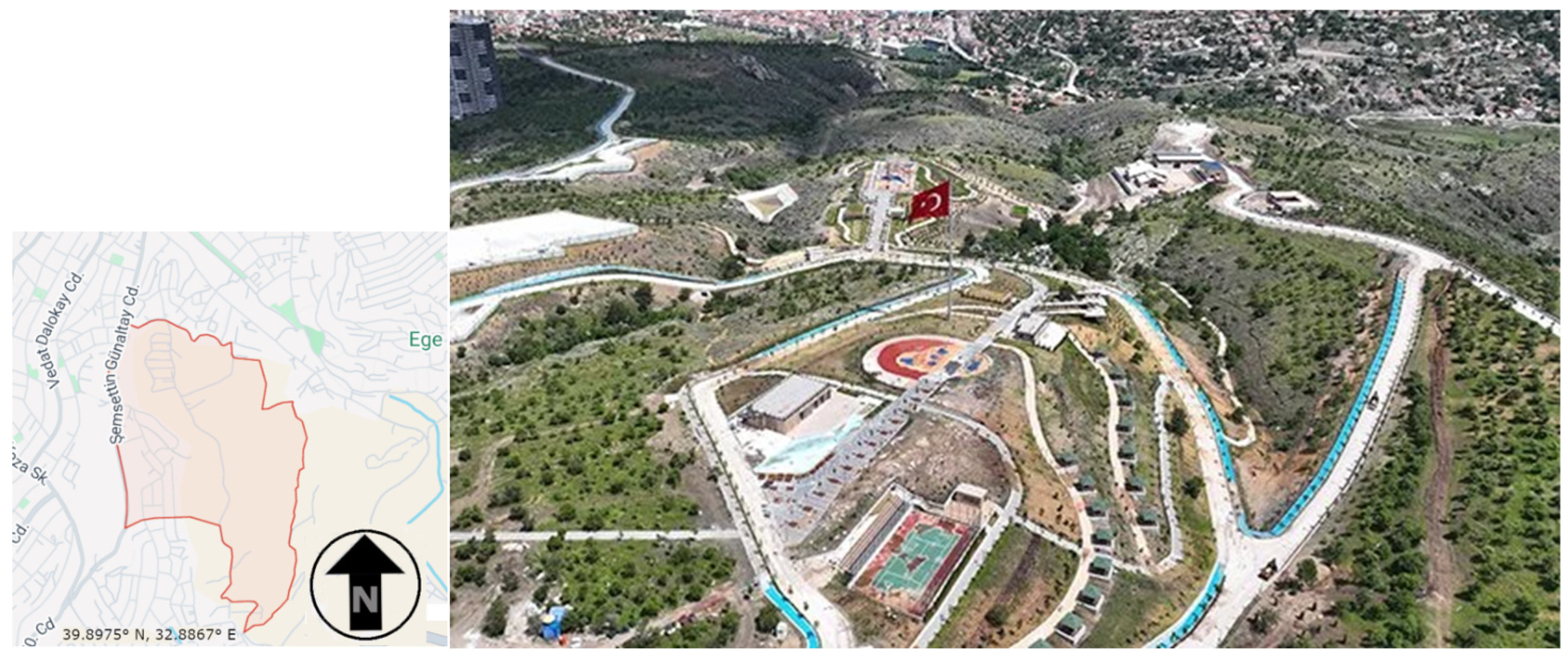
The other area examined in the study, Batıkent, is a neighborhood in the Yenimahalle district of Ankara (Figure 1). The Batıkent Recreation Area includes playgrounds, cafes, a sports complex, walking areas, bicycle paths, a youth center, a women’s center, and other recreational area uses within a project area of 430 decares. The existing species design of the Batıkent Recreation Area project consists of 7555 trees (Appendix A Table A1), 277,249 shrubs (Appendix A Table A2), 22,800 groundcover species (Appendix A Table A3), 77,809 m2 of meadow area (Appendix A Table A4) and 41,420 m2 of lawn area (Appendix A Table A5). The total area of structural elements is 191,160 m2. The total area of plant materials is 240,440 m2.

2.1.2. Bademlidere Park and Recreation Area

Bademlidere, one of the study sites, is a neighborhood in the Çankaya district of Ankara Province (Figure 2). The Bademlidere Park and Recreation Area landscape project was designed over an area of approximately 240,000 m2, and its construction was completed in 2023. The park includes an Adventure Park, Equestrian Facility, Main Square Children’s Playground, Picnic Area Children’s Playground, Square Café, Observation Terraces, Mini Pond, Picnic Areas, Rainwater Harvesting Pond, basketball court and multi-purpose field, bicycle paths, and car parking areas.
The primary objectives of the current project include retaining rainwater in the soil to prevent rapid evaporation, controlling erosion, and improving soil structure. To achieve these goals, the site has been planted with species found in the natural vegetation of Ankara Province, as well as drought-tolerant plants.
When the existing landscape implementation project of the recreation area is examined, there are approximately 28,360 m2 of lawn area and 23,189 m2 of area planted with clover seeds. The quantities of hard surface areas within the project site, including vehicle roads, bicycle paths, rubber pavements, wooden pavements, acrylic and aggregate coatings, granite and basalt pavements, dolomite stone pavements, and concrete area pavements, as well as other structural elements (gazebo, kiosks, etc.), amount to 75,500 m2. The total area of structural elements is 127,000 m2, and the bare soil area is 110,500 m2. Regarding the distribution of plant materials; there are 2808 deciduous trees and shrubs, 2223 evergreen trees and shrubs (Appendix A Table A1), 359,986 shrubs, 142 climbers and vines, 198 herbaceous species (Appendix A Table A2), 7600 groundcovers (Appendix A Table A3), 28,360 m2 of lawn area (Appendix A Table A4), and 23,189 m2 of clover area (Appendix A Table A5).

2.1.3. Landscape Plants and Plant Coefficients Suitable for Ankara’s Climate and Soil Conditions

Ankara province has a broader plant spectrum than other semi-arid regions due to its northern border with the Black Sea climate, its extensive steppe areas in the south, and the presence of diverse topographic and microclimatic zones. This ecological diversity allows for the use of both drought-tolerant species and species that can thrive in more humid areas in the design of landscape and recreation areas. Moreover, topographic variations and local climate factors enhance the adaptability of plant species, contributing to sustainable landscape practices. The Kc values used in this study were derived from FAO publications, academic studies, and average values obtained from landscape applications [38,39,40,41]. For plant species whose Kc values are not directly reported in the literature, Kc values of morphologically and ecologically similar species were used as references.

2.2. Methods

A sustainable and healthy xeriscape design depends on a complete and accurate analysis of the study area and its planning in accordance with xeriscape design principles. Xeriscape design is a design approach developed to conserve natural resources and promote sustainable landscape practices in regions with limited water availability. This approach includes principles such as the selection of low-water-use plant species, the implementation of efficient irrigation methods, and the enhancement of soil water retention capacity. Particularly in semi-arid and arid climate regions, xeriscaping is considered an important tool for optimizing water savings while maintaining the functionality of green spaces [42]. In this context, the application of xeriscape principles in areas like Ankara, where water resources are limited and drought risk is high, can provide significant environmental and economic benefits.

2.2.1. Xeriscape Landscape Design Principles

Xeriscape design is based on eight fundamental principles: proper planning, appropriate plant selection, soil improvement, efficient irrigation techniques, limitation of turf areas, mulch application, regular maintenance, and recycling practices [43].
One of the core principles of xeriscape design is water conservation. This approach has been developed to ensure environmental sustainability in regions with limited water resources. The main components of this principle include selecting plant species with low water requirements, employing efficient irrigation systems, and managing water use effectively. Xerophytic plants are notable for their thick leaves, deep root systems, and surface features that reduce water loss. Examples of such plants include lavender, sedum, cactus, and yucca. Turf areas, due to their high water consumption and maintenance requirements such as mowing and fertilization, are generally incompatible with xeriscape principles [44]. Therefore, the use of turf is avoided or limited to specific areas. Alternatives such as groundcover plants, artificial turf, and natural stone are preferred. The water conservation principle is important not only for plant selection but also for reducing landscape maintenance costs and preserving ecosystem balance.
Recent studies provide empirical support for the role of soil improvement and mulching in conserving soil moisture and improving water-use efficiency in dry and semi-arid environments. Wang [45] showed that organic mulch thickness significantly influences runoff reduction and soil-water conservation in urban green areas under heavy rainfall conditions, indicating that mulch performance depends on slope, rainfall intensity, and application depth. Similarly, Kader et al. [46] reported that mulching can reduce soil evaporation, regulate soil temperature, suppress weed growth, and improve soil moisture retention, thereby supporting more efficient water use in managed landscapes and agricultural systems. Soil amendment practices also contribute to xeriscape performance by improving soil physical properties and increasing water-holding capacity. For example, Kang [47] demonstrated that selected soil amendments enhanced soil aggregate stability, water retention, and plant growth, confirming their relevance for improving soil function under water-limited conditions. In addition, Fan [48] emphasized that mulching is an effective soil and water conservation practice because it reduces runoff and soil loss while improving surface protection. These findings support the inclusion of soil amendment, water retention improvement, and mulching as core mechanisms within xeriscape landscape design.
Selecting native plant species in xeriscape design increases water conservation and reduces maintenance requirements. Native species can thrive with minimal irrigation, fertilization, and pesticide use, supporting long-term sustainability. Additionally, native plants offer advantages such as preventing soil erosion and contributing to natural aesthetics. Furthermore, they provide food and shelter for local fauna, positively contributing to ecosystem balance [49,50].
Groundcover species consist of low-growing plants that cover the soil, reducing evaporation. In addition to conserving water, it prevents soil erosion and limits weed growth. It also protects plant roots from temperature fluctuations by shielding the soil surface from direct sunlight. With its aesthetic contribution and ease of maintenance, groundcover species hold an important place in xeriscape design [51].
Microclimate design aims to create optimal environmental conditions for plant growth by regulating climatic factors such as wind, sunlight, temperature, and humidity within a specific area. This strategy supports healthy plant development while reducing water loss. Different microclimate zones can be established through practices such as shading, windbreaks, and water direction management. Additionally, rainwater harvesting systems can enable water reuse, further enhancing the sustainability of the design [52].
Irrigation efficiency refers to the proportion of applied water that is directly used by plants. High efficiency is achieved by minimizing losses such as evaporation, seepage, and surface runoff. In xeriscape design, irrigation systems should be planned to deliver water directly to the root zone. In this context, drip irrigation supplies water at low pressure directly to plant roots, reducing evaporation and surface runoff losses. Sprinkler irrigation distributes water through atmospheric spraying but has limited application due to evaporation losses. Smart irrigation systems use sensors to automatically control watering, applying water only when necessary. In landscape applications, deciduous and coniferous trees are irrigated with drip systems, turf areas with sprinkler irrigation, and groundcover plants and shrubs are irrigated using either sprinklers or drip systems, depending on the plant species and application method [53].
Turf areas are not compatible with xeriscape design due to their high water and maintenance requirements. Therefore, large turf areas should be avoided, and low-water-demand groundcovers such as sedum, vinca minor, and lavender, or alternative materials like natural stone and artificial turf, should be used instead. This approach offers advantages both aesthetically and economically [54].
Soil improvement practices are carried out to enhance soil water-holding capacity and fertility. Adding organic matter increases soil vitality and its ability to retain water. This capacity can be further supported with amendments such as polymer gels, zeolite, and vermiculite. Mulching, applied as a surface cover, reduces evaporation and helps maintain temperature balance. Additionally, soil pH adjustment creates an environment suitable for plant nutrient uptake [55].
Recycling and recovery are integrated into landscape design to conserve natural resources and reduce waste. Examples of this principle include rainwater harvesting, compost production, and the use of recycled materials. Finally, education and awareness initiatives support the adoption of xeriscape practices, contributing to sustainability. With increased public awareness, the widespread implementation of environmentally friendly practices becomes possible [56].

2.2.2. Penman–Monteith Method

The crop water requirement is defined as the quantity of water needed to compensate for evapotranspiration losses from a cultivated field. Although crop evapotranspiration and crop water requirement are equivalent, they refer to different aspects of the water balance: crop evapotranspiration denotes the amount of water lost through evapotranspiration, whereas crop water requirement indicates the amount of water that must be supplied to meet this loss. In general, irrigation water requirement is calculated as the difference between crop water requirement and effective precipitation. It may also include additional water needed for salt leaching and for compensating losses caused by non-uniform water distribution during irrigation [38,57].
The accounting boundary of annual irrigation water requirement is the annual field-scale, crop-root-zone boundary used to estimate the total irrigation water that must be supplied for crop production during a full year. Within this boundary, crop water demand is based on evapotranspiration, including both crop transpiration and evaporation from the soil. The calculation credits only the portion of rainfall that is effectively stored in the root zone and used by the crop; rainfall lost as runoff or otherwise unavailable is not counted as useful water. It also considers irrigation efficiency, because the gross amount delivered must be higher than the net crop requirement when conveyance, distribution, or application losses occur. Evaporative losses from the soil and crop surface are included as part of crop evapotranspiration. However, deep percolation beyond the root zone is generally not counted since it is very hard to measure.
The Penman–Monteith method is one of the most reliable and scientifically based approaches for estimating plant water requirements. This method is used to determine the amount of water lost through transpiration by plants and evaporation from the soil surface. In the calculations, meteorological (Table 2) and locational data—such as temperature, relative humidity, sunshine duration, and wind speed—are considered alongside plant characteristics [38,58].
In this method, reference crop water consumption is determined by Equation (1).
ETo = 0.408     R n G + γ 900 T + 273   u 2 ( e s e a ) + γ ( 1 + 0.34 u 2 )
In this equation;
ETo = Reference evapotranspiration (mm day−1)
= Slope vapour pressure curve [kPa °C−1],
Rn = Net radiation at the plant surface (MJ/m2 day−1)
G = Soil heat flux density (MJ/m2 day−1)
γ = Psychrometric constant (kPa °C−1)
T = Mean daily air temperature at 2 m height (°C),
u2 = Wind speed at 2 m height (m s−1),
ea = Actual vapor pressure at mean air temperature (kPa)
es = Saturated vapor pressure at mean air temperature (kPa)
Once the E T o value is obtained, the crop evapotranspiration is calculated using the equation:
ETc = Kc × ETo
In this equation:
ETc = The amount of irrigation water required by a specific crop in a given area during a certain period. It is used in the design of irrigation systems, water resource management, and the calculation of irrigation schedules.
Kc = The crop coefficient, which represents the ratio of the crop’s water consumption to the reference crop evapotranspiration. It is used to determine the actual water consumption of the crop.
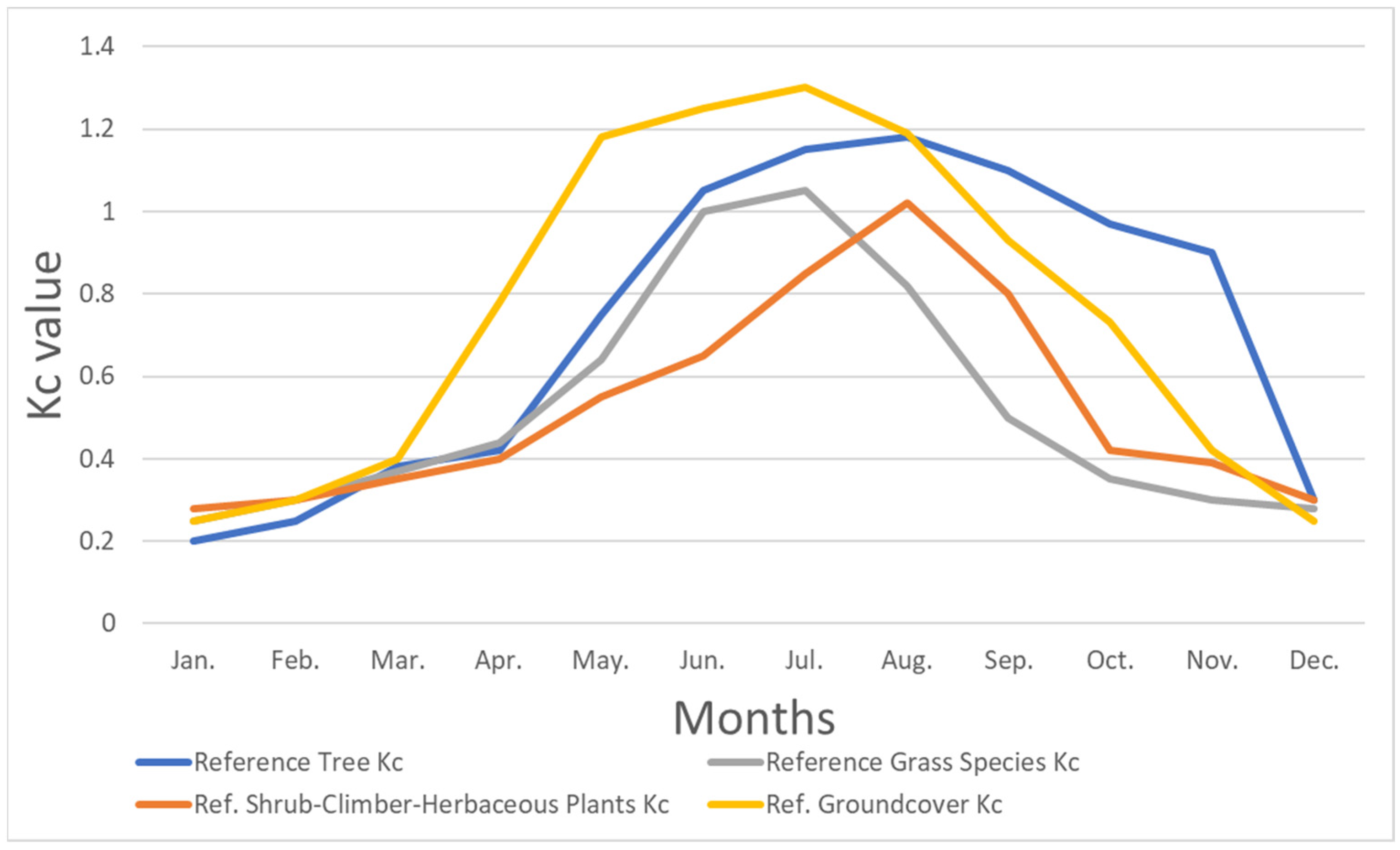
Climate, location, and soil data are measured at the local scale, enabling the calculation of ETo. The most critical aspect in determining ETc is establishing the correct Kc for each plant and its growth stage. The average Kc variations in the plants used in landscape planning are presented in Figure 3. As can be seen in Figure 3, groundcover species have the highest Kc and therefore require the most water. They are followed by trees, then grass and shrubs.
The crop coefficient values used in this study were stage-wise Kc values derived from the general Kc curve presented in Figure 3. While crop coefficient values for many cultivated annual crops are well documented in the literature, Kc information for non-agricultural species, particularly landscape plants, is limited. Therefore, a generalized Kc curve for the evaluated plant groups was developed using the reference sources described in Section 2.1.3.
Following the FAO-56 crop coefficient curve framework, the Kc curve was divided into four growth-related stages: initial, crop development, mid-season, and late-season. The initial stage was represented by the lowest Kc value on the curve, whereas the mid-season stage was represented by the maximum Kc value reported for the corresponding plant group in the appendices. For the crop development and late-season stages, where Kc changes progressively, representative stage values were obtained by linear interpolation between the beginning and ending points of the relevant curve segment, and the mean value of each stage was used in the calculations.
Thus, each stage was assigned a representative Kc value derived from the corresponding segment of Figure 3. These stage-wise Kc values were then used separately to calculate plant water requirement for each period using Equation (2). This approach accounts for the temporal variation in Kc during different growth stages and avoids the use of a single Kc value for the entire assessment period.

2.2.3. CROPWAT Software

CROPWAT is a decision support software developed by the FAO, designed for agricultural water management, irrigation planning, and efficient utilization of water resources. The program calculates the water requirement of a reference crop (ETo) for a given region using the Penman–Monteith method. Additionally, crop water consumption (ETc) can be determined by applying crop coefficients (Kc) specific to different growth stages [40].
CROPWAT was applied as a calculation-based irrigation water requirement model using the FAO Penman–Monteith approach, local meteorological data, and crop/plant-specific coefficient values. The estimations were conducted for the selected urban green space sites under the climatic conditions of Ankara rather than for separate hydrological basins. The main parameters, meteorological, crop coefficients, and planting area characteristics, were defined according to available climate records, literature-based coefficients, and site-specific planting data. It has been reported in many studies that CROPWAT performs well in Ankara and the surrounding region in calculating crop water requirements [59,60,61,62,63].
CROPWAT provides analyses aimed at optimizing water use in agricultural production by taking into account different climate data, soil characteristics, and irrigation methods. Through the program, users can plan irrigation schedules, evaluate water stress scenarios, and compare the efficiency of different irrigation strategies. It is particularly used as a crucial tool for achieving water savings and supporting sustainable agricultural production in arid and semi-arid regions. Additionally, it is frequently employed in regional-scale water management projects and studies assessing the impact of climate change on agricultural water resources. The water requirements of all plants in the project area were determined using CROPWAT version 8.0. It takes into account how much of the total rainfall will be converted into effective rainfall during ETo or ETc calculations, depending on environmental and climatic factors. Thus, the determined net irrigation water amount is corrected with irrigation efficiency, which represents water evaporation, water transmission, and infiltration losses depending on the irrigation method, to calculate the gross irrigation water amount. Irrigation efficiency was taken as 90% for drip irrigation and 70% for sprinkler irrigation.

3. Results

In the study area, the automatic irrigation system does not include differentiated zoning based on the water requirements of individual plant species; therefore, all trees are subjected to the same irrigation schedule. This implies that the irrigation system is assumed to water the entire area uniformly, and in practice, the irrigation duration is generally determined by the species with the highest water demand. Within this context, the tree species with the highest Kc value in the park was identified, and its water requirement for this species was calculated using the existing irrigation system. This approach provides a realistic model for representing on-site irrigation practices and serves as a basis for determining water consumption and analyzing the potential savings achievable in line with xeriscape principles.

3.1. Batikent Recreation Area Existing Plant Groups and Water Consumption

When examining the Kc values of trees and shrubs used in Batıkent Recreation Area, the plants with the highest Kc value are Betula alba (1.10), while the lowest are Juniperus species (0.45). The water consumption of trees and shrubs in the park was calculated using the highest value, 1.10.
When examining the Kc values of shrubs, climbers, and herbaceous plants in the area, the plants with the highest Kc value are Miscanthus sacchariflorus (0.90). The lowest are Lavandula angustifolia (0.50) and Buxus sempervirens (0.50).
Based on the Kc value ranges and mixture ratios for grass, the average Kc value was taken as 0.96. For meadow, the average Kc value was 1.00.
The water consumption of plants in the park area was calculated based on the Penman–Monteith method (Table 3). The annual total water consumption for Batıkent was calculated as 185,566 m3.
In Batıkent, the annual total water consumption was 185,566 m3. Meadow areas accounted for 100,617 m3 of this total, lawn areas for 42,939 m3, shrubs, vines, and herbaceous plants for 21,515 m3, groundcover plants for 14,097 m3, and tree groups for 6398 m3. Meadow and lawn surfaces together therefore represented the dominant share of water demand within the project.

3.2. Bademlidere Recreation Area Existing Plant Groups and Water Consumption

When examining the Kc values of trees and shrubs used in the Bademlidere Recreation Area, the plants with the highest Kc values were Betula alba (1.10), Platanus orientalis (1.10). The lowest was Eleagnus angustifolia (0.50). The highest Kc value was used when calculating the water consumption of the trees and shrubs in the park.
Among the shrubs, climbers, and herbaceous plants used in the Bademlidere Recreation Area, some of the plants with the highest Kc values were Rosa sp. (0.90), Viburnum tinus (0.80). The lowest were Buxus sem. rot. (0.50), Senecio maritimus (0.50), Lavandula officinalis (0.50), and Juniperus horizontalis (0.50).
In the Bademlidere Recreation Area project, groundcover plants were used in two groups. The first group included the herbaceous plants Cerastium tomentosum, Festuca glauca, and Thymus vulgaris, while the second group consisted of areas sown with clover seeds as groundcover. According to July data, the plant with the highest Kc value among the groundcovers, Festuca glauca, was taken as the reference, and a Kc value of 0.55 was assigned for all groundcover plants. The clover seed mixture ratio was Trifolium repens 70% and Trifolium pratense 30%. The July Kc value, calculated according to the proportions of the species in the mixture, was 0.94.
A four-species grass seed mixture was used in the project. The proportions were Lollium perenne 30%, Poa pratensis 10%, Festuca arundinacea 35%, and Festuca rubra rubra 25%. The July Kc value, calculated using the weighted average method based on the proportions of the species in the mixture, was found to be 0.94.
The water consumption of plants in the park area was calculated based on the Penman–Monteith method. When determining the monthly net irrigation requirement, the precipitation amount was subtracted from the gross water requirement and adjusted using the application efficiency corresponding to the irrigation method (Table 4). It was assumed that a smart irrigation system was used on the site and that rain sensors were connected to the control unit.
For Bademlidere, the annual total water consumption was 90,591 m3. Lawn areas accounted for 28,824 m3 of this total, meadow/clover areas for 27,623 m3, shrubs, climbers, and herbaceous plants for 27,679 m3, tree groups for 6329 m3, and groundcover plants for 136 m3. The clover areas, therefore, exhibited water consumption values close to those of turf areas under the assumptions used in the calculations.
Household water consumption is closely related to the climate and culture of the region. Calculations based on data from the Turkish Statistical Institute (TurkStat) and Ankara Municipality indicate that the average domestic water use in the Ankara region is 15 m3/month [64]. The total annual water consumption obtained in Batıkent and Bademlidere Areas is approximately equivalent to the annual domestic water consumption of 1030 and 505 households, respectively, assuming an average monthly household water use of 15 m3.

3.3. Proposed Landscape Design and Water Consumption for Batikent

3.3.1. Proposed Project Based on Low-Water-Use Plants for Recreation Areas and Evaluation of Water Savings

During the xeriscape design process, the number of plants in the initial project was not changed; instead, a new landscape design was proposed by selecting plants with lower water requirements (low Kc values). In this way, water is saved without reducing the number of plants or the amount of green space, and without making any visual difference. In line with xeriscape design principles, a proposed list of low-water-use deciduous trees, coniferous trees, and shrubs suitable for Ankara’s climate [Cercis siliquastrum (0.7), Crataegus monogyna (0.7), Eleagnus angustifo. (0.5), Cedrus deodora (0.7), Cedrus libani (0.7), Cupressus sempervir. (0.7), Pinus nigra (0.6), Pinus brutia (0.6), Pinus sylvestris (0.6), Acer campestre (0.6), Cotinus coggyg. r. p. (0.55), Quercus pubenscens (0.6), Koelreuteria panicul. (0.65), Melia azedarach (0.65), Thuja occidentalis s. (0.7)] includes plants with a maximum Kc value of 0.7 according to July data (Appendix A Table A1). Species selection was based on floristic suitability following Akkemik [65], while Kc values were compiled from FAO Irrigation and Drainage Paper No. 56 and related literature. The proposed project will be compared fundamentally with Batıkent Recreation Area, which has the highest water consumption (185,566 m3).
One of the most commonly used elements in plant landscaping for parks and recreation areas is the shrub groups. In line with xeriscape design principles, a proposed list of low-water-use shrubs, climbers, and herbaceous plants suitable for Ankara’s climate [Thymus vulgaris (0.5), Juniperus horizontal. (0.5), Juniperus sabina (0.5), Juniperus communis (0.5), Juniperus chinensis (0.6), Acantholimon anatol. (0.6), Artemisia arboresce. (0.6), Abelia grandiflora k. (0.6), Berberis thunbergii (0.55), Berberis thunberg. a. (0.55), Berberis thunber. a. (0.55), Berberis thunberg. m. (0.55), Buxus sempervirens (0.5), Buxus sempervire. r. (0.5), Cotaneast. damme. h. (0.55)] includes species with a maximum Kc value of 0.6 according to July data (Appendix A Table A2).
In the current project, Rudbeckia hirta (Black-eyed Susan), with a Kc value of 0.6 according to July data, was used as the basis for groundcover plant water consumption calculations. In the proposed project, Achillea millefolium (Yarrow) with a Kc value of 0.4 has been selected (Appendix A Table A3).
For the 11,420 m2 area allocated to lawn, the selected turfgrass seed mixture should be adapted to semi-arid climates, tolerant to water stress, and characterized by a low Kc value. This indicates that the turf will consume less water relative to the reference evapotranspiration rate. The strategy to be followed here is to prepare a seed mixture that includes warm-season grass species with the greatest tolerance to cold. Cynodon dactylon and Zoysia japonica are among the warm-season turfgrass species that are less affected by cold weather conditions than many alternatives. Although these species lose color during extremely cold winter periods, they regain their turfgrass characteristics in spring.
If a recommended five-species mixture is to be prepared, it could be composed of 30% Festuca arundinacea, 15% Lolium perenne, 15% Poa pratensis, 20% Cynodon dactylon, and 20% Zoysia japonica. The mean Kc value of this mixture is 0.8.
With the new mixture proposed for the meadow areas, the average July Kc value has been reduced to 0.58 (Appendix A Table A4).
In the current project, an area of 77,809 m2 has been established with meadow plants. The mixture applied here has a July Kc value calculated as 1.00. The reason for the high Kc value is the selection of plant species with high Kc values in the mixture, such as Medicago sativa (alfalfa, Kc value: 1.0–1.3) and Avena sativa (white oat, Kc value: 0.9–1.0). Due to the inappropriate selection of plant species used in the mixture for forming meadow areas, the targeted water savings cannot be achieved. If an alternative plant list is proposed for this mixture:
  • Cerastium tomentosum (snow-in-summer, Kc value: 0.50): This species, which has silvery-green foliage and white flowers, is successfully used as a groundcover in semi-arid climates and has an extremely low water requirement. It spreads quickly, covering the soil surface, and can easily be used over large areas instead of turfgrass.
  • Festuca glauca (blue fescue, Kc value: 0.55): A fine-textured grass species that grows in small tufts. It adapts well to drought and poor soils, requires minimal mowing, and has a low water consumption.
  • Thymus serpyllum (creeping thyme, Kc value: 0.45): A thyme species native to Ankara, this aromatic groundcover plant can survive even on rocky and dry slopes. Its water requirement is minimal. It spreads to fill gaps and suppresses weeds.
  • Lotus corniculatus (bird’s-foot trefoil, Kc value: 0.80): This legume species has the advantage of enriching the soil with nitrogen. Compared to other alfalfa species, it has a lower Kc value. It is a drought-tolerant, perennial groundcover.
The average Kc value of these plants is 0.58. They can be applied in mixed form across the site or used in designated zones (Appendix A Table A5).
Accordingly, the annual water requirement, which was 100,617 m3 in the current project, has been reduced to 45,731 m3 with this adjustment. The estimated water savings achieved by changing the plant groups in the meadow areas amount to 54,886 m3. With all these changes, the proposed design resulted in a calculated annual total water consumption of 82,835 m3 for Batıkent (Table 5).

3.3.2. Comparative Water Consumption by Major Plant Groups

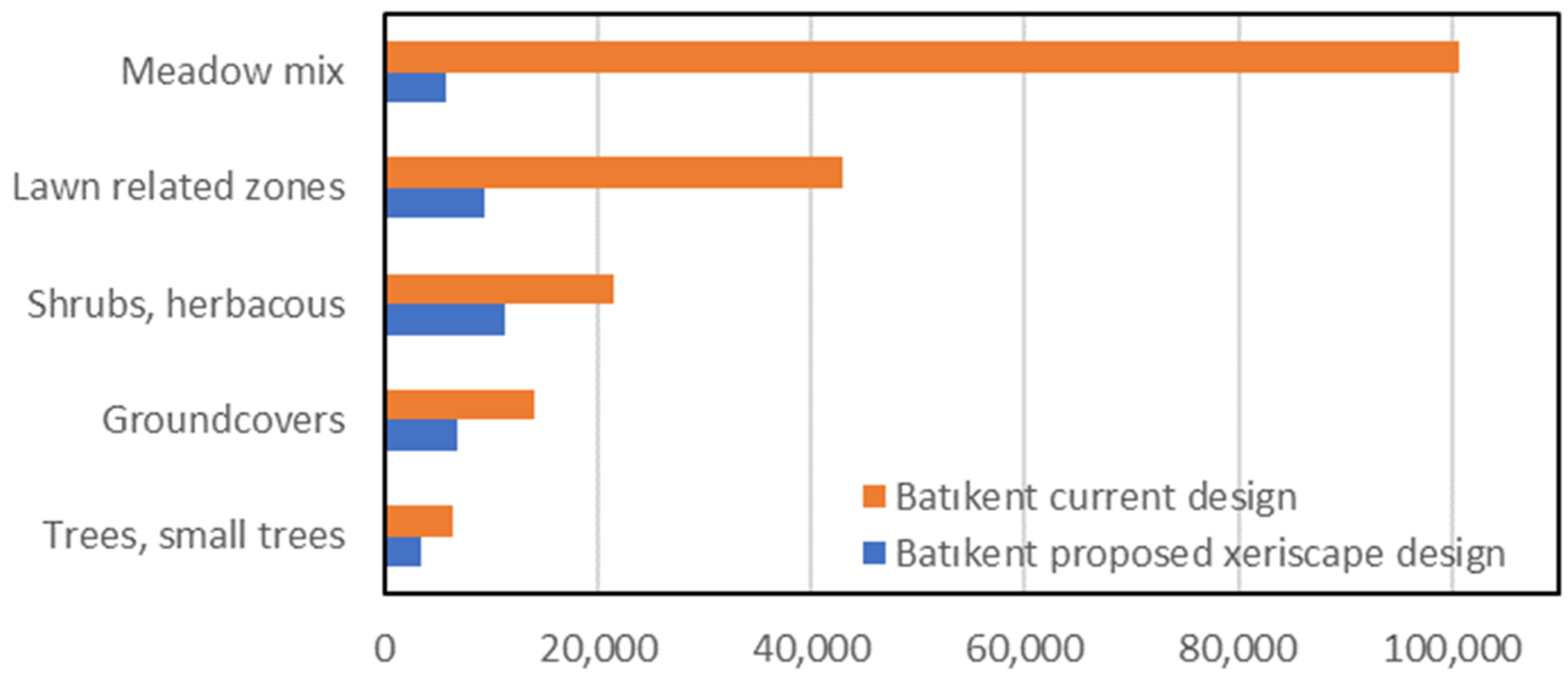
Figure 4 summarizes the annual water consumption of the major plant groups in Batıkent under the current and proposed design scenarios. Of the 5 different types of irrigation materials in the area, meadow mix showed the largest proportional and absolute decrease. The current annual consumption of 100,617 m3 decreased by approximately 94% to 5878 m3. The key here is paying attention to the meadow areas and the seed mix ratios. The second largest decrease occurred in lawn zones. The water requirement of 42,939 m3 decreased by approximately 78% to 9518 m3. In third place are groundcover species with a 51% decrease (from 14,097 m3 to 6871 m3). The last two species are shrubs and trees, with decreases of 47% (from 21,515 m3 to 11,395 m3) and 46% (from 6398 m3 to 3442 m3) respectively.
The largest absolute reductions occur in the meadow mix and in lawn-related zones, confirming that the redesign of extensive herbaceous surfaces, rather than only tree substitution, drives the majority of water savings in semi-arid park design.

3.4. Proposed Landscape Design and Water Consumption for Bademlidere

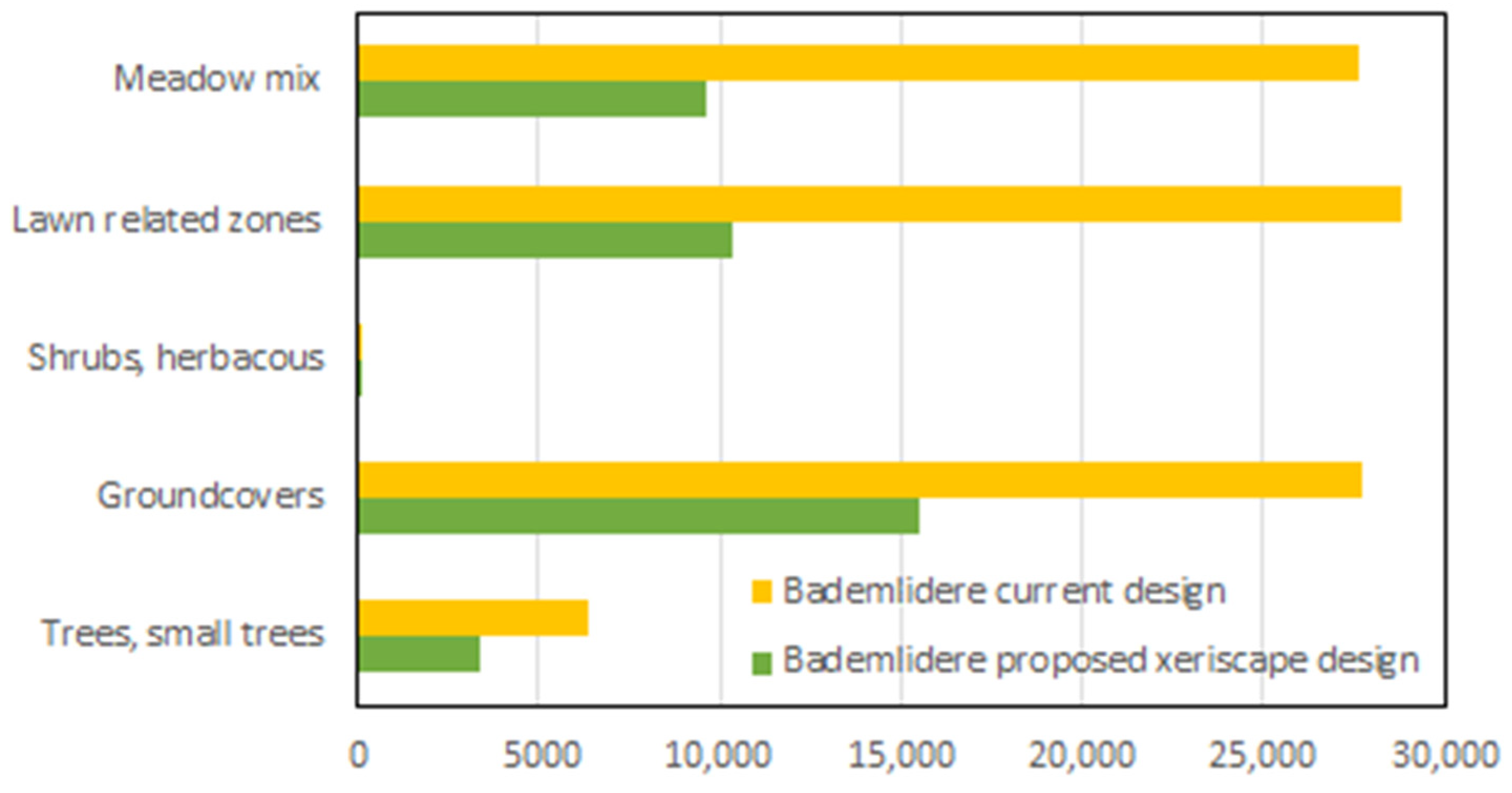
The plants primarily used in the xeriscape design of the Bademlidere recreation area were the same drought-tolerant trees, shrubs, grasses, lawns, and meadows selected for Batıkent Park (Appendix A Table A1, Table A2, Table A3, Table A4 and Table A5). In this case, the water requirement of the area was found to be 3405 m3 for deciduous trees, coniferous trees, and shrubs/small trees; 82 m3 for shrubs, climbers, and herbaceous plants; 15,491 m3 for groundcover plants; 10,389 m3 for lawn areas; and 9614 m3 for meadow areas. Accordingly, the annual water requirement of the current project, which is 90,591 m3, can be reduced to 38,981 m3 with the proposed adjustment, resulting in a total annual water saving of 51,610 m3 (Figure 5).

4. Discussion

4.1. Deciduous Trees, Coniferous Trees, and Small Trees/Shrubs

In xeriscape design, trees and small trees/shrubs are among the plant groups that offer designers greater flexibility, as they account for a relatively low proportion of overall water consumption. Thanks to their deep root systems, these plants can access moisture from deeper soil layers and are distinguished by their tolerance to long irrigation intervals. In implementations under Ankara conditions, species such as Platanus orientalis (Oriental plane), Quercus robur (pedunculate oak), Cedrus libani (Lebanon cedar), and Pinus nigra (black pine) demonstrate resilience to water stress due to their low leaf surface area, stomatal control capabilities, and climate adaptability. Additionally, these species create shaded areas through their canopy structures, reducing evaporation from the soil surface and serving as microclimate regulators. In accordance with xeriscape principles, trees and small trees/shrubs play an important aesthetic, ecological, and functional role, while their low water consumption provides designers with flexibility to enhance visual diversity and ensure long-term sustainability.
The total annual water consumption of deciduous trees, coniferous trees, and small trees/shrubs in the Batıkent Recreation Area is 6398 m3, while in the Bademlidere Recreation Area it is 6329 m3. According to the proposed project presented based on xeriscape design criteria, the annual water consumption in the Batıkent Recreation Area after changing the tree species is 3442 m3, resulting in a water savings of 2956 m3.

4.2. Shrubs, Climbers, and Herbaceous Plants

In xeriscape design, the use of shrubs, climbers, and herbaceous plants plays a critical role in both water management and the aesthetic sustainability of the landscape. These plant groups are generally shorter and have more superficial root systems, so while they do not require as intensive irrigation as turf areas, improper planning can still result in significant water consumption. In shrub groups, drip irrigation systems, which are widely used, provide an effective method for controlled watering; however, in applications in Turkey, planting shrubs too densely to achieve a “quick visual impact” reduces the efficiency of these systems and increases water use. Dense planting raises competition for water and nutrients among individual plants, limiting their growth, and also increases evapotranspiration due to the dense plant canopy, thereby elevating irrigation requirements.
With shrubs planted so densely, irrigation is often supplied through a single station, causing species with different water requirements to receive the same duration and flow rate. According to xeriscape principles, shrub groups can be divided into zones based on their water needs; for example, low-water-demand species can be irrigated through one line, medium-demand species through another, and high-demand species through a separate line with different durations and frequencies. This zoning approach ensures that each plant group receives only the water it requires, resulting in significant water savings. Otherwise, low-water-demand plants may suffer from root rot and diseases due to overwatering, while high-water-demand plants may experience stress due to insufficient irrigation.
The practice of dense planting combined with single-line irrigation significantly increases the practical water consumption of shrub groups, which are theoretically low-water-use plants, thereby contradicting the fundamental xeriscape principle of “water efficiency.” By leaving adequate spacing between plants, individual growth is supported, and total water demand is reduced. Furthermore, selecting drought-tolerant shrubs with low Kc values, such as Artemisia spp., Lavandula spp., Cistus spp., and Teucrium spp., can provide visual richness while minimizing water use. Similarly, for climbers and herbaceous species, plant selection should consider parameters such as sun–shade tolerance, leaf surface area, and root depth; planting density, maintenance requirements, and irrigation schedules should be determined based on these criteria.
In conclusion, the role of shrubs, climbers, and herbaceous plants in xeriscape landscapes can be optimized for both water consumption and maintenance costs through careful species selection, strategic zoning, and balanced planting spacing. Otherwise, dense planting and uniform irrigation practices implemented for visual impact can place a significant burden on water resources and negatively affect plant health.
The total annual water consumption of shrubs, climbers, and herbaceous plants in the Batıkent Recreation Area is 21,515 m3, while in the Bademlidere Recreation Area is 27,679 m3. According to the proposed project based on xeriscape design criteria, the annual water consumption in the Batıkent Recreation Area after changing the shrub species is 11,395 m3, resulting in a water savings of 10,120 m3.

4.3. Lawn Areas

Compared to woody plants, turfgrass species require substantially higher water inputs. In regions with abundant precipitation, including regular rainfall during summer months—such as northern European countries—water scarcity is generally not a concern, and turf areas are often maintained without irrigation systems. In contrast, in regions characterized by low annual precipitation and dry summers, particularly Mediterranean climates, water scarcity constitutes a critical issue, making intensive turfgrass use problematic [66].
According to xeriscape principles, lawn areas should be minimized and limited to only the necessary spaces due to their high water consumption and intensive maintenance requirements. In parks and recreational areas, turfgrass can be used in functional zones such as main axes and plazas with shallow depth frequently accessed by visitors, as well as playgrounds and gathering areas. In these locations, lawns provide a cool and soft surface that serves recreational needs. However, creating extensive lawn areas in interior or infrequently used zones contradicts xeriscape design principles. In summary, turfgrass should be applied only where essential, avoiding the creation of large expanses for aesthetic or habitual reasons. Under Ankara’s semi-arid conditions, this approach conserves water resources while also reducing maintenance costs.
Small changes in plant coefficients can provide significant water savings, particularly for species with high water consumption. Indeed, calculations show that a 0.1-unit reduction in the Kc value for trees does not significantly reduce total water consumption, whereas the same reduction in the turfgrass seed mixture results in annual water savings of 10,130 m3 in the Batıkent Recreation Area and 6895 m3 in the Bademlidere Recreation Area. This finding highlights that the selection of plant species and the proportion of mixtures used in lawn areas should be evaluated strategically, not only for aesthetics or durability but also for water management.
Using natural meadow areas as an alternative to lawn areas is an important strategy in xeriscape design. Meadow areas are established with a mixture of locally planted native or adapted herbaceous species that can grow with little or no mowing and rely on seasonal rainfall. Once established, these areas require less water, demand lower maintenance, and provide a natural landscape appearance. However, for a meadow area to be successful, the species included must have very low Kc values, minimal water consumption, and be suitable for Ankara’s steppe ecology.
The annual water consumption of lawn areas in the Batıkent Recreation Area amounts to 42,939 m3, while in the Bademlidere Recreation Area it is 28,824 m3. According to the proposed project based on xeriscape design criteria, the lawn areas in the Batıkent Recreation Area have been divided into four sections: part of the area was converted into meadow areas, part into artificial turf (10,000 m2) and part into areas covered with organic and/or inorganic materials (i.e., decorative stones, gravel, rocks: 10,000 m2). The remaining section was left as a lawn area. The turfgrass seed mixture in these areas was also reorganized to create a composition with a lower Kc value. As a result, a water savings of 27,543 m3 was achieved.
In xeriscape design, planting clover (Trifolium and Medicago species) is sometimes considered an alternative to turfgrass; however, several points warrant attention. According to calculations, the annual water consumption per 1 m2 for turfgrass is 1.14 m3, whereas for clover it is 1.31 m3. Based on these results, the water consumption of clover areas can, in some cases, be higher than or not significantly different from that of turfgrass areas. Although clover is a legume, it requires water to remain continuously green and dense. While clover areas are more drought-tolerant than turfgrass during water scarcity, they still require regular irrigation if a green appearance is desired. Therefore, switching to clover solely to reduce water demand may not achieve the expected water savings. Additionally, species such as alfalfa grow rapidly and become tall; in agricultural production, they are harvested multiple times per season (4–5 times). When planted as groundcover in landscaping, if not mowed frequently, they quickly lose their turf-like characteristics. Other Trifolium species, such as white clover and microclover, also require mowing, although not as intensively as alfalfa.
Clover species, particularly white clover, are considered invasive in certain regions and countries. They do not remain confined to the areas where they are planted and can spread into turfgrass areas, cracks in hard surfaces, flower beds, or walking paths. Observations in the United States have reported that Trifolium repens behaves invasively in many areas and can colonize both natural and managed plant communities [67]. This can create management challenges in landscaping. Additionally, clover seeds are long-lived and can remain in the soil, germinating even years later, making complete removal difficult. While clover is highly attractive to insects and bees, it is not as tolerant to heavy foot traffic as turfgrass.
For all these reasons, the planting of clover in xeriscape design should be carefully evaluated. Although clovers offer advantages such as drought tolerance and low fertilizer requirements, the expected water savings may not be achieved. A better approach may be to favor mixed meadow areas, as described in the previous section, or to use clover in a controlled manner alongside other species.
Nowadays, artificial turf is increasingly used as an alternative to natural turf in certain areas. In xeriscape design, it can also be preferred in some locations instead of natural grass. Artificial turf offers significant advantages because it does not require irrigation, mowing, or routine vegetation maintenance. However, it cannot provide the cooling effect or natural appearance of real turf. Moreover, because artificial turf does not cool through evapotranspiration, extensive replacement of living vegetation with synthetic surfaces may elevate surface temperatures and intensify local heat-island effects during Ankara’s hot summers. Landscape designers may therefore choose artificial turf only for decorative small green areas, heavily trafficked spaces, or locations where irrigation is difficult, rather than as a universal substitute for vegetated recreational surfaces.
Finally, in xeriscape design, exposed soil surfaces outside of lawn areas should be covered with groundcover materials whenever possible. Leaving bare soil not only creates an empty and neglected visual appearance but also leads to several functional problems. These issues include rapid weed growth, soil drying and cracking under the sun, erosion from rainfall, dust formation in summer, and mud accumulation in winter. The most commonly used groundcover materials are organic mulches (such as bark, shredded pruning residues, straw, etc.) and inorganic coverings (such as decorative stones, gravel, rocks, pumice, etc.).

4.4. Total Water Consumption and Water Savings

In the Batıkent Recreation Area, the existing design required 185,566 m3 of irrigation water annually, equivalent to 432 mm per square meter over the 430,000 m2 project area. Under the proposed xeriscape-based design scenario for Batıkent, the annual irrigation requirement decreased to 82,835 m3, corresponding to an estimated saving of 102,731 m3 and a reduced water requirement of 192 mm per square meter. This represents a calculated reduction of 55.4%. Although this value is higher than the 20–50% water-saving range reported for some xeriscape applications in Turkey, it should be interpreted as a scenario-based estimate derived from consistent climatic inputs, plant coefficients, irrigation efficiency assumptions, and area-based planting data rather than as a field-measured saving.
The results indicate that the water-saving potential of xeriscape design is primarily associated with changes in plant composition, surface-cover allocation, and species-specific crop coefficient values. In both recreation areas, tree groups accounted for a relatively small share of total irrigation demand, particularly when drip irrigation was assumed. This can be explained by their deeper root systems, longer irrigation intervals, and more localized water application within the root zone. In contrast, extensive herbaceous surfaces, especially lawn and meadow areas, represented the most water-demanding components because they cover large areas and require regular irrigation to maintain visual and functional quality during dry summer periods. Therefore, the findings suggest that water-efficient urban green space planning should not focus solely on reducing the number of woody plants, but should prioritize the redesign of high-water-demand surface covers.
The calculations also show that meadow areas should not automatically be regarded as low-water-use alternatives to turfgrass. In the Batıkent project, 119,229 m2 was allocated to lawn and meadow surfaces, including approximately 42,000 m2 of lawn and 77,229 m2 of meadow. Although meadow planting is often preferred in sustainable landscape design due to its potential drought tolerance and lower maintenance demand, the estimated water consumption of the meadow and lawn areas in this study was relatively similar. This result is mainly related to the species composition of the meadow mixture and its weighted average Kc value. Therefore, the water performance of meadow areas depends not only on their general classification as “meadow” but also on the selected species, planting density, management objective, and expected visual quality. From this perspective, meadow mixtures should be evaluated through explicit Kc-based criteria before being adopted as water-saving alternatives in semi-arid urban green spaces.
Similarly, the clover areas used as an alternative to turfgrass in Bademlidere were calculated to have water consumption values close to those of lawn areas. This finding suggests that plant substitutions should be assessed through measurable water-demand indicators rather than general assumptions about drought tolerance or low maintenance. Species selection, irrigation zoning, planting density, and the spatial distribution of surface covers are therefore central mechanisms through which xeriscape design can reduce irrigation demand while maintaining the ecological, recreational, and visual functions of urban green spaces.
The estimated annual saving of 102,731 m3 in the proposed Batıkent scenario also has implications for urban water resource sustainability. Reduced irrigation demand may contribute not only to water conservation but also to lower indirect energy requirements associated with water abstraction, pumping, pressurization, conveyance, and distribution. However, since energy use was not directly measured in this study, this implication should be interpreted as a potential contribution within the broader water–energy–environment nexus rather than as a quantified energy-saving result. From a planning perspective, the findings support the integration of xeriscape principles into municipal green space design, particularly through the specification of maximum weighted average Kc values for meadow mixtures and other extensive planted surfaces. Such an approach may help semi-arid cities develop urban green spaces that are more resource-efficient, climate-responsive, and environmentally sustainable.
The findings of this study are supported by previous irrigation water requirement studies emphasizing the importance of combining reference evapotranspiration, crop/plant coefficients, climatic conditions, growth stages, and irrigation management when estimating water demand. Gabr [68] showed, using FAO-CROPWAT 8.0 and CLIMWAT 2.0 in semi-arid regions, that crop pattern selection and irrigation efficiency substantially affect net and gross irrigation water requirements. The study also emphasized that Kc varies over the growing period and can be divided into initial, development, mid-season, and late-season stages, supporting the stage-wise Kc approach used in the present study. Kumar and Sen [69] similarly demonstrated that crop water requirement should be evaluated through Penman–Monteith-based evapotranspiration estimation and that longer-duration crops generally result in higher evapotranspiration than shorter-duration crops. These findings are directly relevant to urban xeriscape planning. The present results show that water savings depend not only on replacing turfgrass but also on the seasonal water-use behavior of the selected species. In particular, the higher annual water consumption calculated for clover groundcover compared with turfgrass indicates that a plant promoted as a lawn alternative may not always reduce irrigation demand if a continuously green appearance is maintained. Therefore, xeriscape performance should be assessed using species-specific and stage-wise Kc values, planting density, growth duration, and site-specific evapotranspiration conditions rather than generalized assumptions about plant categories.
The results of this study should also be interpreted within the broader context of climate change, increasing urban population pressure, and declining water availability. Semi-arid cities such as Ankara are expected to face greater challenges in maintaining urban green spaces as higher temperatures, longer dry periods, and irregular rainfall regimes increase reference evapotranspiration and reduce the reliability of precipitation as a water source. Previous studies have emphasized that water scarcity, climate variability, population growth, and urbanization increase pressure on available water resources and make efficient water management a priority. Under future climate scenarios, urban irrigation demand may be managed through a combination of strategies: selecting drought-tolerant and low-Kc species, reducing the proportion of high-water-use turf areas, grouping plants according to hydrozones, improving irrigation efficiency through drip or smart irrigation systems, adjusting irrigation schedules according to seasonal evapotranspiration, and incorporating non-potable or harvested water sources where feasible. These measures are consistent with previous irrigation studies showing that improved irrigation efficiency and the selection of lower-water-demand planting or crop patterns can reduce total water requirements. Therefore, xeriscape planning should be regarded not only as a landscape design approach, but also as a climate adaptation tool for reducing municipal irrigation pressure under increasing population and water scarcity.

5. Conclusions

This study examines the potential of xeriscape-based landscape design to support water-efficient and sustainable urban green spaces in semi-arid cities. Focusing on the Bademlidere and Batıkent Recreation Areas in Ankara, the research compares existing planting schemes with a low-water-use design proposal developed according to xeriscape principles. The findings indicate that plant selection, irrigation zoning, planting density, and surface-cover decisions are key factors influencing the long-term water performance of public landscapes. Under conditions of hot, dry summers and increasing drought risk, conventional landscape practices based on extensive lawn coverage or rapid visual impact may place considerable pressure on urban water resources. In this context, xeriscape design offers a practical planning approach that can reduce irrigation demand while maintaining the ecological, recreational, and visual functions of urban green spaces.
The quantitative results demonstrate the water-saving potential of xeriscape-oriented planning at the project scale. The annual irrigation water requirement of the existing planting design was calculated as 90,591 m3 for Bademlidere and 185,566 m3 for Batıkent. In the xeriscape-based alternative proposed for Batıkent, annual water demand decreased to 82,835 m3, producing an estimated saving of 102,731 m3 per year. This amount is approximately equivalent to the yearly domestic water demand of around 600 households. These results suggest that water-sensitive planting strategies can generate substantial reductions in irrigation demand and may contribute to drought adaptation when implemented across public open spaces.
A central finding is that landscape water performance depends not only on broad plant categories, such as lawn, meadow, or shrub areas, but also on the actual species composition within each group. Trees and large shrubs, particularly when irrigated with drip systems, represented a relatively smaller share of total water use due to their deeper root systems, longer irrigation intervals, and shading capacity. In contrast, lawns, meadow areas, and densely planted shrub masses were identified as more critical components in terms of irrigation demand. Therefore, effective water-saving design should prioritize those planting groups where changes in species selection, seed mixture, or spatial allocation can produce the greatest reductions in water consumption.
The study emphasizes that turfgrass should not be entirely rejected, but used selectively in areas with clear recreational or social functions, such as play, gathering, or active use. Water efficiency can be improved by reducing conventional turf in less functional areas, revising seed mixtures toward lower-water species, and reallocating space to better-adapted groundcovers or meadow compositions. However, artificial turf should not be treated as an ecological substitute for natural grass because it lacks comparable cooling benefits and may intensify local heat stress.
Methodologically, the study offers a practical framework for integrating irrigation water-demand estimation into urban landscape planning. By combining the Penman–Monteith method, CROPWAT-based calculations, and species-specific crop coefficients, it enables municipalities, landscape architects, and irrigation engineers to assess water requirements at the design stage and develop evidence-based planting strategies for semi-arid cities.
The findings also relate to the broader water–energy–environment nexus. Since urban water systems require energy for abstraction, treatment, pressurization, and distribution, reducing irrigation demand may also lower indirect energy use. Previous studies on the urban water–energy nexus and water–energy–carbon sustainability indicate that irrigation practices affect resource consumption, carbon performance, and environmental sustainability. Fan et al. [70] emphasized that the urban water–energy nexus is a critical framework for understanding resource flows in cities and for supporting sustainable urban planning through demand-side water management. Similarly, Ahmad et al. [71] showed that water–energy nexus studies in urban water systems provide useful insights for minimizing water and energy consumption and improving management efficiency. Qu et al. [72] proposed a water–energy–carbon sustainability index for urban green spaces and demonstrated that irrigation practices can influence both resource consumption and carbon sequestration performance. Therefore, reducing irrigation demand in semi-arid urban green spaces should be viewed not only as water conservation, but also as a contribution to energy efficiency and climate-responsive landscape management.
Overall, the findings support xeriscape-based planning as a scientifically grounded strategy for improving the resilience and resource efficiency of urban green spaces. The study suggests that sustainable public landscapes can remain functional, visually coherent, and ecologically appropriate when design decisions are guided by species-level water requirements, irrigation zoning, appropriate planting density, and careful evaluation of lawn and meadow alternatives.

Author Contributions

Conceptualization, M.K.; Methodology, M.K.; Software, H.A.; Resources, S.A.; Data curation, M.K.; Writing—original draft, M.K.; Writing—review and editing, S.A.; Visualization, H.A.; Supervision, H.A.; Project administration, S.A. All authors have read and agreed to the published version of the manuscript.

Funding

This research received no external funding.

Data Availability Statement

The data presented in this study are available on request from the corresponding author Halit Apaydin, due to copyright of xeriscape design.

Acknowledgments

We would like to thank the Turkish State Meteorological Service and Turkish Statistical Institute (TurkStat) for the data. The article was developed from the MSc thesis of Mehmet KONCA. During the preparation of this manuscript, the authors used Grammarly and ChatGPT (GPT-4o) solely for assistance with language refinement, including grammar correction, stylistic improvement, and enhancement of readability. No substantive scientific or analytical content was generated by the tool. The authors have reviewed and edited the output and take full responsibility for the content of this publication.

Conflicts of Interest

The authors declare no conflicts of interest.

Appendix A

Table A1. Kc coefficients and numbers of plants in both Bademlidere and Batıkent recreational areas: Deciduous trees, coniferous trees, and shrubs.
HighestCurrent DesignProposed Xeriscape Design
PlantKc ValueBademlidereBatıkentBademlidereBatıkent
Acer campestre0.6 117300529
Acer negundo f.0.75 97
Acer palmatum0.85 10
Acer palmatum artrop.0.85 22
Acer platanoides0.75 317
Acer platanoides k. ki. 0.75 65
Acer saccharinum0.85 203
Aesculus carnea136188
Aesculus hippocastan.1 46
Betula alba1.1126146
Betula alba pendula0.95 66
Catalpa bignonoides0.9121
Cedrus atlantica0.6527055
Cedrus deodora0.7221114309453
Cedrus libani0.7363165400529
Cercis siliquastrum0.8 257200378
Cotinus coggyg. r. p.0.55 171411604
Crataegus monogyna0.7 19309453
Cupressocypar. l. g. r.0.6 27
Cupressus arizonica0.55 41
Cupressus arizonica g.0.55 113
Cupressus arz. fas.0.55195
Cupressus ley. spi.0.661
Cupressus sempervir.0.7 309453
Elaeagnus angustifoli.0.510344
Eleagnus angustifolia0.5 411604
Fraxinus americana0.75 89
Fraxinus angustifolia0.75 83
Fraxinus excelsior0.75282
Ginkgo biloba0.65 383
Hibiscus syriacus0.75 187
İlex aquifolium pyr.0.6513
Juniperus horizo. b. c.0.45 514
Juniperus pfitzeria. g.0.45 216
Juniperus sabina0.45 1053
Juniperus squamata b.0.45 825
Koelreuteria panicul.0.65 16300453
Liquidambar orientali.0.8 36
Liquidambar styracifl.0.8 72
Magnolia grandiflora0.85 5
Malus floribunda roy.0.75 140
Melia azedarach0.65 109300453
Morus alba pendula0.7562
Photinia fraserii0.684
Picea excelsa0.75476
Picea pungens gla.0.7540
Pinus brutia0.6 360529
Pinus mugo0.6 8
Pinus nigra0.634190404604
Pinus sylvestris0.6 350529
Platanus acerifolia0.85 71
Platanus orientalis1.1494
Prunus cer. pis. nig. t.0.794135
Prunus cerrulata kanz.0.75 346
Prunus ser. kanzan t.0.7575
Pyrus calleryana cha.0.75 53
Quercus pubenscens0.6 2360529
Quercus robur0.85 127
Quercus robus0.85153
Quercus rubra0.85 197
Robinia hispida0.55232
Robinia pseu. umbrac.0.636
Sophora japonica0.65 6
Sophora japonica pen.0.65 33
Thuja occidentalis a. 0.7 157
Thuja occidentalis r.0.7 10
Thuja occidentalis s.0.724349308455
Tilia cordata0.9112
Tilia tomentosa0.9473360
Total plant 5031755550317555
Table A2. Kc coefficients and numbers of plants in both Bademlidere and Batıkent recreational areas: Shrubs, climbers, and herbaceous.
HighestCurrent DesignProposed Xeriscape Design
PlantKc ValueBademlidereBatıkentBademlidereBatıkent
Abelia grandiflora0.613,2458417,00013,000
Acantholimon anatol.0.6 201616,00014,000
Artemisia arborescens0.6 59017,00013,000
Berberis thu. atr. nan.0.5549,976302230,00020,249
Berberis thunberg. a.0.55 43624,00017,000
Berberis thunberg. m.0.55 16323,32617,000
Berberis thunbergii0.55 142224,00020,000
Buddlea davidii0.711,100
Buxus sempervire. r.0.57938428,00021,000
Buxus sempervirens0.5 159828,00023,000
Chaenomeles japonica0.657995
Cornus alba sibirica0.724,180874
Cornus sanguine. w. b.0.7 345
Cortaderia selloana0.686
Cotaneast. damme. h.0.55 25,00018,000
Cotinus cog. roy. pur.0.6119
Cotoneaster dammeri0.5519,0353177
Cytisus praecox palet.0.6 625
Cytisus scoparius ruby0.6 907
Dianthus alpinus0.6 709
Eleagnus ebingeii lim.0.7 274
Euonymus alatus0.6 101
Euonymus alatus com.0.6 722
Euonymus fortun. e. g.0.6 299
Euonymus fortunei0.6 2716
Euonymus jap. aur.0.615,770
Euonymus japonica a.0.6 1556
Euonymus japonica v.0.6 1654
Europs pectinatus0.7 1690
Festuca glauca0.6 4790
Forsythia intermedia0.716,110915
Gaura sp.0.551560
Gazania rigens0.6 49,120
Genista lydia0.6 454
Hedera helix ele.0.638
Hedera sp.0.6 7960
Hemerocallis fulva0.8 654
Hemerocallis stel. d. o.0.8 1609
Hosta sp.0.8 165
Ilex aquifolium0.7 267
Iris germenica0.7 165
Juncus aculeata0.8 2982
Juniperus chinensis0.6 17,00014,000
Juniperus communis0.5 28,00022,000
Juniperus horizontalis0.574,640 30,00022,000
Juniperus sabina0.5 25,00022,000
Lavandula angustifol.0.5 694
Lavandula officinalis0.537,095
Lonicera nitida maigr.0.7 72
Lonicera pileata0.7 682
Lythrum salicaria0.8 60
Lythrum salicaria0.8 9212
Mahonia aquifolium0.633,420
Mahonia aquifolium0.6 1389
Miscanthus saccharifl.0.9 515
Miscanthus saccharifl.0.9 60,592
Nandina domesti. f. P.0.7 319
Osmantus fragrans0.8 148
Pennisetum orientale0.8 90,135
Phormium tenax atr.0.55112
Photinia fraseri l. r. r.0.8 682
Photinia ser. lit. red r.0.76385
Picea pungens gla. gl.0.726
Pyracantha coccinea0.657590843
Rosa sp.0.911,418660
Rosmarinus officin. p.0.6 974
Rosmarinus officinalis0.6 532
Salvia officinalis0.6 1514
Santolina chamaecyp.0.6 7803
Senecio maritimus0.51075
Spireae vanhouttei0.8 1353
Stipa tennuissima0.6 4012
Syringa vulgaris0.711,531
Syringa vulgaris0.7 322
Thymus vulgaris0.5 28,00021,000
Viburnum opulus0.6 291
Viburnum tinus0.817,637
Wisteria floribunda0.7104
Total plant 360,326277,249360,326277,249
Table A3. Kc coefficients and plant area in both Bademlidere and Batıkent recreational areas: Groundcover plants.
Highest Kc ValueCurrent DesignProposed Xeriscape Design
PlantBademlidereBatıkentBademlidereBatıkent
Cerastium tomentosum0.56160
Festuca glauca0.55195
Thymus vulgaris0.451245
Rudbeckia hirta0.6 5000
Stipa tenuissima0.4 17,800
Achillea millefolium0.4 760022,800
Total plant area (m2)760022,800760022,800
Table A4. Kc coefficients and percent of lawns in both Bademlidere and Batıkent recreational areas: Lawn areas.
Current DesignProposed Xeriscape Design
HighestBademlidereBatıkentBademlidereBatıkent
PlantKc Value0.940.960.80.8
Agrostis tenuis1 10
Cynodon dactylon0.6 20
Festuca arundinacea0.935 30
Festuca rubra com.0.9 15
Festuca rubra rubra0.92520
Festuca rubra trich.0.9 10
Lollium perenne13035 15
Poa pratensis11010 15
Zoysia japonica0.6 20
Sub total (m2) 28,36041,420 11,420
Artificial turf (m2) 10,000
Decorative stones, gravel, rocks 10,000
Meadow (m2)0.58 10,000
Total area (m2) 28,36041,42028,36041,420
Table A5. Kc coefficients and percent of meadow in both Bademlidere and Batıkent recreational areas: Meadow areas.
Current DesignProposed Xeriscape Design
HighestBademlidereBatıkentBademlidereBatıkent
PlantKc Value0.9410.580.58
Avena sativa1 0.2
Cerastium tomentosum0.5 0.250.25
Festuca glauca0.55 0.250.25
Hordeum vulgare1 0.2
Lotus corniculatus0.8 0.250.25
Medicago sativa1.3 0.2
Sinapis arvensis0.8 0.2
Thymus serpyllum0.45 0.250.25
Trifolium pratense0.90.3
Trifolium repens0.950.7
Vicia sativa0.9 0.2
Total area (m2) 23,18977,80923,18977,809

References

  1. Scientific Facts on Water. State of the Resource. World Water Council. 2008. Available online: https://www.worldwatercouncil.org (accessed on 12 March 2025).
  2. United Nations. The United Nations World Water Development Report: Groundwater: Making the Invisible Visible; UNESCO: Paris, France, 2022. [Google Scholar]
  3. ETS No. 176; European Landscape Convention. Council of Europe: Strasbourg, France, 2000.
  4. Scott, A.J. Creative Cities: Conceptual Issues and Policy Questions. J. Urban Aff. 2006, 28, 1–17. [Google Scholar] [CrossRef]
  5. Benli, M.; Özdemir, R. Balancing Climate Sensitivity and Resilience: Environmental Impacts on Selected Crop Yields in Turkiye. J. Agric. Sci. 2025, 31, 670–689. [Google Scholar] [CrossRef]
  6. Kaczmarek, N.; Mahjoubi, I.; Naimi, M.; Bossenbroek, L.; Moumane, A.; Znari, M.; Sánchez, L.M.S.-N.; Frör, O.; Berger, E. Nature conservation in the Draa Basin (Morocco): History, present situation, and future challenges. J. Nat. Conserv. 2025, 88, 127038. [Google Scholar] [CrossRef]
  7. Szabo Dinu Roman, M.; Dumitras, A.; Mircea, D.-M.; Doroftei, D.; Sestras, P.; Boscaiu, M.; Brzuszek, R.F.; Sestras, A.F. Touch, feel, heal. The use of hospital green spaces and landscape as sensory-therapeutic gardens: A case study in a university clinic. Front. Psychol. 2023, 14, 1201030. [Google Scholar] [CrossRef]
  8. United Nations. United Nations Convention to Combat Desertification Report; United Nations: New York, NY, USA, 1994. [Google Scholar]
  9. World Meteorological Organization. Comprehensive Assessment of Drought and Its Impacts (WMO-No. 1023); World Meteorological Organization: Geneva, Switzerland, 1997. [Google Scholar]
  10. Sureh, F.S.; Sattari, M.T.; Rostamzadeh, H.; Kahya, E. Meteorological Drought Assessment and Prediction in Association with Combination of Atmospheric Circulations and Meteorological Parameters via Rule Based Models. J. Agric. Sci. 2024, 30, 61–78. [Google Scholar] [CrossRef]
  11. Dagdelen, E.; Apaydin, H. Cost-effectiveness of Hydroelectric Turbines and Pumps as an Alternative to Pressure-Reducing Valves for Electricity Production in Irrigation Lines in Turkey. Water Conserv. Sci. Eng. 2024, 9, 59. [Google Scholar] [CrossRef]
  12. Pekin, M.; Demirbag, N.; Khawar, K.; Apaydin, H. Estimation of Alfalfa (Medicago sativa L.) yield under RCP4.5 and RCP8.5 climate change projections with ANN in Turkey. Mausam 2024, 74, 847–860. [Google Scholar] [CrossRef]
  13. Bayer-Altın, T.; Türkeş, M.; Altın, B.N. Evolution of Drought Climatology and Variability in the Central Anatolia Region, Turkey, for the Period 1970–2020. Pure Appl. Geophys. 2023, 180, 3105–3129. [Google Scholar] [CrossRef]
  14. Seyhan, F.; Milletsever, E.; Küçükerdem Öztürk, T.S. Meteorological and Hydrological Drought Assessment in Ankara Province. J. Innov. Civ. Eng. Technol. 2024, 6, 41–55. [Google Scholar] [CrossRef]
  15. Orhan, O.; Oliver-Cabrera, T.; Wdowinski, S.; Yalvac, S.; Yakar, M. Land Subsidence and Its Relations with Sinkhole Activity in Karapınar Region, Turkey: A Multi-Sensor InSAR Time Series Study. Sensors 2021, 21, 774. [Google Scholar] [CrossRef]
  16. Aydogdu Kayadelen, H.; Demir, N. Evaluation of Water Quality in a Highly Impacted Urban Stream Using Water Quality Index (Ankara Stream, Türkiye). Çanakkale Onsekiz Mart Univ. J. Mar. Sci. Fish. 2024, 7, 117–126. [Google Scholar] [CrossRef]
  17. Green, S.D. Zoning Neighborhoods for Resilience: Drivers, Tools and Impacts. Fordham Environ. Law Rev. 2016, 28, 2. [Google Scholar]
  18. Kean, L. Climate Change Adaptation Capacity in Ontario Conservation Authorities: A Case Study Evaluation. Master’s Thesis, University of Waterloo, Waterloo, ON, Canada, 2008. [Google Scholar]
  19. Klaus, V.H.; Kiehl, K. A conceptual framework for urban ecological restoration and rehabilitation. Basic Appl. Ecol. 2021, 52, 82–94. [Google Scholar] [CrossRef]
  20. Fekete, R.; Valkó, O.; Fischer, L.K.; Deák, B.; Klaus, V.H. Ecological restoration and biodiversity-friendly management of urban grasslands—A global review on the current state of knowledge. J. Environ. Manag. 2024, 368, 122220. [Google Scholar] [CrossRef]
  21. Fan, K.; Chu, H.; Eldridge, D.J.; Gaitán, J.J.; Liu, Y.R.; Sokoya, B.; Wang, J.T.; Hu, H.W.; He, J.Z.; Sun, W.; et al. Soil biodiversity supports the delivery of multiple ecosystem functions in urban greenspaces. Nat. Ecol. Evol. 2023, 7, 113–126. [Google Scholar] [CrossRef]
  22. Yang, R.; Yang, S.; Chen, L.L.; Yang, Z.; Xu, L.; Zhang, X.; Liu, G.; Jiao, C.; Bai, R.; Zhang, X.; et al. Effect of vegetation restoration on soil erosion control and soil carbon and nitrogen dynamics: A meta-analysis. Soil Tillage Res. 2023, 230, 105705. [Google Scholar] [CrossRef]
  23. Carrari, E.; Aglietti, C.; Bellandi, A.; Dibari, C.; Ferrini, F.; Fineschi, S.; Galeotti, P.; Giuntoli, A.; Del Fa, R.M.; Moriondo, M.; et al. The management of plants and their impact on monuments in historic gardens: Current threats and solutions. Urban For. Urban Green. 2022, 76, 127727. [Google Scholar] [CrossRef]
  24. The Southern Nevada Water Authority. SNWA Xeriscape Conversion Study; The Southern Nevada Water Authority: Las Vegas, NV, USA, 2005. [Google Scholar]
  25. Taner, M.T. Efficient water use in landscape design: Drought-tolerant landscaping. Master’s Thesis, Ege University, Izmir, Turkey, 2010. [Google Scholar]
  26. Çorbacı, L.Ö.; Ekren, E. Evaluation of Urban Open Green Spaces from the Perspective of Drought-Tolerant Landscape: The Case of Ankara Altınpark. PAUD J. Landsc. Appl. Res. 2022, 4, 1–11. [Google Scholar] [CrossRef]
  27. Sezen, İ.; Esringü, A.; Yardımcı, K.S. Water Efficient Use for Sustainability of Water Resources in Urban Areas: Xeriscape. Kent Akad. 2018, 11, 474–485. [Google Scholar]
  28. Çetin, N.; Mansuroğlu, S.; Kalaycı Önaç, A. Xeriscaping Feasibility as an Urban Adaptation Method for Global Warming: A Case Study from Turkey. Pol. J. Environ. Stud. 2018, 27, 1009–1018. [Google Scholar] [CrossRef] [PubMed]
  29. Tanrıverdi, F.; Güngör, S. The contribution of drought-tolerant landscape principles and practices to water conservation and landscape aesthetics in the Konya province. J. Landsc. Res. 2018, 10, 55–68. [Google Scholar]
  30. Yuceer, H.; Korkut, A. The importance of using drought-tolerant plants within sustainable landscape strategies in cities located in Turkey’s arid and semi-arid climate zones. Landsc. Archit. J. 2019, 21, 35–48. [Google Scholar]
  31. Metin, M.Z.; Koçan, N. Application of Drought-Tolerant Landscape Design in the Case of Yıldırım Beyazıt Park in Etimesgut, Ankara. J. Grad. Sch. Nat. Appl. Sci. Mehmet Akif Ersoy Univ. 2020, 11, 313–323. [Google Scholar] [CrossRef]
  32. Yong, M. The Design of Manmade Water Stream and Landscape for Water Conservation and Community Project Development. Master’s Thesis, University of Malaya, Kuala Lumpur, Malaysia, 2021. Available online: https://studentsrepo.um.edu.my/13012/ (accessed on 10 March 2025).
  33. Millcreek Gardens. Native Plants and Water-Wise Landscaping. 2022. Available online: https://millcreekgardens.com/native-plants/ (accessed on 25 April 2025).
  34. Ünal Çilek, M. Xeriscaping as a water-saving landscape design: Arizona State University Tempe Campus context. GRID—Archit. Plan. Des. J. 2023, 6, 672–698. [Google Scholar] [CrossRef]
  35. Khalaji, F.; Zhang, J.; Sharma, A.K. Social and Economic Impacts of Water Sensitive Urban Design: A Review. Water 2025, 17, 16. [Google Scholar] [CrossRef]
  36. University of California, Riverside. Cash for Grass Programs and Water Savings in Arid Landscapes. University of California Cooperative Extension. 2023. Available online: https://ucanr.edu/sites/default/files/2016-11/252256.pdf (accessed on 27 April 2025).
  37. Turkish State Meteorological Service. Climate Characteristics of Ankara Province. Republic of Turkey Ministry of Environment, Urbanization and Climate Change. 2024. Available online: https://www.mgm.gov.tr (accessed on 10 January 2025).
  38. Allen, R.G.; Pereira, L.S.; Raes, D.; Smith, M. Crop Evapotranspiration: Guidelines for Computing Crop Water Requirements (FAO Irrigation and Drainage Paper No. 56); FAO: Rome, Italy, 1998. [Google Scholar]
  39. Kim, K.S.; Beard, J.B. Comparative turfgrass evapotranspiration rates and associated plant morphological characteristics. Crop Sci. 1988, 28, 328–331. [Google Scholar] [CrossRef]
  40. Smith, M. CROPWAT: A Computer Program for Irrigation Planning and Management (FAO Irrigation and Drainage Paper No. 46); FAO: Rome, Italy, 1992. [Google Scholar]
  41. Steduto, P.; Hsiao, T.C.; Fereres, E.; Raes, D. Crop Yield Response to Water (FAO Irrigation and Drainage Paper No. 66); FAO: Rome, Italy, 2012. [Google Scholar]
  42. Kumar, P.; Debele, S.E.; Sahani, J.; Rawat, N.; Martí-Cardona, B.; Alfieri, S.M.; Basu, B.; Basu, A.S.; Bowyer, P.; Charizopoulos, N.; et al. Nature-based solutions efficiency evaluation against natural hazards: Modelling methods, advantages and limitations. Sci. Total Environ. 2021, 784, 147058. [Google Scholar] [CrossRef]
  43. Oğuztürk, T. Examination of Driving Forces of Landscape Change in Coastal Areas: An Example of Amasra. Master’s Thesis, Bartın University, Bartın, Turkey, 2016. [Google Scholar]
  44. Singh, A. Climate-smart water harvesting approaches for sustainable horticulture in arid regions. J. Environ. Biol. 2026, 47, i–ii. [Google Scholar] [CrossRef]
  45. Wang, B.; Niu, J.; Berndtsson, R.; Zhang, L.; Chen, X.; Li, X.; Zhu, Z. Efficient organic mulch thickness for soil and water conservation in urban areas. Sci. Rep. 2021, 11, 6259. [Google Scholar] [CrossRef] [PubMed]
  46. Kader, M.A.; Senge, M.; Mojid, M.A.; Ito, K. Recent advances in mulching materials and methods for modifying soil environment. Soil Tillage Res. 2019, 168, 155–166. [Google Scholar] [CrossRef]
  47. Kang, M.W.; Yibeltal, M.; Kim, Y.H.; Oh, S.J.; Lee, J.C.; Kwon, E.E.; Lee, S.S. Enhancement of soil physical properties and soil water retention with biochar-based soil amendments. Sci. Total Environ. 2022, 836, 155746. [Google Scholar] [CrossRef]
  48. Fan, D.; Jia, G.; Wang, Y.; Yu, X. The effectiveness of mulching practices on water erosion control: A global meta-analysis. Geoderma 2023, 438, 116643. [Google Scholar] [CrossRef]
  49. Mee, W.; Barnes, J.; Kjelgren, R.; Sutton, R.K. Water Wise: Native Plants for Intermountain Landscapes; Digital Commons—USU (Utah State University): Logan, UT, USA, 2003. [Google Scholar]
  50. Thebuwena, A.C.H.J.; Samarakoon, S.M.S.M.K.; Ratnayake, R.M.C. On the Necessity for Improving Water Efficiency in Commercial Buildings: A Green Design Approach in Hot Humid Climates. Water 2024, 16, 2396. [Google Scholar] [CrossRef]
  51. Vereecken, H.; Schnepf, A.; Hopmans, J.W.; Javaux, M.; Or, D.; Roose, T.; Vanderborght, J.; Young, M.; Amelung, W.; Aitkenhead, M.; et al. Modeling Soil Processes: Review, Key Challenges, and New Perspectives. Vadose Zone J. 2016, 15, 1–57. [Google Scholar] [CrossRef]
  52. Akbari, H.; Cartalis, C.; Kolokotsa, D.; Muscio, A.; Pisello, A.L.; Rossi, F.; Santamouris, M.; Synnefa, A.; Wong, N.H.; Zinzi, M. Local Climate Change and Urban Heat Island Mitigation Techniques—The State of the Art. J. Civ. Eng. Manag. 2015, 22, 1–16. [Google Scholar] [CrossRef]
  53. Akkemik, Ü. (Ed.) All the Trees and Shrubs of Turkey; Türkiye İş Bankası Cultural Publications: Istanbul, Turkey, 2020. [Google Scholar]
  54. Alam, H.; Khattak, J.Z.K.; Ppoyil, S.B.T.; Kurup, S.S.; Ksiksi, T. Landscaping with native plants in the UAE: A review. Emir. J. Food Agric. 2017, 29, 729–741. [Google Scholar] [CrossRef]
  55. Ata, C. Landscape Maintenance Techniques; Yeditepe University Press: Istanbul, Turkey, 2019. [Google Scholar]
  56. Girard, L.F.; Nocca, F. Moving Towards the Circular Economy/City Model: Which Tools for Operationalizing This Model? Sustainability 2019, 11, 6253. [Google Scholar] [CrossRef]
  57. Kijne, J.W.; Barker, R.; Molden, D. Water Productivity in Agriculture: Limits and Opportunities for Improvement; CAB International: Wallingford, UK, 2004. [Google Scholar]
  58. Ogle, D.; St. John, L. Plant Guide for White Clover (Trifolium repens L.). USDA Natural Resources Conservation Service, Idaho Plant Materials Center. 2008. Available online: https://plants.usda.gov/DocumentLibrary/plantguide/pdf/pg_trre3.pdf (accessed on 15 March 2025).
  59. Osman, A.I.; Fawzy, S.; Farghali, M.; El-Azazy, M.; Elgarahy, A.M.; Fahim, R.A.; Maksoud, M.I.A.A.; Ajlan, A.A.; Yousry, M.; Saleem, Y.; et al. Biochar for agronomy, animal farming, anaerobic digestion, composting, water treatment, soil remediation, construction, energy storage, and carbon sequestration: A review. Environ. Chem. Lett. 2022, 20, 2385–2485. [Google Scholar] [CrossRef]
  60. Sattari, M.T.; Apaydin, H. Application of data driven models in estimating daily reference evapotranspiration in a coastal region. Int. J. Sustain. Agric. Manag. Inform. 2024, 10, 296–326. [Google Scholar] [CrossRef]
  61. TurkStat. 2022. Available online: https://veriportali.tuik.gov.tr/tr/databrowser/tuik/categories/3/3_2/TR,DF_SU_ATIKSU_BELEDIYE_GOSTERGE_V1,1.0 (accessed on 10 January 2025).
  62. Ozdemir, E.; Alp, E. #H104-03 Quantification of Water Savings Using Intelligent Irrigation Systems: Application of CROPWAT Model in a Semi-arid Watershed. In Proceedings of the American Geophysical Union, Fall Meeting, Virtual, 1–17 December 2020. [Google Scholar]
  63. Yalcin, E. A CMIP6 multi-model ensemble-based analysis of potential climate change impacts on irrigation water demand and supply using SWAT and CROPWAT models: A case study of Akmese Dam, Turkey. Theor. Appl. Climatol. 2024, 155, 679–699. [Google Scholar] [CrossRef]
  64. Muratoglu, A.; Bilgen, G.K.; Angin, I.; Kodal, S. Performance analyses of effective rainfall estimation methods for accurate quantification of agricultural water footprint. Water Res. 2023, 238, 120011. [Google Scholar] [CrossRef] [PubMed]
  65. Yetik, A.K.; Şen, B. Evaluation of the Impacts of Climate Change on Irrigation Requirements of Maize by CROPWAT Model. Gesunde Pflanz. 2023, 75, 1297–1305. [Google Scholar] [CrossRef]
  66. Şen, B. Determining the Changing Irrigation Demands of Maize Production in the Cukurova Plain under Climate Change Scenarios with the CROPWAT Model. Water 2023, 15, 4215. [Google Scholar] [CrossRef]
  67. Jensen, M.E.; Burman, R.D.; Allen, R.G. (Eds.) Evaporation, Evapotranspiration, and Irrigation Water Requirements; ASCE Manuals and Reports on Engineering Practices No. 70; American Society of Civil Engineers: New York, NY, USA, 2016; p. 360. [Google Scholar] [CrossRef]
  68. Gabr, M.E. Modelling net irrigation water requirements using FAO-CROPWAT 8.0 and CLIMWAT 2.0: A case study of Tina Plain and East South ElKantara regions, North Sinai, Egypt. Arch. Agron. Soil Sci. 2022, 68, 1322–1337. [Google Scholar] [CrossRef]
  69. Kumar, V.; Sen, S. Assessment of spring potential for sustainable agriculture: A case study in Lesser Himalayas. Appl. Eng. Agric. 2020, 36, 11–24. [Google Scholar] [CrossRef]
  70. Fan, J.-L.; Kong, L.; Wang, H.; Zhang, X. A water-energy nexus review from the perspective of urban metabolism. Ecol. Model. 2018, 392, 128–136. [Google Scholar] [CrossRef]
  71. Ahmad, S.; Jia, H.; Chen, Z.; Li, Q.; Xu, C. Water-energy nexus and energy efficiency: A systematic analysis of urban water systems. Renew. Sustain. Energy Rev. 2020, 134, 110381. [Google Scholar] [CrossRef]
  72. Qu, Y.; Shi, Y.; Wu, X.; Zhu, M.; Zhu, P.; Zhang, X.; Le, S.; Ren, Y.; Pan, J.; Wang, Y. Enhancing the carbon sequestration potential of urban green space: A water–energy–carbon fluxes perspective. Urban For. Urban Green. 2025, 104, 128652. [Google Scholar] [CrossRef]
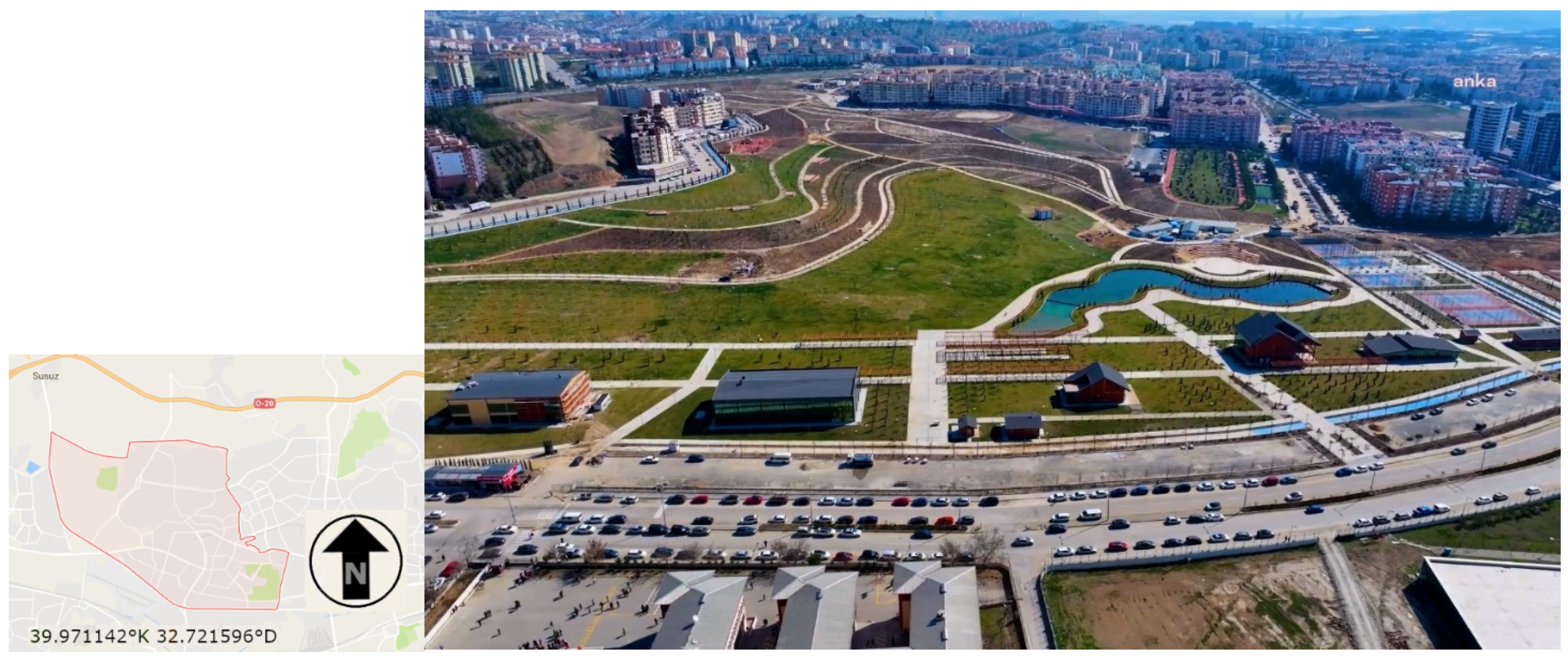
Figure 1. Map and General View of Batıkent Park.
Water 18 01362 g001
Figure 2. Map and General View of Bademlidere.
Water 18 01362 g002
Figure 3. Temporal variation in Kc values used in determining plant water requirements for different species.
Water 18 01362 g003
Figure 4. Current versus proposed annual water consumption (m3) by major plant groups in Batıkent Recreation Area.
Water 18 01362 g004
Figure 5. Current versus proposed annual water consumption by major plant groups in Bademlidere Recreation Area.
Water 18 01362 g005
Table 1. Monthly Average Temperature and Precipitation in Ankara Province (1991–2020).
Jan.Feb.Mar.Apr.May.Jun.Jul.Aug.Sep.Oct.Nov.Dec.Ann.
Average Temp. (°C)1.02.76.711.516.520.624.224.319.613.97.32.812.6
Std. Dev.2.22.83.33.53.03.13.44.24.54.13.63.13.5
Precip. (mm)38.636.646.944.551.040.214.814.617.933.431.943.2413.6
Std. Dev.21.325.528.332.135.634.411.611.217.422.626.133.732.4
Table 2. Climate data for Ankara Province to be used in plant water consumption calculations.
ParameterSymbolMean Value
Mean temperature (°C)T23.4
Mean Maximum Temperature (°C)Tmax30.3
Mean Minimum Temperature (°C)Tmin15.9
Mean Relative Humidity (%)RH48
Mean Wind Speed (at 2 m) (m/s)u22.1
Mean Sunshine Duration (h/day)n11.1
Net Radiation (MJ/m2·day)Rn15.8
Soil Heat Flux (MJ/m2·day)G0
Psychrometric constant (kPa/°C)γ0.066
Slope of vapor pressure curve (kPa/°C)Δ0.18
Saturated vapor pressure (kPa)es3.2
Measured vapor pressure (kPa)ea1.5
Table 3. Batıkent Recreation Area Water Consumption Values (ETc (mm/day)).
Crop & Irrigation EfficiencyMar.Apr.May.Jun.Jul.Aug.Sep.Oct.Nov.Annual (m3)
Deciduous Trees, Coniferous Trees, and Shrubs
90%
2.372.884.616.537.047.046.275.635.186398
Shrubs, Vines, and Herbaceous Plants
90%
2.242.693.844.865.764.933.712.562.3021,515
Groundcover Plants
70%
1.282.303.333.783.843.462.672.051.2814,097
Lawn areas, 70%2.112.883.906.026.145.253.202.242.2442,939
Meadow areas, 70%2.113.845.576.276.405.764.483.462.11100,617
Total 185,566
Table 4. Water Consumption of Plants in Bademlidere Recreation Area (ETc (mm/day)).
Crop & Irrigation EfficiencyMar.Apr.May.Jun.Jul.Aug.Sep.Oct.Nov.Annual (m3)
Deciduous trees, coniferous trees, and shrubs
90%
2.372.884.616.537.047.046.275.635.186329
Shrubs, climbers, and herbaceous plants
90%
2.242.693.844.865.764.933.712.562.3027,679
Groundcover plants 70%1.152.113.073.463.523.202.431.921.15136
Lawn areas, 70%2.112.883.905.896.025.123.142.242.2428,824
Meadow areas, 70%2.113.585.185.896.025.444.163.261.9827,623
Total 90,591
Table 5. Water Consumption Values of Different Species in the Proposed Design of the Batıkent Recreation Area (ETc (mm/day)).
Crop/Irrigation EfficiencyMar.Apr.May.Jun.Jul.Aug.Sep.Oct.Nov.Annual (m3)
Deciduous trees, coniferous trees, and shrubs/small trees
90%
1.541.862.944.164.484.483.975.633.583442
Shrubs, climbers, and herbace. plants
90%
1.471.792.563.263.843.262.501.731.5411,395
Groundcover plants 70%0.831.542.242.502.562.301.791.340.836871
Lawn areas, 70%1.792.433.264.995.124.352.691.861.869518
Meadow areas, 70%1.222.243.203.653.713.332.621.981.225878
Total 82,835
Disclaimer/Publisher’s Note: The statements, opinions and data contained in all publications are solely those of the individual author(s) and contributor(s) and not of MDPI and/or the editor(s). MDPI and/or the editor(s) disclaim responsibility for any injury to people or property resulting from any ideas, methods, instructions or products referred to in the content.