Article

Influences of Dams on Macroinvertebrate Community Structure and Functional Feeding Groups in the Sizao River Basin, Southeast China

1
State Key Laboratory of Environmental Criteria and Risk Assessment, Chinese Research Academy of Environmental Sciences, Beijing 100012, China
2
Shanghai Engineering Research Center of Water Environment Simulation and Ecological Restoration, Shanghai Academy of Environment Sciences, Shanghai 200233, China
3
Institute of Hydrobiology, Chinese Academy of Sciences, Wuhan 430072, China
*
Author to whom correspondence should be addressed.
Water 2026, 18(11), 1353; https://doi.org/10.3390/w18111353
Submission received: 5 May 2026 / Revised: 25 May 2026 / Accepted: 1 June 2026 / Published: 2 June 2026
(This article belongs to the Section Biodiversity and Functionality of Aquatic Ecosystems)

Abstract

Dams are widely distributed in global water bodies and cause severe impacts on aquatic ecosystems. In this study, the Sizao River Basin was selected to explore the effects of dams on the macroinvertebrate community, including functional feeding groups (FFGs). Macroinvertebrate communities and environmental variables were monitored seasonally in April, August, October, and November of 2025. A total of 27 taxa were identified, including 3 phyla, 8 orders, and 15 families. Species richness, abundance, biomass, species diversity, and FFGs diversity in the gate-regulated section were generally lower than those in other river sections. Gatherer–collector dominated FFGs across the Sizao River Basin and accounted for most of the dominant species. An ecosystem assessment based on FFGs suggests that ecosystem attributes of macroinvertebrate communities were fragmented. The longitudinal spatial distribution of FFGs was roughly in line with the predications of the river continuum concept. Redundancy Analysis (RDA) indicated that the permanganate index (CODMn) and dissolved oxygen (DO) were major environmental variables affecting macroinvertebrate community structure, and DO and salinity (SAL) were major variables affecting FFGs. The explanatory power of RDA for FFGs was higher than that for macroinvertebrate community structure. These findings provide valuable insights into protecting aquatic ecosystems in gate-regulated water bodies.

1. Introduction

Damming induces fragmentation of river ecosystems [1,2,3]. Globally, over 60% of rivers longer than 500 km are already fragmented, and thousands of dams are proposed on rivers in biodiversity hotspots worldwide [4]. Fragmentation caused by dams has been considered the most pronounced anthropogenic disturbance affecting global river systems [1]. Acting as physical barriers, dams disrupt longitudinal connectivity and impede upstream–downstream movement of species [4]. The changes in longitudinal connectivity of rivers (i.e., river fragmentation) caused by hydraulic projects have profound effects on aquatic communities [5,6,7,8]. Recent studies have further shown that the combination of dam-induced fragmentation, particularly when combined with climate change or urbanization, can exacerbate adverse effects on aquatic communities in river ecosystems [7,8].
Macroinvertebrates are a critical component of aquatic communities. They can accelerate detrital decomposition [9,10] and release bound nutrients into the water column [11]. In doing so, macroinvertebrates can facilitate nutrient transfer to overlying open waters [12,13,14,15]. Macroinvertebrates also interact with other aquatic taxa. For example, they can influence algae through multiple biological processes, while toxic algae in turn affect them [16]. Given these roles, macroinvertebrates have been widely used to monitor and assess ecosystem health [17,18]. Compared to other aquatic taxa such as fish, macrophytes, and diatoms, macroinvertebrates are the most commonly used group for biological water quality assessment under the European Water Framework Directive (WFD) [19,20].
Macroinvertebrate functional feeding groups (FFGs), also referred to as macroinvertebrate functional guilds [21,22,23], are defined by differences in feeding resources, food preferences, and the strategies and physiological mechanisms used to acquire food and utilize habitat [24,25,26,27]. Macroinvertebrates are typically divided into five FFGs: predator, gatherer–collector, scraper, filterer–collector, and shredder [10,28]. Macroinvertebrate FFGs have been widely used to explore the ecological effects of anthropogenic disturbance [29,30]. Biodiversity indices based on FFGs have also been applied to assess ecological health status [21,31]. To date, studies on macroinvertebrate FFGs have examined various water-body types, including rivers [31,32], delta regions [33], streams [29,34,35], estuaries [21], and wetlands [31]. Several studies have focused on the responses of macroinvertebrate FFGs to different levels of pollution or other anthropogenic disturbances [28,36,37]. In addition to pollution, physical habitat conditions, such as changes in longitudinal connectivity of the river, also significantly affect macroinvertebrate communities [6]. However, compared with research on lateral connectivity, studies examining the effects of altered longitudinal connectivity due to gate regulation on macroinvertebrate communities remain rare [6]. Furthermore, few studies have investigated macroinvertebrate community structure and macroinvertebrate FFGs in seagoing rivers to date. Thus, research focusing on macroinvertebrate community structure and macroinvertebrate FFGs in gate-regulated seagoing rivers is particularly valuable.
The Sizao River Basin is located south of Hangzhou Bay in Ningbo City, eastern China. The main stream of the basin is the Sizao River, a seagoing river that flows from south to north through Cixi City and Qianwan New District into Hangzhou Bay. The Sizao River and its two tributaries in Qianwan New District, the Shiyitang River (SYT) and the Shiertang River (SET), are each divided into several river sections by dams, and the longitudinal connectivity of the Sizao River Basin has been severely obstructed in Qianwan New District. Consequently, the Sizao River Basin is an ideal study area for examining the effects of gate–induced changes in longitudinal connectivity on macroinvertebrate communities in seagoing rivers. However, existing studies on the Sizao River Basin have primarily focused on tidal flat topography [38], with little attention given to aquatic communities.
Given the need to reveal and characterize macroinvertebrate communities and their influencing factors, and the scarcity of studies in this region, it is essential to explore how environmental variables influence macroinvertebrate community structure and macroinvertebrate FFGs in gate-regulated seagoing rivers. This study aimed to (1) characterize the macroinvertebrate community structure and macroinvertebrate FFGs in the Sizao River Basin and (2) identify the relationships between environmental variables and macroinvertebrate communities and macroinvertebrate FFGs. The ultimate goal is to provide a scientific foundation for the construction and management of gates in rivers.

2. Materials and Methods

2.1. Study Area

The Sizao River Basin is characterized by a subtropical monsoon climate, with an average annual temperature of 16.9 °C and an annual precipitation of 1393.4 mm [39]. The Sizao River, the main stream of the basin, has a total length of approximately 29.75 km and a catchment area of about 91.19 km2. The Sizao River underwent three artificial dredging and widening projects from 1958 to 2016. As a result, its width has nearly doubled compared to pre-project conditions and currently ranges from approximately 80 to 140 m. The Sizao River serves as an important flood discharge channel for Ningbo City, and flows from south to north into Hangzhou Bay in the Qianwan New District. The district is undergoing rapid industrialization, with manufacturing developing quickly. Within Qianwan New District, the Sizao River stretches approximately 10.92 km and drains an area of about 39.99 km2. The SET, one of the two tributaries of the Sizao River, is an artificially excavated channel that runs parallel to and adjacent to Hangzhou Bay. The SYT, another tributary of the Sizao River, is located south of SET and farther from Hangzhou Bay. Both SET and SYT flow from west to east into the Sizao River.
The Sizao River Basin is divided by multiple gates that remain closed year-round. Two control gates are located on the main stream of the Sizao River: One at the estuary near SET (hereafter referred to as the Sizao–SET gate) and the other approximately 2100 m south of the Hangzhou Bay estuary near SYT (the Sizao–SYT gate). SET is divided by dams into three sections: the eastern, middle, and western sections, with lengths of 5.0 km, 2.9 km, and 3.1 km, respectively. Additionally, a control gate is situated at the estuary where SYT flows into the Sizao River. In this study, the river section of the Sizao River between the Sizao–SET gate and the Sizao–SYT gate is designated as the gate-regulated section, while the river section south of the Sizao–SYT gate is designated as the upstream section.
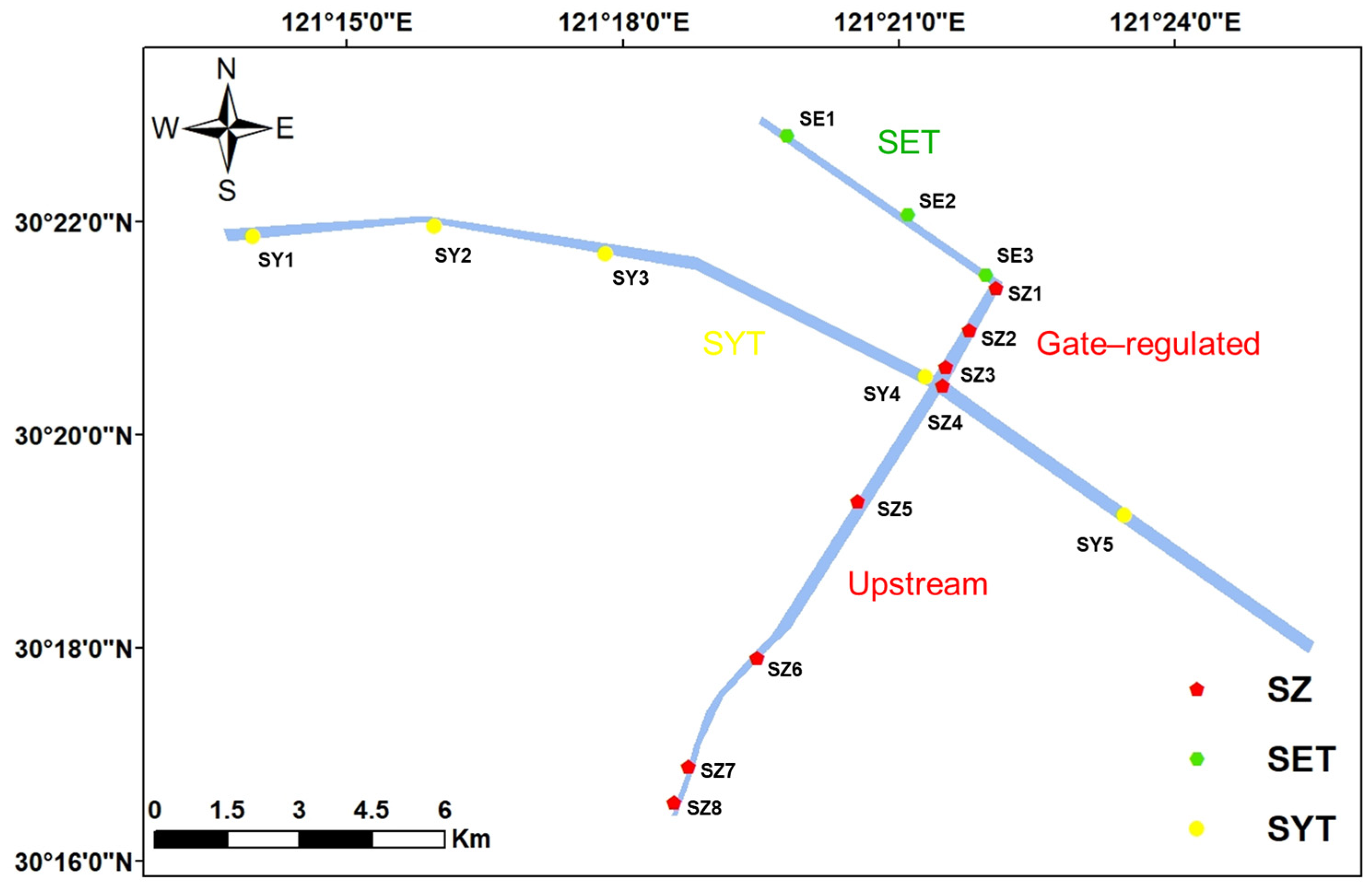
A total of 16 sampling sites were selected for a water ecological survey in the Sizao River Basin. Among these, 3 sampling sites (SZ1–SZ3) were located in the gate-regulated section, and 5 sampling sites (SZ4–SZ8) in the upstream section. Additionally, 3 sampling sites were selected in the eastern part of SET, and 5 sampling sites in SYT. The geographic locations of the sampling sites are shown in Figure 1 and Table S1. Four seasonal surveys were conducted in April, August, October, and November of 2025, representing spring, summer, autumn, and winter, respectively.

2.2. Sample Collection

Macroinvertebrate samples were collected at each site using a modified Peterson grab sampler (with an opening area of 0.03 m2). At each site, samples were sieved and washed using a 40-mesh sieve. After that, the samples were placed in self-sealing plastic bags and brought back to the laboratory. Macroinvertebrate individuals were picked out with ophthalmic forceps and preserved in plastic bottles with 5% formalin solution.
In the laboratory, macroinvertebrate samples were identified using a stereomicroscope (Olympus CX10, Tokyo, Japan) to the lowest possible taxonomic level (mostly genus or species) based on relevant references [40,41,42,43]. All samples had the surface moisture removed using blotting paper, and their wet weight was measured using a one–hundred–thousandth electronic balance (Sartorius Corporation, BSA124S, Gottingen, Germany). Finally, the abundance (ind./m2) and biomass (g/m2) of each taxonomic level in each sample were calculated.

2.3. Measurements of Environmental Variables

At each site, water temperature (WT, °C), pH, conductivity (Cond, μS/cm), dissolved oxygen (DO, mg/L), total dissolved solids (TDS, mg/L), salinity (SAL, ppt), and oxidation-reduction potential (ORP, mV) were measured using a multiparameter water environmental factors monitoring analyzer (YSI Professional Quatro, Yellow Springs, OH, USA). Turbidity (Turb, NTU) was measured on-site using a portable turbidimeter (Hach 2100Q, Shanghai, China). The concentrations of total phosphorus (TP, mg/L), total nitrogen (TN, mg/L), ammonia nitrogen (NH3–N, mg/L), chemical oxygen demand (COD, mg/L), the permanganate index (CODMn, mg/L), and chlorophyll a concentration (Chla, μg/L) were determined in the laboratory.

2.4. Classification of Macroinvertebrate FFGs and Calculation of Diversity Indices

Referring to the different feeding patterns of macroinvertebrates and the classification of macroinvertebrate FFGs in the literature [43,44,45,46], macroinvertebrates were classified into five FFGs: gatherer–collector (GC), filterer–collector (FC), scraper (SC), predator (PR), and shredder (SH) in this study. Further referring to related studies [25], we applied several parameters to assess ecosystem attributes of the macroinvertebrate communities based on macroinvertebrate FFGs, including parameters related to material cycling (F1-F4), longitudinal transport (F5, F6), lateral inputs (F7, F8), and other aspects (F9–F11) (Table 1).
In this study, the Dominance Index (Y) was used to determine the dominant species of macroinvertebrate communities. The Shannon–Wiener Index (H′), Simpson’s Index (D), Margalef Index (R), Pielou Index (J), and species richness (S) were selected to analyze the species diversity of macroinvertebrate communities [47,48,49,50].
The formula for the Dominance Index (Y) is given by
Y = Pi × fi,
in which Pi denotes the ratio of abundance of the i–th species (ind./m2) to the total abundance of the macroinvertebrate community (ind./m2), and fi indicates the frequency of occurrence of the i-th species. When Y ≥ 0.02, the species is identified as a dominant species [51].
In this study, the FFGs’ Shannon–Wiener Index (HFD) and FFGs’ Pielou Index (JFD) were also selected to examine the FFGs’ diversity of macroinvertebrate communities in the Sizao River Basin. The specific formulas are as follows:
H F D = i = 1 n P i l n P i ,
JFD = FD/lnm,
in which m represents the number of FFGs, and Pi represents the ratio of the individual count of the i-th FFG to the total number of individuals in the sample [52].

2.5. Data Analyses

In this study, the environmental variables, abundance and biomass of Polychaeta, Oligochaeta, Insecta, Gastropoda, and Bivalvia, the total abundance and biomass of macroinvertebrate communities, and the diversity indices of the macroinvertebrate communities were tested for assumptions of normality (Shapiro–Wilk) and homogeneity of variance (Levene). If the variables met the assumptions of normality and homogeneity of variance, a one-way analysis of variance (ANOVA) was used to analyze differences among variables across different river sections of the Sizao River Basin. Otherwise, the Kruskal–Wallis nonparametric test was used. Based on the results of normality and homogeneity of variance, the differences in TN and Pielou Index (J) among different river sections of the Sizao River Basin were explored by one–way ANOVA and LSD, while the differences in other variables were explored by Kruskal–Wallis nonparametric test and paired comparison.
Principal component analysis (PCA) was used to analyze the contributions of environmental variables to environmental characteristics across different river sections of the Sizao River Basin and to examine correlations among environmental variables. The principal components with eigenvalue > 1 were retained. Redundancy analysis (RDA) was performed to determine the effects of environmental variables on macroinvertebrate communities and FFGs, respectively. Before RDA, the abundance matrices for macroinvertebrate communities and FFGs were transformed using the Hellinger method. Stepwise forward selection was used to determine the environmental variables that have significant effects on macroinvertebrate communities and FFGs, based on a Monte Carlo test with 999 permutations. The significance of each ordination axis was also determined based on the Monte Carlo test with 999 permutations. The R2adj represented the explanatory power of environmental variables. The values of the variance inflation factor (VIF) for all retained environmental variables were lower than 10. The normality (Shapiro–Wilk) test, the homogeneity of variance (Levene) test, the one-way ANOVA, and the Kruskal–Wallis nonparametric test were performed using SPSS 26.0 software. Calculations of species diversity and FFGs diversity were performed using the function “diversity” of the “vegan” package [53,54,55,56]. PCA and RDA were performed using the functions “pca” and “rda” of the “vegan” package [53,57,58,59] in R 4.5.2 statistical software (R Core Team, 2025) [60].

3. Results

3.1. Environmental Characteristics

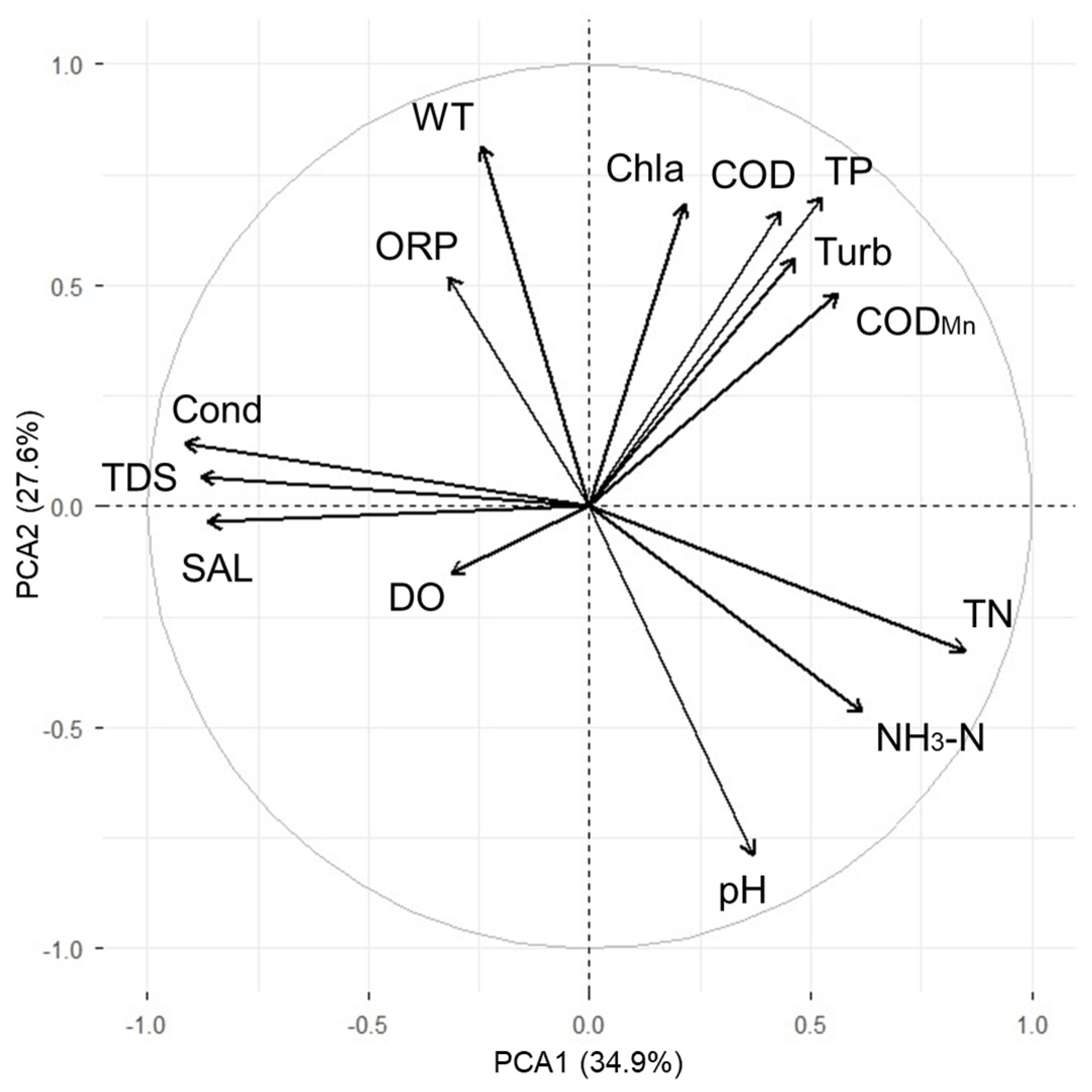
Most environmental variables showed significant differences across different river sections in the Sizao River Basin. Significant differences were observed for DO, Cond, TDS, SAL, COD, TN, TP, NH3–N, and CODMn (p < 0.01). Turb also differed significantly among sections (p < 0.05). In contrast, WT, pH, ORP, and Chla showed no significant differences (Table S2). Principal component analysis (PCA) identified four principal components with eigenvalues > 1. The first two axes explained 34.9% and 27.6% of the total variance, respectively, together accounting for 62.5% of the total variance. The first axis was heavily weighted by four environmental variables: Cond, TDS, SAL, and TN. Each of these variables individually contributed more than 10% to the first axis, and their cumulative contribution to the first axis reached 62.9%. The second axis was heavily weighted by WT, pH, COD, and TP. Each of these variables also contributed more than 10% to the second axis, with a cumulative contribution of 57.3% to the second axis (Figure 2). The first axis mainly reflected the gradient of particulate matter content in water bodies, and the second axis mainly reflected the gradient of ion and organic matter in water bodies.

3.2. Macroinvertebrate Community Structure

3.2.1. Macroinvertebrate Taxa Composition

Across four seasonal sampling events, a total of 27 taxa (most of the individuals were identified to the genus or species level; individuals of Polychaeta and Naididae were identified to the family level) were collected in the Sizao River Basin, representing 3 phyla, 8 orders, and 15 families (Table S3). Insecta was the most diverse group, comprising 3 families and 10 taxa (genus or species level), which accounted for 37.04% of the total. Gastropoda followed with six families and eight taxa (genus or species level), representing 29.63% of the total. Oligochaeta had five taxa (genus or species level, and Naididae was identified to the family level), and Polychaeta had three taxa (family level), making up 18.52% and 11.11% of the total, respectively. The least abundant group was Bivalvia, represented by only one order, one family, and one taxon (species level), accounting for 3.70% of the total.
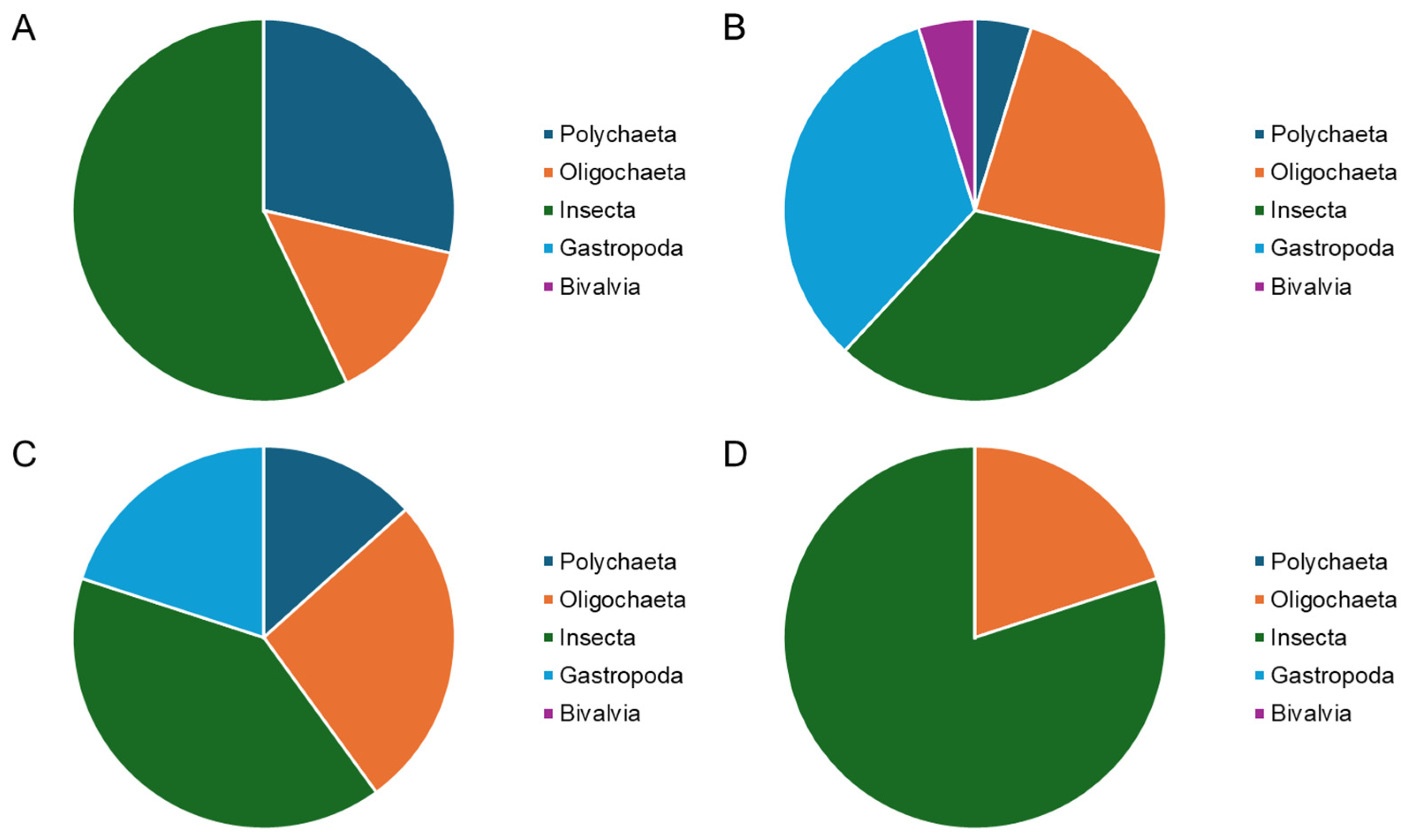
From a regional perspective, taxon richness varied markedly by river section. The upstream section had the highest diversity, with 3 phyla, 6 orders, and a total of 21 taxa. SYT contained 3 phyla, 7 orders, and a total of 15 taxa. SET had 2 phyla, 2 orders, and a total of 10 taxa. The gate-regulated section exhibited the lowest richness, with only two phyla, four orders, and a total of seven taxa (Figure 3).
In the upstream section, Insecta and Gastropoda each had seven taxa, Oligochaeta five, and Polychaeta and Bivalvia only one each. SYT contained six Insecta taxa, four Oligochaeta, three Gastropoda taxa, and two Polychaeta taxa. In SET, Insecta dominated with eight taxa, followed by Oligochaeta (two taxa). The gate-regulated section had four Insecta taxa, two Polychaeta taxa, and only one Oligochaeta taxon (Figure 3).

3.2.2. Abundance and Biomass of Macroinvertebrate Communities

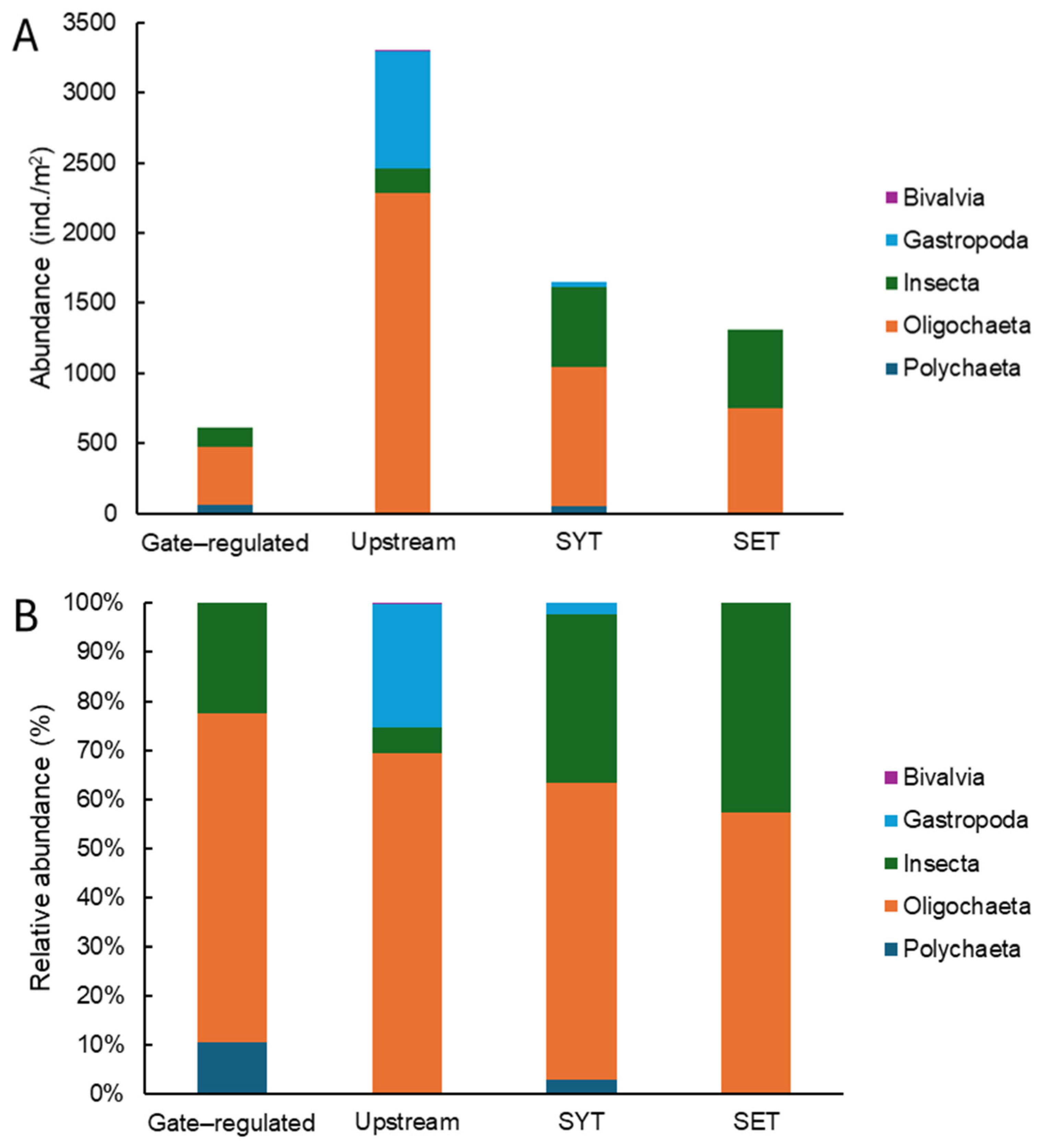
The total abundance and biomass of macroinvertebrate communities differed significantly among river sections across the Sizao River Basin (p < 0.01). The abundance and biomass of Oligochaeta, Insecta, and Gastropoda also showed significant sectional differences across the Sizao River Basin (p < 0.05). The gate-regulated section had the lowest overall total abundance and biomass, as well as the lowest abundances of Oligochaeta and Insecta. Oligochaeta peaked in the upstream section. Insecta was most abundant in SYT, with a similar high abundance in SET. Gastropoda reached its maximum abundance in the upstream section and were also present in SYT. In contrast, Polychaeta was most abundant in the gate-regulated section and least abundant upstream (Figure 4A and Table S4).
In terms of relative abundance, Oligochaeta dominated all sections, accounting for 67.12% (gate-regulated), 69.32% (upstream), 60.42% (SYT), and 57.40% (SET) of the total macroinvertebrate community. Insecta was the second most abundant group in the gate-regulated section, SYT and SET, comprising 22.47%, 34.33%, and 42.60% of the total, respectively. Insecta reached their lowest relative abundance upstream (5.17%). Gastropoda achieved their highest relative abundance upstream (25.33%) and accounted for 2.18% in SYT. Polychaeta showed their highest relative abundance in the gate-regulated section (10.41%). Bivalvia was recorded only upstream (Figure 4B).

3.2.3. Dominant Species of Macroinvertebrate Communities

Dominant species and their FFG attributes also varied significantly among sections. A total of eight dominant species were identified across the Sizao River Basin, including five gatherer–collectors, one predator, one scraper, and one shredder. The gate-regulated section had the fewest dominant species, while SET had the most. In the gate-regulated section, dominant species were Tanypus chinensis (0.060; predator) and Limnodrilus sp. (0.268; gatherer–collector). In the upstream section, the dominants were Limnodrilus sp. (0.554; gatherer–collector), Tubifex sp. (0.028; gatherer–collector), and Bellamya sp. (0.184; scraper). In SYT, dominants included Limnodrilus sp. (0.562), Propsilocerus akamusi (0.043), Polypedilum sp. (0.032; shredder), and Chironomus sp. (0.031); all except Polypedilum sp. were gatherers–collectors. In SET, dominant species were Tanypus chinensis (0.053; predator), Limnodrilus sp. (0.529), Tubifex sp. (0.025), Chironomus sp. (0.058), and Glyptotendipes sp. (0.119); all except Tanypus chinensis were gatherers–collectors (Table 2).

3.3. Macroinvertebrate FFGs

The number of macroinvertebrate FFGs varied among river sections of the Sizao River Basin, and no single river section contained all five FFGs. Upstream supported four FFG types: gatherer–collector, filterer–collector, scraper, and shredder. Both SYT and SET contained three FFG types: SYT had gatherers–collectors, scrapers, and shredders, whereas SET had gatherers–collectors, predators, and shredders. The gate-regulated section had only two FFGs: gatherers–collectors and predators (Table S3).
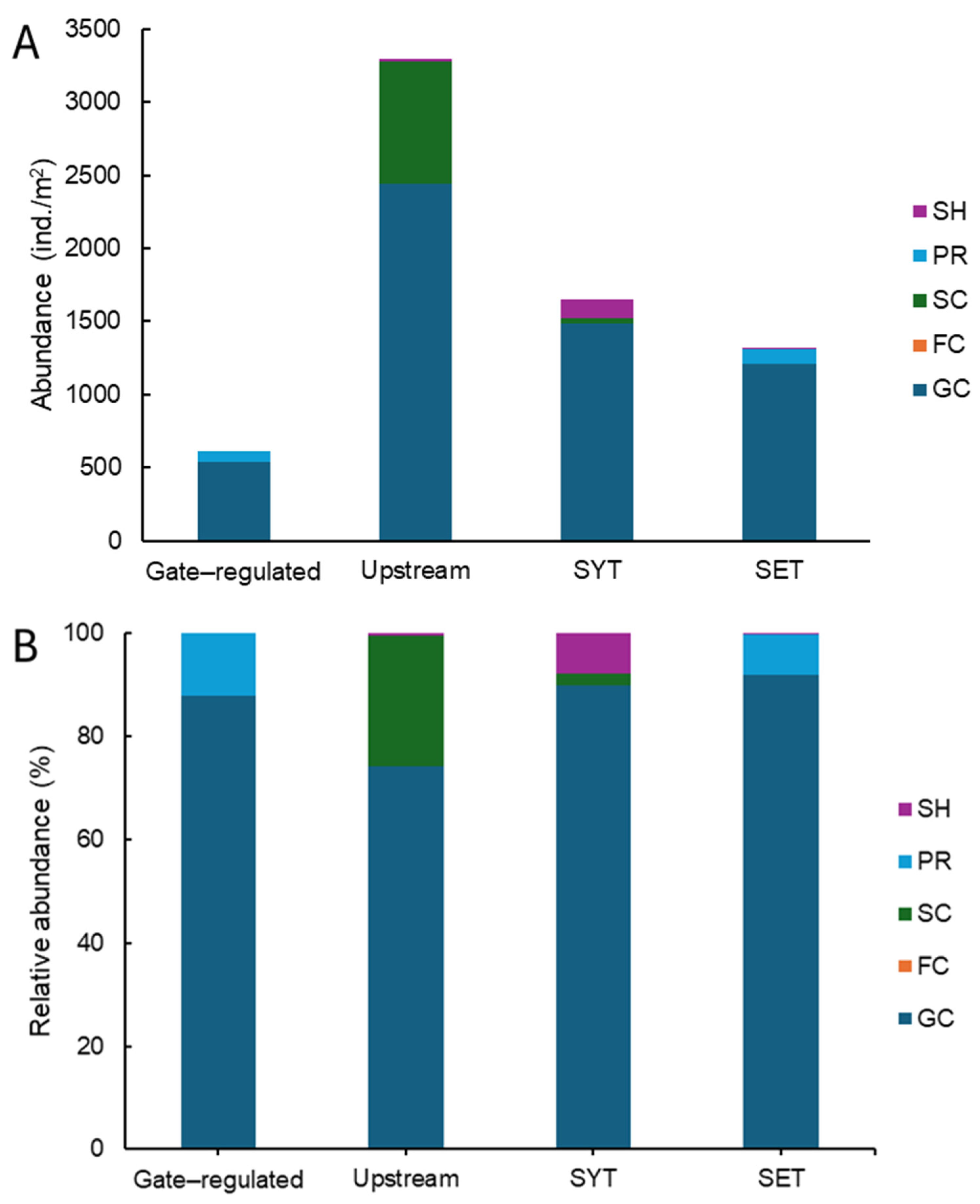
The gatherer–collector type dominated the macroinvertebrate communities across the Sizao River Basin. Its abundance was 535.00 ind./m2 (gate-regulated), 2443.14 ind./m2 (upstream), 1482.05 ind./m2 (SYT), and 1207.41 ind./m2 (SET). In relative abundance terms, the gatherer–collector type accounted for 87.95% (gate-regulated), 74.08% (upstream), 89.89% (SYT), and 91.96% (SET) of the total abundance. The scraper type contributed 25.33% of the total abundance upstream and 2.18% in SYT. The predator type represented 12.05% in the gate-regulated section and 7.90% in SET. The shredder type reached its maximum relative abundance (7.93%) in SYT. The filterer–collector type was recorded only in the upstream (Figure 5).

3.4. Macroinvertebrate Community Diversity

Shannon–Wiener Index and species richness of macroinvertebrate communities differed significantly across the Sizao River Basin (p < 0.01). The Pielou Index and Shannon–Wiener Index of the FFGs also showed significant differences across the Sizao River Basin (p < 0.05). In contrast, the Simpson’s Index, Margalef Index, and FFGs’ Pielou Index did not vary significantly among river sections (p > 0.05). With the exception of the Simpson’s Index, all species diversity indices were lower in the gate-regulated section than in other river sections. In terms of FFGs’ diversity, their Shannon–Wiener Index was also lowest in the gate-regulated section, whereas their Pielou Index was higher in the gate-regulated section compared to other river sections (Table 3).

3.5. Ecosystem Assessment Based on Macroinvertebrate FFGs

The calculation of metrics related to ecosystem attributes revealed that the ecosystem attributes of macroinvertebrate FFGs were fragmentary across the Sizao River Basin. Among all river sections, only the decomposition consistently had values > 0 across the Sizao River Basin. In the upstream section, eight metrics had values > 0: primary productivity, secondary production, autotrophy/heterotrophy, decomposition, longitudinal transport, lateral input, CPOM input/FPOM input, and habitat stability. Additionally, the highest values across the Sizao River Basin are for primary productivity, secondary production, autotrophy/heterotrophy, decomposition, longitudinal transport, and habitat stability. SYT also had eight metrics with values > 0, including primary productivity, secondary production, autotrophy/heterotrophy, decomposition, lateral input, relative lateral input, CPOM input/FPOM input, and habitat stability. Among all basin sections, SYT showed the highest values for lateral input, relative lateral input, and CPOM input/FPOM input. In contrast, SET had only four metrics with values > 0, and the gate-regulated section had only three metrics with values > 0. Furthermore, the values of secondary production and decomposition in both the gate-regulated section and SET were lower than those in the upstream and SYT sections. Lateral input in SET was also lower than in the upstream and SYT sections. However, top-down predator control reached its highest level in the gate-regulated section, and values > 0 for this metric were observed only in SET. Relative longitudinal transport was not detected in any section of the Sizao River Basin (Table 4).

3.6. Relationship Between Environmental Variables and Macroinvertebrate Communities

3.6.1. Macroinvertebrate Community Structure and Water Environmental Factors

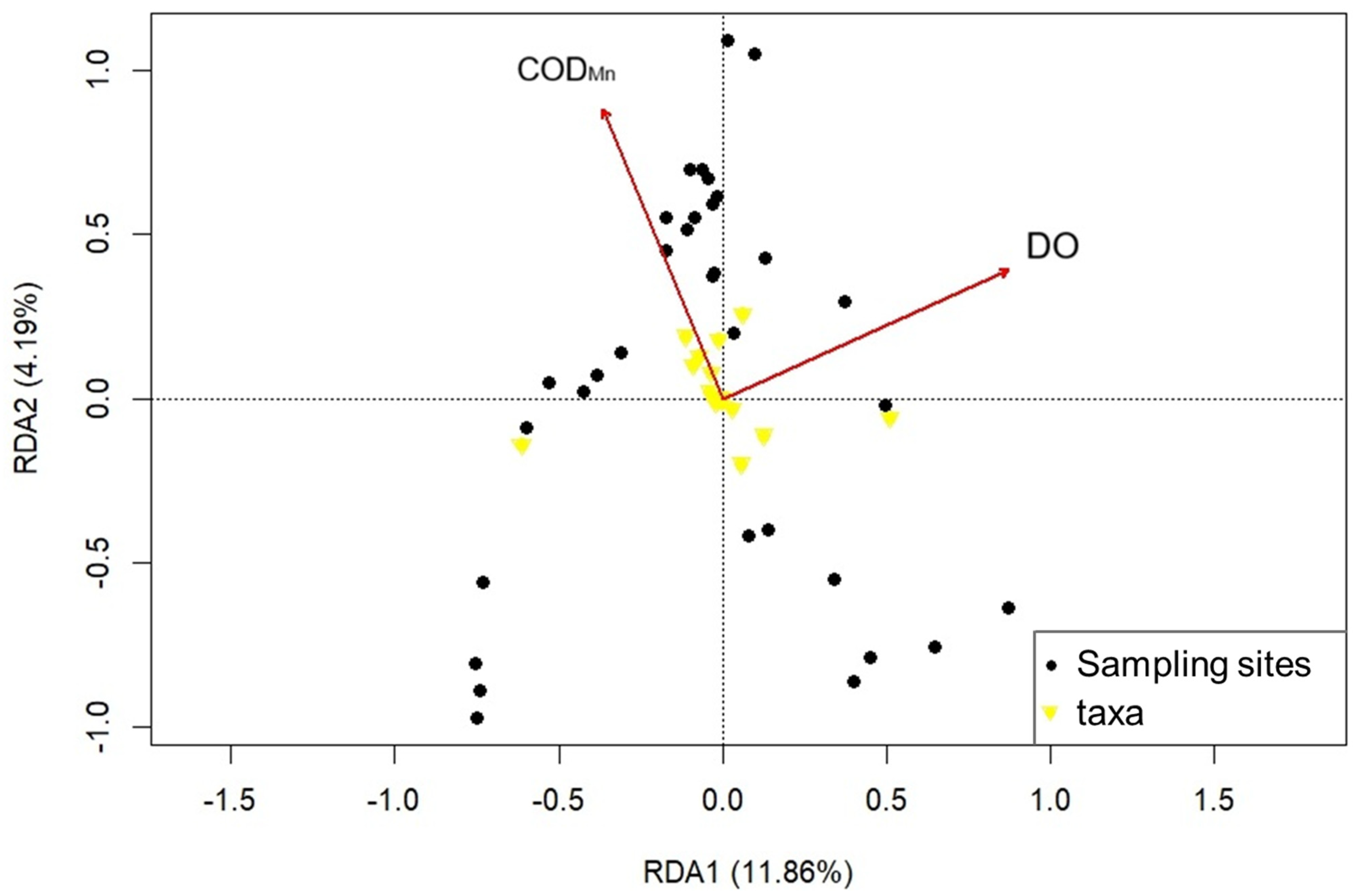
Redundancy analysis (RDA) was conducted to examine the relationships between macroinvertebrate community structure and water environmental factors (Figure 6). Forward selection identified that CODMn and DO were significantly correlated with macroinvertebrate community structure, and the VIF of CODMn and DO had values < 10. Based on the RDA result, CODMn and DO were the primary environmental factors affecting macroinvertebrate community structure. The first RDA axis explained 11.86% of the total variance, and the second axis explained an additional 4.19%. Together, DO and CODMn accounted for 16.05% of the total variability. DO loaded heavily onto the first canonical axis, whereas CODMn loaded heavily onto the second axis (Figure 6).

3.6.2. Macroinvertebrate FFGs and Water Environmental Factors

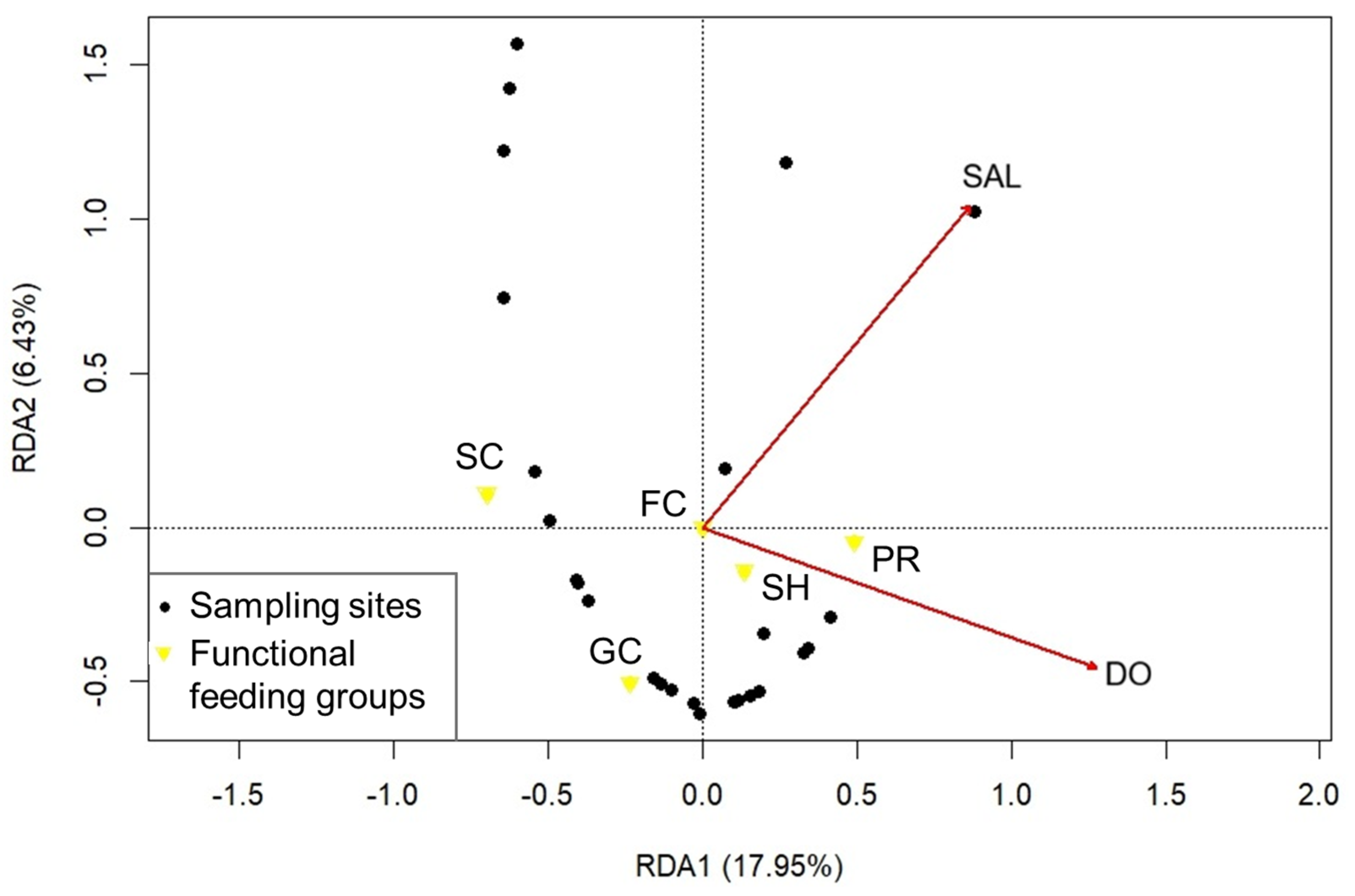
RDA was also used to assess the relationship between macroinvertebrate FFGs and water environmental factors (Figure 7). Forward selection identified that DO and SAL were significantly correlated with macroinvertebrate FFGs, and the VIF of DO and SAL had values < 10. Based on the RDA result, DO and SAL were the major environmental factors affecting macroinvertebrate community FFGs. The first RDA axis explained 17.95% of the total variability, and the second axis explained 6.43%. Together, SAL and DO accounted for 24.38% of the total variability. DO loaded heavily onto the first canonical axis, while SAL loaded heavily onto the second axis. The predator and shredder types were positively correlated with DO. In contrast, the scraper type showed negative correlations with both DO and SAL. The gatherer–collector type was negatively correlated with SAL (Figure 7).

4. Discussion

4.1. Characteristics of Macroinvertebrate Community Structure and FFGs

In general, species diversity and FFG diversity in the gated–regulated section and SET were lower than those in the upstream section and SYT. That is to say, the macroinvertebrate community in the upstream portion of the Sizao River Basin was more complex than that in the downstream portion. This finding is consistent with a previous study on macroinvertebrate community in a floodgate-regulated river [6]. Reduced hydrological connectivity caused by gates likely explains the observed patterns in macroinvertebrate community structure. The degree of connectivity among river sections is known to influence macroinvertebrate communities [61]. Specifically, alpha diversity of macroinvertebrate community increases with greater hydrological connectivity and fluvial dynamics [62,63,64]. Floodgates can therefore lead to a decline in alpha diversity [6].
In this study, the gatherer–collector type dominated the macroinvertebrate community across the Sizao River Basin, a finding consistent with studies from other rivers [29,31,32,65]. The gatherer–collector type primarily feeds on organic detritus [28,66,67]. Compared to more specialized groups, their food sources are broader and more diverse [67,68]. The Qianwan New District is undergoing rapid industrialization and manufacturing development. In addition, parts of the Sizao River Basin are surrounded by farmland or located near residential areas. As a result, the Sizao River Basin is affected by various pollution sources. Large amounts of wastewater have been discharged to the rivers, leading to significant accumulation of organic debris in the water bodies. Slow flow velocities caused by gates, combined with moderate channel widths, further promote the accumulation of organic debris [31,32,66]. Overall, abundant organic detritus supports the dominance of gatherers–collectors. Consistent with these findings, the dominant species in the Sizao River Basin—Limnodrilus sp., Tubifex sp., Chironomus sp., and Glyptotendipes sp.—are all gatherers–collectors that are also known to be pollution-tolerant [32,42].
Apart from the gatherer–collector type, the scraper and predator types also accounted for a certain proportion of the macroinvertebrate community in the Sizao River Basin. The dominance of scraper and predator in polluted water bodies has been reported in several studies [28,34]. Scraper mainly feed on periphyton, and their abundance increases with periphyton production [69]. The discharge of polluted water and the resulting nutrient accumulation may promote the growth of phytoplankton and periphyton, thereby increasing the proportion of scraper [34]. Only one predator taxon was identified, Tanypus chinensis, which has been confirmed as an indicator species of eutrophication [70]. Thus, nutrient accumulation likely favors the colonization of Tanypus chinensis. Although studies have found that predators often inhabit fast-flowing waters [71], flow velocities in the Sizao River Basin are low due to the presence of gates. This may explain why the predator type exhibited low species richness while still accounting for a certain proportion of the macroinvertebrate community.
In this study, shredder was second only to gatherer–collector in the SYT macroinvertebrate community but accounted for very low proportions in the SET and upstream sections. No shredder was found in the gate-regulated section. The shredder type feeds on coarse particulate organic matter (CPOM), such as leaf fall, and converts CPOM (leaf fall) into fine particulate organic matter (FPOM) [72]. Riparian vegetation and shade conditions strongly influence shredder abundance [29,66]. However, the riverbanks of the Sizao River Basin have only sparse street trees, and some sections lack trees entirely, which limits food sources for shredders [73].
The filterer–collector type was found only in the upstream section and represented a very low proportion of the macroinvertebrate community. Only one taxon, Anodonta woodiana, was identified. Previous studies have indicated that the filterer–collector type responds similarly to the gatherer–collector type, with organic matter promoting their abundance [31,32,66]. The results of our study are inconsistent with the previous findings. This discrepancy may be explained by the fact that the development and dispersal of Bivalvia depend on fish, and gates obstruct fish migration [74]. Consequently, the downstream gate-regulated section of the Sizao River may not receive Bivalvia recruitment.
According to the river continuum concept (RCC), the relative abundance of gatherers–collectors and filterers–collectors gradually increases from upstream to downstream of the river, while the relative abundance of shredders decreases along the same gradient. Scrapers typically reach their highest relative abundance in midstream reaches, and predators tend to show minimal spatial variation along the longitudinal gradient of a river [75,76]. In this study, the longitudinal pattern for the gatherer–collector type was consistent with RCC predictions, and the shredder type also largely conformed to these predictions. However, the longitudinal pattern for the filterer–collector type contradicted RCC predictions, likely reflecting strong artificial disturbances caused by gates. Given the limited length of the Sizao River and potential sampling bias, the longitudinal pattern for the scraper and predator types was generally consistent with RCC predictions.
The ecosystem assessment based on macroinvertebrate FFGs indicated that macroinvertebrate FFG ecosystem attributes were fragmented across the Sizao River Basin. Moreover, ecosystem attributes of macroinvertebrate FFGs in the gate-regulated section were more degraded than those in other river sections. These assessment outcomes correspond well with the observed characteristics of macroinvertebrate community structure and macroinvertebrate FFGs. Due to the high density of gatherers–collectors, decomposition was robust across the Sizao River Basin. However, longitudinal material input capacity was substantially lower than lateral input capacity, a pattern likely attributable to the construction of gates.

4.2. Relationship Between Environmental Variables and Macroinvertebrate Community

The RDA results for both macroinvertebrate community structure and macroinvertebrate FFGs indicated that dissolved oxygen (DO) had significant effects on both macroinvertebrate community structure and macroinvertebrate FFGs. Numerous studies have demonstrated that DO significantly influences macroinvertebrate community, including community structure [77,78] and FFGs [31,32,65]. Increased metabolism of macroinvertebrates can consume substantial amounts of DO in the water body, and adequate DO levels are essential for supporting feeding, growth, and reproduction of macroinvertebrate FFGs [79]. In addition to DO, the permanganate index (CODMn) also significantly affected macroinvertebrate community structure in our study. Previous research has indicated that CODMn is a critical environmental variable influencing macroinvertebrate community [80,81]. For macroinvertebrate FFGs, salinity (SAL) was another important environmental variable alongside DO. SAL was found to be significantly related to macroinvertebrate community in areas adjacent to the Yangtze River estuary [82]. Moreover, different macroinvertebrate taxa can exhibit opposing responses to salinity gradients [83]. The present study was conducted in seagoing rivers of Hangzhou Bay, and the study area is adjacent to the bay itself. Compared to inland rivers, the salinity gradient in these seagoing rivers is more pronounced. Consequently, salinity likely plays a regulatory role in shaping macroinvertebrate community FFGs.
The variance explained by RDA for macroinvertebrate community structure and macroinvertebrate FFGs were 16.05% and 24.38%, respectively. Based on the explained rate, the explanatory power of RDA for macroinvertebrate community structure and for macroinvertebrate FFGs was low. Furthermore, our study also found that the variance explained by RDA was lower for macroinvertebrate community structure than for macroinvertebrate FFGs. The environmental variables measured in this study were limited, and some environmental variables that significantly correlate with specific taxa may not have been captured. Studies have found that various environmental variables have significant effects on the macroinvertebrate community, including substrate type, flow velocity, water depth, sediment organic matter, and habitat heterogeneity [84,85,86,87]. However, these environmental variables were missing in this study. Omitting key potential environmental variables can lead to low explanatory power in RDA. Similarly, differences in the variance explained by RDA for macroinvertebrate community structure and for macroinvertebrate FFGs can be attributed to the fact that a single FFG encompasses multiple taxa, and that environmental variables affect different taxa in varying ways. The omission of the potential key environmental variables measured in this study can lead to some environmental variables that significantly correlate with specific taxa not being captured. Therefore, the explanatory power of RDA for macroinvertebrate community structure was relatively low. However, because FFGs are classified based on shared feeding resources and strategies, their collective response to environmental variables may be more pronounced. Thus, when only a limited set of environmental variables can be measured, incorporating macroinvertebrate FFGs can add value to monitoring ecological status.

4.3. Perspectives and Limitations

This study examined the responses of the macroinvertebrate community to dams in seagoing rivers from two complementary dimensions: macroinvertebrate community structure and macroinvertebrate FFGs. It also assessed the conformity of macroinvertebrate community FFGs patterns with the river continuum concept (RCC). Our findings indicated that macroinvertebrate FFGs can supplement information derived solely from macroinvertebrate community structure. Specifically, macroinvertebrate FFGs enhance the understanding of aquatic communities in gate-regulated rivers and deepen insight into ecosystem function under such artificial conditions. We therefore suggest that combining macroinvertebrate community structure and macroinvertebrate FFGs analyses can improve the monitoring of aquatic ecosystems in gate-regulated rivers. However, potential key environmental variables affecting macroinvertebrate community (e.g., substrate type, flow velocity, water depth, sediment organic matter, and habitat heterogeneity) might be missing, which can lead to low explanatory power of RDA for macroinvertebrate community structure and for macroinvertebrate FFGs. Future research should monitor additional environmental variables closely related to the macroinvertebrate community and focus on elucidating the mechanisms by which dams alter macroinvertebrate FFGs in these ecosystems.

5. Conclusions

This study characterized macroinvertebrate community structure and macroinvertebrate FFGs in the Sizao River Basin, a highly disturbed ecosystem affected by dams in eastern China, and examined the effects of environmental variables on both macroinvertebrate community structure and macroinvertebrate FFGs. Significant differences in macroinvertebrate communities were observed among different river sections, including variations in taxa composition, dominant species, FFGs, ecosystem attributes based on FFGs, and species and FFGs diversity. The gate-regulated section, which experienced stronger artificial disturbance, exhibited simpler macroinvertebrate community structure and macroinvertebrate FFGs compared to sections with relatively lower disturbance. Furthermore, ecosystem attributes derived from macroinvertebrate FFGs were less complete in the gate-regulated section than in other sections of the river. The gatherer–collector type dominated the macroinvertebrate FFGs across the Sizao River Basin, and the majority of dominant species belonged to this group. Ecosystem assessment based on macroinvertebrate FFGs indicated that ecosystem attributes of the macroinvertebrate community were fragmented throughout the Sizao River Basin. The longitudinal spatial distribution of the gatherer–collector and shredder types was consistent with the predictions of the river continuum concept (RCC). In contrast, the longitudinal distribution of the filterer–collector type deviated from RCC predictions.
The environmental variables that significantly affected macroinvertebrate community structure differed from those affecting macroinvertebrate FFGs. Specifically, CODMn and DO were the primary environmental factors influencing macroinvertebrate community structure, whereas DO and SAL were the primary environmental factors influencing macroinvertebrate FFGs. Moreover, macroinvertebrate FFGs responded more strongly to water environmental variables than did macroinvertebrate community structure. Taken together, our findings indicate that both the macroinvertebrate community structure and ecological function of the macroinvertebrate community were degraded in the gate-regulated river section. Although gates help prevent seawater intrusion and store freshwater resources, they also exert adverse effects on the macroinvertebrate community.

Supplementary Materials

The following supporting information can be downloaded at: https://www.mdpi.com/article/10.3390/w18111353/s1. Table S1: Latitude and longitude of the sampling points across the Sizao River Basin; Table S2: Kruskal–Wallis nonparametric test and one–way ANOVA of environmental variables in different river sections across the Sizao River Basin; Table S3: Taxa composition and functional feeding groups (FFGs) division of macroinvertebrate communities in different river sections across the Sizao River Basin; Table S4: Kruskal–Wallis nonparametric test of macroinvertebrate communities in different river sections across the Sizao River Basin.

Author Contributions

Conceptualization, W.L. and X.Z.; methodology, W.L.; software, W.L.; formal analysis, W.L.; investigation, W.L., Y.L. and L.Z.; resources, Y.L. and L.L.; data curation, W.L.; writing—original draft preparation, W.L. and X.Z.; writing—review and editing, W.L. and X.Z.; visualization, W.L.; supervision, L.L.; project administration, L.L. and Y.L.; funding acquisition, L.L. and Y.L. All authors have read and agreed to the published version of the manuscript.

Funding

This research was funded by the Shanghai Engineering Research Center of Water Environment Simulation and Ecological Restoration (Grant number WESER-202408) and the Special Fund for the Construction of the National Sustainable Development Agenda Innovation Demonstration Zone in Chenzhou (Grant number 2022sfq54).

Data Availability Statement

The original contributions presented in this study are included in the article. Further inquiries can be directed to the corresponding author.

Conflicts of Interest

The authors declare no conflicts of interest. The funders had no role in the design of the study; in the collection, analyses, or interpretation of data; in the writing of the manuscript; or in the decision to publish the results.

References

  1. Fan, C.Y.; Ke, L.H.; Wang, J.D.; Best, J.; Zhang, Y.L.; Sheng, Y.W.; Liu, K.; Chen, T.; Zeng, F.X.; Zhan, P.F.; et al. Exacerbating dam-induced fragmentation in China’s river systems. Commun. Earth Environ. 2025, 6, 428. [Google Scholar]
  2. Spinti, R.A.; Condon, L.E.; Zhang, J. The evolution of dam induced river fragmentation in the United States. Nat. Commun. 2023, 14, 3820. [Google Scholar] [CrossRef]
  3. He, M.X.; Niu, J.; Liu, D.D.; Wu, C.H.; Wu, P.; Hu, B.X. Quantifying the impact of dam-related barriers on river fragmentation and water quality across China. J. Hydrol. 2026, 664, 134541. [Google Scholar] [CrossRef]
  4. He, F.Z.; Zarfl, C.; Tockner, K.; Olden, D.J.; Campos, Z.; Muniz, F.; Svenning, J.C.; Jähnig, S.C. Hydropower impacts on riverine biodiversity. Nat. Rev. Earth Environ. 2024, 5, 755–772. [Google Scholar] [CrossRef]
  5. Sun, J.R.; Baldan, D.; Lucas, M.C.; Wang, J.; Rodeles, A.A.; Galib, S.M.; Tao, J.; Li, M.B.; He, D.M.; Ding, C.Z. Widespread and strong impacts of river fragmentation by anthropogenic barriers on fishes in the Mekong River Basin. Commun. Earth Environ. 2025, 6, 534. [Google Scholar] [CrossRef]
  6. Chi, S.Y.; Wei, C.Z.; Zheng, J.X.; Hu, J.; Li, M.; Hu, J.X. Distribution patterns of macroinvertebrate communities in a Chinese floodgate-regulated river and their relationships with river longitudinal connectivity. Sci. Total Environ. 2018, 631–632, 765–777. [Google Scholar] [CrossRef]
  7. Yofukuji, K.Y.; Fabrin, T.M.C.; Stabile, B.H.M.; Agostinho, A.A.; Jézéquel, C.; Batista-Silva, V.F.; Esser, L.F.; Ferreira, J.H.D.; Ré, R.; Tedesco, P.A.; et al. Anthropogenic Barriers Limit Fish Access to Essential Habitats in the Amazon in the Face of Climate Change. Glob. Change Biol. 2026, 32, e70685. [Google Scholar] [CrossRef]
  8. Liu, Y.; Liu, M.S.; Yao, Y.P.; Jiang, X.F.; Shen, J.C.; Ding, Z.; Leng, X. The interactive effects of damming and urbanization on multitrophic aquatic communities in a highly populated watershed in China. Ecol. Indic. 2025, 180, 114363. [Google Scholar] [CrossRef]
  9. van de Bund, W.J.; Goedkoop, W.; Johnson, R.K. Effects of deposit-feeder activity on bacterial production and abundance in profundal lake sediment. J. N. Am. Benthol. Soc. 1994, 13, 532–539. [Google Scholar] [CrossRef]
  10. Wallace, J.B.; Webster, J.R. The role of macroinvertebrates in stream ecosystem function. Ann. Rev. Entomol. 1996, 41, 115–139. [Google Scholar] [CrossRef] [PubMed]
  11. Covich, A.P.; Palmer, M.A.; Crowl, T.A. The Role of Benthic Invertebrate Species in Freshwater Ecosystems. BioScience 1999, 49, 119–127. [Google Scholar] [CrossRef]
  12. Lindegaard, C. The role of zoobenthos in energy flow of two shallow lakes. Hydrobiologia 1994, 275/276, 313–322. [Google Scholar] [CrossRef]
  13. Threlkeld, S.T. Benthic–pelagic interactions in shallow water columns: An experimentalist’s perspective. Hydrobiologia 1994, 275/276, 293–300. [Google Scholar] [CrossRef]
  14. Blumenshine, S.C.; Vadeboncoeur, Y.; Lodge, D.M.; Cottingham, K.L.; Knight, S.E. Benthic–pelagic links: Responses of benthos to water-column nutrient enrichment. J. N. Am. Benthol. Soc. 1997, 16, 466–479. [Google Scholar] [CrossRef]
  15. Clarke, K.D.; Knoechel, R.; Ryan, P.M. Influence of trophic role and life-cycle duration on timing and magnitude of benthic macroinvertebrate response to whole-lake enrichment. Can. J. Fish. Aquat. Sci. 1997, 54, 89–95. [Google Scholar] [CrossRef]
  16. Sun, Y.; Yu, X.B.; Yao, W.Z.; Wu, Z.L. Research progress in relationships between freshwater bivalves and algae. Ecotoxicol. Environ. Saf. 2022, 239, 113665. [Google Scholar] [CrossRef]
  17. Chi, J.Y.; Xu, G.L.; Yang, Q.Q.; Sun, J.X. Water quality mediated community variations and niche differentiation of macroinvertebrates in Qingyijiang River Basin, China. Ecol. Indic. 2022, 138, 108830. [Google Scholar] [CrossRef]
  18. Hu, X.H.; Zuo, D.P.; Xu, Z.X.; Huang, Z.F.; Liu, B.; Han, Y. Response of macroinvertebrate community to water quality factors and aquatic ecosystem health assessment in a typical river in Beijing, China. Environ. Res. 2022, 212, 113474. [Google Scholar] [CrossRef]
  19. Masouras, A.; Karaouzas, I.; Dimitriou, E.; Tsirtsis, G.; Smeti, E. Benthic diatoms in river biomonitoring—Present and future perspectives within the water framework directive. Water 2021, 13, 478. [Google Scholar] [CrossRef]
  20. Nõges, P.; Argillier, C.; Borja, Á.; Garmendia, J.M.; Hanganu, J.; Kodeš, V.; Pletterbauer, F.; Sagouis, A.; Birk, S. Quantified biotic and abiotic responses to multiple stress in freshwater, marine and ground waters. Sci. Total Environ. 2016, 540, 43–52. [Google Scholar] [CrossRef] [PubMed]
  21. Vinitha, B.; Sukumaran, S.; Pillai, S. Overcoming data constraints: Using macrobenthic functional feeding guilds for ecological assessment of an anthropogenically impacted estuary. Reg. Stud. Mar. Sci. 2026, 94, 104778. [Google Scholar] [CrossRef]
  22. Pastorino, P.; Bertoli, M.; Squadrone, S.; Brizio, P.; Piazza, G.; Oss Noser, A.G.; Prearo, M.; Abete, M.C.; Pizzul, E. Detection of trace elements in freshwater macrobenthic invertebrates of different functional feeding guilds: A case study in Northeast Italy. Ecohydrol. Hydrobiol. 2019, 19, 428–440. [Google Scholar] [CrossRef]
  23. Bertoli, M.; Pastorino, P.; Lesa, D.; Renzi, M.; Anselmi, S.; Prearo, M.; Pizzul, E. Microplastics accumulation in functional feeding guilds and functional habit groups of freshwater macrobenthic invertebrates: Novel insights in a riverine ecosystem. Sci. Total Environ. 2022, 804, 150207. [Google Scholar] [CrossRef]
  24. Cummins, K.W. Structure and function of stream ecosystems. BioScience 1974, 24, 631–641. [Google Scholar] [CrossRef]
  25. Yoshimura, C.; Tockner, K.; Omura, T.; Moog, O. Species diversity and functional assessment of macroinvertebrate communities in Austrian rivers. Limnology 2006, 7, 63–74. [Google Scholar] [CrossRef]
  26. Sun, X.; Cai, Q.; Li, F.; Yang, S.; Tan, L. Spatial distribution of community structure and functional feeding spatial distribution of community structure and functional feeding groups of macroinvertebrates of Changjiang River, groups of macroinvertebrates of Changjiang River, a tributary of poyang lake in spring. J. Chin. J. Appl. Environ. Biol. 2012, 18, 163–169. [Google Scholar]
  27. Merritt, R.W.; Cummins, K.W. Trophic relationships of macroinvertebrates. In Methods in Stream Ecology, 2nd ed.; Hauer, F.R., Lamberti, G.A., Eds.; Academic Press: San Diego, CA, USA, 2007; pp. 585–610. [Google Scholar]
  28. Gao, Q.Q.; Zhang, Q.Q.; Zeng, J.; Yin, Z.; Liu, J.; Liu, G.; Peng, M.W. Macroinvertebrate community structure, pollution tolerance, diversity and feeding functional groups in polluted urban rivers under different black and odorous levels. Ecol. Indic. 2023, 156, 111148. [Google Scholar] [CrossRef]
  29. Mangadze, T.; Wasserman, R.J.; Froneman, P.W.; Dalu, T. Macroinvertebrate functional feeding group alterations in response to habitat degradation of headwater Austral streams. Sci. Total Environ. 2019, 695, 133910. [Google Scholar] [CrossRef] [PubMed]
  30. Liu, J.M.; Xu, L.; Liu, M.H.; Yu, H.X.; Ming, X.Y.; Yin, J.H.; Ekyamba, S. Macroinvertebrate community dynamics following wetland restoration: Insights from taxonomic structure and functional feeding groups in response to water quality. Heliyon 2024, 10, e34334. [Google Scholar] [CrossRef]
  31. Li, P.L.; Xiong, S.H.; Liu, J.C.; Meng, X.S.; Wang, A.Q.; Wang, C.F.; Zhang, Y.S.; Wang, J.L. Spatiotemporal characteristics of macroinvertebrate functional feeding groups and biological assessment of water quality in the Hulan River Basin. Glob. Ecol. Conserv. 2025, 57, e03377. [Google Scholar] [CrossRef]
  32. Li, P.L.; Xiong, S.H.; Liu, J.C.; Wang, T.; Liu, Y.B.; Liu, K.; Wang, Y.J.; Wang, J.L. The Spatiotemporal Variation and Ecological Evaluation of Macroinvertebrate Functional Feeding Groups in the Upper Yellow River. Biology 2024, 13, 791. [Google Scholar] [CrossRef]
  33. Edegbene, A.O.; Omoigberale, M.O.; Yaagoubi, S.E.; Urhoghide, G.; Edegbene Ovie, T.T.; Biose, E.; Okereka, E.E.; Ezenwa, I.M.; Orhue-Aghimien, J.; Arimoro, F.O. Effects of environmental stressors on macroinvertebrates trait distribution in the sediments of a southern Nigerian river. Limnology 2026, 27, 13–30. [Google Scholar] [CrossRef]
  34. Solis, M.; Arias, M.; Fanelli, S.; Bonetto, C.; Mugni, H. Agrochemicals’ effects on functional feeding groups of macroinvertebrates in Pampas streams. Ecol. Indic. 2019, 101, 373–379. [Google Scholar] [CrossRef]
  35. Vimos-Lojano, D.; Hampel, H.; Vázquez, R.F.; Martínez-Capel, F. Community structure and functional feeding groups of macroinvertebrates in pristine Andean streams under different vegetation cover. Ecohydrol. Hydrobiol. 2020, 20, 357–368. [Google Scholar] [CrossRef]
  36. Chen, Q.; Jian, S.G.; Chen, P. Changes in the functional feeding groups of macrobenthos following artificial reef construction in Daya Bay, China. Glob. Ecol. Conserv. 2022, 33, e01978. [Google Scholar] [CrossRef]
  37. Van Echelpoela, W.; Forioa, M.A.E.; Van Butsela, J.; Locka, K.; Utrerasa, J.A.D.; Dominguez-Grandac, L.E.; Goethalsa, P.L.M. Macroinvertebrate functional feeding group structure along an impacted tropical river: The Portoviejo River (Ecuador). Limnologica 2018, 73, 12–19. [Google Scholar] [CrossRef]
  38. Zheng, X.C.; Zhou, B.; Lei, H.; Jin, Y.X.; Su, Q.Q. Mapping tidal flat topography using time-series Sentinel-2 images and ICESat-2 data: A case study in Cixi City. Ocean Coast. Manag. 2024, 256, 107278. [Google Scholar] [CrossRef]
  39. Cixi Water Conservancy Construction Survey and Design Institute Co. Ltd. Construction Plan for a Water-Saving Society in Cixi City (2018–2022 Year); Cixi Water Conservancy Construction Survey and Design Institute Co., Ltd.: Ningbo, China, 2018. [Google Scholar]
  40. Liu, Y.Y.; Zhang, W.Z.; Wang, Y.X. Medical Malacology; China Ocean Press: Beijing, China, 1993. [Google Scholar]
  41. Wang, H.Z. Studies on Taxonomy, Distribution and Ecology of Microdrile Oligochaetes of China, with Descriptions of Two New Species from the Vicinity of the Great Wall Station of China, Antarctica; Higher Education Press: Beijing, China, 2002. [Google Scholar]
  42. Tang, H.Q. Biosystematic Study on the Chironomid Larvae in China (Diptera: Chironomidae). Doctoral Dissertation, Nankai University, Tianjin, China, 2006. [Google Scholar]
  43. Morse, J.C.; Yang, L.F.; Tian, L.X. Aquatic Insects of China Useful for Monitoring Water Quality; Hohai University Press: Nanjing, China, 1994. [Google Scholar]
  44. Cai, Y.J.; Xu, H.; Vilmi, A.; Tolonen, K.T.; Tang, X.M.; Qin, B.Q.; Gong, Z.J.; Heino, J. Relative roles of spatial processes, natural factors and anthropogenic stressors in structuring a lake macroinvertebrate metacommunity. Sci. Total Environ. 2017, 601–602, 1702–1711. [Google Scholar] [CrossRef]
  45. Li, Z.F.; Liu, Z.Y.; Heino, J.; Jiang, X.M.; Wang, J.; Tang, T.; Xie, Z.C. Discriminating the effects of local stressors from climatic factors and dispersal processes on multiple biodiversity dimensions of macroinvertebrate communities across subtropical drainage basins. Sci. Total Environ. 2020, 711, 134750. [Google Scholar] [CrossRef]
  46. Li, Z.F.; Heino, J.; Liu, Z.Y.; Meng, X.L.; Chen, X.; Ge, Y.H.; Xie, Z.C. The drivers of multiple dimensions of stream macroinvertebrate beta diversity across a large montane landscape. Limnol. Ocean. 2021, 66, 226–236. [Google Scholar] [CrossRef]
  47. Shannon, C.E. The mathematical theory of communication. MD Comput. 1997, 14, 306–317. [Google Scholar]
  48. Simpson, E.H. Measurement of diversity. Nature 1949, 163, 688. [Google Scholar] [CrossRef]
  49. Margalef, R. Information theory in ecology. Gen. Syst. 1958, 3, 36–71. [Google Scholar]
  50. Zhang, Y.; Zhang, M.; Zhang, H.; Yu, Y.; Wang, Y.; Sun, S.; Qu, X. Study on the spatial pattern of macroinvertebrate and their responses to environmental changes in Beijing River. J. Asian J. Ecotoxicol. 2018, 13, 101–110. [Google Scholar]
  51. Xu, Z.; Wang, Y.; Chen, Y.; Shen, H. An ecological study on zooplankton in maximum turbid zone of estuarine area of Changjiang (Yangtze) River. J. Fish. Sci. China 1995, 2, 39–48. [Google Scholar]
  52. Gamito, S.; Furtado, R. Feeding diversity in macroinvertebrate communities: A contribution to estimate the ecological status in shallow waters. Ecol. Indic. 2009, 9, 1009–1019. [Google Scholar] [CrossRef]
  53. Oksanen, J.; Simpson, G.; Blanchet, F.; Kindt, R.; Legendre, P.; Minchin, P.; O’Hara, R.; Solymos, P.; Stevens, M.; Szoecs, E.; et al. Vegan: Community Ecology Package. R Package Version 2.7-2. 2025. Available online: https://CRAN.R-project.org/package=vegan (accessed on 1 October 2025).
  54. Fisher, R.A.; Corbet, A.S.; Williams, C.B. The relation between the number of species and the number of individuals in a random sample of an animal population. J. Anim. Ecol. 1943, 12, 42–58. [Google Scholar] [CrossRef]
  55. Hurlbert, S.H. The nonconcept of species diversity: A critique and alternative parameters. Ecology 1971, 52, 577–586. [Google Scholar] [CrossRef]
  56. Jost, L. Partitioning diversity into independent alpha and beta components. Ecology 2007, 88, 2427–2439. [Google Scholar] [CrossRef]
  57. McCune, B. Influence of noisy environmental data on canonical correspondence analysis. Ecology 1997, 78, 2617–2623. [Google Scholar] [CrossRef]
  58. Palmer, M.W. Putting things in even better order: The advantages of canonical correspondence analysis. Ecology 1993, 74, 2215–2230. [Google Scholar] [CrossRef]
  59. Ter Braak, C.J.F. Canonical Correspondence Analysis: A new eigenvector technique for multivariate direct gradient analysis. Ecology 1986, 67, 1167–1179. [Google Scholar] [CrossRef]
  60. R Core Team. R: A Language and Environment for Statistical Computing; R Foundation for Statistical Computing: Vienna, Austria, 2025; Available online: https://www.R-project.org/ (accessed on 1 October 2025).
  61. Cellot, B.; Dole-Olivier, M.J.; Bornette, G.; Pautou, G. Temporal and spatial environmental variability in the upper Rhône River and its floodplain. Freshw. Biol. 1994, 31, 311–325. [Google Scholar] [CrossRef]
  62. Castella, E.; Richardot-Coulet, M.; Roux, C.; Richoux, P. Aquatic macroinvertebrate assemblages of two contrasting floodplains: The rhǒne and ain rivers. Fr. Regul. Rivers Res. Manag. 1991, 6, 289–300. [Google Scholar] [CrossRef]
  63. Petts, G.E.; Greenwood, M. Channel changes and invertebrate faunas below Nant-Y-Moch dam, River Rheidol, Wales, UK. Hydrobiologia 1985, 122, 65–80. [Google Scholar] [CrossRef]
  64. Robinson, C.T.; Uehlinger, U.; Monaghan, M.T. Stream ecosystem response to multiple experimental floods from a reservoir. River Res. Appl. 2004, 20, 359–377. [Google Scholar] [CrossRef]
  65. Addo-Bediako, A. Spatial distribution patterns of benthic macroinvertebrate functional feeding groups in two rivers of the olifants river system, South Africa. J. Freshw. Ecol. 2021, 36, 97–109. [Google Scholar] [CrossRef]
  66. Min, J.-K.; Kim, Y.-J.; Kong, D.-S. Spatial distribution patterns of benthic macroinvertebrate functional feeding groups by stream size and gradient in Republic of Korea. J. Freshw. Ecol. 2019, 34, 715–738. [Google Scholar] [CrossRef]
  67. Tomanova, S.; Goitia, E.; Helesic, J. Trophic levels and functional feeding groups of macroinvertebrates in Neotropical Streams. Hydrobiologia 2006, 556, 251–264. [Google Scholar] [CrossRef]
  68. Merritt, R.W.; Cummins, K.W.; Berg, M.B.; Novak, J.A.; Higgins, M.; Wessel, K.J.; Lessard, J.L. Development and application of a macroinvertebrate functional-group approach in the bioassessment of remnant river oxbows in southwest Florida. J. N. Am. Benthol. Soc. 2002, 21, 290–310. [Google Scholar] [CrossRef]
  69. Bhawsar, A.; Bhat, M.A.; Vyas, V. Distribution and composition of macroinvertebrates functional feeding groups with reference to catchment area in Barna Sub-Basin of Narmada River Basin. Int. J. Sci. Res. Environ. Sci. 2015, 3, 385–393. [Google Scholar] [CrossRef]
  70. Gong, Z.J.; Xie, P.; Tang, H.J.; Wang, S.D. The influence of eutrophication upon community structure and biodiversity of macrozoobenthos. Acta Hydrobiol. Sin. 2001, 25, 210–216. [Google Scholar]
  71. Zhang, Z.H.; Zhang, J.X.; Yu, M.; Gao, Y.N.; Dong, J.; Song, D.X.; Li, X.J. Temporal-spatial distribution of functional feeding groups of macroinvertebrate and biological evaluation of water quality in Xinyang section of the Huaihe River main stream. Chin. J. Appl. Ecol. 2023, 34, 2820–2826. [Google Scholar]
  72. Jonsson, M.; Malmqvist, B.; Hoffsten, P.O. Leaf litter breakdown rates in boreal streams: Does shredder species richness matter? Freshw. Biol. 2001, 46, 161–217. [Google Scholar] [CrossRef]
  73. Wallace, J.B.; Eggert, S.L.; Meyer, J.L.; Webster, J.R. Stream invertebrate productivity linked to forest subsidies: 37 stream-years of reference and experimental data. Ecology 2015, 96, 1213–1228. [Google Scholar] [CrossRef]
  74. Guo, L. Unionoida; The Straits Publishing & Distributing Group: Fuzhou, China, 2022; pp. 13–18. [Google Scholar]
  75. Hawkins, C.P.; Sedell, J.R. Longitudinal and seasonal changes in functional organization of macroinvertebrate communities in four Oregon streams. Ecology 1981, 62, 387–397. [Google Scholar] [CrossRef]
  76. Vannote, R.L.; Minshall, G.W.; Cummins, K.W.; Sedell, J.R.; Cushing, C.E. The river continuum concept. Can. J. Fish. Aquat. Sci. 1980, 37, 130–137. [Google Scholar] [CrossRef]
  77. Dou, Q.M.; Du, X.; Cong, Y.F.; Wang, L.; Zhao, C.; Song, D.; Liu, H.; Huo, T.B. Influence of environmental variables on macroinvertebrate community structure in Lianhuan Lake. Ecol. Evol. 2022, 12, e8553. [Google Scholar] [CrossRef]
  78. Li, K.; Liu, X.J.; Zhou, Y.; Xu, Y.; Lv, Q.; Ouyang, S.; Wu, X.P. Temporal and spatial changes in macrozoobenthos diversity in Poyang Lake Basin, China. Ecol. Evol. 2019, 9, 6353–6365. [Google Scholar] [CrossRef]
  79. Wang, Y.D.; Xiong, B.X.; Chen, C.B.; Hu, H.S. The effect of environment factors on life activity of zoobenthos. J. Zhejiang Ocean Univ. 2005, 24, 253–257. [Google Scholar]
  80. Du, Y.X.; Shen, N.; Liu, J.J.; Wang, S.Y.; Yuan, P. Benthic Faunal Diversity and Its Environmental Factors Based on Environmental DNA (eDNA) Technology in the Wujiang River Basin, Guizhou. J. Environ. Eng. Technol. 2026. [Google Scholar] [CrossRef]
  81. Zhang, D.P.; Liu, Y.; Bai, X.; Luo, X.; Yang, J.L.; Li, Z.F.; Liu, Z.Y.; Jiang, X.K.; Mo, Y.X.; Chen, J.J.; et al. Taxa diversity and Drivers of Macroinvertebrate Assemblages in the Mainstream of Xijiang River. J. Hydroecology 2025, 46, 171–183. [Google Scholar]
  82. Yan, J.; Sui, J.X.; Xu, Y.; Li, X.Z.; Wang, H.F.; Zhang, B.L. Major environmental variables related to north-south differences in the macrozoobenthic community in adjacent sea areas of the Yangtze River estuary, China. Ecol. Indic. 2019, 105, 70–81. [Google Scholar] [CrossRef]
  83. Yan, J.; Xu, Y.; Sui, J.X.; Li, X.Z.; Wang, H.F.; Zhang, B.L. Long-term variation of the macrobenthic community and its relationship with environmental factors in the Yangtze River estuary and its adjacent area. Mar. Pollut. Bull. 2017, 123, 339–348. [Google Scholar] [CrossRef]
  84. Weatherhead, M.A.; James, M.R. Distribution of macroinvertebrates in relation to physical and biological variables in the littoral zone of nine New Zealand lakes. Hydrobiologia 2001, 462, 115–129. [Google Scholar] [CrossRef]
  85. Zhang, Y.; Cheng, L.; Tolonen, K.E.; Yin, H.B.; Gao, J.F.; Zhang, Z.M.; Li, K.Y.; Cai, Y.J. Substrate degradation and nutrient enrichment structuring macroinvertebrate assemblages in agriculturally dominated Lake Chaohu Basins, China. Sci. Total Environ. 2018, 627, 57–66. [Google Scholar] [CrossRef]
  86. Li, Z.F.; Wang, J.; Liu, Z.Y.; Meng, X.L.; Heino, J.; Jiang, X.K.; Xiong, X.; Jiang, X.M.; Xie, Z.C. Different responses of taxonomic and functional structures of stream macroinvertebrate communities to local stressors and regional factors in a subtropical biodiversity hotspot. Sci. Total Environ. 2019, 655, 1288–1300. [Google Scholar] [CrossRef]
  87. Cai, Y.J.; Gong, Z.J.; Qin, B.Q. Benthic macroinvertebrate community structure in Lake Taihu, China: Effects of trophic status, wind-induced disturbance and habitat complexity. J. Gt. Lakes Res. 2012, 38, 39–48. [Google Scholar] [CrossRef]
Figure 1. Study area and sampling sites.
Water 18 01353 g001
Figure 2. The correlation of environmental variables based on principal component analyses (PCA) in the Sizao River Basin. Note: Values in parentheses indicate the proportion of total variance explained by each PCA axis. Abbreviations: WT: water temperature (°C); Cond: conductivity (μS/cm); DO: dissolved oxygen (mg/L); TDS: total dissolved solids (mg/L); SAL: salinity (ppt); ORP: oxidation reduction potential (mV); Turb: turbidity (NTU); TP: the concentrations of total phosphorus (mg/L); TN: the concentrations of total nitrogen (mg/L); NH3–N: the concentrations of ammonia nitrogen (mg/L); COD: the concentrations of chemical oxygen demand (mg/L); CODMn: the permanganate index (mg/L); Chla: chlorophyll a concentration (μg/L).
Water 18 01353 g002
Figure 3. Species richness of macroinvertebrate communities in different river sections across the Sizao River Basin. (A) Gate-regulated section; (B) upstream; (C) SYT: Shiyitang River; (D) SET: Shiertang River.
Water 18 01353 g003
Figure 4. Macroinvertebrate community structure in different river sections across the Sizao River Basin. (A) Abundance; (B) relative abundance. Note: SYT: Shiyitang River; SET: Shiertang River.
Water 18 01353 g004
Figure 5. Macroinvertebrate functional feeding groups (FFGs) in different river sections across the Sizao River Basin. (A) Abundance; (B) relative abundance. Note: SYT: Shiyitang River; SET: Shiertang River. GC: gatherer–collector; FC: filterer–collector; SC: scraper; PR: predator; SH: shredder.
Water 18 01353 g005
Figure 6. Relationships between macroinvertebrate community structure and water environmental factors based on redundancy analysis (RDA) across the Sizao River Basin. Note: Values in parentheses indicate the proportion of total variance explained by each RDA axis. DO: dissolved oxygen (mg/L); CODMn: the permanganate index (mg/L).
Water 18 01353 g006
Figure 7. Relationships between macroinvertebrate functional feeding groups (FFGs) and water environmental factors based on redundancy analysis (RDA) across the Sizao River Basin. Note: Values in parentheses indicate the proportion of total variance explained by each RDA axis. GC: gatherer–collector; FC: filterer–collector; SC: scraper; PR: predator; SH: shredder. DO: dissolved oxygen (mg/L); SAL: salinity (ppt).
Water 18 01353 g007
Table 1. Functional feeding groups (FFGs) of macroinvertebrates related to ecosystem attributes.
ItemParametersMetrics Based on FFGsEcosystem Attribute
Material cyclingF1Abundance of SCPrimary production
F2BiomassSecondary production
F3Ratio of SC to FC and GCAutotrophy/heterotrophy
F4Abundance of SH and GCDecomposition
Longitudinal transportF5Abundance of FCLongitudinal transport
F6Ratio of FC to SH and GCRelative longitudinal transport
Lateral inputF7Abundance of SHLateral input
F8Ratio of SH to total abundanceRelative lateral input
OthersF9Ratio of SH to FC and GCCPOM input/FPOM input
F10Ratio of PR to total abundanceTop–down predator control
F11Ratio of SC and FC to total SH and GCHabitat stability
Note: CPOM = coarse particulate organic matter; FPOM = fine particulate organic matter. GC: gatherer–collector, FC: filterer–collector, SC: scraper, PR: predator, SH: shredder.
Table 2. Dominant species and macroinvertebrate functional feeding group (FFG) attributes in the Sizao River Basin.
Dominant SpeciesFFGDominance Index (Y)
Gate-RegulatedUpstreamSYTSET
Tanypus chinensisPredator0.060 0.053
Limnodrilus sp.Gatherer–collector0.2680.5540.5620.529
Tubifex sp.Gatherer–collector 0.028 0.025
Bellamya sp.Scraper 0.184
Propsilocerus akamusiGatherer–collector 0.043
Polypedilum sp.Shredder 0.032
Chironomus sp.Gatherer–collector 0.0310.058
Glyptotendipes sp.Gatherer–collector 0.119
Note: SYT: Shiyitang River; SET: Shiertang River.
Table 3. Species diversity and functional feeding group (FFG) diversity of the macroinvertebrate community across the Sizao River Basin.
Gate-RegulatedUpstreamSYTSETH (F)p
Species diversity
Shannon–Wiener Index (H’)0.26 ± 0.140.83 ± 0.100.95 ± 0.120.84 ± 0.1511.7600.008
Simpson’s Index (D)0.44 ± 0.140.44 ± 0.050.49 ± 0.060.45 ± 0.080.6110.894
Species richness (S)1.70 ± 0.625.18 ± 0.644.62 ± 0.504.22 ± 0.7011.9240.008
Pielou Index (J)0.31 ± 0.150.57 ± 0.050.63 ± 0.070.67 ± 0.082.8630.049
Margalef Index (R)0.19 ± 0.100.52 ± 0.070.50 ± 0.060.46 ± 0.095.8190.121
Functional feeding group diversity
FFGs’ Shannon–Wiener Index (H’FD)0.08 ± 0.070.30 ± 0.070.27 ± 0.070.25 ± 0.078.2120.042
FFGs’ Pielou Index (JFD)0.57 ± 0.390.47 ± 0.100.42 ± 0.090.46 ± 0.110.5360.911
Note: SYT: Shiyitang River; SET: Shiertang River. Data were presented as average ± standard error. Significant differences (p < 0.05) are shown in bold.
Table 4. Metrics related to ecosystem attributes based on macroinvertebrate functional feeding groups (FFGs) across the Sizao River Basin.
ItemParameterGate-RegulatedUpstreamSYTSET
Material cyclingF10.00835.2935.900.00
F20.461096.4520.110.77
F30.0011.240.060.00
F4535.002460.781612.821209.26
Longitudinal transportF50.001.960.000.00
F6-0.000.000.00
Lateral inputF70.0017.65130.771.85
F80.000.000.140.00
OthersF90.000.010.560.00
F100.490.000.000.09
F110.0011.230.030.00
Notes: F1: abundance of scraper; F2: biomass; F3: ratio of scraper to filterer–collector and gatherer–collector; F4: abundance of shredder and gatherer–collector; F5: abundance of filterer–collector; F6: ratio of filterer–collector to shredder and gatherer–collector; F7: abundance of shredder; F8: ratio of shredder to total abundance; F9: ratio of shredder to filterer–collector and gatherer–collector; F10: ratio of predator to total abundance; F11: ratio of scraper and filterer–collector to total shredder and gatherer–collector.
Disclaimer/Publisher’s Note: The statements, opinions and data contained in all publications are solely those of the individual author(s) and contributor(s) and not of MDPI and/or the editor(s). MDPI and/or the editor(s) disclaim responsibility for any injury to people or property resulting from any ideas, methods, instructions or products referred to in the content.