Article

Attribution Analysis of Future Seasonal Runoff Variation and Their Uncertain Sources: Quantitative Assessment of Jinsha River, China


1
International Joint Laboratory of Watershed Ecological Security for Water Source Region of Mid-Line Project of South-to-North Water Diversion in Henan Province, College of South to North Water Diversion/College of Water Resources and Modern Agriculture, Nanyang Normal University, Nanyang 473061, China
2
College of Geographic Sciences, Henan University, Kaifeng 475004, China
3
College of Resources and Environmental Sciences, Henan Agricultural University, Zhengzhou 450046, China
*
Authors to whom correspondence should be addressed.
Water 2026, 18(11), 1354; https://doi.org/10.3390/w18111354
Submission received: 10 April 2026 / Revised: 28 May 2026 / Accepted: 1 June 2026 / Published: 3 June 2026
(This article belongs to the Section Hydrology)

Abstract

This study investigates the relative contributions of climate change and human activities to future seasonal runoff changes in the Jinsha River (JSR) Basin (western China), with particular emphasis on quantifying the influence of multiple sources of uncertainty on attribution results. An integrated framework combining global climate models (GCMs), shared socioeconomic pathways (SSPs), hydrological models (HMs), seasonal-scale Budyko models, and variance analysis (VAAN) is developed. The conclusions were as follows: (1) The mutation year of runoff in JSR was 1984. (2) Both the ABCD and dynamic water balance model with variable time scales (DWBM) hydrological models performed excellently in simulating historical runoff, with Nash–Sutcliffe efficiency (NSE) values exceeding 0.85 and relative errors within 10%. (3) Under the SSP119 scenario, human activities dominate runoff changes in spring, summer, and autumn, contributing 13.5 mm, 48.1 mm, and 30.5 mm, respectively, while climate change dominates in winter with a contribution of −10.7 mm. (4) Under the SSP245 and SSP585 scenarios, human activities remain the dominant factor for summer (46.5 mm and −47.4 mm) and autumn (29.1 mm and −30.8 mm), whereas climate change dominates in spring (−14.3 mm and −14.5 mm) and winter (−13.3 mm and −14.2 mm). (5) The interactions among the HMs, GCMs, and SSPs are the primary source of uncertainty, contributing 44.45% to 82.03% of the total variance in attribution results across different seasons.

1. Introduction

Runoff is an important part of the water cycle process in a watershed, affecting the regional ecological environment and economic development. Climate change and human activities are the two main factors influencing runoff changes [1,2,3,4,5]. Under the combined effect of climate change and human activities, the contradiction between water supply and demand in regional resources has been continuously intensifying. In the past few decades, many scholars have quantitatively analyzed the influence of climate and human factors on runoff changes [6,7,8,9]. However, most of these studies have focused on the attribution analysis of runoff changes in historical periods [10,11,12], while neglecting the research on the attribution analysis of future runoff changes. Therefore, there is still a need to explore a quantitative analysis of climate and human factors on the evolution of runoff under different scenarios in the future, which is of vital importance for maintaining water resource security and sustainable utilization of water resources in the new situation [13,14]. While annual runoff changes provide an overview of water resource availability, seasonal runoff variations are more directly linked to water scarcity, ecological health, and infrastructure operations. For instance, reduced spring runoff can critically threaten agricultural irrigation and reservoir replenishment, whereas increased summer runoff may elevate flood risks. Furthermore, the dominant driving factors behind runoff changes often vary by season: spring runoff is highly sensitive to temperature-driven snowmelt, summer and autumn runoff are primarily controlled by monsoon precipitation and human water use, and winter runoff is largely influenced by baseflow and low-flow regulations. Therefore, attributing seasonal runoff changes is essential for developing adaptive water management strategies under future climate and human activities.
The Jinsha River (JSR) is located in the upper reaches of the Yangtze River Basin. The basin is rich in forest and mineral resources, but its ecological environment is relatively fragile, and water and soil erosion problems are particularly prominent in some areas. Additionally, the basin is abundant in water resources, and is also the largest hydropower base in China. Under the combined effect of human activities and climate change, the runoff in the Jinsha River Basin has undergone significant changes. In recent years, many studies have quantitatively calculated the contribution rates of climate and human factors to the streamflow changes in the JSR [15,16,17]. Zhang et al. [18] evaluated the impact of climate change and human activities on the runoff changes in the middle and lower reaches of the Jinsha River from 1960 to 2015, and showed that climate change was the main cause of the reduction in runoff, with a contribution rate of 56.3%. Lv et al. [19] quantified the impact of climate change and human activities on the runoff changes in the Jinsha River from 1961 to 2020, and the results showed that climate change was the dominant factor causing the decline in high streamflow in the Jinsha River, while human activities were the dominant factor causing the increase in low streamflow. Chen et al. [20,21] aimed to quantitatively distinguish the effects of land-use change and climate change on hydrological extremes during the past half century, and noted that land-use change exerts little impact on runoff extremes, while climate change is one of the main factors leading to changes in extreme hydrological situations. However, most existing studies have focused on the attribution analysis of runoff changes in the historical period of the Jinsha River Basin. Quantitative assessment of the influence of different factors on the runoff changes in future periods of the Jinsha River Basin is still relatively scarce. The premise of future runoff change attribution analysis is the simulation of future runoff changes. The results of future runoff simulation have many uncertainties, and existing studies have shown that the uncertainties of future runoff simulation results mainly come from multiple factors, such as global climate models, hydrological models, and emission scenarios [22,23,24]. The uncertainty of runoff simulation results can lead to many uncertainties in future runoff change attribution analysis results, but few studies have evaluated the impact of different factors on the uncertainty of future runoff change attribution analysis results. Several robust tools and approaches have been widely employed to assess seasonal runoff variations and their uncertainties. The Budyko framework, extended to the seasonal scale, has been successfully applied to separate the effects of climate change and human activities on runoff in various river basins [25,26]. For example, Li et al. [27] and Ji et al. [28] demonstrated its effectiveness in quantifying seasonal runoff responses to environmental changes. Furthermore, VAAN has become a standard method for quantifying the contributions of multiple uncertainty sources (e.g., GCMs, hydrological models, and emission scenarios) in climate impact studies [29,30,31]. Studies by Vetter et al. [32], Hattermann et al. [33], and Ye et al. [34] have shown that interactions among different factors often contribute more to total uncertainty than any single factor. Integrating these methods within a multi-model ensemble framework thus provides a robust strategy for both attribution and uncertainty assessment.
Against the backdrop of global warming and accelerating urbanization, it is of great significance to quantitatively assess the impact of uncertainties on the attribution of future runoff changes. Therefore, this study aims to achieve two main objectives: first, to quantitatively analyze the contributions of climate change and human activities to seasonal-scale runoff changes in the Jinsha River during the future period; and second, to quantify the extent to which different factors influence the uncertainty of results from the runoff change attribution analysis. Centered on these objectives, this study seeks to address the following scientific questions: How will the influence of climate change and human activities on seasonal runoff variations in the Jinsha River evolve under future scenarios? To what extent do uncertainties from various sources (such as GCMs, HMs, and SSPs) affect the attribution results? The anticipated findings will provide a scientific basis for water resource management and utilization under conditions of uncertainty.

2. Study Area and Data

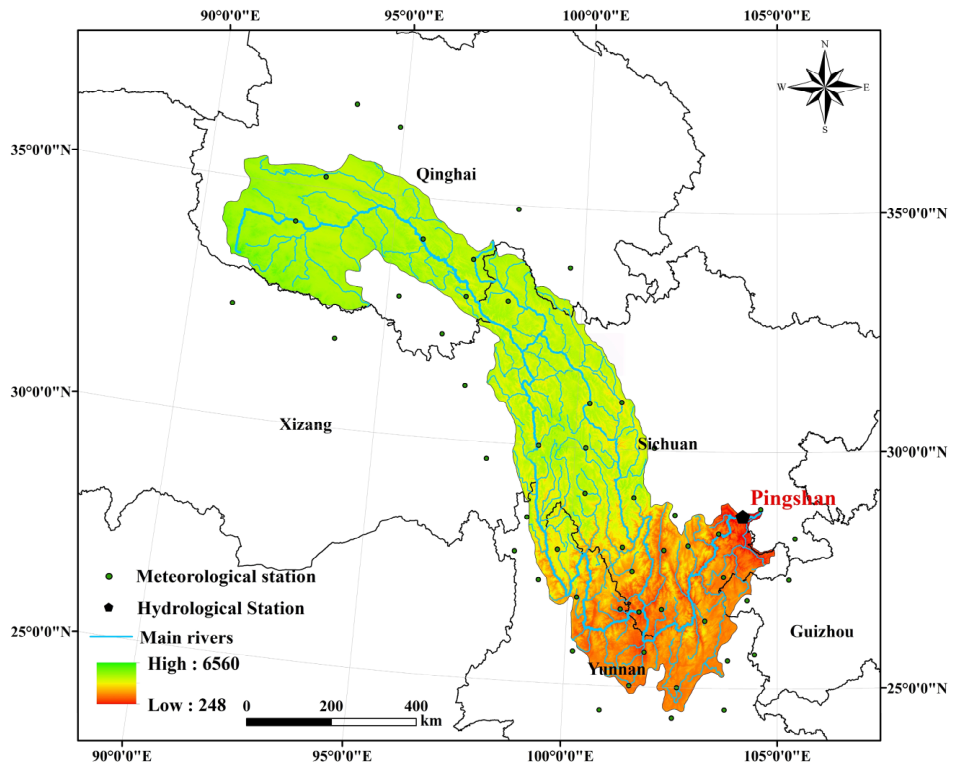
The Jinsha River Basin is located in the upper reaches of the Yangtze River, covering an area of approximately 495,000 square kilometers (Figure 1). It originates from the southwestern side of the Qaladandong Snow Mountain in the Tanggula Mountains. The Jinsha River Basin has abundant and stable runoff and extremely rich hydropower resources. The terrain is complex and variable, with mountains, canyons, hills, and basins distributed alternately within the basin. Affected by the monsoon, the climate of the basin has distinct regional characteristics, and the vegetation types are diverse.
The monthly runoff data of Pingshan Hydrological Station from 1970 to 2016 were sourced from the Changjiang Water Resources Commission of the Ministry of Water Resources of China. The 1 km × 1 km monthly scale precipitation and temperature data from 2030 to 2050 under three climate models (EC-Earth3, GFDL-ESM4, and MRI-ESM2-0) and three emission scenarios (SSP119, SSP245, and SSP585) were obtained from the National Earth System Science Data Center. The meteorological data from 1970 to 2016 were obtained from the China Meteorological Data Network (https://data.cma.cn/), accessed on 15 November 2025. Precipitation was calculated using the Kriging interpolation method, and potential evaporation was calculated using Hargreaves’ formula [35,36].

3. Methodology

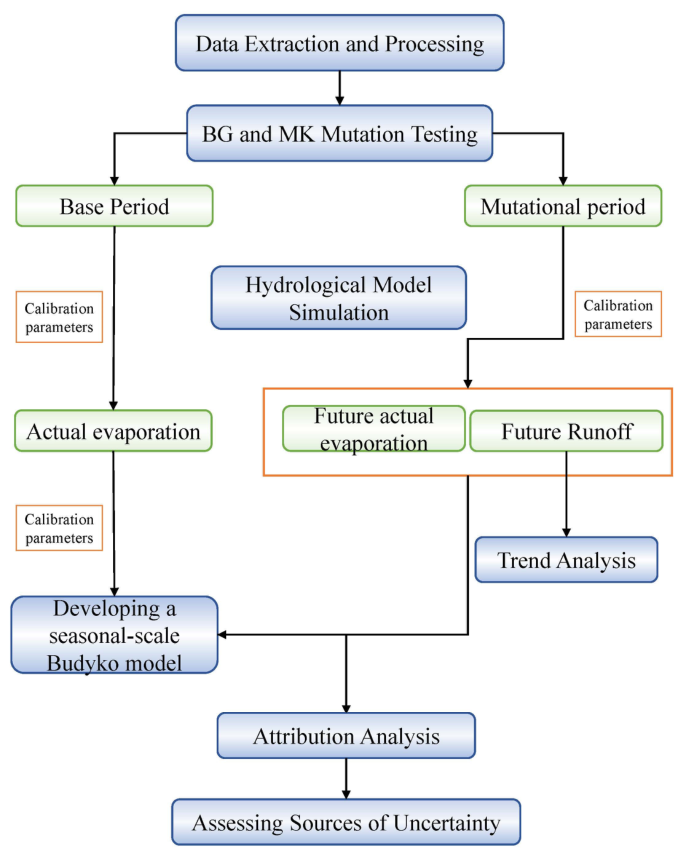
Figure 2 shows the research methodology roadmap for this study. We conducted the study through the following steps: (1) Multiple mutation test methods were used to identify the mutation years of the runoff in the historical period of the Jinsha River, and the study period was divided into the base period and the change period. (2) The hydrological model was used to simulate the monthly scale runoff change process in the base period, and then seasonal-scale Budyko models were constructed. (3) The hydrological model was used to simulate the monthly runoff change process in the change period, and to simulate the runoff of the Jinsha River in the future period under different scenarios. (4) The contribution of climate change and human activities to the seasonal-scale runoff variations in the Jinsha River in the future period was quantitatively calculated using the seasonal-scale Budyko models. (5) The variance analysis method was used to quantitatively evaluate the degree of influence of different factors on the uncertainty of attribution analysis results of the future runoff changes.

3.1. Mutation Testing Methods

In this study, the Bernaola–Galvan (BG) segmentation algorithm and Pettitt’s mutation test for abrupt changes were used to identify the years of abrupt changes in runoff at Pingshan Hydrological Station on the Jinsha River during the historical period.
The BG segmentation algorithm is a non-parametric method used for detecting abrupt change year of time series data [37]. Its advantage lies in the fact that it does not rely on the assumption of normal distribution of the data, and can detect multiple abrupt change years [38]. It is suitable for analyzing complex time series data [39]. Additionally, the BG algorithm conducts statistical significance tests to ensure that the detected years of abrupt change have statistical significance [40].
Pettitt’s mutation test method can effectively diagnose the variation trend and significance of non-normally distributed variables [41]. Its advantages are that it does not require the data to follow a normal distribution, and is not affected by missing values and outliers [42].
The BG algorithm can detect multiple abrupt change points within a time series, which is important for the Jinsha River runoff record that may be influenced by multiple human interventions (e.g., dam constructions and land-use changes) over the 1970–2016 period. The BG algorithm incorporates a statistical significance test (based on a t-test of the means between segments), ensuring that the detected change points are statistically meaningful rather than spurious. It was successfully applied in previous hydrologic change-point detection studies. Pettitt’s test was used as a complementary method because it is a single-change-point test that provides a robust, non-parametric estimate of the most significant change point, and its results can be cross-validated with those of the BG algorithm to increase confidence in the identified mutation year.

3.2. Hydrological Models

In this study, the periods before and after the abrupt change were divided into a base period and a mutation period, which were then simulated using hydrological models. The ABCD and DWBM hydrological models were selected. These two models were used to simulate runoff data from the base period to derive actual evaporation, thereby constructing seasonal-scale Budyko models; the model was then used to simulate runoff data from the mutation period to derive actual evaporation and runoff data for the future period, thereby quantitatively calculating the contributions of climate and human factors to future runoff.
The ABCD hydrological model is an aggregated model based on water balance that divides a river basin into four water reservoirs—soil moisture, groundwater, surface water, and snow cover—and describes the water exchange among these reservoirs through simple nonlinear relationships [28]. This model has a simple structure, few parameters, and relatively low requirements for input data [43]. The model has four parameters: a (0–1): controls the amount of runoff and recharge when soils are unsaturated. b (typically 260–1900): controls the saturation level of the soils. c (0–1): ratio of groundwater recharge to surface runoff. d (0–1): controls the rate of groundwater discharge.
The dynamic water balance model with variable time scales (DWBM) hydrological model is a dynamic water balance model that takes into account multiple hydrological processes, such as precipitation, evaporation, runoff, soil moisture, and groundwater [44]. This model can reflect the dynamic changes in hydrological processes and takes into account multiple hydrological processes with relatively high simulation accuracy [45]. The model simulates the following key hydrological processes: precipitation is partitioned into basin water consumption (evapotranspiration) and basin water yield; available water for evapotranspiration is partitioned between soil storage and actual evapotranspiration; the basin water yield is divided into surface runoff and groundwater recharge; baseflow is generated from groundwater storage drainage; total monthly streamflow is the sum of surface runoff and baseflow. The model contains four parameters: α1 (0–1): precipitation catchment efficiency coefficient; α2 (0–1): evapotranspiration efficiency coefficient (also denoted as α in some versions); Smax: maximum water-holding capacity of the soil storage; d (0–1): groundwater storage time constant (groundwater recession coefficient). The ABCD and DWBM models were widely applied in the simulation of hydrological processes in river basins [46,47,48].
It is important to note that the hydrological model parameters calibrated using the change period (1985–2016) were assumed to remain unchanged when simulating future runoff (2030–2050). This assumption is grounded in the following justifications. First, the parameters of the hydrological model reflect the intrinsic characteristics of the watershed, including soil water-holding capacity, groundwater recharge coefficients, and evapotranspiration responses. In the absence of drastic land-use changes, these physical characteristics typically remain stable over short time scales. Second, since the 1980s, the Jinsha River Basin has not undergone large-scale, systematic land-use changes that could fundamentally alter its hydrological response. Third, this assumption of constant parameters is standard practice in studies of climate impacts on hydrology, in which future runoff is simulated using models calibrated with historical data, precisely because the future observational data needed for recalibration are not available.

3.3. Decomposition Method Based on Seasonal-Scale Budyko Models

In this study, seasonal-scale Budyko models based on actual evaporation simulated for the base period were developed, which enabled further quantification of the contributions of climate change and human activities to future runoff changes. The Budyko model was selected because the Budyko framework describes the watershed-scale water–energy balance using a single surface parameter, making it well-suited for distinguishing between climate-induced and human-induced changes in runoff. Compared to complex distributed hydrological models, the Budyko method requires fewer input data and takes less time to compute. Furthermore, the Budyko framework is extensively validated in numerous watersheds worldwide and is regarded as the standard tool for runoff attribution studies. Therefore, the seasons used in seasonal attribution analysis are defined as follows: March through May is spring; June through August is summer; September through November is fall; and December through February is winter.
The expression of the seasonal-scale Budyko models is as follows [27,28].
E P Δ S = 1 + E p P Δ S φ ω 1 ω
where P represents precipitation; E represents actual evaporation; Ep represents potential evaporation; ΔS is the variation in storage water; φ is the lower bound of aridity indices; and ω is the underlying surface parameter.
The decomposition method based on the Budyko hypothesis was put forward in 2011 [31], and was widely applied in the quantitative analysis of the contribution rate of climate and human factors to runoff variation [33,34].
Δ R = R 2 R 1
R h = R 2 R 2
R c = Δ R R h
where R 1 and R 2 are the runoff of the base period and the future period, respectively; assuming that the mutation period is influenced only by climate change, its runoff is R 2 ; and Rc and Rh, respectively, represent the future runoff variation caused by climatic and human factors.

3.4. Variance Analysis (VAAN)

Building on the aforementioned methods, the VAAN method was used to quantitatively analyze the extent to which sources of uncertainty (GCMs, HMs, and SSPs) influence the results of future runoff change attribution.
Variance analysis (VAAN) quantifies the contribution of different factors to the uncertainty of the results by calculating error squares of different factors, and identifies the main sources of uncertainty [21,35].
S S T = S S A + S S B + S S C + S S I
where SST represents the sum of squared errors of all factors; and S S A , S S B , S S C , and S S I are the squared errors of the HMs, GCMs, SSPs, and their interactions.
S S T = i = 1 N A j = 1 N B k = 1 N c Y i j k Y ¯ 2
S S A = N B N C i = 1 N A Y ¯ i o o Y ¯ 2
S S B = N A N C i = 1 N B Y ¯ o i o Y ¯ 2
S S C = N A N B i = 1 N C Y ¯ o o i Y ¯ 2
S S I = S S T S S A S S B S S C
where N A , N B , and N C are the numbers of the HMs, GCMs, and SSPs, respectively; Y i j k is the category i , j , k corresponding to the HMs, GCMs, and SSPs; Y is the overall mean; and o denotes the mean of the influencing factors.
η A 2 = S S A S S T
η B 2 = S S B S S T
η C 2 = S S C S S T
η I 2 = S S I S S T
where η 2 is the variance score, reflecting the effect of individual uncertainty on total uncertainty; and η A 2 , η B 2 , η C 2 , and η I 2 are the effects of the HMs, GCMs, SSPs, and their interactions on total uncertainty, respectively.

4. Result and Analysis

4.1. Mutation Testing of Runoff

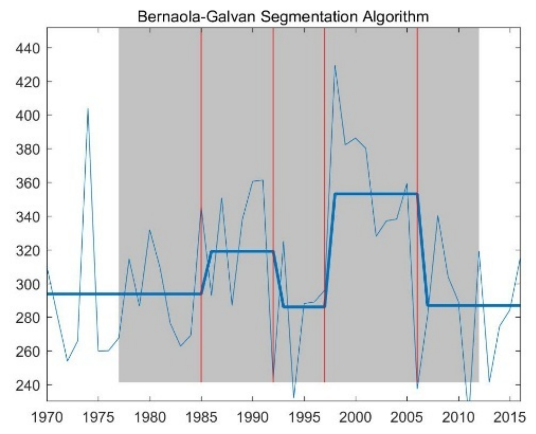
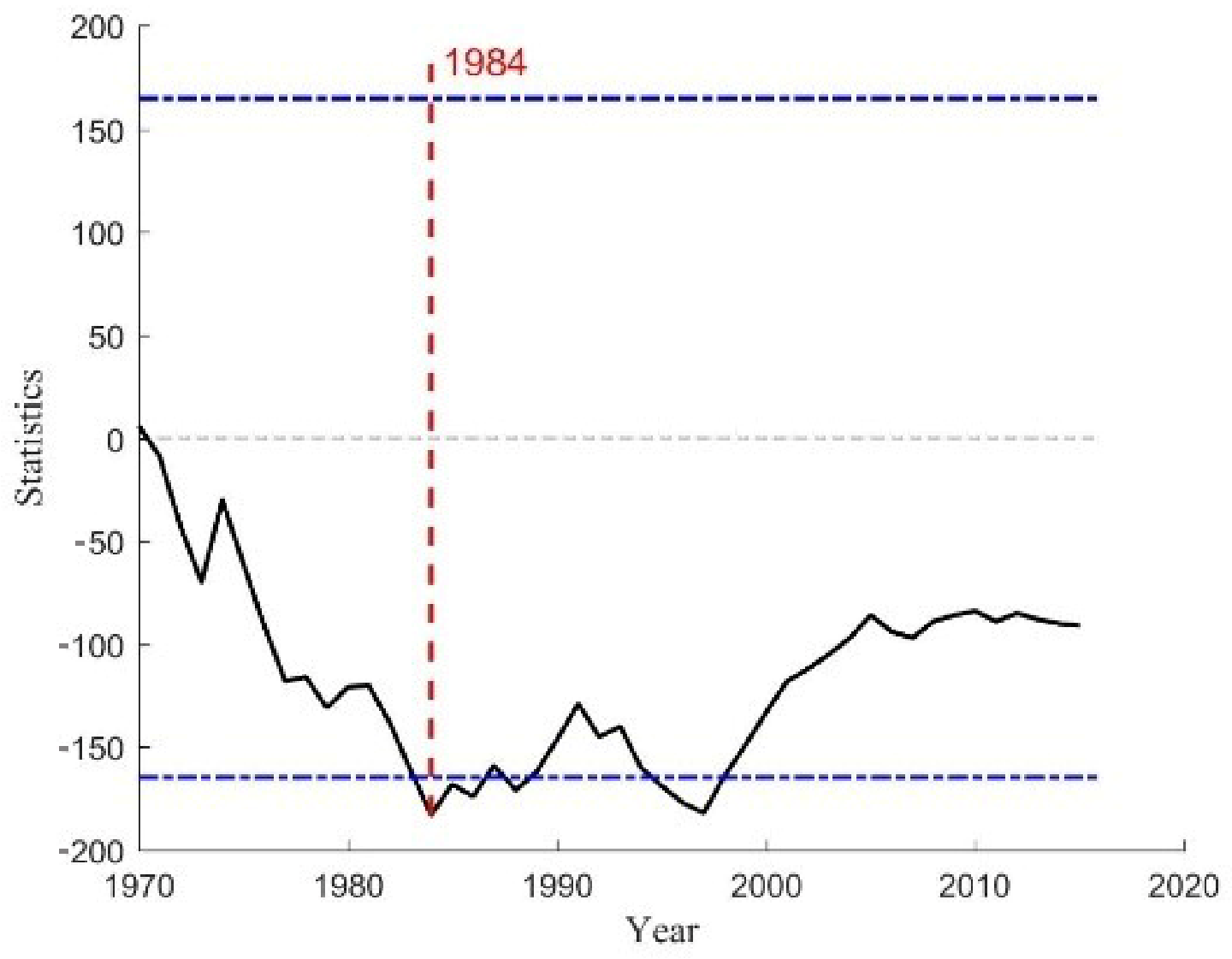
This study employs the BG mutation test and Pettitt’s mutation test methods to identify the mutation year in the runoff sequence at Pingshan Station in the JSR from 1970 to 2016 (Figure 3 and Figure 4). The results of the BG mutation test indicate that there might be multiple mutation points in the runoff sequence at Pingshan Station in the JSR, occurring around 1985, 1993, 1997, and 2006. The results of Pettitt’s mutation test suggest that the mutation year of the runoff sequence at Pingshan Station in the JSR might be around 1984. Ma used the cumulative anomaly method and the M-K breakpoint test to determine that a break occurred in the runoff at Pingshan Station in 1984, consistent with the results of Pettitt’s test [49]. Therefore, 1984 is considered the mutation year of runoff at Pingshan Station.

4.2. Simulation of Future Runoff Changes

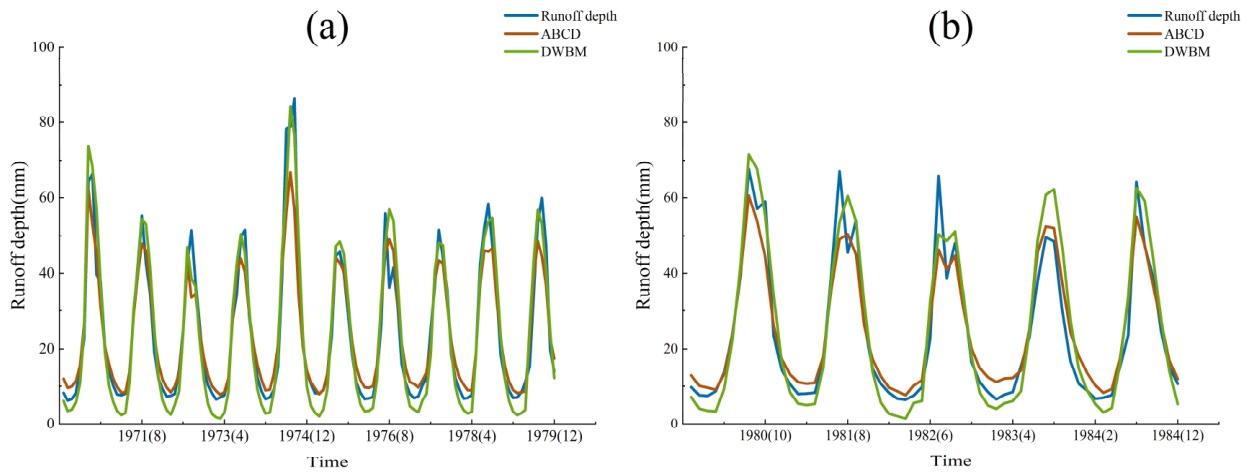
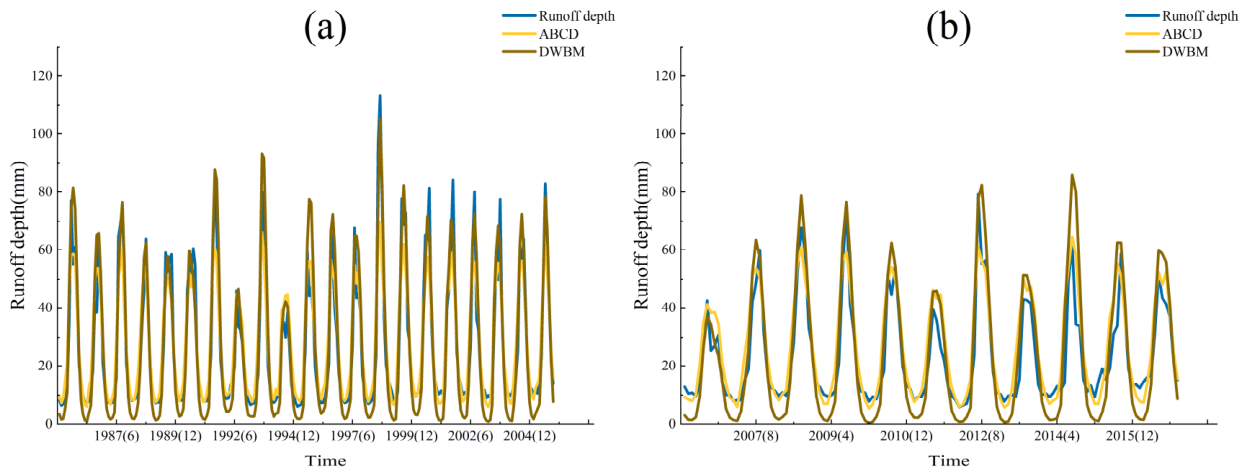
Based on the results of the mutation analysis, the study period (1970–2016) was divided into the base period (1970–1984) and the mutation period (1985–2016). Then, we used the ABCD hydrological model and the DWBM hydrological model to simulate the runoff change process in the base period and the mutation period, respectively (Figure 5 and Figure 6). To ensure the rigor of the calibration–verification scheme, the time series was divided according to the 2:1 ratio commonly used in hydrological modeling, with the base period (1970–1984) and the variation period (1985–2016) designated as the calibration period and the verification period, respectively. For the base period, the calibration period was set as 1970–1979 (10 years), and the verification period as 1980–1984 (5 years). To avoid the influence of changes in runoff patterns, the validation period was truncated at 1984, the identified year of abrupt change. Although the verification period was shorter than the calibration period, its monthly temporal resolution and the simple structure of the hydrological models (ABCD and DWBM) made it statistically suitable for evaluating model performance. For the post-break period, the calibration period was 1985–2005 (21 years) and the verification period was 2006–2016 (11 years), following the 2:1 data-split ratio commonly used in hydrological modeling.
Table 1 and Table 2, respectively, present the parameters and evaluation indicators of the base period by the ABCD and DWBM models. As seen in Table 1, the Nash coefficients of both the calibration period and the verification period by the ABCD model are all above 0.85, and the RE values are all within 10%. In Table 2, the Nash coefficients of both the calibration period and the verification period by the DWBM model are all above 0.80, and the RE values are all within 5%. For both models, validation NSE values are slightly lower than calibration NSE values, which is expected and indicates no severe overfitting. For example, in the base period, the ABCD model’s NSE remains at 0.91 for both calibration and verification; in the mutation period, NSE decreases modestly from 0.89 (calibration) to 0.85 (verification). Similarly, the DWBM model’s NSE decreases from 0.89 to 0.89 in the base period, and from 0.86 to 0.80 in the mutation period. To assess whether model performance is sensitive to the specific partitioning of the calibration and verification sets, we conducted a cross-validation analysis using a sliding window method for the benchmark period. The results show that the NSE values for both models fluctuate within a narrow range (±0.03 for the ABCD model and ±0.04 for the DWBM model), and the RE values consistently remain within ±10%, confirming the robustness of the models’ performance. This indicates that the simulation results of the two hydrological models are quite good, with a relatively precise fitting degree.
Biases in the two hydrological models are carried over into the seasonal attribution analysis based on the Budyko models. However, one of the objectives of this study was to investigate how differences in hydrological models affect attribution results. Since we used the same simulated actual evapotranspiration for both the seasonal-scale Budyko models and the driving attribution calculations, and the deviations remained largely consistent across time periods, the contributions of climatic and anthropogenic factors are less sensitive to absolute deviations. The actual evaporation values obtained by the hydrological models can be used to construct the seasonal-scale Budyko models.
The ABCD and DWBM hydrological models, constructed by the monthly meteorological and hydrological data during the mutation period, respectively, were applied to simulate the monthly runoff volumes in the Jinsha River Basin in the future period (2030–2050) under different scenarios (SSP119, SSP245, and SSP585) (Table 3). Table 3 presents the future changes in seasonal runoff proportions (2030–2050) relative to the base period (1970–1984), along with the uncertainty ranges derived from different GCMs, HMs, and SSPs. The results consistently show decreases in spring and winter runoff (ranging from −18.3% to −25.3%) and increases in summer and autumn runoff (ranging from +2.6% to +8.4%) across all three SSP scenarios.
The projected seasonal patterns are closely linked to the hydrological regime of the JSR, which is dominated by monsoonal climate and high-altitude cryospheric processes. The decline in spring runoff could be explained by two interacting mechanisms. First, rising temperatures (especially under SSP245 and SSP585) accelerate snowmelt and glacier melt in late winter and early spring, reducing the snow water equivalent available for spring melt. Second, increased potential evapotranspiration due to warming enhances atmospheric water demand, further reducing spring runoff. The decline in winter runoff is primarily attributed to reduced precipitation during the dry season (winter precipitation was already low in the JSR), combined with increased evapotranspiration under warmer conditions. In contrast, the increase in summer and autumn runoff is driven by enhanced monsoon precipitation intensity (more extreme precipitation events) under a warming climate, as projected by most GCMs for the Tibetan Plateau and its southeastern margin. Additionally, increased glacier melt during the summer melt season (due to higher temperatures) contributes extra water to streamflow, further amplifying summer and autumn runoff.

4.3. Attribution of Future Runoff Changes

Based on the actual evaporation simulated from the ABCD and DWBM hydrological models during the base period, this study first constructed seasonal-scale Budyko models. Table 4 presents the parameters and evaluation indicators for fitting the seasonal-scale Budyko curve during the base period. As can be seen from Table 4, the R2 of the seasonal-scale Budyko models constructed based on the ABCD model and the DWBM model are all greater than 0.9, and the absolute values of the relative errors are all less than 10%. This indicates that the constructed seasonal-scale Budyko models can be used for quantifying the impacts of climate change and human activities on future runoff changes. In this study, precipitation, potential evaporation, and soil water reserves are classified as climatic factors, while all other factors are classified as anthropogenic factors.
Based on the actual evaporation simulated by the ABCD and DWBM hydrological models during the baseline period, we first constructed seasonal-scale Budyko models (Table 4). Subsequently, using these models, we quantified the contributions of climate change and human activities to future runoff changes (2030–2050) under three SSP scenarios. Table 5 lists the average contribution values (the full range of uncertainty for different GCMs and HMs is shown in parentheses).
To statistically assess whether the differences between human-induced and climate-induced runoff contributions are significant, a paired t-test was conducted on the attribution results across all combinations of GCMs, HMs, and SSPs for each season and scenario. As shown in Table 5, all p-values are below 0.05, indicating that the contributions of human activities and climate change differ significantly at the 95% confidence level. Consequently, the dominant factor can be determined by comparing the absolute magnitudes of their contributions.
As shown in Table 5, under the SSP119 scenario, human activities make a positive contribution to runoff changes in all seasons, with the largest absolute contributions occurring in summer (48.1 mm) and autumn (30.5 mm). Climate change exerts a negative influence in all seasons, most notably in summer (−24.5 mm). Overall, human activities dominate in spring, summer, and autumn, while climate change dominates in winter. Under the SSP245 scenario, climate change becomes the dominant factor in spring, while human activities continue to dominate in summer and autumn. Winter remains dominated by climate change. The SSP585 scenario is consistent with the SSP245 scenario in that human activities are the primary driver of future runoff changes in the summer and fall seasons, exerting a positive influence. However, climate change is the primary driver of future runoff changes in the spring and winter seasons, exerting a negative influence.
Summer and fall are the wet seasons, when reservoir operations (flood storage and dry-season replenishment) and irrigation water withdrawals are most frequent; therefore, anthropogenic factors will dominate future changes in runoff. Spring runoff is highly sensitive to temperature (e.g., snowmelt), so under scenarios of significant warming, the impact of climate change on future runoff changes will outweigh that of anthropogenic factors. Winter runoff is extremely low, and both anthropogenic and climate factors contribute very little to future runoff changes; however, while their effects are clearly distinct in direction, their actual impact is negligible.

4.4. Quantitative Assessment of Uncertainty Sources

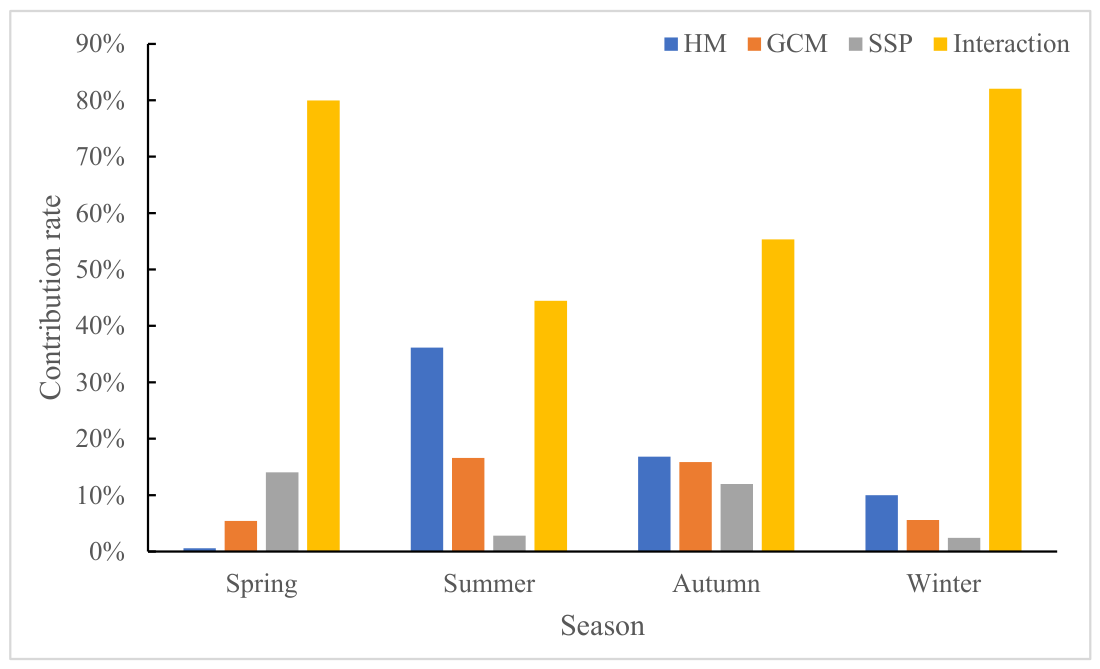
We used the variance analysis method to quantitatively analyze the degree of influence of the hydrological models (HMs), the global climate models (GCMs), the shared socioeconomic pathways (SSPs), and their interactions on the uncertainty of the attribution analysis results of the future runoff changes in the JSR (Figure 7). As shown in Figure 7, the contribution rates of the HMs, GCMs, SSPs, and their interactions to the uncertainty of the attribution analysis results of the spring runoff changes in the future period of the JSR are 0.57%, 5.41%, 14.03%, and 79.98%, respectively.
In spring, the interaction between the HMs, GCMs, and SSPs accounts for 79.98% of the total uncertainty, followed by the SSPs (14.03%) and GCMs (5.41%), while the HMs’ contribution alone is negligible (0.57%). The dominant contribution of interaction uncertainty indicates that, in spring, the interactions among different GCMs, HMs, and SSPs are far more significant than any single factor. In summer, interactions among sources of uncertainty remain dominant (44.45%), but the HMs also contribute significantly (36.15%), followed by the GCMs (16.58%) and SSPs (2.82%). The relatively high contribution of the HMs during the summer is expected, as summer runoff is primarily driven by the precipitation-runoff process, and hydrological model parameterizations (soil water storage and evapotranspiration coefficients) play a critical role in this process. This pattern is consistent with the findings of Bosshard et al. (2013) [29], who found that hydrological model uncertainty is greatest during high-flow seasons. In the autumn, interactions among these three factors still accounted for the largest share (55.34%), with relatively balanced and comparable contributions from the HMs (16.83%), GCMs (15.87%), and SSPs (11.96%). In winter, the interaction between the HMs, GCMs, and SSPs continues to account for the largest share (82.03%) of the attributed changes in future runoff, while the individual contributions of the HMs (9.98%), GCMs (5.57%), and SSPs (2.43%) are negligible. This may be due to the inherently low winter runoff levels, which are highly susceptible to the combined effects of variations in GCM precipitation forecasts, the accuracy of the HM simulations, and the magnitude of warming based on the SSPs. This strong interaction indicates that the “right” combination of factors is crucial for winter simulations—a finding with significant implications for water resource management during the dry season.
Across all seasons, interactions among the HMs, GCMs, and SSPs are the primary source of uncertainty (accounting for 44.45% to 82.03%), far exceeding the contribution of any single factor. This finding suggests that uncertainty in future runoff projections is not a simple linear superposition; rather, it stems from complex nonlinear dependencies among climate projections, hydrological models, and emission scenarios.

5. Discussions

5.1. Interpretation of Key Findings

This study developed an integrated framework combining GCMs, SSPs, hydrological models (ABCD and DWBM), seasonal-scale Budyko models, and variance analysis (VAAN) to attribute future seasonal runoff changes in the Jinsha River Basin and quantify the sources of uncertainty affecting the attribution results. The key findings can be summarized as follows: (1) under the low-emission SSP119 scenario, human activities dominate runoff changes in spring, summer, and autumn, while climate change dominates in winter; (2) under the medium- and high-emission scenarios (SSP245 and SSP585), human activities remain dominant in summer and autumn, but climate change becomes dominant in spring and winter; (3) across all seasons, the interactions among the HMs, GCMs, and SSPs are the primary source of uncertainty (44.45–82.03%), far exceeding the contribution of any single factor.
Our results are broadly consistent with existing attribution studies in the Jinsha River Basin. Zhang et al. [18] found that climate change contributed 56.3% to historical runoff reduction in the middle and lower reaches. Lv et al. [19] reported that climate change dominated high-flow declines, while human activities dominated low-flow increases. Our future projections extend these findings by showing that the relative importance of climate versus human drivers is season-dependent and scenario-dependent. Under higher emissions, climate change becomes the dominant factor in spring and winter, suggesting that warming will increasingly override human regulation during these seasons. This finding aligns with He et al. [50], who reported similar seasonal shifts in other Chinese basins under future scenarios.
The uncertainty partitioning results also echo previous multi-model ensemble studies. Bosshard et al. [29] and Vetter et al. [32] demonstrated that the choice of GCM and hydrological model each contributes substantially to uncertainty in runoff projections, but they did not explicitly quantify interaction effects. Hattermann et al. [33] and Ye et al. [34] found that interactions among uncertainty sources can be significant. Our study advances the literature by quantifying the contribution of interaction effects specifically to attribution results (rather than to raw runoff projections) and by demonstrating that interactions consistently dominate across seasons. This is a non-trivial contribution, as most attribution studies to date have reported only main effects.

5.2. Methodological Limitations and Their Implications

Hargreaves’ Method for Potential Evaporation: Due to the lack of future humidity and wind speed data, we used Hargreaves’ method, which relies only on temperature and solar radiation. Compared to the Penman–Monteith equation, Hargreaves’ method tends to overestimate potential evaporation under humid conditions (e.g., summer monsoon) and may underestimate it under dry, windy conditions (spring and winter). This bias could affect our attribution results in two ways. First, overestimation of Ep in summer leads to a higher aridity index, which in the Budyko framework could overestimate the climate-induced runoff reduction. Second, the exclusion of humidity and wind variability from different GCMs may underestimate the true GCM-related uncertainty, potentially inflating the relative contribution of interaction effects. Therefore, while the qualitative seasonal patterns (e.g., human dominance in summer/autumn and climate dominance in spring/winter under higher emissions) are likely robust, the precise contribution magnitudes should be interpreted with caution. Future studies should employ the Penman–Monteith equation when multi-variable forcing data become available.
Stationary Parameter Assumption for Hydrological Models: We assumed that the ABCD and DWBM parameters calibrated using the change period (1985–2016) remain unchanged when simulating future runoff (2030–2050). This is standard practice in climate impact hydrology and is justified by the absence of large-scale land-use transformations in the Jinsha River Basin since the 1980s. The stationary parameter assumption may, therefore, underestimate the contribution of human activities to future runoff changes, because the effect of new dams is partially captured by the climate forcing (via altered flow seasonality) rather than by the parameter set. Future research should explore dynamic parameterization schemes that allow model parameters to evolve with changing basin conditions.
Limited Number of GCMs and SSPs: We used only three GCMs (EC-Earth3, GFDL-ESM4, and MRI-ESM2-0) and three SSPs (119, 245, and 585). While these cover a reasonable range of climate sensitivities and forcing pathways, a larger ensemble (e.g., 10–20 GCMs) would provide a more complete representation of climate model uncertainty. Our quantification of GCM-related uncertainty (e.g., 5.41% in spring and 16.58% in summer) should, therefore, be considered indicative rather than absolute. Nevertheless, the dominance of interaction effects over main effects is a robust finding that is unlikely to change with a larger ensemble, because interactions arise from the structure of multi-model ensembles rather than from the specific set of models.
Lumping of Human Activities: In the Budyko framework, all non-climatic factors are collectively attributed to “human activities.” However, human activities in the Jinsha River Basin include reservoir regulation, irrigation water withdrawal, land-use change (e.g., afforestation), and soil conservation practices, each with different hydrological effects. Reservoir operation tends to increase dry-season runoff and reduce flood-season peaks; irrigation withdrawal reduces runoff during the growing season; afforestation increases evapotranspiration and reduces runoff. Our positive human contribution in summer and autumn likely reflects the net effect of these competing processes, with reservoir regulation being the dominant factor given the basin’s status as China’s largest hydropower base. Future research should integrate process-based hydrological models that explicitly represent dam operation rules, land-use scenarios, and sectoral water withdrawals to enable a more detailed attribution.

5.3. Broader Applicability and Future Directions

Although this study focuses on the Jinsha River Basin, the methodological framework is fully transferable to other regions. The workflow can be applied to any basin with available historical observations and climate projections. We encourage researchers in other climatic and hydrological settings to adopt this framework, which would help determine whether the dominance of interaction effects is a universal feature or context-dependent.
Future research should address the limitations identified above: (1) use the Penman–Monteith equation to compute potential evaporation when multi-variable forcing becomes available; (2) incorporate dynamic parameterization or land-use scenarios to relax the stationary parameter assumption; (3) expand the GCM and SSP ensembles to better sample climate uncertainty; (4) disaggregate human activities into sectoral components (reservoir operation, irrigation, and land-use change) using process-based models; and (5) explore the use of machine learning emulators to reduce computational burden while maintaining ensemble diversity. By addressing these challenges, the scientific community can move toward more reliable and actionable seasonal runoff attribution under future climate change.

6. Conclusions

This study constructed a framework that integrated global climate models (GCMs), shared socioeconomic pathways (SSPs), hydrological models (HMs), seasonal-scale Budyko models, and variance analysis (VAAN). This framework was adopted to explore the contributions of climate change and human activities to the future seasonal runoff changes in the JSR, and quantify the degree of influence of uncertainty sources on the attribution results of future seasonal runoff changes. The conclusions presented that: (1) Both the ABCD hydrological model and the DWBM hydrological model can achieve excellent fitting results in simulating runoff. (2) Under the SSP119 scenario, human activities are the dominant factor for runoff changes in the JSR during spring, summer, and autumn, while climate change is the dominant factor for runoff changes in the winter of the future period. (3) Under the SSP245 and SSP585 scenarios, human activities are the dominant factor for runoff changes in the summer and autumn of the future period in the JSR, while climate change is the dominant factor for runoff changes in the spring and winter of the future period. (4) The interactions of the HMs, GCMs, and SSPs are the dominant factor affecting the uncertainty of the attribution analysis results of future runoff changes in the JSR.
While the quantitative attribution results (e.g., contributions of human activities vs. climate change to seasonal runoff) are specific to the Jinsha River Basin, the methodological framework and key insights have global relevance. The integrated workflow—combining future climate scenarios, hydrological models, seasonal-scale Budyko attribution, and variance-based uncertainty partitioning—can be directly applied to any watershed with available data. The finding that interaction effects dominate over single-factor uncertainties (44.45–82.03% across seasons) is a generalizable insight that challenges common uncertainty reduction strategies; it suggests that improving individual models (e.g., selecting “better” GCMs or HMs) may yield limited benefits unless model interdependencies are addressed. Moreover, the explicit focus on quantifying uncertainty in attribution results (rather than in runoff simulations) addresses a widely recognized but seldom tackled gap in climate impact hydrology. Thus, this study contributes not only region-specific knowledge for the Jinsha River water management but also a transferable analytical framework and conceptual advances of interest to the global hydrological community.

Author Contributions

J.W.: writing—review and editing, writing—original draft, visualization, validation, methodology, formal analysis, data curation; Z.L.: writing—review and editing, validation, methodology, formal analysis, data curation, conceptualization; G.J.: writing—review and editing, visualization, supervision, funding acquisition, methodology, data curation. All authors have read and agreed to the published version of the manuscript.

Funding

This work was jointly supported by the Henan Provincial Natural Science Foundation (Grant Nos. 252300420849 and 262300420274); Top-Talents Program of Henan Agricultural University (30501031); Key Scientific Research Project of Higher Education Institutions in Henan Province (26A180022); Natural Science Fund of Nanyang Normal University (2025ZX004); and Nanyang Science & Technology Plan Project (24JCQY022).

Data Availability Statement

The data presented in this study are available upon request from the corresponding authors. The data are not publicly available due to restrictions from the data provider, the Changjiang Water Resources Commission of the Ministry of Water Resources of China.

Conflicts of Interest

We declare no conflicts of interest.

References

  1. Xia, C.; Xu, J.; Tian, H.; Liu, J.; Zhang, S.; Lin, S.; Chen, T. Quantitative hydrological response to climate change and human activities in North and South Sources in upper stream of Qiantang River Basin, East China. J. Hydrol. Reg. Stud. 2022, 44, 101222. [Google Scholar] [CrossRef]
  2. Shen, Q.; Cong, Z.; Lei, H. Evaluating the impact of climate and underlying surface change on runoff within the Budyko framework: A study across 224 catchments in China. J. Hydrol. 2017, 554, 251–262. [Google Scholar] [CrossRef]
  3. Ning, T.T.; Zhou, S.; Chang, F.Y.; Shen, H.; Li, Z.; Liu, W.Z. Interaction of vegetation, climate and topography on evapotranspiration modelling at different time scales within the Budyko framework. Agric. For. Meteorol. 2019, 275, 59–68. [Google Scholar] [CrossRef]
  4. Wang, J.; Ji, G.; Hu, Y. Effect of Vegetation Growth, Agricultural Irrigation and Climatic Variability on Streamflow in Wujiang, China. Forests 2024, 15, 1928. [Google Scholar] [CrossRef]
  5. Wang, Y.; Liu, Z.; Qian, B.; He, Z.; Ji, G. Quantitatively Computing the Influence of Vegetation Changes on Surface Discharge in the Middle-Upper Reaches of the Huaihe River, China. Forests 2022, 13, 2000. [Google Scholar] [CrossRef]
  6. Ji, G.; Huang, J.; Guo, Y.; Yan, D. Quantitatively Calculating the Contribution of Vegetation Variation to Runoff in the Middle Reaches of Yellow River Using an Adjusted Budyko Formula. Land 2022, 11, 535. [Google Scholar] [CrossRef]
  7. Ji, G.; Yue, S.; Zhang, J.; Huang, J.; Guo, Y.; Chen, W. Assessing the Impact of Vegetation Variation, Climate and Human Factors on the Streamflow Variation of Yarlung Zangbo River with the Corrected Budyko Equation. Forests 2023, 14, 1312. [Google Scholar] [CrossRef]
  8. Yang, L.; Zhao, G.; Tian, P.; Mu, X.; Tian, X.; Feng, J.; Bai, Y. Runoff changes in the major river basins of China and their responses to potential driving forces. J. Hydrol. 2022, 607, 127536. [Google Scholar] [CrossRef]
  9. Wu, C.; Ji, C.; Shi, B.; Wang, Y.; Gao, J.; Yang, Y.; Mu, J. The impact of climate change and human activities on streamflow and sediment load in the Pearl River basin. Int. J. Sediment Res. 2019, 34, 307–321. [Google Scholar] [CrossRef]
  10. Lei, X.; Gao, L.; Wei, J.; Ma, M.; Xu, L.; Fan, H.; Li, X.; Gao, J.; Dang, H.; Chen, X.; et al. Contributions of climate change and human activities to runoff variations in the Poyang Lake Basin of China. Phys. Chem. Earth 2021, 123, 103019. [Google Scholar] [CrossRef]
  11. Xin, Z.; Li, Y.; Zhang, L.; Ding, W.; Ye, L.; Wu, J.; Zhang, C. Quantifying the relative contribution of climate and human impacts on seasonal streamflow. J. Hydrol. 2019, 574, 936–945. [Google Scholar] [CrossRef]
  12. Li, Y.; Liu, C.; Yu, W.; Tian, D.; Bai, P. Response of streamflow to environmental changes: A Budyko-type analysis based on 144 river basins over China. Sci. Total Environ. 2019, 664, 824–833. [Google Scholar] [CrossRef]
  13. Wang, H.-x.; Wang, B.-l.; Chen, H.; Yang, H.; Guo, W.-x. Analysis of Evolution of Hydrological Regime and Ecological Response in Min River. Resour. Environ. Yangtze Basin 2023, 32, 1960–1970. (In Chinese) [Google Scholar] [CrossRef]
  14. Li, M.-x.; Zou, L.; Xia, J.; Wang, Z.-w. Analysis of Runoff Change and Its Attribution in the Baihe River Basin Under the Budyko Framework. Resour. Environ. Yangtze Basin 2023, 32, 774–782. (In Chinese) [Google Scholar]
  15. Wu, Y.; Fang, H.; Huang, L.; Ouyang, W. Changing runoff due to temperature and precipitation variations in the dammed Jinsha River. J. Hydrol. 2020, 582, 124500. [Google Scholar] [CrossRef]
  16. Zhang, D.; Wang, W.; Yu, S.; Liang, S.; Hu, Q. Assessment of the Contributions of Climate Change and Human Activities to Runoff Variation: Case Study in Four Subregions of the Jinsha River Basin, China. J. Hydrol. Eng. 2021, 26, 05021024. [Google Scholar] [CrossRef]
  17. Zeng, F.; He, Q.; Li, Y.; Shi, W.; Yang, R.; Ma, M.; Huang, G.; Xiao, J.; Yang, X.; Di, D. Reduced runoff in the upper Yangtze River due to comparable contribution of anthropogenic and climate changes. Earth’s Future 2024, 12, e2023EF004028. [Google Scholar] [CrossRef]
  18. Zhang, X.F.; Yan, H.C.; Yue, Y.; Xu, Q.X. Quantifying natural and anthropogenic impacts on runoff and sediment load: An investigation on the middle and lower reaches of the Jinsha River Basin. J. Hydrol. Reg. Stud. 2019, 25, 100617. [Google Scholar] [CrossRef]
  19. Lv, H.; Wang, Y.; Yan, D.; Peng, S.; Zheng, X. Quantifying the impacts of climate change and human activities on hydrological regime in Jinsha River, China. J. Hydrol. 2025, 662, 134008. [Google Scholar] [CrossRef]
  20. Chen, Q.; Chen, H.; Wang, J.; Zhao, Y.; Chen, J.; Xu, C. Impacts of Climate Change and Land-Use Change on Hydrological Extremes in the Jinsha River Basin. Water 2019, 11, 1398. [Google Scholar] [CrossRef]
  21. Chen, Q.; Chen, H.; Zhang, J.; Hou, Y.; Shen, M.; Chen, J.; Xu, C. Impacts of climate change and LULC change on runoff in the Jinsha River Basin. J. Geogr. Sci. 2020, 30, 85–102. [Google Scholar] [CrossRef]
  22. Dobler, C.; Hagemann, S.; Wilby, R.L.; Stötter, J. Quantifying different sources of uncertainty in hydrological projections in an Alpine watershed. Hydrol. Earth Syst. Sci. 2012, 16, 4343–4360. [Google Scholar] [CrossRef]
  23. Chen, J.; Brissette, F.P.; Poulin, A.; Leconte, R. Overall uncertainty study of the hydrological impacts of climate change for a Canadian watershed. Water Resour. Res. 2011, 47, W12509. [Google Scholar] [CrossRef]
  24. Akstinas, V.; Jakimavičius, D.; Meilutytė-Lukauskienė, D.; Kriauciuniene, J.; Sarauskiene, D. Uncertainty of annual runoff projections in Lithuanian rivers under a future climate. Hydrol. Res. 2020, 51, 257–271. [Google Scholar] [CrossRef]
  25. Chen, X.; Alimohammadi, N.; Wang, D.B. Modeling interannual variability of seasonal evaporation and storage change based on the extended Budyko framework. Water Resour. Res. 2013, 49, 6067–6078. [Google Scholar] [CrossRef]
  26. Wang, Z.; Li, Y.; Ding, W.; Zhang, C.; Wu, J. Attribution analysis on seasonal river runoff based on extended Budyko hypothesis. J. Hydroelectr. Eng. 2017, 36, 22–33. (In Chinese) [Google Scholar]
  27. Li, Z.; Huang, S.; Liu, D.; Leng, G.; Zhou, S.; Huang, Q. Assessing the effects of climate change and human activities on runoff variations from a seasonal perspective. Stoch. Environ. Res. Risk Assess. 2020, 34, 575–592. [Google Scholar] [CrossRef]
  28. Ji, G.; Wu, L.; Wang, L.; Yan, D.; Lai, Z. Attribution Analysis of Seasonal Runoff in the Source Region of the Yellow River Using Seasonal Budyko Hypothesis. Land 2021, 10, 542. [Google Scholar] [CrossRef]
  29. Bosshard, T.; Carambia, M.; Goergen, K.; Kotlarski, S.; Krahe, P.; Zappa, M.; Schär, C. Quantifying uncertainty sources in an ensemble of hydrological climate-impact projections. Water Resour. Res. 2013, 49, 1523–1536. [Google Scholar] [CrossRef]
  30. Wang, H.; Chen, J.; Xu, C.; Zhang, J.; Chen, H. A Framework to Quantify the Uncertainty Contribution of GCMs Over Multiple Sources in Hydrological Impacts of Climate Change. Earth’s Future 2020, 8, e2020EF001602. [Google Scholar] [CrossRef]
  31. Mo, C.X.; Huang, K.K.; Ruan, Y.L.; Lai, S.F.; Lei, X.B. Quantifying uncertainty sources in runoff change attribution based on the Budyko framework. J. Hydrol. 2024, 630, 130790. [Google Scholar] [CrossRef]
  32. Vetter, T.; Reinhardt, J.; Flörke, M.; van Griensven, A.; Hattermann, F.; Huang, S.; Koch, H.; Pechlivanidis, I.G.; Plötner, S.; Seidou, O.; et al. Evaluation of sources of uncertainty in projected hydrological changes under climate change in 12 large-scale river basins. Clim. Change 2017, 141, 419–433. [Google Scholar] [CrossRef]
  33. Hattermann, F.F.; Vetter, T.; Breuer, L.; Su, B.; Daggupati, P.; Donnelly, C.; Fekete, B.; Flörke, F.; Gosling, S.N.; Hoffmann, P.; et al. Sources of uncertainty in hydrological climate impact assessment: A cross-scale study. Environ. Res. Lett. 2018, 13, 015006. [Google Scholar] [CrossRef]
  34. Ye, Y.; Li, Z.; Li, X. Quantifying the contributions of multi-source uncertainty to multi-time scale indicators in hydrological modeling under climate change. J. Hydrol. Reg. Stud. 2024, 53, 101845. [Google Scholar] [CrossRef]
  35. Duethmann, D.; Zimmer, J.; Gafurov, A.; Güntner, A.; Kriegel, D.; Merz, B.; Vorogushyn, S. Evaluation of areal precipitation estimates based on downscaled reanalysis and station data by hydrological modelling. Hydrol. Earth Syst. Sci. 2013, 17, 2415–2434. [Google Scholar] [CrossRef]
  36. Workneh, H.T.; Chen, X.; Ma, Y.; Bayable, E.; Dash, A. Comparison of IDW, Kriging and orographic based linear interpolations of rainfall in six rainfall regimes of Ethiopia. J. Hydrol. Reg. Stud. 2024, 52, 101696. [Google Scholar] [CrossRef]
  37. Liu, Z.; Chen, W.; Zhang, Y.; Huang, J.; Guo, Y.; Ji, G. Attribution analysis of multi-temporal scale changes of streamflow in the source area of Lancang River with seasonal scale Budyko model. Front. Ecol. Evol. 2023, 11, 1229198. [Google Scholar] [CrossRef]
  38. Wang, J.; Ji, G. Simulation of Actual Evapotranspiration and Its Multiple-Timescale Attribution Analysis in the Upper Reaches of the Jinsha River, China. Water 2025, 17, 3350. [Google Scholar] [CrossRef]
  39. Qi, J.; Ma, D.; Chen, Z.; Tian, Q.; Tian, Y.; He, Z.; Ma, Q.; Ma, Y.; Guo, L. Runoff Evolution Characteristics and Predictive Analysis of Chushandian Reservoir. Water 2025, 17, 2015. [Google Scholar] [CrossRef]
  40. Liu, M.; Wang, Z.; Wang, M.; Li, X.; Zhang, Y.; Yang, B.; Lai, C. A framework for optimization and assessment of long-term urban stormwater management scenarios under climate change and performance challenges. J. Environ. Manag. 2025, 390, 126298. [Google Scholar] [CrossRef]
  41. Zhang, Y.; Wang, M.; Chen, J.; Zhong, P.A.; Wu, X.; Wu, S. Multiscale attribution analysis for assessing effects of changing environment on runoff: Case study of the Upstream Yangtze River in China. J. Water Clim. Change 2021, 12, 627–646. [Google Scholar] [CrossRef]
  42. Wang, Y.; Wang, S.; Wang, C.; Zhao, W. Runoff sensitivity increases with land use/cover change contributing to runoff decline across the middle reaches of the Yellow River basin. J. Hydrol. 2021, 600, 126536. [Google Scholar] [CrossRef]
  43. Liu, Y.; Zeng, Z.; Lai, C.; Wu, X.; Tan, X.; Wang, Z.; He, S.; Jiang, J. Climate change dominates historical runoff variations at multiple time scales in typical agricultural basin of South China. J. Hydrol. Reg. Stud. 2025, 59, 102322. [Google Scholar] [CrossRef]
  44. Zhang, L.; Potter, N.; Hickel, K.; Zhang, Y.; Shao, Q. Water balance modeling over variable time scales based on the Budyko framework–Model development and testing. J. Hydrol. 2008, 360, 117–131. [Google Scholar] [CrossRef]
  45. Guan, X.; Zhang, J.; Yang, Q.; Tang, X.; Liu, C.; Jin, J.; Liu, Y.; Bao, Z.; Wang, G. Evaluation of Precipitation Products by Using Multiple Hydrological Models over the Upper Yellow River Basin, China. Remote Sens. 2020, 12, 4023. [Google Scholar] [CrossRef]
  46. Wang, X.; Gao, B.; Wang, X. A Modified ABCD Model with Temperature-Dependent Parameters for Cold Regions: Application to Reconstruct the Changing Runoff in the Headwater Catchment of the Golmud River, China. Water 2020, 12, 1812. [Google Scholar] [CrossRef]
  47. Zhao, J.; Wang, D.; Yang, H.; Sivapalan, M. Unifying catchment water balance models for different time scales through the maximum entropy production principle. Water Resour. Res. 2016, 52, 7503–7512. [Google Scholar] [CrossRef]
  48. Zou, Y.; Yan, B.; Gu, D.; Chang, J.; Sun, M. A water-energy complementary model for monthly runoff simulation. J. Hydrol. 2024, 639, 131624. [Google Scholar] [CrossRef]
  49. Ma, Y. Study on the Response of the Hydrological Process of the Jinsha River Basin to Climate Change Based on the SWAT Model. Master’s Thesis, Huazhong University of Science and Technology, Wuhan, China, 2018. [Google Scholar]
  50. He, S.; Chen, K.; Liu, Z.; Deng, L. Exploring the impacts of climate change and human activities on future runoff variations at the seasonal scale. J. Hydrol. 2023, 619, 129382. [Google Scholar] [CrossRef]
Figure 1. Study area.
Water 18 01354 g001
Figure 2. Technology roadmap.
Water 18 01354 g002
Figure 3. BG mutation test results of runoff at Pingshan Station.
Water 18 01354 g003
Figure 4. Pettitt’s mutation test results of runoff at Pingshan Station.
Water 18 01354 g004
Figure 5. Comparison of simulated and observed runoff in the Jinsha River Basin during the base period (calibration period (a) and verification period (b)).
Water 18 01354 g005
Figure 6. Comparison of simulated and observed runoff in the Jinsha River Basin during the mutation period (calibration period (a) and verification period (b)).
Water 18 01354 g006
Figure 7. Quantitative assessment of uncertainty sources on attribution analysis of future runoff changes.
Water 18 01354 g007
Table 1. Parameters and evaluation indicators of base period by ABCD model.
PeriodParametersPeriodNSERE/%
abcd
Base period0.804580.210.90Calibration (1970–1979)0.913.32
Verification (1980–1984)0.917.84
Mutation period0.705450.300.90Calibration (1985–2005)0.891.95
Verification (2006–2016)0.859.49
Table 2. Parameters and evaluation indicators of base period by DWBM model.
PeriodParametersPeriodNSERE/%
α1α2Smaxd
Base period0.330.477480.53Calibration (1970–1979)0.89 −2.45
Verification (1980–1984)0.893.87
Mutation period0.360.485010.45Calibration (1985–2005)0.86−1.17
Verification (2006–2016)0.80−2.51
Table 3. Change ratios of seasonal runoff proportion in future periods compared to the base period.
SeasonPeriodSSP119SSP245SSP585
Spring2030–2050−18.9 (−83.8, 43.9)−21.3 (−90.1, 66.4)−18.3 (−87.0, 73.2)
Summer2030–20502.6 (−43.4, 72.6)4.6 (−58.1, 63.7)3.7 (−34.8, 58.8)
Autumn2030–20508.4 (−59.6, 80.7)7.2 (−46.7, 71.2)7.6 (−39.2, 61.5)
Winter2030–2050−22.4 (−87.1, 31.4)−24.6 (−86.9, 44.5)−25.3 (−82.3, 37.3)
Table 4. Fitting parameters and evaluation indicators of the Budyko models in the base period.
HMSeasonParametersEvaluation Indicators
ωφR2RE/%
ABCDSpring0.77030.6080.982.32
Summer0.86950.25960.998.89
Autumn0.71690.16810.993.80
Winter0.57040.33970.991.91
DWBMSpring1.4008−0.50450.94−2.71
Summer1.4534−0.03870.99−6.75
Autumn1.61820.01390.99−4.11
Winter1.8323−0.07790.96−6.74
Table 5. Attribution analysis of future seasonal runoff.
ScenariosSeasonHuman Factors/mmClimate Factors/mmt-Test
SSP119Spring13.5 (−0.3, 28.0)−12.1 (−21.2, −3.3)0.006
Summer48.1 (7.3, 91.7)−24.5 (−71.8, 30.2)0.016
Autumn30.5 (9.5, 53.7)−8.5 (−35.7, 25.5)0.017
Winter8.0 (3.1, 13.2)−10.7 (−15.4, −7.0)0.001
SSP245Spring12.8 (0.04, 26.3)−14.5 (−23.9, −4.5)0.003
Summer46.5 (8.0, 86.8)−32.9 (−74.3, 18.4)0.007
Autumn29.1 (8.9, 51.1)−20.2 (−44.7, 6.3)0.002
Winter7.7 (3.1, 12.7)−13.3 (−18.8, −8.2)0.001
SSP585Spring13.2 (0.1, 27.5)−14.3 (−23.2, −5.0)0.003
Summer47.4 (6.7, 88.9)−37.1 (−75.7, 5.3)0.004
Autumn30.8 (10.0, 53.6)−22.2 (−42.0, 9.1)0.001
Winter8.1 (3.2, 13.3)−14.2 (−17.5, 12.7)0.001
Disclaimer/Publisher’s Note: The statements, opinions and data contained in all publications are solely those of the individual author(s) and contributor(s) and not of MDPI and/or the editor(s). MDPI and/or the editor(s) disclaim responsibility for any injury to people or property resulting from any ideas, methods, instructions or products referred to in the content.