Article

Composition, Labelling Accuracy, and Potential Dietary Contribution of Bottled Drinking Water Sold in Riyadh, Saudi Arabia


1
Department of Prosthetic Dental Sciences, College of Dentistry, King Saud University, Riyadh 12372, Saudi Arabia
2
Department of Restorative Dental Sciences, College of Dentistry, King Saud University, Riyadh 12372, Saudi Arabia
3
King Abdulaziz City for Science and Technology, P.O. Box 6086, Riyadh 11442, Saudi Arabia
4
Department of Biomedical and Applied Sciences, Indiana University School of Dentistry, Indianapolis, IN 46202, USA
*
Author to whom correspondence should be addressed.
Water 2026, 18(11), 1325; https://doi.org/10.3390/w18111325
Submission received: 17 April 2026 / Revised: 23 May 2026 / Accepted: 26 May 2026 / Published: 30 May 2026
(This article belongs to the Section Water and One Health)

Highlights

What are the main findings?
  • A total of 41 still bottled water products sold in Riyadh were analyzed for fluoride concentration, mineral composition, pH, hardness, and label agreement.
  • Fluoride concentrations varied across products, with a mean of 0.76 ppm and a median of 0.74 ppm; 22/41 products contained fluoride concentrations ≥ 0.70 ppm.
  • Label agreement varied across analytes; fluoride, calcium, and pH labels did not always match the measured values within the predefined tolerance limits.
What are the implications of the main findings?
  • Bottled waters sold in Riyadh show substantial variability in fluoride and mineral composition, indicating that these products cannot be assumed to have a uniform chemical profile.
  • The findings provide a descriptive market snapshot and should be interpreted in the context of convenience sampling, single-bottle sampling, and one-time product collection.
  • Bottled water represents only one source of fluoride and mineral exposure; total intake also depends on tap water, other beverages, foods, supplements, and fluo-ride-containing dental products.

Abstract

Bottled drinking water is widely consumed in Saudi Arabia; however, the chemical composition of these products and the accuracy of the information presented on their labels remain insufficiently characterized. This study evaluated the composition of 41 still bottled waters purchased from major supermarkets in Riyadh, Saudi Arabia, with emphasis on fluoride, calcium, magnesium, sodium, potassium, hardness, and pH, and examined their potential contributions to dietary mineral intake and caries-preventive fluoride exposure. Products were categorized according to label descriptions, and elemental analyses were performed using a fluoride ion-selective electrode for fluoride and ICP-MS for calcium, magnesium, sodium, and potassium. The pH was measured using a calibrated multiparameter analyzer, and hardness was calculated from calcium and magnesium concentrations. Mineral and purified waters accounted for 75.6% of the sampled products. Fluoride concentrations were generally modest (mean 0.76 ppm; median 0.74 ppm), indicating that the potential contribution of bottled water to caries prevention may vary substantially by brand, and only one product would provide the adult adequate intake for fluoride at a hypothetical intake of 2 L/day. Mean concentrations of calcium, magnesium, sodium, and potassium were 15.10, 7.19, 12.08, and 3.55 mg/L, respectively, indicating limited nutritional significance for most products. Most waters were soft to moderately hard, and pH values were close to neutral. Agreement between label declarations and measured values was inconsistent for fluoride, calcium, and pH. These findings show that bottled waters sold in Riyadh differ considerably in composition and that product labels do not always provide a reliable estimate of fluoride content, mineral content, or pH. From a water quality and public health perspective, bottled water can contribute to daily intake of selected constituents, but in most cases, this contribution is modest and highly brand dependent.

1. Introduction

In Saudi Arabia, bottled water has become the beverage of choice for many households, especially in urban centers such as Riyadh. This growing reliance is attributed to concerns about the safety, taste, and reliability of tap water, as well as the wide availability of bottled alternatives [1]. In recent years, national surveys have shown that 57% of Saudi families use bottled water as their main source of drinking water [2]. Although municipal tap water in Saudi Arabia is regulated by the Saudi Standards, Metrology and Quality Organization (SASO) and mainly comes from desalination plants, most people still prefer bottled water for everyday drinking [3].
The Saudi Food and Drug Authority (SFDA) regulates the quality and safety of bottled drinking water according to Gulf Standard GSO 1025, which includes limits on chemical composition and labeling requirements [4]. Among the key parameters of interest in both tap and bottled water is fluoride concentration. Fluoride plays a critical role in caries prevention by promoting remineralization and reducing demineralization of dental hard tissues. Dental caries remains highly prevalent among children in Saudi Arabia. A systematic review of population-based studies reported high caries levels among Saudi children, with prevalence estimates varying by age group and region, as well as some studies reporting caries experience in more than 90% of children in specific Saudi regions [5]. In this context, the Ministry of Health has recommended adjusting fluoride concentrations in drinking water to 0.6–0.8 mg/L [6]. However, this initiative does not address the increasing trend toward bottled-water consumption, which may undermine the benefits of community water fluoridation if bottled products contain inadequate fluoride levels [7].
In addition to fluoride, water may contribute to the dietary intake of essential minerals, such as calcium (Ca), magnesium (Mg), potassium (K), and sodium (Na). These elements are important for bone health, metabolic functions, and hydration [8]. However, the extent to which bottled water contributes meaningfully to mineral intake varies greatly among products [9]. Previous studies in Saudi Arabia have found that some bottled waters contain insufficient levels of fluoride and calcium, particularly imported brands [7].
The aim of this study was to evaluate the fluoride concentration, mineral composition, pH, hardness, and labeling accuracy of still bottled waters sold in Riyadh, Saudi Arabia. In addition, the study estimated the relative contribution of these products to selected fluoride and mineral intake reference values under hypothetical consumption scenarios. The findings provide a descriptive market snapshot of bottled water composition and label agreement in Riyadh.

2. Materials and Methods

2.1. Sampling Procedure

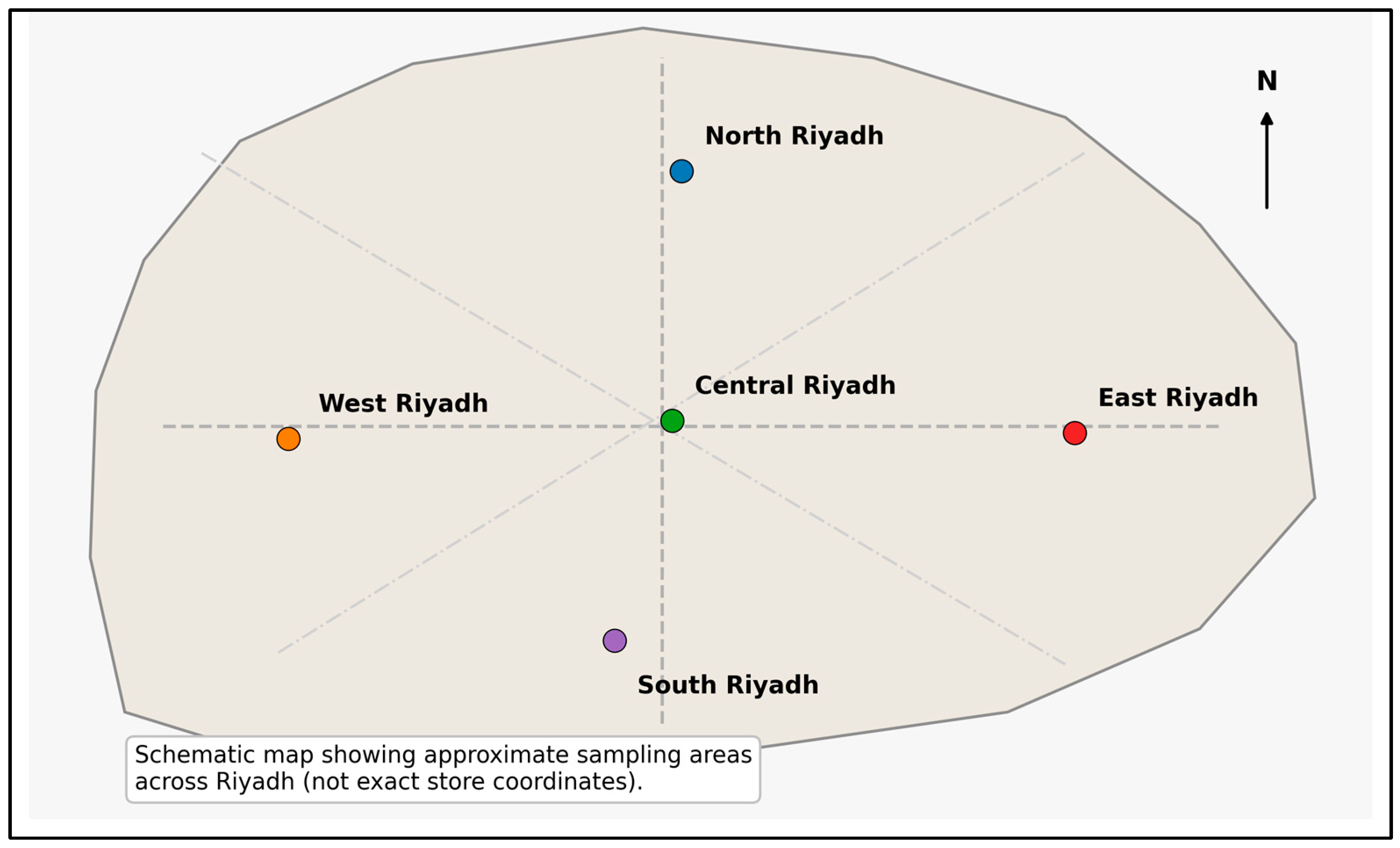
To reflect the range of bottled waters available to consumers in Riyadh, a non-randomized convenience sampling approach was adopted. Bottled water products were purchased from six major retail outlets/supermarket chains across Riyadh, Saudi Arabia, during 12–13 February 2026. The outlets sampled included Panda, Lulu Market, Danube, Farmer, Tamimi Markets, and SPAR. The selection strategy focused on obtaining commonly available still bottled water products representing the main label-defined categories, including purified, spring, mineral, and artesian waters. The approximate distribution of the sampling areas within Riyadh is shown schematically in Figure 1. Each brand/product was represented by one purchased bottle, and duplicate bottles of the same brand were not collected. Therefore, the study was designed to characterize the composition of bottled waters available at the time of sampling rather than to assess batch-to-batch, lot-to-lot, or seasonal variability.
Inclusion was limited to still bottled waters for general consumption. Sparkling waters were excluded because the study focused on still bottled waters intended for routine drinking and to avoid the influence of carbonation on pH-related interpretation [10]. Additionally, flavored waters, infant/nursery waters, seltzers or club sodas, and large-volume distilled waters without added minerals were excluded.
Following purchase, all samples were transported to King Abdulaziz City for Science and Technology (KACST) and stored at room temperature under controlled indoor conditions until laboratory analysis. Each sample was cataloged, and information on labeling, declared composition, and source, when available, was documented to assist in later comparison with measured values. Product price was recorded at the time of purchase from the store receipt or displayed shelf price. To allow comparison across bottle sizes, prices were standardized as cost per liter (SAR/L) by dividing the purchase price by the labeled bottle volume.

2.2. Fluoride Measurement

Fluoride ion concentration in each bottled water sample was measured using the LH-E300(E) handheld multiparameter analyzer (Lianhua Technology, Beijing, China), equipped with a digital fluoride ion-selective electrode. The electrode was calibrated using a two-point fluoride standard solution covering the expected measurement range according to the manufacturer’s instructions, and calibration was checked during the analytical session. Samples were measured directly using the manufacturer’s direct measurement protocol with automatic temperature compensation. TISAB was not added because the instrument protocol was based on direct ISE measurement. However, because TISAB is commonly used in fluoride ISE analysis to control ionic strength and reduce matrix-related effects, the absence of TISAB was considered a methodological limitation. Fluoride results were therefore interpreted cautiously, particularly for samples with low fluoride concentrations or values close to the predefined label agreement threshold. A randomly selected subset of 10 bottled water samples was reanalyzed to assess repeatability, and the repeat-analysis mean difference and %RSD are reported in Supplementary Table S3.

2.3. Determination of Calcium, Magnesium, Sodium, and Potassium

2.3.1. Sample Preparation

For each bottled water sample, an aliquot was diluted with 1% aqueous nitric acid (HNO3) to prepare the final analytical solution for ICP-MS analysis. Depending on the expected elemental concentration, 2–5 mL of sample was transferred into a clean container and diluted to a final volume of 10 mL. When preliminary readings indicated that an analyte concentration exceeded the calibration range, additional dilution was performed to bring the final analytical solution within the validated calibration range. Final concentrations reported in the dataset and manuscript were backcalculated to the original bottled water concentration using the corresponding dilution factor.

2.3.2. Quality Assurance

To ensure the accuracy and reliability of the analytical measurements, a certified Standard Reference Material (SRM)—NIST 1640a Natural Water—was obtained from the National Institute of Standards and Technology (NIST), USA, and used for method validation and comparative analysis. Analytical quality control for ICP-MS was assessed using NIST SRM 1640a Natural Water. Recovery values for calcium, magnesium, potassium, and sodium ranged from 96.8% to 99.2%, supporting acceptable analytical accuracy. In addition, a randomly selected subset of 10 bottled water samples was reanalyzed to assess measurement reproducibility. Repeat-analysis mean differences ranged from 0.10 to 0.41 mg/L for ICP-MS analytes, with %RSD values ranging from 2.8% to 4.5%. For fluoride and pH, repeat-analysis mean differences were 0.06 ppm and 0.06 pH units, respectively. Repeatability and quality control data are provided in Supplementary Table S3.

2.3.3. Instrumentation

Elemental concentrations of calcium (Ca), magnesium (Mg), sodium (Na), and potassium (K) were determined using an inductively coupled plasma mass spectrometer (ICP-MS; PerkinElmer NexION 350Q, PerkinElmer Inc., Waltham, MA, USA), equipped with Syngistix software version 2.5 (PerkinElmer Inc., Waltham, MA, USA). The instrument features a quadrupole mass analyzer, a crossflow nebulizer, and a Scott-type spray chamber (Table 1). Multi-element calibration standards were prepared in 1% nitric acid and used to calibrate the final analytical solutions introduced into the ICP-MS. Sample aliquots were diluted prior to analysis, and the final reported concentrations were back calculated to the original bottled water concentration using the corresponding dilution factor. When required, additional dilution was performed to ensure that the analytical solution remained within the validated calibration range. Operational ICP-MS parameters are presented in Table 1.

2.3.4. Label Agreement Assessment

Label–measurement agreement was assessed using predefined practical tolerance thresholds: ±0.20 ppm for fluoride, ±5 mg/L for calcium, and ±0.5 pH units. These thresholds were not intended to represent regulatory compliance limits and were not used to assess legal or regulatory non-compliance. Instead, they were selected as pragmatic margins to assess practical label agreement between declared and measured values, accounting for expected analytical variability, product label rounding, and the level of difference likely to be meaningful for consumer interpretation. For fluoride, the ±0.20 ppm threshold was chosen because small differences around the commonly cited anti-caries range may influence the interpretation of fluoride adequacy. However, because the fluoride ion-selective electrode has a reported accuracy of ±10%, fluoride discrepancies close to this threshold were interpreted cautiously. For calcium, ±5 mg/L was selected as a practical margin reflecting typical label rounding and the relatively low calcium concentrations expected in bottled waters. For pH, ±0.5 units were selected because this magnitude of difference may be relevant when interpreting product acidity or alkalinity from consumer and clinical perspectives. For magnesium, potassium, and sodium, agreement was assessed descriptively by comparing labeled and measured values and summarizing absolute differences; no predefined tolerance band was applied because no specific interpretive agreement threshold was defined a priori for these analytes. Agreement/disagreement classifications for fluoride, calcium, and pH were recorded at the product level and are provided in Supplementary Table S1c. For magnesium, potassium, and sodium, labeled and measured values and absolute differences are reported descriptively in Supplementary Table S1d.

2.3.5. Detection Limits and Analytical Reporting Information

Detection limits and analytical reporting information for the analytes assessed in this study are provided in Supplementary Table S2. For ICP-MS elemental analysis, the laboratory confirmed that the detection/reporting limits were comparable to reported ICP-MS beverage analysis values, with approximate limits of 0.0221 mg/L for calcium, 0.0005 mg/L for magnesium, 0.0080 mg/L for potassium, and 0.0004 mg/L for sodium. Fluoride was measured using a fluoride ion-selective electrode and interpreted according to the manufacturer-reported accuracy of ±10%. pH does not have a detection limit in the same way as ion concentrations; therefore, pH was reported according to the instrument resolution of 0.01 pH units and accuracy of ±0.02. Very low or non-detect values were retained in the complete dataset as reported by the laboratory and were not replaced by zero or by a fraction of the detection/reporting limit. For descriptive statistics, tables, and supplementary data, these values were retained as reported. For calcium analysis only, calcium non-detect values were plotted at 0 for visualization. For water hardness calculations, samples with calcium values reported as below the lower detection/reporting limit or as near-zero/non-detect values were excluded because hardness calculation requires numerical calcium and magnesium concentrations. The complete dataset, including label information and measured values, is provided in Supplementary Table S1.

2.4. Water Hardness

Water hardness was calculated from measured calcium (Ca) and magnesium (Mg) concentrations and expressed as mg/L calcium carbonate (CaCO3) using the following equation—total hardness as CaCO3 = 2.497 × Ca + 4.118 × Mg, where Ca and Mg are expressed in mg/L. Samples were then categorized according to the U.S. Geological Survey classification as soft (0–60 mg/L as CaCO3), moderately hard (61–120 mg/L as CaCO3), hard (121–180 mg/L as CaCO3), or very hard (>180 mg/L as CaCO3).

2.5. pH Measurement

The pH of each bottled water sample was measured using a handheld multiparameter analyzer (Model LH-E300(E), Lianhua Technology, Beijing, China). This device is equipped with a high-precision digital pH electrode and supports automatic temperature compensation within a range of 5 °C to 60 °C. Prior to measurement, the instrument was calibrated using a three-point standard buffer calibration. Each sample was measured in real time, and the pH value was recorded once stabilized. The LH-E300(E) analyzer provided a resolution of 0.01 pH units and an accuracy of ±0.02, ensuring reliable and reproducible results under field and laboratory conditions.

2.6. Comparison with Dietary Reference Intakes (DRIs)

To contextualize the potential contribution of bottled water to daily fluoride and mineral intake, measured concentrations were compared with dietary reference intakes (DRIs) established by the National Academies of Sciences, Engineering, and Medicine [11]. These include recommended dietary allowances (RDAs) for calcium and magnesium and adequate intakes (AIs) for fluoride, potassium, and sodium. The analysis was intended to illustrate the relative contribution and variability of bottled water rather than to assess whether bottled water alone can meet dietary requirements. Estimated contributions were calculated using hypothetical daily consumption volumes of 0.5 L and 2 L per person, representing moderate- and high-intake scenarios. Adult women aged 31–50 years were used as a standardized reference group for the relative contribution calculations; however, DRI values vary by age, sex, and physiological status, and therefore, the estimates should not be generalized to all population groups. Because total nutrient intake is influenced by foods, other beverages, tap water, supplements, and fluoride-containing dental products, the DRI comparison should be interpreted as a contextual estimate rather than a measure of individual dietary adequacy.

2.7. Statistical Analysis

Descriptive statistics were calculated for fluoride, calcium, magnesium, potassium, sodium, pH, and calculated water hardness. Results were summarized overall and according to bottled water category using mean, standard deviation, median, range, and frequency distributions where appropriate. Because this study was designed as a descriptive market survey and some bottled water categories had small sample sizes, category-level comparisons were interpreted descriptively only and were not subjected to inferential statistical testing. To evaluate measurement reproducibility, a randomly selected subset of 10 bottled water samples was reanalyzed, and repeatability was summarized using mean difference and percentage relative standard deviation (%RSD). Quality assurance procedures were carried out by one of the authors (S.O.). Category-level descriptive statistics, including n, mean, SD, median, minimum, maximum, and IQR, are provided in Supplementary Table S4.

3. Results

3.1. Type of Bottled Water and Cost

Of the 41 products, mineral water (17; 41.5%) and purified water (14; 34.1%) predominated, accounting for approximately 75.6% of the sampled products (Table 2). Spring water accounted for eight products (19.5%), and artesian waters accounted for two products (4.9%). Local Saudi products represented 23 of the 41 products (56.1%), while imported products represented 18 of the 41 products (43.9%). Purified waters were mostly local Saudi products (12/14), whereas mineral waters showed the widest range of international origins. Prices ranged from 1.52 to 42.28 SAR/L; the higher mean cost compared with the median cost (8.02 vs. 3.03 SAR/L) indicates a right-skewed distribution due to a few premium products.

3.2. Fluoride

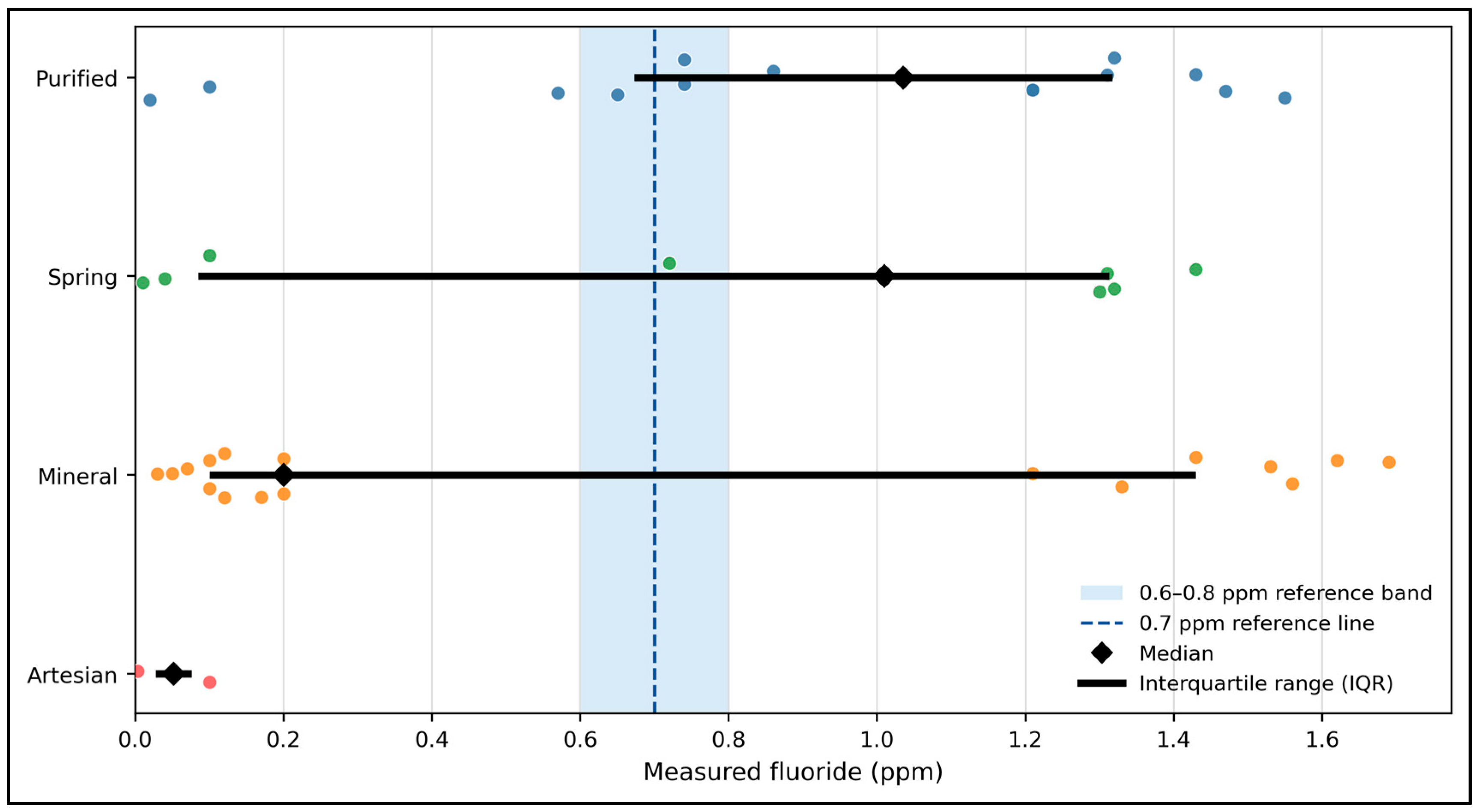
Figure 2 shows the fluoride concentration of bottled water by category. Generally, the F concentration clustered near the target range, with 22 waters containing ≥0.70 ppm. Mean (SD) and median F concentrations were 0.76 (0.62) ppm and 0.74 ppm, respectively. Purified bottled water had the highest mean F concentration (≈0.94 ppm), whereas artesian water had the lowest mean F concentration (≈0.00 ppm). These category-level observations are descriptive only and were not subjected to inferential statistical testing.

3.3. Calcium

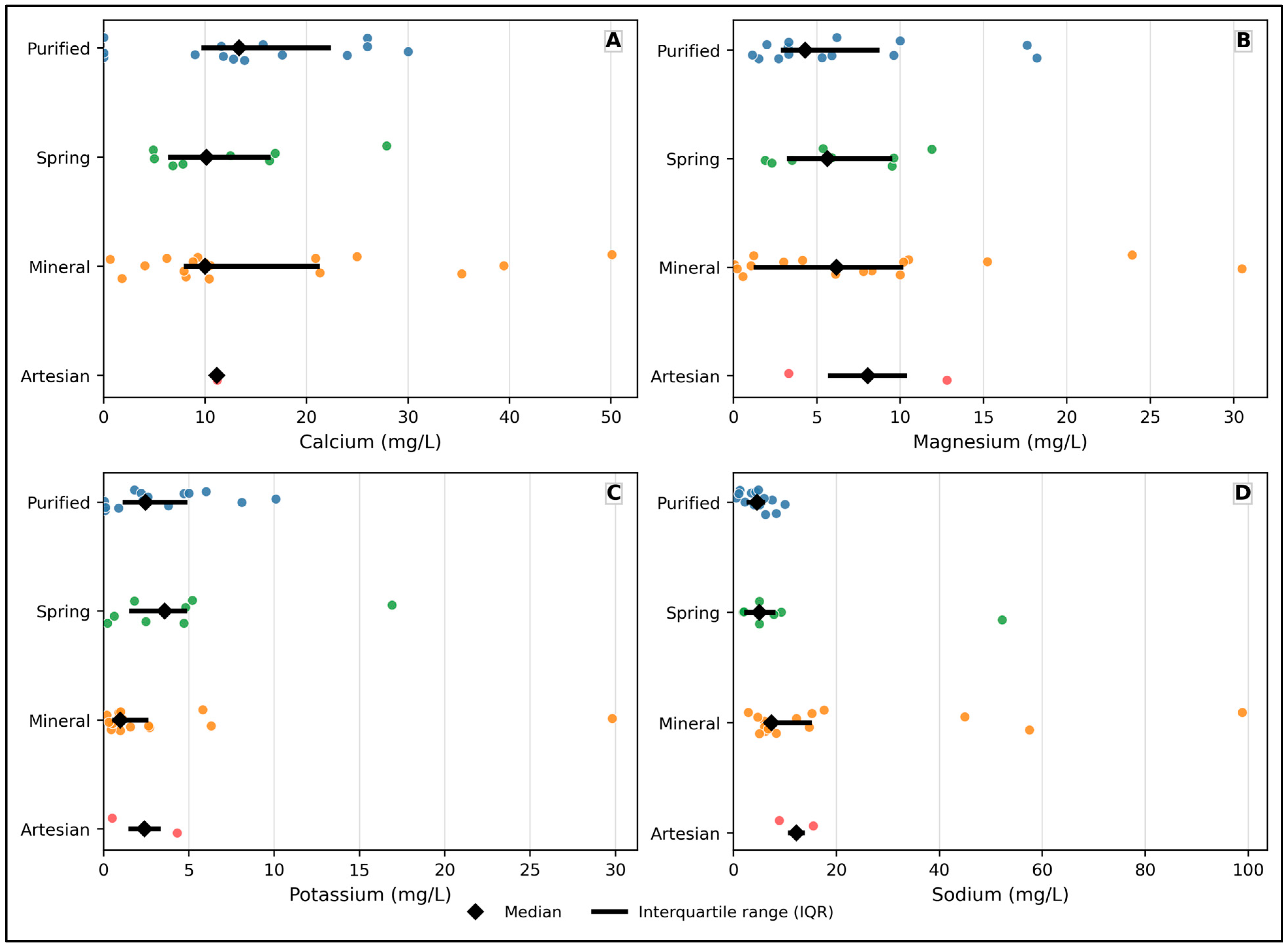
Calcium concentrations are summarized in Figure 3A. Mean (SD) and median Ca concentrations were 15.1 (11.0) mg/L and 11.6 mg/L, respectively. At the category level, purified water had the highest mean Ca concentration (16.5 mg/L), followed by mineral water (15.9 mg/L), spring water (12.3 mg/L), and artesian water (11.2 mg/L). These category-level observations are descriptive only.

3.4. Magnesium, Potassium, and Sodium

Magnesium, potassium, and sodium concentrations are summarized in Figure 3B–D. Mean (SD) and median Mg concentrations were 7.19 (6.57) mg/L and 5.90 mg/L, respectively. Mineral and artesian water had similar mean Mg concentrations (8.17 and 8.05 mg/L, respectively), with lower values in purified and spring water (6.43 and 6.24 mg/L, respectively).
For potassium, the mean (SD) and median concentrations were 3.55 (5.34) mg/L and 1.80 mg/L, respectively. Category mean K concentrations were generally low and ranged from 2.40 mg/L in artesian water to 4.59 mg/L in spring water.
For sodium, the mean (SD) and median concentrations were 12.08 (18.74) mg/L and 6.20 mg/L, respectively. Mineral water had the highest mean Na concentration (18.88 mg/L), whereas purified water had the lowest mean concentration (4.60 mg/L).
For magnesium, potassium, and sodium, no predefined tolerance band was applied because no specific interpretive agreement threshold was defined a priori. Agreement for these analytes was therefore assessed descriptively by comparing labeled and measured values and summarizing absolute differences. Detailed category-level descriptive statistics for all measured analytes are provided in Supplementary Table S4.

3.5. Water Hardness

Mean (SD) and median water hardness values, expressed as CaCO3, were 66.8 (46.1) ppm and 55.0 ppm, respectively. Hardness summaries were calculated for 39 samples because two samples had calcium values reported as below the lower detection/reporting limit or as near-zero/non-detect values. These values were retained in the complete dataset as reported but were excluded from hardness summary calculations because hardness calculation requires numerical calcium and magnesium concentrations. Mineral waters, including one product labeled as mineral and distilled water, were the hardest on average (73.3 ppm). All other categories were softer, with mean hardness values of 65.4 ppm for purified water, 61.0 ppm for artesian water, and 56.3 ppm for spring water. By standard classes, 23 waters (59.0%) were soft (≤60 ppm), 13 (33.3%) were moderately hard (61–120 ppm), 1 (2.6%) was hard (121–180 ppm), and 2 (5.1%) were very hard (>180 ppm).

3.6. pH

Mean (SD) and median pH values were 7.11 (0.54) and 7.10, respectively. Across bottled water categories, mean pH values were close to neutral, ranging from 7.06 for mineral water to 7.55 for artesian water. A summary of pH and calculated water hardness by bottled water category is provided in Table 3.

3.7. Labeling of Mineral Content and Comparison with Measured Values

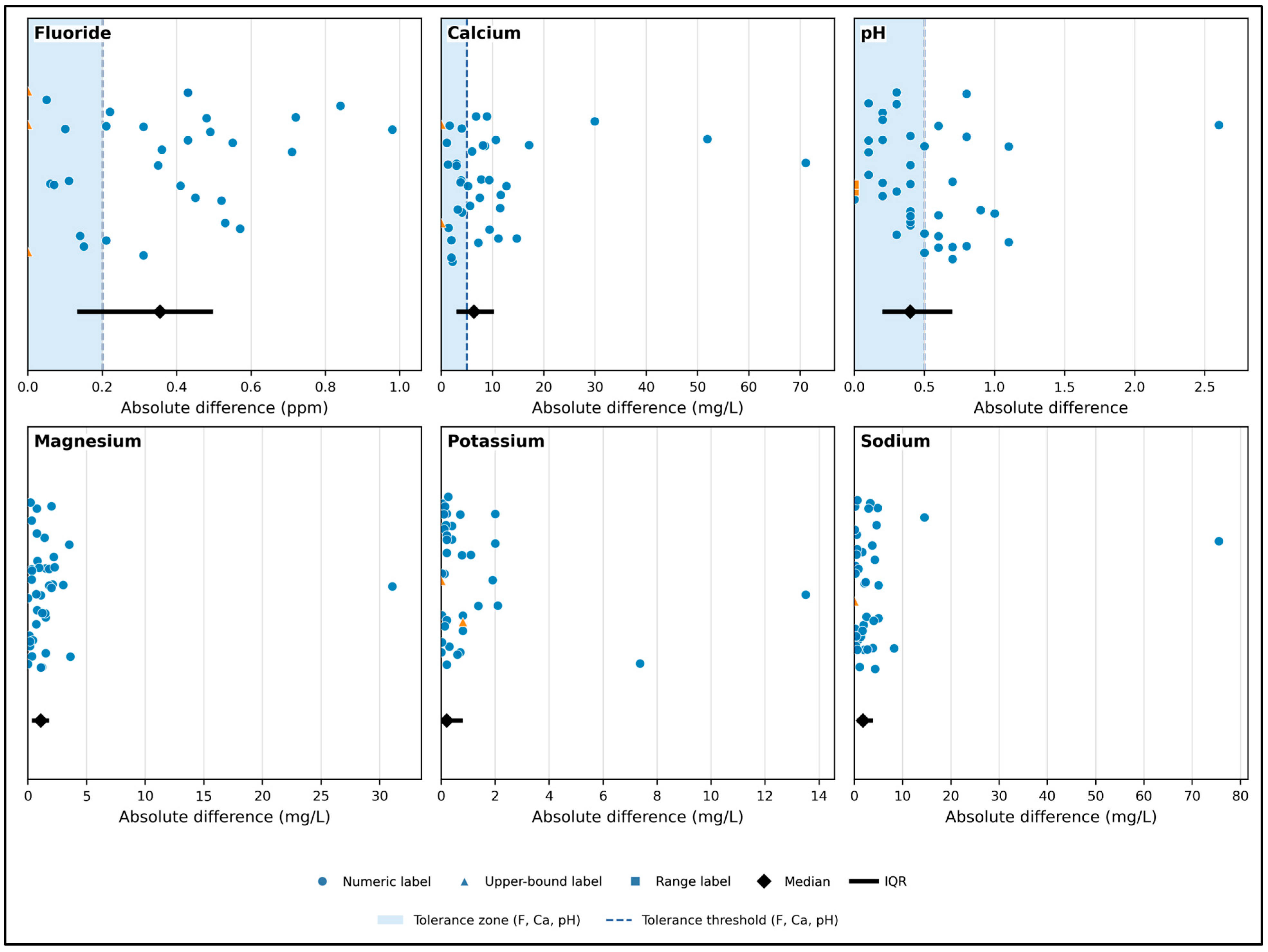
The F concentration was displayed on 32 of the 41 waters (78%). Most labels provided a numeric value, and three used an upper-bound statement (e.g., “<0.2,” “<0.1”); none used terms such as “fluoride-free.” Using the predefined practical tolerance of ±0.20 ppm, practical label agreement was observed for 10 of these 32 waters (31%), whereas 22 waters (69%) were outside the predefined tolerance range. For products labeled with upper-bound statements, measured F values were low and consistent with those claims.
The Ca concentration or a concentration range was displayed on 38 of the 41 waters (92.7%), with label values ranging approximately from <1 to 96 mg/L. When comparing labeled and measured values, upper-bound labels such as “<x” were treated as having 0 difference when the measured value did not exceed the upper-bound value; otherwise, the difference from the upper-bound value was used. For label ranges, the difference was recorded as 0 when the measured value fell within the stated range; otherwise, the distance to the nearest range boundary was used. Practical label agreement was observed for 16 of the 38 waters (42.1%) within the predefined ±5 mg/L tolerance, whereas 22 waters (57.9%) were outside the predefined tolerance range. One example observed in the sampled dataset was Zamzam Water, which listed 96.0 mg/L Ca on the label, whereas the measured value for the tested bottle was 24.96 mg/L.
The pH value or range was displayed on all 41 waters (100%), varying from 5.6 to “9.5+.” Using the predefined practical tolerance of ±0.5 pH units, practical label agreement was observed for 26 waters, whereas 15 waters were outside the predefined tolerance range. Of these 15 products, 12 had measured pH values lower than the declared values, and three had measured pH values higher than the declared values. A maximum absolute difference of 2.6 pH units was noted for Life Wtr (label pH 9.5 versus measured pH 6.9). Product-level labeled values, measured values, absolute differences, and agreement/disagreement classifications for fluoride, calcium, and pH are provided in Supplementary Table S1c. Descriptive labeled-versus-measured comparisons for magnesium, potassium, and sodium are provided in Supplementary Table S1d.
Figure 4 summarizes the agreement between labeled and measured values for fluoride, calcium, pH, magnesium, potassium, and sodium.

3.8. Dietary Reference Intakes and Hypothetical Bottled Water Contributions

Table 4 summarizes the relative contribution of bottled waters to selected adult DRI values, while Table 5 shows the percentage of products reaching selected RDA/AI contribution thresholds under hypothetical 0.5 L/day and 2 L/day intake scenarios. These calculations were intended to illustrate variability among bottled water products rather than to imply that bottled water alone should meet dietary requirements. With respect to fluoride, only one of the 41 bottled waters would contribute an amount equivalent to the adult adequate intake (AI) under the 2 L/day hypothetical intake scenario. For calcium and magnesium, no bottled water would contribute ≥50% of the adult recommended dietary allowance (RDA) at 2 L/day. Contributions to potassium and sodium were generally low. Because DRI values vary by age, sex, and physiological status, and because bottled water is only one component of total fluoride and mineral exposure, these findings should be interpreted as illustrative relative contributions rather than estimates of dietary adequacy for the wider population.

4. Discussion

Local analyses have documented variability in the chemical quality and composition of bottled waters marketed in Saudi Arabia, including differences in fluoride and mineral concentrations across brands [7,12]. Bottled water is a routine drinking-water source for many households in Saudi Arabia, where consumer choices are influenced by perceptions of safety, taste, convenience, and the widespread availability of packaged water [13,14]. Because bottled drinking water in Saudi Arabia is regulated within the Saudi Food and Drug Authority and Gulf Standardization Organization framework, including requirements related to bottled water quality and labeling [4,15,16,17], the composition and accuracy of product information are directly relevant to consumer protection and public-health interpretation. Fluoride is especially relevant in the Saudi context because dental caries remains highly prevalent among children, and the Ministry of Health has previously recommended adjusting fluoride concentrations in drinking water networks to support caries prevention [5,6]. However, increasing reliance on bottled water means that individual fluoride exposure may depend strongly on the fluoride content of the specific bottled water products consumed.
In the present sample, fluoride concentration ranged from 0.003 to 1.69 ppm, with an overall mean (SD) of 0.76 (0.62) ppm and a median of 0.74 ppm (Figure 2). Overall, 22 of the 41 products contained fluoride concentrations ≥0.70 ppm, indicating that slightly more than half of the sampled products were at or above this commonly cited reference level. However, fluoride concentrations varied substantially by brand, and only one product would meet the adult adequate intake for fluoride under the hypothetical 2 L/day intake scenario. These findings indicate that the potential contribution of bottled water to fluoride exposure is highly product dependent. Therefore, the results should not be interpreted as showing that most products were below the selected fluoride reference level, but rather as showing that bottled waters sold in Riyadh show wide variability in fluoride content and differ in their potential contribution to fluoride intake. International references, including the U.S. Public Health Service recommendation of 0.7 mg/L, CDC community-water-fluoridation information, and the WHO drinking-water guideline value of 1.5 mg/L, are useful only as contextual benchmarks and should not replace local interpretation based on Saudi consumption patterns, SFDA/GSO requirements, and national oral-health priorities [18,19,20,21]. These findings should be interpreted descriptively because this laboratory-based study assessed bottled water composition and labeling, not individual dietary intake, total fluoride exposure, or clinical outcomes. Although some products contain fluoride concentrations near commonly cited reference levels, bottled water represents only one component of total fluoride exposure. Total fluoride intake also depends on other drinking water sources, foods, beverages, supplements, and fluoride-containing dental products.
The present findings are generally consistent with previous Saudi studies showing that bottled waters available in the local market vary considerably in fluoride and mineral composition. Aldrees and Al-Manea reported variability in fluoride concentrations among bottled drinking waters available in Riyadh, with many products containing fluoride levels below those considered optimal for caries prevention [7]. Similarly, Al-Omran et al. reported wide variation in the chemical composition and quality parameters of bottled waters marketed in Saudi Arabia [12]. In the present study, fluoride concentrations also varied across products, as well as other mineral concentrations, were generally modest, with most waters classified as soft to moderately hard. Differences between the present findings and earlier Saudi reports may be related to changes in brand availability over time, differences in sampling location and product origin, source-water characteristics, treatment or remineralization processes, and analytical methods. Overall, the current results support previous Saudi observations that bottled water composition cannot be assumed to be uniform across brands and that label information should be interpreted with caution.
From a regulatory perspective, these findings should also be interpreted within the Saudi and Gulf region’s bottled water framework. Bottled drinking water marketed in Saudi Arabia is regulated according to relevant Saudi Food and Drug Authority requirements and Gulf Standardization Organization technical regulations, including GSO 1025:2014 and its amendment for bottled drinking water [4,15], as well as SFDA requirements related to drinking water labeling and approved Saudi-Gulf technical requirements [16,17]. Although the present study was not designed as a formal regulatory compliance assessment, the practical label agreement findings highlight the importance of accurate product labeling and continued post-market monitoring. This is particularly relevant for constituents such as fluoride, calcium, and pH, which may influence consumer interpretation of bottled water composition.
From a hydrogeochemical perspective, the variability observed in the mineral composition of the bottled waters may be related to differences in source geology, aquifer characteristics, residence time, and processing methods. Water originating from mineralized or carbonate-rich aquifers would generally be expected to contain higher calcium and magnesium concentrations and, consequently, greater hardness. In contrast, purified or treated water may show lower and more standardized mineral concentrations, depending on the extent of treatment and any subsequent remineralization. This interpretation is consistent with previous bottled water studies reporting wide international variation in calcium, magnesium, sodium, potassium, and fluoride concentrations across products from different sources and regions [9,12,22]. In the present study, most products were classified as soft to moderately hard according to the U.S. Geological Survey hardness classification [23], indicating relatively modest Ca/Mg mineralization compared with many naturally mineralized European bottled waters, which may contain substantially higher calcium and magnesium levels [9]. By comparison, the generally modest mineral concentrations observed in this study are closer to those reported for many purified or low-mineral bottled waters in the United States [22]. Fluoride concentrations also varied across products; however, several products approached or exceeded the 0.70 mg/L level recommended by the U.S. Public Health Service [18], while most values remained below the WHO drinking-water guideline value of 1.50 mg/L [21] and the European Union parametric value of 1.50 mg/L for drinking water [24]. Overall, these findings suggest that bottled waters sold in Riyadh include a mixture of low mineral, treated, and naturally mineralized products, with fluoride and mineral contributions that are strongly influenced by source characteristics and processing history.
In our dataset, labels reported pH for all products; practical label agreement was observed for 26 products within the predefined ±0.5 pH-unit tolerance, whereas 15 products were outside this tolerance. Among these 15 products, 12 had measured pH values lower than the declared values and three had measured pH values higher than the declared values, with a maximum absolute difference of 2.6 pH units. Fluoride was reported on 32/41 products, with 10 within ±0.20 ppm, and calcium was reported on 38/41 products, with 16 within ±5 mg/L; outliers included Zamzam Water, which reported 96.0 mg/L Ca on the label compared with a measured value of 24.96 mg/L. For Zamzam Water, the difference between the declared calcium value and the measured value in the tested bottle should be interpreted cautiously. This observation is supported by the supplementary dataset, but it reflects only one sampled bottle and should not be interpreted as definitive evidence of persistent mislabeling or product-level inconsistency. Possible explanations include natural variability, batch-to-batch differences, label values representing typical or historical composition, processing or handling differences, analytical variation, or label-updating issues. Repeated testing across multiple bottles and batches would be required before drawing conclusions about persistent label disagreement with this product. These patterns mirror prior work showing that mineral declarations on bottled waters are variable and often provide limited guidance, particularly for fluoride. U.S. regulations require disclosure when fluoride is added to bottled water but do not require declaration of naturally occurring fluoride content, contributing to uncertainty at the point of purchase for consumers and clinicians seeking products that meaningfully support caries prevention [22,25]. As a result, even conscientious label readers may struggle to identify higher-fluoride or reliably mineralized waters without independent testing or manufacturer documentation [22,25].
Evidence directly linking bottled water preference with caries outcomes remains limited. Although reduced intake of fluoridated tap water may plausibly reduce fluoride exposure, available observational evidence does not establish a direct bottled water effect on caries experience [26,27]. In contrast, community water fluoridation is well supported as an effective caries-preventive measure; therefore, replacing optimally fluoridated tap water with low-fluoride alternatives may be relevant at the population level [28]. However, the present study was laboratory-based and was not designed to evaluate caries outcomes or individual fluoride exposure. Therefore, the fluoride findings should be interpreted as descriptive compositional data rather than evidence of caries risk or prevention, and interpretation should consider total fluoride exposure from all sources, including foods, beverages, tap water, supplements, and fluoride-containing dental products [29].Household water treatment systems may also influence fluoride exposure, as reverse osmosis and distillation can substantially reduce fluoride concentrations, whereas many activated-carbon filters have less consistent effects on fluoride removal [30]. These further support interpreting bottled water fluoride values within the broader context of total drinking water and fluoride exposure rather than as a stand-alone indicator of individual fluoride adequacy.
In the present study, calcium averaged 15.1 mg/L (SD 11.0; median 11.6), and magnesium averaged 7.19 mg/L (SD 6.57; median 5.90). Calcium and magnesium concentrations were generally modest across the included still bottled water products, and most samples were classified as soft to moderately hard. Previous bottled water studies, including studies that evaluated sparkling waters, have reported higher mineral concentrations and lower pH values in some carbonated products; however, sparkling waters were excluded from the present study [12,22]. Therefore, comparisons involving sparkling waters are provided only as the literature-based context and should not be interpreted as findings from this dataset. Reflecting these minerals, calculated hardness, expressed as CaCO3, averaged 66.8 ppm (SD 46.1) and clustered mostly in the soft to moderately hard range: soft, n = 23; moderately hard, n = 13; hard, n = 1; and very hard, n = 2. This aligns with USGS hardness categories, which typically classify purified waters as soft and many naturally mineralized waters as harder [23]. Although Ca and Mg can make small contributions to dietary intake and influence hardness, they do not substitute for adequate fluoride with respect to caries prevention; counseling should prioritize fluoride adequacy while acknowledging category-related mineral differences [21,22].
Across all products, pH averaged 7.11 (SD 0.54), with a median of 7.10. By category, mean pH values were close to neutral, ranging from 7.06 for mineral waters to 7.55 for artesian waters. Because sparkling waters were excluded from the present study, the pH findings apply only to still bottled waters. Across the included products, pH values were generally close to neutral, which is consistent with previous reports showing that non-sparkling bottled waters often cluster around neutral pH values, whereas carbonated products tend to be more acidic [12,22].
In this study, label–measurement agreement varied across parameters. As shown in the results, pH, fluoride, and calcium values frequently fell outside the predefined tolerance ranges, and in some cases, the discrepancies were large enough to misrepresent the acidity or mineral content of the product. However, analytical uncertainty should also be considered when interpreting fluoride label agreement. The fluoride ion-selective electrode used in this study has a reported accuracy of ±10%, which may influence classification near the predefined agreement threshold of ±0.20 ppm, especially for samples with low fluoride concentrations. Therefore, minor discrepancies between measured and declared fluoride values may partly reflect measurement uncertainty rather than true labeling inaccuracy. By contrast, larger discrepancies are unlikely to be explained by analytical uncertainty alone and remain relevant from a consumer information and public health perspective. The agreement thresholds used in this study were pragmatic analytical and interpretive margins rather than formal regulatory limits; therefore, the label agreement findings should be interpreted as indicators of practical label accuracy rather than legal non-compliance. For magnesium, sodium, and potassium, labeled and measured values were assessed descriptively without a predefined tolerance band; therefore, these results should be interpreted as descriptive label–measurement comparisons rather than formal agreement classifications. Taken together, these findings suggest that while bottled water labels can guide product selection, especially with respect to Mg/Na/K content, the information provided for pH, F, and Ca should be regarded as approximate rather than precise. Clinicians counseling patients about fluoride adequacy, erosive potential, or mineral intake should therefore interpret label information cautiously and, where possible, consider it within the context of broader dietary sources.
Applying dietary reference intakes (DRIs), only one product in our dataset would achieve the adult fluoride AI (3 mg/day) at a hypothetical intake of 2 L/day; no products would provide ≥50% of the RDA for calcium or magnesium at 2 L/day, and contributions to potassium and sodium are negligible at typical volumes. These patterns mirror prior DRI-based evaluations of bottled waters, which similarly reported low fluoride and generally modest Ca/Mg contributions, reinforcing that bottled waters seldom make a substantial contribution to daily mineral requirements compared with optimally fluoridated tap water [11,22]. The relevance of this comparison is supported by local consumption data showing that bottled water is used as the main drinking water source by a substantial proportion of Saudi households.
Bottled water use in Saudi Arabia varies across regions and cities and is influenced by perceptions of desalinated tap water’s taste/odor and safety, as well as the widespread availability of packaged options [12,13]. In areas where residents rely more on bottled water than municipal tap water, the population-level mineral contribution from water, especially fluoride, may be lower than in communities that primarily consume optimally fluoridated tap water, making source choice (bottled vs. tap) rather than total volume the key driver of fluoride exposure [7,12,13].
This study has several limitations that should be considered when interpreting the findings. First, the use of a non-randomized convenience sampling strategy limits the representativeness of the results. Although products were collected from major supermarkets in Riyadh to reflect commonly available bottled waters, the sample may not capture all brands, batch variations, seasonal changes, or products sold through smaller retailers, online platforms, or other regions of Saudi Arabia. Second, each brand was represented by a single purchased sample; therefore, lot-to-lot, bottle-to-bottle, and temporal variability in fluoride concentration, mineral content, and pH could not be assessed. The results should therefore be interpreted as a market snapshot at the time and place of purchase rather than as definitive fixed values for each brand. In addition, the bottled water market is dynamic, with new products introduced and others discontinued over time. Third, fluoride was measured using direct ion-selective electrode measurement without TISAB. Although the measurements followed the manufacturer’s protocol, and repeatability was assessed in a subset of samples, the absence of TISAB may have increased susceptibility to ionic strength or matrix-related effects. Therefore, fluoride values, particularly small label–measurement discrepancies near the predefined agreement threshold, should be interpreted cautiously. The DRI comparison also used adult women aged 31–50 years as a standardized reference group; therefore, the estimated relative contributions may not apply to children, adolescents, older adults, males, pregnant or lactating women, or individuals with different dietary patterns or exposure sources. Calculations also implicitly assume consistent consumption of the same bottled water product, although many consumers may alternate between different brands and water sources. Finally, total fluoride and mineral intake also depend on foods, other beverages, tap water, supplements, and fluoride-containing dentifrices; therefore, the present findings should be interpreted within the broader context of overall dietary and topical exposure.

5. Conclusions

Bottled waters in this study showed wide variation in fluoride concentration, mineral content, pH, hardness, and label agreement. Some products contained fluoride concentrations near commonly cited reference levels, whereas others had low fluoride concentrations. However, bottled water represents only one component of total fluoride and mineral exposure, and the present laboratory-based findings did not establish individual dietary adequacy or clinical caries-preventive outcomes. The results provide descriptive evidence that bottled water composition and label accuracy vary across products available in Riyadh, Saudi Arabia.

Supplementary Materials

The following supporting information can be downloaded at: https://www.mdpi.com/article/10.3390/w18111325/s1. Table S1a: Product characteristics, sampling information, source, and cost for all 41 bottled water samples; Table S1b: Label information and measured analytical results, including pH, fluoride, calcium, magnesium, potassium, sodium, and calculated water hardness; Table S1c: Label comparison results for fluoride, calcium, and pH, including labeled value, measured value, absolute difference, and agreement/disagreement classification; Table S1d: Descriptive label comparison results for magnesium, potassium, and sodium, including labeled value, measured value, and absolute difference; Table S2: Detection limits and analytical reporting information for the analytes assessed in this study; Table S3: Repeatability and quality control summary for analytical measurements, including repeat-analysis mean difference, %RSD, and NIST SRM 1640a recovery values where applicable; Table S4: Descriptive statistics by bottled water category for fluoride, calcium, magnesium, potassium, sodium, pH, and hardness, including n, mean, SD, median, minimum, maximum, and IQR.

Author Contributions

Conceptualization, L.A. and F.L.; methodology, L.A., F.L. and T.A.; validation, L.A., S.A., T.A. and F.L.; formal analysis, S.A.; investigation, L.A. and T.A.; resources, F.L. and T.A.; data curation, L.A.; writing—original draft preparation, L.A.; writing—review and editing, L.A., S.A., T.A. and F.L.; visualization, L.A. and S.A.; supervision, F.L.; project administration, L.A.; funding acquisition, L.A. All authors have read and agreed to the published version of the manuscript.

Funding

Ongoing Research Funding program, (ORF-2026-1861), King Saud University, Riyadh, Saudi Arabia.

Data Availability Statement

The data supporting the findings of this study are available in the Supplementary Materials. The Supplementary File includes product characteristics, label information, measured analytical results, label comparison data, detection/reporting information, and repeatability/quality control summaries for the bottled water samples analyzed.

Conflicts of Interest

The authors declare no conflicts of interest.

References

  1. Alnasser, M.; Alzeer, K.M.; Khatri, Y. Consumer Perception of Drinking Water in Kingdom of Saudi Arabia. Int. J. Food Nutr. Public Health 2019, 11, 27–45. [Google Scholar] [CrossRef]
  2. General Authority for Statistics. Household Environment Statistics Publication 2023; General Authority for Statistics: Riyadh, Saudi Arabia, 2023. Available online: https://stats.gov.sa/documents/20117/2435259/Household%2BEnvironment%2BStatistics%2BPublication%2B2023%2BEN.pdf/fe59e721-0bb2-57d9-ab33-fdea2808a198?t=1734120327336 (accessed on 3 March 2026).
  3. Al-Hamzah, A.A.; Fellows, C.M. Drinking Water Quality in the Kingdom of Saudi Arabia. Water 2024, 16, 1810. [Google Scholar] [CrossRef]
  4. GSO 1025:2014; Bottled Drinking Water—Gulf Technical Regulation, 3rd ed. Gulf Standardization Organization: Riyadh, Saudi Arabia, 2014. Available online: https://www.gso.org.sa/store/standards/GSO%3A651667/GSO%201025%3A2014?lang=en (accessed on 3 March 2026).
  5. Al Agili, D.E. A Systematic Review of Population-Based Dental Caries Studies among Children in Saudi Arabia. Saudi Dent. J. 2013, 25, 3–11. [Google Scholar] [CrossRef] [PubMed]
  6. Ministry of Health, Saudi Arabia. MOH Recommends More Fluoride in Drinking Water Networks; Ministry of Health: Riyadh, Saudi Arabia, 2007. Available online: https://www.moh.gov.sa/en/Ministry/MediaCenter/News/Pages/NEWS-2007-11-26-001.aspx (accessed on 5 March 2026).
  7. Aldrees, A.M.; Al-Manea, S.M. Fluoride Content of Bottled Drinking Waters Available in Riyadh, Saudi Arabia. Saudi Dent. J. 2010, 22, 189–193. [Google Scholar] [CrossRef] [PubMed]
  8. Institute of Medicine. Dietary Reference Intakes for Calcium and Vitamin D; National Academies Press: Washington, DC, USA, 2011. [Google Scholar] [CrossRef]
  9. Azoulay, A.; Garzon, P.; Eisenberg, M.J. Comparison of the Mineral Content of Tap Water and Bottled Waters. J. Gen. Intern. Med. 2001, 16, 168–175. [Google Scholar] [CrossRef] [PubMed]
  10. World Health Organization. pH in Drinking-Water: Revised Background Document for Development of WHO Guidelines for Drinking-Water Quality; World Health Organization: Geneva, Switzerland, 2007; Available online: https://cdn.who.int/media/docs/default-source/wash-documents/wash-chemicals/ph.pdf (accessed on 15 May 2026).
  11. Otten, J.J.; Hellwig, J.P.; Meyers, L.D. (Eds.) Dietary Reference Intakes: The Essential Guide to Nutrient Requirements; National Academies Press: Washington, DC, USA, 2006. [Google Scholar] [CrossRef]
  12. Al-Omran, A.M.; El-Maghraby, S.E.; Aly, A.A.; Al-Wabel, M.I.; Al-Asmari, Z.A.; Nadeem, M.E. Quality Assessment of Various Bottled Waters Marketed in Saudi Arabia. Environ. Monit. Assess. 2013, 185, 6397–6406. [Google Scholar] [CrossRef] [PubMed]
  13. Shomar, B.; Hawari, J. Desalinated Drinking Water in the GCC Countries—The Need to Address Consumer Perceptions. Environ. Res. 2017, 158, 203–211. [Google Scholar] [CrossRef] [PubMed]
  14. Park, S.; Onufrak, S.J.; Cradock, A.L.; Patel, A.; Hecht, C.; Blanck, H.M. Perceptions of Water Safety and Tap Water Taste and Their Associations with Beverage Intake among U.S. Adults. Am. J. Health Promot. 2023, 37, 625–637. [Google Scholar] [CrossRef] [PubMed]
  15. GSO 1025:2014/Amd 1:2016; Bottled Drinking Water—Amendment to Gulf Technical Regulation. Gulf Standardization Organization: Riyadh, Saudi Arabia, 2016. Available online: https://www.gso.org.sa/store/standards/GSO%3A738508/GSO%201025%3A2014-Amd%201%3A2016?lang=en (accessed on 15 May 2026).
  16. Saudi Food and Drug Authority. Labeling for Drinking Water and Bottled Natural Mineral Water; Saudi Food and Drug Authority: Riyadh, Saudi Arabia, 2019. Available online: https://www.sfda.gov.sa/en/regulations/2555 (accessed on 15 May 2026).
  17. Saudi Food and Drug Authority. SFDA Clarification on Sodium and pH in Bottled Water; Saudi Food and Drug Authority: Riyadh, Saudi Arabia, 2019. Available online: https://www.sfda.gov.sa/en/news/1871 (accessed on 15 May 2026).
  18. U.S. Department of Health and Human Services Federal Panel on Community Water Fluoridation. U.S. Public Health Service Recommendation for Fluoride Concentration in Drinking Water for the Prevention of Dental Caries. Public Health Rep. 2015, 130, 318–331. [Google Scholar] [CrossRef] [PubMed]
  19. Centers for Disease Control and Prevention. 2020 Water Fluoridation Statistics. Available online: https://www.cdc.gov/fluoridation/php/statistics/2020-water-fluoridation-statistics.html (accessed on 3 March 2026).
  20. Centers for Disease Control and Prevention. About Community Water Fluoridation. Available online: https://www.cdc.gov/fluoridation/about/index.html (accessed on 10 March 2026).
  21. Fawell, J.; Bailey, K.; Chilton, J.; Dahi, E.; Fewtrell, L.; Magara, Y. Fluoride in Drinking-Water; World Health Organization: Geneva, Switzerland, 2006; Available online: https://iris.who.int/items/839fd0f0-a000-47fe-9ed8-ba808b4bc304 (accessed on 24 April 2026).
  22. Almejrad, L.; Levon, J.A.; Soto-Rojas, A.E.; Tang, Q.; Lippert, F. An Investigation into the Potential Anticaries Benefits and Contributions to Mineral Intake of Bottled Water. J. Am. Dent. Assoc. 2020, 151, 924–934.e10. [Google Scholar] [CrossRef] [PubMed]
  23. United States Geological Survey. Hardness of Water. Available online: https://www.usgs.gov/water-science-school/science/hardness-water (accessed on 4 March 2026).
  24. European Parliament; Council of the European Union. Directive (EU) 2020/2184 of the European Parliament and of the Council of 16 December 2020 on the Quality of Water Intended for Human Consumption. Off. J. Eur. Union 2020, L435, 1–62. Available online: https://eur-lex.europa.eu/eli/dir/2020/2184/oj (accessed on 13 May 2026).
  25. U.S. Food and Drug Administration. 21 CFR §165.110—Bottled Water. In Electronic Code of Federal Regulations; U.S. Food and Drug Administration: Silver Spring, MD, USA, 2026. Available online: https://www.ecfr.gov/current/title-21/part-165/section-165.110 (accessed on 17 March 2026).
  26. Lin, M.; Griffin, S.O.; Park, S.; Li, C.; Robison, V.; Espinoza, L. Associations between Household Water Fluoridation Status and Plain Tap or Bottled Water Consumption. JDR Clin. Trans. Res. 2021, 6, 440–447. [Google Scholar] [CrossRef]
  27. Broffitt, B.; Levy, S.M.; Warren, J.J.; Cavanaugh, J.E. An Investigation of Bottled Water Use and Caries in the Mixed Dentition. J. Public Health Dent. 2007, 67, 151–158. [Google Scholar] [CrossRef] [PubMed]
  28. Iheozor-Ejiofor, Z.; Walsh, T.; Lewis, S.R.; Riley, P.; Boyers, D.; Clarkson, J.E.; Worthington, H.V.; Glenny, A.-M.; O’Malley, L. Water Fluoridation for the Prevention of Dental Caries. Cochrane Database Syst. Rev. 2024, 10, CD010856. [Google Scholar] [CrossRef] [PubMed]
  29. American Dental Association. Fluoridation Facts. Available online: https://www.ada.org/resources/community-initiatives/fluoride-in-water/fluoridation-facts (accessed on 17 March 2026).
  30. U.S. Environmental Protection Agency. Home Drinking Water Filtration Fact Sheet. Available online: https://www.epa.gov/ground-water-and-drinking-water/home-drinking-water-filtration-fact-sheet (accessed on 4 March 2026).
Figure 1. Schematic map showing the approximate sampling areas within Riyadh where bottled water products were purchased. The map is intended to provide a general visual summary of sampling locations and does not represent exact store coordinates, verified spatial coverage, or a geographically representative sampling design. Please confirm whether an explanation of the dashed lines needs to be added to the figure caption.
Water 18 01325 g001
Figure 2. Distribution of measured fluoride concentrations by bottled water category. Each point represents one product. Colored dots indicate bottled-water categories: blue = purified water, green = spring water, orange = mineral water, and red = artesian water. The black diamond indicates the median, and the black horizontal bar indicates the interquartile range (IQR). The shaded blue band indicates the 0.6–0.8 ppm reference range, and the dashed vertical line indicates 0.7 ppm.
Water 18 01325 g002
Figure 3. Descriptive distributions of measured calcium, magnesium, potassium, and sodium by bottled water category. Each point represents one product. Colored dots indicate bottled-water categories: blue = purified water, green = spring water, orange = mineral water, and red = artesian water. The black diamond indicates the median, and the black horizontal bar indicates the interquartile range (IQR). Panels: (A) calcium, (B) magnesium, (C) potassium, and (D) sodium. Calcium values reported as below the lower detection/reporting limit were plotted at 0 only for visualization.
Water 18 01325 g003
Figure 4. Label–measurement absolute differences for fluoride, calcium, pH, magnesium, potassium, and sodium. Lower values indicate closer label–measurement agreement. Orange markers represent individual bottled-water products included in each label–measurement comparison. For fluoride, calcium, and pH, the shaded blue zone and dashed vertical line indicate the predefined practical tolerance thresholds (±0.20 ppm for fluoride, ±5 mg/L for calcium, and ±0.5 pH units for pH). For upper-bound labels such as “<0.1” or “<1”, the difference was plotted as 0 when the measured value did not exceed the upper-bound value; otherwise, the difference from the upper-bound value was plotted. For label ranges, the difference was plotted as 0 when the measured value fell within the stated range; otherwise, the distance to the nearest range boundary was plotted. Products without numeric or interpretable label values were not included in the corresponding comparison. Marker shapes distinguish numeric labels, upper-bound labels, and range labels. The black diamond indicates the median, and the black horizontal bar indicates the interquartile range (IQR).
Water 18 01325 g004
Table 1. Operational parameters used during ICP-MS analysis.
ParameterValue
Nebulizer Gas Flow0.89 L/min
Auxiliary Gas Flow1.2 L/min
Plasma Gas Flow17 L/min
Analog Stage Voltage1900 V
Pulse Stage Voltage1300 V
Discriminator Threshold12
AC Rod Offset−4.5
ICP RF Power1100 W
Table 2. Bottled water categorization and origin.
CategoryTotal, No.% of TotalLocal Products
(Saudi Arabia)
Imported Products
(Total)
SpainItalyFranceUSAOceaniaOther Imported Origins
Purified Water1434.1122000101
Spring Water819.544100102
Artesian Water24.902000020
Mineral Water1741.5710232003
Notes: Percentages are calculated relative to the total dataset (n = 41), not within rows. Local products are products from Saudi Arabia. Imported products include those with non-Saudi origins. Country columns list the number of products from each origin within each bottled water category; all remaining imported countries are grouped under “Other imported origins.”
Table 3. Summary of measured pH and calculated water hardness by bottled water category.
Categoryn
(pH)
pH
Mean ± SD
pH
Median
n
(Hardness)
Hardness
Mean ± SD
(ppm as CaCO3)
Hardness
Median
Hardness Classes, n
Purified147.09 ± 0.547.001265.4 ± 19.864.6Soft: 5;
Moderately hard: 7
Spring87.15 ± 0.427.05856.3 ± 29.653.4Soft: 6;
Moderately hard: 2
Mineral177.06 ± 0.607.101773.3 ± 65.053.4Soft: 11;
Moderately hard: 3;
Hard: 1;
Very hard: 2
Artesian27.55 ± 0.647.55261.0 ± 27.861.0Soft: 1;
Moderately hard: 1
Note: Water hardness was calculated as mg/L CaCO3 from measured calcium and magnesium concentrations. Hardness classes were defined as soft (0–60), moderately hard (61–120), hard (121–180), and very hard (>180).
Table 4. Relative bottled water contribution to selected adult DRI values (DRI = dietary reference intake) under hypothetical 0.5 L/day and 2 L/day intake scenarios.
AnalyteReference IntakeUnitMinimum
0.5 L/Day
Minimum
2 L/Day
Maximum
0.5 L/Day
Maximum
2 L/Day
Mean
0.5 L/Day
Mean
2 L/Day
Median
0.5 L/Day
Median
2 L/Day
Fluoride (F)3.0mg/day0.000.010.843.380.381.510.371.48
Calcium (Ca)1000.0mg/day0.010.0225.05100.207.5430.185.8023.20
Magnesium (Mg)320.0mg/day0.030.1215.2561.003.6014.392.9511.80
Potassium (K)4.7g/day<0.01<0.010.010.06<0.010.01<0.01<0.01
Sodium (Na)1.5g/day<0.01<0.010.050.200.010.02<0.010.01
Note: Adult women aged 31–50 years were used as the standardized reference group Contributions assume that ppm approximately equals mg/L for fluoride and that mg/L units apply to calcium and magnesium. Potassium and sodium contributions are shown in g/day and were converted from mg/L by dividing by 1000. Values shown as <0.01 indicate non-zero values that are rounded below 0.01 g/day.
Table 5. Percentage of bottled waters reaching selected RDA/AI contribution thresholds under hypothetical 0.5 L/day and 2 L/day intake scenarios.
AnalyteRDA/AI Threshold0.5 L/Day (%)2 L/Day (%)
Fluoride (F)≥10%56.165.9
Fluoride (F)≥25%12.258.5
Fluoride (F)≥50%0.046.3
Fluoride (F)≥75%0.043.9
Calcium (Ca)≥10%0.02.6
Calcium (Ca)≥25%0.00.0
Calcium (Ca)≥50%0.00.0
Calcium (Ca)≥75%0.00.0
Magnesium (Mg)≥10%0.09.8
Magnesium (Mg)≥25%0.00.0
Magnesium (Mg)≥50%0.00.0
Magnesium (Mg)≥75%0.00.0
Potassium (K)≥10%0.00.0
Potassium (K)≥25%0.00.0
Potassium (K)≥50%0.00.0
Potassium (K)≥75%0.00.0
Sodium (Na)≥10%0.02.4
Sodium (Na)≥25%0.00.0
Sodium (Na)≥50%0.00.0
Sodium (Na)≥75%0.00.0
Note: Values represent the percentage of the 41 bottled water products that would reach each selected. RDA = recommended dietary allowance; AI = adequate intake. RDA/AI threshold under the specified hypothetical intake scenario. Thresholds are based on the adult reference intakes shown in Table 4.
Disclaimer/Publisher’s Note: The statements, opinions and data contained in all publications are solely those of the individual author(s) and contributor(s) and not of MDPI and/or the editor(s). MDPI and/or the editor(s) disclaim responsibility for any injury to people or property resulting from any ideas, methods, instructions or products referred to in the content.