Article

Assessment of Basal Crop Coefficient Adjustment in Grapevines with Active Ground Cover: A Case Study


by
María Fandiño
* and
Javier J. Cancela
*
GI-1716, Proyectos y Planificación, Departamento Ingeniería Agroforestal, Escola Politécnica Superior de Enxeñaría, Universidade de Santiago de Compostela, Rúa Benigno Ledo s/n, 27002 Lugo, Spain
*
Authors to whom correspondence should be addressed.
Water 2026, 18(10), 1202; https://doi.org/10.3390/w18101202
Submission received: 28 February 2026 / Revised: 8 May 2026 / Accepted: 12 May 2026 / Published: 15 May 2026
(This article belongs to the Special Issue Crop Evapotranspiration, Crop Irrigation and Water Savings)

Abstract

Competition for water resources makes it necessary to advance research focused on estimating the water needs of row crops, such as vineyards. Following the FAO-56 methodology and the A&P approach, the soil water balance model was applied to a vineyard with continuous vegetation cover in temperate climate conditions (Galicia, Spain). Basal crop coefficients adjusted to local conditions were obtained for both the vineyard and the active vegetation. After SIMDualKc model adjustment, r2 values greater than 0.86 were obtained, along with goodness-of-fit indicators that demonstrate the model’s ability to predict soil water content (PBIASavg = 1.16; EFavg = 0.89; dIAavg = 0.97). A correction factor is proposed that improves the partitioning of the transpiration component in row crops with active cover. The transpiration demand of the vineyard increased by 35% in four study cases (northern Portugal, northwestern Spain, and Italy). The proposed correction factor is shown to be in line with the actual conditions and complex behaviour of a vineyard with active vegetation cover, which opens the way for improved water requirement prediction in complex management situations such as the one studied here. The proposed methodology is expected to improve the efficiency of irrigation management through more accurate determination of the real water amount required by orchards.

1. Introduction

Climate conditions and water resource availability have changed very quickly over the past twenty years in many parts of the world [1]. Moreover, there is a need for more efficient agricultural production due to the increasing global population, generally concentrated in urban areas (or their influence areas), and the associated increase in demand for food. In parallel, reductions in agricultural land and limited water resources which must be shared with other uses (mainly urban and environmental) have exacerbated this problem. Water governance should be implemented holistically, considering all water uses—irrigation, urban, industrial, and environmental—at differing scales (local, regional, and global). Multiple water resources are actually available, including groundwater, surface resources, desalination, and reclaimed water; this panoply facilitates the use of a complex water mix, where water quality and availability change from day to day [2]. In this way, the agricultural sector has implemented new irrigation areas over agricultural land that were not traditionally irrigated (at nearly 20%), using drip irrigation in many cases. This irrigation systems requires less water, achieved through precise delivery at certain times and places, demonstrating clear benefits to crops [3].
Hundreds of studies over the last few years have focused on managing drip irrigation systems, irrigation scheduling, water productivity, and water use efficiency. These studies come from a perspective based on current technologies (e.g., climate forecasts, satellite data, proximal sensors) and the estimation of crop water requirements. For the latter, a well-known methodology based on FAO-56 [4] is usually implemented, where the use of crop coefficients, adjusted to local conditions and reference evapotranspiration, has yielded successful outcomes for many crop types, including field crops, orchards, vineyards, and fruit trees [5,6,7,8,9,10]. Several methodologies have been applied to implement crop coefficient databases to facilitate the determination of crop water requirements and crop evapotranspiration (ETc). Global methods, such as soil water balance, balance energy, weighing lysimeters, and eddy covariance, have generally been successful, but there are pros and cons to all cases [5]. The FAO-56 methodology offers two approaches: simple and dual. The former does not allow for the partitioning of soil evaporation (Es) and crop transpiration (Tcrop); meanwhile, after modelling all components of water balance, the latter (Dual-Kc) approach facilitates separating ETc into two main components: Es and Tcrop. For field crops, this separation is not generally relevant due to the short period during the growing season when there is incomplete cover, which coincides with the first stages when part of the plot is bare soil.
However, for row crops, which include fruit trees, vineyards, and blueberries, among others, there is no complete soil cover due to the crop training system, such that separation of the ETc components is key to discerning which aspects of crop water management can be improved [10]. In row crops, the key aspect of water resource management is the possible presence or absence of active ground cover in the rows and inter-rows, which competes for available resources but offers improvements and synergies in other respects, such as erosion control, increased biodiversity, and improved soil properties.
Several studies have developed approaches to achieve better adjustments in response to real crop water requirements, mainly focusing on row crops. Allen and Pereira [11] included the density coefficient (Kd), which includes the cover fraction (fc) and height crop values. The A&P approach was tested by Pereira et al. [6] to assess density adjustment of several crops, including vineyards. Studies have shown that similar values can be obtained when comparing the Kcb values of FAO-56 and Kcb values adjusted to density coefficient (Kd). This approach brings the obtained results closer to a real cultivation situation, and has been applied in multiple studies with good outcomes.
High-vigour row crops are generally developed in rainy regions or temperate climates, so it is common to implement a cover crop (row and inter-row) for vigour control and to maintain soil (e.g., to control erosion). This practice is linked to crop practices, traditions, and variety characteristics. Recently, it has been highlighted that European countries, through the CAP (Common Agricultural Policy), have promoted the ‘Farm to Fork’ strategy in which environmental considerations have become a key aspect of policy. One of the key topics in this regard is related to the implementation of ‘eco-schemes’ for farmers, where subsidies are granted when they adjust their agronomic practices to a special scheme [12]. Row crop farmers are encouraged to include cover crops during certain periods of the year, but the periods and other considerations differ between regions and countries. The final objective is to compensate for yield reduction when cover crops are present while, at the same time, ensuring positive environmental impacts [13]. This proposal has increased the adoption of inter-row crops by farmers, not only in traditional areas but also in arid climates. However, despite the existence of studies on cover crops (row and inter-row), greater knowledge is needed on water use in agricultural systems where they are present.
Vineyards are one of the main row crops grown worldwide, both in terms of surface area and distribution, due to the economic value of their final product: wine. Their location has been linked to rainfed agriculture in traditional areas (Europe) while, in the New World (Australia, South Africa, etc.), irrigation is normally used. This difference has been minimised with the widespread incorporation of irrigation systems in European wine-growing areas. As noted above, plant cover—encouraged by the EU (through eco-scheme subsidies) due to its positive effects (e.g., erosion control, soil conservation)—has increased significantly. Despite studies relevant to the wine sector having examined irrigation [14,15] and plant cover separately [16], modelling and detailed research on their combined effects are lacking, though a few studies exist in the literature [15,17,18,19]. Despite this, the separation of soil evaporation components and the transpiration of both crops (vineyard and plant cover) has not yet been addressed in depth.
The main objective of this study is to define a methodology to adjust the basal crop coefficients in vineyards with active ground cover, taking into account the cover fraction of the crop and active ground cover. The initial hypothesis is that the Kcb cover value is overestimated when modelling vineyard water requirements with the presence of active ground cover during the growing season. The key goals of the study are (1) to adequately describe active ground cover, given its influence on the soil water balance; (2) to improve the process of estimating Kcb cover in accordance with actual conditions; and (3) to appropriately weigh the transpiration components of the vineyard and the active ground cover separately. To reach this goal, (i) calibration and validation of the soil water balance of a vineyard with active ground cover located in temperate climate conditions (Galicia, Spain) was conducted, and (ii) a new method for adjusting Kcb to actual conditions is proposed. This facilitates the separation of crop and active ground cover transpiration (inter- and/or intra-row), so that the actual water requirements of both vineyards and cover crops can be separated correctly. The proposed methodology is expected to facilitate efficient irrigation management by determining the real water amount required by grapevines.

2. Materials and Methods

An experimental trial was conducted in a commercial vineyard of Vitis vinifera L. cv. Albariño, located in O Rosal (Galicia), owned by Bodega Lagar de Cervera, during the 2016, 2017, and 2018 growing seasons.
Specifically, the plot under study is called ‘Carballas’ by the winery due to the location of the plot, and is located at the following coordinates: 41°57′6″ N, 8°49′26″ W. It has an average altitude of 54 m and an average slope of 14.4% within the area regulated by the DO Rías Baixas. The vineyard was planted on 110-Richter in 2006, with a spacing of 2 m between plants and a separation between rows of 3 m, yielding a density of 1667 pl ha−1. The vineyard is trained using a vertical lyre system with an H-shaped structure and cane pruning, with rows running east–west. Pruning is carried out in winter, leaving an average of 28 buds per vine.
The irrigation system in place on the plot was upgraded in 2016 to implement different irrigation treatments, based on variations in the water regime through the application of irrigation at different stages of the crop cycle. The irrigation system has integrated, self-compensating 2.1 L h−1 drippers, separated by 0.75 m, for a dose of 0.93 L m−2 h−1.
Taking into account the growing season of the vine (April to September), the average annual ETo [20] for the period 2011–2020 is 750 mm, slightly below the ETo for 2016 and 2018 (761 and 758 mm) and 4.3% below the ETo for 2017 (782 mm). This shows a trend toward increased evapotranspiration demand in recent years (Figure 1). More details about the experimental site, irrigation system, and crop conditions have been given by Fandiño [19].
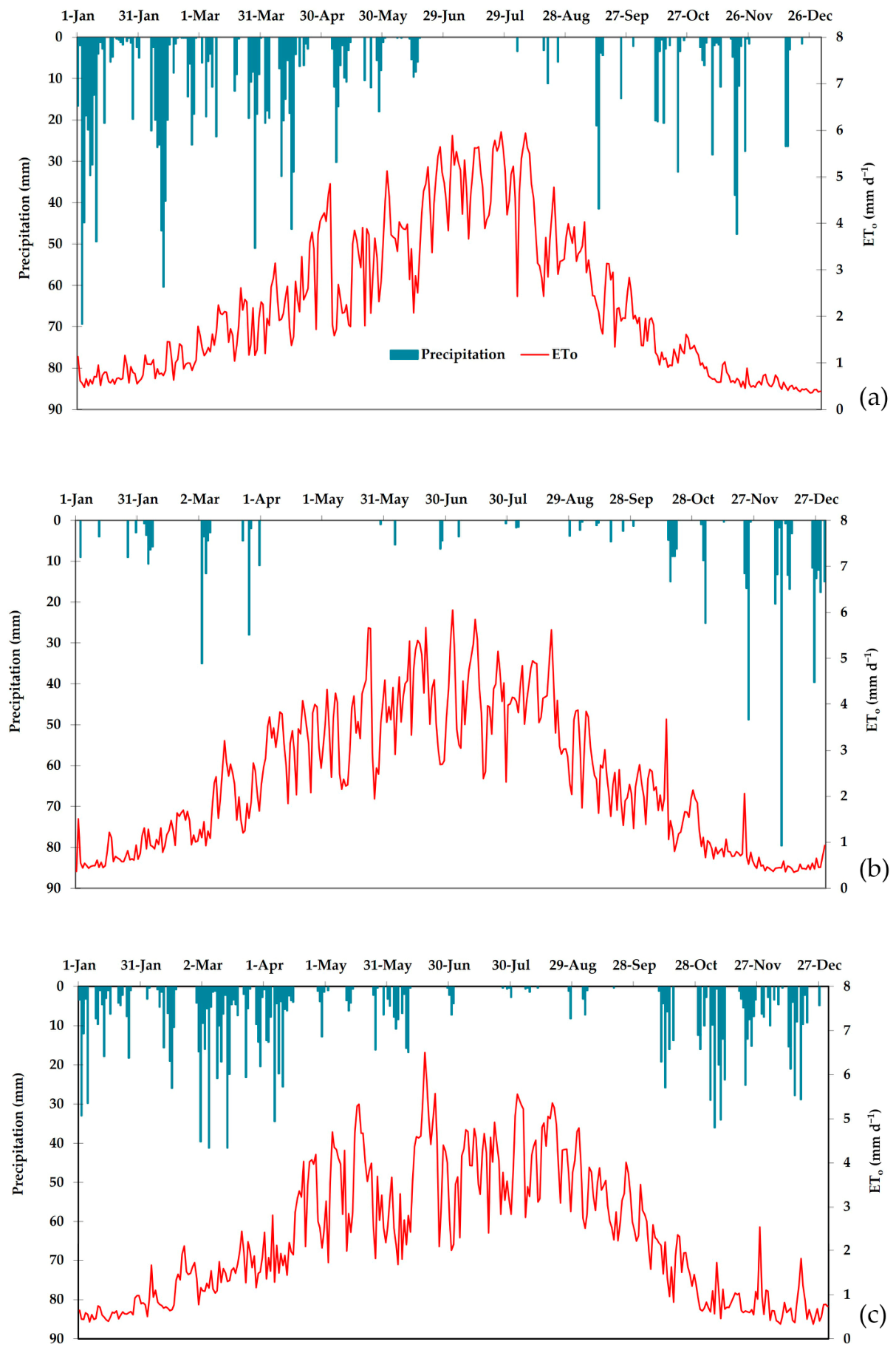
For the thorough calculation of ETo and to model crop water requirements in the study years (2016, 2017, and 2018), the FAO-56 Penman–Monteith equation [4] was applied, using the variables temperature, wind speed, hours of sunshine, and average relative humidity. The results for the three years are shown in Figure 1, together with the rainfall for each year.
The climatic conditions varied between the three years, with higher rainfall in 2016 (1844 mm) and 2018 (1500 mm), while 2017 was less rainy (969 mm). In the period from April to September, these differences between years remain, with an ETo of 652, 655, and 642 mm and precipitation of 554, 190, and 329 mm for 2016, 2017, and 2018, respectively. This allows us to group these years together, with 2016 and 2018 as wetter years and 2017 as a dry year.
In addition to these parameters, soil hydraulic properties were determined, including the water content at field capacity (θFC) and permanent wilting point (θWP). As recommended by other authors [21,22], θFC and θWP were determined by monitoring soil water content over several years (2011–2018) using TDR equipment (TDR-100, Campbell Scientific, Logan, UT, USA). As shown in Table 1, there are slight differences in the soil hydrological limits in the different treatments.
The hydrolimits presented were used to calculate the soil water balance, considering a root depth (Zr) of 0.6 m and θsat established at 0.350 (cm3 cm−3).

2.1. Irrigation Treatments

The treatments implemented to evaluate different water regime strategies under study are described below. For each irrigation treatment, four repetitions (blocks) were defined, where 21 vines were controlled. In each block, two TDR probes were installed (60 cm of depth). During the three growing seasons, soil water contents were determined 10 or 11 times per season; the average values per day and treatment were used during the calibration process.
  • R0. Control in rainfed conditions (0% ETo).
  • R1. Irrigation with 30% ETo from the onset of veraison to the end of ripening.
  • R2. Irrigation with 30% ETo from the pea size phenological stage to the end of ripening.
  • R6. Irrigation with 30% ETo from the sprouting phenological stage until the end of ripening.
Regarding water management strategies, irrigation was initiated on a date characteristic of vineyard development (bud break, pea size, and/or veraison), with treatment R6 being the usual choice. Treatments R2 and R1 are similar to the usual irrigation management practices in other wine-growing regions. Irrigation was scheduled to provide, as much as possible, 30% of the weekly ETo, forecasting it and correcting any deviations in the following week. Table 2 summarises the treatments implemented in each of the three years, including the start and end dates of irrigation.

2.2. Soil Water Modelling

The water requirements of vineyards (ETc) can be assessed with different methods and techniques; in this study, the soil water balance method was used, as previously reported [17,18,23,24].
The ETc estimate is based on the use of the crop coefficient (Kc) as the ratio between ETc and reference evapotranspiration (ETo). Therefore, ETc is obtained as ETc = Kc × ETo [4].
Several factors determine Kc in a vineyard, including the stage of vegetative growth, the height of the canopy (hcrop) and its architecture, the training system, the soil cover fraction, and the presence of mulch and/or active ground cover. The latter is affected by irrigation and soil management, as well as crop management and local conditions [8,10].
Since all of these factors must be considered in detail, a dual approach was selected to determine Kc [4]. The method consists of dividing Kc into two coefficients, one for crop transpiration (Kcb) and another for soil evaporation (Ke), resulting in Kc = Kcb + Ke. Therefore, actual evapotranspiration (ETc act), which is lower than that obtained under standard conditions (ETc), is defined as follows:
E T c   a c t = K s K c b + K e E T o
where ETc act and ETo are expressed in mm d−1; Kcb is the basal crop coefficient; Ks is the coefficient describing the effect of water stress on crop transpiration, with Ks < 1 when limitations occur due to soil water availability; and Ke is the soil evaporation coefficient.
Since the dual approach takes the presence of active vegetation and its variation throughout the cycle into account [11], its use facilitates understanding the separation of water used between crops and active ground cover, as well as soil evaporation.
In the experimental vineyard, there is permanent, active vegetation that competes with the crop for water resources; thus, it is necessary to determine its weight within the evapotranspiration processes. To use the dual approach, it is necessary to tabulate baseline crop coefficients, which must then be adjusted to local conditions. Currently, these values do not exist for vineyards with active ground cover [4,11,25], despite studies on vineyards with similar conditions. Nonetheless, these can be used as a basis for determining these values. Notably, the conditions of active ground cover vary throughout the growing season due to the operations carried out on it, as well as climatic conditions. Therefore, adjusting these conditions is complex, and the baseline coefficients must be adapted to each specific management case.
To determine the effect of active ground cover, the SIMDualKc model [26] incorporates a tool that accounts for changes in ET due to the presence of active ground cover, as well as the management of this vegetation in the vineyard. For this reason, the SIMDualKc model was selected. This model has been tested on different crops [15,27,28,29] and validated in previous studies [17,18] on Galician vineyards with active ground cover.
Therefore, the ultimate objective of modelling is to calibrate the basal coefficients at each growing stage [4], taking into account the management of active ground cover together with the estimation of soil water balance components.
This study focuses on the results related to model calibration/validation using SIMDualKc, as well as on the components of soil water balance. To determine ETc, it is necessary to calibrate the baseline crop coefficients for each stage of crop development—a process explained in the following section. The key crop growing stages are as follows: initial (ini), rapid growth, maximum development (mid), and final (end).
The SIMDualKc model calculates the soil water balance in the root zone, expressed in terms of water depletion at the end of the day, using the following layer model [4,25]:
D r , i = D r , i 1 P R O i I i C R i + E T c , i + D P i
where Dr,i is the soil water depletion in the root zone at the end of day i (mm); Dr,i−1 is the soil water depletion in the root zone at the end of day i − 1 (mm); Pi is the precipitation on day i (mm); ROi is the runoff from the soil surface on day i (mm); Ii is the net amount of irrigation on day i that infiltrates the soil (mm); CRi is the capillary rise from the water table on day i (mm); and DPi is the water flow leaving the root zone by deep percolation on day i (mm). To achieve root zone balance, it is necessary to first adjust the balance in the surface layer of the soil, which is directly involved in soil evaporation processes (Es) and directly related to moisture and the fraction of soil cover by crops and active ground cover.

SIMDualKc Model

A detailed description of the SIMDualKc model has been provided by Rosa et al. [26], who set out the data required for the model to function and the method for calculating the soil water balance. This covers both the surface layer and the root zone, as well as the different extensions it incorporates to determine surface runoff, deep percolation, and the effects of active ground cover management on crop water requirements.
To calculate the water balance in the surface layer, the percentages of sand and clay are required to determine the readily evaporable water (REW) (mm); in addition, the soil water content of the surface layer (cm3 cm−3) at field capacity (θFC = 0.254 cm3 cm−3) and the permanent wilting point (θWP = 0.089 cm3 cm−3) are required, together with the depth of the soil surface layer subject to evaporation (Ze = 0.15 m). The latter facilitates the determination of total evaporable water (TEW, mm).
Using data from a nearby agrometeorological station (MeteoGalicia, Xunta de Galicia), ETo (mm) was calculated using the Penman–Monteith equation with limited data. We then introduced P (mm) and, finally, RHmin (%) and u2 (m s−1), which are required to correct crop coefficients to local conditions [4]. Irrigation scheduling and depths were introduced to simulate the soil water balance with all parameters (Table 2), taking into account the wetting fraction of the soil caused by the irrigation system (fw = 0.10).
Moreover, information about crop growth stages (dates, height, and fraction of ground cover) is required. In addition, it is necessary to enter the values for the soil water depletion fraction (p) for each development stage (pini, pmid, and pend), which are used to determine the readily available water (RAW) for the crop (mm). It is important to enter the crop’s basal cultural coefficients (Kcb full) when there is total soil coverage without water restrictions. This is related to the maximum height of the crop (h) in each phase (Kcb full ini, Kcb full mid, and Kcb full end) (Table 3).
As grapes are a row crop, it is necessary to enter the required parameters to adjust the Kcb to the current density conditions (Kd), orientation (east–west), and row width (width, m) of the crop; the latter are viewed from the east–west direction. Finally, we incorporate the value of Kc min (0.15), the minimum value of the crop coefficient (dry soil without vegetation).
Given that there is active ground cover in the vineyard under study, when applying the A&P approach [11] to adjust the basal crop coefficients (Kcb) to the crop height (h) and its density, it is necessary to determine the basal crop coefficient during the maximum development stage for vegetation with complete ground cover (Kcb full).
K c b   f u l l = F r m i n 1.0 + 0.1 h ; 1.2 + 0.04 u 2 2 0.004 R H m i n 45 h 3 0.3
where h, u2, and RHmin are as previously defined, and Fr is the stomatal resistance correction factor [4,6].
The Kcb full value represents an upper general limit for Kcb mid when there is full soil cover without water restrictions. This expression suggests that the upper limit for Kcb full is 1.20 plus adjustments for local climatic conditions.
Since there is active ground cover in the vineyard, to determine Kcb—mainly representing transpiration—it is necessary to consider the transpiration of active ground cover (Kcb cover), which can be expressed as a function of density (Kd) [6,11] as follows:
K c b = K c b   c o v e r + K d max K cb   full K cb   cover , K cb   full K cb   cover 2
where Kcb is determined by considering the structure of the vegetation and its extent, through the density coefficient (Kd) defined by Allen and Pereira [11], including the transpiration of active ground cover and taking into account Kcb cover.
To determine the other parameters involved in soil water balance, capillary rise, runoff, and deep percolation, methodologies proposed by other authors were applied [25,26]. Capillary rise was considered negligible since the water table is very far from the surface. For deep percolation (DP), a parametric function defined by Liu et al. [30] was used. The required parameters are soil water content at saturation (θSAT, cm3 cm−3), field capacity (θFC), and wilting point (θWP), as well as the parameters a and b, adjusted to soil conditions.
To estimate runoff (RO), the curve number (CN) method developed by the USDA-SCS [31] was used, based on the CN and water depletion in the evaporable layer (De) of the soil. Allen et al. [25] have provided tabulated CN values according to soil type and crop; accordingly, a CN value of 64 was adopted in the modelling process, intermediate to coarse and medium texture soil.

2.3. Active Ground Cover—Modelling

To determine the combined Kcb of active ground cover and crops (Equation (4)), referred to in the results as Kcb cover+crop, the extension included in the SIMDualKc model [26] is used. To use this extension, it is necessary to enter the initial and end values: the fraction of soil cover by active ground cover (fc cover), the density and height (hcover). Moreover, the update of active ground cover conditions throughout the cycle, as different cultural operations are carried out, is required (Table A1).
The procedure used to determine Kcb cover consists of using the concept of Kcb cover full, which depends on vegetation height and local climatic conditions (RHmin and u2), adjusted to daily changes in active ground cover density using the density coefficient (Kd cover). The model uses a variant of Equation (4) [6,25], considering a Kc min of 0.15, which is the minimum crop coefficient for bare soil (Equations (5)–(8)).
K c b   c o v e r   f u l l = m i n ( 1.0 + 0.1 h c o v e r ; 1.2 ) + 0.04 u 2 2 0.004 R H m i n 45 h c o v e r 3 0.3
f c   e f f   c o v e r = d e n s i d a d . f r   c o v e r
K d   c o v e r = m i n 1 , M L f c   e f f   c o v e r , f c   e f f   c o v e r 1 1 + h c o v e r
K c b   c o v e r = K c   m i n + K d   c o v e r K c b   c o v e r   f u l l K c   m i n
where fc eff cover refers to the effective fc cover, and ML is a multiplier on fc eff cover describing the effect of canopy density on shading and on maximum relative ET per fraction of shaded ground [1.0–2.0].
As with the calculation of Kcb full crop, it is necessary to define the value of Fr for the active ground cover, as well as its maximum height (hcover max). For the mixture of spontaneous vegetation in the vineyard studied, Fr = 0.55 and hcover max = 0.3 (m) were considered.

Kcb cover Adjustment to Local Conditions

As the Kcb cover provided by the SIMDualKc model is determined in the absence of crops (vineyards), it is necessary to estimate this coefficient adjusted to crop development conditions. Although these conditions (i.e., the absence of a crop) can be assumed in the initial phase of the cycle, in the other phases, this assumption would be made to the detriment of the crop’s own transpiration, as the transpiration of the active ground cover would increase. Thus, it is necessary to define a new coefficient that corrects Kcb cover, which should reflect the actual situation of active ground cover and separate the vineyard transpiration and active ground cover transpiration. To this end, a sensitivity analysis of the new coefficient was carried out, considering scenarios with different coverage fractions (fc) common in vineyards [10].
Moreover, to evaluate the performance of this new factor, previous articles describing the information needed to validate them were consulted. All studies used soil water balance and the Dual-Kc approach in row crops with active ground cover. The necessary values are Kcb cover, fc crop, and hcrop, applying the new correction factor for the different growth periods of the vineyard.

2.4. Statistical Analysis

To minimise the differences between the observed soil water content (SWCobs) and the simulated soil water content (SWCsim), the calibration process involved adjusting the crop parameters Kcb and p, related to the initial, peak development, and final stages; the soil evaporation parameters TEW, REW, and Ze; and the DP parameters, a, and b. Data from 2018 were used in the calibration process for treatment R0. A set of initial parameters related to crop parameters (Kcb and p) was selected [4,25]; the parameters for soil water evaporation were taken from soil water content measurements in the surface layer from previous projects; and the DP parameters were taken from information provided by Liu et al. [30]. The initial soil water conditions in 2018 for treatment R0 showed a reduction value of 0% for TEW and TAW.
The trial-and-error process of calibrating the parameters begins with the Kcb values. In the following phases, the trial-and-error process is also applied to the parameter p and then to the aforementioned Es and DP parameters. Once the process is complete, the calibrated parameters are obtained, which must then be validated in the remaining treatments and years [26]. The calibration–validation process is considered satisfactory when the goodness-of-fit indicators related to validation varies by less than 20% from those related to calibration.
To validate the accuracy and goodness of fit of the model predictions, two approaches were taken. The first consisted of a graphical analysis of the annual evolution of the values simulated by the model compared to the observed water contents. This first approach provides an adequate perception of the existence of trends or biases in the modelling (if any). The second approach involved performing a regression analysis, forced to the origin, between the observed data and those simulated by the model. When the regression coefficient (b) is close to 1.0, the covariance is close to the variance of the observed values, indicating that the simulated and observed values are statistically similar. In addition, a coefficient of determination (r2) close to 1.0 indicates that most of the total variance in the observed values is explained by the model.
Finally, a set of indicators of estimation errors in the residuals is determined, as reported in previous work [32,33] and described in detail by Pereira et al. [34]. In addition, to assess any bias in the trend of the estimates, the percentage bias (PBIAS) (%) was determined. PBIAS measures the average tendency of predictions to be larger or smaller than their corresponding observations, where positive values indicate an underestimation bias and negative values indicate an overestimation bias. The indicators determined were the normalised root mean square error (NRMSE) (%); the root mean square error (RMSE); the mean absolute error (MAE); the mean relative error (ARE); and the maximum error (Emax), in mm. In addition to determining various model fit quality indicators—such as the fit index (dIA) [35], which represents the relationship between the mean square error and the potential error due to modelling; and, finally, the model efficiency (EF)—a normalised statistic developed by Nash and Sutcliffe [36] was used to determine the relative magnitude of the residual variance compared with the variance in the observed data.

3. Results

3.1. Soil Water Balance—Calibration and Validation

The SIMDualKc model was calibrated using soil water content (SWC, mm) data determined in the field for treatment R0 in 2018. It was also validated for the remaining treatments and years. The standard and calibrated crop parameters are shown in Table 4. It should be noted that the standard crop coefficients refer to vineyards without active vegetation cover. The parameter p do not require major adjustments with respect to p = 0.45 [4,25], so an adjustment was simply made to local climatic conditions, according to Allen et al. [4]. ML values are expected to vary between 1.5 and 2.0 [25], depending on the density and thickness of the vegetation canopy. For a theoretical vineyard with partial coverage, as a result of surface roughness and due to the high amount of energy available resulting from the open space between crop rows [37], ML = 1.5 is considered a reasonable value under the study conditions.
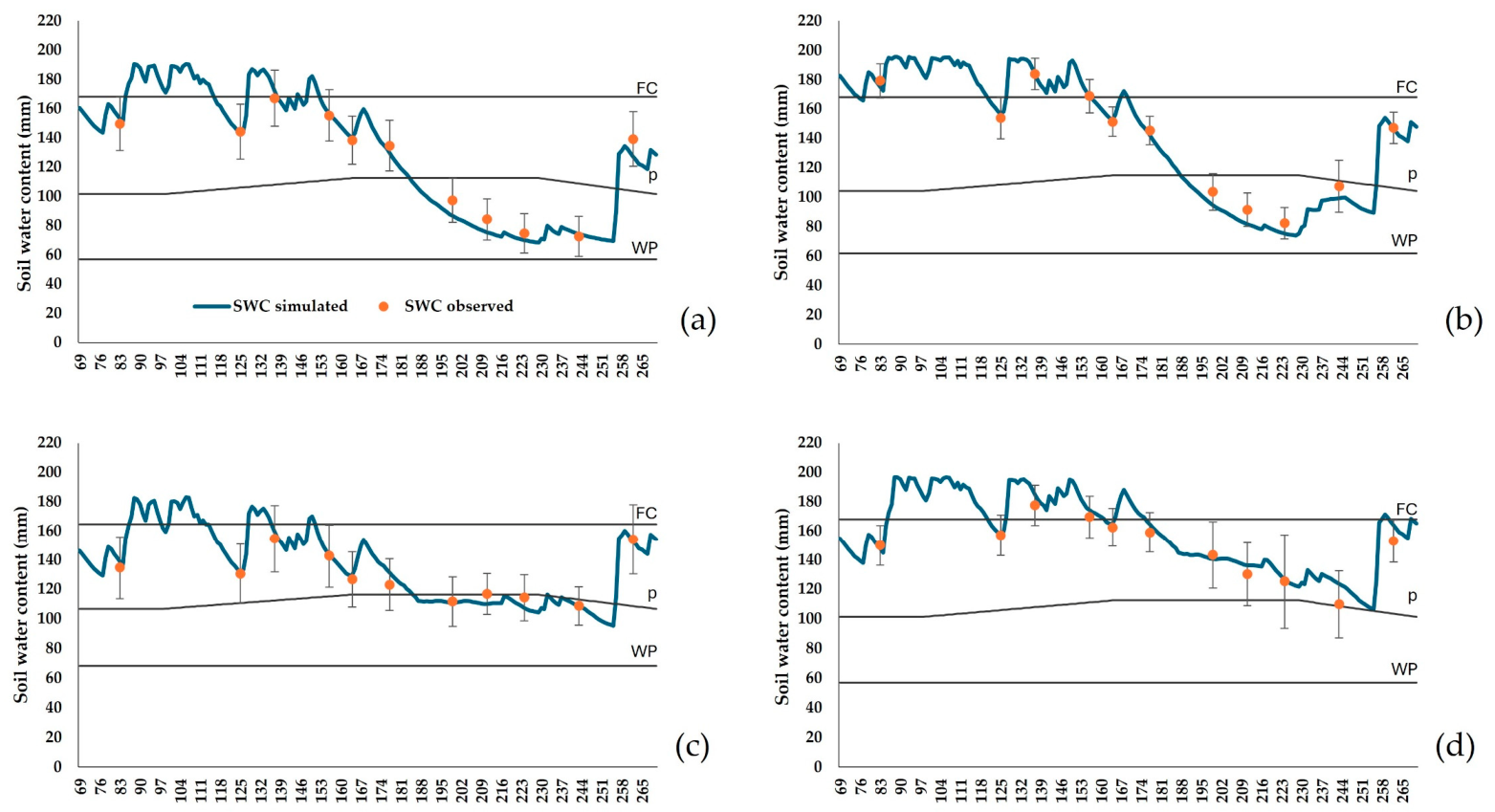
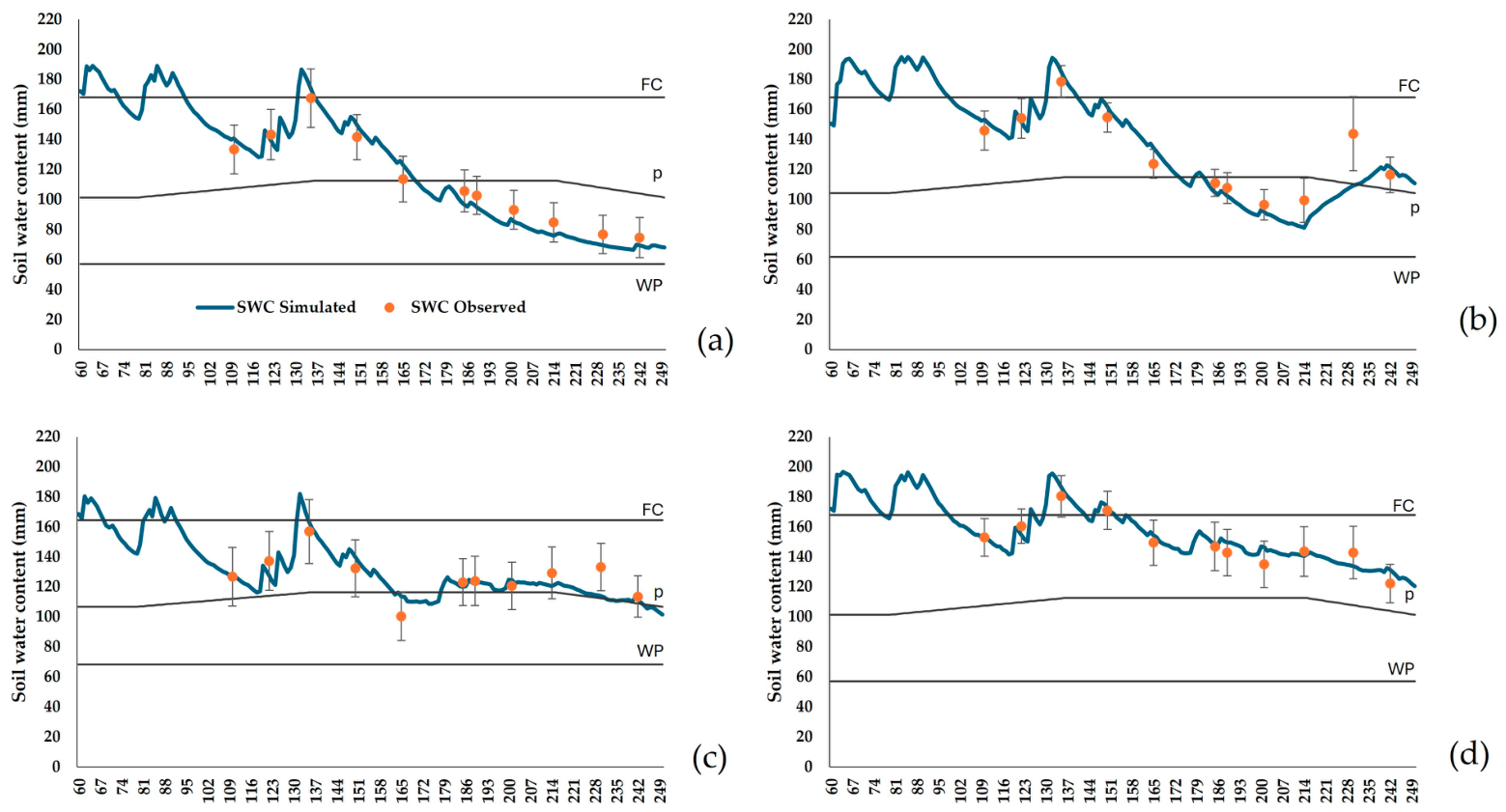
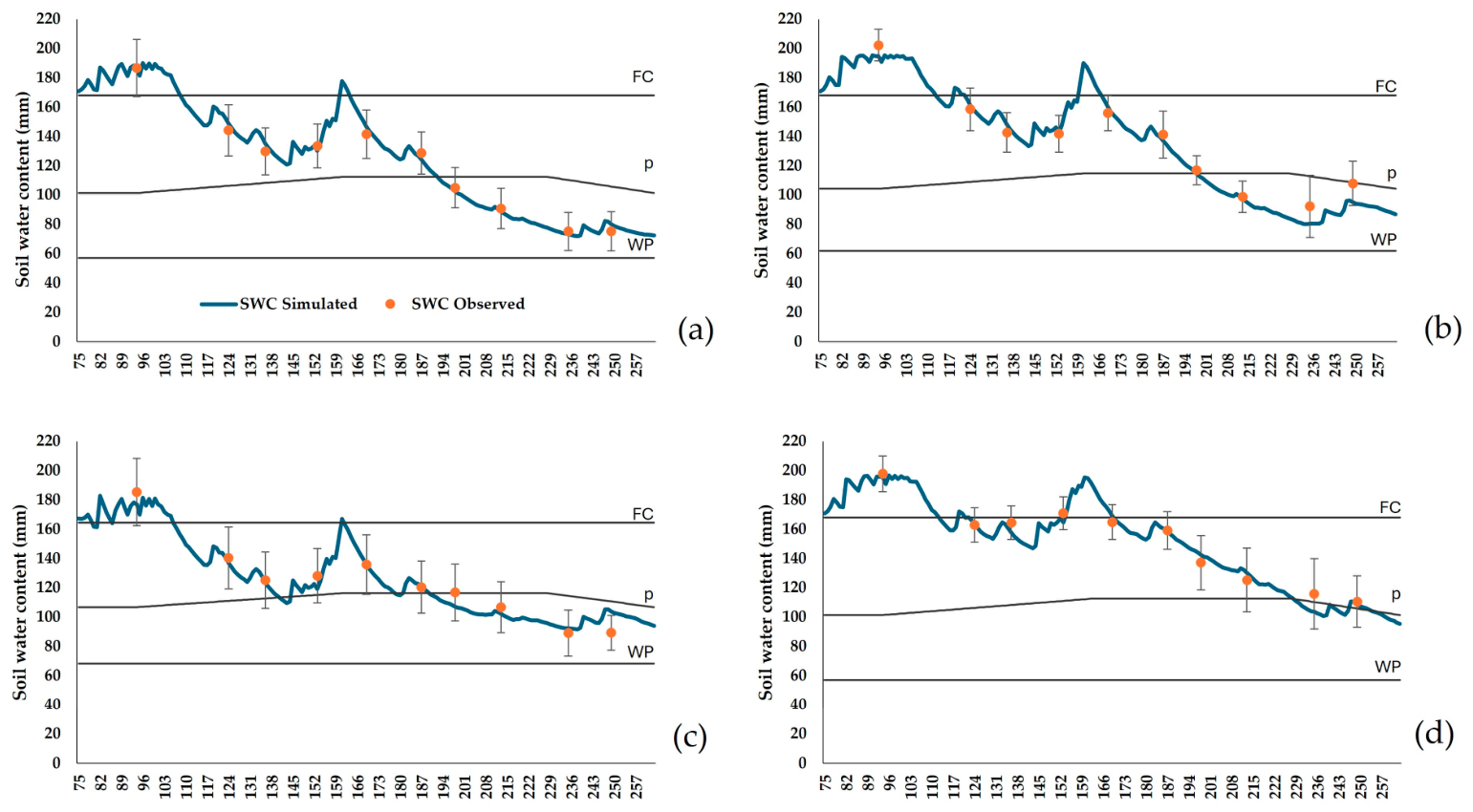
Figure 2, Figure 3 and Figure 4 show the graphical results of the model adjustment between the observed and simulated soil water content (SWC, mm) values throughout the season for the three study years and the four irrigation treatments considered. The simulated SWC values are consistent with the values observed during the three campaigns, despite the different climatic conditions between them (Figure 1) and the different water regimes applied. In 2017, during the peak development phase, differences were observed between the simulated and observed values for R1 and R2 due to errors in the management of the irrigation system, which resulted in adjustment indicators below the average obtained for the remaining treatments and years of study.
The adjustment of simulated values against observed values in 2016 (Figure 2) shows that the model tends to underestimate SWC for treatments R0 and R1, while there is a slight overestimation of observed SWC values for R6 (Table 5). The maximum differences occur at the maximum development stage, related to irrigation and precipitation events (Figure 2).
For 2017, the adjustment of simulated values against observed values shows a tendency for the model to slightly underestimate SWC for R0, R1, and R2 (b < 1.00, Table 5). Once again, the greatest differences occur at the maximum development stage, especially in treatments R1 and R2 (Figure 3), mainly due to the irrigation management problems mentioned above.
The model’s tendency in 2018 is to underestimate SWC values in irrigated treatments (R1, R2, and R6), despite the fact that the problems related to the irrigation system were solved for the current year. This can be seen at the maximum development stage where, despite there being differences, these values are minimised compared with previous campaigns (Figure 4).

3.2. Soil Water Balance—Model Fitting

The model fit was evaluated using goodness-of-fit indicators, which are presented in Table 5, together with the linear regression coefficients. The results show that the coefficients of determination (r2) vary between 0.64 and 1.00 for all treatments, with an average value of 0.92. As the average regression coefficient (b) is 0.99, in general terms, the model underestimates SWC, except in 2016 for R6 and in 2018 for R0. In contrast, the PBIAS indicator shows positive values, which means that the model slightly underestimates SWC values, although these PBIAS values do not exceed 4%. In the case of R2 and R6 in 2016, R6 in 2017, and R0 in 2018, the PBIAS is negative, indicating a slight overestimation. These values are consistent with those obtained by other authors [15,29].
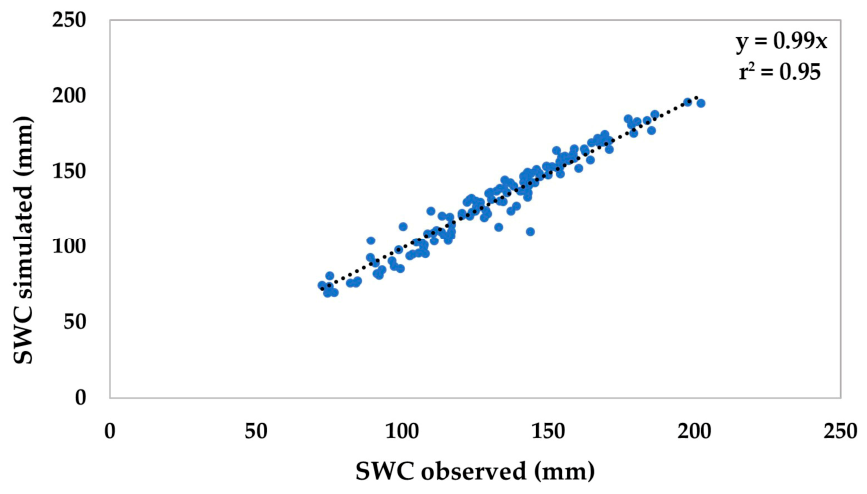
Figure 5 shows the results of the linear regression when all simulated and observed SWC data are considered, verifying the results discussed above. This indicates that the values were statistically similar for all treatments and years.
The residual estimation errors (Table 5) show that the NRMSE varies between 3.18 and 9.41%, with average values around 5%, while the RMSEs range from 3.85 to 12.25 (mm), with the maximum values corresponding to treatments R1 and R2 in 2017. The average RMSE for all years and treatments is 7 mm, which represents 6.3% of the total available water in the soil (TAW); these are relatively low values. The AAE values vary between 3.44 and 8.81 (mm), which are also low values with an average representing 5% of the TAW, in line with the ARE values. Finally, the average value of Emax is 13.64 mm, generally related to the occurrence of rainfall or irrigation events.
The efficiency index (EF) was greater than 0.77, indicating that the residual variance due to modelling is comparable to the variance of the measured data (Table 5), with the exception of R2 in 2017, where the EF is lower. The lower EF index with respect to R2-2017 was due to a slight variation in the soil water content during the growing season (Figure 3), linked to operational mistakes in using the irrigation systems. Furthermore, in that year, a higher irrigation depth than planned was applied in the R2 treatment at the end of the season. Nevertheless, this specific result does not affect the capability of the SIMDualKc model to predict soil water content and use it to partition the crop and active ground cover transpiration, as denoted in the rest of the validation cases (Table 5). Finally, dIA varies between 0.89 and 1.00, with an average value of 0.97, indicating the good fit of the model after calibration.

3.3. New Approach: Kcb Cover Adjustment

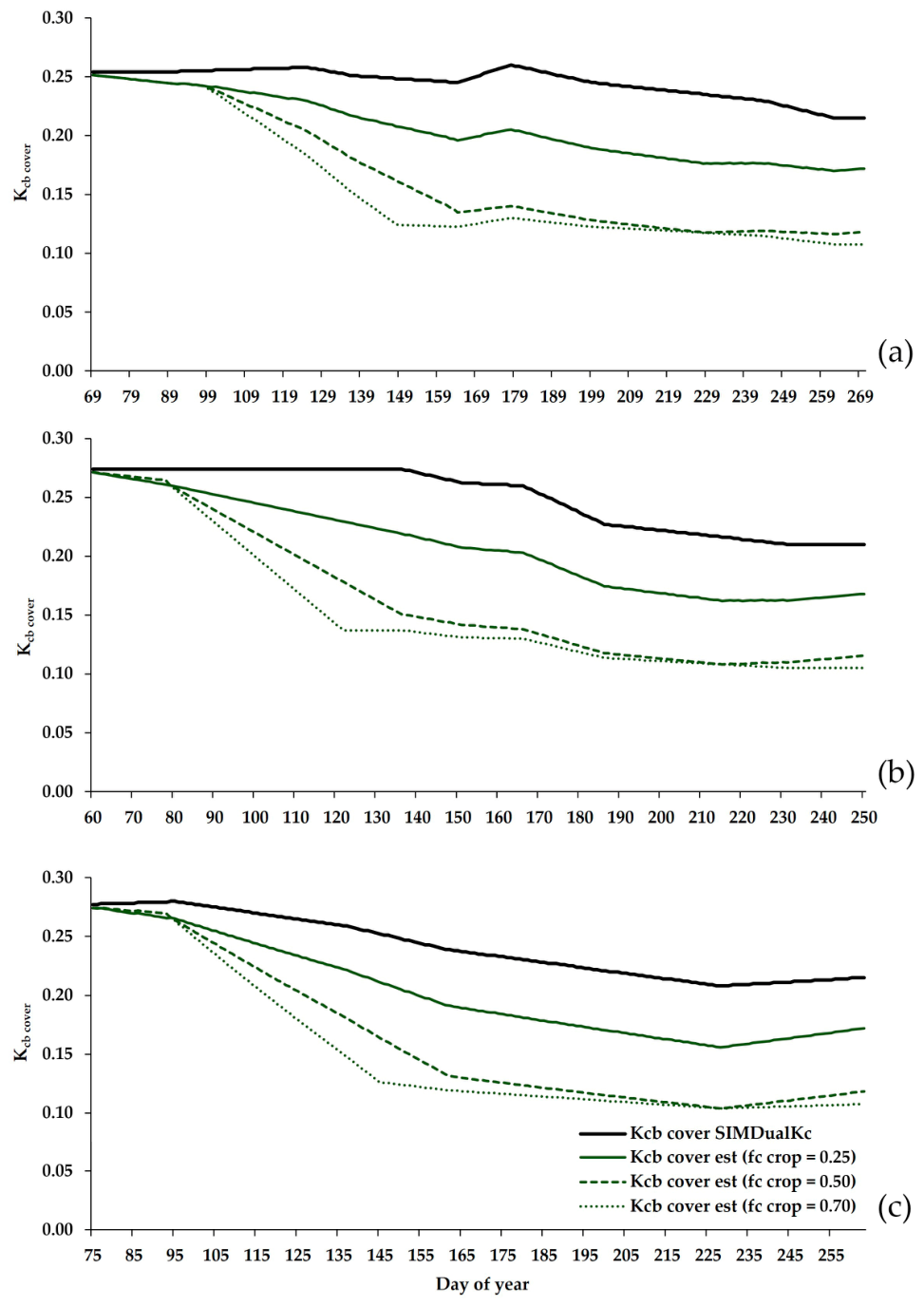
The Kcb of active ground cover (Kcb cover) was not obtained through calibration–validation from standard values; instead, it was calculated with the model using the procedure referred to in Section 2.3, based on observations of the fraction of active ground cover (fc cover), its density, and its height (hcover) throughout the measurement campaign (Table A1). As this Kcb cover value increases the transpiration of active ground cover, a new coefficient (Kcb cover est) has been developed to reduce it, which corrects the Kcb cover obtained with the SIMDualKc model, adjusting it to the vegetation of the vineyard (Equation (9)).
K c b   c o v e r   e s t = K c b   c o v e r m a x 1 f c   c r o p ; 0.5
where fc crop is the vineyard coverage fraction throughout the cycle, and 0.5 is a limiting factor for the reduction in active ground cover transpiration (Tcover). A linear relationship is selected, as this is the same model applied to vegetative growth in the SIMDualKc model. Equation (9) involves only the vineyard canopy cover fraction (fc crop), thereby simplifying its application. fc crop is calculated by the model in accordance with the parameters entered into the modelling for each vegetative stage.
To develop this correction factor, a trial-and-error procedure was followed in which the parameters involved in the equation were adjusted. Different scenarios have been proposed in terms of crop development, particularly regarding the maximum coverage fraction (fc crop). The sensitivity analysis (Figure 6) shows a linear reduction as fc crop increases, up to a maximum correction factor of 0.5, as reflected in Equation (9). The results in Figure 6 are obtained from the Kcb cover values simulated with the SIMDualKc model for the three study years. The coverage fraction was determined in the field for the vineyard studied (fc crop = 0.25, low density), compared with other common coverages in the vineyard, at medium and high density: fc crop = 0.50 and fc crop = 0.70, respectively [11].
Regarding the behaviour of Kcb cover est for different years and densities, it tended to decrease in the initial phase of crop development, while remaining stable in the maximum vineyard development phase. These values are adapted to the development of the vineyard and, therefore, to its transpiration demand as the plant canopy increases during the initial and rapid growth phase. The lower Kcb cover est values are above 0.10–0.15 over the three study years (Figure 6), reflecting the minimum Kcb cover value usually used for crops (Kc min).
Active ground cover throughout the crop cycle contributes to the transpiration of the vineyard and active ground cover as a whole (Kcb cover+crop), with lower Kcb cover values in the final stages of the crop, coinciding with maximum vegetative development and the highest fraction of vineyard cover.

3.4. Crop Coefficient Partitioning

The variation in crop coefficients throughout the three seasons is shown in Table 6 for Kcb cover, Kcb crop, Kcb (cover+crop) act, Ke, and Kc act. The Ke values decrease from the initial phase (Ke = 0.84)—when there is no shading from the plant canopy, coinciding with the highest periods of rainfall—to the final phase (Ke = 0.13), when the plant canopy is fully developed (Table 6).
The initial values of Kcb (cover+crop) act are relatively low (0.27) due to the initial lack of vegetative development in the vineyard, together with the presence of active ground cover in the soil with moderate vigour, resulting in a Kcb cover of 0.26. During the rapid growth period, Kcb (cover+crop) act increases from 0.27 at the end of the initial period to 0.46 at the beginning of the maximum development phase. This is mainly due to crop development, where Kcb crop reaches maximum values (Table 6), and not to the presence of active ground cover. During this period, active ground cover undergoes different cultural operations (herbicide, mowing, etc.) more intensively than in the initial stages, so Kcb cover is reduced compared to the values in the initial phase.
A reduction in Kcb (cover+crop) act is observed in treatments R0, R1, and R2, where the potential values are not reached (Table 6). In the final phase of the crop cycle, a Kcb (cover+crop) act close to the potential was observed for treatment R6 (0.41), while in the remaining treatments, there is a considerable reduction in Kcb (cover+crop) act compared with the potentials of 0.16, 0.30, and 0.36 for R0, R1, and R2, respectively, which is consistent with the water regime applied.

4. Discussion

4.1. Soil Water Balance—Dual-Kc Approach

Over the three years, there was high variability in the SWC measurements, with the error bars showing soil heterogeneity within the same treatment, despite the consistent distance between the TDR measurement points in all cases. This variability is greater in irrigated treatments due to the arrangement of the integrated drippers in the line, as, being 0.75 m apart, the measurement points may be more or less influenced by irrigation. The slope of the plot must also be considered, as the TDR measurement points located downstream are influenced by irrigation from the upper part of the plot. The slope of the plot meant that, in some areas, the irrigation depth was not exactly the same due to changes in pressure and, thus, in opening and closing irrigation times; this resulted in intra-plot irrigation variability (Figure 2, Figure 3 and Figure 4). By arranging the blocks (replicates) per treatment at different elevations, the uncertainty of the results was reduced, ensuring the representativeness and reliability of the model for the plot as a whole, the grape variety, and the vineyard management conditions.
Under Galician conditions, ETc is less than 5 mm day−1 for most of the growing season, resulting in p-values higher than the reference values (p = 0.45) (Table 4). During the mid-season, the values were close to the reference values to p due to higher ETc. It should be noted that the ETc used for the numerical estimation of p represents the combined effect of the vineyard and active ground cover. The value of p for a vineyard with active ground cover should be lower, as proposed by some authors [16], based on competition for available soil water between the vineyard and the active ground cover. However, under similar temperate climate conditions (northern Portugal), other authors have obtained similar p-values [15], clearly indicating that climatic conditions are the key factor in determining the parameter p in each case.
The initial values of Kcb full for the initial, maximum development, and final phases were taken from Allen et al. [25] and Allen and Pereira [11] for winemaking vineyards, and were adjusted during calibration. The calibrated Kcb full values (Kcb full ini = 0.33, Kcb full mid = 0.64, and Kcb full end = 0.48) (Table 4) were higher than the standards for Kcb full ini, while those for the maximum development and final phases were slightly lower. The Kcb full values are lower than those reported by previous authors [14] for vineyards with bare soil, who obtained a constant Kcb full value of 0.78–0.79 in all phases. When selecting the standard starting coefficients, Allen and Pereira [11] included an implicit water-stress coefficient (Ks), contrary to Kcb full values tabulated for wine grapes [25]; in both cases, the presence of active ground cover is not considered, unlike in the present study. The calibrated values for Kcb full mid and Kcb full end are lower than those proposed by previous authors [25] because the fc eff in the study vineyard (fc eff = 0.25) is lower than that they considered (fc eff = 0.5). For Kcb full ini, the calibrated values were higher due to the presence of active ground cover; this value is similar to the Kcb full ini for other fruit crops, such as apple, avocado, apricot, pear, and peach [11,25].
If we compare the average Kcb (cover+crop) act values (Table 6) for R6 (Ks = 1.0), referring to the active ground cover and vineyard as a whole, with the values proposed by Allen and Pereira [11] for low densities (fc eff = 0.25)—implying a stress coefficient (Ks = 0.7)—we obtain Kcb mid = 0.46 and Kcb end = 0.41. These values are lower than those reported previously [11] (Kcb mid = 0.57 and Kcb end = 0.43), due to differences in planting density, age, and vineyard training systems.

4.2. Kcb Cover Adjust—New Approach

The Kcb cover correction factor must be calibrated in the field by measuring the transpiration of the vineyard and/or active ground cover to validate the results obtained with Equation (9). In this study, Kcb cover was approximated empirically by visually observing the active ground cover and vineyard (fc crop; fc cover), and determining the canopy conditions.
The average Kcb cover values for each cultivation stage are shown in Table 6 for all treatments and years of study. These values remained stable at around 0.20, with slight reductions in the maximum development and final stages. A similar behaviour of Kcb cover was obtained for the Albariño variety, grown on semi-trellises, with fc crop = 0.55 [17]; for the Loureiro variety, with fc crop = 0.40 [15]; and for Italian vineyards (Barbera), grown on vertical-shoot-positioned trellises, with fc crop = 0.27 [16].
These values are slightly lower than those obtained for the Loureiro variety [15] (Kcb cover = 0.23), albeit well below the results for the Albariño variety (Kcb cover = 0.36) [17] and identical to those of Italian vineyards [16] regarding the case study with active ground cover. Notably, all previous studies [15,16,17] used a Kcb cover value simulated with the SIMDualKc model, which is why the values reported by the aforementioned authors are higher than those obtained in the present study.
The average Ke for the three seasons and all growing stages was 0.34, higher than that reported for the Albariño variety (Ke = 0.09) [17], grown on semi-trellises, and lower than that reported for the Loureiro variety in northern Portugal (Ke = 0.41) [15].
The Kcb crop ini value was lower than that obtained by previous authors [14,17]; similarly, in the maximum development and final stages, the values were lower than those reported by these authors. López-Urrea et al. [14] obtained a Kcb crop mid of 0.41 and a Kcb crop end of 0.61, higher than the respective values of 0.27 and 0.25 obtained in this study. These values are lower due to the presence of active ground cover in the case of Albariño; if we compare the Kcb crop values for the Tempranillo variety [14] with the Kcb (cover+crop) act for Albariño, we obtain similar values in the maximum development phase (0.46) and lower values for the final phase (0.42). However, Darouich et al. [16] obtained similar Kcb crop mid (0.28) and Kcb crop end (0.18) values compared with those in our study. A study conducted at a Galician vineyard [18] obtained identical values for the Godello variety grown on trellises, with active ground cover that was transformed into mulch after the initial phase of cultivation.
Analysing the three years together, and taking into account the variability of the results according to the irrigation treatment, we find that in the initial phase, the value of Kcb (cover+crop) act is 0.27 in all water regimes. This is lower than values obtained in previous studies [17,38], although it is in line with those obtained in northern Portugal [15]. For the maximum development phases, a Kcb (cover+crop) act value of 0.46 is obtained for R6 and between 0.30 and 0.45 for treatments R0, R1, and R2. In the case of the Loureiro variety, ref. [15] reported values between 0.27 and 0.48, depending on the water regime applied and the climatic conditions of the year, similar to those obtained in this study. In contrast, in a previous study under temperate climate conditions, ref. [17] reported average values for the maximum development phase of 0.65—higher than those obtained in the current study—mainly due to the training system evaluated, with semi-trellises used (as opposed to trellises), even though they used the same variety, Albariño. Finally, in the final stage, the average Kcb (cover+crop) act is 0.41 for R6 and between 0.10 and 0.42 for the remaining treatments. For R6, values higher than those reported by Fandiño et al. [17] (0.30) were obtained, albeit close to those obtained in R1. The “full irrigation” treatment implemented on the Loureiro variety in Portugal [15] shows a Kcb (cover+crop) act value of 0.41, equal to that obtained for R6; however, the value for rainfed land was 0.23, higher than R0 (Kcb (cover+crop) act = 0.16) in the present study.

4.3. Validation of Kcb Cover Adjust Study Cases

Studies of soil water balance in vineyards with active ground cover remain limited [15,16,17,18,19]; however, all authors have achieved good results after Kcb calibration process. Some explanations were made in relation to lower vineyard Kcb values (Kcb crop) during the mid-season by Silva et al. [15] and Darouich et al. [16]. The former obtained a good fit parameter, a good r2, and a b value close to 1, but crop transpiration was underestimated; conversely, Darouich et al. [16] reported an EF value less than 0.4, especially under ground cover conditions, in Italy. After applying the Kcb cover adjusted proposed in the study, an increase in crop transpiration was detected, about 35% on average. Table 7 summarises the results obtained after the application of the new approach to adjust Kcb cover to real conditions (Equation (9)).
In global terms, in all study cases, Kcb cover decreased from 30 to 50%, but this is highly dependent on the fc crop value and trellis system (VPS, semi-trellises, etc.). These results support an increase in vineyard transpiration, linked to the real situation of a complex vineyard with active ground cover. The final values (Table 7) agree with the real vineyard water requirements; during the rapid growth stage, vines with a height of 1.0–1.5 m obviously provide higher water requirements than a cover crop with a height of 0.20 m. These limitations of the original methodology [4,11,26] are due to the lower value of Kcb min in the Kcb full equation. Adaptations to incomplete crops with cover crops have maintained this lower limit, introduced in the original equation for full crops. However, this does not make physical sense in periods where cover crops are decreasing and vineyards are rapidly increasing their vegetative area. Our results show a clear need to reduce the Kcb cover values derived with the daily Dual-Kc model using the fc value of vineyards.

5. Conclusions

Obtaining a good estimate of vineyard water requirements in the presence (continuous or discontinuous) of active ground cover requires thorough adjustment of the parameters affecting the soil water balance. The initial approach defined in the reference studies [4,11,26] resolves the process of determining the transpiration of vineyards and active vegetation (row and/or inter-row) as a whole. However, to differentiate between vineyard transpiration and active ground cover transpiration, a reduction coefficient for the active ground cover transpiration should be adopted to adjust to the ground truth. The initially proposed model limits the minimum value entered for Kc min (0.15) to calculate Kcb cover, resulting in high values despite the evaporative surface area in the vineyard being larger than that of the vegetation cover. The proposed modification has been tested in previous studies, yielding adequate results for all cases and leading to an average increase of 35% in mid-season vineyard transpiration. The proposed correction factor is easy to apply to row crops with active ground cover, based on the Kcb cover value obtained using SIMDualKc and the fc crop value. The presented results demonstrate good applicability to the case under study; as such, the proposed model’s implementation is recommended in similar studies to ensure effective differentiation between crop transpiration and that of active ground cover. However, further research is needed to ensure that the proposed equation is appropriate for different situations around the world.

Author Contributions

Conceptualisation, M.F. and J.J.C.; methodology, M.F. and J.J.C.; formal analysis, M.F. and J.J.C.; investigation, M.F. and J.J.C.; resources, J.J.C.; data curation, M.F.; writing—original draft preparation, M.F. and J.J.C.; writing—review and editing, M.F. and J.J.C.; visualisation, M.F.; project administration, J.J.C.; funding acquisition, J.J.C. All authors have read and agreed to the published version of the manuscript.

Funding

This work was supported by the Spanish National Research Institute for Agriculture (INIA) [RTA2014-00049-C05-05] by the Spanish Government.

Data Availability Statement

The data presented in this study are available upon request from the corresponding authors due to the private interests of the company for which the study was carried out.

Acknowledgments

The authors thank the ‘Lagar de Cervera’ cellar staff and our colleagues at INIA-2014 for their support and collaboration during the experimental design stage. The English revision was funded by Xunta de Galicia (Grupos de Referencia Competitiva ED431C-2025/17).

Conflicts of Interest

The authors declare no conflicts of interest.

Abbreviations

The following abbreviations are used in this manuscript:
CNcurve number [-]
CRcapillary riser [mm o m3 ha−1]
DPdeep percolation [mm o m3 ha−1]
Dr,iwater depletion in the root zone at the end of day i [mm]
Dr,i-1water depletion in the root zone at the end of the previous day i-1 [mm]
Essoil evaporation [mm]
ETccrop evapotranspiration under standard conditions [mm d−1]
ETc act crop evapotranspiration under non-standard conditions [mm]
EToreference crop evapotranspiration [mm d−1]
FCsoil water content at field capacity [mm]
fc coverfraction of soil surface covered by active ground cover [-]
fc effeffective fraction of soil surface covered by crop [-]
fc eff covereffective fraction of soil surface covered by active ground cover [-]
fc or fc cropfraction of soil surface covered by crop [-]
fewfraction of soil that is both exposed and wetted [-]
Frresistance correction factor [-]
fwfraction of soil surface wetted by irrigation [-]
h or hcropcrop height [m]
hcoveractive ground cover height [m]
hcover maxactive ground cover maximum height [m]
Iirrigation [mm]
Kccrop coefficient [-]
Kc actactual crop coefficient [-]
Kc maxmaximum value of crop coefficient (following rain or irrigation) [-]
Kc minminimum value of crop coefficient (dry soil with no ground cover) [-]
Kcb or Kcb cropbasal crop coefficient [-]
Kcb coverbasal active ground cover coefficient [-]
Kcb cover adjadjust basal active ground cover coefficient [-]
Kcb cover fullbasal active ground cover coefficient during mid-season [-]
Kcb cover+cropbasal crop coefficient of vineyard and active ground cover [-]
Kcb (cover+crop) actbasal crop coefficient of vineyard and active ground cover adjusted [-]
Kcb crop adjadjust basal crop coefficient [-]
Kcb fullbasal crop coefficient during mid-season [-]
Kddensity coefficient [-]
Kd coverdensity coefficient by active ground cover [-]
Kesoil evaporation coefficient [-]
Kswater-stress coefficient [-]
MLmultiplier on fc eff (1.5–2.0) describing the effect of the canopy density on shading and on maximum relative evapotranspiration per fraction of ground shaded [-]
Pprecipitation [mm]
pevapotranspiration depletion factor [-]
θFC or FCsoil water content at field capacity [cm3 cm−3] or [mm]
θSAT soil water content at saturation [cm3 cm−3]
θWP or WPsoil water content at wilting point [cm3 cm−3] or [mm]
RAWreadily available soil water of the root zone [mm]
REW readily evaporable water [mm]
RHmin daily minimum relative humidity [%]
RO surface runoff [mm]
SWC soil water content [mm o cm3 cm−3]
TAW total available soil water of the root zone [mm]
Tcoveractive ground cover transpiration [mm]
Tcropcrop transpiration [mm]
TEW total evaporable water [mm]
u2 wind speed at 2 m above ground surface [m s−1]
WPsoil water content at wilting point [mm]
Ze depth of surface soil layer subjected to drying by evaporation [m]
Zr rooting depth [m]

Appendix A

Table A1. Density and height of active ground cover. Years: 2016–2018.
YearDateDay of YearRowInter-Row
Densityh (m)Densityh (m)
201609 Mar.69000.800.05
24 Mar.84000.800.05
04 May125000.800.15
16 May1370.200.050.700.15
12 Jun.164000.700.15
26 Jun.178000.800.20
17 Jul.199000.700.15
30 Aug.243000.600.10
18 Sep.262000.500.05
26 Sep.270000.500.05
201701 Mar.60000.800.15
16 May136000.800.15
31 May1510.200.050.700.10
15 Jun.1660.400.100.650.10
05 Jul.186000.500.10
19 Aug.231000.400.05
30 Aug.242000.400.05
07 Sep.250000.400.05
201816 Mar.750.200.050.800.20
05 Apr.950.200.050.800.25
16 May1360.150.050.700.15
11 Jun.162000.600.10
16 Aug.228000.400.05
20 Sep.263000.450.05

References

  1. Darko, R.O.; Odoi-Yorke, F.; Abbey, A.A.; Afutu, E.; Owusu-Sekyere, J.D.; Sam-Amoah, L.K.; Acheampong, L. A Review of Climate Change Impacts on Irrigation Water Demand and Supply-A Detailed Analysis of Trends, Evolution, and Future Research Directions. Water Resour. Manag. 2025, 39, 17–45. [Google Scholar] [CrossRef]
  2. Rahman, H.M.T.; Natcher, D. Addressing gaps in integrative water-energy-food-forest (WEFF) nexus governance. Environ. Sci. Policy 2025, 172, 104195. [Google Scholar] [CrossRef]
  3. McDermid, S.; Nocco, M.; Lawston-Parker, P.; Keune, J.; Pokhrel, Y.; Jain, M.; Jägermeyr, J.; Brocca, L.; Massari, C.; Jones, A.D.; et al. Irrigation in the Earth system. Nat. Rev. Earth Environ. 2023, 4, 435–453. [Google Scholar] [CrossRef]
  4. Allen, R.G.; Pereira, L.S.; Raes, D.; Smith, M. Crop Evapotranspiration. Guidelines for Computing Crop Water Requirements; FAO Irrigation and Drainage Paper 56; FAO: Rome, Italy, 1998; 300p, Available online: http://www.fao.org/docrep/x0490e/x0490e00.htm (accessed on 10 December 2025).
  5. Pereira, L.S.; Paredes, P.; Jovanovic, N. Soil water balance models for determining crop water and irrigation requirements and irrigation scheduling focusing on the FAO56 method and the dual Kc approach. Agric. Water Manag. 2020, 241, 106357. [Google Scholar] [CrossRef]
  6. Pereira, L.S.; Paredes, P.; Melton, F.; Johnson, L.; Wang, T.; López-Urrea, R.; Cancela, J.J.; Allen, R. Prediction of crop coefficients from fraction of ground cover and height. Background and validation using ground and remote sensing data. Agric. Water Manag. 2020, 240, 106197. [Google Scholar] [CrossRef]
  7. Pereira, L.S.; Paredes, P.; López-Urrea, D.J.; Jovanovic, N. Updates and advances to the FAO56 crop water requirements method. Agric. Water Manag. 2021, 248, 106697. [Google Scholar] [CrossRef]
  8. Pereira, L.S.; Paredes, P.; Hunsaker, D.J.; Lopez-Urrea, R.; Mohammadi Shad, Z. Standard single and basal crop coefficients for field crops. Updates and advances to the FAO56 crop water requirements method. Agric. Water Manag. 2021, 243, 106466. [Google Scholar] [CrossRef]
  9. Pereira, L.S.; Paredes, P.; Oliveira, C.M.; Montoya, F.; López-Urrea, R.; Salman, M. Single and basal crop coefficients for estimation of water use of tree and vine woody crops with consideration of fraction of ground cover, height, and training system for Mediterranean and warm temperate fruit and leaf crops. Irrig. Sci. 2024, 42, 1019–1058. [Google Scholar] [CrossRef]
  10. Rallo, G.; Paço, T.A.; Paredes, P.; Puig-Sirera, À.; Massai, R.; Provenzano, G.; Pereira, L.S. Updated single and dual crop coefficients for tree and vine fruit crops. Agric. Water Manag. 2021, 250, 106645. [Google Scholar] [CrossRef]
  11. Allen, R.G.; Pereira, L.S. Estimating crop coefficients from fraction of ground cover and height. Irrig. Sci. 2009, 28, 17–34. [Google Scholar] [CrossRef]
  12. Pe’er, G.; Finn, J.A.; Díaz, M.; Birkenstock, M.; Lakner, S.; Röder, N.; Kazakova, Y.; Šumrada, T.; Bezák, P.; Concepción, E.D.; et al. How can the European Common Agricultural Policy help halt biodiversity loss? Recommendations by over 300 experts. Conserv. Lett. 2022, 15, e12901. [Google Scholar] [CrossRef]
  13. Runge, T.; Latacz-Lohmann, U.; Schaller, L.; Todorova, K.; Daugbjerg, C.; Termansen, M.; Liira, J.; Le Gloux, F.; Dupraz, P.; Leppanen, J.; et al. Implementation of Eco-schemes in Fifteen European Union Member States. EuroChoices 2022, 21, 19–27. [Google Scholar] [CrossRef]
  14. López-Urrea, R.; Montoro, A.; Mañas, F.; López-Fuster, P.; Fereres, E. Evapotranspiration and crop coefficients from lysimeter measurements of mature ‘Tempranillo’ wine grapes. Agric. Water Manag. 2012, 112, 13–20. [Google Scholar] [CrossRef]
  15. Silva, S.P.; Valín, M.I.; Mendes, S.; Araujo-Paredes, C.; Cancela, J. Dual crop coefficient approach in Vitis vinifera L. cv. Loureiro. Agronomy 2021, 11, 2062. [Google Scholar] [CrossRef]
  16. Darouich, H.; Ramos, T.B.; Pereira, L.S.; Rabino, D.; Bagagiolo, G.; Capello, G.; Simionesei, L.; Cavallo, E.; Biddoccu, M. Water Use and Soil Water Balance of Mediterranean Vineyards under Rainfed and Drip Irrigation Management: Evapotranspiration Partition and Soil Management Modelling for Resource Conservation. Water 2022, 14, 554. [Google Scholar] [CrossRef]
  17. Fandiño, M.; Cancela, J.J.; Rey, B.J.; Martínez, E.M.; Rosa, R.G.; Pereira, L. Using the dual-Kc approach to model evapotranspiration of Albariño vineyards (Vitis vinifera L. cv. Albariño) with consideration of active ground cover. Agric. Water Manag. 2012, 112, 75–87. [Google Scholar] [CrossRef]
  18. Cancela, J.J.; Fandiño, M.; Rey, B.J.; Martinez, E.M. Automatic irrigation system based on dual crop coefficient, soil and plant water status for Vitis vinifera (cv Godello and cv Mencía). Agric. Water Manag. 2015, 151, 52–63. [Google Scholar] [CrossRef]
  19. Fandiño, M. Necesidades de Agua e Influencia de los Sistemas de Riego en Vitis vinifera cv. Albariño. Ph.D. Thesis, Escuela de Doctorado Internacional, Universidad de Santiago de Compostela, Lugo, Spain, 2021. [Google Scholar]
  20. Hargreaves, G.H.; Samani, Z.A. Reference crop evapotranspiration from temperature. Appl. Eng. Agric. 1985, 1, 96–99. [Google Scholar] [CrossRef]
  21. Centeno, A.; Baeza, P.; Lissarrague, J.R. Relationship between soil and plant water status in wine grapes under various water deficit regimes. HortTechnology 2010, 20, 585–593. [Google Scholar] [CrossRef]
  22. Evett, S.R.; Schwartz, R.C.; Casanova, J.J.; Heng, L.K. Soil water sensing for water balance, ET and WUE. Agric. Water Manag. 2012, 104, 1–9. [Google Scholar] [CrossRef]
  23. Singleton, P.L.; Maudsley, D. Pattern of water extraction by grapevines on two soils in the Waikato, New Zealand. N. Z. J. Crop Hortic. Sci. 1996, 24, 415–424. [Google Scholar] [CrossRef]
  24. Fooladmand, H.R.; Sepaskhah, A.R. A soil water balance model for a rainfed vineyard in a micro catchment based on dual crop coefficient. Arch. Agron. Soil Sci. 2009, 55, 67–77. [Google Scholar] [CrossRef]
  25. Allen, R.G.; Wright, J.L.; Pruitt, W.O.; Pereira, L.S.; Jensen, M.E. Water Requirements: In Design and Operation of Farm Irrigation Systems, 2nd ed.; ASABE Monograph: St. Joseph, MI, USA, 2007; Chapter 8. [Google Scholar]
  26. Rosa, R.D.; Paredes, P.; Rodrigues, G.C.; Alves, I.; Fernando, R.M.; Pereira, L.S.; Allen, R.G. Implementing the dual crop coefficient approach in interactive software. 1. Background and computational strategy. Agric. Water Manag. 2012, 103, 8–24. [Google Scholar] [CrossRef]
  27. Esteban-Sanchez, G.; Campillo, C.; Uriarte, D.; Moral, F.J. Assessing effect of irrigation frequency on evaporation and transpiration in vineyards using SIMDualKc simulation model with measured wet fraction. Agronomy 2024, 14, 1468. [Google Scholar] [CrossRef]
  28. Almeida, W.S.; Paredes, P.; Basto, J.; Pôças, I.; Pacheco, C.A.; Paço, T. Estimating evapotranspiration of rainfed winegrapes combining remote sensing and the SIMDualKc Soil Water Balance Model. Water 2024, 16, 2567. [Google Scholar] [CrossRef]
  29. Paço, T.A.; Paredes, P.; Pereira, L.S.; Silvestre, J.; Santos, F.L. Crop coefficients and transpiration of a super intensive Arbequina olive orchard using the dual Kc approach and the Kcb computation with the fraction of ground cover and height. Water 2019, 11, 383. [Google Scholar] [CrossRef]
  30. Liu, Y.; Pereira, L.S.; Fernando, R.M. Fluxes through the bottom boundary of the root zone in silty soils: Parametric approaches to estimate groundwater contribution and percolation. Agric. Water Manag. 2006, 84, 27–40. [Google Scholar] [CrossRef]
  31. USDA, SCS. National Engineering Handbook, Section 4: Hydrology; U.S. Soil Conservation Service, USDA: Washington, DC, USA, 1972. Available online: https://archive.org/download/CAT71334647003/CAT71334647003.pdf (accessed on 14 November 2025).
  32. Legates, D.R.; McCabe, G.J., Jr. Evaluating the use of “goodness-of-fit” Measures in hydrologic and hydroclimatic model validation. Water Resour. Res. 1999, 35, 233–241. [Google Scholar] [CrossRef]
  33. Moriasi, D.N.; Arnold, J.G.; Van Liew, M.W.; Bingner, R.L.; Harmel, R.D.; Veith, T.L. Model Evaluation Guidelines for Systematic Quantification of Accuracy in Watershed Simulations. Trans. ASABE 2007, 50, 885–900. [Google Scholar] [CrossRef]
  34. Pereira, L.S.; Paredes, P.; Rodrigues, G.C.; Neves, M. Modeling malt barley water use and evapotranspiration partitioning in two contrasting rainfall years. Assessing AquaCrop and SIMDualKc models. Agric. Water Manag. 2015, 159, 239–254. [Google Scholar] [CrossRef]
  35. Willmott, C.J. On the validation of models. Phys. Geogr. 1981, 870, 184–194. [Google Scholar] [CrossRef]
  36. Nash, J.E.; Sutcliffe, J.V. River flow forecasting through conceptual models part I—A discussion of principles. J. Hydrol. 1970, 10, 282–290. [Google Scholar] [CrossRef]
  37. Paço, T.A.; Ferreira, M.I.; Rosa, R.D.; Paredes, P.; Rodrigues, G.C.; Conceição, N.; Pacheco, C.A.; Pereira, L.S. The dual crop coefficient approach using a density factor to simulate the evapotranspiration of a peach orchard: SIMDualKc model versus eddy covariance measurements. Irrig. Sci. 2012, 30, 115–126. [Google Scholar] [CrossRef]
  38. Yunusa, I.A.M.; Walker, R.R.; Guy, I.R. Partitioning of seasonal evapotranspiration from a commercial furrow-irrigated Sultana vineyard. Irrig. Sci. 1997, 18, 45–54. [Google Scholar] [CrossRef]
Figure 1. Rainfall distribution and evolution of reference evapotranspiration (ETo): (a) 2016, (b) 2017, and (c) 2018.
Water 18 01202 g001
Figure 2. Simulated () and observed () mean soil water content (SWC, mm) in 2016 for (a) R0, (b) R1, (c) R2, and (d) R6. The x-axis represents the day of the year. Error bars represent the standard deviation of the mean of the observed values. The FC, WP, and p curves represent the soil water content at field capacity, the wilting point, and the easily extractable soil water content, respectively.
Water 18 01202 g002
Figure 3. Simulated () and observed () mean soil water content (SWC, mm) in 2017 for (a) R0, (b) R1, (c) R2, and (d) R6. The x-axis represents the day of the year. Error bars represent the standard deviation of the mean of the observed values. The FC, WP, and p curves represent the soil water content at field capacity, the wilting point, and the easily extractable soil water content, respectively.
Water 18 01202 g003
Figure 4. Simulated () and observed () mean soil water content (SWC, mm) in 2018 for (a) R0, (b) R1, (c) R2, and (d) R6. The x-axis represents the day of the year. Error bars represent the standard deviation of the mean of the observed values. The FC, WP, and p curves represent the soil water content at field capacity, the wilting point, and the easily extractable soil water content, respectively.
Water 18 01202 g004
Figure 5. Comparison between observed and simulated soil water content (SWC, mm, blue dots) for all treatments and all years. Dashed line: shows the lineal relation.
Water 18 01202 g005
Figure 6. Sensitivity analysis of the behaviour of the Kcb cover reduction factor: (a) 2016, (b) 2017, and (c) 2018.
Water 18 01202 g006
Table 1. Soil hydraulic properties and total water available in the soils of the plot 1.
TreatmentSandClaySiltθFCθWPTAW
R056.518.525.00.2800.095111
R159.519.021.50.2800.103106
R258.718.323.00.2740.11496
R658.216.325.50.2800.095111
Average58.218.023.80.2790.102106
Note(s): Sand, clay, and silt are recorded as a percentage. θFC: water content at field capacity (cm3 cm−3), θWP: water content at permanent wilting point (cm3 cm−3), TAW: total available water (mm). 1 The values refer to a soil depth of 0.6 m.
Table 2. Irrigation periods and total irrigation depth (mm). Years: 2016–2018.
Treatment201620172018
Irrigation PeriodTotal Depth (mm)Irrigation PeriodTotal Depth (mm)Irrigation PeriodTotal Depth (mm)
R0------
R116 Aug.–01 Sep.31.603 Aug.–27 Aug.81.522 Aug.–14 Sep.22.3
R211 Jun.–01 Sep.130.215 Jun.–27 Aug.136.628 Jun.–14 Sep.73.5
R619 Apr.–01 Sep.165.206 Apr.–27 Aug.163.302 May–14 Sep.125.6
Table 3. Crop growth stages, height (m), and fraction of ground cover (fc).
Stages201620172018
Dateh (m)fcDateh (m)fcDateh (m)fc
Start09 Mar.1.00.0101 Mar.1.00.0116 Mar.1.00.01
Start rapid grow07 Apr.1.30.0520 Mar.1.30.0504 Apr.1.30.05
Start maximum grow12 Jun.2.00.2016 May.2.00.2011 Jun.2.00.20
Start maturation16 Aug.2.10.2503 Aug.2.10.2516 Aug.2.10.25
Harvest26 Sep.1.90.2007 Sep.1.90.2020 Sep.1.90.20
Table 4. Standard and calibrated modelling parameters.
ParametersStandardCalibrated
Kcb full ini0.20 10.33
Kcb full mid0.80 10.64
Kcb full end0.60 10.48
pini0.45 20.60
pmid0.45 20.50
pend0.45 20.60
a305 3290
b−0.0173 3−0.0320
Note(s): 1 [11]; 2 [4]; 3 [30].
Table 5. Linear regression coefficients and goodness-of-fit indicators related to the calibration and validation of the SIMDualKc model for different irrigation treatments.
Treat.Linear RelationResidues
br2NRMSE
(%)
PBIAS
(%)
RMSE
(mm)
dIAEFEmax
(mm)
AAE
(mm)
ARE
(mm)
2016
R00.980.985.092.206.280.990.9612.205.074.62
R10.981.004.022.555.530.990.979.924.283.99
R21.000.953.42−0.324.410.980.928.263.442.73
R61.030.934.38−2.816.520.970.8813.675.223.72
2017
R00.980.976.473.177.270.990.9410.416.876.80
R10.970.869.413.6812.250.950.7733.808.817.07
R20.980.646.962.038.840.890.5820.146.345.10
R61.000.863.90−0.515.830.960.869.964.753.32
2018
R01.010.993.18−0.543.851.000.995.643.513.11
R10.980.974.891.966.640.990.9612.915.374.40
R20.980.945.751.507.110.980.9314.605.524.83
R60.990.963.721.025.610.990.9512.194.463.20
min.0.970.643.18−2.813.850.890.585.643.442.73
max.1.031.009.413.6812.251.000.9933.808.817.07
Average0.990.925.101.166.680.970.8913.645.304.41
Table 6. Average values of crop coefficients for the different crop stages.
2016
StagesKcb coverKcb cropKcb (cover+crop) actKeKc act
R0R1R2R6R0R1R2R6R0R1R2R6
Initial0.250.010.260.260.260.260.860.860.860.861.121.121.121.12
Rapid growth0.220.140.360.360.360.360.600.600.600.620.960.960.960.98
Max. Develop.0.190.280.300.320.440.480.080.080.140.150.370.400.580.62
Harvest0.170.250.220.320.380.430.190.220.220.220.420.540.600.65
Average0.210.190.300.320.370.400.390.390.410.420.680.710.790.81
2017
StagesKcb coverKcb cropKcb (cover+crop) actKeKc act
R0R1R2R6R0R1R2R6R0R1R2R6
Initial0.270.010.280.280.280.280.780.780.780.781.061.061.061.06
Rapid growth0.240.120.360.360.360.360.470.480.470.500.840.840.830.86
Max. Develop.0.190.270.360.380.450.460.110.110.150.170.470.490.600.63
Harvest0.160.260.100.370.420.420.030.090.090.090.130.460.510.52
Average0.210.200.300.360.400.410.270.280.300.310.580.650.700.72
2018
StagesKcb coverKcb cropKcb (cover+crop) actKeKc act
R0R1R2R6R0R1R2R6R0R1R2R6
Initial0.270.010.280.280.280.280.870.870.870.871.151.151.151.15
Rapid growth0.230.120.350.350.350.350.490.500.490.520.850.850.840.87
Max. Develop.0.170.270.350.380.370.450.100.100.140.160.450.480.510.60
Harvest0.160.250.150.220.270.390.060.110.120.120.210.330.400.51
Average0.200.190.310.330.340.390.310.320.340.350.620.650.670.74
Average
2016–2018
0.200.190.300.340.370.400.320.330.350.360.630.670.720.76
Note(s): Kcb cover: basal coefficient of active ground cover using Equation (9); Kcb crop: basal crop coefficient; Kcb (cover+crop) act: basal crop coefficient of vineyard and active ground cover adjusted; Ke: soil evaporation coefficient; Kc act: simple crop coefficient adjusted.
Table 7. Assessment of Equation (9) to adjust Kcb cover to real conditions.
ReferenceOriginalAdjusted
Kcb crop midKcb cover midfc crop midKcb cover mid adjKcb crop mid adj
[17]0.400.250.530.130.53
[15]0.180.240.400.140.27
[16]0.280.200.290.140.34
Actual study0.220.240.250.180.27
Note(s): Kcb crop mid: basal crop coefficient; Kcb cover mid: basal coefficient of active ground cover; fc crop mid: fraction of crop during the mid-season; Kcb cover mid adj: basal coefficient of active ground cover using Equation (9); Kcb crop mid adj: basal crop coefficient after applying the new approach (Equation (9)). All parameters were referred to mid-season (mid).
Disclaimer/Publisher’s Note: The statements, opinions and data contained in all publications are solely those of the individual author(s) and contributor(s) and not of MDPI and/or the editor(s). MDPI and/or the editor(s) disclaim responsibility for any injury to people or property resulting from any ideas, methods, instructions or products referred to in the content.