Article

Development of XAI-Based Explainable Planning Management for Chl-a Reduction

1
School of Civil Engineering, Chungbuk National University, Cheongju 28644, Republic of Korea
2
Department of Civil Engineering, Chungbuk National University, Cheongju 28644, Republic of Korea
*
Author to whom correspondence should be addressed.
Water 2026, 18(1), 7; https://doi.org/10.3390/w18010007
Submission received: 12 November 2025 / Revised: 16 December 2025 / Accepted: 17 December 2025 / Published: 19 December 2025
(This article belongs to the Special Issue Algae Distribution, Risk, and Prediction)

Abstract

This study presents an explainable artificial intelligence (XAI)-based explainable planning management (EPM) framework designed to provide interpretable prediction-driven insights for water quality management. Although deep learning models such as the multi-layer perceptron (MLP) effectively predict water quality indicators, they have limited interpretability and practical use. To address this limitation, Shapley additive explanations (SHAP) were applied to quantify each input feature’s contribution to model-predicted chlorophyll-a (Chl-a) values and to support the construction of scenario-based analyses. The proposed framework was applied at the Dasan water quality observation station in the Nakdong river basin, Republic of Korea. Daily water quality data from 2014 to 2023 were used for model training, and 2024 data were used for prediction. The model excluding turbidity achieved the lowest root mean squared error (RMSE) of 7.3922. Scenario analyses were performed by varying Chl-a(t−1) and major variables in 10% increments, guided by influence identified through SHAP analysis. Results indicated that pH, which had the highest Shapley value excluding Chl-a(t−1), was the most influential variable, reducing algal bloom warning occurrences by up to 34%. These results demonstrate that the proposed EPM framework enhances interpretability and supports the exploration of prediction-based planning strategies, without implying causal or mechanistic relationships among water quality variables.

1. Introduction

Rivers and reservoirs are important sources of water for domestic, agricultural, and industrial use. However, with recent urbanization and industrialization, water pollution has become a serious problem in many regions [1]. Water resource management and pollution prevention in rivers and reservoirs are essential, and for this purpose, highly accurate water quality predictions are necessary [2].
Previously, hydraulic and water quality analysis models, such as QUAL2E and CE-QUAL-W2, developed by the United States Environmental Protection Agency (USEPA), were used to predict water quality [3,4]. However, hydraulic and water quality analysis models are expensive and time-consuming to build, and they have the disadvantage of being difficult to clearly define coefficients representing the relationships between input features [5]. To overcome these shortcomings, recent research has focused on predicting water quality in rivers and reservoirs using artificial neural networks (ANNs).
To predict water quality in rivers and reservoirs, Ref [4] used ANNs to predict dissolved oxygen (DO), biochemical oxygen demand (BOD), and total nitrogen (T-N) at the Gongju of the Geumgang River in the Republic of Korea. Ref. [6] used long-short term memory, an ANN, to predict DO in the Oncheon stream in Busan, a region capable of collecting real-time water quality data. Ref. [7] conducted a feature importance analysis of water quality features affecting the occurrence of harmful blue-green algae at the Bohyeonsan dam and Yeongcheon dam. Using ANN, they trained and predicted water temperature (WT) and T-N, which had high feature importance. Ref [8] analyzed the prediction accuracy according to input data for predicting BOD using ANN. Ref. [9] used a multi-layer perceptron (MLP) ANN to predict chlorophyll-a (Chl-a). Ref. [10] used a support vector machine (SVM), a machine learning technique, and an ANN to predict water quality features in the Tireh River, located in southwestern Iran. However, studies using ANNs to predict water quality have focused solely on predicting water quality features. Research on reducing water pollution based on predicted results is insufficient.
ANNs are widely used in the water resources field, but their internal computational processes are complex, and their black-box nature makes it difficult to understand the basis for output values [11]. Due to the nature of ANNs, the development of scenarios for water quality reduction based on input features and predicted results is limited. Recent research is underway to understand the basis for ANN results and increase their reliability. Explainable Artificial Intelligence (XAI) is a technique for interpreting the computational process of ANN [12]. A representative XAI technology is SHapley Additive exPlanations (SHAP) [13].
Ref. [14] applied SHAP values to four classifiers—gcForest, XGBoost, lightGBM, and RF—for feature selection in a Parkinson’s disease medical dataset and utilized them for Parkinson’s disease diagnosis. Ref. [15] used SHAP in a machine learning model to predict critical clearing time (CCT) for transient stability assessment of power systems. They analyzed the impact of input variables on stability and regional trends. Ref. [16] applied random forest (RF), support vector machine (SVM), and ANN models to predict tropical cyclone occurrence in the Northwestern Pacific and derived key input variables for typhoon occurrence detection through SHAP analysis. While XAI technology is being used in various fields, including stability assessment and healthcare, research on its application in the water resources sector remains limited.
In this study, we developed explainable planning management (EPM), a method for predicting future Chl-a levels among water quality features and constructing scenarios to reduce the predicted Chl-a levels. EPM builds optimal reduction scenarios by analyzing the influence of input features based on the predicted results of an ANN. EPM analyzes the ANN results using SHAP, an XAI technique. Based on the analyzed results, the feature with the greatest impact on Chl-a is selected and an optimal Chl-a reduction scenario is proposed for each feature.
To analyze the applicability of EPM, the method was applied to the Dasan water quality observatory in the Nakdong River, Republic of Korea. Based on the optimal input data for the EPM application, the predicted Chl-a was applied to scenarios and the frequency of algal blooming warnings was calculated. Based on the scenario results, target values were set and reduction amounts for each feature were proposed accordingly.
The water quality data used in this study include time-lagged inputs and exogenous variables, which may resemble the structural input format of an autoregressive with exogenous inputs (ARX) model. However, this resemblance is limited strictly to the input structure. This similarity does not extend to the model mechanism, as the MLP used in this study employs a computational structure fundamentally different from linear dependency-based autoregressive (AR) or ARX models. The MLP used in this study utilizes nonlinear activation functions across multiple layers, enabling the representation of nonlinear interactions and complex statistical patterns that cannot be captured by linear AR or ARX models. Therefore, the predictive model in this study is not an extension of ARX but an independent deep-learning-based nonlinear prediction framework. Furthermore, the purpose of this study is not to establish causal links among water-quality variables, but to utilize statistical patterns embedded in observed time-series data to characterize and predict Chl-a fluctuations. The influence of input variables was assessed through SHAP-based contribution analysis, which does not determine causal direction but quantifies how strongly each feature contributes to the model’s predictions.
Ecological mechanisms indicate that variables such as pH and DO often respond to changes in algal biomass rather than act as direct physical drivers of bloom formation. Therefore, the scenario experiments in this study are not intended to represent mechanistic or causal relationships. Instead, they evaluate how adjustments to input variables affect the predictive behavior learned by the model, reflecting statistical associations rather than ecological processes.
Building upon recent advances in XAI-based water-quality modeling, this study further extends existing approaches by introducing several methodological components that have not been addressed in prior research. (1) Whereas prior studies have used SHAP only for post hoc interpretation, this study develops an integrated Explainable Planning Management (EPM) framework that uses SHAP not only to explain model behavior but also to reconstruct input configurations and guide scenario-based planning. (2) The proposed framework introduces a new methodology in which SHAP-derived feature influence is directly linked to scenario generation, enabling systematic exploration of model-responsive mitigation ranges for each water-quality variable. (3) Unlike conventional ANN or XAI studies that stop at interpretability, EPM connects explainability with actionable planning support, providing a structured mechanism for evaluating how scaled input adjustments influence predicted algal-bloom warning frequencies. (4) The framework is demonstrated using long-term daily observations from the Nakdong River system, representing one of the first applications of XAI-guided scenario planning for algal-bloom management in a real study area.
This study aims to predict Chl-a concentrations using a deep learning model and to enhance the interpretability of the prediction results for water quality management. Unlike previous studies that primarily focused on improving predictive accuracy or identifying influential factors independently, this study clarifies the role of XAI as a planning and management support tool. The key novelty of this study lies in the proposed EPM framework, which integrates Chl-a prediction with SHAP analyses. Through this framework, the relative importance, nonlinear influence, and interaction effects of input variables on Chl-a dynamics are systematically interpreted. By linking prediction outcomes with structured interpretability, this study shifts the focus from model performance alone to management-oriented applicability, thereby providing practical insights for proactive water quality management. The remainder of this paper is organized as follows. Section 2 describes the methodology for MLP and EPM. Section 3 the study area and data preparation, the deep learning model and the XAI-based analysis methods. Section 4 discusses the additional analysis including uncertainty quantification. Section 5 concludes the study and suggests future research directions.

2. Methodology

2.1. Overview

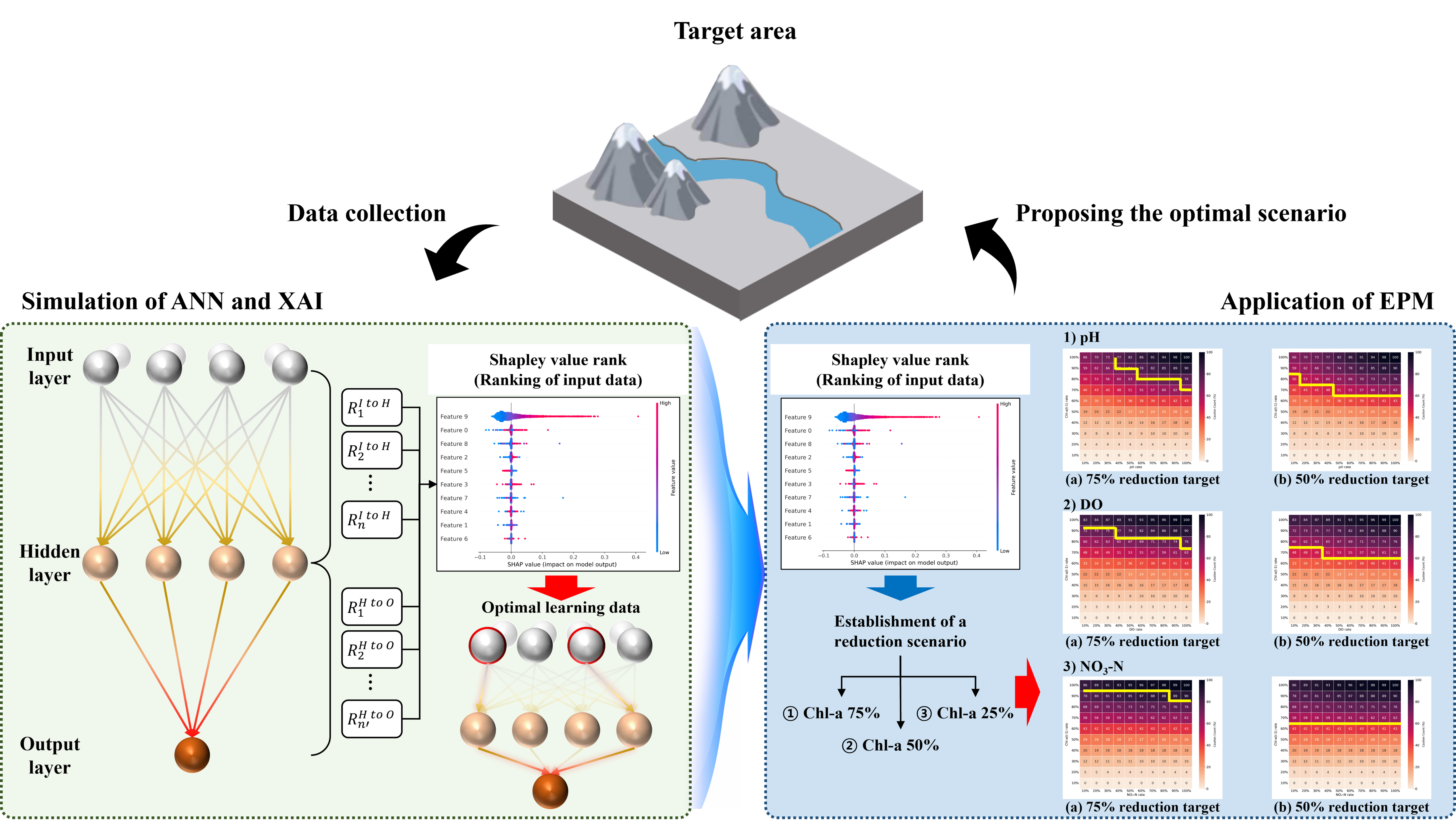
In this study, we developed an XAI-based EPM to construct model-driven scenario analyses for exploring conditions associated with reduced predicted Chl-a levels. The application method of the developed EPM is shown in Figure 1.
According to Figure 1, the first stage is the simulation of ANN and XAI. This stage identifies the model’s optimal predictive configuration by applying XAI techniques to quantify each input feature’s contribution within the trained ANN. This step improves the interpretability and predictive performance of the ANN. The second stage applies EPM to generate model-based sensitivity scenarios for features with high SHAP values. These scenarios examine how variations in influential features affect the model’s predicted Chl-a levels. Based on these model-driven scenarios, the ANN is used to calculate the corresponding predicted frequency of future algal-blooming warnings. Finally, EPM identifies scenario conditions that most effectively reduce the model-predicted frequency of algal-blooming warnings for the target area.

2.2. Multi-Layer Perceptron

A multi-layer perceptron (MLP), a type of ANN, is a perceptron structure comprising an input layer, an output layer, and one or more hidden layers. The input layer receives input data from the neural network, and the output layer outputs the network’s output. Hidden layers between the input and output layers process the data received from the input layer and transmit it to the output layer. A single-layer perceptron, lacking hidden layers, is incapable of solving nonlinear problems. However, an MLP, with its one or more hidden layers, is capable of solving nonlinear problems. Due to their nonlinear problem-solving capabilities, MLP was used in various water resources fields [17,18].
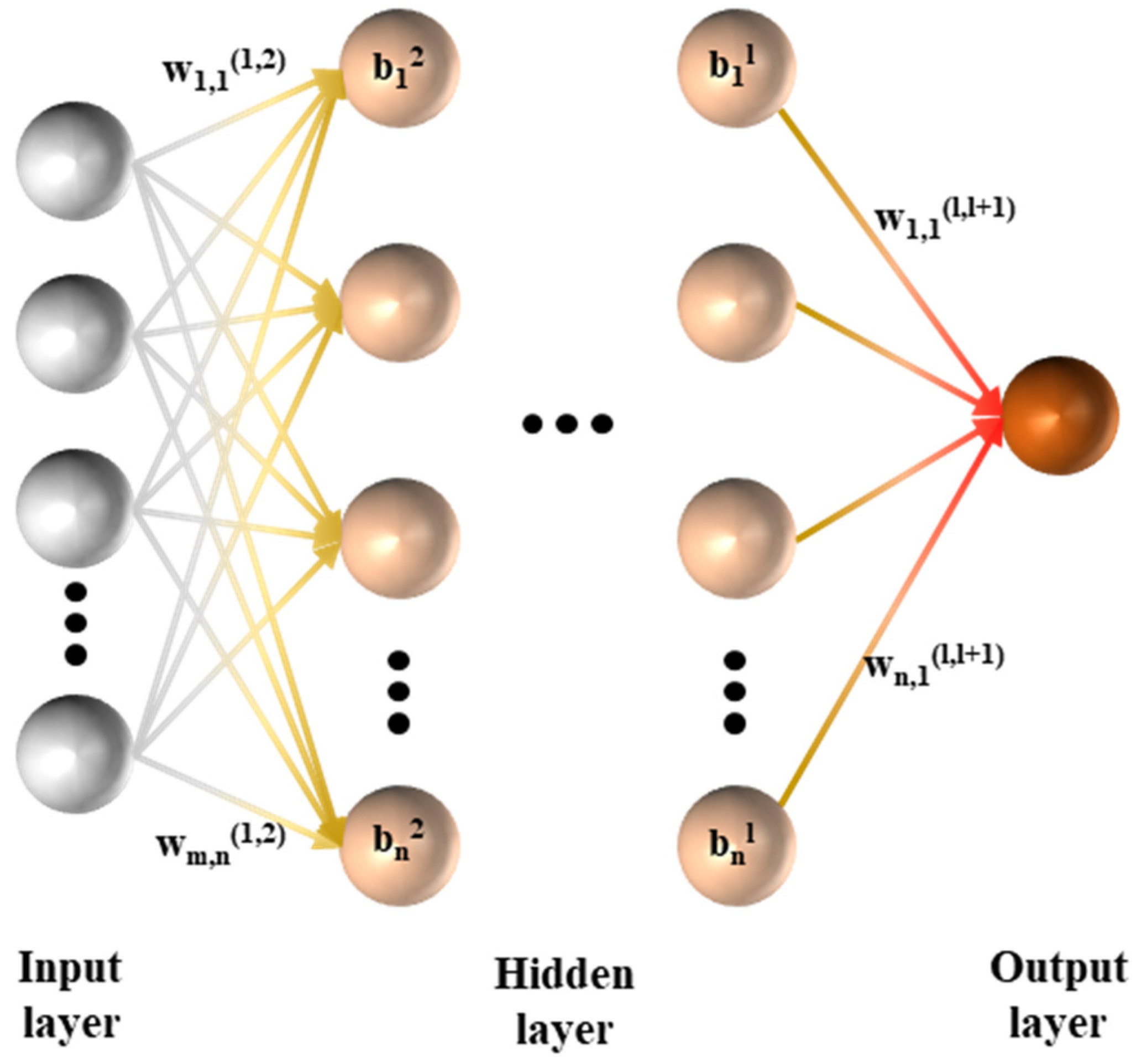
Ref. [19] examined the performance of MLPs for hydrological inflow prediction according to the number of hidden layers, and found that a structure with 10 nodes per hidden layer and 5 hidden layers yielded the highest learning accuracy. The set number of hidden layers and nodes showed excellent performance in predicting hydrological inflow, and the MLP for water quality prediction was based on this structure. Figure 2 shows the structure of the MLP.
In Figure 2, wm,n(l,l+1) represents the weight between the m-th node in the lth layer and the nth node in the l + 1-th layer, and bnl is the bias of the n-th node in the l-th layer. The MLP calculation process is as shown in Equation (1).
x n l + 1 = f a f ( m x m l w m , n l , l + 1 + b n l + 1 )
where faf is the activation function, and xnl+1 is the output of the n-th node in the l + 1 th layer.
The MLP performs iterative learning based on an optimizer to find the weights and biases that minimize the error between the MLP output and the observed values. Among the MLP optimizers, the adaptive moment (Adam) has shown relatively good performance in hydrological runoff prediction [20]. The output of the MLP hidden layer is determined by an activation function. Among the MLP activation functions, the rectified linear unit (Relu) has the advantages of ease of use and short computation time [13,21]. The formula for the Relu function is as shown in Equation (2).
f a f x = m a x ( 0 , x )
where x is the input value to the activation function. The Relu function outputs 0 for values less than 0, and leaves values greater than 0 unchanged.
Hydrological and water-quality time series exhibit nonlinear and time-varying statistical characteristics. Furthermore, interactions among variables often cannot be represented adequately using simple linear models. Because such models assume linear dependencies, traditional statistical time-series approaches such as AR, ARX, and the autoregressive integrated moving average model (ARIMA) are limited in their ability to capture the nonlinear structural behavior commonly observed in water-quality and hydrological data [22]. In contrast, MLPs can learn complex statistical patterns and higher-order interactions through their nonlinear multilayer structure. This enables the model to represent nonlinear relationships among input variables without relying on predefined functional forms [23]. Considering the nonlinear and time-varying characteristics of water-quality time series, MLPs provide a suitable framework for improving predictive accuracy. For this reason, MLPs were selected as the forecasting model in this study.

2.3. Shapley Additive exPlanations

SHAP is an XAI technique proposed by Shapley (1953) based on the game-theoretic Shapley value (SV) concept proposed by [24]. SHAP constructs combinations of multiple input features to determine the importance of each feature within the model, rather than implying causal influence. Based on these combinations, the value is calculated by estimating the average change in the presence or absence of a specific input feature. The formula for calculating the Shapley value (SV) is as shown in Equation (3).
i = S A { i } S ! A S 1 ! A ! f S i f s
where i is the Shapley value of i, A is the set of all features, S is a subset ( S A { i } ) excluding specific features, f s is the predicted value using the prediction model when the prediction model is created using only the feature set S, and f S i is the predicted value when the feature i is added.
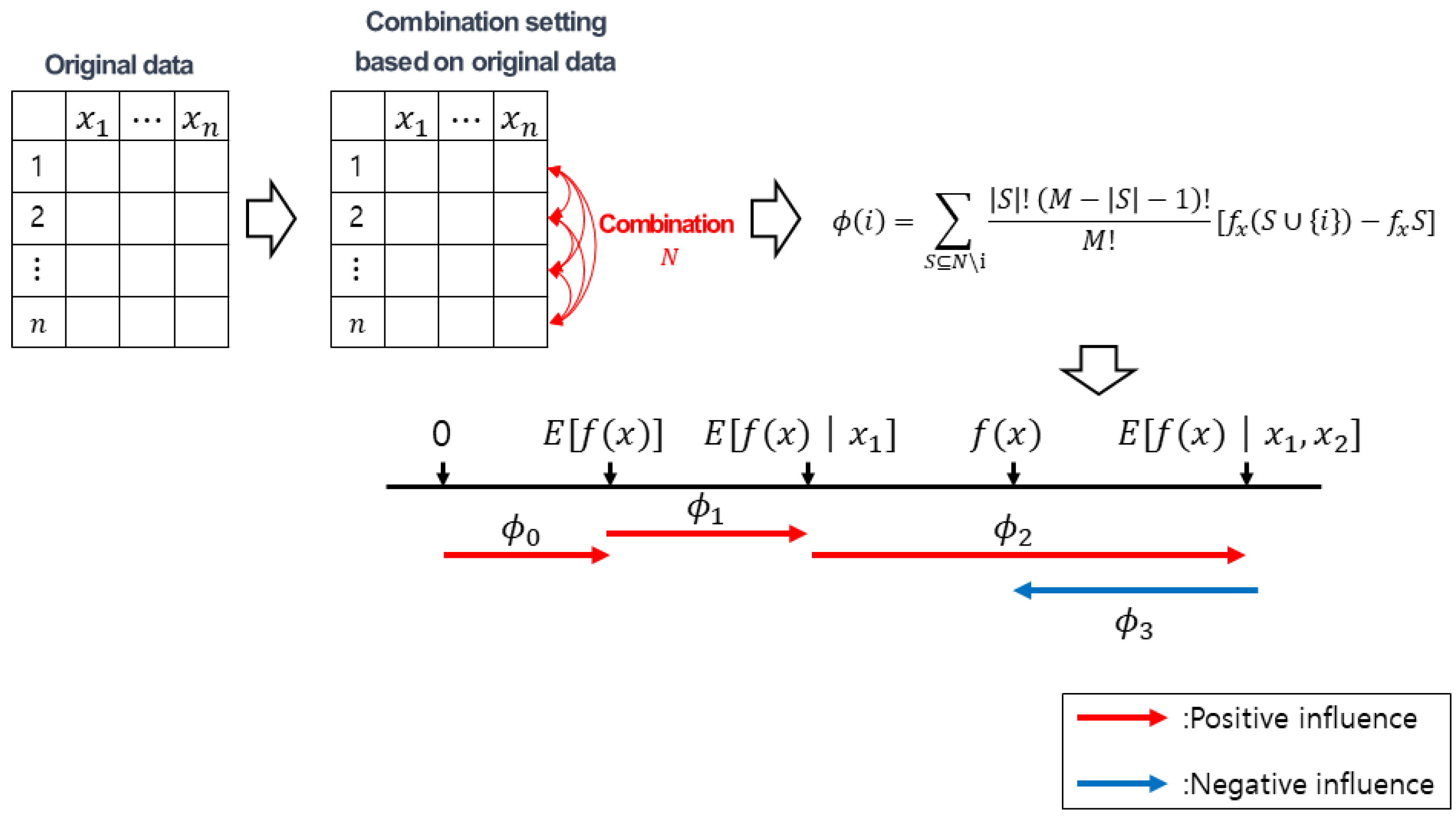
SHAP is largely calculated through four steps. The first step is feature combination generation. All subsets S except for a specific feature i are generated from a given feature set A. The second step is contribution calculation. The difference between the case where feature i is absent ( f s ) and present ( f S i ) is calculated. The calculated difference represents the contribution of feature i to the model’s predicted output, which reflects model-assigned influence rather than causal effect. The third step is weighted average computation. The larger S is, the more cases to consider. Weights are applied according to the size of the generated combination. The weight ( S ! A S 1 ! A ! ) is multiplied according to the size of the combination S . Finally, the first to third steps are repeated for all possible subsets S to produce the final Shapley value. Figure 3 is a conceptual diagram of the Shapley value calculation process.
According to Figure 3, SHAP analyzes input feature combinations. SHAP’s computation proceeds largely through four steps. First, feature combination generation is performed. Given a set of input features A, all subsets S excluding a specific input feature, i, are generated. Second, contributions are calculated. The difference between the results when input feature i is absent ( f s ) and when it is present ( f S i ) is calculated. This difference represents the extent to which feature i affects the model’s output under the trained model structure, without implying a causal relationship in the underlying physical system. Third, a weighted average is calculated. As S increases, the number of cases to consider increases. Weights are applied based on the size of the generated combinations. The weight ( S ! A S 1 ! A ! ) is multiplied by the combination size |S|. Finally, steps 1 through 3 are repeated for all possible subsets S to produce the final SV.

2.4. Explainable Planning Management

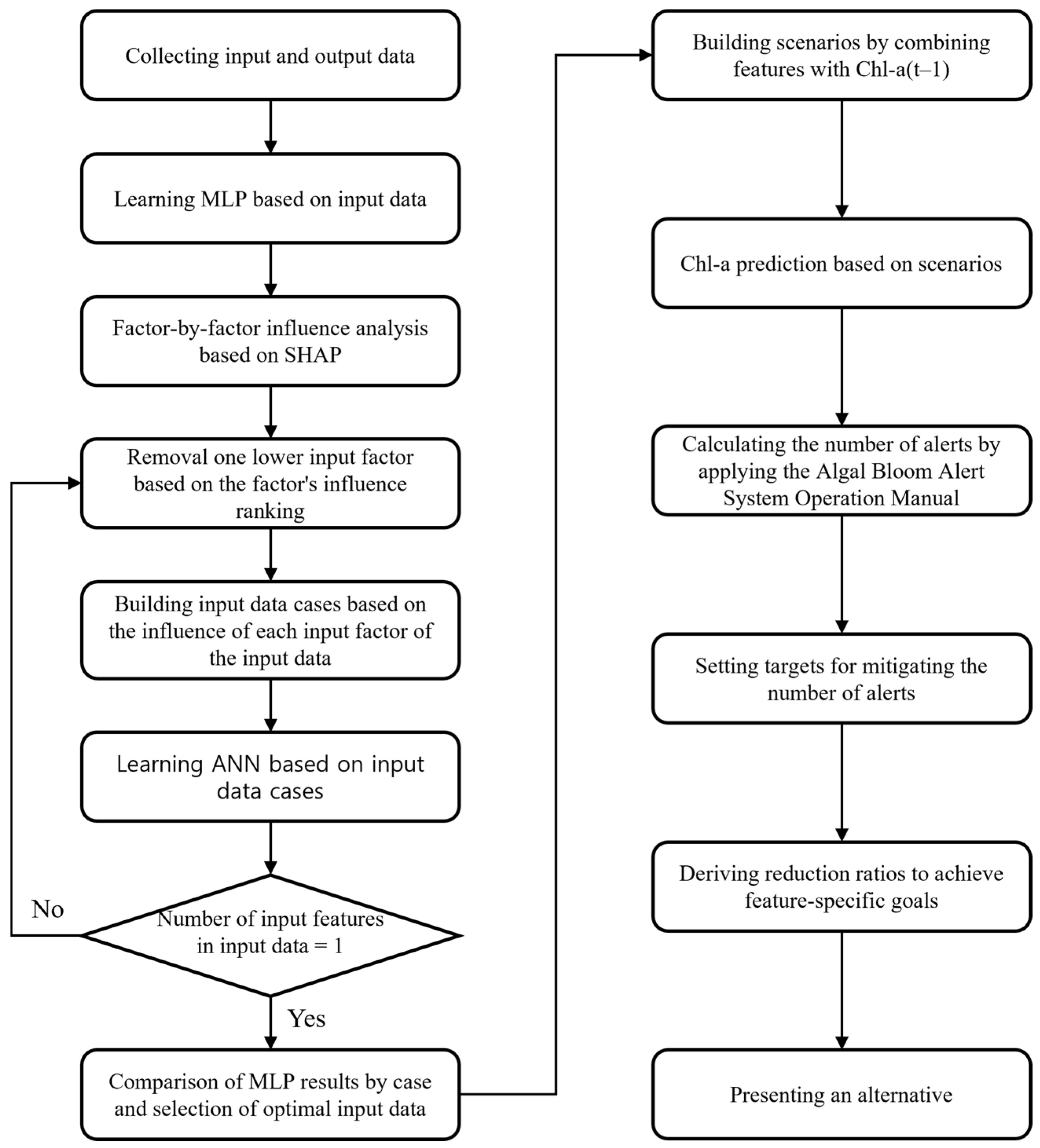
This study developed an EPM based on XAI to construct model-driven scenario analyses using the model-assigned influence of each input feature, supporting proactive planning decisions. EPM utilizes SHAP to quantify each feature’s contribution to the model output and sequentially removes features with low Shapley values to identify an effective set of input variables within the modeling framework. Based on the selected input data, model-based scenarios are constructed in which input feature ratios are systematically varied. The resulting changes in model-predicted Chl-a values are evaluated to explore potential management-oriented alternatives. The alternative proposal process of EPM is illustrated in Figure 4.
As shown in Figure 4, EPM first applies SHAP, an XAI technique, to a trained deep learning model to calculate the SV for each input feature. Then, features with low SVs are sequentially eliminated to create various cases, and the MLP is retrained using the reconstructed input data. After comparing and evaluating the verification and prediction performance for all cases, the case with the best performance is selected as the optimal case.
The selected optimal case represents a combination of features that most effectively contribute to the model’s predictive performance. Scenario analyses are then conducted by systematically adjusting the relative ratios of these features from 100% to 10% in 10% increments. These scenarios are used to examine how variations in the input space influence model-predicted Chl-a levels, providing insight into management-relevant sensitivities rather than describing physical interventions.

3. Results

3.1. Study Area and Construction of Data

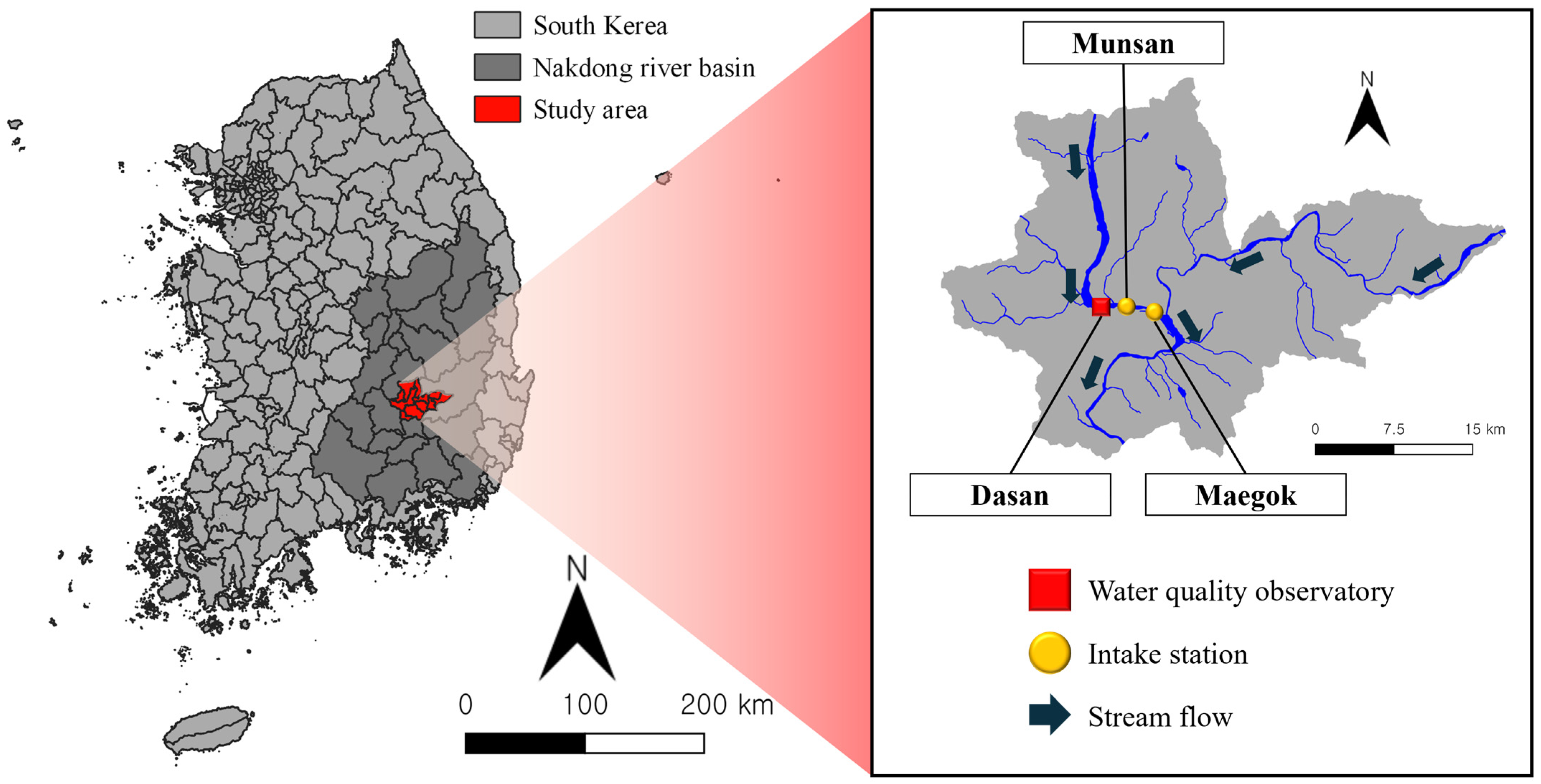
This study evaluated the applicability of EPM by learning and predicting Chl-a at the Dasan water quality observatory in the Nakdong river basin. The Dasan water quality observatory is located in Goryeong-gun, Gyeongsangbuk-do, Republic of Korea. Automatic water quality measurement equipment was installed at the observatory in 2012, enabling the acquisition of daily water quality data. Figure 5 shows the location of the Dasan water quality observatory.
According to Figure 5, the Maegok and Munsan intake stations are located approximately 4 km downstream from the Dasan water quality observatory. Preemptive water quality management measures are essential to ensure a safe water supply for these nearby intake stations. Therefore, daily water quality parameter data from the Dasan water quality observatory were utilized to proactively improve water quality at these intake stations.
Water quality data from the Dasan water quality observatory were obtained from the Water Environment Information System (https://water.nier.go.kr). Daily water quality data from 2014 to 2023 were used for deep learning training, and daily water quality data from 2024 were used for prediction. Data preprocessing was performed based on the established data from 2014 to 2024. The preprocessing involved interpolation of missing data and data scaling. Linear interpolation was applied for missing data. Additionally, min-max normalization (MMN) was used for data scaling. Outlier processing was not performed on the measured data to analyze the impact on the output data based on the measured water quality data. Based on the collected data, a total of 3652 datasets (daily water quality data from 2014 to 2023) were used for deep learning training, as mentioned above, and additional validation was performed for the same period. A total of 366 datasets (daily water quality data from 2024) were used for deep learning predictions. Table 1 lists the input parameters used for training and prediction.
According to Table 1, there are 11 input features for learning and predicting Chl-a. The input features for Chl-a prediction were established based on data measured at the Dasan water quality observatory in Korea based on previous studies [25,26,27,28,29,30,31,32]. Data preprocessing was applied based on the data collected for each input feature. When the difference between the maximum and minimum values of the input and output data is large, the search range of the weights and biases expands, so a wide range of data can cause a decrease in the accuracy of the ANN [33]. Therefore, data preprocessing is necessary before performing ANN training and prediction.
Ref. [34] compared the performance of MMN, Z-score normalization, and Decimal-scaling normalization, which are preprocessing techniques for processing broad data sets, and confirmed the superior performance of MMN. Therefore, this study used MMN for data preprocessing. MMN is a method that converts the maximum and minimum values of each input data into values between 0 and 1. When MMN is performed, the maximum value is converted to 1, and the minimum value is converted to 0. The formula for implementing MMN is as shown in Equation (4).
M M N   v a l i = R a w i R a w m i n R a w m a x R a w m i n
where MMN vali is the i-th data converted using MMN, Rawi is the i-th raw data, Rawmax is the maximum value of the raw data, and Rawmin is the minimum value of the raw data.
To improve water quality, preemptive action is essential, and it is therefore important to consider the temporal relationships between input variables and the model output. Therefore, this study applied Time-lagged Cross Correlation (TLCC) to account for the influence of arrival times between Chl-a and input variables. TLCC is a technique for analyzing simultaneous and time-lagged correlations between two time series. By shifting one time series forward or backward by a certain time interval and calculating the correlation coefficient with another time series, it is possible to estimate the lead or lagged relationship between two variables. Therefore, this study applied TLCC to account for the time lag of input variables. The TLCC equation is shown in Equation (5).
r = i = 1 n ( x i x ¯ ) × ( y i y ¯ ) i = 1 n ( x i x ¯ ) 2 × i = 1 n ( y i y ¯ ) 2
where r is the correlation coefficient, xi is the i-th value of the x variable, x ¯ is the mean of the x variable, yi is the ith value of the y variable, y ¯ is the mean of the y variable, and n is the number of comparison data. Table 2 shows the results of applying TLCC to each input feature.
According to Table 2, NO3-N exhibits the highest lag time of 9 days, followed by TN at 7 days and Turbidity at 2 days. All input features except for these three are known to be 1 day. Therefore, when applying EPM, it is possible to take preemptive action based on data from the previous day.

3.2. MLP Learning and Prediction Based on Input Data Reconstruction Using SHAP

This study used Linear Regression (LR), RF, and MLP to learn and predict Chl-a at the Dasan Water Quality Observatory. Among the three models, the model with the highest predictive performance was selected. The loss function for MLP learning was set to the root mean square error (RMSE), and the RMSE formula is as follows: Equation (6).
R M S E = i = 1 n ( O i P i ) 2 n
where n is the number of data points, O i is the observed value, and P i is the predicted value. LR, RF, and MLP prediction errors were also evaluated using RMSE, and additionally using MAE and R2. The MAE formula is as follows: Equation (7).
M A E = 1 n i = 1 n | O i P i |
where n is the number of data points, O i is the observed value, and P i is the predicted value. The R2 formula is as follows: Equation (8).
R 2 = 1 i = 1 n O i P i 2 i = 1 n O i O ¯ 2
where n is the number of data points, O i is the observed value, O ¯ is the average of the observed value and P i is the predicted value.
To learn and predict Chl-a, the structural parameters of RF and MLP must be set. The parameters of RF used in this study were n_estimators 50, max_depth 37, min_samples_split 6, and min_samples_leaf 4, which showed high performance for high-frequency water quality data in Chl-a prediction [35]. MLP consisted of five hidden layers with 10 nodes each and showed high learning accuracy in hydrological inflow prediction [19]. Adam and Relu were used as the optimizer and activation function of MLP, which showed relatively good performance in hydrological runoff prediction [20,21]. Table 3 shows the Chl-a prediction results of each model.
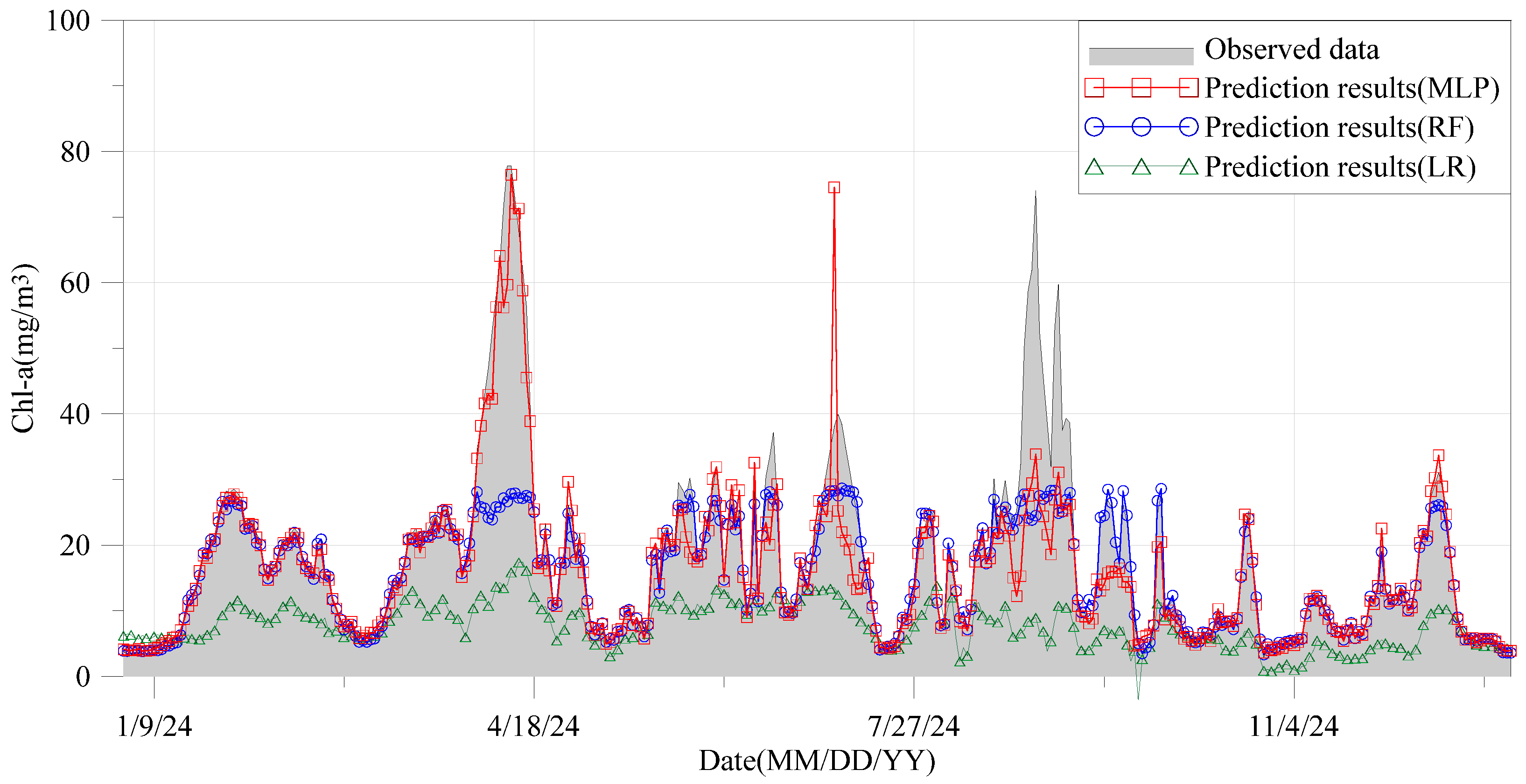
According to Table 3, MLP showed a prediction error reduction effect of about 47% or more in RMSE compared to LR, and also showed a performance improvement of more than 57% in MAE. This is analyzed to be because the linear regression model cannot sufficiently explain environmental data with rapid variability such as tides. In the case of the RF model, the MLP model showed an effect of about 11% or more in RMSE, and also showed a performance improvement of more than 2% in MAE. In particular, based on R2, the MLP model showed an explanatory power improvement of more than 1.77 times compared to LR, and secured a variability explanatory power that was about 1.13 times higher than that of RF. Figure 6 is a comparison of the predicted and observed values of the three models.
According to Figure 6, MLP showed high prediction accuracy throughout the entire period and during the peak concentration interval. However, LR and RF showed lower accuracy compared to MLP during the peak concentration interval. In addition, LR showed the lowest prediction accuracy compared to the other two models throughout the entire period. All three models showed low prediction accuracy in the period after the peak concentration because new patterns were not sufficiently reflected. This is analyzed to be due to the validation phase and different input patterns in the prediction process. As a result of comparing the three models, MLP showed relatively high prediction performance, and SV was performed based on this.
To learn and predict Chl-a, the MLP’s structural parameters must be set. The MLP used in this study consisted of five hidden layers, each with 10 nodes, which demonstrated high learning accuracy in hydrological inflow prediction [19]. The optimizer and activation function of MLP used Adam and Relu, which showed relatively good performance in hydrological runoff prediction [20,21]. We analyzed the SV for each input feature based on an MLP trained on Chl-a using the entire input data set composed of 11 input features. This study performs data-driven learning to improve predictive performance, and the input variable reconstruction process is based on the results of quantitatively evaluating the contribution and influence of each variable using explainable artificial intelligence (XAI). Therefore, the selection of input variables was not based on simple statistical correlations, but rather on model-informed assessments that reflect the statistical interactions and contribution patterns learned during the MLP training process. This approach does not directly identify causal relationships, but rather aims to derive the optimal input combination based on data to maximize predictive accuracy. In other words, the MLP-based model used in this study does not assume a linear causal structure such as AR or ARX, and it is not intended to infer causal relationships among water-quality variables. Instead, it is a data-driven predictive model designed to learn nonlinear statistical patterns in water-quality time series.
The average SV was calculated based on the SVs produced through 10 iterations. Table 4 shows the SVs produced for each input feature.
SHAP analysis results revealed that Chl-a(t−1) had the highest SV (129.08) for predicting Chl-a. Chl-a(t−1) has an SV approximately 49 times higher than Turbidity. For Chl-a(t−1), the previous Chl-a concentration showed the strongest statistical contribution to the model’s prediction of the current Chl-a concentration. Excluding Chl-a(t−1), pH had the highest SV (8.08), while the remaining features ranged from 8 to 2. Therefore, the previous day’s Chl-a exhibited the largest predictive contribution to the model output.
The large SHAP value of Chl-a(t−1) reflects the strong temporal persistence typically observed in algal blooming dynamics. Because short-term Chl-a levels tend to change gradually rather than abruptly, the most recent Chl-a measurement contains substantial information about the current biological state of the system. As a result, the model assigns high predictive weight to Chl-a(t−1). This does not diminish the relevance of other water-quality variables; instead, the strong temporal continuity captured by Chl-a(t−1) explains a large portion of the short-term variability, leaving the remaining features to contribute more incrementally. In nonlinear models such as MLPs, this phenomenon can reduce the apparent marginal contribution of concurrent variables. Not because their influence is removed, but because much of the predictable structure is already captured by the lagged Chl-a value. Therefore, the smaller SHAP values for pH, DO, and nutrients represent their additional predictive contribution beyond the substantial information already contained in Chl-a(t−1).
Based on the SHAP analysis results, the input data was reconstructed to simulate an MLP. Based on the reconstructed input data, the optimal input data was selected through MLP learning and prediction. Table 5 shows the input data removed in descending order of SV, by case.
According to Table 5, the original input data consists of Case 1, which consists of a total of 11 input features. As each case is constructed, one input feature is eliminated from the input data. This elimination of input features is achieved by reconstructing the input data by eliminating one lower-order feature at a time based on the SV. Learning and prediction were performed using MLP for each case through the reconstructed input data. The optimal input data was selected through a trade-off analysis between the MLP’s verification and prediction results. Table 6 shows the verification and prediction results for each case using MLP.
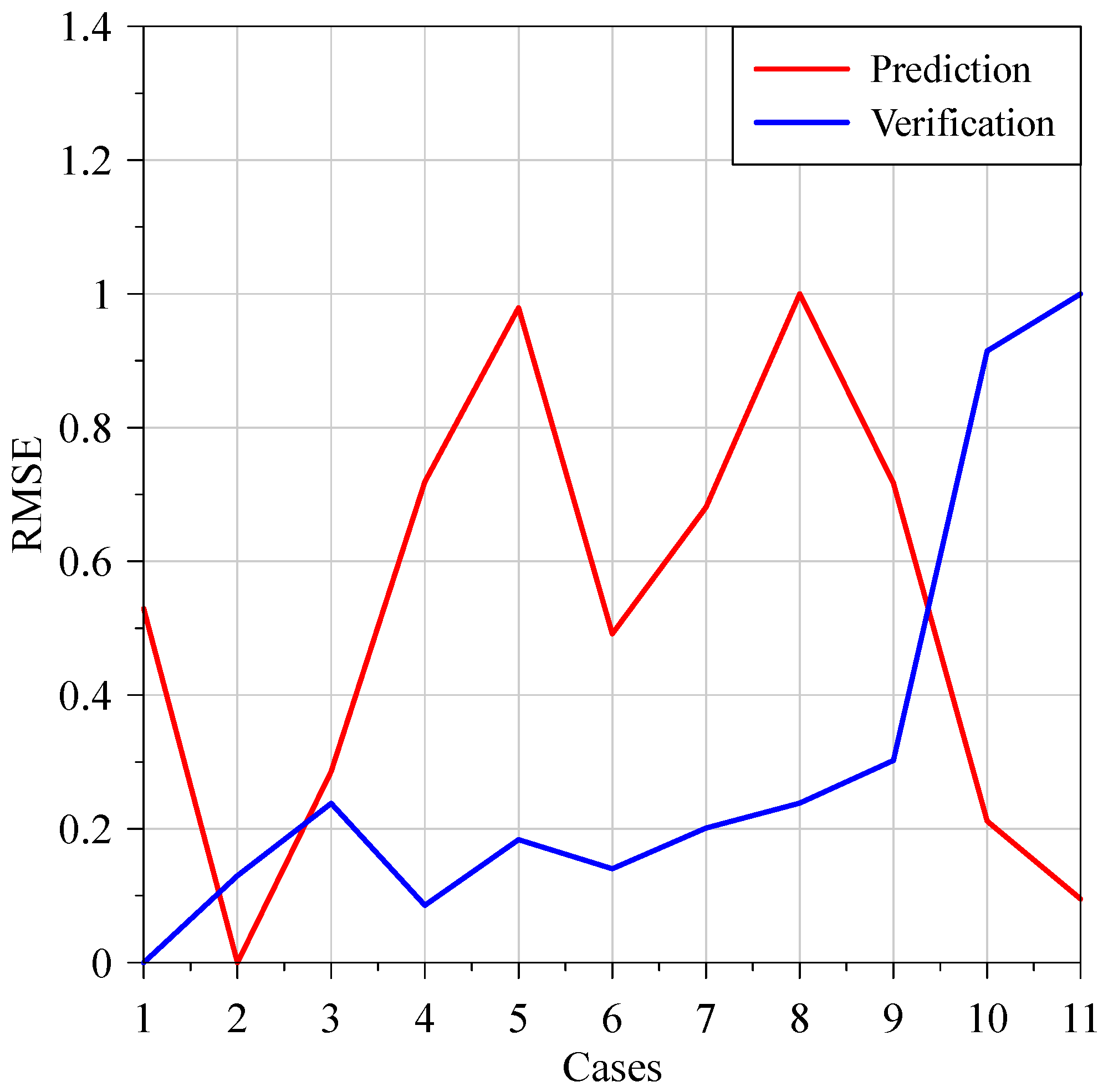
According to Table 6, the verification results increase as the number of cases increases. However, the prediction results showed an increase in error with the number of cases, but then decreased after a certain number of cases. To analyze the trade-off between the verification and prediction results, normalization was applied to the verification and prediction results, and data scaling was used to perform graphical analysis. Figure 7 shows the verification and prediction results with normalization applied, by case.
According to Figure 7, Case 2 showed the best results. While Case 2 did not show the lowest error for the verification results, it did show the best prediction results. Graph analysis using normalization showed that Case 2 produced the best results for both verification and prediction, indicating that unnecessary features were removed during the learning process. Case 2 consists of input data with Tur removed. After selecting the optimal input data, full-period verification and prediction were performed based on the original and reconstructed input data. Table 7 shows the verification results for each method.
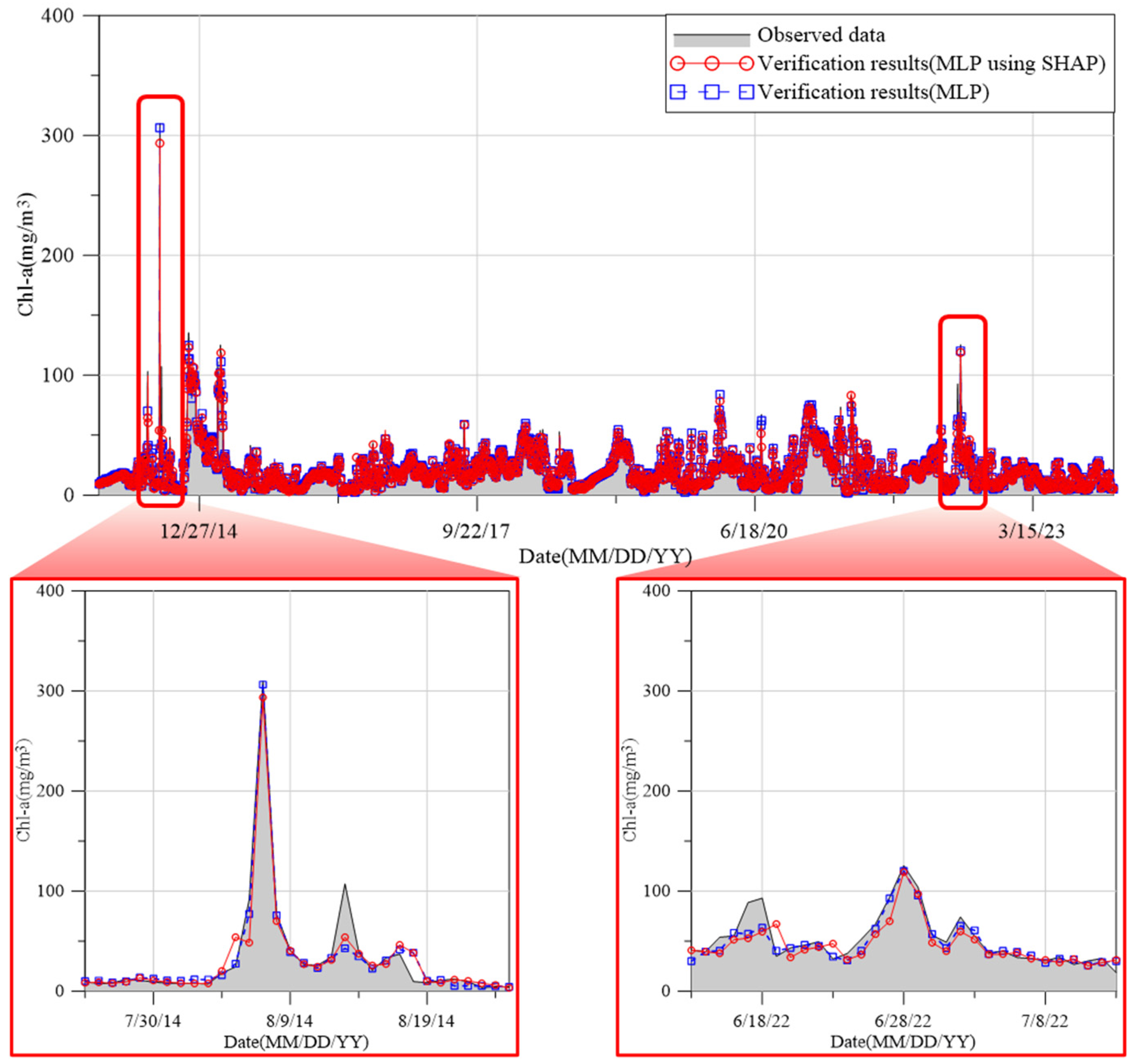
According to the verification results in Table 7, the Average RMSE of the reconstructed data increased by approximately 0.2527 compared to the original data. Furthermore, the Min RMSE and Max RMSE also increased by 0.1156 and 1.3298, respectively. This increase in verification error is believed to be due to the reduced model complexity resulting from the reduced number of input data features. For ANN data models, accuracy depends on the constructed input data. Figure 8 shows the verification results.
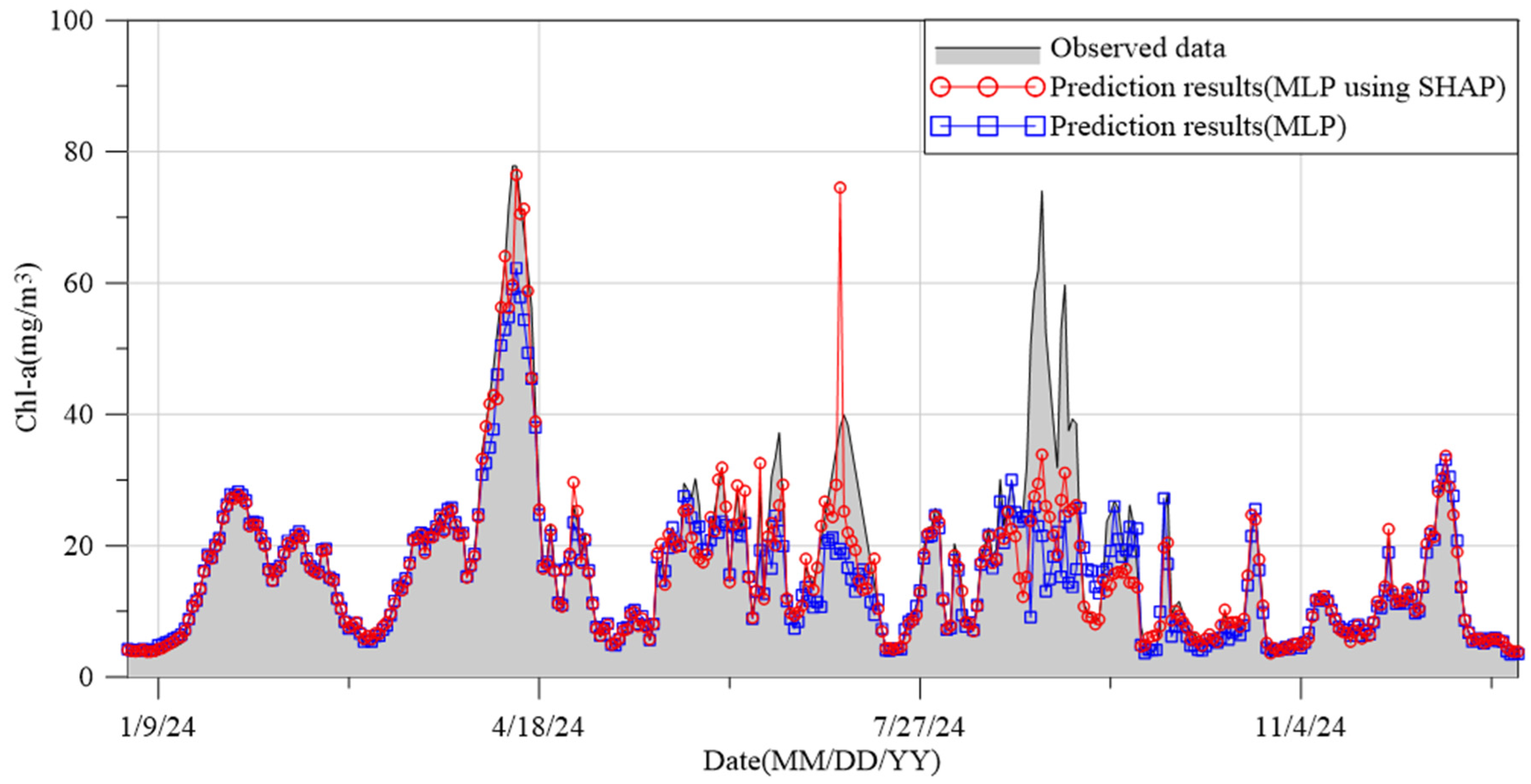
According to Figure 8, both the raw and reconstructed data demonstrate high verification accuracy over the entire period. Zooming in on the time points where peak Chl-A concentrations occurred, the raw data tended to overestimate the observed values. Conversely, the reconstructed data showed a slight underestimation of the observed values. This resulted in a slightly larger overall error compared to the raw data, and a slight increase in the Average RMSE. Predictions were made based on the verification results, and the prediction results are presented in Table 8.
The prediction performance comparison results in Table 8 show that the reconstructed data reduced the predicted RMSE by approximately 0.8749 compared to the original data. Furthermore, the peak difference from the observed value was also reduced by approximately 0.6405 mg/m3. This indicates that while the verification accuracy through MLP is somewhat reduced when using the reconstructed input data, the prediction performance is actually improved. Figure 9 shows the prediction results.
According to the prediction results in Figure 9, the reconstructed data demonstrated high prediction accuracy throughout the entire period and during the peak concentration interval. However, accuracy deteriorated somewhat during periods of temporary fluctuations or when relatively high concentrations occurred after the peak. This is believed to be due to input patterns that differed from the verification phase during the prediction process. Conversely, the raw data tended to underestimate observed values at peak concentrations. Furthermore, in the post-peak period, when relatively high concentrations occurred, the new patterns were not sufficiently reflected, resulting in lower prediction accuracy.
After reconstructing the input data based on SHAP analysis, we compared the learning and prediction performance of the MLP. Case 2, excluding Tur, showed a slight decrease in verification accuracy but improved prediction performance. This demonstrates that the XAI technique can overcome the limitations of the complexity of the MLP. Accordingly, Case 2, which exhibited high prediction performance, was applied to the EPM.

3.3. Application Results of EPM

In this study, the Algal Blooming Warning Operation Manual (2017) of the National Institute of Environmental Research (NIER) of the Ministry of Environment of the Republic of Korea was utilized to assess water pollution based on Chl-a predicted through the Multi-Level Processing (MLP) [36]. The algal blooming warning system was introduced in 1998 to proactively monitor and minimize water pollution damage caused by the massive growth of blue-green algae due to rising water temperatures in summer. It operates under the Water Quality and Aquatic Ecosystem Conservation Act, and its warning criteria are divided into three levels: “Watch (≥15 mg/m3)”, “Warning (≥25 mg/m3)”, and “Outbreak (≥100 mg/m3)” based on Chl-a concentration. The issuance or release of a warning is determined based on whether two consecutive measurements meet the criteria. In this study, the warning level was used as the standard.
Based on the MLP results of SHAP-based input data reconstruction, Chl-a was predicted based on Case 2, which showed high accuracy. Scenarios were constructed by combining each input feature, including Chl-a(t−1), which directly affects Chl-a prediction. To simulate changes in TN, TP, and Chl-a concentrations in the lake, a scenario was constructed in which the external TN and TP loads were gradually reduced by 10% up to a maximum of 50% [37]. In this study, scenarios were constructed by gradually reducing each input feature from 100% to 10% in 10% increments. Scenarios were constructed by virtually adjusting the scaled values of each input feature from 100% to 10% in 10% increments to examine how these adjustments influence the model’s predicted Chl-a levels.
In this study, target levels for reducing predicted algal-bloom warning occurrences were set to 75%, 50%, and 25%, and model-based scenario outcomes were evaluated to identify feature-adjustment patterns associated with reduced predicted warning frequencies [35]. In addition, a scenario-based analysis was performed for pH and DO, which exhibited high SHAP-based contributions, allowing exploration of how adjustments to these variables affect predicted Chl-a levels within the model. In this study, Chl-a(t−1) appears as the most influential variable because the model learns strong temporal persistence in the Chl-a time series. Therefore, reducing the scaled value of Chl-a(t−1) in the scenario framework lowers the predicted Chl-a simply because the model statistically relies on this lagged relationship. However, Chl-a(t−1) is not a controllable management variable, and the scenario adjustments do not imply that managers can or should physically reduce “yesterday’s Chl-a” to influence today’s conditions. The results instead represent model sensitivity based on temporal autocorrelation learned during training.

3.3.1. pH-Based Algal Bloom Response Scenario Analysis

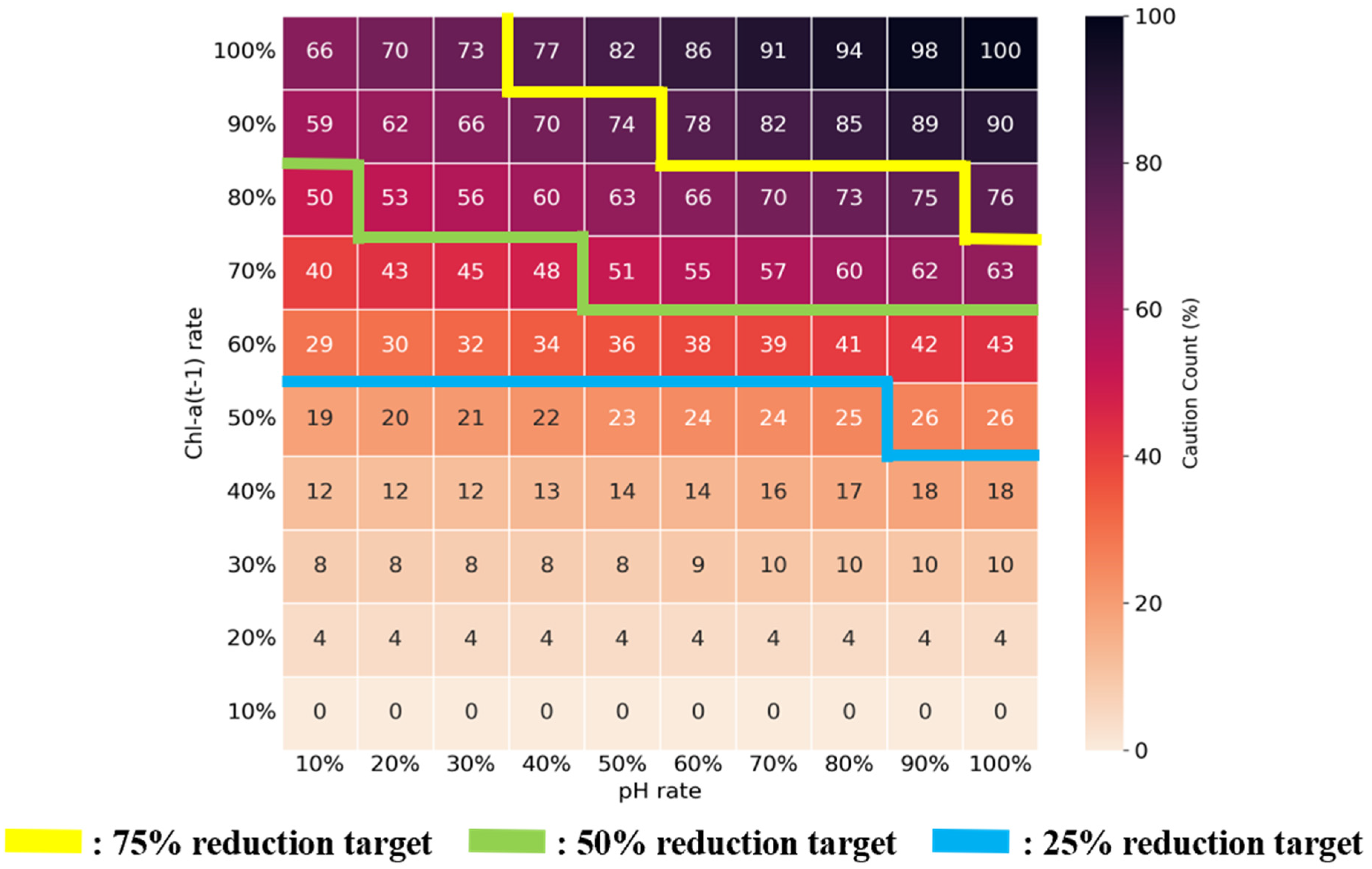
For the pH-based scenario analysis, scenarios were constructed by virtually adjusting the scaled pH and Chl-a(t−1) inputs, and the resulting number of predicted algal bloom warnings was calculated using the trained model. The results are shown in Figure 10.
According to Figure 10, the predicted number of algal bloom warnings decreased when the scaled values of Chl-a(t−1) and pH were lower within the model-based scenario space. These patterns indicate that Chl-a(t−1) and pH exhibit positive associations with the model’s predicted Chl-a values within the scenario settings. In the model output, higher scaled values of Chl-a(t−1) and pH were associated with higher predicted Chl-a levels, which in turn resulted in a larger number of predicted warning occurrences. Therefore, the highest number of algal blooming warning alarms occurred when the upper right corner Chl-a(t−1) and pH ratios were 100%, and the lowest number occurred when the lower left corner Chl-a(t−1) and pH ratios were 10%.
According to the SHAP results, pH exhibited the highest model-based contribution among the features except Chl-a(t−1). This indicates that pH plays a relatively strong role in the model’s prediction process, without implying a causal relationship. Consistent with the SV results, within the EPM scenario experiments, lower scaled pH values were associated with fewer predicted warning occurrences. A similar pattern was observed for Chl-a(t−1), reflecting the model’s internal response to changes in input values. To achieve a predicted warning occurrence rate of 75% or less within the model, the scenario experiments indicated that the scaled pH input would need to be set to approximately 30% or lower when Chl-a(t−1) remained at 100%. If the Chl-a(t−1) ratio is reduced to 90%, the pH must be reduced to 50% or less, and if the Chl-a(t−1) ratio is reduced to 80%, the pH must be reduced to 90% or less. When the Chl-a(t−1) ratio is reduced to 70% or less, the pH is satisfied at all ratios. To limit the alarm occurrence rate to 50% or less, setting the Chl-a(t−1) ratio from 100% to 90% will not allow the target occurrence to be mitigated. Reducing the Chl-a(t−1) ratio to 80% will require a pH reduction of 10% or less. Reducing the Chl-a(t−1) ratio to 70% will require a pH reduction of 40% or less. Reducing the Chl-a(t−1) ratio to 60% or less will satisfy the pH requirement at all rates.
To limit the alarm occurrence rate to 25% or less, setting the Chl-a(t−1) ratio from 100% to 60% will not allow the target occurrence to be mitigated. Reducing the Chl-a(t−1) ratio to 50% will require a pH reduction of 80% or less. Reducing the Chl-a(t−1) ratio to 40% or less will satisfy the pH requirement at all rates. The corresponding scenario thresholds represent combinations of scaled Chl-a(t−1) and pH values that produced the target levels of predicted warning occurrences in the model. These thresholds describe the model’s behavior rather than physical or causal effects in the study area. These results reflect the model’s statistical response to scaled inputs and should not be interpreted as implying that reducing pH, DO, or Chl-a(t−1) would physically control algal blooms in natural systems.

3.3.2. DO-Based Algal Bloom Response Scenario Analysis

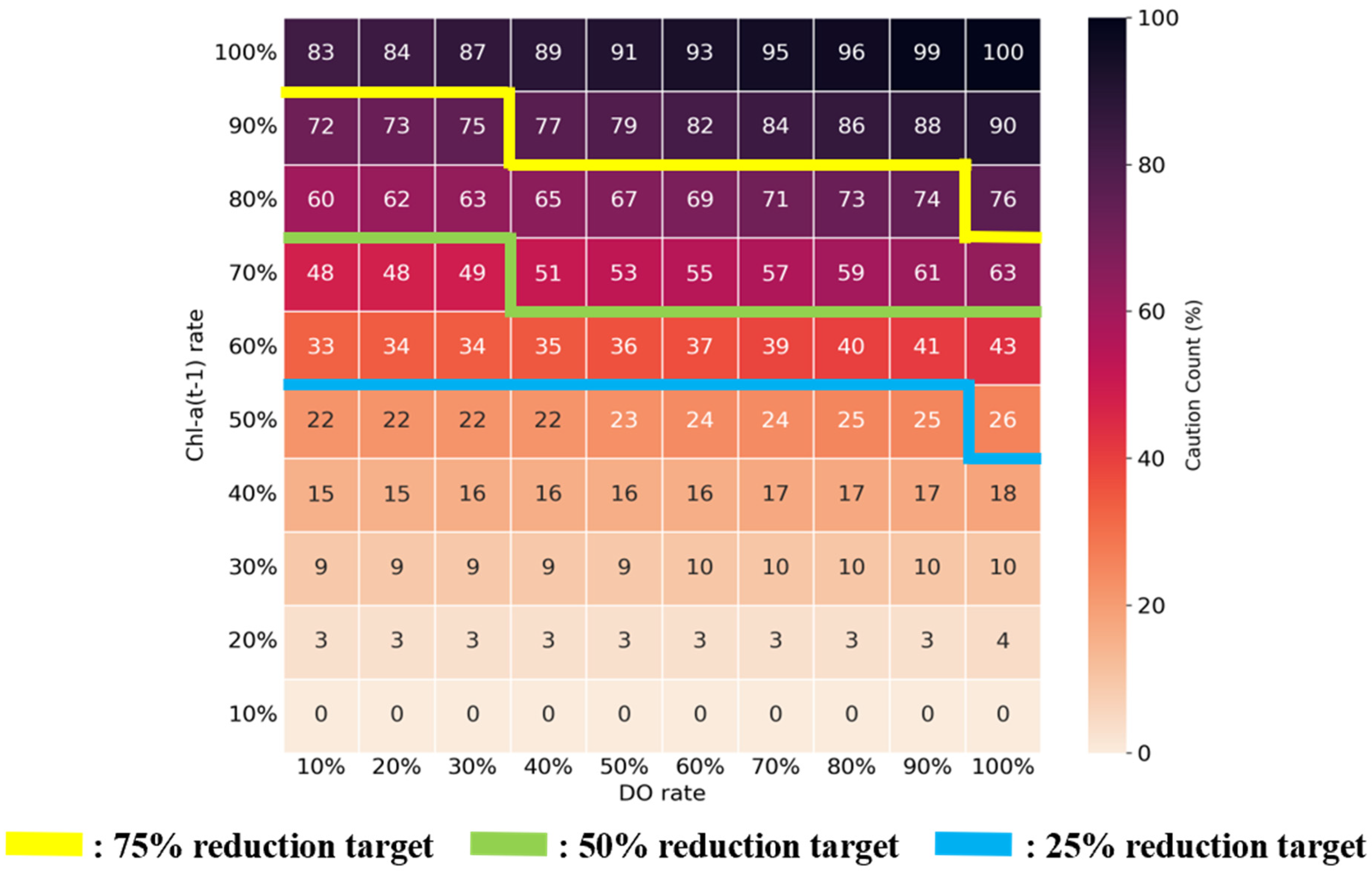
For the DO-based scenario analysis, scenarios were constructed by virtually adjusting the scaled DO and Chl-a(t−1) inputs, and the resulting number of predicted algal-bloom warnings was computed using the trained model. The results are shown in Figure 11.
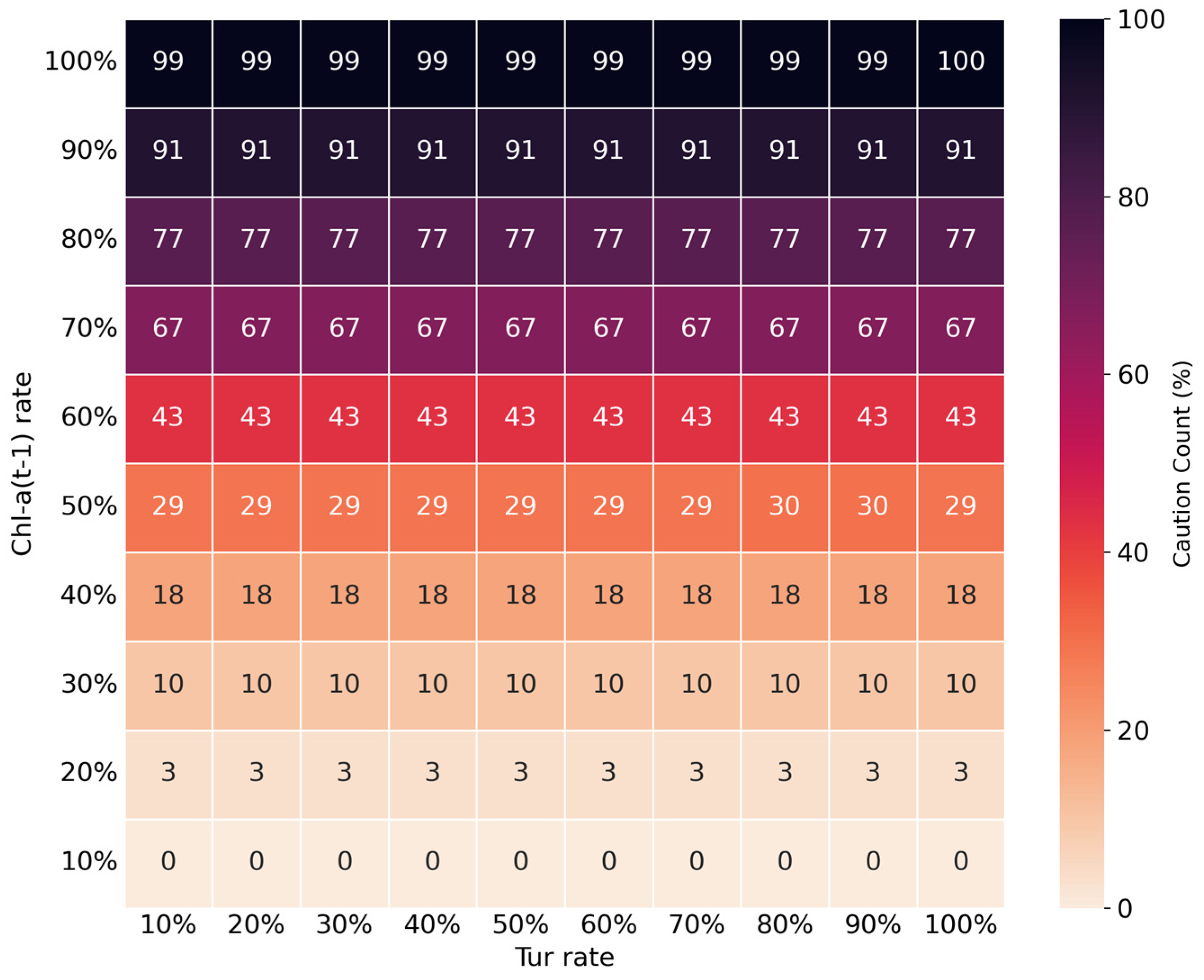
According to Figure 11, lower scaled values of Chl-a(t−1) and DO were associated with fewer predicted warning occurrences in the model output. Furthermore, the threshold values are identical to those for Chl-a(t−1) and pH, as they decrease from 75% to 50% and 25%, respectively. However, unlike the pH-based scenarios, the DO-based scenarios exhibited different model-response patterns across reduction targets. For example, when Chl-a(t−1) was fixed at 100% in the scenario space, the model predicted a 75% reduction in warning occurrences for certain pH adjustments. In contrast, even large reductions in DO did not yield the same model-predicted reduction. This indicates that DO contributed less strongly than pH to the model’s prediction patterns. These scenario patterns suggest that DO had a smaller model-based contribution than pH. Furthermore, lower scaled Chl-a(t−1) values were consistently associated with fewer predicted warning occurrences within the model framework.
The 25% reduction target in Figure 10 shows that the threshold shape for reducing the number of algal bloom alerts by 50% is similar to the shape of the relationship between Chl-a(t−1) and pH. When interpreting scenario outcomes, combinations involving features with higher SHAP contributions yielded larger reductions in predicted warnings, reflecting the model’s internal sensitivity patterns.

3.3.3. 7 Water Quality Index-Based Algal Bloom Response Scenario Analysis

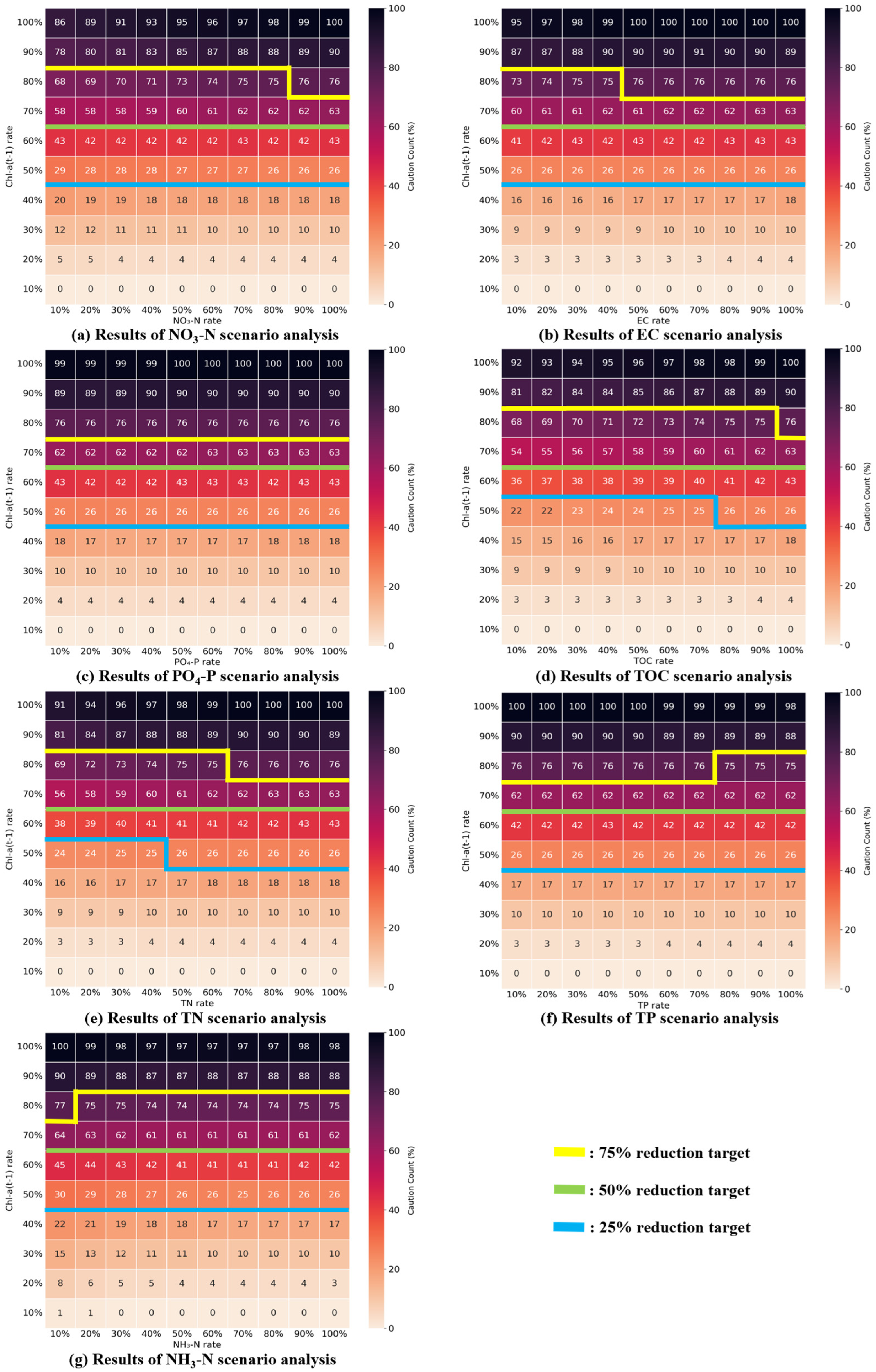
For the 7 water quality index-based algal bloom response scenario analysis, scenarios were constructed based on input feature reductions, and the number of algal bloom warning alerts generated was calculated based on the predicted results. The results are shown in Figure 12.
According to Figure 12, NO3-N, EC, PO4-P, TOC, TN, TP, and NH3-N showed the same results when analyzing the results according to the scenario to reduce the number of algal blooming warning alarm occurrences by 50%. Based on the results, it can be seen that when NO3-N, EC, PO4-P, TOC, TN, TP, and NH3-N are aimed at reducing the number of algal blooming warning alarm occurrences by 50%, the model was most sensitive to changes in Chl-a(t−1), which exhibited the highest SHAP contribution among the input features. However, in the scenario to reduce the number of algal blooming warning alarm occurrences by 75%, all features except PO4-P are influential. However, it can be seen that they are not as influential as pH and DO. Based on these results, we found that scenario combinations involving pH or DO adjustments showed larger reductions in model-predicted warning occurrences compared with the other features. However, we also found that mitigation scenarios utilizing NO3-N, EC, PO4-P, TOC, TN, TP, and NH3-N are feasible. Specifically, when Chl-a(t−1) is fixed at 80%, TP is approximately 80% or higher, and NH3-N is approximately 20% or higher, the number of algal bloom warning alerts is reduced by 75%. TP and NH3-N exhibited negative SHAP associations with the model’s predicted Chl-a values, indicating a model-learned pattern rather than a causal relationship.
Analysis of scenarios aimed at reducing the number of algal bloom warning alerts by 25% revealed that NO3-N, EC, PO4-P, TOC, TN, TP, and NH3-N have a lower impact than pH and DO. It can be seen that NO3-N, EC, PO4-P, TOC, TN, TP and NH3-N have less influence than Chl-a(t−1), and in that case, it can be seen that adjusting the scaled Chl-a(t−1) values produced the largest changes in predicted warning occurrences within the model.


4. Discussion

In this study, SHAP-based input data reconstruction was performed to improve the accuracy of the MLP. During the data reconstruction process, MLP training and prediction achieved the highest accuracy when using input data with Tur removed. In the Republic of Korea, where the study basin is located, we observed a tendency for sensor measurements to be approximately 3–4 times higher during Tur measurement [38]. This is because Tur meters are more exposed to irritants than existing sensors installed within the basin [38]. Therefore, the SV is analyzed to be low due to data quality compared to other water quality factors. Furthermore, the study area, the Dasan Water Quality Observatory, is located at the confluence of upstream streams. Located in the mainstream of the Nakdong River, the Dasan water quality observatory has relatively slow flow rates and increased residence times. In slow-flow areas, Chl-a increases due to water temperature and other factors, while Tur decreases due to riverbed disturbance and reduced suspended solids. Due to the quality of the data and the locational characteristics of the study area, Tur is analyzed to have a low impact on Chl-a. In the case of deep learning, including MLP, results are produced through internal learning based on established input and output data. Therefore, if the influence of each input factor in the input data on the output data is low, it can act as a factor reducing accuracy. Tur was analyzed to have a low impact on Chl-a. In addition, the results of analyzing SV based on the trained MLP show that Tur reduces accuracy in the process of learning and predicting Chl-a due to the learning mechanism of MLP.
Scenarios were designed to predict algal bloom alert occurrences using predicted Chl-a values based on optimal input features. Analysis results showed that scenarios involving features with higher SHAP contributions produced larger reductions in the predicted alert frequency within the model. Conversely, scenarios with lower scaled TP and NH3-N values resulted in higher predicted alert frequencies. The negative SHAP values for TP and NH3-N indicate that, within the model output, these features were associated with lower predicted Chl-a concentrations. These associations do not imply causal relationships. Thus, lower scaled values of these features were linked to higher predicted Chl-a concentrations in the model, which resulted in more predicted alerts. This reflects model behavior only and should not be interpreted as a physical causal relationship.

In this study, scenarios were simulated through input feature optimization. During the input feature optimization process, Tur was eliminated. To analyze the influence of Tur using EPM, a Tur reduction scenario was developed and analyzed. The analysis results for the Tur reduction scenario are shown in Figure 13.
According to Figure 13, as the ratio of Chl-a(t−1), a key feature in Chl-a prediction, decreased, the frequency of alert occurrences tended to decrease. Conversely, when the ratio of Tur decreased, the frequency of alert occurrences decreased by only about 1% at most. This suggests that Tur, which had the lowest SHAP contribution, produced minimal changes in the model’s predicted alert frequency and therefore had limited influence within the model context [39,40].
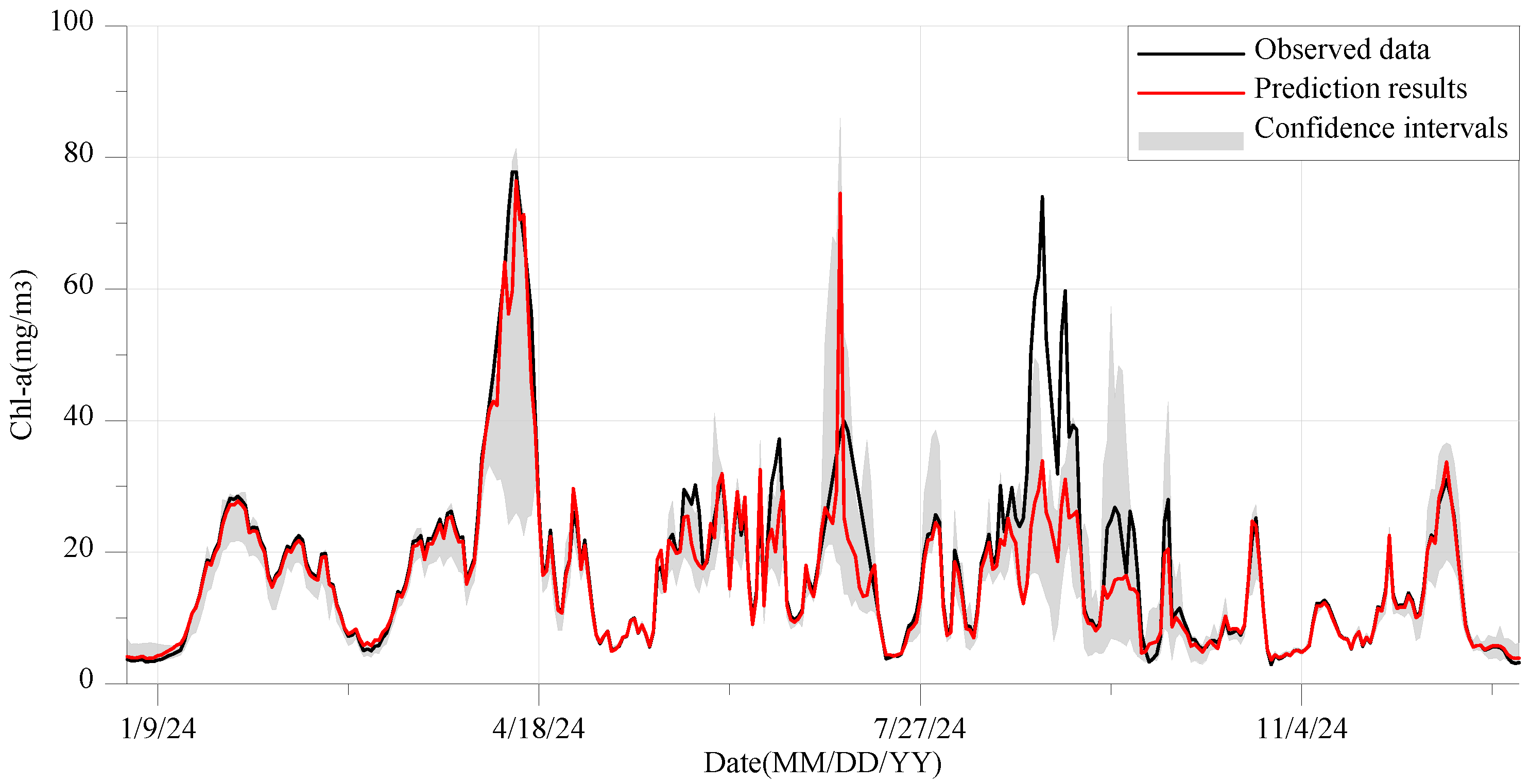
This study applied the 95% prediction uncertainty interval (95PPU) to complement existing analyses focused on verification and prediction accuracy. 95PPU is a method for assessing prediction reliability using the proportion of observed values within the upper and lower bounds (p-factor) derived from multiple prediction results and the average width of the prediction interval (d-factor). To quantitatively assess the uncertainty of Chl-a prediction results, the 95% prediction uncertainty interval (95PPU) technique was applied [41]. A 95% prediction interval was constructed based on the upper and lower 2.5% quantiles of the repeated prediction results, and the reliability and stability of the predictions were assessed through the p-factor and d-factor, which indicate the observed value falls within the corresponding range. In this study, a 95% confidence interval was constructed based on the upper and lower 2.5% quantiles calculated from 10 repeated prediction results, and whether the observed value falls within the predicted range was quantitatively analyzed. Figure 14 shows the prediction results and confidence intervals for Case 2.
According to Figure 12, in the Chl-a concentration range with low variability, the width of the confidence interval is narrower than that in the highest concentration range. In the highest concentration range, the confidence interval tended to widen as the variance between the predicted values increased. In particular, the confidence interval fluctuated irregularly after the highest Chl-a concentration. This is analyzed as the result of the emergence of a new pattern that deviates from the prediction range based on the training data. The p-factor, which is an uncertainty evaluation index, was 0.8716, and the d-factor was 0.636. Generally, when the p-factor is 0.7 or higher and the d-factor is 1.5 or lower, the model has an acceptable level of performance in terms of uncertainty in prediction [42]. Therefore, the MLP-based Chl-a prediction showed reliable performance in terms of uncertainty.

5. Conclusions

This study developed an XAI-based Explainable Planning Management (EPM) system that overcomes the limitations of deep learning’s black-box approach for water resource management and water pollution prevention. The EPM model utilized SHAP, an XAI technique, to analyze the influence of key input features. Based on this analysis, optimal input data were reconstructed, and scenario analysis was performed to estimate algal bloom frequencies. Based on the estimated occurrence frequencies, a plan was established based on target water quality standards, and reduction rates for each feature were presented, establishing an explainable preemptive response system.
To verify the applicability of the EPM, predictions and alternative suggestions were performed for Chl-a at the Dasan water quality observatory in the Nakdong river basin, Republic of Korea. SHAP analysis was performed on an MLP model trained on Chl-a using the entire input data. The results showed that Chl-a(t−1) had the greatest impact on Chl-a prediction, with an SV of 129.08, followed by pH, which had the highest importance at 8.08. This confirmed that Chl-a(t−1) had the largest contribution to the model’s prediction of current-day Chl-a.
Based on these SHAP analysis results, the input data was reconstructed to compare and analyze the learning and prediction performance of the MLP. Input feature reconstruction was performed by sequentially removing features with low importance based on SV, thereby constructing case-specific input data. After training the MLP with the reconstructed input data, the relationship between verification and prediction performance was analyzed to derive the optimal input combination.
As a result, in Case 2, where turbidity was excluded, verification accuracy was somewhat lower, but prediction accuracy actually tended to improve. This indicates that the removal of low-contribution features improved the model’s predictive generalization performance. The verification average RMSE of the reconstructed data increased by approximately 5.21% compared to the original, while the prediction RMSE decreased by approximately 10.58%. Furthermore, the peak difference from the observed value decreased by approximately 3.42%, confirming improved prediction stability.
Applying scenarios based on optimal input data, pH was the feature whose scaled adjustments produced the largest changes in the model’s predicted warning frequencies, with reductions of up to 34% in the scenario experiments. These outcomes describe the model’s internal sensitivity rather than physical mitigation effects. Accordingly, the scenario experiments were used to identify model-responsive ranges of scaled input adjustments for each target level of predicted warning frequency.
The scenario results should be interpreted as statistical sensitivity patterns, not ecological prescriptions. Variables such as pH and DO are well known to respond to algal biomass, meaning that the modeled reductions in these variables do not imply that acidification or oxygen reduction are viable management interventions. Likewise, Chl-a(t−1) functions as a statistical predictor of temporal persistence and is not a controllable management variable. Therefore, the EPM framework provides decision-support insights into model behavior rather than direct ecological guidance.
Overall, the results demonstrate that the EPM developed in this study offers an explainable framework for examining how changes in input features influence predictive outcomes, supporting preemptive planning from a modeling perspective. While the model-based scenarios reveal statistical patterns learned by the predictive model, they should not be interpreted as evidence that modifying pH or DO would physically control algal blooms in natural ecosystems. Future research may incorporate domain-specific management mechanisms into the EPM framework, linking model-derived scenario insights with practical water-quality planning.

Author Contributions

Conceptualization, J.G.J., Y.M.R. and E.H.L.; methodology, J.G.J. and Y.M.R.; software, J.G.J.; validation, J.G.J. and Y.M.R.; formal analysis, J.G.J., Y.M.R. and E.H.L.; investigation, J.G.J., Y.M.R. and E.H.L.; resources, J.G.J., Y.M.R. and E.H.L.; data curation, J.G.J.; writing—original draft preparation, J.G.J. and Y.M.R.; writing—review and editing, E.H.L.; visualization, J.G.J., Y.M.R. and E.H.L.; supervision, E.H.L.; project administration, E.H.L.; funding acquisition, E.H.L. All authors have read and agreed to the published version of the manuscript.

Funding

This work was supported by Chungbuk National University NUDP program (2025).

Data Availability Statement

The original data presented in the study are openly available in the Water Environment Information System at https://water.nier.go.kr/web (accessed on 12 November 2025).

Conflicts of Interest

The authors declare no conflicts of interest.

References

  1. Park, S.Y.; Choi, J.H.; Wang, S.; Park, S.S. Design of a water quality monitoring network in a large river system using the genetic algorithm. Ecol. Model. 2006, 199, 289–297. [Google Scholar] [CrossRef]
  2. Lu, H.; Ma, X. Hybrid decision tree-based machine learning models for short-term water quality prediction. Chemosphere 2020, 249, 126169. [Google Scholar] [CrossRef]
  3. Drolc, A.; Končan, J.Z. Calibration of QUAL2E model for the Sava River (Slovenia). Water Sci. Technol. 1999, 40, 111–118. [Google Scholar] [CrossRef]
  4. Ahn, S.J.; Yeon, I.S.; Han, Y.S.; Lee, J.K. Water quality forecasting at Gongju station in Geum River using neural network model. J. Korea Water Resour. Assoc. 2001, 34, 701–711. [Google Scholar]
  5. Lee, S.; Lee, D. Improved prediction of harmful algal blooms in four Major South Korea’s Rivers using deep learning models. Int. J. Environ. Res. Public Health 2018, 15, 1322. [Google Scholar] [CrossRef] [PubMed]
  6. Lim, H.; An, H.; Choi, E.; Kim, Y. Prediction of the DO concentration using the machine learning algorithm: Case study in Oncheoncheon, Republic of Korea. Korean J. Agric. Sci. 2020, 47, 1029–1037. [Google Scholar] [CrossRef]
  7. Kim, S.H.; Park, J.H.; Kim, B. Prediction of cyanobacteria harmful algal blooms in reservoir using machine learning and deep learning. J. Korea Water Resour. Assoc. 2021, 54, 1167–1181. [Google Scholar]
  8. Dogan, E.; Ates, A.; Yilmaz, E.C.; Eren, B. Application of artificial neural networks to estimate wastewater treatment plant inlet biochemical oxygen demand. Environ. Prog. 2008, 27, 439–446. [Google Scholar] [CrossRef]
  9. Wang, T.S.; Tan, C.H.; Chen, L.; Tsai, Y.C. Applying artificial neural networks and remote sensing to estimate chlorophyll-a concentration in water body. In Proceedings of the 2008 Second International Symposium on Intelligent Information Technology Application, IEEE, Shanghai, China, 20–22 December 2008; Volume 1, pp. 540–544. [Google Scholar]
  10. Haghiabi, A.H.; Nasrolahi, A.H.; Parsaie, A. Water quality prediction using machine learning methods. Water Qual. Res. J. 2018, 53, 3–13. [Google Scholar] [CrossRef]
  11. Chun, Y.E.; Kim, S.B.; Lee, J.Y.; Woo, J.H. Study on credit rating model using explainable AI. Korean Data Inf. Sci. Soc. 2021, 32, 283–295. [Google Scholar] [CrossRef]
  12. Roh, S.; Park, D. Sweet Persimmons Classification Based on a Mixed Two-Step Synthetic Neural Network. J. Korea Multimed. Soc. 2021, 24, 1358–1368. [Google Scholar]
  13. Lundberg, S.M.; Lee, S.I. A unified approach to interpreting model predictions. In Proceedings of the Advances in Neural Information Processing Systems, Long Beach, CA, USA, 4–9 December 2017; Volume 30, pp. 4768–4777. [Google Scholar]
  14. Liu, Y.; Liu, Z.; Luo, X.; Zhao, H. Diagnosis of Parkinson’s disease based on SHAP value feature selection. Biocybern. Biomed. Eng. 2022, 42, 856–869. [Google Scholar] [CrossRef]
  15. Hamilton, R.I.; Papadopoulos, P.N. Using SHAP values and machine learning to understand trends in the transient stability limit. IEEE Trans. Power Syst. 2023, 39, 1384–1397. [Google Scholar] [CrossRef]
  16. Loi, C.L.; Wu, C.C.; Liang, Y.C. Prediction of tropical cyclogenesis based on machine learning methods and its SHAP interpretation. J. Adv. Model. Earth Syst. 2024, 16, e2023MS003637. [Google Scholar] [CrossRef]
  17. Lee, J.H.; Kim, J.S.; Jang, H.W.; Lee, J.C. Drought forecasting using the multi layer perceptron (MLP) artificial neural network model. J. Korea Water Resour. Assoc. 2013, 46, 1249–1263. [Google Scholar] [CrossRef]
  18. Zhou, T.; Jiang, Z.; Liu, X.; Tan, K. Research on the long-term and short-term forecasts of navigable river’s water-level fluctuation based on the adaptive multilayer perceptron. J. Hydrol. 2020, 591, 125285. [Google Scholar] [CrossRef]
  19. Lee, W.J.; Lee, E.H. Improvement of multi layer perceptron performance using combination of adaptive moments and improved harmony search for prediction of Daecheong Dam inflow. J. Korea Water Resour. Assoc. 2023, 56, 63–74. [Google Scholar]
  20. Mahsa, M.; Lee, T. Comparison of optimization algorithms in deep learning-based neural networks for hydrological forecasting: Case study of Nam River daily runoff. J. Korean Soc. Hazard Mitig. 2018, 18, 377–384. [Google Scholar] [CrossRef]
  21. Yoo, Y.; Kim, D.; Lee, J. Performance Analysis of Various Activation Functions in Super Resolution Model. In Proceedings of the Korea Information Processing Society Conference, Online, 6–7 November 2020; Volume 27, pp. 504–507. [Google Scholar]
  22. Faruk, D.Ö. A hybrid neural network and ARIMA model for water quality time series prediction. Eng. Appl. Artif. Intell. 2010, 23, 586–594. [Google Scholar] [CrossRef]
  23. Cybenko, G. Approximation by superpositions of a sigmoidal function. Math. Control Signals Syst. 1989, 2, 303–314. [Google Scholar] [CrossRef]
  24. Shapley, L.S. A Value for n-Person Games; Princeton University Press: Princeton, NJ, USA, 1953. [Google Scholar]
  25. Bobbin, J.; Recknagel, F. Knowledge discovery for prediction and explanation of blue-green algal dynamics in lakes by evolutionary algorithms. Ecol. Model. 2001, 146, 253–262. [Google Scholar] [CrossRef]
  26. Jung, W.S.; Kim, S.E.; Kim, Y.D. Analysis of influential factors of cyanobacteria in the mainstream of Nakdong river using random forest. J. Wetl. Res. 2021, 23, 27–34. [Google Scholar]
  27. Heddam, S.; Yaseen, Z.M.; Falah, M.W.; Goliatt, L.; Tan, M.L.; Sa’adi, Z.; Ahmadianfar, I.; Saggi, M.; Bhatia, A.; Samui, P. Cyanobacteria blue-green algae prediction enhancement using hybrid machine learning–based gamma test variable selection and empirical wavelet transform. Environ. Sci. Pollut. Res. 2022, 29, 77157–77187. [Google Scholar] [CrossRef] [PubMed]
  28. Jung, W.S.; Jo, B.G.; Kim, Y.D. A study on the occurrence characteristics of harmful blue-green algae in stagnant rivers using machine learning. Appl. Sci. 2023, 13, 3699. [Google Scholar] [CrossRef]
  29. Jo, B.G.; Jung, W.S.; Nam, S.H.; Kim, Y.D. Prediction of cyanobacteria using decision tree algorithm and sensor monitoring data. Appl. Sci. 2023, 13, 12266. [Google Scholar] [CrossRef]
  30. Song, C.Y.; Kim, J.Y.; Kim, Y.J.; Joo, H.J.; Seo, J.H. A Study on the Predicting Harmful Cyanobacteria Algal Blooms Using Machine Learning Technology—The Nakdong River Case. J. Korean Inst. Intell. Syst. 2023, 33, 29–36. [Google Scholar]
  31. Yun, S.L. Correlation and Prediction Analysis of Cyanobacteria with Water Environment Data. J. Korean Soc. Environ. Eng. 2024, 46, 792–805. [Google Scholar] [CrossRef]
  32. Sun, L.; Chu, Y.; Li, H.; Han, X.; Shu, S. Prediction of Blue-Green Algae Cells in a City Water Source Based on the LSTM Model. Water 2025, 17, 237. [Google Scholar] [CrossRef]
  33. Mok, J.Y.; Choi, J.H.; Moon, Y.I. Prediction of multipurpose dam inflow using deep learning. J. Korea Water Resour. Assoc. 2020, 53, 97–105. [Google Scholar]
  34. Nawi, N.M.; Atomi, W.H.; Rehman, M.Z. The effect of data pre-processing on optimized training of artificial neural networks. Procedia Technol. 2013, 11, 32–39. [Google Scholar] [CrossRef]
  35. Busari, I.; Sahoo, D.; Sudheer, K.P.; Harmel, R.D.; Privette, C.; Schlautman, M.; Sawyer, C. Investigating the influence of measurement uncertainty on chlorophyll-a predictions as an indicator of harmful algal blooms in machine learning models. Ecol. Inform. 2024, 82, 102735. [Google Scholar] [CrossRef]
  36. National Institute of Environmental Research. Algal Bloom Alert System Operation Manual (2017); National Institute of Environmental Research: Incheon, Republic of Korea, 2017. [Google Scholar]
  37. Gong, F.; Luo, L.; Li, H.; Chen, L.; Zhang, R.; Wu, G.; Zhang, J.; Shi, W.; Zhang, F.; Zhang, H.; et al. Quantitative assessment of water quality improvement by reducing external loadings at lake Erhai, southwest China. Int. J. Environ. Res. Public Health 2023, 20, 5038. [Google Scholar] [CrossRef] [PubMed]
  38. National Institute of Environmental Research. Pilot Study on Sensor-Based Continuous Water-Quality Monitoring Network: Final Report. 3; National Institute of Environmental Research: Incheon, Republic of Korea, 2023. [Google Scholar]
  39. Qu, S.; Wang, J.J.; Kumar, A.; Yu, Z.G.; Zhao, W.Q. Identification of driving factors for chlorophyll-a in multi-stable shallow lakes of China employing machine learning methods. Ecohydrology 2023, 16, e2590. [Google Scholar] [CrossRef]
  40. Kumar, A.; Mishra, S.; Bakshi, S.; Upadhyay, P.; Thakur, T.K. Response of eutrophication and water quality drivers on greenhouse gas emissions in lakes of China: A critical analysis. Ecohydrology 2023, 16, e2483. [Google Scholar] [CrossRef]
  41. Seifi, A.; Madvar, H.R.; Davarpanah, R.; Ali, M.; Mashat, A.W. Designing advanced feature selection and uncertainty quantification-based deep learning approach to predict chlorophyll-a and water bloom risks in dam reservoir. J. Water Process Eng. 2025, 77, 108341. [Google Scholar] [CrossRef]
  42. Tang, X.; Zhang, J.; Wang, G.; Jin, J.; Liu, C.; Liu, Y.; He, R.; Bao, Z. Uncertainty analysis of SWAT modeling in the lancang river basin using four different algorithms. Water 2021, 13, 341. [Google Scholar] [CrossRef]
Figure 1. Conceptual diagram of the EPM application process for the target area.
Water 18 00007 g001
Figure 2. Structure diagram of MLP.
Water 18 00007 g002
Figure 3. Conceptual diagram of the Shapley value calculation process.
Water 18 00007 g003
Figure 4. Flowchart of the process of proposing an alternative to EPM.
Water 18 00007 g004
Figure 5. Study area, water quality observatory, and intake station status.
Water 18 00007 g005
Figure 6. Prediction results for each model.
Water 18 00007 g006
Figure 7. Normalized verification and prediction results by case.
Water 18 00007 g007
Figure 8. Verification results for MLP and MLP using SHAP.
Water 18 00007 g008
Figure 9. Prediction results for MLP and MLP using SHAP.
Water 18 00007 g009
Figure 10. Results of pH scenario analysis according to Chl-a reduction target.
Water 18 00007 g010
Figure 11. Results of DO scenario analysis according to the Chl-a reduction target.
Water 18 00007 g011
Figure 12. Results of scenario analysis based on features for each Chl-a reduction target.
Water 18 00007 g012
Figure 13. Results of Tur scenario analysis according to Chl-a reduction target.
Water 18 00007 g013
Figure 14. Prediction results and confidence intervals for Case 2.
Water 18 00007 g014
Table 1. Input features for learning and prediction.
Feature NumberInput Feature (Abbreviation)
1Turbidity (Tur)
2Total Nitrogen (TN)
3Total Phosphorus (TP)
4potential of Hydrogen (pH)
5Electric Conductivity (EC)
6Dissolved Oxygen (DO)
7Total Oxygen Content (TOC)
8Chlorophyll-a (Chl-a)
9Ammonia Nitrogen (NH3-N)
10Nitrate Nitrogen (NO3-N)
11Orthophosphate Phosphorus (PO4-P)
Table 2. TLCC application results by input feature.
Input FeaturesTime Lags (Day)
Tur2
TN7
TP1
pH1
EC1
DO1
TOC1
NH3-N1
NO3-N9
PO4-P1
Chl-a1
Table 3. RMSE, MAE, and R2 prediction results for each model.
ModelRMSEMAER2
LR15.812010.66860.3870
RF9.37154.67210.6065
MLP8.26714.55120.6863
Table 4. SV by input feature.
Input FeaturesSVs
Chl-a(t–1)129.08
pH8.08
DO6.31
NO3-N5.64
EC5.14
PO4-P3.93
TOC3.91
TN3.86
TP3.53
NH3-N3.16
Tur2.61
Table 5. Case-specific input data reconstructed by sequentially removing features with SV.
CasesInput Features
1Chl-a(t−1), pH, DO, NO3-N, EC, PO4-P, TOC, TN, TP, NH3-N, Tur
2Chl-a(t−1), pH, DO, NO3-N, EC, PO4-P, TOC, TN, TP, NH3-N
3Chl-a(t−1), pH, DO, NO3-N, EC, PO4-P, TOC, TN, TP
4Chl-a(t−1), pH, DO, NO3-N, EC, PO4-P, TOC, TN
5Chl-a(t−1), pH, DO, NO3-N, EC, PO4-P, TOC
6Chl-a(t−1), pH, DO, NO3-N, EC, PO4-P
7Chl-a(t−1), pH, DO, NO3-N, EC
8Chl-a(t−1), pH, DO, NO3-N
9Chl-a(t−1), pH, DO
10Chl-a(t−1), pH
11Chl-a(t−1)
Table 6. Normalized verification and prediction results of RMSE by case.
CasesVerification RMSEPrediction RMSE
10.00000.5292
20.13010.0000
30.23830.2856
40.08580.7191
50.18370.9792
60.14050.4917
70.20140.6808
80.23841.0000
90.30240.717
100.91460.2118
111.00000.095
Table 7. Verification results of RMSE for MLP and MLP using SHAP.
ModelRMSE
MinMaxAverage
MLP using SHAP4.67866.42755.1004
MLP4.56305.09774.8477
Table 8. Prediction results of RMSE and peak difference for MLP and MLP using SHAP.
ModelRMSEDifference (mg/m3)
(|Observed Data–Predicted Data|)
MLP using SHAP7.392218.1104
MLP8.267118.7509
Disclaimer/Publisher’s Note: The statements, opinions and data contained in all publications are solely those of the individual author(s) and contributor(s) and not of MDPI and/or the editor(s). MDPI and/or the editor(s) disclaim responsibility for any injury to people or property resulting from any ideas, methods, instructions or products referred to in the content.