Optical Sensor Systems for Antibiotic Detection in Water Solutions

Abstract
1. Introduction
- For detection of analyte concentrations, confirmatory techniques use mass spectrometry and liquid chromatography. Another detection method is to combine liquid chromatography with UV or electrophoresis-based techniques.
- The primary purpose of screening is to make semi-quantitative measurements. This method is used because it is less likely to produce false-positive results, simple to use, rapid, affordable, and highly selective [8].
2. Antibiotics and Their Role in Environmental Pollution
3. Biosensors for Antibiotic Detection
4. Optical Sensor Systems for Antibiotic Detection
- Absorption (the ability of a substance to absorb optical radiation).
- Reflection (when a light flux falls on the interface between two media, and part of its radiation is reflected back).
- Luminescence (the glow of a substance that occurs after it absorbs excitation energy, which is excess radiation, as compared with the thermal radiation of the body at a given temperature).
- Photoluminescence (the emission of photons by a substance that occurs when the substance is excited by electromagnetic radiation in the ultraviolet, visible, and infrared wavelength ranges).
4.1. Colorimetric Optical Sensors
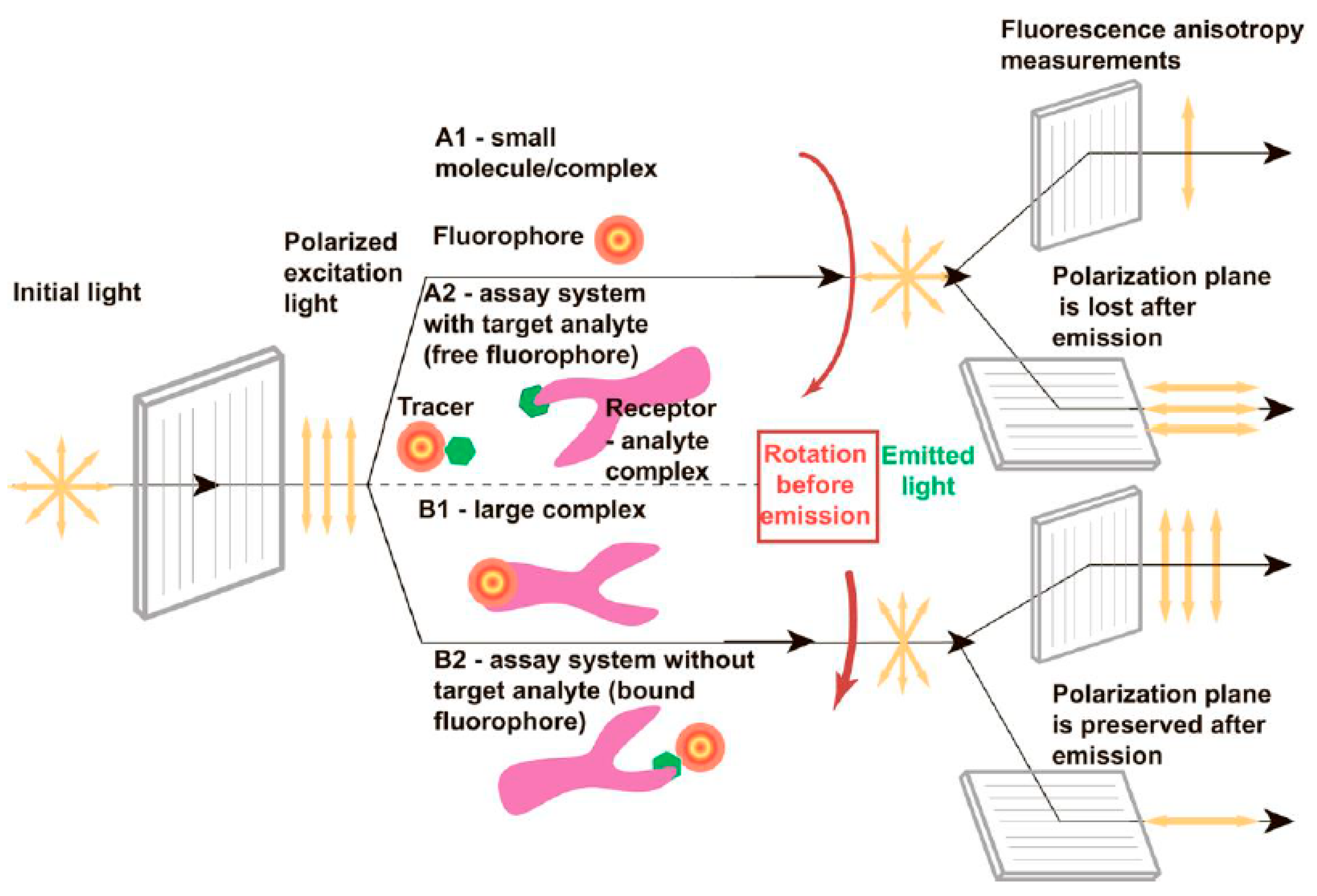
4.2. Fluorescence-Based Optical Sensors
4.3. Surface Plasmon Resonance (SPR)-Based and Localized Surface Plasmon Resonance (LSPR)-Based Sensors
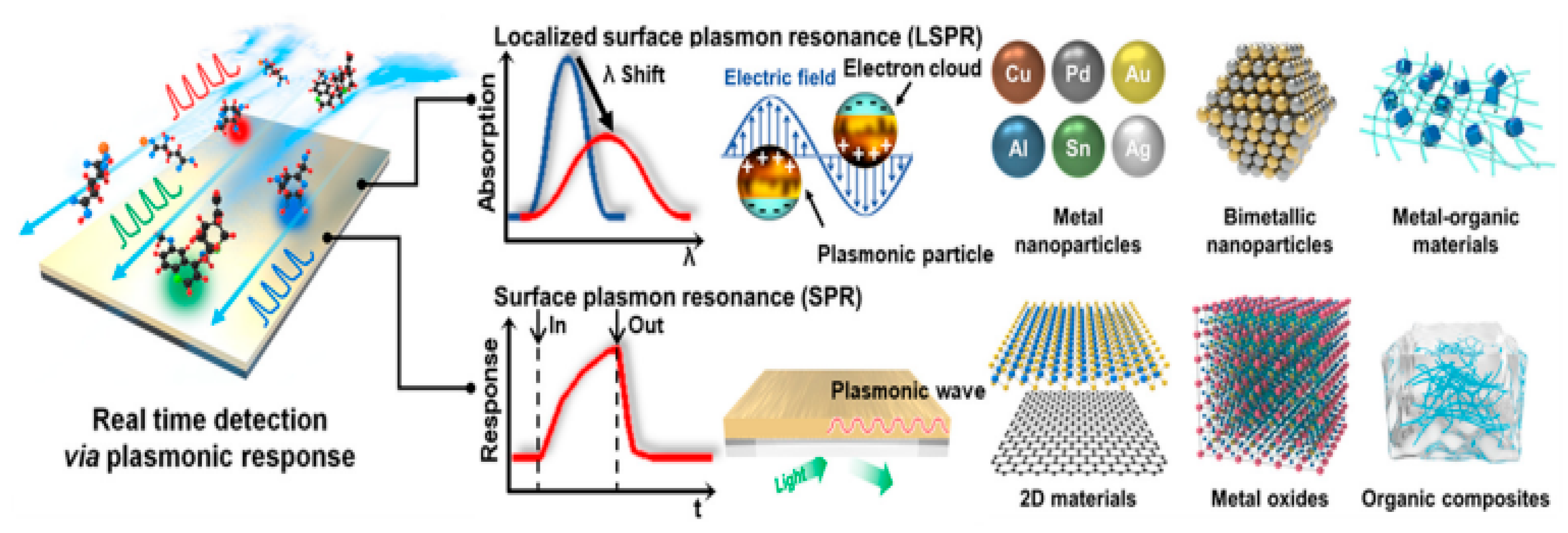
4.4. Surface-Enhanced Raman Spectra
4.5. Photonic Crystal Biosensors
4.6. Fiber-Optic Biosensors
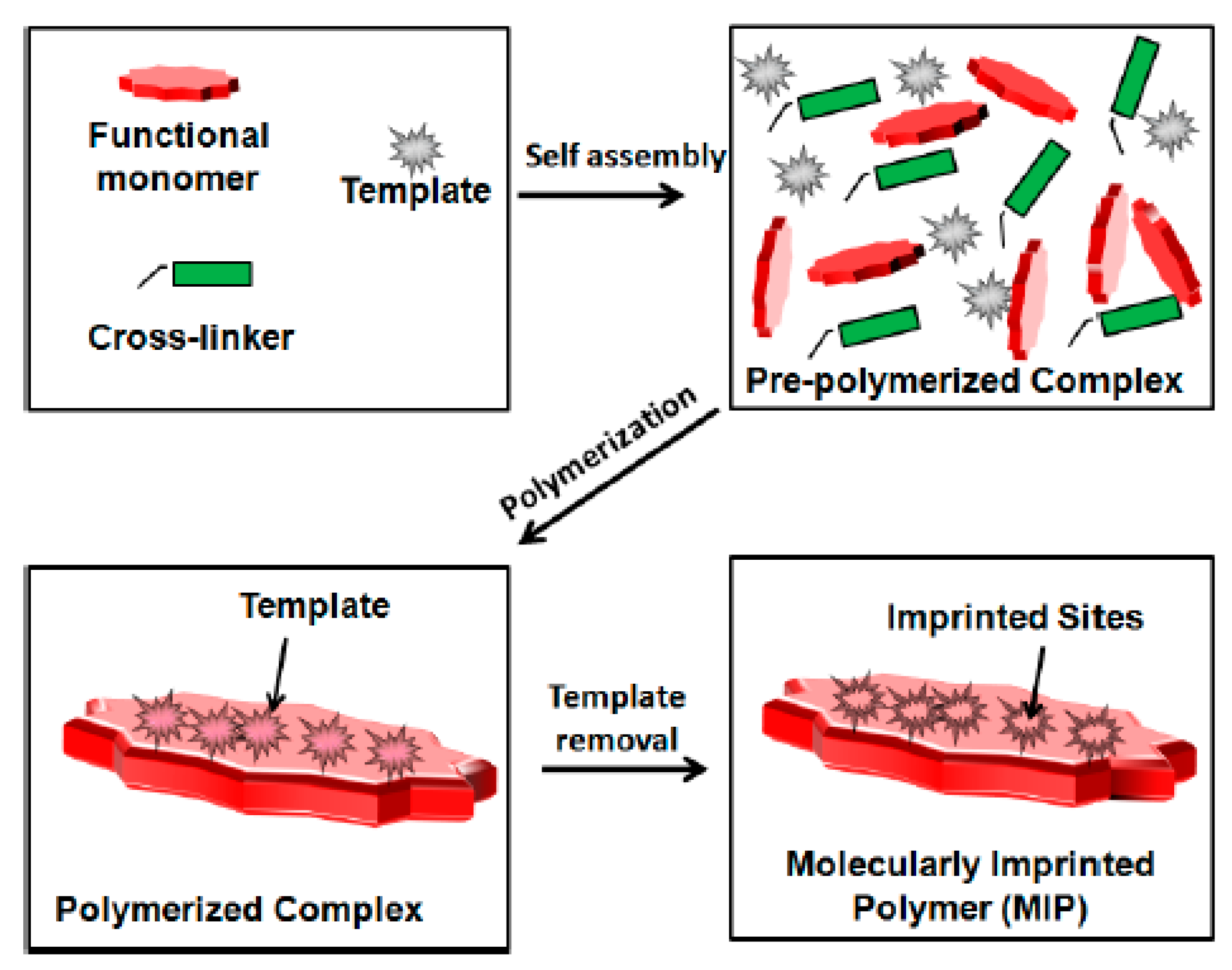
4.7. Optical Sensors Based on Molecularly Imprinted Polymers
4.8. Electro-Optical Approach for Antibiotic Detection
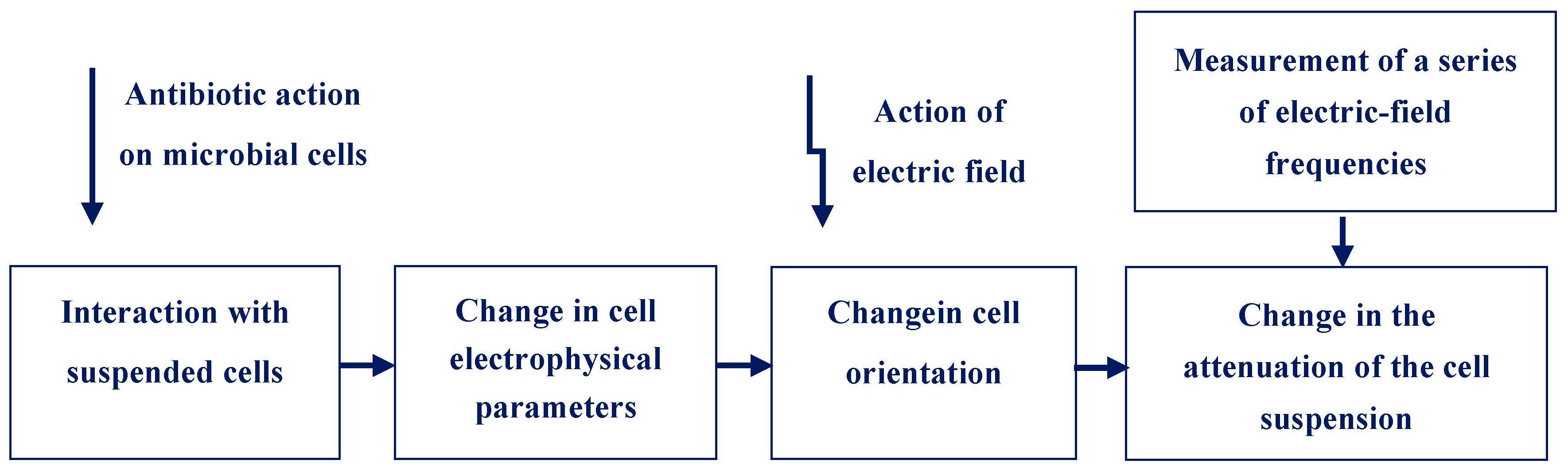
- Surface adhesion, without changing cellular structure, facilitates shielding of the electric field and reduces the overall polarizability of the cells.
- Surface adhesion contributes to changes in the electric characteristics and thickness of the cell wall.
- Penetration of the antibacterial drug into the cell cytoplasm leads to a radical change in the recorded polarizability of the cell.
- The effect of the antibacterial drug on the membrane contributes to changes in its electric properties or leads to active transport of ions from the cytoplasm and a change in its specific electric conductivity.
5. Discussion and Prospects
6. Conclusions
Author Contributions
Funding
Data Availability Statement
Conflicts of Interest
References
- Drakvik, E.; Altenburger, R.; Aoki, Y.; Backhaus, T.; Bahadori, T.; Barouki, R.; Brack, W.; Cronin, M.T.D.; Demeneix, B.; Hougaard Bennekou, S.; et al. Statement on advancing the assessment of chemical mixtures and their risks for human health and the environment. Environ. Int. 2020, 134, 105267. [Google Scholar] [CrossRef]
- Negahdary, M.; Ameku, W.A.; Santos, B.G.; dos Santos Lima, I.; de Oliveira, T.G.; França, M.C.; Angnes, L. Recent electrochemical sensors and biosensors for toxic agents based on screen-printed electrodes equipped with nanomaterials. Microchem. J. 2023, 185, 108281. [Google Scholar] [CrossRef]
- Ben, Y.; Fu, C.; Hu, M.; Liu, L.; Wong, M.H.; Zheng, C. Human health risk assessment of antibiotic resistance associated with antibiotic residues in the environment: A review. Environ. Res. 2019, 169, 483–493. [Google Scholar] [CrossRef]
- Naidu, R.; Biswas, B.; Willettm, I.R.; Cribb, J.; Singh, B.K.; Nathanail, C.P.; Coulon, F.; Semple, K.T.; Jones, K.C.; Barclay, A. Chemical pollution: A growing peril and potential catastrophic risk to humanity. Environ. Int. 2021, 156, 106616. [Google Scholar] [CrossRef]
- Guliy, O.I.; Zaitsev, B.D.; Borodina, I.A. Antibiotics and analytical methods used for their determination. In Nanobioanalytical Approaches to Medical Diagnostics; Maurya, P.K., Chandra, P., Eds.; Chapter 5; Elsevier Ltd.: Amsterdam, The Netherlands; Woodhead Publishing: Cambridge, UK, 2022; pp. 143–177. ISBN 978-0-323-85147-3. [Google Scholar] [CrossRef]
- Guliy, O.I.; Karavaeva, O.A. Sensor systems for assessing bacterial susceptibility to antibiotics. Antibiot. Chemother. 2025, 70, 76–87. [Google Scholar] [CrossRef]
- Alsowaidi, A.K.M.; Karavaeva, O.A.; Guliy, O.I. Methods and approaches for antibiotics detection. Antibiot. Chemother. 2022, 67, 53–61. [Google Scholar] [CrossRef]
- Cháfer-Pericás, C.; Maquieira, Á.; Puchades, R. Fast screening methods to detect antibiotic residues in food samples. Trends Anal. Chem. 2010, 29, 1038–1049. [Google Scholar] [CrossRef]
- Dezhakam, E.; Tavakkol, M.; Kafili, T.; Nozohouri, E.; Naseri, A.; Khalilzadeh, B.; Rahbarghazi, R. Electrochemical and optical (bio)sensors for analysis of antibiotic residuals. Food Chem. 2024, 439, 138145. [Google Scholar] [CrossRef]
- Guliy, O.I.; Dykman, L.A. Prospects for the use of nanozyme-based electrochemical and colorimetric sensors for antibiotic detection. Talanta 2025, 286, 127524. [Google Scholar] [CrossRef]
- Baranova, A.A.; Tyurin, A.P.; Korshun, V.A.; Alferova, V.A. Sensing of Antibiotic–Bacteria Interactions. Antibiotics 2023, 12, 1340. [Google Scholar] [CrossRef]
- Bounegru, A.V.; Dinu Iacob, A.; Iticescu, C.; Georgescu, P.L. Electrochemical sensors and biosensors for the detection of pharmaceutical contaminants in natural waters—A comprehensive review. Chemosensors 2025, 13, 65. [Google Scholar] [CrossRef]
- Guliy, O.I.; Zaitsev, B.D.; Alsowaidi, A.K.M.; Karavaeva, O.A.; Lovtsova, L.G.; Borodina, I.A. Biosensor systems for antibiotics detection. Biophysics 2021, 66, 555–564. [Google Scholar] [CrossRef]
- Athira, E.T.; Dutta, S.; Singh, M.M.; Madaboosi, N.; Sai, V.V.R.; Satija, J. Recent progress in optical nanosensors for antibiotics detection. Appl. Nanosci. 2023, 13, 6519–6538. [Google Scholar] [CrossRef]
- Larsson, D.G. Antibiotics in the environment. Upsala J. Med. Sci. 2014, 119, 108–112. [Google Scholar] [CrossRef]
- Liu, C.; Li, B.; Liu, M.; Mao, S. Demand, status, and prospect of antibiotics detection in the environment. Sens. Actuators B Chem. 2022, 369, 132383. [Google Scholar] [CrossRef]
- Wang, X.; Lin, Y.; Zheng, Y.; Meng, F. Antibiotics in mariculture systems: A review of occurrence, environmental behavior, and ecological effects. Environ. Pollut. 2022, 293, 11854. [Google Scholar] [CrossRef]
- Zeng, H.; Li, J.; Zhao, W.; Xu, J.; Xu, H.; Li, D.; Zhang, J. The Current status and prevention of antibiotic pollution in ground water in China. Int. J. Environ. Res. Public Health 2022, 19, 11256. [Google Scholar] [CrossRef]
- Duan, W.; Cui, H.; Jia, X.; Huang, X. Occurrence and ecotoxicity of sulfonamides in the aquatic environment: A review. Sci. Total Environ. 2022, 820, 153178. [Google Scholar] [CrossRef]
- Lapworth, D.J.; Baran, N.; Stuart, M.E.; Ward, R.S. Emerging organic contaminants in groundwater: A review of sources, fate and occurrence. Environ. Pollut. 2012, 163, 287–303. [Google Scholar] [CrossRef]
- Danner, M.C.; Robertson, A.; Behrends, V.; Reiss, J. Antibiotic pollution in surface fresh waters: Occurrence and effects. Sci. Total Environ. 2019, 664, 793–804. [Google Scholar] [CrossRef]
- European Centre for Disease Prevention and Control. Antimicrobial Consumption in the EU/EEA (ESAC-Net)—Annual Epidemiological Report 2023; ECDC: Stockholm, Sweden, 2024. [Google Scholar]
- Mashile, P.P.; Munonde, T.S.; Nomngongo, P.N. Occurrence and adsorptive removal of sulfonamides and β-blockers in African and Asian water matrices: A comprehensive review. Environ. Adv. 2023, 13, 100435. [Google Scholar] [CrossRef]
- Rodriguez-Mozaz, S.; Vaz-Moreira, I.; Della Giustina, S.V.; Llorca, M.; Barceló, D.; Schubert, S.; Berendonk, T.U.; Michael-Kordatou, I.; Fatta-Kassinos, D.; Martinez, J.L.; et al. Antibiotic residues in final effluents of European wastewater treatment plants and their impact on the aquatic environment. Environ. Int. 2020, 140, 105733. [Google Scholar] [CrossRef]
- Ma, Y.; Li, M.; Wu, M.; Li, Z.; Liu, X. Occurrences and regional distributions of 20 antibiotics in water bodies during groundwater recharge. Sci. Total Environ. 2015, 518–519, 498–506. [Google Scholar] [CrossRef] [PubMed]
- Cooper, M.A.; Shlaes, D. Fix the antibiotics pipeline. Nature 2011, 472, 32. [Google Scholar] [CrossRef] [PubMed]
- Guliy, O.I.; Evstigneeva, S.S.; Karavaeva, O.A. Antimicrobial resistance and current methods for its detection. Front. Biosci. (Elite Ed.) 2023, 15, 19. [Google Scholar] [CrossRef]
- Catalano, A.; Iacopetta, D.; Ceramella, J.; Scumaci, D.; Giuzio, F.; Saturnino, C.; Aquaro, S.; Rosano, C.; Sinicropi, M.S. Multidrug Resistance (MDR): A widespread phenomenon in pharmacological therapies. Molecules 2022, 27, 616. [Google Scholar] [CrossRef]
- Ding, P.; Gao, Y.; Wang, J.; Xiang, H.; Zhang, C.; Wang, L.; Ji, G.; Wu, T. Progress and challenges of multidrug resistance proteins in diseases. Am. J. Cancer Res. 2022, 12, 4483–4501. [Google Scholar] [PubMed]
- Le Page, G.; Gunnarsson, L.; Snape, J.; Tyler, C.R. Integrating human and environmental health in antibiotic risk assessment: A critical analysis of protection goals, species sensitivity and antimicrobial resistance. Environ. Int. 2017, 109, 155–169. [Google Scholar] [CrossRef]
- Wang, Q.-J.; Mo, C.-H.; Li, Y.-W.; Gao, P.; Tai, Y.-P.; Zhang, Y.; Ruan, Z.-L.; Xu, J.-W. Determination of four fluoroquinolone antibiotics in tap water in Guangzhou and Macao. Environ. Pollut. 2010, 158, 2350–2358. [Google Scholar] [CrossRef]
- Yılmaz, Ç.; Özcengiz, G. Antibiotics: Pharmacokinetics, toxicity, resistance and multidrug efflux pumps. Biochem. Pharmacol. 2017, 133, 43–62. [Google Scholar] [CrossRef]
- Adane, W.D.; Chandravanshi, B.S.; Getachew, N.; Tessema, M. A cutting-edge electrochemical sensing platform for the simultaneous determination of the residues of antimicrobial drugs, rifampicin and norfloxacin, in water samples. Anal. Chim. Acta 2024, 1312, 342746. [Google Scholar] [CrossRef] [PubMed]
- Kim, J.; Ahn, J. Emergence and spread of antibiotic-resistant foodborne pathogens from farm to table. Food Sci. Biotechnol. 2022, 31, 1481–1499. [Google Scholar] [CrossRef] [PubMed]
- Kaur, K.; Singh, S.; Kaur, R. Impact of antibiotic usage in food-producing animals on food safety and possible antibiotic alternatives. Microbe 2024, 4, 100097. [Google Scholar] [CrossRef]
- Founou, L.L.; Founou, R.C.; Essack, S.Y. Antibiotic resistance in the food chain: A developing country-perspective. Front. Microbiol. 2016, 7, 1881. [Google Scholar] [CrossRef]
- Simjee, S.; Ippolito, G. European regulations on prevention use of antimicrobials from January 2022. Braz. J. Vet. Med. 2022, 44, e000822. [Google Scholar] [CrossRef]
- WHO. WHO Bacterial Priority Pathogens List, 2024: Bacterial Pathogens of Public Health Importance to Guide Research, Development and Strategies to Prevent and Control Antimicrobial Resistance; World Health Organization: Geneva, Switzerland, 2024. [Google Scholar]
- Wu-Wu, J.W.F.; Guadamuz-Mayorga, C.; Oviedo-Cerdas, D.; Zamora, W.J. Antibiotic resistance and food safety: Perspectives on new technologies and molecules for microbial control in the food industry. Antibiotics 2023, 12, 550. [Google Scholar] [CrossRef]
- Purohit, B.; Vernekar, P.R.; Shetti, N.P.; Chandra, P. Biosensor nanoengineering: Design, operation, and implementation for biomolecular analysis. Sens. Int. 2020, 1, 100040. [Google Scholar] [CrossRef]
- Singh, N.; Dkhar, D.S.; Chandra, P.; Azad, U.P. Nanobiosensors Design Using 2D Materials: Implementation in Infectious and Fatal Disease Diagnosis. Biosensors 2023, 13, 166. [Google Scholar] [CrossRef]
- Guliy, O.I.; Zaitsev, B.D.; Smirnov, A.V.; Karavaeva, O.A.; Borodina, I.A. Prospects of acoustic sensor systems for antibiotic detection. Biosens. Bioelectron. X 2022, 12, 100274. [Google Scholar] [CrossRef]
- Won, S.-Y.; Chandra, P.; Hee, T.S.; Shim, Y.-B. Simultaneous detection of antibacterial sulfonamides in a microfluidic device with amperometry. Biosens. Bioelectron. 2013, 39, 204–209. [Google Scholar] [CrossRef]
- Mahato, K.; Baranwal, A.; Srivastava, A.; Maurya, P.K.; Chandra, P. Smart materials for biosensing applications. In Techno-Societal 2016. ICATSA 2016; Pawar, P., Ronge, B., Balasubramaniam, R., Seshabhattar, S., Eds.; Springer: Cham, Switzerland, 2018; pp. 421–431. [Google Scholar] [CrossRef]
- Azad, U.P.; Chandra, P. (Eds.) Handbook of Material Engineering in Nanobiomedicine and Diagnostics; Springer: Singapore, 2025. [Google Scholar] [CrossRef]
- Zafar, H.; Channa, A.; Jeoti, V.; Stojanovič, G.M. Comprehensive review on wearable sweat-glucose sensors for continuous glucose monitoring. Sensors 2022, 22, 638. [Google Scholar] [CrossRef]
- Liu, X.; Marrakchi, M.; Xu, D.; Dong, H.; Andreescu, S. Biosensors based on modularly designed synthetic peptides for recognition, detection and live/dead differentiation of pathogenic bacteria. Biosens. Bioelectron. 2016, 80, 9–16. [Google Scholar] [CrossRef]
- Liu, Y.; Zhou, H.; Hu, Z.; Yu, G.; Yang, D.; Zhao, J. Label and label-free based surface-enhanced Raman scattering for pathogen bacteria detection: A review. Biosens. Bioelectron. 2017, 94, 131–140. [Google Scholar] [CrossRef] [PubMed]
- Fan, X.; White, I.M.; Shopova, S.I.; Zhu, H.; Suter, J.D.; Sun, Y. Sensitive optical biosensors for unlabeled targets: A review. Anal. Chim. Acta 2008, 620, 8–26. [Google Scholar] [CrossRef] [PubMed]
- Dudak, F.C.; Boyaci, I.H. Rapid and label-free bacteria detection by surface plasmon resonance (SPR) biosensors. Biotechnol. J. 2009, 4, 1003–1011. [Google Scholar] [CrossRef]
- Wu, X.; Xu, C.; Tripp, R.A.; Huang, Y.W.; Zhao, Y. Detection and differentiation of foodborne pathogenic bacteria in mung bean sprouts using field deployable label-free SERS devices. Analyst 2013, 138, 3005–3012. [Google Scholar] [CrossRef] [PubMed]
- Marks, H.; Schechinger, M.; Garza, J.; Locke, A.; Coté, G. Surface enhanced Raman spectroscopy (SERS) for in vitro diagnostic testing at the point of care. Nanophotonics 2017, 6, 681–701. [Google Scholar] [CrossRef]
- Kahraman, M.; Mullen, E.R.; Korkmaz, A.; Wachsmann-Hogiu, S. Fundamentals and applications of SERS-based bioanalytical sensing. Nanophotonics 2017, 6, 831–852. [Google Scholar] [CrossRef]
- Lin, P.H.; Huang, S.C.; Chen, K.P.; Li, B.R.; Li, Y.K. Effective construction of a high-capacity boronic acid layer on a quartz crystal microbalance chip for high-density antibody immobilization. Sensors 2019, 19, 28. [Google Scholar] [CrossRef]
- Wu, R.; Ma, Y.; Pan, J.; Lee, S.H.; Liu, J.; Zhu, H.; Gu, R.; Shea, K.J.; Pan, G. Efficient capture, rapid killing and ultrasensitive detection of bacteria by a nano-decorated multi-functional electrode sensor. Biosens. Bioelectron. 2018, 101, 52–59. [Google Scholar] [CrossRef]
- Guliy, O.I.; Bunin, V.D. Electrooptical analysis as sensing system for detection and diagnostics bacterial cells in the book. In Biointerface Engineering: Prospects in Medical Diagnostics and Drug Delivery; Chandra, P., Pandey, L.M., Eds.; Springer: Cham, Switzerland, 2020; pp. 233–254, Chapter 11; ISBN 978-981-15-4789-8. [Google Scholar]
- Guliy, O.I.; Karavaeva, O.A.; Smirnov, A.V.; Eremin, S.A.; Bunin, V.D. Optical sensors for bacterial detection. Sensors 2023, 23, 9391. [Google Scholar] [CrossRef]
- Wu, Y.; Xu, X.; Zhu, Y.; Wan, J.; Wang, X.; Zhou, X.; Li, X.; Zhou, W. Research progress on multiplexed pathogen detection using optical biosensors. Biosensors 2025, 15, 378. [Google Scholar] [CrossRef]
- Jeon, H.J.; Kim, H.S.; Chung, E.; Lee, D.Y. Nanozyme-based colorimetric biosensor with a systemic quantification algorithm for noninvasive glucose monitoring. Theranostics 2022, 12, 6308–6338. [Google Scholar] [CrossRef]
- Guliy, O.I.; Dykman, L.A. Immunoassay analysis using full-length and phage antibodies for detection of antibiotics: A review of the literature. Appl. Biochem. Microbiol. 2024, 60, 541–553. [Google Scholar] [CrossRef]
- Yang, L.; Xu, X.; Song, Y.; Huang, J.; Xu, H. Research progress of nanozymes in colorimetric biosensing: Classification, activity and application. Chem. Eng. J. 2024, 487, 150612. [Google Scholar] [CrossRef]
- Guliy, O.I.; Chumakov, D.S.; Evstigneeva, S.S.; Liu, Q.; Zavyalova, E.G. Nanozymes: A dual approach to bacterial colorimetric and luminescent detection and to bacterial pathogen killing. Biosens. Bioelectron. 2025, 288, 117835. [Google Scholar] [CrossRef]
- Chumakov, D.S.; Evstigneeva, S.S.; Guliy, O.I. Luminescent nanozyme-based sensors for bacteria detection. Appl. Biochem. Microbiol. 2024, 60, 1022–1034. [Google Scholar] [CrossRef]
- Ajay Piriya, V.S.; Joseph, P.; Kiruba Daniel, S.C.G.; Lakshmanan, S.; Kinoshita, T.; Muthusamy, S. Colorimetric sensors for rapid detection of various analytes. Mater. Sci. Eng. C 2017, 78, 1231–1245. [Google Scholar] [CrossRef]
- Yang, F.-Q.; Ge, L. Colorimetric Sensors: Methods and Applications. Sensors 2023, 23, 9887. [Google Scholar] [CrossRef]
- Wu, Y.; Feng, J.; Hu, G.; Zhang, E.; Yu, H.-H. Colorimetric sensors for chemical and biological sensing applications. Sensors 2023, 23, 2749. [Google Scholar] [CrossRef]
- Abedalwafa, M.A.; Li, Y.; Nia, C.; Wang, L. Colorimetric sensor arrays for the detection and identification of antibiotics. Anal. Methods 2019, 11, 2836–2854. [Google Scholar] [CrossRef]
- Dykman, L.A.; Guliy, O.I. Gold-based nanohybrid materials in biosensing. Talanta 2026, 298 Pt A, 128814. [Google Scholar] [CrossRef]
- Qin, Y.; Sun, J.; Huang, W.; Yue, H.; Meng, F.; Zhang, M. Colorimetric sensor array for the rapid distinction and detection of various antibiotic-resistant psychrophilic bacteria in raw milk based-on machine learning. Food Chem. X 2024, 22, 101281. [Google Scholar] [CrossRef]
- Song, K.-M.; Cho, M.; Jo, H.; Min, K.; Jeon, S.H.; Kim, T.; Han, M.S.; Ku, J.K.; Ban, C. Gold nanoparticle-based colorimetric detection of kanamycin using a DNA aptamer. Anal. Biochem. 2011, 415, 175–181. [Google Scholar] [CrossRef]
- Lu, W.; Guo, Y.; Yue, Y.; Zhang, J.; Fan, L.; Li, F.; Zhao, Y.; Dong, C.; Shuang, S. Smartphone-assisted colorimetric sensing platform based on molybdenum-doped carbon dots nanozyme for visual monitoring of ampicillin. Chem. Eng. J. 2023, 468, 143615. [Google Scholar] [CrossRef]
- Esmaelpourfarkhani, M.; Ramezani, M.; Alibolandi, M. Signal-off nanozyme-based colorimetric aptasensor for sensitive detection of ampicillin using MnO2 nanoflowers and gold nanoparticles. Anal. Biochem. 2024, 687, 115459. [Google Scholar] [CrossRef]
- Shen, Y.Z.; Wei, Y.L.; Liu, Z.M.; Nie, C.; Ye, Y.W. Engineering of 2D artificial nanozyme-based blocking effect-triggered colorimetric sensor for onsite visual assay of residual tetracycline in milk. Microchim. Acta 2022, 189, 233. [Google Scholar] [CrossRef]
- Zhu, B.C.; Dong, S.M.; Liu, Z.C.; Gao, Y.; Zhu, X.X.; Xie, M.; Liu, Q.Y. Enhanced peroxidase-like activity of bimetal (Fe/Co) MIL-101 for determination of tetracycline and hydrogen peroxide. New J. Chem. 2022, 46, 21834–21844. [Google Scholar] [CrossRef]
- Zhu, X.; Tang, J.; Ouyang, X.; Liao, Y.; Feng, H.; Yu, I.; Chen, L.; Lu, Y.; Yi, Y.; Tang, L. Hollow NiCo@C nanozyme-embedded paper-based colorimetric aptasensor for highly sensitive antibiotic detection on a smartphone platform. Anal. Chem. 2022, 94, 16768–16777. [Google Scholar] [CrossRef]
- Yao, Y.; Chen, T.; Mao, W.; Zhong, Y.; Dai, S.; Zeng, X.; Liu, C.; Tang, S.; Qiao, F.; Shi, E.; et al. Three-dimensional DNA/Ni-Fe layered double oxide frame networks-induced “cusp-exposure” of Au@Ag nanostars for ultrasensitive determination of kanamycin. Sens. Actuators B. 2021, 343, 130082. [Google Scholar] [CrossRef]
- Zhu, X.; Tang, L.; Wang, J.J.; Peng, B.; Ouyang, X.L.; Tan, J.S.; Yu, J.F.; Feng, H.P.; Tang, J.L. Enhanced peroxidase-like activity of boron nitride quantum dots anchored porous CeO2 nanorods by aptamer for highly sensitive colorimetric detection of kanamycin. Sens. Actuators B. 2021, 330, 129318. [Google Scholar] [CrossRef]
- Tang, Y.; Hu, Y.; Zhou, P.; Wang, C.X.; Tao, H.; Wu, Y.G. Colorimetric detection of kanamycin residue in foods based on the aptamer-enhanced peroxidase-mimicking activity of layered WS2 nanosheets. J. Agric. Food Chem. 2021, 69, 2884–2893. [Google Scholar] [CrossRef]
- Zhou, X.; Li, J.; Hu, Y.; Wu, Y.; Wang, Y.; Ning, G. A novel colorimetric assay for sensitive detection of kanamycin based on the aptamer-regulated peroxidase-mimicking activity of Co3O4 nanoparticles. Anal. Methods 2023, 15, 2441–2447. [Google Scholar] [CrossRef]
- Sun, M.M.; He, M.X.; Jiang, S.J.; Wang, Y.Y.; Wang, X.X.; Liu, T.; Song, C.; Wang, S.N.; Rao, H.B.; Lu, Z.W. Multi-enzyme activity of three layers FeOx@ZnMnFeOy@Fe-Mn organogel for colorimetric detection of antioxidants and norfloxacin with smartphone. Chem. Eng. J. 2021, 425, 131823. [Google Scholar] [CrossRef]
- Wang, L.; Chen, C.; Liu, Y.; Olga, G.; Xue, K.; Liu, Q. Photoenhanced Peroxidase-Like Activity of Co3V2O8–TiO2 heterojunction for colorimetric determination of neomycin. ACS Appl. Nano Mater. 2025, 8, 8797–8806. [Google Scholar] [CrossRef]
- Li, M.; Huang, J.; Deng, R.; Yan, Y.; Zhang, W.; Ge, D.; Chen, X. Construction of γ-Fe2O3 based colorimetric sensing arrays through the phase transformation induced by rare-earth doping for the detection of antibiotics in water environments. J. Environ. Chem. Eng. 2025, 13, 117126. [Google Scholar] [CrossRef]
- Wang, L.; Chu, Y.; Cao, B.; Zhang, R.; Hussain, Z.; Liu, Q. Cobalt (II) porphyrin nanoaggregates as sacrificial templates to improve the peroxidase-like activity of light-controlled TiO2-based nanozymes for colorimetric determination of amikacin. Talanta 2025, 281, 126889. [Google Scholar] [CrossRef]
- Wang, W.; Yin, Y.; Gunasekaran, S. Nanozymatic degradation and simultaneous colorimetric detection of tetracycline. Food Chem. 2023, 426, 136607. [Google Scholar] [CrossRef]
- Xu, D.; Shen, Z.; Wang, G.; Wei, L.; Gao, X.; Dong, H.; Wang, G.; Sun, X.; Li, F.; Guo, Y. Dual-catalytic colorimetric biosensor based on double-active Fe@Co-N stellate porous carbon and DNAzyme for simultaneous detection of tetracycline antibiotics. Sens. Actuators B Chem. 2023, 376 Pt B, 133024. [Google Scholar] [CrossRef]
- Meng, F.; Wei, K.; Li, Y.; Zhang, L.; Xu, S.; Shi, X.; Tang, B. Efficient synthesis of multifunctional α-Fe2O3 QDs/TS-1 as an artificial nanozyme for simultaneous colorimetric detection and photodegradation of tetracyclines. Chem. Eng. J. 2024, 498, 155225. [Google Scholar] [CrossRef]
- Zhao, J.; Wu, Y.G.; Tao, H.; Chen, H.Y.; Yang, W.P.; Qiu, S.Y. Colorimetric detection of streptomycin in milk based on peroxidase-mimicking catalytic activity of gold nanoparticles. RSC Adv. 2017, 7, 38471–38478. [Google Scholar] [CrossRef]
- Yan, J.; Huang, Y.F.; Zhang, C.H.; Fang, Z.Z.; Bai, W.H.; Yan, M.M.; Zhu, C.; Chen, A.L. Aptamer based photometric assay for the antibiotic sulfadimethoxine based on the inhibition and reactivation of the peroxidase-like activity of gold nanoparticle. Microchim. Acta 2017, 184, 59–63. [Google Scholar] [CrossRef]
- Sheng, Y.M.; Liang, J.; Xie, J. Indirect competitive determination of tetracycline residue in honey using an ultrasensitive gold-nanoparticle-linked aptamer assay. Molecules 2020, 25, 2144. [Google Scholar] [CrossRef] [PubMed]
- Zhang, Z.; Tian, Y.; Huang, P.; Wu, F.Y. Using target-specific aptamers to enhancethe peroxidase-like activity of gold nanoclusters for colorimetric detection of tetracycline antibiotics. Talanta 2020, 208, 120342. [Google Scholar] [CrossRef]
- Yuan, F.; Zhao, H.; Wang, X.; Quan, X. Determination of oxytetracycline by a graphene—Gold nanoparticle-based colorimetric aptamer sensor. Anal. Lett. 2017, 50, 544–553. [Google Scholar] [CrossRef]
- Zhang, L.; Li, J.; Wang, J.; Yan, X.; Song, J.; Feng, F. An ultra-sensitive colorimetric sensing platform for simultaneous detection of moxifloxacin/ciprofloxacin and Cr(III) ions based on ammonium thioglycolate functionalized gold nanoparticles. Sensors 2025, 25, 3228. [Google Scholar] [CrossRef]
- Li, Z.; Meng, F.; Li, R.; Fang, Y.; Cui, Y.; Qin, Y.; Zhang, M. Amino-functionalized Fe(III)-Based MOF for the high-efficiency extraction and ultrasensitive colorimetric detection of tetracycline. Biosens. Bioelectron. 2023, 234, 115294. [Google Scholar] [CrossRef] [PubMed]
- Wang, L.; Liu, G.; Ren, Y.; Feng, Y.; Zhao, X.; Zhu, Y.; Chen, M.; Zhu, F.; Liu, Q.; Chen, X. Integrating target-triggered aptamer-capped HRP@Metal-organic frameworks with a colorimeter readout for on-Site sensitive detection of antibiotics. Anal. Chem. 2020, 92, 14259–14266. [Google Scholar] [CrossRef]
- Li, J.; Yu, C.; Wu, Y.N.; Zhu, Y.; Xu, J.; Wang, Y.; Wang, H.; Guo, M.; Li, F. Novel sensing platform based on gold nanoparticle-aptamer and Fe-metal-organic framework for multiple antibiotic detection and signal amplification. Environ. Int. 2019, 125, 135–141. [Google Scholar] [CrossRef]
- Shukla, V.; Ahmad, M.; Siddiqui, K.A. Synthesis of dual functional Zn(II) MOF for colorimetric detection of norfloxacin and photocatalytic degradation of ornidzole drugs in aqueous medium. Polyhedron 2024, 260, 117078. [Google Scholar] [CrossRef]
- Pérez-Juste, J.; Pastoriza-Santos, I.; Liz-Marzán, L.M.; Mulvaney, P. Gold nanorods: Synthesis, characterization and applications. Coord. Chem. Rev. 2005, 249, 1870–1901. [Google Scholar] [CrossRef]
- Sharma, P.; Siddiqui, K.A. Metal–organic frameworksas fluorescent and colorimetric sensors for antibiotic tracing. Discov. Chem. 2025, 2, 199. [Google Scholar] [CrossRef]
- Shukla, V.; Siddiqui, K.A. MOFs in healthcare diagnostics: Shaping the future of biomedical test strips. CrystEngComm 2025, 27, 4443–4452. [Google Scholar] [CrossRef]
- Rayappa, M.K.; Kavya, K.S.; Rattu, G.; Krishna, P.M. Advances and effectiveness of metal–organic framework based bio/chemical sensors for rapid and ultrasensitive probing of antibiotic residues in foods. Sustain. Food Technol. 2023, 1, 152–184. [Google Scholar] [CrossRef]
- Krishnan, S.; ul Quasim Syed, Z. Colorimetric visual sensors for point-of-needs testing. Sens. Actuators Rep. 2022, 4, 100078. [Google Scholar] [CrossRef]
- Lee, Y.; Haizan, I.; Sim, S.B.; Choi, J.-H. Colorimetric biosensors: Advancements in nanomaterials and cutting-edge detection strategies. Biosensors 2025, 15, 362. [Google Scholar] [CrossRef] [PubMed]
- Fluorescence and Phosphorescence Diagram. Available online: https://fr.wikipedia.org/wiki/Fluorescence (accessed on 22 September 2025).
- Samokhvalov, A.V.; Mironova, A.A.; Eremin, S.A.; Zherdev, A.V.; Dzantiev, B.B. Polycations as aptamer-binding modulators for sensitive fluorescence anisotropy assay of aflatoxin B1. Sensors 2024, 24, 3230. [Google Scholar] [CrossRef]
- Cao, X.; Liu, T.; Wang, X.; Yu, Y.; Li, Y.; Zhang, L. Recent advances in nanozyme-based sensing technology for antioxidant detection. Sensors 2024, 24, 6616. [Google Scholar] [CrossRef] [PubMed]
- Fernando, K.A.S.; Sahu, S.; Liu, Y.M.; Lewis, W.K.; Guliants, E.A.; Jafariyan, A.; Wang, P.; Bunker, C.E.; Sun, Y.P. Carbon quantum dots and applications in photocatalytic energy conversion. ACS Appl. Mater. Interfaces 2015, 7, 8363–8376. [Google Scholar] [CrossRef]
- Wang, Q.; Xu, Q.; Zhai, S.; Zhao, Q.; Liu, W.; Chen, Z.; Wang, A. Understanding the coordination behavior of antibiotics: Take tetracycline as an example. J. Hazard. Mater. 2023, 460, 132375. [Google Scholar] [CrossRef]
- Tian, Z.; Zhang, X.; Zhang, Y.; Wu, Z.; Luan, G.; Bao, L.; Ji, Y.; Cui, M.; Li, C. A MOF-on-MOF heterostructure ratiometric/colorimetric dual-mode fluorescence sensor based on support vector machine for detecting tetracyclines in animal-derived foods. Food Chem. 2024, 460, 140690. [Google Scholar] [CrossRef]
- Zhang, Y.; Wang, T.; Guo, H.; Gao, X.; Yan, Y.; Zhou, X.; Zhao, M.; Qin, H.; Liu, Y. An ion-coordination hydrogel based sensor array for point-of-care identification and removal of multiple tetracyclines. Biosens. Bioelectron. 2023, 231, 115266. [Google Scholar] [CrossRef]
- Shao, L.; Dong, C.; Sang, F.; Qian, H.; Ren, J. Studies on interaction of CdTe quantum dots with bovine serum albumin using fluorescence correlation spectroscopy. J. Fluoresc. 2009, 19, 151–157. [Google Scholar] [CrossRef]
- Suárez, G.; Jin, Y.H.; Auerswald, J.; Berchtold, S.; Knapp, H.F.; Diserens, J.M.; Leterrier, Y.; Månson, J.A.; Voirin, G. Lab-on-a-chip for multiplexed biosensing of residual antibiotics in milk. Lab Chip 2009, 9, 1625–1630. [Google Scholar] [CrossRef]
- Ding, S.; Chen, J.; Jiang, H.; He, J.; Shi, W.; Zhao, W.; Shen, J. Application of quantum dot-antibody conjugates for detection of sulfamethazine residue in chicken muscle tissue. J. Agric. Food Chem. 2006, 54, 6139–6142. [Google Scholar] [CrossRef] [PubMed]
- Khezerlou, A.; Tavassoli, M.; Sani, M.A.; Ghasempour, Z.; Ehsani, A.; Khalilzadeh, B. Rapid and sensitive detection of tetracycline residue in food samples using Cr(III)-MOF fluorescent sensor. Food Chem. X 2023, 20, 100883. [Google Scholar] [CrossRef]
- Peng, C.; Li, Z.; Zhu, Y.; Chen, W.; Yuan, Y.; Liu, L.; Li, Q.; Xu, D.; Qiao, R.; Wang, L.; et al. Simultaneous and sensitive determination of multiplex chemical residues based on multicolor quantum dot probes. Biosens. Bioelectron. 2009, 24, 3657–3662. [Google Scholar] [CrossRef] [PubMed]
- Song, E.; Yu, M.; Wang, Y.; Hu, W.; Cheng, D.; Swihart, M.T.; Song, Y. Multi-color quantum dot-based fluorescence immunoassay array for simultaneous visual detection of multiple antibiotic residues in milk. Biosens. Bioelectron. 2015, 72, 320–325. [Google Scholar] [CrossRef]
- Zhu, K.; Li, J.; Wang, Z.; Jiang, H.; Beier, R.C.; Xu, F.; Shen, J.; Ding, S. Simultaneous detection of multiple chemical residues in milk using broad-specificity antibodies in a hybrid immunosorbent assay. Biosens. Bioelectron. 2011, 26, 2716–2719. [Google Scholar] [CrossRef] [PubMed]
- Wang, Y.; Gan, N.; Li, T.; Cao, Y.; Hu, F.; Chen, Y. A novel aptamer–quantum dot fluorescence probe for specific detection of antibiotic residues in milk. Anal. Methods 2016, 8, 3006–3013. [Google Scholar] [CrossRef]
- Wu, C.; Gan, N.; Ou, C.; Tang, H.; Zhou, Y.; Cao, J. A homogenous “signal-on” aptasensor for antibiotics based on a single stranded DNA binding protein-quantum dot aptamer probe coupling exonuclease-assisted target recycling for signal amplification. RSC Adv. 2017, 7, 8381–8387. [Google Scholar] [CrossRef]
- He, Y.; Zhang, B.; Fan, Z. Aptamer based fluorometric sulfamethazine assay based on the use of grapheme oxide quantum dots. Microchim. Acta 2018, 185, 163–170. [Google Scholar] [CrossRef]
- Taghdisi, S.M.; Danesh, N.M.; Nameghi, M.A.; Ramezani, M.; Abnous, K. A labelfree fluorescent aptasensor for selective and sensitive detection of streptomycin in milk and blood serum. Food Chem. 2016, 203, 145–149. [Google Scholar] [CrossRef] [PubMed]
- Wu, S.; Zhang, H.; Shi, Z.; Duan, N.; Fang, C.C.; Dai, S.; Wang, Z. Aptamer-based fluorescence biosensor for chloramphenicol determination using upconversion nanoparticles author links open overlay panel. Food Control 2015, 50, 597–604. [Google Scholar] [CrossRef]
- Zhou, Z.; Wen, X.; Shi, C.; Wu, L.; Long, Z.; He, J.; Hou, X. Multi-color fluorescence sensing platform for visual determination of norfloxacin based on a terbium (III) functionalized covalent organic framework. Food Chem. 2023, 417, 135883. [Google Scholar] [CrossRef] [PubMed]
- Shi, B.; Zhang, X.; Li, W.; Liang, N.; Hu, X.; Xiao, J.; Wang, D.; Zou, X.; Shi, J. An intrinsic dual-emitting fluorescence sensing toward tetracycline with self-calibration model based on luminescent lanthanide-functionalized metal-organic frameworks. Food Chem. 2023, 400, 133995. [Google Scholar] [CrossRef]
- Ke, C.B.; Lu, T.L.; Chen, J.L. Excitation-independent dual emissions of carbon dots synthesized by plasma irradiation of ionic liquids: Ratiometric fluorometric determination of norfloxacin and mercury(II). Mikrochim. Acta 2019, 186, 376. [Google Scholar] [CrossRef]
- Mohammed Ameen, S.S.; Sher Mohammed, N.M.; Omer, K.M. Ultra-small highly fluorescent zinc-based metalorganic framework nanodots for ratiometric visual sensing of tetracycline based on aggregation induced emission. Talanta 2023, 254, 124178. [Google Scholar] [CrossRef]
- Larina, M.Y.; Farafonova, O.V.; Eremin, S.A.; Ermolayeva, T.N. Using carbon quantum dots for the determination of aminoglycoside antibiotics by fluorescence polarization immunoassay. J. Anal. Chem. 2023, 78, 34–42. [Google Scholar] [CrossRef]
- Jia, Y.; Cheng, Z.; Wang, G.; Shuang, S.; Zhou, Y.; Dong, C.; Du, F. Nitrogen doped biomass derived carbon dots as a fluorescence dual-mode sensing platform for detection of tetracyclines in biological and food samples. Food Chem. 2023, 402, 134245. [Google Scholar] [CrossRef]
- Yue, X.; Wu, C.; Zhou, Z.; Fu, L.; Bai, Y. Fluorescent sensing of ciprofloxacin and chloramphenicol in milk samples via inner filter effect and photoinduced electron transfer based on nanosized rod-shaped Eu-MOF. Foods 2022, 11, 3138. [Google Scholar] [CrossRef]
- Xie, R.; Yang, P.; Liu, J.; Zou, X.; Tan, Y.; Wang, X.; Tao, J.; Zhao, P. Lanthanide-functionalized metal-organic frameworks based ratiometric fluorescent sensor array for identification and determination of antibiotics. Talanta 2021, 231, 122366. [Google Scholar] [CrossRef]
- Lei, M.; Ge, F.; Gao, X.; Shi, Z.; Zheng, H. A Water-Stable Tb-MOF As a rapid, accurate, and highly sensitive ratiometric luminescent sensor for the discriminative sensing of antibiotics and D2O in H2O. Inorg. Chem. 2021, 60, 10513–10521. [Google Scholar] [CrossRef] [PubMed]
- Li, C.; Zeng, C.; Chen, Z.; Jiang, Y.; Yao, H.; Yang, Y.; Wong, W.T. Luminescent lanthanide metal-organic framework test strip for immediate detection of tetracycline antibiotics in water. J. Hazard. Mater. 2020, 384, 121498. [Google Scholar] [CrossRef]
- Liu, Q.; Ning, D.; Li, W.J.; Du, X.M.; Wang, Q.; Li, Y.; Ruan, W.J. Metal-organic framework-based fuorescent sensing of tetracycline-type antibiotics applicable to environmental and food analysis. Analyst 2019, 144, 1916–1922. [Google Scholar] [CrossRef] [PubMed]
- Yu, L.; Chen, H.; Yue, J.; Chen, X.; Sun, M.; Hou, J.; Alamry, K.A.; Marwani, H.M.; Wang, X.; Wang, S. Europium metalorganic framework for selective and sensitive detection of doxycycline based on fluorescence enhancement. Talanta 2020, 207, 120297. [Google Scholar] [CrossRef] [PubMed]
- Chen, Q.; Zhang, H.; Sun, H.; Yang, Y.; Zhang, D.; Li, X.; Zhang, Y. Sensitive dual-signal detection and effective removal of tetracycline antibiotic sin honey based on a hollo wtriple-metal organic framework nanozymes. Food Chem. 2024, 442, 138383. [Google Scholar] [CrossRef]
- Chen, H.; Wang, Z.; Shi, Q.; Shi, W.; Lv, Y.; Liu, S. A colorimetric and fluorescent dual-mode sensor based on a smartphone-assisted laccase-like nanoenzyme for the detection of tetracycline antibiotics. Nanomaterials 2025, 15, 162. [Google Scholar] [CrossRef]
- Yang, K.; Zhu, R.; Li, Z.; Shuang, S.; Zhai, Y.; Dong, C. Highly sensitive dual-mode assay fort etracycline detection. Chin. J. Anal. Chem. 2024, 52, 100363. [Google Scholar] [CrossRef]
- Bai, L.; Yu, J.; Hao, L.; Hui, C.; Yuan, M.; Wu, X.; Yin, F.; Ye, T.; Xu, F. Smartphone-assisted dual-mode fluorescent/colorimetric biosensors based on Fe3O4-CDs nanozyme for self-calibrated detection of oxytetracycline. Talanta 2026, 298 Pt A, 128839. [Google Scholar] [CrossRef]
- Leung, K.-H.; He, H.-Z.; Chan, D.S.-H.; Fu, W.-C.; Leung, C.-H.; Ma, D.-L. An oligonucleotide-based switch-on luminescent probe for the detection of kanamycin in aqueous solution. Sens. Actuators B Chem. 2013, 177, 487–492. [Google Scholar] [CrossRef]
- Sun, Y.-X.; Ji, B.-T.; Chen, J.-H.; Liu, L.-P.; Gao, L.-L.; Deng, Z.-P.; Sun, Y.; Wang, J.-J.; Zhao, B.; Li, J.-G. A smartphone-integrated bimetallic ratiometric fluorescent probe for specific visual detection of tetracycline antibiotics in food samples and latent fingerprinting. Food Chem. 2025, 464 Pt 3, 141782. [Google Scholar] [CrossRef]
- Virolainen, N.E.; Pikkemaat, M.G.; Elferink, J.W.A.; Karp, M.T. Rapid detection of tetracyclines and their 4-epimer derivatives from poultry meat with bioluminescent biosensor bacteria. J. Agric. Food Chem. 2008, 56, 11065–11070. [Google Scholar] [CrossRef]
- Lu, M.-Y.; Kao, W.-C.; Belkin, S.; Cheng, J.-Y. A smartphone-based whole-cell array sensor for detection of antibiotics in milk. Sensors 2019, 19, 3882. [Google Scholar] [CrossRef]
- Nonejuie, P.; Burkart, M.; Pogliano, K.; Pogliano, J. Bacterial cytological profiling rapidly identifies the cellular pathways targeted by antibacterial molecules. Proc. Natl. Acad. Sci. USA 2013, 110, 16169–16174. [Google Scholar] [CrossRef]
- Martin, J.K.; Sheehan, J.P.; Bratton, B.P.; Moore, G.M.; Mateus, A.; Li, S.H.-J.; Kim, H.; Rabinowitz, J.D.; Typas, A.; Savitski, M.M.; et al. A Dual-mechanism antibiotic kills gram-negative bacteria and avoids drug resistance. Cell 2020, 181, 1518–1532.e14. [Google Scholar] [CrossRef]
- Ouyang, X.; Hoeksma, J.; Lubbers, R.J.M.; Siersma, T.K.; Hamoen, L.W.; Den Hertog, J. Classification of antimicrobial mechanism of action using dynamic bacterial morphology imaging. Sci. Rep. 2022, 12, 11162. [Google Scholar] [CrossRef]
- Zoffmann, S.; Vercruysse, M.; Benmansour, F.; Maunz, A.; Wolf, L.; Blum Marti, R.; Heckel, T.; Ding, H.; Truong, H.H.; Prummer, M.; et al. Machine learning-powered antibiotics phenotypic drug discovery. Sci. Rep. 2019, 9, 5013. [Google Scholar] [CrossRef] [PubMed]
- Spahn, C.; Gómez-de-Mariscal, E.; Laine, R.F.; Pereira, P.M.; Von Chamier, L.; Conduit, M.; Pinho, M.G.; Jacquemet, G.; Holden, S.; Heilemann, M.; et al. DeepBacs for multi-task bacterial image analysis using open-source deep learning approaches. Commun. Biol. 2022, 5, 688. [Google Scholar] [CrossRef] [PubMed]
- Liu, X.; Ma, Q.; Feng, X.; Li, R.; Zhang, X. A recycled Tb-MOF fluorescent sensing material for highly sensitive and selective detection of tetracycline in milk. Microchem. J. 2021, 170, 106714. [Google Scholar] [CrossRef]
- Mukhametova, L.I.; Eremin, S.A. Fluorescence polarization assays for organic compounds in food safety. Front. Biosci. (Elite Ed.) 2024, 16, 4. [Google Scholar] [CrossRef]
- Xia, N.; Chang, Y.; Zhou, Q.; Ding, S.; Gao, F. An overview of the design of metal-organic frameworks-based fluorescent chemosensors and biosensors. Biosensors 2022, 12, 928. [Google Scholar] [CrossRef]
- Yan, K.-C.; Steinbrueck, A.; Sedgwick, A.C.; James, T.D. Fluorescent Chemosensors for Ion and Molecule Recognition: The Next Chapter. Front. Sens. 2021, 2, 731928. [Google Scholar] [CrossRef]
- Wu, L.; Liu, J.; Li, P.; Tang, B.; James, T.D. Two-photon small-molecule fluorescence-based agents for sensing, imaging, and therapy within biological systems. Chem. Soc. Rev. 2021, 50, 702–734. [Google Scholar] [CrossRef]
- Donnier-Maréchal, M.; Abdullayev, S.; Bauduin, M.; Pascal, Y.; Fu, M.Q.; He, X.P.; Gillon, E.; Imberty, A.; Kipnis, E.; Dessein, R.; et al. Tetraphenylethylene-based glycoclusters with aggregation-induced emission (AIE) properties as high-affinity ligands of bacterial lectins. Org. Biomol. Chem. 2018, 16, 8804–8809. [Google Scholar] [CrossRef] [PubMed]
- Cho, S.H.; Choi, S.; Suh, J.M.; Jang, H.W. Advancements in surface plasmon resonance sensors for real-time detection of chemical analytes: Sensing materials and applications. J. Mater. Chem. C 2025, 13, 6484–6507. [Google Scholar] [CrossRef]
- Deisingh, A.K.; Thompson, M. Biosensors for the detection of bacteria. Can. J. Microbiol. 2004, 50, 69–77. [Google Scholar] [CrossRef] [PubMed]
- Zhang, X.; Li, Z.; Yan, W.; Li, A.; Zhang, F.; Li, X.; Lu, M.; Peng, W. Customizable miniaturized SPR instrument. Talanta 2024, 269, 125440. [Google Scholar] [CrossRef]
- Wang, Q.; Zhao, W.-M. Optical methods of antibiotic residues detections: A xomprehensive review. Sens. Actuators B Chem. 2018, 269, 238–256. [Google Scholar] [CrossRef]
- Ferguson, J.P.; Baxter, G.A.; Mcevoy, J.D.; Stead, S.; Rawlings, E.; Sharman, M. Detection of streptomycin and dihydrostreptomycin residues in milk, honey and meat samples using an optical biosensor. Analyst 2002, 127, 951–956. [Google Scholar] [CrossRef]
- Gustavsson, E.; Bjurling, P.; Sternesjö, Å. Biosensor analysis of penicillin G in milk based on the inhibition of carboxypeptidase activity. Anal. Chim. Acta 2002, 468, 153–159. [Google Scholar] [CrossRef]
- Altintas, Z. Surface plasmon resonance based sensor for the detection of glycopeptide antibiotics in milk using rationally designed nanoMIPs. Sci. Rep. 2018, 8, 11222. [Google Scholar] [CrossRef]
- Rebe, R.S.; Bremer, M.G.; Haasnoot, W.; Norde, W.; Chem, A. Label-free and multiplex detection of antibiotic residues in milk using imaging surface plasmon resonance-based immunosensor. Anal. Chem. 2009, 81, 7743–7749. [Google Scholar] [CrossRef] [PubMed]
- Kastner, S.; Dietel, A.K.; Seier, F.; Ghosh, S.; Weiß, D.; Makarewicz, O.; Csáki, A.; Fritzsche, W. LSPR-Based biosensing enables the detection of antimicrobial resistance genes. Small 2023, 19, e2207953. [Google Scholar] [CrossRef] [PubMed]
- Mehrabi, F.; Dadmehr, M.; Ranjbar, B.; Hosseini, M. Aptamer-based colorimetric detection of oxytetracycline by a LSPR-based assay of gold Nanorods in honey sample. ChemistrySelect 2024, 9, e202305069. [Google Scholar] [CrossRef]
- Waitkus, J.; Park, J.; Ndukaife, T.; Yang, S.; Du, K. Antibiotic-mediated plasmonic resonanceon a novel nanopillar metasurface array. Adv. Mater. Interfaces 2025, 12, 2400945. [Google Scholar] [CrossRef] [PubMed]
- Fernández, F.; Sánchezbaeza, F.; Marco, M.P. Nanogold probe enhanced surface plasmon resonance immunosensor for improved detection of antibiotic residues. Biosens. Bioelectron. 2012, 34, 151–158. [Google Scholar] [CrossRef]
- Fernández, F.; Hegnerová, K.; Piliarik, M.; Sanchez-Baeza, F.; Homola, J.; Marco, M.-P. A label-free and portable multichannel surface plasmon resonance immunosensor for on site, analysis of antibiotics in milk samples. Biosens. Bioelectron. 2010, 26, 1231–1238. [Google Scholar] [CrossRef]
- Galatus, R.; Feier, B.; Cristea, C.; Cennamo, N.; Zeni, L. SPR based hybrid electro-optic biosensor for β-lactam antibiotics determination in water. In Proceedings Volume 10405, Remote Sensing and Modeling of Ecosystems for Sustainability XIV, Proceedings of the SPIE Optical Engineering + Applications, San Diego, CA, USA, 6–10 August 2017; SPIE: Bellingham, WA, USA, 2017; p. 104050C. [Google Scholar] [CrossRef]
- Gustavsson, E.; Degelaen, J.; Bjurling, P.; Sternesjö, Å. Determination of beta-lactams in milk using a surface plasmon resonance-based biosensor. J. Agric. Food Chem. 2004, 52, 2791–2796. [Google Scholar] [CrossRef]
- Kumalasari, M.R.; Alfanaar, R.; Andreani, A.S. Gold nanoparticles (AuNPs): A versatile material for biosensor application. Talanta Open 2024, 9, 100327. [Google Scholar] [CrossRef]
- Alberti, G.; Zanoni, C.; Magnaghi, L.R.; Biesuz, R. Gold and silver nanoparticle-based colorimetric sensors: New trends and applications. Chemosensors 2021, 9, 305. [Google Scholar] [CrossRef]
- Chen, H.-F.; Lin, C.-H.; Su, C.-Y.; Chen, H.-P.; Chiang, Y.-L. Chapter 21: Surface plasmon resonance biotechnology for antimicrobial susceptibility test. In Book Biosensors for Health, Environment and Biosecurity; IntechOpen: London, UK, 2011; pp. 453–468. [Google Scholar]
- Han, X.X.; Rodriguez, R.S.; Haynes, C.L.; Ozaki, Y.; Zhao, B. Surface-enhanced Raman spectroscopy. Nat. Rev. Methods Primers 2021, 1, 87. [Google Scholar] [CrossRef]
- Gong, T.; Das, C.M.; Yin, M.-J.; Lv, T.-R.; Singh, N.M.; Soehartono, A.M.; Singh, G.; An, Q.-F.; Yong, K.-T. Development of SERS tags for human diseases screening and detection. Coord. Chem. Rev. 2022, 470, 214711. [Google Scholar] [CrossRef]
- Cialla-May, D.; Bonifacio, A.; Markin, A.; Markina, N.; Fornasaro, S.; Dwivedi, A.; Dib, T.; Farnesi, E.; Liu, C.; Ghosh, A.; et al. Recent advances of surface enhanced Raman spectroscopy (SERS) in optical biosensing. Trends Anal. Chem. 2024, 18, 117990. [Google Scholar] [CrossRef]
- Dina, N.E.; Tahir, M.A.; Bajwa, S.Z.; Amin, I.; Valev, V.K.; Zhang, L. SERS-based antibiotic susceptibility testing: Towards point-of-care clinical diagnosis. Biosens. Bioelectron. 2023, 219, 114843. [Google Scholar] [CrossRef]
- Chisanga, M.; Lemay-St-Denis, C.; Wei, X.; Liang, Y.; Lu, M.; Peng, W.; Pelletier, J.N.; Masson, J.F. Metabolite microextraction on surface-enhanced Raman scattering nanofibres and D2O probing accelerate antibiotic susceptibility testing. npj Biosens. 2025, 2, 21. [Google Scholar] [CrossRef] [PubMed]
- Das, S.; Saxena, K.; Tinguely, J.C.; Pal, A.; Wickramasinghe, N.L.; Khezri, A.; Dubey, V.; Ahmad, A.; Perumal, V.; Ahmad, R.; et al. SERS nanowire chip and machine learning-enabled classification of wild-type and antibiotic-resistant bacteria at species and strain levels. ACS Appl. Mater. Interfaces 2023, 15, 24047–24058. [Google Scholar] [CrossRef]
- Han, Y.Y.; Wang, J.T.; Cheng, W.C.; Chen, K.L.; Chi, Y.; Teng, L.J.; Wang, J.K.; Wang, Y.L. SERS-based rapid susceptibility testing of commonly administered antibiotics on clinically important bacteria species directly from blood culture of bacteremia patients. World J. Microbiol. Biotechnol. 2023, 39, 282. [Google Scholar] [CrossRef]
- Tahir, F.; Kamran, A.; Majeed, M.I.; Alghamdi, A.A.; Javed, M.R.; Nawaz, H.; Iqbal, M.A.; Tahir, M.; Tariq, A.; Rashid, N.; et al. Surface-enhanced Raman scattering (SERS) in combination with PCA and PLS-DA for the evaluation of antibacterial activity of 1-Isopentyl-3-pentyl-1H-imidazole-3-ium bromide against Bacillus subtilis. ACS Omega 2024, 9, 6861–6872. [Google Scholar] [CrossRef]
- Ahmad, W.; Zareef, M.; Chen, M.; Xu, Y.; Wang, J.; Chen, Q. Surface-enhanced Raman scattering detection of antibiotics. Trends Anal. Chem. 2025, 191, 118352. [Google Scholar] [CrossRef]
- He, L.; Lin, M.; Li, H.; Kim, N.J. Surface-enhanced Raman spectroscopy coupled with dendritic silver nanosubstrate for detection of restricted antibiotics. J. Raman Spectrosc. 2010, 41, 739–744. [Google Scholar] [CrossRef]
- Chen, J.; Feng, S.; Gao, F.; Grant, E.; Xu, J.; Wang, S.; Huang, Q.; Lu, X. Fabrication of SERS-active substrates using silver nanofilm-coated porous anodic aluminum oxide for detection of antibiotics. J. Food Sci. 2015, 80, N834–N840. [Google Scholar] [CrossRef]
- Andreou, C.; Mirsafavi, R.; Moskovits, M.; Meinhart, C.D. Detection of low concentrations of ampicillin in milk. Analyst 2015, 140, 5003–5005. [Google Scholar] [CrossRef] [PubMed]
- Mckeating, K.S.; Couture, M.; Dinel, M.P.; Garneautsodikova, S.; Masson, J.F. High Throughput LSPR and SERS Analysis of Aminoglycoside Antibiotics. Analyst 2016, 141, 5120–5126. [Google Scholar] [CrossRef] [PubMed]
- Chen, Y.; Li, X.; Yang, M.; Han, X.; Jiang, X.; Zhao, B. High sensitive detection of penicillin G residues in milk by surface-enhanced Raman scattering. Talanta 2017, 167, 236–241. [Google Scholar] [CrossRef]
- Shi, Q.; Huang, J.; Sun, Y.; Deng, R.; Teng, M.; Li, Q.; Yang, Y.; Hu, X.; Zhang, Z.; Zhang, G. A SERS-based multiple immuno-nanoprobe for ultrasensitive detection of neomycin and quinolone antibiotics via a lateral flow assay. Microchim. Acta 2018, 185, 84–91. [Google Scholar] [CrossRef] [PubMed]
- Huang, Y.-H.; Wei, H.; Santiago, P.J.; Thrift, W.J.; Ragan, R.; Jiang, S. Sensing antibiotics in wastewater using Surface-Enhanced Raman scattering. Environ. Sci. Technol. 2023, 57, 4880–4891. [Google Scholar] [CrossRef]
- Li, Y.T.; Qu, L.L.; Li, D.W.; Song, Q.X.; Fathi, F.; Long, Y.T. Rapid and sensitive in-situ detection of polarantibiotics in water using a disposable Ag-graphene sensor based on electrophoretic preconcentration and surface-enhanced Raman spectroscopy. Biosens. Bioelectron. 2013, 43, 94–100. [Google Scholar] [CrossRef]
- Qu, L.-L.; Liu, Y.-Y.; Liu, M.-K.; Yang, G.-H.; Li, D.-W.; Li, H.-T. Highly Reproducible Ag NPs/CNT Intercalated GO membranes for enrichment and SERS detection of antibiotics. ACS Appl. Mater. Interfaces 2016, 8, 28180–28186. [Google Scholar] [CrossRef]
- Ouyang, L.; Zhu, L.; Ruan, Y.; Tang, H. Preparation of a native b-cyclodextrin modified plasmonic hydrogel substrate and its use as a surface-enhanced Raman scattering scaffold for antibiotics identification. J. Mater. Chem. C 2015, 3, 7575–7582. [Google Scholar] [CrossRef]
- Hong, K.Y.; de Albuquerque, C.D.L.; Poppi, R.J.; Brolo, A.G. Determination of aqueous antibiotic solutions using SERS nanogratings. Anal. Chim. Acta 2017, 982, 148–155. [Google Scholar] [CrossRef]
- Tan, L.; Lou, Y.; Zhu, J.-J. High-performance SERS chips for sensitive identification and detection of antibiotic residues with self-assembled hollow Ag octahedral. Chem. Commun. 2023, 59, 14443–14446. [Google Scholar] [CrossRef] [PubMed]
- Sadik, S.; Columbus, S.; Bhattacharjee, S.; Nazeer, S.; Ramachandran, K.; Daoudi, K.; Alawadhi, H.; Gaidi, M.; Shanableh, A. Smart optical sensing of multiple antibiotic residues from wastewater effluents with ensured specificity using SERS assisted with multivariate analysis. Environ. Pollut. 2024, 343, 123229. [Google Scholar] [CrossRef] [PubMed]
- Fan, J.; Qiu, L.; Qiao, Y.; Xue, M.; Dong, X.; Meng, Z. Recent Advances in Sensing Applications of Molecularly Imprinted Photonic Crystals. Front. Chem. 2021, 9, 665119. [Google Scholar] [CrossRef]
- Wang, J.; Pinkse, P.W.H.; Segerink, L.I.; Eijkel, J.C.T. Bottom-up assembled photonic crystals for structure-enabled label-free sensing. ACS Nano 2021, 15, 9299–9327. [Google Scholar] [CrossRef]
- Inan, H.; Poyraz, M.; Inci, F.; Lifson, M.A.; Baday, M.; Cunningham, B.T.; Demirci, U. Photonic crystals: Emerging biosensors and their promise for point-of-care applications. Chem. Soc. Rev. 2017, 46, 366–388. [Google Scholar] [CrossRef]
- Li, X.; Jia, M.; Yu, L.; Li, Y.; He, X.; Chen, L.; Zhang, Y. An ultrasensitive label-free biosensor based on aptamer functionalized two-dimensional photonic crystal for kanamycin detection in milk. Food Chem. 2023, 402, 134239. [Google Scholar] [CrossRef]
- Wang, C.; Xiao, F.; Chen, Q.; Wang, S.; Zhou, J.; Wu, Z. A two-dimensional photonic crystal hydrogel biosensor for colorimetric detection of penicillin G and penicillinase inhibitors. Analyst 2021, 146, 502–508. [Google Scholar] [CrossRef]
- Yan, H.; Yang, C.-J.; Tang, N.; Zou, Y.; Chakravarty, S.; Roth, A.; Chen, R.T. Specific detection of antibiotics by silicon-on-chip photonic crystal biosensor arrays. IEEE Sens. J. 2017, 17, 5915–5919. [Google Scholar] [CrossRef]
- Sai, N.; Wu, Y.; Sun, Z.; Yu, G.; Huang, G. A novel photonic sensor for the detection of chloramphenicol. Arab. J. Chem. 2019, 12, 4398–4406. [Google Scholar] [CrossRef]
- Banada, P.P.; Bhunia, A.K. Antibodies and immunoassays for detection of bacterial pathogens. In Principles of Bacterial Detection: Biosensors, Recognition Receptors and Microsystems; Zourob, M., Elwary, S., Turner, A., Eds.; Chapter 21; Springer Science & Business Media, LLC: Berlin/Heidelberg, Germany, 2008. [Google Scholar]
- Chou, Y.-L.; Wen, H.-Y.; Weng, Y.-Q.; Liu, Y.-C.; Wu, C.-W.; Hsu, H.-C.; Chiang, C.-C. A U-Shaped optical fiber temperature sensor coated with electrospinning polyvinyl alcohol nanofibers: Simulation and experiment. Polymers 2022, 14, 2110. [Google Scholar] [CrossRef]
- Zhang, L.; Sun, X.; Yu, H.; Deng, N.; Qiu, F.; Wang, J.; Qiu, M. Plasmonic metafibers electro-optic modulators. Light Sci. Appl. 2023, 12, 198. [Google Scholar] [CrossRef]
- Caucheteur, C.; Guo, T.; Albert, J. Review of plasmonic fiber optic biochemical sensors: Improving the limit of detection. Anal. Bioanal. Chem. 2015, 407, 3883–3897. [Google Scholar] [CrossRef]
- Herrera-Domínguez, M.; Morales-Luna, G.; Mahlknecht, J.; Cheng, Q.; Aguilar-Hernández, I.; Ornelas-Soto, N. Optical biosensors and their applications for the detection of water pollutants. Biosensors 2023, 13, 370. [Google Scholar] [CrossRef]
- Lamarca, R.S.; Franco, D.F.; Nalin, M.; de Lima Gomes, P.C.F.; Messaddeq, Y. Label-Free ultrasensitive and environment-friendly immunosensor based on a silica optical fiber for the determination of ciprofloxacin in wastewater samples. Anal. Chem. 2020, 92, 14415–14422. [Google Scholar] [CrossRef] [PubMed]
- Peng, X.; Peng, B.; Wang, X.; Ren, Z.; Yang, Z.; Liu, L.; Li, J.; Chen, L.; You, D.; Li, J.; et al. Optical & electrochemical fiber-optic sensor: Insitu detection of antibiotics with fM detection limit. Sens. Diagn. 2023, 2, 1531–1540. [Google Scholar] [CrossRef]
- Vikas; Saccomandi, P. Design Considerations of an ITO-coated U-shaped fiber Optic LMR biosensor for the detection of antibiotic ciprofloxacin. Biosensors 2023, 13, 362. [Google Scholar] [CrossRef]
- Weber, P.; Vogler, J.; Gauglitz, G. Development of an optical biosensor for the detection of antibiotics in the environment. Opt. Sensors 2017, 10231, 102312L. [Google Scholar] [CrossRef]
- Scott, I.M.; Kraft, L.J.; Parker, J.D.; Daniel, K.; Kustick, S.; Kennen, D.; McMurry, J.L. A real time optical biosensor assay for amoxicillin and other β-Lactams in water samples. Ga. J. Sci. 2010, 68, 72. [Google Scholar]
- Sun, D.; Hou, Z.; Yan, H.; Yang, Y.; Wang, G.; Wu, J.; Ma, J. An all-fiber system biosensor for trace β-lactam antibiotics detection enhanced by functionalized microfiber and fiber bragg grating. J. Colloid Interface Sci. 2024, 658, 903–912. [Google Scholar] [CrossRef]
- Sciacca, B.; Secret, E.; Pace, S.; Gonzalez, P.; Geobaldo, F.; Quignard, F.; Cunin, F. Chitosan-Functionalized Porous Silicon Optical Transducer for the Detection of Carboxylic Acid-Containing Drugs in Water. J. Mater. Chem. 2011, 21, 2294–2302. [Google Scholar] [CrossRef]
- Zhao, Z.; Yin, H.; Xiao, J.; Cui, M.; Huang, R.; Su, R. Efficient sequential detection of two antibiotics using a fiber-optic surface plasmon resonance sensor. Sensors 2024, 24, 2126. [Google Scholar] [CrossRef]
- Teng, P.; Gao, D.; Yang, X.; Luo, M.; Kong, D.; Gao, S.; Liu, Z.; Li, Z.; Wen, X.; Yuan, L.; et al. In situ SERS detection of quinolone antibiotic residues in a water environment based on optofluidic in-fiber integrated Ag nanoparticles. Appl. Opt. 2021, 60, 6659–6664. [Google Scholar] [CrossRef] [PubMed]
- Zhou, J.; Liao, C.; Zou, M.; Villalba, M.I.; Xiong, C.; Zhao, C.; Venturelli, L.; Liu, D.; Kohler, A.-C.; Sekatskii, S.K.; et al. An optical fiber-based nanomotionsensor for rapid antibiotic and antifungal susceptibility tests. Nano Lett. 2024, 24, 2980–2988. [Google Scholar] [CrossRef]
- Poret, M.; Flores-Galicia, F.; Frangville, C.; Lerner, A.; Perez-Toralla, K.; Laffont, G. Lab-around-fiber for biomarkers detection of antimicrobial resistance. In Proceedings Volume 13001, Specialty Optical Fibres VIII, Proceedings of the SPIE Photonics Europe, Strasbourg, France, 7–12 April 2024; SPIE: Bellingham, WA, USA, 2024; p. 1300107. [Google Scholar] [CrossRef]
- Ayankojo, A.G.; Reut, J.; Nguyen, V.B.C.; Boroznjak, R.; Syritski, V. Advances in detection of antibiotic pollutants in aqueous media using molecular imprinting technique—A review. Biosensors 2022, 12, 441. [Google Scholar] [CrossRef] [PubMed]
- Sherrington, D.C. Preparation, structure and morphology of polymer supports. Chem. Commun. 1998, 21, 2275–2286. [Google Scholar] [CrossRef]
- Lu, W.; Liu, J.; Li, J.; Wang, X.; Lv, M.; Cui, R.; Chen, L. Dual-template molecularly imprinted polymers for dispersive solid phase extraction of fluoroquinolones in water samples coupled with high performance liquid chromatography. Analyst 2019, 144, 1292–1302. [Google Scholar] [CrossRef]
- Chai, P.; Song, Z.; Liu, W.; Xue, J.; Wang, S.; Liu, J.; Li, J. Application of carbon dots in the analysis and detection of antibiotics. Chin. J. Chromatogr. 2021, 39, 816–826. (In Chinese) [Google Scholar] [CrossRef]
- Wang, X.; Li, J.; Chen, L. Advanced preparation technologies and strategies for molecularly imprinted materials. Chin. Sci. Bull. 2019, 64, 1352–1367. (In Chinese) [Google Scholar] [CrossRef]
- Chen, L.; Wang, X.; Lu, W.; Wu, X.; Li, J. Molecular imprinting: Perspectives and applications. Chem. Soc. Rev. 2016, 45, 2137–2211. [Google Scholar] [CrossRef]
- Liu, B.; Tang, D.; Zhang, B.; Que, X.; Yang, H.; Chen, G. Au(III)-promoted magnetic molecularly imprinted polymer nanospheres for electrochemical determination of streptomycin residues in food. Biosens. Bioelectron. 2013, 41, 551–556. [Google Scholar] [CrossRef]
- Yola, M.L.; Uzun, L.; Özaltin, N.; Denizli, A. Development of molecular imprinted nanosensor for determination of tobramycin in pharmaceuticals and foods. Talanta 2014, 120, 318–324. [Google Scholar] [CrossRef]
- Lian, W.; Liu, S.; Yu, J.; Xing, X.; Li, J.; Cui, M.; Huang, J. Electrochemical sensor based on gold nanoparticles fabricated molecularly imprinted polymer film at chitosan-platinum nanoparticles/graphene-gold nanoparticles double nanocomposites modified electrode for detection of erythromycin. Biosens. Bioelectron. 2012, 38, 163–169. [Google Scholar] [CrossRef]
- Gupta, B.D.; Shrivastav, A.M.; Usha, S.P. Surface plasmon resonance-based fiber optic sensors utilizing molecular imprinting. Sensors 2016, 16, 1381. [Google Scholar] [CrossRef]
- Homola, J.; Yee, S.S.; Gauglitz, G. Surface plasmon resonance sensors: Review. Sens. Actuators B Chem. 1999, 54, 3–15. [Google Scholar] [CrossRef]
- Lotierzo, M.; Henry, O.Y.F.; Piletsky, S.; Tothill, I.; Cullen, D.; Kania, M.; Hock, B.; Turner, A.P.F. Surface plasmon resonance sensor for domoic acid based on grafted imprinted polymer. Biosens. Bioelectron. 2004, 20, 145–152. [Google Scholar] [CrossRef] [PubMed]
- Munteanu, F.D.; Titoiu, A.M.; Marty, J.L.; Vasilescu, A. Detection of antibiotics and evaluation of antibacterial activity with screen-printed electrodes. Sensors 2018, 18, 901. [Google Scholar] [CrossRef] [PubMed]
- Verma, R.; Gupta, B.D. Optical fiber sensor for the detection of tetracycline using surface plasmon resonance and molecular imprinting. Analyst 2013, 138, 7254–7263. [Google Scholar] [CrossRef]
- Luo, Q.; Yu, N.; Shi, C.; Wang, X.; Wu, J. Surface plasmon resonance sensor for antibiotics detection basedon photo-initiated polymerization molecularly imprinted array. Talanta 2016, 161, 797–803. [Google Scholar] [CrossRef]
- Frasconi, M.; Tel-Vered, R.; Riskin, M.; Willner, I. Surface plasmon resonance analysis of antibiotics using imprinted boronic acid-functionalized Au nanoparticle composites. Anal. Chem. 2010, 82, 2512–2519. [Google Scholar] [CrossRef] [PubMed]
- Ayankojo, A.G.; Reut, J.; Öpik, A.; Furchner, A.; Syritski, V. Hybrid molecularly imprinted polymer for amoxicillin detection. Biosens. Bioelectron. 2018, 118, 102–107. [Google Scholar] [CrossRef]
- Gao, W.R.; Li, P.; Qin, S.; Huang, Z.; Cao, Y.N.; Liu, X. A highly sensitive tetracycline sensor based on a combination of magnetic molecularly imprinted polymer nanoparticles and surface plasmon resonance detection. Microchim. Acta 2019, 186, 637. [Google Scholar] [CrossRef]
- Sullivan, M.V.; Henderson, A.; Hand, R.A.; Turner, N.W. A molecularly imprinted polymer nanoparticle-based surface plasmon resonance sensor platform for antibiotic detection in river water and milk. Anal. Bioanal. Chem. 2022, 414, 3687–3696. [Google Scholar] [CrossRef]
- Shrivastav, A.M.; Mishra, S.K.; Gupta, B.D. Localized and propagating surface plasmon resonance based fiber optic sensor for the detection of tetracycline using molecular imprinting. Mater. Res. Express 2015, 2, 035007. [Google Scholar] [CrossRef]
- Sari, E.; Üzek, R.; Duman, M.; Denizli, A. Detection of ciprofloxacin through surface plasmon resonance nanosensor with specific recognitionsites. J. Biomater. Sci. Polym. Ed. 2018, 29, 1302–1318. [Google Scholar] [CrossRef]
- Ren, X.; Yang, L.; Li, Y.; Li, X. Design and synthesis of a sandwiched silver microsphere/TiO2 nanoparticles/molecular imprinted polymers structure for suppressing background noise interference in high sensitivity surface-enhanced Raman scattering detection. Appl. Surf. Sci. 2021, 544, 148879. [Google Scholar] [CrossRef]
- Li, H.; Jia, X.; Jiang, W.; Zhou, T.; He, J.; Luan, Y.; Shang, Y.; Liu, C.; Che, G. Magnetically assisted imprinted sensor for selective detection antibiotics in river based on Surface-Enhanced Raman Scattering. Opt. Mater. 2020, 108, 110200. [Google Scholar] [CrossRef]
- Ashley, J.; Wu, K.; Hansen, M.F.; Schmidt, M.S.; Boisen, A.; Sun, Y. Quantitative detection of trace level cloxacillinin food samples using magnetic molecularly imprinted polymer extraction and Surface-Enhanced Raman spectroscopy nanopillars. ACS Anal. Chem. 2017, 89, 11484–11490. [Google Scholar] [CrossRef] [PubMed]
- Carrasco, S.; Benito-Peña, E.; Navarro-Villoslada, F.; Langer, J.; Sanz-Ortiz, M.N.; Reguera, J.; Liz-Marzán, L.M.; Moreno-Bondi, M.C. Multibranched gold–mesoporous silica nanoparticles coated with a molecularly imprinted polymer for label-free antibiotic Surface-Enhanced Raman Scattering analysis. Chem. Mater. 2016, 28, 7947–7954. [Google Scholar] [CrossRef]
- Sui, G.; Yang, X.; Li, H.; Li, Y.; Li, L.; Shao, J.; Li, Y.; Wang, J.; Xue, Y.; Zhang, J.; et al. Synthesis of SERS imprinted membrane based on Ag/ESM with different morphologies for selective detection of antibiotics in aqueous sample. Opt. Mater. 2021, 121, 111581. [Google Scholar] [CrossRef]
- Zhang, F.; Liu, E.; Zheng, X.; Yu, L.; Yan, Y. A Flexible imprinted photonic resin film templated by nanocrystalline cellulose for naked-eye recognition of sulfonamides. J. Ind. Eng. Chem. 2018, 58, 172–178. [Google Scholar] [CrossRef]
- Liu, B.X.; Zhu, H.J.; Feng, R.L.; Wang, M.Z.; Hu, P.W.; Pan, J.M.; Niu, X.H. Facile molecular imprinting on magnetic nanozyme surface for highly selective colorimetric detection of tetracycline. Sens. Actuators B 2022, 370, 132451. [Google Scholar] [CrossRef]
- Zhang, Z.P.; Liu, Y.; Huang, P.C.; Wu, F.Y.; Ma, L.H. Polydopamine molecularly imprinted polymer coated on a biomimetic iron-based metal-organic framework for highly selective fluorescence detection of metronidazole. Talanta 2021, 232, 122411. [Google Scholar] [CrossRef]
- Nag, P.; Sadani, K.; Mukherji, S.; Mukherji, S. In situ synthesis of plasmonic core MIPs on U bend optical fibers for LSPR sensing of small molecule contaminants in food and environment: An illustration with bisphenol A. IEEE Sens. J. 2024, 24, 7889–7895. [Google Scholar] [CrossRef]
- Jamieson, O.D.; Bell, J.; Hudson, A.; Saczek, J.; Perez-Padilla, V.; Kaiya, G.; Novakovic, K.; Davies, M.; Foster, E.; Gruber, J.; et al. Design and application of an imprinted polymer sensor for the dual detection of antibiotic contaminants in aqueous samples and food matrices. ACS Appl. Polym. Mater. 2025, 7, 2265–2273. [Google Scholar] [CrossRef]
- Hu, X.; Zhao, Y.; Dong, J.; Liu, C.; Qi, Y.; Fang, G.; Wang, S. A strong blue fluorescent nanoprobe based on Mg/N co-doped carbon dots coupled with molecularly imprinted polymer for ultrasensitive and highly selective detection of tetracycline in animal-derived foods. Sens. Actuators B Chem. 2021, 338, 129809. [Google Scholar] [CrossRef]
- Hu, X.L.; Guo, Y.; Zhang, J.N.; Wang, X.H.; Fang, G.Z.; Wang, S. A signal-amplified ratiometric fluorescence biomimetic sensor based on the synergistic effect of IFE and AE for the visual smart monitoring of oxytetracycline. Chem. Eng. J. 2022, 433, 134499. [Google Scholar] [CrossRef]
- Wang, J.; Li, X.; Zhang, R.; Fu, B.; Chen, M.; Ye, M.; Liu, W.; Xu, J.; Pan, G.; Zhang, H. A Molecularly Imprinted antibiotic receptor on magnetic nanotubes for the detection and removal of environmental oxytetracycline. J. Mater. Chem. B 2022, 10, 6777–6783. [Google Scholar] [CrossRef] [PubMed]
- Huang, Q.-D.; Lv, C.-H.; Yuan, X.-L.; He, M.; Lai, J.-P.; Sun, H. A novel fluorescent optical fiber sensor for highly selective detection of antibiotic ciprofloxacin based on replaceable molecularly imprinted nanoparticles composite hydrogel detector. Sens. Actuators B Chem. 2021, 328, 129000. [Google Scholar] [CrossRef]
- Zheng, B.; Liu, G.; Zhao, L.; Wang, G.; Wang, Y. Levofloxacin molecularly imprinted two dimensional photonic crystal hydrogel sensor. Polymer 2022, 239, 124448. [Google Scholar] [CrossRef]
- Cao, Y.; Liu, G.; Zheng, B.; Wang, X.; Li, H.; Wang, G.; Zhao, L.; Wang, Y. A Sulfamethoxazole molecularly imprinted two-dimensional photonic crystal hydrogel sensor. Soft Matter 2021, 17, 4969–4978. [Google Scholar] [CrossRef]
- Wei, X.; Zhang, S.; Wang, T.; Chen, A.; Guo, J.; Bai, B.; Yang, S.; Li, Y.; Wang, X.; Liu, X. Molecularly imprinted CsPbBr3 quantum dot-based fluorescent sensor for trace tetracycline detection in aqueous environments. J. Mater. Chem. C 2022, 10, 8432–8440. [Google Scholar] [CrossRef]
- Wisnuwardhani, H.A.; Ibrahim, S.; Mukti, R.R.; Damayanti, S. Molecularly-imprinted SERS: A potential method for bioanalysis. Sci. Pharm. 2022, 90, 54. [Google Scholar] [CrossRef]
- Yao, J.; Zhang, R.; Batool, S.; Wang, Z.; Wahab, A. Recent advances in quantum dots: Design principles, sensing mechanisms, and applications in food safety analysis. Microchim. Acta 2025, 192, 614. [Google Scholar] [CrossRef]
- Zhao, G.; Zhang, Y.; Sun, D.; Yan, S.; Wen, Y.; Wang, Y.; Li, G.; Liu, H.; Li, J.; Song, Z. Recent advances in molecularly imprinted polymers for antibiotic analysis. Molecules 2023, 28, 335. [Google Scholar] [CrossRef]
- Chen, M.; Li, H.; Xue, X.; Tan, F.; Ye, L. Signal amplification in molecular sensing by imprinted polymers. Microchim. Acta 2024, 191, 574. [Google Scholar] [CrossRef]
- Kanevskiy, M.V.; Shardin, V.V.; Bunin, V.D.; Guliy, O.I. Electrophysical sensor systems for in vitro monitoring of bacterial metabolic activity. Biosens. Bioelectron. X 2022, 11, 100179. [Google Scholar] [CrossRef]
- Bunin, V.D.; Angersbach, A.; Mehta, S.K.; Guliy, O.I. Use of an optical sensor to directly monitor the metabolic activity of growing bacteria. Talanta 2021, 234, 122590. [Google Scholar] [CrossRef] [PubMed]
- Guliy, O.I.; Ignatov, O.V.; Markina, L.N.; Bunin, V.D.; Ignatov, V.V. Action of ampicillin and kanamicin on the electrophysical characteristics of Escherichia coli cells. Int.J. Environ. Anal. Chem. 2005, 85, 981–992. [Google Scholar] [CrossRef]
- Ignatov, O.V.; Guliy, O.I.; Bunin, V.D.; Ignatov, V.V. Electrophysical analysis of microbial cells and biosensor technology. Int. J. Environ. Anal. Chem. 2005, 85, 727–740. [Google Scholar] [CrossRef]
- Guliy, O.I.; Bunin, V.D.; Balko, A.B.; Volkov, A.A.; Staroverov, S.A.; Karavaeva, O.A.; Ignatov, O.V. Effect of sulfonamides on the electrophysical properties of bacterial cells. Anti-Infect. Agents 2014, 12, 191–197. [Google Scholar] [CrossRef]
- Guliy, O.I.; Evstigneeva, S.S.; Bunin, V.D. Bacteria-based electro-optical platform for ampicillin detection in aquatic solutions. Talanta 2021, 225, 122007. [Google Scholar] [CrossRef]
- McCracken, K.E.; Tat, T.; Paz, V.; Yoon, J.Y. Smartphone-based fluorescence detection of bisphenol A from water samples. RSC Adv. 2017, 7, 9237–9243. [Google Scholar] [CrossRef]
- Arano-Martinez, J.A.; Martínez-González, C.L.; Salazar, M.I.; Torres-Torres, C. A framework for biosensors assisted by multiphoton effects and machine learning. Biosensors 2022, 12, 710. [Google Scholar] [CrossRef] [PubMed]
- Dogan, V.; Isık, T.; Kılıç, V.; Horzum, N. A Field-deployable water quality monitoring with machine learning-based smartphone colorimetry. Anal. Methods 2022, 14, 3458–3466. [Google Scholar] [CrossRef] [PubMed]






| Detection Method | Analyte | Detection Range/Limit | Ref. |
|---|---|---|---|
| Colorimetric detection | Kanamycin (also kanamycin B and tobramycin) | 25 nM | [70] |
| Smartphone-assisted sensing platform | Ampicillin | 0.0500 to 100 µg/mL/12 ng/mL | [71] |
| Nanozyme-based aptasensor | Ampicillin | 70 pM to 10 nM/21.7 pM | [72] |
| Cu-doped-g-C3N4/POD | Tetracycline | 0.1~50 M/31.51 nM | [73] |
| MIL-101(Fe/Co)/POD | Tetracycline | 1–8 M/0.24 M | [74] |
| NiCo@CHCs/POD | Enrofloxacin | 0.1 ng/mL to 50 μg/mL/0.09 ng/mL | [75] |
| Nickel iron-layered double oxide/POD | Kanamycin | 0.01 fM to 0.1 nM/3 aM | [76] |
| Boron nitride quantum dots supported by porous CeO2 nanorods | Kanamycin | 0.01 nM to 100 nM/4.6 pM | [77] |
| WS2/POD nanosheets | Kanamycin | 0.1–0.5 M/0.6 µM | [78] |
| Colorimetric assay based on the aptamer-regulated peroxidase-mimicking activity of Co3O4 nanoparticles | Kanamycin | 0.1–30 μM/44.2 nM | [79] |
| FO@ZMFO@FMMOG/OXD POD CAT | Norfloxacin | 0.415–6.21 M/52 nM | [80] |
| Co3V2O8–TiO2 nanozyme colorimetric sensing platform | H2O2 Neomycin | 10–80 μM/1.98 μM 20–90 μM/8.82 μM | [81] |
| Nanozyme-based sensor | Norfloxacin (NOR) Ciprofloxacin (CIP) Enrofloxacin (ENR) | 0.05–2.5 μM and 200–650 μM/0.78 nM for NOR, 0.05–2.5 μM and 350–750 μM/0.80 nM for CIP, 0.05–2.5 μM and 300–650 μM/7.18 nM for ENR | [82] |
| Nanozyme-based sensor | H2O2 Amikacin | 20–100 μM/3.04 μM 50–100 μM/1.88 μM | [83] |
| Colorimetric nanozymes-based sensor | Tetracycline | 615.38 nM | [84] |
| Colorimetric sensor with dual catalytic system of the nanoenzyme and G-quadruplex/hemin DNAzyme | Tetracycline | 0.333 ng/mL | [85] |
| Colorimetric detection | Oxytetracycline Doxycycline Tetracycline | 19.7 μg/L 23.1 μg/L 35.9 μg/L | [86] |
| AuNPs/POD | Streptomycin | 0.1 µM to 0.5 µM/86 nM | [87] |
| AuNPs/POD | Sulfadimethoxine | 0.01–1000 µg/mL/10 ng/ml | [88] |
| AuNPs/POD | Tetracycline | 0.01 ng/mL to 10 ng/mL/2.7 pg/mL | [89] |
| Au nanoclusters/POD | Tetracycline | 1–16 μM/46 nM | [90] |
| Graphene/AuNP hybrid/POD | Oxytetracycline | 0.17 to 0.50 µM/91 nM | [91] |
| Colorimetric chemosensor based on the aggregation of ammonium thioglycolate (ATG)-functionalized gold nanoparticles (ATG-AuNPs) | Moxifloxacin Ciprofloxacin | 0~200 µM/1.57 µM 0~100 µM/1.30 µM | [92] |
| Amino-functionalized Fe(III)-based MOF colorimetric detection | Tetracycline | 50–1000 nM/46.75 nM | [93] |
| Aptamer-capped HRP@MOFs with a colorimeter readout | Streptomycin | 0.005–6 ng mL−1/ 0.51 pg mL−1 | [94] |
| (MOF)-aptamer-3,3′,5,5′-tetramethylbenzidine (TMB)-H2O2-based sensing platform | Chloramphenicol Oxytetracycline Tetracycline Ampicillin | 50–200 nM/25 nM (8.1 ng/mL) 50–100 nM/20 nM (9.9 ng/mL) 50–100 nM/18 nM (8.0 ng/mL) 50–100 nM/13 nM (5.2 ng/mL) | [95] |
| Dual functional Zn(II) MOF for colorimetric detection | Norfloxacin Nitrofurantoin | 0.323 ppm 0.590 ppm | [96] |
| Detection Method | Analyte | Detection Range/Limit | Ref. |
|---|---|---|---|
| Lab-on-a-chip multiplexed biosensor | Sulfonamides, fluoroquinolones, and tetracyclines | 100 μg L−1 | [111] |
| Indirect competitive fluorescence enzyme-linked immunosorbent assay (cFLISA) | Sulfamethazine | 1.0 ng/mL | [112] |
| Fluorescent sensing probe based on chromium(III)–MOF | Tetracycline | 5–45 ng/mL/ 0.78 ng/mL | [113] |
| Multicolor QDs–antibodies | Dexamethasone Medroxyprogesterone acetate Gentamicin Ceftiofur Clonazepam | 0.13 ng/mL 0.16 ng/mL 0.07 ng/mL 0.06 ng/mL 0.14 ng/mL | [114] |
| Multicolor QDs–antibodies | Sulfonamides, tetracyclines, penicillin G | 5 pg/mL | [115] |
| Hybrid immunosorbent assay | Quinolones Sulfonamides Melamine | 0.18 ng mL−1 0.17 ng mL−1 7.5 ng mL−1 | [116] |
| QDs–dsDNA; antibodies–dsDNA | Chloramphenicol | 2 pg/mL | [117] |
| QDs–SSB–DNA | Streptomycin | 30 pg/mL | [118] |
| GOQDs–aptamer | Sulfamethazine | 5 pg/mL | [119] |
| Label-free fluorescent aptasensor | Streptomycin | 54.5 nM | [120] |
| Aptamer-based fluorescence biosensor | Chloramphenicol | 0.01 to 1 ng mL−1/down to 0.01 ng mL−1 | [121] |
| Multi-color fluorescence sensing platform | Norfloxacin | 0.33 nM and 7.3 μM | [122] |
| Ratiometric fluorescence sensor based on lanthanide-functionalized MOFs (Ag+/Eu3+@UiO-66(COOH)2, AEUC) | Tetracycline | Detection limit, 12.8 nmol/L; quantification limit, 38.6 nmol/L | [123] |
| Ratiometric fluorometric sensor | Norfloxacin | 7.3 nM | [124] |
| Fluorescent zinc-based MOF nanodots for ratiometric detection | Tetracycline | Ratiometricpeak intensities of F520/F440, with detection limit of 5 nM Smartphone integrated with theratiometricvisual platform visually detected LOD of 10 nM | [125] |
| CQDs as a label in FPIA | Amikacin Streptomycin Gentamicinre | 3 ng/mL 10 ng/mL 20 ng/mL | [126] |
| Fluorescence with molybdenum disulfide nanoplates | Tetracycline | 0–50 μM/0.032 μM | [127] |
| Fluorescent nanosized rod-shaped europium MOF (Eu-MOF) | Ciprofloxacin and chloramphenicol | 0.0136 and 3.16 μM | [128] |
| Ratiometricfluorescent sensorarray based on three Eu3+ and Tb3+ co-doped MOFs | Norfloxacin Minocycline | 2–200 mM/5.6 mg L−1 0.4–20 mM/19.1 mg L−1 | [129] |
| Ratiometric luminescent sensor | Nitrofurans, nitroimidazoles, sulfamethoxazole | 98 mg L−1 and 196 mg L−1 | [130] |
| Luminescent lanthanide MOF test | Oxytetracycline, tetracycline | 1.95 and 2.77 nM | [131] |
| MOF-based fluorescent sensing | Tetracycline, chlorotetracycline, and oxytetracycline | 0.28–0.30 μM | [132] |
| Europium MOFbased on fluorescence enhancement | Doxycycline | LOD 47 nM | [133] |
| Colorimetric/fluorescent dual-signal mode sensor (with apt-NiCoFe-MOF-74) | Tetracycline | - | [134] |
| Cu-BL-based colorimetric/fluorescent dual-mode sensor | Tetracycline Chlortetracycline Oxytetracycline | 0.5–80 μM/0.27 μM 1–80 μM/0.22 μM 0.25–80 μM/0.26 μM | [135] |
| Dual-mode assay based on a colloidally stable mixture of specific aptamer stabilized AuNPs (Apt-stabilized AuNPs) and graphite carbon nitride nanosheets (g-C3N4) | Tetracycline | 5.0 × 10⁻¹⁶–5.0 × 10⁻¹¹ M/1.0 × 10−16 M | [136] |
| Smartphone-assisted dual-mode fluorescent/colorimetric biosensors based on Fe3O4-CDs nanozyme | Oxytetracycline | 1.8 nM for the colorimetric mode and 7.9 nM for the fluorescence mode | [137] |
| An oligonucleotide-based switch-on luminescent sensor | Kanamycin | 0.2–150 μM/ 143 nM | [138] |
| Bimetallic ratiometric fluorescent detection | Oxytetracycline Doxycycline | 0–60 μM/8.6 nM (visual detection); with smartphones/9.8 nM 0–172 μM/4.8 nM (visual detection); with smartphones/14.2 nM | [139] |
| Bioluminescent bacteria-basedbiosensor | Doxycycline Chlortetracycline Tetracycline, oxytetracycline | 5 ng g−1 7.5 ng g−1 25 ng g−1 | [140] |
| Whole-cell biosensor, LumiCellSense (LCS) | Ciprofloxacin | 7.2 ng/mL | [141] |
| Detection Method | Analyte | Detection Range/Limit | Ref. |
|---|---|---|---|
| SPR-based optical sensors | Streptomycin Dihydrostreptomycin | 30 µg kg−1 | [157] |
| SPR biosensor (Biacore SPR biosensor) | Penicillin G | 2.6 μg kg−1 | [158] |
| SPR-based optical sensors | Vancomycin | 4.1 ng mL−1 to 17.7 ng mL−1 | [159] |
| SPR imaging | Neomycin Gentamicin Kanamycin Streptomycin Enrofloxacin Chloramphenicol Sulfadiazine in milk | 1500 ng/mL 100 ng/mL 150 ng/mL 200 ng/mL 100 ng/mL 0.3 ng/mL 100 ng/mL | [160] |
| LSPR sensor | Oxytetracycline | 0.1 nM to 100 nM/0.04 nM | [162] |
| LSPR sensor | Cephalexin | 0.3 μg/mL | [163] |
| LSPR/SPR | Enrofloxacin | 0.11 ng/mL | [164] |
| Multichannel SPR immunosensor | Enrofloxacin Sulfadiazine Chloramphenicol | 0.30 ng/mL 0.29 ng/mL 0.26 ng/mL | [165] |
| SPR-based hybrid sensor | Ampicillin | - | [166] |
| SPR immunosensor | Penicillin G | 1.2 μg/kg and 1.5 μg/kg | [167] |
| Detection Method | Analyte | Detection Range/Limit | Ref. |
|---|---|---|---|
| Metal nanoparticles combined (LSPR effect to enhance SERS signals) | Enoxacin Chloramphenicol Ciprofloxacin | 20 ng/mL 15.79 ng/mL 20 ng/mL | [180] |
| SERS nanofilm-coated porous Al2O3 (tunable pore size) | Chloramphenicol | LOD: 7.5 ng/mL (aqueous) 50 ng/mL (milk) MRL: 0.3 ng/mL (milk) | [181] |
| SERS AgNPs, samples, salt microfluidic junction | Ampicillin | LOD: 10 ng/mL (milk) MRL: 4 ng/mL (milk) | [182] |
| Dual detection of LSPR and SERS | Tobramycin | - | [183] |
| SERS Ag–AgNPs | Penicillin G | LOD: 0.85 ng/mL MRL: 4 ng/mL | [184] |
| SERS-LFA | Neomycin Norfloxacin | 0.37 pg/mL 0.55 pg/mL | [185] |
| SERS | Quinoline | 5.01 ppb | [186] |
| SERS with AgNPs–graphene oxide | Methotrexate Ampicillin trihydrate 6-aminopenicillanic acid Penicillin G | 0.27 ng/mL 0.32 ng/mL 0.15 ng/mL 0.11 ng/mL | [187] |
| SERS AgNPs/CNTs–GO | Oxytetracyclinehydrochloride Ampicillin trihydrate Tetracycline | 0.38 ng/mL 1.29 ng/mL 0.77 ng/mL | [188] |
| SERS with PVA–CD–AgNPs | Sulfamonomethoxine Sulfadiazine Sulfadimidine | 10 ng/mL | [189] |
| SERS with metal optical nanograting | Fluoroquinolone Enrofloxacin Ciprofloxacin | - | [190] |
| SERS chips | Ciprofloxacin, amoxicillin, and cefazolin in water Enrofloxacin in milk | - | [191] |
| Detection Method | Analyte | Detection Range/Limit | Ref. |
|---|---|---|---|
| Two-dimensional PC (SiO2-Au-ssDNA 2D PC) that combines PCs, gold nanoparticles (Au NPs), and aptamers | Kanamycin | 5 pg·mL−1 to 5 μg·mL−1/1.10 pg·mL | [196] |
| Two-dimensional PC hydrogel biosensor | Penicillin G | 1 μM and 0.1 μM | [197] |
| Silicon on-chip PC biosensor | Gentamicin | 0.1 nM to 1 μM | [198] |
| Photonicsensor | Chloramphenicol | 2 ng mL−1 to 512 ng mL−1 | [199] |
| Detection Method | Analyte | Detection Range/Limit | Refs. |
|---|---|---|---|
| Immunosensor based on a silica optical-fiber sensor | Ciprofloxacin | 0.01 to 10,000 ng L−1/3.30 × 10−3 ng L−1. The quantification limit of 0.01 ng L−1 | [205] |
| Optical & electrochemical fiber-optic sensor | Ciprofloxacin | 2.69 × 10⁻¹⁴ M | [206] |
| U-Shaped Fiber Optic Biosensor | Ciprofloxacin | 0.001 to 0.029 moldm−3 | [207] |
| Optical sensor based on interferometer | Penicillin G | 250 ppb | [208] |
| Optical sensor based on interferometer | Amoxicillin | 1 ppm (~33 μM) | [209] |
| An all-fiber system biosensor | Amoxicillin | 0.01–100 nM/ 0.04 nM | [210] |
| Chitosan-functionalized porous silicon optical sensor | Ibuprofen | 1000 ppb | [211] |
| Fiber-optic surface plasmon resonance sensor | Ciprofloxacin Enrofloxacin | 0.81 ng/mL 1.20 ng/mL | [212] |
| Optofluidic in-fiber integrated Ag nanoparticle sensor | Ciprofloxacin Norfloxacin | 10−10–10−11 M | [213] |
| Detection Method | Analyte | Detection Range/Limit | Ref. |
|---|---|---|---|
| Optical fiber sensor using the SPR and molecular imprinting | Tetracycline | 0–0.96 μM | [229] |
| Surface plasmon resonance sensor with MIP | Azithromycin Dopamine Penicillin | 10−11–10−7 mol L−1 | [230] |
| SPR analysis with MIPs | Neomycin Kanamycin Streptomycin | 2.00 ± 0.21 pM 1.00 ± 0.10 pM 200 ± 30 fM | [231] |
| MIP film with SPR-based sensor | Amoxicillin | 73 pM | [232] |
| MMIPs NPs with SPR | Tetracycline | 5.0–100 pg/mL/1.0 pg/mL | [233] |
| SPR with high-affinity nanoparticles (nanoMIPs) | Ciprofloxacin Moxifloxacin Ofloxacin | 36.2 nM 54.7 nM 34.6 nM | [234] |
| SPR based fiber optic sensor using MIP | Tetracycline | 10−8 M to 10−5 M | [235] |
| SPR with MIP/NPs | Ciprofloxacin | 3.21 ppb in ultrapure water 7.1 ppb in synthetic wastewater | [236] |
| Sandwiched silver microsphere/TiO2 nanoparticles/MIP structure with SERS | Sulfamethazine | 3.6 × 10⁻⁹ mol/L | [237] |
| Fe3O4@Ag@MIPs with SERS | Enrofloxacin hydrochloride | 0.012 nM | [238] |
| Magnetic MIP with SERS | Cloxacillin | 7.8 pmol | [239] |
| SERS with bAu@mSiO2@MIP | Enrofloxacin | 1.5 nM | [240] |
| SERS with MIPs on membrane materials | Spiramycin | 0.027 nM | [241] |
| Optical nanocrystalline cellulose | Sulfanilamide | - | [242] |
| MIP with colorimetric detection | Tetracycline | 0.4 μM | [243] |
| MIP with fluorescence detection | Metronidazole | 1 to 200 μM/53.4 nM | [244] |
| U-bend optical fibers with MIP | Bisphenol A | 30 ng/mL to 10 µg/mL | [245] |
| Ratiometric fluorescence biomimetic sensor based on Mg,N-CDs/Eu-MOFs@MIP | Tetracycline | 0.56 μM | [246] |
| Fluorescent sensor based via a facile encapsulation of Mg,N-CDs into MIP | Tetracycline | 5–100 ng mL−1/0.79 ng mL−1 | [247] |
| Mg,N-CDs/Eu-MOFs@MIP fluorescence sensor | Oxytetracycline | 0.02–50 μg/mL/ 6.6 ng/mL | [248] |
| Fluorescent sensor based on molecularly imprinted magnetic halloysite nanotubes (referred to as MHNTs@FMIPs) | Oxytetracycline | 10–300 nM/ 8.1 nM | [249] |
| Molecularly imprinted fluorescent optical fiber sensor (MIFOFS) | Ciprofloxacin | /6.86 μM | [250] |
| Molecularly Imprinted Two Dimensional Photonic Crystal Hydrogel Sensor | Levofloxacin | 10−10 to 10−4 M | [251] |
| Photonic Crystal Hydrogel Sensor (SMZ–MIPCH) with MIP | Sulfamethoxazole | 10−16 mol L−1 to 10−10 mol L−1/10−16 mol L−1 | [252] |
| CsPbBr3 quantum dots and MIPs | Tetracycline | 0.2–5.0 μM/28 nM | [253] |
Disclaimer/Publisher’s Note: The statements, opinions and data contained in all publications are solely those of the individual author(s) and contributor(s) and not of MDPI and/or the editor(s). MDPI and/or the editor(s) disclaim responsibility for any injury to people or property resulting from any ideas, methods, instructions or products referred to in the content. |
© 2026 by the authors. Licensee MDPI, Basel, Switzerland. This article is an open access article distributed under the terms and conditions of the Creative Commons Attribution (CC BY) license.
Share and Cite
Guliy, O.I.; Bunin, V.D. Optical Sensor Systems for Antibiotic Detection in Water Solutions. Water 2026, 18, 125. https://doi.org/10.3390/w18010125
Guliy OI, Bunin VD. Optical Sensor Systems for Antibiotic Detection in Water Solutions. Water. 2026; 18(1):125. https://doi.org/10.3390/w18010125
Chicago/Turabian StyleGuliy, Olga I., and Viktor D. Bunin. 2026. "Optical Sensor Systems for Antibiotic Detection in Water Solutions" Water 18, no. 1: 125. https://doi.org/10.3390/w18010125
APA StyleGuliy, O. I., & Bunin, V. D. (2026). Optical Sensor Systems for Antibiotic Detection in Water Solutions. Water, 18(1), 125. https://doi.org/10.3390/w18010125