Article

Water Quality and Phytoplankton Control Epilithic Algal Communities in Small Subtropical Rural Rivers


1
Jiangxi Key Laboratory of Water Resources Allocation and Efficient Utilization, Jiangxi University of Water Resources and Electric Power, Nanchang 330099, China
2
Jiangxi Key Laboratory for Intelligent Monitoring and Integrated Restoration of Watershed Ecosystem, Jiangxi University of Water Resources and Electric Power, Nanchang 330099, China
*
Author to whom correspondence should be addressed.
Water 2026, 18(1), 126; https://doi.org/10.3390/w18010126
Submission received: 6 December 2025 / Revised: 31 December 2025 / Accepted: 2 January 2026 / Published: 5 January 2026
(This article belongs to the Special Issue Wetland Water Quality Monitoring and Assessment)

Abstract

To elucidate the driving factors and regulatory mechanisms of epilithic algal communities in subtropical rural rivers, we investigated the water physicochemical parameters, sediment characteristics, phytoplankton, macroinvertebrates, and epilithic algal communities in the Shilipu and Xiabu Rivers during the summer period (June and August 2023). A total of 131 epilithic algal species belonging to five phyla were identified, with Cyanobacteria, Chlorophyta, and Bacillariophyta constituting the dominant groups. Core dominant species included Lyngbya sp. C. Agardh, 1824, Oscillatoria sp. Vauch., 1803, and Gomphonema sp. Agardh, 1824. Epilithic algal communities exhibited significant monthly differences, with both biomass and abundance being significantly higher (p < 0.05) in August than in June. Environmental factors, encompassing both abiotic and biotic parameters, collectively explained 56.76% and 56.99% of the variation in epilithic algal abundance and biomass, respectively. Water physicochemical parameters and phytoplankton biomass emerged as the core driving factors. Both showed highly significant positive correlations with epilithic algal abundance (R = 0.26, p < 0.001; R = 0.27, p < 0.001) and biomass (R = 0.21, p < 0.001; R = 0.27, p < 0.001). Sediment factors exerted a mild regulatory effect (abundance: R = 0.13, p < 0.05; biomass: R = 0.17, p < 0.01) by releasing nutrients to supplement the water column. The impact of macroinvertebrates was weak and biomass-dependent, showing only a weakly significant positive correlation with epilithic algal biomass (R = 0.12, p < 0.05). This study reveals the synergistic regulatory effects of abiotic and biotic factors on epilithic algal communities in subtropical rural rivers, where elevated external nutrient input attenuates the competitive effects of phytoplankton and the grazing pressure of macroinvertebrates. This provides a scientific basis for the ecological monitoring and restoration of similar river systems.

1. Introduction

River ecosystems are dynamic complexes shaped by interactions between aquatic environments, hydromorphology, biological communities, and various environmental factors [1,2]. They encompass three core functions, namely material cycling, energy flow, and biological information transmission, and play an irreplaceable role in maintaining regional ecological balance and conserving biodiversity [3,4,5]. Epilithic algae are key primary producers attached to substrates such as rocks in stream ecosystems, and they fulfill multiple critical roles in stream ecosystems [6]. On one hand, they efficiently absorb nitrogen, phosphorus, and other nutrients from water to participate in ecological cycling [7,8]. The biofilm epilithic algae form can accelerate the decomposition and transformation of organic detritus. This process promotes the migration and exchange of carbon, nitrogen, phosphorus, and other elements between water and sediments [9]. On the other hand, certain pollution-tolerant taxa can alleviate eutrophication pressure by absorbing excess nutrients [10]. They can also adsorb and degrade pollutants to enhance water self-purification capacity [11]. Epilithic algae are highly sensitive to environmental changes and have short life cycles [12]. More importantly, these traits make them ideal bioindicators for global river water quality monitoring [13]. Their community characteristics are widely used to assess environmental disturbances and ecological restoration effects [14,15]. For instance, studies in the Qinhuai River Basin have shown that species richness and Shannon diversity index of epilithic algae in clean water are significantly higher than those in polluted water, while functional evenness shows the opposite trend [16]. In addition, against the backdrop of global environmental change, their community dynamics can provide key clues for predicting the responses of river ecosystems to climate change and human activities [14,17].
The spatiotemporal dynamics of epilithic algae are driven by both seasonal changes and spatial heterogeneity, with seasonal variation typically being more pronounced [18]. Physicochemical environmental factors are the core forces regulating these dynamics, among which nutrients, temperature, and hydrodynamic conditions have the most prominent impacts [19]. Studies across different climatic regions have confirmed this pattern: in Greenland’s rivers, phosphate and water temperature are the primary factors affecting the biomass of autotrophic epilithic algae (indicated by chlorophyll a), while catchment slope and nitrate concentration mainly regulate total biomass [20]; in tropical rivers, the spatial distribution of nitrogen and phosphorus nutrients directly determines community structure, high ammonium nitrogen and total phosphorus concentrations in urban areas favor pollution-tolerant species, while low-nutrient environments in rural areas better support sensitive species [21]. Random forest analysis in China’s Qinhuai River Basin also shows that water temperature is the most critical factor predicting the species richness, evenness, and functional richness of epilithic algae, with dissolved oxygen and total phosphorus also significantly influencing community composition [10]. On the seasonal scale, studies on tropical rivers in Brazil have found that epilithic algae biomass is significantly higher in the dry season than in the rainy season due to gentle water flow and stable nutrient concentrations, with biomass in urban areas reaching up to 252.2 × 106 µm3/cm2 in the dry season—more than 10 times that in rural areas [22]; long-term monitoring in China’s Chishui River Basin indicates that epilithic algae communities are dominated by small individuals and attached species in spring, shifting to large individuals and motile taxa in autumn, a transition closely related to community recovery strategies after flood disturbances [21]. On the spatial scale, environmental heterogeneity along the longitudinal gradient of rivers drives the differentiation of epilithic algae communities—from upstream to downstream, as nutrient concentrations increase and water flow velocity decreases, pollution-tolerant and fast-growing taxa gradually replace sensitive species, forming a clear ecological gradient pattern [23,24].
Currently, substantial research has been conducted on the driving factors of epilithic algae community structure, but most existing studies focus on the impacts of abiotic environmental factors such as temperature, nutrient concentration, and water flow velocity. The regulatory role of biotic factors within river ecosystems has received insufficient attention, especially the interspecific interactions such as grazing pressure from benthic and zooplankton, and resource competition from phytoplankton. The mechanisms by which these interactions affect the community composition, biomass, and functional traits of epilithic algae remain insufficiently clarified. Based on the synergistic interaction laws of biotic and abiotic factors in river ecosystems and the gaps in existing research, this study aims to systematically evaluate the comprehensive impacts of biotic and abiotic factors on epilithic algae in subtropical rural rivers, and proposes the following two hypotheses: (1) Biotic and abiotic factors jointly regulate epilithic algae community structure, and their relative importance varies with seasonal and spatial gradients; (2) There is a significant resource competition relationship between phytoplankton and epilithic algae—an increase in phytoplankton biomass will limit nutrient acquisition by epilithic algae, thereby reducing their biomass and functional diversity.

2. Materials and Methods

2.1. Study Area

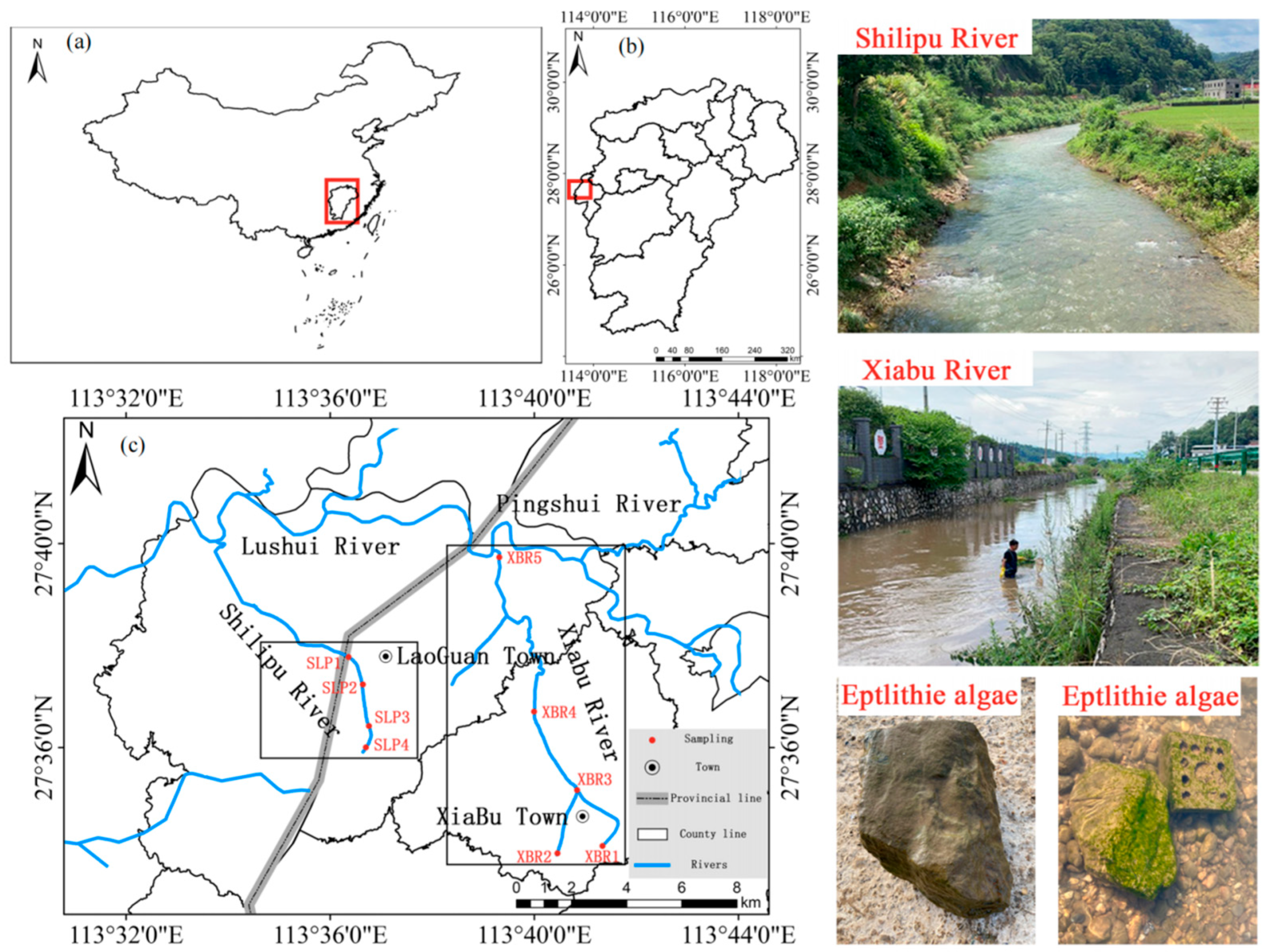
The Shilipu River and Xiabu River are both situated in Xiangdong District, Pingxiang City, Jiangxi Province, belonging to the Xiangjiang River basin within the Dongting Lake system. They serve as important regional tributaries connecting Jiangxi and Hunan provinces. The Shilipu River has a catchment area of 54.5 km2, a total length of 17 km, and an average channel gradient of 2.16‰, and an average channel width of 4.5 m, with relatively gentle flow. The Xiabu River covers a catchment area of 61.7 km2, stretches approximately 23.2 km in total length, and features a main channel longitudinal gradient of 1.52‰ and an average channel width of 3.5 m. Neither of the two rivers has been fully channelized, and both retain partial natural borders. Specifically, the Xiabu River has more than 60% artificial shorelines (mainly composed of concrete revetments constructed for flood control), while the Shilipu River has approximately 50% artificial shorelines and 50% natural shorelines. Both rivers cross the provincial boundary from Jiangxi Province into Liling City, Hunan Province, and ultimately empty into the Xiangjiang River.
According to the Köppen–Geiger climate classification, the watersheds of the two rivers fall under the type Cfa (Subtropical Humid Climate). Therefore, the hydrological regime of the studied rivers is dominated by seasonal precipitation: runoff is concentrated in the rainy season (April to June) due to the influence of the East Asian monsoon, while the dry season (November to February) is marked by relatively low flow; the summer sampling period (June and August 2023) falls in the transition from the rainy to the post-rainy season. The catchment areas of the two rivers are dominated by agricultural land (e.g., paddy fields, drylands) and natural vegetation (forests, shrubs). The main anthropogenic activities in the watersheds are traditional agriculture (e.g., soil-test-based fertilization, solar pest control) and rural domestic life, with no large-scale industrial pollution sources. Therefore, these two rivers are typical small subtropical rural rivers.
As cross-provincial rivers, they have gained joint attention from the Jiangxi and Hunan governments. Recent heavy investment has gone into their ecological restoration. Hydraulic upgrades include new drainage stations, flood gates, dredging and embankment reinforcement, boosting flood control and water quality. Pollution control and ecological enhancement involve constructed wetlands, rural wastewater facilities, sewage pipelines, ecological ditches, soil-test-based fertilization and solar pest control. These multi-dimensional measures support ecological stability in the Lushui and broader Xiangjiang basins.

2.2. Sampling and Analyses

Samples were collected in June and August 2023 from the Shilipu River (4 sampling sites) and Xiabu River (5 sampling sites) located in Xiangdong District, Pingxiang City, Jiangxi Province (Figure 1). Water samples for physicochemical analysis were collected following the methods described by Liu et al. (2024) [25] and Liu et al. (2019) [26]. Briefly, in situ measurements of water temperature (WT), electrical conductivity (EC), and dissolved oxygen (DO) were performed at each sampling location using a YSI ProQuatro (Yellow Springs Instruments, OH, USA). Secchi depth (SD) was assessed with a Secchi disc, while water depth (WD) was measured via a handheld Speedtech Depthmate portable sounder. Furthermore, 1 L composite water samples were gathered from three distinct water layers (surface, middle, and bottom) to analyze chemical indicators, such as total nitrogen (TN), total phosphorus (TP), phosphate (PO43−-P), nitrate (NO3-N), nitrite (NO2-N), and ammonium (NH3-N). These chemical parameters were analyzed in line with the standards set forth by Baird et al. (2017) [27]. For chlorophyll a (Chl a) quantification, 500 mL water samples were filtered through 47 mm GF/F filters (Whatman, Maidstone, Kent, UK). Subsequent to filtration, Chl a was extracted using hot 90% ethanol, and its concentration was determined spectrophotometrically with an Agilent Cary 60 UV-Vis spectrophotometer, following the method described by Lorenzen et al. (1967) [28].
Sediment nutrient samples were collected and analyzed following the method of [29]. Briefly, surface sediment samples (upper ~5 cm) were collected at each station using a Peterson grab for the determination of physical and chemical parameters. Organic matter (OM) content was estimated by loss on ignition at 550 °C for 3 h. For the analysis of total nitrogen (TNsedi) and total phosphorus (TPsedi), approximately 30 mg of dried sediment was subsampled from each sample. Subsequently, 25 mL of distilled water was added, and the samples were subjected to combined persulphate digestion, followed by spectrophotometric determination of phosphate and nitrate using an Agilent Cary 60 UV-Vis (Agilent Technologies, Santa Clara, CA, USA) spectrophotometer [29,30]. Available phosphorus (Avail-P) was determined via sodium bicarbonate extraction [31].
Macroinvertebrate samples were collected according to [29]. Briefly, macroinvertebrate samples were collected with a 0.05 m2 modified Peterson grab, sieved in situ through a 250 μm mesh. Retained materials were transported to the laboratory the same day. Then, samples were sorted on a white tray, and specimens were preserved in 7% buffered formalin. Specimens were identified to species (89%) or genus (11%), counted, blotted dry, and weighed for wet weight with an electronic balance.
Phytoplankton samples were collected following the procedures outlined by Liu et al. (2019) [26]. Briefly, one-liter samples were fixed in situ with 15 mL of Lugol’s iodine solution and allowed to settle for a period of 48 h before analysis under a light microscope (Olympus CX23, Tokyo, Japan). Taxonomic identification was performed based on the methods described by Hu et al. (2006) [32]. The average cell volume was determined using suitable geometric shapes [33]. To estimate biomass, the volume measurements were converted under the assumption that 1 mm3 of volume corresponds to 1 mg of fresh weight biomass [26,34].
Epilithic algal samples were collected following the methodology outlined by Ochieng et al. (2025) [16] and Feng et al. (2025) [35]. We randomly selected five stones that were permanently submerged in water, each with a diameter of at least 10 cm, from a 100 m stretch of the river. To collect the algal biofilms, we brushed the surfaces of the stones (within a 3 cm radius) using a sterile toothbrush, followed by rinsing with distilled water. All resulting subsamples were combined into a single composite sample per site and preserved in Lugol’s solution (colored cognac). Each composite sample was then concentrated to a volume of 30 mL after 48 h of settling in a sedimentation chamber, as per [36]. A 0.1 mL aliquot of each concentrated sample was examined in an algal counting chamber (Yixing Puxi Optical Components Co., Ltd., Yixing, China) under a light microscope (Olympus CX23) at 40× magnification, with taxa identified down to the genus and species levels [32]. The epilithic algal biomass was estimated based on approximate geometric forms of biovolume [33].
To identify the composition of dominant species, the dominance index of epilithic algae was employed, with species meeting the criterion of Y > 0.02 defined as dominant taxa [13]. The specific calculation formula for the dominance index is presented below:
Y = N i / N × f i
For phytoplankton and epilithic algae, Ni refers to the cell number of the ith species, and N refers to the total cell number of all algal species; for benthic macroinvertebrates, Ni refers to the individual number of the ith species, and N refers to the total individual number of all macroinvertebrate species. fi is the frequency of occurrence of the ith species.

2.3. Statistical Analysis

One-way ANOVA was utilized to examine significant differences in the mean values of physicochemical factors between June and August. Redundancy analysis (RDA) was performed to quantify the impacts of abiotic factors (water and sediment physicochemical parameters) and biotic factors (biomass of macroinvertebrates and phytoplankton) on the periphytic algae taxonomic community. The RDA was implemented with the R package vegan, following the methodological protocols outlined by Liu et al. (2024) [25] and Liu et al. (2019) [26].
Initially, variance inflation factors (VIF) were calculated via the envfit function to detect collinearity among abiotic and biotic variables; redundant variables with a VIF > 20 were excluded prior to RDA implementation. Subsequently, the Hellinger transformation was applied to the periphytic algae dataset, while selected environmental variables were standardized by scaling to zero mean and unit variance. Finally, the RDA was conducted using the rda function, and the optimal model was selected through the ordistep function.
The Mantel test was used to analyze the correlation between the periphytic algal community dissimilarity matrix and the environmental distance matrix. Both the community dissimilarity matrix and the environmental distance matrix were calculated using the vegdist function within the vegan package. The community dissimilarity matrices for the epiphytic algae, benthic fauna, and phytoplankton were constructed based on the Bray–Curtis distance algorithm. Conversely, the environmental distance matrices for the water quality indicators and sediment indicators employed the Euclidean distance algorithm. A Mantel correlation coefficient (R > 0) indicates that the degree of difference in the algal community structure among sites increases with increasing environmental distance. When the significance level for the test is less than 0.05 (p < 0.05), the correlation is deemed statistically significant. All statistical analyses were carried out using the R package (v4.4.2).

3. Results

3.1. Environmental Characteristic

The average depth of the Shilipu River and Xiabu River ranges from 0.70 m to 1.20 m; both rivers show a slight decrease from June to August, but neither difference is statistically significant (p > 0.05). Water temperature is stable (Shilipu River ~29.5 °C, Xiabu River 27.36–29.48 °C, typical for summer) and shows no monthly significance in either river. Transparency ranges 0.22–0.38 m, but neither change is significant (p > 0.05). Both rivers have no significant monthly changes in dissolved oxygen (DO) or electrical conductivity (EC). Their average pH decreases significantly (p < 0.05), Shilipu River from 7.83 ± 0.10 (June) to 7.43 ± 0.19 (August), and Xiabu River from 8.32 ± 0.49 (June) to 7.64 ± 0.23 (August). Oxidation-reduction potential (ORP) of both rivers drops very significantly (p < 0.01): Shilipu River from 251.25 ± 20.78 mV (June) to 154.98 ± 18.34 mV (August), Xiabu River from 249.80 ± 12.73 mV (June) to 179.20 ± 9.10 mV (August) (Table 1).
For nitrogen indicators, both rivers have a very significant monthly decrease in NH3-N (p < 0.01), which leads to a significant drop in total nitrogen (TNwat, p < 0.05). Shilipu River’s NH3-N decreases from 0.68 ± 0.05 mg/L in June to 0.46 ± 0.05 mg/L in August, with TNwat falling from 2.19 ± 0.39 mg/L in June to 1.43 ± 0.16 mg/L in August (p < 0.05); Xiabu River’s NH3-N drops from 0.67 ± 0.08 mg/L in June to 0.32 ± 0.07 mg/L in August, and TNwat from 3.50 ± 1.06 mg/L in June to 1.94 ± 0.23 mg/L in August (p < 0.05). Phosphorus levels in both rivers show a decreasing trend, but with different significant indicators: Xiabu River has a significant monthly decrease in TPwat, which from 0.35 ± 0.18 mg/L in June to 0.14 ± 0.03 mg/L in August (p < 0.05), while Shilipu River has a significant monthly decline in PO43−-P from 0.03 ± 0.01 mg/L in June to 0.02 ± 0.00 mg/L in August (p < 0.05) (Table 1).
Regarding sediment composition, TPsedi, TNsedi, and organic matter (OMsedi) in the Shilipu River are generally lower than those in the Xiabu River. Shilipu River’s available phosphorus (Avail-P) decreases from 31.54 ± 13.41 mg/kg in June to 16.51 ± 9.13 mg/kg in August, while Xiabu River’s A-P remains relatively stable. None of the sediment indicators (TNsedi, TPsedi, OMsedi) in either river shows significant monthly changes (all p > 0.05), indicating that sediment composition remains relatively stable (Table 1).

3.2. Phytoplankton and Macroinvertebrates Characteristic

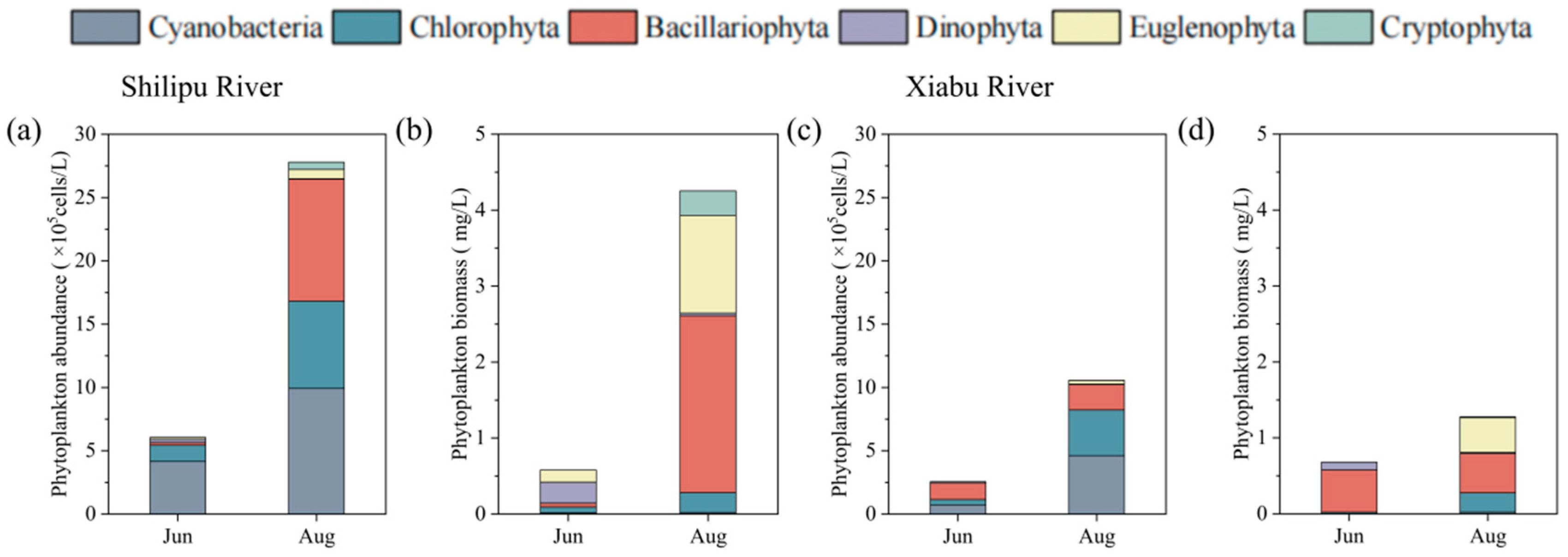
During the investigation, a total of 147 phytoplankton species and genera were identified in the Shilipu River and Xiabu River. The phytoplankton abundance in the Shilipu River ranged from 0.41 × 10⁵ cells/L to 64.02 × 10⁵ cells/L (Figure 2a), and the biomass varied from 0.06 mg/L to 8.1 mg/L (Figure 2b). For the Xiabu River, the phytoplankton abundance was between 2.26 × 10⁵ cells/L and 26.37 × 10⁵ cells/L (Figure 2c), with the biomass ranging from 0.18 mg/L to 3.47 mg/L (Figure 2d). Both rivers were dominated by Cyanobacteria in terms of abundance, while Bacillariophyta had the highest biomass. Additionally, the phytoplankton abundance and biomass in both rivers were significantly higher in August than in June (Figure 2). The dominant phytoplankton species included 11 species, such as Melosira granulata (Ehr.) Ralfs, 1843, Nitzschia palea (Kütz.) W. Smith, 1856, and Oscillatoria sp. Vauch, 1803 (Table 2).
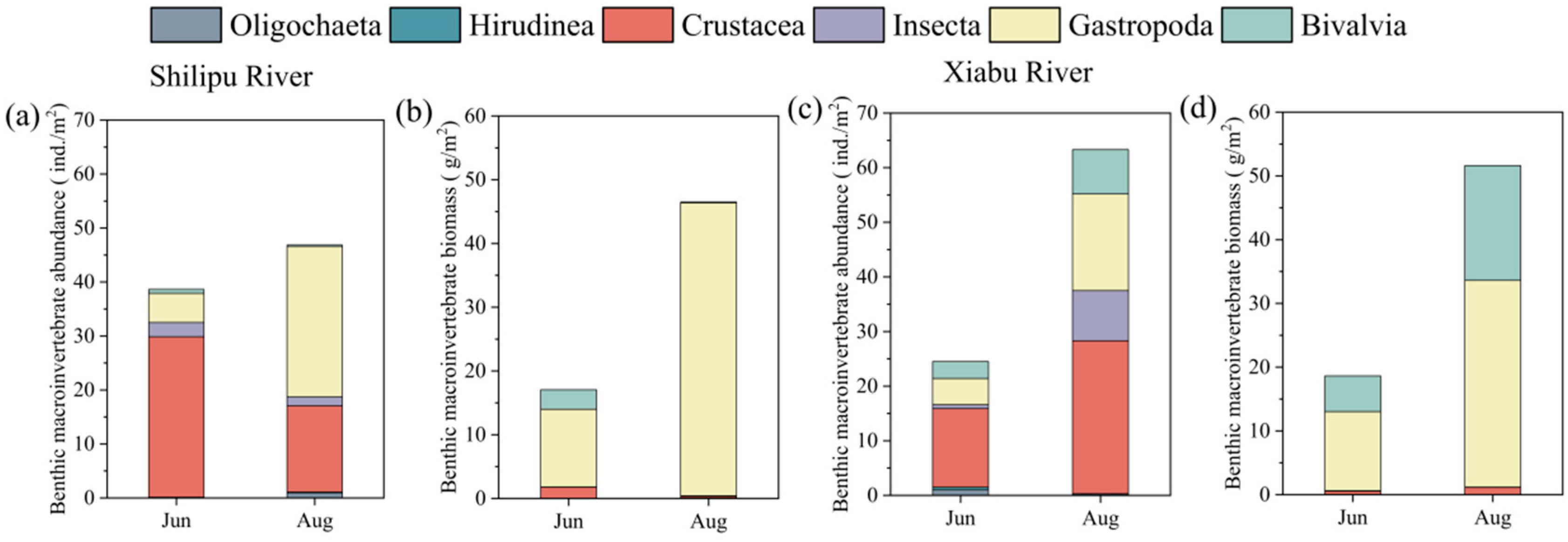
A total of 34 benthic macroinvertebrate species were identified in the two rivers, belonging to six classes. Insecta was the most species-rich class with 17 species, while Crustacea had the highest overall abundance (Figure 3). In the Shilipu River, the abundance of benthic macroinvertebrates ranged from 8 ind./m2 to 83 ind./m2 with a mean of 42.73 ind./m2 (Figure 3a), and the biomass varied from 0.79 g/m2 to 93.26 g/m2 with a mean of 31.78 g/m2 (Figure 3b). For the Xiabu River, the abundance ranged from 6 ind./m2 to 230 ind./m2 (Figure 3c), and the biomass from 1.17 g/m2 to 141.81 g/m2 with a mean of 35.11 g/m2 (Figure 3d). Corbicula fluminea (O. F. Müller, 1774), Caridina sp. H. Milne-Edwards, 1837, Neocaridina denticulata sinensis (Kemp, 1918), and Bellamya aeruginosa (Reeve, 1863) were the dominant benthic species in both rivers (Table 3). Additionally, the abundance and biomass of benthic macroinvertebrates in both rivers were significantly higher in August than in June (Figure 3).

3.3. Epilithic Algae Characteristic

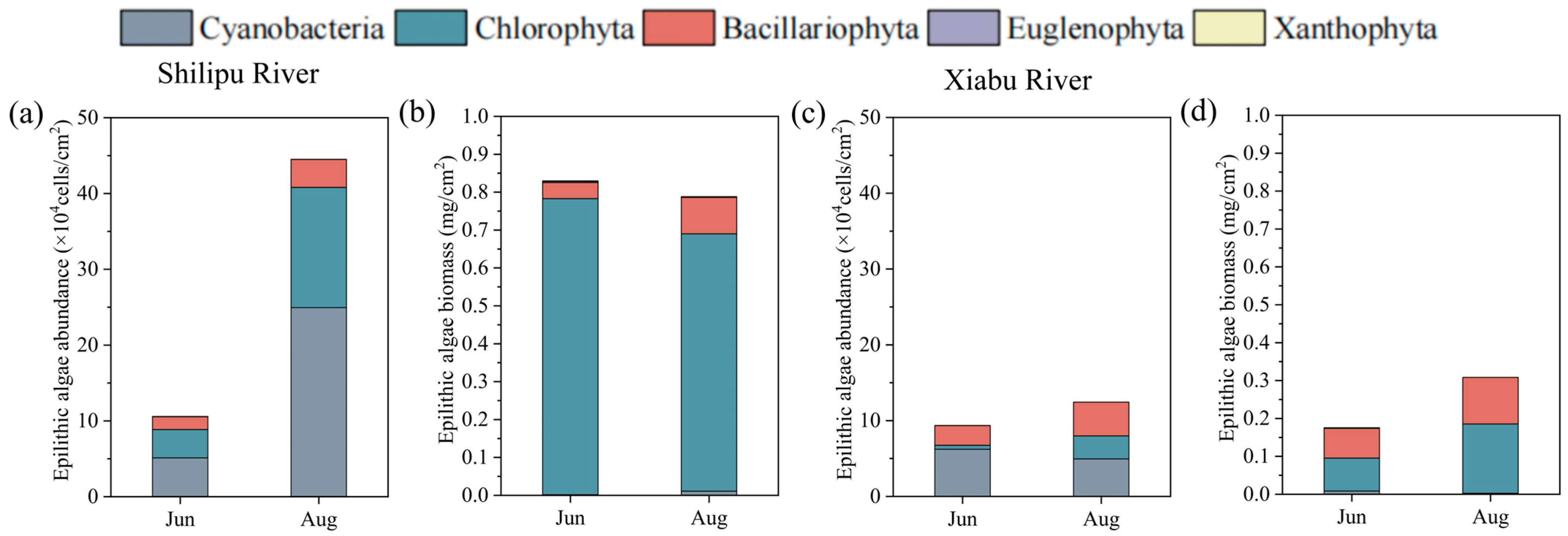
During the investigation, a total of 131 epilithic algae species were identified, belonging to five phyla. Cyanobacteria, Chlorophyta, and Bacillariophyta were the dominant groups, while Euglenophyta and Xanthophyta were only detected at individual sampling sites. The epilithic algae abundance and biomass in the Shilipu River were significantly higher than those in the Xiabu River (Figure 4). In the Shilipu River, the epilithic algae abundance ranged from 5.81 × 10⁴ cells/m2 to 66.75 × 10⁴ cells/m2 with a mean of 20.55 × 10⁴ cells/m2 (Figure 4a). The biomass varied from 0.13 mg/m2 to 1.91 mg/m2 with a mean of 0.81 mg/m2 (Figure 4b). Chlorophyta accounted for an absolute dominance in biomass in both months, with an average biomass of 0.77 mg/m2, representing over 90% of the total biomass. In the Xiabu River, the epilithic algae abundance ranged from 1.09 × 10⁴ cells/m2 to 18.13 × 10⁴ cells/m2 with a mean of 10.89 × 10⁴ cells/m2 (Figure 4c). The biomass varied from 0.01 mg/m2 to 0.63 mg/m2 with a mean of 0.24 mg/m2 (Figure 4d). Cyanobacteria had the highest abundance, accounting for 48.78% of the total abundance, while Chlorophyta had the highest biomass, representing 44.82% of the total biomass. The dominant epilithic algae species included 12 species, such as Phormidium sp. Kützing, 1843, Rivularia sp. C. Agardh, 1824, and Stigeoclonium sp. Kützing, 1843 (Table 4).

3.4. Effect of Environmental Parameters on Epilithic Algae Communities

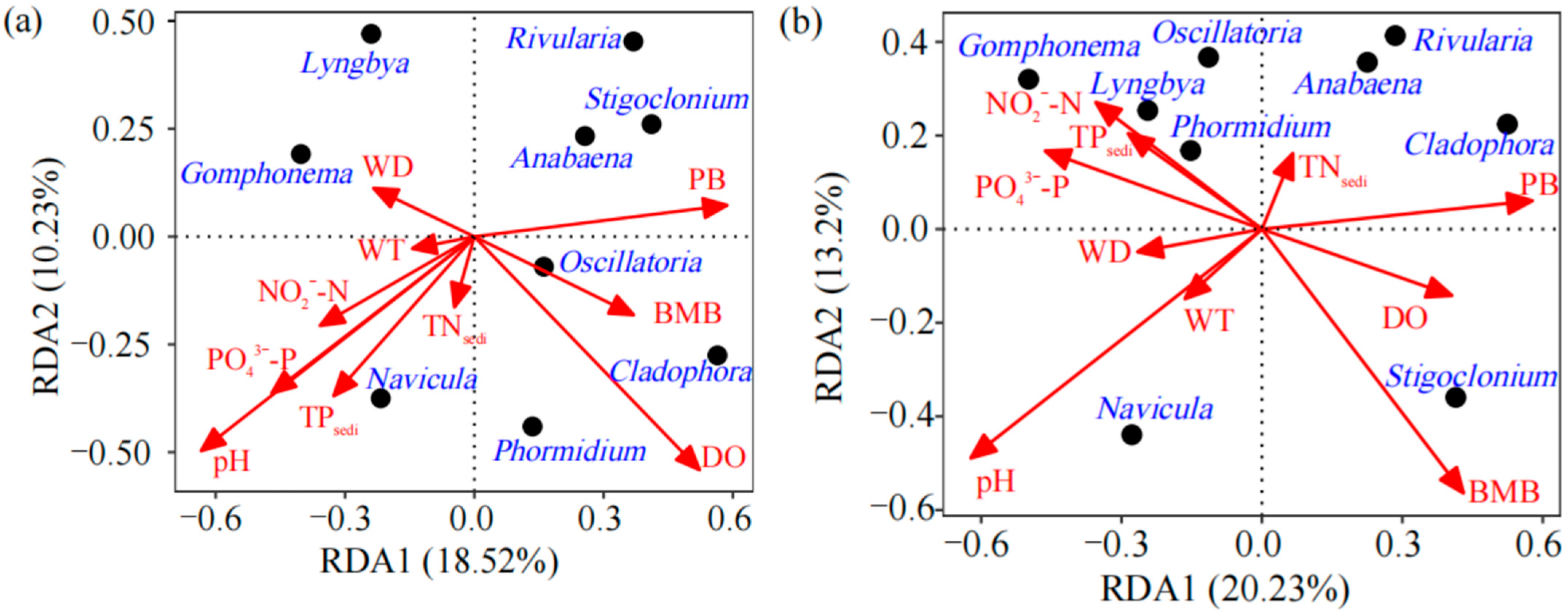
The constrained RDA results reveal a close and significant correlation between the abundance/biomass composition of epilithic algae and environmental parameters (Figure 5). Environmental factors explain 56.76% and 56.99% of the variation in the epilithic algae abundance and biomass communities, respectively (Figure 5). These explanatory variables belong to three categories: water quality, sediment nutrients, and biological groups (phytoplankton, macroinvertebrates). All three categories influence the epilithic algae community, with water quality serving as the core driver. Water quality parameters (e.g., WT, WD, NO3-N, PO43−-P) exhibit the strongest correlations with epilithic algae. In the abundance community (Figure 5a), Lyngbya sp. and Gomphonema sp. show positive associations with WT and WD, while Oscillatoria sp. and Navicula sp. correlate positively with NO3-N and PO43−-P. In the biomass community (Figure 5b), Gomphonema sp. and Lyngbya sp. also link significantly to PO43−-P and NO3-N, Cladophora sp. and Stigeoclonium sp. associate positively with DO, and Nitzschia sp. ties to WT and WD. Sediment nutrients exert taxon-specific effects. In the abundance community, Rivularia sp. and Anabaena sp. correlate positively with sediment TPsedi, and Stigeoclonium sp. links to sediment TNsedi. In the biomass community, Oscillatoria sp. and Phormidium sp. show positive relationships with TNsedi, and Anabaena sp. and Rivularia sp. associate with TPsedi. Biological groups play a secondary role. Phytoplankton biomass correlates positively with Stigeoclonium sp., implying potential competitive or synergistic interactions. Macroinvertebrates’ biomass shows negative correlations with most epilithic algae taxa, likely reflecting grazing pressure.
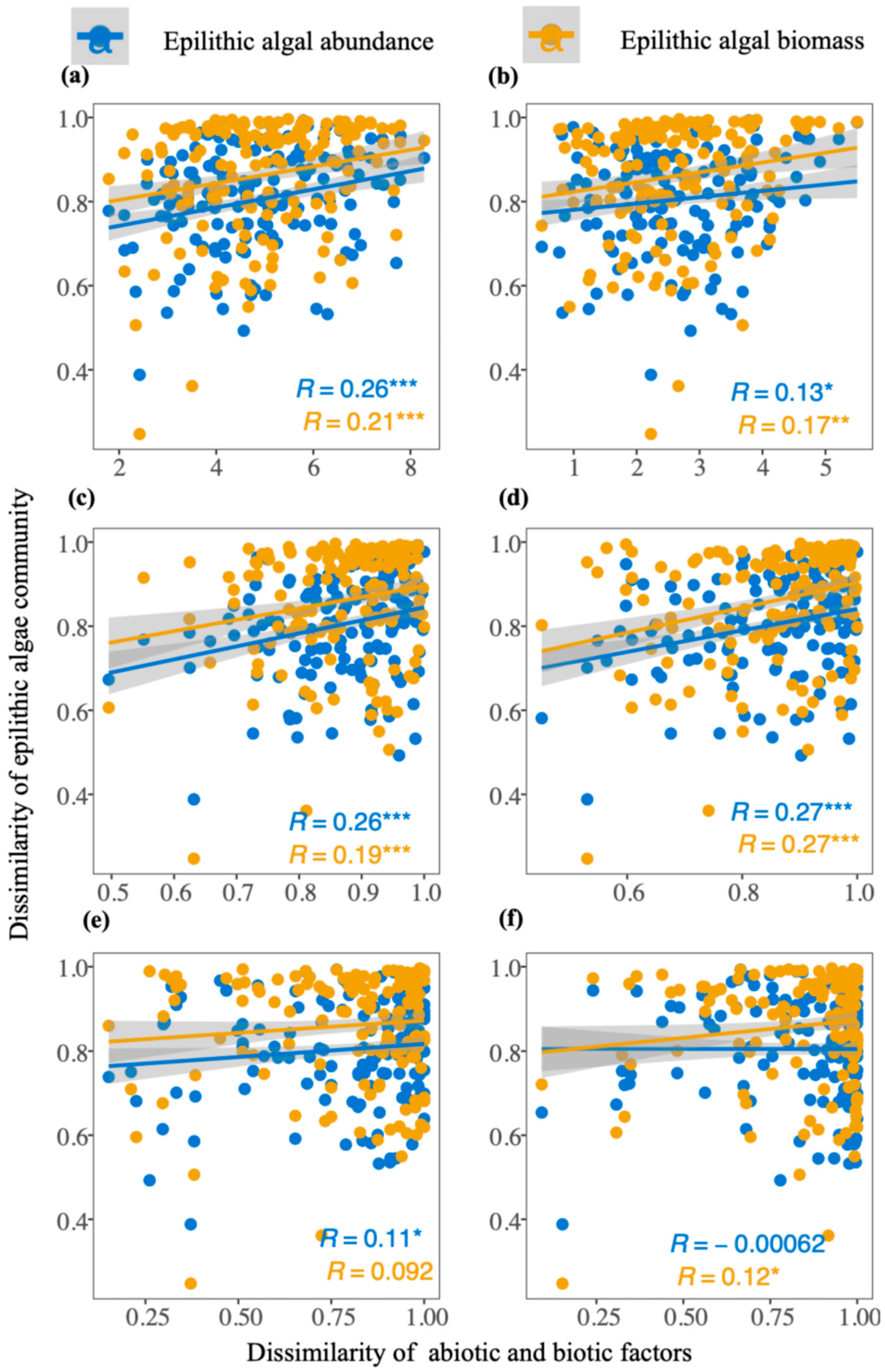
Epiphytic algae exhibit the strongest responsiveness to water physicochemical parameters and phytoplankton biomass, with macroinvertebrate factors exerting only weak or trait-specific effects (Figure 6). Regarding abiotic factors, both epiphytic algal abundance (R = 0.26, p < 0.001) and biomass (R = 0.21, p < 0.001) show high sensitivity to the water environment, displaying strong positive correlations with water physicochemical dissimilarity (Figure 6a). Sediment parameters induce milder, yet still significant, positive responses (abundance: R = 0.13, p < 0.05; biomass: R = 0.17, p < 0.01) (Figure 6b). Among biotic factors, phytoplankton biomass is identified as a key driver, correlating equally strongly with both epiphytic algal abundance and biomass (R = 0.27, p < 0.001) (Figure 6d). This strong coupling is further reflected by the correlation between phytoplankton abundance and epiphytic algal abundance (R = 0.26, p < 0.001) (Figure 6c). Conversely, macroinvertebrates’ effects are limited and metric-dependent: macroinvertebrates’ abundance has minimal effects, showing only a weak correlation with epiphytic algal abundance (R = 0.11, p < 0.05) and no significant effect on epiphytic algal biomass (Figure 6e). In contrast, macroinvertebrate biomass elicits a significant, biomass-specific response in epiphytic algal biomass (R = 0.12, p < 0.05), while having a negligible correlation with epiphytic algal abundance (R = −0.0006, p > 0.05) (Figure 6f).

4. Discussion

Epilithic algae, as key primary producers in river ecosystems, play pivotal roles in material cycling and energy flow, with their community structure dynamically shaped by the combined effects of abiotic and biotic factors [37]. However, the relative importance of water physicochemical parameters, sediment characteristics, phytoplankton competition, and macroinvertebrate grazing in regulating epilithic algae communities remains poorly understood in subtropical rural rivers. The present study systematically explored these relationships in the Shilipu River and Xiabu River, aiming to fill this knowledge gap and provide empirical support for the ecological management of subtropical rural aquatic ecosystems.

4.1. Effects of Water Quality and Sediment on Epilithic Algal Communities

Water physicochemical parameters emerged as the core driving factors regulating the variation in epilithic algal communities [38,39]. Water quality parameters exhibited a highly significant positive correlation with both epilithic algal abundance (R = 0.26, p < 0.001) and biomass (R = 0.21, p < 0.001). As primary producers attached to the substrate surface, their growth and development are entirely dependent on water column resources (nutrients such as nitrogen and phosphorus, and light). Furthermore, lacking the ability for active migration, epilithic algae possess extremely high sensitivity to subtle fluctuations in water environmental parameters. This finding further validates that the stability of the aquatic environment and the availability of resources are key regulatory elements determining the structure and distribution of epilithic communities, and this regulatory effect is more direct and significant, especially for algal groups with high nutritional demands and rapid environmental response.
Epilithic algae are major consumers of essential nutrients like nitrogen and phosphorus in river ecosystems, and the correlation between their community dynamics and nutrient concentrations is universally applicable across climate zones [40]. For instance, the study by Moedt et al. (2025) [20] on Greenland streams confirmed that phosphate concentration and water temperature are the primary environmental factors driving the abundance of autotrophic biofilms, while nitrate concentration directly impacts the total biofilm biomass. This conclusion resonates with the core finding of the present study, further validating the Bottom-Up control effect of water physicochemical indicators (especially nutrients) on epilithic algal communities [41]. Nutrients, by directly providing the material basis required for growth and metabolism, determine the abundance threshold and biomass ceiling of epilithic algae [38,42]. In addition, although water temperature does not directly provide nutrients, it indirectly regulates epilithic algal growth through multiple pathways [38,43]. For instance, a warming manipulation experiment conducted in subarctic regions confirmed that elevated water temperatures contribute to enhanced epilithic algae biomass; this phenomenon is closely associated with the elevated uptake efficiency of dissolved inorganic nitrogen by algae [44]. Water temperature also affects the dissolution and diffusion coefficients of nutrients in the water body [45]; the diffusion rates of phosphate and ammonia-nitrogen significantly increase under high-temperature conditions, indirectly enhancing the algae’s resource acquisition efficiency. This temperature-nutrient synergistic regulation mechanism is particularly prominent in subtropical rivers. A study by Ochieng et al. (2025) [16] focusing on the subtropical Qinhuai River revealed that water temperature and nutrient concentration can significantly and positively predict the taxonomic diversity as well as the functional diversity of epilithic algae.
Furthermore, the two rivers investigated in this study are subtropical rural rivers, which are subject to the superimposed impacts of direct rural domestic sewage discharge and agricultural non-point source pollution. This exposure has resulted in significantly elevated concentrations of nitrogen and phosphorus within the rivers, highlighting prominent eutrophication characteristics [46]. This environmental context is consistent with the findings of [22], who concluded that periphytic biomass is generally higher in rivers significantly impacted by land-use changes. Notably, while the high concentrations of nitrogen and phosphorus did not inhibit algal biomass, they reshaped the community structure through the environmental filtering effect. In this study, the dominant epilithic algal groups were concentrated in highly pollution-tolerant Cyanobacteria (e.g., Oscillatoria sp., Phormidium sp.) and Chlorophyta (e.g., Cladophora sp., Stigeoclonium elongatum), while the nutrient-sensitive Bacillariophyta (diatoms) were only represented by Gomphonema sp. and Navicula sp., forming a typical eutrophic community profile dominated by pollution-tolerant taxa.
As both the attachment substrate and a nutrient repository for epilithic algae, the physicochemical properties of the sediment indirectly influence community structure by modifying microhabitat conditions [47]. Sediment participates in the aquatic nutrient cycle through a release-and-supply process, providing continuous nutritional support for epilithic algae. Nitrogen and phosphorus stored in the sediment can be slowly released into the water body through processes like microbial mineralization and physical desorption, thus replenishing the nutrients consumed by algae in the water column [48]. This sediment-water nutrient exchange process is crucial for maintaining the high biomass of algae in eutrophic rivers. Ochieng et al. (2025) [16] demonstrated that the sediment phosphorus release rate in the Qinhuai River basin is significantly and positively correlated with the resource use efficiency of epilithic algae; that is, the higher the phosphorus release from the sediment, the higher the algal utilization efficiency of waterborne phosphorus. Although the sediment nitrogen and phosphorus contents of the two rivers did not show significant spatiotemporal variation, their continuous release process still provided a stable nutrient subsidy to the water body, indirectly supporting the high biomass of pollution-tolerant algae and serving as an important supplementary mechanism beyond the primary regulation of water physicochemical parameters.
It is noteworthy that the correlation between sediment factors and epilithic algae in this study (abundance R = 0.13, biomass R = 0.17) was significantly lower than that of water physicochemical parameters (abundance R = 0.26, biomass R = 0.21). This difference is intimately related to the unique environmental context of the surveyed area. Both rivers are affected by direct discharge of rural domestic sewage and agricultural non-point source pollution, resulting in high concentrations of nitrogen and phosphorus in both the water column and the sediment. In this scenario, nutrients are no longer the only limiting factor for epilithic algal growth, which consequently weakens the regulatory effect of nutrient release from the sediment. This phenomenon, where high water column nutrient concentrations mask the nutrient effect of the sediment, confirms the environmental threshold effect in ecological regulation.

4.2. Effects of Biotic Factors on Epilithic Algal Communities

The relationship between phytoplankton and epilithic algae exhibits characteristics of both competition and synergy, which is consistent with the plankton-benthos resource allocation theory proposed by Vadeboncoeur et al. (2003) [49] and Wu et al. (2025) [50]. Both phytoplankton and epilithic algae share resources such as light, nitrogen, and phosphorus [51]. The significant increase in phytoplankton biomass during summer intensifies nutrient competition, potentially leading to a decline in the dominance of sensitive epilithic taxa (e.g., narrow-niche diatoms). However, correlation analysis revealed a significant positive correlation (R = 0.27, p < 0.001) between the two, indicating that the synergistic effect was more prominent. This synergy may arise because the mortality and decomposition of phytoplankton release dissolved organic carbon and inorganic nutrients, providing an additional nutritional subsidy for epilithic algae. This cooperative effect is often more pronounced in nutrient-poor areas, such as the Greater Khingan Mountains [13]. In the present study, both surveyed rivers are in rural areas, and due to the nutrient input from rural sewage and agricultural runoff, water column nutrient levels are high. Furthermore, the rivers investigated are shallow, ensuring relatively sufficient light. Under these conditions of non-limiting nutrients and light, both phytoplankton and epilithic algae received abundant growth resources, consequently exhibiting synchronized high biomass [39]. This strongly supports the conclusion that in shallow river ecosystems with ample nutrients and light, the combined control effect of abiotic factors on both epilithic algae and phytoplankton communities is far stronger than the biotic interactions between them.
The influence of benthic macroinvertebrates on epilithic algae manifests as biomass-dependent regulation, rather than simple density-dependent constraint. The study found a significant correlation between macroinvertebrate biomass and epilithic algal biomass, while the density correlation was weaker. The primary reason for the limited impact of macroinvertebrates on epilithic algae is that the high growth rate of the algae during summer compensates for the grazing pressure. Although both the abundance and biomass of macroinvertebrates showed a significant increasing trend between June and August, their grazing pressure was completely offset by the high productivity of the epilithic algae. The high concentration of nutrients in the study area provided an abundant nutrients and light for epilithic algae, significantly boosting their growth rate [40]. This high growth rate enabled the algae to rapidly compensate for biomass loss from grazing, thus maintaining stable total biomass or even achieving net growth via continuous proliferation. This mechanism, where high productivity offsets grazing pressure, further weakens the regulatory role of macroinvertebrates on epilithic algae, ultimately manifesting at the macro scale as a weak positive correlation between their biomasses, rather than the negative correlation typical of a classic predator-prey relationship.

5. Conclusions

This study investigated the environmental and biological communities of subtropical rural rivers (Shilipu River and Xiabu River) during summer (June to August) to clarify the driving factors and regulatory mechanisms of epilithic algal communities. Significant spatiotemporal differentiation in the summer environment and biota was found. Water column parameters, including pH, ORP, NH3-N, TNwat, and phosphorus indicators, showed a significant monthly decreasing trend (p < 0.05), while physical parameters (water depth, temperature, etc.) showed no significant change (p > 0.05). Epilithic algal communities exhibited significant monthly differences, with both biomass and abundance being significantly higher in August than in June. Epilithic algal communities were regulated by multi-factor synergy, with water physicochemical parameters and phytoplankton biomass as key drivers, while sediment factors exerted milder effects, and macroinvertebrates’ impacts were weak. The input of relatively high levels of external nitrogen and phosphorus nutrients weakened the competitive effect of phytoplankton and the grazing pressure from benthic macroinvertebrates.

Author Contributions

Conceptualization, J.L. and L.L.; Formal analysis, J.L., J.Z., S.Z. and G.L.; Funding acquisition, W.L. and L.L.; Investigation, J.L., Z.X. and Y.H.; Methodology, W.L.; Software, Z.X. and S.Z.; Supervision, Y.C. and L.L.; Visualization, J.Z., X.C. and M.X.; Writing—original draft, J.L.; Writing—review and editing, Y.C. All authors have read and agreed to the published version of the manuscript.

Funding

This work was supported by National University Student Innovation and Entrepreneurship Training Program Supported Project of Nanchang Institute of Technology (No. 202211319002), The Research Startup Fund from Jiangxi University of Water Resources and Electric Power (No. 0101-01000576), Jiangxi Province 2025 Postgraduate Innovation Special Fund Project (No. YC2025-S791) and National Natural Science Foundation of China (No. 52260026).

Data Availability Statement

The raw data supporting the conclusions of this article will be made available by the authors on request.

Acknowledgments

The authors wish to thank Leping Wen, Shaofei Wu and Shengming Hu from Jiangxi University of Water Resources and Electric Power, for their assistance in sample collection.

Conflicts of Interest

The authors declare no conflicts of interest.

References

  1. Thorp, J.H.; Thoms, M.C.; Delong, M.D. The riverine ecosystem synthesis: Biocomplexity in river networks across space and time. River Res. Appl. 2006, 22, 123–147. [Google Scholar] [CrossRef]
  2. Rodeles, A.A.; Peñas, F.J.; Arroita, M.; Barquín, J. Predicting river ecosystem metabolism across large environmental gradients: Drivers and temporal dependencies in the Iberian Peninsula. Limnol. Oceanogr. 2025, 70, 1152–1166. [Google Scholar] [CrossRef]
  3. Battin, T.J.; Lauerwald, R.; Bernhardt, E.S.; Bertuzzo, E.; Gener, L.G.; Hall, R.O.; Hotchkiss, E.R.; Maavara, T.; Pavelsky, T.M.; Ran, L.; et al. River ecosystem metabolism and carbon biogeochemistry in a changing world. Nature 2023, 613, 449–459. [Google Scholar] [CrossRef] [PubMed]
  4. Talluto, L.; del Campo, R.; Estévez, E.; Altermatt, F.; Datry, T.; Singer, G. Towards (better) fluvial meta-ecosystem ecology: A research perspective. npj Biodiversity 2024, 3, 3. [Google Scholar] [CrossRef]
  5. Zhao, H.; Jiang, Y.; Xiao, Q.; Zhang, C.; Behzad, H.M. Coupled Carbon-Nitrogen Cycling Controls the Transformation of Dissolved Inorganic Carbon into Dissolved Organic Carbon in Karst Aquatic Systems. J. Hydrol. 2021, 592, 125764. [Google Scholar] [CrossRef]
  6. Bonacina, L.; Fornaroli, R.; Mezzanotte, V.; Marazzi, F. Temporal patterns of stream biofilm in a mountain catchment: One-year monthly samplings across streams of the Orobic Alps (Northern Italy). Hydrobiologia 2024, 851, 2081–2097. [Google Scholar] [CrossRef]
  7. Battin, T.J.; Besemer, K.; Bengtsson, M.M.; Romani, A.M.; Packmann, A.I. The Ecology and Biogeochemistry of Stream Biofilms. Nat. Rev. Microbiol. 2016, 14, 251–263. [Google Scholar] [CrossRef]
  8. Pearce, N.J.T.; Parsons, C.T.; Pomfret, S.M.; Yates, A.G. Periphyton Phosphorus Uptake in Response to Dynamic Concentrations in Streams: Assimilation and Changes to Intracellular Speciation. Environ. Sci. Technol. 2023, 57, 4643–4655. [Google Scholar] [CrossRef]
  9. Yi, Z.; Yang, Y.; Yan, C.; Pei, G. The Influence of Periphyton Biofilm on Phosphorus Migration in Sediments. Int. J. Envion. Res. 2019, 13, 327–335. [Google Scholar] [CrossRef]
  10. Sun, R.; Xu, Y.; Wu, Y.; Tang, J.; Esquivel-Elizondo, S.; Kerr, P.G.; Staddon, P.L.; Liu, J. Functional Sustainability of Nutrient Accumulation by Periphytic Biofilm under Temperature Fluctuations. Envion. Technol. 2021, 42, 1145–1154. [Google Scholar] [CrossRef]
  11. Zhong, W.; Zhao, W.; Song, J. Responses of Periphyton Microbial Growth, Activity, and Pollutant Removal Efficiency to Cu Exposure. IJERPH 2020, 17, 941. [Google Scholar] [CrossRef]
  12. Zhao, K.; Yang, J.; Lv, J.; Liu, Q.; Liu, X.; Xie, S.; Feng, J. Structural Characteristics of Periphytic Algal Community and Its Relationship with Environmental Factors in the Taiyuan Region of the Fenhe River. Water 2022, 14, 2151. [Google Scholar] [CrossRef]
  13. Wei, W.; Lv, H.; Li, C.; Guo, H.; Ye, C.; Wang, Y.; Hu, N. Distribution Characteristics of Epiphytic Algal Communities in the Third Largest River in China. Water 2025, 17, 2508. [Google Scholar] [CrossRef]
  14. Lanza, W.G.; Hernández, V.C.; Achá, D.; Lazzaro, X. Responses of Phytoplankton and Periphyton Community Structure to an Anthropic Eutrophication Gradient in Tropical High-Altitude Lake Titicaca. J. Great Lakes Res. 2024, 50, 102294. [Google Scholar] [CrossRef]
  15. Khapare, P.; Lokhande, S.; Andhale, S. Epiphytic Algal Flora on Aquatic Macrophytes of the Godavari River System Diversity Interactions and Environmental Influences. Discov. Plants 2025, 2, 337. [Google Scholar] [CrossRef]
  16. Ochieng, B.; Chen, M.; András, A.; Bai, S.; Cui, Y.; Liu, J.; Zhang, P.; Hu, J.; Zhou, S.; Wang, J. Functional and Taxonomic Diversity Is Associated With Resource Use Efficiency in Epilithic Algae of Subtropical Qinhuai River, China. Freshw. Biol. 2025, 70, e70029. [Google Scholar] [CrossRef]
  17. Huang, W.; Liu, X.; Peng, W.; Wu, L.; Yano, S.; Zhang, J.; Zhao, F. Periphyton and Ecosystem Metabolism as Indicators of River Ecosystem Response to Environmental Flow Restoration in a Flow-Reduced River. Ecol. Indic. 2018, 92, 394–401. [Google Scholar] [CrossRef]
  18. Yong-Jae, K. Temporal and Spatial Dynamics of an Epilithic Algal Community in the Hantan River. ALGAE 2004, 19, 15–22. [Google Scholar] [CrossRef]
  19. Kuo, Y.-M.; Yu, H.-L.; Kuan, W.-H.; Kuo, M.-H.; Lin, H.-J. Factors Controlling Changes in Epilithic Algal Biomass in the Mountain Streams of Subtropical Taiwan. PLoS ONE 2016, 11, e0166604. [Google Scholar] [CrossRef]
  20. Moedt, S.M.; Christoffersen, K.S.; Westergaard-Nielsen, A.; Martinsen, K.T.; Pastor, A.; Korsgaard, N.J.; Riis, T. Drivers of Epilithic Biofilms in Greenland Streams: The Role of Nutrients, Temperature and Catchment Slope Across a Climate Gradient. Envion. Microbiol. Rep. 2025, 17, e70074. [Google Scholar] [CrossRef] [PubMed]
  21. Wang, J.; Hu, J.; Tang, T.; Heino, J.; Jiang, X.; Li, Z.; Xie, Z. Seasonal Shifts in the Assembly Dynamics of Benthic Macroinvertebrate and Diatom Communities in a Subtropical River. Ecol. Evol. 2020, 10, 692–704. [Google Scholar] [CrossRef]
  22. De Araújo, S.D.E.; Von Rückert, G.; Figueredo, C.C. Epilithic Diatom Communities as Efficient Bioindicators for Evaluating Land Use Impacts on a Tropical Watershed. Limnology 2025, 5, 755–772. [Google Scholar] [CrossRef]
  23. He, F.; Zarfl, C.; Tockner, K.; Olden, J.D.; Campos, Z.; Muniz, F.; Svenning, J.-C.; Jähnig, S.C. Hydropower Impacts on Riverine Biodiversity. Nat. Rev. Earth Envion. 2024, 5, 755–772. [Google Scholar] [CrossRef]
  24. Yang, S.; Bertuzzo, E.; Büttner, O.; Borchardt, D.; Rao, P.S.C. Emergent Spatial Patterns of Competing Benthic and Pelagic Algae in a River Network: A Parsimonious Basin-Scale Modeling Analysis. Water Res. 2021, 193, 116887. [Google Scholar] [CrossRef] [PubMed]
  25. Liu, J.; Zou, H.; Deng, F.; Liu, Y.; Li, W.; Xu, J.; Liu, S.; Wu, Q.; Zhang, X.; Weng, F.; et al. Phytoplankton Functional Groups in Poyang Lake: Succession and Driving Factors. J. Ocean. Limnol. 2024, 42, 1764–1776. [Google Scholar] [CrossRef]
  26. Liu, J.; Chen, Y.; Li, M.; Liu, B.; Liu, X.; Wu, Z.; Cai, Y.; Xu, J.; Wang, J. Water-Level Fluctuations Are Key for Phytoplankton Taxonomic Communities and Functional Groups in Poyang Lake. Ecol. Indic. 2019, 104, 470–478. [Google Scholar] [CrossRef]
  27. Baird, R.B.; Eaton, A.D.; Rice, E.W. Standard Methods for the Examination of Water and Wastewater, 23th ed.; American Public Health Association, American Water Works Association, Water Environment Federation, Eds.; American Public Health Association: Washington, DC, USA, 2017; ISBN 978-0-87553-287-5. [Google Scholar]
  28. Lorenzen, C.J. Determination of Chlorophyll and Pheo-Pigments: Spectrophotometric Equations. Limnol. Oceanogr. 1967, 12, 343–346. [Google Scholar] [CrossRef]
  29. Cai, Y.; Xu, H.; Vilmi, A.; Tolonen, K.T.; Tang, X.; Qin, B.; Gong, Z.; Heino, J. Relative Roles of Spatial Processes, Natural Factors and Anthropogenic Stressors in Structuring a Lake Macroinvertebrate Metacommunity. Sci. Total Environ. 2017, 601–602, 1702–1711. [Google Scholar] [CrossRef]
  30. Ebina, J. Simultaneous Determination of Total Nitrogen and Total Phosphorus in Water Using Peroxodisulfate Oxidation. Water Res. 1983, 17, 1721–1726. [Google Scholar] [CrossRef]
  31. Zhu, Y.; Li, W.; Ahmed, W.; Mahmood, M.; Ali, H.M.; Rizwan, M.; Bundschuh, J.; Akmal, M.; Mehmood, S. Study on Application of Green-Synthesized ZnO and Si Nanoparticles in Enhancing Aquaculture Sediment Quality. Chem. Biol. Technol. Agric. 2025, 12, 6. [Google Scholar] [CrossRef]
  32. Hu, H.; Wei, Y. The Freshwater Algae of China: Systematics, Taxonomy and Ecology; Science Press: Beijing, China, 2006; ISBN 7-03-016633-7. [Google Scholar]
  33. Hillebrand, H.; Dürselen, C.; Kirschtel, D.; Pollingher, U.; Zohary, T. Biovolume Calculation for Pelagic and Benthic Microalgae. J. Phycol. 1999, 35, 403–424. [Google Scholar] [CrossRef]
  34. Chen, Y.; Qin, B.; Katrin, T.; Martin, T. Dokulil Long-Term Dynamics of Phytoplankton Assemblages: Microcystis-Domination in Lake Taihu, a Large Shallow Lake in China. J. Plankton Res. 2003, 25, 445–453. [Google Scholar] [CrossRef]
  35. Feng, X.; He, K.; Chen, C.; Han, Y.; He, Y.; Chen, X.; Yan, L.; Xu, Y. Unraveling the complex dynamics of benthic algae in the Red River Basin: A comparative study. Ecol. Inform. 2025, 88, 103128. [Google Scholar] [CrossRef]
  36. Utermöhl, H. Zur Vervollkommnung der quantitativen Phytoplankton-Methodik: Mit 1 Tabelle und 15 abbildungen im Text und auf 1 Tafel. SIL Commun. 1953-1996 1958, 9, 1–38. [Google Scholar] [CrossRef]
  37. Vadeboncoeur, Y.; Power, M.E. Attached Algae: The Cryptic Base of Inverted Trophic Pyramids in Freshwaters. Annu. Rev. Ecol. Evol. Syst. 2017, 48, 255–279. [Google Scholar] [CrossRef]
  38. Moedt, S.M.; Riis, T.; Jacobsen, D.; Geertz-Hansen, O.; Martinsen, K.T.; Christoffersen, K.S. Environmental Controls of Autotrophic Biofilm Biomass and Community Composition in Subarctic Lakes and Streams in Greenland. Limnol. Oceanogr. 2025, 70, 2941–2956. [Google Scholar] [CrossRef]
  39. Zhang, J.; Shu, X.; Zhang, Y.; Tan, X.; Zhang, Q. The Responses of Epilithic Algal Community Structure and Function to Light and Nutrients and Their Linkages in Subtropical Rivers. Hydrobiologia 2020, 847, 841–855. [Google Scholar] [CrossRef]
  40. Feijoó, C.; Vilches, C.; Ferreiro, N.; Sabater, S.; Giorgi, A. Nutrient Addition Increases Benthic Biofilm Respiration in a Nutrient-Rich Pampean Stream. Hydrobiologia 2025, 1–14. [Google Scholar] [CrossRef]
  41. Huttunen, K.-L.; Koskinen, E.; Erkinaro, A.; Muotka, T.; Marttila, H.; Mustonen, K.-R. The Key Role of Nitrogen in Boosting Algal Growth in Arctic Rivers. Arct. Sci. 2025, 11, 1–11. [Google Scholar] [CrossRef]
  42. Pineda-Morante, D.; Argudo, M.; Romaní, A.M.; Guasch, H.; Martí, E. Light–Dark Conditions Drive Variability in Phosphorus and Ammonium Uptake by Epilithic Biofilms along the Main Stem of a Mediterranean River. Limnol. Oceanogr. 2025, 70, 2431–2446. [Google Scholar] [CrossRef]
  43. Madsusan, A.; Krainara, S.; Suksong, W.; Sudchoo, K.; Tohmoh, N.; Jonggrijug, P.; Maipunklang, C.; Chadaram, C.; Samaeng, K.; Kurdthongmee, P.; et al. Impact of a Tropical Monsoon Climate on Formaldehyde Exposure and Microbial Contamination in Anatomy Dissection Hall. PLoS ONE 2025, 20, e0337238. [Google Scholar] [CrossRef] [PubMed]
  44. Hood, J.M.; Benstead, J.P.; Cross, W.F.; Huryn, A.D.; Johnson, P.W.; Gíslason, G.M.; Junker, J.R.; Nelson, D.; Ólafsson, J.S.; Tran, C. Increased Resource Use Efficiency Amplifies Positive Response of Aquatic Primary Production to Experimental Warming. Glob. Change Biol. 2018, 24, 1069–1084. [Google Scholar] [CrossRef]
  45. Zhou, X.; Chen, N.; Yan, Z.; Duan, S. Warming Increases Nutrient Mobilization and Gaseous Nitrogen Removal from Sediments across Cascade Reservoirs. Environ. Pollut. 2016, 219, 490–500. [Google Scholar] [CrossRef] [PubMed]
  46. Li, H.; Yan, X.; Wang, J.; Xie, H.; Xia, L.; Ti, C.; Xie, Y. Assessment of Nitrogen and Phosphorus Contributions from Different Agricultural Non-Point Sources to Waterbody in Watershed. Agric. Water Manag. 2025, 317, 109655. [Google Scholar] [CrossRef]
  47. Nunes, M.; Adams, J.B.; Lemley, D.A. Characterising Benthic Diatom Community Responses to Abiotic Variability in a Tropical Ramsar Estuarine Lake. Wetl. Ecol. Manag. 2025, 33, 37. [Google Scholar] [CrossRef]
  48. Wu, R.; Shi, X.; Kang, X.; Zhang, S.; Zhao, S.; Liu, Y.; Sun, B.; Lu, J.; Yu, H.; Wang, S.; et al. Characteristics of Nitrogen and Phosphorus Migration at Sediment-Water Interface in Seasonal Frozen Lakes and the Mechanism of Microbial Driven Cycling: A Case Study of Lake Daihai. J. Contam. Hydrol. 2025, 273, 104598. [Google Scholar] [CrossRef]
  49. Vadeboncoeur, Y.; Jeppesen, E.; Zanden, M.J.V.; Schierup, H.; Christoffersen, K.; Lodge, D.M. From Greenland to Green Lakes: Cultural Eutrophication and the Loss of Benthic Pathways in Lakes. Limnol. Oceanogr. 2003, 48, 1408–1418. [Google Scholar] [CrossRef]
  50. Wu, H.; You, Y.; Xue, L.; Hao, B. Algal Coexistence Created Jointly by Neutral Competitor and Asymmetrical Competitors in Shallow Aquatic Ecosystems. Ecol. Indic. 2025, 173, 113447. [Google Scholar] [CrossRef]
  51. He, H.; Luo, X.; Jin, H.; Gu, J.; Jeppesen, E.; Liu, Z.; Li, K. Effects of Exposed Artificial Substrate on the Competition between Phytoplankton and Benthic Algae: Implications for Shallow Lake Restoration. Water 2017, 9, 24. [Google Scholar] [CrossRef]
Figure 1. Location of the study area. (a) Jiangxi Province in China (red box), (b) Shilipu River and Xiabu River in Jiangxi (red box), and (c) sampling stations in the two rivers.
Water 18 00126 g001
Figure 2. Monthly variation of phytoplankton abundance (a,c) and biomass (b,d) in Shilipu River (a,b) and Xiabu River (c,d).
Water 18 00126 g002
Figure 3. Monthly variation of benthic macroinvertebrates abundance (a,c) and biomass (b,d) in Shilipu River (a,b) and Xiabu River (c,d).
Water 18 00126 g003
Figure 4. Monthly variation of epilithic algae abundance (a,c) and biomass (b,d) in Shilipu River (a,b) and Xiabu River (c,d).
Water 18 00126 g004
Figure 5. Redundancy analysis of abiotic and biotic variables and epilithic algae abundance (a) or biomass (b). Solid lines with arrowheads represent environmental variables, while black dots represent epilithic algae abundance (a) and biomass (b), respectively. The percentages of the total variance explained are shown in brackets. PB: phytoplankton biomass; BMB: Benthic macroinvertebrate biomass.
Water 18 00126 g005
Figure 6. Response patterns of epiphytic algae abundance (blue) and biomass (orange) to abiotic and biotic distances. (a) water physicochemical parameters, (b) sediment physicochemical parameters, (c) phytoplankton abundance, (d) phytoplankton biomass, (e) macroinvertebrates abundance, (f) macroinvertebrates biomass. *, **, and *** indicate significant differences at the 0.05, 0.01, and 0.001 levels, respectively.
Water 18 00126 g006
Table 1. Water and sediment physicochemical properties in the Shilipu River and Xiabu River.
Shilipu RiverXiabu River
JuneAugustp-ValueJuneAugustp-Value
Depth (m)1.05 ± 0.730.7 ± 0.3080.4731.2 ± 0.8580.82 ± 0.8570.548
Transparency (m)0.3 ± 0.1220.375 ± 0.0830.4140.22 ± 0.1170.38 ± 0.1720.162
Temperature (°C)29.55 ± 0.72629.5 ± 0.4950.92529.48 ± 2.93227.36 ± 1.4090.229
pH7.825 ± 0.1017.428 ± 0.1940.028.318 ± 0.4917.642 ± 0.2250.037
DO (mg/L)2.79 ± 0.5874.173 ± 1.0670.0973.734 ± 0.5284.456 ± 0.7290.147
EC (µS/cm)336.95 ± 29.931360.7 ± 124.8840.76339.1 ± 85.465498.56 ± 178.260.145
ORP (mV)251.25 ± 20.777154.975 ± 18.340.001249.8 ± 12.734179.2 ± 9.1020.001
NO3-N (mg/L)1.26 ± 0.3960.869 ± 0.1530.1611.696 ± 0.4451.462 ± 0.2820.401
NO2-N (mg/L)0.022 ± 0.010.013 ± 0.0110.3150.104 ± 0.0560.064 ± 0.0210.223
NH3-N (mg/L)0.68 ± 0.0520.461 ± 0.0540.0020.673 ± 0.0750.324 ± 0.0730.001
TNwat (mg/L)2.193 ± 0.3921.432 ± 0.1550.023.496 ± 1.0621.944 ± 0.2270.021
TPwat (mg/L)0.153 ± 0.0230.108 ± 0.0320.0950.353 ± 0.1810.14 ± 0.0320.049
PO43-P (mg/L)0.034 ± 0.0110.015 ± 0.0040.0320.053 ± 0.0270.049 ± 0.020.791
TNsedi (g/kg)1.741 ± 0.3512.162 ± 0.7650.422.836 ± 1.1882.042 ± 1.0030.37
TPsedi (g/kg)0.333 ± 0.1120.312 ± 0.1590.8590.466 ± 0.1440.495 ± 0.0560.725
Avail-P (mg/kg)31.544 ± 13.40716.505 ± 9.1270.15925.694 ± 12.24827.566 ± 6.3830.802
OM (%)0.045 ± 0.0180.028 ± 0.0110.20.085 ± 0.0110.06 ± 0.0250.149
Note: Significant differences in the factors are indicated by boldface p-values, where p < 0.05 denotes a significant difference and p < 0.01 denotes a highly significant difference.
Table 2. Dominant species and dominance degree of phytoplankton in the Shilipu River and Xiabu River.
Dominant Species (Y > 0.02)PhylumJuneAugust
Oscillatoria sp. Vauch, 1803Cyanobacteria 0.02
Nitzschia palea (Kütz.) W. Smith, 1856Bacillariophyta 0.03
Melosira granulata (Ehr.) Ralfs, 1843Bacillariophyta0.03 0.04
Nitzschia sp. Hassall, 1845Bacillariophyta 0.06
Oscillatoria chlorina Kütz., 1843Cyanobacteria0.05
Peridiniopsis sp. Ehrenberg, 1830 Dinophyta0.02
Scenedesmus quadricauda (Turp.) de Bréb, 1838Chlorophyta 0.09
Microcystis sp. Kützing, 1833Cyanobacteria 0.04
Cyclotella sp. Kützing, 1833Bacillariophyta0.05
Aphanocapsa sp. Nägeli, 1949Cyanobacteria 0.03
Scenedesmus sp. Meyen, 1829Chlorophyta 0.03
Table 3. Dominant species and dominance degree of Benthic macroinvertebrates in Shilipu River and Xiabu River.
Dominant Species (Y > 0.02)ClassJuneAugust
Corbicula fluminea (O. F. Müller, 1774)Bivalvia0.04 0.06
Caridina sp. H. Milne-Edwards, 1837Malacostraca0.19 0.36
Bellamya aeruginosa (Reeve, 1863)Gastropoda0.11 0.28
Neocaridina denticulata sinensis (Kemp, 1918)Malacostraca0.14
Table 4. Dominant species and dominance degree of epilithic algae in Shilipu River and Xiabu River.
Dominant Species (Y > 0.02)PhylumJuneAugust
Oscillatoria sp. Vauch, 1803Cyanobacteria0.03 0.06
Cladophora sp. Kützing 1843Cyanobacteria 0.08
Pseudanabaena sp. Lauterborn, 1915Cyanobacteria0.03
Rivularia sp. C. Agardh, 1824Cyanobacteria 0.11
Stigeoclonium sp. Kützing, 1843Cyanobacteria 0.10
Oscillatoria limosa C. Agardh, 1824Cyanobacteria 0.03
Lyngbya sp. C. Agardh, 1824Cyanobacteria0.13 0.03
Phormidium sp. Kützing, 1843Chlorophyta0.04 0.03
Gomphonema sp. C. Agardh, 1824Chlorophyta0.12 0.04
Anabaena sp. Bory de Saint-Vincent, 1822Chlorophyta 0.05
Navicula sp. Bory de Saint-Vincent, 1822Bacillariophyta 0.05
Cladophora crispata (Roth) Kützing, 1843Bacillariophyta0.06
Disclaimer/Publisher’s Note: The statements, opinions and data contained in all publications are solely those of the individual author(s) and contributor(s) and not of MDPI and/or the editor(s). MDPI and/or the editor(s) disclaim responsibility for any injury to people or property resulting from any ideas, methods, instructions or products referred to in the content.