Review

A State-of-the-Art Review of Microalgae-Based Food Processing Wastewater Treatment: Progress, Problems, and Prospects

School of Grain Science and Technology, Jiangsu University of Science and Technology, Zhenjiang 212100, China
Water 2025, 17(4), 536; https://doi.org/10.3390/w17040536
Submission received: 12 December 2024 / Revised: 13 January 2025 / Accepted: 26 January 2025 / Published: 13 February 2025
(This article belongs to the Special Issue Wastewater Treatment and Reuse Advances Review)

Abstract

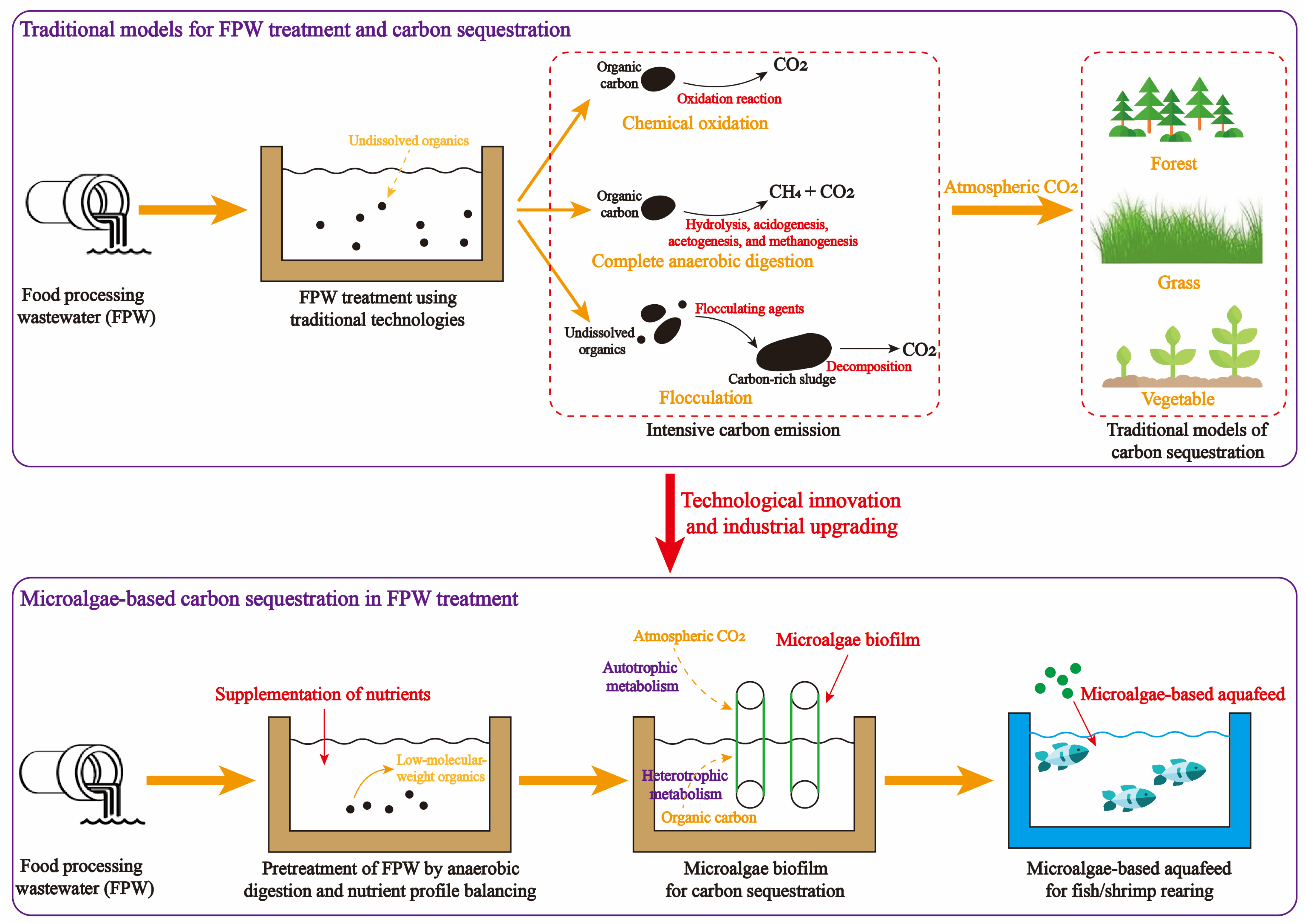
Environmental problems caused by the intensive carbon emissions from food processing wastewater (FPW) treatment using traditional technologies are promoting innovations in carbon sequestration. In traditional models, plant-based carbon sequestration is challenged by low carbon fixation rates and low profitability. Microalgae-based carbon sequestration in FPW treatment has recently gained considerable interest. In this novel model, anaerobic digestion is employed to pretreat FPW, increasing the digestibility of wastewater-borne organics, and microalgae biofilm is used to recover nutrients from FPW for high-value biomass production. Moreover, biomass with high protein content and immunomodulatory effects is further exploited as feedstock for aquafeed production. With the application of this concept, pollutants in FPW are converted into nutritious biomass, and the carbon emissions associated with FPW treatment are reduced. In this review study, the innovative concept of microalgae-based carbon sequestration is introduced, and research progress in the fields of FPW pretreatment, microalgae biofilm, and biomass valorization is summarized. In addition, an in-depth discussion of the current problems that hinder the industrial application of microalgae-based carbon sequestration in FPW treatment is provided. Finally, the establishment of an industrial chain based on this promising concept to achieve the goal of carbon neutrality in wastewater treatment is discussed.
Keywords: food processing wastewater; carbon sequestration; microalgae; aquafeed; sustainability food processing wastewater; carbon sequestration; microalgae; aquafeed; sustainability