Article

Hydrological Sensitivity to Land-Use and Climate Change in the Asa Watershed, Nigeria

by
Ismail Adebayo Adigun
1,
Shiksha Bastola
1,
Beomgu Kim
1,
Chi Young Kim
2 and
Younghun Jung
1,*
1
Department of Advanced Science and Technology Convergence, Kyungpook National University, Sangju-si 37224, Gyeongbuk-do, Republic of Korea
2
Korea Institute of Hydrological Survey, 11th to 13th Floors, 9th Halls of Office-Dong, 217-59 KINTEX Exhibition Center, KINTEX-ro, Ilsanseo-gu, Goyang-si 10390, Gyeonggi-do, Republic of Korea
*
Author to whom correspondence should be addressed.
Water 2025, 17(24), 3477; https://doi.org/10.3390/w17243477
Submission received: 12 November 2025 / Revised: 3 December 2025 / Accepted: 4 December 2025 / Published: 8 December 2025
(This article belongs to the Section Hydrology)

Abstract

Understanding the interaction between land use and climate variability in regulating the hydrology of tropical watersheds remains a significant scientific and policy challenge, particularly in regions with limited data. This study applied the InVEST Annual Water Yield model to assess hydrological dynamics in the Asa watershed, Nigeria, over the period 1991–2020, using three decades of precipitation and land-use/land-cover (LULC) data, along with uncertainty quantification. The results revealed a non-linear trend in water yield, with total annual yield increasing by 6.89% between 2000 and 2010, despite declining precipitation and rising evaporative demand, primarily driven by land-use modifications. Between 2010 and 2020, yield declined by 5.39% under further precipitation reduction, where precipitation sensitivity increased eightfold, marking a shift from land-use-dominated to precipitation-dominated hydrological controls. Surrogate modeling further confirmed precipitation as the dominant driver after 2010, highlighting that cumulative land degradation weakened the watershed’s natural buffering capacity and amplified climatic responses. These findings establish a threshold at which cumulative land degradation transforms watershed hydrology from land-use-dominated to climate-sensitive regimes, providing a transferable framework for identifying vulnerability thresholds in data-scarce African tropical watersheds.

1. Introduction

Understanding and quantifying ecosystem services (ES) is essential for advancing sustainable development in the 21st century [1]. As sustainability has gained increasing global attention, ES has emerged as a critical focus in environmental science and resource management. These services are vital to environmental sustainability and human well-being, encompassing provisioning services such as food, freshwater, and energy; regulating services that influence climate and water quality; cultural services that enrich human experiences; and supporting services that maintain soil recovery and nutrient cycling [2,3,4]. Among these services, freshwater provisioning is crucial for agriculture, public health, energy generation, and economic growth [3,5].
Global assessments indicate that more than 4 billion people face seasonal water stress, and nearly 70% of ecosystems are increasingly affected by water scarcity driven by climate change, land-use alterations, and unsustainable resource consumption [6,7]. These pressures hinder progress toward Sustainable Development Goal (SDG) 6 on clean water and sanitation, while jeopardizing food security for the 2.3 billion people reliant on irrigated agriculture [8,9]. A key metric for evaluating freshwater ecosystem services is annual water yield (AWY), the total amount of freshwater annually generated within a basin. In regions with limited hydrological monitoring, AWY serves as a critical link between ecological sustainability and socioeconomic development [10].
In hydrological modeling and watershed management, water yield (WY) is a result of interactions among precipitation, infiltration, evapotranspiration, runoff, and soil–vegetation dynamics, reflecting both natural variability and human-induced pressures [11,12]. Assessing the spatial distribution of WY among watersheds is essential for understanding the responses of ecosystems to land-use change and for anticipating water-related risks, including scarcity and flooding [13,14]. Various models integrating remote sensing and GIS technologies, such as SWAT [15], ARIES [16], and the Integrated Valuation of Ecosystem Services and Trade-offs (InVEST) model [17], have been used to simulate and evaluate regional WY services. ARIES employs probabilistic Bayesian network models to map ES flows based on GIS inputs [18,19]. In contrast, SWAT is a process-based model that requires extensive datasets on precipitation, slope, and soil characteristics. While it is highly effective in capturing long-term land-use impacts, it is often unsuitable in data-scarce environments [20,21].
In contrast, the InVEST AWY module offers a practical alternative that requires relatively simple inputs, such as precipitation, reference evapotranspiration, land use/land cover, soil depth, and root depth, to generate spatially explicit estimates of WY [22]. While InVEST has been applied in over 185 countries [23], fewer studies in Africa have used the AWY module, leaving substantial gaps in hydrological evidence for water resource planning [24]. This underutilization is especially concerning given the rapid land-use changes and intensifying climate pressures facing many African watersheds [25], coupled with inadequate hydrological monitoring infrastructure [26,27]. Within this broader continental context, Nigeria stands out as a case of high priority. As the most populous country in Africa, Nigeria faces significant water challenges with over 60 million of the population lacking reliable access to clean water [28]. For example, groundwater storage in Kwara State has declined since 2000 [29], urban expansion in Ilorin has doubled since 2010 [30], and the deforestation rate exceeds 3.5% annually [31].
Addressing this evidence gap in Nigeria provides more than just a localized case study. The methodological integration of the InVEST model with variance-based Sobol sensitivity analysis and Random Forest modeling provides a new framework for detecting hydrological regime shifts in data-scarce basins. In this regard, the present study not only advances local knowledge of WY dynamics in Kwara State but also improves regional capacity to identify critical thresholds at which catchment responses fundamentally change. More broadly, this study contributes to the global discourse on ecosystem services and climate resilience by demonstrating how integrated stochastic modeling approaches can inform adaptive management strategies in developing regions facing accelerating environmental change.

Water Yield in the Asa Watershed

The Asa watershed, a key hydrological unit in Kwara State, supports over 2.1 million inhabitants, including about 89% of the 1.2 million residents of Ilorin who depend on it for domestic needs, urban services, and small-scale agriculture [32]. Despite its importance, spatially explicit assessments of WY under land use and climate change remain limited. Existing studies have primarily focused on watershed delineation and water quality [33,34]. For example, [35] examined boundary effects on water quality predictions in the Gaa Akanbi area, a significant locality within the Asa watershed with a river tributary, but did not extend their analysis to WY dynamics. This lack of systematic evidence is increasingly concerning given the accelerating land-use transitions in the watershed. Cropland has expanded by 28% since 2000, while the synergistic impacts of land-use/land-cover (LULC) and climate change continue to intensify. Recurrent droughts (2018, 2022) and floods (2020, 2023) highlight the risks of unmanaged hydrological change and the growing instability of the watershed [36,37].
To address this gap, this study applies the InVEST AWY module to the Asa watershed with three objectives: (i) to quantify AWY in this data-scarce watershed, (ii) to evaluate the impacts of LULC transitions such as forest-to-cropland conversion on AWY, and (iii) to estimate sensitivity thresholds for AWY under LULC and climatic variability. By conducting a systematic assessment of AWY in the Asa watershed, this study offers a replicable framework for the 97% of African watersheds lacking similar evaluations [38]. The findings also provide an evidence base for guiding integrated resource governance in Nigeria, supporting water allocation, agricultural planning, and climate adaptation. More broadly, this study contributes to the global discourse on ecosystem services and resilience by informing policy pathways toward the achievement of SDG 6 (Clean Water and Sanitation) and SDG 13 (Climate Action).
In addition, a bibliometric analysis was conducted using Web of Science and VOSviewer 1.6.20 to map the intellectual landscape and identify thematic trends in hydrological sensitivity to LULC and climate variability. The search strategy combined structured query strings, (“InVEST Water Yield” OR “Water Yield”) AND (“Asa watershed” OR “Nigeria” OR “Africa”) AND (“InVEST model” OR “SWAT model” OR “ARIES model”) AND (“Sensitivity” OR “climate”), limited to the period 2015–2025, yielding 31 peer-reviewed publications. Results reveal increasing reliance on the SWAT model to examine WY and climate–LULC linkages, while integration of the InVEST framework remains rare in Nigeria and, notably, absent for the Asa watershed, as shown in Figure 1. This bibliometric gap reinforces the novelty of the present study and its potential to expand methodological diversity in WY assessment.

2. Methodology

2.1. Study Area

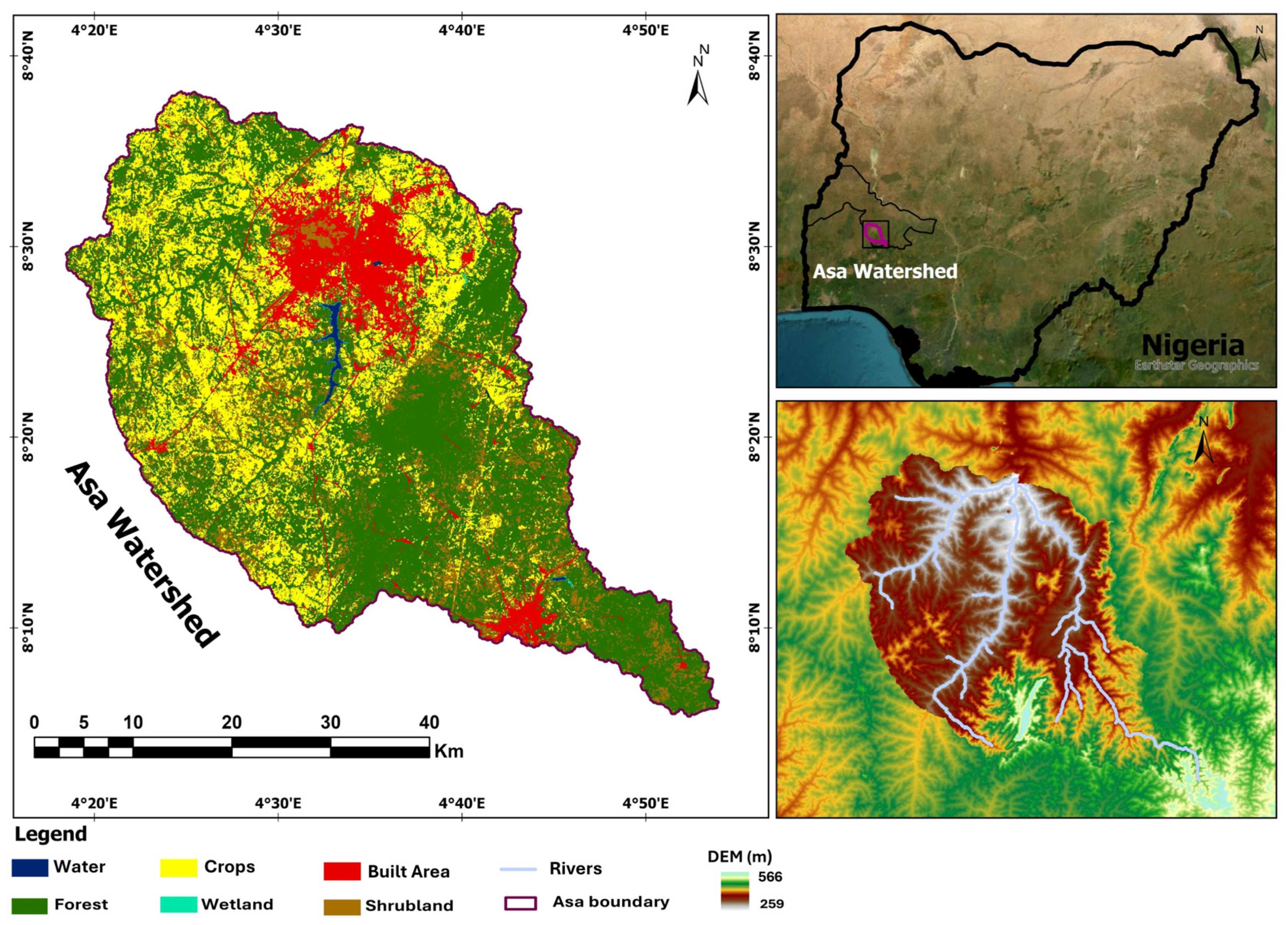
The Asa watershed lies in north-central Nigeria within Kwara State. It covers approximately 2000 km2 between latitudes 8°39′ N and 8°04′ N and longitudes 4°54′ E and 4°17′ E (Figure 2). The topography is surrounded by gently undulating plains, with elevations ranging from 259 to 566 m above sea level. The watershed has a humid tropical climate with two distinct seasons: a rainy season from April to October and a dry season from November to March. The mean annual rainfall is approximately 1288 mm, with about 90% of this precipitation occurring during the rainy season [39]. Temperatures range from 25 °C to 29 °C during the wet season and 33 °C to 37 °C during the dry season [39,40]. Hydrologically, it is characterized by a network of perennial and intermittent streams, which serve as an essential source of domestic water supply, agriculture, and ecological services for more than two million residents [41,42].

2.2. Modeling Water Yield Dynamics with InVEST

2.2.1. InVEST Water Yield Model

AWY was simulated using the InVEST model, version 3.13.0, developed by the Natural Capital Project [43]. The model adopts a modular, Budyko-based framework to estimate WY at the pixel level by balancing precipitation and actual evapotranspiration (AET). The WY for each grid cell x is defined as follows:
Y x = 1 A E T x P x · P x
where Y(x) is the AWY (mm), P(x) is the annual precipitation (mm), and AET(x) is the actual evapotranspiration (mm). The Budyko formulation partitions evapotranspiration as a function of precipitation, potential evapotranspiration (PET), and an empirical parameter ω, which represents soil–vegetation–climate interactions [44]. The AET is expressed as follows:
A E T x P x = 1 + P E T x P x 1 + ( P E T x P x ) ω 1 ω
where PET (x) is the potential evapotranspiration and ω is an empirical parameter dependent on vegetation and soil properties [45]. The PET (x) is calculated as follows:
P E T x = K c l x · E T 0 x
where Kc(lx) is the vegetation evapotranspiration coefficient for the LULC type in each raster cell x, and ET0 (x) is the reference evapotranspiration. The parameter ω is estimated as follows:
ω x = Z × A W C x P x + 1.25
where AWC(x) is the plant-available water content and Z is a seasonality constant (ranging from 1 to 30) reflecting rainfall distribution [46].

2.2.2. Data Acquisition and Preprocessing

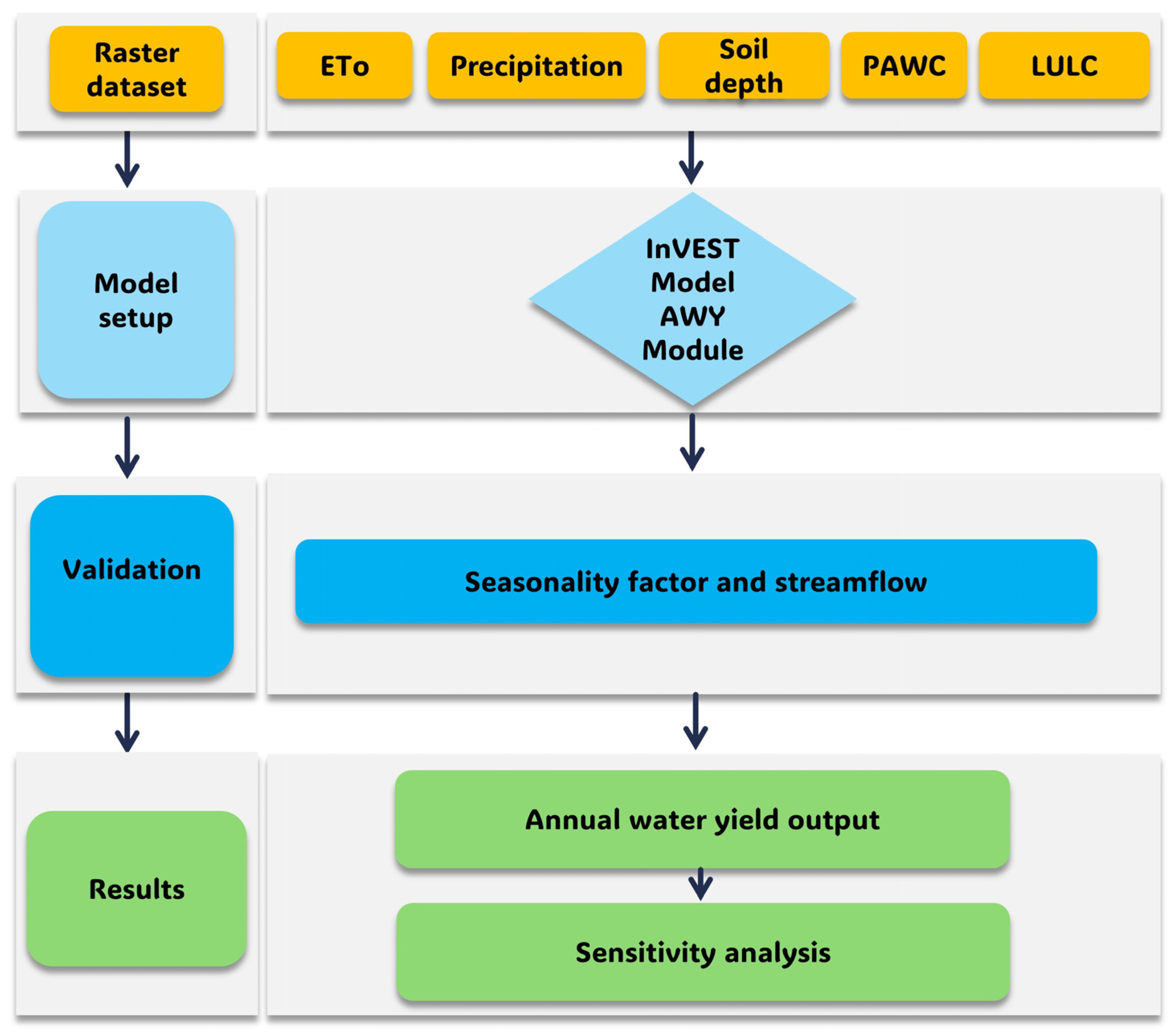
Five spatial datasets were compiled as inputs to the InVEST model: annual precipitation, annual reference evapotranspiration, root-restricting soil depth, plant-available water content (PAWC), and LULC for the study period (Figure 3 and Table 1). Precipitation data were obtained from the CRU TS 4.06 dataset [47], while ET0 values were extracted from TerraClimate [48] for 30-year period, as shown in Table 2. Soil parameters were sourced from ISRIC soil grids, and LULC maps were derived from the GLAD Landsat-based product at 30 m resolution [49]. The LULC classes were categorized into six hydrologically relevant categories: cropland, forest, shrubland, wetlands, built-up areas, and open water.
All spatial layers were projected to WGS84 UTM Zone 33N and resampled to 30 m resolution using bilinear interpolation for continuous variables (precipitation, ET0) and nearest neighbor for categorical data (soil properties, LULC), following established methods for watershed assessment in data-scarce regions [17,43]. This alignment procedure enables pixel-wise model execution while preserving the native information content of each dataset. Based on FAO guidelines and ISRIC soil data [50,51], a biophysical table was constructed to assign Kc values and root depth parameters to each LULC type (Table 3). Precipitation and ET0 datasets were averaged annually, while the LULC and soil data were assumed to be static over the baseline simulation period. ArcGIS Pro 3.2.0 was used to perform preprocessing to ensure consistency in alignment and resolution across all datasets.

2.2.3. Calibration and Validation

Although the InVEST AWY module is designed for application in data-sparse contexts, model validation is essential to ensure reliability. Following the approaches of [52,53], the simulated AWY values were compared with observed discharge records from the Asa River gauging station, operated by the Nigeria Hydrological Services Agency (NIHSA) in collaboration with the Lower Niger River Basin Development Authority. The station is positioned near the watershed outlet (8°25′ N, 4°35′ E) in Kwara State [34]. Our validation utilized a 20-year record (2001–2020), which represents the period available to assess consistency between modeled and observed streamflow [54]. Since the AWY model produces spatially explicit long-term annual averages rather than time-series discharge, the performance was evaluated using the coefficient of determination (R2) and percent bias (PBIAS) [55], metrics for validating spatially explicit long-term average water yield estimates against decadal streamflow averages in data-scarce regions.

2.3. Sensitivity Analysis of Water Yield Drivers

A variance-based global sensitivity analysis (Sobol method) was used to quantify the influence of land-use and climatic drivers on AWY [56,57]. This method decomposes the variance of AWY outputs in the Asa watershed and evaluates the contributions of individual variables, such as precipitation, ET0, and LULC, as well as their interactions to the AWY outputs. The first-order index (Si) quantifies the direct contribution of a single parameter to output variance, while the total-order index (STi) captures both individual and interaction effects. These indices are defined as follows:
S i = V x i [ E x i ( Y x i ) ] V ( Y )
S T i = E x i V x i Y x i V Y
where Y is the AWY, V(Y) is the variance, x i c is an input parameter, and x i   represents all other parameters. Sobol indices were estimated using Saltelli’s quasi-random sampling scheme (at sample size N = 10,000; D = 3 uncertain inputs; 50,000 model evaluations per year) [58]. The sensitivity indices were spatially mapped to identify areas within the watershed that are most responsive to LULC and climate drivers. This approach effectively captures non-linear and interaction effects on WY, offering evidence-based insights to inform land-use planning, drought resilience strategies, and integrated water resource management in the Asa watershed.

Surrogate Interpretable Analysis

To corroborate the variance-based sensitivity outcomes and validate parameter influence on AWY, this study employed a random forest (RF) surrogate model to estimate the relative importance of hydrological drivers, precipitation, ET0, and LULC, in controlling spatial and temporal variations in AWY. The foundation of the RF is an ensemble of decision trees, each trained on raster data and guided by recursive partitioning of the feature space [57,59]. For a given random vector X R p and response variable Y R , RF builds a predictive function capturing the conditional expectation of Y given X (Equation (7)).
f t ( x ) = E [ Y X = x ]
The training set, defined as L = ( ( X 1 , Y 1 ) , , ( X n , Y n ) ) is split recursively to form non-overlapping. Model performance was rigorously evaluated using the coefficient of determination (R2) and root mean square error (RMSE) metrics, assessed under a k-fold cross-validation scheme. The relative importance of each driver was extracted from the trained RF model using built-in permutation importance measures, allowing for transparent interpretation of hydrological control mechanisms on AWY.

3. Results

3.1. Spatial Patterns of Annual Water Yield

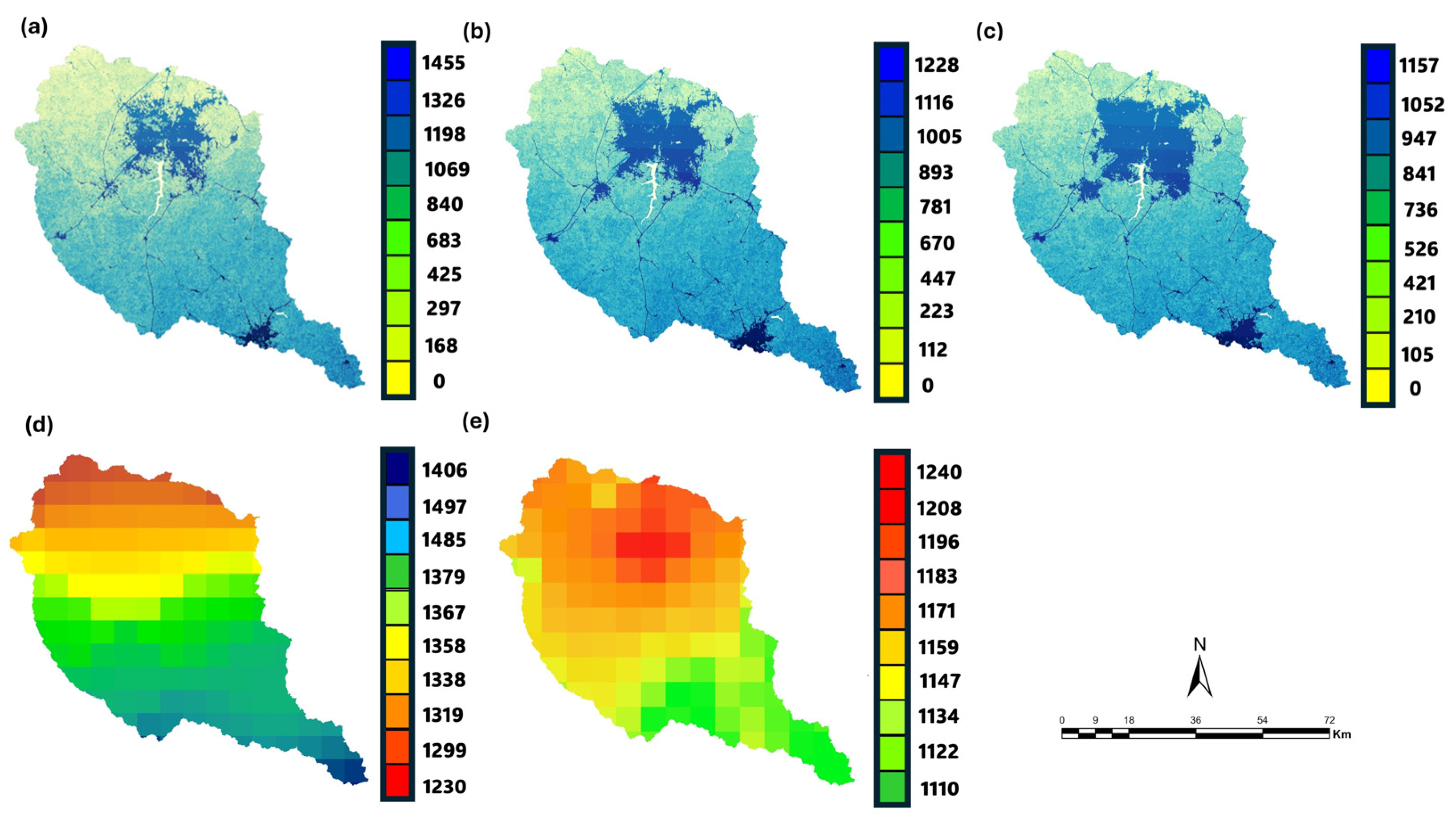
This study revealed distinct and temporally consistent spatial patterns in AWY across the Asa watershed from 2000 to 2020. Higher AWY values were consistently observed in the southern part of the watershed, where increased precipitation and a combination of forest and agricultural land cover supported greater water retention and groundwater recharge. In contrast, the northeastern region exhibited persistently lower WY, coinciding with rapid urban expansion and elevated ET0. The maximum AWY, ranging from 0 to 1455 mm, was recorded in 2000 under favorable hydroclimatic conditions despite early signs of urbanization. By 2020, reduced precipitation corresponded to a notable decrease in AWY, with values ranging from 0 to 1157 mm (Figure 4). This pattern reflects the combined effects of declining rainfall, land use conversion, and potential shifts in the hydrological response of the watershed under changing climatic conditions.
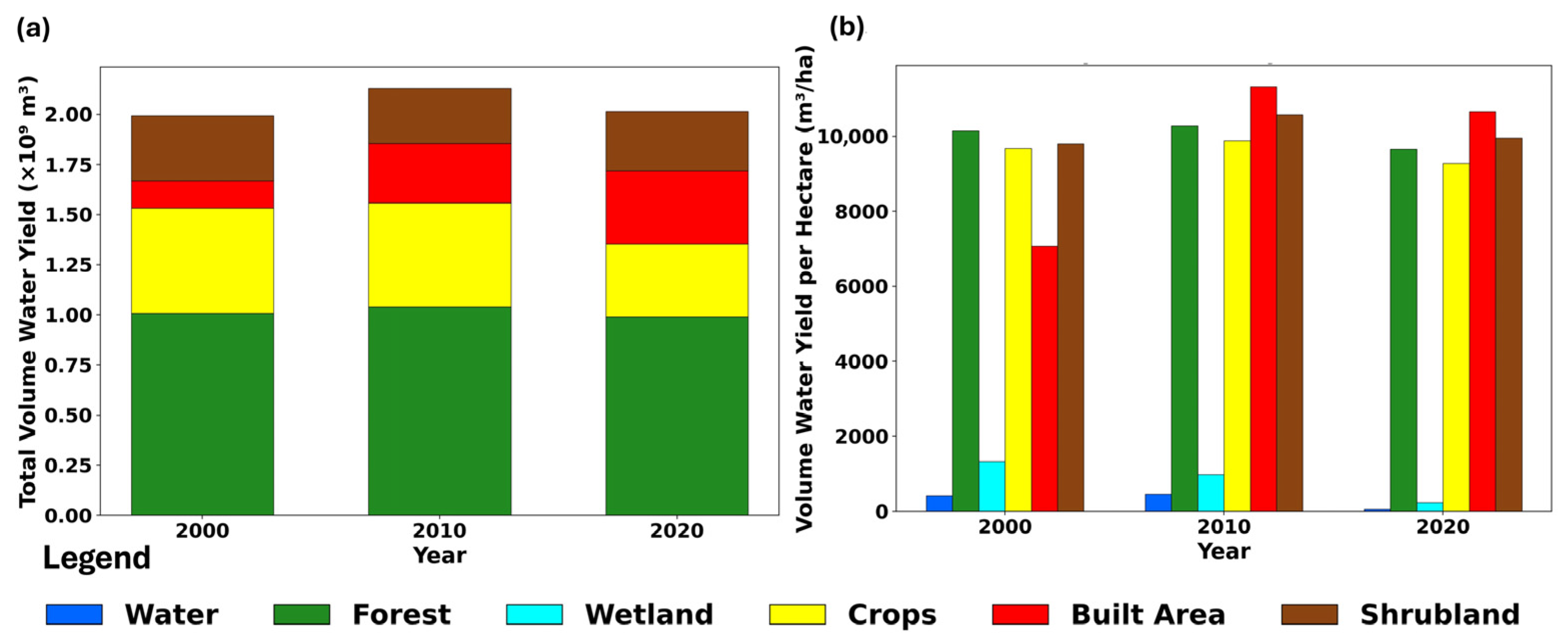
Total volumetric WY exhibited a non-linear trend over the study period. In 2000, the watershed produced 1.99 × 10⁹ m3 year−1, which increased to 2.13 × 10⁹ m3 in 2010 (+6.89%). However, by 2020, yield declined to 2.02 × 10⁹ m3 (–5.39% relative to 2010), resulting in a net increase of only 1.12% over two decades (Table 4). This indicates a complex hydrological response to both anthropogenic and climatic pressures. The seasonality factor (Z) was calibrated to a value of 8.51 through iterative adjustment to maximize agreement between simulated annual water yield and observed streamflow, accounting for the distinct bimodal rainfall distribution of the tropical-derived savanna within the watershed. This calibration followed the Budyko framework in data-scarce regions [46]. Model performance was evaluated against observed streamflow data collected at the watershed outlet over a 20-year period, yielding an R2 of 0.81 and a systematic underestimation of ~40% (percent bias). This performance is consistent with similar studies in West African basins, where calibration accuracy is limited by dependence on generalized global datasets for precipitation, soil, and evapotranspiration [60,61].
The intermediate peak in 2010 suggests that hydrological responses were modulated by compound land–climate interactions. The subsequent decline reflects the cumulative landscape transformation and intensifying hydroclimatic stressors. These findings highlight the vulnerability of watershed-scale hydrological productivity to the combined influence of anthropogenic and climatic drivers in this rapidly developing region.

3.2. LULC Transitions and Water Yield Dynamics in the Asa Watershed

AWY dynamics and LULC changes were analyzed across the Asa Watershed from 2000 to 2020, revealing significant temporal variations in hydrological productivity and landscape composition (Figure 5). In 2000, 2010, and 2020, the watershed exhibited substantial shifts in both the spatial distribution and WY volume across different land cover types. The forest remained the dominant land cover throughout the study period, expanding from 99,183.54 ha in 2000 to 102,707.31 ha in 2020, corresponding to a 3.55% increase. Despite this expansion, the forest WY per pixel declined from 1014.78 mm to 965.00 mm, reflecting a 4.90% reduction in hydrological productivity. The most pronounced transformation was observed in built-up areas, which increased from 19,369.67 ha in 2000 to 34,284.76 ha in 2020, representing a 77.00% increase. Notably, WY per pixel in built-up areas increased significantly from 707.28 mm to 1066.15 mm, the highest yield among all land cover types in 2020.
Cropland area declined significantly from 54,233.83 ha in 2000 to 38,971.75 ha in 2020, a 28.14% reduction. The WY per pixel also dropped from 967.29 mm to 928.62 mm, reflecting a 4% decline. Water bodies exhibited the most significant relative reduction in hydrological performance, with a decrease in per-pixel yield from 41.72 mm to 7.02 mm, an 83.17% reduction. However, areal coverage remained relatively stable (791.92 ha to 885.12 ha). Wetlands also degraded, with area decreasing from 218.65 ha to 105.15 ha (a 51.91% reduction) and WY declining from 133.60 mm to 22.90 mm, which corresponds to an 82.86% loss. Shrubland decreased moderately from 33,040.42 ha to 29,880.11 ha (9.57% reduction), although its WY increased from 980.48 mm to 995.93 mm, representing a 1.58% improvement. The intermediate year, 2010, recorded peak WY per pixel in built-up areas (1132.57 mm) and relatively high productivity in forests (1027.87 mm), suggesting that hydrological responses fluctuate over time rather than follow a strictly linear trend (Table 5).
The observed LULC conversion patterns indicate substantial landscape transformation, with the expansion of built areas occurring primarily at the expense of cropland and natural vegetation. The variations in per-hectare WY, particularly the sharp decline in the hydrological productivity of water bodies, suggest that watershed hydrology is increasingly shaped by a combination of climate variability and anthropogenic pressures that extend beyond land use change alone (Figure 5).

3.3. Evaluating Water Yield Sensitivity to LULC and Climate Variability

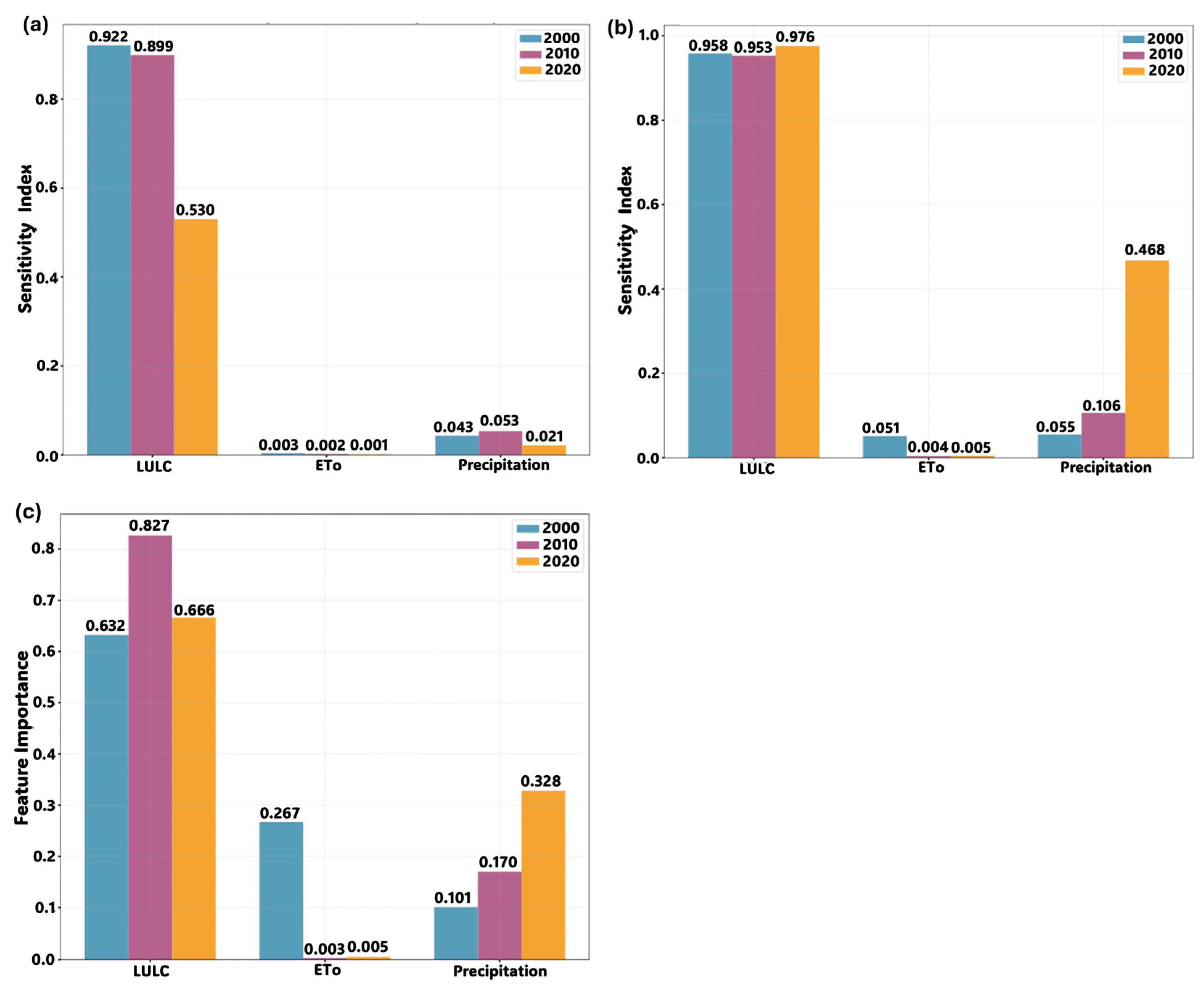
The sensitivity analysis revealed significant temporal variations in the relative influence of LULC and climatic variables on AWY in the Asa watershed over the two-decade study period, indicating a fundamental regime shift in hydrological controls. The first-order Sobol index (S1) for LULC declined moderately from 0.922 in 2000 to 0.899 in 2010, followed by a substantial drop to 0.530 in 2020 (Figure 6). This represents a 42.4% reduction in the direct influence of LULC, indicating a shift in the dominant hydrological controls from land use to precipitation. The growing divergence between first-order and total-order sensitivity indices (S1 vs. STi) highlights that while direct effects of current land cover diminished, interaction effects with precipitation increased substantially.
In contrast, St for LULC remained relatively stable, ranging from 0.958 in 2000 to 0.953 in 2010, before increasing to 0.976 in 2020. This increase reflects a modest gain of 1.8% in the overall influence of LULC. The divergence between the first-order and total-order indices suggests that although the direct effects of LULC have diminished, its indirect effects, particularly interactions with other variables, have become more significant over time.
Among the climatic variables, precipitation exhibited the most complex sensitivity dynamics. The first-order index for precipitation decreased by 50.9% from 0.043 in 2000 to 0.021 in 2020, indicating a reduced direct effect on WY. However, its total-order index increased dramatically from 0.055 in 2000 to 0.468 in 2020, representing a 746.8% increase. This pronounced shift suggests that the role of precipitation transitioned from a primarily direct driver to a variable one predominantly mediated through interactions, reflecting increasingly intricate precipitation-LULC-hydrology coupling mechanisms over time.
Evapotranspiration (ETo) displayed consistently negligible sensitivity throughout the study period. Its first-order indices remained near zero (0.003 in 2000, 0.002 in 2010, and 0.001 in 2020), while total-order indices remained below 0.006. These results imply that variability in ETo exerted minimal control on AWY, likely due to its relatively narrow range compared to the dominant effects of LULC and precipitation interaction.
Complementary insights from the Random Forest feature importance analysis partially corroborated the Sobol results. The importance of LULC fluctuated from 63.2% in 2000 to a peak of 82.7% in 2010 and then declined to 66.6% in 2020. These fluctuations were less pronounced than those in the Sobol indices. Precipitation importance increased from 10.1% in 2000 to 32.8% in 2020, which aligns with the increased interaction effects captured in the Sobol analysis. ETo remained consistently insignificant, with feature importance ranging from 0.3% to 2.7% across all years, reinforcing its limited role in WY variability.
The surrogate Random Forest analysis corroborated these findings, showing a 16.1 percentage-point reduction in LULC’s predictive dominance (from 82.7% to 66.6%) between 2010 and 2020. The strong model performance (R2 = 0.965–0.985) confirms the reliability of our sensitivity estimates, as presented in Table 6. This analysis quantitatively demonstrates the shifting dominance of hydrological drivers over time. During 2000–2010, LULC was unequivocally the dominant driver of AWY, with first-order effects accounting for 89.9–92.2% of variance, while precipitation contributed only 2.1–4.3% directly. However, by 2020, precipitation’s total-order effects (STi = 0.468) surpassed LULC’s first-order effects (S1 = 0.530), indicating that precipitation interactions became the primary control mechanism. The Random Forest analysis corroborates this transition, where precipitation’s importance increased from 10.1% to 32.8% between 2000–2020, while LULC’s importance declined from 82.7% to 66.6%. This quantitative evidence confirms that 2010 represents the inflection point where cumulative land degradation fundamentally altered watershed behavior, shifting from LULC-dominated (pre-2010) to precipitation-dominated (post-2010) hydrological controls.
The regime shift is quantifiable through precipitation inputs, which declined by 7.8% from 1373 mm in 2000 to 1266 mm in 2020, while ETo increased by 3.0% from 1165 mm to 1200 mm. During 2000–2010, the watershed maintained high resilience to these climatic stresses due to dominant LULC controls (S1 = 0.899). After 2010, the same system exhibited heightened precipitation sensitivity (STi = 0.468), demonstrating that cumulative anthropogenic pressures fundamentally transformed watershed behavior. Together, these results establish 2010 as a critical inflection point where cumulative land degradation exceeded the watershed’s buffering capacity, transforming the hydrological regime from land-use-dominated to climate-sensitive, a threshold phenomenon with significant implications for water resource management in data-scarce regions.

4. Discussion

4.1. Spatial Gradients of Water Yield

The spatial patterns observed in the Asa watershed indicate a complex and evolving hydrological response that challenges the commonly assumed direct relationships between land cover and WY in tropical watershed management. The persistent south-to-north gradient in WY, where southern regions maintain higher productivity despite similar precipitation levels, reflects the Sahelian–Sudanian ecological transition observed across West Africa [62]. This spatial behavior is rooted in soil–vegetation–atmosphere interactions, which are often underrepresented in regional hydrological assessments. The hydrological response of West African catchments has evolved over recent decades due to significant land cover changes, which have altered soil hydrodynamics and reshaped regional water budgets [63].
The non-linear trends in volumetric WY, i.e., an initial increase followed by a decline, are particularly noteworthy. The peak observed between 2000 and 2010 occurred despite ongoing urbanization, contradicting conventional expectations of continuous WY decline under expanding urban land use. This finding aligns with previous studies suggesting that moderate urbanization can initially enhance runoff connectivity, while the remaining forest cover sustains evapotranspiration and maintains WY [64]. However, the decline after 2010 indicates that a critical threshold was crossed. Cumulative soil compaction resulting from intensive agriculture and deforestation disrupted natural regulatory processes. This threshold-like behavior is consistent with findings from the Sokoto Rima River Basin in northwestern Nigeria, where spatial analyses also revealed seasonal WY reductions linked to land degradation [65,66].
These spatial and temporal patterns also correspond with broader hydrological responses documented across West African basins, where shifts in precipitation timing, soil moisture regimes, and vegetation structure collectively reshape annual runoff generation [67]. Comparable findings from Ghana, Kenya, and Ethiopia indicate that landscape transitions, rather than precipitation magnitude alone, are increasingly governing the spatial distribution of WY in tropical basins [67,68,69]. This convergence across regions underscores the growing consensus that land cover change, soil disturbance, and surface-subsurface disconnections exert a stronger influence on hydrological behavior than previously recognized [70]. The observed dynamics in the Asa watershed, therefore, reaffirm the importance of integrating spatially explicit LULC information into watershed planning and water resource management in data-limited watersheds.

4.2. Dynamics of LULC on Water Yield

The relationship between land cover change and hydrological response in the Asa watershed reveals both expected patterns and anomalies that challenge conventional assumptions. The 3.55% forest cover expansion, accompanied by a 4.90% decline in forest WY per pixel, contradicts the notion that increased forest extent automatically translates into higher WY. This counterintuitive result aligns with findings from the Niger Delta, where forest expansion through monoculture plantations with high water demand has reduced groundwater availability [71]. The replacement of native forests with exotic species characterized by deeper root systems explains this paradox [72]. Similar observations have been reported elsewhere, suggesting that changes in WY after forest conversion are often modest due to trade-offs between higher evapotranspiration and cloud water interception [73].
The most striking anomaly is the identification of built-up areas as the most productive type of land cover in terms of WY per pixel. This result is consistent with those of [64,74], who reported that urban areas in tropical watersheds can generate higher runoff coefficients due to efficient drainage pathways during intense rainfall events. As documented for Abeokuta (a major city in southwestern Nigeria), the urban heat island effect likely intensifies convection, increases rainfall intensity, and enhances runoff generation [75]. However, this apparent hydrological productivity comes at the cost of reduced groundwater recharge and increased flood risk, a trade-off not captured by AWY metrics. For example, urban flood susceptibility mapping in Ilorin, Nigeria, has demonstrated that urban expansion significantly increases flood risk despite apparent gains in surface runoff efficiency [76].
Despite relatively stable areal coverage, the 83.17% decline in water body productivity represents a critical degradation of hydrological function. This pattern corroborates the findings that anthropogenic activities have reduced water quality in the Asa River through increased turbidity and sedimentation [77]. Parallel wetland degradation, with a 51.91% reduction in area and an 82.86% decline in WY, suggests a systemic collapse of the natural water regulation functions of the watershed. This pattern is consistent with studies across African river basins, which show that land cover changes, most often associated with land use shifts, modify soil surface hydrodynamics and disrupt local and regional water budgets [62].

4.3. Implications of LULC and Climate Variability on Water Yield

The analysis reveals a fundamental regime shift in the dominant physical drivers of WY dynamics, with significant implications for the management of water resources in data-scarce environments. The 42.4% decline in the first-order sensitivity of LULC from 2000 to 2020, together with the 746.8% increase in the total-order sensitivity of precipitation, indicates a critical transition from a landscape-dominated to a climate-dominated hydrological regime. This finding aligns with [78], who reported that cumulative soil compaction fundamentally alters watershed responsiveness to precipitation inputs. Our analysis establishes 2010 as the critical inflection point where this transition occurred, providing a quantifiable threshold for watershed vulnerability.
The growing divergence between the first-order and total-order sensitivity indices for LULC highlights the key physical processes driving the changing behavior of a watershed. While the direct effects of current land cover have diminished, the interaction effects have increased. This suggests that historical land use continues to influence hydrological responses through persistent changes in soil physical properties. This phenomenon, known as the landscape memory effect, manifests as threshold responses in hydrological connectivity. Under these conditions, even minor changes in land cover may trigger disproportionate hydrological responses due to pre-existing soil degradation. These observations are consistent with research showing that the hydrological response of West African catchments has changed significantly over time as a result of widespread land cover transformation that alters soil surface hydrodynamics [53]. Ref. [65] confirmed this phenomenon in the Sokoto-Rima Basin (northwestern Nigeria), reporting significant spatial variability in WY responses to land use changes across different seasons.
The consistently negligible sensitivity to ET0 throughout the study period is particularly noteworthy. This outcome supports an earlier finding that ET0 has limited explanatory power for WY in tropical watersheds, where soil moisture is typically the primary limiting factor [44]. Field measurements in Southwestern Nigeria confirmed that root-zone soil moisture frequently falls below critical thresholds during the dry season, indicating that soil water availability constricts vegetation water uptake more than atmospheric conditions [79]. This pattern is widely observed across the derived savanna zone, highlighting the strong influence of soil moisture dynamics during seasonal transitions. The findings also align with those of [73], who noted that projected climatic drying under greenhouse gas scenarios is expected to have profound effects on the hydrology of tropical watersheds. The integration of variance-based Sobol sensitivity analysis with Random Forest modeling provides a robust methodological framework for detecting such regime shifts in data-scarce environments.

4.4. Study Limitations

This study has several limitations, primarily arising from the simplified treatment of hydrological processes. The model aggregates surface runoff, subsurface flow, and baseflow, assuming that the water generated from each pixel ultimately reaches the point of interest. Furthermore, the accuracy of core input datasets, namely LULC and climate variables, is constrained by inherent uncertainties. The quality of LULC data depends on the resolution and classification reliability of satellite imagery, whereas climate inputs, such as precipitation and ET0, are often interpolated, which may not fully capture spatial heterogeneity. Further uncertainties are associated with soil depth, PAWC, and Kc, which are typically derived from generalized global datasets.
Despite these limitations, InVEST remains a widely applied and practical tool for assessing ecosystem services and informing water management in data-scarce regions. Therefore, the findings should be interpreted with caution, but they nonetheless provide credible first-order insights into hydrological dynamics and landscape-climate interactions in the Asa watershed and similar tropical basins.

5. Conclusions

This study demonstrates that linear relationships between land cover and WY cannot fully explain tropical watershed dynamics. In the Asa watershed, Nigeria, AWY followed a non-linear trajectory, peaking in 2010 before declining. This pattern reveals a shift in the hydrological regime from land-use dominance to precipitation-driven controls. The findings highlight how cumulative land degradation weakens the natural buffering capacity of the watershed and increases its sensitivity to climatic variability, even under modest rainfall changes.
From a methodological perspective, this study presents an integration of the InVEST AWY model with Sobol sensitivity analysis and Random Forest learning. Together, these tools offer one of the frameworks for disentangling the drivers of hydrological variability in a data-scarce African basin. Although the model systematically underestimated the absolute discharge volumes, it effectively captured the spatial and temporal patterns. These underscore the utility of the model for conducting uncertainty-aware ecohydrological assessments and guiding decision-making in regions with limited observational data.
Future research should focus on expanding this methodological framework across multiple African basins to evaluate the generalizability of these threshold dynamics. Comparative applications would help identify common vulnerability points across different ecological zones while accounting for regional specificities. Additionally, targeted field measurements of soil-vegetation interactions could enhance the physical basis of the identified thresholds. The stochastic sensitivity framework presented here provides a transferable approach for identifying critical points of hydrological vulnerability in data-scarce regions, offering valuable insights for adaptive watershed management under changing environmental conditions.

Policy Recommendations

This study highlights the critical importance of threshold-based approaches for integrated land and climate governance in tropical watersheds with limited data. Our analysis identifies 2010 as a critical inflection point where cumulative land degradation transformed the Asa watershed’s hydrological regime. The following threshold-informed policy actions are recommended to support sustainable water resource management and ecosystem resilience:
  • Establish cost-effective hydrological monitoring networks that integrate rainfall, streamflow, and soil moisture measurements. These networks will enable more accurate calibration and validation of ecohydrological models in data-limited settings.
  • Land use planning should incorporate the identified hydrological threshold. This could involve policies to limit the conversion of natural vegetation to impervious surfaces in headwater catchments, which our analysis shows are critical for maintaining the watershed’s buffering capacity.
  • Adopt uncertainty-based decision-making frameworks for water resource management. These should explicitly account for model bias and sensitivity analysis when allocating water for domestic, agricultural, and industrial sectors.
  • Align regional adaptation strategies with the Sustainable Development Goals (SDGs 6 and 13) by incorporating watershed-scale sensitivity assessments into national and subnational climate resilience policies.
Collectively, these recommendations strengthen ecosystem services, reduce hydrological risks, and offer a replicable framework for sustainable watershed management in African basins facing comparable environmental challenges.

Author Contributions

I.A.A.: Writing—review & editing, Writing—original draft, Visualization, Validation, Software, Methodology, Investigation, Formal analysis, Data curation, Conceptualization. S.B.: Writing—review & editing, Visualization, Validation, Methodology, Formal analysis. B.K.: Writing—review & editing, Visualization, Validation, Investigation. C.Y.K.: Writing—review & editing, Visualization, Validation, Investigation, Data curation. Y.J.: Writing—review & editing, Funding acquisition, Conceptualization, Methodology, Supervision. All authors have read and agreed to the published version of the manuscript.

Funding

This work was supported by Korea Environment Industry & Technology Institute (KEITI) through Aquatic Ecosystem Conservation Research Program, funded by Korea Ministry of Environment (MOE) (RS-2025-02304832).

Data Availability Statement

All input datasets used in this study are publicly available and can be accessed from the respective data repositories cited in the manuscript.

Conflicts of Interest

The authors declare that they have no known competing financial interests or personal relationships that could have appeared to influence the work reported in this article.

References

  1. Zhou, Y.; Gu, B. The Impacts of Human Activities on Earth Critical Zone. Earth Crit. Zone 2024, 1, 100004. [Google Scholar] [CrossRef]
  2. Bastola, S.; Lee, S.; Shin, Y.; Jung, Y. An Assessment of Environmental Impacts on the Ecosystem Services: Study on the Bagmati Basin of Nepal. Sustainability 2020, 12, 8186. [Google Scholar] [CrossRef]
  3. Fehlinger, L.; Misteli, B.; Morant, D.; Juvigny-Khenafou, N.; Cunillera-Montcusí, D.; Chaguaceda, F.; Stamenković, O.; Fahy, J.; Kolář, V.; Halabowski, D.; et al. The Ecological Role of Permanent Ponds in Europe: A Review of Dietary Linkages to Terrestrial Ecosystems via Emerging Insects. Inland Waters 2023, 13, 30–46. [Google Scholar] [CrossRef]
  4. Millennium Ecosystem Assessment Ecosystems and Human Well-Being. In Biodiversity Synthesis; World Resources Institute: Washington, DC, USA, 2005.
  5. Jiang, H.; Wu, W.; Wang, J.; Yang, W.; Gao, Y.; Duan, Y.; Ma, G.; Wu, C.; Shao, J. Mapping Global Value of Terrestrial Ecosystem Services by Countries. Ecosyst. Serv. 2021, 52, 101361. [Google Scholar] [CrossRef]
  6. Intergovernmental Panel on Climate Change (IPCC). Climate Change 2022—Impacts, Adaptation and Vulnerability; Intergovernmental Panel on Climate Change (IPCC): Geneva, Switzerland, 2023. [Google Scholar]
  7. Mekonnen, M.M.; Hoekstra, A.Y. Sustainability: Four Billion People Facing Severe Water Scarcity. Sci. Adv. 2016, 2, e1500323. [Google Scholar] [CrossRef]
  8. Adigun, I.A.; Bastola, S.; Choo, I.; Jung, Y. Unraveling Climate-Induced Emissions and Food Security in Africa through Greenhouse Gas and Water Impacts across Development Levels. J. Environ. Manag. 2025, 393, 127161. [Google Scholar] [CrossRef] [PubMed]
  9. UN Water. The United Nations World Water Development Report 2023: Partnerships and Cooperation for Water; UN Water: Geneva, Switzerland, 2023; ISBN 978-92-3-100576-3. [Google Scholar]
  10. Almeida, B.; Cabral, P. Water Yield Modelling, Sensitivity Analysis and Validation: A Study for Portugal. ISPRS Int. J. Geo-Inf. 2021, 10, 494. [Google Scholar] [CrossRef]
  11. Winkler, R.D.; Moore, R.D.D.; Redding, T.E.; Spittlehouse, D.L.; Carlyle-Moses, D.E.; Smerdon, B.D. Hydrologic Processes and Watershed Response. In Compendium of Forest Hydrology and Geomorphology in British Columbia; British Columbia Ministry of Forests and Range—Forest Science Program: Victoria, BC, USA, 2010; pp. 133–178. [Google Scholar]
  12. Yang, X.; Chen, R.; Ji, G.; Wang, C.; Yang, Y.; Xu, J. Assessment of Future Water Yield and Water Purification Services in Data Scarce Region of Northwest China. Int. J. Environ. Res. Public Health 2021, 18, 8960. [Google Scholar] [CrossRef]
  13. Bastola, S.; Shakya, B.; Seong, Y.; Kim, B.; Jung, Y. AHP and FAHP-Based Multi-Criteria Analysis for Suitable Dam Location Analysis: A Case Study of the Bagmati Basin, Nepal. Stoch. Environ. Res. Risk Assess. 2024, 38, 4209–4225. [Google Scholar] [CrossRef]
  14. Nahib, I.; Ambarwulan, W.; Rahadiati, A.; Munajati, S.L.; Prihanto, Y.; Suryanta, J.; Turmudi, T.; Nuswantoro, A.C. Assessment of the Impacts of Climate and LULC Changes on the Water Yield in the Citarum River Basin, West Java Province, Indonesia. Sustainability 2021, 13, 3919. [Google Scholar] [CrossRef]
  15. Ayivi, F.; Jha, M.K. Estimation of Water Balance and Water Yield in the Reedy Fork-Buffalo Creek Watershed in North Carolina Using SWAT. Int. Soil Water Conserv. Res. 2018, 6, 203–213. [Google Scholar] [CrossRef]
  16. Bagstad, K.J.; Ingram, J.C.; Lange, G.M.; Masozera, M.; Ancona, Z.H.; Bana, M.; Kagabo, D.; Musana, B.; Nabahungu, N.L.; Rukundo, E.; et al. Towards Ecosystem Accounts for Rwanda: Tracking 25 Years of Change in Flows and Potential Supply of Ecosystem Services. People Nat. 2020, 2, 163–188. [Google Scholar] [CrossRef]
  17. Redhead, J.W.; Stratford, C.; Sharps, K.; Jones, L.; Ziv, G.; Clarke, D.; Oliver, T.H.; Bullock, J.M. Empirical Validation of the InVEST Water Yield Ecosystem Service Model at a National Scale. Sci. Total Environ. 2016, 569, 1418–1426. [Google Scholar] [CrossRef]
  18. Martínez-López, J.; Bagstad, K.J.; Balbi, S.; Magrach, A.; Voigt, B.; Athanasiadis, I.; Pascual, M.; Willcock, S.; Villa, F. Towards Globally Customizable Ecosystem Service Models. Sci. Total Environ. 2019, 650, 2325–2336. [Google Scholar] [CrossRef]
  19. Villa, F.; Ceroni, M.; Bagstad, K.; Johnson, G.; Krivov, S. ARIES (ARtificial Intelligence for Ecosystem Services): A New Tool for Ecosystem Services Assessment, Planning, and Valuation. In Proceedings of the 11th Annual BIOECON Conference on Economic Instruments to Enhance the Conservation and Sustainable use of Biodiversity, Venice, Italy, 21–22 September 2009; pp. 1–10. [Google Scholar]
  20. Pang, S.; Wang, X.; Melching, C.S.; Feger, K.H. Development and Testing of a Modified SWAT Model Based on Slope Condition and Precipitation Intensity. J. Hydrol. 2020, 588, 125098. [Google Scholar] [CrossRef]
  21. Arnold, J.G.; Moriasi, D.N.; Gassman, P.W.; Abbaspour, K.C.; White, M.J.; Srinivasan, R.; Santhi, C.; Harmel, R.D.; Van Griensven, A.; Van Liew, M.W.; et al. SWAT: Model Use, Calibration, and Validation. Trans. ASABE 2012, 55, 1491–1508. [Google Scholar] [CrossRef]
  22. Doan, M.K.; Hill, R.; Hallegatte, S.; Corral, P.; Brunckhorst, B.; Nguyen, M.; Freije-Rodriguez, S.; Naikal, E. Counting People Exposed to, Vulnerable to, or at High Risk From Climate Shocks: A Methodology; World Bank Group: Washington, DC, USA, 2023. [Google Scholar] [CrossRef]
  23. Stanford Univiersity. Natural Capital Project InVEST®: A Powerful Tool to Map and Value Ecosystem Services; Stanford Univiersity: Stanford, CA, USA, 2023. [Google Scholar]
  24. Mukhopadhyay, A.; Hati, J.P.; Acharyya, R.; Pal, I.; Tuladhar, N.; Habel, M. Global Trends in Using the InVEST Model Suite and Related Research: A Systematic Review. Ecohydrol. Hydrobiol. 2025, 25, 389–405. [Google Scholar] [CrossRef]
  25. Papa, F.; Crétaux, J.F.; Grippa, M.; Robert, E.; Trigg, M.; Tshimanga, R.M.; Kitambo, B.; Paris, A.; Carr, A.; Fleischmann, A.S.; et al. Water Resources in Africa Under Global Change: Monitoring Surface Waters from Space; Springer: Berlin/Heidelberg, Germany, 2023; Volume 44, ISBN 0123456789. [Google Scholar]
  26. Bastola, S.; Cho, J.; Kam, J.; Jung, Y. Assessing the Influence of Climate Change on Multiple Climate Indices in Nepal Using CMIP6 Global Climate Models. Atmos. Res. 2024, 311, 107720. [Google Scholar] [CrossRef]
  27. Teferi, E.; O’Donnell, G.; Bewket, W.; Zeleke, G.; Walsh, C. Enhancing Hydrometric Monitoring in Ethiopia’s Abbay Basin: A Collaborative Framework for Data-Scarce Africa. J. Hydrol. Reg. Stud. 2025, 60, 102579. [Google Scholar] [CrossRef]
  28. World Bank Group. World Bank Nigeria: Ensuring Water, Sanitation and Hygiene for All; World Bank Group: Washington, DC, USA, 2021; pp. 1–5. [Google Scholar]
  29. Isukuru, E.J.; Opha, J.O.; Isaiah, O.W.; Orovwighose, B.; Emmanuel, S.S. Nigeria’s Water Crisis: Abundant Water, Polluted Reality. Clean. Water 2024, 2, 100026. [Google Scholar] [CrossRef]
  30. Idrees, M.O.; Adepoju, B.D.; Ipadeola, A.O.; Omar, D.M.; Alade, A.K.; Salami, I.B. Evaluating Urban Sprawl and Land Consumption Rate in Ilorin Metropolis Using Multitemporal Landsat Imagery. Environ. Technol. Sci. J. 2022, 12, 37–47. [Google Scholar] [CrossRef]
  31. FAO. The State of the World’s Forests 2022; Food and Agriculture Organization of the United Nations: Rome, Italy, 2022; ISBN 9789251359846. [Google Scholar]
  32. Bello, A.A. The Impact of Watershed Delineation on Hydrological Processes at Asa River Dam Upstream in Ilorin, Kwara State, Nigeria. Master’s Thesis, Kwara State University (Nigeria), Malete, Nigeria, 2023. [Google Scholar]
  33. Idrees, M.O.; Olateju, S.A.; Omar, D.M.; Babalola, A.; Ahmadu, H.A.; Kalantar, B. Spatial Assessment of Accelerated Surface Runoff and Water Accumulation Potential Areas Using AHP and Data-Driven GIS-Based Approach: The Case of Ilorin Metropolis, Nigeria. Geocarto Int. 2022, 37, 15877–15895. [Google Scholar] [CrossRef]
  34. Adebayo, H.; Ogunlela, A. Flood Frequency Analysis of Asa River, Ilorin, Nigeria. Int. J. Hydrol. 2024, 8, 15–19. [Google Scholar] [CrossRef]
  35. Adeogun, A.G.; Ganiyu, H.O.; Adetoro, A.E.; Idowu, B.S. Effects of Watershed Delineation on the Prediction of Water Quality Parameters in Gaa Akanbi Area, Ilorin. LAUTECH J. Civ. Environ. Stud. 2022, 8, 92–104. [Google Scholar] [CrossRef]
  36. Bamutaze, Y.; Kyamanywa, S.; Nabanoga, G.; Singh, B.R.; Lal, R. Climate Change Management Agriculture and Ecosystem Resilience in Sub Saharan Africa Livelihood Pathways Under Changing Climate; Springer: Berlin/Heidelberg, Germany, 2019; ISBN 9783030129736. [Google Scholar]
  37. Eteh, D.R.; Japheth, B.R.; Akajiaku, C.U.; Osondu, I.; Mene-Ejegi, O.O.; Nwachukwu, E.M.; Oriasi, M.D.; Omietimi, E.J.; Ayo-Bali, A.E. Assessing the Impact of Climate Change on Flood Patterns in Downstream Nigeria Using Machine Learning and Geospatial Techniques (2018–2024); Springer International Publishing: Berlin/Heidelberg, Germany, 2025; Volume 3, ISBN 0123456789. [Google Scholar]
  38. Thiaw, I. Water Resources Modeling in Data-Scarce Watersheds: Contribution of the SWAT Model and the SUFI2 Algorithm to the Study of the Thiokoye River Basin. J. Geosci. Environ. Prot. 2025, 13, 46–73. [Google Scholar] [CrossRef]
  39. Olaniyan, O.S.; Ayemu, A.I.; Adeyokunnu, A.T.; Ojo, E.O.; Afolabi, L.A. Estimation of Runoff from River Asa Watershed Using SCS Curve Number and Geographic Information System (GIS). Niger. J. Environ. Sci. Technol. 2022, 6, 207–213. [Google Scholar] [CrossRef]
  40. Adeogun, A.G.; Ganiyu, H.O.; Ladokun, L.L.; Ibitoye, B.A. Evaluation of Hydrokinetic Energy Potentials of Selected Rivers in Kwara State, Nigeria. Environ. Eng. Res. 2020, 25, 267–273. [Google Scholar] [CrossRef]
  41. Kolawole, O.M.; Ajayi, K.T.; Olayemi, A.B.; Okoh, A.I. Assessment of Water Quality in Asa River (Nigeria) and Its Indigenous Clarias Gariepinus Fish. Int. J. Environ. Res. Public Health 2011, 8, 4332–4352. [Google Scholar] [CrossRef]
  42. Abdulhaleem, A.; Idowu, A.; Olujobi, A. Investigation of Ground Water Reservoir in ASA and Ilorin West Local Government of Kwara State Using Geographic Information System. In Proceedings of the FIG Working Week 2013, Abuja, Niger, 6–10 May 2013; pp. 1–17. [Google Scholar]
  43. Sharp, R.; Douglass, J.; Wolny, S.; Arkema, K.; Bernhardt, J.; Bierbower, W.; Chaumont, N.; Denu, D.; Fisher, D.; Glowinski, K.; et al. InVEST 3.8. 7. User’s Guide. In Natural Capital Project; Stanford University: Standford, CA, USA, 2020; pp. 1–7. [Google Scholar]
  44. Zhang, L.; Hickel, K.; Dawes, W.R.; Chiew, F.H.S.; Western, A.W.; Briggs, P.R. A Rational Function Approach for Estimating Mean Annual Evapotranspiration. Water Resour. Res. 2004, 40, 89–97. [Google Scholar] [CrossRef]
  45. Budyko, M.I. Climate and Life; Academic Press: New York, NY, USA, 1974; Volume 18. [Google Scholar]
  46. Zhang, X.; Zhang, G.; Long, X.; Zhang, Q.; Liu, D.; Wu, H.; Li, S. Identifying the Drivers of Water Yield Ecosystem Service: A Case Study in the Yangtze River Basin, China. Ecol. Indic. 2021, 132, 108304. [Google Scholar] [CrossRef]
  47. Harris, I.; Osborn, T.J.; Jones, P.; Lister, D. Version 4 of the CRU TS Monthly High-Resolution Gridded Multivariate Climate Dataset. Sci. Data 2020, 7, 109. [Google Scholar] [CrossRef]
  48. Abatzoglou, J.T.; Dobrowski, S.Z.; Parks, S.A.; Hegewisch, K.C. TerraClimate, a High-Resolution Global Dataset of Monthly Climate and Climatic Water Balance from 1958-2015. Sci. Data 2018, 5, 170191. [Google Scholar] [CrossRef]
  49. Potapov, P.; Hansen, M.C.; Pickens, A.; Hernandez-Serna, A.; Tyukavina, A.; Turubanova, S.; Zalles, V.; Li, X.; Khan, A.; Stolle, F.; et al. The Global 2000-2020 Land Cover and Land Use Change Dataset Derived From the Landsat Archive: First Results. Front. Remote Sens. 2022, 3, 856903. [Google Scholar] [CrossRef]
  50. Hengl, T.; De Jesus, J.M.; Heuvelink, G.B.M.; Gonzalez, M.R.; Kilibarda, M.; Blagotić, A.; Shangguan, W.; Wright, M.N.; Geng, X.; Bauer-Marschallinger, B.; et al. SoilGrids250m: Global Gridded Soil Information Based on Machine Learning. PLoS ONE 2017, 12, e0169748. [Google Scholar] [CrossRef]
  51. FAO. Evapotranspiration Guidelines for Computing Crop Water Requirements: Guidelines for Computing Crop Water Requirements (FAO Irrigation and Drainage Paper No.56); Food and Agriculture Organization of the United Nations: Rome, Italy, 1998; Volume 333. [Google Scholar]
  52. Bojer, A.K.; Abshare, M.W.; Mesfin, F.; Al-Quraishi, A.M.F. Assessing Climate and Land Use Impacts on Surface Water Yield Using Remote Sensing and Machine Learning. Sci. Rep. 2025, 15, e0169748. [Google Scholar] [CrossRef]
  53. Getachew, B.; Manjunatha, B.R. Impacts of Land-Use Change on the Hydrology of Lake Tana Basin, Upper Blue Nile River Basin, Ethiopia. Glob. Chall. 2022, 6, 2200041. [Google Scholar] [CrossRef]
  54. Szwed, M.; Karg, G.; Pińskwar, I.; Radziejewski, M.; Graczyk, D.; Kȩdziora, A.; Kundzewicz, Z.W. Climate Change and Its Effect on Agriculture, Water Resources and Human Health Sectors in Poland. Nat. Hazards Earth Syst. Sci. 2010, 10, 1725–1737. [Google Scholar] [CrossRef]
  55. Yin, G.; Wang, X.; Zhang, X.; Fu, Y.; Hao, F.; Hu, Q. InVEST Model-Based Estimation of Water Yield in North China and Its Sensitivities to Climate Variables. Water 2020, 12, 1692. [Google Scholar] [CrossRef]
  56. Quang, N.H.; Tran, V.N. Robust Uncertainty Analysis of a Process-Based Model for Runoff and Soil Erosion Simulations Using Surrogate Modeling: A Synthetic Study. Stoch. Environ. Res. Risk Assess. 2025, 39, 2929–2944. [Google Scholar] [CrossRef]
  57. Svitelman, V.; Saveleva, E.; Neuvazhaev, G. Comparison of Feature Importance Measures and Variance-Based Indices for Sensitivity Analysis: Case Study of Radioactive Waste Disposal Flow and Transport Model. Stoch. Environ. Res. Risk Assess. 2024, 39, 4827–4847. [Google Scholar] [CrossRef]
  58. Saltelli, A.; Tarantola, S. On the Relative Importance of Input Factors in Mathematical Models: Safety Assessment for Nuclear Waste Disposal. J. Am. Stat. Assoc. 2002, 97, 702–709. [Google Scholar] [CrossRef]
  59. Garg, A.; Mukhopadhyay, T.; Belarbi, M.O.; Li, L. Random Forest-Based Surrogates for Transforming the Behavioral Predictions of Laminated Composite Plates and Shells from FSDT to Elasticity Solutions. Compos. Struct. 2023, 309, 116756. [Google Scholar] [CrossRef]
  60. Ibrahim, B.; Wisser, D.; Barry, B.; Fowe, T.; Aduna, A. Hydrological Predictions for Small Ungauged Watersheds in the Sudanian Zone of the Volta Basin in West Africa. J. Hydrol. Reg. Stud. 2015, 4, 386–397. [Google Scholar] [CrossRef]
  61. Speth, P.; Christoph, M.; Diekkrüger, B.; Bollig, M.; Fink, B.A.H.; Goldbach, H.; Heckelei, T.; Menz, G.; Reichert, B.; RöSSLER, M. Impacts of Global Change on the Hydrological Cycle in West and Northwest Africa; Springer: Berlin/Heidelberg, Germany, 2010; ISBN 9783642129568. [Google Scholar]
  62. Descroix, L.; Mahé, G.; Lebel, T.; Favreau, G.; Galle, S.; Gautier, E.; Olivry, J.C.; Albergel, J.; Amogu, O.; Cappelaere, B.; et al. Spatio-Temporal Variability of Hydrological Regimes around the Boundaries between Sahelian and Sudanian Areas of West Africa: A Synthesis. J. Hydrol. 2009, 375, 90–102. [Google Scholar] [CrossRef]
  63. Togbévi, Q.F.; Sintondji, L.O. Hydrological Response to Land Use and Land Cover Changes in a Tropical West African Catchment (Couffo, Benin). AIMS Geosci. 2021, 7, 338–354. [Google Scholar] [CrossRef]
  64. Yang, J.; Entekhabi, D.; Castelli, F.; Chua, L. Hydrologic Response of a Tropical Watershed to Urbanization. J. Hydrol. 2014, 517, 538–546. [Google Scholar] [CrossRef]
  65. Raji, S.A.; Odunuga, S.; Fasona, M. Spatial Appraisal of Seasonal Water Yield of the Sokoto-Rima Basin. Sak. Univ. J. Sci. 2021, 25, 950–968. [Google Scholar] [CrossRef]
  66. Achugbu, I.C.; Olufayo, A.A.; Balogun, I.A.; Dudhia, J.; McAllister, M.; Adefisan, E.A.; Naabil, E. Potential Effects of Land Use Land Cover Change on Streamflow over the Sokoto Rima River Basin. Heliyon 2022, 8, e09779. [Google Scholar] [CrossRef] [PubMed]
  67. Awotwi, A.; Annor, T.; Anornu, G.K.; Quaye-Ballard, J.A.; Agyekum, J.; Ampadu, B.; Nti, I.K.; Gyampo, M.A.; Boakye, E. Climate Change Impact on Streamflow in a Tropical Basin of Ghana, West Africa. J. Hydrol. Reg. Stud. 2021, 34, 100805. [Google Scholar] [CrossRef]
  68. Katsekpor, J.T.; Greve, K.; Yamba, E.I. Streamflow Forecasting Using Machine Learning for Flood Management and Mitigation in the White Volta Basin of Ghana. Environ. Chall. 2025, 20, 101181. [Google Scholar] [CrossRef]
  69. Aragaw, H.M.; Kura, A.L. Hydrological Response to Land Use/Land Cover Changes in Ethiopian Basins: A Review. Hydrol. Sci. J. 2024, 69, 986–996. [Google Scholar] [CrossRef]
  70. Liu, Z.; Rong, L.; Wei, W. Impacts of Land Use/Cover Change on Water Balance by Using the SWAT Model in a Typical Loess Hilly Watershed of China. Geogr. Sustain. 2023, 4, 19–28. [Google Scholar] [CrossRef]
  71. Agumagu, O.O.; Marchant, R.; Stringer, L.C. Land Use and Land Cover Change Dynamics in the Niger Delta Region of Nigeria from 1986 to 2024. Land 2025, 14, 765. [Google Scholar] [CrossRef]
  72. Oriola, E.O.; Bamidele, I.O.; Oriola, E. Impact of Cropping Systems on Soil Properties in Derived Savanna Ecological Zone of Kwara State, Nigeria. Conflu. J. Environ. Stud. 2012, 7, 34–41. [Google Scholar]
  73. Bruijnzeel, L.A.; Mulligan, M.; Scatena, F.N. Hydrometeorology of Tropical Montane Cloud Forests: Emerging Patterns. Hydrol. Process. 2011, 25, 465–498. [Google Scholar] [CrossRef]
  74. Measho, S.; Chen, B.; Pellikka, P.; Trisurat, Y.; Guo, L.; Sun, S.; Zhang, H. Land Use/Land Cover Changes and Associated Impacts on Water Yield Availability and Variations in the Mereb-Gash River Basin in the Horn of Africa. J. Geophys. Res. Biogeosci. 2020, 125, e2020JG005632. [Google Scholar] [CrossRef]
  75. Balogun, I.A.; Adeyewa, D.Z.; Balogun, A.A.; Morakinyo, T.E. Analysis of Urban Expansion and Land Use/ Land Cover Changes in Abeokuta, Nigeria Using Remote Sensing and Geographic Information System Techniques. J. Geogr. Reg. Plan. 2024, 4, 533–541. [Google Scholar] [CrossRef]
  76. Idrees, M.O.; Yusuf, A.; Mokhtar, E.S.; Yao, K. Urban Flood Susceptibility Mapping in Ilorin, Nigeria, Using GIS and Multi-Criteria Decision Analysis. Model. Earth Syst. Environ. 2022, 8, 5779–5791. [Google Scholar] [CrossRef]
  77. Solihu, H.; Bilewu, S.O. Assessment of Anthropogenic Activities Impacts on the Water Quality of Asa River: A Case Study of Amilengbe Area, Ilorin, Kwara State, Nigeria. Environ. Chall. 2022, 7, 100473. [Google Scholar] [CrossRef]
  78. Le Roux, E.; Wendling, V.; Panthou, G.; Dubas, O.; Vandervaere, J.-P.; Hector, B.; Favreau, G.; Cohard, J.-M.; Pierre, C.; Descroix, L.; et al. Hydrological Regime Shifts in Sahelian Watersheds: An Investigation with a Simple Dynamical Model Driven by Annual Precipitation. EGUsphere 2025, 2025, 1–17. [Google Scholar] [CrossRef]
  79. Adewole, A.O.; Eludoyin, A.O.; Chirima, G.J.; Newete, S.W. Field-Scale Variability and Dynamics of Soil Moisture in Southwestern Nigeria. Discov. Soil 2024, 1, 12. [Google Scholar] [CrossRef]
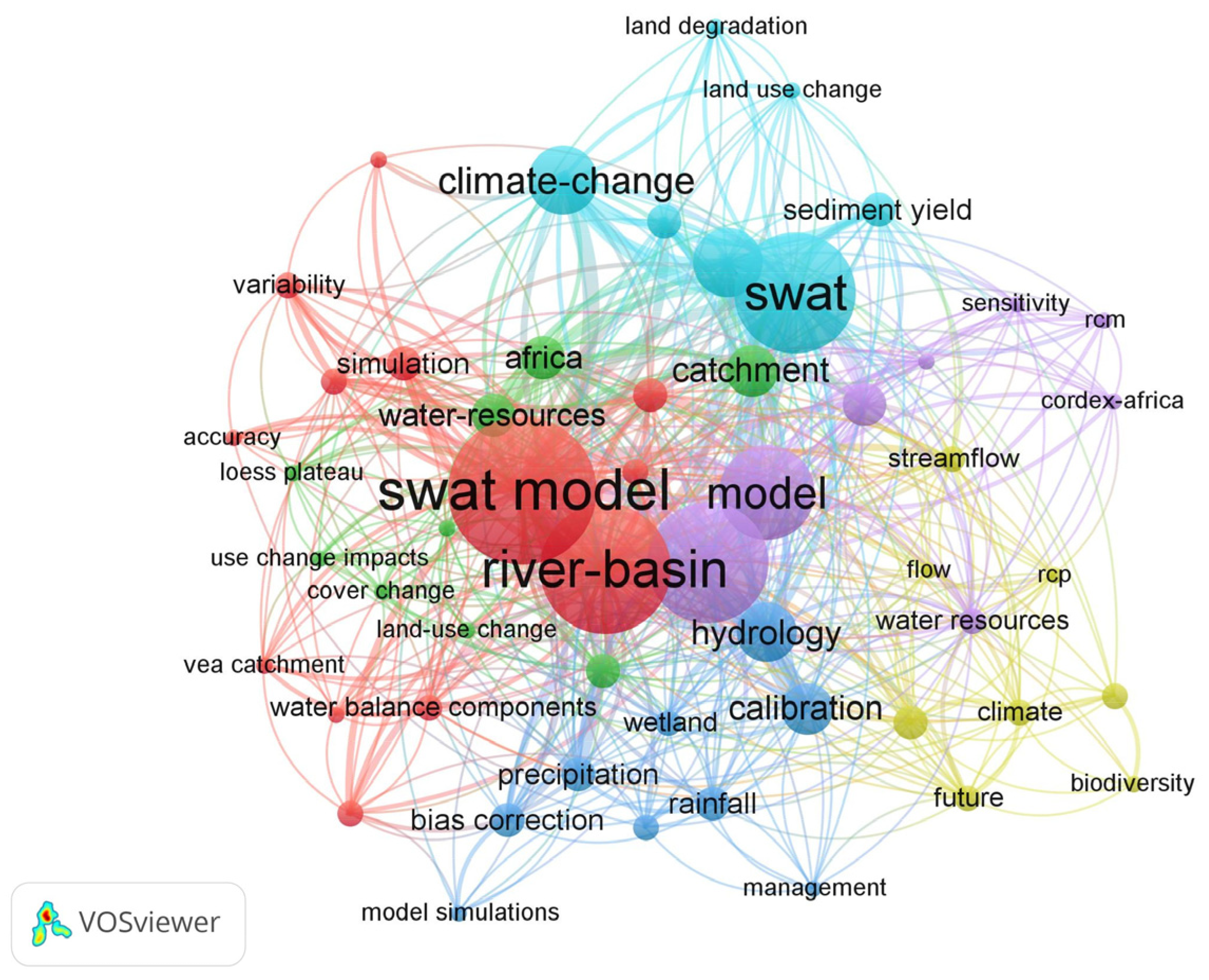
Figure 1. Bibliometric analysis of hydrological sensitivity studies in African watersheds. Nodes illustrate the prevalence of SWAT-based studies and the limited application of InVEST models in the Asa watershed.
Water 17 03477 g001
Figure 2. The Asa watershed and river networks in Kwara State, Nigeria.
Water 17 03477 g002
Figure 3. Flowchart of the InVEST model for AWY.
Water 17 03477 g003
Figure 4. Spatial distribution of (a) WY in 2000, (b) WY in 2010, (c) WY in 2020, (d) average annual precipitation, and (e) average annual reference evapotranspiration.
Water 17 03477 g004
Figure 5. Distribution of AWY: (a) total volume, (b) volume water yield per hectare.
Water 17 03477 g005
Figure 6. Temporal comparison of (a) S1, (b) ST, and (c) feature importance.
Water 17 03477 g006
Table 1. Summary of datasets and sources used in the InVEST AWY model.
Input SourceResolution
PrecipitationPreCRU TS 4.0655 km
Reference EvapotranspirationEToTerraClimate4 km
Root Depth, Plant available water contentRDp, PAWCISRIC250 m
Land use/Land coverLULCGLAD Land Cover30 m
Watershed Boundary SRTM DEM (USGS)30 m
Streamflow Data Nigeria Hydrological Services Agency (NIHSA)20 years (2001–2020)
Crop Coefficients KcFAO Crop Water Requirements GuidelinesClass-dependent
Table 2. Climate variables and LULC reference periods.
S/NClimate Data PeriodLULC Reference YearDenotationMean Rainfall (mm)
11991–2000200020001373
22001–2010201020101331
32011–2020202020201266
Table 3. Biophysical attributes associated with land-use characteristics of the Asa watershed.
LULC_descLucodeLULC_vegKcRoot_Depth (mm)
Water101.051
Forest210.801500
Wetland401.001200
Crops510.95800
Built Area700.15300
Shrubland1110.701000
Table 4. Comparison of simulated AWY and observed streamflow.
YearSimulated AWY (Million m3)Observed Streamflow (Million m3)
200019903214
201021303482
202020203499
Table 5. AWY by LULC in the Asa Watershed.
LULC/Year200020102020
Area (ha)WY/Pixel (mm)Area (ha)WY/Pixel (mm)Area (ha)WY/Pixel (mm)
Water791.9241.72919.8946.40885.127.02
Forest99,195.501014.78101,190.841027.87102,707.31965.00
Wetland218.65133.696.0498.12105.1522.90
Crops54,237.84967.2952,449.75988.0438,971.75928.62
Built Area19,370.63707.2826,130.811132.5734,284.761066.15
Shrubland33,044.42980.4826,046.851057.829,880.11995.93
Table 6. Model performance across years.
YearR2RMSEMAE
20000.97617.34.5
20100.98511.18.5
20200.96511.38.5
Disclaimer/Publisher’s Note: The statements, opinions and data contained in all publications are solely those of the individual author(s) and contributor(s) and not of MDPI and/or the editor(s). MDPI and/or the editor(s) disclaim responsibility for any injury to people or property resulting from any ideas, methods, instructions or products referred to in the content.