You are currently viewing a new version of our website. To view the old version click .
Water
  • Article
  • Open Access

5 December 2025

A 21-Year Analysis of Turbidity Variability in Cartagena Bay: Seasonal Patterns and the Influence of ENSO


,
,
,
and
1
Faculty of Engineering, Universidad de Cartagena, Cartagena 130015, Colombia
2
Department of Meteorology, Federal University of Rio de Janeiro (UFRJ), Rio de Janeiro 21941-916, Brazil
3
Centro de Investigaciones Oceanográficas e Hidrográficas del Caribe, Cartagena 130001, Colombia
*
Author to whom correspondence should be addressed.
This article belongs to the Special Issue Intelligent Water Management: Machine Learning, Remote Sensing, Data Analytics, Predictive Modeling, and the Path to Sustainability

Abstract

Cartagena Bay, a coastal estuary in northern Colombia, receives significant sediment inputs from the Canal del Dique, an artificial channel with average discharge rates of 55 m3/s during the dry season and 250 m3/s during the rainy season. This study presents the variability of turbidity in Cartagena Bay for 21 years (2002–2022) using MODIS satellite imagery. Turbidity series were determined by using a remote sensing empirical algorithm developed for Cartagena Bay in 2024. In the present study, this algorithm was validated using MODIS data, demonstrating an adequate performance (R2 = 0.88, RMSE = 3.1, MAPE = 29.5%). Spatial and temporal turbidity patterns were analyzed for three representative months: February (dry season), July (low precipitation), and November (high rainfall). The role of the El Niño–Southern Oscillation (ENSO) on the dynamics of the Canal del Dique discharge and turbidity levels was studied through anomaly analysis and Fourier Transform Analysis (FTA). Results highlight a marked spatial variability in turbidity, with the highest turbidity levels observed near the canal mouth from April to September. FTA revealed a dominant annual cycle in turbidity and discharge, with additional semi-annual and multi-year periodicities linked to the rainfall periods and ENSO. Turbidity variability appears primarily driven by seasonal and local hydrodynamic processes, with a long-term increasing trend in turbidity. This approach can be applied to other tropical estuaries under strong fluvial influence.

1. Introduction

The Cartagena Bay is an estuary located in northern Colombia that receives an average discharge of 55 m3/s during the dry season and 250 m3/s in the rainy season, carrying high sediment loads from the Magdalena River (1528 km) through the Canal del Dique (113 km), an artificial channel [1]. It is connected to the Caribbean Sea through two inlets, one to the north (Bocagrande-Escollera Submarina) and the other to the south (Bocachica), through which water exchange occurs [2].
Cartagena Bay has been identified as one of the highest-priority monitoring areas in Colombia due to its ecological and economic importance and pollution [3]. Starting in 2001, INVEMAR (Instituto de Investigaciones Marinas de Colombia) has been monitoring Cartagena Bay twice a year at 12 stations using in situ measurements as part of the REDCAM (Water Quality Monitoring Information System), an interinstitutional program to monitor marine and coastal pollution. Monitoring has identified the main sources of contamination and the trends of several water quality parameters, with suspended solids playing a crucial role due to the significant sediment input into the bay through the Canal del Dique (approximately 1.7 million tons of sediments annually) [2]. These monitoring efforts, however, have not been suitable for long-term water monitoring, since they provide only a snapshot of water quality at two dates per year, each representing a different season. Conventional methodologies for collecting such data in coastal waters are based on field campaigns, which are expensive to maintain, especially for developing countries [3,4,5]. Furthermore, data limitations have made it challenging to understand long-term spatial and temporal variability of water turbidity patterns within the bay and their consequences for water quality and sediment transport. More research and data collection should be conducted in Cartagena Bay, as it is essential to improve the understanding of complex interactions and assess their ecological implications [5].
Several studies on the hydrodynamics and distribution of sediments in Cartagena Bay have been conducted to assess its water quality [6,7,8,9]. These studies indicate that sediment dispersion in Cartagena Bay increases considerably during periods of high flow in the Canal del Dique. Furthermore, through observations derived from numerical models that analyzed specific years (2002, 2006, and 2008), each representing various climatic conditions associated with El Niño-Southern Oscillation (ENSO), certain patterns were identified as strengthening or weakening, respectively, during the cold and warm phases of the ENSO [6].
Although observational and model-based studies in the bay have provided valuable insights into hydrodynamic behavior and sediment transport during different ENSO phases, their scope is limited to specific periods or individual events. A deeper understanding of temporal variability and the long-term influence of climate oscillations on water quality requires the incorporation of extended time-series analyses [10,11]. This type of analysis can reveal persistent trends and episodic anomalies that remain hidden in short-term approaches. In the case of Cartagena Bay, despite notable research efforts, there is a clear need to strengthen the assessment of long-term turbidity dynamics, particularly concerning the spatial and temporal variability associated with ENSO episodes.
This study, focused on Cartagena Bay during the period 2002–2022, specifically addresses this gap by combining MODIS-derived turbidity data with Dique Channel discharge records and ENSO indices to unravel seasonal and interannual turbidity patterns in a tropical environment with strong fluvial influence and hydrodynamic complexity.
Globally recognized for its high temporal resolution, the MODIS remote sensing sensor has been applied in the study of spatio-temporal variability of water biogeochemical parameters and for assessing the impact of ENSO on both coastal and inland waters. The use of MODIS in this study is supported by its long-term record, broad spatial coverage, and prior successful applications in turbid coastal waters. Also, Turbidity retrievals from remote sensing are among the most reliable, low uncertainty developed methodologies as shown by similar approaches that have been applied in other coastal systems: Nechad et al. [12] calibrated and validated a multisensor algorithm including MODIS for turbidity in European coastal waters; Dogliotti et al. [13] proposed a generic algorithm for coastal and estuarine waters; Petus et al. [14] used MODIS to analyze the spatio-temporal variability of the Adour River turbid plume in the Bay of Biscay, France, Chen et al. [15] used MODIS to monitor turbidity in Tampa Bay, USA; Yang et al. [16] applied MODIS 250 m imagery to estimate turbidity in Darwin Harbour, Australia; Yunus et al. [11] to monitor Total Suspended Solids in Chesapeake Bay for 18 years (2002–2020), and recently Faria de Sousa et al. [17] for monitoring turbidity in Guanabara Bay (Brazil). These studies demonstrate that MODIS provides reliable estimates of turbidity in diverse turbid coastal environments, supporting its use for deriving long-term satellite time series in Cartagena Bay.
This study uses MODIS sensor data to conduct a temporal analysis of turbidity in Cartagena Bay, Colombia, to understand its spatial and temporal dynamics. To fulfill this objective, the study employs an empirical remote-sensing turbidity algorithm developed specifically for the bay [18]. The article also provides a turbidity variability analysis and its relationship with the Canal del Dique flow, and the effect of the El Niño Southern Oscillation (ENSO) using MODIS data obtained over 21 years (2002—2022).
While several studies have investigated turbidity dynamics in estuarine and coastal systems worldwide, such as along an estuary-to-coast gradient in New Zealand [10] and in turbid freshwater plumes influenced by the El Niño–Southern Oscillation (ENSO) along the Oregon coast [19], few studies have focused on tropical bays affected by complex fluvial inputs, regarding inflow flux and biogeochemical characteristics based on long-term satellite analyses spanning more than two decades. For instance, the seasonal variability of the maximum turbidity zone has been documented in the Yangtze Estuary [20], and the effects of extreme climatic events on hydrological parameters, including turbidity, have been analyzed along the Brazilian Amazon coast [21]. Similarly, a 15-year MODIS-based study in the Río de la Plata Estuary demonstrated strong seasonal and interannual variability in turbidity associated with river discharge and wind forcing [22]. However, none of these studies integrates a 21-year satellite time series to systematically explore both seasonal and interannual turbidity variability in relation to river discharge and ENSO influences within a tropical bay system. This type of analysis is particularly relevant for estuarine environments in the tropics, where intense rainfall, substantial freshwater inputs, and dynamic land–sea interactions promote transient stratification primarily controlled by salinity rather than temperature [23]. The present research, focused on Cartagena Bay for the 2002–2022 period, addresses this gap by combining MODIS-derived turbidity data with discharge records from the Canal del Dique and ENSO indices to unravel the seasonal and interannual turbidity patterns in a tropical system characterized by highly dynamic fluvial inputs.

2. Materials and Methods

2.1. Study Area

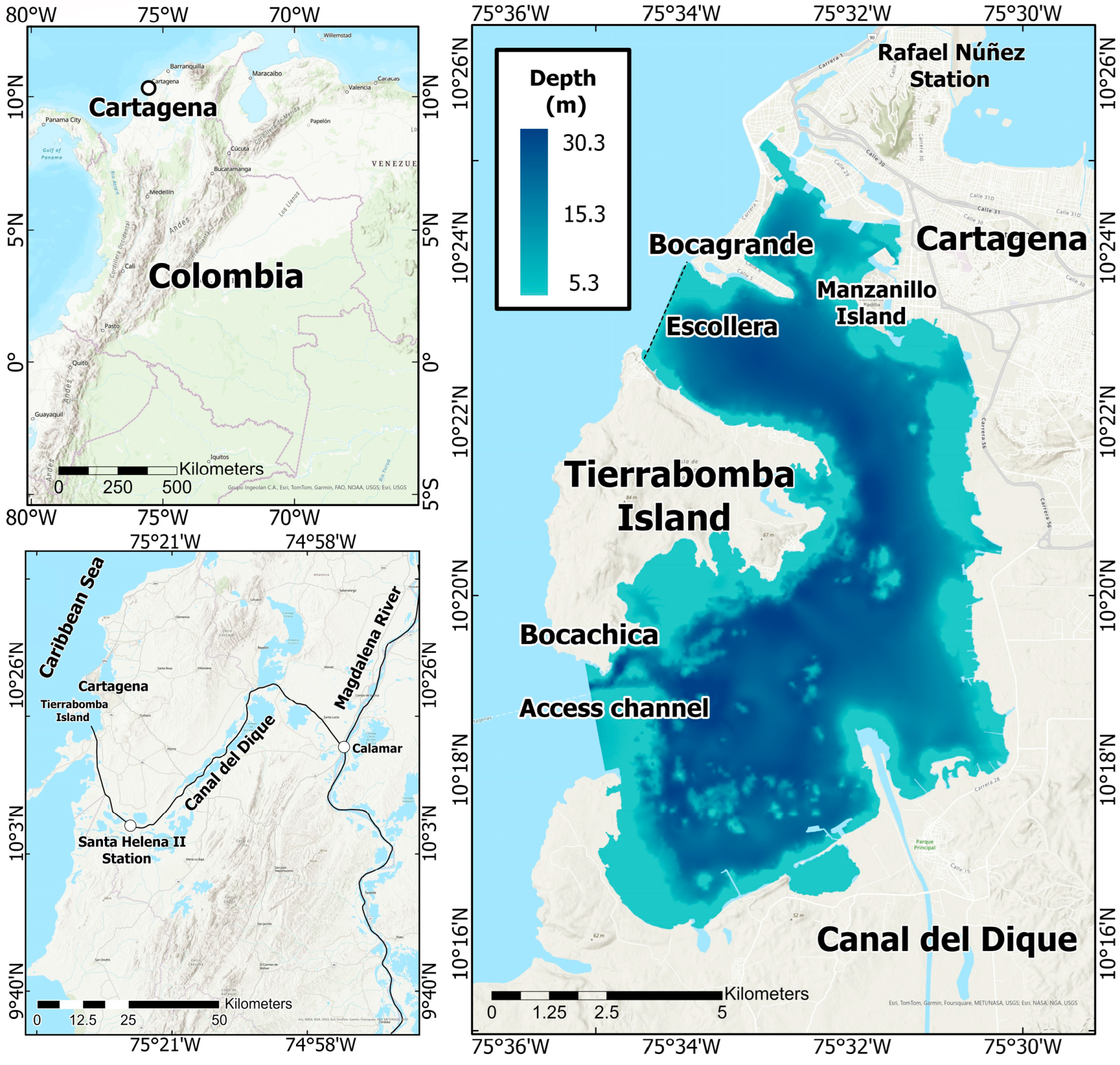
Cartagena Bay is an estuarine system located in the Colombian Caribbean in the northwest of South America (Figure 1). It covers an area of approximately 82 km2 [8], with average depths ranging from 5.3 m to 30.3 m [24]. The bay is characterized by two distinct entrances, Bocachica and Bocagrande, which are separated by the island of Tierrabomba. The Bocagrande entrance is partially obstructed by a submerged breakwater, locally known as “Escollera,” with depths ranging from 0.6 m to 2.1 m. In contrast, the Bocachica inlet comprises three narrow channels, with the primary navigation channel being the widest, approximately 100 m wide and 15 m deep [25].
Figure 1. Location of Cartagena Bay.
The water quality and morphology of the Cartagena Bay have been altered as a consequence of the contribution of sediments from the Canal del Dique, which is a branch of the Magdalena River that flows into the Cartagena Bay [2], which has produced a delta that has increased over time and has influenced the sediment dynamics of the bay, becoming a threat to coral reefs and the operation of ports and navigability [8].
The region in which Cartagena Bay is located experiences two climatological seasons: a dry period from December to March and a rainy season from April to November. In particular, the highest levels of rainfall are observed during the months that span from September to November [26]. It is well-documented that during the rainy season, the bay experiences its highest levels of turbidity, primarily due to increased sediment input from the Canal del Dique [6,7,18,27].
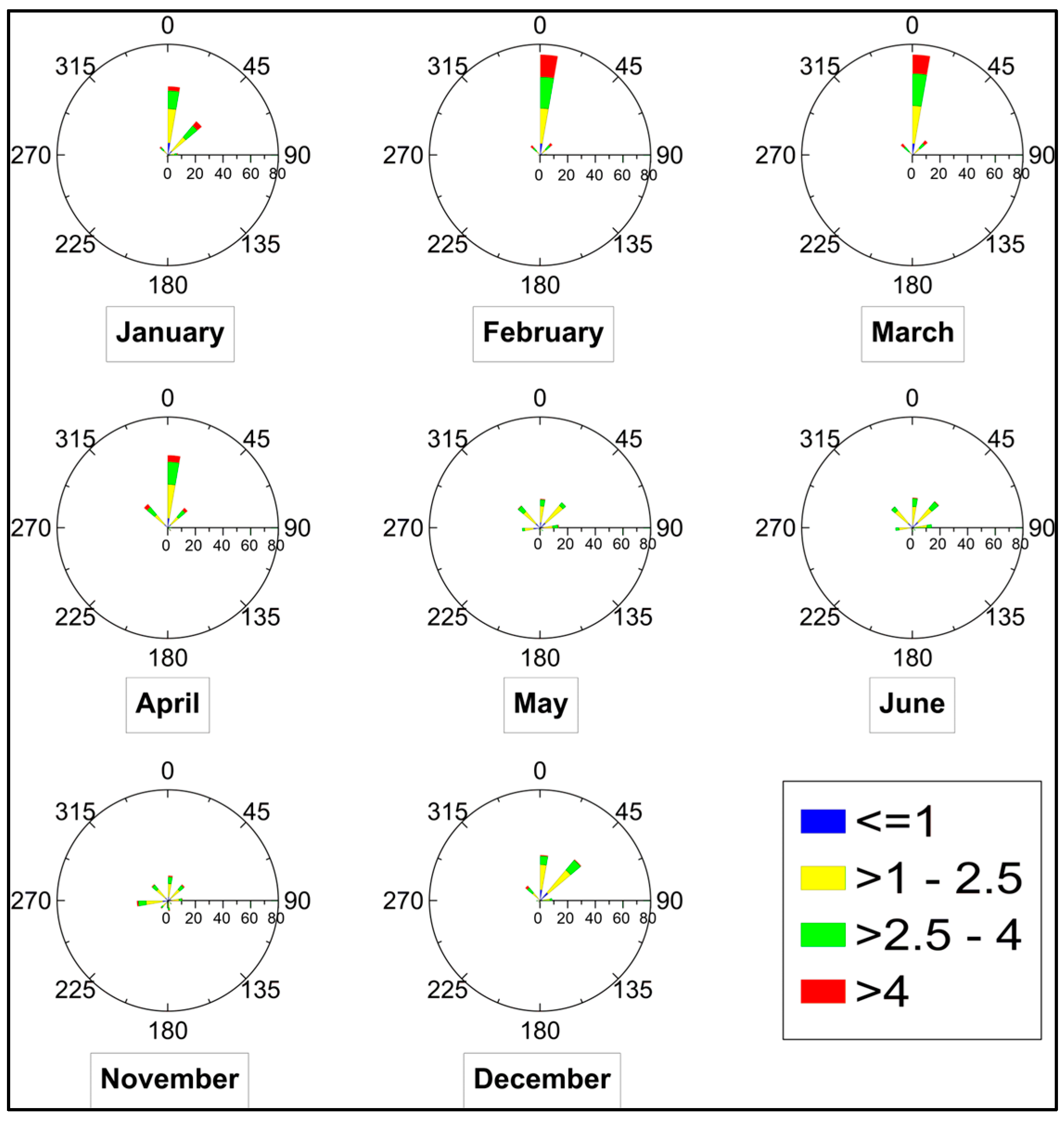
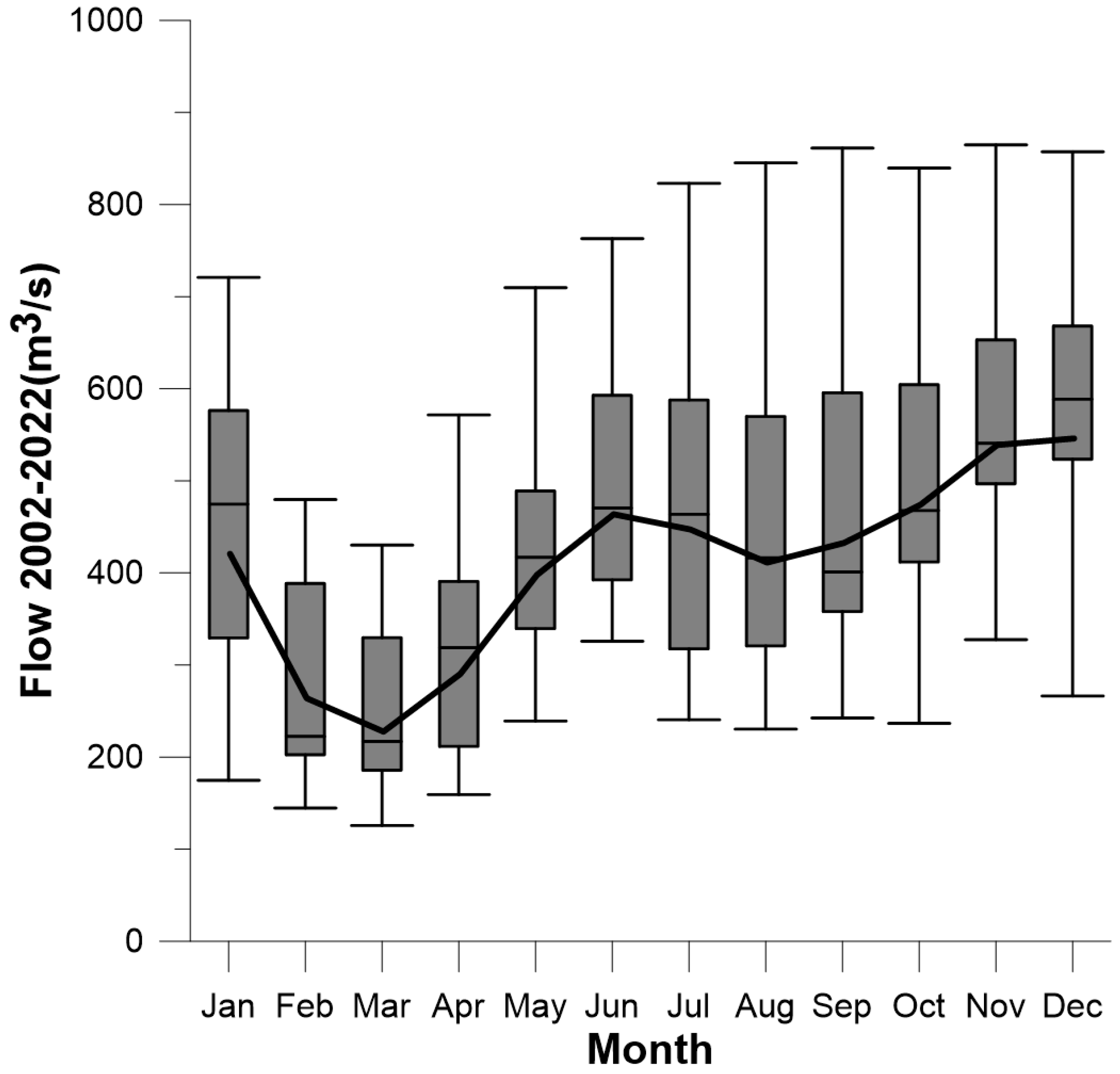
The hydrodynamics of Cartagena Bay are mainly influenced by wind patterns, saline stratification resulting from freshwater flow through the Canal del Dique, and microtidal variations in sea level [28]. During the dry season, especially in February and March, the Canal del Dique registers its lowest flows (Figure 2), while consistent northeast trade winds persist with average speeds exceeding 4 m/s (Figure 3). From April to July, canal flows experience a slight increase, accompanied by less intense winds blowing from various directions (north, northeast, east, and southeast) (Figure 3). As the rainy season sets in from August to November, canal flows significantly escalate (Figure 2), while predominantly weak winds from the southwest prevail (Figure 3).
Figure 2. Monthly Canal del Dique discharge for the 2002–2022 period. The boxplots represent the distribution of flow values, with boxes indicating the interquartile range (25th–75th percentiles), whiskers showing the minimum and maximum values, and the horizontal line within each box representing the median. The solid line depicts the multiannual mean flow for the same period.
Figure 3. Monthly wind rose diagrams for the period 2015–2019 at the Rafael Nuñez Station. Each panel represents the distribution of wind direction and wind speed frequencies for a given month. Wind speed categories are color-coded: blue (≤1 m s−1), yellow (>1–2.5 m s−1), green (>2.5–4 m s−1), and red (>4 m s−1). Radial axis indicates relative frequency (%).

2.2. Image Processing

MODIS imagery was selected for its high temporal resolution and the availability of a consistent 21-year data series (2002–2022), which ensures the robustness of long-term trend analyses. This period also aligns with the operational period during which MODIS data retained high radiometric quality before the noted decline in 2023 [29]. Other sensors, such as Sentinel and Landsat, were considered; however, their lower temporal resolution or shorter temporal coverage limit their applicability for consistent multi-decadal time series analyses.
Reflectance data from MODIS imagery were accessed, processed, and downloaded using Google Earth Engine (GEE). For turbidity estimation, the MOD09GA.061 product—Surface Reflectance 500 m Daily—was employed, which provides atmospherically corrected surface reflectance (R) at a spatial resolution of 500 m [30]. Although this atmospheric correction approach is not considered the most robust for water quality studies, it has been widely applied in similar studies [11,31].
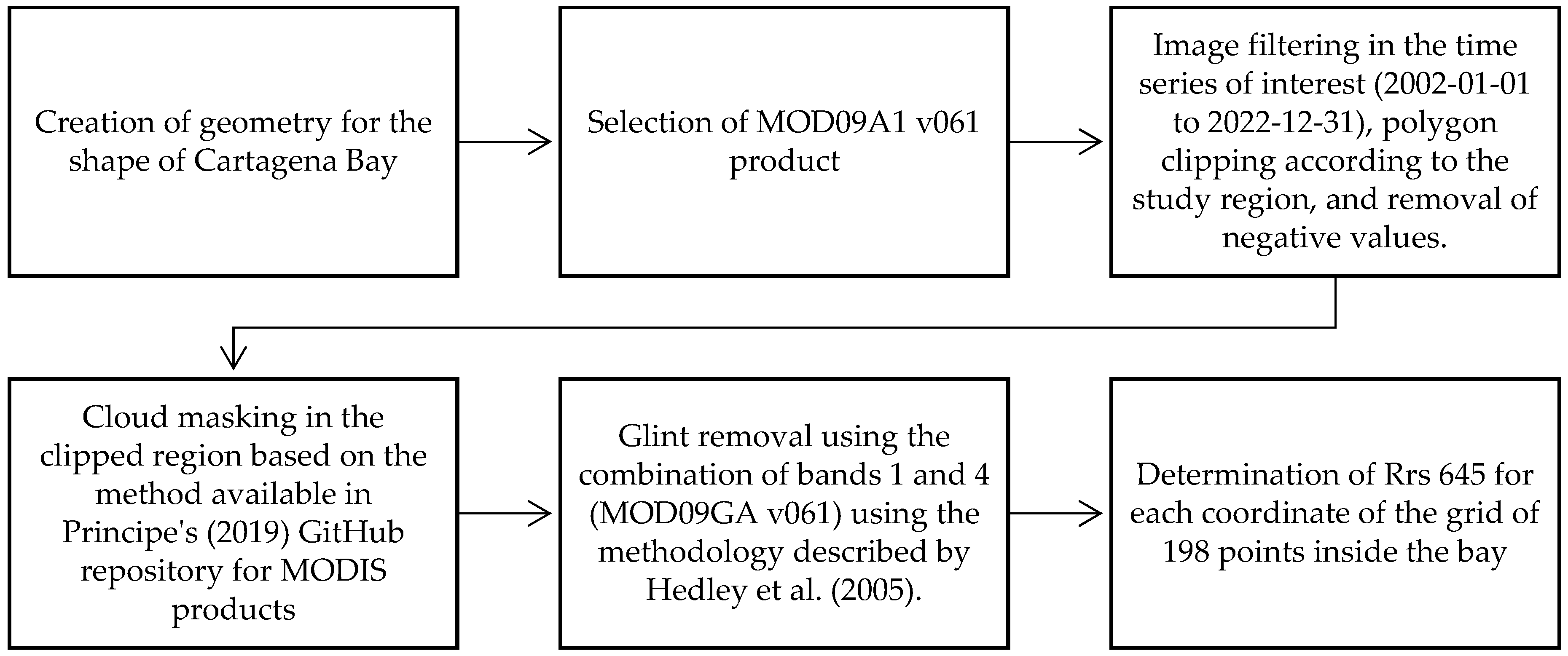
The processing of the MODIS images involved several sequential steps (Figure 4). This processing method is based on the one proposed by De Sousa [32] (https://github.com/felipefariadesousa) (accessed on 22 May 2024). Initially, data filtering was performed, covering the period from 1 January 2002, to 31 December 2022. Subsequently, the dataset was clipped using the polygon outlining the bay’s geometry. Additionally, the scaling factor applied by Google Earth Engine (GEE) in the MODIS product was applied, and negative values potentially originating from noise or atmospheric conditions in the image were eliminated.
Figure 4. Processing Images Methodology. Steps related to cloud masking and glint removal were based on Principe [33] and Hedley et al. [34], respectively.
A crucial step in the processing phase was the filtering of data that could compromise the accuracy of the results, such as those affected by cloud cover, cirrus clouds, or shadows. To address this, the GEE tools recommended by Principe [33] were used. This tool uses a bit mask within MODIS images to identify pixels affected by clouds, generating a cloud-masked dataset. This approach enabled the extraction of cloud-free surface reflectance values, ensuring that subsequent analyses were based exclusively on reliable data. The selection of this method was based on its demonstrated applicability in similar estuarine optical conditions [17]. All pre-processing steps and their assumptions were selected based on prior validation in similar environments.
As a final step, “deglinting” was performed to reduce the effects caused by the specular reflection of the sun on surfaces such as water. This involved applying the method proposed by Hedley et al. [34], which follows these steps:
First, representative areas of the image exhibiting a wide range of sun-glint intensities are selected, avoiding shaded or dark regions. The minimum Near-Infrared (NIR) brightness (MinNIR) within the sample is determined to represent the NIR reflectance free of glint. For each sunlit band (i), a linear regression is performed between NIR brightness (x-axis) and the band reflectance (Ri, y-axis) using the selected pixels. The slope of the regression line (bi) quantifies the degree to which glint in the NIR band affects the corresponding band i.
The reflectance of each pixel is then corrected according to the following equation:
R C o r r = R i b i ( R N I R M i n N I R ) ,
In essence, this formula involves reducing the reflectance value of the pixel in band i (Ri) by the product of the regression slope (bi) and the difference between the pixel’s NIR reflectance value (RNIR) and the ambient NIR level (MinNIR).

2.3. Turbidity Time Series

For the development of the time series, a spatial grid of 198 points was defined across Cartagena Bay, with each coordinate corresponding to the center of a MODIS pixel. This configuration ensured that the extracted reflectance data were not affected by land contamination, thus eliminating the need for additional masking procedures. The overall workflow for data extraction, algorithm application, and time-series generation is presented in Figure 5, which outlines the sequential steps used to derive continuous turbidity records from MODIS imagery.
Figure 5. Turbidity Time-series Generation Workflow.
Turbidity was estimated using the algorithm proposed and validated by Eljaiek-Urzola et al. [18] for Cartagena Bay (Equation (2)), developed from radiometric and water quality data collected during field campaigns.
For the development of the algorithm, Eljaiek-Urzola et al. [18] used twenty-one in situ data pairs consisting of turbidity (FNU) and remote sensing reflectance (Rrs), measured in Cartagena Bay using a Hanna Turbidity Probe and an Ocean Optics spectroradiometer, respectively. Of these, sixteen samples were collected from areas outside the sediment plume and five from within. The calibration of the empirical turbidity model was performed using Monte Carlo (MC) simulations, where ten of the twenty-one samples were randomly selected for calibration by applying a linear relationship between Rrs and turbidity. This process was repeated 300,000 times, generating slope, intercept, and R2 values for each iteration. The selection of algorithms involved analyzing the R2 histogram to identify equations within the most frequent range. From these, equations with slope and intercept values near the mode (mode ± standard deviation) were shortlisted, and those with the highest R2 values were chosen.
T = 707.98 × R r s ( 645   n m ) + 0.03 ,
where T is turbidity (FNU), and Rrs (665) is the remote sensing reflectance at a wavelength of 665 nm.
To support the application of this algorithm across the full 2002–2022 period, its performance was also validated using in situ turbidity measurements collected in Cartagena Bay during field campaigns conducted in 2019, 2021, and 2022. These more recent observations (representing different hydroclimatic conditions) served to confirm the algorithm’s robustness under variable environmental scenarios. This validation step ensured the consistency of the model before applying it retrospectively to the full satellite time series, as further detailed in Section 3.2. These campaigns were carried out by public institutions: Universidad de Cartagena, Aguas de Cartagena, and the Instituto de Investigaciones Marinas y Costeras (INVEMAR).
The resulting dataset comprised 55 paired observations, each corresponding to the exact day of the satellite overpass (matchups). Field measurements were consistently collected during morning hours, which correspond with the satellite overpass time. While a larger dataset is always advantageous for enhancing statistical robustness, the number of matchups obtained in this study is consistent with those used in similar coastal optical algorithm validations reported in the literature (N = 63 and 46 for MODIS Aqua and MODIS Terra in Rio de la Plata [22], N = 24 for Cienfuegos Bay [35], N = 49 for MERIS in Southern North Sea [12]. The empirical algorithm employed in this research was therefore developed and validated specifically for the optical characteristics of Cartagena Bay, based on these locally acquired field measurements. To evaluate the performance of the algorithms, the root mean square error (RMSE) and the Mean Absolute Percentage error (MAPE) were estimated with the following equations:
R M S E 1 n i = 1 n ( T m i T c a l i ) 2 ,
M A P E = 1 n i = 1 n T m i T c a l i T m i ,
where Tcal and Tm represent the turbidity values calculated from MODIS data and the in situ measured turbidity for each sample i, respectively.

2.4. Seasonal and Spatial Turbidity Variability

For the spatial analysis of the entire bay, a total of 768 MODIS images acquired between 2002 and 2022 were selected, applying the filtering method described in Section 2.2 to exclude images with excessive cloud cover. The analysis was completed by 2022, as NASA’s Ocean Biology Processing Group noted that the scientific quality of MODIS-Aqua and MODIS-Terra Ocean color data products declined significantly starting in 2023. The decline is due to the difficulties associated with tracking and correcting instrument calibration changes as the platforms depart from their nominal orbital node crossing times [29].
Considering the frequent cloud cover in the region that encompasses Cartagena Bay, which limits the number of images available for the entire bay, a spatial analysis of the whole bay was conducted utilizing data from three months representing distinct seasons: February (dry season), July (month with low precipitation), and November (month with heavy rainfall). These months were chosen for their extensive coverage of satellite data.
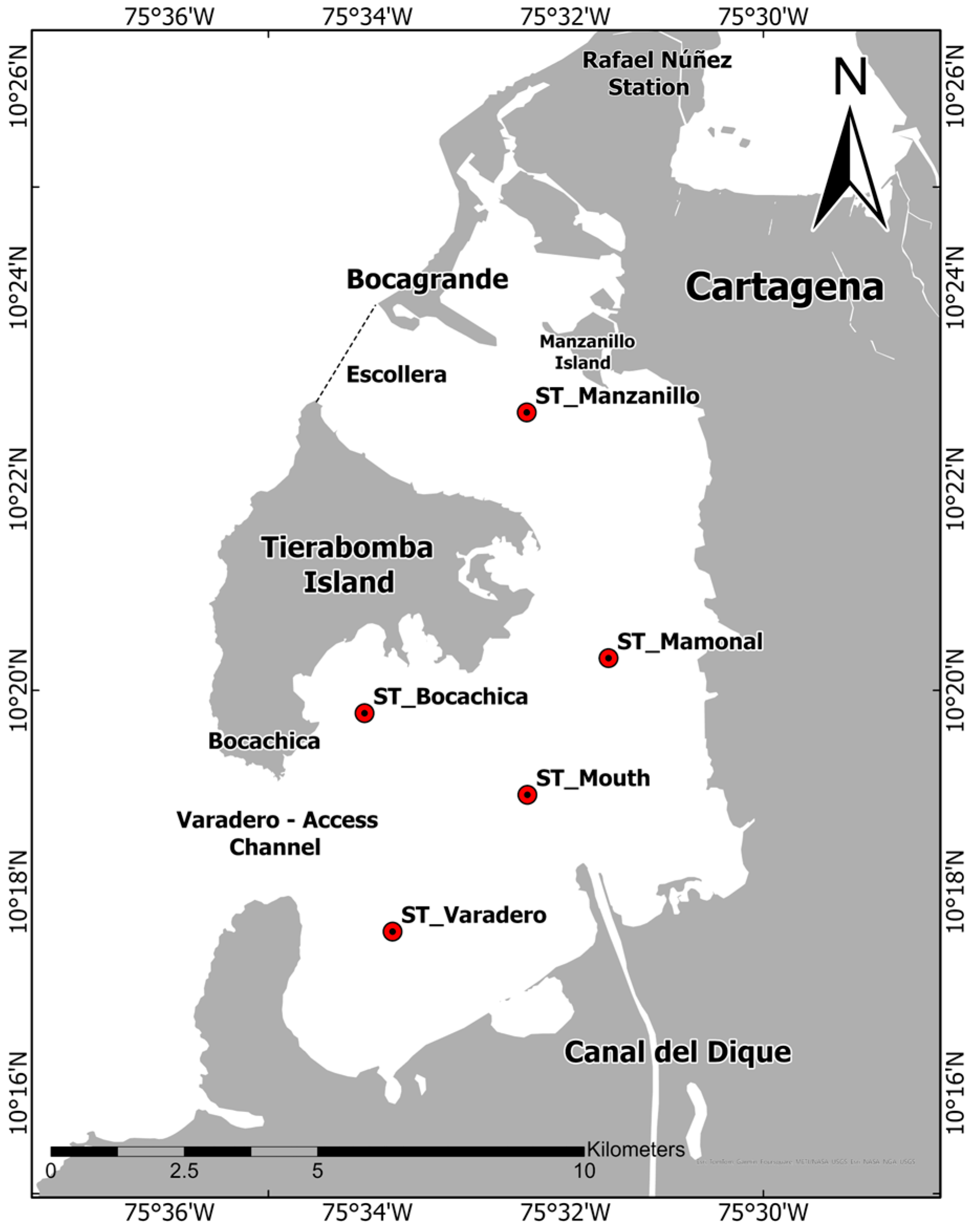
Given the pronounced spatial and seasonal variability of hydrodynamic conditions in Cartagena Bay, together with the frequent cloud cover that constrains satellite image availability, five strategic stations were selected for the seasonal turbidity analysis (Figure 6). The selection was designed to capture the main environmental gradients of the bay, considering proximity to the Canal del Dique’s mouth, differences in depth, and exposure to tidal and circulation patterns. Although the tidal range in Cartagena Bay is relatively small, tidal forcing plays a significant role in water renewal and circulation, particularly in constricted sectors such as Bocachica and Bocagrande (near the Mamonal station).
Figure 6. Selected Stations.
The environmental and anthropogenic significance of each station further guided their selection. Varadero was included due to the presence of a coral reef, representing an ecologically sensitive area. Bocachica corresponds to a recreational and bathing zone, reflecting touristic pressures. Mamonal is in Cartagena’s industrial sector, an area with intense port and industrial activities. Mouth was chosen at the outlet of the Canal del Dique, capturing the influence of fluvial inputs and sediment discharges. Finally, Manzanillo represents the northern sector of the bay, where interactions with the open sea and coastal circulation processes occur. Together, this spatial configuration provides a robust framework to assess turbidity dynamics across regions with contrasting environmental and hydrodynamic conditions.

2.5. ENSO-Related Anomaly Analysis

The analysis of the average turbidity time series of the bay was compared with the temporal analysis of the flow and the Southern Oscillation Index (SOI) to identify and evaluate anomalous periods in the data series. The SOI is defined as a standardized index of the difference in sea level pressure between two points, one located at Tahiti and the other at Darwin, Australia. SOI measures fluctuations in air pressure between the western and eastern tropical Pacific during El Niño and La Niña events. Other indices include the ONI (Oceanic Niño Index). SOI was selected because the index data is available monthly.
Flow time series data were obtained from the IDEAM hydrometeorological database, specifically from the Santa Helena II K84 station located along the Canal del Dique (Figure 1). The measured flow series was obtained by 12 December 2022, because the measurements were finished. The Santa Helena II hydrometeorological station was selected because of its location within the Canal del Dique, making it the closest station to the bay’s entrance. Additionally, this station offers the highest availability of data for the area.
A standardized anomaly analysis was performed for comparison with the SOI. The standardized anomalies were generated according to the methodology described by Santamaría-del-Ángel et al. [36], employing the Z transformation, defined by the following equation:
Z = ( X i X ¯ ) S D x ,  
where X i represents the value of the variable under study, X ¯ and S D x denote the mean and standard deviation of each data series, respectively.
To complement this study, a frequency analysis was conducted using Fourier Transform Analysis (FT), a mathematical tool that decomposes time-domain signals into their constituent frequency components. This transformation provides a frequency-domain representation of the data, enabling the identification of dominant frequencies and their corresponding amplitudes, thereby offering insights into the underlying temporal patterns [37,38]. The spectral analysis provided by the FT was used to detect cycles or periodic patterns in the data, such as seasonal trends in the time series.

3. Results and Discussion

3.1. MODIS Images

A total of 107, 49, and 34 cloud-free MODIS satellite images were used for the spatial analysis of turbidity across Cartagena Bay for the months of February, July, and November, respectively, during the 2002–2022 period (Table 1). The highest number of usable images occurred during the dry season (December–March), when cloud cover is generally lower.
Table 1. Number of MODIS images per Month (2002–2022) used for Turbidity Analysis at Each Monitoring Station and for the Entire Bay.
Table 1 also shows the number of MODIS images used for turbidity analysis at each monitoring station: 410 for St. Manzanillo, 870 for St. Bocachica, 852 for St. Mamonal, 706 for St. Varadero, and 904 for St. Mouth. These values vary across stations, as only cloud-free observations over each specific location were selected. Notably, the number of images for certain stations, such as St. Mouth, exceeds that used in the full-bay spatial analysis. This discrepancy arises from the selection criteria: while the bay-wide analysis included only images with ≤40% total cloud cover over the entire bay (in tropical coastal regions such as Cartagena Bay, cloud cover is highly recurrent, and adopting a stricter criterion, such as 30% would have considerably reduced the number of usable images, limiting the temporal representativeness of the analysis), the station-based analysis incorporated all images without cloud cover over the respective site.
It can be observed that the months with the highest number of cloud-free images are December and January (dry season), reflecting lower cloud cover during this period. The months with the lowest number of available images are May, September, and October, which correspond to the rainy season. The station with the fewest available images is Manzanillo, and the months with the lowest number of images are April, May, and October, each with 11 images over the 21 years. The station with the highest number of images is Mouth, while May presents the lowest number of images throughout 21 years (23 images).

3.2. Validation of Algorithm with MODIS Data

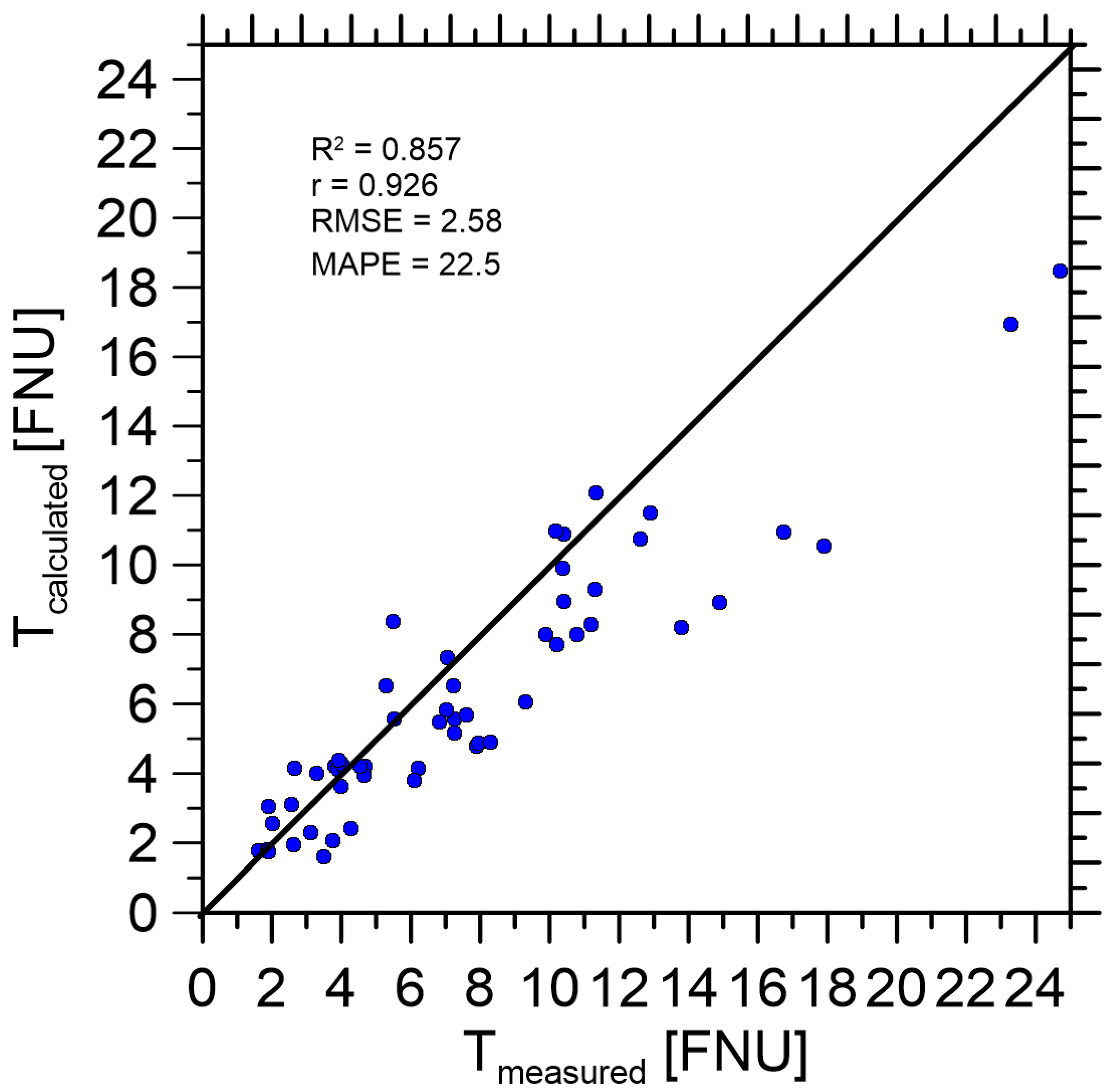
For validation, the calculated and measured turbidity values were compared, yielding an R2 of 0.857, a Pearson correlation coefficient of 0.926, an RMSE of 2.58, and a MAPE of 22.5%. These results indicate that the algorithm performs well with MODIS data and aligns with values reported in the literature for similar studies in other bays worldwide [39,40,41] (Figure 7).
Figure 7. Scatter plot of MODIS-derived vs. in situ measured (FNU) turbidity.
The findings suggest that the algorithm exhibits good performance under low-to-moderate turbidity conditions, closely approximating the 1:1 relationship. However, at turbidity values greater than 12 FNU, there was an underestimation likely due to optical saturation effects [13,42], the relatively limited number of calibration samples in this turbidity range, and the limits of MODIS’s relatively spatial resolutions, which exacerbate mixed-pixel effects in coastal waters while also reducing sensitivity to high turbidity values. Nevertheless, despite these limitations, MODIS provides an accurate assessment of turbidity variability in Cartagena Bay and is suitable for quantifying variability both in seasonal and spatial terms.
Although in situ turbidity data for algorithm validation were only available for three years (2019, 2021, and 2022), the empirical model was developed and calibrated specifically for Cartagena Bay using local field measurements. The optical conditions of the bay are strongly influenced by sediment-rich discharges from the Canal del Dique, which maintain a relatively stable optical regime over time. Similar approaches in data-scarce coastal or estuarine systems have relied on partial validation periods when persistent optical conditions could be reasonably assumed (e.g., [13,19,43]). Additionally, the observed consistency between the long-term turbidity series and known hydrological or ENSO-driven anomalies supports the temporal robustness of the applied algorithm. This approach, while acknowledging its limitations, has been successfully used in other estuarine systems where continuous in situ validation is impractical or impossible.

3.3. Seasonal and Spatial Turbidity Patterns

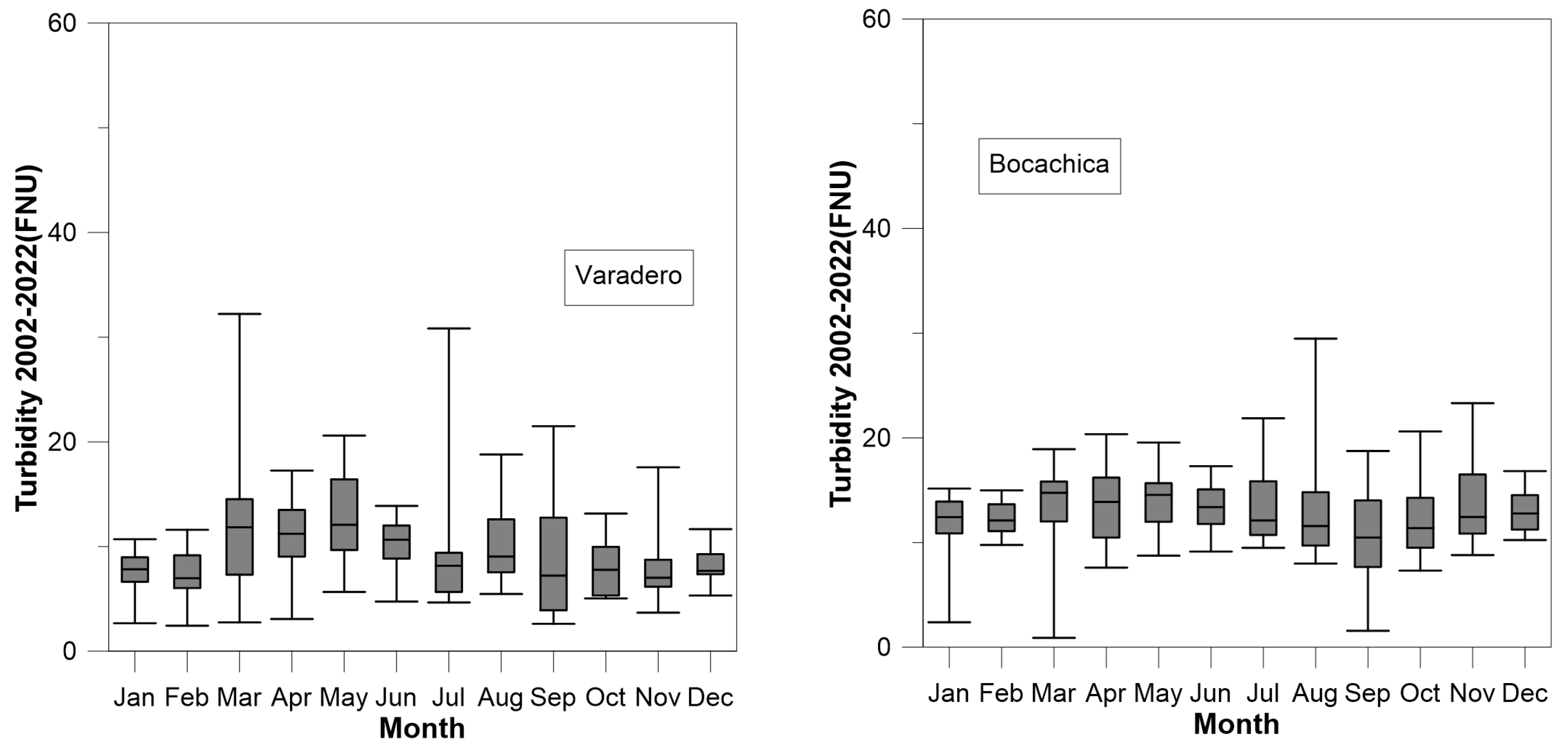
The southern zone of the bay (Varadero and Bocachica stations) has the highest turbidity values in March, April, and May (average values of 12 to 15 FNU), as shown in Figure 8. This is the time of the year when the north and northeast winds still prevail, possibly carrying sediment plumes to this area and thus raising the turbidity. The dry season is characterized by currents flowing mainly southwest in the bay, with greater intensities observed on the western side of the Canal del Dique mouth (0.2–0.35 m/s) [6], where the Varadero and Bocachica stations are located. The flow from the Canal del Dique slows down as it enters the bay and merges with the coastal current in the south. The influence of tidal currents on these flows is minimal due to the microtidal regime [6].
Figure 8. Turbidity Trends (2002–2022) at Varadero and Bocachica Stations. Data represents the median and the 25th and 75th percentiles of the monthly turbidity averages for the years 2002–2022.
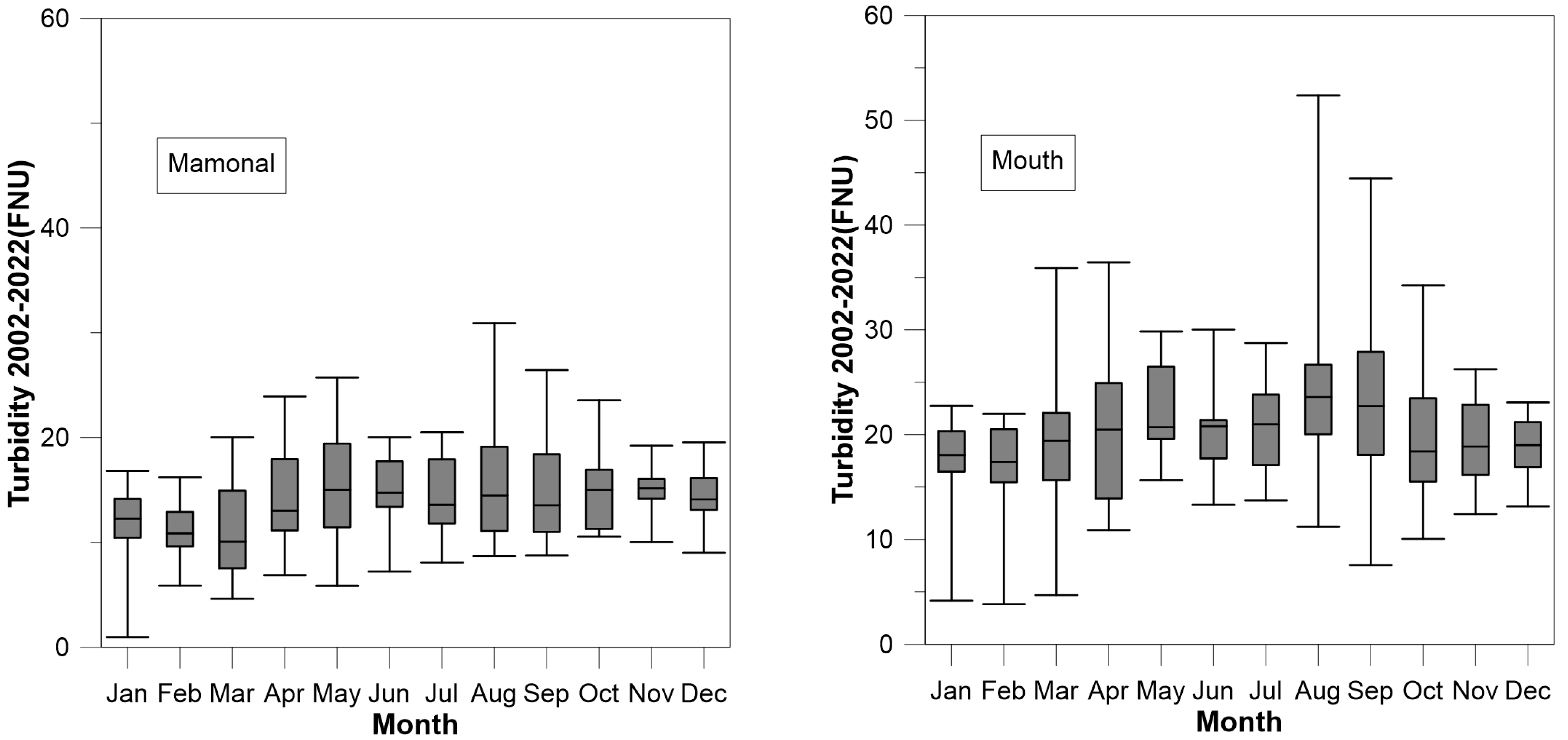
At the Mamonal station, an opposite pattern is observed, where the lowest turbidities occur in March, at approximately 10 FNU (Figure 9). This pattern occurs when the Canal del Dique has the least discharge, and the currents from the southwest are prevalent in the bay [6]. However, during the rainy season, the turbidity in this zone reaches its highest levels, averaging about 15 FNU and a maximum of 30 FNU, possibly due to low wind speeds and a northwesterly direction of the currents in Cartagena Bay [6]. In turn, the sediment plumes in the bay mainly move toward the north.
Figure 9. Turbidity Trends (2002–2022) at Mamonal and the mouth of the Canal del Dique Stations. Data represents the median and the 25th and 75th percentiles of the monthly turbidity averages for the years 2002–2022.
Near St Mouth, average turbidity values remain relatively stable. During the period from April to September, values are highest, ranging from approximately 20 FNU, with peak values between 45 FNU and 53 FNU in August and September (Figure 9). This area of St. Mouth experiences a slight decrease from October to December, which also coincides with the months of highest channel flow (Figure 2). The turbidity drop may be due to dilution processes associated with high discharge of the Canal del Dique.
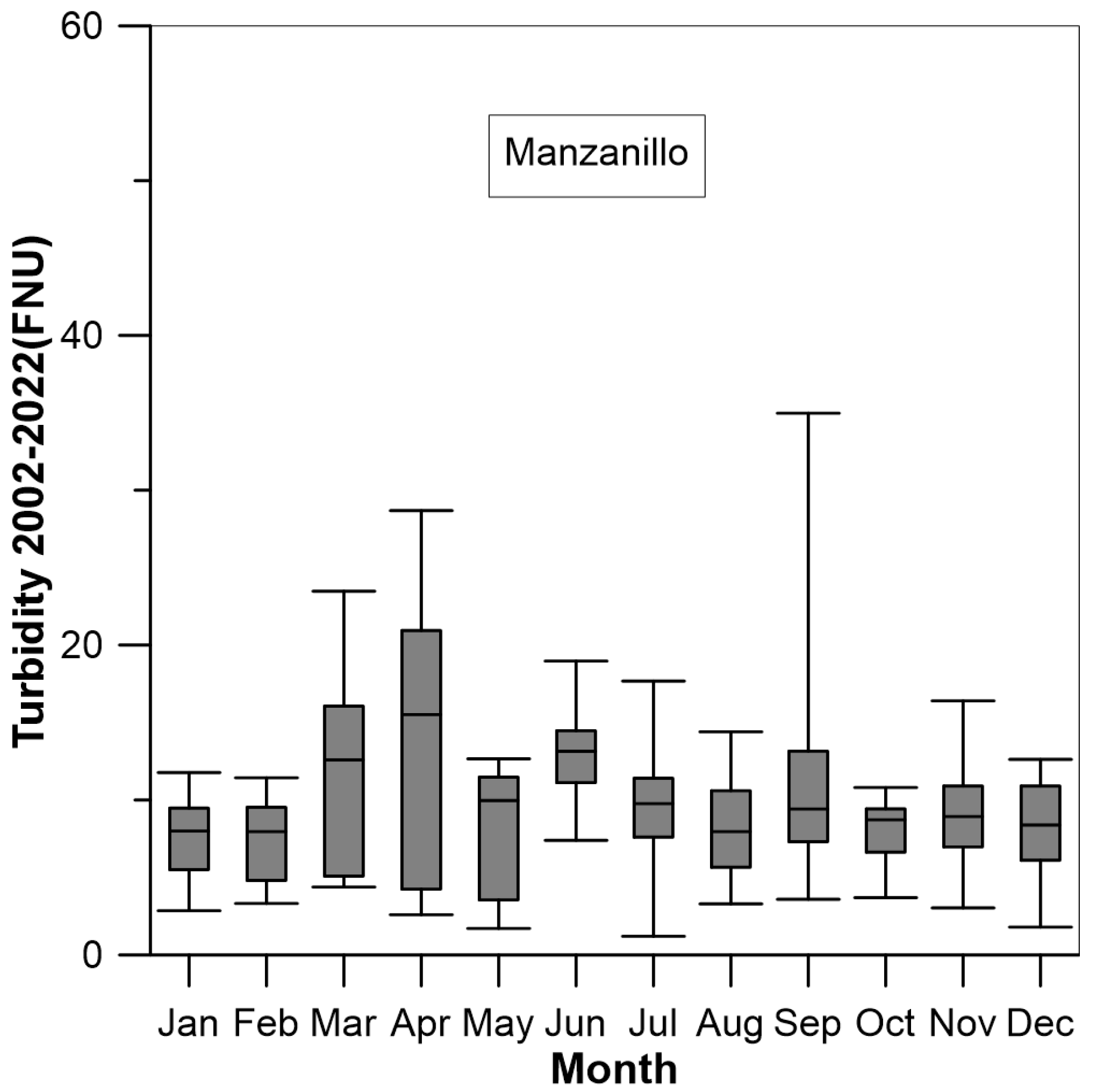
In the Manzanillo area, turbidity levels significantly rise in April (approximately to an average turbidity of 15 FNU) (Figure 10). This increase coincides with the onset of the rainy season, when Canal del Dique’s flow begins to increase (Figure 2). This period of the year also coincides with weaker winds (Figure 3) and prevailing south-to-north currents [6,28], allowing sediment plumes to move northward into the bay. Additionally, during the peak discharge period (September to December), turbidity levels decrease (falling below 10 FNU). This could be attributed to reduced sediment transport due to lower bay currents resulting from decreased flow velocities or even bay flushing through the Bocagrande inlet, which connects to the Caribbean Sea, as net residual surface flow exits the bay through the Bocachica and Bocagrande inlets during the rainy season [6]. However, it is important to note that in September, maximum turbidity levels of 35 FNU were recorded.
Figure 10. Turbidity 2002–2022 in Manzanillo. Data represents the median and the 25th and 75th percentiles of the monthly turbidity averages for the years 2002–2022.
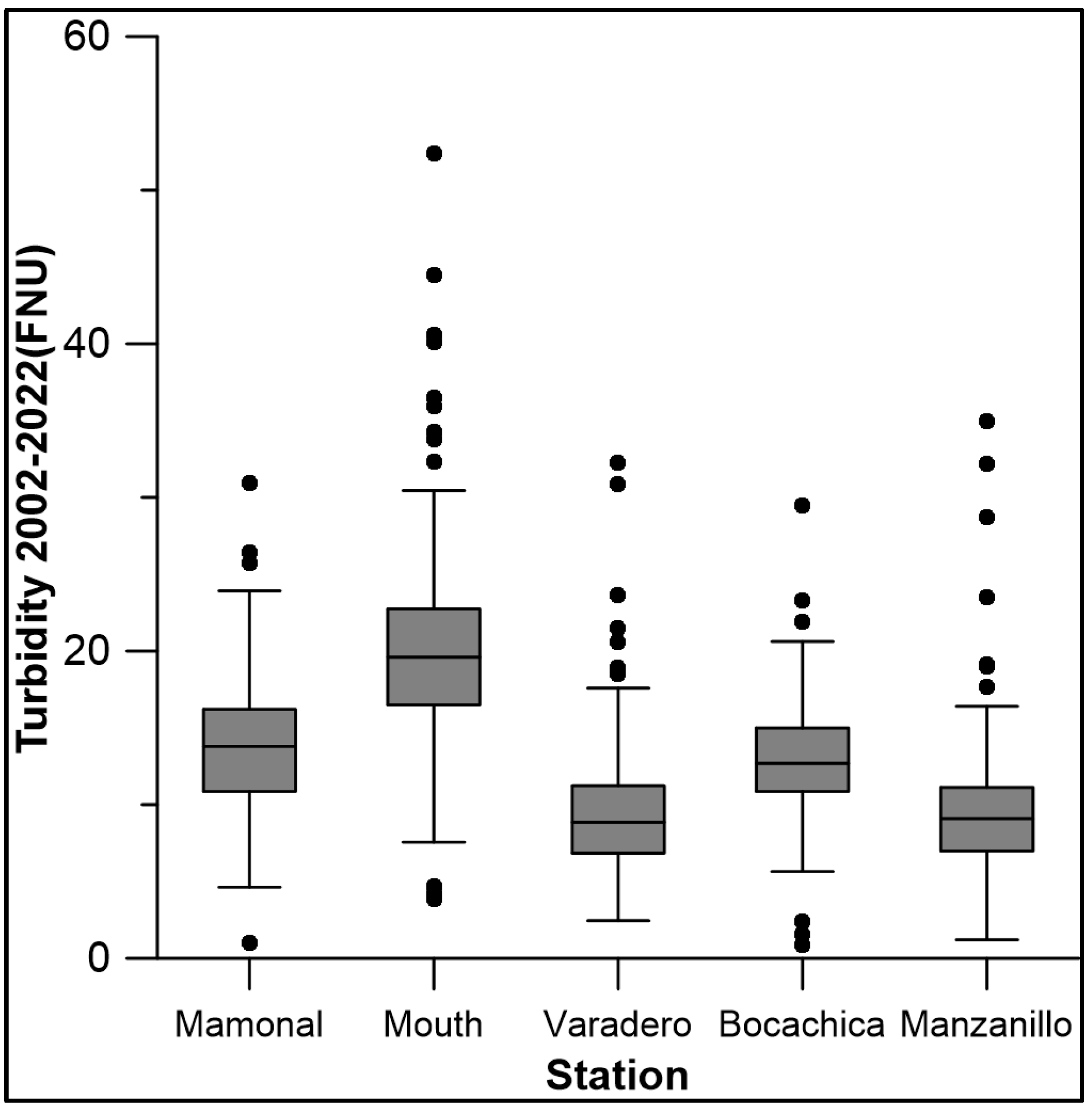
Comparing the stations, the mouth station showed the highest median values and the widest interquartile range, indicating significant temporal variability and frequent high turbidity events. This pattern is likely due to its proximity to the Canal del Dique, which supplies large amounts of fluvial sediments. Mamonal station recorded the second-highest turbidity levels, with values ranging from 0.97 FNU to 30.9 FNU and a median of 13.8 FNU. In contrast, Manzanillo station exhibited turbidity values from 1.2 FNU to 35 FNU, with a lower median of 9.1 FNU (Figure 11).
Figure 11. Turbidity Data Distribution Summary for Each Station (2002–2022).
The relationship between turbidity at the Canal del Dique’s mouth and other monitoring stations in Cartagena Bay exhibited moderate correlations, supporting the important influence of sediment discharge from the Canal. The strongest correlations were with Mamonal (R2 = 0.5528, p < 0.001), Varadero (R2 = 0.5324, p < 0.001), and Bocachica (R2 = 0.5129, p < 0.001), showing the impact of sediment-laden water in the southern area of the Bay. Although the correlations with Manzanillo and the average turbidity in the Bay were lower, they were also statistically significant (R2 = 0.3, p = 0.0011 and R2 = 0.3204, p = 0.0005, respectively). These findings suggest that the sediment discharge from Canal del Dique is an important factor in the variability of observed turbidity in the bay, while also being subjected to the influence of tides, sediment suspension, and local hydrodynamic processes. The statistically significant correlations observed between the canal mouth and monitoring stations point to the Dique Canal’s ability to serve as a primary source of sediment input to Cartagena Bay and, therefore, an important contributor to spatial and temporal turbidity observations. The variation in correlations observed within the varying positions of the Bay is reflective of the complexities involved in sediment transport dynamics.

3.4. Turbidity Spatial Distribution in Cartagena Bay

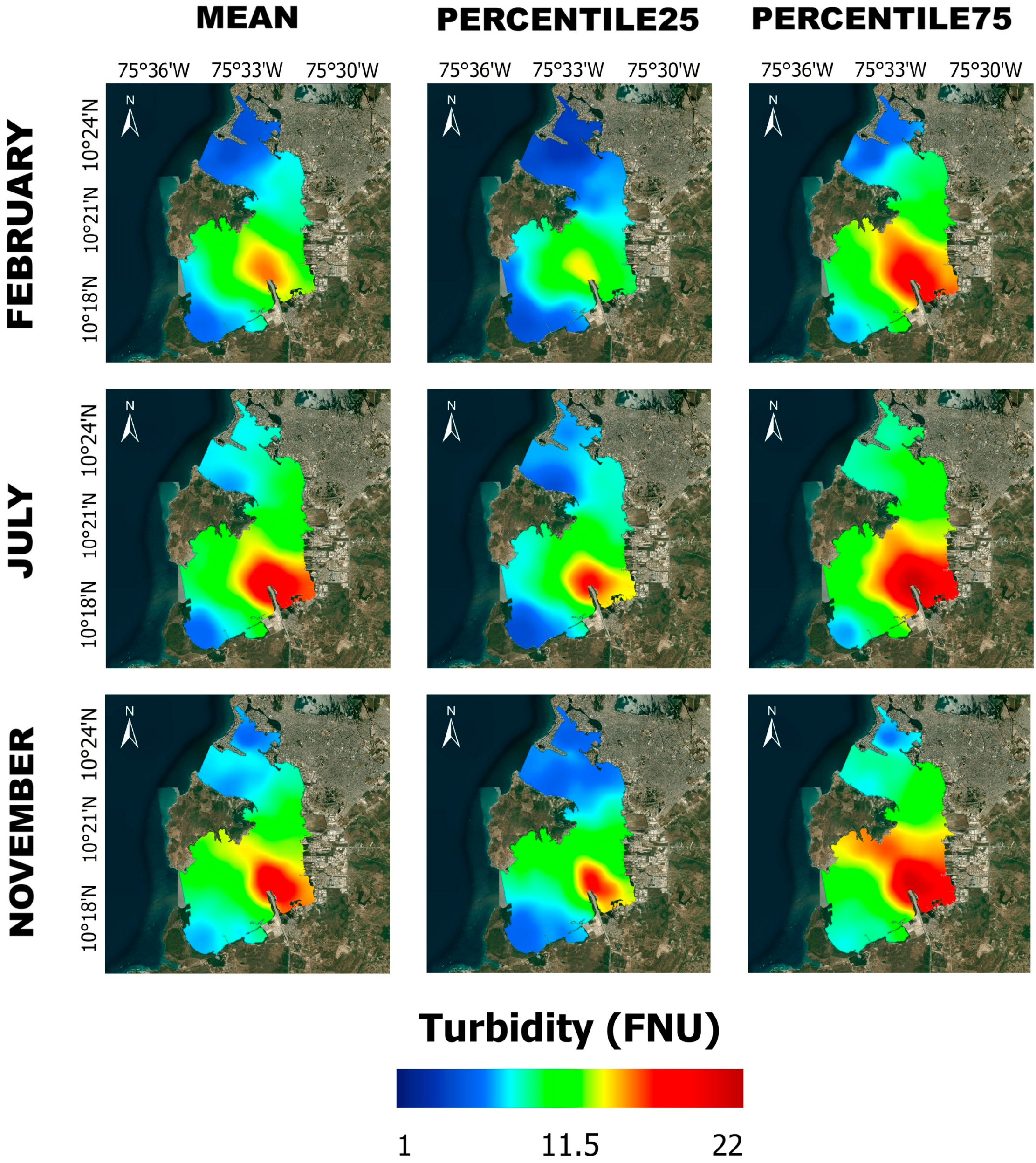
As illustrated in Figure 12, during the dry season (February), average turbidity levels in the bay (2002–2022) ranged between 2 and 18 FNU. Since this is the month when the Canal del Dique presents the lowest flow, sediment inflow to the bay is also lower. The maximum turbidity level occurs nearest to the mouth of the Dique Canal, generating a small plume towards Bocachica; conversely, turbidity levels are lower in Bocagrande. This behavior is influenced by the trade winds that predominate during this season (strong winds), blowing from the north and northeast (Figure 3).
Figure 12. Turbidity Spatial Distribution in Cartagena Bay (2002–2022).
It can also be noted that the range of turbidity values between 1 FNU and 13 FNU encompasses the 25th percentile of the dataset, indicating that 25% of the data falls within this range and below. The range between 5 FNU and 20 FNU covers the 75th percentile, indicating that 75% of the data falls within this range and below. These percentiles provide insights into the distribution of turbidity values within the dataset, with the 25th percentile representing relatively lower turbidity levels and the 75th percentile representing higher turbidity levels.
In July (rainy season), an increase in turbidity levels in Cartagena Bay can be observed, with an average ranging between 6 FNU and 22 FNU. During this month, sediment distribution occurs across almost the entire bay due to the increase in flow rate and, consequently, sediment load. The hydrodynamic conditions of the bay during the rainy season, characterized by predominantly weak winds blowing from various directions, also contribute to this sediment dispersion.
It is also worth noting that the range of turbidity values between 2 FNU and 20 FNU encompasses the 25th percentile of the dataset, indicating that 25% of the data falls within this range and below. In this case, it is observed that the highest turbidity values are located very close to the mouth of the canal. Similarly, the range between 8 FNU and 22 FNU covers the 75th percentile, indicating that 75% of the data falls within this range and below, suggesting higher turbidity levels throughout almost the entire bay.
In November (rainy season), the behavior is like July, with turbidity levels averaging between 6 FNU and 20 FNU. However, there is less sediment distribution in the bay due to a slight decrease in flow rates from the Canal del Dique (Figure 2) and, consequently, sediment load. This results in a turbidity pattern that is slightly more concentrated at the mouth of the canal.
Overall, during the rainy season, higher turbidity levels are observed with a plume pattern directed towards the northern part of the bay. This phenomenon is influenced by the hydrodynamic conditions of the season, which are governed by winds coming from the south and west. In the dry season, the bay experiences lower turbidity levels due to the reduced sediment load from the Canal del Dique (Figure 2).

3.5. Turbidity Trends in Cartagena Bay

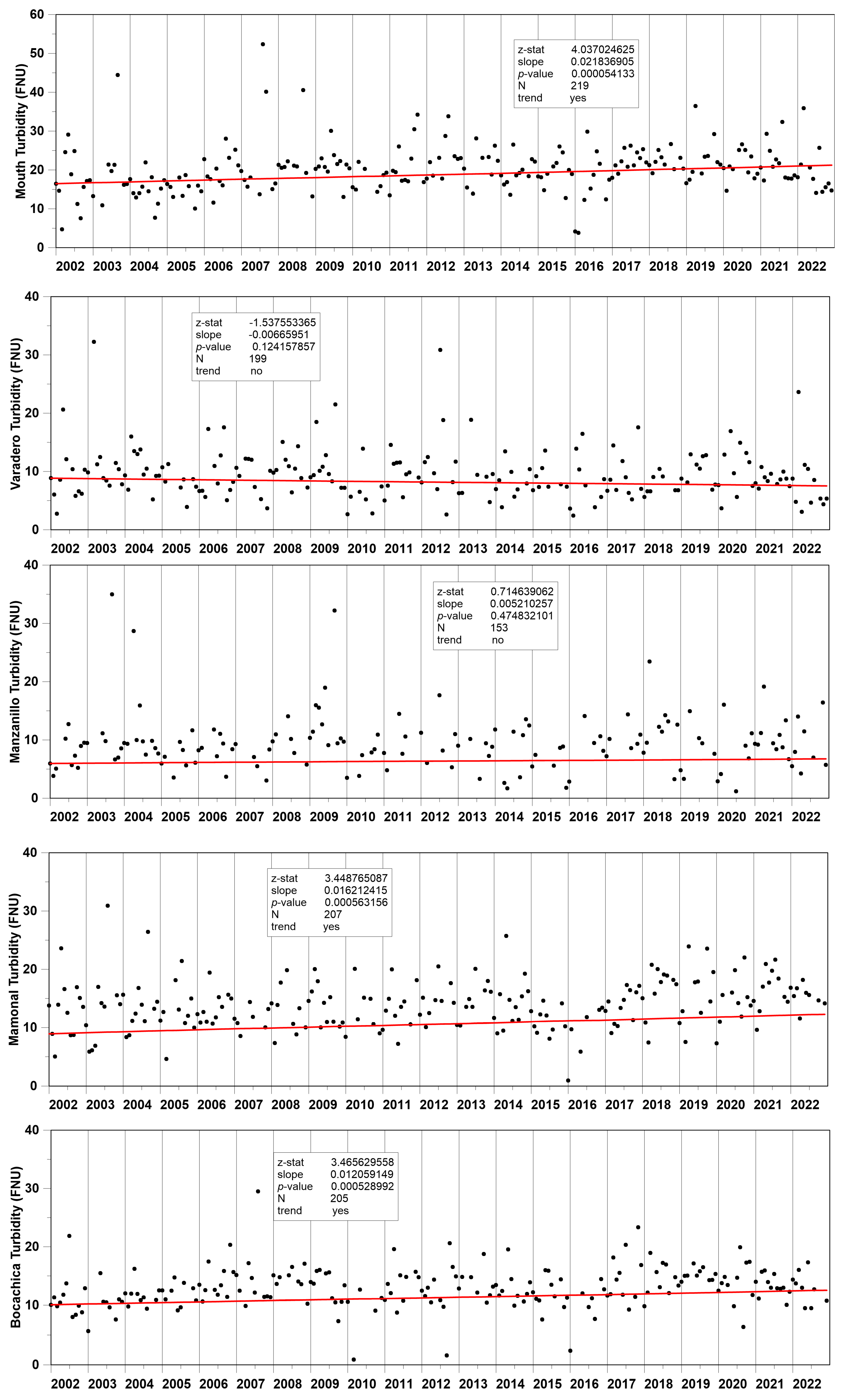
Analyses conducted using Mann–Kendall revealed statistically significant positive trends for discharge from Canal del Dique and turbidity at three stations in the study area of Cartagena Bay for the period 2002–2022 (Figure 13). Discharge exhibited a significant positive trend for the period of record, with Z = 2.54, p = 0.011, and Sen’s slope of 0.42 units per time step, which shows the fluvial discharge of water to the bay steadily increased over the 21 years. Sediment turbidity also exhibited significant positive trends at all three of study stations of Mamonal (Z = 3.45; p = 0.00056, Sen’s slope = 0.016), Bocachica (Z = 3.47; p = 0.00053, Sen’s slope = 0.012), and Mouth (Z = 4.04; p < 0.001, Sen’s slope = 0.022) suggesting that more suspended sediments may be transported to the center area of the bay as discharge of freshwater increased. The stations of Manzanillo (Z = 0.71, p = 0.47) and Varadero (Z = −1.54, p = 0.12) did not show any significant trends. Manzanillo St. (with some data gaps) is close to Bocagrande inlet, which directly connects to the Caribbean Sea. The ongoing exchange of water and flushing sediments in this area may be influencing turbidity trends. Varadero, although located near the mouth of the bay, is strongly influenced by coastal and tidal exchanges due to its proximity to the Bocachica inlet. These hydrodynamic interactions likely contribute to the variability in the dilution and dispersion of suspended sediments.
Figure 13. Trends of Turbidity in different stations of Cartagena Bay (2002–2022). Scatter is the turbidity and the red line in the trend.

3.6. ENSO Influence on Turbidity Variability

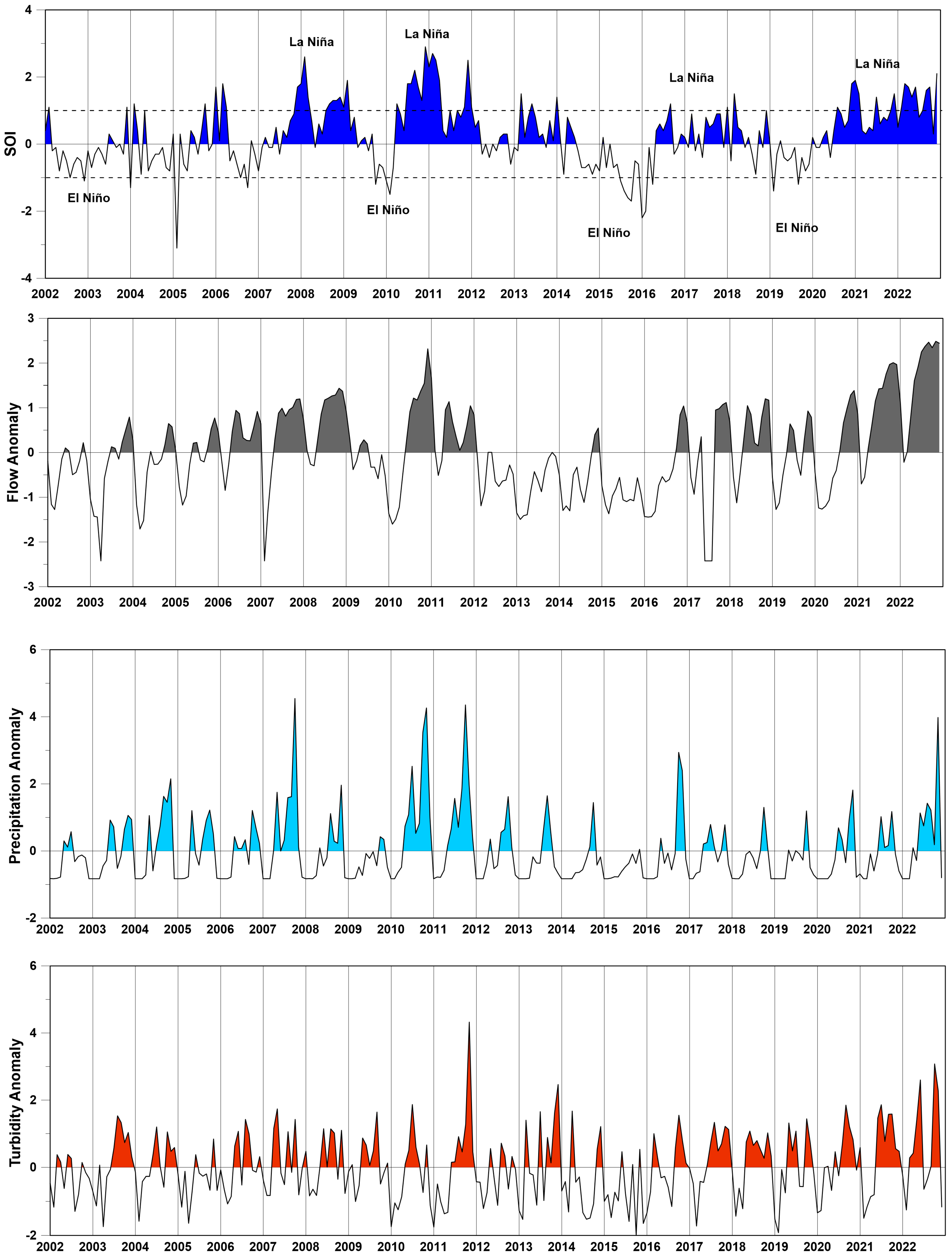
The influence of the Southern Oscillation Index (SOI) on both the flow rate of the Canal del Dique and the precipitation regime is evident (Figure 14). It can be observed that during La Niña events (blue area in the SOI diagram), flow rates and precipitation are higher than during El Niño events (uncolored area in the SOI diagram). This behavior is also reported by other researchers, who found that El Niño–Southern Oscillation (ENSO) events are one of the main factors controlling precipitation [44] and the variability in fluvial discharge of the Magdalena River [45] in Colombia.
Figure 14. Time series of the Southern Oscillation Index (SOI), Canal del Dique flow anomalies, precipitation anomalies, and turbidity anomalies from 2002 to 2022. Positive SOI values (shaded in blue) indicate La Niña, the cold phase of the ENSO cycle, typically associated with enhanced precipitation in northern South America. Negative SOI values (shown without shading) correspond to El Niño, the warm phase of ENSO, generally linked to reduced regional rainfall.
The analysis of monthly anomalies from 2002 to 2022 (Figure 14) reveals a general pattern in which La Niña events (positive SOI values) are commonly associated with increased precipitation and higher discharge from the Canal del Dique, often coinciding with peaks in average turbidity in Cartagena Bay. However, during intense La Niña phases in the rainy season, heavy rainfall can produce a dilution or flushing effect that decreases sediment concentration, leading to unexpectedly low turbidity values despite the elevated discharge. Conversely, El Niño phases are typically characterized by reduced rainfall and lower discharge, which generally result in decreased turbidity levels.
This overall pattern is consistent across several events (e.g., 2008; 2010–2011; 2022), although notable exceptions occurred during neutral or even El Niño conditions, such as in early 2005, late 2015, and mid-2019, when significant turbidity anomalies were recorded despite negative or near-zero SOI values.
The relationship between the average turbidity of the bay and key climatic variables associated with ENSO was analyzed using Spearman’s rank correlation, as this non-parametric method is suitable for assessing monotonic relationships between variables that may not follow a normal distribution or exhibit linear behavior. Results from the Spearman rank correlation analysis indicate that average turbidity in the bay is moderately and significantly correlated with both precipitation (ρ = 0.4748, p < 0.001) and discharge from the Canal del Dique (ρ = 0.4733, p < 0.001). These findings suggest that increased rainfall and canal flow are generally associated with elevated turbidity levels. However, the reliance on a single-point precipitation measurement may underestimate the spatial variability of rainfall across the watershed that contributes to the Canal del Dique’s flow. Moreover, it is important to consider that other environmental drivers (such as tidal fluctuations, residual currents, and wind-induced circulation) can resuspend and redistribute sediments, potentially altering the direct influence of fluvial inputs on turbidity dynamics within the bay.
The correlation between turbidity and the Southern Oscillation Index (SOI) Is weak but statistically significant (ρ = 0.1289, p = 0.0412), suggesting a potential indirect influence of ENSO, likely mediated by its effect on freshwater discharge from the canal. This relationship is supported by a moderate and significant correlation between SOI and canal discharge (ρ = 0.3933, p < 0.0001), showing a connection between phases of ENSO and hydrological variability in the system. The relationship between SOI and local precipitation is not statistically significant (ρ = 0.0729, p = 0.2483), which may be because data were only taken from one meteorological station, not covering the entire area of the Canal del Dique’s watershed.
A lag analysis was also performed to identify temporal delays among the main hydroclimatic processes influencing turbidity dynamics in Cartagena Bay (Table 2). Cross-correlation analysis revealed that turbidity responds to both local and regional forcings operating at different time scales. The Canal del Dique discharge exhibited a delayed effect of approximately one month (lag = +1, r = 0.47, p < 0.05), indicating a statistically significant relationship in which turbidity increases after the time required for sediment transport, dispersion, and mixing within the bay. In contrast, the direct correlation between ENSO and turbidity was weak and not statistically significant (lag = +2, r = 0.17, p > 0.05), suggesting that La Niña conditions do not directly control turbidity levels but rather exert an indirect influence through their modulation of the regional hydrological regime, particularly by increasing discharge and sediment delivery from the Canal del Dique.
Table 2. Cross-correlation summary between climatic, hydrological, and Turbidity (2002–2022).
These findings emphasize the temporal complexity of the physical and climatic controls linking large-scale climate variability to optical water properties in tropical estuarine environments. Although hydrological inputs driven by the dominant phase of the ENSO cycle are a major driver of sediment transport and turbidity, local hydrodynamic processes (including residual circulation, wind-driven currents, and bathymetric features) also exert a significant influence on turbidity dynamics throughout the bay.
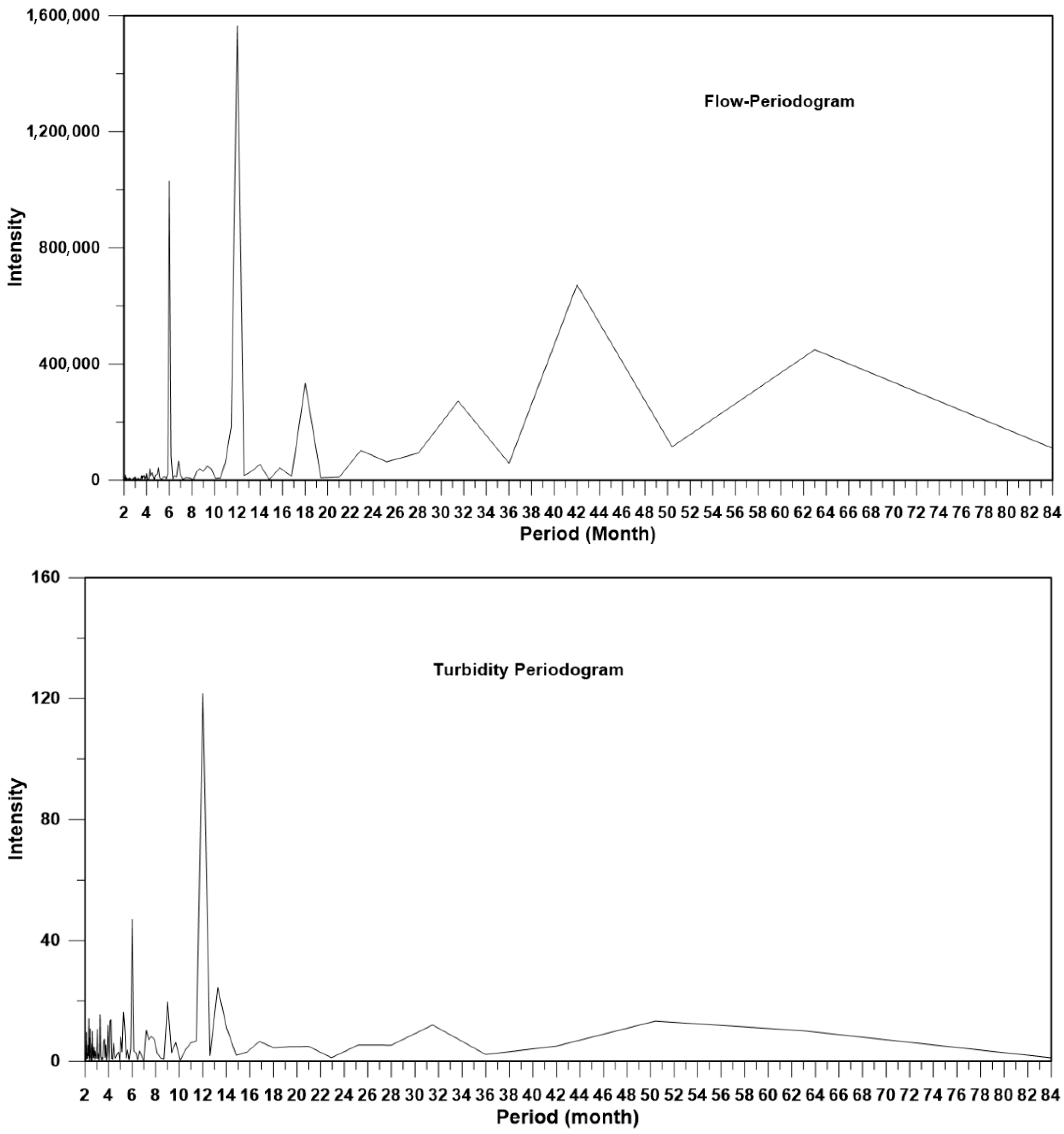
The Fourier Transform (FT) analysis revealed a dominant annual cycle (12-month periodicity) in both turbidity and Canal del Dique discharge (Figure 15), indicating that seasonal forcing strongly influences these variables. The periodogram for Canal del Dique discharge also displayed semi-annual (6-month) and multi-year (40–70-month) periodicities, reflecting secondary and longer-term climatic influences (such as El Niño/La Niña events). Although turbidity exhibited weaker multi-year variability, its dominant periodicity aligns with the seasonal discharge cycle, suggesting that short-term processes (particularly sediment inputs from the Canal del Dique and local hydrodynamic conditions) predominate. Overall, these findings indicate that canal discharge and estuarine hydrodynamics are the main drivers of turbidity seasonality in Cartagena Bay.
Figure 15. Periodograms of Canal del Dique Flow and Average Turbidity in Cartagena Bay: Dominant Cycles.
As shown in Table 3, precipitation patterns respond differently to ENSO phases depending on the specific geographic and climatic characteristics of each region. For example, in the Río de la Plata Estuary and Patos Lagoon (Brazil), El Niño events are generally associated with increased rainfall, while La Niña tends to produce drier conditions. In contrast, regions such as the Berau Coastal Shelf (Indonesia), Exmouth Gulf (Australia), Cartagena Bay (Colombia), and the Hauraki Gulf (New Zealand) often experience above-average rainfall during La Niña phases and reduced precipitation during El Niño events. These diverse responses reflect the complex influence of ENSO on regional atmospheric circulation patterns, consistent with the historical precipitation anomalies reported by Lenssen [46].
Table 3. ENSO Influence on Turbidity and Sediment Dynamics Across Coastal and Estuarine Systems.
The influence of ENSO on turbidity and sediment dynamics varies considerably among coastal and estuarine systems, reflecting the predominant role of local hydrodynamic and climatic conditions in some regions (Table 3). In areas such as the Río de la Plata Estuary, Patos Lagoon, Exmouth Gulf, and the Berau Coastal Shelf, ENSO cycles exert a significant influence on turbidity levels, primarily through changes in precipitation, wind patterns, river discharge, and the concentration of sediments carried by freshwater inputs. In contrast, in systems like the Hauraki Gulf and Cartagena Bay, the relationship between ENSO phases and turbidity is weak or inconsistent. In these regions, sediment dynamics are largely governed by local hydrodynamic processes, including tidal currents, wind-driven circulation, and estuarine exchange, which can override the influence of large-scale climate variability. Moreover, in Cartagena Bay, increased precipitation and higher river discharge during La Niña events may dilute sediment concentrations in freshwater inflows, limiting the sediment available to the bay despite elevated discharge.
It is important to highlight that Cartagena Bay does not behave as a typical estuarine system. Unlike open estuaries with pronounced bathymetric gradients and direct exchanges with continental shelf waters, Cartagena Bay is a semi-enclosed, shallow embayment with limited hydrodynamic connectivity to the open Caribbean Sea. Its morphology resembles a basin or ‘bowl’ with low flushing capacity, strong fluvial influence from the Canal del Dique, and narrow inlets (Bocachica and Bocagrande). This unique hydrogeomorphological configuration leads to predominantly internal circulation, sediment retention, and weak vertical mixing. As such, assumptions based on classical estuarine models (such as stratification, tidal flushing, and estuarine mixing) may not be directly applicable. The methodological choices and interpretation of results in this study were designed specifically to reflect the dynamics of this system. In contrast to previous studies focused on shorter periods or specific ENSO events such as those conducted in the Río de la Plata Estuary [22], Gulf of Mexico [47], Patos Lagoon [5], Exmouth Gulf [48], the Berau Coastal Shelf [49], or New Zealand’s Hauraki Gulf [10], this research provides a unique, systematic 21-year analysis of turbidity dynamics in a tropical bay. By combining a locally validated empirical algorithm with high-frequency MODIS data, hydroclimatic indices, and river discharge records, this approach captures both seasonal and interannual patterns of turbidity in Cartagena Bay, a system dominated by complex fluvial interactions. This long-term, multi-scalar framework not only identifies temporal lag effects between ENSO and turbidity but also clarifies the dominant role of local hydrodynamic processes in modulating sediment dispersion. The methodology developed here is transferable to other data-scarce, sediment-influenced estuaries in tropical regions, providing a robust tool for water quality assessment under increasing climatic and anthropogenic stressors.

4. Conclusions

This study provides a comprehensive analysis of the seasonal and interannual variability of turbidity in Cartagena Bay and its relationship to climatic and hydrological drivers. Cartagena Bay experiences high levels of cloud cover for much of the year, making it difficult to obtain cloud-free MODIS images. The dry season (December to March) provides the most available images, while the rest of the year has limited availability. Despite the challenges in analyzing turbidity during the rainy season due to the limited number of usable images, it was possible to conduct an analysis that revealed the general trend in turbidity behavior during both the dry and rainy seasons.
The highest turbidity levels occurred near the mouth of the Canal del Dique, especially at the beginning of the rainy seasons, likely due to increased sediment input from watershed runoff. In contrast, lower turbidity levels were observed in the northern sector of the bay during March, when discharge is minimal and prevailing currents may limit sediment intrusion.
A long-term upward trend in turbidity levels was identified in Cartagena Bay, which can be attributed to increased flow of the Canal del Dique, likely exacerbated by land-use changes or even hydroclimatic dynamics in the Canal del Dique watershed. It is well known that as extreme rainfall events become more frequent in tropical basins, fluvial sediment loads are expected to increase, exacerbating water quality degradation in downstream estuarine systems. The findings of this research provide crucial evidence for environmental managers, highlighting the need to incorporate hydro-sedimentary dynamics and climate resilience into governance strategies in Cartagena Bay to design sediment management policies, monitoring programs, and interventions aimed at reducing the vulnerability of Cartagena Bay and similar coastal environments.
Fourier Transform Analysis revealed a cyclical pattern, identifying that sediment discharge from the Dique Channel directly influences turbidity dynamics in Cartagena Bay. Spearman correlations showed moderate and statistically significant relationships between turbidity, precipitation, and channel discharge, highlighting the influence of fluvial inputs at the bay. However, the correlations between turbidity and ENSO phases were weak, suggesting that ENSO exerts indirect pressure through precipitation and flow patterns. During La Niña episodes, the expected turbidity peaks were not always observed, likely due to a flushing effect caused by high precipitation and runoff that can dilute sediment concentrations before reaching the bay.
These findings highlight the complex interaction between climatic drivers and local processes such as tides, residual currents, and winds in shaping turbidity dynamics in Cartagena Bay. Beyond the regional context, this research provides insights applicable to other tropical estuaries with strong fluvial influence, where sediment and freshwater inputs drive high optical variability. The combined use of long-term satellite records and hydrometeorological data offers a transferable framework for assessing the impacts of climate variability and land-use change on water quality. This approach can be extended to other estuarine and deltaic systems worldwide, particularly those under similar hydro-sedimentary pressures, supporting the design of monitoring programs and adaptive management strategies that enhance the resilience of coastal ecosystems facing increasing climatic and anthropogenic stressors.

Author Contributions

Conceptualization, M.E.-U. and L.A.S.d.C.; Funding acquisition, M.E.-U. and E.Q.-B.; methodology, M.E.-U., L.A.S.d.C., L.F.M.F.d.S. and S.P.B.-T.; formal analysis, M.E.-U., L.A.S.d.C. and S.P.B.-T.; investigation, M.E.-U. and L.A.S.d.C.; resources, M.E.-U.; writing—original draft preparation, M.E.-U.; writing—review and editing, M.E.-U., L.A.S.d.C., E.Q.-B. and S.P.B.-T.; visualization, M.E.-U. All authors have read and agreed to the published version of the manuscript.

Funding

This research and the APC were funded by the Vice-Presidency of Research of the University of Cartagena through the strengthening plans for the University’s institutes (Resolutions No. 02030 of 2024 and No. 03119 of 2024; Commitment and Start Record 063-2024).

Data Availability Statement

Data is contained within the article.

Acknowledgments

The authors express their gratitude to the University of Cartagena and the Vice Rector for Research, providing financial support for the acquisition of equipment and fieldwork. In addition, the authors express their gratitude to Centro de Investigaciones Oceanográficas e Hidrográficas del Caribe (CIOH) and the students of the Environmental Modeling Research Group of the University of Cartagena for their invaluable support, which contributed significantly to the development of this project.

Conflicts of Interest

The authors declare no conflicts of interest.

References

  1. Tuchkovenko, Y.S.; Lonin, S.A. Mathematical model of the oxygen regime of Cartagena Bay. Ecol. Modell. 2003, 165, 91–106. [Google Scholar] [CrossRef]
  2. Invemar. Diagnóstico y Evaluación de la Calidad de las Aguas Marinas y Costeras en el Caribe y Pacífico Colombianos; Espinosa, L.F., Obando, P., Garcés, O., Eds.; Informe Técnico 2019; REDCAM-INVEMAR: Santa Marta, Colombia, 2020. Available online: https://www.invemar.org.co/documents/37438/75549/Informe+REDCAM_2019.pdf/9133403e-4b7b-e4bd-69e1-df4f5841b1f7?t=1670244369911 (accessed on 23 October 2025).
  3. Cherukuru, N.; Martin, P.; Sanwlani, N.; Mujahid, A.; Müller, M. A semi-analytical optical remote sensing model to estimate suspended sediment and dissolved organic carbon in tropical coastal waters influenced by peatland-draining river discharges off sarawak, borneo. Remote Sens. 2021, 13, 99. [Google Scholar] [CrossRef]
  4. Kabiri, K.; Moradi, M. Landsat-8 imagery to estimate clarity in near-shore coastal waters: Feasibility study—Chabahar Bay, Iran. Cont. Shelf Res. 2016, 125, 44–53. [Google Scholar] [CrossRef]
  5. Távora, J.; Fernandes, E.H.; Bitencourt, L.P.; Orozco, P.M.S. El-Niño Southern Oscillation (ENSO) effects on the variability of Patos Lagoon Suspended Particulate Matter. Reg. Stud. Mar. Sci. 2020, 40, 101495. [Google Scholar] [CrossRef]
  6. Restrepo, J.C.; Escobar, J.; Otero, L.; Franco, D.; Pierini, J.; Correa, I. Factors Influencing the Distribution and Characteristics of Surface Sediment in the Bay of Cartagena, Colombia. Coast. Educ. Res. Found. 2017, 33, 135–148. [Google Scholar] [CrossRef]
  7. Tosic, M.; Restrepo, J.D.; Lonin, S.; Izquierdo, A.; Martins, F. Water and sediment quality in Cartagena Bay, Colombia: Seasonal variability and potential impacts of pollution. Estuar. Coast. Shelf Sci. 2019, 216, 187–203. [Google Scholar] [CrossRef]
  8. Restrepo, J.D.; Zapata, P.; Díaz, J.M.; Garzón-Ferreira, J.; García, C.B.; Restrepo, J.C. Aportes Fluviales al mar Caribe y Evaluación Preliminar del Impacto Sobre los Ecosistemas Costeros; Universidad Eafit: Medellín, Colombia, 2005. [Google Scholar]
  9. Restrepo, J.D.; Escobar, R.; Tosic, M. Fluvial fluxes from the Magdalena River into Cartagena Bay, Caribbean Colombia: Trends, future scenarios, and connections with upstream human impacts. Geomorphology 2018, 302, 92–105. [Google Scholar] [CrossRef]
  10. Seers, B.M.; Shears, N.T. Spatio-temporal patterns in coastal turbidity—Long-term trends and drivers of variation across an estuarine-open coast gradient. Estuar. Coast. Shelf Sci. 2015, 154, 137–151. [Google Scholar] [CrossRef]
  11. Yunus, A.P.; Masago, Y.; Hijioka, Y. Analysis of long-term (2002–2020) trends and peak events in total suspended solids concentrations in the Chesapeake Bay using MODIS imagery. J. Environ. Manag. 2021, 299, 113550. [Google Scholar] [CrossRef]
  12. Nechad, B.; Ruddick, K.G.; Neukermans, G. Calibration and validation of a generic multisensor algorithm for mapping of turbidity in coastal waters. In Remote Sensing of the Ocean, Sea Ice, and Large Water Regions; Bostater, C., Mertikas, S.P., Neyt, X., Velez-Reyes, M., Eds.; SPIE: Bellingham, WA, USA, 2009. [Google Scholar]
  13. Dogliotti, A.; Ruddick, K.G.; Nechad, B.; Doxaran, D.; Knaeps, E. A single algorithm to retrieve turbidity from remotely-sensed data in all coastal and estuarine waters. Remote Sens. Environ. 2015, 156, 157–168. [Google Scholar] [CrossRef]
  14. Petus, C.; Marieu, V.; Novoa, S.; Chust, G.; Bruneau, N.; Froidefond, J.M. Monitoring spatio-temporal variability of the Adour River turbid plume (Bay of Biscay, France) with MODIS 250-m imagery. Cont. Shelf Res. 2014, 74, 35–49. [Google Scholar] [CrossRef]
  15. Chen, Z.; Hu, C.; Muller-Karger, F. Monitoring turbidity in Tampa Bay using MODIS/Aqua 250-m imagery. Remote Sens. Env. 2007, 109, 207–223. [Google Scholar] [CrossRef]
  16. Yang, G.; Wang, X.H.; Ritchie, E.A.; Qiao, L.; Li, G.; Cheng, Z. Using 250-M Surface Reflectance MODIS Aqua/Terra Product to Estimate Turbidity in a Macro-Tidal. Remote Sens. 2018, 10, 997. [Google Scholar] [CrossRef]
  17. de Sousa, L.F.; de Carvalho, L.S.; Cirano, M.; Barberini, F.D.; Maciel, D.A.; Lange, P.K.; Soares, F.S.; Ciotti, A.M. Regional Studies in Marine Science The seasonal and tidal effects on turbidity in Guanabara Bay, Rio de Janeiro-Brazil. Reg. Stud. Mar. Sci. 2025, 90, 104449. [Google Scholar] [CrossRef]
  18. Eljaiek-Urzola, M.; Sander De Carvalho, L.A.; Betancur-Turizo, S.P.; Quiñones-Bolaños, E.; Castrillon-Ortiz, C. Spatial Patterns of Turbidity in Cartagena Bay, Colombia, Using Sentinel-2 Imagery. Remote Sens. 2024, 16, 179. [Google Scholar] [CrossRef]
  19. Saldías, G.S.; Strub, P.T.; Shearman, R.K. Spatio-temporal variability and ENSO modulation of turbid freshwater plumes along the Oregon coast. Estuar. Coast. Shelf Sci. 2020, 243, 106880. [Google Scholar] [CrossRef]
  20. Wan, Y.; Wang, L. Study on the Seasonal Estuarine Turbidity Maximum Variations of the Yangtze Estuary, China. J. Waterw. Port. Coast. Ocean. Eng. 2018, 144, 5018002. [Google Scholar] [CrossRef]
  21. da Costa, Á.K.R.; Pereira, L.C.C.; Jiménez, J.A.; de Oliveira, A.R.G.; de Jesus Flores-Montes, M.; da Costa, R.M. Effects of Extreme Climatic Events on the Hydrological Parameters of the Estuarine Waters of the Amazon Coast. Estuaries Coasts 2022, 45, 1517–1533. [Google Scholar] [CrossRef]
  22. Dogliotti, A.; Ruddick, K.; Guerrero, R. Seasonal and inter-annual turbidity variability in the Río de la Plata from 15 years of MODIS: El Niño dilution effect. Estuar. Coast. Shelf Sci. 2016, 182, 27–39. [Google Scholar] [CrossRef]
  23. Wolanski, E.; Elliott, M. 3—Estuarine sediment dynamics. In Estuarine Ecohydrology, 2nd ed.; Wolanski, E., Elliott, M., Eds.; Elsevier: Boston, MA, USA, 2016; pp. 77–125. Available online: https://www.sciencedirect.com/science/article/pii/B9780444633989000039 (accessed on 23 October 2025).
  24. DIMAR-CIOH. Carta Náutica 261—Bahía de Cartagena. Escala 25.000. Catálogo de Cartas Náuticas de Colombia. 13 April 2021. Available online: www.dimar.mil.co/dimar-presenta-actualizacion-de-la-carta-nautica-262-bahia-de-cartagena (accessed on 17 July 2024).
  25. Molares, R.; Mestres, M. Efectos de la descarga estacional del Canal del Dique en el mecanismo de intercambio de aguas de una bahía semicerrada y micromareal: Bahía de Cartagena, Colombia. Boletín Científico CIOH 2012, 45, 53–74. [Google Scholar] [CrossRef]
  26. IDEAM. Consulta y Descarga de Datos Hidrometeorológicos. 2023. Available online: http://dhime.ideam.gov.co/atencionciudadano/ (accessed on 14 November 2023).
  27. Lonin, S.; Parra, C.; Andrade, C.; Thomas, Y.F. Patrones de la pluma turbia del canal del Dique en la bahía de Cartagena. Boletín Científico CIOH 2004, 22, 77–89. [Google Scholar] [CrossRef]
  28. Lonin, S.; Giraldo, L. Circulación de las aguas y transporte de contaminantes en la Bahía Interna de Cartagena. Boletín Científico CIOH 1995, 16, 25–56. [Google Scholar] [CrossRef]
  29. Twedt, K.A.; Xiong, X.; Geng, X.; Wilson, T.; Mu, Q. Impact of satellite orbit drift on MODIS Earth scene observations used in calibration of the reflective solar bands. In Proceedings of the SPIE Optics + Photonics 2023 Conference, San Diego, CA, USA, 20–24 August 2023; p. 24. [Google Scholar]
  30. NASA. MODIS—Moderate Resolution Imaging Spectroradiometer. 2024. Available online: https://modis.gsfc.nasa.gov/data/ (accessed on 22 May 2024).
  31. Katlane, R.; El Kilani, B.; Dhaoui, O.; Kateb, F.; Chehata, N. Monitoring of sea surface temperature, chlorophyll, and turbidity in Tunisian waters from 2005 to 2020 using MODIS imagery and the Google Earth Engine. Reg Stud Mar Sci 2023, 66, 103143. [Google Scholar] [CrossRef]
  32. De Sousa, F.F. Cloud_Filter_for_Google_Earth_Engine. 2024. Available online: https://github.com/felipefariadesousa/Cloud_filter_for_google_earth_engine/blob/main/Examples/Cloud_filter_Landsat.js (accessed on 22 May 2024).
  33. Principe, R. Geetools-Code-Editor-Code-Editor: A Set of Tools to Use in Google Earth Engine Code Editor (JavaScript). 2019. Available online: https://github.com/fitoprincipe/geetools-code-editor (accessed on 10 March 2024).
  34. Hedley, J.D.; Harborne, A.R.; Mumby, P.J. Simple and robust removal of sun glint for mapping shallow-water benthos. Int. J. Remote Sens. 2005, 26, 2107–2112. [Google Scholar] [CrossRef]
  35. Ouillon, S.; Douillet, P.; Petrenko, A.; Neveux, J.; Froidefond, J.M.; Caledonia, N. Optical Algorithms at Satellite Wavelengths for Total Suspended Matter in Tropical Coastal Waters. Sensors 2008, 8, 4165–4185. [Google Scholar] [CrossRef]
  36. Santamaría-del-Ángel, E.; Sebastia-Frasquet, M.; González-Silvera, A.; Aguilar-Maldonado, J.; Mercado-Santana, A.; Herrera-Carmona, J. Uso Potencial de las Anomalías Estandarizadas en la Interpretación de Fenómenos Oceanográficos Globales a Escalas Locales. In Tópicos Agenda Para la Sostenibilidad Costas y Mares Méxicanos; Instituto de Ecología, Pesquerías y Oceanografía del Golfo de México (epomex) Universidad Autónoma de Campeche: Campeche, Mexico, 2019; pp. 193–212. [Google Scholar]
  37. Villalba, R.; Ferral, A.; Baez, J.; Kurita, J.; Beltramone, G.; Bertoni, J.C. Temporal Analysis of Precipitation in the Lower and Middle Paraguay Basin within the La Plata Basin (2001–2020) and its Relationship with the El Niño/Southern Oscillation (ENSO) Phenomenon. In Proceedings of the 2023 XX Workshop on Information Processing and Control (RPIC), Oberá, Argentina, 1–3 November 2023; IEEE: New York, NY, USA, 2023. [Google Scholar]
  38. Góez Arango, C.; Poveda Jaramillo, G. Variabilidad de las anomalías y de la escala de fluctuación de caudales medios mensuales con el área de la cuenca. Av. En. Recur. Hidráulicos 2005, 12, 77–89. [Google Scholar]
  39. Lu, X.; Mo, Z.; Zhao, J.; Ma, C. Remote monitoring of water clarity in coastal oceans of the Guangdong-Hong Kong-Macao Greater Bay Area, China based on machine learning. Ecol. Indic. 2024, 160, 111789. [Google Scholar] [CrossRef]
  40. Yu, G.; Zhong, Y.; Liu, S.; Lao, Q.; Chen, C.; Fu, D.; Chen, F. Remote Sensing Estimates of Particulate Organic Carbon Sources in the Zhanjiang Bay Using Sentinel-2 Data and Carbon Isotopes. Remote Sens. 2023, 15, 3768. [Google Scholar] [CrossRef]
  41. Zhou, Y.; Yu, D.; Cheng, W.; Gai, Y.; Yao, H.; Yang, L.; Pan, S. Monitoring multi-temporal and spatial variations of water transparency in the Jiaozhou Bay using GOCI data. Mar. Pollut. Bull. 2022, 180, 113815. [Google Scholar] [CrossRef]
  42. Constantin, S.; Doxaran, D.; Constantinescu, S. Estimation of water turbidity and analysis of its spatio-temporal variability in the Danube River plume (Black Sea) using MODIS satellite data. Cont. Shelf Res. 2016, 112, 14–30. [Google Scholar] [CrossRef]
  43. Nechad, B.; Ruddick, K.G.; Park, Y. Remote Sensing of Environment Calibration and validation of a generic multisensor algorithm for mapping of total suspended matter in turbid waters. Remote Sens. Environ. 2010, 114, 854–866. [Google Scholar] [CrossRef]
  44. Puertas, O.; Carvajal, Y. Incidencia de El Niño-Oscilación del Sur en la precipitación y la temperatura del aire en Colombia, utilizando el Climate Explorer. Rev. Científica Ing. Y Desarro. 2008, 23, 104–118. [Google Scholar]
  45. Beier, E.; Bernal, G.; Ruiz-Ochoa, M.; Barton, E.D. Freshwater exchanges and surface salinity in the Colombian basin, Caribbean Sea. PLoS ONE 2017, 12, e0182116. [Google Scholar] [CrossRef]
  46. Lenssen, N.J.L.; Goddard, L.; Mason, S. Seasonal forecast skill of enso teleconnection maps. Weather Forecast. 2020, 35, 2387–2406. [Google Scholar] [CrossRef]
  47. McCarthy, M.J.; Otis, D.B.; Méndez-Lázaro, P.; Muller-Karger, F.E. Water quality drivers in 11 Gulf of Mexico Estuaries. Remote Sens. 2018, 10, 255. [Google Scholar] [CrossRef]
  48. Cartwright, P.J.; Fearns, P.R.C.S.; Branson, P.; Cuttler, M.V.W.; O’leary, M.; Browne, N.K.; Lowe, R.J. Identifying metocean drivers of turbidity using 18 years of MODIS satellite data: Implications for marine ecosystems under climate change. Remote Sens. 2021, 13, 3616. [Google Scholar] [CrossRef]
  49. Khadami, F.; Tarya, A.; Radjawane, I.M.; Suprijo, T.; Sujatmiko, K.A.; Anwar, I.P.; Hidayatullah, M.F.; Erlangga, M.F.R.A. Understanding Two Decades of Turbidity Dynamics in a Coral Triangle Hotspot: The Berau Coastal Shelf. Water 2024, 16, 2300. [Google Scholar] [CrossRef]
Disclaimer/Publisher’s Note: The statements, opinions and data contained in all publications are solely those of the individual author(s) and contributor(s) and not of MDPI and/or the editor(s). MDPI and/or the editor(s) disclaim responsibility for any injury to people or property resulting from any ideas, methods, instructions or products referred to in the content.

Article Metrics

Citations

Article Access Statistics

Multiple requests from the same IP address are counted as one view.