Current Research Trends and Challenges Related to the Use of Greywater in Buildings



Abstract
1. Introduction
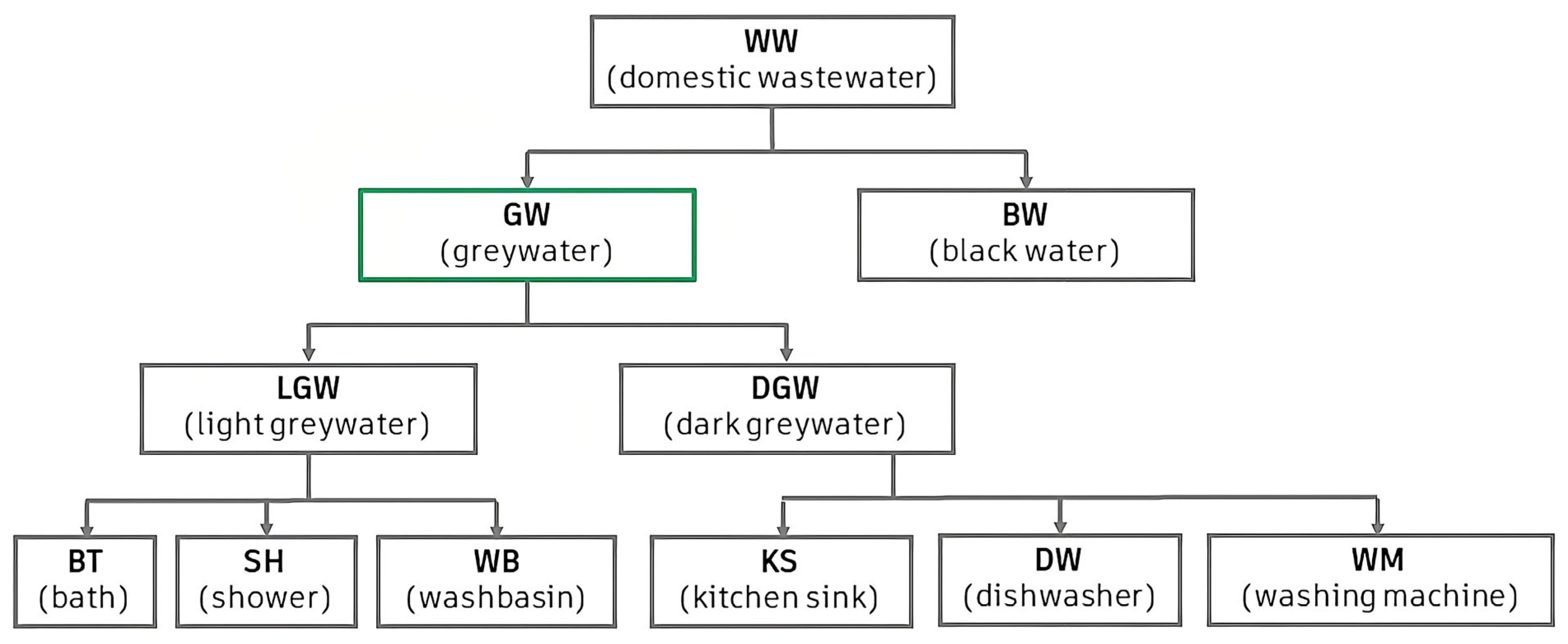
2. Quantitative and Qualitative Characteristics of Greywater
2.1. Quantitative Characteristics of Greywater
2.2. Qualitative Characteristics of Greywater
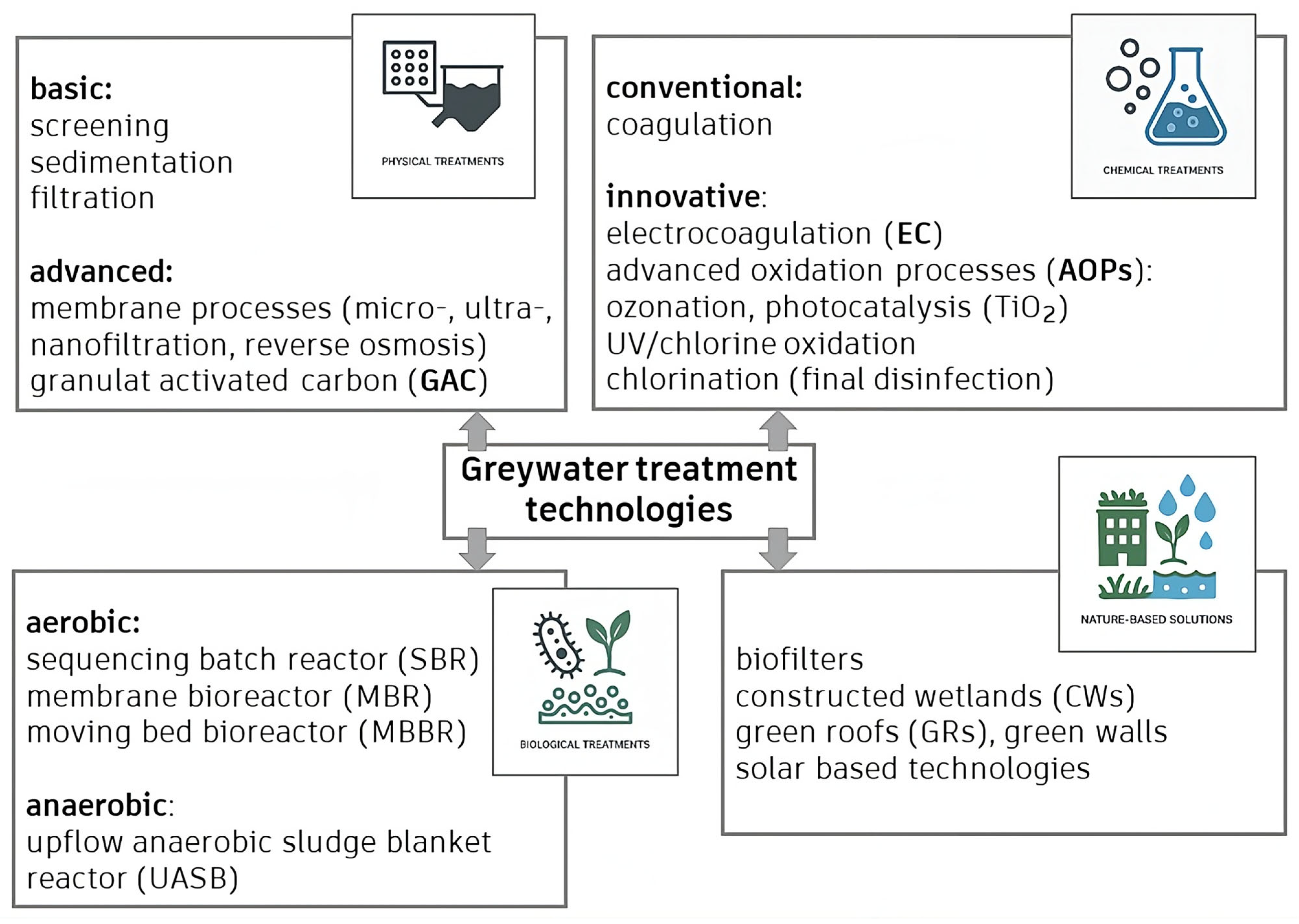
3. Greywater Treatment Technologies
4. Legal Regulations—Rules and Guidelines

| Indicator | USA (California) 1 | USA 2 | Australia 3 | Canada 4 | UK 5 | China 6 | Japan 7 | Spain 8 |
|---|---|---|---|---|---|---|---|---|
| pH | 6.0–9.0 | 6.0–9.0 | 6.0–9.0 | 6.0–9.0 | 5.0–9.5 | 6.5–9.5 | 5.8–8.6 | |
| Turbidity [NTU] | <5 | ≤2 | - | ≤2 | <10 | <2 | ≤2 | ≤2 |
| TSS [mg/L] | ≤10 | ≤10 | ≤10 | ≤10 | - | ≤10 | ≤10 | ≤10 |
| BOD5 [mg/L] | ≤10 | ≤10 | ≤10 | ≤10 | - | ≤10 | ≤10 | ≤10 |
| Cl2 residual [mg/L] | - | ≥0.5 | - | ≥0.5 | <2.0 | 0.3–1.0 | trace amount | - |
| E. coli [CFU/100 mL] | ≤14 | ≤2.2–14 | ≤1 | ND | 250 | ≤3 | ND | ≤10 |
| Total coliforms [CFU/100 mL] | - | - | - | ND | 1000 | ≤100 | ≤3 | - |
| Enterococcus [CFU/100 mL] | - | - | - | - | 100 | - | - | - |
| Other | - | - | - | - | visually clear, not objectionable contamination | odour not unpleasant | odour not unpleasant, not objectionable contamination | odour not unpleasant, not objectionable contamination |
5. Social Aspects of Water Reuse in Buildings
6. Conclusions
Author Contributions
Funding
Data Availability Statement
Conflicts of Interest
Abbreviations
| WW | total wastewater |
| BW | black water (wastewater from toilets) |
| GW | greywater |
| DGW | dark greywater |
| KS | kitchen sink |
| DW | dishwasher |
| WM | washing machine |
| LGW | light greywater |
| BT | bath |
| SH | shower |
| WB | washbasin |
References
- Nolde, E. Greywater reuse systems for toilet flushing in multi-storey buildings—Over ten years experience in Berlin. Urban Water 1999, 1, 275–284. [Google Scholar] [CrossRef]
- Surendran, S.; Wheatley, A.D. Grey-water Reclamation for Non-Potable Re-use. J. CIWEM 1998, 12, 406–413. [Google Scholar] [CrossRef]
- March, J.; Gual, M.; Orozco, F. Experiences on greywater reuse for toilet flushing in a hotel (Mallorca Island, Spain). Desalination 2004, 164, 241–247. [Google Scholar] [CrossRef]
- Li, Z.; Boyle, F.; Reynolds, A. Rainwater harvesting and greywater treatment systems for domestic application in Ireland. Desalination 2010, 260, 1–8. [Google Scholar] [CrossRef]
- Jabornig, S. Overview and feasibility of advanced grey water treatment systems for single households. Urban Water J. 2013, 11, 361–369. [Google Scholar] [CrossRef]
- Nolde, E. Greywater recycling systems in Germany—Results, experiences and guidelines. Water Sci. Technol. 2005, 51, 203–210. [Google Scholar] [CrossRef]
- Fountoulakis, M.; Markakis, N.; Petousi, I.; Manios, T. Single house on-site grey water treatment using a submerged membrane bioreactor for toilet flushing. Sci. Total Environ. 2016, 551–552, 706–711. [Google Scholar] [CrossRef]
- Priyanka, K.; Remya, N.; Behera, M. Greywater treatment using modified solar photocatalyst- degradation, kinetics, pathway and toxicity analysis. Sep. Purif. Technol. 2020, 251, 117319. [Google Scholar] [CrossRef]
- Khalil, M.; Liu, Y. Greywater biodegradability and biological treatment technologies: A critical review. Int. Biodeterior. Biodegrad. 2021, 161, 105211. [Google Scholar] [CrossRef]
- Shaikh, I.N.; Ahammed, M.M. Quantity and quality characteristics of greywater: A review. J. Environ. Manag. 2020, 261, 110266. [Google Scholar] [CrossRef] [PubMed]
- Leal, L.H.; Zeeman, G.; Temmink, H.; Buisman, C. Characterisation and biological treatment of greywater. Water Sci. Technol. 2007, 56, 193–200. [Google Scholar] [CrossRef] [PubMed]
- Li, F.; Wichmann, K.; Otterpohl, R. Review of the technological approaches for grey water treatment and reuses. Sci. Total Environ. 2009, 407, 3439–3449. [Google Scholar] [CrossRef]
- Alsulaili, A.D.; Hamoda, M.F. Quantification and characterization of greywater from schools. Water Sci. Technol. 2015, 72, 1973–1980. [Google Scholar] [CrossRef]
- He, Z.; Li, Y.; Qi, B. Recent insights into greywater treatment: A comprehensive review on characteristics, treatment technologies, and pollutant removal mechanisms. Environ. Sci. Pollut. Res. 2022, 29, 54025–54044. [Google Scholar] [CrossRef]
- Oteng-Peprah, M.; de Vries, N.; Acheampong, M. Greywater characterization and generation rates in a peri urban municipality of a developing country. J. Environ. Manag. 2018, 206, 498–506. [Google Scholar] [CrossRef]
- Penn, R.; Hadari, M.; Friedler, E. Evaluation of the effects of greywater reuse on domestic wastewater quality and quantity. Urban Water J. 2012, 9, 137–148. [Google Scholar] [CrossRef]
- Mandal, D.; Labhasetwar, P.; Dhone, S.; Dubey, A.S.; Shinde, G.; Wate, S. Water conservation due to greywater treatment and reuse in urban setting with specific context to developing countries. Resour. Conserv. Recycl. 2011, 55, 356–361. [Google Scholar] [CrossRef]
- Antonopoulou, G.; Kirkou, A.; Stasinakis, A.S. Quantitative and qualitative greywater characterization in Greek households and investigation of their treatment using physicochemical methods. Sci. Total Environ. 2013, 454–455, 426–432. [Google Scholar] [CrossRef] [PubMed]
- Chrispim, M.C.; Nolasco, M.A. Greywater treatment using a moving bed biofilm reactor at a university campus in Brazil. J. Clean. Prod. 2017, 142, 290–296. [Google Scholar] [CrossRef]
- Krozer, Y.; Hophmayer-Tokich, S.; van Meerendonk, H.; Tijsma, S.; Vos, E. Innovations in the water chain—Experiences in The Netherlands. J. Clean. Prod. 2010, 18, 439–446. [Google Scholar] [CrossRef]
- Zhang, D.; Gersberg, R.M.; Wilhelm, C.; Voigt, M. Decentralized water management: Rainwater harvesting and greywater reuse in an urban area of Beijing, China. Urban Water J. 2009, 6, 375–385. [Google Scholar] [CrossRef]
- Faruqui, N.; Al-Jayyousi, O. Greywater reuse in urban agriculture for poverty alleviation. A case study in Jordan. Water Int. 2002, 27, 387–394. [Google Scholar] [CrossRef]
- Büsser, S.; Pha, T.N.; Antoine, M.; Nguyen, V.A. Characteristics and Quantities of Domestic Wastewater in Urban and Peri-Urban Households in Hanoi; Annual Report of FY 2006, The Core University Program between Japan Society for the Promotion of Science (JSPS) and Vietnamese Academy of Science and Technology (VAST); Osaka University: Suita, Japan, 2007; pp. 395–397. Available online: https://ir.library.osaka-u.ac.jp/repo/ouka/all/13204/ (accessed on 28 November 2025).
- Shresta, R.R.; Haberl, R.; Laber, J.; Manandhar, R.; Mader, J. Application of Constructed Wetlands for Wastewater Treatment in Nepal. Water Sci. Technol. 2001, 44, 381–386. [Google Scholar] [CrossRef]
- Friedler, E.; Hadari, M. Economic feasibility of on-site greywater reuse in multi-storey buildings. Desalination 2006, 190, 221–234. [Google Scholar] [CrossRef]
- Abusam, A.; Abdullah, H.; Khajah, M.; Al-Ajeel, F.; Al-Haddad, A. Generation rates of greywater in Kuwaiti residential apartments. Kuwait J. Sci. 2025, 52, 100405. [Google Scholar] [CrossRef]
- Palmquist, H.; Hanæus, J. Hazardous substances in separately collected grey- and blackwater from ordinary Swedish households. Sci. Total Environ. 2005, 348, 151–163. [Google Scholar] [CrossRef] [PubMed]
- Morel, A.; Diener, S. Greywater Management in Low and Middle-Income Countries: Review of Different Treatment Systems for Households or Neighbourhoods; Sandec Report No. 14/06; Swiss Federal Institute of Aquatic Science and Technology (Eawag): Dübendorf, Switzerland, 2006. [Google Scholar]
- Wheatley, A.D.; Surendran, S. Greywater treatment and reuse results from a 50-person trial. Urban Water J. 2008, 5, 187–194. [Google Scholar] [CrossRef]
- Rodríguez, C.; Serrano, J.; Sánchez, R.; Celume, T.; Leiva, E. Optimization of greywater reuse systems: Integration of economic and environmental objectives in real case scenarios. J. Water Process Eng. 2025, 77, 108582. [Google Scholar] [CrossRef]
- Eriksson, E.; Auffarth, K.; Henze, M.; Ledin, A. Characteristics of grey wastewater. Urban Water 2002, 4, 85–104. [Google Scholar] [CrossRef]
- Khajvand, M.; Mostafazadeh, A.K.; Drogui, P.; Tyagi, R.D.; Brien, E. Greywater characteristics, impacts, treatment, and reclamation using adsorption processes towards the circular economy. Environ. Sci. Pollut. Res. Int. 2022, 29, 10966–11003. [Google Scholar] [CrossRef]
- Gałązka, A.; Jankiewicz, U. Endocrine Disrupting Compounds (Nonylphenol and Bisphenol A)–Sources, Harmfulness and Laccase-Assisted Degradation in the Aquatic Environment. Microorganisms 2022, 10, 2236. [Google Scholar] [CrossRef] [PubMed]
- Turull, M.; Buttiglieri, G.; Vazquez, V.; Rodriguez-Mozaz, S.; Santos, L.H. Analytical upgrade of a methodology based on UHPLC-MS/MS for the analysis of endocrine disrupting compounds in greywater. Water Emerg. Contam. Nanoplast. 2023, 2, 17. [Google Scholar] [CrossRef]
- Butkovskyi, A.; Rijnaarts, H.; Zeeman, G.; Leal, L.H. Fate of personal care and household products in source separated sanitation. J. Hazard. Mater. 2016, 320, 427–434. [Google Scholar] [CrossRef]
- Budeli, P.; Sibali, L.L. Greywater Reuse: Contaminant Profile, Health Implications, and Sustainable Solutions. Int. J. Environ. Res. Public Health 2025, 22, 740. [Google Scholar] [CrossRef]
- De Falco, F.; Di Pace, E.; Cocca, M.; Avella, M. The contribution of washing processes of synthetic clothes to microplastic pollution. Sci. Rep. 2019, 9, 6633. [Google Scholar] [CrossRef]
- Gonçalves, R.F.; Vaz, L.d.O.; Peres, M.; Merlo, S.S. Microbiological risk from non-potable reuse of greywater treated by anaerobic filters associated to vertical constructed wetlands Elsevier Enhanced Reader. J. Water Process Eng. 2022, 39, 101751. [Google Scholar] [CrossRef]
- Jefferson, B.; Palmer, A.; Jeffrey, P.; Stuetz, R.; Judd, S. Grey water characterisation and its impact on the selection and operation of technologies for urban reuse. Water Sci. Technol. 2004, 50, 157–164. [Google Scholar] [CrossRef]
- Burrows, W.D.; Schmidt, M.O.; Carnevale, R.M.; Schaub, S.A. Nonpotable reuse: Development of health criteria and technologies for shower water recycle. Water Sci. Technol. 1991, 24, 81–88. [Google Scholar] [CrossRef]
- Christova-Boal, D.; Eden, R.E.; McFarlane, S. An investigation into greywater reuse for urban residential properties. Desalination 1996, 106, 391–397. [Google Scholar] [CrossRef]
- Niewitecka, K.; Chudzicki, J.; Żubrowska-Sudoł, M. Water and Sewage in the Circular Economy Model: MonGOS International Conference 2022; Smol, M., Ed.; Mineral and Energy Economy Research Institute Polish Academy of Sciences: Kraków, Poland, 2022; pp. 46–57. ISBN 978-83-964234-9-8. [Google Scholar]
- Awasthi, A.; Gandhi, K.; Rayalu, S. Greywater treatment technologies: A comprehensive review. Int. J. Environ. Sci. Technol. 2024, 21, 1053–1082. [Google Scholar] [CrossRef]
- Boano, F.; Caruso, A.; Costamagna, E.; Ridolfi, L.; Fiore, S.; Demichelis, F.; Galvão, A.; Pisoeiro, J.; Rizzo, A.; Masi, F. A review of nature-based solutions for greywater treatment: Applications, hydraulic design, and environmental benefits. Sci. Total Environ. 2020, 711, 134731. [Google Scholar] [CrossRef] [PubMed]
- Kamińska, G.; Marszałek, A. Advanced Treatment of Real GreyWater by SBR Followed by Ultrafiltration—Performance and Fouling Behavior. Water 2020, 12, 154. [Google Scholar] [CrossRef]
- Kehoe, P. Scaling up onsite water recycling systems in the US. Water Secur. 2023, 20, 100153. [Google Scholar] [CrossRef]
- Leal, L.H.; Temmink, H.; Zeeman, G.; Buisman, C.J.N. Comparison of Three Systems for Biological Greywater Treatment. Water 2010, 2, 155–169. [Google Scholar] [CrossRef]
- Tusiime, A.; Solihu, H.; Sekasi, J.; Mutanda, H.E. Performance of lab-scale filtration system for grey water treatment and reuse. Environ. Chall. 2022, 9, 100641. [Google Scholar] [CrossRef]
- Hernández-Leal, L.; Temmink, H.; Zeeman, G.; Buisman, C. Removal of micropollutants from aerobically treated grey water via ozone and activated carbon. Water Res. 2011, 45, 2887–2896. [Google Scholar] [CrossRef]
- Zraunig, A.; Estelrich, M.; Gattringer, H.; Kisser, J.; Langergraber, G.; Radtke, M.; Rodriguez-Roda, I.; Buttiglieri, G. Long term decentralized greywater treatment for water reuse purposes in a tourist facility by vertical ecosystem. Ecol. Eng. 2019, 138, 138–147. [Google Scholar] [CrossRef]
- Alfiya, Y.; Dubowski, Y.; Friedler, E. Diurnal patterns of micropollutants concentrations in domestic greywater. Urban Water J. 2018, 15, 399–406. [Google Scholar] [CrossRef]
- García-Gómez, E.; Gil-Solsona, R.; Mikkolainen, E.; Hytti, M.; Ytreberg, E.; Gago-Ferrero, P.; Petrović, M.; Gros, M. Identification of emerging contaminants in greywater emitted from ships by a comprehensive LC-HRMS target and suspect screening approach. Environ. Pollut. 2025, 366, 125524. [Google Scholar] [CrossRef]
- Najmi, M.; Mehrnia, M.R.; Tashauoei, H.R.; Iranpoury, A.; Alivand, M.S. Removal of personal care products (PCPs) from greywater using a submerged membrane bioreactor (SMBR): The effect of hydraulic retention time. J. Environ. Chem. Eng. 2020, 8, 104432. [Google Scholar] [CrossRef]
- Ittisupornrat, S.; Namyuang, C.; Phetrak, A.; Sriromreun, P.; Theepharaksapan, S. Microplastic contamination and removal efficiency in greywater treatment using a membrane bioreactor. Front. Microbiol. 2025, 16, 1519230. [Google Scholar] [CrossRef] [PubMed]
- Morris, J.C.; Georgiou, I.; Guenther, E.; Caucci, S. Barriers in Implementation of Wastewater Reuse: Identifying the Way Forward in Closing the Loop. Circ. Econ. Sustain. 2021, 1, 413–433. [Google Scholar] [CrossRef]
- European Commission: Directorate-General for Environment. Circular Economy Action Plan—International Aspects; Publications Office of the European Union: Luxembourg, 2020; Available online: https://op.europa.eu/pl/publication-detail/-/publication/9dc6aa01-39d2-11eb-b27b-01aa75ed71a1 (accessed on 2 August 2025).
- Directive (EU) 2024/3019 of the European Parliament and of the Council of 27 November 2024 Concerning Urban Wastewater Treatment. Available online: https://eur-lex.europa.eu/eli/dir/2024/3019/oj/eng (accessed on 2 August 2025).
- Regulation (EU) 2020/741 of the European Parliament and of the Council of 25 May 2020 on Minimum Requirements for Water Reuse. Available online: https://eur-lex.europa.eu/eli/reg/2020/741/oj/eng (accessed on 2 August 2025).
- Directive 2006/7/EC of the European Parliament and of the Council of 15 February 2006 Concerning the Management of Bathing Water Quality. Available online: https://www.legislation.gov.uk/eudr/2006/7/contents/england#match-1 (accessed on 2 August 2025).
- BS8525-1:2010; Greywater Systems. Code of Practice. British Standards Institution: London, UK, 2010.
- BS 8525-2:2011; Greywater Systems. Specification. British Standards Institution: London, UK, 2011.
- Barcelona City Council. Ordinance on the Use and Recovery of Greywater in New Buildings and Major Renovations in the City of Barcelona; Barcelona City Council: Barcelona, Spain, 2025. [Google Scholar]
- UNE-EN 16941-2:2021; On-Site Non-Potable Water Systems. Part 2: Systems for the Use of Greywater. European Committee for Standardization: Brussels, Belgium, 2021.
- UNE-EN 12056-2:2001; Gravity Drainage Systems Inside Buildings. Part 2: Sanitary Pipework, Layout and Calculation. European Committee for Standardization: Brussels, Belgium, 2001.
- Verordnung Über Die Qualität von Wasser für den Menschlichen Gebrauch (Trinkwasserverordnung-TrinkwV). Bundesgesetzblatt Teil I Nr. 95, Germany, 2023. Available online: https://www.gesetze-im-internet.de/trinkwv_2023/ (accessed on 2 August 2025).
- Wasserhaushaltsgesetz (WHG) [Federal Water Act]. Bundesgesetzblatt Teil I Nr. 3901, 2021. Available online: https://www.gesetze-im-internet.de/whg_2009/ (accessed on 2 August 2025).
- Decree No. 2024-796 of 12 July 2024 on the Use of Water Unfit for Human Consumption, in Particular Rainwater and Greywater, for Domestic and Non-Domestic Purposes. Available online: https://www.legifrance.gouv.fr/jorf/id/JORFTEXT000049962670 (accessed on 2 August 2025).
- Fachvereinigung Betriebs- und Regenwassernutzung e.V. (fbr). fbr-Guideline: Greywater. Guidelines for Planning, Construction, Operation and Maintenance of Greywater Recycling Plants; FBR: Darmstadt, Germany, 2011.
- NSF/ANSI Standard 350; Onsite Residential and Commercial Water Reuse Treatment Systems. NSF International: Ann Arbor, MI, USA, 2019.
- United States Environmental Protection Agency (EPA). Guidelines for Water Reuse. EPA/600/R-12/618; Office of Research and Development, U.S. Environmental Protection Agency: Washington, DC, USA, 2012.
- AS 1546.4:2016; On-Site Domestic Wastewater Treatment Units—Part 4: Domestic Greywater Treatment Systems. Standards Australia: Sydney, Australia, 2016.
- CSA B128.1-06; Design and Installation of Non-Potable Water Systems. Canadian Standards Association: Mississauga, ON, Canada, 2006.
- GB/T 50336-2008; Code for Design of Reclaimed Water Distribution Engineering. China Architecture & Building Press: Beijing, China, 2008.
- Ministry of Land, Infrastructure, Transport and Tourism (MLIT). Guidelines for the Reuse of Treated Wastewater; Ministry of Land, Infrastructure, Transport and Tourism (MLIT): Tokyo, Japan, 2007.
- California Building Standards Commission. California Plumbing Code (CPC); Title 24, Part 5, 2022 Edition; California Building Standards Commission: Sacramento, CA, USA, 2022.
- Australian Building Codes Board. National Construction Code: Plumbing Code of Australia; Australian Building Codes Board: Canberra, Australia, 2017; Volume 3.
- AS/NZS 3500:2021; Plumbing and Drainage. Standards Australia: Sydney, Australia; Standards New Zealand: Wellington, New Zealand, 2021.
- World Health Organization. Guidelines for the Safe Use of Wastewater, Excreta and Greywater; Volume IV: Excreta and Greywater Use in Agriculture; WHO Press: Geneva, Switzerland, 2006. [Google Scholar]
- Gul, S.; Govender, I.G.; Bux, F.; Baba, S.H. Role of public attitude, knowledge, and trust in shaping the acceptance of recycled wastewater for potable and non-potable uses. AQUA Water Infrastruct. Ecosyst. Soc. 2024, 73, 722–736. [Google Scholar] [CrossRef]
- Al-Khatib, I.A.; Al Sham, A.a.H.U.; Garcia, G.R.; Celik, I. Social Acceptance of Greywater Reuse in Rural Areas. J. Environ. Public Health 2022, 2022, 6603348. [Google Scholar] [CrossRef]
- Portman, M.E.; Vdov, O.; Schuetze, M.; Gilboa, Y.; Friedler, E. Public perceptions and perspectives on alternative sources of water for reuse generated at the household level. Water Reuse 2022, 12, 157. [Google Scholar] [CrossRef]
- Akpan, V.E.; Omole, D.O.; Bassey, D.E. Assessing the public perceptions of treated wastewater reuse: Opportunities and implications for urban communities in developing countries. Heliyon 2020, 6, e05246. [Google Scholar] [CrossRef]
- June, M.; Bill, M.; Maria, Z. Acceptance of water recycling in Australia: National baseline data. Water 2006, 33, 151–157. [Google Scholar]
- Alhumoud, J.M.; Madzikanda, D. Public Perceptions on Water Reuse Options: The Case of Sulaibiya Wastewater Treatment Plant In Kuwait. Int. Bus. Econ. Res. J. (IBER) 2010, 9, 141–158. [Google Scholar] [CrossRef]


| Country (Reference) | Building Type | Greywater (GW) | Quantity by Source | Share in Domestic Wastewater | Domestic Wastewater (WW) |
|---|---|---|---|---|---|
| [L/p/d] | [L/p/d] | [%] | [L/p/d] | ||
| Brazil [19] | university building | 248.2 | SH: 63.6 WB: 39.2 WM: 145.3 | nd | nd |
| Netherlands [20] | households | 82 | SH: 38 BT: 9 WM: 25 WB: 4 KS: 6 | 70–75 | nd |
| China–Pekin [21] | urban household | 86 | nd | nd | nd |
| India [17] | urban household | 110 | LGW + WM: 80 KS: 30 | LGW: 48 | 165 |
| Greece [18] | domestic households | 82.6 | SH/BT: 33.9 WM: 21.3 WB: 8.6 KS: 12.2 DW: 6.6 | 58 | 142 |
| Jordan [22] | domestic households | 50 | nd | nd | nd |
| Vietnam [23] | domestic household | 80–110 | SH/BT: 30–60 KS: 15–20 WM: 15–30 | nd | nd |
| Nepal [24] | domestic household | 72 | nd | nd | nd |
| Israel [16] | domestic household | 100.4 | KS: 26.6 WM: 16.6 WB: 18 BT: 22.4 SH: 16.8 | 73 | 138.1 |
| Israel [25] | domestic household | 90–120 | nd | 60–70 | nd |
| Kuwait [26] | domestic households | 200 | WB: 79 SH: 43 KS: 76 WM: 2 | 84 | 238 |
| Ghana [15] | domestic household (in-house water supply) | 73.4 | nd | 74.2 | 82.51 |
| Ghana [15] | domestic household (outside sources of water) | 32.4 | nd | 88.6 | 36.64 |
| Sweden [27] | domestic household area | 66 | nd | nd | nd |
| Switzerland [28] | domestic household | 110 | SH/BT: 52 WM: 30 KS: 28 | nd | nd |
| Netherlands [11] | domestic household | 60–100 | nd | 80 | nd |
| UK [29] | university residential | 102.9 | BT/SH: 45.5 WB: 43.8 WM: 13.6 | nd | nd |
| UK [29] | domestic household | 84 | BT/SH: 33.6 WB: 24 WM: 26.4 | nd | nd |
| Country [Reference] | Source | pH | Turbidity | TSS | COD | BOD | TN | NH4+-N | TP |
|---|---|---|---|---|---|---|---|---|---|
| [-] | [NTU] | [mg/L] | [mgO2/L] | [mgO2/L] | [mgN/L] | [mg/L] | [mgP/L] | ||
| Germany [1] | SH | nd | nd | nd | 113–633 | 70–300 | nd | nd | nd |
| BT + SH | nd | nd | nd | 100–200 | 50–100 | nd | nd | nd | |
| Denmark [31] | BT+ SH+ WB | 6.4–8.1 | 60–240 | 40–200 | 113–633 | 76–200 | 5–17 | <0.1–15 | 0.11–2 |
| WM | 8.1–10 | nd | 120–280 | 725–1815 | 48–290 | 1–21 | <0.1–1.9 | 0.06–57 | |
| KS | 6.3–7.4 | nd | 235–720 | 26–1380 | 5–1460 | 0.31–74 | 0.2–23 | 0.06–74 | |
| England [39] | SH | nd | 84.8 | 89 | 420 | nd | nd | nd | nd |
| BT | nd | 59.8 | 58 | 367 | nd | nd | nd | nd | |
| mixed | nd | 164 | 100 | 451 | 146 | 10.4 | nd | 0.35 | |
| Germany, Denmark, Sweden, Spain, Japan China, USA, Canada, Australia, Oman, Israel [12] | SH/BT | 6.4–8.1 | 44–375 | 7–505 | 100–633 | 50–300 | 3.6–19.4 | nd | 0.11–>48.8 |
| WM | 7.1–10 | 50–444 | 68–465 | 231–2950 | 48–472 | 1.1–40.3 | nd | 0–>171 | |
| KS | 5.9–7.4 | 298 | 134–1300 | 26–2050 | 536–1460 | 11.4–74 | nd | 2.9–>74 | |
| mixed | 6.3–8.1 | 29–375 | 25–183 | 100–700 | 47–466 | 1.7–34.3 | nd | 0.11–22.8 | |
| Brazil [19] | SH | 7.0–8.2 | 100 | 155.8 | 272.8 | 123.1 | nd | 50.3 | 5.3 |
| WB | 48.7 | 18.5 | 208.1 | 101.1 | nd | 5.1 | 3.3 | ||
| WM | 33.5 | 32.7 | 274.1 | 77 | nd | 4.3 | 2.3 | ||
| Greece [18] | SH/BT | 7.22 | nd | 63 | 399 | nd | nd | 8.4 | 0.4 * |
| WB | 7.07 | nd | 61 | 335 | nd | nd | 2.6 | 0.7 * | |
| KS | 6.72 | nd | 299 | 775 | nd | nd | 4.0 | 0.4 * | |
| Ghana [15] | mixed | 7.0 | nd | 297–538 | 644–758 | 204–253 | nd | 14.2–14.8 | 2.3 |
| Poland [42] | SH + WB | 6.9–8.19 | 10–362 | 13–110 | 11.2–329 | nd | 10.1–10.6 | nd | <0.5–0.814 |
| Australia, China, India, Israel, France, Netherlands, Greece, Spain, Brazil, Egypt, Malaysia, South Africa [14] | BT/SH + WB | 6.0–7.7 | 68–81 | 57.5–88 | 324–445 | 130–349 | 5.3–23 | 0.022–0.24 | 3–18 |
| KS | 5.94–8.74 | 54.4–245 | 308–3589 | 384–2074.5 | 200–604.5 | 28.05 | 4.7–6.89 | 5.3–15.7 | |
| WM | 7.1–9.95 | 45–162 | 60–95 | 466–1353 | 290 | 33 | <0.28 | 1.3 | |
| mixed | 6.5–8.63 | 4–173 | 16–122.9 | 74–668 | 117 | 10.4 | 1.9–29.7 | 0.89–9.4 |
| Country [Reference] | Source | Total Coliforms | E. coli | Other Indicators |
|---|---|---|---|---|
| [CFU/100 mL] | [CFU/100 mL] | [CFU/100 mL] | ||
| Germany [1] | SH | 10−1–103 | 10−1–101 CFU/mL | Total counts: 107–108 |
| BT + SH | 102–103 | 10−1–101 CFU/mL | Total counts: 107–108 | |
| Denmark [31] | BT + SH + WB | 70–2.4 × 10⁷ | 1–3.3 × 10³ | Total counts: 107–3 × 10⁸ Enterococcus: 1–7 × 10⁴ |
| WM | 85–8.9 × 10⁵ | 9–16 × 103 | Total counts: 107–3 × 10⁸ Enterococcus: 1–1.3 × 10⁶ | |
| KS | nd | 0.13–250 × 106 | Enterococcus: not detected | |
| England [39] | SH | 6800 | 2050 | nd |
| BT | 6350 | 40.1 | nd | |
| mixed | 7387 | 1740 | nd | |
| Germany, Denmark, Sweden, Spain, Japan China, USA, Canada, Australia, Oman, Israel [12] | SH/BT | 10–2.4 × 10⁷ | 0–3.4 × 10⁵ | nd |
| WM | 200.5–7 × 10⁵ | 50–1.4 × 10³ | nd | |
| KS | >2.4 × 10⁸ | nd | nd | |
| mixed | 56–8.03 × 10⁷ | 0.1–1.5 × 10⁸ | nd | |
| Brazil [19] | SH | 4.0 × 10⁵ | 5.06 × 10⁴ | nd |
| WB | 7.6 × 10⁶ | 2.08 × 10⁴ | nd | |
| WM | 50 | 0 | nd | |
| Ghana [15] | mixed | 3.7–3.8 × 10⁶ | 1.8–2.4 × 10⁴ | Salmonella spp.: 3.1–2.4 × 10³ |
| Poland [42] | SH + WB | 0.1–3.2 × 101 CFU/mL | nd | Total counts: 76–>3 × 10⁵ Enterococcus: 20–3.2 × 10³ |
| Australia, China, India, Israel, France, Netherlands, Greece, Spain, Brazil, Egypt, Malaysia, South Africa [14] | BT/SH + WB | 1.1 × 10⁸ | 4.5 × 10⁵–6.1 × 10⁵ | nd |
| KS | nd | nd | nd | |
| WM | 4.8 × 10⁵ | 3.6 × 10⁵ | nd | |
| mixed | 2.2 × 10⁵–1 × 10⁶ | 1 × 10⁵–6 × 10⁵ | nd |
| Treatment Type | Scale | Building Type | Greywater Source | Removal Efficiency (%) | Final Effluent Quality | Country [References] | |||||||||
|---|---|---|---|---|---|---|---|---|---|---|---|---|---|---|---|
| TSS | TOC | COD | BOD5 | Turbidity | TN | TP | Total Coliforms | E. coli | Enterococcus | ||||||
| SBR | lab | single-family house | SH + WB + WM + DW | - | 91 | 92 | - | - | - | - | - | - | - | 7 mg/L TOC; 44 mg/L COD 4 NTU >100 CFU/100 mL E. coli 3 CFU/100 mL Enterokoki | Poland [45] |
| ultrafiltration | - | >95 | >95 | 99 | 84 | - | - | - | 100 | 100 | 0.47–2.19 mg/L TOC; 5.8–18.1 mg/L COD <2 mg/L BOD5 <1 NTU 0 CFU E. coli/100 mL 0 CFU Enterokoki/100 mL | ||||
| MBBR | pilot | university building | SH + WB + WM | 87 | - | 70 | 59 | 66 | - | - | - | 100 | - | 11.3 mg/L TSS 73.9 mg/L COD 13.7 NTU 18.2 mg/L BOD | Brazil [19] |
| SBR | lab | housing estate | SH + WB + KS | - | - | 90 | - | - | - | - | - | - | - | 82 mg/L COD | Netherlands [47] |
| sand + GAC filters | lab | university building | SH + WB + KS + WM | - | - | >96 | >95 | 97–100 | - | 49.1 | - | - | - | 0–2.7 NTU 1–2.3 mg/L BOD 2.3–5.7 mg/L COD 42–163 CFU/100 mL Faecal coliforms 3300–78,000 CFU/100 mL Total coliforms | Ethiopia [48] |
| RBC | on-site | hotel | SH + BT + WB + WM | - | - | - | - | - | - | - | - | >99 | - | Germany [1] | |
| MBBR + filtration + UV | on-site | university building | SH + BT + WB + WM | 94 | - | - | 95.6 | 95.9 | - | - | 100 | 100 | - | 2.0 mg/L TSS 3.0 mg/L BOD 2.0 NTU | UK [29] |
| SMBR | on-site | single house | SH + WB + WM | 92 | - | 87 | - | 97 | 40 | 69 | 100 | 100 | - | 8 mg/L TSS 59 mg/L COD 5.0 NTU 20 mg/L TN 69 mg/L TP | Greece [8] |
| filtration + sedimentation + NaOCl | on-site | hotel | BT + WB | 58 | 31 | 54 | - | 18 | 38 | - | - | 100 | - | 18.6 mg/L TSS 39.9 mg/L TOC 16.5 NTU 78 mg/L COD 7.1 mg/L TN | Mallorca (Spain) [3] |
| coagulation + filtration + GAC | lab | single houses | SH + WB + KS | 97 | - | 96 | - | - | - | - | - | - | - | 11 mg/L TSS 28 mg/L COD | Greece [18] |
Disclaimer/Publisher’s Note: The statements, opinions and data contained in all publications are solely those of the individual author(s) and contributor(s) and not of MDPI and/or the editor(s). MDPI and/or the editor(s) disclaim responsibility for any injury to people or property resulting from any ideas, methods, instructions or products referred to in the content. |
© 2025 by the authors. Licensee MDPI, Basel, Switzerland. This article is an open access article distributed under the terms and conditions of the Creative Commons Attribution (CC BY) license (https://creativecommons.org/licenses/by/4.0/).
Share and Cite
Niewitecka, K.; Żubrowska-Sudoł, M. Current Research Trends and Challenges Related to the Use of Greywater in Buildings. Water 2025, 17, 3431. https://doi.org/10.3390/w17233431
Niewitecka K, Żubrowska-Sudoł M. Current Research Trends and Challenges Related to the Use of Greywater in Buildings. Water. 2025; 17(23):3431. https://doi.org/10.3390/w17233431
Chicago/Turabian StyleNiewitecka, Kaja, and Monika Żubrowska-Sudoł. 2025. "Current Research Trends and Challenges Related to the Use of Greywater in Buildings" Water 17, no. 23: 3431. https://doi.org/10.3390/w17233431
APA StyleNiewitecka, K., & Żubrowska-Sudoł, M. (2025). Current Research Trends and Challenges Related to the Use of Greywater in Buildings. Water, 17(23), 3431. https://doi.org/10.3390/w17233431