Review

Towards Sustainable Proton Exchange Membranes: Materials and Challenges for Water Electrolysis

by
Filip Komers
1,2,
Daniela Plachá
3,*,
Bart Van der Bruggen
1,4 and
Svetlozar Velizarov
5,*
1
Laboratory of Advanced Nanomaterials, Nanotechnology Centre, CEET, VSB-Technical University of Ostrava, 708 00 Ostrava, Czech Republic
2
Faculty of Materials Science and Technology, VSB-Technical University of Ostrava, 708 00 Ostrava, Czech Republic
3
Energy Research Centre, CEET, VSB-Technical University of Ostrava, 708 00 Ostrava, Czech Republic
4
Department of Chemical Engineering, KU Leuven, Celestijnenlaan 200F, B-3001 Leuven, Belgium
5
LAQV/REQUIMTE, Department of Chemistry, NOVA School of Science and Technology, NOVA FCT, Universidade NOVA de Lisboa, 2829-516 Caparica, Portugal
*
Authors to whom correspondence should be addressed.
Water 2025, 17(22), 3297; https://doi.org/10.3390/w17223297
Submission received: 30 September 2025 / Revised: 2 November 2025 / Accepted: 14 November 2025 / Published: 18 November 2025
(This article belongs to the Section Water-Energy Nexus)

Abstract

This article provides a comparative analysis of sustainable polymer membranes based on biopolymers and Nafion in the context of proton exchange membrane (PEM) for water electrolyzers. Nafion, a perfluorinated polymer, has been a standard choice for PEM applications due to its excellent proton conductivity and chemical stability. However, the sustainability challenges associated with its production, lifecycle and cost necessitate the exploration of alternative materials that may offer comparable performance while being environmentally friendly. The most promising alternative polymer for PEM electrolyzers appears to be cellulose with good thermal stability at 200 °C and a water absorption of 35%, which is slightly higher compared to Nafion membranes with a water absorption value of around 30%. Sustainable PEMs also have much lower hydrogen permeability, e.g., chitosan has been determined to have a permeability of 7 barrers, while Nafion is characterized by a value of more than 100 barrers. The biggest drawbacks of sustainable membranes are proton conductivity and durability, where Nafion membranes are still superior. This review also focuses on mechanical properties, chemical resistance, preparation methods and cost-effectiveness. Sustainable polymers show promising properties for supporting efficient hydrogen production, especially in dynamic operating environments facilitated by renewable energy sources.

1. Introduction

Hydrogen technology is rapidly emerging as a pivotal component in the global transition to sustainable energy, primarily due to its potential to decarbonize various sectors. Hydrogen can serve as a clean energy carrier, facilitating the integration of renewable energy sources such as wind, solar, and hydropower into existing energy systems [1]. Importantly, hydrogen technologies encompass a wide array of processes, including hydrogen production, storage, transportation, and utilization in various applications such as transportation, power generation, and industrial processes [2]. One of the core aspects of hydrogen technology is its production methods, which can be broadly categorized into green hydrogen (produced via electrolysis using renewable energy), blue hydrogen (derived from natural gas with carbon capture and storage), and grey hydrogen (produced from fossil fuels without carbon capture) [3].
Proton exchange membranes (PEMs) are critical components in several electrochemical devices, primarily fuel cells, facilitating the conversion of chemical energy into electrical energy [4]. Another significant application of PEMs is in proton exchange membrane water electrolyzers (PEMWEs), which produce hydrogen through the electrochemical splitting of water using electrical energy preferably sourced from renewable resources [5]. The efficiency of this process is critically dependent on the ion conductivity and durability of the membranes used, making advancements in PEM technology crucial for scaling up hydrogen production systems [6].
The aim of this review is to explore the materials that are used or have been studied as possible alternatives for the preparation of PEMs. There are many materials which are being used for PEMWE application nowadays; however, for this review were selected 4 most commonly used non-sustainable materials which are Nafion (with all its types) polyetheretherketone (PEEK), polybenzimidazole (PBI) and sulfonated poly(arylene ethersulfone) (sPAES). From sustainable materials also 4 polymers were selected for this review- cellulose, sodium alginate, chitosan and lignin. There are also other sustainable materials possible for PEMWEs applications such as polyvinylalcohol (PVA), pectin or k-carrageenan, but they are not included in this review because they are not very common and there was not enough information about their usage in PEMWEs. Sustainable polymers, like cellulose-based membranes, not only provide an eco-friendly alternative due to their renewability but also display excellent mechanical properties and lower production costs [7]. The shift toward bio-based materials could reduce the carbon footprint associated with PEM manufacturing, facilitating the transition to greener technologies in hydrogen production [8].

2. Fundamental Principles

2.1. Water Electrolyzer with Proton Exchange Membranes

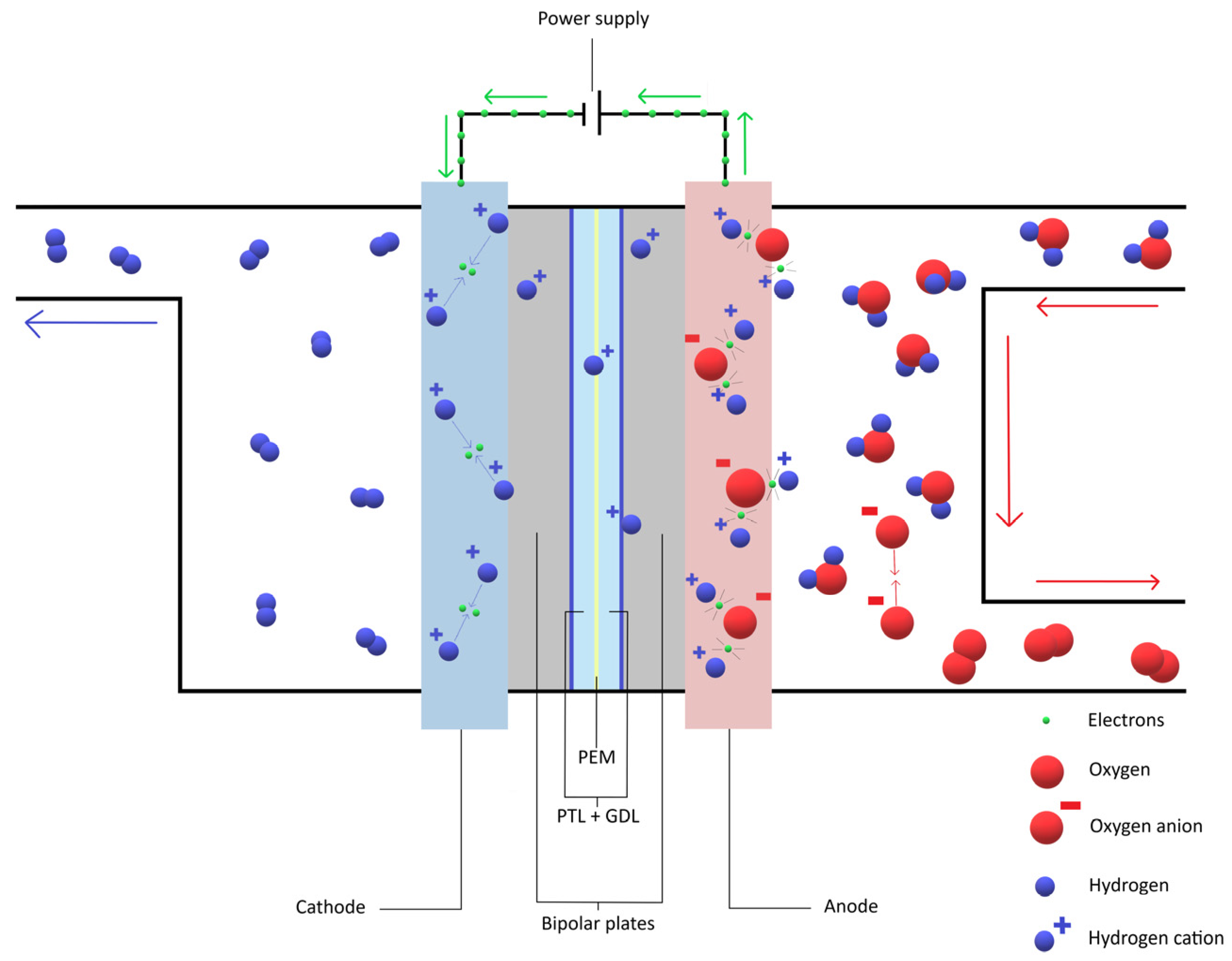
A PEM water electrolyzer—PEMWE is a device in which water is split into hydrogen and oxygen using electric power Equation (1). When voltage is applied, water is fed to the anode, where it undergoes oxidation: water molecules split into oxygen gas, protons (H+), and electrons. The oxygen molecules are released at the anode Equation (2); the protons migrate through the PEM—which selectively allows protons to pass—while the electrons travel through an external circuit. At the cathode, the protons and electrons recombine to form hydrogen gas Equation (3) [9]. The membrane acts also as a gas separator, preventing hydrogen and oxygen from mixing. PEM electrolyzers offer advantages such as high purity hydrogen, compact design, and operation at high power densities and pressures. However, they face challenges including the high cost of noble metal catalysts (like iridium and platinum) and the need for very pure water to protect the membrane from fouling and degradation and ensure its durability [10,11].
Global   reaction : H 2 O H 2 + 1 2 O 2
Anode   reaction :   2 H 2 O 4 H + + O 2 + 4 e
Cathode   reaction : 2 H + + 2 e H 2
Equations describing processes in PEM water electrolyzer [12].
Water electrolysis is an endothermic process, which requires external energy in order to proceed. The theoretical electrical energy required for the electrolysis of water can be calculated based on the Gibbs free energy change associated with the reaction, which for splitting water is approximately 237.2 kJ/mol at around 1.23 V under standard conditions [13]. However, in practical applications, the actual voltage required to achieve electrolysis exceeds this theoretical value due to overpotentials caused by various factors, mainly the slow kinetics of the hydrogen evolution reaction (HER) and especially of oxygen evolution reaction (OER) [9]. Typical operating voltages for PEM electrolyzers generally range from 1.8 to 2.0 V, depending significantly on the design and materials used. The efficiency of the PEM electrolyzer is crucial when considering the power needed for operation. It is often quoted that PEM electrolyzers demonstrate an efficiency of about 70–80%, meaning a significant fraction of the input electrical energy is converted into the chemical energy of hydrogen [14]. The efficiency of the eletrolyzer depends on many factors such as power supply, water flowrate, operating temperature and others. Ideal working conditions are current density of about 250 mA/cm2, a water flowrate of 2 mL/min with a temperature of 70 °C [15].

2.2. Structure of the Electrolyzer Cell Unit

Generally, an electrolyzer is composed of a varying number of electrolytic cells. Each cell is made up of several components (Figure 1). A critical component of PEM electrolyzers is the membrane itself, which facilitates ion transport while acting as a barrier for gases to prevent gas crossover, which enhances operational safety and efficiency. Another two important parts are gas difusion layer (GDL) and porous transport layer (PTL). The GDL primarily facilitates gas transport and conducts electricity, while the PTL is tailored to manage water distribution and gas removal efficiently. Catalyst layers are on both cathode as well as anode, making the electrolysis possible. Another key component in PEM electrolyzer are bipolar plates which encompass gas distribution, current collection, thermal management, structural integrity, and water management. The catalyst layers support electrochemical reactions [16,17]. Typically, the anode consists of noble metals like iridium oxide (IrO2) or platinum-based catalysts, because of the strong acidic environment from H+ ions. Cathode also uses noble metals such as platinum supported on carbon to optimize performance [18]. Catalyst development is a significant area of innovation, particularly in reducing dependence on precious metals, e.g., by incorporating base metals and composites [19].

2.3. The Basic Working Mechanisms of PEMs and Electrolytes

The PEM is a crucial component of the water electrolyzer, acting as a solid electrolyte with proton conductivity. It is specifically designed to let only hydrogen cations (protons) pass towards the cathode, where they recombine into hydrogen molecules (Figure 2). This hydrogen is usually called “green hydrogen” because its production requires only water and leaves no pollutants; however, produced hydrogen can be called “green” only if the power supply comes from renewable sources [18,20]. A significant property of PEM is to prevent the passage of H2 or O2 through the membrane, the so-called crossover, which commonly occurs. This crossover results in a loss of system efficiency, but it is important to monitor it primarily from a safety perspective. Hydrogen in oxygen is explosive in the range of 4–95 vol. %. Generally, when operating the PEM electrolyzer, the concentration of hydrogen in the oxygen stream must remain below 4% by volume. For safe operation of systems, a maximum tolerable amount corresponding to 50% of the lower explosive limit (LEL) is usually specified. Thus, the risk can be mitigated by implementing an automatic shutdown of the electrolyzer once the concentration of hydrogen in the oxygen reaches 2–3 vol. % [21].
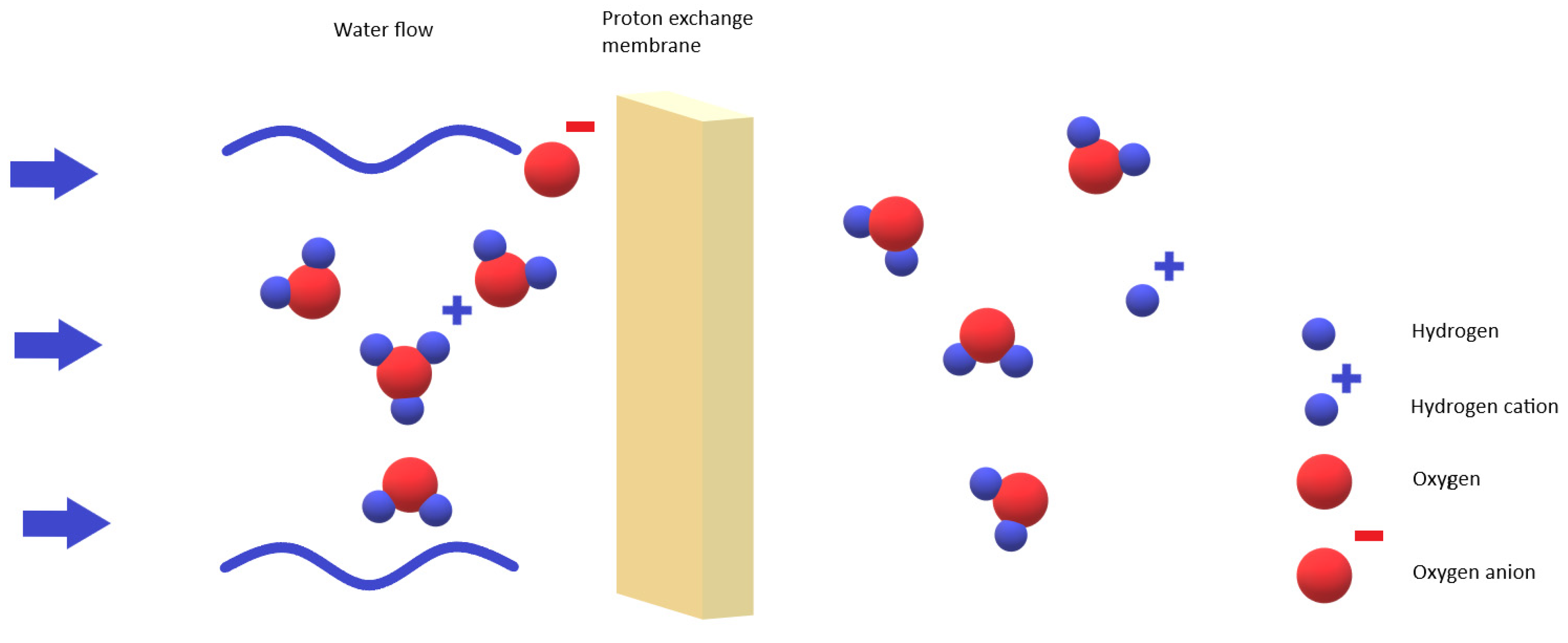
The passage of hydrogen protons across the membrane is described by two mechanisms: Grotthuss and Vehicle mechanism. The Grotthuss mechanism (Figure 3) requires a hydrated membrane to be conductive. In this mechanism hydrogen protons hop to a water molecule creating a hydronium ion H3O+, which almost immediately recombines into H2O and H+. That hydrogen proton then “hops” onto another water molecule creating H3O+ again. The activation energy for this process was measured to be 14–40 kJ/mol. This process repeats over and over again until hydrogen protons reach the other side of the membrane [22,23].
The Vehicle mechanism relies (Figure 4) on molecular diffusion, where protons navigate through the PEM along with the water molecules. It relies on diffusion of hydronium ions such a H3O+, H5O2+ and H9O4+ in water using hydrogen bonds. The efficiency of this mechanism depends on the membrane structure and water flow [23,24].
During PEM electrolysis both Grothuss as well as Vehicle mechanism are happening at the same time, however Vehicle mechanism generally exhibits lower efficiency compared to the Grothuss mechanism due to slower diffusion and the larger molecular size involved in the transport process [9]. The larger molecular weight results in slower kinetics, leading to increased energy consumption during water dissociation, which is less optimal for high-performance applications [25]. To enhance the reliance on the Grothuss mechanism for proton transport in Proton Exchange Membrane (PEM) electrolyzers, a multifaceted approach is essential. One of the primary strategies involves the development of advanced membrane materials that optimize proton conduction. Membranes should be engineered with high levels of sulfonic acid groups to improve hydration and maintain an environment conducive to the Grotthuss mechanism. Adequate hydration is critical since the effectiveness of this mechanism hinges on the presence of water molecules facilitating rapid proton hopping through hydrogen bonds [26].

3. Materials for PEMs

The investigation of membrane types reveals a diverse group of materials and applications, each offering unique advantages and challenges in their respective fields. Materials for PEMs are being selected based on properties they need to have [27] (Table 1). The molecular structure of the polymer backbone directly impacts the PEM proton conductivity and durability. Most membranes have been shown to enhance proton conductivity through the introduction of sulfonic acid groups, which increase the membrane water uptake capacity and facilitate proton transport via hydration layers formed within the membrane matrix [28]. Sulfonic acid groups also significantly increase the density of charge carriers within the membrane. The sulfonic acid functionalities dissociate in the presence of water, releasing protons (H+) that become available for conduction. This is also the reason why proper hydration of the membrane is required [29]. The backbone composition of the polymer is critical for its mechanical and thermal stability. Polyfluorosulfonic acids, such as Nafion, are commonly used in PEMs primarily due to their strong thermal and chemical resistance. PEEK, PBI or sPAES have high stability and durability due to aromatic rings, which enhances mechanical integrity by providing stability under harsh electrochemical conditions [30].
Furthermore, the porosity of a membrane significantly impacts the balance of water management within the electrolyzer. An increase in the membrane porosity can enhance water transport to the reaction sites, which is essential for effective electrolysis; however, excessive porosity may facilitate the crossover of gases, undermining hydrogen production efficiency. The water management in PEM electrolyzers is delicate, as an optimal amount of water is required to achieve both high ionic conduction and minimized gas crossover [31].
Furthermore, this review discusses and evaluates selected materials for PEM based on their proton conductivity, water absorption, power density, durability, gas permeability, and thermal stability.
Table 1. General properties and its common values for PEMs.
Thermal Stability
(°C)
Water Uptake
(wt%)
Power Density
(mW·m2)
Durability
(h)
Proton Conductivity
(mS/cm)
Hydrogen Permeability
(Barrer)
Common values70–100
[32]
28–100
[33]
800–2000
[34]
40–50
[19]
50–150
[35]
0.1–1.0
[31]

3.1. Commonly Used Materials

The most common materials for PEMs are Nafion and sulfonated membranes with SO3H functional groups because of their unique properties like water uptake, proton conductivity and durability [36]. These materials are however facing challenges in terms of very high cost and degradation to toxic residues. This is the reason why nowadays scientists are trying to replace perfluorinated polymers like Nafion, PEEK, sPAES and others with more sustainable and cost-effective materials.

3.1.1. Nafions

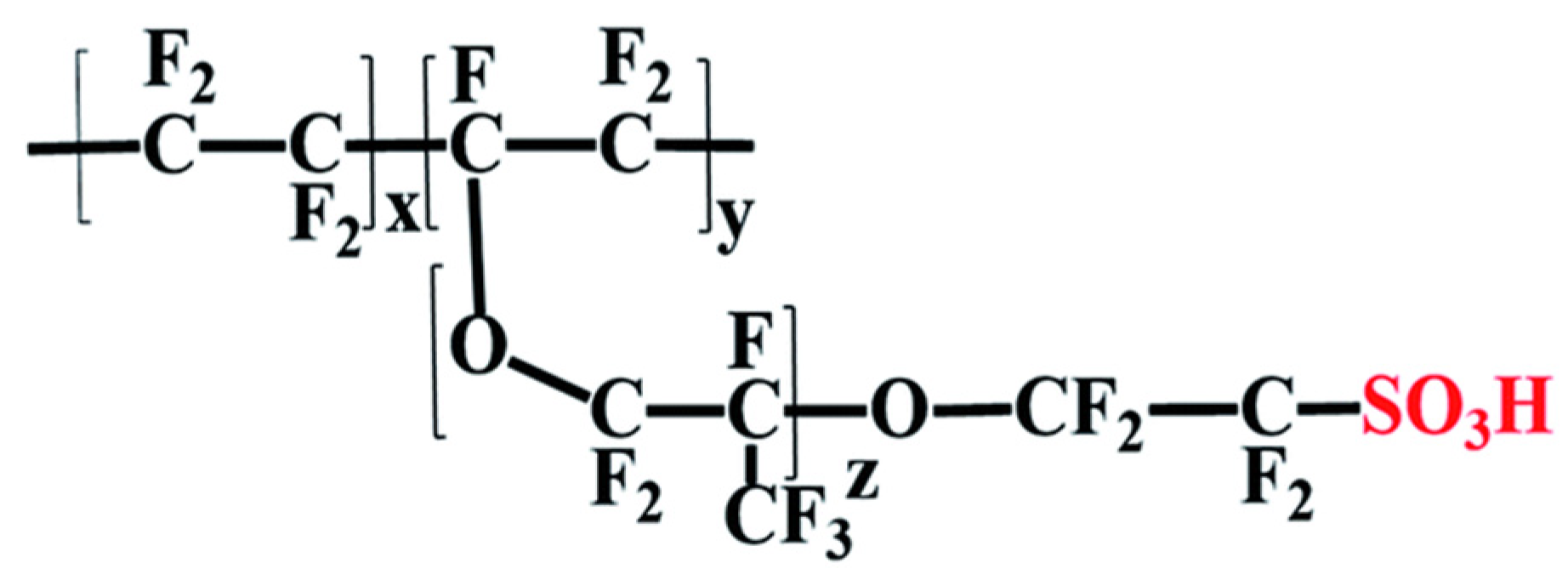
Nafion is considered to be the most used ion exchange membrane in electrolyzers. The structure of Nafion comprises a hydrophobic polytetrafluoroethylene (PTFE) backbone with pendant sulfonic acid (–SO3H) side groups that endow it with ionic conductivity (Figure 5). The presence of these sulfonic acid groups facilitates the formation of water-containing ionic channels, which act as conduits for proton transport [37]. This design allows Nafion to maintain high ionic conductivity under a range of operational conditions; however, it is particularly sensitive to changes in relative humidity and temperature, which can adversely affect its performance [38]. Nafion can maintain decent performance at elevated temperatures (up to 80 °C), though its performance heavily relies on adequate hydration for sustaining conductivity. Despite its strengths, Nafion faces challenges related to chemical degradation and environmental sensitivity. Continuous long-term operation can cause stress-induced deterioration and increased susceptibility to oxidative damage, which affects its long-term viability [39]. Consequently, significant research is dedicated to improving Nafion chemical stability and reducing its degradation rates under various operational conditions [40].
At lower temperatures, specifically near room temperature, Nafion 112 exhibits reduced proton conductivity, which directly affects the hydrogen generation efficiency. For instance, research indicates that operating at 30 °C resulted in a peak electrolysis performance value of approximately 263.76% efficiency at a current of 7.59 A [41]. However, as the temperature increases, so does the membrane conductivity due to the enhanced mobility of protons. Operating temperatures approaching 80 °C allow for a notable increase in current density, potentially exceeding 5 A/cm2, which can significantly enhance the overall efficiency of hydrogen production. According to the literature, significant ohmic resistance develops across Nafion membranes at elevated current densities, particularly at temperatures above 80 °C. This increased resistance can diminish the efficiency gains expected from higher temperatures and current densities, as it introduces additional energy losses in the system. It has also been stated that the operating limits of Nafion membranes, although they can operate at temperatures up to 140 °C, significantly limit the moisture level due to water loss at increased vapor pressure and non-uniform transport, with reduced ionic conductivity and therefore the membranes may operate inefficiently [42]. Also chemical and mechanical damage of membrane interface can be expected, which can lead to the fluoride emission (in case of Nafion) and membrane thinning [43].
Several commercially available types of Nafion membranes are distinguished primarily by their thickness and ion exchange capacity. Common types include Nafion 112, Nafion 115, Nafion 117, and Nafion 212 (Table 2). The differences between them can be attributed to their thickness, proton conductivity, chemical structure and composition, water uptake properties, mechanical characteristics, and suitability for specific applications. These criteria collectively inform the selection of Nafion membranes based on performance requirements in various electrochemical systems [44]. For instance, Nafion 117 is frequently used in commercial applications due to its balance of performance and cost, while Nafion 212 exhibits an enhanced proton conductivity derived from a higher ion exchange capacity, making it more suitable for high-performance applications [45,46]. The performance of Nafion membranes can significantly vary based on their type and composition. Nafion 117 exhibits a high proton conductivity due to its appropriate thickness and maintains an adequate level of water retention necessary for efficient proton transport [47]. Thinner membranes such as Nafion 112 are generally preferable for applications requiring high proton permeability, while thicker membranes like Nafion 117 may serve specific roles in applications where gas crossover needs strict control. Therefore, the selection of membrane thickness must consider both the desired performance outcomes and the operational constraints of the PEM electrolyzer systems.
  • Nafion 112
Nafion 112 is commercially one of the most used Nafion membranes in various electrolyzers and fuel cell applications due to its exceptional proton conductivity 100–120 mS/cm [48] and thermal stability—its thermal degradation starts around 200 °C [49]. Its thickness is approximately 50 μm [50] and its tensile strength was measured 19.1 MPa in hydrated state [51]. Membrane thickness significantly affects proton passage in PEM electrolyzers, with thinner membranes like Nafion 112 generally exhibiting better conductive properties due to structural advantages that promote enhanced proton mobility [44]. Nafion 112 maintains a high ionic conductivity in both humidified environments and at elevated temperatures, making it a prime choice for applications such as PEM Fuel Cells [52,53]. The high proton conductivity of Nafion 112 is attributed to the presence of sulfonic acid groups that facilitate ionic transport. This polymer enables the formation of hydrophilic domains within a hydrophobic matrix, essential for ion conduction through proton hopping mechanisms [46]. Its water uptake is 28–30% [54]. The thermal stability of Nafion 112 is another critical factor; it generally operates efficiently at temperatures up to 80 °C. Nafion 112 has exeptional durability which is around 2000 h [55]. However, modifications can enable functioning at higher temperatures, thus expanding the operational range [56]. Despite its advantages, Nafion 112 faces challenges such as degradation when exposed to high temperatures and oxidative environments. Thermal degradation occurs in multiple stages, leading to weight loss and mechanical failure if not properly addressed [57].
  • Nafion 115
Nafion 115 exhibits a high ionic conductivity, typically reported around 100–200 mS/cm [54], underpinning its efficacy in facilitating proton transport during electrolysis [58]. The membrane thickness of approximately 127 µm strikes a balance between conductivity and ohmic resistance, yielding notable energy efficiency and enhanced electrolyte utilization at power densities approximately 800 mW/cm2 [48]. Although it is most effective at temperatures from 60 °C to 80 °C, it is also capable of operating at elevated temperatures up to 150 °C without significant degradation, highlighting its versatile applicability in high-temperature electrolyzer designs, but only modified using polyphenylsulfone as a cross-linker [59]. The utilization of Nafion 115 in these devices is associated with improved overall performance metrics, particularly in terms of power density and voltage efficiency [60]. For instance, studies in the recent literature indicate that PEM electrolyzers employing Nafion 115 can achieve stable operation at high power densities around 800 mW/cm2 [48], contributing to cost-efficiency in hydrogen production. Furthermore, advancements in hybrid membranes, combining Nafion with materials like CeO2 and graphene, have resulted in enhanced durability and power density, indicating a promising future for modified Nafion membranes in electrolyzer applications [60,61].
  • Nafion 117
Nafion 117 is a widely used polymer electrolyte membrane in water electrolyzers, particularly for hydrogen production [62]. Its thickness is 183 μm [63] and the ideal temperatures under which Nafion 112 operates are between 50 and 80 °C [64]. The performance of Nafion 117 is significantly influenced by factors such as membrane thickness, which is 183 μm [63]; this affects ionic transport properties and overall voltage losses during operation. Studies indicate that thicker membranes, such as Nafion 117, exhibit a higher ohmic overvoltage compared to thinner membranes, resulting in increased operational voltage [62]. The efficiency of Nafion 117 in water electrolyzers also relates to its capability to maintain proton conductivity of 100–120 mS/cm. Research shows that while Nafion membranes can perform well at power densities exceeding 900 mW/cm2 [48], they encounter substantial ohmic losses due to membrane resistance, especially critical in high-performance systems [42,65]. To address this limitation, innovations in membrane design have been explored, including the use of nanostructured materials and composite formulations to enhance conductivity without compromising stability [66].
  • Nafion 212
Nafion 212 is the third most commonly used Nafion in PEM water electrolyzers, particularly known for its effective role in facilitating proton transport during the electrochemical process of water electrolysis. One notable advantage of Nafion 212 is its relatively thinner membrane design, approximately 50 μm in thickness, which is comparable to Nafion 112. This reduces the ionic resistance and enhances electrolysis efficiency when compared to thicker membranes such as Nafion 117, which is critical at high power densities above 860 mW/cm2 [65,67]. The higher ionic conductivity 100–120 mS/cm of Nafion 212, particularly under wet conditions in water uptake of 45% [54], facilitates rapid proton transport, thus supporting larger power densities without extensive voltage losses, a common limitation in other membrane types [67]. However, one challenge associated with Nafion 212 is the crossover of hydrogen through the membrane. While this is a known issue in PEM applications, recent studies on Nafion suggest that optimally managing operating conditions and membrane characteristics can mitigate this effect, allowing for the use of Nafion 212 in applications requiring high-purity hydrogen production [68].
  • Disadvantages of Nafion
Despite its widespread use, there are significant challenges and disadvantages associated with Nafion that limit its performance and application scope in PEMWE. One primary concern is Nafion high sensitivity to dehydration, particularly at elevated temperatures. When operating at temperatures above 80 °C, Nafion membranes exhibit a rapid decrease in proton conductivity due to water evaporation, leading to performance degradation. This characteristic imposes significant constraints on operational temperatures, limiting the efficiency of PEM electrolyzers that could otherwise benefit from improved reaction kinetics at higher temperatures [69]. The continuous requirement for water management also presents a challenge, as maintaining water uptake for at least 28% is crucial for sustaining proton conductivity [70].
Another issue is the chemical stability of Nafion under operational stresses. Research has shown that long-term exposure to oxidative environments and the presence of catalysts can lead to the degradation of Nafion membranes, resulting in reduced performance and lifespan [71]. The accumulation of radicals and chemical species during operation can exacerbate this degradation, risking membrane integrity and functionality over time [72]. Such vulnerabilities necessitate the development of enhanced versions of Nafion or composite membranes to improve its resistance to chemical attack while still functioning effectively.
Moreover Nafion is derived from fossil fuels and involves complex chemical processes. Its production is much more energy-intensive, with emissions estimates around 2.5 kg of CO2 per m2 of Nafion membrane produced. The manufacturing processes for Nafion membranes indeed release significant greenhouse gases due to the petrochemical nature of the raw materials and energy-intensive methods needed for their production [73].
Cost is another significant drawback of Nafion. As a commercially manufactured perfluorosulfonic acid polymer, Nafion tends to be expensive, which can escalate the overall cost of PEM electrolyzer systems. This economic factor can inhibit widespread adoption, especially in applications where cost efficiency is paramount [74]. Alternative materials, such as sulfonated block copolymers or more affordable hydrocarbon-based polymers, have been studied as potential substitutes to mitigate cost concerns [75]. However, these alternatives often struggle to match Nafion high conductivity and other desirable characteristics, leading to a complex trade-off in performance and cost.

3.1.2. Poly(Ether Ether Ketone) (PEEK)

PEEK membranes have gained substantial attention as potential PEM for use in electrolyzers due to their favorable properties, including excellent thermal stability of 300 °C [76] and chemical stability, mechanical strength, and reasonable proton conductivity in the range of 60–70 mS/cm [77]. These characteristics make PEEK a strong candidate for the development of advanced electrolyzer technologies, particularly in PEMWEs [10,78]. By introducing sulfonic acid functional groups (Figure 6), the ionic exchange capacity of PEEK is significantly improved, facilitating enhanced proton transport through the membrane [79]. Studies have demonstrated that sPEEK membranes can achieve high levels of proton conductivity, particularly when subjected to humidified conditions, which are typical in PEM electrolyzer operations. This trait is essential to ensure efficient electrolysis and reduce energy losses associated with Ohmic losses [80]. Moreover, one of the advantages of using PEEK-based membranes in electrolyzers is their superior mechanical strength compared to traditional ionomers like Nafion. This quality results in better durability and longer operational life in harsh electrochemical environments, where mechanical integrity is critical [78]. In high-temperature or variable operational scenarios, the robustness of PEEK membranes mitigates risks of physical degradation, which can be observed in softer membranes under prolonged electrolysis conditions [81].
Significant limitation of PEEK membranes is their relatively low ionic conductivity compared to Nafion. Although PEEK exhibits good mechanical strength and thermal stability, its ionic conductivity is often insufficient for high-performance electrolysis applications. This reduced conductivity can lead to higher internal resistance, which in turn can adversely affect the overall efficiency and performance of PEM electrolyzers operating at high power densities [82]. Another drawback is the high cost of PEEK itself, which can limit the commercial viability of PEEK-based membranes in broad applications. Even though PEEK offers excellent stability and durability, the price of PEEK materials is higher than that of some polymer alternatives, including sulfonated variants that are less costly than traditional Nafion. PEEK membranes can also be more challenging to fabricate compared to Nafion, which has well-established processing techniques. Issues related to dimensional stability and the necessity for advanced fabrication methods can complicate the manufacturing processes for PEEK membranes [83]. Finally, chemical compatibility remains a concern. Although PEEK has good resistance to many corrosive environments, the aggressive conditions present in PEM electrolysis, particularly with certain catalysts, might lead to unexpected degradation or changes in performance over prolonged operation periods [82]. This is essential when considering membrane longevity and reliability in commercial deployments. The production of PEEK membranes involves several key processes: polymer synthesis, sulfonation, and membrane casting. While specific literature data directly addressing PEEK production emissions is sparse, estimates derived from similar high-performance polymer membranes suggest that emissions could be in the range of 1.5 to 2.0 kg CO2/m2. This range considers the energy-intensive steps required in polymer synthesis and the additional energy required during the sulfonation process [84].

3.1.3. Polybenzimidazole (PBI)

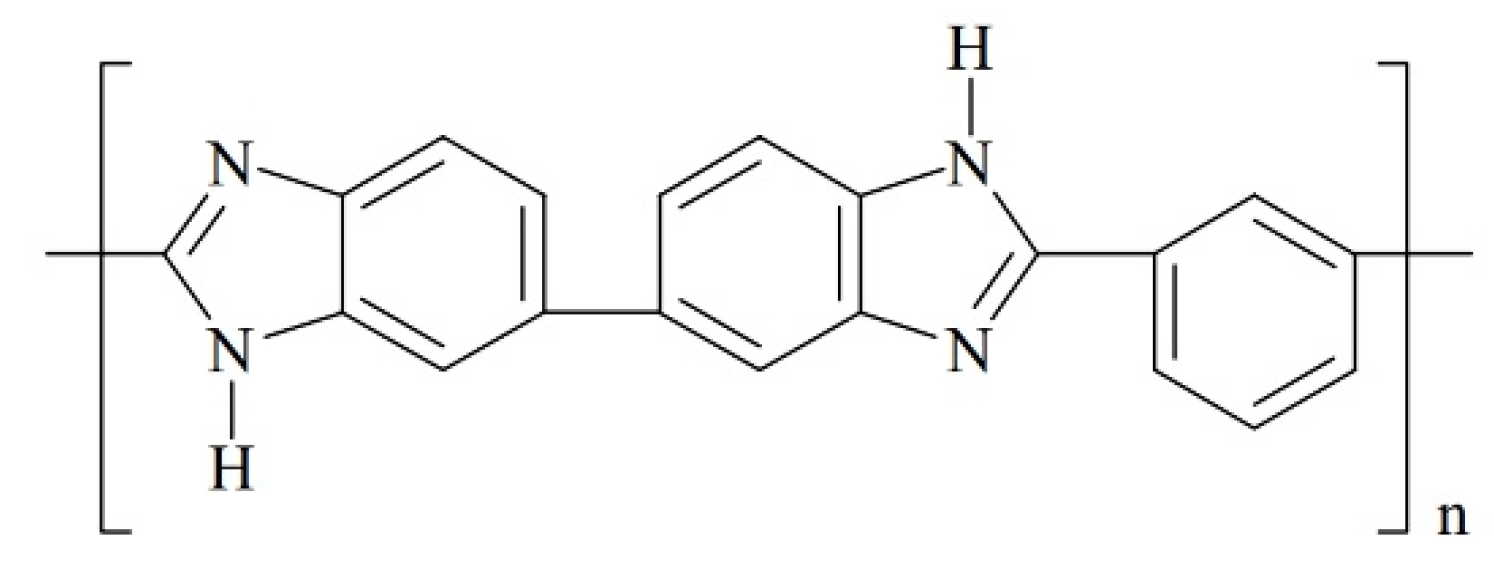
Polybenzimidazole has garnered significant interest as a PEM in electrolyzers, particularly due to its unique properties, such as high chemical stability, excellent thermal endurance above 400 °C [85], and the ability to operate effectively without added humidity. These characteristics make PBI membranes suitable for both high-temperature and challenging electrochemical environments in applications such as hydrogen production through water electrolysis [86,87]. One critical advantage of PBI as a PEM is its high mechanical strength and stability, essential for maintaining membrane integrity during prolonged operation under acidic conditions. When PBI is doped with phosphoric acid or sulfonated, its imidazole groups are protonated (Figure 7), which enhances its proton conductivity significantly from 30 to 40 up to 70 mS/cm [77,88]. For example, studies have shown that sulfonated PBI membranes can outperform traditional Nafion membranes in acidic electrolyzers, providing lower cell voltages at similar power densities of 600 mW/cm2 [48,87]. PBI resilience extends to high-temperature applications, where it can maintain its performance without the need for water, unlike many conventional membranes that require hydration to function efficiently. For instance, para-PBI membranes have been successfully used in hydrogen chloride (HCl) electrolyzers, where they can operate at temperatures exceeding 160 °C while retaining high proton conductivity and stability [86,89].
One of the main challenges associated with PBI membranes is their low proton conductivity (30–40 mS/cm) compared to Nafion. Even though PBI can tolerate high temperatures and harsh chemical environments, its ionic conductivity can fall short, particularly under low-humidity conditions [90]. While research efforts are ongoing to enhance their proton conductivity through various doping strategies, achieving competitive conductivity levels remains a challenge [87]. The mechanical stability of PBI membranes can also be compromised with elevated phosphoric acid doping levels. While acid doping increases proton conductivity, it introduces a plasticizing effect that may decrease the overall mechanical integrity of the membranes, making them less durable under operational stresses [91]. Continued exposure to operational conditions can exacerbate this issue, leading to dimensional instability and increased risk of failure [92]. Additionally, the cost of PBI membranes is often higher compared to other membrane materials, including Nafion. Manufacturing processes for PBI can be more complex and expensive, which may limit broader industrial applications. The economic factors associated with the production of PBI membranes may hinder their competitiveness in a market that increasingly demands lower-cost solutions for hydrogen generation technologies [93]. Moreover, the integration of PBI membranes into PEM electrolyzers involves challenges regarding fabrication and scaling. Developing uniform and defect-free PBI membranes while maintaining the desired properties is a technical challenge that requires additional research and development. This complexity can increase both time and costs associated with producing viable membrane solutions for commercial applications [94]. The production of PBI membranes typically involves synthesizing polybenzimidazole through polymerization processes. The environmental analysis indicates that the energy input for producing PBI membranes may lead to emissions around 1–1.5 kg CO2 per square meter of membrane, depending on the production technology and the phosphoric acid doping used for enhancing proton conductivity. This estimate covers raw material preparation, polymerization, and membrane processing stages [95].

3.1.4. Sulfonated Poly(Arylene Ether Sulfone) (sPAES)

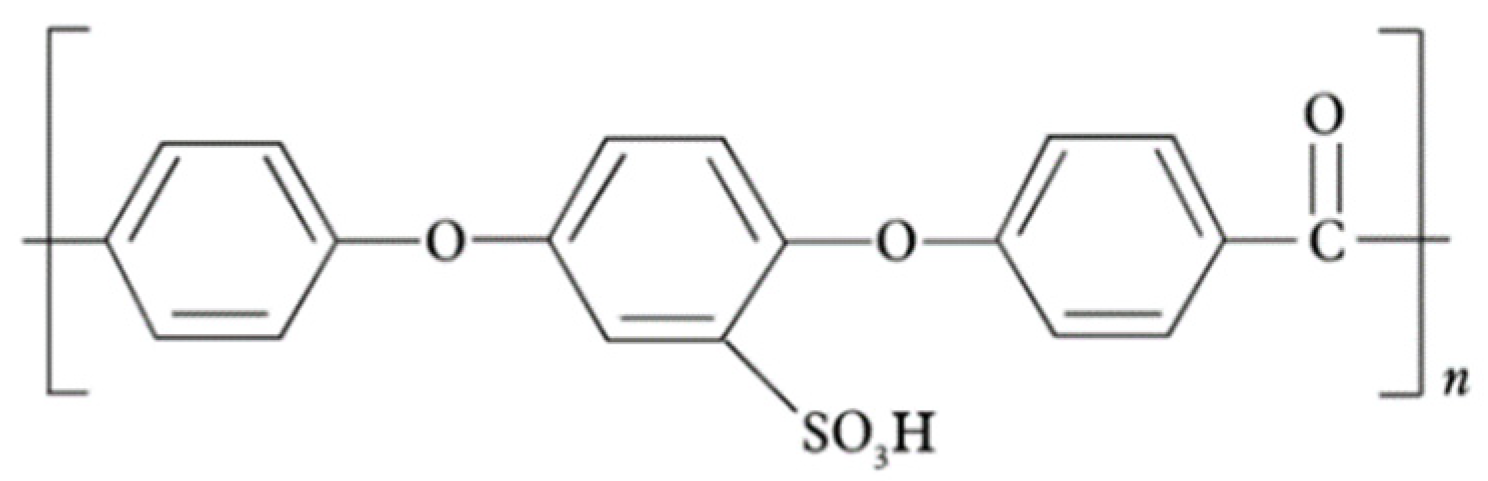
sPAES membranes are known for their high thermal stability (260 °C) [96] and resistance to chemical degradation. Research indicates that these membranes maintain their structural integrity even at elevated temperatures, outperforming many traditional membranes [97,98]. The incorporation of sulfonic acid or -CF3 groups (Figure 8) in the polymer backbone enhances proton conductivity while ensuring the membrane remains stable under operational stresses [99,100]. The ionic conductivity of sPAES membranes is closely linked to their degree of sulfonation. Studies show that higher sulfonation levels lead to increased ion exchange capacity (IEC), which can enhance proton conductivity [38,101]. However, excessive sulfonation can result in membrane swelling and loss of mechanical strength, posing challenges for their practical application [100]. Balancing sulfonation levels is crucial to optimize conductivity while maintaining physical integrity [102]. Recent advancements have explored the development of hybrid sPAES membranes, combining them with other materials to improve proton conduction and mechanical properties. For instance, the addition of silsesquioxane units has been shown to enhance the hydrophilic character of sPAES membranes, resulting in an improved hydrolytic stability and overall performance in wet conditions [103]. The application of sPAES membranes in electrolyzers has shown promising results, particularly in terms of performance metrics such as power density and voltage efficiency. These membranes are capable of operating effectively under varying humidity levels, which is often a limitation for conventional PEMs [104,105].
Figure 8. Chemical structure of sPAES. Reproduce with permission [106]. Copyright 2003 Elsevier.
Water 17 03297 g008
One of the primary concerns is the relatively lower proton conductivity (80–90 mS/cm) [107] of sPAES membranes compared to Nafion. While studies suggest that sPAES membranes can exhibit competitive conductivity, it is generally not sufficient for high-performance applications, particularly at elevated temperatures or low humidity levels. Preliminary studies have reported that while the proton conductivity of some sPAES membranes is promising, it often does not match the performance of Nafion under similar conditions, which can adversely affect the efficiency of the electrolyzer [108]. Moreover, sPAES may require humidification to maintain optimal conductivity, complicating system design and operation. Chemically, sPAES membranes may exhibit limited stability under the acidic environments prevalent in PEM electrolyzers. Their long-term durability remains a concern, particularly when exposed to reactive species generated during the anodic and cathodic reactions essential for water electrolysis. Tests have shown that degradation can occur under prolonged operational stresses; however, specific assessments of sPAES membranes under these conditions are still emerging [109]. As such, while sPAES membranes are designed to resist dissolution, structural weaknesses can quickly lead to failure, resulting in increased maintenance costs and system downtime. The process of producing sPAES membranes involves several stages, including polymer synthesis, sulfonation, and membrane casting. Specific CO2 emission data for sPAES is not directly available; however, similar high-performance membranes generally result in emissions in the range of 1.2 to 2 kg CO2/m2 [84].

3.1.5. Hybrid Membranes

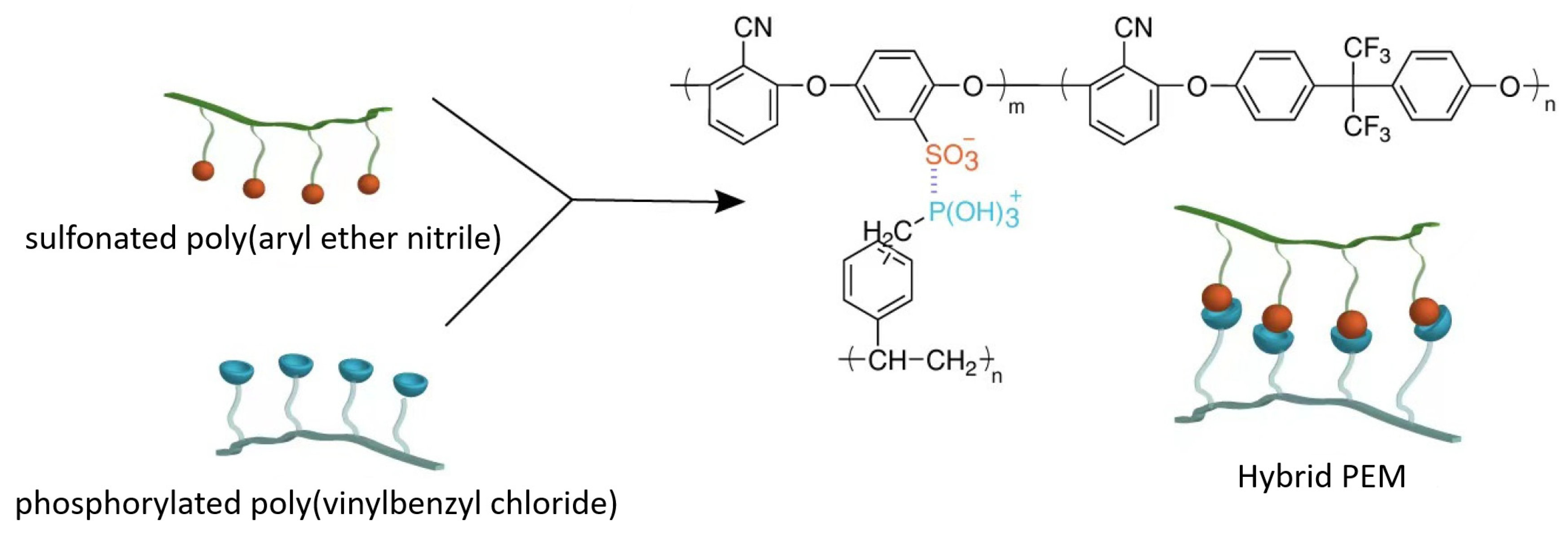
Hybrid membranes combining phosphoric acid and sulfonic acid functional groups have emerged as a promising approach to enhance the performance of PEMs in electrochemical applications such as PEMWEs (Figure 9). The integration of these functional groups aims to harness the advantages of each, improving proton conductivity while maintaining stability across a wider range of operational conditions. PEMs utilizing sulfonic acid groups are widely acclaimed for their high proton conductivity and efficiency in transporting protons. These characteristics are strongly influenced by water molecules, which facilitate proton transfer at lower temperatures [110]. On the other hand, traditional sulfonic acid-based membranes, such as Nafion, face challenges related to performance under high temperature and low humidity scenarios. Specifically, sulfonic acid degradation can limit the applicability of these membranes at temperatures above 100 °C. To overcome these limitations, hybrid membranes that incorporate phosphoric acid groups (H3PO4) alongside sulfonic acid groups have been investigated. Phosphoric acid can enhance proton conductivity while improving thermal and chemical stability, making these hybrid membranes suitable for higher temperature applications [111,112]. Recent studies indicate that membranes functionalized with both sulfonic and phosphoric acid groups exhibit synergistic effects that can lead to improved performance metrics for PEM applications. For instance, dual functionality allows for superior ion transport properties compared to membranes that rely solely on sulfonic acid domains. The hybridization of these acid groups has been shown to achieve a fine balance between conductivity and stability, thereby allowing operation in more demanding conditions [111]. The advantages of hybrid sulfonic/phosphoric acid membranes extend beyond mere conductivity. The structural designs of these membranes can facilitate enhanced phase separation, leading to improved proton conduction pathways through the formation of well-defined hydrophilic domains within a hydrophobic matrix [113].
The most commonly used hybrid membrane not containing Nafion is Zirconia Toughened Alumina (Zirfon). One of the key advantages of Zirfon membranes is their enhanced mechanical strength and toughness. Research has shown that zirconia promotes a phase transformation mechanism that increases the toughness of the alumina matrix, thereby providing greater durability under operational stresses commonly encountered in PEM electrolyzers. Specifically, the addition of zirconia not only increases fracture toughness but also improves the mechanical stability of the membranes over various environmental conditions [114].
Figure 9. Example of hybrid membrane with sulfonic and phosphoric groups [115].
Water 17 03297 g009
One of the primary concerns regarding hybrid membranes is their durability and stability under conditions typically encountered in practical applications. Both sulfonic acid and phosphoric acid groups can lead to membrane degradation over time. The presence of sulfonic acid can promote swelling due to excessive water absorption, which may compromise the structural integrity of the membrane and lead to physical deformities or ruptures [66]. Swelling is particularly problematic at elevated temperatures, where differential expansion can cause mechanical failure [116]. The generation of gas crossover (specifically hydrogen) through membranes also contributes to reduced durability, as it can chemically destabilize the membrane matrix, producing unwanted mixed potentials [53,117]. Another challenge is achieving adequate proton conductivity, especially at low relative humidity conditions, which are critical in many operational environments. Hybrid membranes may exhibit insufficient conductivity under such conditions compared to their pristine counterparts, impacting their applicability in real-world scenarios [118]. Additionally, maintaining the necessary hydration levels becomes increasingly challenging in operational environments that fluctuate in humidity, affecting performance consistency [119]. The production of Zirfon membranes involves both inorganic and organic components, influencing the CO2 emissions associated with their synthesis. Zirfon includes a ceramic component made from zirconia and a polymer component that enhances ion conductivity and reduces gas crossover during electrolysis. Proper Zirfon CO2 emissions have not been found, however current estimates indicate that Zirfon may have CO2 emissions approximately 1.8 to 2.2 kg CO2/m2, reflecting energy inputs required for both ceramic processing and polymer production [114].

3.2. Sustainable Materials

Sustainable materials for PEMs have gained significant attention due to their vital role in various electrochemical applications, particularly in fuel cells. Traditional PEMs, such as Nafion, while effective, present challenges including their high cost, non-biodegradability, and environmental concerns associated with their long-term use [120,121]. Therefore, the exploration of eco-friendly alternatives is paramount. In this review, four most commonly used sustainable polymers for PEMs were selected and order form the most common, which is chitosan to the newest addition which is lignin. There are also more polymers that are being explored like, for example, pectin, but there was not enough information available for their usage as PEMs, so they were not included.

3.2.1. Chitosan

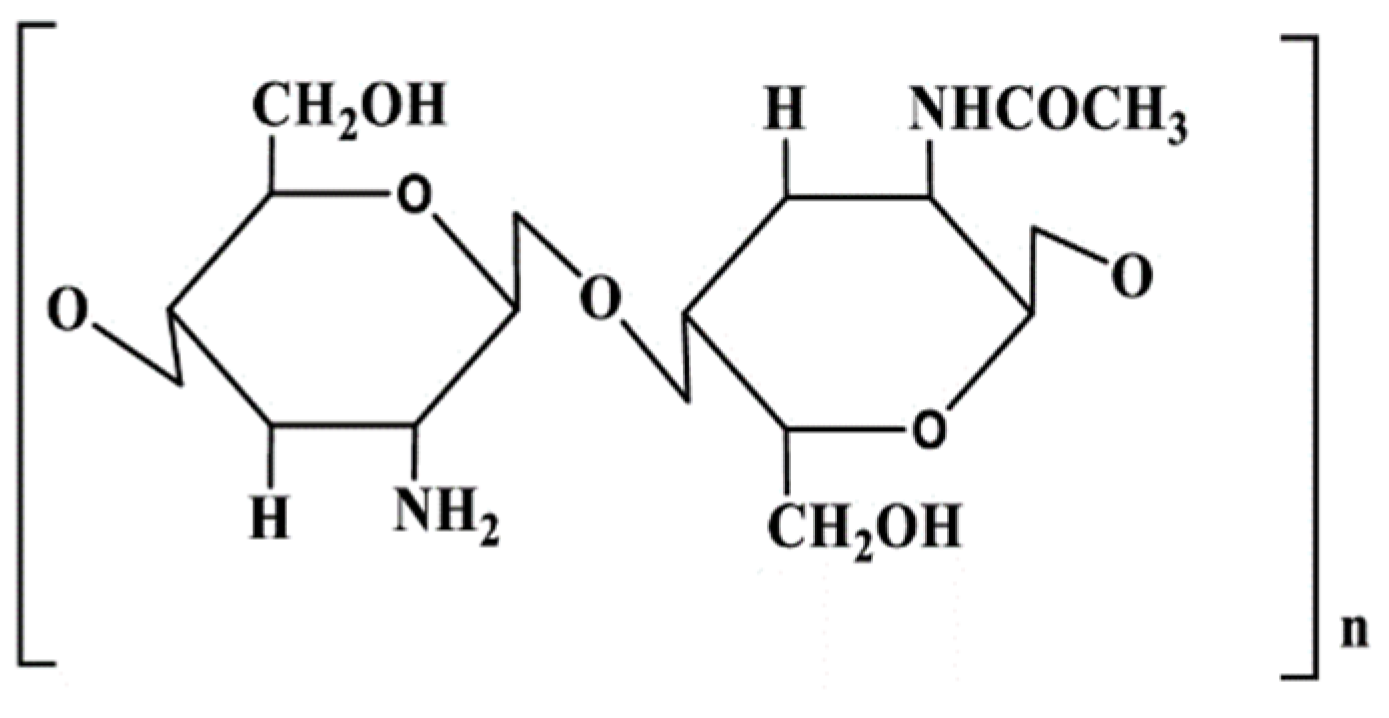
Chitosan membranes are gaining attention as promising materials in PEM electrolyzers due to their biocompatibility, sustainability, favorable mechanical properties, and the potential for enhanced ion conductivity when properly modified. These attributes make chitosan an appealing candidate for developing advanced membranes aimed at improving the efficiency of hydrogen production through electrolysis. Chitosan is a biopolymer derived from chitin (Figure 10), presenting a more sustainable alternative to traditional membrane materials and promoting the development of environmentally friendly energy solutions [122]. The integration of chitosan into membrane technology can significantly enhance proton conductivity, which is paramount for the operation of PEM electrolyzers. Atmaja et al. [123] discuss how the incorporation of functional additives, such as phosphotungstic acid, can boost proton conductivity in chitosan-based membranes, highlighting the importance of structural properties in membrane performance [123]. The ongoing research and refinement in fabrication techniques have allowed scientists to engineer chitosan membranes to have specific morphologies that can sustain higher operational efficiencies while also addressing the demands for lower production costs, which are common in conventional PEM technologies [36]. Chitosan membranes have also been explored for their ability to manage humidity levels effectively, a critical parameter in PEM operation. As highlighted by Kheirrouz et al. [124], maintaining optimal humidity is essential for maximizing proton conductivity and overall performance of PEM electrolyzers under varying operational conditions, as it enhances ion transport and reduces Ohmic losses [124].
One major issue is the low proton conductivity of chitosan membranes. The ionic conductivity of chitosan membranes is often insufficient for the demands of high-performance electrolysis applications, as they typically do not reach the conductivity levels necessary to facilitate efficient electrochemical reactions [125]. The performance of PEM electrolyzers is heavily dependent on the ionic transport capability of the membrane, and inadequate conductivity can severely limit the overall efficiency of hydrogen production [126]. Moreover, chitosan membranes, similarly to the other sustainable membranes, face challenges regarding mechanical stability and durability. Under prolonged exposure to the high humidity and temperature conditions common in PEM electrolyzers, chitosan membranes can experience physical degradation and swelling. These variations in shape and size can lead to compromised integrity and performance of the membrane over time, resulting in increased maintenance requirements. Unlike more traditional PEM materials, which are specifically designed to endure such stresses, chitosan may not provide the structural reliability needed for long-term use in electrolysis systems. Chemical stability is another significant concern. The acidic environment typically found in PEM electrolyzers can severely degrade chitosan membranes, leading to their deterioration and performance loss [125]. Additionally, while chitosan membranes possess inherent advantages, such as being derived from renewable sources and displaying favorable ion selectivity, these benefits are often counteracted by their limitations in terms of transport properties and resistance to harsh electrolytic conditions. Without significant modifications, the membrane ability to function effectively in a PEM electrolyzer setting remains constrained [127]. Chitosan is derived from chitin, which is primarily extracted from shrimp exoskeletons and other crustacean shells. The production of chitosan involves several steps: the collection of raw materials, demineralization, deacetylation, and drying. The LCA (Life-cycle assessments) for chitosan production indicates that the carbon emissions associated with the extraction and processing could result in approximately 0.64 kg CO2/m2 of chitosan membrane produced, depending on processing efficiency and energy inputs [128].

3.2.2. Cellulose

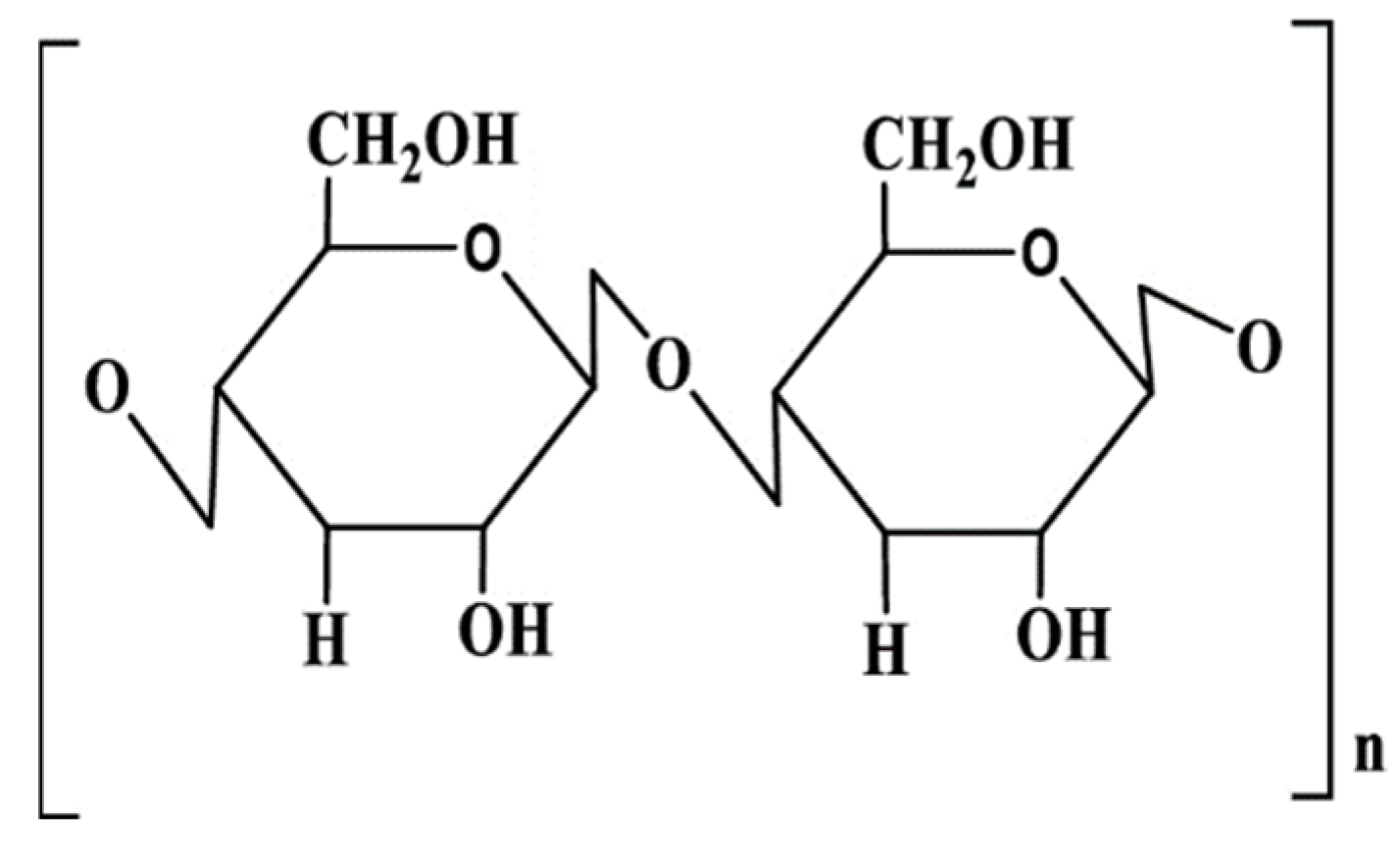
Cellulose (Figure 11) membranes are emerging as a promising alternative for PEMWE. One of the significant benefits of cellulose membranes in PEM electrolyzers is their inherent biocompatibility and renewability. Given the increasing emphasis on environmental sustainability in energy technologies, cellulose-derived membranes contribute to the development of greener electrolysis systems that can potentially replace traditional materials such as Nafion [129]. Furthermore, cellulose membranes can be engineered to achieve the necessary proton conductivity for efficient operation in acidic conditions, which is crucial in PEM electrolyzers that utilize high power densities for hydrogen production [130]. In addition to their electrochemical performance, cellulose membranes offer advantages in terms of lower production [131]. Incorporating cellulose into the design of PEMWEs could potentially reduce the overall costs associated with hydrogen production, making this technology more accessible and scalable for various applications, including large-scale hydrogen production from renewable sources [132]. Notably, the hydrophilic nature of cellulose can help maintain adequate moisture levels within the electrolyzer, which is essential for effective proton conduction [9].
Nanocellulose can be integrated into polymer matrices to create composite membranes that exhibit superior proton conductivity compared to traditional polymer membranes. The incorporation of cellulose nanofibers into membranes such as Nafion has been shown to improve the dimensional stability of the membranes, thereby enhancing their water distribution and overall performance in electrolysis applications [8]. This modification allows for better hydration, which is critical for maintaining high ionic conductivity. Furthermore, the reinforcing action of nanocellulose aids in achieving a more uniform membrane structure, which is crucial for reducing gas crossover and enhancing ion transport efficiency. The reinforcing action of cellulose nanofibers, stating that long nanofibers can reach the percolation threshold at low loading levels, forming a robust network within the membrane and leading to improved mechanical and electrochemical properties. This feature is particularly valuable in PEM electrolyzers where membrane durability is critical due to harsh operating conditions [133].
A significant drawback of cellulose membranes in PEM applications is their low proton conductivity which was measured at values of 20–30 mS/cm [134]. While cellulose has been shown to facilitate proton transport, it typically does not achieve the same levels of conductivity as, e.g., Nafion [7]. This lower conductivity can lead to inefficiencies in electrochemical reactions occurring within the electrolyzer, hampering hydrogen production rates. Moreover, enhancements in cellulose membranes often require the integration of additives or complex chemical modifications to achieve more balanced conductivity, which may not always be feasible or cost-effective [135]. Mechanical stability is another critical disadvantage when using cellulose membranes in PEM electrolyzers. Cellulose-based membranes tend to suffer from inadequate mechanical strength, particularly under prolonged operational conditions involving temperature fluctuations and moisture variations. Such mechanical constraints could lead to physical degradation or deformation during operation, resulting in reduced membrane lifespan which is from 100 to 200 h [136] and efficiency. In contrast, materials like Nafion are specifically designed to withstand harsher conditions, thus ensuring better reliability throughout the electrolyzer operational lifespan. Furthermore, cellulose membranes exhibit susceptibility to chemical degradation, particularly when exposed to the acidic or oxidative environments prevalent in PEM electrolyzers [137]. The production of cellulose-based membranes involves extracting cellulose from agricultural sources, processing it, and converting it into membrane form. Studies suggest that the production of cellulose membranes can generate approximately 0.50 to 0.75 kg CO2/m2 due to the relatively low energy input compared to traditional petroleum-based polymers like Nafion. The exact emissions depend on factors such as resource sourcing, processing techniques, and the efficiency of the bioprocessing methods employed [73].

3.2.3. Sodium Alginate

Sodium alginate membranes are emerging as viable materials for PEMs in electrolyzers, particularly due to their favorable biocompatibility, because it is a natural polysaccharide (Figure 12) derived from brown seaweed. Sodium alginate exhibits mechanical properties that are essential for the durability of electrochemical devices. Pure alginate is often brittle; however, the introduction of plasticizers such as glycerol has been shown to improve the flexibility and tensile strength of alginate membranes considerably. Investigations into the mechanical performance of sodium alginate polymer electrolyte membranes indicate that varying the concentration of glycerol can optimize the membrane elongation at break and tensile stress, making it more suitable for operational demands in PEM electrolyzers [138].
However, they present several distinct disadvantages that merit careful consideration. One primary disadvantage is their relatively low ionic conductivity (10–15 mS/cm [139]) compared to conventional Nafion membranes (100 mS/cm), which is essential for the efficient transport of ions during the electrolysis process [15]. Moreover, the mechanical robustness of sodium alginate membranes is often questioned. The polymer hydrophilicity may lead to increased swelling, especially in aqueous environments like those found in PEM electrolyzers. This swelling can adversely affect the membrane dimensional stability, leading to mechanical failure under operational stresses [140]. Thermal stability is another critical concern. Sodium alginate membranes typically exhibit lower thermal resistance in a range of 180–200 °C [141]. This limitation is crucial, as PEM electrolyzers operate efficiently at elevated temperatures to enhance kinetics [142]. A membrane that cannot withstand high temperatures might degrade, leading to increased maintenance needs and reduced overall system efficiency. Sodium alginate is derived from brown algae, particularly species such as Macrocystis pyrifera. The extraction process typically involves drying the algae, followed by chemical treatment to isolate the alginate. The environmental impact of this process has been quantified in recent studies. The overall emissions from the extraction of green alginate can average around 1.2 to 1.5 kg CO2/m2 when considering energy, water use, and chemical inputs during the alginate extraction process [143].

3.2.4. Lignin

Lignin, a complex and abundant natural polymer derived from biomass, has emerged as a promising material for use in PEM electrolyzers. This potential is attributed to a lignin unique structure and properties, which facilitate electrochemical processes essential for hydrogen production. One key advantage of utilizing lignin in PEMs is the ability to form sulfonated lignin ionomers. The synthesis of sulfonated lignin ionomers was performed by sulfomethylating kraft lignin, allowing for controlled ion exchange capacities, which are crucial for proton conductivity [144]. Such modifications can enhance the ionic conductivity of the membranes, making them suitable for applications in electrolyzers that require efficient proton transport. The characterizations of these ionomers further demonstrate their effectiveness in renewable energy applications, highlighting their role as potential substitutes for conventional polymer membranes like Nafion [145]. However, challenges remain regarding the electrochemical properties of lignin itself. Studies indicate that while lignin can enhance certain aspects of electrolysis, its inherent characteristics may hinder the catalytic performance at the anode, particularly regarding the electro-oxidation of lignin-derived compounds [146]. Research continues to focus on optimizing lignin processing and incorporation strategies, including employing nickel-based electrocatalysts that can effectively facilitate lignin oxidation and improve hydrogen production efficiency [147].
A primary concern related to lignin membranes is their generally low proton conductivity which is 5–15 mS/cm [148]. Although lignin has functional groups that can participate in ion exchange processes, its ionic conductivity tends to be inferior to that of established PEM materials such as Nafion. This reduced conductivity adversely affects ion transport during the electrolysis process, which is crucial for efficient hydrogen production [78]. Inefficient ion transport correlates with poor electrochemical performance, leading to higher operational costs and lower overall efficiency in lignin-based PEM electrolyzers [149]. Mechanical stability is another significant issue. Lignin membranes often exhibit inadequate mechanical strength, which can be problematic in the harsh operating environments of electrolyzers. Factors such as temperature fluctuations and water content can lead to swelling or degradation of the membrane structure, ultimately affecting its durability and functional lifespan. Generally, PEMs are required to maintain their integrity under compression and in hydrated environments, conditions that lignin membranes may not withstand effectively [150]. This lack of robustness raises concerns about the reliability and longevity of lignin-based PEMs in practical applications. Additionally, lignin membranes may face challenges associated with large-scale manufacturing and consistency in material properties. Variability in lignin sources and the methods of membrane fabrication can lead to inconsistencies in performance characteristics, making it difficult to achieve uniform functionality necessary for commercial applications [15]. Lignin membranes are recognized for their potential to serve as efficient proton exchange membranes due to their biocompatibility and conductive properties. However, the operational performance of lignin membranes can vary widely based on formulation and processing. While specific CO2 emissions related to the operational phase of lignin membranes are less documented, we can estimate emissions from hydrogen production to be around 0.5 to 1.0 kg CO2/m2 when operating under typical conditions, particularly when powered by renewable energy sources [151].
Table 2. Summary of values for each mentioned PEM.
Thermal Stability
(°C)
Water Uptake
(wt %)
Power Density
(mW·m−2)
Durability
(h)
Proton Conductivity
(mS/cm)
Hydrogen
Permeability
(barrer)
Membrane Thickness
(μm)
Emissions of CO2
(kg on 1 m2 membrane)
Nafion 112200
[49]
28–30
[54]
850
[48]
2000
[55]
100–120
[48]
115
[152]
50
[50]
2.5
[84]
Nafion 115180
[69]
22–24
[54]
800
[59]
1000
[153]
85–95
[59]
110
[152]
127
[154]
2.5
[84]
Nafion 117180
[49]
30–32
[54]
900
[15]
2000
[61]
100–120
[15]
120
[152]
183
[63]
2.5
[84]
Nafion 212180
[49]
40–45
[54]
860
[155]
1000
[48]
120–130
[155]
115
[152]
50
[154]
2.5
[84]
PEEK300
[76]
15–20
[77]
400–500
[156]
500
[139]
60–70
[77]
60
[157]
50–100
[154]
1.5–2
[84]
PBI400
[85]
10–15
[148]
600
[48]
1500
[55]
30–40
[77]
5
[157]
50–150
[154]
1–1.5
[95]
sPAES260
[96]
15–20
[107]
500–700
[158]
2000
[55]
80–90
[107]
25
[158]
21–25
[107]
1.2–2
[84]
Hybrid membrane Zirfon150–200
[114]
22
[114]
120–150
[59]
800–1000
[114]
50–80
[114]
200–300
[114]
175–300
[8]
1.8–2.2
[114]
Chitosan200
[159]
40–55
[136]
100–200
[148]
100–300
[148]
15–25
[136]
7
[157]
112
[160]
0.64
[128]
Cellulose200
[161]
30–35
[134]
200–300
[162]
100–200
[136]
20–30
[134]
8–10
[134]
46–62
[73]
0.5–0.75
[73]
Sodium Alginate180–200
[163]
35–45
[139]
150–250
[148]
50–100
[148]
10–15
[139]
6
[157]
25–110
[164]
1.2–1.5
[143]
Lignin160–190
[165]
20–30
[148]
50–100
[148]
50–100
[148]
5–15
[148]
10–12
[148]
x0.5–1
[151]
Note(s): Thermal stability is meant temperature, at which the degradation of the polymer starts.

3.2.5. Summary

Currently, Nafion represents the standard PEM material due to its excellent proton conductivity and high-power density (Table 2). While alternative membranes may exhibit comparable or even superior performance in certain parameters, Table 2 clearly demonstrates that in the critical aspects, such as proton conductivity and durability, they are considerably weaker. Nevertheless, Nafion also suffers from several drawbacks, including relatively low water uptake, limited thermal stability, and high hydrogen permeability, which also implies increased oxygen crossover. These issues not only reduce efficiency but may also result in hydrogen contamination, membrane degradation, or even safety risks. This is precisely why the development of composite membranes has become an important research direction.
The comparison also reveals that while Nafion provides excellent performance under specific conditions, its operational temperature is a significant limitation compared to other polymers like, for example, PBI. Although Nafion has thermal stability 180–200 °C, it exhibits significant limitations at temperatures exceeding 80 °C, where it suffers from dehydration, causing a decline in proton conductivity and functionality. Overall, while Nafion remains a prominent choice in low-temperature applications, in the higher temperatures, polymers like PBI, sPAES or cellulose seem to be better choice [166].
As evident from the data presented in Table 2, Nafion membranes exhibit the highest carbon footprint, reaching approximately 2.5 kg CO2 per m2 of membrane. Among the non-sustainable polymers, PBI shows the lowest carbon emissions, ranging between 1.0 and 1.5 kg CO2 m2, which is unexpectedly lower than that of the nominally sustainable sodium alginate membranes (1.2–1.5 kg CO2 m2). The lowest emissions are observed for bio-based materials such as chitosan, lignin, and cellulose, with reported values in the range of 0.5–1.0 kg CO2 m2. It should be noted that the reported carbon footprints are strongly influenced by the specific production processes, including the synthesis route and the energy mix used, particularly the proportion of renewable electricity.

3.3. Composite Membranes

Composite membranes are based on one of the previously mentioned polymers and a filler. Because polymer composites are being made from most of the mentioned polymers, this section will focus primarily on the polymer fillers. Fillers play a significant role in enhancing the properties of composite membranes used in PEM electrolyzers. These fillers can improve mechanical strength, thermal stability, proton conductivity, and overall performance of the membranes under operating conditions. The integration of various fillers into polymer matrices results in nanocomposite membranes, where the fillers can be categorized into inorganic, organic, and hybrid types, each contributing differently to the membrane characteristics. The creation of polymer composites for PEM electrolyzers is motivated by the need to improve their electrochemical performance, reduce costs, and enhance durability. A central challenge in developing effective PEM electrolyzers involves achieving high proton conductivity while maintaining mechanical integrity and thermal stability under operational conditions. The integration of various materials into polymer matrices has shown promising results in addressing these challenges. To address these challenges, the most commonly used fillers are inorganic oxides (SiO2, TiO2, ZrO2), carbon based nanomaterials, heteropolyacids (HPAs) and ionic liquids.

3.3.1. Inorganic Oxides

One of the hallmark characteristics of inorganic oxide fillers is their ability to reinforce the mechanical stability of polymer matrices. For instance, Wong et al. [167] demonstrated that the inclusion of inorganic fillers in a chitosan/sulfonated poly(vinyl alcohol) composite membrane greatly improved the membrane hydrolytic stability and proton conductivity, achieving about 75.9% of the conductivity of commercially available Nafion membranes at elevated temperatures [167]. This indicates that optimizing the conditions for inorganic filler integration could yield membranes with superior ionic transport properties essential for electrolyzers.
Bimetallic oxide fillers, particularly ceria-zinc oxide composites, have shown promise in enhancing the oxidative stability of composite membranes, which is crucial given the harsh operational conditions of PEM electrolyzers. The mechanisms by which these fillers operate include the enhancement of proton-conductive pathways and increased ionic conductivity, which further address performance stagnation often observed in unmodified polymer membranes [168]. Furthermore, metal oxides such as SiO2 and TiO2 and ZrO2 improve the high-temperature operation of PEM water electrolyzers, outperforming standard Nafion counterparts due to enhanced thermal stability and ionic conductivity [52].
Moreover, various studies highlight the influence of different inorganic fillers on PEM functionality, allowing for the strategic selection of materials with desirable properties. Incorporating functional additives like alumina and sulfated metal oxides can enhance hydration and reduce gas crossover in PEM fuel cells, particularly under low humidity and elevated temperature conditions [169]. Such additions have been shown to significantly improve the overall performance and longevity of PEMs under severe operational conditions, emphasizing the crucial role of fillers in optimizing PEM performance [23].

3.3.2. Carbon Based Nanomaterials

One of the primary benefits of incorporating carbon-based fillers into PEMs is their ability to significantly enhance ionic conductivity. Studies have demonstrated that the introduction of carbon nanotubes (CNTs) into a Nafion matrix leads to improved ionic pathways, thereby increasing the overall conductivity of the membrane. This enhancement is critical, as higher conductivity allows for more efficient proton transport during electrolysis, which in turn elevates the power density and overall efficiency of the electrolyzer [170]. Moreover, the high surface area and aspect ratio of CNTs facilitate better adhesion and distribution within the polymer matrix, which is essential for membrane performance [171]. In addition to increasing conductivity, carbon-based fillers also bolster the mechanical properties of PEMs. The reinforcement provided by carbon-based nanomaterials (CBNs) can increase the tensile strength and flexibility of the composite membranes, which is crucial for the durability of PEM electrolyzers under varying operational conditions. For instance, composites made from graphitized carbon nanofibers have shown enhanced mechanical integrity, allowing the PEM to endure the physical stresses experienced during operation [172].
Graphene oxide, recognized for its unique properties, also stands out as a hybrid inorganic filler that can improve both conductivity and mechanical integrity in polymer matrices. Research suggests that graphene oxide enhances the electrochemical stability and durability of Nafion membranes, which is vital for maintaining performance during operational cycles [173]. This demonstrates how the synergistic effects of combining different filler materials can be harnessed to maximize the functionality of PEMs.
Electrochemical stability is another critical domain where carbon-based nanomaterials demonstrate significant advantages. The incorporation of CBNs can mitigate degradation mechanisms that commonly affect conventional PEM materials under harsh operating conditions. For example, studies suggest that electrodes composed of carbon nanofibers decorated with metallic nanoparticles exhibit remarkable stability and activity for the hydrogen evolution reaction (HER), a vital process in electrolysis [174,175]. The effective integration of CBNs with electrocatalysts can thus enhance durability and increase the efficiency of the overall electrolysis process. Furthermore, CBNs possess unique electrochemical properties that make them appealing candidates for catalyzing essential reactions such as the oxygen evolution reaction and hydrogen evolution reaction. The functionalization of CBNs can enhance their electrochemical activity, providing improved pathways for catalyst supports in PEM water electrolysis. Studies have indicated that carbon-supported precious metals, such as platinum, demonstrate increased catalytic activity and stability compared to their standalone forms [176,177]. With ongoing research into non-precious metal catalysts supported by carbon-based materials, there is potential for significant cost reductions in PEM technology [178,179].
Lastly, the sustainability aspect of using carbon-based nanomaterials is noteworthy. As CBNs can be derived from renewable sources or recycled materials, their integration into PEMs aligns with the global movement towards sustainable and environmentally friendly technologies. The potential for creating bio-based CBNs offers opportunities to reduce the carbon footprint of electrolyzer systems, which is increasingly relevant in the context of green hydrogen production technologies [180].

3.3.3. Heteropolyacids (HPAs)

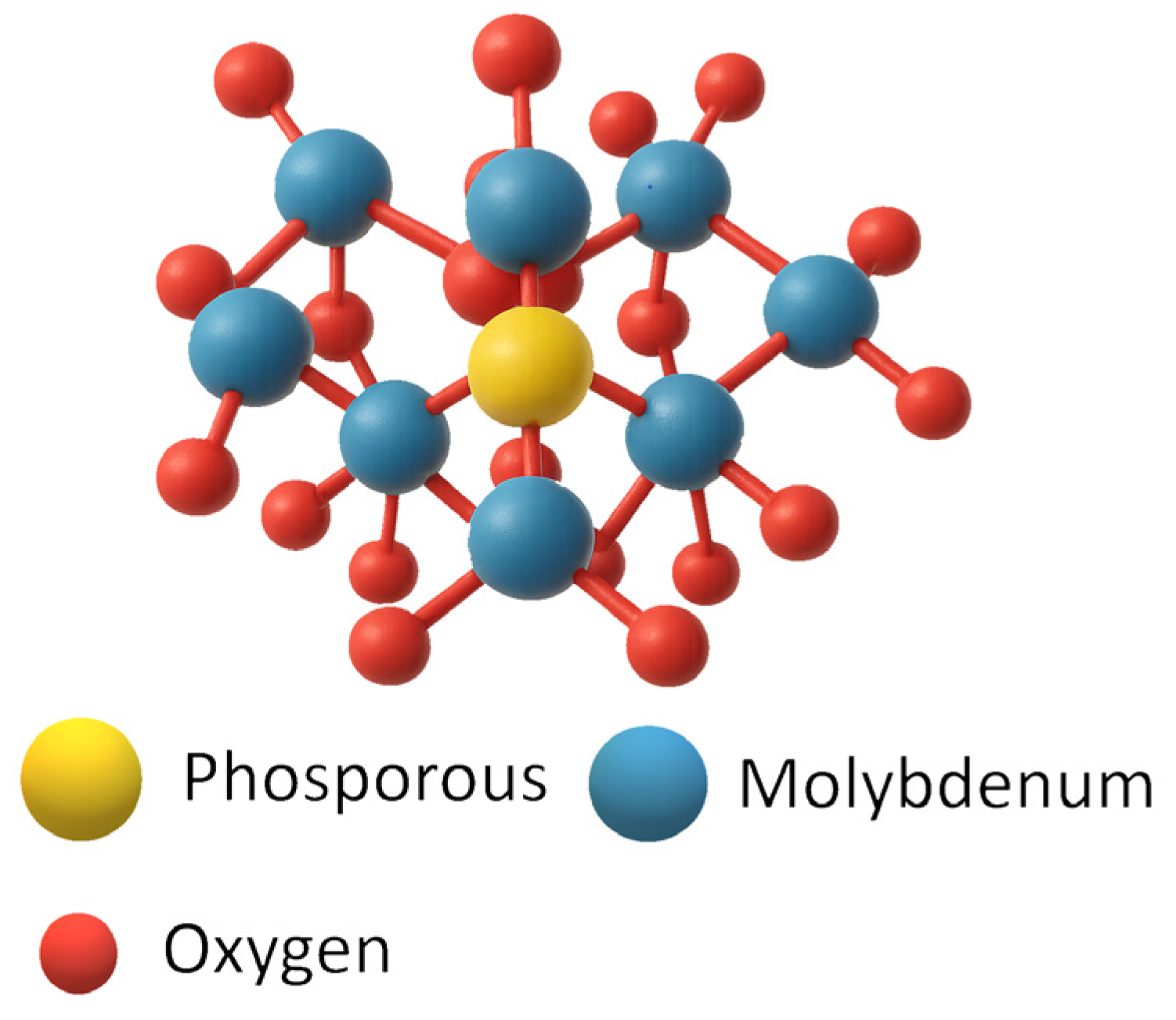
HPAs (Figure 13) have emerged as promising candidates for polymer fillers in PEM electrolyzers due to their unique properties and functionalities. These compounds exhibit high acidity and ionic conductivity, making them particularly attractive for enhancing the performance of PEMs used in fuel cells and electrolyzers. One of the primary advantages of incorporating HPAs into polymer matrices lies in their inherent high proton conductivity. HPAs can significantly improve the ionic conductivity of the polymer electrolyte membranes, particularly in dehydrated environments in which conventional PEMs, like Nafion, struggle with ion transport [181]. A study focused on the application of a nano-composite filler made from HPA and imidazole-modified mesoporous silica demonstrated notable stability and sustained conductivity in high temperatures and low humidity conditions, which are critical for the efficiency of PEM. This characteristic addresses a major limitation of conventional PEMs, which typically require humidification for optimal performance. HPAs also enhance the mechanical properties of PEMs. By modifying polymeric matrices with HPAs, researchers have observed improvements in the tensile strength and flexibility of the membranes, thereby increasing their durability under varied operational conditions [182,183]. This enhancement is crucial in applications where fluctuations in temperature and humidity can lead to mechanical stress and degradation over time.
Another vital aspect is the compatibility of HPAs with various polymer matrices. HPAs can be effectively incorporated into different types of polymers, such as sPEEK and PBI, leading to composite membranes that display improved properties. These composites not only retain the excellent proton conductivity offered by HPAs but also leverage the mechanical stability of the polymer backbone. Optimized HPA-doped membranes can operate efficiently even at elevated temperatures, broadening the applicability of PEM technologies in high-temperature fuel cell systems [184]. Furthermore, HPAs can serve dual functions by acting both as proton conductors and as catalytic sites within the membrane. This dual functionality has been highlighted in research demonstrating that HPAs can enhance reaction kinetics for the oxygen evolution and hydrogen evolution reactions, which are critical processes in electrolyzer performance [185]. Membranes that combine the proton conducting and catalytic properties of HPAs could lead to significant performance improvements and lower energy barriers in PEM electrolyzers. Despite these benefits, the solubility of HPAs in aqueous environments poses a challenge. High solubility may lead to leaching of the filler during operation, potentially diminishing the membranes performance and lifetime. Research efforts have been directed at stabilizing HPAs within the polymer matrix through various methods to mitigate this issue and enhance long-term stability [181,182].

3.3.4. Ionic Liquids

Ionic liquids (ILs) have gained significant attention as polymer fillers in PEM electrolyzers due to their unique properties, which can greatly enhance the performance of polymer electrolytes. Their non-volatile nature, high ionic conductivity, and thermal stability, combined with the advantageous characteristics of polymers, create opportunities for the development of high-performance electrolyte membranes. One of the most notable features of ionic liquids is their ability to maintain high ionic conductivity under various conditions. Due to their molecular design comprising organic cations and anions ionic liquids can exhibit superior ionic transport properties compared to traditional liquid or polymer electrolytes. Research has shown that the incorporation of ILs into polymer matrices significantly improves the overall ionic conductivity of the membrane, enhancing proton conduction and reducing energy losses during operation [186]. Moreover, ionic liquid electrochemical stability makes them suitable for use in PEM electrolyzers that operate at elevated temperatures. Protic ionic liquids have shown promise as nonaqueous proton-conducting electrolytes in high-temperature fuel cells, providing conductive and stable environments that traditional aqueous electrolytes cannot [187].
IL modified membranes for proton exchange membrane PEMWE are evolving as a promising solution to enhance the performance and operational range of these systems. Research indicates that incorporating ionic liquids into membranes can improve ionic conductivity while maintaining mechanical stability, which is crucial for optimal electrolyzer efficiency [188]. For instance, the introduction of methanesulfonic acid-based protic ionic liquids into polymer composite membranes creates high-temperature operation capabilities, thereby broadening the potential applications of PEMWE in various environments [189].
One significant study highlighted the use of triethylammonium triflate (TEA-TF) ionic liquid in Nafion membranes. The incorporation of TEA-TF was found to improve ionic conductivity and water uptake without adversely affecting the permeability of gases such as oxygen and hydrogen. As the content of TEA-TF increased, both the electrochemical and transport properties of the Nafion-TEA-TF membranes were enhanced, making them more suitable for effective incorporation into PEM electrolyzers [190]. Another approach discussed the use of ionic liquids in PBI membranes. Research indicated that the addition of certain ionic liquids could facilitate the formation of continuous proton transport channels. This enhancement in proton conduction is particularly beneficial in high-temperature applications, bolstering the performance of PEMs under challenging conditions. Similarly, studies on methanesulfonic-acid-based protic ionic liquids have shown that these ILs effectively elevate ionic conductivity, further improving the electrochemical capabilities of PBI-based PEMs [189]. In further studies, it was reported that IL incorporation into multilayered polyelectrolytes had minimal effects on swelling behaviors, maintaining the mechanical stability of the membranes while enhancing ionic conductivity, providing a robust structure for hydrogen production. The ability of ILs to improve ion transport properties while retaining the mechanical integrity of the membrane is crucial for the operational longevity and efficiency of PEM electrolyzers [191].

3.3.5. Recycling of PEMs

Along with research into new ways to increase the efficiency of electrolyzers and fuel cells, there are also studies focused on recycling membrane electrode systems, which currently operate mainly on the basis of platinum and iridium catalysts and Nafion. The reason for the introduction of recycling processes is the current social trend associated with the circular economy, as well as the fact that their limited lifespan and high costs prevent the large-scale commercialization of these technologies. Many studies have already been devoted to the development of processes for recycling precious metals from electrodes, but little research has been devoted to recycling perfluorinated membranes. However, this process could lead to a reduction in production costs and environmental impacts.
However, the research also highlights that the primary degradation mechanisms affecting polysulfur ionomers include oxidative stress and hydrolysis, especially under harsh operating conditions. Such degradation reduces the lifespan and efficiency of PEM systems and complicates recycling efforts. Since ionomers are crucial for the performance of PEMWEs, efforts are focused on developing recycling processes that would alleviate these problems. For example, advances in end-of-life regeneration processes are focused on extracting valuable components, including ionomers, from used membrane electrode assemblies [188]. This is essential for reducing the environmental impacts associated with disposal and material waste, highlighting the potential for a circular economy in PEM technology. Ionomers are essential for PEM technology, and their recyclability poses challenges that require innovative solutions [192,193].

4. Methods of PEM Preparation

The preparation of PEMs for water electrolysis involves various methodologies aimed at enhancing their performance attributes such as conductivity, mechanical stability, and overall efficiency. These techniques are crucial, as the membranes serve as the electrolyte, facilitating proton conduction while preventing gas crossover during the electrolytic process. Method are ordered based on their historical usage, starting from the oldest one- casting and ending with the most recent method, which is 3D printing.

4.1. Casting

The casting procedure involves several intricate steps, often coupled with the optimization of material properties to achieve high performance in electrolysis. The primary method of casting PEMs typically involves the solution-casting technique. In this process, polymer solutions are prepared and subsequently cast into thin films on a flat substrate (Figure 14). To successfully implement the casting method for the preparation of polymer membranes, several critical components and considerations must be addressed including the selection of materials, preparation of the casting solution, mold design, environmental conditions, and post-casting processes [194]. The polymer concentration in the casting solution significantly affects the membrane structure and properties; variations can lead to differences in porosity, mechanical strength, and permeability. High polymer concentrations may reduce the number of macro-voids but can lead to denser membranes, while lower concentrations can result in more porous structures with larger voids [195]. The preparation of the casting solution itself requires careful consideration of the solvent and any additives. The solvent must adequately dissolve the chosen polymer to create a uniform solution. Additionally, additives such as plasticizers or surfactants may be incorporated to enhance properties like membrane flexibility or promote porosity [196]. The viscosity of the solution is also a critical factor; a higher viscosity can affect the membrane formation process and the resulting morphological characteristics [197].
The choice of solvent and evaporative conditions is paramount, as they significantly influence the polymer crystallization and structural properties, ultimately affecting ionic conductivity and mechanical performance. One of the significant challenges in casting PEMs lies in ensuring the desired hydration level within the membrane. Research indicates that maintaining an optimal humidity during the casting process can significantly enhance the membrane ionic conductivity and mechanical strength [198]. The integration of various additives can help to enhance the electrochemical properties. These additives may include nanoscale materials that can augment proton transport pathways and minimize resistive losses in the membrane, thereby enhancing the overall efficiency of the electrolyzer [199].
One significant drawback of the casting method is the potential for non-uniform thickness in the membranes. This phenomenon, often referred to as the “coffee-ring effect,” occurs when the solution evaporates unevenly, leading to inconsistent polymer distribution across the membrane surface [200]. Such inconsistency can result in varied ionic conductivity and performance, which is particularly critical in applications like PEM electrolyzers, where uniformity in the physical and chemical properties is essential for efficient operation [201]. Another issue is the inherent limitations concerning the scalability and commercial applicability of the casting method. The casting process may not be easily adaptable to large-scale production, which is necessary for commercial PEM applications. Current membrane manufacturing processes often require high throughput and uniformity, and conventional casting methods might struggle to meet these demands consistently [200]. Moreover, the casting method is sensitive to environmental conditions. This includes variations in humidity and temperature, which can affect the drying rate and final morphology of the cast membrane. Such sensitivities also mean that any fluctuations can lead to defects, including cracks or voids, which would negatively impact the mechanical integrity and proton transport capabilities of the membrane [201].

4.2. Cross-Linking

Cross-linked membranes have garnered significant attention for their application in PEMs used in electrolyzers. Cross-linking enhances the mechanical integrity, dimensional stability, and thermal resistance of membranes while simultaneously allowing for tailored ionic conductivity essential for efficient electrochemical processes, such as water electrolysis. Cross-linking involves joining polymer chains via covalent bonds, creating a three-dimensional network that enhances the structural strength of the membranes (Figure 15). As described by Pasquini et al. [202], this structural change reduces dimensional swelling and improves hydrolytic stability, though it can lead to a decreased ion exchange capacity and reduced proton conductivity due to the consumption of sulfonic acid groups in the membrane [202]. Nonetheless, maintaining a balance between mechanical stability and conductivity is crucial for the efficient operation of PEM electrolyzers. Various materials have been employed to create cross-linked membranes, each offering unique advantages. For instance, the combination of polyvinyl alcohol (PVA) with chitosan leads to a highly effective cross-linked membrane. The work by Panawong et al. [203] highlights the reaction mechanisms involved, such as esterification with sulfosuccinic acid and subsequent ionic cross-linking, which imparts desired properties to the membrane while maintaining mechanical strength [203]. Additionally, hydrophilic cross-linking using aliphatic hydrocarbons has been explored. Julius et al. reported that while cross-linked PEMs improve dimensional stability and swelling resistance due to a more compact structure, they can also increase resistance to proton conduction. Hydrophilic cross-linking agents can mitigate the decrease in proton conductivity caused by increased hydrophobicity from covalent bonding, thereby retaining conductive domains [204].
One of the primary disadvantages of the cross-linking method is the compromise in polymer chain mobility. While cross-linking generally enhances mechanical strength, it simultaneously restricts the movement of polymer chains, which can hinder ionic conductivity. High cross-link density, which improves structural integrity, can lead to reduced segmental motion of the polymer chains, ultimately diminishing the membrane ability to conduct ions effectively [206]. This issue is particularly critical in applications like PEM electrolyzers, where high ionic conductivity is vital for efficient hydrogen production. Moreover, the cross-linking process can limit the swelling capacity of the membranes. Although limited swelling can be beneficial in preventing dimensional changes during operation, it can also obstruct the necessary volumetric expansion of the membrane when in contact with water or other electrolytes. Restricted swelling may lead to blockages in the pores, impeding gas transport and reducing overall electrochemical performance [57]. This trade-off can be detrimental, especially in applications where gas permeability is crucial. The cross-linking reaction often requires the use of excess cross-linking agents, which can remain as impurities in the final membrane (Figure 15). These residual materials may adversely affect membrane properties, including its electrochemical performance and compatibility with the electrolyzer environment. Controlling an amount of cross-linking agents used is critical, but managing this aspect poses additional challenges during membrane fabrication [207].

4.3. Electrospinning

Electrospun membranes are gaining prominence as novel alternatives for PEMs in electrolyzers, primarily due to their unique structural properties that enhance performance in water electrolysis applications. The electrospinning technique allows for the production of nanofibers with high surface area, excellent porosity, and tunable morphologies, critical for optimizing proton conductivity and mechanical stability (Figure 16). One of the primary advantages of electrospun membranes is their structural integrity, which results from the fibrous morphology generated through electrospinning. This architecture enhances proton conduction pathways compared to traditional film-form PEMs. Wakiya et al. [118] demonstrated continuous proton conductive pathways in nanofiber frameworks, indicating a superior performance due to the intrinsic morphology provided by electrospinning [118]. Their findings suggest that such structures facilitate more efficient ion transport through the membrane, crucial for high-performance applications in electrolyzers. Electrospun membranes can also be engineered to incorporate various ion-conducting materials, leading to composite structures that exhibit tailored properties. Odess et al. [208] emphasized the potential of electrospun membranes to exhibit anisotropic through-plane conductivity by utilizing buckling-induced mechanisms in nanofibers [208]. This innovation allows for mechanically robust membranes capable of withstanding operational stresses while enhancing proton conductivity. The versatility of the electrospinning process also permits the blending of multiple polymer types to create hybrid membranes. Samsudin and Hacker [209] reported on electrospun anion exchange membranes that showed a superior conductivity compared to membranes produced using conventional casting methods, underlining the enhanced ionic transport capabilities facilitated by the nanofibers [209]. Such enhancements are particularly important for optimizing the performance of PEMs under various electrolysis conditions. Another significant consideration regarding electrospun membranes is the influence of humidity and operating temperature on their performance metrics. Membranes fabricated through electrospinning, such as those explored by Huang et al., demonstrated stability and performance under varying operating conditions, including low humidity environments, which are essential for practical applications in PEM electrolyzers [210].
One major disadvantage of electrospinning is the typically low mechanical strength of the produced nanofibers. This lack of mechanical robustness can compromise membrane durability under prolonged operational stresses typically encountered in fuel cells or electrolyzers [212]. Another significant issue is related to the scaling up of the electrospinning process. While electrospinning is excellent for producing small batches of high-quality nanofibers, it faces challenges in reaching industrial-scale production levels. The process is relatively slow, and factors such as the need for continuous pumping and the dependence on specific environmental conditions conducive to fiber formation limit its efficiency in fabricating large quantities of membrane material [213]. These challenges hinder the economic viability of producing PEMs at the scale necessary for commercial applications. Electrospinning also requires electrically conductive polymer solutions to facilitate the electrostatic forces needed for fiber formation. This requirement means that non-conductive polymers cannot be utilized directly, limiting the choice of materials available for the creation of PEMs. Additionally, some polymers that would be ideal for PEM applications may require modification with conductive additives or pre-treatment, complicating the fabrication process and potentially increasing costs [214].

4.4. 3D-Printing

3D printing technologies have recently been integrated into the fabrication and development of PEM electrolyzers, presenting an innovative approach to enhancing the design and performance of these systems (Figure 17). The implementation of 3D-printed membranes in PEM electrolyzers allows for a significant reduction in production costs and provides greater design flexibility. This technology enables the rapid prototyping of complex geometries that can enhance mass transport and decrease resistive losses, which are typically compounded in conventional designs [215]. Additionally, the use of clear resins in 3D printing eliminates concerns regarding chemical reactions that may complicate traditional manufacturing methods, leading to designs that can optimize fluid flow and ion conduction while maintaining structural integrity. For instance, optimizing the interface between the membrane and porous transport layers can significantly mitigate Ohmic losses, a factor crucial to improving the overall electrolyzer efficiency [15,216]. Moreover, recent studies indicate that the high current densities achievable with PEM electrolyzers (up to 2 A/cm2) can be effectively harnessed using 3D printing technologies to create optimized flow channels and catalyst layers that maximize the available reaction surface area [217]. By reducing the thickness of the membrane while maintaining mechanical stability, 3D printing can contribute to the operational efficiency and dynamic response of PEM electrolyzers, making them suitable for fluctuating renewable energy supplies [149]. Researchers have noted that the adaptability of PEM electrolyzers to hybrid applications, such as integration with wind and solar energies, further accentuates their relevance in contemporary energy strategies aimed at sustainability [218,219].
One notable challenge is the mechanical strength and structural integrity of 3D-printed PEMs. While 3D printing allows for complex geometries and designs, the resulting structures may not possess adequate mechanical properties for practical applications in electrolysis [220]. Often, the layer-by-layer deposition process results in weaker interlayer adhesion compared to traditional manufacturing methods, making the membranes susceptible to delamination under operational stresses encountered in electrolysis environments. Even when specialized materials are used, ensuring homogeneity and optimal dispersion of ion-conducting additives within the printed matrix can be challenging. This inconsistency can lead to reduced ionic conductivity and electrochemical performance, which are pivotal characteristics for PEMs used in electrolyzers [221]. The 3D printing process can also introduce defects such as unintentional porosity and irregular surface finish, which can adversely affect the electrochemical performance of the membranes. Inconsistent layer thickness and surface textures can result from variations in printing parameters (e.g., nozzle diameter, print speed, or temperature), leading to uneven ionic pathways and undesirable flow characteristics [222].

4.5. Polymer Composites Preparation

A common approach for fabricating these composite membranes involves integrating conductive nanomaterials, such as CNTs, into polymer matrices. For instance, it has been noted that CNTs, when incorporated into polymer blends, can improve proton conductivity and mechanical durability of the resulting membranes [223]. The preparation process typically encompasses methods such as electrospinning or solution blending, which allow for uniform dispersion of CNTs within the polymer matrix [224]. The operational characteristics of PEM electrolysers, such as their capacity to rapidly adapt to power fluctuations, are contingent upon the quality of the composite membranes used. The incorporation of additive manufacturing techniques, such as fused filament fabrication, allows for efficient fabrication of these composite structures, providing precise control over geometries and distributions of the material components [225].

5. Challenges and Limitations of Sustainable PEMs

The challenges associated with sustainable membranes used in PEM electrolyzers are significant despite their promise for hydrogen production from renewable energy sources. These challenges are multifaceted, including issues related to material degradation, high costs, operational durability, gas crossover, and performance limitations under varying operational conditions, which all hinder the widespread adoption of this technology.

5.1. Performance Challenges

The performance challenges associated with sustainable membranes used in PEM electrolyzers are numerous and complex. These membranes are crucial components that directly impact the efficiency and longevity of the electrolyzer system. Understanding and addressing these challenges is vital for enhancing the overall viability and adoption of PEM electrolyzers in hydrogen production.
Proton conductivity is one of the main issues of sustainable membranes. High proton conductivity is essential for minimizing ohmic losses in the electrochemical process. However, low conductivity often arises due to poor hydration levels or varying temperatures and pressures during operation. Maintaining the optimal hydration level is critical—too high hydration can lead to membrane degradation, while insufficient hydration can diminish performance. This delicate balance underlines the need for engineering membranes that can sustain high conductivity without suffering from accelerated wear [33].
Hydrogen permeability is another critical performance factor affecting PEM electrolyzers. An ideal membrane should provide effective separation between hydrogen and oxygen gases to prevent cross-contamination and ensure high purity of hydrogen production. If gas crossover occurs, it can lead to significant losses in efficiency and safety concerns due to the risk of flammability [226]. The inherent chemical and mechanical conditions found in the electrolyzer can exacerbate this issue. Moreover, managing the integrity and mechanical strength of membranes under operational stresses is crucial, as membranes are often subjected to fluctuating pressures and thermal cycling, which can induce microstructural degradation [150].
Chemical stability is also a significant barrier to membrane performance. The acidic environment within PEM electrolyzers, often essential for optimal catalytic activity, can lead to membrane degradation over time. This degradation compromises not only the mechanical properties of the membrane but also its proton conductivity and gas permeability [227]. Methods to enhance the chemical durability of membranes while maintaining or improving their conductive properties are an active area of research. Noble metals such as platinum and iridium, used in the electrochemical reactions, require stable conditions to remain effective, which further complicates membrane and system design [132].
Further complicating the situation is the impact of cationic impurities on membrane performance. These impurities can significantly affect the conductivity and overall efficiency of the PEM electrolyzers, necessitating rigorous purification processes for feedwater used during the electrolysis [226,228]. Operating under suboptimal conditions, such as inappropriate pH or total dissolved solids levels, can exacerbate these performance issues, indicating that precise control of operational parameters is essential for maximizing membrane efficacy [132].

5.2. Scalability and Processability

The processability and scalability issues surrounding sustainable membranes in PEM electrolyzers are critical, as they directly affect the overall efficiency, performance, and commercial viability of this technology. These issues encompass challenges related to membrane fabrication, mechanical integrity, compatibility with components, and scale-up considerations.
A primary challenge in membrane processability arises from the fabrication methods. The synthesis of high-quality PEMs often involves complex processes that require strict control over parameters, such as temperature, humidity, and ionomer concentration. Variations in these parameters can lead to inconsistencies in membrane properties such as thickness, porosity, and conductivity, which ultimately affect performance. Achieving uniformity in membrane thickness is particularly vital, as non-uniform membranes can result in uneven current distribution during electrolysis, diminishing efficiency and lifespan [30].
Mechanical integrity during handling and operation presents another significant issue. PEMs are typically thin and sensitive to physical stresses, which can lead to tears, punctures, or delamination over time [227]. This fragility necessitates careful handling during installation and operation, complicating integration into larger systems. Furthermore, the mechanical performance of membranes under fluctuating operational conditions—such as variations in pressure, temperature, and humidity—can induce swelling or shrinkage, ultimately affecting their durability and performance [33]. The reliability of sealing materials and methods used alongside the membranes is crucial for maintaining structural integrity during operation [229].
Compatibility with other components in the electrolysis stack introduces additional processability challenges. The interaction between the membrane and the electrodes must be managed to avoid detrimental reactions or performance degradation. The catalysts applied to the membranes can influence their performance, as the presence of noble metals required for effective catalysis can lead to corrosion of the membrane [227]. Moreover, ensuring that porous transport layers and bipolar plates align well with the membranes is paramount to prevent significant losses or physical stresses; discrepancies in their coefficients of thermal expansion can lead to early failure if not properly accounted for [216].

5.3. Operating Conditions

The operating conditions for sustainable membranes in PEM electrolyzers can significantly impact their performance, durability, and long-term stability. A range of issues arise due to these conditions, including acidity levels, pressure fluctuations, and fouling, which can collectively impede the effectiveness of these membranes.
Acidic conditions are necessary for the optimal performance of PEM electrolyzers since they facilitate proton transport and catalysis. However, the corrosive nature of acids, particularly concentrated sulfuric acid, poses a significant challenge; it can cause chemical degradation of the membrane materials over time, reducing their lifespan and effectiveness. Maintaining membrane integrity under such harsh conditions necessitates the use of robust materials that can withstand these corrosive environments while ensuring efficient proton transport [230].
Operating under high pressure is a common requirement for PEM electrolyzers to enhance gas solubility and improve hydrogen production efficiency. However, elevated pressure can result in gas crossover, where hydrogen and oxygen gases pass through the membrane undesirably. This crossover can compromise the purity of the generated hydrogen and reduce overall system efficiency. Maintaining optimal pressure conditions is thus vital to preventing such issues, which may include mechanical stresses on the membrane that can lead to physical failures [231].
Fouling is a critical operational challenge for sustainable membranes in PEM electrolyzers. Organic matter, particulate matter, and biofilm formation can significantly reduce membrane performance by blocking active sites and inhibiting proton conduction [232]. Regular cleaning and maintenance are required to alleviate these fouling issues, which increases operational downtime and associated costs. Developing anti-fouling strategies is essential to enhance membrane performance while minimizing maintenance requirements [228,233].
The performance of sustainable PEMs is also highly dependent on maintaining appropriate hydration levels. Insufficient hydration can lead to increased membrane resistance and reduced proton conductivity, while excessive hydration can lead to swelling and mechanical degradation. Achieving a balance between hydration levels is crucial, as it directly impacts the efficiency and stability of the entire electrolyzer system [234].

5.4. Commercialization

One of the most important issues of sustainable PEMs is its commercialization. The commercialization of sustainable membranes for PEM electrolyzers faces several significant challenges. These issues center around operational stability, durability, and supply chain constraints, which collectively impact the feasibility of scaling these technologies for widespread industrial use.
Sustainable membranes often struggle with durability and stability over extended operational periods, particularly under dynamic conditions typical for renewable energy applications. Membrane degradation due to chemical, thermal, and mechanical stresses can lead to decreased performance and increased maintenance requirements. The membranes must operate efficiently in acidic environments and withstand harsh conditions encountered during hydrogen production. Ensuring long-term stability while maintaining high proton conductivity and gas separation efficiency remains a significant challenge for researchers and manufacturers [9].
While PEM electrolyzers provide several advantages, such as high current density and compact design, they must compete against other electrolyzer technologies, notably alkaline electrolyzers, which have been commercially established for longer and generally operate at lower costs. The maturity and lower initial capital investment of alkaline electrolyzer technologies can make it challenging for PEM systems to penetrate the market effectively [30]. The specific cost of bio-based membranes alone is difficult to quantify but is anticipated to be more favorable than that of current PEMs. For example, while Nafion-type membranes can cost over $200 per square meter, emerging bio-based alternatives could potentially lower costs to about $50 to $100 per square meter if manufactured at scale [235].
The commercialization of PEM electrolyzers will also be influenced by industry regulations and government policies promoting hydrogen technology and renewable energy initiatives. Clear incentives, subsidies, and regulations supporting clean hydrogen production are essential for fostering a conducive market environment for PEM technologies. Without strong policy support, achieving significant market penetration may remain a challenge [13].

6. Conclusions and Future Perspectives

The overarching goals associated with advancements in PEMWE technology include achieving significant cost reductions, improving overall system efficiency, and establishing a reliable infrastructure for hydrogen production conducive to widespread adoption. Critical targets include reducing the cost of hydrogen to levels below €1.80/kg by 2030, which requires substantial advancements in both technology and scale. Nowadays, the cost of hydrogen is around €5/kg, but the production of hydrogen is still improving. The percentage of hydrogen made with PEM electrolyzers is also rising—now, it takes over 4% of global hydrogen production, where the rest of the hydrogen production comes from nonrenewable resources such as natural gas, oil and coal.
The economic viability of sustainable PEMs is significantly enhanced by their potential for reduced production costs. For instance, cellulose-derived membranes have been shown to lead to lower costs owing to their abundant availability and the eco-friendly synthesis processes employed in their fabrication. As production methods become more scalable and the performance of these membranes is validated through rigorous testing, the transition from research to commercialization appears feasible. The cost of Nafion membrane is now at $200 per square meter but the cost of sustainable membranes could be at $50–100 per square meter. Furthermore, innovations in membrane engineering, such as the development of composite and hybrid membranes, are actively pursued to lower the prices even more.
Sustainable PEMs for electrolyzers present both promising advantages and notable challenges in the context of hydrogen production and energy conversion. These membranes are essential components in PEMWEs, which convert renewable electricity into hydrogen gas, contributing significantly to sustainable energy solutions. Among the various sustainable candidates, cellulose demonstrates the highest potential as a replacement for Nafion. This advantage arises primarily from its availability, favorable thermal stability 200 °C, and inherently low gas permeability 8–10 barrer, making it a particularly promising and sustainable alternative. Sodium alginate follows closely, offering comparable benefits, though with more limited proton conductivity 10–15 mS/cm for a little higher price. In contrast, chitosan and lignin currently present less favorable prospects due to their low proton conductivity (15–25 mS/cm for chitosan and only 5–15 mS/cm for lignin) and also low power density, which is only 50–100 mW/cm2 for lignin. Overall, these findings highlight cellulose as the most viable pathway toward the development of efficient, environmentally benign proton exchange membranes. Even though sustainable PEMs show great promise in enhancing the viability of hydrogen production technologies through improved performance metrics and reduced environmental impacts, significant barriers including cost, material stability, and scalability must be overcome.
Among the investigated materials, Nafion-based membranes exhibited the highest performance, with Nafion 117 achieving power densities up to 900 mW·cm−2. Their exceptional proton conductivity, reaching 120–130 mS·cm−1 for Nafion 212, and long-term stability of up to 2000 h confirm their status as benchmark materials for proton exchange applications. However, these advantages are increasingly overshadowed by serious environmental and economic concerns. The fluorinated nature of Nafion leads to high production costs and considerable carbon dioxide emissions—around 2.5 kg CO2 per m2 of membrane—raising questions about the sustainability of its large-scale use.
Sustainable, fluorine-free membranes have emerged as promising alternatives, offering up to fivefold lower CO2 emissions during production and significantly reduced hydrogen permeability (8–10 Barrer compared to over 100 Barrer for Nafion). Although their operational durability remains limited to approximately 50–300 h, continuous progress in material design, crosslinking strategies, and polymer chemistry is expected to narrow this performance gap in the near future.
An important factor influencing both proton conductivity and mechanical durability is the membrane thickness. Thinner membranes around 50 μm generally provide lower ohmic resistance, enhancing proton transport and overall power density. However, this reduction in thickness often leads to compromised mechanical integrity, increased gas crossover, and accelerated chemical degradation, particularly under high differential pressures typical of PEM electrolyzers. Conversely, thicker membranes up to 150 μm offer improved dimensional stability and extended operational lifetime but at the cost of increased internal resistance and reduced energy efficiency. Therefore, the optimal balance between thickness, mechanical strength, and conductivity remains a key challenge in the design of next-generation membranes.
Looking ahead, research efforts should focus on optimizing the balance between membrane performance and environmental footprint. Strategies such as bio-based polymer synthesis, hybrid organic–inorganic structures, and advanced nanocomposite formulations hold great potential for achieving both high conductivity and long-term durability while minimizing ecological impact. As sustainability becomes an increasingly critical design parameter, these next-generation membranes could ultimately provide a viable path toward greener and more efficient proton exchange technologies.

Author Contributions

Conceptualization, F.K. and D.P.; investigation, F.K.; writing—original draft preparation, F.K.; writing—review and editing, D.P., S.V. and B.V.d.B.; visualization, F.K.; supervision, D.P., B.V.d.B. and S.V.; project administration, D.P.; funding acquisition, D.P. All authors have read and agreed to the published version of the manuscript.

Funding

This research was funded by MSMT, OP JTF “REFESH” project, reg. no. CZ.10.03.01/00/22_0030/0000048, the NPO project reg. no. TN7023812D “Innovative solutions for sustainable energy” within the National Center for Energy II, reg. no. TN02000025 and MSMT, OP JAK project “Advanced Materials for Energy and Environmental technologies”, reg. No. CZ.02.01.01/00/23_021/0008592.

Data Availability Statement

Figure 9, Figure 15, and Figure 16. All data supporting the findings of this study, including figures reproduced from open-access sources, are available in the published literature cited in the article. These figures were reproduced under the terms of the Creative Commons Attribution (CC BY) license from the respective open-access publications. The original data used for Figure 9 are not deposited in an external repository. Instead, they are openly available as part of an open-access publication in Polymers (MDPI) at https://doi.org/10.3390/polym15153203. Figure 9 in this manuscript was reproduced from this source under the Creative Commons Attribution (CC BY 4.0) license. The original data used for Figure 15 are not stored in a separate external repository. They are openly available as part of an open-access publication in Polymers (MDPI) at https://doi.org/10.3390/polym17050615 under the Creative Commons Attribution (CC BY 4.0) license. The original data used for Figure 16 are not deposited in any external repository. They are openly available as part of an open-access publication in Polymers (MDPI) at https://doi.org/10.3390/polym17050615. Figure 16 in this manuscript was reproduced from this source under the Creative Commons Attribution (CC BY 4.0) license.

Acknowledgments

During the preparation of this manuscript/study, the author(s) used [scite.ai] for the purposes of [data collection, grammar check]. No content was directly generated by AI. The authors have reviewed and edited the output and take full responsibility for the content of this publication.

Conflicts of Interest

The authors declare no conflicts of interest.

Abbreviations

CBNCarbon-based nanomaterial
CNTCarbon nanotube
GDLGas diffusion layer
HERHydrogen evolution reaction
HPAHeteropolyacid
IECIon exchange capacity
ILIonic liquid
LCALife-cycle assessments
OEROxygen evolution reaction
PBIPolybenzimidazole
PEEKPolyether ether ketone
PEMProton exchange membrane
PEMFCProton exchange membrane fuel cell
PEMWEProton exchange membrane water electrolysis
PTFEPolytetraflurethylene
PTLPorous transport layer
PVAPolyvinylacohol
PVDFPolyvinyl difluoride
sPAESSulfonated poly(arylene ethersulfone)
TEA-TFTriethylammonium triflate

References

  1. Noyan, O.F.; Hasan, M.M.; Pala, N. A Global Review of the Hydrogen Energy Eco-System. Energies 2023, 16, 1484. [Google Scholar] [CrossRef]
  2. Cheekatamarla, P. Hydrogen and the Global Energy Transition—Path to Sustainability and Adoption across All Economic Sectors. Energies 2024, 17, 807. [Google Scholar] [CrossRef]
  3. Yan, X.; Zheng, W.; Wei, Y.; Yan, Z. Current Status and Economic Analysis of Green Hydrogen Energy Industry Chain. Processes 2024, 12, 315. [Google Scholar] [CrossRef]
  4. Smith, K.; Foglia, F.; Clancy, A.J.; Brett, D.J.L.; Miller, T.S. Nafion Matrix and Ionic Domain Tuning for High-Performance Composite Proton Exchange Membranes. Adv. Funct. Mater. 2023, 33, 2304061. [Google Scholar] [CrossRef]
  5. Nechitailov, A.A.; Volovitch, P.; Glebova, N.V.; Krasnova, A. Features of the Degradation of the Proton-Conducting Polymer Nafion in Highly Porous Electrodes of PEM Fuel Cells. Membranes 2023, 13, 342. [Google Scholar] [CrossRef]
  6. Segale, M.; Seadira, T.; Sigwadi, R.; Mokrani, T.; Summers, G. A New Frontier towards the Development of Efficient SPEEK Polymer Membranes for PEM Fuel Cell Applications: A Review. Mater. Adv. 2024, 5, 7979–8006. [Google Scholar] [CrossRef]
  7. Phan-Huynh, T.N.; Pham, H.T.; Nguyen, P.T.; Tap, T.D.; Nguyen, T.H.; Phung, Q.; Tran, T.T.V.; Chang, Y.-J.; Lai, Y.-T.; Hoang, D. Cellulose-Based Proton Exchange Membrane Derived from an Agricultural Byproduct. ACS Appl. Polym. Mater. 2025, 7, 2347–2358. [Google Scholar] [CrossRef]
  8. Talarico, D.; Fontananova, E.; Sibilllano, T.; Ciriminna, R.; Palermo, S.; Galiano, F.; Profio, G.D.; Figoli, A.; Petri, G.L.; Angellotti, G.; et al. CytroCell@Nafion: Enhanced Proton Exchange Membranes. ChemRxiv 2025. [Google Scholar] [CrossRef]
  9. Ahmed, K.W.; Jang, M.J.; Park, M.G.; Chen, Z.; Fowler, M. Effect of Components and Operating Conditions on the Performance of PEM Electrolyzers: A Review. Electrochem 2022, 3, 581–612. [Google Scholar] [CrossRef]
  10. Yodwong, B.; Guilbert, D.; Phattanasak, M.; Kaewmanee, W.; Hinaje, M.; Vitale, G. Proton Exchange Membrane Electrolyzer Modeling for Power Electronics Control: A Short Review. C 2020, 6, 29. [Google Scholar] [CrossRef]
  11. Ayers, K.E.; Anderson, E.B.; Capuano, C.; Carter, B.; Dalton, L.; Hanlon, G.; Manco, J.; Niedzwiecki, M. Research Advances towards Low Cost, High Efficiency PEM Electrolysis. ECS Trans. 2010, 33, 3. [Google Scholar] [CrossRef]
  12. Falcão, D.S.; Pinto, A.M.F.R. A Review on PEM Electrolyzer Modelling: Guidelines for Beginners. J. Clean. Prod. 2020, 261, 121184. [Google Scholar] [CrossRef]
  13. Wang, T.; Cao, X.; Jiao, L. PEM Water Electrolysis for Hydrogen Production: Fundamentals, Advances, and Prospects. Carbon Neutrality 2022, 1, 21. [Google Scholar] [CrossRef]
  14. Avcı, A.E.; Çögenli, M.S.; Çelik, S.; Özcan, H. Experimental Investigation of Bio-Inspired Flow Field Design for AEM and PEM Water Electrolyzer Cells. Int. J. Energy Stud. 2023, 8, 809–829. [Google Scholar] [CrossRef]
  15. Noor Azam, A.M.I.; Li, N.K.; Zulkefli, N.N.; Masdar, M.S.; Majlan, E.H.; Baharuddin, N.A.; Mohd Zainoodin, A.; Mohamad Yunus, R.; Shamsul, N.S.; Husaini, T.; et al. Parametric Study and Electrocatalyst of Polymer Electrolyte Membrane (PEM) Electrolysis Performance. Polymers 2023, 15, 560. [Google Scholar] [CrossRef] [PubMed]
  16. Krause, K.; Garcia, M.; Michau, D.; Clisson, G.; Billinghurst, B.; Battaglia, J.-L.; Chevalier, S. Probing Membrane Hydration in Microfluidic Polymer Electrolyte Membrane Electrolyzers via Operando Synchrotron Fourier-Transform Infrared Spectroscopy. Lab Chip 2023, 23, 4002–4009. [Google Scholar] [CrossRef] [PubMed]
  17. Chen, Y.; Liu, C.; Xu, J.; Xia, C.; Wang, P.; Xia, B.Y.; Yan, Y.; Wang, X. Key Components and Design Strategy for a Proton Exchange Membrane Water Electrolyzer. Small Struct. 2023, 4, 2200130. [Google Scholar] [CrossRef]
  18. Stiber, S.; Sata, N.; Morawietz, T.; Ansar, S.A.; Jahnke, T.; Lee, J.K.; Bazylak, A.; Fallisch, A.; Gago, A.S.; Friedrich, K.A. A High-Performance, Durable and Low-Cost Proton Exchange Membrane Electrolyser with Stainless Steel Components. Energy Environ. Sci. 2022, 15, 109–122. [Google Scholar] [CrossRef]
  19. Wu, R.; Liu, H.; Xu, J.; Qu, M.-R.; Qin, Y.-Y.; Zheng, X.-S.; Zhu, J.-F.; Li, H.; Su, X.-Z.; Yu, S.-H. Surface Reconstruction Activates Non-Noble Metal Cathode for Proton Exchange Membrane Water Electrolyzer. Adv. Energy Mater. 2025, 15, 2405846. [Google Scholar] [CrossRef]
  20. Aubras, F.; Damour, C.; Benne, M.; Boulevard, S.; Bessafi, M.; Grondin-Perez, B.; Kadjo, A.J.-J.; Deseure, J. A Non-Intrusive Signal-Based Fault Diagnosis Method for Proton Exchange Membrane Water Electrolyzer Using Empirical Mode Decomposition. Energies 2021, 14, 4458. [Google Scholar] [CrossRef]
  21. Freiberg, A.T.S.; Thiele, S. Closing the Hydrogen and Oxygen Mass Balance for PEM Water Electrolysis. J. Electrochem. Soc. 2025, 172, 034506. [Google Scholar] [CrossRef]
  22. Wang, W.; Tai, G.; Li, Y.; Sun, J. Highly Elastic, Healable, and Durable Anhydrous High-Temperature Proton Exchange Membranes Cross-Linked with Highly Dense Hydrogen Bonds. Macromol. Rapid Commun. 2023, 44, 2300007. [Google Scholar] [CrossRef] [PubMed]
  23. Wani, A.A.; Shaari, N.; Kamarudin, S.K.; Raduwan, N.F.; Yusoff, Y.N.; Khan, A.M.; Yousuf, S.; Ansari, M.N.M. Critical Review on Composite-Based Polymer Electrolyte Membranes toward Fuel Cell Applications: Progress and Perspectives. Energy Fuels 2024, 38, 18169–18193. [Google Scholar] [CrossRef]
  24. Vijitha, R.; Nagaraja, K.; Hanafiah, M.M.; Rao, K.M.; Venkateswarlu, K.; Lakkaboyana, S.K.; Rao, K.S.V.K. Fabrication of Eco-Friendly Polyelectrolyte Membranes Based on Sulfonate Grafted Sodium Alginate for Drug Delivery, Toxic Metal Ion Removal and Fuel Cell Applications. Polymers 2021, 13, 3293. [Google Scholar] [CrossRef]
  25. Wang, S.; Lv, H.; Sun, Y.; Ji, W.; Shen, X.; Zhang, C. Constructing Supports–Network with N–TiO2 Nanofibres for Highly Efficient Hydrogen–Production of PEM Electrolyzer. World Electr. Veh. J. 2021, 12, 124. [Google Scholar] [CrossRef]
  26. Popov, I.; Zhu, Z.; Young-Gonzales, A.R.; Sacci, R.L.; Mamontov, E.; Gainaru, C.; Paddison, S.J.; Sokolov, A.P. Search for a Grotthuss Mechanism through the Observation of Proton Transfer. Commun. Chem. 2023, 6, 77. [Google Scholar] [CrossRef]
  27. Huang, X.; Zhao, S.; Liu, H.; Wang, R.; Tang, H. Hydrophilic Channel Volume Behavior on Proton Transport Performance of Proton Exchange Membrane in Fuel Cells. ACS Appl. Polym. Mater. 2022, 4, 2423–2431. [Google Scholar] [CrossRef]
  28. Justin Jose Sheela, A.S.; Moorthy, S.; Maria Mahimai, B.; Sekar, K.; Kannaiyan, D.; Deivanayagam, P. Sulfonated Poly Ether Sulfone Membrane Reinforced with Bismuth-Based Organic and Inorganic Additives for Fuel Cells. ACS Omega 2023, 8, 27510–27518. [Google Scholar] [CrossRef]
  29. Shamsabadi, A.; Tohidian, M.; Hemmasi, E.; Makki, H. Proton Exchange Membranes Based on Sulfonated Polybutylene Fumarate: Preparation and Characterization. J. Polym. Sci. 2024, 62, 3320–3333. [Google Scholar] [CrossRef]
  30. Choi, B.B.; Jo, J.H.; Lee, T.; Jeon, S.-Y.; Kim, J.; Yoo, Y.-S. Operational Characteristics of High-Performance kW Class Alkaline Electrolyzer Stack for Green Hydrogen Production. J. Electrochem. Sci. Technol 2021, 12, 302–307. [Google Scholar] [CrossRef]
  31. Fornaciari, J.C.; Gerhardt, M.R.; Zhou, J.; Regmi, Y.N.; Danilovic, N.; Bell, A.T.; Weber, A.Z. The Role of Water in Vapor-Fed Proton-Exchange-Membrane Electrolysis. J. Electrochem. Soc. 2020, 167, 104508. [Google Scholar] [CrossRef]
  32. Lee, J.K.; Bazylak, A. Optimizing Porous Transport Layer Design Parameters via Stochastic Pore Network Modelling: Reactant Transport and Interfacial Contact Considerations. J. Electrochem. Soc. 2020, 167, 013541. [Google Scholar] [CrossRef]
  33. Almutairi, Z. Impact of Water Properties on the Performance of PEM Electrolyzer. Preprints 2023. [CrossRef]
  34. Fakourian, S.; Alizadeh, M. Hydrogen Generation from the Wastewater of Power Plants via an Integrated Photovoltaic and Electrolyzer System: A Pilot-Scale Study. Energy Fuels 2023, 37, 6099–6109. [Google Scholar] [CrossRef]
  35. Jiang, G.; Yu, H.; Li, Y.; Yao, D.; Chi, J.; Sun, S.; Shao, Z. Low-Loading and Highly Stable Membrane Electrode Based on an Ir@WOxNR Ordered Array for PEM Water Electrolysis. ACS Appl. Mater. Interfaces 2021, 13, 15073–15082. [Google Scholar] [CrossRef] [PubMed]
  36. Feng, C.; Dong, Y.; Zhong, S.; Chen, D.; Zeng, G.; He, W. Optimizing the Molecular Weight of Poly(Vinylidene Fluoride) for Competitive Perfluorosulfonic Acid Membranes. Phys. Status Solidi (RRL) Rapid Res. Lett. 2022, 16, 2100468. [Google Scholar] [CrossRef]
  37. Sengupta, S.; Pant, R.; Venkatnathan, A.; Lyulin, A.V. Molecular-Dynamics Modeling of Nafion Membranes. Macromol. Symp. 2022, 405, 2100212. [Google Scholar] [CrossRef]
  38. Goo, B.-H.; Al Munsur, A.Z.; Choi, O.; Kim, Y.; Kwon, O.J.; Kim, T.-H. Sulfonated Poly(Ether Sulfone)-Coated and -Blended Nafion Membranes with Enhanced Conductivity and Reduced Hydrogen Permeability. ACS Appl. Energy Mater. 2020, 3, 11418–11433. [Google Scholar] [CrossRef]
  39. Mayadevi, T.S.; Goo, B.-H.; Paek, S.Y.; Choi, O.; Kim, Y.; Kwon, O.J.; Lee, S.Y.; Kim, H.-J.; Kim, T.-H. Nafion Composite Membranes Impregnated with Polydopamine and Poly(Sulfonated Dopamine) for High-Performance Proton Exchange Membranes. ACS Omega 2022, 7, 12956–12970. [Google Scholar] [CrossRef]
  40. Sharma, P.P.; Tinh, V.D.C.; Kim, D. Improved Oxidative Stability by Embedded Cerium into Graphene Oxide Nanosheets for Proton Exchange Membrane Fuel Cell Application. Membranes 2021, 11, 238. [Google Scholar] [CrossRef]
  41. Yacub, N.S.; Rauf, L.N.; Suryanto, S.; Bhuana, C. Pengaruh Temperatur Air Terhadap Produksi Hidrogen (H2) Metode Proton Exchange Membrane (PEM) Electrolyzer. J. Tek. Mesin Sinergi 2025, 23, 54–61. [Google Scholar] [CrossRef]
  42. Esposito, D.V.; Cohen, L.; Jin, J.; Dondapati, J.; Lin, Z.; Weimer, M.S.; Harris, S.; Dameron, A.A.; Junker, S.; Hawkes, J.; et al. Nanoscale Proton-Conducting Oxide Membranes for Low Temperature Water Electrolysis. Meet. Abstr. 2024, MA2024-02, 3358. [Google Scholar] [CrossRef]
  43. Frensch, S.H.; Fouda-Onana, F.; Serre, G.; Thoby, D.; Araya, S.S.; Kær, S.K. Influence of the Operation Mode on PEM Water Electrolysis Degradation. Int. J. Hydrogen Energy 2019, 44, 29889–29898. [Google Scholar] [CrossRef]
  44. Lufrano, E.; Simari, C.; Di Vona, M.L.; Nicotera, I.; Narducci, R. How the Morphology of Nafion-Based Membranes Affects Proton Transport. Polymers 2021, 13, 359. [Google Scholar] [CrossRef]
  45. Monopoli, A.; Casiello, M.; Cotugno, P.; Milella, A.; Palumbo, F.; Fracassi, F.; Nacci, A. Synthesis of Tailored Perfluoro Unsaturated Monomers for Potential Applications in Proton Exchange Membrane Preparation. Molecules 2021, 26, 5592. [Google Scholar] [CrossRef]
  46. Gao, X.; Yamamoto, K.; Hirai, T.; Uchiyama, T.; Ohta, N.; Takao, N.; Matsumoto, M.; Imai, H.; Sugawara, S.; Shinohara, K.; et al. Morphology Changes in Perfluorosulfonated Ionomer from Thickness and Thermal Treatment Conditions. Langmuir 2020, 36, 3871–3878. [Google Scholar] [CrossRef]
  47. Zavorotnaya, U.M.; Privalov, A.F.; Kresse, B.; Vogel, M.; Ponomarev, I.I.; Volkova, Y.A.; Sinitsyn, V.V. Diffusion in Sulfonated Co-Polynaphthoyleneimide Proton Exchange Membranes with Different Ratios of Hydrophylic to Hydrophobic Groups Studied Using SFG NMR. Macromolecules 2022, 55, 8823–8833. [Google Scholar] [CrossRef]
  48. Min, K.; Al Munsur, A.Z.; Paek, S.Y.; Jeon, S.; Lee, S.Y.; Kim, T.-H. Development of High-Performance Polymer Electrolyte Membranes through the Application of Quantum Dot Coatings to Nafion Membranes. ACS Appl. Mater. Interfaces 2023, 15, 15616–15624. [Google Scholar] [CrossRef]
  49. Krasnova, A.O.; Glebova, N.V.; Kastsova, A.G.; Rabchinskii, M.K.; Nechitailov, A.A. Thermal Stabilization of Nafion with Nanocarbon Materials. Polymers 2023, 15, 2070. [Google Scholar] [CrossRef]
  50. Nakashima, K.; Yoshida, M.; Kondo, Y. Performance Characteristics of a Free-Breathing Polymer Electrolyte Fuel Cell with Various Channel Shapes. Meet. Abstr. 2024, MA2024-02, 3234. [Google Scholar] [CrossRef]
  51. Jheng, L.-C.; Cheng, C.-W.; Ho, K.-S.; Hsu, S.L.-C.; Hsu, C.-Y.; Lin, B.-Y.; Ho, T.-H. Dimethylimidazolium-Functionalized Polybenzimidazole and Its Organic–Inorganic Hybrid Membranes for Anion Exchange Membrane Fuel Cells. Polymers 2021, 13, 2864. [Google Scholar] [CrossRef] [PubMed]
  52. Gagliardi, G.G.; Ibrahim, A.; Borello, D.; El-Kharouf, A. Composite Polymers Development and Application for Polymer Electrolyte Membrane Technologies—A Review. Molecules 2020, 25, 1712. [Google Scholar] [CrossRef] [PubMed]
  53. Wei, P.; Sui, Y.; Meng, X.; Zhou, Q. The Advances Development of Proton Exchange Membrane with High Proton Conductivity and Balanced Stability in Fuel Cells. J. Appl. Polym. Sci. 2023, 140, e53919. [Google Scholar] [CrossRef]
  54. Safronova, E.Y.; Voropaeva, D.Y.; Lysova, A.A.; Korchagin, O.V.; Bogdanovskaya, V.A.; Yaroslavtsev, A.B. On the Properties of Nafion Membranes Recast from Dispersion in N-Methyl-2-Pyrrolidone. Polymers 2022, 14, 5275. [Google Scholar] [CrossRef]
  55. Kang, Y.S.; Jang, S.; Choi, E.; Jo, S.; Kim, S.M.; Yoo, S.J. Sandwich-like Nafion Composite Membrane with Ultrathin Ceria Barriers for Durable Fuel Cells. Int. J. Energy Res. 2021, 46, 6457–6470. [Google Scholar] [CrossRef]
  56. Li, G.; Kujawski, W.; Rynkowska, E. Advancements in Proton Exchange Membranes for High-Performance High-Temperature Proton Exchange Membrane Fuel Cells (HT-PEMFC). Rev. Chem. Eng. 2022, 38, 327–346. [Google Scholar] [CrossRef]
  57. Al Munsur, A.Z.; Goo, B.-H.; Kim, Y.; Kwon, O.J.; Paek, S.Y.; Lee, S.Y.; Kim, H.-J.; Kim, T.-H. Nafion-Based Proton-Exchange Membranes Built on Cross-Linked Semi-Interpenetrating Polymer Networks between Poly(Acrylic Acid) and Poly(Vinyl Alcohol). ACS Appl. Mater. Interfaces 2021, 13, 28188–28200. [Google Scholar] [CrossRef]
  58. Lander, S.; Vagin, M.; Gueskine, V.; Erlandsson, J.; Boissard, Y.; Korhonen, L.; Berggren, M.; Wågberg, L.; Crispin, X. Sulfonated Cellulose Membranes Improve the Stability of Aqueous Organic Redox Flow Batteries. Adv. Energy Sustain. Res. 2022, 3, 2200016. [Google Scholar] [CrossRef]
  59. Kim, J.-D. High-Temperature Water Electrolysis Properties of Membrane Electrode Assemblies with Nafion and Crosslinked Sulfonated Polyphenylsulfone Membranes by Using a Decal Method. Membranes 2024, 14, 173. [Google Scholar] [CrossRef]
  60. Guo, X.; Zhang, H.; Shen, Z.; Liu, X.; Xia, W.; Ma, M.; Cao, D. Construction and Prospect of Noble Metal-Based Catalysts for Proton Exchange Membrane Water Electrolyzers. Small Struct. 2023, 4, 2300081. [Google Scholar] [CrossRef]
  61. Duan, Y.; Pang, Y.; Liu, B.; Wu, L.; Hu, X.; Li, Q.; Zhao, C. Synergistic Utilization of a CeO2-Anchored Bifunctionalized Metal–Organic Framework in a Polymer Nanocomposite toward Achieving High Power Density and Durability of PEMFC. ACS Sustain. Chem. Eng. 2023, 11, 5270–5283. [Google Scholar] [CrossRef]
  62. Rocha, A.G.; Ferreira, R.; Falcão, D.; Pinto, A.M.F.R. Experimental Study on the Catalyst-Coated Membrane of a Proton Exchange Membrane Electrolyzer. Energies 2022, 15, 7937. [Google Scholar] [CrossRef]
  63. Fernihough, O.; Ismail, M.S.; El-kharouf, A. Intermediate Temperature PEFC’s with Nafion® 211 Membrane Electrolytes: An Experimental and Numerical Study. Membranes 2022, 12, 430. [Google Scholar] [CrossRef] [PubMed]
  64. Zou, Y.; Yang, M.; Liu, G.; Xu, C. Sulfonated Poly (Fluorenyl Ether Ketone Nitrile) Membranes Used for High Temperature PEM Fuel Cell. Heliyon 2020, 6, e04855. [Google Scholar] [CrossRef]
  65. Scheepers, F.; Stähler, A.; Stähler, M.; Müller, M.; Lehnert, W.; Carmo, M. High-Pressure Polymer Electrolyte Membrane Water Electrolyzers: Is It Worth It? Meet. Abstr. 2020, MA2020-01, 518. [Google Scholar] [CrossRef]
  66. Liu, B.; Hu, B.; Du, J.; Cheng, D.; Zang, H.-Y.; Ge, X.; Tan, H.; Wang, Y.; Duan, X.; Jin, Z.; et al. Precise Molecular-Level Modification of Nafion with Bismuth Oxide Clusters for High-Performance Proton-Exchange Membranes. Angew. Chem. 2021, 133, 6141–6150. [Google Scholar] [CrossRef]
  67. Bernt, M.; Schröter, J.; Möckl, M.; Gasteiger, H.A. Analysis of Gas Permeation Phenomena in a PEM Water Electrolyzer Operated at High Pressure and High Current Density. J. Electrochem. Soc. 2020, 167, 124502. [Google Scholar] [CrossRef]
  68. Martin, A.; Trinke, P.; Bensmann, B.; Hanke-Rauschenbach, R. Hydrogen Crossover in PEM Water Electrolysis at Current Densities up to 10 A cm−2. J. Electrochem. Soc. 2022, 169, 094507. [Google Scholar] [CrossRef]
  69. Zhang, X.; Trieu, D.; Zheng, D.; Ji, W.; Qu, H.; Ding, T.; Qiu, D.; Qu, D. Nafion/PTFE Composite Membranes for a High Temperature PEM Fuel Cell Application. Ind. Eng. Chem. Res. 2021, 60, 11086–11094. [Google Scholar] [CrossRef]
  70. Mehanathan, S.; Mohamed, H.; Jaafar, J.; Ilbeygi, H. Composite Proton Electrolyte Membranes C Poly Ether-Ether Ketone (SPEEK) at Various Amount of Mesoporous Phosphotungstic Acid (mPTA) for Hydrogen Fuel Cell Application. J. Appl. Membr. Sci. Technol. 2020, 24, 13–29. [Google Scholar] [CrossRef]
  71. Seo, D.C.; Jeon, I.; Jeong, E.S.; Jho, J.Y. Mechanical Properties and Chemical Durability of Nafion/Sulfonated Graphene Oxide/Cerium Oxide Composite Membranes for Fuel-Cell Applications. Polymers 2020, 12, 1375. [Google Scholar] [CrossRef]
  72. Bajaj, A.; Liu, F.; Kulik, H.J. Uncovering Alternate Pathways to Nafion Membrane Degradation in Fuel Cells with First-Principles Modeling. J. Phys. Chem. C 2020, 124, 15094–15106. [Google Scholar] [CrossRef]
  73. Miyake, J. Cellulose Proton Conductor: Both Sulfonic Acid and Hydrophobic Group Functionalization Enable High Proton Conductivity. JACS Au 2025, 5, 4165–4169. [Google Scholar] [CrossRef]
  74. Li, Z.; He, H.; Zhai, L.; Guo, H.; Li, X.; Li, T.; He, S.; Chai, S.; Usenko, A.; Li, H. Nafion Hybrid Membranes with Enhanced Ion Selectivity via Supramolecular Complexation for Vanadium Redox Flow Batteries. ACS Appl. Polym. Mater. 2025, 7, 2152–2159. [Google Scholar] [CrossRef]
  75. Ohira, A.; Sakata, W.; Ishida, E.; Mitsuru, T.; Sato, Y. Application of High-Performance Hydrocarbon-Type Sulfonated Polyethersulfone for Vanadium Redox-Flow Battery. Int. J. Energy Res. 2021, 45, 19405–19412. [Google Scholar] [CrossRef]
  76. Choi, J.S.; Tsui, J.H.; Xu, F.; Lee, S.H.; Sung, S.-K.; Lee, H.J.; Wang, C.; Kim, H.J.; Kim, D.-H. Fabrication of Micro- and Nanopatterned Nafion Thin Films with Tunable Mechanical and Electrical Properties Using Thermal Evaporation-Induced Capillary Force Lithography. Adv. Mater. Interfaces 2021, 8, 2002005. [Google Scholar] [CrossRef]
  77. Yoshimura, K.; Chen, J.; Sawada, S.; Radulescu, A.; Zhao, Y.; Maekawa, Y. Structural Factors for the Chemical Stability of Graft-Type Polymer Electrolyte Membranes Evaluated from the Local Hydration Number. ACS Appl. Polym. Mater. 2024, 6, 13585–13593. [Google Scholar] [CrossRef]
  78. Mustapha, F.; Guilbert, D.; El-Ganaoui, M. Investigation of Electrical and Thermal Performance of a Commercial PEM Elec-trolyzer under Dynamic Solicitations. Clean Technol. 2022, 4, 931–941. [Google Scholar] [CrossRef]
  79. Ouimet, R.J.; Young, J.L.; Schuler, T.; Bender, G.; Roberts, G.M.; Ayers, K.E. Measurement of Resistance, Porosity, and Water Contact Angle of Porous Transport Layers for Low-Temperature Electrolysis Technologies. Front. Energy Res. 2022, 10, 911077. [Google Scholar] [CrossRef]
  80. Yuan, T.; Li, H.; Wang, J.; Jia, D. Research on the Influence of Ripple Voltage on the Performance of a Proton Exchange Membrane Electrolyzer. Energies 2023, 16, 6912. [Google Scholar] [CrossRef]
  81. El Jery, A.; Salman, H.M.; Al-Khafaji, R.M.; Nassar, M.F.; Sillanpää, M. Thermodynamics Investigation and Artificial Neural Network Prediction of Energy, Exergy, and Hydrogen Production from a Solar Thermochemical Plant Using a Polymer Membrane Electrolyzer. Molecules 2023, 28, 2649. [Google Scholar] [CrossRef] [PubMed]
  82. Maier, M.; Smith, K.; Dodwell, J.; Hinds, G.; Shearing, P.R.; Brett, D.J.L. Mass Transport in PEM Water Electrolysers: A Review. Int. J. Hydrogen Energy 2022, 47, 30–56. [Google Scholar] [CrossRef]
  83. Liu, L.; Ma, H.; Khan, M.; Hsiao, B.S. Recent Advances and Challenges in Anion Exchange Membranes Development/Application for Water Electrolysis: A Review. Membranes 2024, 14, 85. [Google Scholar] [CrossRef] [PubMed]
  84. Babatunde, O.M.; Akintayo, B.D.; Emezirinwune, M.U.; Olanrewaju, O.A. Environmental Impact Assessment of a 1 kW Proton-Exchange Membrane Fuel Cell: A Mid-Point and End-Point Analysis. Hydrogen 2024, 5, 352–373. [Google Scholar] [CrossRef]
  85. Avci, A.H.; Messana, D.A.; Santoro, S.; Tufa, R.A.; Curcio, E.; Di Profio, G.; Fontananova, E. Energy Harvesting from Brines by Reverse Electrodialysis Using Nafion Membranes. Membranes 2020, 10, 168. [Google Scholar] [CrossRef]
  86. Likit-anurak, K.; Teel, H.; Shimpalee, S.; Meekins, B. Experimentally-Validated CFD Model of an Anhydrous HCl Electrolyzer. Meet. Abstr. 2024, MA2024-02, 3202. [Google Scholar] [CrossRef]
  87. Likit-anurak, K.; Karki, I.; Howard, B.I.; Murdock, L.; Mukhin, N.; Brannon, J.; Hepstall, A.; Young, B.; Shimpalee, S.; Benicewicz, B.; et al. Polybenzimidazole Membranes as Nafion Replacement in Aqueous HCl Electrolyzers. ACS Appl. Energy Mater. 2023, 6, 5429–5434. [Google Scholar] [CrossRef]
  88. Huang, Z.; Zhu, D.; Ma, M.; Zhao, B.; Liang, J.; Zhang, L.; Chen, C.; Liu, M.; Gao, C.; Huang, F.; et al. Highly Efficient and Durable Water Electrolysis at High KOH Concentration Enabled by Cationic Group-Free Ion Solvating Membranes in Free-Standing Gel Form. Small 2025, 21, 2408159. [Google Scholar] [CrossRef]
  89. Likit-anurak, K.; Mukhin, N.Y.; Brannon, J.K.; Hepstall, A.M.; Murdock, L.; Benicewicz, B.; Shimpalee, S.; Meekins, B. Para-Polybenzimidazole Membranes for HCl Electrolysis at High (T <160 °C) Temperatures. Meet. Abstr. 2022, MA2022-02, 1668. [Google Scholar] [CrossRef]
  90. Zhou, Z.; Zholobko, O.; Wu, X.-F.; Aulich, T.; Thakare, J.; Hurley, J. Polybenzimidazole-Based Polymer Electrolyte Membranes for High-Temperature Fuel Cells: Current Status and Prospects. Energies 2021, 14, 135. [Google Scholar] [CrossRef]
  91. Wang, Y.; Sun, P.; Li, Z.; Guo, H.; Pei, H.; Yin, X. Construction of Novel Proton Transport Channels by Triphosphonic Acid Proton Conductor-Doped Crosslinked mPBI-Based High-Temperature and Low-Humidity Proton Exchange Membranes. ACS Sustain. Chem. Eng. 2021, 9, 2861–2871. [Google Scholar] [CrossRef]
  92. Javed, A.; Palafox Gonzalez, P.; Thangadurai, V. A Critical Review of Electrolytes for Advanced Low- and High-Temperature Polymer Electrolyte Membrane Fuel Cells. ACS Appl. Mater. Interfaces 2023, 15, 29674–29699. [Google Scholar] [CrossRef]
  93. Zhang, K.; Liang, X.; Wang, L.; Sun, K.; Wang, Y.; Xie, Z.; Wu, Q.; Bai, X.; Hamdy, M.S.; Chen, H.; et al. Status and Perspectives of Key Materials for PEM Electrolyzer. Nano Res. Energy 2022, 1, e9120032. [Google Scholar] [CrossRef]
  94. Kwon, O.; Yang, S.; Kang, B.-H.; Park, J.; Park, G.; Baek, J.; Oh, H.-M.; So, Y.; Park, S.-H.; Jeong, Y.; et al. Improved Performance of High-Temperature Proton Exchange Membrane Fuel Cells by Purified CNT Nanoporous Sheets. Adv. Funct. Mater. 2024, 34, 2309865. [Google Scholar] [CrossRef]
  95. Diaz-Abad, S.; Fernández-Mancebo, S.; Rodrigo, M.A.; Lobato, J. Characterization of PBI/Graphene Oxide Composite Membranes for the SO2 Depolarized Electrolysis at High Temperature. Membranes 2022, 12, 116. [Google Scholar] [CrossRef] [PubMed]
  96. Zeng, S.; Zeng, Y.; Song, J.; Meng, Z. Insights Into the Thermal Stability and Proton Transport Mechanism of PTFE-Nafion Composite Membranes. J. Appl. Polym. Sci. 2025, 142, e56563. [Google Scholar] [CrossRef]
  97. Wang, T.; Li, T.; Aboki, J.; Guo, R. Disulfonated Poly(Arylene Ether Sulfone) Random Copolymers Containing Hierarchical Iptycene Units for Proton Exchange Membranes. Front. Chem. 2020, 8, 674. [Google Scholar] [CrossRef] [PubMed]
  98. Zhang, S.; Liu, H.; Tan, Y.; Lu, C.; Mao, S.; Kang, L.; Liao, H. Novel Trisulfonated Poly(Phthalazinone Ether Phosphine Oxide)s with High Dimensional Stability for Proton Exchange Membrane. Energy Fuels 2020, 34, 4999–5005. [Google Scholar] [CrossRef]
  99. Kulasekaran, P.; Mahimai, B.M.; Deivanayagam, P. Novel Cross-Linked Poly(Vinyl Alcohol)-Based Electrolyte Membranes for Fuel Cell Applications. RSC Adv. 2020, 10, 26521–26527. [Google Scholar] [CrossRef]
  100. Moxey, D.; Devendhar Singh, S.K.; Plunkett, E.; Moore, R.B.; Arnett, N.Y. Fabrication of Thermally Stable Sulfonated Poly(Arylene Ether Sulfone) Containing Sulfonic Acid Based Additives for Proton Exchange Membrane Fuel Cells. ChemistrySelect 2022, 7, e202203309. [Google Scholar] [CrossRef]
  101. Aziz, A.; Lotebulo Ndruru, S.T.C.; Bundjali, B.; Wahyuningrum, D.; Arcana, I.M. Synthesis of Polymer Electrolyte Membranes from Sulfonated Poly(Arylene Ether Ketones) with Partial Substitution of Carboxylate Acid Group. ChemistrySelect 2022, 7, e202202583. [Google Scholar] [CrossRef]
  102. Kim, M.; Ko, H.; Nam, S.Y.; Kim, K. Study on Control of Polymeric Architecture of Sulfonated Hydrocarbon-Based Polymers for High-Performance Polymer Electrolyte Membranes in Fuel Cell Applications. Polymers 2021, 13, 3520. [Google Scholar] [CrossRef] [PubMed]
  103. Mukherjee, R.; Mandal, A.K.; Banerjee, S. Sulfonated Poly(Arylene Ether Sulfone) Functionalized Polysilsesquioxane Hybrid Membranes with Enhanced Proton Conductivity. e-Polymers 2020, 20, 430–442. [Google Scholar] [CrossRef]
  104. Ramos-Rivera, G.; Suleiman, D. Random Sulfonated Poly(Arylene Ether Sulfone) and Sulfonated Poly(Arylene Ether Ketone) Membranes for Fuel Cell Applications. J. Appl. Polym. Sci. 2024, 141, e55156. [Google Scholar] [CrossRef]
  105. Zhou, L.; Zhu, J.; Lin, M.; Xu, J.; Xie, Z.; Chen, D. Tetra-Alkylsulfonate Functionalized Poly(Aryl Ether) Membranes with Nanosized Hydrophilic Channels for Efficient Proton Conduction. J. Energy Chem. 2020, 40, 57–64. [Google Scholar] [CrossRef]
  106. Wang, F.; Hickner, M.; Kim, Y.S.; Zawodzinski, T.A.; McGrath, J.E. Direct Polymerization of Sulfonated Poly(Arylene Ether Sulfone) Random (Statistical) Copolymers: Candidates for New Proton Exchange Membranes. J. Membr. Sci. 2002, 197, 231–242. [Google Scholar] [CrossRef]
  107. Kim, J.; Kim, K.; Han, J.; Lee, H.; Kim, H.; Kim, S.; Sung, Y.-E.; Lee, J.-C. End-Group Cross-Linked Membranes Based on Highly Sulfonated Poly(Arylene Ether Sulfone) with Vinyl Functionalized Graphene Oxide as a Cross-Linker and a Filler for Proton Exchange Membrane Fuel Cell Application. J. Polym. Sci. 2020, 58, 3456–3466. [Google Scholar] [CrossRef]
  108. Ye, Z.; Chen, N.; Zheng, Z.; Xiong, L.; Chen, D. Preparation of Sulfonated Poly(Arylene Ether)/SiO2 Composite Membranes with Enhanced Proton Selectivity for Vanadium Redox Flow Batteries. Molecules 2023, 28, 3130. [Google Scholar] [CrossRef]
  109. Kumar Samuel, A.; Faqeeh, A.H.; Li, W.; Ertekin, Z.; Wang, Y.; Zhang, J.; Gadegaard, N.; Moran, D.A.J.; Symes, M.D.; Ganin, A.Y. Assessing Challenges of 2D-Molybdenum Ditelluride for Efficient Hydrogen Generation in a Full-Scale Proton Exchange Membrane (PEM) Water Electrolyzer. ACS Sustain. Chem. Eng. 2024, 12, 1276–1285. [Google Scholar] [CrossRef]
  110. Xu, G.; Zou, J.; Guo, Z.; Li, J.; Ma, L.; Li, Y.; Cai, W. Bi-Functional Composting the Sulfonic Acid Based Proton Exchange Membrane for High Temperature Fuel Cell Application. Polymers 2020, 12, 1000. [Google Scholar] [CrossRef]
  111. Feng, K.; Zhao, P.; Meng, L.; Li, N.; Chen, F.; Wang, J.; Xu, J. Study on the Application Performance of Polymer Electrolyte Membrane Functionalized with Triethyl Phosphite-Modified Graphene Oxide in Fuel Cells. ACS Appl. Mater. Interfaces 2024, 16, 34156–34166. [Google Scholar] [CrossRef]
  112. Nakayama, T.; Kajita, T.; Nishimoto, M.; Tanaka, H.; Sato, K.; Marium, M.; Mufundirwa, A.; Iwamoto, H.; Noro, A. Polymer Electrolyte Membranes of Polystyrene with Directly Bonded Alkylenephosphonate Groups on the Side Chains. ACS Appl. Polym. Mater. 2024, 6, 15150–15161. [Google Scholar] [CrossRef]
  113. Dai, J.; Zhang, Y.; Wang, G.; Zhuang, Y. Structural Architectures of Polymer Proton Exchange Membranes Suitable for High-Temperature Fuel Cell Applications. Sci. China Mater. 2022, 65, 273–297. [Google Scholar] [CrossRef]
  114. Ali, M.F.; Lee, H.I.; Bernäcker, C.I.; Weißgärber, T.; Lee, S.; Kim, S.-K.; Cho, W.-C. Zirconia Toughened Alumina-Based Separator Membrane for Advanced Alkaline Water Electrolyzer. Polymers 2022, 14, 1173. [Google Scholar] [CrossRef] [PubMed]
  115. Zhang, Z.; Liu, H.; Dong, T.; Deng, Y.; Li, Y.; Lu, C.; Jia, W.; Meng, Z.; Zhou, M.; Tang, H. Phosphonate Poly(Vinylbenzyl Chloride)-Modified Sulfonated Poly(Aryl Ether Nitrile) for Blend Proton Exchange Membranes: Enhanced Mechanical and Electrochemical Properties. Polymers 2023, 15, 3203. [Google Scholar] [CrossRef] [PubMed]
  116. Singh, R.; Oberoi, A.S.; Singh, T. Factors Influencing the Performance of PEM Fuel Cells: A Review on Performance Parameters, Water Management, and Cooling Techniques. Int. J. Energy Res. 2022, 46, 3810–3842. [Google Scholar] [CrossRef]
  117. Kutagulla, S.; Le, N.H.; Caldino Bohn, I.T.; Stacy, B.J.; Favela, C.S.; Slack, J.J.; Baker, A.M.; Kim, H.; Shin, H.S.; Korgel, B.A.; et al. Comparative Studies of Atomically Thin Proton Conductive Films to Reduce Crossover in Hydrogen Fuel Cells. ACS Appl. Mater. Interfaces 2023, 15, 59358–59369. [Google Scholar] [CrossRef]
  118. Wakiya, T.; Tanaka, M.; Kawakami, H. Fabrication and Electrolyte Characterizations of Nanofiber Framework-Based Polymer Composite Membranes with Continuous Proton Conductive Pathways. Membranes 2021, 11, 90. [Google Scholar] [CrossRef]
  119. Park, E.J.; Arges, C.G.; Xu, H.; Kim, Y.S. Membrane Strategies for Water Electrolysis. ACS Energy Lett. 2022, 7, 3447–3457. [Google Scholar] [CrossRef]
  120. Malik, R.S.; Soni, U.; Chauhan, S.S.; Verma, P.; Choudhary, V. Development of Functionalized Quantum Dot Modified Poly(Vinyl Alcohol) Membranes for Fuel Cell Applications. RSC Adv. 2016, 6, 47536–47544. [Google Scholar] [CrossRef]
  121. Surti, P.V.; Kailasa, S.K.; Mungray, A.K. Development of a Novel Composite Polymer Electrolyte Membrane for Application as a Separator in a Dual Chamber Microbial Fuel Cell. Ind. Eng. Chem. Res. 2024, 63, 5182–5194. [Google Scholar] [CrossRef]
  122. Dang, N.T.T.; Le, T.Q.; Duc Cuong, N.; Linh, N.L.M.; Le, L.S.; Tran, T.D.; Nguyen, H.P. Polythiophene-Wrapped Chitosan Nanofibrils with a Bouligand Structure toward Electrochemical Macroscopic Membranes. ACS Omega 2024, 9, 13680–13691. [Google Scholar] [CrossRef]
  123. Atmaja, L.; Rachmawati, D.R.; Hartanti, E.A. Synthesis and Characterization of Chitosan/κ-Carrageenan/Mesoporous Phosphotungstic Acid (mPTA) Electrolyte Membranes for Direct Methanol Fuel Cell (DMFC) Applications. Defect Diffus. Forum 2022, 416, 153–158. [Google Scholar] [CrossRef]
  124. Kheirrouz, M.; Melino, F.; Ancona, M.A. Fault Detection and Diagnosis Methods for Green Hydrogen Production: A Review. Int. J. Hydrogen Energy 2022, 47, 27747–27774. [Google Scholar] [CrossRef]
  125. Jiménez-Gómez, C.P.; Cecilia, J.A. Chitosan: A Natural Biopolymer with a Wide and Varied Range of Applications. Molecules 2020, 25, 3981. [Google Scholar] [CrossRef] [PubMed]
  126. Radu, E.-R.; Pandele, A.M.; Tuncel, C.; Miculescu, F.; Voicu, S.I. Preparation and Characterization of Chitosan/LDH Composite Membranes for Drug Delivery Application. Membranes 2023, 13, 179. [Google Scholar] [CrossRef] [PubMed]
  127. Arunachalam, M.; Sinopoli, A.; Aidoudi, F.; Creager, S.E.; Smith, R.; Merzougui, B.; Aïssa, B. High Performance of Anion Exchange Blend Membranes Based on Novel Phosphonium Cation Polymers for All-Vanadium Redox Flow Battery Applications. ACS Appl. Mater. Interfaces 2021, 13, 45935–45943. [Google Scholar] [CrossRef]
  128. Meramo, S.; González-Delgado, Á.D.; Sukumara, S.; Fajardo, W.S.; León-Pulido, J. Sustainable Design Approach for Modeling Bioprocesses from Laboratory toward Commercialization: Optimizing Chitosan Production. Polymers 2022, 14, 25. [Google Scholar] [CrossRef]
  129. Gao, H.; Jiang, Y.; Chen, R.; Dong, C.-L.; Huang, Y.-C.; Ma, M.; Shi, Z.; Liu, J.; Zhang, Z.; Qiu, M.; et al. Alloyed Pt Single-Atom Catalysts for Durable PEM Water Electrolyzer. Adv. Funct. Mater. 2023, 33, 2214795. [Google Scholar] [CrossRef]
  130. Han, B.; Steen, S.M.; Mo, J.; Zhang, F.-Y. Electrochemical Performance Modeling of a Proton Exchange Membrane Electrolyzer Cell for Hydrogen Energy. Int. J. Hydrogen Energy 2015, 40, 7006–7016. [Google Scholar] [CrossRef]
  131. Hou, L.; Gu, X.; Cui, X.; Tang, J.; Li, Z.; Liu, X.; Cho, J. Strategies for the Design of Ruthenium-Based Electrocatalysts toward Acidic Oxygen Evolution Reaction. EES Catal. 2023, 1, 619–644. [Google Scholar] [CrossRef]
  132. Zakaria, Z.; Kamarudin, S.K. A Review of Alkaline Solid Polymer Membrane in the Application of AEM Electrolyzer: Materials and Characterization. Int. J. Energy Res. 2021, 45, 18337–18354. [Google Scholar] [CrossRef]
  133. Fontananova, E.; Ciriminna, R.; Talarico, D.; Galiano, F.; Figoli, A.; Profio, G.D.; Mancuso, R.; Gabriele, B.; Pomelli, C.S.; Guazzelli, L.; et al. CytroCell@PIL: A New Citrus Nanocellulose-Polymeric Ionic Liquid Composite for Enhanced Anion Exchange Membranes. Nano Sel. 2025, 6, e70001. [Google Scholar] [CrossRef]
  134. Hwang, S.; Lee, H.; Jeong, Y.-G.; Choi, C.; Hwang, I.; Song, S.; Nam, S.Y.; Lee, J.H.; Kim, K. Polymer Electrolyte Membranes Containing Functionalized Organic/Inorganic Composite for Polymer Electrolyte Membrane Fuel Cell Applications. Int. J. Mol. Sci. 2022, 23, 14252. [Google Scholar] [CrossRef]
  135. Palanisamy, G.; Oh, T.H.; Thangarasu, S. Modified Cellulose Proton-Exchange Membranes for Direct Methanol Fuel Cells. Polymers 2023, 15, 659. [Google Scholar] [CrossRef]
  136. Su, J.; Ye, J.; Qin, Z.; Sun, L. Polytetrafluoroethylene Modified Nafion Membranes by Magnetron Sputtering for Vanadium Redox Flow Batteries. Coatings 2022, 12, 378. [Google Scholar] [CrossRef]
  137. Karunanithi, D.; Balaguru, S.; Swaminathan, E.; Gangasalam, A. Composite Proton Exchange Membrane of Cellulose Triacetate Polymer Integrated with Polyacrylic Acid and Triazole Based Copolymer for Balanced Proton Conduction and Methanol Permeability. J. Chem. Technol. Biotechnol. 2022, 97, 984–994. [Google Scholar] [CrossRef]
  138. Shaari, N.; Kamarudin, S.K.; Basri, S.; Shyuan, L.K.; Masdar, M.S.; Nordin, D. Enhanced Proton Conductivity and Methanol Permeability Reduction via Sodium Alginate Electrolyte-Sulfonated Graphene Oxide Bio-Membrane. Nanoscale Res. Lett. 2018, 13, 82. [Google Scholar] [CrossRef]
  139. Nandi, A.K.; Chatterjee, D.P. Hybrid Polymer Gels for Energy Applications. J. Mater. Chem. A 2023, 11, 12593–12642. [Google Scholar] [CrossRef]
  140. Lin, H.Y.; Lou, Z.X.; Ding, Y.; Li, X.; Mao, F.; Yuan, H.Y.; Liu, P.F.; Yang, H.G. Oxygen Evolution Electrocatalysts for the Proton Exchange Membrane Electrolyzer: Challenges on Stability. Small Methods 2022, 6, 2201130. [Google Scholar] [CrossRef]
  141. Li, C.; Li, X.; Wang, L.; Xia, Z.; Yang, J.; Wang, N.; Li, Y.; Zhang, H. Preparation of High-Barrier Performance Paper-Based Materials from Biomass-Based Silicone-Modified Acrylic Polymer Emulsion. Polym. Eng. Sci. 2024, 64, 3348–3362. [Google Scholar] [CrossRef]
  142. Yuan, C.-Z.; Zhao, H.; Huang, S.; Li, J.; Zhang, L.; Zhao, W.; Weng, Y.; Zhang, X.; Ye, S.; Chen, Y. Designing and Regulating Catalysts for Enhanced Oxygen Evolution in Acid Electrolytes. Carbon Neutralization 2023, 2, 467–493. [Google Scholar] [CrossRef]
  143. Smith, H.A.; Cabling, L.P.B.; Leonard, N.A.; Dubrawski, K.L.; Buckley, H.L. Green Alginate Extraction from Macrocystis pyrifera for Bioplastic Applications: Physicochemical, Environmental Impact, and Chemical Hazard Analyses. ACS Sustain. Resour. Manag. 2024, 1, 958–969. [Google Scholar] [CrossRef]
  144. Farzin, S.; Johnson, T.J.; Chatterjee, S.; Zamani, E.; Dishari, S.K. Ionomers From Kraft Lignin for Renewable Energy Applications. Front. Chem. 2020, 8, 690. [Google Scholar] [CrossRef]
  145. dos Santos, F.B.; McMichael, P.S.; Whitbeck, A.; Jalaee, A.; Gyenge, E.; Foster, E.J. Proton Exchange Membranes from Sulfonated Lignin Nanocomposites for Redox Flow Battery Applications. Small 2024, 20, 2309459. [Google Scholar] [CrossRef]
  146. Beliaeva, K.; Elsheref, M.; Walden, D.; Dappozze, F.; Nieto-Marquez, A.; Gil, S.; Guillard, C.; Steinmann, S.N.; Vernoux, P.; Caravaca, A. Towards Understanding Lignin Electrolysis: Electro-Oxidation of a β-O-4 Linkage Model on PtRu Electrodes. J. Electrochem. Soc. 2020, 167, 134511. [Google Scholar] [CrossRef]
  147. Khalid, M.; De, B.S.; Singh, A.; Shahgaldi, S. Lignin Electrolysis at Room Temperature on Nickel Foam for Hydrogen Generation: Performance Evaluation and Effect of Flow Rate. Catalysts 2022, 12, 1646. [Google Scholar] [CrossRef]
  148. Hegde, S.N.; Manuvalli, B.B.; Kariduraganavar, M.Y. A Unique Approach for the Development of Hybrid Membranes by Incorporating Functionalized Nanosilica into Crosslinked sPVA/TEOS for Fuel Cell Applications. ACS Appl. Energy Mater. 2022, 5, 9823–9829. [Google Scholar] [CrossRef]
  149. Ayers, K.; Danilovic, N.; Harrison, K.; Xu, H. PEM Electrolysis, a Forerunner for Clean Hydrogen. Electrochem. Soc. Interface 2021, 30, 67. [Google Scholar] [CrossRef]
  150. Arthurs, C.; Kusoglu, A. Compressive Creep of Polymer Electrolyte Membranes: A Case Study for Electrolyzers. ACS Appl. Energy Mater. 2021, 4, 3249–3254. [Google Scholar] [CrossRef]
  151. Kulas, D.; Handler, R.; Tindall, G.; Lynn, B.; Thies, M.; Shonnard, D. Economic and Environmental Impact of Recovering and Upgrading Lignin via the ALPHA Process on an Ethanol Biorefinery. Sustain. Sci. Technol. 2025, 2, 034001. [Google Scholar] [CrossRef]
  152. Ko, E.J.; Lee, E.; Lee, J.Y.; Yu, D.M.; Yoon, S.J.; Oh, K.-H.; Hong, Y.T.; So, S. Multi-Block Copolymer Membranes Consisting of Sulfonated Poly(p-Phenylene) and Naphthalene Containing Poly(Arylene Ether Ketone) for Proton Exchange Membrane Water Electrolysis. Polymers 2023, 15, 1748. [Google Scholar] [CrossRef] [PubMed]
  153. Yang, J.; Lv, P.; Tang, W.; Wang, Q. Sulfonate and Ammonium-Grafted Poly(Isatin Triphenyl) Membranes for the Vanadium Redox Flow Battery. ACS Appl. Polym. Mater. 2024, 6, 10727–10737. [Google Scholar] [CrossRef]
  154. Adamski, M.; Peressin, N.; Holdcroft, S. On the Evolution of Sulfonated Polyphenylenes as Proton Exchange Membranes for Fuel Cells. Mater. Adv. 2021, 2, 4966–5005. [Google Scholar] [CrossRef]
  155. Song, Y.; Guo, Z.; Yin, J.; Liu, M.; Tolj, I.; Grigoriev, S.A.; Ge, M.; Sun, C. Investigations of the Sulfonated Poly(Ether Ether Ketone) Membranes with Various Degrees of Sulfonation by Considering Durability for the Proton Exchange Membrane Fuel Cell (PEMFC) Applications. Polymers 2025, 17, 2181. [Google Scholar] [CrossRef]
  156. Kim, J.; Hwang, S.; Jeong, Y.-G.; Choi, Y.-S.; Kim, K. Cross-Linked Sulfonated Poly(Arylene Ether Sulfone) Membrane Using Polymeric Cross-Linkers for Polymer Electrolyte Membrane Fuel Cell Applications. Membranes 2023, 13, 7. [Google Scholar] [CrossRef]
  157. Lee, H.; Han, J.; Ahn, S.M.; Jeong, H.Y.; Kim, J.; Kim, H.; Kim, T.-H.; Kim, K.; Lee, J.-C. Simple and Effective Cross-Linking Technology for the Preparation of Cross-Linked Membranes Composed of Highly Sulfonated Poly(Ether Ether Ketone) and Poly(Arylene Ether Sulfone) for Fuel Cell Applications. ACS Appl. Energy Mater. 2020, 3, 10495–10505. [Google Scholar] [CrossRef]
  158. Clarizia, G.; Bernardo, P. Polyether Block Amide as Host Matrix for Nanocomposite Membranes Applied to Different Sensitive Fields. Membranes 2022, 12, 1096. [Google Scholar] [CrossRef]
  159. Ilyas, R.A.; Aisyah, H.A.; Nordin, A.H.; Ngadi, N.; Zuhri, M.Y.M.; Asyraf, M.R.M.; Sapuan, S.M.; Zainudin, E.S.; Sharma, S.; Abral, H.; et al. Natural-Fiber-Reinforced Chitosan, Chitosan Blends and Their Nanocomposites for Various Advanced Applications. Polymers 2022, 14, 874. [Google Scholar] [CrossRef]
  160. Kharroubi, M.; Bellali, F.; Karrat, A.; Bouchdoug, M.; Jaouad, A.; Kharroubi, M.; Bellali, F.; Karrat, A.; Bouchdoug, M.; Jaouad, A. Preparation of Teucrium polium Extract-Loaded Chitosan-Sodium Lauryl Sulfate Beads and Chitosan-Alginate Films for Wound Dressing Application. AIMSPH 2021, 8, 754–775. [Google Scholar] [CrossRef]
  161. Xu, M.; Li, T.; Zhang, S.; Li, W.; He, J.; Yin, C. Preparation and Characterization of Cellulose Carbamate Membrane with High Strength and Transparency. J. Appl. Polym. Sci. 2021, 138, 50068. [Google Scholar] [CrossRef]
  162. Tomasino, D.V.; Wolf, M.; Farina, H.; Chiarello, G.; Feldhoff, A.; Ortenzi, M.A.; Sabatini, V. Role of Doping Agent Degree of Sulfonation and Casting Solvent on the Electrical Conductivity and Morphology of PEDOT:SPAES Thin Films. Polymers 2021, 13, 658. [Google Scholar] [CrossRef] [PubMed]
  163. Sharma, J.; Améduri, B.; Kulshrestha, V. Proton-Conducting γ-Sulfopropyl Acrylate Tethered Halato-Telechelic PVDF Membranes for Vanadium Redox Flow Batteries. ChemElectroChem 2024, 11, e202400539. [Google Scholar] [CrossRef]
  164. Lacorte, D.H.; Valério Filho, A.; Carvalho, M.D.; Avila, L.B.; Moraes, C.C.; Rosa, G.S.d. Optimization of the Green Extraction of Red Araçá (Psidium catteyanum Sabine) and Application in Alginate Membranes for Use as Dressings. Molecules 2023, 28, 6688. [Google Scholar] [CrossRef]
  165. An, V.N.; Phong, L.P.N.; Van Nhi, N.; Van, T.T.T.; Nhan, H.T.C.; Van Hieu, L. Effect of Imidazole-Doped Nanocrystalline Cellulose on the Characterization of Nafion Films of Fuel Cells. J. Chem. Technol. Biotechnol. 2021, 96, 3114–3121. [Google Scholar] [CrossRef]
  166. Rony, F.; Lou, J.; Ilias, S. Application of Nanoparticles in Modified Polybenzimidazole-Based High Temperature Proton Exchange Membranes. J. Elastomers Plast. 2023, 55, 1152–1170. [Google Scholar] [CrossRef]
  167. Wong, C.Y.; Wong, W.Y.; Loh, K.S.; Khalid, M.; Daud, W.R.W.; Lim, K.L.; Walvekar, R. Enhancement in Hydrolytic Stability and Proton Conductivity of Optimised Chitosan/Sulfonated Poly(Vinyl Alcohol) Composite Membrane with Inorganic Fillers. Int. J. Energy Res. 2021, 45, 21307–21323. [Google Scholar] [CrossRef]
  168. Hossain, S.M.; Patnaik, P.; Sharma, R.; Sarkar, S.; Chatterjee, U. Unveiling CeZnOx Bimetallic Oxide: A Promising Material to Develop Composite SPPO Membranes for Enhanced Oxidative Stability and Fuel Cell Performance. ACS Appl. Mater. Interfaces 2024, 16, 7097–7111. [Google Scholar] [CrossRef]
  169. Mazzapioda, L.; Lo Vecchio, C.; Danyliv, O.; Baglio, V.; Martinelli, A.; Navarra, M.A. Composite Nafion-CaTiO3-δ Membranes as Electrolyte Component for PEM Fuel Cells. Polymers 2020, 12, 2019. [Google Scholar] [CrossRef]
  170. Zaman, S.; Khalid, M.; Shahgaldi, S. Advanced Electrocatalyst Supports for Proton Exchange Membrane Water Electrolyzers. ACS Energy Lett. 2024, 9, 2922–2935. [Google Scholar] [CrossRef]
  171. Hodnik, N.; Romano, L.; Jovanovič, P.; Ruiz-Zepeda, F.; Bele, M.; Fabbri, F.; Persano, L.; Camposeo, A.; Pisignano, D. Assembly of Pt Nanoparticles on Graphitized Carbon Nanofibers as Hierarchically Structured Electrodes. ACS Appl. Nano Mater. 2020, 3, 9880–9888. [Google Scholar] [CrossRef] [PubMed]
  172. Xiao, Y.C.; Gabardo, C.M.; Liu, S.; Lee, G.; Zhao, Y.; O’Brien, C.P.; Miao, R.K.; Xu, Y.; Edwards, J.P.; Fan, M.; et al. Direct Carbonate Electrolysis into Pure Syngas. EES Catalysis 2023, 1, 54–61. [Google Scholar] [CrossRef]
  173. Vinothkannan, M.; Ramakrishnan, S.; Kim, A.R.; Lee, H.-K.; Yoo, D.J. Ceria Stabilized by Titanium Carbide as a Sustainable Filler in the Nafion Matrix Improves the Mechanical Integrity, Electrochemical Durability, and Hydrogen Impermeability of Proton-Exchange Membrane Fuel Cells: Effects of the Filler Content. ACS Appl. Mater. Interfaces 2020, 12, 5704–5716. [Google Scholar] [CrossRef] [PubMed]
  174. Selyanchyn, O.; Selyanchyn, R.; Lyth, S.M. A Review of Proton Conductivity in Cellulosic Materials. Front. Energy Res. 2020, 8, 596164. [Google Scholar] [CrossRef]
  175. Park, S.; Jun, J.H.; Park, M.; Jeong, J.; Jo, J.-H.; Jeon, S.; Yang, J.; Choi, S.M.; Jo, W.; Lee, J.-H. Hierarchically Designed Co4Fe3@N-Doped Graphitic Carbon as an Electrocatalyst for Oxygen Evolution in Anion-Exchange-Membrane Water Electrolysis. Energy Fuels 2024, 38, 4451–4463. [Google Scholar] [CrossRef]
  176. Li, L.; Wang, P.; Shao, Q.; Huang, X. Recent Progress in Advanced Electrocatalyst Design for Acidic Oxygen Evolution Reaction. Adv. Mater. 2021, 33, 2004243. [Google Scholar] [CrossRef]
  177. Stelmachowski, P.; Duch, J.; Sebastián, D.; Lázaro, M.J.; Kotarba, A. Carbon-Based Composites as Electrocatalysts for Oxygen Evolution Reaction in Alkaline Media. Materials 2021, 14, 4984. [Google Scholar] [CrossRef]
  178. Gao, J.; Tao, H.; Liu, B. Progress of Nonprecious-Metal-Based Electrocatalysts for Oxygen Evolution in Acidic Media. Adv. Mater. 2021, 33, 2003786. [Google Scholar] [CrossRef]
  179. Zavala, L.A.; Kumar, K.; Martin, V.; Maillard, F.; Maugé, F.; Portier, X.; Oliviero, L.; Dubau, L. Direct Evidence of the Role of Co or Pt, Co Single-Atom Promoters on the Performance of MoS2 Nanoclusters for the Hydrogen Evolution Reaction. ACS Catal. 2023, 13, 1221–1229. [Google Scholar] [CrossRef]
  180. Selyanchyn, O.; Bayer, T.; Klotz, D.; Selyanchyn, R.; Sasaki, K.; Lyth, S.M. Cellulose Nanocrystals Crosslinked with Sulfosuccinic Acid as Sustainable Proton Exchange Membranes for Electrochemical Energy Applications. Membranes 2022, 12, 658. [Google Scholar] [CrossRef]
  181. Lee, G.; Kim, J.; Park, J.; Jeon, Y.; Park, J.; Shul, Y.-G. Nano-Composite Filler of Heteropolyacid-Imidazole Modified Mesoporous Silica for High Temperature PEMFC at Low Humidity. Nanomaterials 2022, 12, 1230. [Google Scholar] [CrossRef] [PubMed]
  182. Harun, N.A.M.; Shaari, N.; Nik Zaiman, N.F.H. A Review of Alternative Polymer Electrolyte Membrane for Fuel Cell Application Based on Sulfonated Poly(Ether Ether Ketone). Int. J. Energy Res. 2021, 45, 19671–19708. [Google Scholar] [CrossRef]
  183. Yu, S.; Zhao, X.; Su, G.; Wang, Y.; Wang, Z.; Han, K.; Zhu, H. Synthesis and Electrocatalytic Performance of a P-Mo-V Keggin Heteropolyacid Modified Ag@Pt/MWCNTs Catalyst for Oxygen Reduction in Proton Exchange Membrane Fuel Cell. Ionics 2019, 25, 5141–5152. [Google Scholar] [CrossRef]
  184. Zhang, J.; Aili, D.; Lu, S.; Li, Q.; Jiang, S.P. Advancement toward Polymer Electrolyte Membrane Fuel Cells at Elevated Temperatures. Research 2020, 2020, 9089405. [Google Scholar] [CrossRef] [PubMed]
  185. Sharma, A.; Đelević, L.; Herkendell, K. Next-Generation Proton-Exchange Membranes in Microbial Fuel Cells: Overcoming Nafion’s Limitations. Energy Technol. 2024, 12, 2301346. [Google Scholar] [CrossRef]
  186. Liu, S.; Wu, D.; Akcora, P. Ion-Containing Polymer-Grafted Nanoparticles in Ionic Liquids: Implications for Polymer Electrolyte Membranes. ACS Appl. Nano Mater. 2021, 4, 8108–8115. [Google Scholar] [CrossRef]
  187. Rodenbücher, C.; Korte, C.; Chen, Y.; Wippermann, K.; Kowalski, P.M.; Kim, S.; Kim, J.; Hempelmann, R.; Kim, B. High-Temperature Polymer Electrolyte Fuel Cells Based on Protic Ionic Liquids. Fuel Cells 2024, 24, e202300213. [Google Scholar] [CrossRef]
  188. Mensharapov, R.M.; Ivanova, N.A.; Bakirov, A.V.; Semkina, A.S.; Patsaev, T.D.; Sinyakov, M.V.; Klein, O.I.; Dmitryakov, P.V.; Zhang, C.; Spasov, D.D. Effects of Sol–Gel Modification on the Microstructure of Nafion Membranes. Polymers 2025, 17, 1542. [Google Scholar] [CrossRef]
  189. Anis, A.; Alam, M.; Alhamidi, A.; Gupta, R.K.; Tariq, M.; Al-Zahrani, S.M. Studies on Polybenzimidazole and Methanesulfonate Protic-Ionic-Liquids-Based Composite Polymer Electrolyte Membranes. Polymers 2023, 15, 2821. [Google Scholar] [CrossRef]
  190. Goh, J.T.E.; Abdul Rahim, A.R.; Masdar, M.S.; Shyuan, L.K. Enhanced Performance of Polymer Electrolyte Membranes via Modification with Ionic Liquids for Fuel Cell Applications. Membranes 2021, 11, 395. [Google Scholar] [CrossRef]
  191. Konyalı, E.; Cengiz, H.Y.; Müftüler, A.; Deligöz, H. Monitoring the Salt Stability and Solvent Swelling Behavior of PAH-Based Polyelectrolyte Multilayers by Quartz Crystal Microbalance with Dissipation. Polym. Eng. Sci. 2023, 63, 3328–3342. [Google Scholar] [CrossRef]
  192. Robert, M.; Dubelley, F.; Paul, A.; Svecova, L.; Bas, C. Investigation of Membrane–Electrode Separation Processes for the Recycling of Ionomer Membranes in End-of-Life PEM Fuel Cells. Energy Fuels 2025, 39, 2758–2771. [Google Scholar] [CrossRef]
  193. Staudacher, M.; Goes, D.; Ahn, S.; Vrucak, D.; Gießmann, T.; Bauer-Siebenlist, B.; Leißner, T.; Rudolph, M.; Fleischer, J.; Friedrich, B.; et al. Conceptual Recycling Chain for Proton Exchange Membrane Water Electrolyzers—Case Study Involving Review-Derived Model Stack. Recycling 2025, 10, 121. [Google Scholar] [CrossRef]
  194. Rasool, M.A.; Vankelecom, I.F.J. γ-Valerolactone as Bio-Based Solvent for Nanofiltration Membrane Preparation. Membranes 2021, 11, 418. [Google Scholar] [CrossRef] [PubMed]
  195. Prajapati, P.K.; Mistry, R.; Saxena, M.; Nandha, N.; Thummar, U.; Kumar, P.; Singh, P.S. Increase of Flow-through Pores in Rationally Designed Organosilica-PVDF Nanocomposite Membrane. J. Appl. Polym. Sci. 2021, 138, 50846. [Google Scholar] [CrossRef]
  196. Alkandari, S.H.; Castro-Dominguez, B. Electro-Casting for Superior Gas Separation Membrane Performance and Manufacturing. ACS Appl. Mater. Interfaces 2023, 15, 56600–56611. [Google Scholar] [CrossRef] [PubMed]
  197. Nielen, W.M.; Willott, J.D.; Galicia, J.A.R.; de Vos, W.M. Effect of Solution Viscosity on the Precipitation of PSaMA in Aqueous Phase Separation-Based Membrane Formation. Polymers 2021, 13, 1775. [Google Scholar] [CrossRef]
  198. Ren, Q.; Chen, Y.; Kong, Y.-R.; Zhang, J.; Luo, H.-B.; Liu, Y.; Zou, Y.; Ren, X.-M. Metal–Organic Framework-Derived N-Doped Porous Carbon for a Superprotonic Conductor at above 100 °C. Inorg. Chem. 2022, 61, 20057–20063. [Google Scholar] [CrossRef]
  199. Yeo, K.-R.; Lee, K.-S.; Kim, H.; Lee, J.; Kim, S.-K. A Highly Active and Stable 3D Dandelion Spore-Structured Self-Supporting Ir-Based Electrocatalyst for Proton Exchange Membrane Water Electrolysis Fabricated Using Structural Reconstruction. Energy Environ. Sci. 2022, 15, 3449–3461. [Google Scholar] [CrossRef]
  200. Seol, C.; Jang, S.; Lee, J.; Nam, L.V.; Pham, T.A.; Koo, S.; Kim, K.; Jang, J.-H.; Kim, S.M.; Yoo, S.J. High-Performance Fuel Cells with a Plasma-Etched Polymer Electrolyte Membrane with Microhole Arrays. ACS Sustain. Chem. Eng. 2021, 9, 5884–5894. [Google Scholar] [CrossRef]
  201. Phillips, A.; Ulsh, M.; Mackay, J.; Harris, T.; Shrivastava, N.; Chatterjee, A.; Porter, J.; Bender, G. The Effect of Membrane Casting Irregularities on Initial Fuel Cell Performance. Fuel Cells 2020, 20, 60–69. [Google Scholar] [CrossRef]
  202. Pasquini, L.; Zhakisheva, B.; Sgreccia, E.; Narducci, R.; Di Vona, M.L.; Knauth, P. Stability of Proton Exchange Membranes in Phosphate Buffer for Enzymatic Fuel Cell Application: Hydration, Conductivity and Mechanical Properties. Polymers 2021, 13, 475. [Google Scholar] [CrossRef]
  203. Panawong, C.; Tasarin, S.; Saejueng, P.; Budsombat, S. Composite Proton Conducting Membranes from Crosslinked Poly(Vinyl Alcohol)/Chitosan and Silica Particles Containing Poly(2-Acrylamido-2-Methyl-1-Propansulfonic Acid). J. Appl. Polym. Sci. 2022, 139, 51989. [Google Scholar] [CrossRef]
  204. Julius, D.; Yang Lee, J.; Hong, L. Hydrophilic Cross-Linked Aliphatic Hydrocarbon Diblock Copolymer as Proton Exchange Membrane for Fuel Cells. Materials 2021, 14, 1617. [Google Scholar] [CrossRef] [PubMed]
  205. Mohd Amin, N.H.; Junaidi, M.U.M.; Amir, Z.; Hashim, N.A.; Hizaddin, H.F.; Ahmad, A.L.; Zainal Abidin, M.I.I.; Rabuni, M.F.; Syed Nor, S.N. Diamine-Crosslinked and Blended Polyimide Membranes: An Emerging Strategy in Enhancing H2/CO2 Separation. Polymers 2025, 17, 615. [Google Scholar] [CrossRef] [PubMed]
  206. Tsai, Y.-C.; Chiu, C.-C. Solute Diffusivity and Local Free Volume in Cross-Linked Polymer Network: Implication of Optimizing the Conductivity of Polymer Electrolyte. Polymers 2022, 14, 2061. [Google Scholar] [CrossRef]
  207. Chen, S.; Peng, H.; Hu, M.; Wang, G.; Xiao, L.; Lu, J.; Zhuang, L. Ultrathin Self-Cross-Linked Alkaline Polymer Electrolyte Membrane for APEFC Applications. ACS Appl. Energy Mater. 2021, 4, 4297–4301. [Google Scholar] [CrossRef]
  208. Odess, A.; Cohen, M.; Li, J.; Dantus, M.; Zussman, E.; Freger, V. Electrospun Ion-Conducting Composite Membrane with Buckling-Induced Anisotropic Through-Plane Conductivity. ACS Appl. Mater. Interfaces 2021, 13, 35700–35708. [Google Scholar] [CrossRef]
  209. Samsudin, A.M.; Hacker, V. QPVA-Based Electrospun Anion Exchange Membrane for Fuel Cells. Int. J. Renew. Energy Dev. 2023, 12, 375–380. [Google Scholar] [CrossRef]
  210. Huang, C.-C. Sulfonated Poly (Ether Ether Ketone)-Filled Nanofiber-Based Composite Proton Exchange Membranes for Direct Methanol Fuel Cells. J. Appl. Polym. Sci. 2025, 142, e56748. [Google Scholar] [CrossRef]
  211. Gonzales, R.R.; Park, M.J.; Tijing, L.; Han, D.S.; Phuntsho, S.; Shon, H.K. Modification of Nanofiber Support Layer for Thin Film Composite Forward Osmosis Membranes via Layer-by-Layer Polyelectrolyte Deposition. Membranes 2018, 8, 70. [Google Scholar] [CrossRef]
  212. Younes, H.M.; Kadavil, H.; Ismail, H.M.; Adib, S.A.; Zamani, S.; Alany, R.G.; Al-Kinani, A.A. Overview of Tissue Engineering and Drug Delivery Applications of Reactive Electrospinning and Crosslinking Techniques of Polymeric Nanofibers with Highlights on Their Biocompatibility Testing and Regulatory Aspects. Pharmaceutics 2024, 16, 32. [Google Scholar] [CrossRef] [PubMed]
  213. Islam, M.D.; Hasan, M.M.; Akhtaruzzaman, M.; Rashid, M.J. Electrospun Nanofiber-Based Electrolytes for Next-Generation Quasi-Solid Dye-Sensitized Solar Cells: A Review. Energy Fuels 2024, 38, 14797–14838. [Google Scholar] [CrossRef]
  214. Atif, R.; Khaliq, J.; Combrinck, M.; Hassanin, A.H.; Shehata, N.; Elnabawy, E.; Shyha, I. Solution Blow Spinning of Polyvinylidene Fluoride Based Fibers for Energy Harvesting Applications: A Review. Polymers 2020, 12, 1304. [Google Scholar] [CrossRef] [PubMed]
  215. Singh, A.; Singh, K.; Dixit, R.J.; De, B.S.; Basu, S. Co-Generation of Hydrogen and FDCA from Biomass-Based HMF in a 3D-Printed Flow Electrolyzer. Ind. Eng. Chem. Res. 2024, 63, 21180–21189. [Google Scholar] [CrossRef]
  216. Liu, C.; Wippermann, K.; Rasinski, M.; Suo, Y.; Shviro, M.; Carmo, M.; Lehnert, W. Constructing a Multifunctional Interface between Membrane and Porous Transport Layer for Water Electrolyzers. ACS Appl. Mater. Interfaces 2021, 13, 16182–16196. [Google Scholar] [CrossRef]
  217. Gerhardt, M.R.; Østenstad, J.S.; Barnett, A.O.; Thomassen, M.S. Modeling Contact Resistance and Water Transport within a Cathode Liquid-Fed Proton Exchange Membrane Electrolyzer. J. Electrochem. Soc. 2023, 170, 124516. [Google Scholar] [CrossRef]
  218. Liao, L.; Li, M.; Yin, Y.; Du, R.; Tan, X.; Zhong, Q.; Zeng, F. Development of a Self-Pressurized Polymer Electrolyte Membrane Electrolyzer for Hydrogen Production at High Pressures. Chem. Eng. Technol. 2025, 48, e202400121. [Google Scholar] [CrossRef]
  219. Gradinaru, S.; Tabaras, D.; Gheorghe, D.; Zamfir, R.; Vasilescu, M.; Grigorescu, G.; Cristescu, I. Analysis of the anisotropy for 3D printed pla parts usable in medicine. UPB Sci. Bull. Ser. B Chem. Mater. Sci. 2019, 81, 313–324. [Google Scholar]
  220. Browne, M.P.; Redondo, E.; Pumera, M. 3D Printing for Electrochemical Energy Applications. Chem. Rev. 2020, 120, 2783–2810. [Google Scholar] [CrossRef]
  221. Hüner, B.; Kıstı, M.; Uysal, S.; Uzgören, İ.N.; Özdoğan, E.; Süzen, Y.O.; Demir, N.; Kaya, M.F. An Overview of Various Additive Manufacturing Technologies and Materials for Electrochemical Energy Conversion Applications. ACS Omega 2022, 7, 40638–40658. [Google Scholar] [CrossRef] [PubMed]
  222. Golubkov, S.S.; Morozova, S.M. Recent Progress of 3D Printing of Polymer Electrolyte Membrane-Based Fuel Cells for Clean Energy Generation. Polymers 2023, 15, 4553. [Google Scholar] [CrossRef] [PubMed]
  223. Suzuki, K.; Tanaka, M.; Kuramochi, M.; Yamanouchi, S.; Miyaguchi, N.; Kawakami, H. Development of Blend Nanofiber Composite Polymer Electrolyte Membranes with Dual Proton Conductive Mechanism and High Stability for Next-Generation Fuel Cells. ACS Appl. Polym. Mater. 2023, 5, 5177–5188. [Google Scholar] [CrossRef]
  224. Zhang, S.; Tanioka, A.; Matsumoto, H. De Novo Ion-Exchange Membranes Based on Nanofibers. Membranes 2021, 11, 652. [Google Scholar] [CrossRef]
  225. Srivastava, V.K.; Jain, P.K.; Kumar, P.; Pegoretti, A.; Bowen, C.R. Smart Manufacturing Process of Carbon-Based Low-Dimensional Structures and Fiber-Reinforced Polymer Composites for Engineering Applications. J. Mater. Eng. Perform. 2020, 29, 4162–4186. [Google Scholar] [CrossRef]
  226. Li, N.; Araya, S.S.; Cui, X.; Kær, S.K. The Effects of Cationic Impurities on the Performance of Proton Exchange Membrane Water Electrolyzer. J. Power Sources 2020, 473, 228617. [Google Scholar] [CrossRef]
  227. Wang, L.; Pan, Q.; Liang, X.; Zou, X. Ensuring Stability of Anode Catalysts in PEMWE: From Material Design to Practical Application. ChemSusChem 2025, 18, e202401220. [Google Scholar] [CrossRef]
  228. Merino-Garcia, I.; Velizarov, S. New Insights into the Definition of Membrane Cleaning Strategies to Diminish the Fouling Impact in Ion Exchange Membrane Separation Processes. Sep. Purif. Technol. 2021, 277, 119445. [Google Scholar] [CrossRef]
  229. Hubert, M.A.; King, L.A.; Jaramillo, T.F. Evaluating the Case for Reduced Precious Metal Catalysts in Proton Exchange Membrane Electrolyzers. ACS Energy Lett. 2022, 7, 17–23. [Google Scholar] [CrossRef]
  230. Zhang, Y.; Tang, X.; Xu, S.; Sun, C. Deep Learning-Based State-of-Health Estimation of Proton-Exchange Membrane Fuel Cells under Dynamic Operation Conditions. Sensors 2024, 24, 4451. [Google Scholar] [CrossRef]
  231. Lorenz, J.; Janßen, H.; Yassin, K.; Leppin, J.; Choi, Y.-W.; Cha, J.-E.; Wark, M.; Brandon, S.; Dekel, D.R.; Harms, C.; et al. Impact of the Relative Humidity on the Performance Stability of Anion Exchange Membrane Fuel Cells Studied by Ion Chromatography. ACS Appl. Polym. Mater. 2022, 4, 3962–3970. [Google Scholar] [CrossRef]
  232. Alpatova, A.; Qamar, A.; Al-Ghamdi, M.; Lee, J.; Ghaffour, N. Effective Membrane Backwash with Carbon Dioxide under Severe Fouling and Operation Conditions. J. Membr. Sci. 2020, 611, 118290. [Google Scholar] [CrossRef]
  233. Michler, N.; Hirsch, U.M.; Steinert, C.; Fritzsche, G.; Schmelzer, C.E.H. Plasma-Enhanced Magnetron Sputtering: A Novel Approach for Biofunctional Metal Nanoparticle Coatings on Reverse Osmosis Composite Membranes. Adv. Mater. Interfaces 2024, 11, 2400461. [Google Scholar] [CrossRef]
  234. Guo, X.; Xu, B.; Ma, Z.; Li, Y.; Li, D. Performance Analysis Based on Sustainability Exergy Indicators of High-Temperature Proton Exchange Membrane Fuel Cell. Int. J. Mol. Sci. 2022, 23, 10111. [Google Scholar] [CrossRef] [PubMed]
  235. Klose, C.; Saatkamp, T.; Münchinger, A.; Bohn, L.; Titvinidze, G.; Breitwieser, M.; Kreuer, K.-D.; Vierrath, S. All-Hydrocarbon MEA for PEM Water Electrolysis Combining Low Hydrogen Crossover and High Efficiency. Adv. Energy Mater. 2020, 10, 1903995. [Google Scholar] [CrossRef]
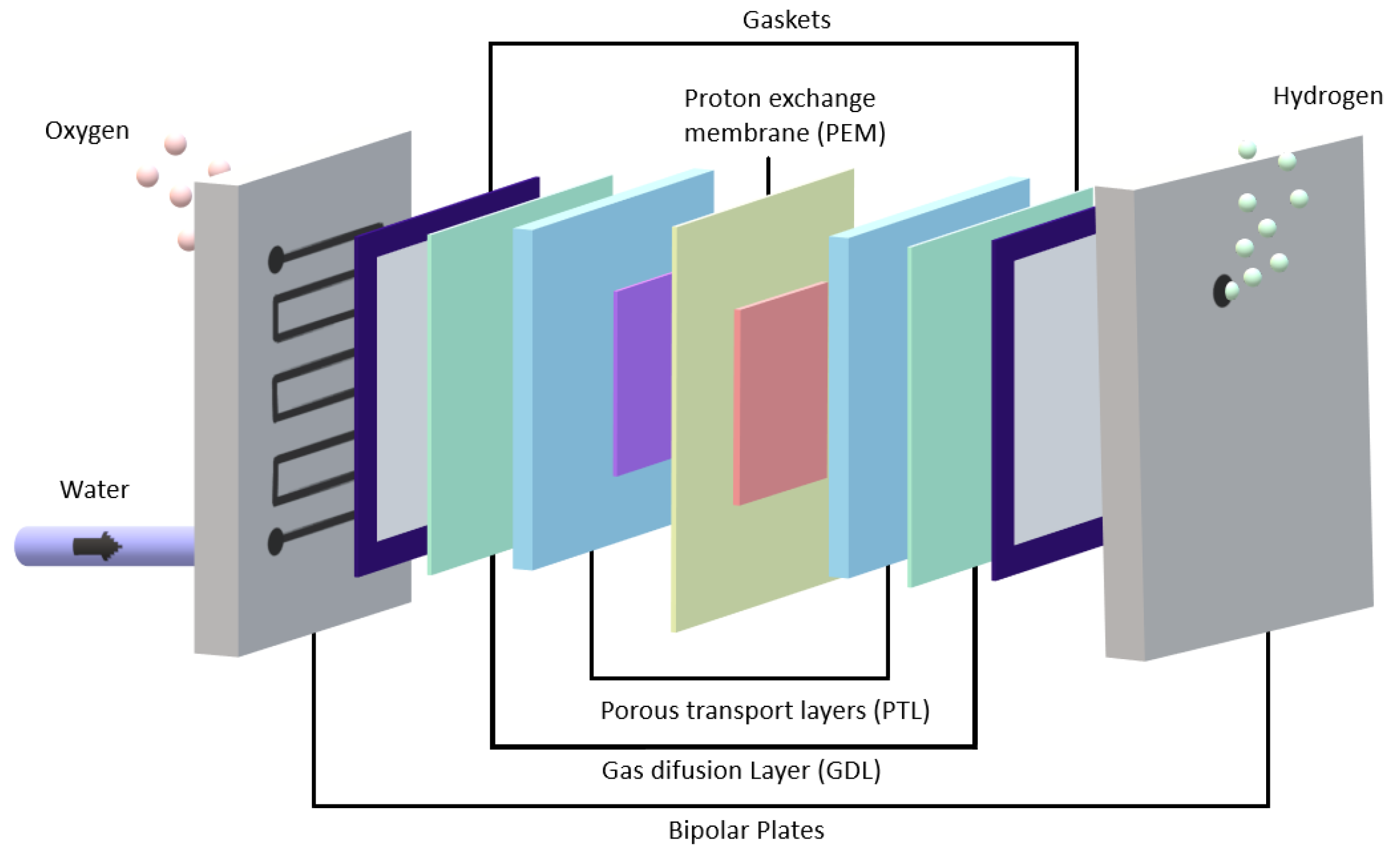
Figure 1. Structure of PEM electrolyzer cell unit.
Water 17 03297 g001
Figure 2. Principal of PEM electrolyzer.
Water 17 03297 g002
Figure 3. Grothuss mechanism of proton conductivity.
Water 17 03297 g003
Figure 4. Vehicle mechanism of proton conductivity.
Water 17 03297 g004
Figure 5. Structure of Nafion. The red color highlights the presence of the main functional group—the sulfonic acid side group.
Water 17 03297 g005
Figure 6. Chemical structure of PEEK.
Water 17 03297 g006
Figure 7. Chemical structure of PBI.
Water 17 03297 g007
Figure 10. Chemical structure of chitosan.
Water 17 03297 g010
Figure 11. Chemical structure of cellulose.
Water 17 03297 g011
Figure 12. Chemical structure of sodium alginate.
Water 17 03297 g012
Figure 13. Structure of HPA Reproduce with permission [183]. Copyright 2003 Springer Nature.
Water 17 03297 g013
Figure 14. Casting method.
Water 17 03297 g014
Figure 15. Cross-linking of the polymer membranes [205].
Water 17 03297 g015
Figure 16. Electrospinning setup [211].
Water 17 03297 g016
Figure 17. Three-dimensional printing principal [219].
Water 17 03297 g017
Disclaimer/Publisher’s Note: The statements, opinions and data contained in all publications are solely those of the individual author(s) and contributor(s) and not of MDPI and/or the editor(s). MDPI and/or the editor(s) disclaim responsibility for any injury to people or property resulting from any ideas, methods, instructions or products referred to in the content.