Article

U.S. Precipitation Variability: Regional Disparities and Multiscale Features Since the 17th Century

1
Research Institute for Eco-Civilization, Chinese Academy of Social Sciences, Beijing 100053, China
2
Beijing Municipal Climate Center, Beijing Meteorological Service, Beijing 100089, China
3
School of Geographical Sciences, Liaoning Normal University, Dalian 116029, China
4
Centre for Human Settlements, Liaoning Normal University, Dalian 116029, China
5
Key Laboratory of Land Surface Pattern and Simulation, Institute of Geographic Sciences and Natural Resources Research, Chinese Academy of Sciences, Beijing 100101, China
*
Authors to whom correspondence should be addressed.
Water 2025, 17(17), 2529; https://doi.org/10.3390/w17172529
Submission received: 2 July 2025 / Revised: 22 August 2025 / Accepted: 22 August 2025 / Published: 25 August 2025
(This article belongs to the Special Issue Advance in Hydrology and Hydraulics of the River System Research 2025)

Abstract

Proxy data-based reconstructions provide an essential basis for understanding comprehensive precipitation variability at multiple time scales. This study compared the variation characteristics of reconstructed precipitation data across different regions in the U.S. and the differences at decadal/multidecadal scales. The reconstruction showed that multiple scales of precipitation variability existed in each region and both multidecadal and decadal variability varied over time and across region. There was weaker multidecadal variability in the latter half of the 18th century and during the mid-19th century to mid-20th century east of the Rocky Mountains (RM); however, multidecadal variability appears to have increased since the 20th century in most regions. Decadal variability was weaker west of the RM except in the Southwest U.S. in the latter half of the 18th century. While decadal variability became stronger in the early 20th century, it shifted from a stronger phase to a weaker phase east of the RM. Then, we compared the spatiotemporal differences between the reconstructed Palmer Drought Severity Index (PDSI) and reconstructed precipitation in this study. The reconstructed annual precipitation mostly remains consistent with the existing PDSI dataset, but there are inconsistencies in the severe dry/wet intensities in some regions. Multiscale analysis of regional precipitation data holds great importance for understanding the relationship between precipitation in different regions and the climate system, while also providing a scientific theoretical basis for precipitation prediction.

1. Introduction

Climate variability refers to the relative rate of change from one climatic phase to another [1,2,3]. Climate variability on interannual, decadal, and centennial scales has a severe impact on grain production [4,5], water sources [6,7], and the atmospheric environment [8,9]. Generally, from a long-term perspective, climate variability is dominated by external forcing, such as volcanic aerosols or solar activities [10,11,12], and internal climate system variability including the El Niño–Southern Oscillation (ENSO), Pacific Decadal Oscillation (PDO), and Atlantic Multidecadal Oscillation (AMO) [13,14,15]. Since the 20th century, anthropogenic forcing, such as greenhouse gases and land use changes, have also played an important role in climate variability [16,17]. However, due to the shortage of meteorological observations data, it is difficult to comprehensively understand climate variability at different time scales, particularly at the multidecadal and centennial scales [18,19]. Therefore, reconstructed long-term climate variations are valuable for depicting natural climate variability and the potential effects of human activities on the climate system, which are important topics in climate change research.
Precipitation variability is an important metric of climate change. Extreme hydroclimate events caused by precipitation variability are a major factor contributing to severe disasters. In the United States (U.S.), the drought resulting from reduced precipitation in the central U.S. in 2012 resulted in economic losses exceeding USD 30 billion [20,21]; the flood resulting from increased precipitation in the lower Mississippi River in 1927 led to more than 700,000 people losing their homes and economic losses exceeding USD 1 billion [22,23]. Since the U.S. occupies a large area, it encompasses many climate regimes. Precipitation variability in the U.S. is distinctively characterized by spatial heterogeneity [24,25]. For instance, instrumental records reveal that from 1991 to 2012, precipitation levels rose in the Northeast and Midwest regions of the U.S., while declining across much of the Southwest [26,27]. The underlying factors driving these precipitation variations also differed among these areas. For instance, precipitation deficits in the Southwest and central U.S. might stem from reduced atmospheric moisture transport from the Gulf of Mexico [28]. Meanwhile, the decrease in precipitation in the Southeast U.S. could be attributed to land–air interactions resulting from local soil moisture depletion [29,30]. These examples underscore the regional disparities in precipitation patterns and their potential causes across the U.S. Existing studies, primarily relying on limited instrumental data, have predominantly focused on interannual and decadal precipitation variability, leaving gaps in our understanding of multidecadal and centennial-scale changes. Therefore, reconstructed precipitation series for each U.S. region are essential to elucidate long-term regional precipitation variability and interregional differences.
In terms of reconstructing hydroclimate variations for the U.S., there are two major achievements. The first is the reconstruction of the Palmer Drought Severity Index (PDSI). Two important reconstructed PDSI datasets are available. One refers to the gridded summer PDSI in North America, with a spatial resolution of 2.5 by 2.5 degrees, spanning more than 500 years for most grid cells; it was reconstructed using tree-ring width data and a point-by-point method [31,32]. The other one refers to the gridded summer PDSI in the U.S., with a spatial resolution of 2 degrees latitude by 3 degrees longitude, spanning back to AD 1700. It was also reconstructed based on tree-ring width data, but instead applied the regularized expectation maximization algorithm [33]. Additionally, there are also some regional PDSI reconstructions [34,35,36,37]. The PDSI is determined not only by precipitation, but also by potential evapotranspiration (PET), which is jointly affected by temperature, radiation, and wind velocity [38,39]. So, PDSI variability may not fully represent precipitation variability. A deeper understanding of the multiscale characteristics of regional precipitation and its discrepancies with the PDSI lays a scientific foundation for revealing the similarities and differences in precipitation changes across different regions of the United States, as well as for future regional precipitation prediction and disaster prevention and mitigation efforts.
The second achievement is the reconstruction of past precipitation. For instance, winter precipitation since 1602 was reconstructed for 96 meteorological stations in the U.S. and southwestern Canada using the spatial correlation method and 65 tree-ring width chronologies [40]. Seasonal or annual regional precipitation was also reconstructed in the U.S. [41,42]. Although there are number of precipitation reconstructions, the differences in annual precipitation variability among climate regimes remain unclear. One reason is that some of them are seasonal precipitation reconstructions, rather than annual precipitation reconstructions. The other reason is that the existing annual precipitation reconstructions are mostly for single-region rather than multiple climate regimes. Compared to proxy data sources such as lake sediments and glaciers, tree-ring chronologies offer advantages including extensive spatial coverage, high temporal resolution, and precise dating. However, considering the variations in tree-ring samples across different regions, particularly the scarcity of sampling sites in the eastern United States, which poses certain limitations for gridded precipitation reconstruction, we focus more on regional-scale precipitation reconstruction. This strategy could, to a certain extent, mitigate the inaccuracies in reconstruction outcomes stemming from an inadequate sample size. Therefore, regional-scale precipitation reconstruction sequences based on tree-ring chronologies are of great significance for revealing similarities and differences in decadal-scale precipitation variations.
In this study, we analyzed long-term precipitation variability and the differences among regions using regional reconstructed precipitation. We addressed the following key questions: (1) What are the differences in reconstructed precipitation among 12 regions in the U.S.? (2) What are the differences in reconstructed precipitation and reconstructed PDSI among regions? Following this Introduction, Section 2 outlines the data and method used in the study, Section 3 presents the findings, Section 4 discusses the innovations and uncertainties, and Section 5 summarizes the conclusions.

2. Materials and Methods

2.1. Study Area

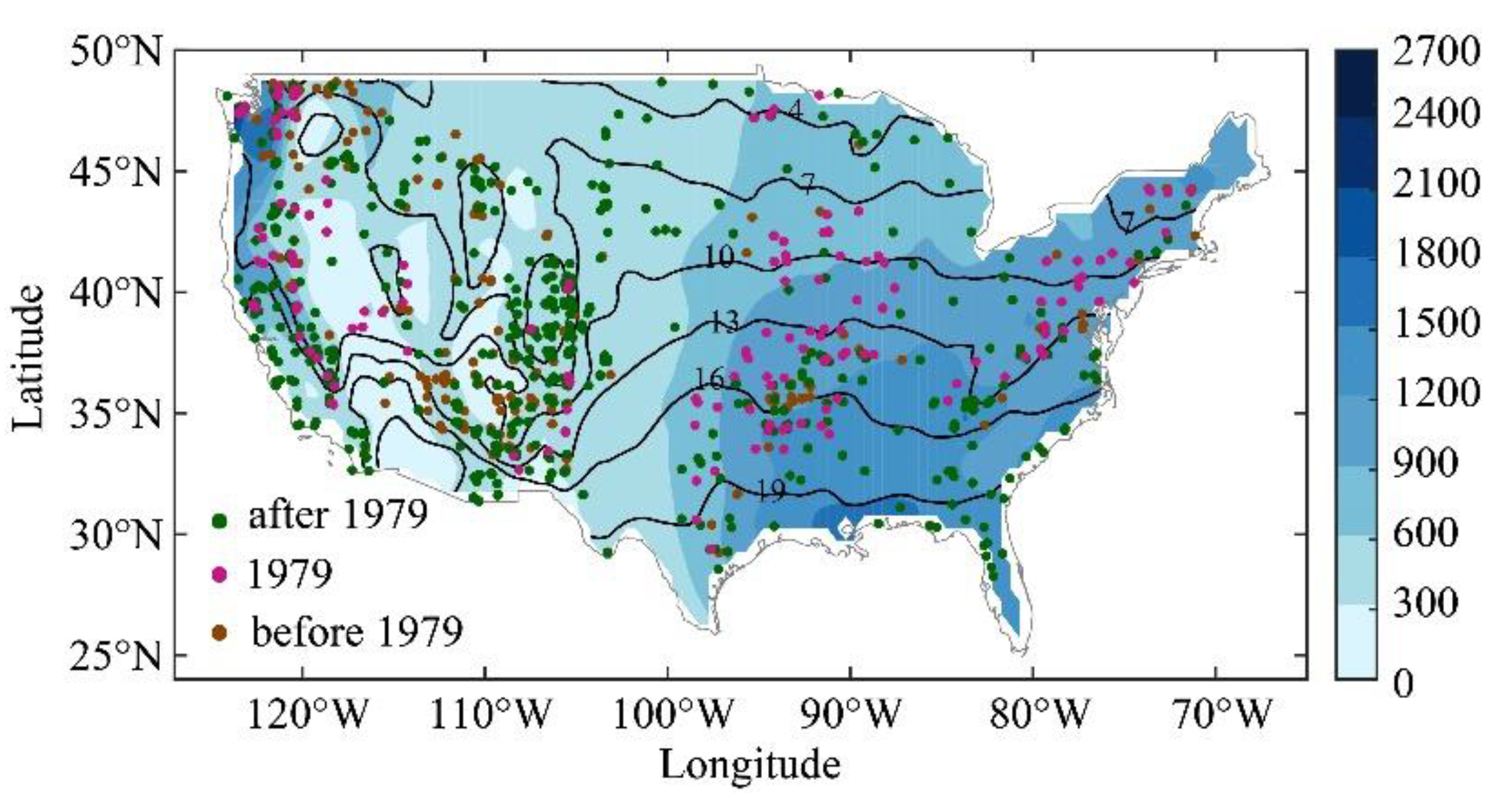
The study area is the contiguous U.S. Figure 1 shows that the mean annual precipitation exhibits a strong east–west gradient, characterized by higher precipitation in the east and lower precipitation in the west. In the southeast, the mean annual precipitation exceeds 2000 mm. In the central U.S., it decreases to about 900 mm. Notably, annual precipitation declines sharply to below 600 mm west of 100° W. In particular, it is less than 300 mm in the U.S. Cordillera. In the northwestern U.S., precipitation increases again to over 1500 mm.
The annual mean temperature mainly varies across zones, and it gradually decreases from south to north. It is about 4 degrees Celsius in the northernmost U.S. and 20 degrees Celsius in the southernmost U.S. In the Rocky Mountains (RM), the temperature is lower than in other areas within the same zone, while in the northwest U.S., it is higher than in other areas within the same zone.

2.2. Data

In this study, we used the instrumental dataset CRU [43], which is provided by the Climate Research Unit, University of East Anglia. This dataset has a spatial resolution of 0.5 by 0.5 degrees and a temporal resolution of monthly intervals during AD 1901–2015. This dataset was prepared through interpolation with ground site-based measurements around the world. Moreover, the interpolation methods account for the influence of station relocation and instrumental replacement [43].
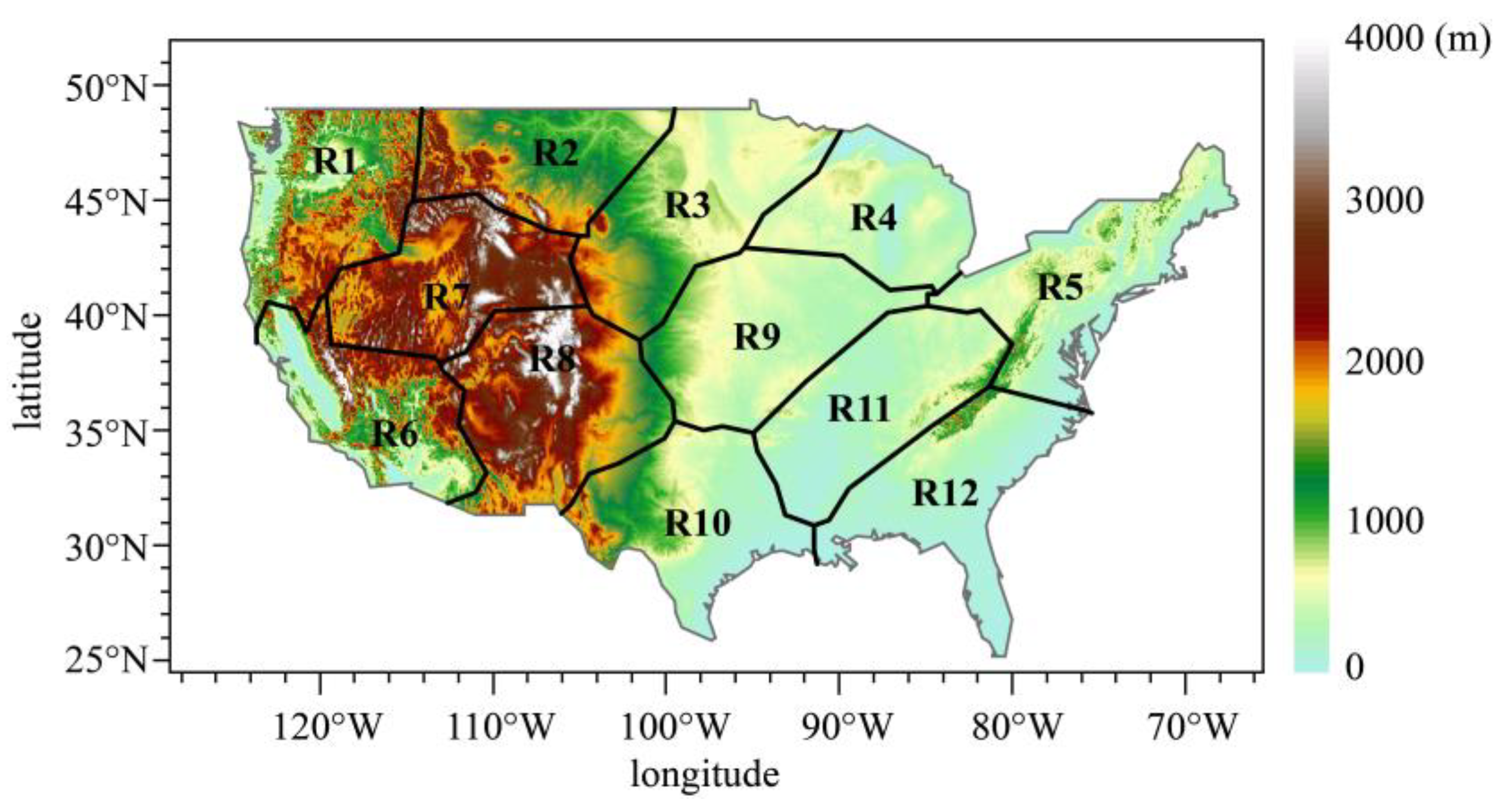
The reconstructed precipitation dataset for the U.S. was constructed by [44]. Based on 1258 tree-ring width chronologies from the U.S., they employed a regional and segmented approach to develop calibration equations of precipitation reconstruction for 12 regions across the U.S. The corresponding 12 precipitation regions derived from the Rotated Empirical Orthogonal Function (REOF) are illustrated in Figure 2. Compared to traditional Empirical Orthogonal Function (EOF) analysis, REOF concentrates on the high-loading variables of each principal mode within specific regions while keeping the loadings of other variables close to zero, thereby more clearly revealing regional disparities in precipitation changes. The results indicate that when the first 12 REOFs are selected, dividing the contiguous United States into 12 regions, the cumulative variance contribution reaches 72.51%, capturing the main features of regional disparities in precipitation changes. The variance explained by the calibration equations used to reconstruct the precipitation series for each region ranges from 28.96% to 91.91% (with an average of 58.34%). Among the reconstructed precipitation series, four regions have series lengths exceeding a millennium, three regions span 500–1000 years, and the remaining five regions span 290–500 years. To compare the spatiotemporal variations in interdecadal to multidecadal precipitation across different regions, we focus exclusively on precipitation data from each region dating back to the 17th century.
The 1258 tree-ring chronologies were collected from the World Data Center for Paleoclimatology archives (https://www.ncdc.noaa.gov (accessed on 1 June 2018)). Tree-ring sites are mainly located in the Southwest Coast, RM, Mississippi Plain, and Appalachian Mountains.
Cook et al. (2007) [32] utilized a network of tree-ring chronologies as the primary proxy data, combined with gridded instrumental Palmer Drought Severity Index (PDSI) observations, to reconstruct a PDSI dataset for the contiguous U.S. over the past 2000 years at a high spatial resolution of 0.5° × 0.5° grid cells using a point-by-point regression approach. This pioneering work unveiled the existence of multidecadal to centennial-scale megadroughts in the drought history of North America, offering a perspective on drought variability that extends far beyond the length of instrumental records [45,46].

2.3. Method

The Pearson correlation coefficient is a standardized statistical measure used to quantify the strength and direction of the linear relationship between two variables, X and Y. It is employed to reveal and measure the degree of consistency in the changing trends between two variables (indicating positive or negative correlation) and the strength of their association. The calculation equation is as follows:
r = ( x i     x ¯ ) × ( y i     y ) ( x i     x ¯ ) 2 × ( y i     y ¯ ) 2
The Fast Fourier Transform (FFT)-based power spectrum is obtained by applying the FFT to a signal and computing the squared magnitude of its frequency-domain representation. This metric quantifies the power distribution density across distinct frequency components, revealing the energy contribution of each frequency band within the signal. As a fundamental analytical tool, it enables the identification of dominant frequencies, characterization of spectral composition, and detection of periodic or harmonic patterns in the signal.
P k = 1 N × f s X ( k ) 2
where X(k) represents the complex result at the k-th frequency bin after applying the FFT to the signal X. N denotes the number of sampling points of the signal, which also corresponds to the length of the FFT; and fs represents the sampling frequency (unit: Hz) and is utilized to normalize the energy to the actual physical frequency. In this study, filtering with time spans of 11–30 years and over 31 years was employed to represent precipitation variability characteristics at interdecadal and multidecadal scales, respectively.
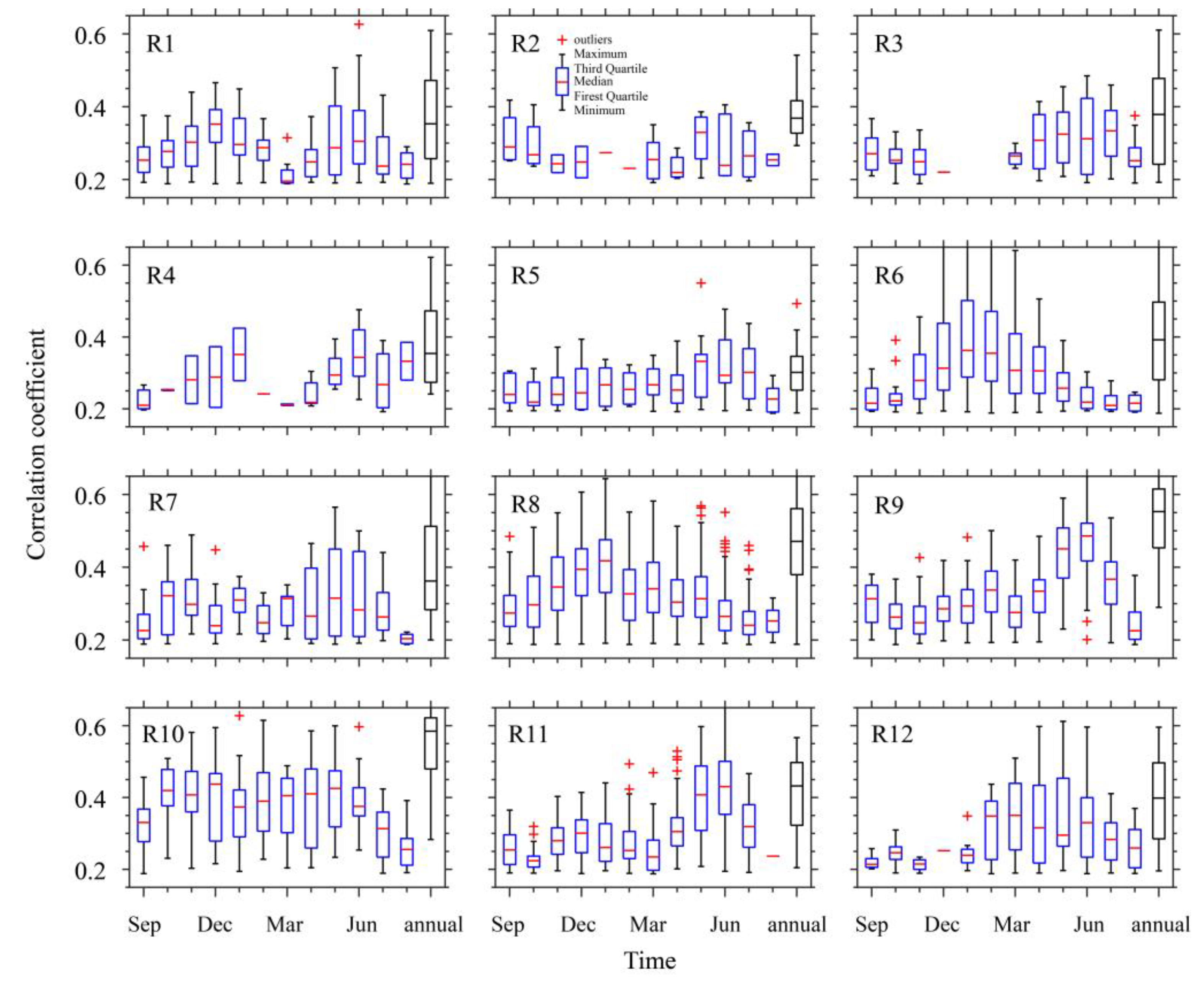
Based on the reconstructed precipitation, Figure 3 illustrates that tree-ring width (TRW) chronologies are mostly positively correlated with precipitation but with regional and seasonal differences. Stronger annual correlations (r = 0.43–0.58) are observed in the southern RM, Central/Eastern Great Plains, and southern U.S., likely due to cumulative soil moisture effects. Seasonal differences are pronounced: winter correlations dominate in the southern RM (r = 0.42) due to snowmelt moisture, while summer correlations peak in the Central/Eastern Great Plains (r = 0.46) and south U.S. under the influence of monsoons. In contrast, the southwestern U.S., northern RM, and southeastern U.S. show moderate annual correlations (r = 0.36–0.40) with distinct seasonal patterns (winter in California, summer in Florida), whereas northern U.S. regions (1–5) exhibit weaker annual (r = 0.31–0.36) and less pronounced seasonal correlations. Taken together, these findings show that the tree-ring width was highly sensitive to the annual precipitation in each region, with the correlation coefficients ranging from 0.31 to 0.58. Due to the seasonal cycle of precipitation, the sensitivity of tree growth to precipitation exhibited seasonal variation; however, the correlations with the annual precipitation remain close to the maximum seasonal correlations.

3. Results

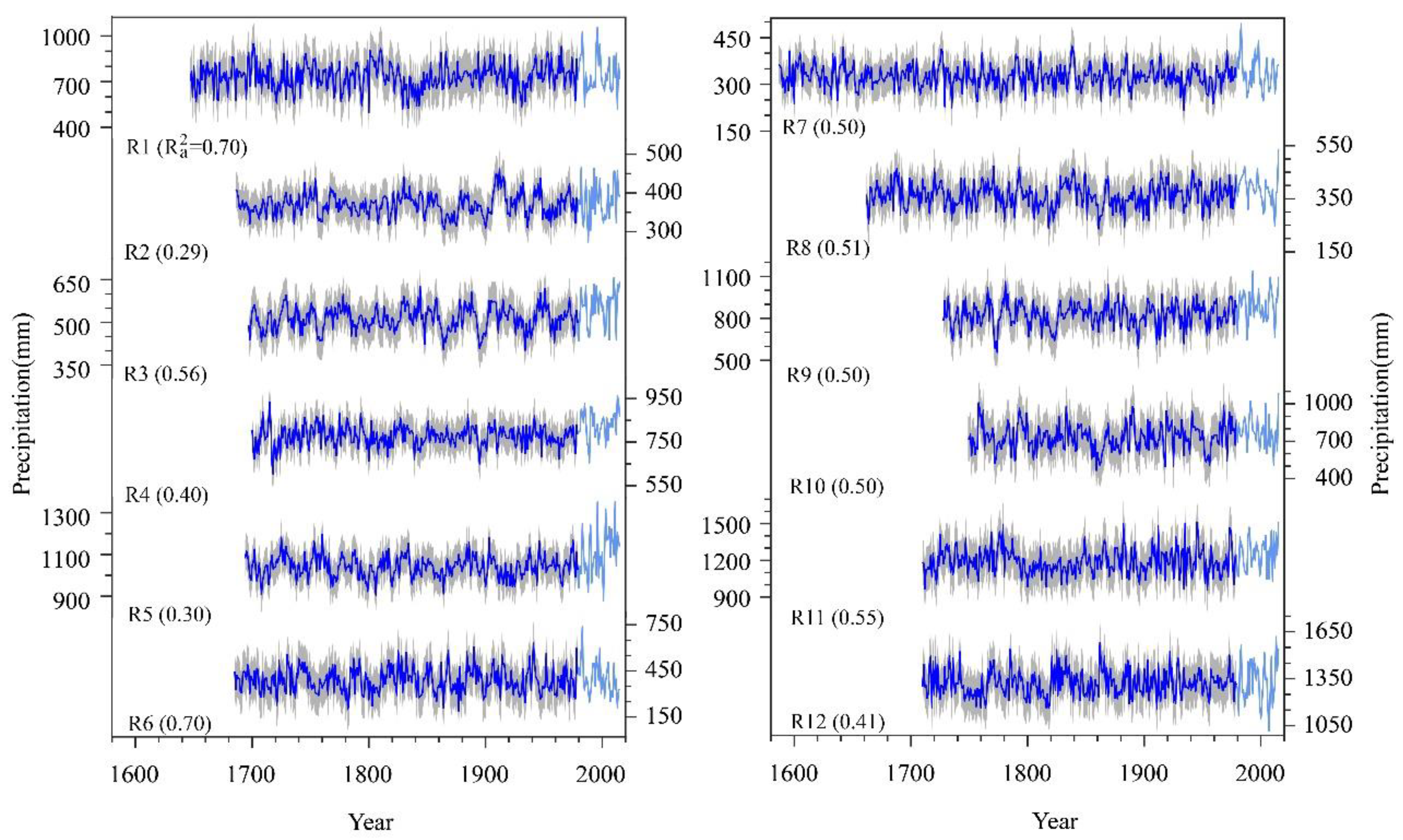
Figure 4 shows the reconstructed annual precipitation for each region of the U.S. over the past several centuries. We found that multiple scales of variability existed in each region, and both multidecadal and decadal variability changed over time and across regions. The R a 2 values between the reconstructed precipitation sequences and observed results across different regions range from 0.29 to 0.70. Specifically, Region 1 exhibits the highest R a 2 value (0.70), while Region 2 shows the lowest (0.29). This outcome reflects the varying degrees of credibility in the reconstructed sequences across different regions.

3.1. Temporal–Spatial Variations in Multidecadal Variability

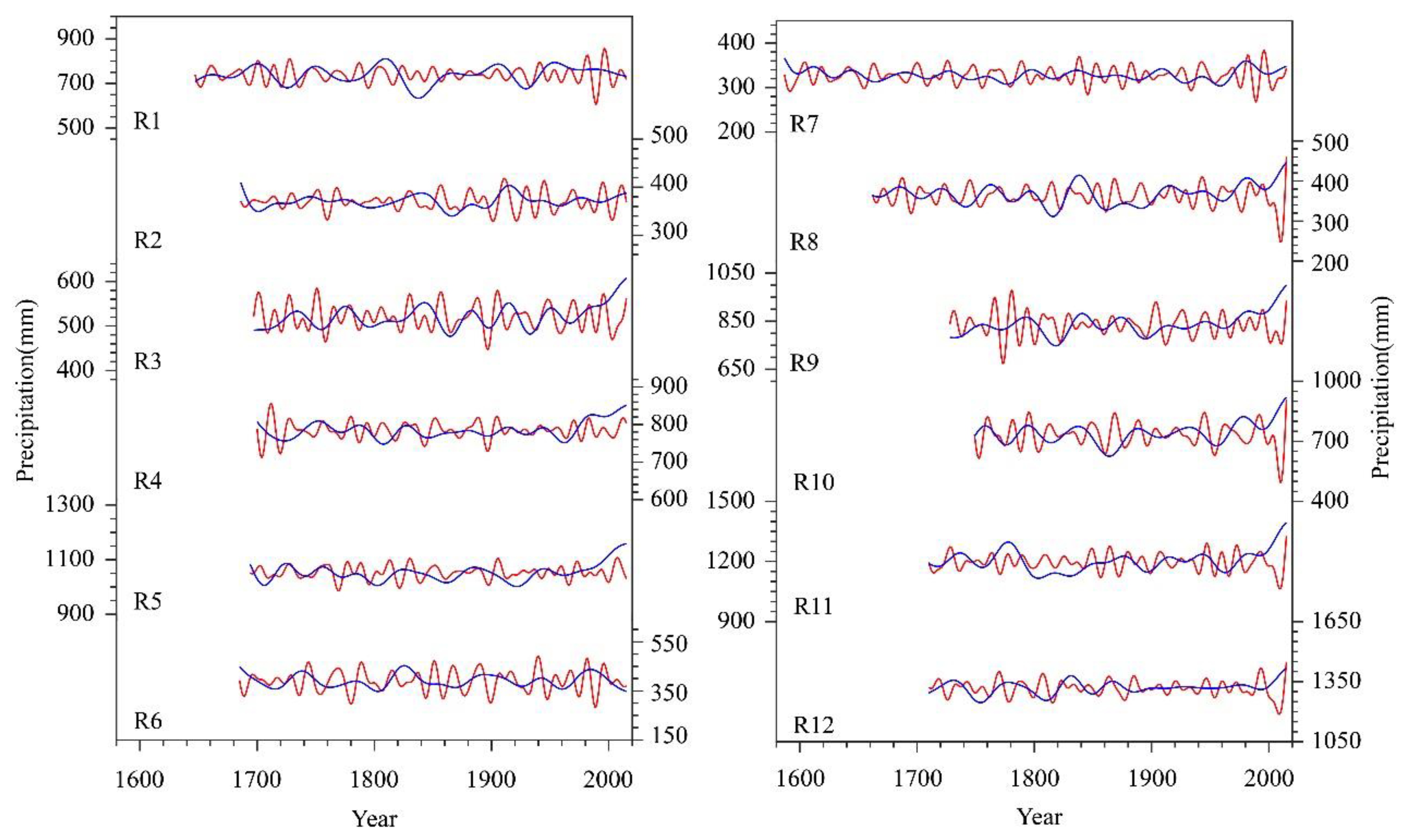
The multidecadal-scale standard deviation (σ) accounts for 28–50% of the total variation. The largest weightings, 50% and 48%, occurred, respectively, in Region 3 and Region 8, which are arranged northeast–southwest across the west central U.S. Figure 5 shows that multidecadal variations in Region 3 and Region 8 have existed over the last 300 years, but Region 8 showed weak oscillations from the mid-19th century to the mid-20th century. Since the mid-20th century, both Region 3 and Region 8 have entered a phase of higher precipitation, with the anomaly reaching as high as 8.0% (41.5 mm) in Region 3 and 10.7% (39.1 mm) in Region 8. Historically, the maximum positive anomaly was 6% in Region 3 and 13% in Region 8, which occurred around the 1840s, both comparable to the high values in the present.
Subsequently, the weighting of multidecadal variation in the range of 44–46% occurred in Regions 5, 9, 10, and 11, which are also roughly arranged northeast–southwest in the eastern part of the U.S. Figure 5 shows that the multidecadal variations in these regions have existed over the last 300 years, but with weak oscillations during the 19th century in Region 11, which has also entered a phase of higher precipitation since the mid-20th century. The anomaly reached as high as 6.7% (70.0 mm) in Region 5, 7.9% (66.4 mm) in Region 9, 6.1% (45.4 mm) in Region 10, and 5.5% (66.7 mm) in Region 11. These high positive anomalies were higher than any positive anomalies in history.
Next, weightings of 40% and 37% for multidecadal variation occurred, respectively, in Regions 1 and 2, which are located in the northwestern part of the U.S. A comparable weighting of 38% occurred in Region 4, which is located in the north/central region of the U.S. Figure 5 shows that multidecadal variations have occurred in these regions over the past 300 years, with continuous and stable oscillation. Regions 1 and 2 have had relatively few high-precipitation phases since the 20th century, while Region 4 has had significantly more high-precipitation phases since the 20th century. Precipitation reached as high as 7.4% (54.7 mm) in Region 1, 4.6% (17.1 mm) in Region 2, and 8.5% (66.6 mm) in Region 4. These values were higher than those in the past.
The lowest weightings of 29% and 28% occurred, respectively, in Regions 6 and 7, which are located in the western region of the U.S. Figure 5 shows that the multidecadal variations in these regions have existed for over 350 years. These regions have also entered a high-precipitation phase since the mid-20th century, with precipitation reaching as high as 11.9% (40.3 mm) in Region 6 and 9.6% (31.4 mm) in Region 7. These high positive anomalies were higher than any positive anomalies in history.

3.2. Temporal–Spatial Variations in Decadal Variability

The decade-scale standard deviation accounts for 45–62% of the total variations. The largest weightings of 62%, 62%, and 60% occurred, respectively, in Region 6, Region 7, and Region 2, which are located in the western U.S. Figure 5 shows that robust decadal variations in Region 2, Region 6, and Region 7 have existed over the last 300 years. Notably, the amplitudes of decadal variations in the early and late 20th century were likely larger than those in the mid-20th century and the pre-instrumental periods in Region 2, whereas, for Region 6 and Region 7, amplitudes of decadal variations during the 20th century were unlikely to be larger than those during pre-instrumental periods.
The secondary weighting was approximately 58%, occurring mainly in the U.S. Great Plains from north to south (Regions 3, 9, and 10) and the southeastern U.S. (Region 12). Figure 5 shows that the decadal variations from these regions have existed over the past 300 years. In Region 3 and Region 9, the amplitudes of decadal variations were, respectively, weaker during the late 18th century to early 19th century and the mid-19th century compared to other periods. In Region 10 and Region 12, the amplitude of decadal variations likely remained unchanged until the early 21st century, when there was an abnormal negative anomaly exceeding one standard deviation. The anomalous precipitation reached as low as −236 mm, accounting for about 30% of the climatology mean, in Region 10.
Next, the weightings were approximately 53%, 51%, and 50% in the northeastern U.S. (Regions 4 and 5) and southwestern U.S. (Region 8), respectively. Figure 5 shows that the decadal variations from these regions have existed for almost the last 300 years, but with interruptions in Region 4 and Region 5. We found that the amplitudes of decadal variations were much weaker in the first half of the 20th century compared to those in other periods in Region 4 and Region 5. In Region 8, the amplitude of decadal variations likely remained unchanged until the early 21st century, when there was an anomaly exceeding one standard deviation. The anomalous precipitation reached as low as −115 mm, accounting for about 31% of the climatology mean.
The weightings of decadal variations were approximately 47% and 48% in the northwestern U.S. (Region 1) and the lower Ohio and Mississippi River Valley (Region 11), respectively, which were the lowest among these regions. Figure 5 shows that the amplitudes of decadal variations were likely weaker during the mid-19th century to the mid-20th century compared to those during other periods, and they were abnormally larger during the late 20th century compared to the pre-instrumental period in Region 1. It likely remained unchanged until the early 21st century, when an anomaly exceeding one standard deviation occurred in Region 11.
Taking the abovementioned findings together, both weightings of multidecadal variability and decadal variability varied over time and across regions. The comparisons across these regions show that in the central and eastern regions, i.e., Regions 3–5 and 8–12, oscillations in multidecadal variations since the mid-20th century showed that these regions entered a higher precipitation phase, appearing stronger than pre-instrumental periods. However, in western regions, i.e., Regions 1–2 and 6–7, the oscillations in multidecadal variations since the mid-20th century are comparable to those in pre-instrumental periods. At the decadal scale, the oscillations since the mid-20th century are comparable to those in pre-instrumental periods in the northern regions and western regions; however, in the early 21st century, the southern and eastern regions, i.e., Regions 8–12, showed less abnormal precipitation, significantly lower than the pre-instrumental climatology mean.

4. Discussion

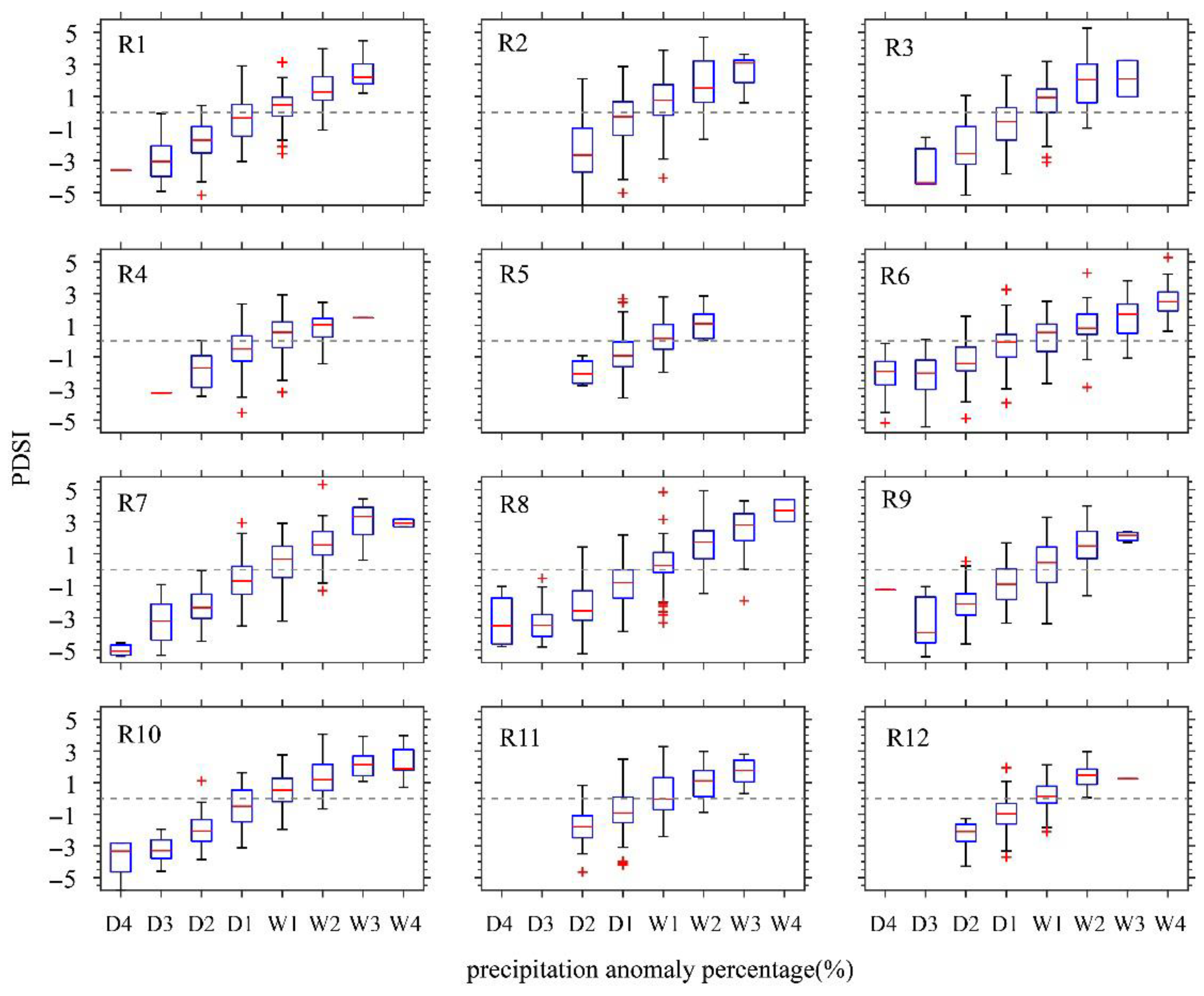
Figure 6 shows that significant positive correlations exist between the reconstructed precipitation and PDSI for each region. With an increase in precipitation, the PDSI also increases, denoting consistently wet conditions. These findings suggest that both the reconstructed annual precipitation and PDSI denote essentially the same wet/dry variations. Hence, both can be verified with each other. Also, PDSI variations were perhaps modulated mainly by precipitation variations.
However, inconsistences between the reconstructed precipitation and PDSI could also be found regarding severe dry/wet conditions. For instance, in Region 6, the median PDSIs for the group with a precipitation anomaly lower than −50% and the group with a precipitation anomaly in the range of −30% to −50% were, respectively, −1.92 and −2.03, both of which are comparable to each other. This suggests that in severe dry conditions, the PDSI has not co-varied with the precipitation anomaly. This mismatch can also be found in Regions 8, 9, 10, and 12, and it may be caused by two possible reasons. One reason is that the PDSI represents summer precipitation, while the reconstructed precipitation refers to annual precipitation. Severely higher/lower annual precipitation may not represent a wet/dry summer. The other reason is that the PDSI is jointly modulated by not only precipitation but also temperature, wind, radiation, and soil properties, among others. So, as a result, extremely high/low precipitation may not represent an extremely high/low PDSI.
However, there exists certain uncertainty in PDSI reconstruction. One notable limitation lies in the spatial resolution. For instance, the insufficient sample density in the eastern United States is a critical issue. In Cook et al.’s reconstruction network, tree-ring chronologies exceeding 500 years are exceedingly scarce in the eastern region, resulting in a lower spatiotemporal resolution for drought event reconstruction in the east compared to the west. Hoffmann et al. (2020) [47] found through comparison that the capability of PDSI reconstruction to capture extreme drought events in the eastern U.S. is 30–50% weaker than that in the western region. Another limitation stems from the simplified assumptions inherent in the PDSI model itself, for example, the regional applicability of soil moisture parameters. In PDSI calculations, parameters such as field capacity and potential evapotranspiration are set based on data from the U.S. Central Plains. Muhammad et al. (2017) [48] highlighted that the PDSI might underestimate drought risks in mountainous areas caused by delayed snowmelt.
Our study introduces two important innovations. Firstly, we conducted a comparative analysis of reconstructed precipitation sequences and PDSI (Palmer Drought Severity Index) reconstructions across different regions of the United States. By examining the similarities and differences between these datasets, we highlighted the uncertainties inherent in PDSI reconstructions. Through this comparison, we found that precipitation sequences more directly reflect the climatic influences on tree-ring growth, providing a clearer indicator of regional hydroclimatic conditions. Secondly, our study focuses on regional precipitation patterns across the United States, while the existing literature emphasizes that the PDSI primarily captures surface drought characteristics. By analyzing multiscale regional differences in precipitation, our research offers significant value for understanding the evolutionary trends and predictive mechanisms of precipitation in diverse U.S. climates. This approach enhances the scientific basis for regional climate studies and improves precipitation forecasting capabilities.

5. Conclusions

This study reveals significant spatial variability in precipitation across the U.S., with multiscale (decadal to multidecadal) variations evident in regional reconstructions from tree-ring width data. Notably, multidecadal variability weakened east of the RM from the late 18th to mid-20th centuries but strengthened post-20th century in most regions. Decadal variability initially weakened west of the RM (excluding southwestern U.S.) before intensifying in the early 20th century, while east of the RM, it exhibited a reverse trend. Reconstructed precipitation aligns broadly with existing PDSI datasets, though minor discrepancies persist under severe dry/wet conditions.
This research offers a historical perspective on precipitation variability spanning pre-industrial to industrial periods, enhancing the understanding of anthropogenic influences on the modern climate. The regional precipitation dataset developed herein provides critical baseline data for examining natural variability, validating climate models, and elucidating mechanisms driving precipitation changes.
Notably, some uncertainties remain, which require further research. The uncertainties in this study primarily encompass two aspects. Firstly, the variance explained by reconstructed precipitation sequences varies across different regions, indicating differential sensitivity of tree-ring widths to precipitation. Consequently, multiscale comparisons of reconstructed precipitation based on tree rings may introduce certain errors. Secondly, tree-ring width data require detrending treatments (e.g., linear regression and smoothing splines) to remove age-related growth trends, a process that may inadvertently attenuate centennial-scale variability signals. So, comparisons of multidecadal precipitation differences across regions may also be subject to uncertainties. Future work should prioritize grid-based reconstructions and employ period-specific samples to improve the explained variance and capture longer-term variability. These refinements will strengthen precipitation forecasting and provide deeper insight into regional climate dynamics.

Author Contributions

Conceptualization, Q.W., Y.X. and M.B.; methodology, Q.W., Y.X. and M.B.; software, W.D.; formal analysis, Q.W., Y.X. and M.B.; investigation, W.D. and M.W.; data curation, W.D. and M.W.; writing—original draft preparation, Q.W.; writing—review and editing, Y.X. and M.B.; funding acquisition, M.W., M.B., and W.D. All authors have read and agreed to the published version of the manuscript.

Funding

This research was funded by the National Key R&D Program of China, grant number 2023YFC320660103 (funder: Maowei Wu); the National Natural Science Foundation of China, grant number 42305055 (funder: Mengxin Bai); and the Innovation and Development Special Foundation of the China Meteorological Administration, grant number CXFZ2025J068 (funder: Wupeng Du).

Data Availability Statement

All data used in this study are publicly available and can be downloaded from the corresponding websites. The CRU temperature and precipitation datasets were provided by the Climate Research Unit, University of East Anglia (https://crudata.uea.ac.uk/cru/data/hrg/ (accessed on 10 March 2024)). The reconstructed regional precipitation data used in this study can be obtained from the authors or the Science Data Bank at http://www.dx.doi.org/10.11922/sciencedb.j00001.00254 (accessed on 1 July 2024). The reconstructed gridded PDSI dataset was derived by Cook et al. (2004) [31], which can be downloaded from https://www.ncei.noaa.gov/access/paleo-search/study/6319 (accessed on 1 July 2024). Data will be made available on request.

Conflicts of Interest

The authors declare no conflicts of interest.

References

  1. Hebert, R.; Herzschuh, U.; Laepple, T. Millennial-scale climate variability over land overprinted by ocean temperature fluctuations. Nat. Geosci. 2022, 15, 11. [Google Scholar] [CrossRef]
  2. Luterbacher, J.; Dietrich, D.; Xoplaki, E.; Grosjean, M.; Wanner, H. European seasonal and annual temperature variability, trends, and extremes since 1500. Science 2004, 303, 1499–1503. [Google Scholar] [CrossRef]
  3. Buntgen, U.; Tegel, W.; Nicolussi, K.; McCormick, M.; Frank, D.; Trouet, V.; Kaplan, J.O.; Herzig, F.; Heussner, K.U.; Wanner, H.; et al. 2500 Years of European Climate Variability and Human Susceptibility. Science 2011, 331, 578–582. [Google Scholar] [CrossRef] [PubMed]
  4. Cohn, A.S.; VanWey, L.K.; Spera, S.A.; Mustard, J.F. Cropping frequency and area response to climate variability can exceed yield response. Nat. Clim. Change 2016, 6, 601–604. [Google Scholar] [CrossRef]
  5. Ray, D.K.; Gerber, J.S.; MacDonald, G.K.; West, P.C. Climate variation explains a third of global crop yield variability. Nat. Commun. 2015, 6, 5989. [Google Scholar] [CrossRef]
  6. Guo, D.L.; Thomas, J.; Lazaro, A.; Mahundo, C.; Lwetoijera, D.; Mrimi, E.; Matwewe, F.; Johnson, F. Understanding the Impacts of Short-Term Climate Variability on Drinking Water Source Quality: Observations from Three Distinct Climatic Regions in Tanzania. Geohealth 2019, 3, 84–103. [Google Scholar] [CrossRef]
  7. Hu, S.S.; Liu, C.M.; Zheng, H.X.; Wang, Z.G.; Yu, J.J. Assessing the impacts of climate variability and human activities on streamflow in the water source area of Baiyangdian Lake. J. Geogr. Sci. 2012, 22, 895–905. [Google Scholar] [CrossRef]
  8. Pienkosz, B.D.; Saari, R.K.; Monier, E.; Garcia-Menendez, F. Natural Variability in Projections of Climate Change Impacts on Fine Particulate Matter Pollution. Earth’s Future 2019, 7, 762–770. [Google Scholar] [CrossRef]
  9. Garcia-Menendez, F.; Monier, E.; Selin, N.E. The role of natural variability in projections of climate change impacts on US ozone pollution. Geophys. Res. Lett. 2017, 44, 2911–2921. [Google Scholar] [CrossRef]
  10. Santer, B.D.; Bonfils, C.; Painter, J.F.; Zelinka, M.D.; Mears, C.; Solomon, S.; Schmidt, G.A.; Fyfe, J.C.; Cole, J.N.S.; Nazarenko, L. Volcanic contribution to decadal changes in tropospheric temperature. Nat. Geosci. 2014, 7, 185–189. [Google Scholar] [CrossRef]
  11. Jin, C.H.; Wang, B.; Liu, J.; Ning, L.; Yan, M. Decadal variability of northern Asian winter monsoon shaped by the 11-year solar cycle. Clim. Dyn. 2019, 53, 6559–6568. [Google Scholar] [CrossRef]
  12. Jin, C.H.; Liu, J.; Wang, B.; Yan, M.; Ning, L. Decadal Variations of the East Asian Summer Monsoon Forced by the 11-Year Insolation Cycle. J. Clim. 2019, 32, 2735–2745. [Google Scholar] [CrossRef]
  13. Qin, M.H.; Dai, A.G.; Hua, W.J. Quantifying Contributions of Internal Variability and External Forcing to Atlantic Multidecadal Variability Since 1870. Geophys. Res. Lett. 2020, 47, e2020GL089504. [Google Scholar] [CrossRef]
  14. Wang, J.L.; Yang, B.; Ljungqvist, F.C.; Luterbacher, J.; Osborn, T.J.; Briffa, K.R.; Zorita, E. Internal and external forcing of multidecadal Atlantic climate variability over the past 1,200 years. Nat. Geosci. 2017, 10, 512–517. [Google Scholar] [CrossRef]
  15. Hua, W.J.; Dai, A.G.; Qin, M.H. Contributions of Internal Variability and External Forcing to the Recent Pacific Decadal Variations. Geophys. Res. Lett. 2018, 45, 7084–7092. [Google Scholar] [CrossRef]
  16. Yan, M.; Liu, J.; Wang, Z.Y.; Ning, L. Biogeophysical impacts of land use/land cover change on 20th century anthropogenic climate compared to the impacts of greenhouse gas change. Int. J. Climatol. 2020, 40, 6560–6573. [Google Scholar] [CrossRef]
  17. Marvel, K.; Cook, B.I.; Bonfils, C.J.W.; Durack, P.J.; Smerdon, J.E.; Williams, A.P. Twentieth-century hydroclimate changes consistent with human influence. Nature 2019, 569, 59–65. [Google Scholar] [CrossRef] [PubMed]
  18. Bochow, N.; Poltronieri, A.; Rypdal, M.; Boers, N. Reconstructing historical climate fields with deep learning. Sci. Adv. 2025, 11, eadp0558. [Google Scholar] [CrossRef] [PubMed]
  19. Kadow, C.; Hall, D.M.; Ulbrich, U. Artificial intelligence reconstructs missing climate information. Nat. Geosci. 2020, 13, 408–413. [Google Scholar] [CrossRef]
  20. Basara, J.B.; Christian, J.I.; Wakefield, R.A.; Otkin, J.A.; Hunt, E.H.; Brown, D.P. The evolution, propagation, and spread of flash drought in the Central United States during 2012. Environ. Res. Lett. 2019, 14, 084025. [Google Scholar] [CrossRef]
  21. Mallya, G.; Zhao, L.; Song, X.C.; Niyogi, D.; Govindaraju, R.S. 2012 Midwest Drought in the United States. J. Hydrol. Eng. 2013, 18, 737–745. [Google Scholar] [CrossRef]
  22. Smith, J.A.; Baeck, M.L. “Prophetic vision, vivid imagination”: The 1927 Mississippi River flood. Water Resour. Res. 2015, 51, 9964–9994. [Google Scholar] [CrossRef]
  23. Archfield, S.A.; Hirsch, R.M.; Viglione, A.; Blöschl, G. Fragmented patterns of flood change across the United States. Geophys. Res. Lett. 2016, 43, 10232–10239. [Google Scholar] [CrossRef]
  24. Abatzoglou, J.T.; Rupp, D.E.; Mote, P.W. Seasonal Climate Variability and Change in the Pacific Northwest of the United States. J. Clim. 2014, 27, 2125–2142. [Google Scholar] [CrossRef]
  25. Xu, R.; Li, Y.; Guan, K.Y.; Zhao, L.; Peng, B.; Miao, C.Y.; Fu, B.J. Divergent responses of maize yield to precipitation in the United States. Environ. Res. Lett. 2022, 17, 014016. [Google Scholar] [CrossRef]
  26. McRoberts, D.B.; Nielsen-Gammon, J.W. A New Homogenized Climate Division Precipitation Dataset for Analysis of Climate Variability and Climate Change. J. Appl. Meteorol. Climatol. 2011, 50, 1187–1199. [Google Scholar] [CrossRef]
  27. Groisman, P.Y.; Knight, R.W.; Karl, T.R. Changes in Intense Precipitation over the Central United States. J. Hydrometeorol. 2012, 13, 47–66. [Google Scholar] [CrossRef]
  28. Wang, H.L.; Schubert, S. The Precipitation Response over the Continental United States to Cold Tropical Pacific Sea Surface Temperatures. J. Clim. 2014, 27, 5036–5055. [Google Scholar] [CrossRef]
  29. Zhu, X.J.; Stan, C. Projection of Summer Precipitation over the Southeastern United States in the Super-parameterized CCSM4. J. Clim. 2015, 28, 20. [Google Scholar] [CrossRef]
  30. Qing, Y.M.; Wang, S.; Yang, Z.L.; Gentine, P. Soil moisture-atmosphere feedbacks have triggered the shifts from drought to pluvial conditions since 1980. Commun. Earth Environ. 2023, 4, 254. [Google Scholar] [CrossRef]
  31. Cook, E.R.; Woodhouse, C.A.; Eakin, C.M.; Meko, D.M.; Stahle, D.W. Long-term aridity changes in the western United States. Science 2004, 306, 1015–1018. [Google Scholar] [CrossRef]
  32. Cook, E.R.; Seager, R.; Cane, M.A.; Stahle, D.W. North American drought: Reconstructions, causes, and consequences. Earth Sci. Rev. 2007, 81, 93–134. [Google Scholar] [CrossRef]
  33. Zhang, Z.H.; Mann, M.E.; Cook, E.R. Alternative methods of proxy-based climate field reconstruction: Application to summer drought over the conterminous United States back to AD1700 from tree-ring data. Holocene 2004, 14, 502–516. [Google Scholar] [CrossRef]
  34. Fye, F.K.; Stahle, D.W.; Cook, E.R. Paleoclimatic analogs to twentieth-century moisture regimes across the United States. Bull. Am. Meteorol. Soc. 2003, 84, 901–910. [Google Scholar] [CrossRef]
  35. Hidalgo, H.G. Climate precursors of multidecadal drought variability in the western United States. Water Resour. Res. 2004, 40, 12. [Google Scholar] [CrossRef]
  36. Maxwell, J.T.; Harley, G.L.; Matheus, T.J. Dendroclimatic reconstructions from multiple co-occurring species: A case study from an old-growth deciduous forest in Indiana, USA. Int. J. Climatol. 2015, 35, 860–870. [Google Scholar] [CrossRef]
  37. Maxwell, J.T.; Harley, G.L. Increased tree-ring network density reveals more precise estimations of sub-regional hydroclimate variability and climate dynamics in the Midwest, USA. Clim. Dyn. 2017, 49, 1479–1493. [Google Scholar] [CrossRef]
  38. Dai, A.G. Characteristics and trends in various forms of the Palmer Drought Severity Index during 1900–2008. J. Geophys. Res. Atmos. 2011, 116, D12115. [Google Scholar] [CrossRef]
  39. Trenberth, K.E.; Dai, A.G.; van der Schrier, G.; Jones, P.D.; Barichivich, J.; Briffa, K.R.; Sheffield, J. Global warming and changes in drought. Nat. Clim. Change 2014, 4, 17–22. [Google Scholar] [CrossRef]
  40. Fritts, H.C.; Lofgren, G.R.; Gordon, G.A. Variations in climate since 1602 as reconstructed from tree rings. Quat. Res. 1979, 12, 18–46. [Google Scholar] [CrossRef]
  41. Steinschneider, S.; Ho, M.; Williams, A.P.; Cook, E.R.; Lall, U. A 500-Year Tree Ring-Based Reconstruction of Extreme Cold-Season Precipitation and Number of Atmospheric River Landfalls Across the Southwestern United States. Geophys. Res. Lett. 2018, 45, 5672–5680. [Google Scholar] [CrossRef]
  42. Stahle, D.W.; Cleaveland, M.K.; Grissino-Mayer, H.D.; Griffin, R.D.; Fye, F.K.; Therrell, M.D.; Burnette, D.J.; Meko, D.M.; Diaz, J.V. Cool- and Warm-Season Precipitation Reconstructions over Western New Mexico. J. Clim. 2009, 22, 3729–3750. [Google Scholar] [CrossRef]
  43. Harris, I.; Osborn, T.J.; Jones, P.; Lister, D. Version 4 of the CRU TS monthly high-resolution gridded multivariate climate dataset. Sci. Data 2020, 7, 109. [Google Scholar] [CrossRef] [PubMed]
  44. Bai, M.X.; Hao, Z.X.; Zhang, X.Z.; Zheng, J.Y. A dataset of tree-ring-based regional precipitation reconstruction in the United States during the last millennium. China Sci. Data 2021, 6, 3. [Google Scholar] [CrossRef]
  45. Stahle, D.W.; Cook, E.R.; Burnette, D.J.; Torbenson, M.C.A.; Howard, I.M.; Griffin, D.; Diaz, J.V.; Cook, B.I.; Williams, A.P.; Watson, E. Dynamics, Variability, and Change in Seasonal Precipitation Reconstructions for North America. J. Clim. 2020, 33, 3173–3195. [Google Scholar] [CrossRef]
  46. Smerdon, J.E.; Cook, B.I.; Cook, E.R.; Seager, R. Bridging Past and Future Climate across Paleoclimatic Reconstructions, Observations, and Models: A Hydroclimate Case Study. J. Clim. 2015, 28, 3212–3231. [Google Scholar] [CrossRef]
  47. Hoffmann, D.; Gallant, A.J.E.; Arblaster, J.M. Uncertainties in Drought from Index and Data Selection. J. Geophys. Res. Atmos. 2020, 125, 18. [Google Scholar] [CrossRef]
  48. Muhammad, A.; Jha, S.K.; Rasmussen, P.F. Drought Characterization for a Snow-Dominated Region of Afghanistan. J. Hydrol. Eng. 2017, 22, 8. [Google Scholar] [CrossRef]
Figure 1. Annual precipitation (units: mm; shading) and annual mean temperature (units: °C; black solid line) during AD 1901–2015; locations of tree-ring sample sites in the U.S.
Water 17 02529 g001
Figure 2. Spatial distribution of the first 12 modes of annual precipitation variations across the U.S. (1901–2015) derived from Rotated Empirical Orthogonal Function (REOF) analysis (color shading indicates surface elevation above sea level; regions are labeled with R).
Water 17 02529 g002
Figure 3. The correlation coefficient (p < 0.1) between tree-ring width (TRW) chronologies and seasonal and annual precipitation in each region.
Water 17 02529 g003
Figure 4. Reconstructed annual precipitation (blue line) with a 0.05 confidence interval (gray shading) and R a 2 (percentage in bracket), along with instrumental measurements (light blue line) for each region.
Water 17 02529 g004
Figure 5. The 31-year FFT low-pass filter (blue line) and 11- to 30-year FFT band-pass filter (red line) for annual precipitation variation in each region.
Water 17 02529 g005
Figure 6. Co-variation relations between the PDSI and precipitation anomaly (groups D4 to D1 denote precipitation anomalies <−30%, −30% to −20%, −20% to −10%, and −10% to 0, respectively; groups W4 to W1 denote precipitation anomalies >30%, 20% to 30%, 10% to 20%, and 0–10%). (R denotes region, the meanings of the symbols refer to Figure 3)
Water 17 02529 g006
Disclaimer/Publisher’s Note: The statements, opinions and data contained in all publications are solely those of the individual author(s) and contributor(s) and not of MDPI and/or the editor(s). MDPI and/or the editor(s) disclaim responsibility for any injury to people or property resulting from any ideas, methods, instructions or products referred to in the content.