Assessment of the Volume, Spatial Diversity, Functioning, and Structure of Sediments in Water Bodies Within the Słubia River Catchment (Myślibórz Lakeland, Poland)

 , , ,
, , ,
Abstract
1. Introduction
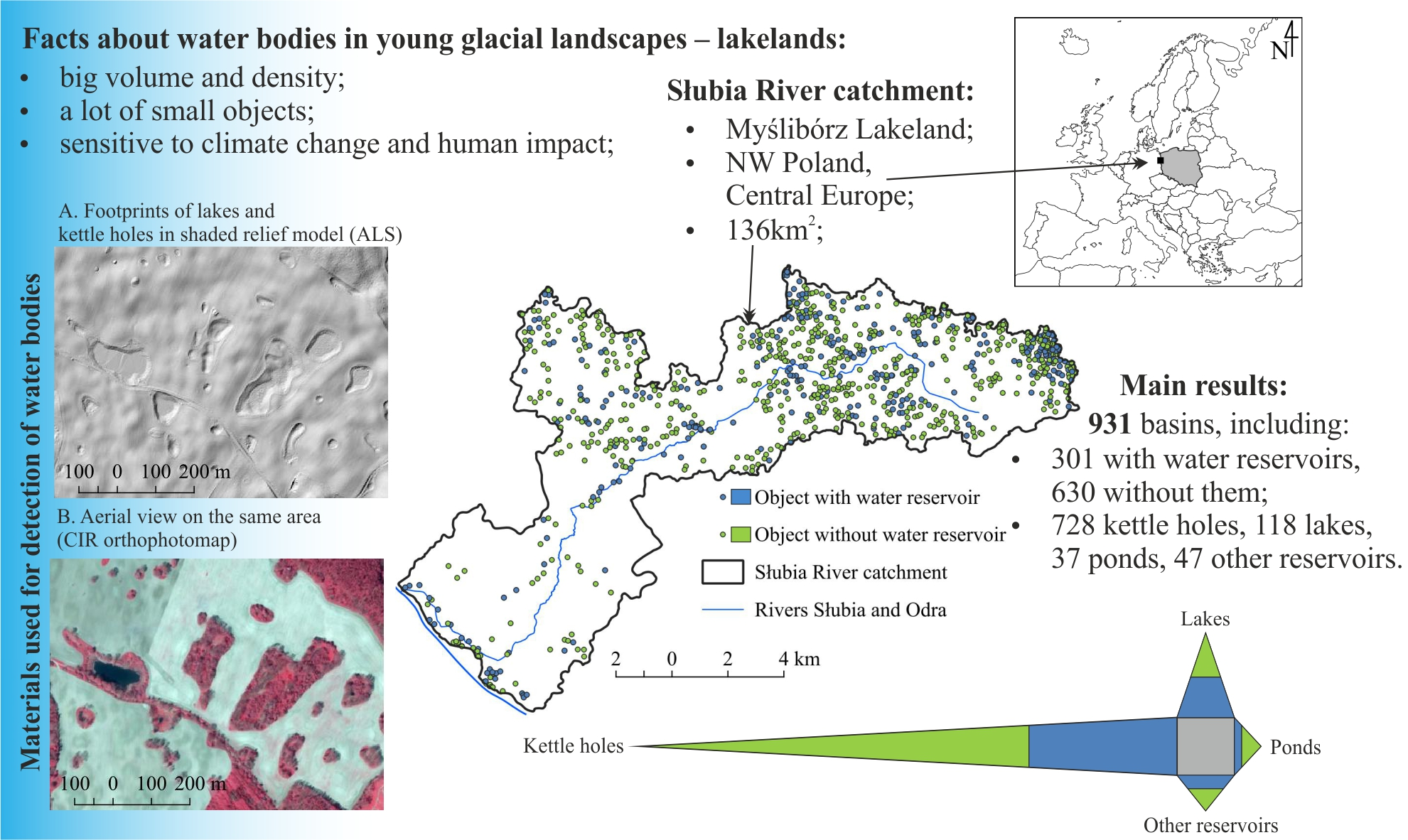
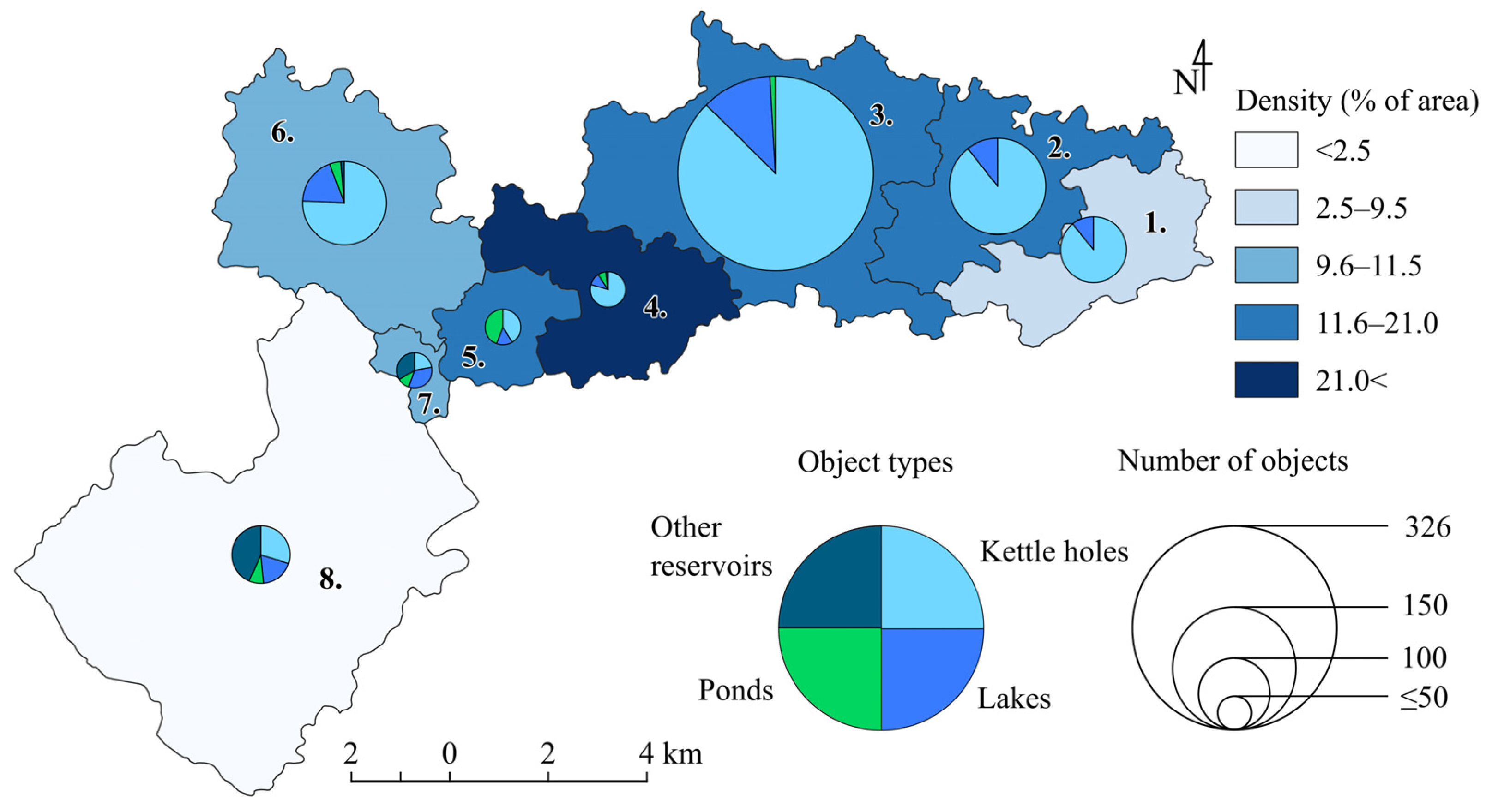
- Determining the number, spatial distribution, and density of water bodies identified in the landscape, with a distinction between kettle holes, lakes, ponds, and other types of reservoirs;
- Determining the number and percentage of basins presently occupied by water bodies;
- An attempt at identifying the reasons for the decline of water bodies, including an interpretation of the surface relief, and lithogeochemical analysis, along with a classification of bottom deposits sampled in selected kettle holes.
2. Materials and Methods
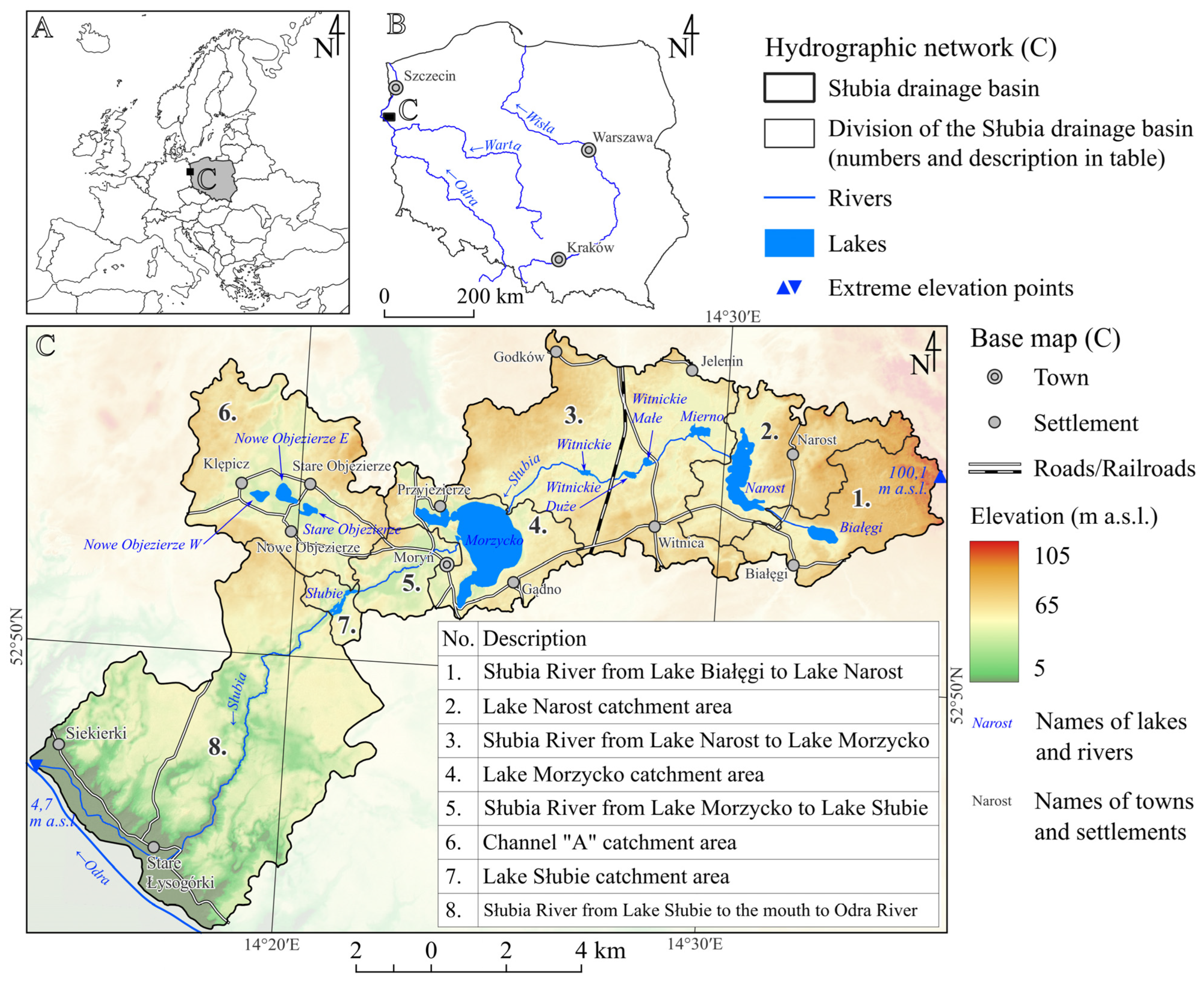
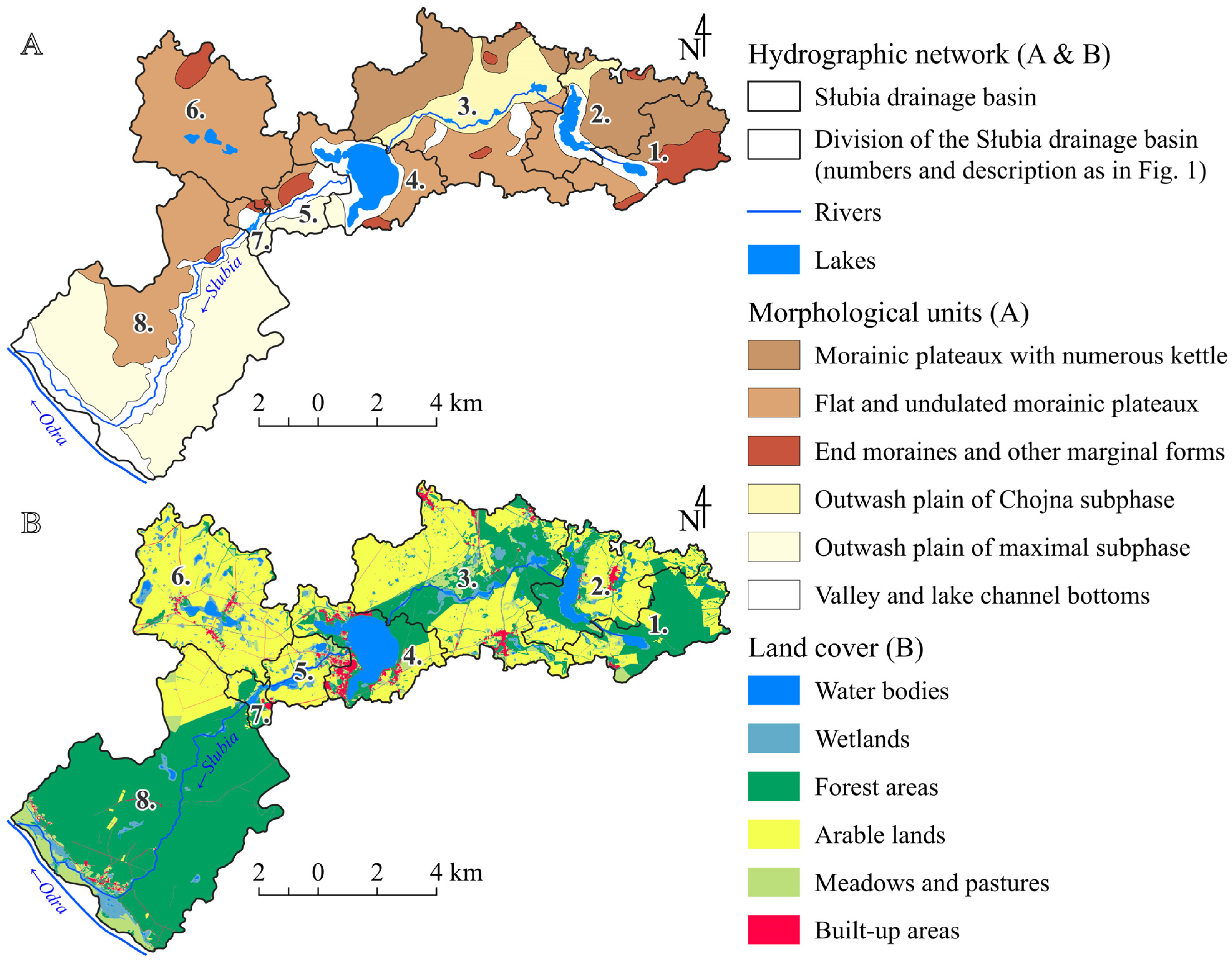
2.1. Study Area
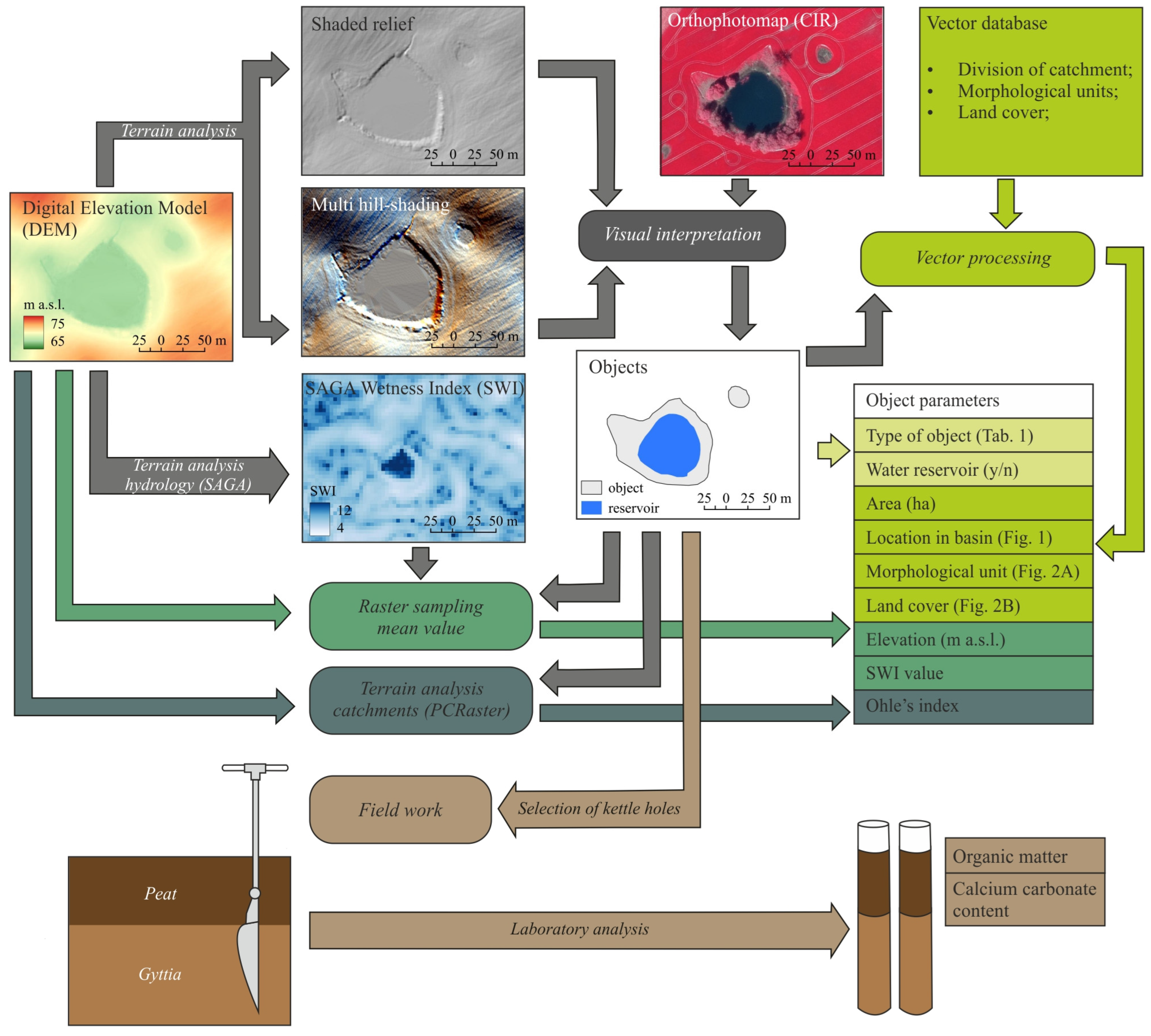
2.2. GIS Data Sources and Database Construction
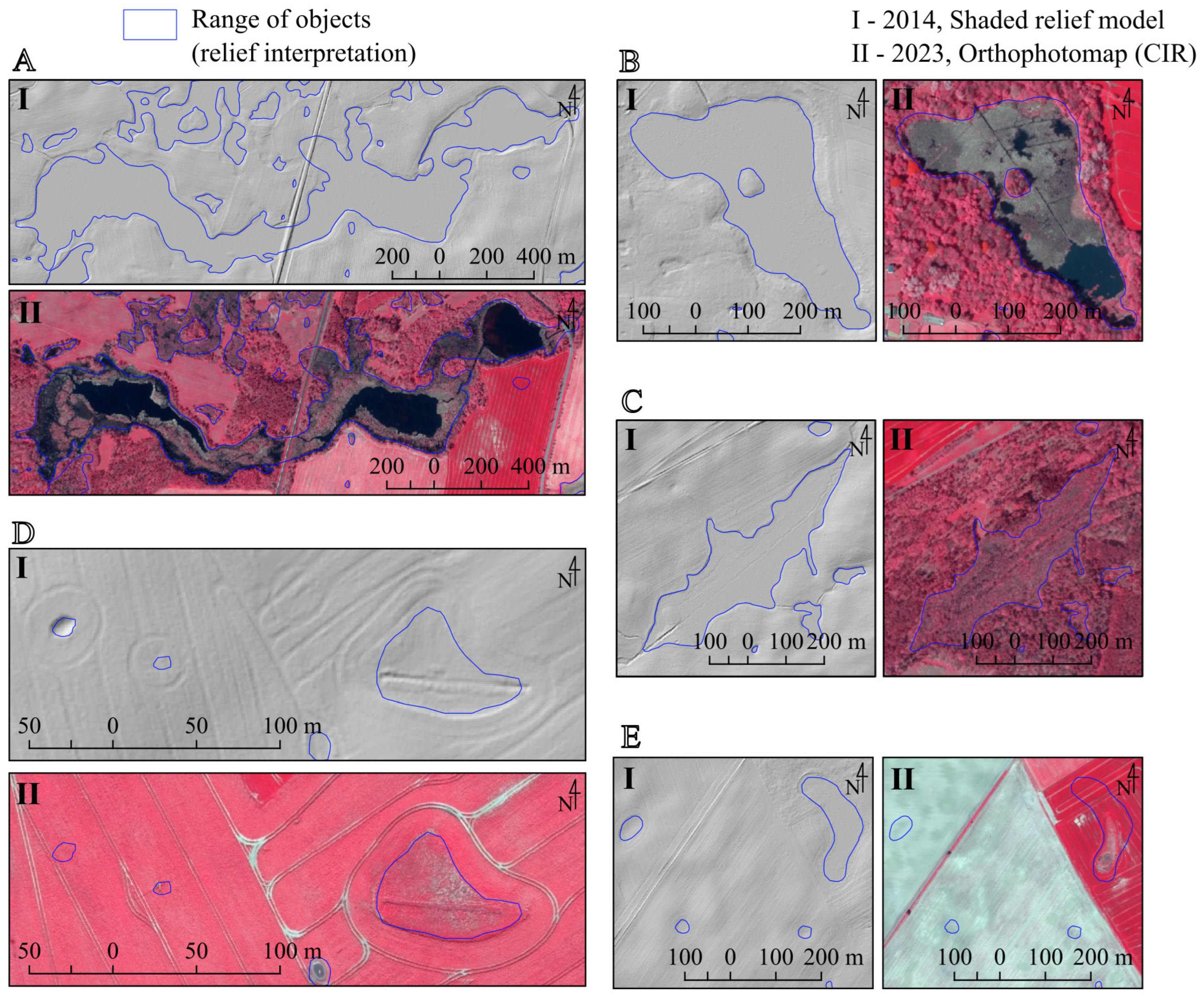
- Digital Elevation Model resulting from airborne laser scanning. The model originated from the ISOK project (pol. Informatyczny System Osłony Kraju przed nadzwyczajnymi zagrożeniami—IT System of State Protection against natural hazards). It is based on elevation data from the ISOK project Standard I, where the measurement point density equaled 4–6 pts per m2, and measurement accuracy equaled 0.2 m. For our study area, the data were generated in 2014. The spatial resolution of this dataset equals 1 × 1 m.
- Aerial orthophotomap made in 2023 using the Color Infrared (CIR) technique, with a spatial resolution of 0.25 × 0.25 m.
2.3. Field Work and Laboratory Analyses
3. Results
3.1. The Ohle Index Distribution
3.2. Kettle Holes
3.3. Lakes
3.4. Ponds
3.5. Other Reservoirs
3.6. Lithology and Key Geochemical Features of Bottom Sediments
4. Discussion
4.1. Assessment of the Object Inventory Method
4.2. Reasons for Spatial Variability in Morphometric Parameters and the Condition of Water Bodies
4.3. Reasons for Spatial Lithogeochemical Variability in Sediments Infilling Lakes and Kettle Holes
5. Conclusions
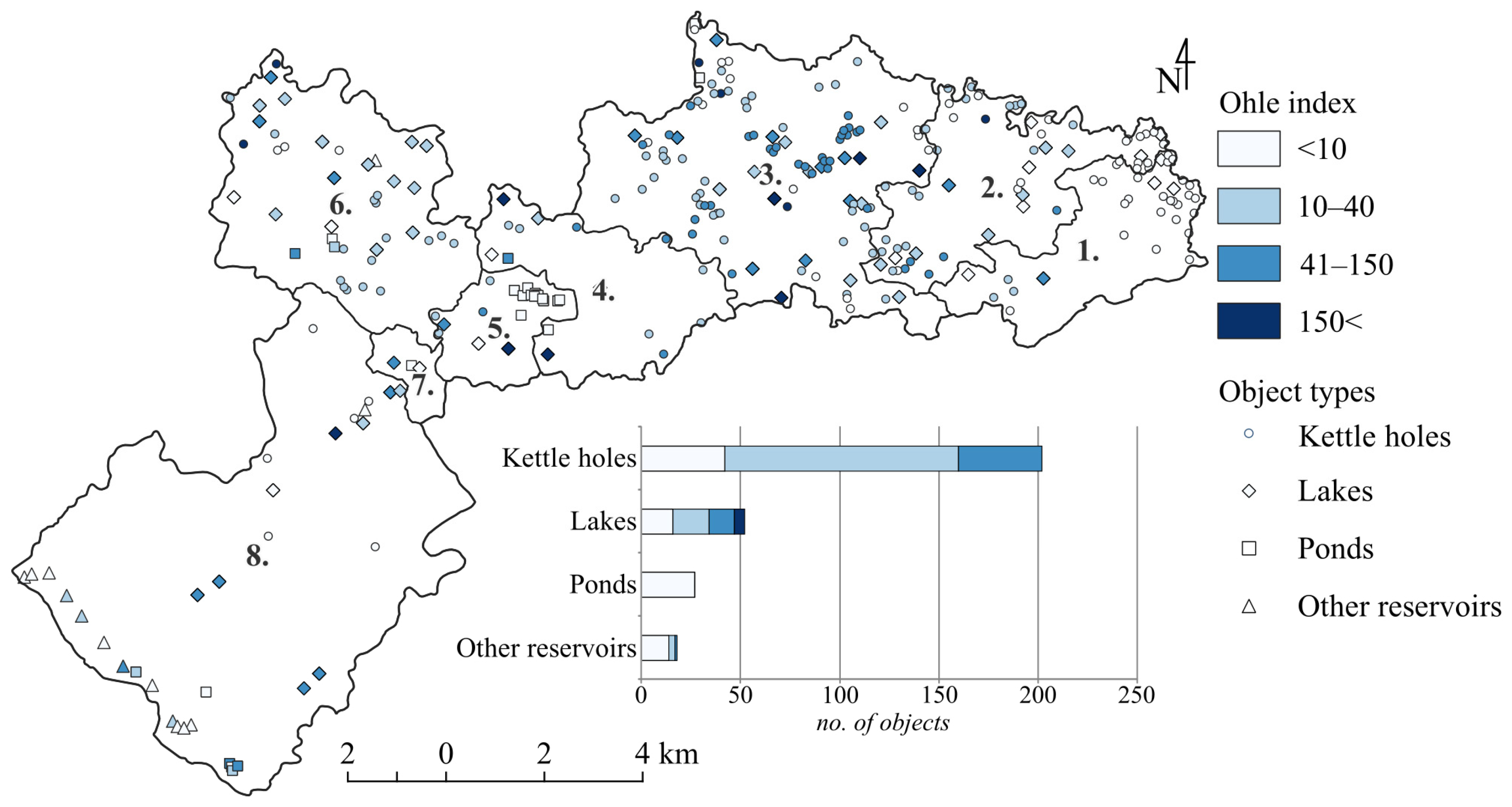
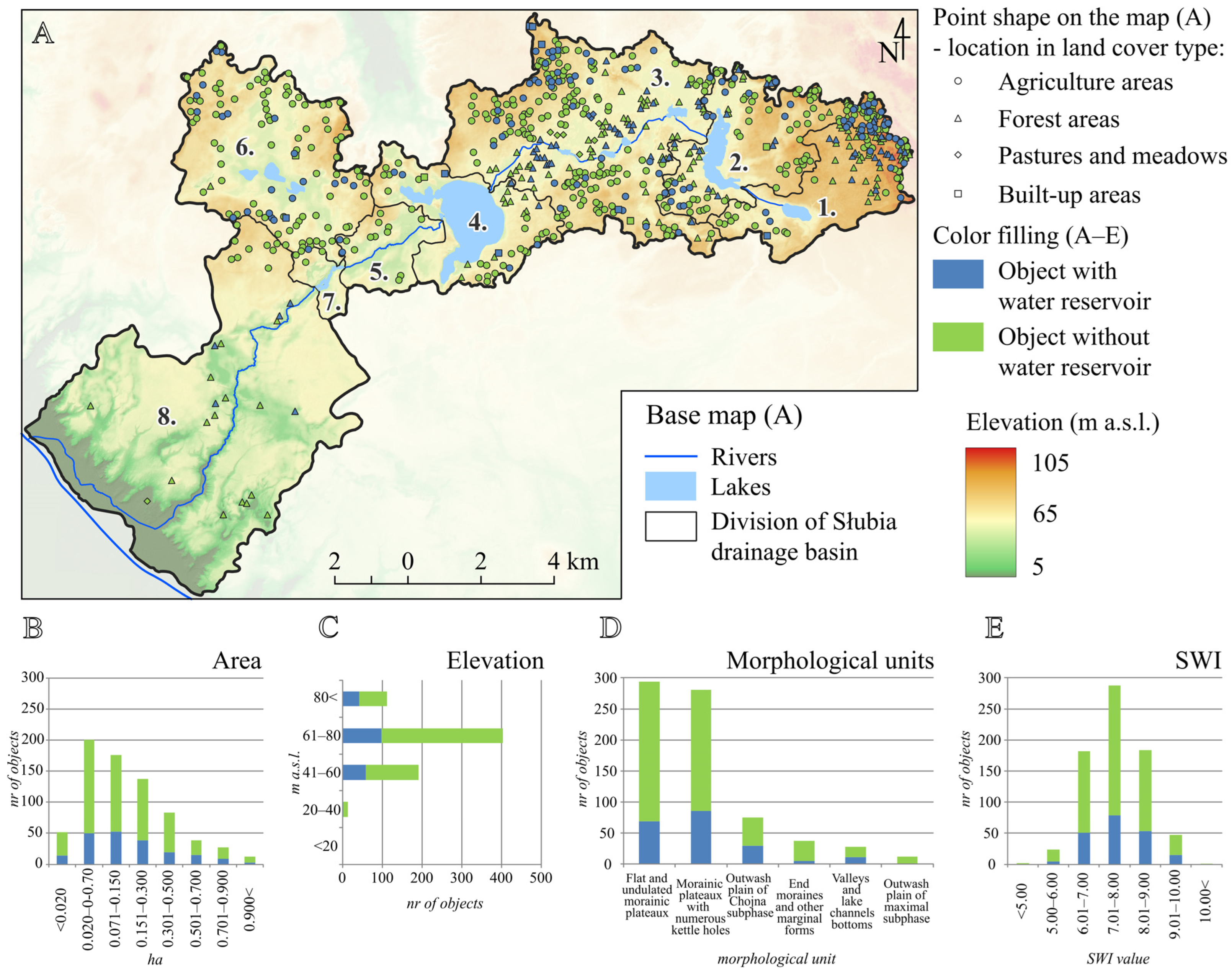
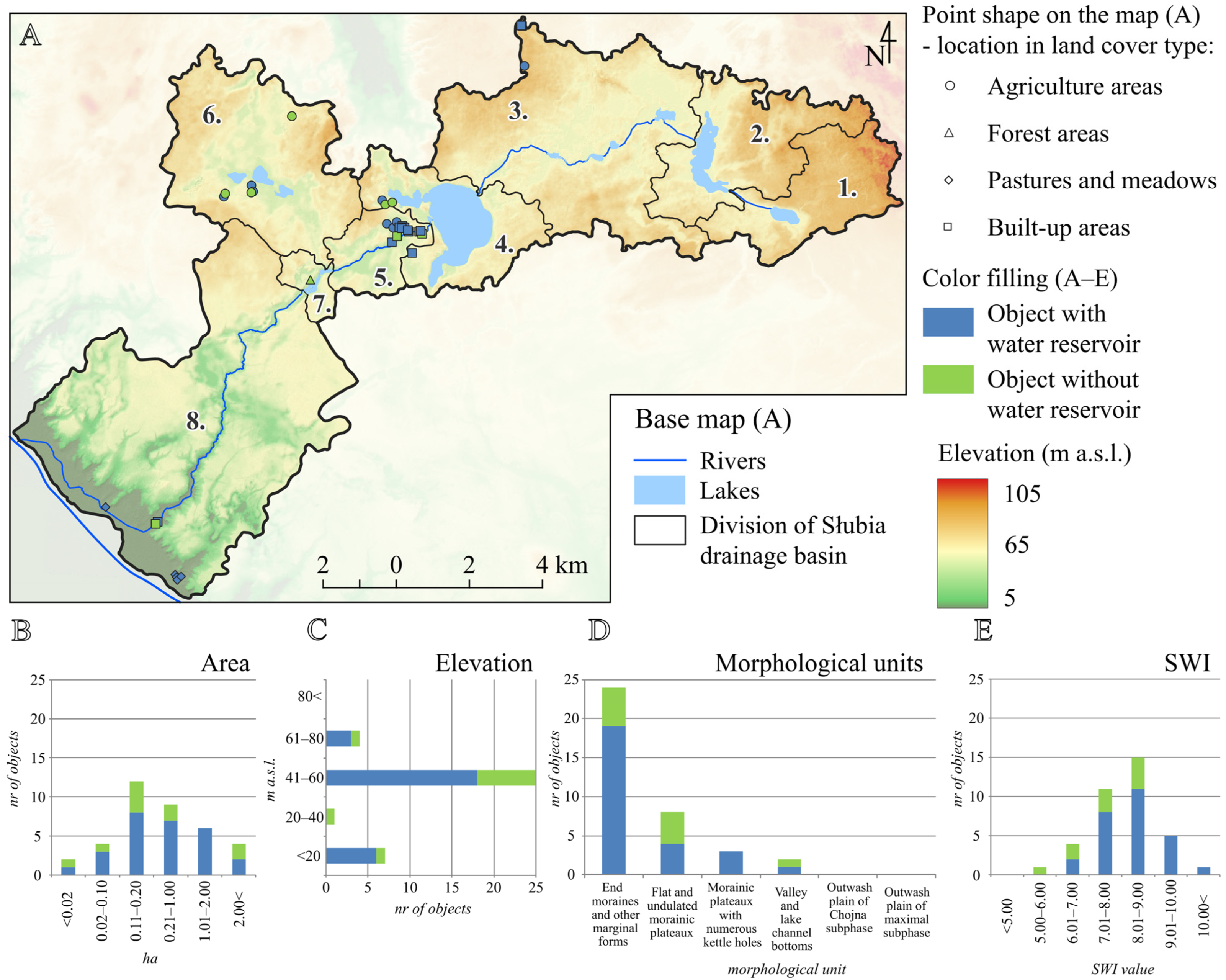
- Number-wise, kettle holes occupying small surface areas are the dominant basin type in the studied catchment. These also yielded the highest rate of water body decline (72.3% of objects devoid of water bodies). Kettle holes were frequently located close to watershed zones and displayed low values of indices for moisture concentration (SWI) and basin resistance (Ohle index).
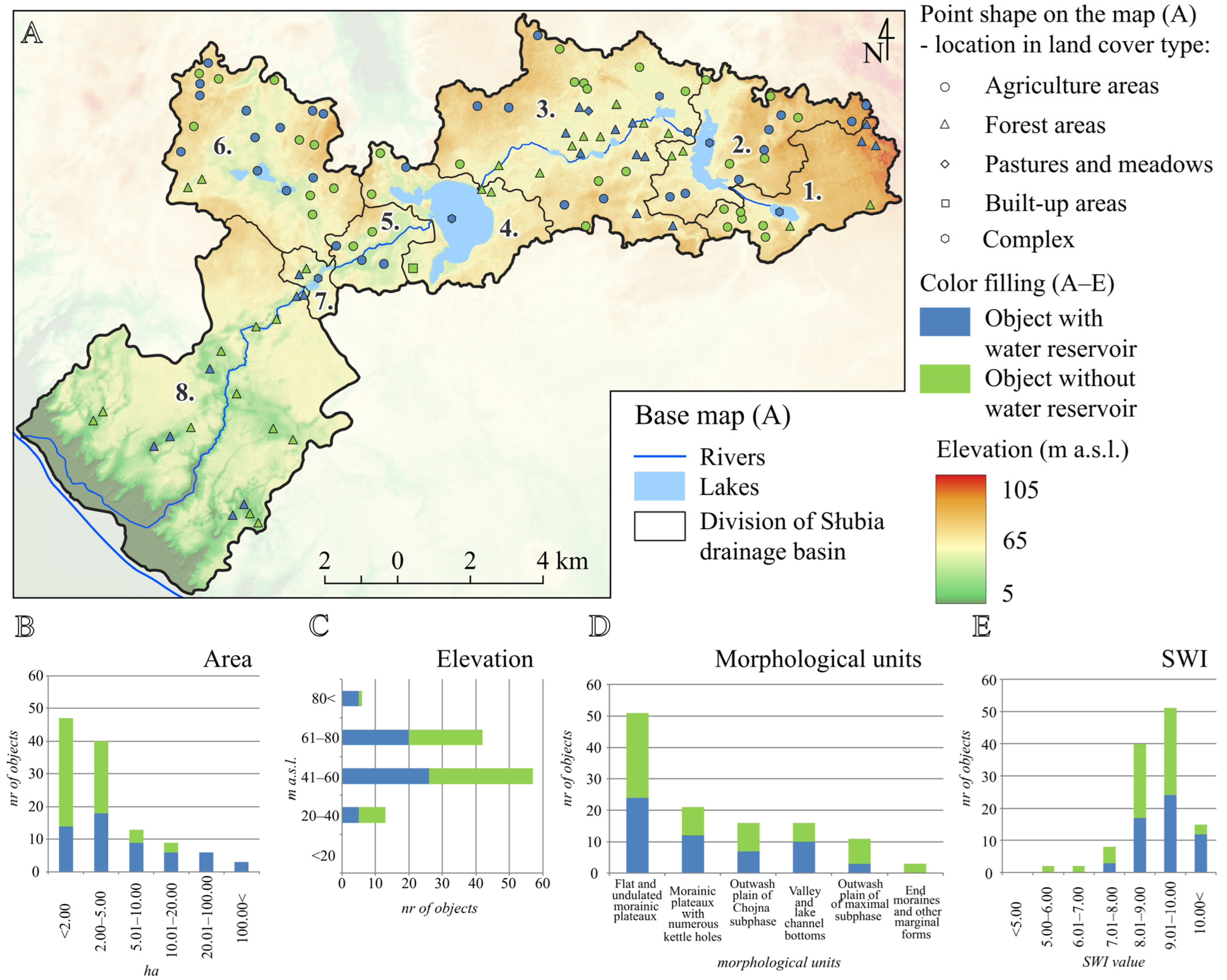
- A large number of lakes were identified (188), with their preservation degree estimated at 44%. We also observed a considerable difference between the size of the present-day water body and the extent of the basin visible in the terrain model.
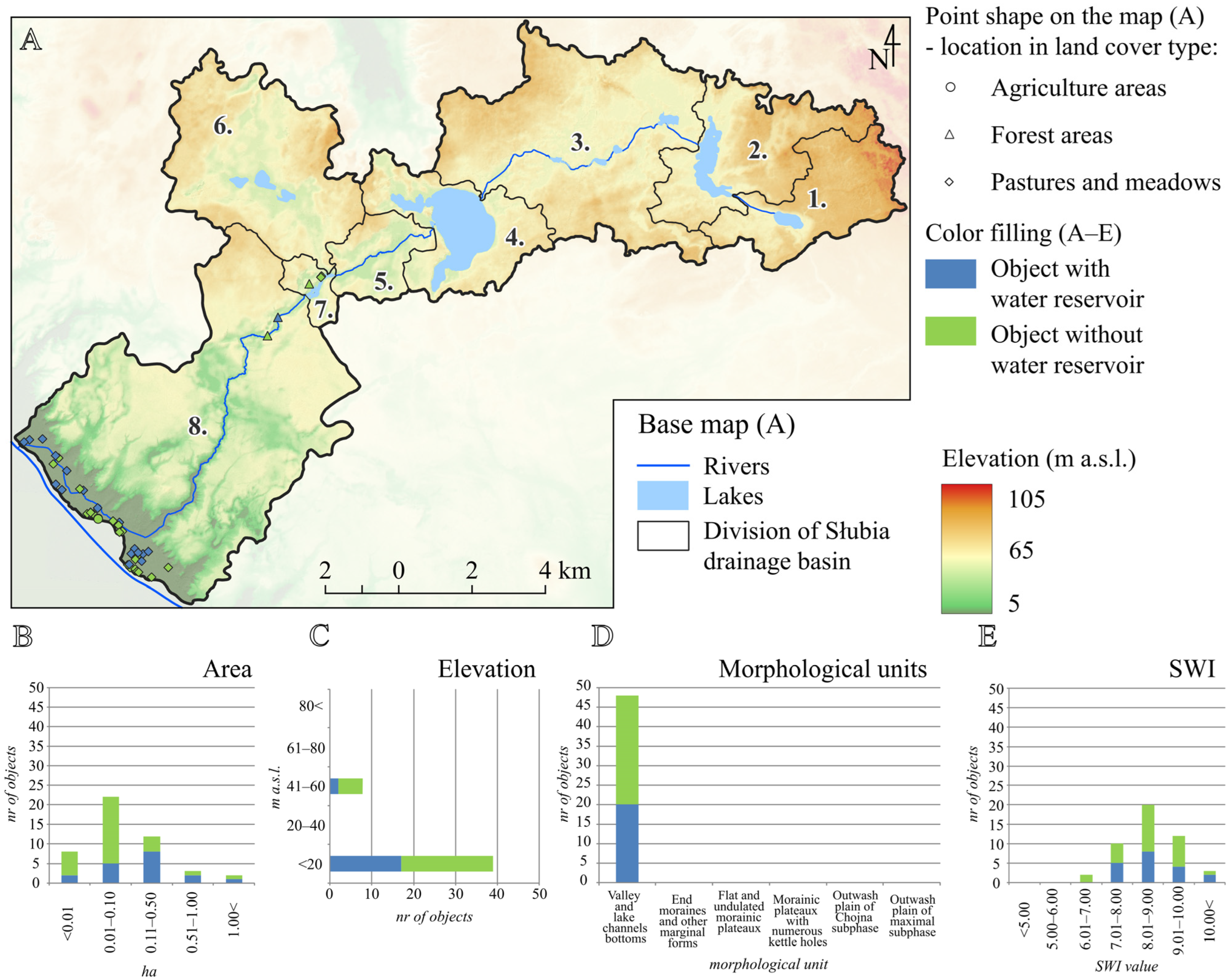
- Basin decline and desiccation are due not only to changing climatic and hydrologic conditions, but also to human impact. This is especially striking in the case of kettle holes located on arable land, despite the significant part they play in ecology and landscape, and despite the benefits their presence brings to the adjacent farmlands.
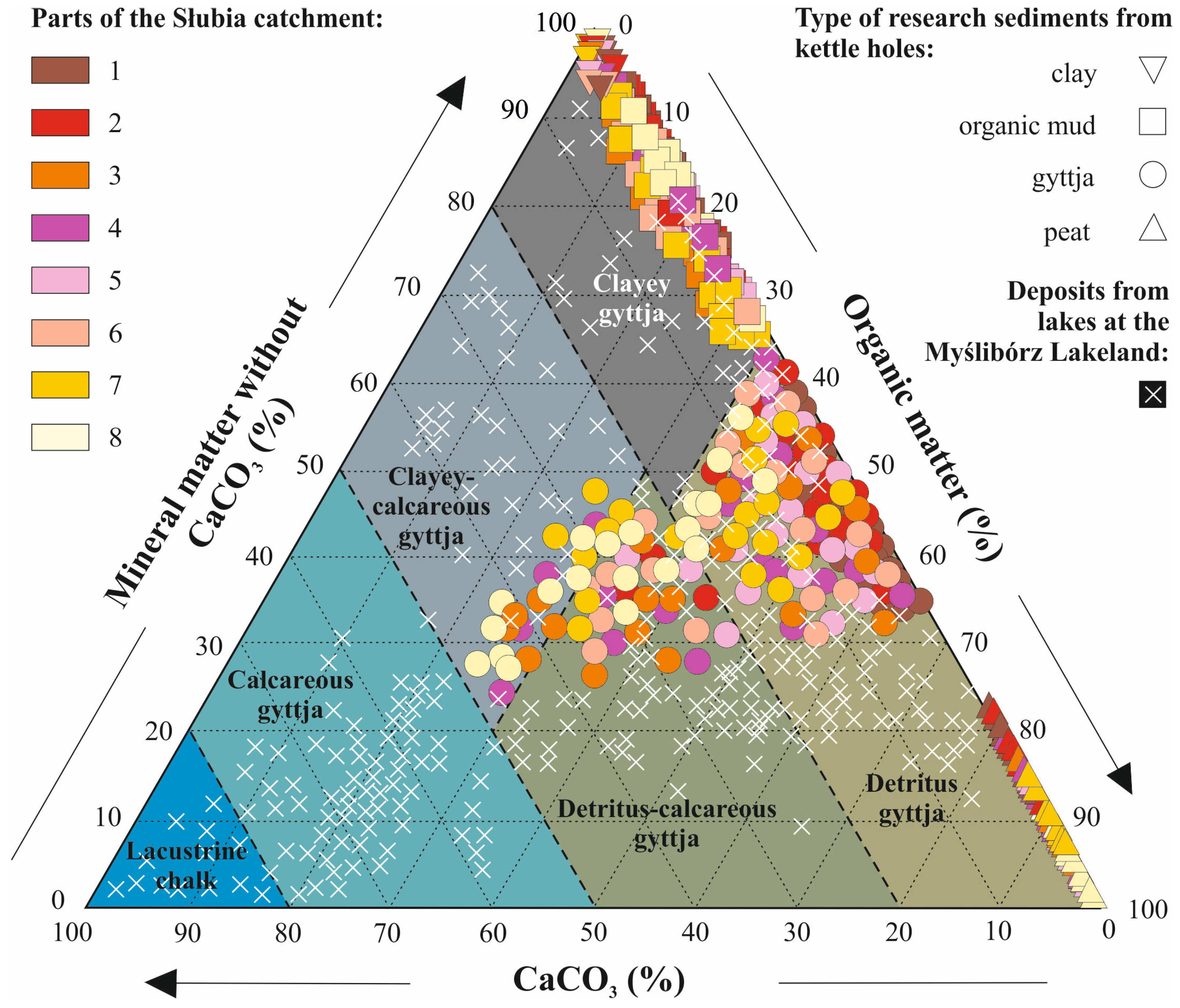
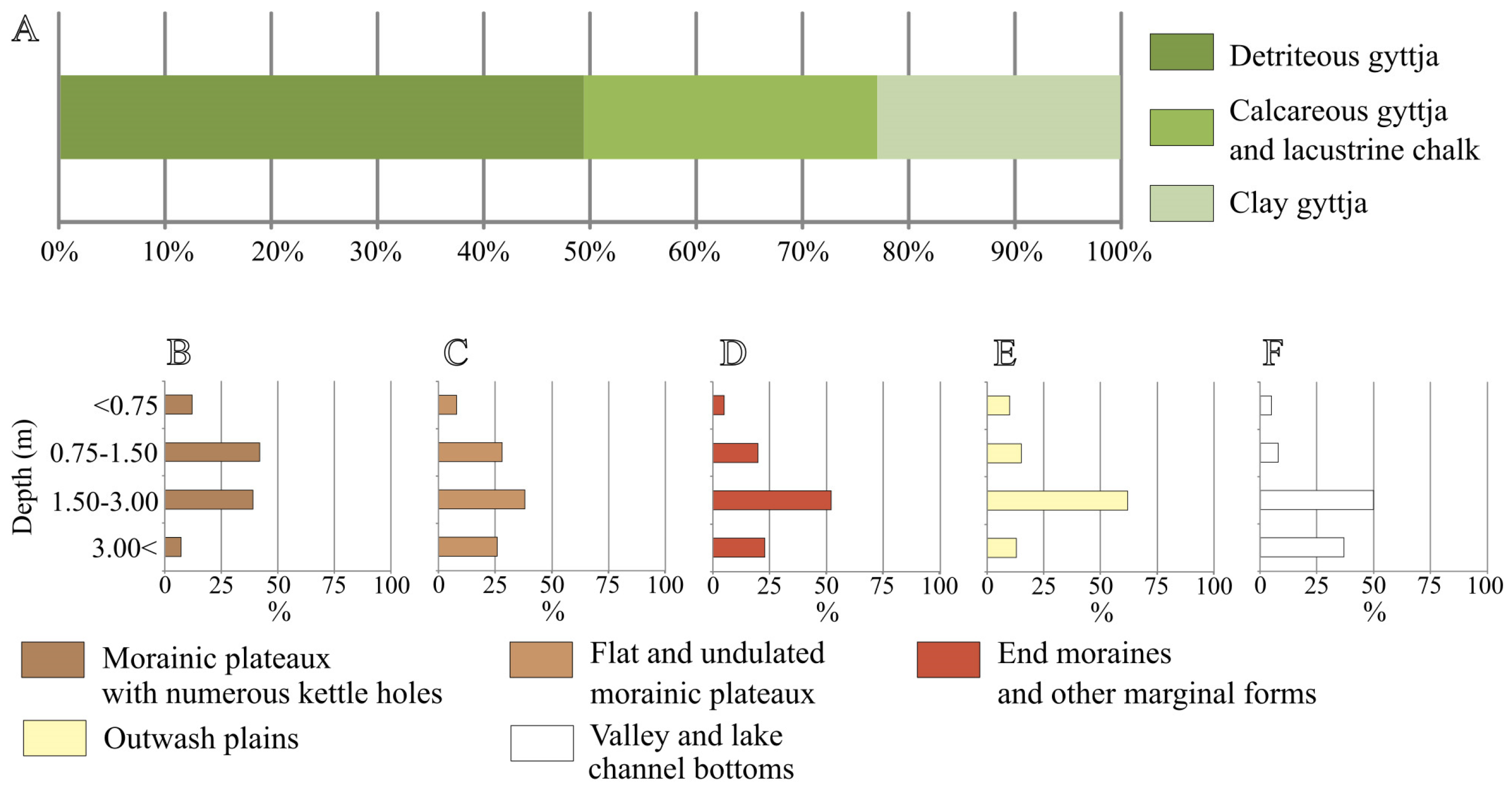
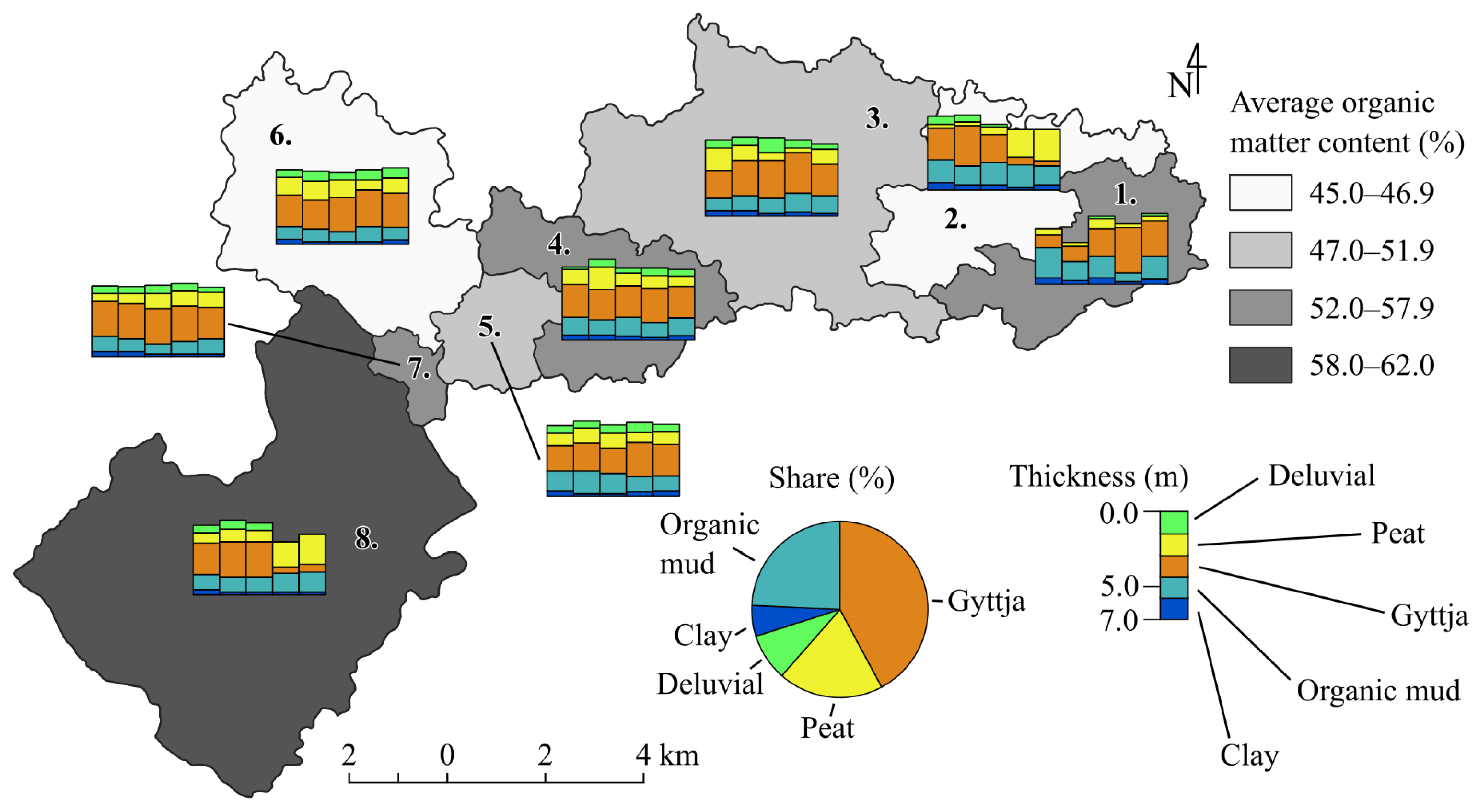
- Land cover structure in the catchment is a significant factor shaping the character of bottom sediments and the supply of matter to the studied water bodies. The most favorable conditions for highly organic sediment accumulation occur in basins located in the forests, while the least favorable conditions are observed where arable land prevails. Consequently, the organic matter content in sediments of the selected water bodies ranges from low to medium (20–75%), correlative to a medium to highly silt-rich sediment group. From the perspective of contemporary sediment-forming processes in the documented sedimentary basins, the most favorable conditions exist in the catchments of the upper and medium course of the Słubia River valley. In both cases, the future functioning of the water bodies will depend on hydroclimatic conditions, including fluctuations of the groundwater level.
- Despite the strong human impact on water bodies of the Słubia River catchment, limnic sediments display a low enrichment in most elements relative to the local geochemical background, and a >10% higher organic matter content compared to kettle holes.
Author Contributions
Funding
Data Availability Statement
Acknowledgments
Conflicts of Interest
Abbreviations
| ALS | Airborne Laser Scanning |
| CIR | Color Infrared |
| DEM | Digital Elevation Model |
| DTM | Digital Terrain Model |
| GUGiK | pol. Główny Urząd Geodezji i Kartografii (Polish Office of Geodesy and Cartography) |
| ISOK | pol. Informatyczny System Osłony Kraju (IT System of State Protection against natural hazards) |
| TWI | Topographic Wetness Index |
| SWI/ SAGA WI | [System for Automated Geoscientific Analyses] Wetness Index |
References
- Bajkiewicz-Grabowska, E. Struktura fizycznogeograficzna zlewni jako podstawa oceny dostawy materii biogennej do jezior. Pr. I Stud. Geogr. 1985, 7, 65–89. [Google Scholar]
- Vasić, F.; Paul, C.; Strauss, V.; Helming, P. Ecosystem services of kettle holes in agricultural landscapes. Agronomy 2020, 10, 1326. [Google Scholar] [CrossRef]
- Choiński, A.; Skowron, R. Zmiany powierzchni i zarastanie jezior w Polsce. Badania Fizjogr. Ser. A—Geogr. Fiz. 2021, A72, 125–140. [Google Scholar] [CrossRef]
- Yao, F.; Livneh, B.; Rajagopalan, B.; Wang, J.; Crétaux, J.-F.; Wada, Y.; Berge-Nguyen, M. Satellites reveal widespread decline in global lake water storage. Science 2023, 380, 743–749. [Google Scholar] [CrossRef]
- Willcock, S.; Cooper, G.S.; Addy, J.; Dearing, J.A. Earlier collapse of Anthropocene ecosystems driven by multiple faster and noiser drivers. Nat. Sustain. 2023, 6, 1331–1342. [Google Scholar] [CrossRef]
- Mikulski, Z. Kształtowanie się bilansu wodnego jezior w Polsce. Przegląd Geogr. 1970, 42, 433–447. [Google Scholar]
- Bajkiewicz-Grabowska, E. Ocena naturalnej podatności jezior na degradację i rola zlewni w tym procesie. Wiadomości Ekol. 1987, 33, 279–289. [Google Scholar]
- Dawidek, J.; Ferencz, B. Water renewal time in lakes with transformed water distribution in the catchment areas. Water 2024, 16, 384. [Google Scholar] [CrossRef]
- Bajkiewicz-Grabowska, E. Obieg Materii w Systemach Rzeczno-Jeziornych; Warsaw University: Warsaw, Poland, 2002; p. 247. [Google Scholar]
- Major, M.; Pietruszyński, Ł.; Cieśliński, R. Zróżnicowanie przestrzenne wybranych składników biogennych w śródpolnych oczkach w Polsce Północnej. Przegląd Geogr. 2021, 93, 59–81. [Google Scholar] [CrossRef]
- Kowalczewska-Madura, K.; Dondajewska-Pielka, R.; Gołdyn, R. The assessment of external and internal nutrient loading as a basis for Lake management. Water 2022, 14, 2844. [Google Scholar] [CrossRef]
- Kowalewski, G. Alogeniczne i Autogeniczne Składowe Zarastania Jezior: Hipoteza Wahań Poziomu Wody; Studia Limnologica et Telmatologica—Monographiae I; Bogucki Wyd. Naukowe: Poznań, Poland, 2014; p. 197. [Google Scholar]
- Pasławski, Z. Typologia hydrologiczna jezior Pojezierza Wielkopolskiego. Przegląd Geofiz. 1975, 4, 55–75. [Google Scholar]
- Mauersberger, R. Hydrologische Seentypen und ihre Kennzeichnung am Beispiel der Seenlandschaften Nordostdeutschlands. Greifswald Geogr. Arb. 2002, 26, 227–231. [Google Scholar]
- Ohle, W. Nährstoffanreicherung der Gewässer durch Düngemittel und Meliorationen. München Beitr. 1965, 12, 54–83. [Google Scholar]
- Sojka, M.; Choiński, A.; Ptak, M.; Siepak, M. The variabilitiy of lake water chemistry in the Bory Tucholskie National Park (Northern Poland). Water 2020, 12, 394. [Google Scholar] [CrossRef]
- Zwoliński, Z. Geomorficzne Dostosowywanie Się Koryta Parsęty Do Aktualnego Reżimu Rzecznego; Dokumentacja Geograficzna; IGiPZ PAN: Warsaw, Poland, 1989; p. 144. [Google Scholar]
- Cedro, B. Kształtowanie się krajobrazu dolinnego w obszarze młodoglacjalnym na przykładzie doliny Regi w okolicy Łobza. Pr. Kom. Kraj. Kult. PTG 2007, 7, 202–210. [Google Scholar]
- Siedlik, K.; Borówka, R.K. Zmiany Poziomu Wody Jezior Doliny Środkowej Płoni w Czasach Historycznych ze Szczególnym Uwzględnieniem Jeziora Miedwie; Rozprawy i Studia—Uniwersytet Szczeciński: Szczecin, Poland, 2019; Volume 1086, p. 206. [Google Scholar]
- Karasiewicz, T.M. The kettle-hole mire as archives of postglacial changes in Biegonic sedimentation (Tuchola Forest, north-central Poland). Catena 2019, 176, 26–44. [Google Scholar] [CrossRef]
- Okupny, D.; Borówka, R.K.; Cedro, B.; Sławińska, J.; Tomkowiak, J.; Michczyński, A.; Kozłowska, D.; Kowalski, K.; Siedlik, K. Geochemistry of a sedimentary section at the Wąwelnica archaeological site, Szczecin Hills (Western Pomerania). Acta Geogr. Lodz. 2020, 110, 169–186. [Google Scholar] [CrossRef]
- Latałowa, M. Zmiany hydrologiczne wywołane przez czynnik klimatyczny i działalność człowieka zapisane w torfowisku Kołczewo i osadach dennych Jeziora Raczego. In Ewolucja Geosystemów Nadmorskich Południowego Bałtyku; Borówka, R.K., Młynarczyk, Z., Wojciechowski, A., Eds.; Bogucki Wydawnictwo Naukowe: Poznań-Szczecin, Poland, 1999; pp. 99–103. [Google Scholar]
- Pieńkowski, P.; Podlasiński, M. Podział i geneza oczek wodnych na przykładzie wybranych obiektów w strefie moreny czołowej Pomorza Zachodniego. Folia Univ. Agric. Stetin. 2001, 221, 223–230. [Google Scholar]
- Błaszkiewicz, M. Późnoglacjalna i Wczesnoholoceńska Ewolucja Obniżeń Jeziornych Na Pojezierzu Kociewskim (Wchodnia Część Pomorza); Prace Geograficzne; IGiPZ PAN: Warsaw, Poland, 2005; Volume 201, p. 192. [Google Scholar]
- Pędziszewska, A.; Tylmann, W.; Witak, M.; Piotrowska, N.; Maciejewska, E.; Latałowa, M. Holocene environmental changes reflected by pollen, diatoms and geochemistry of annually laminated sediments of Lake Suminko in the Kashubian Lake District (N Poland). Rev. Palaeobot. Palynol. 2015, 216, 55–75. [Google Scholar] [CrossRef]
- Kruczkowska, B. The use of kettle holes for reconstructing former soil cover in different types of land use. Geogr. Pol. 2016, 89, 323–343. [Google Scholar] [CrossRef]
- Pleskot, K.; Tjallingii, R.; Makohonienko, M.; Nowaczyk, N.; Szczuciński, W. Holocene paleohydrological renconstruction of Lake Strzeszyńskie (Western Poland) and its implications for the central European climatic transition zone. J. Paleolimnol. 2018, 59, 443–459. [Google Scholar] [CrossRef]
- Pleskot, K.; Apolinarska, K.; Kołaczek, P.; Suchora, M.; Fojutowski, M.; Joniak, T.; Kotrys, B.; Kramkowski, M.; Słowiński, M.; Woźniak, M.; et al. Searching for the 4.2ka climate event at Lake Spore, Poland. Catena 2020, 191, 104565. [Google Scholar] [CrossRef]
- Korzeniowski, A.; Okupny, D.; Michczyński, A.; Sławińska, J.; Borówka, R.K. Lithology and geochemistry of the late glacial and Holocene sediments from Gostyń Lake (Western Pomerania, Myślibórz Lakeland). Acta Geogr. Lodz. 2020, 110, 149–168. [Google Scholar] [CrossRef]
- Kramkowski, M. Paleośrodowiskowe znaczenie zmian tempa i charakteru sedymentacji osadów jeziora Jelonek w Borach Tucholskich. Przegląd Geogr. 2020, 92, 409–422. [Google Scholar] [CrossRef]
- Okupny, D.; Antczak-Orlewska, O.; Pawłowski, D.; Borówka, R.K.; Sławińska, J.; Tomkowiak, J.; Osóch, P.; Bartczak, A.; Nierychlewska, A.; Osóch, B.; et al. How well multiindicator palaeo-environmental studiem meet the needs of research on settlements, on the example of the Elary mediewal settlement complex in Szczecin: Methodological proglems and evaluating interpretation value. Acta Geogr. Lodz. 2022, 112, 97–121. [Google Scholar] [CrossRef]
- Bonk, A.; Piotrowska, N.; Żarczyński, M.; Enters, D.; Makohonienko, M.; Rzodkiewicz, M.; Tylmann, W. Limnological responses to environmental changes during the last 3,000 years revealed from a varved sequence of Lake Lubińskie (Western Poland). Catena 2023, 226, 107053. [Google Scholar] [CrossRef]
- Czerniak, L.; Pędziszewska, A.; Święta-Musznicka, J.; Goslar, T.; Matuszewska, A.; Niska, M.; Podlasiński, M.; Tylmann, W. The Neolithic ceremonial centre at Nowe Objezierze (NW Poland) and its biography from the perspective of the palynological record. J. Anthropol. Archaeol. 2023, 72, 101551. [Google Scholar] [CrossRef]
- Makohonienko, M.; Płóciennik, M.; Papiernik, P.; Kittel, P.; Gałka, M.; Mroczkowska, A.; Apolinarska, K.; Okupny, D.; Panfil, M.; Kotrys, B.; et al. Environmental changes during Mesolithic-Neolithic transition in Kuyavia Lakeland, Central Poland. Quat. Int. 2023, 644–645, 196–221. [Google Scholar] [CrossRef]
- Choiński, A.; Kijowski, A. Fotolimnologia. Wydawnictwo Naukowe UAM: Poznań, Poland, 2015; p. 134. [Google Scholar]
- Adamek, A.; Mareczka, P.; Jucha, W.; Musielak, S.; Okupny, D. Geochemical analyses of recent sediments from Lake Morzycko against selected physiographic parameters of the Słubia River catchment (Western Poland). Acta Geogr. Lodz. 2021, 111, 71–87. [Google Scholar] [CrossRef]
- Juśkiewicz, W.; Gierszewski, P. Toxic metal pollution of aquatic ecosystems of European Union nature protection areas in a region of intensive agriculture (Lake Gopło, Poland). Aquat. Sci. 2022, 84, 52. [Google Scholar] [CrossRef]
- Gudowicz, J.; Zwoliński, Z. Kształtowanie się odpływu rzecznego w dorzeczu Parsęty w świetle modelowania hydrologicznego. Przegląd Geogr. 2017, 89, 45–66. [Google Scholar] [CrossRef]
- Franczak, P.; Jucha, W.; Marszałek, A. Przydatność numerycznych modeli terenu wygenerowanych z chmury punktów ALS (ISOK) w interpretacji wybranych elementów koryta cieku—Analiza na przykładzie Sopotni Wielkiej. Pr. Stud. Koła Nauk. Geogr. Uniw. Pedagog. W Krakowie 2017, 5, 30–58. [Google Scholar]
- Kunz, M.; Skowron, R.; Skowroński, S.z. Morphometry changes of Lake Ostrowskie (the Gniezno Lakeland) on the basis of cartographic, remote sensing and geodetic surveying. Limnol. Rev. 2010, 10, 77–85. [Google Scholar] [CrossRef]
- Pieńkowski, P. Analiza rozmieszczenia oczek wodnych oraz zmian w ich występowaniu na obszarze Polski Północno-Zachodniej. Zesz. Nauk. AR Szczec. 2003, 222, 122. [Google Scholar]
- Kochanowska, R.; Pieńkowski, P.; Wołejko, L. Characteristics of intrafield water holes in Western Pomerania in relation to differentiation of the young-glacial landscape and human impact. J. Water Land Dev. 1998, 2, 85–101. [Google Scholar]
- Marszelewski, W.; Podgórski, Z. Zmiany ilościowe oczek i jezior na Pojezierzu Chełmińskim w świetle materiałów kartograficznych z XIX i XX wieku. Przegląd Geogr. 2004, 76, 33–50. [Google Scholar]
- Pieńkowski, P. Wpływ użytkowania terenu na transformację krajobrazu w obrębie unikatowego kompleksu oczek wodnych na Pojezierzu Myśliborskim. Pr. Kom. Kraj. Kult. 2021, 45, 51–68. [Google Scholar] [CrossRef]
- Downing, J.A. Emerging global role of small lakes and ponds: Little things mean a lot. Limnetica 2010, 29, 9–24. [Google Scholar] [CrossRef]
- Karpińska-Kołaczek, M.; Kołaczek, P.; Marcisz, K.; Gałka, M.; Kajukało-Drygalska, K.; Mauquoy, D.; Lamentowicz, M. Kettle-hole peatlands as carbon hot spots: Unveiling controls of carbon accumulation rates during the last two millennia. Catena 2024, 237, 107764. [Google Scholar] [CrossRef]
- Golus, W.; Bajkiewicz-Grabowska, E. Water circulation in the moraine ponds of Northern Poland. Hydrobiologia 2017, 793, 55–65. [Google Scholar] [CrossRef]
- Kaźmierczak, E. The vegetation of kettle holes in central Poland. Acta Phytogeogr. Suec. 1997, 83, 97. [Google Scholar]
- Bosiacka, B.; Pieńkowski, P. Analiza przekształceń oczek wodnych oraz ocean walorów przyrodniczych śródpolnych zbiorników w centralnej części Równiny Nowogardzkiej. Woda-Sr.—Obsz. Wiej. 2004, 4, 335–349. [Google Scholar]
- Major, M. Możliwości zastosowania teorii funkcjonowania geoekosyst emu do badań obszarów bezodpływowych. Przegląd Geogr. 2010, 82, 103–113. [Google Scholar]
- Gerke, H.H.; Koszinski, S.; Kalettka, T.; Sommer, M. Structures and hydrologic funkcjon of soil landscapes with kettle holes using an integrated hydropedological approach. J. Hydrol. 2010, 393, 123–132. [Google Scholar] [CrossRef]
- Starkel, L. Odrębność zapisu holoceńskich zmian klimatu w dolinach Niżu Polskiego. Bot. Guideb. 2008, 30, 169–182. [Google Scholar]
- Gilewska, S. Podział Polski na jednostki geomorfologiczne. Przegląd Geogr. 1986, 58, 15–40. [Google Scholar]
- Pisarska-Jamroży, M. Zonation of glaciomarginal environment inferred from Pleistocene deposits of Myślibórz Lakeland, NW Poland. Geogr. Ann. Ser. A Phys. Geogr. 2008, 90, 237–249. [Google Scholar] [CrossRef]
- Karczewski, A. Wpływ recesji lobu Odry na powstanie i rozwój sieci dolinnej Pojezierza Myśliborskiego i Niziny Szczecińskiej. Pr. Kom. Geogr.—Geol. PTPN 1968, 8, 106. [Google Scholar]
- Jasnowski, M. Budowa i roślinność torfowisk Pomorza Zachodniego. Pr. Szczecińskiego Tow. Nauk. 1962, 10, 340. [Google Scholar]
- Żurek, S. Geosystemy bagienne strefy przybałtyckiej. In Ewolucja Geosystemów Nadmorskich Południowego Bałtyku; Borówka, R.K., Młynarczyk, Z., Wojciechowski, A., Eds.; Bogucki Wydawnictwo Naukowe: Poznań-Szczecin, Poland, 1999; pp. 187–198. [Google Scholar]
- Kochanowska, R.; Rygielski, T. Mokradła w krajobrazie młodoglacjalnym Pomorza Zachodniego. Woda-Sr.—Obsz. Wiej. 2001, 1, 69–82. [Google Scholar]
- Markowski, R. Struktura i właściwości podtorfowych osadów jeziornych rozprzestrzenionych na Pomorzu Zachodnim jako podstawa ich rozpoznawania klasyfikacji. Kreda Jeziorna i Gytie 1980, 2, 44–55. [Google Scholar]
- Jańczak, J.; Choiński, A. Zmiany wahań poziomu wody jezior w latach 1956–1985. In Przemiany Stosunków Wodnych W Polsce W Wyniku Procesów Naturalnych i Antropogenicznych; Dynowska, I., Ed.; Jagiellonian Univ: Kraków, Poland, 1993; pp. 98–107. [Google Scholar]
- Geoportal of Polish Office of Geodesy and Cartography (GUGiK). Available online: http://www.geoportal.gov.pl/ (accessed on 1 July 2025).
- QGIS Project Website. Available online: http://qgis.org/ (accessed on 1 July 2025).
- Beven, K.; Kirkby, N. A physically based variable contributing area model of basin hydrology. Hydrol. Sci. Bull. 1979, 24, 43–69. [Google Scholar] [CrossRef]
- Schmidt, F.; Persson, A. Comparison of DEM Data Capture and Topographic Wetness Indices. Precis. Agric. 2003, 4, 179–192. [Google Scholar] [CrossRef]
- Migoń, P.; Kasprzak, M. Tereny podmokłe na Płaskowyżu Gór Stołowych w świetle parametryzacji powierzchni na podstawie topograficznego indeksu wilgotności (TWI). Stud. Lim. Tel. 2014, 8, 57–68. [Google Scholar]
- Böhner, J.; Selige, T. Spatial prediction of soil attributes using terrain analysis and climate regionalization. In SAGA—Analyses and Modelling Applications; Böhner, J., McCloy, K.R., Strobl, J., Eds.; Göttinger Geographische Abhandlungen; University of Goettingen: Göttingen, Germany, 2006; Volume 115, pp. 13–27. [Google Scholar]
- Bogale, A. Morphometric analysis of a drainage basin using geographical information system in Gilgel Abay watershed, Lake Tana Basin, upper Blue Nile Basin, Ethiopia. Appl. Water Sci. 2021, 11, 122. [Google Scholar] [CrossRef]
- Tobolski, K. Przewodnik do oznaczania torfów i osadów jeziornych. Vadem. Geobot. 2000, 1, 508. [Google Scholar]
- Dean, W.E. Determination of carbonate and organic matter in calcareous sediments and sedimentary rocks by loss on ignition; comparison with other methods. J. Sediment. Res. 1974, 44, 242–248. [Google Scholar] [CrossRef]
- Łachacz, A.; Nitkiewicz, S. Classification of soils developed from bottom lake deposits in north-eastern Poland. Soil Sci. Ann. 2021, 72, 140643. [Google Scholar] [CrossRef]
- Podlasińska, J. Zróżnicowanie I Chemizm Osadów Małych Zbiorników Wodnych W Krajobrazie Młodoglacjalnym; ZUT: Sczecin, Poland, 2012; p. 112. [Google Scholar]
- Bucała-Hrabia, A.; Kijowska-Strugała, M.; Bryndal, T.; Cebulski, J.; Kiszka, K.; Kroczak, R. An integrated approach for investigating geomorphic changes due to flash flooding in two small stream channels (Western Polish Carpathians). J. Hydrol. Reg. Stud. 2020, 31, 100731. [Google Scholar] [CrossRef]
- Jucha, W.; Mareczka, P.; Okupny, D. Assesmment of peat extraction range and vegetation succession on the Baligówka degraded peat bog (Central Europe) using the ALS data and orthophotomap. Remote Sens. 2022, 14, 2817. [Google Scholar] [CrossRef]
- Kroczak, R.; Bryndal, T.; Żychowski, J. Surface drainage systems operating during heavy rainfall—A comparative analysis between two small flysch catchments located in different physiographic regions of the Western Carpathians (Poland). Water 2022, 14, 482. [Google Scholar] [CrossRef]
- Jucha, W.; Mareczka, P.; Okupny, D. Using remote sensing materials to assess the effects of peat extraction on the morphology and vegetation cover of a raised bog (Ludźmierz near Nowy Targ, Southern Poland). Mires Peat 2020, 26, 28. [Google Scholar] [CrossRef]
- Vyse, S.A.; Semiromi, M.T.; Lischeid, G.; Merz, C.h. Characterizing hydrological processes within kettle holes using stable water isotopes in the Uckermark of northern Brandenburg, Germany. Hydrol. Process. 2020, 34, 1868–1887. [Google Scholar] [CrossRef]
- Choiński, A. Limnologia Fizyczna Polski; Adam Mickiewicz University: Poznań, Poland, 2007; p. 547. [Google Scholar]
- Borówka, R.K. Przebieg i Rozmiary Denudacji W Obrębie Śródwysoczyznowych Basenów Sedymentacyjnych Podczas Późnego Vistulianu i Holocenu; Adam Mickiewicz University: Poznań, Poland, 1992; Volume 54, p. 177. [Google Scholar]
- Borówka, R.K. Geochemiczne badania osadów jeziornych strefy umiarkowanej. Stud. Lim. Tel. 2007, 1, 33–42. [Google Scholar]
- Żurek, S. Torfowiska powiatu grajewskiego na tle warunków geomorfologicznych. Przegląd Geogr. 1969, 41, 469–484. [Google Scholar]
- Drwal, J. Zagadnienia bezodpływowości na obszarach młodo glacjalnych. Z. Nauk. Wydz. Biol. i Nauk O Ziemi 1975, 3, 7–26. [Google Scholar]
- Klatkowa, H. The incorporation of closed depressions into the open erosional system as one of the models of head valley stretch fashioning in the Vistulian. Quest. Geogr. 1989, 2, 83–91. [Google Scholar]
- Kordowski, J. The role of dead ice in morphogenesis of Grudziądz Basin and Świecie Basin—Landforms and sediments. Landf. Anal. 2014, 25, 43–54. [Google Scholar] [CrossRef]
- Koćmit, A.; Podlasiński, M.; Roy, M.; Tomaszewicz, T.; Chudecka, J. Water erosion in the catchment basin of the Jeleni Brook. J. Water Land Dev. 2006, 10, 121–131. [Google Scholar] [CrossRef]
- Józefaciuk, A.; Józefaciuk, C. Struktura zagrożenia erozją wodną fizjograficznych krain Polski. Pamiętniki Puławskie 1992, 101, 23–49. [Google Scholar]
- Maślankowska, L. Dokumentacja Geologiczna Torfowisk Rejonu “Trzcinno-Nowogródek”; Wojewódzka Rada Narodowa, Wydział Rolnictwa i Leśnictwa: Szczecin, Poland, 1966; p. 120. [Google Scholar]
- Maślankowska, I.; Żądełek, J.; Traszkoś, M. Dokumentacja Geobotaniczna Torfowisk Rejonu “Trzebinia”; Wojewódzka Rada Narodowa, Wydział Rolnictwa i Leśnictwa: Szczecin, Poland, 1971; p. 120. [Google Scholar]
- Piotrowski, A. Objaśnienia do Szczegółowej Mapy Geologicznej Polski w Skali 1:50 000, Arkusz Chojna (344); Polish Geological Institute: Warsaw, Poland, 1991; p. 79. [Google Scholar]
- Krzyszkowski, D.; Czerwonka, J.A.; Dobracki, R. Litostratygrafia glin lodowcowych i osadów proglacjalnych okolic Szczecina, Polska północno-zachodnia. Biul. Państwowego Inst. Geol. 2007, 425, 47–74. [Google Scholar]
- Szyborska-Kaszycka, J. (Ed.) Objaśnienia do Mapy Geośrodowiskowej Polski w Skali 1:50 000, Arkusz Chojna (344); Polish Geological Institute: Warsaw, Poland, 2008; p. 45. [Google Scholar]
- Szyborska-Kaszycka, J. (Ed.) Objaśnienia do Mapy Geośrodowiskowej Polski w Skali 1:50,000, Arkusz Trzcińsko-Zdrój (345); Polish Geological Institute: Warsaw, Poland, 2009; p. 52. [Google Scholar]
- Sojka, M.; Jaskuła, J.; Barabach, J.; Ptak, M.; Zhu, S. Heavy meatls in lake surface sediments in protected areas in Poland: Concentration, pollution, ecological risk, sources and spatial distribution. Sci. Rep. 2022, 12, 15006. [Google Scholar] [CrossRef]
- Żurek, S. Palaeohydrological changes in the wetlands. Przegląd Geogr. 1993, 64, 75–95. [Google Scholar]
- Churski, T. Przegląd form plejstoceńskich i holoceńskich związanych z torfowiskami. Wiadomości IMUZ 1964, 4, 71–90. [Google Scholar]
- Solarski, H.; Nowicki, Z. Hydrological and ecological meaning small lakes and Marshem of Masurian Lakeland. Geoecosystem Lowl. Areas 1993, 6, 175–180. [Google Scholar]
- Jania, J.A.; Zwoliński, Z. Extreme meteorogical, hydrological and geomorphological events in Poland. Landf. Anal. 2011, 15, 51–64. [Google Scholar]
- Sienkiewicz, M. Significance of anthropogenic denudation in the transformation of slopes and soils in the middle part of northern Poland. Geosystems Lowl. Areas 1993, 6, 153–158. [Google Scholar]
- Karasiewicz, M.T.; Hulisz, P.; Świtoniak, M. Effect of denudation processes on properties of sediments filling the intra-glacial curvilineations througs in Zbójno vicinity (Dobrzyń Lakeland). Landf. Anal. 2014, 25, 29–42. [Google Scholar] [CrossRef]
- Kittel, P. The prehistoric human impact on slope development at the archaeological site in Smólsk (Kuyavian Lakeland). Bull. Geogr.—Phys. Geogr. Ser. 2015, 8, 107–122. [Google Scholar] [CrossRef]
- van der Meij, W.M.; Reimann, T.; Vornehm, V.K.; Temme, A.J.A.M.; Wallinga, J.; van Beek, R.; Sommer, M. Reconstructing rates and patterns of colluvial soil redistribution in agrarian (hummocky) landscapes. Earth Surf. Process. Landf. 2019, 44, 2408–2422. [Google Scholar] [CrossRef]
- Borówka, R.K. Naturalne i antropogeniczne uwarunkowania zmian denudacji podczas holocenu. Rocz. AR W Pozn. 1994, 266, 27–37. [Google Scholar]
- Okupny, D.; Fortuniak, K.; Kloss, M.; Ziułkiewicz, M.; Forysiak, J.; Fortuniak, A.; Bednorz, L.; Pawlak, W. Preliminary geological and palaeobotanical description of the Kopytkowo swamp in relation to the analysis of contemporary water conditions and vegetation (Biebrza River valley, NE Poland). Acta Geogr. Lodz. 2016, 105, 149–162. [Google Scholar]
- Nowaczyk, B.; Tobolski, K. Remarks on Late-Glacial limnic sediments accumulated in the water environment. Badania Fizjogr. Nad Pol. Zachodnią—Ser. A Geogr. Fiz. 1980, 33, 65–78. [Google Scholar]
- Mazurek, M. Fluctuations of water level in Lake Lednickie, the Gniezno Plateau, on the basis of study of terrace sediments. Badania Fizjogr. Nad Pol. Zachodnią—Ser. A Geogr. Fiz. 1990, 41, 63–74. [Google Scholar]



| Object Type | Features | Appearance (Shaded Relief Model) |
|---|---|---|
| Kettle holes /Pot holes * |
|  |
| Lakes |
|  |
| Ponds |
|  |
| Other reservoirs |
|  |
Disclaimer/Publisher’s Note: The statements, opinions and data contained in all publications are solely those of the individual author(s) and contributor(s) and not of MDPI and/or the editor(s). MDPI and/or the editor(s) disclaim responsibility for any injury to people or property resulting from any ideas, methods, instructions or products referred to in the content. |
© 2025 by the authors. Licensee MDPI, Basel, Switzerland. This article is an open access article distributed under the terms and conditions of the Creative Commons Attribution (CC BY) license (https://creativecommons.org/licenses/by/4.0/).
Share and Cite
Jucha, W.; Bobrek, A.; Ceglarek, W.; Cybul, P.; Grabiec, I.; Kachnowicz, N.; Kijowski, M.; Konderak, N.; Mareczka, P.; Okupny, D.; et al. Assessment of the Volume, Spatial Diversity, Functioning, and Structure of Sediments in Water Bodies Within the Słubia River Catchment (Myślibórz Lakeland, Poland). Water 2025, 17, 2530. https://doi.org/10.3390/w17172530
Jucha W, Bobrek A, Ceglarek W, Cybul P, Grabiec I, Kachnowicz N, Kijowski M, Konderak N, Mareczka P, Okupny D, et al. Assessment of the Volume, Spatial Diversity, Functioning, and Structure of Sediments in Water Bodies Within the Słubia River Catchment (Myślibórz Lakeland, Poland). Water. 2025; 17(17):2530. https://doi.org/10.3390/w17172530
Chicago/Turabian StyleJucha, Witold, Aleksandra Bobrek, Weronika Ceglarek, Piotr Cybul, Izabela Grabiec, Nikola Kachnowicz, Michał Kijowski, Natalia Konderak, Paulina Mareczka, Daniel Okupny, and et al. 2025. "Assessment of the Volume, Spatial Diversity, Functioning, and Structure of Sediments in Water Bodies Within the Słubia River Catchment (Myślibórz Lakeland, Poland)" Water 17, no. 17: 2530. https://doi.org/10.3390/w17172530
APA StyleJucha, W., Bobrek, A., Ceglarek, W., Cybul, P., Grabiec, I., Kachnowicz, N., Kijowski, M., Konderak, N., Mareczka, P., Okupny, D., Sotek, Z., Rysak, I., & Trzepla, P. (2025). Assessment of the Volume, Spatial Diversity, Functioning, and Structure of Sediments in Water Bodies Within the Słubia River Catchment (Myślibórz Lakeland, Poland). Water, 17(17), 2530. https://doi.org/10.3390/w17172530