Assessment of Water Resource Utilization and Analysis of Driving Factors in Zhoushan City Based on Water Footprint Theory and LMDI Model

 ,
,
Abstract
1. Introduction
2. Overview of the Study Area and Data Source
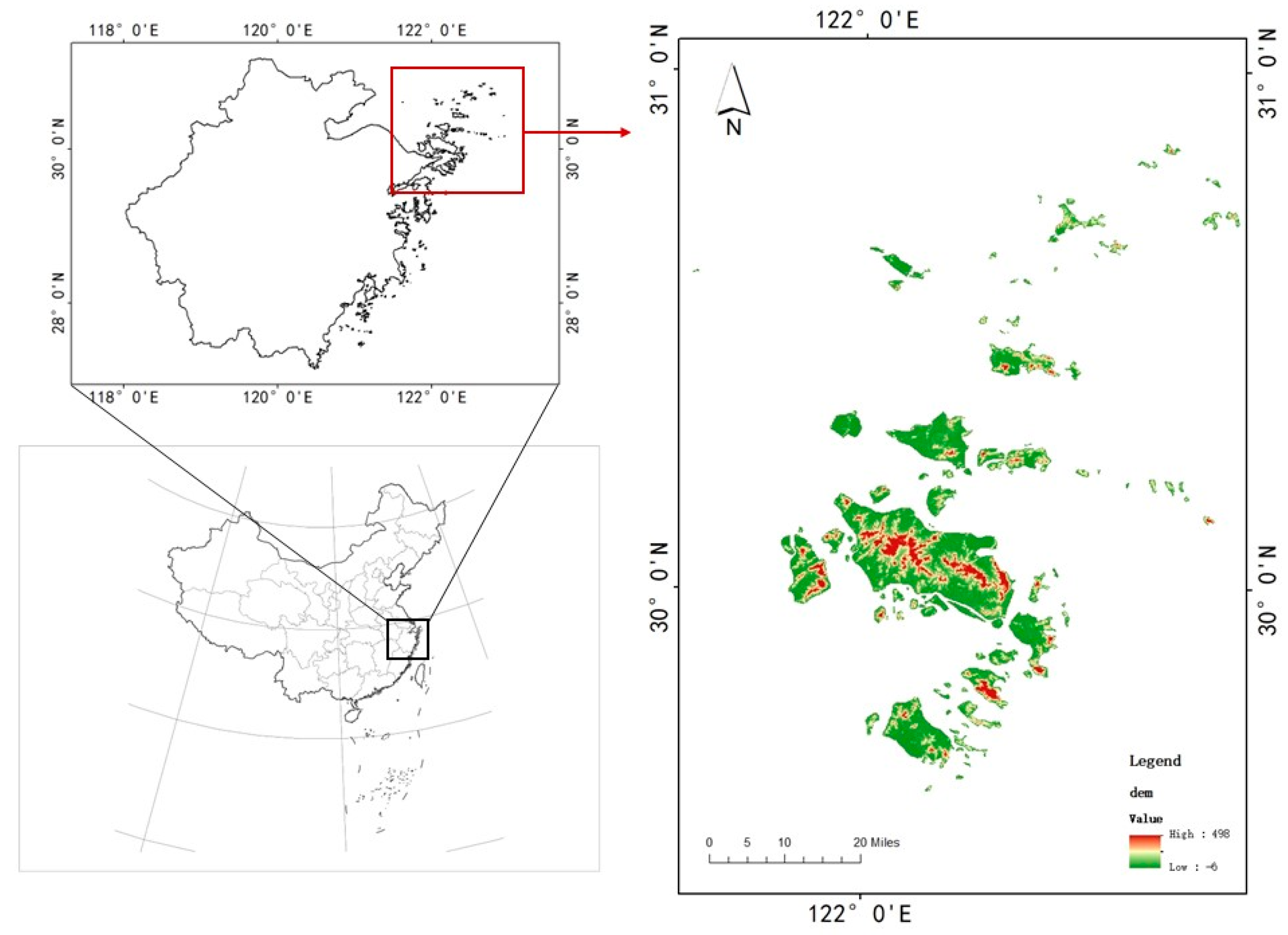
2.1. An Overview of the Study Area
2.2. Data Source
3. Research Method
3.1. Calculation Method of Water Footprints
3.2. Analysis of Water Footprint Driving Factors Using the LMDI Model
3.3. Indicator System for Evaluating Water Resource Utilization
4. Result Analysis
4.1. Analysis of Water Footprint Changes
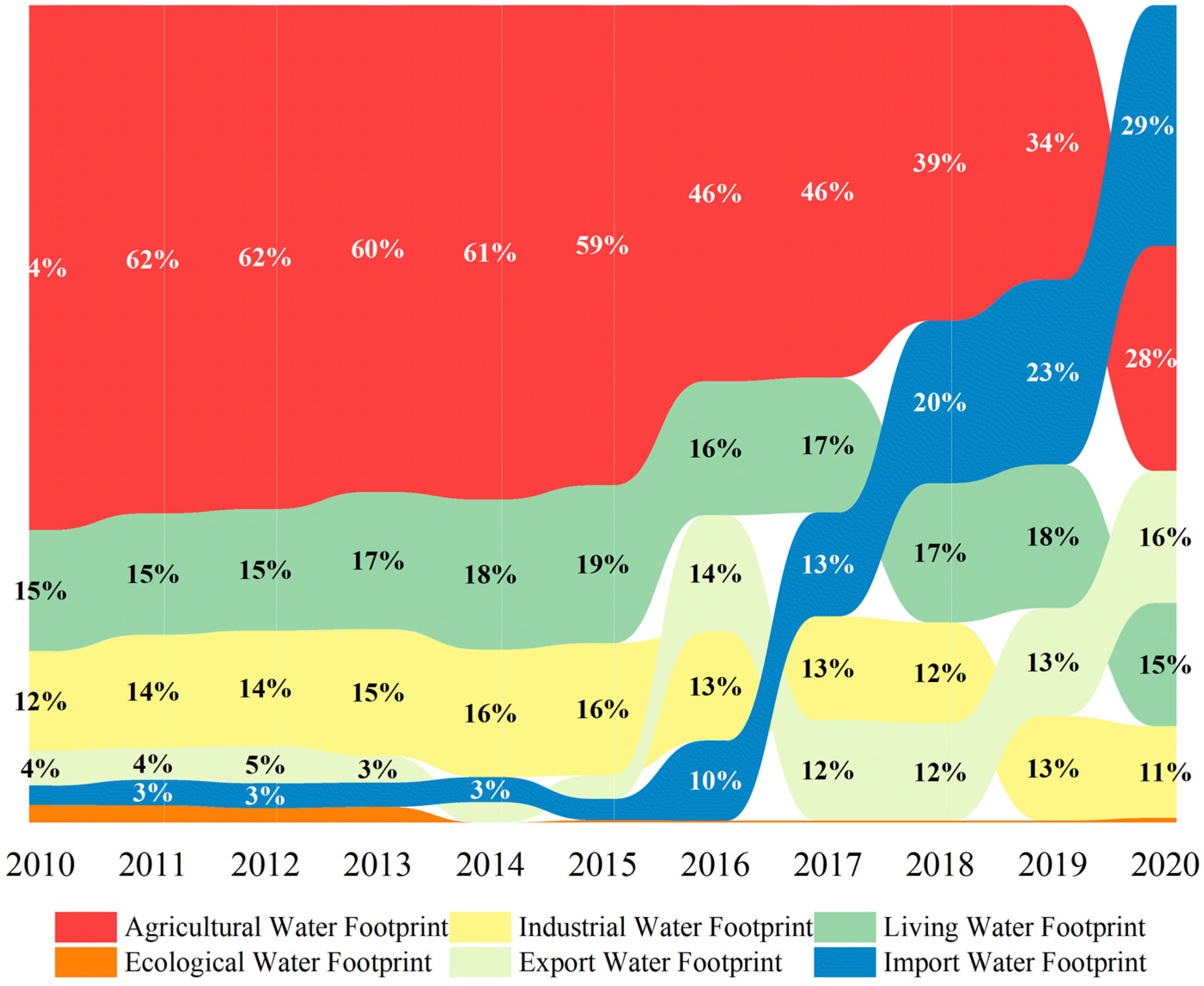
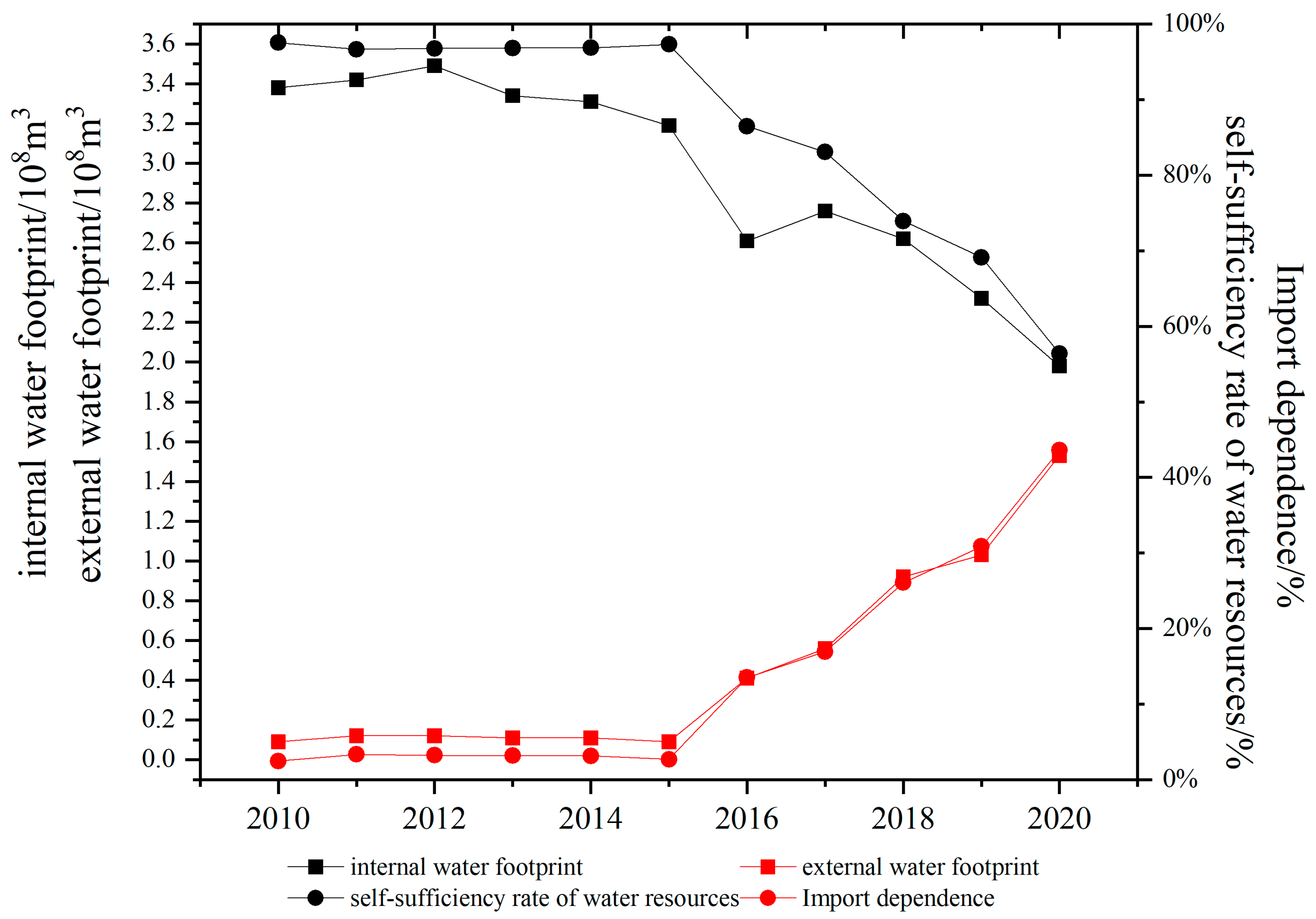
4.2. Analysis of Water Footprint Structure
4.3. Water Resource Utilization Assessment
4.3.1. Analysis of Water Footprint Efficiency
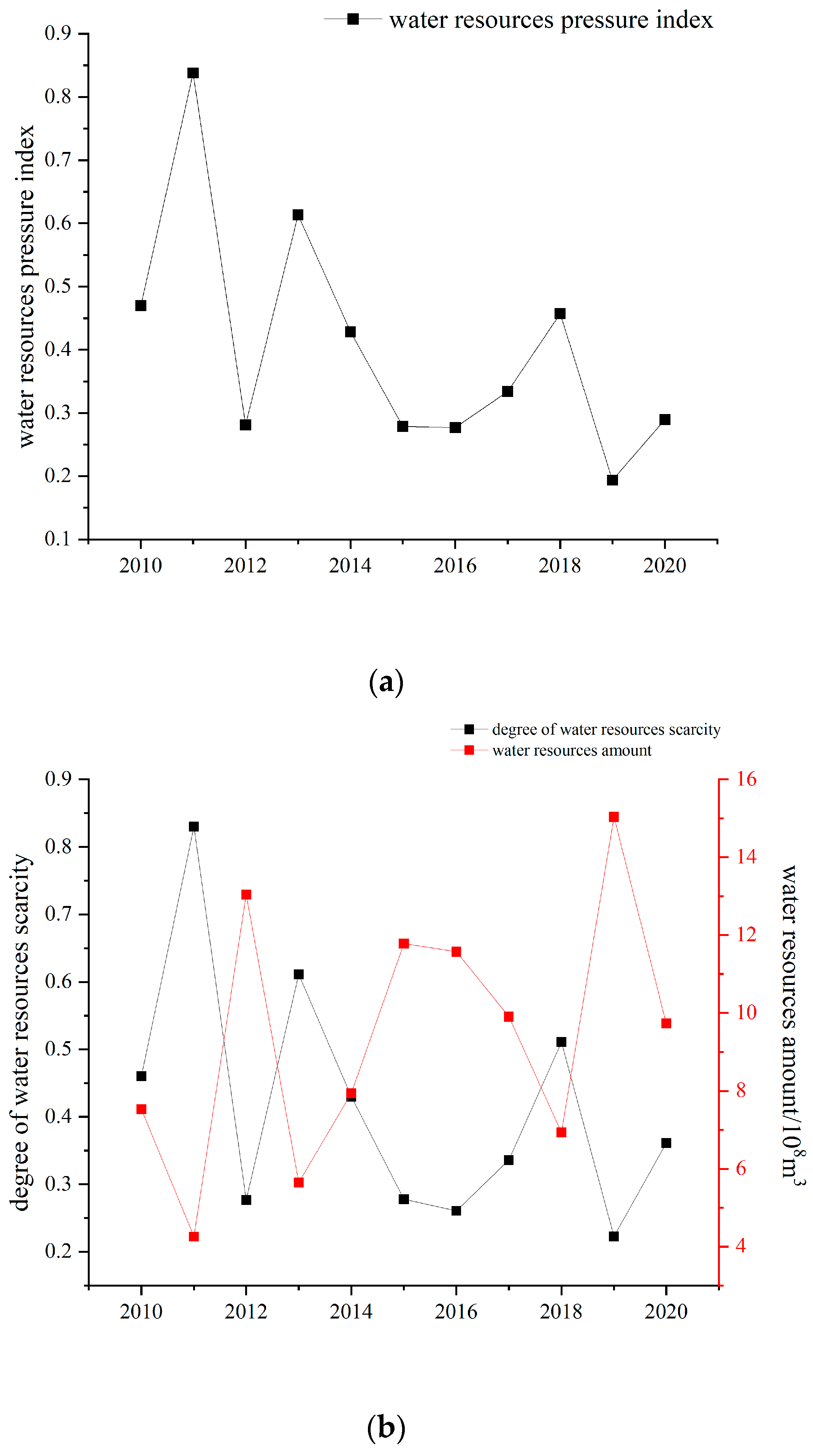
4.3.2. Analysis of Water Resource Ecological Security
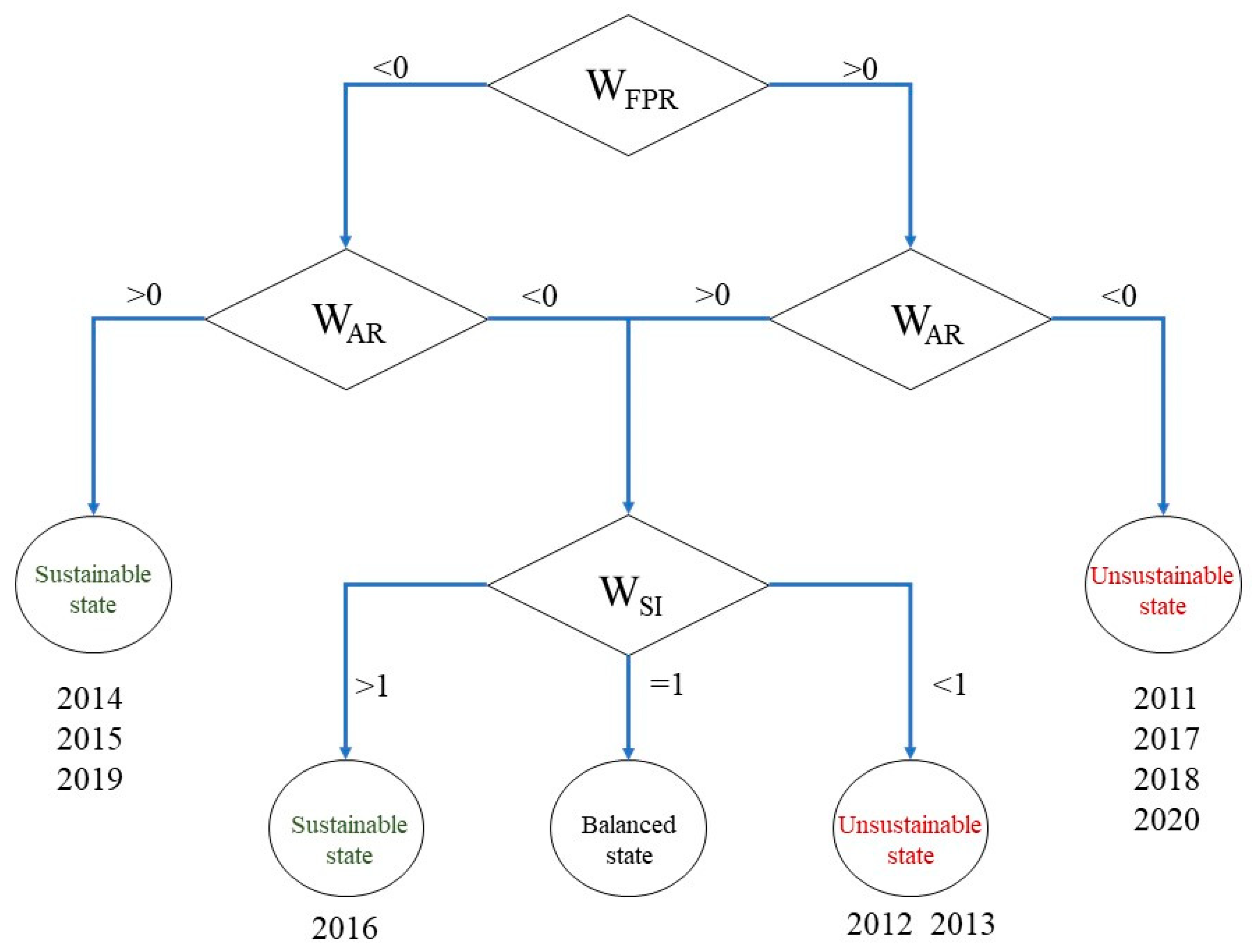
4.3.3. Analysis and Evaluation of Water Footprint Sustainability
4.4. Analysis of Water Footprint Driving Factors
5. Conclusions
- (1)
- Based on the WFT analysis, it is observed that the total water footprint of Zhoushan City has experienced minimal changes, while the internal structure has undergone significant transformations in recent years. This reflects the city’s frequent exchange of water resources with the external environment, indicating a close correlation with Zhoushan’s economic development. The water scarcity index and pressure index consistently exhibit a fluctuating downward trend, with 45% of the years surpassing the 0.4 threshold for water resource development and utilization. The average values for these indices are 0.42 and 0.41, respectively, signifying a considerable risk to the ecological security of water resources. The trade structure was found to be imbalanced, with the water footprint of exported products exceeding that of imported ones. To address this issue, it is crucial to rigorously control the virtual water content of both imported and exported products, striving for higher imports of virtual water compared to exports. To alleviate local water resource pressure, several measures can be taken, including optimizing the industrial structure, improving water use efficiency in the primary sector, promoting water-saving agricultural practices, adopting cleaner production methods in the secondary sector, emphasizing recycling and sustainable development, and implementing a service-oriented approach in the tertiary sector, particularly in the use of drinking and domestic water. Changing consumption patterns and launching widespread water-saving campaigns are also essential steps to mitigate local water resource pressure and ensure the sustainable utilization of water resources in Zhoushan while safeguarding ecological security.
- (2)
- According to the LMDI model, the factor decomposition indicates that technological effects have the greatest impact, followed by economic effects and population effects. Technological factors emerge as the decisive and counteractive driving factor, contributing to a substantial 47.06% of the total impact and playing a pivotal role in decreasing Zhoushan’s total water footprint. Conversely, economic and population effects, acting as positive driving factors, exhibit the smallest contributions, underscoring that rapid economic growth and population expansion are intensifying water resource pressures in the region. In the course of development, Zhoushan should harness the counteractive influence of technological factors to curtail the growth of the water footprint. Achieving this necessitates the vigorous development and adoption of water-saving technologies, along with enhancements in the utilization efficiency of water resources within production. Moreover, in addition to improving the efficiency of introducing and utilizing external water resources in nearshore regions, it is crucial to extend internal water resource development and utilization technologies to offshore areas. This strategy enables Zhoushan to strike a balance between the efficient utilization and distribution of both external and internal water resources, ensuring sustainability while effectively harnessing external water resources.
- (3)
- This study employs a quantitative analysis by integrating WFT and the LMDI model to evaluate water resource utilization in Zhoushan City. The objective assessment reveals the primary driving factors influencing the sustainability of water resource utilization in Zhoushan City, offering valuable insights for formulating practical strategies in water resource management. However, considering the multitude of aspects within the water system, this study focuses on areas closely linked to urban development, yet there are additional directions beyond those outlined. In future research, the evaluation scope of the water system can be broadened, and the selection of water resource evaluation indicators can be further diversified and refined. With the ongoing evolution of the evaluation system, novel models and methods for water system evaluation are emerging. Subsequent research can explore different models to decompose and evaluate Zhoushan’s water system, aiming to develop evaluation methods that accentuate the unique features of water resource utilization in island regions.
6. Suggestion
- Zhoushan City should continue to focus on the rational allocation and optimization of water resources. This can be achieved by optimizing the structure of product import and export, reducing the consumption of internal water resources, relying on imported virtual water, and improving water resource utilization to alleviate water supply pressure.
- Zhoushan City should gradually improve its structure of water usage, adjusting the utilization rates of water resources across various industries, and mitigating the unsustainable state of water resources.
- The Zhoushan government could bolster the growth of novel technologies by actively introducing talent-friendly policies, enhancing living standards for tech professionals, and fostering swift progress in water conservation techniques in the city. Such measures could significantly enhance the water resource landscape in Zhoushan City.
Author Contributions
Funding
Data Availability Statement
Conflicts of Interest
References
- Zhang, G.P.; Hoekstra, A.Y.; Mathews, R.E. Water Footprint Assessment (WFA) for better water governance and sustainable development. Water Resour. Ind. 2013, 1, 1–6. [Google Scholar] [CrossRef] [Scilit]
- Liu, Z.; Fan, Y.; Liu, M.; Yin, Z.; Li, X.; Yin, L.; Zheng, W. Remote sensing and geostatistics in urban water-resource monitoring: A review. Mar. Freshw. Res. 2023, 74, 747–765. [Google Scholar] [CrossRef] [Scilit]
- National Bureau of Statistics of China. China Statistical Yearbook; China Statistic Press: Beijing, China, 2020. (In Chinese)
- Zhoushan Water Resources Bureau. Zhoushan Statistical Yearbook; China Statistic Press: Beijing, China, 2022. (In Chinese)
- Xu, X.Y.; Li, Y.L.; Li, J.Q.; Li, Y.Y. Study on the development, utilization and protection of island water resources. China Water Resour. 2020, 23, 44–46. [Google Scholar]
- Allan, J.A. Fortunately there are substitutes for water otherwise our hydro-political futures would be impossible. Priorities Water Resour. Alloc. Manag. 1993, 13, 26. [Google Scholar]
- Antonelli, M.; Sartori, M. Unfolding the potential of the virtual water concept. What is still under debate? Environ. Sci. Policy 2015, 50, 240–251. [Google Scholar] [CrossRef] [Scilit]
- Chapagain, A.K.; Hoekstra, A.Y. Virtual Water Trade: Aquantifcation of Virtual Water Flows between Nations Inrelation to International Trade of Livestock and Livestock Products. In Virtual Water Trade Proceedings of the International Expert Meeting on Virtual Water Trade, Value of Water Research Report Series; Hoekstra, A.Y., Ed.; No. 12; UNESCO-IHE: Delft, The Netherlands, 2003. [Google Scholar]
- Hoekstra, A.Y. The Water Footprint of Modern Consumer Society; Routledge: London, UK, 2013. [Google Scholar]
- Hoekstra, A.Y.; Chapagain, A.K. Globalization of Water: Sharing the Planet’s Freshwater Resources; Blackwell Publishing: Oxford, UK, 2008. [Google Scholar]
- Hoekstra, A.Y.; Chapagain, A.K.; Aldaya, M.M.; Mekonnen, M.M. The Water Footprint Assessment Manual: Setting the Global Standard; Earthscan: London, UK, 2011. [Google Scholar]
- Zhang, F.F.; Zhang, Q.N.; Li, F.D.; Fu, H.Y.; Yang, X.H. The spatial correlation pattern of water footprint intensity and its driving factors in China. J. Nat. Resour. 2019, 34, 934–944. [Google Scholar] [CrossRef] [Scilit]
- Sun, C.Z.; Wang, Z.H. Driving factors for virtual water trade of agricultural products between China and countries along “Belt and Road”. J. Econ. Water Resour. 2020, 38, 1–7+28+85. [Google Scholar]
- Jang, W.Q.; Li, X.Y.; Liu, C.J.; Sun, Q. Impact of residents’ diet changes on water resource demand in China: From the perspective of nutritional balance. Resour. Sci. 2021, 43, 1662–1674. [Google Scholar] [CrossRef] [Scilit]
- Wang, H.; Small, M.J.; Dzombak, D.A. Factors Governing Change in Water Withdrawals for U.S. Industrial Sectors from 1997 to 2002. Environ. Sci. Technol. 2014, 48, 3420–3429. [Google Scholar] [CrossRef] [Scilit]
- Li, W.; Wen, H.; Nie, P. Prediction of China’s Industrial Carbon Peak: Based on GDIM-MC Model and LSTM-NN model. Energy Strategy Rev. 2023, 50, 101240. [Google Scholar] [CrossRef] [Scilit]
- Wu, B.; Quan, Q.; Yang, S.; Yang, D. A social-ecological coupling model for evaluating the human-water relationship in basins within the Budyko framework. J. Hydrol. 2023, 619, 129361. [Google Scholar] [CrossRef] [Scilit]
- Vaninsky, A. Factorial decomposition of CO2 emissions: A generalized Divisia index approach. Energy Econ. 2014, 45, 389–400. [Google Scholar] [CrossRef] [Scilit]
- Zheng, J.W.; Sun, C.Z. Driving factors of China’s water resources flow pattern based on MRIO and GTWR. Sci. Geogr. Sin. 2023, 43, 1837–1850. [Google Scholar]
- Ang, B.W. Decomposition analysis for policymaking in energy: Which is the preferred method? Energy Pol. 2004, 32, 1131–1139. [Google Scholar] [CrossRef] [Scilit]
- Hao, Q.T.; Huang, M.X.; Bao, G. Study on Carbon Emission Calculation Methods Overview and Its Comparison. Chin. J. Environ. Manag. 2011, 4, 51. [Google Scholar]
- Ang, B.W. The LMDI approach to decomposition analysis: A practical guide. Energy Policy 2005, 33, 867–871. [Google Scholar] [CrossRef] [Scilit]
- Xi, H.; Cui, W.; Cai, L.; Chen, M.; Xu, C. Evaluation and prediction of ecosystem service value in the Zhoushan Islands based on LUCC. Sustainability 2021, 13, 2302. [Google Scholar] [CrossRef] [Scilit]
- Chen, J.; Pan, D.; Mao, Z.; Chen, N.; Zhao, J.; Liu, M. Land-Cover Reconstruction and Change Analysis Using Multisource Remotely Sensed Imageries in Zhoushan Islands since 1970. J. Coast. Res. 2014, 294, 272–282. [Google Scholar] [CrossRef] [Scilit]
- Gu, H.; Guo, Q.; Lin, P.; Bai, L.; Yang, S.; Sitharam, T.G.; Liu, J. Feasibility study of coastal reservoirs in the Zhoushan Islands, China. J. Coast. Res. 2018, 35, 835. [Google Scholar] [CrossRef] [Scilit]
- Compilation Committee of China’s Island Records. China’s Island Records; Zhejiang Volume. Volume 2, Southern Part of Zhoushan City; Ocean Press: Beijing, China, 2014. [Google Scholar]
- Liu, C.H.; Jin, W.L.; Sun, Y.J.; Kang-li, C.H.E.N. Evaluation of Water Resources Utilization in the Taihu Basin from the Perspective of Water Footprint. China Rural. Water Hydropower 2022, 8, 70–77. [Google Scholar]
- Zeng, W.; Qiu, Y.L.; Cao, X.C. Driving forces of agricultural water use change in Jiangsu Province based on water footprint and LMDI. Jiangsu Water Resour. 2021, 12, 28–35. [Google Scholar]
- Hoekstra, A.Y. The Water Footprint Assessment Manual Setting the Global Standard; Science Press: Beijing, China, 2012. [Google Scholar]
- Chapagain, A.K.; Hoekstra, A.Y. Water Footprints of Nations. J. Bank. Financ. 2004. Available online: https://research.utwente.nl/en/publications/water-footprints-of-nations (accessed on 21 January 2024).
- Sun, C.Z.; Zhang, L. Changes in Spatial and Temporal Differences of Agricultural Product Virtual Water Versus Cultivated Land in China. Resour. Sci. 2009, 31, 84–93. [Google Scholar]
- Chapagain, A.K.; Hoekstra, A.Y. Water Footprints of Nations; Value of Water Research Report Series No.16; UNESCO-IHE: Delft, The Netherlnds, 2004. [Google Scholar]
- Shang, Q.K.; Yin, K.X.; Mi, W.B. Assessing water resources in Qinghai province based on theory of water footprint. J. Arid. Land Resour. Environ. 2020, 34, 70–77. [Google Scholar]
- Ang, B.W.; Zhang, F.Q.; Choi, K.-H. Factorizing changes in energy and environmental indicators through decomposition. Energy 1998, 23, 489–495. [Google Scholar] [CrossRef] [Scilit]
- Ding, L. Influencing Factors Decomposition of Industrial Air Pollutants Emissions in Zhejiang Province Based on LMDI. Sci-Tech Innov. Product. 2022, 8, 56–63. [Google Scholar]
- Li, J.; Wang, Z.; Wu, X.; Xu, C.Y.; Guo, S.; Chen, X. Toward Monitoring Short-Term Droughts Using a Novel Daily-Scale, Standardized Antecedent Precipitation Evapotranspiration Index. J. Hydrometeorol. 2020, 21, 891–908. [Google Scholar] [CrossRef] [Scilit]
- Qi, R.; Geng, Y.; Zhu, Q.H. Evaluation of Regional Water Resources Utilization Based on Water Footprint Method. J. Nat. Resour. 2011, 26, 486–495. [Google Scholar]
- Zhang, Y.; Huang, K.; Yu, Y.; Hu, T.; Wei, J. Impact of climate change and drought regime o ater footprint of crop production: The case of Lake Dianchi Basin, China. Nat. Hazard. 2015, 79, 549–566. [Google Scholar] [CrossRef] [Scilit]
- Paolo, M.P.; Leo, D.; Federica, T.P. Environmental Kuznets curve and the water footprint: An empirical analysis. Water Environ. J. 2016, 1, 1–11. [Google Scholar]
- Ali, A.B.; Hong, L.; Elshaikh, N.A.; Haofang, Y. Assessing impacts of water harvesting techniques on the water footprint of sorghum in Western Sudan. Outlook Agric. 2016, 45, 185–191. [Google Scholar] [CrossRef] [Scilit]
- Yang, Z.W.; Liu, H.L.; Xu, X.Y.; Yang, T.T. Applying the water footprint and dynamic structural decomposition analysis on the growing water use in China during 1997–2007. Ecol. Indic. 2016, 60, 634–643. [Google Scholar] [CrossRef] [Scilit]
- Zhu, Q.R.; Yang, L.; Liu, X. Water footprint of China’s export trade and trade structure optimization. Quant. Econ. Technol. Econ. Res. 2016, 12, 42–60. [Google Scholar]
- Yuan, C.; Li, Q.; Nie, W.; Ye, C. A depth information-based method to enhance rainfall-induced landslide deformation area identification. Measurement 2023, 219, 113288. [Google Scholar] [CrossRef] [Scilit]
- Xie, X.M.; Zhang, T.T.; Wang, M.; Huang, Z. Impact of shale gas development on regional water resources in China from water footprint assessment view. Sci. Total Environ. 2019, 679, 317–327. [Google Scholar] [CrossRef] [Scilit]
- Wang, W.; Zhuo, L.; Li, M.; Liu, Y.L.; Wu, P.T. The effect of development in water–saving irrigation techniques on spatial–temporal variations in crop water footprint and benchmarking. J. Hydrol. 2019, 577, 1–13. [Google Scholar] [CrossRef] [Scilit]


| Product | Grain | Cotton | Vegetable | Fruit | Pork |
|---|---|---|---|---|---|
| Virtual water content (m3/kg) | 1.13 | 4.98 | 0.1 | 1 | 2.21 |
| Product | Beef | Mutton | Poultry egg | Aquatic product | |
| Virtual water content (m3/kg) | 12.56 | 5.2 | 3.55 | 5 |
| Evaluation Structure | Evaluation Indicators | Calculation Equation | Basic Meaning | |
|---|---|---|---|---|
| Water footprint structure | Self-sufficiency rate of water resources/% (WSS) | (WI/WT) × 100% | Degree of local water resource utilization. Reflects the extent to which a region uses local water resources: the greater the percentage, the more dependent the region is on its own water resources. | |
| Water resource import dependency/% (WD) | (WE/WT) × 100% | Dependency on external water resources. Reflects the extent to which a region is dependent on external water resources: the greater the percentage, the greater the region’s dependence on imported water resources. | ||
| Water footprint benefits | Indicators of internal benefit | Water footprint population density per ten thousand tons/(10,000 tons per individual) | P/WT | Population supported by water footprint. Reflecting the number of populations supplied by the regional water footprint of 10,000 tons, the higher the index, the more population supported by the regional water footprint, and the more effective force played by water resources in the region |
| Water footprint economic benefits/(CNY/m3) | G/WT | Economic efficiency of water resource utilization reflects the level of economic benefits brought by water footprint consumption, the higher the index value, the greater the economic benefits generated by water footprint in the region, and the higher the level of water resources utilization. | ||
| Water footprint land density/(m3/km2) | WT/A | Land area covered by water footprint. The higher the index, the greater the water resources consumed per unit area. | ||
| Indicators of external benefit | Net water footprint trade /100 million m3 | Wex − WE | Water resource trade. | |
| Water resource contribution rate/% | (Wex − WE)/WA | Contribution to water resources in other regions. It indicates the contribution level of available water resources in the region (outside the region) to water resources consumption in other regions (within the region). | ||
| Water resource ecological security | Water resource scarcity index (WS)/% | (WT/WA) × 100% | Water resource scarcity. It reflects the shortage of water resources. | |
| Water resource pressure index (WP)/% | (WI + Wex)/WA × 100% | Effect intensity on available water resources. It reflects the effect of water demand for products and services produced in a region on the amount of available water resources. | ||
| Water footprint sustainability | Water footprint growth index (WFPR)/% | (W1 − W0)/W0 | Change in regional water usage. It reflects the change in amplitude of regional water resources consumption in a certain period, and its magnitude indicates the speed of regional water footprint increase or decrease. | |
| Available water resource growth index (WAR)/% | (WA1 − WA2)/WA1 | Change in regional available water resources. It reflects the change range of regional available water resources in a certain period, and its magnitude indicates the speed of the increase and decrease in regional available water resources. | ||
| Water resource sustainability index (WSI) | |WFPR|/|WAR| | Sustainability of regional water resource utilization. Quantification reflects the sustainable utilization capacity of water resources in a region |
| Year | Agricultural Water Footprint | Industrial Water Footprint | Domestic Water Footprint | Ecological Water Footprint | Export Water Footprint | Import Water Footprint | Total Water Footprint |
|---|---|---|---|---|---|---|---|
| 2010 | 2.43 | 0.46 | 0.56 | 0.08 | 0.16 | 0.09 | 3.46 |
| 2011 | 2.39 | 0.53 | 0.57 | 0.08 | 0.15 | 0.12 | 3.53 |
| 2012 | 2.45 | 0.56 | 0.59 | 0.07 | 0.18 | 0.12 | 3.61 |
| 2013 | 2.20 | 0.57 | 0.62 | 0.07 | 0.12 | 0.11 | 3.45 |
| 2014 | 2.18 | 0.56 | 0.66 | 0.00 | 0.09 | 0.11 | 3.41 |
| 2015 | 2.04 | 0.56 | 0.67 | 0.01 | 0.10 | 0.09 | 3.27 |
| 2016 | 1.94 | 0.56 | 0.69 | 0.01 | 0.60 | 0.41 | 3.02 |
| 2017 | 2.01 | 0.56 | 0.73 | 0.01 | 0.54 | 0.56 | 3.33 |
| 2018 | 1.79 | 0.57 | 0.79 | 0.01 | 0.55 | 0.92 | 3.54 |
| 2019 | 1.53 | 0.58 | 0.80 | 0.01 | 0.60 | 1.03 | 3.35 |
| 2020 | 1.43 | 0.58 | 0.78 | 0.03 | 0.84 | 1.53 | 3.52 |
| Year | Internal Benefits | External Benefits | |||
|---|---|---|---|---|---|
| Population Density for Ten Thousand Tons of Water Footprint/(10,000 Tons per Individual) | Economic Efficiency of the Water Footprint/(CNY/m3) | Water Footprint per Unit of Land Area/(m3/km2) | Net Trade Value of the Water Footprint/100-million m3 | Contribution to Water Resources/% | |
| 2010 | 32.36 | 175.92 | 1.56 | 0.07 | 0.94% |
| 2011 | 32.17 | 195.04 | 1.59 | 0.03 | 0.81% |
| 2012 | 31.58 | 209.43 | 1.63 | 0.06 | 0.45% |
| 2013 | 33.20 | 238.18 | 1.55 | 0.01 | 0.20% |
| 2014 | 33.68 | 259.48 | 1.54 | −0.01 | −0.16% |
| 2015 | 35.31 | 284.35 | 1.47 | 0.01 | 0.09% |
| 2016 | 38.59 | 356.74 | 1.36 | 0.19 | 1.64% |
| 2017 | 35.20 | 339.51 | 1.50 | −0.02 | −0.21% |
| 2018 | 33.12 | 352.14 | 1.60 | −0.37 | −5.36% |
| 2019 | 34.77 | 406.69 | 1.51 | −0.44 | −2.92% |
| 2020 | 32.97 | 430.12 | 1.58 | −0.70 | −7.17% |
| Year | Water Footprint Growth Index (WFPR) | Available Water Resource Growth Index (WAR) | Water Resource Sustainability Index (WSI) | Status |
|---|---|---|---|---|
| 2011 | 0.02 | −0.43 | 0.05 | Unsustainable |
| 2012 | 0.02 | 2.06 | 0.01 | Unsustainable |
| 2013 | −0.04 | −0.57 | −0.08 | Unsustainable |
| 2014 | −0.01 | 0.41 | −0.02 | Sustainable |
| 2015 | −0.04 | 0.48 | −0.09 | Sustainable |
| 2016 | −0.08 | −0.02 | 4.42 | Sustainable |
| 2017 | 0.10 | −0.14 | 0.71 | Unsustainable |
| 2018 | 0.06 | −0.30 | 0.22 | Unsustainable |
| 2019 | −0.05 | 1.17 | −0.05 | Sustainable |
| 2020 | 0.05 | −0.35 | 0.14 | Unsustainable |
| Year | Population Factor | Economic Factor | Technological Factor | Total |
|---|---|---|---|---|
| 2011 | 0.47 | 0.38 | −0.36 | 0.49 |
| 2012 | 1.13 | 1.09 | −0.98 | 1.24 |
| 2013 | 1.94 | 2.02 | −2.01 | 1.95 |
| 2014 | 2.22 | 3.21 | −3.33 | 2.1 |
| 2015 | 2.44 | 4.47 | −4.88 | 2.03 |
| 2016 | 2.27 | 6.01 | −6.98 | 1.3 |
| 2017 | 1.45 | 8.25 | −9.55 | 0.15 |
| 2018 | 1.49 | 10.87 | −12.29 | 0.07 |
| 2019 | 2.08 | 13.18 | −14.81 | 0.45 |
| 2020 | 1.14 | 16.55 | −18.29 | −0.6 |
| Average | 1.66 | 6.60 | −7.35 | 0.91 |
| Proportion/% | 10.65% | 42.29% | 47.06% | 100% |
Disclaimer/Publisher’s Note: The statements, opinions and data contained in all publications are solely those of the individual author(s) and contributor(s) and not of MDPI and/or the editor(s). MDPI and/or the editor(s) disclaim responsibility for any injury to people or property resulting from any ideas, methods, instructions or products referred to in the content. |
© 2024 by the authors. Licensee MDPI, Basel, Switzerland. This article is an open access article distributed under the terms and conditions of the Creative Commons Attribution (CC BY) license (https://creativecommons.org/licenses/by/4.0/).
Share and Cite
Feng, J.; Gu, C.; Li, S.; Wang, L.; Gui, F.; Zhao, S.; Zhang, B. Assessment of Water Resource Utilization and Analysis of Driving Factors in Zhoushan City Based on Water Footprint Theory and LMDI Model. Water 2024, 16, 385. https://doi.org/10.3390/w16030385
Feng J, Gu C, Li S, Wang L, Gui F, Zhao S, Zhang B. Assessment of Water Resource Utilization and Analysis of Driving Factors in Zhoushan City Based on Water Footprint Theory and LMDI Model. Water. 2024; 16(3):385. https://doi.org/10.3390/w16030385
Chicago/Turabian StyleFeng, Jirong, Chaona Gu, Sizheng Li, Liuzhu Wang, Feng Gui, Sheng Zhao, and Bin Zhang. 2024. "Assessment of Water Resource Utilization and Analysis of Driving Factors in Zhoushan City Based on Water Footprint Theory and LMDI Model" Water 16, no. 3: 385. https://doi.org/10.3390/w16030385
APA StyleFeng, J., Gu, C., Li, S., Wang, L., Gui, F., Zhao, S., & Zhang, B. (2024). Assessment of Water Resource Utilization and Analysis of Driving Factors in Zhoushan City Based on Water Footprint Theory and LMDI Model. Water, 16(3), 385. https://doi.org/10.3390/w16030385