Article

Employing Tank Constraints to Present Total Cost and Water Age Trade-Offs in Optimal Operation of Water Distribution Systems

Civil and Environmental Engineering, Technion—Israel Institute of Technology, Haifa 32000, Israel
*
Author to whom correspondence should be addressed.
Water 2024, 16(12), 1637; https://doi.org/10.3390/w16121637
Submission received: 10 May 2024 / Revised: 30 May 2024 / Accepted: 5 June 2024 / Published: 7 June 2024
(This article belongs to the Section Water Resources Management, Policy and Governance)

Abstract

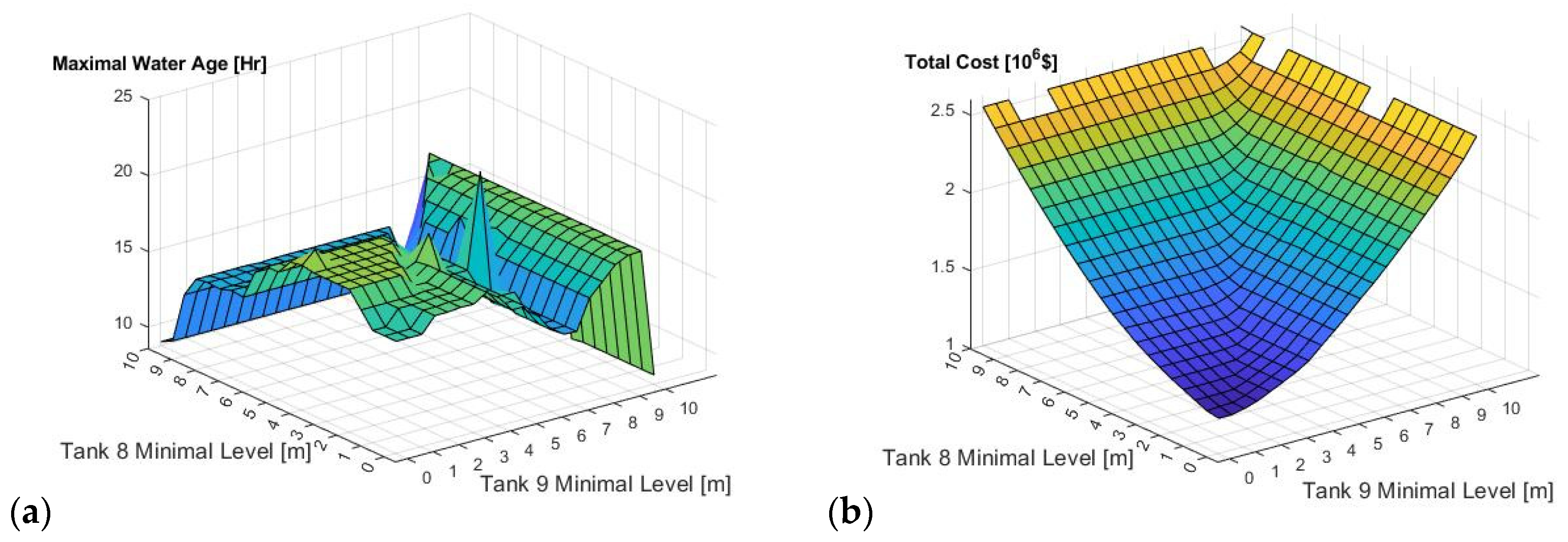
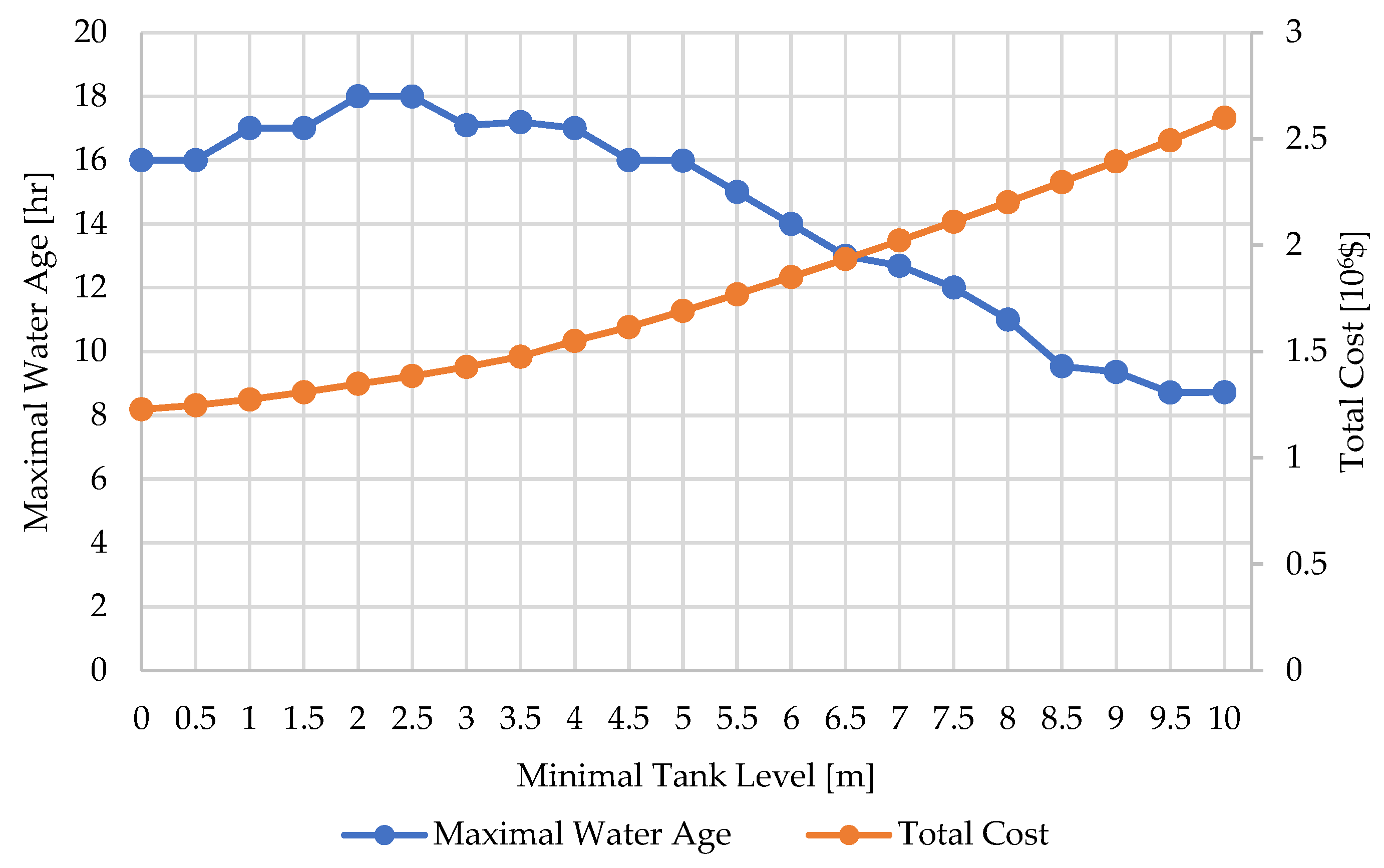
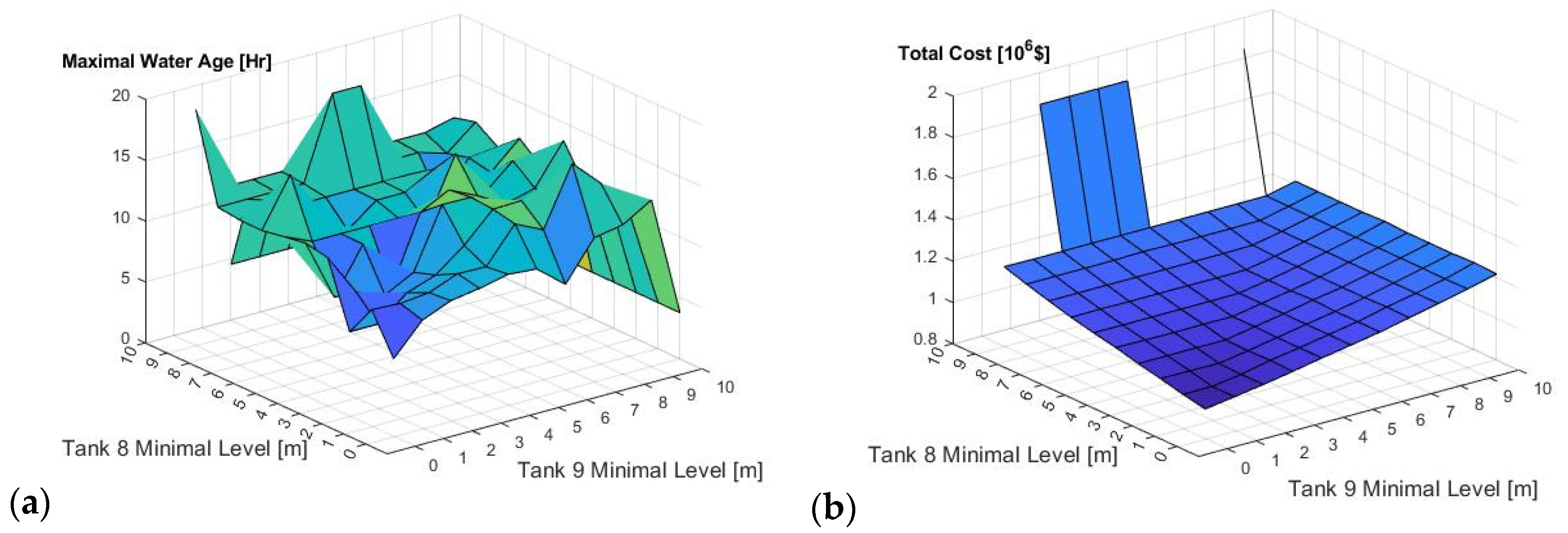
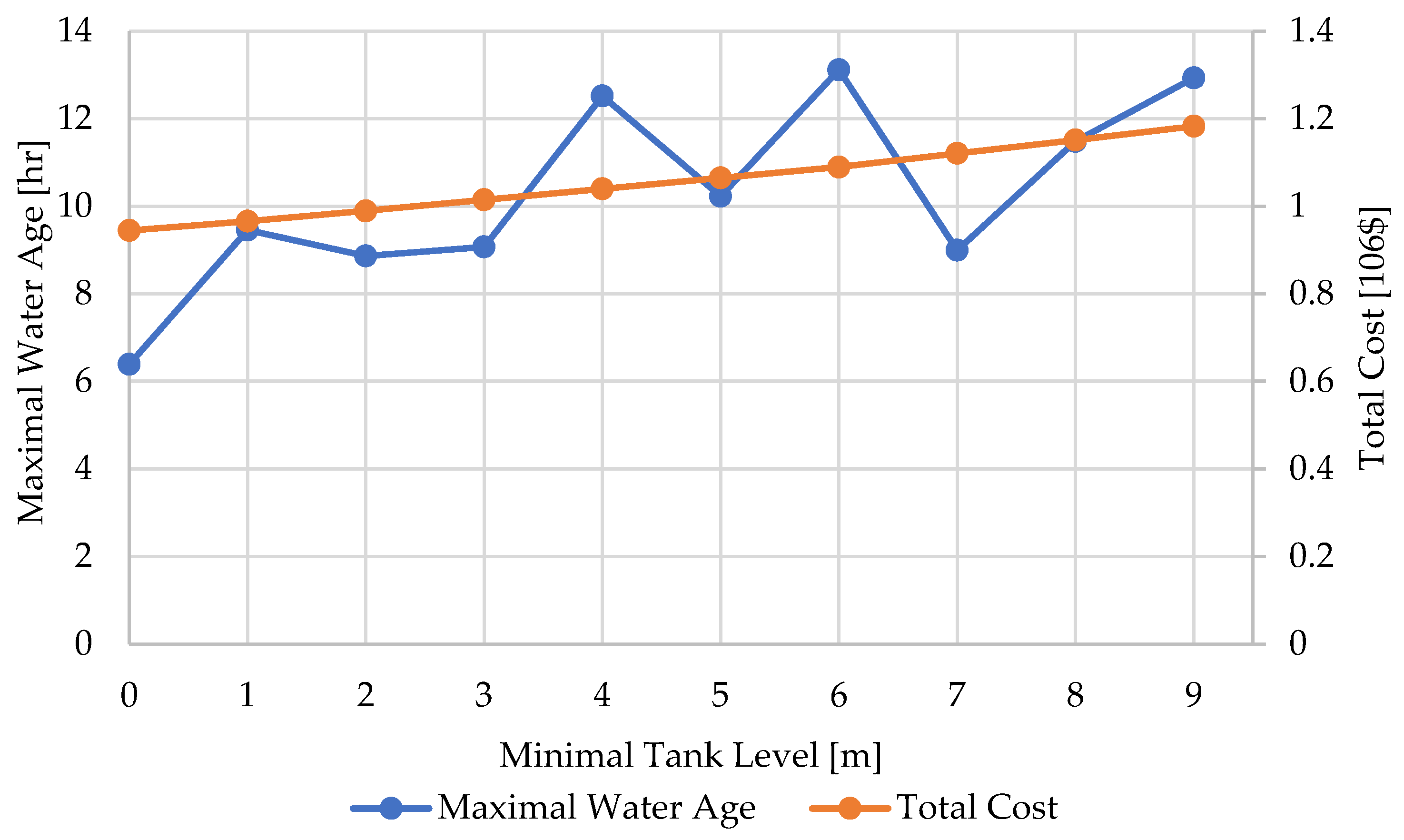
Water distribution systems (WDSs) are massive infrastructure systems designed to supply water from sources to consumers. The optimal operation problem of WDSs is the problem of determining pump and tank operation to meet the consumers’ demands with minimal operating cost, under different constraints, which often include hydraulic feasibility, pressure boundaries, and water quality standards. The water quality aspect of WDSs’ operation poses significant challenges due to its complex mathematical nature. Determined by mixing in the systems’ nodes, it is affected by flow directions, which are subject to change based on the hydraulic state of the system and are therefore difficult to either predict, control, or be included in an analytical model used for optimization. Water age, which is defined as the time water travels in the system until reaching the consumer, is often used as a general water quality indicator—high values of water age imply low water quality, whereas low values of water age usually mean fresher, cleaner, and safer water. In this work, we present the effects that tank operation has on water age. As tanks contain large amounts of water for long periods of time, water tends to age there significantly, which translates into older water being supplied to consumers. By constraining the tank operation, we aim to present the trade-off between water age, tank operation, and operational cost in the WDS optimal operation problem and provide an operational tool that could assist system operators to decide how to operate their system, based on their budget and desired water age boundary. The analysis is applied to three case studies that vary in size and complexity, using MATLAB version R2021b and EPANET 2.2. The presented results show an ability to mitigate high water age in water networks through tank constraints, which varies in accordance with the system’s complexity and tank dominance in supply. The importance of a visual tool that serves as a guide for operators to tackle the complex problem of controlling water age is demonstrated as well.
Keywords: optimal operation; water age; water distribution system; multi-objective optimization optimal operation; water age; water distribution system; multi-objective optimization