Article

Experimental Study on the Clogging Performance of Waste Slag

1
College of Geology and Environment, Xi’an University of Science and Technology, Xi’an 710054, China
2
Kunming Engineering Corporation Limited, Kunming 650000, China
3
The Seventh Geological Exploration Institute of Heilong Jiang Province, Suihua 152000, China
*
Authors to whom correspondence should be addressed.
Water 2024, 16(10), 1390; https://doi.org/10.3390/w16101390
Submission received: 31 March 2024 / Revised: 3 May 2024 / Accepted: 7 May 2024 / Published: 13 May 2024
(This article belongs to the Topic Landslides and Natural Resources)

Abstract

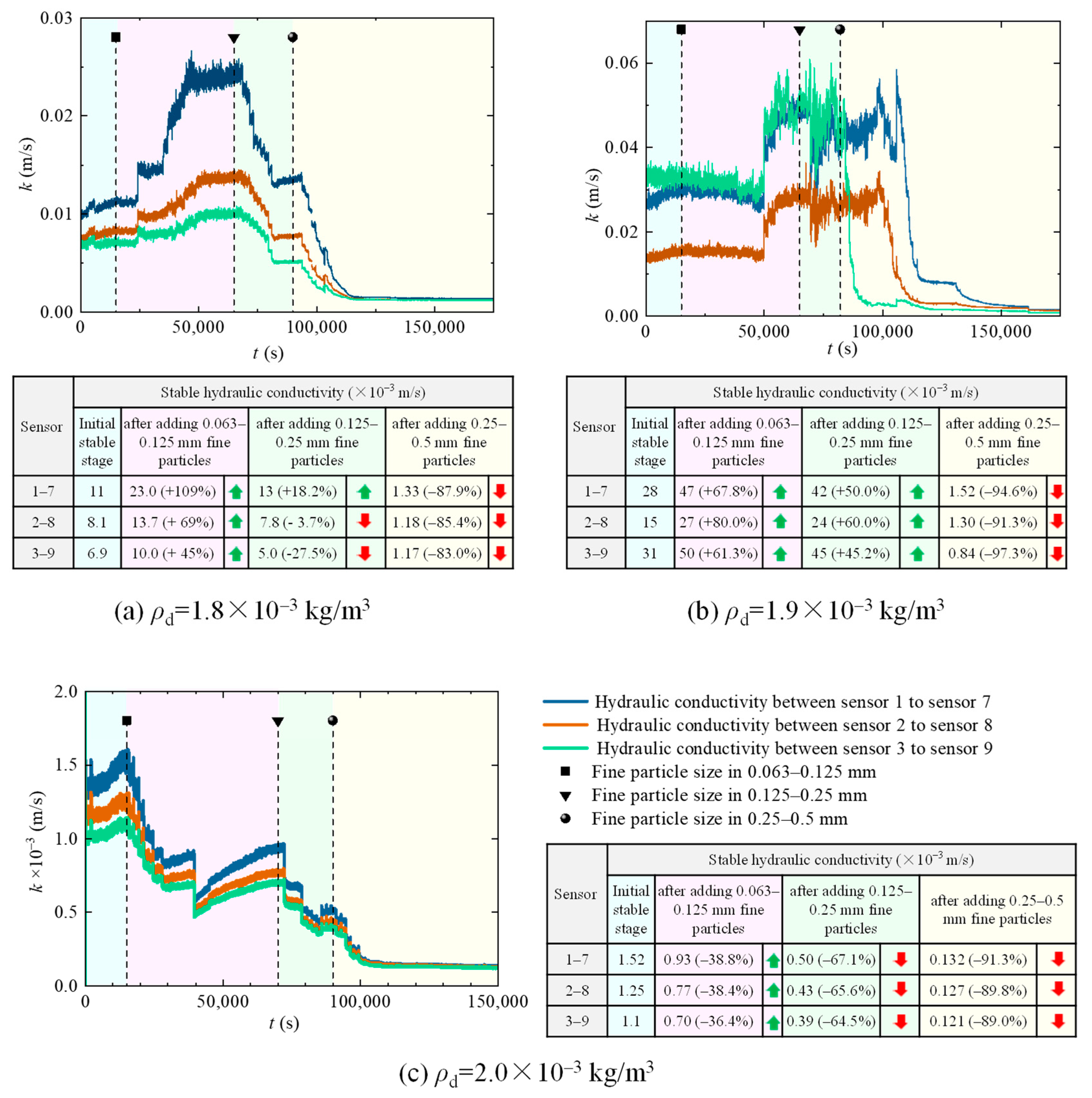
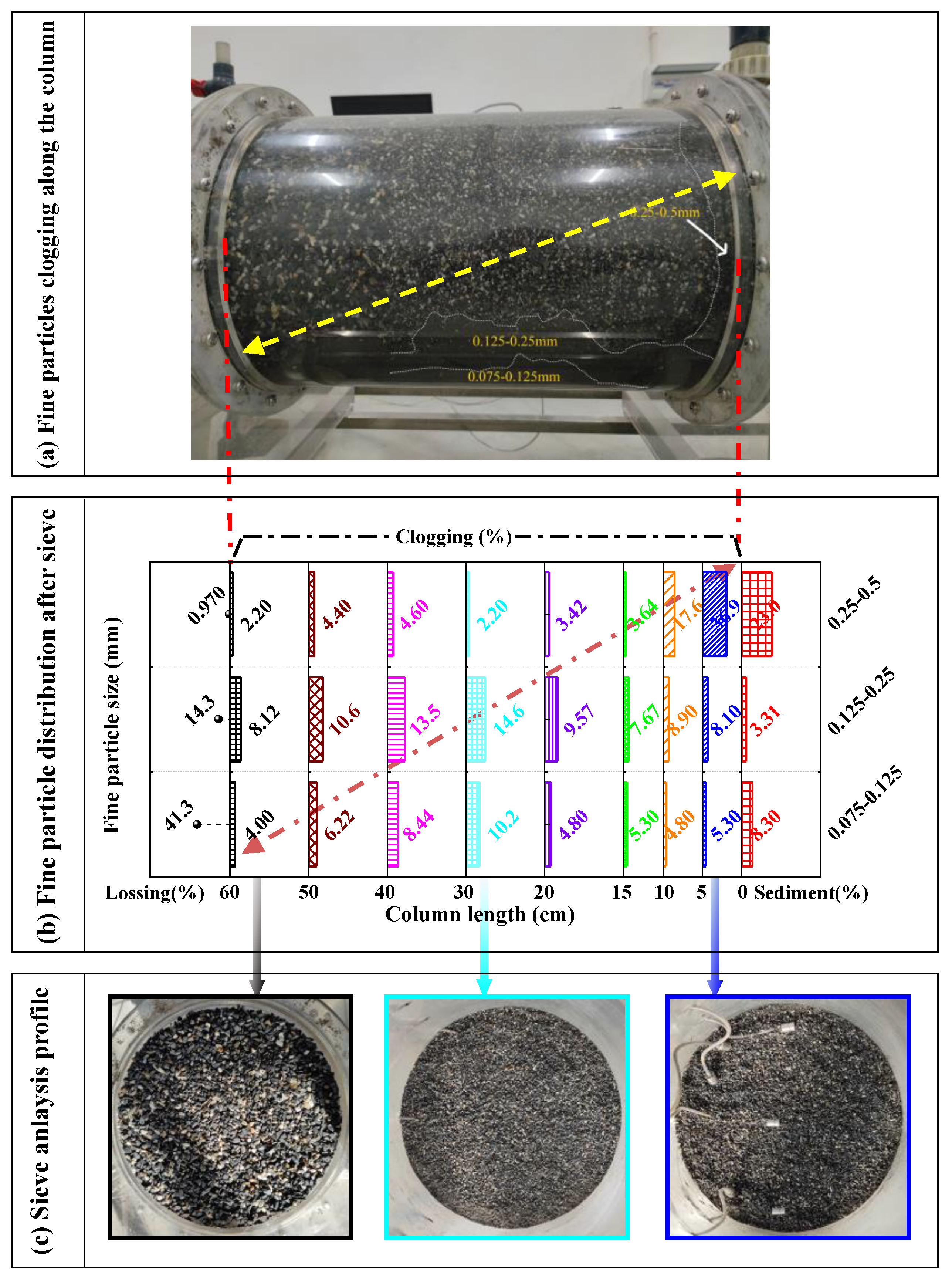
The fine particles around a mining area are easy to transport under the climatic and hydrological actions such as rainfall, that causes the change in the permeability of accumulated slag and increases the hazard probability of slag debris flow. In this study, eight experiments were designed to discuss the influence of fine particle migration on the permeability characteristics and clogging of slag accumulation in different graded particles and different dry densities. The results of experiments with coarse slags of five different particle sizes show that the ratio ranging from four to six in the coarse slag size and fine size caused a significant clogging phenomenon. It is confirmed that the shape of the particles is one of the factors affecting the clogging of coarse soil besides the coarse and fine particle size, and the clogging assessment criterion for slag and the corresponding clogging patterns based on the slag shape characteristics are given. And through three kinds of different dry density-graded slag, three clogging experiments were completed to verify the clogging standard and clogging particle size. The experimental results show that the clogging particle size obtained by the clogging criteria can effectively reduce the permeability of slag accumulation, and it is considered that the equivalent particle size and particle shape characteristics are the main factors affecting the clogging performance of accumulation, while the dry density of deposits has no significant influence on it.
Keywords: clogging; permeability; slags; slag shape; clogging assessment criterion clogging; permeability; slags; slag shape; clogging assessment criterion