Review

Review of Nonpoint Source Pollution Models: Current Status and Future Direction

1
State Key Laboratory of Water Environment Simulation, School of Environment, Beijing Normal University, Beijing 100875, China
2
Key Laboratory of Agricultural Soil and Water Engineering in Arid and Semiarid Areas, Ministry of Education, Northwest A&F University, Xianyang 712100, China
3
Innovation Academy for Precision Measurement Science and Technology, Wuhan 430077, China
4
Nanjing Institute of Geography and Limnology, Chinese Academy of Sciences, Nanjing 210008, China
*
Author to whom correspondence should be addressed.
Water 2022, 14(20), 3217; https://doi.org/10.3390/w14203217
Submission received: 11 September 2022 / Revised: 7 October 2022 / Accepted: 10 October 2022 / Published: 13 October 2022
(This article belongs to the Special Issue Point-Source and Diffuse Water Pollution)

Abstract

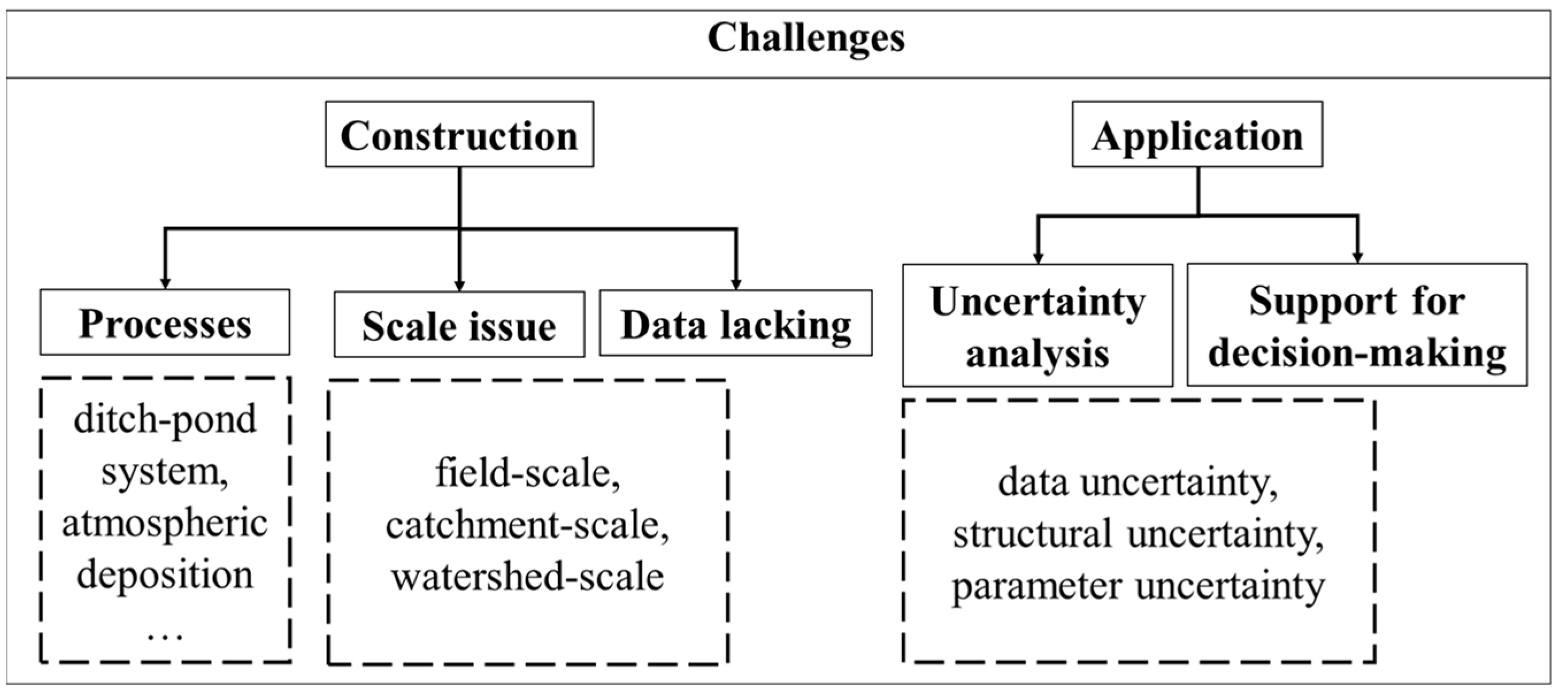
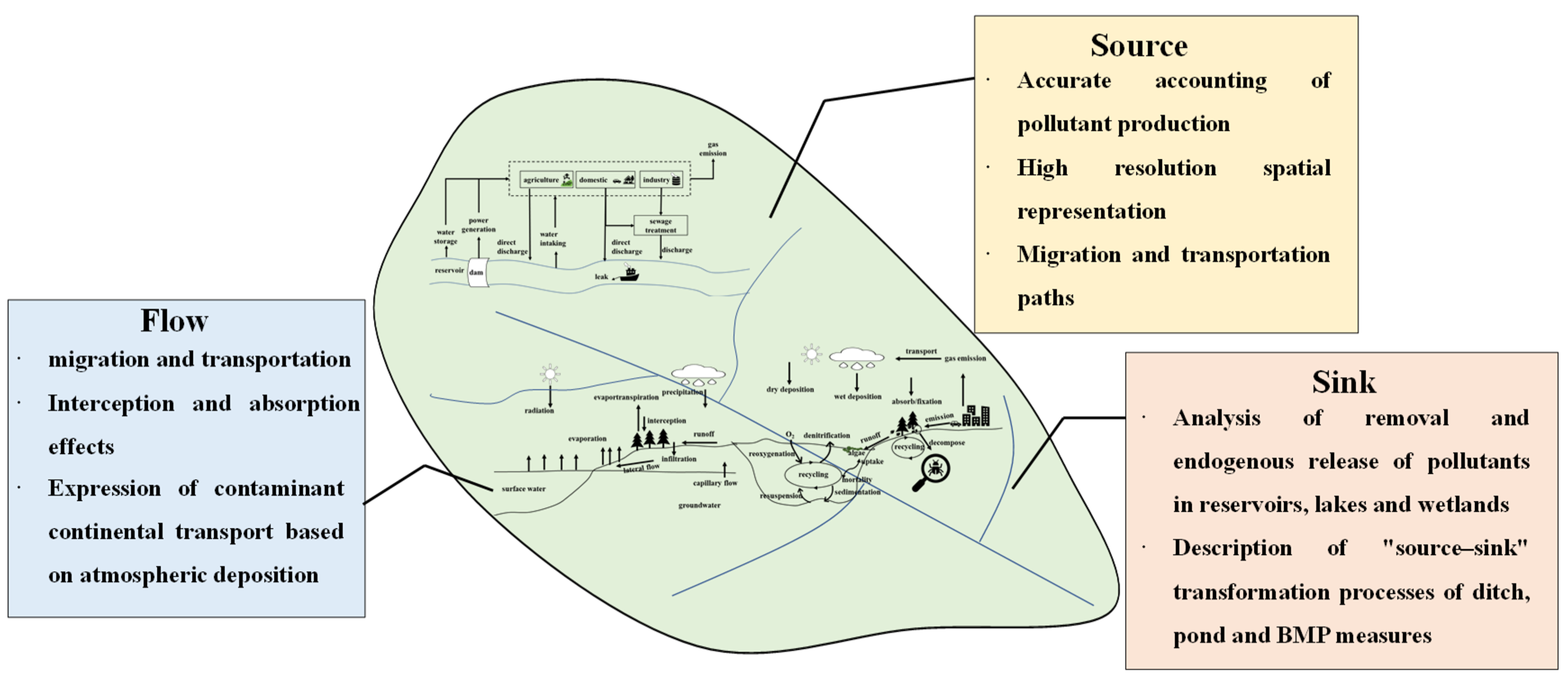
Modelling tools are commonly used for predicting non-point source (NPS) pollutants and it is timely to review progress that has been made in terms of the development of NPS models. This paper: (1) proposes a systematic description of model framework and generalizes some commonly used models; (2) identifies the common challenges in model structure and applications; (3) summarizes the future directions of NPS models. Challenges in model construction and application are based on the following: (1) limitations in understanding specific NPS pollution processes; (2) model expansion to different scales; (3) data scarcity and its impacts on model performance; (4) prediction uncertainty due to model input, parameter and model structure; (5) insufficient accuracy for decision-making. Finally, this paper proposes future directions for model development, including: (1) a source–flow–sink framework for model development; (2) standardization for model input and parameter; (3) reliable decision support for environmental management. The findings of this review provide helps in the accurate prediction and management of NPS pollution around the world.
Keywords: nonpoint source pollution; model construction; model application; uncertainty; decision-making; best management practice nonpoint source pollution; model construction; model application; uncertainty; decision-making; best management practice