

UNESCO’s Contribution to Face Global Water Challenges


Abstract
1. Introduction
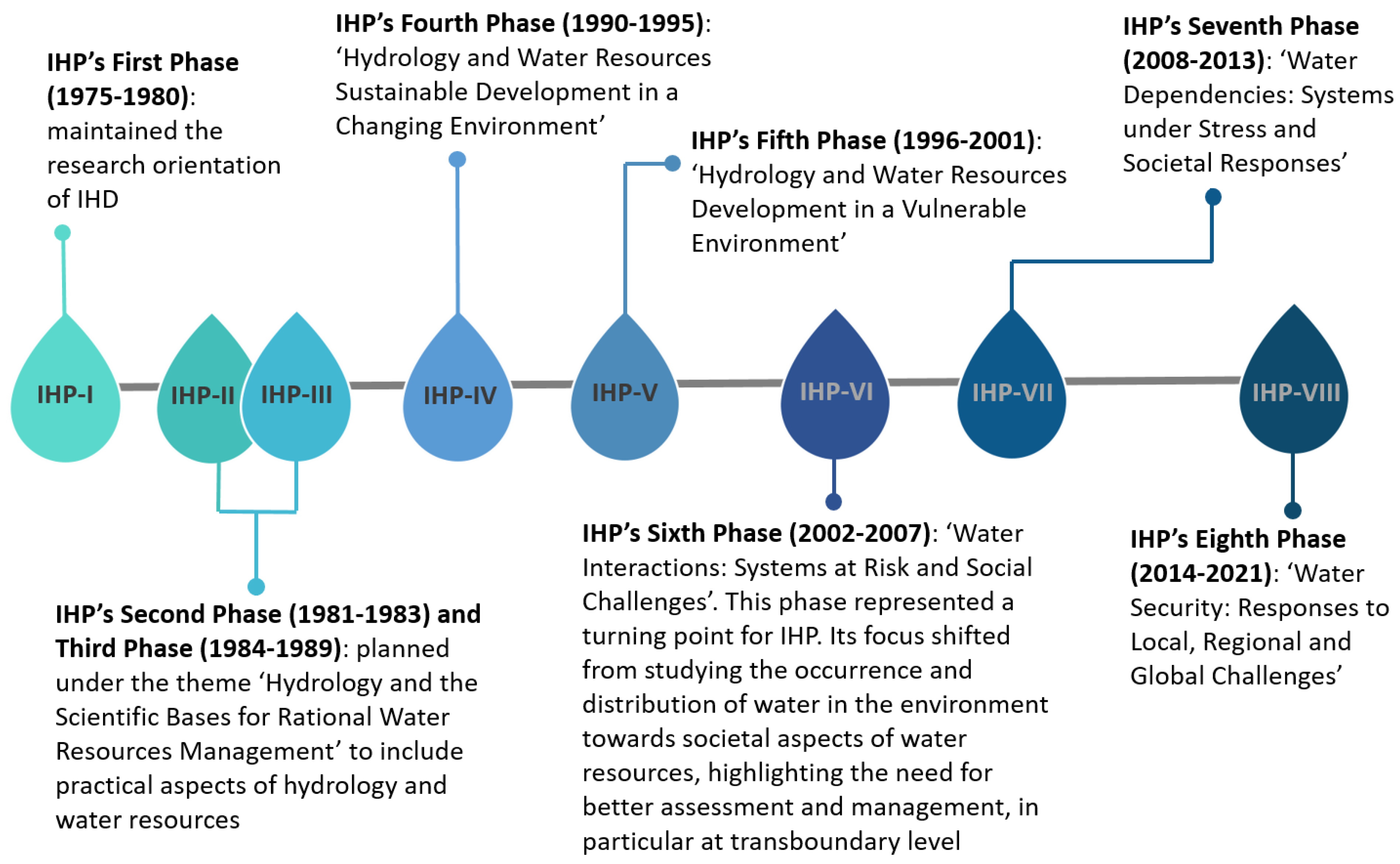
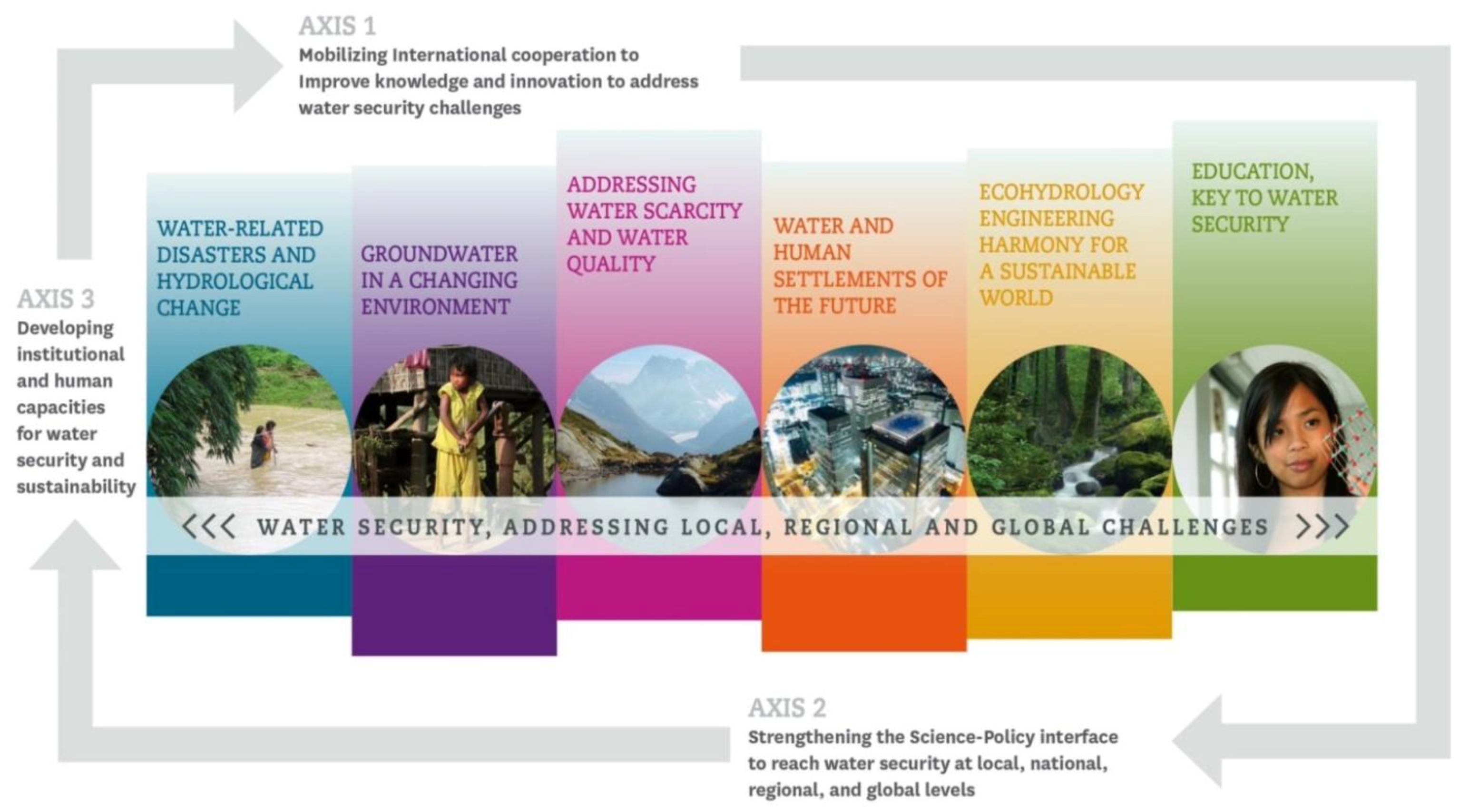
2. Intergovernmental Hydrological Programme: Origin and Strategy
- Theme 1: Water-related Disasters and Hydrological Changes
- Theme 2: Groundwater in a Changing Environment
- Theme 3: Addressing Water Scarcity and Quality
- Theme 4: Water and Human Settlements of the Future
- Theme 5: Ecohydrology, Engineering Harmony for a Sustainable World
- Theme 6: Water Education, Key to Water Security
3. IHP’s Urban Water Management Programme (UWMP)
4. Global Water Challenges
4.1. Pressures on Water Availability
4.1.1. Population Growth
4.1.2. Agriculture
4.1.3. Water Scarcity
4.1.4. Climate Variability and Change
4.2. Water Quality
4.3. Water Related Hazards
4.4. Servicing the Most Vulnerable: Slum Populations
5. UNESCO’s Contribution to Global Water Challenges
5.1. Science & Technology (Tools and Methodologies)
5.1.1. Water Availability
5.1.2. Water Quality
5.1.3. Water Related Hazards
5.1.4. Nature Based Solutions: Ecohydrology
5.1.5. Data Management
5.2. International Cooperation
5.3. Science-Policy Interface
5.4. Human Capital
5.5. Networking
5.6. More than Science & Technology
6. Conclusion
Author Contributions
Funding
Conflicts of Interest
References
- UNDP (United Nations Development Programme). Human Development Report. Beyond scarcity: Power, Poverty and the Global Water Crisis; United Nations Development Programme: New York, NY, USA, 2006. [Google Scholar]
- UNISDR. Making Development Sustainable: The Future of Disaster Risk Management. In Global Assessment Report on Disaster Risk Reduction; United Nations Office for Disaster Risk Reduction (UNISDR): Geneva, Switzerland, 2015. [Google Scholar]
- Water, Megacities and Global Change; UNESCO/ARCEAU IdF: Paris, France, 2016; ISBN 978-92-3-100161-1. Available online: https://unesdoc.unesco.org/ark:/48223/pf0000245419 (accessed on 17 December 2018).
- Shiklomanov, I.A. Appraisal and Assessment of World Water Resources. Water Int. 2000, 25, 11–32. [Google Scholar] [CrossRef] [Scilit]
- United Nations, Department of Economic and Social Affairs, Population Division. World Population Prospects: The 2017 Revision, Key Findings and Advance Tables; Working Paper No. ESA/P/WP/248; United Nations, Department of Economic and Social Affairs, Population Division: New York, NY, USA, 2017. [Google Scholar]
- WWAP (World Water Assessment Programme). The United Nations World Water Development Report 4: Managing Water under Uncertainty and Risk; UNESCO: Paris, France, 2012. [Google Scholar]
- Agriculture, Food and Water, 2003. Available online: http://www.fao.org/docrep/006/Y4683E/y4683e07.htm (accessed on 16 October 2018).
- Förster, J. Eurostat Statistics Explained. Water Use in Industry; Eurostat: Luxembourg, 2014; Available online: https://ec.europa.eu/eurostat/statistics-explained/index.php?title=Archive:Water_use_in_industry&oldid=197333 (accessed on 29 September 2018).
- FAO (Food and Agriculture Organization of the United Nations). Food Wastage Footprints. Sustainable Pathways; FAO: Rome, Italy, 2013. [Google Scholar]
- Madani, K.; Lund, J.R. Strategic multi-criteria decision making under uncertainty. In World Environmental and Water Resources Congress 2011: Bearing Knowledge for Sustainability—Proceedings of the 2011 World Environmental and Water Resources Congress, Palm Springs, CA, USA, May 2011; pp. 3096–3102. [CrossRef] [Scilit]
- Serageldin, I. Assuring water for food: The challenge for the coming generation. Water Resour. Dev. 2001, 17, 521–525. [Google Scholar] [CrossRef] [Scilit]
- Shiklomanov, I. World water resources. water in crisis, Oxford, New York. In Comprehensive Assessment of the Freshwater Resources of the World; Gleick, P., Ed.; World Meteorological Organization: Stockholm, Sweden, 1997; Volume 88. [Google Scholar]
- UNDP (United Nations Development Programme). Millenium Development Goals Report for Uganda 2015: Special Theme; Results, Reflections and the Way Forward. Available online: https://ug.usembassy.gov/wp-content/uploads/sites/42/2016/07/UGANDA-MDG_2015-FINAL-REPORT.pdf (accessed on 29 September 2018).
- Seckler, D.; Barker, R.; Amarasinghe, U. Water scarcity in the twenty-first century. Int. J. Water Resour. Dev. 1999, 15, 29–42. [Google Scholar] [CrossRef] [Scilit]
- Schiermeier, Q. IPCC report under fire. Nature 2014, 508, 298. [Google Scholar] [CrossRef] [Scilit] [PubMed]
- Elliott, J.D.; Deryng, C.; Müller, K.; Frieler, M.; Konzmann, D.; Gerten, M.; Glotter, M.; Flörke, Y.; Wada, N.; Best, S.; et al. Constraints and potentials of future irrigation water availability on agricultural production under climate change. Proc. Natl. Acad. Sci. 2014, 111, 3239–3244. [Google Scholar] [CrossRef] [Scilit] [PubMed]
- Haddeland, I.; Heinke, J.; Biemans, H.; Stephanie, E.; Martina, F.; Naota, H.; Markus, K.; Fulco, L.; Yoshimitsu, M.; Jacob, S.; et al. Global water resources affected by human interventions and climate change. PNAS 2014, 111, 3251–3256. [Google Scholar] [CrossRef] [Scilit] [PubMed]
- Schewe, J.; Heinke, J.; Gerten, D.; Ingjerd, H.; Nigel, W.A.; Douglas, B.C.; Rutger, D.; Stephanie, E.; Balázs, M.F.; Felipe, J.C.-G.; et al. Multi-model assessment of water scarcity under climate change. PNAS 2014, 111, 3245–3250. [Google Scholar] [CrossRef] [Scilit] [PubMed]
- Mirchi, A.; Madani, K.; Roos, M.; Watkins, D.W. Climate Change Impacts on California’s Water Resources. 2013. Available online: https://www.researchgate.net/publication/273378884_Climate_Change_Impacts_on_California’s_Water_Resources (accessed on 29 September 2018). [CrossRef] [Scilit]
- Gohari, A.; Bozorgi, A.; Madani, K.; Elledge, J.; Berndtsson, R. Adaptation of surface water supply to climate change in central Iran. J. Water Clim. Chang. 2014, 5, 391–407. [Google Scholar] [CrossRef] [Scilit]
- Nazemi, A.; Wheater, H.S.; Chun, K.P.; Bonsal, B.; Mekonnen, M. Forms and drivers of annual streamflow variability in the headwaters of Canadian Prairies during the 20th century. Hydrol. Process. 2017. [Google Scholar] [CrossRef] [Scilit]
- Nazemi, A.; Wheater, H.S. On inclusion of water resource management in Earth system models—Part 1: Problem definition and representation of water demand. Hydrol. Earth Syst. Sci. 2015, 19, 33–61. [Google Scholar] [CrossRef] [Scilit]
- Nazemi, A.; Wheater, H.S. On inclusion of water resource management in Earth system models—Part 2: Representation of water supply and allocation and opportunities for improved modeling. Hydrol. Earth Syst. Sci. 2015, 19, 63–90. [Google Scholar] [CrossRef] [Scilit]
- Holger, T.; Martin-Bordes, J.L.; Jasonm, G. Climate Change Effects on Groundwater Resources: A Global Synthesis of Findings and Recommendations; Taylor & Francis Group: London, UK, 2012; ISBN 978-0-415-68936-6. [Google Scholar]
- Agrawal, A. Local institutions and adaptation to climate change. In Social Dimensions of Climate Change: Equity and Vulnerability in a Warming World, Mearns; Mearns, R., Norton, A., Eds.; The World Bank: Washington, DC, USA, 2010; pp. 173–198. [Google Scholar]
- Rosenzweig, C.J.; Elliott, D.; Deryng, A.C.; Ruane, C.; Müller, A.; Arneth, K.J.; Boote, C.; Folberth, M.; Glotter, N.; Khabarov, K.; et al. Assessing agricultural risks of climate change in the 21st century in a global gridded crop model intercomparison. Proc. Nat. Acad. Sci. 2014, 111, 3268–3273. [Google Scholar] [CrossRef] [Scilit] [PubMed]
- Daskalaki, P.; Voudouris, K. Groundwater quality of porous aquifers in Greece: A synoptic review. Environm. Geol. 2007, 54, 505–513. [Google Scholar] [CrossRef] [Scilit]
- Carey, R.O.; Migliaccio, K.W. Contribution of wastewater treatment plant effluents to nutrient dynamics in aquatic systems: A review. Environ. Manag. 2009, 44, 205–217. [Google Scholar] [CrossRef] [Scilit] [PubMed]
- Managing Water Resources in Arid and Semi Arid Regions of Latin America and the Caribbean, MWAR-LAC. Available online: http://www.cazalac.org/mwar_lac/index.php?id=12 (accessed on 16 October 2018).
- IPCC (Intergovernmental Panel on Climate Change). Climate Change 2014: Synthesis Report. Contribution of Working Groups I, II and III to the Fifth Assessment Report of the Intergovernmental Panel on Climate Change; Pachauri, R.K., Meyer, L.A., Eds.; IPCC: Geneva, Switzerland, 2014; p. 151. [Google Scholar]
- Jiménez Cisneros, B.E.; Oki, T.; Arnell, N.W. Freshwater resources. In Climate Change 2014: Impacts, Adaptation, and Vulnerability. Part A: Global and Sectoral Aspects. Contribution of Working Group II to the Fifth Assessment Report of the Intergovernmental Panel on Climate Change; Field, C.B., Barros, V.R., Dokken, D.J., Eds.; Cambridge University Press: Cambridge, UK, 2014. [Google Scholar]
- World Bank. Reducing Inequalities in Water Supply, Sanitation, and Hygiene in the Era of the Sustainable Development Goals: Synthesis Report of the WASH Poverty Diagnostic Initiative; WASH Poverty Diagnostic; World Bank: Washington, DC, USA, 2017. [Google Scholar]
- WWF (World Wide Fund for Nature). Food Loss and Waste: Facts and Futures; WWF South Africa: Gland, Switzerland, 2017. [Google Scholar]
- Munich Re 2013 NatCatSERVICE Database (Munich: Munich Reinsurance Company). 2013. Available online: https://www.munichre.com/en/reinsurance/business/non-life/natcatservice/index.html (accessed on 29 September 2018).
- Prudhomme, C.; Giuntoli, I.; Robinson, E.L.; Douglas, B.C.; Nigel, W.A.; Rutger, D.; Balázs, M.F.; Wietse, F.; Dieter, G.; Simon, N.G.; et al. Hydrological droughts in the 21st century hotspots and uncertainties from a global multimodel ensemble experiment. PNAS 2014, 111, 3262–3267. [Google Scholar] [CrossRef] [Scilit] [PubMed]
- Richter, B.D.; Mathews, R.; Harisson, D.L.; Wigington, R. Ecologically sustainable water management: Managing river flows for ecological integrity. Ecol. Appl. 2003, 13, 206–224. [Google Scholar] [CrossRef] [Scilit]
- UNESCO, 1st Water Science-Policy Interface Colloquium. Available online: https://en.unesco.org/news/1st-water-science-policy-interface-colloquium (accessed on 29 September 2018).
- UNESCO, International Initiative on Water Quality (IIWQ). Available online: https://en.unesco.org/waterquality-IIWQ (accessed on 29 September 2018).
- Guégan, M.; Uvo, C.B.; Madani, K. “Developing a Module for Estimating Climate Warming Effects on Hydropower Pricing in California” Energy Policy; Elsevier: Amsterdam, Netherlands, 2012; Volume 41, pp. 261–271. [Google Scholar]
- Montreal, Laval Declare States of Emergency over Flooding; Benjamin Shingler, Kalina Laframbois, CBC News. Available online: https://www.cbc.ca/news/canada/montreal/quebec-flooding-province-army-1.4103506 (accessed on 17 September 2018.).
- Dankers, R.; Arnell, N.W.; Clark, D.B.; Pete, D.F.; Balázs, M.F.; Simon, N.G.; Jens, H.; Hyungjun, K.; Yoshimitsu, M.; Yusuke, S.; et al. First look at changes in flood hazard in the Inter-Sectoral Impact Model Intercomparison Project ensemble. PNAS 2014, 111, 3257–3261. [Google Scholar] [CrossRef] [Scilit] [PubMed]
- Balaguru, K.; Foltz, G.R.; Ruby, L.L.; Hagos, S.M.; Judi, D.R. On the Use of Ocean Dynamic Temperature for Hurricane Intensity Forecasting. Am. Meteorol. Soc. 2018. [Google Scholar] [CrossRef] [Scilit]
- WHO and UNICEF. Progress on Sanitation and Drinking Water—2015 Update and MDG Assessment; World Health Organization (WHO) and the United Nations Children’s Fund (UNICEF): Geneva, Switzerland, 2015; ISBN 9 789241 509145. [Google Scholar]
- WWAP (World Water Assessment Programme). The United Nations World Water Development Report 2017. Wastewater: The Untapped Resource; UNESCO: Paris, France, 2017. [Google Scholar]
- UNESCO, Ecohydrology. Available online: https://en.unesco.org/themes/water-security/hydrology/ecohydrology/ (accessed on 29 September 2018).
- OECD. OECD Environmental Outlook to 2050: The Consequences of Inaction; OECD Publishing: Paris, France, 2012. [Google Scholar] [CrossRef] [Scilit]
- UNESCO, The Water Information Network System (WINS). Available online: https://en.unesco.org/ihp-wins (accessed on 29 September 2018).
- G-WADI, UNESCO IHP’s “Global Network on Water and Development Information for Arid Lands. Available online: http://gwadi.org/tools-resources/hydrologic-monitoring/african-monitoring (accessed on 16 October 2018).
- Mirchi, A.; Madani, K.; Watkins, J.D.; Ahmad, S. Synthesis of System Dynamics Tools for Holistic Conceptualization of Water Resources Problems. Water Resour. Manag. 2012, 26, 2421–2442. [Google Scholar] [CrossRef] [Scilit]
- UNESCO, Hydrology Initiatives. Available online: https://en.unesco.org/themes/water-security/hydrology/programmes (accessed on 29 September 2018).
- UN HABITAT, Planning and Design for Sustainable Urban Mobility: Global Report on Human Settlements 2013. ISBN Series Number: 978-92-1-131929-3. Available online: https://unhabitat.org/planning-and-design-for-sustainable-urban-mobility-global-report-on-human-settlements-2013/ (accessed on 29 September 2018).
- UN HABITAT, World Cities Report 2016; UN-Habitat: Nairobi, Kenya; ISBN 978-92-1-132708-3. Available online: https://unhabitat.org/books/world-cities-report/ (accessed on 29 September 2018).
- UNESCO BIOPALT project. Available online: https://en.unesco.org/biopalt?language=en. (accessed on 4 January 2019).
- UNESCO, Urban Water Management Programme. Available online: https://en.unesco.org/uwmp (accessed on 29 September 2018).
- Davos World Economic Forum 2015. Available online: https://www.weforum.org/agenda/2015/12/why-we-need-to-address-global-water-security-now/ (accessed on 16 October 2018).

| Initiative | Description | Contact Officer |
|---|---|---|
 | Flow Regimes from International Experimental and Network Data, an international research initiative that helps to set up regional networks for analyzing hydrological data through the exchange of data, knowledge and techniques at the regional level | Mr Abou Amani a.amani@unesco.org |
 | Global Network on Water and Development Information in Arid Lands, a global network on water resources management in arid and semi-arid zones whose primary aim is to build an effective global community to promote international and regional cooperation in the arid and semiarid areas | Mr Anil Mishra a.mishra@unesco.org |
| GLOBAL NETWORK OF WATER MUSEUMS | Global Network of Water Museums, is an IHP initiative to create synergies within UNESCO with the aim of better using water museums to improve water management via communication and educational activities | Mr Alexander Otte a.otte@unesco.org |
 | Groundwater Resources Assessment under the Pressures of Humanity and Climate Change, a UNESCO-led project seeking to improve our understanding of how groundwater interacts within the global water cycle, how it supports human activity and ecosystems, and how it responds to the complex dual pressures of human activity and climate change | Ms. Alice Aureli a.aureli@unesco.org |
 | Hydrology for the Environment, Life and Policy, a new approach to integrated catchment management by building a framework for water law and policy experts, water resource managers and water scientists to work together on water-related problems | Mr Abou Amani a.amani@unesco.org |
 | Integrated Water Resources Management, an initiative implementing IWRM at the river basin level as an essential element to managing water resources more sustainably, leading to long-term social, economic and environmental benefits | Mr Alexandros Makarigakis a.makarigakis@unesco.org |
 | International Drought Initiative, an initiative aiming at providing a platform for networking and dissemination of knowledge and information between international entities that are actively working on droughts | Mr Abou Amani a.amani@unesco.org |
 | International Flood Initiative, an interagency initiative promoting an integrated approach to flood management which takes advantage of the benefits of floods and the use of flood plains, while reducing social, environmental and economic risks. Partners include the World Metereological Organization (WMO), the United Nations University (UNU), the International Association of Hydrological Sciences (IAHS) and the International Strategy for Disaster Reduction (ISDR). | Mr Abou Amani a.amani@unesco.org |
 | International Initiative on Water Quality, an international platform to strengthen knowledge, research and policy, and develop innovative approaches to tackle water quality challenges | Ms. Sarantuyaa Zandaryaa s.zandaryaa@unesco.org |
 | International Sediment Initiative, an initiative to assess erosion and sediment transport to marine, lake or reservoir environments aimed at the creation of a holistic approach for the remediation and conservation of surface waters, closely linking science with policy and management need | Mr Anil Mishra a.mishra@unesco.org |
 | Internationally Shared Aquifer Resources Management, an initiative to set up a network of specialists and experts to compile a world inventory of transboundary aquifers and to develop wise practices and guidance tools concerning shared groundwater resources management | Ms. Alice Aureli a.aureli@unesco.org |
| LAND SUBSIDENCE INTERNATIONAL INITIATIVE | Land Subsidence International Initiative is a global IHP platform for scientific researchers and institutions, aimed at voluntarily creating the knowledge base to build, facilitate and foster cooperation concerning planning, hydrogeological sciences and water security in urban and coastal areas, by exchanging expertise and good practices for a better transfer of knowledge to public policies; | Ms. Alice Aureli a.aureli@unesco.org |
 | Managing Aquifer Recharge, an initiative that aims to expand water resources and improve water quality with the adoption of improved practices for management of aquifer recharge (storage and recovery) | Ms. Alice Aureli a.aureli@unesco.org |
 | From Potential Conflict to Cooperation Potential, a project facilitating multi-level and interdisciplinary dialogues in order to foster peace, cooperation and development related to the management of shared water resources | Ms. Renee Gift r.gift@unesco.org |
 | Urban Water Management Programme, an initiative that generates approaches, tools and guidelines which will allow cities to improve their knowledge, as well as analysis of the urban water situation to draw up more effective urban water management strategies | Mr Alexandros Makarigakis a.makarigakis@unesco.org |
 | World Hydrogeological Map, an initiative to collect, collate and visualize hydrogeological information at the global scale to convey groundwater-related information in a way appropriate for global discussion on water issues | Ms. Alice Aureli a.aureli@unesco.org |
 | World Large Rivers Initiative, while excluding operational management, aims to establish a purely scientific global platform of researchers and institutions to develop, on a voluntary basis, the scientific foundation for integrated river research by exchanging expertise and good practice | Mr Abou Amani a.amani@unesco.org |
© 2019 by the authors. Licensee MDPI, Basel, Switzerland. This article is an open access article distributed under the terms and conditions of the Creative Commons Attribution (CC BY) license (http://creativecommons.org/licenses/by/4.0/).
Share and Cite
Makarigakis, A.K.; Jimenez-Cisneros, B.E. UNESCO’s Contribution to Face Global Water Challenges. Water 2019, 11, 388. https://doi.org/10.3390/w11020388
Makarigakis AK, Jimenez-Cisneros BE. UNESCO’s Contribution to Face Global Water Challenges. Water. 2019; 11(2):388. https://doi.org/10.3390/w11020388
Chicago/Turabian StyleMakarigakis, Alexandros K., and Blanca Elena Jimenez-Cisneros. 2019. "UNESCO’s Contribution to Face Global Water Challenges" Water 11, no. 2: 388. https://doi.org/10.3390/w11020388
APA StyleMakarigakis, A. K., & Jimenez-Cisneros, B. E. (2019). UNESCO’s Contribution to Face Global Water Challenges. Water, 11(2), 388. https://doi.org/10.3390/w11020388

