Precipitation Characteristics in Huangshan City Under the Background of Reduced Atmospheric Pollutants: Temporal Variations and Potential Associations Analysis


 and
and
Abstract
1. Introduction
2. Methodology
2.1. Study Area
2.2. Data Sources and Chemical Analysis
2.3. Data Analysis
2.3.1. Volume-Weighted Average Concentration
2.3.2. Neutralization Factor
2.3.3. Ion Balance Check and Data Quality Control
3. Results and Discussion
3.1. Atmospheric Pollutant Emissions
3.2. Interannual Variation Characteristics of Acid Rain
3.3. Seasonal Variation Characteristics of Acid Rain
3.4. Precipitation Ions Analysis
3.4.1. Ion Composition and Interannual Variation Trend
3.4.2. Major Alkaline Ion Neutralization Effect
3.4.3. Ion Correlation Analysis
3.5. Regional Comparison of Acid Rain Conditions in Huangshan City
3.6. Uncertainties and Limitations of the Study
4. Discussion
- (1)
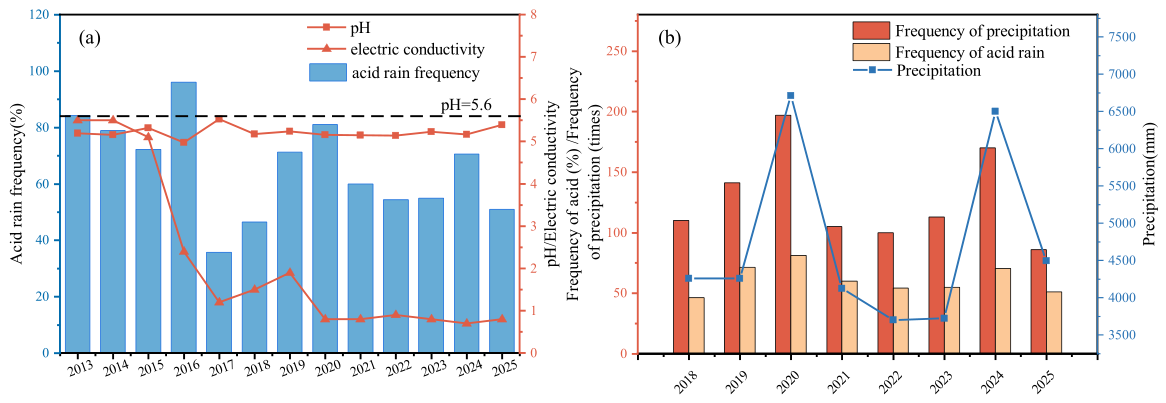
- The acid rain pollution situation has shown a significant phased improvement, but the situation remains severe. During the study period, acid rain pollution in Huangshan City experienced an evolution from “high-level fluctuations” to “stabilization at medium and low levels”. With 2017 as a key turning point, the acid rain frequency dropped off a cliff from the previous high level (e.g., as high as 96% in 2016) and has basically stabilized below 60% since then, except for an abnormal rebound in 2024. This change is highly consistent with the final assessment time of the National Action Plan for Air Pollution Prevention and Control (the Ten Air Pollution Prevention and Control Measures), indicating that macro emission reduction policies have played a decisive role in regional acid rain control. However, unlike the trajectory in Southwest China, characterized by “severe first, then mild, with rapid improvement,” Huangshan exhibits a pattern of “effective policies but lagging improvement.” In terms of harm types, while soil acidification and forest degradation are predominant in Southwest China, Huangshan, as a UNESCO World Natural and Cultural Heritage site, faces a unique cultural heritage risk: the corrosion of ancient stone materials (such as cliff inscriptions and memorial archways) caused by acid rain. The acid rain frequency still reached 50.9% in 2025, indicating that acid rain, as a wet deposition pollution, still has a long-term risk in Huangshan City and cannot be ignored.
- (2)
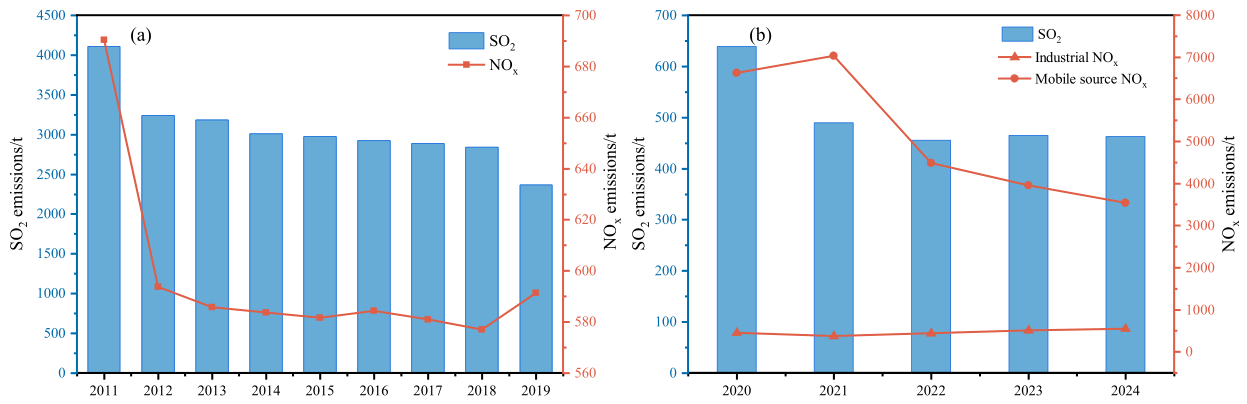
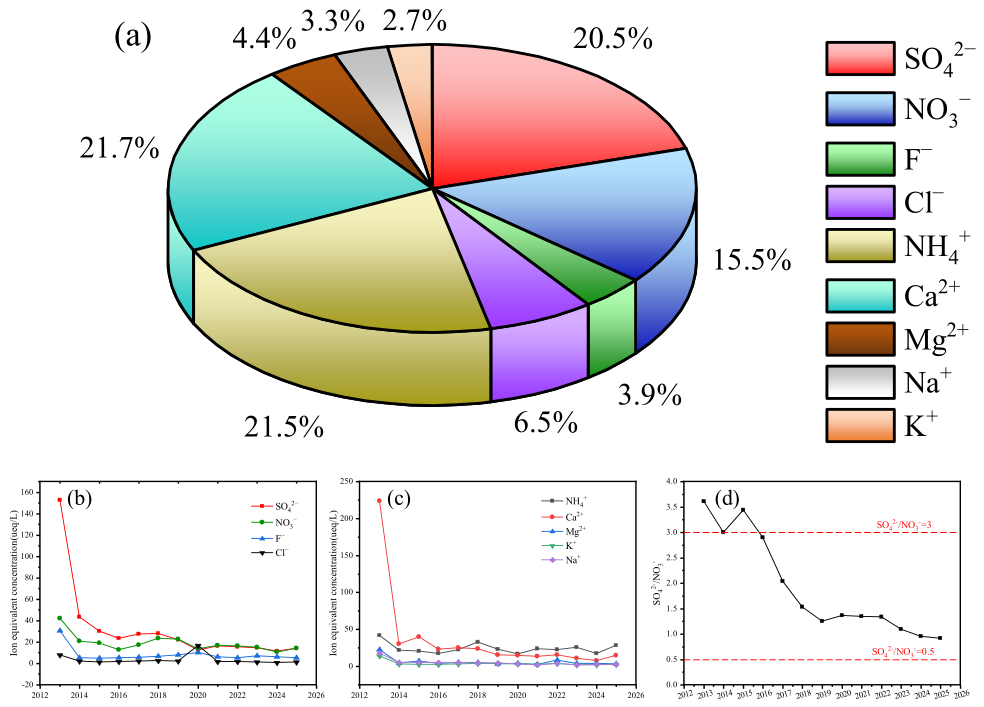
- The type of acid rain is shifting from sulfuric acid type to mixed sulfuric-nitric acid type, and the contribution of mobile source pollution is becoming increasingly prominent. Precipitation chemical analysis showed that the equivalent concentration ratio of SO42− to NO3− in precipitation in Huangshan City decreased significantly from 4.09 in 2013 to 1.10 in 2018, marking the shift in the dominant type of acid rain from the traditional sulfuric acid type (coal-fired type) to the mixed sulfuric–nitric acid type. This shift is directly related to the change in the local pollutant emission structure: the control of sulfur dioxide (SO2) emissions has achieved remarkable results, and the concentration has been stably at an extremely low level for a long time, while the reduction range of nitrogen oxide (NOx) emissions is relatively limited, among which the rapid growth of motor vehicle ownership (from 118,900 in 2013 to 387,900 in 2024) has made mobile sources the absolute main body of NOx emissions. Therefore, the contribution of motor vehicle exhaust emissions to acid rain formation can no longer be ignored.
- (3)
- Precipitation exhibits highly specific selective ion pairing between Ca2+ and SO42− (r = 0.989) and between NH4+ and NO3− (r = 0.839), with these two pairs accounting for 81.4% of the total cation concentration. Linear regression analysis shows that Ca2+ dominates the neutralization of SO42− (explanatory power of 97.5%), while NH4+ dominates the neutralization of NO3− (explanatory power of 85.7%). From the perspective of atmospheric chemical mechanisms, the Ca2+–SO42− pairing mainly occurs during the below-cloud scavenging stage (heterogeneous neutralization of H2SO4 droplets with CaCO3-rich dust), whereas the NH4+–NO3− pairing primarily reflects in-cloud processes (rapid liquid-phase reaction of NH3 and HNO3 within clouds to form NH4NO3, which is subsequently deposited to the ground via precipitation). This specific ion pairing, combined with the characteristics of high forest coverage and low background of alkaline substances due to fewer atmospheric particulates in the local area, together form a system with a relatively balanced acid-base ion but limited buffer capacity. This makes the precipitation pH value not controlled by the concentration of a single acidic ion but by the net balance of specific ion pairs, explaining why the pH value can remain relatively stable when the total ion concentration (conductivity) changes.
- (4)
- During the plateau period, when emission intensities are relatively stable, interannual variability in precipitation, especially extreme wet events, serves as a key external factor driving anomalous increases in acid rain frequency. As emissions of major acid precursors have been effectively controlled and have entered a period of low-level stabilization, the main driving factor for acid rain occurrence has shifted. Interannual analysis shows that anomalous fluctuations in acid rain frequency are closely related to precipitation amount. Given that the baseline level of pollutant “feedstock” still exists, abundant and frequent precipitation acts like an efficient scavenging process, washing down large amounts of acidic substances accumulated in the atmosphere, leading to a sharp increase in the proportion of acid rain samples. Therefore, the occurrence of acid rain in Huangshan City has currently shifted from being primarily driven by “emissions” to a stage where it is more susceptible to the random influence of “precipitation variability”.
- (5)
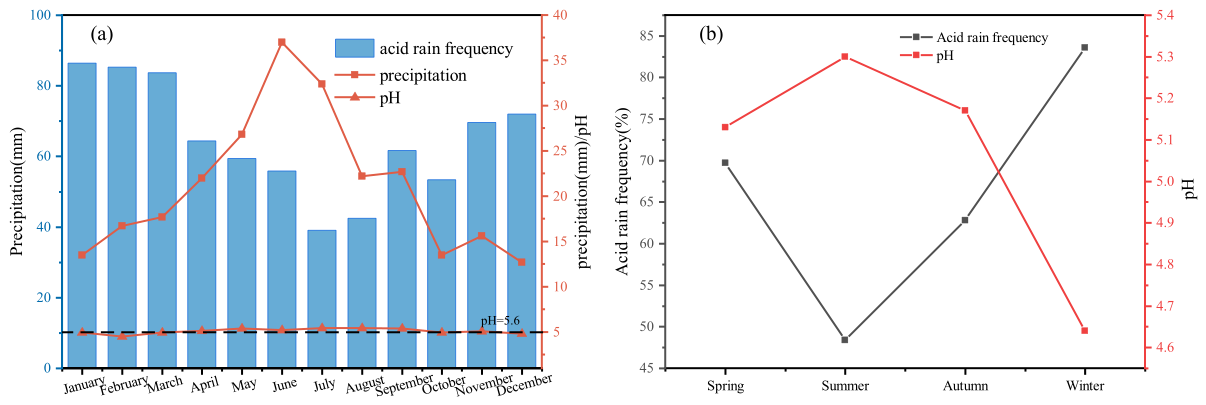
- The spatiotemporal pattern of acid rain is jointly shaped by regional transport and local geographical and climatic characteristics. In Huangshan City, acid rain pollution exhibits pronounced seasonal variations, with the highest frequency and lowest pH value occurring in winter and the opposite pattern in summer. This is primarily governed by the East Asian monsoon circulation: northerly winds from industrial regions such as North China and the Yangtze River Delta prevail in winter, bringing exogenous pollutants, whereas in summer, the area is influenced by relatively clean marine air masses. Furthermore, the unique mountain–basin terrain of Huangshan City hinders the horizontal diffusion of pollutants, leading to their retention and thereby exacerbating the transformation and accumulation of local acidic substances. Comparative studies indicate that the neutralization effect of precipitation in Huangshan City is stronger than that in southeastern China but weaker than that in northern China, which precisely reflects its regional background characteristics as a north–south transition zone influenced by multiple sources.
5. Conclusions
Author Contributions
Funding
Institutional Review Board Statement
Informed Consent Statement
Data Availability Statement
Conflicts of Interest
References
- Zhang, Y.; Li, J.; Tan, J.; Li, W.; Singh, B.P.; Yang, X.; Bolan, N.; Chen, X.; Xu, S.; Bao, Y.; et al. An overview of the direct and indirect effects of acid rain on plants: Relationships among acid rain, soil, microorganisms, and plants. Sci. Total Environ. 2023, 870, 161998. [Google Scholar] [CrossRef]
- Likens, G.E. Ambio’s legacy on monitoring, impact, and management of acid rain. Ambio 2020, 49, 1105–1116. [Google Scholar]
- Zong-jie, L.; Song, L.L.; Jing-zhu, M.; Li, Y.G. The characteristics changes of pH and EC of atmospheric precipitation and analysis on the source of acid rain in the source area of the Yangtze River from 2010 to 2015. Atmos. Environ. 2017, 156, 61–69. [Google Scholar]
- Yun, J.; Zhu, C.; Wang, Q.; Hu, Q.; Yang, G. Catalytic conversions of atmospheric sulfur dioxide and formation of acid rain over mineral dusts: Molecular oxygen as the oxygen source. Chemosphere 2019, 217, 18–25. [Google Scholar] [CrossRef]
- Abbasi, T.; Poornima, P.; Kannadasan, T.; Abbasi, S.A. Acid rain: Past, present, and future. Int. J. Environ. Eng. 2013, 5, 229–272. [Google Scholar] [CrossRef]
- Shi, Z.; Zhang, J.; Xiao, Z.; Lu, T.; Ren, X.; Wei, H. Effects of acid rain on plant growth: A meta-analysis. J. Environ. Manag. 2021, 297, 113213. [Google Scholar] [CrossRef]
- Li, L.; Li, H.; Peng, L.; Li, Y.; Zhou, Y.; Chai, F.; Mo, Z.; Chen, Z.; Mao, J.; Wang, W. Characterization of precipitation in the background of atmospheric pollutants reduction in Guilin: Temporal variation and source apportionment. J. Environ. Sci. 2020, 90, 188–200. [Google Scholar] [CrossRef]
- Cui, L.; Liang, J.; Fu, H.; Zhang, L. The contributions of socioeconomic and natural factors to the acid deposition over China. Chemosphere 2020, 243, 125284. [Google Scholar] [CrossRef]
- Jang, J.-H.; Hong, J.; Kim, J.B.; Park, S.; Hwang, K.; Kim, J.; Kim, J.Y.; Bae, G.-N.; Kim, S.; Kim, K.H. Influence of atmospheric ammonia on secondary inorganic aerosol formation in PM2.5 during spring 2024 in the Hongseong area, Republic of Korea. Atmos. Environ. 2025, 358, 121363. [Google Scholar]
- Xu, Z.; Fu, Y.; Ying, Q.; Hopke, P.K.; Shu, X.; Yang, X.; Qiao, X.; Tang, Y. Atmospheric deposition of pollutants at three altitudes on Mount Emei, Sichuan Basin, southwestern China. Sci. Total Environ. 2024, 957, 177806. [Google Scholar] [PubMed]
- Zeng, J.; Xu, W.; Kuang, Y.; Xu, W.; Liu, C.; Zhang, G.; Zhao, H.; Ren, S.; Zhou, G.; Xu, X. The Impact of Agroecosystems on Nitrous Acid (HONO) Emissions during Spring and Autumn in the North China Plain. Toxics 2024, 12, 331. [Google Scholar] [CrossRef]
- Jia, L.; Sun, J.; Fu, Y. Spatiotemporal variation and influencing factors of air pollution in Anhui Province. Heliyon 2023, 9, e15764. [Google Scholar] [CrossRef] [PubMed]
- Sun, J.; Lu, C.; Yin, Y.; Gao, S.; Li, J.; Zhang, Y. Impact of stochastic collisions on cloud droplet number concentration and relative dispersion during Meiyu frontal system. Atmos. Res. 2024, 285, 106645. [Google Scholar] [CrossRef]
- Lv, T.; Zhao, R.; Wang, N.; Xie, L.; Chen, S.; Ding, H.; Fang, Y. Effect of Environmental and Spatial Factors on Multi-Diversity in Mt. Huangshan. Ecol. Evol. 2025, 15, e12890. [Google Scholar] [CrossRef]
- Zhang, J.H.; Zhang, Y.; Zhou, J.; Liu, Z.-H.; Zhang, H.-L.; Tian, Q. Tourism water footprint: An empirical analysis of Mount Huangshan. Asia Pac. J. Tour. Res. 2017, 22, 1193–1206. [Google Scholar] [CrossRef]
- Laouali, D.; Galy-Lacaux, C.; Diop, B.; Delon, C.; Orange, D.; Lacaux, J.P.; Akpo, A.; Lavenu, F.; Gardrat, E.; Castera, P. Long term monitoring of the chemical composition of precipitation and wet deposition fluxes over three Sahelian savannas. Atmos. Environ. 2012, 62, 554–566. [Google Scholar] [CrossRef]
- Wang, Y.; Yu, W.; Pan, Y.; Wu, D. Acid neutralization of precipitation in Northern China. J. Air Waste Manag. Assoc. 2012, 62, 68–76. [Google Scholar] [CrossRef]
- Fritz, S.J. A Survey of Charge-Balance Errors on Published Analyses of Potable Ground and Surface Waters. Ground Water 1994, 32, 539–546. [Google Scholar] [CrossRef]
- Feng, T.; Shi, Y.; Wang, X.; Wan, X.; Mi, Z. Synergies of air pollution control policies: A review. J. Environ. Manag. 2025, 376, 112856. [Google Scholar] [CrossRef] [PubMed]
- HJ/T 165-2004; Technical Specifications for Acid Deposition Monitoring. Environmental Science Press: Beijing, China, 2004.
- Wang, H.; Gui, H.; Wang, H.; Liu, G. Break point identification and spatiotemporal dynamic evolution of air pollutants: An empirical study from Anhui province, east China. Front. Environ. Sci. 2022, 10, 876345. [Google Scholar] [CrossRef]
- Dang, R.; Liao, H. Radiative forcing and health impact of aerosols and ozone in China as the consequence of clean air actions over 2012–2017. Geophys. Res. Lett. 2019, 46, 12504–12513. [Google Scholar] [CrossRef]
- Ahmad Romli, R.H.; Mochamad Aryono, A.; Adi, M. Spatiotemporal Modeling of Acid Rain Chemistry in Tropical Java Using Mixed-Effects Models: Deposition Patterns and Threshold Exceedance. J. Meteorol. Dan Geofis. 2025, 26, 55–72. [Google Scholar] [CrossRef]
- Indrawati, A.; Tanti, D.A.; Ambarsari, N.; Ma’ruf, I.F.; Sumaryati, N.; Setyawati, W.; Pusfitasari, E.D.; Nugroho, G.A.; Cholianawati, N.; Sinatra, T.; et al. Spatiotemporal distribution in chemical composition of wet atmospheric deposition in Bandung Indonesia. Environ. Sci. Pollut. Res. 2024, 31, 64295–64313. [Google Scholar] [CrossRef] [PubMed]
- Tang, Y.; Huang, A.; Wu, P.; Huang, D.; Xue, D.; Wu, Y. Drivers of Summer Extreme Precipitation Events Over East China. Geophys. Res. Lett. 2021, 48, e2021GL094099. [Google Scholar] [CrossRef]
- Li, Z.; He, Y.; Pang, H.; Jia, W.; He, X.; Zhang, N.; Ning, B.; Yuan, L.; Song, B.; Theakstone, W.H. Chemistry of snow deposited during the summer monsoon and in the winter season at Baishui glacier No. 1, Yulong mountain, China. J. Glaciol. 2009, 55, 407–418. [Google Scholar] [CrossRef]
- Li, Z.; Feng, Q.; Guo, X.; Gao, Y.; Pan, Y.; Wang, T.; Li, J.; Guo, R.; Jia, B.; Song, Y.; et al. The evolution and environmental significance of glaciochemistry during the ablation period in the north of Tibetan Plateau, China. Quat. Int. 2015, 363, 116–124. [Google Scholar]
- Li, Z.; Li, Z.; Wang, T.; Gao, Y.; Cheng, A.; Guo, X.; Guo, R.; Jia, B.; Song, Y.; Han, C.; et al. Composition of wet deposition in the central Qilian Mountains, China. Environ. Earth Sci. 2014, 72, 309–319. [Google Scholar]
- Lin, H.; You, Q.; Jiao, Y. Water Vapor Transportation and Its Influences on Precipitation in Summer over Qinghai-Xizang Plateau and Its Surroundings. Plateau Meteorol. 2016, 35, 309–317. (In Chinese) [Google Scholar]
- Shi, C.; Deng, X.; Yang, Y.; Huang, X.; Wu, B. Precipitation chemistry and corresponding transport patterns of influencing air masses at Huangshan Mountain in East China. Adv. Atmos. Sci. 2014, 31, 1361–1372. [Google Scholar] [CrossRef]
- Li, W.; Gao, J. Acid deposition and integrated zoning control in China. Environ. Manag. 2002, 30, 169–182. [Google Scholar] [CrossRef] [PubMed]
- Miao, Y.; Zhang, C.; Xiao, Q.; Zhao, H.J. Dynamic Variations and Sources of Nitrate During Dry Season in the Lijiang River. Environ. Sci. 2018, 39, 3012–3020. (In Chinese) [Google Scholar]
- Larssen, T.; Lydersen, E.; Tang, D.; He, Y.; Gao, J.; Liu, H.; Duan, L.; Seip, H.M.; Vogt, R.D.; Mulder, J.; et al. Acid Rain in China. Environ. Sci. Technol. 2006, 40, 418–425. [Google Scholar] [CrossRef]
- Xu, Z.; Wu, Y.; Liu, W.J.; Liang, C.-S.; Ji, J.P.; Zhao, T.; Zhang, X. Chemical composition of rainwater and the acid neutralizing effect at Beijing and Chizhou city, China. Atmos. Res. 2015, 156, 188–198. [Google Scholar] [CrossRef]
- Migliavacca, D.; Teixeira, E.; Wiegand, F.; Machado, A.; Sanchez, J. Atmospheric precipitation and chemical composition of an urban site, Guaiba hydrographic basin, Brazil. Atmos. Environ. 2005, 39, 247–256. [Google Scholar] [CrossRef]
- Niu, H.; He, Y.; Lu, X.X.; Shen, J.; Du, J.; Zhang, T.; Pu, T.; Xin, H.; Chang, L. Chemical composition of rainwater in the Yulong Snow Mountain region, Southwestern China. Atmos. Res. 2014, 143, 118–128. [Google Scholar] [CrossRef]
- Chandra Mouli, P.; Venkata Mohan, S.; Reddy, S.J. Rainwater chemistry at a regional representative urban site: Influence of terrestrial sources on ionic composition. Atmos. Environ. 2005, 39, 7207–7217. [Google Scholar] [CrossRef]
- Conradie, E.H.; Van Zyl, P.G.; Pienaar, J.J.; Beukes, J.P.; Galy-Lacaux, C.; Venter, A.D.; Mkhatshwa, G.V. The chemical composition and fluxes of atmospheric wet deposition at four sites in South Africa. Atmos. Environ. 2016, 136, 105–116. [Google Scholar] [CrossRef]
- Rao, P.S.P.; Tiwari, S.; Matwale, J.L.; Pervez, S.; Tunved, P.D.; Safai, P.; Srivastava, A.K.; Bisht, D.S.; Singh, S.; Hopke, P.K. Sources of chemical species in rainwater during monsoon and non-monsoonal periods over two mega cities in India and dominant source region of secondary aerosols. Atmos. Environ. 2016, 135, 158–169. [Google Scholar] [CrossRef]
- Zhang, X.; Jiang, H.; Zhang, Q.; Zhang, X. Chemical characteristics of rainwater in northeast China, a case study of Dalian. Atmos. Res. 2012, 112–113, 118–126. [Google Scholar] [CrossRef]
- Dadrasi, A.; Weinzettel, J.; Salmani, F.; Vačkářová, D. High-Resolution Spatial Analysis of Organic and Chemical Nitrogen Fertilizer Sources on NH3 Emissions. E3S Web Conf. 2025, 635, 03002. [Google Scholar] [CrossRef]
- Lin, C.; Ooka, R.; Kikumoto, H.; Kim, Y.; Zhang, Y.; Flageul, C.; Sartelet, K. Impact of gas dry deposition parameterization on secondary particle formation in an urban canyon. Atmos. Environ. 2024, 333, 120633. [Google Scholar] [CrossRef]
- Peng, W.; Zhu, B.; Kang, H.; Chen, K.; Lu, W.; Lu, C.; Kang, N.; Hu, J.; Chen, H.; Liao, H. Inconsistent 3-D Structures and Sources of Sulfate Ammonium and Nitrate Ammonium Aerosols During Cold Front Episodes. J. Geophys. Res. Atmos. 2024, 129, e2023JD039958. [Google Scholar] [CrossRef]
- Guo, Z.; Zhang, G.; Peng, X.; Sun, W.; Liu, F.; Li, M.; Pan, X.; Du, X.; Wang, J.; Wang, Z.; et al. In situ measurement evidence of selective aqueous-phase formation of ammonium, nitrate, and sulfate in clouds. Atmos. Res. 2026, 330, 108514. [Google Scholar] [CrossRef]
- Zhu, H.; Li, Y.; Wu, L.; Yu, S.; Xin, C.; Sun, P.; Xiao, Q.; Zhao, H.; Zhang, Y.; Qin, T. Impact of the atmospheric deposition of major acid rain components, especially NH4, on carbonate weathering during recharge in typical karst areas of the Lijiang River basin, southwest China. Appl. Geochem. 2020, 116, 104654. [Google Scholar] [CrossRef]
- Zhang, Z.; Shen, L.; Zhu, B.; Yue, J.; Wang, H.; Zhang, Q. Chemical characteristics and potential sources of precipitation in Nanjing. Trans. Atmos. Sci. 2015, 38, 473–482. (In Chinese) [Google Scholar]
- Wang, J.; Zhang, L.; Wang, C.; Xia, L.; Huang, C.; Li, T. Effects of acid deposition on the hydrochemistry of Jinyunshan Lake. J. Earth Environ. 2023, 14, 242–252. (In Chinese) [Google Scholar]
- Li, Q.; Liu, X.; Zhang, J. Changing trends of acid rain types in the Yangtze River Delta region. J. Nanjing For. Univ. (Nat. Sci. Ed.) 2021, 45, 168–174. (In Chinese) [Google Scholar]
- Xiao, Q.; Yang, G.; Chen, Q. Variation Characteristics of Acid Rain and Its Relationship with Meteorological Factors in Dazhou. Plateau Mt. Meteorol. Res. 2024, 44, 77–82. (In Chinese) [Google Scholar]
- Sun, S.; Liu, S.; Li, L.; Zhao, W. Components, acidification characteristics, and sources of atmospheric precipitation in Beijing from 1997 to 2020. Atmos. Environ. 2021, 266, 118707. [Google Scholar] [CrossRef]



| Index | Adjusted R-Square | Coefficients | p-Value |
|---|---|---|---|
| NH4+ | 0.975 | 0.164 | 0.666 |
| Ca2+ | 0.633 | 6.24 × 10⁻⁸ |
| Index | Adjusted R-Square | Coefficients | p-Value |
|---|---|---|---|
| NH4+ | 0.857 | 0.422 | 0.050 |
| Ca2+ | 0.089 | 0.003 |
| Index | pH | Conductivity | SO42− | NO3− | Cl− | F− | NH4+ | Ca2+ | Mg2+ | K+ | Na+ |
|---|---|---|---|---|---|---|---|---|---|---|---|
| pH | 1 | - | - | - | - | - | - | - | - | - | - |
| Conductivity | −0.077 | 1 | - | - | - | - | - | - | - | - | - |
| SO42− | −0.041 | 0.688 | 1 | - | - | - | - | - | - | - | - |
| NO3− | 0.026 | 0.645 | 0.931 | 1 | - | - | - | - | - | - | - |
| Cl− | −0.086 | 0.444 | 0.928 | 0.855 | 1 | - | - | - | - | - | - |
| F− | −0.150 | 0.004 | 0.234 | 0.186 | 0.463 | 1 | - | - | - | - | - |
| NH4+ | 0.143 | 0.310 | 0.754 | 0.839 | 0.714 | 0.0001 | 1 | - | - | - | - |
| Ca2+ | −0.033 | 0.633 | 0.989 | 0.907 | 0.953 | 0.279 | 0.748 | 1 | - | - | - |
| Mg2+ | −0.052 | 0.592 | 0.947 | 0.873 | 0.915 | 0.263 | 0.717 | 0.968 | 1 | - | - |
| K+ | −0.056 | 0.540 | 0.967 | 0.931 | 0.964 | 0.338 | 0.776 | 0.977 | 0.961 | 1 | - |
| Na+ | −0.027 | 0.668 | 0.980 | 0.909 | 0.915 | 0.261 | 0.697 | 0.979 | 0.953 | 0.969 | 1 |
| Cities/Regions | Time | Acid Rain Frequency | pH | Acid Rain Type |
|---|---|---|---|---|
| Huangshan City | 2013–2025 | 55% | 5.06 | sulfate-type to sulfate-nitrate mixed-type |
| Nanjing City [46] | 2020–2021 | 20.9% | 5.8 ± 0.5 | sulfate-type to sulfate-nitrate mixed-type |
| Guilin City [7] | 2013–2017 | 42.5–74.9% | 4.85–5.23 | sulfate-type to sulfate-nitrate mixed-type |
| Jinyun Mountain, Chongqing [47] | 2001–2019 | - | 3.9–5.2 | sulfate-type to sulfate-nitrate mixed-type |
| Yangtze River Delta (Region) [48] | 2010–2018 | 57.1 ± 18.7% | 4.87 ± 0.28 | sulfate-type to sulfate-nitrate mixed-type |
| Dazhou City [49] | 2008–2022 | 27.49% | 6.2 | sulfate-type to sulfate-nitrate mixed-type |
| Beijing City [50] | 1997–2020 | Dropped to 0% after 2017 | 5.74 ± 0.67 (urban area), 6.53 ± 0.54 (suburban area) | sulfate-type to sulfate-nitrate mixed-type |
Disclaimer/Publisher’s Note: The statements, opinions and data contained in all publications are solely those of the individual author(s) and contributor(s) and not of MDPI and/or the editor(s). MDPI and/or the editor(s) disclaim responsibility for any injury to people or property resulting from any ideas, methods, instructions or products referred to in the content. |
© 2026 by the authors. Licensee MDPI, Basel, Switzerland. This article is an open access article distributed under the terms and conditions of the Creative Commons Attribution (CC BY) license.
Share and Cite
Cheng, L.; Wang, Y.; Li, J.; Xu, F.; Fei, Y.; Xu, Z.; Pan, C. Precipitation Characteristics in Huangshan City Under the Background of Reduced Atmospheric Pollutants: Temporal Variations and Potential Associations Analysis. Atmosphere 2026, 17, 575. https://doi.org/10.3390/atmos17060575
Cheng L, Wang Y, Li J, Xu F, Fei Y, Xu Z, Pan C. Precipitation Characteristics in Huangshan City Under the Background of Reduced Atmospheric Pollutants: Temporal Variations and Potential Associations Analysis. Atmosphere. 2026; 17(6):575. https://doi.org/10.3390/atmos17060575
Chicago/Turabian StyleCheng, Long, Yimei Wang, Jialing Li, Feng Xu, Yi Fei, Zhenyi Xu, and Chengrong Pan. 2026. "Precipitation Characteristics in Huangshan City Under the Background of Reduced Atmospheric Pollutants: Temporal Variations and Potential Associations Analysis" Atmosphere 17, no. 6: 575. https://doi.org/10.3390/atmos17060575
APA StyleCheng, L., Wang, Y., Li, J., Xu, F., Fei, Y., Xu, Z., & Pan, C. (2026). Precipitation Characteristics in Huangshan City Under the Background of Reduced Atmospheric Pollutants: Temporal Variations and Potential Associations Analysis. Atmosphere, 17(6), 575. https://doi.org/10.3390/atmos17060575