Article

Satellite-Based Assessment of Potential Microclimatic Effects of Photovoltaic (PV) Power Plants in Vulnerable Agroecosystems


by
Ioannis Faraslis
1,*,
Nicolas R. Dalezios
2,
Marios Spiliotopoulos
2,
Nikolaos Alpanakis
3,
Stavros Sakellariou
1,
Vagelis Brisimis
2 and
Nicholas Dercas
4
1
Department of Environmental Sciences, University of Thessaly, 41500 Larisa, Greece
2
Laboratory of Hydrology, Department of Civil Engineering, University of Thessaly, 38334 Volos, Greece
3
Department of Surveying and Agronomic Engineering, Aristotle University of Thessaloniki, 54124 Thessaloniki, Greece
4
Laboratory of Agricultural Hydraulics, Department of Natural Resources and Agricultural Engineering, Agricultural University of Athens, 11855 Athens, Greece
*
Author to whom correspondence should be addressed.
Atmosphere 2026, 17(6), 562; https://doi.org/10.3390/atmos17060562
Submission received: 13 March 2026 / Revised: 26 May 2026 / Accepted: 26 May 2026 / Published: 29 May 2026
(This article belongs to the Section Biometeorology and Bioclimatology)

Abstract

There is a strong global increase in the installation of renewable energy power plants, due to increasing energy demand in the electricity generation sector and fast cost reduction. Recent studies indicate that the installation and operation of photovoltaic (PV) power plants have negligible microclimatic effects, although there are minor effects on night temperature in some cases, which, however, do not justify climate or environmental change. The development of solar energy and the installation and operation of PV power plants serve as a key solution for the energy transition to reduce carbon emissions and to address global warming. Despite the benefit of emission reduction, the deployment of solar energy through the installation of solar power plants causes land cover changes and may have minor effects on the surface energy balance by modifying roughness and albedo, biodiversity by disturbing habitats, and water resources by requiring water for cooling and cleaning. These changes may also lead to minor climatic, ecological, and social impacts. The objective of the paper consists of assessing the potential microclimatic effects of photovoltaic power plants based on satellite-based land surface temperature (LST) analyses. Specifically, the potential change in the land surface temperature, both under photovoltaic panels and on the panels, in relation to the temperature of the surrounding area is being examined in this study. The implementation is conducted in Mediterranean ecosystems, which are considered vulnerable agroecosystems due to increased climate variability. The final Landsat-based time series analysis further supports this synthesis, reporting that monthly LST differences between the PV Park and surrounding area are negligible and do not indicate a meaningful microclimate alteration attributable to PV operations. Accordingly, the evidence supports the core conclusion: utility-scale PV deployment does not constitute a driver of climate change, and the documented effects are best understood as localized surface–atmosphere energy-balance perturbations whose sign and magnitude depend on land cover, seasonality, and operation.

1. Introduction

There is a strong global increase in the installation of renewable energy power plants, due to increasing energy demand in the electricity generation sector and fast cost reduction [1,2,3]. Photovoltaic (PV) power plants have the advantage of relying on an abundant source of energy, namely solar energy, and, at the same time, being less disruptive to ecosystems than some other forms of production of renewable energy, such as hydroelectric plants. In addition, unlike wind energy, solar parks are silent [2]. Recent studies indicate that the installation and operation of PV power plants have negligible microclimatic effects [2,4,5,6,7,8], although there are minor effects on night temperature in some cases [1,9,10], which, however, do not justify climate or environmental change. In a recent review of the state of the art on the effects on microclimate in agrivoltaics (APV) systems [11,12], there are a few APV case studies related to ground-mounted PV plants and, specifically, there are only a few data related to APV systems in arid and semi-arid climates. Indeed, the development of solar energy and the installation and operation of PV power plants serve as a key solution for energy transition to reduce carbon emissions and to address global warming [5,13]. As of 2019, the global electrical energy generated by solar power (including solar PV and thermal) was 694 Terawatt-hours (TWh), accounting for approximately 10% of total renewable energy [14]. By 2040, solar energy is projected to become one of the largest sources of renewable energy production worldwide, with power output from photovoltaic power plants (7200 TWh) exceeding hydropower, and together with wind power promoting the share of renewables to two-thirds of electricity generation [15]. Moreover, to achieve the net zero emissions goal by 2050, solar energy needs rapid growth to more than 22% of electricity generation by 2030 [14].
Air temperature is an essential variable to characterize the impacts of a solar park on the local scale; however, it depends on in situ measurements, which are often unavailable. This limitation can be circumvented using remote sensing data. Satellite data has the advantage of providing global spatial cover and does not depend on the installation date of the solar park: remote sensing allows the study of surface variables not only during a solar park’s operation period but also before its installation. Several variables can be analyzed, among which land surface temperature (LST) and vegetation indices (VI) are the most important ones. Remote sensing studies form the largest evidence base, leveraging Landsat-class thermal data to quantify LST anomalies over PV footprints relative to nearby controls. This approach highlights that PV-induced LST signals are typically small to modest, vary by season, and can change sign depending on background climate and land cover [4,15,16,17,18]. Mechanistically, shading tends to depress daytime LST, especially under dry, high-insolation conditions, while nighttime effects are generally weaker and can reflect altered longwave exchange and boundary-layer coupling.
In the PV–microclimate literature, a distinction should be made between LST, which is a land or skin surface temperature retrieved from thermal infrared remote sensing, and near-surface air temperature (Ta) measured at ~2 m. Indeed, LST is more sensitive to land cover heterogeneity at high spatial resolution, whereas Ta integrates atmospheric mixing and boundary-layer processes over broader scales. In this paper, this distinction is explicitly adopted, and it is noted that most published evidence relies on LST-based analyses, while Ta inferences require additional modeling assumptions and may introduce extra uncertainty. Crucially, these microclimatic signals are addressed by LST analysis in this paper. Based on the Intergovernmental Panel on Climate Change (IPCC)-aligned reasoning, the 21st century is characterized by increased climate variability, whereas climate change implies persistent, statistically robust shifts over multi-decadal periods [18,19], which is not what PV-park studies typically measure or can demonstrate. It is also noted that the role of rainfall in the potential impact of the microclimate of the installation area is also considered in this paper through climatological analysis of the region based on the ERA5-LAND database. However, stormy systems or hydrometeorological processes are outside the scope of this paper and there are no bibliographic references to date. The main reason is that stormy weather systems are typical meso-scale synoptic systems; their motion and evolution follow the laws of the general circulation of the atmosphere, and cover and affect large areas as compared to the size of PV Parks.
While LST dominates remote sensing assessments, in situ micrometeorological campaigns provide direct evidence on Ta and turbulent fluxes. Observational work at utility-scale PV facilities indicates that PV arrays can shift sensible versus latent heat partitioning and modify near-surface turbulence, with measurable but localized changes in Ta and energy fluxes [11]. These observations are consistent with the PV heat island effect being a local, site-dependent phenomenon, not a regional climate signal [9,16,20]. Critically, the existence of local PV-induced energy-balance perturbations motivates careful methodological choices (sensor height, fetch, stability regime, and control selection) when interpreting temperature differences.
Moreover, regional- to global-scale modeling studies have examined the radiative forcing implications of large-scale PV deployment, with albedo change as the primary pathway [6,16,18,19,21]. Analyses show that the net forcing depends on the contrast between PV panel reflectance/absorption and the native land surface, and on how much incoming energy is converted to electricity rather than heat [6,18,19,22]. These studies provide the key bridge to the “climate versus microclimate” distinction: even when a measurable surface perturbation exists, it does not follow that a detectable climate trend emerges, especially given the limited spatial footprint of typical PV installations relative to atmospheric circulation scales [6,18]. This is consistent with the final position that PV Parks do not meet the criteria for climate change attribution [18,19].
Special attention is given to the APV systems. These systems provide a physically transparent context for interpreting PV–microclimate interactions because they explicitly co-locate PV infrastructure with managed vegetation and soils [23]. Field studies in Mediterranean and other climates report that shading can reduce daytime ground heating, alter soil moisture, and potentially buffer thermal extremes, with outcomes strongly conditioned by crop type, mounting geometry, and local water availability [24,25,26,27,28,29]. Reviews emphasize that agrivoltaics often shift the partitioning of net radiation toward latent heat (when moisture is available) and reduce extreme soil/plant heat stress, supporting a small, context-dependent, and frequently beneficial microclimate signal rather than a systematic warming driver. In this framing, any microclimatic effect is primarily a surface-process response rather than a regional climate forcing, and it is therefore inappropriate to interpret localized LST and soil-temperature differences as evidence of climate change [30]. In semi-arid or vulnerable environments, several studies report PV-associated cool islands, consistent with strong daytime shading and altered surface radiative properties. These findings align with broader ecohydrology and land-use impact literature suggesting that the sign and magnitude of surface thermal anomalies depend on pre-existing land cover (e.g., barren land versus cropland) and the extent to which PV development changes vegetation structure and evapotranspiration [17,31]. Importantly, the cool-island narrative supports the core conclusion in such studies: PV Parks do not systematically warm the landscape; rather, they generate spatially heterogeneous perturbations that are frequently neutral or cooling in daytime LST.
This paper examines the potential impact on the microclimate of an area that belongs to vulnerable agroecosystems from the installation and operation of PV power plants. Specifically, the potential change in the ground surface temperature, both under PV panels and on the panels, in relation to the temperature of the surrounding area, is being investigated. The objective of the paper consists of assessing the potential microclimatic effects of PV power plants based on satellite-based LST analysis. Nevertheless, the main methodological limitations and scope boundaries of the study remain and consist of LST interpretation, spatial resolution constraints, and the absence of in situ validation. The implementation is conducted in Mediterranean ecosystems, which are considered vulnerable agroecosystems due to the impacts of climate variability and change. The paper is structured as follows: in Section 2, Materials and Methods are presented, which include background information, a description of the study area, including climatology and topography, extended descriptions and analyses, as well as justification of vulnerable agroecosystems, the employed database and the methodological procedure to be followed. Specifically, the methodological steps include temperature trend analysis in the PV site before and after the installation of the PV power plant, annual distribution of mean monthly temperature analysis before and after the installation, as well as of the surrounding area. In Section 3 the results are analyzed and presented, and Section 4 covers a discussion on the components of PV plants.

2. Materials and Methods

This section presents brief background information, followed by a description of the study area, then the employed database is presented, followed by the adopted methodological procedure of the paper.

2.1. Background Information

The topic of the potential impact on the microclimate has arisen relatively recently and there are not many bibliographic references, while the findings vary depending on the adopted methodology, i.e., satellite surface temperature data vs. in situ measurements, the scale/geometry of the installation and local conditions, such as land cover, seasonality, wind, and humidity. Literature review has led to the distinction of two categories: the first category concerns the non-increase or decrease (cooling) of temperature using satellite temperature data, namely LST, i.e., no negative effect on the microclimate of an area, where most of the references belong [1,4,5,6,9,10]. In this first category, it is shown in several cases that the differences are small to very small, indicating seasonality, although mild cooling is often observed, especially during the warm months, attributed to mechanisms such as ground shading, changes in surface properties (e.g., reflectivity, or albedo) and changes in energy distribution, since part of the incident radiation is converted into electricity. In addition, “cool island” phenomena have been reported, i.e., colder surface temperatures within and/or around facilities under certain conditions [4]. The second category refers to small differences in temperature for certain hours, mainly during the night, and under certain meteorological conditions, e.g., apnea [9,10,32].
The LST or skin surface temperature is one of the key climate variables determined by the surface energy balance and closely related to the near-surface air temperature [33,34]. Unlike air temperature measured by weather stations as point samples, surface temperature can be monitored using satellite remote sensing with a much larger spatial coverage [35]. Previous studies have found that remote sensing platforms, such as AVHRR, MODIS (NASA EOSDIS Land Processes Distributed Active Archive Center (LP DAAC), Sioux Falls, SD, USA) and Landsat (Earth Resources Observation and Science (EROS) Center, located in Sioux Falls, SD, USA, part of the U.S. Geological Survey -USGS), can be used to map land surface temperature effectively in various regions [36,37]. But this technique has not been attempted to map the surface temperature in PV power plants (the surface temperature is the mixture of the PV panels’ surface temperature and the surface temperature of the land between solar panels). In recent studies of large PV systems [38,39], the EOS-MODIS thermal band [40] was used, which had high temporal and spatial resolution and long-term remote sensing observations, to investigate the effects of the PV power plants on surface temperature using the 23 largest PV power plants in the world. The remote sensing images were processed in Google Earth EngineGEE (a geospatial processing service developed by Google LLC (Mountain View, CA, USA), which is a cloud-based platform with massive computational capabilities for processing spatial-temporal data [41]. Specifically, the main objectives of this study are to: (1) assess the effects of the installation of the PV power plants on daytime, nighttime and daily surface temperature and (2) further examine if these effects are related to location, local climate and surface conditions.
At this point it is useful to point out that these results often arise from in situ measurements of air temperature near the ground and/or from analyses that separate day and night behavior. Some studies report diurnal asymmetry, which means slightly cooling during the day and marginal warming at night, with the net overall effect usually remaining limited [32]. Therefore, interpretation requires attention to what exactly is measured (LST vs. air temperature), at what height and under what meteorological conditions. It is appropriate to point out at this point that all the above do not constitute climate change, i.e., a change in the climate. This is because, according to the IPCC, to consider that the climate of an area has changed, there must be persistence of phenomena, such as a significant increase or decrease in temperature, for at least a few decades, which is not the case with PV Parks. However, the possibility of an impact on the microclimate from the installation and operation of PV Parks is being examined, with emphasis on the systematic documentation of any small-scale differences and on considering natural variability and local conditions.
Despite the benefit of emission reduction [5,42], the deployment of solar energy through the installation of solar power plants causes land cover changes, and may have minor effects on the surface energy balance by modifying roughness and albedo [43], biodiversity by disturbing habitats [44], and water resources by requiring water for cooling and cleaning [45,46]. These changes may also lead to minor climatic, ecological, and social impacts [46,47,48]. Indeed, photovoltaic solar parks can have a minor impact on land use, soil moisture, surface temperature and albedo, among others [1,9,21,49]. PV power plants can perturb the surface energy balance through: (i) shading of the ground, (ii) changes in surface radiative properties (notably albedo and emissivity), (iii) modified aerodynamic roughness and turbulence, and (iv) conversion of part of the incoming shortwave radiation into electricity rather than heat. However, issues exist regarding the potential impact on the microclimate of the areas where PV power plants are installed and operated. Land cover change also plays a role in the potential impact of solar parks, as their installation alters the existing land cover, i.e., from a vegetated area to a man-made one. This change in land cover translates into different albedos, evapotranspiration rates, soil moisture and surface temperatures, accompanied by a higher seasonality before the installation and outside the solar park area, mainly because of the seasonality of vegetation [1,6,10,32].
Across APV field studies, a consistent pattern emerges between remote sensing LST assessments, in situ Ta measurements, and climate-modeling analyses. Specifically, PV installations can produce local and seasonally structured surface-temperature responses that are typically small, often cooling in daytime, and not persistent at climate timescales [4,5,6]. Landsat-based time series analysis further supports this synthesis, reporting that monthly LST differences between the PV Park and surrounding area are negligible and do not indicate a meaningful microclimate alteration attributable to PV operations [4,5,6,7,38].
Furthermore, temperature trends show a similar profile with an increase both in the operating area of the PV Park and in the surrounding area, a phenomenon generally attributed to climate variability. The above findings are also confirmed by the corresponding international literature, which, especially in studies based on satellite data of LST, generally shows no increase or a mild decrease in temperature in or around PV installations, with the results often being small-scale and showing seasonality [1,9,10,32]. In addition, some analyses report diurnal asymmetry (e.g., slight cooling during the day and marginal heating at night), without, however, resulting in significant differentiation at the level of the overall temperature balance [32]. Furthermore, on-site air temperature measurements near PV installations show that, where deviations are recorded, these are usually limited and dependent on the prevailing meteorological conditions and the characteristics of the installation [9,10].

2.2. Study Area of the Talasol PV Park: Caceres Province, Spain

In this section, first the climatology of the Caceres Province in western Spain is briefly presented. Then, the vulnerability of this Mediterranean agroecosystem is briefly justified, followed by a description of the main features of the Talasol PV Park.
Climatology. The province of Cáceres has a Mediterranean climate with hot, dry summers and mild, wet winters (https://weatherandclimate.com/spain/extremadura/caceres, accessed on 20 January 2026). The PV Park of Talasol (39.63 N, 6.30 W) is established in the province of Cáceres, within the western region of Spain (Figure 1). In this study, the local climate conditions were analyzed, such as monthly air temperature, precipitation, and whether they are related to the surface temperature effect of the PV power plants. The ERA5-LAND database (accessed on 20 January 2026) for the area covered by the Talasol PV Park was used for the period 1980–2020 and specifically for the hydrological years 1981–2020 (October–September) to analyze the changes in climate variables before the installation of the PV power plant. The use of hydrological years is considered appropriate for hydroclimatic analysis, since it connects fall and winter with the next thermal period.
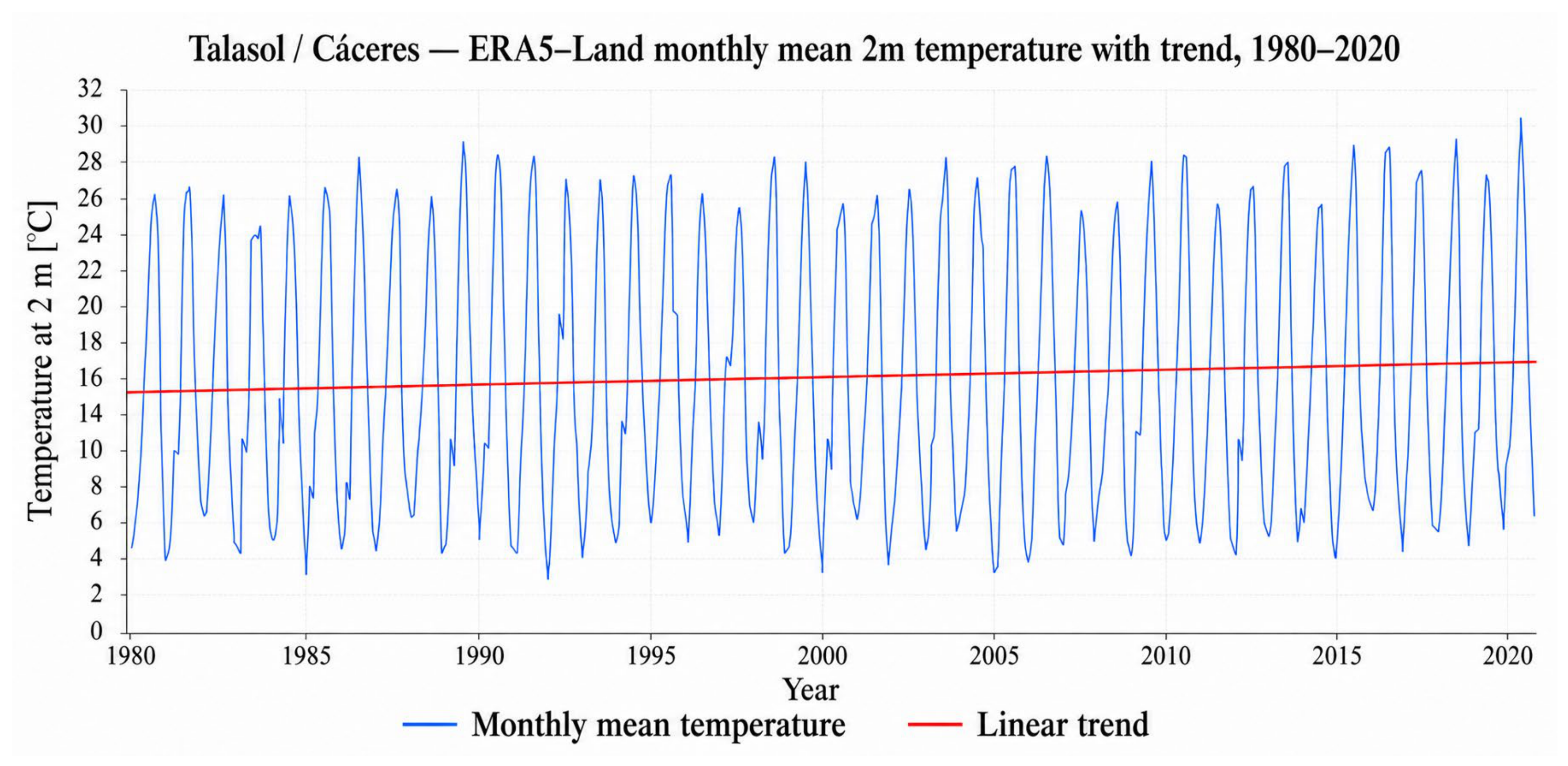
Table 1 presents the mean monthly temperatures and precipitation for the region. The results indicate that the mean annual temperature is 16.2 °C, with a maximum temperature occurring in July. The coldest month is January with a mean temperature of 7.38 °C, and the warmest month is July with a mean temperature of 26.54 °C, where the annual thermal range is 19.16 °C, indicating that the region faces a clear seasonality and summer thermal stress. The analysis has also shown that the mean summer temperature from June to August is 25.3 °C, indicating that the high summer temperatures increase evapotranspiration and thermal stress, which are significant for agriculture, vegetation cover and energy applications. Similarly, the mean winter temperature of December–February is 8.18 °C, indicating that winters remain mild as related to the annual variability. The coldest monthly value is in January 1992 at 5.23 °C, and the warmest monthly value is in July 2020 at 30.57 °C, indicating that, besides seasonality, there are years with exceptionally warm summers or colder winters.
There is a linear positive temperature trend, which is +0.027°C/year, or 0.27 °C/decade (Figure 2), and the total temperature increase over the 40-year period is +1.05 °C, an indication of clear warming of the region. However, for this trend, R2 = 0.292, which indicates that the trend does not explain all the variability and there are significant fluctuations from year to year; thus, the interpretation must also consider the natural climate variability. Moreover, the coldest hydrological year is HY1993 at 15.22 °C and the warmest is HY2020 at 17.64 °C, at the end of the period, which is consistent with the overall positive temperature trend. In addition, the average of the first five hydrological years is 15.81 °C, and the mean of the last five years is 17.22 °C, with a positive difference of +1.41 °C, which also justifies the warming of the region. Overall, the results of the analysis indicate seasonality, high summer values and a long-term positive temperature trend.
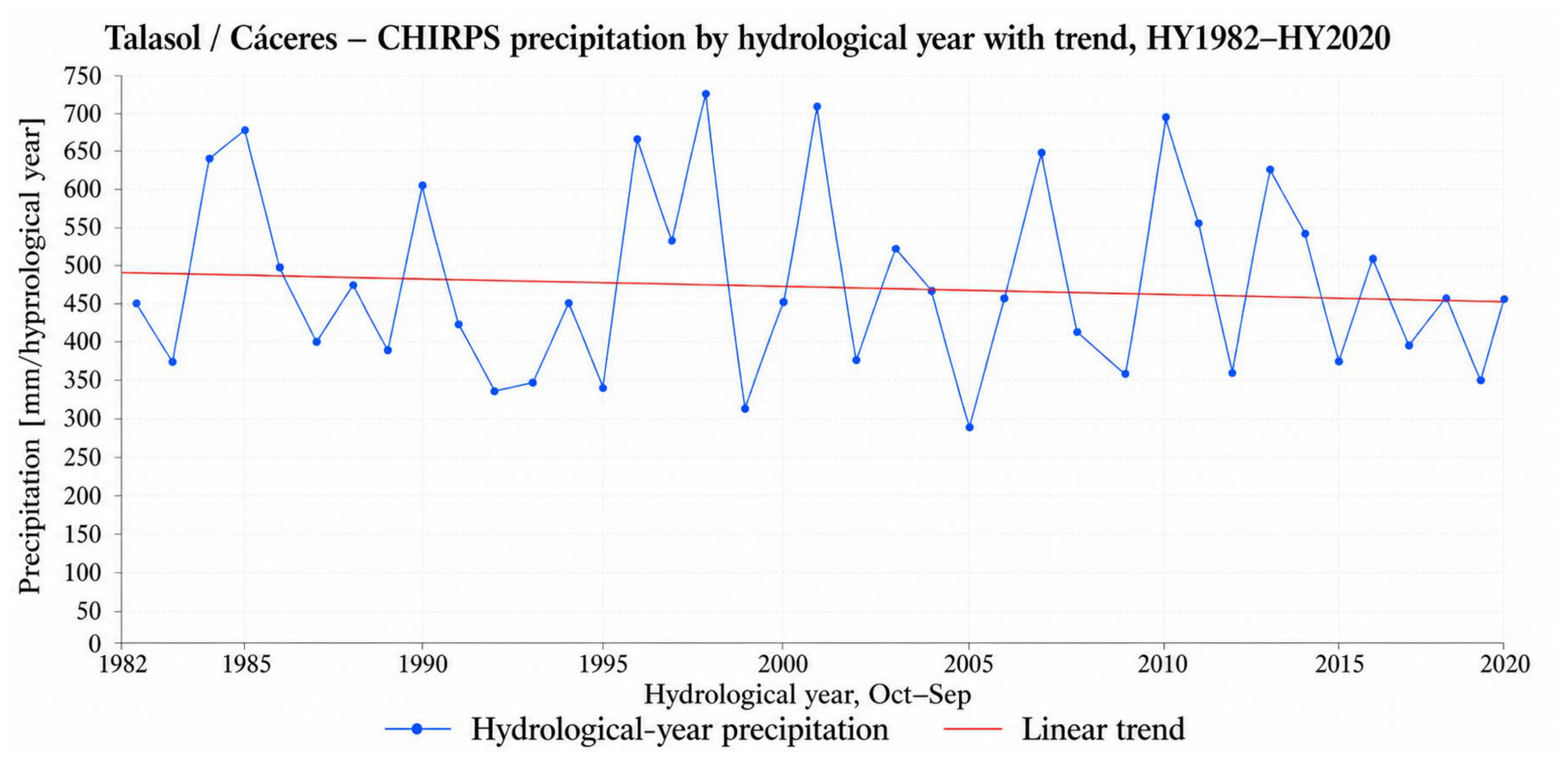
Moreover, the CHIRPS (Climate Hazards Group InfraRed Precipitation with Station data) database was used [50] for the analysis of the precipitation data for the Caceres Province, which includes the Talasol PV Park, for the period 1980–2020, and specifically for the hydrological years 1981–2020. The results indicate that the mean annual precipitation for the hydrological years HY1981–HY2020 is 482.1 mm, with a standard deviation of 124.8 mm, which indicates high variability from year to year. The analysis of results shows strong seasonality, with precipitation occurring mainly during the fall and winter months. The wettest hydrological year was HY1998 with 730.3 mm and the driest hydrological year was HY2005 with 290.0 mm. Figure 3 shows the plot of precipitation for the Talasol PV Park area, where there is a linear negative precipitation trend of −5.68 mm/decade; however, R2 = 0.0027, which is very low, and indicates that the annual and seasonal variability is much more significant than the trend. Indeed, the dry years and the seasonal distribution are more significant than the small linear trend.
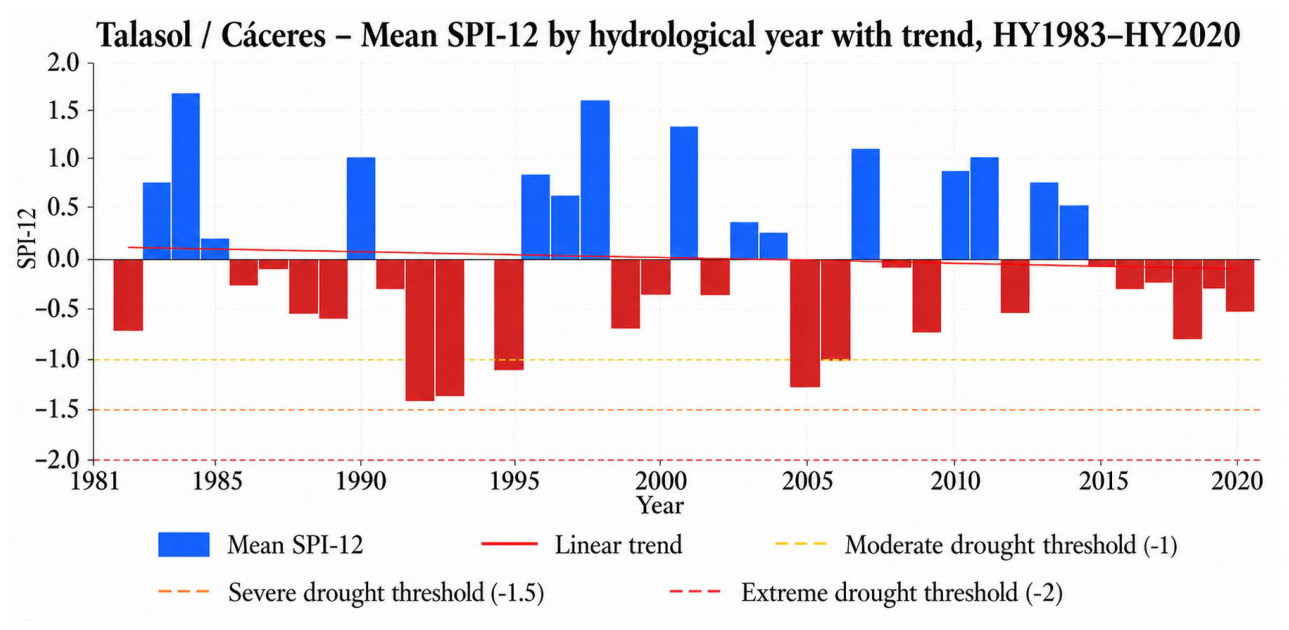
In addition, the CHIRPS database was also used [50] for the assessment of drought based on the drought index SPI-12 (Standardized Precipitation Index), which uses only precipitation data, for the Caceres Province, which includes the Talasol PV Park, for the period 1980–2020, and specifically for the hydrological years 1981–2020 (Figure 4).
For the computation of SPI-12, the CHIRPS database was used for the analysis of the daily precipitation data at 5 × 5 km2 following the Gamma distribution [50]. The results of SPI-12 indicate that in 469 monthly calculations, mild drought dominates in the frequency (SPI-12 < −1.0 is 19%), whereas there is limited occurrence of severe drought (SPI-12 < −1.5 is 5.1%) and extreme drought (SPI-12 < −2 is 0.4%). Moreover, in 20/38 hydrological years, there is at least one month with mild to moderate drought, whereas severe drought occurs in 8/38 years and extreme drought in 2/38 years. The above indicates that drought is not an isolated phenomenon or hazard and recurrence is the characteristic of the time series. The hydrological years with significant droughts are, in order of magnitude, 1992 (−1.41), 1993 (−1.36), 2005 (−1.27), 1995 (−1.09) and 2006 (−1.01), which are appropriate for in-depth analysis of the impacts of drought on the vulnerable agroecosystem of Caceres Province, Spain. Similarly, the wettest years in order of magnitude are 1985 (+1.69), 1998 (+1.66), 2001 (+1.37), 2007 (+1.10) and 2011 (+1.03), which indicates that wet periods interchange with drought periods; thus, the variability is more significant than a simple long-term linear trend. Indeed, there is a weak negative linear trend (Figure 4) (−0.045 SPI/decade or adjusted trend for the period 1981–2020 of the order of −0.174 SPI) towards drier conditions; however, R2 = 0.0025, which is very low, and means that the linear trend explains very little of the drought variability.
Topography. The topography of the region is dominated by plains exhibiting minor slopes (Figure 1). The altitude ranges from 300 m (the city of Caceres) to 1700 m (the Peña de Francia mountain). The province of Cáceres in Extremadura (an autonomous community in southwestern Spain, comprising the provinces of Cáceres and Badajoz) has Mediterranean vegetation adapted to semi-arid conditions. The vegetation is characterized by open woodlands dominated by scattered evergreen oaks, including holm oak and cork oak. These agroecosystems further incorporate sclerophyllous shrubs and grasslands which collectively sustain the extensive livestock husbandry of the region. The economy is predominantly agrarian, with principal crops encompassing cereals, tomatoes, peppers, cherries, and olives, alongside livestock production featuring cattle and pigs [51].
Vulnerability. The 21st century has been characterized by increased climate variability. Moreover, climate change is almost totally attributed to anthropogenic causes. Agriculture in the Mediterranean basin is considered vulnerable mainly due to three factors, which are the impacts of climate change [52]: first, the mean global temperature is steadily increasing and has already reached approximately +1.5 °C in the Northern Hemisphere; second, there is a reduction in the precipitation amount of about 20% in the Mediterranean region; and third, long-term projections of climate change research indicate that the frequency and intensity of extreme events, such as floods, droughts, or heat waves, are expected to increase during the 21st century in arid and semi-arid zones [52,53,54,55,56,57]. The analysis of the Talasol PV Park data justifies the above three vulnerability conditions. Specifically, there is a linear positive temperature trend, which is +0.027 °C/year, or 0.27 °C/decade. There is also a linear negative precipitation trend of −5.68 mm/decade. Finally, the results indicate that drought is not an isolated phenomenon or hazard and frequency or recurrence is the characteristic of the time series.
Cáceres is a vulnerable agroecosystem because it relies on the Dehesa, an agrosilvopastoral system. It is a mix of ancient oak woodlands and low-intensity farming that is highly sensitive to environmental shifts. This semi-arid landscape operates on very thin margins; its poor, shallow soils are prone to rapid erosion, and the region faces intensifying “aridification” due to extreme Mediterranean heatwaves and prolonged droughts. Because the local flora and fauna are already living at their thermal and hydric limits, any significant change in land use—such as the introduction of massive industrial infrastructure or intensive irrigation—can easily disrupt this equilibrium, triggering irreversible soil degradation and a loss of the biodiversity that has sustained the region for centuries [58,59,60].
The PV Park of Talasol is in the province of Cáceres, within the western region of Spain. The size of the Talasol PV Park was 611 ha and the selected surrounding area or buffer zone was 967 ha (Figure 2). The Talasol PV Park under study is a 300 MWp solar facility commissioned in December 2020. The PV plant occupies an area of approximately 611 hectares of rural area (dominated by shrubs and meadows). The average altitude of the PV plant is approximately 400 m (Figure 1). Over the five-year operational period of the Talasol PV plant, substantial environmental, economic, and social benefits have been documented. Environmentally, the facility produces 561 GWh of clean electricity annually, sufficient to supply approximately 100,000 households. It also reduces 63,000 tons of CO2 emissions per year, equivalent to removing 14,000 cars from circulation. Economically and socially, its construction in a disadvantaged area generated 500 jobs during the 17-month development phase and stimulated local GDP through supply chain expenditures (https://www.gem.wiki/Talasol_solar_farm) (accessed on 20 January 2026).
Choosing the Talasol PV Park as a case study provides a unique opportunity to analyze the intersection of large-scale renewable energy infrastructure and sensitive Mediterranean landscapes. Located in Cáceres, Spain, this 300 MW facility covers 611 hectares of vulnerable agroecosystems, characterized by thin soils, high aridity, and the traditional “Dehesa” land-use system (dominated by shrubs and meadows). The average altitude of the PV plant is approximately 400 m (Figure 2). This facility has now been operational for over five years (the facility was commissioned in December 2020), providing a sufficiently long period to accurately monitor and evaluate long-term microclimatic effects rather than temporary construction-related shifts. Monitoring these effects is critical because the massive concentration of photovoltaic panels can trigger a ‘Photovoltaic Heat Island’ (PVHI) effect, altering local land surface temperatures and evapotranspiration rates. In these vulnerable agroecosystems, studying Talasol allows for a high-impact evaluation of the extent to which ‘green’ energy transitions may, or may not, impact the ecological stability of semi-arid agroecosystems.

2.3. Database and Preprocessing

Satellite Data: The database contains LST time series from Landsat 8 and Landsat 9 satellites, covering the period 2013–2025. Analysis uses the Thermal Infrared Sensor (TIRS) Band10, with a spatial resolution of 30 × 30 m and a 16-day temporal frequency. Over this 13-year period in the Talasol PV study area, 615 cloud-free satellite images were selected (cloud cover < 20%) to prevent distortion. Moreover, for the same 13-year period, thermal data were used for the buffer zone.
Image processing was conducted with the GEE platform using calibrated LST products from Landsat 8 and 9, derived from their thermal infrared sensors [41]. A geospatial database was created in GIS, incorporating the PV study area and buffer zones (as vector data) along with the LST analysis results (raster data). ArcGIS Pro 3.5.1 is used for spatial analysis and data mapping. Basic datasets are created and analyzed.

2.4. Methodological Procedure

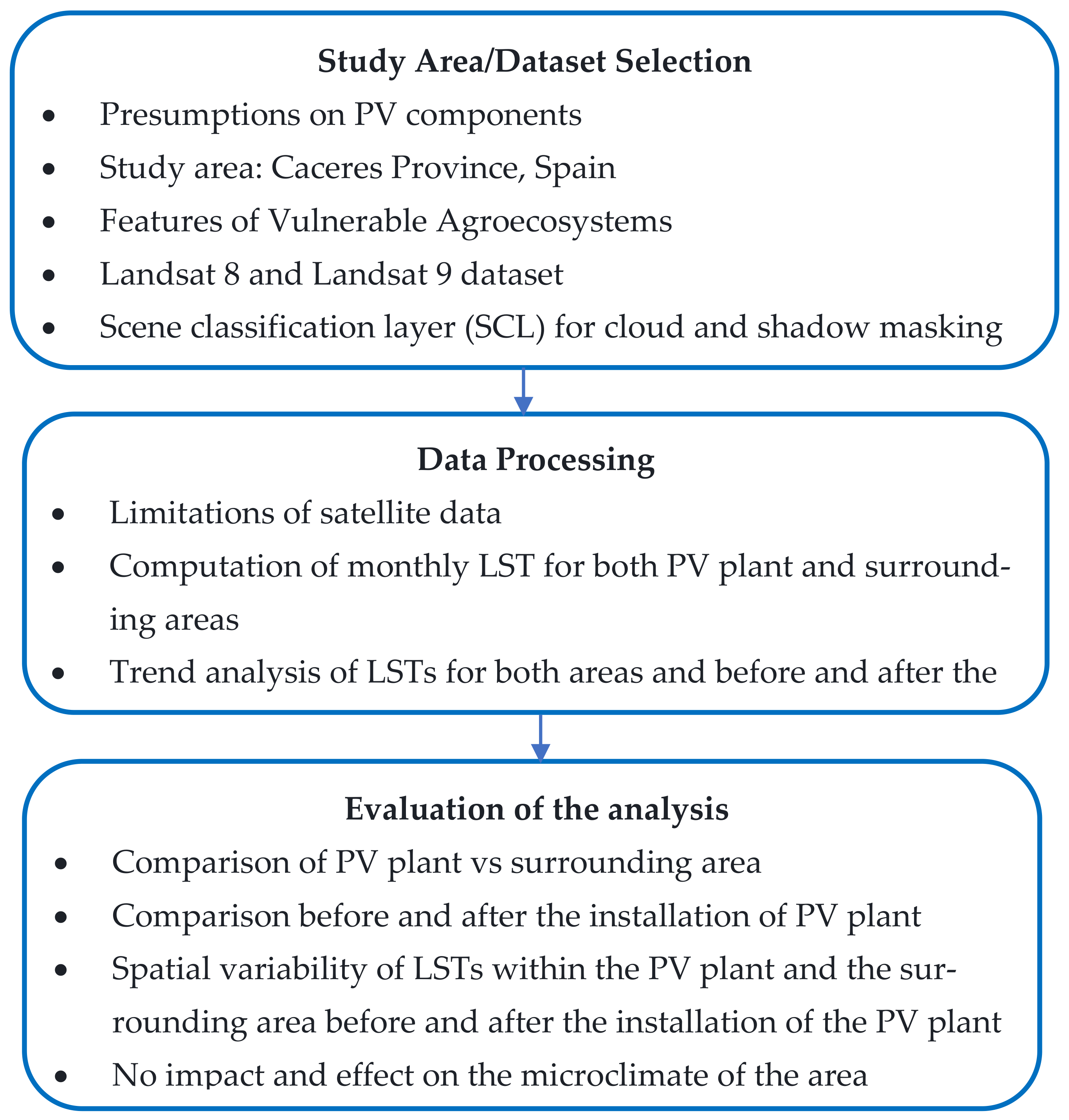
The methodological workflow adopted in this study is summarized in Figure 5. It describes the steps from satellite data acquisition to model evaluation and shows how remote sensing LST is used to assess the potential microclimatic effects of PV power plants in vulnerable Mediterranean agroecosystems.
To monitor the potential impact of the photovoltaic park on the thermal environment, temperature trends and long-range averages before and after its operation are analyzed, both within the installation area and in the surrounding regions (buffer zone). The temperature variations in the PV plant and in the buffer zone are analyzed exclusively using Earth observation satellite data. Specifically, Landsat-derived LST data are utilized over a period of 13 years (2013–2025). This LST data captures the actual surface temperature of the Earth’s surface, from the satellite’s pixels, at high spatial resolution (100 m per pixel resampling to 30 m), enabling direct observation of surface thermal properties. LST measurements excel in mapping spatial heterogeneity and short-term surface dynamics, as they are less influenced by near-surface atmospheric variability, such as wind or humidity, compared to air temperature. LST directly reflects the radiative influence of land cover characteristics, rendering it particularly suitable for monitoring localized temperature variations attributable to changes in vegetation cover, urbanization (e.g., urban heat island effects), PV panel installations, and similar aspects. In contrast, air temperature, typically measured at meteorological stations at a standard height of 2 m, provides a broader representation of near-surface atmospheric conditions, but lacks the fine spatial resolution afforded by LST satellite data [1,61]. Moreover, converting LST to equivalent air temperature necessitates complex empirical or physical transformations, which introduce uncertainties arising from surface emissivity variations, atmospheric correction errors, and potential interference from clouds or aerosols.

2.4.1. Delimitation of the PV Park and Surrounding Area

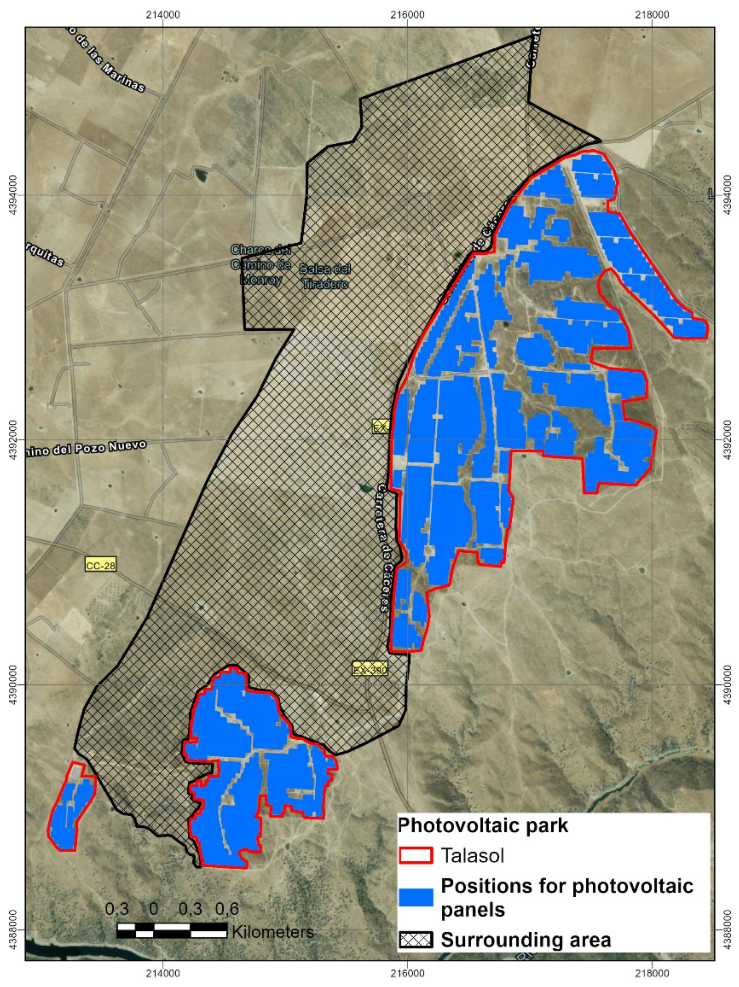
High-resolution satellite images were used to digitize the locations of the PV panels. Specifically, areas within the PV Park that do not host PV panel installations were identified and excluded. The resulting polygons are used to analyze the microclimate impact of PV panels, without considering the effects of soil or vegetation cover (Figure 6).
Finally, a surrounding area or buffer zone was created, which is used as a comparison surface of temperature change in relation to the surface covered by PV panels. Specifically, a zone north of the PV Park was selected, which occupies an area of approximately 967 hectares. It is a rural area, dominated by shrubs and meadows (Figure 6). The map shows the locations of the PV panels (blue), as well as the surrounding area (grid).

2.4.2. Methodological Steps

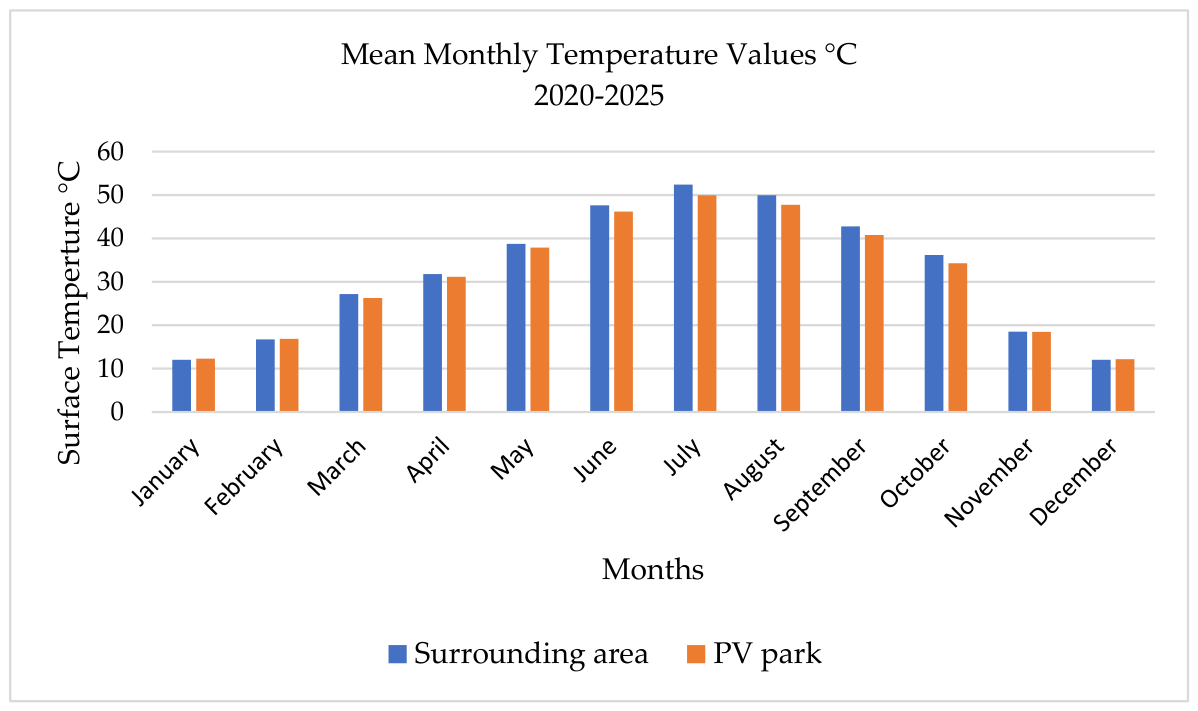
The methodological steps are described, which include the analysis of the temporal trends in ground surface temperature of both the PV installation area and the surrounding area before and after the PV installation, as well as comparisons between mean monthly temperatures of the PV installation area and the surrounding area. The analysis of results is presented in the form of diagrams and maps, with the help of which a comparison is conducted of the spatial and temporal temperature changes in the two areas.
Trend Analysis
Trend analysis of the temperature time series (LST) reveals the long-term overall direction of either increasing or decreasing or stabilizing in temperature values over time in the study area. For graphical representations, the mean LST value is computed for each of the 615 satellite images by averaging all the pixels within each image. Monthly LST composites are created by considering all the images within each month. Then, a time series of LST values is created consisting of 615 values. Linear regression is used to conduct trend analysis, and the slope is calculated, which indicates the increase or decrease in temperature by a specific temperature value °C/year (e.g., Figure 7). The temperature trend analysis is conducted: (1) in the Talasol PV Park for the whole period (2013–2025), (2) in the Talasol PV Park for the period before the installation of the PV Park (2013–2019), (3) in the Talasol PV Park for the period after the installation of the PV Park (2020–2025), and (4) in the surrounding area or buffer zone for the whole period (2013–2025).
Mapping of the LST trend is also developed to show the spatial LST variability within the PV Park and the surrounding area or buffer zone for the examined period, either the whole period (2013–2025) or before the installation of the PV Park (2013–2019) or after the installation of the PV Park (2020–2025) (e.g., Figure 7). The maps are created as follows: monthly LST composites are computed by considering all the images within each month. A time series of monthly LST is created and plotted on a graph for the examined period (e.g., 2013–2025). Then, linear regression is used to conduct trend analysis of monthly LST values as a linear function of time, and to compute trends and plot them on the same graph. Specifically, trends are computed, via GEE, as follows: for each pixel of each monthly image, a time series of LST values is created from all the monthly images of the examined period, then a slope is fitted over time for each pixel, where the ‘scale’ band gives the trend magnitude and the ‘offset’ provides the intercept. It is worth mentioning that there is consistency between the LST trend analysis (Figure 7) and the temperature analysis of the ERA5-LAND data for the Talasol area (Figure 3), which are used for validation of the LST analysis and for justification of the vulnerability of the region.
Annual Distribution of the Mean Monthly LST
The annual distribution of the mean monthly LST is computed as follows: for each of the 615 satellite images, the mean LST value is computed from all the pixels of the image; this is conducted for all the images within each month; then, the mean monthly LST value is computed as the average of all the mean LSTs from the images of the month; then, for each month, e.g., January, the mean January LST value is computed from the time series of Januarys for the examined period (e.g., 2013–2025); this computation is conducted for all the 12 months of the year and the histogram of the annual distribution of mean monthly LSTs is created for the selected area, i.e., either the PV Park or the surrounding area, and for the examined period (e.g., Figure 7). The calculation of mean monthly land surface temperature (LST) in the Landsat time series contributes to the smoothing of daily fluctuations and the analysis of seasonal patterns. This facilitates the identification of any changes in LST, both in relation to past years, as well as after the installation of the Talasol PV plant. The calculation of the mean monthly land surface temperature is conducted in the Talasol PV Park, for the periods 2013–2019 and 2020–2025, respectively, as well as in the surrounding area or buffer zone for the periods 2013–2019 and 2020–2025.

3. Analysis of Results

This section covers the presentation and interpretation of the results based on the analysis of Landsat LST data in the two regions.

3.1. Analysis of Temperature Trend in the PV Park for the Whole Period (2013–2025)

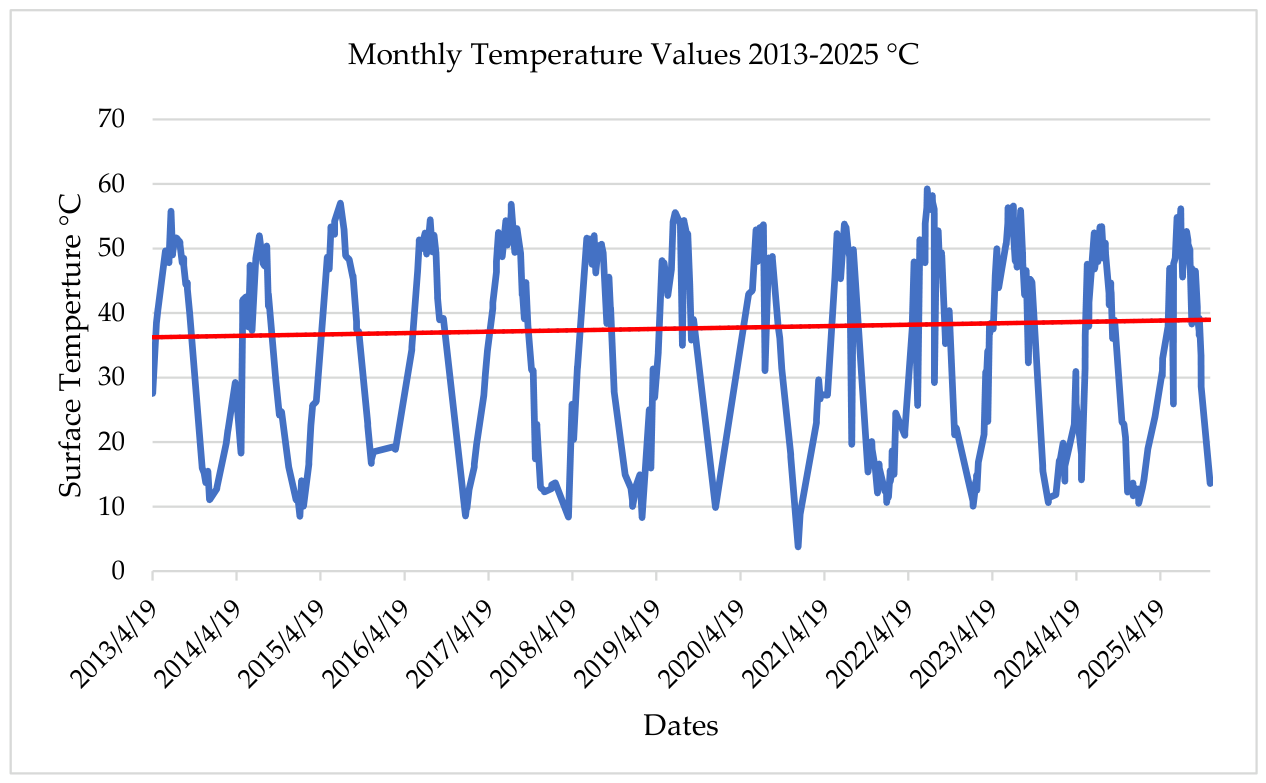
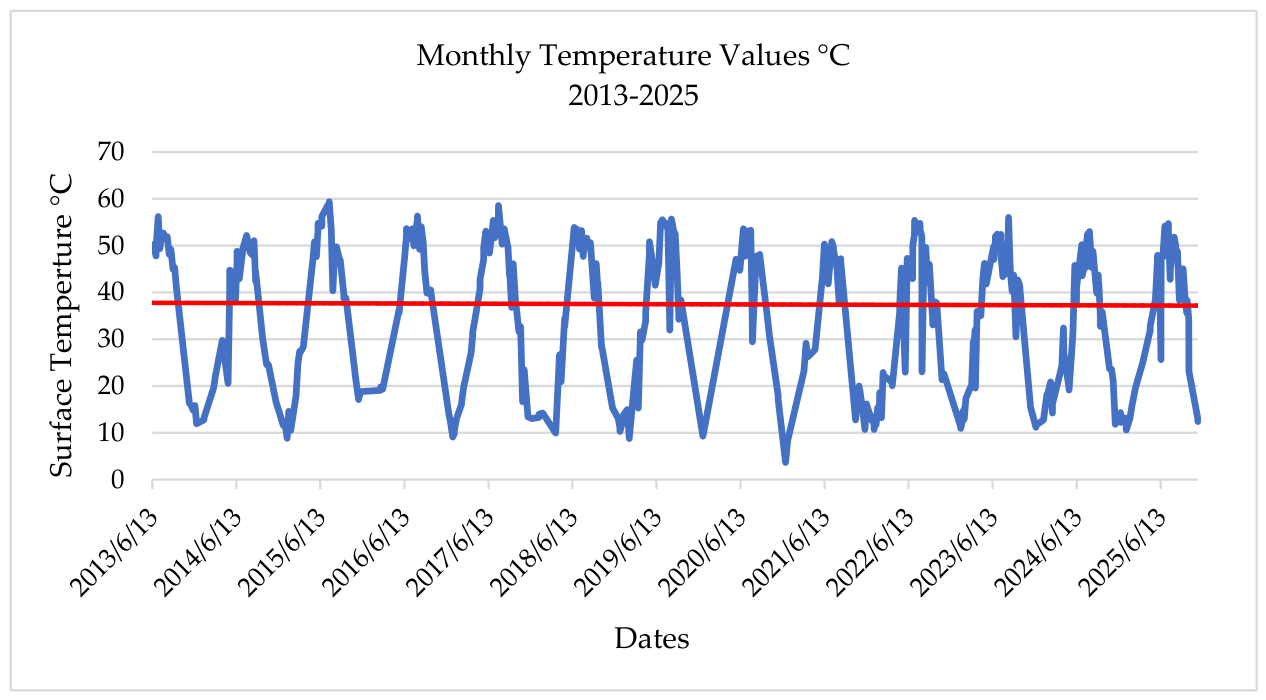
The graph below shows the monthly temperature fluctuations (LST) for the whole period 2013–2025 at the Talasol PV Park (Figure 7). The red line depicts the trend of decreasing temperature, which is calculated at −0.0339 °C/year.
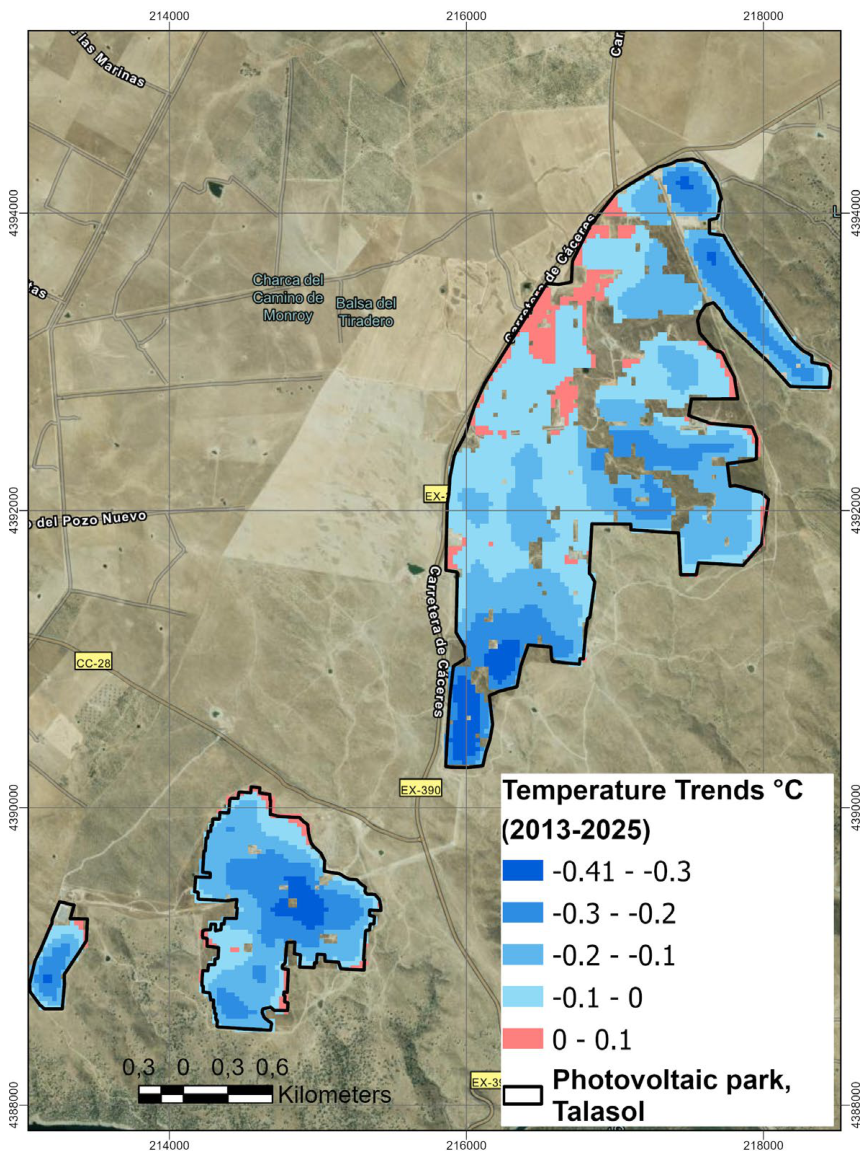
The temperature decrease trend is then mapped for the 13-year period (2013–2025). The map below shows the spatial temperature variability inside the PV system (Figure 8). It is observed that there is a temperature decrease trend throughout the PV system (shades of blue). However, in small areas in the northwest part of the PV Park and at its edges, a slight increase in temperature is observed (red shade). This is maybe due to PV structure like higher pane density or the location of inverter stations and sub-stations. Another reason for higher temperatures (red areas) could be the spatial analysis of the Landsat satellite data. Indeed, even with a mask restricted to PV arrays, some thermal pixels could overlap with the surrounding ground. The negative trend of land surface temperature across the entire area of the Talasol PV Park for 2013–2025, despite the general climate temperature increase in Spain, is mainly due to changes in land use and reflectivity (albedo) during the construction/operation of the park. That is, before 2020, the existence of vegetation cover affected LST values. On the contrary, after the operation of the PV panels, the LST increases; however, the overall trend for the period 2013–2025 remains negative due to the long period before the operation of the PV Park. This fact creates a false negative trend, as the LST falls from higher initial values. From the above, it is assessed that if the existing vegetation remains after the installation of PV panels, as well as if there is a possibility for higher PV towers, then several agricultural activities could be continued under the PV panels, under certain conditions.
The final Landsat-based analysis (2013–2025) finds insignificant differences between the operating PV area and the surrounding landscape at the monthly scale, reinforcing the interpretation that PV installations do not yield a robust, persistent microclimate warming signature at the scale examined. Accordingly, the evidence supports the core assessment: utility-scale PV deployment does not constitute a driver of climate change, and the documented effects are best understood as localized surface–atmosphere energy-balance perturbations whose sign and magnitude depend on land cover, seasonality, and operation.

3.2. Analysis of Temperature Trend in the PV Park for the Periods 2013–2019 and 2020–2025

At this step an analysis of the temperature trends in the PV Park is carried out for the two periods before and after its operation, namely for the periods 2013–2019 and 2020–2025, respectively. The graphs below verify the analysis conducted in the previous section.
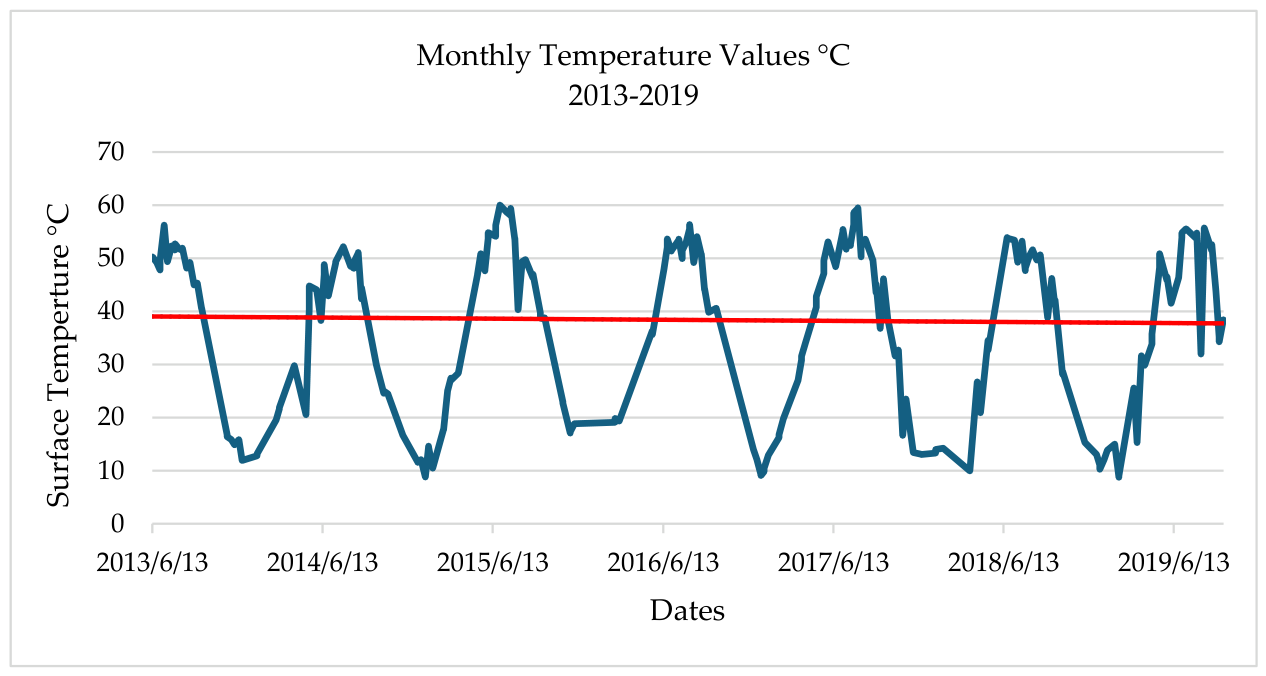
Period 2013–2019: The graph below shows the negative trend of monthly changes from 2013 to 2019 (Figure 9). It is estimated that for the seven (7) years the total temperature trend is 1.078 °C (red line), which statistically means that the LST in this area has an average trend of −0.154 degrees °C/year. The interpretation of the results was presented in the previous section. During the installation work of the PV Park, vegetation was removed, resulting in bare soil for a relatively long period. This fact increases the reflectivity of the soil (albedo), respectively, reducing the LST in relation to the vegetation cover.
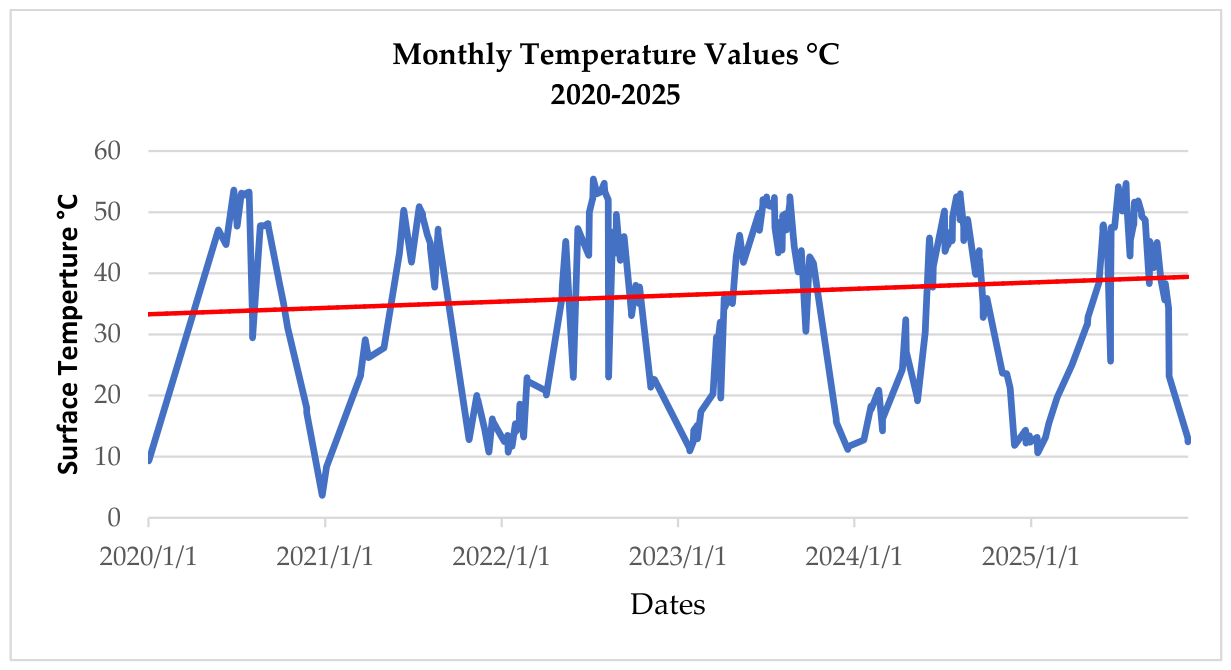
Period 2020–2025:Figure 10 shows the positive trend of monthly fluctuations for the period 2020–2025, that is, during the operation of the PV Park. It is estimated that for this period the trend in LST is on average +0.958 °C (red line). As mentioned above, PV panels absorb radiation and emit heat, thus increasing the LST locally. Of course, PV panels, as surfaces with high reflectivity (albedo), must be subjected to regular cleaning, because, otherwise, the LST decreases due to heat absorption and by extension.
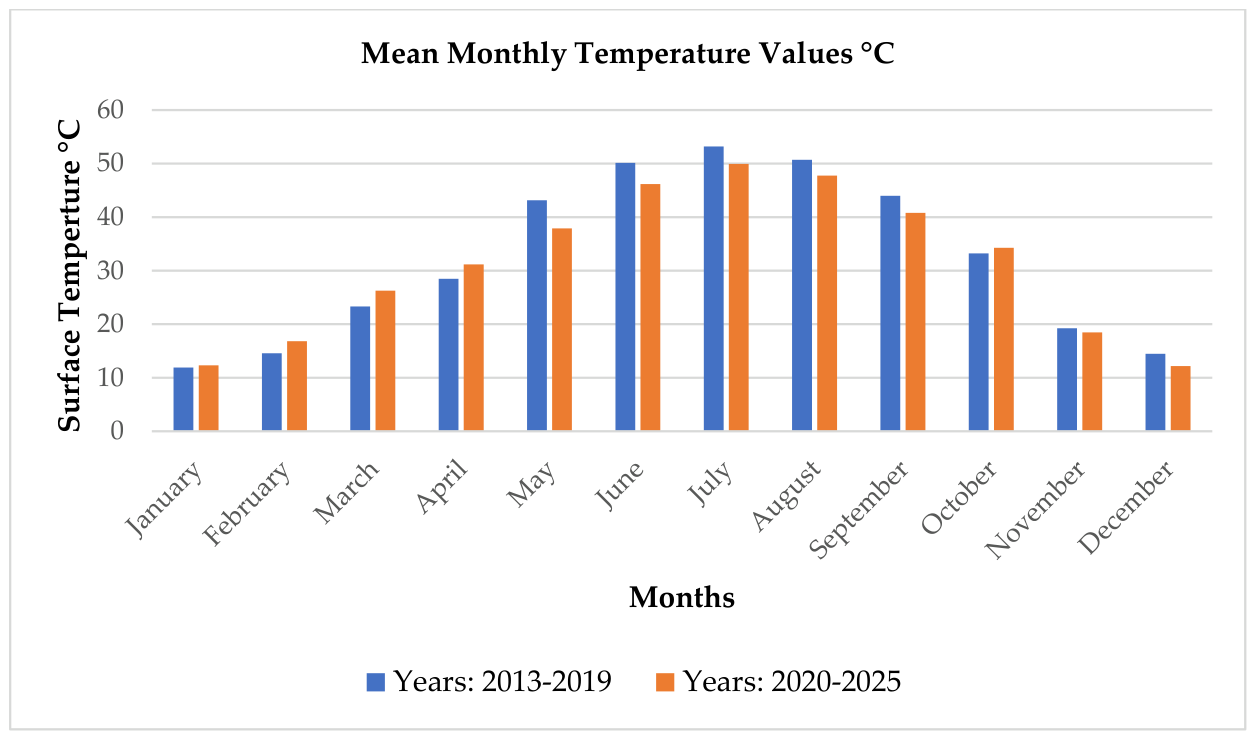
In Figure 11, as well as in the corresponding Table 2, a comparison is conducted of the mean monthly LST for the two periods (2013–2019 and 2020–2025), respectively, i.e., before and after the operation of the Talasol PV Park (Table 2, Figure 11). It was found that there are no significant differences in the monthly values between the two periods. During the summer months a decrease of 3–4 °C is observed after the installation and operation of the PV Park (2020–2025). This is essentially due to the cooling effects caused by the installation, since the comparison is based on LST values. PV Parks create shadows in the zones from the panels, reducing direct solar radiation on the ground and limiting thermal absorption. This leads to lower LST values during the day, especially in dry summer conditions.

3.3. Ambient Temperature Trend Analysis of the Surrounding PV Area for the Period 2013–2025

The graph below (Figure 12) shows the monthly temporal temperature trends of LST for the period 2013–2025 in the surrounding area or buffer zone, northwest of the Talasol PV Park. The red line depicts the trend of increasing land surface temperature, which is estimated at +0.215 °C/year.
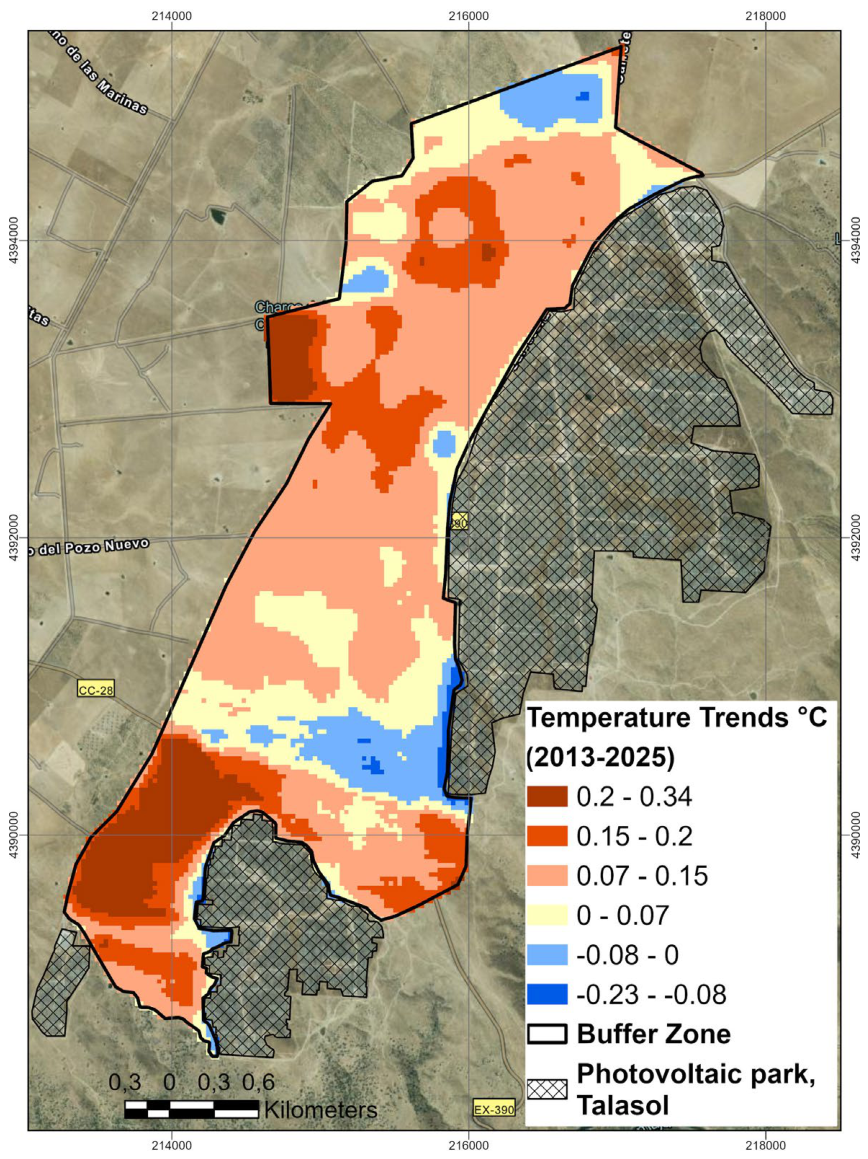
The temperature increase trend is then mapped for the 13-year period (2013–2025). The map below (Figure 13), in the surrounding area, shows the spatial temperature variability. It is found that, during the entire period after the installation of the PV plant, there is a tendency for the temperature to increase (shades of yellow, red). On the contrary, in small areas southeast, near the PV plant and in the northern part of the region, a trend is observed of slight decrease in temperature (blue shades). In these areas, there is a general positive trend (+2 °C/decade 2013–2025). The small zones showing a negative trend may be due to the microtopography of the area, which compensates for the general increase due to climate change. On the contrary, the neighboring areas of the PV Park with a small negative trend are affected by shading or aerodynamic cooling from the air flowing under the panels.

3.4. Comparison of Mean Monthly Temperatures Between the PV Area and the Surrounding Area for the Period 2020–2025

Table 3, as well as the graph (Figure 14), presents the annual distribution of the mean monthly ground temperature values between the Talasol PV Park and the surrounding area for the period 2020–2025 (Table 3, Figure 14), i.e., during the operation period of the PV Park. Essentially, the main objective of the comparison of the two areas is to investigate the temperature changes in areas with and without the presence of PV panels. It was found that there are insignificant differences in the monthly values between the two areas. During the summer months a decrease of less than 1 °C is observed in the PV Park, as compared to the surrounding area. This is considered a very important and valuable finding, which establishes the non-significant impact of the PV Parks on the microclimate of the area. Indeed, from the study of graphs (Figure 11 and Figure 14) it is observed that they follow the same pattern. That is, both the surrounding area and the PV Park area before the installation present slightly higher values during the summer months. This fact reinforces the view that the installation of PV Parks does not increase the temperature, which is due to the cooling effects caused by the PV panels (see explanation in Section 3.3).

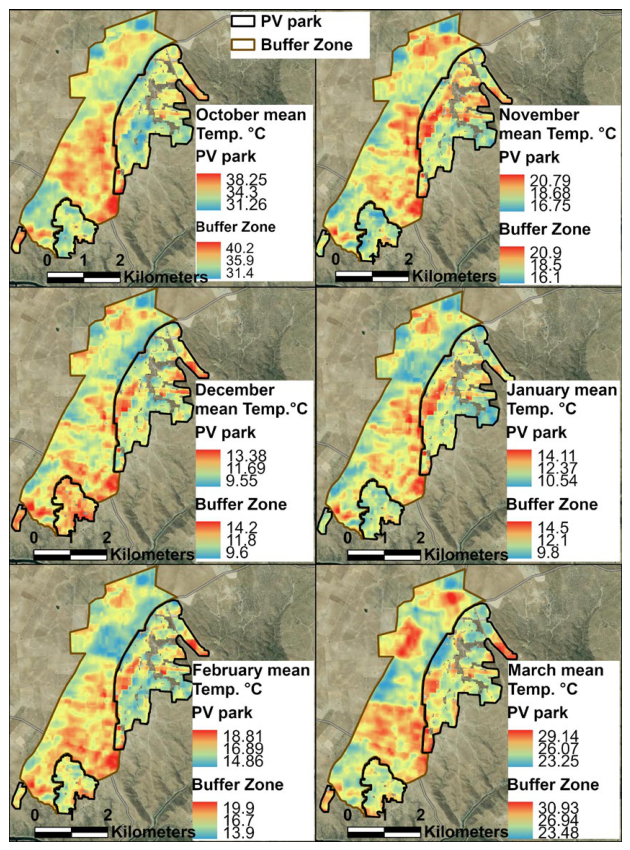
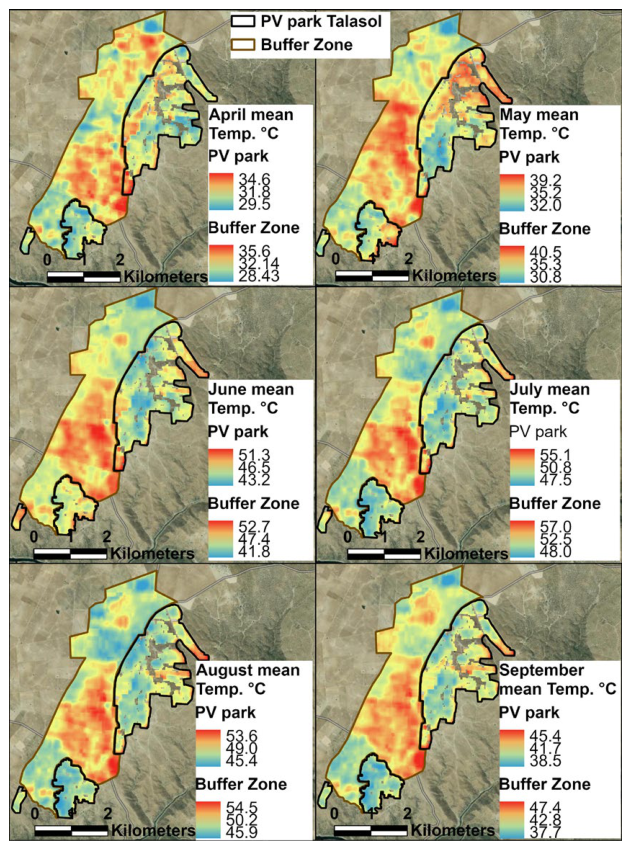
3.5. Spatial Mapping of Mean Monthly Temperatures of the PV Park and Surrounding Area for the Period 2020–2025

Mapping of the spatial distribution and variability of the mean monthly temperature values is presented for both the PV Park area and the surrounding area for the wet period (Figure 15) and dry period (Figure 16), respectively. It is found that the variability of the LST is between 4 and 5 degrees °C. It is also observed that during the summer months (June, July, and August) in the central zone of the surrounding area there are high values, i.e., LST > 50 °C. In contrast, in the PV Park, the high values are limited to a smaller section. This reinforces the assessment that there are no significant differences in LST between the PV panels and the surrounding agricultural land.

4. Discussion

The goal of this study is to evaluate solar power plants’ possible microclimatic effects using satellite-based LST studies. This section offers a conceptual explanation of a few crucial elements and characteristics that are not considered in the current analysis but might be included in future research since they are crucial to properly evaluating the possible effects of solar power plants on the environment and climate. APV systems, air temperature, emissivity, NDVI, albedo, evapotranspiration, precipitation, cooling effect, vegetation, climate, geography, energy budget, and water cycle are some of these variables. It has been stated [46] that there are no sufficient APV case studies regarding ground-mounted PV plants. The findings of the present study have shown that: (a) PV modules reduce net radiation and wind speed, which reduces water consumption due to evapotranspiration, increasing soil water availability for crops and enabling water savings; (b) in hot and dry climates, the reduction in climatic stress could compensate for the decrease in photosynthesis due to the shading effect of PV modules, thereby not damaging crop yield; and (c) crops can be grown in rows between PV modules even in the case of fixed PV layouts.
Customized solutions based on environmental, agronomic, morphological, and socioeconomic factors must be developed for each unique area. In addition to its indirect climatic influence through lowering GHG, the large-scale installation of solar PV panels may have a direct impact on the local and possibly regional climate [10,11]. In recent decades, life-cycle assessment (LCA) has been used to thoroughly examine the effects of GHG reduction on solar power facilities [13,14,43,62]. The most crucial element that reflects changes in the energy balance is temperature, which is a manifestation of thermal energy. According to recent field data, PV power plants may marginally raise daytime air temperatures in arid areas [6,15,16,32]. Because of the significant variability of surface conditions and the small “footprints” of weather stations, the air temperature observed at PV power plants may also be skewed. Furthermore, it is commonly recognized that surface emissivity has a significant impact on the LST detected by satellite [56]. Because the MODIS algorithm employed a set emissivity value for each type of land cover, the interest in a recent study was primarily about the change in emissivity with the construction of the PV power plant. Previous findings [38] have shown that vegetation, which typically occupies a very small fraction of the land surface, was not significantly affected by the building of PV power plants. The findings also demonstrated that there had been little variation in the average NDVI across numerous PV power facilities.
On the other hand, because the albedo of PV panels usually ranges from 0.06 to 0.1 with an average of approximately 0.08, which is significantly lower than the background albedo of about 0.22, the installation of solar panels will reduce surface albedo [10]. The fact that albedo dropped after power plants were installed indicates that the solar panel effect outweighs the disturbance effect [38]. Albedo by itself, however, cannot account for the drop in surface temperature since, if incoming solar radiation remains constant, lowering albedo will result in the surface receiving more solar energy, which will raise surface temperature. In fact, using the high-resolution ERA reanalysis climate data, it was discovered that the incoming solar radiation hardly changed before and after the PV power plants were installed [38].
In a different study [5], the impacts of solar farms (SFs) on albedo, vegetation, and LST based on 116 major SFs worldwide were measured using MODIS data and the enhanced vegetation index (EVI) as a proxy. Barren land had the most effects on albedo and daytime LST, followed by farmland and grassland; the opposite was true for vegetation impact. Seasonal and latitudinal fluctuations showed that albedo was most affected at high latitudes in winter, while vegetation was most affected at mid-latitudes in summer, and daytime LST was most affected at low latitudes during spring-summer transitions. Correlation analysis showed that the albedo and LST impacts were enhanced over large SFs with high capacity.
The effects of vegetation and LST depended on the type of SF (PV or concentrating solar power) and were linked with climatic and geographic parameters. By partitioning the surface energy balance, evapotranspiration (ET) has the potential to alter surface temperature in addition to albedo. The primary determinants of local ET are vegetation conditions and precipitation. Even in regions with little vegetation cover, plant transpiration dominates ET in many ecosystems [63]. Arid and semi-arid regions are home to most of the PV power facilities. According to earlier research, PV power plants may not have much of an influence on plant development because of the shading effect, which occurs when the shade of the PV panels cools the soil and vegetation during the day [16,64].
Additionally, it was discovered that the development of power plants had little effect on the precipitation and ET over the plants and their surroundings. As a result, while the solar panels may have cooled the soil and vegetation surfaces through the shadowing effect, ET contributed very little to the observed surface cooling. Furthermore, a recent study [49] found that in drylands or regions with extreme water stress, ground-mounted PV plants with a fixed structure 2.2 m high have decreased evapotranspiration. This decrease in water loss can improve soil moisture and lessen the effects of drought, encouraging plant growth and raising biomass production.
Moreover, it has been noted [21] that PV systems have caused a rise in soil temperatures in the winter and fall in other seasons in desert conditions. In comparison to periods with full sunshine exposure, they also observed an average increase in soil moisture of 11–15%, indicating that these effects may enhance plant–soil APV in arid regions. Consequently, it may be essential to use less water because of PVs’ shade impact. This could greatly improve crop tolerance to climate fluctuation and change and yield stability, especially in arid regions and drylands [6].
Many PV plants have minimal vegetation, typically consisting of small shrubs or grass. The placement of the power plants will alter the wind profile and enhance surface roughness [6]. By collecting solar radiation, the PV panels, which typically stand 1–2 m above the ground, function as a “heater” in the air during the day [6,15,16,32]. For two reasons, solar panels heat the air more efficiently than typical ground surfaces like soil and vegetation. First, both the upper and lower surfaces of solar panels can exchange heat with the surrounding air. Secondly, the wind speed in the air is higher than that at the ground surface, resulting in increased turbulence surrounding the solar panels, resulting in heat exchange with the air [6,15,16,32]. The solar panels become comparatively cooler and the surrounding air warmer because of this convection process, which transfers additional heat from the panels to the air [34].
The PV power plants’ cooling effect at night is not separate from their cooling effect during the day. By converting energy into electricity and sensible heat into the air, each solar panel in the power plants serves as a convective heater and electrical converter during the day. Less solar energy can reach the ground as a result. The surface temperature at night will drop even more if the ground energy input is reduced [6,65].
Furthermore, the PV temperature effect was shown to be strongly linked with latitude but not with longitude or altitude, indicating that the PV temperature effect varied depending on the geographical location. By taking into consideration the direct climate influence and the cooling effect on surface temperature of the PV power plants, this discovery is helpful for choosing the locations of future PV power plants. Nevertheless, the main methodological limitations and scope boundaries of the study remain and consist of LST interpretation, spatial resolution constraints, and the absence of in situ validation. Specifically, some of the methodological and technological limitations include: the 16-day revisit cycle of Landsat and the resulting daytime-only bias; the inability to record the effects of nighttime warming; pixel mixing between PV panels and underlying ground/soil at 30 m resolution; the absence of on-site LST or air temperature validation; the lack of direct atmospheric information (e.g., wind speed, humidity); and potential edge effects and land cover heterogeneity within the study area.
Additionally, the research region includes a variety of land types, including bare soil, agricultural land, PV arrays, pixel mixing, edge effects, and changes in land cover over time—all of which are crucial for comprehending how the LST varies. This work acknowledges and takes into consideration these limitations (parts 2.3 and 2.4). To avoid distortion, 615 cloud-free satellite photos (cloud cover < 20%) were chosen for this 13-year period in the Talasol PV study region. Furthermore, the issue of low resolution and pixel mixing has been greatly diminished by utilizing only the blue regions of Figure 6 (Section 2.4.1), and it is considered to have a less significant effect on the accuracy of the study. Sections of the PV Park that do not have PV panel installations were found and eliminated. Without taking into consideration the effects of soil or vegetation cover, the generated polygons are utilized to study the microclimate impact of PV panels (Figure 6). To fulfill the goal of clean electricity and direct climate benefits, additional PV power plants may be built in lower latitudes in the future, such as semi-arid tropical and subtropical regions. Latitude is widely recognized as a composite indication of soil, vegetation, and climate, including temperature, precipitation, and solar radiation. Plant development is encouraged by higher annual mean temperatures, precipitation, and solar radiation in lower latitudes.
The higher NDVI values at the lower latitudes prior to the PV power plants’ construction attest to this. As a result, the development of the PV power plants also resulted in a greater loss of vegetation cover in the lower latitudes. Furthermore, the increased PV cooling impact throughout the night as precipitation increases indicates that the PV modules are better at dissipating the thermal energy stored in the wetter soils because of their high thermal conductivity and ability to function as radiators at night. In conclusion, the PV power plants primarily affected the local surface temperature through their effects on surface energy budgets and the water cycle through vegetation, both of which are influenced by the local climate.
In addition to calibrating satellite LST with in situ sensors, the proposed future work is anticipated to concentrate on key areas like nighttime thermal dynamics, surface energy-balance modeling, multi-sensor fusion (Sentinel-3 SLSTR and ECOSTRESS), land cover change analysis, and microclimate modeling frameworks like ENVI-met and WRF. Further research using experimental and modeling techniques is required to uncover the mechanisms underlying the effects of different PV power plants on the local and regional climate. However, climate, surface albedo, and the size of the power plants, which means their area and potential electricity production, can all accurately forecast the PV temperature effect. These results can be used to estimate the direct climate effect of the PV power plants with smaller scales (area or capacity), useful information guiding the planning, designing, and site selection for constructing new PV power plants.

5. Summary and Conclusions

The present paper aims to identify the potential impact on the microclimate of the area from the installation and operation of PV plants, in terms of temporal temperature fluctuations throughout the year, as well as spatial variability. In particular, the issue of the possible change (reduction) in the LST, both under photovoltaic panels and on the panels, in relation to the temperature of the surrounding area, is investigated. For this purpose, an area in Spain was selected, namely in the Caceres province, which belongs to vulnerable Mediterranean agroecosystems, since it presents the typical geomorphological, topographic, climatic and environmental characteristics. In the Caceres province, a high-power PV Park, namely the Talasol PV Park, has been operating for approximately five years (2020-present). LST data from the Landsat satellite were used for the period 2013–2025. Temperature variability and trends in the Talasol PV Park before and after its installation, as well as within the surrounding area, were computed and compared.
The analysis was based on LST data, which captures the desired effect, namely the potential impact of PV on the microclimate, according to the cited literature. In particular, the monitoring of temperature changes is conducted using thermal data from the Landsat satellite, which uses LST. LST records the actual surface temperature from the trace elements (pixels) of the satellite, providing high spatial resolution. The Landsat 8 and 9 satellites were used, which present spatial resolution, i.e., pixel size of 30 × 30 m, temporal revisit every 16 days for their operating period (2013–2025). A total of 615 satellite images were analyzed. In perspective, it is expected that research will prioritize the integration of in situ LST measurements, obtained via infrared thermometers or thermal cameras mounted on PV panels, with Landsat-derived LST data. This matching process will enable precise bias correction of satellite estimates. Ultimately, such calibration will yield more reliable thermal insights for PV performance assessment.
It is considered appropriate to point out that the paper deals with the potential effect of PV power plants on the microclimate of a region. According to the IPCC, to consider that the climate of a region has changed, there must be persistence of the phenomena, i.e., a significant increase or decrease in temperature, for at least a few decades. Moreover, a comment is added on the air or atmospheric temperature: there are three heat transfer mechanisms in the atmosphere, by which the air is heated by solar radiation, namely conduction, convection and radiation, which essentially take place in a location or point with a very limited spatial range. That is, the incident solar radiation on the PV panels is absorbed and converted into energy and is not a substance or pollutant to be diffused or dispersed and transported by the air. Furthermore, there is no issue of radiation, which is harmful to humans or the environment, or radioactivity, from the installation and operation of PV Parks. It is also noted that the role of rainfall in the potential impact of the microclimate of the installation area is also considered in this paper through climatological analysis of the region based on the ERA5-LAND database.
In summary, the most significant results and findings of the above study are briefly presented as follows:
  • Trend analysis was performed based on a linear model to pixel-level LST values over time from all pixels of the Caceres region of Spain (Talasol PV Park) for both the entire period 2013–2025, as well as for the periods before the installation of the PV panels (2013–2019) and after the installation (2020–2025). A small negative trend in LST was observed in the Talasol PV Park for the entire period 2013–2025, as well as for the period 2013–2019, as explained in Section 3.1. For the period 2020–2025, i.e., during the operation of the PV Park, a small positive trend was recorded in the monthly changes in LST. Based on the above, the results of the study show insignificant temperature variability and effect on the microclimate due to the installation of the PV panels in relation to both the periods before and after the installation of the PV Park, as well as the surrounding area or buffer zone.
  • The mean monthly LST was compared for the two periods (2013–2019 and 2020–2025), i.e., before and after the operation of the Talasol PV Park (Table 2, Figure 11). The results are considered expected, since it was found that there are no significant differences in the monthly values between the two periods, as explained in Section 3.2.
  • The temporal trend in mean monthly LST for the period 2013–2025 in the surrounding area northwest of the Talasol PV Park was analyzed (Figure 12). A small increase in LST was found, as expected, as explained in Section 3.3.
  • The mean monthly LST between the Talasol PV Park and the surrounding area for the period 2020–2025 is presented (Table 3, Figure 14), i.e., during the operating period of the PV Park. It was found that there are insignificant differences in monthly values between the two areas, as explained in Section 3.4.
  • Mapping of the spatial distribution and variability of the mean monthly LST for both the PV Park and the surrounding area (Figure 15 and Figure 16) has indicated that there are no significant spatial and seasonal differences in LST between the PV panels and the surrounding agricultural land, as explained in Section 3.5.

Author Contributions

Conceptualization, V.B., N.R.D., I.F., N.D.; project administration, I.F., N.R.D., N.A. and M.S.; methodology, N.A., I.F. and S.S.; software, I.F. and N.A.; validation, M.S. and S.S.; investigation, N.D.; data curation, I.F. and M.S.; writing—original draft preparation, N.R.D., I.F. and M.S.; writing—review and editing, V.B., N.D. and S.S.; visualization, N.R.D., I.F.; supervision, N.R.D. and N.D. All authors have read and agreed to the published version of the manuscript.

Funding

No funding was available for this paper.

Data Availability Statement

Landsat 8 & 9 and MODIS were applied from Google Earth Engine could platform.

Acknowledgments

The authors acknowledge the European Space Agency for the supporting data and materials.

Conflicts of Interest

The authors declare no conflicts of interest.

References

  1. Hurduc, A.; Ermida, S.L.; Brito, M.C.; Göttsche, F.M.; DaCamara, C. Impact of a Small-Scale Solar Park on Temperature and Vegetation Parameters Obtained from Landsat 8. Renew. Energy 2024, 221, 119827. [Google Scholar] [CrossRef]
  2. Sampaio, P.G.V.; González, M.O.A. Photovoltaic Solar Energy: Conceptual Framework. Renew. Sustain. Energy Rev. 2017, 74, 590–601. [Google Scholar] [CrossRef]
  3. Renno, C.; Di Marino, O. Agrivoltaics Across Crops and Technologies: A Systematic Review of Experimental Tests on Yield, Microclimate, and Energy Performance. Energies 2026, 19, 539. [Google Scholar] [CrossRef]
  4. Guoqing, L.; Hernandez, R.R.; Blackburn, G.A.; Davies, G.; Hunt, M.; Whyatt, J.D.; Armstrong, A. Ground-Mounted Photovoltaic Solar Parks Promote Land Surface Cool Islands in Arid Ecosystems. Renew. Sustain. Energy Transit. 2021, 1, 100008. [Google Scholar] [CrossRef]
  5. Xu, Z.; Li, Y.; Qin, Y.; Bach, E. A Global Assessment of the Effects of Solar Farms on Albedo, Vegetation, and Land Surface Temperature Using Remote Sensing. Sol. Energy 2024, 268, 112198. [Google Scholar] [CrossRef]
  6. Millstein, D.; Menon, S. Regional Climate Consequences of Large-Scale Cool Roof and Photovoltaic Array Deployment. Environ. Res. Lett. 2011, 6, 034001. [Google Scholar] [CrossRef]
  7. Fagnano, M.; Fiorentino, N.; Visconti, D.; Baldi, G.M.; Falce, M.; Acutis, M.; Genovese, M.; Di Blasi, M. Effects of a Photovoltaic Plant on Microclimate and Crops’ Growth in a Mediterranean Area. Agronomy 2024, 14, 466. [Google Scholar] [CrossRef]
  8. Duan, C.; Han, C.; Hu, W.; Liu, J.; Ma, Y. Land Surface Temperature Shows Negligible Difference Between Inside and Outside Photovoltaic Power Plants in China. J. Geophys. Res. Atmos. 2026, 131, e2026JD046444. [Google Scholar] [CrossRef]
  9. Barron-Gafford, G.A.; Minor, R.L.; Allen, N.A.; Cronin, A.D.; Brooks, A.E.; Pavao-Zuckerman, M.A. The Photovoltaic Heat Island Effect: Larger Solar Power Plants Increase Local Temperatures. Sci. Rep. 2016, 6, 35070. [Google Scholar] [CrossRef]
  10. Broadbent, A.M.; Krayenhoff, E.S.; Georgescu, M.; Sailor, D.J. The Observed Effects of Utility-Scale Photovoltaics on near-Surface Air Temperature and Energy Balance. J. Appl. Meteorol. Climatol. 2019, 58, 989–1006. [Google Scholar] [CrossRef]
  11. Touil, S.; Richa, A.; Fizir, M.; Bingwa, B. Shading Effect of Photovoltaic Panels on Horticulture Crops Production: A Mini Review. Rev. Environ. Sci. Biotechnol. 2021, 20, 281–296. [Google Scholar] [CrossRef]
  12. Jahangirlou, M.R.; Pullens, J.W.M.; Lindhardt, M.K.K.; El Khoury, Y.V.; Antoniuk, V.; Manevski, K.; Ottosen, C.-O.; Jørgensen, U. Agrivoltaic systems: Trade-offs on microclimate, physiology, yield and canopy thermal-spectral maps. Agric. Syst. 2026, 232, 104557. [Google Scholar] [CrossRef]
  13. Masson, V.; Bonhomme, M.; Salagnac, J.L.; Briottet, X.; Lemonsu, A. Solar Panels Reduce Both Global Warming and Urban Heat Island. Front. Environ. Sci. 2014, 2, 14. [Google Scholar] [CrossRef]
  14. International Energy Agency. Renewables 2021—Analysis and Forecast to 2026; International Energy Agency: Paris, France, 2021.
  15. Nemet, G.F. Net Radiative Forcing from Widespread Deployment of Photovoltaics. Environ. Sci. Technol. 2009, 43, 2173–2178. [Google Scholar] [CrossRef] [PubMed]
  16. Taha, H. The Potential for Air-Temperature Impact from Large-Scale Deployment of Solar Photovoltaic Arrays in Urban Areas. Sol. Energy 2013, 91, 358–367. [Google Scholar] [CrossRef]
  17. Hernandez, R.R.; Hoffacker, M.K.; Field, C.B. Efficient Use of Land to Meet Sustainable Energy Needs. Nat. Clim. Change 2015, 5, 353–358. [Google Scholar] [CrossRef]
  18. Hu, A.; Levis, S.; Meehl, G.A.; Han, W.; Washington, W.M.; Oleson, K.W.; Van Ruijven, B.J.; He, M.; Strand, W.G. Impact of Solar Panels on Global Climate. Nat. Clim. Change 2016, 6, 290–294. [Google Scholar] [CrossRef]
  19. Akbari, H.; Menon, S.; Rosenfeld, A. Global Cooling: Increasing World-Wide Urban Albedos to Offset CO2. Clim. Change 2009, 94, 275–286. [Google Scholar] [CrossRef]
  20. Oke, T.R. The Energetic Basis of the Urban Heat Island. Q. J. R. Meteorol. Soc. 1982, 108, 1–24. [Google Scholar] [CrossRef]
  21. Turney, D.; Fthenakis, V. Environmental Impacts from the Installation and Operation of Large-Scale Solar Power Plants. Renew. Sustain. Energy Rev. 2011, 15, 3261–3270. [Google Scholar] [CrossRef]
  22. Menon, S.; Akbari, H.; Mahanama, S.; Sednev, I.; Levinson, R. Radiative Forcing and Temperature Response to Changes in Urban Albedos and Associated CO2 Offsets. Environ. Res. Lett. 2010, 5, 014005. [Google Scholar] [CrossRef]
  23. Mundu, M.M.; Sempewo, J.I.; Mahoro, G.B.; Sankarapandian, V.; Uti, D.E. Environmental Impacts of Agri-Photovoltaics Systems on Local Ecosystems, Food Security, Climate Change, and Sustainability. Food Energy Secur. 2026, 15, e70186. [Google Scholar] [CrossRef]
  24. Dupraz, C.; Marrou, H.; Talbot, G.; Dufour, L.; Nogier, A.; Ferard, Y. Combining Solar Photovoltaic Panels and Food Crops for Optimising Land Use: Towards New Agrivoltaic Schemes. Renew. Energy 2011, 36, 2725–2732. [Google Scholar] [CrossRef]
  25. Amaducci, S.; Yin, X.; Colauzzi, M. Agrivoltaic Systems to Optimise Land Use for Electric Energy Production. Appl. Energy 2018, 220, 545–561. [Google Scholar] [CrossRef]
  26. Marrou, H.; Wéry, J.; Dufour, L.; Dupraz, C.; Marrou, H.; Wery, J.; Dufour, L.; Dupraz, C. Productivity and Radiation Use Efficiency of Lettuces Grown in the Partial Shade of Photovoltaic Panels. Eur. J. Agron. 2013, 44, 54–66. [Google Scholar] [CrossRef]
  27. Adeh, E.H.; Selker, J.S.; Higgins, C.W. Remarkable Agrivoltaic Influence on Soil Moisture, Micrometeorology and Water-Use Efficiency. PLoS ONE 2018, 13, e0203256. [Google Scholar] [CrossRef]
  28. Barron-Gafford, G.A.; Pavao-Zuckerman, M.A.; Minor, R.L.; Sutter, L.F.; Barnett-Moreno, I.; Blackett, D.T.; Thompson, M.; Dimond, K.; Gerlak, A.K.; Nabhan, G.P.; et al. Agrivoltaics Provide Mutual Benefits across the Food–Energy–Water Nexus in Drylands. Nat. Sustain. 2019, 2, 848–855. [Google Scholar] [CrossRef]
  29. Chebli, H.; Dragonetti, G.; Fouial, A. Comparing Microclimate Conditions Induced by Semi-Transparent and Conventional Agrivoltaic Systems and Their Effects on Arugula Response (Eruca vesicaria) in Southern Italy. Resources 2026, 15, 33. [Google Scholar] [CrossRef]
  30. Zhang, Z.; Cong, Z.; Huang, Y.; Li, S.; Lei, H.; Yang, D. Ecohydrological Effects of Photovoltaic Plants in Kubuqi Desert Based on Ecohydrological Modelling and Field Observation. Ecohydrology 2026, 19, e70181. [Google Scholar] [CrossRef]
  31. Hernandez, R.R.; Easter, S.B.; Murphy-Mariscal, M.L.; Maestre, F.T.; Tavassoli, M.; Allen, E.B.; Barrows, C.W.; Belnap, J.; Ochoa-Hueso, R.; Ravi, S.; et al. Environmental Impacts of Utility-Scale Solar Energy. Renew. Sustain. Energy Rev. 2014, 29, 766–779. [Google Scholar] [CrossRef]
  32. Wang, X.; Zhou, Q.; Zhang, Y.; Liu, X.; Liu, J.; Chen, S.; Wang, X.; Wu, J. Diurnal Asymmetry Effects of Photovoltaic Power Plants on Land Surface Temperature in Gobi Deserts. Remote Sens. 2024, 16, 1711. [Google Scholar] [CrossRef]
  33. Zhu, W.; Lű, A.; Jia, S. Estimation of daily maximum and minimum air temperature using MODIS land surface temperature products. Remote Sens. Environ. 2013, 130, 62–73. [Google Scholar] [CrossRef]
  34. Luo, D.; Jin, H.; Marchenko, S.S.; Romanovsky, V.E. Difference between near-surface air, land surface and ground surface temperatures and their influences on the frozen ground on the Qinghai-Tibet Plateau. Geoderma 2018, 312, 74–85. [Google Scholar] [CrossRef]
  35. Zhu, W.; Lu, A.; Jia, S.; Yan, J.; Mahmood, R. Retrievals of all-weather daytime air temperature from MODIS products. Remote Sens. Environ. 2017, 189, 152–163. [Google Scholar] [CrossRef]
  36. Shamir, E.; Georgakakos, K.P. MODIS Land surface temperature as an index of surface air temperature for operational snowpack estimation. Remote Sens. Environ. 2014, 152, 83–98. [Google Scholar] [CrossRef]
  37. Anderson, M.C.; Allen, R.G.; Morse, A.; Kustas, W.P. Use of Landsat thermal imagery in monitoring evapotranspiration and managing water resources. Remote Sens. Environ. 2012, 122, 50–65. [Google Scholar] [CrossRef]
  38. Zhang, X.; Xu, M. Assessing the Effects of Photovoltaic Powerplants on Surface Temperature Using Remote Sensing Techniques. Remote Sens. 2020, 12, 1825. [Google Scholar] [CrossRef]
  39. Gao, Y.; Yang, Q.; Chang, P.; Wang, C.; Wang, X.; Yu, M.; Liu, R.; Babierjiang, D.; Shi, Q.; Yryszhan, Z. Assessment of the Spatiotemporal Patterns and Ecological Impacts of Photovoltaic Power Plants in Central Asia. Earth’s Future 2026, 14, e2025EF006335. [Google Scholar] [CrossRef]
  40. Wan, Z. New refinements and validation of the collection-6 MODIS land-surface temperature/emissivity product. Remote Sens. Environ. 2014, 140, 36–45. [Google Scholar] [CrossRef]
  41. Gorelick, N.; Hancher, M.; Dixon, M.; Ilyushchenko, S.; Thau, D.; Moore, R. Google Earth Engine: Planetary-scale geospatial analysis for everyone. Remote Sens. Environ. 2017, 202, 18–27. [Google Scholar] [CrossRef]
  42. Zhang, Z.; Chen, M.; Zhong, T.; Zhu, R.; Qian, Z.; Zhang, F.; Yang, Y.; Zhang, K.; Santi, P.; Wang, K.; et al. Carbon Mitigation Potential Afforded by Rooftop Photovoltaic in China. Nat. Commun. 2023, 14, 2347. [Google Scholar] [CrossRef] [PubMed]
  43. Fan, C.; Huang, X. Direct Impact of Solar Farm Deployment on Surface Longwave Radiation. Environ. Res. Commun. 2021, 3, 125006. [Google Scholar] [CrossRef]
  44. Sonter, L.J.; Dade, M.C.; Watson, J.E.M.; Valenta, R.K. Renewable Energy Production Will Exacerbate Mining Threats to Biodiversity. Nat. Commun. 2020, 11, 4174. [Google Scholar] [CrossRef]
  45. Tsoutsos, T.; Frantzeskaki, N.; Gekas, V. Environmental Impacts from the Solar Energy Technologies. Energy Policy 2005, 33, 289–296. [Google Scholar] [CrossRef]
  46. Wu, C.; Liu, H.; Yu, Y.; Zhao, W.; Liu, J.; Yu, H.; Yetemen, O. Ecohydrological Effects of Photovoltaic Solar Farms on Soil Microclimates and Moisture Regimes in Arid Northwest China: A Modeling Study. Sci. Total Environ. 2022, 802, 149946. [Google Scholar] [CrossRef]
  47. Hernandez, R.R.; Hoffacker, M.K.; Murphy-Mariscal, M.L.; Wu, G.C.; Allen, M.F. Solar Energy Development Impacts on Land Cover Change and Protected Areas. Proc. Natl. Acad. Sci. USA 2015, 112, 13579–13584. [Google Scholar] [CrossRef] [PubMed]
  48. Zhang, Y.; Tian, Z.; Liu, B.; Chen, S.; Wu, J. Effects of Photovoltaic Power Station Construction on Terrestrial Ecosystems: A Meta-Analysis. Front. Ecol. Evol. 2023, 11, 1151182. [Google Scholar] [CrossRef]
  49. Yang, L.; Gao, X.; Lv, F.; Hui, X.; Ma, L.; Hou, X. Study on the Local Climatic Effects of Large Photovoltaic Solar Farms in Desert Areas. Sol. Energy 2017, 144, 244–253. [Google Scholar] [CrossRef]
  50. Sakellariou, S.; Dalezios, N.R.; Spiliotopoulos, M.; Alpanakis, N.; Faraslis, I.; Tziatzios, G.A.; Sidiropoulos, P.; Dercas, N.; Domínguez, A.; López, H.M.; et al. Remotely Sensed Comparative Spatiotemporal Analysis of Drought and Wet Periods in Distinct Mediterranean Agroecosystems. Remote Sens. 2024, 16, 3652. [Google Scholar] [CrossRef]
  51. Rey, M.T.d.T.; Álvarez, A.D.; García-Moruno, L. The Recent Sediment Record as an Indicator of Past Soil-Erosion Dynamics. Study in Dehesa Areas in the Province of Cáceres (Spain). Sustainability 2019, 11, 6102. [Google Scholar] [CrossRef]
  52. Faraslis, I.; Dalezios, N.R.; Spiliotopoulos, M.; Tziatzios, G.A.; Sakellariou, S.; Dercas, N.; Giannousa, K.; Belaud, G.; Daudin, K.; Cameira, M.D.R.; et al. Satellite-based innovative agroclimatic classification under reduced water availability: Identification of optimal productivity zones. Land 2025, 14, 2147. [Google Scholar] [CrossRef]
  53. Faraslis, I.; Dalezios, N.R.; Alpanakis, N.; Tziatzios, G.A.; Spiliotopoulos, M.; Sakellariou, S.; Sidiropoulos, P.; Dercas, N.; Domínguez, A.; Martínez-López, J.A.; et al. Remotely sensed Agroclimatic Classification and Zoning in water limited Mediterranean areas towards sustainable agriculture. Remote Sens. 2023, 15, 5720. [Google Scholar] [CrossRef]
  54. Van Leeuwen, C.; Friant, P.; Chone, X.; Tregoat, O.; Koundouras, S.; Dubourdieu, D. Influence of climate, soil, and cultivar on terroir. Am. J. Enol. Vitic. 2004, 55, 207–217. [Google Scholar] [CrossRef]
  55. Santos, J.A.; Malheiro, A.C.; Karremann, M.K.; Pinto, J.G. Statistical modelling of grapevine yield in the Port Wine region under present and future climate conditions. Int. J. Biometeorol. 2010, 55, 119–131. [Google Scholar] [CrossRef] [PubMed]
  56. Soares, D.; Paredes, P.; Paco, T.A.; Rolim, J. Projected Bioclimatic Changes in Portugal: Assessing Maize Future Suitability. Agronomy 2025, 15, 592. [Google Scholar] [CrossRef]
  57. Vicente-Serrano, S.M.; Pena-Angulo, D.; Begueria, S.; Dominguez-Castro, F.; Tomas-Burguera, M.; Noguera, I.; Gimeno-Sotelo, L.; El Kenawy, A. Global drought trends and future projections. Philos. Trans. R. Soc. A 2022, 380, 20210285. [Google Scholar] [CrossRef]
  58. Moreno, G.; Pulido, F.J. The Functioning, Management and Persistence of Dehesas. In Agroforestry in Europe: Current Status and Future Prospects; Rigueiro-Rodríguez, A., McAdam, J., Mosquera-Losada, M.R., Eds.; Advances in Agroforestry; Springer: Dordrecht, The Netherlands, 2009; Volume 6, pp. 127–160. [Google Scholar] [CrossRef]
  59. Villamayor-Tomas, S.; Gaitán-Cremaschi, D.; Corbera, E.; Pierri-Daunt, A.B.; Santos de Lima, L. Vulnerability to climate change, depopulation and the global food regime: An index-based approach for rural Spain. Environ. Sci. Policy 2025, 174, 104254. [Google Scholar] [CrossRef]
  60. Lozano-Parra, J.; Sánchez-Martín, J.M. Exploring the Impact of Climate Change on Water Resources for Vegetation Covers in Extremadura (Spain). Water 2024, 16, 1418. [Google Scholar] [CrossRef]
  61. Cheng, H.L.; Huang, H.; Yang, J.; Pang, R.; Bian, J.Y. Research on thermal environment analysis of photovoltaic power plants based on remote sensing images. Int. Arch. Photogramm. Remote Sens. Spat. Inf. Sci. 2023, 48, 1343–1350. [Google Scholar] [CrossRef]
  62. Turdimambetov, I.; Murgaš, F.; Victor, F.; Oteuliev, M.; Madreimov, A.; Shamuratova, G.; Atabayev, S.; Reymov, A. Measurement of Environmental Indicators of the Quality of Life in a Region with Extreme Climatic Conditions. Evidence from Around the Aral Sea. Geoj. Tour. Geosites 2024, 57, 1941–1951. [Google Scholar] [CrossRef]
  63. Duan, H.-B.; Zhang, G.-P.; Zhu, L.; Fan, Y.; Wang, S.-Y. How will diffusion of PV solar contribute to China’s emissions-peaking and climate responses? Renew. Sust. Energy Rev. 2016, 53, 1076–1085. [Google Scholar] [CrossRef]
  64. Aliprandi, F.; Stoppato, A.; Mirandola, A. Estimating CO2 emissions reduction from renewable energy use in Italy. Renew. Energy 2016, 96, 220–232. [Google Scholar] [CrossRef]
  65. Peng, J.; Lu, L.; Yang, H. Review on life cycle assessment of energy payback and greenhouse gas emission of solar photovoltaic systems. Renew. Sust. Energy Rev. 2013, 19, 255–274. [Google Scholar] [CrossRef]
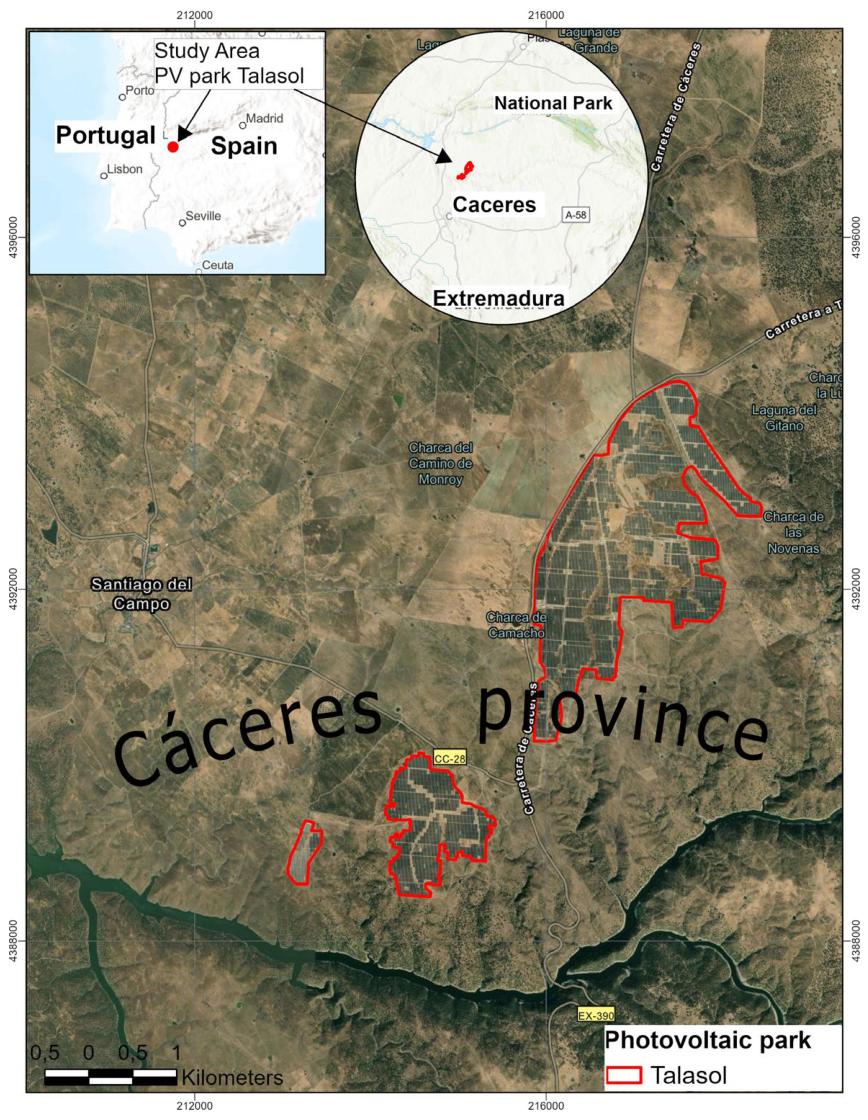
Figure 1. Geographical positioning of the Talasol PV Park within Cáceres Province. The size of the Talasol PV Park was 611 ha and the selected surrounding area or buffer zone was 967 ha. The Talasol PV Park under study is a 300 MWp solar facility commissioned in December 2020.
Atmosphere 17 00562 g001
Figure 2. Plot of the mean monthly temperature for the Talasol PV Park area for the period 1980–2020 (blue line), and the linear positive trend +0.27 °C/decade (red line).
Atmosphere 17 00562 g002
Figure 3. Plot of the annual precipitation for the Talasol PV Park area for the period 1980–2020 (blue line), and the linear negative trend −5.68 mm/decade (red line).
Atmosphere 17 00562 g003
Figure 4. Plot of the mean drought index SPI-12, with drought severity classes, for the Talasol PV Park area for the hydrological years 1981–2020 (wet years in blue, drought years in red), and the linear negative trend of −0.0045 SPI/year or the adjusted value for the period 1981–2020, equal to −0.174 SPI (red line).
Atmosphere 17 00562 g004
Figure 5. Overview of the methodological workflow adopted for the satellite-based assessment of potential microclimatic effects of photovoltaic (PV) power plants in vulnerable agroecosystems.
Atmosphere 17 00562 g005
Figure 6. PV facilities of Talasol PV Park and the surrounding area in Cáceres Province. The size of the Talasol PV Park is 611 ha (blue area) and the selected surrounding area or buffer zone is 967 ha (gridded area).
Atmosphere 17 00562 g006
Figure 7. Trend of monthly temperature fluctuations (in blue) at the Talasol PV Park (2013–2025). The red line depicts the trend of decreasing temperature, which is calculated to be −0.0339 °C/year.
Atmosphere 17 00562 g007
Figure 8. Spatial temperature variability (in blue) in the Talasol PV Park (2013–2025). There is a temperature decrease trend throughout the PV system (shades of blue). However, in small areas in the northwest part of the PV Park and at its edges, a slight increase in temperature is observed (red shade).
Atmosphere 17 00562 g008
Figure 9. Trend of monthly temperature fluctuations (in blue) at the Talasol PV Park, 2013–2019. It is estimated that for the seven (7) years the total temperature trend is 1.078 °C (red line), which statistically means that LST in this area has an average trend of −0.154 degrees °C/year.
Atmosphere 17 00562 g009
Figure 10. Trend of monthly temperature (in blue) at the Talasol PV Park, 2020–2025. It is estimated that for this period the trend in LST is on average +0.958 °C (red line).
Atmosphere 17 00562 g010
Figure 11. Mean monthly LST at the Talasol PV Park for the periods, 2013–2019 (in blue) and 2020–2025 (in orange ). During the summer months a decrease of 3–4 °C is observed after the installation and operation of the PV Park (2020–2025).
Atmosphere 17 00562 g011
Figure 12. Temporal trend of monthly temperature fluctuations (in blue) in the surrounding area, 2013–2025. The red line depicts the trend of increasing land surface temperature, which is estimated at +0.215 °C/year.
Atmosphere 17 00562 g012
Figure 13. Spatial variability of LST trends in the surrounding area or buffer zone (2013–2025). There is a tendency for the temperature to increase (shades of yellow, red). On the contrary, in small areas southeast, near the PV plant and in the northern part of the region, a trend is observed of a slight decrease in temperature (blue shades).
Atmosphere 17 00562 g013
Figure 14. Mean monthly LSTs at the Talasol PV Park (orange) and the surrounding area (blue) for the period 2020–2025. During the summer months a decrease of less than 1 °C is observed in the PV Park, as compared to the surrounding area.
Atmosphere 17 00562 g014
Figure 15. Mean temperatures over the period 2020–2025 from October to March (wet season). It is found that the variability of the LST is between 4 and 5 degrees °C. There are no significant differences in LST between the PV panels and the surrounding agricultural land.
Atmosphere 17 00562 g015
Figure 16. Mean temperatures over the period 2020–2025 from April to September (dry season). It is found that the variability of the LST is between 4 and 5 degrees °C. During the summer months (June, July, and August) in the central zone of the surrounding area there are high values, i.e., LST > 50 °C. There are no significant differences in LST between the PV panels and the surrounding agricultural land.
Atmosphere 17 00562 g016
Table 1. Mean monthly temperature and precipitation for the Talasol PV Park for the period 1980–2020.
MonthTemp (°C)Rain (mm)
January7.446.6
February8.842.1
March11.743.1
April13.847.1
May17.740.9
June22.918.7
July26.52.0
August26.54.0
September22.525.8
October16.870.9
November11.477.1
December8.464.1
Mean 16.2
Table 2. Mean monthly LST of the two periods before (2013–2019) and after (2020–2025) the installation of the Talasol PV Park.
MonthMean Monthly LST °C
Period: 2013–2019Period: 2020–2025
January11.90612.304
February14.57616.838
March23.29826.279
April28.48431.182
May43.1537.898
June50.14646.162
July53.20449.94
August50.71247.739
September44.00240.779
October33.23534.264
November19.23218.456
December14.46312.166
Table 3. Mean monthly temperature values for the period 2020–2025.
MonthMean Monthly LST °C
(2020–2025)
Surrounding AreaPV Park
January12.0512.304
February16.73516.838
March27.19926.279
April31.76731.182
May38.76437.898
June47.6446.162
July52.40849.94
August49.94547.739
September42.79240.779
October36.17234.264
November18.5118.456
December12.04212.166
Disclaimer/Publisher’s Note: The statements, opinions and data contained in all publications are solely those of the individual author(s) and contributor(s) and not of MDPI and/or the editor(s). MDPI and/or the editor(s) disclaim responsibility for any injury to people or property resulting from any ideas, methods, instructions or products referred to in the content.