1. Introduction
Remote alpine lakes are valuable environmental archives because their sediments integrate atmospheric contaminant inputs over decadal timescales while receiving relatively limited direct industrial disturbance. This archive function is particularly important on the Tibetan Plateau (TP), where high elevation, low temperature, and complex mountain meteorology favor the interception and retention of semivolatile persistent organic pollutants (POPs) transported from surrounding source regions [
1]. Influenced by the Indian monsoon, the East Asian monsoon, and the westerlies, the TP is widely recognized as a receptor region for the long-range atmospheric transport (LRAT) of POPs [
1]. More recently, Tibetan lake sediments have been used not only to reconstruct historical pollutant burdens, but also to evaluate how source change, environmental persistence, and atmospheric transfer are integrated in remote high-altitude archives [
2,
3,
4]. This perspective is especially important for POPs, whose sedimentary records may reflect both historical emissions and post-emission environmental processing [
5].
Polybrominated diphenyl ethers (PBDEs) are a representative class of brominated flame retardants that are widely used in polymers, electronics, textiles, construction materials, wire insulation, polyurethane foams, and other consumer and industrial products. Because PBDEs are additive flame retardants rather than chemically bound components, they can be released into the environment during product use, abrasion, recycling, waste handling, landfill disposal, wastewater/sludge discharge, and secondary volatilization from contaminated environmental reservoirs [
6,
7,
8,
9,
10]. Despite international restrictions, PBDEs remain globally relevant contaminants because their persistence, ongoing release from products in use, and continued presence in environmental reservoirs sustain their occurrence in multiple environmental media long after peak production and use [
6,
7].
Reported PBDE concentrations in sediments vary by several orders of magnitude depending on source proximity, environmental setting, and the congeners included in the reported sum. Recent studies have reported PBDE levels from ND–457 pg/g dw in a southern Tibetan Plateau lake sediment core [
11] to ng/g levels in urban aquatic sediments, such as 1.1–26 ng/g dw in urban lake sediments from Hanoi, Vietnam [
9], and 4.31–327 ng/g dw in sediments near a regulated e-waste recycling site in eastern China [
10]. These contrasts show that the relatively low PBDE concentrations in remote alpine sediments should not be interpreted simply as weak environmental relevance; instead, they may represent low-level but persistent atmospheric inputs archived under remote receptor conditions. Together, their broad emission pathways, persistence, and sedimentary retention make PBDEs particularly suitable for sediment-core studies. Concentration and flux profiles can track the historical evolution of PBDE input intensity, whereas homologue patterns and diagnostic congener ratios can provide additional insight into source composition and environmental fractionation.
On the Tibetan Plateau, however, knowledge of PBDE occurrence has expanded more rapidly than the interpretive framework needed to evaluate dated sediment records. Atmospheric observations from remote southwestern China identified BDE-209, BDE-47, and BDE-99 as major congeners and linked their occurrence to monsoon-associated transport from broader Asian source regions [
12]. Passive air sampling across the Tibetan Plateau further confirmed that PBDEs are detectable over a broad spatial scale in the plateau atmosphere, supporting the role of the TP as a regional receptor of airborne PBDEs [
13]. Consistent with this receptor-oriented view, field studies from the central Tibetan Plateau and other high-altitude settings showed that PBDE distributions in surface soils varied systematically with altitude and environmental conditions, indicating that high-elevation environments on the plateau are sensitive to regional transport and depositional processes rather than to local emissions alone [
14,
15,
16,
17]. At the same time, studies from Lhasa and its surrounding areas demonstrated that localized anthropogenic activities, especially waste handling and landfill emissions, may also contribute PBDEs to the developing plateau environment [
18,
19]. Glacier-influenced and soil-based investigations further suggested that secondary release from environmental reservoirs and congener-specific retention in soils may modify the PBDE signal before it is incorporated into sedimentary archives [
20,
21]. The importance of such secondary release has also been demonstrated in glacier-fed systems, where melting ice can remobilize legacy contaminants and alter the apparent timing of contaminant delivery to downstream environments [
22]. These observations indicate that pollutant profiles preserved in remote sediments should not be treated as direct surrogates for atmospheric emission history. Instead, they need to be evaluated using multiple lines of evidence capable of distinguishing input intensity, source evolution, and transport-related environmental fractionation [
11].
Only limited evidence is currently available for historical PBDE deposition in dated Tibetan lake sediments. A previous study from the southern TP confirmed that alpine lake sediments can archive the input history of PBDEs, but comparable records from Xizang lakes remain scarce [
11]. The main objective of this study was to reconstruct the temporal record of PBDEs in a dated sediment core from Yamzho Yumco and to evaluate how this record reflects source evolution, atmospheric transport, deposition, and sedimentary storage in a remote high-altitude receptor system. For this purpose, 17 PBDE congeners were analyzed, and down-core trends in Σ
17PBDE concentrations, depositional fluxes, homologue composition, and the BDE-47/BDE-99 ratio were combined. Conceptually, we considered the Yamzho Yumco record as the integrated outcome of regional PBDE emissions and source evolution, atmospheric transport to the Xizang Plateau, direct deposition and catchment-mediated transfer to the lake, and final incorporation into the sediment archive. By treating the Yamzho Yumco core as a remote receptor archive rather than a simple depositional sink, this study clarifies how PBDE input history, LRAT, and delayed environmental response are coupled in a high-altitude sediment record.
2. Materials and Methods
2.1. Study Site and Sampling
Yamzho Yumco is a large inland lake located in Nagarze County on the southern Xizang Plateau. According to China Lake Records, the lake is predominantly recharged by surface runoff, which contributes about 84% of the total water input. Its catchment area is approximately 6100 km
2, whereas the lake surface area is about 640 km
2, yielding a catchment-to-lake area ratio of 9.6 [
23]. This runoff-dominated hydrological setting indicates strong catchment–lake connectivity and suggests that atmospherically deposited contaminants may be transferred from the catchment to the lake through lateral transport associated with runoff, suspended particles, and eroded materials [
24,
25,
26].
A previously dated sediment core from Yamzho Yumco was used in this study [
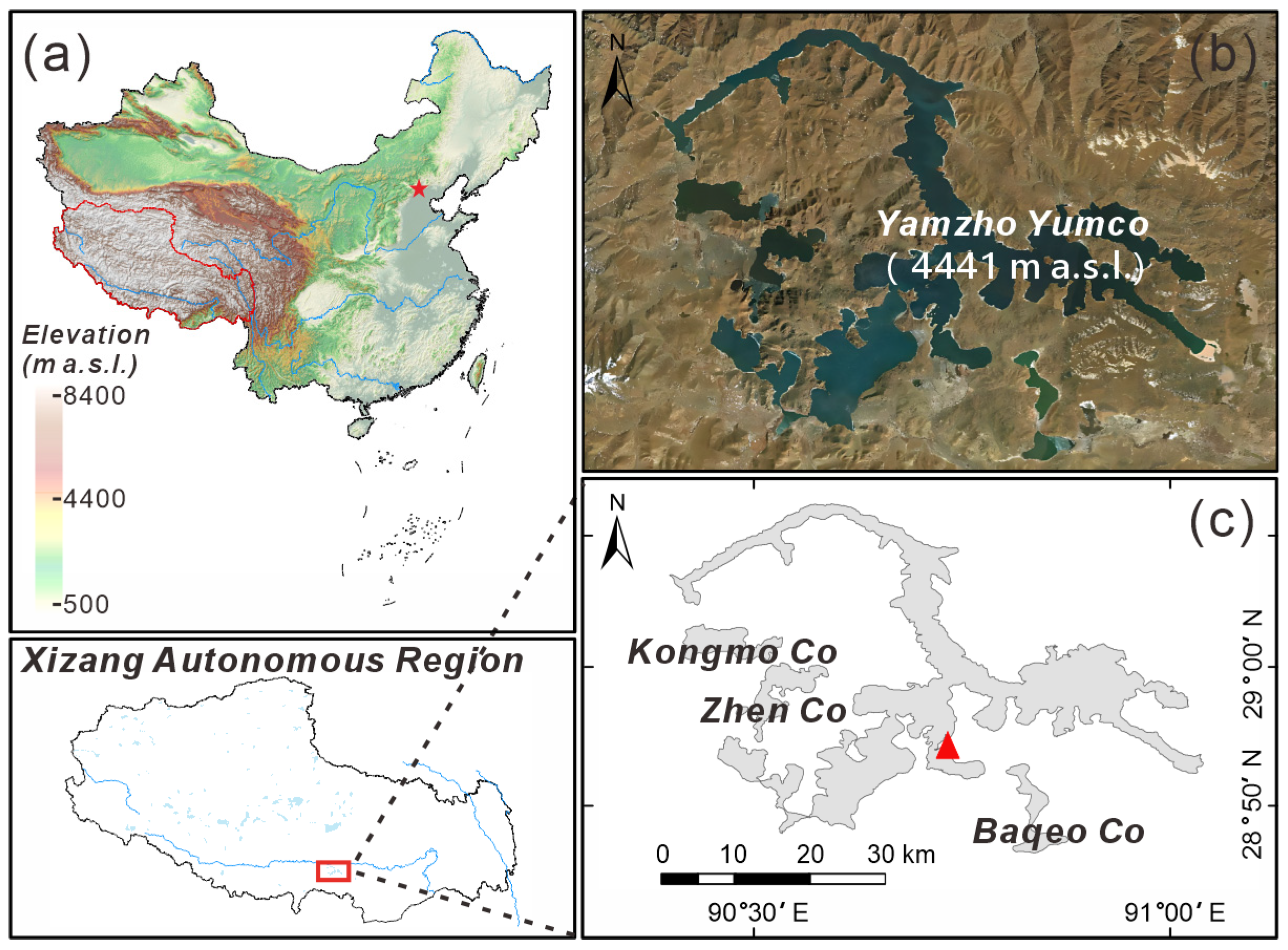
26]. The core was collected in August 2023 from the northeastern sector of the lake (28.85° N, 90.70° E; 4443 m a.s.l.) using a gravity corer (15 cm inner diameter) at a water depth of 5 m (
Figure 1). Although geographically located in the northeastern sector of the lake, the sampling site was distant from major river inlets and situated in the deepest open-water area, representing a relatively stable depositional environment for lacustrine sediment accumulation. The core was sectioned in the field at 1 cm intervals, yielding 48 subsamples, which were transferred into centrifuge tubes and stored frozen until analysis.
The age-depth relationship of this core was established previously using
210Pb and
137Cs dating [
26]. The resulting chronology spans the period from 1930 to 2023, with an average sedimentation rate of 0.46 cm/yr. This time interval was determined by the established
210Pb/
137Cs chronology of the sediment core rather than being selected a priori. It covers the transition from a pre-intensive-use background period to the rapid expansion, peak input, and recent regulation-influenced stage of PBDE contamination. Therefore, the 1930–2023 record provides an appropriate temporal framework for evaluating the historical evolution of PBDE inputs to this remote alpine lake. Because the present study focuses on PBDEs measured in the same dated sediment archive, the detailed dating procedure is not repeated here.
2.2. Chemical Analysis
Seventeen PBDE congeners, including BDE-17, -28, -47, -66, -71, -85, -99, -100, -138, -153, -154, -183, -190, -206, -207, -208, and -209, were determined in the sediment samples.
Analytical procedures generally followed previously reported methods for PBDE determination in Tibetan Plateau environmental samples and dated sediment archives, with minor modifications for the present study [
11,
16,
19]. Native PBDE standards were purchased from AccuStandard, Inc. (New Haven, CT, USA).
13C-labeled BDE-47,
13C-labeled BDE-99, and
13C-labeled BDE-209 were used as surrogate standards to monitor analyte losses during sample preparation, whereas
13C-labeled BDE-100 and
13C-labeled BDE-183 were used as internal standards for quantification. Hexane, dichloromethane (DCM), and acetone were of analytical grade. All glassware was pre-cleaned by repeated rinsing with fresh solvent before use.
Each sediment sample was freeze-dried, ground into fine powder, sieved through a stainless-steel sieve, and stored in clean amber glass bottles at −20 °C before extraction. Approximately 20 g of dry sediment was homogenized, spiked with surrogate standards, and Soxhlet-extracted for 48 h using a mixture of hexane/DCM/acetone (1:1:1, v/v/v). Activated copper was added before extraction to remove elemental sulfur. After extraction, the extract was solvent-exchanged to hexane and concentrated to approximately 1.0 mL. The extract was then purified using a multilayer silica gel/alumina column packed, from top to bottom, with anhydrous Na2SO4, 50% sulfuric acid-silica gel, neutral silica gel, and neutral alumina. Target compounds were eluted with 20 mL of hexane/DCM (1:1, v/v). The purified extract was concentrated to approximately 20 μL under a gentle stream of nitrogen, and internal standards were added before instrumental analysis.
PBDE congeners were determined by gas chromatography–tandem mass spectrometry (GC–MS/MS; Shimadzu GCMS-TQ8040NX, Shimadzu Corporation, Kyoto, Japan) operated in electron capture negative ionization mode. Tri- to nona-BDE congeners were analyzed on a DB-5MS capillary column (30 m × 0.25 mm i.d. × 0.25 μm), whereas BDE-209 was analyzed separately on a CP-Sil 13 CB column (12.5 m × 0.25 mm i.d. × 0.20 μm). The oven temperature program was as follows: the initial temperature was held at 110 °C for 5 min, increased to 200 °C at 30 °C/min, and then increased to 295 °C at 5 °C/min and held for 15 min. The injector temperature was maintained at 290 °C, and both the ion source and quadrupole temperatures were maintained at 150 °C. The monitored ions were m/z 79 and 81 for tri- to nona-BDE congeners, and m/z 488.6 and 486.6 for BDE-209. Individual PBDE congeners were identified by comparing their retention times and monitored ion responses with those of authentic standards analyzed under the same instrumental conditions. Quantification was performed using the internal standard method, and all concentrations are reported on a dry-weight basis.
2.3. Quality Assurance and Quality Control (QA/QC)
Quality assurance and quality control procedures were conducted to evaluate potential contamination, method accuracy, and analytical reproducibility. A procedural blank, a spiked blank, and one duplicate sample were included in each batch of eight samples. No target PBDE congeners were detected in the procedural blanks. Each final extract was measured in triplicate, and the mean value of the three measurements was used for subsequent data analysis. Analytical repeatability was further assessed using duplicate samples included in each analytical batch.
The method detection limits (MDLs), defined as a signal-to-noise ratio greater than three, ranged from 0.4 to 2 pg/g for tri- to nona-BDE congeners, whereas the MDL for BDE-209 was 3 pg/g. Concentrations below the MDLs were treated as non-detects and assigned a value of one-half of the corresponding MDL for statistical analysis and plotting. Matrix spike recoveries ranged from 76% to 108%, with an average standard deviation of 12%. The relative deviations between duplicate samples were less than 20% for all target analytes, indicating acceptable reproducibility for sediment PBDE analysis. The average surrogate recoveries of 13C-labeled BDE-47, 13C-labeled BDE-99, and 13C-labeled BDE-209 were 76% ± 19%, 87% ± 12%, and 81% ± 8%, respectively. Reported concentrations were not corrected for surrogate recoveries.
2.4. Data Treatment, Statistical Analysis, and Uncertainty Considerations
As described in
Section 2.3, concentrations below the MDLs were assigned a value of one-half of the corresponding MDL for statistical analysis and plotting. Σ
17PBDEs was calculated as the sum of the 17 target congeners, and PBDE homologue contributions were expressed as percentages of Σ
17PBDEs. The BDE-47/BDE-99 ratio was calculated as an additional indicator of congener-selective environmental processing. Depositional fluxes were calculated from PBDE concentrations and the sediment mass accumulation rate derived from the previously established chronology of the same core [
26]. Descriptive statistics, including ranges, means, and stage-based comparisons, were used to summarize temporal variations in concentrations, fluxes, homologue composition, and diagnostic ratios. Non-parametric Mann–Kendall trend tests were used to evaluate monotonic temporal trends in Σ
17PBDE concentrations, depositional fluxes, and the BDE-47/BDE-99 ratio [
27]. Pettitt change-point tests were used to identify potential regime shifts in these records [
28,
29], and the detailed statistical outputs are provided in
Supplementary Table S1. Because the age-depth model was adopted from a previously published
210Pb/
137Cs chronology rather than recalculated in this study, temporal interpretations were focused on multi-decadal and stage-based patterns rather than exact year-by-year changes. Analytical uncertainty was constrained through triplicate instrumental measurements, blanks, duplicate samples, MDLs, matrix spike recoveries, and surrogate recoveries. Atmospheric transport modeling and air-mass back-trajectory analysis were beyond the scope of the present sediment-core study; therefore, the LRAT interpretation was based on the sedimentary evidence obtained here together with published atmospheric and environmental observations from the Tibetan Plateau and surrounding regions. The overall workflow of the study is shown in
Supplementary Figure S1.
3. Results and Discussion
3.1. Temporal Variation of Σ17PBDE Concentrations and Major Congener Profiles
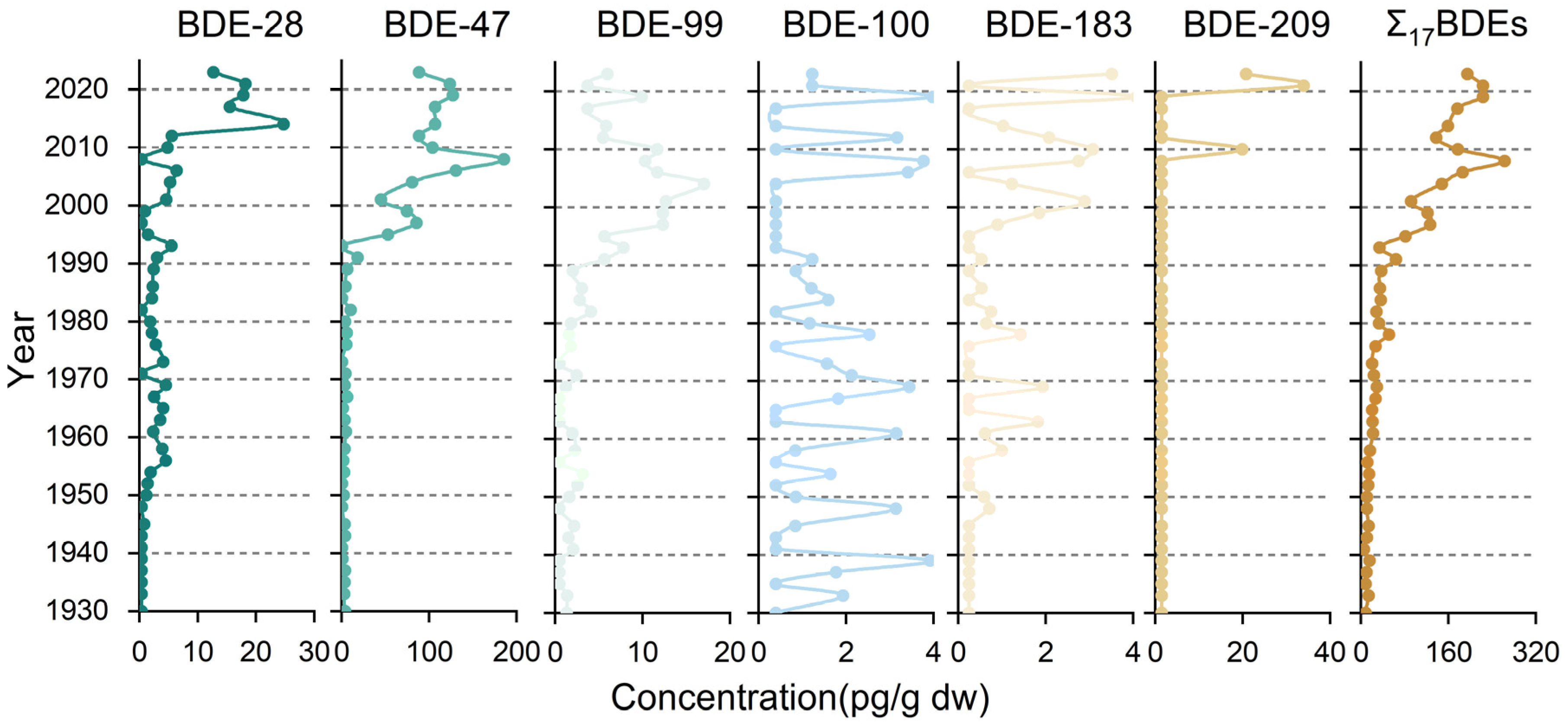
The down-core concentration profiles of Σ
17PBDEs and representative congeners indicate a clear long-term increase in PBDE contamination in Yamzho Yumco sediments (
Figure 2). Σ
17PBDE concentrations ranged from 5.80 to 263.13 pg/g dw, with a mean of 68.03 pg/g dw. Values remained low during 1930–1969 (5.80–29.58 pg/g dw; mean 15.17 pg/g dw), increased to 20.51–51.32 pg/g dw during 1971–1989 (mean 32.64 pg/g dw), and rose much more markedly after 1990, reaching 34.33–263.13 pg/g dw with a mean of 150.71 pg/g dw. The highest concentration occurred in 2008, and sediments deposited after 2010 remained consistently enriched. This temporal pattern is broadly consistent with previous sediment-core studies showing that PBDE burdens increased strongly during the late twentieth century and remained substantial in recent sediments despite subsequent regulatory control [
11,
30,
31].
Congener-specific data further show that the up-core increase in Σ
17PBDEs was driven mainly by lower-brominated PBDEs, especially BDE-47. BDE-47 was the dominant congener throughout most of the core, ranging from 0.30 to 185.49 pg/g dw and contributing, on average, 50.6% of Σ
17PBDEs. BDE-28 and BDE-99 were secondary contributors, whereas BDE-100 and BDE-183 remained at relatively low levels. The different temporal profiles of BDE-100 and BDE-183 from those of the dominant congeners may reflect their different source associations and environmental behaviors. BDE-100 is mainly associated with penta-BDE formulations, whereas BDE-183 is commonly regarded as a representative congener of octa-BDE-related inputs [
32]. Because both congeners occurred at relatively low concentrations in the Yamzho Yumco core, their profiles were more sensitive to episodic inputs and low-concentration variability. In particular, the higher bromination degree of BDE-183 favors particle association and may reduce its long-range transport efficiency relative to lower-brominated congeners. Therefore, the asynchronous patterns of BDE-100 and BDE-183 are interpreted as the combined result of source composition, congener-specific transport behavior, and low-concentration variability in a remote alpine receptor system. A distinct feature of the recent sediments is the enrichment of BDE-209, which stayed near its minimum reported level in most pre-2010 layers but increased to 19.94 pg/g dw in 2010, 33.93 pg/g dw in 2021, and 20.82 pg/g dw in 2023. The coexistence of persistent low-brominated dominance and recent deca-BDE-related enhancement suggests that the Yamzho Yumco record integrated evolving source inputs rather than a single, compositionally stable PBDE source. Such recent enrichment of BDE-209 is consistent with the continued environmental relevance of deca-BDE-related contamination despite progressive restrictions on legacy PBDE formulations [
8].
This pattern is more characteristic of a remote receptor archive than of a source-proximal depositional system. In urban or industrially influenced sediments, recent PBDE profiles often show much stronger deca-BDE dominance or other source-oriented congener patterns, reflecting direct or near-field inputs of highly brominated commercial mixtures [
31,
33]. Similar source-oriented PBDE distributions have been reported in Chinese coastal environments, including aquatic sediments and biota from the Bo Sea and surface sediments from the Pearl River Delta, where highly brominated flame retardants make a stronger contribution than would be expected in a remote alpine receptor system [
15,
34]. In contrast, the Yamzho Yumco core remained dominated by lower-brominated congeners despite the appearance of BDE-209 in the upper layers. This structure agrees better with observations from remote southwestern China and the Tibetan Plateau, where atmospheric and high-mountain receptor environments commonly preserve mixed PBDE signals while still showing important contributions from transport-favored congeners such as BDE-47 and BDE-99 [
12,
18,
35]. Therefore, the concentration record does not simply document increasing contamination; it also indicates that the PBDE signal preserved in Yamzho Yumco was shaped by both changing source composition and selective atmospheric transfer to a remote alpine lake. Taken together, the concentration record suggests that Yamzho Yumco functioned as a selective high-altitude receptor rather than a simple depositional endpoint [
12,
35]. This interpretation should be regarded as a qualitative source–receptor assessment based on congener patterns and regional comparisons, rather than as a quantitative source-apportionment result.
3.2. Historical Trends of Depositional Fluxes of Σ17PBDEs
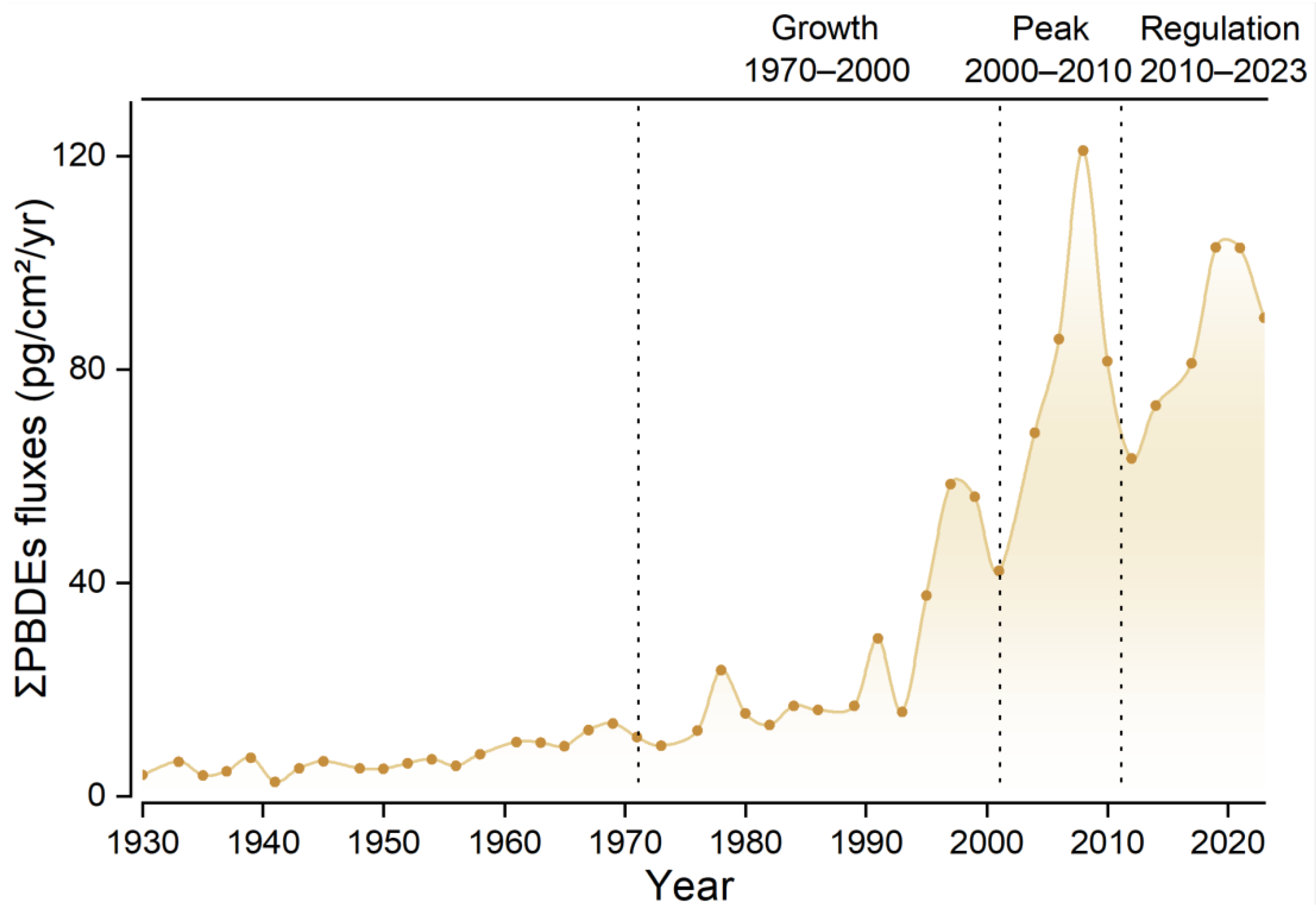
A clearer picture of PBDE input history is provided by the depositional-flux record (
Figure 3), which ranged from 2.67 to 121.04 pg/cm
2/yr and averaged 31.29 pg/cm
2/yr for the whole core. Fluxes remained low and relatively stable during 1930–1969 (2.67–13.60 pg/cm
2/yr; mean 6.98 pg/cm
2/yr), increased during 1971–1999 (9.44–58.45 pg/cm
2/yr; mean 23.76 pg/cm
2/yr), and rose sharply after 2000. The maximum flux was recorded in 2008 (121.04 pg/cm
2/yr), after which values declined but remained high during 2010–2023 (63.27–102.90 pg/cm
2/yr; mean 84.94 pg/cm
2/yr). The flux profile therefore records a transition from a low-background stage to a late-twentieth-century growth stage and finally to a sustained high-input stage after 2000. Non-parametric statistical tests supported this stage-based interpretation. Mann–Kendall tests confirmed significant upward trends in Σ
17PBDE concentrations, depositional fluxes, and the BDE-47/BDE-99 ratio (
p < 0.001), while Pettitt tests identified major shifts around 1976 for both the concentration and flux records and around 1997 for the BDE-47/BDE-99 ratio (
p < 0.001;
Supplementary Table S1). These results support the transition from low background levels before the late twentieth century to elevated PBDE inputs and altered congener relationships in recent sediments.
The repeated increase–decrease pattern in
Figure 3 should be interpreted as variation in depositional flux rather than concentration alone. Because depositional flux is controlled by both sediment concentration and sediment accumulation, it may show stronger short-term variability than the concentration profile. In a remote alpine lake, PBDE delivery is also affected by non-linear atmospheric transport, particle-associated deposition, catchment runoff, sediment redistribution, and secondary release from environmental reservoirs. For Yamzho Yumco, where surface runoff accounts for about 84% of the water supply, this catchment-mediated component may partly explain why the flux record shows short-term variability superimposed on the long-term increase. Thus, the short-term fluctuations in the flux record are interpreted as episodic input and depositional variability superimposed on the long-term increase in PBDE loading since the 1970s. Given the chronological resolution of the sediment core, these fluctuations should not be over-interpreted year by year; the more robust signal is the transition from low fluxes before the 1970s to elevated and persistent fluxes after 2000.
Compared with concentrations, depositional fluxes more directly reflect the temporal intensity of PBDE delivery to the lake. Atmospheric deposition studies from the Great Lakes likewise showed that substantial PBDE inputs can persist even when congener-specific trends diverge, underscoring the need to interpret fluxes together with composition rather than as a simple proxy for source strength [
36]. The progressive rise after the 1970s and the sharp amplification after 2000 are broadly compatible with the historical expansion in the production, use, and environmental release of commercial PBDE mixtures. Similar up-core increases have been reported from dated sediment cores in other regions, including the Great Lakes and the Pearl River Estuary, and a comparable recent rise has been documented in a dated lake sediment core from the southern Tibetan Plateau [
30,
33,
37]. The broader temporal correspondence among these records supports the regional relevance of the Yamzho Yumco trend.
The significance of the Yamzho Yumco flux record, however, goes beyond documenting increased PBDE input. The onset of enhanced fluxes after the 1970s, the maximum in the 2000s, and the absence of a sharp post-2010 decline together indicate that this remote alpine lake responded not only to changing source emissions, but also to the coupling between regional atmospheric transport and delayed environmental release. This interpretation is consistent with the global history of PBDE use and regulation, but it also suggests that remote high-altitude lakes may respond to source controls with an environmental lag. Continued emissions from products in use, waste handling, and secondary reservoirs can sustain atmospheric inputs long after formal phase-out begins [
6,
38]. Evidence that Tibetan background soils can act as both sinks and secondary sources of atmospheric POPs, together with reviews of landfill-related PBDE release, further supports the view that re-volatilization from environmental reservoirs can prolong PBDE delivery to remote receiving environments [
38,
39]. Recent sediment studies from Tibetan lakes likewise indicate that contaminant records in remote plateau sediments should be interpreted as process-integrated archives rather than simple emission chronologies [
2,
3]. In this sense, the Yamzho Yumco flux history suggests that the lake captured not only the timing of PBDE input intensification, but also the coupled influence of global use history, regional atmospheric transport, and delayed release from products in use and secondary environmental reservoirs.
3.3. Temporal Variation in PBDE Homologue Composition
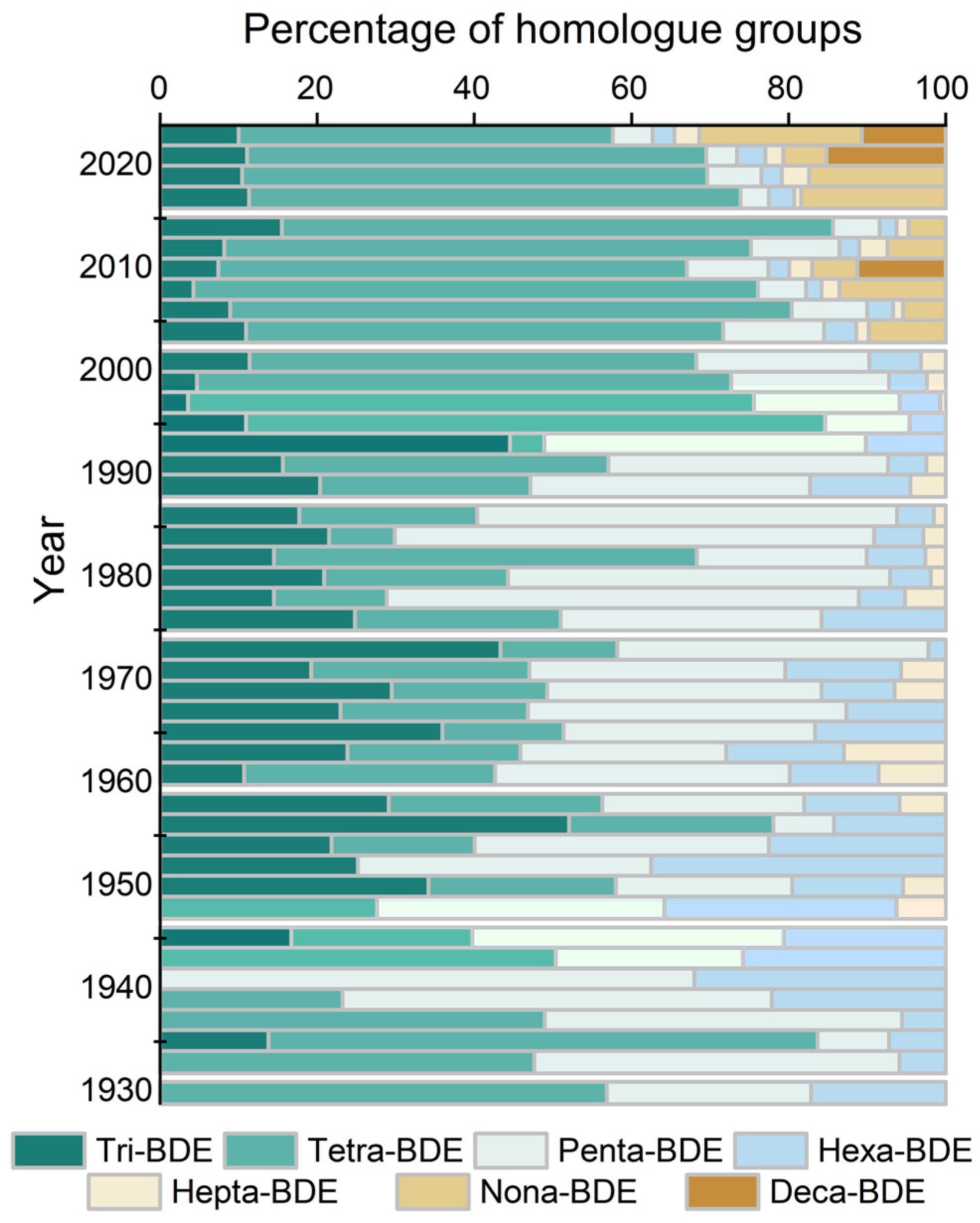
The homologue composition provides further evidence that the recent increase in PBDE deposition was not simply a proportional increase across all homologues(
Figure 4). Instead, the record reflects a long-term shift from an earlier penta-/tetra-BDE-dominated profile to a more strongly tetra-BDE-dominated profile, with superimposed contributions from highly brominated homologues in recent decades. Even so, tri- to penta-BDEs remained the major fraction throughout the core, accounting on average for 80.16%, 90.40%, and 81.14% of total PBDEs during 1930–1969, 1971–1999, and 2001–2023, respectively. Such a persistent predominance of lower-brominated PBDEs is consistent with remote mountain and plateau receptor environments, where lighter congeners are more effectively transferred and archived than highly brominated compounds [
12,
14,
40]. Thus, the recent enrichment of highly brominated homologues is best interpreted as evidence of source evolution superimposed on a receptor archive that remained selectively biased toward lower-brominated congeners.
The recent appearance of nona- and deca-BDEs nevertheless suggests that the PBDE signal reaching Yamzho Yumco became more compositionally mixed in the twenty-first century. This interpretation agrees with atmospheric observations from remote southwestern China, Lhasa, and other receptor sites on the Tibetan Plateau, where highly brominated flame retardants co-occur with lower-brominated congeners under long-range transport conditions rather than exclusively under local-source influence [
12,
40]. However, deca-BDE never became dominant in the Yamzho Yumco core and remained subordinate to tetra-BDE even in the recent layers. This contrast indicates that source evolution was superimposed on transport selectivity. In other words, the sedimentary PBDE profile did not simply inherit the composition of contemporary source regions, but preserved a filtered signal shaped by the preferential transfer and archival efficiency of lower-brominated homologues in a remote alpine environment.
This point is central to the environmental meaning of the record. The Yamzho Yumco core indicates that even when regional source mixtures evolve toward greater contributions from highly brominated PBDEs, the final sedimentary archive in a high-altitude remote lake may still be governed primarily by long-range transport and depositional selectivity. This behavior makes such lakes useful for source–receptor interpretation: they do not merely store what is emitted, but preserve what survives transport and is efficiently incorporated into the sediment record.
3.4. Temporal Variation in the BDE-47/BDE-99 Ratio
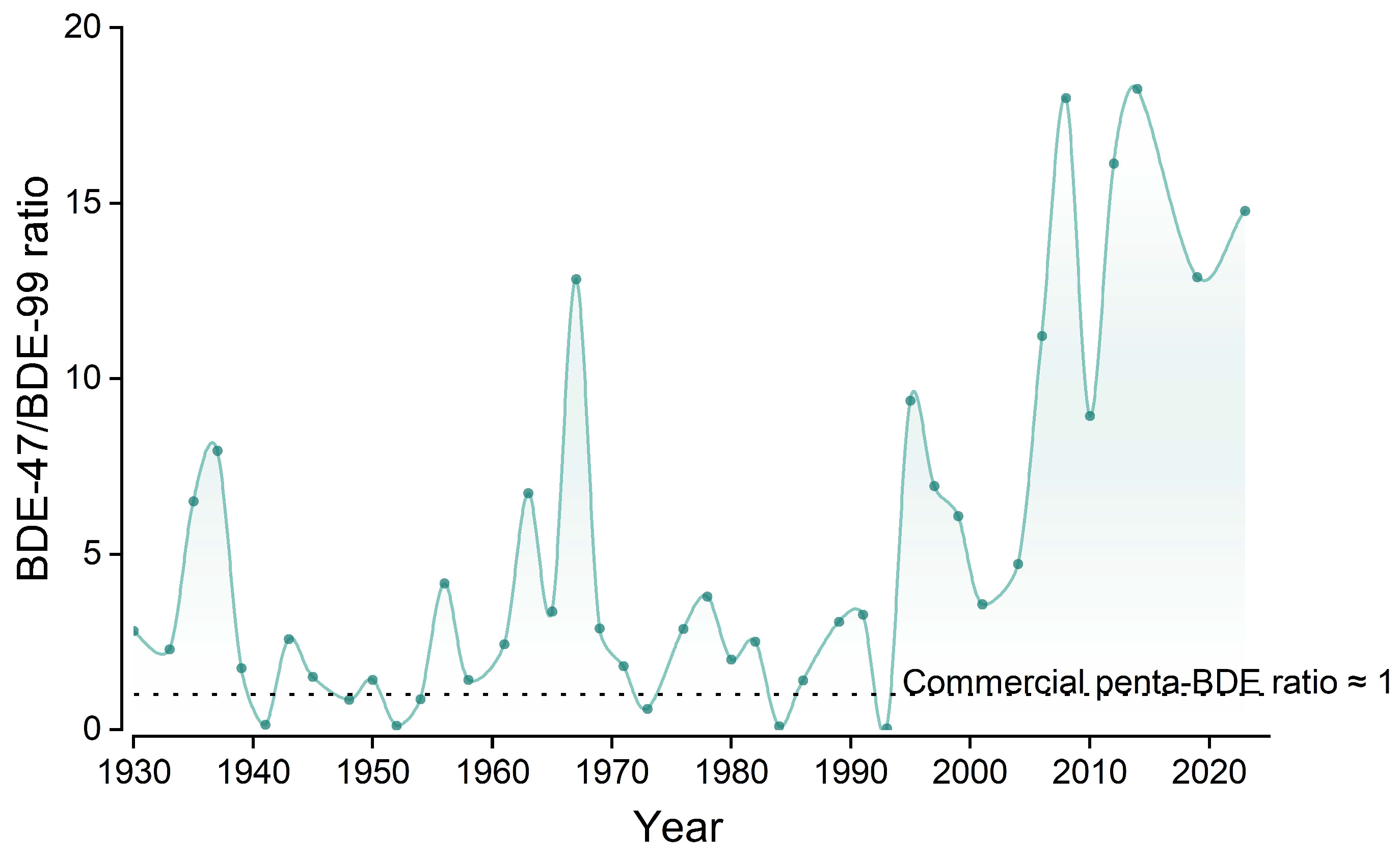
The BDE-47/BDE-99 ratio provides a further constraint on the environmental meaning of the sedimentary PBDE signal (
Figure 5). Across the whole core, the ratio ranged from 0.04 to 18.26, with an overall mean of 5.12. Values before 2000 were generally low to moderate and highly variable, averaging 3.24 during 1930–1999. After 2000, however, the ratio increased markedly and remained high, ranging from 3.57 to 18.26 with a mean of 12.06 during 2001–2023. The highest values occurred in 2008, 2012, and 2014, indicating a pronounced enrichment of BDE-47 relative to BDE-99 in the upper part of the core. Although some short-term fluctuations in the older layers should be interpreted cautiously because PBDE concentrations were relatively low, the overall up-core increase remains clear.
This trend is environmentally meaningful because BDE-47 and BDE-99 are major components of technical penta-BDE mixtures and typically occur in broadly comparable proportions. Detailed characterization of commercial formulations showed that penta-BDE products such as DE-71 and Bromkal 70-5DE exhibit BDE-47/BDE-99 ratios close to unity [
32]. Therefore, the substantially higher post-2000 ratios in Yamzho Yumco are unlikely to reflect fresh technical penta-BDE input alone. Instead, they indicate that the sedimentary PBDE profile had been modified by congener-selective processes during transport, deposition, and recycling through secondary reservoirs.
This interpretation is supported by studies of remote atmospheric deposition and receptor environments. Atmospheric deposition measurements in remote European mountains showed that, although BDE-209 dominated total PBDE deposition, BDE-47 and BDE-99 remained the major low-brominated congeners and exhibited elevated BDE-47/BDE-99 ratios relative to technical mixtures, consistent with transport-related fractionation [
41]. Similarly, long-term atmospheric observations have shown that higher BDE-47/BDE-99 ratios in remote environments are more closely associated with congener-specific transport behavior and secondary emissions from environmental reservoirs than with unchanged source composition [
42]. In this context, the persistently elevated ratios in the recent Yamzho Yumco sediments are more consistent with a transport- and fate-modified PBDE signal than with direct local contamination.
Considered together with the concentration, flux, and homologue-composition records, the BDE-47/BDE-99 ratio strengthens the interpretation that Yamzho Yumco sediments preserve a transport-modified record of regional PBDE emissions reaching the Xizang Plateau. The ratio thus provides an independent line of evidence that this remote lake sediment core integrated source evolution, long-range atmospheric transport, and post-emission environmental fractionation.
3.5. Conceptual Interpretation of PBDE Transport and Sedimentary Archiving
The interpretation of the Yamzho Yumco sediment record was based on a source–transport–deposition–archive perspective rather than on a direct source-apportionment model. In this perspective, PBDEs released from historical and contemporary products, waste streams, and secondary environmental reservoirs can be transported regionally through the atmosphere, consistent with the recognition of the Tibetan Plateau as a receptor region for atmospherically transported POPs [
1,
13]. After reaching the Yamzho Yumco basin, PBDEs may enter the lake through two linked pathways: direct atmospheric deposition onto the lake surface and catchment-mediated lateral transfer of previously deposited contaminants. The latter pathway is particularly relevant because surface runoff accounts for about 84% of the lake water supply and the catchment-to-lake area ratio is approximately 9.6 [
23]. Thus, PBDEs deposited on catchment soils, particles, or other environmental reservoirs may be remobilized and transported into the lake with runoff, suspended particles, and eroded materials [
24,
26,
39]. Under this interpretation, the concentration and flux profiles are considered as the combined outcome of atmospheric input, catchment-mediated transfer, and sedimentary storage, rather than as records of direct atmospheric deposition alone. However, because paired PBDE data for catchment soils, inflowing waters, suspended particles, and surface sediments are not available, the relative contribution of lateral remobilization cannot be quantified in the present study.
The LRAT interpretation in this study should therefore be viewed as a sediment-based inference rather than a trajectory-model-based source attribution. Previous atmospheric observations and passive air sampling studies have shown that PBDEs and other POPs are detectable across the Tibetan Plateau and that the plateau can receive contaminants transported from surrounding source regions [
1,
12,
13,
18]. In the present core, the persistent predominance of lower-brominated PBDEs, the subordinate but recent occurrence of highly brominated homologues, and the elevated BDE-47/BDE-99 ratios are consistent with a transport-modified receptor signal. However, without concurrent atmospheric measurements or air-mass back-trajectory analysis, this study cannot quantitatively resolve transport pathways or assign proportional source contributions.
Source interpretation in this study was therefore constrained to qualitative and semi-quantitative evidence from congener profiles, homologue composition, diagnostic ratios, and comparison with technical mixtures and regional observations, rather than numerical source contribution estimates. Within this interpretive framework, the sedimentary indicators used in this study provide complementary constraints. Concentration and depositional-flux profiles reflect the temporal intensity of PBDE delivery to the lake, homologue composition records the relative contribution of lower- and higher-brominated PBDEs, and the BDE-47/BDE-99 ratio provides an additional indicator of congener-selective environmental processing when considered together with the other evidence. Therefore, the Yamzho Yumco core is interpreted as a process-integrated archive of PBDE input, atmospheric transport, catchment transfer, and sedimentary storage. This framework does not quantify the relative contributions of individual sources or transport pathways, but it provides a necessary basis for interpreting the sediment record beyond a descriptive concentration profile.
3.6. Regional Synthesis and External Consistency Evaluation
To further place the Yamzho Yumco record in a regional context, we evaluated its external consistency using three lines of published evidence: sedimentary records from other aquatic systems, emission- and source-related information, and independent atmospheric observations. First, the Σ
17PBDE concentrations in the Yamzho Yumco core are comparable to the pg/g-level PBDE record reported from a southern Tibetan Plateau lake sediment core [
11], but are much lower than those reported from urban lake sediments and e-waste-influenced sediments [
9,
10]. This contrast supports the interpretation that Yamzho Yumco represents a remote receptor archive rather than a source-proximal depositional environment. The late-twentieth-century increase in concentrations and fluxes is also broadly consistent with dated PBDE sediment records from other regions, including the Great Lakes, the Pearl River Estuary, and riverine sediments in eastern China [
30,
33,
37].
Second, the temporal evolution of the Yamzho Yumco record is consistent with the broader history of PBDE production, use, regulation, and continued release from legacy products and waste-related reservoirs [
6,
7,
8]. The recent occurrence of BDE-209 in the upper sediments is compatible with changing source mixtures and the continued environmental relevance of deca-BDE-related contamination, although the sedimentary profile remained dominated by lower-brominated congeners. Third, independent atmospheric observations from remote southwestern China, passive air sampling across the Tibetan Plateau, atmospheric measurements from Lhasa, and remote mountain deposition or long-term atmospheric studies all indicate that PBDEs and related flame retardants occur in high-altitude receptor environments and may be influenced by regional atmospheric transport and congener-specific deposition processes [
12,
13,
18,
40,
41,
42].
Taken together, these external lines of evidence support the interpretation that the Yamzho Yumco sediment core records a transport-modified remote receptor signal rather than an isolated local anomaly. This regional synthesis does not replace a site-specific emission inventory or a dedicated atmospheric transport model, but it provides an evidence-based consistency evaluation for the sedimentary interpretation and improves the regional relevance of the study.
4. Environmental Implications, Challenges, and Future Perspectives
The combined evidence from the Yamzho Yumco core has broader implications for interpreting POP records in remote high-altitude lake sediments. The coherent variations in Σ
17PBDE concentrations, depositional fluxes, homologue composition, and the BDE-47/BDE-99 ratio indicate that dated alpine lake sediments can preserve process-integrated signals of PBDE input, source evolution, atmospheric transport, catchment-mediated transfer, and post-emission environmental fractionation [
2,
3,
11]. For high-altitude regions such as the Xizang Plateau, where direct long-term atmospheric monitoring data remain limited, such sediment archives provide a useful long-term perspective for evaluating the response of remote receptor systems to regional and global changes in PBDE emissions [
1,
13].
Several limitations should also be recognized. First, the present study is based on a single sediment core, and the sedimentary record alone cannot fully separate the relative contributions of regional atmospheric transport, direct atmospheric deposition, catchment-mediated lateral transfer, local low-intensity activities, and secondary release from environmental reservoirs [
22,
25,
26,
39]. Second, the absence of simultaneous atmospheric measurements, source-specific fingerprints, site-specific emission inventories, and air-mass trajectory analysis limits quantitative source apportionment and prevents a fully model-based regional validation of the sedimentary interpretation. Third, the age-depth model was adopted from a previously published
210Pb/
137Cs chronology of the same core; therefore, the temporal interpretation is most reliable at multi-decadal and stage-based scales rather than for exact year-by-year attribution.
Future studies should combine multi-core and multi-lake sediment records with catchment soils, inflowing waters, suspended particles, surface sediments, passive air sampling, back-trajectory analysis, receptor modeling, and regional emission inventories. Such integrated approaches would help distinguish direct atmospheric deposition from catchment-mediated remobilization, improve quantitative source attribution, constrain the influence of changing climate and hydrological processes, and strengthen the interpretation of remote lake sediments as archives of POP transport and fate in mountain environments.