Article

Environmental Impact Assessment of the Soyuz-2.1a Launch Vehicle with the Progress MS-29 Cargo Spacecraft in Kazakhstan: A One-Time Monitoring with Retrospective Comparison of Data from 2020–2023


by
Aliya Kalizhanova
1,
Murat Kunelbayev
2,
Anar Utegenova
3,
Ainur Kozbakova
4,* and
Serik Daruish
2
1
Institute of Information and Computational Technologies CS MSHE RK, Almaty University of Energy and Communications Named After G. Daukeyev, 050010 Almaty, Kazakhstan
2
Institute of Information and Computational Technologies CS MSHE RK, Al-Farabi Kazakh National University, 050010 Almaty, Kazakhstan
3
Institute of Information and Computational Technologies CS MSHE RK, Almaty Technological University, 050010 Almaty, Kazakhstan
4
Institute of Information and Computational Technologies CS MSHE RK, Satbayev University, 050010 Almaty, Kazakhstan
*
Author to whom correspondence should be addressed.
Atmosphere 2026, 17(6), 532; https://doi.org/10.3390/atmos17060532
Submission received: 8 April 2026 / Revised: 18 May 2026 / Accepted: 19 May 2026 / Published: 22 May 2026
(This article belongs to the Section Air Quality)

Abstract

The relevance of this study is determined by the need for a scientifically grounded assessment of environmental risks associated with rocket launches and by the necessity of ensuring environmental safety in areas potentially affected by space activities. Comprehensive monitoring of rocket-stage impact zones and adjacent populated areas is especially important because pollutant distribution depends on natural, climatic, and spatial factors. This study assesses the environmental impact of the “Soyuz-2.1a” launch with the “Progress MS-29” cargo spacecraft in Kazakhstan using integrated field monitoring, laboratory analysis, and geoinformation methods. The work should be interpreted as a single-event environmental monitoring assessment, while historical monitoring data from 2020–2023 were used only as a retrospective comparative background for the U-25 impact area and were not included in the main BACI statistical analysis. The study covered the launch site, adjacent populated areas, and the U-25 stage impact zone. A before–after control-impact (BACI) design with distance stratification and consideration of wind direction was applied to identify post-launch changes. Measurements below the limit of detection and limit of quantification were processed using censored-data methods, including Regression on Order Statistics (ROS) and the Kaplan–Meier estimator. Spatial analysis was used to generate concentration fields, contour maps, and risk zones, revealing an anisotropic distribution of environmental stress in the downwind sector. An integrated hazard quotient (HQ) metric was applied to compare air, water, and soil conditions on a unified scale. The results indicate that the post-launch impact was localized and time-limited, with the greatest sensitivity observed in the soil component of the U-25 zone during the early post-launch period. Atmospheric air and water indicators remained within regulatory limits in populated areas. The proposed approach combines BACI monitoring, censored-data analysis, spatial modeling, and GIS-based visualization, providing a reproducible framework for the environmental assessment of rocket-stage impact areas. The practical recommendations include staged post-launch monitoring, temporary restriction of access to high-stress zones, primary reclamation of contaminated soil, and the use of WebGIS tools to support environmental decision-making.

1. Introduction

The impact of rocket and space activities on the environment in Kazakhstan remains a pressing scientific and applied issue. Regular launches from the Baikonur Cosmodrome are accompanied by atmospheric emissions, mechanical destruction of the soil cover, and potential contamination by rocket fuel components. The objective of this study is to conduct a comprehensive assessment of the environmental situation during the launch of the “Soyuz-2.1a” launch vehicle with the “Progress MS-29” spacecraft. Article [1] presents the results of the “Soyuz-FG” launch vehicle and “Soyuz MS-10” spacecraft accident in the Ulytau region of Kazakhstan, identifying two local fuel spill zones. No significant differences in the exchange forms of Ca and Mg or in cation exchange capacity were found between the seasonal samples. The obtained results are informative for the development of remediation programs for arid landscapes and for planning monitoring in areas of regular stage landings and emergency impacts. In [2], a method for determining rocket kerosene (RG-1 and T-1) in soil was developed using static headspace sampling followed by gas chromatography-mass spectrometry (GC-MS). It was shown that analysis of the vapor phase above a solid sample is preferable to ultrasonic extraction with methanol and analysis of the equilibrium vapor phase above the extract. In [3], the identification of semi-volatile fuels in soil based on the distribution of sesquiterpanane biomarkers was demonstrated. Extraction with dichloromethane and GC-MS revealed markers in RG-1, T-1, TS-1, and diesel. The biomarker profiles are specific and are preserved during soil transformation; profile parameters were proposed for reliable identification at any stage. Article [4] presents an overview of the environmental impacts of space launches, focusing on emissions from solid and liquid rocket propellants. It is shown that stratospheric ozone depletion is the best-studied and most acute effect: the contribution of liquid rocket engines has been confirmed, but solid engines cause losses orders of magnitude higher. Environmental tradeoffs in the selection of launch systems are discussed, and gaps in knowledge (climate, ecotoxicity, health risks) are identified. Article [5] examines the environmental impacts of launch vehicle accidents during the boost phase of flight (debris fall, fuel spills, emissions), and presents an approach to damage assessment and measures for its mitigation/elimination. A set of routine indicators of the “hydrocarbon status” of soils (bitumoids, polycyclic aromatic hydrocarbons PAHs, gaseous hydrocarbons) is proposed, tested at eight sites ranging from forest to dry steppe. The hydrocarbon status (HCS), as an integral indicator, reflects climatic and geomorphological conditions, soil properties, and anthropogenic load [6]. The work [7] proposed a set of routinely measured indicators of the “hydrocarbon status” of soils (bitumoids, PAHs, and gas hydrocarbons), which are used to assess natural and anthropogenic impacts. Studies at eight sites from forest to dry steppe showed that HCS, like humus/salt status, serves as an integral characteristic of soils, reflecting climatic and geomorphological conditions, soil properties, and pollution levels. Reference [8] examines the rocket and technical context of nitrosodimethylamine (NDMA), its use in hypergolic vapors (UDMH—unsymmetrical dimethylhydrazine/N2O4), pathways of entry into the environment (flare emissions, spills during stage falls and accidents, discharge of residues), and subsequent transformation to nitrosamines. Article [9] discusses “heptyl” (NDMA, UDMH) as a widely used rocket propellant, which is prone to irreversible wetting with loss of properties, which limits its long-term storage. Article [10] assessed potentially mineralizable carbon (PMC) and nitrogen (PMN) in Eurasian steppe soils across 41 samples (Ukraine, Kazakhstan; cropland, forest, meadow, desert) after a 133-day incubation with CO2 and mineral N monitoring. Article [11] found that the exposure of watercress and zucchini to UDMH rapidly and at all concentrations resulted in the formation of 1-methyl-1H-1,2,4-triazole, a reliable marker of UDMH contamination (according to GC-MS data). In [12], the leasing regime and Roscosmos’s control created a closed environmental policy around Baikonur, where proton accidents and the risk of UDMH coexist with the suppression of criticism and the absence of independent science. In [13], the concept of Baikonur’s “internal offshore” is substantiated: lease deals between Russia and Kazakhstan convert the Soviet legacy into a closed governance regime, where the vast lands of the “drop zones” serve global flows of launches, capital, and waste. In [14], it was shown that behind the façade of rocket heroics lies the land and infrastructure of launches. Since the 1950s, “drop zones” in the Kazakh steppe have received stages and toxic fuel residues from launches from Baikonur. It is argued that post-Soviet lease agreements between Russia and Kazakhstan have transformed this Soviet facility into an “intracontinental offshore”—a privatized space with offshore privileges and elements of de facto extraterritoriality. The study in [15] analyzed the environmental safety of soils exposed to UDMH (heptyl): domestic methods for determining its mass fraction were compared, the behavior of the substance and its transformation pathways in ecosystems were considered, and practical experience in remediation was systematized. The risk of secondary UDMH formation during the sample preparation stage was separately noted, and it was shown that the duration of contamination persistence was determined by the soil type: in acidic peatlands, it persists longer, while in alkaline peatlands, it persists much less. The work in [16] provides a concise assessment of the environmental aspects of kerosene use in the aerospace sector. It was shown that the key risks are caused by emissions and leaks in aviation, as well as spills at the impact sites of the first stages of launch vehicles (while the second and third stages usually do not affect terrestrial ecosystems). Reference [17] showed that oxidative methods for UDMH purification were assessed based on residual fuel, ignoring many nitrogen-containing transformation products, while [18] showed that in coastal salt marshes of the Bohai coast, soils under vegetation, compared to “bare” soils, had lower EC—electrical conductivity/salt/SAR—sodium adsorption ratio/density and higher pH, organic matter, MWD—mean weight diameter and Ks—saturated hydraulic conductivity. RDA (redundancy analysis)/SEM (structural equation modeling) analyses revealed two opposing sets of features and confirmed that the key determinants of salinity are organic matter and density, with their combined effect being stronger than their individual effects, which is important for desalinization strategies. In [19], the authors examined how “space industrialization” affects the Earth’s environment. The article discusses the growth of space debris, light pollution of the night sky, the possible impact of launches and debris burnup on the atmosphere and ozone layer, radiation risks from nuclear sources on spacecraft and the effects of expanding space tourism. The authors call for measures to reduce these impacts and stricter regulation. Reference [20] showed that spectrofluorimetric in combination with multivariate data analysis can quickly predict the oxidative stability of oils and biodiesel, while in [21], they systematized the oxidation pathways of UDMH and its (often highly toxic) products despite the disparity of data, some of which is only hypothetical. Detection environments, confirmed schemes and toxicity are summarized; it is emphasized that prediction without experiment is unreliable, and understanding the transformations is necessary for risk identification and mitigation. Article [22] notes that hydrazine and its derivatives—monomethylhydrazine (MMH) and unsymmetrical dimethylhydrazine (UDMH)—are highly toxic and are widely used as rocket fuels in military and aerospace technology. Article [23] examined laboratory methods for assessing the hydrocarbon status of soils—the total content and composition of bitumoids, individual hydrocarbons, and gases. The most applicable approaches are described: luminescence-bituminological analysis and low-temperature spectrofluorimetric.

2. Materials and Methods

Experimental soil samples and air quality data were provided by the Republican State Enterprise Infracos (Almaty, Kazakhstan). Three main areas were selected for the study of launch vehicle impact zones: the cosmodrome launch site, the first stage impact area, and populated areas located near the flight trajectory. This choice was driven by the need for a comprehensive analysis—from local processing sites to populated areas. At the launch site (site 31), the impact of fueling and launch operations on air and soil conditions was studied. In the first stage impact area (zone U-25, Ulytau), fuel component spills, mechanical damage to the soil, and localized fires were assessed. In the populated areas of Baikonur, Toretam, Akai, Zhezkazgan, and Talap, air, water, and soil quality were measured to determine the potential impact of the launch on living conditions.
Historical monitoring data for 2020–2023 were used only as a retrospective comparative baseline for interpreting contamination levels in the U-25 stage’s impact zone. These data were not included in the main BACI statistical analysis for the Soyuz-2.1a/Progress MS-29 launch. The BACI analysis was only performed on monitoring data directly related to the Progress MS-29 launch.
To obtain reliable data, sampling was carried out according to standardized methods and state standards. Soil samples were collected from the upper soil layer (0–20 cm), corresponding to the zone of greatest pollutant accumulation, using State Standards SS (GOST) 17.4.3.01-2017 “Environmental Protection. Soils. General Requirements for Sampling.” Moscow, Russia and SS (GOST) 17.4.4.02-2017 “Environmental Protection. Soils. Methods of Sampling and Preparing Samples for Chemical, Bacteriological, and Helminthological Analysis.” Moscow, Russia. In populated areas, pooled samples were collected from four locations, allowing for the spatial variability in pollution to be accounted for. Drinking water samples were collected in accordance with Standard of the Republic of Kazakhstan SS (GOST) R 51592-2003 “Water. General requirements for sampling”, Moscow, Russia from centralized networks and individual sources using sterile containers and observing preservation conditions. To monitor air quality, measurements were taken at a height of 1.5 m above the ground, corresponding to the human breathing zone, and were conducted at three time periods: before launch, immediately after, and 24 h later. A wide range of measuring instruments was used for analysis, providing both rapid assessments and detailed laboratory studies. The Automatic Continuous Monitoring Gas Analyzer Model-4 (ACMGA-4) gas analyzer was used to record concentrations of nitrogen oxides and hydrocarbons in the ground layer of the atmosphere. An electronic meteorometer stationary MES-200A meteorological meter recorded meteorological parameters (temperature, humidity, wind speed and direction) necessary for the accurate interpretation of pollutant propagation. Indicator tubes compliant with SS (GOST) 12.1.014-84 “Occupational Safety Standards System. Working Area Air. Method for Measuring Concentrations of Harmful Substances with Indicator Tubes,” Moscow Russia provided rapid monitoring of harmful substance levels in the air. For more complex analyses, a “Color Yauza” ion liquid chromatograph with amperometric and spectrophotometric detectors was used, enabling the determination of 1,1-dimethylhydrazine and its derivatives. Nitrosodimethylamine concentrations were determined with a Spekolo-1500 spectrophotometer, and petroleum products with a “Fluorat-02-3M” fluorimeter. In addition, PU-4E and AM-5 aspirators were used to collect air samples in sealed containers.
A combination of physicochemical methods was used to assess the environmental conditions. Ion chromatography was used to determine hydrazines and their derivatives in air and soil. Spectrophotometric methods allowed for the detection of nitrogen-containing compounds, including carcinogenic nitroso compounds. Fluorimetric analysis provided the highly sensitive detection of petroleum products in water and soil. Electrometric methods were also used to measure the pH and conductivity of aqueous soil extracts, as well as complexometry to determine the metal ion content. All methods were calibrated using standard samples and precision controlled using replicate measurements. A Garmin GPSmap 60CSx manufactured by Garmin Ltd., headquartered in Olathe, KS, USA satellite receiver was used to record the coordinates of the collected samples, ensuring precise georeferencing of the data. This allowed for the creation of a digital map of the surveyed areas and the comparison of the spatial distribution of pollutants. All measurements were performed in triplicate. The results are presented as mean values with standard deviations. To assess the environmental significance, maximum permissible concentrations (MPCs) for air, soil, and water were used, as well as the approximate safe exposure level (ASEL) for atmospheric air in populated areas.
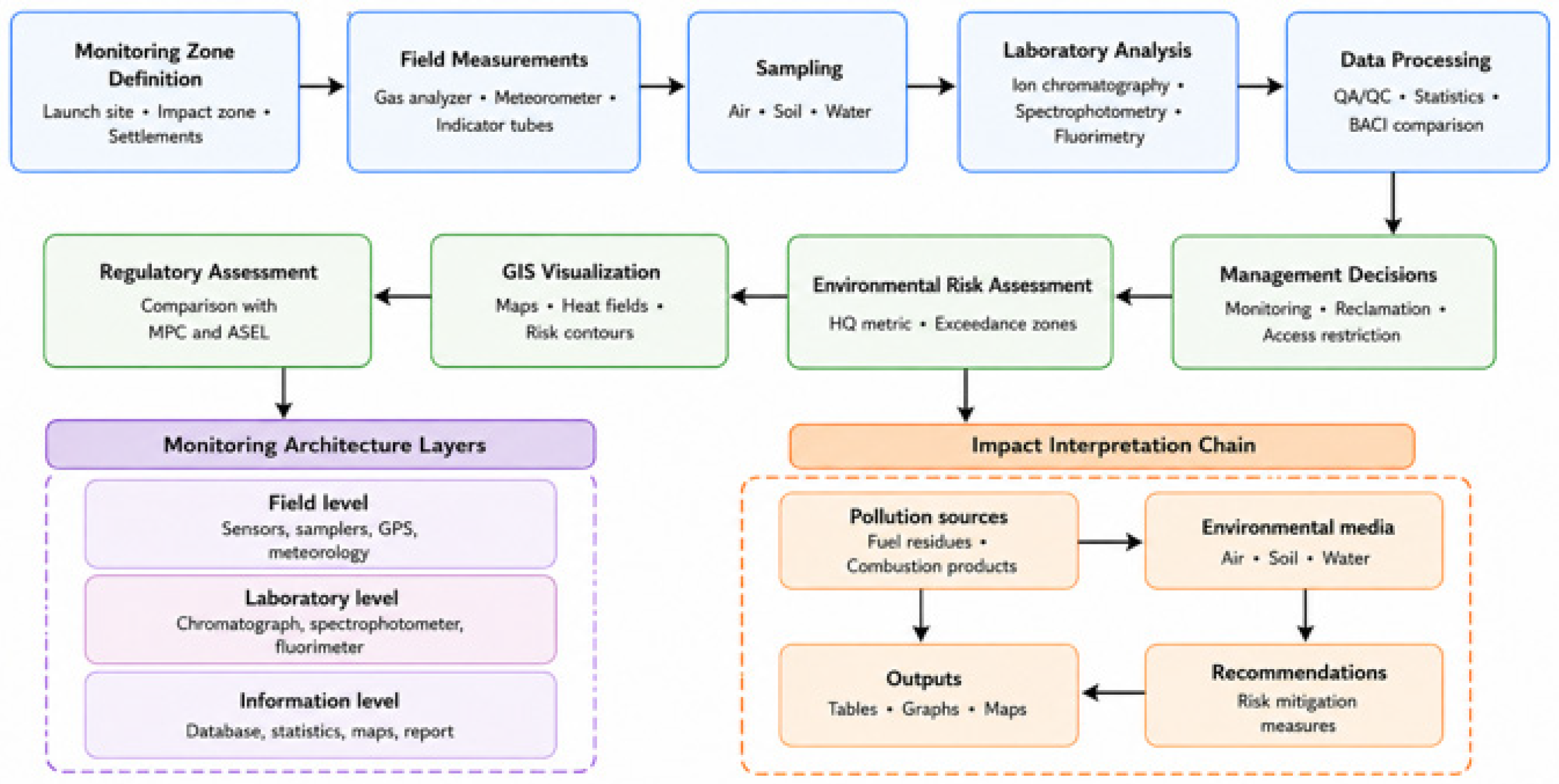
Figure 1 presents a flowchart for the environmental monitoring of rocket launch impacts. It illustrates the workflow: from defining monitoring zones and conducting field measurements to sampling, laboratory analysis, data processing, and environmental risk assessment. The lower part of the flowchart presents two additional blocks: the monitoring architecture and the impact interpretation chain. The architecture includes field, laboratory, and information levels, while the interpretation chain shows the transition from pollution sources to natural environments, the analysis results, and risk mitigation recommendations.

2.1. Inversion Estimate of Emission Intensity Q* Based on Field Data

This subsection describes the inversion formulation of the problem: the emission intensity of source Q (g/s) is determined from field observations, after which the reconstructed concentration and risk fields are calculated, linked to the assessed source.

2.1.1. Data for Inversion

For each monitoring point i, an increment relative to the background is generated using the BACI (T−/T+) scheme:
ΔCi = Ci(T+) − Ci(T−)
Here, Ci(T+) is the concentration (or contamination indicator) after the event, and Ci(T−) is the background value before the event. For values below the detection limit (<LOD limit of detection) or below the limit of quantification (<LOQ limit of quantification), it is recommended to use unbiased estimates (e.g., regression on order statistics (ROS) or Kaplan–Meier) to avoid underestimating ΔCi.

2.1.2. Single-Emission Response Model

Since the ground-level concentration is linear with respect to the source intensity Q in dispersion models, a response to a single emission gi is introduced:
Cimodel(Q) = Q·gi,⋯gi = Cimodel(Q = 1)
The gi response is calculated either from an analytical Gaussian jet model (under fixed meteorological conditions) or from a HYSPLIT/similar model run under a conditional single emission, after which Q scaling is applied.

2.1.3. Q* Estimate (Weighted Least Squares, Constrained to Q ≥ 0)

The inversion model for increments is written as:
ΔCi = Q·gi + εi
where εi is the combined measurement and modeling error. The estimate Q* is found using the weighted minimization of squared deviations problem:
Q* = arg min {Q ≥ 0} Σi=1n wiCiQ·gi)2
Due to linearity in Q, the solution has a closed form:
Q* = max(0, (Σi wi gi ΔCi)/(Σi wi gi2))
The weights wi are defined as the inverse variances of the observations. A practical form of the weights is:
wi = 1/(σmeas,i2 + σbg2)
where σmeas,i is estimated from the repeatability/certified uncertainty of the laboratory measurement at point i, and σbg is estimated from the variability of background values T.

2.1.4. Confidence Interval for Q*

To construct a 95% confidence interval for Q*, bootstrapping (re-sampling i observations with replacement) and/or an ensemble of weather scenarios (variation in wind speed and direction within the observed windows) is recommended. The 2.5th and 97.5th percentiles are taken from the Q* distribution.

2.1.5. Concentration Field Reconstruction and Goodness-of-Fit Test

After evaluating Q*, the increment and final concentration field are reconstructed:
C ( c , y ) = Q ** g ( x , y ) ,   C ( x , y ) = C b g ( x , y ) + C ( x , y )
The agreement between the model and observations is assessed using the scatterplot of observed ΔCi versus calculated Q*·gi, as well as the RMSE/MAE metrics and rank correlation. The resulting maps can be directly used to construct MPC exceedance contours and priority reclamation zones.
The scientific novelty of this work lies in the construction of a probability map of regulatory threshold exceedances as a spatial field P(HQ > 1) by cells, highlighting the high-risk contour and accounting for directional transport, which enables the objective localization of priority monitoring zones. It is also proposed to accompany the probability map with a separate uncertainty map (CI/σ) to clearly highlight areas where the model yields the greatest uncertainty and where the condensation of measurements is required. An inversion estimate of the source emission intensity Q \ * based on field data was developed using BACI increments Δ C i and the linear transport response g i with an analytical solution of the weighted least squares problem subject to the constraint Q ≥ 0, transforming the impact analysis into a quantitatively identifiable formulation. A formal accounting of left-censored measurements (<LOD/<LOQ) is introduced in the “measurements → inversion → risk” chain, which reduces the bias in concentration estimates and the resulting risk maps. The feasibility of using a unified metric HQ = C/“MAC” for comparing air–water–soil on a single scale and identifying the dominant impact environment is demonstrated. An anisotropic structure of risk zones, consistent with meteorological conditions, is also demonstrated, making the results applicable to observation regulations and management decisions.
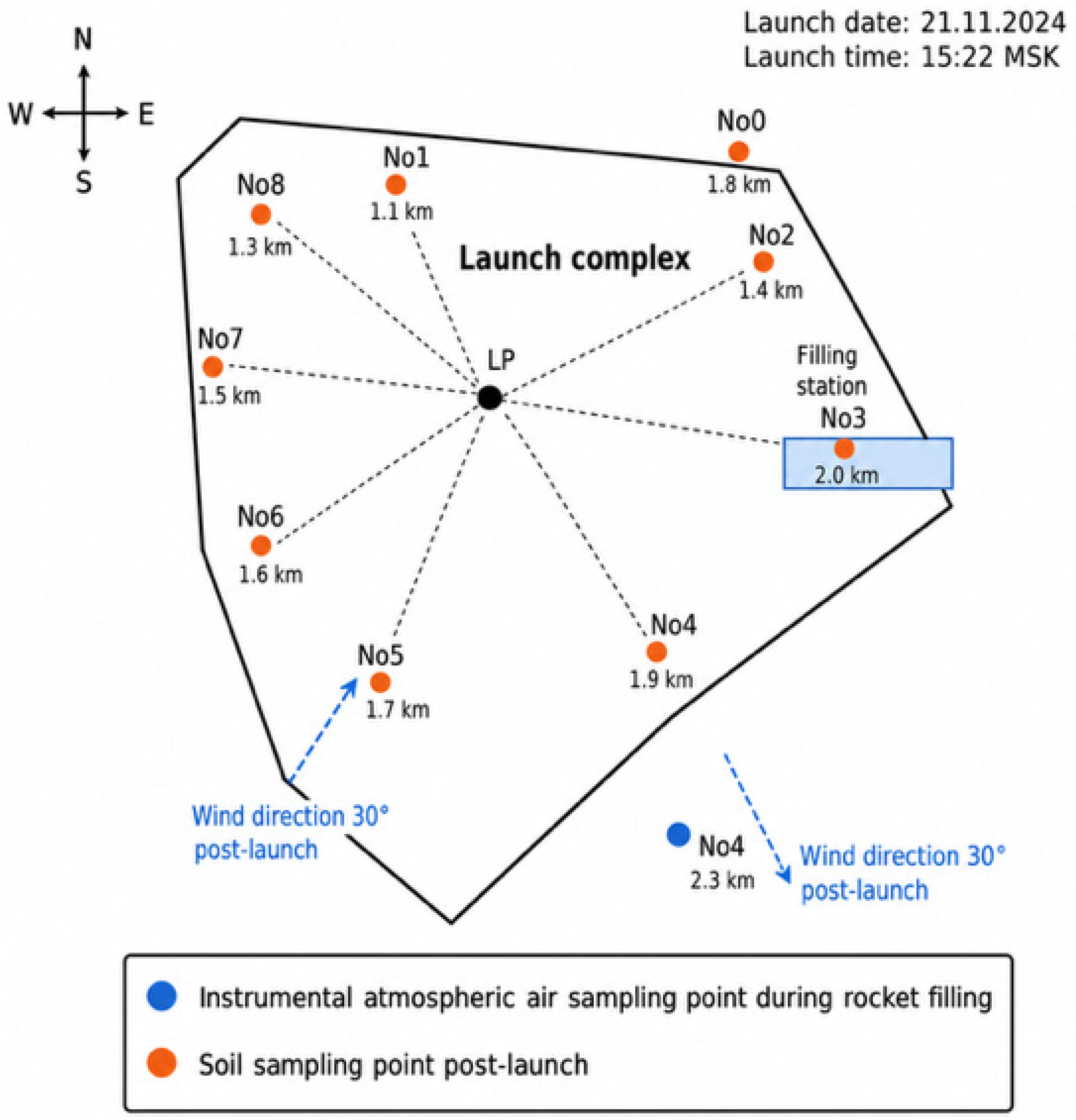
Figure 2 shows the location of the launch complex, LP launch sites, soil sampling stations after launch, and the atmospheric air monitoring station during rocket fueling. Dashed radial lines are drawn from LP to points No. 0–No. 8, with distances from the launch site in kilometers indicated next to them (e.g., No. 1—1.1 km, No. 3—2.0 km, No. 4—1.9 km). Orange dots indicate soil sampling stations after launch, and the blue dot indicates the atmospheric air monitoring station during rocket fueling. The diagram also shows 30° wind directions after launch, allowing one to correlate the spatial locations of the monitoring stations with the possible direction of pollutant transport.
Table 1 of the measurement metadata shows that the instrument/method, limits of detection and quantification (LOD/LOQ), and uncertainty are specified for each parameter. For air, parameters are provided for NO2 (ACMGA-4 gas analyzer manufactured by BIOBASE in Jinan, China) and total hydrocarbons (PID analyzer), while for soil and water, parameters are oil products (Fluorat-02-3M/IR by Lumex Instruments, Mission, BC, Canada), nitrates (Spekol-1500, Analytik Jena AG company, Jena, Germany), and UDMH/NDMA (GC-MS and LC-MS/MS). LOD/LOQ values and uncertainties are typical for the respective methods and must be confirmed by instrument data sheets and laboratory SOPs/validation protocols before publication. Calibration is performed regularly (zero/span checks, calibration curves, control samples), which ensures traceability and comparability of results.
The sample size was calculated for the minimum detectable effect for TPH Δ = 300 mg/kg with a power of 0.80 and α = 0.05. Using the two-sample t-test formula n = 2 ( z 1 / 2 + z 1 β ) 2 σ 2 / 2 and a pilot variance of σ ≈ 300 mg/kg, we obtained n ≈ 16 per group; taking into account lognormality (CV ≈ 50%), σ l n = 0.473, and l n = ln 1.5 gives n ≈ 22. A conservative number of 20–22 points per group per time point was adopted. To increase power, stratification by distance and wind rose (0–2; 2–5; 5–10 km) with a non-uniform distribution.
Allocation example: downwind sector—10/8/6; windward (control)—6/4/4, for a total of 38 composites. Each point is formed as a composite of 5 increments; field and laboratory duplicates—≥10%, methodological and instrumental “blank”—1 each per shift (for a total of ~44 determinations per time point). With the BACI design, the same grid is repeated at T− and T+, which provides sufficient power to evaluate the “group × time” interaction (safety factor ~1.3).
Readings below the laboratory limit of detection (LOD) were flagged as undetectable and considered left-censored at the LOD level; values between the LOD and LOQ were considered quantitatively unreliable and considered left-censored at the LOQ level. Detectable and <LOQ values were not excluded from the analysis. Left-censored samples were processed using the regression on order statistics (ROS) method assuming a log-normal distribution (NADA—non-detects and data analysis implementation), which ensured unbiased mean/quantile estimates with a censoring rate of up to ~50% and multiple thresholds (different LOD/LOQ in batches). For descriptive statistics, the detection rate (DF, %) and medians, according to the nonparametric Kaplan–Meier estimate, were additionally provided. For visualization (only in graphs), the <LOD/<LOQ values were displayed as LOD/√2 and LOQ/√2, respectively; ROS estimates were used in risk calculations. Only measurements with QA/QC violations (incorrect blanks, recovery control out of tolerance, calibration failure) were excluded from the analysis; such cases were flagged and not included in the statistics.
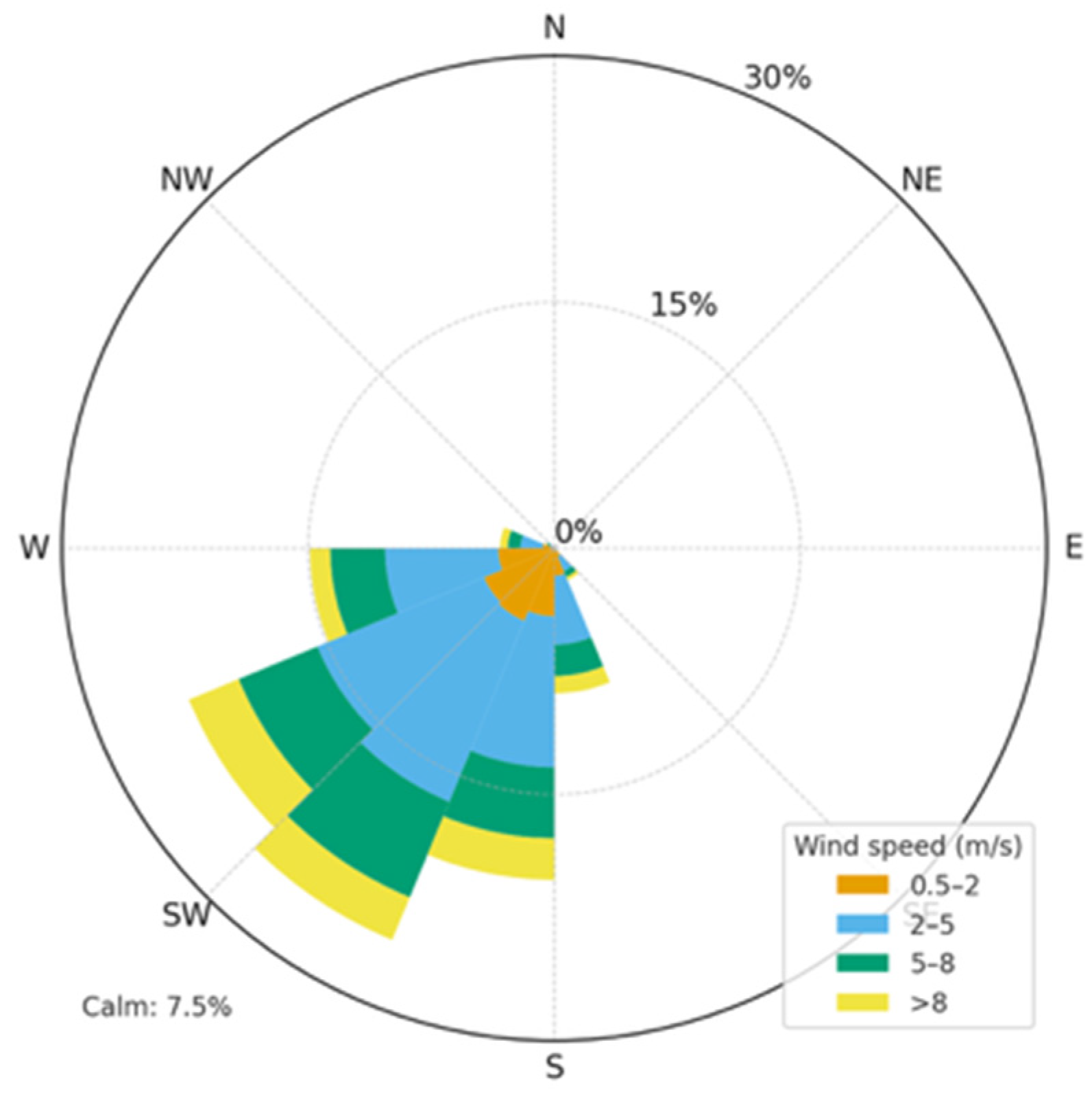
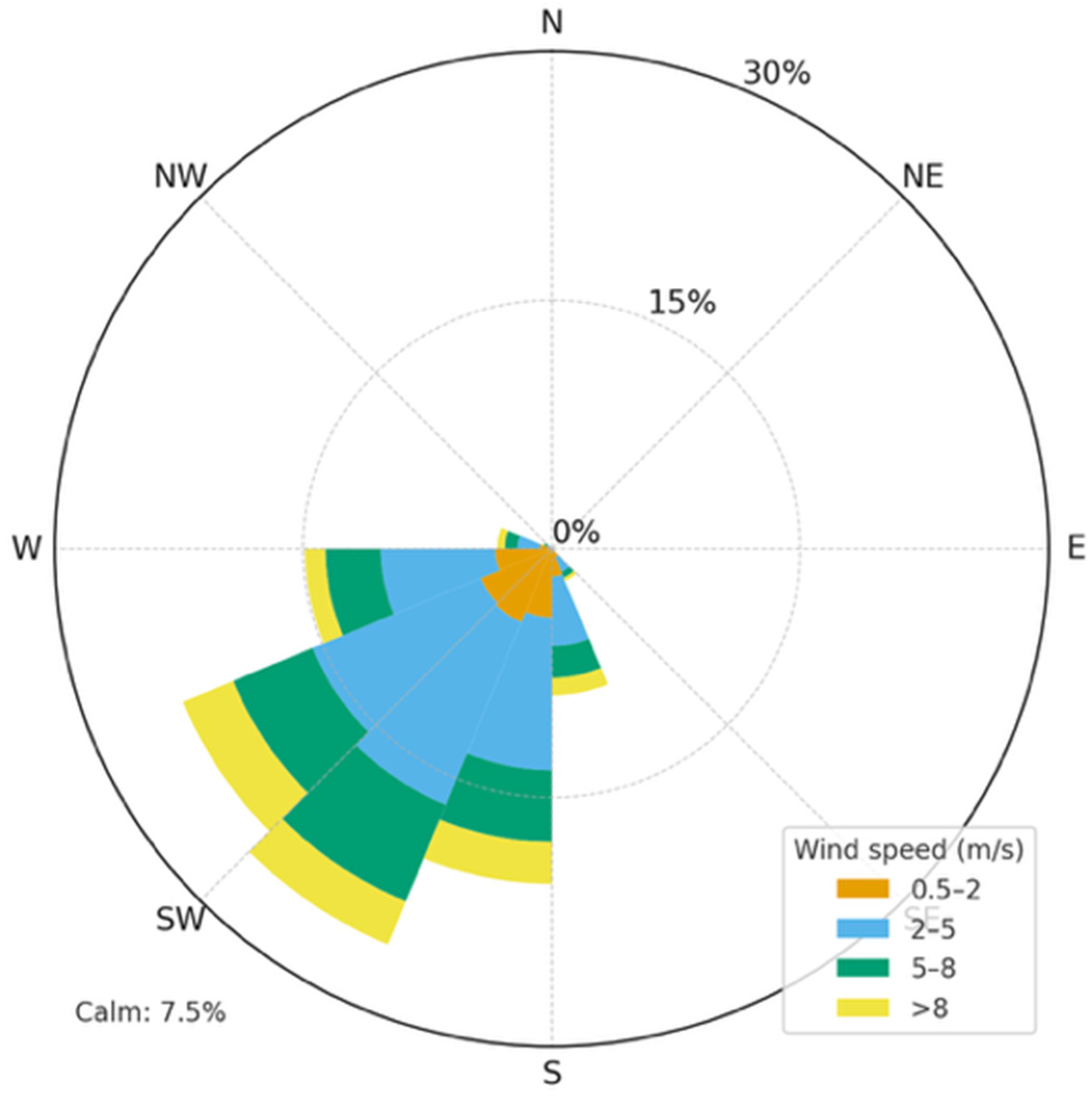
To assess the transport directionality, we constructed wind roses for two windows: T− (the period before the event) and T+ (the period after). Hourly wind direction/speed series were aggregated over 16 compass points (22.5° increments) and divided into speed classes (0.5–2; 2–5; 5–8; >8 m/s); “calm” was defined as u < 0.5 m/s. To ensure comparability, identical window lengths and identical hours of day were used (e.g., 09:00–18:00 LT). The meteorological data source was a local weather station/reanalysis (specify specifically), normalized to the release altitude (log-law/MO profile, if necessary). Wind roses were used to define the downwind sector and validate the anisotropy of the concentration field.
In this study, we performed a rapid assessment of the surface concentration field using two approaches:
A. Stationary Gaussian jet (equivalent to a point/low source).
A quasi-stationary emission Q (g/s) was assumed at a flow velocity u (m/s) and effective height H. The concentration at point (x, y, z) was calculated using the classical formula with reflection from the underlying surface:
C x , y , z = Q 2 π u σ y x σ z x exp   ( y 2 2 σ y 2 ) [ exp z H 2 2 σ z 2 + e x p ( z + H 2 2 σ z 2 ) ] e x p ( λ x u ) .
where σ y x , σ z ( x ) are dispersion functions parameterized by the stability class (Pasquill–Gifford/Briggs) σ y = a i x b i , σ z = c i x d i ; λ is the effective loss constant (option for chemical transformations/decantation; default λ = 0). For surface release, H ≈ 2 m was adopted. The calculation was carried out on a regular grid (step 100–250 m) within 0–10 km in the leeward direction for sets (Q, u, stability) characteristic of T− and T+.
In this study, all concentration field calculations and subsequent modeling results were performed at λ = 0. This means that effective pollutant losses due to chemical transformation, deposition, or degradation were not considered within this model, and the analysis focused on the transport and spatial dilution of the emission. The parameter λ was retained in the equation to allow for future model expansion in the presence of experimentally validated data on pollutant loss rates.
The “regular grid” in Equation (8) refers to a regular rectangular computational grid in a Cartesian X–Y coordinate system, constructed around the emission source/launch site. In the revised version of the manuscript, the term “regular grid” will be replaced with the more precise expression “regular Cartesian computational grid”. The computational domain covers a distance of 0–10 km from the source, and the grid step was selected between 100–250 m, depending on the required detail. With a 100-m step, a 10-km region contains approximately 100 × 100 computational cells, while with a 250-m step, it contains approximately 40 × 40 cells. For each cell, the coordinates of its center, the distance to the source, the relative wind direction, and the corresponding concentration/risk value were calculated. Thus, the cells were distributed uniformly across the X–Y plane rather than randomly.
B. Eulerian trajectory run (HYSPLIT, concentration mode).
Alternatively, normalized runs were performed with a single emission Q_0 = 1 g/s (or 1 g/hour for short releases) and a meteorological field for the T−/T+ windows; the resulting fields were scaled to the actual Q. “Concentration mode” was used with summation of 1-h intervals, with the release height H as above. Turbulence and subsidence parameters were set to HYSPLIT by default. Choice between A and B: for simple open terrain, A is sufficient; for complex circulation/breezes/night drainage flows, B is preferable.
The scientific novelty lies in the development of a reproducible post-launch assessment methodology combining the BACI design with distance and wind sector stratification, formalized accounting for left-censored data with multiple LOD/LOQ (ROS/Kaplan–Meier), an anisotropic risk model (heatmap overlay and model isolines with quantitative validation according to Spearman/Jaccard), a unified HQ metric for air–water–soil based on ROS EPC estimates with 95% CI, an estimate of the spatial attenuation parameter β and the half-range L 1 / 2 , uncertainty decomposition and sensitivity analysis, as well as the development of a portable WebGIS layer pipeline and code for operational risk communication.
In this study, turbulent dispersion within each calculated meteorological window was assumed to be quasi-stationary and horizontally uniform. In the Gaussian model, the influence of turbulence was accounted for through the transverse and vertical dispersion functions σy(x) and σz(x), parameterized by the Pasquill–Gifford/Briggs atmospheric stability classes. Local small-scale turbulent fluctuations caused by microrelief, buildings, and transient wind gusts were not explicitly modeled but were considered as a source of uncertainty. To assess the sensitivity of the results, wind speed, wind direction, and atmospheric stability class were varied within an ensemble of meteorological scenarios. Therefore, the differences between the measured and calculated concentrations may be partly due to the simplified description of turbulent mixing.

3. Results

3.1. Main Monitoring Results for the Progress MS-29 Launch

During monitoring, the launch site (site 31, Baikonur), populated areas (Baikonur, Zhezkazgan, Talap), and the stage impact area (U-25) were surveyed. The data obtained included pre-launch and post-launch series and subsequent T + 1 week/T + 1–6 month series for air (NO2, hydrocarbons), water (oil products, nitrates), and soil (oil products), as well as spatial maps (heatmap) and 10/25/50/75% risk isolines. Summary results for each Wednesday are provided below.

3.2. Launch Site: Site 31, Baikonur

During the survey of the launch pad’s sanitary protection zone, it was found that nitrogen dioxide and sulfur dioxide levels in the atmospheric surface layer did not exceed the maximum permissible concentrations (MPCs). Gas analysis data indicate a brief increase in concentrations in the first hours after launch, but within 24 h, the levels returned to the background levels. Soil samples revealed petroleum product levels in the range of 6–10 mg/kg, significantly below the regulatory limit (100 mg/kg). This indicates that the rocket fueling and launch operations did not have a lasting negative impact on the soil.

3.3. Stage Impact Area: U-25 Zone, Ulytau

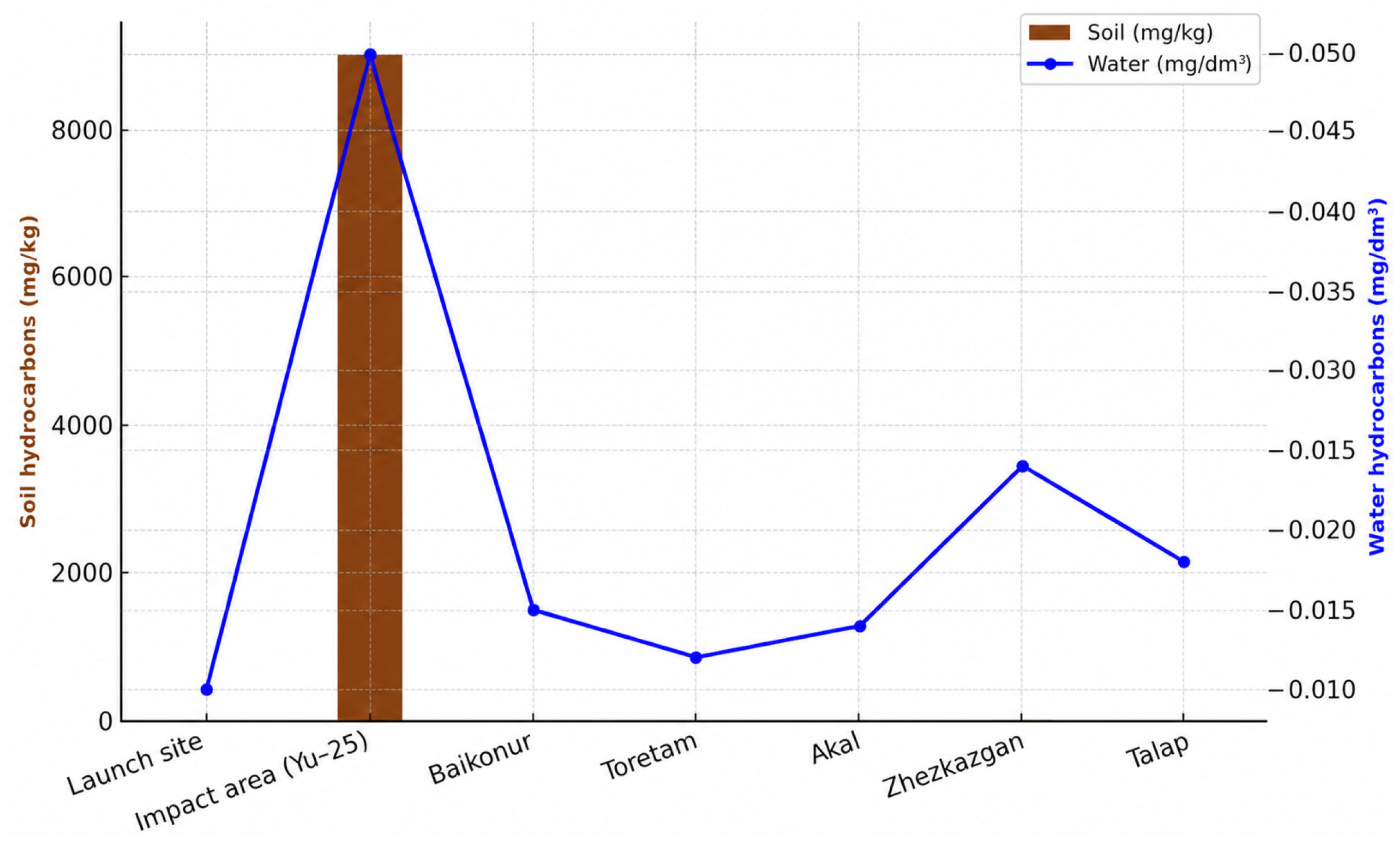
Localized fuel component spills were recorded at the impact points of the side units over an area of approximately 3.2 m2. Oil product concentrations in the soil samples reached 7900 mg/kg, which is more than 90 times higher than the regulatory limits. Mechanical soil damage and vegetation fires were also detected over a total area of 11 m2. These data confirm that the primary environmental impact from launches is concentrated in the stage impact areas, where remediation measures are required, including removing the contaminated soil layer and restoring vegetation. Air quality parameters were measured prior to the launch of the “Soyuz-2.1a” launch vehicle with the “Progress MS-29” cargo spacecraft. Work was conducted in the “U-25” impact zone (Ulytau) to record background atmospheric parameters. These data are necessary for subsequent comparison with post-launch measurement results and for assessing the environmental impact of the launch activities. Soil sampling was conducted prior to the launch of the “Soyuz-2.1a” launch vehicle with the “Progress MS-29” cargo spacecraft in the “U-25” impact area (Ulytau). The resulting samples allow for a record of the initial soil condition, which is necessary for subsequent comparison with the results after the launch. This approach provides an objective assessment of changes in soil composition associated with the impact of the launch activity.

3.4. Populated Areas: Baikonur, Toretam, and Akai

During the atmospheric air survey, it was found that the hydrocarbon concentration did not exceed 18.8 mg/m3, with the ASEL standard being 30 mg/m3. The oil product content in the soil samples ranged from 6–14 mg/kg, which is within sanitary standards. In drinking water samples, oil product concentrations did not exceed 0.015 mg/dm3, with the MAC being 0.1 mg/dm3. Thus, the rocket launch did not have a significant impact on the sanitary conditions of residential areas. Air quality measurements were conducted prior to the launch of the “Soyuz-2.1a” launch vehicle with the “Progress MS-29” cargo spacecraft in Baikonur, at the following address: Microdistrict 5A, Building 9/4. These data were used to determine the background atmospheric parameters in residential areas, allowing for subsequent comparison with post-launch measurements and an objective assessment of the launch activity’s impact on populated areas. Soil sampling was conducted prior to the launch of the “Soyuz-2.1a” launch vehicle with the “Progress MS-29” cargo spacecraft in Baikonur, at the following address: Microdistrict 5A, Building 9/4. These studies allow for the initial soil conditions in residential areas to be recorded for subsequent comparison with the post-launch results, providing an objective assessment of the potential impact of the launch activity on the environment and public health.

3.5. Residential Areas: Zhezkazgan and Talap

Gas analysis measurements revealed no excess levels of air pollutants; concentrations were below the detection limits of the instruments. In soil samples, the maximum levels of oil products were 18.6 mg/kg, and nitrates were up to 15.9 mg/kg, significantly below the MAC. In drinking water systems, oil products did not exceed 0.024 mg/dm3, and nitrates did not exceed 2.1 mg/dm3, which were also within the regulatory limits. This suggests that the launch had no impact on these residential areas or was at the background levels. Air quality measurements were conducted prior to the launch of the Soyuz-2.1a launch vehicle with the Progress MS-29 cargo spacecraft in the village of Talap, located at 12-1 Bolashak Street. Measurements were conducted in the immediate vicinity of residential buildings to obtain background air quality data. These data allow for a comparison of the initial state with the post-launch results and an objective assessment of the environmental impact on the community. Soil sampling was conducted prior to the launch of the Soyuz-2.1a launch vehicle with the Progress MS-29 cargo spacecraft in the village of Talap, located at 12-1 Bolashak Street. These data allowed for a recording of the initial soil condition in the community and for comparison with the post-launch results, enabling an objective assessment of the level of potential soil contamination.
Air quality measurements following the launch of the Progress MS-29 cargo spacecraft in the city of Zhezkazgan, located at 22-1 Tusipbekova Street. Measurements were taken in the residential area to assess the impact of the launch activities on populated areas and subsequently compare them with the background values.
Figure 3 shows the sequence of the ecological chain of impacts from rocket fuel residue. After the stages fall to the surface, fuel spills and localized contamination occurs, primarily in the soil. High concentrations of petroleum products are recorded here, which can exceed the maximum permissible concentration several times (for example, up to 7900 mg/kg versus the standard of 1000 mg/kg). Soil serves as the primary accumulator of toxicants, from where they gradually migrate to adjacent ecosystem components.
The next link is water—both surface and underground sources. During the filtration process, some pollutants enter the groundwater and streams. Samples taken near the impact sites showed an increase in petroleum product concentrations to 0.015 mg/dm3, which, while still below the maximum permissible value (0.10 mg/dm3), indicates that contamination is being transported.
The impact then spreads to plants. They absorb pollutants through their roots or via precipitation on the leaves and fruits. Even at low concentrations in water or soil, bioaccumulation occurs, increasing the risk of toxicants entering the food chain.
The final link is the population. People are exposed both directly (by breathing contaminated air at the time of impact) and indirectly—by consuming water or food grown in contaminated areas. Long-term accumulation can lead to chronic health risks, making ongoing monitoring and prompt remediation of impact areas essential. Thus, the “fuel residue → soil → water → plants → population” pathway illustrates the cumulative and multi-stage nature of environmental impacts, with each link increasing the potential risk to humans.

3.6. Retrospective Comparison with Historical Monitoring Data from 2020–2023

Table 2 presents data on the concentration of petroleum products in soil and water in the impact areas of the “Soyuz-2.1a” (U-25) launch vehicle stages for 2020–2023.
Table 2 shows that 2023 saw the highest levels of oil product soil contamination (up to 7900 mg/kg), significantly exceeding the levels of previous years.
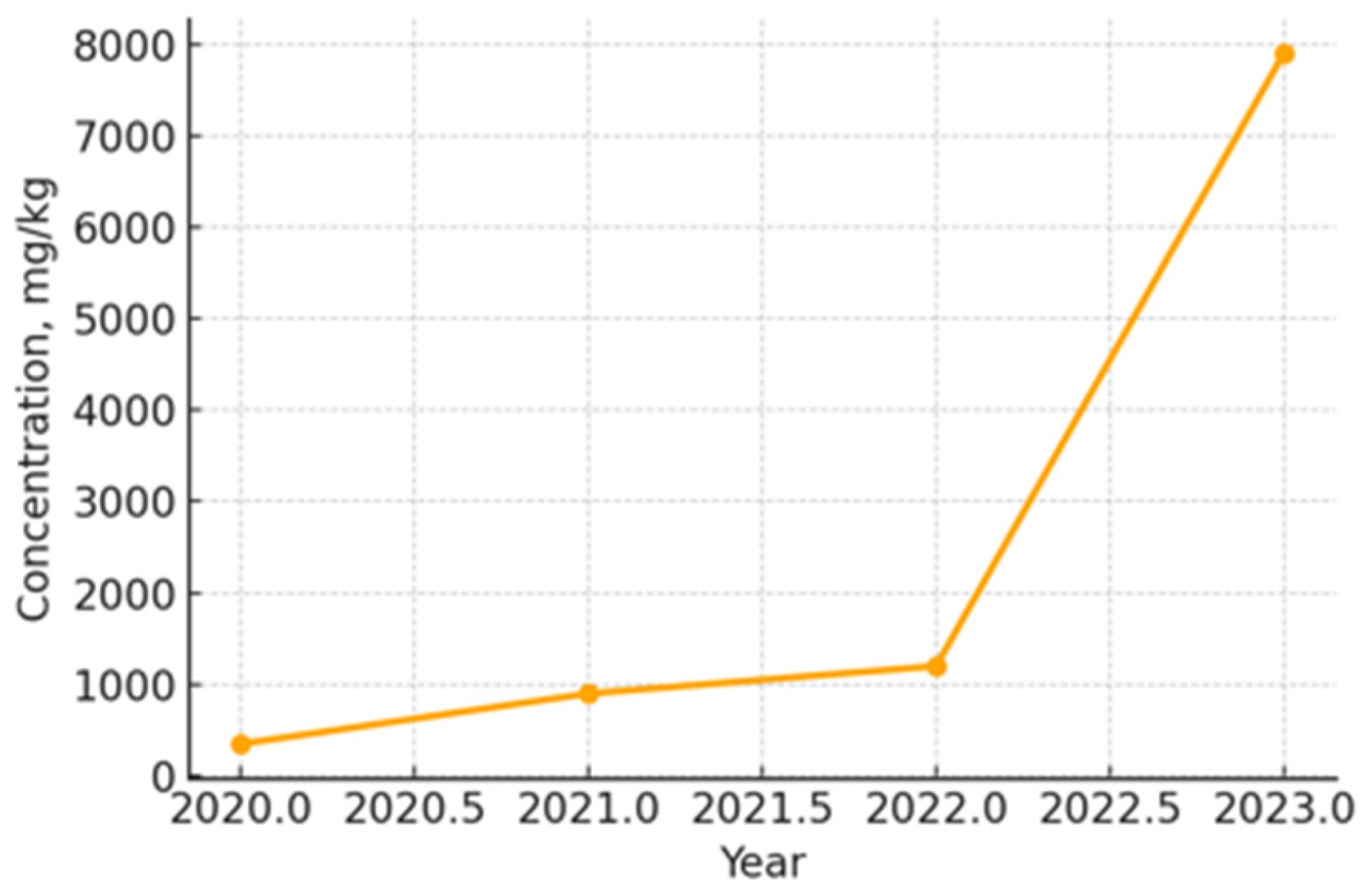
Figure 4 shows changes in the maximum oil product concentrations in soil in the rocket stage impact area in 2020–2023. In 2020, the level was approximately 350 mg/kg, rising to 900 and 1200 mg/kg in 2021 and 2022, respectively. A sharp increase was recorded in 2023, reaching almost 7900 mg/kg, indicating a significant environmental impact compared to previous years.
Table 3 compares the background values (pre-launch) and post-launch data for the “Soyuz-2.1a” launch vehicle with the “Progress MS-29” spacecraft across the main observation zones.
Table 3 compares the background and post-launch pollutant levels at different observation points. No significant excesses of MACs were detected in residential areas of Baikonur, Talapa, and Zhezkazgan: NO2 and oil product concentrations remained within the acceptable limits. The highest load was observed in the “U-25” impact zone, where oil product content in the soil after the launch reached 7900 mg/kg compared to the standard of 1000 mg/kg. This indicates the local environmental risks and the need for remediation measures.
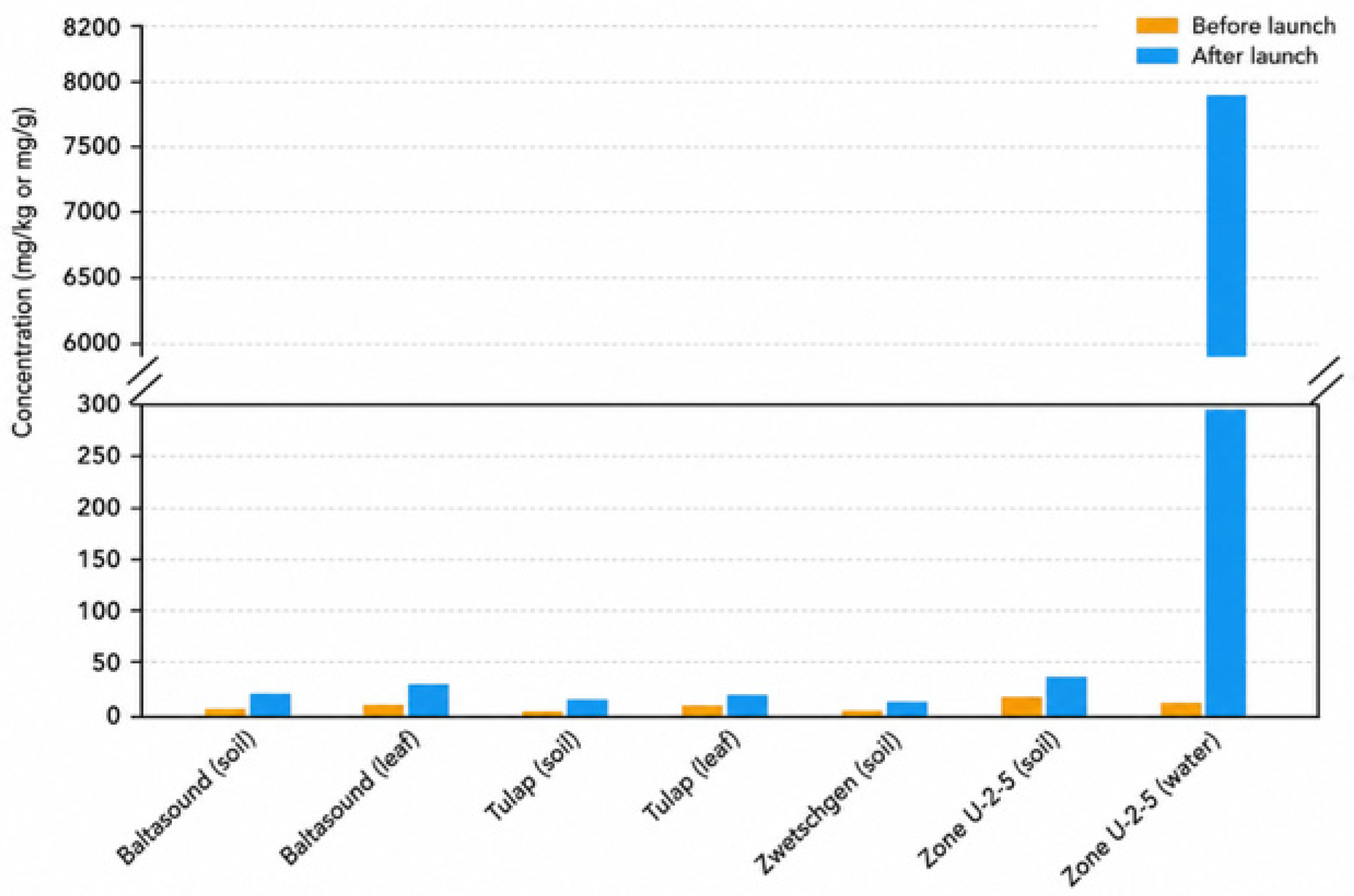
Figure 5 shows a comparison of the background and post-launch pollutant concentrations by monitoring zone in 2023. In Baikonur, NO2 levels in the air increased from 0.025 to 0.030 mg/m3, while oil products in the soil increased from 110 to 145 mg/kg, both within the MAC (1000 mg/kg). In the village of Talap, NO2 levels increased from 0.021 to 0.027 mg/m3, while oil products in the soil increased from 95 to 120 mg/kg, also within the norm. In Zhezkazgan, NO2 concentrations increased from 0.018 to 0.025 mg/m3, while the MAC was 0.085 mg/m3. The largest changes were recorded in the impact zone of U-25: the oil product content in the soil increased from 180 to 7900 mg/kg, which was more than 7 times higher than the MAC (1000 mg/kg), and in the water, from 0.008 to 0.015 mg/dm3, which remained within acceptable limits.
Table 4 summarizes the international environmental monitoring practices applied during the operation of modern rocket and space programs, including Falcon 9, Ariane, and Long March. The table presents the main monitored environmental components, such as atmospheric air, water, soil, bottom sediments, and biota, as well as approaches to assess the impact of launches on natural systems. The comparison shows that international practice places particular emphasis on preliminary background monitoring, post-launch measurements, cumulative impact assessment, a standardized QA/QC system, and spatial visualization of results using cartographic and GIS tools. These approaches can be adapted for monitoring the U-25 zone, as they allow for a more objective assessment of pollution distribution, the identification of high-risk areas, and the justification of environmental protection measures.
Figure 6 shows the distribution of petroleum products in soil and water across various monitoring zones. It is clear that in all populated areas and at the launch site, concentrations were within the normal limits, while in the area where the stages fell (U-25), extreme excess was recorded—over 7900 mg/kg in soil. In water, concentrations remained low and did not exceed the sanitary standards.
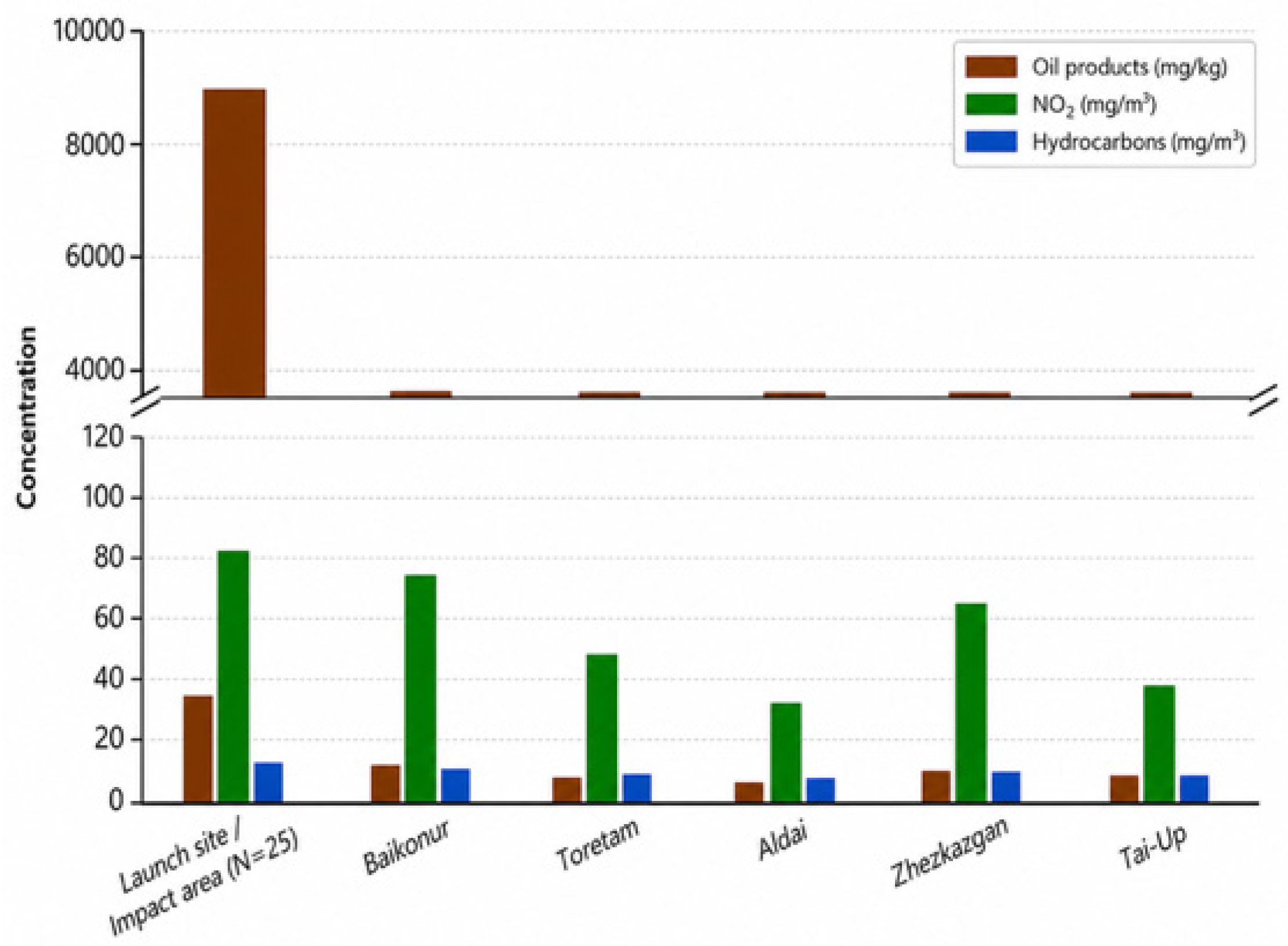
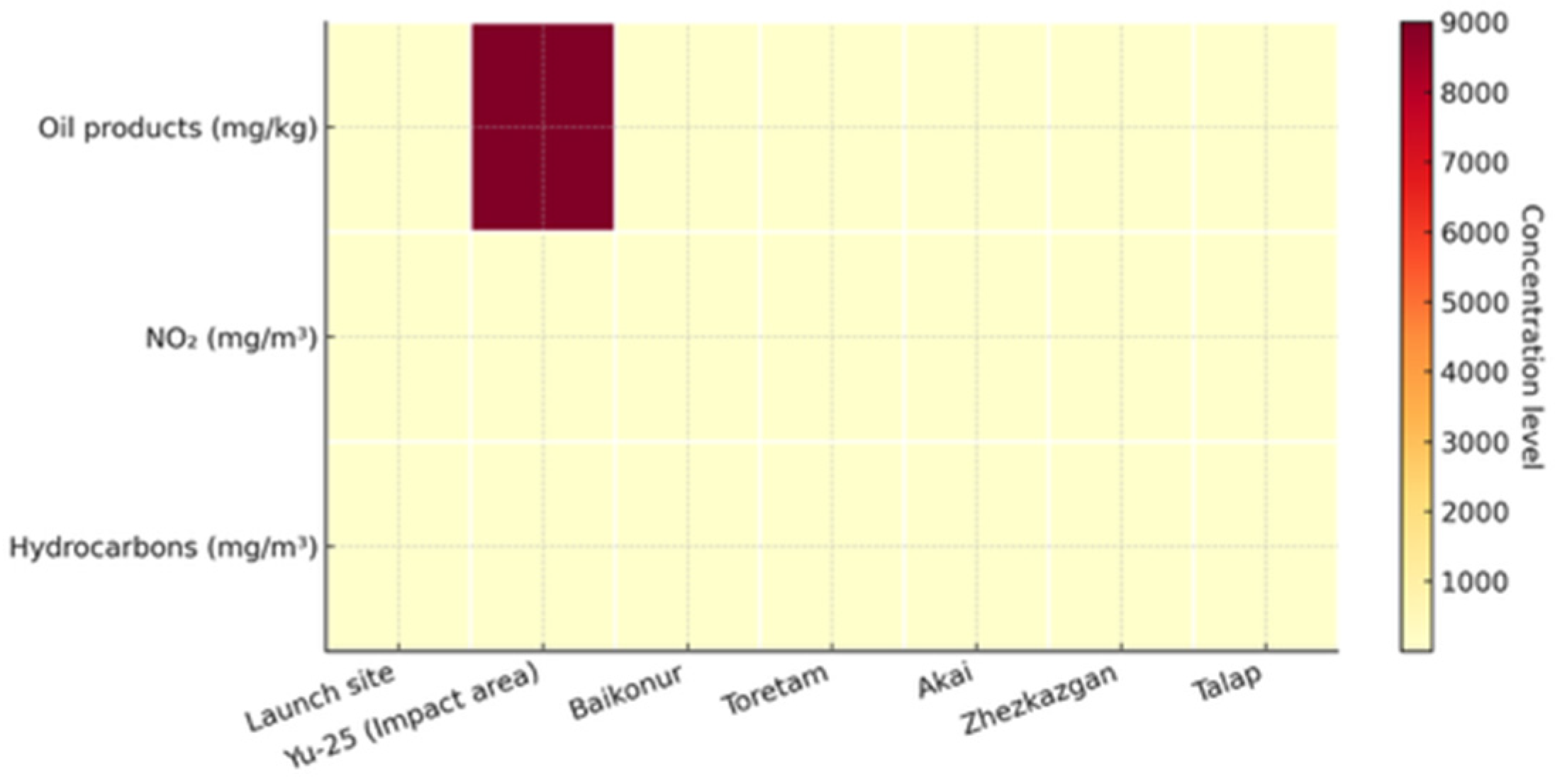
Figure 7 compares the pollutant levels in different monitoring zones. It is clearly visible that petroleum products are particularly prominent in the step-down zone (U-25), where their concentrations exceed the background levels by tens and hundreds of times. Meanwhile, in populated areas, levels of petroleum products, NO2, and hydrocarbons remained within acceptable limits.
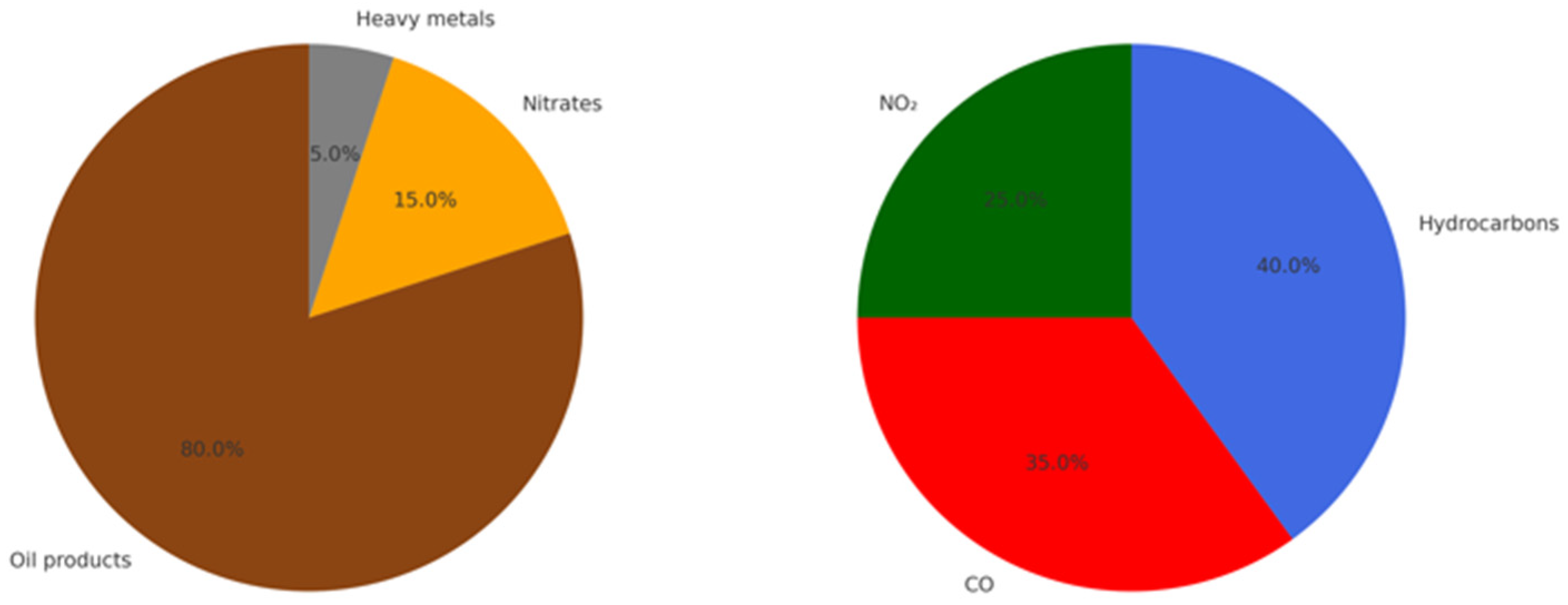
Figure 8 shows the distribution structure of pollutants in soil and atmospheric air. In the soil of the step impact area, petroleum products accounted for the majority—approximately 80%, nitrates accounted for 15%, and heavy metals accounted for approximately 5%. The distribution in the air was different: hydrocarbons comprised approximately 40% of all pollutants, carbon monoxide (CO) accounted for approximately 35%, and nitrogen dioxide (NO2) accounted for 25%.
Figure 9 shows the distribution of pollutants by monitoring zone. In the area where the stages fell (U-25), extreme levels of petroleum products were observed—approximately 7900 mg/kg, which was two orders of magnitude higher than at other locations, where concentrations ranged from 8–18.6 mg/kg. In the air at Y-25, NO2 concentrations reached 0.3 mg/m3 with a TSL of 0.085 mg/m3, while hydrocarbons were recorded at 25 mg/m3. In populated areas, the levels were significantly lower, for example, in Baikonur, petroleum products were 10 mg/kg, NO2 was 0.05 mg/m3, and hydrocarbons 18.8 mg/m3, all within acceptable limits.
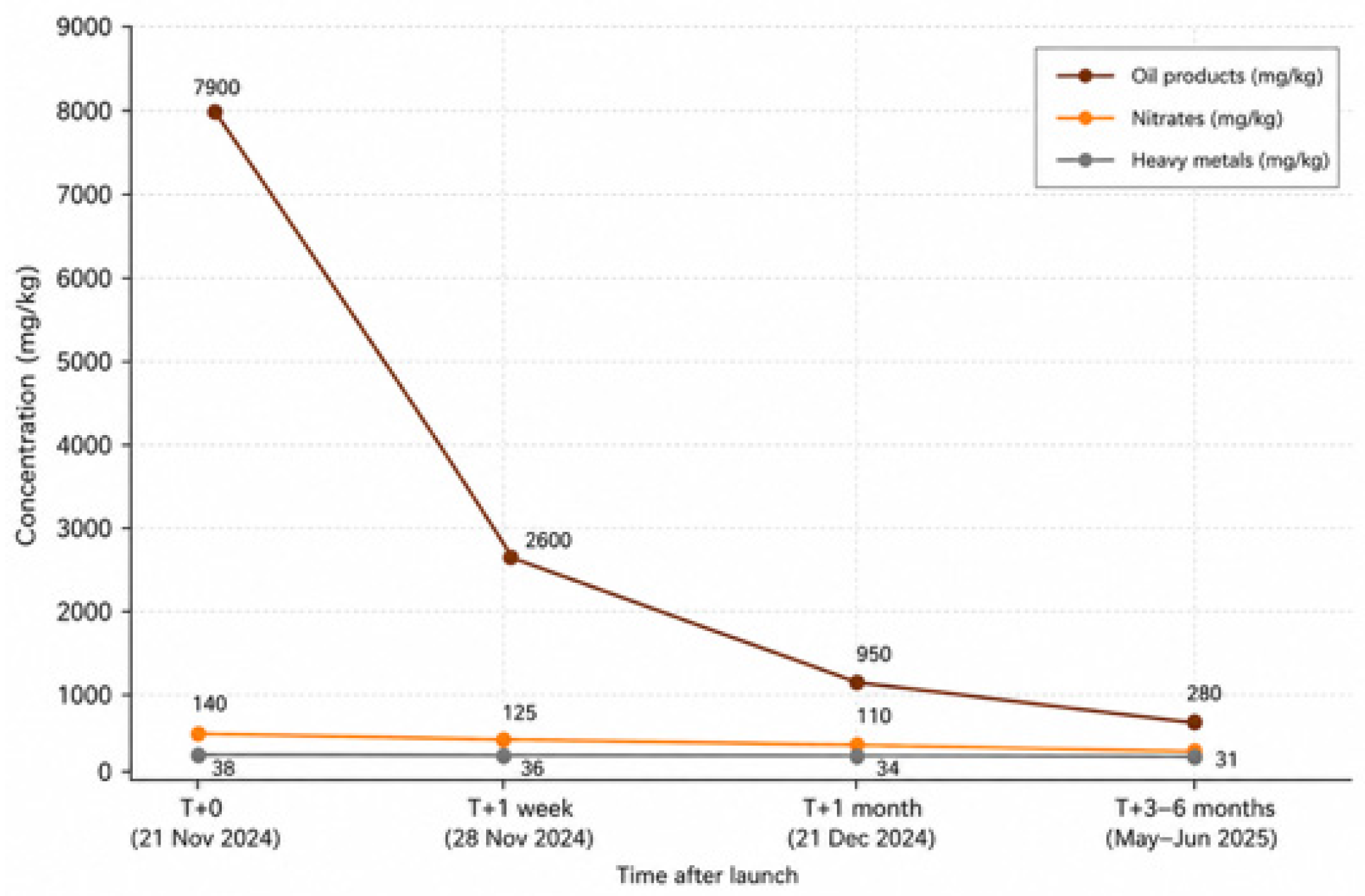
Figure 10 shows the actual post-launch dynamics of soil contamination in the U-25 zone. The time axis represents the actual observation periods after launch: T + 0, T + 1 week, T + 1 month, and T + 3–6 months; therefore, the graph did not include the predicted values for future years. The most dramatic decrease was observed for petroleum products: concentrations decreased from 7900 mg/kg at T + 0 to 2600 mg/kg after one week, 950 mg/kg after one month, and 280 mg/kg after three to six months. Nitrate and heavy metal concentrations changed less significantly, indicating a more stable trend for these components compared to petroleum products.
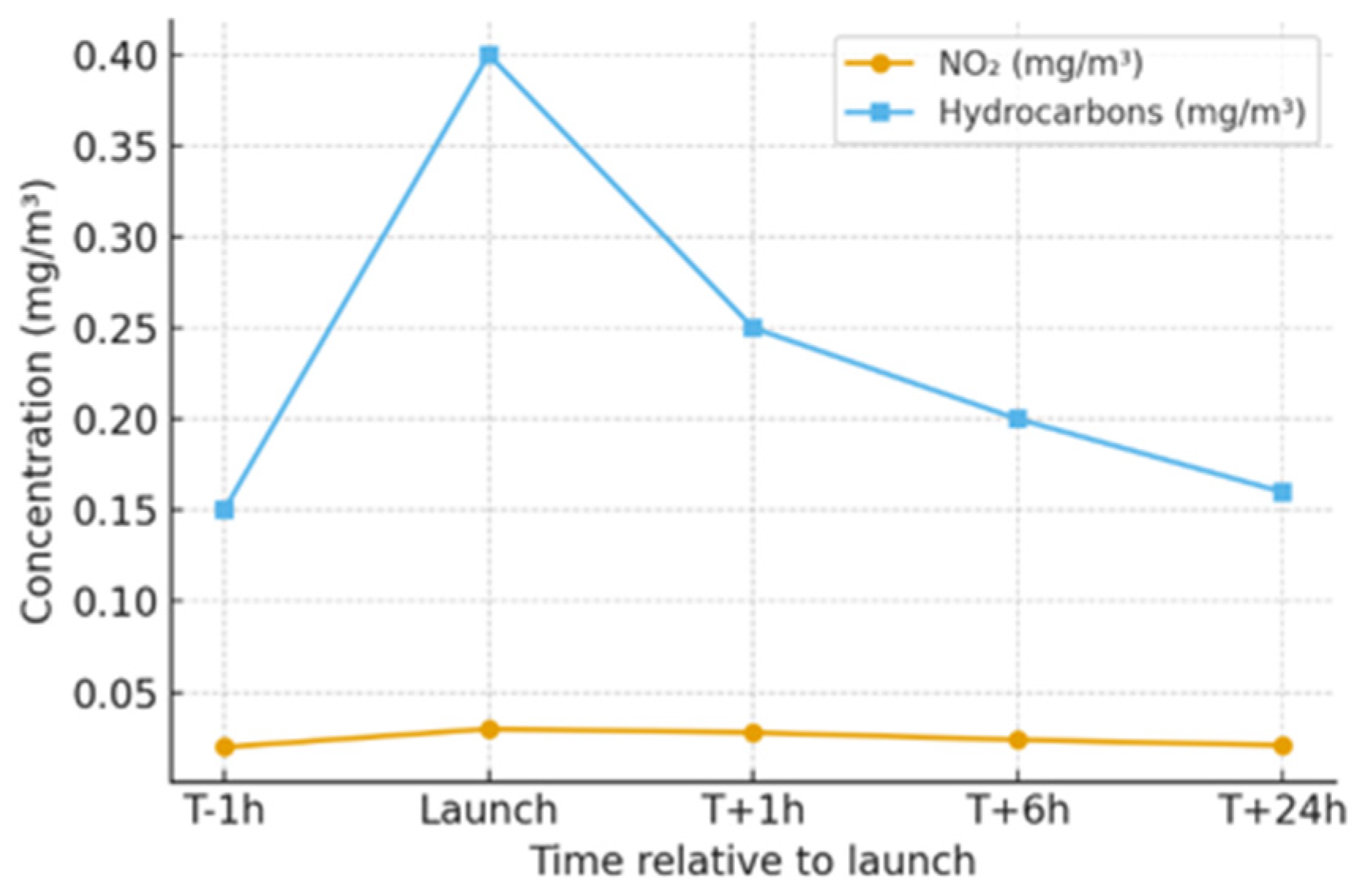
Figure 11 shows changes in the NO2 and hydrocarbon concentrations in atmospheric air. Before launch, the NO2 concentration was 0.020 mg/m3, and at launch, it rose to 0.030 mg/m3, after which it gradually decreased to the background levels. Hydrocarbons increased from 0.15 to 0.40 mg/m3 and then also returned to the baseline levels.
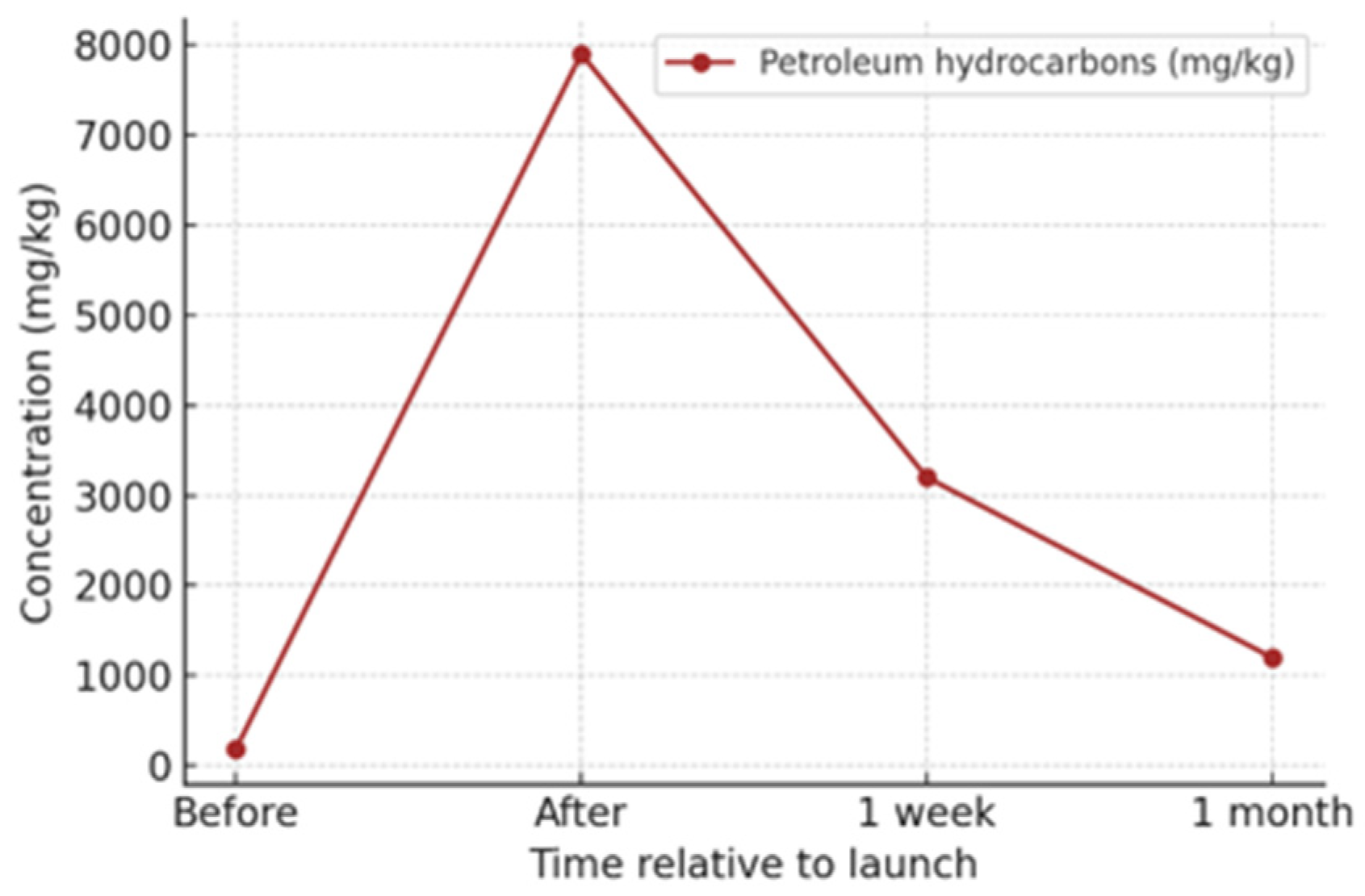
Figure 12 shows the dynamics of oil product content in the soil. Before the launch, the level was 180 mg/kg; immediately after the launch, it rose to 7900 mg/kg; a week later, it dropped to 3200 mg/kg; and a month later to 1200 mg/kg, which is approaching the standards.
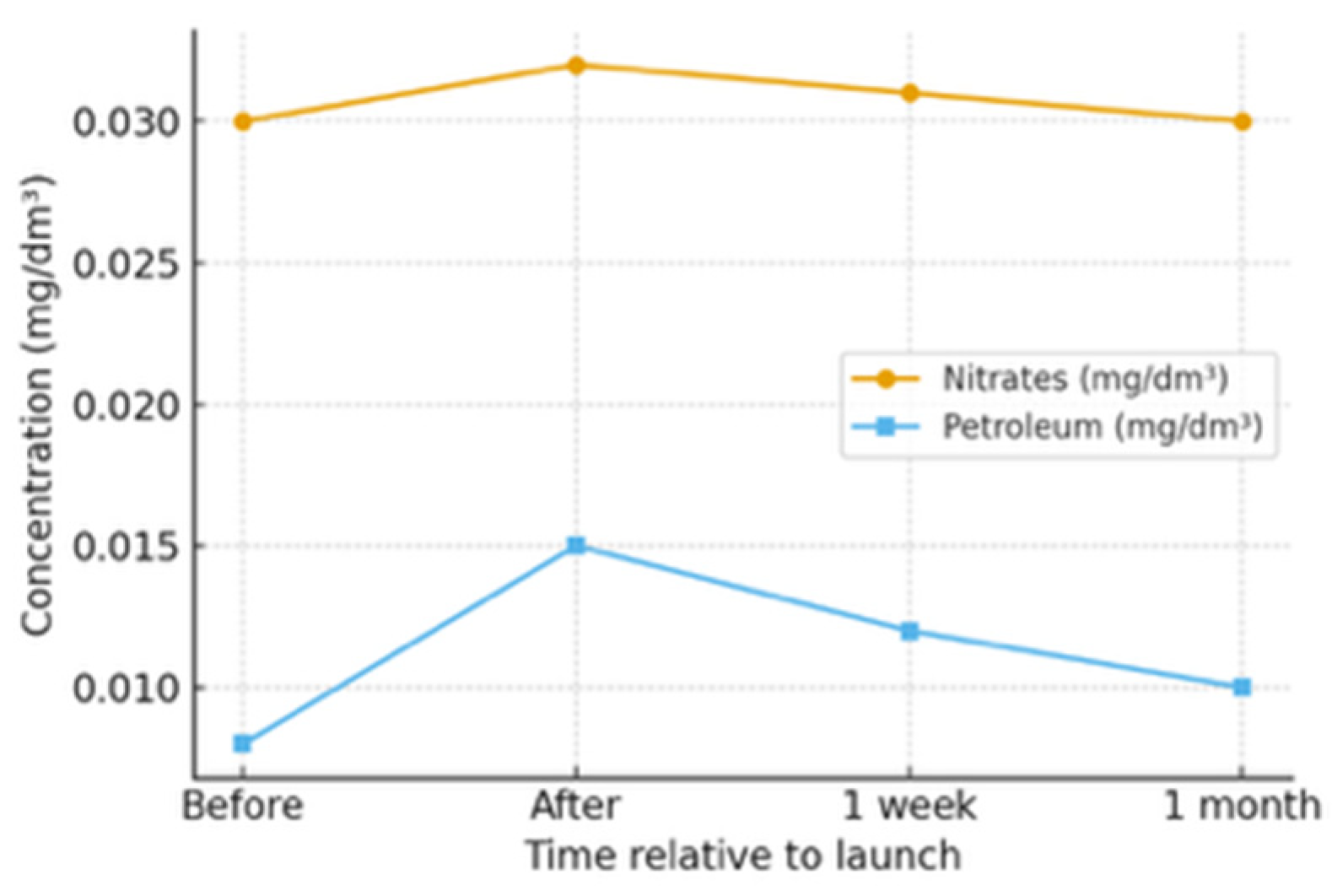
Figure 13 shows changes in the water quality indicators in the U-25 monitoring zone. Nitrate concentrations remained virtually unchanged (within 0.030–0.032 mg/dm3). Oil product levels increased from 0.008 to 0.015 mg/dm3 and then stabilized at 0.010 mg/dm3, which is within the acceptable limits.

3.7. Statistical Validation and Model Quality Assessment

To confirm the BACI interpretation, background and post-trigger values were compared for the main environmental components. The most pronounced change was recorded for petroleum products in the soil of the U-25 zone, where the concentration increased from the background level to a maximum post-trigger value of 7900 mg/kg. This difference was considered the main response of the soil component in the BACI analysis. For atmospheric air and water, changes were less pronounced and remained below the corresponding guideline values. For the key soil indicator, the post-trigger increase was further characterized using confidence intervals calculated using bootstrap permutations. Model and measurement agreement was assessed by comparing the measured concentrations at sampling points with predicted values in the nearest cells of a regular computational grid. For quantitative assessment, RMSE, MAE, and rank correlation were used. Uncertainty analysis was performed by varying wind speed, wind direction, atmospheric stability class, and estimated emission intensity Q within an ensemble of meteorological scenarios. The results showed that the main contributions to uncertainty come from meteorological parameters and simplified assumptions about turbulent mixing. Therefore, the model results should be interpreted as a spatially validated estimate of the pollution field, rather than as an exact pointwise retrieval of concentrations.
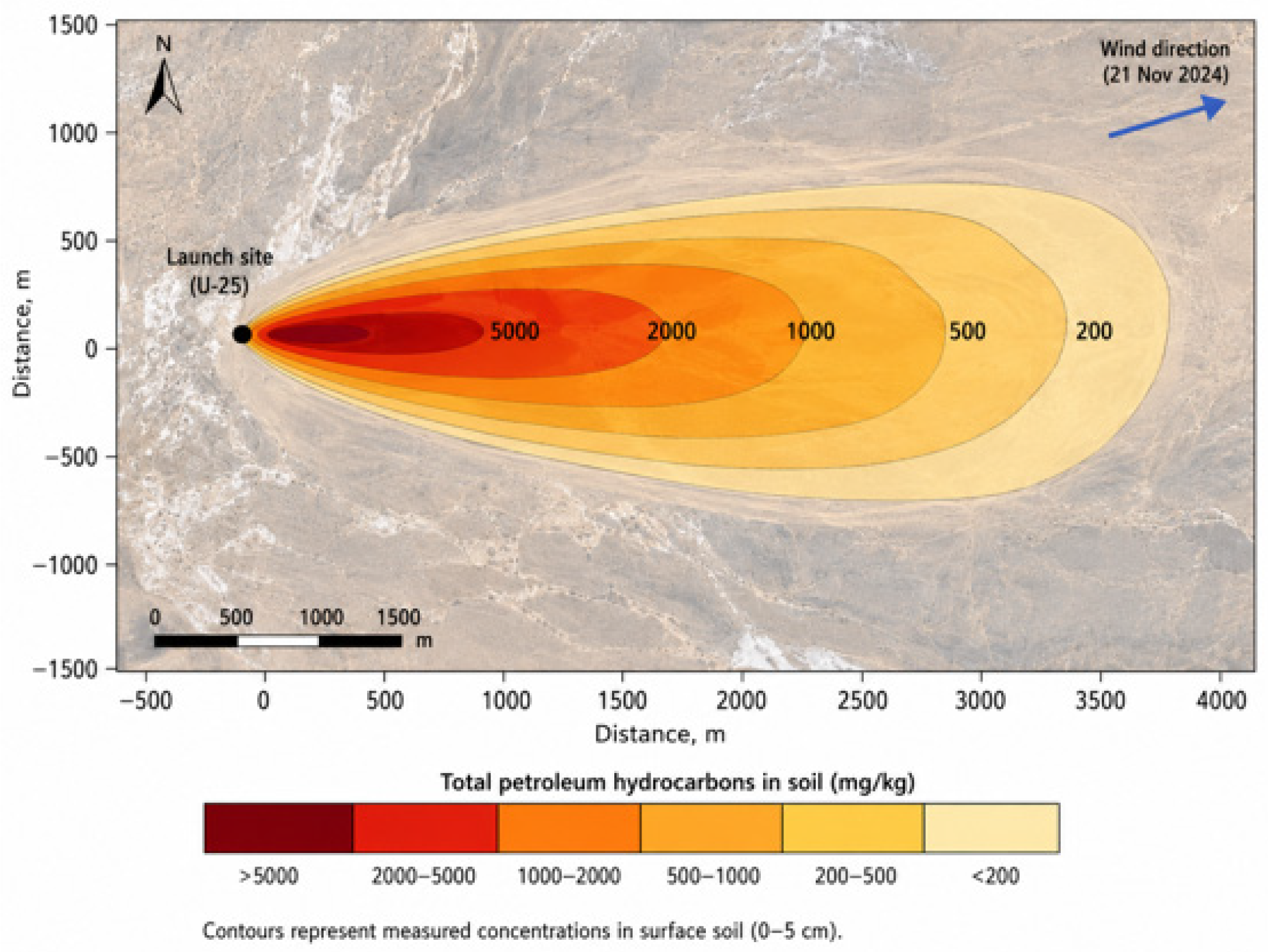
Figure 14 shows the spatial distribution of oil products in the soil of the U-25 zone after the launch. Unlike the previous symmetrical image, the contamination is represented as an elongated plume oriented along the wind direction on 21 November 2024, better reflecting the anisotropic transport of contaminants. The highest concentrations were concentrated near the impact point/source of exposure, where the oil product content exceeded 5000 mg/kg. With increasing distance from the source, the concentration gradually decreased to zones of 200–500 mg/kg and <200 mg/kg, demonstrating a pronounced contamination gradient along the direction of propagation.
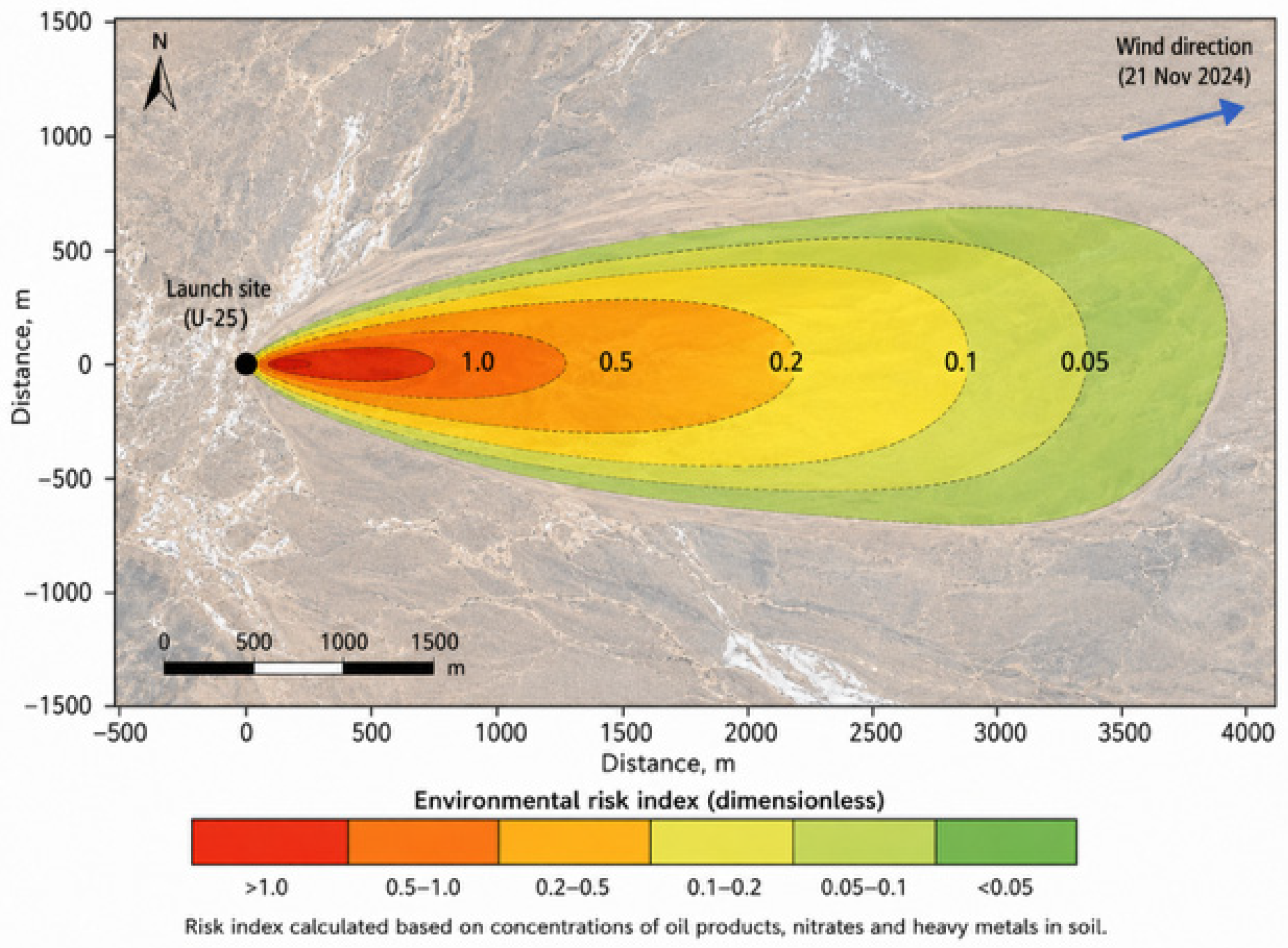
Figure 15 shows the spatial distribution of the environmental risk index in the U-25 zone, taking into account the wind direction after launch. In the updated version, the risk is not represented symmetrically around the source, but as an elongated plume directed downwind on 21 November 2024, which better reflects the likely spread of pollutants. The maximum risk was concentrated near the impact point/source of exposure, where the index exceeded 1.0. With increasing distance from the source, the risk gradually decreased to ranges of 0.5–1.0, 0.2–0.5, 0.1–0.2, 0.05–0.1, and then to <0.05, demonstrating a significant reduction in the environmental load along the direction of transport.
Table 5 summarizes the international environmental monitoring practices for three programs: Falcon 9 (USA), Ariane (EU), and Long March (China). For each program, the actual sources (official EA/EMP and peer-reviewed articles), monitoring focus (air, water/sediments, soil/biota), and key techniques that can be transferred to the Baikonur-“U-25” case are listed. For Falcon 9, the NEPA “background → consequences → measures” structure is highlighted, along with an emissions inventory and a clear QA/QC block. We recommend using air quality application templates and standardizing legends/maps. For Ariane, an EMP scheme with a dense point network, T−/T+ series, and layer publishing via OGC services is shown—this can be replicated for the U-25 WebGIS portal. Long March provides examples of “before/after” biomonitoring and the practice of public fall corridor maps/NOTAM notifications; a biota module and feedback channel should be added.
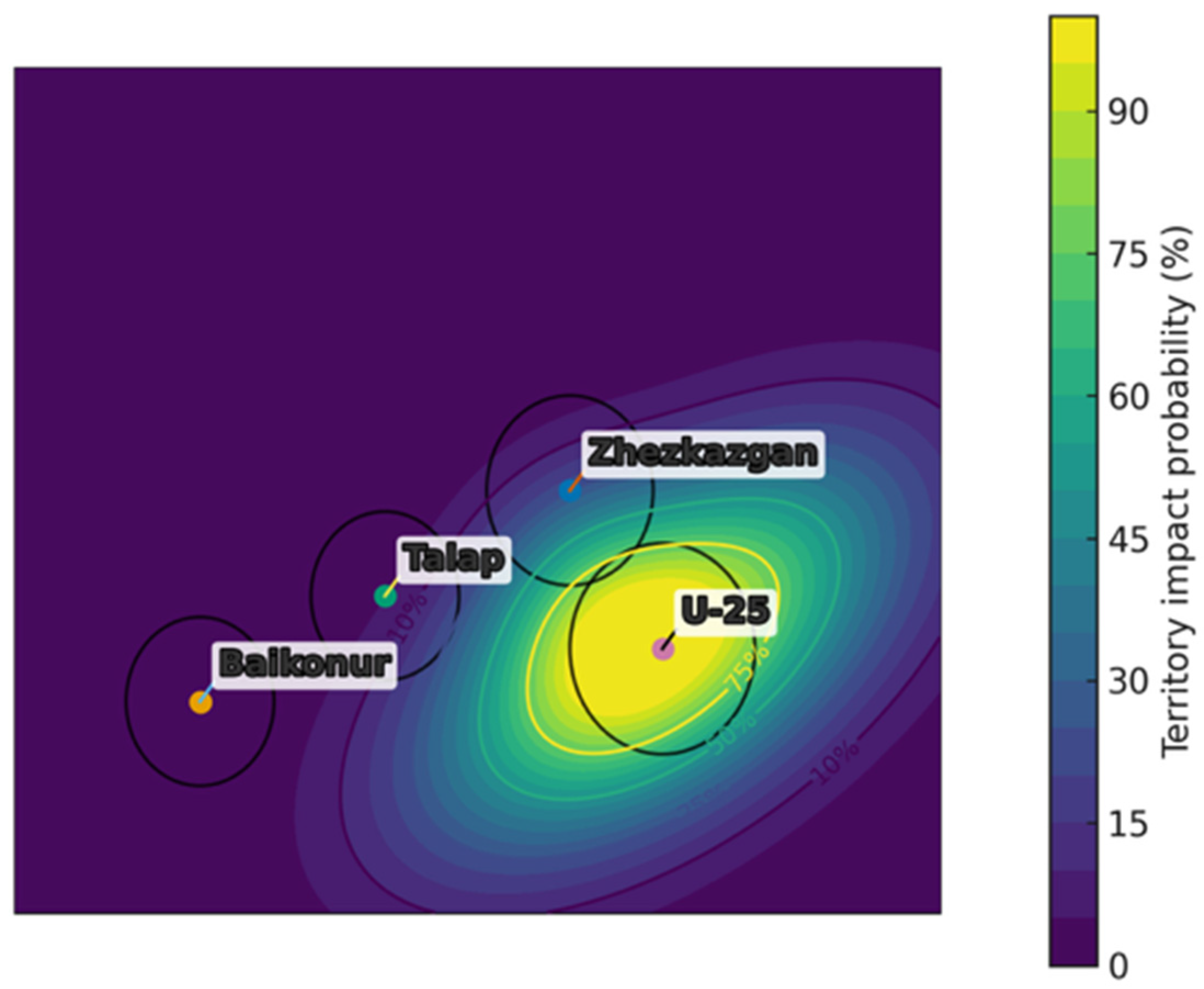
Figure 16 shows a spatial map of the risk of damage to the territory in the U-25 area: the color background is the probability field, and the white isolines indicate the 10/25/50/75% levels. The risk field is elongated along an axis of approximately 30° (taking into account wind direction after launch), reflecting the expected contamination shift. Key monitoring points are labeled on the map: Baikonur, Zhezkazgan, Talap, and U-25. This allows for the rapid identification of zones with P > 50% for priority sampling and public notification.
Figure 17 shows the prevailing wind directions in the S–SW–W sectors at moderate speeds of 2–5 and 5–8 m/s; the proportion of calm winds was ≈7.5%. The maximum contribution by compass direction reached ~25–30% (the common radial scale allows for direct comparison between the T−/T+ windows). These data were used to define the leeward sector and interpret the anisotropy of the concentration field.
Figure 18 shows a wind rose showing a predominance of flows from the S–SW–W sector at moderate speeds of 2–5 and 5–8 m/s; the proportion of calm winds was ~7–8%. Speed classes were standardized (0.5–2; 2–5; 5–8; >8 m/s), and the radial scale was common, allowing for a direct comparison of T−/T+ periods. Maximum frequencies were recorded in the leeward directions, consistent with the observed anisotropy of concentrations on the map. These results were used to define the leeward sector and validate the isoconcentration model.
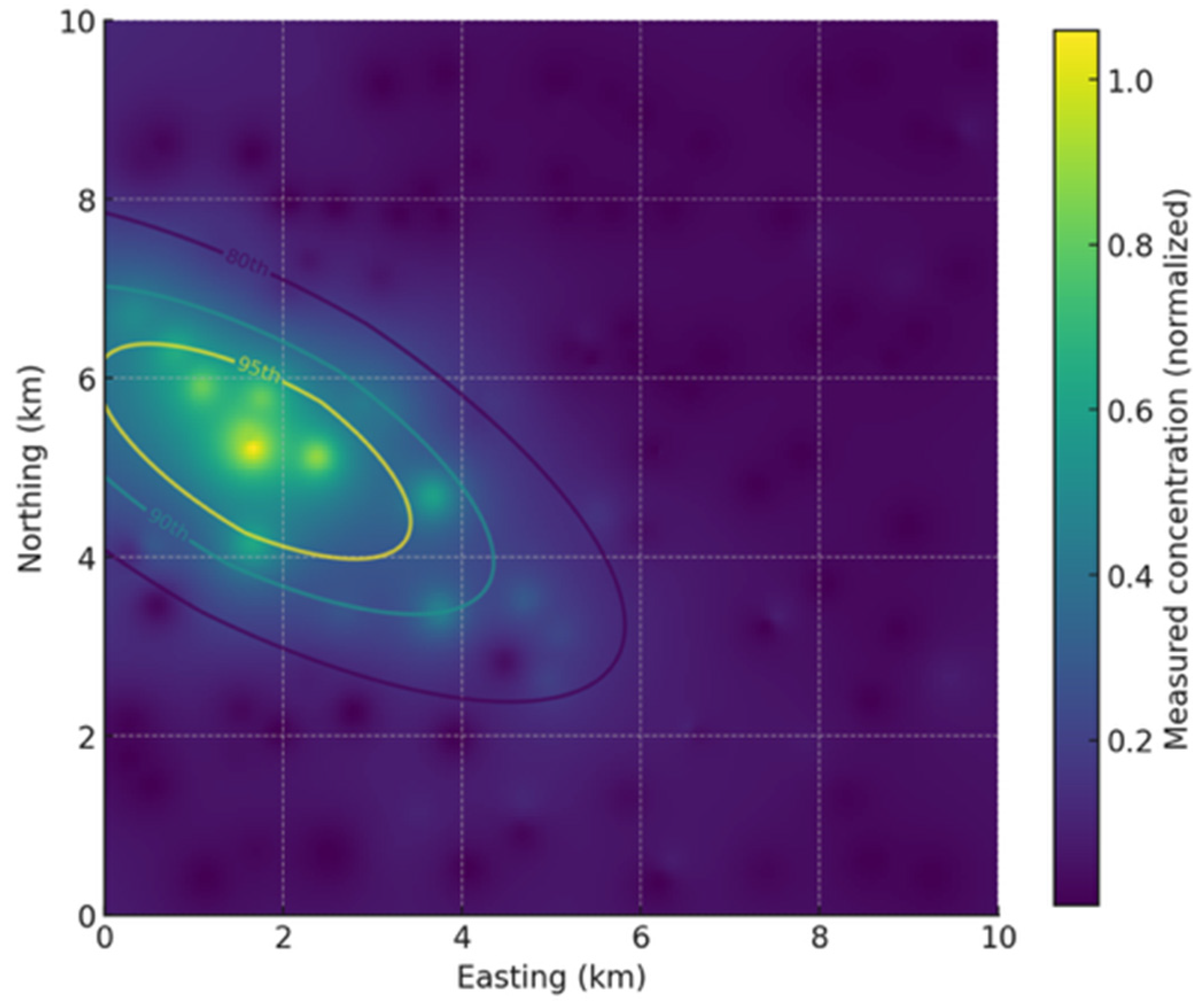
Figure 19 shows a comparison of the model and measurements: 80th/90th/95th percentile contours on the heat map. The model maximum coincides with the downwind measurement “hot zone”, confirming directional transport and deposition. The radial gradient is consistent with exponential decay C ( r ) = e x p ( a β r ) (see Figure 20); small discrepancies at the periphery are explained by microtopography and local source variability. The scale/projection was consistent; ROS estimates were used for the calculations, taking into account <LOD/<LO
The comparison was performed by comparing measured concentrations at sampling points with model values in the nearest computational cells. In Figure 19, the heat map shows the distribution of experimental/interpolated data, and the 80th, 90th, and 95th percentile contours indicate model-predicted zones of elevated concentration. The coincidence of these contours with the experimental “hot zone” was used as a visual consistency criterion, and RMSE, MAE, and rank correlation were additionally calculated.
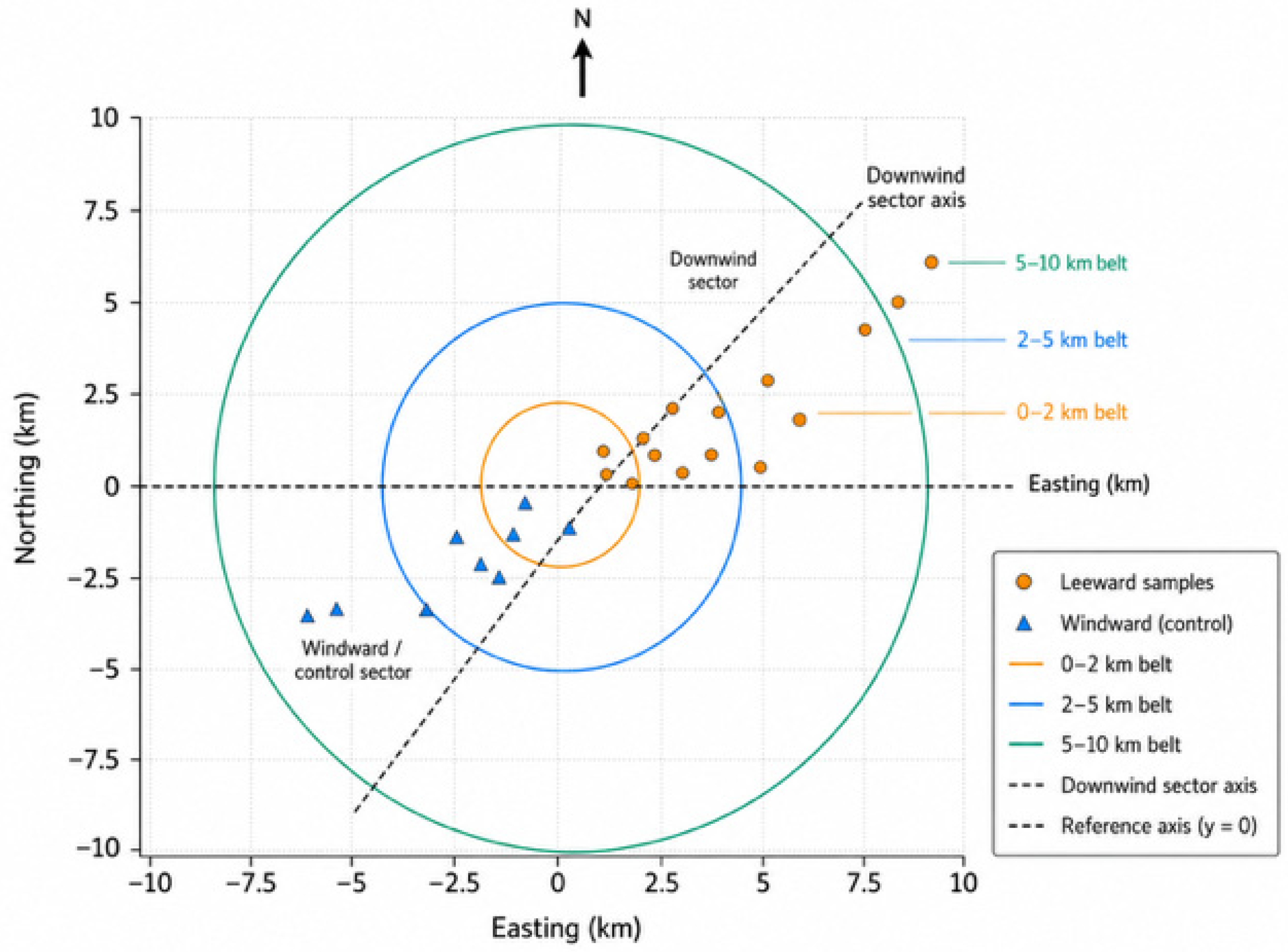
Figure 20 shows the stratified sampling scheme for site U-25, in which the study area was divided into three annular distance bands from the source: 0–2 km, 2–5 km, and 5–10 km. These bands were further subdivided into a leeward sector and a windward control sector based on wind rose analysis.
This refinement makes the spatial stratification scheme more understandable and allows for a direct comparison of concentration gradients as a function of distance, as well as verification of hotspot locations on thermal and isoconcentration maps.
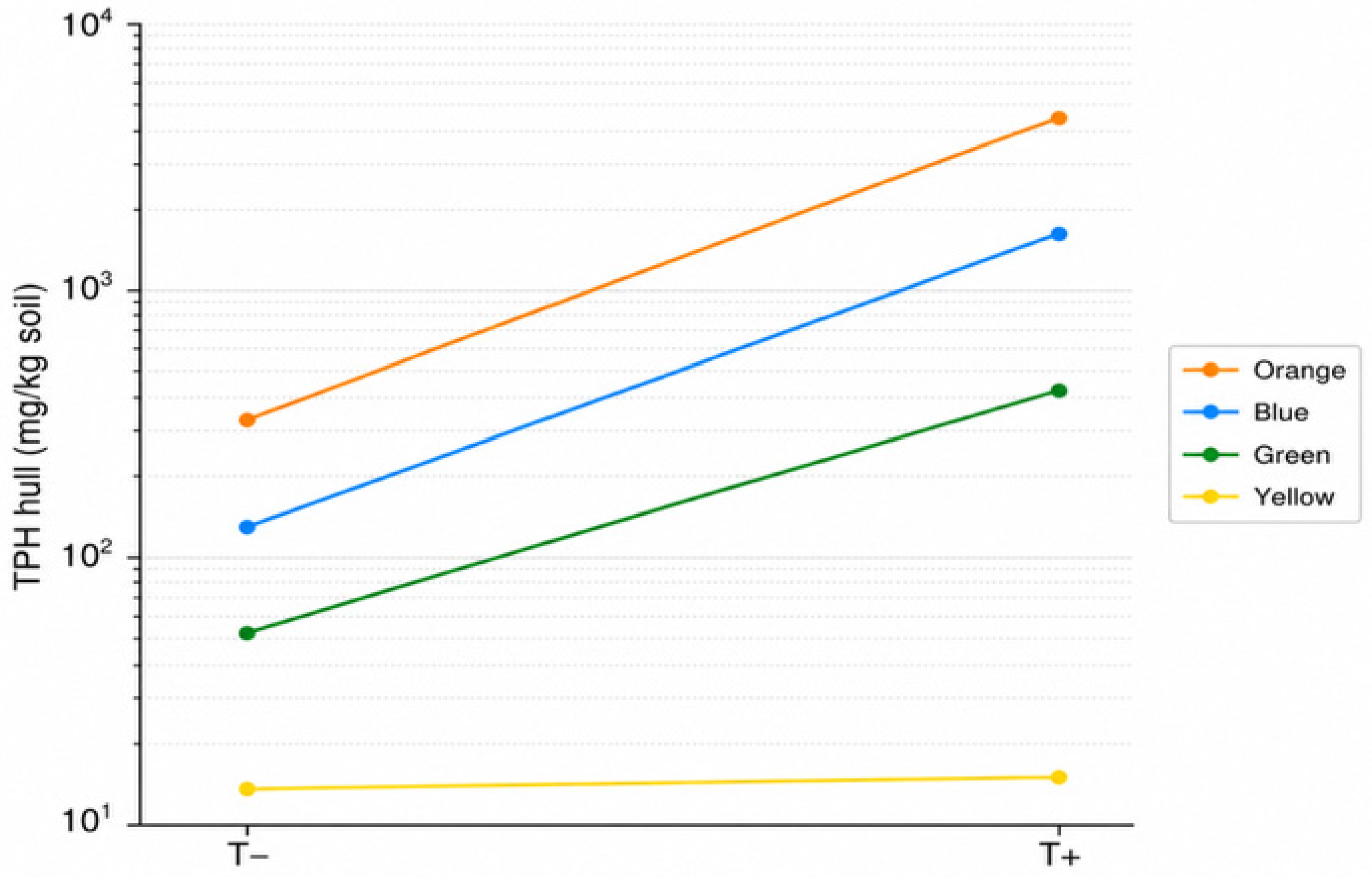
Figure 21 shows an analysis of soil TPH changes by strata (T− → T+). Intertemporal comparison (T− vs. T+) revealed a short-term increase in pollutants in the immediate vicinity of the impact zone: an episodic increase in NO2 was recorded in the air, quickly returning to background levels; changes in water were minor and remained within the regulatory limits, while the highest U-25 load was observed in the soil in the first month after the event, followed by a decrease by T + 3–6 months. Intermediary comparison (air–water–soil) indicates that acute risks for air and water were low (HQ < 1 in all periods), while soil locally demonstrated HQ > 1 in the early phase, after which risk metrics fell below the threshold. Spatial analysis revealed pronounced anisotropy: in the leeward sector, median concentrations and the fraction of detectable values (DF) were higher than in the windward control, and the gradient across the 0–2/2–5/5–10 km belts was consistent with exponential decay C ( r ) = e x p ( a β r ) (β estimate with 95% CI—see Figure 21). Comparison of the model and measurements confirmed directional transport: the 80th/90th/95th percentile isolines overlapped the “hot spots” of the heat map, the rank agreement coefficient for cells was positive (ρ > 0), and the “model↔measurement” scattering showed good agreement relative to the 1:1 line with a small RMSE. Statistical differences were tested using nonparametric tests (Mann–Whitney/Wilcoxon; for censored series—KM/log-rank/Peto–Prentice), effects were additionally characterized by median differences and effect sizes (Cliff’s δ/Cohen’s d), and ROS/Kaplan–Meier were used for series with <LOD/<LOQ. Uncertainty analysis (bootstrap + ensemble of meteorological scenarios) showed the robustness of the main conclusions to the choice of the censoring method and assumptions about turbulence; the greatest contribution to the scatter came from the variation of meteorological parameters (u, stability class) and the a priori estimate of the Q emission. Overall, the identified picture is one of a localized, time-decreasing impact with a downwind component and a priority of remediation actions in the near leeward soil belt of U-25.
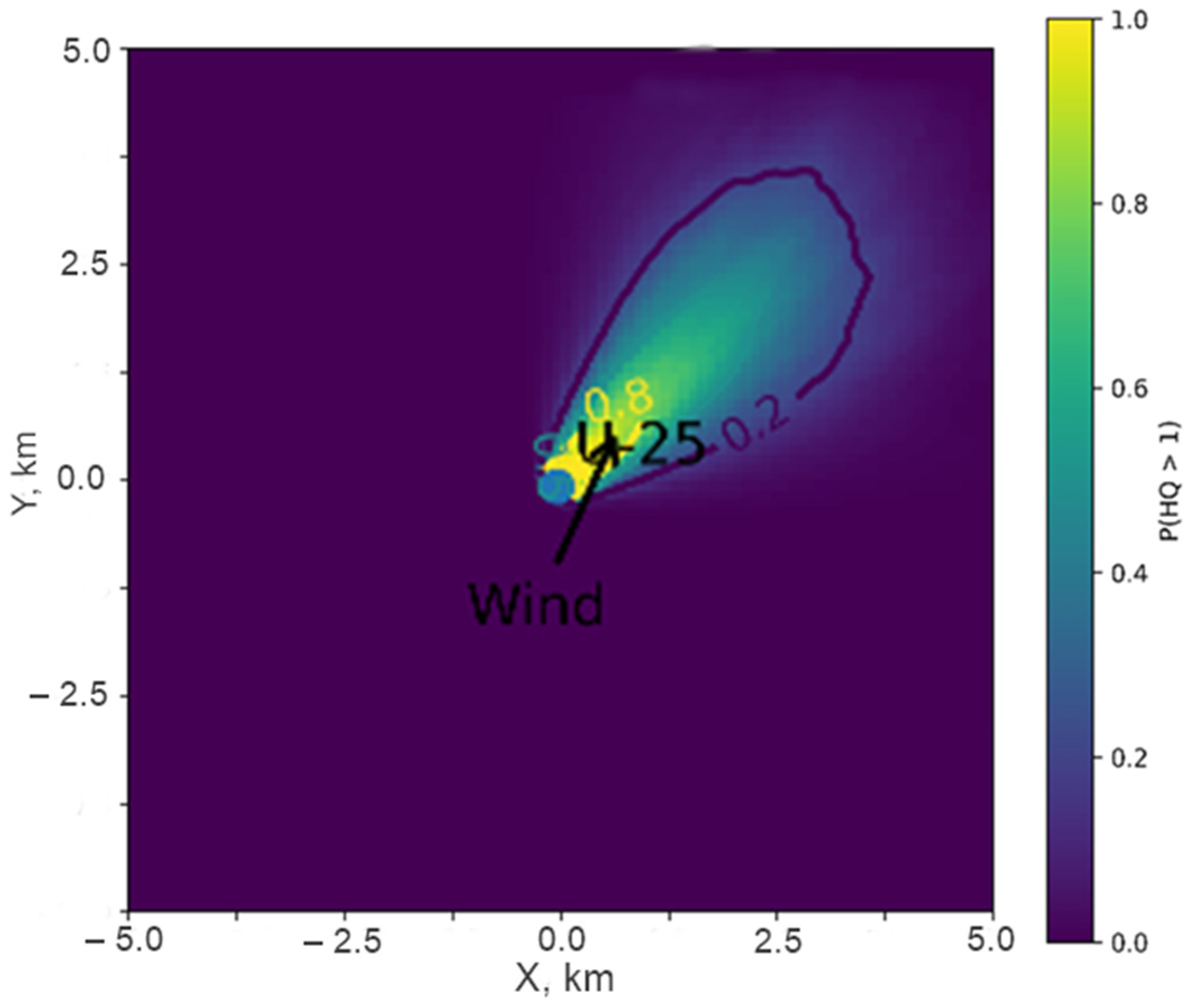
Figure 22 shows a spatial map of the probability of exceeding the P (HQ > 1) threshold in X–Y coordinates (km), where the color represents the risk level from 0 to 1. The maximum probability values are concentrated near the source and form an elongated “trail” in the direction of transport, consistent with the shown wind vector. The contour highlights the high-risk area, within which the probability of exceeding was significantly higher than the background values, while outside the contour, the values quickly dropped to near zero. This visualization allows one to simultaneously assess the location of the maximum risk zone and its extent in the direction of propagation.

4. Discussion

The obtained results show that the environmental impact of the Soyuz-2.1a launch vehicle carrying the Progress MS-29 spacecraft was primarily localized in the U-25 reentry zone. In populated areas, including Baikonur, Talap, and Zhezkazgan, the concentrations of airborne pollutants, oil products in the soil, and water quality indicators remained below the established regulatory limits. The highest environmental impact was recorded in the soil component of the U-25 reentry zone, where an increase in oil product concentrations was observed after the launch. This confirms that soil is the most sensitive medium for detecting localized post-launch contamination. Unlike soil, changes in the air and water parameters were short-term and did not indicate a sustained excess of permissible levels. Spatial analysis revealed that the contamination distribution is not completely radial. Wind direction influences the transport of pollutants and forms an anisotropic plume in the downwind sector. Therefore, when interpreting contamination and risk maps, it is necessary to consider meteorological conditions, particularly wind direction and atmospheric stability. Differences between the measured and calculated concentrations may be due to dispersion model uncertainties, including simplified turbulence assumptions, the influence of microrelief, surface heterogeneity, and short-term wind fluctuations. These factors were considered as sources of model uncertainty. Overall, the results confirm that the primary environmental risk is associated with localized soil contamination in the U-25 zone. Further monitoring should focus on repeat soil sampling, refinement of spatial risk maps, and the use of WebGIS visualization for rapid environmental decision-making.

5. Conclusions

The integration of stratified sampling, censoring (<LOD/<LOQ), and spatial validation confirmed the local, predominantly short-term nature of the post-trigger impact, with the greatest load concentrated in the soil of the U-25 site in the first month after the event. Comparison of isoconcentrations with wind roses and model-to-measurement correlations indicate directional transport and deposition, while air and water demonstrate low acute risks and a rapid return to background levels. The analytical framework used (ROS/Kaplan–Meier + BACI) ensured robustness of the estimates with incomplete data and heterogeneous detection thresholds and can serve as a replicable template for similar incidents. Uncertainties associated with emission approximation and limited meteorological coverage remain significant; these are partially mitigated by ensemble analysis but require subsequent direct source measurements and expansion of the observation network. The practical conclusion is to prioritize the remediation of U-25 foci in soil and maintain monitoring protocols (T− → T + 1 week → T + 1/3/6 months) with the publication of layers in WebGIS for operational decisions and feedback to local authorities.

Author Contributions

Conceptualization A.K. (Aliya Kalizhanova), A.U., A.K. (Ainur Kozbakova), M.K. and S.D.; methodology, A.K. (Aliya Kalizhanova), A.U., A.K. (Ainur Kozbakova), M.K. and S.D.; software, M.K. and S.D.; resources A.U. and M.K.; data curation, A.K. (Aliya Kalizhanova), A.K. (Ainur Kozbakova) and M.K.; project administration, A.K. (Aliya Kalizhanova). All authors have read and agreed to the published version of the manuscript.

Funding

The work was supported by a grant and funding from the Ministry of Science and Higher Education of the Republic of Kazakhstan within the framework of Project No. AP23488291, “Development of a multifunctional resource for environmental certification of areas where the separated parts of launch vehicles impact by the method of adaptive presentation of interactive GIS”, Institute Information and Computational Technologies CS MSHE RK.

Data Availability Statement

Data is contained within the article. The original contributions presented in the study are included in the article, further inquiries can be directed to the corresponding author.

Conflicts of Interest

The authors declare no conflict of interest.

Abbreviations

The following abbreviations are used in this manuscript:
HCSHydrocarbon status (HCS)
BACIBefore–after control impact
ROSRegression on order statistics
TPHTotal petroleum hydrocarbons
NADANon-detects and data analysis
LODLimit of detection
NDMANitrosodimethylamine
UDMHUnsymmetrical dimethylhydrazine
ECElectrical conductivity
SARSodium adsorption ratio
MWDMean weight diameter
RDARedundancy analysis
SEMStructural equation modeling
SS(GOST)State standards
ACMGA-4Automatic Continuous Monitoring Gas Analyzer Model-4
MESElectronic meteorometer stationary
MPCsMaximum permissible concentrations
ASELApproximate safe exposure level
LOQLimit of quantification

References

  1. Bekeshev, Y.; Semenkov, I.; Stepanova, Y.; Karpachevskiy, A.; Lednev, S.; Klink, G.; Yerzhanov, Y.; Bapyshev, A.; Koroleva, T. Data on the temporal changes in soil properties at the emergency crash site of the launch vehicle ‘Soyuz-FG’ in Kazakhstan. Data Brief 2024, 55, 110646. [Google Scholar] [CrossRef]
  2. Bolotnik, T.A.; Smolenkov, A.D.; Smirnov, R.S.; Shpigun, O.A. Determination of rocket kerosene in soil by static headspace analysis coupled with gas chromatography–mass spectrometry. Mosc. Univ. Chem. Bull. 2015, 70, 168–174. [Google Scholar] [CrossRef]
  3. Bolotnik, T.A.; Plyushchenko, I.V.; Smolenkov, A.D.; Pirogov, A.V.; Popik, M.V.; Shpigun, O.A. Identification of spillages of semi-volatile hydrocarbon fuels in soils by gas chromatography-mass spectrometry. J. Anal. Chem. 2018, 73, 570–575. [Google Scholar] [CrossRef]
  4. Dallas, J.A.; Raval, S.; Alvarez Gaitan, J.P.; Saydam, S.; Dempster, A.G. The environmental impact of emissions from space launches: A comprehensive review. J. Clean. Prod. 2020, 255, 120209. [Google Scholar] [CrossRef]
  5. Epifanov, I.K.; Kondratyev, A.D.; Doroshina, S.V. Environmental damage in result of ascent-phase abort of rocket carriers. Natzional’nye Interes Prioritety Bezop 2009, 24, 53–57. [Google Scholar]
  6. Gennadiev, A.N.; Pikovskii, Y.I.; Zhidkin, A.P.; Kovach, R.G.; Koshovskii, T.S.; Smirnova, M.A.; Khlynina, N.I.; Tsibart, A.S. Factors and features of the hydrocarbon status of soils. Eurasian Soil. Sci. 2015, 48, 1193–1206. [Google Scholar] [CrossRef]
  7. Gooijer, C.; Kozin, I.; Velthorst, N.H. Shpol’skii spectrometry, a distinct method in environmental analysis. Mikrochim. Acta 1997, 127, 149–182. [Google Scholar] [CrossRef]
  8. Hu, C.; Zhang, Y.; Zhou, Y.; Liu, Z.-F.; Feng, X.-S. Unsymmetrical dimethylhydrazine and related compounds in the environment: Recent updates on pretreatment, analysis, and removal techniques. J. Hazard. Mater. 2022, 432, 128708. [Google Scholar] [CrossRef] [PubMed]
  9. Ivanova, E.; Osipova, M.; Vasilieva, T.; Eremkin, A.; Markova, S.; Zazhivihina, E.; Smirnova, S.; Mitrasov, Y.; Nasakin, O. The recycling of substandard rocket fuel n, n-dimethylhydrazine via the involvement of its hydrazones derived from glyoxal, acrolein, metacrolein, crotonaldehyde, and formaldehyde in organic synthesis. Int. J. Mol. Sci. 2023, 24, 17196. [Google Scholar] [CrossRef]
  10. Kadono, A.; Funakawa, S.; Kosaki, T. Factors controlling mineralization of soil organic matter in the Eurasian steppe. Soil. Biol. Biochem. 2008, 40, 947–955. [Google Scholar] [CrossRef]
  11. Karnaeva, A.E.; Milyushkin, A.L.; Khesina, Z.B.; Buryak, A.K. 1-Methyl-1H-1,2,4-triazole as the main marker of 1,1-dimethylhydrazine exposure in plants. Environ. Sci. Pollut. Res. 2022, 29, 64225–64231. [Google Scholar] [CrossRef]
  12. Kopack, R.A. Rocket wastelands in Kazakhstan: Scientific authoritarianism and the Baikonur cosmodrome. Ann. Am. Assoc. Geogr. 2019, 109, 556–567. [Google Scholar] [CrossRef]
  13. Kopack, R. Baikonur 2.0: ‘inland-offshore’ space economies in post-Soviet Kazakhstan. Cult. Theory Crit. 2021, 62, 96–112. [Google Scholar] [CrossRef]
  14. Koroleva, T.V.; Semenkov, I.N.; Sharapova, A.V.; Krechetov, P.P.; Lednev, S.A. Ecological consequences of space rocket accidents in Kazakhstan between 1999 and 2018. Environ. Pollut. 2021, 268, 115711. [Google Scholar] [CrossRef]
  15. Koroleva, T.V.; Semenkov, I.N.; Lednev, S.A.; Soldatova, O.S. Unsymmetrical dimethylhydrazine (UDMH) and its transformation products in soils: A review of the sources, detection, behavior, toxicity, and remediation of polluted territories. Eurasian Soil. Sci. 2023, 56, 210–225. [Google Scholar] [CrossRef]
  16. Koroleva, T.V.; Semenkov, I.N.; Lednev, S.A.; Soldatova, O.S. Jet fuel as a source of soil pollution: A review. Eurasian Soil. Sci. 2024, 57, 1519–1524. [Google Scholar] [CrossRef]
  17. Kosyakov, D.S.; Ul’yanovskii, N.V.; Pikovskoi, I.I.; Kenessov, B.; Bakaikina, N.V.; Zhubatov, Z.; Lebedev, A.T. Effects of oxidant and catalyst on the transformation products of rocket fuel 1,1-dimethylhydrazine in water and soil. Chemosphere 2019, 228, 335–344. [Google Scholar] [CrossRef]
  18. Li, W.; Li, J.; Wu, Y.; Guo, K.; Feng, X.; Liu, X. Soil organic matter and bulk density: Driving factors in the vegetation-mediated restoration of coastal saline lands in North China. Agronomy 2024, 14, 2007. [Google Scholar] [CrossRef]
  19. Liu, L.; Jia, P.; Huang, Y.; Han, J.; Lichtfouse, E. Space industrialization. Environ. Chem. Lett. 2022, 21, 5571. [Google Scholar] [CrossRef]
  20. Meira, M.; Quintella, C.M.; Tanajura, A.D.S.; da Silva, H.R.G.; Fernando, J.D.S.; Neto, P.R.d.C.; Pepe, I.M.; Santos, M.A.; Nascimento, L.L. Determination of the oxidation stability of biodiesel and oils by spectrofluorimetry and multivariate calibration. Talanta 2011, 85, 430–434. [Google Scholar] [CrossRef] [PubMed]
  21. Milyushkin, A.L.; Karnaeva, A.E. Unsymmetrical dimethylhydrazine transformation products: A review. Sci. Total Environ. 2023, 891, 164367. [Google Scholar] [CrossRef]
  22. Nguyen, H.N.; Chenoweth, J.A.; Bebarta, V.S.; Albertson, T.E.; Nowadly, C.D. The toxicity, pathophysiology, and treatment of acute hydrazine propellant exposure: A systematic review. Mil. Med. 2021, 186, e319–e326. [Google Scholar] [CrossRef]
  23. Pikovskii, Y.I.; Korotkov, L.A.; Smirnova, M.A.; Kovach, R.G. Laboratory analytical methods for the determination of the hydrocarbon status of soils (a review). Eurasian Soil Sci. 2017, 50, 1125–1137. [Google Scholar] [CrossRef]
  24. Federal Aviation Administration (FAA). Final Environmental Assessment and Finding of No Significant Impact (FONSI) for the SpaceX Falcon Program (LC-39A & LC-40, Kennedy Space Center/Cape Canaveral); FAA Office of Commercial Space Transportation: Washington, DC, USA, 2020; 600p. [Google Scholar]
  25. Federal Aviation Administration (FAA). Draft Environmental Assessment: SpaceX Falcon 9 Operations at Space Launch Complex 40, Cape Canaveral Space Force Station, Florida (with Air Quality Technical Report); FAA: Washington, DC, USA, 2025; 300p. [Google Scholar]
  26. National Aeronautics and Space Administration (NASA); U.S. Air Force (USAF). Environmental Assessment—SpaceX Falcon 1 and 9 Launch Programs at CCAFS/KSC; NASA/USAF: Washington, DC, USA, 2007; 300p. [Google Scholar]
  27. CNES/Centre Spatial Guyanais (CSG). Environmental Measurement Plan (EMP) & Annual Environmental Reports (Ariane/Vega); CNES/CSG: Kourou, France, 2012–2023. [Google Scholar]
  28. Chanoine, A. For ESA Clean Space. Environmental Impacts of Launchers and Space Missions—Life Cycle Assessment (LCA); Clean Space Industrial Days (CSID): Noordwijk, The Netherlands, 2017; 35p. [Google Scholar]
  29. Xue, Y.; John, R.; Liu, X.; Wang, X.; Su, S.; Tan, Z.; Yang, Q.; He, Q.; Jiang, K.; Zhang, H. Rocket launching activities are associated with reduced insect species richness and abundance in two types of tropical plantations around the Wenchang Satellite Launch Center, southern China. Ecol. Indic. 2021, 127, 107751. [Google Scholar] [CrossRef]
  30. China Aerospace Studies Institute (CASI), Air University. China’s Ground Segment; Air University Press: Maxwell AFB, AL, USA, 2021; 80p. [Google Scholar]
  31. Philippine Space Agency (PhilSA). Advisory on the Long March 8A Rocket Launch (Drop-Zone and Maritime Safety Notice); PhilSA (Official Advisory): Manila, Philippines, 2025. [Google Scholar]
Figure 1. Rocket launch impact environmental monitoring flowchart.
Atmosphere 17 00532 g001
Figure 2. Launch complex location, LP launch site.
Atmosphere 17 00532 g002
Figure 3. Sequence of the ecological chain of impacts from rocket fuel residue.
Atmosphere 17 00532 g003
Figure 4. Changes in the maximum soil oil product concentrations in the rocket stage impact area in 2020–2023.
Atmosphere 17 00532 g004
Figure 5. Comparison of the background and post-launch pollutant concentrations by monitoring zone in 2023.
Atmosphere 17 00532 g005
Figure 6. Distribution of petroleum products in soil and water across various monitoring zones.
Atmosphere 17 00532 g006
Figure 7. Comparison of pollutant levels in different monitoring zones.
Atmosphere 17 00532 g007
Figure 8. Distribution structure of pollutants in soil and atmospheric air.
Atmosphere 17 00532 g008
Figure 9. Distribution of pollutants by monitoring zone.
Atmosphere 17 00532 g009
Figure 10. Dynamics of changes in the soil pollutant concentrations after launch and subsequent remediation measures.
Atmosphere 17 00532 g010
Figure 11. Dynamics of NO2 and hydrocarbon concentrations in the air.
Atmosphere 17 00532 g011
Figure 12. Changes in oil product concentrations in the soil.
Atmosphere 17 00532 g012
Figure 13. Water parameter trends.
Atmosphere 17 00532 g013
Figure 14. Spatial distribution of oil products in the soil of the U-25 zone after the launch.
Atmosphere 17 00532 g014
Figure 15. Spatial distribution of the environmental risk index in the U-25 zone, taking into account the wind direction after launch.
Atmosphere 17 00532 g015
Figure 16. Spatial model of the risk of damage to the territory in the U-25 area.
Atmosphere 17 00532 g016
Figure 17. Wind roses: T−.
Atmosphere 17 00532 g017
Figure 18. Wind roses: T+.
Atmosphere 17 00532 g018
Figure 19. Model-measurement comparison: 80th/90th/95th percentile contours on the heat map.
Atmosphere 17 00532 g019
Figure 20. Stratified sampling scheme for site U-25.
Atmosphere 17 00532 g020
Figure 21. Analysis of soil TPH changes by strata (T− → T+).
Atmosphere 17 00532 g021
Figure 22. Spatial map of the probability of exceeding the threshold P (HQ > 1).
Atmosphere 17 00532 g022
Table 1. Measurement metadata.
IndicatorInstrument/MethodLOD/LOQError
NO2 (air)“ACMGA-4” gas analyzer, electrochemical sensorLOD 0.005; LOQ 0.010 mg/m3±10% (k = 2)
Hydrocarbons (air)Portable PID analyzerLOD 0.001; LOQ 0.003 mg/m3±15%
Total petroleum hydrocarbon (TPH) petroleum products (soil)“Fluorat-02-3M” fluorimeter/IR spectrometryLOD 5; LOQ 10 mg/kg±20%
Petroleum products TPH (water)“Fluorat-02-3M” fluorometerLOD 0.005; LOQ 0.010 mg/dm3±20%
Nitrates NO3 (water)“Spekol-1500” spectrophotometer (UV–Vis)LOD 0.005; LOQ 0.010 mg/dm3±10%
UDMH, NDMA (soil)GC-MS (headspace/derivatization)LOD 0.001; LOQ 0.005 mg/kg±25%
UDMH, NDMA (water)LC-MS/MS (derivatization)LOD 0.0005; LOQ 0.001 mg/dm3±20%
Note: LOD/LOQ values and uncertainties are typical; please adjust according to your verification/validation documents if necessary.
Table 2. Comparative table with boundaries (2020–2023).
YearImpact Area (U-25)Concentration of Petroleum
Products in Soil, mg/kg
Water Samples, mg/dm3Maximum Permissible
Concentration Exceeded
2020Progress MS-1550–3500.010–0.020No exceedances
2021Progress MS-18120–9000.005–0.018No exceedances
2022Progress MS-2180–12000.006–0.016Local exceedances in soil
2023Progress MS-255–79000.006–0.015Significant exceedances in soil
Table 3. Comparison of the background and post-launch pollutant values.
Locality/AreaIndicatorPre-Launch (Background)Post-LaunchMPCExceeded
Baikonur, Mira St., 13NO2, mg/m30.0250.0300.085No
Baikonur, 5A Microdistrict, Bldg. 9/4Oil products in soil, mg/kg1101451000No
Talap, st. Bolashak, 12-1NO2, mg/m30.0210.0270.085No
Talap, st. Bolashak, 12-1Oil products in soil, mg/kg951201000No
Zhezkazgan, st. Tusipbekova, 22-1NO2, mg/m30.0180.0250.085No
Impact zone “U-25”Oil products in soil, mg/kg18079001000Exceeded
Impact zone “U-25”Petroleum products in water, mg/dm30.0080.0150.10No
Note: Data compiled based on the 2023 report.
Table 4. Measurement and quality control metadata.
IndicatorMatrixInstrument/MethodLOD/LOQUncertaintyCalibration IntervalStandard/SOPQA/QC Notes
NO2AirPortable gas analyzer ACMGA-4; electrochemical sensorLOD 0.005 mg/m3; LOQ 0.010 mg/m3±10% (k = 2)Zero/span check before each shift; full calibration every 6 monthsInternal SOP; national sanitary normsField duplicates and instrument checks; results compared with MPC/ASEL
Total hydrocarbonsAirPortable PID hydrocarbon analyzer; indicator tubes for rapid controlLOD 0.001 mg/m3; LOQ 0.003 mg/m3±15% (k = 2)Span check daily; factory calibration quarterlySOP for ambient VOC monitoring; SS(GOST) 12.1.014-84Blank control and repeated measurements during field monitoring
Petroleum hydrocarbons/TPHSoilFluorat-02-3M fluorimeter or IR spectrometryLOD 5 mg/kg; LOQ 10 mg/kg±20% (matrix spikes)Calibration with standards for each analytical batch; control chartGOST/ISO methods for TPH in soils; laboratory SOPComposite sample of five increments; field and laboratory duplicates ≥10%
Petroleum hydrocarbons/TPHWaterFluorat-02-3M fluorimeterLOD 0.005 mg/dm3; LOQ 0.010 mg/dm3±20%Blank and standard check for each batch; weekly full calibrationGOST/ISO methods for oil products in water; laboratory SOPSterile containers, preservation conditions, trip blanks and duplicate samples
Nitrates (NO3)WaterSpekol-1500 spectrophotometer; UV–Vis methodLOD 0.005 mg/dm3; LOQ 0.010 mg/dm3±10%Calibration curve for each batch; verification with certified reference materialsISO 7890/GOST equivalent; laboratory SOPControl samples and repeatability check for each analytical batch
UDMH and NDMASoilGC-MS; headspace sampling/derivatizationLOD 0.001 mg/kg; LOQ 0.005 mg/kg±25% (complex matrix)Five-point calibration each run; continuing calibration verificationValidated laboratory method; literature protocolsMatrix spikes, blanks, duplicate samples and QA/QC flagging
UDMH and NDMAWaterLC-MS/MS; derivatization methodLOD 0.0005 mg/dm3; LOQ 0.001 mg/dm3±20%Matrix-matched calibration for each batchEPA/ISO guidance; laboratory SOPTrip blanks, field blanks and recovery control
Field duplicates/blanksAir/Soil/WaterQA/QC controls during sampling and analysisNot applicableRSD ≤ 20% for duplicatesEach sampling day/analytical batchQA plan: field blanks, trip blanks, spikesMeasurements with QA/QC violations were excluded from statistical analysis
Note. LOD = limit of detection; LOQ = limit of quantification; QA/QC = quality assurance and quality control; MPC = maximum permissible concentration; ASEL = approximate safe exposure level. Values should be verified using instrument passports and laboratory validation protocols before publication.
Table 5. International monitoring practices: Falcon 9 (USA), Ariane (EU), Long March (China).
ProgramReal Reference(s)What’s Monitored/FocusKey Practices You Can Adapt
Falcon 9 (USA)FAA: Final Environmental Assessment for SpaceX Falcon Program (LC-39A/LC-40); Air/Water/Noise; NEPA structure; air-quality modeling appendices [24].Air (NOx/VOC & criteria pollutants), water/sediments near pads/landing zones; cumulative effects & noiseUse baseline vs. post-launch design; adopt air-quality technical appendix template; standardize impact matrices; mirror NEPA sectioning and legend style.
Falcon 9 (USA)FAA: Draft EA for Falcon 9 Operations at SLC-40 (2025); Federal Register notice on Final EA availability [25].Updated emissions inventory; up to 120 launches/year; booster landings at SLC-40Align emissions inventory & QA/QC tables; explicitly state uncertainty and cumulative impacts.
Falcon 9 (USA)NASA/USAF: Environmental Assessment for Falcon 1/9 at CCAFS/KSC (2007); Supplemental EA (2013); FONSI for F9 RTLS (2015) [26].Legacy NEPA examples covering Air/Water/Soil and mitigationReuse section skeleton and map symbology; show paths/footprints and buffers consistently.
Ariane (EU)CNES/CSG: Environmental Measurement Plan (EMP) portal + annual reports (2012–2023): open OGC publication (WMS/WFS) [27].Dense spatial networks (>100 sites); routine T−/T+ series; bio-monitoring year-roundAdopt EMP-style calendar (T−, T + hours/days/weeks); publish OGC layers; include biota sentinels.
Ariane (EU)ESA/CNES: Environmental impacts of launchers and space missions (LCA framing) [28].Cross-media & life cycle perspectiveAdd cumulative effects paragraph and an assumptions registry to Discussion.
Long March (China)Xue et al., 2021, Ecological Indicators 127:107751—launch-related changes in insect communities near Wenchang SLC (before/after) [29].Biota (insects) + ambient factors; robust stats on before/afterBorrow a biomonitoring module (steppe species analogues); add CI/effect sizes in Results.
Long March (China)CASI/Air University report on Wenchang spaceport (operations/logistics context) [30].Site/ops context affecting exposure pathwaysUse for operational context subsection (prevailing winds, logistics, traffic).
Long March (China)Official drop-zone advisories/NOTAM-based notices (e.g., LM-5B/7/12) [31].Public safety corridors; advance community alertsAdd public corridor maps and “time windows” to WebGIS; include a PGIS feedback channel.
Disclaimer/Publisher’s Note: The statements, opinions and data contained in all publications are solely those of the individual author(s) and contributor(s) and not of MDPI and/or the editor(s). MDPI and/or the editor(s) disclaim responsibility for any injury to people or property resulting from any ideas, methods, instructions or products referred to in the content.