Interpretable Predictive Model and Multi-Factor Coupling Mechanism of Convective Heat Transfer on Heated Cylinders in Polar Marine Environments

 ,
,
Abstract
1. Introduction
2. Materials and Methods
2.1. Heat Transfer Principles
2.2. Experimental System
2.3. Dataset and Feature Selection
2.4. Machine Learning Algorithms
2.5. SHAP Analysis Methods
3. Results and Discussion
3.1. Experimental Heat-Transfer Characteristics
3.2. Predictive Model Performance
3.3. SHAP-Based Interpretability Analysis
3.3.1. Global Analysis
3.3.2. Interaction Effects
3.3.3. Stratified Analysis
3.4. Practical Implications for EHT Control
4. Conclusions
- (1)
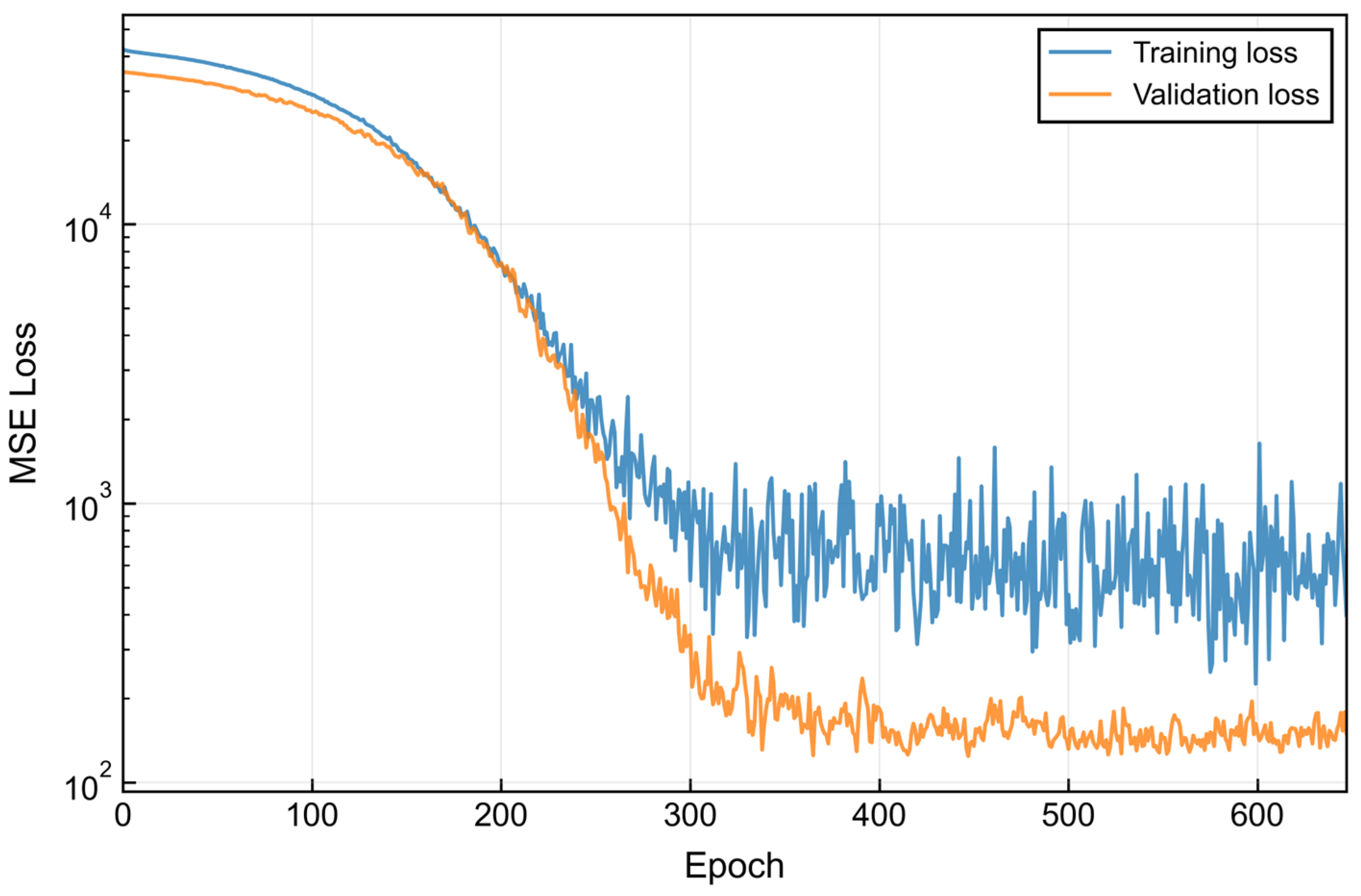
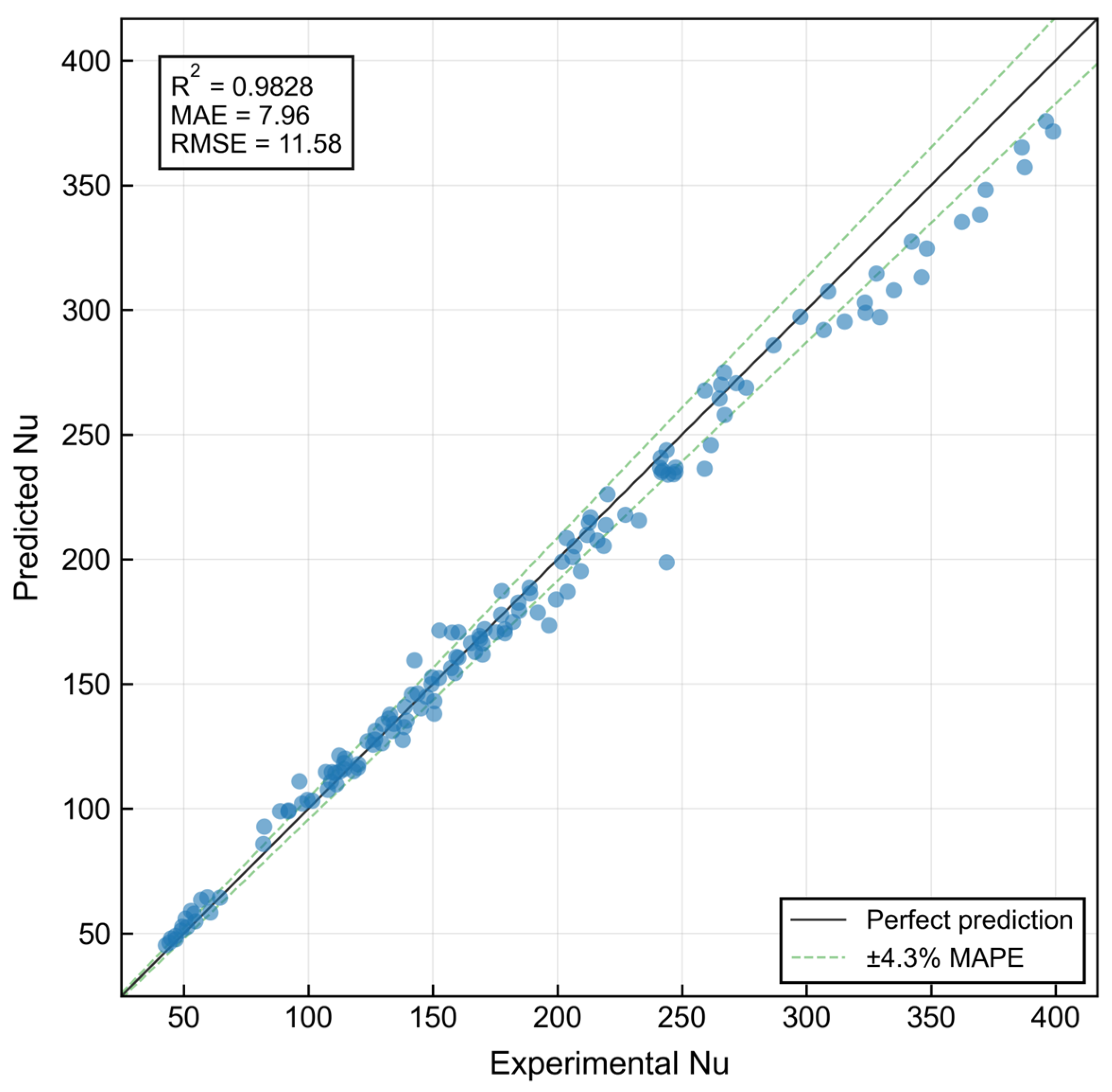
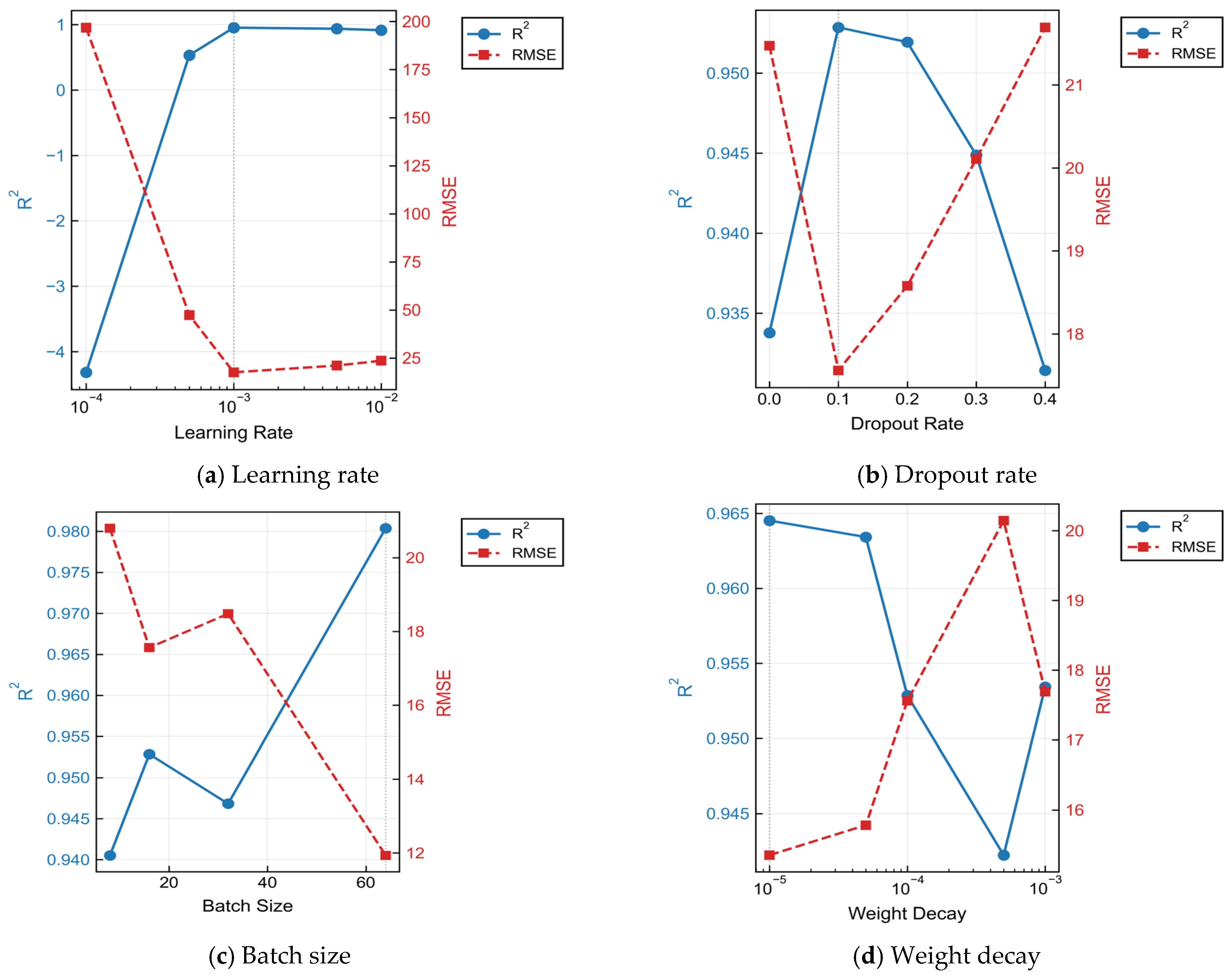
- The proposed DNN model achieved high prediction accuracy for Nu, with an R2 of 0.983, an MAE of 7.96, and an RMSE of 11.58 on the testing set. Compared with conventional machine learning methods, the DNN model better captured the nonlinear relationship between environmental/operating parameters and convective heat transfer.
- (2)
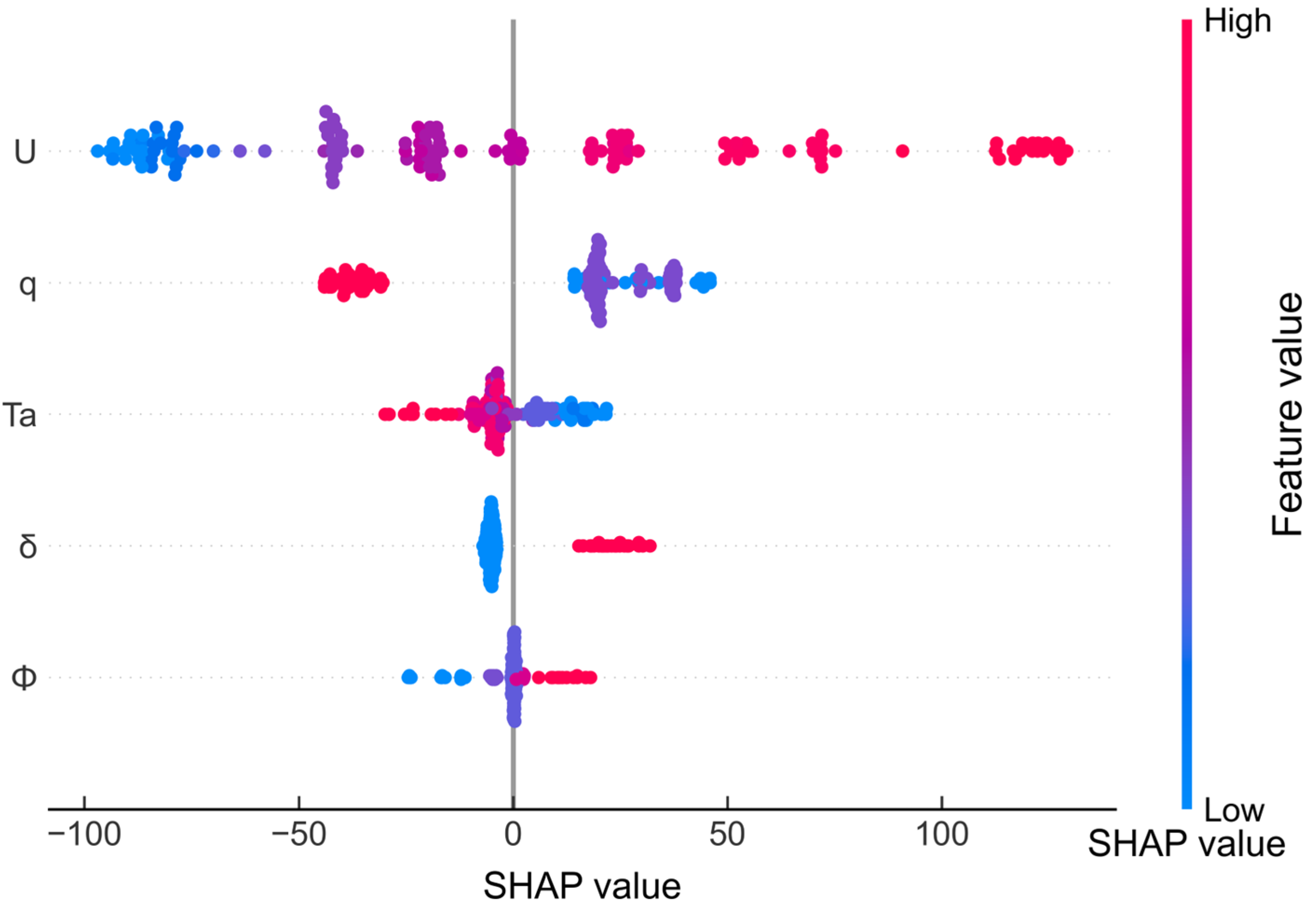
- SHAP analysis identified wind speed as the dominant factor affecting Nu, with its independent main effect accounting for 86.1% of its total contribution. Heat flux density and geometric curvature ratio were secondary but important factors, whereas ambient temperature and relative humidity showed relatively weaker global effects.
- (3)
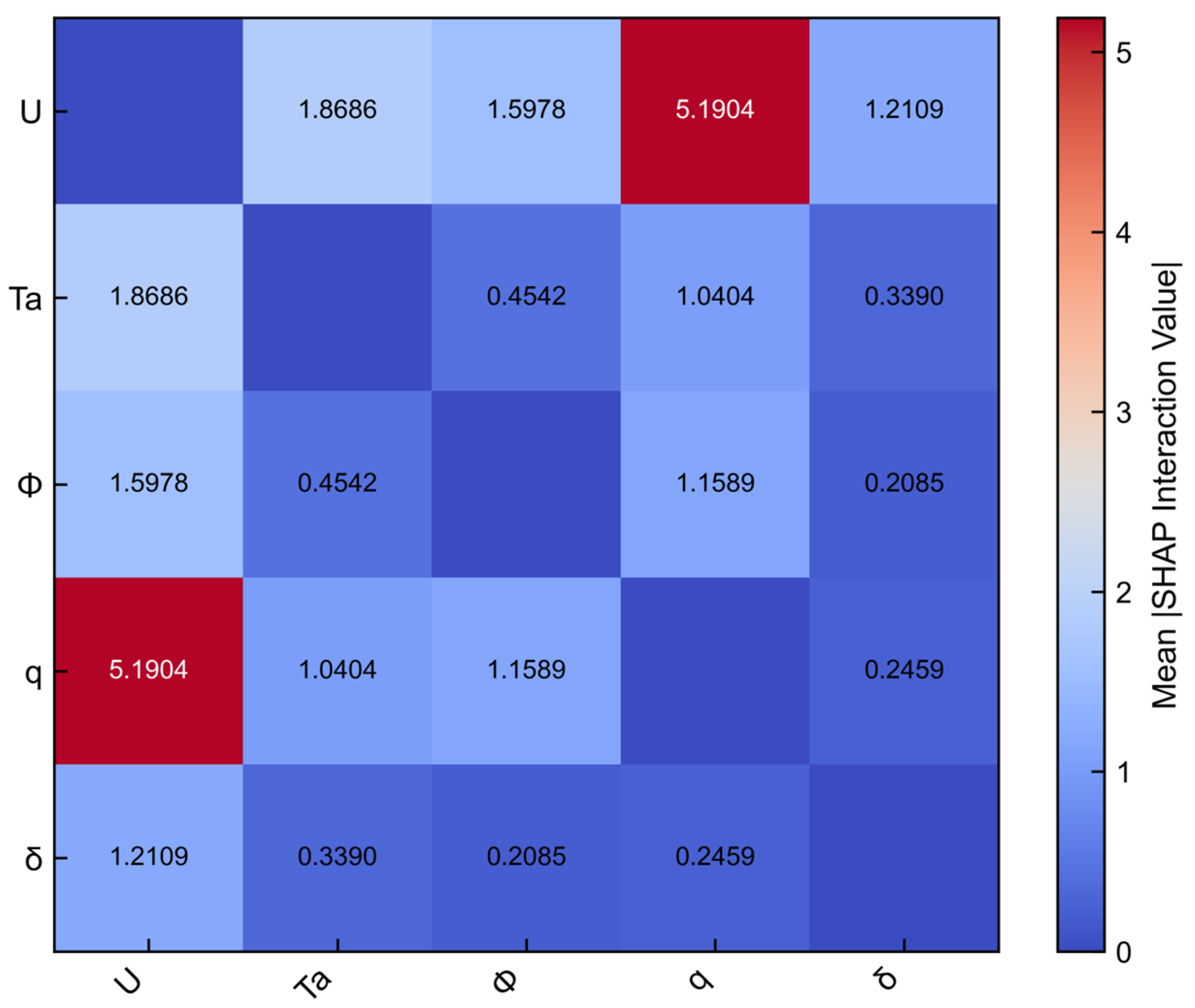
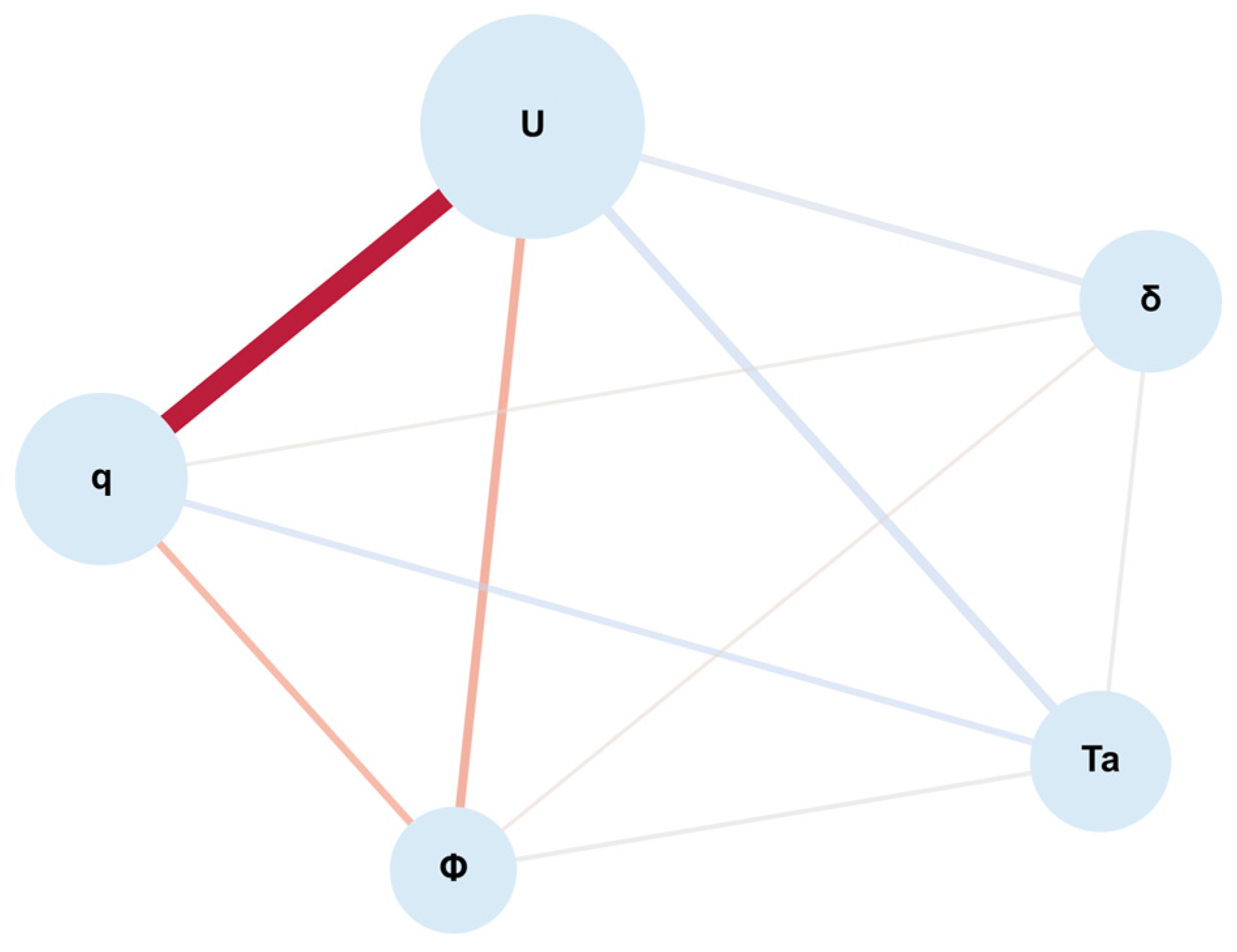
- SHAP interaction analysis further revealed that the strongest coupling effect occurred between wind speed and heat flux density, with a peak average absolute interaction value of 5.19. This indicates that the combined increase in flow velocity and thermal load significantly enhances convective heat transfer.
- (4)
- The present work provides a transferable data-driven framework for heat loss estimation and thermal management of EHT systems on polar marine equipment, but its validity is limited to the experimental parameter ranges investigated. Extrapolation to substantially different conditions requires further validation.
Author Contributions
Funding
Institutional Review Board Statement
Informed Consent Statement
Data Availability Statement
Acknowledgments
Conflicts of Interest
Glossary
| Nomenclature | |
| Heat transfer area of the circular tube (m2) | |
| Outer diameter of the circular tube (m) | |
| Convective heat transfer coefficient (W/(m2·K)) | |
| ) | |
| Nusselt number | |
| Prandtl number | |
| Heating power supplied by the EHT tape (W) | |
| Convective heat transfer rate (W) | |
| Radiative heat transfer rate (W) | |
| Surface heat flux density (W/m2) | |
| Coefficient of determination | |
| Reynolds number | |
| Free-stream air temperature (K) | |
| (K) | |
| Wall temperature (K) | |
| Effective heated length of the circular tube (m) | |
| Inflow wind speed (m/s) | |
| Greek symbols | |
| Relative humidity (%) | |
| Abbreviations | |
| BN | Batch Normalization |
| DNN | Deep Neural Network |
| DT | Decision Tree |
| EHT | Electric Heat Tracing |
| LR | Linear Regression |
| MAE | Mean Absolute Error |
| MAPE | Mean Absolute Percentage Error |
| ReLU | Rectified Linear Unit |
| RF | Random Forest |
| RMSE | Root Mean Square Error |
| SHAP | Shapley Additive Explanations |
References
- Shi, K.; Duan, X. A Review of Ice Protection Techniques for Structures in the Arctic and Offshore Harsh Environments. J. Offshore Mech. Arct. Eng. 2021, 143, 064502. [Google Scholar] [CrossRef] [Scilit]
- Goldstein, R.J.; Madanan, U.; Kuehn, T.H. Simplified Correlations for Free Convection from a Horizontal Isothermal Cylinder. Appl. Therm. Eng. 2019, 161, 113832. [Google Scholar] [CrossRef] [Scilit]
- Liu, C.; Cui, M.; Qian, T.; Li, P.; Wang, J.; Wen, H.; Zhang, D. Numerical Model for Heat Loss and Coupled Heat Transfer on Anti-Icing Surfaces of Polar Equipment under Sea Spray Impact. Case Stud. Therm. Eng. 2025, 76, 107289. [Google Scholar] [CrossRef] [Scilit]
- Sparrow, E.M.; Abraham, J.P.; Tong, J.C.K. Archival Correlations for Average Heat Transfer Coefficients for Non-Circular and Circular Cylinders and for Spheres in Cross-Flow. Int. J. Heat Mass Transf. 2004, 47, 5285–5296. [Google Scholar] [CrossRef] [Scilit]
- Zhao, Q.; Mao, B.; Zhao, J.; Li, H.; Wei, S.; Bai, X.; Zhang, X.; Zhang, Y. Experimental Study on the Forced Convection Heat Transfer Characteristics of Airflow with Variable Thermophysical Parameters in a Circular Tube. Case Stud. Therm. Eng. 2022, 40, 102495. [Google Scholar] [CrossRef] [Scilit]
- Chen, B.-K.; Chang, N.-T.; Hsu, H.-Y. Coupled Inflow Vapour Velocity and Surface Wettability Effect on Condensation Heat Transfer Characteristics: A Volume-of-Fluid Method Study. J. Fluid Mech. 2025, 1011, A13. [Google Scholar] [CrossRef] [Scilit]
- Sanitjai, S.; Goldstein, R.J. Heat Transfer from a Circular Cylinder to Mixtures of Water and Ethylene Glycol. Int. J. Heat Mass Transf. 2004, 47, 4785–4794. [Google Scholar] [CrossRef] [Scilit]
- Fernández-Seara, J.; Uhía, F.J.; Alberto Dopazo, J. Experimental Transient Natural Convection Heat Transfer from a Vertical Cylindrical Tank. Appl. Therm. Eng. 2011, 31, 1915–1922. [Google Scholar] [CrossRef] [Scilit]
- Zhang, L.; Tian, L.; Zhang, A.; Chen, H. Effects of the Shape of Tube and Flow Field on Fluid Flow and Heat Transfer. Int. Commun. Heat Mass Transf. 2020, 117, 104782. [Google Scholar] [CrossRef] [Scilit]
- Rafi, A.H.; Rahman, M.R.; Rabby, S.M.F.; Ahmed, D.H. Natural and Forced Convective Heat Transfer Enhancement for Solid Cylinders with Different Geometrical Shapes. Period. Polytech. Mech. Eng. 2024, 68, 97–113. [Google Scholar] [CrossRef] [Scilit]
- Loyola-Fuentes, J.; Nazemzadeh, N.; Diaz-Bejarano, E.; Mancin, S.; Coletti, F. A Framework for Data Regression of Heat Transfer Data Using Machine Learning. Appl. Therm. Eng. 2024, 248, 123043. [Google Scholar] [CrossRef] [Scilit]
- Vu, A.T.; Gulati, S.; Vogel, P.-A.; Grunwald, T.; Bergs, T. Machine Learning-Based Predictive Modeling of Contact Heat Transfer. Int. J. Heat Mass Transf. 2021, 174, 121300. [Google Scholar] [CrossRef] [Scilit]
- Kim, M.; Moon, J.H. Deep Neural Network Prediction for Effective Thermal Conductivity and Spreading Thermal Resistance for Flat Heat Pipe. Int. J. Numer. Methods Heat Fluid Flow 2022, 33, 437–455. [Google Scholar] [CrossRef] [Scilit]
- Zhong, J.; Zhu, H.; Zhou, T.; Zhou, S.; Song, J. Prediction of Fluid-Thermal-Structure Interaction of Three Equilateral-Triangular Circular Cylinders Based on XGBoost-SHAP. Ocean Eng. 2025, 333, 121558. [Google Scholar] [CrossRef] [Scilit]
- Li, S.; Yang, H.; Zhang, X.; Sun, M.; Liu, Y.; Song, Y. Rapid Prediction of Heat Transfer Characteristics in Regenerative Cooling Channels of Ram/Scramjet Using Machine Learning. Aerosp. Sci. Technol. 2026, 168, 111088. [Google Scholar] [CrossRef] [Scilit]
- Liu, C.; Cui, M.; Li, P.; Cao, J.; Wen, H.; Yuan, Y.; Zhang, D. A Study on the Coupled Mechanisms of Surface Thermal Loss and Explainable Data-Driven Modeling for Marine Equipment Components in Polar Environments. Appl. Ocean Res. 2025, 162, 104733. [Google Scholar] [CrossRef] [Scilit]
- Liu, H.; Wen, H.; Cao, J.; Han, X.; Liu, C.; Zhang, D. Impact of Convective Heat Transfer on Circular Tube Components in Polar Ships Within Ice-Covered Regions. J. Mar. Sci. Eng. 2025, 13, 1207. [Google Scholar] [CrossRef] [Scilit]
- Yu, D.; Zhang, D.; Wu, L.; Kong, X.; Yue, Q. Analysis of the Influence of Convection Heat Transfer in Circular Tubes on Ships in a Polar Environment. Atmosphere 2022, 13, 149. [Google Scholar] [CrossRef] [Scilit]
- Bernardini, L.; McLinden, M.O.; Yang, X.; Richter, M. How Accurate Are Your Experimental Data? A More Accessible GUM-Based Methodology for Uncertainty Evaluation. Int. J. Thermophys. 2024, 45, 164. [Google Scholar] [CrossRef] [Scilit]
- Lundberg, S.; Lee, S.-I. A Unified Approach to Interpreting Model Predictions. Adv. Neural Inf. Process. Syst. 2017, 30, 4765–4774. [Google Scholar] [CrossRef] [Scilit]
- Wu, Z.; Chen, X.; Mao, Y.; Li, E.; Zeng, X.; Wang, J.-X. A Deep Learning Algorithm with Smart-Sized Training Data for Transient Thermal Performance Prediction. Case Stud. Therm. Eng. 2022, 39, 102420. [Google Scholar] [CrossRef] [Scilit]





| The Physical Quantity Being Measured | The Symbol of the Physical Quantity | Relative Uncertainty | Sources of Uncertainty |
|---|---|---|---|
| Heating power (W) | 2% | Power fluctuations | |
| Outer diameter of the round pipe (m) | D | 0.5% | Pipe diameter tolerance |
| Wall temperature (K) | 0.6% | K-type thermocouple accuracy | |
| Fluid temperature (K) | 0.6% | Environmental inhomogeneity |
| Variable | Symbol | Range | Unit |
|---|---|---|---|
| Free-stream air temperature | −40 to −5 | °C | |
| Wind speed | 2 to 9.5 | m/s | |
| Relative humidity | 10 to 95 | % | |
| Heat flux density | 758, 1517, 2807 | W/m2 | |
| Curvature ratio | 0, 0.336 | / |
| Model | R2 | MAE | RMSE |
|---|---|---|---|
| LR | 0.892 | 26.22 | 31.79 |
| DT | 0.973 | 10.93 | 15.85 |
| RF | 0.977 | 9.51 | 14.86 |
| DNN | 0.983 | 7.96 | 11.58 |
| Feature | Mean Absolute Main Effect | Mean Absolute Interaction Effect | Total Mean Absolute SHAP Value | Proportion of Main Effect (%) | Relative Importance (%) |
|---|---|---|---|---|---|
| 60.9 | 9.8 | 70.7 | 86.1 | 51.1 | |
| 26.5 | 7.6 | 34.1 | 77.7 | 24.6 | |
| 10.1 | 3.7 | 13.8 | 73.2 | 10.0 | |
| 10.8 | 2.0 | 12.8 | 84.4 | 9.2 | |
| 3.7 | 3.4 | 7.1 | 52.1 | 5.1 |
Disclaimer/Publisher’s Note: The statements, opinions and data contained in all publications are solely those of the individual author(s) and contributor(s) and not of MDPI and/or the editor(s). MDPI and/or the editor(s) disclaim responsibility for any injury to people or property resulting from any ideas, methods, instructions or products referred to in the content. |
© 2026 by the authors. Licensee MDPI, Basel, Switzerland. This article is an open access article distributed under the terms and conditions of the Creative Commons Attribution (CC BY) license.
Share and Cite
Zhang, S.; Liu, C.; Wang, J.; Xi, J.; Gong, Y.; Chen, Y.; Wen, H.; Zhang, D. Interpretable Predictive Model and Multi-Factor Coupling Mechanism of Convective Heat Transfer on Heated Cylinders in Polar Marine Environments. Atmosphere 2026, 17, 525. https://doi.org/10.3390/atmos17050525
Zhang S, Liu C, Wang J, Xi J, Gong Y, Chen Y, Wen H, Zhang D. Interpretable Predictive Model and Multi-Factor Coupling Mechanism of Convective Heat Transfer on Heated Cylinders in Polar Marine Environments. Atmosphere. 2026; 17(5):525. https://doi.org/10.3390/atmos17050525
Chicago/Turabian StyleZhang, Siyu, Chenyang Liu, Jiankai Wang, Jinhao Xi, Yuning Gong, Yan Chen, Haiming Wen, and Dayong Zhang. 2026. "Interpretable Predictive Model and Multi-Factor Coupling Mechanism of Convective Heat Transfer on Heated Cylinders in Polar Marine Environments" Atmosphere 17, no. 5: 525. https://doi.org/10.3390/atmos17050525
APA StyleZhang, S., Liu, C., Wang, J., Xi, J., Gong, Y., Chen, Y., Wen, H., & Zhang, D. (2026). Interpretable Predictive Model and Multi-Factor Coupling Mechanism of Convective Heat Transfer on Heated Cylinders in Polar Marine Environments. Atmosphere, 17(5), 525. https://doi.org/10.3390/atmos17050525