
Global Mesospheric Inversion Layer Climatology and Statistics Based on Limb-Sounding Satellite Data
 ,
,  and
and
Abstract
1. Introduction
2. Data and Methods
2.1. Data
2.2. Methods
3. Results
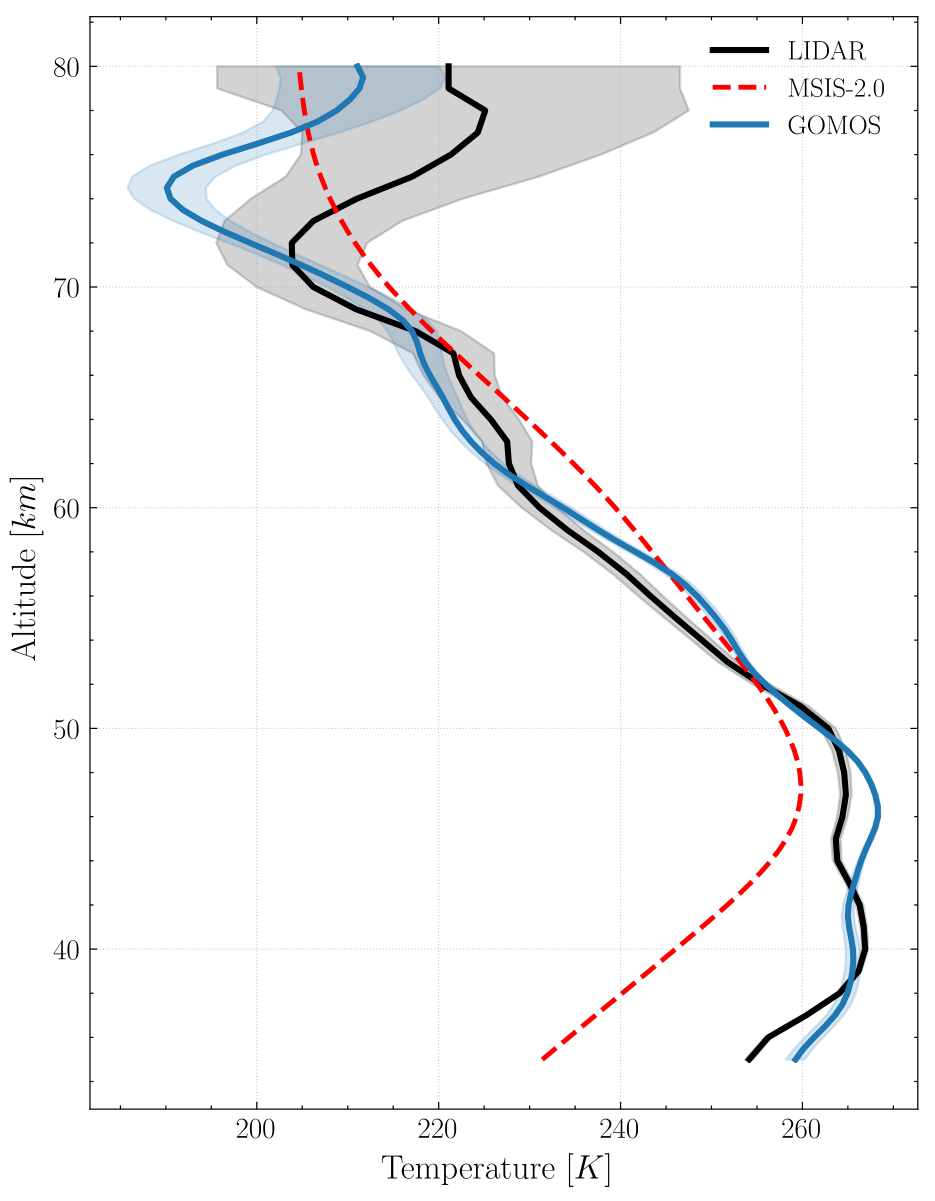
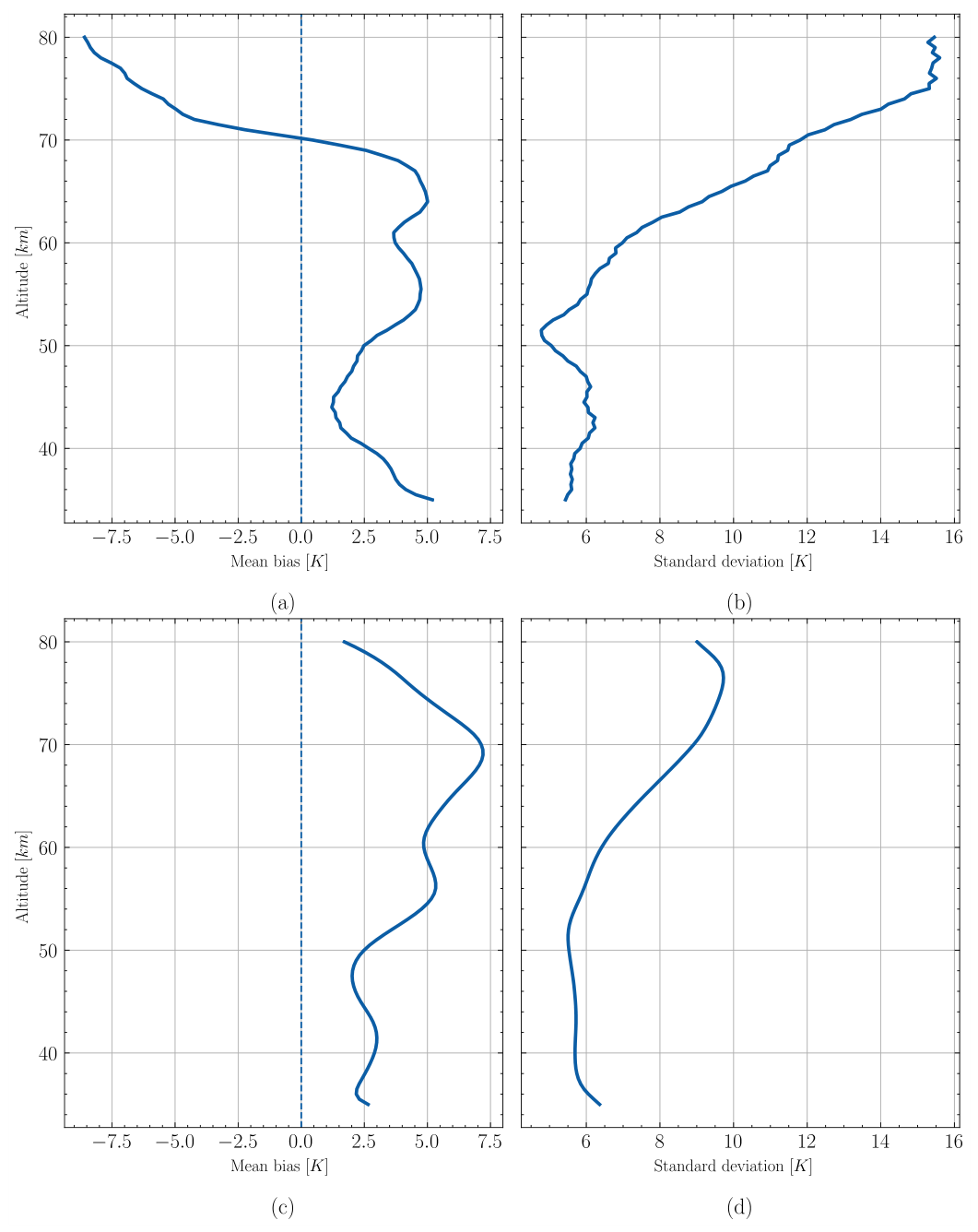
3.1. Comparison of GOMOS Profiles with LIDAR Measurement and the MSIS-2.0 Model
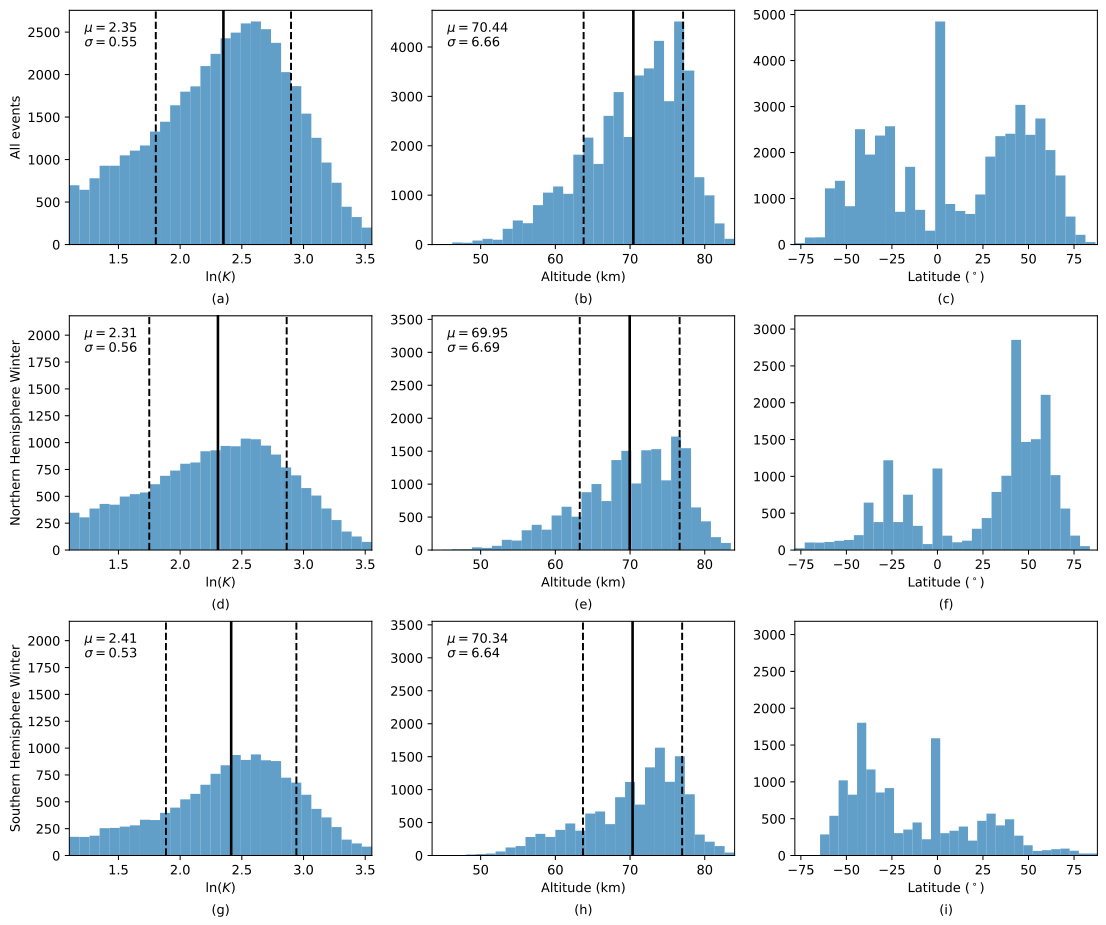
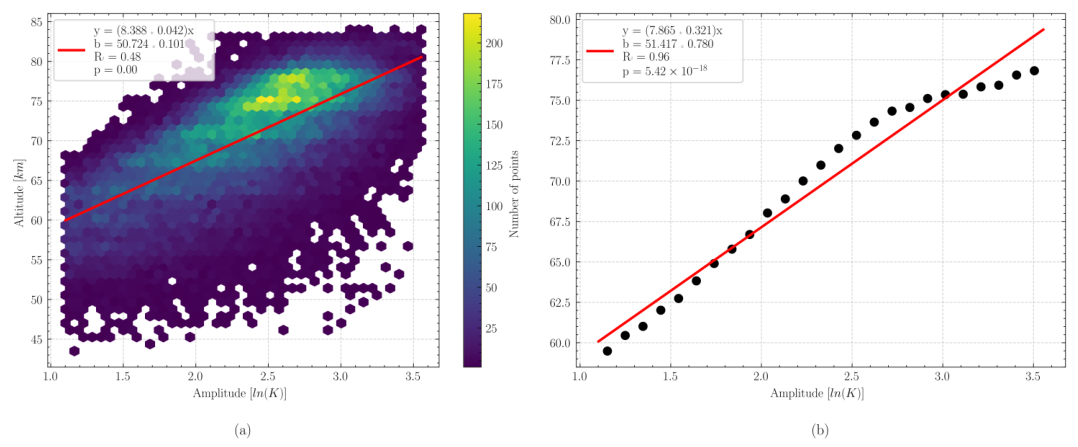
3.2. MILs Statistics
Inversion Occurrence Depending on the Mesospheric Season
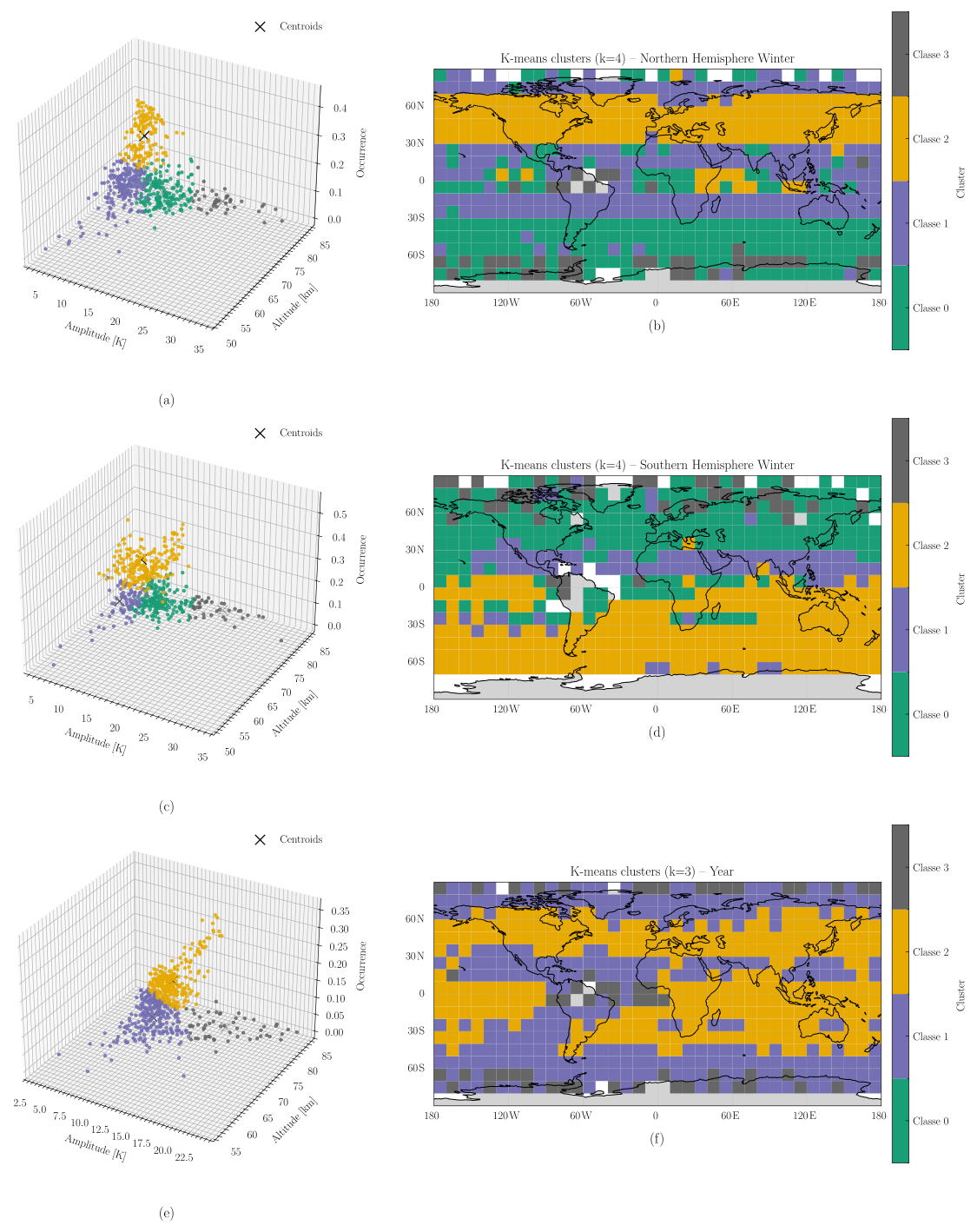
3.3. Possible Classification of Inversions
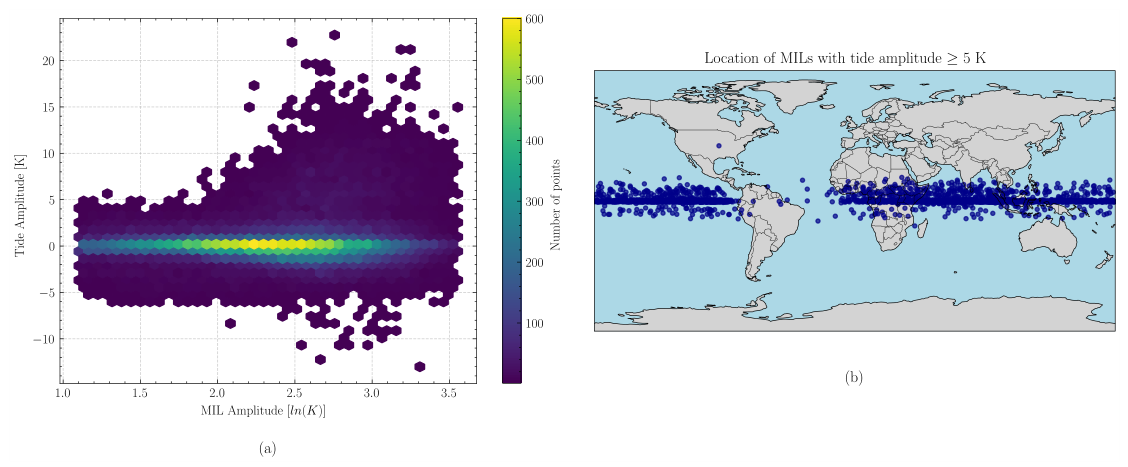
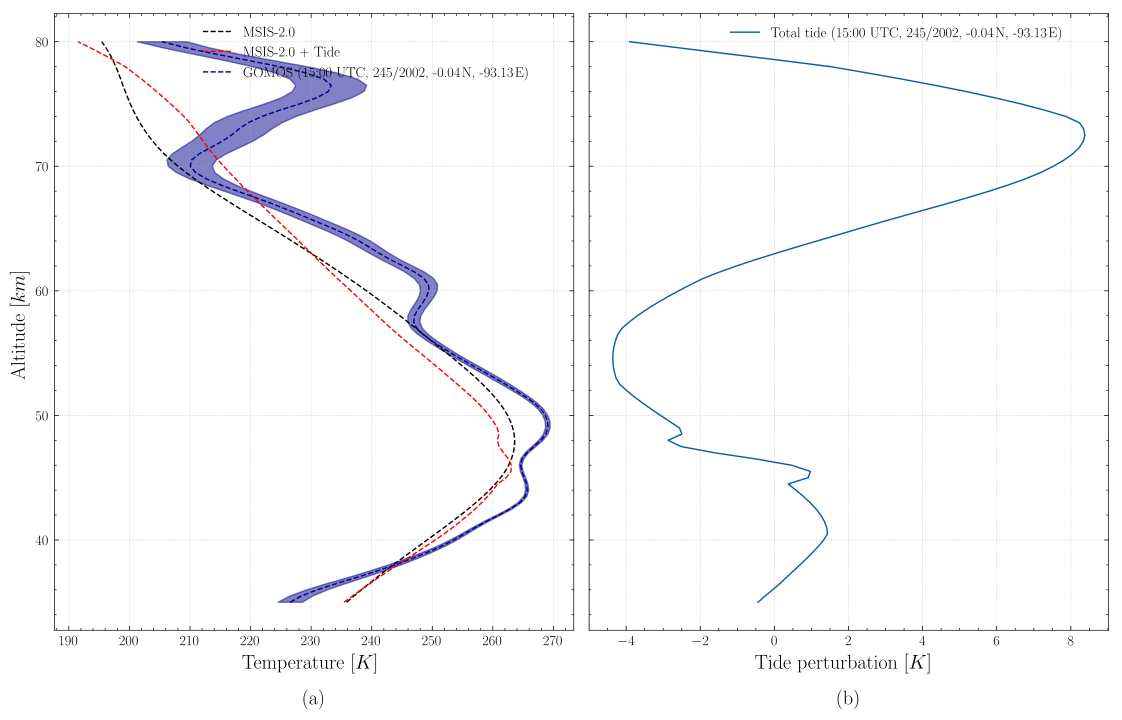
3.4. Relation of Atmospheric Tides and Inversions
4. Discussion
4.1. Comparison of GOMOS Profiles with LIDAR Measurement and the MSIS-2.0 Model
4.2. Lower MILs Statistics
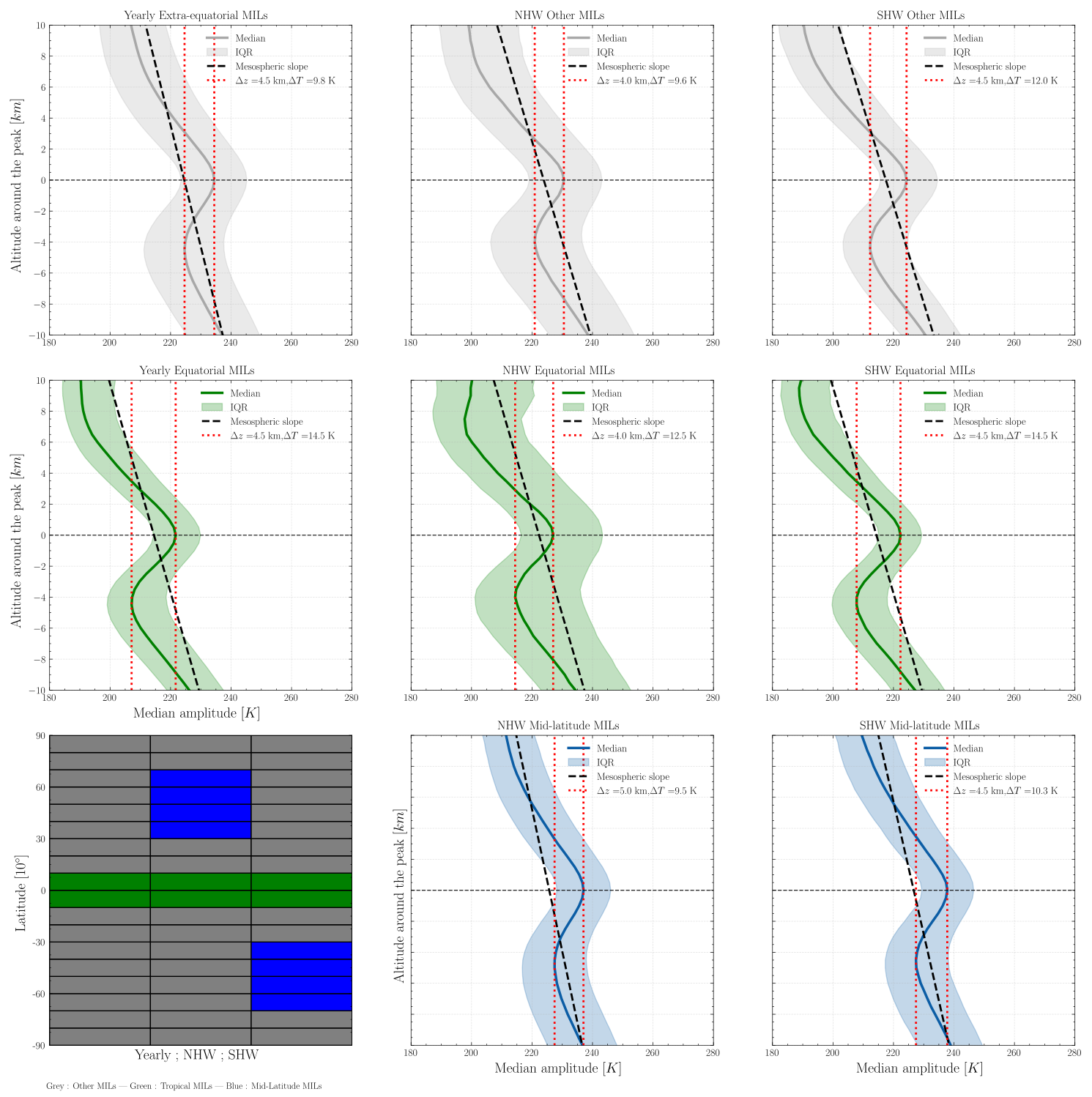
4.3. Possible Classification of Inversions
4.4. Relation of Polar Vortex Disturbance and Inversions
4.5. Relation of Numerical Atmospheric Tides and MILs
5. Conclusions
Author Contributions
Funding
Institutional Review Board Statement
Informed Consent Statement
Data Availability Statement
Acknowledgments
Conflicts of Interest
Abbreviations
| MIL | Mesospheric Inversion Layer |
| SSW | Sudden Stratosheric Warming |
| SSA | South Atlantic Anomaly |
| NHW | Northern Hemisphere Winter |
| SHW | Southern Hemisphere Winter |
References
- Tett, S.F.; Betts, R.; Crowley, T.J.; Gregory, J.; Johns, T.C.; Jones, A.; Osborn, T.J.; Öström, E.; Roberts, D.L.; Woodage, M.J. The impact of natural and anthropogenic forcings on climate and hydrology since 1550. Clim. Dyn. 2006, 28, 3–34. [Google Scholar] [CrossRef]
- Qian, L.; Jacobi, C.; McInerney, J. Trends and solar irradiance effects in the mesosphere. J. Geophys. Res. Space Phys. 2019, 124, 1343–1360. [Google Scholar] [CrossRef]
- World Meteorological Organization (WMO). Executive Summary. Scientific Assessment of Ozone Depletion; GAW Report; No. 278; World Meteorological Organization (WMO): Geneva, Switzerland, 2022; pp. 5368–5380. [Google Scholar]
- She, C.-Y.; Berger, U.; Yan, Z.-A.; Yuan, T.; Lübken, F.-J.; Krueger, D.A.; Hu, X. Solar Response and Long-Term Trend of Midlatitude Mesopause Region Temperature Based on 28 Years (1990–2017) of Na-LIDAR Observations. J. Geophys. Res. Space Phys. 2019, 124, 7140–7156. [Google Scholar] [CrossRef]
- Salby, M.; Sassi, F.; Callaghan, P.; Wu, D.; Keckhut, P.; Hauchecorne, A. Mesospheric inversions and their relationship to planetary wave structure. J. Geophys. Res. 2002, 107, ACL 4-1–ACL 4-13. [Google Scholar] [CrossRef]
- Fritts, D.C.; Alexander, M.J. Gravity wave dynamics and effects in the middle atmosphere. Rev. Geophys. 2003, 41, 1003. [Google Scholar] [CrossRef]
- Holton, J.R. The Role of Gravity Wave Induced Drag and Diffusion in the Momentum Budget of the Mesosphere. J. Atmos. Sci. 1982, 791–799. [Google Scholar] [CrossRef]
- Lindzen, R.D.; Chapman, S. Atmospheric tides. Space Sci. Rev. 1969, 10, 3–118. [Google Scholar] [CrossRef]
- Pancheva, D.; Mukhtarov, P.; Bojilova, R. Climatology of the Nonmigrating Tides Based on Long-Term SABER/TIMED Measurements and Their Impact on the Longitudinal Structures Observed in the Ionosphere. Atmosphere 2024, 15, 478. [Google Scholar] [CrossRef]
- Oberheide, J.; Forbes, J.M.; Zhang, X.; Bruinsma, S. Climatology of upward propagating diurnal and semidiurnal tides in the thermosphere. J. Geophys. Res. 2011, 116, A11306. [Google Scholar] [CrossRef]
- Leovy, C. Simple Models of Thermally Driven Mesopheric Circulation. J. Atmos. Sci. 1964, 21, 327–341. [Google Scholar] [CrossRef][Green Version]
- Tufel, N.G.; Keckhut, P.; Dumas, L.; Mariaccia, A.; Meftah, M.; Courcoux, Y.; Vicomte, M.; Hauchecorne, A. Assessment of middle atmosphere climatology using LIDAR for aerospace applications. Adv. Space. Res. 2025, 18, 1871–1889. [Google Scholar] [CrossRef]
- Schmidlin, F.J. Temperature inversion near 75 km. Geophys. Res. Lett. 1976, 3, 173–176. [Google Scholar] [CrossRef]
- Meriwether, J.W.; Gardner, C.S. A review of the mesosphere inversion layer phenomenon. J. Geophys. Res. 2000, 105, 12405–12416. [Google Scholar] [CrossRef]
- Fritts, D.C.; Laughman, B.; Wang, L.; Lund, T.S.; Collins, R.L. Collins; Gravity wave dynamics in a mesospheric inversion layer: 1. Reflection, trapping, and instability dynamics. J. Geophys. Res. Atmos. 2018, 123, 626–648. [Google Scholar] [CrossRef]
- Hauchecorne, A.; Blanot, L.; Wing, R.; Keckhut, P.; Khaykin, S.; Bertaux, J.L.; Meftah, M.; Claud, C.; Sofieva, V. A new MesosphEO data set of temperature profiles from 35 to 85 km using Rayleigh scattering at limb from GOMOS/ENVISAT daytime observations. Atmos. Meas. Tech. 2019, 12, 749–761. [Google Scholar] [CrossRef]
- Meriwether, J.W.; Gerrard, A.J. Mesosphere inversion layers and stratosphere temperature enhancements. Rev. Geophys. 2004, 42, 42–73. [Google Scholar] [CrossRef]
- Szewczyk, A.; Strelnikov, B.; Rapp, M.; Strelnikova, I.; Baumgarten, G.; Kaifler, N.; Hoppe, U.-P. Simultaneous observations of a mesospheric inversion layer and turbulence during the ECOMA-2010 rocket campaign. Ann. Geophys. 2013, 31, 775–785. [Google Scholar] [CrossRef]
- Mariaccia, A.; Keckhut, P.; Hauchecorne, A.; Khaykin, S.; Ratynski, M. Co-Located Wind and Temperature Observations at Mid-Latitudes During Mesospheric Inversion Layer Events. Geophys. Res. Let. 2023, 50, e2022GL102683. [Google Scholar] [CrossRef]
- De Mazière, M.; Thompson, M.; Kurylo, M.J.; Wild, J.D.; Bernhard, G.; Blumenstock, T.; Braathen, G.O.; Hannigan, J.W.; Lambert, J.C.; Leblanc, T.; et al. The Network for the Detection of Atmospheric Composition Change (NDACC): History, status and perspectives. Atmos. Chem. Phys. 2018, 18, 4935–4964. [Google Scholar] [CrossRef]
- Steinbrecht, W.; Leblanc, T. LIDARs in the Network for Detection of Atmospheric Composition Change (NDACC) and the Tropospheric Ozone LIDAR Network (TOLNet). In Handbook of Air Quality and Climate Change; Akimoto, H., Tanimoto, H., Eds.; Springer: Singapore, 2023. [Google Scholar] [CrossRef]
- McGee, T.J.; Sullivan, J.T.; Twigg, L.W.; Sumnicht, G.K.; Barnes, J.; Leblanc, T.; McDermid, S. LIDAR validation measurements at the NOAA Mauna Loa Observatory NDACC Station. LIDAR Remote Sens. Environ. Monit. XVI 2018, 10779, 47–63. [Google Scholar] [CrossRef]
- Wing, R.; Hauchecorne, A.; Keckhut, P.; Godin-Beekmann, S.; Khaykin, S.; McCullough, E. LIDAR temperature series in the middle atmosphere as a reference data set. part 2: Assessment of temperature observations from MLS/AURA and SABER/TIMED satellites. Atmos. Meas. Tech. 2018, 11, 6703–6717. [Google Scholar] [CrossRef]
- Fechine, J.; Wrasse, C.M.; Takahashi, H.; Mlynczak, M.G.; Russel, J.M. Lower-mesospheric inversion layers over brazilian equatorial region using TIMED/SABER temperature profiles. Adv. Space. Res. 2008, 41, 1447–1453. [Google Scholar] [CrossRef]
- France, J.A.; Harvey, V.L.; Randall, C.E.; Collins, R.L.; Smith, A.K.; Peck, E.D.; Fang, X. A climatology of planetary wave-driven mesospheric inversion layers in the extraequatorial winter. J. Geophys. Res. Atmos. 2015, 120, 399–413. [Google Scholar] [CrossRef]
- Da Costa–Louro, P.; Keckhut, P.; Hauchecorne, A.; Meftah, M.; Jaross, G.; Mangin, A. Limb Temperature Observations in the Stratosphere and Mesosphere Derived from the OMPS Sensor. Remote Sens. 2024, 16, 3878. [Google Scholar] [CrossRef]
- Leblanc, T.; Hauchecorne, A. Recent observations of mesospheric temperature inversions. J. Geophys. Res. Atmos. 1997, 102, 19471–19482. [Google Scholar] [CrossRef]
- Gan, Q.; Zhang, S.D.; Yi, F. TIMED/SABER observations of lower mesospheric inversion layers at low and middle latitudes. J. Geophys. Res. Atmos. 2012, 117. [Google Scholar] [CrossRef]
- Bertaux, J.L.; Mégie, G.; Widemann, T.; Chassefière, E.; Pellinen, R.; Kyrola, E.; Korpela, S.; Simon, P. Monitoring of ozone trend by stellar occultations: The GOMOS instrument. Adv. Space Res. 1991, 11, 237–242. [Google Scholar] [CrossRef]
- Pérot, K. Characterisation and Climatology of Polar Mesospheric Clouds from GOMOS / ENVISAT Stellar Occultation Instrument. Ph.D. Thesis, Université Pierre et Marie Curie, Paris, France, 2012. [Google Scholar]
- Emmert, J.T.; Drob, D.P.; Picone, J.M.; Siskind, D.E.; Jones, M., Jr.; Mlynczak, M.G.; Bernath, P.F.; Chu, X.; Doornbos, E.; Funke, B.; et al. A whole-atmosphere empirical model of temperature and neutral species densities. Earth Space Sci. 2020, 8, e2020EA001321. [Google Scholar] [CrossRef]
- Ardalan, M.; Keckhut, P.; Hauchecorne, A.; Wing, R.; Meftah, M.; Farhani, G. Updated Climatology of Mesospheric Temperature Inversions Detected by Rayleigh LIDAR above Observatoire de Haute Provence, France, Using a K-Mean Clustering Technique. Atmosphere 2022, 13, 814. [Google Scholar] [CrossRef]
- Cleveland, W.S. Robust Locally Weighted Regression and Smoothing Scatterplots. J. Am. Stat. Assoc. 1979, 74, 829–836. [Google Scholar] [CrossRef]
- Gelman, A.; Hill, J. Data Analysis Using Regression and Multilevel/Hierarchical Models; Cambridge University Press: Cambridge, UK, 2007; pp. 154–196. [Google Scholar]
- GSWM: Global Scale Wave Model. Available online: https://www.hao.ucar.edu/modeling/gswm/gswm.html (accessed on 20 February 2026).
- Hagan, M.E.; Forbes, J.M.; Vial, F. On modeling migrating solar tides. Geophys. Res. Lett. 1995, 22, 893–896. [Google Scholar] [CrossRef]
- MacQueen, J. Some methods for classification and analysis of multivariate observations. Berkeley Symp. Math. Stat. Prob. 1967, 5, 281–297. [Google Scholar]
- Hauchecorne, A.; Chanin, M.-L.; Wilson, R. Mesospheric temperature inversion and gravity wave breaking. Geophys. Res. Let. 1987, 14, 933–936. [Google Scholar] [CrossRef]
- Zhang, X.; Forbes, J.M.; Hagan, M.E.; Russell, J.M., III; Palo, S.E.; Mertens, C.J.; Mlynczak, M.G. Monthly tidal temperatures 20–120 km from TIMED/SABER. J. Geophys. Res. 2006, 111, 893–896. [Google Scholar] [CrossRef]
- Bègue, N.; Mbatha, N.; Bencherif, H.; Loua, R.T.; Sivakumar, V.; Leblanc, T. Statistical analysis of the mesospheric inversion layers over two symmetrical tropical sites: Réunion (20.8° S, 55.5° E) and Mauna Loa (19.5° N, 155.6° W). Ann. Geophys. 2017, 35, 1177–1194. [Google Scholar] [CrossRef][Green Version]
- Strelnikova, I.; Almowafy, M.; Baumgarten, G.; Baumgarten, K.; Ern, M., Jr.; Gerding, M.; Lübken, F.-J. Seasonal Cycle of Gravity Wave Potential Energy Densities from LIDAR and Satellite Observations at 54° and 69°N. J. Atmos. Sci. 2021, 78, 1359–1386. [Google Scholar] [CrossRef]
- Jaross, G.; Bhartia, P.K.; Chen, G.; Kowitt, M.; Haken, M.; Chen, Z.; Xu, P.; Warner, J.; Kelly, T. OMPS Limb Profiler instrument performance assessment. J. Geophys. Res. Atmos. 2014, 119, 4399–4412. [Google Scholar] [CrossRef]
- Okui, H.; Sato, K.; Koshin, D.; Watanabe, S. Formation of a mesospheric inversion layer and the subsequent elevated stratopause associated with the major stratospheric sudden warming in 2018/19. J. Atmos. Sci. 2021, 126, e2021JD034681. [Google Scholar] [CrossRef]
- Riggin, D.M.; Lieberman, R.S. Variability of the diurnal tide in the equatorial MLT. JASTP 2013, 102, 1364–6826. [Google Scholar] [CrossRef]
- Lieberman, R.S.; Riggin, D.M.; Ortland, D.A.; Nesbitt, S.W.; Vincent, R.A. Variability of mesospheric diurnal tides and tropospheric diurnal heating during 1997–1998. J. Geophys. Res. 2007, 112, D20110. [Google Scholar] [CrossRef]
- Garcia, R.R. On the Structure and Variability of the Migrating Diurnal Temperature Tide Observed by SABER. J. Atmos. Sci. 2023, 80, 687–704. [Google Scholar] [CrossRef]
- Chalachew Lingerew, U. Jaya Prakash Raju, Investigating the role of gravity waves in mesosphere and lower-thermosphere (MLT) inversions at low latitudes. Ann. Geophys. 2025, 43, 1–14. [Google Scholar] [CrossRef]
- Chane Ming, F.; Hauchecorne, A.; Bellisario, C.; Simoneau, P.; Keckhut, P.; Trémoulu, S.; Listowski, C.; Berthet, G.; Jégou, F.; Khaykin, S.; et al. Case Study of a Mesospheric Temperature Inversion over Maïdo Observatory through a Multi-Instrumental Observation. Remote Sens. 2023, 15, 2045. [Google Scholar] [CrossRef]
- Hauchecorne, A.; Paredes, J.; Cugnet, D.; Keckhut, P.; Cot, C.; Millet, C.; Le Pichon, A.; Heinrich, P. Development of the new realistic atmospheric model RACCORD from the ground to the thermosphere. In Proceedings of the EGU General Assembly 2012, Vienna, Austria, 22–27 April 2012; Available online: https://hal.science/hal-00707023v1 (accessed on 1 April 2026).
- Jungclaus, J.H.; Lorenz, S.J.; Schmidt, H.; Brovkin, V.; Brüggemann, N.; Chegini, F.; Crüger, T.; De-Vrese, P.; Gayler, V.; Giorgetta, M.A.; et al. The ICON Earth System Model version 1.0. J. Adv. Model. Earth Syst. 2022, 14, e2021MS002813. [Google Scholar] [CrossRef]




Disclaimer/Publisher’s Note: The statements, opinions and data contained in all publications are solely those of the individual author(s) and contributor(s) and not of MDPI and/or the editor(s). MDPI and/or the editor(s) disclaim responsibility for any injury to people or property resulting from any ideas, methods, instructions or products referred to in the content. |
© 2026 by the authors. Licensee MDPI, Basel, Switzerland. This article is an open access article distributed under the terms and conditions of the Creative Commons Attribution (CC BY) license.
Share and Cite
Tufel, N.G.; Da Costa-Louro, P.; Keckhut, P.; Hauchecorne, A. Global Mesospheric Inversion Layer Climatology and Statistics Based on Limb-Sounding Satellite Data. Atmosphere 2026, 17, 510. https://doi.org/10.3390/atmos17050510
Tufel NG, Da Costa-Louro P, Keckhut P, Hauchecorne A. Global Mesospheric Inversion Layer Climatology and Statistics Based on Limb-Sounding Satellite Data. Atmosphere. 2026; 17(5):510. https://doi.org/10.3390/atmos17050510
Chicago/Turabian StyleTufel, Nicolas Gilbert, Pedro Da Costa-Louro, Philippe Keckhut, and Alain Hauchecorne. 2026. "Global Mesospheric Inversion Layer Climatology and Statistics Based on Limb-Sounding Satellite Data" Atmosphere 17, no. 5: 510. https://doi.org/10.3390/atmos17050510
APA StyleTufel, N. G., Da Costa-Louro, P., Keckhut, P., & Hauchecorne, A. (2026). Global Mesospheric Inversion Layer Climatology and Statistics Based on Limb-Sounding Satellite Data. Atmosphere, 17(5), 510. https://doi.org/10.3390/atmos17050510