Article

Global Mesospheric Inversion Layer Climatology and Statistics Based on Limb-Sounding Satellite Data

by
Nicolas Gilbert Tufel
1,2,*,
Pedro Da Costa-Louro
1,
Philippe Keckhut
1 and
Alain Hauchecorne
1,3
1
Laboratoire Atmosphères Observations Spatiales (LATMOS), Institut Pierre-Simon Laplace (IPSL), Université de Versailles Saint-Quentin-en-Yvelines (UVSQ), Centre National de la Recherche Scientifique (CNRS), 78280 Guyancourt, France
2
Direction Générale de l’Armement, 60 Boulevard du Maréchal Martial Valin, 75015 Paris, France
3
Gordien Strato, 91370 Verrières-le-Buisson, France
*
Author to whom correspondence should be addressed.
Atmosphere 2026, 17(5), 510; https://doi.org/10.3390/atmos17050510
Submission received: 26 March 2026 / Revised: 29 April 2026 / Accepted: 11 May 2026 / Published: 17 May 2026
(This article belongs to the Section Upper Atmosphere)

Abstract

This study tackles the middle atmosphere phenomenon known as Mesospheric Inversion Layers (MILs). Reinterpreting Envisat’s GOMOS instrument limb-sounding temperature profiles which we compared to the MSIS-2.0 climatological model, we studied 340,000 resolute temperature profiles, detecting 44,000 (13%) MILs in this dataset. We have shown that MILs are a worldwide phenomenon, concentrated around the tropics and in the Winter Hemisphere’s mid-latitude region (between 30 % and 50 % of profiles are MILs in those areas). MILs follow a correlation law ( R 2 = 0.5 on pure data, R 2 = 0.97 on binned-mean data) between the log-amplitude of its peak and its altitude. Median altitudes are about 70 km worldwide, but the median amplitude reached by equatorial MILs is typically higher (14.5 K compared to the others at 12.5 K). Lastly, equatorial MILs (but not mid-latitude MILs) are correlated with high-difference estimated tide temperature gradient contributions. Results suggest that the MIL is a common phenomenon with statistically consistent characteristics. Seasonal occurrence hinted that there is probably a class of MILs favoured by planetary waves at the edge of the polar vortex, while the equatorial type of inversions seems to occur when the atmospheric tide model flattens the temperature gradient around 70 km.

1. Introduction

The middle atmosphere (MA, 10–100 km) is an interesting layer that ranges between the lower atmosphere (the troposphere and the lower stratosphere), where most particle emissions are mixed (volcanoes, anthropogenic, etc.), and an upper atmosphere whose physics is primarily driven by variations in sun radiations [1,2]. Knowledge about this difficult-to-access layer has improved over the past forty years thanks to growing interest in the ozone layer, one of the key physical objects of the MA, which absorbs UV radiation and has been monitored for the past 30 years [3,4]. Thanks to this subject of interest, some key phenomena which drive these rather quiet air layers have been found and explained. First, the influence of planetary waves on the stratosphere, which can cause periodic heating and cooling of the stratopause, and the breaking of the polar vortex which can cause sudden stratospheric warming (SSW) and deviations of 10 to 40 K from the modelled profile [5]. Then, gravity waves (GWs) propagate through the atmospheric layers, especially in the mesosphere, where the decreasing density induces an exponential increase in their amplitude, typically producing variations from  + 1 to + 3 K of variation around the profile in most temperature profiles, causing, however, a lasting effect on the climatology when they break [6,7]. In addition, the heating of both the ozone layer and water vapour in the middle atmosphere creates a semi-diurnal oscillation of the mesosphere: these waves are called atmospheric migrating and non-migrating tidal waves and can amount to about 10 K difference between two phases [8,9,10]. Finally, convection phenomena which were only theorised like mesospheric circulation and the phenomenon of warm mesosphere/cold stratosphere [11] were observed through ground-breaking instruments like LIDAR sounding and satellite data [12].
However, if some events have been increasingly studied and understood, others remain to be completely understood. For instance, rocket data revealed the existence of high intensity phenomena in the high-mesosphere where the temperature gradient suddenly changes sign [13], called Mesospheric Inversion Layers (MILs), which Rayleigh LIDAR data confirmed and measured to be statistically significant throughout the year [12,14,15]. MILs are usually detected via LIDAR data, but have been recently detected through limb-sounding instruments [16]. However, because the majority of the knowledge on this phenomenon has been deduced from LIDAR observations, little is known on the horizontal or temporal scale of those events, even if it is suggested they could last multiple days and expand vertically over dozens of kilometres and horizontally over hundreds to thousands of kilometres [16]. MILs have been historically classified into two separate event types: the lower MIL, forming under 80 km, and the upper MIL, forming at the frontier with the thermosphere at 95 km [14]. The formation of MILs is still a debatable subject; some theses infer dynamical process might cause them, including, for instance, planetary wave breaking in the upper mesosphere, or tidal waves interacting with gravity waves [5,17]. Strong wind movement and inversion provoked by heating of the layer by breaking gravity waves is also a strong hypothesis [18], backed by the recent demonstration that MILs can be correlated with a wind inversion at the same altitude showed by the re-analysis of the DYANA campaign data [19]. Another oversight about the MILs is that because of the measurement technique mainly used to detect it, we can only acquire statistics on a few points around the Earth especially from the NDACC database [20], which only allows hypotheses on the latitude and longitude distribution of this phenomenon. Indeed today’s measurement abilities for this layer are scarce: LIDARs provide the largest record and stay the most reliable data source [21,22], but they lack important information as mentioned above. Other satellite data like the one measured with a radiometer limb-sounder like SABER have a sufficient vertical resolution, but seem to have bias with the LIDAR [23]. They have, nonetheless, been able to retrieve MIL data, for instance, in Brasil, discovering that this phenomenon happens up to 40% of the time some months in Brasil [24]. SABER surprisingly seems to detect fewer MILS than the WACCM model, but is able to give information on the formation and characteristics of planetary-driven MILs outside of the tropics [25]. However, re-interpretation of limb-sounding satellites used for other purposes presents interest, as it allows us to gather data from a pre-existing mission. In addition, the method of the retrieval, close to the one of the LIDAR, yields similar results and abilities, enabling us to detect the MILs [16]. The data provided by those instruments is more profuse, as it is based either on the lit-limb or on solar/star extinction, even though it then makes it difficult to obtain data for some areas (the poles) [12]: in any case, comparing climatology and statistics with this specific instrument is an important step to consolidate our knowledge of MILs characteristics and occurrences [26].
In past climatologies, Leblanc&Hauchecorne [27] showed with UARS data that MILs had a geographical distribution over a couple of years (1991–1992). They seemed to be occurring mainly during the winter of the considered hemisphere, while there was a consistent occurrence of inversions on the equatorial area, with a maximum in spring. Analyses of SABER data from Gan et al. [28] drew the same conclusion over the years 2002–2013, in particular the mean of temperature around at the equator exhibited a persistent inversion around 85 km. However long-time limb-sounding datasets obtained from Rayleigh-scattering based technique with visible band spectrometers like GOMOS were not used yet to study this phenomenon.
Thus, this study aims at using the GOMOS dataset as described by Hauchecorne et al. [16] to produce a global limb-sounding climatology of the mesospheric inversion layer phenomenon. For this purpose, this paper will first describe the data and methods used (Section 2), describing the additional curation of the profiles and the method to describe the MILs. Section 3 will describe the results we obtained in terms of temporal and spatial distribution, the usual characteristics of the inversions, along with different classifications proposed. Then, we shall discuss the hypothesis we have on the causes of the phenomenon given our results (Section 4), before concluding and laying the future work ahead.

2. Data and Methods

2.1. Data

The data used for this study is the GOMOS instrument (ESA, Paris, France) temperature dataset. GOMOS was an instrument from ESA’s Envisat mission and it acquired data from 2002 to 2012. GOMOS was designed to observe the atmospheric composition from starlight absorption by the atmosphere layers thanks to an original method based on star occultation [29]. The number of occultations was much larger than solar occultations but signals vary for each measurement accordingly to star magnitudes. For temperature retrieval, the measurement is based on detectors which observed the background on a sky portion which did not include the star. This background corresponds to molecular scattering used to derive temperature with Hauchecorne’s technique [16,26]. This treatment has recently been optimised thanks to the New Simplified Radiative Transfer Model developed by Da Costa–Louro and co-authors [26], designed for any instrument measuring at the limb between 30 and 80 km. This model incorporates the absorption effects of O3 and NO2, as well as the extinction effect of Rayleigh scattering. Its main advantage lies in the improvement of results between 30 and 50 km, while allowing the use of the entire wavelength spectrum where Rayleigh scattering of the atmosphere at the limb is measurable, i.e., from the near ultraviolet to the near infrared. In this new database, the wavelength range used has been changed from 420–450 nm to 330–380 because it is a range where Rayleigh scattering is more pronounced, significantly improving results at higher altitudes. With their assent, we used their profiles to obtain a first global analysis and climatology. An additional step to improve the quality of our database is the removal of mesosphere clouds. Indeed, previous research on the GOMOS dataset revealed the importance to observe these little known formations [30]. However, if GOMOS helped study this phenomenon, the temperature retrieval method is highly sensitive to non-Rayleigh scattering. In particular because the temperature profile is recomposed in a top-down method, the entire profile proves too warm if it is computed in the presence of one of those clouds. We therefore used a detection method designed by Pérot [30], which is mainly a threshold on the radiance between 80 and 90 km determined with a χ 2 dispersion study and is dependent on GOMOS’ photometer specifications. This removal step greatly improved the comparison of the instrument with MSIS-2.0 as stated in Section 3.
We compared GOMOS results with two other datasets: the climatological model MSIS-2.0 and the Observatoire de Haute Provence (OHP, Saint-Michel-l’Observatoire, France) LIDAR database. NRLMSISE-2.0 (MSIS-2.0) is a climatological model developed by the Naval Research Laboratory (NASA, Washington, DC, USA): it registers temperature, density and other atmospheric factors as a function of the altitude, latitude, longitude and time. We used the MSIS-2.0 model, which integrates new data on free oxygen at high altitudes [31]. The OHP LIDAR is the oldest operating Rayleigh LIDAR in France (located at 43.94° N, 5.71° E), giving data since 1978: it has been compared with the NASA mobile LIDAR and has been used ever since its creation to both obtain climatological temperature but also to study extreme phenomena like Sudden Stratospheric Warmings or Mesospheric Inversion Layers [12,32].

2.2. Methods

We detected the lower MILs with a method which selects profiles with a gradient inversion which exceeds a threshold increasing with altitude (to filter out GW): this method was previously used to obtain MIL climatologies with LIDAR data [12]. We defined the amplitude of the inversion as the difference between the MIL maximum peak (top of the MIL) and the local minimum in the mesosphere just below the MIL (bottom of the MIL) [14,28]. The validation of the GOMOS profile data was done with the long temporal series of the OHP LIDAR which had already been compared with other satellite observations during validation campaigns [21]. Because Envisat was on a heliosynchronous trajectory, the same spots were visited at the same time, and it is thus impossible to select profiles exactly at the location and time of the LIDAR night measurement. Therefore, we decided to select GOMOS profiles measured at maximum 2 °   ×   2 ° , and acquired at most 2 days apart. Amongst the 340,000 profiles of the GOMOS dataset, the selected profiles close to the LIDAR amounted to 164 profiles. To compare with the climatological high atmosphere model MSIS-2.0 described by Emmert et al. [31], we could use all profiles, as this model can be called at all times, latitudes and longitudes. When we studied the amplitude and altitude of the MILs, because of the amount of profiles used and the rather important variability they display in both altitude and amplitude, we exposed the underlying trend using a binned-mean technique, in which the independent variable is divided into bins and the mean of the dependent variable is computed within each bin. This provides an estimate of the conditional expectation in a discretised form [33,34]. In addition to this method, we inspired ourselves of Ardalan et al. [32] which conducted a K-mean cluster analysis of the OHP MILs. We investigated the relation of MILs with numerical tide modelling: we used for this purpose the open-source numerical points by M. Hagan and co-workers [35,36] and we interpolated them at our data’s scale. We used for our study the temperature contribution created by both diurnal and semi-diurnal tides at the coordinates and time of GOMOS’ profile, and we computed from this value a tide contribution to the temperature gradient at a given altitude T G C : z T t i d e ( z + 2.5 km ) T t i d e ( z 2.5 km ) . We used this function at the top of the MIL z p e a k , to obtain T G C ( z p e a k ) . When we computed this quantity for profiles without an inversion, we randomly selected a peak altitude T G C ( Z ) , Z N ( μ = 70 , σ 2 = 5 2 ) .

3. Results

3.1. Comparison of GOMOS Profiles with LIDAR Measurement and the MSIS-2.0 Model

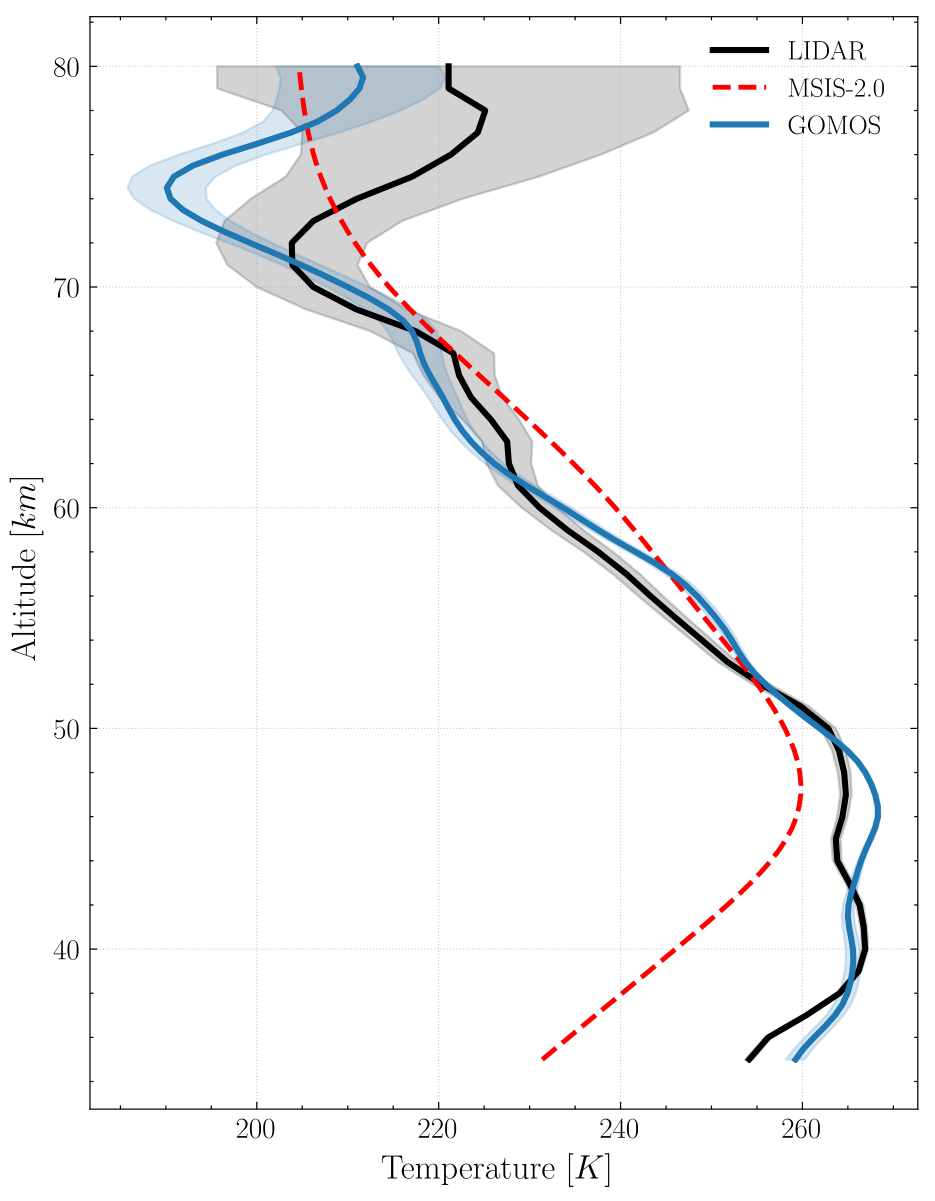
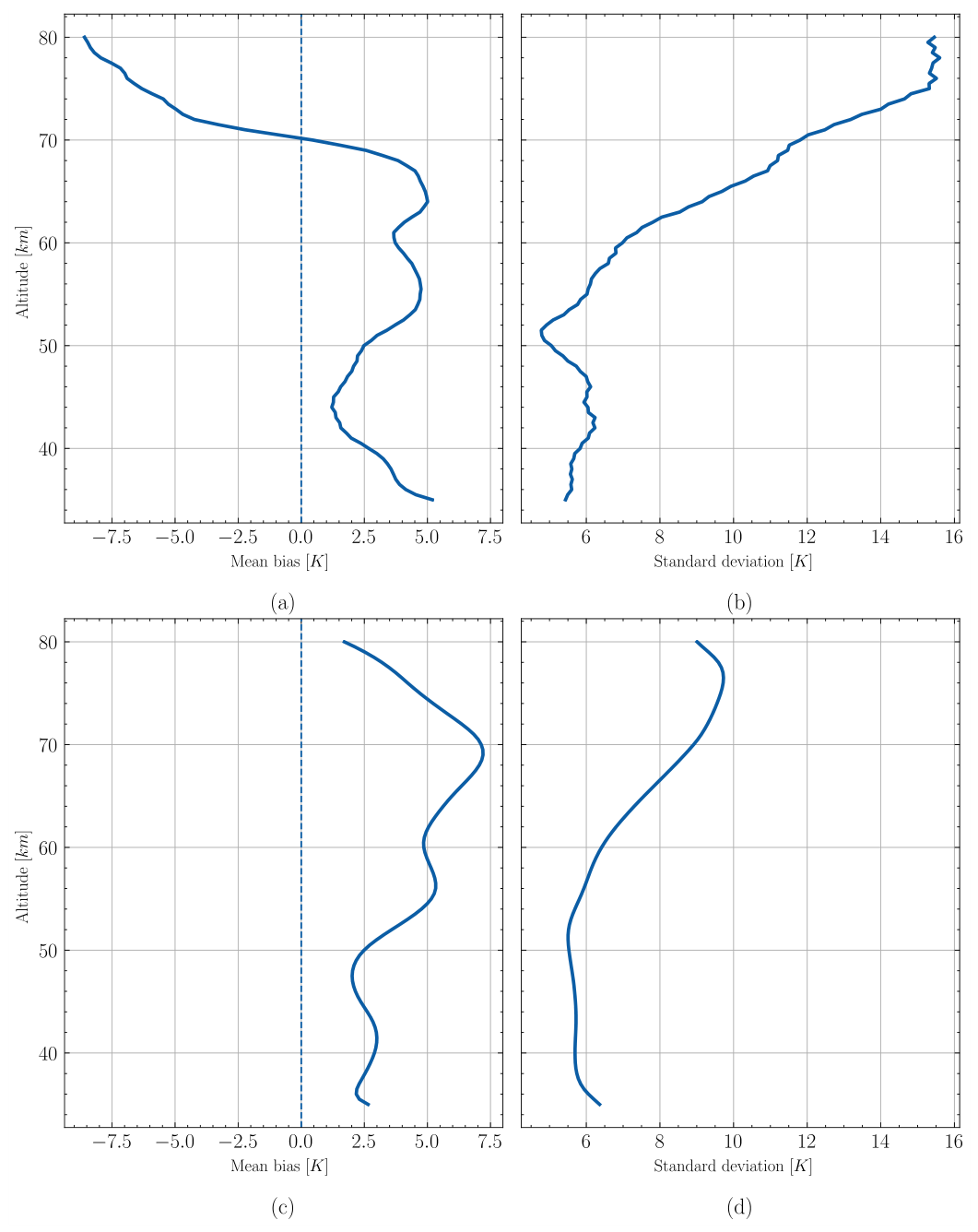
We found that LIDAR and GOMOS profiles, although spatially separated by a couple of degrees are still consistent with each other. On one example profile (seen on Figure 1), the two instruments observe here the same separated structure at the stratopause, the same slope between the stratopause and the inversion occurring at z = 75 km. Its amplitude changing could be the cause of the LIDAR reaching the top of the profile, and the different tide phase between 7 PM and 9 AM. On a larger scale, we present the bias between the GOMOS profiles and the LIDAR measurements at the OHP, which we notice are relatively close (fewer than 8 K difference in mean, as can be observed on Figure 2a. The bias is globally restrained under 5 K below 60 km, when it then increases to reach +10 K at 65 km and −9 K at 75 km. The standard deviation between the ground-based and satellite-borne measurements is contained under 15 K, ranging from about 5 K up to 50 km and increasing to a 16 K maximum at 80 km as represented on Figure 2b. The mean bias with MSIS-2.0 reveals a good agreement in mean of the model, with a bias reaching a maximum of 7 K at 70 km (see Figure 2c), while there is also a good agreement in terms of variability, with values ranging between 6 K in the stratosphere and lower mesosphere and a maximum of 10 K at 75 km, as depicted by Figure 2d. The decrease of variability above this altitude is most certainly linked to our way of retrieving the temperature profile, as we have to use a pressure value at the top of atmosphere which is the value given by MSIS-2.0.

3.2. MILs Statistics

Inversion Occurrence Depending on the Mesospheric Season

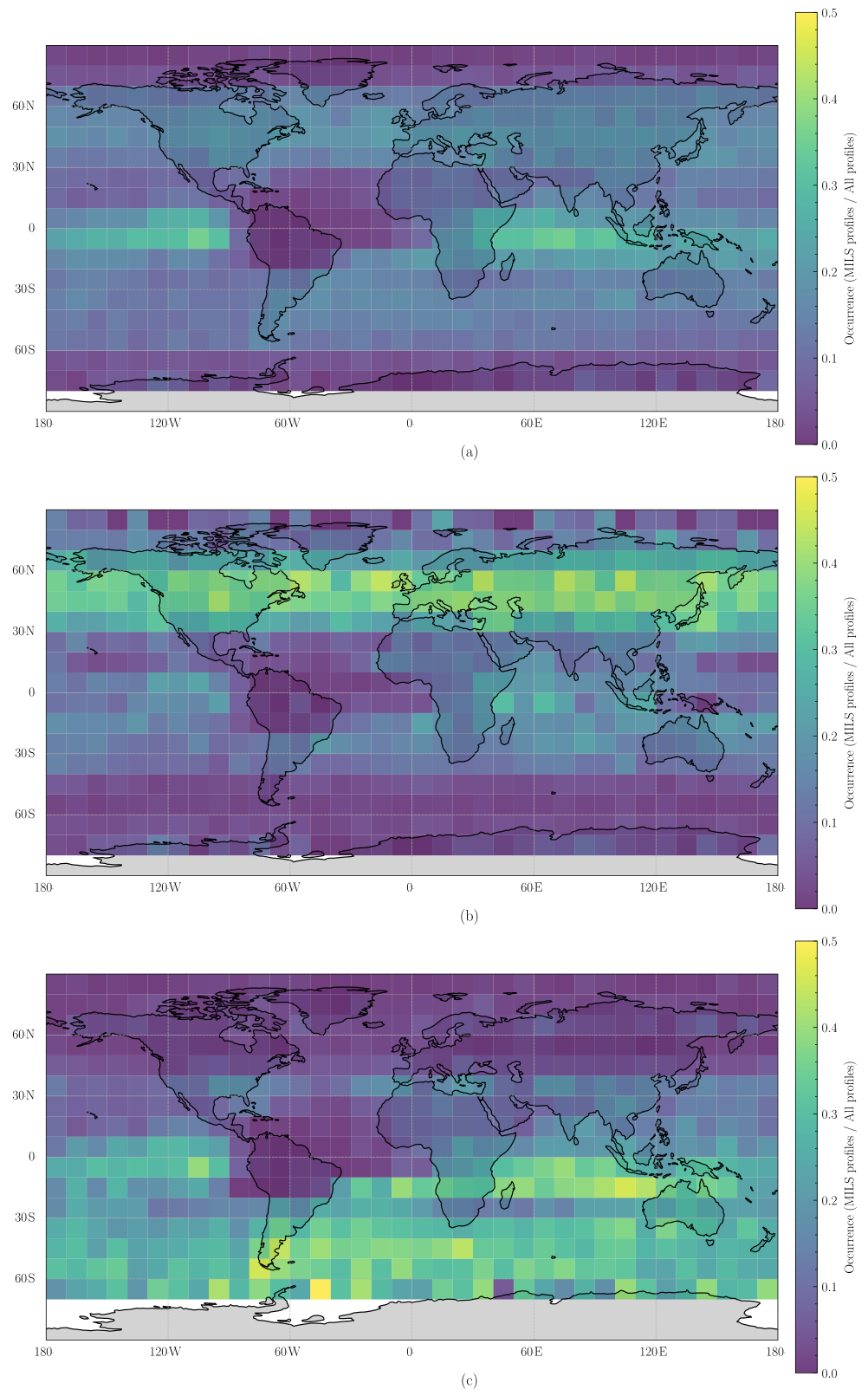
Over the 340,000 profiles detected by GOMOS, we detected a high number of inversions, namely 44,118 on the whole period, 18,403 during the Northern Hemisphere Winter and 14,357 during the Southern Hemisphere Winter. Figure 3a shows on a 10° grid the ratio of MILs over the number of measured profiles in each grid square: the phenomenon seems to occur locally throughout the globe, with MILs accounting for in most tiles above 10% of all registered profiles in an area between 60° S and 60° N of latitude. An area above the centre Atlantic seems not to register as much MILs as the rest of the globe: we think is due to error in the experimental data, as explained in the discussion section. The phenomenon seems otherwise when considering all profiles homogeneous longitude-wise. There is a slightly higher concentration at the equator, where the prevalence reaches ∼ 30 % . During the Northern Hemisphere Winter, MILs also occur more frequently on the equatorial belt, but there is a stark contrast between a mid-latitude band between 30° Nand 60° N, where prevalence values range between 30 % and 48 % , and the band from 40° S to 80° S where only 5 % inversions are detected, as can be seen on Figure 3b. This tendency is somewhat comparable to the one during the Southern Hemisphere Winter (represented on Figure 3c), during which we notice that in the 40° N to 80° N region, the maximum regional occurrence is barely 10 % while a band under the equatorial band 20 ° S to 70° S has a higher ratio of MILs, between 30 % and 50 % .
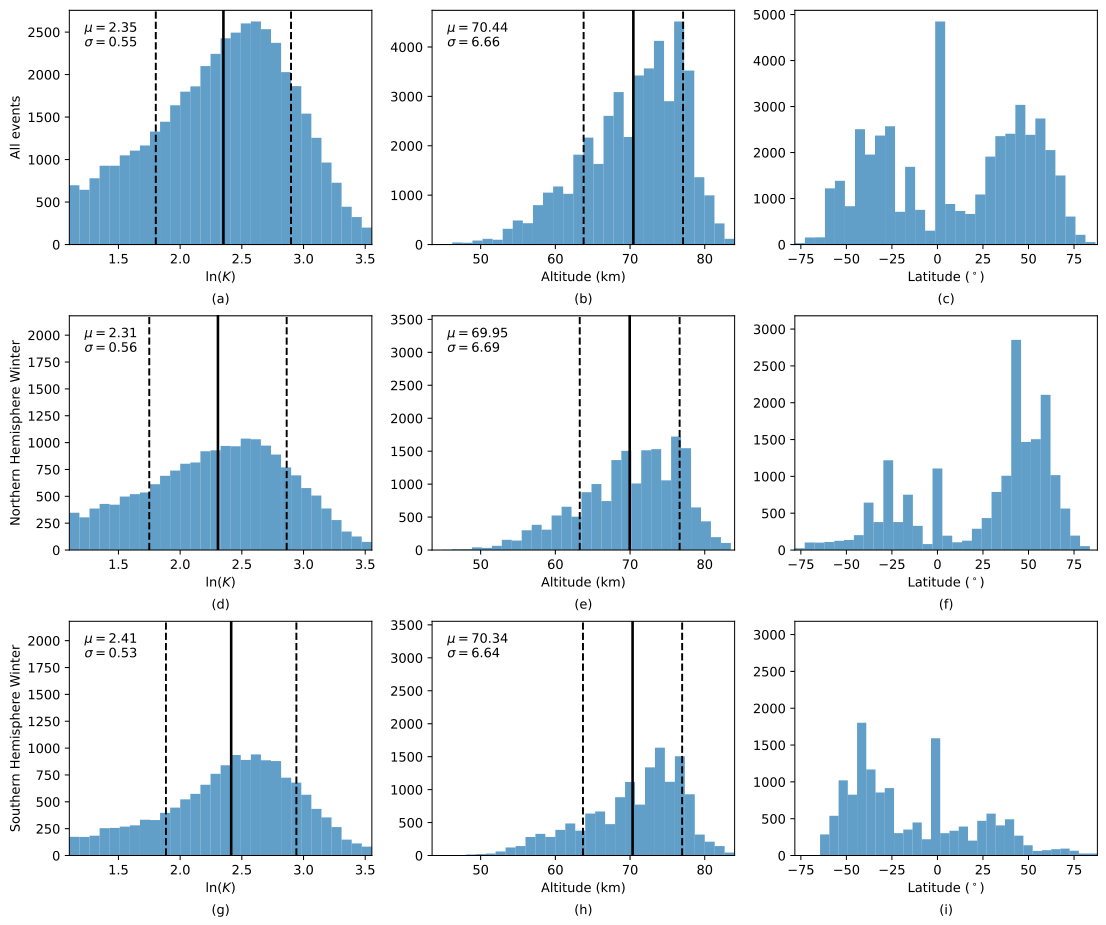
The statistics shown on Figure 4 are consistent with Figure 3. In particular there is a seasonal distribution of the inversions as described above with two Gaussian distributions centred around 50° N in the Northern Hemisphere Winter and 45° S during the Southern Hemisphere Winter, while the equatorial MILs seem to be independent of the seasonality and be restricted to a very narrow latitude band (less than 10°), as shown in Figure 4c,f,i. Regarding the characteristics of the MILs, the detected inversions seem to display an almost Gaussian distribution of log-amplitudes for all profiles, and both winter cases (see Figure 4a,d,g). The mean amplitude found with an approximate law N ( 2.35 , 0.55 ) corresponds to a Log-Normal distribution of the temperatures with a mean of 10.4 K. As for the altitude statistics of the MILs, it appears to follow a skewed-Gaussian with a sensibly constant mean for each season considered, of z m e a n 70 km as represented in Figure 4a,d,g.
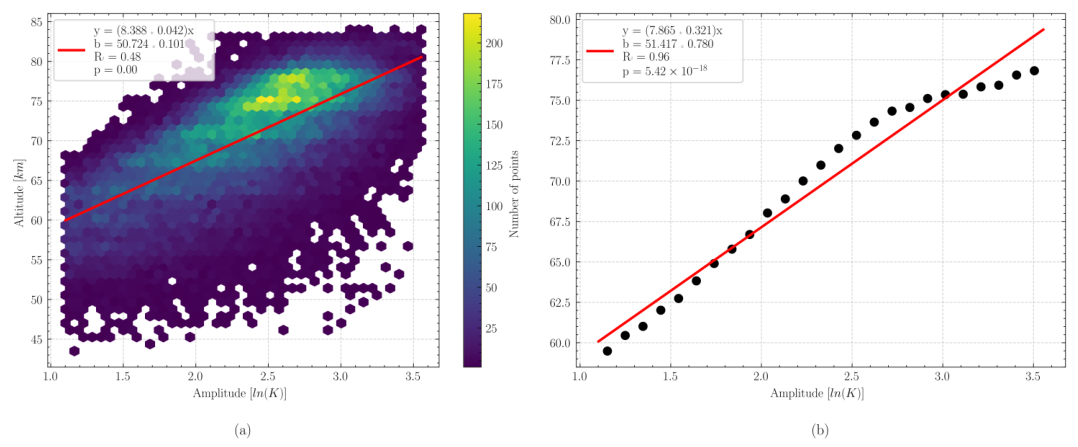
In addition to this purely one-dimensional distribution of MILs, we targeted the codependency of the log-amplitude and altitude of those phenomena. We obtained a correlation as a linear function z = 8.4 l n ( T ) + 51 (with the slope y = 8.39 ± 0.04 and intercept β = 50.7 ± 0.1 ), with a quite low R 2 = 0.48 as seen on Figure 5. We then used a binned-mean to remove the high variability of the dataset. Therefore we applied a linear regression to binned data, where the independent variable is divided into 25 bins and the dependent variable is averaged within each bin. The result exposed a similar trend, with z = 7.9 l n ( T ) + 51 (with the slope y = 7.87 ± 0.32 and intercept β = 51.4 ± 0.8 ) and a R 2 = 0.96 , indicating a significant correlation that is represented on Figure 5b.

3.3. Possible Classification of Inversions

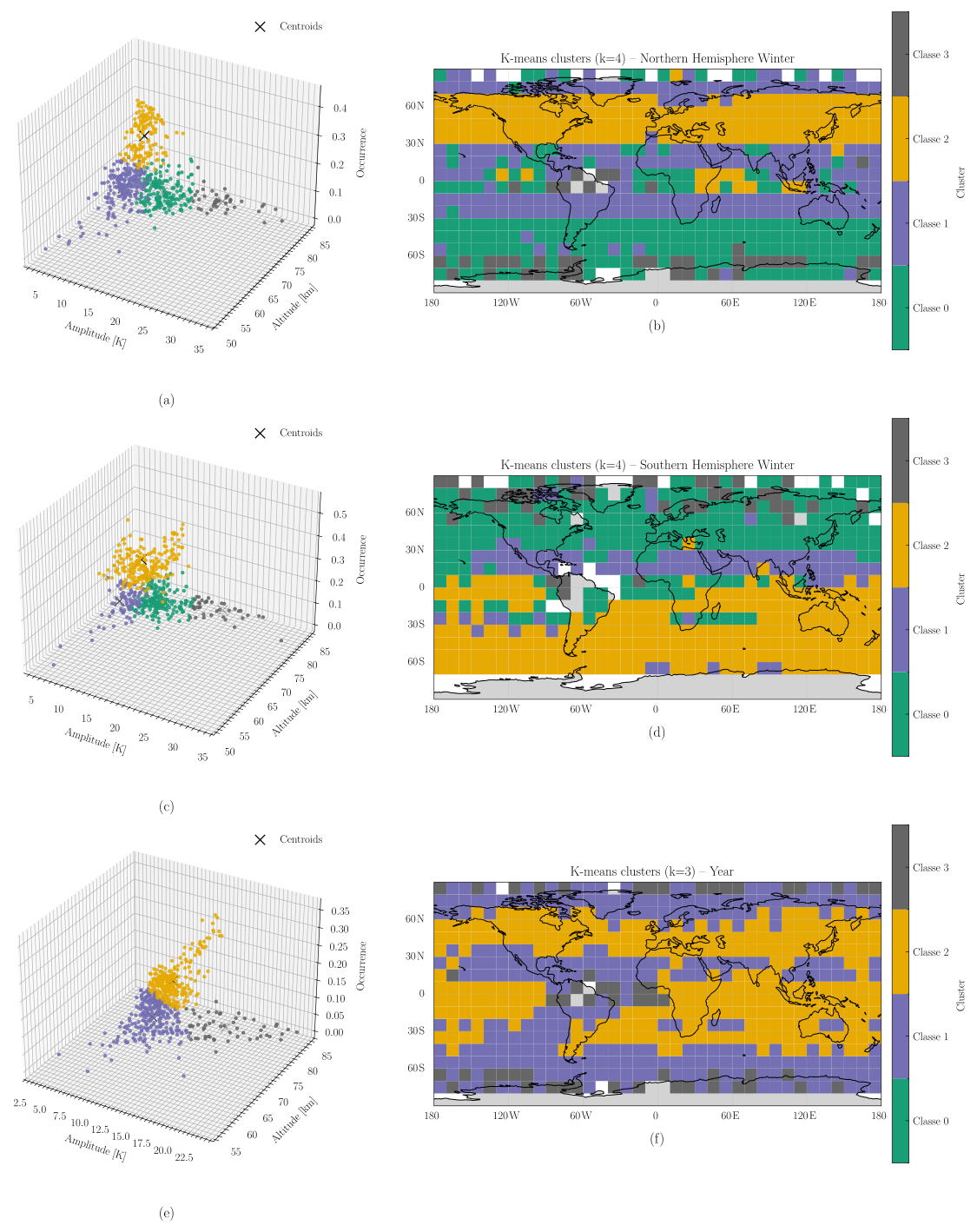
We used a K-mean clustering technique on the 3D graph containing altitudes, amplitudes and occurrences of the MILs. This technique endeavours to constitute K clusters which would minimise the mean standard deviation of the distance between the dots and their centre. The number of clusters, K, needs to be selected with an elbow method which allows to find the integer for which the second derivative of the within-cluster sum of squares is the closest to zero [32,37]. When scattered on a 3D graph and using a K-mean clustering technique, we obtained a classification minimising the standard-deviation with four classes (as represented on Figure 6a for the Northern Hemisphere Winter and Figure 6b for the Southern Hemisphere Winter). There is a clearly spatially defined cluster (Class 2) which is characterised by its occurrence and is for both seasons located in the Winter Hemisphere mid-latitudes. Two other classes group together in Figure 6a the low occurrence, but with variable MIL amplitudes (Class 1 and 0), while on both seasons there is a class of high amplitude MILs detected in the Summer pole (Class 3). Using these results along with the histogram shown on Figure 4c, we defined three classes to study for both seasons: equatorial, mid-latitude and ”other” inversions, while we separated yearly only on equatorial/non equatorial MILS.
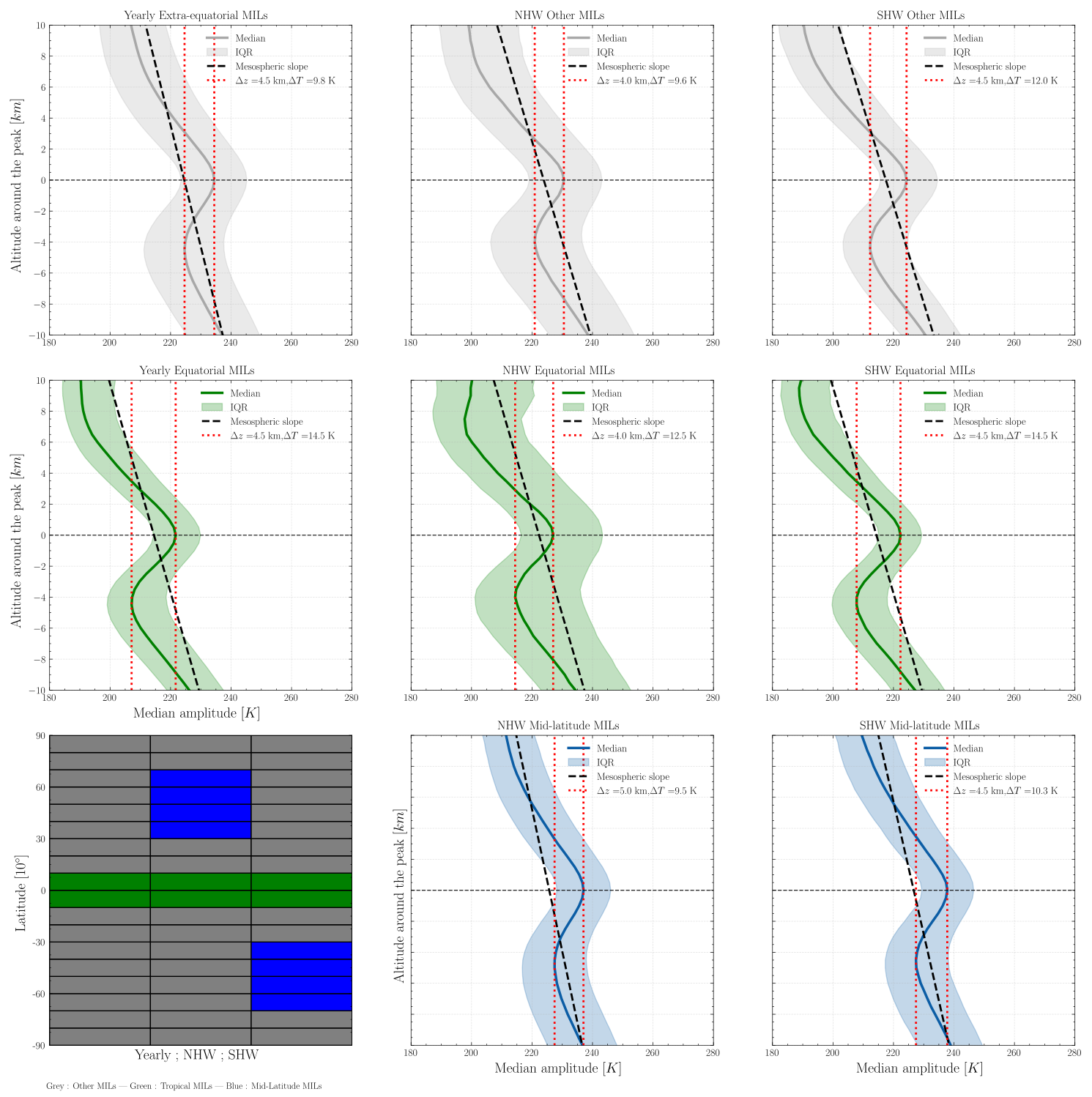
When they are centred around their inversion peak, the different MIL classes have overall similar shapes and characteristics, as depicted on Figure 7. The inversion causes a rupture to the linear negative temperature gradient which is normally to be found in the Mesosphere. About 5 km below the inversion, the temperature is below the gradient, this effect being particularly observable during the equatorial MILs. Then, at the peak of the inversion, the maximum of temperature exceeds the value normally reached while following the mesosphere gradient, in particular for the Mid-latitude MILs. At the top of the profile and even at 10 km above the inversion, the inversion still causes a cooling of the temperature profile when compared to the one it should have had with the theoretical mesosphere gradient.
If the overall structure seems to be the same, we see as well that as expected from Figure 6a, the mid-latitude MILs and the non-equatorial ones have a smaller Δ T between the local minimum and maximum, reaching about 10 K, while the median equatorial inversions range between 12.5 K and 14.5 K (see Figure 7). All of the demonstrated median profiles have a thickness (difference of altitude between the local minimum and the local maximum of the MIL) of 4–5 km, with a slight tendency for equatorial MILs to be larger.

3.4. Relation of Atmospheric Tides and Inversions

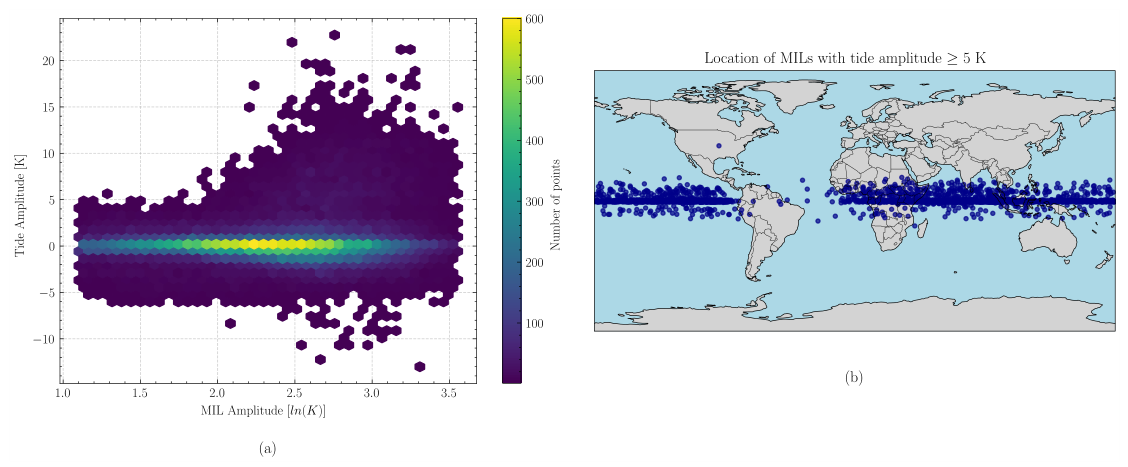
Amongst the current theories about MILs, we know that GWs can maintain them, as was theorised and modelled by Hauchecorne and collaborators [38], but the triggering event is still unknown. Rossby waves propagating around the polar vortex seem to fit the occurrence of MILs (at the right latitude in the Winter Hemisphere). We tried to correlate the atmospheric tide numerical model from Hagan [35] to the inversions and see if any patterns appeared. Most of the cases of MILs are linked with a random distribution of numerical tide gradient contributions ( T G C ( z p e a k ) = T t i d e ( z p e a k + 2.5 km ) T t i d e ( z p e a k 2.5 km ) ) at the altitude of the peak of the MIL. This is true at least for low intensity estimated tide gradient contributions, as represented on Figure 8a. The binned mean (not represented) showed a weak agreement when noise is removed, correlating the amplitude of the MIL to the amplitude of the numerical tide. However, a distinct population of (MILs, tide contributions) couples are characterised by MILs with an amplitude higher than 7.3 K and a numerical tide gradient contribution of more than 5 K. When we investigated those points, we found a spatial distribution of those MILs in the equatorial region that we showed on Figure 8b. These equatorial MILs linked to an estimated extreme tide gradient contribution at the peak of the MIL represent 2300 profiles out of all 6300 equatorial MILs detected in the GOMOS dataset.
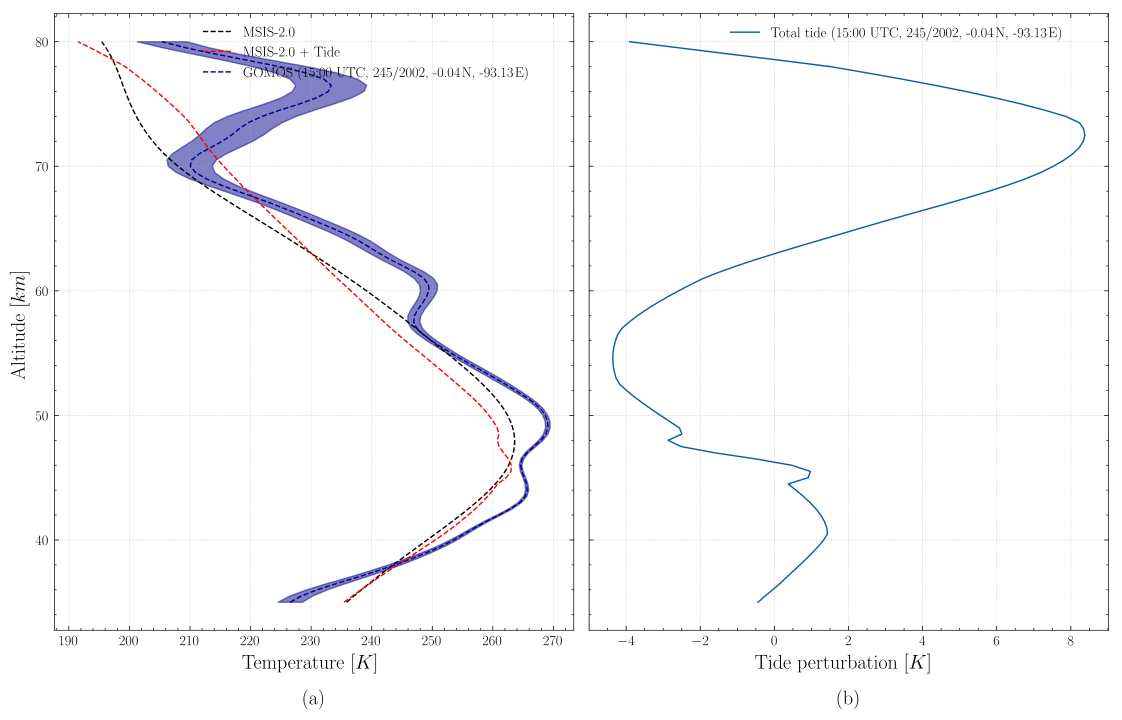
Statistically, the ratio of MILs in the equatorial band ( 20 ° , 20 ° ) that are associated with a positive numerical atmospheric tide gradient component (that is to say T t i d e ( z p e a k + 2.5 km ) T t i d e ( z p e a k 2.5 km ) 0 ) (67%) is higher than the percentage of non-MIL profiles showing a positive estimated tide gradient component at a randomised altitude (that is to say T t i d e ( Z + 2.5 km ) T t i d e ( Z 2.5 km ) 0 with Z N ( μ = 70 km , σ 2 = 5 2 ) , the Gaussian distribution that we computed for equatorial MILs) (48.2%). This does not seem to be the case for extra-equatorial profiles (36.3% to 54.5%). An example of one of those inversions is shown on Figure 9a, along with the numerical temperature variations due to tides in Figure 9b.

4. Discussion

4.1. Comparison of GOMOS Profiles with LIDAR Measurement and the MSIS-2.0 Model

GOMOS temperature profiles using the limb sounding method and a new correction of the atmospheric lower profile seem in agreement with the LIDAR in the stratosphere and lower mesosphere, especially in the 35–50 km band that is affected by our new correction method. There is however in the higher mesosphere a discrepancy between GOMOS and the LIDAR that can amount to 15 K in standard deviation. We deem it very probable that this systematic error could be due to the difference of measurement times between the OHP LIDAR (hour-long measurement between 19:00 and 0:00) and GOMOS (always same time of measurement per given latitude/longitude, around 9:00 for OHP). According to Zhang et al. [39], the amplitude of the migrating solar tide (which is due to ozone warming by the sun and is 24-h periodic) could amount to +4 to +6 K at 80 km and 40° N, which would explain at least +8 K to +12 K of the standard deviation discrepancy at this altitude. An additional source of error is the distance between the LIDAR profile and GOMOS’, which can come up to 311 km. Regarding the comparison with MSIS-2.0, we assessed a bias close to the one found with the LIDAR [12], and regarding standard deviation, apart from the last part of the profile (above 80 km) it is close to values observed between MSIS-2.0 and SABER for instance [31]. The fact that this instrument obtains as well the same bias in the high stratosphere than the LIDAR to MSIS-2.0 leads us to think that either our method to retrieve the temperature profile induces this discrepancy, or that there is a consistent error in MSIS-2.0 model, which could be due to the historical temperature values used by the model in the mesosphere.

4.2. Lower MILs Statistics

MILs statistics clearly show that the season of the year has an impact on how often they appear, at least for the lower MILs (under 80 km) that GOMOS instrument is able to detect. Our results compare with those of Leblanc&Hauchecorne [27] with UARS data, but our dataset spans on a wider period of time (10 years compared to the 2 years of UARS campaign). The mid-latitude/equatorial inversion distinction they observed is also well defined. The distribution of MILs is consistent with other space-borne studies [24,25] and with LIDAR-based detections [12,40]. Inversions appear to present a log-normal distribution in amplitude, regardless of the hemisphere or season considered, with a maximal peak at +10 K, which clearly distinguishes them from gravity waves [6]. The altitude at which they occur follows a Gaussian distribution, and they occur most frequently at 70 km. Note that because of the range of GOMOS (35–80 km), and because some profiles are filtered, MILs do not reach above 75–80 km. As a result, we under-represent MILs which occur above 80 km. We know for instance from literature that an entire different class of MILs can be detected above those altitudes [14]. In general, we found that lower MILs were following a linear trend of the altitude of occurrence when compared to the log-amplitude. This relation is close to an affine function, which is coherent with [38]’s theory, which states MILs are fuelled by gravity waves dampening, as we know their amplitude increases exponentially with altitude [41].

4.3. Possible Classification of Inversions

We classified the inversions with multiple criteria, namely occurrence, altitude and amplitude. The classification which was created by the K-mean clusters of the mean inversion in each point of our grid showed first that there is an area close to the North of Brasil that does not contain reliable data, and which also contains very high amplitude inversions. It is probably due to measurement or processing errors, and we assume this could be due to unadjusted measurements made by the satellite when it was above the South Atlantic Anomaly (SAA), a phenomenon that is also described for some other satellite measurements [42]. We see a similar distribution of high amplitude areas in the Summer Pole in both classifications. We think this is due to Mesospheric Cloud formation: even though we removed the clouds which were visible by the satellite, it is possible that the beginning of the nucleation process of those ice clouds in the mesosphere of the summer pole creates a pseudo-aerosol scattering at the altitude GOMOS is measuring, inducing a falsely elevated density gap and thus temperature peak [30]. Therefore, our algorithm would principally detect “inversions” of the temperature profiles when in reality they are nucleating clouds. Thanks to Hauchecorne et al. [38], we know that existing inversions can be fuelled by GWs in the mesosphere. However, the initiation process of the MIL is still to be determined: given our classification, we thus could infer that the occurrence distribution delineates two or more mechanisms of inversion initiation.

4.4. Relation of Polar Vortex Disturbance and Inversions

First in the Winter Hemisphere, the mid-latitudes, which correspond to the ridge of the polar vortex and thus the location where planetary waves concentrate, we reveal that there is a rather high, low-amplitude but quite frequent MIL distribution: they can be linked to planetary wave induced inversions [25], or inversions linked to SSWs [43]. Note that this class is less distinguishable in the Southern Hemisphere, maybe because the Rossby waves are usually smaller in amplitude and the SSWs rarer there. The link between MILs and planetary wave structures and extreme polar vortex phenomena were investigated by Salby and co-authors [5], but also by France and co-authors [25] in a climatology of the phenomenon which revealed the importance of the interaction between planetary waves and gravity waves for the triggering of MILs.

4.5. Relation of Numerical Atmospheric Tides and MILs

The other class of inversions, located principally at the equator, tends to present a higher amplitude and occurs during the whole year (25% of all equatorial profiles are MILs). Using the classification, we inferred that equatorial MILs were caused by a different phenomenon from mid-latitude MILs for instance. Our hypothesis was that it is caused by atmospheric tides: by creating a positive anomaly of temperature at an altitude z 2.5 km and a negative one at z + 2.5 km for instance, it could “flatten” the temperature gradient and thus trigger favourable conditions for an inversion to occur and persist thanks to GWs dampening and breaking. We did not find on all profiles a significant correlation between intense estimated tide gradient contribution and MILs. However, as shown, at the equator specifically, there is about a third of the equatorial MILs which occurs at the same moment as the numerical tide model computed a +5 K tide component around the MIL peak, which would lead, if linked to the real tide, to a flattening of the normally steeply negative temperature gradient at 70 km. When we study statistically the MILs which happen at the equator and when we study the numerical model tide component around their peak, we detect that the MILs with a positive tide gradient component around their peak are overrepresented amongst all MILs profiles compared to non-MIL profiles. This would indicate that the equatorial MIL phenomenon is at least correlated to the numerical tide gradient contribution sign. Of course, this correlation could be simply due to the tide contribution to the temperature profile: a positive tide temperature gradient component would create a bigger temperature gradient inversion and register the profiles as MILs. But then this would not explain why we do not obtain the same statistics for mid-latitude MILs. The same conclusion of a tide influence on the creation of lower MILs was also put forward in Zhang et al. [39]. One main limitation of our findings is the type of orbit of GOMOS, which do not allow us to visit a same place with different daylight times. Second, our assumption is that tides precede and cause MILs: given that it is thought those phenomena last hours, or even days, our way to study the situation by co-locating the numerical tide and temperature measurement is questionable because it would miss the temporality and thus the causality. Lastly, the tides used were the theoretical estimates given by Hagan [35]: the real tide is difficult to measure, and it is estimated that its amplitude at the equator could even range higher than this model [44,45,46].

5. Conclusions

The GOMOS dataset provides an almost unique insight on lower MILs up to 75 km because of its high temperature resolution in the mesosphere, its large number of profiles and its validation with LIDAR measurements and widely used climatological models. The new treatment we applied allowed us to obtain a good agreement with MSIS-2.0 for instance. Complementary to rocket soundings [13] and more recently LIDAR data, this dataset enabled analyses confirming that MILs are a local phenomenon which can happen anywhere around the globe, as was already hinted by UARS measurements [27]. It also proved this widespread phenomenon occurs with varying amplitude and probability depending on the season: most MILs occur either at the mid-latitudes of the Winter Hemisphere, or inside an equatorial band. These last MILs seem to present a higher amplitude and stronger gradient changes than the others, while the mid-latitude MILs are smaller in amplitude but happen in up to 50% of the profiles of the considered areas. Concerning the equatorial MILs, about 30 % of them are linked to strong numerical tide vertical variations around their peak, and they appear to occur specifically when the Δ T of the tide around the inversion is positive. While the role of GWs to maintain MILs suggested by Hauchecorne and co-authors [38,47] is still valid, our study suggests that inversions occur primarily when the temperature gradient becomes less negative (or even slightly positive) as a result of planetary wave or tidal wave contributions. Obviously, our next goal would be to monitor inversion formation together with the actual tides and not an estimate (or the planetary waves for the mid-latitude MILs) in real-time just like the study case from Chane-Ming and collaborators [48], but this would require data from multiple satellites or LIDARs. This could be possible now that OMPS limb-sounding data are processed to obtain high-resolution profiles similar to those of GOMOS [26]: both could be used complementarily to study the formation and evolution of this phenomenon. An additional satellite with data reaching up to 100 km would also help expand our findings to the upper MILs, which are thought to be contained to polar regions [14]. Improvement of the data or flag of out-of-norms profiles could also improve the SAA area in which the data is not nominal. This study also provides perspectives for MIL modelling through high-resolution mesospheric models: since ERA-5 reanalyses have proven to be reliable in the stratosphere, it could be interesting to use a general circulation model with primitive dynamical equations to study the evolution of the atmosphere when a particularly big atmospheric tide passes through the upper mesosphere, as a way to assess whether MILs can be theoretically generated in this way, for instance with the RACCORD model Hauchecorne et al. [49] or ICON [50], both of which can simulate atmospheric fields in the 30–70 km region using MSIS-2.0 and ERA-5 profiles.

Author Contributions

Conceptualization, N.G.T.; methodology, N.G.T.; software, N.G.T.; validation, N.G.T., P.D.C.-L., P.K., A.H.; formal analysis, N.G.T.; investigation, N.G.T., P.D.C.-L., P.K., A.H.; resources, N.G.T., P.D.C.-L., P.K.; data curation, N.G.T., P.D.C.-L.; writing—original draft preparation, N.G.T., P.D.C.-L.; writing—review and editing, N.G.T., P.D.C.-L., P.K., A.H.; visualization, N.G.T.; supervision, P.K.; project administration, P.K.; funding acquisition, N.G.T., P.K. All authors have read and agreed to the published version of the manuscript.

Funding

This research received no external funding.

Institutional Review Board Statement

Not applicable.

Informed Consent Statement

Not applicable.

Data Availability Statement

The dataset “GOMOS temperature profiles from Rayleigh scattering at limb” is freely available in NetCDF4 format from the ESA MesosphEO Data product service: http://mesospheo.fmi.fi/data_service (last access: 10 May 2026). Data used for obtaining the estimate tides can be found freely with explaination to use it at https://www.hao.ucar.edu/modeling/gswm/gswm.html (last access: 10 May 2026).

Acknowledgments

This study was performed with the support of the Direction Générale de l’Armement. This research was funded by DGA (Direction Générale pour l’Armement) through the salary of Nicolas G. Tufel. Profiles from the GOMOS dataset were obtained thanks to the European Space Agency, Centre National d’Etudes Spatiales (CNES) and CNRS/INSU. LIDAR operations are supported by CNRS, NASA, CNES, La Réunion and Versailles Saint-Quentin en Yvelines universities.

Conflicts of Interest

Author Alain Hauchecorne was employed by the company Gordien Strato. The remaining authors declare that the research was conducted in the absence of any commercial or financial relationships that could be construed as a potential conflict of interest.

Abbreviations

The following abbreviations are used in this manuscript:
MILMesospheric Inversion Layer
SSWSudden Stratosheric Warming
SSASouth Atlantic Anomaly
NHWNorthern Hemisphere Winter
SHWSouthern Hemisphere Winter

References

  1. Tett, S.F.; Betts, R.; Crowley, T.J.; Gregory, J.; Johns, T.C.; Jones, A.; Osborn, T.J.; Öström, E.; Roberts, D.L.; Woodage, M.J. The impact of natural and anthropogenic forcings on climate and hydrology since 1550. Clim. Dyn. 2006, 28, 3–34. [Google Scholar] [CrossRef]
  2. Qian, L.; Jacobi, C.; McInerney, J. Trends and solar irradiance effects in the mesosphere. J. Geophys. Res. Space Phys. 2019, 124, 1343–1360. [Google Scholar] [CrossRef]
  3. World Meteorological Organization (WMO). Executive Summary. Scientific Assessment of Ozone Depletion; GAW Report; No. 278; World Meteorological Organization (WMO): Geneva, Switzerland, 2022; pp. 5368–5380. [Google Scholar]
  4. She, C.-Y.; Berger, U.; Yan, Z.-A.; Yuan, T.; Lübken, F.-J.; Krueger, D.A.; Hu, X. Solar Response and Long-Term Trend of Midlatitude Mesopause Region Temperature Based on 28 Years (1990–2017) of Na-LIDAR Observations. J. Geophys. Res. Space Phys. 2019, 124, 7140–7156. [Google Scholar] [CrossRef]
  5. Salby, M.; Sassi, F.; Callaghan, P.; Wu, D.; Keckhut, P.; Hauchecorne, A. Mesospheric inversions and their relationship to planetary wave structure. J. Geophys. Res. 2002, 107, ACL 4-1–ACL 4-13. [Google Scholar] [CrossRef]
  6. Fritts, D.C.; Alexander, M.J. Gravity wave dynamics and effects in the middle atmosphere. Rev. Geophys. 2003, 41, 1003. [Google Scholar] [CrossRef]
  7. Holton, J.R. The Role of Gravity Wave Induced Drag and Diffusion in the Momentum Budget of the Mesosphere. J. Atmos. Sci. 1982, 791–799. [Google Scholar] [CrossRef]
  8. Lindzen, R.D.; Chapman, S. Atmospheric tides. Space Sci. Rev. 1969, 10, 3–118. [Google Scholar] [CrossRef]
  9. Pancheva, D.; Mukhtarov, P.; Bojilova, R. Climatology of the Nonmigrating Tides Based on Long-Term SABER/TIMED Measurements and Their Impact on the Longitudinal Structures Observed in the Ionosphere. Atmosphere 2024, 15, 478. [Google Scholar] [CrossRef]
  10. Oberheide, J.; Forbes, J.M.; Zhang, X.; Bruinsma, S. Climatology of upward propagating diurnal and semidiurnal tides in the thermosphere. J. Geophys. Res. 2011, 116, A11306. [Google Scholar] [CrossRef]
  11. Leovy, C. Simple Models of Thermally Driven Mesopheric Circulation. J. Atmos. Sci. 1964, 21, 327–341. [Google Scholar] [CrossRef][Green Version]
  12. Tufel, N.G.; Keckhut, P.; Dumas, L.; Mariaccia, A.; Meftah, M.; Courcoux, Y.; Vicomte, M.; Hauchecorne, A. Assessment of middle atmosphere climatology using LIDAR for aerospace applications. Adv. Space. Res. 2025, 18, 1871–1889. [Google Scholar] [CrossRef]
  13. Schmidlin, F.J. Temperature inversion near 75 km. Geophys. Res. Lett. 1976, 3, 173–176. [Google Scholar] [CrossRef]
  14. Meriwether, J.W.; Gardner, C.S. A review of the mesosphere inversion layer phenomenon. J. Geophys. Res. 2000, 105, 12405–12416. [Google Scholar] [CrossRef]
  15. Fritts, D.C.; Laughman, B.; Wang, L.; Lund, T.S.; Collins, R.L. Collins; Gravity wave dynamics in a mesospheric inversion layer: 1. Reflection, trapping, and instability dynamics. J. Geophys. Res. Atmos. 2018, 123, 626–648. [Google Scholar] [CrossRef]
  16. Hauchecorne, A.; Blanot, L.; Wing, R.; Keckhut, P.; Khaykin, S.; Bertaux, J.L.; Meftah, M.; Claud, C.; Sofieva, V. A new MesosphEO data set of temperature profiles from 35 to 85 km using Rayleigh scattering at limb from GOMOS/ENVISAT daytime observations. Atmos. Meas. Tech. 2019, 12, 749–761. [Google Scholar] [CrossRef]
  17. Meriwether, J.W.; Gerrard, A.J. Mesosphere inversion layers and stratosphere temperature enhancements. Rev. Geophys. 2004, 42, 42–73. [Google Scholar] [CrossRef]
  18. Szewczyk, A.; Strelnikov, B.; Rapp, M.; Strelnikova, I.; Baumgarten, G.; Kaifler, N.; Hoppe, U.-P. Simultaneous observations of a mesospheric inversion layer and turbulence during the ECOMA-2010 rocket campaign. Ann. Geophys. 2013, 31, 775–785. [Google Scholar] [CrossRef]
  19. Mariaccia, A.; Keckhut, P.; Hauchecorne, A.; Khaykin, S.; Ratynski, M. Co-Located Wind and Temperature Observations at Mid-Latitudes During Mesospheric Inversion Layer Events. Geophys. Res. Let. 2023, 50, e2022GL102683. [Google Scholar] [CrossRef]
  20. De Mazière, M.; Thompson, M.; Kurylo, M.J.; Wild, J.D.; Bernhard, G.; Blumenstock, T.; Braathen, G.O.; Hannigan, J.W.; Lambert, J.C.; Leblanc, T.; et al. The Network for the Detection of Atmospheric Composition Change (NDACC): History, status and perspectives. Atmos. Chem. Phys. 2018, 18, 4935–4964. [Google Scholar] [CrossRef]
  21. Steinbrecht, W.; Leblanc, T. LIDARs in the Network for Detection of Atmospheric Composition Change (NDACC) and the Tropospheric Ozone LIDAR Network (TOLNet). In Handbook of Air Quality and Climate Change; Akimoto, H., Tanimoto, H., Eds.; Springer: Singapore, 2023. [Google Scholar] [CrossRef]
  22. McGee, T.J.; Sullivan, J.T.; Twigg, L.W.; Sumnicht, G.K.; Barnes, J.; Leblanc, T.; McDermid, S. LIDAR validation measurements at the NOAA Mauna Loa Observatory NDACC Station. LIDAR Remote Sens. Environ. Monit. XVI 2018, 10779, 47–63. [Google Scholar] [CrossRef]
  23. Wing, R.; Hauchecorne, A.; Keckhut, P.; Godin-Beekmann, S.; Khaykin, S.; McCullough, E. LIDAR temperature series in the middle atmosphere as a reference data set. part 2: Assessment of temperature observations from MLS/AURA and SABER/TIMED satellites. Atmos. Meas. Tech. 2018, 11, 6703–6717. [Google Scholar] [CrossRef]
  24. Fechine, J.; Wrasse, C.M.; Takahashi, H.; Mlynczak, M.G.; Russel, J.M. Lower-mesospheric inversion layers over brazilian equatorial region using TIMED/SABER temperature profiles. Adv. Space. Res. 2008, 41, 1447–1453. [Google Scholar] [CrossRef]
  25. France, J.A.; Harvey, V.L.; Randall, C.E.; Collins, R.L.; Smith, A.K.; Peck, E.D.; Fang, X. A climatology of planetary wave-driven mesospheric inversion layers in the extraequatorial winter. J. Geophys. Res. Atmos. 2015, 120, 399–413. [Google Scholar] [CrossRef]
  26. Da Costa–Louro, P.; Keckhut, P.; Hauchecorne, A.; Meftah, M.; Jaross, G.; Mangin, A. Limb Temperature Observations in the Stratosphere and Mesosphere Derived from the OMPS Sensor. Remote Sens. 2024, 16, 3878. [Google Scholar] [CrossRef]
  27. Leblanc, T.; Hauchecorne, A. Recent observations of mesospheric temperature inversions. J. Geophys. Res. Atmos. 1997, 102, 19471–19482. [Google Scholar] [CrossRef]
  28. Gan, Q.; Zhang, S.D.; Yi, F. TIMED/SABER observations of lower mesospheric inversion layers at low and middle latitudes. J. Geophys. Res. Atmos. 2012, 117. [Google Scholar] [CrossRef]
  29. Bertaux, J.L.; Mégie, G.; Widemann, T.; Chassefière, E.; Pellinen, R.; Kyrola, E.; Korpela, S.; Simon, P. Monitoring of ozone trend by stellar occultations: The GOMOS instrument. Adv. Space Res. 1991, 11, 237–242. [Google Scholar] [CrossRef]
  30. Pérot, K. Characterisation and Climatology of Polar Mesospheric Clouds from GOMOS / ENVISAT Stellar Occultation Instrument. Ph.D. Thesis, Université Pierre et Marie Curie, Paris, France, 2012. [Google Scholar]
  31. Emmert, J.T.; Drob, D.P.; Picone, J.M.; Siskind, D.E.; Jones, M., Jr.; Mlynczak, M.G.; Bernath, P.F.; Chu, X.; Doornbos, E.; Funke, B.; et al. A whole-atmosphere empirical model of temperature and neutral species densities. Earth Space Sci. 2020, 8, e2020EA001321. [Google Scholar] [CrossRef]
  32. Ardalan, M.; Keckhut, P.; Hauchecorne, A.; Wing, R.; Meftah, M.; Farhani, G. Updated Climatology of Mesospheric Temperature Inversions Detected by Rayleigh LIDAR above Observatoire de Haute Provence, France, Using a K-Mean Clustering Technique. Atmosphere 2022, 13, 814. [Google Scholar] [CrossRef]
  33. Cleveland, W.S. Robust Locally Weighted Regression and Smoothing Scatterplots. J. Am. Stat. Assoc. 1979, 74, 829–836. [Google Scholar] [CrossRef]
  34. Gelman, A.; Hill, J. Data Analysis Using Regression and Multilevel/Hierarchical Models; Cambridge University Press: Cambridge, UK, 2007; pp. 154–196. [Google Scholar]
  35. GSWM: Global Scale Wave Model. Available online: https://www.hao.ucar.edu/modeling/gswm/gswm.html (accessed on 20 February 2026).
  36. Hagan, M.E.; Forbes, J.M.; Vial, F. On modeling migrating solar tides. Geophys. Res. Lett. 1995, 22, 893–896. [Google Scholar] [CrossRef]
  37. MacQueen, J. Some methods for classification and analysis of multivariate observations. Berkeley Symp. Math. Stat. Prob. 1967, 5, 281–297. [Google Scholar]
  38. Hauchecorne, A.; Chanin, M.-L.; Wilson, R. Mesospheric temperature inversion and gravity wave breaking. Geophys. Res. Let. 1987, 14, 933–936. [Google Scholar] [CrossRef]
  39. Zhang, X.; Forbes, J.M.; Hagan, M.E.; Russell, J.M., III; Palo, S.E.; Mertens, C.J.; Mlynczak, M.G. Monthly tidal temperatures 20–120 km from TIMED/SABER. J. Geophys. Res. 2006, 111, 893–896. [Google Scholar] [CrossRef]
  40. Bègue, N.; Mbatha, N.; Bencherif, H.; Loua, R.T.; Sivakumar, V.; Leblanc, T. Statistical analysis of the mesospheric inversion layers over two symmetrical tropical sites: Réunion (20.8° S, 55.5° E) and Mauna Loa (19.5° N, 155.6° W). Ann. Geophys. 2017, 35, 1177–1194. [Google Scholar] [CrossRef][Green Version]
  41. Strelnikova, I.; Almowafy, M.; Baumgarten, G.; Baumgarten, K.; Ern, M., Jr.; Gerding, M.; Lübken, F.-J. Seasonal Cycle of Gravity Wave Potential Energy Densities from LIDAR and Satellite Observations at 54° and 69°N. J. Atmos. Sci. 2021, 78, 1359–1386. [Google Scholar] [CrossRef]
  42. Jaross, G.; Bhartia, P.K.; Chen, G.; Kowitt, M.; Haken, M.; Chen, Z.; Xu, P.; Warner, J.; Kelly, T. OMPS Limb Profiler instrument performance assessment. J. Geophys. Res. Atmos. 2014, 119, 4399–4412. [Google Scholar] [CrossRef]
  43. Okui, H.; Sato, K.; Koshin, D.; Watanabe, S. Formation of a mesospheric inversion layer and the subsequent elevated stratopause associated with the major stratospheric sudden warming in 2018/19. J. Atmos. Sci. 2021, 126, e2021JD034681. [Google Scholar] [CrossRef]
  44. Riggin, D.M.; Lieberman, R.S. Variability of the diurnal tide in the equatorial MLT. JASTP 2013, 102, 1364–6826. [Google Scholar] [CrossRef]
  45. Lieberman, R.S.; Riggin, D.M.; Ortland, D.A.; Nesbitt, S.W.; Vincent, R.A. Variability of mesospheric diurnal tides and tropospheric diurnal heating during 1997–1998. J. Geophys. Res. 2007, 112, D20110. [Google Scholar] [CrossRef]
  46. Garcia, R.R. On the Structure and Variability of the Migrating Diurnal Temperature Tide Observed by SABER. J. Atmos. Sci. 2023, 80, 687–704. [Google Scholar] [CrossRef]
  47. Chalachew Lingerew, U. Jaya Prakash Raju, Investigating the role of gravity waves in mesosphere and lower-thermosphere (MLT) inversions at low latitudes. Ann. Geophys. 2025, 43, 1–14. [Google Scholar] [CrossRef]
  48. Chane Ming, F.; Hauchecorne, A.; Bellisario, C.; Simoneau, P.; Keckhut, P.; Trémoulu, S.; Listowski, C.; Berthet, G.; Jégou, F.; Khaykin, S.; et al. Case Study of a Mesospheric Temperature Inversion over Maïdo Observatory through a Multi-Instrumental Observation. Remote Sens. 2023, 15, 2045. [Google Scholar] [CrossRef]
  49. Hauchecorne, A.; Paredes, J.; Cugnet, D.; Keckhut, P.; Cot, C.; Millet, C.; Le Pichon, A.; Heinrich, P. Development of the new realistic atmospheric model RACCORD from the ground to the thermosphere. In Proceedings of the EGU General Assembly 2012, Vienna, Austria, 22–27 April 2012; Available online: https://hal.science/hal-00707023v1 (accessed on 1 April 2026).
  50. Jungclaus, J.H.; Lorenz, S.J.; Schmidt, H.; Brovkin, V.; Brüggemann, N.; Chegini, F.; Crüger, T.; De-Vrese, P.; Gayler, V.; Giorgetta, M.A.; et al. The ICON Earth System Model version 1.0. J. Adv. Model. Earth Syst. 2022, 14, e2021MS002813. [Google Scholar] [CrossRef]
Figure 1. Example of a temperature profile seen by GOMOS at 9 AM on the 26 December at coordinates (42.43° N, 7.57° E) with respect to the MSIS-2.0 profile and the LIDAR measurement on the same day at 7 PM at OHP coordinates (43.91° N, 5.71° E). The shaded area corresponds to the instrument’s assessed error.
Atmosphere 17 00510 g001
Figure 2. Evaluation of GOMOS temperature profile showing (a) the mean bias with LIDAR profiles (GOMOS minus LIDAR) (selected two days apart and 2° latitude and longitude at most from the satellite measurement), (b) the associated standard-deviation, (c) the mean bias with the MSIS-2.0 profile called on the right day, time and location (GOMOS minus MSIS-20) and (d) the associated standard-deviation.
Atmosphere 17 00510 g002
Figure 3. Computed occurrence of MILs detected by GOMOS on each 10 °   ×   10 ° tile for (a) the all year (that is to say all profiles), (b) on Northern Hemisphere Winter (November to April) and (c) Southern Hemisphere Winter (May to September).
Atmosphere 17 00510 g003
Figure 4. Histograms of (a) (respectively (d,g)) the logarithm of the amplitude of the inversions, (b) (respectively (e,h)) the altitude at which the inversion occurs and (c) (respectively (f,i)) the latitude where the events happen during the entire considered period during the whole considered period (respectively Northern Hemisphere Winter and Southern Hemisphere Winter).
Atmosphere 17 00510 g004
Figure 5. Representation of the altitude as a function of the Log-Amplitude of the MIL, with (a) all data presented within a density colormap and (b) a binned linear regression on all GOMOS profiles detected as MILs.
Atmosphere 17 00510 g005
Figure 6. (a) (resp. (c), resp. (e)) K-mean clusters on the 3D-dataset of the mean inversion in each tile in the Northern Hemisphere Winter (resp. Southern Hemisphere Winter, resp all Year profiles) (amplitude, latitude, occurrence) and (b) (resp. (d), resp (f)) the representation of the corresponding tiles on our 10 °   ×   10 ° grid representation. Class 3: high amplitude points corresponding to polar clouds or area subject to errors, Class 2: Mid-Latitude Winter Hemisphere, Class 1: equatorial MILs and 0: other MILs.
Atmosphere 17 00510 g006
Figure 7. Representation of median aligned inversion profiles for different latitudes, with IQR, median thickness and Δ T , along with the latitudes used to select the profiles.
Atmosphere 17 00510 g007
Figure 8. Representation of the atmospheric tide 5-km difference as a function of the Log-Amplitude of the MIL, with (a) all data presented within a density colourmap and (b) a representation of the detected dots with the atmospheric tide greater than 5 K and MIL amplitude above 7.3 K (2347 profiles out of the 6300 overall equatorial profiles).
Atmosphere 17 00510 g008
Figure 9. Representation of (a) a MIL correlated with a tide, showing GOMOS profile, MSIS-2.0 profile and the later supplemented with the atmospheric tide and (b) the numerical atmospheric tide on that day and hour.
Atmosphere 17 00510 g009
Disclaimer/Publisher’s Note: The statements, opinions and data contained in all publications are solely those of the individual author(s) and contributor(s) and not of MDPI and/or the editor(s). MDPI and/or the editor(s) disclaim responsibility for any injury to people or property resulting from any ideas, methods, instructions or products referred to in the content.