Article

Asymmetric Upper-Atmosphere Response and the GNSS Positioning Accuracy of the October 2024 Severe Geomagnetic Storm over Two African Mid-Latitude Stations


1
Centre for Space Research, North-West University, Potchefstroom Campus, Potchefstroom 2531, South Africa
2
Department of Physics, Federal University of Lafia, Lafia 950101, Nasarawa, Nigeria
*
Author to whom correspondence should be addressed.
Atmosphere 2026, 17(5), 494; https://doi.org/10.3390/atmos17050494
Submission received: 23 March 2026 / Revised: 4 May 2026 / Accepted: 4 May 2026 / Published: 12 May 2026

Abstract

Space weather events triggered by solar activity impact critical technologies like the Global Navigation Satellite System (GNSS) by causing atmospheric imbalances that alter ionospheric electron density. This study investigates the upper atmosphere response to the severe geomagnetic storms of October 2024, focusing on the coupling and compositional exchange between the ionosphere and thermosphere. Data were analysed from two mid-latitude African stations, Rabat (RABT) and Hermanus (HNUS), using GNSS-Total Electron Content (TEC) measurements alongside thermospheric circulation observations from NASA-GOLD and solar wind indices from OMNIWeb. The October 2024 storm, which reached a minimum Dst of −333 nT, drove a negative ionospheric storm phase marked by TEC depletions exceeding 50 TECU. This response was driven by storm-time thermospheric upwelling of N2-rich air, which lowered the O/N2 ratio and accelerated plasma loss via charge-exchange reactions. Furthermore, a distinct hemispheric asymmetry was observed, as the equatorward thermospheric circulation in the Northern Hemisphere arrived before that of the Southern Hemisphere. Direct post-processing of the Earth-Centred Earth-Fixed (ECEF) coordinates using RTKLIB single-point position revealed that, while positioning accuracy significantly degraded at HNUS with errors increasing by up to 270%, it counterintuitively improved at RABT, where errors reached their minimum during the main and early recovery phases of the storm. These findings highlight that the technological impact of severe space weather is determined not just by storm magnitude but by the specific sign and spatial structure of the regional ionospheric response.

1. Introduction

Space weather events are recognised phenomena that impact space technology, including the GNSS and high-frequency radio communications, affecting human activities reliant on these technologies. These events are triggered by solar activity, such as solar flares (SFs) and coronal mass ejections (CMEs) (e.g., [1]).
Solar flares are large bursts of electromagnetic energy, often followed by CMEs. During these CMEs, the increased levels of solar wind particles exert additional pressure on the magnetosphere, resulting in the significant compression of the magnetopause [2]. A southward-oriented interplanetary magnetic field (Bz) leads to magnetic reconnection on the day side of the Earth. This process causes geomagnetic storms and results in particle precipitation from the turbulent solar wind. The increased charged particle density initiates atmospheric dynamics that create an imbalance in the thermosphere, affecting the distribution of atmospheric molecules, ions, and atoms on short- and long-term scales (e.g., [3,4,5,6]). Since the thermosphere and the ionosphere are energetically coupled through solar irradiance and geomagnetic activity, the ionosphere can be severely affected during such geomagnetic disturbances (e.g., [2,7]).
A geomagnetic storm can drive the inflow of energetic particles into the high-latitude upper atmosphere, initiating a nucleonic electromagnetic cascade that changes atmospheric chemistry (e.g., [8,9,10]) and dynamics by the equatorward thermospheric circulation (e.g., [11]). High-energy charged particles initiate this cascade in the ionosphere. As a result, the ionosphere’s TEC is altered, resulting in temporal and spatial fluctuations in electron density (e.g., [12]). The sudden changes in the F-region and the ionosphere’s response can increase group delay in GNSS or a complete blackout of high-frequency radio communication (e.g., [13,14]), depending on whether the TEC is enhanced or depleted, respectively. Fluctuations in TEC have become a significant topic in space weather physics, with various models explaining the depletion or enhancement of TEC through thermospheric circulation and variations in the O/N2 ratio (e.g., [15,16,17,18]).
The ionosphere–thermosphere (IT) system responds to geomagnetic disturbances. Energy deposition at high latitudes through Joule heating and particle precipitation drives thermospheric expansion and circulation divergence, leading to upwelling. This upwelling transports air rich in N 2 from lower altitudes to the F-region, lowering the crucial O/N2 ratio [11,19,20]. Accurate representation of the ionospheric state during the main phase of geomagnetic storms remains a significant challenge, as the system is strongly influenced by localised processes such as neutral winds and electric fields that are difficult to capture. While studies have demonstrated that assimilating thermospheric mass density (TMD) from satellites into physics-based models like the Coupled Thermosphere Ionosphere Plasmasphere electrodynamics (CTIPe) can enhance global upper atmospheric representations [21], these models are often not fully constrained by TMD alone. Consequently, global models may overlook regional dynamics, such as the specific inter-hemispheric timing of wind surges (e.g., [21,22]). This highlights the need for direct, high-resolution observations of thermospheric circulation and compositional exchange provided in this study through NASA-GOLD and ground-based GNSS-TEC measurements to resolve the complex, localised IT coupling over mid-latitude sectors.
A decreased O/N2 ratio is the signature of a negative ionospheric storm because molecular ions ( NO + and O 2 + ) resulting from charge exchange reactions ( O + + N 2 NO + + N ) recombine with electrons much faster than atomic oxygen ions ( O + ) do (e.g., [23,24]). Conversely, equatorward neutral winds driven by storm-time heating can push plasma upward along magnetic field lines, reducing the ion recombination rate and causing positive storms (TEC enhancement) (e.g., [11,15]).
The thermospheric and ionospheric responses over the European sector during the G3-level extreme geomagnetic storm of 3–4 November 2021, were reported in [25], in which they identified two different ionospheric storm phases. At high latitudes, negative ionospheric storms occurred due to thermospheric heating and upwelling, which reduced the O/N2 ratio and accelerated plasma loss. In contrast, middle and low latitudes experienced positive ionospheric storms driven by equatorward and westward neutral winds that transported plasma to higher altitudes along magnetic field lines where recombination rates are lower, effectively prolonging the plasma lifetime. The findings suggest that negative and positive ionospheric storms are not isolated events but are interconnected through simultaneous regional changes in thermospheric composition and wind dynamics (e.g., [25,26]).
Storm-time TEC fluctuation is linked to the changes in the N2, where an increase in N2 due to faster ion recombination led to a depletion in the upper-atmosphere TEC (e.g., [11,20,27]). During a severe geomagnetic storm, particle precipitation from solar wind charged particles occurs, particularly in the high-latitude ionosphere (e.g., [8,10]), and sometimes reaches low latitudes (e.g., [28]). This particle precipitation often led to sudden fluctuations of atmospheric constituents at lower altitudes [8].
The vulnerability of modern technological infrastructures, particularly GNSS, to extreme space weather has been increasingly highlighted by recent intense solar activity. While the global ionospheric response to severe geomagnetic storms is often characterised by large-scale depletions in TEC, the underlying mechanisms involve a complex interplay of IT coupling and regional dynamics that are not yet fully captured by global models. Studies of subauroral phenomena, such as Stable Auroral Red (SAR) arcs and Strong Thermal Emission Velocity Enhancement (STEVE) [29,30], demonstrate that the mid-latitude upper atmosphere is a region of intricate magnetic field transitions where diverse morphologies and formation mechanisms—including heat conduction and neutral composition changes—play critical roles. However, the specific technological impact of such disturbances is often determined by localised responses, such as hemispheric asymmetries in thermospheric wind surges and the influence of regional features like the South Atlantic Magnetic Anomaly (SAMA). By investigating the October 2024 severe geomagnetic storm, which reached a minimum Dst of -333 nT, this study addresses the need for high-resolution, inter-hemispheric observations to resolve the timing of thermospheric surges and their effects on regional GNSS positioning accuracy over the African sector.
In our analysis of the October 2024 storm, we use data from two mid-latitude stations to clarify the inter-hemispheric timing of thermospheric surges. This research is essential for understanding sudden changes in the upper atmosphere that can lead to either the depletion or enhancement of TEC. These fluctuations significantly affect GNSS signals and high-frequency radio communication (e.g., [3,31]).

2. Materials and Methods

2.1. Observations and Data Analysis

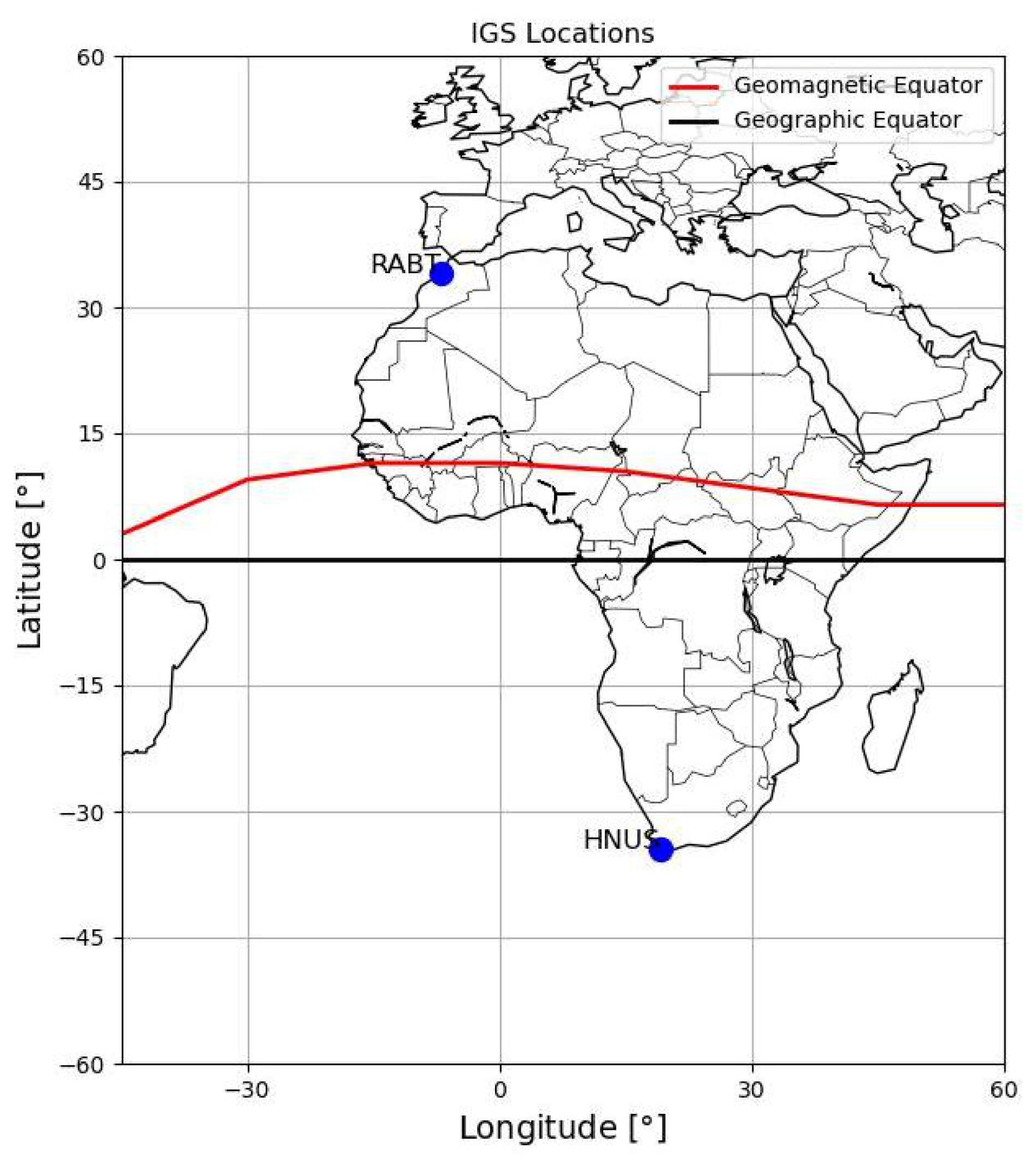
In this study, we utilise GNSS data obtained from two stations in the mid-latitude African sector: one in Rabat, Morocco, with station ID RABT, and the other in Hermanus, South Africa, with station ID HNUS. Both stations are located in the Northern and Southern Hemispheres, respectively (see Figure 1).

2.2. October 2024 Events

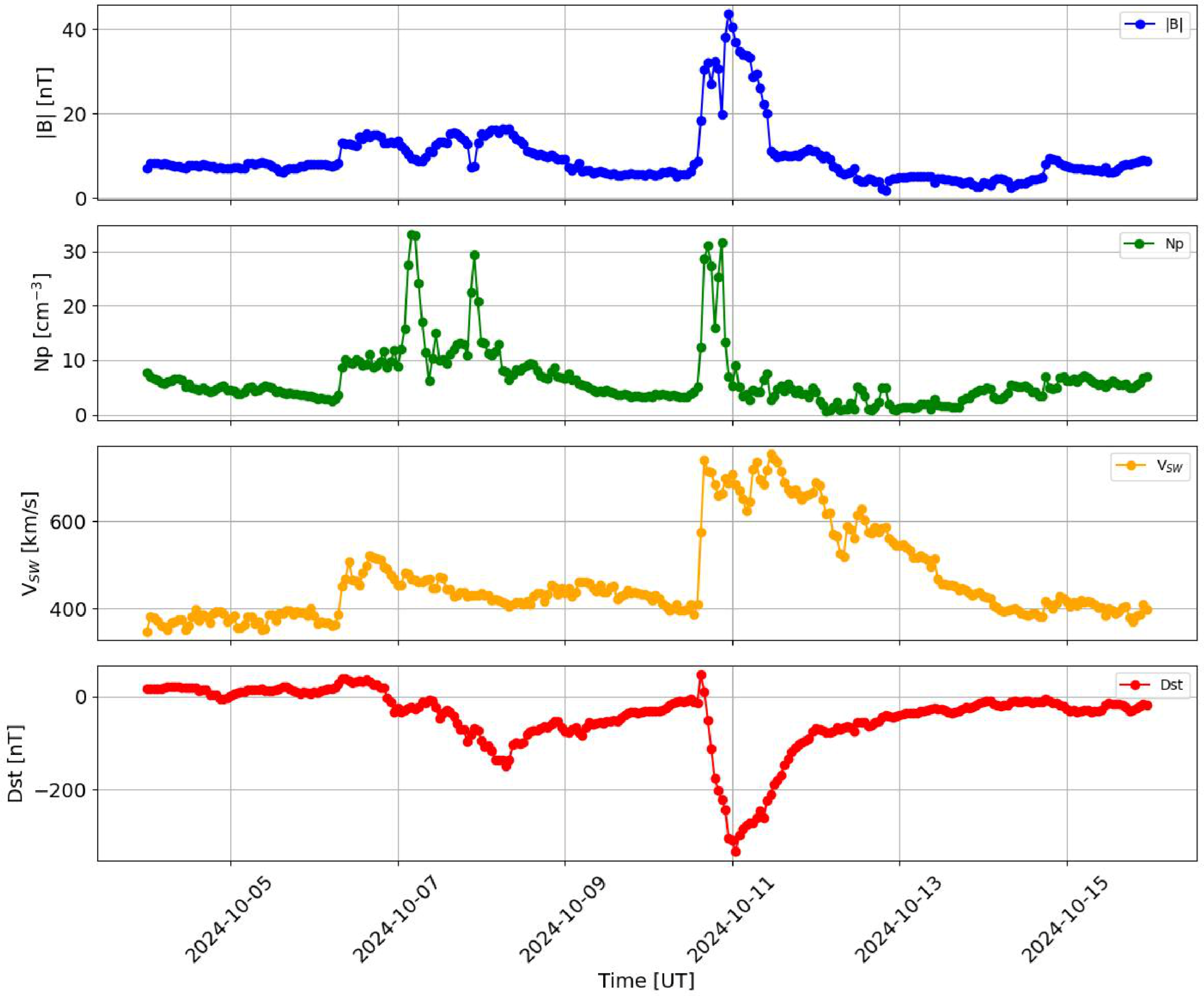
The October severe storm was associated with multiple CMEs and an eruption from AR 13848 on 9 October, distinguished by its strong X-ray brightness (https://solarmonitor.org/data/, accessed on 7 January 2025 ). This event unfolded as a two-step storm: first, a moderate sudden storm commencement (SSC) with a minimum Dst of −148 nT on 8 October (DOY 282), followed by a more intense SSC that produced a minimum Dst of −333 nT on 11 October (DOY 285) (see Figure 2).

2.3. Data Sources and Analysis

The space weather parameters were obtained from the OMNIWeb data service (https://omniweb.gsfc.nasa.gov/form/dx1.html, accessed on 20 June 2025). The GNSS-TEC data were obtained from the International GNSS Stations (IGS-CDDIS (https://cddis.nasa.gov/archive/gnss/data/daily/, accessed on 26 January 2026)) and IONOLAB (http://ionolab.org/index.php?page=webtec&language=en (v1.42), accessed on 29 January 2026) [32,33,34] for the two stations. This data was used to estimate the storm-time temporal fluctuations in TEC, while the TEC is the integrated electron density along the ray path between the GNSS satellite in space and the receiver on the ground, which is usually expressed in TEC units (TECUs), where 1 TECU = 1 × 10¹⁶ electrons/m2.
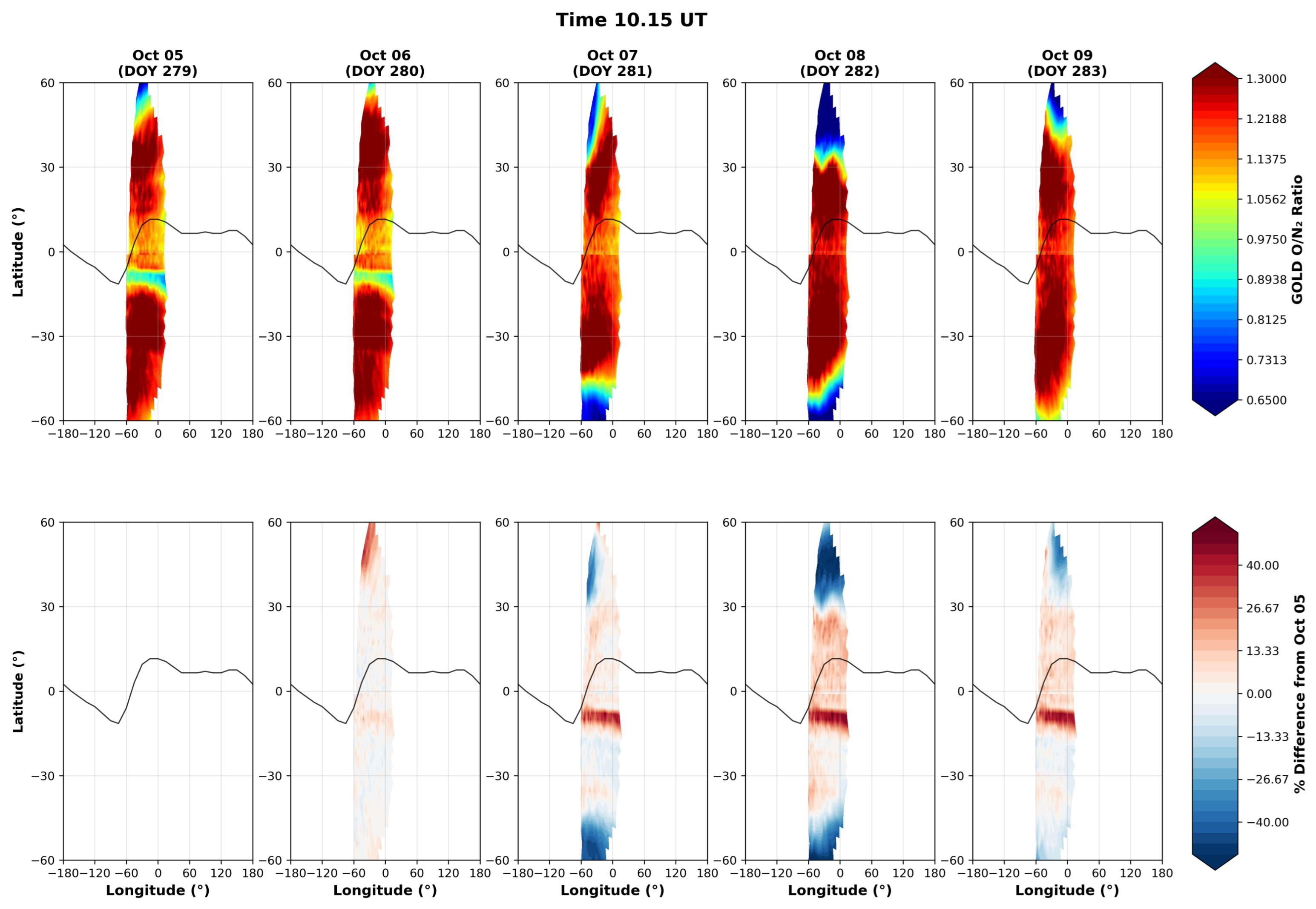
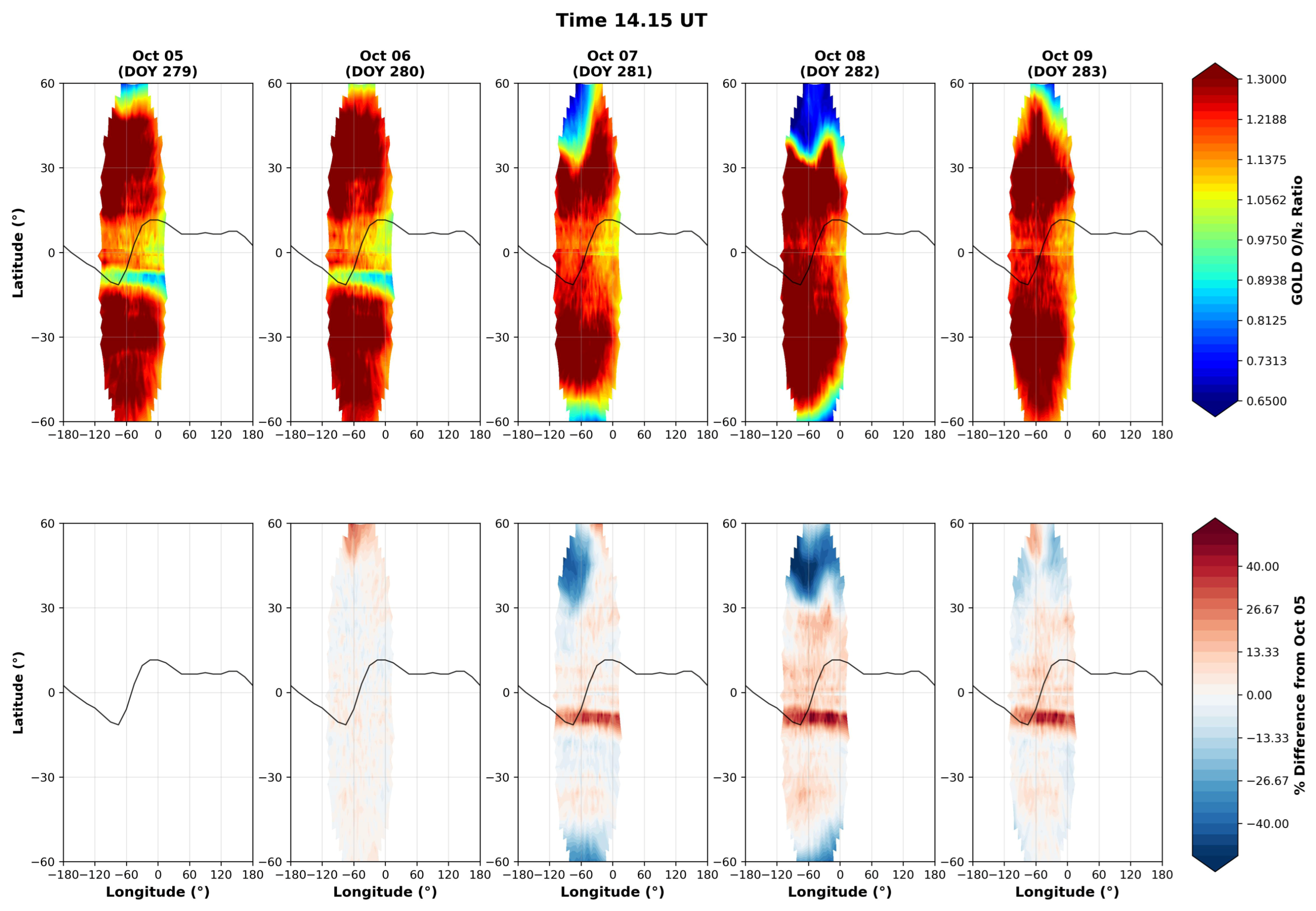
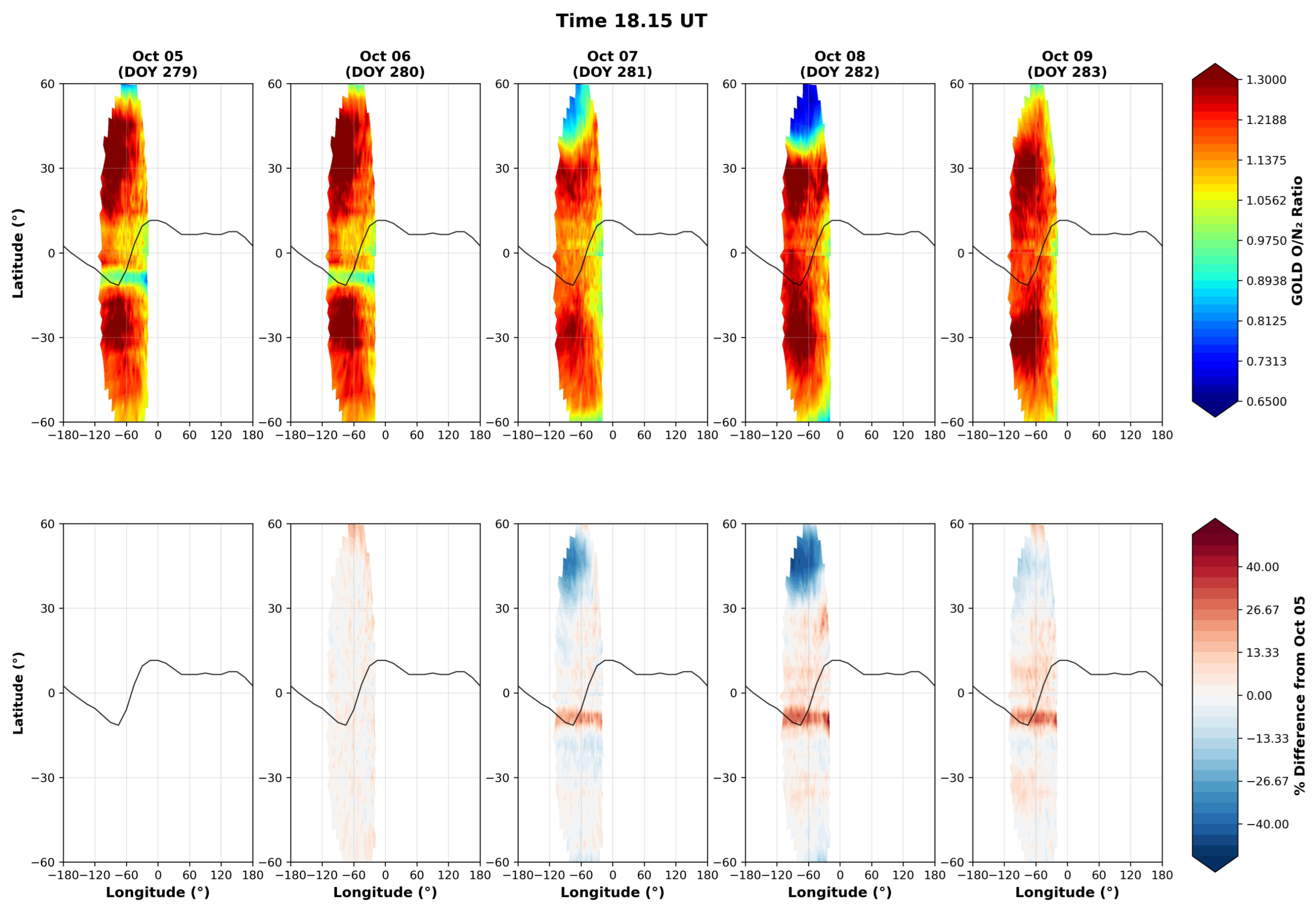
Data from NASA Global-Scale Observations of the Limb and Disk (NASA-GOLD (https://gold.cs.ucf.edu/data/, accessed on 12 January 2026)) were analysed for the storm-time thermospheric circulation and fluctuations. The NASA-GOLD instrument provides high-resolution data on thermospheric composition and circulation, specifically measuring the O/N2 ratio against a fixed N2 column density of 1 × 10¹⁷/cm2. These measurements utilise daytime emissions from the Lyman–Birge–Hopfield (LBH) nitrogen band (140.0–150.0 nm) and nighttime atomic oxygen emissions at 135.6 nm, providing a 30 min temporal resolution essential for tracking the evolution of N2-dominated winds [6,15,19]. To address the 10–20% contamination of the oxygen emission band that occurs during heightened geomagnetic activity, the methodology involves comparing thermospheric composition at simultaneous intervals, specifically 10:15, 14:15, and 18:15 UT, against a quiet-time baseline on 5 October (DOY 279). This application of GOLD data enables the precise determination of both the short-term spatial and temporal variability of the thermosphere as it responds to severe upper atmosphere disturbances.
In a single-point positioning technique, we utilised RTKLIB (https://www.rtklib.com) (version 2.4.3) for the post-processing of station observation and navigational Receiver Independent Exchange (RINEX) files obtained from IGS-CDDIS. The processing configuration utilised the preset L1+2 frequencies with a forward filter type and a 15° elevation mask angle, ensuring that at least five GNSS satellites (from the GPS, GLONASS, and Galileo constellations) were visible to maintain a high data quality factor. Ionospheric and satellite ephemeris corrections were derived from broadcast ionospheric corrections and navigation data, while the Saastamoinen model was applied for tropospheric correction. Storm-time positioning errors were determined by calculating the differences between the ECEF coordinates obtained from post-processing (X, Y, Z) and the fixed station positions provided by the International Terrestrial Reference Frame (https://network.igs.org) (ITRF) [11,35]. The final accuracy metrics were established by calculating the absolute mean error (ame) defined in Equation (1) for the X, Y, and Z components, providing a quantitative assessment of positioning stability during the storm’s commencement, main, and recovery phases.
a m e ( X , Y , Z ) = n = 1 n P X , Y , Z P ITRF n
where P X , Y , Z and P ITRF are the calculated positions during the storm and the given IGS stations Earth-Centred Earth-Fixed coordinates, respectively, while n is the number of observations.

3. Results

3.1. October 2024 Geomagnetic Storm Events

The October 2024 severe geomagnetic storm developed as a distinct two-step event. The first step was triggered by a moderate SSC at 08:00 UT on 6 October (DOY 280), characterised by an immediate rise in solar wind speed to approximately 452 km/s (see Figure 2). This initial disturbance led to the onset of the main phase at 04:00 UT on 7 October as proton density peaked at 33 cm−3, eventually reaching a minimum Dst of −148 nT by the morning of 8 October. After a short recovery period, a second and significantly more severe phase commenced at 16:00 UT on 10 October (DOY 284), with the interplanetary magnetic field ( | B | ) intensifying to 32 nT and solar wind speeds (Vsw) surging to 740 km/s. This second step drove the storm to its peak, reaching a severe minimum Dst of −333 nT at 01:00 UT on 11 October (DOY 285).
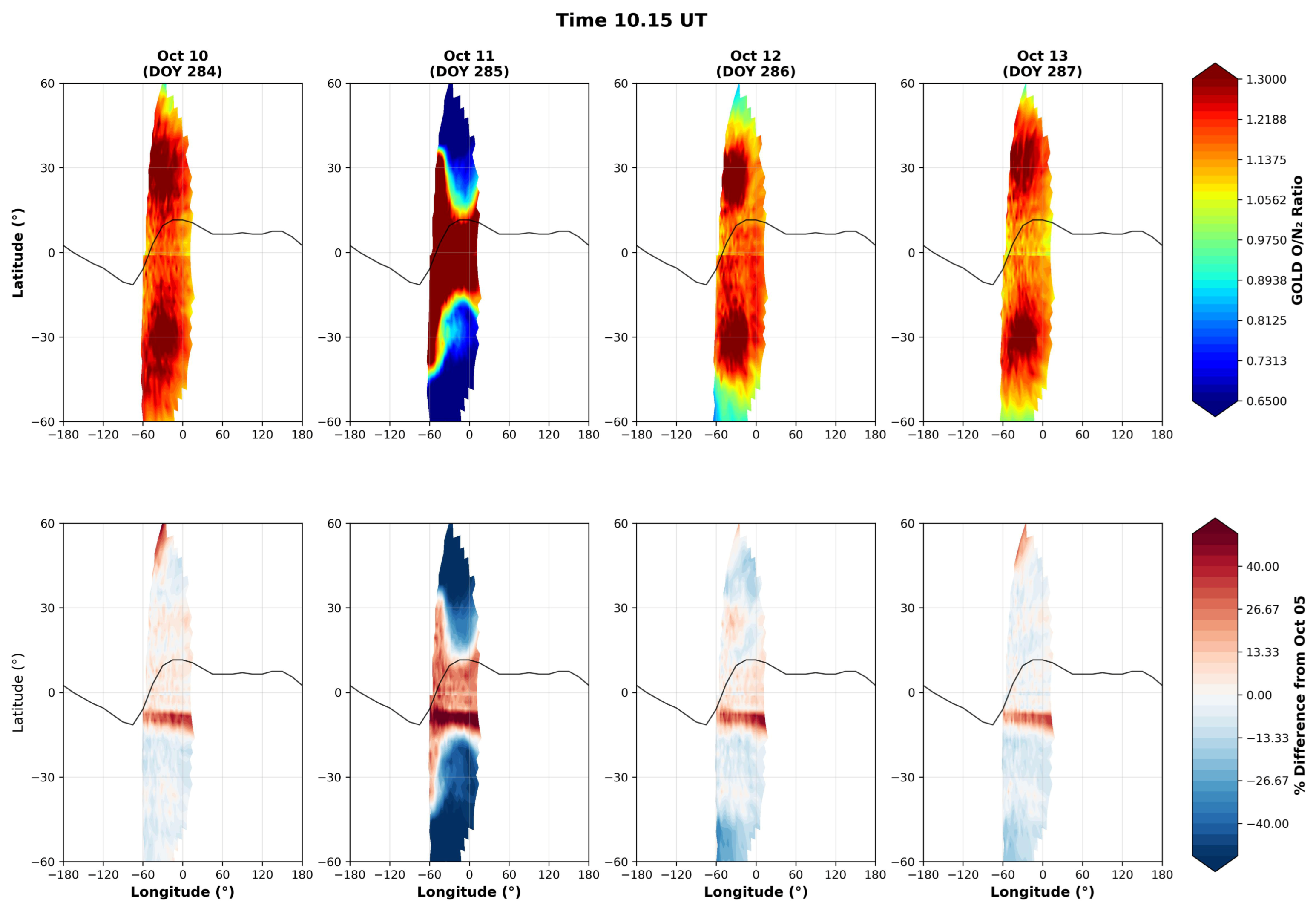
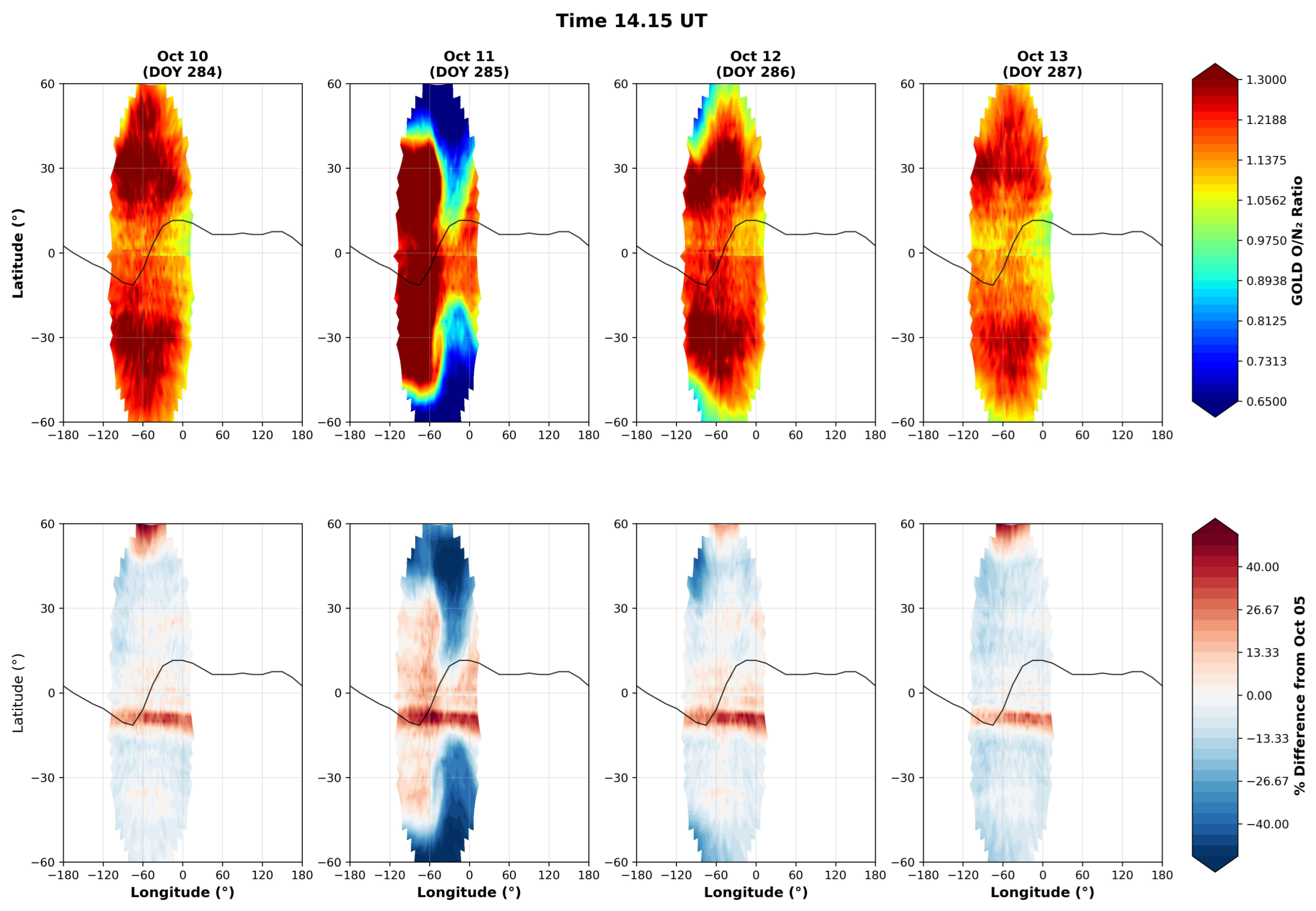
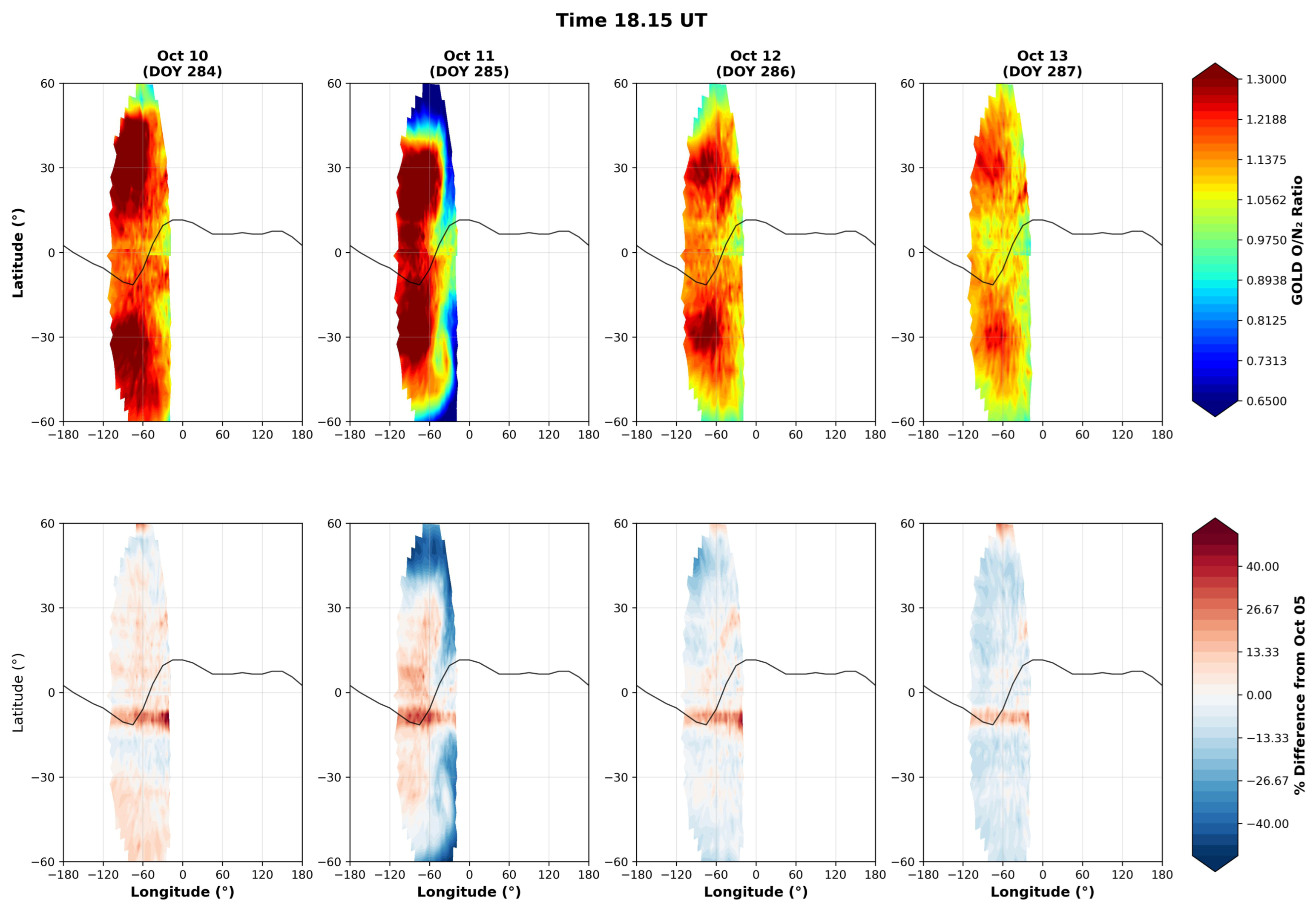
The thermospheric circulation patterns shown in Figure 3, Figure 4 and Figure 5 show an equatorward N2-rich wind that is short lived on DOY 282 (8 October) at about 30° latitude in the Northern Hemisphere. Depicted as the blue vortices in the high latitude, this consistency was not visible in the Southern Hemisphere, while Figure 6, Figure 7 and Figure 8 during the main phase on the 11 October (DOY 285) indicate that N2-dominated winds are transported equatorward in both hemispheres, in the sequence of events visible from 10:15 UT to 18:15 UT. Unlike the extreme May storm, where the equatorward thermospheric wind advected from the Southern Hemisphere arrived earlier than that of the Northern Hemisphere [11], the equatorward N2-rich thermospheric flow during the October event from the Northern Hemisphere reached the geomagnetic equator earlier than the Southern Hemisphere (see Figure 7 at 10:15 and 14:15 UT).
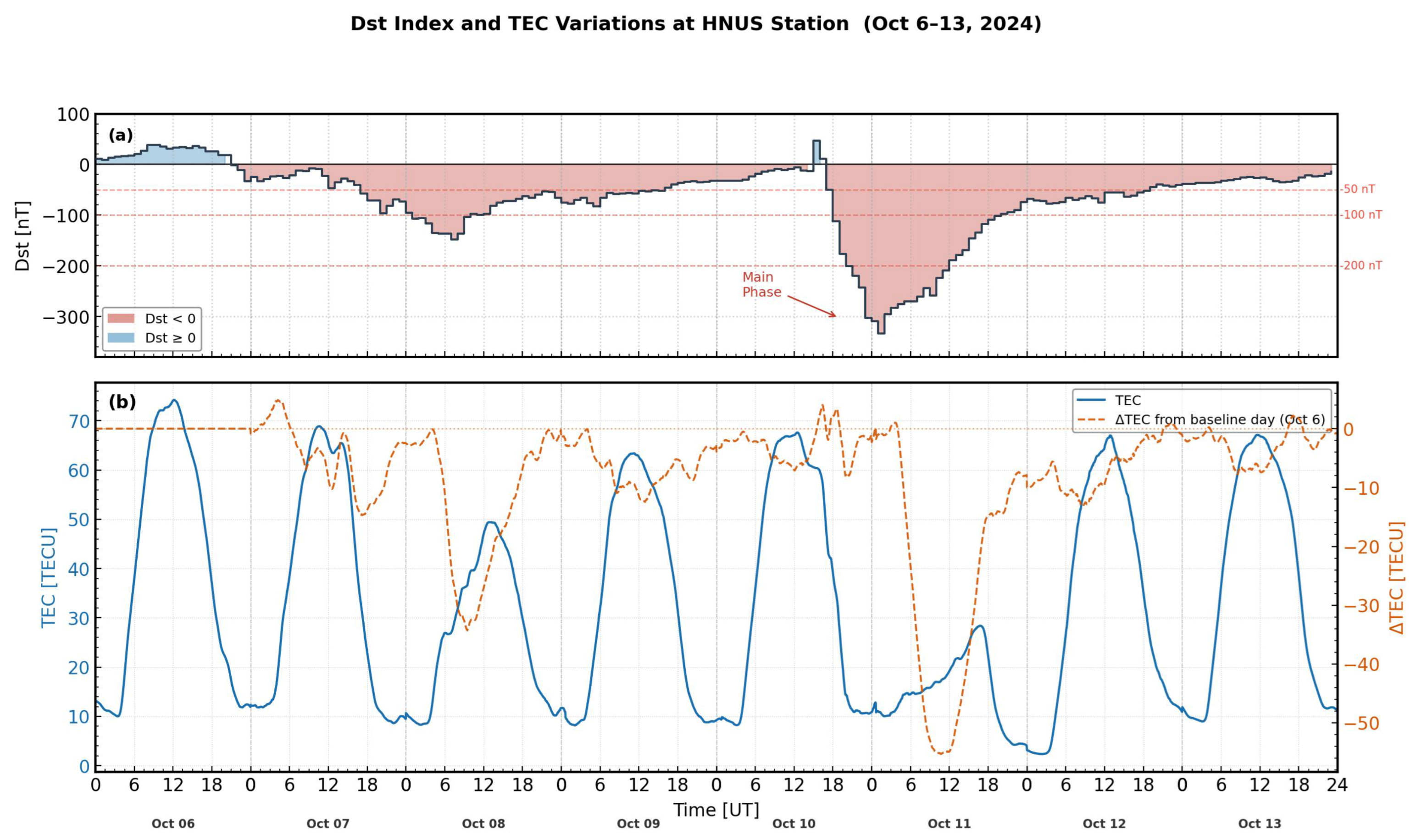
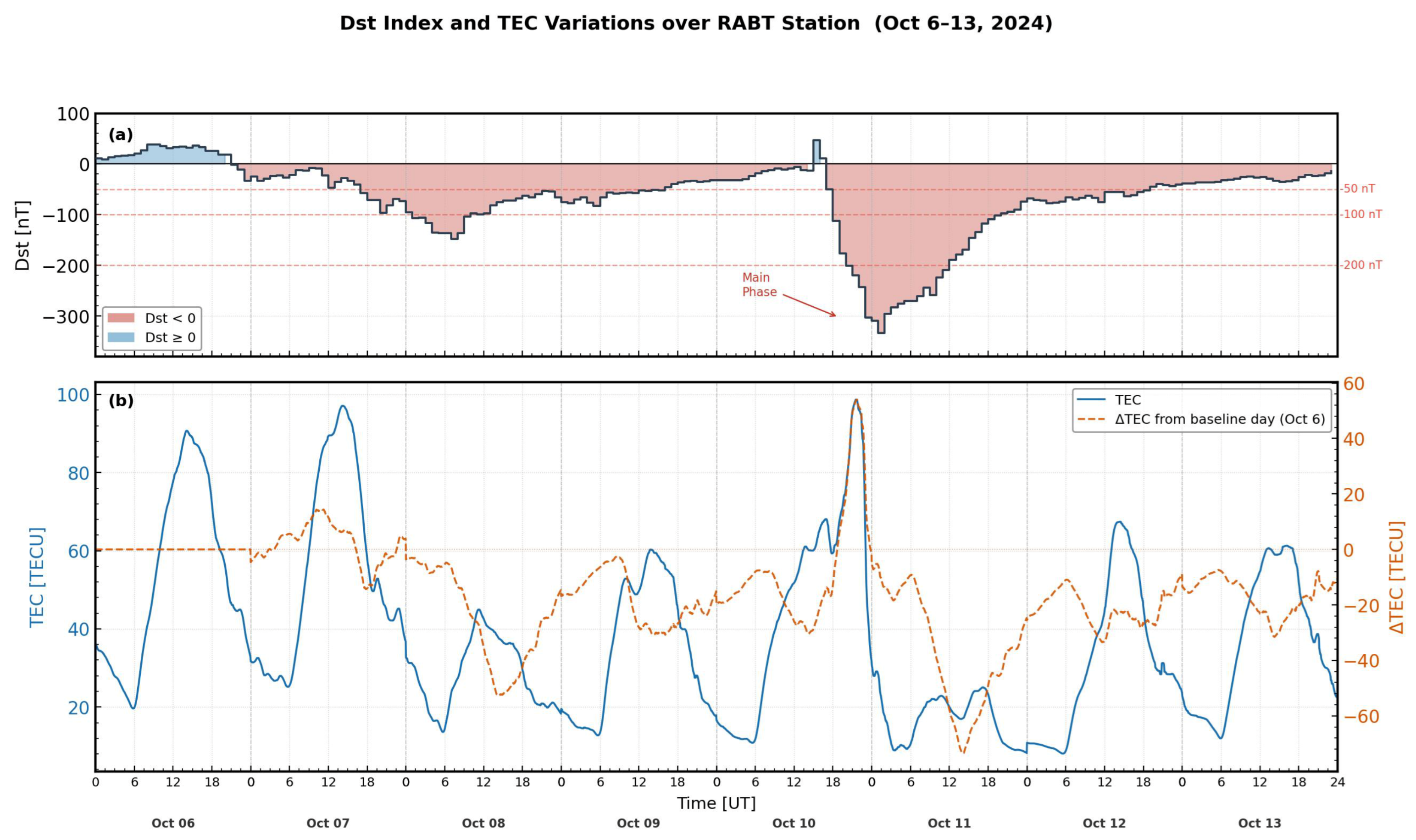
The diurnal TEC peaks over HNUS at noon (at 12:00 UT), while that of RABT peaks in the post-noon period. The TEC observation over HNUS and RABT shows a similar pattern of TEC depletion of about >30 TECU and >50 TECU during the main phases of both the moderate and severe storms in October (see Figure 9 and Figure 10), respectively. The TEC depletion is consistent with faster recombination of atmospheric atomic species and the N2-dominated thermospheric advection [11], reducing the electron density in the ionosphere over the two stations.
This increase in N2 at F-region altitudes (450 km) introduces a more rapid loss mechanism for ionospheric plasma. The dominant O+ ions undergo a fast charge-exchange reaction with the upswelling N2 molecules (O+ + N2→ NO+ + N), and the resulting molecular ions (NO+) then recombine with electrons much more quickly than O+ ions do, leading to a net depletion of TEC in the F-region resulting in the negative ionospheric storm observed.

3.2. Storm-Time GNSS Positioning Accuracy

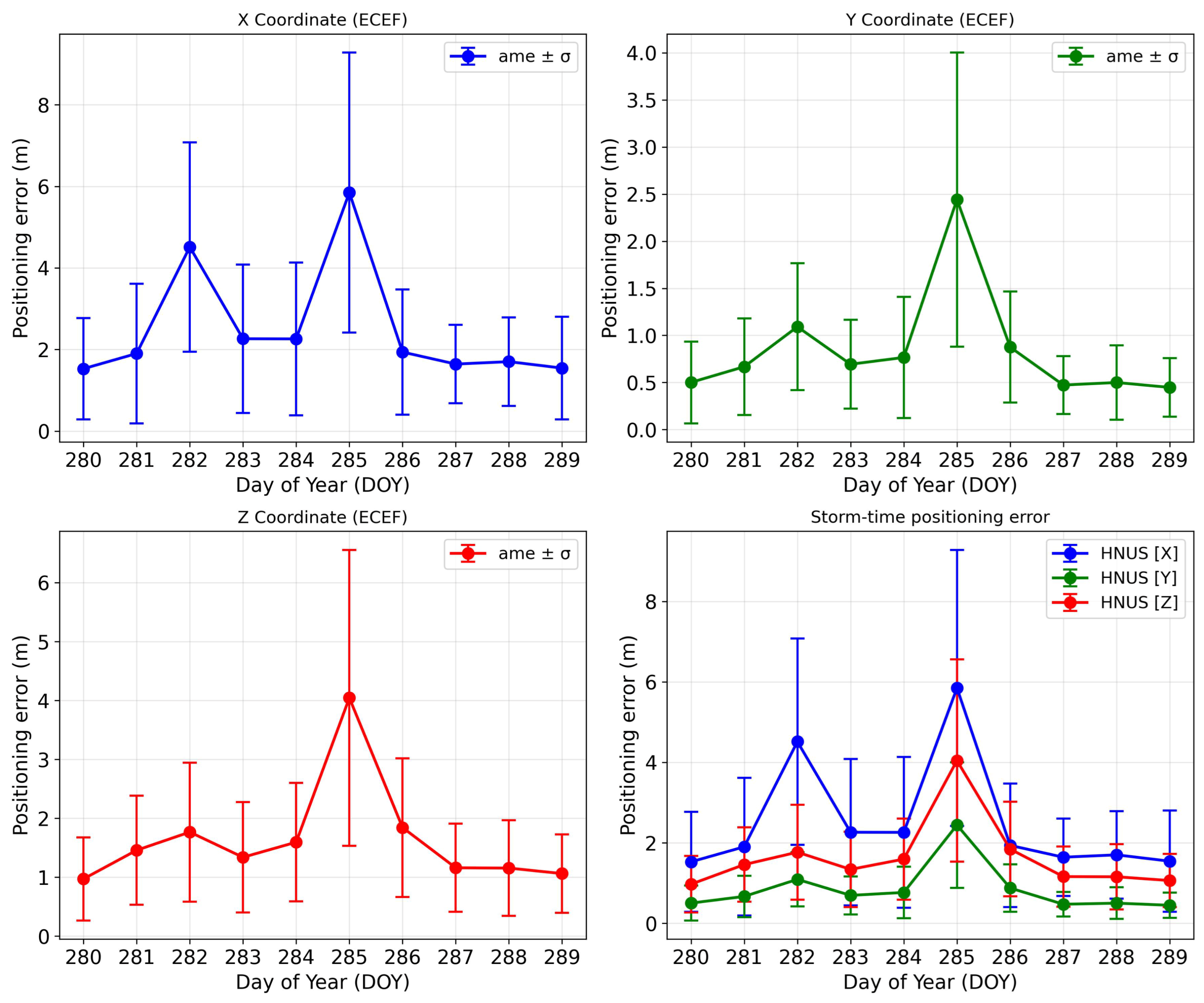
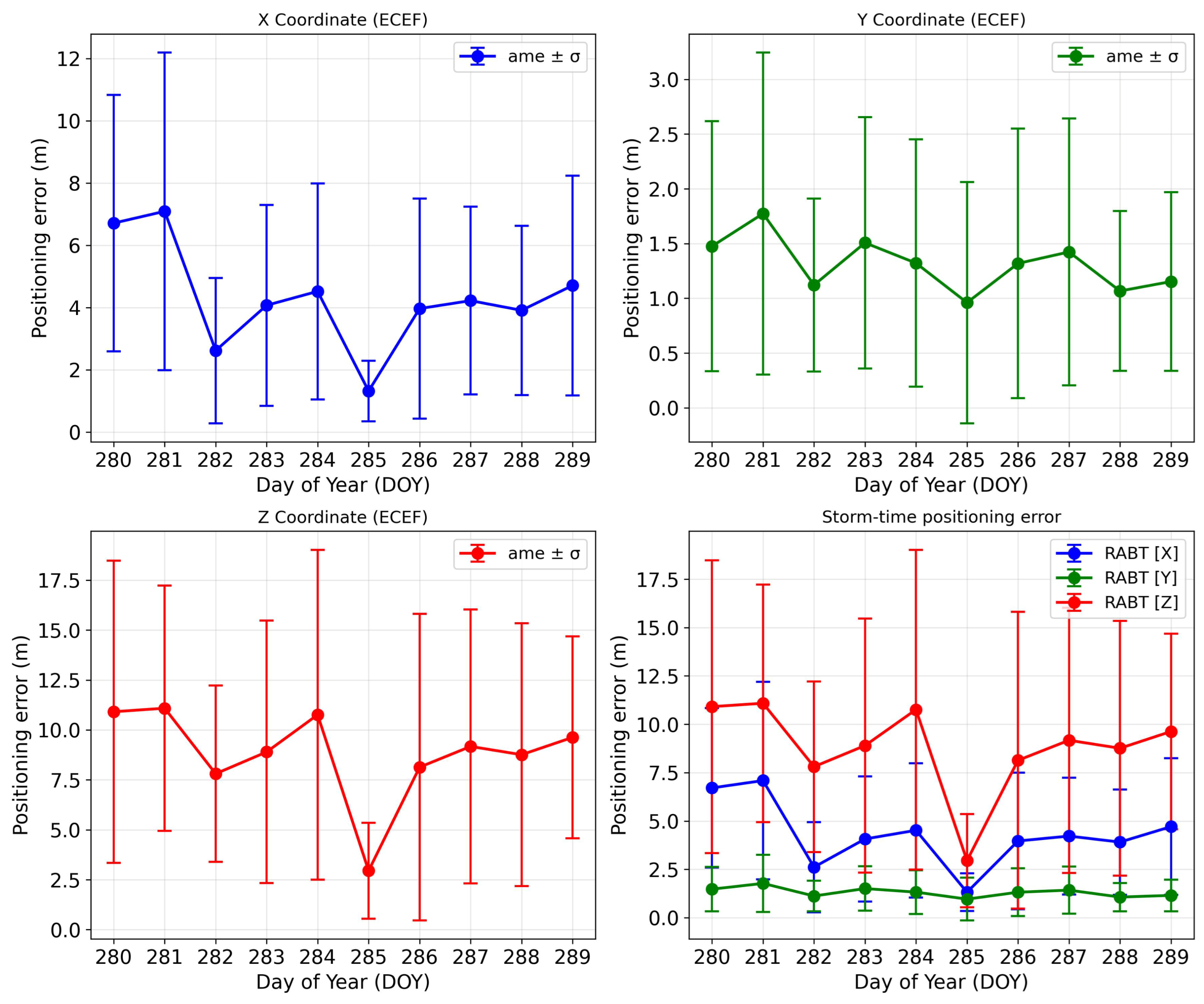
Figure 11 and Figure 12 present the ECEF coordinate positioning errors (X, Y, Z components) at HNUS and RABT over Days of Year (DOYs) 280–289, encompassing the storm commencement, the storm main phase, and the recovery phase of the October 2024 geomagnetic storm. At HNUS, an increased positioning error was observed simultaneously across all three ECEF components at DOY 285 during the main phase and early recovery phase, with the X-component reaching a maximum error of approximately 5.85 m, the Z-component 4.0 m, and the Y-component 2.45 m, representing increases of roughly 270%, 150%, and 220%, respectively, relative to the 6 October (DOY 280) baseline values. This simultaneous degradation across all coordinate components at DOY 285 is consistent with a severe storm-time ionospheric negative phase over the Southern Hemisphere mid-latitudes, wherein TEC depletion to as low as 2.37 TECU, as observed in the TEC analysis, produces large unmodelled ionospheric residuals that project onto all three coordinate directions through the satellite geometry.
The SAMA influenced irregular ionospheric structures over HNUS, further preventing standard single-frequency ionospheric corrections from adequately absorbing the rapidly varying delay, amplifying positioning errors beyond what would be expected at a magnetically normal mid-latitude site. At RABT, in contrast, the positioning behaviour during DOY 285 is opposite; all three components reach their minimum errors for the entire observation window, with X reducing to 1.4 m, Y to 0.97 m, and Z to 3.1 m, compared to pre-main phase values of 6.7 m, 1.5 m, and 11.0 m, respectively, for DOY 280. This counterintuitive improvement at the time of geomagnetic disturbance is consistent with the early-arriving equatorward thermospheric wind surge, which elevates plasma along field lines through the F-region wind dynamo, producing a smooth and spatially coherent TEC over the equatorial ionisation anomaly (EIA) crest that is readily corrected by the receiver even in a depleted TEC. It is further noteworthy that RABT exhibits persistently large Z-component errors (8–11 m) throughout the period before the storm’s main phase, likely reflecting the station’s proximity to the EIA crest, where elevated and structured background TEC inflates the vertical delay component even under geomagnetically quiet conditions, whereas the storm-time plasma uplift temporarily homogenises the spatial TEC structure, improving the differential correction geometry. Figure 11 and Figure 12 provide observational evidence that storm-time GNSS positioning impact is not determined by the magnitude of geomagnetic disturbance alone, but critically by the sign and spatial structure of the ionospheric response at each station’s magnetic and geographic location, degrading positioning where the ionosphere depletes and becomes irregular while transiently improving it where the storm drives a coherent plasma enhancement.

4. Discussion

4.1. Dynamics and Energetics of the October 2024 Severe Storm

The severe geomagnetic storm of October 2024 was a complex two-step event initiated by the eruption of AR 13848 and multiple CMEs. The first step involved a moderate SSC on 6 October (DOY 280), reaching a minimum Dst of −148 nT on 8 October (DOY 282), while the subsequent severe SSC reached an extreme minimum Dst of −333 nT on 11 October (DOY 285). This extreme energy deposition from the solar wind exerted significant pressure on the magnetosphere, triggering intense Joule heating and particle precipitation at high latitudes (e.g., [4,9]). Such heating leads to thermospheric expansion and circulation divergence, which reshapes the composition of the upper atmosphere.

4.2. Physical Mechanisms of IT Coupling

The primary physical mechanism driving the observed ionospheric response is the storm-time thermospheric upwelling. As heating occurs, air rich in N2 is transported from lower altitudes to the F-region (approximately 450 km). This upwelling significantly alters the neutral composition by lowering the O/N2 ratio, which serves as the signature of a negative ionospheric storm (e.g., [11,20,21]). In this enriched N2 environment, the dominant O+ ions undergo a rapid charge-exchange reaction. The resulting molecular ions (NO+) recombine with electrons much faster than atomic oxygen ions do (e.g., [22,24,26]), leading to a net depletion of the TEC. Observations at the mid-latitude stations RABT and HNUS confirmed this consistent depletion, with TEC losses exceeding 30 TECU and 50 TECU during the moderate and severe phases, respectively.

4.3. Hemispheric Asymmetry in Atmospheric Dynamics over the Two Stations

This study highlights a significant hemispheric asymmetry in the propagation of thermospheric disturbances. NASA-GOLD observations during the October 2024 storm main phase showed that N2-dominated wind was advected equatorward in both hemispheres. However, a distinct difference was noted compared to the extreme storm of May 2024 [11,19]: in the October event, the equatorward thermospheric circulation in the Northern Hemisphere arrived before that of the Southern Hemisphere; the opposite is the case during the May 2024 events. This variability underscores the complexity of the upper atmosphere response and suggests that seasonal or Universal Time (UT) dependencies heavily influence how circulation patterns advect composition bulges toward lower latitudes.

4.4. Technological Implications for GNSS Positioning

During the October 2024 geomagnetic storm, the TEC observations at HNUS and RABT reveal an inter-hemispheric asymmetry in both ionospheric response and its consequence for GNSS positioning, one that cannot be fully explained by storm-time chemistry alone but requires consideration of storm-time thermospheric wind dynamics. At high latitudes, Joule heating and auroral particle precipitation deposit large amounts of energy into the thermosphere, launching equatorward neutral wind surges in both hemispheres. Critically, however, the Northern Hemisphere wind surge arrives at mid-latitudes earlier than its Southern Hemisphere counterpart, a well-documented asymmetry attributable to the fact that during October, the Northern Hemisphere auroral oval is tilted toward the sun-lit dayside, where background thermospheric pressure gradients already favour equatorward flow, whereas the Southern Hemisphere surge must propagate through a relatively denser, more resistive nightside thermosphere (e.g., [19,23]). This timing asymmetry has different ionospheric consequences at the two stations. Over RABT, the early-arriving northward-to-equatorward wind pushes ionospheric plasma upward along magnetic field lines through the F-region wind dynamo mechanism and the fountain effect enhancement, thereby elevating the F-layer to higher altitudes where recombination rates are lower, temporarily sustaining and reinforcing the EIA crest (e.g., [36]), allowing the broadcast ionospheric correction to single-point positioning to be effective.
This produces the elevated TEC observed at RABT during the storm onset, which, despite its higher absolute magnitude, remains tractable for dual-frequency GNSS receivers and spatially coherent enough for differential corrections to remain valid even during the TEC depletion that follows. Over HNUS, the delayed Southern Hemisphere equatorward wind surge arrives in an ionosphere already depleted by the negative storm-phase composition changes; the decrease in the O/N2 ratio suppresses electron production that propagates from the auroral zone (e.g., [5,20]). Rather than elevating plasma, the equatorward wind over the Southern Hemisphere mid-latitudes drives plasma downward along the steeper southern magnetic field lines into regions of higher recombination, accelerating the TEC depletion already underway and driving TEC as low as 2.37 TECU over the station. This downward plasma transport is particularly severe at HNUS owing to its location within the SAMA (e.g., [37]), where the anomalously shallow magnetic field inclination alters the effective projection of the neutral wind onto the field-aligned direction, amplifying the downward drift component relative to what would occur at a mid-latitude site outside SAMA. The impact on GNSS positioning is as follows: while RABT benefits from a wind-driven plasma uplift that produces high but smooth and correctable TEC, HNUS suffers a wind-accelerated plasma drainage that creates severe depletions, spatially incoherent structures, and large residual errors after ionospheric model correction (e.g., [38]), creating the observed GNSS positioning degradation.
Overall, the October 2024 geomagnetic storm is consistently characterised as producing a negative ionospheric storm phase marked by severe plasma loss. Swarm satellite observations from multiple studies confirm electron density depletion reaching two to three orders of magnitude below quiet-time levels, and most researchers describe these as morphological depletion bands stretching from the equator to auroral latitudes [39,40,41,42]. This work goes further by providing specific regional quantification for the African sector, reporting depletions exceeding 50 TECU and identifying an extreme case at HNUS where TEC dropped as low as 2.37 TECU, a level of granularity that may be absent from broader global analyses.
Most studies agree that differences in particle precipitation and Hall conductivity drive uneven ionospheric responses between the Northern and Southern Hemispheres [43], though they differ on the precise mechanisms and timing. Our analyses demonstrate that the Northern Hemisphere equatorward thermospheric circulation arrived before its Southern Hemisphere counterpart, attributed to the October auroral oval being tilted toward the sun-lit dayside in the Northern Hemisphere, which favoured equatorward flow, while the Southern Hemisphere surge was resisted by a denser nightside thermosphere. Notably, this is explicitly identified as the reverse of the May 2024 storm, where the Southern Hemisphere surge arrived first.
The GNSS positioning analysis reveals a regional contrast driven by the sign of the local ionospheric response. At HNUS, positioning errors degraded by as much as 270%, with X-component errors reaching 5.85 m, an outcome exacerbated by SAMA, where shallow magnetic inclination amplified downward plasma drainage. At RABT, however, positioning accuracy improved during the storm’s main phase, with X-component errors falling to just 1.4 m. Research highlights that extreme meridional gradients of up to 3 m of delay over 2500 km present significant challenges to Satellite-Based Augmentation Systems worldwide [39]. Instead of the storm-time global perspective of the F-region [40,42], this work demonstrates how localised thermospheric surges can simultaneously degrade positioning performance at one station while improving it at another.

5. Conclusions

This study analysed the upper atmospheric response over mid-latitude African stations to the severe geomagnetic storm of October 2024. We identified a consistent chain of cause and effect where storm-time thermospheric heating drove the upward transport of N2-rich air, significantly increasing N2 density at F-region altitudes (450 km) and lowering the O/N2 ratio. This enrichment created an efficient pathway for the loss of ionospheric plasma through rapid charge-exchange reactions, leading to the significant TEC depletions characteristic of a negative ionospheric storm.
The study further reveals an inter-hemispheric timing asymmetry; the Northern Hemisphere wind surge arrived earlier than its Southern Hemisphere counterpart due to the October auroral oval tilt and background pressure gradients favouring equatorward flow in the north. The technological consequences of this asymmetry were contrasting. At RABT, the early wind surge drove a smooth plasma uplift that temporarily enhanced positioning geometry. Conversely, at HNUS, the delayed surge arrived in an already depleted ionosphere and, exacerbated by the SAMA, drove plasma downward into regions of high recombination, resulting in severe positioning degradation. These outcomes highlight that under specific storm conditions, the upper atmosphere response can counterintuitively enhance positioning performance in one hemisphere while degrading it in another, reinforcing the complexity of the upper atmospheric response to geomagnetic storms.

Author Contributions

Conceptualization and methodology, J.O.; software, J.O.; validation, J.O., and D.M.; formal analysis, J.O.; investigation, J.O. and D.M.; resources, J.O. and D.M.; data curation, J.O. and D.M.; writing—original draft preparation, J.O.; writing—review and editing, J.O. and D.M.; visualization, J.O.; supervision, J.O.; project administration, J.O. All authors have read and agreed to the published version of the manuscript.

Funding

This research received no external funding.

Institutional Review Board Statement

Not applicable.

Informed Consent Statement

Not applicable.

Data Availability Statement

All datasets used in this study are publicly available, and the links are provided in Section 2.3 of this manuscript.

Acknowledgments

The data used in this study were made available through the following providers: The interplanetary and geomagnetic activity indices from the OmniWeb database hosted by NASA/GSFC Space Physics Data Facility, the IONOLAB, and the NASA GOLD mission for GOLD data. The authors have reviewed and edited the output and take full responsibility for the content of this publication.

Conflicts of Interest

The authors declare no conflicts of interest.

References

  1. Kolarski, A.; Veselinović, N.; Srećković, V.A.; Mijić, Z.; Savić, M.; Dragić, A. Impacts of Extreme Space Weather Events on September 6th, 2017 on Ionosphere and Primary Cosmic Rays. Remote Sens. 2023, 15, 1403. [Google Scholar] [CrossRef]
  2. Tulasi Ram, S.; Veenadhari, B.; Dimri, A.P.; Bulusu, J.; Bagiya, M.; Gurubaran, S.; Parihar, N.; Remya, B.; Seemala, G.; Singh, R.; et al. Super-Intense Geomagnetic Storm on 10–11 May 2024: Possible Mechanisms and Impacts. Space Weather 2024, 22, e2024SW004126. [Google Scholar] [CrossRef]
  3. Guo, J.; Wang, B.; Whitman, K.; Plainaki, C.; Zhao, L.; Bain, H.M.; Cohen, C.; Dalla, S.; Dumbovic, M.; Janvier, M.; et al. Particle radiation environment in the heliosphere: Status, limitations, and recommendations. Adv. Space Res. 2024, in press. [Google Scholar] [CrossRef]
  4. Jebaraj, I.C.; Kouloumvakos, A.; Dresing, N.; Warmuth, A.; Wijsen, N.; Palmroos, C.; Gieseler, J.; Marmyleva, A.; Vainio, R.; Krupar, V.; et al. Multiple injections of energetic electrons associated with the flare and CME event on 9 October 2021. Astron. Astrophys. 2023, 675, A27. [Google Scholar] [CrossRef]
  5. Prölss, G.W. Density Perturbations in the Upper Atmosphere Caused by the Dissipation of Solar Wind Energy. Surv. Geophys. 2011, 32, 101–195. [Google Scholar] [CrossRef]
  6. Qian, L.; Gan, Q.; Wang, W.; Cai, X.; Eastes, R.; Yue, J. Seasonal Variation of Thermospheric Composition Observed by NASA GOLD. JGR Space Phys. 2022, 127, e2022JA030496. [Google Scholar] [CrossRef]
  7. Nava, B.; Rodríguez-Zuluaga, J.; Alazo-Cuartas, K.; Kashcheyev, A.; Migoya-Orué, Y.; Radicella, S.M.; Amory-Mazaudier, C.; Fleury, R. Middle- and low-latitude ionosphere response to 2015 St. Patrick’s Day geomagnetic storm. J. Geophys. Res. Space Phys. 2016, 121, 3421–3438. [Google Scholar] [CrossRef]
  8. Jackman, C.H.; DeLand, M.T.; Labow, G.J.; Fleming, E.L.; Weisenstein, D.K.; Ko, M.K.W.; Sinnhuber, M.; Anderson, J.; Russell, J.M. The influence of the several very large solar proton events in years 2000–2003 on the neutral middle atmosphere. Adv. Space Res. 2005, 35, 445–450. [Google Scholar] [CrossRef][Green Version]
  9. Nilam, B.; Tulasi Ram, S.; Oliveira, D.M.; Remya, B.; Shiokawa, K.; Rai, D.; Sibeck, D.; Dimri, A.P. Strong Westward Current Pulse at Auroral Latitudes Extending to Dawn-Side Low-Latitudes Due To Enhanced Density Within Kelvin-Helmholtz Wave Vortex in Solar Wind. Geophys. Res. Lett. 2025, 52, e2025GL117032. [Google Scholar] [CrossRef]
  10. Velinov, P.I.Y.; Asenovski, S.; Kudela, K.; Lastovicka, J.; Mateev, L.; Mishev, A.; Tonev, P. Impact of cosmic rays and solar energetic particles on the Earth’s ionosphere and atmosphere. J. Space Weather Space Clim. 2013, 3, A14. [Google Scholar] [CrossRef][Green Version]
  11. Omojola, J.; Greer, K.; Moeketsi, D. Geospace response to May 2024 X-class flare and coronal mass ejection. Adv. Space Res. 2025, 76, 7220–7229. [Google Scholar] [CrossRef]
  12. Mironova, I.; Sinnhuber, M.; Bazilevskaya, G.; Clilverd, M.; Funke, B.; Makhmutov, V.; Rozanov, E.; Santee, M.L.; Sukhodolov, T.; Ulich, T. Exceptional middle latitude electron precipitation detected by balloon observations: Implications for atmospheric composition. Atmos. Chem. Phys. 2022, 22, 6703–6716. [Google Scholar] [CrossRef]
  13. Li, W.; Liu, T.; Zuo, P.; Zou, Z.; Ruan, M.; Wei, J. Low-latitude ionospheric responses and positioning performance of ground GNSS associated with the geomagnetic storm on March 13–14, 2022. Front. Astron. Space Sci. 2024, 11, 1431611. [Google Scholar] [CrossRef]
  14. Nanjo, S.; Shiokawa, K. Spatial structures of blue low-latitude aurora observed from Japan during the extreme geomagnetic storm of May 2024. Earth Planets Space 2024, 76, 156. [Google Scholar] [CrossRef]
  15. Greer, K.R.; Laskar, F.; Eastes, R.W.; Lumpe, J.; Liu, H.-L.; Pedatella, N. The Molecular Oxygen Density Structure of the Lower Thermosphere as Seen by GOLD and Models. Geophys. Res. Lett. 2022, 49, e2022GL098800. [Google Scholar] [CrossRef]
  16. Habarulema, J.B.; Katamzi-Joseph, Z.T.; Burešová, D.; Nndanganeni, R.; Matamba, T.; Tshisaphungo, M.; Buchert, S.; Kosch, M.; Lotz, S.; Cilliers, P.; et al. Ionospheric Response at Conjugate Locations During the 7-8 September 2017 Geomagnetic Storm Over the Europe-African Longitude Sector. J. Geophys. Res. Space Phys. 2020, 125, e28307. [Google Scholar] [CrossRef]
  17. Matamba, T.M.; Danskin, D.W.; Nndanganeni, R.R.; Tshisaphungo, M. Space weather impacts on the ionosphere over the southern African mid-latitude region. Earth Planets Space 2023, 75, 142. [Google Scholar] [CrossRef]
  18. Qian, L.; Solomon, S.C. Thermospheric Density: An Overview of Temporal and Spatial Variations. Space Sci. Rev. 2012, 168, 147–173. [Google Scholar] [CrossRef]
  19. Correira, J.; Evans, J.S.; Lumpe, J.D.; Eastes, R.W.; Wang, W.; Aryal, S.; Krywonos, A.; McClintock, W.E. Upper Atmospheric Vortices Following Strong Geomagnetic Storms. Authorea 2024. [Google Scholar] [CrossRef]
  20. Fuller-Rowell, T.J.; Codrescu, M.V.; Moffett, R.J.; Quegan, S. Response of the thermosphere and ionosphere to geomagnetic storms. J. Geophys. Res. Space Phys. 1994, 99, 3893–3914. [Google Scholar] [CrossRef]
  21. Fernandez-Gomez, I.; Kodikara, T.; Borries, C.; Forootan, E.; Goss, A.; Schmidt, M.; Codrescu, M.V. Improving estimates of the ionosphere during geomagnetic storm conditions through assimilation of thermospheric mass density. Earth Planets Space 2022, 74, 121. [Google Scholar] [CrossRef]
  22. Shahzad, R.; Shah, M.; Tariq, M.A.; Calabia, A.; Melgarejo-Morales, A.; Jamjareegulgarn, P.; Liu, L. Ionospheric–Thermospheric Responses to Geomagnetic Storms from Multi-Instrument Space Weather Data. Remote Sens. 2023, 15, 2687. [Google Scholar] [CrossRef]
  23. Fuller-Rowell, T.J.; Codrescu, M.V.; Rishbeth, H.; Moffett, R.J.; Quegan, S. On the seasonal response of the thermosphere and ionosphere to geomagnetic storms. J. Geophys. Res. 1996, 101, 2343–2353. [Google Scholar] [CrossRef]
  24. Sojka, J.J.; Schunk, R.W. A theoretical F region study of ion compositional and temperature variations in response to magnetospheric storm inputs. J. Geophys. Res. 1984, 89, 2348–2358. [Google Scholar] [CrossRef]
  25. Kim, J.; Kwak, Y.-S.; Lee, C.; Lee, J.; Kam, H.; Yang, T.-Y.; Jee, G.; Kim, Y.H. Observational evidence of thermospheric wind and composition changes and the resulting ionospheric disturbances in the European sector during extreme geomagnetic storms. J. Space Weather Space Clim. 2023, 13, 24. [Google Scholar] [CrossRef]
  26. Krall, J.; Huba, J.D. The Effect of the Thermosphere on Ionosphere Outflows. Front. Astron. Space Sci. 2021, 8, 712616. [Google Scholar] [CrossRef]
  27. Mansilla, G.A. Some effects in the upper atmosphere during geomagnetic storms. Adv. Space Res. 2011, 47, 930–937. [Google Scholar] [CrossRef]
  28. Ratovsky, K.G.; Klimenko, M.V.; Yasyukevich, Y.V.; Klimenko, V.V.; Vesnin, A.M. Statistical Analysis and Interpretation of High-, Mid- and Low-Latitude Responses in Regional Electron Content to Geomagnetic Storms. Atmosphere 2020, 11, 1308. [Google Scholar] [CrossRef]
  29. Gallardo-Lacourt, B.; Frey, H.U.; Martinis, C. Proton Aurora and Optical Emissions in the Subauroral Region. Space Sci. Rev. 2021, 217, 10. [Google Scholar] [CrossRef]
  30. Spogli, L.; Alberti, T.; Bagiacchi, P.; Cafarella, L.; Cesaroni, C.; Cianchini, G.; Coco, I.; Di Mauro, D.; Ghidoni, R.; Giannattasio, F.; et al. The effects of the May 2024 Mother’s Day superstorm over the Mediterranean sector: From data to public communication. Ann. Geophys. 2024, 67, PA218. [Google Scholar] [CrossRef]
  31. Kalakoski, N.; Verronen, P.T.; Seppala, A.; Szelag, M.E.; Kero, A.; Marsh, D.R. Statistical response of middle atmosphere composition to solar proton events in WACCM-D simulations: The importance of lower ionospheric chemistry. Atmos. Chem. Phys. 2020, 20, 8923–8938. [Google Scholar] [CrossRef]
  32. Arikan, F.; Erol, C.B.; Arikan, O. Regularized estimation of vertical total electron content from Global Positioning System data. J. Geophys. Res. 2003, 108, 2002JA009605. [Google Scholar] [CrossRef]
  33. Arikan, F.; Nayir, H.; Sezen, U.; Arikan, O. Estimation of single station interfrequency receiver bias using GPS-TEC. Radio Sci. 2008, 43, 2007RS003785. [Google Scholar] [CrossRef]
  34. Sezen, U.; Arikan, F.; Arikan, O.; Ugurlu, O.; Sadeghimorad, A. Online, automatic, near-real time estimation of GPS-TEC: IONOLAB-TEC. Space Weather 2013, 11, 297–305. [Google Scholar] [CrossRef]
  35. Omojola, J.; Adewumi, T. Effects of St Patrick’s Day Intervals Geomagnetic Storms on the Accuracy of GNSS Positioning and Total Electron Content over Nigeria. J. Earth Space Phys. 2020, 45, 181–188. [Google Scholar] [CrossRef]
  36. Balan, N.; Liu, L.; Le, H. A brief review of equatorial ionization anomaly and ionospheric irregularities. Earth Planet. Phys. 2018, 2, 257–275. [Google Scholar] [CrossRef]
  37. Pavón-Carrasco, F.J.; De Santis, A. The South Atlantic Anomaly: The Key for a Possible Geomagnetic Reversal. Front. Earth Sci. 2016, 4, 188187. [Google Scholar] [CrossRef]
  38. Nava, B.; Coïsson, P.; Radicella, S.M. A new version of the NeQuick ionosphere electron density model. J. Atmos. Sol.-Terr. Phys. 2008, 70, 1856–1862. [Google Scholar] [CrossRef]
  39. Liu, T.; Jiang, Y.; Chen, B.; Liu, J.; He, Y.; Chen, W. Characterizing North-South Ionospheric Gradients During Geomagnetic Storms: A Variogram Enhancement for Wide Area Ionospheric Models. Space Weather 2026, 24, e2025SW004416. [Google Scholar] [CrossRef]
  40. Paul, K.S.; Haralambous, H.; Moses, M.; Tripathi, S.C. Effects of the October 2024 Storm over the Global Ionosphere. Remote Sens. 2025, 17, 2329. [Google Scholar] [CrossRef]
  41. Picanço, G.A.S.; Fagundes, P.R.; Moro, J.; Nogueira, P.A.B.; Muella, M.T.A.H.; Denardini, C.M.; Resende, L.C.A.; Da Silva, L.A.; Laranja, S.R.; Anoruo, C.; et al. Simultaneous occurrence of midlatitude plasma bubbles and LSTIDs during the 10 October 2024 geomagnetic storm. Adv. Space Res. 2025, 76, 6200–6219. [Google Scholar] [CrossRef]
  42. Tripathi, S.C.; Haralambous, H.; Biswas, T. Ionospheric Variability During the 10 October 2024 Geomagnetic Storm: A Regional Analysis Across Europe. Atmosphere 2025, 16, 1029. [Google Scholar] [CrossRef]
  43. Correira, J.; Evans, J.S.; Lumpe, J.D.; Eastes, R.W.; Wang, W.; Aryal, S.; Krywonos, A.; McClintock, W.E. Upper Atmospheric Vortices Following Strong Geomagnetic Storms. Geophys. Res. Lett. 2025, 52, e2024GL113726. [Google Scholar] [CrossRef]
Figure 1. The map of Africa showing the locations of the two IGS stations. The map illustrates the relationship of the stations to both the geomagnetic and geographic equators.
Atmosphere 17 00494 g001
Figure 2. The space weather characteristics during the event in October 2024. | B | is the interplanetary magnetic field, Np is the proton density, Vsw is the solar wind speed, and Dst is the disturbed storm time index on 5–15 October 2024.
Atmosphere 17 00494 g002
Figure 3. Thermospheric circulations during the October 2024 geomagnetic storm at 10.15 UT. The plot from NASA-GOLD illustrates the thermospheric circulation patterns observed from 5 October to 9 October (DOY 279–283) during the initial moderate storm. The lower panel plots are the differences from the thermospheric composition of 5 October, highlighting the variations from the pre-storm period.
Atmosphere 17 00494 g003
Figure 4. Thermospheric circulations during the October 2024 geomagnetic storm at 14.15 UT. The plot from NASA-GOLD illustrates the thermospheric circulation patterns observed from 5 October to 9 October (DOY 279–283) during the moderate storm. The lower panel plots are the differences from the thermospheric composition of 5 October, highlighting the variations from the pre-storm period.
Atmosphere 17 00494 g004
Figure 5. Thermospheric circulations during the October 2024 geomagnetic storm at 18.15 UT. The plot from NASA-GOLD illustrates the thermospheric circulation patterns observed from 5 October to 9 October (DOY 279–283) in the post-noon period. The lower panel plots are the differences from the thermospheric composition of 5 October, highlighting the variations from the pre-storm period.
Atmosphere 17 00494 g005
Figure 6. Thermospheric circulations during the October 2024 geomagnetic storm at 10.15 UT. The plot from NASA-GOLD illustrates the thermospheric circulation patterns observed from 10 October to 13 October (DOY 284–287) during the subsequent severe storm; the blue colour depicts the N2 rich wind, while the red colour represents the dominating O + , and the yellow/orange colour represents about an equal proportion of O/N2 mixture. The lower panel plots are the differences from the thermospheric composition of 5 October to highlight the variations from the pre-storm period.
Atmosphere 17 00494 g006
Figure 7. Thermospheric circulations during the October 2024 geomagnetic storm at 14.15 UT. The plot from NASA-GOLD illustrates the thermospheric circulation patterns observed from 10 October to 13 October (DOY 284–287) during the severe storm. The lower panel plots are the differences from the thermospheric composition of 5 October, highlighting the variations from the pre-storm period.
Atmosphere 17 00494 g007
Figure 8. Thermospheric circulations during the October 2024 geomagnetic storm at 18.15 UT. The plot from NASA-GOLD illustrates the thermospheric circulation patterns observed from 10 October to 13 October (DOY 284–287) during the post-noon period of the severe storm. The lower panel plots are the differences from the thermospheric composition of 5 October to highlight the variations from the pre-storm period.
Atmosphere 17 00494 g008
Figure 9. Two panel plots of the TEC and the Dst. The upper panel (a) shows Dst, while the lower panel (b) shows TEC over HNUS, superimposed is the relative difference from the 6 October used as the baseline.
Atmosphere 17 00494 g009
Figure 10. Two panel plots of the TEC and the Dst. The upper panel (a) shows Dst, while the lower panel (b) shows TEC over RABT, and the difference plotted relative to 6 October, as the baseline.
Atmosphere 17 00494 g010
Figure 11. GNSS positioning accuracy over HNUS during the October storm. The absolute mean error (ame) in positioning on the ECEF coordinates over HNUS during the storm period, calculated using the same scheme as in [11,35]. The error bar represents the standard deviation ( σ ).
Atmosphere 17 00494 g011
Figure 12. GNSS positioning accuracy during the October storm. The absolute mean error (ame) in positioning on the ECEF coordinates over RABT during the storm period. The error bar represents the standard deviation ( σ ).
Atmosphere 17 00494 g012
Disclaimer/Publisher’s Note: The statements, opinions and data contained in all publications are solely those of the individual author(s) and contributor(s) and not of MDPI and/or the editor(s). MDPI and/or the editor(s) disclaim responsibility for any injury to people or property resulting from any ideas, methods, instructions or products referred to in the content.