Article

Summertime Biogenic Volatile Organic Compounds in China: Emissions and Their Modulation on O3 and PM2.5 Pollution

1
College of Environment and Geography, Carbon Neutrality and Eco-Environmental Technology Innovation Center of Qingdao, Qingdao University, Qingdao 266071, China
2
Chinese Research Academy of Environmental Sciences, Beijing 100012, China
*
Authors to whom correspondence should be addressed.
Atmosphere 2026, 17(5), 473; https://doi.org/10.3390/atmos17050473
Submission received: 26 March 2026 / Revised: 27 April 2026 / Accepted: 30 April 2026 / Published: 5 May 2026

Abstract

Coordinated control of fine particulate matter (PM2.5) and ozone (O3) is an urgent national strategic priority for China’s air pollution governance. Biogenic volatile organic compounds (BVOCs) are important precursors of O3 and secondary organic aerosol (SOA). To quantify the species-specific impacts of BVOCs, we used the Model of Emissions of Gases and Aerosols from Nature (MEGAN, v3.2) and the Community Multiscale Air Quality (CMAQ, v5.3.2) model to investigate BVOC emission characteristics and their modulating effects on summertime O3 and PM2.5 across China. In July 2020, total BVOC emissions were 6.50 × 10⁶ tons, showing a spatial pattern that decreased from southeast to northwest and a unimodal diurnal variation that peaked at 13:00–14:00. BVOC emissions significantly promoted O3 formation, with a maximum concentration increment of 47.36 μg m−3 in VOC-limited regions such as the Sichuan Basin (SCB) and Yangtze River Delta (YRD). Their impact on PM2.5 was limited, with most regional increments below 3 μg m−3. Isoprene dominated O3 enhancement, while monoterpenes acted as the key BVOC for PM2.5 via SOA formation. Anthropogenic emission reductions elevated the relative contribution of BVOC emissions to air pollution in most regions. These findings highlighted the importance of considering BVOC emissions and their species-specific effects in China’s coordinated PM2.5-O3 control strategies for more precise air quality management.

1. Introduction

In recent years, air pollution has posed a significant challenge to sustainable development. Although China has made significant advances in air quality improvement, particulate pollution remains a persistent problem [1,2,3,4]. At the same time, ozone (O3) pollution has become more noticeable, with higher ambient concentrations reported in most regions [5]. Integrated observational data have indicated a consistent increase in summertime O3 levels in China over recent decades, with a reported trend of about 0.96 ppb y−1 [6]. The co-occurrence of high fine particulate matter (PM2.5) and O3 levels characterizes a typical state of complex air pollution, which not only poses challenges for regional air quality management but can also have detrimental effects on the ecological environment and human health [7,8,9]. In response, China’s 15th Five-Year Plan has explicitly prioritized the coordinated control of PM2.5 and O3 as a critical strategic objective.
Contemporary research on air pollution in China remains focused on anthropogenic emissions, with relatively limited attention given to natural sources such as biogenic volatile organic compounds (BVOC) emissions [10]. This oversight is significant given that, on a global scale, terrestrial vegetation dictates 75–90% of the total VOC budget [11]. Especially in China, BVOC emissions have been estimated at approximately 10.00–58.59 Tg y−1 [12,13]. Driven by the abundance of unsaturated bonds (e.g., C=C), the rapid oxidation of BVOCs generates peroxy radicals that facilitate O3 accumulation in the presence of nitrogen oxides (NOx), simultaneously producing low-volatility condensates that form secondary organic aerosols (SOA, a crucial component of PM2.5) [14,15,16], and these atmospheric impacts are usually positively correlated with the total emissions [17]. Such a dual influence on both gas-phase chemistry and particle formation underscores the pivotal role of BVOC emissions in regional air quality. Consequently, a comprehensive understanding of BVOC emission characteristics and their contributions to O3 and PM2.5 formation is a prerequisite for formulating effective control strategies for secondary air pollution in China.
Numerous studies have explored the impacts of BVOC emissions on O3 and PM2.5 formation, with formation potential analysis [18,19] and air quality modeling being the most commonly employed methodologies [20,21]. However, formation potential analysis often overlooks the complex, non-linear chemical feedbacks between BVOCs and other precursors, which can vary significantly across different chemical regimes [22]. In light of this, most current studies rely on air quality models to assess the impact of BVOCs on O3 and PM2.5. Churkina et al. [23] simulated plant-derived BVOC emissions and their response to O3 using the WRF-Chem model, revealing that BVOC emissions significantly increased air pollution levels during the heatwave. Liu et al. [24] concluded that climate-driven BVOC emission changes would enhance O3 and SOA concentrations by 0.9% and 7.3% in eastern China from 2015 to 2050 under the future climate scenario RCP8.5. Uttamang et al. [25] indicated that BVOC emissions over the northern region of Thailand contributed 5.3–5.6% of the total concentrations of PM2.5. However, most existing studies have treated BVOCs as a single group, paying limited attention to the distinct roles of individual species, such as isoprene and monoterpenes, in the formation of O3 and PM2.5. In addition, few studies have investigated how anthropogenic emission reductions alter the relative contribution of BVOCs to O3 and PM2.5 formation, leaving the role of BVOCs under cleaner anthropogenic conditions insufficiently characterized. Addressing these gaps is important for strengthening the scientific basis of coordinated O3-PM2.5 control, especially under the current policy context of continuous anthropogenic emission mitigation.
In this study, we investigated BVOC emissions and their air-quality impacts across China in July 2020. Beyond characterizing the spatiotemporal distribution of BVOC emissions, this work advanced previous China-wide studies in three aspects. (1) We simultaneously quantified the effects of BVOC emissions on both O3 and PM2.5, which is directly relevant to China’s ongoing coordinated control of these two pollutants. (2) The contributions of major BVOC groups (isoprene and monoterpenes) were compared to clarify their distinct roles in O3 production and PM2.5 formation. (3) A hypothetical anthropogenic-emission reduction scenario was applied to examine the relative importance of BVOCs under cleaner anthropogenic conditions, thereby providing insight into the potential role of biogenic sources in future air-quality improvement.

2. Methodology

2.1. Main Models and Research Domain

This study employed a modeling framework coupling the Weather Research and Forecasting (WRF, v3.8.1) model, the Model of Emissions of Gases and Aerosols from Nature (MEGAN, v3.2), and the Community Multiscale Air Quality (CMAQ, v5.3.2) model. Specifically, WRF provided meteorological fields, MEGAN generated the BVOC emission inventories, which together drove the air quality simulations in CMAQ. The simulation domain covers China and portions of the surrounding areas, utilizing a Lambert Conformal Conic projection centered at 34° N, 108° E, with a horizontal resolution of 36 km × 36 km (188 × 128 grid cells).

2.2. Model Configuration

For the WRF simulation, initial and boundary meteorological conditions were obtained from the National Centers for Environmental Prediction (NCEP) Final (FNL) reanalysis data with a spatial resolution of 1° × 1° (https://gdex.ucar.edu/datasets/d083002/, accessed on 22 May 2025). Global topographic and land-use data obtained from the USGS were used as the topographic input data. The WRF model then provided the necessary meteorological data for CMAQ and MEGAN. The parametric scheme for the meteorological field simulation included the WSM 5-class microphysics option, RRTM longwave radiation option, MM5 shortwave radiation option, Monin–Obukhov surface layer option, Noah land surface option, YSU boundary layer option, and Kain-Fritsch cumulus option.
The biogenic emission model MEGANv3.2 (https://bai.ess.uci.edu/megan, accessed on 29 May 2025) was applied to estimate BVOC emissions, yielding hourly emissions for 199 BVOC species, including isoprene, monoterpenes, sesquiterpenes, and other VOCs. Key input variables for MEGAN included Leaf Area Index (LAI), emission factors, meteorological fields, and vegetation cover data. Specifically, vegetation parameters (growth form and canopy type) were based on the MODIS MCD12Q1 land-cover product (https://lpdaac.usgs.gov/products/mcd12q1v006/, accessed on 3 June 2025). 8-day LAI data for 2020 were obtained from MODIS Collection 5 and processed following Yuan et al. [26]. Other parameters, including ecological function types, species composition, and emission factors, were sourced from the MEGANv3.2 default global database.
The gridded hourly emission flux in MEGANv3.2 was calculated as:
E =   EF   ×   γ
γ = LAI   ×   γ T P ×   γ L A ×   γ S M ×   γ H T ×   γ H W ×   γ L T ×   γ B D ×   γ C O 2 ×   γ O 3
where E is the BVOC net emission flux (μg m−2 h−1). EF is the BVOC emission factor (μg m−2 h−1) under standard environmental conditions (T = 303.15 K, PAR = 1000 μmol m−2 s−1) and γ is the emission activity factor, which is calculated by eq 2. LAI is the leaf area index (m2 m−2). γ is an environmental factor, where the symbol asterisk (*) can be replaced by canopy temperature/light (TP), leaf age (LA), soil moisture (SM), high temperature (HT), high wind speed (HW), low temperature (LT), bidirectional exchange (BD), ambient CO2 concentration (CO2), or O3 exposure (O3). In this study, γ C O 2 , γ B D and γ O 3 were not considered in the BVOC emission estimation, so the values are 1.
We used CMAQv5.3.2 (https://www.cmascenter.org/cmaq/, accessed on 17 June 2025) to simulate O3 and PM2.5 concentrations from 1 July to 31 July 2020, a representative summertime period characterized by high BVOC emissions and active photochemistry. The initial and boundary conditions for the CMAQ simulations were based on the default profiles, representing an unpolluted atmosphere. A 7-day spin-up was used to minimize the effects of initial conditions. The model employed the SAPRC07 mechanism for gas-phase chemistry and the AERO6 module for aerosol dynamics. Anthropogenic emissions for 2020 were obtained from the Multi-resolution Emission Inventory (MEICv1.4, http://www.meicmodel.org/, accessed on 20 June 2025), which covers five sectors and multiple air pollutants including SO2, CO, NOx, NH3, NMVOC, PM2.5, BC, and OC. The monthly emissions compatible with the SAPRC07 mechanism at grid format (0.25° × 0.25°) were used. To generate model-ready inputs, the MEIC inventory underwent spatial, temporal, and species allocations through the Modular Emission Inventory Allocation Tools for the Community Multiscale Air Quality model (MEIAT-CMAQ-main, https://github.com/Airwhf/MEIAT-CMAQ, accessed on 23 June 2025) [27].

2.3. Simulation Scenarios

The possible varieties in the simulation of O3 and PM2.5 mainly include precursor emissions (VOCs and NOx), meteorological conditions (e.g., temperature and solar radiation), chemical reaction mechanisms, and deposition processes. To evaluate the role of BVOC emissions in the formation of O3 and PM2.5, only the inclusion or exclusion of biogenic emissions was adjusted across simulation cases in this study. The specific configurations for anthropogenic and biogenic emissions in each scenario are summarized in Table 1. The baseline case, Case 1, included all anthropogenic (A_2020) and biogenic (B_2020) emissions to establish typical pollution levels. Case 2 excluded all biogenic emissions, Cases 3 and 4 separately considered only isoprene emissions (B_isop) and monoterpene emissions (B_mono), with all other influencing factors kept consistent. Cases 5 and 6 were designed with a 25% reduction in anthropogenic emissions (A_25%); this reduction level was selected as an idealized moderate sensitivity perturbation, consistent with those commonly used in air-quality modeling studies [28]. Case 5 included biogenic emissions, while Case 6 excluded them, enabling a direct evaluation of the role of BVOCs and their potential relative importance under stringent anthropogenic emission-reduction conditions.
The contributions of BVOC emissions were calculated using the “brute-force” method (difference method). The total BVOC emissions contribution is calculated as the difference in pollutant concentrations between Case 1 and Case 2. Likewise, the individual contributions of isoprene and monoterpenes were obtained by comparing Case 3 and Case 4 with Case 2, respectively.

3. Results and Discussion

3.1. Model Evaluation

Meteorological factors can influence the chemical reactions associated with pollution production and elimination, the transportation of its precursors, and BVOC emissions [29]. Simulated meteorological and pollutant concentration data for July 2020 were compared with observational data from monitoring stations to evaluate model performance. Meteorological observations were obtained from the National Tibetan Plateau/Third Pole Environment Data Center (https://doi.org/10.11888/AtmosphericPhysics.tpe.249369.file, accessed on 10 July 2025), while air pollutant data came from the China National Environmental Monitoring Centre (https://www.cnemc.cn/, accessed on 25 July 2025). The statistical indicators employed included the correlation coefficient (R), normalized mean bias (NMB), and root mean square error (RMSE).
Table 2 shows the evaluation results for different parameters. The simulated temperature at 2 m height (TEMP2) and wind speed at 10 m height (WSPD10) were compared to observations. The R values for TEMP2 and WSPD10 were 0.90 and 0.48, respectively. Overall, the simulation performance of TEMP2 was better than that of WSPD10, which is also comparable with previous studies [30]. Nevertheless, wind fields may propagate into the estimated BVOC emissions by affecting the meteorological drivers used in MEGAN, and may also influence pollutant transport and dispersion in CMAQ, thereby affecting the magnitude of simulated pollutant accumulation in some regions. Simulated maximum daily 8 h average O3 (MDA8 O3) and PM2.5 concentrations were also compared with observations: the R values were 0.74 for MDA8 O3 and 0.69 for PM2.5. The model performance was within the range recommended by Huang et al. [31,32]. Similarly, biases in simulated O3 and PM2.5 concentrations may influence the absolute magnitude of the estimated BVOC contributions.

3.2. BVOC Emission Characteristics

3.2.1. BVOC Emission Budget

In July 2020, the total BVOC emissions in China were estimated as 6.50 × 10⁶ tons. In this study, BVOC emissions were grouped into four categories based on their chemical properties: isoprene, monoterpenes, sesquiterpenes, and other VOCs. The other VOCs category, encompassing a wide variety of compounds, made the largest contribution, accounting for approximately 46.3% (3.01 × 10⁶ tons). Isoprene and monoterpenes followed with emissions of 1.86 × 10⁶ tons and 1.34 × 10⁶ tons, representing 29.1% and 20.6% of the total, respectively. Sesquiterpenes, by contrast, contributed only 2.05 × 10⁵ tons (3.2%) owing to their lower emission potentials. These estimates aligned well with the magnitude of emissions reported in previous studies for the same region [19,33].

3.2.2. Spatial Variations

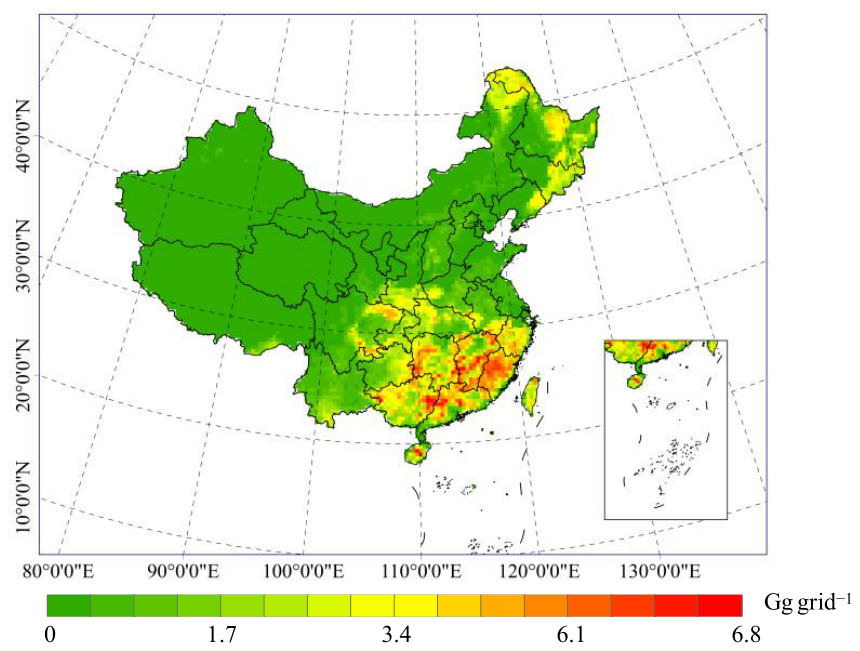
Figure 1 illustrates the spatial distribution of BVOC emissions across China in July 2020. Overall, the emissions exhibited strong spatial heterogeneity, characterized by a distinct gradient decreasing from the southeast to the northwest. Specifically, areas with high emissions were predominantly located in the subtropical and tropical humid regions south of the Qinling–Huaihe Line, notably within South China (e.g., Guangdong, Guangxi provinces), and East China (e.g., Fujian, Jiangxi provinces). The highest fluxes in these areas resulted from the combined effect of extensive high-potential emissions of broadleaf and coniferous forests, along with favorable weather conditions that collectively drove high emission rates [34,35]. Additionally, northeastern China emerged as another emission hotspot owing to extensive forest cover like coniferous and broadleaf trees, accounting for over 77% of the national total vegetation. Constrained by arid and alpine climates, the northwestern inland and the Tibetan Plateau exhibited negligible emissions, as these regions were dominated by low-biomass deserts, the Gobi, and alpine meadows [13].
Special attention was given to four key urban agglomerations characterized by dense populations and severe air pollution: Beijing-Tianjin-Hebei (BTH), the Yangtze River Delta (YRD), the Pearl River Delta (PRD), and the Sichuan Basin (SCB). Benefiting from abundant hydrothermal resources and dense subtropical vegetation, the PRD showed the highest emission intensity among the four regions, with an average grid emission of approximately 3.16 × 10³ tons. The YRD and the SCB showed similar average grid emissions of 1.54 × 10³ tons and 1.98 × 10³ tons, respectively. Moreover, both regions exhibited distinct topographic dependencies: in the YRD, emission fluxes in southern Zhejiang with hilly mountains were significantly higher than those in the northern plains; modulated by basin topography, the SCB presented a unique annular distribution characterized by high emissions in the surrounding mountains and low emissions in the basin bottom. Conversely, the BTH had a generally lower emission intensity, with an average grid emission of approximately 3.68 × 10² tons.

3.2.3. Temporal Distribution

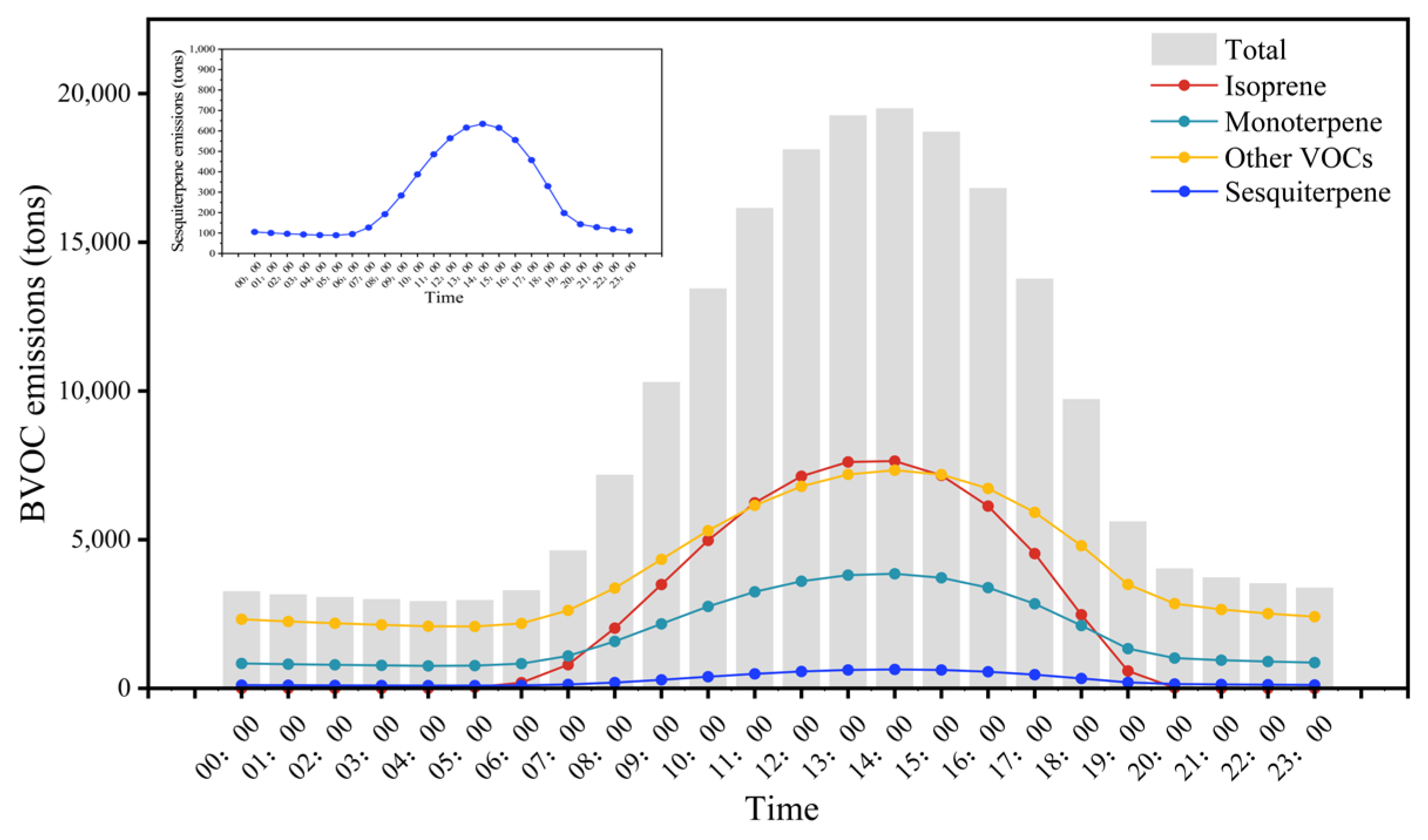
BVOC emissions exhibited distinct hourly variations governed primarily by meteorological forcing. As shown in Figure 2, the diurnal profile of total BVOC emissions followed a unimodal distribution closely aligned with the temporal evolution of solar radiation and air temperature. During the nighttime period (20:00 to 06:00 the next day), BVOC emissions remained at a low baseline level (approximately 3 × 10³ tons h−1) with minimal fluctuation. Following sunrise, emissions climbed rapidly, reaching a peak of approximately 2 × 10⁴ tons h−1 between 13:00 and 14:00. Notably, the diurnal pattern displayed a slight temporal asymmetry driven by atmospheric thermal inertia, with a more gradual decline in emissions during the late afternoon (15:00–18:00) than the increase observed in the early morning, as elevated ambient temperatures often persisted after solar radiation weakened [36].
Under the prolonged daylight conditions of July, the emission period of isoprene was constrained to 06:00–20:00, peaking around 14:00. This was because isoprene synthesis is strictly light-dependent, resulting in negligible emissions at night [37]. Furthermore, since isoprene is emitted into the atmosphere immediately upon synthesis within the plant tissues, it demonstrates a rapid response to changes in external environmental conditions [38]. In contrast, monoterpenes and sesquiterpenes were emitted throughout the day and maintained a stable level at night. Their emission rates were influenced by various factors such as the plant’s physiological condition, compound volatility, and environmental temperature. Our results indicated that the amplitude of diurnal variability in isoprene emissions was significantly more pronounced than that of monoterpenes and sesquiterpenes. This observation aligns with previous research conducted in the Beijing area [39] and all of China [40], further suggesting that isoprene emissions are more sensitive to diurnal changes in light and temperature.

3.3. O3 and PM2.5 Response to BVOC Emissions

3.3.1. Impact of BVOC Emissions on O3 and PM2.5

To quantify the influence of BVOC emissions on O3 and PM2.5 concentrations, we conducted an evaluation using two parallel simulation scenarios in the CMAQ model. In Case 1, both anthropogenic and biogenic emissions were considered, capturing the combined impact of human activities and natural sources on air quality. In contrast, Case 2 was designed to isolate the effects of anthropogenic emissions by excluding the contribution of BVOC emissions.
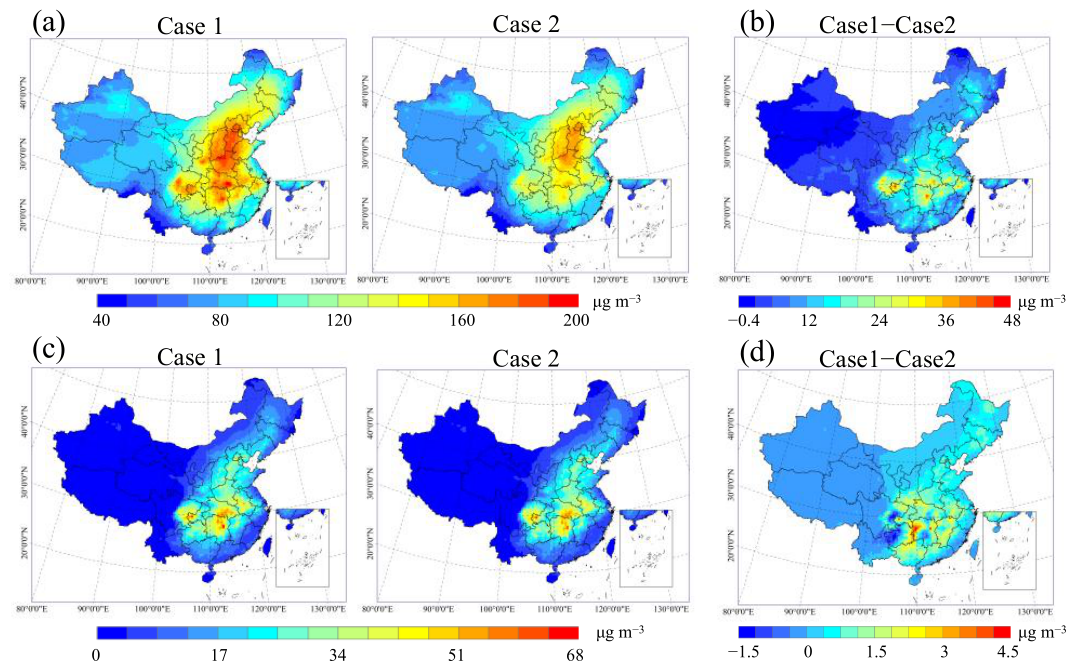
Figure 3 shows the simulated average MDA8 O3 and PM2.5 concentrations over China in July 2020. Specifically, in the absence of BVOC emissions, the simulated MDA8 O3 concentrations were primarily confined to the BTH region. After accounting for BVOC emissions, the model successfully captured the spatial pattern of MDA8 O3 (Figure 3a), which formed a contiguous high-concentration belt (>180 μg m−3) extending from the North China Plain (NCP) to Central China, driven by widespread photochemical production. This suggested that O3 pollution in the BTH region was primarily sustained by strong anthropogenic precursor emissions [41], while the inclusion of BVOC emissions further enhanced regional photochemical production. Through interactions with anthropogenic precursors, BVOCs amplified the spatial extent of O3 pollution, promoting its expansion from urban hotspots toward a broader regional pattern. Compared to O3, PM2.5 concentrations appeared less sensitive to BVOC emissions, a phenomenon stemming from the indirect pathway of BVOC-induced aerosol formation—BVOCs influence PM2.5 primarily through the gas-to-particle conversion into SOA [42]. This biogenic signal is often obscured by the massive background of primary particulate matter (e.g., coal combustion and mineral dust) and secondary inorganic aerosols prevalent across the study regions. As shown in Figure 3c, PM2.5 concentrations were primarily found in the Hunan–Hubei and SCB regions, with the highest monthly average concentration reaching approximately 50 μg m−3. Notably, the basin topography of the SCB may limit the dispersion of precursors. Their accumulation, combined with high humidity, could favor aerosol hygroscopic growth and aqueous-phase reactions, thereby contributing to higher PM2.5 concentrations [43,44]. Moreover, the pollutant levels in the PRD during July were generally lower than those in several other major cities, probably due to the monsoon-prevailing southerly winds, which brought relatively clean air from the South China Sea [45]. Significantly, the co-occurrence of high O3 and PM2.5 levels in the NCP and Central China underscores the critical challenge of complex air pollution in these densely populated and industrialized regions during summer.
Figure 3b shows the difference in MDA8 O3 concentration between simulations with and without BVOC emissions. In general, BVOC emissions induced a widespread increase in MDA8 O3 concentrations across most regions, with concentration variations ranging from −0.42 to 47.36 μg m−3 and the highest contribution ratio reaching 37.7%. O3 formation exhibits a pronounced nonlinear response to its precursors (VOCs and NOx), and the efficiency of O3 production depends on the concentration ratio between them, which defines the specific formation regime (i.e., VOC-limited, transition, or NOx-limited) [46]. Previous studies have shown that O3 formation in major Chinese urban agglomerations is predominantly VOC-limited, while transition or NOx-limited regimes are more common in suburban and rural areas [47,48,49,50]. Although Southeast China experienced the highest BVOC emissions, the most pronounced MDA8 O3 increases (up to ~30 μg m−3) were concentrated in Central, East, and Southwest China, particularly within the SCB and YRD. Domain-averaged MDA8 O3 increments in SCB and YRD reached 21.68 μg m−3 and 17.26 μg m−3, representing relative contributions of 17.0% and 15.3%, respectively. These pronounced increases were likely associated with interactions between BVOC emissions and anthropogenic NOx emissions under VOC-limited conditions, which have been widely reported in major Chinese urban regions [51,52]. In contrast, the PRD—despite having the highest BVOC emission fluxes among the four studied regions—showed a weaker O3 response (12.64 μg m−3), which may be partly related to coastal meteorological conditions and monsoon-driven ventilation that could enhance pollutant dispersion [45]. Despite this atmospheric dilution, the relative biogenic contribution in the PRD remained substantial (15.4%). Meanwhile, the BTH showed the most limited biogenic impact (8.6%), primarily due to its lower BVOC emission intensities and the absolute dominance of anthropogenic sources [53].
The effect of BVOC emissions on PM2.5 concentrations was generally smaller than their effect on MDA8 O3 (Figure 3d), because BVOCs presumably contribute to SOA formation and have a relatively minor effect on inorganic aerosols such as sulfate and nitrate. Across most of China, modeled PM2.5 concentrations exhibited slight changes between cases with and without BVOC emissions. When BVOC emissions were included, increases in PM2.5 concentrations were predominantly concentrated in several southern regions, with net changes typically ranging from −1.46 to 4.54 μg m−3. According to the grid-average concentration changes (Figure 3d), the YRD showed the largest increase in PM2.5 concentration (0.81 µg m−3, corresponding to 3.8% contribution), followed by the SCB (0.69 µg m−3, 2.7%) and BTH (0.62 µg m−3, 2.4%). And the PRD showed the lowest increment (0.47 µg m−3, 5.2%). Overall, regional variations in BVOC-induced PM2.5 increments were fundamentally determined by the synergistic coupling of BVOC emission intensity and anthropogenic emission levels, which collectively governed the efficiency of converting gaseous BVOCs into SOA [54]. Nevertheless, anthropogenic emissions remained the dominant contributors to particulate matter levels [55].

3.3.2. Species-Specific Impact on O3 and PM2.5

Since isoprene and monoterpenes account for the vast majority of BVOC emissions, we conducted conditional simulations by setting emissions of all other BVOC emissions to zero to investigate the contributions of isoprene and monoterpenes to O3 and PM2.5 pollution. The specific effects of these species on O3 and PM2.5 were quantified by the deviations of Case 3 and Case 4 from Case 2.
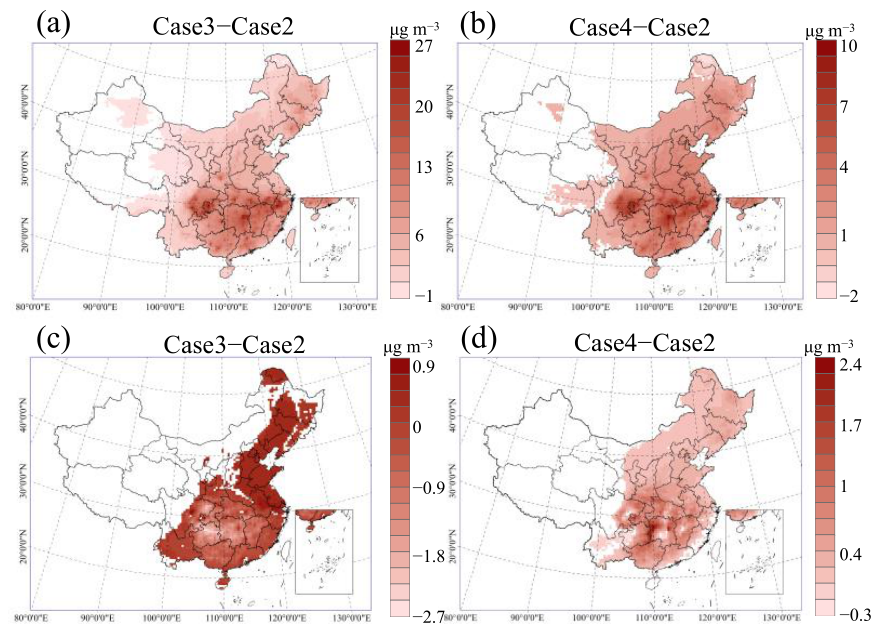
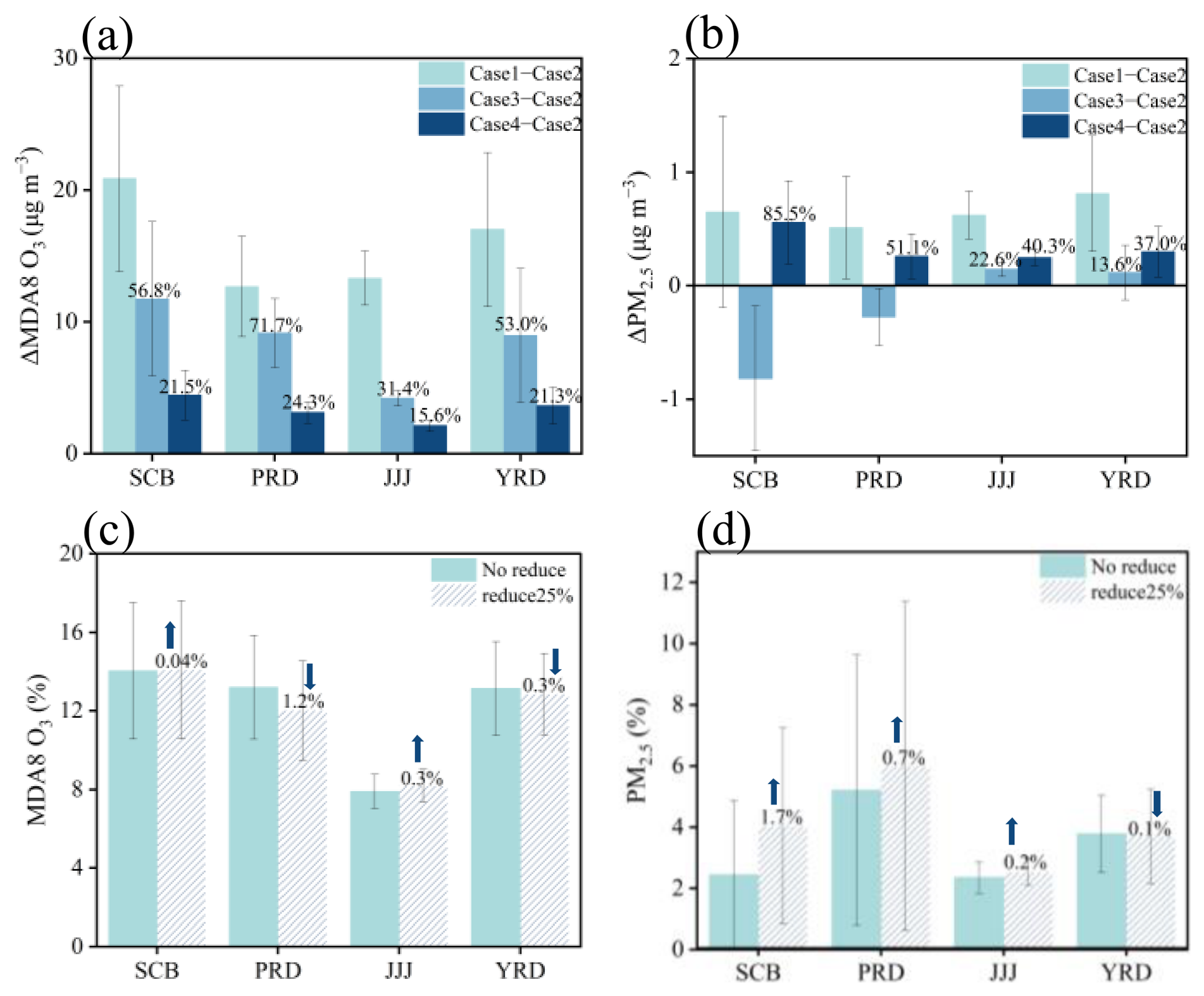
Figure 4a,b indicates that the impact of isoprene on MDA8 O3 (−0.93–26.28 μg m−3) was significantly higher than that of monoterpenes (−1.98–9.83 μg m−3). The difference in O3 contribution may arise from isoprene’s greater reactivity in regional photochemical processes, combined with its longer atmospheric lifetime and higher emission, all of which increase its O3-forming potential [56,57,58].
The distribution of forest types across different regions might contribute to these variations. Broadleaf forests, such as Quercus, are primary sources of isoprene emissions, while coniferous forests, including species like Pinus thunbergii and Platycladus orientalis, predominantly emit monoterpenes [59,60,61]. This disparity significantly impacts regional pollutant formation and atmospheric chemical processes [62]. For instance, in the PRD, SCB and YRD regions, where broadleaf forests dominate, isoprene emissions substantially increased MDA8 O3 concentration, raising it by an average of 9–12 μg m−3. These increases accounted for 53.0–71.7% of the total impact attributed to BVOC emissions (Figure 5a). In these same regions, monoterpenes provided a comparatively modest but non-negligible contribution, representing 21.3–24.3% of the O3 enhancement. Meanwhile, in northern and central China, such as the BTH region, isoprene persisted as the single most influential individual precursor, accounting for 31.4%. In contrast, the contribution from monoterpenes remained limited to 15.6%. Compared with southern regions, BTH showed a lower combined contribution from isoprene and monoterpenes. This pattern suggested a more diversified role for other biogenic species and potentially more complex non-linear interactions between biogenic and anthropogenic sources in the northern chemical environment. These findings highlighted that effective O3 mitigation strategies must account for both the specific chemical reactivity and emission of BVOCs.
Regarding PM2.5, although the concentration changes were relatively modest compared to MDA8 O3, the underlying chemical pathways revealed distinct species-specific impacts. Isoprene emissions exhibited a widespread inhibitory effect on PM2.5 concentrations in eastern China (Figure 4c), with gridded decreases reaching up to 2.69 μg m−3. This suppressive impact was particularly pronounced in the SCB and PRD, where net PM2.5 reductions were simulated (Figure 5b). This phenomenon was likely associated with competition for atmospheric oxidants (such as OH radicals) between abundant isoprene and inorganic precursors like SO2 and NOx, which can in turn suppress the formation of sulfate and nitrate aerosols [63]. In contrast, monoterpenes consistently promoted PM2.5 formation across most regions (Figure 4d). Despite their lower total emission flux compared to isoprene, monoterpenes played a disproportionately critical role in the PM2.5 formation due to their high SOA formation potential. As shown in Figure 5b, the contribution of monoterpenes to the total BVOC-induced PM2.5 increase reached 85.5% in SCB and 51.1% in PRD. This strong influence was also evident in other regions, representing 40.3% of the BVOC-induced PM2.5 in the BTH and 37.0% in the YRD. These results underscored that the high SOA formation efficiency of monoterpenes made them a non-negligible or even dominant component of the BVOC-induced particulate matter load.

3.3.3. Response of BVOC Contribution to Anthropogenic Emission Reductions

As various control strategies are implemented, reductions in anthropogenic emissions may alter the contribution of BVOC emissions to air pollutant formation. Here, we compared the relative contribution of BVOC emissions to MDA8 O3 and PM2.5 concentrations before and after a 25% reduction in anthropogenic emissions.
The simulation results revealed a spatial heterogeneity in the response of BVOC contributions. For MDA8 O3 (Figure 5c), the contribution of BVOCs exhibited divergent trends across regions. In the SCB and BTH, the contributions marginally increased by 0.04% and 0.3%, respectively, indicating a slight increase in the relative role of biogenic sources in O3 formation as anthropogenic precursors declined. However, notable decreases were observed in the PRD (1.2%) and YRD (0.3%) regions. This anomaly highlighted the non-linear dependence of secondary pollution formation on precursor ratios. Specifically, reductions in anthropogenic NOx emissions likely weaken the NO-titration effect in the PRD and YRD, thereby moderating the decline in total O3 concentrations. In addition, previous studies have shown that NOx reductions can alleviate OH depletion and, under some chemical conditions, promote O3 formation [64,65]. Regarding PM2.5 (Figure 5d), the response was more consistently positive, with relative BVOC contributions increasing in the SCB (1.7%), PRD (0.7%), and BTH (0.2%). This reflected a fundamental change in the aerosol composition mix, where the relative importance of biogenic SOA was magnified as the primary and inorganic pollutants were effectively curtailed. The increasing relative contribution of BVOCs in most regions suggested that biogenic sources would pose a growing constraint on further PM2.5 mitigation as anthropogenic emissions decline. This situation will become more pronounced under China’s carbon-peaking and carbon-neutrality goals. Further research is expected to better understand these processes. For instance, to better quantify the separate and synergistic effects of anthropogenic and BVOC emissions based on sensitivity testing, it is necessary to investigate the spatial distribution of O3 and PM2.5 changes by comparing NOx and VOC emissions changes.

3.4. Uncertainty Analysis

This study acknowledges several uncertainties that may affect the accuracy of the results. These were mainly attributed to the following: (1) The uncertainty in BVOC emission inventories is a significant limitation. The emission factors for BVOC emissions are based on default global datasets, which may not fully capture the spatial variations in BVOC emissions across different regions of China. Wang et al. [66] simulated BVOC emission inventories using both default and locally measured EFs, finding that estimates of BVOC emissions in southern China using local EFs were lower than default values, particularly for sesquiterpenes, with an average reduction rate of approximately 40%. Local vegetation types, seasonal changes, and environmental conditions (e.g., temperature, humidity, and solar radiation) can also greatly influence BVOC emissions, and any discrepancies in the emission inventories could lead to inaccuracies in estimating their impact on air quality. (2) The relationship between pollutants and their precursors is inherently nonlinear, with complex interactions between emissions, atmospheric conditions, and chemical processes. The use of simple difference-based analysis (e.g., Case 1–Case 2) may oversimplify the actual dynamics and fail to account for feedback mechanisms or thresholds in the photochemical reactions. (3) In addition, uncertainties associated with other input data, including meteorological inputs and anthropogenic emission datasets, as well as uncertainties in the physical and chemical parameterizations used in the modeling system, may affect the simulated BVOC contributions to O3 and PM2.5 by influencing the atmospheric transport, chemical transformation, and aerosol formation processes. Such uncertainties may be especially relevant in regions with complex terrain or strong monsoonal influence, such as the SCB and PRD.
Despite these uncertainties, studying BVOC emission inventories holds significant value for mitigating air pollution in China. It can also provide a useful reference for vegetation selection in future urban planning and for the development of air-quality management measures. Future research should aim to develop more accurate, higher-resolution gridded BVOC emission estimates by continuously updating high-precision vegetation cover data and localized emission factor data, thereby enabling a more precise assessment of BVOC contributions to O3 and PM2.5 levels. Furthermore, integrating satellite observations and ground-based monitoring data to constrain model parameters will better capture complex nonlinear interactions and significantly enhance the reliability of BVOC impact assessments.

4. Conclusions

This study employed a modeling framework of MEGANv3.2 and CMAQv5.3.2 to characterize BVOC emissions and their impacts on MDA8 O3 and PM2.5 across China in July 2020. BVOC emissions were estimated to be 6.50 × 10⁶ tons, showing pronounced spatial heterogeneity with generally higher emissions in southeastern China. In addition, BVOC emissions exhibited a unimodal diurnal pattern mainly driven by temperature and solar radiation, with peak emissions occurring consistently between 13:00 and 14:00.
BVOC emissions significantly enhanced O3 formation, particularly in SCB and YRD, where MDA8 O3 increments reached 21.68 μg m−3 and 17.26 μg m−3, respectively. Species-specific analysis further showed that isoprene dominated O3 enhancement because of its high reactivity, whereas monoterpenes played a disproportionately important role in PM2.5 formation through SOA production despite their lower emission fluxes. In addition, sensitivity analysis indicated that, as anthropogenic emissions declined, the relative contribution of BVOC emissions to air pollution generally increased in most urban agglomerations.
These findings highlighted the importance of considering BVOCs in understanding China’s summertime air pollution. Differentiating the effects of total BVOCs and major BVOC species on both O3 and PM2.5 helps elucidate how biogenic emissions interact with anthropogenic precursors and influence summertime complex pollution through distinct chemical pathways. Future coordinated O3-PM2.5 control in China could benefit from considering regional BVOC backgrounds and species-specific chemical effects, rather than relying solely on uniform precursor-reduction approaches. In regions such as the SCB and YRD, where BVOCs substantially enhanced O3, the outcomes of anthropogenic NOx and VOC control are likely to be influenced by biogenic–anthropogenic chemical interactions. Meanwhile, in areas where monoterpenes were found to contribute importantly to PM2.5 through SOA formation, the role of vegetation composition in urban greening and ecological planning deserves greater attention, in addition to vegetation coverage. As anthropogenic emissions continue to decline, incorporating BVOC-related processes into regional air-quality management will become increasingly important for achieving more effective and refined control of summertime O3-PM2.5 pollution.

Author Contributions

L.L. conceived and designed the study; C.S. performed the simulation, data analysis, and drafted the manuscript; T.Z., H.H., X.W., Y.J. and L.L. revised the manuscript. All authors have read and agreed to the published version of the manuscript.

Funding

This research was funded by the Development Plan for Youth Innovation Team of Colleges and Universities of Shandong Province (2022KJ147).

Institutional Review Board Statement

Not applicable.

Informed Consent Statement

Not applicable.

Data Availability Statement

The code and data used in this study are available upon request from the corresponding author, Lingyu Li (lilingyu@qdu.edu.cn).

Conflicts of Interest

The contact author has declared that none of the authors have any competing interests.

References

  1. Pai, S.J.; Carter, T.S.; Heald, C.L.; Kroll, J.H. Updated World Health Organization Air Quality Guidelines Highlight the Importance of Non-anthropogenic PM2.5. Environ. Sci. Technol. Lett. 2022, 9, 501–506. [Google Scholar] [CrossRef]
  2. Fan, H.; Zhao, C.; Yang, Y.; Yang, X. Spatio-Temporal Variations of the PM2.5/PM10 Ratios and Its Application to Air Pollution Type Classification in China. Front. Environ. Sci. 2021, 9, 692440. [Google Scholar] [CrossRef]
  3. Zheng, B.; Zhang, Q.; Zhang, Y.; He, K.B.; Wang, K.; Zheng, G.J.; Duan, F.K.; Ma, Y.L.; Kimoto, T. Heterogeneous chemistry: A mechanism missing in current models to explain secondary inorganic aerosol formation during the January 2013 haze episode in North China. Atmos. Chem. Phys. 2015, 15, 2031–2049. [Google Scholar] [CrossRef]
  4. Ma, M.; Gao, Y.; Ding, A.; Su, H.; Liao, H.; Wang, S.; Wang, X.; Zhao, B.; Zhang, S.; Fu, P.; et al. Development and Assessment of a High-Resolution Biogenic Emission Inventory from Urban Green Spaces in China. Environ. Sci. Technol. 2022, 56, 175–184. [Google Scholar] [CrossRef]
  5. Wang, W.; Parrish, D.D.; Wang, S.; Bao, F.; Ni, R.; Li, X.; Yang, S.; Wang, H.; Cheng, Y.; Su, H. Long-term trend of ozone pollution in China during 2014–2020: Distinct seasonal and spatial characteristics and ozone sensitivity. Atmos. Chem. Phys. 2022, 22, 8935–8949. [Google Scholar] [CrossRef]
  6. Wang, N.; Liu, S.; Xu, J.; Wang, Y.; Li, C.; Xie, Y.; Lu, H.; Yang, F. Climate-driven biogenic emissions alleviate the impact of human-made emission reductions on O3 control in the Pearl River Delta region, southern China. Atmos. Chem. Phys. 2025, 25, 8859–8870. [Google Scholar] [CrossRef]
  7. Xu, R.; Li, Z.; Zhu, X.; Guo, C.; Su, Q.; Peng, J.; Wang, Z.; Qian, Y.; Li, X.; Xu, Q.; et al. Acute effects of exposure to fine particulate matter and ozone on lung function, inflammation and oxidative stress in healthy adults. Ecotoxicol. Environ. Saf. 2022, 243, 114013. [Google Scholar] [CrossRef]
  8. Poschl, U. Atmospheric aerosols: Composition, transformation, climate and health effects. Angew. Chem. Int. Ed. Engl. 2005, 44, 7520–7540. [Google Scholar] [CrossRef]
  9. Liu, C.; Chen, R.; Sera, F.; Vicedo-Cabrera, A.M.; Guo, Y.; Tong, S.; Lavigne, E.; Correa, P.M.; Ortega, N.V.; Achilleos, S.; et al. Interactive effects of ambient fine particulate matter and ozone on daily mortality in 372 cities: Two stage time series analysis. BMJ 2023, 383, e075203. [Google Scholar] [CrossRef]
  10. Duan, C.; Liao, H.; Wang, K.; Ren, Y. The research hotspots and trends of volatile organic compound emissions from anthropogenic and natural sources: A systematic quantitative review. Environ. Res. 2023, 216, 114386. [Google Scholar] [CrossRef]
  11. Guenther, A.B.; Jiang, X.; Heald, C.L.; Sakulyanontvittaya, T.; Duhl, T.; Emmons, L.K.; Wang, X. The Model of Emissions of Gases and Aerosols from Nature version 2.1 (MEGAN2.1): An extended and updated framework for modeling biogenic emissions. Geosci. Model Dev. 2012, 5, 1471–1492. [Google Scholar] [CrossRef]
  12. Li, L.; Yang, W.; Xie, S.; Wu, Y. Estimations and uncertainty of biogenic volatile organic compound emission inventory in China for 2008–2018. Sci. Total Environ. 2020, 733, 139301. [Google Scholar] [CrossRef]
  13. Wang, H.; Wu, Q.; Guenther, A.B.; Yang, X.; Wang, L.; Xiao, T.; Li, J.; Feng, J.; Xu, Q.; Cheng, H. A long-term estimation of biogenic volatile organic compound (BVOC) emission in China from 2001–2016: The roles of land cover change and climate variability. Atmos. Chem. Phys. 2021, 21, 4825–4848. [Google Scholar] [CrossRef]
  14. Bianchi, F.; Kurten, T.; Riva, M.; Mohr, C.; Rissanen, M.P.; Roldin, P.; Berndt, T.; Crounse, J.D.; Wennberg, P.O.; Mentel, T.F.; et al. Highly Oxygenated Organic Molecules (HOM) from Gas-Phase Autoxidation Involving Peroxy Radicals: A Key Contributor to Atmospheric Aerosol. Chem. Rev. 2019, 119, 3472–3509. [Google Scholar] [CrossRef]
  15. Paasonen, P.; Asmi, A.; Petäjä, T.; Kajos, M.K.; Äijälä, M.; Junninen, H.; Holst, T.; Abbatt, J.P.D.; Arneth, A.; Birmili, W.; et al. Warming-induced increase in aerosol number concentration likely to moderate climate change. Nat. Geosci. 2013, 6, 438–442. [Google Scholar] [CrossRef]
  16. Thomas, S.J.; Tykkä, T.; Hellén, H.; Bianchi, F.; Praplan, A.P. Undetected biogenic volatile organic compounds from Norway spruce drive total ozone reactivity measurements. Atmos. Chem. Phys. 2023, 23, 14627–14642. [Google Scholar] [CrossRef]
  17. Steiner, A.L. Role of the Terrestrial Biosphere in Atmospheric Chemistry and Climate. Acc. Chem. Res. 2020, 53, 1260–1268. [Google Scholar] [CrossRef]
  18. Salvador, C.M.; Chou, C.C.K.; Ho, T.T.; Tsai, C.-Y.; Tsao, T.-M.; Tsai, M.-J.; Su, T.-C. Contribution of terpenes to ozone formation and secondary organic aerosols in a subtropical forest impacted by urban pollution. Atmosphere 2020, 11, 1232. [Google Scholar] [CrossRef]
  19. Bai, G.; Kong, F.; Li, Z.; Li, L. Characteristic of biogenic volatile organic compound (BVOC) emissions and their impacts on the formation of atmospheric secondary pollutants in China. Chin. J. Ecol. 2025, 44, 3694. [Google Scholar]
  20. Nishimura, H.; Shimadera, H.; Kondo, A.; Akiyama, K.; Inoue, Y. Numerical Analysis on Biogenic Emission Sources Contributing to Urban Ozone Concentration in Osaka, Japan. Asian J. Atmos. Environ. 2015, 9, 259–271. [Google Scholar] [CrossRef]
  21. Zhang, S.; Lyu, Y.; Yang, X.; Yuan, L.; Wang, Y.; Wang, L.; Liang, Y.; Qiao, Y.; Wang, S. Modeling Biogenic Volatile Organic Compounds Emissions and Subsequent Impacts on Ozone Air Quality in the Sichuan Basin, Southwestern China. Front. Ecol. Evol. 2022, 10, 924944. [Google Scholar] [CrossRef]
  22. Zhang, Y.; Xue, L.; Carter, W.P.L.; Pei, C.; Chen, T.; Mu, J.; Wang, Y.; Zhang, Q.; Wang, W. Development of ozone reactivity scales for volatile organic compounds in a Chinese megacity. Atmos. Chem. Phys. 2021, 21, 11053–11068. [Google Scholar] [CrossRef]
  23. Galina, C.; Friderike, K.; Boris, B.; Axel, L.; RüDiger, G.; Karolina, T. Effect of VOC emissions from vegetation on air quality in Berlin during a heatwave. Environ. Sci. Technol. 2017, 51, 6120–6130. [Google Scholar] [CrossRef]
  24. Liu, S.; Xing, J.; Zhang, H.; Ding, D.; Zhang, F.; Zhao, B.; Sahu, S.K.; Wang, S. Climate-driven trends of biogenic volatile organic compound emissions and their impacts on summertime ozone and secondary organic aerosol in China in the 2050s. Atmos. Environ. 2019, 218, 117020. [Google Scholar] [CrossRef]
  25. Uttamang, P.; Janta, R.; Bran, S.H.; Macatangay, R.; Surapipith, V.; Tala, W.; Chantara, S. Effects of biogenic volatile organic compounds and anthropogenic NOx emissions on O3 and PM2.5 formation over the northern region of Thailand. Front. Environ. Sci. 2023, 11, 1146437. [Google Scholar] [CrossRef]
  26. Yuan, H.; Dai, Y.; Xiao, Z.; Ji, D.; Wei, S. Reprocessing the MODIS Leaf Area Index products for land surface and climate modelling. Remote Sens. Environ. 2011, 115, 1171–1187. [Google Scholar] [CrossRef]
  27. Wang, H.; Qiu, J.; Liu, Y.; Fan, Q.; Lu, X.; Zhang, Y.; Wu, K.; Shen, A.; Xu, Y.; Jin, Y.; et al. MEIAT-CMAQ: A modular emission inventory allocation tool for Community Multiscale Air Quality Model. Atmos. Environ. 2024, 331, 120604. [Google Scholar] [CrossRef]
  28. Bessagnet, B.; Cuvelier, K.; De Meij, A.; Monteiro, A.; Pisoni, E.; Thunis, P.; Violaris, A.; Kushta, J.; Denby, B.R.; Mu, Q.; et al. Assessment of the sensitivity of model responses to urban emission changes in support of emission reduction strategies. Air Qual. Atmos. Health 2023, 17, 681–706. [Google Scholar] [CrossRef]
  29. Gong, C.; Liao, H. A typical weather pattern for ozone pollution events in North China. Atmos. Chem. Phys. 2019, 19, 13725–13740. [Google Scholar] [CrossRef]
  30. Zhang, S.; Zhang, Z.; Li, Y.; Du, X.; Qu, L.; Tang, W.; Xu, J.; Meng, F. Formation processes and source contributions of ground-level ozone in urban and suburban Beijing using the WRF-CMAQ modelling system. J. Environ. Sci. 2023, 127, 753–766. [Google Scholar] [CrossRef]
  31. Huang, L.; Zhu, Y.; Zhai, H.; Xue, S.; Zhu, T.; Shao, Y.; Liu, Z.; Emery, C.; Yarwood, G.; Wang, Y.; et al. Recommendations on benchmarks for numerical air quality model applications in China—Part 1: PM2.5 and chemical species. Atmos. Chem. Phys. 2021, 21, 2725–2743. [Google Scholar] [CrossRef]
  32. Huang, L.; Zhang, X.; Emery, C.; Mu, Q.; Yarwood, G.; Zhai, H.; Sun, Z.; Xue, S.; Wang, Y.; Fu, J.S.; et al. Recommendations on benchmarks for numerical air quality model applications in China—Part 2: Ozone and uncertainty analysis. Atmos. Chem. Phys. 2025, 25, 4233–4249. [Google Scholar] [CrossRef]
  33. Wu, K.; Yang, X.; Chen, D.; Gu, S.; Lu, Y.; Jiang, Q.; Wang, K.; Ou, Y.; Qian, Y.; Shao, P.; et al. Estimation of biogenic VOC emissions and their corresponding impact on ozone and secondary organic aerosol formation in China. Atmos. Res. 2020, 231, 104656. [Google Scholar] [CrossRef]
  34. Qaderi, M.M.; Martel, A.B.; Strugnell, C.A. Environmental factors regulate plant secondary metabolites. Plants 2023, 12, 447. [Google Scholar] [CrossRef]
  35. Kozlowska, W.; Matkowski, A.; Zielinska, S. Light intensity and temperature effect on Salvia yangii (B. T. Drew) metabolic profile in vitro. Front. Plant Sci. 2022, 13, 888509. [Google Scholar] [CrossRef]
  36. Rahman, M.A.; Gupta, S.K.; Akylbekov, N.; Zhapparbergenov, R.; Hasnain, S.M.M.; Zairov, R. Comprehensive overview of heat management methods for enhancing photovoltaic thermal systems. iScience 2024, 27, 110950. [Google Scholar] [CrossRef]
  37. Wang, X.; Zhang, Y.; Tan, Y.; Tan, Y.; Bai, J.; Gu, D.; Ma, Z.; Du, J.; Han, Z. Effects of light on the emissions of biogenic isoprene and monoterpenes: A review. Atmos. Pollut. Res. 2022, 13, 101397. [Google Scholar] [CrossRef]
  38. Delwiche, C.F.; Sharkey, T.D. Rapid appearance of 13C in biogenic isoprene when 13CO2 is fed to intact leaves. Plant Cell Environ. 2006, 16, 587–591. [Google Scholar] [CrossRef]
  39. Zhang, Q.; Li, L.; Zhao, W.; Wang, X.; Jiang, L.; Liu, B.; Li, X.; Lu, H. Emission characteristics of VOCs from forests and its impact on regional air quality in Beijing. China Environ. Sci. 2021, 41, 622–632. [Google Scholar]
  40. Li, L.Y.; Chen, Y.; Xie, S.D. Spatio-temporal variation of biogenic volatile organic compounds emissions in China. Environ. Pollut. 2013, 182, 157–168. [Google Scholar] [CrossRef]
  41. Wang, X.; Fu, T.M.; Zhang, L.; Cao, H.; Zhang, Q.; Ma, H.; Shen, L.; Evans, M.J.; Ivatt, P.D.; Lu, X.; et al. Sensitivities of Ozone Air Pollution in the Beijing-Tianjin-Hebei Area to Local and Upwind Precursor Emissions Using Adjoint Modeling. Environ. Sci. Technol. 2021, 55, 5752–5762. [Google Scholar] [CrossRef]
  42. Mahilang, M.; Deb, M.K.; Pervez, S. Biogenic secondary organic aerosols: A review on formation mechanism, analytical challenges and environmental impacts. Chemosphere 2021, 262, 127771. [Google Scholar] [CrossRef]
  43. Kong, L.; Tan, Q.; Feng, M.; Qu, Y.; An, J.; Liu, X.; Cheng, N.; Deng, Y.; Zhai, R.; Wang, Z. Investigating the characteristics and source analyses of PM2.5 seasonal variations in Chengdu, Southwest China. Chemosphere 2020, 243, 125267. [Google Scholar] [CrossRef]
  44. Zhang, L.; Guo, X.; Zhao, T.; Gong, S.; Xu, X.; Li, Y.; Luo, L.; Gui, K.; Wang, H.; Zheng, Y.; et al. A modelling study of the terrain effects on haze pollution in the Sichuan Basin. Atmos. Environ. 2019, 196, 77–85. [Google Scholar] [CrossRef]
  45. Yang, L.; Luo, H.; Yuan, Z.; Zheng, J.; Huang, Z.; Li, C.; Lin, X.; Louie, P.K.K.; Chen, D.; Bian, Y. Quantitative impacts of meteorology and precursor emission changes on the long-term trend of ambient ozone over the Pearl River Delta, China, and implications for ozone control strategy. Atmos. Chem. Phys. 2019, 19, 12901–12916. [Google Scholar] [CrossRef]
  46. Jin, X.; Fiore, A.; Boersma, K.F.; Smedt, I.; Valin, L. Inferring changes in summertime surface ozone-NOx-VOC chemistry over U.S. urban areas from two decades of satellite and ground-based observations. Environ. Sci. Technol. 2020, 54, 6518–6529. [Google Scholar] [CrossRef]
  47. Han, X.; Zhu, L.; Wang, S.; Meng, X.; Zhang, M.; Hu, J. Modeling study of impacts on surface ozone of regional transport and emissions reductions over North China Plain in summer 2015. Atmos. Chem. Phys. 2018, 18, 12207–12221. [Google Scholar] [CrossRef]
  48. Ou, J.; Yuan, Z.; Zheng, J.; Huang, Z.; Shao, M.; Li, Z.; Huang, X.; Guo, H.; Louie, P.K. Ambient ozone control in a photochemically active region: Short-term despiking or long-term attainment? Environ. Sci. Technol. 2016, 50, 5720–5728. [Google Scholar] [CrossRef]
  49. An, J.; Zou, J.; Wang, J.; Lin, X.; Zhu, B. Differences in ozone photochemical characteristics between the megacity Nanjing and its suburban surroundings, Yangtze River Delta, China. Environ. Sci. Pollut. Res. Int. 2015, 22, 19607–19617. [Google Scholar] [CrossRef]
  50. Su, R.; Lu, K.; Yu, J.; Tan, Z.; Jiang, M.; Li, J.; Xie, S.; Wu, Y.; Zeng, L.; Zhai, C.; et al. Exploration of the formation mechanism and source attribution of ambient ozone in Chongqing with an observation-based model. Sci. China Earth Sci. 2017, 61, 23–32. [Google Scholar] [CrossRef]
  51. Ren, J.; Guo, F.; Xie, S. Diagnosing ozone-NOx-VOC sensitivity and revealing causes of ozone increases in China based on 2013–2021 satellite retrievals. Atmos. Chem. Phys. 2022, 22, 15035–15047. [Google Scholar] [CrossRef]
  52. Zhou, Y.; Fu, J.S.; Zhuang, G.; Levy, J.I. Risk-based prioritization among air pollution control strategies in the Yangtze River Delta, China. Environ. Health Perspect. 2010, 118, 1204–1210. [Google Scholar] [CrossRef]
  53. Cao, J.; Situ, S.; Hao, Y.F.; Xie, S.D.; Li, L.Y. Enhanced summertime ozone and SOA from biogenic volatile organic compound (BVOC) emissions due to vegetation biomass variability during 1981–2018 in China. Atmos. Chem. Phys. 2022, 22, 2351–2364. [Google Scholar] [CrossRef]
  54. Takeuchi, M.; Berkemeier, T.; Eris, G.; Ng, N.L. Non-linear effects of secondary organic aerosol formation and properties in multi-precursor systems. Nat. Commun. 2022, 13, 7883. [Google Scholar] [CrossRef]
  55. Li, C.; Wang, J.; Zhang, H.; Diner, D.J.; Hasheminassab, S.; Janechek, N. Improvement of Surface PM2.5 Diurnal Variation Simulations in East Africa for the MAIA Satellite Mission. ACS EST Air 2024, 1, 223–233. [Google Scholar] [CrossRef]
  56. Schwantes, R.H.; Emmons, L.K.; Orlando, J.J.; Barth, M.C.; Tyndall, G.S.; Hall, S.R.; Ullmann, K.; St. Clair, J.M.; Blake, D.R.; Wisthaler, A.; et al. Comprehensive isoprene and terpene gas-phase chemistry improves simulated surface ozone in the southeastern US. Atmos. Chem. Phys. 2020, 20, 3739–3776. [Google Scholar] [CrossRef]
  57. Berezina, E.; Moiseenko, K.; Skorokhod, A.; Elansky, N.; Belikov, I.; Pankratova, N. Isoprene and monoterpenes over Russia and their impacts in tropospheric ozone formation. Geogr. Environ. Sustain. 2019, 12, 63–74. [Google Scholar] [CrossRef]
  58. Hantson, S.; Knorr, W.; Schurgers, G.; Pugh, T.a.M.; Arneth, A. Global isoprene and monoterpene emissions under changing climate, vegetation, CO2 and land use. Atmos. Environ. 2017, 155, 35–45. [Google Scholar] [CrossRef]
  59. Zhang, Q.; Xue, Z.; Yi, L.; Wang, J.; Liu, E. Temperature Regulates BVOCs-Induced O3 Formation Potential Across Various Vegetation Types in the Sichuan Basin, China. Forests 2025, 16, 1091. [Google Scholar] [CrossRef]
  60. Jing, X.; Lun, X.; Fan, C.; Ma, W. Emission patterns of biogenic volatile organic compounds from dominant forest species in Beijing, China. J. Environ. Sci. 2020, 95, 73–81. [Google Scholar] [CrossRef]
  61. Yu, S.-J.; Seo, Y.-S.; Son, Y.-S.; Kim, J.-C. Characteristics of BVOCs emitted from representative tree species in South Korea according to environmental influences. Atmos. Environ. 2024, 318, 120238. [Google Scholar] [CrossRef]
  62. Bao, X.; Zhou, W.; Xu, L.; Zheng, Z. A meta-analysis on plant volatile organic compound emissions of different plant species and responses to environmental stress. Environ. Pollut. 2023, 318, 120886. [Google Scholar] [CrossRef]
  63. Mcfiggans, G.; Mentel, T.F.; Wildt, J.; Pullinen, I.; Kang, S.; Kleist, E.; Schmitt, S.; Springer, M.; Tillmann, R.; Wu, C.; et al. Secondary organic aerosol reduced by mixture of atmospheric vapours. Nature 2019, 565, 587–593. [Google Scholar] [CrossRef]
  64. Wang, N.; Xu, J.; Pei, C.; Tang, R.; Zhou, D.; Chen, Y.; Li, M.; Deng, X.; Deng, T.; Huang, X.; et al. Air Quality During COVID-19 Lockdown in the Yangtze River Delta and the Pearl River Delta: Two Different Responsive Mechanisms to Emission Reductions in China. Environ. Sci. Technol. 2021, 55, 5721–5730. [Google Scholar] [CrossRef]
  65. Zhu, J.; Chen, L.; Liao, H.; Yang, H.; Yang, Y.; Yue, X. Enhanced PM2.5 Decreases and O3 Increases in China During COVID-19 Lockdown by Aerosol-Radiation Feedback. Geophys. Res. Lett. 2021, 48, e2020GL090260. [Google Scholar] [CrossRef]
  66. Wang, P.; Zhang, Y.; Gong, H.; Zhang, H.; Guenther, A.; Zeng, J.; Wang, T.; Wang, X. Updating Biogenic Volatile Organic Compound (BVOC) Emissions with Locally Measured Emission Factors in South China and the Effect on Modeled Ozone and Secondary Organic Aerosol Production. J. Geophys. Res. Atmos. 2023, 128, e2023JD039928. [Google Scholar] [CrossRef]
Figure 1. Spatial distribution of biogenic volatile organic compound (BVOC) emissions in July 2020.
Atmosphere 17 00473 g001
Figure 2. Daily emission changes in BVOCs.
Atmosphere 17 00473 g002
Figure 3. Average spatial distribution of maximum daily 8-h average ozone (MDA8 O3) (a) and fine particulate matter (PM2.5) (c) concentrations in July 2020 under the Case 1 and Case 2 simulations. Difference in MDA8 O3 (b) and PM2.5 (d) concentrations between Case 1 and Case 2 simulations.
Atmosphere 17 00473 g003
Figure 4. Spatial distributions of the effects of isoprene and monoterpenes on MDA8 O3 (a,b) and PM2.5 (c,d). Blank areas indicate small differences in pollutant concentrations (ΔMDA8 O3 ≤ ±0.1 μg m−3; ΔPM2.5 ≤ ±0.05 μg m−3).
Atmosphere 17 00473 g004
Figure 5. Changes in MDA8 O3 (a) and PM2.5 (b) concentrations induced by different BVOCs. Percentages indicate each compound’s contribution to the total BVOC effect. Contribution ratios of BVOC emissions to MDA8 O3 (c) and PM2.5 (d) before and after anthropogenic emission reductions.
Atmosphere 17 00473 g005
Table 1. Different configurations for the Community Multiscale Air Quality (CMAQ) model.
SimulationsAnthropogenic EmissionsBiogenic EmissionsNotes
Case 1A_2020B_2020with both anthropogenic and biogenic emissions
Case 2A_2020-with anthropogenic but without biogenic emissions
Case 3A_2020B_isopwith anthropogenic and biogenic isoprene emissions
Case 4A_2020B_monowith anthropogenic and biogenic monoterpene emissions
Case 5A_25%B_2020with biogenic and 25% reduced anthropogenic emissions
Case 6A_25%-with 25% reduced anthropogenic emissions but without biogenic emissions
Table 2. Verification statistics for the Weather Research and Forecasting (WRF) and CMAQ simulations.
VariablesSample NumberAverageRNMBRMSE
ObservationSimulation
TEMP2 (°C)39323.9622.990.90−4.1%2.65
WSPD10 (m s−1)3932.483.780.4852.7%1.67
MDA8 O3 (μg m−3)600128.58133.420.743.8%22.09
PM2.5 (μg m−3)60021.5619.290.69−10.6%6.97
Disclaimer/Publisher’s Note: The statements, opinions and data contained in all publications are solely those of the individual author(s) and contributor(s) and not of MDPI and/or the editor(s). MDPI and/or the editor(s) disclaim responsibility for any injury to people or property resulting from any ideas, methods, instructions or products referred to in the content.