1. Introduction
GrandSKY is the first large-scale commercial Uncrewed Aircraft System (UAS) test park in Grand Forks, North Dakota, USA, that provides a testing environment for UAS operators and manufacturers to advance technologies enabling Beyond Visual Line of Sight (BVLOS) operations. However, hazardous wind conditions remain a significant barrier to daily mission planning, sortie scheduling, and autonomy tests. Also, sudden changes in wind speed and direction can render UASs unrecoverable if the resulting head winds exceed performance characteristics. Hence, the growth of BVLOS operations for UASs places increasing demands on high-resolution, low-altitude wind forecasts. Turbulent wind fields, including sudden shifts in speed and direction, can compromise navigation safety, increase power consumption, and in some cases, lead to unrecoverable flight scenarios [
1,
2].
At the same time, UASs trying to maintain level/smooth flight in areas of more intense wind speeds and crosswinds can run out of power more quickly than anticipated. Moreover, North Dakota has experienced a variety of severe weather events including blizzards, snowstorms, thunderstorms, and tornadoes with strong wind speeds and gusts which pose significant risks to GrandSKY’s missions and operations, leading to high cancelation rates and the grounding of various vehicles [
3]. This disruption results in a broader economic effect, as postponed activities can hinder productivity, revenue generation, and the advancement of UAS technologies within the region.
Current solutions to predict wind hazards suggest using (1) expensive sensors such as lidars and radars that have operational limitations, limited spatial coverage and require continuous calibration and maintenance, (2) low-resolution mesoscale forecasts (1 to 10 km horizontal grid spacing) not specifically tailored for low-altitude UAS operations, or (3) ground-based observations at nearby airports that fail at capturing critical in-flight wind conditions [
1,
2,
4,
5]. In this study, “low-altitude” refers to operations conducted below 122 m (400 ft) AGL, consistent with FAA guidelines for small UAS operations. On the one hand, mesoscale models with horizontal resolutions coarser than 1 km are well-suited for capturing the dynamic processes of the atmosphere by including appropriate initial and boundary conditions from global models as well as modeling the full range of physics, including radiative transfer, moist and cloud processes, boundary-layer processes, surface interactions, and other key processes that are not included in microscale models. However, they lack the spatial detail needed to resolve microscale wind structures that directly impact UAS safety. Microscale models, on the other hand, simulate detailed flow around terrain, resolve fine-scale turbulence and explicitly represent terrain interactions. These microscale models are required to resolve the intermediate and large turbulent eddies which are hazardous to UAS navigation. Among microscale techniques, the Large-Eddy Simulation (LES) technique has gained popularity in both research and industry because it potentially provides more accurate results than Reynolds-Averaged Navier–Stokes (RANS) simulations with a lower computational cost than Direct Numerical Simulations (DNSs) [
2,
3]. The governing equations share the same fundamental form. The key distinction lies in the turbulence treatment: LES resolves the larger turbulent eddies explicitly while parameterizing only the subgrid-scale motions, whereas RANS-based configurations parameterize all turbulent fluctuations through a turbulence closure scheme. In addition, the ability of LES to resolve idealized urban canopy flows has been demonstrated using comparison wind tunnel and DNS results [
2,
3]. Depending on the problem being investigated and the LES setup, the LES technique also has the advantage of having a weak dependency on Reynolds number and the choice of the subgrid-scale (SGS) turbulence model [
6]. In LES, the resolved scales contain the majority of turbulent kinetic energy, while the SGS motions are intended to contain only a small fraction of the total turbulent energy. The SGS parameterization accounts for the effects of these unresolved small-scale motions on momentum and energy transfer, allowing the LES to explicitly resolve the energy-containing turbulent eddies that are most relevant for UAS operations. Therefore, mesoscale-to-microscale (M2M) coupling presents a promising approach to incorporating important mesoscale flow characteristics into microscale wind simulations by combining the advantages of both types of models.
Recent advances in coupled mesoscale-to-microscale atmospheric modeling have significantly improved the simulation of turbulent atmospheric flows across a wide range of applications, including wind energy, urban climate, and hazard assessment. However, these studies differ substantially in horizontal resolution, coupling strategy, and intended application, which affects their ability to resolve near-surface turbulence relevant to low-altitude Uncrewed Aircraft System (UAS) operations.
For example, reference [
7] applied a WRF-LES framework at approximately 90 m (88.9 m) horizontal grid spacing, combined with observational nudging, to simulate offshore turbulence over the South China Sea. Reference [
8] used 100 m WRF-LES simulations over Enschede, Netherlands, improving representation of convective boundary-layer structures compared to mesoscale parameterizations, but still operating in a regime where a substantial portion of turbulence remains subgrid-scale.
Reference [
9] employed a multi-resolution WRF-LES–wave coupling system with nested grids down to approximately 100 m, 20 m, and locally refined grids approaching 4 m, demonstrating improved air–sea interaction during storm conditions, but at a computational cost that limits operational applicability. Reference [
10] conducted ultra-high-resolution LES at 30 m grid spacing over urban Haikou during Typhoon Yagi, resolving strong flow modulation by urban morphology under extreme wind conditions. Reference [
11] implemented nested WRF-LES simulations with inner-domain resolutions of approximately 33 m, highlighting persistent limitations in resolving near-surface wind shear and turbulence intermittency in tropical cyclone environments even at these fine scales.
Collectively, these studies demonstrate that LES applications span a wide range of resolutions—from roughly 100 m down to 30 m (and locally finer in specialized coupling systems)—but are primarily designed for process understanding rather than systematic evaluation of low-altitude (<120 m AGL) UAS operational constraints. In contrast, the present study employs a 40 m LES nested within a 1 km mesoscale WRF simulation, specifically designed to resolve energy-containing turbulent eddies in the lowest part of the boundary layer that directly impact UAS gust exposure, and operational flyability. This configuration bridges the gap between mesoscale forecasting and microscale turbulence relevant for operational UAS decision-making in environments such as GrandSKY.
Fire–atmosphere interactions were advanced by reference [
12], whose 333.33 m LES study of the Mosquito wildfire elucidated smoke plume transport and boundary-layer dynamics essential for wildfire management. On the renewable energy front, reference [
13] employed a WRF-PALM multiscale approach to quantify seasonal and spatial heterogeneity of wind and solar resources in Chongqing’s complex urban river valleys, identifying optimal micro-siting solutions for hybrid street lighting with substantial economic and environmental benefits. Reference [
14] further contributed methodological improvements by developing wavelet-based profile assimilation methods for data-driven LES, enhancing the physical consistency and accuracy of coupled mesoscale-to-microscale simulations.
Focusing on wind energy forecasting, reference [
15] introduced the dynamically coupled WRF-OpenFOAM system (WOCSS), which significantly improves day-ahead wind power predictions by resolving transient nonlinear wind speed variations, outperforming conventional snapshot-based approaches. Reference [
16] demonstrated the advantage of 333 m WRF-LES over traditional WRF in complex terrain during cold wave events in Guizhou, China, achieving higher fidelity in near-surface meteorological variables vital for infrastructure safety under ice conditions. Lastly, reference [
17] showcased the efficacy of coupling WRF with CFD to refine wind resource assessments in Liaoning Province, China, accounting for complex terrain effects and producing high-resolution wind maps critical for regional wind farm siting and sustainable energy planning. Unlike the UAS-focused configuration in this study (40 m LES), these applications span a range of resolutions from approximately 333 m [
12,
16] to grid-refined WRF–PALM and WRF–CFD hybrid systems that do not systematically target the 10–100 m near-surface turbulence scales critical for low-altitude flight operations, highlighting the distinct modeling requirements between energy/wildfire applications and UAS-oriented boundary-layer prediction. We also acknowledge that LES is not limited to WRF-based frameworks, and that a broad range of meteorological and CFD-based LES models have been widely used in atmospheric turbulence research. In addition, the increasing use of convection-permitting numerical weather prediction systems at ~1–2 km resolution has reduced some aspects of the traditional mesoscale gap. However, for low-altitude UAS applications, these resolutions still do not explicitly resolve energy-containing turbulent eddies and gust-scale variability within the lowest part of the atmospheric boundary layer. Therefore, mesoscale-to-microscale coupling remains necessary when the objective is to accurately represent near-surface turbulence and its impact on operational flight safety.
Modeling the detailed behavior of turbulent flow over complex terrain has long been a central challenge in atmospheric science [
18]. The increasing demand for accurate wind resource assessments and forecasts—especially for wind energy and aerospace applications—has made this goal even more pressing. In response, the research community has invested substantial effort into LESs forced by mesoscale model output [
19,
20]. Recent advances in computing power have made it feasible to conduct LESs with grid spacings on the order of tens of meters over realistic, extended domains at resolutions on the order of tens of meters. Various downscaling techniques have also been developed to translate lower-resolution mesoscale output into high-resolution fields. These include dynamical downscaling approaches [
21], statistical methods [
22], and hybrid statistical–dynamical approaches [
23]. More recently, deep learning techniques have emerged as a promising data-based alternative, offering the potential to train models using a limited number of LES outputs to efficiently perform direct downscaling from mesoscale simulations. Over the past five years, research on physics-based M2M coupling has highlighted several key challenges and findings. Reference [
1] used M2M coupling with the Weather Research and Forecasting (WRF) model’s nesting capability to downscale forecasts to 100 m horizontal resolutions. The simulated data were validated over 147 days against ground-based data from three airports in the Chicago area and showed a good agreement with radiosonde sounding profiles and ground-based METeorological Aerodrome Report (METAR) data. However, wind speed was overestimated during stable conditions due to resolution uncertainties. Additionally, low-altitude airborne or remote-sensing data within the atmospheric boundary layer are needed to validate the simulations at flight altitudes. The evaluation of the 100 m simulations during lake-breeze events (LBEs) revealed that the model slightly misrepresented the timing and inland penetration of the LBE, indicating areas for further improvement in capturing such events. Reference [
2] compared real-time 10 m microscale wind speed and direction simulations based on computational fluid dynamics (CFD) LES over Downtown Oklahoma City against ground-based stations and found that the coupled simulations provided more accurate wind speed and direction predictions through the OCKNET ground-based network over Downtown Oklahoma City during stable winter conditions while the 400 m WRF-LES simulation failed to capture small-scale wind eddies, highlighting the importance of accurately representing terrain in urban areas. Coupled simulations provided a better representation of wind gusts and turbulence during stable atmospheric stratification.
Other recent studies have used different refinement ratios of 10:1 [
1], 9:1 [
24], and 11:1 [
25] depending on the simulated cases, because atmospheric turbulence closure schemes used in LES models are not designed to operate at grid spacings ranging within the terra incognita. Terra incognita [
26] refers to the horizontal resolution range between 1 km and 100 m, where models are too coarse for LES to resolve turbulence but too fine for traditional parameterizations. This gray zone leads to uncertainty and inaccuracy in representing subgrid-scale turbulence and surface–atmosphere interactions. Thus, a substantial increase in the resolution between the mesoscale and microscale grids is needed to avoid intermediate simulation with the terra incognita range [
25]. The refinement ratio refers to the ratio of grid spacing between two nested domains in our simulation. It indicates how much finer the resolution becomes in the inner domain relative to the outer domain.
Model evaluation and accuracy assessment is important at low altitudes where most UAS flight operations occur. Notably, the Meteodrone, manufactured by Meteomatics and operated by GrandSKY, is a lightweight, battery-powered weather data collection UAS designed to gather real-time high-resolution atmospheric measurements over the GrandSKY site. This drone is equipped with a range of sensors that capture critical weather variables such as wind speed, temperature, humidity, and atmospheric pressure. By flying at various altitudes, the Meteodrone provides valuable vertical profiles of weather conditions, offering insights into boundary-layer structure, wind patterns and shear, turbulence, and other environmental factors that are essential for UAS operations including dew point and relative humidity, which are critical for characterizing icing and fog (visibility) risks, as well as surface heat flux, which influences boundary-layer stability, convection, and turbulence intensity affecting UAS operations. The data collected by the Meteodrone aids in improving flight safety, optimizing UAS performance, and supporting the ongoing operations, research and development at GrandSKY. Moreover, traditional weather stations are sparse and often located far from agricultural or remote regions, while satellite data lacks the spatial and temporal granularity needed for real-time, localized decision-making. While technologies such as lidars, radars, and other remote-sensing instruments offer valuable insights, they are expensive, require intensive maintenance, and are not scalable for widespread deployment. This limits their practicality and cost efficiency. By filling the gaps in traditional weather monitoring, the Meteodrone helps GrandSKY ensure better decision-making, safety, and planning.
The aim of this study is two-fold. First, we evaluate the accuracy of LESs of 40 m horizontal grid spacing (a refinement ratio of 25:1) in reproducing wind speed and direction during both summer and winter seasons over GrandSKY using Meteodrone, satellite, and ground-based observations. Second, we assess the impact of the 40 m simulations on UAS flyability and safety over GrandSKY. UAS flyability refers to the suitability of environmental and airspace conditions for safe UAS operations. It includes factors like wind speed, visibility, icing, turbulence-related quantities, such as turbulent kinetic energy, wind variability, and gustiness, and regulatory constraints that determine whether a drone can take off, navigate, and land safely. UAS safety extends beyond flyability to encompass the overall reliability of the system, including obstacle avoidance, communication, hardware integrity, and risk mitigation measures. Together, flyability and safety define the operational readiness and risk profile of UAS missions. The flyability analysis considers a notional UAS with a maximum safe operating wind speed of 4 m s−1, which reflects typical operational limits for small drones and nanodrones. The primary novelty of this study lies in the use of a 40 m horizontal resolution LES, nested within a 1 km mesoscale WRF simulation, to resolve low-altitude turbulence and wind gusts relevant to UAS operations. This resolution enables the partial capture of energy-containing eddies in the lowest 1 km of the atmosphere, which directly influence gustiness, flight stability, and operational safety. By combining LES outputs with ground-based METAR, satellite-derived winds, and vertical profiles from Meteodrone flights, this work quantifies the practical impact of fine-scale wind variability on UAS flyability, demonstrating that coarser simulations can overestimate available operational windows by up to 17%. Unlike prior studies, this research explicitly links high-resolution turbulence-resolving simulations to UAS mission planning, providing actionable guidance for safe and risk-aware operations in complex atmospheric conditions.
This paper is structured as follows:
Section 2 presents the methodology, the setup of different simulations, observational datasets, and evaluation metrics. The results and discussions of the numerical experiments are then presented in
Section 3, and, finally, the conclusions and future directions are given in
Section 4.
3. Results and Discussion
The simulations over both domains were performed simultaneously to maintain consistent boundary interactions between the outer and inner domains. The total CPU time for completing both domains was approximately 5 days and 6 h. CPU time refers to the total wall-clock time required to complete the full simulation period (including spin-up and both summer and winter cases) using parallel execution.
3.1. Evaluation Against Ground-Based Measurement
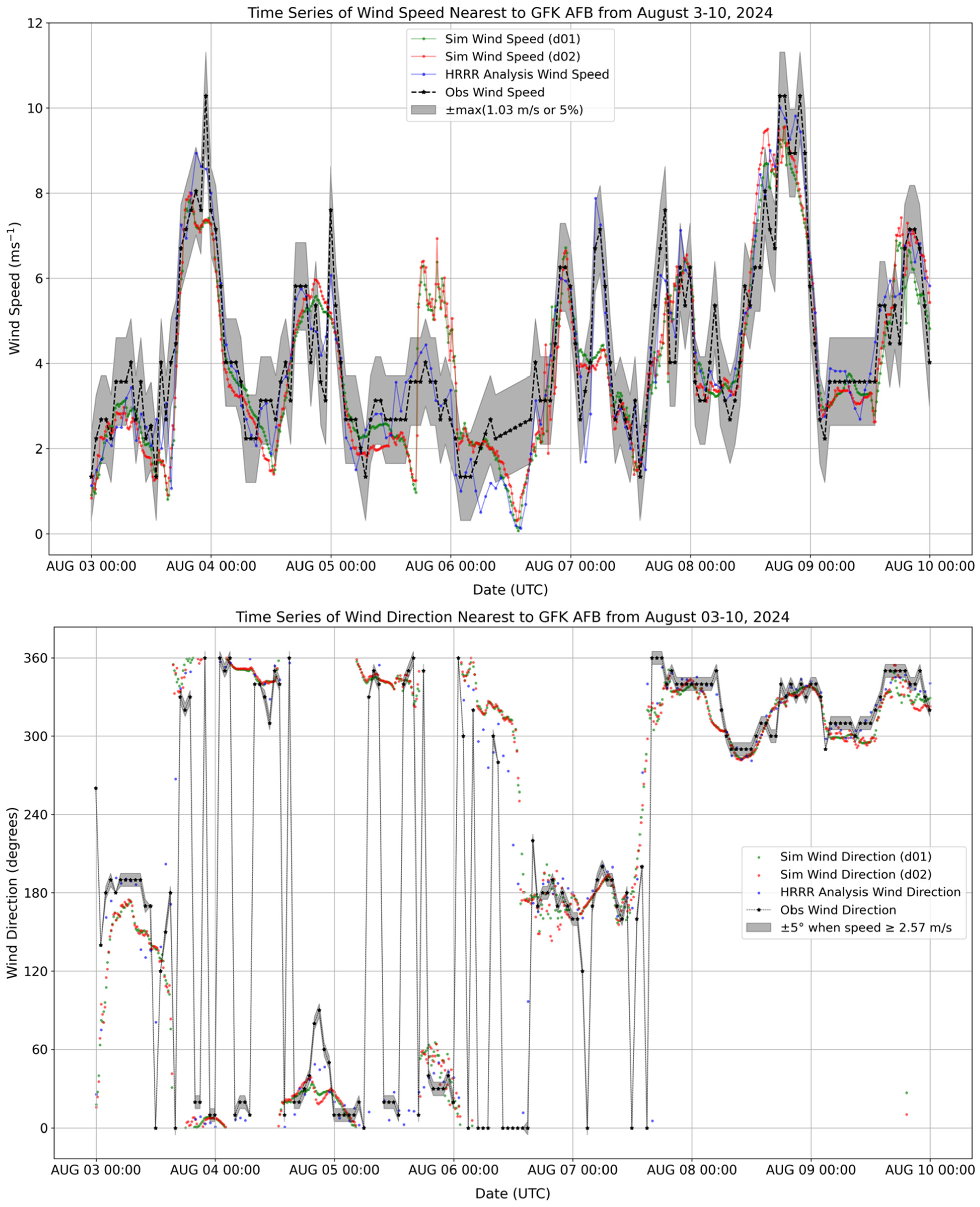
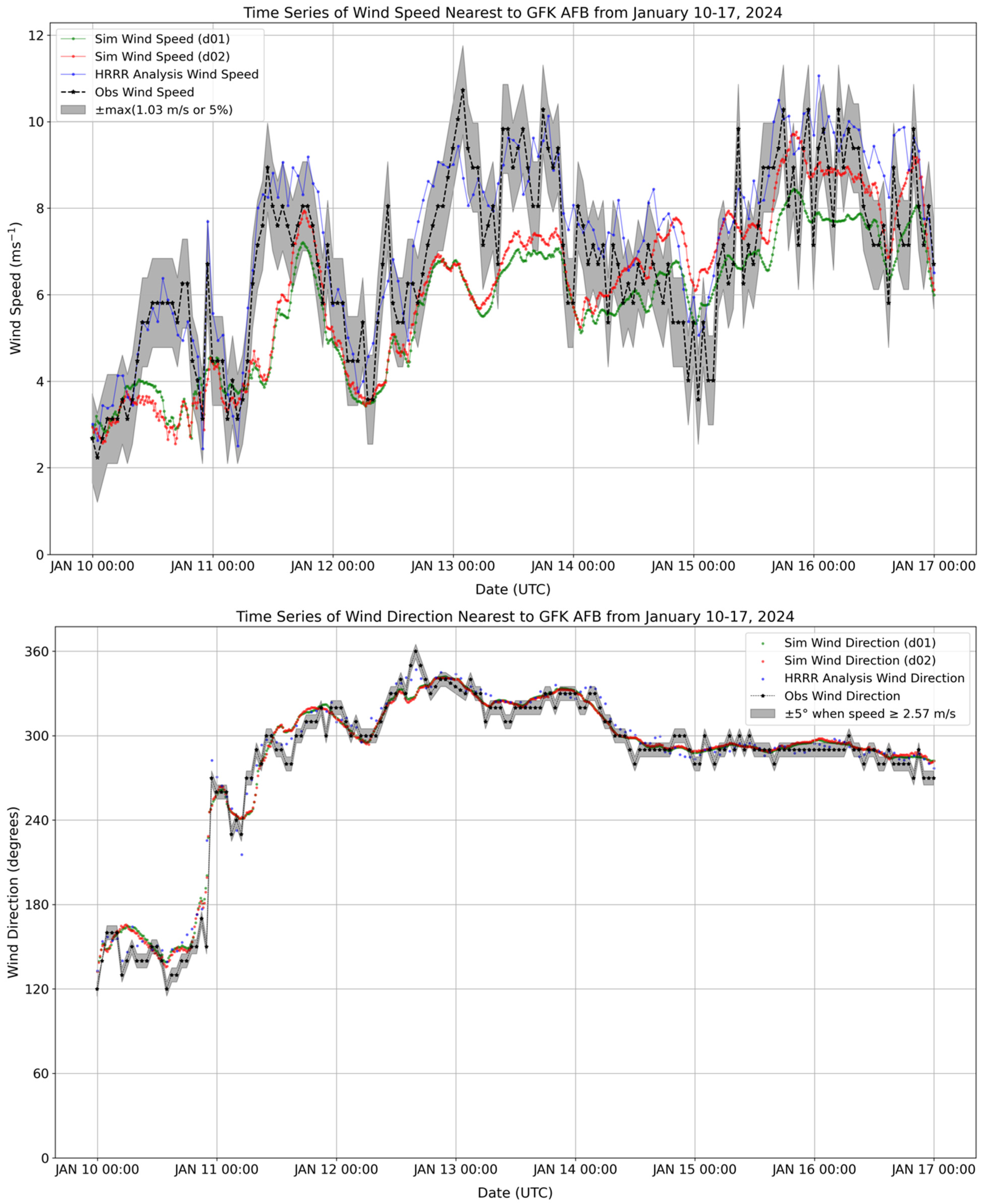
Figure 2 and
Figure 3 show time series of both simulated and METAR-observed wind speed and direction over the AFB station during both simulated periods, and their statistical comparison against the AFB METAR observations is shown in
Table 3. The wind direction statistics are computed using circular statistics. The comparison of both the zonal and meridional wind components is shown in
Table A1 in
Appendix A. The simulated data were interpolated to the AFB station location using nearest-neighbor interpolation. The observations are subsampled every 15 min for the comparison with the WRF simulations and every hour for the comparison with the HRRR data. The HRRR analyses are used every day at 00UTC, similar to the initialization of the WRF simulations. The HRRR and WRF forecasts initialized at 00 UTC every day are used for the time series comparisons.
The observed winds in summer show a clear diurnal signal each day, with winds from the north, northwest, and south. During the first day of the winter period, winds were blowing from the southeast and then shifted in direction to blow from northwest during the rest of the winter period. The winds during the summer season show more pronounced diurnal variability compared to winter and the winter winds have a more persistent direction and shift less frequently than summer winds because of the reduced radiative cooling at the surface during winter. In winter, reduced incoming solar radiation and lower surface heat fluxes limit the development of the convective boundary layer, leading to weaker daytime mixing and more stable atmospheric conditions. As a result, wind direction tends to be more persistent and exhibits less variability compared to summer. This seasonal contrast highlights the stronger influence of surface-driven turbulence during summer versus more stable, stratified conditions in winter.
In the summer experiments, the 1 km and 40 m simulations overestimate the wind speed over the AFB surface station while the 3 km HRRR data underestimate it, but the most accurate simulation is the 40 m LES with a mean bias of 49%.
The three simulations generally capture the observed wind direction well, with high correlation (up to 97%) and small directional bias. Wind speed discrepancies are more pronounced and are primarily associated with specific meteorological conditions, particularly on August 5th, when persistent cloud cover with cloud tops between approximately 1524–2896 m limited boundary-layer development. This suppression of convective mixing is not fully captured by the model, leading to overestimated afternoon wind speeds in all simulations.
Overall, wind direction is consistently well represented across all configurations, while wind speed shows larger sensitivity to boundary-layer representation and surface–atmosphere coupling. During the summer period, differences between the 1 km and 40 m simulations are relatively small in terms of mean statistics. The added value of the 40 m simulation is therefore not primarily reflected in improved mean wind speed over flat terrain, but rather in its ability to resolve higher-frequency variability and gust structures, with only limited systematic improvement in bulk metrics.
During the winter period, all simulations show comparable performance in wind direction. The 40 m simulation exhibits a modest improvement in wind speed representation, with reduced bias and a correlation of approximately 0.73. The main differences occur during afternoon periods, associated with surface temperature biases during the simulated snowstorm event, which affect boundary-layer stability and momentum exchange.
For evaluation at cloud-top levels during the summer period, GOES-R satellite-derived atmospheric motion vectors (DMWs) [
40] are used as an independent reference. However, it is noted that these products carry typical uncertainties on the order of 1–2 m s
−1 and are therefore used only for qualitative assessment of large-scale flow consistency. Where available, HRRR provides a more dynamically consistent reference due to its assimilation of multiple observational sources. The comparison indicates that the LES generally captures the large-scale wind structure, but the evaluation is limited by the sparse spatial coverage of satellite-derived wind vectors within the domain. The HRRR analysis data are used to initialize the WRF simulations every 6 h. For the comparison and time series analysis, HRRR forecasts initialized from the analysis are also used, as described in
Section 2.1 of the methodology. As the model integration progresses, physical parameterizations dominate the evolution of the flow, and errors may grow and introduce biases over time. In contrast, the 1 km and 40 m WRF simulations are initialized from HRRR but do not include additional data assimilation during their integration. Although the HRRR analysis itself is produced using an EnKF–Var data assimilation system, small-scale features are not fully constrained at the finer resolutions used in this study. As a result, small-scale errors can develop and amplify during the WRF model integration, particularly in near-surface wind fields, leading to differences in accuracy even at relatively short forecast lead times.
The comparison shows that TKE from D1 and D2 is positively correlated, but with a systematic underestimation at the coarser 1 km resolution. Specifically, D1 captures the temporal variability reasonably well, but underestimates TKE magnitude by approximately 10% on average in summer and 18% on average in winter (with peak differences reaching sometimes 20% and 25% during high-turbulence periods in summer and winter respectively) relative to D2.
This result suggests that while the 1 km forecast can reproduce the general evolution of turbulence, it does not fully resolve the intensity of smaller-scale turbulent motions represented in the 40 m simulation. Consequently, using D1 alone would lead to a lower estimate of u′2 (or velocity variance) and therefore a conservative estimate of peak wind fluctuations.
These findings provide a useful reference for practitioners: a correction factor based on the observed bias (on the order of 10% in summer and 18% in winter) can be applied to TKE or derived quantities (e.g., standard deviation of wind speed) when using coarser WRF configurations, allowing more realistic estimates of maximum wind velocity without the computational cost of LES or very high-resolution simulations.
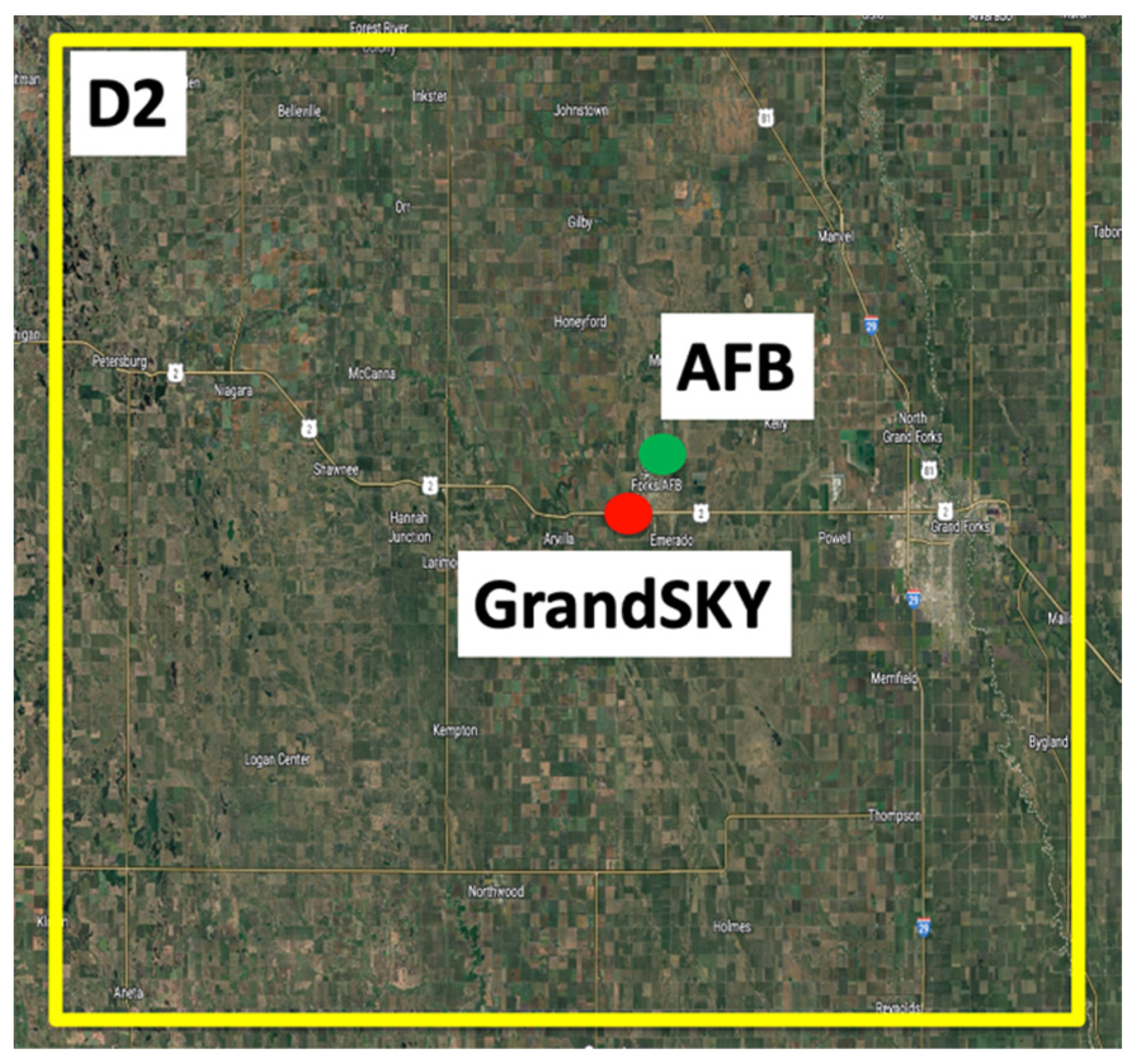
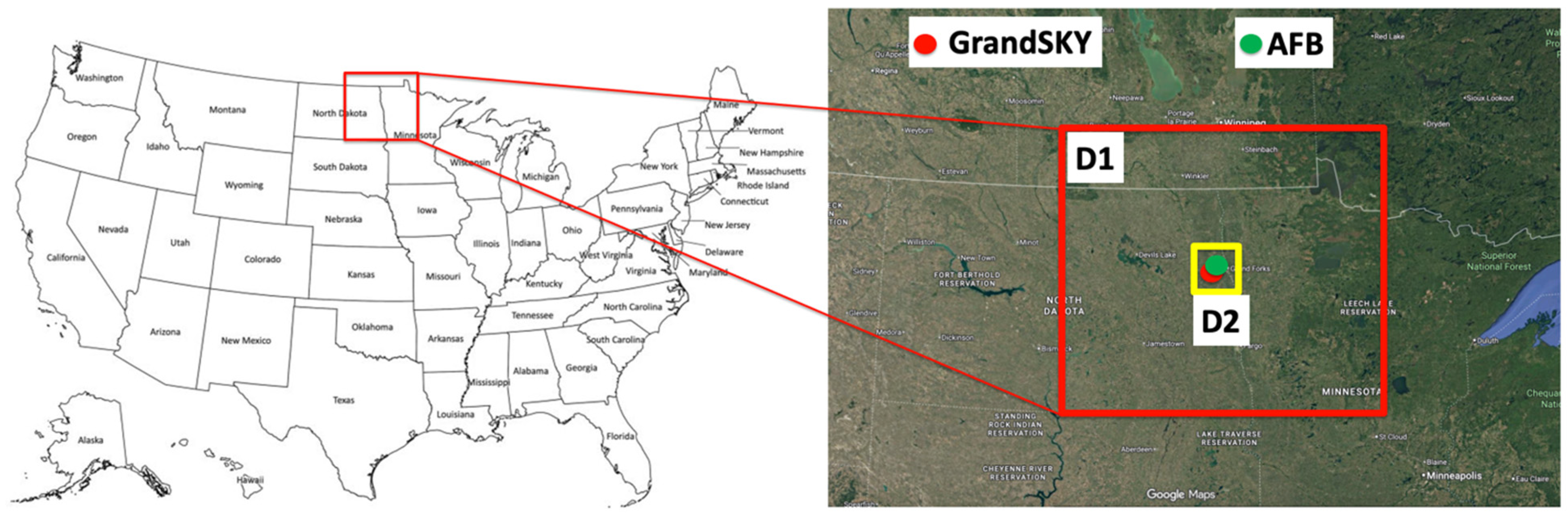
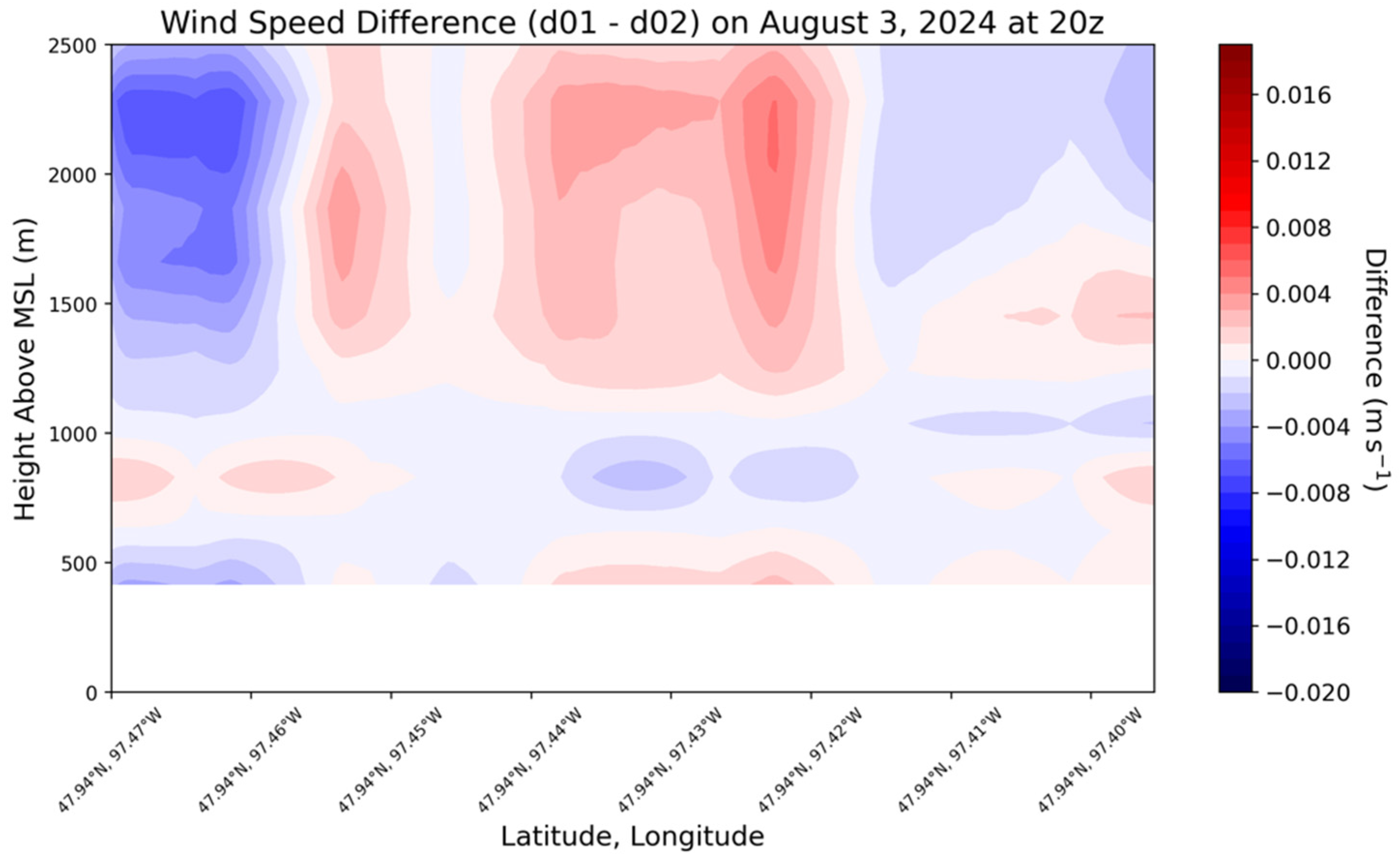
An example vertical cross-section passing through the GrandSKY and AFB locations indicated in
Figure 1 is shown in
Figure A2 to facilitate comparison between the D1 and D2 simulations, with a focus on the low-altitude region. For consistency, D1 data are interpolated onto the D2 grid, and the difference (D1–D2) is computed along the cross-section and shown in
Figure A2. The differences are very small and indicate strong agreement between the two simulations in the lower levels.
3.2. Evaluation Against UAS Observations
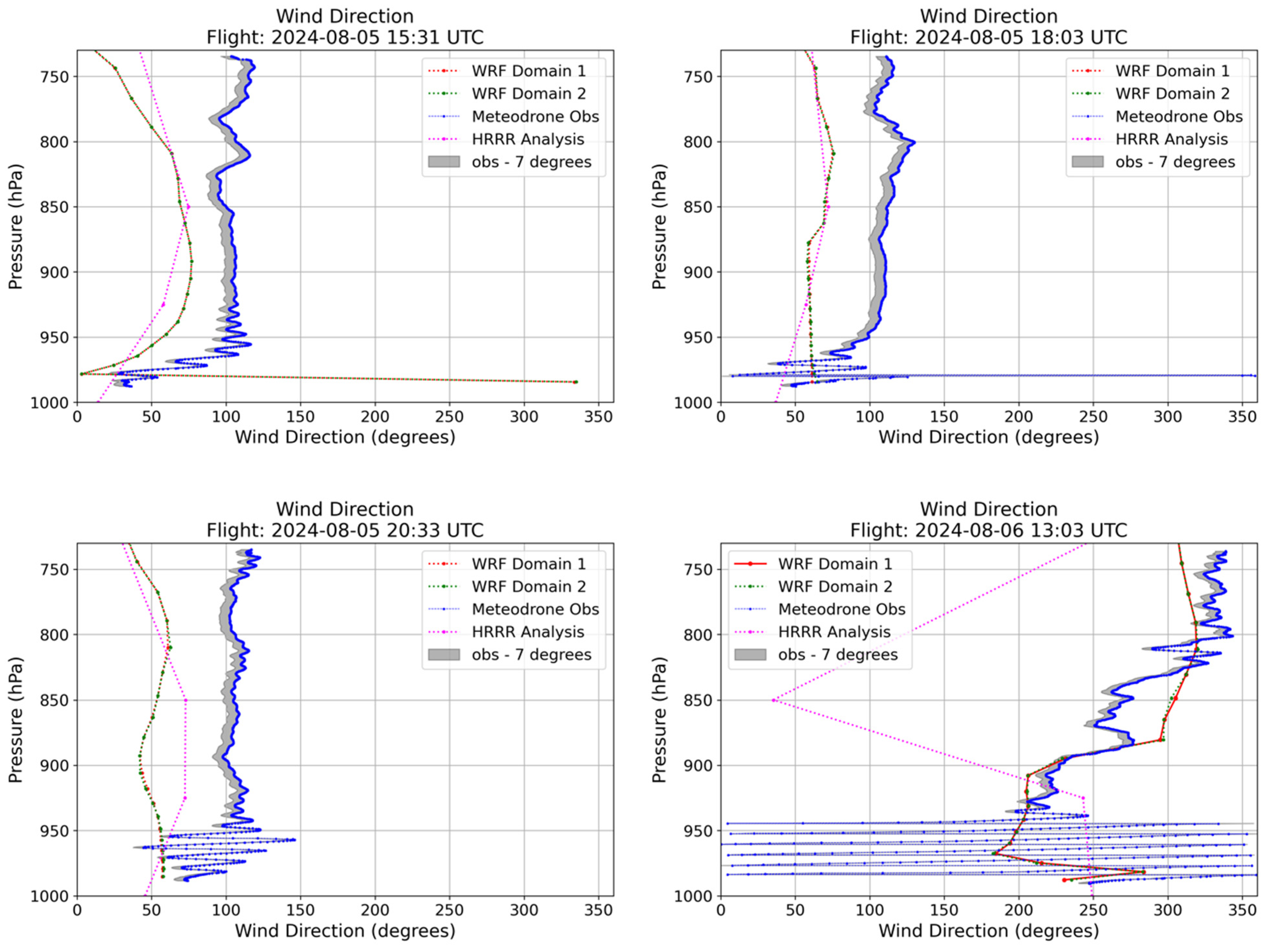
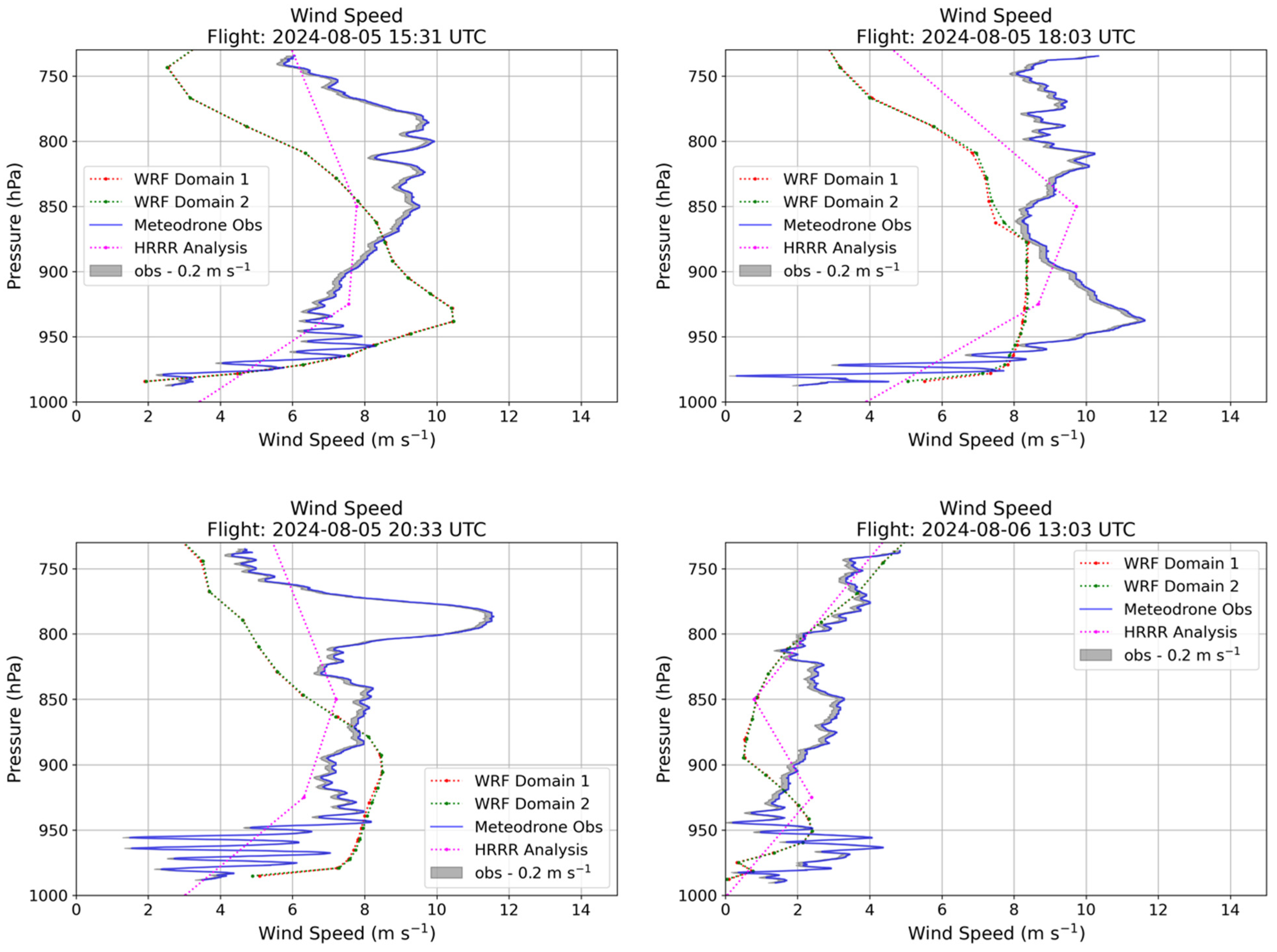
Figure 4 and
Figure 5 show the wind speed and direction vertical profiles of the Meteodrone data, using the 3 km, 1 km, and 40 m predictions for four summer flights. The simulated data is interpolated to the recorded flight location and time using the nearest-neighbor interpolation. We acknowledge that this approach does not directly account for temporal averaging or small-scale variability, which can contribute to differences between observations and simulated values, especially under convective or turbulent conditions.
Only data above 920 hPa was considered due to oscillations observed in the Meteodrone wind measurements at lower levels. The low-level oscillations below ~700 m AGL are attributed to airframe and rotor effects, which can perturb wind measurements during ascent and descent. To mitigate this, only data above 920 hPa are considered for model comparison. The indicated −0.2 m/s and −7° bands correspond to the nominal sensor bias. The relatively small differences between D1 and D2 results highlight the challenges in resolving small-scale variability at this single site, and the lack of winter plots is due to limited Meteodrone flights during the winter period. These data are considered unreliable due to airframe-induced perturbations and propeller wash effects during descent and near-surface operations. Close to the ground, the interaction of the rotor downwash with surface friction and local obstacles can produce spurious readings in both wind speed and direction. By focusing on the ascent above 920 hPa, we ensure that the profiles represent undisturbed atmospheric conditions suitable for validation of LES and mesoscale simulations.
The vertical profiles of the simulations over d01 and d02 have a higher vertical resolution than the HRRR data which only provides two vertical points within the flight altitudes which make it less suitable for comparison. The shaded area in
Figure 4 represents the measurement positive bias of 0.2 m s
−1 in wind speed, reflecting the confidence level of the measurements.
However, between 930 and 740 hPa, errors increase, reaching up to 2.4 m s−1. Notably, the wind speed profiles from the 1 km and 40 m simulations are nearly identical across the four flights, suggesting limited added benefit from increased horizontal resolution for wind speed alone in this vertical range under the sampled conditions. In contrast, wind direction profiles exhibited significant discrepancies. Both the 1 km and 40 m simulations deviated from the Meteodrone wind direction measurements by approximately 39°, with the errors increasing during afternoon flights; the differences increase as the convective boundary layer develops, and atmospheric instabilities intensify in the afternoon. The differences observed are likely related to a combination of factors, including limitations in the model’s representation of vertical wind structure, such as vertical wind shear and turbulent mixing processes (both resolved and subgrid-scale). In particular, challenges in capturing directional turning within the boundary layer, especially during convective periods, as well as uncertainties in surface flux representation and turbulence structure, can strongly influence wind direction profiles. These processes are known to be sensitive to model configuration and spatial resolution.
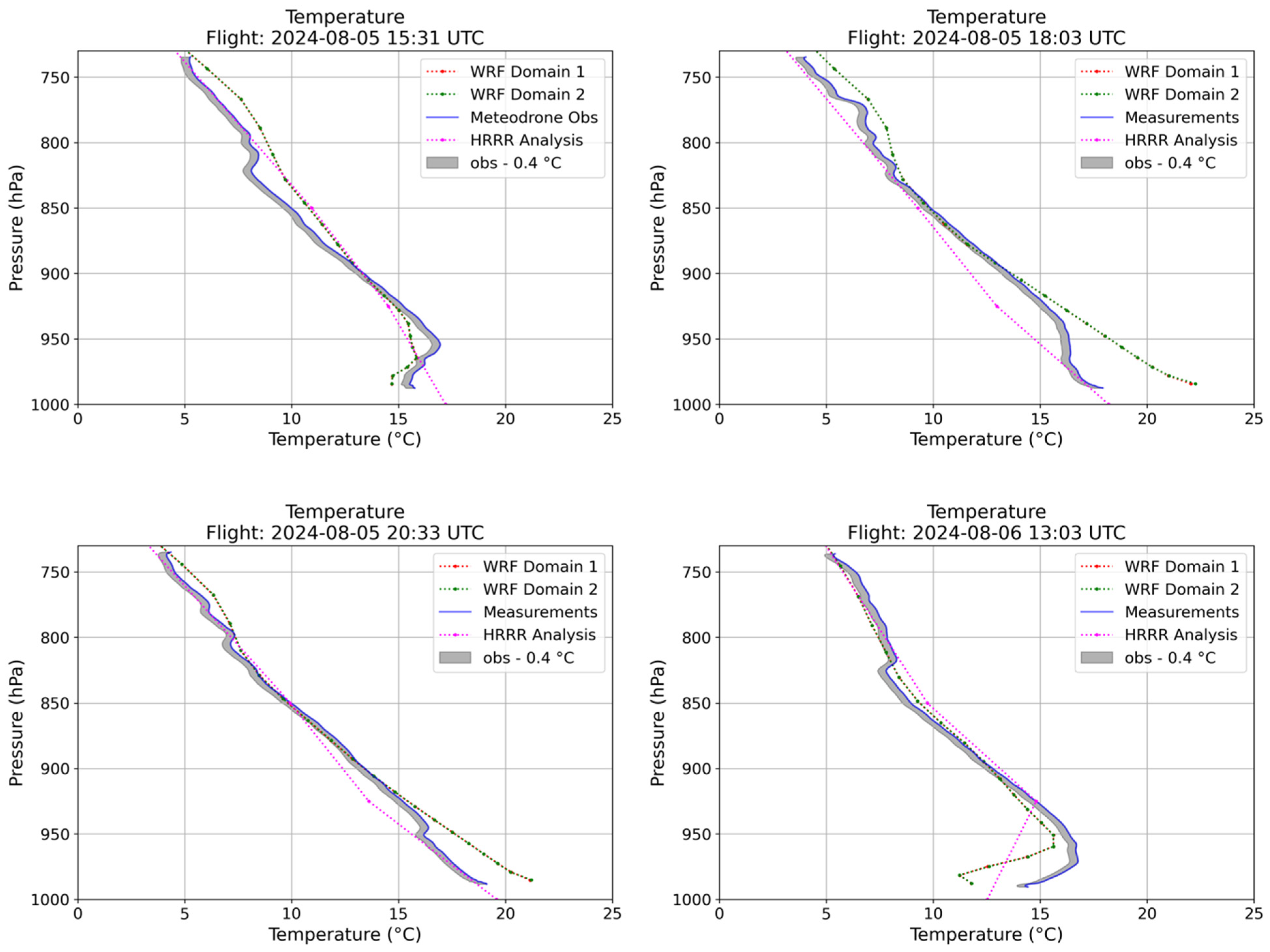
The observed differences may also be attributed to temperature structure differences, as illustrated in
Figure A3, which influence the boundary-layer depth and associated variability.
We acknowledge that this approach does not directly account for temporal averaging or small-scale variability, which can contribute to differences between observations and simulated values, especially under convective or turbulent conditions. It should be noted that these comparisons are based on observations from a single location over a small number of days. Therefore, the results primarily reflect the local conditions at the GrandSKY site and may not capture broader spatial or temporal variability.
The HRRR model includes a full vertical structure with multiple levels throughout the atmosphere, including the boundary layer. However, when extracting HRRR data for comparison with the Meteodrone profiles, only a limited number of pressure levels within the altitude range of interest (surface to approximately 700 hPa) were available or retained in the processed output used for plotting, resulting in the appearance of only a few discrete vertical levels. This does not affect the initialization of the WRF simulations. The WRF model is initialized using the full three-dimensional HRRR fields, including all available vertical levels and required atmospheric variables. Therefore, the vertical resolution used for model initialization is significantly higher than that shown in the comparison figures.
The comparison of dew point temperature and relative humidity vertical profiles (not provided here) also reveals significant discrepancies, particularly above 820 hPa. These differences suggest limitations in the model’s ability to accurately represent the vertical thermodynamic structure of the lower and mid-troposphere. In particular, biases in moisture transport, boundary-layer mixing, and cloud–radiation interactions may contribute to these deviations. Such processes are closely linked to the representation of entrainment at the top of the boundary-layer and vertical moisture fluxes, which are sensitive to both model resolution and parameterization choices. This indicates a need for further improvement in the simulation of vertical thermodynamic profiles, especially in capturing moisture variability and its interaction with boundary layer dynamics.
ERA5, due to its relatively coarse spatial resolution, has limited capability to represent local boundary-layer processes and fine-scale wind directional turning. Therefore, while it provides a useful large-scale reference for consistency, it is not expected to capture the localized variability resolved by the Meteodrone observations or the LES simulations. The discrepancies observed in wind direction are likely related to a combination of factors, including vertical wind shear, directional turning within the boundary layer (particularly during convective conditions), and uncertainties in surface fluxes and turbulence representation. These processes strongly influence wind direction profiles and are known to be sensitive to model configuration and spatial resolution. Further evaluation using additional independent observations or alternative reanalysis datasets, as well as improvements in turbulence and surface-layer parameterizations, would be beneficial and represents an important direction for future work.
3.3. Impact on Wind Gusts
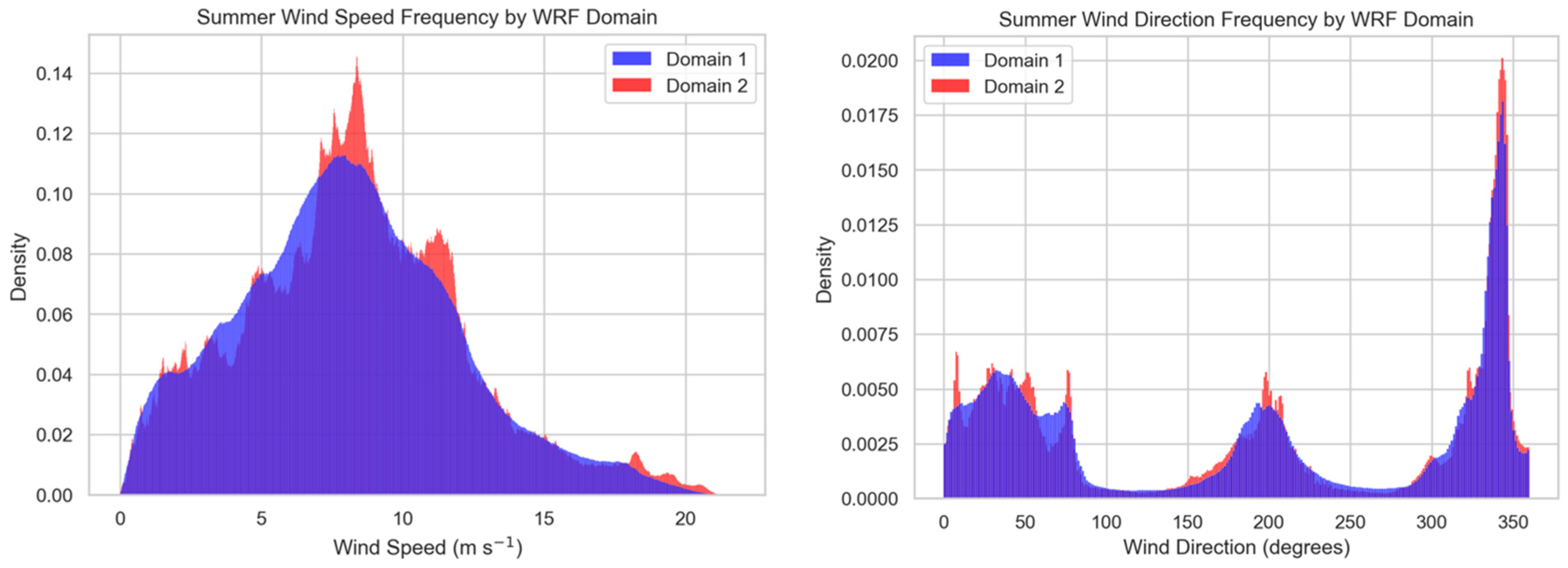
The wind gustiness predictability is compared using the 1 km and 40 m simulations over the inner domain, and aggregated all timesteps and grid cells in the D2 from the surface to the altitude of 1 km AGL.
Figure 6 shows the predicted Probability Density Functions (PDFs) of both wind speed and direction using both simulations. Here, ‘gustiness’ is used to describe wind speed variability associated with gust fluctuations, and does not directly correspond to turbulent kinetic energy or a formal turbulence metric. In this analysis, wind speed is defined as the horizontal wind magnitude at each model grid point. Wind speed variability refers to the spread of wind speeds within the sampled dataset and is quantified here from the probability density functions (PDFs) constructed using all grid points and time steps within the inner domain (D2), from the surface up to 1 km AGL. Gustiness refers here to the broader variability and intermittency of wind speed represented in the PDFs. Therefore, ‘gustiness’ in this study reflects resolved fluctuations across space and time rather than a formal meteorological gust diagnostic. All statistics are based on instantaneous model outputs at their native temporal resolution and aggregated over the full analysis period.
Wind speed distributions are commonly expected to resemble Rayleigh or Weibull distributions, particularly in open, flat terrain and when considering longer-term wind climatology. In our case, the wind speed distribution appears closer to a normal-like shape due to the short sampling window. The analysis of the variability of both PDFs shows clear differences between both PDFs with more pronounced spikes for the PDF of the LES. The 1 km simulation is predicting a Gaussian or lognormal shape distribution for wind speed with one peak at 7.66 m s
−1, while the 40 m simulations show a multi-modal distribution with multiple peaks—the two highest peaks at 8.1 and 11.6 m s
−1—and a greater frequency of high wind speeds. The highest wind speed variability of 4 m.s
−1 compared to 3 m.s
−1 using the 1 km simulation indicates stronger gusts predictions. This difference arises from the coupling method which resolves energetic eddies caused by the mechanical terrain-induced friction [
2,
24]. A similar result is observed for wind direction variability: 82° in the LES vs. 64° in the 1 km simulation. The objective is to statistically assess wind variability in the lowest part of the PBL, focusing on differences in resolved turbulence and wind fluctuations between the simulations. The maximum wind speed variability ranges from approximately 3 to 4 m s
−1 between the simulations, with the 1 km configuration showing slightly higher variability. This difference is small and should be interpreted with caution, as it is likely within the uncertainty of the simulations under weak wind conditions. The differences observed in
Figure 6 reflect the increased spatial variability resolved by the 40 m LES compared to the 1 km simulation. The previously suggested ‘shape’ of the distributions should not be interpreted as a Gaussian fit; rather, the distributions represent aggregated values over the lowest 1 km of the domain, where extreme values may result from vertical averaging rather than instantaneous fluctuations at a given height. Winter PDFs are not provided due to the limited availability of high-resolution Meteodrone flights during the winter period, which constrains verification.
The comparison of wind speed and direction PDFs between the 1 km and 40 m simulations reveals clear structural differences. It should be noted that, in the absence of observational PDFs, these results are not intended to demonstrate an improved statistical accuracy of the LES. Instead, they highlight differences in the representation of wind variability and turbulence between the two modeling approaches.
The 1 km simulation produces a smooth, near-Gaussian distribution of wind speed, which is consistent with the use of parameterized turbulence at this scale. In contrast, the 40 m LES exhibits a multi-modal distribution, reflecting the explicit resolution of turbulent eddies and intermittent gust events. While both simulations may yield similar bulk statistical properties such as mean and variance, the LES provides additional information on extremes, variability, and intermittency, which are not captured by the coarser-resolution model.
These differences are particularly relevant for UAS operations, where short-duration gusts and localized wind variability can significantly impact flight stability and safety. Therefore, the value of the LES in this context lies not in reproducing a specific statistical distribution, but in providing a more physically realistic representation of fine-scale wind fluctuations that influence operational decision-making.
3.4. Impact on UAS Operations
To highlight the impact of the LES on UAS navigation, the 1 km and 40 m wind fields are compared in terms of flyable locations over the simulated airspace (inner domain) for flight altitudes below 1 km. Flyability is defined as the percentage of time UASs can safely operate. A notional UAS designed with a wind speed limit of 4 m.s
−1 is used to illustrate this impact. Wind shear can affect UAS navigation beyond simply exceeding maximum wind speed limits, as vertical and horizontal shear may induce rapid changes in airspeed and heading, increasing vehicle instability and energy demand. However, wind shear is negligible during the simulated periods considered in this study, and therefore the analysis focuses primarily on wind speed magnitude. Accordingly, we apply a simplified operational constraint based on a maximum allowable wind speed threshold (4 m s
−1) to illustrate first-order flight limitations. The 1 km data over Domain 1 was interpolated to Domain 2 grid cells using the nearest-neighbor interpolation. It is found that, during the summer simulated period, the average difference between flyable grid cells using the 40 m LES and the 1 km simulation is 19.8% in summer and 13% in winter. Over GrandSKY’s take-off and landing point (see
Figure 1), the difference in wind speed exceedance between the simulations is about 4 h in a day, affecting operations timelines and scheduling by 17% (during the summer), assuming operations every hour.
This discrepancy reduces available operational windows (potential flight times) by 17% (4 out of a typical 24 h day) for the period investigated. This reduction significantly impacts mission planning, especially for time-sensitive or large-scale operations, leading to delays, extended project timelines, or the need for additional resources to meet deadlines. Scheduling flexibility and contingency planning become crucial to mitigate these impacts and ensure operational efficiency.
4. Conclusions
This study demonstrates that LES nested within a mesoscale WRF model offers a slight improvement in predicting low-altitude wind fields, which are critical for UAS operations at GrandSKY. By using a combination of surface METAR observations, satellite-derived motion winds, and vertical profiles from Meteodrone flights during both summer and winter conditions, the study reveals a modest improvement in the representation of wind speed, wind direction, and gust variability compared to a 1 km mesoscale configuration. The results show that the 40 m LES improves wind speed and direction forecasts relative to the 1 km mesoscale simulation. In the absence of significant terrain or urban effects, wind direction is primarily controlled by large-scale meteorological forcing and is therefore not significantly improved with nested LES. During the summer period, the LES reduces wind speed bias and better captures diurnal variability, particularly under convective conditions. The LES also shows an improved ability to reproduce wind gust distributions, capturing a broader range of wind speeds and more realistic multimodal probability density functions due to its ability to resolve small-scale turbulent structures. Comparisons against vertical Meteodrone profiles show moderate agreement in the lower troposphere, as indicated by accuracy metrics, although directional biases above 930 hPa persist, suggesting limitations in the representation of vertical structure and boundary-layer processes.
These findings are particularly relevant for UAS mission planning, where even modest discrepancies in wind conditions can lead to mission cancelations, safety risks, or reduced operational efficiency. The comparisons between the 40 m LES and the 1 km simulation show only modest differences in wind speed, direction, and gustiness at the site and for the selected periods. Given the limited temporal and spatial coverage of the observations, the results do not support general conclusions about systematic improvements. Instead, they should be interpreted as an illustration of the potential value of high-resolution LES for resolving small-scale flow structures relevant to UAS operations, rather than as definitive evidence of improved forecasting skill.
The conclusions regarding LES performance and its impact on UAS operations are constrained by the limited dataset, consisting of vertical profiles from a single site over short summer and winter periods. While the findings illustrate the potential benefits of high-resolution LES, further evaluation across multiple locations and longer time periods is required to generalize these results.
Operationally, the LES provides a more conservative estimate of UAS flyability. Specifically, the 40 m simulation identifies up to 17% fewer flyable hours during the summer period, emphasizing the importance of fine-scale modeling in risk-aware flight planning. These findings underscore the operational value of mesoscale-to-microscale (M2M) coupling for enabling weather-resilient autonomous operations and advancing efforts to safely integrate UAS into the national airspace system.
We acknowledge that in the time series results, the advantage of the 40 m LES over the 1 km simulation may appear limited, particularly in the mean wind speed profiles, where both simulations exhibit some bias, with a slight improvement observed in the 40 m configuration, especially during winter. However, the primary benefit of the 40 m LES is not reflected in mean wind speed alone, but in its ability to resolve gust variability and extreme events, which are critical for UAS operations. As demonstrated in the PDF analysis and flyability assessment, the 40 m LES captures a broader range of wind speeds, more realistic multimodal gust distributions, and increased directional variability—features that are not represented in the 1 km simulation. These differences translate into a quantifiable impact on operational decision-making, with the 40 m simulation predicting up to 17% fewer flyable hours for a notional UAS with a 4 m s−1 wind limit. Therefore, while comparisons of mean wind speeds suggest only a slight improvement, the fine-scale turbulence and gust-resolving capability of LES provides actionable information for risk-aware UAS flight planning, which is the central contribution of this work.
In this study, the objective is not to replace ensemble forecasting, but to investigate the added value of high-resolution LES in resolving gust variability relevant to UAS operations within the boundary layer. While ensemble systems capture uncertainty at larger scales, they do not explicitly resolve localized gusts that can directly impact UAS stability and safety. The study acknowledges that combining high-resolution LES with ensemble approaches would provide a more comprehensive framework, enabling both detailed turbulence representation and uncertainty quantification. This integration represents an important direction for future research, particularly for operational decision-support tools under uncertain atmospheric conditions.
Future work focuses on identifying and quantifying the sources of error in LESs relative to high-resolution observations, including the impact of effectively instantaneous measurements. Addressing these issues may involve ensemble simulations, higher-frequency output, or improved treatment of subgrid variability to better improve the statistical agreement between LES predictions and observed wind statistics, including turbulence intensity and variability metrics, rather than implying pointwise alignment of instantaneous turbulent fluctuations.
Future work should also focus on the characterization of vertical and horizontal wind shear in LES and its impact on UAS flight stability, including shear-induced load variability and coupling with turbulent gust structures, using higher-frequency observational datasets and targeted model diagnostics.
Future work will also examine the integration of LES forecasts into real-time operational frameworks through computational acceleration and adaptive mesh refinement strategies [
41]. Developing data assimilation methods that incorporate targeted low-altitude observations, such as Meteodrone profiles, would further improve model initialization and forecast skill. Refinement of cloud microphysics and radiative schemes is also required to improve the representation of convective boundary-layer processes and cloud–radiation interactions. Expanding the evaluation to diverse geographic locations and atmospheric regimes would improve generalization across the national airspace system. Additionally, LES-generated datasets can support machine learning-based emulators that approximate high-resolution flow fields at reduced computational cost. Coupling such models with UAS trajectory planning systems can enable probabilistic, wind-aware decision support tools for operations in weather-sensitive environments such as GrandSKY. Ultimately, these developments support the transition of LES-enabled forecasting from research to scalable operational systems that enhance the reliability and resilience of UAS operations in complex atmospheric environments.