


Impact of YunYao GNSS-RO Refractivity Data Assimilation on Typhoon Forecasts: A Case Study of Typhoon BEBINCA (2024)
 , and
, and 
Abstract
1. Introduction
2. Materials and Methods
2.1. Model Description
2.2. Experimental Design
- (1)
- WSM6_NODA: The WSM6 cloud microphysics scheme is adopted, utilizing background field data provided by the GFS with a horizontal resolution of 0.25° and a time interval of 6 h, used as initial and boundary conditions. These data are interpolated onto the simulation domain by the Weather Research and Forecasting Preprocessing System (WPS) and WRF, with no data assimilation involved.
- (2)
- WSM6_DA: Based on the WSM6_NODA configuration, YunYao GNSS-RO refractivity observations were assimilated at the forecast initial time using the GSI three-dimensional variational assimilation system.
- (3)
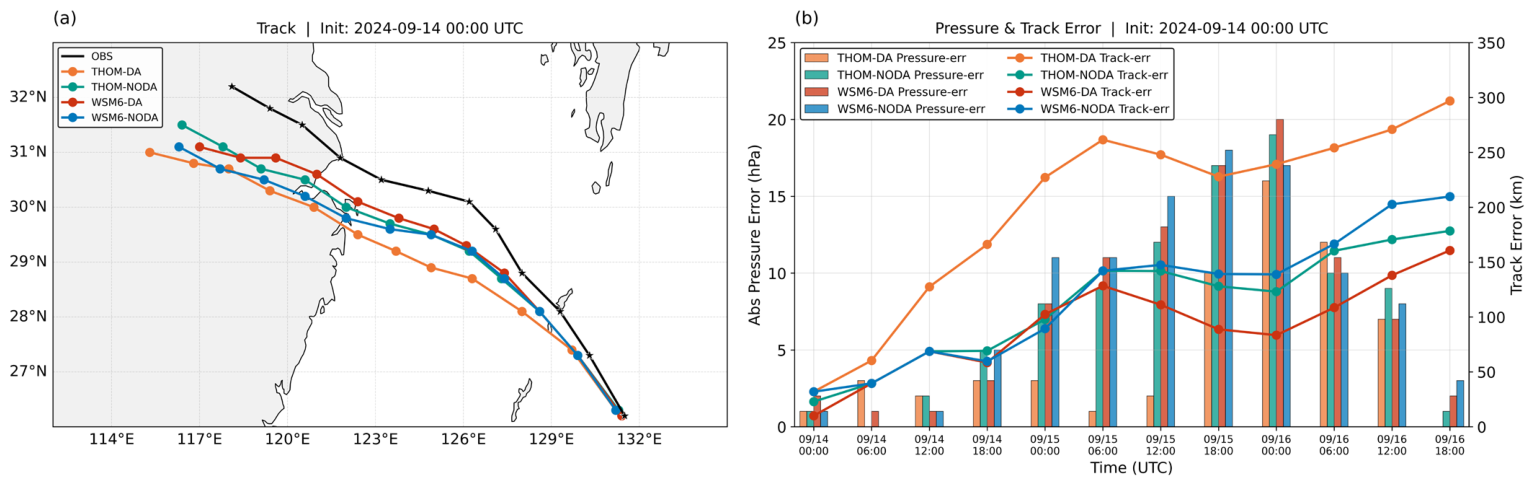
- THOM_NODA: The Thompson cloud microphysics scheme is adopted, with all other settings completely consistent with the WSM6_NODA experiment. By comparing with WSM6_NODA, the differences in forecasts under different cloud microphysics schemes without assimilation can be evaluated.
- (4)
- THOM_DA: Based on the THOM_NODA configuration, YunYao GNSS-RO refractivity observations are assimilated using the GSI system, with the assimilation settings consistent with those in WSM6_DA. By comparing with WSM6_DA, it is possible to further evaluate the differences in forecasting effects of cloud microphysical schemes after assimilating YunYao GNSS-RO refractivity data.
2.3. Observational and Reanalysis Data
3. Results
3.1. Initial Field Assimilation Results
3.2. Forecast Results of Meteorological Elements
3.3. Typhoon Forecast Results
3.4. Sensitivity Tests on Parameterization Schemes
4. Conclusions
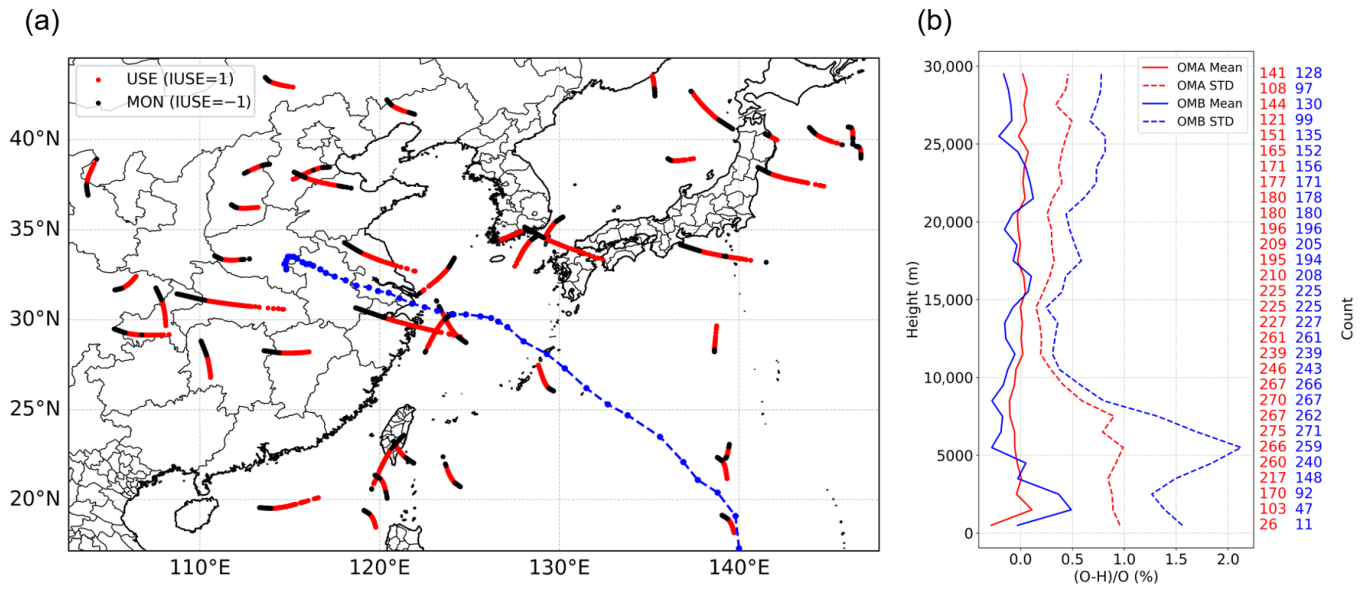
- Data assimilation improves the consistency between the initial atmospheric fields and observations in the middle and upper troposphere. Both the mean relative error and the standard deviation of the background field relative to observations are significantly reduced, providing a more accurate initial atmospheric state for typhoon forecasting.
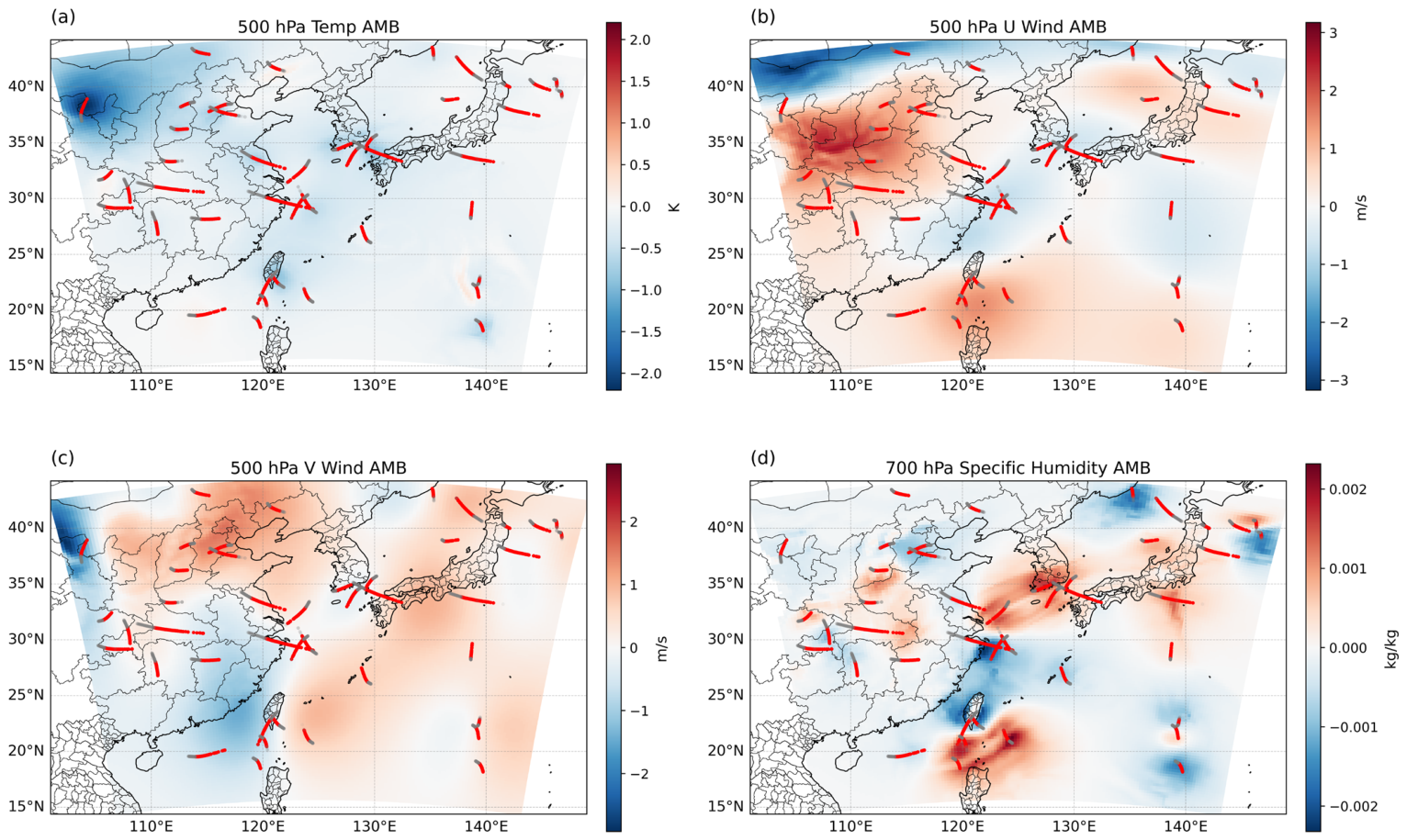
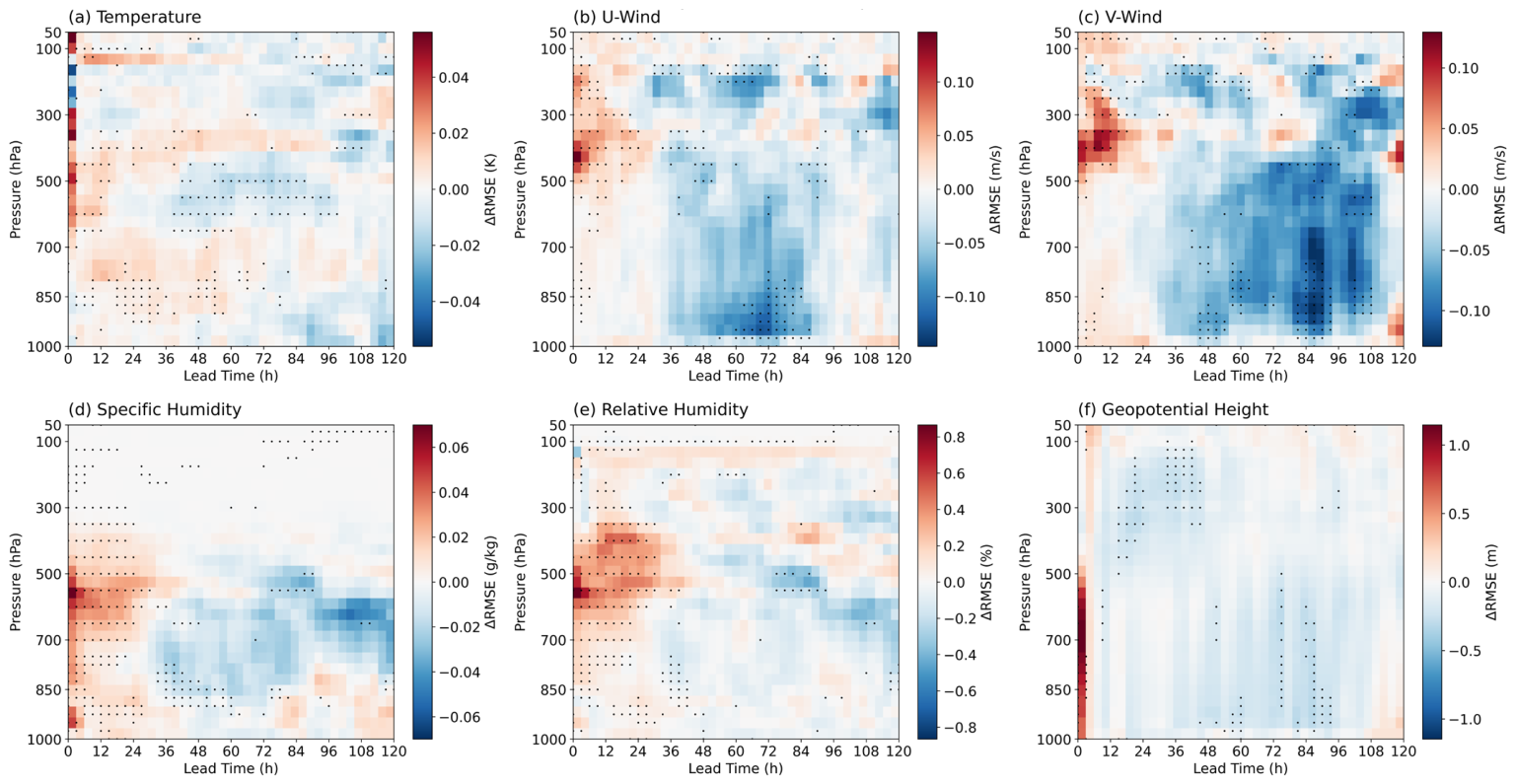
- Comparisons with ERA5 reanalysis data show that assimilating YunYao GNSS-RO data effectively improves the forecast accuracy of key meteorological variables. The assimilation experiment shows higher simulation accuracy for geopotential height, humidity, temperature, and wind speed. Statistical results from multiple initializations show that the improvements persist from 36 h to 120 h forecast lead time, with maximum RMSE reductions exceeding 0.2 K for temperature and 0.1 m s−1 for wind speed, while geopotential height shows consistent improvement throughout the entire atmosphere.
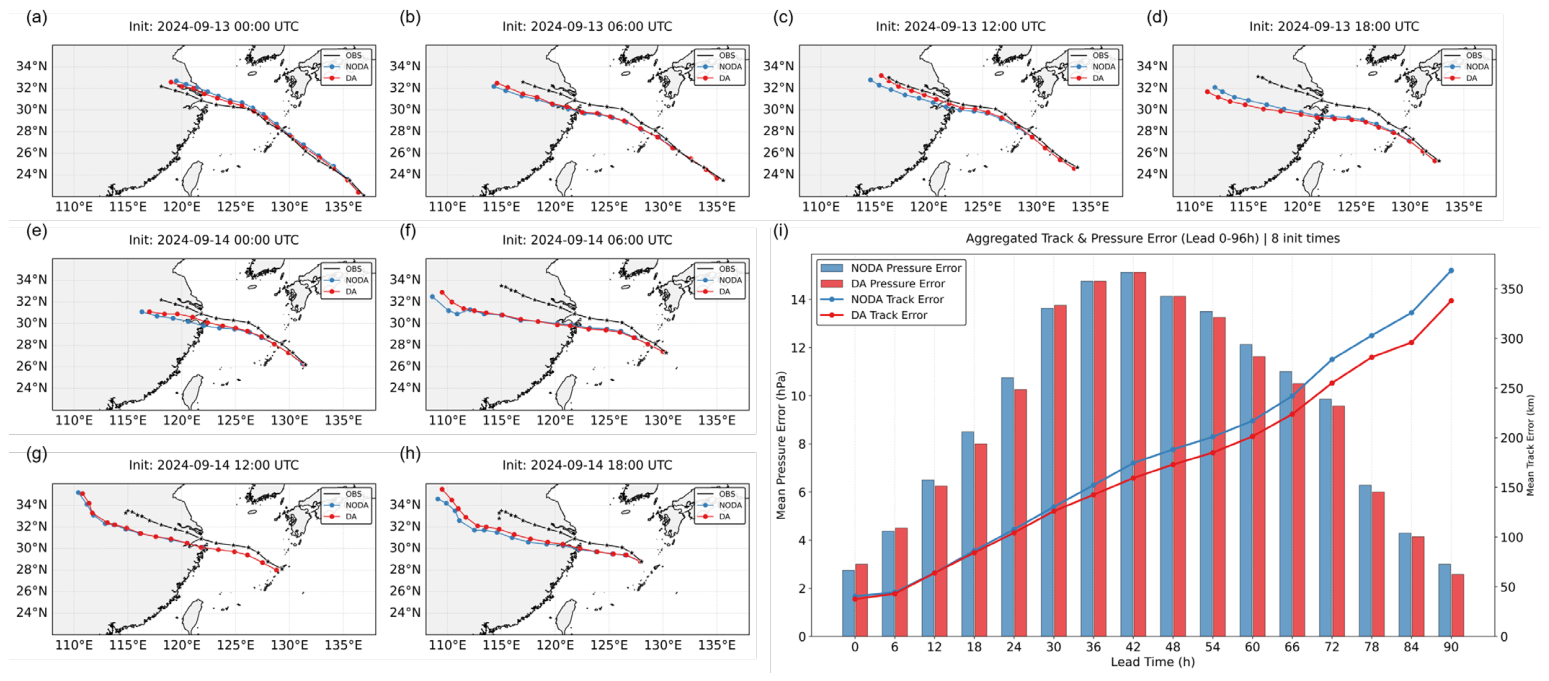
- Assimilation of YunYao GNSS-RO data significantly improves the simulation accuracy of Typhoon BEBINCA’s track and intensity. Compared with observations, the tracks in seven assimilation experiments are closer to the best track. Statistical results from multiple forecast initializations show that the 84 h track error is reduced by approximately 30 km on average, and the minimum central pressure bias is also reduced.
- Cloud microphysics schemes have a significant influence on the assimilation effects. The WSM6 scheme is more beneficial for improving track forecast accuracy, whereas the Thompson scheme performs better for intensity forecasting. In operational forecasting, the assimilation strategy should be optimized in combination with the characteristics of physical parameterization schemes to achieve overall improvements in typhoon track and intensity forecast performance.
Author Contributions
Funding
Institutional Review Board Statement
Informed Consent Statement
Data Availability Statement
Conflicts of Interest
Abbreviations
| WRF | Weather Research and Forecasting model |
| GSI | Gridpoint Statistical Interpolation system |
| GNSS-RO | Global Navigation Satellite System Radio Occultation |
References
- Kursinski, E.R.; Hajj, G.A.; Schofield, J.T.; Linfield, R.P.; Hardy, K.R. Observing Earth’s atmosphere with radio occultation measurements using the Global Positioning System. J. Geophys. Res. Atmos. 1997, 102, 23429–23465. [Google Scholar] [CrossRef]
- Ware, R.; Exner, M.; Feng, D.; Gorbunov, M.; Hardy, K.; Herman, B.; Kuo, Y.; Meehan, T.; Melbourne, W.; Rocken, C.; et al. GPS Sounding of the Atmosphere from Low Earth Orbit: Preliminary Results. Bull. Am. Meteorol. Soc. 1996, 77, 19–40. [Google Scholar] [CrossRef]
- Zhran, M.; Mousa, A.; Wang, Y.; Hasher, F.F.; Jin, S. Assessment of Commercial GNSS Radio Occultation Performance from PlanetiQ Mission. Remote Sens. 2024, 16, 3339. [Google Scholar] [CrossRef]
- Anthes, R.A. Exploring Earth’s atmosphere with radio occultation: Contributions to weather, climate and space weather. Atmos. Meas. Tech. 2011, 4, 1077–1103. [Google Scholar] [CrossRef]
- Eyre, J.R. Observation impact metrics in NWP: A theoretical study. Part II: Systems with suboptimal observation errors. Q. J. R. Meteorol. Soc. 2024, 150, 632–640. [Google Scholar] [CrossRef]
- Kuo, Y.-H.; Sokolovskiy, S.; Anthes, R.; Vandenberghe, F. Assimilation of GPS Radio Occultation Data for Numerical Weather Prediction. Terr. Atmos. Ocean. Sci. 2001, 11, 157–186. [Google Scholar] [CrossRef]
- Zhu, M.-B.; Zhang, W.-M.; Cao, X.-Q. Research on the implementation of GPS radio occultation one-dimensional bending angle operator in four-dimensional variational data assimilation system. Acta Phys. Sin. 2013, 62, 189203. [Google Scholar] [CrossRef]
- Cai, Q.; Wang, Y.; Zhang, B.; Li, J.; Lan, W.; Wang, G. Evaluation on Assimilation Application of Yunhai-2 Occultation Data in Regional Numerical Weather Prediction Model. Chin. J. Atmos. Sci. 2021, 45, 217–228. [Google Scholar] [CrossRef]
- Healy, S.B.; Thépaut, J.N. Assimilation experiments with CHAMP GPS radio occultation measurements. Q. J. R. Meteorol. Soc. 2006, 132, 605–623. [Google Scholar] [CrossRef]
- Johnston, B.R.; Cucurull, L.; Anthes, R.; Mueller, M.J.; Lim, A.H.N. The Impact of Assimilating GNSS-RO Observations on HAFS Tropical Cyclone Forecasts from the 2022 Atlantic Hurricane Season. Weather. Forecast. 2025, 40, 2539–2559. [Google Scholar] [CrossRef]
- Miller, W.J.; Chen, Y.; Ho, S.-P.; Shao, X. Evaluating the Impacts of COSMIC-2 GNSS RO Bending Angle Assimilation on Atlantic Hurricane Forecasts Using the HWRF Model. Mon. Weather. Rev. 2023, 151, 1821–1847. [Google Scholar] [CrossRef]
- Qiu, C.; Wang, X.; Zhou, K.; Zhang, J.; Chen, Y.; Li, H.; Liu, D.; Yuan, H. Comparative Assessment of Spire and COSMIC-2 Radio Occultation Data Quality. Remote Sens. 2023, 15, 5082. [Google Scholar] [CrossRef]
- Cucurull, L.; Derber, J.C. Operational Implementation of COSMIC Observations into NCEP’s Global Data Assimilation System. Weather. Forecast. 2008, 23, 702–711. [Google Scholar] [CrossRef]
- Healy, S.B. Forecast impact experiment with a constellation of GPS radio occultation receivers. Atmos. Sci. Lett. 2008, 9, 111–118. [Google Scholar] [CrossRef]
- Liu, Y.; Xue, J. Assimilation of GNSS radio occultation observations in GRAPES. Atmos. Meas. Tech. 2014, 7, 3935–3946. [Google Scholar] [CrossRef]
- Yue, H.; Fu, N.; Li, F.; Cheng, Y.; Wu, M.; Guo, P.; Dong, W.; Hu, X.; Wang, F. The Yunyao LEO Satellite Constellation: Occultation Results of the Neutral Atmosphere Using Multi-System Global Navigation Satellites. Remote Sens. 2025, 17, 2851. [Google Scholar] [CrossRef]
- Xu, X.; Han, W.; Wang, J.; Gao, Z.; Li, F.; Cheng, Y.; Fu, N. Quality assessment of YUNYAO radio occultation data in the neutral atmosphere. Atmos. Meas. Tech. 2025, 18, 1339–1353. [Google Scholar] [CrossRef]
- Abualkishik, A. A Comparative Study on the Software Architecture of Wrf and Other Numerical Weather Prediction Models. J. Theor. Appl. Inf. Technol. 2018, 96, 8244–8254. [Google Scholar]
- Yang, Y.; Wang, Y.; Zhu, K. Assimilation of Chinese Doppler Radar and Lightning Data Using WRF-GSI: A Case Study of Mesoscale Convective System. Adv. Meteorol. 2015, 2015, 763919. [Google Scholar] [CrossRef]
- Ma, Z.; Kuo, Y.-H.; Ralph, F.M.; Neiman, P.J.; Wick, G.A.; Sukovich, E.; Wang, B. Assimilation of GPS Radio Occultation Data for an Intense Atmospheric River with the NCEP Regional GSI System. Mon. Weather. Rev. 2011, 139, 2170–2183. [Google Scholar] [CrossRef]
- Kleist, D.T.; Parrish, D.F.; Derber, J.C.; Treadon, R.; Wu, W.-S.; Lord, S. Introduction of the GSI into the NCEP Global Data Assimilation System. Weather. Forecast. 2009, 24, 1691–1705. [Google Scholar] [CrossRef]
- Hong, S.Y.; Lim, J.-O.J. The WRF Single-Moment 6-Class Microphysics Scheme (WSM6). Asia-Pac. J. Atmos. Sci. 2006, 42, 129–151. [Google Scholar]
- Kain, J.S. The Kain–Fritsch Convective Parameterization: An Update. J. Appl. Meteorol. 2004, 43, 170–181. [Google Scholar] [CrossRef]
- Mlawer, E.J.; Taubman, S.J.; Brown, P.D.; Iacono, M.J.; Clough, S.A. Radiative transfer for inhomogeneous atmospheres: RRTM, a validated correlated-k model for the longwave. J. Geophys. Res. Atmos. 1997, 102, 16663–16682. [Google Scholar] [CrossRef]
- Dudhia, J. Numerical Study of Convection Observed during the Winter Monsoon Experiment Using a Mesoscale Two-Dimensional Model. J. Atmos. Sci. 1989, 46, 3077–3107. [Google Scholar] [CrossRef]
- Hong, S.-Y.; Noh, Y.; Dudhia, J. A New Vertical Diffusion Package with an Explicit Treatment of Entrainment Processes. Mon. Weather. Rev. 2006, 134, 2318–2341. [Google Scholar] [CrossRef]
- Jiménez, P.A.; Dudhia, J.; González-Rouco, J.F.; Navarro, J.; Montávez, J.P.; García-Bustamante, E. A Revised Scheme for the WRF Surface Layer Formulation. Mon. Weather. Rev. 2012, 140, 898–918. [Google Scholar] [CrossRef]
- Chen, F.; Dudhia, J. Coupling an Advanced Land Surface–Hydrology Model with the Penn State–NCAR MM5 Modeling System. Part I: Model Implementation and Sensitivity. Mon. Weather. Rev. 2001, 129, 569–585. [Google Scholar] [CrossRef]
- Parrish, D.F.; Derber, J.C. The National Meteorological Center’s Spectral Statistical-Interpolation Analysis System. Mon. Weather. Rev. 1992, 120, 1747–1763. [Google Scholar] [CrossRef]
- Singh, R.; Ojha, S.P.; Anthes, R.; Hunt, D. Evaluation and Assimilation of the COSMIC-2 Radio Occultation Constellation Observed Atmospheric Refractivity in the WRF Data Assimilation System. J. Geophys. Res. Atmos. 2021, 126, e2021JD034935. [Google Scholar] [CrossRef]
- Cucurull, L.; Derber, J.C.; Treadon, R.; Purser, R.J. Assimilation of Global Positioning System Radio Occultation Observations into NCEP’s Global Data Assimilation System. Mon. Weather. Rev. 2007, 135, 3174–3193. [Google Scholar] [CrossRef]
- Yang, S.; Zou, X. Assimilating Tianmu-1 RO Data From a 23-Satellite Constellation to Enhance the Track Forecasts of Typhoon Gaemi (2024). Geophys. Res. Lett. 2025, 52, e2025GL115679. [Google Scholar] [CrossRef]
- Thompson, G.; Field, P.R.; Rasmussen, R.M.; Hall, W.D. Explicit Forecasts of Winter Precipitation Using an Improved Bulk Microphysics Scheme. Part II: Implementation of a New Snow Parameterization. Mon. Weather. Rev. 2008, 136, 5095–5115. [Google Scholar] [CrossRef]
- Hersbach, H.; Bell, B.; Berrisford, P.; Biavati, G.; Horányi, A.; Muñoz Sabater, J.; Nicolas, J.; Peubey, C.; Radu, R.; Rozum, I.; et al. ERA5 Hourly Data on Single Levels from 1940 to Present; Copernicus Climate Change Service: Bonn, Germany, 2023. [Google Scholar] [CrossRef]
- Student. The Probable Error of a Mean. Biometrika 1908, 6, 1–25. [Google Scholar] [CrossRef]
- Lu, X.; Yu, H.; Ying, M.; Zhao, B.; Zhang, S.; Lin, L.; Bai, L.; Wan, R. Western North Pacific Tropical Cyclone Database Created by the China Meteorological Administration. Adv. Atmos. Sci. 2021, 38, 690–699. [Google Scholar] [CrossRef]





| Physical Process | Parameterization Scheme |
|---|---|
| cloud microphysics | WSM6 |
| Cumulus Convection | KF |
| Longwave Radiation | RRTM |
| Shortwave Radiation | Dudhia |
| Planetary Boundary Layer | YSU |
| Surface Layer | MM5 M-O |
| Land Surface Processes | Noah LSM |
| Experiment Setup | WSM6_NODA | WSM6_DA | THOM_NODA | THOM_DA |
|---|---|---|---|---|
| Assimilation of YunYao GNSS-RO Refractivity | NO | YES | NO | YES |
| Cloud Microphysics Scheme | WSM6 | WSM6 | Thompson | Thompson |
Disclaimer/Publisher’s Note: The statements, opinions and data contained in all publications are solely those of the individual author(s) and contributor(s) and not of MDPI and/or the editor(s). MDPI and/or the editor(s) disclaim responsibility for any injury to people or property resulting from any ideas, methods, instructions or products referred to in the content. |
© 2026 by the authors. Licensee MDPI, Basel, Switzerland. This article is an open access article distributed under the terms and conditions of the Creative Commons Attribution (CC BY) license.
Share and Cite
Kan, L.; Li, F.; Li, J.; Huang, M.; Wang, P.; Cheng, Y.; Cui, J.; Yan, D.; Zhang, W.; He, C.; et al. Impact of YunYao GNSS-RO Refractivity Data Assimilation on Typhoon Forecasts: A Case Study of Typhoon BEBINCA (2024). Atmosphere 2026, 17, 467. https://doi.org/10.3390/atmos17050467
Kan L, Li F, Li J, Huang M, Wang P, Cheng Y, Cui J, Yan D, Zhang W, He C, et al. Impact of YunYao GNSS-RO Refractivity Data Assimilation on Typhoon Forecasts: A Case Study of Typhoon BEBINCA (2024). Atmosphere. 2026; 17(5):467. https://doi.org/10.3390/atmos17050467
Chicago/Turabian StyleKan, Liang, Fenghui Li, Jinxiao Li, Manyi Huang, Pengcheng Wang, Yan Cheng, Jiawen Cui, Dan Yan, Wenxi Zhang, Chaochao He, and et al. 2026. "Impact of YunYao GNSS-RO Refractivity Data Assimilation on Typhoon Forecasts: A Case Study of Typhoon BEBINCA (2024)" Atmosphere 17, no. 5: 467. https://doi.org/10.3390/atmos17050467
APA StyleKan, L., Li, F., Li, J., Huang, M., Wang, P., Cheng, Y., Cui, J., Yan, D., Zhang, W., He, C., Liang, X., Shen, Z., & Zhou, W. (2026). Impact of YunYao GNSS-RO Refractivity Data Assimilation on Typhoon Forecasts: A Case Study of Typhoon BEBINCA (2024). Atmosphere, 17(5), 467. https://doi.org/10.3390/atmos17050467