


Abstract
Based on monthly meteorological observations from 57 stations in Jiangsu Province during 1961–2022, the Standardized Precipitation Evapotranspiration Index (SPEI) was calculated to characterize regional dry–wet variability. Empirical Orthogonal Function (EOF) analysis was applied to extract the dominant spatially coherent dry–wet modes, and cross-wavelet analysis was further employed to examine, in the time–frequency domain, the mode-specific responses to multiscale climate drivers, including the El Niño–Southern Oscillation (ENSO), Sunspot Number (SSN), Arctic Oscillation (AO), and Pacific Decadal Oscillation (PDO). The results show that dry–wet variability in Jiangsu Province is primarily organized by a regionally coherent mode (EOF1, explaining 56.3% of the total variance) and a north–south dipole mode (EOF2, explaining 17.8%), with the zero-value line of EOF2 closely aligned with the Huaihe River–Subei Irrigation Canal climatic transition zone. The temporal coefficient of EOF1 (PC1) exhibits a significant regime shift around 2013, followed by a pronounced wetting trend across the entire region. This change may reflect recent hydroclimatic adjustments in the study area, although the present study does not attempt a formal attribution of the respective thermal and precipitation contributions. In contrast, the temporal coefficient of EOF2 (PC2) undergoes an abrupt change around 1980, indicating a transition of the spatial dry–wet pattern from “southern drought–northern flood” to “southern flood–northern drought,” broadly consistent with an interdecadal climatic transition. Cross-wavelet analysis further reveals that PC1 is closely associated with ENSO at interannual timescales, with a lag of approximately 4–6 months, while its long-term variability shows time–frequency coherence with SSN. PC2 also exhibits time–frequency coherence with SSN at longer timescales, with an apparent phase transition around the 1980s; however, this low-frequency signal should be interpreted cautiously because the underlying physical mechanism remains uncertain. Overall, this study shows that dry–wet variability in Jiangsu Province is organized by two leading spatial modes with distinct temporal evolution and scale-dependent climate linkages. These findings provide new evidence for understanding hydroclimatic variability in monsoon transition zones and offer a basis for spatially differentiated drought–flood risk assessment.
1. Introduction
The Sixth Assessment Report of the Intergovernmental Panel on Climate Change (IPCC AR6) indicates that global warming has significantly intensified both the frequency and intensity of extreme precipitation and drought events, and that the risk of drought–flood disasters is expected to continue increasing in the future. Droughts and floods are among the most damaging hydroclimatic hazards worldwide. Droughts can reduce agricultural productivity, threaten water supply, and degrade ecosystems, whereas floods can cause severe damage to infrastructure, human settlements, and socioeconomic systems. Under climate change, the intensification of the hydrological cycle may increase the frequency of both prolonged dry conditions and extreme wet events in many regions. Therefore, understanding the spatiotemporal organization of dry–wet variability is important not only for regional climate diagnosis, but also for disaster risk reduction and adaptive water resources management. In China, hydroclimatic conditions have undergone notable changes in recent decades, leading to the frequent occurrence of meteorological disasters such as droughts and floods in many regions. Statistics show that in recent years, losses caused by meteorological disasters—particularly drought and flood events—have accounted for more than 70% of total natural disaster losses in China, equivalent to approximately 1% of the national gross domestic product (GDP), and affecting about 400 million people annually [1,2]. These losses pose a serious threat to human life and property and severely constrain sustainable socioeconomic development. Therefore, an in-depth investigation of the spatiotemporal characteristics of drought–flood variability and their underlying causes is of great theoretical and practical significance for accurately understanding regional dry–wet variations, improving predictive capability, and formulating effective disaster prevention and mitigation strategies.
Jiangsu Province is located along the eastern coast of China and lies in the transitional zone between warm temperate and subtropical monsoon climates, under the influence of the East Asian monsoon system. In the context of ongoing climate change, drought–flood disasters have occurred frequently in Jiangsu Province. Representative events include the severe drought in the Jianghuai region during 2010–2011 and the “dry flood season” phenomenon in the Yangtze River Basin in 2022, both of which caused substantial impacts on agricultural and industrial production as well as daily life [3,4]. Against this background, a systematic investigation of dry–wet variability in Jiangsu Province is of considerable practical significance.
In recent years, numerous studies have examined drought–flood variability in Jiangsu Province. For example, Tian and Yu [4,5] conducted a diagnostic analysis of flood-season drought–flood variations over nearly the past century; Zhan et al. [6] analyzed the evolution of drought–flood frequency, affected area, and intensity at multiple time scales based on the standardized precipitation index (SPI); and Zhang et al. [7] investigated the evolution of drought–flood abrupt alternation events across Jiangsu Province and its sub-regions using a drought–flood abrupt alternation assessment model. However, most existing studies rely on station-based observations and characterize regional drought–flood conditions mainly through area-weighted averaging or spatial interpolation. Such approaches emphasize local or regional direct causal relationships and make it difficult to summarize the dominant coherent modes of drought–flood variability across the entire province within a concise analytical framework. Consequently, the intrinsic evolution of drought–flood patterns has not been adequately revealed from the perspective of regional-scale meteorological fields.
Empirical orthogonal function (EOF) analysis is a statistical technique that decomposes a meteorological field into a set of mutually orthogonal spatial modes and their corresponding temporal coefficients, and it has been widely applied in drought–flood studies. By extracting the dominant spatial patterns of drought–flood variability and characterizing their temporal evolution, numerous studies have revealed the principal spatial structures and long-term variability characteristics of regional drought–flood regimes. For example, Sun et al. [8] employed SPI and EOF analysis to identify drought regionalization in the Loess Plateau of Shanxi Province; Zhou and Wang [9] analyzed the spatiotemporal distribution of drought in the Weihe River Basin using EOF analysis based on the standardized precipitation evapotranspiration index (SPEI); Xu et al. [10] used EOF decomposition to reveal spatial temperature modes over the Qinghai–Tibet Plateau characterized by a region-wide coherent pattern and an east–west dipole structure; and Sang et al. [11] identified northern China, particularly the Loess Plateau, as a high-risk region for agricultural drought using EOF analysis.
From the temporal perspective, wavelet analysis has become an effective tool for diagnosing periodic variability in nonstationary climate time series because it simultaneously characterizes time- and frequency-domain features. Cross-wavelet transform and wavelet coherence analysis further reveal resonance periods and phase relationships between two time series at specific scales, and they have been widely applied to investigate teleconnections between regional dry–wet variability and large-scale atmospheric circulation patterns, such as ENSO, PDO, and NAO. For instance, Wang et al. [12] discovered an 8–12-year resonance cycle between drought–flood variability in Liaoning Province and sunspot number; Xu et al. [13] showed that ENSO primarily modulates the interannual variability of drought in Lanzhou, whereas PDO and AO dominate variability at the interdecadal scale; and Peng et al. [14] demonstrated a close linkage between drought conditions in Central Asia and the Tibetan Plateau index.
To systematically elucidate the spatiotemporal characteristics and underlying causes of droughts and floods in Jiangsu Province, and to address the limitations of existing studies in identifying coherent modes and linking them with multiscale driving mechanisms, this study calculates the Standardized Precipitation Evapotranspiration Index (SPEI) using monthly meteorological observations from 57 stations across the province during 1961–2022, with a focus on interannual to interdecadal climate variability. An integrated framework combining Empirical Orthogonal Function (EOF) decomposition and cross-wavelet analysis is adopted. Specifically, EOF analysis is employed to identify the main modes of drought–flood variability, and cross-wavelet transform is then applied to examine the time–frequency characteristics and phase relationships between distinct spatial modes and key climate drivers, including ENSO, SSN, AO, and PDO. Particular emphasis is placed on identifying critical climate regime shifts and revealing the temporal variability and nonlinear nature of the multi-factor driving relationships. This study aims to clarify the long-term evolution and spatial reorganization of drought–flood patterns in Jiangsu Province, and to provide a scientific basis for regionally differentiated drought–flood prediction and mitigation. The main contribution of this study is not merely the combined use of EOF and cross-wavelet analysis, but the identification of two dominant spatial modes of dry–wet variability in Jiangsu Province and the demonstration that these modes differ in their regime-shift behavior and scale-dependent climate linkages. This perspective helps clarify how drought–flood patterns are spatially reorganized in a monsoon transition region under the influence of multiscale climate variability.
2. Materials and Methods
2.1. Data Sources
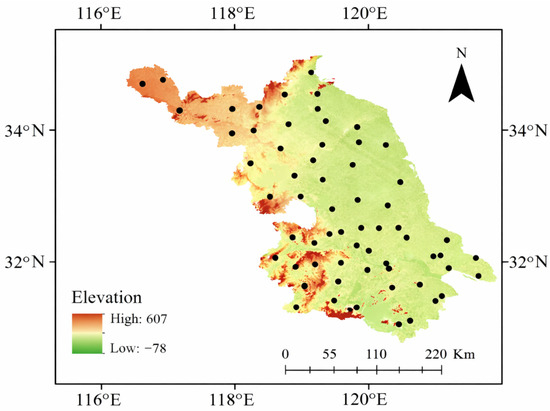
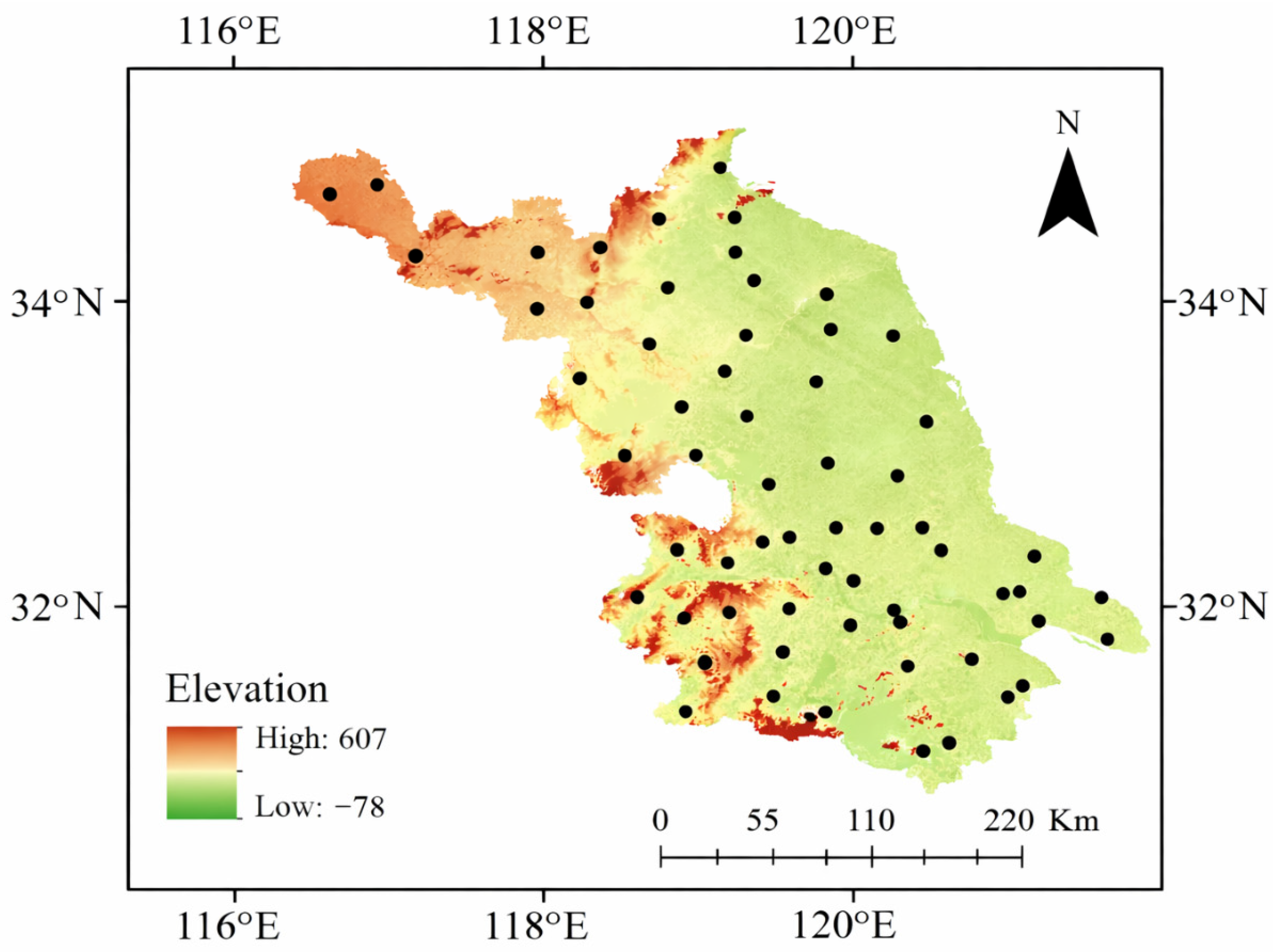
Monthly precipitation, mean air temperature, wind speed, relative humidity, maximum temperature, minimum temperature, and sunshine duration data from 57 meteorological stations in Jiangsu Province during 1961–2022 were obtained from the China Meteorological Data Service Center (the distribution of meteorological stations is shown in Figure 1). To ensure temporal continuity and data completeness, stations with missing or discontinuous records were excluded. Large-scale climate indices, including the Niño3.4 index, Arctic Oscillation (AO), and Pacific Decadal Oscillation (PDO), were obtained from the National Climate Center of China. Sunspot number (SSN) data were sourced from the Royal Observatory of Belgium.
Figure 1.
Topography and distribution of meteorological stations in Jiangsu Province. Black dots indicate the locations of the 57 meteorological stations.
2.2. Methods
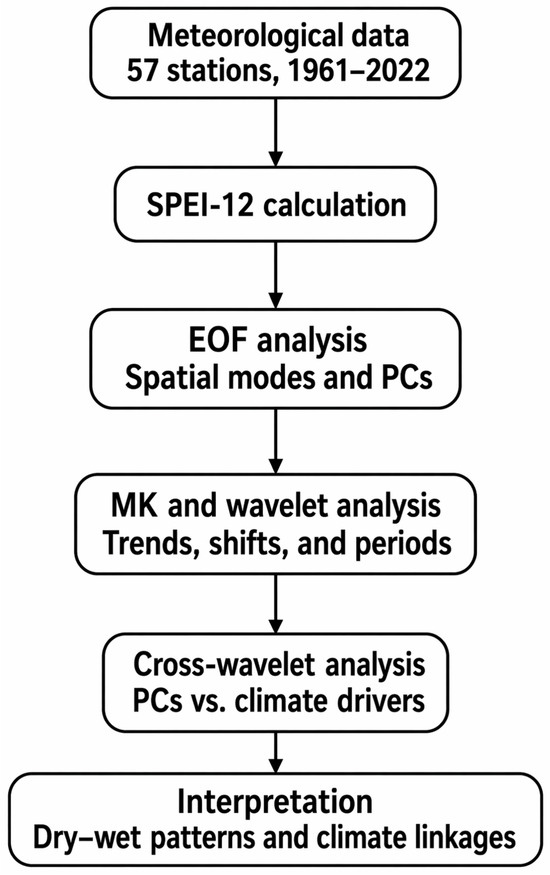
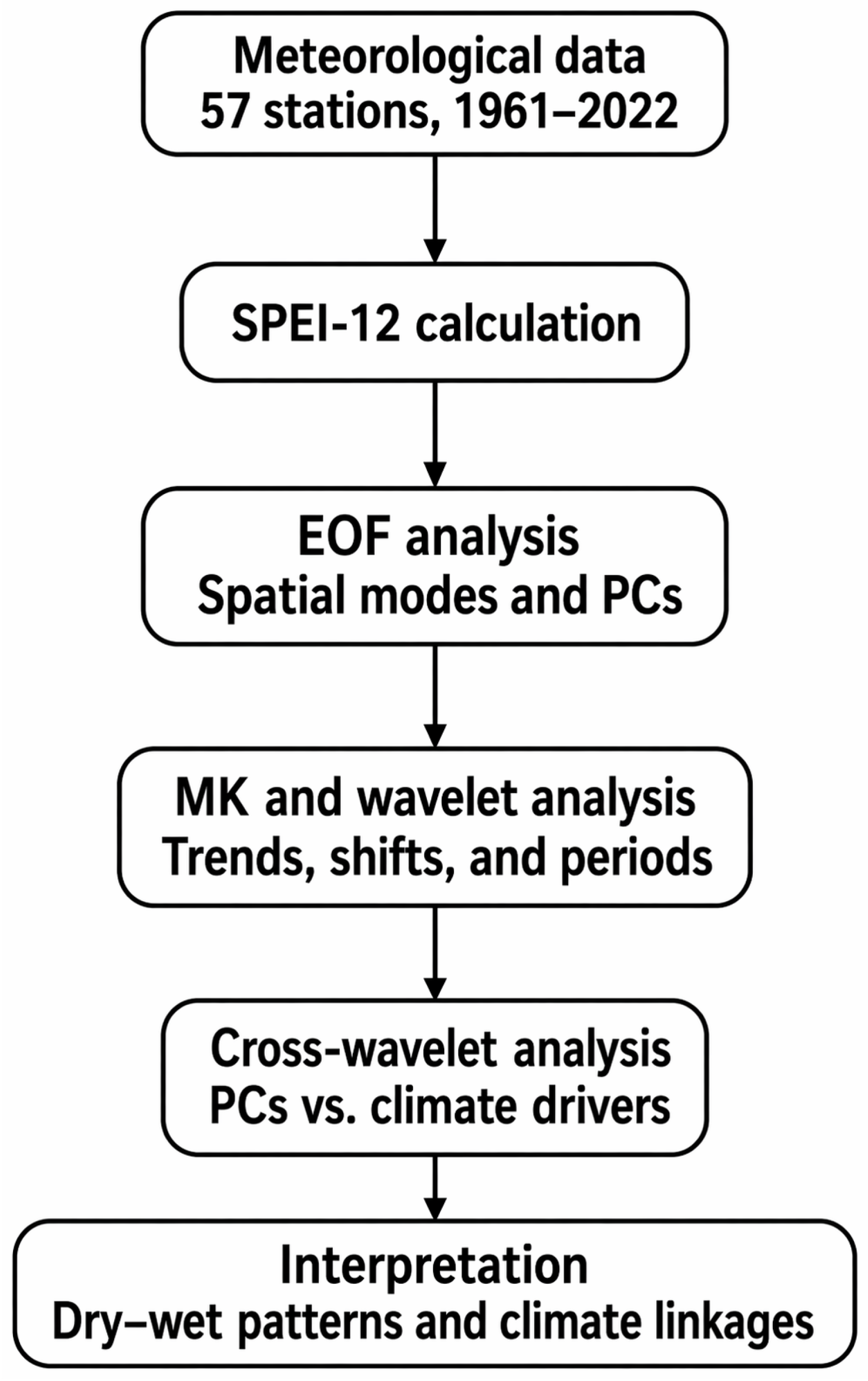
The methodological framework (Figure 2) of this study consists of four main steps. First, SPEI-12 was calculated from station-based meteorological observations to characterize annual-scale dry–wet variability. Second, EOF analysis was applied to extract the dominant spatial modes and their corresponding principal components. Third, trend and change-point analyses were conducted on the PCs using the Mann–Kendall method. Finally, wavelet and cross-wavelet analyses were used to identify periodic variability and time–frequency coherence between the PCs and selected climate drivers.
Figure 2.
Conceptual flowchart of the methodological framework used in this study.
2.2.1. Standardized Precipitation Evapotranspiration Index (SPEI)
The Standardized Precipitation Evapotranspiration Index (SPEI) is constructed under the assumption that the difference between precipitation and potential evapotranspiration over a given accumulation period follows a log-logistic probability distribution. This difference series is fitted to the distribution and subsequently standardized to a normal distribution to quantify dry–wet conditions at a specific timescale. SPEI is widely regarded as an effective indicator for monitoring and assessing drought and flood conditions under the context of ongoing climate change [15].
The annual-scale SPEI (SPEI-12), calculated based on the accumulated precipitation over the previous 12 months, reflects interannual variations in long-term water balance and exhibits relatively stable temporal characteristics. It is therefore suitable for evaluating the long-term impacts of climate change on water resource systems. Accordingly, this study adopts SPEI-12 (hereafter referred to as SPEI) to analyze the spatial patterns and temporal evolution of drought and flood conditions in Jiangsu Province.
Although SPEI-12 is a 12-month accumulation index, it remains suitable for interannual to interdecadal analysis because it preserves low-frequency hydroclimatic variability while reducing high-frequency monthly noise. In this study, the objective is to characterize annual-scale dry–wet anomalies and their dominant variability at interannual and longer timescales, rather than month-to-month fluctuations. Therefore, SPEI-12 is appropriate for subsequent EOF and wavelet-based analyses. Nevertheless, because temporal smoothing is inherent in SPEI-12, the interpretation of higher-frequency variability should be made cautiously.
It should be noted that SPEI incorporates the effect of potential evapotranspiration and may therefore reflect not only precipitation anomalies but also changes in atmospheric evaporative demand. However, the primary objective of this study is to identify the dominant spatiotemporal modes of drought–flood variability and their multiscale climatic drivers, rather than to conduct a formal attribution analysis of thermal versus precipitation contributions. To evaluate the robustness of the main findings, the same analytical framework was additionally applied to SPI as a supplementary comparison.
For clarity, the term drought–flood variability in this study refers to the continuum of regional dry–wet hydroclimatic anomalies represented by SPEI, rather than only disaster-level drought or flood events. The dry–wet categories were defined as follows: SPEI ≤ −1.5 indicates very dry conditions, −1.5 < SPEI ≤ −0.5 indicates dry conditions, −0.5 < SPEI < 0.5 indicates near-normal conditions, 0.5 ≤ SPEI < 1.5 indicates wet conditions, and SPEI ≥ 1.5 indicates very wet conditions.
2.2.2. Empirical Orthogonal Function (EOF) Analysis
EOF analysis is a commonly used method in meteorology for decomposing a spatiotemporal climate field into orthogonal spatial patterns and corresponding temporal coefficients [16,17,18]. In this study, the spatial patterns are consistently referred to as EOF modes, while the corresponding temporal coefficients are referred to as principal components (PCs). The EOF modes describe the dominant spatial organization of SPEI variability, whereas the PCs represent the temporal evolution of each mode. Eigenmodes that pass the North significance test are considered to effectively represent the dominant spatial structure of the regional variable field.
If an EOF mode exhibits coefficients with the same sign across the region, it indicates a coherent spatial pattern with consistent dry–wet variability. In contrast, an EOF mode characterized by alternating positive and negative coefficients reflects opposite dry–wet variations between different subregions. In this study, EOF analysis is applied to the SPEI field in Jiangsu Province to identify the dominant spatial modes of dry–wet variability.
2.2.3. Mann–Kendall Test for Trend and Change-Point Detection
To analyze trends and abrupt changes in the principal component time series derived from SPEI, the nonparametric Mann–Kendall (MK) test was employed in combination with linear trend analysis [19]. The MK test is computationally efficient and is not sensitive to assumptions of linearity or to the presence of a small number of outliers. It can effectively detect monotonic trends and identify potential change points in a time series. Owing to these advantages, the MK test has been widely used internationally for detecting trends and abrupt changes in climate and hydrological time series. In this study, the sequential Mann–Kendall method based on the UF and UB statistics was used to identify possible change points in the PC series. The intersection of the UF and UB curves within the confidence interval was regarded as a potential change point. Because long-term hydroclimatic series may exhibit serial correlation, the MK results were interpreted as indicators of possible trends and regime shifts rather than as standalone evidence. Therefore, the detected change points were further discussed together with EOF patterns, wavelet results, and historical drought–flood records.
2.2.4. Wavelet Analysis
The Morlet wavelet is employed to analyze the periodicity of the time series, as it effectively captures multiscale variability and reveals the temporal evolution of dominant oscillation periods and their varying intensities over time. Cross-wavelet transform (XWT) combines wavelet analysis with cross-spectral analysis and serves as a powerful signal-processing technique for identifying common oscillatory behavior between two time series in both time and frequency domains [20]. This approach enables a quantitative assessment of the strength and temporal evolution of their interrelationships. In cross-wavelet power spectra, the direction of arrows indicates the phase relationship between the two series (in-phase or anti-phase), while the statistical significance of the power spectrum is evaluated by comparison with red-noise or white-noise background spectra. The statistical significance of the wavelet and cross-wavelet spectra was tested against a red-noise background at the 95% confidence level, following Grinsted et al. [20], Zhang et al. [21], and Torrence and Compo [22]. The cone of influence was used to identify regions potentially affected by edge effects, and signals outside the reliable region were interpreted cautiously. In the cross-wavelet spectra, arrows pointing right indicate in-phase behavior, arrows pointing left indicate anti-phase behavior, arrows pointing upward indicate that the first series leads the second by approximately one-quarter cycle, and arrows pointing downward indicate that the first series lags the second by approximately one-quarter cycle. In this study, cross-wavelet results are interpreted as time–frequency coherence rather than direct evidence of causality. Detailed computational procedures can be found in refs. [20,21,22].
3. Results
3.1. Spatiotemporal Characteristics of Dry–Wet Variability
3.1.1. Spatial Distribution Characteristics of Dry–Wet Variability
EOF was applied to the SPEI-12 series in Jiangsu Province for the period 1961–2022, and the North significance test was conducted to assess the statistical robustness of the extracted modes. Table 1 lists the variance contribution rates of the first five EOF modes, with a cumulative explained variance of 80.68%. The first two eigenmodes together account for 74.1% of the total variance, and their corresponding error ranges do not overlap, indicating that both modes pass the North significance test. These results demonstrate that the first two EOF modes effectively capture the dominant spatiotemporal patterns of drought–flood variability in Jiangsu Province.
Table 1.
Total-field variance contributions of the first five EOF modes of SPEI-12 in Jiangsu Province.
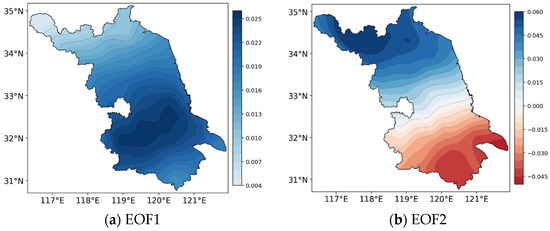
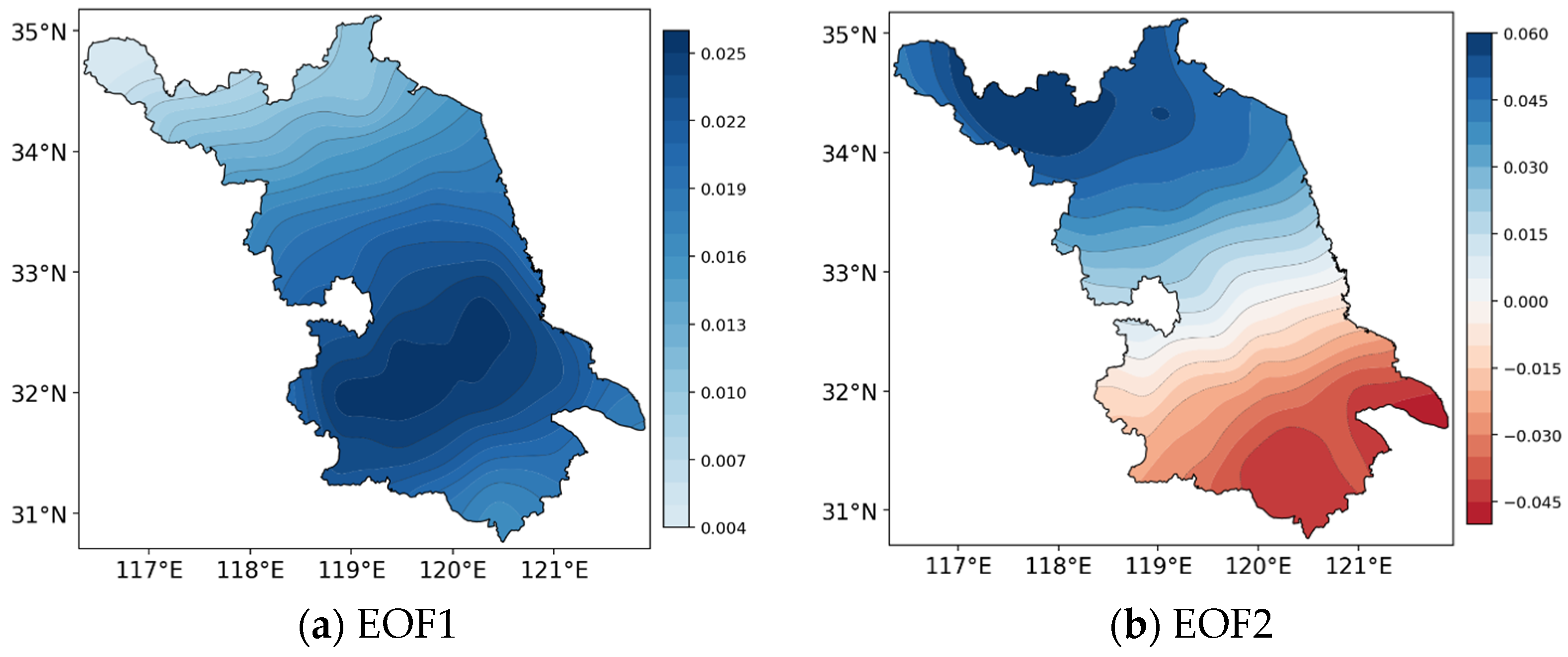
The first mode (EOF1) explains 56.3% of the total variance, far exceeding the other modes, and thus represents the dominant spatial pattern of drought–flood variability in Jiangsu Province. As shown in Figure 3a, EOF1 exhibits a spatially coherent pattern with uniform signs across the province, indicating regionally synchronous drought–flood variations, with the highest loadings located in central Jiangsu, suggesting heightened sensitivity to drought–flood changes. The second mode (EOF2) accounts for 17.8% of the total variance and displays a pronounced north–south dipole pattern (Figure 3b), with positive loadings in northern Jiangsu and negative loadings in southern Jiangsu. The nodal line approximately follows the Huaihe River–Subei Irrigation Canal, clearly characterizing the north–south contrast in drought–flood distribution. This pattern is consistent with typical rainfall configurations in eastern China and may be associated with interannual variations in the East Asian summer monsoon or the meridional displacement of the rain belt.
Figure 3.
Spatial distributions of the first two EOF modes of SPEI-12 in Jiangsu Province: (a) EOF1 and (b) EOF2.
3.1.2. Temporal Characteristics of Dry–Wet Variability
The PCs represent the temporal coefficients corresponding to the EOF spatial modes. For EOF1, positive PC values indicate relatively wet conditions across the province, while negative values indicate relatively dry conditions. For event interpretation, years with PC ≥ 1 are classified as wet-dominated years, whereas years with PC ≤ −1 are classified as dry-dominated years.
Analysis of the First Principal Component (PC1)
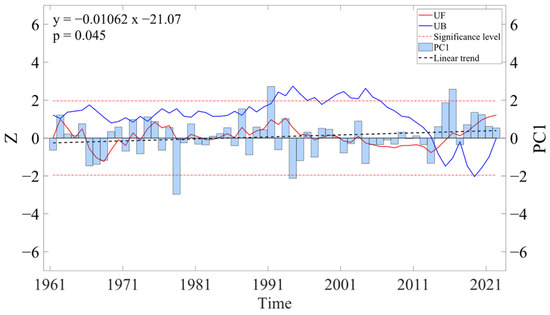
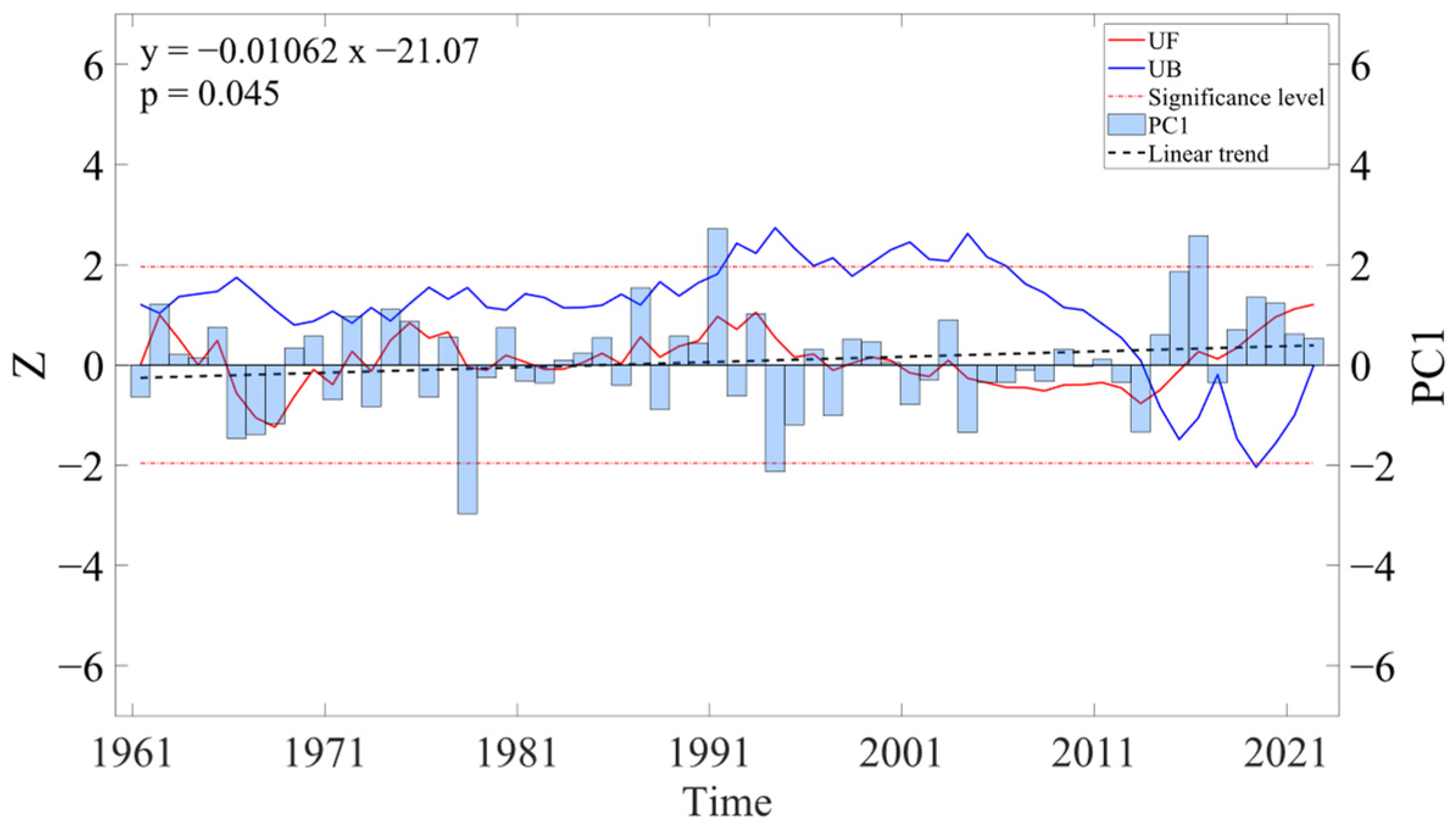
Figure 4 shows the time series of PC1. Positive PC1 values indicate province-wide wet conditions, while negative values represent coherent dry conditions across Jiangsu Province. According to the PC1 series, flood-dominated years include 1962, 1987, 1991, 2015, 2016, 2020, and 2021, whereas drought-dominated years include 1966, 1967, 1968, 1978, 1988, 1994, 1995, 2004 and 2013. Among these, 1978 and 1994 are identified as representative province-wide drought years, while 1991 is identified as a representative flood year, which is consistent with historical records. Historical documentation indicates that Jiangsu Province experienced a severe province-wide drought in 1978, with continuous dry conditions lasting more than 250 days and precipitation reduced by approximately 50% relative to the climatological mean. In 1994, persistent drought occurred from spring through autumn, resulting in severe impacts. In contrast, a catastrophic flood occurred in the Jianghuai region in 1991, during which precipitation in Jiangsu was exceptionally above normal, leading to substantial flood-related losses. Trend analysis of PC1 indicates a linear tendency rate of 0.11 per decade (p < 0.05), and the Mann–Kendall test yields a Z value of 2.07, suggesting a statistically significant wetting trend across Jiangsu Province. The MK change-point test further reveals an abrupt shift in PC1 around 2013, after which the series transitions from negative to positive values, indicating a shift toward wetter conditions. The post-2013 period passes the significance test after 2021, further confirming the enhanced wetting tendency in recent years.
Figure 4.
Temporal variation in PC1 corresponding to EOF1 in Jiangsu Province.
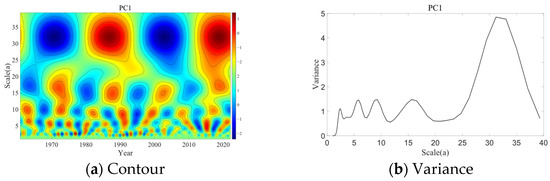
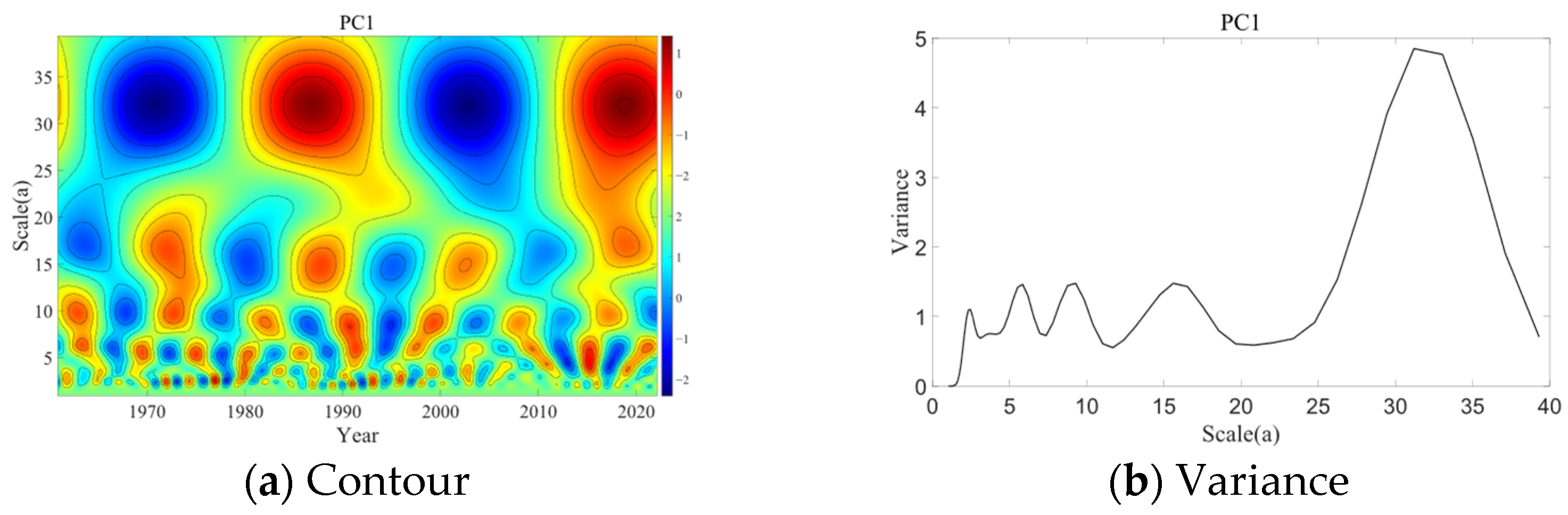
Wavelet analysis was applied to PC1, and the results are shown in Figure 5. In Figure 5a, the positive and negative values of the real part of the wavelet coefficients represent different dry–wet phases of PC1 at each timescale. Alternating positive and negative centers indicate phase transitions between relatively wet and dry periods, while larger absolute values indicate stronger oscillation intensity at the corresponding timescale. The wavelet variance spectrum indicates that PC1 exhibits several significant periodicities, including interannual cycles of 2–3 years and 5–10 years, as well as interdecadal cycles of 15–20 years and 30–35 years. The contour map of the real part of the wavelet coefficients reveals that the short-term 2–3-year signal is particularly strong during 1970–1980 and 1990–2000. The 5–10-year periodicity is most prominent during 1961–1985, after which it gradually shifts toward a period of approximately 10 years, and becomes dominated by a 5-year cycle after 2010. This variability in short-term periodicity is likely closely related to phase changes in ENSO.
Figure 5.
Wavelet analysis of PC1 in Jiangsu Province: (a) real part of wavelet coefficients and (b) wavelet variance. Positive and negative coefficients in (a) indicate opposite dry–wet phases.
The interdecadal 15–20-year cycle persists throughout the entire study period and undergoes four complete phase transitions. The 30–35-year long-term periodicity is the strongest and exhibits stable positive and negative phases, completing two full drought–flood cycles. This long-term cycle represents the dominant periodic mode controlling drought–flood variability in Jiangsu Province over the past 62 years and may be associated with oscillations of larger-scale climate systems.
Analysis of the Second Principal Component (PC2)
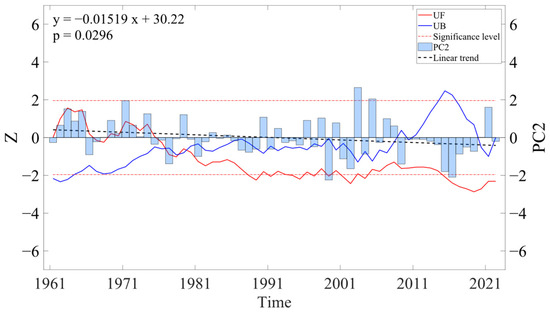
Figure 6 presents the time series of PC2. Positive values of PC2 correspond to a “southern drought–northern flood” pattern, whereas negative values indicate a “southern flood–northern drought” configuration. The linear trend of PC2 is −0.15 per decade (p < 0.05), suggesting a significant tendency toward the “southern flood–northern drought” pattern over time. The nonparametric Mann–Kendall (MK) test yields a Z value of 2.52, confirming that the trend passes the 0.05 significance level.
Figure 6.
Temporal variation in PC2 corresponding to EOF2 in Jiangsu Province.
The year 2003 (PC2 = 2.62) represents the most pronounced “southern drought–northern flood” event, while 1999 (PC2 = −2.25) corresponds to the strongest “southern flood–northern drought” event. The MK mutation test indicates a significant regime shift around 1980. Prior to this change point, the dominant drought–flood configuration in Jiangsu Province was characterized by “southern drought–northern flood.” After 1980, the prevailing pattern shifted to “southern flood–northern drought,” with the tendency during 2014–2022 reaching statistical significance at the 0.05 level.
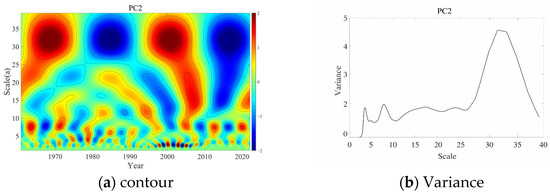
Wavelet analysis of PC2 is shown in Figure 7. The wavelet variance spectrum indicates that PC2 exhibits significant interannual periodicities of 2–3 years and 6–8 years, as well as an interdecadal periodicity of 30–35 years. The contour map of the real part of the wavelet coefficients shows that the 2–3-year cycle is particularly strong during 1998–2007, while the 6–8-year cycle is more pronounced during 1961–1975 and 2005–2022. The 30–35-year long-term periodicity persists throughout the entire study period and undergoes approximately two complete cycles.
Figure 7.
Wavelet analysis of PC2 in Jiangsu Province: (a) real part of wavelet coefficients and (b) wavelet variance. Positive and negative coefficients in (a) indicate opposite dry–wet phases.
3.2. Time–Frequency Relationships Between Dry–Wet Modes and Climate Factors
3.2.1. Correlation Between Dry–Wet Modes and Climate Factors
Table 2 presents the Pearson correlation coefficients between PC1, PC2, and the selected climate indices. PC1 shows weak but statistically significant correlations with the Niño3.4 index (r = 0.20, p < 0.05) and SSN (r = −0.18, p < 0.05), while PC2 is weakly correlated with the Niño3.4 index (r = 0.16, p < 0.05). These coefficients indicate limited linear associations rather than strong controlling influences. Therefore, the correlation results are used here only as preliminary statistical evidence.
Table 2.
Pearson correlation coefficients between PCs and climate factors.
It should be noted that individual climate indices explain only a small fraction of the variability in PC1 and PC2 under a linear framework. Regional dry–wet variability is likely influenced by multiple interacting factors and may exhibit nonlinear, scale-dependent, and time-varying relationships with large-scale climate drivers. Accordingly, cross-wavelet analysis is further used to examine whether these weak overall correlations contain more specific time–frequency relationships.
3.2.2. Resonance Relationships Between PC1 and Climate Factors
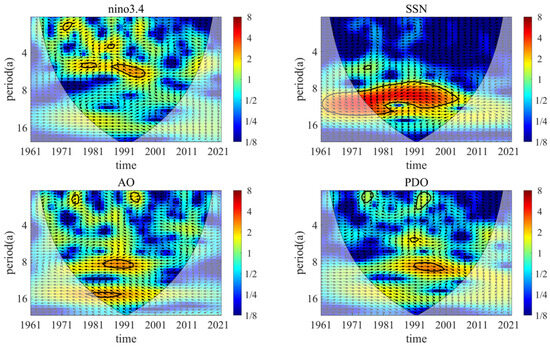
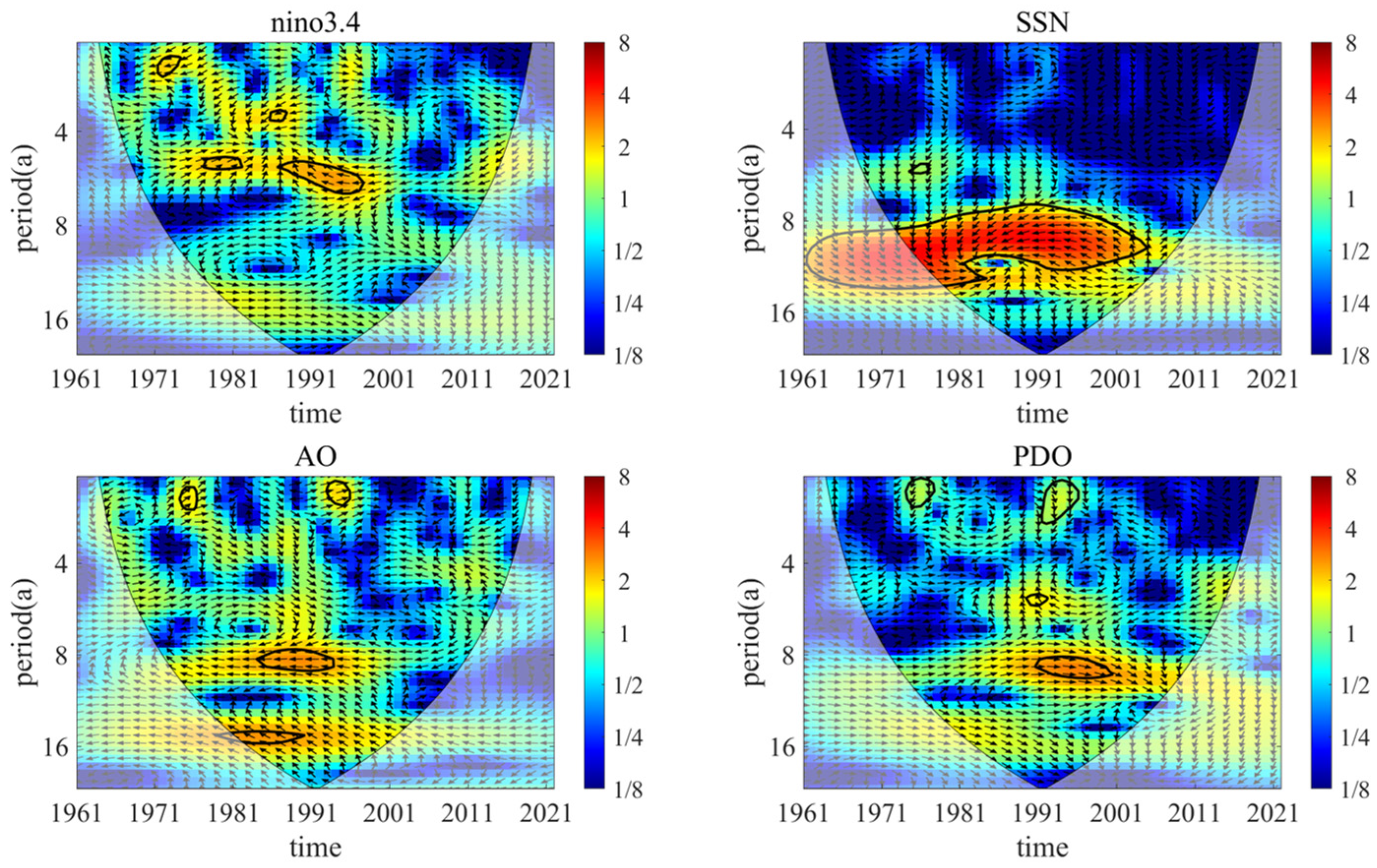
The cross-wavelet power spectra between PC1 and the major climate indices are shown in Figure 8.
Figure 8.
Cross-wavelet power spectra between PC1 and climate factors (The black circles represent the significant results that have passed the significance test at the 0.05 level).
A pronounced and persistent coherence between PC1 and ENSO is identified at the 3–4 year periodicity. During 1976–1982, the phase arrows predominantly point toward the upper right, indicating that PC1 leads ENSO by approximately two months. From 1982 to 2003, however, the arrows shift toward the lower right, suggesting that PC1 lags ENSO by about 4–6 months. This shift in phase relationship is consistent with the delayed modulation of precipitation in eastern China by ENSO through ocean–atmosphere coupling processes that influence the Western Pacific Subtropical High and the East Asian monsoon system [23,24].
At the 8–16-year periodicity, PC1 shows time–frequency coherence with SSN during 1981–2005, with arrows mainly pointing to the right. This result suggests a possible low-frequency association between SSN and the regionally coherent dry–wet mode. However, because the physical pathway linking solar variability to regional hydroclimatic conditions is indirect and uncertain, this relationship should be interpreted cautiously and should not be regarded as direct causal evidence.
For the AO, a notable in-phase relationship with PC1 appears at the 8–10 year periodicity during 1984–1992, as indicated by the rightward orientation of the phase arrows.
In the case of PDO, PC1 exhibits a clear synchronous relationship at the 8–10 year periodicity during 1991–2001. Additionally, significant coherence is detected at the shorter 2–3 year periodicity (e.g., 1972–1975 and 1991–1995), with phase arrows indicating that PDO tends to lead PC1 by approximately three months during these intervals.
3.2.3. Resonance Relationships Between PC2 and Climate Factors
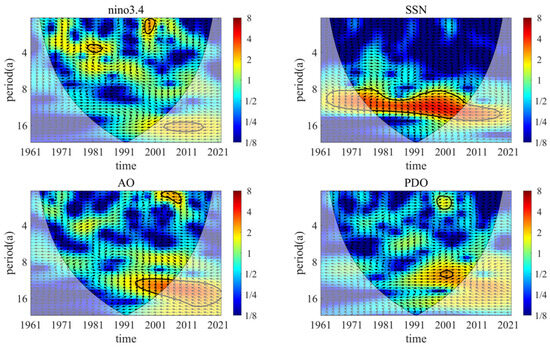
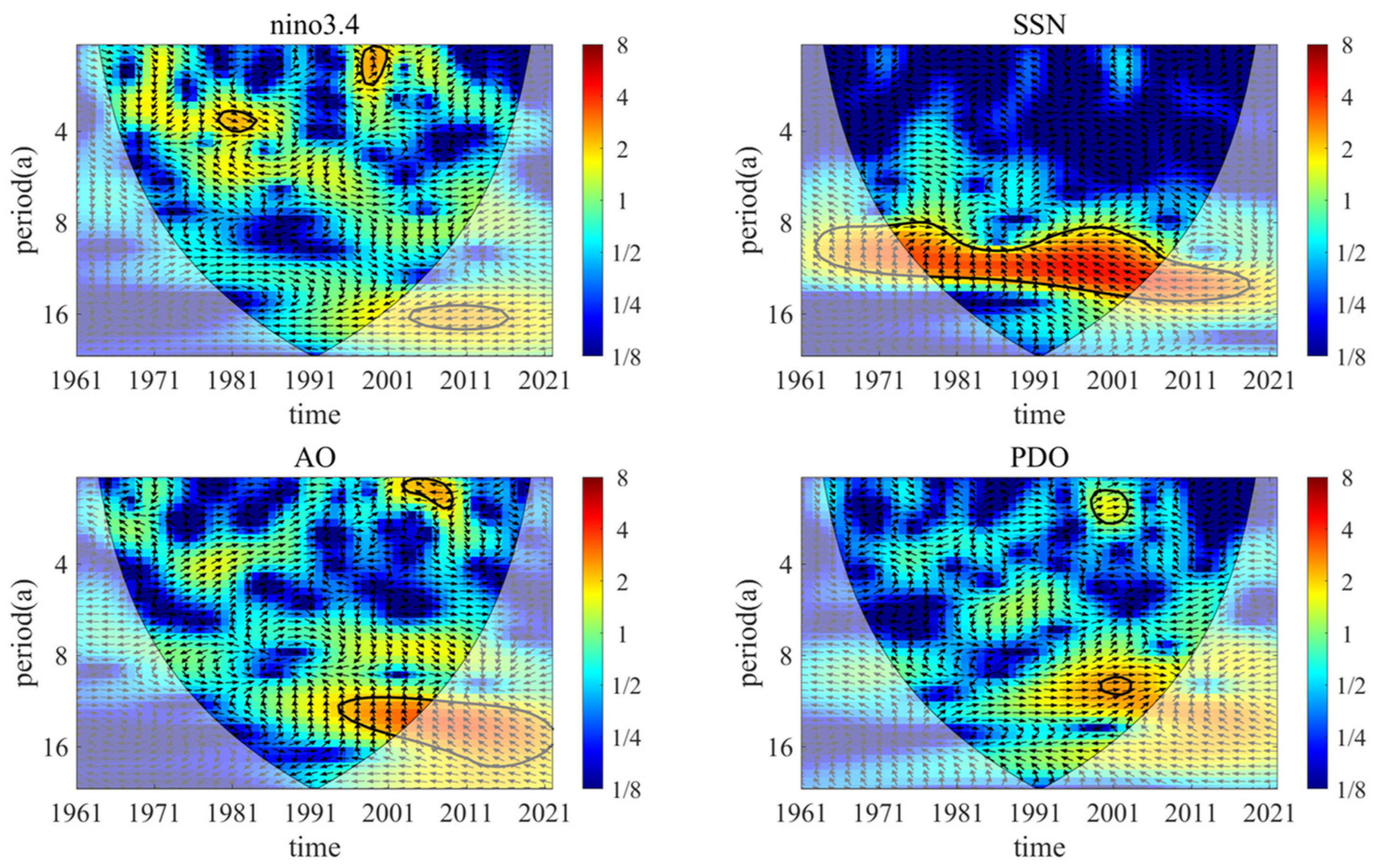
The cross-wavelet power spectra between PC2 and the major climate indices are shown in Figure 9.
Figure 9.
Cross-wavelet power spectra between PC2 and climate factors (The black circles represent the significant results that have passed the significance test at the 0.05 level).
PC2 exhibits significant coherence with ENSO at the 2–4-year timescale; however, the phase relationship varies across different periods, such as 1980–1983 and 1998–2001, as indicated by unstable arrow directions, suggesting temporal instability in the teleconnection between ENSO and the north–south dipole drought–flood pattern in Jiangsu Province.
PC2 also shows relatively persistent coherence with SSN at the 8–16-year band. Before the 1980s, the phase arrows are mainly oriented to the right or upper right, whereas after the 1980s they tend to point to the left, indicating an apparent phase transition. However, this feature should be interpreted as a change in time–frequency coherence rather than direct causal evidence. Given the weak linear correlation between PC2 and SSN and the uncertainty of the underlying physical mechanism, the SSN-related signal is discussed here only as a possible low-frequency background linkage that may be modulated by other circulation factors.
The relationship between PC2 and AO shows significant resonance at the 10–16-year scale during 1993–2001, with arrows pointing toward the lower right, indicating that PC2 lags AO, while an anti-phase resonance is also observed at shorter timescales of 1–3 years during 2001–2008.
In contrast, PC2 and PDO exhibit limited coherence, with significant resonance bands only appearing during 1999–2002 at periods of approximately 2–3 years and around 10 years, both characterized by in-phase relationships as indicated by rightward-pointing arrows.
4. Discussion
The long-term dry–wet variability in Jiangsu Province is not merely the cumulative outcome of short-term weather events, but reflects the combined influence of large-scale ocean–atmosphere variability, monsoon circulation, regional moisture transport, and possible background external forcings. By integrating EOF-based spatial decomposition with cross-wavelet time–frequency analysis, this study identifies two fundamental dry–wet spatial modes, namely a regionally coherent mode and a north–south dipole mode, and further reveals their differentiated multiscale relationships with common climate drivers such as ENSO, PDO, AO, and SSN.
The regionally coherent mode represented by EOF1 indicates that Jiangsu Province can experience synchronous dry–wet anomalies under certain large-scale circulation backgrounds. This spatial consistency may be related to the common influence of East Asian monsoon variability and large-scale moisture transport over eastern China. When anomalous circulation favors enhanced moisture convergence or suppressed precipitation over the entire province, coherent wet or dry conditions may occur across Jiangsu. Therefore, EOF1 can be interpreted as the integrated regional response of Jiangsu Province to large-scale hydroclimatic forcing.
The north–south dipole pattern revealed by EOF2 is closely related to the transitional climatic setting of Jiangsu Province. The province lies between the warm temperate and subtropical monsoon climate zones, and the Huaihe River–Subei Irrigation Canal region marks an important hydroclimatic transition belt. Under this background, meridional displacement of the monsoon rain belt can lead to opposite precipitation anomalies between northern and southern Jiangsu. Variations in the East Asian summer monsoon and the western Pacific subtropical high may further regulate the location and intensity of moisture convergence, thereby contributing to the north–south dipole pattern. This interpretation is consistent with previous studies on province-wide dry–wet synchrony, meridional precipitation contrasts, and abrupt drought–flood transitions in Jiangsu Province [5,6,7].
The two regime shifts identified in this study provide additional evidence for the temporal reorganization of dry–wet patterns in Jiangsu Province. The wetting shift in PC1 after 2013 may reflect recent hydroclimatic adjustments involving changes in regional precipitation, atmospheric circulation, and evaporative demand under warming. However, because this study does not formally separate precipitation and thermal contributions, this shift is interpreted as a hydroclimatic signal rather than as a directly attributed warming effect. In contrast, the abrupt change in PC2 around 1980 may be related to the late-1970s interdecadal climate transition, which has been widely associated with changes in Pacific background conditions, PDO phase transitions, and East Asian monsoon circulation. Such large-scale circulation adjustments may alter the meridional distribution of moisture transport and rainfall over eastern China, thereby contributing to the transition from a “southern drought–northern flood” pattern to a “southern flood–northern drought” pattern in Jiangsu Province [25].
Cross-wavelet analysis further reveals scale-dependent associations that are difficult to capture using conventional linear statistics. For the regionally coherent dry–wet mode (PC1), the dominant interannual periodicities are broadly consistent with the primary ENSO band. The observed lag of PC1 behind ENSO by about 4–6 months suggests a delayed teleconnection process through which tropical Pacific sea surface temperature anomalies may influence the western Pacific subtropical high, monsoon moisture transport, and the location of the main rain belt over eastern China [23,24]. Compared with ENSO, the effects of PDO and AO are likely more indirect and may act by modifying the background circulation state rather than exerting a direct and stable control on regional dry–wet variability.
The coherence between PC2 and SSN at the 8–16-year band is an interesting low-frequency signal, but it should be treated as tentative evidence rather than a confirmed driving mechanism. The weak linear correlation and uncertain physical pathway indicate that the SSN-related result should be interpreted cautiously. More generally, the detected cross-wavelet relationships should be understood as time–frequency coherence rather than direct causality. Further verification using circulation diagnostics and process-based analyses is required to clarify the physical pathways linking large-scale climate drivers and regional dry–wet variability.
It should be noted that, because SPEI includes the effect of potential evapotranspiration, the identified dry–wet variations may reflect not only precipitation anomalies but also changes in atmospheric evaporative demand under warming. However, the focus of the present study is on the spatiotemporal modes of dry–wet variability and their multiscale climatic linkages, rather than on quantitatively separating thermal and precipitation contributions. To assess the robustness of the results, the same analytical framework was also applied to SPI, and the corresponding comparison results are provided in Appendix A (Figure A1 and Figure A2). The comparison shows that the dominant EOF modes, major regime shifts, and overall temporal evolution are generally consistent between the two indices. This suggests that the principal findings reported here are robust and are not solely an artifact of the PET-related component in SPEI.
Although EOF analysis effectively identifies dominant orthogonal spatial modes, the resulting modes may sometimes be influenced by mathematical orthogonality constraints. Rotated EOF analysis may provide more localized and physically interpretable spatial patterns, and will be considered in future work to further examine regional dry–wet variability. In addition, although SPEI provides an effective climatic measure of dry–wet variability by incorporating precipitation and potential evapotranspiration, it cannot fully represent all components of the terrestrial water cycle. Future studies should integrate soil moisture, runoff, groundwater storage, evapotranspiration, and vegetation indicators to provide a more comprehensive assessment of drought–wetness evolution and its ecological and hydrological impacts.
5. Conclusions
Based on the annual-scale Standardized Precipitation Evapotranspiration Index (SPEI), and by integrating EOF with wavelet-based analyses, this study systematically investigates the spatiotemporal evolution of dry–wet variability in Jiangsu Province during 1961–2022 and examines its associated climatic linkages. The main conclusions are summarized as follows:
- (1)
- Two stable spatial modes of dry–wet variability are identified in Jiangsu Province: a regionally coherent mode (EOF1) and a north–south dipole mode (EOF2). The nodal line of EOF2 closely coincides with the Huaihe River–Subei Irrigation Canal climatic transition zone, quantitatively characterizing Jiangsu Province as a typical climate transition region. PC1 exhibits a regime shift around 2013, indicating an overall transition toward wetter conditions across the province, whereas PC2 undergoes an abrupt change around 1980, marking a transformation of the spatial pattern from “southern drought–northern flood” to “southern flood–northern drought.”
- (2)
- Cross-wavelet analysis indicates that the two spatial modes exhibit differentiated and scale-dependent relationships with major climate drivers. The interannual variability of PC1 is most clearly associated with ENSO and shows an apparent lagged response. At longer timescales, PC1 and PC2 display intermittent time–frequency coherence with SSN, AO, and PDO. However, these low-frequency signals should be interpreted cautiously because their physical mechanisms remain uncertain and the detected coherence does not imply direct causality.
- (3)
- By distinguishing the regionally coherent mode from the north–south dipole mode, this study provides a mode-based understanding of dry–wet variability in Jiangsu Province. This approach moves beyond station-based or regional-mean descriptions and provides a clearer basis for interpreting spatially differentiated hydroclimatic variability in a monsoon transition zone. The results provide a scientific basis for spatially explicit drought–flood risk assessment and adaptive water resources management that accounts for regional heterogeneity.
Several limitations should also be noted. First, SPEI-based results may reflect both precipitation anomalies and evaporative-demand effects, and this study does not formally separate these contributions. Second, serial correlation, edge effects in wavelet analysis, and the limited length of the observational record may affect statistical interpretation. Third, although EOF analysis identifies dominant orthogonal modes, rotated EOF analysis and other spatial methods may further clarify localized patterns. Future studies should integrate soil moisture, runoff, groundwater storage, evapotranspiration, vegetation indicators, and circulation diagnostics to provide a more comprehensive assessment of dry–wet evolution and its hydrological and ecological impacts.
Author Contributions
Conceptualization, T.Y., G.Y. and J.H.; methodology, T.Y. and G.Y.; formal analysis, T.Y.; investigation, T.Y.; data curation, T.Y. and S.L.; writing—original draft preparation, T.Y.; writing—review and editing, G.Y., J.H. and S.L.; supervision, G.Y. and J.H.; project administration, G.Y.; funding acquisition, G.Y. All authors have read and agreed to the published version of the manuscript.
Funding
This research was funded by the National Natural Science Foundation of China (NO.U2342219) and Jiangsu Water Conservancy Science and Technology Project (NO.2023006).
Institutional Review Board Statement
Not applicable.
Informed Consent Statement
Not applicable.
Data Availability Statement
The meteorological station data used in this study were obtained from the China Meteorological Data Service Center (https://data.cma.cn/site/index.html, accessed on 24 April 2026). The teleconnection climate indices, including Niño3.4, AO, and PDO, were obtained from the National Climate Center of China (http://cmdp.ncc-cma.net/cn/monitoring.htm, accessed on 24 April 2026), and the sunspot number (SSN) data were obtained from the Royal Observatory of Belgium (https://www.astro.oma.be/en/, accessed on 24 April 2026).
Conflicts of Interest
The authors declare no conflicts of interest.
Appendix A
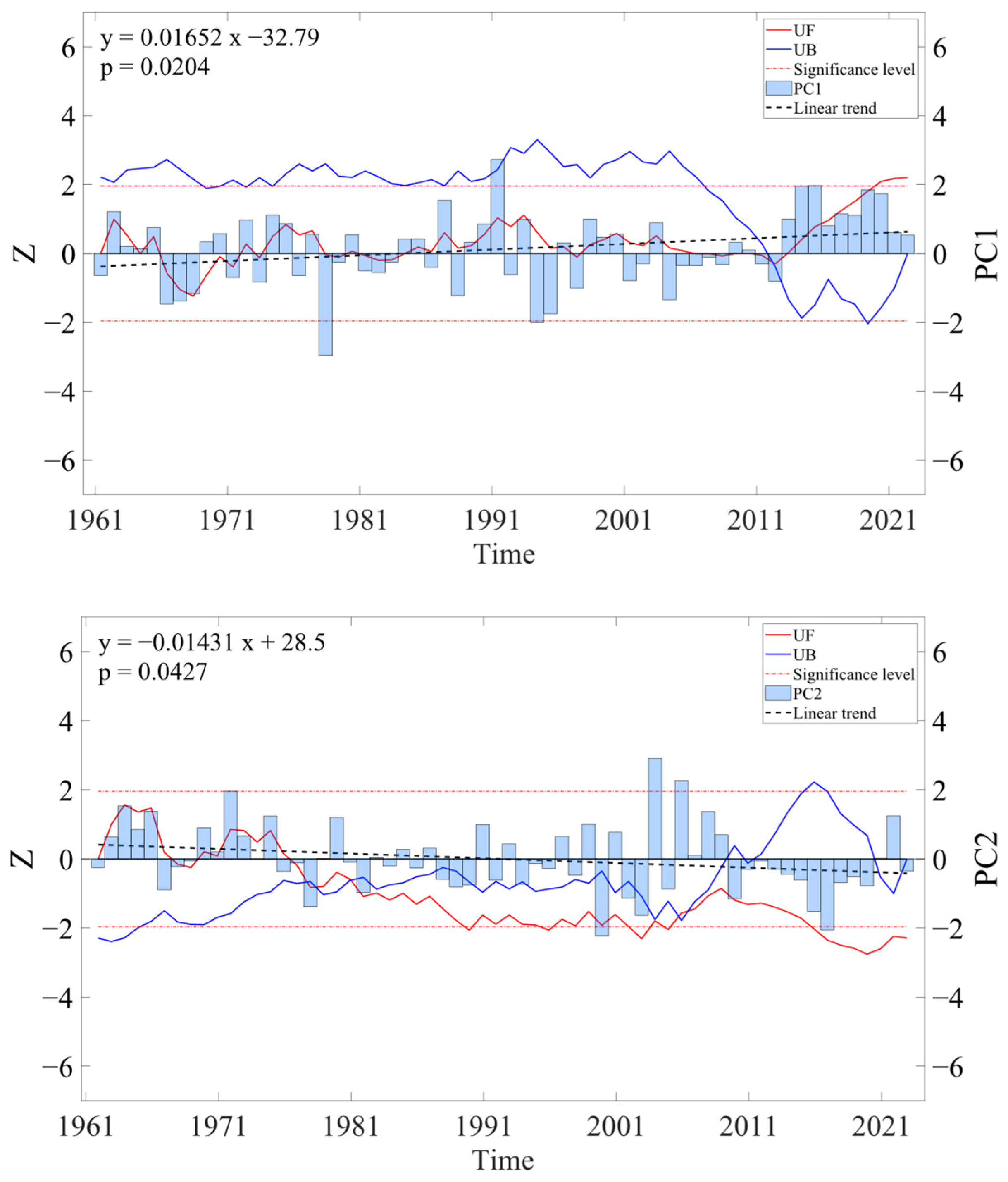
To evaluate the robustness of the SPEI-based results, the same analytical framework was additionally applied to SPI. The following supplementary figures present the corresponding EOF spatial modes and temporal coefficients derived from SPI. These results are used solely as a robustness check and do not alter the main SPEI-based analytical framework adopted in the manuscript.
Figure A1.
Spatial patterns of the first two EOF modes derived from SPI in Jiangsu Province using the same analytical framework as that applied to SPEI.
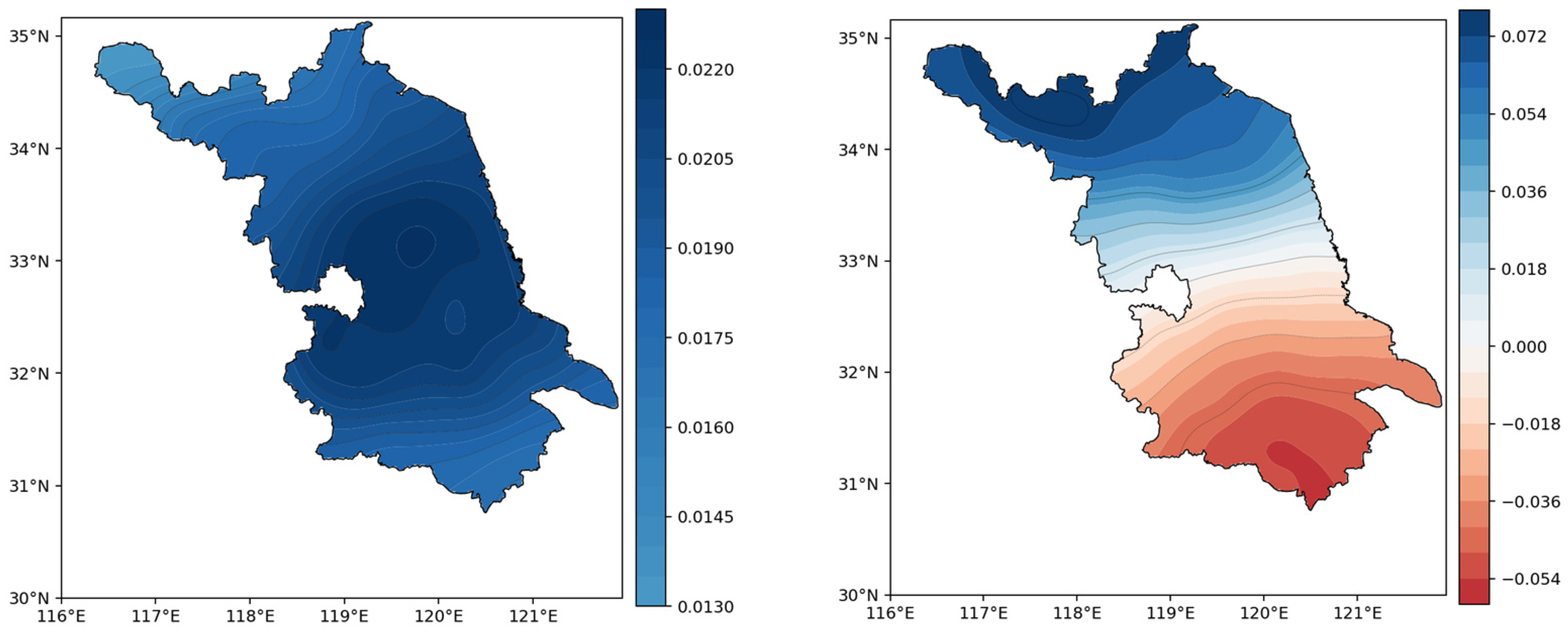
Figure A2.
Temporal coefficients (PC1 and PC2) of the first two EOF modes derived from SPI in Jiangsu Province using the same analytical framework as that applied to SPEI.
References
- Liu, T.; Yan, T. Main meteorological disasters in China and their economic losses. J. Nat. Disasters 2011, 20, 90–95. (In Chinese) [Google Scholar]
- Zhai, P.; Liu, J. Extreme weather/climate events and disaster prevention and mitigation under global warming background. Strateg. Study CAE 2012, 14, 55–63, 84. (In Chinese) [Google Scholar]
- Zhang, P.; Liu, L.; Sun, J.; Jiang, Y. Comparative analysis of the autumn–winter–spring drought in 2010/2011 and other sustained drought events in Jiangsu Province. In Proceedings of the 32nd Annual Meeting of the Chinese Meteorological Society, Tianjin, China, 14 October 2015. (In Chinese) [Google Scholar]
- Xia, J.; Chen, J.; She, D. Impacts and countermeasures of extreme drought in the Yangtze River Basin in 2022. J. Hydraul. Eng. 2022, 53, 1143–1153. (In Chinese) [Google Scholar]
- Tian, X.; Gan, L. Diagnosis of drought and flood changes during the flood season in Jiangsu Province over the past century. J. Meteorol. Sci. 1998, 18, 389–395. (In Chinese) [Google Scholar]
- Zhan, Z.; Liu, M.; Zhu, Y.; Li, M. Characteristics of drought and flood based on the standardized precipitation index in Jiangsu Province during the past 59 years. China Flood Drought Manag. 2024, 34, 94–100. (In Chinese) [Google Scholar]
- Zhang, Y.; Yuan, F.; Zhang, L.; Song, Y.; Shi, J. Evolution characteristics of drought–flood abrupt alternation in Jiangsu Province based on precipitation statistical methods. J. China Hydrol. 2022, 42, 36–41. (In Chinese) [Google Scholar]
- Sun, Z.; Wang, Z.; Cao, X.; Yang, Q.; Liu, Z.; Lei, Y. Characteristics of drought change in the Loess Plateau of Shaanxi based on the standardized precipitation index during 1971–2010. J. Desert Res. 2013, 33, 1560–1567. (In Chinese) [Google Scholar]
- Zhou, K.; Wang, Y. Spatiotemporal distribution of drought in the Weihe River Basin based on EOF. J. Northwest A F Univ. (Nat. Sci. Ed.) 2020, 48, 146–154. (In Chinese) [Google Scholar]
- Xu, L.; Hu, Z.; Zhao, Y.; Hong, X. Climate change characteristics over the Qinghai–Tibetan Plateau during 1961–2010. Plateau Meteorol. 2019, 38, 911–919. (In Chinese) [Google Scholar]
- Sang, J.; Hao, L. Spatiotemporal patterns of typical agro-meteorological disasters in China over the past 30 years. Chin. J. Eco-Agric. 2018, 26, 1302–1314. (In Chinese) [Google Scholar]
- Wang, X.; Lu, J.; Cao, Y. Drought and flood characteristics in Liaoning Province and their response to atmospheric circulation over the past 54 years. J. Hydraul. Eng. 2020, 51, 1514–1524. (In Chinese) [Google Scholar]
- Xu, Q.; Chen, L.; Fan, Y.; Tang, W.; Lu, B. Relationship between drought in Lanzhou and climate indices based on SPEI. J. China Hydrol. 2021, 41, 56–62. (In Chinese) [Google Scholar]
- Peng, Y.; Li, F.; Xu, N.; Kulmatov, R.; Gao, K.; Wang, G.; Zhang, Y.; Qiao, Y.; Li, Y.; Yang, H.; et al. Spatiotemporal variations in drought conditions and their atmospheric oscillation drivers in Central Asia from 1990 to 2019. Chin. J. Eco-Agric. 2021, 29, 312–324. (In Chinese) [Google Scholar]
- Zhang, H.; Ding, M.; Li, L.; Liu, L. Continuous wetting on the Tibetan Plateau during 1970–2017. Water 2019, 11, 2605. [Google Scholar] [CrossRef] [Scilit]
- Wei, F. Modern Climate Statistical Diagnosis and Prediction Technology, 2nd ed.; China Meteorological Press: Beijing, China, 2007; pp. 71–75. (In Chinese) [Google Scholar]
- Preisendorfer, R.W.; Mobley, C.D. Principal Component Analysis in Meteorology and Oceanography; Elsevier: Amsterdam, The Netherlands, 1988. [Google Scholar]
- Pandzic, K. Principal component analysis of precipitation in the Adriatic-Pannonian area of Yugoslavia. J. Climatol. 1988, 8, 357–370. [Google Scholar] [CrossRef] [Scilit]
- Mann, H.B. Nonparametric tests against trend. Econometrica 1945, 13, 245–259. [Google Scholar] [CrossRef] [Scilit]
- Grinsted, A.; Moore, J.C.; Jevrejeva, S. Application of the cross wavelet transform and wavelet coherence to geophysical time series. Nonlinear Process. Geophys. 2004, 11, 561–566. [Google Scholar] [CrossRef] [Scilit]
- Zhang, H.; Yu, Q.; Chen, K.; Gu, L. Relationship between runoff periodicity and ENSO events based on cross-wavelet transform. J. North China Univ. Water Resour. Electr. Power (Nat. Sci. Ed.) 2016, 37, 59–66. (In Chinese) [Google Scholar]
- Torrence, C.; Compo, G.P. A practical guide to wavelet analysis. Bull. Am. Meteorol. Soc. 1998, 79, 61–78. [Google Scholar] [CrossRef] [Scilit]
- Wu, S.; Zhao, W.; Yang, Y.; Jin, J.; Zheng, D.; Wang, X. Response of extreme precipitation in the middle and lower Yangtze River Basin to atmospheric circulation based on wavelet transform. J. Water Resour. Water Eng. 2021, 32, 67–76. (In Chinese) [Google Scholar]
- Zou, L.; Xia, J.; Zhang, Y. Spatiotemporal characteristics of extreme precipitation in the middle and lower Yangtze River Basin. Resour. Environ. Yangtze Basin 2021, 30, 1264–1274. (In Chinese) [Google Scholar]
- Xiao, Z.; Zhong, Q.; Yin, Z.; Zhou, L.; Song, Y.; Han, Y.; Huang, C.; Pang, J.; Zhao, L. Advances in research on the impact of decadal solar variability on modern climate. Adv. Earth Sci. 2013, 28, 1335–1348. (In Chinese) [Google Scholar]

Disclaimer/Publisher’s Note: The statements, opinions and data contained in all publications are solely those of the individual author(s) and contributor(s) and not of MDPI and/or the editor(s). MDPI and/or the editor(s) disclaim responsibility for any injury to people or property resulting from any ideas, methods, instructions or products referred to in the content. |
© 2026 by the authors. Licensee MDPI, Basel, Switzerland. This article is an open access article distributed under the terms and conditions of the Creative Commons Attribution (CC BY) license.