
Article

Heavy Rainfall Increases CO2 Emissions from Rivers in a Typical Human-Impacted Region

1
Anhui Provincial Key Laboratory of Earth Surface Processes and Regional Response in the Yangtze-Huaihe River Basin, School of Geography and Tourism, Anhui Normal University, Wuhu 241002, China
2
State Key Laboratory of Lake and Watershed Science for Water Security, Nanjing Institute of Geography and Limnology, Chinese Academy of Sciences, Nanjing 211135, China
3
Nanjing Institute of Environmental Sciences, Ministry of Ecology and Environment, Nanjing 210042, China
*
Authors to whom correspondence should be addressed.
Atmosphere 2026, 17(5), 449; https://doi.org/10.3390/atmos17050449
Submission received: 28 January 2026 / Revised: 9 April 2026 / Accepted: 23 April 2026 / Published: 28 April 2026
(This article belongs to the Special Issue Atmospheric Pollution Dynamics in China)

Abstract

Rivers emit substantial amounts of carbon dioxide (CO2) to the atmosphere, yet its response to heavy rainfall remains unclear with intensive anthropogenic disturbances. To fill the knowledge gap, this study investigated the dynamic variability of CO2 partial pressure (pCO2) and CO2 emissions flux at the Chaohu Lake Basin, a watershed under intensive anthropogenic perturbations, based on field campaigns across diverse river systems during dry season, normal season, and post-rainfall periods. Results demonstrated marked differences in aquatic pCO2 across river types, with urban rivers (3949 µatm) exhibiting significantly higher levels than non-urban counterparts (1423 µatm). Rainfall events elevated riverine pCO2, but the effect size varied between river types (urban river versus non-urban river). In non-urban rivers, pCO2 following heavy rainfall (2461 μatm) was significantly higher (p < 0.05) than those observed during both dry season (1096 μatm) and normal season (712 μatm). In contrast, urban rivers demonstrated only marginal pCO2 elevation after rainfall (20–30%). Statistical analysis revealed that discharge, total nitrogen (TN), total phosphorus (TP), and ammonia nitrogen (NH4+-N) showed significantly positive correlations with pCO2, while dissolved oxygen (DO) and pH exhibited significantly negative correlations with pCO2. Overall, rivers in the Chaohu Lake Basin act as significant sources of atmospheric CO2, with an annual mean CO2 emission flux of 297.84 mmol·m−2·d−1, and the heavy rainfall events amplify riverine CO2 emissions (629.91 mmol·m−2·d−1), with observed enhancement effects exceeding 300% compared to baseline conditions. To accurately estimate the CO2 emissions from human-dominated rivers, future research should emphasize the impacts of extreme or heavy rainfall events.

1. Introduction

Inland waters are significant sources of atmospheric greenhouse gases (GHGs) [1,2,3], among which rivers and streams play a central role in the land–atmosphere carbon exchange. Despite covering less than 20% of the total freshwater surface area, they contribute approximately 85% of the carbon dioxide (CO2) emissions from inland waters [2]. It is estimated that global rivers emit approximately 2.0 Pg C of CO2 into the atmosphere annually [4], accounting for more than half of the annual carbon sequestration (3.4 Pg) by global terrestrial ecosystems [5]. This amount could be under-estimated because of the high areal flux of urban-dominated rivers [6,7]. In addition, the absence of episodic events, including heavy rainfall, can have a substantial impact on the estimation of riverine CO2 emissions [8]. To reduce this uncertainty, more research on river carbon emissions conducted in human-dominated areas and under extreme weather events is needed.
The enhanced anthropogenic activities, through urban wastewater discharge and agricultural runoff, have intensified nutrient concentrations in riverine systems, resulting in eutrophication and perturbation of biogeochemical cycles [9]. For example, the input of agricultural fertilizers into riverine systems via surface runoff elevates aqueous nutrient concentrations, thereby potentially enhancing CO2 production and subsequent emission from aquatic environments [10,11]. Several studies demonstrated that the highest CO2 emissions were often observed in rivers surrounded by highly urbanized regions [12,13], which should be considered to accurately estimate the CO2 emissions from human-impacted aquatic ecosystems. Hence, quantifying CO2 emission flux in urban-agricultural riverine systems is critical for refining total inland water greenhouse gas emission inventories and developing effective mitigation strategies.
In addition to anthropogenic perturbations, episodic hydrometeorological events exert critical control on CO2 emission patterns. The rainfall events facilitate the transfer of substantial amounts of dissolved organic matter from terrestrial ecosystems to river systems through accelerated surface runoff and enhanced soil leaching processes, consequently promoting microbial CO2 production in aquatic environments [14]. However, some studies have demonstrated that the combined effects of rainfall dilution and enhanced gas evasion driven by elevated gas transfer velocities can override the stimulatory influence of lateral inputs, resulting in lower river pCO2 levels during wet seasons compared to dry seasons [15]. And the transient nature of precipitation-induced impacts—typically persisting for 6 to 72 h—introduces significant uncertainties in extrapolating steady-state degassing models [16,17]. To better understand temporal variability and potential “hot-moments” of inland water CO2 emissions, more process understanding would be required with regard to CO2 cycling during periods of extreme events like floods for which observations are generally rare [18].
The Chaohu Lake Basin, situated in eastern China, encompasses a network of numerous inflowing rivers and experiences pronounced monsoon influences. The average annual precipitation is more than 1000 mm [19]. Recent years have witnessed accelerated urbanization characterized by expanding urban land use and population growth in municipal areas. Currently, the basin’s population exceeds 10 million inhabitants, with the majority concentrated in the intensively urbanized northern region [13]. This demographic distribution reflects spatial disparities in regional development patterns. The Chaohu Lake Basin rivers, given the presence of multiple waterways traversing highly urbanized areas within the watershed and a climate conducive to intense precipitation events, serve as exemplary representatives of inland waters subject to the combined impacts of heavy rainfall phenomena and anthropogenic activities. Research on these rivers could provide critical references for refining CO2 budget estimations in fluvial systems across similar regions worldwide.
Therefore, this study selected representative rivers in the Chaohu Lake Basin as research subjects. Field samplings were conducted during dry season, normal season, and post-rainfall conditions to elucidate spatiotemporal variations in pCO2 and CO2 emission flux at the water–air interface, with a particular focus on the potential impact of heavy rainfall and its variation among different river types, while simultaneously analyzing physical, chemical, and biological driving factors. This study aims to provide empirical support and theoretical foundations for refining CO2 budget assessments in fluvial ecosystems within high-intensity anthropogenic activity zones under heavy rainfall scenarios.

2. Materials and Methods

2.1. Study Area and Sampled Riverine Types

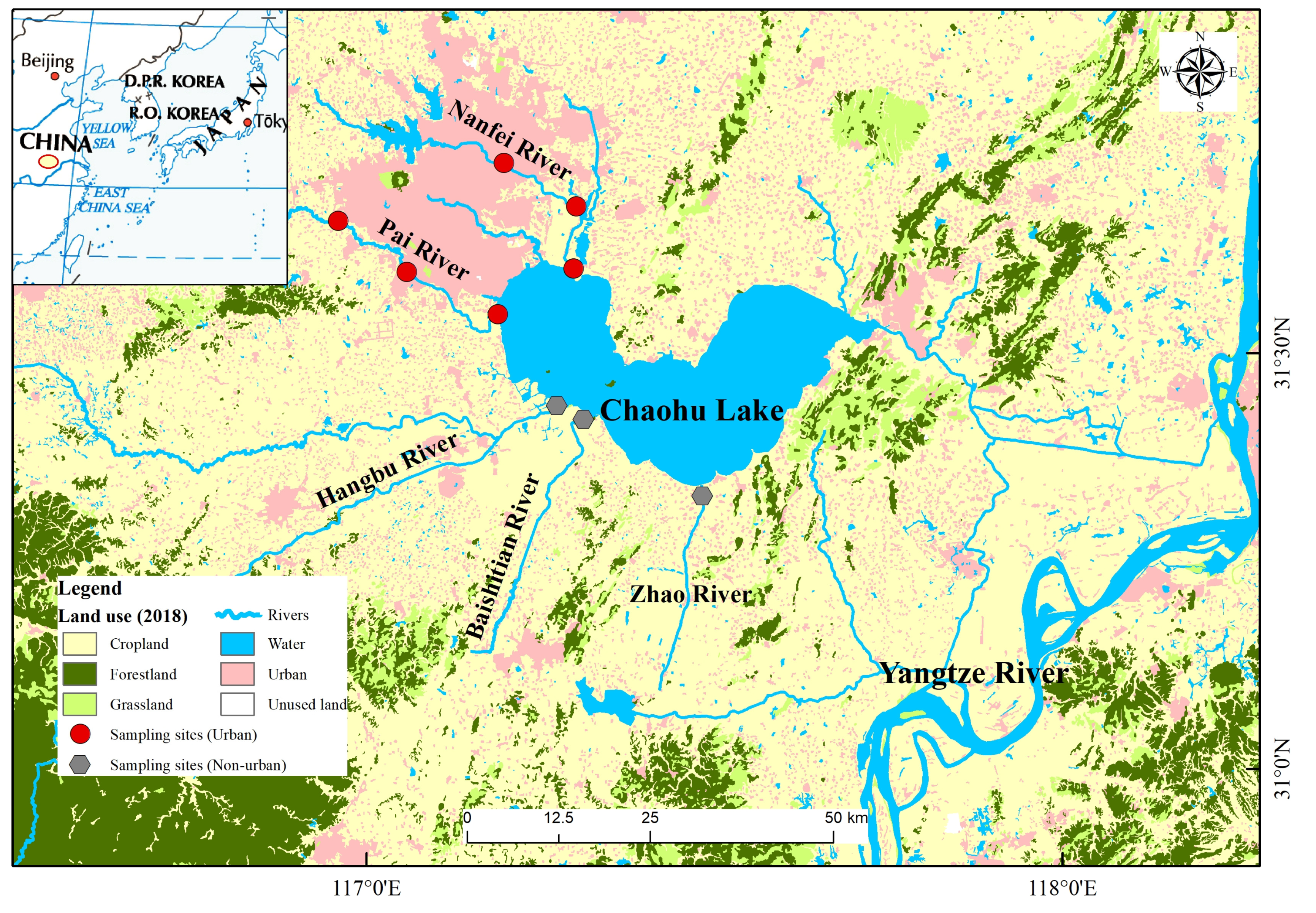
Lake Chao, located in Hefei City, Anhui Province, China, is situated in the lower reaches of the Yangtze River. With a surface area of approximately 780 km2, it extends 54 km from east to west and 21 km in width from north to south. Characterized by its distinctive bird’s nest-shaped morphology, it ranks as the fifth-largest freshwater lake in China (Figure 1). Lake Chao’s hydrological network comprises over 30 perennial tributaries draining into the lake. Key inflow rivers include the Nanfei River flowing through downtown urban area, the Pai River traversing suburban area [20,21], and the Hangbu, Baishitian, and Zhao Rivers are predominantly located within non-urban zones of the southern basin region. The Nanfei, Hangbu, and Baishitian Rivers collectively contribute over 75% of the total inflow into the lake. Among them, the Nanfei River delivers the highest loads of total nitrogen and total phosphorus, contributing nearly half of the pollutant load with less than one-sixth of the total inflow volume. In contrast, the Hangbu River, accounting for more than half of the total inflow, contributes approximately one-fifth of the pollutant load, serving as a major source of cleaner inflow to Lake Chaohu, which is available from the Chaohu Lake Administration of Anhui Province (https://chglj.hefei.gov.cn/, accessed on 28 January 2026). The catchment is characterized by subtropical monsoon climate, resulting in high rainfall in the wet season (generally from June to September) and much less rainfall in the dry season (generally from December to February) [22].
To comparatively analyze the heterogeneity of greenhouse gas emissions among river systems, we categorized the sampled rivers into two distinct groups: urban rivers (including the Nanfei River and Pai River) and non-urban rivers (comprising the Hangbu River, Baishitian River, and Zhao River). River typology classifications also referenced prior basin-scale studies [13]. Sampling sites for the three non-urban rivers were located at their estuaries to reflect the background water quality and overall emission characteristics of the basin. For the two urban rivers, sampling sites were established not only at the estuaries (downstream) but also along midstream and upstream sections, in order to assess the impact of urban wastewater discharge on water quality and carbon dioxide emissions. The spatial distribution of sampling sites covered both urban and natural landscapes, thereby providing a representative overview of key environmental pressures across the basin.

2.2. Sample Collection and Analysis

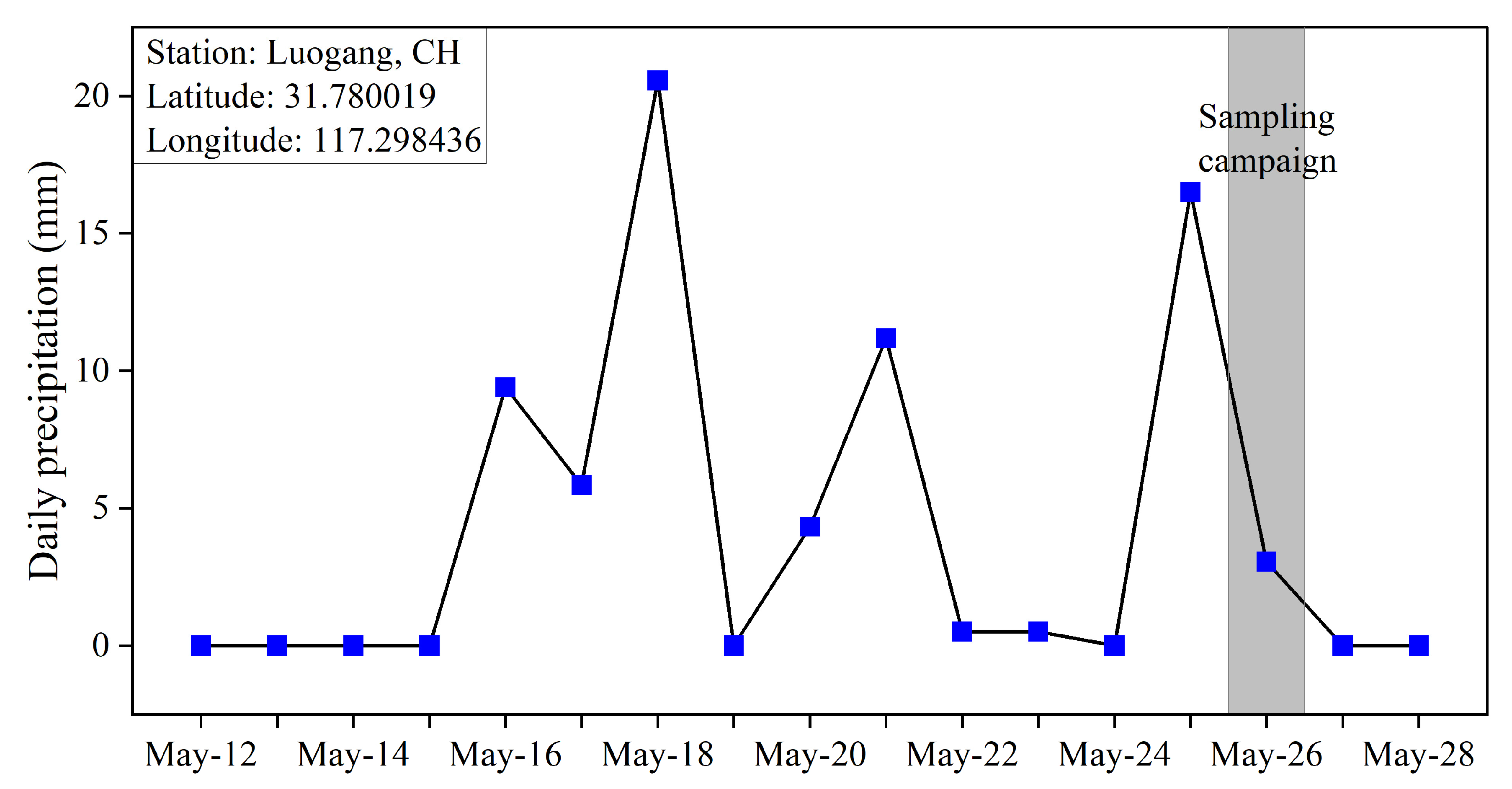
This study conducted field sampling at the aforementioned sampling sites in 26 May 2018, 19 January 2019, and 9 May 2019. Specifically, January represented the dry season of the river system, characterized by low discharge, decreased water levels, and reduced flow velocity (in contrast to the wet season with opposing hydrological features, while the normal season exhibits intermediate conditions). May sampling occurred during the normal season, typically displaying moderate hydrological parameters, such as the May 2019 sampling event, which can serve as the initial state. However, a heavy rainfall (16.51 mm/24 h) occurred one day prior to the May 2018 sampling campaign, with cumulative precipitation exceeding 60 mm during the preceding 10-day period (Figure 2). Given that the surface water in the region is primarily derived from precipitation and experiences weak evaporation [23], this rainfall likely altered the river’s hydrological regime (e.g., resulting in increased discharge) and associated environmental conditions. The sampling campaign was designed to account for the pronounced influence of heavy rainfall on pollutant transport. Sampling was therefore conducted within 24 h after rainfall events to reliably capture peak pollution loads associated with runoff, including non-point source pollutants and urban surface discharge.
During sampling, approximately 16 mL of river surface water was injected into 33 mL headspace vials using a syringe for subsequent analysis of the partial pressure of dissolved carbon dioxide (pCO2) [24,25]. The headspace vials were constructed of brown glass and prepared by first adding 2 g of potassium chloride. The vials were then sealed with butyl rubber septa and secured with aluminum caps. Finally, the vials were evacuated, filled with 5 mL of high-purity nitrogen gas (mole fraction ≥ 99.999%) [25], and the needle puncture sites were sealed with sealing compound to ensure gas-tight integrity. Atmospheric air samples were collected above the water surface and transferred into aluminum foil gas bags for subsequent determination of greenhouse gas concentrations.
This study conducted three field samplings over a one-year period, collecting nine specimens each time, yielding a total of 27 samples. During laboratory analysis of gas samples, the headspace vial is first vigorously shaken for 3 min and then allowed to stand for 30 min to achieve full equilibrium between the gas and liquid phases in the vial [26]. Subsequently, a 5 mL syringe is used to extract the gas from the headspace vial and inject it into a gas chromatograph (7890B, Agilent Technologies, Santa Clara, CA, USA) equipped with a flame ionization detector (FID) for CO2 detection. The original dissolved concentration of CO2 in water is determined through the calculation based on CO2 gas dissolution equilibrium and Henry’s law [27].
In addition, a multi-parameter water quality analyzer (YSI 6000) was used on-site to measure surface water temperature, pH, dissolved oxygen (DO), and other indicators, while water samples were simultaneously collected for the determination of key water environmental parameters. Among these, total nitrogen (TN) was quantified using the alkaline potassium persulfate digestion followed by UV spectrophotometry, and total phosphorus (TP) was measured using the ammonium molybdate spectrophotometric method. Ammonia nitrogen (NH4+-N) and nitrate nitrogen (NO3-N) were determined using a flow analyzer, while chlorophyll-a (Chl-a) was measured by spectrophotometry following acetone extraction and storage protected from light. Riverine attributes such as width, depth, and mean flow rates at all sampling riverine reaches were obtained by a boat-mounted Acoustic Doppler Current Profiler (ADCP), RiverSurveyor M9 (SonTex, San Diego, CA, USA).

2.3. Data Calculations

The initial dissolved concentration of CO2 in the water body, denoted as Cw, is calculated as given in Equation (1) [27], while the pCO2 in the water is computed according to Equation (3).
C w = p 1 × K e + V a V l × p 1 p 0 V m
K e = e 58.0931 + 90.5069 100 T + 22.2940 ln T 100 + S 0.027766 0.025888 T 100 + 0.0050578 T 100 2
p C O 2 = C w K s
In the equations, Cw denotes the dissolved CO2 concentration in the water body (μmol·L−1), p0 and p1 represent the partial pressure of CO2 in high-purity nitrogen and in the gas mixture after equilibration via shaking, respectively (μatm). Ke refers to the solubility of CO2 gas at equilibrium (mol·L−1·atm−1), and Ks indicates the Henry’s law constant (mol·L−1·atm−1). Va denotes the gas phase volume in the headspace vial (mL), Vl represents the liquid phase volume in the headspace vial (mL). Vm is the molar volume of CO2 gas, T indicates the temperature in Kelvin (K), and S refers to the salinity (%).
Based on Cw, the calculation of CO2 emission flux at the water–air interface refers to the boundary layer model method, with the calculation formula provided in Equation (4) [28].
F = k × C w C e q
k = 0.24 × 2841 V S + 2.02 S c / 600 3 / 2
S c C O 2 = 1911.1 118.11 × t + 3.4527 × t 2 0.04132 × t 3
In these formulas, F denotes the CO2 exchange flux (mmol·m−2·d−1), Ceq represents the atmospheric CO2 concentration above the water surface (µmol·L−1), and k is the CO2 gas exchange rate at the water–air interface (m·d−1) [29]. V represents the stream velocity (m·s−1), S denotes the river slope (dimensionless), and Sc is the Schmidt number, which is determined solely by the water temperature (°C) [28].

2.4. Data Analysis

Prior to statistical analysis, data distribution was assessed using the Shapiro–Wilk test. Variables meeting normality assumptions (p > 0.05) were analyzed using one-way ANOVA with Tukey’s HSD post hoc test. Non-normal variables were log10-transformed prior to ANOVA. Linear regression was performed to assess the relationship between environmental variables and CO2 to identify trends and quantify the strength and direction of the associations. One-way ANOVA was conducted to determine whether significant differences existed among different groups at the 0.05 significance level. The independent-samples t-test was employed to assess the significance of differences in the metrics between urban and non-urban rivers. All statistical analyses were performed in SPSS (v26) and the figures were created by Origin 2021.

3. Results

3.1. Riverine Physical and Chemical Characteristics

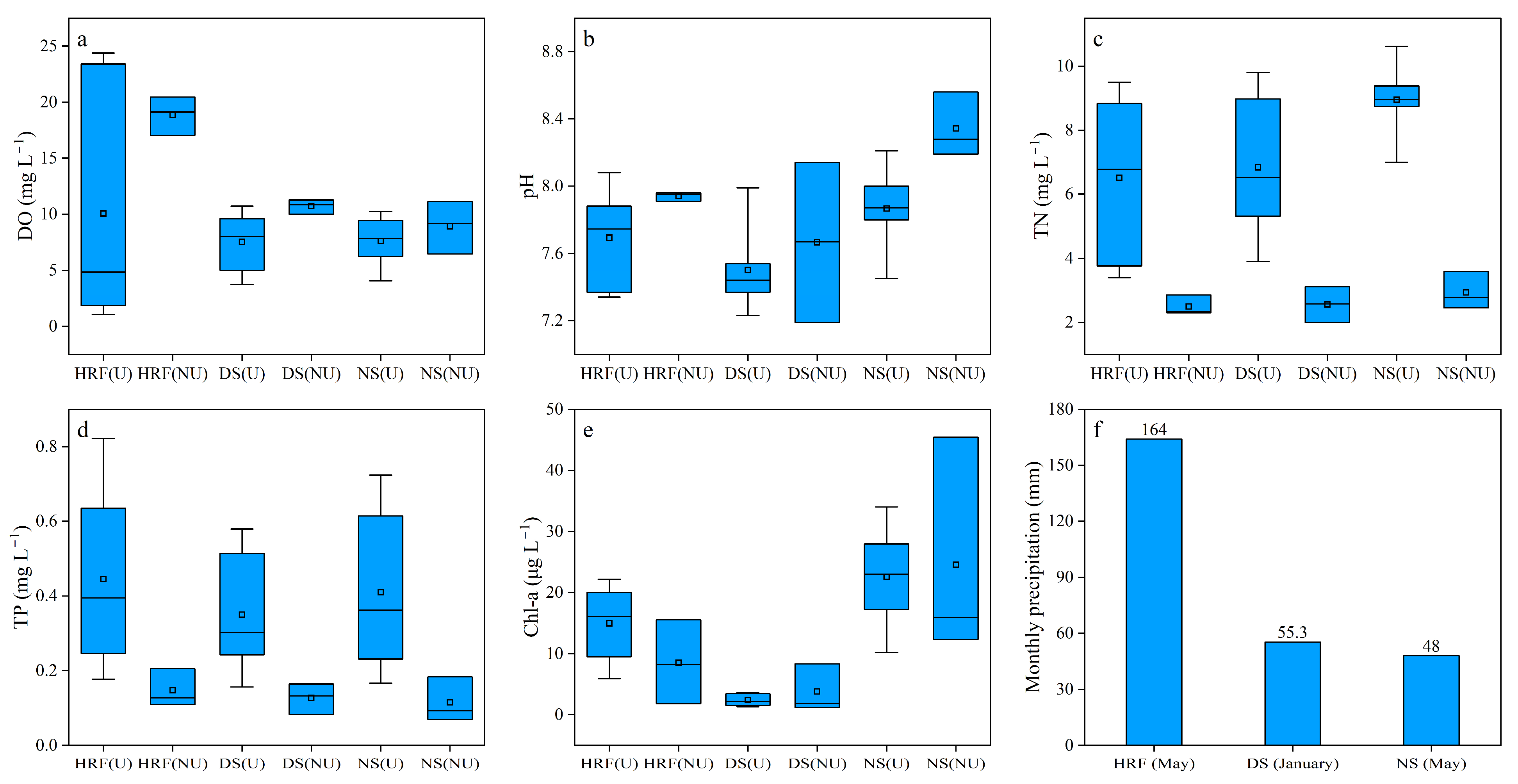
Statistical analysis revealed significant spatiotemporal variations in physicochemical parameters of rivers across the Chaohu Lake Basin (Table 1). For instance, urban river discharge following the heavy rainfall event reached 18.36 m3 s−1, which was significantly higher (p < 0.05) than the corresponding period in the following year (4.19 m3 s−1). Notably, non-urban rivers exhibited a markedly elevated discharge of 122.79 m3 s−1 under similar post-rainfall conditions. In addition, DO levels in non-urban rivers reached 18.86 mg L−1 following the heavy rainfall, significantly higher (p < 0.05) than those during dry (10.70 mg L−1) and normal water periods (8.91 mg L−1). pH during dry season averaged 7.56, significantly lower (p < 0.05) than the 8.03 observed in normal season. NO3-N concentrations post-intensive rainfall (0.51 mg L−1) were markedly reduced compared to dry (2.44 mg L−1) and normal water periods (2.09 mg L−1). However, NH4-N levels following heavy rainfall (2.72 mg L−1) showed no statistically significant differences (p > 0.05) from dry (2.58 mg L−1) or normal water periods (2.83 mg L−1).
On the other hand, distinct differences were observed between urban and non-urban rivers. During the three sampling periods, non-urban rivers exhibited higher DO and pH levels. For instance, the DO values in non-urban rivers measured 18.86, 10.70, and 8.91 mg L−1, respectively, while those in urban rivers were lower at 10.06, 7.52, and 7.62 mg L−1. Conversely, urban rivers demonstrated significantly elevated nutrient concentrations. Specifically, NH4-N levels in urban rivers exceeded those in non-urban rivers by more than fivefold. For instance, during the dry season, urban river concentrations reached 3.70 mg L−1, compared to merely 0.33 mg L−1 in non-urban counterparts. Similarly, PO4-P concentrations in urban rivers were measured to be multiple times (ranging up to over tenfold) higher than those observed in non-urban systems.
It is noteworthy that the TN concentrations in urban rivers during the three sampling periods were 6.51, 6.84, and 8.94 mg L−1, respectively (Figure 3), showing no significant temporal variations (p > 0.05). Similarly, non-urban rivers exhibited TN concentrations of 2.50, 2.56, and 2.94 mg L−1 with no statistically significant temporal differences (p > 0.05). However, urban rivers demonstrated TN levels over twice those of non-urban counterparts, revealing pronounced spatial disparities. A comparable spatial differentiation pattern was also observed for TP concentrations between urban and non-urban river systems. Conversely, Chl-a concentrations in the dry season (2.84 μg L−1) were significantly lower (p < 0.05) than post-rainfall (12.80 μg L−1) and the normal season (23.22 μg L−1), while water temperature exhibited analogous seasonal trends. The heavy rainfall event month registered 164 mm of monthly precipitation, representing a twofold increase compared to the corresponding month in the subsequent year (48 mm). Notably, the adjacent two-month (April and June) precipitation remained below 100 mm. All the above comparisons suggest a markedly elevated precipitation level for the month in which the heavy rainfall occurred.

3.2. Variability of pCO2 Between Urban and Non-Urban Rivers

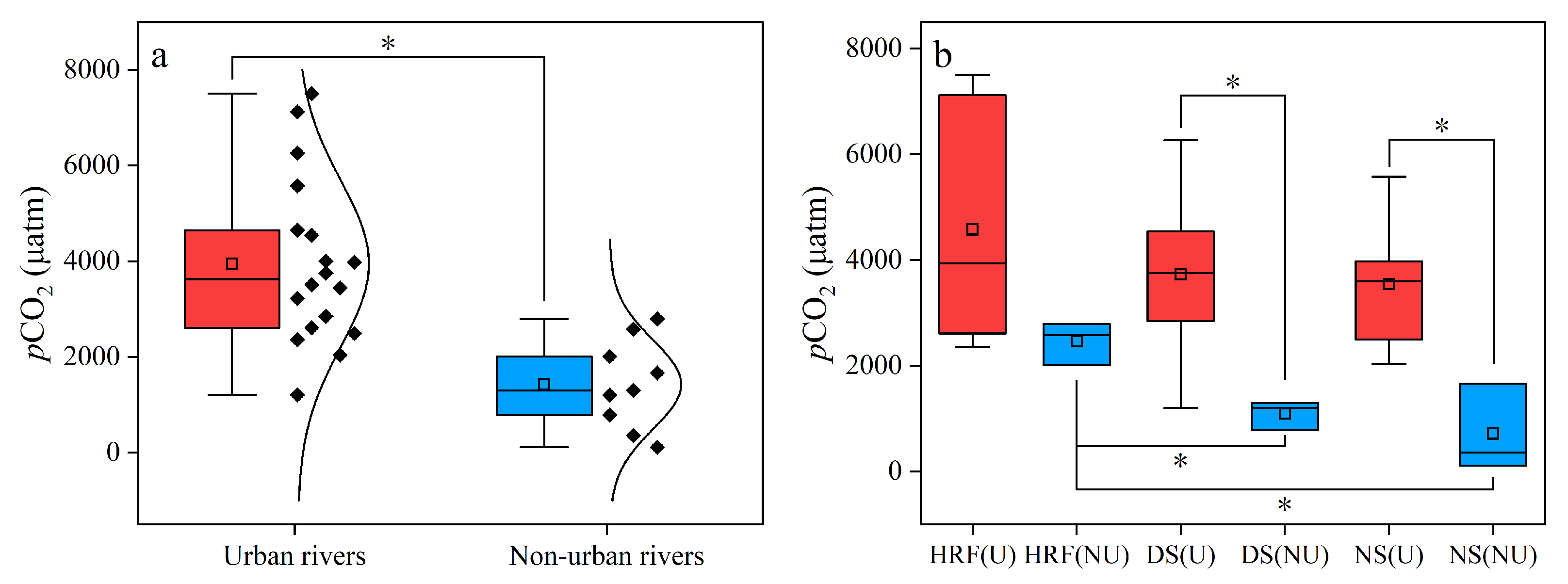
At the aggregate level, urban and non-urban river waters exhibited statistically significant differences in pCO2 levels (p < 0.05, Figure 4a). Specifically, urban river waters had a mean pCO2 of 3949 μatm, which is 2.8-fold higher than that of non-urban river waters (1423 μatm). Notably, urban rivers exhibited substantial internal pCO2 variability, with values ranging from 1203 μatm to 7498 μatm, whereas non-urban rivers demonstrated smaller intra-system differences.
The analysis of pCO2 in urban and non-urban rivers during three sampling periods revealed that urban rivers exhibited pCO2 levels of 4576 μatm, 3726 μatm, and 3545 μatm during post-heavy rainfall, dry season, and normal water periods, respectively (Figure 4b). The heavy rainfall event elevated aquatic pCO2 by 20–30% compared to normal conditions, though no significant differences were observed among these hydrological phases (p > 0.05). In contrast, non-urban rivers displayed pCO2 of 2461 μatm, 1096 μatm, and 712 μatm during post-heavy rainfall, dry season, and normal water periods, respectively. The heavy rainfall event resulted in pCO2 levels that were significantly higher (2.2-fold and 3.5-fold, respectively) compared to those observed during the dry season and normal water periods (p < 0.05). Additionally, during both the dry season and normal water periods, urban rivers consistently exhibited significantly higher pCO2 levels than their non-urban counterparts (p < 0.05), aligning with the overall trend of urbanization-driven carbon dynamics.
A comparative analysis of pCO2 in water at the estuaries of five rivers discharging into the lake revealed that urban rivers exhibited considerably higher levels than non-urban rivers (Table 2). Among the non-urban rivers, the Hangbu River—despite receiving inflow from a basin with minor urban/peri-urban land use—exhibited pCO2 levels comparable to the other non-urban rivers (e.g., Baishitian and Zhao Rivers), further supporting its classification as a predominantly non-urban system. Specifically, the urban Nanfei and Pai Rivers exhibited pCO2 values of 3865 μatm and 2853 μatm, respectively, whereas the highest value among non-urban rivers was only 1747 μatm. These findings indicate that urban rivers are associated with elevated aquatic CO2 concentrations. In addition, a comparison of pCO2 levels along different reaches of the two urban rivers revealed that the middle and upper sections of the Nanfei River exhibited higher levels, with a mean value exceeding 5500 μatm, whereas the downstream section showed a lower mean value of less than 4000 μatm. This decrease in the downstream reach may be attributed to its greater distance from the urban core. In contrast, the Pai River demonstrated elevated CO2 levels specifically in its midstream section, likely due to the location of a county town within this segment.

3.3. Influences of Environmental Factors

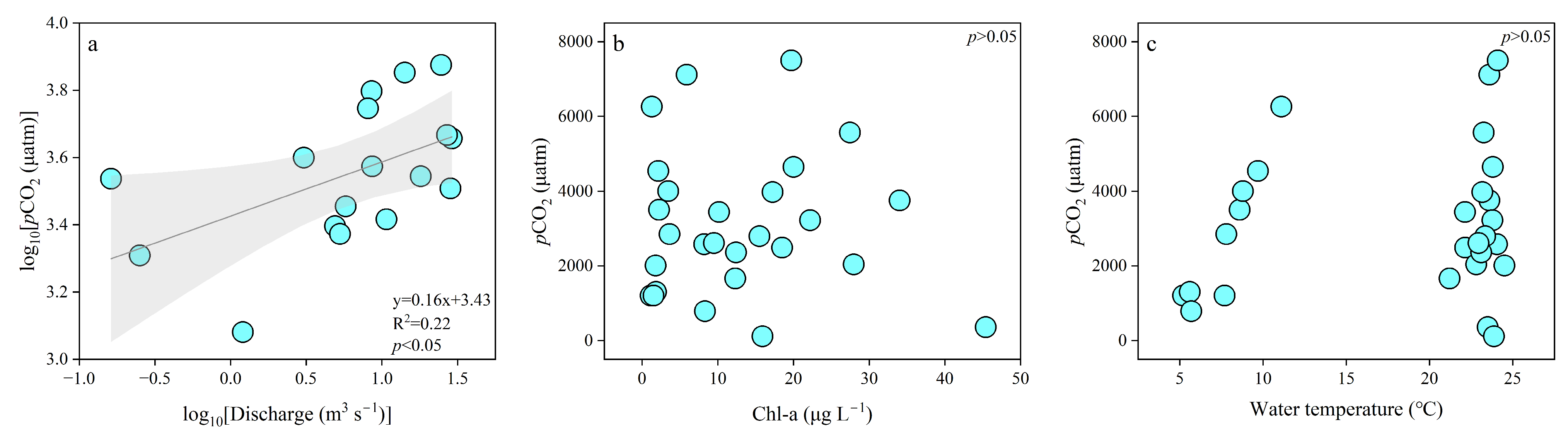
Figure 5a demonstrates a significantly positive correlation between river discharge and pCO2 in urban rivers (p < 0.05, R2 = 0.22). In contrast, no significant relationship was observed between discharge and pCO2 in non-urban rivers (p > 0.05). Figure 5b reveals that Chl-a exhibited no statistically significant association with pCO2 across the entire dataset (p > 0.05), nor when urban and non-urban rivers were analyzed separately. The correlation between water temperature and pCO2 is not significant (p > 0.05), whether considered as a whole or in parts (Figure 5c). These results suggest that hydrological drivers (e.g., discharge) may play a more pronounced regulatory role in pCO2 dynamics within urban river systems compared to biological factors like Chl-a.
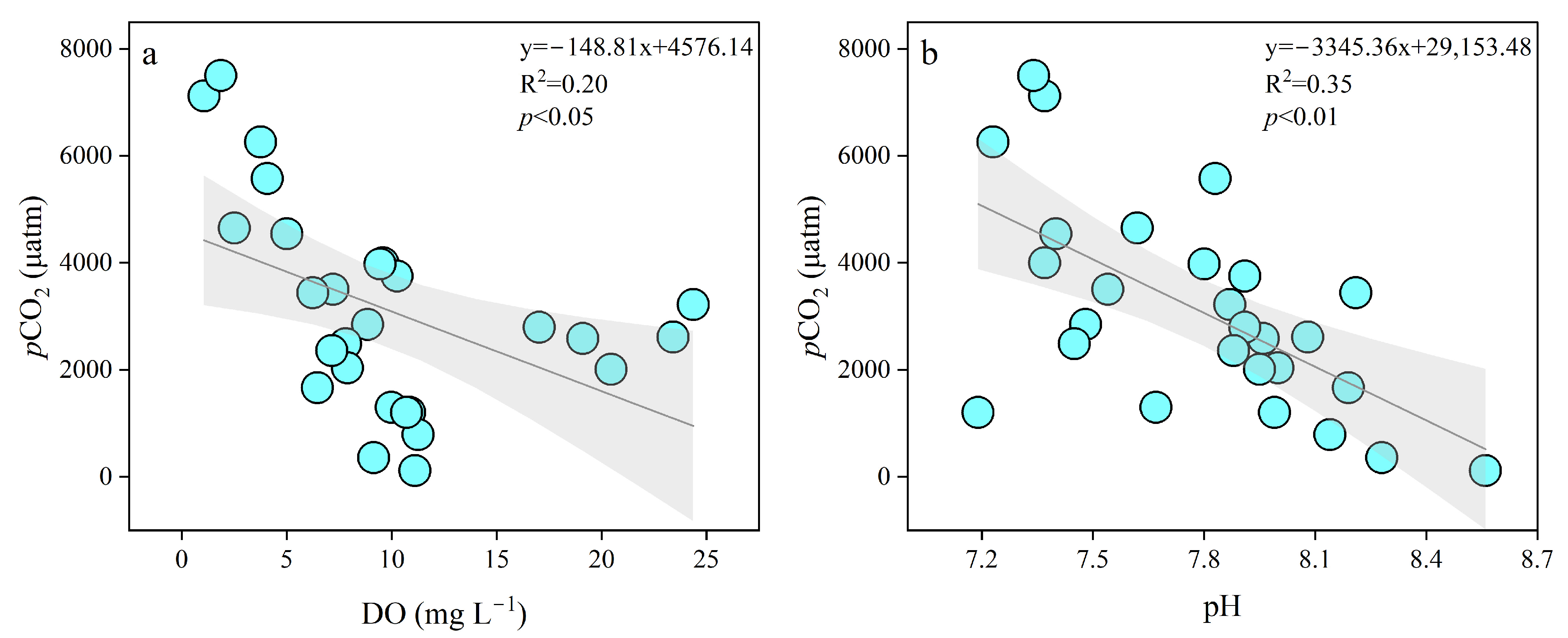
DO and pH are recognized as critical regulators of aquatic CO2 dynamics. As illustrated in Figure 6, our results revealed a significant negative correlation between DO and pCO2 (R2 = 0.20, p < 0.05; Figure 6a), while pH demonstrated a much stronger inverse relationship with pCO2 (R2 = 0.35, p < 0.01; Figure 6b). The pH parameter explained a greater proportion of the observed CO2 variation compared to DO, as evidenced by its higher regression coefficient. These findings collectively indicate that elevated DO and pH levels in water systems correspond to decreased CO2 concentrations. Notably, the dominant explanatory power of pH suggests its pivotal role in modulating CO2 evasion processes within the studied aquatic environments.
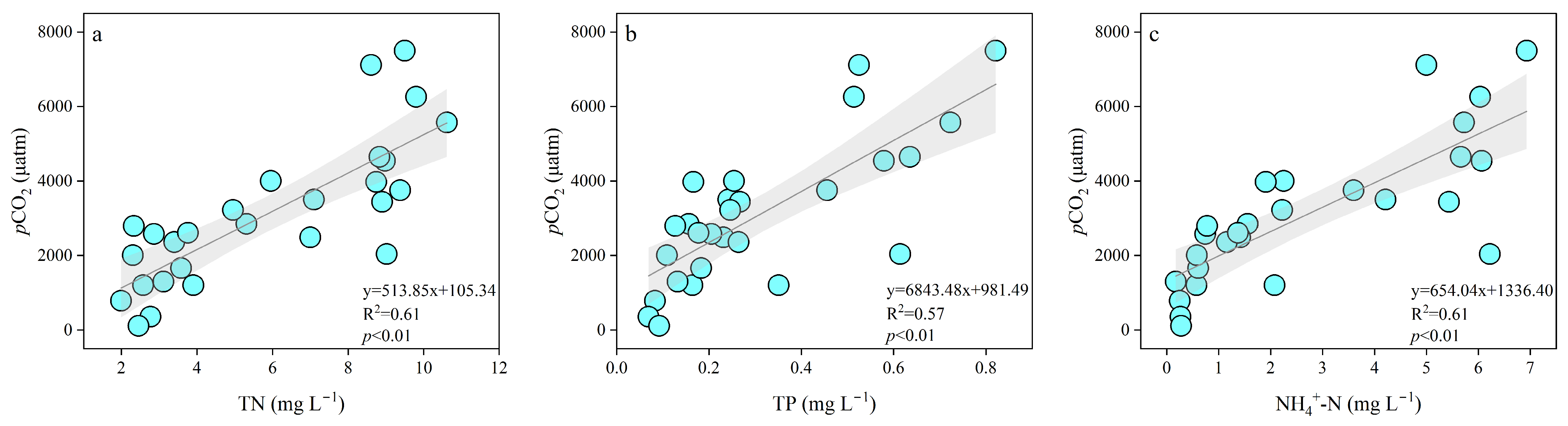
The generation of CO2 in fluvial ecosystems constitutes a dynamic and intricately regulated process, wherein nutrient loading frequently emerges as a pivotal driver. The correlations between pCO2 and nutrients in river water of the Chaohu Lake Basin are illustrated in Figure 7. The results demonstrate that TN, TP, and NH4+-N concentrations exhibit highly significant positive correlations with pCO2 (p < 0.01), accounting for 61%, 57%, and 61% of the pCO2 variability, respectively, thereby indicating robust explanatory capacity. The results above indicate that with increasing nutrient load levels, the pCO2 in river waters of the Chaohu Lake Basin exhibits a significant upward trend.

3.4. CO2 Emission Fluxes

Based on data such as aqueous CO2 concentration and combined with a water–air interface diffusion model, the CO2 exchange flux at the water–air interface of rivers in the Chaohu Lake Basin was estimated. The results indicate that the CO2 exchange flux at the water–air interface of rivers in the Chaohu Lake Basin is positive (297.84 mmol·m−2·d−1), representing a “net source” of CO2 emissions (Table 3). The CO2 exchange flux was higher in urban rivers (335.16 mmol·m−2·d−1) than in non-urban rivers (223.20 mmol·m−2·d−1). Specifically, the urban river (Nanfei River) exhibited a gradually decreasing trend in CO2 flux from upstream to downstream, while the suburban river (Pai River) showed an initial increase followed by a decrease along the flow direction. The flux in the midstream section of Pai River reached 607.41 mmol·m−2·d−1, approximately three times higher than that observed in its upstream and downstream sections. These patterns demonstrate significant spatial variations in CO2 emissions at the water–air interface across river systems within the Chaohu Lake Basin. A comparison of the riverine CO2 fluxes across the three sampling periods revealed that, overall, the flux after heavy rainfall reached 629.91 mmol·m−2·d−1, which was substantially higher than those during the dry season (128.30 mmol·m−2·d−1) and the normal season (135.31 mmol·m−2·d−1). It is noteworthy that the flux from non-urban rivers after heavy rainfall rose to 643.48 mmol·m−2·d−1, a level comparable to that of urban rivers and significantly higher than during regular conditions.

4. Discussion

4.1. Roles of Riverine Physicochemical Factors

In our study, TN, TP, and NH4+-N concentrations exhibit significant positive correlations with pCO2 (p < 0.01), accounting for 61%, 57%, and 61% of the pCO2 variability, respectively. Nutrient inputs impact the balance of primary production and respiration in rivers, thus affecting CO2 consumption and production [10,30]. For example, NH4+ influences the primary productivity of aquatic plants and plankton metabolism, indirectly regulating CO2 concentration [31]. In this study, urban rivers are characterized by high nutrient loads and low Chl-a concentrations (Table 1). The high nutrient loads indicate a high potential for CO2 production, while the low Chl-a concentrations reflect a reduced potential for CO2 consumption. The collective effect of these factors may lead to elevated CO2 emissions in urban rivers [3]. In addition, our results revealed a significant negative correlation between DO, pH and pCO2 (Figure 6). pH is an important factor regulating the aquatic carbonate equilibrium, while DO serves as an indicative parameter for biological metabolism in water [32]. From inland rivers in China, there was a significantly negative exponential relationship between pH and fCO2 and a significantly negative correlation between DO and fCO2 [33]. In the present study, urban rivers exhibited lower pH and DO levels compared to non-urban rivers, which may explain their higher CO2 concentrations. Notably, pCO2 and CO2 fluxes in urban rivers were very high during both the dry and normal seasons, whereas those in non-urban rivers were very low, particularly in the normal season. For example, during the normal season, pCO2 and CO2 fluxes in the Baishitian river were 114 μatm and −9.87 mmol·m−2·d−1, respectively. Long-term measurement showed point source organic pollution appeared to be the main driver of pCO2 in the lower Seine River, downstream of the main outlet of waste water treatment plant effluents, and whatever the period studied [34]. The continuous discharge of domestic wastewater keeps pollutant concentrations in urban rivers consistently high, thereby reducing the amplitude of CO2 fluctuations over time (Table 1). Although quantitative watershed-scale data are not available, it is well established that urban catchments with high population density generate disproportionately large wastewater loads compared to agricultural catchments [13], which likely explains the persistently elevated nutrient and CO2 levels observed in urban rivers across all seasons. The reason for higher CO2 levels in non-urban rivers during dry season may be attributed to a longer water residence time and lower currents, both contributing to the accumulation of gases in the water column [10]. The overall results suggest that neglecting localized pollution impacts on GHG emissions from increasingly urbanized river basins may result in a substantial underestimation of global riverine GHG emissions [35].

4.2. Impact of Heavy Rainfall Events on Riverine CO2 Emissions

Flood events fundamentally alter riverine carbon cycling, rapidly mobilizing terrestrial carbon stores and disrupting baseflow dynamics [36]. In this study, the heavy rainfall event elevated aquatic pCO2 by 20–30% compared to normal conditions in urban rivers, and 120–250% in non-urban rivers. Floodplain connectivity and overland flow introduce large quantities of dissolved organic carbon (DOC), dissolved inorganic carbon (DIC), and particulate organic carbon (POC) derived from soils and riparian zones into the river channel. The decomposition of this active carbon rapidly produces CO2, particularly within anoxic microsites in the water column or resuspended sediments [17,37].
Rainstorm is a key driver of carbon emissions from inland waters [14]. Based on aqueous CO2 concentration data and combined with a water–air interface diffusion model, following the heavy rainfall event, the riverine CO2 emission flux in the Chaohu Lake Basin surged to 629.91 mmol·m−2·d−1, representing a fivefold increase compared to baseline conditions (Table 3). The diffusion model using Equation (5) captures this, as increased river velocity (V) and slope (S) during floods generate intense turbulence at the water–air interface, dramatically enhancing the k value. In addition, pCO2 rises substantially after the rainfall event (Table 2), resulting in a large concentration gradient [8]. In this study, the rainfall event resulted in elevated levels of both the k value and dissolved CO2. Their combined effect led to a higher riverine CO2 emission flux (Equation (4)).

4.3. A Comprehensive Assessment of Riverine CO2 Emissions in the Chaohu Lake Basin

The mean riverine CO2 emission flux at the water–air interface in this study was 297.84 mmol·m−2·d−1, with positive flux values indicating that the river acts as a source of atmospheric CO2. In comparison with other studies, the riverine CO2 emission flux in this study was 53 times higher than that of Lake Chaohu (5.61 mmol·m−2·d−1) [38], 17 times higher than that of rivers in Nanjing city in the areas of the Yangtze River delta of China (17.63 mmol·m−2·d−1) [39] and twice that of the CO2 flux from the source region of the Yellow River (143.9 mmol·m−2·d−1) [40], indicating that rivers in the Chaohu Lake Basin represent a significant source of CO2 emissions. It is noteworthy that CO2 emissions exhibited significant differences between the two river types. The average flux in urban rivers was 335.16 mmol·m−2·d−1, which is 50% higher than that in non-urban rivers. When comparing flux data only under normal conditions (excluding the heavy rainfall event, as non-urban river values becomes exceptionally high following such precipitation), the flux in urban rivers was more than 10 times greater than that in non-urban rivers, indicating that urban rivers are hotspots for CO2 emissions. This finding is consistent with the conclusions of another study in the same region [13]. Similarly to our study, riverine CO2 emission rates in the Chongqing metropolitan area were three to six times higher than in rural or forested areas [41]. Furthermore, linear regression analysis revealed that annual CO2 concentration and flux were significantly correlated with the proportion of built-up area in the mainstem of Liao River [42], and the proportion of built-up area explained 49% of the variation in CO2 flux. Therefore, increased attention should be given to the carbon emissions from urban rivers within the Lake Chaohu Basin in future studies.
This comprehensive assessment reveals that CO2 fluxes in urban rivers of the Lake Chaohu Basin were significantly higher than those in non-urban rivers during dry and normal water periods, with values of 181.65 and 200.70 mmol·m−2·d−1 versus 21.59 and 4.54 mmol·m−2·d−1, respectively. However, following the heavy rainfall event, both river types exhibited a substantial increase in CO2 emissions, reaching more than 600 mmol·m−2·d−1. Notably, non-urban rivers demonstrated a dramatic amplification—by tens to hundreds of times—compared to their baseline fluxes, highlighting the extreme sensitivity of these systems to precipitation events. Therefore, enhancing the monitoring of carbon emissions from non-urban rivers under heavy rainfall conditions is needed. Current carbon cycle models that inadequately account for the pulse-release of carbon during heavy rainfall events likely underestimate emissions from inland waters. This study reveals a critical positive feedback mechanism: climate change-induced intensification of heavy rainfall may amplify fluvial carbon emissions, which in turn accelerates climate change. In the context of global climate change contributing to an increased frequency of extreme precipitation events, future efforts should prioritize the conservation of riparian vegetation and wetlands, as they function as effective “carbon buffer zones” that intercept and sequester terrestrial carbon, thereby mitigating dramatic fluctuations in riverine carbon concentrations following rainfall events. These findings underscore the critical role of hydrological disturbances in regulating riverine CO2 emissions and emphasize the need to incorporate event-driven dynamics into carbon budgeting models for these human-impacted regions.

4.4. Limitations of the Study

As with most research, the present study also has several limitations that should be acknowledged. Firstly, we acknowledge that topographic differences exist between our studied rivers, with urban systems located on east-oriented slopes and non-urban rivers on north-oriented slopes. While slope aspect and angle may modulate local runoff generation, our study suggests that land use and associated carbon source–sink dynamics override potential orographic effects in this relatively low-relief basin. Future studies with denser topographic sampling could further disentangle these controls. Secondly, the magnitude of the increase in riverine CO2 emissions attributable to heavy rainfall may subject to uncertainty in our study, primarily because we conducted only one sampling event following the heavy rainfall and compared it with two other sampling datasets. These two datasets were collected several months after the rainfall event and may not adequately represent the pre-rainfall conditions. However, the minimal differences in both pCO2 and emission flux between the two sampling events form a substantial contrast with the conditions following the heavy rainfall, sufficiently demonstrating that “heavy rainfall enhanced riverine CO2 emissions to some extent”. To accurately estimate the contribution of a rainfall event to greenhouse gas emissions, it is necessary to measure and consider the initial emission levels beforehand. For example, temporal changes can be captured by collecting GHG emission data at regular intervals before, during, and after rainfall events. This approach ensures a clear understanding of how rainfall influences GHG fluxes.

5. Conclusions

Rivers in the Chaohu Lake Basin overall serve as a net source of greenhouse gas CO2 emissions (297.84 mmol·m−2·d−1), with urban rivers (335.16 mmol·m−2·d−1) exhibiting stronger CO2 emissions compared to non-urban rivers (223.20 mmol·m−2·d−1). Notably, CO2 emissions in non-urban rivers were minimal during the normal season (4.54 mmol·m−2·d−1), contrasting with a slightly higher value of 21.59 mmol·m−2·d−1 observed in the dry season. Key environmental parameters in water bodies significantly influence riverine pCO2. Among these, discharge, TN, TP, and NH4+-N showed significantly positive correlations with pCO2 (p < 0.05), while DO and pH exhibited significantly negative correlations with pCO2 (p < 0.05). Relatively large increases in riverine CO2 emissions were observed following the heavy rainfall event, though the extent of enhancement varied across river types: urban rivers exhibited an increase by severalfold, while non-urban rivers even experienced a rise of tens of times. Future research should prioritize monitoring riverine CO2 emissions under heavy rainfall conditions, particularly in non-urban river systems.

Author Contributions

Conceptualization, Q.X.; Methodology, Q.X.; Validation, Z.G.; Formal analysis, Z.G.; Resources, Q.X.; Data curation, Z.G.; Writing—original draft, Z.G.; Writing—review & editing, Z.G., Y.M., L.H., M.J. and Q.X.; Visualization, Z.G.; Supervision, Q.X.; Project administration, Q.X.; Funding acquisition, Y.M. and Q.X. All authors have read and agreed to the published version of the manuscript.

Funding

The present study was supported jointly Jiangsu Provincial Science and Technology Planning Project (BK20231516), the Opening Foundation of Anhui Province Key Laboratory of Environmental Hormone and Reproduction (FSKFKT012), and the National Natural Science Foundation of China (42307106).

Institutional Review Board Statement

Not applicable.

Informed Consent Statement

Not applicable.

Data Availability Statement

Data will be made available on request.

Conflicts of Interest

The authors declare no conflicts of interest.

References

  1. Borges, A.V.; Darchambeau, F.; Teodoru, C.R.; Marwick, T.R.; Tamooh, F.; Geeraert, N.; Omengo, F.O.; Guérin, F.; Lambert, T.; Morana, C.; et al. Globally Significant Greenhouse-Gas Emissions from African Inland Waters. Nat. Geosci. 2015, 8, 637–642. [Google Scholar] [CrossRef]
  2. Raymond, P.A.; Hartmann, J.; Lauerwald, R.; Sobek, S.; McDonald, C.; Hoover, M.; Butman, D.; Striegl, R.; Mayorga, E.; Humborg, C.; et al. Global Carbon Dioxide Emissions from Inland Waters. Nature 2013, 503, 355–359. [Google Scholar] [CrossRef] [PubMed]
  3. Xiao, Q.; Xu, X.; Qi, T.; Luo, J.; Lee, X.; Duan, H. Lakes Shifted from a Carbon Dioxide Source to a Sink over Past Two Decades in China. Sci. Bull. 2024, 69, 1857–1861. [Google Scholar] [CrossRef]
  4. Liu, S.; Kuhn, C.; Amatulli, G.; Aho, K.; Butman, D.E.; Allen, G.H.; Lin, P.; Pan, M.; Yamazaki, D.; Brinkerhoff, C.; et al. The Importance of Hydrology in Routing Terrestrial Carbon to the Atmosphere via Global Streams and Rivers. Proc. Natl. Acad. Sci. USA 2022, 119, e2106322119. [Google Scholar] [CrossRef]
  5. Friedlingstein, P.; O’Sullivan, M.; Jones, M.W.; Andrew, R.M.; Hauck, J.; Olsen, A.; Peters, G.P.; Peters, W.; Pongratz, J.; Sitch, S.; et al. Global Carbon Budget 2020. Earth Syst. Sci. Data 2020, 12, 3269–3340. [Google Scholar] [CrossRef]
  6. Li, S.; Bush, R.T.; Santos, I.R.; Zhang, Q.; Song, K.; Mao, R.; Wen, Z.; Lu, X.X. Large Greenhouse Gases Emissions from China’s Lakes and Reservoirs. Water Res. 2018, 147, 13–24. [Google Scholar] [CrossRef] [PubMed]
  7. Tang, W.; Xu, Y.J.; Ma, Y.; Maher, D.T.; Li, S. Hot Spot of CH4 Production and Diffusive Flux in Rivers with High Urbanization. Water Res. 2021, 204, 117624. [Google Scholar] [CrossRef]
  8. Li, J.; Zhang, T.; Pu, J.; Huang, C.; Yu, S.; Ren, K.; Sun, P.; Xiao, Q. Contrasting Influences of Diurnal Patterns and Rainfall Events on Riverine CO2 Degassing: Insights from in Situ High-Resolution Monitoring. J. Hydrol. 2025, 662, 133916. [Google Scholar] [CrossRef]
  9. Panwar, S.; Gaur, D.; Chakrapani, G.J. Total Organic Carbon Transport by the Alaknanda River, Garhwal Himalayas, India. Arab. J. Geosci. 2017, 10, 207. [Google Scholar] [CrossRef]
  10. Borges, A.V.; Darchambeau, F.; Lambert, T.; Bouillon, S.; Morana, C.; Brouyère, S.; Hakoun, V.; Jurado, A.; Tseng, H.-C.; Descy, J.-P.; et al. Effects of Agricultural Land Use on Fluvial Carbon Dioxide, Methane and Nitrous Oxide Concentrations in a Large European River, the Meuse (Belgium). Sci. Total Environ. 2018, 610–611, 342–355. [Google Scholar] [CrossRef] [PubMed]
  11. Xiao, Q.; Hu, Z.; Hu, C.; Islam, A.R.M.T.; Bian, H.; Chen, S.; Liu, C.; Lee, X. A Highly Agricultural River Network in Jurong Reservoir Watershed as Significant CO2 and CH4 Sources. Sci. Total Environ. 2021, 769, 144558. [Google Scholar] [CrossRef]
  12. Brown, A.M.; Bass, A.M.; Skiba, U.; MacDonald, J.M.; Pickard, A.E. Urban Landscapes and Legacy Industry Provide Hotspots for Riverine Greenhouse Gases: A Source-to-Sea Study of the River Clyde. Water Res. 2023, 236, 119969. [Google Scholar] [CrossRef]
  13. Zhang, W.; Li, H.; Xiao, Q.; Li, X. Urban Rivers Are Hotspots of Riverine Greenhouse Gas (N2O, CH4, CO2) Emissions in the Mixed-Landscape Chaohu Lake Basin. Water Res. 2021, 189, 116624. [Google Scholar] [CrossRef] [PubMed]
  14. Zhou, L.; Zhou, Y.; Zhang, Y.; Jeppesen, E.; Weyhenmeyer, G.A. Rainstorm-Induced Organic Matter Pulses: A Key Driver of Carbon Emissions from Inland Waters. Innovation 2025, 6, 100746. [Google Scholar] [CrossRef] [PubMed]
  15. Tang, W.; Xu, Y.J.; Ni, M.; Li, S. Land Use and Hydrological Factors Control Concentrations and Diffusive Fluxes of Riverine Dissolved Carbon Dioxide and Methane in Low-Order Streams. Water Res. 2023, 231, 119615. [Google Scholar] [CrossRef] [PubMed]
  16. Gómez-Gener, L.; Rocher-Ros, G.; Battin, T.; Cohen, M.J.; Dalmagro, H.J.; Dinsmore, K.J.; Drake, T.W.; Duvert, C.; Enrich-Prast, A.; Horgby, Å.; et al. Global Carbon Dioxide Efflux from Rivers Enhanced by High Nocturnal Emissions. Nat. Geosci. 2021, 14, 289–294. [Google Scholar] [CrossRef]
  17. Reiman, J.H.; Xu, Y.J. Dissolved Carbon Export and CO2 Outgassing from the Lower Mississippi River—Implications of Future River Carbon Fluxes. J. Hydrol. 2019, 578, 124093. [Google Scholar] [CrossRef]
  18. Lauerwald, R.; Allen, G.H.; Deemer, B.R.; Liu, S.; Maavara, T.; Raymond, P.; Alcott, L.; Bastviken, D.; Hastie, A.; Holgerson, M.A.; et al. Inland Water Greenhouse Gas Budgets for RECCAP2: 1. State-Of-The-Art of Global Scale Assessments. Glob. Biogeochem. Cycles 2023, 37, e2022GB007657. [Google Scholar] [CrossRef]
  19. Yao, X.; Wang, J.; Xie, X.; Jiang, D.; Xu, X. Distribution of SOCD along Different Offshore Distances in China’s Fresh-Water Lake-Chaohu under Different Habitats. Sci. Rep. 2022, 12, 14712. [Google Scholar] [CrossRef]
  20. Gu, Y.; Zhang, P.; Qin, F.; Yongjiu, C.; Xiaolong, W. Impact of the Evolution of Watershed Landscape Pattern on River Water Quality—The Example of the Nanfei River, Lake Chaohu Basin. J. Lake Sci. 2024, 36, 1769–1781. [Google Scholar] [CrossRef]
  21. Wu, L.; Liu, K.; Wang, Z.; Yang, Y.; Sang, R.; Zhu, H.; Wang, X.; Pang, Y.; Tong, J.; Liu, X.; et al. Temporal–Spatial Variations in Physicochemical Factors and Assessing Water Quality Condition in River–Lake System of Chaohu Lake Basin, China. Sustainability 2025, 17, 2182. [Google Scholar] [CrossRef]
  22. Peng, Z.; Hu, W.; Liu, G.; Gao, R.; Wei, W. Estimating Daily Inflows of Large Lakes Using a Water-Balance-Based Runoff Coefficient Scaling Approach. Hydrol. Process. 2019, 33, 2535–2550. [Google Scholar] [CrossRef]
  23. Zheng, L.; Jiang, C.; Chen, X.; Li, Y.; Li, C.; Zheng, L. Combining Hydrochemistry and Hydrogen and Oxygen Stable Isotopes to Reveal the Influence of Human Activities on Surface Water Quality in Chaohu Lake Basin. J. Environ. Manag. 2022, 312, 114933. [Google Scholar] [CrossRef] [PubMed]
  24. Crawford, J.T.; Dornblaser, M.M.; Stanley, E.H.; Clow, D.W.; Striegl, R.G. Source Limitation of Carbon Gas Emissions in High-Elevation Mountain Streams and Lakes. J. Geophys. Res.-Biogeosci. 2015, 120, 952–964. [Google Scholar] [CrossRef]
  25. Striegl, R.G.; Kortelainen, P.; Chanton, J.P.; Wickland, K.P.; Bugna, G.C.; Rantakari, M. Carbon Dioxide Partial Pressure and 13C Content of North Temperate and Boreal Lakes at Spring Ice Melt. Limnol. Oceanogr. 2001, 46, 941–945. [Google Scholar] [CrossRef]
  26. Jahangir, M.M.R.; Johnston, P.; Khalil, M.I.; Grant, J.; Somers, C.; Richards, K.G. Evaluation of Headspace Equilibration Methods for Quantifying Greenhouse Gases in Groundwater. J. Environ. Manag. 2012, 111, 208–212. [Google Scholar] [CrossRef]
  27. Goldenfum, J.A. GHG Measurement Guidelines for Freshwater Reservoirs; The International Hydropower Association (IHA): London, UK, 2010. [Google Scholar]
  28. Wanninkhof, R. Relationship between Wind Speed and Gas Exchange over the Ocean Revisited. Limnol. Oceanogr. Methods 2014, 12, 351–362. [Google Scholar] [CrossRef]
  29. Raymond, P.A.; Zappa, C.J.; Butman, D.; Bott, T.L.; Potter, J.; Mulholland, P.; Laursen, A.E.; McDowell, W.H.; Newbold, D. Scaling the Gas Transfer Velocity and Hydraulic Geometry in Streams and Small Rivers. Limnol. Oceanogr. Fluids Environ. 2012, 2, 41–53. [Google Scholar] [CrossRef]
  30. Hu, B.; Wang, D.; Zhou, J.; Meng, W.; Li, C.; Sun, Z.; Guo, X.; Wang, Z. Greenhouse Gases Emission from the Sewage Draining Rivers. Sci. Total Environ. 2018, 612, 1454–1462. [Google Scholar] [CrossRef]
  31. Crawford, J.T.; Stanley, E.H.; Spawn, S.A.; Finlay, J.C.; Loken, L.C.; Striegl, R.G. Ebullitive Methane Emissions from Oxygenated Wetland Streams. Glob. Change Biol. 2014, 20, 3408–3422. [Google Scholar] [CrossRef]
  32. Li, S.; Ni, M.; Mao, R.; Bush, R.T. Riverine CO2 Supersaturation and Outgassing in a Subtropical Monsoonal Mountainous Area (Three Gorges Reservoir Region) of China. J. Hydrol. 2018, 558, 460–469. [Google Scholar] [CrossRef]
  33. Zhou, T.; Wang, X.; Xiao, Z.; Qing, Z.; Li, X.; Wang, J.; Que, Z. Characteristics and Influencing Factors of CO2 Emission from Inland Waters in China. Sci. China Earth Sci. 2024, 67, 2034–2055. [Google Scholar] [CrossRef]
  34. Marescaux, A.; Thieu, V.; Borges, A.V.; Garnier, J. Seasonal and Spatial Variability of the Partial Pressure of Carbon Dioxide in the Human-Impacted Seine River in France. Sci. Rep. 2018, 8, 13961. [Google Scholar] [CrossRef] [PubMed]
  35. Begum, M.S.; Bogard, M.J.; Butman, D.E.; Chea, E.; Kumar, S.; Lu, X.; Nayna, O.K.; Ran, L.; Richey, J.E.; Tareq, S.M.; et al. Localized Pollution Impacts on Greenhouse Gas Dynamics in Three Anthropogenically Modified Asian River Systems. J. Geophys. Res.-Biogeosci. 2021, 126, e2020JG006124. [Google Scholar] [CrossRef]
  36. Woodrow, R.L.; White, S.A.; Conrad, S.R.; Wadnerkar, P.D.; Rocher-Ros, G.; Sanders, C.J.; Holloway, C.J.; Santos, I.R. Enhanced Stream Greenhouse Gas Emissions at Night and during Flood Events. Limnol. Oceanogr. Lett. 2024, 9, 276–285. [Google Scholar] [CrossRef]
  37. Almeida, R.M.; Pacheco, F.S.; Barros, N.; Rosi, E.; Roland, F. Extreme Floods Increase CO2 Outgassing from a Large Amazonian River. Limnol. Oceanogr. 2017, 62, 989–999. [Google Scholar] [CrossRef]
  38. Qi, T.; Xiao, Q.; Miao, Y.; Duan, H. Temporal and Spatial Variation of Carbon Dioxide Concentration and Its Exchange Fluxes in Lake Chaohu. J. Lake Sci. 2019, 31, 766–778. [Google Scholar] [CrossRef]
  39. Zhou, X.-D.; Kumar, A.; Wang, H.-Y.; Knorr, K.-H.; Chen, Y.-B.; Liu, Y.-X.; Lin, J.-J.; Han, L.; Yu, Z.-G. Greenhouse Gas Emissions Hotspots and Drivers of Urban Freshwater Bodies in Areas of the Yangtze River Delta, China. Ecohydrology 2023, 16, 1–15. [Google Scholar] [CrossRef]
  40. Qu, B.; Aho, K.S.; Li, C.; Kang, S.; Sillanpää, M.; Yan, F.; Raymond, P.A. Greenhouse Gases Emissions in Rivers of the Tibetan Plateau. Sci. Rep. 2017, 7, 16573. [Google Scholar] [CrossRef]
  41. Wang, X.; He, Y.; Yuan, X.; Chen, H.; Peng, C.; Zhu, Q.; Yue, J.; Ren, H.; Deng, W.; Liu, H. pCO2 and CO2 Fluxes of the Metropolitan River Network in Relation to the Urbanization of Chongqing, China. J. Geophys. Res.-Biogeosci. 2017, 122, 470–486. [Google Scholar] [CrossRef]
  42. Cui, P.; Cui, L.; Zheng, Y.; Su, F. Land Use and Urbanization Indirectly Control Riverine CH4 and CO2 Emissions by Altering Nutrient Input. Water Res. 2024, 265, 122266. [Google Scholar] [CrossRef]
Figure 1. Sampling sites and land cover in the Chaohu Lake Basin. To determine the differences in CO2 emission among rivers, we classified the nine sampling sites from five rivers into two categories: urban (U) and non-urban (NU), based on the land use types surrounding the sampling sites.
Atmosphere 17 00449 g001
Figure 2. Daily precipitation data before and after the heavy rainfall event (obtained from the meteorological station Luogang around sampling points) and the sampling timeline of this study.
Atmosphere 17 00449 g002
Figure 3. Physicochemical characteristics in urban versus non-urban areas across heavy rainfall (HRF), dry season (DS), and normal season (NS), including (a) DO; (b) pH; (c) TN; (d) TP; (e) Chl-a; (f) Monthly precipitation. In each box plot, the elements from bottom to top are arranged as follows: the minimum value, the lower quartile (Q1), the median (Q2), the upper quartile (Q3), and the maximum value. And the mean value is represented by a small square symbol within the plot.
Atmosphere 17 00449 g003
Figure 4. pCO2 regimes in urban versus non-urban rivers: (a) catchment-integrated signatures, (b) temporal-phase resolved dynamics. Asterisks denote statistically significant differences at the 0.05 level. In each box plot, the elements from bottom to top are arranged as follows: the minimum value, the lower quartile (Q1), the median (Q2), the upper quartile (Q3), and the maximum value. And the mean value is represented by a small square symbol within the plot. In Figure a, the boxplot is displayed with its data points and the corresponding normal distribution curve on the right side.
Atmosphere 17 00449 g004
Figure 5. Univariate linear regression between discharge (a), Chl-a (b), water temperature (c) and pCO2. (a) Exclusively presents data from urban river sampling sites, whereas (b,c) incorporate the complete dataset encompassing all sampling locations. Shaded areas represent 95% confidence intervals. We used the adjusted R2 of the model to assess the explanatory power of variables.
Atmosphere 17 00449 g005
Figure 6. Univariate linear regression between DO (a), pH (b) and pCO2. Shaded areas represent 95% confidence intervals. We used the adjusted R2 of the model to assess the explanatory power of variables.
Atmosphere 17 00449 g006
Figure 7. Univariate linear regression between TN (a), TP (b), NH4+-N (c) and pCO2. Shaded areas represent 95% confidence intervals. We used the adjusted R2 of the model to assess the explanatory power of variables.
Atmosphere 17 00449 g007
Table 1. Statistical characteristics of riverine physical and chemical indicators. All of the data were shown as Mean ± SD. Different lowercase letters denote significant temporal differences (p < 0.05) among rivers of the same type.
TimeRiver TypesDischarge
m3 s−1
Tw
°C
DO
mg L−1
pHNO3-N
mg L−1
NH4-N
mg L−1
PO4-P
mg L−1
Chl-a
μg L−1
Urban18.36 ± 9.59 a23.55 ± 0.45 a10.06 ± 10.92 a7.69 ± 0.30 ab0.51 ± 0.25 b3.72 ± 2.45 a0.25 ± 0.21 a14.95 ± 6.61 a
Heavy RainfallNon-urban122.79 ± 90.52 a23.97 ± 0.58 a18.86 ± 1.72 a7.94 ± 0.03 ab0.52 ± 0.09 b0.70 ± 0.11 a0.04 ± 0.01 a8.50 ± 6.85 a
Total53.17 ± 69.51 a23.69 ± 0.50 a12.99 ± 9.73 a7.78 ± 0.27 ab0.51 ± 0.21 b2.72 ± 2.46 a0.18 ± 0.20 a12.80 ± 7.03 a
Urban10.44 ± 11.16 ab8.95 ± 1.28 b7.52 ± 2.71 a7.50 ± 0.26 b2.71 ± 0.83 a3.70 ± 2.03 a0.14 ± 0.08 a2.38 ± 0.97 b
Dry SeasonNon-urban6.30 ± 7.57 a5.50 ± 0.26 b10.70 ± 0.65 b7.67 ± 0.48 b1.89 ± 0.58 a0.33 ± 0.21 b0.05 ± 0.04 a3.76 ± 3.95 a
Total9.06 ± 9.82 a7.80 ± 2.00 b8.58 ± 2.69 a7.56 ± 0.33 b2.44 ± 0.83 a2.58 ± 2.33 a0.11 ± 0.08 a2.84 ± 2.23 b
Urban4.19 ± 3.71 b22.85 ± 0.61 a7.62 ± 2.23 a7.87 ± 0.25 a2.70 ± 1.12 a4.05 ± 2.06 a0.18 ± 0.19 a22.56 ± 8.75 a
Normal SeasonNon-urban7.86 ± 9.03 a22.86 ± 1.44 a8.91 ± 2.33 b8.34 ± 0.19 a0.87 ± 0.25 b0.38 ± 0.19 ab0.01 ± 0.00 a24.54 ± 18.15 a
Total5.41 ± 5.69 a22.85 ± 0.87 a8.05 ± 2.21 a8.03 ± 0.33 a2.09 ± 1.28 a2.83 ± 2.45 a0.12 ± 0.17 a23.22 ± 11.46 a
Table 2. pCO2 of different rivers during three sampling periods.
RiverDry Season/
(μatm)
Normal Season/
(μatm)
Heavy Rainfall/
(μatm)
Mean/
(μatm)
Nanfei (upper)6260 3749 7118 5709
Nanfei (middle)4540 5573 7498 5870
Nanfei (lower)3504 3441 4650 3865
Urban RiversPai (upper)1203 2037 2359 1866
Pai (middle)4000 3977 2609 3529
Pai (lower)2848 2489 3221 2853
Mean3726354545763949
Hangbu1201 358 2009 1189
Non-urbanBaishitian1300 114 2582 1332
RiversZhao785 1664 2793 1747
Mean109671224611423
AllMean2849260038713107
Table 3. CO2 fluxes at the water–air interface of different rivers during three sampling periods (The positive value represents the source, while the negative value represents the sink).
RiverDry Season/
(mmol·m−2·d−1)
Normal Season/
(mmol·m−2·d−1)
Heavy Rainfall/
(mmol·m−2·d−1)
Mean/
(mmol·m−2·d−1)
Nanfei (upper)374.05 234.05 695.13 434.41
Nanfei (middle)316.04 199.45 561.10 358.86
Nanfei (lower)179.36 58.72 351.98 196.69
Urban RiversPai (upper)68.95 52.49 598.93 240.12
Pai (middle)64.02 582.44 1175.76 607.41
Pai (lower)87.51 77.03 355.85 173.46
Mean181.65200.70623.13335.16
Hangbu14.10 −3.30 586.66 199.15
Non-urbanBaishitian39.15 −9.87 308.11 112.46
RiversZhao11.52 26.80 1035.68 358.00
Mean21.594.54643.48223.20
AllMean128.30135.31629.91297.84
Disclaimer/Publisher’s Note: The statements, opinions and data contained in all publications are solely those of the individual author(s) and contributor(s) and not of MDPI and/or the editor(s). MDPI and/or the editor(s) disclaim responsibility for any injury to people or property resulting from any ideas, methods, instructions or products referred to in the content.