Article

High-Resolution PM2.5 and Ozone (O3) Estimates and the Impacts on Human Health and Crop Yields Across Sichuan Basin During 2015–2021

1
Key Laboratory of Geographic Information Science of the Ministry of Education, School of Geographic Sciences, East China Normal University, Shanghai 200241, China
2
Institute of Eco-Chongming (IEC), 20 Cuiniao Road, Chenjia Town, Chongming District, Shanghai 202162, China
*
Authors to whom correspondence should be addressed.
Atmosphere 2026, 17(5), 432; https://doi.org/10.3390/atmos17050432
Submission received: 27 February 2026 / Revised: 18 April 2026 / Accepted: 20 April 2026 / Published: 22 April 2026
(This article belongs to the Special Issue Air Quality in China (4th Edition))

Abstract

Despite stringent national clean air policies, severe PM2.5 and ozone (O3) pollution persists in some parts of China, notably the Sichuan Basin—a key economic zone in the southwest. High-resolution assessment of the health and crop impacts of these pollutants remains limited in this region. In this study, we developed a multi-source data fusion framework based on a machine learning model to reconstruct daily PM2.5 and O3 concentrations at 1 km resolution during 2015–2021. The model integrates ground observations, meteorological data, chemical transport model outputs, and satellite retrievals. The model performed robustly, achieving R2 values of 0.91 for PM2.5 and 0.64 for O3. PM2.5 exhibited a decreasing tendency after 2017, while O3 showed interannual variability, with peaks in 2016 and 2018. Spatially, PM2.5 was more concentrated in urban centers, whereas O3 showed higher levels in western Sichuan and a banded pattern in the east. Seasonal patterns were also evident: PM2.5 increased in autumn and winter due to meteorological and emission factors, while O3 peaked in spring and summer, driven by photochemistry and high temperatures. Topography and emissions further shaped these distributions, with mountains in the west trapping O3 and urban clusters exacerbating PM2.5. Based on the reconstructed dataset, we further explored the potential impacts of pollutant exposure on human health and crop yields. The results provide a high-resolution dataset for understanding pollutant variability.

1. Introduction

With the rapid advancement of urbanization and industrialization, some regions of China still suffer from severe air pollution [1]. Among the major atmospheric pollutants, PM2.5 and O3 play significant roles in both global climate change and human health. Long-term exposure to ambient PM2.5 and O3 has been consistently linked to increased mortality from respiratory and cardiovascular diseases [2]. According to Du et al. [3], the estimated annual deaths attributable to PM2.5 and O3 exposure in China reached approximately 131,200 and 98,000, respectively. Beyond its impact on human health, O3 also adversely affects vegetation. It can enter plant tissues through both stomatal and non-stomatal pathways, disrupting normal growth and development [4]. Numerous studies have shown that exposure to ambient ozone concentrations higher than 40 ppb can reduce the yield of major crops such as wheat, rice, soybeans, and potatoes by approximately 10% compared to conditions under lower O3 levels [5]. However, many current assessments of the health and agricultural impacts of PM2.5 and O3 rely on relatively coarse-resolution data (with spatial resolutions greater than 5 km), which limits the accuracy and precision of such evaluations.
To date, ground-level monitoring alone is insufficient to capture the high-resolution spatiotemporal distribution of PM2.5 and O3. To overcome this limitation, satellite-based products have been increasingly utilized to estimate gridded concentrations of these pollutants [6]. However, satellite-derived data often contain substantial spatial and temporal gaps, preventing the generation of continuous, full-coverage pollution maps. To address this issue, chemical transport models (CTMs) have been employed to complement satellite observations and reconstruct complete PM2.5 and O3 datasets. Despite these advances, few studies have developed high-resolution (≤1 km) O3 concentration datasets or used such fine-scale data to evaluate associated health and agricultural impacts [7,8,9,10,11].
The Sichuan Basin is located in the southwest region of China. Compared with the Beijing–Tianjin area, the Yangtze River Delta and the Pearl River Delta, the Sichuan Basin is surrounded by mountains and has a relatively stable atmospheric junction and temperature inversion layer, which makes it easier for pollutants in this region to accumulate and diffuse [12]. Due to multiple factors such as complex terrain and large population emissions, the Sichuan Basin is often characterized by serious PM2.5 and O3 pollution events. It is highly necessary to reveal the spatiotemporal characteristics of PM2.5 and O3 exposure. The Sichuan Basin is also one of the largest producers of rice and maize in China. Increasing O3 concentrations are progressively impacting rice crops. To date, no study has used high-resolution datasets to assess the O3-induced crop losses. To address the limitations, a high-resolution (1 km) PM2.5 and O3 concentrations across the Sichuan Basin from 2015 to 2021 were estimated using a three-stage model, and their impacts on human health and crop yield were also assessed based on this dataset. To address these limitations, this study develops a high-resolution (1 km) dataset of PM2.5 and O3 concentrations across the Sichuan Basin from 2015 to 2021 using a multi-source data fusion framework. Compared with previous studies, this work integrates ground observations, meteorological data, chemical transport model outputs, and satellite retrievals within a machine learning approach. This study aims to improve the understanding of the spatiotemporal variability of air pollution and provide a data basis for future environmental and impact-related studies.

2. Data and Methods

2.1. Data Preparation

Multi-source datasets were used to develop a machine learning model for estimating high-resolution PM2.5 and O3 concentrations in the Sichuan Basin. Ground-level PM2.5 and 8 h O3 observations from 2015 to 2021 were obtained from the China National Environmental Monitoring Center. A total of 103 monitoring stations within the Sichuan Basin were selected for this study. These stations are primarily distributed across urban and suburban areas and provide continuous measurements using standardized monitoring instruments. Figure S1 illustrates the distribution of sites across the study area. Daily meteorological data were derived from GEOS-FP data, a high-resolution global meteorological dataset developed by NASA. GEOS-FP data refers to the scalable external data model of the Global Earth System Model (GEOS) developed by NASA. The variables include albedo, evaporation, 2 m temperature (T2m), planetary boundary layer height (PBLH), surface pressure (Sp), total precipitation (Tp), 10 m U wind component (U10), and 10 m V wind component (V10). The original meteorological data (approximately 0.25° resolution) were resampled to a 1 km grid using bilinear interpolation. Land use data at 30 m resolution, including water bodies, grasslands, urban areas, forests, and agricultural land [13], were aggregated to 1 km resolution using fractional coverage. The GEOS-Chem (v13.4.0), driven by MERRA2-assimilated meteorological data was applied to estimate the daily concentrations of PM2.5 and O3 from 2015 to 2021. The model includes detailed tropospheric chemistry (O3–NOx–VOC–PM–halogen) and provides high-resolution outputs that were directly used as predictor variables in the machine learning model [14]. The satellite products used in this study included MODIS Level-2 aerosol optical depth (AOD) retrieval (MYD04_L2) data. To address missing satellite retrievals, the modeling framework distinguished between samples with and without valid satellite observations. When satellite data are available, they are incorporated together with meteorological variables, land use data, and model outputs as predictors in the machine learning model. For periods without satellite coverage, pollutant concentrations are estimated using chemical transport model outputs and other auxiliary variables. The predictions from these two cases were subsequently merged to produce a unified, full-coverage dataset, and the merged results were further constrained using ground-based monitoring observations. Missing satellite data were not directly interpolated but were handled through case-specific modeling and subsequent observational constraint [15,16].
To ensure consistency across datasets, all variables were harmonized to a unified 1 km spatial grid and daily temporal resolution. Quality control procedures included removing invalid values, excluding extreme outliers (beyond the 99th percentile), and handling missing values through interpolation or exclusion, depending on data availability. The final predictor dataset consisted of daily matched samples at monitoring locations, combining pollutant observations with all predictor variables.

2.2. Model Development

2.2.1. GEOS-Chem Model Description

GEOS-Chem is a global chemical transport model that has been widely applied to estimate PM2.5 and 8 h O3 concentrations across China. The GEOS-Chem model was used to estimate daily pollutant concentrations during 2015–2021. GEOS-Chem is driven by MERRA2-assimilated meteorological data and incorporates detailed O3-NOx-VOC-PM-halogen tropospheric chemistry. The nested grid version of the model covers the Sichuan Basin with a horizontal resolution of 0.5° × 0.625°. Then, the GEOS-Chem output was resampled to 1 km using Kriging interpolation.

2.2.2. Theoretical Basis of XGBoost Algorithm

Q ( t ) = i = 1 n [ l ( y i , y ( t 1 ) ) + y ( t 1 ) l ( y i , ŷ ( t 1 ) ) f t ( x i ) + 1 2 y ( t 1 ) 2 L ( y i , ŷ ( t 1 ) ) f t 2 ( x i ) ] + Ω ( f t )
where Q ( t ) signifies the objective function during the t-th iteration. is used to indicate the partial derivative of a function. Additionally, y ( t 1 ) represents the second-order derivative with respect to y(t−1). The term l refers to a convex loss function that is differentiable and quantifies the discrepancy between the predicted output ŷ ( t 1 ) for the i-th sample at the t-th iteration and its corresponding true value yi. The function f t (x) captures the incremental update, while Ω ( f t ) denotes the regularization term applied to f t . The learning rate was set to 0.05, and the n_estimators was set to 600.

2.2.3. Data Processing

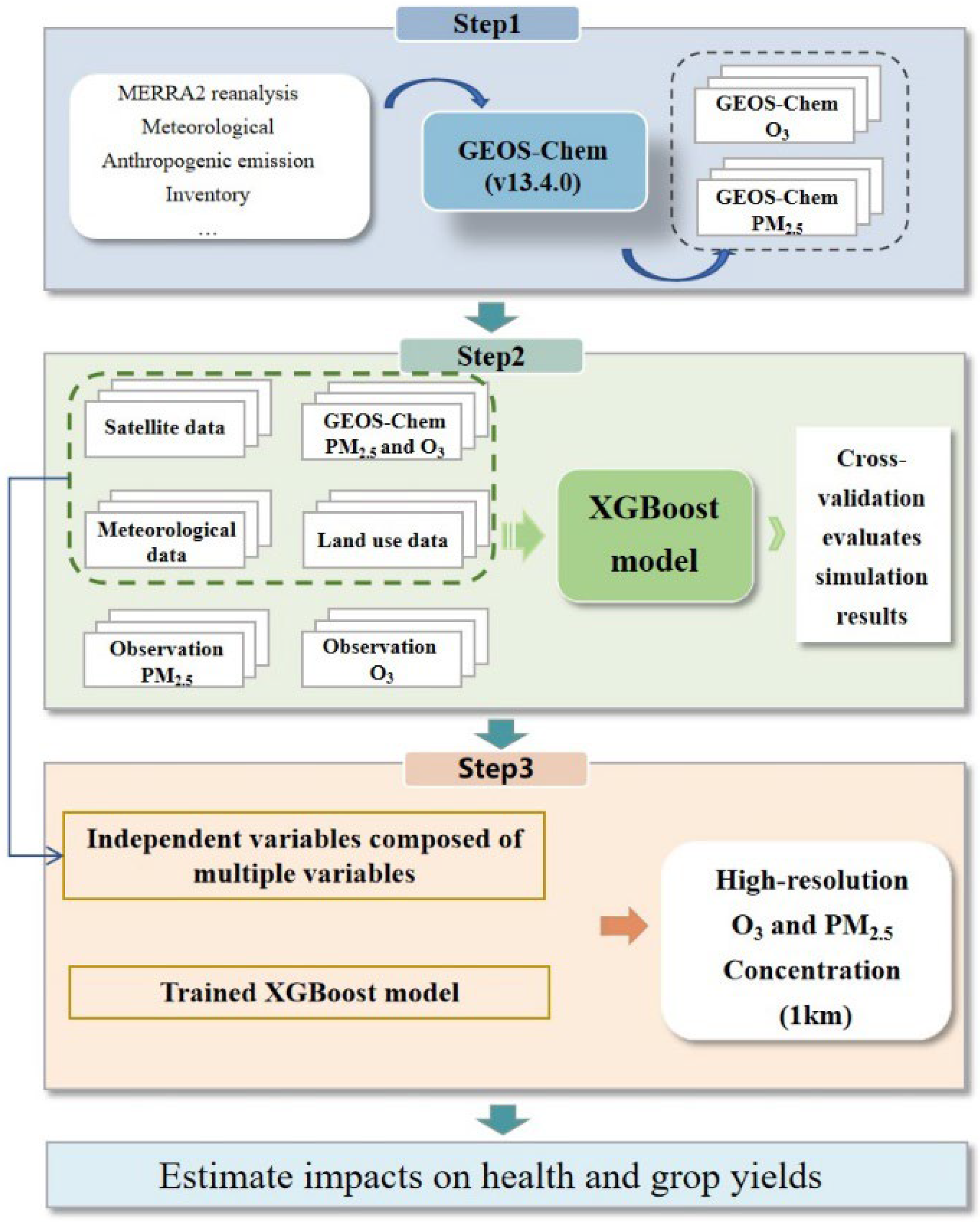
A three-stage model was developed to estimate high-resolution PM2.5 and O3 concentrations across the Sichuan Basin (Figure 1). In the first stage, a comprehensive collection of independent variables was conducted, including observational data, meteorological factors, land use data, model output data, and satellite data. These datasets were preprocessed through data screening and elimination, with spatial interpolation applied to the meteorological and land use data. In the second stage, the independent variables with the same resolution were integrated into the XGBoost model. Optimal model parameters were determined through multiple rounds of testing. Satellite data were not utilized in the O3 modeling process. In the final stage, using the trained XGBoost model, PM2.5 and 8 h O3 concentrations were predicted for grid cells lacking ground-level observations. The resulting dataset spans the years 2015 to 2021, providing high-resolution estimates of PM2.5 and 8 h O3 concentrations across the Sichuan Basin.
It should be noted that the “three-stage model” represents a workflow rather than three independent predictive models. In this framework, GEOS-Chem outputs provide physically consistent background fields, while the machine learning model integrates multi-source data to further refine pollutant distributions. Rather than generating spatial patterns solely from GEOS-Chem, the XGBoost model learns the relationships between ground observations and multiple predictors, including meteorological variables, land use information, and GEOS-Chem outputs. Therefore, the final pollutant fields reflect a combination of physically based simulations and data-driven corrections, allowing for improved representation of local-scale variability.

2.3. Premature Mortality Induced by Long-Term Exposure

In this study, premature mortality attributable to PM2.5 and O3 exposure was estimated. The cases of premature deaths due to excessive pollutant exposure were calculated using the following equation:
SD = I0 (1 − 1∕exp[β(CC0)]) × Pop
where SD represents the number of premature deaths attributable to excessive pollutant exposure, I0 denotes the baseline mortality rate, and β is the exposure–response coefficient. C and C0 correspond to the pollutant concentration and the theoretical minimum-risk exposure level (TMREL), respectively. The TMREL values were set to 2.4 μg/m3 for PM2.5 and 62 μg/m3 for 8 h O3, based on previous epidemiological studies [17,18]. These values are widely used in global burden of disease assessments. Pop represents the total annual population of the Sichuan Basin. When the pollutant concentration (C) is lower than or equal to the theoretical minimum-risk exposure level (C0), the attributable fraction becomes zero, resulting in no estimated premature deaths. Therefore, in some years, the estimated O3-related mortality may be zero due to concentrations not exceeding the threshold value.

2.4. The Calculation of Loss of Yield and Economic Cost

The dose–response relationship of agricultural crops varies across diverse geographical environments, influenced by factors such as cultivar diversity, local climatic regimes, and O3 concentrations. In our study, to better evaluate the impact of ozone concentration on rice yield within the Sichuan Basin, Wang’s model was employed for the computational analysis of single rice [19]. Peng’s model was utilized to estimate the effects of ozone concentration on maize yield [20]. The detailed computational formulas are presented as follows:
RY = 1 − 0.009489 × AOT40
RY = e ( M 7 202 ) 2.47 e ( 25 202 ) 2.47
RY = 1 − 0.00577 × AOT40
RY = e ( M 12 124 ) 2.83 e ( 20 124 ) 2.83
RYL = 1 − RY
where RY represents the crop yield loss relative to the theoretical yield under conditions without O3 exposure. AOT40 is a widely used exposure index in Europe for vegetation protection, defined as the cumulative sum of hourly O3 concentrations exceeding 40 ppb during daylight hours (08:00 to 18:00) over the crop growing season. M7 refers to the mean O3 concentration (in ppb) during a 7 h period (09:00 to 16:00) throughout the entire rice growing season. RYL (Relative Yield Loss) quantifies the theoretical reduction in crop yield in the absence of O3 exposure.
The formula to calculate Crop Yield Loss (CPL) using Relative Yield Loss (RYL) and Crop Yield (CP) is as follows:
C P L = R Y L × C P 1 R Y L
The economic cost loss (ECL) can be calculated based on the rice yield loss (CPL) and the crop purchase price (CPP), with the specific formula as follows:
ECL = CPL × CPP
The ozone exposure indices (AOT40, M7, and M12) were calculated based on modeled O3 concentrations. Since the model provides daily O3 values, these indices were approximated using daily concentrations as proxies for hourly values. Although these indices are traditionally defined using hourly O3 data, the reconstructed dataset in this study provides daily O3 concentrations; therefore, daily values were used as proxies to approximate hourly exposure indices. This approach has been adopted in regional-scale assessments, but it may introduce additional uncertainty into the estimated crop exposure and impact results. Accordingly, these results should be interpreted with caution. The crop growing season was defined from July to September, corresponding to the main period of crop sensitivity to ozone exposure in the Sichuan Basin. Crop production data and economic parameters were obtained from the Sichuan Statistical Yearbook, which provides official statistics on crop yield and market prices. These data were used to estimate economic losses associated with ozone-induced yield reduction. It should be noted that uncertainties remain due to the use of daily O3 data to approximate hourly exposure indices and the application of generalized exposure–response relationships. These uncertainties may affect the magnitude of the estimated crop losses and should be considered when interpreting the results.

3. Results and Discussion

3.1. Model Performance

In order to better understand the relationships among candidate variables, we performed correlation analysis using the Pearson correlation coefficient (Figure S2). Statistical significance (p-value < 0.01) was used as a reference for interpretation rather than as a strict criterion for feature selection. A strong positive correlation exists between PM2.5 concentration and satellite data (0.95), as well as model output data (0.44). This suggests that incorporating model data and satellite data improves the simulation of PM2.5 concentration. A strong negative correlation exists with vapor evaporation (−0.35), 2 m temperature (altitude) (−0.36), and planetary boundary layer height (−0.36). It was assumed that high PM2.5 concentrations lead to atmospheric stagnation, reduced wind speed, and a noticeable restriction in water vapor evaporation [21]. Low temperature reduces atmospheric convection and increases the accumulation of PM2.5 [22]. The interaction between PM2.5 and meteorological factors is closely related to variations in planetary boundary layer height (PBLH) [23]. The concentration of O3 exhibits a strong positive correlation with vapor evaporation (0.56), model output data (0.45), and planetary boundary layer height (0.50), while it shows a negative correlation with surface pressure (−0.43). The significant correlation of meteorological factors and O3 concentrations has been confirmed by previous statistical modeling studies [24,25]. In the high-temperature conditions with prolonged sunlight, the formation of O3 via photochemical reactions is highly favorable. These findings provide preliminary insights into the relationships between predictors and pollutant concentrations, rather than serving as a strict basis for variable selection. To quantitatively evaluate the contribution of different predictors, feature importance analysis was conducted based on the trained XGBoost models for both O3 and PM2.5 (Figure S7). The results show that meteorological variables contribute the largest proportion to the model predictions, highlighting the dominant role of atmospheric conditions. GEOS-Chem model outputs also provide substantial contributions, reflecting their importance in representing large-scale background patterns. In addition, land use variables contribute to capturing local spatial heterogeneity. These results demonstrate that the model effectively integrates multi-source data, combining large-scale chemical transport model outputs with local environmental factors to improve prediction accuracy for both pollutants. It should be noted that, in a machine learning framework, it is difficult to fully separate the independent contribution of each predictor because substantial correlations and shared information may exist among variables. Therefore, the normalized feature importance values were used here to quantify the relative contribution of different predictor groups. In this context, a larger proportion indicates a greater relative contribution to model prediction, rather than a strictly independent physical effect.
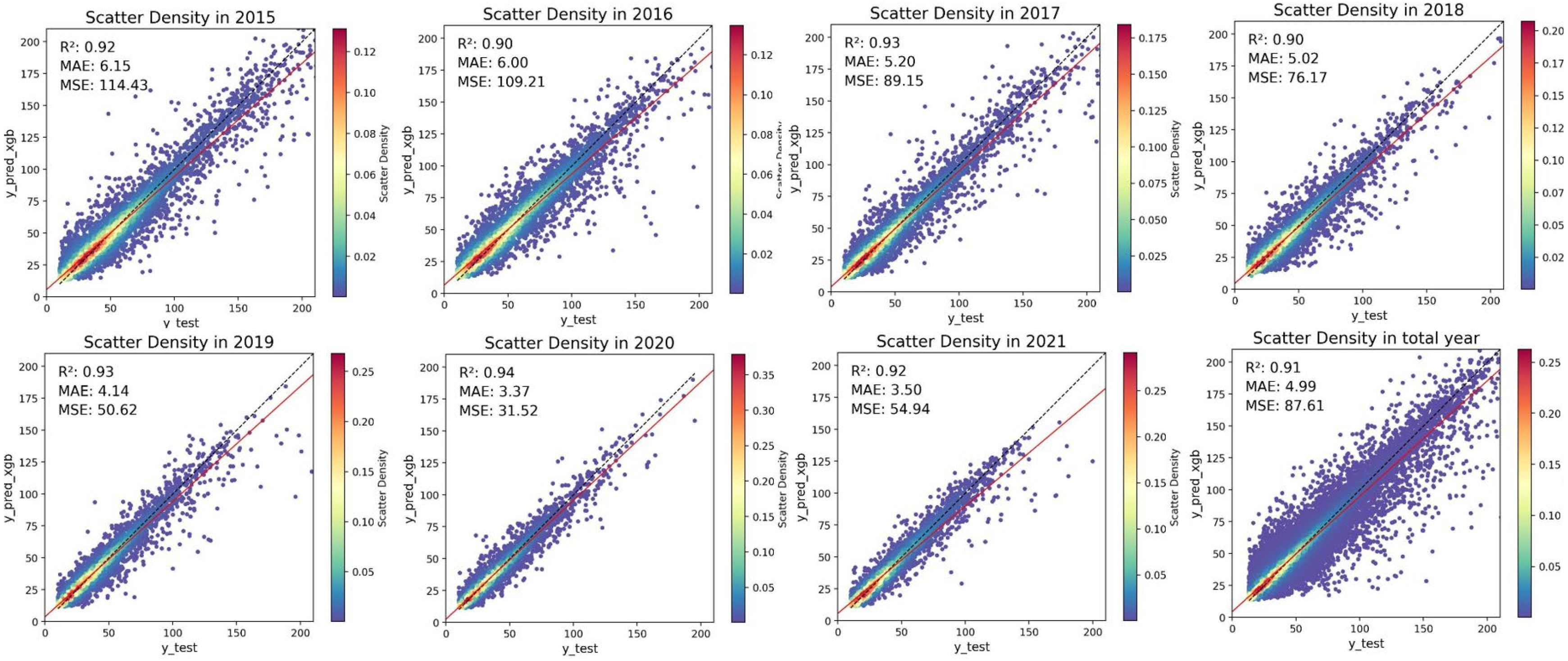
In our study, a three-stage model was developed to construct a PM2.5 and 8 h O3 dataset covering the Sichuan Basin from 2015 to 2021. Figure 2 and Figure S3 depict the interannual variations in R2 values for PM2.5 and 8 h O3. The R2 values for PM2.5 simulation exceed 0.9 during this period. The annual simulation results for 8 h O3 are mostly above 0.6, with a maximum value of 0.8. The R2 values for PM2.5 and 8 h O3 obtained via 10-fold cross-validation were 0.91 and 0.64, respectively. The cross-validation was conducted using a random sampling strategy, in which the dataset was randomly divided into ten subsets, with nine subsets used for training and one for validation in each iteration. Random cross-validation is widely used in similar studies and provides a general evaluation of model predictive capability. In our study, the R2 value for PM2.5 was comparable to that of the TAP dataset (R2: 0.83) [26,27] and some other studies (R2: 0.80–0.84) [27,28,29,30,31,32]. The overall accuracy of the PM2.5 estimates in 2020 (R2 = 0.94, MSE = 31.52 μg/m3, MAE = 3.37 μg/m3) is generally better than that for other years. The R2 value for O3 was comparable to that reported by Wang and exceeded those reported by Dang and Zhan (R2: 0.53–0.69) [8,9,30]. The overall accuracy of the 8 h O3 estimates for the years since 2017 (R2 = 0.75–0.80, MSE = 110.07–191.25 μg/m3, MAE = 7.43–9.90 μg/m3) is generally better than that for the previous years. The R2 value for O3 is slightly lower than that reported by Wei et al., possibly due to the higher resolution and full coverage of the O3 data in our study (R2: 0.78) [33]. However, because random cross-validation may overestimate predictive performance in spatially structured environmental datasets, an additional station-based independent validation was conducted. Specifically, monitoring sites were defined according to their longitude and latitude coordinates, and 20% of the sites were randomly selected as testing sites, while the remaining 80% were used for training. All observations from the testing sites were completely excluded from model training. This design ensures spatial independence between the training and testing datasets and provides a more rigorous evaluation of model generalizability. This validation was conducted for both O3 and PM2.5. The results (Table S1) show that the model maintains stable predictive performance across all years for both pollutants, despite a moderate decrease compared to random cross-validation. This indicates reasonable spatial generalizability. Overall, the three-stage model exhibits satisfactory predictive performance across various evaluation metrics. We emphasize that the 1 km dataset should be interpreted as a high-resolution reconstruction constrained by observations and multi-source predictors, rather than as the creation of entirely new physical information at that scale. The good performance on previously unseen stations nevertheless indicates that the model can reproduce fine-scale spatial variability with reasonable robustness. Compared with random cross-validation, this station-based validation provides a stricter test of model transferability because all observations from the testing sites are excluded from model training. Although some degree of spatial autocorrelation may still exist in environmental predictors, this design reduces the influence of direct spatial overlap between the training and testing datasets and provides more robust evidence of model generalizability.

3.2. Spatial and Temporal Distribution Characteristics of PM2.5 and O3 Concentrations in SCB

In our study, the model was used to estimate PM2.5 and O3 concentrations at 1 km resolution. Figure S4 illustrates that PM2.5 concentrations generally exhibited a decreasing tendency over the study period (p = 0.016). The concentration reached its peak in 2017, with an annual average of 36.79 µg/m3, followed by a decline in subsequent years. Although a least-squares fitting suggests a decreasing pattern, the limited number of annual data points introduces uncertainty in trend estimation. After 2017, PM2.5 concentrations decreased significantly. This trend is consistent with findings from previous studies [34]. In contrast, O3 concentrations exhibited two peaks in 2016 and 2018, with values of 79.37 μg/m3 and 77.09 μg/m3, respectively, and reached a minimum of 54.19 μg/m3 in 2017. From 2018 to 2020, O3 concentrations declined annually, followed by a slight increase in 2021. The Mann–Kendall test indicates a statistically significant decreasing tendency for PM2.5 during 2015–2021, while no statistically significant trend is observed for O3, which shows notable interannual variability. The decline in PM2.5 concentrations in the Sichuan Basin indicates significant progress in air pollution control efforts.
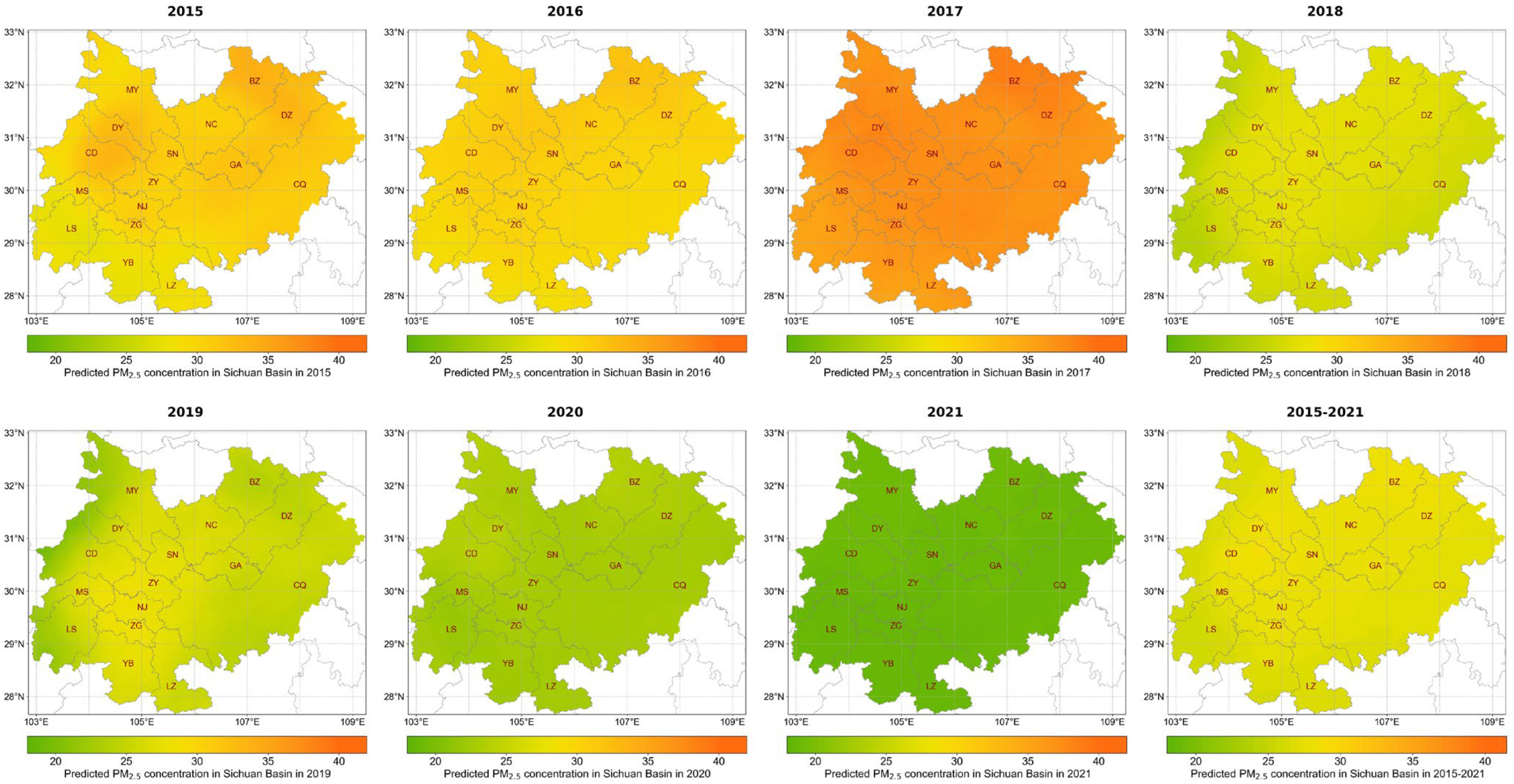
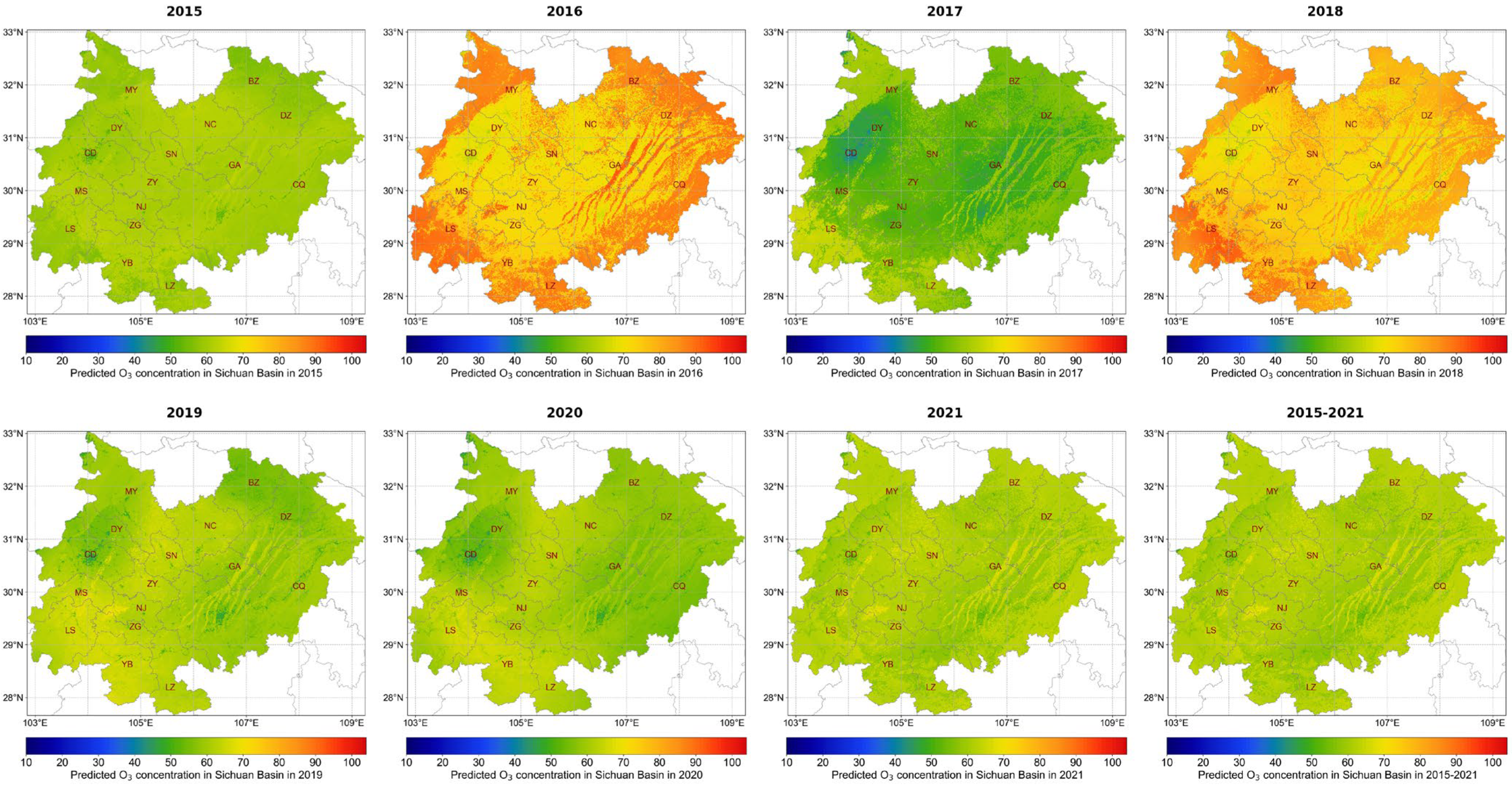
The annual spatial distribution of PM2.5 concentrations is presented in Figure 3. From 2015 to 2017, most areas of the Sichuan Basin experienced elevated concentrations, with the highest levels concentrated in the northwest and southeast regions. At the urban level, high concentrations were marked in Bazhong, Dazhou, Chengdu, and Deyang. From 2015 to 2021, PM2.5 concentrations exhibited a spatial pattern characterized by higher levels in central urban areas compared to the surrounding regions. The western Sichuan Plain experienced a rebound in PM2.5 concentrations in 2019, followed by a subsequent decline in the following years [35]. The areas with high concentrations of PM2.5 are mainly concentrated in the northwest regions. In 2017, severe air pollution was observed in the SCB. It was primarily concentrated in the urban agglomerations of southern and western Sichuan, attributed to substantial local emissions and transboundary pollution in these zones [36]. The sharp decline in PM2.5 concentrations in 2018 may be associated with the implementation of the “Three-Year Action Plan” to “Win the Blue Sky Defense War” introduced in 2018 [37]. It should be noted that the relatively smooth appearance of some spatial maps is partly due to the use of a consistent color scale across different years to facilitate interannual comparison. When year-specific color scales are applied, more pronounced spatial variability can be observed (Figure S6). The spatial distribution of O3 concentrations in the Sichuan Basin is also illustrated in Figure 4. In 2016, O3 levels were relatively high, with surrounding areas exhibiting higher concentrations than the central region. The spatial pattern in 2018 was similar to that in 2016, albeit with a slight reduction in overall concentrations. From 2019 to 2020, O3 concentrations were higher in the western part of the basin and lower in the east. In 2021, O3 concentrations increased across the entire study area. In Chengdu, elevated emissions of NOx and VOCs from motor vehicles and industrial sources result in enhanced photochemical reactions and substantial O3 formation. In the central area of Chengdu, relatively lower O3 concentrations can be observed, which is attributable to the “titration” effect of nitric oxide (NO). Elevated NO levels, primarily originating from vehicle exhaust and other anthropogenic emissions in the urban core, rapidly deplete O3 through chemical reactions, thereby leading to a reduction in ambient O3 concentrations. Surrounding cities, such as Deyang and Mianyang, are impacted by regional transport, leading to elevated O3 concentrations as well [38]. The mountains on the western edge of the basin impede the dispersion of pollutants, resulting in their accumulation. The terrain in the central hilly area is characterized by low elevation and poor ventilation, leading to weak wind conditions, which hinder O3 dispersion and result in a banded spatial distribution [39]. The southern part of Sichuan Province experiences elevated O3 levels, attributable to intensive industrial activities [40]. The overall increase in pollutant concentrations observed in 2021 might be attributed to the occurrence of heatwaves.
In 2017, the most severe year for PM2.5 pollution, Bazhong (38.08 μg/m3), Deyang (37.80 μg/m3), Dazhou (37.36 μg/m3), and Chengdu (37.14 μg/m3) experienced significant pollution. However, the year of 2016 exhibited more severe O3 pollution, with Leshan (83.21 μg/m3), Luzhou (80.02 μg/m3), and Chongqing (79.93 μg/m3) recording the highest concentrations. Studies have indicated that Leshan possesses the highest VOC emissions among all of these cities in the Sichuan Basin, primarily originating from traffic emissions and stationary combustion sources [41]. In 2018, several prefecture-level cities such as Leshan City (83.13 μg/m3), Ya’an City (82 μg/m3), Guangyuan City (81.26 μg/m3) and Yibin City (81.00 μg/m3) also experienced serious O3 pollution.
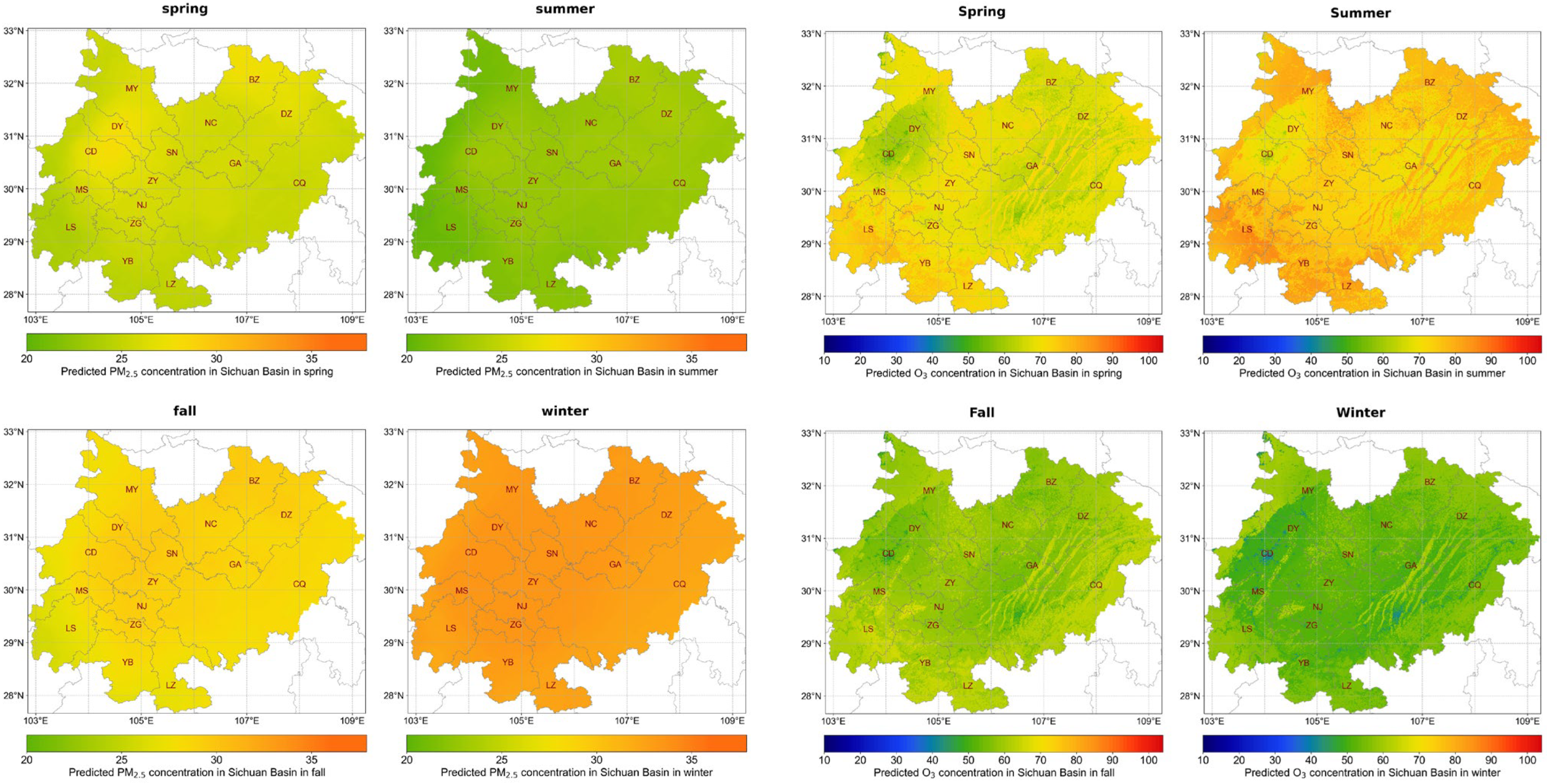
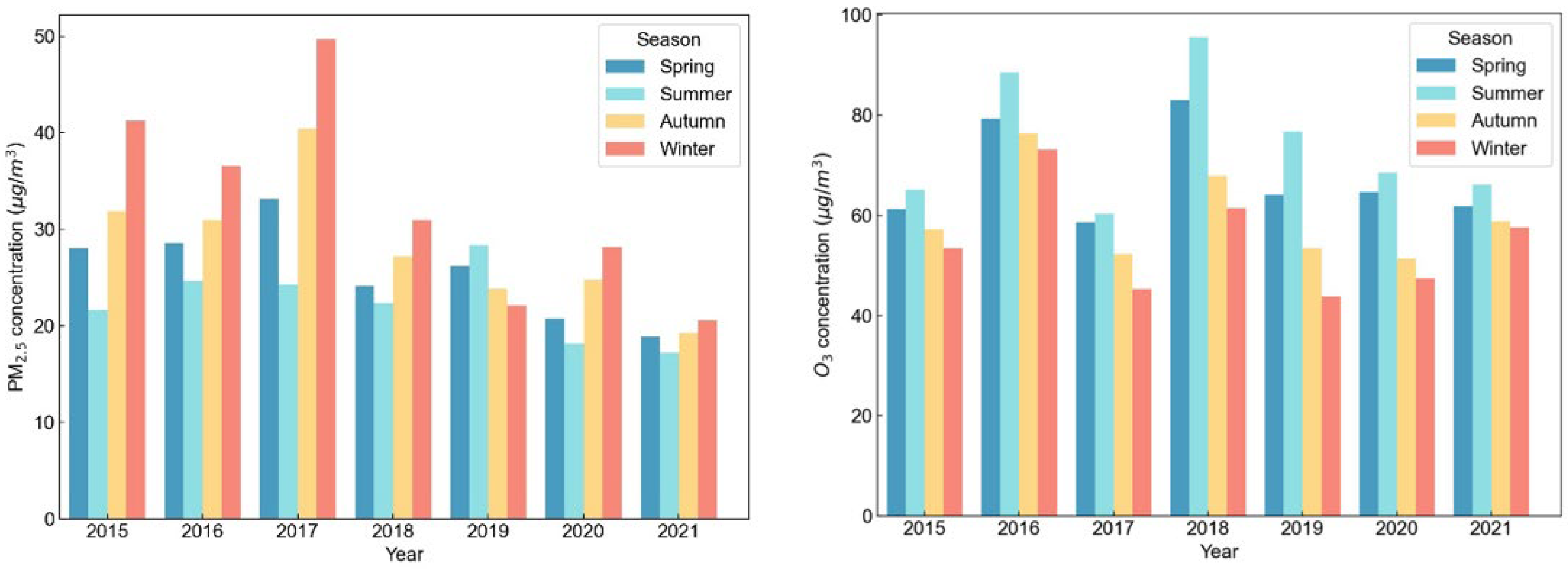
Figures S5, Figure 5 and Figure 6 illustrate the temporal and seasonal distribution of PM2.5. The concentration of PM2.5 is generally higher in autumn and winter, lower in spring and summer, and peaks during winter. In contrast, O3 concentrations are elevated in spring and summer but lower in autumn and winter, reaching their highest levels in summer. In winter, the boundary layer height tends to be lower, atmospheric diffusion conditions are unfavorable, and pollutants are more likely to accumulate [42]. Temperature inversion layers frequently occur, inhibiting the vertical diffusion of pollutants. High humidity promotes the hygroscopic growth and secondary formation of PM2.5 [43]. In contrast, high temperatures intensify atmospheric convection, leading to an increased boundary layer height and facilitating the dispersion of pollutants [44,45,46]. Increased precipitation enhances the wet deposition effect, contributing to pollutant removal. Strong winds in spring may facilitate the regional transport of pollutants [47]. Analyzing the interannual variation in seasonal pollutant concentrations, the PM2.5 concentration was notably high in the winter of 2017, reaching 50.11 μg/m3. Additionally, 2017 recorded the highest annual average PM2.5 concentration across all years. However, not all years exhibited pronounced seasonal differences. In 2018, seasonal variations in PM2.5 concentration were minimal, with similar levels in summer and winter. Furthermore, in 2019, PM2.5 concentrations in autumn and winter were even lower than those in spring and summer. For O3, the most severe pollution occurred in the summer of 2018, with concentrations reaching 95.56 μg/m3. From 2015 to 2021, O3 levels consistently followed a seasonal pattern, being highest in summer, followed by spring, and lower in autumn and winter. O3 concentrations are generally higher during the warm season compared to the cold season. The seasonal variation is strongly influenced by chemical mechanisms. During the warm season, VOC control dominates ozone formation, while NOx titration effects prevail in the cold season [35]. In addition, temperature serves as the primary driving factor for O3 formation, and a significant positive correlation exists between temperature and O3 concentration [48,49].

3.3. Health Effects of Excessive Pollutant Exposure

In this study, we estimated total premature deaths attributable to PM2.5 and O3 exposure using high-resolution data. Table 1 presents the specific mortality estimates associated with PM2.5 and O3 pollution. To enhance confidence in our results, we calculated the maximum and minimum values within a 95% confidence interval (CI), ensuring that the true value falls within this range 95% of the time. From 2015 to 2021, elevated PM2.5 concentrations were associated with an estimated 20,248 (95% CI: 0–39,988), 19,911 (95% CI: 0–40,130), 26,073 (95% CI: 0–51,303), 19,382 (95% CI: 0–38,298), 21,459 (95% CI: 0–42,348), 18,478 (95% CI: 0–13,757), and 1040 (95% CI: 0–27,280) premature deaths, respectively. The highest number of cases occurred in 2017, reaching 1749 deaths. For O3 exposure, at a threshold of 29.1 ppm, the estimated number of premature deaths due to elevated O3 levels was 4586 (95% CI: 2180–6992) in 2015, 45,728 (95% CI: 21,739–69,717) in 2016, 0 in 2017, 41,177 (95% CI: 19,576–62,779) in 2018, 5401 (95% CI: 2567–8234) in 2019, 1880 (95% CI: 893–2866) in 2020, and 8428 (95% CI: 4007–12,850) in 2021. The highest mortality due to O3 overexposure was observed in 2016, with 45,728 premature deaths. Overall, our findings are consistent with those reported in previous studies [50,51]. It should be noted that the estimated premature deaths represent the attributable fraction associated with pollutant exposure, rather than direct causation. These estimates reflect population-level risk and may involve combined effects with other health risk factors. Long-term exposure to high concentrations of PM2.5 and O3 has significant adverse effects on public health in the Sichuan Basin.

3.4. Effects of Excessive Pollutant Exposure on Food Production

Table 2 and Table 3 present the values of AOT40, RY, RYL, and CPL for rice and maize during their respective growing seasons from 2015 to 2021 in the Sichuan Basin. According to the AOT40 index, the highest RYL for rice (12.6%) occurred in 2018, leading to an estimated production loss of 213.27 × 10⁴ tons. While the M7-based RYL and CPL values were lower than those from AOT40, both indices identified 2018 as the year with the greatest loss. The annual rice production from 2015 to 2021 was 1465.2, 1467.3, 1473.7, 1478.6, 1469.8, 1475.3, and 1493.4 × 104 tons, respectively. The proportion of rice yield loss due to O3 exposure, based on the AOT40 index, ranged from 1.19% (2021) to 14.43% (2018). Similarly, for maize, the highest RYL (7.67%) occurred in 2018, resulting in an estimated production loss of 88.52 × 10⁴ tons. The annual maize production from 2015 to 2021 was 992.3, 1058.0, 1068.0, 1066.3, 1062.2, 1065.0, and 1084.7 × 104 tons, respectively. The proportion of maize yield loss based on the AOT40 index varied from 0.72% (2021) to 8.3% (2018). Notably, the RYL of maize calculated using the M12 index was consistently lower than that obtained using AOT40.
Previous studies on O3 exposure and its impact on rice and maize yields have reported varying results due to differences in methodologies, definitions of the growing season, and study periods. Research indicates that the yield reduction for rice ranges from 7.3% to 8.8%, while for maize, it falls between 5.0% and 6.3% [52]. Lin et al. estimated that O3-induced relative yield losses ranged from 3.9% to 15.0% for single-season rice and from 2.2% to 5.5% for maize [53]. Cao et al. estimated that the relative yield loss (RYL) based on AOT40 due to O3 in 2015 was 10.4% [54]. Feng et al. estimated that the relative yield loss (RYL) due to O3 in the North China Plain during 2014–2017 was 8.2–13.4% [55]. Yao et al. [55] estimated RYL caused by O3 in Sichuan Province to be 4.9–9.2% for single rice [56]. RYL values calculated in our study are larger than the differences between different years calculated in previous studies, while the minimum values are lower than those in other studies. This discrepancy could be attributed to the higher-resolution ozone calculations used in our study and the larger sample size compared to the number of sites. Additionally, the RYL calculated based on AOT40 is significantly higher than that calculated based on M7, which is consistent with previous studies [54,56,57].

4. Implications and Limitations

In our study, a three-stage model was used to construct high-resolution PM2.5 and O3 data covering the Sichuan Basin. However, the limited number and uneven spatial distribution of ground monitoring stations may influence the accuracy of the simulation results. Additionally, the estimation process may involve coefficients that are not fully applicable to the Sichuan Basin. A certain level of uncertainty exists regarding the estimated impacts on human health and agricultural production. The framework developed in this study can be considered a transferable tool for high-resolution air pollution assessment and impact evaluation. The methodology can be applied to other regions, provided that key input data are available, including ground monitoring observations, meteorological data, satellite retrievals, and chemical transport model outputs. However, several limitations should be noted. The model performance depends on the density and representativeness of monitoring stations, and uncertainties may arise from the use of generalized exposure–response relationships and simplified assumptions in health and crop impact models. Therefore, when applying this framework to other regions, local calibration and validation are recommended, and the results should be interpreted with consideration of regional characteristics and data availability. In addition, because the reconstructed dataset provides daily rather than hourly O3 concentrations, the ozone exposure indices used in the crop impact assessment were approximated from daily values. This may introduce uncertainty into the estimation of crop losses and related economic costs, and the corresponding results should therefore be interpreted as indicative rather than exact.
Although there is some uncertainty in the calculation process, some policy suggestions can be provided. The concentration of PM2.5 has significantly improved, but continued strict enforcement of pollution control policies is necessary to prevent a rebound. Synergistic control of VOCs and NOx is essential to effectively reduce O3 concentrations. Meanwhile, the joint prevention and control of PM2.5 and O3 should be further enhanced. Pollution control efforts should be prioritized in heavily polluted cities. Sichuan Province should strengthen PM2.5 pollution control in Bazhong, Deyang, Chengdu, and other cities, and people should reduce their travel during high pollution periods. At the same time, strengthened ozone pollution prevention and control efforts are also needed in cities such as Leshan and Luzhou. The agricultural sector should implement protective measures during high O3 pollution periods, such as adjusting planting schedules or using O3-tolerant crop varieties. Additionally, applying protective agricultural practices, like covering crops or using anti-ozone treatments, could help reduce the impact on rice and maize yields, especially during the growing season when O3 concentrations peak. Given that only past data were simulated, future research should prioritize forecasting PM2.5 and O3 concentrations to facilitate more effective prevention of the adverse impacts associated with high pollutant concentrations.

Supplementary Materials

The following supporting information can be downloaded at: https://www.mdpi.com/article/10.3390/atmos17050432/s1, Figure S1: Spatial distribution of the monitoring sites; Figure S2: Correlation between meteorological factors, land-use data, model output O3 concentration, and site O3 concentration (left), and correlation between meteorological factors, land-use data, model output PM2.5 concentration, satellite data, and site PM2.5 concentration (right) during 2015–2021; Figure S3: O3 regression scatter density map from 2015 to 2021; Figure S4: Changes in PM2.5 and O3 concentrations during 2015–2021; Figure S5: Average concentrations of PM2.5 (left) and O3 (right) in different seasons; Figure S6: Distribution of PM2.5 (μg/m3) from 2015 to 2021; Figure S7: Relative contribution of predictor groups for O3 and PM2.5; Table S1: Results of station-based independent validation for O3 and PM2.5 from 2015 to 2021.

Author Contributions

Y.S. (Yubing Shen): Writing—original draft, Y.S. (Yumeng Shao): Data curation. L.Z.: Data curation. R.L.: Writing—original draft, Conceptualization. G.W.: Conceptualization. All authors have read and agreed to the published version of the manuscript.

Funding

This research was funded by the National Natural Science Foundation of China (42577111, U23A2030).

Institutional Review Board Statement

Not applicable.

Informed Consent Statement

Not applicable.

Data Availability Statement

The data presented in this study are available on request from the corresponding author.

Conflicts of Interest

The authors declare no conflicts of interest.

References

  1. Zhu, T. Air pollution in China: Scientific challenges and policy implications. Natl. Sci. Rev. 2017, 4, 800. [Google Scholar] [CrossRef]
  2. Turner, M.C.; Jerrett, M.; Pope, C.A., III; Krewski, D.; Gapstur, S.M.; Diver, W.R.; Beckerman, B.S.; Marshall, J.D.; Su, J.; Crouse, D.L.; et al. Long-term ozone exposure and mortality in a large prospective study. Am. J. Respir. Crit. Care Med. 2016, 193, 1134–1142. [Google Scholar] [CrossRef]
  3. Du, S.; He, C.; Zhang, L.; Zhao, Y.; Chu, L.; Ni, J. Policy implications for synergistic management of PM2.5 and O3 pollution from a pattern-process-sustainability perspective in China. Sci. Total Environ. 2024, 916, 170210. [Google Scholar] [CrossRef]
  4. Zhang, W.; Feng, Z.; Wang, X.; Liu, X.; Hu, E. Quantification of ozone exposure- and stomatal uptake-yield response relationships for soybean in Northeast China. Sci. Total Environ. 2017, 599–600, 710–720. [Google Scholar] [CrossRef]
  5. Feng, Z.; Kobayashi, K. Assessing the impacts of current and future concentrations of surface ozone on crop yield with meta-analysis. Atmos. Environ. 2009, 43, 1510–1519. [Google Scholar] [CrossRef]
  6. Chen, G.; Knibbs, L.D.; Zhang, W.; Li, S.; Cao, W.; Guo, J.; Ren, H.; Wang, B.; Wang, H.; Williams, G.; et al. Estimating spatiotemporal distribution of PM1 concentrations in China with satellite remote sensing, meteorology, and land use information. Environ. Pollut. 2018, 233, 1086–1094. [Google Scholar] [CrossRef]
  7. Fu, X.; Wang, S.X.; Zhao, B.; Xing, J.; Cheng, Z.; Liu, H.; Hao, J.M. Emission inventory of primary pollutants and chemical speciation in 2010 for the Yangtze River Delta region, China. Atmos. Environ. 2013, 70, 39–50. [Google Scholar] [CrossRef]
  8. Richardson, L.F. Weather Prediction by Numerical Process; Cambridge University Press: Cambridge, UK, 2007. [Google Scholar]
  9. Stern, R.; Builtjes, P.; Schaap, M.; Timmermans, R.; Vautard, R.; Hodzic, A.; Memmesheimer, M.; Feldmann, H.; Renner, E.; Wolke, R.; et al. A model inter-comparison study focusing on episodes with elevated PM10 concentrations. Atmos. Environ. 2008, 42, 4567–4588. [Google Scholar] [CrossRef]
  10. Zhan, Y.; Luo, Y.; Deng, X.; Grieneisen, M.L.; Zhang, M.; Di, B. Spatiotemporal prediction of daily ambient ozone levels across China using random forest for human exposure assessment. Environ. Pollut. 2018, 233, 464–473. [Google Scholar] [CrossRef] [PubMed]
  11. Zhao, Y.; Wang, S.X.; Duan, L.; Lei, Y.; Cao, P.F.; Hao, J.M. Primary air pollutant emissions of coal-fired power plants in China: Current status and future prediction. Atmos. Environ. 2008, 42, 8442–8452. [Google Scholar] [CrossRef]
  12. Vautard, R.; Hauglustaine, D. Impact of global climate change on regional air quality: Introduction to the thematic issue. Comptes Rendus Geosci. 2007, 339, 703–708. [Google Scholar] [CrossRef]
  13. Yang, J.; Huang, X. The 30 m annual land cover dataset and its dynamics in China from 1990 to 2019. Earth Syst. Sci. Data 2021, 13, 3907–3925. [Google Scholar] [CrossRef]
  14. Liu, H.; Jacob, D.J.; Bey, I.; Yantosca, R.M. Constraints from 210Pb and 7Be on wet deposition and transport in a global three-dimensional chemical tracer model driven by assimilated meteorological fields. J. Geophys. Res. Atmos. 2001, 106, 12109–12128. [Google Scholar] [CrossRef]
  15. Engel-Cox, J.A.; Holloman, C.H.; Coutant, B.W.; Hoff, R.M. Qualitative and quantitative evaluation of MODIS satellite sensor data for regional and urban scale air quality. Atmos. Environ. 2004, 38, 2495–2509. [Google Scholar] [CrossRef]
  16. Jin, J.L.; Ma, J.Z.; Lin, W.L.; Zhao, H.R.; Shaiganfar, R.; Beirle, S.; Wagner, T. MAX-DOAS measurements and satellite validation of tropospheric NO2 and SO2 vertical column densities at a rural site of North China. Atmos. Environ. 2016, 133, 12–25. [Google Scholar] [CrossRef]
  17. Burnett, R.; Chen, H.; Szyszkowicz, M.; Fann, N.; Hubbell, B.; Pope, C.A.; Apte, J.S.; Brauer, M.; Cohen, A.; Weichenthal, S.; et al. Global estimates of mortality associated with long-term exposure to outdoor fine particulate matter. Proc. Natl. Acad. Sci. USA 2018, 115, 9592–9597. [Google Scholar] [CrossRef]
  18. GBD 2019 Risk Factors Collaborators. Global burden of 87 risk factors in 204 countries and territories, 1990–2019: A systematic analysis. Lancet 2020, 396, 1223–1249. [CrossRef]
  19. Wang, X.; Zhang, Q.; Zheng, F.; Zheng, Q.; Yao, F.; Chen, Z.; Zhang, W.; Hou, P.; Feng, Z.; Song, W.; et al. Effects of elevated O3 concentration on winter wheat and rice yields in the Yangtze River Delta, China. Environ. Pollut. 2012, 171, 118–125. [Google Scholar] [CrossRef]
  20. Peng, J.; Shang, B.; Xu, Y.; Feng, Z.; Pleijel, H.; Calatayud, V. Ozone exposure- and flux-yield response relationships for maize. Environ. Pollut. 2019, 252, 1–7. [Google Scholar] [CrossRef]
  21. Yang, Y.R.; Liu, X.G.; Qu, Y.; An, J.L.; Jiang, R.; Zhang, Y.H.; Sun, Y.L.; Wu, Z.J.; Zhang, F.; Xu, W.Q.; et al. Characteristics and formation mechanism of continuous hazes in China: A case study during the autumn of 2014 in the North China Plain. Atmos. Chem. Phys. 2015, 15, 8165–8178. [Google Scholar] [CrossRef]
  22. Li, J.; Chen, H.; Li, Z.; Wang, P.; Cribb, M.; Fan, X. Low-level temperature inversions and their effect on aerosol condensation nuclei concentrations under different large-scale synoptic circulations. Adv. Atmos. Sci. 2015, 32, 898–908. [Google Scholar] [CrossRef]
  23. Emeis, S.; Schäfer, K. Remote sensing methods to investigate boundary-layer structures relevant to air pollution in cities. Bound.-Layer Meteorol. 2006, 121, 377–385. [Google Scholar] [CrossRef]
  24. Dang, R.; Liao, H.; Fu, Y. Quantifying the anthropogenic and meteorological influences on summertime surface ozone in China over 2012–2017. Sci. Total Environ. 2021, 754, 142394. [Google Scholar] [CrossRef]
  25. Wise, E.K.; Comrie, A.C. Meteorologically adjusted urban air quality trends in the Southwestern United States. Atmos. Environ. 2005, 39, 2969–2980. [Google Scholar] [CrossRef]
  26. Geng, G.N.; Xiao, Q.Y.; Liu, S.G.; Liu, X.D.; Cheng, J.; Zheng, Y.X.; Xue, T.; Tong, D.; Zheng, B.; Peng, Y.R.; et al. Tracking air pollution in China: Near real-time PM2.5 retrievals from multisource data fusion. Environ. Sci. Technol. 2021, 55, 12106–12115. [Google Scholar] [CrossRef] [PubMed]
  27. Xiao, Q.; Chang, H.H.; Geng, G.; Liu, Y. An ensemble machine-learning model to predict historical PM2.5 concentrations in China from satellite data. Environ. Sci. Technol. 2018, 52, 13260–13269. [Google Scholar] [CrossRef]
  28. Chen, G.; Li, S.; Knibbs, L.D.; Hamm, N.A.S.; Cao, W.; Li, T.; Guo, J.; Ren, H.; Abramson, M.J.; Guo, Y. A machine learning method to estimate PM2.5 concentrations across China with remote sensing, meteorological and land use information. Sci. Total Environ. 2018, 636, 52–60. [Google Scholar] [CrossRef] [PubMed]
  29. Gui, K.; Che, H.Z.; Zeng, Z.L.; Wang, Y.Q.; Zhai, S.X.; Wang, Z.M.; Luo, M.; Zhang, L.; Liao, T.T.; Zhao, H.J.; et al. Construction of a virtual PM2.5 observation network in China based on high-density surface meteorological observations using the extreme gradient boosting model. Environ. Int. 2020, 141, 105801. [Google Scholar] [CrossRef]
  30. Song, Z.H.; Chen, B.; Huang, J.P. Combining Himawari-8 AOD and deep forest model to obtain city-level distribution of PM2.5 in China. Environ. Pollut. 2022, 297, 118826. [Google Scholar] [CrossRef]
  31. Wang, Y.Y.; Huang, C.H.; Hu, J.L.; Wang, M. Development of high-resolution spatio-temporal models for ambient air pollution in a metropolitan area of China from 2013 to 2019. Chemosphere 2022, 291, 132918. [Google Scholar] [CrossRef]
  32. Yin, S.C.; Li, T.W.; Cheng, X.; Wu, J.A. Remote sensing estimation of surface PM2.5 concentrations using a deep learning model improved by data augmentation and a particle size constraint. Atmos. Environ. 2022, 287, 119282. [Google Scholar] [CrossRef]
  33. Wei, J.; Li, Z.; Li, K.; Dickerson, R.R.; Pinker, R.T.; Wang, J.; Liu, X.; Sun, L.; Xue, W.; Cribb, M. Full-coverage mapping and spatiotemporal variations of ground-level ozone (O3) pollution from 2013 to 2020 across China. Remote Sens. Environ. 2022, 270, 112775. [Google Scholar] [CrossRef]
  34. Jin, H.; Chen, X.; Zhong, R.; Liu, M. Influence and prediction of PM2.5 through multiple environmental variables in China. Sci. Total Environ. 2022, 849, 157910. [Google Scholar] [CrossRef] [PubMed]
  35. Wu, X.; Shi, G.; Xiang, X.; Yang, F. The characteristics of PM2.5 pollution episodes during 2016–2019 in Sichuan Basin, China. Aerosol Air Qual. Res. 2021, 21, 210126. [Google Scholar] [CrossRef]
  36. Qiao, X.; Guo, H.; Tang, Y.; Wang, P.; Deng, W.; Zhao, X.; Hu, J.; Ying, Q.; Zhang, H. Local and regional contributions to fine particulate matter in the 18 cities of Sichuan Basin, southwestern China. Atmos. Chem. Phys. 2019, 19, 5791–5803. [Google Scholar] [CrossRef]
  37. Li, S.; Guo, J.; Wang, Y.; Lian, X.; Li, J. The characteristics of PM2.5 and O3 synergistic pollution in the Sichuan Basin urban agglomeration. Atmosphere 2025, 16, 329. [Google Scholar] [CrossRef]
  38. Zhao, S.; Yu, Y.; Yin, D.; Qin, D.; He, J.; Dong, L. Spatial patterns and temporal variations of six criteria air pollutants during 2015 to 2017 in the city clusters of Sichuan Basin, China. Sci. Total Environ. 2018, 624, 540–557. [Google Scholar] [CrossRef]
  39. Ning, G.; Yim, S.H.L.; Yang, Y.; Gu, Y.; Dong, G. Modulations of synoptic and climatic changes on ozone pollution and its health risks in mountain-basin areas. Atmos. Environ. 2020, 240, 117808. [Google Scholar] [CrossRef]
  40. Wu, K.; Wang, Y.; Qiao, Y.; Liu, Y.; Wang, S.; Yang, X.; Wang, H.; Lu, Y.; Zhang, X.; Lei, Y. Drivers of 2013–2020 ozone trends in the Sichuan Basin, China: Impacts of meteorology and precursor emission changes. Environ. Pollut. 2022, 300, 118914. [Google Scholar] [CrossRef]
  41. Xie, Y.; Cheng, C.; Wang, Z.; Wang, K.; Wang, Y.; Zhang, X.; Li, X.; Ren, L.; Liu, M.; Li, M. Exploration of O3-precursor relationship and observation-oriented O3 control strategies in a non-provincial capital city, southwestern China. Sci. Total Environ. 2021, 800, 149422. [Google Scholar] [CrossRef]
  42. Chen, Z.; Chen, D.; Zhao, C.; Kwan, M.P.; Cai, J.; Zhuang, Y.; Zhao, B.; Wang, X.; Chen, B.; Yang, J.; et al. Influence of meteorological conditions on PM2.5 concentrations across China: A review of methodology and mechanism. Environ. Int. 2020, 139, 105558. [Google Scholar] [CrossRef]
  43. Mousavinezhad, S.; Choi, Y.; Pouyaei, A.; Ghahremanloo, M.; Nelson, D.L. A comprehensive investigation of surface ozone pollution in China, 2015–2019: Separating the contributions from meteorology and precursor emissions. Atmos. Res. 2021, 257, 105599. [Google Scholar] [CrossRef]
  44. Ding, A.; Huang, X.; Nie, W.; Chi, X.; Xu, Z.; Zheng, L.; Xu, Z.; Xie, Y.; Qi, X.; Shen, Y.; et al. Significant reduction of PM2.5 in eastern China due to regional-scale emission control: Evidence from SORPES in 2011–2018. Atmos. Chem. Phys. 2019, 19, 11791–11801. [Google Scholar] [CrossRef]
  45. Xiao, Q.; Zheng, Y.; Geng, G.; Chen, C.; Huang, X.; Che, H.; Zhang, X.; He, K.; Zhang, Q. Separating emission and meteorological contributions to long-term PM2.5 trends over eastern China during 2000–2018. Atmos. Chem. Phys. 2021, 21, 9475–9496. [Google Scholar] [CrossRef]
  46. Zhai, S.; Jacob, D.J.; Wang, X.; Shen, L.; Li, K.; Zhang, Y.; Gui, K.; Zhao, T.; Liao, H. Fine particulate matter (PM2.5) trends in China, 2013–2018: Separating contributions from anthropogenic emissions and meteorology. Atmos. Chem. Phys. 2019, 19, 11031–11041. [Google Scholar] [CrossRef]
  47. Zhang, Y.L.; Cao, F. Fine particulate matter (PM2.5) in China at a city level. Sci. Rep. 2015, 5, 14884. [Google Scholar] [CrossRef] [PubMed]
  48. Li, R.; Wang, Z.; Cui, L.; Fu, H.; Zhang, L.; Kong, L.; Chen, W.; Chen, J. Air pollution characteristics in China during 2015–2016: Spatiotemporal variations and key meteorological factors. Sci. Total Environ. 2019, 648, 902–915. [Google Scholar] [CrossRef]
  49. Zhang, H.; Wang, Y.; Hu, J.; Ying, Q.; Hu, X.M. Relationships between meteorological parameters and criteria air pollutants in three megacities in China. Environ. Res. 2015, 140, 242–254. [Google Scholar] [CrossRef] [PubMed]
  50. Xie, Y.; Dai, H.; Dong, H.; Hanaoka, T.; Masui, T. Economic impacts from PM2.5 pollution-related health effects in China: A provincial-level analysis. Environ. Sci. Technol. 2016, 50, 4836–4843. [Google Scholar] [CrossRef]
  51. Yang, X.; Ben, B.; Wang, W.; Long, B.; Xie, Y.; Wu, K.; Zhang, X. Fine particulate matter pollution in the Sichuan Basin of China from 2013 to 2020: Sources, emissions, and mortality burden. Environ. Int. 2025, 197, 109366. [Google Scholar] [CrossRef]
  52. Zhao, H.; Zheng, Y.; Zhang, Y.; Li, T. Evaluating the effects of surface O3 on three main food crops across China during 2015–2018. Environ. Pollut. 2020, 258, 113794. [Google Scholar] [CrossRef]
  53. Lin, Y.; Jiang, F.; Zhao, J.; Zhu, G.; He, X.; Ma, X.; Li, S.; Sabel, C.E.; Wang, H. Impacts of O3 on premature mortality and crop yield loss across China. Atmos. Environ. 2018, 194, 41–47. [Google Scholar] [CrossRef]
  54. Cao, J.; Wang, X.; Zhao, H.; Ma, M.; Chang, M. Evaluating the effects of ground-level O3 on rice yield and economic losses in Southern China. Environ. Pollut. 2020, 267, 115694. [Google Scholar] [CrossRef] [PubMed]
  55. Feng, Z.; Hu, T.; Tai, A.P.K.; Calatayud, V. Yield and economic losses in maize caused by ambient ozone in the North China Plain (2014–2017). Sci. Total Environ. 2020, 722, 137958. [Google Scholar] [CrossRef]
  56. Yao, W.; You, X.; Gao, A.; Lin, J.; Wu, M.; Li, A.; Gao, Z.; Zhang, Y.; Zhang, H. Assessment of ozone pollution on rice yield reduction and economic losses in Sichuan province during 2015–2020. Environ. Pollut. 2024, 357, 124404. [Google Scholar] [CrossRef] [PubMed]
  57. Ngo Thanh, D.; Lai Nguyen, H.; Nguyen Thi Kim, O. Assessment of rice yield loss due to exposure to ozone pollution in Southern Vietnam. Sci. Total Environ. 2016, 566, 1069–1079. [Google Scholar] [CrossRef]
Figure 1. The workflow of full-coverage air pollutant estimates across Sichuan basin.
Atmosphere 17 00432 g001
Figure 2. PM2.5 regression scatter density map from 2015 to 2021.
Atmosphere 17 00432 g002
Figure 3. Spatial distribution of annual mean PM2.5 concentrations (μg/m3) in the Sichuan Basin from 2015 to 2021.
Atmosphere 17 00432 g003
Figure 4. Spatial distribution of annual mean O3 concentrations (μg/m3) in the Sichuan Basin from 2015 to 2021.
Atmosphere 17 00432 g004
Figure 5. Average concentrations of PM2.5 (left) and O3 (right) in different seasons.
Atmosphere 17 00432 g005
Figure 6. Interannual variation in the mean concentrations of PM2.5 (left) and O3 (right) in different seasons.
Atmosphere 17 00432 g006
Table 1. Deaths on account of long-term PM2.5 and O3 exposure from 2015 to 2021.
PM2.5O3
YearDeathDown (CI: 95%)Up
(CI: 95%)
DeathDown (CI: 95%)Up
(CI: 95%)
201520,248039,988458621806992
201619,911039,33245,72821,73969,717
201724,601048,452000
201817,059033,75841,17719,57662,779
201916,344032,358540125678234
202014,783029,29518808932866
202111,955023,7358428400712,850
Table 2. AOT40, RY, RYL and CPL for single rice based on AOT40 and M7 (parentheses) during the rice-growing seasons in the Sichuan Basin.
CropYearAOT40RYRYLCPL
(×104 tons)
Rice20151.95540.9814
(0.9946)
0.0186
(0.0054)
27.7003
(7.9253)
20167.98340.9242
(0.9827)
0.0758
(0.0173)
120.2655
(25.8456)
20173.13620.9702
(0.9964)
0.0298
(0.0036)
45.2014
(5.3873)
201813.28460.8739
(0.9802)
0.1261
(0.0198)
213.2740
(29.8766)
20196.96400.9339
(0.9895)
0.0661
(0.0105)
103.9994
(15.5913)
20204.26520.9595
(0.9943)
0.0405
(0.0057)
62.2273
(8.4325)
20211.24270.9882
(0.9941)
0.0118
(0.0059)
17.8202
(8.8816)
Table 3. AOT40, RY, RYL and CPL for maize based on AOT40 and M12(parentheses) during the maize-growing seasons in the Sichuan Basin.
CropYearAOT40RYRYLCPL
(×104 tons)
Maize20151.95540.9887
(0.9946)
0.0113
(0.0054)
11.3235
(5.3675)
20167.98340.9539
(0.9827)
0.0461
(0.0173)
51.0895
(18.6366)
20173.13620.9819
(0.9964)
0.0181
(0.0036)
19.6825
(3.9039)
201813.28460.9233
(0.9802)
0.0767
(0.0198)
88.5196
(21.5459)
20196.96400.9598
(0.9895)
0.0402
(0.0105)
44.4687
(11.2671)
20204.26520.9754
(0.9943)
0.0246
(0.0057)
26.8711
(6.0870)
20211.24270.9928
(0.9941)
0.0072
(0.0059)
7.8339
(6.4509)
Disclaimer/Publisher’s Note: The statements, opinions and data contained in all publications are solely those of the individual author(s) and contributor(s) and not of MDPI and/or the editor(s). MDPI and/or the editor(s) disclaim responsibility for any injury to people or property resulting from any ideas, methods, instructions or products referred to in the content.