
Article

Mitigating Atmospheric Effects on Space-to-Ground Optical Communication: Insights from Channel Characteristic Analysis

School of Electronics and Information, Zhengzhou University of Light Industry, Zhengzhou 450000, China
*
Author to whom correspondence should be addressed.
Atmosphere 2026, 17(4), 365; https://doi.org/10.3390/atmos17040365
Submission received: 29 January 2026 / Revised: 25 March 2026 / Accepted: 30 March 2026 / Published: 31 March 2026
(This article belongs to the Section Atmospheric Techniques, Instruments, and Modeling)

Abstract

Space-to-ground optical communication has emerged as a critical development direction for future communication systems, owing to its advantages of a high bandwidth, strong confidentiality, and immunity to electromagnetic interference. However, its practical deployment is significantly restricted by the severe degradation of laser transmission performance induced by random atmospheric channels. To address this bottleneck, this paper systematically analyzes the vertical distribution and composition of the atmosphere, and identifies the core parameters that characterize fundamental atmospheric properties. On this basis, we focus on the key influence mechanisms of atmospheric channels in space-to-ground optical communication. The effects of atmospheric absorption, attenuation, scattering, and turbulence on laser signals are investigated, and corresponding mathematical models are established to quantify their influence laws. Simulation results validate the effectiveness of the theoretical models and show that atmospheric transmittance varies considerably under different weather conditions. In specific atmospheric environments, the rational selection of communication wavelengths, the optimal configuration of the zenith angle for ground terminals, and the appropriate design of system height play decisive roles in ensuring stable and efficient signal transmission for space-to-ground optical communication.

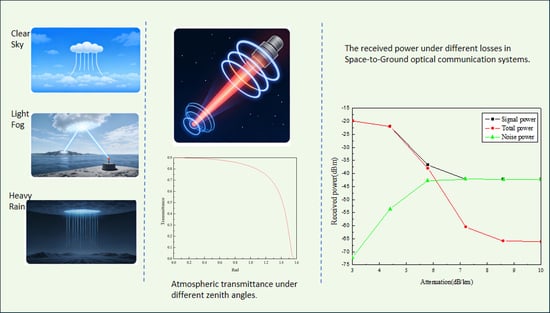
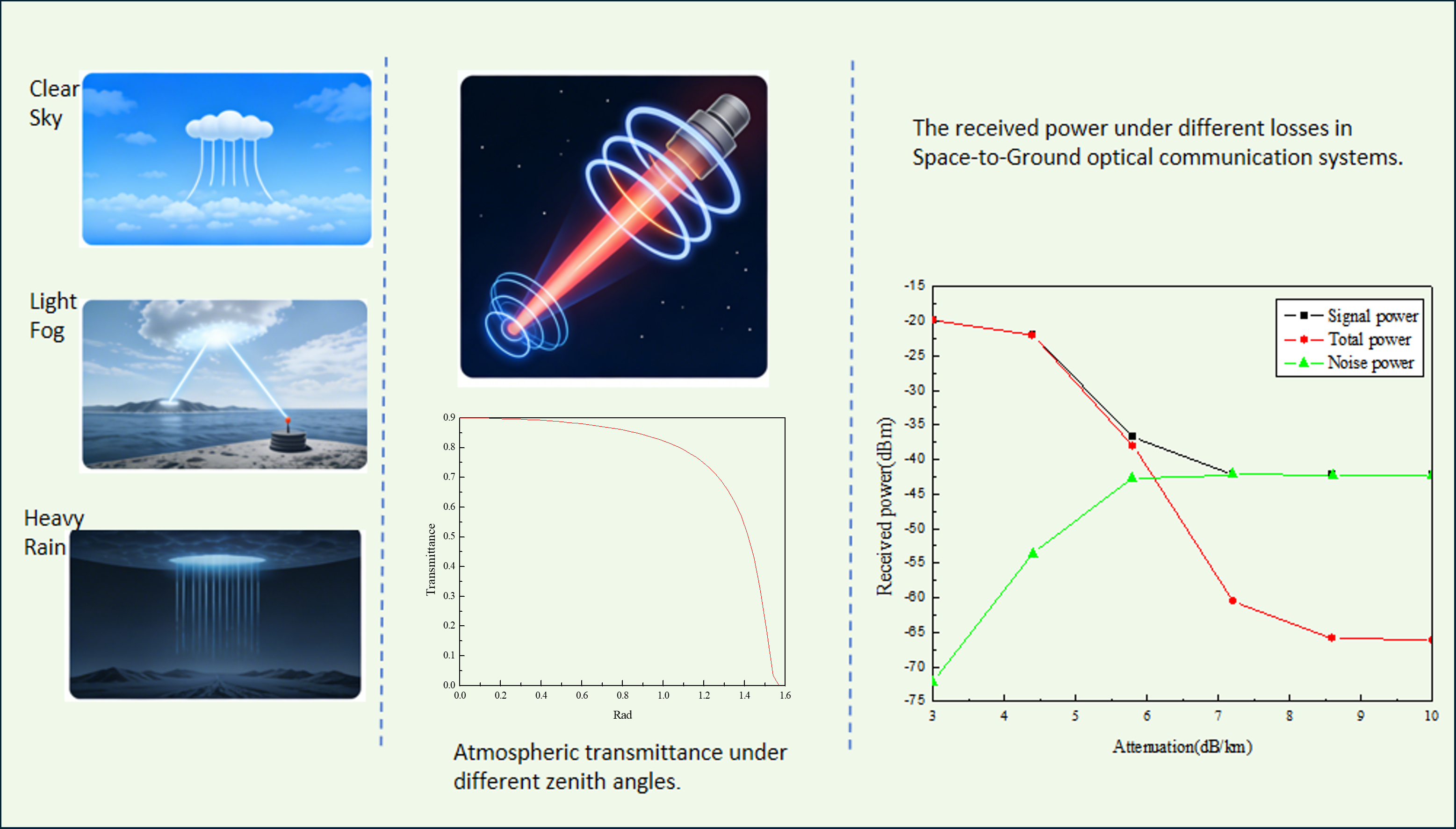
Graphical Abstract

1. Introduction

Traditional space-to-ground optical communications are mainly realized via microwave links, whose communication capacity reaches at most 600 Mbps. Thus, such systems can hardly meet the growing demand for large-capacity information transmission. In addition, the relatively wide microwave beam is not conducive to secure information transmission. Therefore, employing microwaves as the information carrier for space-to-ground communication has become a transmission bottleneck for space resource development and information acquisition. Compared with microwave communication, laser communication exhibits strong competitiveness owing to its advantages of a large communication capacity, high transmission rate, excellent confidentiality, small size, and light weight [1,2,3,4,5,6,7]. At present, substantial manpower, material and financial resources have been devoted to space-to-ground optical communication, and successful communication links have been demonstrated. The European Space Agency (ESA), National Aeronautics and Space Administration (NASA), and Japan Aerospace Exploration Agency (JAXA) have successfully developed experimental engineering prototypes of space-to-ground optical communication systems, with communication code rates up to 1 Gbps, and satisfactory results have been obtained in satellite-borne experiments [8]. Therefore, space-to-ground optical communication has become the optimal technical approach for further space development and utilization, as well as for large-capacity, high-confidentiality and wide-coverage communication.
Over the past decades, extensive theoretical and experimental studies have been conducted on atmospheric effects in satellite-to-ground optical communication, establishing a well-established body of literature. Representative existing models and approaches can be categorized as follows: (1) Atmospheric turbulence modeling: Classic models such as the Kolmogorov spectrum and Hufnagel-Valley (HV) model have been widely used to characterize refractive index fluctuations, with recent studies focusing on adaptive optics and fade mitigation techniques; (2) Atmospheric attenuation prediction: Empirical and semi-empirical models (e.g., MODTRAN 6, LOWTRAN 7) have been developed to estimate transmittance under various weather conditions, with a focus on wavelength-dependent absorption and scattering; (3) System performance analysis: Prior research has primarily focused on either turbulence-induced scintillation or attenuation-induced power loss in isolation, with limited integration of these effects into a unified framework for system design. However, most existing studies either focus on single atmospheric effects (e.g., turbulence or attenuation alone) or lack a quantitative coupling of atmospheric characteristics with practical engineering constraints (e.g., device cost, eye safety, and regulatory limits). This gap limits the direct applicability of these findings to real-world system design. The space-to-ground optical communication system mainly consists of three components: transmitter, atmospheric channel, and receiver. Since the atmospheric channel is open, it is susceptible to the influence of various weather conditions. Given the complex and variable natural environment of space-to-ground optical links, the investigation of atmospheric channels for space-to-ground optical communication is of great importance. When laser beams propagate through the atmospheric channel, they readily interact with atmospheric particles, leading to absorption and scattering, which induce atmospheric attenuation and atmospheric turbulence effects. Atmospheric attenuation reduces the received signal power, while atmospheric turbulence causes signal phase fluctuations, atmospheric scintillation, beam bending and wandering, beam broadening, and other phenomena. These effects increase the bit error rate and degrade signal transmission quality and link reliability [9]. In addition, space-to-ground optical communication serves as a key technology for connecting satellite optical networks and ground optical fiber communication networks. Therefore, studying the influence of atmospheric effects on the atmospheric channel in space-to-ground optical communication is of great significance.
In view of this, this paper investigates the characteristics of the atmosphere and analyzes the atmospheric channel in space-to-ground optical communication. The main atmospheric effects considered include absorption, attenuation, scattering, and turbulence. In addition, the characteristics of atmospheric particles such as those in fog, rain, and sand are analyzed. Since the influence of atmospheric attenuation on signal loss can be characterized by atmospheric transmittance, the atmospheric transmittance under different conditions is simulated. Furthermore, the scattering intensity of signals caused by different atmospheric particles is simulated and analyzed. Finally, a space-to-ground optical communication system is established, and the system performance under various weather conditions is evaluated through simulation. The simulation results show that atmospheric transmittance varies under different weather conditions. Under specific atmospheric conditions, the communication wavelength, transmission zenith angle, and altitude design of the ground station have significant impacts on the signal transmission performance of space-to-ground optical communication. This work advances existing knowledge by integrating an analysis of the atmospheric vertical structure and composition with detailed mathematical modeling of atmospheric effects, providing a more holistic framework for understanding channel behavior; unlike prior studies that often focus on isolated atmospheric phenomena, our comprehensive simulations of transmittance and scattering under diverse conditions offer a quantitative basis for comparing and contrasting atmospheric impacts, thereby enhancing the rigor of atmospheric channel analysis. The research and analysis in this paper have certain theoretical significance for wavelength selection, ground terminal altitude setting, and transmitting angle selection of ground stations in practical space-to-ground optical communication applications.
The remainder of this paper is organized as follows. Section 2 analyzes the atmospheric channel in space-to-ground optical communication. Section 3 presents simulation analyses of atmospheric transmittance under various atmospheric conditions, investigates the scattering intensity of different atmospheric particles, and discusses atmospheric attenuation under different weather conditions. Finally, the main conclusions are summarized in Section 4.

2. Analysis of Atmospheric Channel for Space-to-Ground Optical Communication

2.1. Atmospheric Characteristics

Due to the complex and variable environment of space-to-ground optical communication links, optical signals transmitted through the atmospheric channel are affected by atmospheric attenuation and turbulence effects. Clouds, fog, haze, and precipitation in the atmosphere can cause severe attenuation of optical signals. In addition, the absorption and scattering of optical signals by media such as atmospheric molecules and aerosols may lead to information errors or even communication interruptions. Therefore, the influence of atmospheric effects must be fully considered. The atmosphere is the gaseous envelope surrounding the Earth. The Earth is surrounded by such a dense atmosphere, which mainly consists of 78.1% nitrogen, 20.9% oxygen, 0.93% argon, and small amounts of carbon dioxide, rare gases, and water vapor [10,11,12]. The atmospheric density is highest near the Earth’s surface, and the density of atmospheric particles gradually decreases with increasing altitude. The distribution of gas particles mainly depends on the actual atmospheric conditions at a given time. The composition of the atmosphere is relatively complex and includes various liquid and solid particles. These particles differ in morphology and have a wide size distribution, ranging from approximately 30 nm to 2000 µm. In general, liquid particles mainly include fog droplets, raindrops, cloud droplets, snowflakes, ice crystals, and hail, while solid particles mainly include dust, smoke, and various industrial pollutants. Driven by temperature, pressure, and wind, the components of the atmosphere are constantly moving, keeping the atmosphere in a state of continuous motion [13].
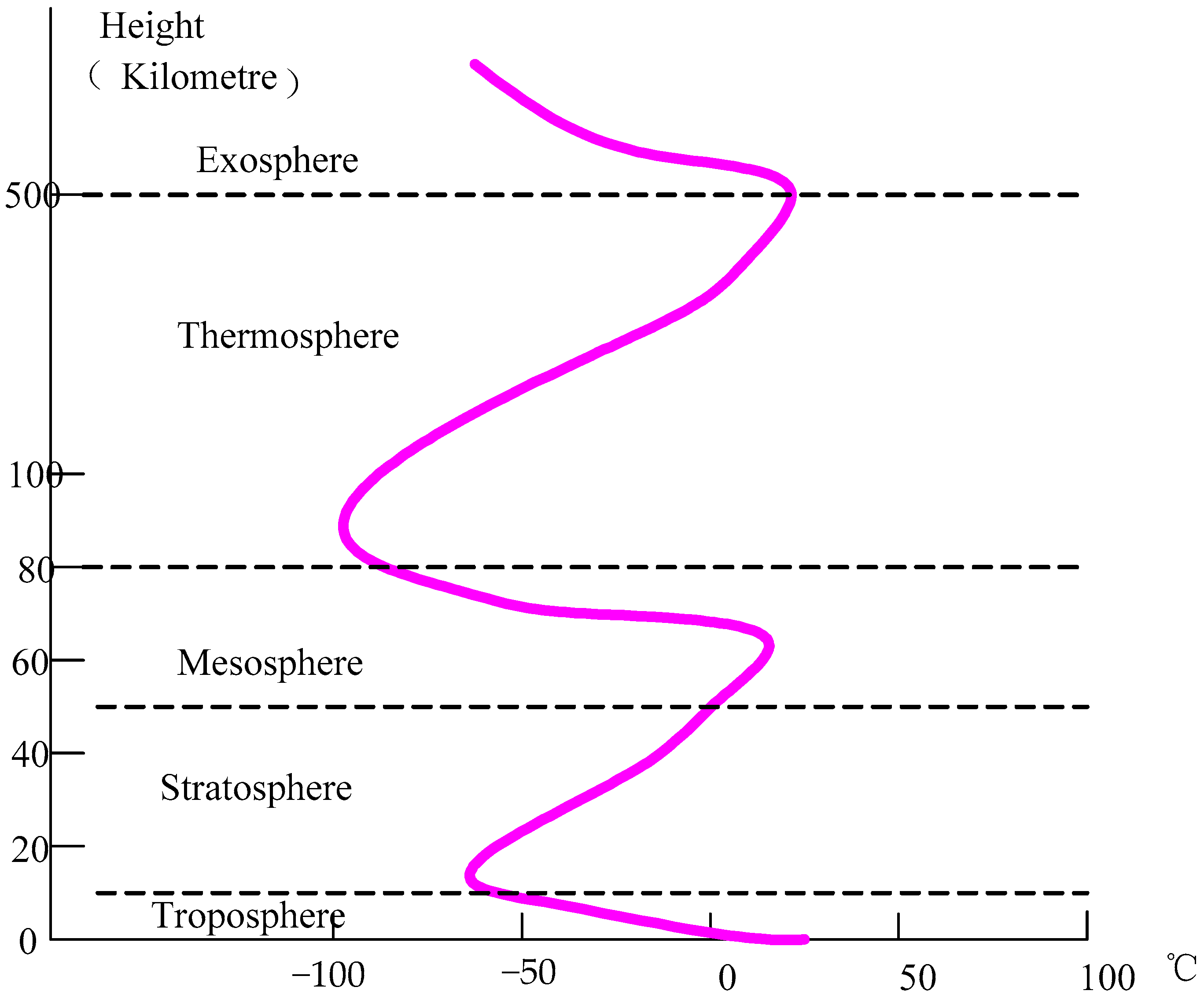
The atmosphere is layered above the Earth. According to the vertical distribution characteristics of temperature, pressure, and dynamic conditions, the atmosphere can be divided into five layers: from bottom to top, these are the troposphere (<10 km), stratosphere (10–50 km), mesosphere (50–80 km), thermosphere (80–500 km), and exosphere (above 500 km), as illustrated in Figure 1.
It can be seen from the figure that the troposphere is close to the Earth’s surface, and its characteristic is that the temperature gradually decreases with increasing altitude. In other words, vertical air movement is dominant and intense in the troposphere, while horizontal advection and transport, although non-negligible, are relatively weak. In addition, the troposphere contains 80% of the total atmospheric mass, and all weather phenomena such as wind and rain occur within this layer. Therefore, the troposphere has the greatest impact on the transmission characteristics of space-to-ground optical signals. The stratosphere contains 20% of the atmospheric mass, with low and stable atmospheric density, and has little influence on space-to-ground optical transmission. The air in the mesosphere, thermosphere, and exosphere is extremely thin, so its influence on space-to-ground optical propagation can be ignored.

2.2. Atmospheric Absorption Effect

During the propagation of optical signals in the atmosphere, various gas molecules and particles exist, accompanied by meteorological phenomena such as fog, rain, snow, and sand particles, as well as wind-induced air motion, significantly affect the propagation of optical signals. Optical signals are scattered by atmospheric particles during transmission, causing part of the signal energy to deviate from the original propagation direction and undergo spatial redistribution, with a portion of the energy converted into other forms. Atmospheric absorption of optical signals mainly includes absorption by atmospheric aerosols and absorption by atmospheric molecules. Accordingly, the total atmospheric absorption coefficient is composed of the aerosol absorption coefficient and the molecular absorption coefficient.
The main gaseous components in the atmosphere include O2, N2, and CO2. During the propagation of optical signals in the atmosphere, various gas molecules and particles exist, accompanied by meteorological phenomena such as fog, rain, snow, sand, and wind. Optical signals are scattered by atmospheric particles during transmission, causing part of the signal energy to deviate from the original propagation direction and be redistributed spatially, while some energy is converted into other forms. The atmospheric absorption of optical signals mainly includes absorption by atmospheric aerosols and absorption by atmospheric molecules. Therefore, the total atmospheric absorption coefficient is composed of the aerosol absorption coefficient and the molecular absorption coefficient.
The main gaseous molecules in the atmosphere include O2, N2, CO2, H2O, CO, O3, and inert gases. In the ultraviolet, visible, and infrared spectral regions, the dominant atmospheric absorbing molecules are O2, CO2, H2O, O3, as well as trace amounts of CO, CH4, and N2O. In the ultraviolet region (0.2–0.4 μm), the 0.2–0.26 μm band is mainly absorbed by atmospheric ozone, and this band is also known as the solar-blind band. Although the ozone content in the atmosphere is very low, accounting for only 0.01–0.1% of the atmosphere, it exhibits strong absorption of solar radiation. In the visible region (0.5–0.7 μm), the main atmospheric absorbing molecules are O2 and O3. The absorption bands of O2 are located at 0.63 μm, 0.69 μm, and 0.76 μm, while O3 shows strong absorption in the 0.45–0.76 μm band. In the infrared region, the dominant absorbing molecules in the atmosphere are H2O, O3, and CO2. In addition, O2 and N2 account for approximately 99% of the atmosphere, but their absorption in the visible and near-infrared bands is not significant. The most important molecules for absorption in the visible and near-infrared regions are H2O and CO2 [14,15,16,17]. The absorption bands in the visible and near-infrared regions are presented in Table 1.

2.3. Atmospheric Attenuation Effect

When laser beams propagate in the atmospheric channel, atmospheric attenuation effects will occur, which are induced by the absorption and scattering of light waves by atmospheric constituents. According to the above analysis, the atmosphere is a mixture mainly composed of water vapor, atmospheric molecules, and various impurity particles. Due to the differences in molecular structures within the atmosphere, their absorption lines and spectral absorption characteristics are distinct. The most important absorbing molecules in the near-infrared band are H2O and CO2 molecules. When the laser transmits signals through the atmosphere, it interacts with these particles, resulting in the attenuation of laser energy. The atmospheric attenuation can be described and calculated by the following formula [18,19,20]:
α S P E C ( dB / km ) 13   dB V   km λ   nm 550   nm q
where   α S P E C is the specific attenuation; λ is the wavelength; and V is the atmospheric visibility. The wavelength of 550 nm is selected because it corresponds to the peak of the solar radiation spectrum reaching the Earth’s surface and is also the region of maximum sensitivity for standard photodetectors and human vision, making it a universally accepted reference in atmospheric optics and radiative transfer studies. The value of q is
q = 1.6 i f   V 50   km 1.3 i f   6   km V < 50   km 0.585   V 1 3 i f   V < 6   km
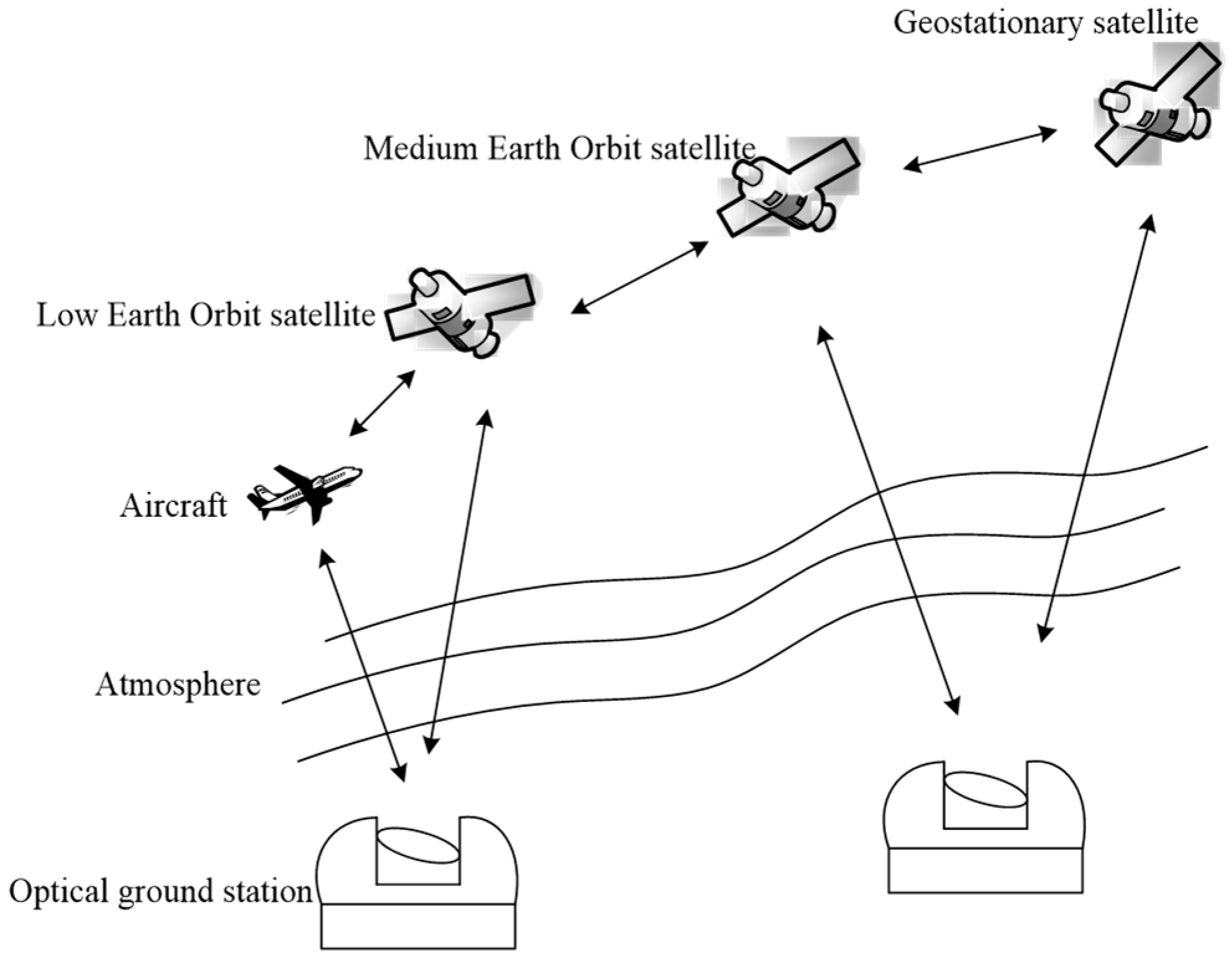
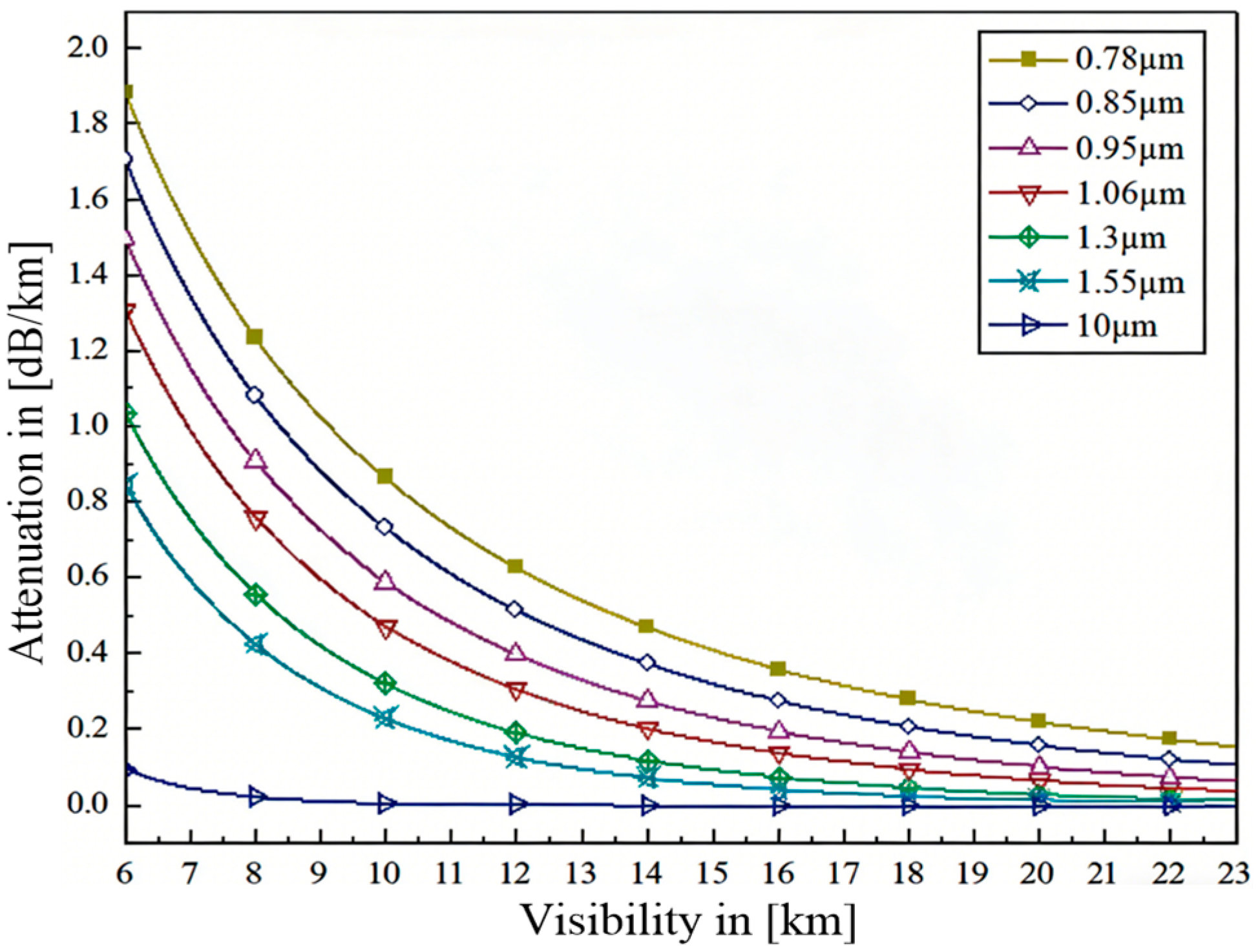
Figure 2 shows the schematic diagram of space-to-ground optical communication. It can be observed from the figure that the atmosphere is the main influencing factor for space-to-ground optical communication. Therefore, Equation (1) provides an empirical calculation of atmospheric attenuation. It can be seen from the equation that atmospheric visibility and wavelength are the dominant parameters determining atmospheric attenuation. According to the atmospheric attenuation model, the atmospheric attenuation for different wavelengths within the visibility range of 6–23 km is calculated, as illustrated in Figure 3. It can be seen from the figure that when the atmospheric visibility is less than 6 km, the atmospheric conditions are poor and seriously affect signal transmission, making the atmospheric channel highly unreliable. When the atmospheric visibility is greater than 23 km, the weather is sunny, and the atmospheric influence on signal transmission is negligible. In addition, when the atmospheric visibility ranges from 6 km to 23 km, the atmospheric conditions vary from dense fog and cumulus clouds to clear sky, corresponding to a transition from poor to good conditions. Thus, the atmospheric attenuation within this visibility range is analyzed in detail. It can also be observed from Figure 3 that the atmospheric attenuation for different wavelengths gradually decreases with increasing visibility, and longer wavelengths exhibit lower attenuation under the same visibility. Furthermore, when the atmospheric visibility is less than 6 km, the weather conditions are poor and the attenuation at short wavelengths is relatively large. When the atmospheric visibility exceeds 23 km, the weather is clear, the attenuation at all wavelengths is low, and the difference between wavelengths is small. Therefore, under sunny weather conditions, the selection of the operating wavelength is more flexible. In space-to-ground optical communication, a longer wavelength at the transmitting end leads to lower signal attenuation. For example, compared with the wavelengths of 0.78 μm and 10 μm shown in the figure, the attenuation difference is approximately 1.8 dB/km at a visibility of 6 km, which is of great significance in engineering applications.

2.4. Atmospheric Scattering Effect

Light waves attenuate continuously during atmospheric propagation, which is mainly caused by atmospheric absorption and scattering. Therefore, when light waves propagate in the atmosphere, they inevitably interact with atmospheric particles and produce scattering. Scattering refers to the spatial redistribution of energy after light waves interact with various particles in the atmosphere.
When the diameter of particles in the atmosphere is much smaller than the wavelength of light, the scattering that occurs is called Rayleigh scattering, also known as molecular scattering. That is to say, when the size of atmospheric molecules is much smaller than the wavelength of light, their scattering behavior can be approximated as that of small particles. Rayleigh scattering is characterized by the scattering intensity being inversely proportional to the fourth power of the wavelength. In other words, the more strongly light is scattered in all directions, the weaker its intensity remains along the original propagation direction. This explains why the sky appears blue: blue light has a relatively short wavelength and thus experiences strong scattering in all directions, which makes the entire sky look blue. Therefore, according to the above analysis, during sunny weather, laser beams propagating through the atmosphere are prone to Rayleigh scattering, and the scattering coefficient of Rayleigh scattering is as follows [21,22,23,24,25]:
K S R = 8 π 3 3 ( n 3 1 ) 2 N g λ 4 6 + 3 δ 6 7 δ
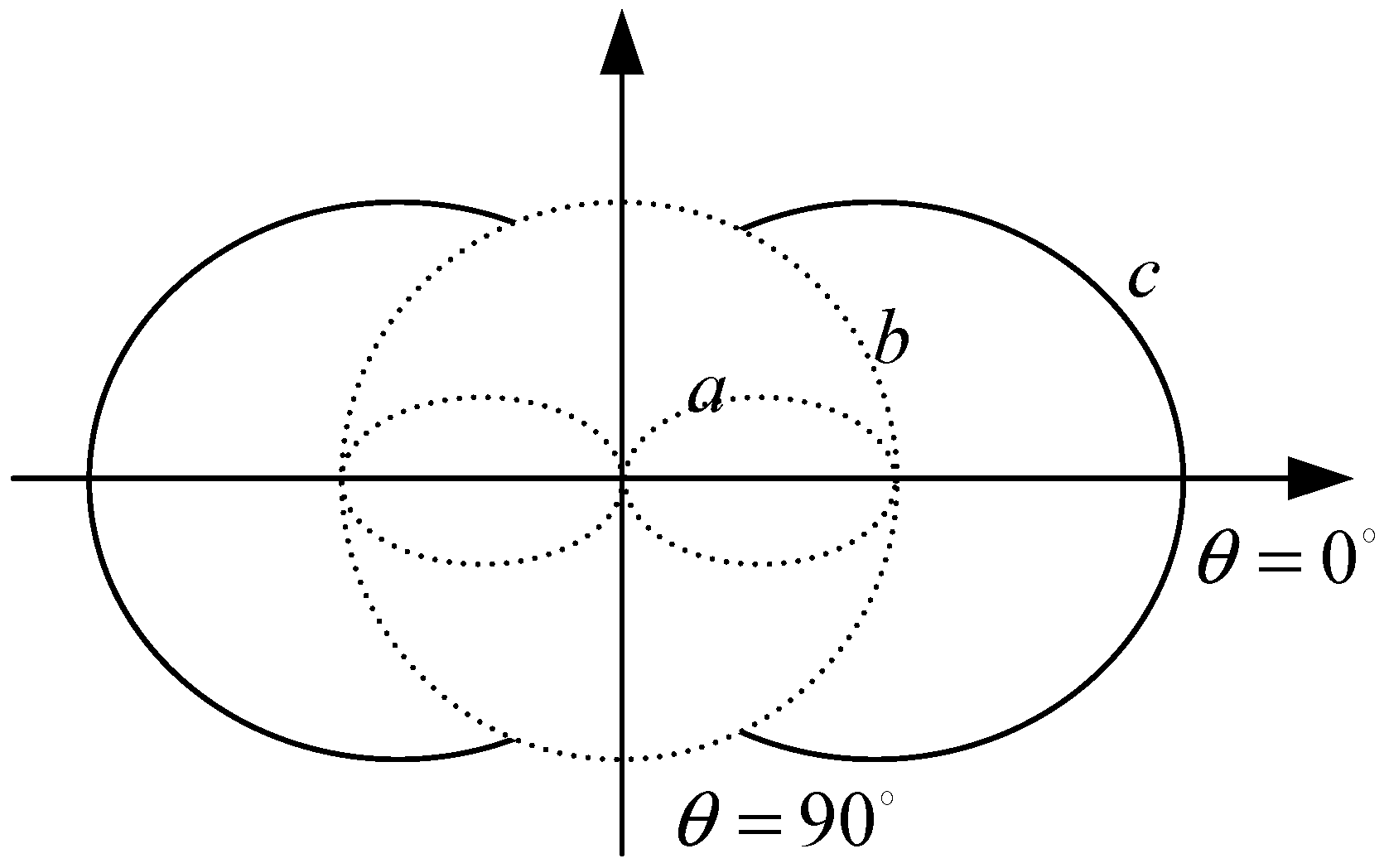
where   N g is the number of gas molecules in unit volume; n is the atmospheric refractive index; and δ is the depolarization factor of the scattered radiation, which is generally 0.035. λ is the wavelength. It can be inferred from Equation (3) that the intensity of Rayleigh scattering light is inversely proportional to the fourth power of the wavelength. Figure 4 shows the intensity distribution of Rayleigh scattering for incident natural light, where a, b, and c represent the intensity distributions of scattered light with the electric vector parallel to the scattering plane, perpendicular to the scattering plane, and the total scattered light intensity, respectively.
When the size of the scatterer is comparable to the wavelength of the incident light, Mie scattering occurs. In general, aerosol particles account for a significant proportion of the atmosphere, and the scattering of light waves by these aerosol particles is much stronger than Rayleigh scattering. In such cases, Mie scattering theory needs to be employed for analysis. However, due to the complexity of Mie theory, it is not conducive to the investigation of some practical problems. For the sake of simplicity, a common and straightforward model can be adopted to estimate the atmospheric scattering of laser beams. This model correlates the scatterer size with atmospheric visibility, and its expression is described by
K S M = 3.91 R V × ( λ 0 λ ) q
where R V is visibility-related parameter (km−1); λ denotes the wavelength, and its unit is nm; λ 0 is 550 nm;   q is the correction factor determined by R V . It can be seen from the formula that the intensity is inversely proportional to the q power of the wavelength. The parameter q is the exponent in the power-law distribution of atmospheric particulates, which is directly linked to   R V through the scattering model. Specifically, q is determined by the ratio of the total extinction coefficient to the scattering coefficient, which is a function of R V and the wavelength λ . The intensity of Mie scattering is asymmetric, and the forward scattering intensity is far greater than the backward scattering intensity. Therefore, in air ground optical communication, the influence of backward scattering can be ignored in some cases.

2.5. Atmospheric Turbulence Effects

The Earth is surrounded by an atmosphere. Due to factors such as the Earth’s gravity, the density of the entire atmosphere is dense in the lower layers and sparse in the upper layers. Weather conditions change continuously, and the atmosphere remains in a state of motion (turbulence), so that the communication channel is always located within turbulent gases. In space-to-ground optical communication, atmospheric turbulence causes random fluctuations in the refractive index of atmospheric molecular clusters, which further leads to phenomena such as beam broadening, beam wander, and phase fluctuations.
Atmospheric turbulence induces random variations in the atmospheric refractive index. In this paper, the atmospheric refractive index structure parameter is used to analyze the intensity of atmospheric turbulence. In space-to-ground optical communication, the atmospheric refractive index structure parameter is related to the height above the ground, and it is commonly described by the Hufnagel-Valley (HV) model [26,27,28].
c n 2 ( h ) = 0.00594 ( v / 27 ) 2 10 5 h 10 exp ( h / 1000 ) + 2.7 × 10 16 exp ( h / 1500 ) + A exp ( h / 100 )
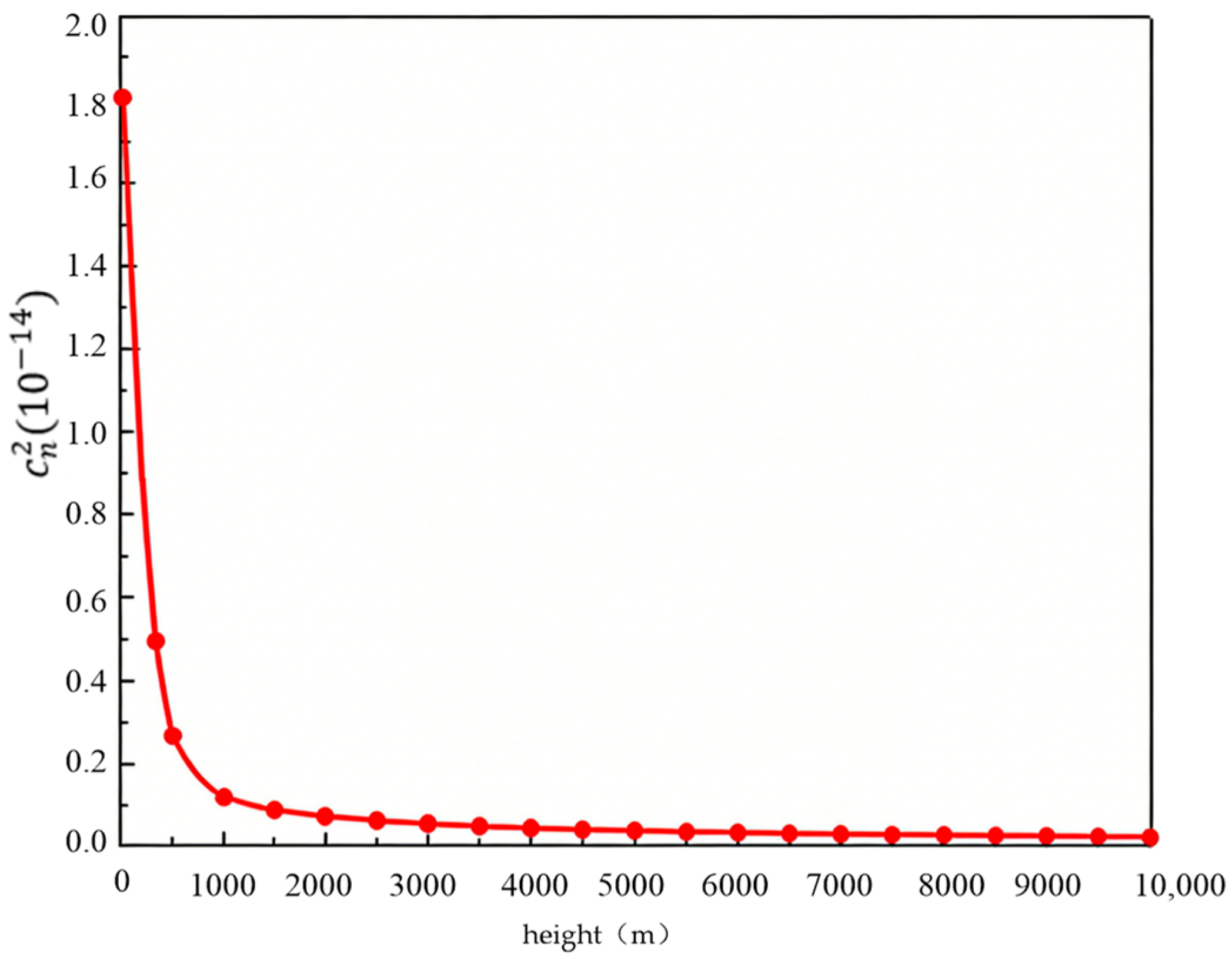
where h is the height of the transmitter or receiver, in meters; v is the wind speed, here referring to the root-mean-square wind speed with a value of 21 m/s; and A is the typical value of the near-ground refractive index structure parameter. According to Equation (5), the variation curve of the atmospheric refractive index structure parameter with height is calculated in this paper and shown in Figure 5.
It can be observed from Figure 5 that the atmospheric refractive index structure parameter gradually decreases with increasing altitude, indicating that atmospheric turbulence effects become weaker at higher altitudes. When the height exceeds about 2000 m, the curve of the atmospheric refractive index structure parameter becomes flat and close to the horizontal axis. This illustrates that as the height of the ground communication terminal increases, the atmospheric refractive index structure parameter gradually decreases to nearly zero, implying that atmospheric turbulence imposes little impact on the communication channel when the height is above 2000 m. Therefore, without considering other influencing factors, the higher the altitude of the optical ground station, the lower the atmospheric loss. According to the above analysis, in practical space-to-ground optical communication systems, the optical ground station should be located at a relatively high altitude.

3. Simulation and Analysis

3.1. Atmospheric Transmittance Under Different Atmospheric Conditions

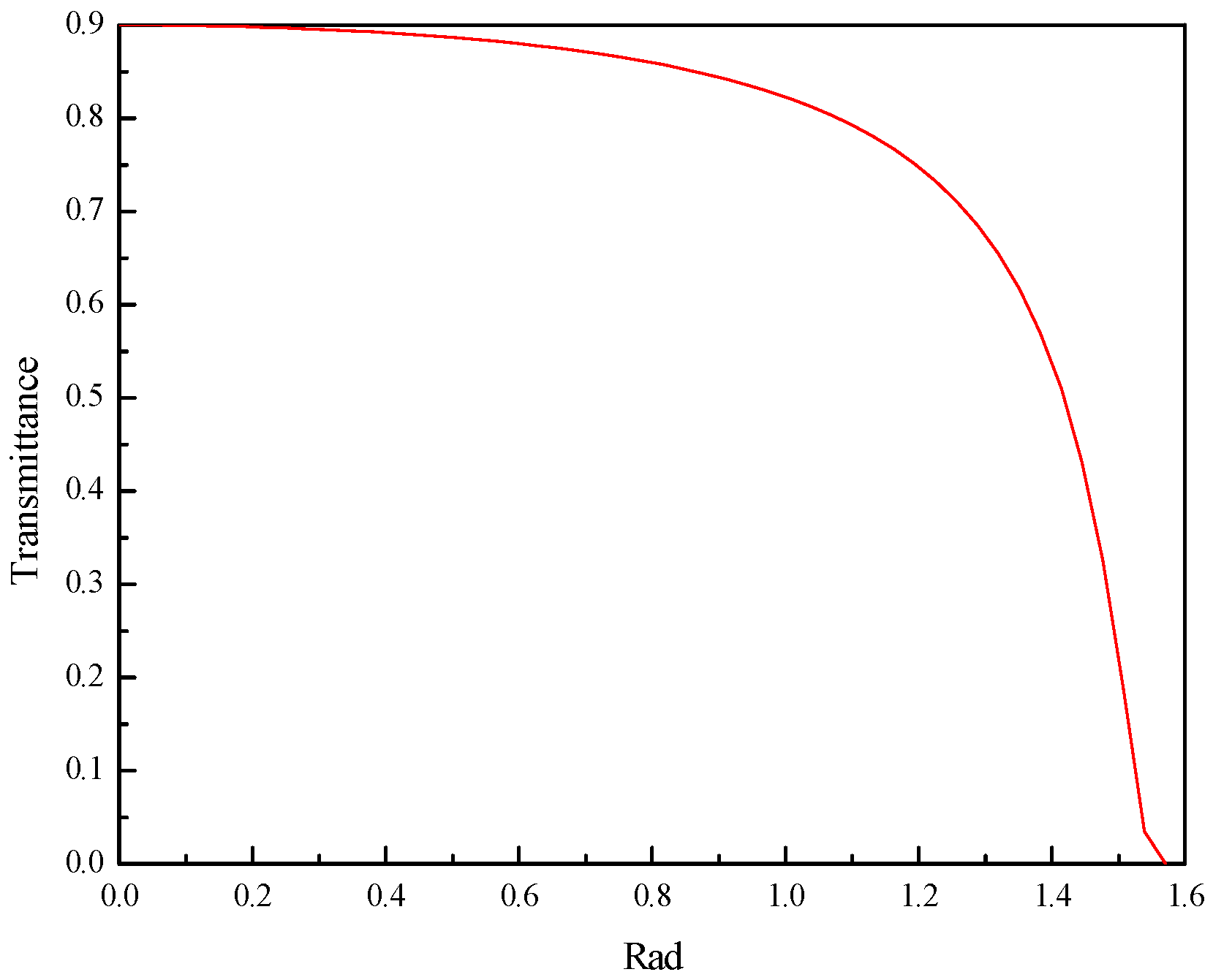
In this paper, the beam transmittance of space-to-ground optical communication under different weather conditions is simulated and analyzed. In the optical link, atmospheric transmittance is described by   T = P r / P t = e τ ,   P r and P t   are received power and transmitting power, respectively. τ is the optical depth. Reference [29] points out that the beam zenith transmittance can be converted into transmittance under different observation angles. If the zenith transmittance is defined as   T 0 , then the transmittance T θ when the observation zenith angle is θ an be calculated. The expression is T θ = T 0 m ( θ ) , where m ( θ ) s e c θ is the air mass term. When the transmittance is 0.9, the atmospheric transmittance under different zenith angles can be obtained, as shown in Figure 6.
The abscissa in Figure 6 is the zenith angle in radians, and the ordinate is the transmittance. It can be seen that the atmospheric transmittance is 0.9 when the zenith angle is 0 rad. With an increase in the zenith angle, the total atmospheric transmittance gradually decreases. When the zenith angle is approximately 1.2 rad (about 70°), the transmittance drops sharply. Between 0 and 1.2 rad, the transmittance curve varies gently. In this range, the atmospheric transmittance of the beam is high and the signal attenuation is low. In practical space-to-ground optical communication, when a ground communication terminal communicates with a space communication terminal, the communication performance is good if the zenith angle of the ground terminal is between 0 and 1.2 rad. When the zenith angle exceeds 1.2 rad, relay communication via other ground nodes or space nodes should be considered to maintain satisfactory communication performance. In addition, in this section, the beam transmittance under different atmospheric conditions is simulated based on the MODTRAN atmospheric simulation software, which mainly includes the following three parts:
(1)
Simulation of atmospheric transmittance at different altitudes
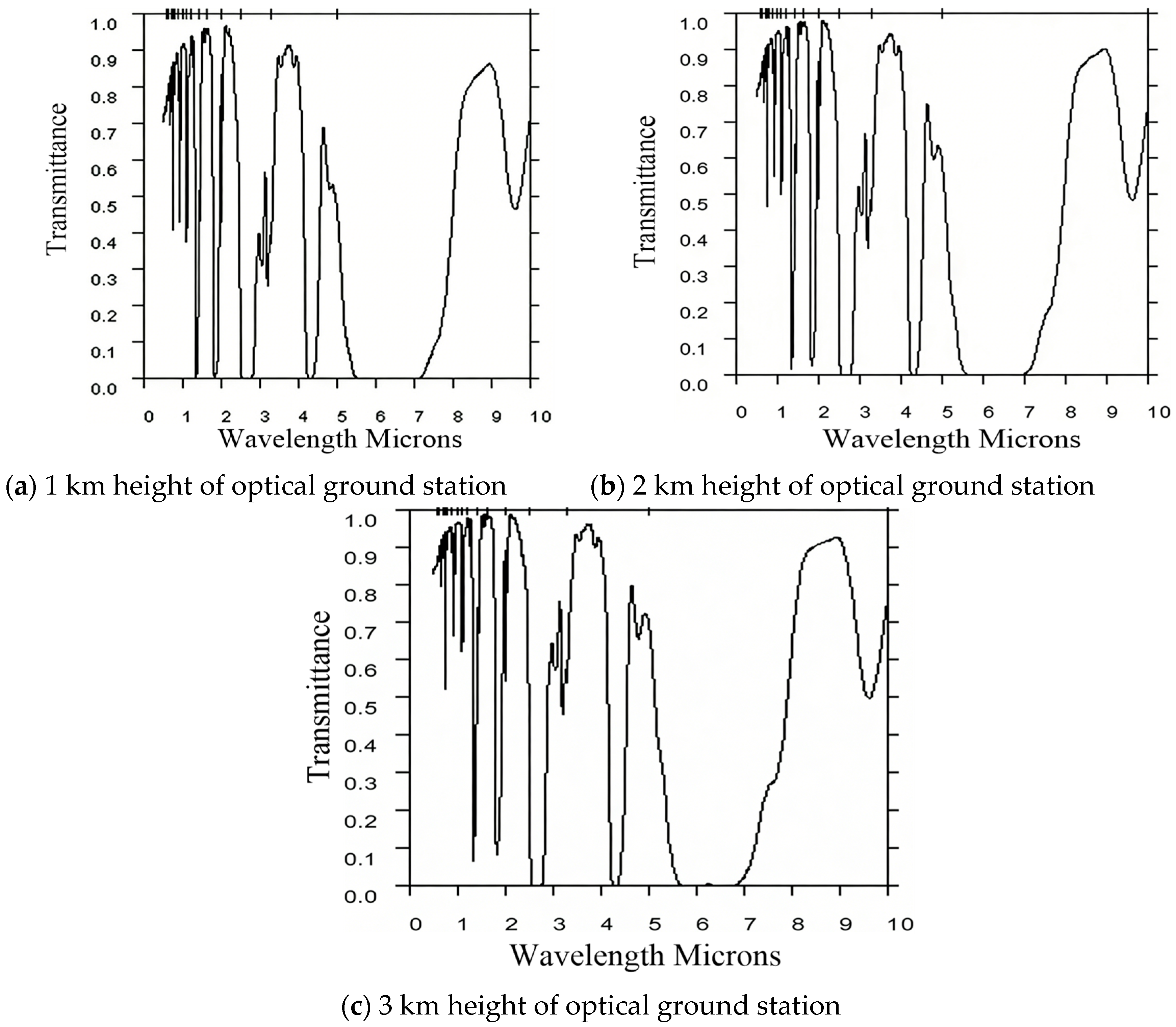
As can be seen from Figure 7, with constant visibility and zenith angle, the atmospheric transmittance of the beam gradually increases as the height of the ground communication terminal rises. Additionally, the transmittance window for longer-wavelength beams is relatively larger. Figure 7a represents the atmospheric transmittance spectrum at a ground station altitude of 1 km, while Figure 7b shows the spectrum at an altitude of 2 km. The differences are most pronounced at shorter wavelengths (e.g., 1–3 μm). Specifically, the transmittance at 2 km altitude is consistently higher than at 1 km in this range, which is attributed to the reduced column density of water vapor and aerosols at higher altitudes. Therefore, in practical space-to-ground optical communication, the height of the ground communication terminal should be selected to be as large as possible. This not only enhances the beam transmittance but also results in relatively low signal attenuation, which is conducive to improving the reliability of the communication link.
The typical wavelength range employed in atmospheric laser communication systems is currently from 0.85 μm to 1.55 μm. As observed in the figure, the atmospheric transmittance window near 1 μm is relatively narrow, but its transmittance value is relatively high. Consequently, this wavelength band is suitable for application as a communication beam, which further verifies the consistency between the simulation results and practical engineering applications.
(2)
Simulation of Atmospheric Transmittance at Different Emission Zenith Angles
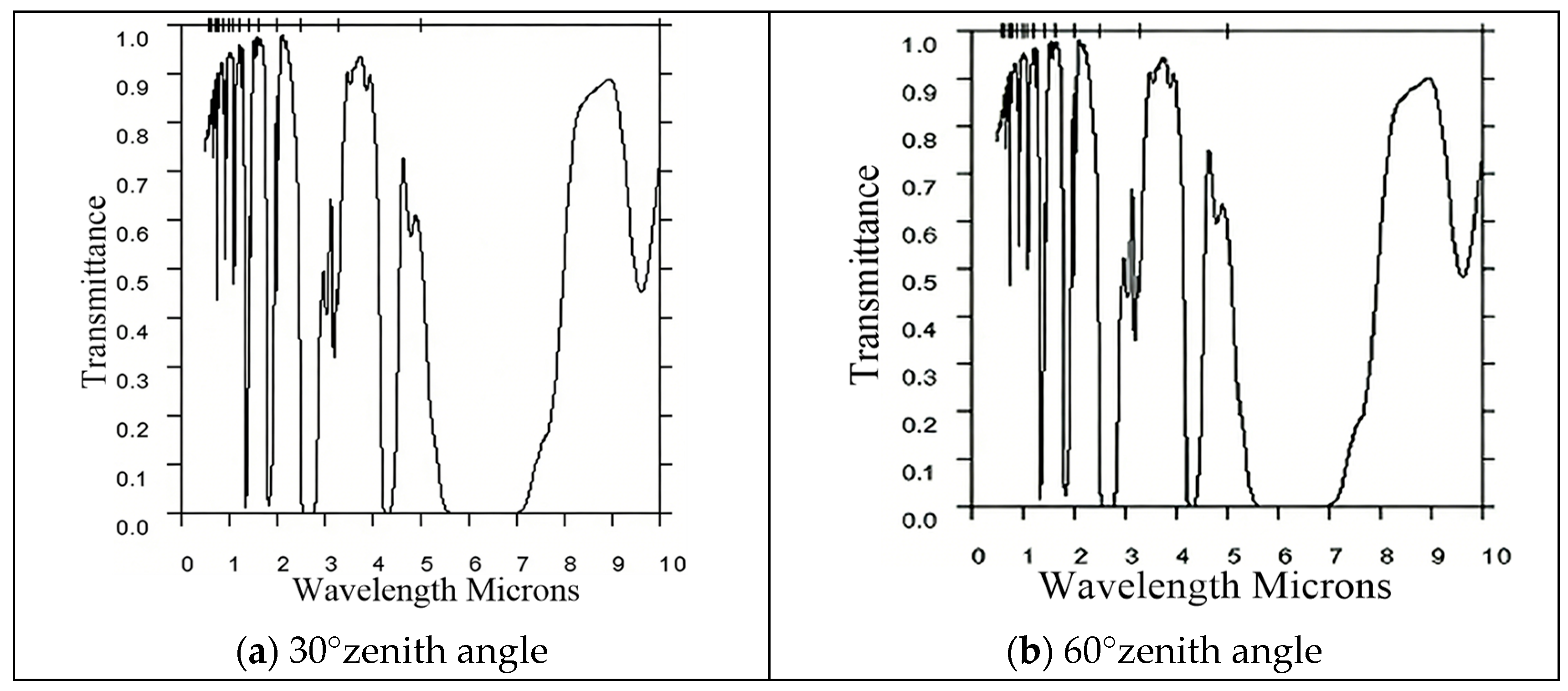
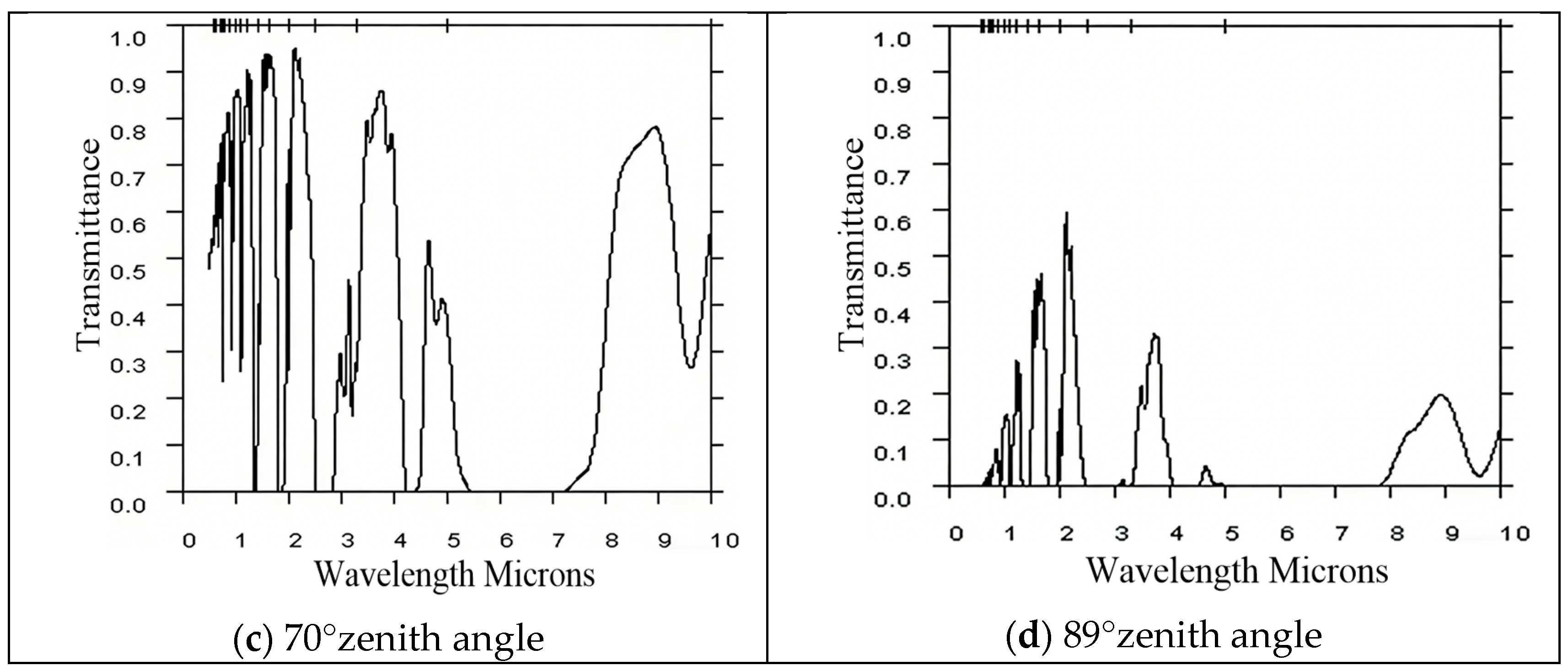
In the simulations of atmospheric transmittance at different transmitting zenith angles in this work, the height of the ground communication terminal is set to 2 km. According to the 1976 U.S. Standard Atmosphere Model, the atmospheric visibility is set to 23 km, and the atmospheric propagation distance for space-to-ground optical communication is fixed at 100 km. For the ground terminal, within the zenith angle range of 0° to 89°, simulations are performed at zenith angles of 30°, 60°, 70°, and 89°, respectively. Similarly, in the simulations, the beam wavelength is selected within the range of 0.5 μm to 10 μm. The corresponding simulation results are presented in Figure 8.
Figure 7b depicts the simulated atmospheric transmittance at a zenith angle of 0°, whereas Figure 8a–d correspond to the atmospheric transmittance results obtained at zenith angles of 30°, 60°, 70°, and 89° for the ground communication terminal, respectively. It can be seen from the simulation results that, at a fixed ground terminal height, the atmospheric transmittance of the beam reaches its maximum at a zenith angle of 0°, as shown in Figure 7b. As the zenith angle increases, the atmospheric transmittance gradually decreases, as observed in Figure 8a–d. This phenomenon mainly arises because the signal propagation path is vertical when the zenith angle is 0°, corresponding to the shortest transmission distance and thus the weakest atmospheric attenuation. As the zenith angle increases, the space-to-ground optical communication path changes from vertical to oblique, leading to a longer propagation distance and lower atmospheric transmittance. Furthermore, a larger zenith angle corresponds to a longer oblique path and lower transmittance, which explains why the transmittance is maximized along the vertical path. When the variation in the zenith angle is relatively small (within approximately 30°), the change in atmospheric transmittance is modest. In contrast, the transmittance varies significantly when the zenith angle is around 70°. Therefore, in practical space-to-ground optical communication systems, it is necessary to consider the deployment of relay nodes according to the zenith angle to improve the overall communication performance. In addition, the simulation results are consistent with the theoretical analysis shown in Figure 6.
(3)
Simulation of Atmospheric Transmittance under Different Rainfall Conditions
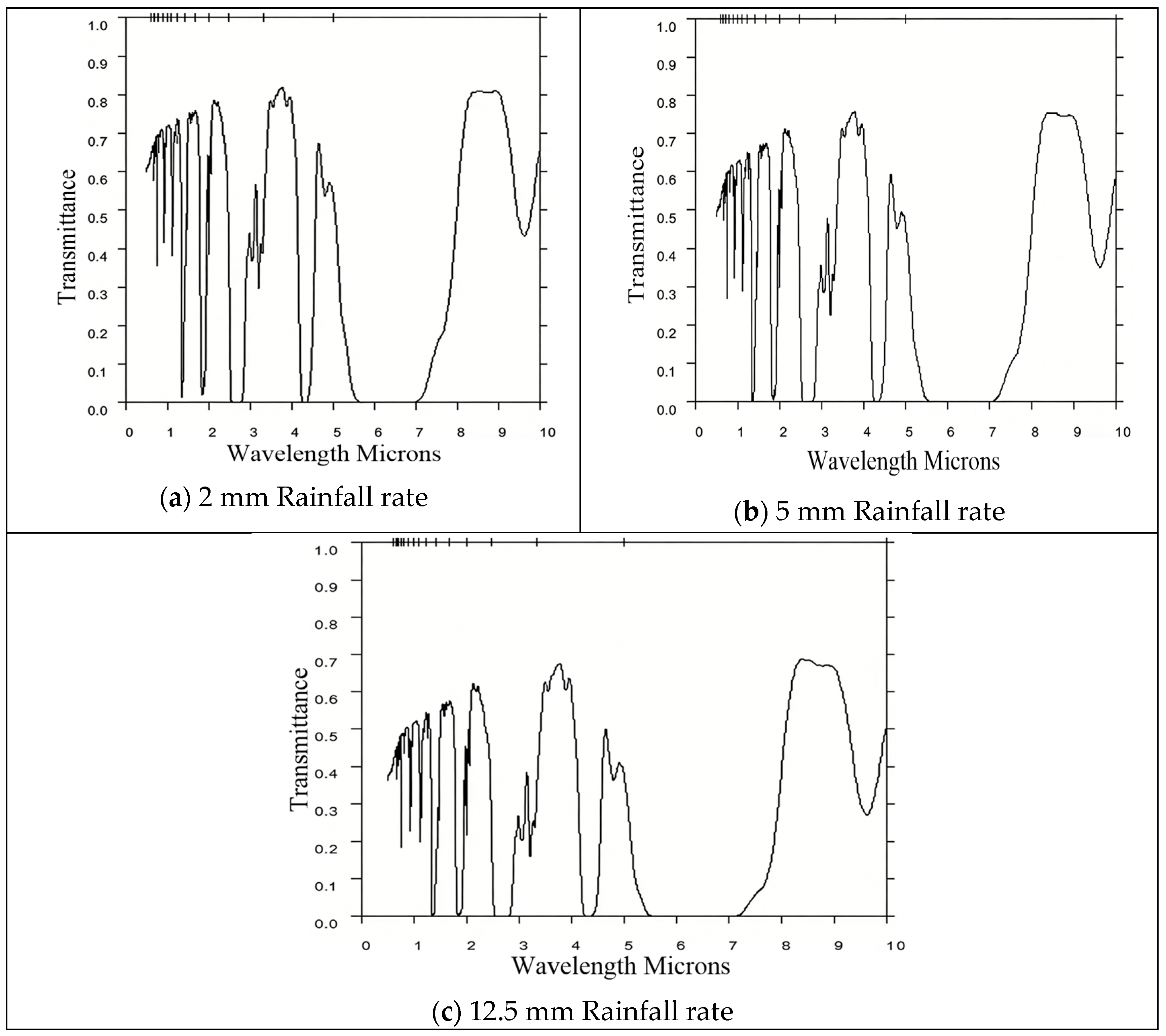
Among the factors influencing signal propagation through the atmosphere, rainfall represents a major cause of communication performance degradation. According to rainfall intensity, precipitation is generally categorized into drizzle (rainfall rate below 10 mm/h), moderate rain (above 10 mm/h), and heavy rain (above 24 mm/h). Under heavy rain conditions, the optical communication link is typically interrupted. Accordingly, in the simulations of atmospheric transmittance under rainy conditions in this work, three rainfall rates—2 mm/h, 5 mm/h, and 12.5 mm/h—are adopted. Based on the 1976 U.S. Standard Atmosphere Model, the atmospheric visibility is set to 23 km. The height and zenith angle of the ground communication terminal are fixed at 2 km and 0°, respectively, and the propagation distance for space-to-ground optical communication remains 100 km. The cloud base height corresponding to the simulated rainfall conditions is set to 2 km, a typical value for mid-level clouds in the standard atmosphere model, which is consistent with the terminal height and ensures the consistency of the simulated optical path. The wavelength range considered in the simulations is from 0.5 μm to 10 μm. The corresponding simulation results are presented in Figure 9.
From Figure 9a–c, it can be observed that rainfall has a significant impact on signal transmission in space-to-ground optical communication. As the rainfall rate increases, the atmospheric transmittance of the beam gradually decreases; however, under the same conditions, beams with longer wavelengths exhibit higher transmittance. As shown in Figure 9a, when the rainfall rate is 2 mm/h, the average atmospheric transmittance is approximately 65%, indicating that drizzle has a relatively minor effect on signal transmission. When the rainfall rate is 12.5 mm/h, the average atmospheric transmittance drops to about 50%, which means the signal attenuation reaches 50%. Therefore, it can be inferred that under heavy rain conditions, i.e., when rainfall exceeds 24 mm/h, signal attenuation will be even greater and communication may be interrupted. At a wavelength of 1.064 μm, the transmittance decreases from 0.75 to 0.45 as the rainfall rate increases from 2 mm/h to 12.5 mm/h. Hence, in practical space-to-ground optical communication, the impact of rainfall on communication cannot be ignored. Consequently, when communication is interrupted due to rainfall, relay communication or the use of longer wavelength bands should be considered to maintain the link.

3.2. Simulation of Scattering Intensity by Different Atmospheric Particles

Based on the analysis of atmospheric scattering effects in the text and the study of the physical characteristics of fog, rain, and sand particles, this section primarily simulates the scattering intensity of fog, rain, and sand particles of different sizes. The simulation results are as follows:
(1)
Scattering intensity distribution of fog particles
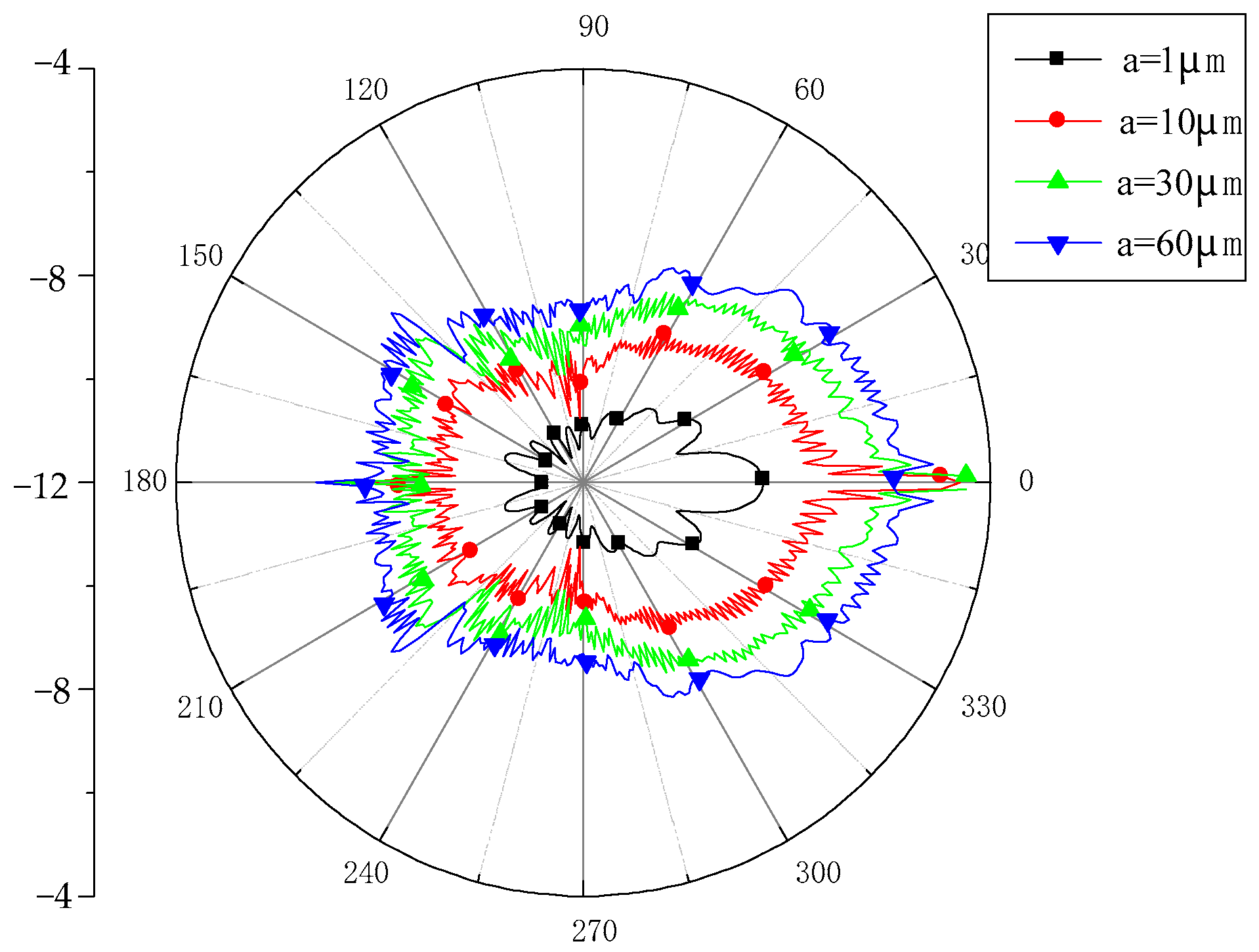
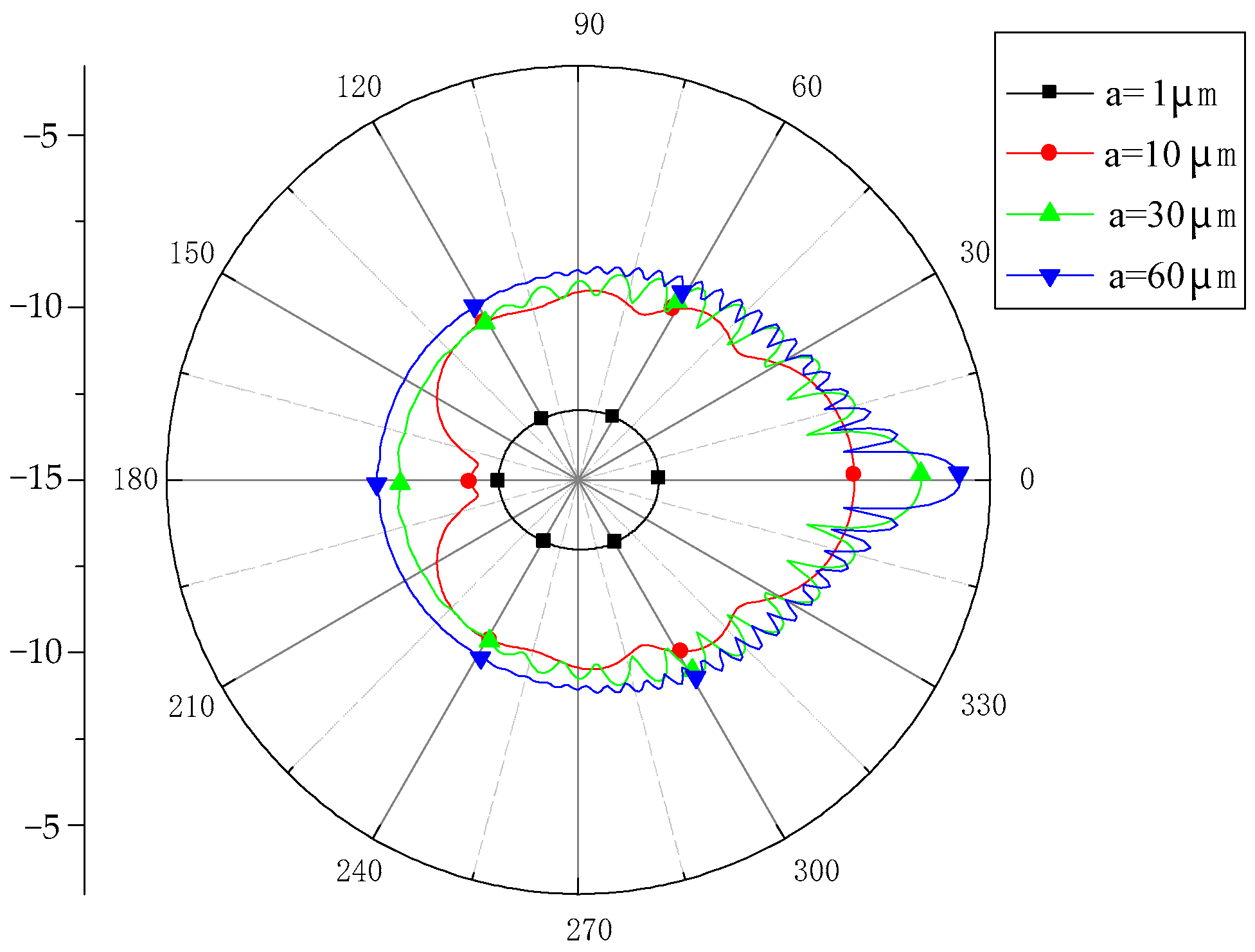
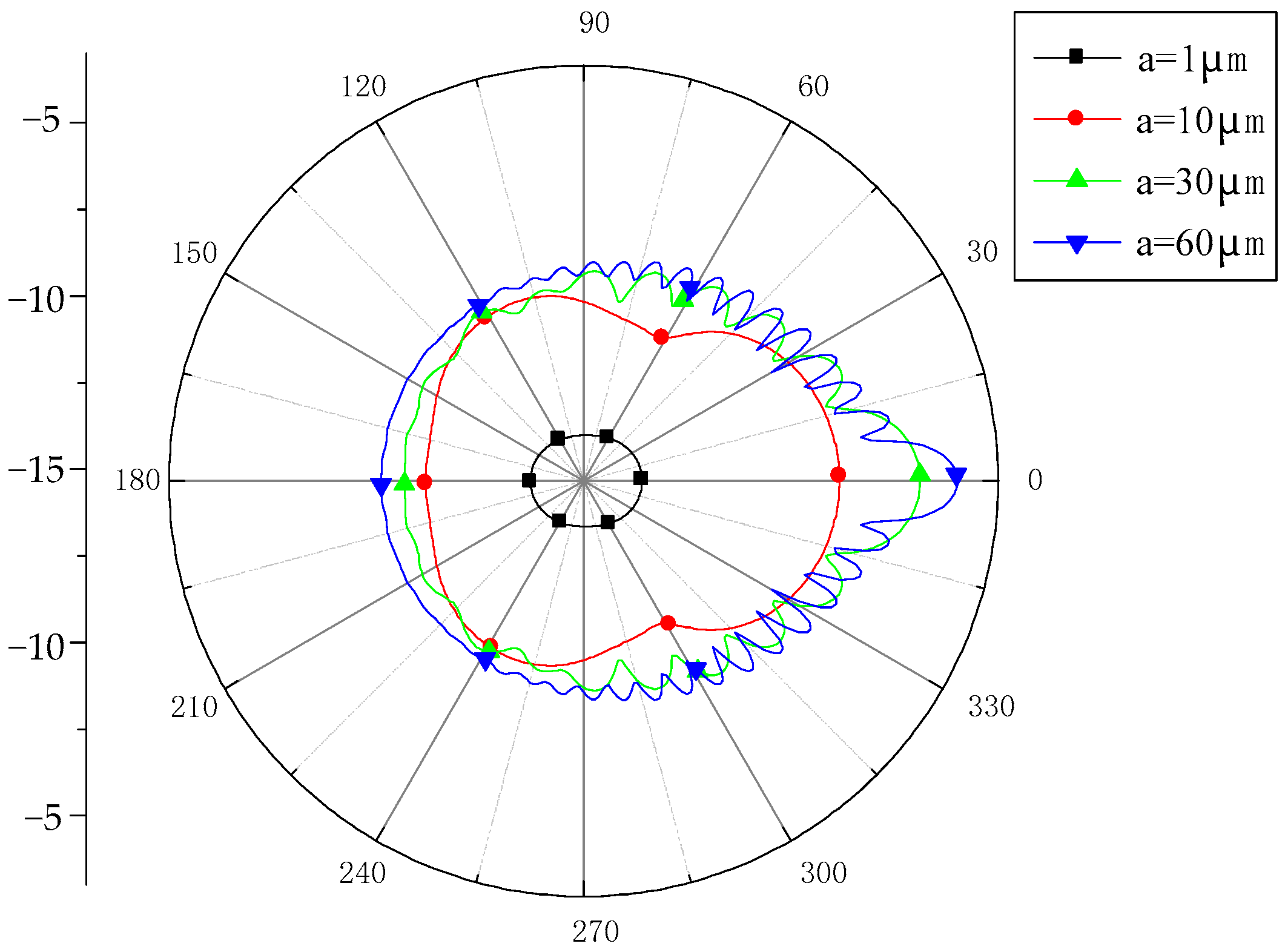
Based on the analysis of atmospheric scattering effects presented in this paper and the study of the physical characteristics of fog, rain, and sand particles, this section employs Mie scattering theory to simulate the scattering intensity of single spherical fog particles and perform calculations and simulations on the scattering of light with different wavelengths by fog particles of varying sizes. Since the radius of fog particles typically ranges from 1 μm to 60 μm, the simulations in this work select single spherical fog particles with radii of 1 μm, 10 μm, 30 μm, and 60 μm, respectively. The optical wavelengths are chosen as 650 nm, 1064 nm, and 1550 nm, with their corresponding complex refractive indices for water being m = 1.346 − i1.08 × 10−8, m = 1.331 − i1.64 × 10−8, and m = 1.178 − i0.071. In the simulation scenario design, the incident light intensity is set to I0 = 1 W. The scattered light intensity (processed by logarithmic transformation) at a distance of 0.1 m from the scatterer, as well as its polar coordinate distribution with respect to the scattering angle, are simulated. The simulation results are presented in Figure 10, Figure 11 and Figure 12.
It can be observed from Figure 10, Figure 11 and Figure 12 that the scattering intensity distribution of fog particles is relatively complex. The more pronounced fluctuations in Figure 10 ( λ = 650   nm ) arise from the strong sensitivity of Mie scattering to small changes in particle orientation and local concentration when the particle size parameter x = 2 π r / λ is large. In contrast, the smoother curves in Figure 11 ( λ = 1064   nm ) and Figure 12 ( λ = 1550   nm ) reflect the reduced oscillatory behavior of the scattering phase function at longer wavelengths, where the particle size parameter is smaller, leading to a more continuous and stable intensity distribution. The lateral scattering intensity distribution exhibits intricate lobes, and the lateral scattering intensity is significantly lower than the forward scattering intensity. Under different wavelength conditions, the forward scattering intensity gradually increases with an increase in the optical wavelength, and the forward scattering of longer wavelengths is notably stronger than that of shorter wavelengths. At the same wavelength, the forward scattering intensity also increases gradually as the size of fog particles increases. Therefore, based on these simulation results, it can be concluded that longer-wavelength beams should be selected as the communication wavelength for space-to-ground optical communication under heavy fog conditions. When long-wavelength lasers are employed for signal transmission, forward scattering by fog particles is most prominent for these wavelengths, with a scattering intensity higher than that of shorter wavelengths. This enables the beam to concentrate more energy, thereby facilitating the propagation of the optical wave toward the intended destination.
(2)
Scattering Intensity Distribution of Rain Particles
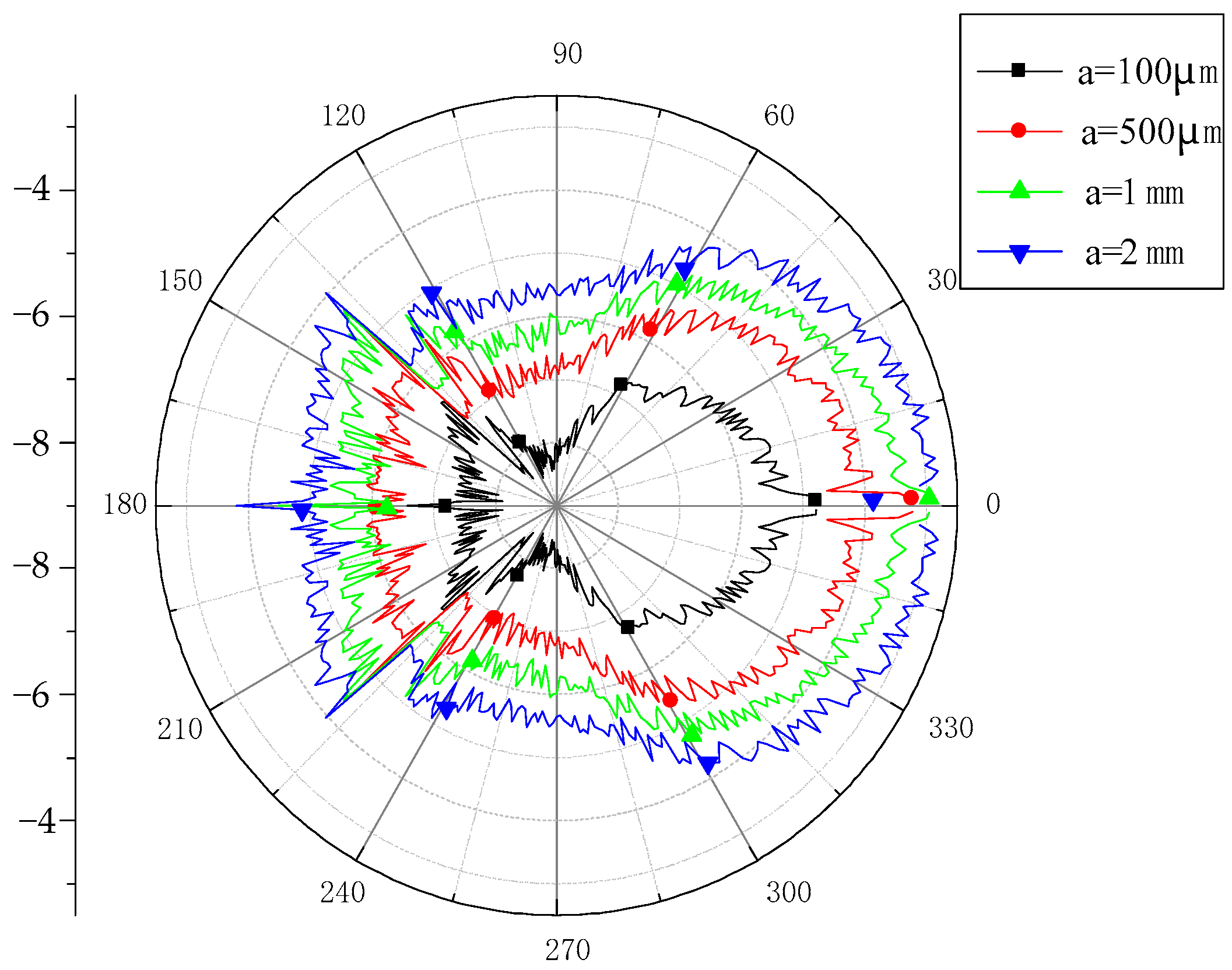
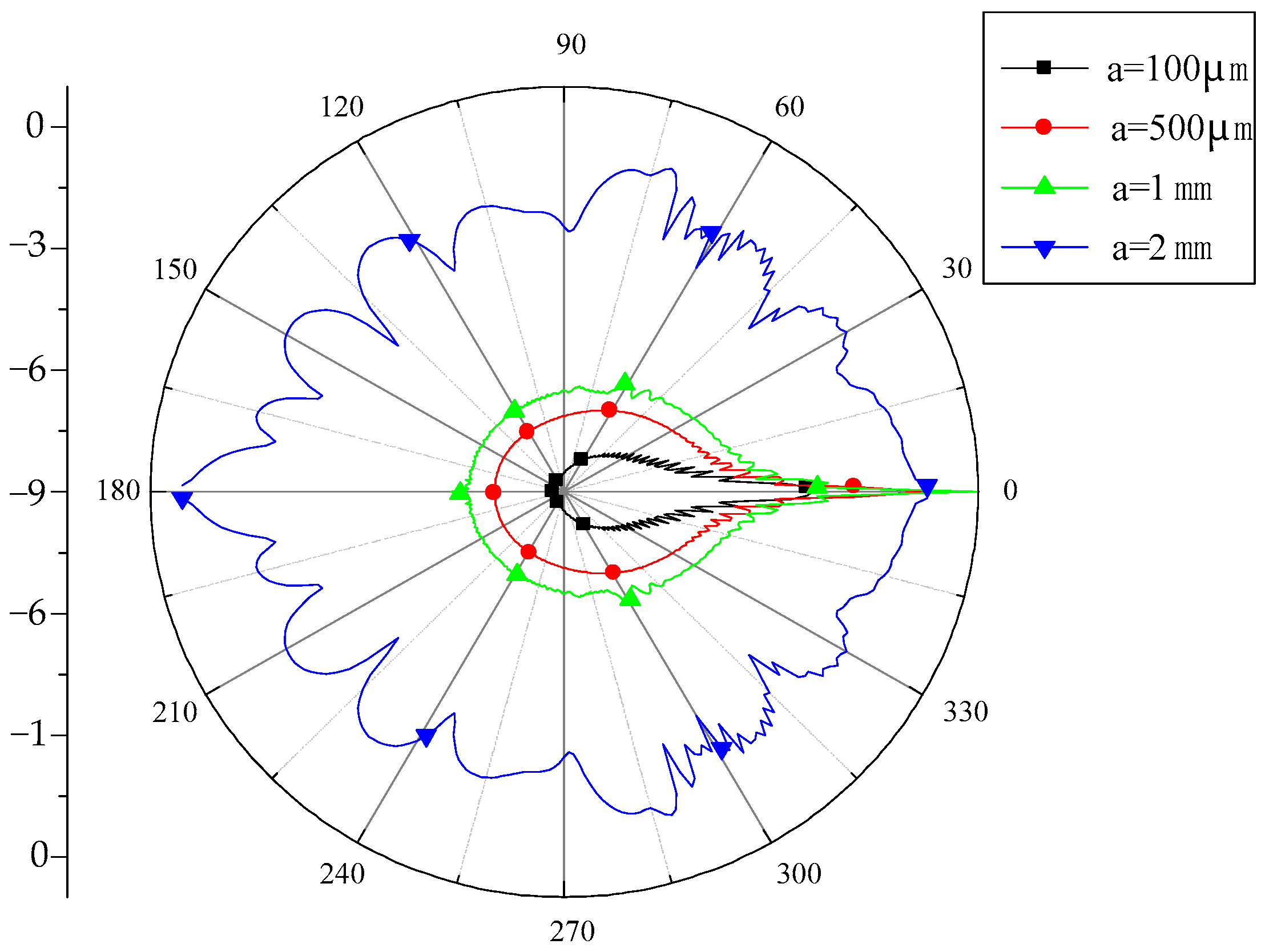
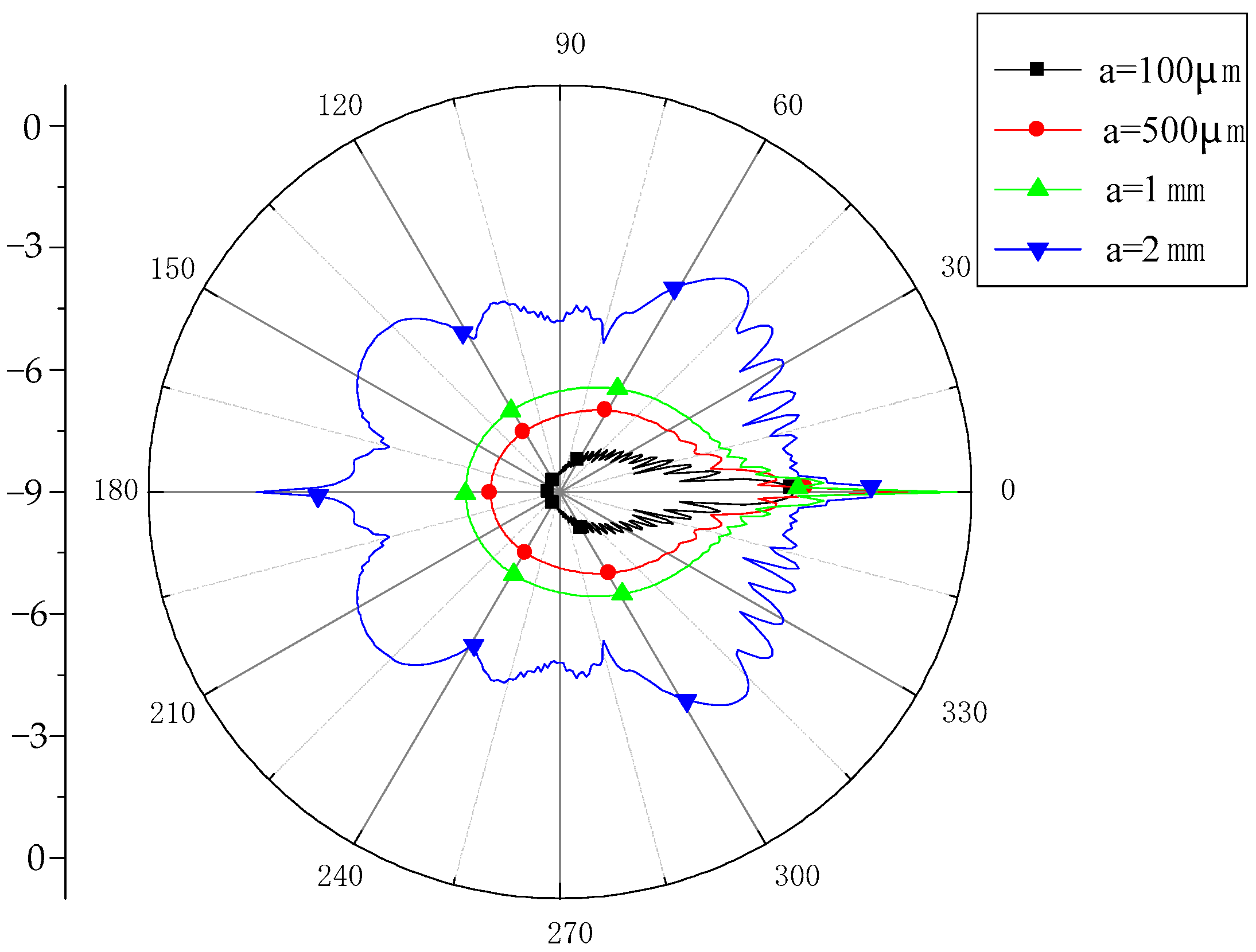
Raindrop particles can be approximated as spherical particles, and Mie scattering theory can be applied to calculate the scattering of photons by spherical raindrops. In this work, calculations and simulations are performed to investigate the scattering of laser light with different wavelengths by raindrop particles of varying sizes. Given that raindrop radii typically range from 50 μm to 4 mm, single spherical raindrop particles with radii of 100 μm, 500 μm, 1 mm, and 2 mm were selected for the simulations. Additionally, the laser wavelengths adopted in this study are 650 nm, 1064 nm, and 1550 nm, with their corresponding complex refractive indices for water being m = 1.346 − i1.08 × 10−8, m = 1.331 − i1.64 × 10−8, and m = 1.178 − i0.071, respectively. In the design of the simulation scenario, the incident light intensity is set to I0 = 1 W. The scattered light intensity (processed by logarithmic transformation) at a distance of 0.1 m from the scatterer, as well as its polar coordinate distribution with respect to the scattering angle, were simulated. The simulation results are presented in Figure 13, Figure 14 and Figure 15.
As can be seen from the figures, the scattering intensity distribution of raindrop particles is similar to that of fog particles, both of which are relatively complex with numerous side lobes in the lateral direction. However, lateral scattering is much weaker compared to forward and backward scattering. Under the same wavelength condition, as the size of raindrop particles increases, both forward and backward scattering intensities gradually increase, with forward scattering showing a more pronounced enhancement. Under different wavelength conditions, the forward scattering intensity of longer wavelengths is significantly greater than that of shorter wavelengths. Therefore, in practical communication processes, selecting longer wavelengths for signal transmission under rainy conditions is more beneficial for improving system performance. Although the absolute difference in atmospheric attenuation between the two bands is small, the 1550 nm band offers a marginal advantage in terms of lower atmospheric loss under moderate-to-heavy rainfall conditions. This makes the 1550 nm band more suitable for long-haul links or systems requiring a higher link margin. Additionally, considering eye safety and regulatory constraints, the 1550 nm band is typically permitted to operate at higher transmit power levels, which further influences the practical selection of the wavelength. From the perspective of device availability and cost-effectiveness, the 1064 nm laser and detector technologies are more mature and less expensive. Consequently, despite its slightly higher attenuation, 1064 nm remains the preferred choice for many ground-based deployments.
In Figure 14 and Figure 15, the lines corresponding to the 2 mm differ significantly from the others. The 2 mm particle size corresponds to large raindrops or coarse aerosols, which are outside the typical range of Mie scattering dominance for the communication wavelengths considered in our study (e.g., 1.064 μm, 1.55 μm). The significant deviation is attributed to the transition from Mie scattering (dominant for particles with sizes comparable to the wavelength) to geometric optics scattering (dominant for particles much larger than the wavelength). For 2 mm particles, the scattering cross-section becomes much larger, leading to a much stronger attenuation of the optical signal, which is reflected in the distinct shape and lower transmittance values of the curve.

3.3. Simulation of Atmospheric Attenuation Under Different Atmospheric Conditions

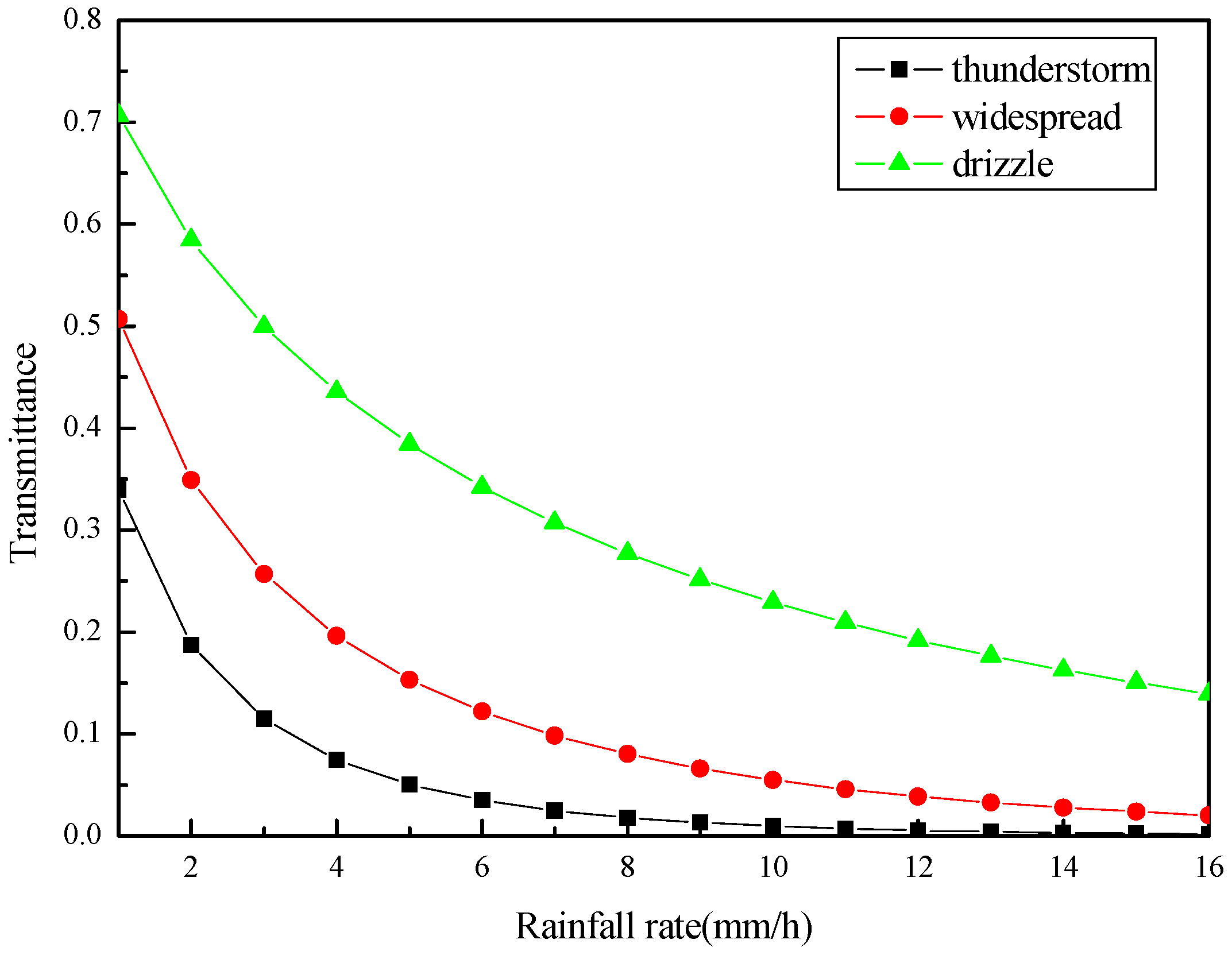
When optical signals propagate through the atmospheric channel, the combined effects of atmospheric absorption and scattering manifest as atmospheric attenuation. Based on the analysis of atmospheric absorption and scattering characteristics presented above, this section conducts simulation analysis of atmospheric attenuation under different atmospheric conditions using MATLAB R2024a simulation software. It primarily covers atmospheric attenuation under different rainfall conditions, as shown in Table 2, Table 3 and Table 4. This paper also simulates atmospheric transmittance under various rainfall rates, with the results presented in Figure 16.
Based on the raindrop size distribution measured by Joss et al. using a disdrometer, rainfall is classified into the following types: drizzle, widespread rain, and thunderstorm. Their respective size distributions are given as follows [30]:
Drizzle : N ( D ) = 30000 e 5.7 R 0.21 D ( m 3 mm 1 )
Widespread : N ( D ) = 7000 e 4.1 R 0.21 D ( m 3 mm 1 )
Thunderstorm : N ( D ) = 1400 e 3.0 R 0.21 D ( m 3 mm 1 )
where R represents the rainfall rate, and D denotes the raindrop radius. Based on the rainfall distributions given above, this section simulates atmospheric attenuation under different rainfall types for communication wavelengths of 650 nm, 1064 nm, and 1550 nm, respectively. The simulation results are presented in Table 2, Table 3 and Table 4. It can be observed from Table 2, Table 3 and Table 4 that when a beam propagates through the atmospheric channel at a constant rainfall rate, atmospheric attenuation decreases as the communication wavelength increases. This indicates that longer wavelengths exhibit stronger anti-interference capabilities. Furthermore, when the communication wavelength is fixed—for example, at 650 nm as shown in Table 2—atmospheric attenuation is the smallest under drizzle conditions and the largest under thunderstorm conditions. Moreover, atmospheric attenuation gradually increases with the rise in rainfall rate. Additionally, this section simulates the atmospheric transmittance for the 1064 nm communication wavelength under different rainfall rates, with the results shown in Figure 14. It can be observed from the figure that as the rainfall rate increases, atmospheric transmittance gradually decreases. Furthermore, under drizzle conditions, the atmospheric transmittance is the highest, while it is the lowest during thunderstorms.
In addition, when a beam propagates through the atmospheric channel, it is inevitably affected by adverse weather conditions such as sandstorms and haze. Under windy and dusty conditions, the attenuation and scattering caused by sand and dust particles lead to a reduction in the energy of the optical signal, resulting in a lower signal-to-noise ratio and potentially causing communication link interruption in severe cases. Studies have shown that the size distribution of sand and dust particles follows a logarithmic distribution. This section will conduct simulations of atmospheric attenuation for sandstorms, vehicle-raised dust, and natural wind-blown sand. The parameter distributions for these three types of sand and dust particles are listed in Table 5, and the simulation results are presented in Table 6, Table 7 and Table 8.
From Table 6, Table 7 and Table 8, it can be observed that as the communication wavelength increases, atmospheric attenuation gradually decreases. However, in the vicinity of a communication wavelength of 1064 nm, the change in atmospheric attenuation is not significant. As shown in Table 6 and Table 7, when the communication wavelengths are relatively close, the variation in attenuation is small. When the communication wavelength is fixed, the attenuation exhibits a decreasing trend as visibility increases, as shown in Table 8. It can also be seen from Table 8 that under sandstorm conditions, atmospheric attenuation is the highest when the signal propagates through the atmosphere, followed by vehicle-raised dust conditions, while natural wind-blown sand conditions result in the lowest atmospheric attenuation.

4. Conclusions

This study systematically investigates the impact of atmospheric channels on signal transmission in space-to-ground optical communication, with a focus on atmospheric effects and their implications for system design. The stochastic nature of the atmospheric channel—encompassing absorption, attenuation, scattering, and turbulence effects—represents a critical performance constraint for space-to-ground optical links. Atmospheric transmittance, a key metric for quantifying channel attenuation, is highly sensitive to the weather conditions, communication wavelength, ground station zenith angle, and altitude, while simulations of scattering intensity for fog, rain, and sand particles demonstrate that different atmospheric particulates induce distinct attenuation profiles that directly influence link reliability. This work advances existing knowledge by integrating an analysis of the atmospheric vertical structure and composition with detailed mathematical modeling of atmospheric effects, providing a more holistic framework for understanding channel behavior; unlike prior studies that often focus on isolated atmospheric phenomena, our comprehensive simulations of transmittance and scattering under diverse conditions offer a quantitative basis for comparing and contrasting atmospheric impacts, thereby enhancing the rigor of atmospheric channel analysis. The results provide clear, actionable guidance for optimizing space-to-ground optical communication systems: trade-offs between 1064 nm and 1550 nm should consider both atmospheric attenuation characteristics and practical constraints such as device cost, eye safety, and regulatory limits; higher ground station altitudes and optimized zenith angles can significantly improve the transmittance and link margin, enhancing system robustness, and system design must account for variable atmospheric conditions—particularly the differential attenuation caused by fog, rain, and sandstorms—to ensure reliable operation across diverse environments.

Author Contributions

Conceptualization, X.W. and Z.Z.; methodology, X.W.; software, X.W.; validation, X.W. and Z.Z.; formal analysis, X.W. and Z.Z.; investigation, X.W. and Z.Z.; resources, X.W.; data curation, Z.Z.; writing—original draft preparation, X.W.; writing—review and editing, X.W.; visualization, X.W. and Z.Z.; supervision, X.W. and Z.Z.; project administration, X.W.; funding acquisition, X.W. All authors have read and agreed to the published version of the manuscript.

Funding

This research was funded by [Henan Provincial Science and Technology Tackling Program] grant number [262102210211]. And The APC was funded by [262102210211].

Institutional Review Board Statement

Not applicable.

Informed Consent Statement

Not applicable.

Data Availability Statement

The data supporting the findings of this study are derived from simulations conducted using MATLAB software. The simulation parameters and conditions are fully described in the manuscript, and the key calculation models are presented in the relevant sections. No additional raw datasets were generated or archived during this study.

Acknowledgments

This work was supported in part by the Henan Key Laboratory of Information Functional Materials and Sensing Technology.

Conflicts of Interest

The authors declare no conflicts of interest.

References

  1. Li, C.-Y.; Lu, H.-H.; Chou, C.-R.; Hsia, H.-M.; Feng, C.-Y.; Chen, Y.-H. A Flexible Bidirectional Fiber-FSO-5G Wireless Convergent System. J. Light. Technol. 2021, 39, 1296–1305. [Google Scholar] [CrossRef]
  2. Alqurashi, F.S.; Xu, J.; Goiriz, L.B.; Alouini, M.-S. Enhancing Wireless Backhaul Networks with Parallel FSO-mmWave Systems: Experimental Analysis and Availability Assessment. IEEE Open J. Commun. Soc. 2025, 6, 10219–10228. [Google Scholar] [CrossRef]
  3. Nafees, M.; Huang, S.; Thompson, J.; Safari, M. Backhaul-Aware UAV-Aided Capacity Enhancement in Mixed FSO-RF Network. IEEE Open J. Commun. Soc. 2024, 21, 4400–4416. [Google Scholar] [CrossRef]
  4. Vu, B.-M.; Dang, N.T.; Shin, O.-S. Optimization of Mixed FSO-RF Downlink Systems With SLIPT-Enabled UAV Base Station and HAP-Mounted Optical RIS. IEEE Access 2026, 14, 7099–7115. [Google Scholar] [CrossRef]
  5. Aman, W.; Qaraqe, M.; Rahman, M.M.U.; Al-Kuwari, S.; Al-Naffouri, T.Y. Effective Capacity Analysis for Hybrid FSO/THz Backhaul Link in 6G Networks. IEEE Wirel. Commun. Lett. 2025, 14, 2616–2620. [Google Scholar] [CrossRef]
  6. Saber, M.J.; Hasna, M. Security Analysis of Integrated HAP-Based FSO and UAV-Enabled RF Downlink Communications. IEEE Open J. Commun. Soc. 2024, 5, 5427–5435. [Google Scholar] [CrossRef]
  7. Nguyen, H.D.; Yeom, H.; Ha, J. Beam Divergence Angle Optimization for Secure FSO-Based Space–Air Communications. IEEE Trans. Aerosp. Electron. Syst. 2025, 62, 2218–2235. [Google Scholar] [CrossRef]
  8. Bastiaens, H.M.J.; Neijts, G.; Memon, A.; Fan, Y.; Mak, J.; Geskus, D.; Hoekman, M.; Moskalenko, V.; Bente, E.A.J.M.; Boller, K.-J. Broadband optical frequency comb generation using hybrid integrated InP-Si3N4 diode lasers. In Proceedings of the CLEO/Europe-EQEC, Munich, Germany, 21–25 June 2021; pp. 21–25. [Google Scholar] [CrossRef]
  9. Guo, W.; Li, Y.; Wang, Z.; He, L.; Jiao, S.; Qiu, J. Interaction Between Adaptive Optics and Mode Diversity Reception in GEO Optical Downlinks. J. Light. Technol. 2025, 23, 10538–10551. [Google Scholar] [CrossRef]
  10. Chen, C.P.; Piazzolla, S.; Roberts, T. Data Management and Data Products of a Daily Optical Communications Ground Station for Laser Communications Relay Demonstration. In Proceedings of the 2024 Workshop on Innovative Satellite and Earth Exploration (WISEE), Daytona Beach, FL, USA, 10–12 December 2024; pp. 16–18. [Google Scholar] [CrossRef]
  11. Divsalar, D.; Dolinar, S.; Farr, W.; Mohageg, M.; Thill, M.D.; Israel, D.J.; Alerstam, E.; Peng, M.; Shaw, M.; Wollman, E. Wavelength division multiple access for deep space optical communications. In Proceedings of the IEEE Aerospace Conference, Big Sky, MT, USA, 7–14 March 2020; pp. 1–13. [Google Scholar] [CrossRef]
  12. Yang, H.; Liu, C. Performance Analysis of a Coherent Heterodyne Detection Hybrid FSO/RF System Based on Nakagami-m Fading Channel and F Atmospheric Turbulence Channel. In Proceedings of the 2024 9th International Conference on Information Technology and Network Engineering (ITNEC), Chongqing, China, 13–15 September 2024; pp. 20–22. [Google Scholar] [CrossRef]
  13. Liu, S.; Xu, W. Bubble Size Distribution Inversion from Multi-frequency Sound Speed and Attenuation Measurements. In Proceedings of the OCEANS 2023–Limerick, Limerick, Ireland, 5–8 June 2023; pp. 1–5. [Google Scholar] [CrossRef]
  14. Kumar, R.; Bhattacharyya, S.; Bhardwaj, R.; Gaurav, K. Mini-Batch Gradient Ascent for Enhanced Indoor Localization in IoT Networks with Rayleigh Fading. In Proceedings of the 2024 Second International Conference on Microwave, Antenna and Communication (MAC), Dehradun, India, 11–13 April 2024; pp. 1–6. [Google Scholar] [CrossRef]
  15. Shao, J.; Gutema, T.Z.; Popoola, W.O. Enhanced Room Coverage with Photon-Level NLOS Ultraviolet Optical Wireless Communication. IEEE Photonics Technol. Lett. 2025, 37, 1447–1450. [Google Scholar] [CrossRef]
  16. Song, H.; Song, E.; Liu, Y.; Wang, B.; Wang, Q.; Wang, Z. Miniature FBG Vibration Sensor with High Performance and Low Angle Dependence for Two-Dimensional Vibration Measurement. IEEE Trans. Instrum. Meas. 2023, 72, 1–11. [Google Scholar] [CrossRef]
  17. He, X.; Zhang, Q.; Zhang, R.; Li, P.; Wang, X.; Li, D. Research on detection technology of bubble size distribution in transformer oil based on Mie scattering theory. In Proceedings of the 2021 IEEE International Symposium on Electrical Insulation (ISH 2021), Xi’an, China, 12–16 June 2021; pp. 1740–1743. [Google Scholar] [CrossRef]
  18. Jones, C.C.; Harnett, L.A.; Mohr, C.A.; Koch, S.J.; Cook, M.A. Structure-Based Adaptive Radar Processing for Joint Clutter Cancellation and Moving Target Estimation. In Proceedings of the 2020 IEEE Radar Conference (RadarConf20), Washington, DC, USA, 21–25 September 2020; pp. 413–418. [Google Scholar] [CrossRef]
  19. Löwe, J.-M.; Hinrichsen, V. Experimental Investigation of the Influence of Electric Charge on the Behavior of Water Droplets in Electric Fields. In Proceedings of the 2019 IEEE International Conference on Dielectric Liquids (ICDL), Roma, Italy, 23–27 June 2019; pp. 1–6. [Google Scholar] [CrossRef]
  20. Liu, F.; Han, W.; Li, H.; Zhao, B.; Zhang, Y.; Chen, L. Unraveling High-Resolution Temporal–Spatial Variability of Raindrop Size Distributions in Extreme Rainfall Events with Dual-Polarization Radar Optimal Estimates. IEEE Trans. Geosci. Remote Sens. 2025, 63, 1–15. [Google Scholar] [CrossRef]
  21. McDonald, J.E. The shape and aerodynamics of large raindrops. J. Meteorol. 1954, 11, 478–494. [Google Scholar] [CrossRef]
  22. Zhang, F.; Wang, F.; Chen, W.; Zhang, Y. Experiments and analysis of sand dust flashover of the flat plate model. IEEE Trans. Dielectr. Electr. Insul. 2010, 17, 572–581. [Google Scholar] [CrossRef]
  23. Abdelsadek, M.Y.; Chaudhry, A.U.; Darwish, T.; Erdogan, E.; Karabulut-Kurt, G.; Madoery, P.G.; Yahia, O.B.; Yanikomeroglu, H. Future Space Networks: Toward the Next Giant Leap for Humankind. IEEE Trans. Commun. 2023, 71, 949–1007. [Google Scholar] [CrossRef]
  24. Gao, Z.; Eisen, M.; Ribeiro, A.; Chen, K.; Huang, K. Resource Allocation via Model-Free Deep Learning in Free Space Optical Communications. IEEE Trans. Commun. 2022, 70, 920–934. [Google Scholar] [CrossRef]
  25. Awan, M.S.; Leitgeb, E.; Marzuki; Khan, M.S.; Nadeem, F.; Capsoni, C. Evaluation of fog attenuation results for optical wireless links in free space. In Proceedings of the IEEE International Workshop on Satellite and Space Communications, Toulouse, France, 1–3 October 2008; pp. 199–203. [Google Scholar] [CrossRef]
  26. Dev, V.; Reddy, A.N.K.; Ustinov, A.V.; Khonina, S.N.; Pal, V. Autofocusing and self-healing properties of aberration laser beams in a turbulent media. Phys. Rev. Appl. 2021, 16, 014061. [Google Scholar] [CrossRef]
  27. Gang, S.; Ning-Quan, W.; Li-Ming, X.; Yi, W. Profile and Character of Atmospheric Structure Constant of Refractive Index Cn2. Atmos. Ocean. Sci. Lett. 2012, 5, 270–272. [Google Scholar] [CrossRef]
  28. Li, Y.; Zhu, W.; Wu, X.; Rao, R. Equivalent refractive-index structure constant of non-Kolmogorov turbulence. Opt. Express 2015, 23, 23004–23012. [Google Scholar] [CrossRef] [PubMed]
  29. Hemmati, H. Deep Space Optical Communications; Tsinghua University Press: Beijing, China, 2009; pp. 114–118. [Google Scholar]
  30. Dong, Q.F.; Xu, J.D.; Huang, J.Y.; Zhang, L.; Wang, H. Propagation Effects of Millimeter Pulse Waves in Rain Medium. J. Theor. Exp. Res. 2008, 5, 1–3. [Google Scholar] [CrossRef]
  31. Wu, Z.S.; You, J.G.; Yang, K.R. Attenuation Characteristics of Laser in Sand-Dust Storms. Chin. J. Lasers 2004, 31, 1075–1080. [Google Scholar] [CrossRef]
Figure 1. Vertical temperature distribution of atmosphere.
Atmosphere 17 00365 g001
Figure 2. Diagram of the space-to-ground optical communications.
Atmosphere 17 00365 g002
Figure 3. Beam attenuation diagram at different wavelengths.
Atmosphere 17 00365 g003
Figure 4. Intensity distributing of Rayleigh scattering with incidence nature light.
Atmosphere 17 00365 g004
Figure 5. Refractive index structure constant with different heights.
Atmosphere 17 00365 g005
Figure 6. Atmospheric transmittance under different zenith angles.
Atmosphere 17 00365 g006
Figure 7. Atmospheric transmittance with different heights.
Atmosphere 17 00365 g007
Figure 8. Atmospheric transmittance with different zenith angles.
Atmosphere 17 00365 g008aAtmosphere 17 00365 g008b
Figure 9. Atmospheric transmittance with different rainfall.
Atmosphere 17 00365 g009
Figure 10. Intensity of laser scattering with different radius of fog particle at λ = 650 nm.
Atmosphere 17 00365 g010
Figure 11. Intensity of laser scattering with different radius of fog particle at λ = 1064 nm.
Atmosphere 17 00365 g011
Figure 12. Intensity of laser scattering with different radius of fog particle at λ = 1550   nm .
Atmosphere 17 00365 g012
Figure 13. Intensity of laser scattering with different radius of rain particle at   λ = 650   nm .
Atmosphere 17 00365 g013
Figure 14. Intensity of laser scattering with different radius of rain particle at λ = 1064 nm.
Atmosphere 17 00365 g014
Figure 15. Intensity of laser scattering with different radius of rain particle at λ = 1550 nm.
Atmosphere 17 00365 g015
Figure 16. Transmittance with different rainfall rates.
Atmosphere 17 00365 g016
Table 1. Primary absorption spectrum with visible and near infrared.
Atmospheric
Absorption Molecule
Central Wavelength of Absorption Spectrum Line (μm)
H2O0.72, 0.82, 0.93, 1.13, 1.38, 1.46, 1.87, 2.66, 3.15, 6.26, 11.7, 12.6, 13.5, 14.3
CO21.4, 1.6, 2.05, 4.3, 5.2, 9.4, 10.4
O24.7, 9.6
Table 2. 650 nm Atmospheric Attenuation for Various Rainfall Rates.
Rainfall Rate (mm/h)Drizzle
Attenuation (dB/km)
Widespread
Attenuation (dB/km)
Thunderstorm
Attenuation (dB/km)
11.526783.000054.80021
22.3594.635857.41965
54.188618.2408313.18998
106.4499412.7323920.38107
158.2841516.4179926.2892
Table 3. 1064 nm Atmospheric Attenuation for Various Rainfall Rates.
Rainfall Rate (mm/h)Drizzle
Attenuation (dB/km)
Widespread Attenuation (dB/km)Thunderstorm Attenuation (dB/km)
11.508272.951434.69147
22.334344.569417.27314
54.152758.1434712.97367
106.4025412.6038920.09148
158.2284516.2649525.9461
Table 4. 1550 nm Atmospheric Attenuation for Various Rainfall Rates.
Rainfall Rate (mm/h)Drizzle
Attenuation (dB/km)
Widespread Attenuation (dB/km)Thunderstorm Attenuation (dB/km)
11.508092.950234.69246
22.334574.570387.27571
54.152888.1446212.97716
106.4024312.6027720.0957
158.22811525.9307
Table 5. S Size distribution parameters of sand grain. Adapted with permission from Ref. [31]. Copyright [2004], [Chin. J. Lasers].
Type Mean   ( μ )
−Logarithm of Size
Variance ( σ )Particle
Number ( N )
Sandstorm−8.4890.6636.272 × 106
Vehicle-raised dust−9.4480.4811.88 × 106
Natural wind-blown sand−9.7180.4051.630 × 105
Table 6. Atmospheric attenuation with wavelength of 1064 nm.
Visibility (km)Sandstorm Attenuation (dB/km)Vehicle-Raised Dust Attenuation (dB/km)Natural Wind-Blown Sand
Attenuation (dB/km)
121.585421.4073221.19102
210.792710.7036610.59551
37.195137.135777.06367
54.317084.281464.2382
102.158542.140732.1191
151.439031.427151.41273
Table 7. Atmospheric attenuation with wavelength of 1550 nm.
Visibility (km)Sandstorm
Attenuation (dB/km)
Vehicle-Raised Dust Attenuation (dB/km)Natural Wind-Blown Sand
Attenuation (dB/km)
121.4032721.0936820.74834
210.7016410.5468410.37417
37.134427.031236.91611
54.280654.218744.14967
102.140332.109372.07483
151.426881.406251.38322
Table 8. Atmospheric attenuation with wavelength of 10 μm.
Visibility (km)Sandstorm Attenuation (dB/km)Vehicle-Raised Dust Attenuation (dB/km)Natural Wind-Blown Sand Attenuation (dB/km)
118.6231818.3725818.28197
29.311599.186299.14099
36.207736.124196.09399
53.724643.674523.65639
101.862321.837261.8282
151.241551.224841.2188
Disclaimer/Publisher’s Note: The statements, opinions and data contained in all publications are solely those of the individual author(s) and contributor(s) and not of MDPI and/or the editor(s). MDPI and/or the editor(s) disclaim responsibility for any injury to people or property resulting from any ideas, methods, instructions or products referred to in the content.