1. Introduction
Thunderstorm (TS) electrification is fundamentally linked to the convective dynamics and microphysical evolution of deep convective clouds. The accurate nowcasting of ground rainfall associated with summer thunderstorms remains a significant challenge due to the rapid development and localized nature of convective systems. While advanced radar systems, such as DP-PAWR [
1], enable high-spatiotemporal-resolution observations of storm structure and precipitation processes, total lightning observations provide complementary insights into the electrical and dynamical evolution of convective systems, particularly during TS development. Radar-based observational studies have demonstrated that total lightning activity is closely associated with the vertical development of strong reflectivity cores within the mixed-phase region. A study on the numerical modeling of TS electrification demonstrated that, following the initial appearance of radar echoes near the −12 °C level, echo tops rapidly ascend during the developing stage, and strong electric fields capable of producing lightning form near the −30 °C level as the gravitational separation of negatively charged graupel and positively charged ice crystals occurs [
2]. The subsequent evolution of updrafts and downdrafts governs both electrification and precipitation fallout. In summer TSs, intense lightning activity is associated with higher ascent rates of 20–25 dBZ reflectivity echoes. These observations are consistent with a non-inductive charging mechanism [
3]. More recent studies have further linked lightning activity to microphysical precipitation processes, indicating that heavy rainfall in highly electrified clouds is primarily driven by graupel growth under active riming electrification, whereas low-electrical-activity clouds tend to produce rainfall through frozen drop growth mechanisms [
4].
Numerous observational and case-based studies have demonstrated a robust temporal relationship between lightning activity and heavy precipitation in deep convective systems. Continuous total lightning (TL) monitoring has therefore been recognized as a powerful real-time indicator of convective intensity and structural evolution. Trends in the IC flash rate have been shown to provide early indication of severe weather hazards, including intense rainfall, wind gusts, tornadoes, and hail [
5,
6,
7]. In addition, lightning observations have been demonstrated to improve the detection and monitoring of storm-scale complex processes such as cell merging and splitting [
8]. A strong correlation (r = 0.92) between the IC pulse rate and ground rainfall as well as a consistent ~10 min lag between the peak IC activity and peak ground rainfall were reported for isolated summer thunderstorm cells occurring in Japan [
9]. In a subsequent study [
10], it was demonstrated that rainfall volume associated with isolated convective cells can be predicted up to 12 min in advance using the IC pulse rate with high predictive accuracy (correlation between actual and predicted rainfall = 0.94). This result reinforces the potential of lightning-based diagnostics for short-term quantitative precipitation forecasting in convective environments.
However, the approach is limited to a purely temporal and quantitative framework, without incorporating spatial analyses of TS cells. Moreover, the methodology requires manual identification of cell area depending on lightning occurrence at each time step. This manual cell tracking introduces operator-dependent uncertainty and significantly increases analysis time, thereby limiting the number of cases that can be examined and constraining robust validation of the prediction model.
Several studies have developed automated thunderstorm detection and tracking algorithms using radar and satellite observations. Threshold-based tracking approaches such as TITAN [
11] and CELLTRACK [
12] have demonstrated the feasibility of objectively identifying and tracking reflectivity cores. Kernel-based methods, such as that proposed in [
13], have improved tracking performance under storm deformation, splitting, and merging, addressing complexities critical for short-term forecasting. With the advancement of total lightning detection systems, lightning data have increasingly been incorporated into storm identification and nowcasting frameworks. Studies within the FLASH project [
14] and related investigations have demonstrated that total lightning observations provide valuable information on convective intensity and severe weather evolution [
15,
16]. Hybrid radar–lightning tracking algorithms have been further developed to monitor electrically active storm regions, showing that three-dimensional lightning observations enhance real-time storm tracking and provide predictive insight into storm behavior based on lightning activity [
16,
17].
Shimizu and Uyeda (2012) proposed a novel approach for accurately tracking and monitoring convective cells within mesoscale convective systems occurring over China during the Meiyu frontal season, named AITCC (Algorithm for the Identification and Tracking Convective Cells), which uses a 3D radar reflectivity dataset [
18]. The AITCC methodology identifies convective regions based on a threshold radar reflectivity. This algorithm also incorporates a merging and splitting scheme that conserves the total area of the convective cells and maintains their spatial relationships during these processes.
To address the limitations of manual tracking and to investigate the spatial relationship between IC activity and ground rainfall, this study utilized the AITCC methodology to automatically identify and track both precipitation and lightning cells. Using time-lagged two-dimensional spatial cross-correlation and displacement analysis, we quantified (1) the evolution of spatial correlation strength across a storm’s life cycle, (2) the temporal offset between lightning and rainfall cells, and (3) the sensitivity of the results to selected lightning intensity (IC pulse rate ≥ 5 or ≥2 per 5 min) and rainfall intensity (50 mm/h and 80 mm/h) thresholds. Although this study focused on detailed analyses of one isolated TS cell, this framework is expected to reduce computational complexity and make it feasible to analyze a larger number of TS events in the future. By integrating objective cell tracking with coupled lightning–rainfall analysis, this study evaluated the potential for spatiotemporal and quantitative nowcasting of heavy rainfall using total lightning data observations.
2. Data and Methodology
For this study, 2D composite ground precipitation intensity data from eXtended RAdar Information Network (XRAIN), operated by Ministry of Land, Infrastructure, Transport and Tourism (MLIT), Japan, and total lightning data from Japanese Total Lightning Network (JTLN, 17 sensors), deployed and operated by the University of Electro-communication with Earth Networks [
10,
19], were collected for every 5 min time interval. The composite rainfall data derived from X-band and C-band radars had a temporal resolution of 1 min and a spatial resolution of 250 m. Similarly, the JTLN provided high-resolution lightning data with a spatial resolution of 500 m.
2.1. AITCC (Algorithm for the Identification and Tracking Convective Cells)
Shimizu and Uyeda [
18] developed a method to identify individual convective cells by first identifying convection groups using a reference threshold value and then varying the threshold value for each individual convection cell within the identified convection group. This method is called AITCC.
2.1.1. Cell Group Identification
The identification procedure begins by detecting convection groups based on radar reflectivity and subsequently extracts individual convective cells within those groups using adaptive thresholding. The steps are as follows:
Stratiform region is excluded to focus on convective areas.
Radar reflectivity data are quantized, and the peaks in the convective region are detected.
Local peaks are detected, and weaker peaks are deleted.
Convection groups are defined, and the properties are calculated.
Convective groups are reduced depending on the defined properties (area, etc.).
Individual convective cells are extracted from each convection group by applying variable thresholds.
2.1.2. Cell Group Tracking
The tracking component aims to associate convective cells between consecutive radar observations. A cell detected at an initial time (T) is referred to as the parent, while the corresponding cell at the subsequent time (T + Δt), assumed to represent the same convective system, is termed the child. The tracking procedure involves the following steps:
Obtain the averaged moving vector (MV) of the precipitation system by using the cross-correlation (CCR) method.
In case of the generation of a new cell (i.e., without an initial MV), apply CCR to estimate an initial MV.
Find the optimal MV that maximizes the area of overlap (optimal overlapping area method) between successive timesteps by modifying the MV.
Calculate the priority function (PF) based on similarities (e.g., area, MV, reflectivity intensity) between parent and child cell groups.
Consider merging and splitting processes by applying the accumulated occupation ratio.
Forward-in-time procedure categorizes the parent cell groups (maintaining, dissipating, or splitting), backward-in-time procedure tracks alone child cell group (if it exists), and backward-in-time procedure categorizes all child cell groups (into maintaining, generated, or merging).
Remove crossing assignments and finally move to convective cell tracking.
2.2. Data Processing
As the ground precipitation data are gridded intensity data, no additional data processing is required. For the TL data associated with a TS, data processing is necessary to convert discrete point data into gridded intensity data before being used as input to the AITCC model. The geospatial extent of the precipitation data, including its latitude–longitude range and grid dimensions, is checked, and lightning data are extracted for the same range. For initial visualization and comparison, the IC data for every 5 min are resampled onto a coarser grid, e.g., resampled to 160 × 128, if the precipitation data are structured as 1600 × 1280. Following this, the lightning data are interpolated onto a finer grid that matches the resolution and dimensions of the rainfall data. This results in a pair of datasets, rainfall intensity (mm/h) and lightning density (pulses per 5 min), which have identical grid resolution and geographic coverage, making them suitable for use as inputs to the AITCC model. In this study, the constant threshold approach of the AITCC for identifying and tracking a cell group was considered, and the conditions for detecting precipitation cells and lightning cells were:
These thresholds were used to analyze the relationship between IC and rainfall and to determine the optimal parameters for nowcasting.
3. Results: Case Study
The TS event occurred on 30 August 2017, in Saitama prefecture and had a maximum precipitation intensity of >100 mm/h, which caused flooding of the Yanase River, which was considered for a detailed analysis.
3.1. Input Data Preparation
For the TS event, the properties of the ground rainfall dataset obtained from XRAIN are summarized in
Table 1.
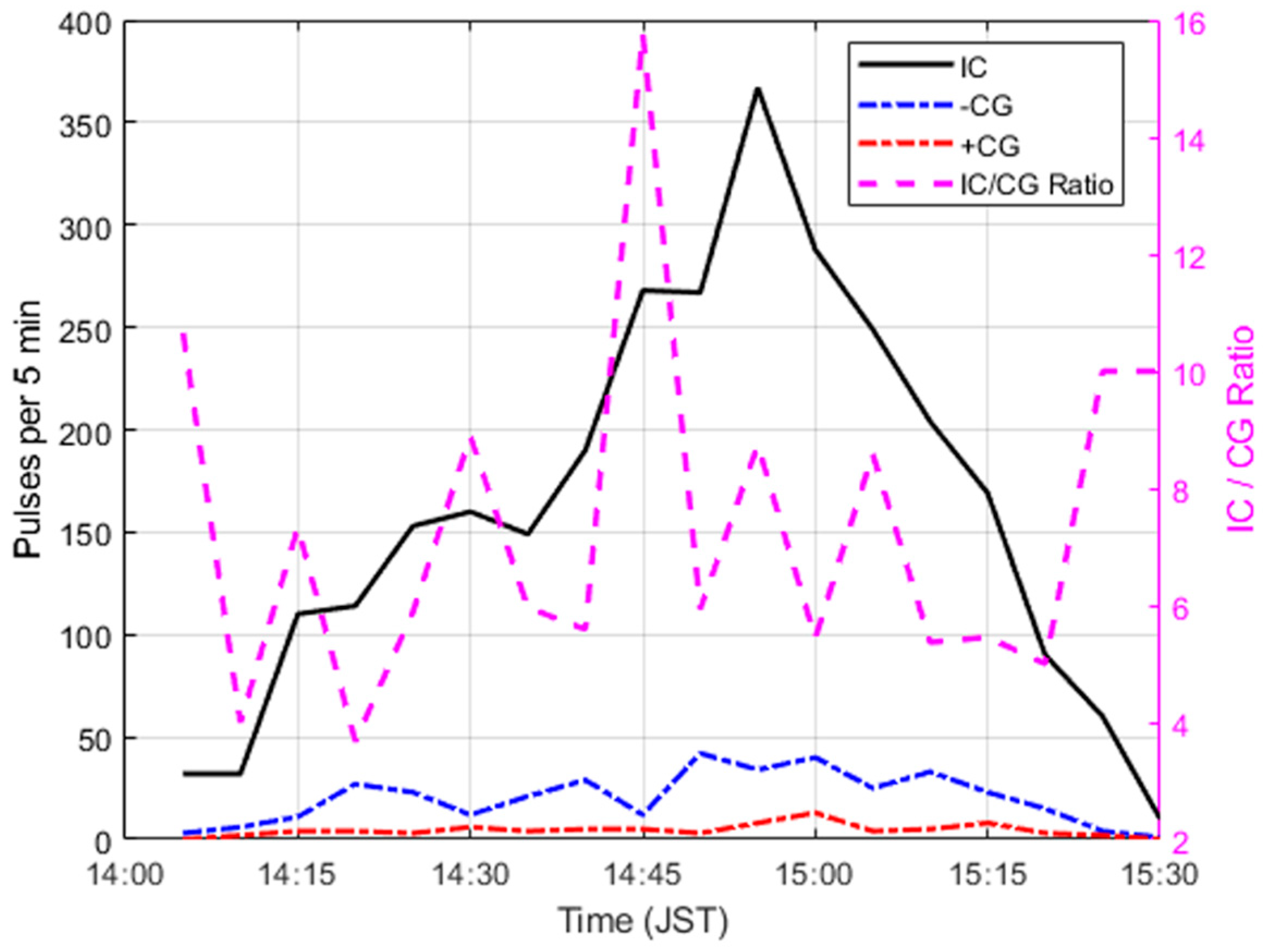
During this TS event, from 14:00 to 15:30 JST, a total of 3352 pulses were recorded by JTLN within the latitude range of 35.5–36.5° N and longitude range of 139–140° E, associated with the development of two TS cells. The recorded pulses consisted of 2912 in-cloud (IC), 361 negative cloud-to-ground (−CG), and 79 positive cloud-to-ground (+CG) discharges. For this spatial range, the IC, +CG, −CG pulse rates and IC/CG ratio per 5 min are illustrated in
Figure 1. The observed oscillation in the IC/CG ratio were primarily driven by variability in the CG lightning pulse rate. The peaks in the IC/CG ratio corresponded to reduced CG activity, while lower values (drops) were associated with relatively increased CG occurrence. Of the two TS cells, one cell developed around 14:00 JST and dissipated by approximately 14:30 JST, while the second cell initiated around 14:20 JST and persisted until about 15:30 JST. The second cell was considered for detailed analysis in this study.
Following the data processing procedure described in
Section 2.2, the discrete IC lightning observations were converted into gridded density fields with the same spatial and temporal resolutions as the rainfall dataset (1600 × 1280 grid, 250 m resolution, 5 min interval). This ensured spatial and temporal consistency between the rainfall intensity and lightning density for subsequent AITCC-based cell detection and tracking.
3.2. Lightning Cell Identification
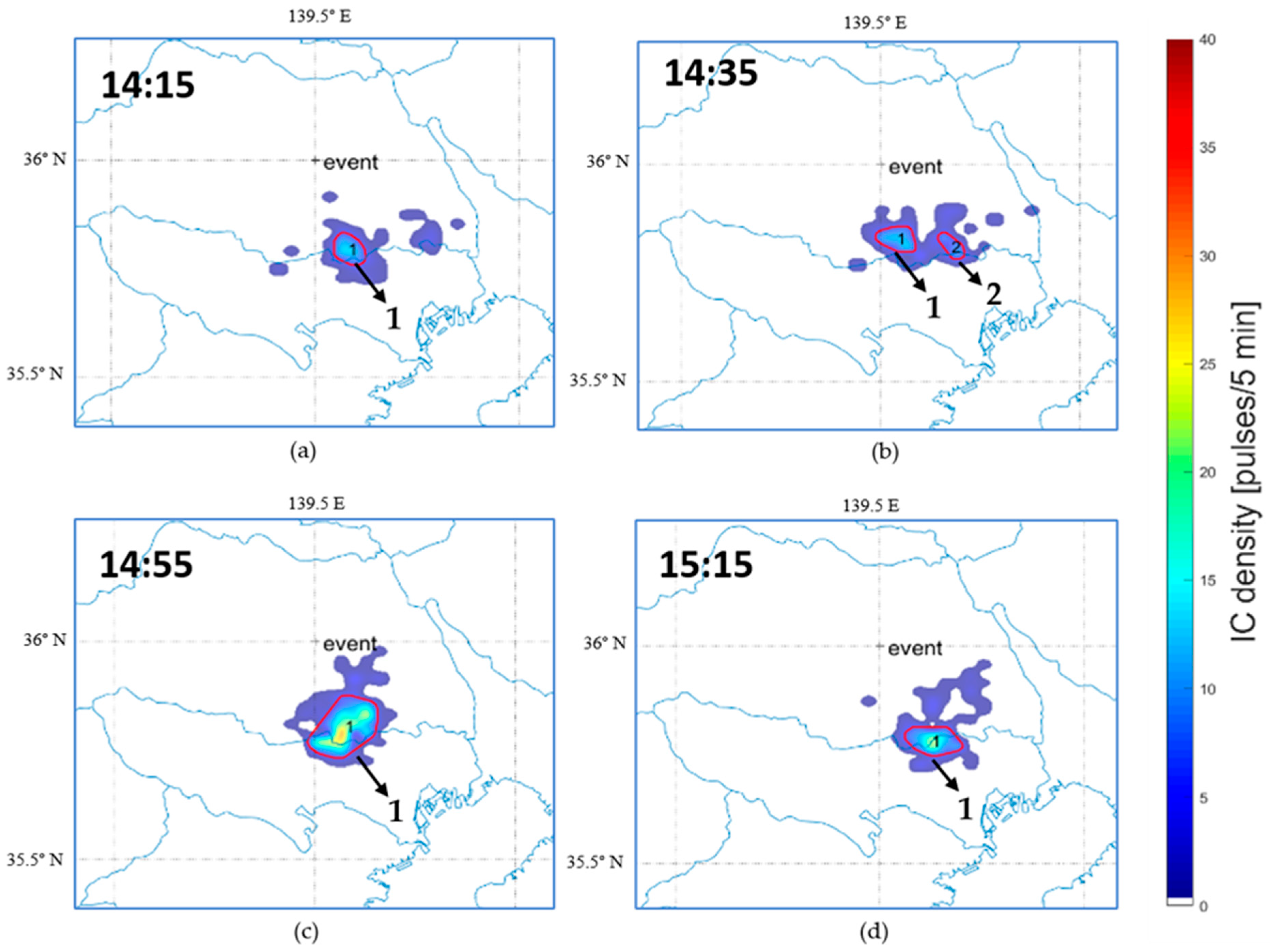
Figure 2 shows the results of the identification of lightning cells by AITCC for different time steps (in 20 min time intervals) representing the developing, mature and dissipating stage of the TS cell. The IC threshold for identifying a lightning cell was considered to be 5 pulses/5 min.
AITCC started identifying one lightning cell from 14:15 JST (numbered 1 and contoured with a red line, as shown in
Figure 2a) and identified two lightning cells at 14:35 JST. At 14:35 JST, the older cell shifted slightly eastward and was numbered 2, while the newer cell was numbered 1 (
Figure 2b). After 14:35 JST, it continued to identify the newer cell until 15:20 JST, and the older cell diminished. Around 14:55 JST, the lightning cell became well-developed (
Figure 2c) and began dissipating after this time step (
Figure 2d).
3.3. Precipitation Cell Identification
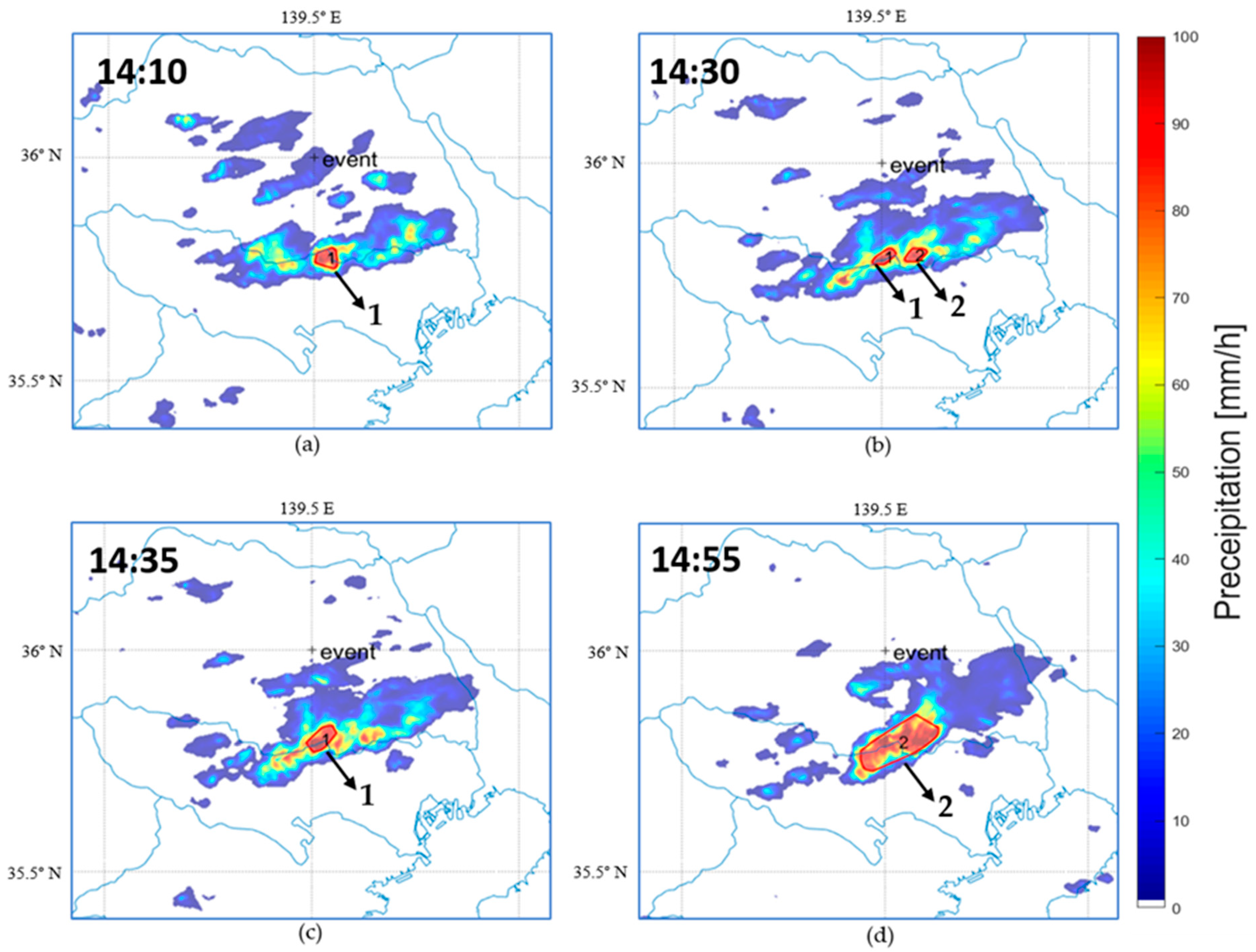
Figure 3a–d show the identified precipitation cells (the area contoured with a red line) during the life cycle of the TS from 14:10 JST to 14:55 JST. At 14:10 JST (
Figure 3a), AITCC identified the first precipitation cell, labeled 1. By 14:30 JST (
Figure 3b), the earlier cell (labeled 2) became smaller, and a new cell was identified to west of it and was numbered 1. At 14:35 JST (
Figure 3c), the older cell dissipated, and the newer cell began to develop. By 14:55 JST (
Figure 3d), the precipitation cell became well-developed and was numbered 2, which gradually started dissipating from 15:05 JST onwards. The cell was labeled 2 at 14:55 JST because AITCC identified another new precipitation cell in the north-west direction of the considered cell at 14:50 JST, but no associated lightning activity was observed in this new location and was therefore not considered.
For both the lightning and precipitation cell identification, a well-developed cell was observed around 14:55 JST, numbered lightning cell 1 (
Figure 2c) and precipitation cell 2 (
Figure 3d). The tracking algorithm was applied for these two cells.
3.4. Lightning Cell Tracking
The AITCC algorithm started tracking the selected lightning cell at 14:35 JST and continued tracking until 15:20 JST. During the life cycle of the TS cell, the associated lightning cell did not show significant movement in any particular direction until the dissipation stage. It appeared and remained approximately between 35.7° N and 35.9° N and between 139.5° E and 139.7° E.
Between the two identified cells at 14:35 JST (refer to
Figure 2b), the cell numbered 1 was tracked and recognized as the initial stage of the mature cell observed at 14:55 JST (
Figure 2c). The well-developed lightning cell enclosed the maximum area at 14:55 JST and started decaying afterwards.
3.5. Precipitation Cell Tracking
The AITCC tracking algorithm was applied to track the corresponding precipitation cell (appeared well-developed at 14:55 JST,
Figure 3d). The AITCC algorithm began tracking the selected precipitation cell from 14:30 JST and continued tracking until 15:15 JST.
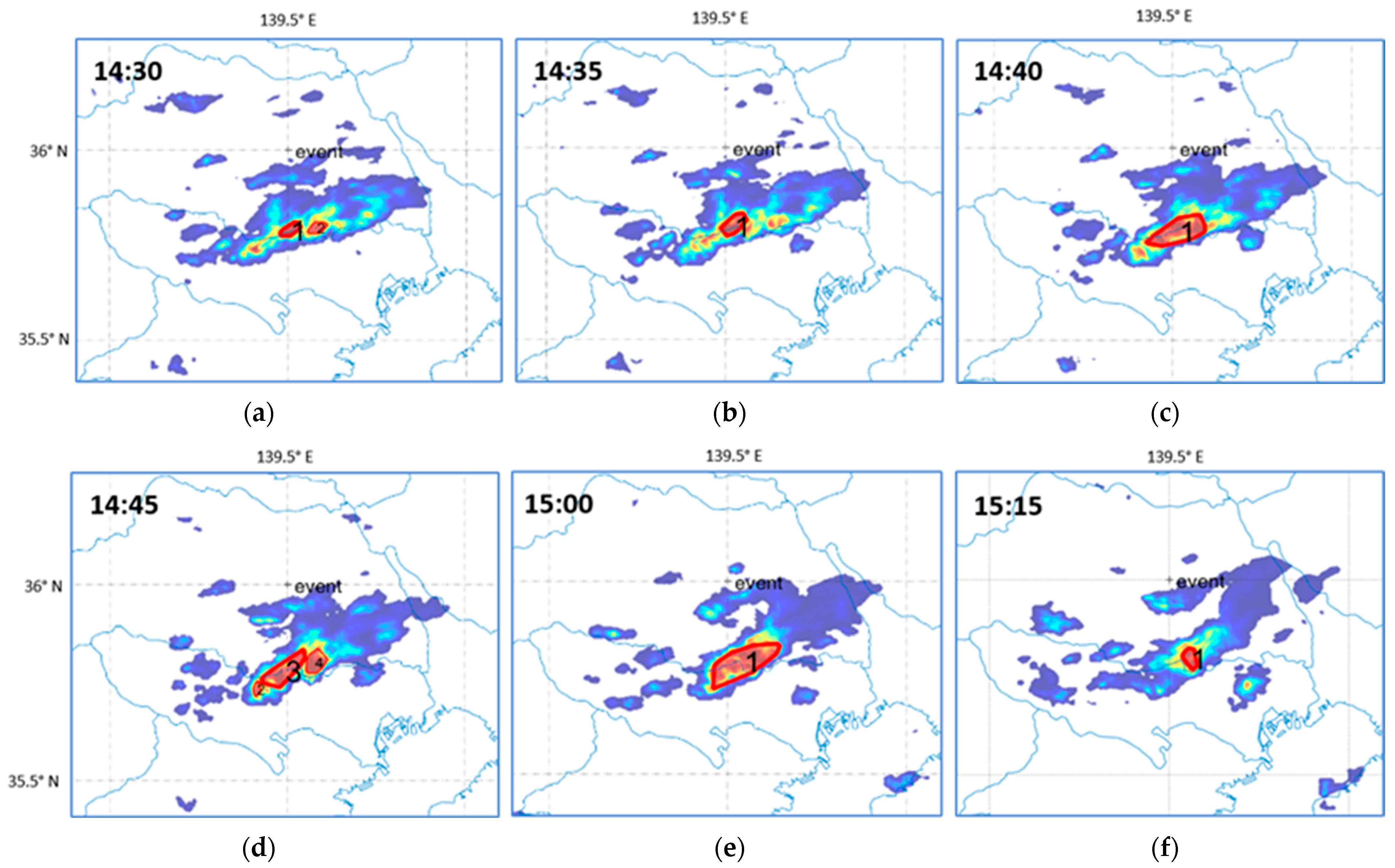
Figure 4 illustrates the tracked cell from 14:30 JST to 15:15 JST, depicting its developing to dissipating stages.
At 14:30 JST, two precipitation cells were identified, but only cell 1 was tracked as the initial state of the selected cell (bounded by a thick red line in
Figure 4a). At 14:35 JST (
Figure 4b), the other cell dissipated, while cell 1 expanded gradually until 14:40 JST (
Figure 4c). At 14:45 JST, three cells were identified (labeled 2, 3, and 4), with one new cell appearing to the east and the other to the southwest direction. However, only the older cell (labeled 3) was tracked as the selected cell for the time step (
Figure 4d). The cells numbered 2 and 3 at 14:45 JST had merged by 14:50 JST, and were renumbered as cell 2, which became the tracked cell. By 15:00 JST (
Figure 4e), AITCC tracked a larger precipitation area labeled cell 1. The cell area started decreasing noticeably after 15:00 JST, and the precipitation cell gradually diminished after 15:15 JST. During the life cycle of the TS cell, the associated heavy precipitation area also exhibited no significant movement in any particular direction until the dissipation stage. However, it covered a slightly wider area compared to the lightning cell, remaining approximately between 35.7–35.9° N and 139.4–139.7° E.
The cell identification and tracking were performed for different threshold levels, setting the rainfall threshold to 50 mm/h and lightning threshold to 2 pulses/5 min. For a rainfall threshold of 50 mm/h, the rainfall cell was tracked from 14:00 JST to 15:25 JST, whereas for the IC threshold of 2 pulses/5 min, the lightning cell was tracked continuously from 14:10 JST to 15:25 JST. After identifying and tracking the precipitation and lightning cells at various intensity thresholds, further analysis was carried out to quantify the spatial and temporal relationship between them. This was conducted using a 2D-normalized cross-correlation approach, described in the following section.
3.6. Time-Lagged Spatial Cross-Correlation Analysis
To evaluate the spatial relationship between the tracked lightning and rainfall cells, two-dimensional normalized cross-correlation analysis was performed after extracting the area of interest (AoI) at each time step. The AoI was defined as the area within the tracked area (thick red boundary) where the intensity values exceeded the selected threshold.
The cross-correlation between the extracted IC lightning cell and the corresponding ground rainfall cell was calculated for four threshold combinations using two different thresholds for rainfall intensity (50 mm/h and 80 mm/h) and two for IC intensity (5 pulses/5 min and 2 pulses/5 min). Variable time lags were considered between the IC lightning L(
t) and rainfall R(
t + Δ
t): no time lag (0 min), as well as 5 min, 10 min, 15 min and 20 min time lag. The maximum normalized cross-correlation coefficient obtained for each lag is summarized in
Table 2 and
Table 3 for IC thresholds of 5 pulses/5 min and 2 pulses/5 min, respectively.
3.6.1. Evolution of Correlation with Time Lag
For both of the selected IC thresholds, strong positive correlations were observed between the IC lightning activity and rainfall. For the 50 mm/h rainfall threshold, the correlation coefficient showed more consistent behavior, with values increasing from zero lag to a maximum of 0.84 at a 10 min lag, followed by a gradual decrease at 15 and 20 min lags. This consistent peak at 10 min was observed for both IC thresholds, indicating that the spatial structure of heavy rainfall (≥50 mm/h) aligned most strongly with lightning activity occurring approximately 10 min earlier.
In contrast, for the 80 mm/h threshold, correlation values remained high but showed comparatively greater variability across time lags. Peak correlations of approximately 0.74–0.76 occurred at 5 and 15 min lags, without exhibiting a clear and systematic maximum at 10 min. Although the differences between the IC thresholds were relatively small, the consistent pattern in both cases suggested that the correlation between IC lightning and ≥50 mm/h rainfall was more robust. This suggests that heavy rainfall intensities (≥50 mm/h) were more reliably associated with lightning activity for this particular event.
3.6.2. Spatial Displacement Characteristics
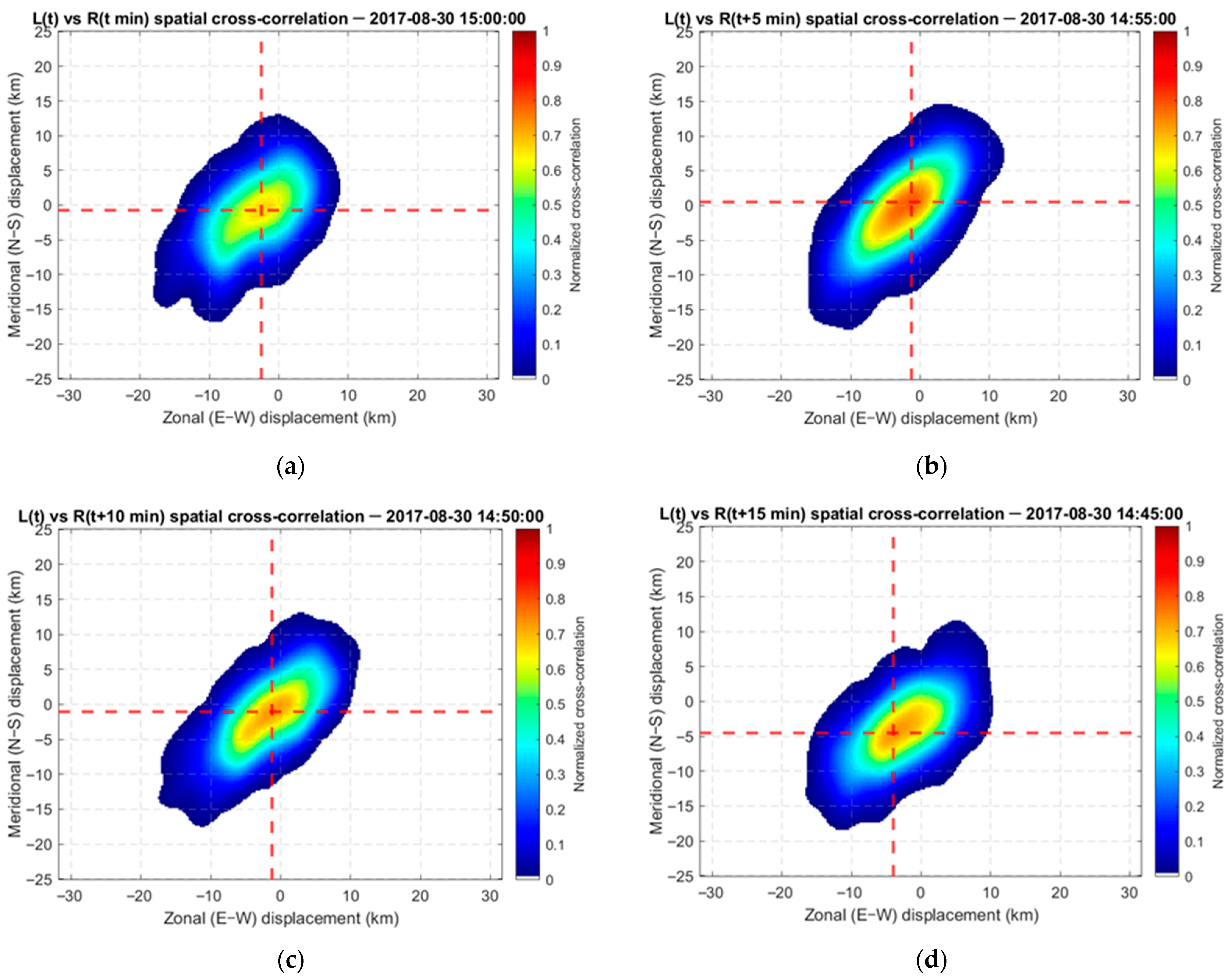
To further investigate the spatial relationship, cross-correlation matrices were visualized for the time corresponding to the maximum ground rainfall intensity (15:00 JST). Lightning distributions at the same time and 5, 10, 15, and 20 min earlier were compared with the rainfall matrix.
The cross-correlation matrices in
Figure 5a–d illustrate the spatial displacement required for optimal alignment between lightning and rainfall cells. The horizontal axis represents zonal (east–west) displacement, while the vertical axis represents meridional (north–south) displacement, both expressed in kilometers relative to the zero-shift position. The origin (0,0) corresponds to perfect spatial alignment without displacement.
The location of the maximum correlation is marked by the intersection of red dashed horizontal and vertical lines. The proximity of this intersection to the origin indicates the magnitude of the spatial offset between the fields, with smaller distances representing stronger collocation and minimal positional shift.
For the peak ground rainfall time, the highest correlation (0.78) was obtained for a 5 min lag (
Figure 5b). The correlation values for 10 and 15 min lags were 0.72 and 0.71, respectively (
Figure 5c and
Figure 5d, respectively). The smallest spatial displacement was also observed for the 5 min lag, with a comparable displacement at 10 min. This indicates that the rainfall structure most closely aligned with the lightning distribution occurring 5–10 min earlier in terms of both spatial similarity and positional offset.
It should be noted that the analyzed rainfall and the lightning cell exhibited quasi-stationary behavior during the study period, which might have contributed to the small displacement in the cross-correlation analysis. When cells exhibit significant movement during the lifecycle of a TS, the magnitude of the spatial displacement and the optimum temporal offset may vary. However, the methodology provides a consistent framework for identifying the movement direction of the storm as well as the underlying relationship between lightning activity and subsequent rainfall development.
4. Discussion
For the ≥50 mm/h threshold, the temporal evolution exhibited a clear and consistent peak when there was a 10 min time difference between the detected lightning cell (L(t)) and the rainfall cell (R(t + 10 min)). In contrast, the ≥80 mm/h threshold showed a slightly lower correlation coefficient and greater variability, with stronger correlations for 5 and 15 min lags rather than a single pronounced maximum for the 10 min lag.
This difference likely reflects the spatial and temporal characteristics of extreme rainfall cores. Rainfall regions exceeding 80 mm/h are typically more localized and transient compared to broader ≥50 mm/h structures, and the spatial correspondence with IC activity fluctuates more. The more coherent behavior observed for the ≥50 mm/h threshold suggested that storm-scale electrification was more strongly linked to organized heavy rainfall cells than to the most intense, localized torrential rainfall core. Both IC intensity thresholds produced similar temporal trends and peak correlation values, indicating that the spatial relationship between IC lightning and heavy rainfall remained consistent despite moderate threshold variation.
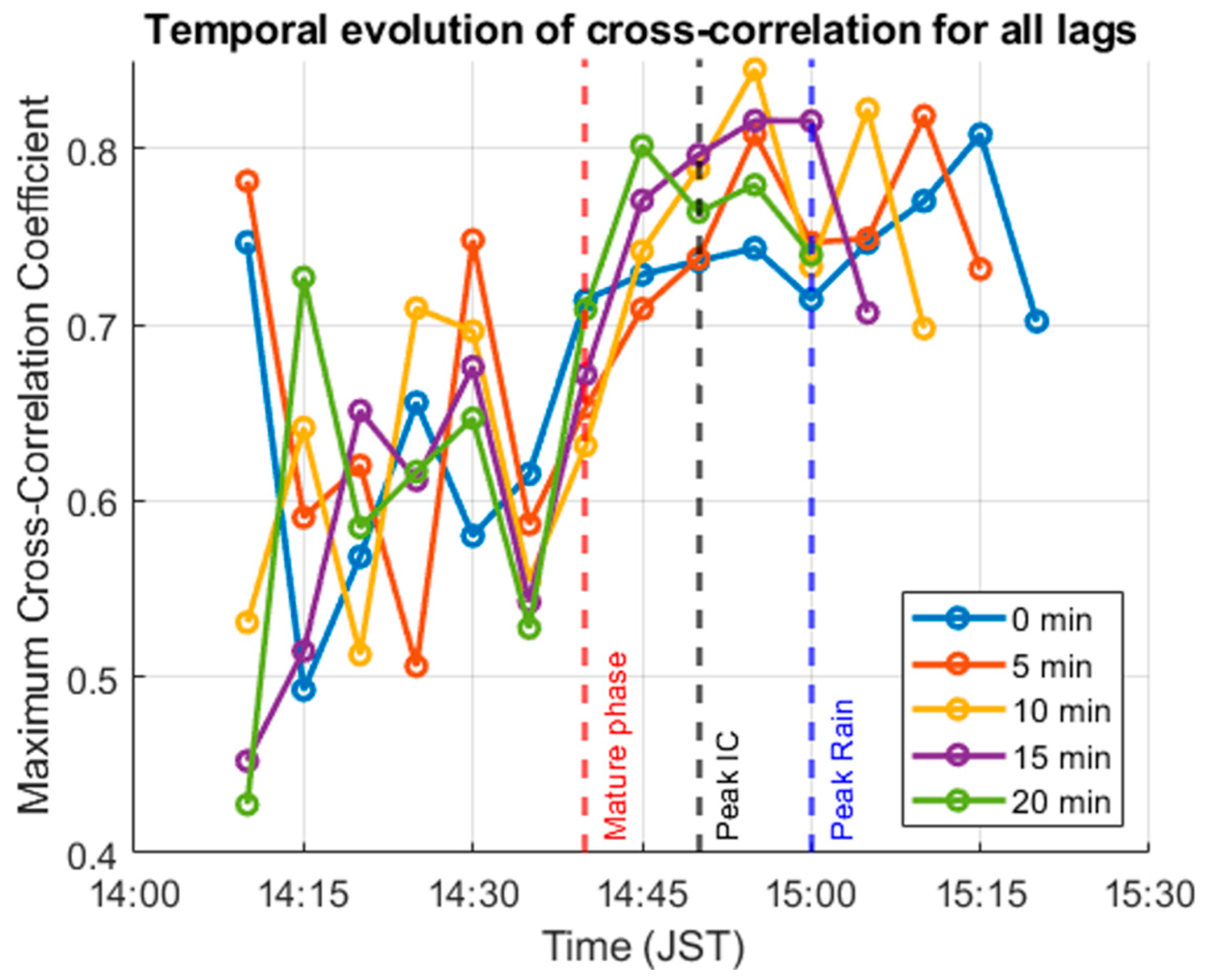
A clear storm-phase dependence was observed in the temporal evolution of the cross-correlation values. The temporal evolution of the cross-correlation coefficients for different time lags is shown in
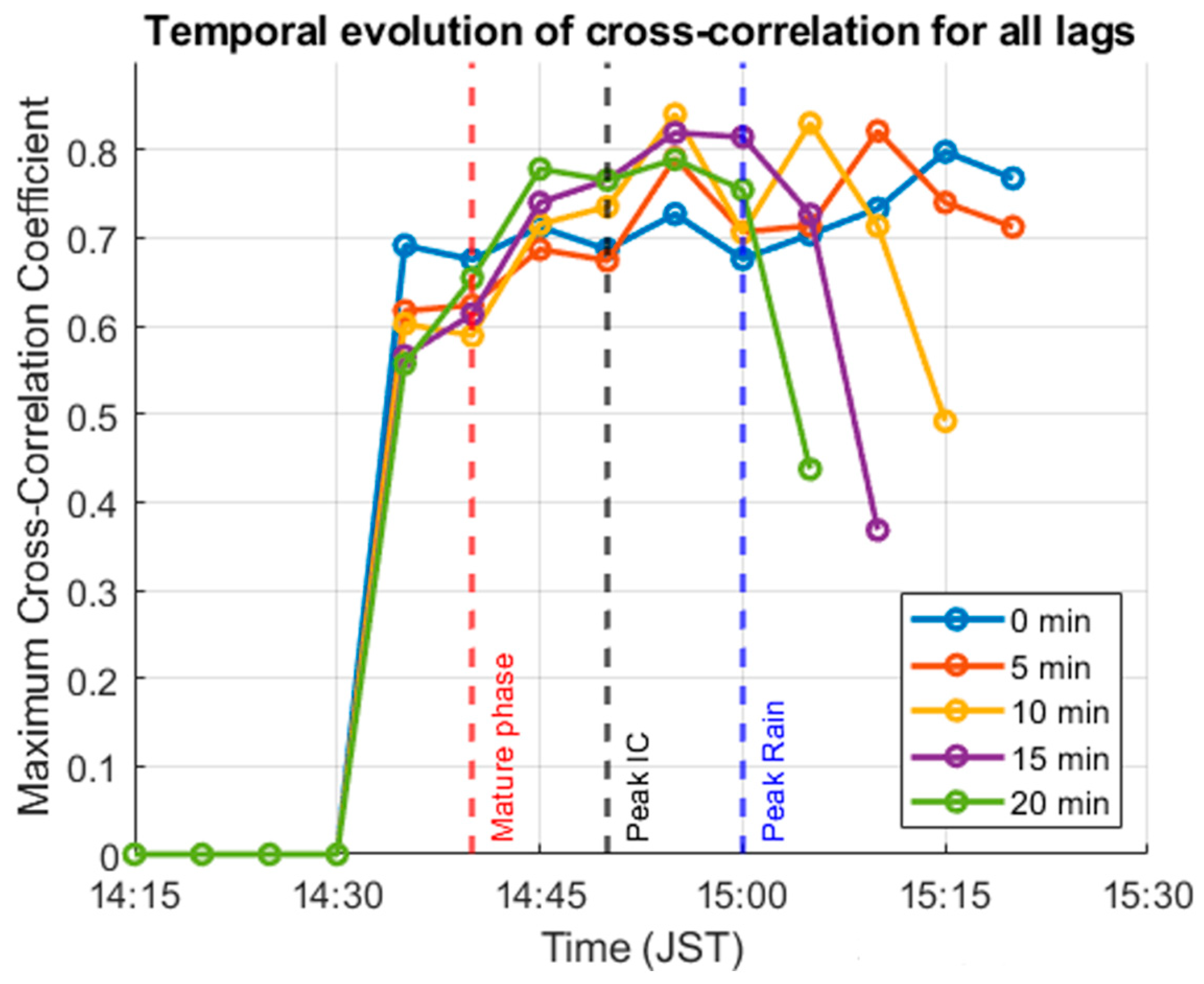
Figure 6 for the ≥50 mm/h rainfall threshold and the 2 pulses/5 min IC threshold. The x-axis represents the time in JST, and the y-axis represents the cross-correlation value. The cross-correlation values were available from 14:10 JST onwards. The cross-correlation coefficients were relatively irregular and weaker prior to approximately 14:40 JST. From around 14:40 JST until the time of the maximum precipitation, the correlation values increased substantially and remained consistently high, mostly above 0.70. Similar behavior was observed for the same rainfall and higher lightning threshold combination (
Figure 7). Although tracking began later in the higher threshold combinations (around 14:35), the correlation values from approximately 14:35 JST through the peak precipitation period were above 0.60.
The cross-correlation coefficients were not highly sensitive to the IC lightning threshold (2 vs. 5 pulses/5 min), but the choice of threshold influenced the temporal detection of the lightning cell. When the higher threshold (5 pulses/5 min) was applied, the onset of identifiable lightning cells occurred later than when applying the 2 pulses/5 min criterion. For short-lived convective systems, where the storm lifetime is 30–60 min, the initial few time steps represent a substantial fraction of the storm’s evolution. In such rapidly evolving systems, early identification of electrification onset is critical for short-term monitoring and prediction. A lower IC threshold may therefore be advantageous for early-stage detection if it does not significantly alter the overall correlation magnitude during the mature phase.
It is noteworthy that the analyzed event occurred in Saitama Prefecture, located within the Kanto Plain, which is characterized by predominantly flat, lowland terrain with minimal orographic influence. The extreme rainfall event led to flooding in the Yanase River basin and human casualties. According to the Kumagaya Local Meteorological Office, the event was associated with the inflow of warm and humid air from the south toward a stationary front over the Kanto region, resulting in highly unstable atmospheric conditions and intense convective rainfall [
21]. The hourly observations from the Tokorozawa AMeDAS station show that temperatures reached 31.1 °C at 11:00, ~30.5 °C at 13:00 prior to the onset of precipitation, followed by intense rainfall of up to 35.5 mm h
−1, and a rapid temperature decrease to about 24 °C at around 15:00 JST. These conditions are consistent with strong convective activity driven primarily by thermodynamic factors.
Therefore, the relationship between lightning discharge density and precipitation obtained in this study is likely primarily influenced by atmospheric conditions rather than orographic effects. In contrast, in mountainous or hilly regions, orography is the primary factor influencing the spatial distribution of thunderstorm activity, and thus the relationship may differ across such complex terrain.
Moreover, the present TS event analysis was limited to a well-defined, isolated cell for most of the time steps for both IC pulses and rainfall. This structural simplicity resulted in relatively high correlation values and stable displacement behavior among time lags. However, in complex TSs involving multiple cells, cell splitting, or cell merging, the maximum correlation changes frequently. In such cases, the spatial location of the peak correlation may shift significantly from one time step to the next, not necessarily because lightning and rainfall are physically separated, but because different storm cells dominate the spatial pattern at different times.
Under multi-cell conditions, a 5 min temporal resolution may be insufficient to resolve rapid structural evolution. Higher temporal resolution (e.g., 1–3 min) could improve the tracking of individual cells, where charge regions can reorganize rapidly during cell interaction and dynamical transitions.
5. Conclusions
The application of AITCC enabled the automatic extraction of lightning cells (IC-frequent area) and precipitation cells based on predefined intensity thresholds, which reduced the complexity and the required time detecting cells at every time step compared with manual detection. This automated approach facilitated robust two-dimensional cross-correlation and displacement analyses between tracked IC lightning and precipitation cells.
The cross-correlation analysis between the tracked IC lightning and precipitation cells revealed a strong and consistent spatiotemporal relationship. For the 50 mm/h rainfall threshold and both IC thresholds, the correlation peaked at 0.84 with a 10 min lag. Notably, the present analysis reproduced the previously reported ~10 min lead of the peak IC activity relative to maximum ground rainfall for this event, which was originally identified using manual cell tracking [
9]. Despite adopting an automated AITCC-based framework and incorporating two-dimensional spatial cross-correlation and displacement analysis, the optimal lag remains at 10 min. This consistency confirms the robustness of the relationship and demonstrates that the earlier findings were not an artifact of manual cell selection. When using a higher rainfall threshold of 80 mm/h (torrential rainfall), the correlation values showed higher variability with different time lags and slightly lower peak values. For this isolated convective case, the structural correspondence between lightning and precipitation cells showed limited sensitivity to the chosen IC threshold.
The temporal evolution of the correlation strength further demonstrated that the spatial coupling intensified after 14:40 JST, coinciding with the transition toward the mature phase of the storm. During this stage, the strengthened updrafts and enhanced mixed-phase microphysics contributed to a more coherent alignment between electrification and heavy rainfall. Prior to this period, rapid structural evolution may have contributed to the greater variability in the alignment.
Displacement analysis derived from the cross-correlation matrices provided additional insight into storm cell evolution and propagation. From these matrices, along with identifying the maximum correlation value, the corresponding displacement indices indicated the optimal shift where the rainfall data best aligned with the lightning data. For this particular analyzed event, at the time of maximum ground precipitation (15:00 JST), the least displacement and cross-correlation coefficients of 0.79 and 0.73 were observed for the 5 and 10 min lags, respectively. Identifying the optimal displacement provides insights into the movement of the whole storm system and the location of increased rainfall in the subsequent time steps. These findings demonstrate that the IC lightning rate can function not only as a temporal precursor but also as a spatial proxy for forthcoming heavy rainfall, particularly during the mature stage of isolated convective cells.
Although the present analysis focused on a single isolated thunderstorm event, the integration of automated cell tracking with time-lagged spatial cross-correlation significantly reduces methodological constraints and enables scalable application to larger storm datasets. Future work will focus on analyzing the spatial and temporal relationships of additional complex TS events and exploring different threshold combinations to identify the optimal conditions for developing a machine learning model that enhances the robustness of short-term rainfall prediction.
Author Contributions
Conceptualization, D.M. and Y.H.; methodology, D.M. and Y.H.; software, D.M.; validation, D.M., Y.H. and H.K.; formal analysis, D.M.; resources, Y.H. and J.L.; data curation, Y.H. and J.L.; writing—original draft preparation, D.M.; writing—review and editing, D.M., Y.H., H.K. and J.L.; supervision, Y.H. and H.K.; project administration, Y.H.; funding acquisition, Y.H. All authors have read and agreed to the published version of the manuscript.
Funding
This research was funded by Japan Society for the Promotion of Science (JSPS) KAKENHI, grant number JP23K25950, and there was no external funding for the APC.
Institutional Review Board Statement
Not applicable.
Informed Consent Statement
Not applicable.
Data Availability Statement
The rainfall data were obtained from the DIAS platform provided by the Ministry of Land, Infrastructure, Transport and Tourism (MLIT), Japan. The user needs to register and log in to access the dataset (URL:
https://xrain.diasjp.net/info/, accessed on 15 December 2026), and redistribution of the XRAIN datasets is prohibited. The total lightning data from the Japanese Total Lightning Network (JTLN) are available after using the contact form of Earth Networks (
https://get.earthnetworks.com/contactus, accessed on 15 December 2026). All figures in this study were generated using MATLAB (R2021b, 9.11.0.1809720) scripts.
Acknowledgments
We acknowledge the support from the Ministry of Education, Culture, Sports, Science, and Technology (AiQuSci Scholarship). The authors thank the Ministry of Land, Infrastructure, Transport and Tourism (MLIT) for providing XRAIN data (downloaded from the DIAS website) and the Takahashi Industrial and Economic Research Foundation for partially supporting this research project.
Conflicts of Interest
Author Jeff Lapierre was employed by the Advanced Environmental Monitoring. The remaining authors declare that the research was conducted in the absence of any commercial or financial relationships that could be construed as a potential conflict of interest.
Abbreviations
The following abbreviations are used in this manuscript:
| XRAIN | Extended Radar Information Network |
| MLIT | Ministry of Land, Infrastructure, Transport and Tourism |
| AITCC | Algorithm for the Identification and Tracking of Convective Cells |
| JTLN | Japanese Total Lightning Network |
| TL | Total Lightning |
| IC | In Cloud |
| CG | Cloud-to-Ground |
| TS | Thunderstorm |
| TIFS | Tracking Interactive Forecast System |
| MV | Moving Vector |
| CCR | Cross-Correlation |
| PF | Priority Function |
| JST | Japanese Standard Time |
| AoI | Area of Interest |
References
- Kikuchi, H.; Hobara, Y.; Ushio, T. Time-Altitude Variation of 30-Second-Update Full Volume Scan Data for Summer Convective Storms Observed With X-Band Dual Polarized Phased Array Weather Radar. IEEE Access 2024, 12, 104333–104343. [Google Scholar] [CrossRef]
- Takahasi, T. Thunderstorm Electrification—A Numerical Study. J. Atmos. Sci. 1984, 41, 2541–2558. [Google Scholar] [CrossRef]
- Michimoto, K. A Study of Radar Echoes and Their Relation to Lightning Discharge of Thunderclouds in The Hokuriku District. I, Observation and Analysis of Thunderclouds in Summer and Winter. J. Meteorol. Soc. Jpn. 1991, 69, 327–336. [Google Scholar] [CrossRef]
- Takahashi, T.; Kawano, T.; Ishihara, M. Different Precipitation Mechanisms Produce Heavy Rain with and Without Lightning in Japan. J. Meteorol. Soc. Jpn. 2015, 93, 245–263. [Google Scholar] [CrossRef][Green Version]
- Goodman, S.J.; Blakeslee, R.; Christian, H.; Koshak, W.; Bailey, J.; Hall, J.; McCaul, E.; Buechler, D.; Darden, C.; Burks, J. The North Alabama lightning mapping array: Recent severe storm observations and future prospects. Atmos. Res. 2005, 76, 423–437. [Google Scholar] [CrossRef]
- Pineda, N.; Bech, J.; Rigo, T.; Montanyà, J. A Mediterranean Nocturnal Heavy Rainfall and Tornadic Event. Part II: Total Lightning Analysis. Atmos. Res. 2011, 100, 638–648. [Google Scholar] [CrossRef]
- Liu, C.; Sloop, C.; Heckman, S. Application of Lightning in Predicting High Impact Weather; OBS/IMO/TECO: St. Petersburg, Russia, 2014. [Google Scholar]
- Farnell, C.; Rigo, T.; Pineda, N. Lightning jump as a nowcast predictor: Application to severe weather events in Catalonia. Atmos. Res. 2016, 183, 130–141. [Google Scholar] [CrossRef]
- Mondal, D.; Hobara, Y.; Kikuchi, H.; Lapierre, J. Thunderstorms and Total Lightning Characteristics Causing Heavy Precipitation in Japan: A case Study. Radio Sci. Bull. 2021, 378, 70–76. [Google Scholar] [CrossRef]
- Mondal, D.; Hobara, Y.; Kikuchi, H.; Lapierre, J.; Le Floch, P.; Kameya, O.; Kawaguchi, N.; Motojima, K.; Shiokawa, K.; Eguchi, T.; et al. Temporal dependencies between total lightning and rainfall in multicellular systems: A predictive approach for torrential rain during summer thunderstorms in Japan. Radio Sci. 2026, 61, e2025RS008380. [Google Scholar] [CrossRef]
- Dixon, M.; Wiener, G. TITAN—Thunderstorm Identification, Tracking, Analysis, and Nowcasting—A Radar-Based Methodology. J. Atmos. Ocean. Technol. 1993, 10, 785–797. [Google Scholar] [CrossRef]
- Kyznarová, H.; Novák, P. CELLTRACK—Convective cell tracking algorithm and its use for deriving life cycle characteristics. Atmos. Res. 2009, 93, 317–327. [Google Scholar] [CrossRef]
- Picus, C.; Beleznai, C.; Nowak, C.; Ramoser, H.; Mitterhuber, S. Kernel-Based Storm Tracking in Radar Data. In Proceedings of the IEEE Radar Conference, Rome, Italy, 26–30 May 2008. [Google Scholar]
- Price, C.; Yair, Y.; Mugnai, A.; Lagouvardos, K.; Llasat, M.C.; Michaelides, S.; Dayan, U.; Dietrich, S.; Galanti, E.; Garrote, L.; et al. The FLASH Project: Using lightning data to better understand and predict flash floods. Environ. Sci. Policy 2011, 14, 898–911. [Google Scholar] [CrossRef]
- Bruning, E.C.; Rust, W.D.; Schuur, T.J.; MacGorman, D.R.; Krehbiel, P.R.; Rison, W. Electrical and polarimetric radar observations of a multicell storm in TELEX. Mon. Weather Rev. 2007, 135, 2525–2544. [Google Scholar] [CrossRef]
- Meyer, V.K.; Höller, H.; Betz, H.D. Automated thunderstorm tracking: Utilization of three-dimensional lightning and radar data. Atmos. Chem. Phys. 2013, 13, 5137–5150. [Google Scholar] [CrossRef]
- Meyer, V.K.; Höller, H.; Betz, H.D. The temporal evolution of three-dimensional lightning parameters and their suitability for thunderstorm tracking and nowcasting. Atmos. Chem. Phys. 2013, 13, 5151–5161. [Google Scholar] [CrossRef]
- Shimizu, S.; Uyeda, H. Algorithm for the Identification and Tracking of Convective Cells Based on Constant and Adaptive Threshold Methods Using a New Cell-Merging and -Splitting Scheme. J. Meteorol. Soc. Jpn. Ser. II 2012, 90, 869–889. [Google Scholar] [CrossRef]
- Hobara, Y.; Kono, S.; Ogawa, T.; Heckman, S.; Stock, M.; Liu, C. Total Lightning Characteristics of recent hazardous weather events in Japan. In Proceedings of the American Geophysical Union (AGU) fall Meeting, New Orleans, LA, USA, 11–15 December 2017. [Google Scholar]
- Huang, Y.; Fan, Y.; Cai, L.; Cheng, S.; Wang, J. A New Thunderstorm Identification Algorithm based on Total Lightning Activity. Earth Space Sci. 2022, 9, e2021EA002079. [Google Scholar] [CrossRef]
- Kumagaya Local Meteorological Office. Preliminary Report on the Heavy Rain Event of 30 August 2017 in Saitama Prefecture; Kumagaya Local Meteorological Office: Saitama, Japan, 2017. [Google Scholar]
| Disclaimer/Publisher’s Note: The statements, opinions and data contained in all publications are solely those of the individual author(s) and contributor(s) and not of MDPI and/or the editor(s). MDPI and/or the editor(s) disclaim responsibility for any injury to people or property resulting from any ideas, methods, instructions or products referred to in the content. |