Article

The Effect of Neighboring Objects on Non-Rainfall Water

by
Giora J. Kidron
1,* and
Rafael Kronenfeld
2
1
Institute of Earth Sciences, The Hebrew University, Givat Ram Campus, Jerusalem 91904, Israel
2
Meteorological Unit, Israel Meteorological Service, Sde Boker 84993, Israel
*
Author to whom correspondence should be addressed.
Atmosphere 2026, 17(4), 347; https://doi.org/10.3390/atmos17040347
Submission received: 27 January 2026 / Revised: 25 March 2026 / Accepted: 26 March 2026 / Published: 30 March 2026
(This article belongs to the Special Issue Analysis of Dew under Different Climate Changes)

Abstract

With non-rainfall water (NRW), principally dew and fog, serving as an important water source, especially in arid and semiarid regions, factors that may increase the NRW yield may have important hydrological and ecological consequences. On the other hand, dew and fog may also have hazardous effect on inorganic and human-made materials that may undergo corrosion and/or degradation. It has long been noted that dew and fog are affected by neighboring objects, the effect of which was, however, only barely explored. Hypothesizing that it may principally be linked to the sky view factor (SVF) (determining, in turn, substrate temperature and heat flow) and, therefore, to the angle that is formed between the collecting substrate and the height of the neighboring objects, a set of square boxes (30 × 30 or 60 × 60 cm) was constructed. The boxes had variable heights, forming angles of 15°, 30°, 45°, 60°, and 75° between 6 × 6 × 0.1 cm cloth attached to a substratum (10 × 10 × 0.2 cm glass plate overlying 10 × 10 × 0.5 cm plywood) at the center of each box and the top walls of the box. NRW that accumulated at the cloths was compared with cloths placed in the open, serving as control. Another set served to measure the plate temperatures. A clear decrease in NRW, with an angle corresponding to a third-degree polynomial equation, was found (r2 = 0.998). Taking 0.1 mm as the threshold for vapor condensation (dew), and taking the average maximal NRW as measured for two years in the Negev (0.20 mm), angles of ≥45° will suffice to impair condensation. However, with the projected decrease in NRW with global warming, even angles of ≥30° may impair condensation in 1–2 decades. While it may decrease the dew amounts and subsequently negatively affect the vegetation in forest clearings and wadis or canyons, it may decrease the exposure of construction materials to corrosion and/or degradation, thus exerting a positive effect on construction materials in urban settings.

1. Introduction

Non-rainfall water (NRW) and among it, dew and fog, may affect various aspects of life, particularly the biota [1,2], promoting plant growth [3,4,5,6,7,8,9], as well as the growth of lithic organisms (lithobionts) [10,11] and, to a certain extent, also moss-dominated biocrusts [12]. On the other hand, it may have negative effects. By providing frequent days during which the leaves are wetted, dew and fog may promote fungal diseases [13,14,15]. Frequent wet–dry cycles may also have a negative effect on inorganic and human-made materials that may undergo corrosion and/or degradation [16,17].
Whereas degradation results from direct chemical attack, corrosion takes place electrochemically [17,18]. As for degradation, it may take place even on the most widely used construction material, carbon steel [19], but also on a large variety of materials such as limestone, building stones, or cement, during which H2SO4 interacts with CaCO3 to form CaSO4 [18]. As for electrochemical corrosion, it occurs following electron transfer, triggered by acidity [17,18]. Acidity can be directly provided by dew or fog, following scavenging of acidic components from the atmosphere, but it may also be triggered by dissolution of dry deposition, previously deposited on the substrate, undergoing enhanced chemical reaction following dew formation and fog interception.
While climatological conditions, such as the amount of vapor in the air, temperature, and wind regimes, principally dictate NRW, NRW is also dictated by microclimatological factors that affect the heat exchange [20,21] or the substrate temperature, largely determined by the sky view factor (SVF), i.e., the proportion of sky “seen” by the deposition substrate, which can be generally described in Equation (1) [22]:
SVF = cos2 (θ)
where θ is the angular height of the obstacle.
The effects of the SVF were especially investigated in relation to urban environments, leading to various equations aiming to estimate the SVF [23,24], and to the study of the SFV effects on the temperatures of urban street canyons [23,25], and, subsequently, on urban heat islands [26]. The SVF was also studied under natural environments, principally exploring its effect on the temperature regime and, to a lesser extent, on the dew regime. This was clearly shown within a forest, at a forest edge, and at a forest clearing, which exhibited reduced NRW in accordance with the SVF at each location [27,28]. This was also clearly seen when the NRW was measured on shaded and partially shaded substrates, such as under a shrub or at the edge of a cave [29], but also on substrates positioned at an angle relative to the horizontal.
The effect of SVF under a natural environment was substantiated in the Negev using 50 cm × 50 cm × 10 cm wooden boxes with sides inclined at 15°, 30°, 45°, 60°, 75°, and 90° relative to the horizontal. A clear reduction was noted at an angle > 30°, corresponding to a third-degree polynomial equation, attesting to the cardinal effect that SVF may have upon the NRW amounts (Figure 1; [30]). Similar findings were also reported by other scholars [31,32] attesting to the decrease in the radiative cooling power with the increase in angle. Investigating the link between dew amounts and the different parts of cars, Beysens [31] showed a clear reduction in the amount of dew at the car sides positioned at high angles relative to those positioned at a horizontal angle, such as the car roofs.
SVF may also affect the amount of NRW, whether within urban or open environments. In cities, the urban geometry, often referred as urban canyons, determines long-wave radiation, resulting in higher temperatures and lower NRW [25,33,34,35]. Low SVF may also affect NRW in the open, even when not positioned at an angle or shielded but, rather, on horizontal substates, once affected by neighboring objects. It may affect the temperatures of the substrate, as it may hinder airflow (and hence vapor). By decreasing the sky view, low SVF may impede infrared radiation of the substrate, while at the same time, the substrate may receive infrared radiation from the neighboring objects that may act to increase its temperature [21]. This was the case with 10 cm × 10 cm × 7 cm cobbles that were surrounded by 10 cm × 10 cm × 15 cm cobbles (positioned 5 cm away). The amount received on these cobbles was ~0.5 the amount obtained on “free-standing” cobbles, pointing to the possible effect of SVF [29]. Additionally, SVF may also largely affect adjacent horizontally positioned leaves, which are not located on the same plain (level), and as such, high-elevated leaves may affect the NRW of lower leaves, even when not directly shielding the leaves below them. Thus, for instance, when cloths (mimicking leaves) were positioned next to each other in two rows, one 2 cm higher than the other, the amount of NRW received at the lower row was by 40% lower than that of the upper row. This impeded NRW following the SVF effect was recently suggested to explain, in addition to direct shielding, the low amount of NRW that was estimated to accumulate on the Negev shrubs [36].
Hypothesizing that the degree to which the sky view will be affected by neighboring substrates or obstacles (buildings, cobbles, leaves) will determine the amount of NRW [37], and that neighboring substrates or obstacles may exert an additional effect to that of SVF, as they may also hamper heat exchange, boxes made of variable-size wall heights which formed variable angles with the top of the walls of 15°, 30°, 45°, 60°, and 75° were constructed. Hypothesizing that the tilted-surface SVF effects may differ from obstructed-horizontal SVF effects, measurements of NRW and temperatures within these boxes were conducted. The measurements took place between the middle of October and middle of December 2015.

2. The Research Site and Methodology

The research site is located on a flat loessial valley near Kibbutz Sede Boqer, Negev Highlights, Israel (34°23′ E, 30°56′ N), 150 m from a meteorological station run by the Israel Meteorological Service (IMS). Long-term annual mean precipitation is 95 mm falling during the winter months, mainly between November and April [38]. Dew is frequent [39] with ~200 dewy and foggy days per year, yielding an average amount of ~33 mm [40]. Average daily annual temperature is 17.9 °C; it is 24.7 °C during the hottest month of July and 9.3 °C during the coldest month of January [41]. Annual potential evaporation is ~2600 mm [42].
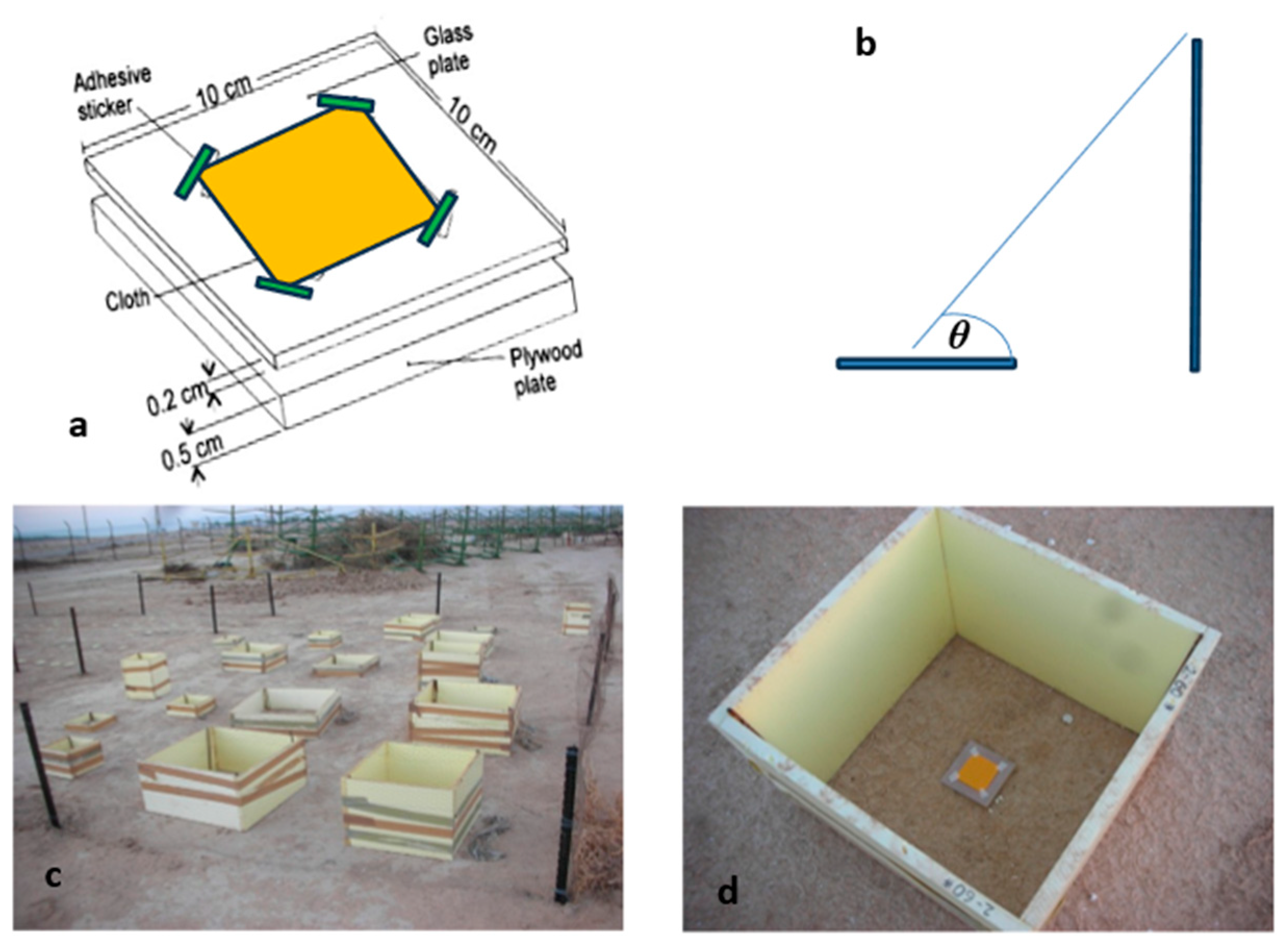
For the NRW measurements, the cloth-plate method (CPM) was used [43]. It consists of 10 cm × 10 cm × 0.2 cm glass plate glued to 10 cm × 10 cm × 0.5 cm plywood, thus creating an identical substrate on which an absorbing cloth was attached. We used 6 cm × 6 cm × 0.1 cm PVA microfiber porous cloths (Vileda, Weinheim, Germany), attached via adhesive tape at their four corners, to the middle of the glass plate (Figure 2a). Each plate was located within 2 cm thick Polyurethane (PU) box (having a thermal conductivity of ~0.030 Watts per meter Kelvin) that had walls of variable heights in order to form a certain angle between the CPM and the top of the box walls (Figure 2b). With the use of Equation (2) as suggested by Oke [44], the height of the wall was determined:
θ = tan−1 (H/0.5W)
where θ is the angle, H the wall height, and W the width.
Due to practical reasons (the need to collect all the samples in a very short time in order to guarantee a reliable comparison), a limited set of angles (15°, 30°, 45°, 60°, and 75°) was chosen (a pair of boxes for each angle). The amounts that were measured on the CPM positioned within the boxes were compared to a pair of glass plates located in the open that served as a control (COT). During the beginning of the experiments, and trying to understand whether the length of the box affects the results, boxes of 30 cm × 30 cm and 60 cm × 60 cm were used (Figure 2c). Substantiating that the angle rather than the length of the box determines the amount of NRW, a pair of 60 cm × 60 cm boxes forming predetermined angles from horizontal (15°, 30°, 45°, and 60°) between the glass plate and the top of the box walls were constructed (Figure 2b). Additionally, boxes that form 75° from horizontal with the end of the box walls were also constructed. At first, we used 60 cm × 60 cm boxes but had to replace them with 30 cm × 30 cm boxes when realizing that the height of the 60 cm × 60 cm boxes did not allow us to keep the construction stable during the relatively potent afternoon winds. This change in the wall length did not have any significant effect on the NRW, supporting our decision that for the 75° angle, the use of the 30 cm × 30 cm boxes is possible.
The CPM was placed at the center of each box (Figure 2d), and each afternoon, a cloth was attached to each glass plate (~13:00 local time) and collected during the following morning (around sunrise, ~6:00 local time). The cloths were collected into separate glass flasks that were immediately sealed and brought to a nearby lab where they were weighed, oven-dried (at 70 °C until reaching a constant weight), and reweighed. The amount of NRW was determined in accordance with Equation (3):
WC (mm) = ((WCwet − WCdry)/Aρ) × 10
where WC is the amount of water in millimeters, WCwet and WCdry are the wet and dry water contents of the cloths in grams, respectively, A is the surface area in cm2, and ρ is the density of water (g cm−3) at a given temperature, multiplied by 10 to convert the values to millimeters.
Calibrated (±0.05 °C) 3 cm long and 0.5 cm diameter TMC6-HD thermistors (Onset Computer Corporation, Bourne, MA, USA), shielded from direct radiation by 4 cm × 1.5 cm × 0.5 cm thick polyurethane and tightly attached to the center of the glass plates, were used to study the effect of the SVF on the temperature regime. All sensors were connected to U-12 Hobo data loggers (Onset Computer Corporation, MA, USA). Readings were done and stored in 20 min intervals.
One-way ANOVA was executed in order to assess whether the different angles yielded significantly different NRW. Once significant, paired t-tests were carried out. Values were considered significant at p < 0.05.

3. Results

A total of 21 dewy and foggy days was recorded, between 19 October and 15 December 2025, during which 20 dewy days and a singly foggy day (on 8 November 2025) were measured. The amount of NRW as measured in the open by the CPM and general climatological conditions are shown in Table 1. Whereas average NRW was 0.132 mm, average maximum RH was 92.1%, minimum air temperature was 12.7 °C, and average nocturnal wind speed was 1.7 m s−1. The data also show an average high nocturnal RH (between 20:00 and 6:00) of 89.0%.
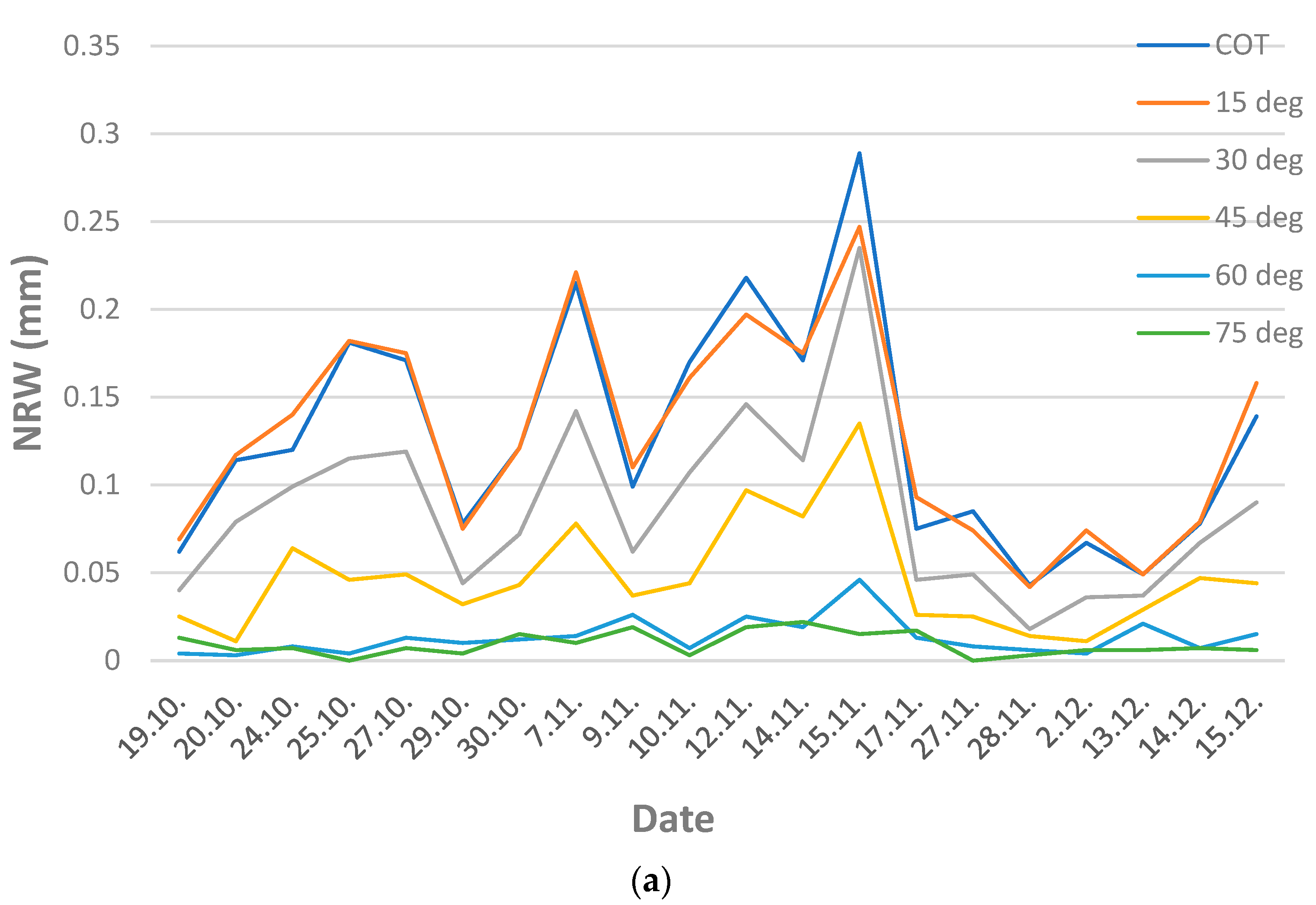
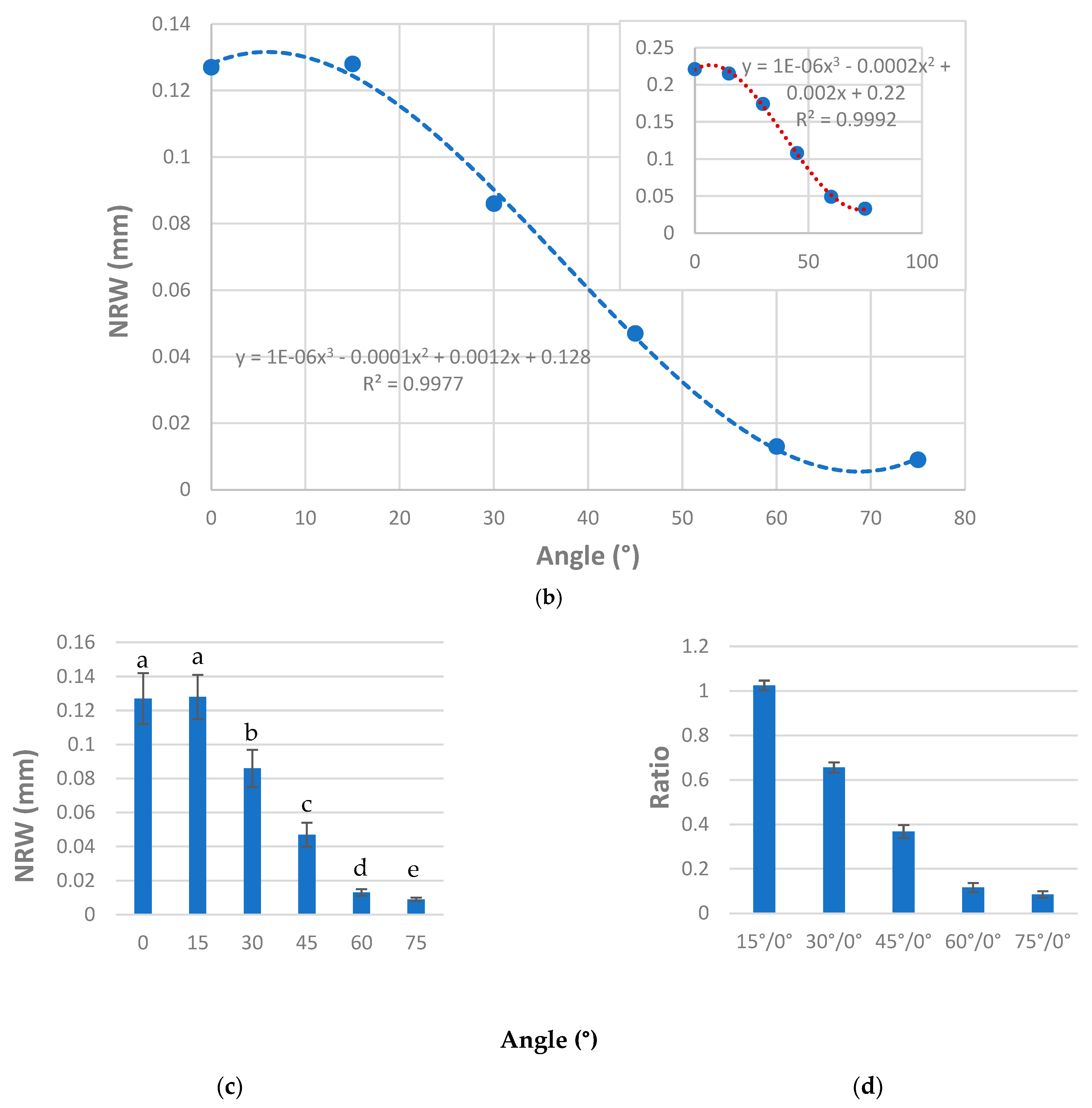
Consecutive daily amounts of NRW as obtained in the open by CPM (COT) and the variable angles during 20 dewy days of measurements are shown in Figure 3a. During these days, NRW ≥ 0.1 mm was measured during 12 days by COT. Figure 3a shows consistent differences as also evident in Table 2. Whereas no clear differences could have been detected between 15° and COT, a clear gradient characterized the ≥30°, which, as can be seen in Figure 3b, corresponded to a third-degree polynomial equation:
NRW (mm dew) = 1 × 10−6x3 − 0.0001x2 + 0.0012x + 0.128 r2 = 0.9977
where x = angle (°).
A similar pattern was also obtained for a single foggy day (inset), also corresponding to a third-degree polynomial equation:
NRW (mm fog) = 1 × 10−6x3 − 0.0002x2 + 0.002x + 0.22 r2 = 0.9992
No significant differences were obtained between COT and 15°. All other angles yielded significant differences between each other (Figure 3c), although the differences between 60° and 75° were small, as also noted by the similar ratio between 60° and COT and between 75° and COT (Figure 3d). It was interesting to observe, however, that whereas the ratios between 15°, 30°, 45°, 60°, and 75° and that of 0° (COT) were 1.03, 0.66, 0.37, 0.12 and 0.09, respectively, they were 0.97,0.79, 0.49, 0.22, and 0.15, respectively, for the foggy day, pointing to a lower drop in NRW with angle during the foggy day.
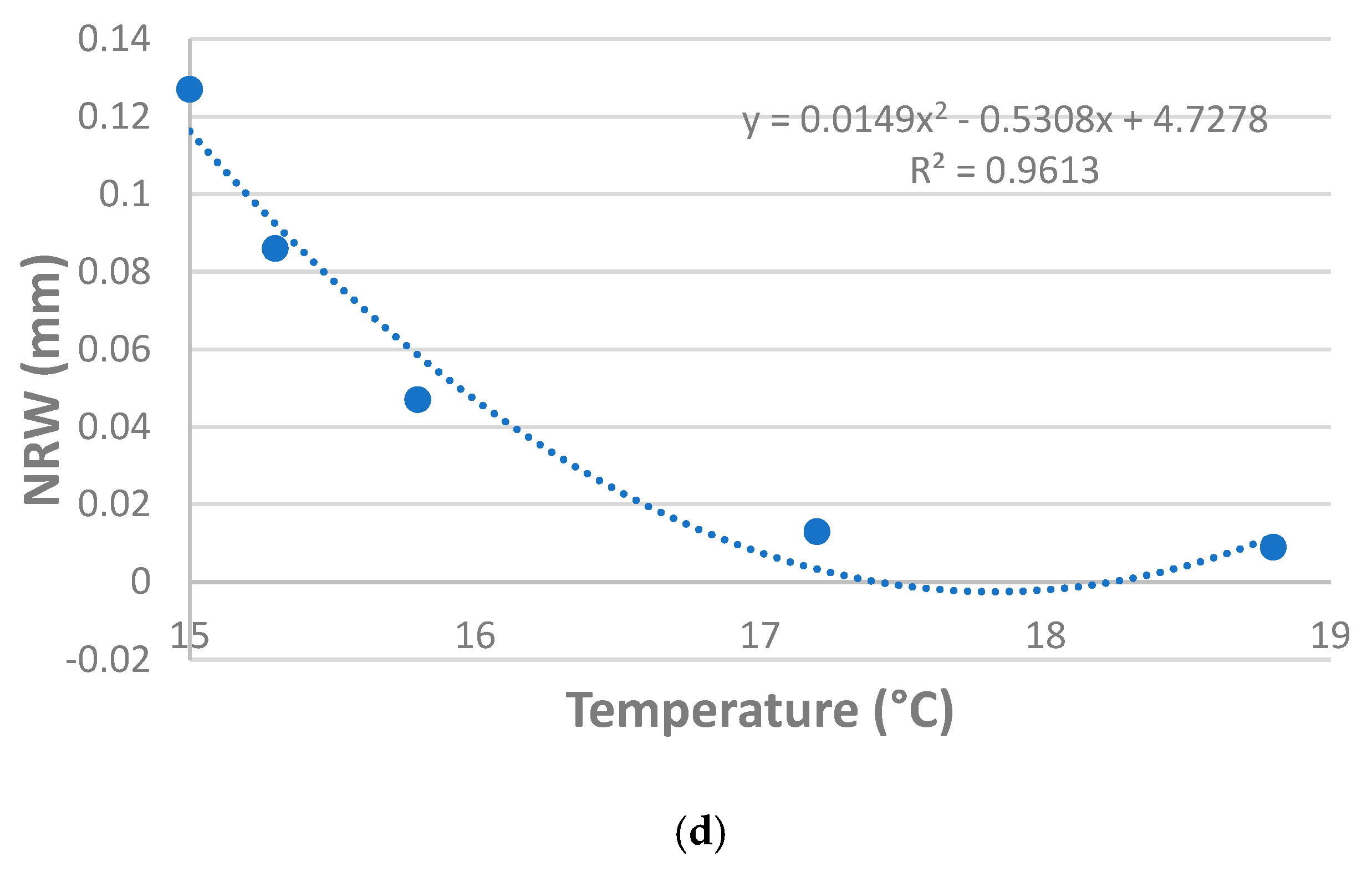
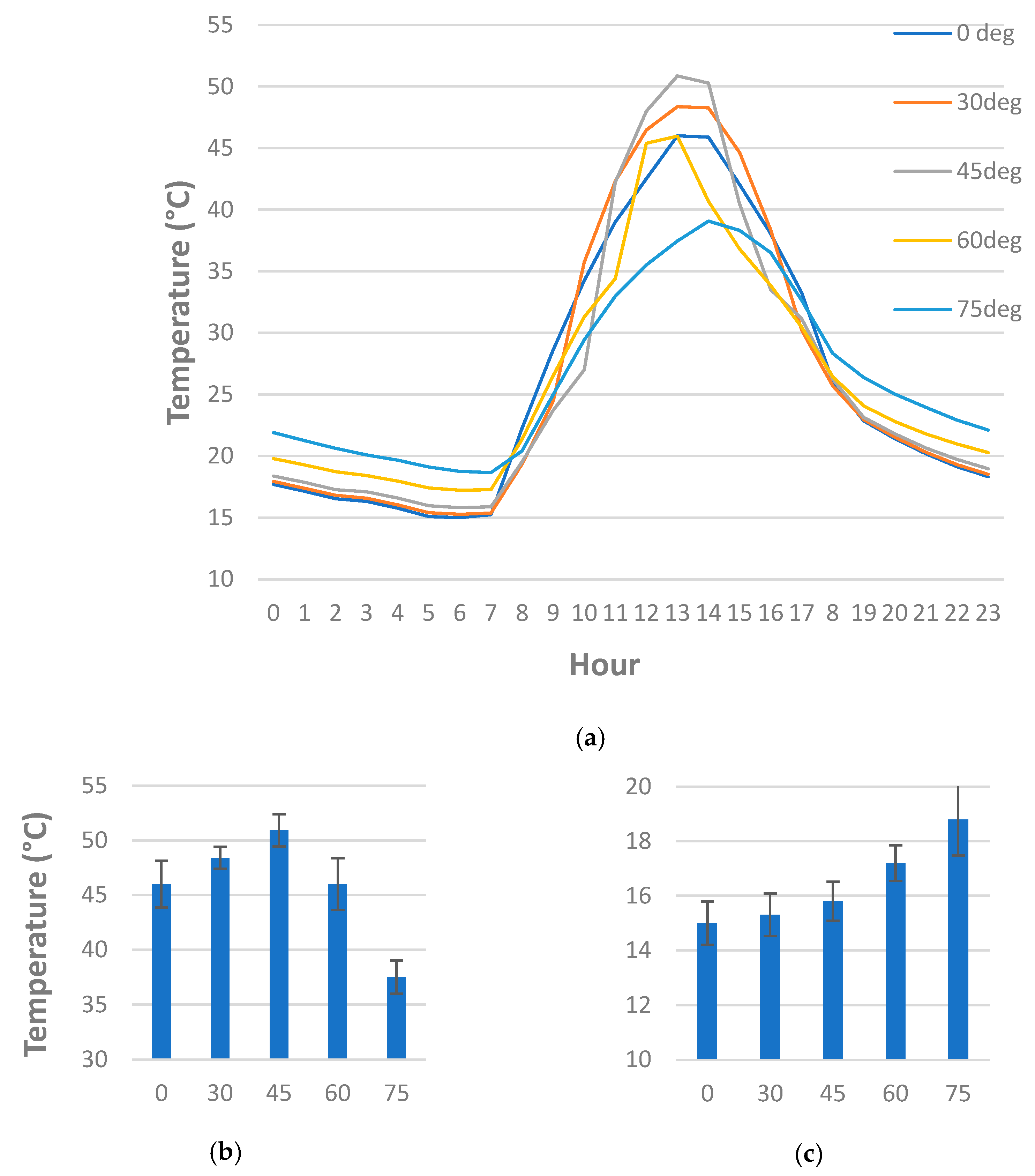
Temperature values as measured during 24 consecutive days at the 30°, 45°, 60°, and 75° boxes are shown in Figure 4a. The pattern does not correspond to a typical diurnal cycle, explained by the fact that some of the sensors were shielded from direct radiation during certain daytime hours by the walls of the boxes. This is especially evident for 60° and 75°, which show a drop in maximum temperatures (Figure 4b). As for the minimum temperatures, they show a steady increase with angle, reflecting the impediment of longwave radiative cooling by the box walls (Figure 4c). However, when comparing the amounts of the NRW against the minimum temperatures, a sharp drop in NRW with temperature is noted, corresponding to a second-degree polynomial equation (Figure 4d):
NRW(mm) = 0.0149x2 − 0.5308x + 4.7278 r2 = 0.9613
where x = temperature (°C).
Thus, a 1 °C increase in the minimum temperature may imply a sharp reduction in NRW to about half the amount that characterized the NRW prior to the increase in minimum temperatures.

4. Discussion

Whether when attempting to evaluate the amount of NRW in a complex terrain or on tilted objects, the effect of SVF should be considered. While commonly acknowledging its effect, SVF was particularly studied in connection to its effect on radiation, energy balance, and temperatures, particularly in urban and peri-urban settings [22,23,26]. Much less attention was given to the possible effect of SVF on NRW, especially under natural conditions.
The current findings characterize the effect of SVF. The climatological conditions during the research period reflected the conditions that characterized the site during the late summer and fall and may therefore be regarded as reflecting the climatological conditions in the Negev Highlands during the dewy season. Thus, for instance, the average relative humidity and wind speed during the dewy days, 92.1 % and 1.7 m s−1, were similar to those registered during the summer of 2022 of 92.5% and 2.0 m s−1, respectively [45]. Higher wind speeds were recorded, however, during the afternoon hours (14:00–18:00), averaging 3.3 m s−1 (SD = 1.0), reflecting the sea breeze, similar (although lower) than the wind speeds that were recorded during the end of the summer and the beginning of fall, during which the sea breeze is maximal [39]. During previous research, when the SVF effect was determined with wooden boxes, a drop of NRW at angles > 30° took place, while no effect was noted between 15° and 30° and the horizontal (Figure 1; [30]). A similar pattern was also found by Beysens et al. [31]. The change in angles in the wooden box experiment corresponded to a third-degree polynomial equation, similar to the pattern obtained during the current research. Nevertheless, when comparing both equations, i.e., that shown in Figure 1 and that in Figure 3a, certain differences are noted. Although yielding substantially different amounts of NRW once concomitant measurements were carried out (with glass yielding ~30% more NRW than wood; [43]), these differences do not result from the different materials used, since the same material was used when attempting to compare the angle effect. Whereas in our case, the amount recorded by the CPM within the boxes was compared to the CPM located in the open (all positioned on the ground), the amount compared in Kidron [30] was between cloths attached to the wooden substrates, whether at the center of each side of the box (at ~5 cm above ground) or on top of 5 cm high boxes. Whereas angles of 15° and 30° at the wooden box experiment yielded similar values to the horizontal, only the 15° yielded similar values to the horizontal in the PU box experiment. Already at >15°, a drop in NRW was recorded at the PU boxes.
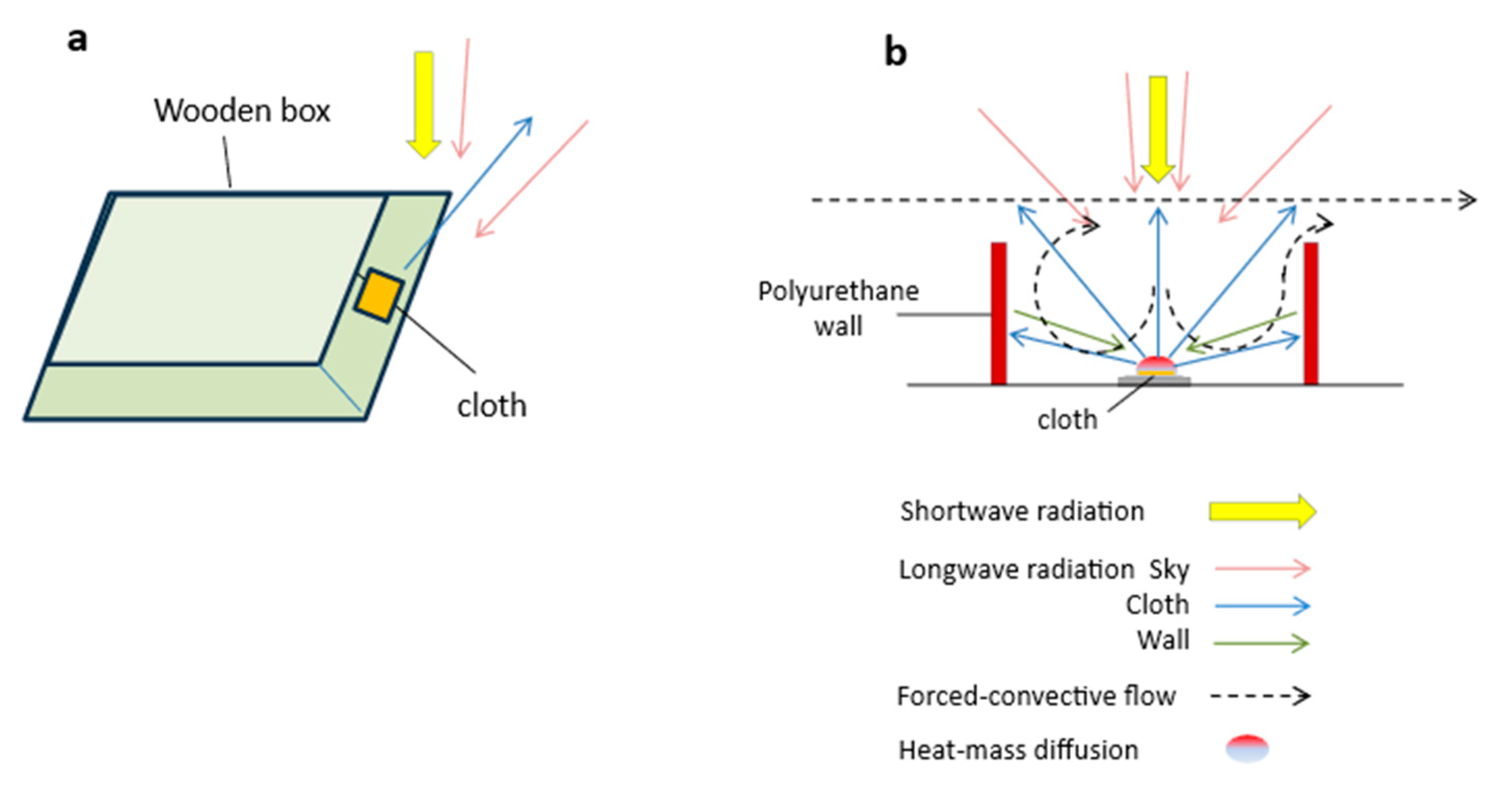
Also, in comparison to the wooden box experiment, the drop in NRW was substantially higher in the PU experiment, explained by the impeded airflow within the PU boxes, as illustrated in Figure 5. For instance, it was twice as much lower at 45° (0.74 in the wooden boxes versus 0.37 in the PU boxes) and over three times lower for 60° and 75°. In this regard, it is of interest to note the similar drop in NRW that was measured by 10 cm × 10 cm × 7 cm cobbles surrounded by 10 cm × 10 cm × 15 cm cobbles placed at a distance of 5 cm [29]. Forming 60° with the neighboring cobbles, the amount obtained was 0.46 that of the exposed cobble, almost identical to that obtained by the PU boxes (0.47). Interestingly however, the ratios between the different angles and the horizontal were substantially lower (up to 3-fold lower) for the foggy day for the 60° and 75°. Similar results were also obtained during an initial unpublished experiment in 2012, with PU boxes confirming the general trend exhibited by fog, i.e., the lower reduction effect exerted by the higher angles on NRW during foggy mornings (Kidron and Uclés, unpub).
It is of interest to note that the ratios found between the 60° and 75° angles and the horizontal were higher than those found for the wooden boxes, albeit the fact that the glass plates within the PU boxes were shielded for many hours from direct daytime radiation, therefore exhibiting lower temperatures (Figure 4a). Apparently, under the current ambient conditions, the shading and the subsequent lower daytime temperatures may not affect the dew formation that commences later during the evening, when the plates that were exposed to radiation already cooled off. This is in line with previous findings during which limestone and chert cobbles yielded the same amount of dew in the Negev, albeit the higher midday temperatures of the dark cherts. Rapid cooling of the chert before the onset of dew resulted in similar dew amounts that formed on both cobbles [29].
The variable extent to which variable angles affected the NRW can be explained by the effect exerted by the SVF and by the additional effect of the resultant impeded air transport. As for the wooden boxes, objects tilted at 15° and 30° angles are still fully exposed to the sky, and subsequently, no drop in NRW took place. At the PU experiment, whereas the 15° boxes were still fully exposed to the sky, a clear drop took place at >15°. The walls of the boxes at ≥30° already affected the temperatures within the boxes, as can be seen by the slight increase in the minimum temperatures already at 30° (Figure 4c). The shielding effect of the walls of the PU boxes increased substantially at 60° and especially at 75°, reflected in a sharp increase in the minimum temperatures and the sharp decrease in NRW. This, in turn, also impeded an efficient heat exchange.
Impeded heat exchange will lead to limited vapor transport but also to temperature increase [20]. This may explain the larger drop in NRW with angle in the PU experiment versus the experiment executed with the wooden boxes. And thus, as far as the attempts to predict the change in NRW with angle, the relations as obtained for the wooden boxes should serve to predict NRW of substrates such as leaves of different angles, while the relations, as obtained for the PU boxes, should assist in evaluating the possible effects of canyons or narrow wadis [46], cliffs [29], or forest clearings [28], but also stones or cobbles surrounded by neighboring stones or cobbles [29].
Also, the relations as found for the PU boxes may be principally valid also for urban environments. Forming heat islands [47], the amounts of NRW obtained in urban environments are substantially lower than those characterizing adjacent rural places [48,49]. According to Beysens et al. [49], the amount of NRW obtained in a rural environment may be 7-fold higher than in the urban environment. While the low amounts measured within the urban environment are generally attributed to the heat island effect [47], the current findings support the view that the urban heat island is just one factor that affects the NRW. Once the angle created between an object and the surrounding objects is ≥30°, NRW may be largely affected by the SVF. Moreover, it may be also affected by impeded heat exchange (Figure 5). This may explain the larger drop in NRW with angle at the PU boxes relative to the wooden boxes. With the PU boxes reflecting an urban environment, this may assist in evaluating the relative vulnerability of materials to dew, such as those constructed with metals that may be affected by corrosion and rust.
One should note that regardless of the amount of NRW recorded on the horizontal, the drop in NRW with angle was consistent. Using cyanobacteria as biomarkers, condensation will take place at 0.1 mm [50]. Under the current ambient conditions, this threshold was already reached on the horizontal (and at 15°) during the foggy day and during 12 out of the 20 dewy days. However, taking the current results, substrates that create angles of 30°, 45°, 60°, and 75° with the neighboring objects may reach the 0.1 mm threshold only for 7, 2, 0, and 0 days, respectively (Figure 3a). In fact, this threshold was not reached at 60° and 75°, not even during the foggy day. And thus, as far as the material corrosion and/or degradation by dew is concerned, materials that form 30° and 45° degrees with the neighboring objects will already face substantially lower occasions during which they will be effectively affected, while not being affected once angles of 60° and 75° are formed.
Assuming that spatial temperature change can be implied in the study of temporal temperature change [51], temperature’s effect on NRW during the current experiments may highlight the possible effect of rising temperature during global warming. Taking published scenarios of an anticipated increase in minimum temperatures [52] and rates of a minimum temperature rise of 0.295 °C per decade [53], the anticipated drop in NRW may be significant during the coming decades: approximately 1 °C in three decades. According to Figure 4d, this may imply a drop in NRW to about half the current values. When considering the current maximum average NRW in the Negev Highlands of 0.2 mm [54], angles of ≥45° will suffice to impair condensation. However, with the projected decrease in NRW with global warming, even angles of ≥30° may impair condensation in one to two decades. Such a temperature rise implies that vapor condensation and, therefore, foliar water uptake may not take place in many forest clearings, wadis, and canyons. Temperature rise may, however, have a positive effect on construction materials, especially in urban environments. Construction materials that form ≥30° with the top of their neighboring objects may commonly not reach the threshold during which condensation may take place and therefore, may be less vulnerable to corrosion and/or degradation.
Additional measurements are, however, needed in order to substantiate the above relationships. Our single day of measurement during which fog was recorded is insufficient for establishing a reliable relationship between the amounts of fog and angle. As for dew, we believe that albeit seasonal differences [39], the current findings reflect the ratios between the different angles and the horizontal and, therefore, should not substantially deviate from the current ratios, providing, of course, that the mechanism examined is confined to dewfall [55]. Yet, one of the factors that may, however, impact the relationships is the wind regime. Whereas the Negev Highlands are characterized by relatively low to moderate average nocturnal wind speeds of 1–2 m s−1 [41,46], the effects of higher wind speeds should be studied. Under higher wind speeds, higher air turbulence is expected, and subsequently, more vertical moisture transfer may take place [56], which may affect, in turn, the NRW input.

5. Conclusions

The effects of variable degrees of the sky view factor (SVF) as a result of geometric constraints on the non-rainfall water (NRW) was studied. Glass plates that were located within square boxes that formed variable angles with the top walls of the boxes (15°, 30°, 45°, 60°, 75°) served to evaluate the SVF effect. A sharp decrease in NRW with angle was obtained in accordance with a third-degree polynomial equation. Whereas NRW at 15° was not affected, NRW at 30°, 45°, 60°, and 75° yielded, respectively, 0.66, 0.37, 0.12, and 0.09 that of COT. In comparison to previous findings, during which tilted-surface SVF effects were studied using wooden boxes, here, obstructed-horizontal SVF effects were investigated with the aid of the PU boxes. The current results show a higher drop in NRW with angle, explained by the impediment in the heat exchange. Our findings imply that with the increase in global warming and the subsequent increase in minimum temperatures, plants that inhabit forest clearings, wadis, and canyons will be less exposed to dew and, subsequently, to foliar water uptake. Yet, in contrast to the negative effects exerted on plants, construction materials, especially in urban environment with low SVF, may be subjected to lower corrosion and/or degradation.

Author Contributions

Conceptualization, methodology, writing and editing: G.J.K. Investigation and data collection: R.K. and G.J.K. All authors have read and agreed to the published version of the manuscript.

Funding

This research received no external funding.

Institutional Review Board Statement

Not applicable.

Data Availability Statement

Data will made available upon a reasonable request.

Acknowledgments

The available access to meteorological data by the Israel Meteorological Service (IMS) is highly acknowledged. We would also like to thank Daniel Beysens in his assistance in drawing Figure 5 and four anonymous reviewers for their constructive comments that substantially increased the clarity of our manuscript.

Conflicts of Interest

The authors declare no conflicts of interest.

References

  1. Stone, E.C. The ecological importance of dew. Q. Rev. Biol. 1963, 38, 328–341. [Google Scholar] [CrossRef]
  2. Kidron, G.J.; Starinsky, A. Measurements and ecological implications of non-rainfall water in desert ecosystems—A review. Ecohydrology 2019, 12, e2121. [Google Scholar] [CrossRef]
  3. Boucher, J.-F.; Munson, A.D.; Bernier, P.Y. Foliar absorption of dew influences shoot water potential and root growth in Pinus strobes seedlings. Tree Physiol. 1995, 15, 819–823. [Google Scholar] [CrossRef]
  4. Caird, M.A.; Richards, J.H.; Donovan, L.A. Nighttime stomatal conductance and transpiration in C3 and C4 plants. Plant Physiol. 2007, 143, 4–10. [Google Scholar] [CrossRef]
  5. Cosh, M.H.; Kabela, E.D.; Hornbuckle, B.; Gleason, M.L.; Jackson, T.J.; Prueger, J.H. Observations of dew amount using in situ and satellite measurements in an agricultural landscape. Agric. For. Meteorol. 2009, 149, 1082–1086. [Google Scholar] [CrossRef]
  6. Ben-Asher, J.; Alpert, P.; Ben-Zvi, A. Dew is a major factor affecting vegetation water use efficiency rather than a source of water in the eastern Mediterranean area. Water Resour. Res. 2010, 46, W10532. [Google Scholar] [CrossRef]
  7. Zhuang, Y.; Ratcliffe, S. Relationship between dew presence and Bassia dasyphylla plant growth. J. Arid. Land 2012, 4, 11–18. [Google Scholar] [CrossRef]
  8. Hill, A.; Dawson, T.E.; Shelef, O.; Rachmilevitch, S. The role of dew in Negev Desert plants. Oecologia 2015, 178, 317–327. [Google Scholar] [CrossRef]
  9. Yang, X.D.; Lv, G.H.; Ali, A.; Ran, Q.Y.; Gong, X.W.; Wang, F.; Liu, Z.D.; Qin, L.; Liu, W.G. Experimental variations in functional and demographic traits of Lappula semiglabra among dew amount treatments in an arid region. Ecohydrology 2017, 10, e1858. [Google Scholar] [CrossRef]
  10. Lange, O.L.; Schulze, E.D.; Koch, W. Ecophysiological investigations on lichens of the Negev Desert, III: CO2 gas exchange and water metabolism of crustose and foliose lichens in their natural habitat during the summer dry period. Flora 1970, 159, 525–538. [Google Scholar] [CrossRef]
  11. Kappen, L.; Lange, O.L.; Schulze, E.-D.; Evenari, M.; Buschbom, V. Ecophysiological investigations on lichens of the Negev Desert, IV: Annual course of the photosynthetic production of Ramalina maciformis (Del.) Bory. Flora 1979, 168, 85–105. [Google Scholar] [CrossRef]
  12. Kidron, G.J.; Herrnstadt, I.; Barzilay, E. The role of dew as a moisture source for sand microbiotic crusts in the Negev Desert, Israel. J. Arid. Environ. 2002, 52, 517–533. [Google Scholar] [CrossRef]
  13. Schuh, W. Influence of interrupted dew periods, relative humidity, and light on disease severity and latent infections caused by Cercospora kikuchii on soybean. Phytopathology 1993, 83, 109–113. [Google Scholar] [CrossRef]
  14. Wilson, T.B.; Bland, W.L.; Norman, J.M. Measurement and simulation of dew accumulation and drying in a potato canopy. Agric. For. Meteorol. 1999, 93, 111–119. [Google Scholar] [CrossRef]
  15. Dawson, T.E.; Goldsmith, G.R. The value of wet leaves. New Phytol. 2018, 219, 1156–1169. [Google Scholar] [CrossRef]
  16. Mulawa, P.A.; Cadle, S.H.; Lipari, F.; Ang, C.C.; Vandervennet, R.T. Urban dew: Its composition and influence on dry deposition rates. Atmos. Environ. 1986, 20, 1389–1396. [Google Scholar] [CrossRef]
  17. Roberge, P.R.; Klassen, R.D.; Haberecht, P.W. Atmospheric corrosivity modeling—A review. Mater. Des. 2002, 23, 321–330. [Google Scholar] [CrossRef]
  18. Wisniewski, J. The potential acidity associated with dews. Frosts, and fogs. Water Air Soil Pollut. 1983, 17, 361–377. [Google Scholar] [CrossRef]
  19. Katayama, H.; Noda, K.; Masuda, H.; Nagasawa, M.; Itagaki, M.; Watanabe, K. Corrosion simulation of carbon steels in atmospheric environment. Corros. Sci. 2005, 47, 2599–2606. [Google Scholar] [CrossRef]
  20. Beysens, D. Dew Water; River Publishers: Gistrup, Denmark, 2018. [Google Scholar]
  21. Muselli, M.; Carvajal, D.; Beysens, D.A. A study to explore the dew condensation potential of cars. Atmosphere 2021, 13, 65. [Google Scholar] [CrossRef]
  22. Oke, T.R. Boundary Layer Climates; John Wiley and Sons: New York, NY, USA, 1978; p. 372. [Google Scholar]
  23. Miao, C.; Yu, S.; Hu, Y.; Zhang, H.; He, X.; Chen, W. Review of methods used to estimate the sky view factor in urban street canyons. Build. Environ. 2020, 168, 106497. [Google Scholar] [CrossRef]
  24. Kumar, B.; Sarkar, B. Determining the appropriate rotation angle in a vector-based method of sky-view factor calculation. Measurements 2025, 244, 116384. [Google Scholar] [CrossRef]
  25. Pérez-Arévalo, R.; Jiménez-Caldera, J.E.; Serrano-Montes, J.L.; Rodriguez-Comino, J.; Ortiz Royero, J.C.; Caballero-Calvo, A. Impacts of urban morphology on micrometeorological parameters and cyclonic phenomena in northern Colombian Caribbean. Climate 2025, 13, 87. [Google Scholar] [CrossRef]
  26. Dirksen, M.; Ronda, R.J.; Theeuwes, N.E.; Pagani, G.A. Sky view factor calculations and its application to urban heat island studies. Urban Stud. 2019, 30, 100498. [Google Scholar] [CrossRef]
  27. Lloyd, M.G. The contribution of dew to the summer water budget of Northern Idaho. Bull. Am. Meteorol. Soc. 1961, 42, 572–580. [Google Scholar] [CrossRef]
  28. Tuller, S.T.; Chilton, R. The role of dew in the seasonal moisture balance of a summer-dry climate. Agric. For. Meteorol. 1973, 11, 135–142. [Google Scholar] [CrossRef]
  29. Kidron, G.J. The effect of substrate properties, size, position, sheltering and shading on dew: An experimental approach in the Negev Desert. Atmos. Res. 2010, 98, 378–386. [Google Scholar] [CrossRef]
  30. Kidron, G.J. Angle and aspect dependent dew precipitation in the Negev Desert, Israel. J. Hydrol. 2005, 301, 66–74. [Google Scholar] [CrossRef]
  31. Beysens, D.; Pruvost, V.; Pruvost, B. Dew observed on cars as proxy for quantitative measurements. J. Arid. Environ. 2016, 135, 90–95. [Google Scholar] [CrossRef]
  32. Muselli, M.; Lefavrais, S.; Royon, L.; Flores, P.; Beysens, D. Heat transfer mechanisms governing the performance of tilted planar dew condensers. Int. J. Therm. Sci. 2026, 222, 110493. [Google Scholar] [CrossRef]
  33. Blankenstein, S.; Kuttler, W. Impact of street geometry on downward longwave radiation and air temperature in an urban environment. Meteorol. Z 2004, 13, 373–379. [Google Scholar] [CrossRef]
  34. Richards, K. Urban and rural dewfall, surface moisture, and associated canopy-level air temperature and humidity measurements for Vancouver, Canada. Bound.-Layer Meteorol. 2005, 114, 143–163. [Google Scholar] [CrossRef]
  35. Richards, K. Sky view and weather controls on nocturnal surface moisture deposition on grass at urban sites. Phys. Geogr. 2006, 27, 70–85. [Google Scholar] [CrossRef]
  36. Kidron, G.J.; Kronenfeld, R.; Xiao, B. Dew formation on desert plants—Challenging estimates based on an experimental approach. Plant Soil 2026, 518, 1713–1731. [Google Scholar] [CrossRef]
  37. Howell, J.C.; Yizhaq, T.; Drechsler, N.; Zamir, Y.; Beysens, D.; Shaw, J.A. Generalized nighttime radiative deficits. J. Hydrol. 2021, 603, 126971. [Google Scholar] [CrossRef]
  38. Rosenan, N.; Gilad, M. Atlas of Israel; Meteorological Data, Sheet IV/2; Carta: Jerusalem, Israel, 1985. [Google Scholar]
  39. Zangvil, A. Six years of dew observation in the Negev Desert, Israel. J. Arid. Environ. 1996, 32, 361–372. [Google Scholar] [CrossRef]
  40. Evenari, M.; Shanan, L.; Tadmor, N. The Negev, The Challenge of a Desert; Harvard University Press: Cambridge, MA, USA, 1971; p. 345. [Google Scholar]
  41. Bitan, A.; Rubin, S. Climatic Atlas of Israel for Physical and Environmental Planning and Design; Ramot Publishing, Tel Aviv University: Tel Aviv, Israel, 1991. [Google Scholar]
  42. Evenari, M. Ecology of the Negev Desert, a critical review of our knowledge. In Developments in Arid Zone Ecology and Environmental Quality; Shuval, H., Ed.; Balaban ISS: Philadelphia, PA, USA, 1981; pp. 1–33. [Google Scholar]
  43. Kidron, G.J. A simple weighing method for dew and fog measurements. Weather 1998, 53, 428–433. [Google Scholar] [CrossRef]
  44. Oke, T.R. Canyon geometry and the nocturnal heat island—Comparison of scale model and field observations. J. Climatol. 1981, 1, 232–254. [Google Scholar] [CrossRef]
  45. Kidron, G.J.; Kronenfeld, R.; Starinsky, A.; Xiao, B.; Muselli, M.; Beysens, D. Even in a dew desert: Dewfall does not provide sufficient moisture for biocrust growth—Evidence from direct measurements and a meteorological model. J. Hydrol. 2023, 627, 130450. [Google Scholar] [CrossRef]
  46. Kidron, G.J.; Kronenfeld, R.; Temina, M. The different effects of regional and local winds on dew formation in the Negev Desert. J. Hydrol. Hydromech. 2023, 71, 132–138. [Google Scholar] [CrossRef]
  47. Richards, K. Observation and simulation of dew in rural and urban environments. Prog. Phys. Geogr. 2004, 28, 76–94. [Google Scholar] [CrossRef]
  48. Galek, G.; Sobik, M.; Bias, M.; Polkowska, Z.; Cichata-Kamrowska, K. Urban dew formation efficiency and chemistry in Poland. Atmos. Pollut. Res. 2016, 7, 18–24. [Google Scholar] [CrossRef]
  49. Beysens, D.; Mongruel, A.; Acker, K. Urban dew and rain in Paris, France: Occurrence and physico-chemical characteristics. Atmos. Res. 2017, 189, 152–161. [Google Scholar] [CrossRef]
  50. Lange, O.L.; Kidron, G.J.; Büdel, B.; Meyer, A.; Kilian, E.; Abeliovitch, A. Taxonomic composition and photosynthetic characteristics of the biological soil crusts covering sand dunes in the Western Negev Desert. Func, Ecol. 1992, 6, 519–527. [Google Scholar] [CrossRef]
  51. Phillips, M.L.; McNellis, B.E.; Howell, A.; Lauria, C.M.; Belnap, J.; Reed, C.S. Biocrusts mediate a new mechanism for land degradation under a changing climate. Nat. Clim. Change 2022, 12, 71–76. [Google Scholar] [CrossRef]
  52. Zhou, L.; Dickinson, R.E.; Dirmeyer, P.; Dai, A.; Min, S.K. Spatiotemporal patterns of changes in maximum and minimum temperatures in multi-model simulations. Geophys. Res. Lett. 2009, 36, L02702. [Google Scholar] [CrossRef]
  53. Vose, R.S.; Easterling, D.R.; Gleason, B. Maximum and minimum temperature trends for the globe: An update through 2004. Geophys. Res. Lett. 2005, 32, L23822. [Google Scholar] [CrossRef]
  54. Kidron, G.J.; Kronenfeld, R.; Starinsky, A. Mornings with the highest non-rainfall water during two years of measurements in the Negev- ecological implications. Hydrol. Process. 2024, 38, e15155. [Google Scholar] [CrossRef]
  55. Monteith, J.L. Dew. Q. J. Royal Meteorol. Soc. 1957, 83, 322–341. [Google Scholar] [CrossRef]
  56. Richards, K. Observation and Modelling of Urban Dew. Ph.D. Thesis, The University of British Columbia, Vancouver, BC, Canada, 1999. [Google Scholar]
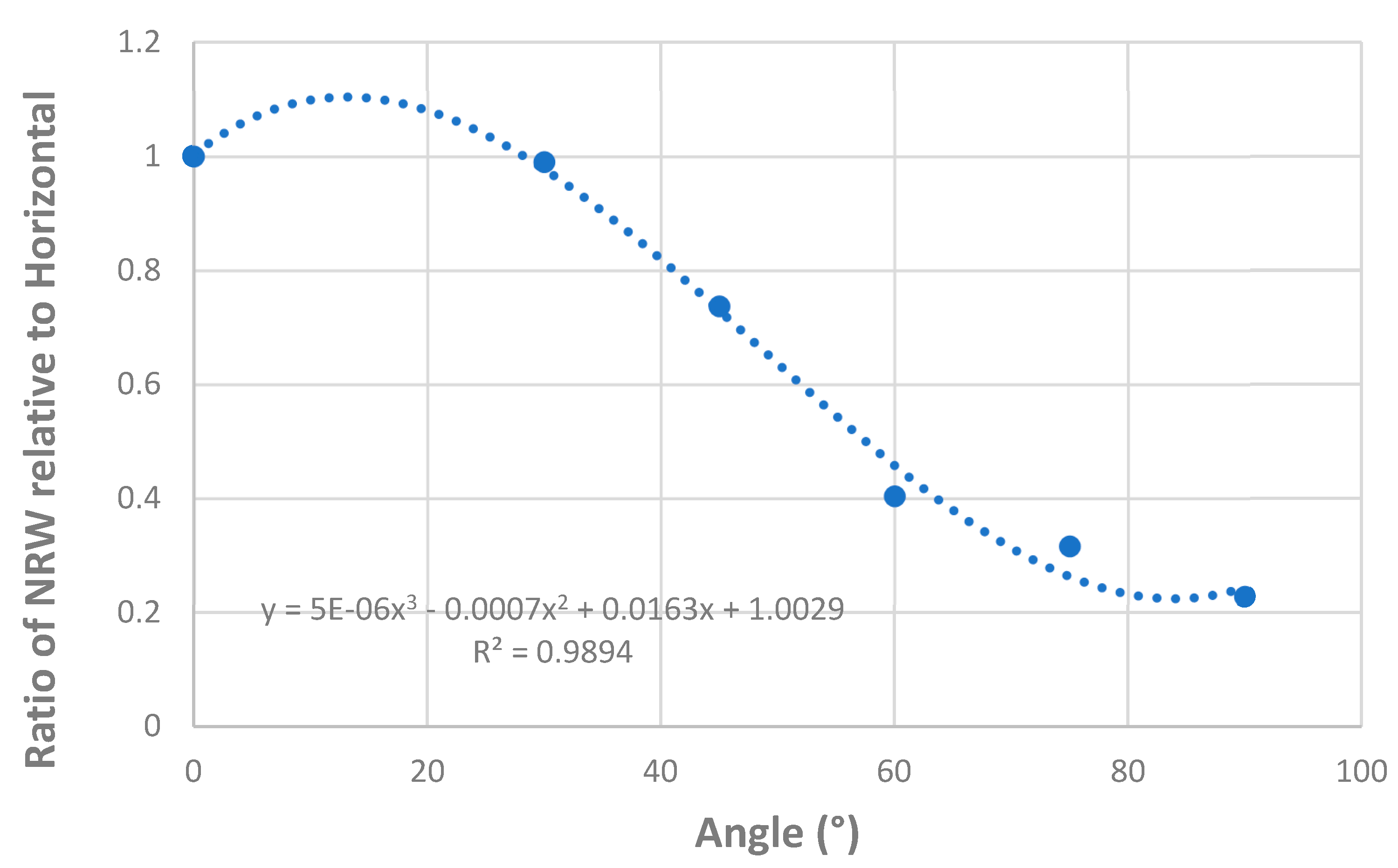
Figure 1. The amount of NRW relative to horizontal as obtained on the sides of 50 cm × 50 cm × 10 cm boxes that forming angles of 15°, 30°, 45°, 60°, and 75° and 90° during 27 dewy days in the Negev (modified from [30]).
Atmosphere 17 00347 g001
Figure 2. A schematic drawing of the cloth-plate method (CPM) showing the cloth attached to the middle of the glass plate (a), the location of the CPM relative to the PU walls, determining the angle (θ) between the cloth and the top of the wall (b), general view (c), and a close-up (d) of boxes used to control the sky view “seen” by the deposition substrate.
Atmosphere 17 00347 g002
Figure 3. Daily amounts of the NRW at angles of 15°, 30°, 45°, 60°, and 75° (a), the relationship between the above angles and NRW during 20 dewy days and during a foggy day on 11 August 2025 (in inset) (b), the average amount obtained for each angle during the dewy days (c), and the ratio between the different angles in relation to horizontal during the dewy days (d). Bars represent one SE. Different letters indicate significant differences (paired t-test; p < 0.05).
Atmosphere 17 00347 g003aAtmosphere 17 00347 g003b
Figure 4. Average diurnal temperature measurements as measured on the glass plates that formed angles of 0°, 30°, 45°, 60°, and 75° with the top of the box walls (a) and the average maximum (b) and minimum temperatures (c) of the above angles and the relationship between the minimum temperatures and NRW (d). Bars represent one SE.
Atmosphere 17 00347 g004aAtmosphere 17 00347 g004b
Figure 5. Schematic drawings showing cloths attached to a wooden box (a) and placed on glass between polyurethane walls (b). Arrows indicate shortwave (yellow) and longwave radiation from sky (red), wall (green), and cloth (blue). The width of the arrows indicates the magnitude of radiation. Note that condensation proceeds by diffusion in a quiescent boundary layer close to the cloth.
Atmosphere 17 00347 g005
Table 1. Non-rainfall water (NRW) as measured during dewy and foggy days in the open by the cloth-plate method (CPM) and various climatological variables, including minimum (min) air temperature and average nocturnal (20:00–6:00) air temperature, maximum (max) relative humidity (RH) and average nocturnal (20:00–6:00) RH, and average nocturnal (20:00–6:00) wind speed (WS). AVE = average; SD = one standard deviation.
DateNRW
(CPM)
Ta (min)Ta
(ave)
20:00–6:00
RH (max)RH (ave)
20:00–6:00
WS (ave)
20:00–6:00
19.10.0.06212.614.892861.2
20.100.1141315.694881.2
24.100.1218.819.893792
25.100.1811316.498921.3
27.100.17113.316.595911.4
29.100.07817.118.597921.8
30.100.12113.816.595891.7
7.110.21514.218.598921.7
8.11-fog0.22114.617.799941.7
9.110.09912.715.691841.2
10.110.1711.81594881.3
12.110.21814.217.895891.9
14.110.17114.71690872
15.110.28913.114.789843.3
17.110.0759.211.293881.1
27.110.0858.910.481751.1
28.110.0438.91273741.2
2.120.0676.710.894861.3
13.120.0491113.188782.3
14.120.0787.811.390841.4
15.120.13914.8895901
Average
(SD)
0.132
(0.067)
12.7
(3.3)
14.8
(3.1)
92.1
(6.0)
89.0
(9.3)
1.7
(0.9)
Table 2. One-way ANOVA analysis performed for the non-rainfall water at the various angles.
Angle (°)NMeanSD
0200.1270.066
15200.1280.059
30200.0860.051
45200.0470.031
60200.0130.010
75200.0930.066
Total1200.0680.065
Between-groupSum of SquaresdfMean SquareFSig.
Between-group0.28650.05729.612<0.001
Within groups0.2201140.002
Total0.507119
Disclaimer/Publisher’s Note: The statements, opinions and data contained in all publications are solely those of the individual author(s) and contributor(s) and not of MDPI and/or the editor(s). MDPI and/or the editor(s) disclaim responsibility for any injury to people or property resulting from any ideas, methods, instructions or products referred to in the content.