
Efficient Temperature- and Moisture-Compensated Design for Next-Generation Adsorbent-Based Radon Detectors


Abstract
1. Introduction
2. Materials and Methods
2.1. Theoretical Model
2.2. Estimation of Water Permeability and Protection Against Humidity
3. Results
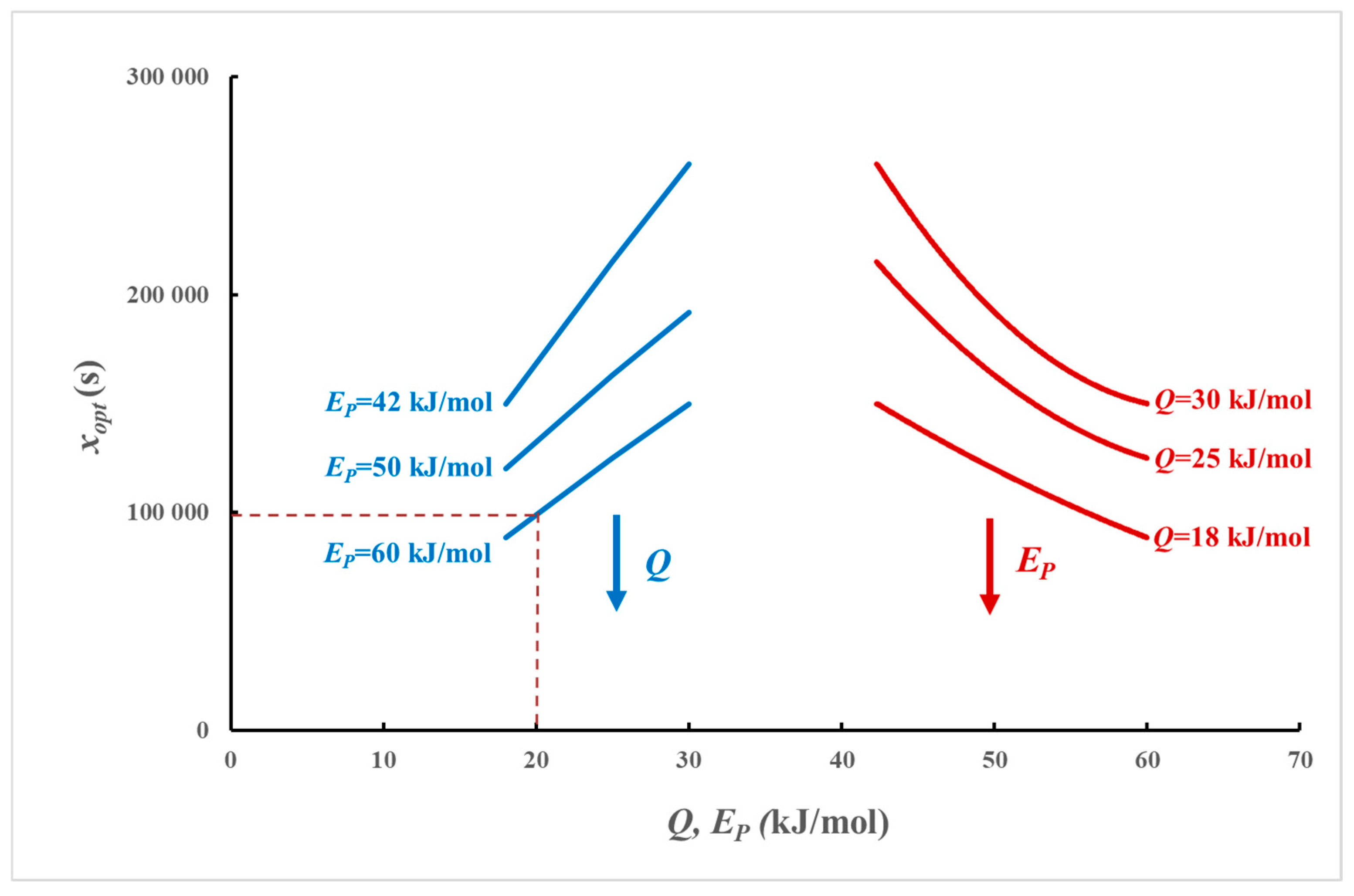
3.1. Estimating EP and Q Ranges for Modelling
3.2. Optimization
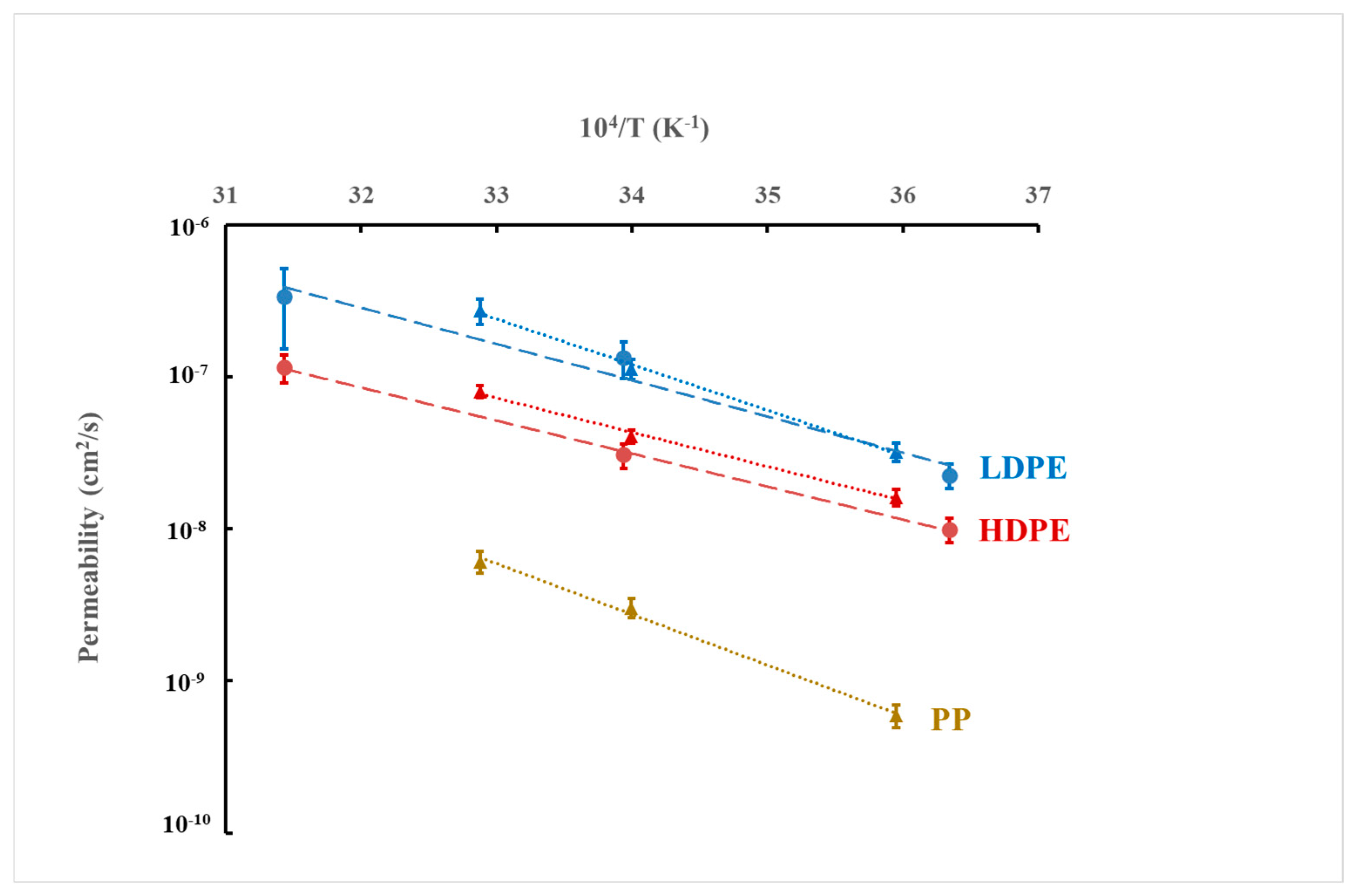
- LDPE (P0 = 1.23 × 10⁻⁷ cm2/s, EP = 50 kJ/mol)
- HDPE (P0 = 3.57 × 10⁻⁸ cm2/s, EP = 42.3 kJ/mol)
- PP (P0 = 3.03 × 10⁻⁹ cm2/s, EP = 63.9 kJ/mol)
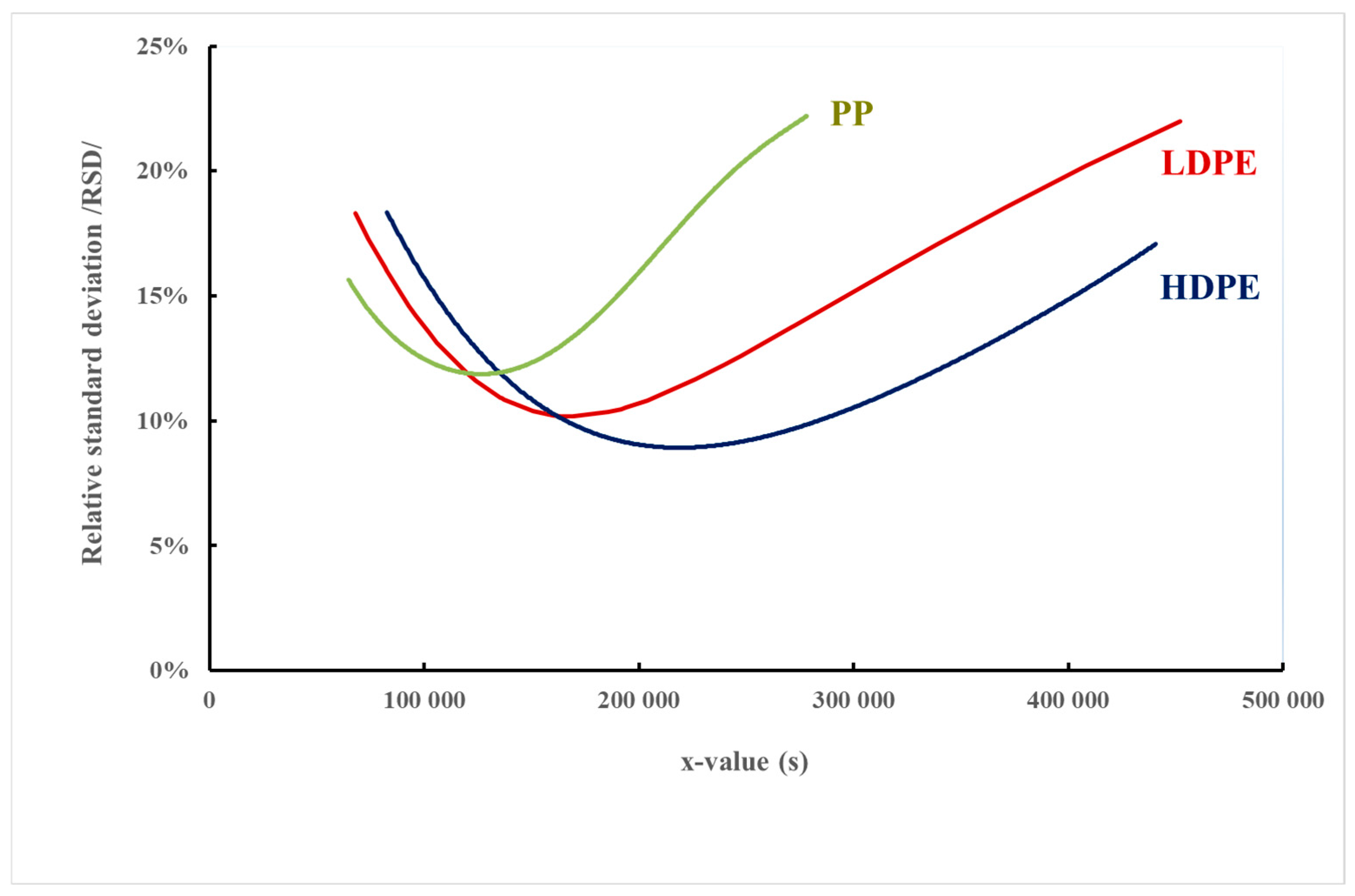
- LDPE: xopt = 1.7 × 10⁵ s
- HDPE: xopt = 2.14 × 10⁵ s
- PP: xopt = 1.12 × 10⁵ s.
- LDPE, S = 56 cm2. For a square envelope, the area of one side is 28 cm2 and the side length is 5.3 cm;
- HDPE, S = 154 cm2. For a square envelope, the area of one side is 77 cm2 and the side length is 8.8 cm;
- PP, S = 3500 cm2. For a square envelope, the area of one side is 1750 cm2 and the side length is 42 cm.
3.3. Resistance to Humidity
- LDPE: 0.112 g·mm·m−2·d−1·atm−1;
- HDPE: 0.0148 g·mm·m−2·d−1·atm−1;
- PP: 0.0575 g·mm·m−2·d−1·atm−1.
- LDPE: 8 days;
- HDPE: 22 days;
- PP: 6 h.
4. Discussion
- Validation with common polymers:
- The method was tested using LDPE, HDPE, and PP.
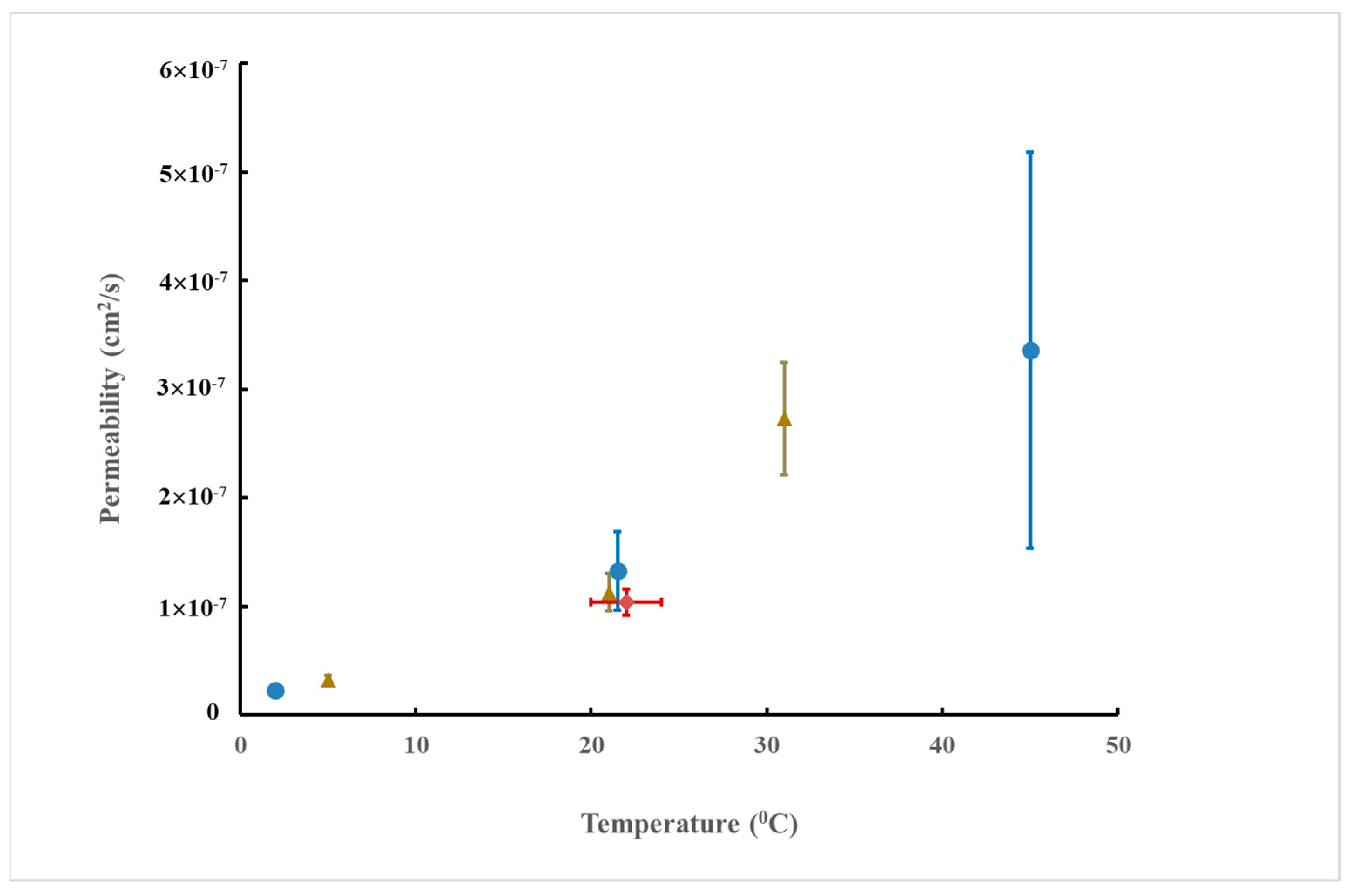
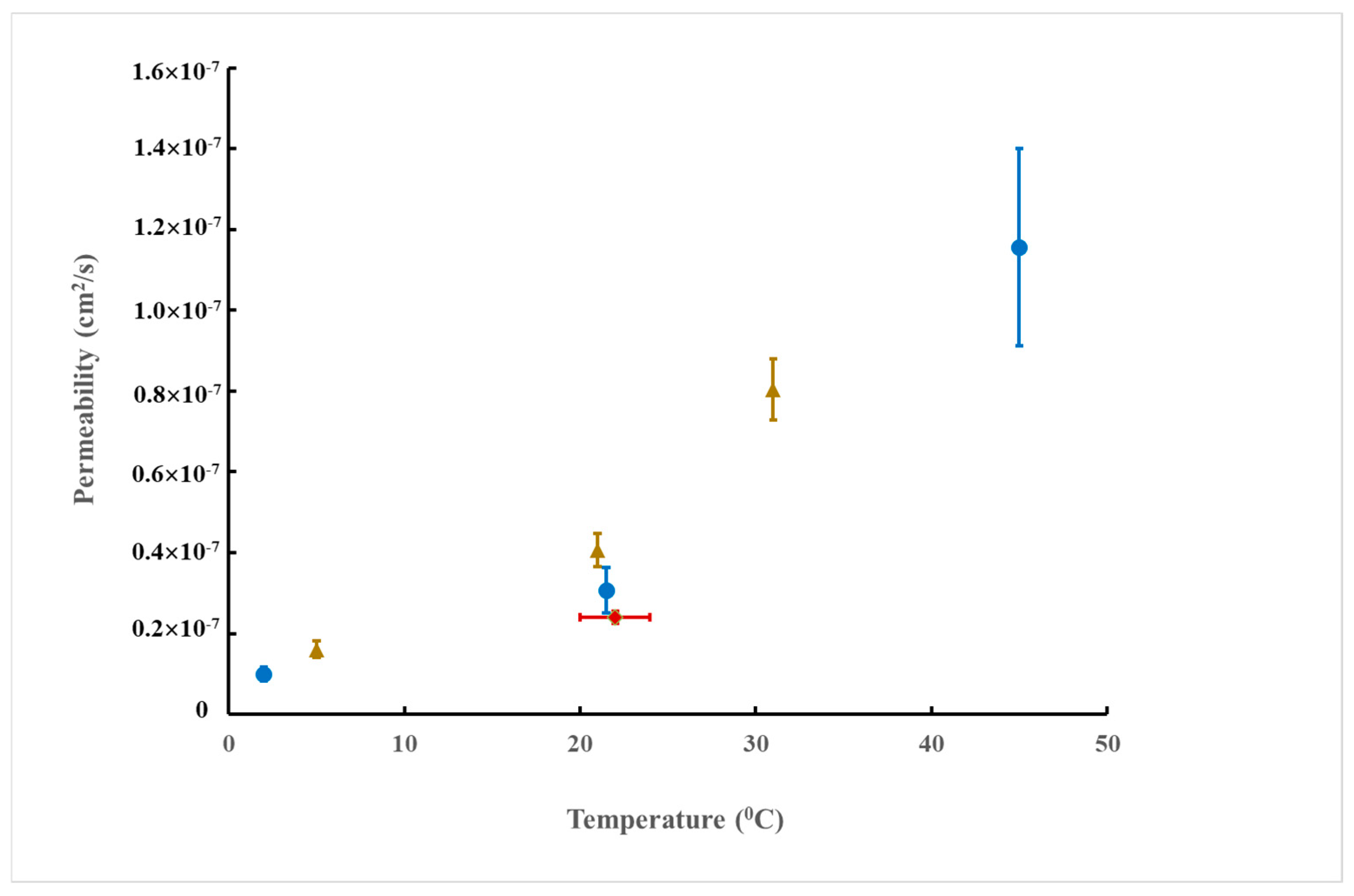
- Experimental data from the literature were processed to determine P0 at 21 °C and the radon permeability activation energies (EP) for each plastic.
- Temperature compensation:
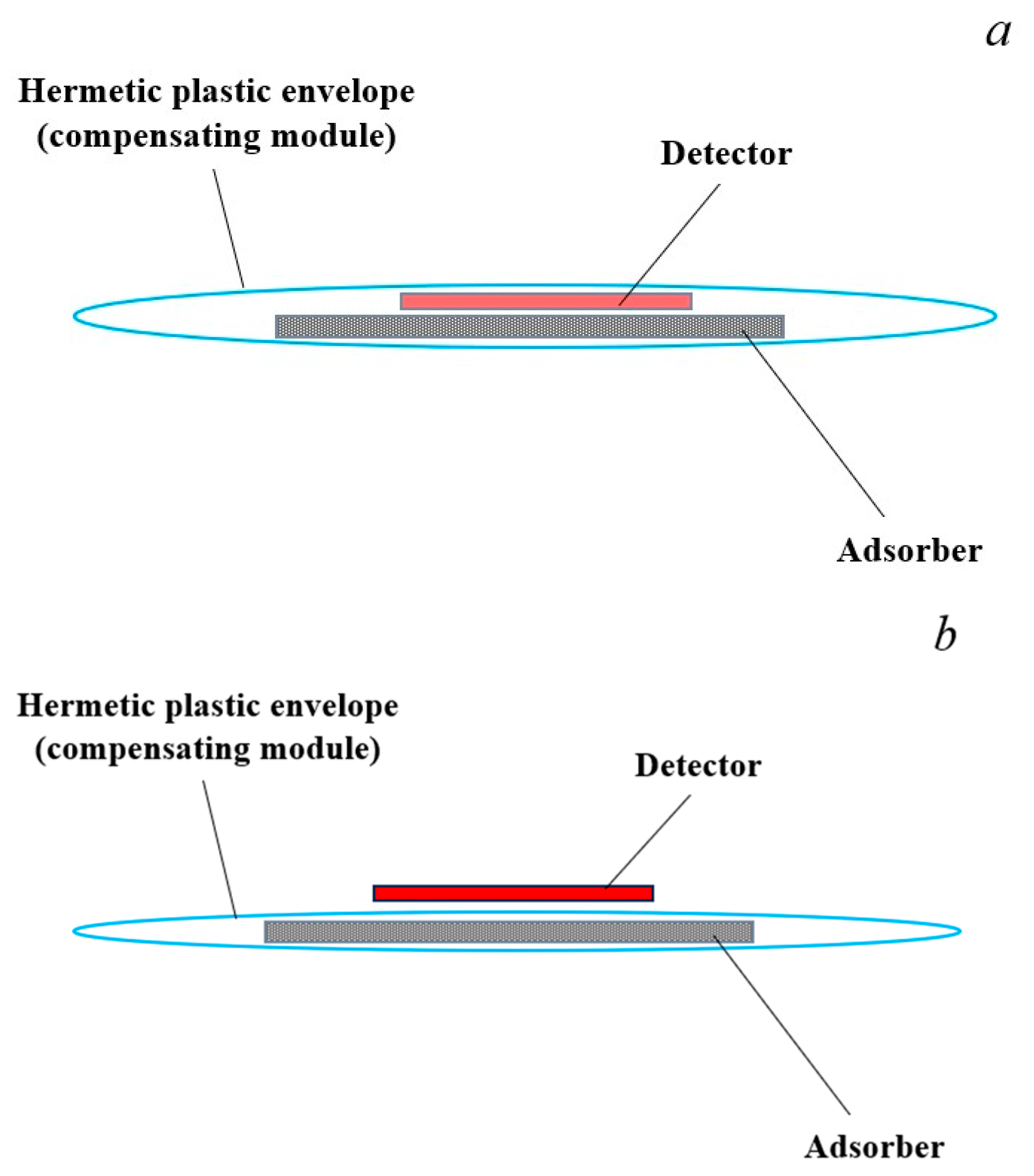
- Once the optimal x value (xopt) is determined, the best temperature compensation is achieved by appropriately linking the adsorbent mass, total area of the plastic envelope, and foil thickness according to Equation (5) for xopt.
- Even if the parameter x deviates by a factor of two (or slightly more) from xopt, temperature compensation remains satisfactory, with the RSD staying below ~20%. This suggests that adequate temperature compensation can be achieved even if the radon adsorption properties of the adsorbent and the radon permeability of the plastic are only approximately known.
- Moisture protection:
- Compensating modules made of HDPE and LDPE provide effective long-term protection against humidity, retarding water adsorption by a factor of 88 for HDPE and 32 for LDPE.
- Moisture retarding factor can be further extended by a factor of 2–3 by increasing proportionally the foil thickness (e.g., the x-value, see Equation (5)), although this would slightly reduce the temperature compensation (e.g., the RSD increasing from ~10% to ~15–20%).
- At lower temperatures, exposure time could be significantly longer due to reduced water permeability and smaller partial pressure differences.
5. Conclusions
6. Patents
- Patent BG Nr. 67405 (priority 19 March 2019, issued 31 December 2021)
- Patent BG Nr. 67484 (priority 19 August 2020, issued 15 December 2022)
Funding
Institutional Review Board Statement
Informed Consent Statement
Data Availability Statement
Conflicts of Interest
References
- Ludewig, P.; Lorenser, E. Untersuchungen der Grubenluft in den Schneeberger Gruben auf den Gehalt von Radium-Emanation. Z. Phys. 1924, 22, 178–185. [Google Scholar] [CrossRef] [Scilit]
- Sevc, J.; Kunz, E.; Tomásek, L.; Placek, V.; Horácek, J. Cancer in man after exposure to radon daughters. Health Phys. 1988, 54, 27–46. [Google Scholar] [CrossRef] [Scilit] [PubMed]
- International Agency for Research on Cancer (IARC). IARC Monographs on the Evaluation of Carcinogen Risks to Humans; IARC: Lyon, France, 1988; Volume 43. [Google Scholar]
- WHO. Handbook on Indoor Radon: A Public Health Perspective; Zeeb, H., Shannoun, F., Eds.; WHO Publications: Geneva, Switzerland, 2009. [Google Scholar]
- International Commission on Radiological Protection. Lung Cancer Risk from Radon and Progeny and Statement on Radon. ICRP Publication 115. Ann. ICRP 2010, 40, 1–64. [Google Scholar]
- Council of the European Union. Council Directive 2013/59/EURATOM of 5 December 2013. Official Journal of the European Union L 13/17.1.2014, Article 103.
- United Nations Scientific Committee on the Effects of Atomic Radiation (UNSCEAR). Sources of Ionizing Radiation; United Nations Scientific Committee on the Effects of Atomic Radiation Report to the General Assembly; UNSCEAR: Vienna, Austria, 2008; Volume I. [Google Scholar]
- TraceRADON. Available online: http://traceradon-empir.eu (accessed on 18 May 2025).
- Röttger, S.; Röttger, A.; Grossi, C.; Vargas, A.; Karstens, U.; Cinelli, G.; Chung, E.; Kikaj, D.; Rennick, C.; Mertes, F.; et al. Radon metrology for use in climate change observation and radiation protection at the environmental level. Adv. Geosci. 2022, 57, 37–47. [Google Scholar] [CrossRef] [Scilit]
- Fialova, E.; Otahal, P.P.S.; Vosahlik, J.; Mazanova, M. Equipment for testing measuring devices at a low-level radon activity concentration. Int. J. Environ. Res. Public Health 2020, 17, 1904. [Google Scholar] [CrossRef] [Scilit]
- Celikovic, I.; Pantelic, G.; Vukanac, I.; Nikolic, J.K.; Živanovic, M.; Cinelli, G.; Gruber, V.; Baumann, S.; Poncela, L.S.Q.; Rabago, D. Outdoor Radon as a Tool to Estimate Radon Priority Areas—A Literature Overview. Int. J. Environ. Res. Public Health 2022, 19, 662. [Google Scholar] [CrossRef] [Scilit] [PubMed]
- Grossi, C.; Arnold, D.; Adame, J.A.; López-Coto, I.; Bolívar, J.P.; de la Morena, B.A.; Vargas, A. Atmospheric 222Rn concentration and source term at El Arenosillo 100 m meteorological tower in southwest Spain. Radiat. Meas. 2012, 47, 149–162. [Google Scholar] [CrossRef] [Scilit]
- Grossi, C.; Vogel, F.R.; Curcoll, R.; Àgueda, A.; Vargas, A.; Rodó, X.; Morguí, J.-A. Study of the daily and seasonal atmospheric CH4 mixing ratio variability in a rural Spanish region using 222Rn tracer. Atmos. Chem. Phys. 2018, 18, 5847–5860. [Google Scholar] [CrossRef] [Scilit]
- Chambers, S.D.; Hong, S.-B.; Williams, A.G.; Crawford, J.; Griffiths, A.D.; Park, S.-J. Characterising terrestrial influences on Antarctic air masses using Radon-222 measurements at King George Island. Atmos. Phys. Chem. 2014, 14, 9903–9916. [Google Scholar] [CrossRef] [Scilit]
- Mamont-Ciesla, K.; Stavarz, O.; Karpinska, M.; Kapala, J.; Kozak, K.; Grzadziel, D.; Chalupnik, S.; Chmielewska, I.; Olszewski, J.; Przylibski, T.; et al. Intercomparison of radon CR-39 detector systems conducted in CLOR’s calibration chamber. Nukleonika 2010, 55, 589–593. [Google Scholar]
- Tommasino, L.; Tommasino, M.C.; Viola, P. Radon-film-badges by solid radiators to complement track detector-based radon monitors. Radiat. Meas. 2009, 44, 719–723. [Google Scholar] [CrossRef] [Scilit]
- Sohrabi, M.; Ghahremani, M. Novel panorama megasize environmental radon monitor. Radiat. Phys. Chem. 2021, 181, 109325. [Google Scholar] [CrossRef] [Scilit]
- Sohrabi, M. Concentration and duration dependence of a new prototype polycarbonate/activated-carbon fabric individual and environmental radon monitor. JINST 2018, 13, P11012. [Google Scholar] [CrossRef] [Scilit]
- Rutherford, E. Adsorption of radioactive emanations by charcoal. Nature 1906, 76, 634. [Google Scholar]
- Cohen, B.L.; Cohen, E.S. Theory and practice of radon monitoring with charcoal adsorption. Health Phys. 1983, 45, 501–508. [Google Scholar] [CrossRef] [Scilit]
- Sutej, T.; Ilic, R.; Krizman, M. A new technique for radon measurement based on a combination of a track-etch detector and activated charcoal. Nucl. Tracks Radiat. Meas. 1991, 19, 423–424. [Google Scholar] [CrossRef] [Scilit]
- Cosma, C.; Van Deynse, A.; Poffijn, A. Studies on radon adsorption characteristics of different charcoals used as amplifiers for the track detectors. Radiat. Meas. 1999, 31, 351–354. [Google Scholar] [CrossRef] [Scilit]
- Van Deynse, A.; Cosma, C.; Poffijn, A. A passive radon dosimeter based on the combination of a track etch detector and activated charcoal. Radiat. Meas. 1999, 31, 325–330. [Google Scholar] [CrossRef] [Scilit]
- Zikovski, L. Temperature dependence of adsorption coefficients of 222Rn on activated charcoal determined by adsorption-desorption method. Health Phys. 2001, 80, 175–176. [Google Scholar] [CrossRef] [Scilit] [PubMed]
- Cooper, A.; Le, T.N.; Iimoto, T.; Kosako, T. Temperature calibration formula for activated charcoal radon collectors. J. Environ. Radioact. 2011, 102, 60–63. [Google Scholar] [CrossRef] [Scilit]
- Guo, L.; Wang, Y.; Zhang, L.; Zeng, Z.; Dong, W.; Guo, Q. The temperature dependence of adsorption coefficients of 222Rn on activated charcoal: An experimental study. Appl. Radiat. Isot. 2017, 125, 185–187. [Google Scholar] [CrossRef] [Scilit] [PubMed]
- Shefsky, L.S.; Rose, D.; Parsons, G.C. A study of radon adsorption on activated carbon as a function of temperature. In Proceedings of the AARST International Radon Conference, Denver, CO, USA, 20–22 September 1993. [Google Scholar]
- Golightly, J. Characterization of a Radon Filter, and Radon Detection. M.Sc. Thesis, Queen’s University, Kingston, ON, Canada, 2008. [Google Scholar]
- Scarpita, S.C. Factors Affecting the Estimation of Indoor Radon Using Passive Activated Charcoal Canisters. Ph.D. Dissertation, New York University, New York, NY, USA, 1990. [Google Scholar]
- George, A. State-of-the-Art Instruments for Measuring Radon/thoron and Their Progeny in Dwellings—A Review. Health Phys. 1996, 70, 451–463. [Google Scholar] [CrossRef] [Scilit] [PubMed]
- Pressyanov, D.; Momchilov, M.; Georgiev, P. Influence of humidity on activated carbon fabrics scheduled for use in high sensitivity radon detectors. Appl. Radiat. Isot. 2023, 200, 110941. [Google Scholar] [CrossRef] [Scilit]
- Heinitz, S.; Mermans, J.; Maertens, D.; Skliarova, H.; Aerts, A.; Cardinaels, T.; Gueibe, C.; Rutten, J.; Ireland, N.; Kuznicki, D.; et al. Adsorption of radon on silver exchanged zeolites at ambient temperatures. Sci. Rep. 2023, 13, 6811. [Google Scholar] [CrossRef] [Scilit] [PubMed]
- Pressyanov, D. Assessing radon adsorption capacity in adsorbents using solid state nuclear track detectors (SSNTDs). Radiat. Meas. 2024, 176, 107199. [Google Scholar] [CrossRef] [Scilit]
- Pressyanov, D.; Dimitrov, D. The sensitivity of Innovative techniques for measuring low levels of radon in the environment using passive detectors. J. Environ. Radioact. 2024, 277, 107461. [Google Scholar] [CrossRef] [Scilit]
- Pressyanov, D.; Zajonchovska, V.; Dimitrov, D. Examining radon levels in soil gas and atmospheric air near the soil–air interface. Eur. Phys. J. Spec. Top. 2025, 1–8. [Google Scholar] [CrossRef] [Scilit]
- Pressyanov, D.; Dimitrov, D. Fine-Scale Spatial Distribution of Indoor Radon and Identification of Potential Ingress Pathways. Atmosphere 2025, 16, 943. [Google Scholar] [CrossRef] [Scilit]
- Pressyanov, D. Compensation Module for Sensors for Measurement of Radioactive Noble Gases. Bulgarian Patent BG67405, 19 March 2019. [Google Scholar]
- Pressyanov, D. Compensation Module for Sensors for Measurement of Radioactive Noble Gases. Bulgarian Patent BG Nr. 67484, 19 August 2020. [Google Scholar]
- Pressyanov, D. New generation of highly sensitive radon detectors based on activated carbon with compensated temperature dependence. Sci. Rep. 2022, 12, 8479. [Google Scholar] [CrossRef] [Scilit]
- Kozlova, A.; Zhmakin, V.; Markova, S.; Teplyakov, V.; Shalygin, M. Xenon recovery from medical gas mixtures by polymer membranes: Effect of temperature on Xe/O2 selectivity. J. Membr. Sci. 2024, 698, 122527. [Google Scholar] [CrossRef] [Scilit]
- Schowalter, S.J.; Colin, B.C.; John, M.D. Permeability of Noble Gases through Kapton, Butyl, Nylon, and “Silver Shield”. Nucl. Instrum. Meth. Phys. Res. 2010, 615, 267–271. [Google Scholar] [CrossRef] [Scilit]
- Hammon, H.G.; Ernst, K.; Newton, J.C. Noble gas permeability of polymer films and coatings. J. Appl. Polym. Sci. 1977, 21, 1979–1997. [Google Scholar] [CrossRef] [Scilit]
- Pressyanov, D.; Dimitrov, D. The problem with the temperature dependence of radon diffusion chambers with anti-thoron barrier. Rom. J. Phys. 2020, 65, 801. [Google Scholar]
- Fleischer, R.L.; Giard, W.R.; Turner, L.G. Membrane-based thermal effects in 222Rn dosimetry. Radiat. Meas. 2000, 32, 325–328. [Google Scholar] [CrossRef] [Scilit]
- Georgiev, S.; Mitev, K.; Dutsov, C.; Boshkova, T.; Dimitrova, I. Partition Coefficients and Diffusion Lengths of 222Rn in Some Polymers at Different Temperatures. Int. J. Environ. Res. Public Health 2019, 16, 4523. [Google Scholar] [CrossRef] [Scilit]
- Keller, P.; Kouzes, R. Water Vapor Permeation in Plastics; Pacific Northwest National Laboratory: Richland, DC, USA, 2017; PNNL-26070. [Google Scholar]
- Pressyanov, D.; Georgiev, S.; Dimitrova, I.; Mitev, K.; Boshkova, T. Determination of the diffusion coefficient and solubility of radon in plastics. Radiat. Prot. Dosim. 2011, 145, 123–126. [Google Scholar] [CrossRef] [Scilit]
- Sullivan, P.D.; Stone, B.R.; Hashisho, Z.; Rood, M.J. Water adsorption with hysteresis effect onto microporous activated carbon fabrics. Adsorpion 2007, 13, 173–189. [Google Scholar] [CrossRef] [Scilit]
- Pressyanov, D.; Foerster, E.; Georgiev, S.; Dimitrova, I.; Mitev, K. Traceability of CDs/DVDs used as retrospective 222Rn detectors to reference STAR laboratory. Radiat. Meas. 2013, 59, 165–171. [Google Scholar] [CrossRef] [Scilit]




Disclaimer/Publisher’s Note: The statements, opinions and data contained in all publications are solely those of the individual author(s) and contributor(s) and not of MDPI and/or the editor(s). MDPI and/or the editor(s) disclaim responsibility for any injury to people or property resulting from any ideas, methods, instructions or products referred to in the content. |
© 2026 by the author. Licensee MDPI, Basel, Switzerland. This article is an open access article distributed under the terms and conditions of the Creative Commons Attribution (CC BY) license.
Share and Cite
Pressyanov, D. Efficient Temperature- and Moisture-Compensated Design for Next-Generation Adsorbent-Based Radon Detectors. Atmosphere 2026, 17, 346. https://doi.org/10.3390/atmos17040346
Pressyanov D. Efficient Temperature- and Moisture-Compensated Design for Next-Generation Adsorbent-Based Radon Detectors. Atmosphere. 2026; 17(4):346. https://doi.org/10.3390/atmos17040346
Chicago/Turabian StylePressyanov, Dobromir. 2026. "Efficient Temperature- and Moisture-Compensated Design for Next-Generation Adsorbent-Based Radon Detectors" Atmosphere 17, no. 4: 346. https://doi.org/10.3390/atmos17040346
APA StylePressyanov, D. (2026). Efficient Temperature- and Moisture-Compensated Design for Next-Generation Adsorbent-Based Radon Detectors. Atmosphere, 17(4), 346. https://doi.org/10.3390/atmos17040346