Quiet-Time Rapid Subauroral Plasma Flows at High Northern Magnetic Latitudes in the Dusk Sector


Abstract
1. Introduction
2. Materials and Methods
3. Results
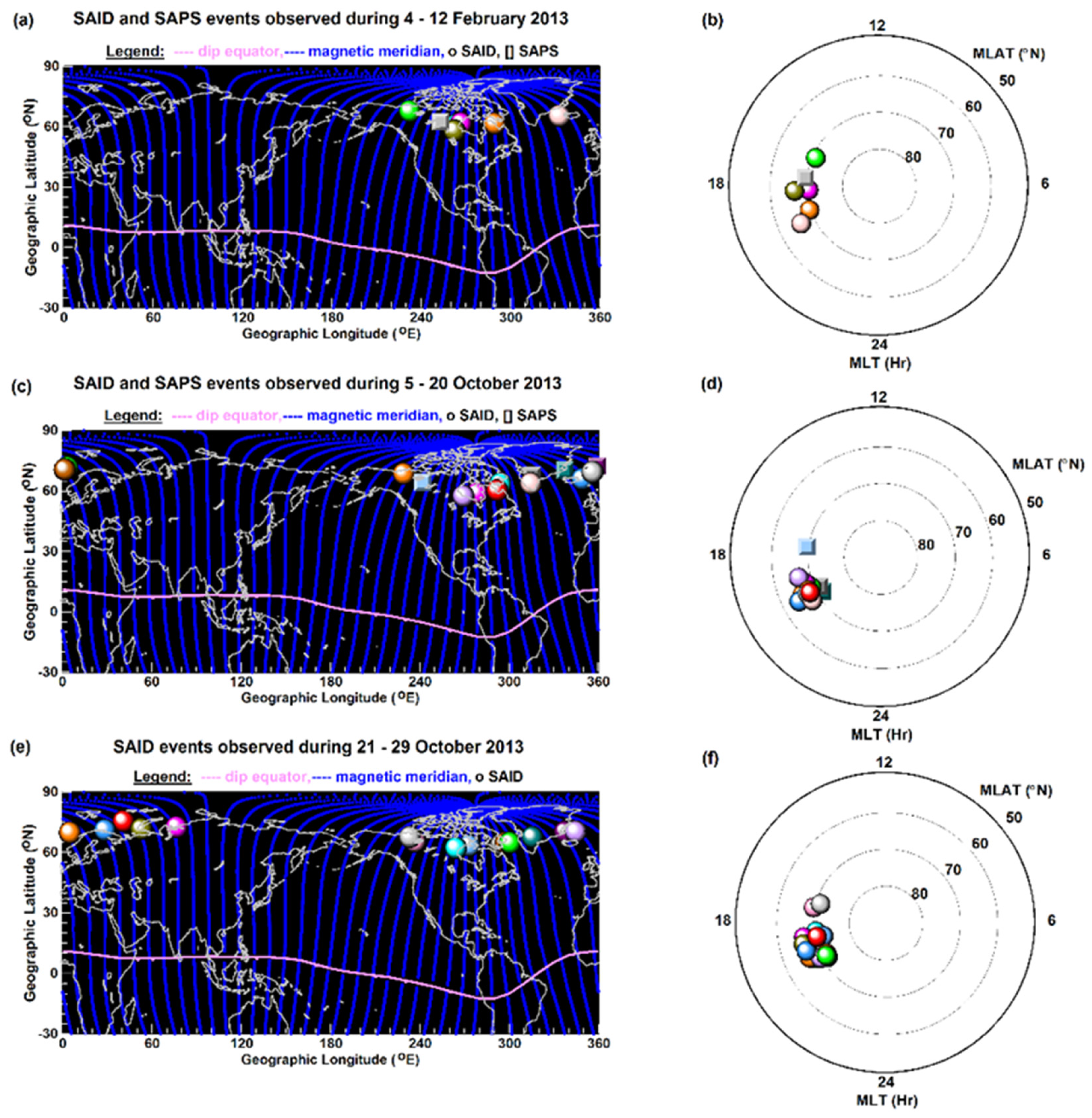
3.1. Rapid High-Latitude Subauroral Flows Investigated
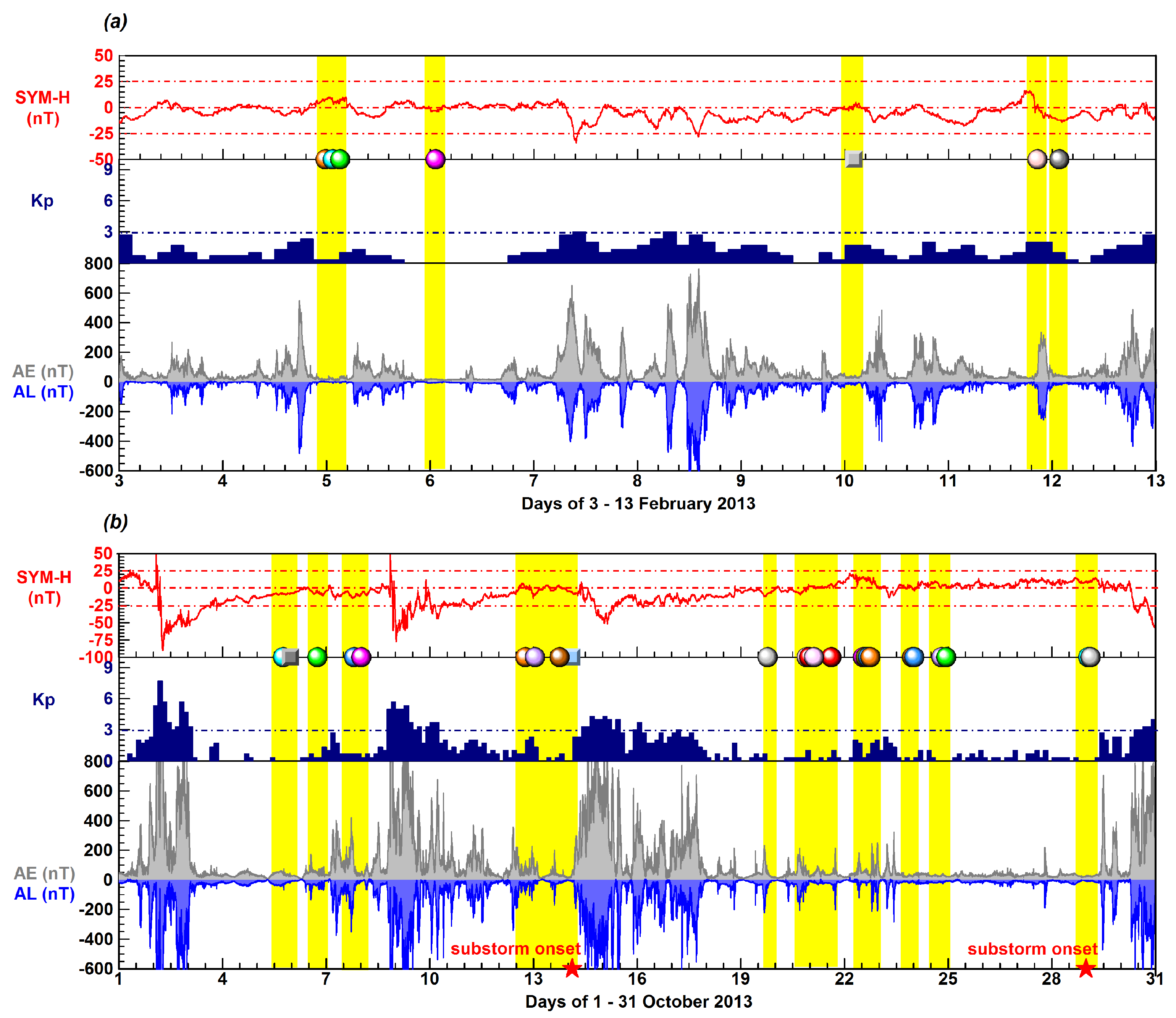
3.2. Underlying Interplanetary and Geomagnetic Conditions
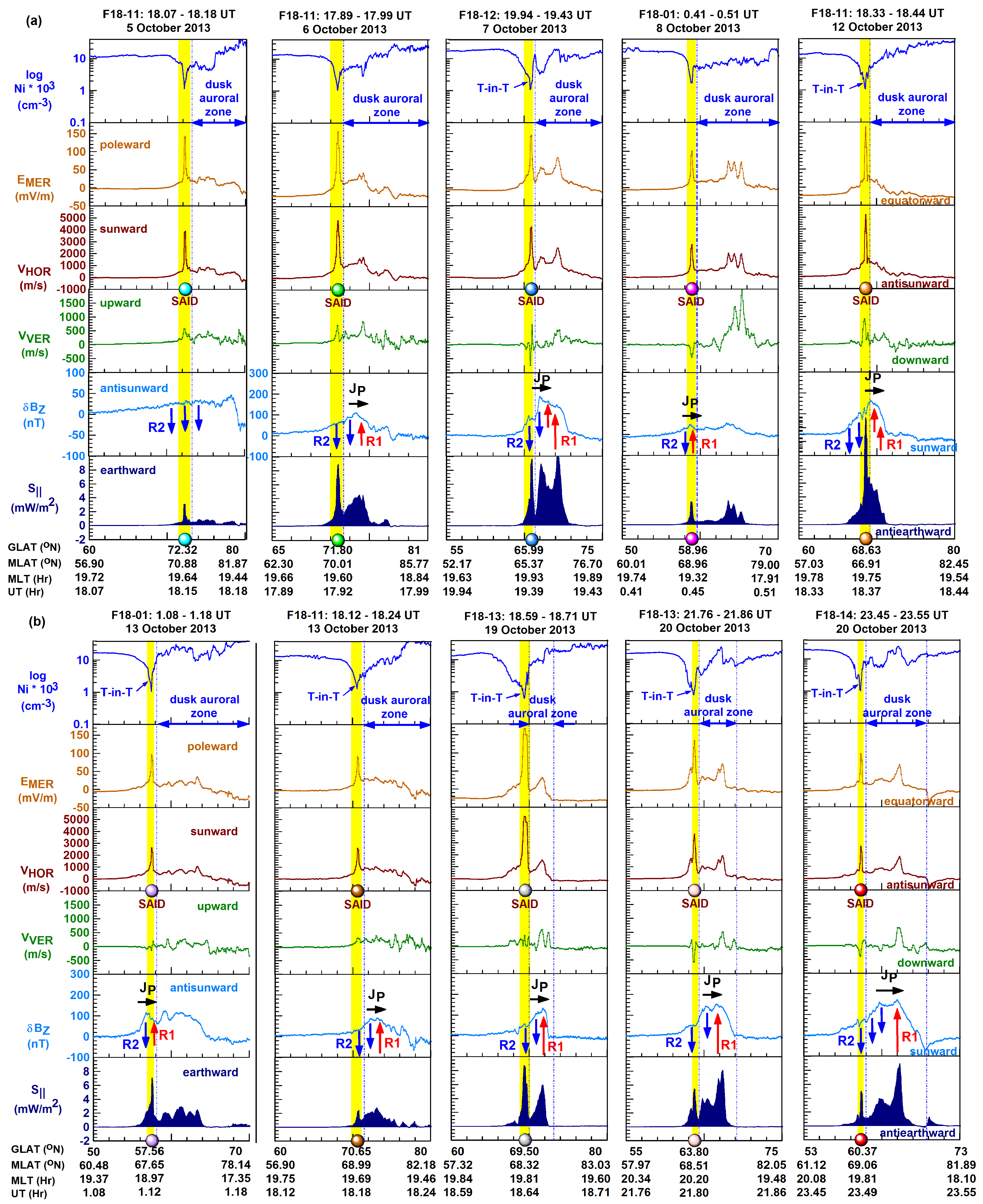
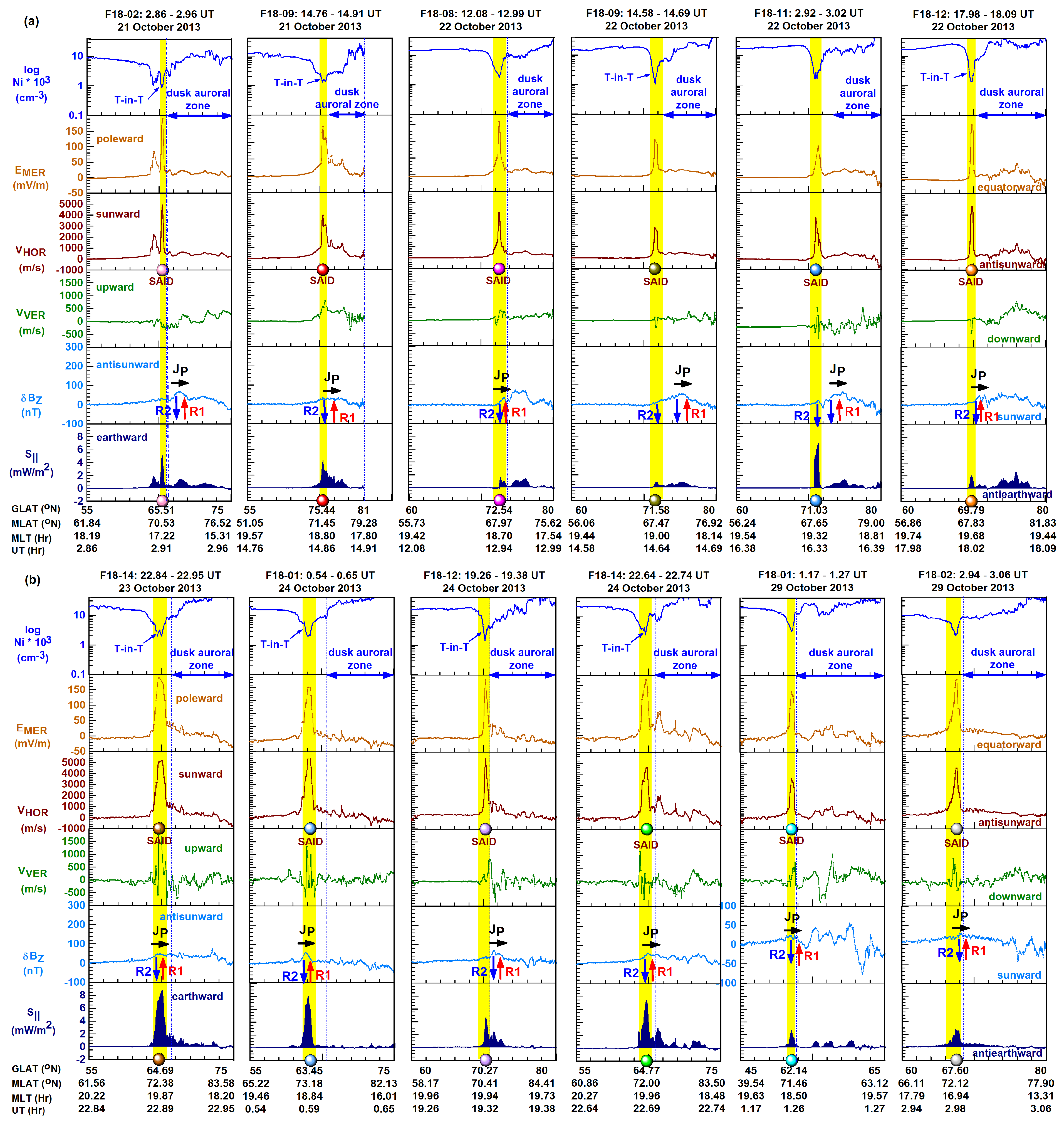
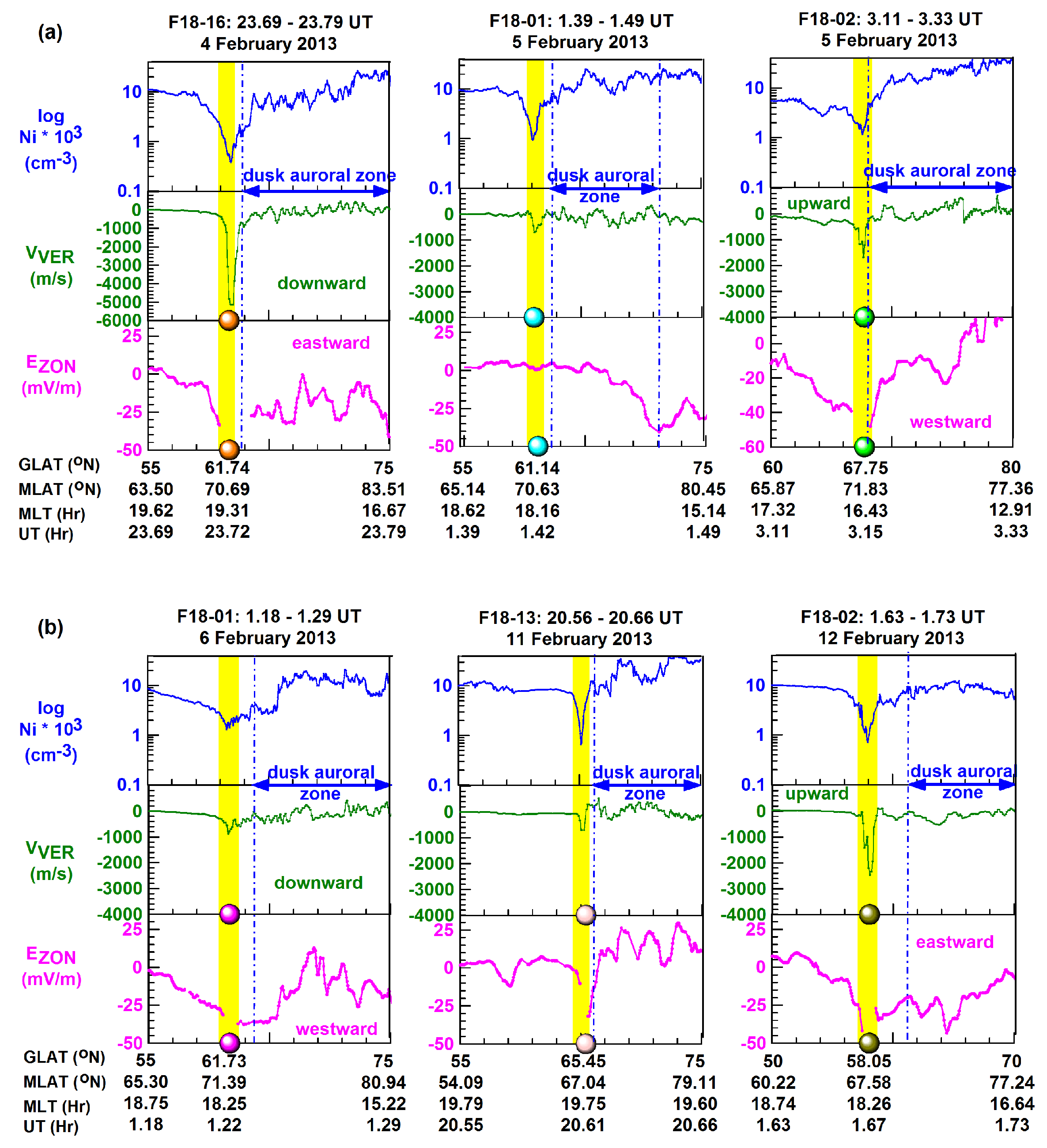
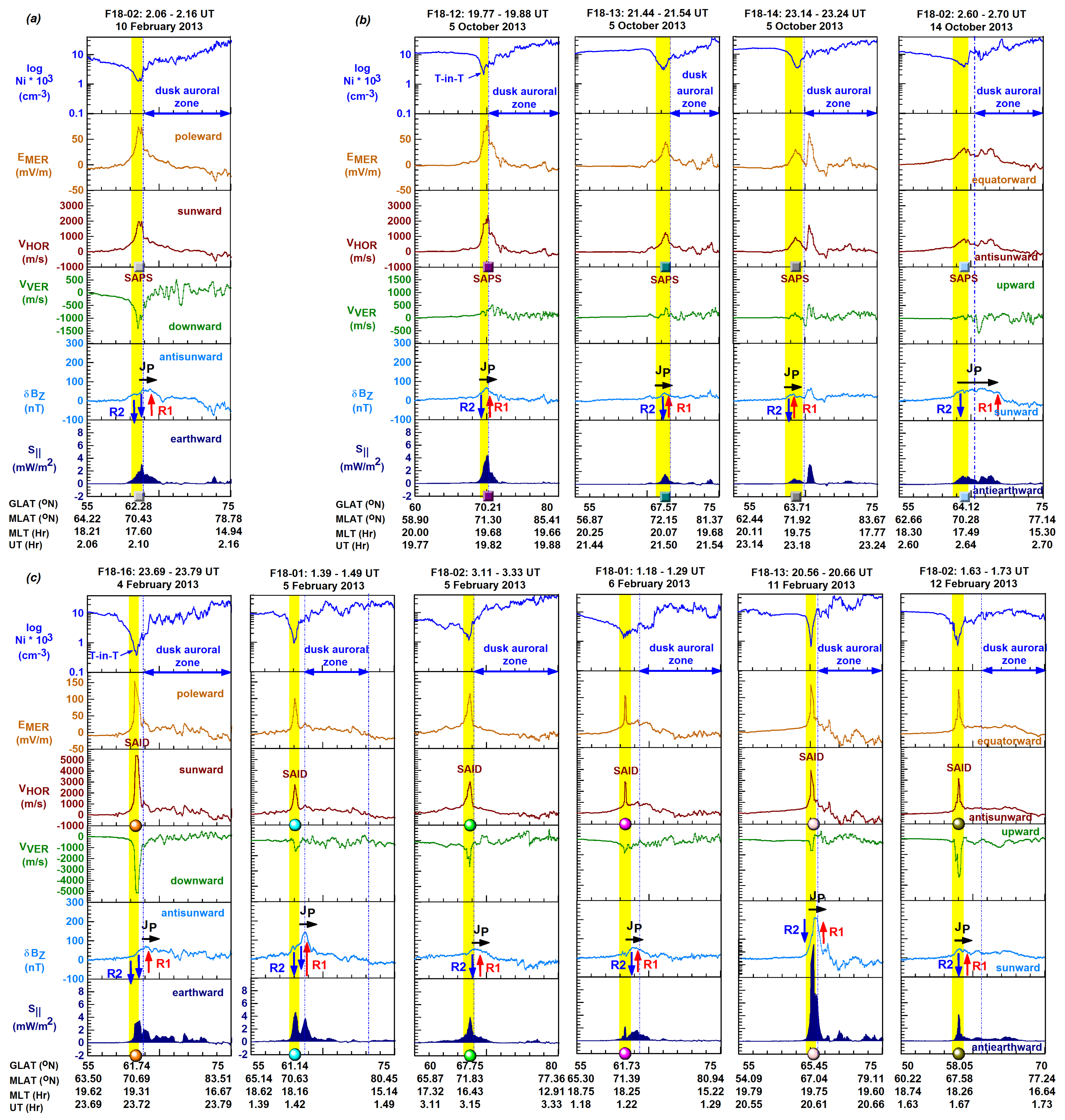
3.3. Characteristics of the Rapid High-Latitude SAPS and SAID Flows
3.4. Enhanced Downward Drifts Underlying the Rapid High-Latitude SAID Flows
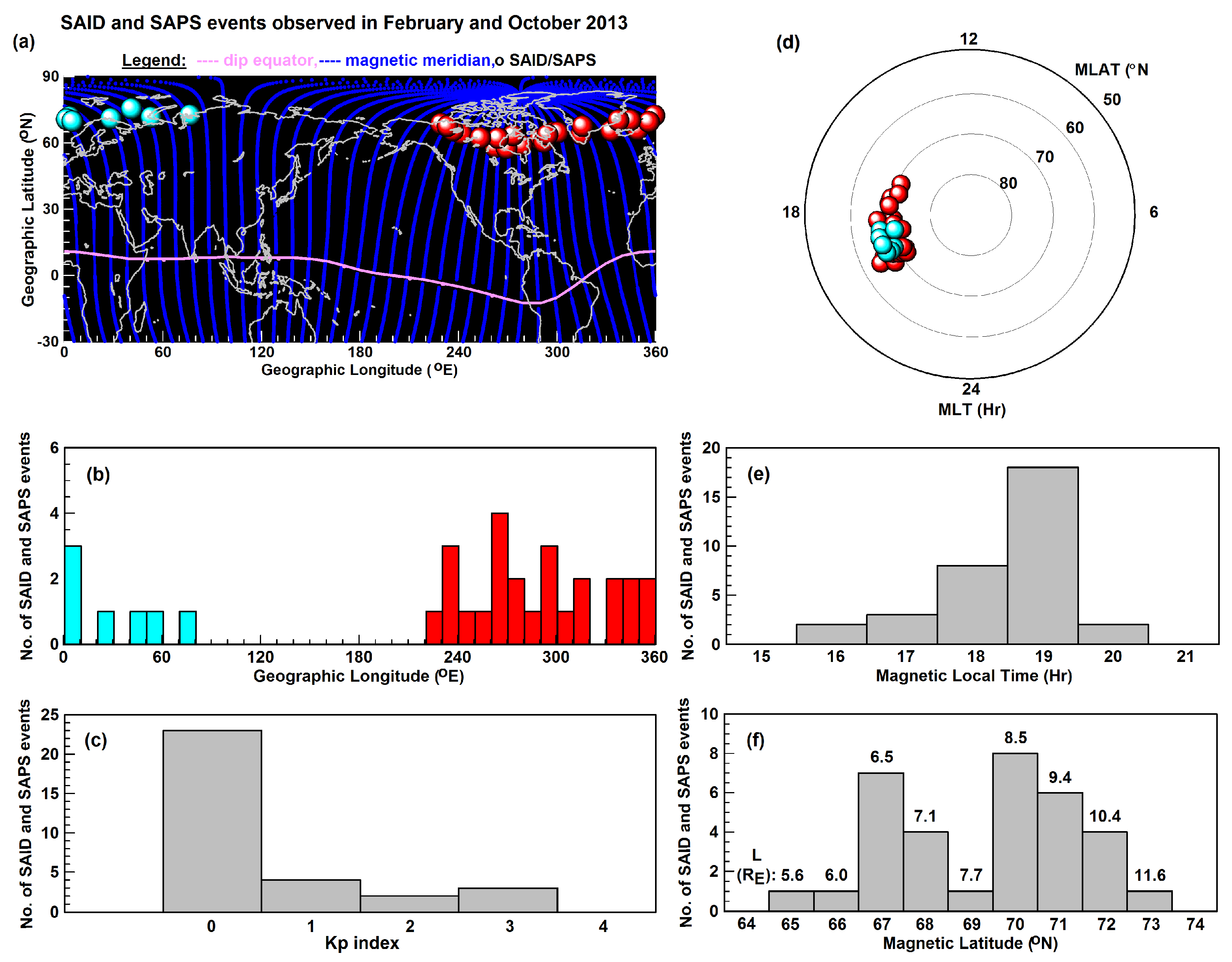
3.5. Statistical Results
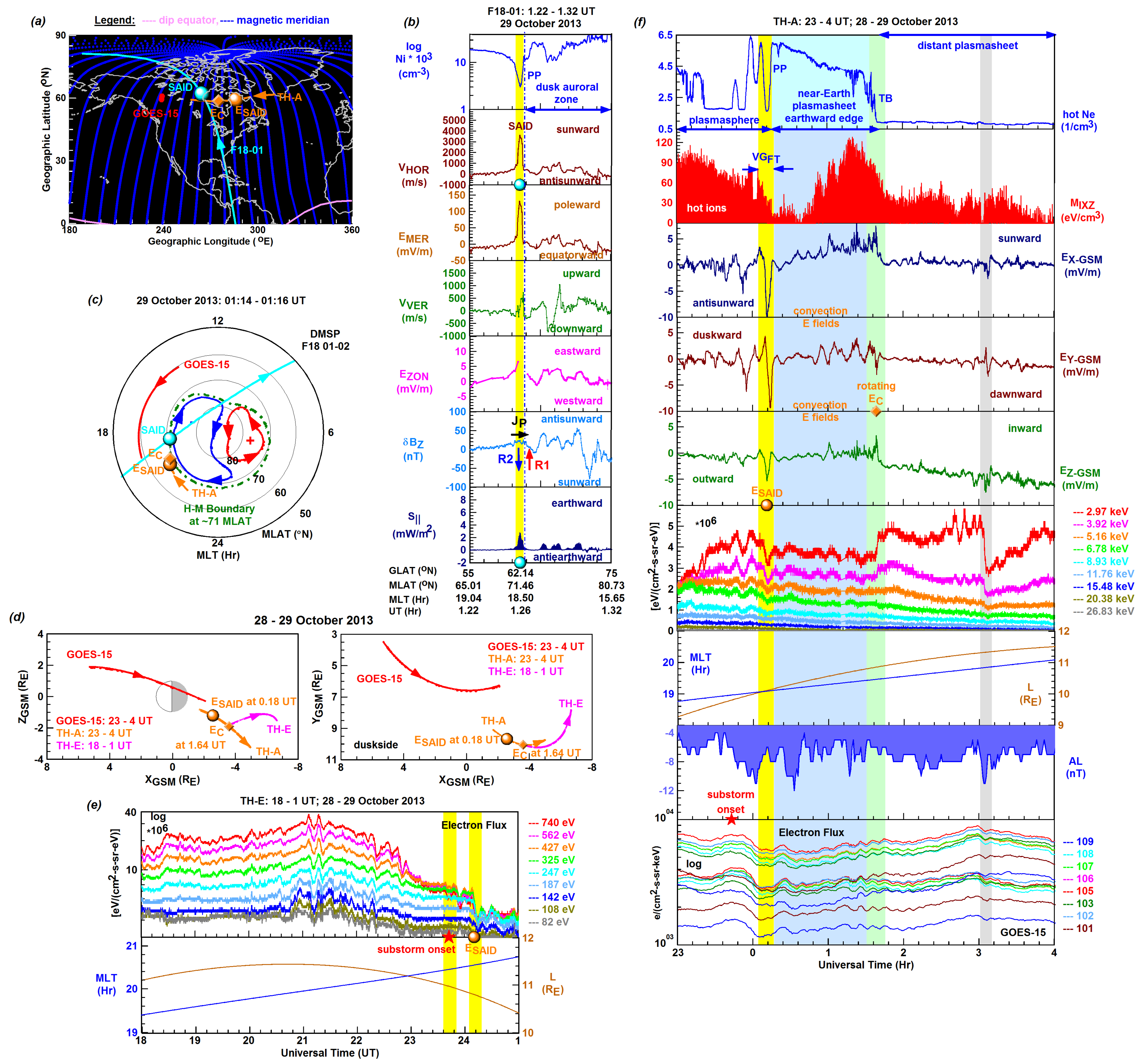
3.6. Conjugate Observations of the 29 October 2013 SAID Event
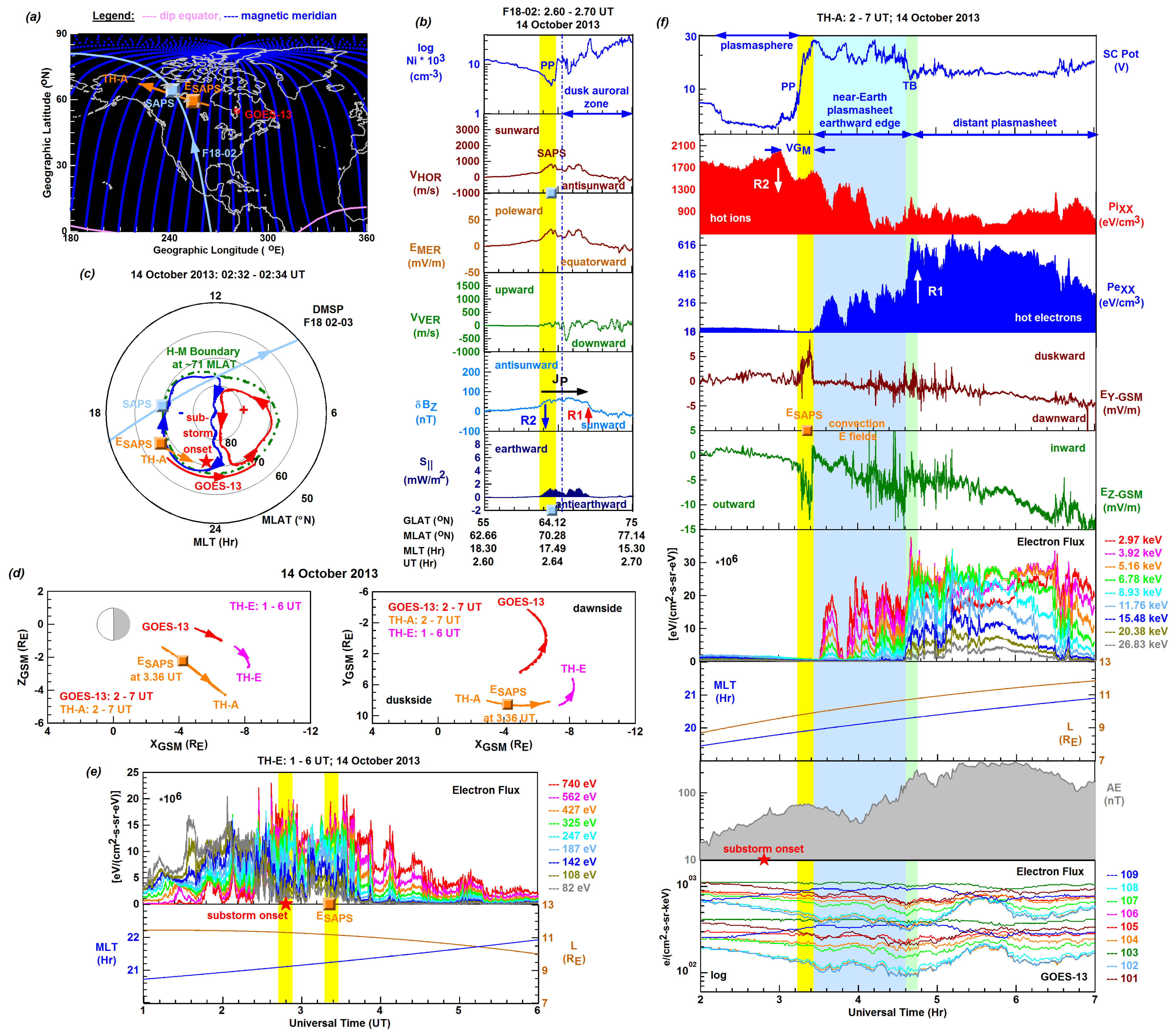
3.7. Conjugate Observations of the 14 October 2013 SAPS Event
4. Summary of Results
- (i)
- The underlying strong poleward E field: 90–190 mV/m;
- (ii)
- The underlying strong zonal E field (max|EZON| ≈ 50 mV/m);
- (iii)
- The associated deep subauroral main trough (min Ni ≈ 0.4 × 103 cm−3);
- (iv)
- The trough-in-the-trough plasma density feature implying positive feedback mechanisms in progress;
- (v)
- The magnitude of ↓R2 current implying previous or recent SAPS/SAID development in a voltage generator setting;
- (vi)
- The locally increased earthward electromagnetic energy deposition along the plasmapause into the SAPS/SAID flow channel, measured by the Poynting flux (S‖ ≤ 12 mV/m), implying the generation of electromagnetic energy in the conjugate inner-magnetosphere voltage generator and its subsequent downward/earthward channeling.
5. Discussion
6. Conclusions
Supplementary Materials
Author Contributions
Funding
Institutional Review Board Statement
Informed Consent Statement
Data Availability Statement
Acknowledgments
Conflicts of Interest
Abbreviations
| B field | Magnetic Field |
| DMSP | Defense Meteorological Satellite Program |
| E field | Electric Field |
| EC | Convection Electric Field |
| EMER | Meridional Electric Field |
| EZON | Zonal Electric Field |
| ESAID | Sub-Auroral Ion Drift Electric Field |
| EFI | Electric Field Instrument |
| ESA | Electrostatic Analyzer |
| FACs | Field-Aligned Currents |
| GLAT | Geographic Latitude |
| GLON | Geographic Longitude |
| GOES | Geostationary Operational Environmental Satellite |
| GSM | Geocentric Solar Magnetospheric |
| H-M | Heppner–Maynard |
| L | L Dhell |
| MIT | Main Ionospheric Trough |
| MLAT | Magnetic Latitude |
| MLT | Magnetic Local Time |
| Ne | Electron Density |
| Ni | Ion Density |
| PJ | Polarization Jet |
| PP | Plasmapause |
| R1 | Region 1 |
| R2 | Region 2 |
| SAID | Sub-Auroral Ion Drift |
| SAPS | Sub-Auroral Polarization Stream |
| SAR | Stable Auroral Red |
| SML | SuperMAG AL |
| SuperDARN | Super Dual Auroral Radar Network |
| STEVE | Strong Thermal Emission Velocity Enhancement |
| THEMIS | Time History of Events and Macroscale Interactions during Substorms |
| TB | Trapping Boundary |
| VG | Voltage Generator |
| VGFT | Fast-Time Voltage Generator |
| VGM | Magnetospheric Voltage Generator |
| VHOR | Cross-track Horizontal Drift Velocity |
| VVER | Cross-track Vertical Drift Velocity |
References
- Muldrew, D.B. F layer ionization troughs deduced from Alouette data. J. Geophys. Res. 1965, 70, 2635–2650. [Google Scholar] [CrossRef]
- Rycroft, M.J.; Thomas, J.O. The magnetospheric plasmapause and the electron density trough at the Alouette I orbit. Planet. Space Sci. 1970, 18, 65–80. [Google Scholar] [CrossRef]
- Moffett, R.J.; Quegan, S. The mid-latitude trough in electron concentration of the ionospheric F layer: A review of observations and modeling. J. Atmos. Terr. Phys. 1983, 45, 315–343. [Google Scholar] [CrossRef]
- Anderson, P.C.; Heelis, R.A.; Hanson, W.B. The ionospheric signatures of rapid subauroral ion drifts. J. Geophys. Res. 1991, 96, 5785–5792. [Google Scholar] [CrossRef]
- Spiro, R.W.; Heelis, R.A.; Hanson, W.B. Rapid subauroral drifts observed by Atmosphere Explorer C. Geophys. Res. Lett. 1979, 6, 657–660. [Google Scholar] [CrossRef]
- Anderson, P.C.; Hanson, W.B.; Heelis, R.A.; Craven, J.D.; Baker, D.N.; Frank, L.A. A proposed production model of rapid subauroral ion drifts and their relationship to substorm evolution. J. Geophys. Res. 1993, 98, 6069–6078. [Google Scholar] [CrossRef]
- Anderson, P.C.; Carpenter, D.L.; Tsuruda, K.; Mukai, T.; Rich, F.J. Multisatellite observations of rapid subauroral ion drifts (SAID). J. Geophys. Res. 2001, 106, 29585–29600. [Google Scholar] [CrossRef]
- Galperin, Y.L.; Ponomarev, V.N.; Zosimova, A.G. Plasma convection in the polar ionosphere. Ann. Geophys. 1974, 30, 1–7. [Google Scholar]
- Yeh, H.C.; Foster, J.C.; Rich, F.J.; Swider, W. Storm time electric field penetration observed at mid-latitude. J. Geophys. Res. 1991, 96, 5707–5721. [Google Scholar] [CrossRef]
- Foster, J.; Burke, W. A new categorization for sub-auroral electric fields. Eos Trans. Am. Geophys. Union 2002, 83, 393–394. [Google Scholar] [CrossRef]
- Karlsson, T.; Marklund, G.T.; Blomberg, L.G.; Mälkki, A. Subauroral electric fields observed by the Freja satellite: A statistical study. J. Geophys. Res. 1998, 103, 4327–4341. [Google Scholar] [CrossRef]
- Foster, J.; Vo, H. Average characteristics and activity dependence of the subauroral polarization stream. J. Geophys. Res. 2002, 107, SIA 16-1–SIA 16-10. [Google Scholar] [CrossRef]
- Figueiredo, S.; Karlsson, E.; Marklund, G. Investigation of subauroral ion drifts and related field-aligned currents and ionospheric Pedersen conductivity distribution. Ann. Geophys. 2004, 22, 923–934. [Google Scholar] [CrossRef]
- He, F.; Zhang, X.-X.; Wang, W.; Liu, L.; Ren, Z.-P.; Yue, X.; Hu, L.; Wan, W.; Wang, H. Largescale structure of subauroral polarization streams during the main phase of a severe geomagnetic storm. J. Geophys. Res. Space Phys. 2018, 123, 2964–2973. [Google Scholar] [CrossRef]
- Clausen, L.; Baker, J.; Ruohoniemi, J.; Greenwald, R.; Thomas, E.; Shepherd, S.; Talaat, E.R.; Bristow, W.A.; Zheng, Y.; Coster, A.J.; et al. Large-scale observations of a subauroral polarization stream by midlatitude superdarn radars: Instantaneous longitudinal velocity variations. J. Geophys. Res. 2012, 117, A05306. [Google Scholar] [CrossRef]
- Zhao, B.; Zhang, J.; Zhang, Q.; Wang, W.; Xing, Z.; Lyons, L.R.; Nishimura, Y.; Oksavik, K.; Wang, X.; Li, H.; et al. Simultaneous observation of duskside and dawnside subauroral polarization streams during an intense magnetic storm. Geophys. Res. Lett. 2025, 52, e2024GL114160. [Google Scholar] [CrossRef]
- Liu, J.; Lyons, L.R.; Knipp, D.; Zhang, Q.; Wang, C.; Shen, Y.; Angelopoulos, V.; Ma, Y.; Tian, S.; Artemyev, A.; et al. Poynting flux input to the auroral ionosphere: The impact of subauroral polarization streams and dawnside auroral polarization streams. J. Geophys. Res. Space Phys. 2024, 129, e2024JA032605. [Google Scholar] [CrossRef]
- Kunduri, B.; Baker, J.; Ruohoniemi, J.M.; Bailey, S.M.; Gallardo-Lacourt, B. An examination of magnetosphere-ionosphere-thermosphere coupling during STEVE. In Proceedings of the AGU Fall Meeting 2022, Chicago, IL, USA, 12–16 December 2022; id. SA35B-07. Available online: https://ui.adsabs.harvard.edu/abs/2022AGUFMSA35B..07K/abstract (accessed on 19 September 2025).
- Filippov, V.M.; Shestakova, L.V.; Galperin, Y.I. The band of rapid ion drift at subauroral F-region and its manifestation in high-latitude ionosphere structure. Cosm. Res. 1984, 22, 557–564. [Google Scholar]
- Stepanov, A.E.; Gololobov, A.Y.; Khalipov, V.L.; Golikov, I.A. Ion upward flows in the subauroral polarisation jet. In Physics of Auroral Phenomena, Proceedings of the XLI Annual Seminar, Apatity, Russia, 14–16 March 2018; Polar Geophysical Institute: Apatity, Russia, 2018; pp. 118–121. [Google Scholar] [CrossRef]
- Southwood, D.; Wolf, R. An assessment of the role of precipitation in magnetospheric convection. J. Geophys. Res. 1978, 83, 5227–5232. [Google Scholar] [CrossRef]
- Mishin, E.V. The evolving paradigm of the subauroral geospace. Front. Astron. Space Sci. 2023, 10, 1118758. [Google Scholar] [CrossRef]
- Mishin, E.V.; Streltsov, A.V. Subauroral geospace. In Nonlinear Wave and Plasma Structures in the Auroral and Subauroral Geospacer; Elsevier (S&T): Amsterdam, The Netherlands, 2022; pp. 481–610. [Google Scholar] [CrossRef]
- Mishin, E.V. Interaction of substorm injections with the subauroral geospace: 1. Multispacecraft observations of SAID. J. Geophys. Res. Space Phys. 2013, 118, 5782–5796. [Google Scholar] [CrossRef]
- Mishin, E.V. SAPS onset timing during substorms and the westward traveling surge. Geophys. Res. Lett. 2016, 43, 6687–6693. [Google Scholar] [CrossRef]
- Mishin, E.; Nishimura, Y.; Foster, J. SAPS/SAID revisited: A causal relation to the substorm current wedge. J. Geophys. Res. Space Phys. 2017, 122, 8516–8535. [Google Scholar] [CrossRef]
- Fukui, K.; Miyashita, Y.; Machida, S.; Miyoshi, Y.; Ieda, A.; Nishimura, Y.; Angelopoulos, V. A statistical study of near-Earth magnetotail evolution during pseudosubstorms and substorms with THEMIS data. J. Geophys. Res. Space Phys. 2020, 125, e2019JA026642. [Google Scholar] [CrossRef]
- Streltsov, A.V.; Mishin, E.V. Ultralow frequency electrodynamics of magnetosphere-ionosphere interactions near the plasmapause during substorms. J. Geophys. Res. Space Phys. 2018, 123, 7441–7451. [Google Scholar] [CrossRef]
- MacDonald, E.A.; Donovan, E.; Nishimura, Y.; Case, N.A.; Gillies, D.M.; Gallardo-Lacourt, B.; Archer, W.E.; Spanswick, E.L.; Bourassa, N.; Connors, M.; et al. New science in plain sight: Citizen scientists lead to the discovery of optical structure in the upper atmosphere. Sci. Adv. 2018, 4, eaaq0030. [Google Scholar] [CrossRef]
- Gillies, D.M.; Donovan, E.; Hampton, D.; Liang, J.; Connors, M.; Nishimura, Y.; Gallardo-Lacourt, B.; Spanswick, E. First observations from the TREx spectrograph: The optical spectrum of STEVE and the picket fence phenomena. Geophys. Res. Lett. 2019, 46, 7207–7213. [Google Scholar] [CrossRef]
- Bailey, M.; Byrne, C.; Nezic, R.; Asher, D.; Finnegan, J. Historical observations of STEVE. Observatory 2018, 138, 227–245. [Google Scholar] [CrossRef]
- Gallardo-Lacourt, B.; Nishimura, Y.; Donovan, E.; Gillies, D.M.; Perry, G.W.; Archer, W.E.; Nava, O.A.; Spanswick, E.L. A statistical analysis of STEVE. J. Geophys. Res. Space Phys. 2018, 123, 9893–9905. [Google Scholar] [CrossRef]
- Gallardo-Lacourt, B.; Perry, G.W.; Archer, W.E.; Donovan, E. How did we miss this? An upper atmospheric discovery named STEVE. Eos 2019, 100. [Google Scholar] [CrossRef]
- Nishimura, Y.; Dyer, A.; Kangas, L.; Donovan, E.; Angelopoulos, V. Unsolved problems in strong thermal emission velocity enhancement (STEVE) and the picket fence. Front. Astron. Space Sci. 2023, 10, 1087974. [Google Scholar] [CrossRef]
- Barbier, D. Research on the 6300 Line of Atmospheric Luminescence Nocturne. Ann. Geophys. 1959, 15, 179–217. [Google Scholar]
- Kozyra, J.U.; Nagy, A.F.; Slater, D.W. High-altitude energy source(s) for stable auroral red arcs. Rev. Geophys. 1997, 35, 155–190. [Google Scholar] [CrossRef]
- Martinis, C.; Griffin, I.; Gallardo-Lacourt, B.; Wroten, J.; Nishimura, Y.; Baumgardner, J.; Knudsen, D.J. Rainbow of the night: First direct observation of a SAR arc evolving into STEVE. Geophys. Res. Lett. 2022, 49, e2022GL098511. [Google Scholar] [CrossRef]
- Parnikov, S.G.; Ievenko, I.B.; Koltovskoi, I.I. Subauroral Luminosity STEVE over Yakutia during a Substorm: Analysis of the Event of March 1, 2017. Geomagn. Aeron. 2022, 62, 434–443. [Google Scholar] [CrossRef]
- Mishin, E.V.; Streltsov, A.V. Toward the unified theory of SAID-linked subauroral arcs. J. Geophys. Res. Space Phys. 2024, 129, e2023JA032196. [Google Scholar] [CrossRef]
- He, F.; Zhang, X.-X.; Chen, B. Solar cycle, seasonal, and diurnal variations of subauroral ion drifts: Statistical results. J. Geophys. Res. Space Phys. 2014, 119, 5076–5086. [Google Scholar] [CrossRef]
- Laakso, H.; Pfaff, R. Fast plasma drifts in the high latitude ionosphere. Geophys. Res. Lett. 2023, 50, e2023GL103566. [Google Scholar] [CrossRef]
- Erickson, P.J.; Beroz, F.; Miskin, M.Z. Statistical characterization of the American sector subauroral polarization stream using incoherent scatter radar. J. Geophys. Res. 2011, 116, A00J21. [Google Scholar] [CrossRef]
- Kunduri, B.S.R.; Baker, J.B.H.; Ruohoniemi, J.M.; Thomas, E.G.; Shepherd, S.G.; Sterne, K.T. Statistical characterization of the large-scale structure of the subauroral polarization stream. J. Geophys. Res. Space Phys. 2017, 122, 6035–6048. [Google Scholar] [CrossRef]
- Wang, H.; Ridley, A.J.; Lühr, H.; Liemohn, M.W.; Ma, S.Y. Statistical study of the subauroral polarization stream: Its dependence on the cross–polar cap potential and subauroral conductance. J. Geophys. Res. 2008, 113, A12311. [Google Scholar] [CrossRef]
- Landry, R.G.; Anderson, P.C. An auroral boundary-oriented model of subauroral polarization streams (SAPS). J. Geophys. Res. Space Phys. 2018, 123, 3154–3169. [Google Scholar] [CrossRef]
- Gallardo-Lacourt, B.; Nishimura, Y.; Kepko, L.; Spanswick, E.L.; Gillies, D.M.; Knudsen, D.J.; Burchill, J.K.; Skone, S.H.; Pinto, V.A.; Chaddock, D.; et al. Unexpected STEVE observations at high latitude during quiet geomagnetic conditions. Geophys. Res. Lett. 2024, 51, e2024GL110568. [Google Scholar] [CrossRef]
- Svaldi, V.; Matsuo, T.; Kilcommons, L.; Gallardo-Lacourt, B. High-latitude ionospheric electrodynamics during STEVE and non-STEVE substorm events. J. Geophys. Res. Space Phys. 2023, 128, e2022JA030277. [Google Scholar] [CrossRef]
- Rich, F.J.; Hairston, M. Large-scale convection patterns observed by DMSP. J. Geophys. Res. 1994, 99, 3827–3844. [Google Scholar] [CrossRef]
- Hairston, M. Madrigal SSIES-2 Manual 2018. Available online: https://cdaweb.gsfc.nasa.gov/pub/data (accessed on 26 February 2026).
- Huang, C.Y.; Burke, W.J. Transient sheets of field-aligned current observed by DMSP during the main phase of a magnetic superstorm. J. Geophys. Res. 2004, 109, A06303. [Google Scholar] [CrossRef]
- Huang, C.Y.; Su, Y.; Sutton, E.K.; Weimer, D.R.; Davidson, R.L. Energy coupling during the August 2011 magnetic storm. J. Geophys. Res. Space Phys. 2014, 119, 1219–1232. [Google Scholar] [CrossRef]
- Kilcommons, L.M.; Knipp, D.J.; Hairston, M.; Coley, W.R. DMSP Poynting flux: Data processing and inter-spacecraft comparisons. J. Geophys. Res. Space Phys. 2022, 127, e2022JA030299. [Google Scholar] [CrossRef]
- Burch, J.L.; Angelopoulos, V. (Eds.) The THEMIS Mission; Springer Science+Business Media, BV: New York, NY, USA, 2009. [Google Scholar] [CrossRef]
- McFadden, J.P.; Carlson, C.W.; Larson, D.; Bonnell, J.; Mozer, F.; Angelopoulos, V.; Glassmeier, K.-H.; Auster, U. THEMIS ESA First Science Results and Performance Issues. In The THEMIS Mission; Burch, J.L., Angelopoulos, V., Eds.; Springer: New York, NY, USA, 2008. [Google Scholar] [CrossRef]
- Bonnell, J.W.; Mozer, F.S.; Delory, G.T.; Hull, A.J.; Ergun, R.E.; Cully, C.M.; Angelopoulos, V.; Harvey, P.R. The Electric Field Instrument (EFI) for THEMIS. Space Sci. Rev. 2008, 141, 303–341. [Google Scholar] [CrossRef]
- Grubb, R.N. The SMS/GOES space environment monitor subsystem. In NOAA Technical Memorandum ERL SEL; NOAA technical memorandum ERL SEL42; Space Environment Laboratory: Boulder, CO, USA, 1975. Available online: https://repository.library.noaa.gov/view/noaa/18586/noaa_18586_DS1.pdf (accessed on 15 July 2025).
- Newell, P.T.; Gjerloev, J.W. Evaluation of SuperMAG auroral electrojet indices as indicators of substorms and auroral power. J. Geophys. Res. 2011, 116, A12211. [Google Scholar] [CrossRef]
- Forsyth, C.; Rae, I.J.; Coxon, J.C.; Freeman, M.P.; Jackman, C.M.; Gjerloev, J.; Fazakerley, A.N. A new technique for determining substorm onsets and phases from indices of the Electrojet (SOPHIE). J. Geophys. Res. Space Phys. 2015, 120, 10592–10606. [Google Scholar] [CrossRef]
- Isaev, N.V.; Gdalevich, G.L.; Benkova, N.P.; Gubsky, V.; Trushkina, E.P.; Kozlov, E.F.; Samorokin, N.I.; Stanev, G.; Teodosiev, D.; Samardjiev, T. Auroral electric field penetration into the middle-latitude trough. Adv. Space Res. 1987, 7, 59–63. [Google Scholar] [CrossRef]
- Rishbeth, H. On explaining the behavior of the ionospheric F-region. Rev. Geophys. 1968, 6, 33–71. [Google Scholar] [CrossRef]
- Titheridge, J.E. Plasmapause effects in the top side ionosphere. J. Geophys. Res. 1976, 81, 3227–3233. [Google Scholar] [CrossRef]
- Thomas, E.G.; Shepherd, S.G. Statistical patterns of ionospheric convection derived from mid-latitude, high-latitude, and polar SuperDARN HF radar observations. J. Geophys. Res. 2018, 123, 3196–3216. [Google Scholar] [CrossRef]
- Heppner, J.P.; Maynard, N.C. Empirical high-latitude electric-field models. J. Geophys. Res. 1987, 92, 4467–4489. [Google Scholar] [CrossRef]
- Fogg, A.R.; Lester, M.; Yeoman, T.K.; Burrell, A.G.; Imber, S.M.; Milan, S.E.; Thomas, E.G.; Sangha, H.; Anderson, B.J. An improved estimation of SuperDARN Heppner-Maynard boundaries using AMPERE data. J. Geophys. Res. Space Phys. 2020, 125, e2019JA027218. [Google Scholar] [CrossRef]
- Ponomarenko, P.V.; Menk, F.W.; Waters, C.L. Visualization of ULF waves in SuperDARN data. Geophys. Res. Lett. 2003, 30, 1926. [Google Scholar] [CrossRef]
- Burrows, J.R.; McDiarmid, I.B. Critical Problems of Magnetospheric Physics, Proceedings of the Symposium, Madrid, Spain, 11–13 May 1972; Dyer, E.R., Ed.; National Academy of Sciences: Washington, DC, USA, 1972; pp. 83–106. Available online: https://adsabs.harvard.edu/full/1972cpmp.conf...83B (accessed on 17 February 2026).
- Frank, L.A. Relationship of the plasma sheet, ring current, trapping boundary, and plasmapause near the magnetic equator and local midnight. J. Geophys. Res. 1971, 76, 2265–2275. [Google Scholar] [CrossRef]
- Galperin, Y.I.; Feldstein, Y.I. Mapping of the precipitation region to the plasma sheet. J. Geomagn. Geoelectr. 1996, 48, 857–875. [Google Scholar] [CrossRef]
- Mishin, E.; Puhl-Quinn, P. SAID: Plasmaspheric short circuit of substorm injections. Geophys. Res. Lett. 2007, 34, L24101. [Google Scholar] [CrossRef]
- Mishin, E.; Sotnikov, V. The turbulent plasmasphere boundary layer and the outer radiation belt boundary. Plasma Phys. Control. Fusion 2017, 59, 124003. [Google Scholar] [CrossRef]
- Mishin, E.V.; Streltsov, A.V. Auroral geospace. In Nonlinear Wave and Plasma Structures in the Auroral and Subauroral Geospacer; Elsevier (S&T): Amsterdam, The Netherlands, 2022; pp. 199–343. [Google Scholar] [CrossRef]







| Westward SAPS Events | Plasma Variables | ||||||
|---|---|---|---|---|---|---|---|
| Event No. | Event Date | UT (Hr:Mn) | MLAT (°N) | MLT (Hr:Mn) | Ni 103 (cm−3) | VHOR (m/s) | EMER (mV/m) |
| 1 | 10 February 2013 | 02:06 | 70.43 | 17:36 | 1.2 | 2000 | 73 |
| 2 | 5 October 2013 | 19:49 | 71.30 | 19:41 | 2.1 | 2400 | 89 |
| 3 | 5 October 2013 | 21:30 | 72.15 | 20:04 | 3.5 | 1400 | 45 |
| 4 | 5 October 2013 | 23:11 | 71.92 | 19:45 | 3.5 | 1000 | 30 |
| 5 | 14 October 2013 | 02:38 | 70.28 | 17:29 | 4.1 | 900 | 30 |
| Westward SAID Events | Plasma Variables | ||||||
|---|---|---|---|---|---|---|---|
| Event No. | Event Date | UT (Hr:Mn) | MLAT (°N) | MLT (Hr:Mn) | Ni 103 (cm−3) | VHOR (m/s) | EMER (mV/m) |
| 1 | 4 February 2013 | 23:43 | 70.69 | 19:19 | 0.4 | 5400 | 150 |
| 2 | 5 February 2013 | 01:25 | 70.63 | 18:09 | 1.0 | 2800 | 100 |
| 3 | 5 February 2013 | 03:10 | 71.83 | 16:25 | 1.2 | 3000 | 115 |
| 4 | 6 February 2013 | 01:13 | 71.39 | 18:15 | 1.5 | 3000 | 105 |
| 5 | 11 February 2013 | 20:19 | 67.04 | 19:45 | 0.6 | 4000 | 140 |
| 6 | 12 February 2013 | 01:40 | 67.58 | 18:16 | 0.7 | 3200 | 125 |
| 7 | 5 October 2013 | 18:09 | 70.88 | 19:38 | 1.1 | 4000 | 140 |
| 8 | 6 October 2013 | 17:55 | 70.01 | 19:36 | 1.0 | 5000 | 160 |
| 9 | 7 October 2013 | 19:23 | 65.37 | 19:56 | 1.0 | 4200 | 140 |
| 10 | 8 October 2013 | 00:27 | 68.96 | 19:19 | 1.9 | 2950 | 150 |
| 11 | 12 October 2013 | 18:22 | 66.91 | 19:45 | 1.2 | 5200 | 170 |
| 12 | 13 October 2013 | 01:07 | 67.65 | 18:58 | 1.0 | 2600 | 100 |
| 13 | 13 October 2013 | 18:11 | 68.99 | 19:41 | 1.3 | 2500 | 90 |
| 14 | 19 October 2013 | 18:32 | 68.32 | 19:48 | 0.6 | 5300 | 170 |
| 15 | 20 October 2013 | 21:48 | 68.51 | 20:12 | 0.8 | 3800 | 140 |
| 16 | 20 October 2013 | 23:29 | 69.06 | 19:48 | 1.1 | 2800 | 95 |
| 17 | 21 October 2013 | 03:13 | 70.53 | 17:13 | 1.0 | 5000 | 195 |
| 18 | 21 October 2013 | 02:53 | 71.45 | 18:48 | 1.5 | 4000 | 150 |
| 19 | 22 October 2013 | 12:54 | 67.97 | 18:42 | 2.0 | 4200 | 160 |
| 20 | 22 October 2013 | 14:51 | 67.47 | 19:00 | 1.0 | 2800 | 110 |
| 21 | 22 October 2013 | 16:18 | 67.65 | 19:19 | 1.9 | 3800 | 90 |
| 22 | 22 October 2013 | 18:12 | 67.83 | 19:41 | 1.5 | 4800 | 170 |
| 23 | 23 October 2013 | 22:53 | 72.38 | 19:52 | 2.0 | 5200 | 190 |
| 24 | 24 October 2013 | 00:35 | 73.18 | 18:50 | 2.0 | 5400 | 150 |
| 25 | 24 October 2013 | 19:19 | 70.41 | 19:56 | 1.4 | 5400 | 185 |
| 26 | 24 October 2013 | 22:41 | 72.00 | 19:57 | 2.5 | 4600 | 170 |
| 27 | 29 October 2013 | 01:15 | 71.46 | 18:30 | 3.0 | 3800 | 135 |
| 28 | 29 October 2013 | 02:58 | 72.12 | 16:56 | 2.5 | 5600 | 170 |
Disclaimer/Publisher’s Note: The statements, opinions and data contained in all publications are solely those of the individual author(s) and contributor(s) and not of MDPI and/or the editor(s). MDPI and/or the editor(s) disclaim responsibility for any injury to people or property resulting from any ideas, methods, instructions or products referred to in the content. |
© 2026 by the authors. Licensee MDPI, Basel, Switzerland. This article is an open access article distributed under the terms and conditions of the Creative Commons Attribution (CC BY) license.
Share and Cite
Horvath, I.; Lovell, B.C. Quiet-Time Rapid Subauroral Plasma Flows at High Northern Magnetic Latitudes in the Dusk Sector. Atmosphere 2026, 17, 341. https://doi.org/10.3390/atmos17040341
Horvath I, Lovell BC. Quiet-Time Rapid Subauroral Plasma Flows at High Northern Magnetic Latitudes in the Dusk Sector. Atmosphere. 2026; 17(4):341. https://doi.org/10.3390/atmos17040341
Chicago/Turabian StyleHorvath, Ildiko, and Brian C. Lovell. 2026. "Quiet-Time Rapid Subauroral Plasma Flows at High Northern Magnetic Latitudes in the Dusk Sector" Atmosphere 17, no. 4: 341. https://doi.org/10.3390/atmos17040341
APA StyleHorvath, I., & Lovell, B. C. (2026). Quiet-Time Rapid Subauroral Plasma Flows at High Northern Magnetic Latitudes in the Dusk Sector. Atmosphere, 17(4), 341. https://doi.org/10.3390/atmos17040341