Article

A New Crop Gross Primary Production Estimation Method Based on Solar-Induced Chlorophyll Fluorescence


1
School of Computer, Jiangsu University of Science and Technology, Zhenjiang 212100, China
2
School of the Environment and Safety Engineering, Jiangsu University, Zhenjiang 212013, China
3
School of the Emergency Management, Jiangsu University, Zhenjiang 212013, China
*
Author to whom correspondence should be addressed.
Atmosphere 2026, 17(3), 298; https://doi.org/10.3390/atmos17030298
Submission received: 24 January 2026 / Revised: 11 March 2026 / Accepted: 13 March 2026 / Published: 16 March 2026
(This article belongs to the Section Biometeorology and Bioclimatology)

Abstract

Solar-induced chlorophyll fluorescence (SIF) is an emerging predictor in the crop gross primary production (GPP) estimation for its close relationships with vegetation photosynthesis. Conventional crop GPP are estimated by data-driven models upscaled from eddy covariance flux observations, light-use efficiency (LUE) models, and process-based models, which are constrained by the limited availability of in-site experimental and simulated data. By using vegetation remote sensing data and meteorological data to simulate the combined impacts of changes in vegetation physiological factors and environmental factors on GPP estimation, we proposed a new method to estimate GPP for winter wheat over the North China Plain (NCP) based on the SIF-based mechanistic light response (MLR) model with bias correction. Results showed that (1) vegetation and meteorological factors could be used to fit the bias caused by the static input parameters of the MLR model for winter wheat GPP estimation, which solved the unavailability of the input parameters in the MLR models; (2) the MLR model with bias correction could quickly achieve large-scale crop GPP estimation at the regional scale during the vigorous period of winter wheat, whose performance was superior to that of a traditional statistical regression model with an increased R2 of 6.4%.

1. Introduction

As one of the most important chemical reactions on earth, photosynthesis provides energy and oxygen for natural life and maintains the balance of the ecosystem. Through this process, terrestrial vegetation fixes carbon dioxide (CO2) in the air into organic compounds, which is also known as gross primary production (GPP) at the ecosystem level [1]. GPP is considered to be crucial for understanding the carbon cycle and ecosystem functions. In farmland ecosystems, GPP is an important component characterizing the carbon budget and also the starting point for the formation of crop yields [2]. Therefore, how to accurately estimate crop GPP or yield is a long-term concern of government departments around the world, which is of great significance for ensuring national food security under the background of global climate changes.
In recent decades, GPP estimation via remote sensing (RS) technology has received increasing attention, having the advantages of expansive coverage, repeatable observation, and the capacity to obtain the real-time dynamics of ground objects with high spatial and temporal resolutions [3], which can generally be divided into three categories: data-driven models upscaled from eddy covariance flux observations, light-use efficiency (LUE) models, and process-based models [4,5,6]. Among them, data-driven models are constructed with eddy covariance flux observation data, satellite-based RS data, and meteorological parameters. Satellite-based RS data typically included vegetation parameters, such as the vegetation index (VI) and leaf area index (LAI), and they can reflect the physiological and structural information of vegetation. It first selected the interpretation factors that highly respond to the ground-based GPP. On the premise of obtaining high-quality and strictly preprocessed input samples, empirical statistics or machine learning (ML) algorithms are used to construct relationships between the interpretation factors and GPP. Finally, grid-based interpretation factors are input to the model to achieve the spatiotemporal pattern of GPP estimation. For example, FLUXCOM GPP data is generated by upscaling approaches based on ML algorithms that integrate FLUXNET site-level observations, satellite remote sensing, and meteorological data [7]. The Max-Planck-Institut für Biogeochemie (MPI-BGC) GPP product is generated by upscaling approaches based on the Model Tree Ensemble (MTE) method that integrates satellite-based fractions of photosynthetically active radiation (fPAR), meteorological data, and vegetation type data [8]. However, data-driven models usually have high uncertainty with the lack of mechanism explanation and regional applicability for their high dependence on the input dataset [9]. Therefore, data-driven models using statistical models avoid the explicit simulation of various biological and physical processes, thus achieving better model efficiency but at the cost of reduced generalizability [10].
Based on the fundamental principle that when the water and soil fertility are both sufficient, the production capacity of vegetation is only related to the solar radiation energy absorbed by the vegetation [11], the LUE models estimate GPP by combining the photosynthetic rate and photosynthetically active radiation (PAR) with the physiological characteristics of vegetation. With few input parameters and simple calculation, LUE models based on greenness-based vegetation indices (VIs) are currently the most important method for estimating GPP [12]. However, VIs cannot fully characterize the physiological functions of vegetation, and they are extremely insensitive to photosynthetic activities that have not yet caused changes in reflectance data (such as alterations in stomatal conductance, etc.), which has a weak correlation with the short-term photosynthesis of vegetation [13]. Therefore, using reflectance data alone cannot timely and accurately reflect the changes in photosynthesis and the stress conditions of vegetation. In addition, insufficient parameterization of the models for their variability depending on those factors such as phenological state, vegetation structure, and species composition is also regarded as one of the main sources of uncertainty in the LUE models [14]. By contrast, process-based models take into account ecological processes such as photosynthesis, respiration, and water-use efficiency and describe the formation mechanism of GPP through mathematical equations and simulation algorithms [15]. They have high theoretical explanatory power and simulation accuracy, whose physical understanding and physiological mechanisms for the vegetation growth process are more in line with the actual photosynthesis process [4], but their difficulties obtaining lots of environmental parameters and having a relatively complex model structure bring significant uncertainties to GPP estimation [16]. In addition, because GPP is sensitive to CO2 and climate changes, input variables, as well as the initial states of biomass and soil carbon pools, have significant impacts on GPP estimation [17,18].
Solar-induced chlorophyll fluorescence (SIF), emitted by green vegetation during photosynthesis after absorbing light energy, is often considered to be a non-invasive indicator of the functional state of the photosynthetic mechanism [19,20]. SIF contains lots of information on the physiological, biochemical, and metabolic characteristics of vegetation, and responds rapidly to changes induced by environmental stress in vegetation functions. Further, the relationships between SIF and GPP observations derived from eddy covariance flux have confirmed that SIF can be used for GPP estimation based on LUE models [21,22]. Through linear regression or ML algorithms, empirical statistical models are constructed based on the GPP obtained from the eddy covariance observations (GPPEC) and SIF obtained from remote sensing observations to estimate regional and global GPP. However, the relationships between them are easily influenced by many factors, with unclear changes at different spatial and temporal scales, which makes the models lack universality and generalization [23]. By coupling the radiation transfer processes of light and heat radiation with the biochemical processes of the leaves, the Soil Canopy Observation, Photochemistry and Energy fluxes (SCOPE) model can be used to simulate radiative transfer and the exchange of heat, CO2, and H2O between soil, vegetation, and the atmosphere [24]. The SCOPE model can not only simulate SIF in different observation directions by calculating the variations in radiation transfer within the multi-layer canopy with the solar zenith angle (SZA) and leaf orientation [25], but it can also assess the relationships between GPP and SIF at the leaf and canopy levels across different time scales and for diverse vegetation types and sites [26]. Running the SCOPE model for photosynthesis and fluorescence requires inputs of meteorological variables, vegetation structure parameters, leaf biophysical parameters, optical parameters, and vegetation physiological parameters [27]. Among them, the values of meteorological variables are usually available from flux tower measurements, while the values of other important input parameters are set to default values collected from the literature or inverted from satellite-based data [28]. In addition, some scholars have coupled the SCOPE model with other models to improve the accuracy of GPP estimation, such as the Carbon Cycle Data Assimilation System (CCDAS) and the Community Land Model (CLM) [29,30,31]. Therefore, the SCOPE model is currently widely used in the simulation of photosynthesis and fluorescence with in-site measurements and simulated GPP at the regional scale, although its complex model structure and large computational load have restricted its application to some extent [32].
Another approach to estimate GPP is the mechanistic light response (MLR) model proposed by Gu et al. [33], which explicitly accounts for the key mechanisms linking SIF emissions to the GPP and has been used to quantify crop carbon uptake, thereby estimating crop yield. Different from the Farquhar–von Caemmerer–Berry (FvCB) model requiring numerous parameters that are highly affected by vegetation functional types (PFT) and environmental conditions, the MLR model mechanistically describes the photosynthetic processes of vegetation while reducing the influences of parameter uncertainty with the physiological information carried by SIF [34]. Although the MLR model has minimal dependence on the quantity and quality of the observation data of ground stations, it is still rather difficult to obtain the values of the model’s input paraments. In addition, these input parameters are also highly susceptible to environmental factors, whose magnitude and degree directly affect the accuracy of GPP estimation. In practical applications, the values of input parameters often are treated as constants or are simulated from SIF and meteorological factors. For example, Kira et al. [35] optimized the fraction of open PSII reaction centers (qL) and then applied the MLR model to estimate crop GPP and yield for corn and wheat in the United States of America’s (U.S.) corn belt and India’s Indo-Gangetic plain wheat belt, respectively. Wang et al. [36] and Xue et al. [37] simulated qL and further developed a practical SIF-based crop model from the MLR model to estimate GPP and yield for corn and soybean in the U.S. corn belt and wheat in Australia, respectively.
However, under the influence of changes in environmental conditions, the unavailability of the values of the remaining input parameters of the MLR model still brings large biases to crop GPP estimation, which has great limitations to the transferability of the MLR model at the regional scale. Therefore, by using vegetation and meteorological factors to fit the bias caused by the static input parameters of the MLR model, we have developed a practical crop GPP estimation method based on the MLR model with bias correction. The method can solve the problem of the unavailability of input parameters and their susceptibility to the comprehensive influences of environmental factors as much as possible without the need to parameterize the physiological processes or nutrient dynamics and management practices of crops. Relevant results will optimize the MLR models in scientific and practical applications and improve the accuracy and reliability of crop GPP estimation mechanistically.

2. Materials and Methods

2.1. Study Area

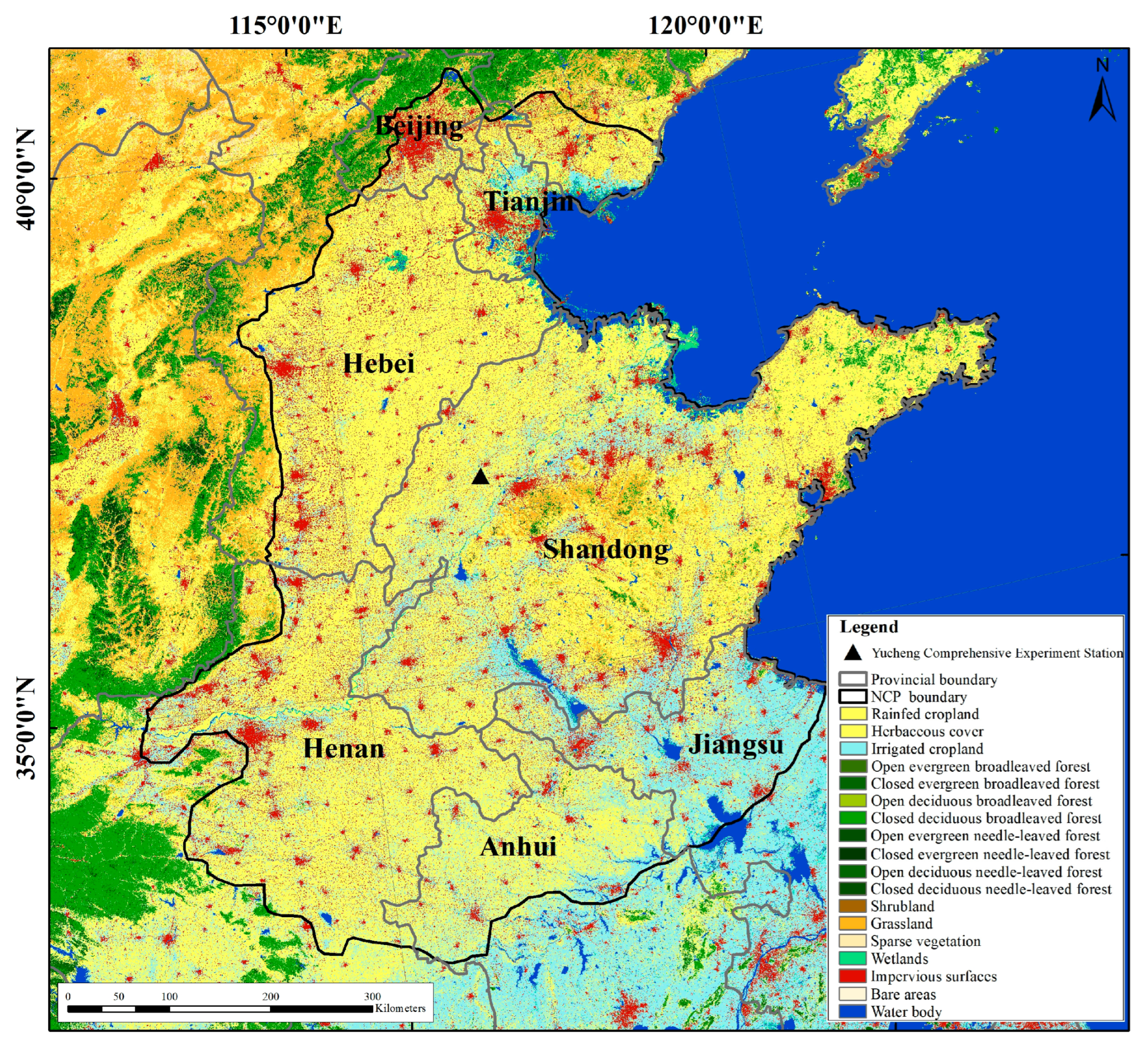
Located in the eastern region of China, the North China Plain (NCP) geographically consists of five provinces (Hebei, Henan, Shandong, Anhui, and Jiangsu) and two province-level municipalities (Beijing and Tianjin) (Figure 1), covering a total area of 3.92 × 10⁵ km2 [38]. Except for the Shandong Peninsula, which is hilly, the NCP has vast, cultivated plains terrain. As the largest farmland ecosystem in China, the NCP is an important grain production region, with a prevailing winter wheat–summer maize rotation system [39].

2.2. Data Source

The data used in the study included: (a) vegetation remote sensing products, (b) meteorological data, and (c) planting area for winter wheat (Table S1). Daily and 8-day data were aggregated to a monthly scale to ensure the consistency of the temporal resolution of all data. Specifically, daily reflectance data that had undergone quality control was scaled and used to calculate daily VIs, and it was further aggregated to monthly VIs through the maximum value composite (MVC). Eight-day GPP was composited to a monthly scale by summing them weighted with the number of days belonging to each month, while 8-day fPAR was composited to a monthly scale by averaging them [40,41].

2.2.1. GOSIF Dataset

Based on a data-driven approach (cubist regression tree model), Li et al. [42] developed a new global ‘OCO-2’ SIF dataset (GOSIF) with high spatial and temporal resolutions (8-day, 0.05°), whose monthly values and yearly values were also produced. With the advantages of finer spatial resolution and a longer record compared with SIF retrieval from OCO-2 soundings, the GOSIF dataset had been widely used to monitor vegetation photosynthesis and evaluate the impacts of environmental stress on it.

2.2.2. MODIS Data Product

Near-infrared reflectance of vegetation (NIRv) was calculated with the daily reflectance data using the MCD43C4 Nadir Bidirectional Reflectance Distribution Function (BRDF)-Adjusted reflectance dataset and was aggregated to monthly values (Text S1). NIRv had been suggested as the effective substitution of satellite-based SIF [43] and could also be used to improve GPP estimation as the proxy of GPP [44,45].
Land surface temperature (LST) data was derived from MOD11C3 product. Monthly LST data was measured in kelvins. LST could characterize canopy temperature, whose sensitivity to heat response also helped to detect the abnormal elevation of LST in a timely manner when drought occurred [46]. Therefore, it was considered as the initial indicator of drought for green vegetation.

2.2.3. GLASS GPP/fPAR Product

With the advantage of a long-term series, high spatiotemporal resolution, and high-quality, Global LAnd Surface Satellite (GLASS) products provided global land surface remote sensing products [47]. With the improved algorithm of the LUE models, the GLASS GPP product was estimated with the GLASS LAI product and fraction of a photosynthetically active radiation (fPAR) product as inputs [48]. Among them, GLASS fPAR product was calculated from the LAI data based on the look-up table to ensure the physical consistency of their retrievals.

2.2.4. CHIRPS Precipitation Product

Monthly precipitation data was derived from the Climate Hazards Group Infrared Precipitation with Station data (CHIRPS). As a land-only climatic database for precipitation [49], CHIRPS integrated the precipitation data from satellite-based platforms and ground-based meteorological stations and provided daily and monthly precipitation products [50]. Gao et al. [51] and Peng et al. [52] evaluated the applicability of CHIRPS in China, and Zhong et al. [53] investigated the drought monitoring utility of CHIRPS across mainland China.

2.2.5. SM Dataset

Based on reconstruction model-based downscaling techniques, Meng et al. [54] developed a fine-resolution soil moisture (SM) dataset for China from 2002 to 2018 by using SM data from multiple passive microwave products. It can be used to significantly improve hydrology and drought monitoring and plays an important role in ecological and other geophysical models as an input parameter.

2.2.6. Flux Measurements Data

Yucheng Comprehensive Experiment Station (YCES) of the Chinese Academy of Science was located in the Yellow River alluvial plain of the NCP (116°34′12.72″ E, 36°49′44.4″ N; in a county-level city (Yucheng) of the Dezhou prefecture-level city, Shandong Province, China). It was characterized by loamy soil texture and a semiarid and warm-temperate climate [55]. Natural conditions and the agricultural production level of the area were representative and typical over NCP, which helped it become a typical representative of the irrigation farmland with the double-cropping of winter wheat and summer corn [56]. Zhang et al. [57] elaborately introduced the model, configuration, and composition of the flux observation system, as well as information on data acquisition and transmission. Observed ecosystem carbon and water flux data from 2003 to 2010 in YCES formed a standardized dataset with different time scales of 30 min, daily, monthly, and yearly, whose data processing procedures, quality control, and data format were consistent with Chinaflux [58].

2.2.7. Planting Area of Winter Wheat

Based on Landsat and Sentinel satellite-based images, Dong et al. [59] provided distribution maps of winter wheat planting areas in eleven provinces and autonomous regions of China with a spatial resolution of 30 m from 2016 to 2019. The comprehensive assessment based on the survey samples showed that the planting area of winter wheat had a good correlation with the agricultural area statistical data at the municipal/county levels.

2.3. Methods

2.3.1. MLR Model

The MLR model offered a new framework to calculate GPP from SIF, with an obvious advantage of the reduced demand for lots of input parameters than the FvCB model [60]. GPP for C3 and C4 crops could be estimated mechanistically as:
G P P = C i Γ * 4 C i + 8 Γ * · J a ,   C 3 ;   1 x 3 · J a ,   C 4  
where Ci was the intercellular CO2 concentration, and Γ was the CO2 compensation point. x was the fraction of total electron transport of mesophyll and bundle sheath allocated to the CO2 concentration mechanism. Ja was the actual electron transport rate (ETR) from PSII to PSI, and it could calculated as the following formula, Formula (2).
J a = Φ P S I I m a x · ( 1 + K D F ) 1 Φ P S I I m a x · q L · S I F f e s c
In Formula (2), ΦPSIImax was the maximum photochemical quantum efficiency of PSII for dark-adapted leaves, and kDF was the ratio between the rate constants of constitutive thermal dissipation (kD) and fluorescence emission (kF). qL was the fraction of open PSII reaction centers, and could be further calculated as the following formula, Formula (3), whose aqL and bqL were empirical parameters. fesc was the canopy escape probability of SIF and could be calculated from NIRv and fPAR as the following formula, Formula (4) [61].
q L = a q L e b q L · P A R
f e s c = N I R v f P A R

2.3.2. Crop GPP Estimation Based on the MLR Model with Bias Correction

In the practical applications of estimating crop GPP, several input parameters from the MLR model were often regarded as constants, whose values collected from the literature were different in different regions [35]. Therefore, these values, which were not applicable to other regions in the world, limited the generalization of the MLR model. Taking the NCP in China as the research area, we calculated winter wheat GPP during the peak growing season (from March to May) based on the MLR model with the values of the input parameters from Kira et al. [35] (Table S2), whose study area was India’s Indo-Gangetic plain. The performance of the MLR model was compared with those values from the RS GPP product, which were regarded as the “true values” for winter wheat GPP (Figure S1). The horizontal axis represented the estimated GPP values from the MLR model, while the vertical axis represented the GPP values from the RS GPP product (GLASS GPP product). The red diagonal line was the equivalent line indicating that the estimated GPP values were equivalent to the GLASS GPP values. It could be found that R2 was negative in March and April between the winter wheat GPP predicted by the MLR model and GLASS GPP values. This meant that the input parameters of the MLR model had deviated too much, which meant that the prediction effect was not as good as that of the model using the historical average over NCP. Therefore, input parameters of the model must be transferred in the wider application of the MLR model on a global scale.
Further, it could be seen that these dots had two characteristics:
(1)
There was a certain linear trend between the estimated GPP values and GLASS GPP values, but there was a deviation from the equivalent line;
(2)
The dispersion of the dots was very high, with significant scattering between them and the linear regression line.
Based on observations of the above characteristics, we could draw two inferences:
(1)
Model drift triggered a significant linear relationship between the estimated GPP values and the RS GPP values, which was manifested as a systematic deviation that required correction.
(2)
The input parameters from the MLR model were easily affected by meteorological factors such as water and heat conditions and underwent dynamic changes all the time, which resulted in significant errors between the estimated GPP values and the true GPP.
Based on the above two inferences, we proposed a new method to estimate crop GPP by the MLR model with bias correction to solve the bias and scattering in the crop GPP estimation from the MLR model. Since the input parameters remained fixed and could not be dynamically changed according to meteorological factors such as water and heat conditions, we first decomposed the original Formula (1) as:
G P P m = S I F · F C i , Γ * , Φ P S I I m a x , k D F , a q L , b q L
where GPPm was the GPP value estimated from MLR model with fixed values of input parameters, and F C i , Γ * , Φ P S I I m a x , k D F , a q L , b q L was a function that contained all static parameters except SIF, whose values were fixed.
When the input parameter was static, F C i , Γ * , Φ P S I I m a x , k D F , a q L , b q L could be simplified to F θ s t a t i c . If the input parameters were not static, F C i , Γ * , Φ P S I I m a x , k D F , a q L , b q L could be simplified to F θ d y n a m i c , and S I F · F θ d y n a m i c could represent the true GPP. There must be a deviation between S I F · F θ s t a t i c and S I F · F θ d y n a m i c . So, the bias between F θ s t a t i c and F θ d y n a m i c was denoted by δ b i a s , and GPPm was transformed into GPPbias by introducing an offset to model the dynamic changes in these parameters in Formula (5), as shown below:
G P P b i a s = S I F · F C i , Γ * , Φ P S I I m a x , k D F , a q L , b q L + δ b i a s
where GPPbias was the GPP values obtained by adding the offset. F C i , Γ * , Φ P S I I m a x , k D F , a q L , b q L used static input parameters because we could not obtain dynamic input parameters. As long as we could dynamically change the δ b i a s according to meteorological factors such as water and heat conditions, effects similar to that of the dynamic input parameters could be achieved. To better determine exactly which factors would affect the δ b i a s , we used Pearson correlation analysis between δ b i a s and several vegetation variables (including SIF and NIRv) and meteorological variables (including precipitation, LST, and SM) (Figure S2). It could be seen that δ b i a s had a strong correlation with SIF and NIRv, and δ b i a s also had a certain correlation with precipitation and LST most months. In contrast, the relationship between δ b i a s and SM was weak. The phenomenon confirmed input parameters from the MLR model were significantly affected by vegetation and meteorological factors.
Most studies directly estimated GPP by establishing a linear regression (LR) model between SIF and GPP [62]. Among them, the LR model proposed by Guanter et al. [63] was the most representative one. Furthermore, Dong et al. [64] added temperature stress factors and saturated water vapor stress factors to this simple linear model for grasping the carbon sequestration of global terrestrial ecosystems. Therefore, based on the Pearson correlation analysis between δ b i a s and vegetation variables and meteorological variables, the LR algorithm was chosen to construct Formula (7) for estimating the δ b i a s as:
δ b i a s = θ 1 · S I F + θ 2 · L S T + θ 3 · p r e c i p + θ 4 · N I R v + θ 5
Subsequently, we constructed the relationship between the GPP values dynamically estimated with the MLR model and δ b i a s to eliminate the deviation (see Formula (8)). Among them, GPPp represented the GPP values dynamically estimated by the MLR model and by transferring; α and β were the parameters of the LR algorithm.
G P P p = α · G P P b i a s + β
Finally, combining the above Formulas (6)–(8), GPPp was expressed as:
G P P p = α · S I F · F C i , Γ * , Φ P S I I m a x , k D F , a q L , b q L + θ 1 · S I F + θ 2 · L S T + θ 3 · p r e c i p + θ 4 · N I R v + θ 5 + β
For the convenience of calculation, we simplified Formula (9) as:
G P P p = α 1 · G P P m + α 2 · S I F 2 + α 3 · S I F · L S T + α 4 · S I F · p r e c i p + α 5 · S I F · N I R v + α 6 · S I F + β
where α1, α2, α3, α4, α5, α6, and β could be calculated using the LR algorithm.
Therefore, based on the ideas of transfer learning and bias correction, the MLR model could better estimate the GPP for winter wheat by combining mechanistic fundamentals with regional empirical adjustments. The method used meteorological factors and vegetation variables to fit the bias caused by static input parameters of the MLR model for winter wheat GPP estimation, which solved the unavailability of the input parameters and increased the spatial transferability in the MLR models. Wholly, without complex ground experiments and cumbersome model calibrations, this method would theoretically improve the performance and application of the MLR model.

2.3.3. Experimental Design

Taking winter wheat as the research object, the experiment in this paper was conducted over NCP, one of the grain production regions in China. Through preprocessing, the data source for the vegetation variables and meteorological variables used in the experiment had a uniform spatiotemporal resolution (monthly, 0.05°) and time series (from 2007 to 2015). Given the limited availability of eddy covariance flux observation data for winter wheat over NCP, the GLASS GPP product was selected as the true value of winter wheat GPP over NCP in the study. Zheng et al. [65] used eddy covariance measurements from 95 towers in the FLUXNET 2015 dataset, covering nine major ecosystem types around the globe, to calibrate and validate the EC-LUE model and found that, since the GLASS GPP product integrated important environmental variables, it could represent interannual variations and long-term trends. Although the GLASS GPP product has been well verified through ground observations [66], it may have certain limitations for ecosystems with complex underlying surfaces, especially in farmland ecosystems with fragmented cultivated land plots and mixed-crop planting. Therefore, we first explored the relationships between GLASS GPP products and eddy covariance flux observation data for winter wheat. The high degree of consistency between them had confirmed the feasibility of using GLASS GPP products as “true values” for winter wheat GPP estimation.
Before the proposed method to estimate crop GPP from the MLR model with bias correction was trained and tested, we first defined the input data used for the proposed method. Phenology played an important role in the growth and development of crops. Liu et al. [67] had confirmed the nonlinear relationship between the yield of solar-induced chlorophyll fluorescence and photosynthetic efficiency in senescent crops. Shen et al. [68] had also confirmed that the sensitivity of SIF to drought-induced GPP variabilities during the vigorous growing periods of winter wheat was stronger than that during the greening stage and maturity stage. Therefore, considering the weak photosynthetic and limited distributions of winter wheat during the overwintering stage, greening stage (mainly February), and maturity stage (June), we focused on the analysis during the peak growing season (from March to May) after the greening of winter wheat and took the vegetation and meteorological variables during this period as input data of the proposed method. Subsequently, these input data in each month were divided into two parts: the data from 2007 to 2014 was used in the model training, while the data from 2015 was used for model testing. The performances of the proposed methods for model training and model testing were characterized by R2 and RMSE. In fact, a severe drought event occurred in NCP from spring to autumn in 2015 [69], which spanned the main growing season of winter wheat. This provides a good scenario for observing the predictive power of the model under drought conditions. Therefore, predicting winter wheat GPP in 2015 over NCP enabled us to observe the predictive power of the trained model and the applicability of the proposed method under environmental stress conditions. Additionally, in order to demonstrate the superiority of the proposed method, we compared the performance of the proposed method with that of traditional statistical models using the LR algorithm.
In the specific process of model training, a K-fold cross-validation (K-fold CV) was used to enhance the stability of model evaluation. Considering the data sequence used for modeling was from 2007 to 2014 (a total of 8 years), 8-fold CV was used in the study, and it divided the modeling dataset into 8 parts, with 7 parts serving as the training set and the remaining 1 part as the testing set. In other words, in the modeling dataset, the data of a certain month in a year served as the testing set, while the data of a certain month in other years except the certain year served as the training set. This process was cycled sequentially through 8 iterations, integrating the results of the model evaluations. Through repeated experiments pixel by pixel, the performances of the proposed method and traditional statistical models using the LR algorithm in GPP estimation for winter wheat were characterized by the average R2 and RMSE obtained from cross-validation. Wholly, the cross-validation reduced over-reliance on specific datasets and had a more stable and reliable performance, which ultimately enhanced the model’s generalization ability.
The complete experiments for crop GPP estimation from the above two methods were implemented in Python (v3.12) programming language. The core calculations relied on standard libraries such as NumPy and Pandas for data operations and Scikit-learn for implementing the ML models used in this paper. We placed a minimal, runnable implementation in the GitHub repository, which is publicly available at: https://github.com/overlook2021/MLR_bias_model (accessed on 11 March 2026).

3. Results

3.1. Relationships Between Satellite-Based GPP Product and Eddy Covariance Flux Observation Data

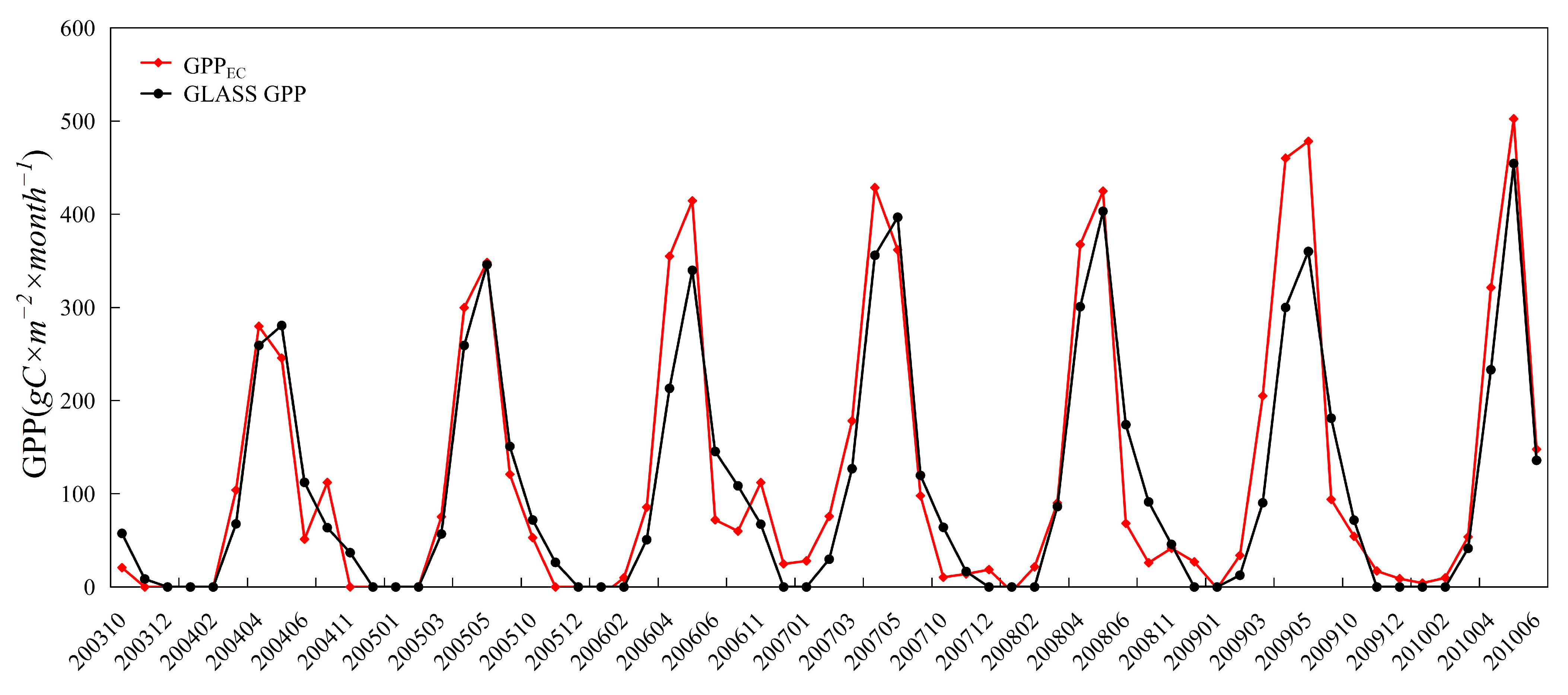
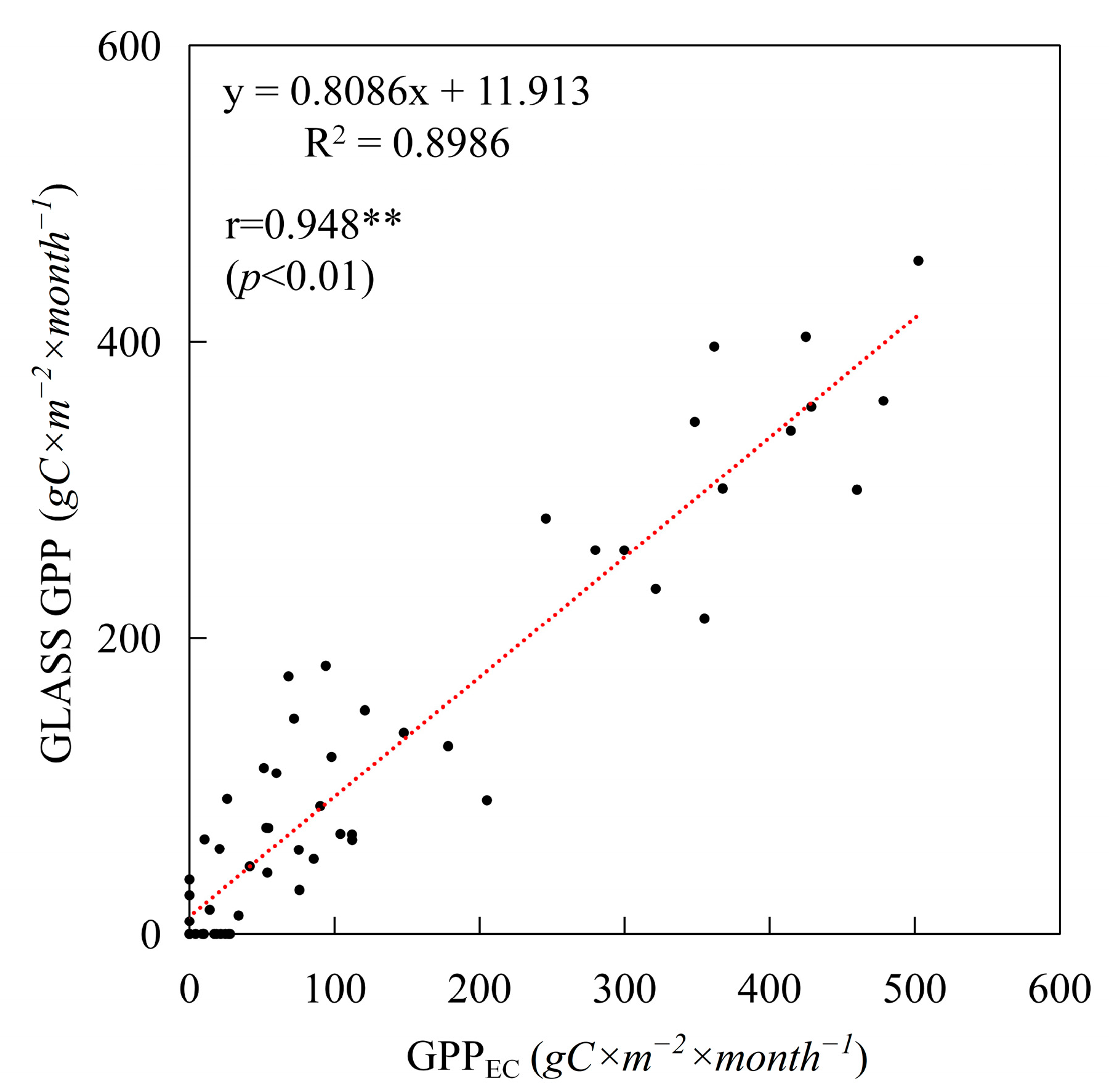
GPPEC data obtained from the Yucheng Comprehensive Experiment Station (YCES) was utilized to verify the accuracy of the GLASS GPP product and evaluate the feasibility of quantifying the GPP of winter wheat over NCP. Winter wheat was usually sown in early October and harvested in early June over NCP, so we first observed the temporal variation characteristics of the monthly GLASS GPP values and GPPEC throughout the entire growing season of winter wheat from 2003 to 2010 (Figure 2). It was found that the monthly GLASS GPP values and the GPPEC of winter wheat were similar in numerical range, and both of them had the same temporal variation characteristics. Specifically, GPP values were relatively lower during the overwintering stage before the green-up stage. They increased sharply after the green-up period, reaching their peak values in April, and then declined in May and June. In addition, monthly GLASS GPP values were significantly positive related to GPPEC, whose correlation coefficient was as high as 0.948 ** (p < 0.01) (Figure 3). Therefore, the GLASS GPP products could be considered as the true values and used to quantify winter wheat GPP over the NCP.

3.2. Performance of GPP Estimation from the MLR Model with Bias Correction

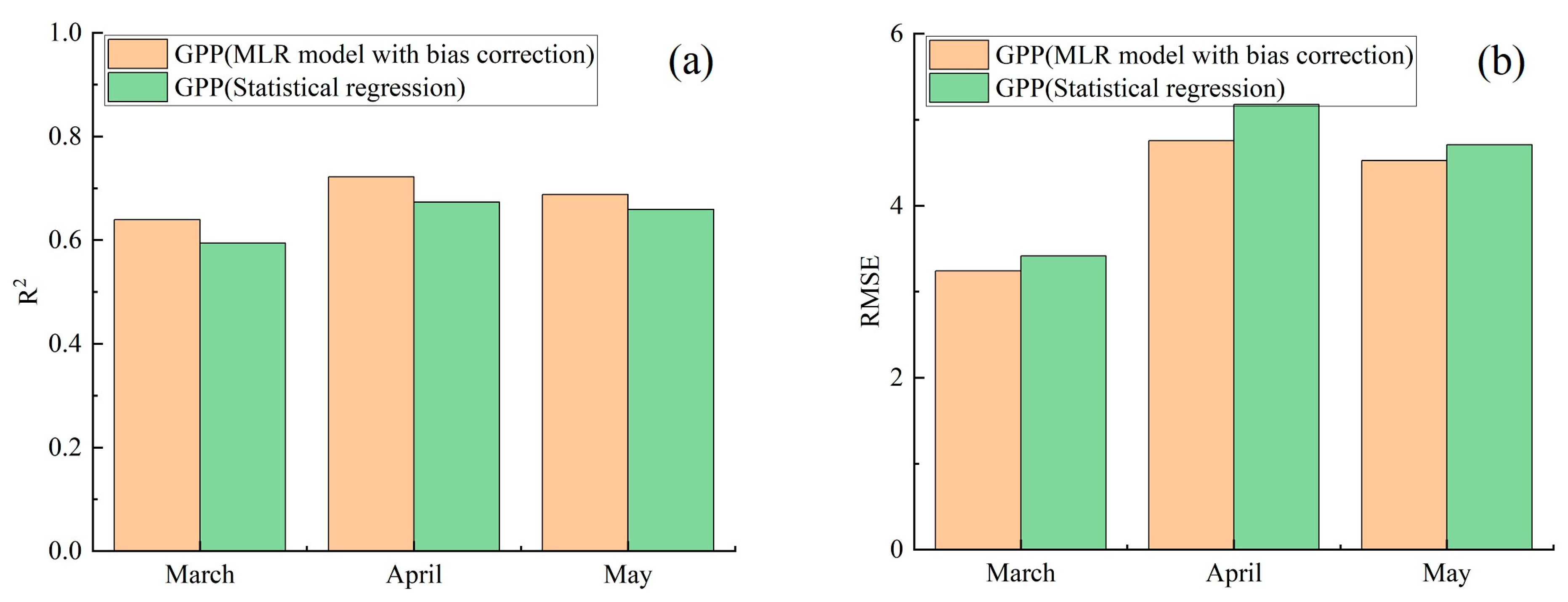
The performance of winter wheat GPP estimation from March to May by the MLR model with bias correction was shown in Figure 4, which was characterized as R2 and RMSE obtained from the k-fold cross-validation in the training of the model and was compared with the performance of winter wheat GPP estimation from the traditional statistical model. With multi-source data as input, the traditional statistical model using the LR algorithm achieved a good performance in GPP estimation for winter wheat during the vigorous growth stage (from March to May). Especially in April and May, the R2 of the model was higher than 0.6. In contrast, the MLR model with bias correction had a relatively higher R2 than the traditional statistical model using the LR algorithm, which was characterized by an increased R2 of 6.4%. In addition, the MLR model with bias correction had a relatively lower RMSE than the traditional statistical model using the LR algorithm in GPP estimation for winter wheat. Therefore, with the higher R2 and RMSE calculated from the K-fold CV, the performance of the MLR model with bias correction was superior to that of the traditional statistical model using the LR algorithm in GPP estimation for winter wheat during the vigorous growth stage.

3.3. GPP Prediction from the MLR Model with Bias Correction in 2015

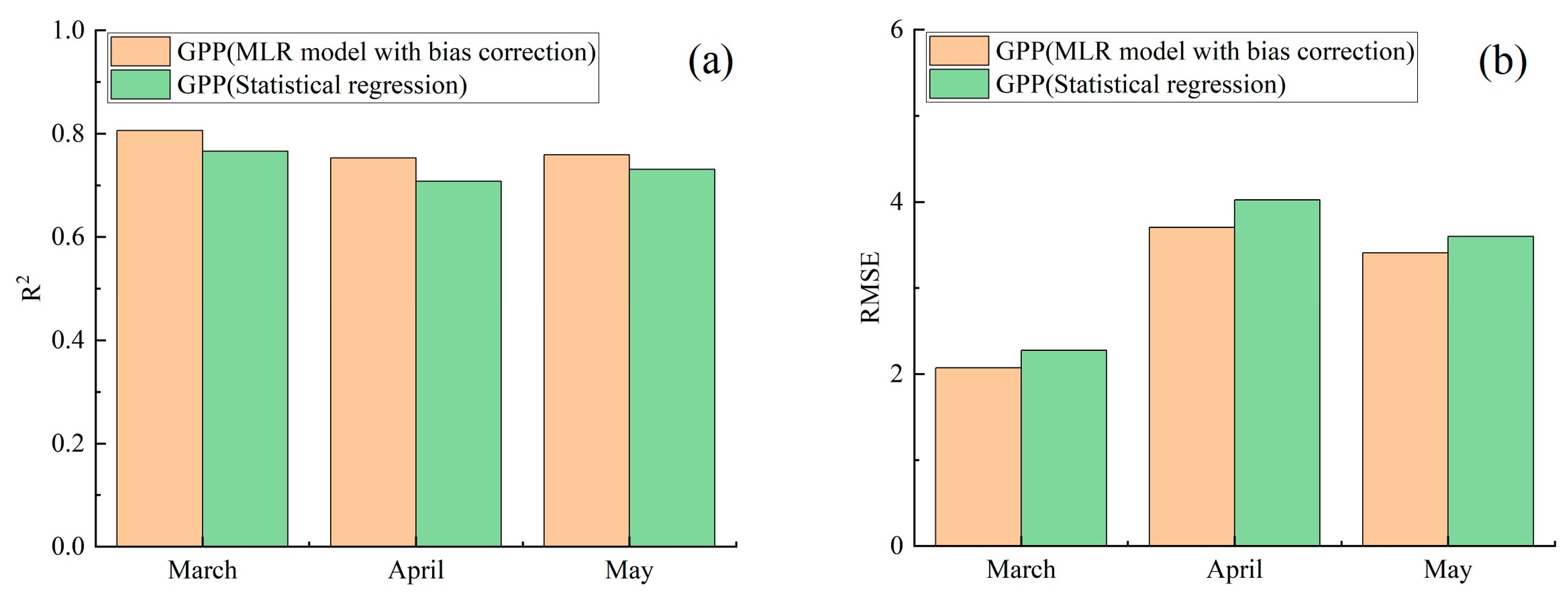
To further validate the performance of the proposed methods, the trained MLR model with bias correction was further used to predict winter wheat GPP for the reserved year 2015 (Figure 5), whose results were compared with the actual GPP values indicated by the GLASS GPP product. A similar phenomenon was observed. The traditional statistical model using the LR algorithm achieved a good performance in GPP estimation for winter wheat during the vigorous growth stage (from March to May), with an R2 higher than 0.7 and an RMSE lower than 40 gC·m−2·month−1. The MLR model with bias correction performed better in GPP estimation for winter wheat, with a higher R2 and lower RMSE during the vigorous growth stage, whose results were also superior to the traditional statistical model using the LR algorithm. Therefore, the MLR model with bias correction could better estimate crop GPP, and it could be used to quickly and mechanistically predict crop GPP under the condition of obtaining the current vegetation variables and meteorological variables in a timely manner.
In order to further study the main influencing factors of winter wheat GPP and improve the interpretability of the GPP estimation model for winter wheat, the SHAP analysis is shown in Figure S3. It can be seen that, in the feature importance for winter wheat GPP prediction from the MLR model with bias correction in 2015 from March to May, SIF was ranked as the number one factor, followed by LST or NIRv. The feature importance of SIF was higher than that of NIRv, which indicated that a significant role of SIF in the GPP estimation. However, precipitation had a lower contribution than LST to the GPP estimation, and the importance of SM was the lowest. The phenomenon was consistent with the correlation analysis between δ b i a s and vegetation variables and meteorological variables.
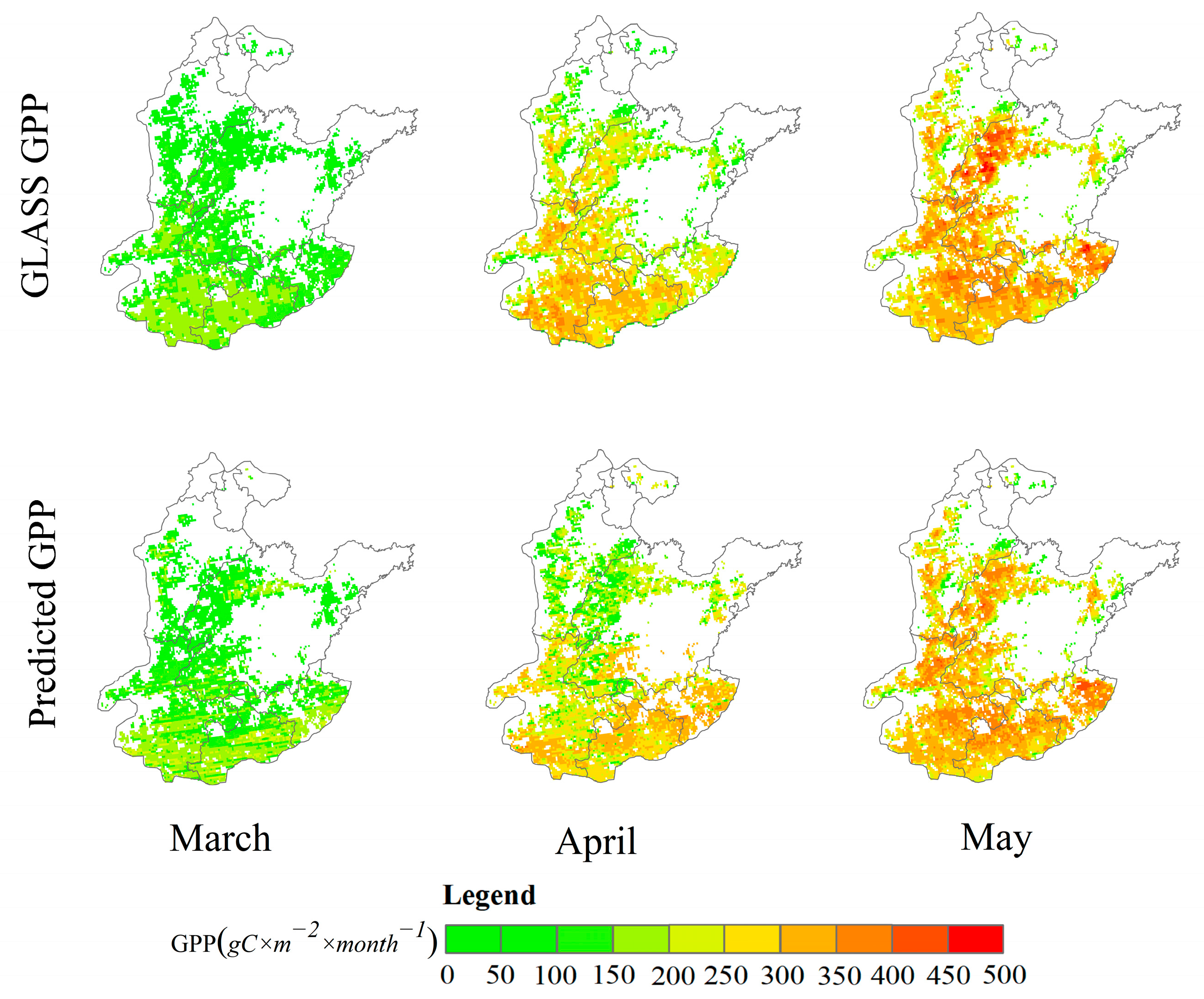
The performance for winter wheat GPP prediction from the trained MLR model with bias correction is shown in Figure 6. In the actual situation, winter wheat GPP over the NCP increased from March to May, and the values in the southern region were higher than that in the northern region for higher temperatures. Specially, GPP was relatively lower over the NCP in March, and it increased in April by approximately 100 gC·m−2·month−1, especially in the Anhui and Jiangsu Provinces. In May, the GPP had larger values across the whole region. The GPP values predicted by the trained MLR model with bias correction were consistent with GLASS GPP values in temporal variations and spatial distributions. The consistency between them reflected the accuracy of the MLR model with bias correction in the crop GPP estimation.

4. Discussion

4.1. Necessity of the MLR Model with Bias Correction

From empirical modeling to mechanistic modeling, increasingly complex methods have been used to estimate the GPP from SIF with their own advantages and disadvantages (Table S3). Employing a linear or nonlinear statistical relationship between SIF and GPP, data-driven models upscaled from eddy covariance flux observations have reduced generalizability [10]. With difficulties determining or obtaining input parameters, large uncertainties of input parameters for the LUE models and process-based models led to considerable errors in the GPP estimation. On the whole, current methods to estimate GPP were not satisfactory for the spatial validation, which was highly related to the accuracy of some input data to the models [70]. As a model which explicitly considered the key mechanisms linking SIF emission with C3 and C4 photosynthesis, the MLR model was, in essence, an improved version derived from the FvCB biochemical model concerning both complexity and mechanistic rigorousness, provided that light and dark reactions were in equilibrium [71]. Liu et al. [71] tested the applicability, capability, and advantages of the MLR model in estimating the GPP at the canopy scale under various conditions, and found that the MLR model was superior to two other classical models (the FvCB model and LUE model), with a better performance at larger temporal scales and good stability with different PFTs and with both C3 and C4 vegetation. Liu et al. [72] applied the MLR model to predict GPP at winter wheat research sites, demonstrating a high R2 value (0.82) in flux tower data validation. This indicated that the model effectively captured key characteristics of carbon cycling in winter wheat ecosystems and accurately forecasted GPP trends. Emergence of the MLR model allowed the GPP estimation to be realized mechanistically from SIF and readily available ancillary data without the need to track numerous complex processes that influenced the GPP. Although the MLR model required much fewer input parameters than the FvCB model, diverse biomes and environmental factors still had significant impacts on the numerical changes in input parameters, which were ultimately reflected in the performance of the model. Relevant studies at the leaf level had shown that, in the absence of abiotic/biotic stress, some of them converged among different vegetation species/biomes [33,60], such as ΦPSIImax. Factually, they varied with environmental changes/stresses, whose degree would affect GPP estimation. For example, Ci and Γ* were associated with stomatal conductance, and the variation in Ci was controlled by the temperature and vapor pressure deficit (VPD). This situation made the input parameters, which were usually regarded as constants, applicable in one place but not in another place, which was specifically manifested as the application of the model.
Therefore, some scholars have tried to advance this model by calibrating fluorescence parameters or combining with other models. For example, Liu et al. [71] introduced a newly developed model of photosynthesis from the MLR model that could mechanistically simulate the key processes regulating qL and observed that the estimated GPP from the advanced MLR model performed well compared with measurements of in-site flux without relying on statistical regression. Based on these research, Wang et al. [36] and Xue et al. [37] further developed a practical SIF-based crop model from the MLR model with the simulated qL to predict crop yields (Table S4). Guo et al. [73] independently developed a dedicated device to measure the qL-related parameters required for this model. These achievements verified the high reliability of the MLR model with accurate data from the SIF observations and input parameters when estimating the GPP. In terms of model improvement based on the idea of model coupling, Beauclaire et al. [34] combined the MLR model with the unified stomatal optimality (USO) model to estimate both GPP and transpiration (Tr) at the ecosystem scale. However, Feng et al. [74] used SIF to model Tr by coupling the MLR model with Ball–Woodrow–Berry (BWB) parameterization for stomatal conductance and found that the performance of the MLR-BWB model might have been impacted by neglecting the effects of changes in the canopy structure (i.e., setting fesc to constant), although Tr estimated from the MLR-BWB model was consistent with in-site GPPEC for crops and forests. Therefore, the effects of environmental factors on input parameters and canopy structural changes in vegetation on the performance of the MLR model needed to be taken into consideration.
Theoretically, on the basis of knowing the dynamic changes in the above input parameters, the MLR model could drastically improve the accuracy of GPP estimation and its performance in GPP prediction. Therefore, this paper proposed the improved procedure to estimate crop GPP using the MLR model with bias correction, which was actually a kind of hybrid model that combined mechanism models and data-driven models organically [75]. Specifically, in the MLR model, when the input parameter was static, F C i , Γ * , Φ P S I I m a x , k D F , a q L , b q L could be simplified to F θ s t a t i c , and it remained mechanistic. IF the input parameters were not static, F C i , Γ * , Φ P S I I m a x , k D F , a q L , b q L could be simplified to F θ d y n a m i c , and S I F · F θ d y n a m i c could represent the true GPP. There must be a deviation between S I F · F θ s t a t i c and S I F · F θ d y n a m i c , and the bias between F θ s t a t i c and F θ d y n a m i c was denoted by δ b i a s . Therefore, the method proposed by us introduced an offset to model the dynamic changes in the input parameters and regarded the changes in input parameters accompanied by meteorological factors as a whole. Due to high correlation coefficients between δ b i a s and meteorological factors and vegetation variables, δ b i a s could be estimated by them; meteorological factors and vegetation variables were used to fit the bias caused by the static input parameters of the MLR model for winter wheat GPP estimation, which solved the unavailability of the input parameters in the MLR models, which was close to the residual correction methods used in hybrid modeling. Therefore, the rationality of bias correction was guaranteed, thus avoiding the predicament of statistical fitting.
On the whole, the method proposed by this study combined mechanistic fundamentals with regional empirical adjustments under the support of meteorological factors and vegetation variables, which achieved a more interpretable and accurate model with the aid of mechanism modelling. By leveraging the LR algorithm to achieve the model transfer and bias correction, it overcame the difficulty of being unable to obtain input parameters dynamically and accurately outside the existing regions where the fixed parameters were used and successfully applied the mechanism model to large-scale transfer learning scenarios.

4.2. Performance of the MLR Model with Bias Correction

In the study, the MLR model with bias correction could better estimate winter wheat GPP than the traditional statistical regression model over NCP, with a higher R2 and lower RMSE. The estimated GPP by the MLR model with bias correction was positively related to the eddy covariance flux observation data at the Yucheng Comprehensive Experiment Station, with relatively weaker relationships than the GLASS GPP product (Figure S4). This approach effectively migrated the application of MLR model with the fixed input parameters in a certain region to another region, which significantly eliminated the difficulty of obtaining input parameter data and promoted the rapid application of the MLR model in a wide range.
The performances for winter wheat GPP estimation by the MLR model with bias correction in February and June are shown in Tables S5 and S6, which are compared with that from March to May. It can be seen that the performances of two methods in estimating the GPP were all good for several months during the vigorous winter wheat period. However, in February and June, the performance of the traditional statistical model using the LR algorithm to estimate GPP for winter wheat was weaker than that from March to May. The MLR model with bias correction also had similar performances with a relatively larger R2 and lower RMSE than the traditional statistical model using the LR algorithm. This phenomenon was mainly due to the characteristics of photosynthesis for winter wheat. Photosynthesis was usually intensive during the peak greenness season but was weaker in the early stage and senescence period of crop growth. In February, the growth of winter wheat was relatively slow in the green-up stage after overwintering. Meanwhile, in June, winter wheat entered the final growth stage, and the chlorophyll content dropped sharply, resulting in a deterioration of the effect of estimating GPP using SIF [76]. Therefore, the performance of the MLR model with bias correction in estimating crop GPP was bad during the early and late periods, which was consistent with previous study [68]. Chen et al. [77] developed a parsimonious mechanistic model for SIF-based GPP estimation in evergreen needle forests (ENFs) by employing the MLR framework and Eco-Evolutionary theory to describe the light and dark reactions during photosynthesis, respectively, and found that, considering the seasonal variation in ΦPSIImax, GPP overestimation in winter and early spring could be avoided due to the relatively low environmental sensitivity of SIF. It was worth noting that the negative R2 of the two methods for GPP estimation for winter wheat in February was an abnormal phenomenon, which may have come about for complex reasons. Among them, one of the most important points to note was that the mixed-pixel phenomenon formed with the surrounding ground features (such as soil) was more serious, especially in February, when winter wheat had a sparse planting area because it had not yet fully emerged and resumed growth. On the whole, phenology played a crucial role in the crop GPP estimation, and the influences of phenology on input parameters could not be ignored when using the MLR model with bias correction to estimate crop GPP, which required further in-depth study in subsequent research.
In fact, when process-based models were applied to a certain region, issues such as the re-calibration of input parameters and the response degree of input parameters to output variables were all common concerns. In order to explore the transferability of the proposed method in the crop GPP estimation with different phenological characteristics, we constructed the MLR model with bias correction to estimate the GPP for spring wheat in the planting areas of spring wheat in northwestern China, which are characterized by sparse distribution (Figure S5). Spring wheat was usually sown in early March and harvested in late July or August, and it entered the jointing stage in May and the heading stage in June [78]. So, we focused on the analysis during the peak growing season of spring wheat (from May to June) after the greening. It was found that, compared to winter wheat, the results of the proposed method were relatively poor during the vigorous growth period of spring wheat, the reason for this phenomenon being that the sparse distribution of spring wheat brought about greater influences by mixed pixels. However, the proposed method was still superior to the LR algorithm (Figure S6), which reflected a certain degree of generalization for the proposed method. Generally, the MLR offered a more physiologically based approach for estimating photosynthesis by integrating SIF as an input [79], and the proposed method from the MLR model with bias correction could solve the issue of transferability of the MLR model when used in other regions with different phenological characteristics in different regions, especially in these areas with large and uniform planting areas. This was of great significance for expanding the practical application of the MLR model in operational use.

4.3. Uncertainties

Model-driven data, model structure, and input parameters were usually the three main sources of uncertainty in GPP estimation [80]. Although those model-driven data used in the study maintained the same temporal and spatial resolution (monthly, 0.05°), the uncertainties brought about by the data itself would also affect the performance of the MLR model with bias correction and the accuracy of the final predicted GPP values for winter wheat. For example, the generation of spatially downscaled SIF products (GOSIF dataset) used in this paper highly relied on various explanatory variables with high spatial resolution, which mainly included the spatially and temporally continuous data of vegetation variables and meteorological variables. Among them, meteorological variables were derived from the Modern-Era Retrospective Analysis for Research and Applications (MERRA-2) reanalysis data, which was obtained by using data assimilation techniques in Numerical Weather Prediction (NWP) to restore long-term historical climate records. The uncertainty for MERRA-2 reanalysis data mainly stemmed from the auxiliary data used in the data assimilation process and the dynamic model process [81]. Therefore, during the process of spatiotemporal expansion, GOSIF datasets were bound to lose the vegetation physiological information of the original SIF data, which was different from the real SIF products [82]. In addition, since the method proposed by us introduced an offset to model the dynamic changes in multiple input parameters and regarded the changes in input parameters accompanied by meteorological factors as a whole, it did not calculate the specific numerical values of each input parameter, which also brought some uncertainty.
Except for meteorological factors and vegetation variables, other factors also affected crop growth, such as soil conditions, topographic factors, and human activities, whose changes were ultimately reflected in the GPP values [83]. These factors not only had strong relationships with the GPP individually but also had certain connections between them internally. Only five factors were selected in this paper, and the influences of other factors on crop GPP estimation were ignored, which also brought about some uncertainties. In addition, environmental factors such as light conditions, low temperatures, and water stress also had significant impacts on the relationship between SIF and GPP, and the relationships between vegetation/meteorological variables and GPP may not be linear. The relationship between the bias term and environmental variables was assumed to be linear in the proposed method, which may limit the physical interpretation of the bias term. Therefore, nonlinear ML algorithms were also used by previous scholars to construct the relationships between the interpretation factors and GPP. For example, Guo et al. [84] used three ML models (support vector regression (SVR), artificial neural network (ANN), and long short-term memory networks (LSTM)) to predict maize GPP in northwest China based on carbon flux, various environmental factors, and maize growth indices measured in the maize field. Therefore, some uncertainties in estimating δ bias using the LR algorithm needed to be addressed in the subsequent improvement of the proposed method.

4.4. Limitations

Due to the limited spatial–temporal resolution, short time-series length, and spatial discontinuity, it was difficult for current satellite-based SIF products to meet the demands of agricultural remote sensing monitoring. It was necessary to adopt measures to strengthen the monitoring capability of satellite SIFs at the regional scale, such as improving the retrieval methods or downscaling to enhance the spatial and temporal resolution of satellite-based SIF data. Therefore, the application of spatially downscaled SIF products in the GPP estimation for crops was still a stopgap measure, although this way had certain limitations. Improved satellite-based SIF data would be of great significance for exploring the role of SIF in agricultural remote sensing monitoring. Such products included two categories: the first category was the data from upcoming satellite platforms. For example, TROPOspheric Monitoring Instrument (TROPOMI) aboard the Copernicus Sentinel-5P mission provided SIF retrieval with a relatively high spatial resolution (at nadir: 5.5  ×  3.5 km) and nearly global coverage [85], although the dataset was only available from 2018 onward. FLuorescence EXplorer (FLEX), designed by the European Space Agency (ESA) [86], was expected to be launched in 2025 and would fly in conjunction with the Copernicus Sentinel-3 mission. It provided satellite-based SIF observations on a global scale with a spatial resolution of 300 m. The second category was the spatially downscaled SIF products with higher accuracy and spatial–temporal resolution. In previous studies, without an explicit physical and radiative transfer relationship, ML algorithms had been commonly used to obtain global SIF products at a relatively fine resolution and high continuity by deriving statistical relationships between SIF (the target variable) and different explanatory variables using a subset of the original SIF (OCO-2 or TROPOMI mission) periods and extrapolating the derived relationship in space and time [87]. Different from the ML-based approaches, the downscaling methods used predicted SIF (PSIF) as an intermediate variable to redistribute the original coarser SIF datasets, so it could better preserve information from the original SIF retrieval while enhancing the spatial resolution compared with ML approaches. Therefore, developing better downscaling methods was one of the important ways to improve the spatial–temporal resolution of data sources in the future. For example, Tao et al. [88] utilized a weighted stacking algorithm to generate a high spatial resolution SIF dataset (500 m, 8 days) in China (HCSIF) from 2000 to 2022 from the TROPOMI, with a spatial resolution at nadir of 3.5 km by 5.6–7 km, which was verified against satellite-based and tower-based measurements of SIF and GPP from flux towers. These datasets could potentially advance the understanding of terrestrial ecological processes, including the precise assessment of crop health, productivity, and environmental stress in the long term.
It is worth noting that the Terra satellite equipped with MODIS instruments has recently been experiencing power-based limitations caused by orbital changes and solar array efficiency (publicly available on the following website: https://terra.nasa.gov/ (accessed on 26 October 2025)), whose unclear prospects for the acquisition of BRDF-adjusted reflectance data may have certain impacts on the continuity of research. However, the Aqua satellite, which was also equipped with MODIS instruments, provided a similar dataset (MYD43C4 Nadir BRDF-adjusted reflectance data), which was a complement to the Terra satellite for VIs calculation. In addition, domestic satellites in China can also calculate VIs. The GaoFen (GF) satellite and Fengyun (FY) satellite have developed public NDVI products with high spatial resolutions. For example, GF MuSyQ/NDVI products (16 m/10 day) have a higher temporal–spatial resolution than Landsat NDVI and Sentinel-2 NDVI products [89]. FY-3D MERSI-II/NDVI products have a high consistency with Terra MODIS/NDVI products in the changing trend and spatial distribution pattern [90].
In addition, a previous study had confirmed that the succession and reproduction processes of vegetation communities were mainly influenced by climatic and topographical factors over a long period of time and were mainly affected by human activities in a short period [91,92]. Therefore, further investigating the spatiotemporal evolution characteristics of crop GPP and its driving factors was of great significance for studying the developmental dynamics of the agricultural ecosystem and estimating crop productivity. In addition to the limitations caused by the data sources mentioned above, the influences of soil conditions and topographical factors on the estimated values and corresponding temporal and spatial distributions for winter wheat GPP could not be ignored, either. In terms of soil conditions, apart from soil moisture, soil properties (such as soil potential of hydrogen (PH), soil organic matter (SOM), soil bulk density (BD), and soil texture) were also an influencing factor for the spatial variation in GPP. Romero et al. [93] had investigated the link between soil health (a composite index based on soil properties, biodiversity, and plant disease control) and net primary productivity across three major land-use types: woodlands, grasslands, and croplands. In terms of topographical factors, altitude, slope and aspect were important topographical factors that influenced the spatial variation in GPP. They mainly determined the potential of photosynthesis indirectly but profoundly by affecting the spatial redistribution of ecological factors such as light, temperature, and water. Xu et al. [94] and Lv et al. [95] comprehensively analyze the impacts of anthropogenic factors, land-use types, climatic factors, and topographic factors on the spatial differentiation of vegetation GPP based on geographical detector models. In future research, the influencing factors affecting the spatial differentiation of crop GPP would be detected at regional scales.

5. Conclusions

With spatially downscaled SIF products and the auxiliary data of vegetation and meteorological variables, we proposed a new method to estimate the GPP for winter wheat over the North China Plain (NCP) based on the SIF-based MLR model with bias correction, whose performance was compared with that of a traditional statistical regression model. Results showed that vegetation and meteorological factors could be used to fit the bias caused by static input parameters of the MLR model for winter wheat GPP estimation with the LR algorithm, which solved the unavailability of the input parameters in the MLR models. The MLR model with bias correction could quickly achieve large-scale winter wheat GPP estimation at the regional scale during the vigorous winter wheat period, whose performance was superior to that of the traditional statistical regression model with an increased R2 of 6.4%. On the whole, the proposed method could mechanistically estimate crop GPP based on the MLR model with bias correction without strict requirements for the explicit tracking of complex agricultural–climate processes.

Supplementary Materials

The following supporting information can be downloaded at: https://www.mdpi.com/article/10.3390/atmos17030298/s1, Text S1: Calculation of NIRv based on the MCD43C4 product; Figure S1: Comparison between the GLASS GPP values and GPP values estimated by the MLR model in (a) March, (b) April, (c) May in 2015 over NCP; Figure S2: Relationships between δbias and several vegetation variables (including SIF and NIRv) and meteorological variables (including precipitation, LST, SM) in (a) March, (b) April, (c) May in 2015 over NCP; Figure S3: Feature importance for the winter wheat GPP prediction from the MLR model with bias correction in (a) March, (b)April, (c) May 2015; Figure S4: Comparison between monthly estimated GPP by the MLR model with bias correction and GPPEC from March to May (2007–2010) at the Yucheng Comprehensive Experiment Station; Figure S5: Spatial distribution of planting area of spring wheat in the northwestern China; Figure S6: Comparison between the performances of different methods to estimate GPP for spring wheat in the northwestern China, which is characterized as (a) R2 and (b) RMSE; Table S1: Data source; Table S2: Values of input parameters used for estimating winter wheat GPP based on the MLR model in the study; Table S3: Comparison between common methods for GPP estimation based on SIF; Table S4: Values of input parameters used for estimating crop GPP based on the MLR model in others’ studies; Table S5. Comparison between the performances of different methods to estimate GPP; Table S6. Comparison between the performances of different methods to estimate GPP for winter wheat over NCP from February to June (Characterized as RMSE) [20,35,36,37].

Author Contributions

Y.N. collected and analyzed the data and wrote the manuscript; Q.S. as the corresponding author, edited the manuscript and provided constructive comments; Q.R. and Y.Y. assisted with data processing and analysis. All authors have read and agreed to the published version of the manuscript.

Funding

This work was supported by The National Natural Science Foundation of China under Grant 42071401.

Institutional Review Board Statement

Not applicable.

Informed Consent Statement

Not applicable.

Data Availability Statement

The data supporting the findings of this study are publicly available from the following sources: SIF data at http://globalecology.unh.edu (accessed on 30 May 2025), BRDF-adjusted reflectance and LST at https://lpdaac.usgs.gov (accessed on 30 May 2025), GPP/fPAR data at http://glass-product.bnu.edu.cn (accessed on 30 May 2025), precipitation data at http://globalchange.bnu.edu.cn (accessed on 30 May 2025), precipitation data at https://data.chc.ucsb.edu/products/CHIRPS-2.0 (accessed on 30 May 2025), soil moisture data at http://data.tpdc.ac.cn/zh-hans (accessed on 30 May 2025), Flux measurements data at http://www.cnern.org.cn/data/initDRsearch (accessed on 30 May 2025). and winter wheat map at https://doi.org/10.6084/m9.figshare.12003990 (accessed on 30 May 2025).

Conflicts of Interest

The authors declare no conflicts of interest.

References

  1. McCallum, I.; Franklin, O.; Moltchanova, E.; Merbold, L.; Schmullius, C.; Shvidenko, A.; Schepaschenko, D.; Fritz, S. Improved light and temperature responses for light-use-efficiency-based gpp models. Biogeosciences 2013, 10, 6577–6590. [Google Scholar]
  2. Yan, H.M.; Liu, J.Y.; Cao, M.K. Spatial pattern and topographic control of China’s agricultural productivity variability. Acta Geogr. Sin. 2007, 62, 171–180. (In Chinese) [Google Scholar]
  3. Chen, L.; Liu, L.Z.; Liu, S.S.; Shi, Z.Y.; Shi, C.H. The application of remote sensing technology in inland water quality monitoring and water environment science, recent progress and perspectives. Remote Sens. 2025, 17, 667. [Google Scholar]
  4. Wang, Z. Sunlit Leaf Photosynthesis Rate Correlates Best with Chlorophyll Fluorescence of Terrestrial Ecosystems. Master’s Thesis, University of Toronto, Toronto, ON, Canada, 2014. [Google Scholar]
  5. Anav, A.; Friedlingstein, P.; Beer, C.; Ciais, P.; Harper, A.; Jones, C.; Murray-Tortarolo, G.; Papale, D.; Parazoo, N.C.; Peylin, P.; et al. Spatiotemporal patterns of terrestrial gross primary production: A review. Rev. Geophys. 2015, 53, 785–818. [Google Scholar] [CrossRef]
  6. Yang, C.C.; Zhu, Z.L.; Tan, L.; Liu, S.M.; Xu, Z.W.; Bai, J.H.; Xiao, Q. Analysis on evapotranspiration of maize field measured by Lysimeters in Huailai. Plateau Meteorol. 2015, 34, 1095–1106. (In Chinese) [Google Scholar]
  7. Jung, M.; Schwalm, C.; Migliavacca, M.; Walther, S.; Camps-Valls, G.; Koirala, S.; Anthoni, P.; Besnard, S.; Bodesheim, P.; Carvalhais, N.; et al. Scaling carbon fluxes from eddy covariance sites to globe, synthesis and evaluation of the FLUXCOM approach. Biogeosciences 2020, 17, 1343–1365. [Google Scholar] [CrossRef]
  8. Jung, M.; Reichstein, M.; Margolis, H.A.; Cescatti, A.; Richardson, A.D.; Arain, M.A.; Arneth, A.; Bernhofer, C.; Bonal, D.; Chen, J.; et al. Global patterns of land-atmosphere fluxes of carbon dioxide, latent heat, and sensible heat derived from eddy covariance, satellite, and meteorological observations. J. Geophys. Res. Biogeosci. 2011, 116. [Google Scholar] [CrossRef]
  9. Yuan, W.P.; Cai, W.W.; Liu, D.; Dong, W.J. Satellite-based vegetation production models of terrestrial ecosystem: An overview. Adv. Earth Sci. 2014, 29, 541–550. (In Chinese) [Google Scholar]
  10. Lischeid, G.; Webber, H.; Sommer, M.; Nendel, C.; Ewert, F. Machine learning in crop yield modelling, a powerful tool, but no surrogate for science. Agric. For. Meteorol. 2022, 312, 108698. [Google Scholar] [CrossRef]
  11. Lieth, H.; Whittaker, R.H. Primary Productivity of the Biosphere; Springer: New York, NY, USA; Berlin/Heidelberg, Germany, 1975. [Google Scholar]
  12. Yuan, Y.B.; Zhang, C.F.; Huang, P.; Dong, H.; Yang, J.H. Estimation of global terrestrial gross primary productivity based on solar-induced chlorophyll fluorescence. Trans. Chin. Soc. Agric. Mach. 2022, 53, 183–191. (In Chinese) [Google Scholar]
  13. Grace, J.; Nichol, C.; Disney, M.; Lewis, P.; Quaife, T.; Bowyer, P. Can we measure terrestrial photosynthesis from space directly, using spectral reflectance and fluorescence. Glob. Change Biol. 2007, 13, 1484–1497. [Google Scholar] [CrossRef]
  14. Hilker, T.; Coops, N.C.; Wulder, M.A.; Black, T.A.; Guy, R.D. The use of remote sensing in light use efficiency based models of gross primary production, a review of current status and future requirements. Sci. Total Environ. 2008, 404, 411–423. [Google Scholar] [CrossRef]
  15. Jiang, C.; Ryu, Y. Multi-scale evaluation of global gross primary productivity and evapotranspiration products derived from Breathing Earth System Simulator (BESS). Remote Sens. Environ. 2016, 186, 528–547. [Google Scholar] [CrossRef]
  16. Wang, Y.N.; Wei, J.; Tang, X.G.; Han, X.J.; Ma, M.G. Progress of using the chlorophyll fluorescence to estimate terrestrial gross primary production. Remote Sens. Technol. Appl. 2020, 35, 975–989. (In Chinese) [Google Scholar]
  17. Liu, J.; Chen, J.M.; Cihlar, J.; Park, W.M. A Process-Based boreal ecosystem productivity simulator using remote sensing Inputs. Remote Sens. Environ. 1997, 2, 158–175. [Google Scholar]
  18. Bunkei, M.; Masayuki, T. Integrating remotely sensed data with an ecosystem model to estimate net primary productivity in East Asia. Remote Sens. Environ. 2002, 81, 58–66. [Google Scholar]
  19. Rascher, U.; Alonso, L.; Burkart, A.; Cilia, C.; Zemek, F. Sun-induced fluorescence—A new probe of photosynthesis, first maps from the imaging spectrometer Hyplant. Glob. Change Biol. 2015, 21, 4673–4684. [Google Scholar]
  20. Shen, Q.; Liu, L.Z.; Zhao, W.H.; Yang, J.H.; Han, X.Y.; Tian, F.; Wu, J. Relationship of surface soil moisture with solar-induced chlorophyll fluorescence and normalized difference vegetation index in different phenological stages, a case study of Northeast China. Environ. Res. Lett. 2021, 16, 024039. [Google Scholar] [CrossRef]
  21. Frankenberg, C.; Fisher, J.B.; Worden, J.; Badgley, G.; Saatchi, S.S.; Lee, J.E.; Toon, G.C.; Butz, A.; Jung, M.; Kuze, A.; et al. New global observations of the terrestrial carbon cycle from GOSAT, Patterns of plant fluorescence with gross primary productivity. Geophys. Res. Lett. 2011, 38, L17706. [Google Scholar] [CrossRef]
  22. Sanders, A.F.J.; Verstraeten, W.W.; Kooreman, M.L.; van Leth, T.C.; Beringer, J.; Joiner, J. Spaceborne sun-induced vegetation fluorescence time series from 2007 to 2015 evaluated with Australian flux tower measurements. Remote Sens. 2016, 8, 895. [Google Scholar] [CrossRef]
  23. Sun, Y.; Frankenberg, C.; Wood, J.D.; Schimel, D.S.; Jung, M.; Guanter, L.; Drewry, D.T.; Verma, M.; Porcar-Castell, A.; Griffis, T.J.; et al. OCO-2 advances photosynthesis observation from space via solar-induced chlorophyll fluorescence. Science 2017, 358, eaam5747. [Google Scholar] [CrossRef]
  24. van der Tol, C.; Verhoef, W.; Timmermans, J.; Verhoef, A.; Su, Z. An integrated model of soil-canopy spectral radiances, photosynthesis, fluorescence, temperature and energy balance. Biogeosciences 2009, 6, 3109–3129. [Google Scholar] [CrossRef]
  25. Liu, L.Y.; Liu, X.J.; Wang, Z.H.; Zhang, B. Measurement and analysis of bidirectional SIF emissions in wheat canopies. IEEE Trans. Geosci. Remote Sens. 2016, 54, 2640–2651. [Google Scholar] [CrossRef]
  26. Zhang, Y.G.; Guanter, L.; Berry, J.A.; van der Tol, C.; Yang, X.; Tang, J.W.; Zhang, F.M. Model-based analysis of the relationship between sun-induced chlorophyll fluorescence and gross primary production for remote sensing applications. Remote Sens. Environ. 2016, 187, 145–155. [Google Scholar] [CrossRef]
  27. Zhang, Y.G.; Guanter, L.; Berry, J.A.; Joiner, J.; van der Tol, C.; Huete, A.; Gitelson, A.; Voigt, M.; Köhler, P. Estimation of vegetation photosynthetic capacity from space-based measurements of chlorophyll fluorescence for terrestrial biosphere models. Glob. Change Biol. 2014, 20, 3727–3742. [Google Scholar] [CrossRef]
  28. Wagle, P.; Zhang, Y.G.; Jin, C.; Xiao, X.M. Comparison of solar-induced chlorophyll fluorescence, light-use efficiency, and process-based GPP models in maize. Ecol. Appl. 2016, 26, 1211–1222. [Google Scholar] [CrossRef]
  29. Koffi, E.N.; Rayner, P.J.; Norton, A.J.; Frankenberg, C.; Scholze, M. Investigating the usefulness of satellite-derived fluorescence data in inferring gross primary productivity within the carbon cycle data assimilation system. Biogeosciences 2015, 12, 4067–4084. [Google Scholar] [CrossRef]
  30. Lee, J.E.; Berry, J.A.; Tol, C.; Yang, X.; Guanter, L.; Damm, A.; Baker, I.; Frankenberg, C. Simulations of chlorophyll fluorescence incorporated into the Community Land Model version 4. Glob. Change Biol. 2015, 21, 3469–3477. [Google Scholar] [CrossRef] [PubMed]
  31. Li, R.; Lombardozzi, D.; Shi, M.; Frankenberg, C.; Parazoo, N.C.; Köhler, P.; Yi, K.; Guan, K.; Yang, X. Representation of leaf-to-canopy radiative transfer processes improves simulation of far-red solar-induced chlorophyll fluorescence in the Community Land Model version 5. J. Adv. Model. Earth Syst. 2022, 14, e2021MS002747. [Google Scholar] [CrossRef] [PubMed]
  32. Zhan, C.H.; Zhang, Z.Y.; Zhang, Y.G. Recent advances in the radiative transfer models of sun-induced chlorophyll fluorescence. J. Remote Sens. 2020, 24, 945–957. (In Chinese) [Google Scholar]
  33. Gu, L.H.; Han, J.M.; Wood, J.D.; Chang, C.Y.Y.; Sun, Y. Sun-induced Chl fluorescence and its importance for biophysical modeling of photosynthesis based on light reactions. New Phytol. 2019, 223, 1179–1191. [Google Scholar] [CrossRef]
  34. Beauclaire, Q.; Canni`ere, S.D.; Jonard, F.; Pezzetti, N.; Delhez, L.; Longdoz, B. Modeling gross primary production and transpiration from sun-induced chlorophyll fluorescence using a mechanistic light-response approach. Remote Sens. Environ. 2024, 307, 114150. [Google Scholar] [CrossRef]
  35. Kira, O.; Wen, J.M.; Han, J.M.; McDonald, A.J.; Barrett, C.B.; Ortiz-Bobea, A.; Liu, Y.Y.; You, L.; Mueller, N.D.; Sun, Y. A scalable crop yield estimation framework based on remote sensing of solar-induced chlorophyll fluorescence (SIF). Environ. Res. Lett. 2024, 19, 044071. [Google Scholar] [CrossRef]
  36. Wang, Y.K.; Yu, Q.; Liu, Z.Q.; Ren, W.; Lu, X.L. A practical SIF-based crop model for predicting crop yields by quantifying the fraction of open PSII reaction centers (qL). Remote Sens. Environ. 2025, 320, 114658. [Google Scholar] [CrossRef]
  37. Xue, J.R.; Huete, A.; Liu, Z.Q.; Gao, S.C.; Lu, X.L. A lightweight sif-based crop yield estimation model, a case study of Australian wheat. Agric. For. Meteorol. 2025, 364, 110439. [Google Scholar] [CrossRef]
  38. Cao, Y.P.; Qin, F.; Pang, Y.J.; Zhao, F.; Huang, J.T. Spatiotemporal changes in vegetation and hydrological factors in the North China plain from 2002 to 2016. Acta Ecol. Sin. 2019, 39, 1560–1571. (In Chinese) [Google Scholar] [CrossRef]
  39. Mo, X.G.; Liu, S.X.; Lin, Z.H.; Qiu, J.X. Patterns of evapotranspiration and GPP and their responses to climate variations over the North China plain. Acta Geogr. Sin. 2011, 66, 589–598. (In Chinese) [Google Scholar]
  40. Du, L.T.; Tian, Q.J.; Yu, T.; Meng, Q.Y.; Jancso, T.; Udvardy, P.; Huang, Y. A comprehensive drought monitoring method integrating MODIS and TRMM data. Int. J. Appl. Earth Obs. Geoinf. 2013, 23, 245–253. [Google Scholar] [CrossRef]
  41. Rhee, J.; Im, J.; Carbone, G.J. Monitoring agricultural drought for arid and humid regions using multi-sensor remote sensing data. Remote Sens. Environ. 2010, 114, 2875–2887. [Google Scholar] [CrossRef]
  42. Li, X.; Xiao, J.F. A Global, 0.05-degree product of solar-induced chlorophyll fluorescence derived from OCO-2, MODIS, and reanalysis data. Remote Sens. 2019, 11, 517. [Google Scholar] [CrossRef]
  43. Badgley, G.; Field, C.B.; Berry, J.A. Canopy near-infrared reflectance and terrestrial photosynthesis. Sci. Adv. 2017, 3, e1602244. [Google Scholar] [CrossRef] [PubMed]
  44. Wu, G.H.; Guan, K.Y.; Jiang, C.Y.; Peng, B.; Kimm, H.; Chen, M.; Yang, X.; Wang, S.; E Suyker, A.; Bernacchi, C.J.; et al. Radiance-based NIRv as a proxy for GPP of Corn and Soybean. Environ. Res. Lett. 2020, 15, 034009. [Google Scholar] [CrossRef]
  45. Wang, S.H.; Zhang, Y.G.; Ju, W.M.; Qiu, B.; Zhang, Z.Y. Tracking the seasonal and inter-annual variations of global gross primary production during last four decades using satellite near-infrared reflectance data. Sci. Total Environ. 2021, 755, 142569. [Google Scholar] [CrossRef]
  46. Peng, Q.; Wang, R.H.; Jiang, Y.L.; Wu, X.Q. Adaptability of drought situation monitor in Xinjiang with the NDVI-LST index. Acta Ecol. Sin. 2018, 38, 4694–4703. (In Chinese) [Google Scholar] [CrossRef][Green Version]
  47. Zhao, X.; Liang, S.L.; Liu, S.H.; Yuan, W.P.; Xiao, Z.Q.; Liu, Q.; Cheng, J.; Zhang, X.; Tang, H.; Zhang, X.; et al. The Global Land Surface Satellite (GLASS) remote sensing data processing system and products. Remote Sens. 2013, 5, 2436–2450. [Google Scholar] [CrossRef]
  48. Yu, T.; Sun, R.; Xiao, Z.Q.; Zhang, Q.; Liu, G.; Cui, T.X.; Wan, J.M. Estimation of global vegetation productivity from global land surface satellite data. Remote Sens. 2018, 10, 327. [Google Scholar] [CrossRef]
  49. Retalis, A.; Tymvios, F.; Katsanos, D.; Michaelides, S. Downscaling CHIRPS precipitation data: An artificial neural network modelling approach. Int. J. Remote Sens. 2017, 38, 3943–3959. [Google Scholar] [CrossRef]
  50. Liu, J.; Wei, R.; Zhang, T.; Zhang, Q.; Liu, Y.L. Spatial and temporal evolution characteristics of dry and wet condition in Yalongjiang River Basin based on the chirps satellite precipitation. Resour. Environ. Yangtze Basin 2020, 29, 1800–1811. (In Chinese) [Google Scholar]
  51. Gao, F.; Zhang, Y.H.; Ren, X.L.; Yao, Y.J.; Hao, Z.C.; Cai, W.Y. Evaluation of CHIRPS and its application for drought monitoring over the Haihe River Basin, China. Nat. Hazards 2018, 92, 155–172. [Google Scholar] [CrossRef]
  52. Peng, Z.H.; Li, Y.Z.; Yu, W.J.; Xing, Y.C.; Feng, A.Q.; Du, S.W. Research on the applicability of remote sensing precipitation products in different climatic regions of China. J. Geo-Inf. Sci. 2021, 23, 1296–1311. (In Chinese) [Google Scholar]
  53. Zhong, R.D.; Chen, X.H.; Lai, C.G.; Wang, Z.; Lian, Y.; Yu, H.; Wu, X. Drought monitoring utility of satellite-based precipitation products across mainland China. J. Hydrol. 2019, 568, 343–359. [Google Scholar] [CrossRef]
  54. Meng, X.J.; Mao, K.B.A.; Meng, F.; Shi, J.C.; Zeng, J.Y.; Shen, X.Y.; Cui, Y.K.; Jiang, L.M.; Guo, Z.H. A fine-resolution soil moisture dataset for China in 2002–2018. Earth Syst. Sci. Data 2021, 13, 3239–3261. [Google Scholar] [CrossRef]
  55. Zhu, Z.L.; Zhao, F.H.; Voss, L.; Xu, L.K.; Sun, X.M.; Yu, G.R.; Meixner, F.X. The effects of different calibration and frequency response correction methods on eddy covariance ozone flux measured with a dry chemiluminescence analyzer. Agric. For. Meteorol. 2015, 213, 114–125. [Google Scholar] [CrossRef]
  56. Zhao, F.H.; Li, F.D.; Zhan, C.S.; Zhang, L.M.; Chen, Z. A carbon and water fluxes dataset of the farmland ecosystem of winter wheat and summer maize in Yucheng (2003–2010). Sci. Data Bank 2021. (In Chinese) [Google Scholar] [CrossRef]
  57. Zhang, L.M.; Luo, Y.W.; Liu, M.; Chen, Z.; Su, W.; He, H.L.; Zhu, Z.L. Carbon and water fluxes observed by the Chinese Flux Observation and Research Network (2003–2005). Sci. Data Bank 2019, 4. (In Chinese) [Google Scholar] [CrossRef]
  58. Yu, G.R.; Wen, X.F.; Sun, X.M.; Tanner, B.D.; Lee, X.H.; Chen, J.Y. Overview of China FLUX and evaluation of its eddy covariance measurement. Agric. For. Meteorol. 2006, 137, 125–137. [Google Scholar] [CrossRef]
  59. Dong, J.; Fu, Y.Y.; Wang, J.J.; Tian, H.F.; Fu, S.; Niu, Z.; Han, W.; Zheng, Y.; Huang, J.; Yuan, W. Early-season mapping of winter wheat in China based on Landsat and Sentinel images. Earth Syst. Sci. Data 2020, 12, 3081–3095. [Google Scholar] [CrossRef]
  60. Han, J.M.; Chang, C.Y.Y.; Gu, L.H.; Zhang, Y.J.; Meeker, E.W.; Magney, T.S.; Walker, A.P.; Wen, J.; Kira, O.; McNaull, S.; et al. The physiological basis for estimating photosynthesis from Chla fluorescence. New Phytol. 2022, 234, 1206–1219. [Google Scholar] [CrossRef]
  61. Zeng, Y.L.; Badgley, G.; Dechant, B.; Ryu, Y.; Chen, M.; Berry, J.A. A practical approach for estimating the escape ratio of solar-induced chlorophyll fluorescence. Remote Sens. Environ. 2019, 232, 111209. [Google Scholar] [CrossRef]
  62. Guanter, L.; Zhang, Y.G.; Jung, M.; Joiner, J.; Voigt, M.; Berry, J.A.; Frankenberg, C.; Huete, A.R.; Zarco-Tejada, P.; Lee, J.-E.; et al. Global and time-resolved monitoring of crop photosynthesis with chlorophyll fluorescence. Proc. Natl. Acad. Sci. USA 2014, 111, E1327–E1333. [Google Scholar] [CrossRef]
  63. Lee, J.E.; Frankenberg, C.; van der Tol, C.; Berry, J.A.; Guanter, L.; Boyce, C.K.; Fisher, J.B.; Morrow, E.; Worden, J.R.; Asefi, S.; et al. Forest productivity and water stress in Amazonia: Observations from GOSAT chlorophyll fluorescence. Proc. R. Soc. B 2013, 280, 20130171. [Google Scholar] [CrossRef]
  64. Dong, H.; Guo, H.; Yuan, Y.B. Estimation of terrestrial ecosystem GPP based on sun-induced chlorophyll fluorescence. Trans. Chin. Soc. Agric. Mach. 2019, 50, 205–211. (In Chinese) [Google Scholar]
  65. Zheng, Y.; Shen, R.Q.; Wang, Y.W.; Li, X.; Liu, S.; Liang, S.; Chen, J.M.; Ju, W.; Zhang, L.; Yuan, W. Improved estimate of global gross primary production for reproducing its long-term variation, 1982-2017. Earth Syst. Sci. Data 2020, 12, 2725–2746. [Google Scholar] [CrossRef]
  66. Yuan, W.P.; Liu, S.G.; Yu, G.R.; Bonnefond, J.M.; Chen, J.Q.; Davis, K.; Desai, A.R.; Goldstein, A.H.; Gianelle, D.; Rossi, F.; et al. Global estimates of evapotranspiration and gross primary production based on MODIS and global meteorology data. Remote Sens. Environ. 2010, 114, 1416–1431. [Google Scholar] [CrossRef]
  67. Liu, L.Z.; Zhao, W.H.; Shen, Q.; Wu, J.J.; Teng, Y.G.; Yang, J.H.; Han, X.; Tian, F. Nonlinear relationship between the yield of solar-induced chlorophyll fluorescence and photosynthetic efficiency in senescent crops. Remote Sens. 2020, 12, 1518. [Google Scholar] [CrossRef]
  68. Shen, Q.; Lin, J.Y.; Yang, J.H.; Zhao, W.H.; Wu, J.J. Exploring the potential of spatially downscaled solar-induced chlorophyll fluorescence to monitor drought effects on gross primary production in winter wheat. IEEE J. Sel. Top. Appl. Earth Obs. Remote Sens. 2022, 15, 2012–2022. [Google Scholar] [CrossRef]
  69. Wang, S.S.; Wang, S.P.; Feng, J.Y. Drought events and its influence in 2015 in China. J. Arid Meteorol. 2016, 34, 382–389. (In Chinese) [Google Scholar]
  70. Zielinska, K.D.; Misiura, K.; Malinska, A.; Gurdak, R.; Grzybowski, P.; Bartold, M.; Kluczek, M. Spatiotemporal estimation of gross primary production for terrestrial wetlands using satellite and field data. Remote Sens. Appl. 2022, 27, 100786. [Google Scholar]
  71. Liu, Y.P.; Hu, Z.Y.; Wang, G.X.; Gessler, A.; Sun, S.Q. The applicability of a SIF-based mechanistic model for estimating GPP at the canopy scale. Agric. For. Meteorol. 2024, 356, 110192. [Google Scholar] [CrossRef]
  72. Liu, Z.Q.; Zhao, F.; Liu, X.; Yu, Q.; Wang, Y.; Peng, X.; Cai, H.; Lu, X. Direct estimation of photosynthetic CO2 assimilation from solar-induced chlorophyll fluorescence (SIF). Remote Sens. Environ. 2022, 271, 112893. [Google Scholar] [CrossRef]
  73. Guo, C.H.; Liu, Z.Q.; Lu, X.L. Application of simultaneous active and passive fluorescence observations, extending a fluorescence-based qL estimation model. Sensors 2025, 25, 1700. [Google Scholar] [CrossRef]
  74. Feng, H.Z.; Xu, T.R.; Liu, L.Y.; Zhou, S.; Zhao, J.X.; Liu, S.M.; Xu, Z.W.; Mao, K.; He, X.; Zhu, Z.; et al. Modeling transpiration with sun-induced chlorophyll fluorescence observations vila carbon-water coupling methods. Remote Sens. 2021, 13, 804. [Google Scholar] [CrossRef]
  75. Feng, P.; Wang, B.; Liu, D.L.; Waters, C.; Xiao, D.; Shi, L.; Yu, Q. Dynamic wheat yield forecasts are improved by a hybrid approach using a biophysical model and machine learning technique. Agric. For. Meteorol. 2020, 285–286, 107922. [Google Scholar] [CrossRef]
  76. Yoshida, Y.; Joiner, J.; Tucker, C.; Berry, J.; Lee, J.E.; Walker, G.; Reichle, R.; Koster, R.; Lyapustin, A.; Wang, Y. The 2010 Russian drought impact on satellite measurements of solar-induced chlorophyll fluorescence, insights from modeling and comparisons with parameters derived from satellite reflectance. Remote Sens. Environ. 2015, 166, 163–177. [Google Scholar] [CrossRef]
  77. Chen, R.N.; Liu, L.Y.; Liu, Z.Q.; Liu, X.; Kim, J.; Kim, H.S.; Lee, H.; Wu, G.; Guo, C.; Gu, L. SIF-based GPP modeling for evergreen forests considering the seasonal variation in maximum photochemical efficiency. Agric. For. Meteorol. 2024, 344, 109814. [Google Scholar] [CrossRef]
  78. Sun, R.; Lei, J.; Shang, J.L.; Guo, J.P.; Zhang, T.; Zhang, H.Y.; Li, Q. Change of typical phenological phases of spring wheat and oil flax in semi-arid region in Northwest China. J. Arid Meteorol. 2017, 35, 761–766. (In Chinese) [Google Scholar]
  79. Qin, J.; Deng, Z.Y.; Wang, S.Q.; Chen, J.; Fu, P.; Huang, C. A review on solar-induced chlorophyll fluorescence of vegetation and its ecological process modeling. Ecol. Front. 2026, 46, 55–67. [Google Scholar] [CrossRef]
  80. Xiao, J.F.; Davis, K.J.; Urban, N.M.; Keller, K. Uncertainty in model parameters and regional carbon fluxes: A model-data fusion approach. Agric. For. Meteorol. 2014, 189, 175–186. [Google Scholar] [CrossRef]
  81. Gelaro, R.; McCarty, W.; Suarez, M.J.; Todling, R.; Molod, A.; Takacs, L.; Randles, C.A.; Darmenov, A.; Bosilovich, M.G.; Reichle, R.; et al. The modem-era retrospective analysis for research and applications, version 2 (MERRA-2). J. Clim. 2017, 30, 5419–5454. [Google Scholar] [CrossRef] [PubMed]
  82. Zheng, M.X.; Hu, H.; Niu, Y.; Shen, Q.; Jia, F.; Geng, X.L. Modeling of winter wheat yield prediction based on solar-induced chlorophyll fluorescence by machine learning methods. Eur. J. Remote Sens. 2025, 58, 2455940. [Google Scholar] [CrossRef]
  83. Wang, J.B.; Yang, Y.H.; Zuo, C.; Gu, F.X.; He, H.L. Impacts of human activities and climate change on gros primary productivity of the terestmal ecsystems in China. Acta Ecol. Sin. 2021, 41, 7085–7099. (In Chinese) [Google Scholar]
  84. Guo, H.; Zhou, X.; Dong, Y.; Wang, Y.; Li, S. On the use of machine learning methods to improve the estimation of gross primary productivity of maize field with drip irrigation. Ecol. Model. 2023, 476, 110250. [Google Scholar] [CrossRef]
  85. Guanter, L.; Aben, I.; Tol, P.; Krijger, J.M.; Hollstein, A.; Köhler, P.; Damm, A.; Joiner, J.; Frankenberg, C.; Landgraf, J. Potential of the tropospheric monitoring instrument (tropomi) onboard the sentinel-5 precursor for the monitoring of terrestrial chlorophyll fluorescence. Atmos. Meas. Tech. 2015, 8, 1337–1352. [Google Scholar] [CrossRef]
  86. Drusch, M.; Moreno, J.; Del Bello, U.; Franco, R.; Goulas, Y.; Huth, A.; Kraft, S.; Middleton, E.M.; Miglietta, F.; Mohammed, G.; et al. The fluorescence explorer mission concept—ESA’s earth explorer 8. IEEE Trans. Geosci. Remote Sens. 2017, 55, 1273–1284. [Google Scholar] [CrossRef]
  87. Chen, S.Y.; Liu, L.Y.; Sui, L.C.; Liu, X.; Ma, Y. An improved spatially downscaled solar-induced chlorophyll fluorescence dataset from the TROPOMI product. Sci. Data 2025, 12, 135. [Google Scholar] [CrossRef]
  88. Tao, S.Y.; Chen, J.M.; Zhang, Z.Y.; Zhang, Y.G.; Ju, W.M.; Zhu, T.T.; Wu, L.; Wu, Y.; Kang, X. A high resolution satellite-based solar-induced chlorophyll fluorescence dataset for China from 2000 to 2022. Sci. Data 2024, 11, 1286. [Google Scholar] [CrossRef]
  89. Zhang, Z.X.; Li, J.; Liu, Q.H.; Zhao, J.; Dong, Y.D.; Li, S.Z.; Wen, Y.; Yu, W.T. Verification and analysis of high spatial-temporal resolution vegetation index product based on GF-1 satellite data. Natl. Remote Sens. Bull. 2023, 27, 665–676. (In Chinese) [Google Scholar]
  90. Wang, Y.Y.; Li, G.C. Assessment of FY-3D MERSI/NDVI global product. Acta Meteorol. Sin. 2022, 80, 124–135. (In Chinese) [Google Scholar]
  91. He, P.X.; Ma, X.L.; Sun, Z.J. Interannual variability in summer climate change controls GPP long-term changes. Environ. Res. 2022, 212, 113409. [Google Scholar] [CrossRef]
  92. Chen, H.; Bai, X.Y.; Li, Y.B.; Li, Q.; Wu, L.; Chen, F.; Li, C.; Deng, Y.; Xi, H.; Ran, C.; et al. Soil drying weakens the positive effect of climate factors on global gross primary production. Ecol. Indic. 2021, 129, 107953. [Google Scholar] [CrossRef]
  93. Romero, F.; Labouyrie, M.; Orgiazzi, A.; Ballabio, C.; Panagos, P.; Jones, A.; Tedersoo, L.; Bahram, M.; Guerra, C.A.; Eisenhauer, N.; et al. Soil health is associated with higher primary productivity across Europe. Nat. Ecol. Evol. 2024, 8, 1847–1855. [Google Scholar] [CrossRef]
  94. Xu, Y.; Zhao, C.; Guo, Z.D.; Dai, Q.Y.; Pan, Y.C.; Zheng, Z.W. Spatio-temporal variation of gross primary productivity and synergistic mechanism of influencing factors in the eight economic zones, China. China Environ. Sci. 2023, 43, 477–487. (In Chinese) [Google Scholar]
  95. Lv, J.X.; Zhao, W.W. Variations of vegetation gross primary productivity and its driving factors in Tibetan Plateau. Acta Ecol. Sin. 2025, 45, 6934–6947. (In Chinese) [Google Scholar]
Figure 1. Land-use and land cover types over NCP.
Atmosphere 17 00298 g001
Figure 2. Temporal variations in monthly GPPEC and GLASS GPP values during the growing season of winter wheat (2003–2010) at the Yucheng Comprehensive Experiment Station.
Atmosphere 17 00298 g002
Figure 3. Relationships between monthly GPPEC and GLASS GPP values during the growing season of winter wheat (2003–2010) at the Yucheng Comprehensive Experiment Station.(**. Significantly correlated at the 0.01 level (bilateral)).
Atmosphere 17 00298 g003
Figure 4. Comparison between the performances of different methods in estimating GPP for winter wheat over NCP, which is characterized as (a) R2 and (b) RMSE.
Atmosphere 17 00298 g004
Figure 5. Comparison between the performances of different methods in predicting GPP for winter wheat in 2015 over NCP, which is characterized as (a) R2 and (b) RMSE.
Atmosphere 17 00298 g005
Figure 6. Spatial distributions of GLASS GPP values and GPP values predicted by the MLR model with bias correction for winter wheat in 2015 over NCP.
Atmosphere 17 00298 g006
Disclaimer/Publisher’s Note: The statements, opinions and data contained in all publications are solely those of the individual author(s) and contributor(s) and not of MDPI and/or the editor(s). MDPI and/or the editor(s) disclaim responsibility for any injury to people or property resulting from any ideas, methods, instructions or products referred to in the content.