
Article

Strengthened ENSO Impact on January–April Rainfall over Southern India and Sri Lanka in Recent Decades


1
Xiamen Ocean Vocational College, Xiamen 361100, China
2
State Key Laboratory of Marine Environmental Science, College of Ocean and Earth Sciences, Xiamen University, Xiamen 361102, China
3
Southern Marine Science and Engineering Guangdong Laboratory (Zhuhai), Zhuhai 519082, China
*
Authors to whom correspondence should be addressed.
Atmosphere 2026, 17(3), 292; https://doi.org/10.3390/atmos17030292
Submission received: 2 February 2026 / Revised: 5 March 2026 / Accepted: 10 March 2026 / Published: 13 March 2026
(This article belongs to the Section Climatology)

Abstract

Southern India and Sri Lanka (SISL) rainfall during January–April (JFMA) exhibits strong interannual variability and is influenced by the El Niño–Southern Oscillation (ENSO), yet the long-term evolution of this relationship and its physical drivers remain unclear. Based on multiple precipitation datasets and atmospheric reanalysis products for 1950–2024, this study reveals a pronounced strengthening of the negative correlation between JFMA-mean SISL rainfall and the Niño 3.4 index, shifting from a statistically insignificant relationship prior to the late 1970s to a more coherent association after the 1980s. This transition is accompanied by intensified ENSO-related circulation anomalies. The strengthened and westward-extended Northwest Pacific Anticyclone (NWPAC) plays a dominant role, whereas an enhanced cross-equatorial temperature gradient in the Indian Ocean contributes to a lesser extent. Composite analyses further indicate that, on average, Eastern Pacific (EP) ENSO events tend to produce stronger rainfall anomalies over SISL than Central Pacific (CP) events; however, the differences between EP and CP composites are not statistically significant, reflecting pronounced event-to-event variability, especially for CP events. These results highlight the complexity of ENSO–SISL teleconnections and underscore the importance of NWPAC as a key bridge linking Pacific SST variability to regional rainfall responses.

1. Introduction

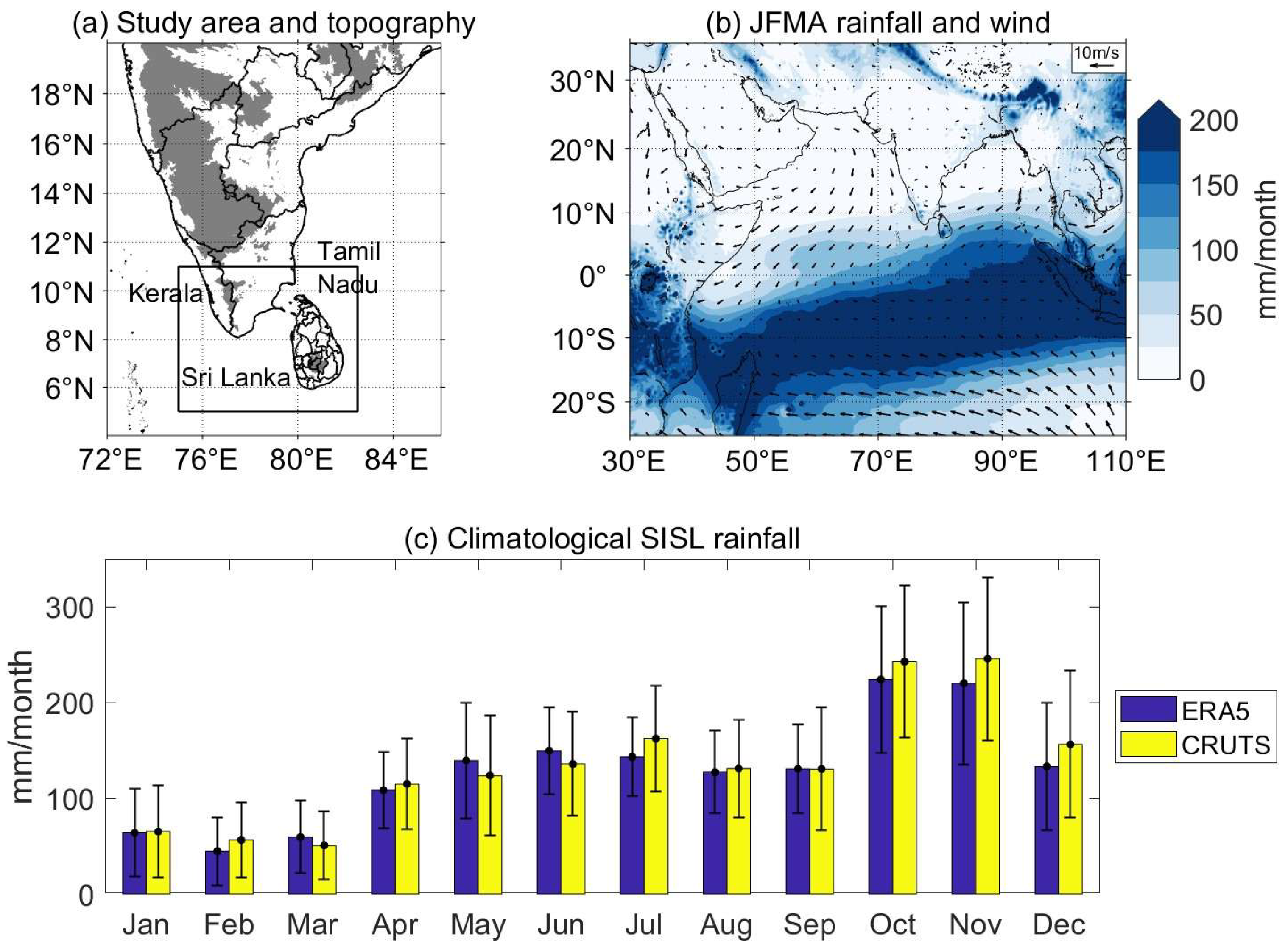
As the most prominent mode of interannual climate variability, the El Niño–Southern Oscillation (ENSO) exerts a profound influence on precipitation patterns across the Asian monsoon region through large-scale atmospheric teleconnections and coupled ocean–atmosphere processes [1,2,3]. The Indian Peninsula and Sri Lanka (Figure 1a), located within the core domain of the South Asian monsoon system, have long been recognized as regions where rainfall variability is strongly modulated by ENSO [4,5]. Early observational studies showed that ENSO-related rainfall anomalies over South Asia exhibit pronounced spatial heterogeneity, allowing the region to be broadly divided into two distinct climatic regimes: central–northern India and southern India–Sri Lanka [1,6]. These two regions differ not only in their dominant rainy seasons but also in the nature and seasonality of their responses to ENSO forcing.
Over central and northern India, ENSO impacts are most evident during the boreal summer monsoon season (June–September), with El Niño typically associated with weakened monsoon circulation and reduced rainfall, and La Niña favoring enhanced monsoon rainfall [7,8]. However, this relationship has shown a weakening trend in recent decades [4,9,10]. In contrast, rainfall over southern India and Sri Lanka (SISL, black box in Figure 1a) exhibits a markedly different ENSO sensitivity. Previous studies have shown that ENSO-related rainfall anomalies over SISL tend to peak outside the core summer monsoon season, particularly during October–November. This seasonality reflects the region’s stronger exposure to tropical circulation anomalies and Indian Ocean–Pacific interactions [1,11,12]. This regional disparity stems from seasonal differences in atmospheric circulation and moisture transport. It highlights the complexity of ENSO’s impact on the South Asian monsoon.
Previous studies on rainfall variability over SISL have predominantly focused on the boreal summer and the late autumn to early winter season, for which the underlying mechanisms are relatively well established. During the developing phase of ENSO, summer rainfall over SISL is smaller in magnitude than that over central and northern regions. It is indirectly influenced by ENSO via modulation of Indian Ocean sea surface temperature (SST) anomalies and the associated changes in regional convection [13]. In contrast, summer rainfall during the decaying phase of ENSO shows a strong dependence on the rate of ENSO decay. Rapidly decaying El Niño events tend to produce cooler and wetter conditions over SISL, while slowly decaying events are associated with warmer and drier summers. This contrast has been linked to SST variations in the central and eastern Pacific and the modulation of the Walker circulation [14]. Meanwhile, the variability of SISL precipitation during October-November is more directly tied to ENSO. Studies suggest that this correlation has strengthened since the 1980s, likely due to changes in ENSO-related large-scale atmospheric circulation, particularly adjustments in the Walker circulation [12,15,16]. Additionally, some studies have explored the influence of Indian Ocean Dipole (IOD) on the boreal autumn rainfall in SISL, further enriching our understanding of the regional precipitation dynamics [17,18,19].
In contrast to the extensively studied wet seasons, precipitation over the SISL during the relatively dry months of January–April (JFMA) has received far less attention. Although this period contributes only about 10–20% of the annual rainfall (approximately 20% in Sri Lanka and 10% in southern Indian states such as Kerala and Tamil Nadu), it plays a critical role in sustaining water resources and winter-season agriculture, including Sri Lanka’s Maha season and India’s Rabi crops [20,21]. During JFMA, the climatological Intertropical Convergence Zone (ITCZ) is located south of 5° N (Figure 1b), placing the SISL region near the northern margin of the main rainfall belt. Consequently, despite relatively low climatological mean rainfall, SISL precipitation is still highly sensitive to shifts in large-scale circulation and convection, leading to evident local rainfall variability, as shown in both ERA5 and CRUTS datasets (Figure 1c).
One of the earliest systematic analyses by Vialard et al. [21] examined the drivers of JFMA rainfall in SISL. They found a significant negative correlation with ENSO: El Niño events lead to drier conditions, while La Niña events bring wetter conditions. This variability is jointly modulated by Indian Ocean cross-equatorial temperature gradients (CETG) and intraseasonal convection associated with the Madden–Julian Oscillation (MJO). Subsequent studies focusing on Sri Lanka revealed an asymmetric ENSO response, with El Niño exerting a stronger suppressive effect on boreal winter rainfall than the enhancement during La Niña, linked to anomalous low-level circulation over the tropical western North Pacific [22]. Case-based analyses further affirm that March–April precipitation is sensitive to ENSO, potentially associated with differences in El Niño decay rates [23]. However, these studies primarily emphasize seasonal mechanisms or case-dependent responses, with limited exploration of long-term changes in ENSO–rainfall relationships.
Therefore, the potential evolution of the ENSO influence on JFMA rainfall remains poorly understood. This knowledge gap is particularly important in the context of ongoing climate change, as growing evidence suggests that ENSO characteristics themselves, including amplitude, frequency, spatial pattern, and associated teleconnection pathways, have undergone significant changes over recent decades [24,25,26]. Whether and how these changes have modulated the relationship between ENSO and subsequent JFMA rainfall over the SISL has yet to be systematically examined.
Motivated by these considerations, the present study investigates the long-term evolution of the ENSO–JFMA rainfall relationship over the SISL from the mid-twentieth century to the present. By documenting a pronounced strengthening of the ENSO influence on SISL rainfall since the late twentieth century, this work aims to advance understanding of changing Indo-Pacific teleconnections and their implications for seasonal predictability and climate risk in the SISL. The structure of this paper is organized as follows. Section 2 introduces the data and methods used in this study. Section 3 describes decadal changes in the relationship between ENSO and JFMA rainfall, and further explores underlying mechanisms. Section 4 discusses the broader implications of the findings and some unclear issues that deserve further investigation. Section 5 provides a brief summary and concluding remarks.

2. Materials and Methods

This study uses atmospheric reanalysis data from the European Centre for Medium-Range Weather Forecasts (ECMWF) fifth-generation reanalysis (ERA5) product [27]. Monthly mean precipitation, wind fields, and outgoing longwave radiation (OLR), with a horizontal resolution of 0.25° × 0.25°, are used to characterize large-scale atmospheric circulation and convective variability associated with ENSO. ERA5 data are available from 1940 onward; however, considering the limited availability and potential biases in surface observations during the World War II period [28], our analysis is restricted to the period from 1950 to 2024, when observations are relatively abundant and more reliable [29].
To further assess the potential influence of intraseasonal variability, particularly that associated with the MJO, hourly ERA5 precipitation data are additionally employed. The hourly precipitation is first averaged to daily values. Then, following the approach of Vialard et al. [21], a daily climatology with a 45-day low-pass filter is constructed from the full record, and precipitation anomalies are calculated relative to this climatology. Temporal filtering is further applied to separate intraseasonal (10–90 days) and lower-frequency components (>90 days). Monthly precipitation anomalies derived after removing intraseasonal variability are compared with the original monthly precipitation anomalies to evaluate the robustness of the low-frequency ENSO–precipitation relationship.
To assess the robustness of the results, two independent monthly precipitation datasets are also used. The first is the Climatic Research Unit Time Series (CRUTS) dataset Version 4.09 [30], developed by the Climatic Research Unit, University of East Anglia, which provides gridded land precipitation at a horizontal resolution of 0.5° × 0.5°. The second dataset is the Global Precipitation Climatology Centre (GPCC) product Version 2025, provided by the German Weather Service (Deutscher Wetterdienst, DWD), which offers gauge-based global land precipitation at a spatial resolution of 0.25° × 0.25° [31]. Both datasets over the period 1950–2024 are used to examine and validate the interdecadal variability of the ENSO–rainfall relationship over the SISL.
SST data used in this study are obtained from the Hadley Centre Sea Ice and Sea Surface Temperature (HadISST) dataset Version 1.1, developed by the Met Office Hadley Centre. HadISST provides globally complete monthly mean SST fields at a horizontal resolution of 1° × 1°, based on a combination of in situ observations and satellite-derived information [32]. The dataset is used to characterize large-scale SST variability associated with ENSO during the analysis period from 1950 to 2024.
Details of the above datasets are listed in Table 1. Datasets with different spatial resolutions are analyzed on their native grids. For regional-mean calculations, area-averaged values are calculated based on each dataset’s original resolution. No regridding is performed, as no point-by-point comparisons across datasets are involved. To focus on interannual variability, all monthly variables are first converted to anomalies by removing their respective climatological monthly means. The linear trend over the full analysis period is also removed prior to filtering to minimize the potential influence of long-term climate change. A 9-year high-pass filter (Lanczos filter) is then applied separately for each calendar month to further suppress decadal and longer-term variations. Sensitivity tests using 7-year and 11-year high-pass filters yield qualitatively similar results, indicating that the extraction of interannual signals is not sensitive to the specific choice of cutoff period.
The climate indices used in this study are calculated directly from the interannual SST anomalies of the HadISST dataset described above. The Niño 3.4 index is defined as the area-averaged SST anomaly over 5° S–5° N and 120° W–170° W and is used to represent ENSO intensity. The Niño 3 and Niño 4 indices are defined as area-averaged SST anomalies over 5° S–5° N, 150° W–90° W and 5° S–5° N, 160° E–150° W, respectively. Preliminary comparisons indicate that the resulting Niño indices are highly consistent with the corresponding publicly available ENSO indices, confirming the robustness of the calculations.
Following Vialard et al. [21], the cross-equatorial temperature gradient (CETG) index is defined as
C E T G = T N I O T S I O
where TNIO and TSIO denote interannual SST anomalies averaged over the tropical north Indian Ocean (10° N–20° N, 60° E–100° E) and the tropical south Indian Ocean (8° S–0°, 75° E–105° E), respectively.
To further examine the potential influence of different ENSO types on rainfall variability over the SISL, ENSO events are classified into eastern Pacific (EP) and central Pacific (CP) types following Ren and Jin (2011) [33]. The EP and CP indices (EPI and CPI) are constructed from the Niño 3 and Niño 4 indices as follows:
E P I = N i ñ o 3 α N i ñ o 4 ,   C P I = N i ñ o 4 α N i ñ o 3
where α = 0.4, when Niño 3 × Niño 4 > 0, and α = 0 otherwise.
To quantify the interdecadal variation in the ENSO–SISL rainfall relationship during JFMA, 31-year running correlations are computed between the JFMA-mean Niño 3.4 index and SISL rainfall anomalies. The effective sample size is estimated following Bretherton et al. (1999) [34] as
N e f f = N 1 r x r y 1 + r x r y
where N is the window length and rx and ry are the lag-1 autocorrelation coefficients of the two time series. Given the small lag-1 autocorrelations (0.02 for Niño 3.4 and 0.14 for rainfall), Neff is close to 31, and thus the effective degree of freedom is calculated as df = Neff − 2 ≈ 29. Based on a two-tailed Student’s t-test, the critical correlation coefficients are approximately 0.36 and 0.46 for the 95% and 99% confidence levels, respectively.

3. Results

3.1. Long-Term Evolution of the ENSO–Rainfall Relationship During January–April

Given that SISL lies near the northern margin of the climatological rainfall belt during JFMA (Figure 1b) and exhibits relatively low mean rainfall with highly sensitive variability (Figure 1c), we first examine the long-term evolution of the ENSO–rainfall relationship during this season.
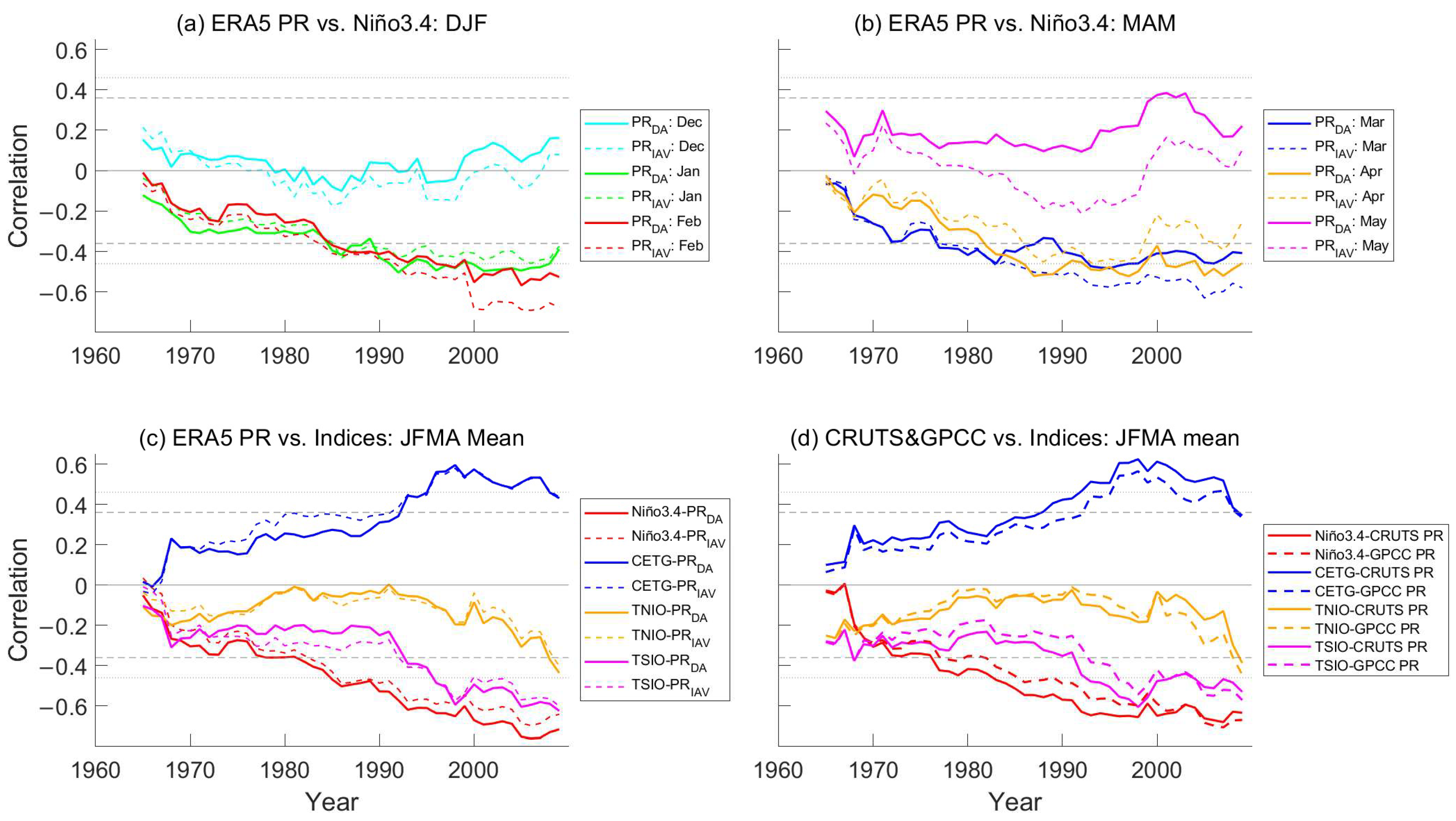
Figure 2a,b show the 31-year running correlation coefficients between the Niño 3.4 index and ERA5 rainfall anomalies over SISL for individual months from December to May. During January–April, the ENSO–rainfall relationship exhibits a pronounced strengthening trend: correlations are generally weak and statistically insignificant before the late 1970s, but become significantly negative after the mid-1980s. This negative relationship continues to intensify through the 1990s and remains persistently strong into the twenty-first century. In contrast, correlations in December and May are mostly insignificant throughout the record and show no clear long-term trend.
The correlations derived from interannual rainfall anomalies based on monthly ERA5 data (solid lines) are broadly consistent with those obtained after removing intraseasonal variability using daily ERA5 data (dashed lines). This indicates that MJO-related intraseasonal rainfall variability plays a limited role in shaping the long-term evolution of the ENSO–rainfall relationship over SISL. For February and March, the ENSO–rainfall correlations are slightly stronger in recent decades after filtering out intraseasonal variability, whereas modest reductions are found for January and April. The latter likely reflects the temporal smoothing associated with the 90-day filtering window, which may mix signals from adjacent months (December and May). Nevertheless, these differences are minor, and both approaches consistently reveal a robust long-term enhancement of the negative ENSO–rainfall relationship during JFMA.
For JFMA-mean rainfall, the strengthening of the negative relationship with the Niño 3.4 index is even more evident (Figure 2c). Regardless of whether the intraseasonal signal is removed, correlations remain below the 95% significance level prior to the late 1970s but exceed the 99% significance level from the mid-1980s onward. Similar results are obtained using CRUTS and GPCC precipitation datasets (Figure 2d), demonstrating the robustness of the observed strengthening trend.
Previous studies have suggested that ENSO influences SISL rainfall during JFMA through a combination of large-scale atmospheric teleconnections and ENSO-induced adjustments of tropical Indian Ocean SSTs, which together modulate regional convection and rainfall variability [21,35]. Consistent with this framework, correlations between the CETG index and SISL rainfall exhibit a coherent strengthening of positive correlations across all three precipitation datasets, indicating an enhanced relationship between the meridional SST gradient and the SISL rainfall variability. Notably, however, this CETG–rainfall correlation peaks during the 1990s and shows a gradual decline thereafter, although it remains above the 95% significance level.
Further insight is obtained by separately examining how JFMA-mean rainfall relates to the TNIO and TSIO. Overall, TSIO shows stronger running correlations with the SISL rainfall than TNIO. The TSIO–rainfall linkage strengthens during the 1980s and 1990s and maintains a stable and significant negative correlation since the late 1990s. In contrast, the TNIO–rainfall relationship is generally insignificant throughout the twentieth century, but intensifies after the early 2000s and becomes significantly negative at the 95% confidence level within the most recent 31-year window. These results suggest that, in recent decades, the relationship between local Indian Ocean SSTs and SISL rainfall has transitioned from a meridional dipole pattern proposed by previous studies [35] toward a more spatially coherent SST structure, which may contribute to the weakening of the CETG–rainfall correlation after its peak.

3.2. Interdecadal Shift in ENSO-Related Climate Patterns and Their Impacts on SISL Rainfall

The running correlation analysis in Section 3.1 reveals a pronounced strengthening of the ENSO–SISL rainfall relationship during JFMA. To explore the physical basis of this transition, we compare ENSO-related climate anomalies over the Pacific and Indian Oceans between two contrasting periods: 1950–1979, when correlations between JFMA-mean rainfall and ENSO remain below the 95% confidence level, and 1985–2024, when the correlations exceed the 99% confidence level. The intervening years 1980–1984 represent a transitional phase during which the correlation gradually increased, and are therefore excluded to clearly distinguish the two contrasting epochs. Basin-scale regression patterns of rainfall, surface winds, SST, and OLR onto the Niño 3.4 index are examined to diagnose changes in large-scale circulation and convective responses associated with ENSO (Figure 3 and Figure 4). In addition, although regression patterns represent the atmospheric response per 1 °C Niño 3.4 SST anomaly, the actual ENSO-related climate impact depends on the amplitude of ENSO variability. Therefore, the regression coefficients are further scaled by the standard deviation of theNiño 3.44 index for each period to illustrate the effective magnitude of climate responses.
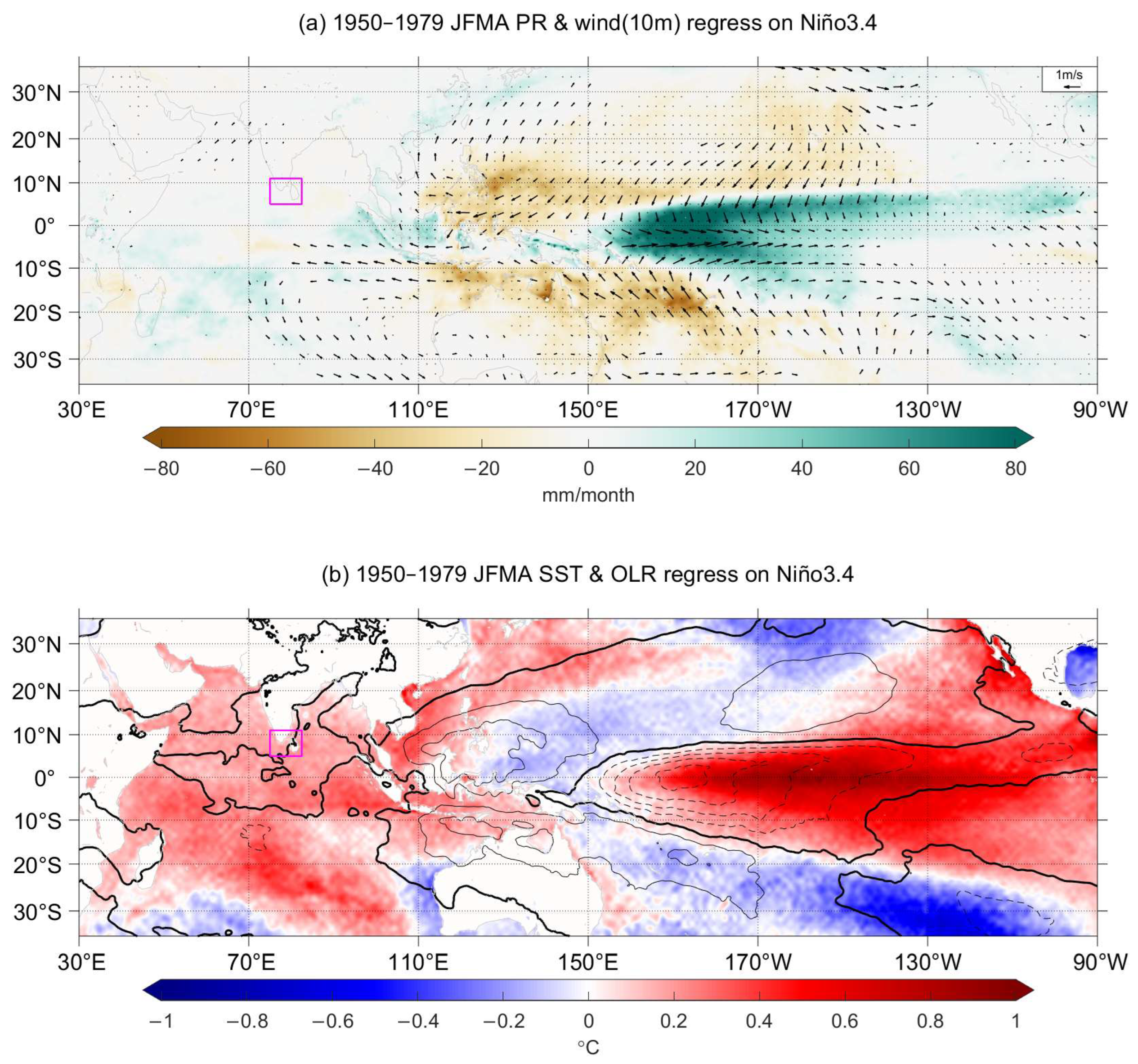
As shown in Figure 3, ENSO-related atmospheric anomalies during 1950–1979 exhibit typical El Niño–like features over the Pacific basin. Positive SST anomalies over the central–eastern equatorial Pacific are accompanied by anomalous westerlies, with enhanced convection and rainfall shifting eastward into the equatorial central Pacific. In contrast, suppressed convection and reduced rainfall prevail over the tropical western Pacific, accompanied by the low-level anticyclonic wind anomalies.
However, ENSO-related atmospheric anomalies over the Indian Ocean remain weak during 1950–1979. The westward extension of Pacific convective suppression is largely confined to the Maritime Continent and does not penetrate the Indian Ocean. Consistent with this, anomalies in surface winds, OLR, and rainfall over the Indian Ocean are generally weak and insignificant. Although a basin-wide SST warming signal is evident across the tropical Indian Ocean, it fails to induce a coherent convective or rainfall response, indicating that ENSO-related Indian Ocean SST anomalies during this period exert only a limited influence on regional atmospheric circulation and rainfall around the SISL region.
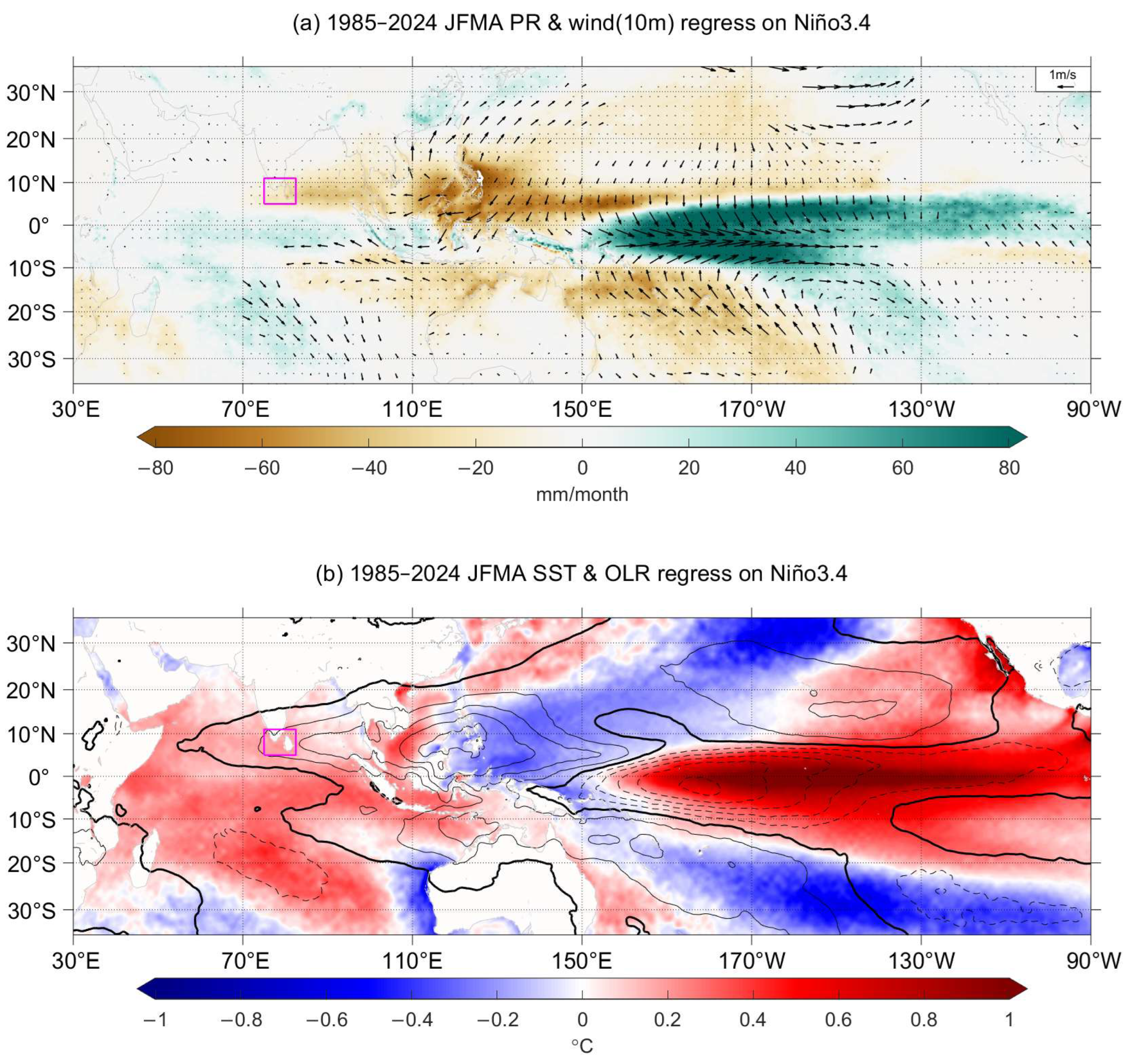
During 1985–2024, ENSO-related atmospheric anomalies exhibit spatial patterns broadly similar to those during 1950–1979, but with substantially enhanced amplitudes (Figure 4). SST warming over the central–eastern equatorial Pacific is intensified by approximately 21%, accompanied by markedly stronger equatorial westerly wind anomalies and amplified convective and rainfall responses. The strengthened air–sea coupling also induces a more pronounced atmospheric response over the western Pacific, characterized by a clearer interhemispheric asymmetry in convective anomalies across the equator. While convective and rainfall anomalies in the Southern Hemisphere show only limited enhancement compared to the earlier period, likely constrained by land–sea contrast associated with the Australian continent, suppressed convection and reduced rainfall over the Philippine Sea become much more pronounced. This enhanced suppression is accompanied by a stronger low-level anomalous anticyclonic circulation, commonly referred to as the Northwest Pacific Anticyclone (NWPAC), a key component of the ENSO–Asian climate teleconnection [3,36]. Notably, the magnitude of the NWPAC intensification is substantially larger than the corresponding SST warming amplitude over the Niño 3.4 region, suggesting that the strengthened ENSO teleconnection to the tropical Indian Ocean and the western North Pacific since the 1970s may not simply reflect stronger ENSO events themselves, but may also involve changes in the mean climate background state. Recent studies indicate that background-state changes, such as a climatological El Niño-like warming pattern in the equatorial Pacific, eastward-shifted Walker circulation, and the associated reorganization of tropical precipitation, can enhance the sensitivity of atmospheric circulation to ENSO forcing. In particular, enhanced convective heating over the central–eastern equatorial Pacific together with strengthened negative precipitation anomalies over the tropical western North Pacific can reinforce the Rossby-wave response that drives the anomalous anticyclone [37]. Such changes in the climatological convection and moisture distribution may amplify the atmospheric response to ENSO SST anomalies, thereby contributing to a disproportionately stronger NWPAC response relative to the increase in Niño 3.4 SST amplitude. During the late period (1985–2024), anomalous convective suppression associated with the NWPAC extends farther westward, reaching the southern Bay of Bengal and the SISL region, and thereby exerting a direct influence on regional convection and rainfall.
The SST response in the Indian Ocean exhibits a more pronounced meridional contrast than during 1950–1979. Warming in the tropical southern basin exceeds that in the northern basin, which is consistent with previous results [29,38] and results in the intensification of CETG. Enhanced warming over the southern Indian Ocean is associated with increased local rainfall. The coexistence of enhanced rainfall over 0–5° S and suppressed rainfall over the southern Bay of Bengal and SISL reflects the southward displacement of the northern margin of the climatological ITCZ during El Niño events.
Overall, compared with the earlier period, ENSO-related atmospheric responses during 1985–2024 feature a pronounced intensification and westward extension of the NWPAC, together with an enhanced CETG, both of which favor significant rainfall anomalies over the SISL. It is noteworthy that these rainfall anomalies are largely confined south of ~12° N, with weak impacts on the central–northern India Peninsula.

3.3. Comparison of EP and CP ENSO Influences on SISL Rainfall

ENSO events can be broadly classified into EP and CP types, which are known to induce different atmospheric teleconnection patterns. As shown in Section 3.2, both ENSO intensity and the associated large-scale atmospheric responses are stronger during the late period. This raises an important question as to whether the strengthened ENSO–SISL rainfall relationship is mainly controlled by EP ENSO, CP ENSO, or a combination of both.
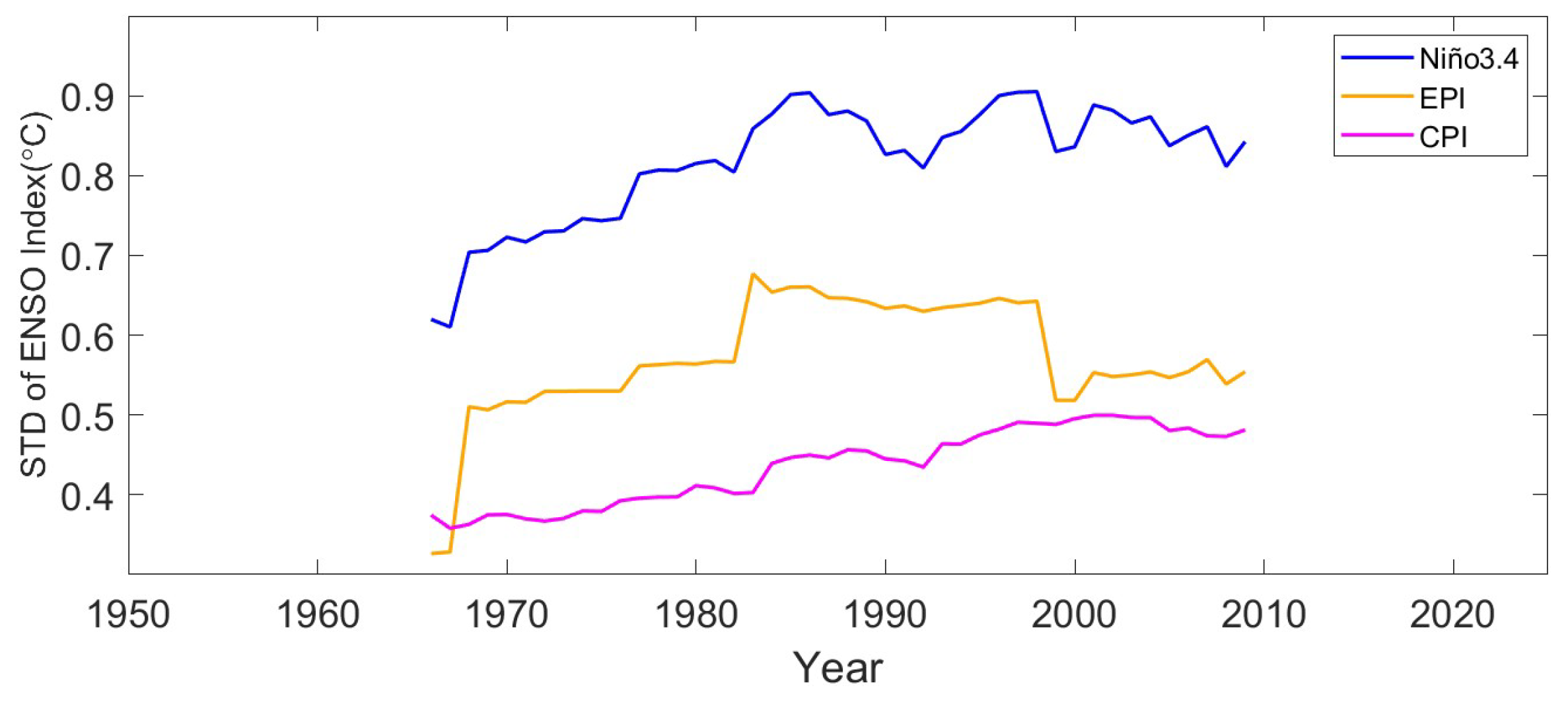
As shown in Figure 5, the 31-year running standard deviations of the JFMA-mean Niño 3.4 index, EPI, and CPI all exhibit an overall increasing tendency, indicating a general intensification of ENSO variability. Among them, CPI shows a more persistent but relatively weaker increase, whereas the Niño 3.4 index and EPI reach their maximum amplitudes during the 1980s–1990s and slightly weaken afterward, while remaining stronger than their pre-1970s levels. Therefore, this section further examines the respective contributions of EP and CP ENSO events to the enhanced ENSO–SISL rainfall relationship.
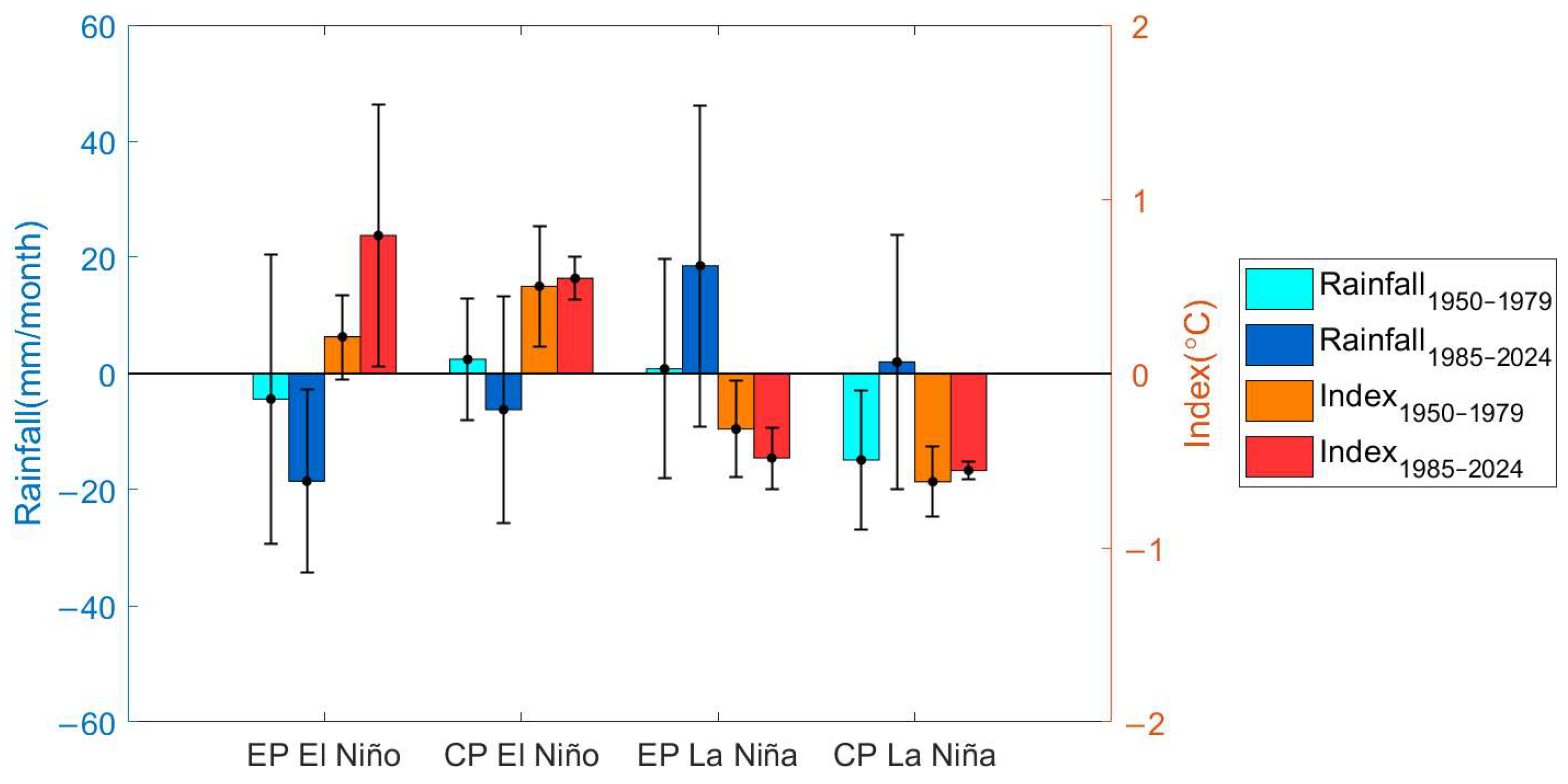
Table 2 lists the selected EP and CP ENSO events since the 1950s. An ENSO event is classified as EP (CP) when the absolute value of the EPI (CPI) exceeds 0.5 °C during the ENSO mature winter and persists for at least three consecutive months. Figure 6 shows composite amplitudes of the JFMA-mean ENSO indices (EPI or CPI) and the corresponding SISL rainfall anomalies for four ENSO categories (EP El Niño, EP La Niña, CP El Niño, and CP La Niña), separately for the early (1950–1979) and late (1985–2024) periods. Note that the years listed in Table 2 correspond to the developing phase of ENSO, and the associated rainfall anomalies are therefore calculated for the subsequent JFMA season following the ENSO mature winter.
The composite results for the four ENSO categories indicate that, compared with the early period (1950–1979), the inverse relationship between ENSO indices and SISL rainfall becomes more consistent during 1985–2024 (Figure 6). For EP ENSO events, both EP El Niño and EP La Niña exhibit stronger mean amplitudes in the late period, accompanied by enhanced SISL rainfall responses of opposite sign. In contrast, although the JFMA-mean amplitudes of CP El Niño and CP La Niña during the late period are comparable to those of the EP composites, their associated rainfall anomalies are substantially weaker.
It should be noted that the composite results for CP ENSO events are affected by sample-size limitations, particularly for CP El Niño and CP La Niña during 1950–1979 and for CP La Niña during 1985–2024, each of which includes only two events. These small sample sizes reduce the statistical robustness of the corresponding composite means and standard deviations. Therefore, the results for these three categories should be interpreted with caution.
In addition, for EP El Niño, EP La Niña, and CP El Niño events, although the late period includes more samples and shows a clearer correspondence between ENSO indices and SISL rainfall, the rainfall error bars remain large. Especially for EP La Niña and CP El Niño, the standard deviations of SISL rainfall are much larger relative to their composite means than those of the corresponding ENSO indices, reflecting substantial event-to-event variability in rainfall responses even within the same ENSO category. Similar behavior has been noted in previous studies on SISL rainfall variability across different seasons [14,21,22], suggesting the potential influences of other processes such as background monsoon circulation, local air–sea interactions, and teleconnections from higher latitudes.
To further distinguish the impacts of CP and EP ENSO events, we next examine composite JFMA anomalies of large-scale climate fields over the Pacific and Indian Oceans. Owing to the limited samples of CP La Niña and early-period CP El Niño events, we focus on the late period (1985–2024) and compare EP El Niño and CP El Niño composites to assess their contrasting influences on SISL rainfall. Given that both ENSO types include only seven events during 1985–2024, the statistical significance of the composite anomalies is evaluated using a Monte Carlo resampling test. Specifically, seven years are randomly selected from the 40-year period and composited 10,000 times to construct a reference distribution, and anomalies exceeding the 90% confidence level are considered statistically significant.
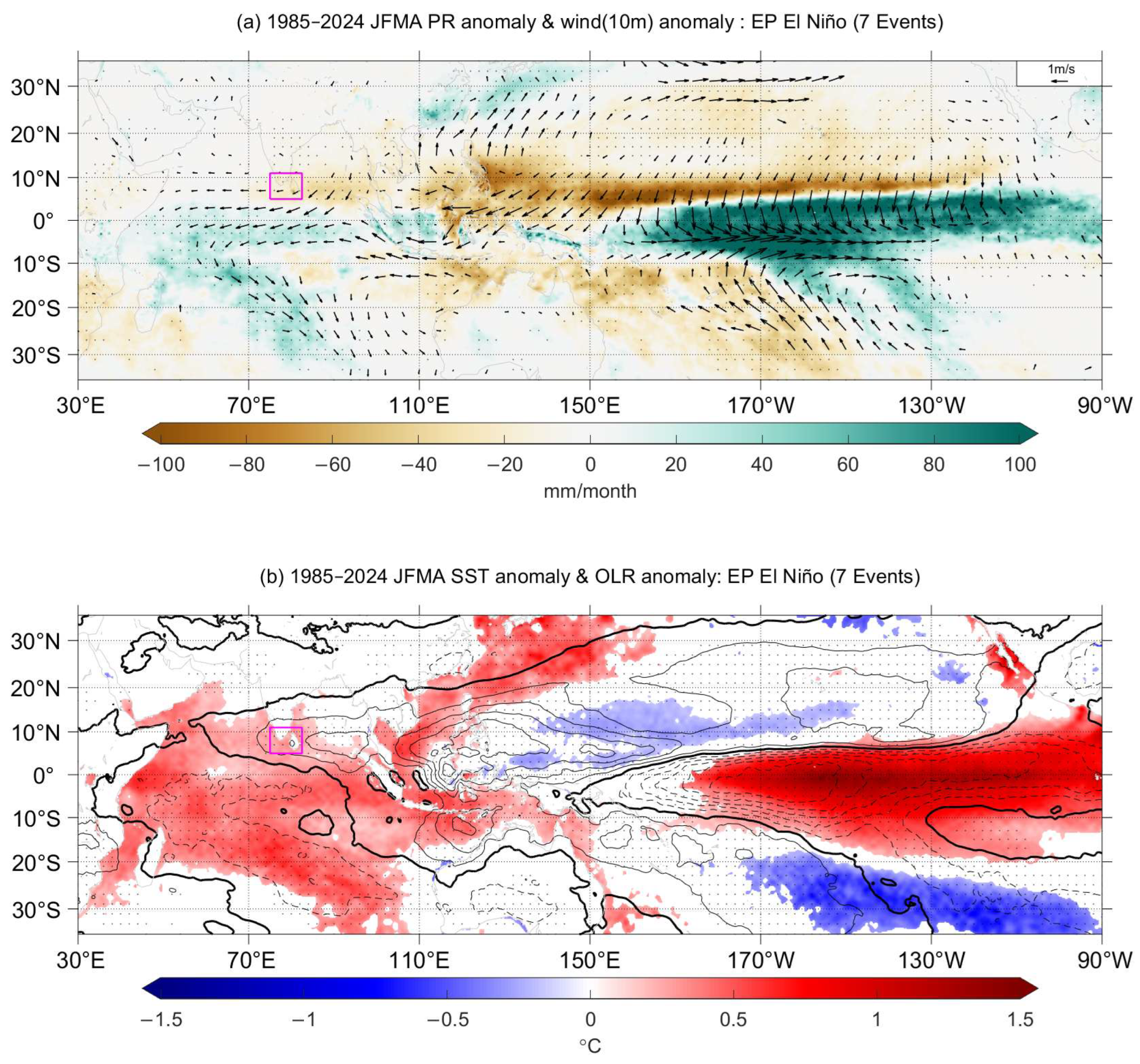
As shown in Figure 7, the composite anomalies for EP El Niño events during the late period exhibit precipitation and wind patterns that are broadly consistent with the regression results shown in Figure 4, but with more clearly defined anomaly structures. In the central–eastern Pacific, rainfall anomalies are more pronounced than in the regression fields, with a zonally elongated band of suppressed precipitation over 5–10° N accompanied by enhanced rainfall near the equator to its south, indicating a southward displacement of the Pacific ITCZ during EP El Niño events.
Over the tropical western Pacific, the ENSO-related climate anomalies display a marked interhemispheric asymmetry. Compared with the early period (1950–1979; with a spatial pattern similar to Figure 3), the NWPAC is substantially intensified during 1985–2024, and the associated suppressed convection and reduced rainfall extend farther westward into the southern Bay of Bengal and the SISL. In addition, SST warming in the tropical southern Indian Ocean exceeds that in the northern basin and is accompanied by enhanced rainfall south of the equator, further contributing to the asymmetric rainfall response over the Indian Ocean during EP El Niño events.
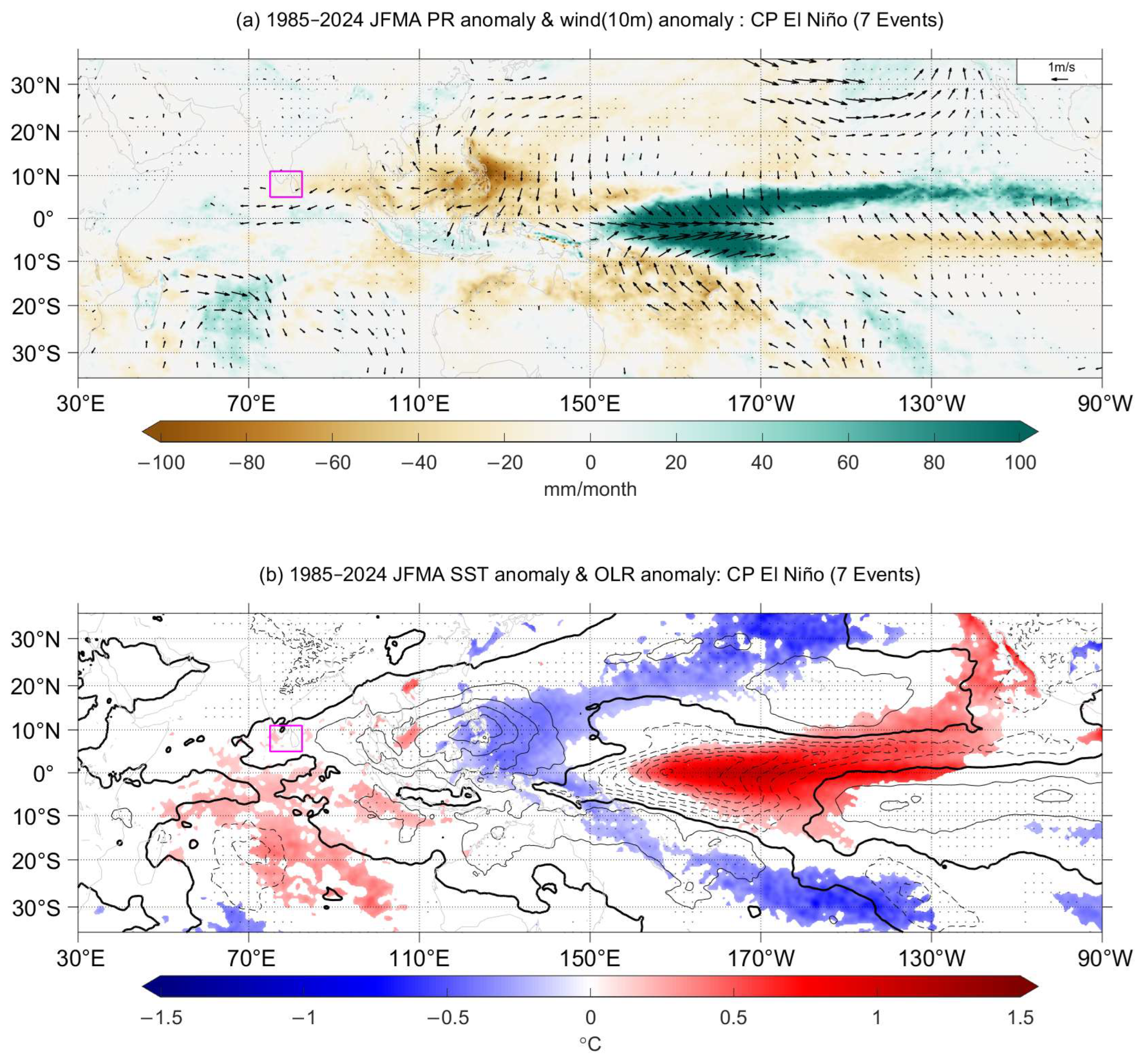
In contrast to EP El Niño, the composite anomalies for CP El Niño during the same period (1985–2024) exhibit a westward-shifted warming and convection center along the equatorial Pacific (Figure 8). Although the JFMA-mean CPI amplitude during the late period is comparable to that in the early period (Figure 6), the NWPAC during 1985–2024 is still strengthened relative to the early period and extends westward toward the southern Bay of Bengal. Overall, however, the climate responses over the Indian Ocean induced by CP El Niño, including rainfall, OLR, and SST anomalies, are substantially weaker than those associated with EP El Niño. Over the SISL region, the composite results still indicate suppressed convection and reduced rainfall, but these anomalies do not exceed the significance threshold. In addition, as shown in Figure 6, the standard deviation of SISL rainfall during CP El Niño events in 1985–2024 exceeds the magnitude of the composite mean, indicating pronounced event-to-event variability. Together, these features suggest a relatively weaker and less robust influence of CP El Niño on SISL rainfall.
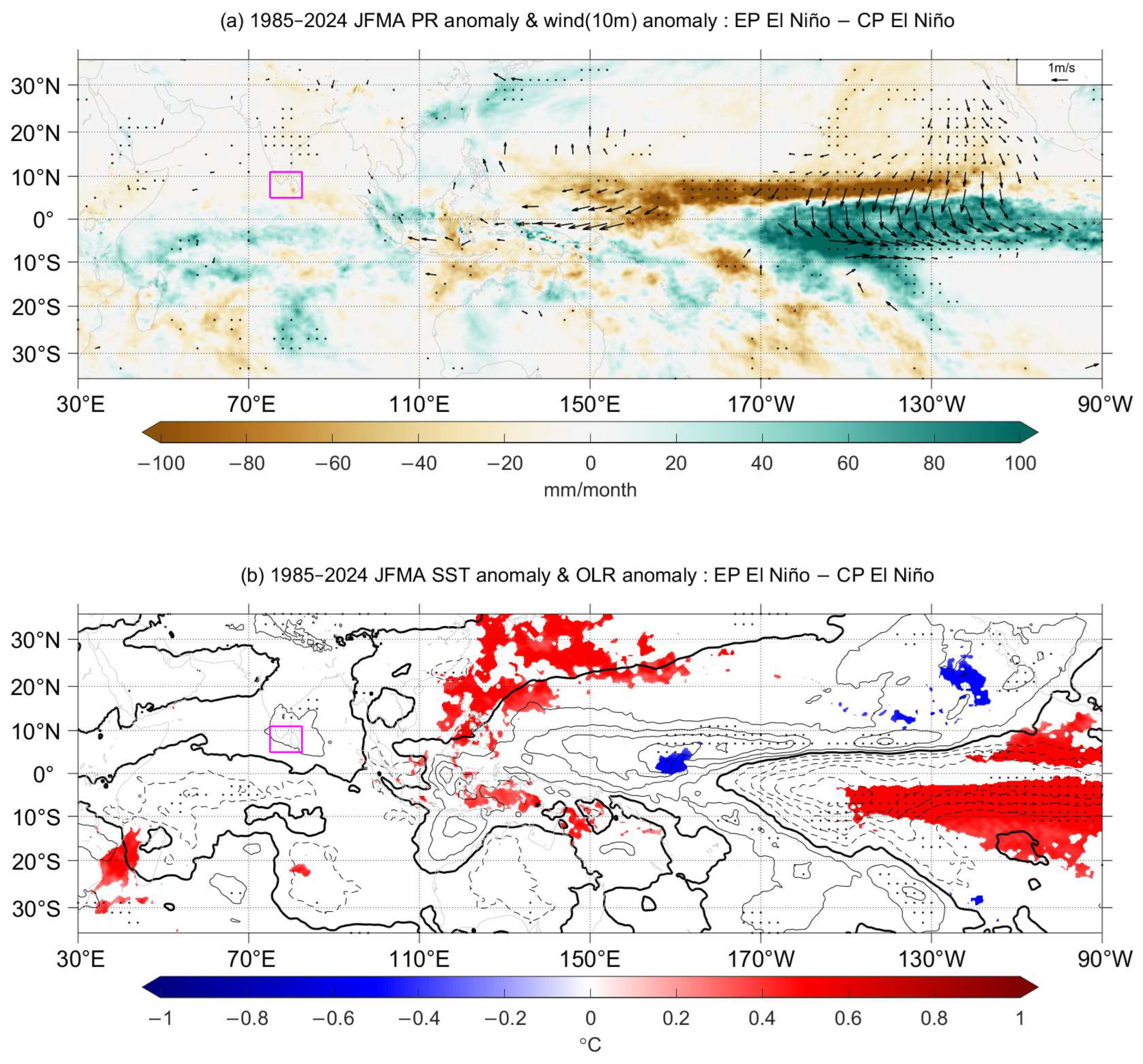
Figure 9 further illustrates the differences in composite climate anomalies between EP and CP El Niño events during 1985–2024. To quantitatively assess whether the EP–CP contrasts are statistically significant, we applied a non-parametric Monte Carlo permutation test. Unlike the resampling procedure used to evaluate the significance of individual composites in Figure 7 and Figure 8, here, the null hypothesis assumes that EP and CP composite anomalies are drawn from the same parent distribution. We randomly resampled the El Niño events without replacement 10,000 times, partitioning them into two groups with the same sizes as the observed EP and CP samples, and recalculated the composite difference each time to generate a distribution of surrogate differences. Statistical significance is assessed at each grid point based on the percentile position of the observed EP–CP composite difference within the permutation distribution.
As shown in Figure 9, statistically significant EP–CP differences in rainfall, wind, SST, and OLR anomalies are primarily confined to the tropical Pacific, whereas most signals over the Indian Ocean are not significant. Over the SISL region, although the EP composite exhibits relatively stronger negative rainfall anomalies and positive OLR anomalies compared to the CP composite, the permutation test indicates that these contrasts do not reach the 90% confidence level. This insignificance likely reflects both the limited sample size and the substantial inter-event variability (as indicated by the large standard deviations in Figure 6).
Composite anomalies for La Niña events during 1985–2024 largely mirror those for El Niño, with relatively stronger rainfall and OLR signals over SISL in the EP composite; however, the EP–CP differences remain statistically insignificant. For brevity, these results are not discussed in detail. Taken together, the above analyses indicate that although EP ENSO events tend to produce stronger composite rainfall anomalies over SISL, the distinction between EP and CP impacts is not statistically significant during the late period and should therefore be interpreted with caution.
Considering that many ENSO events exhibit basin-wide warming or cooling signals with concurrent anomalies in both the eastern and central Pacific, different classification methods may yield non-identical assignments of EP and CP events. To assess this potential methodological dependence, we additionally examined the EOF-based approach in which the first two principal components of tropical Pacific SST anomalies are used to distinguish ENSO regimes [39,40]. Compared with the EPI/CPI-based framework, this method may reclassify events with less pronounced zonal SST contrast or evolving spatial structures. In particular, some events identified as EP in Table 2 are classified as CP under the EOF-based approach, including the most recent 2023 El Niño.
Composite analyses based on the EOF-derived classification produce qualitatively similar rainfall patterns, and the EP–CP differences likewise do not reach statistical significance (figures not shown). This consistency suggests that although different ENSO-type definitions may influence the categorization of individual events, the EP–CP contrast in SISL rainfall remains statistically insignificant under both classification frameworks.

4. Discussion

Growing evidence indicates that large-scale climate teleconnections in the Indo-Pacific region have undergone substantial changes since the 1970s, raising the possibility that ENSO impacts on regional rainfall may also have evolved [29,38,41]. Anthropogenic forcings, particularly aerosols with pronounced decadal variability since the mid-twentieth century, have also been suggested to modulate ENSO variability and its characteristics [42], potentially contributing to the evolving ENSO–rainfall relationships documented here. Nevertheless, a systematic assessment of the long-term evolution of the ENSO–SISL rainfall relationship in the JFMA season remains lacking.
This study documents a sustained strengthening of the ENSO influence on JFMA rainfall over the SISL since the mid-twentieth century. Rather than being solely attributable to changes in ENSO amplitude, the strengthened relationship appears closely linked to modifications in ENSO-related atmospheric teleconnections. A key feature emerging from our analyses is the intensified and westward-extended NWPAC during recent decades. Previous studies have shown that the ENSO–NWPAC linkage is sensitive to background SST distributions and large-scale atmospheric conditions [37], and can vary on interdecadal timescales [38,43]. Consistent with these findings, our regression and composite results indicate that the enhanced ENSO–SISL rainfall connection coincides with a more prominent NWPAC response, which facilitates the westward extension of suppressed convection into the southern Bay of Bengal. This circulation pathway provides a direct dynamical link between ENSO variability and rainfall anomalies over SISL. Climate model projections suggest that the atmospheric response over the western North Pacific to ENSO forcing may strengthen under increasing CO2 concentrations [37], implying a potentially greater influence of the NWPAC on regional rainfall variability, including over SISL, in a warming climate.
ENSO-related SST anomalies in the Indian Ocean also exhibit notable changes, with a more pronounced CETG during the recent period. Earlier studies emphasized the role of the CETG in modulating boreal spring rainfall over SISL [21,35]. While our results are broadly consistent with this framework, the decline of CETG–rainfall correlation since the late 1990s differs somewhat from the steadily elevated trend of ENSO–rainfall correlation. Moreover, according to Wu et al. [35], the CETG-related spring precipitation changes cover the entire Indian Peninsula as well as the surrounding Bay of Bengal and eastern Arabian Sea. In contrast, ENSO-related rainfall anomalies in this study are spatially confined to the latitudinal band of 5–12° N from the southern Bay of Bengal to the SISL, which is a much smaller range.
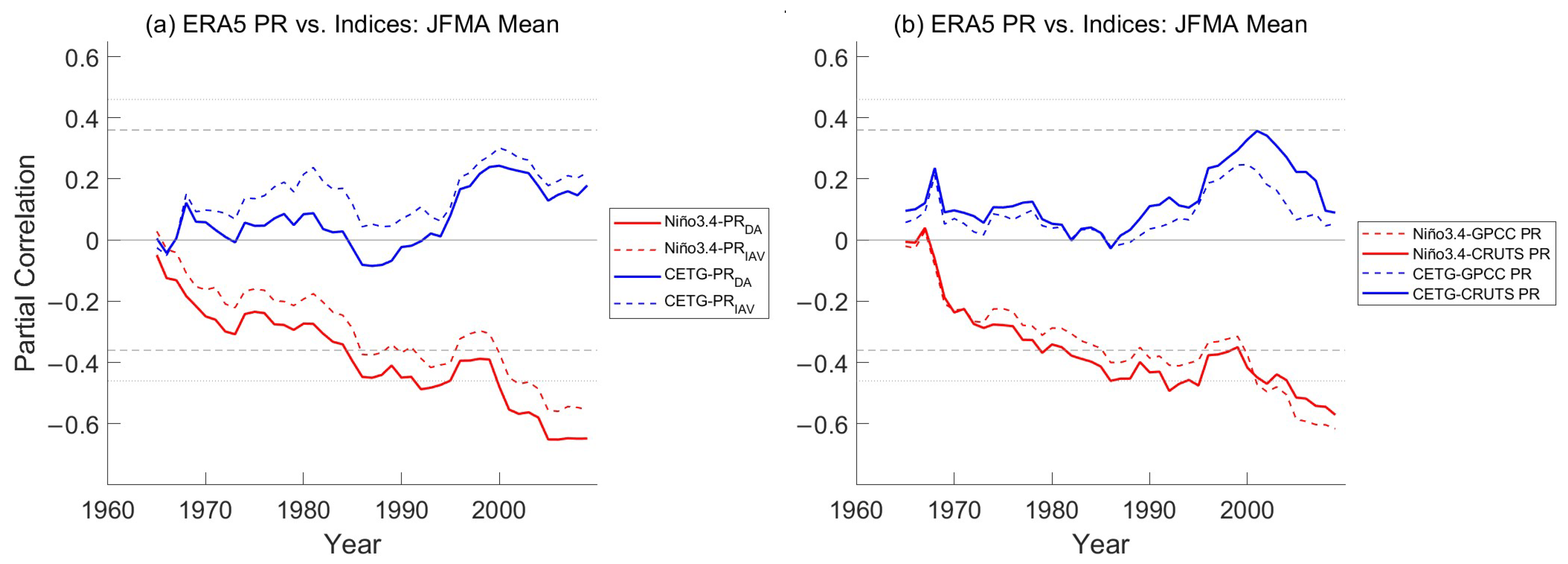
The partial correlation analysis provides further clarification. When controlling for the CETG index, the partial correlation between Niño 3.4 and SISL rainfall shows only a slight reduction in magnitude, while retaining the sustained strengthening trend and remaining statistically significant in recent decades (Figure 10). This indicates that the intensified ENSO–rainfall linkage is not substantially dependent on the meridional Indian Ocean SST gradient. In contrast, when controlling for Niño 3.4, the partial correlation between CETG and SISL rainfall decreases markedly and becomes largely insignificant. These results suggest that a considerable portion of the CETG–rainfall relationship may reflect ENSO-driven variability rather than an independent local forcing. Therefore, the strengthened ENSO impact on SISL rainfall appears to be primarily associated with the direct atmospheric teleconnection, while the CETG variability likely acts as a secondary modulator within an ENSO-dominated framework.
In addition, the increasing linkage between TNIO and SISL rainfall since the late 1990s (as shown in Figure 2c) suggests that the Indian Ocean SST–rainfall relationship may be transitioning from a meridional dipole pattern toward a more spatially coherent SST structure. This shift may be related to the rapid warming of the Indian Ocean in recent decades. As the tropical Indian Ocean SST continues to rise in recent years, air–sea interaction processes have adjusted, and the influence of local SST anomalies in the equatorial and northern Indian Ocean on SISL rainfall has become increasingly apparent [44,45]. Such changes may modify both the strength and pathways of the linkage between ENSO and regional precipitation. Understanding the future evolution of these processes is therefore important for improving seasonal rainfall prediction over South Asia and for supporting more targeted climate adaptation strategies in the region.

5. Conclusions

This study examines the long-term evolution of the ENSO–SISL rainfall relationship during the JFMA season and identifies a clear interdecadal strengthening of the ENSO–rainfall linkage from 1950 to 2024. While ENSO-related rainfall signals over SISL are relatively weak prior to the late 1970s, the relationship becomes statistically significant since the 1980s. This transition is accompanied by coherent large-scale circulation changes, most notably an intensified and westward-extended NWPAC, which facilitates the westward extension of suppressed convection into the southern Bay of Bengal and the SISL. Changes in Indian Ocean SST patterns during ENSO events, including a more pronounced meridional SST contrast, are also evident, but their influence appears secondary compared with the direct atmospheric teleconnection associated with the strengthened NWPAC. These features together indicate a reorganization of ENSO-related Indo-Pacific climate patterns that provides more favorable conditions for ENSO signals to affect rainfall over the southern Bay of Bengal and the SISL.
Analyses considering ENSO diversity further suggest that EP ENSO events tend to be associated with stronger and more spatially extensive teleconnection patterns than CP events during the late period, leading to relatively stronger composite rainfall anomalies over the SISL region. However, the composite anomalies associated with CP ENSO events are generally weaker, and the differences between EP and CP composite climate anomalies do not reach statistical significance. This likely reflects the limited sample size and the pronounced event-to-event variability of SISL rainfall during CP ENSO events. Taken together, these results advance our understanding of Indo-Pacific teleconnections relevant to SISL rainfall variability and highlight the important role of westward-extended NWPAC and the potential effect of ENSO diversity. Future work is needed to assess how these relationships may evolve under ongoing climate change and to evaluate their representation in climate models.

Author Contributions

Conceptualization, L.L. and W.Z.; methodology, W.Z.; software, Z.Y.; validation, L.L. and H.W.; formal analysis, L.L. and Z.Y.; writing—original draft preparation, L.L.; writing—review and editing, W.Z., Z.Y. and H.W. All authors have read and agreed to the published version of the manuscript.

Funding

This research was funded by the International Partnership Program of Chinese Academy of Sciences (059GJHZ2023104MI), the National Natural Science Foundation of China (42006177 and 41776003), the Natural Science Foundation of Fujian Province of China (2023J01021), and the Fujian Provincial Key Science and Technology Program of China (2024YZ040025).

Institutional Review Board Statement

Not applicable.

Informed Consent Statement

Not applicable.

Data Availability Statement

Publicly available datasets were analyzed in this study: the Hadley Centre Sea Ice and Sea Surface Temperature (HadISST) dataset is available from the University Corporation for Atmospheric Research (UCAR) at https://doi.org/10.5065/XMYE-AN84; the ERA-5 reanalysis data are available from the Copernicus Climate Data Store at https://doi.org/10.24381/cds.adbb2d47; the CRUTS (Climatic Research Unit Time Series) gridded precipitation data can be cited via the CRUTS dataset reference at https://doi.org/10.1038/s41597-020-0453-3; the GPCC precipitation data are available at https://doi.org/10.5676/DWD_GPCC/MONTHLY_V2025_025.

Acknowledgments

The authors are grateful to the editor and the anonymous reviewers for their valuable time, expertise, and constructive comments.

Conflicts of Interest

The authors declare no conflicts of interest.

Abbreviations

The following abbreviations are used in this manuscript:
ENSOEl Niño–Southern Oscillation
SISLSouthern India and Sri Lanka
JFMAJanuary–April
SSTSea surface temperature
OLROutgoing longwave radiation
CETGCross-equatorial temperature gradients
CPCentral Pacific
CPICentral Pacific Index
EPEastern Pacific
EPIEastern Pacific Index
NWPACNorthwest Pacific Anticyclone
ITCZIntertropical Convergence Zone
MJOMadden–Julian Oscillation

References

  1. Rasmusson, E.M.; Carpenter, T.H. The Relationship Between Eastern Equatorial Pacific Sea Surface Temperatures and Rainfall over India and Sri Lanka. Mon. Weather Rev. 1983, 111, 517–528. [Google Scholar] [CrossRef]
  2. Webster, P.J.; Yang, S. Monsoon and Enso: Selectively Interactive Systems. Q. J. R. Meteorol. Soc. 1992, 118, 877–926. [Google Scholar] [CrossRef]
  3. Wang, B.; Wu, R.; Fu, X. Pacific–East Asian Teleconnection: How Does ENSO Affect East Asian Climate? J. Clim. 2000, 13, 1517–1536. [Google Scholar] [CrossRef]
  4. Ummenhofer, C.C.; Sen Gupta, A.; Li, Y.; Taschetto, A.S.; England, M.H. Multi-decadal modulation of the El Niño–Indian monsoon relationship by Indian Ocean variability. Environ. Res. Lett. 2011, 6, 034006. [Google Scholar] [CrossRef]
  5. Turner, A.G.; Annamalai, H. Climate change and the South Asian summer monsoon. Nat. Clim. Change 2012, 2, 587–595. [Google Scholar] [CrossRef]
  6. Ropelewski, C.F.; Halpert, M.S. Global and Regional Scale Precipitation Patterns Associated with the El Niño/Southern Oscillation. Mon. Weather Rev. 1987, 115, 1606–1626. [Google Scholar] [CrossRef]
  7. Kripalani, R.H.; Kulkarni, A. Climatic impact of El Niño/La Niña on the Indian monsoon: A new perspective. Weather 1997, 52, 39–46. [Google Scholar] [CrossRef]
  8. Rajeevan, M.; Pai, D.S. On the El Niño-Indian monsoon predictive relationships. Geophys. Res. Lett. 2007, 34, L04704. [Google Scholar] [CrossRef]
  9. Kumar, K.K.; Rajagopalan, B.; Cane, M.A. On the Weakening Relationship Between the Indian Monsoon and ENSO. Science 1999, 284, 2156–2159. [Google Scholar] [CrossRef]
  10. Kumar, K.K.; Rajagopalan, B.; Hoerling, M.; Bates, G.; Cane, M. Unraveling the mystery of Indian monsoon failure during El Nino. Science 2006, 314, 115–119. [Google Scholar] [CrossRef]
  11. Suppiah, R. Extremes of the Southern Oscillation Phenomenon and the Rainfall of Sri Lanka. Int. J. Climatol. 1997, 17, 87–101. [Google Scholar] [CrossRef]
  12. Zubair, L.; Ropelewski, C.F. The Strengthening Relationship between ENSO and Northeast Monsoon Rainfall over Sri Lanka and Southern India. J. Clim. 2006, 19, 1567–1575. [Google Scholar] [CrossRef]
  13. Vecchi, G.A.; Harrison, D.E. Interannual Indian Rainfall Variability and Indian Ocean Sea Surface Temperature Anomalies. In Earth’s Climate; American Geophysical Union: Washington, DC, USA, 2004; pp. 247–259. [Google Scholar]
  14. Kajakokulan, P.; Kumar, V. Post-El Niño Influence on Summer Monsoon Rainfall in Sri Lanka. Water 2025, 17, 1664. [Google Scholar] [CrossRef]
  15. Suppiah, R. Trends in the southern oscillation phenomenon and Australian rainfall and changes in their relationship. Int. J. Climatol. 2004, 24, 269–290. [Google Scholar] [CrossRef]
  16. Kumar, P.; Rupa Kumar, K.; Rajeevan, M.; Sahai, A.K. On the recent strengthening of the relationship between ENSO and northeast monsoon rainfall over South Asia. Clim. Dyn. 2007, 28, 649–660. [Google Scholar] [CrossRef]
  17. Kripalani, R.H.; Kumar, P. Northeast monsoon rainfall variability over south peninsular India vis-à-vis the Indian Ocean dipole mode. Int. J. Climatol. 2004, 24, 1267–1282. [Google Scholar] [CrossRef]
  18. Zubair, L.; Rao, S.A.; Yamagata, T. Modulation of Sri Lankan Maha rainfall by the Indian Ocean Dipole. Geophys. Res. Lett. 2003, 30, 1063. [Google Scholar] [CrossRef]
  19. Kajakokulan, P.; Jayawardena, S.; Attada, R. Strengthening of Indian Ocean Dipole-Rainfall Relationship in Sri Lanka After the 1980s. Earth Syst. Environ. 2025, 9, 3601–3613. [Google Scholar] [CrossRef]
  20. Zubair, L. El Niño–southern oscillation influences on rice production in Sri Lanka. Int. J. Climatol. 2002, 22, 249–260. [Google Scholar] [CrossRef]
  21. Vialard, J.; Terray, P.; Duvel, J.P.; Nanjundiah, R.S.; Shenoi, S.S.C.; Shankar, D. Factors controlling January–April rainfall over southern India and Sri Lanka. Clim. Dyn. 2011, 37, 493–507. [Google Scholar] [CrossRef]
  22. Kajakokulan, P.; Santoso, A.; Zhao, S. Asymmetric response of Sri Lanka Northeast Monsoon rainfall to El Niño/La Niña. Clim. Dyn. 2025, 63, 101. [Google Scholar] [CrossRef]
  23. Ranaweera, K.R.K.D.N.; Kamae, Y. Impact of El Niño Southern Oscillation on the first inter-monsoon rainfall over Sri Lanka in the post-El Niño years. Front. Clim. 2024, 6, 1361322. [Google Scholar] [CrossRef]
  24. Cai, W.; Santoso, A.; Collins, M.; Dewitte, B.; Karamperidou, C.; Kug, J.-S.; Lengaigne, M.; McPhaden, M.J.; Stuecker, M.F.; Taschetto, A.S.; et al. Changing El Niño–Southern Oscillation in a warming climate. Nat. Rev. Earth Environ. 2021, 2, 628–644. [Google Scholar] [CrossRef]
  25. Cai, W.; Ng, B.; Geng, T.; Jia, F.; Wu, L.; Wang, G.; Liu, Y.; Gan, B.; Yang, K.; Santoso, A.; et al. Anthropogenic impacts on twentieth-century ENSO variability changes. Nat. Rev. Earth Environ. 2023, 4, 407–418. [Google Scholar] [CrossRef]
  26. Wu, P.-H.; Lin, C.-H.; Chen, H.; Wang, L.; Ho, C.-R. Spatiotemporal Variations and Characteristics of the El Niño–Southern Oscillation (ENSO) Phenomenon from 1950 to 2023. Atmosphere 2025, 16, 1264. [Google Scholar] [CrossRef]
  27. Hersbach, H.; Bell, B.; Berrisford, P.; Hirahara, S.; Horányi, A.; Muñoz-Sabater, J.; Nicolas, J.; Peubey, C.; Radu, R.; Schepers, D.; et al. The ERA5 global reanalysis. Q. J. R. Meteorol. Soc. 2020, 146, 1999–2049. [Google Scholar] [CrossRef]
  28. Pfeiffer, M.; Zinke, J.; Dullo, W.C.; Garbe-Schönberg, D.; Latif, M.; Weber, M.E. Indian Ocean corals reveal crucial role of World War II bias for twentieth century warming estimates. Sci. Rep. 2017, 7, 14434. [Google Scholar] [CrossRef]
  29. Xie, S.-P.; Du, Y.; Huang, G.; Zheng, X.-T.; Tokinaga, H.; Hu, K.; Liu, Q. Decadal Shift in El Niño Influences on Indo–Western Pacific and East Asian Climate in the 1970s. J. Clim. 2010, 23, 3352–3368. [Google Scholar] [CrossRef]
  30. Harris, I.; Osborn, T.J.; Jones, P.; Lister, D. Version 4 of the CRU TS monthly high-resolution gridded multivariate climate dataset. Sci. Data 2020, 7, 109. [Google Scholar] [CrossRef]
  31. Schneider, U.; Becker, A.; Finger, P.; Meyer-Christoffer, A.; Ziese, M.; Rudolf, B. GPCC’s new land surface precipitation climatology based on quality-controlled in situ data and its role in quantifying the global water cycle. Theor. Appl. Climatol. 2014, 115, 15–40. [Google Scholar] [CrossRef]
  32. Rayner, N.A.; Parker, D.E.; Horton, E.B.; Folland, C.K.; Alexander, L.V.; Rowell, D.P.; Kent, E.C.; Kaplan, A. Global analyses of sea surface temperature, sea ice, and night marine air temperature since the late nineteenth century. J. Geophys. Res. Atmos. 2003, 108, 4407. [Google Scholar] [CrossRef]
  33. Ren, H.-L.; Jin, F.-F. Niño indices for two types of ENSO. Geophys. Res. Lett. 2011, 38, L04704. [Google Scholar] [CrossRef]
  34. Bretherton, C.S.; Widmann, M.; Dymnikov, V.P.; Wallace, J.M.; Bladé, I. The Effective Number of Spatial Degrees of Freedom of a Time-Varying Field. J. Clim. 1999, 12, 1990–2009. [Google Scholar] [CrossRef]
  35. Wu, R.; Kirtman, B.P.; Krishnamurthy, V. An asymmetric mode of tropical Indian Ocean rainfall variability in boreal spring. J. Geophys. Res. Atmos. 2008, 113, D05104. [Google Scholar] [CrossRef]
  36. Xie, S.-P.; Hu, K.; Hafner, J.; Tokinaga, H.; Du, Y.; Huang, G.; Sampe, T. Indian Ocean Capacitor Effect on Indo–Western Pacific Climate during the Summer following El Niño. J. Clim. 2009, 22, 730–747. [Google Scholar] [CrossRef]
  37. Zhang, W.; Tao, W.; Huang, G.; Hu, K.; Qu, X.; Gong, H.; Yang, K.; Wang, Y. Irreversibility of ENSO impacts on the wintertime anomalous Western North Pacific anticyclone to CO2 forcing. npj Clim. Atmos. Sci. 2024, 7, 299. [Google Scholar] [CrossRef]
  38. Huang, G.; Hu, K.; Xie, S.-P. Strengthening of Tropical Indian Ocean Teleconnection to the Northwest Pacific since the Mid-1970s: An Atmospheric GCM Study. J. Clim. 2010, 23, 5294–5304. [Google Scholar] [CrossRef]
  39. Takahashi, K.; Montecinos, A.; Goubanova, K.; Dewitte, B. ENSO regimes: Reinterpreting the canonical and Modoki El Niño. Geophys. Res. Lett. 2011, 38, L10704. [Google Scholar] [CrossRef]
  40. Liu, W.; Duarte Cavalcante Pinto, D.; Fedorov, A.; Zhu, J. The Impacts of a Weakened Atlantic Meridional Overturning Circulation on ENSO in a Warmer Climate. Geophys. Res. Lett. 2023, 50, e2023GL103025. [Google Scholar] [CrossRef]
  41. O’Reilly, C.H. Interdecadal variability of the ENSO teleconnection to the wintertime North Pacific. Clim. Dyn. 2018, 51, 3333–3350. [Google Scholar] [CrossRef]
  42. Ren, X.; Liu, W. Distinct anthropogenic aerosol and greenhouse gas effects on El Niño/Southern Oscillation variability. Commun. Earth Environ. 2025, 6, 24. [Google Scholar] [CrossRef]
  43. Chowdary, J.S.; Xie, S.-P.; Tokinaga, H.; Okumura, Y.M.; Kubota, H.; Johnson, N.; Zheng, X.-T. Interdecadal Variations in ENSO Teleconnection to the Indo–Western Pacific for 1870–2007. J. Clim. 2012, 25, 1722–1744. [Google Scholar] [CrossRef]
  44. Goswami, B.B.; An, S.-I. An assessment of the ENSO-monsoon teleconnection in a warming climate. npj Clim. Atmos. Sci. 2023, 6, 82. [Google Scholar] [CrossRef]
  45. Kajakokulan, P.; Pathirana, G.; Dheerasinghe, M.; Edirisooriya, I. Influence of Indian Ocean warming on rainfall of Sri Lanka. Int. J. Climatol. 2023, 43, 4917–4926. [Google Scholar] [CrossRef]
Figure 1. (a) Administrative boundaries of India Peninsular and Sri Lanka. The black box outlines the SISL region. Gray shading denotes regions with elevation higher than 500 m. (b) Climatological mean rainfall (January–April) over the Indian Ocean and surrounding regions based on ERA5 reanalysis. (c) Monthly climatology of land rainfall over SISL from ERA5 (blue) and CRUTS (yellow). Error bars indicate the interannual standard deviation.
Atmosphere 17 00292 g001
Figure 2. (a) The 31-year running correlation coefficients between the Niño 3.4 index and ERA5 rainfall anomalies over SISL for individual months of December, January, and February. Solid and dashed lines denote correlations calculated using interannual rainfall anomalies derived from monthly and daily ERA5 data, respectively (see Section 2 for details of the calculation). (b) Same as (a) but for March, April, and May. (c) Same as (a) but for correlations between the JFMA-mean rainfall anomalies over SISL and selected indices, including the Niño 3.4 index, CETG index, TNIO, and TSIO. (d) The 31-year running correlation coefficients between the selected indices and JFMA-mean rainfall anomalies derived from CRUTS (solid lines) and GPCC (dashed lines). The dashed and dotted gray lines in all subplots denote the 95% (±0.36) and 99% (±0.46) significance levels, respectively, based on a two-sided Student’s t test.
Atmosphere 17 00292 g002
Figure 3. ENSO-related climate anomalies during 1950–1979, obtained by regressing the indicated fields onto the Niño 3.4 index and scaling the regression coefficients by the standard deviation of the Niño 3.4 index for the same period. (a) JFMA-mean rainfall anomalies (shading) and surface wind anomalies (vectors). Gray dots indicate where the rainfall exceeds the 95% confidence level. (b) SST anomalies (shading) and OLR anomalies (contours with interval of 4 W/m2). Magenta boxes in (a,b) indicate the location of SISL.
Atmosphere 17 00292 g003
Figure 4. ENSO-related climate anomalies during 1985–2024, obtained by regressing the indicated fields onto the Niño 3.4 index and scaling the regression coefficients by the standard deviation of the Niño 3.4 index for the same period. (a) JFMA-mean rainfall anomalies (shading) and surface wind anomalies (vectors). Gray dots indicate where the rainfall exceeds the 95% confidence level. (b) SST anomalies (shading) and OLR anomalies (contours with interval of 4 W/m2). Magenta boxes in (a,b) indicate the location of SISL.
Atmosphere 17 00292 g004
Figure 5. Time series of running standard deviations of the JFMA-mean Niño 3.4 index, EPI, and CPI using a 31-year centered window.
Atmosphere 17 00292 g005
Figure 6. Composite anomalies of ENSO indices and corresponding SISL rainfall for different ENSO types during two periods. For EP ENSO events, composites of the EPI are shown, while for CP ENSO events, composites of the CPI are shown. Bars represent the JFMA-mean rainfall anomalies over SISL (left y-axis, mm/month) and the corresponding ENSO index amplitudes (right y-axis, °C) during 1950–1979 and 1985–2024, respectively. Error bars denote one standard deviation among events. The rainfall values are derived from the hourly ERA5 data with the removal of intraseasonal signals.
Atmosphere 17 00292 g006
Figure 7. Composite climate anomalies for EP El Niño events during 1985–2024. (a) JFMA-mean rainfall anomalies (shading) and surface wind anomalies (vectors). (b) JFMA-mean SST anomalies (shading) and OLR anomalies (contours with interval of 4 W/m2). The statistical significance of composite anomalies is assessed using a Monte Carlo resampling test. Only wind and SST anomalies exceeding the 90% confidence level are shown. Gray dots in (a,b) indicate rainfall and OLR anomalies that are statistically significant at the 90% confidence level, respectively. Magenta boxes in (a,b) indicate the location of SISL.
Atmosphere 17 00292 g007
Figure 8. Composite climate anomalies for CP El Niño events during 1985–2024. (a) JFMA-mean rainfall anomalies (shading) and surface wind anomalies (vectors). (b) JFMA-mean SST anomalies (shading) and OLR anomalies (contours with interval of 4 W/m2). The statistical significance of composite anomalies is assessed using a Monte Carlo resampling test. Only wind and SST anomalies exceeding the 90% confidence level are shown. Gray dots in (a,b) indicate rainfall and OLR anomalies that are statistically significant at the 90% confidence level, respectively. Magenta boxes in (a,b) indicate the location of SISL.
Atmosphere 17 00292 g008
Figure 9. Differences in composite climate anomalies between EP and CP El Niño events (EP minus CP) during 1985–2024. (a) JFMA-mean rainfall anomalies (shading) and surface wind anomalies (vectors). (b) JFMA-mean SST anomalies (shading) and OLR anomalies (contours with interval of 4 W m−2). Statistical significance of the composite differences is assessed using a non-parametric Monte Carlo permutation test (10,000 permutations). Only wind and SST differences exceeding the 90% confidence level are shown. Gray dots in (a,b) indicate rainfall and OLR differences that are statistically significant at the 90% confidence level, respectively. Magenta boxes in (a,b) denote the location of SISL.
Atmosphere 17 00292 g009
Figure 10. The 31-year running partial correlations of JFMA-mean SISL rainfall with the Niño 3.4 (red) and CETG (blue) indices during 1950–2024. For theNiño 3.44–rainfall correlation, the influence of the CETG index is removed, and vice versa. (a) Solid and dashed lines are calculated using rainfall anomalies derived from monthly and daily ERA5 data, respectively. (b) Same as in (a), but using rainfall anomalies derived from CRUTS (solid lines) and GPCC (dashed lines). The dashed and dotted gray lines in all subplots denote the 95% (±0.36) and 99% (±0.46) significance levels, respectively, based on a two-sided Student’s t test.
Atmosphere 17 00292 g010
Table 1. Datasets used in this study.
ProductResolutionVariables AnalyzedSourceDownload Link
ERA50.25° × 0.25°
Monthly/Hourly
Precipitation, winds, OLREuropean Centre for Medium-Range Weather Forecastshttps://cds.climate.copernicus.eu/datasets/reanalysis-era5-single-levels (accessed on 5 September 2025)
CRUTS0.5° × 0.5°
Monthly
Land precipitationClimatic Research Unit, University of East Angliahttps://crudata.uea.ac.uk/cru/data/hrg/ (accessed on 1 November 2025)
GPCC0.25° × 0.25°
Monthly
Land precipitationGerman Weather Servicehttps://dwd.de/EN/ourservices/gpcc/gpcc.html (accessed on 1 November 2025)
HadISST1° × 1°
Monthly
SSTMet Office Hadley Centrehttps://www.metoffice.gov.uk/hadobs/hadisst/ (accessed on 5 September 2025)
Table 2. The developing years of EP and CP ENSO events during 1950–2024.
EventEPCP
El Niño1951, 1957, 1963,
1965, 1972, 1976,
1979, 1982, 1986,
1987, 1991, 1997,
2006, 2015, 2023
1968, 1977, 1994,
2002, 2004, 2009,
2014,2018, 2019
La Niña1950, 1954, 1955, 1964,
1970, 1971, 1984, 1988,
1995, 1998, 1999, 2007,
2010, 2017, 2020, 2021
1973, 1975,
2000, 2011
Disclaimer/Publisher’s Note: The statements, opinions and data contained in all publications are solely those of the individual author(s) and contributor(s) and not of MDPI and/or the editor(s). MDPI and/or the editor(s) disclaim responsibility for any injury to people or property resulting from any ideas, methods, instructions or products referred to in the content.