
Article

Non-Stationary Flood Characteristics and Joint Risk Analysis in Inland China with Uncertainty Considerations


1
College of Water Conservancy & Architectural Engineering, Shihezi University, Shihezi 832000, China
2
Key Laboratory of Cold and Arid Regions Eco-Hydraulic Engineering, Xinjiang Production & Construction Corps, Shihezi 832000, China
*
Author to whom correspondence should be addressed.
Atmosphere 2026, 17(3), 281; https://doi.org/10.3390/atmos17030281
Submission received: 29 January 2026 / Revised: 3 March 2026 / Accepted: 4 March 2026 / Published: 7 March 2026

Abstract

Under global climate change, flood processes exhibit significant non-stationarity due to multiple driving factors, rendering traditional frequency analysis methods based on stationarity assumptions inadequate for accurate risk assessment. This study, focusing on the Kuitun River Basin and utilizing observed data from the Jiangjunmiao Hydrological Station (1959–2014), develops a joint design approach that addresses both non-stationarity and multivariate dependence. The approach integrates the Generalized Additive Model for Location, Scale, and Shape (GAMLSS) with copula functions and employs a parametric bootstrap to quantify the impacts of marginal parameter estimation and sample size uncertainty on design floods. The results indicate that flooding in the Kuitun River is influenced by precipitation, temperature, and snowmelt, with summer precipitation having the greatest impact. Marginal parameter uncertainty is significantly amplified at high return periods, and the confidence intervals of design values expand as the return period increases. In the joint framework, the OR criterion is more sensitive to parameter perturbations, with the 100-year flood peak and flood volume design values approximately 24.2% and 19.8% higher than those of the AND criterion, respectively. Increasing the sample size significantly reduces uncertainty; when the sample size increases from 56 to 500, the HDR area and confidence interval width decrease by approximately 60–70%, and the stability of joint flood design estimates improves significantly. The research findings can provide a scientific basis and technical support for flood analysis and risk management in the Kuitun River Basin under changing environmental conditions.

1. Introduction

In the context of global climate change, the frequency and intensity of extreme hydrological events have significantly increased, leading to a marked rise in flood risk levels in watersheds [1,2]. Traditional hydrological frequency analysis is based on the assumption of stationarity, which assumes that the distribution form of the hydrological series and its parameters remain constant over time [3]. However, with the intensification of climate change and human activities, hydrological processes have exhibited pronounced non-stationary characteristics, making traditional frequency analysis based on the stationarity assumption difficult to apply under changing environmental conditions [4]. If the non-stationary evolution of hydrological variables and the uncertainties in frequency analysis are ignored, it may lead to systematic underestimation or overestimation of design values, affecting the safety and cost-effectiveness of flood control projects [5,6,7]. Therefore, conducting multivariable flood risk uncertainty analysis under non-stationary conditions is crucial for enhancing the scientific and reliable management of flood risks.
The non-stationary characteristics of hydrological processes have been increasingly enhanced due to climate change. Previous studies have applied mixed distribution or conditional probability distribution methods to overcome the limitations of traditional restoration-reconstruction methods in handling extreme value series under changing environmental conditions [8,9,10,11]. However, such methods remain limited in their ability to characterize complex and highly variable physical driving mechanisms. To overcome this limitation, the Generalized Additive Model for Location, Scale, and Shape (GAMLSS) [12] has been introduced into hydrological frequency analysis. By flexibly establishing nonlinear functional relationships between statistical parameters and physical covariates (e.g., climate change and human activities), this model can effectively capture the dynamic evolution of hydrological series [13,14,15,16]. However, the flood process typically involves multiple characteristic variables, such as peak flow, flood volume, and duration [17]. Relying solely on univariate models makes it difficult to characterize the joint distribution features among these multiple attributes [18,19]. Copula functions, due to their ability to accurately model the dependency structure among multiple variables under different marginal distributions, have been widely applied in hydrological research fields such as rainfall storms [20,21], droughts [22,23], and flood risk [24,25].
Estimating design values for hydrological extreme events is a core task in engineering hydrological analysis. It is important to note that all frequency analyses inevitably involve uncertainty, which spans across all stages, including data collection, model selection, parameter estimation, and design value calculation [26]. Ignoring these uncertainty factors may lead to design standards deviating from the actual risk level, severely affecting the accuracy and reliability of design flood estimates [27]. Therefore, quantitatively identifying and assessing uncertainty is a crucial approach to improving the reliability of flood design values [28,29]. Existing studies have explored the uncertainty in flood frequency analysis from multiple perspectives, indicating that the uncertainty in flood frequency analysis primarily arises from factors such as model structure, parameter estimation, and sample size [30,31,32,33,34]. However, many of these studies are based on the stationarity assumption and do not adequately consider how the non-stationary evolution of hydrological series under climate change affects the propagation of uncertainty in multivariate design values. Continuing to rely on the stationarity assumption may introduce systematic biases in risk levels, thereby affecting the scientific validity and reliability of flood risk management.
To this end, this study adopts the GAMLSS model within a non-stationarity framework, constructing non-stationary marginal distributions driven by climate factors, and combines copula functions to build joint distributions for flood peak and flood volume. Furthermore, the parameterized bootstrap method is used to quantify the effects of marginal parameter perturbations and sample size uncertainty on joint design value estimation, providing scientific support for flood risk assessment and flood control management under changing environmental conditions.

2. Study Area and Data

Overview of the Study Area

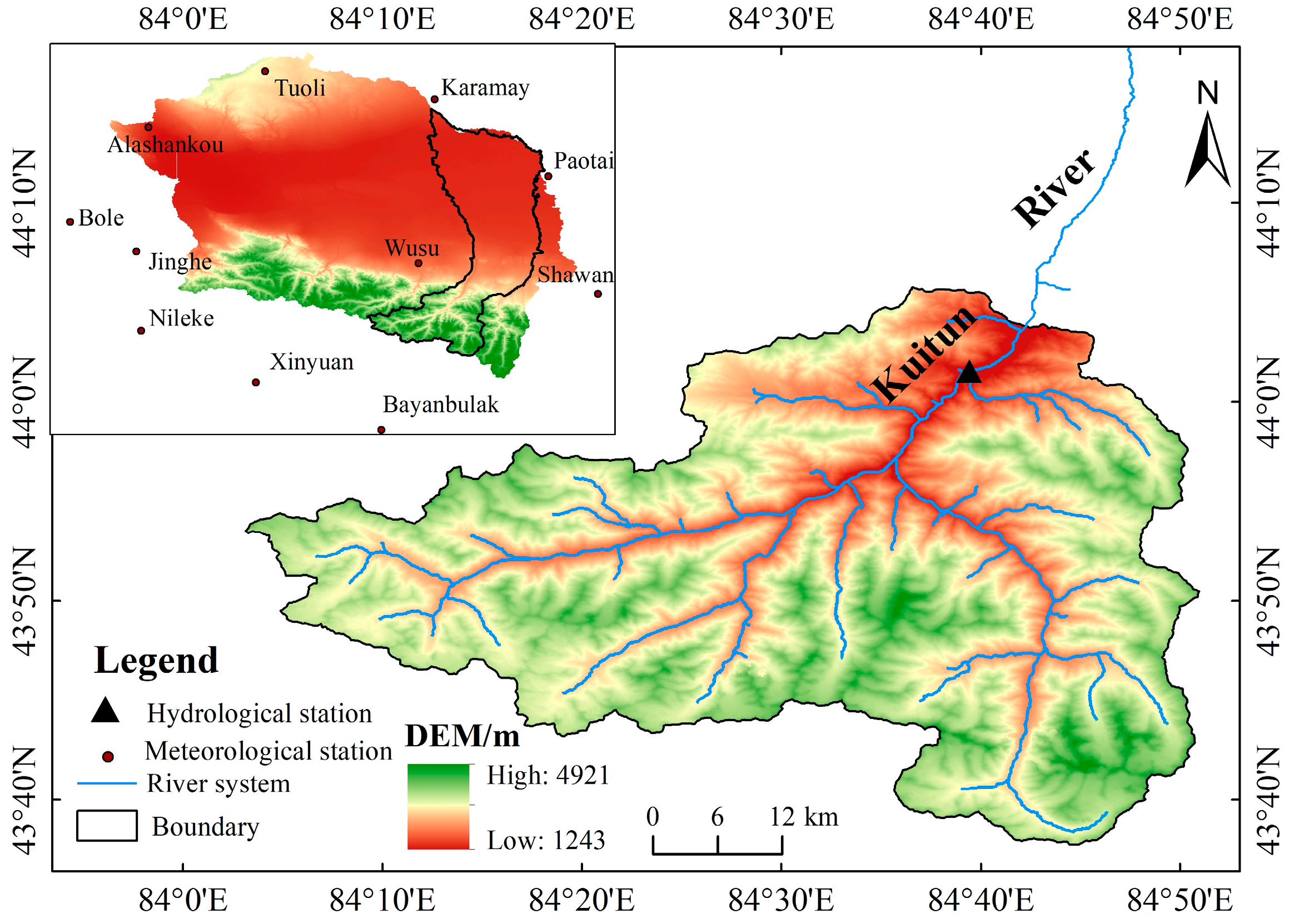
The Kuitun River Basin is located in the central part of the northern Tianshan Mountains in Xinjiang, at the southwestern edge of the Junggar Basin, and originates from Yilianhabierga Mountain in the Tianshan range of Xinjiang. Its geographic coordinates are 83°22′ E to 85°47′ E and 43°30′ N to 45°04′ N (Figure 1). The total area of the basin is approximately 28,300 km2, with elevations ranging from 1000 to 4900 m, with areas above 3500 m being considered high-mountain regions. These areas are characterized by steep terrain and deep valleys, which are critical sources of flood formation. The basin has a typical continental arid climate, with uneven precipitation distribution and intense evaporation. Runoff is primarily replenished by mountain snowmelt and intense rainfall during the flood season, with most of the annual runoff occurring from June to August. The long-term average annual runoff is 6.595 × 10⁸ m3.
This study constructed a flood extreme value sample and climate covariate system based on multisource meteorological and hydrological data. The specific data sources and processing methods were as follows: Flood data were obtained from daily flow observations at the Jiangjunmiao Hydrological Station from 1959 to 2014. The annual maximum method (AM method) was used to extract the annual maximum peak flow (Q), the 1-day maximum flood volumes (W1), the 3-day maximum flood volumes (W3), and the 7-day maximum flood volumes (W7), forming the extreme flood sample. Meteorological data were selected from daily temperature and precipitation records from 11 meteorological stations in the basin and surrounding areas, covering the period from 1959 to 2014 (Table 1). The data were sourced from the National Meteorological Science Data Center (https://data.cma.cn, accessed on 20 September 2023). After performing Kriging spatial interpolation on the daily data, the arithmetic mean method was used to calculate the basin-wide average precipitation and temperature. The snowmelt runoff data were sourced from the National Cryosphere Desert Data Center (www.ncdc.ac.cn, accessed on 31 October 2024), specifically from the 1951–2020 monthly snowmelt dataset for China [35]. This dataset has a long time span and high spatial resolution, which effectively reflects the temporal and spatial distribution and long-term changes in snowmelt resources in the study area.

3. Methods

3.1. Non-Stationarity Test

Theil–Sen slope estimation [36] reveals data trends using robust nonparametric linear regression. This method is computationally efficient and can effectively avoid the impact of data anomalies and different time series lengths on the analysis results. To assess the statistical significance of identified trends, we additionally applied the Mann–Kendall (M-K) nonparametric test. Consequently, an integrated Sen–MK approach was employed for trend detection [37,38], while sliding T-tests and Pettitt tests were applied to identify potential breakpoints in the flood series.

3.2. GAMLSS Model

The GAMLSS model utilizes monotonic link functions to establish relationships between distribution parameters (location, scale, and shape) and explanatory variables [11,39]. The link functions g k ( θ k ) for each parameter are formulated as
g k ( θ k ) = η k = X k β k + j = 1 J k Z j k γ j k
where θ k is an n-dimensional vector; X k denotes an n × I k covariate matrix; β k represents the parameter vector to be estimated, Z j k is the known design matrix, γ j k constitutes a q j k -dimensional random vector following a normal distribution.
This study selects the gamma (GA), Gumbel (GU), logistic (LO), normal (NO), log-normal (LOGNO), and Weibull distribution (WEI) as candidate theoretical distributions for flood extreme value series. The optimal model is selected using the Akaike information criterion (AIC) and Bayesian information criterion (BIC), followed by a comprehensive assessment of residual normality and goodness-of-fit via worm plots, kurtosis coefficient analysis, and Filliben correlation coefficient tests.

3.3. Copula-Based Modeling Approach

Copula functions can couple any number of one-dimensional marginal distributions into a multivariate joint probability distribution function, hence termed a linking function [40]. For n random variables X1, X2, X3, …, Xn, there exists a unique n-dimensional copula function C that satisfies the relationship between their joint distribution function F(x1, x2, ⋯xn) and marginal distribution functions F1(x1), F2(x2), ⋯Fn(xn):
F ( x 1 , x 2 , , x n ) = C F 1 x 1 , F 2 x 2 , , F n x n
The Archimedean copula family, which is characterized by a single parameter, has been widely adopted in flood analysis due to its simple construction and computational convenience [41,42]. Therefore, this study selects the Gumbel–Hougaard, Clayton, and Frank copulas from this family for optimization.

3.4. Bivariate Return Period

Hydrological frequency analysis is used to determine design values at specified frequencies or to establish design standards corresponding to specific flood design values, namely return periods. A flood event is classified as hazardous when its return period exceeds a predetermined design threshold. This study employs both “AND” and “OR” joint probability criteria to derive composite return periods, as formulated below:
T or = 1 P ( U u V v ) = 1 1 C ( u , v )
T a n d = 1 P ( U u V v ) = 1 1 u v + C u , v
where u and v represent the marginal distribution probabilities of flood peak and flood volume, respectively, and C (u, v) denotes the joint distribution probability.

3.5. Parametric Bootstrap-Based Uncertainty Quantification Framework for Joint Design Values

To quantify the impacts of different sources of uncertainty on joint design flood estimation, this study introduces a parametric bootstrap within a “conditional margins with covariates–copula” framework. This method does not rely on asymptotic theory and is suitable for small samples and nonlinear problems; through repeated resampling or parameter perturbation, it quantifies the effects of estimation error and sampling variance on joint design values [43,44,45]. We specifically assess two types of uncertainty: (1) marginal distribution parameter uncertainty and (2) sample size uncertainty. Both analyses are based on generating a large number of pseudo-samples; by computing joint design values and their confidence intervals, we reveal the propagation mechanisms and impacts of the uncertainties.
1.
Marginal Distribution Parameter Uncertainty
We keep the covariate functional forms and copula parameters fixed and apply random perturbations only to the vector of marginal parameter estimates to assess how estimation errors affect the joint design values. The specific steps are as follows:
(1) Obtaining the Marginal Parameter Trajectory: Based on the marginal distribution constructed using the GAMLSS model with covariates, for each year t = 1 , 2 , , 56 , the corresponding covariate observations are substituted into the model to calculate the conditional parameters for peak flow and flood volume:
μ Q , t = μ Q Z t , σ Q , t = σ Q Z t , μ W , t = μ W Z t , σ W , t = σ W Z t
Forming the parameter trajectory of the marginal parameters.
(2) Generation of Bootstrap Parameter Perturbations: Centered on the overall parameter vector θ m , B = 1000 sets of perturbed parameters θ m b are generated based on its estimated covariance matrix V a r ^ θ m :
θ m = μ Q , σ Q , μ W , σ W
(3) Estimation and Statistical Analysis of Joint Design Values: When only marginal parameter uncertainty is considered, with the copula parameter θ c held fixed, the joint design value can be expressed as ( x T , y T ) = g ( θ m , θ c ) ; therefore, the design value in the b-th bootstrap iteration is ( x T ( b ) , y T ( b ) ) = g ( θ ^ m ( b ) , θ ^ c ) . The joint design values under the OR and AND criteria for different return periods T 5 , 10 , 20 , 50 , 100 , 200 are then calculated according to Equations (3) and (4). The results from the 1000 simulations are aggregated, and a 95% confidence interval C I 95 % = Q 2.5 % , Q 97.5 % is constructed using the empirical quantile method; the interval width is then calculated to quantify the effect of marginal parameter uncertainty on the joint design values.
2.
Sample Size Uncertainty
With the model structure fixed, n = 56, 200, 400, and 500 are taken in turn to refit the marginal distributions with covariates and the copula structure; a bootstrap is then employed to simulate the sampling–estimation process under different sample sizes, thereby quantifying the uncertainty caused by changes in finite sample size. The procedure is outlined as follows:
(1) Generation of Covariate Trajectories: A covariate sequence Z t * t = 1 n of length n is obtained by sampling with replacement from the empirical distribution of historical covariates Z t .
(2) Joint Sample Simulation and Model Re-fitting: Samples U t , V t C θ are drawn from the baseline copula, and simulated samples are generated via the conditional inverse transform:
Q t * = F Q Z 1 U t Z t * ; μ Q , σ Q , W t * = F W Z 1 V t Z t * ; μ W , σ W
Subsequently, the GAMLSS conditional marginal parameter function μ . Z , σ . Z is re-estimated using Q t * , Z t * and W t * , Z t * , and the simulated samples are transformed into pseudo-observations, followed by re-estimating the copula parameters θ ^ c using the maximum likelihood method.
u t = F Q Z Q t * , Z t * , v t = F W Z W t * , Z t *
(3) Estimation and Statistical Analysis of Joint Design Values: For the b-th simulation with a sample size of n, the marginal parameters θ ^ m ( b , n ) and copula parameters θ ^ c ( b , n ) are re-estimated, and the joint design value can be expressed as ( x T , y T ) = g ( θ m , θ c ) ; thus, the design value in the b-th simulation is ( x T ( b , n ) , y T ( b , n ) ) = g ( θ ^ m ( b , n ) , θ ^ c ( b , n ) ) . Calculate the joint design values under the AND and OR criteria for a return period T. The above procedure is repeated B = 1000 times to obtain the sampling distribution of joint design values for a sample size of n , and calculate their mean, 95% confidence interval, and the highest density region (HDR) area S. Finally, by comparing results across different sample sizes, the convergence behavior of uncertainty with respect to sample size is analyzed.

4. Results and Analysis

4.1. Test for Non-Stationarity of Peak Flow and Flood Volume Sequences

Under the background of climate change, many studies have conducted trend analysis and change-point detection on hydrological series and found that these series no longer satisfy the assumption of stationarity [5,46]. Statistics indicate that extreme hydrological events occur frequently in the Kuitun River Basin. Since 2011, more than 130 debris-flow disasters have been recorded, and catastrophic mixed-type floods occurred in 1987, 1996, and 1999, causing repeated damage to hydraulic infrastructure and substantial economic losses [47]. Therefore, the Sen–MK trend test combined with the sliding t-test and the Pettitt test was applied to diagnose the non-stationarity of the flood series in the Kuitun River. The results (Table 2) show that the Sen slopes of all flood series are greater than zero, indicating an overall increasing trend. Both the sliding t-test and the Pettitt test consistently identify 1986 as a significant change point. In summary, the flood series of the Kuitun River exhibits significant non-stationary characteristics, necessitating the construction of a non-stationary model for accurate flood risk assessment.

4.2. Analysis of Flood-Driving Factors

In view of the formation mechanism of rainstorm–snowmelt mixed floods in the Kuitun River Basin, three types of climatic covariates were selected: precipitation, temperature, and snowmelt volume. Specifically, precipitation was represented by the mean precipitation from June to August (P6–8) and the annual mean precipitation (P) as covariates. The period from June to August corresponds to the concentrated rainfall season in the basin, during which intense precipitation can rapidly enhance runoff generation, elevate peak discharge, and increase flood volume. The annual precipitation reflects the background precipitation conditions at the annual scale. Air temperature was represented by the average temperatures in spring (March–May, T3–5), summer (June–August, T6–8), and the flood season (May–September, T5–9). Elevated spring temperatures accelerate snowmelt, increasing early-season meltwater runoff and providing a water supply basis for flood formation. During the flood season, air temperature influences flood volume and duration by regulating snowmelt rate and evaporation losses. During the non-flood season, precipitation in the basin is scarce, and winter snow serves as the primary water storage. Therefore, the accumulated snowmelt volume from October to May of the following year (S) was constructed as a covariate to quantify its driving effect on flood variation.

4.2.1. Quantifying the Contribution of Individual Climatic Factors Using GAMLSS

To effectively characterize the dynamic behavior of flood processes and investigate the influence mechanisms of different climatic factors on flooding, this study incorporates temporal variables into both location and scale parameters within the GAMLSS framework. Model selection was then performed by optimizing the model structure from six candidate distributions based on the minimization criteria of GD, AIC, and BIC, ultimately identifying the LOGNO distribution as the optimal baseline model (Table 3). Building on this foundation, while maintaining temporal variables, climatic factors, including summer precipitation (P6–8) and spring temperature (T3–5), were individually incorporated into either μ or σ parameters. By comparing improvements in model goodness-of-fit, the independent contribution of each factor to flood variation was identified.
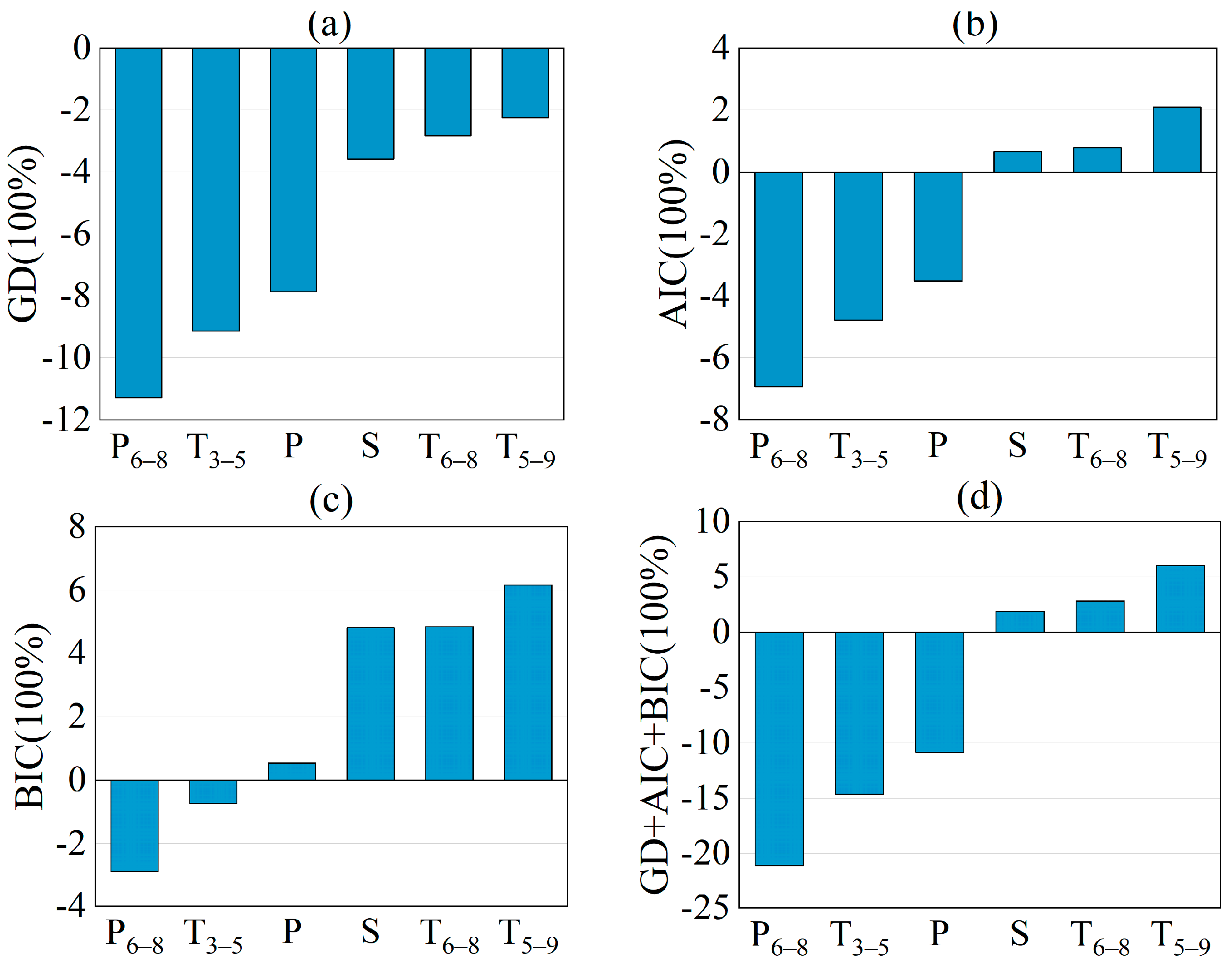
The changes in information criteria resulting from individually embedding each factor into either μ or σ (Table 4), along with their corresponding improvement magnitudes and cumulative effects (Figure 2), demonstrate that only summer precipitation (P6–8) and spring temperature (T3–5) led to consistent and significant decreases in the criteria. The contributions of other variables were limited, with some indicators even showing an increase. Specifically, summer precipitation (P6–8) provided the most significant improvement to model performance. The GD values for the location and scale parameters decreased by 7.49 and 3.80, respectively, accompanied by notable reductions in both AIC and BIC. Spring temperature (T3–5) reduced the scale GD by 5.66 and the location GD by 3.47, indicating its strong explanatory power for flood generation. In contrast, both flood-season temperature (T5–9) and summer temperature (T6–8) contributed the least to the model, with most evaluation metrics showing increases. The inclusion of snowmelt volume (S) enhanced the explanatory power of some models to a certain extent, as evidenced by decreases in the location and scale GD values of 1.88 and 1.71, respectively. However, the AIC and BIC showed no marked improvement. This suggests that the influence of snowmelt on flooding is complex, likely driven by temperature and also closely related to factors such as antecedent snowpack storage and the superposition of precipitation during the melt period.
Overall analysis indicates that summer precipitation (P6–8) exerts the most direct and pronounced control on the annual maximum flood peak. Spring temperature (T3–5) influences flood generation indirectly by modulating the snowmelt process. The remaining temperature and snow-related variables make only limited overall contributions. Overall, floods in the Kuitun River are driven by the coupled effects of precipitation, temperature, and snowmelt; consequently, flood modeling and risk assessment should account for the coordinated influence of multiple climatic drivers.

4.2.2. Screening of Key Climatic Covariates for Flood Series

The copula entropy (CE) method, based on copula functions and entropy theory [48,49], does not require assumptions regarding the dependence form or marginal distribution and is capable of capturing nonlinear structures and tail dependence between variables. In this study, this method is employed to screen climate-driven factors and identify key covariates influencing flood characteristics.
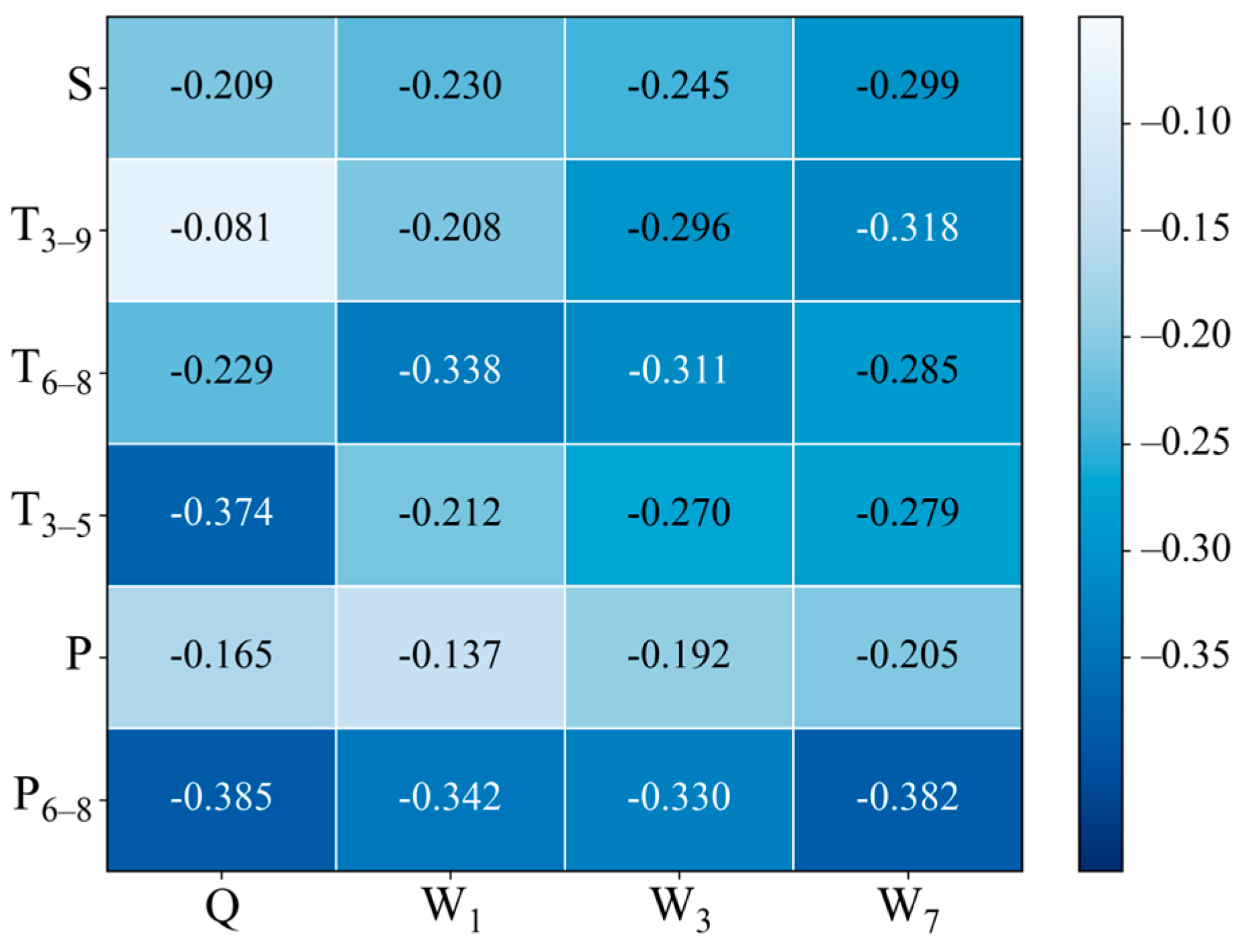
As illustrated in Figure 3, summer precipitation (P6–8) exhibits the strongest statistical dependence with the flood series. Among temperature variables, spring temperature (T3–5) shows the strongest dependence on the Q series, with an entropy of −0.374. Summer temperature (T6–8) has a relatively strong dependence on the W1 and W3 series, with entropies of −0.338 and −0.311, respectively. Flood-season temperature (T5–9) is most prominent in the W7 series. Snowmelt (S) shows at least moderate dependence on all flood series. In summary, P6–8, S, and temperature variables corresponding to different flood characteristics were selected as covariates for subsequent non-stationary flood frequency analysis in the Kuitun River Basin.

4.3. Construction and Selection of Marginal Distribution Models for Flood Series

Within the GAMLSS framework, we build stationary and non-stationary models for the flood series at the Jiangjunmiao Hydrological Station. Based on simulation performance evaluation, the LOGNO distribution provides the best fit (Table 5). For the annual maximum flood peak (Q), the AIC of the non-stationary model (557.70) is markedly lower than that of the stationary model (567.51). For the W1, W3, and W7 series, the non-stationary models also yield lower AIC values than their stationary counterparts, indicating that incorporating meteorological factors and snowmelt effectively improves model fit and corroborates the presence of non-stationary behavior in the flood series.
The parameter structure of the optimal model further reveals that the location parameter (μ) of the Q series is independently driven by precipitation (P6–8), reflecting the direct regulatory effect of precipitation on flood peaks, while the scale parameter (σ) is jointly influenced by spring temperature (T3–5) and snowmelt runoff volume (S), indicating the synergistic effects of rising temperatures and snowmelt processes on flood variability. For the W1 and W3 series, the non-stationarity primarily manifests in the dynamic characteristics of the location parameter (μ), whereas for the W7 series, both the location (μ) and scale parameters (σ) of the optimal distribution model vary with covariates, demonstrating the non-stationary nature of the flood series and the complex influences of multiple factors.
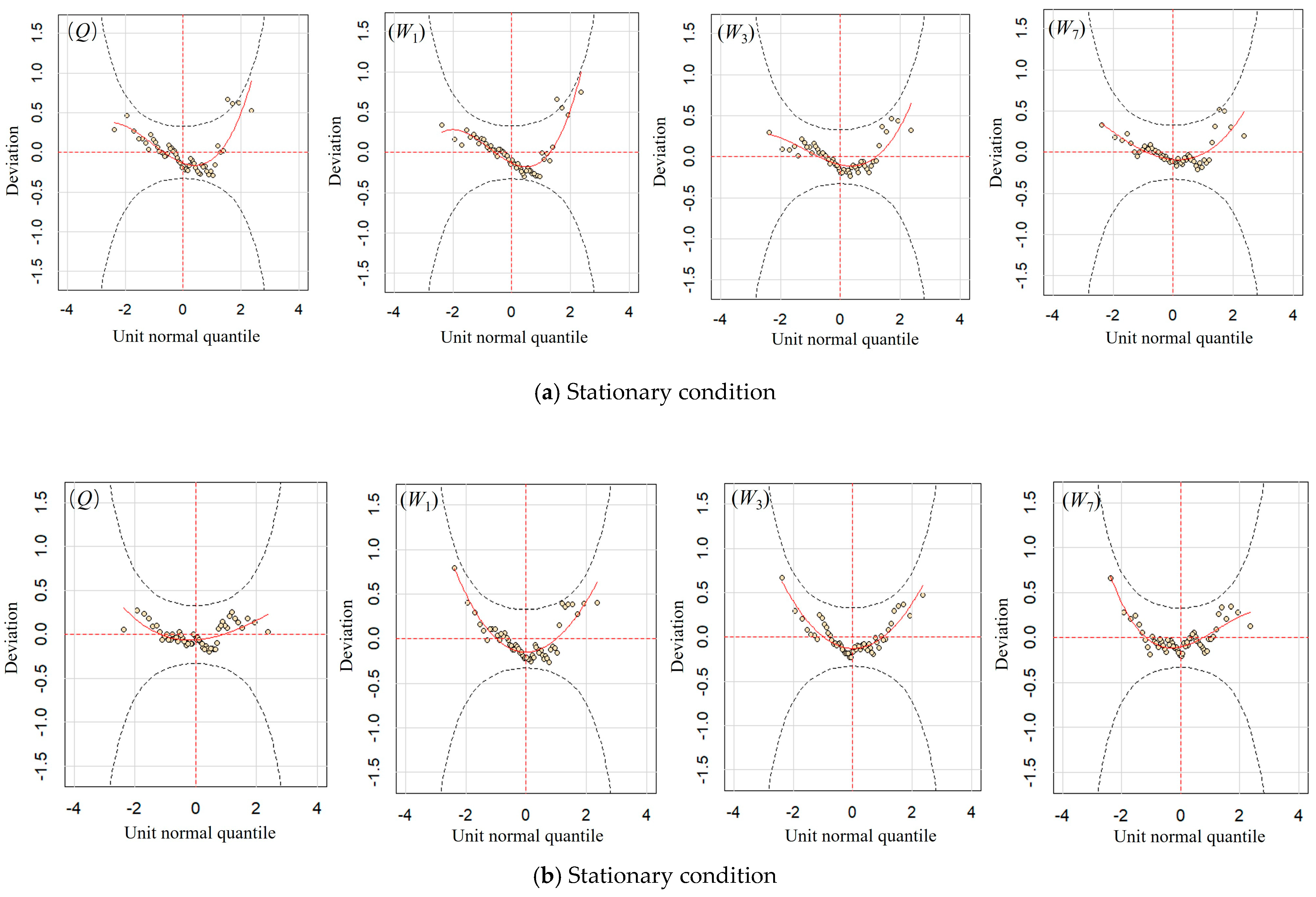
Analysis of the worm plots (Figure 4) for the optimal models of each flood series demonstrates that the model residuals are distributed along the red theoretical distribution curve and predominantly fall within the black boundary lines representing the 95% confidence interval, confirming that the residuals satisfy the normality assumption. The quantile residual evaluation metrics (Table 6) reveal that all model residuals exhibit a mean approximating 0, variance close to 1, a kurtosis coefficient near 3, and Filliben correlation coefficients exceeding 0.95, collectively verifying the well-behaved residual distribution and excellent model fit. Compared to stationary models, the non-stationary models demonstrate superior performance in terms of both symmetry and stability of residual distributions.
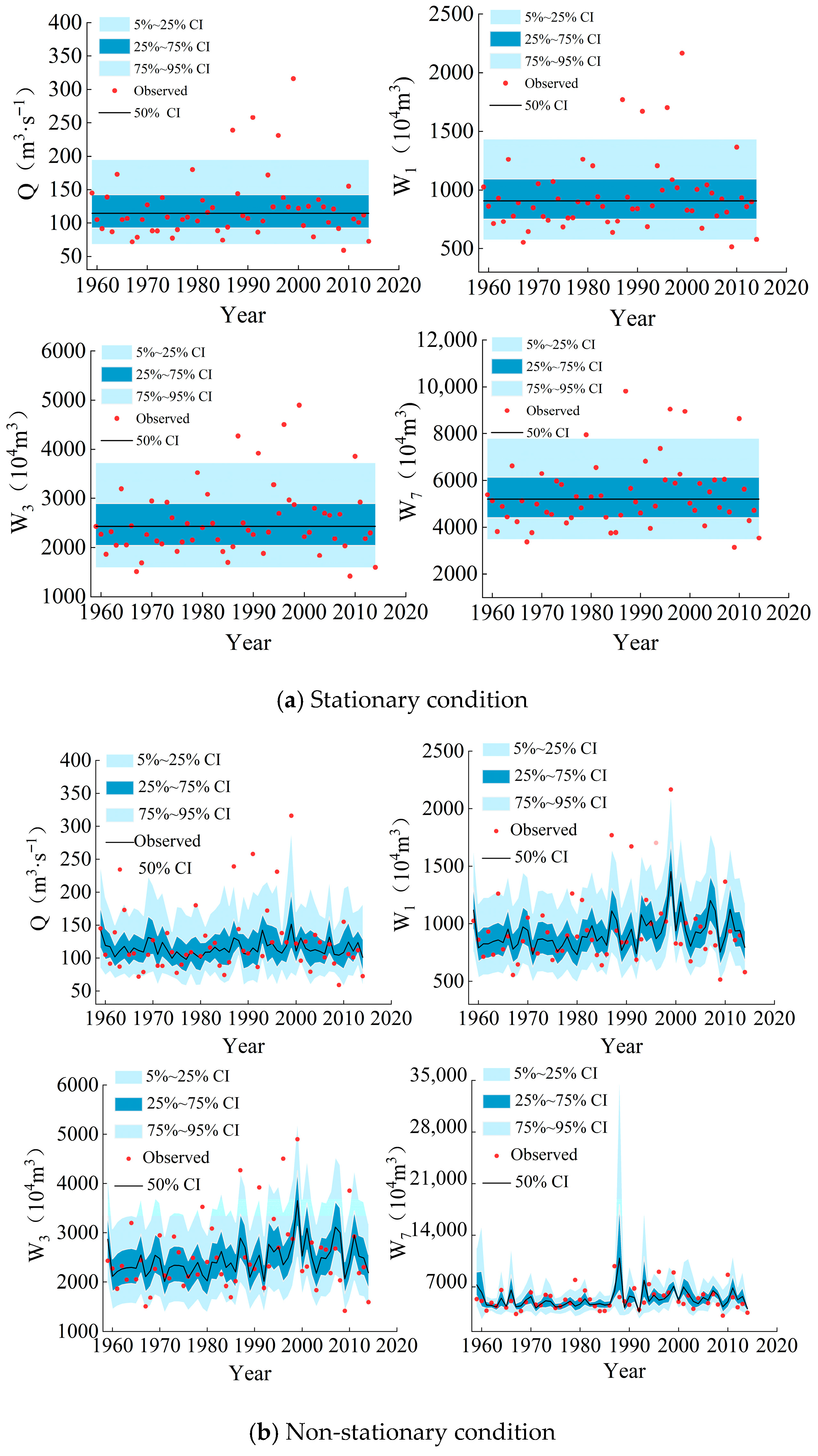
Under the optimal model parameters, the 5th–95th percentile envelope, which includes the 50th percentile (median), is shown in Figure 5. The results show that most data points of the flood series fall within the percentile envelope intervals; the non-stationary model incorporating climatic factors as covariates can not only reveal long-term trends of floods but also capture their short-term fluctuations, adequately demonstrating the rationale for incorporating climatic factors as covariates in flood fitting procedures and their capability to effectively characterize the dynamic behavior of floods.
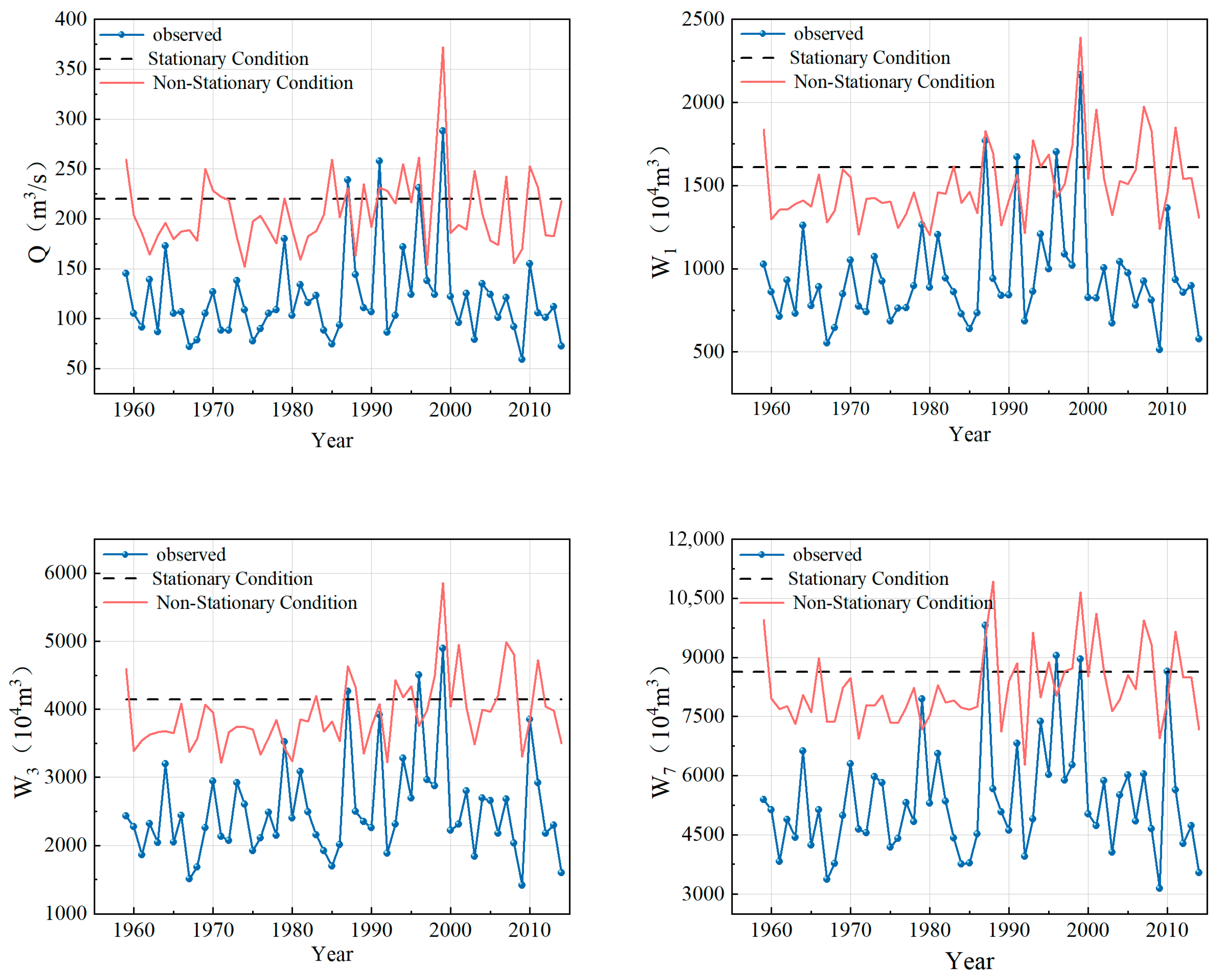
Based on the fitted marginal distributions, the 50-year return level of the flood characteristic series was calculated (Figure 6). As shown in Figure 6, the design value derived from the traditional stationary model remains constant throughout the study period, ignoring changes in the basin’s environmental background. In contrast, the non-stationary design values exhibit significant interannual variability, clearly reflecting the dynamic regulatory effects of covariates such as summer precipitation and spring temperature on flood risk. Comparative results show that following the abrupt change in 1986 to the early 2000s, the risk levels estimated by the non-stationary model were significantly higher than those derived from the stationary model. In particular, a pronounced peak in the design value was observed in 1999, which can be attributed to the combined effects of extreme rainfall and high temperatures that triggered large-scale snowmelt within the basin during that year. This phenomenon indicates that if traditional stationarity assumptions are adopted in hydraulic infrastructure design, the actual flood risk may be substantially underestimated in years of extreme environmental change, thereby posing a threat to engineering safety.

4.4. Construction and Selection of the Joint Distribution Model for Flood Peak and Volume

Considering interdependence among variables, we use Kendall, Spearman, and Pearson measures to quantify pairwise dependence (Table 7). The flood variables exhibit generally strong correlations, among which Q and W1 show the strongest association at the 5% significance level. Therefore, we select Q and W1—the most strongly correlated pair—as the core variables for subsequent flood risk analysis.
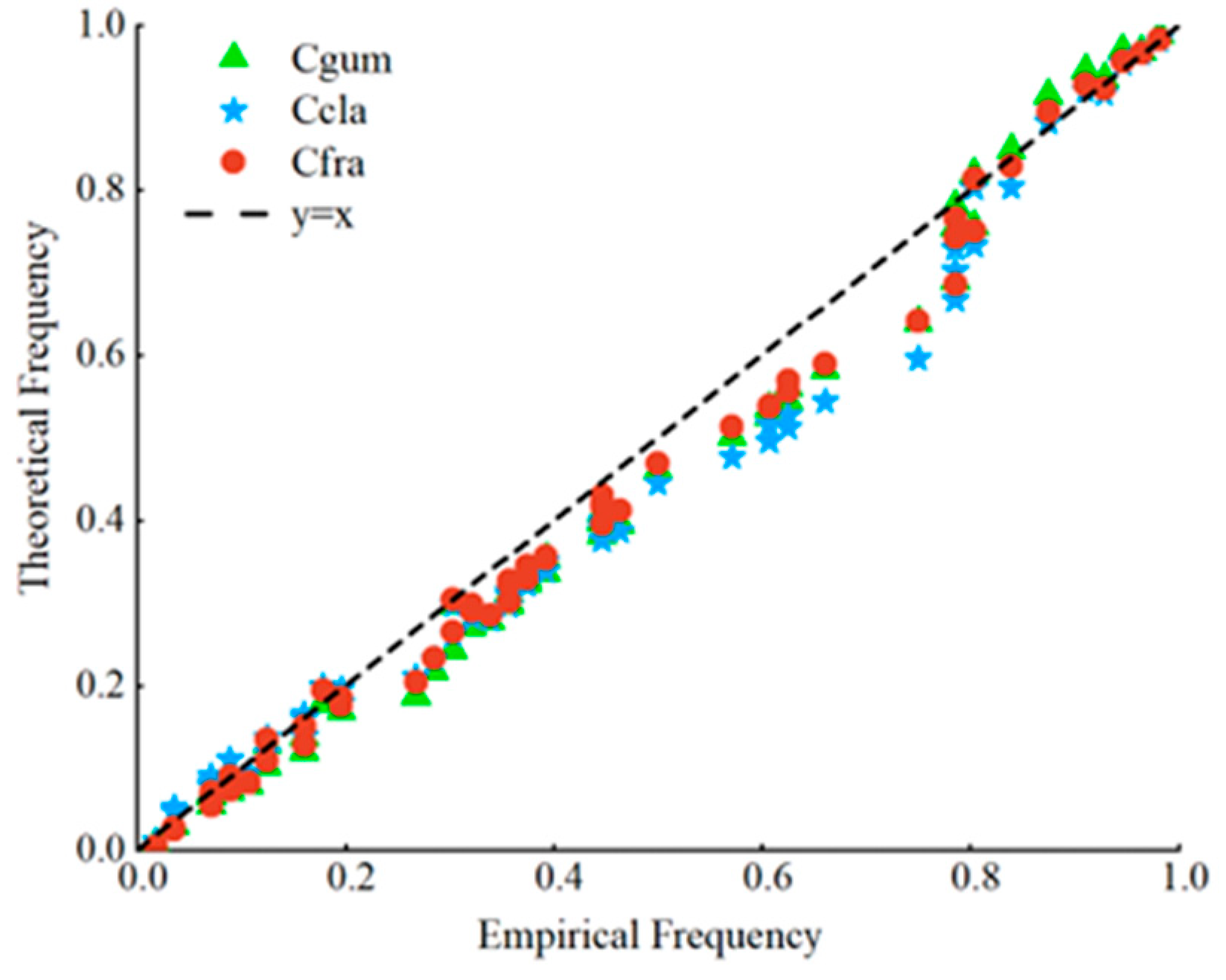
We adopt the LOGNO distribution—selected as optimal under the non-stationary modeling—as the marginal distributions for Q and W1 and employ a copula to construct their joint distribution model. By comparing the goodness of fit of the Gumbel, Clayton, and Frank copulas (Table 8), we find that the Frank copula performs best across all criteria and clearly outperforms the Gumbel and Clayton copulas. The theoretical–empirical frequency fitting curves (Figure 7) further show that the Gumbel copula lies slightly above the reference line in the upper tail, the Clayton copula exhibits systematic bias in the mid-to-high range, and the Frank copula shows the smallest overall deviation from the reference line across the entire probability range and the best global fit, accurately characterizing the joint distribution of flood peak and volume; therefore, we chose the Frank copula as the final dependence structure for the QW1 joint distribution for subsequent joint design estimation and uncertainty-risk assessment.

4.5. Flood Risk Assessment Under Non-Stationary Conditions Considering Uncertainties

4.5.1. Impact of Marginal Distribution Parameter Uncertainty on Flood Risk

To quantify the impact of marginal distribution parameter uncertainty on joint design values, this study perturbs the marginal distribution parameters 1000 times using a parametric bootstrap approach under the current mean climate baseline. The calculated univariate design values and their 95% confidence intervals (Table 9) show that both the design values and associated uncertainty intervals increase markedly with the return period. At the T = 5-year return period, both Q and W1 show relatively low mean values (143.04 m3/s and 1087.41 × 104 m3, respectively) with narrow confidence interval widths. When the return period increases to T = 100 a, the mean of Q rises by 53%, while its confidence interval width expands from 8.14 m3/s to 29.21 m3/s, representing a 259% increase, nearly five times the mean increase. For W1, the mean increases by 43%, and the interval width grows from 99.70 × 10⁴ m3 to 142.77 × 10⁴ m3, also a 43% increase that is broadly in step with the mean change. Therefore, to more comprehensively characterize the uncertainty of extreme floods, it is necessary to further evaluate the joint risk of flood peak and volume within a joint-distribution framework.
Within the joint distribution framework, both the design values and the confidence intervals similarly widen as the return period increases (Table 10). The results show that the design values under the OR criterion are systematically higher than those under the AND criterion. For the 100-year event, the OR-based flood peak and volume exceed the AND-based values by 24.15% and 19.78%, respectively, and the difference between the two criteria increases with return period. Compared with the univariate results (Table 9), the design flood peak (234.05 m3/s) and the annual maximum 1-day flood volume (1650.01 × 104 m3) under the joint OR criterion are 6.97% and 5.96% higher, respectively. This indicates that neglecting variable interdependence would lead to a systematic underestimation of flood protection standards. Regarding uncertainty, the confidence interval widths under the OR criterion are generally larger than those under the AND criterion. Taking the T = 100-year case as an example, the confidence interval width for Q increases from 19.76 m3/s to 34.33 m3/s, representing a 73.73% rise in uncertainty, while that for W1 expands from 126.29 × 10⁴ m3 to 151.28 × 10⁴ m3, an increase of 19.78%. These findings demonstrate that the OR criterion is more sensitive to parameter uncertainty, with its response being particularly pronounced when assessing extreme flood risks.
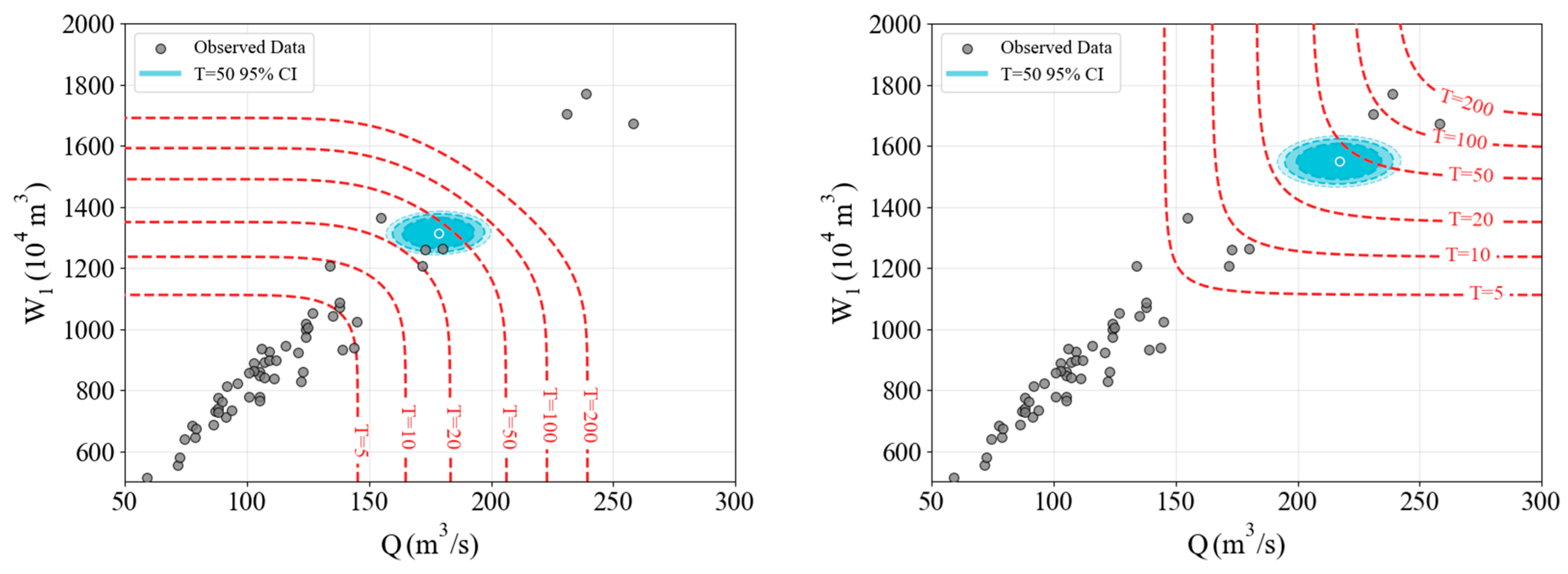
A comparison between the deterministic joint return period contour and the 95% confidence region considering parameter uncertainty under the T = 50-year condition (Figure 8) elucidates the significant impact of parameter uncertainty on design values. When parameter uncertainty is accounted for, the confidence region for the joint design event substantially exceeds the traditional deterministic contour. Furthermore, this region progressively expands outward as the confidence level increases. At the 95% confidence level, the potential variation range of the 50-year joint design value approximately spans the joint quantile levels corresponding to return periods from 20 to 100 years. This indicates that estimation errors in the marginal parameters are propagated and amplified through the joint distribution structure.

4.5.2. Impact of Sample Size Uncertainty on Flood Risk

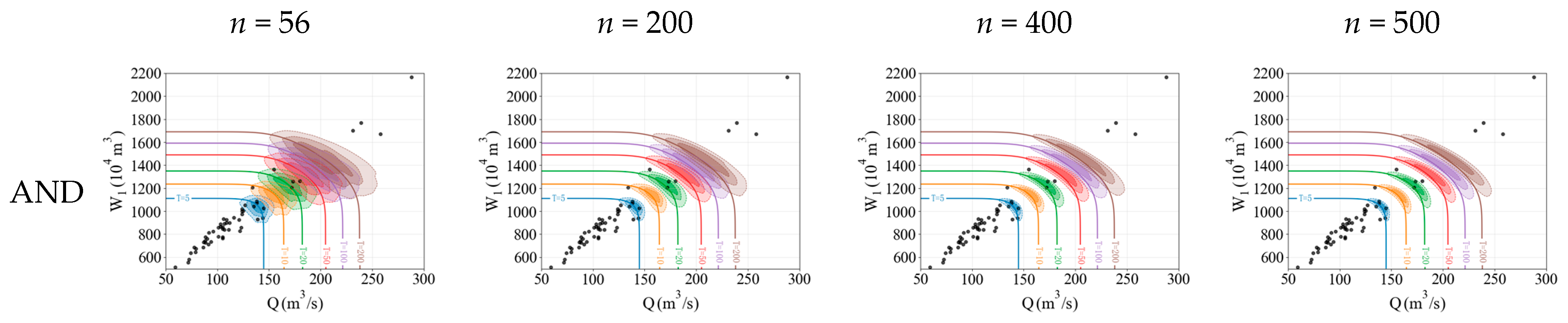
After clarifying the influence of marginal parameter perturbations on joint design values, the sampling uncertainty arising from variations in sample size was further analyzed. A comparison of the joint return-period contours and the HDR 75% confidence contours across return-period levels (Figure 9) shows that as the sample size increases from 56 to 500, the confidence regions under both criteria shrink markedly and tend to converge. Under the original sample (n = 56), the confidence region is highly dispersed, particularly at the extreme return period (T = 200a), indicating high uncertainty in joint-quantile estimates under small-sample conditions. As the sample size increases, the confidence region gradually converges and becomes more spatially concentrated; when n reaches 400 and 500, the region contracts noticeably, and the estimates become more spatially consistent, showing that larger samples substantially improve the stability and reliability of joint-quantile estimation. Compared with the AND criterion, the OR criterion yields generally wider confidence regions and higher uncertainty at the same confidence level.
Based on the patterns of uncertainty variation in joint design flood estimates across sample sizes (Table 11), all uncertainty metrics decrease substantially and systematically as sample size increases. Under the AND criterion, when the sample size increases from 56 to 500, the 100-year joint confidence-region area decreases from 248.40 × 10⁶ m6/s to 81.40 × 10⁶ m6/s (a 67.2% reduction), and the 95% confidence interval widths of Q and W1 shrink by 68.9% and 67.1%, respectively. Under the OR criterion, the reduction in the joint area (69.2%) is slightly higher than under the AND criterion, whereas the reductions in the interval widths of Q and W1 (about 68% and 67%) are slightly lower than under the AND criterion; however, the absolute widths of their confidence intervals are systematically greater than those under the AND criterion. Overall, enlarging the sample size markedly improves the stability and reliability of joint design flood estimates. Therefore, when deriving joint design floods from limited samples, it is essential to explicitly evaluate and fully account for sample-size-driven estimation uncertainty to ensure reliability and safety in engineering design.

5. Discussion

Floods in the Kuitun River Basin are subject to multiple influences from climate change. Among these, summer precipitation (P6–8) exhibits the most pronounced impact on the basin’s hydrological processes. The basin, located on the northern slope of the Tianshan Mountains, is influenced by large-scale westerly circulation, which facilitates orographic lifting of summer moisture and results in widespread and persistent rainfall [50]. Combined with the steep and deep upstream topography that promotes rapid convergence, this precipitation can quickly convert into concentrated runoff within a short time, producing floods with high peaks and rapid response. The inclusion of spring temperature (T3–5) also significantly improved model performance. This phenomenon can be attributed to rising spring temperatures accelerating the melting of high-mountain snowpack, which increases stream baseflow in the short term. This finding is highly consistent with the seasonal characteristics of the “spring flood” phenomenon observed in Xinjiang [51,52]. In contrast, both flood-season temperature (T5–9) and summer temperature (T6–8) contributed the least to the model. This conclusion aligns with the findings of Wang et al. [53], who reported no significant correlation between temperature and runoff during the relatively warm months from June to October. Furthermore, the shift in flood-driving mechanisms from snowmelt dominance to precipitation dependence increases model uncertainty [54].
In traditional flood risk analysis using copula functions, marginal distributions are typically constructed under the assumption of stationarity [55]. In assessing bivariate flood risk, this study employed a joint design framework that integrates GAMLSS with copula functions, effectively addressing non-stationarity, multivariate dependence, and uncertainty quantification in the Kuitun River Basin. Similar non-stationary joint modeling approaches have been successfully applied in other basins strongly affected by climate change, such as the Huai River and Han River basins [46,56], demonstrating the applicability of this method for handling multi-driver, non-stationary hydrological series. In arid-region flood risk analysis, He et al. applied the CAMLSS model to conduct non-stationary snowmelt flood frequency analysis in the Manas River Basin [57], while Khajehali et al. employed copula-based multivariate frequency analysis in the Kan River Basin in Iran [58], revealing non-stationary flood behaviors under climate change. Few studies have combined GAMLSS with copula functions for flood risk assessment in arid regions. The core approach adopted in this study—introducing climatic covariates to construct marginal distributions and combining them with copula functions to capture multivariate dependence structures—can effectively accommodate the hydrological characteristics of floods in arid and snowmelt-affected regions, where floods are nonlinearly driven by multiple factors such as precipitation, air temperature, and snowmelt. The approach is generally transferable; however, in practical applications, local adjustments such as covariate selection and uncertainty quantification based on the specific hydrological processes of the study area are recommended to ensure model robustness.
The study reveals that parameter uncertainty introduces considerable variability into design flood estimates. Taking the T = 50-year case as an example, under the 95% confidence level, the most probable joint design point corresponds to a joint return period ranging approximately from 20 to 100 years. This indicates that, under limited sample conditions, the point estimates for design floods with higher return periods are unstable, and the associated uncertainty exhibits a significant amplification effect with increasing return periods. This finding aligns with recent research [33,35]. Sample size exerts a significant influence on the uncertainty of joint design values. When the sample size is small, the estimation of tail dependence structures is highly sensitive to extreme sample points, which may introduce substantial sampling errors and amplify the uncertainty of the estimates. Hu et al. addressed the uncertainty in hydrological design value estimation under small-sample conditions and proposed a bootstrap resampling-based approach, demonstrating that this method exhibits strong robustness with respect to the choice of parameter estimation techniques [59]. Dung et al. and Yin et al., by integrating copula and bootstrap analyses, found that increasing sample size can effectively reduce uncertainty in flood estimation, which is consistent with the findings of this study [30,60]. Therefore, in data-scarce basins where additional observations cannot be obtained, the bootstrap method can be employed to estimate and quantify biases and uncertainties arising from limited sample size, thereby providing confidence interval references for flood control and safety decision-making.
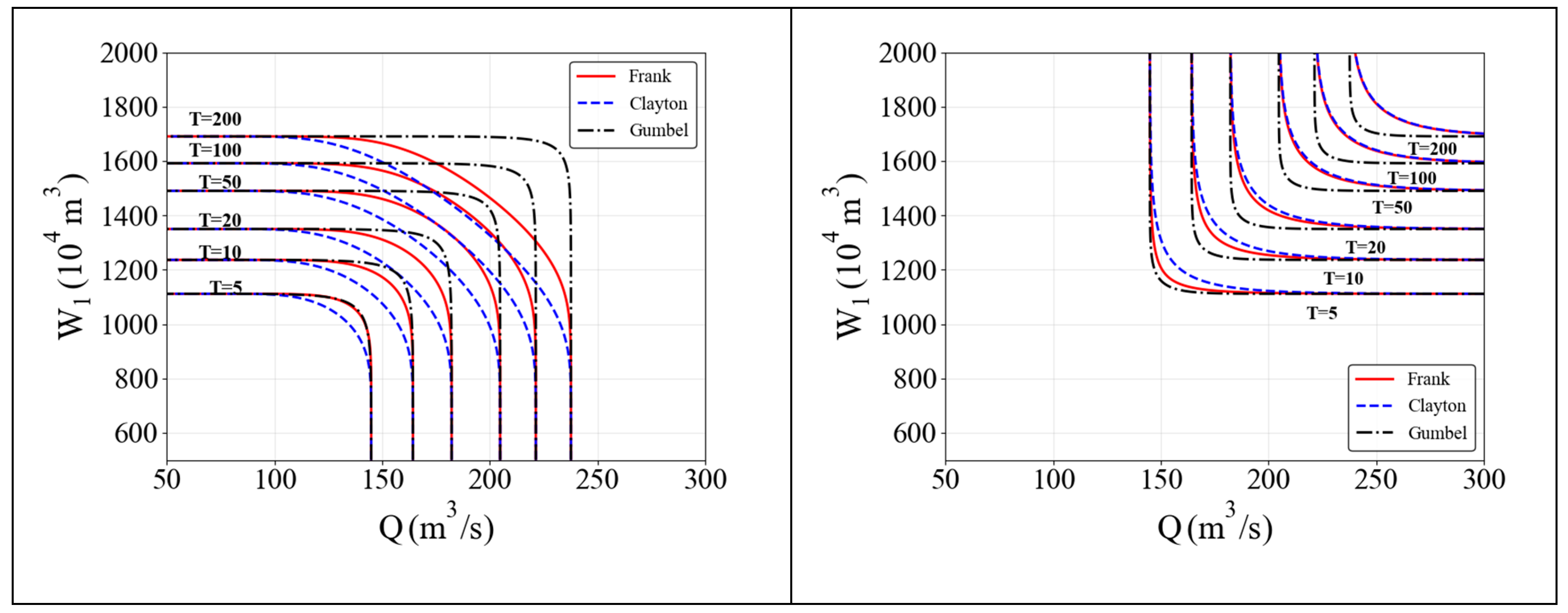
In addition, model structural uncertainty is an important source of uncertainty in flood design values. In this study, the statistically optimal model structure was selected based on information criteria, which partly mitigates the bias caused by subjective model selection; however, differences in results may still exist between alternative structures. Comparing the contour plots of the three copula structures under the AND criterion (Figure 10) reveals that, at the same return period, the joint design results differ among the copula structures. Moreover, as the return period increases, structural uncertainty is amplified in the extreme tail regions. Specifically, the Gumbel copula, which exhibits upper-tail dependence, produces higher joint design estimates than the Frank and Clayton copulas under high return periods, whereas the Clayton copula, emphasizing lower-tail dependence, yields relatively lower estimates under extreme scenarios. This indicates that the choice of model structure has a significant impact on flood risk assessment results, and neglecting structural uncertainty may lead to underestimation or overestimation of extreme flood risk. In practical applications, a comparative analysis of multiple model structures should be conducted, and a model structure ensemble approach [61] should be employed to balance the differing performances of individual structures in extreme flood simulations, thereby enhancing the robustness of the design outcomes.
Despite successfully overcoming the limitation of the stationary marginal distribution assumption in traditional copula analysis by introducing the GAMLSS model and thoroughly investigating the influences of marginal distribution parameters and sample size on the uncertainty of joint design values, this study has the following limitations. In the flood risk calculation, this study was conducted assuming a mean climate scenario, so the resulting design values and their uncertainties reflect risk levels under the given climate conditions. However, the non-stationarity of covariates over time was not considered. Future research could further couple climate projection scenarios or consider the probability distributions of climatic factors to enable a more comprehensive assessment of design flood risk under changing environmental conditions.

6. Conclusions

Floods in the Kuitun River Basin are co-influenced by multiple factors, including precipitation, temperature, and snowmelt, with summer precipitation being the primary driver. Based on the non-stationarity diagnosis, this study constructed climate-driven GAMLSS-based marginal distribution models, which were then coupled with the Frank copula to establish a joint distribution of flood peak and volume. Within this framework, a parametric bootstrap method was employed to systematically quantify the impacts of uncertainties in both marginal parameters and sample size on flood design values under climate change. The results show that: (1) The joint design approach that couples GAMLSS with copula functions captures nonlinear relationships between flood variables and multiple drivers as well as multivariate dependence structures, provides a feasible pathway for modeling flood processes under non-stationary conditions, and is more flexible than traditional stationary frequency analysis. (2) Uncertainty in marginal parameters is markedly amplified at high return periods, and the confidence interval of the design value expands appreciably with increasing return period (T); meanwhile, the OR criterion is more sensitive to tail perturbations of the parameters and yields an overall wider uncertainty range than the AND criterion. (3) Sample size uncertainty mainly arises from limited observational records and insufficient representativeness. Under small-sample conditions, the HDR confidence region of joint design floods is wide and exhibits dispersed boundaries; as sample size increases, the convergence of the joint-distribution estimates improves markedly, and their stability increases. When the sample size increases from 56 to 500, the reductions in all uncertainty metrics exceed two-thirds.
This study quantitatively analyzed the coupled effects of flood non-stationarity and uncertainty on flood design values under a mean climate scenario, highlighting the necessity of explicitly quantifying and communicating uncertainty in regional flood risk studies. In the context of ongoing climate change, future research could further incorporate the temporal variability of covariates into the joint frequency framework to enhance the robustness of long-term design flood estimates and support decision-making.

Author Contributions

Y.H.: Writing—original draft, Software, Methodology. F.C.: Writing—review and editing, Supervision, Project administration, Funding acquisition. C.H.: Writing—review and editing, Investigation. X.X.: Validation, Supervision. T.W. and F.Z.: Data curation, Conceptualization. All authors have read and agreed to the published version of the manuscript.

Funding

This research was funded by the National Natural Science Foundation of China (Grant Nos. 52569004, 52169005) and the Corps Science and Technology Innovation Talents Program Project (Grant No. 2023CB008-08).

Data Availability Statement

The data presented in this study are available on request from the corresponding author due to privacy.

Conflicts of Interest

The authors declare that they have no conflicts of interest.

References

  1. Xu, Z.; Chen, H.; Ren, M.; Cheng, T. Progress on disaster mechanism and risk assessment of urban flood/waterlogging disasters in China. Adv. Water Sci. 2022, 31, 713–724. [Google Scholar] [CrossRef]
  2. Clarke, B.; Otto, F.; Stuart-Smith, R.; Harrington, L. Extreme weather impacts of climate change: An attribution perspective. Environ. Res. Clim. 2022, 1, 012001. [Google Scholar] [CrossRef]
  3. Xie, P.; Chen, G.; Lei, H.; Wu, F. Hydrological alteration diagnosis system. J. Hydroelectr. Eng. 2010, 29, 85–91. [Google Scholar]
  4. Li, R.; Xiong, L.; Jiang, C.; Li, W.; Liu, C. Quantifying multivariate flood risk under nonstationary condition. Nat. Hazards 2023, 116, 1161–1187. [Google Scholar] [CrossRef]
  5. Wang, H.; Huang, S.; Fang, W.; Dai, M.; Huang, Q. Bivariate flood risk assessment considering non-stationary model. J. Xi’an Univ. Technol. 2020, 36, 507–515. [Google Scholar] [CrossRef]
  6. Song, M.; Zhang, J.; Liu, Y.; Liu, C.; Bao, Z.; Jin, J.; He, R.; Bian, G.; Wang, G. Time-varying copula-based compound flood risk assessment of extreme rainfall and high water level under a non-stationary environment. J. Flood Risk Manag. 2024, 17, e13032. [Google Scholar] [CrossRef]
  7. Stephens, T.A.; Bledsoe, B.P. Flood Protection Reliability: The Impact of Uncertainty and Nonstationarity. Water Resour. Res. 2023, 59, e2021WR031921. [Google Scholar] [CrossRef]
  8. Liang, Z.; Hu, Y.; Wang, J. Advances in hydrological frequency analysis of non-stationary time series. Adv. Water Sci. 2011, 22, 864–871. [Google Scholar] [CrossRef]
  9. He, C.; Chen, F.; Wang, Y.; Long, A.; He, X. Flood frequency analysis of Manas River Basin in China under non-stationary condition. J. Flood Risk Manag. 2021, 14, e12745. [Google Scholar] [CrossRef]
  10. Rohmer, J.; Thieblemont, R.; Le Cozannet, G. Revisiting the link between extreme sea levels and climate variability using a spline-based non-stationary extreme value analysis. Weather Clim. Extrem. 2021, 33, 100352. [Google Scholar] [CrossRef]
  11. Mo, S.; Li, C.; Xing, H.; Jiang, K. GAMLSS Model-based Analysis on Annual Runoff in Xiaoli River Basin. J. Basic Sci. Eng. 2022, 30, 40–49. [Google Scholar] [CrossRef]
  12. Stasinopoulos, D.M.; Rigby, R.A. Generalized Additive Models for Location Scale and Shape (GAMLSS) in R. J. Stat. Softw. 2007, 23, 1–46. [Google Scholar] [CrossRef]
  13. Hao, W.; Shao, Q.; Hao, Z.; Ju, Q.; Baima, W.; Zhang, D. Non-stationary modelling of extreme precipitation by climate indices during rainy season in Hanjiang River Basin, China. Int. J. Climatol. 2019, 39, 4154–4169. [Google Scholar] [CrossRef]
  14. Zhang, T.; Wang, Y.; Wang, B.; Tan, S.; Feng, P. Nonstationary Flood Frequency Analysis Using Univariate and Bivariate Time-Varying Models Based on GAMLSS. Water 2018, 10, 819. [Google Scholar] [CrossRef]
  15. Jin, H.; Willems, P.; Chen, X.; Liu, M. Nonstationary flood and its influencing factors analysis in the Han jiang River Basin, China. J. Hydrol. 2023, 625, 129994. [Google Scholar] [CrossRef]
  16. Niu, B.; Li, Y.; Liu, L.; Xie, L.; Wang, L.; Jiang, X.; Feng, H.; Yu, Q.; He, J.; Lin, H. Improved identification and monitoring of meteorological, agricultural, and hydrological droughts using the modified nonstationary drought indices in the Yellow River Basin of China. J. Hydrol. 2024, 643, 131788. [Google Scholar] [CrossRef]
  17. Liu, Z.; Guo, S.; Xu, X.; Xu, S.; Cheng, J. Application of Copula functions in hydrology and water resources: A state-of-the-art review. Adv. Water Sci. 2021, 32, 148–159. [Google Scholar] [CrossRef]
  18. Chebana, F.; Ouarda, T.B.M.J. Multivariate quantiles in hydrological frequency analysis. Environmetrics 2011, 22, 63–78. [Google Scholar] [CrossRef]
  19. Requena, A.I.; Chebana, F.; Mediero, L. A complete procedure for multivariate index-flood model application. J. Hydrol. 2016, 535, 559–580. [Google Scholar] [CrossRef]
  20. Yang, X.; Zhu, D.; Wang, J.; Weng, S.; Hou, M. Rainstorm Combination Design during the Meiyu Season: An Example from Southern Jiangsu, China. J. Hydrol. Eng. 2022, 27, 05022022. [Google Scholar] [CrossRef]
  21. Abdollahi, S.; Akhoond-Ali, A.M.; Mirabbasi, R.; Adamowski, J.F. Probabilistic Event Based Rainfall-Runoff Modeling Using Copula Function. Water Resour. Manag. 2019, 33, 3799–3814. [Google Scholar] [CrossRef]
  22. Hasan, I.F.; Abdullah, R. Agricultural Drought Characteristics Analysis Using Copula. Water Resour. Manag. 2022, 36, 5915–5930. [Google Scholar] [CrossRef]
  23. Kim, S.U.; Seo, D.I. Comparison of the drought return periods by univariate, bivariate probability distribution, and copula function under SSPs scenarios. Theor. Appl. Climatol. 2024, 156, 67. [Google Scholar] [CrossRef]
  24. Klaho, M.; Safavi, H.; Golmohammadi, M.; Alkntar, M. Comparison between bivariate and trivariate flood frequency analysis using the Archimedean copula functions, a case study of the Karun River in Iran. Nat. Hazards 2022, 112, 1589–1610. [Google Scholar] [CrossRef]
  25. Xu, P.; Wang, D.; Singh, V.P.; Lu, H.; Wang, Y.; Wu, J.; Wang, L.; Liu, J.; Zhang, J. Multivariate Hazard Assessment for Nonstationary Seasonal Flood Extremes Considering Climate Change. J. Geophys. Res. Atmos. 2020, 125, 19. [Google Scholar] [CrossRef]
  26. Montanari, A. What do we mean by ‘uncertainty’? The need for a consistent wording about uncertainty assessment in hydrology. Hydrol. Process 2007, 21, 841–845. [Google Scholar] [CrossRef]
  27. Michailidi, E.M.; Bacchi, B. Dealing with uncertainty in the probability of overtopping of a flood mitigation dam. Hydrol. Earth Syst. Sci. 2017, 21, 2497–2507. [Google Scholar] [CrossRef]
  28. Serinaldi, F. An uncertain journey around the tails of multivariate hydrological distributions. Water Resour. Res. 2013, 49, 6527–6547. [Google Scholar] [CrossRef]
  29. Sharma, S.; Ghimire, G.; Talchabhadel, R.; Panthi, J.; Lee, B.; Sun, F.; Baniya, R.; Adhikari, T. Bayesian characterization of uncertainties surrounding fluvial flood hazard estimates. Hydrol. Sci. J. 2022, 67, 277–286. [Google Scholar] [CrossRef]
  30. Dung, N.; Merz, B.; Bárdossy, A.; Apel, H. Handling uncertainty in bivariate quantile estimation—An application to flood hazard analysis in the Mekong Delta. J. Hydrol. 2015, 527, 704–717. [Google Scholar] [CrossRef]
  31. Liu, Y.; Li, Y.; Ma, Y.; Jia, Q.; Su, Y. Development of a Bayesian-copula-based frequency analysis method for hydrological risk assessment—The Naryn River in Central Asia. J. Hydrol. 2020, 580, 124349. [Google Scholar] [CrossRef]
  32. Guo, A.; Chang, J.; Wang, Y.; Huang, Q.; Li, Y. Uncertainty quantification and propagation in bivariate design flood estimation using a Bayesian information-theoretic approach. J. Hydrol. 2020, 584, 124677. [Google Scholar] [CrossRef]
  33. Huang, K.; Fan, Y. Parameter Uncertainty and Sensitivity Evaluation of Copula-Based Multivariate Hydroclimatic Risk Assessment. J. Environ. Inform. 2021, 38, 131–144. [Google Scholar] [CrossRef]
  34. Yin, C.; Sun, Z.; Xiong, M.; Wang, J.; Zhang, W.; Liu, Y.; Zhang, J. Compound flooding potential in the Yangtze Estuary based on Bayesian inference. Adv. Water Sci. 2025, 36, 166–176. [Google Scholar] [CrossRef]
  35. Yang, Y.; Chen, R.; Liu, G.; Liu, Z.; Wang, X. Trends and variability in snowmelt in China under climate change. Hydrol. Earth Syst. Sci. 2022, 26, 305–329. [Google Scholar] [CrossRef]
  36. Birkes, D.; Dodge, Y. Estimating the Regression Line. In Alternative Methods of Regression; Wiley Series in Probability and Statistics, Wiley-Intersciee; John Wiley & Sons, Inc.: Hoboken, NJ, USA, 1993; pp. 113–118. [Google Scholar]
  37. Jiang, W.; Yuan, L.; Wang, W.; Cao, R.; Zhang, Y.; Shen, W. Spatio-temporal analysis of vegetation variation in the Yellow River Basin. Ecol. Indic. 2015, 51, 117–126. [Google Scholar] [CrossRef]
  38. Zhou, M.; Li, Z.; Gao, M.; Zhu, W.; Zhang, S.; Ma, J.; Ta, L.; Yang, G. Revealing the Eco-Environmental Quality of the Yellow River Basin: Trends and Drivers. Remote Sens. 2024, 16, 2018. [Google Scholar] [CrossRef]
  39. Wang, Y.; Peng, T.; Lin, Q.; Singh, V.; Dong, X.; Chen, C.; Liu, L.; Chang, W.; Wang, G. A New Non-stationary Hydrological Drought Index Encompassing Climate Indices and Modified Reservoir Index as Covariates. Water Resour. Manag. 2022, 36, 2433–2454. [Google Scholar] [CrossRef]
  40. Nelsen, R.B. Copulas. In An Introduction to Copula; Springer: Berlin/Heidelberg, Germany, 2006; pp. 10–14. [Google Scholar] [CrossRef]
  41. Amini, S.; Bidaki, R.Z.; Mirabbasi, R.; Shafaei, M. Flood risk analysis based on nested copula structure in Armand Basin, Iran. Acta Geophys. 2022, 70, 1385–1399. [Google Scholar] [CrossRef]
  42. Sun, H.; Li, Z.; Chu, Y.; Ruan, X.; Wang, J.; Fan, C. An accuracy-enhanced risk assessment framework for compound flood peak-volume effects using a mixed copula-probabilistic approach: A case study of the Yangtze River Basin, China. Nat. Hazards 2025, 121, 12635–12664. [Google Scholar] [CrossRef]
  43. Picheny, V.; Kim, N.; Haftka, R. Application of bootstrap method in conservative estimation of reliability with limited samples. Struct. Multidisc. Optim. 2009, 41, 205–217. [Google Scholar] [CrossRef]
  44. Du, T.; Xiong, L.; Li, S.; Shao, J.; XU, C.; Yan, L. Risk-based nonstationary design flood and uncertainty analysis. J. Hydraul. Eng. 2016, 49, 241–253. [Google Scholar] [CrossRef]
  45. Mohan, M.; Adarsh, S. Deciphering the Variations in the Generalized Extreme Value Distribution Parameters in the Non-stationary Flood Frequency Analysis. Water Resour. Manag. 2025, 39, 5227–5248. [Google Scholar] [CrossRef]
  46. Hong, S.; Shi, P.; Qu, S.; Feng, Y.; Zhao, M. Flood analysis of the main stream of Huaihe River under inconsistent condition. J. Water Resour. Water Eng. 2022, 33, 69–78. [Google Scholar] [CrossRef]
  47. Gan, X. Xinjiang Kuitun River Flood Characteristics and Maximum Value Research. Water Conserv. Sci. Technol. Econ. 2014, 20, 56–57. [Google Scholar]
  48. Ma, J.; Sun, Z. Mutual Information Is Copula Entropy. Tsinghua Sci. Technol. 2008, 16, 51–54. [Google Scholar] [CrossRef]
  49. Ma, J. Variable selection with copula entropy. Chin. J. Appl. Probab. Stat. 2021, 37, 405–420. [Google Scholar] [CrossRef]
  50. Yu, X.; Zhao, Y. Simulation of Orographic Effects on Summer Rain in the the Tianshan Mountains. J. Desert Res. 2016, 36, 1133–1143. [Google Scholar] [CrossRef]
  51. Tian, H.; Yang, X.; Zhang, G.; Zhao, L.; Wang, Z.; Zhao, L. The Possible Weather Causes for Snowmelt Flooding in Xinjiang in Mid-March 2009. Meteorol. Mon. 2011, 37, 590–598. [Google Scholar]
  52. Liu, X.; Zhao, L.; Yang, J.; Hui, J.; Tang, Q.; Tian, H. Study on Distribution Features of Spring Snowmelt Flooding in Xinjiang. J. Anhui Agric. Sci. 2016, 44, 165–168. [Google Scholar] [CrossRef]
  53. Wang, K.; Pu, T.; Shi, X.; Kun, Y. Impact of temperature and precipitation on runoff change in the source region of Lancang River. Clim. Change Res. 2020, 16, 306–315. [Google Scholar]
  54. Weng, J.; Yang, Y.; Mu, Z.; Yang, L. Mechanisms and spatiotemporal variation characteristics of flooding over northwestern China. Acta Geogr. Sin. 2024, 79, 2768–2779. [Google Scholar] [CrossRef]
  55. Daneshkhah, A.; Remesan, R.; Chatrabgoun, O.; Holman, I. Probabilistic modeling of flood characterizations with parametric and minimum information pair-copula model. J. Hydrol. 2016, 540, 469–487. [Google Scholar] [CrossRef]
  56. Zhou, Y.; Guo, S.; Xu, C.; Xiong, L.; Chen, H.; Ngongondo, C.; Li, L. Probabilistic interval estimation of design floods under non-stationary conditions by an integrated approach. Hydrol. Res. 2022, 53, 259–278. [Google Scholar] [CrossRef]
  57. He, C.; Chen, F.; Long, A.; Luo, C.; Qiao, C. Frequency Analysis of Snowmelt Flood Based on GAMLSS Model in Manas River Basin. Water 2021, 13, 2007. [Google Scholar] [CrossRef]
  58. Khajehali, M.; Safavi, H.; Nikoo, M.; Najafi, M.; Alizadeh-sh, R. A copula-based multivariate flood frequency analysis under climate change effects. Sci. Rep. 2025, 15, 146. [Google Scholar] [CrossRef] [PubMed]
  59. Hu, Y.; Liang, Z.; Wang, J.; Yang, H. Determination of design hydrologic characteristics with sampling uncertainty considerations. Adv. Water Sci. 2013, 24, 667–674. [Google Scholar] [CrossRef]
  60. Yin, J.; Guo, S.; Wu, X.; Liu, Z.; Xiong, F. Uncertainty of bivariate design flood estimation and its impact on reservoir flood prevention. J. Hydraul. Eng. 2018, 49, 715–724. [Google Scholar] [CrossRef]
  61. Butts, M.; Payne, J.; Kristensen, M.; Madsen, H. An evaluation of the impact of model structure on hydrological modelling uncertainty for streamflow simulation. J. Hydrol. 2004, 298, 242–266. [Google Scholar] [CrossRef]
Figure 1. Overview of the Kuitun River Basin.
Atmosphere 17 00281 g001
Figure 2. Impacts of climatic drivers on model GD, AIC, BIC, and cumulative effects. Note: In Figure 2, (a) Impacts on GD; (b) Impacts on AIC; (c) Impacts on BIC; (d) Cumulative impacts on GD+AIC+BIC.
Atmosphere 17 00281 g002
Figure 3. Dependence relationships between climatic drivers and flood characteristics variables.
Atmosphere 17 00281 g003
Figure 4. Residual plots of optimal marginal distribution fittings for the flood series at the hydrological station.
Atmosphere 17 00281 g004
Figure 5. Comparison of quantile curves between stationary and non-stationary flood frequency distributions.
Atmosphere 17 00281 g005
Figure 6. Time-varying 50-year return levels in different years.
Atmosphere 17 00281 g006
Figure 7. Comparison of empirical versus theoretical frequency fitting for copula functions.
Atmosphere 17 00281 g007
Figure 8. Uncertainty in 50-year “OR” and “AND” design flood estimates. Note: In Figure 8, the red dashed lines represent the deterministic joint return period contours. The elliptical regions indicate the confidence domains of the 50-year joint design event under parameter uncertainty, corresponding to confidence levels of 75%, 90%, and 95% from the inside out.
Atmosphere 17 00281 g008
Figure 9. Confidence regions of joint-quantile estimates under different sample sizes. Note: In Figure 9, the black dots represent observed flood series values.
Atmosphere 17 00281 g009aAtmosphere 17 00281 g009b
Figure 10. Return period contour plots for copula models with different structures.
Atmosphere 17 00281 g010
Table 1. Meteorological stations in and around the Kuitun River Basin.
StationLongitude
(°E)
Latitude
(°N)
Recode
Period
StationLongitude
(°E)
Latitude
(°N)
Recode
Period
Wusu84.6744.431959–2014Bayanbulak84.1543.031959–2014
Bole82.0744.901959–2014Shawan85.6144.331960–2014
Nileke82.5243.801959–2014Paotai85.2544.851959–2014
Jinghe82.9044.611959–2014Karamay84.8545.611959–2014
Alashankou82.5645.181959–2014Tuoli83.6046.551959–2014
Xinyuan83.3043.451959–2014
Table 2. Results of the trend analysis of flood sequences at the Jiangjunmiao Hydrological Station.
Flood Series|Z|βSequence Trend
Q0.43>0No significant increase
W10.71>0No significant increase
W31.03>0No significant increase
W70.80>0No significant increase
Note: |Z| denotes the absolute value of the Mann–Kendall trend test statistic. At the 5% significance level, the critical value is 1.96; when |Z| < 1.96, the trend is not significant. β denotes the Theil–Sen slope estimator (β > 0 indicates an increasing trend).
Table 3. Goodness-of-fit evaluation of different probability distribution functions for flood peak series.
Distribution TypeGDAICBIC
LOGNO560.58568.58576.68
GA566.36574.36582.46
GU612.35620.35628.45
LO575.04583.04591.14
NO583.27591.27599.37
WEI585.34591.34597.42
Table 4. Analysis of climatic drivers’ effects on flood extreme value distribution parameters.
VariableMu Sigma
GDAICBICGDAICBIC
original560.75568.75576.85560.75568.75576.85
P6–8−7.49−5.31−3.29−3.80−1.630.40
P−6.53−4.36−2.34−1.340.842.86
T3–5−3.47−1.300.73−5.66−3.49−1.47
T5–9−0.821.353.37−1.420.752.78
T6–8−0.771.403.43−2.06−0.611.41
S−1.880.292.32−1.710.372.49
Table 5. Fitting results of optimal models for the flood series at Jiangjunmiao Hydrological Station.
Flood SeriesModel Typeμ-Related Indicatorsσ-Related IndicatorsAICBICDistribution Type
QStationary--567.51571.56LOGNO
Non-StationaryP6–8T3–5 + S557.70567.82LOGNO
W1Stationary--782.69786.74LOGNO
Non-StationaryP6–8 + T6–8-770.64778.75LOGNO
W3Stationary--885.23889.28LOGNO
Non-StationaryP6–8 + T6–8-875.17883.27LOGNO
W7Stationary--964.73968.78LOGNO
Non-StationaryP6–8 + T5–9 + SS956.58968.73LOGNO
Table 6. Quantitative evaluation metrics of residual distributions for optimal flood series models.
Flood SeriesModel μ σ MeanVarianceKurtosisFilliben CC
QStationary4.7420.3230.0001.0184.0410.970
Non-Stationary4.432 + 0.012 × P6–8exp (−0.746 – 0.051 ×
T3–5 − 0.004 × S)
−0.0051.0182.5930.992
W1Stationary6.8100.2800.0001.0183.9950.973
Non-Stationary3.384 + 0.019 × P6–8 + 0.149 × T6–80.2420.0001.0183.0460.981
W3Stationary7.7960.2600.0001.0183.2210.985
Non-Stationary4.545 + 0.016 × P6–8 + 0.144 × T6–80.2290.0001.0183.0210.983
W7Stationary8.5550.2470.0001.0182.5940.986
Non-Stationary4.940 + 0.017 × P6–8 + 0.167 ×
T3–5 + 0.010 × S
exp (0.026 + 0.009 × S)−0.0001.0183.0200.987
Table 7. Dependence measures between variables.
Correlation CoefficientQ vs. W1Q vs. W3Q vs. W7
Kendall’s τ0.840.770.74
Spearman’s ρ0.960.910.90
Pearson’s r 0.980.930.87
Table 8. Parameter estimates and goodness-of-fit evaluation for copula functions.
Copula Model θ AICBICOLS
Gumbel2.91−338.96−336.940.08
Clayton2.98−320.31−318.290.06
Frank10.87−358.55−356.530.04
Table 9. Univariate design values and 95% interval estimates for flood peaks and volumes across return periods.
Return Period (Years)Q (m3/s)W1 (104 m3)
Mean95% CIInterval WidthMean95% CIInterval Width
5143.04[138.61, 146.75]8.141087.41[1047.69, 1147.39]99.70
10160.70[156.95, 168.43]11.481209.49[1165.30, 1276.20]110.89
20178.88[172.89, 188.35]15.461320.56[1272.32, 1393.40]121.08
50201.54[191.48, 216.56]25.091457.83[1404.57, 1538.23]133.66
100218.79[206.75, 235.96]29.211557.17[1500.29, 1643.06]142.77
200234.72[222.45, 256.90]34.451654.02[1593.59, 1745.25]151.65
Table 10. Joint design values and confidence intervals for flood peaks and volumes across return periods.
Return Period (Years)AND Return Period CriterionOR Return Period Criterion
Mean Q (m3/s) Mear W1 (104 m3)95% CI for Q (m3/s) 95% CI for W1 (104 m3)Mean Q (m3/s)Mear W1 (104 m3)95% CI for Q (m3/s)95% CI for W1 (104 m3)
5136.181039.01[132.23, 138.75][1001.05, 1096.31]151.071141.26[145.71, 156.42][1099.57, 1204.21]
10150.631138.21[145.31, 155.87][1096.63, 1200.99]172.421282.07[167.74, 180.61][1235.23, 1352.78]
20162.461220.81[158.61, 170.26][1176.21, 1288.14]193.241405.08[183.73, 206.05][1353.75, 1482.58]
50177.841314.40[172.11, 187.28][1266.38, 1386.89]217.471549.10[205.45, 234.16][1492.51, 1634.54]
100188.521377.48[180.38, 200.14][1327.16, 1453.45]234.051650.01[221.79, 256.12][1589.73, 1741.01]
200197.971436.07[188.39, 212.68][1383.61, 1515.28]250.181747.15[234.85, 275.44][1683.32, 1843.51]
Table 11. Mean values and uncertainty measures of T = 100-year joint design flood estimates under different sample sizes.
nAND Return Period CriterionOR Return Period Criterion
Mean Q (m3/s)Mear W1 (104 m3)95% CI with of Q95% CI with of W175% HDR Area S (×106 m6/s)Mean Q (m3/s)Mear W1 (104 m3)95% CI with of Q95% CI with of W175% HDR Area S (×106 m6/s)
56194.771405.2053.80185.21248.40249.551691.0881.64214.38263.91
200196.101408.9627.5098.53125.38246.161691.7843.20116.00130.41
400197.021408.5119.7167.5692.40248.461688.5129.7677.2494.66
500198.651409.7516.7361.0081.40248.981689.8226.0070.7281.16
Disclaimer/Publisher’s Note: The statements, opinions and data contained in all publications are solely those of the individual author(s) and contributor(s) and not of MDPI and/or the editor(s). MDPI and/or the editor(s) disclaim responsibility for any injury to people or property resulting from any ideas, methods, instructions or products referred to in the content.