Article

Resolve the Decadal Variation in the Relationship Between ENSO and East Asian Winter Monsoon

1
State Key Laboratory of Climate System Prediction and Risk Management/Key Laboratory of Meteorological Disaster, Ministry of Education/Collaborative Innovation Center on Forecast and Evaluation of Meteorological Disasters, Nanjing University of Information Science and Technology, Nanjing 210044, China
2
School of Atmospheric Sciences, Nanjing University of Information Science and Technology, Nanjing 210044, China
*
Author to whom correspondence should be addressed.
Atmosphere 2026, 17(3), 279; https://doi.org/10.3390/atmos17030279
Submission received: 24 January 2026 / Revised: 1 March 2026 / Accepted: 4 March 2026 / Published: 6 March 2026
(This article belongs to the Section Climatology)

Abstract

The relationship between the El Niño–Southern Oscillation (ENSO) and the East Asian winter monsoon (EAWM) shows pronounced decadal variability, and the modulation of the Atlantic Multidecadal Oscillation (AMO) and the Pacific Decadal Oscillation (PDO) remain highly controversial. In this study, reanalysis data for 1951–2020 are used to re-examine the decadal modulation of the ENSO–EAWM relationship. A running-correlation decomposition is applied to identify the key source of nonstationarity, and a multiple regression framework is further used to quantify the respective contributions of the AMO, PDO, and their nonlinear interactions with ENSO. Results indicate that the decadal variations in the ENSO–EAWM relationship are mainly controlled by changes in their covariance rather than by variations in ENSO or monsoon amplitude. The AMO and PDO are found to modulate the relationship through distinct regional pathways: the AMO primarily affects the EAWM over central and South China, whereas the PDO exerts a strong influence over South China. These regionally dependent modulations help reconcile previous conflicting results and provide a more unified interpretation of the decadal variability of ENSO impacts over East Asia.

1. Introduction

The East Asian winter monsoon (EAWM) is one of the most dominant circulation systems in the northern hemisphere during boreal winter. It is characterized by a strong Siberian High, a deep Aleutian Low, and prevailing low-level northwesterlies along the East Asian coast [1,2,3]. Variations in the EAWM exert a profound influence on winter temperature, precipitation, and extreme cold events across East Asia, thereby affecting agriculture, energy demand, transportation, and public safety for a region inhabited by more than one billion people. Improving the understanding and predictability of EAWM variability therefore remains a central issue in climate dynamics and seasonal prediction.
The El Niño–Southern Oscillation (ENSO) is the most prominent and predictable mode of interannual climate variability and has long been recognized as a key driver of East Asian climate fluctuations [4,5,6,7]. In its canonical form, El Niño events are associated with a weakened EAWM and anomalously warm winters over East Asia, whereas La Niña events tend to strengthen the monsoon and induce colder conditions [6,7]. This teleconnection is primarily mediated by the western North Pacific anomalous anticyclone (WNPAC). During El Niño winters, suppressed convection over the Maritime Continent excites a Rossby wave response that produces a WNPAC over the Philippine Sea, whose western flank weakens the climatological northerlies of EAWM and transports warm, moist air into East Asia [6].
Despite the robustness of this long-term ENSO–EAWM relationship (EER) on interannual timescales, growing evidence suggests that it is not temporally stationary. Pronounced decadal fluctuations in the strength of the EER have been reported [8,9,10], implying that low-frequency climate background states may modulate ENSO teleconnections. Among the proposed candidates, the Pacific Decadal Oscillation (PDO) and the Atlantic Multidecadal Oscillation (AMO) have attracted particular attention [8,11,12,13,14]. However, their relative importance and even the sign of their modulation remain highly controversial. For example, Geng et al. [15] suggested that the AMO plays a dominant role in regulating the EER, with little contribution from the PDO. In contrast, He and Wang [11], Kim et al. [13], and Shi [14] argued that both the AMO and PDO exert significant influences. Moreover, the phase dependence of the AMO also remains debated: He and Wang [11] proposed that a negative AMO phase favors a stronger EER, whereas Geng et al. [15], Kim et al. [13], and Shi [14] reported an enhanced EER during the positive AMO phase.
These inconsistencies highlight the need for a systematic re-examination of the decadal modulation of the EER. In this study, we particularly investigate the decadal variation in the EER and reassess the respective roles of the AMO and PDO in shaping this variation. This effort aims to reconcile discrepancies among previous studies and provide a more coherent physical interpretation.

2. Data and Methods

2.1. Data

Monthly sea surface temperature (SST) data are obtained from the Extended Reconstructed Sea Surface Temperature version 5 (ERSSTv5) dataset provided by the National Oceanic and Atmospheric Administration (NOAA) [16]. Atmospheric variables are derived from the National Centers for Environmental Prediction–Department of Energy (NCEP–DOE) Reanalysis II (NCEP2) dataset [17]. The PDO index is defined as the leading principal component of monthly SST anomalies over the North Pacific [18]. The AMO index is calculated as the detrended, area-weighted average of SST anomalies over the North Atlantic [19]. The global mean SST was removed before calculating the PDO and AMO indices. The Niño 3.4 index is defined as the area-averaged SST anomalies over 5° S–5° N, 170° W–120° W, representing ENSO variability. All these indices are normalized.
To isolate decadal variability associated with the PDO and AMO, a 20-year low-pass Lanczos filter is applied to the PDO and AMO indices and related atmospheric variables [20]. Statistical significance is assessed using a two-tailed Student’s t-test, with the effective degrees of freedom estimated following Bretherton et al. [21]. To reduce the risk of overestimating significant areas due to multiple testing, the false discovery rate (FDR) method [22] was applied in all spatial significance tests. Only results that pass the FDR-adjusted threshold are regarded as statistically significant. This study focuses on the boreal winter season (December–January–February, DJF) during the period 1951–2020.

2.2. Methods

Running correlation is first applied to reveal the decadal changes in the relationship. To interpret the nonstationary behavior of running correlation, we adopt the analytical framework proposed by Geng et al. [15]. For two time series X and Y, their running correlation coefficient r ˜ , calculated within a sliding window, can be expressed as
r ˜ = X Y ˜ X 2 ˜ Y 2 ˜ = X Y ¯ + Δ ( X Y ) ˜ X 2 ¯ + Δ ( X 2 ) ˜ Y 2 ¯ + Δ ( Y 2 ) ˜ ,
where the tilde denotes statistics calculated within the running window, the overbar denotes the corresponding statistics over the full period, and Δ represents their departures from the full-period counterparts. By applying a first-order Taylor expansion, the running correlation r ˜ can be approximated as
r ˜ r ¯ + r ¯ Δ ( X Y ) ˜ X Y ¯ 2 a r ¯ Δ ( X 2 ) ˜ 2 X 2 ¯ 2 b r ¯ Δ ( Y 2 ) ˜ 2 Y 2 ¯ 2 c ,
where r ¯ denotes the correlation coefficient between X and Y over the entire period and is therefore time-invariant. Equation (2) indicates that the nonstationarity of the running correlation arises from departures of the running covariance (term 2a) and variances (terms 2b and 2c) from their long-term mean states.
While Geng et al. [15] applied this framework to interpret the nonstationarity between two time series (the Niño 3.4 index and an EAWM index), we extend the method to diagnose the decadal modulation of ENSO’s impact on the large-scale EAWM, by applying it to the Niño 3.4 index (N) and the spatially distributed 850 hPa meridional wind field (M). When both N and M are normalized, Equation (2) can be rewritten in terms of the running correlation anomaly Δ r ˜ = r ˜ r ¯ as
Δ r ˜ Δ ( M N ) ˜ 3 a r ¯ Δ ( M 2 ) ˜ 2 3 b r ¯ Δ ( N 2 ) ˜ 2 3 c ,
With Equation (3) evaluated at each grid point, this decomposition enables a quantitative attribution of the decadal modulation of the EER to spatial variations in their covariance (term 3a) and individual amplitude (terms 3b and 3c) components. In this study, the sliding window width is set to 17 years, while 15- and 19-year sliding windows yield similar results (not shown).

3. Results

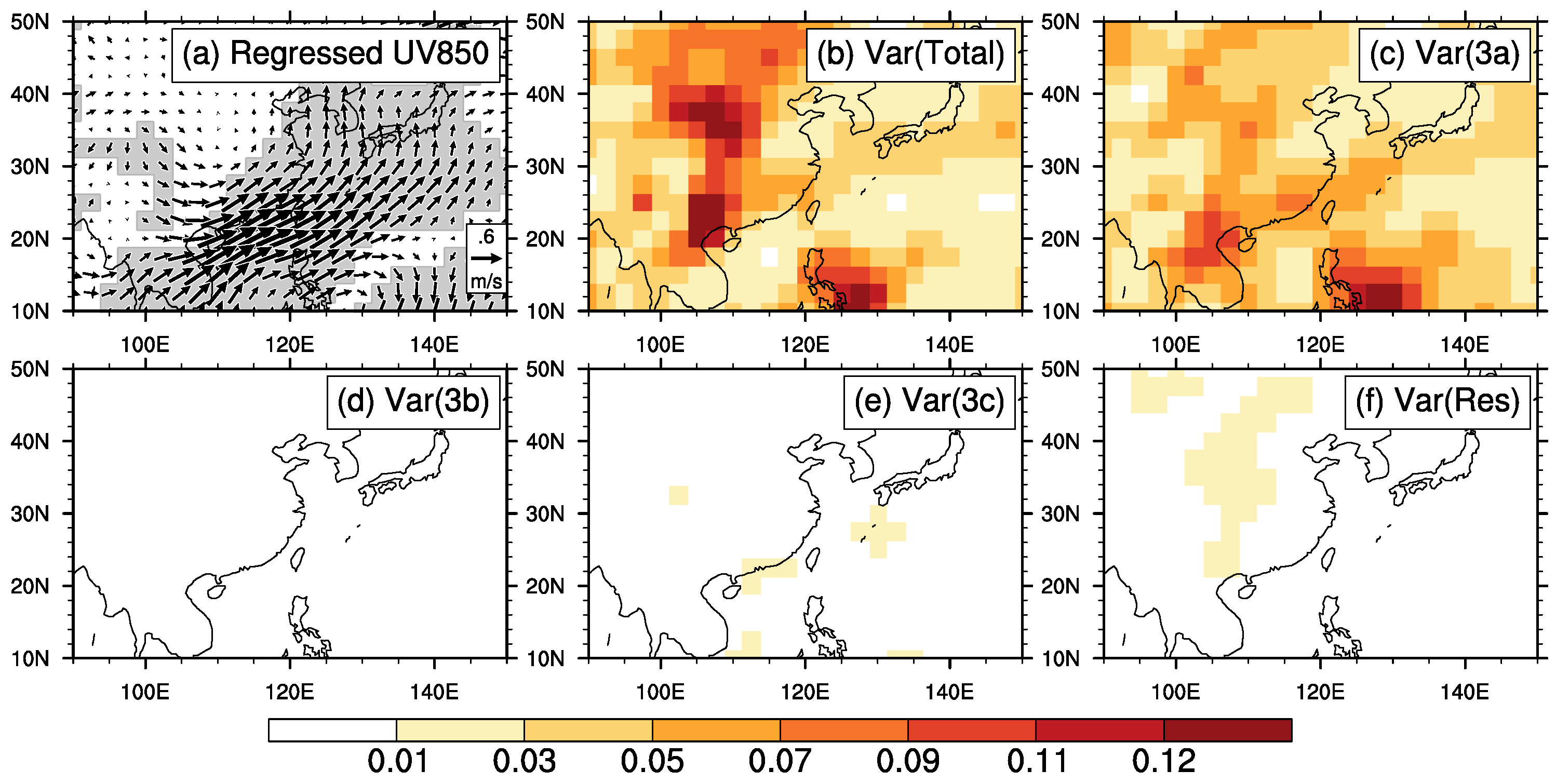
We first examine the long-term relationship between ENSO and the EAWM (i.e., r ¯ ) by regressing the low-level wind field onto the Niño 3.4 index over the entire period (Figure 1a). Consistent with previous studies, El Niño events are associated with pronounced southerly wind anomalies along the East Asian coast, which weaken the climatological prevailing low-level northerlies and indicate a weakened EAWM [6]. Therefore, to quantify the temporal stability of this EER, we diagnose the variations in the running correlation coefficients (i.e., Δ r ˜ ) between the Niño 3.4 index and 850 hPa meridional winds at each grid point. Specifically, the variance of Δ r ˜ is used as a measure of stability, with larger variance indicating a more unstable relationship. The spatial distribution of this variance is shown in Figure 1b. Pronounced variability is evident over East Asia, particularly over the continental region, indicating strong decadal fluctuations in the regional EER. This result confirms that the impact of ENSO on low-level meridional winds over East Asia is highly nonstationary, in agreement with previous findings [12,13,14].
According to the decomposition framework described in Equation (3), the changes in r ˜ can be attributed to contributions from covariance and amplitude components. We therefore compute the variance of each right-hand-side term in Equation (3), analogous to Figure 1b. The results show that the variance of r ˜ is dominated by fluctuations in the ENSO–meridional wind covariance (Figure 1c), whereas the contributions from the amplitudes of ENSO and meridional winds themselves are relatively small (Figure 1d,e). A minor residual contribution is also present, which likely arises from the truncation error associated with the first-order Taylor expansion (Figure 1f).
To further diagnose the physical sources of the running covariance between ENSO and the EAWM (term 3a in Equation (3)), we extend the framework of Geng et al. [15]. In their study, the EAWM variability was represented as a linear function of ENSO, AMO, and their nonlinear interaction. Here, to investigate the potential modulation from the PDO, we further include both the linear PDO effect and the nonlinear interaction between ENSO and PDO [23,24,25,26].
Accordingly, the 850 hPa meridional wind (M) at each grid point is expressed using a multiple linear regression:
M β 0 + β 1 N + β 2 A + β 3 ( A × N ) + β 4 P + β 5 ( P × N ) ,
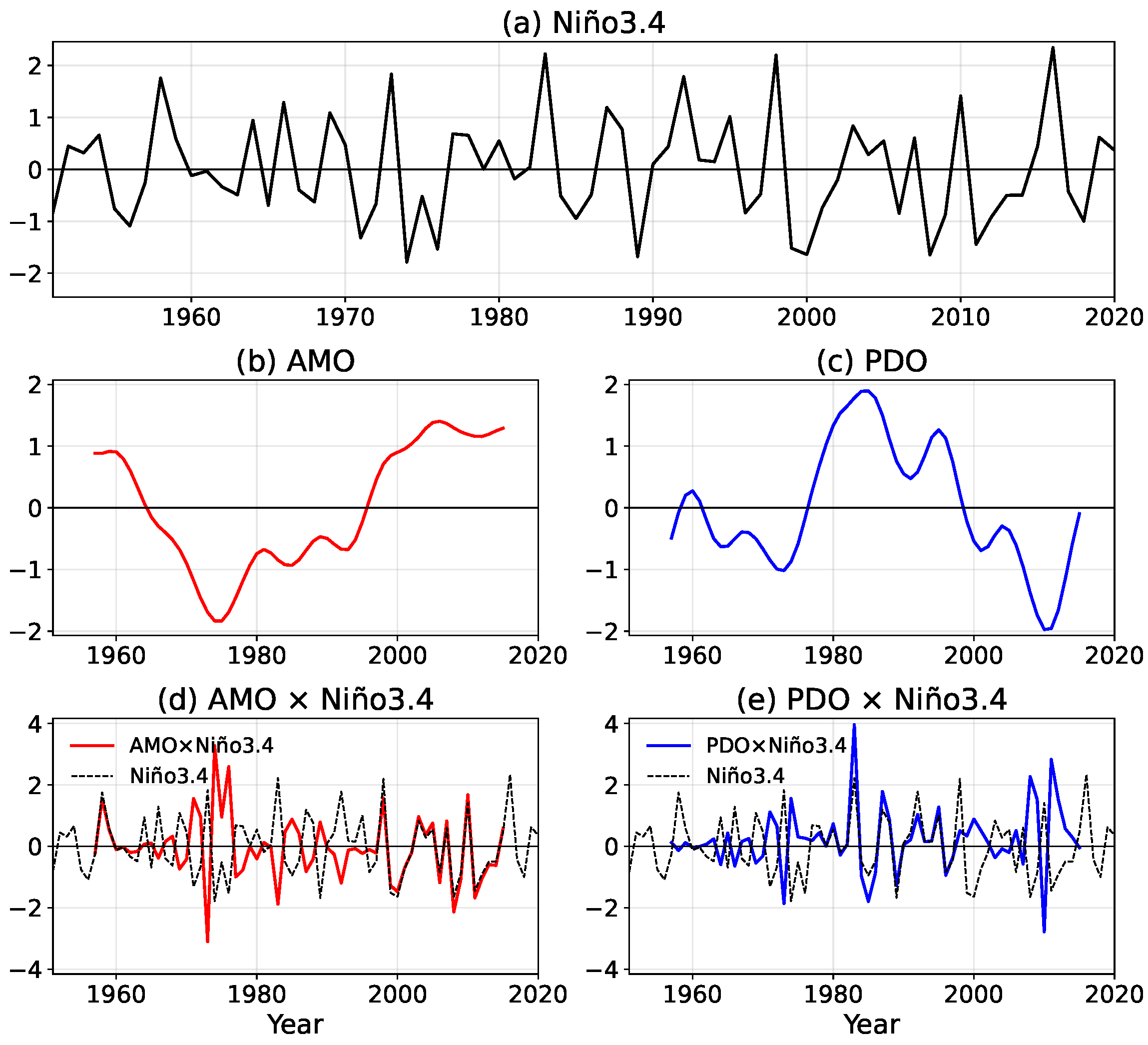
where N, A, and P denote the Niño 3.4 index, AMO index, and PDO index, respectively. The A × N and P × N terms represent the first-order nonlinear AMO–ENSO and PDO–ENSO interaction, respectively. These indices are shown in Figure 2. The AMO exhibits a negative phase from the 1960s to the 1990s, with positive phases before and after this period. In contrast, the PDO remains predominantly positive from the late 1970s to around 2000, and negative in the preceding and subsequent decades. Their interactions with the Niño3.4 index clearly illustrate the modulation effects of the AMO and PDO on ENSO variability. For example, during the positive phase of the AMO, the AMO×Niño3.4 index tends to display a signal opposite to that of the original Niño3.4 index, indicating a reversal or weakening of the ENSO-related impact under this background state. Coefficients β 1 β 5 are the corresponding regression coefficients, and β 0 denotes the intercept term.
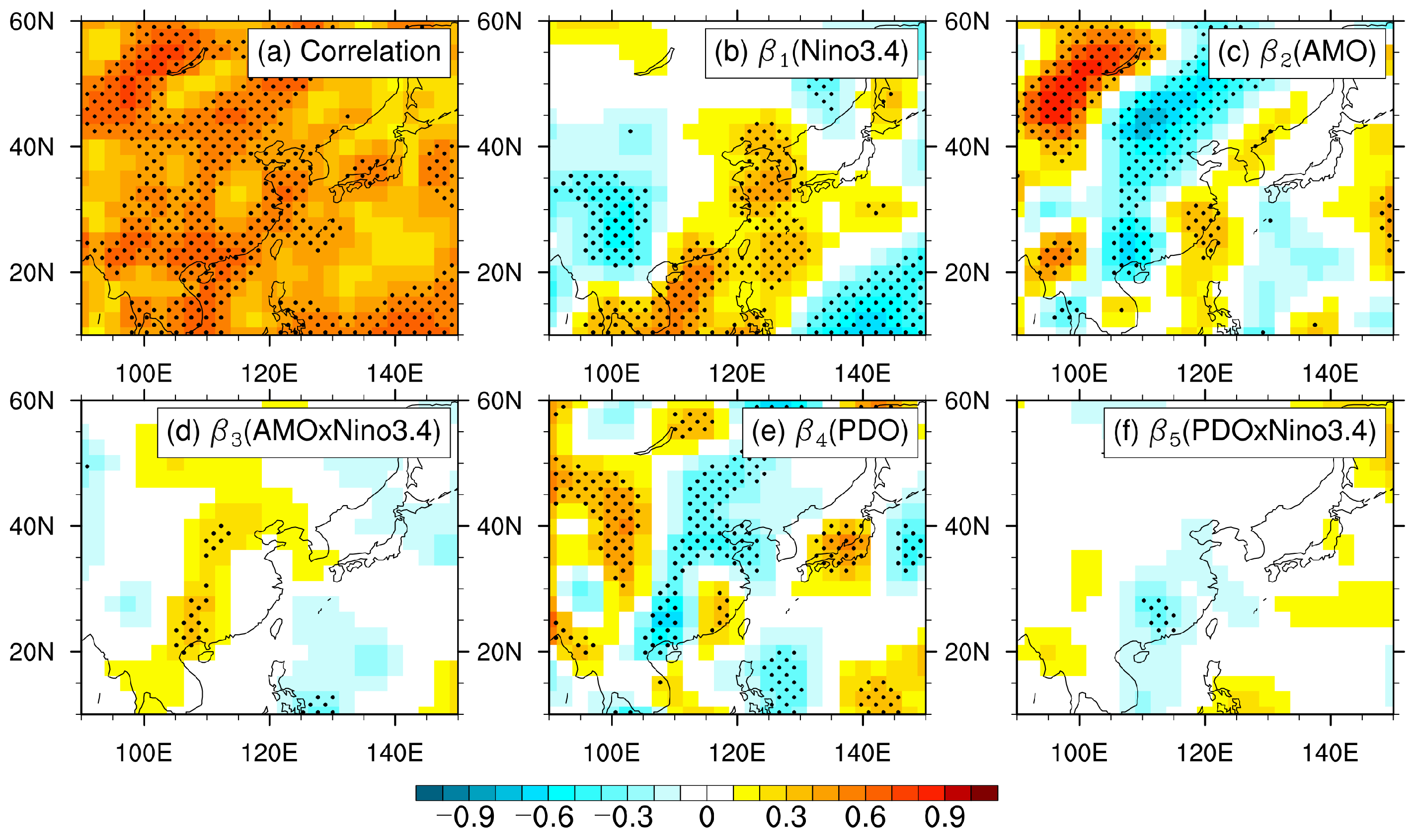
Figure 3a shows the spatial distribution of the multiple correlation coefficients derived from Equation (4). Significant correlations are found over East Asia and the western North Pacific, indicating that Equation (4) reasonably captures the combined modulation of ENSO, AMO, PDO, and their interactions on large-scale circulation. The spatial distribution of β 1 reveals a widespread positive relationship between ENSO and East Asian meridional winds (Figure 3b), consistent with the climatological ENSO–EAWM linkage shown in Figure 1a. In contrast, the positive phases of the AMO and PDO are associated with northerly anomalies over East Asia, corresponding to an intensified EAWM (Figure 3c,e). The nonlinear interaction between the AMO and ENSO induces southerly anomalies over East Asia, indicative of a weakened EAWM (Figure 3d), whereas the interaction between the PDO and ENSO leads to northerly anomalies over South China and a strengthened EAWM there (Figure 3f).
Based on Equation (4), the running covariance term Δ ( M N ) ˜ in Equation (3) can be further decomposed as
Δ ( M N ) ˜ Δ β 1 ( N 2 ) ˜ 5 a + Δ β 2 ( A N ) ˜ 5 b + Δ β 3 ( ( A × N ) N ) ˜ 5 c + Δ β 4 ( P N ) ˜ 5 d + Δ β 5 ( ( P × N ) N ) ˜ 5 e ,
where each term represents the contribution from changes in ENSO amplitude (term 5a), linear AMO modulation (term 5b), nonlinear AMO–ENSO interaction (term 5c), linear PDO modulation (term 5d), and nonlinear PDO–ENSO interaction (term 5e), respectively.
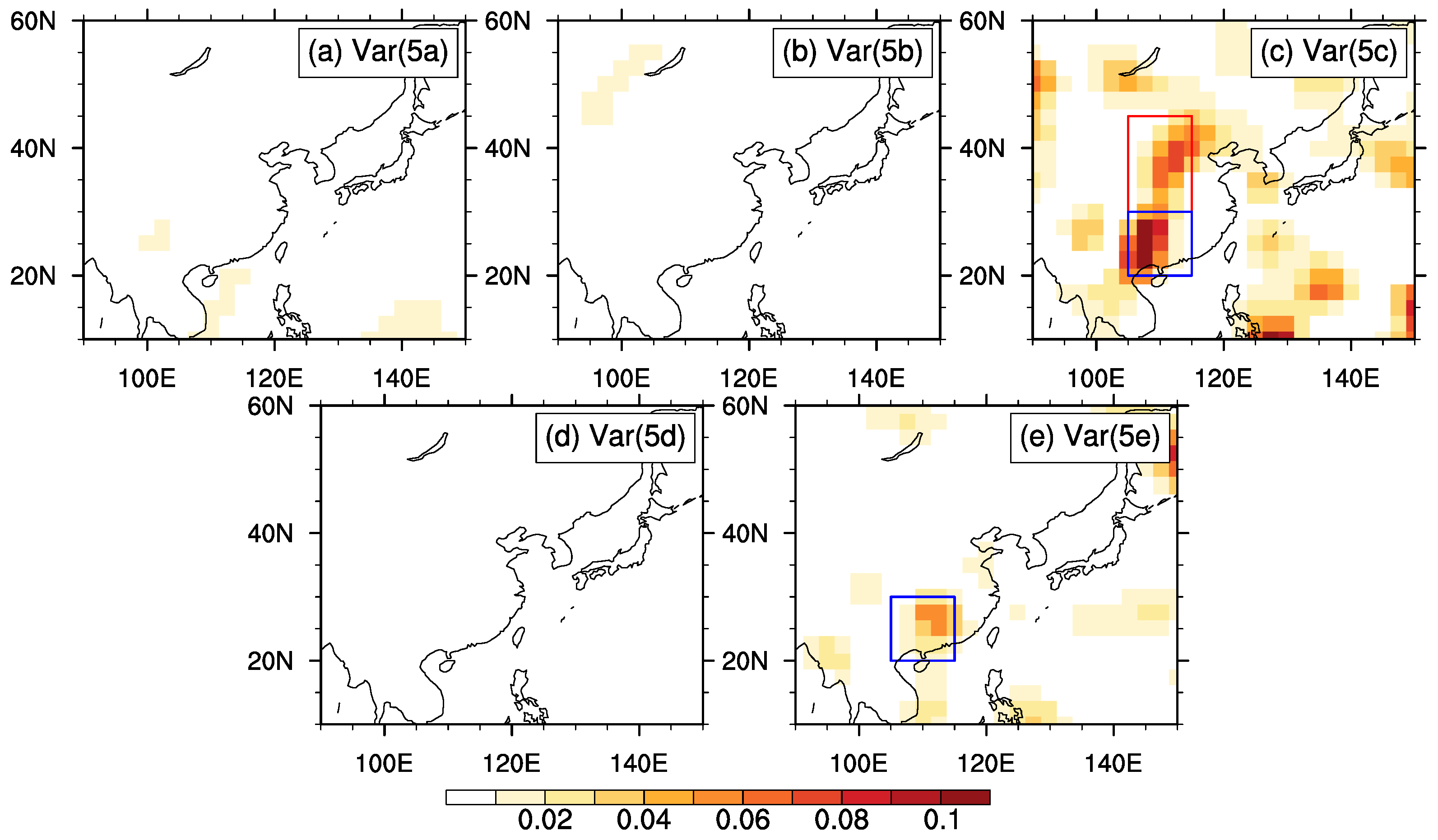
The variances of each term in Equation (5) are shown in Figure 4. The dominant contribution to Δ ( M N ) ˜ arises from term 5c and term 5e for certain regions, that is, the nonlinear interaction between the AMO/PDO and ENSO (Figure 4c,e), whereas the remaining terms exhibit comparatively weaker contributions (Figure 4a,b,d).
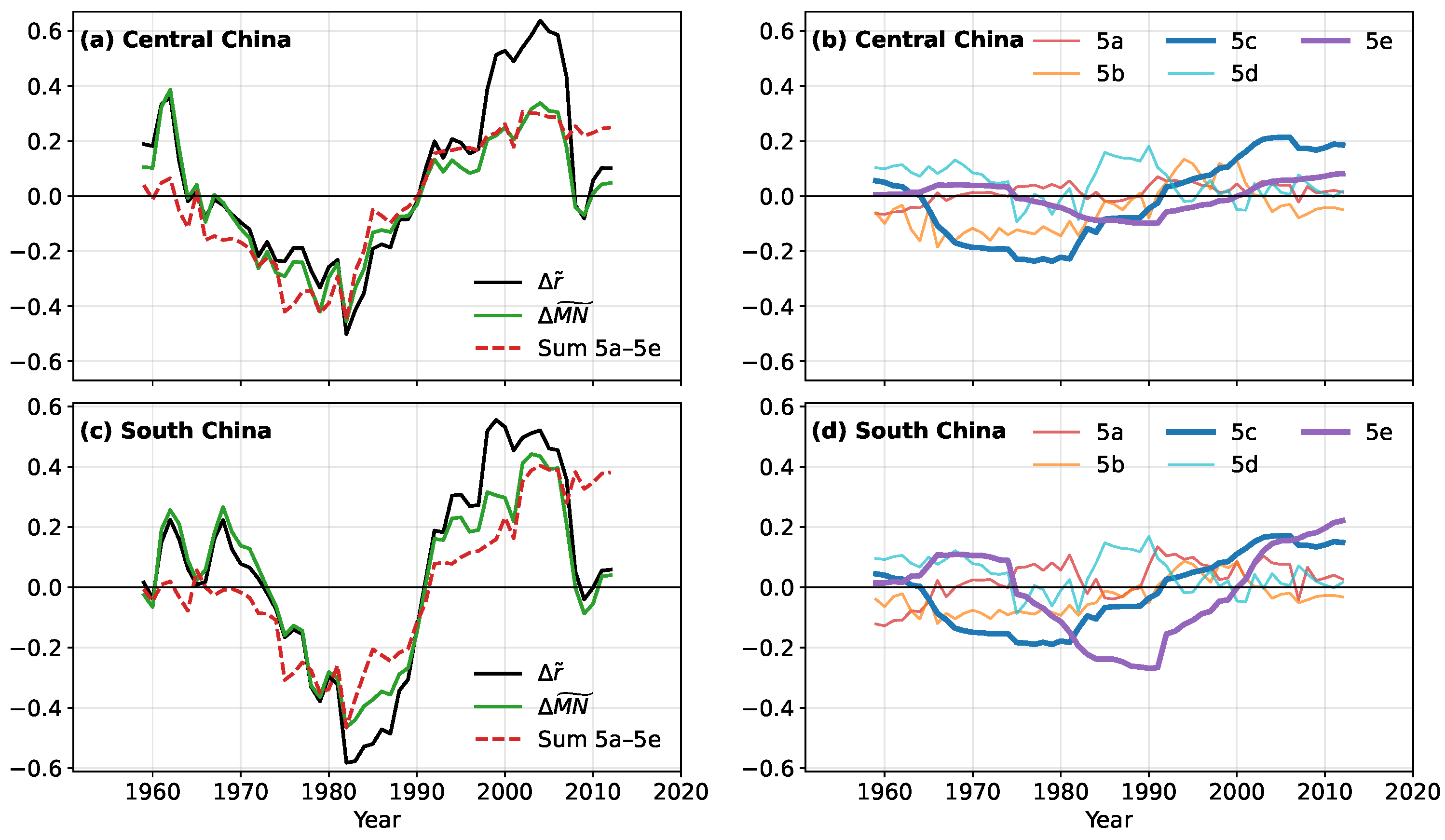
To better illustrate individual contributions, we examine the relationship between ENSO and 850 hPa meridional winds over central and South China (Figure 5). For central China, the running correlation between ENSO and regional meridional winds displays pronounced decadal variability, with weaker correlations during the 1960s–1980s and stronger correlations after the 1990s (Figure 5a). The running correlation closely follows variations in their covariance, with a correlation coefficient of 0.94, significant at the 99% confidence level, in turn, strongly modulated by the AMO–ENSO nonlinear interaction term, which also shows a decadal shift around the 1960s and 1990s (correlation coefficient of 0.83, significant at the 99% confidence level; term 5c in Figure 5b). Such strong consistency also implies the rationality of the decomposition of Equations (3) and (5).
In contrast, in South China, both the AMO–ENSO and PDO–ENSO nonlinear interaction contribute. Specifically, in this region, the running correlation between ENSO and regional meridional winds is weaker during the 1970s–1980s and stronger before the 1970s and after the 1990s (Figure 5c). The decadal change around the 1970s of this relationship is closely related to the PDO–ENSO nonlinear interaction, while the other decadal change around 1990 is coincident with the AMO–ENSO nonlinear interaction (Figure 5d). It is noted that the PDO–ENSO nonlinear interaction term also has a decadal shift around the mid-1970s, which is unrelated to the decadal changes in the EER.

3.1. Role of the AMO–ENSO Nonlinear Interaction

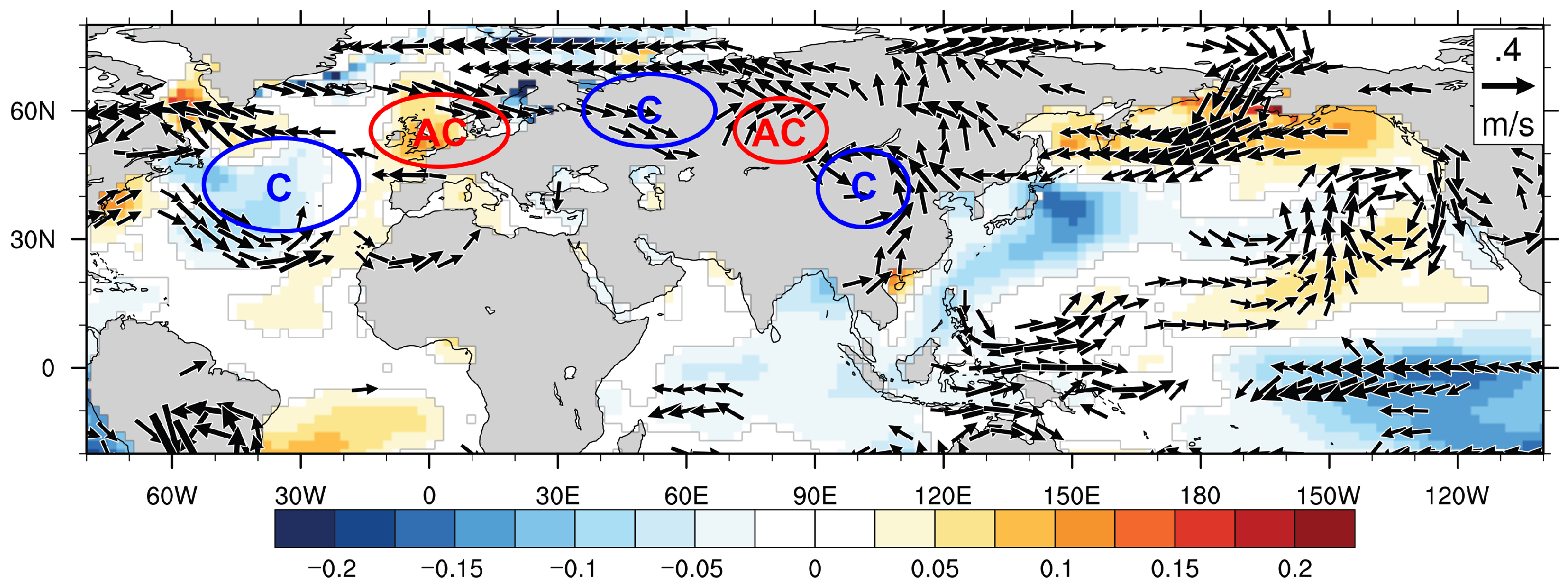
The AMO influences the EER via its nonlinear interaction with ENSO, whereby the AMO first modulates ENSO-related SST anomalies and subsequently alters the EER. This nonlinear effect manifests through two distinct processes. The first process involves changes in the tropical Pacific. Figure 6 shows SST anomalies regressed onto the AMO×Niño 3.4 index, representing modifications to the SST structure of El Niño during the positive phase of the AMO. The negative SST anomalies over the eastern equatorial Pacific indicate a weakened El Niño signal, consistent with previous studies showing that El Niño events tend to be suppressed during positive AMO phases [27,28]. Consequently, the associated atmospheric impacts are also reduced, including anomalous southerlies over the Philippine Sea (Figure 6), which corresponds to the pronounced decadal variability of the EER over this region (Figure 4c).
The second process operates through the North Atlantic. During the positive AMO phase, the reduced El Niño influence over the North Atlantic is associated with a low-level anticyclone north of approximately 50° N and a cyclone to the south, resembling a negative North Atlantic Oscillation–like response (Figure 6). This anomalous circulation further propagates downstream and induces an anomalous cyclone over East Asia, leading to southerly anomalies. These southerlies can substantially amplify El Niño–related southerly anomalies over East Asia, thereby contributing to the pronounced decadal variability of the EER over South and central China under different AMO phases.

3.2. Role of the PDO–ENSO Nonlinear Interaction

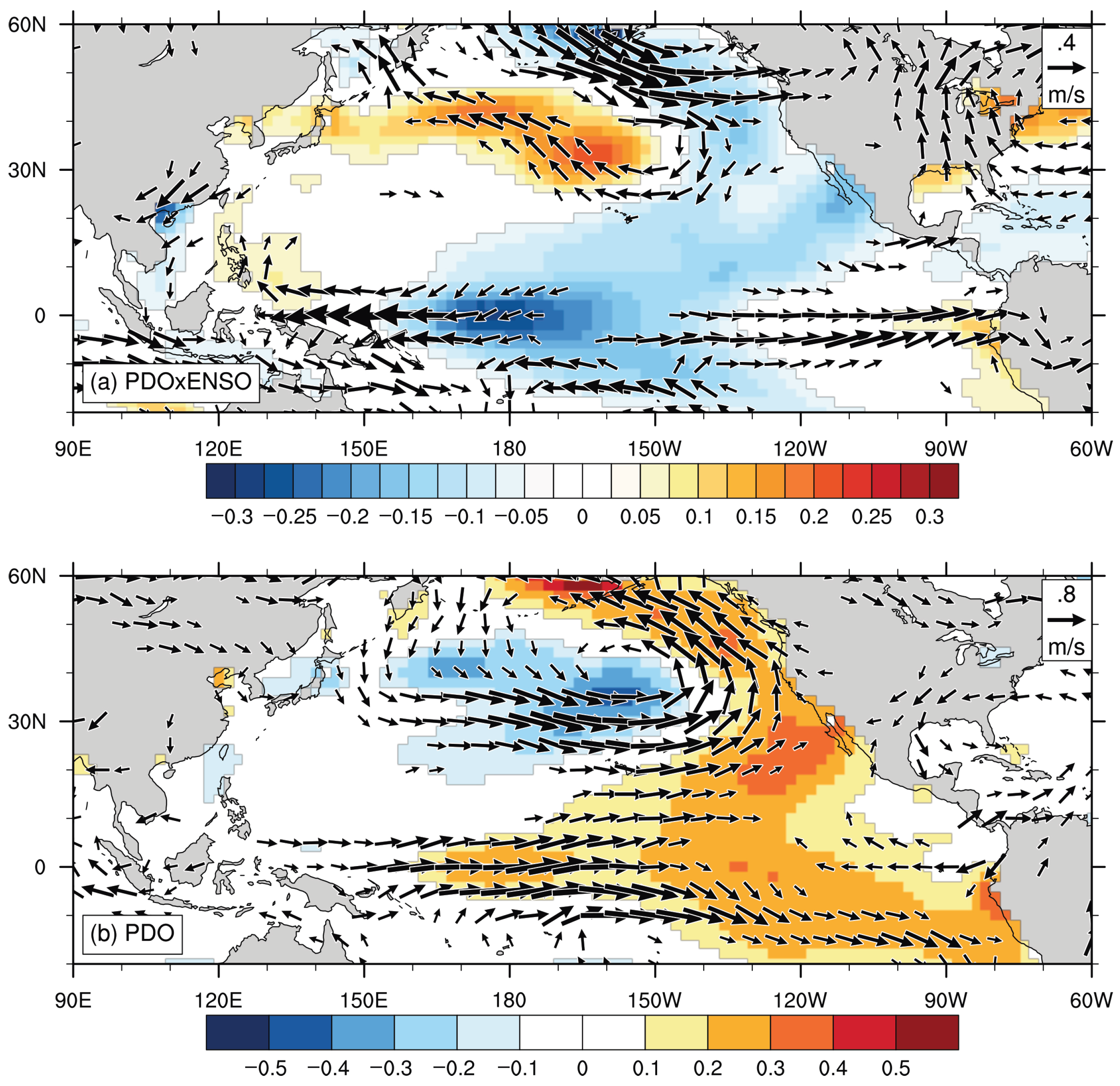
Figure 7a shows SST and 850 hPa wind anomalies regressed onto the PDO×Niño 3.4 index, showing that during the positive phase of the PDO, El Niño–related SST anomalies are characterized by cooling over the central equatorial Pacific and warming over the eastern equatorial Pacific, indicating an eastward displacement of the El Niño SST pattern, consistent with [13]. The anomalous cooling over the central equatorial Pacific tends to enhance the trade winds toward the western equatorial Pacific, leading to SST warming in that region. The resulting warmer SSTs favor the development of anomalous cyclonic circulation near the Philippine Sea, which induces anomalous northerly winds over South China (Figure 7a). Consequently, the influence of El Niño on the EAWM over South China is substantially weakened under positive PDO phases.

4. Discussion and Conclusions

In this study, we provide a comprehensive investigation of the decadal variation of the EER. In particular, over central China, the EER underwent decadal shifts around the 1960s and the 1990s, while over South China, comparable shifts occurred around the 1970s and the 1990s. As two dominant modes of decadal climate variability, both the AMO and PDO are found to exert significant modulation on the EER, albeit through distinct mechanisms. In theory, a purely linear modulation by the AMO or PDO (i.e., changes in the decadal background climate state) cannot alter the EER, because linear background changes affect El Niño and La Niña events in a symmetric manner. Since the EER can be approximated by the EAWM difference between the El Niño and La Niña responses, such symmetric effects are eliminated in the linear combination. Therefore, changes in the EER necessarily imply the presence of nonlinear modulation processes.
The nonlinear interaction between AMO/PDO and ENSO therefore has dominant contribution to EER variations, which induces pronounced asymmetric responses between El Niño and La Niña events and consequently leads to substantial changes in the EER. The nonlinear AMO–ENSO interaction manifests through two processes. One operates via the tropical Pacific, whereby the AMO modulates the strength and spatial structure of ENSO-related SST anomalies, affecting atmospheric circulation over the Philippine Sea. The other involves a North Atlantic–East Asia pathway, in which AMO-related modulation of ENSO alters atmospheric teleconnections through the North Atlantic, ultimately influencing circulation anomalies over the East Asian continent. Together, these processes lead to marked differences in ENSO’s influence on the EAWM under different AMO phases.
The PDO also affects the EER primarily through its nonlinear interaction with ENSO. As shown in this study, the PDO can alter the zonal position of ENSO-related SST anomalies. During the positive phase of the PDO, ENSO-related SST anomalies tend to shift eastward, causing ENSO-related tropical teleconnections to be displaced farther from the East Asian continent and thereby weakening ENSO’s influence on the EAWM, resulting in a weaker EER. This conclusion is supported by observational evidence showing that ENSO events since the 1990s tend to exhibit more central-Pacific characteristics [29,30], coinciding with a transition of the PDO toward its negative phase (Figure 2c).
Our results are generally consistent with Kim et al. [13], who reported a stronger EER with a westward shift of ENSO impacts during negative PDO phases, but differ from the findings of Shi [14], who emphasized an eastward shift of ENSO influence during negative PDO phases. One possible explanation for this discrepancy is that the PDO also exerts a substantial influence on the background equatorial SST state. During the positive PDO phase, pronounced warming of the central equatorial Pacific background SST (Figure 7a) may partially offset the El Niño–related cooling anomalies in this region (Figure 7b), thereby modifying the apparent PDO influence on ENSO-related teleconnections. This issue warrants further investigation in future studies.
In this study, we primarily use the quadratic interaction terms to represent only one specific and relatively simple form of nonlinearity. While they are effective in capturing first-order modulation effects and allow for straightforward physical interpretation, the actual nonlinear relationships within the climate system may be more complex, potentially involving asymmetric responses, threshold behaviors, or state-dependent feedbacks. More general nonlinear approaches, such as nonparametric regression frameworks, may provide additional insights into higher-order dependencies among ENSO, PDO, and AMO. Another important issue is the debated physical nature of the AMO. Although it is commonly used to represent multidecadal North Atlantic SST variability, part of its signal may be externally forced rather than purely internal [31]. Here, we treat the AMO as a statistical descriptor of low-frequency background variability, without attributing its dynamical origin.
Finally, although this study focuses on the dominant AMO and PDO influence on decadal changes in the EER, other factors may also play roles, such as Indian Ocean SST [32], the Arctic Oscillation [33], and Siberian snow cover [34]. A more comprehensive assessment of the combined effects of ENSO amplitude, background-state changes, inter-basin interactions, and other external forcings remains an important topic for future research.

Author Contributions

Conceptualization, J.S. and F.Z.; methodology, J.S. and S.L.; software, S.L.; validation, S.L. and J.S.; formal analysis, S.L., F.Z. and J.S.; investigation, S.L., F.Z. and J.S.; resources, J.S. and S.L.; data curation, S.L.; writing—original draft preparation, S.L., F.Z. and J.S.; writing—review and editing, J.S.; visualization, S.L. and J.S.; supervision, J.S.; project administration, J.S.; funding acquisition, J.S. All authors have read and agreed to the published version of the manuscript.

Funding

This research was funded by the National Natural Science Foundation of China, grant number 42088101.

Institutional Review Board Statement

Not applicable.

Informed Consent Statement

Not applicable.

Data Availability Statement

NCEP2/DOE reanalysis data are available at https://psl.noaa.gov/data/gridded/data.ncep.reanalysis2.html (accessed on 28 February 2026). ERSST v5 can be accessed at https://psl.noaa.gov/data/gridded/data.noaa.ersst.v5.html/ (accessed on 28 February 2026).

Conflicts of Interest

The authors declare no conflicts of interest.

References

  1. Jhun, J.G.; Lee, E.J. A New East Asian Winter Monsoon Index and Associated Characteristics of the Winter Monsoon. J. Clim. 2004, 17, 711–726. [Google Scholar] [CrossRef]
  2. Zhang, Y.; Sperber, K.R.; Boyle, J.S. Climatology and interannual variation of the East Asian winter monsoon: Results from the 1979–95 NCEP/NCAR reanalysis. Mon. Weather. Rev. 1997, 125, 2605–2619. [Google Scholar] [CrossRef]
  3. Wu, B.; Wang, J. Winter Arctic Oscillation, Siberian High and East Asian Winter Monsoon. Geophys. Res. Lett. 2002, 29, 1897. [Google Scholar] [CrossRef]
  4. Yuan, Y.; Yang, S. Impacts of different types of El Niño on the East Asian climate. J. Clim. 2012, 25, 7702–7722. [Google Scholar] [CrossRef]
  5. Lenssen, N.J.; Goddard, L.; Mason, S. Seasonal forecast skill of ENSO teleconnection maps. Weather. Forecast. 2020, 35, 2387–2406. [Google Scholar] [CrossRef]
  6. Wang, B.; Wu, R.; Fu, X. Pacific–East Asian Teleconnection: How Does ENSO Affect East Asian Climate? J. Clim. 2000, 13, 1517–1536. [Google Scholar] [CrossRef]
  7. Zhang, R.; Sumi, A.; Kimoto, M. Impact of El Nino on the East Asian Monsoon: A Diagnostic Study of the 1986/87 and 1991/92 Events. J. Meteorol. Soc. Jpn. 1996, 74, 49–62. [Google Scholar] [CrossRef]
  8. Wang, L.; Chen, W.; Huang, R. Interdecadal modulation of PDO on the impact of ENSO on the East Asian winter monsoon. Geophys. Res. Lett. 2008, 35, L20702. [Google Scholar] [CrossRef]
  9. Wang, H.; He, S. Weakening relationship between East Asian winter monsoon and ENSO after mid-1970s. Chin. Sci. Bull. 2012, 57, 3535–3540. [Google Scholar] [CrossRef]
  10. Yu, S.; Sun, J. Revisiting the relationship between El Niño–Southern Oscillation and the East Asian winter monsoon. Int. J. Climatol. 2018, 38, 4846–4859. [Google Scholar] [CrossRef]
  11. He, S.; Wang, H. Oscillating relationship between the East Asian winter monsoon and ENSO. J. Clim. 2013, 26, 9819–9838. [Google Scholar] [CrossRef]
  12. Geng, X.; Zhang, W.; Stuecker, M.F.; Liu, P.; Jin, F.F.; Tan, G. Decadal modulation of the ENSO–East Asian winter monsoon relationship by the Atlantic Multidecadal Oscillation. Clim. Dyn. 2017, 49, 2531–2544. [Google Scholar] [CrossRef]
  13. Kim, J.W.; An, S.I.; Jun, S.Y.; Park, H.J.; Yeh, S.W. ENSO and East Asian winter monsoon relationship modulation associated with the anomalous northwest Pacific anticyclone. Clim. Dyn. 2017, 49, 1157–1179. [Google Scholar] [CrossRef]
  14. Shi, J. Reexamining the decadal variation in the ENSO–East Asian winter monsoon relationship. Geophys. Res. Lett. 2021, 48, e2021GL094208. [Google Scholar] [CrossRef]
  15. Geng, X.; Zhang, W.; Jin, F.F.; Stuecker, M.F. A New Method for Interpreting Nonstationary Running Correlations and Its Application to the ENSO-EAWM Relationship. Geophys. Res. Lett. 2018, 45, 327–334. [Google Scholar] [CrossRef]
  16. Huang, B.; Thorne, P.W.; Banzon, V.F.; Boyer, T.; Chepurin, G.; Lawrimore, J.H.; Menne, M.J.; Smith, T.M.; Vose, R.S.; Zhang, H.M. Extended reconstructed sea surface temperature, version 5 (ERSSTv5): Upgrades, validations, and intercomparisons. J. Clim. 2017, 30, 8179–8205. [Google Scholar] [CrossRef]
  17. Kanamitsu, M.; Ebisuzaki, W.; Woollen, J.; Yang, S.K.; Hnilo, J.; Fiorino, M.; Potter, G. NCEP–DOE AMIP-II Reanalysis (R-2). Bull. Am. Meteorol. Soc. 2002, 83, 1631–1644. [Google Scholar] [CrossRef]
  18. Mantua, N.J.; Hare, S.R.; Zhang, Y.; Wallace, J.M.; Francis, R.C. A Pacific interdecadal climate oscillation with impacts on salmon production. Bull. Am. Meteorol. Soc. 1997, 78, 1069–1080. [Google Scholar] [CrossRef]
  19. Enfield, D.B.; Mestas-Nuñez, A.M.; Trimble, P.J. The Atlantic multidecadal oscillation and its relation to rainfall and river flows in the continental US. Geophys. Res. Lett. 2001, 28, 2077–2080. [Google Scholar] [CrossRef]
  20. Duchon, C.E. Lanczos Filtering in One and Two Dimensions. J. Appl. Meteorol. 1979, 18, 1016–1022. [Google Scholar] [CrossRef]
  21. Bretherton, C.S.; Widmann, M.; Dymnikov, V.P.; Wallace, J.M.; Bladé, I. The effective number of spatial degrees of freedom of a time-varying field. J. Clim. 1999, 12, 1990–2009. [Google Scholar] [CrossRef]
  22. Wilks, D.S. “The Stippling Shows Statistically Significant Grid Points”: How Research Results Are Routinely Overstated and Overinterpreted, and What to Do About It. Bull. Am. Meteorol. Soc. 2016, 97, 2263–2273. [Google Scholar] [CrossRef]
  23. Kim, J.W.; Yeh, S.W.; Chang, E.C. Combined effect of El Niño-Southern Oscillation and Pacific decadal oscillation on the East Asian winter monsoon. Clim. Dyn. 2014, 42, 957–971. [Google Scholar] [CrossRef]
  24. Fan, G.; Lv, F.; Zhang, J.; Fu, J. A possible way to extract a stationary relationship between ENSO and the East Asian winter monsoon. Atmos. Ocean. Sci. Lett. 2020, 13, 294–300. [Google Scholar] [CrossRef]
  25. Zhao, S.; Li, J.; Sun, C. Decadal variability in the occurrence of wintertime haze in central eastern China tied to the Pacific Decadal Oscillation. Sci. Rep. 2016, 6, 27424. [Google Scholar] [CrossRef]
  26. Hao, X.; Li, F.; Sun, J.; Wang, H.; He, S. Assessment of the response of the East Asian winter monsoon to ENSO-like SSTAs in three US CLIVAR Project models. Int. J. Climatol. 2016, 36, 847–866. [Google Scholar] [CrossRef]
  27. Kang, I.S.; No, H.h.; Kucharski, F. ENSO amplitude modulation associated with the mean SST changes in the tropical central Pacific induced by Atlantic multidecadal oscillation. J. Clim. 2014, 27, 7911–7920. [Google Scholar] [CrossRef]
  28. Gong, Y.; Li, T.; Chen, L. Interdecadal modulation of ENSO amplitude by the Atlantic multi-decadal oscillation (AMO). Clim. Dyn. 2020, 55, 2689–2702. [Google Scholar] [CrossRef]
  29. McPhaden, M.J.; Lee, T.; McClurg, D. El Niño and its relationship to changing background conditions in the tropical Pacific Ocean. Geophys. Res. Lett. 2011, 38, L15709. [Google Scholar] [CrossRef]
  30. Yeh, S.W.; Wang, X.; Wang, C.; Dewitte, B. On the relationship between the North Pacific climate variability and the central Pacific El Niño. J. Clim. 2015, 28, 663–677. [Google Scholar] [CrossRef]
  31. Mann, M.E.; Steinman, B.A.; Brouillette, D.J.; Miller, S.K. Multidecadal climate oscillations during the past millennium driven by volcanic forcing. Science 2021, 371, 1014–1019. [Google Scholar] [CrossRef] [PubMed]
  32. Watanabe, M.; Jin, F.f. Role of Indian Ocean warming in the development of Philippine Sea anticyclone during ENSO. Geophys. Res. Lett. 2002, 29, 116.1–116.4. [Google Scholar] [CrossRef]
  33. Chen, D.; Sun, J.; Gao, Y. Effects of AO on the interdecadal oscillating relationship between the ENSO and East Asian winter monsoon. Int. J. Climatol. 2020, 40, 4374–4383. [Google Scholar] [CrossRef]
  34. Wang, B.; Wu, Z.; Chang, C.P.; Liu, J.; Li, J.; Zhou, T. Another look at interannual-to-interdecadal variations of the East Asian winter monsoon: The northern and southern temperature modes. J. Clim. 2010, 23, 1495–1512. [Google Scholar] [CrossRef]
Figure 1. (a) Regressed 850 hPa winds onto the Niño3.4 index (in m s−1; shadings indicate meridional wind anomalies significant at the 90% level); (b) variances of the running correlation between the Niño3.4 index and 850 hPa meridional winds; (c) variance of term 3a, (d) term 3b, (e) term 3c, and (f) the residual term.
Atmosphere 17 00279 g001
Figure 2. (a) Nino3.4 index; (b) AMO index; (c) PDO index; (d) AMO×Nino3.4 index; (e) PDO×Nino3.4 index.
Atmosphere 17 00279 g002
Figure 3. (a) Multiple correlation coefficients and (bf) regression coefficients of each term in Equation (4); Dots indicate statistical significance after FDR correction (with α FDR = 0.10 ).
Atmosphere 17 00279 g003
Figure 4. Variances of terms in Equation (5). Red rectangle is central China (30°–45° N, 105°–115° E) and blue rectangle is South China (20°–30° N, 105°–115° E).
Atmosphere 17 00279 g004
Figure 5. (a) Changes in the running correlation and covariance between the Niño3.4 index and regional normalized 850 hPa meridional winds, together with covariance estimated from Equation (5); (b) Individual right-hand-side terms of Equation (5) over central China. (c) and (d) are the same as (a) and (b), respectively, but for South China.
Atmosphere 17 00279 g005
Figure 6. Regressed SST (shading, in K) and 850 hPa winds (vectors, in m s−1) onto the AMO×Niño 3.4 index. Red circles indicate anomalous anticyclones, and blue circles indicate anomalous cyclones. Only wind and SST anomalies significant after FDR correction (with α FDR = 0.10 ) are shown.
Atmosphere 17 00279 g006
Figure 7. (a) Same as Figure 6, but for the PDO×Niño 3.4 index; (b) Same as Figure 7a but for PDO index.
Atmosphere 17 00279 g007
Disclaimer/Publisher’s Note: The statements, opinions and data contained in all publications are solely those of the individual author(s) and contributor(s) and not of MDPI and/or the editor(s). MDPI and/or the editor(s) disclaim responsibility for any injury to people or property resulting from any ideas, methods, instructions or products referred to in the content.