Emission, Transport, and Deposition Mechanisms for a Severe Summer Dust Storm Originating in Southern Mongolia



Abstract
1. Introduction
2. Materials and Methods
2.1. Data
2.1.1. Himawari Satellite Data
2.1.2. ERA5 Reanalysis Data
2.1.3. MERRA-2 Reanalysis Data
2.1.4. SYNOP Station Data
2.2. Models
2.2.1. WRF-Chem Model
2.2.2. LAGRANTO Model
3. Results and Discussion
3.1. Dust Transport Process
3.1.1. Evolution of the Dust Process and Weather Situation
3.1.2. Dust Transport Trajectories and Concentration Changes
3.2. Variations in Dust Deposition
3.3. Dust Emission Conditions
3.3.1. Strong Winds
3.3.2. Dust Source Region Conditions
4. Limitations and Future Implications
5. Conclusions
- (1)
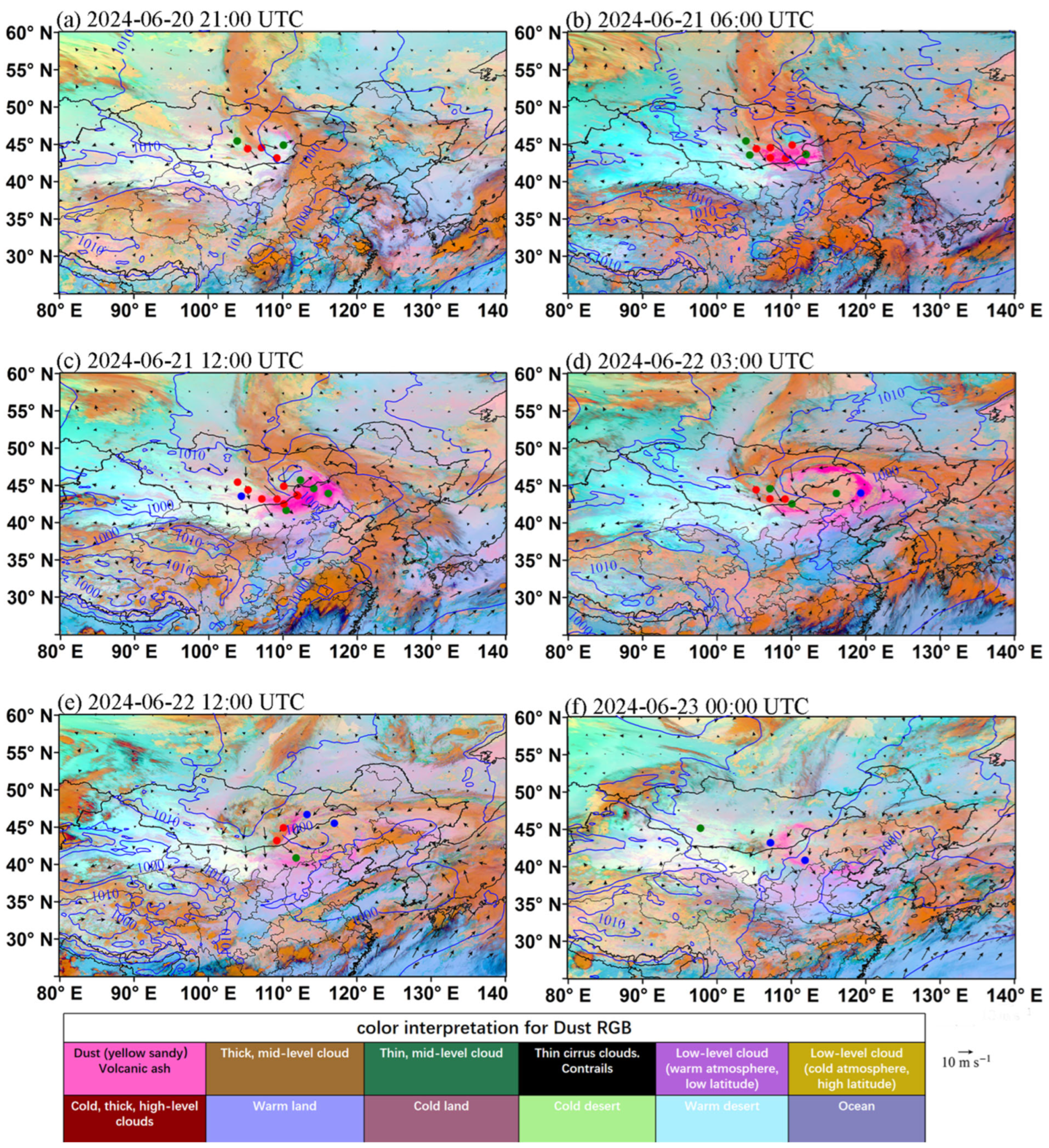
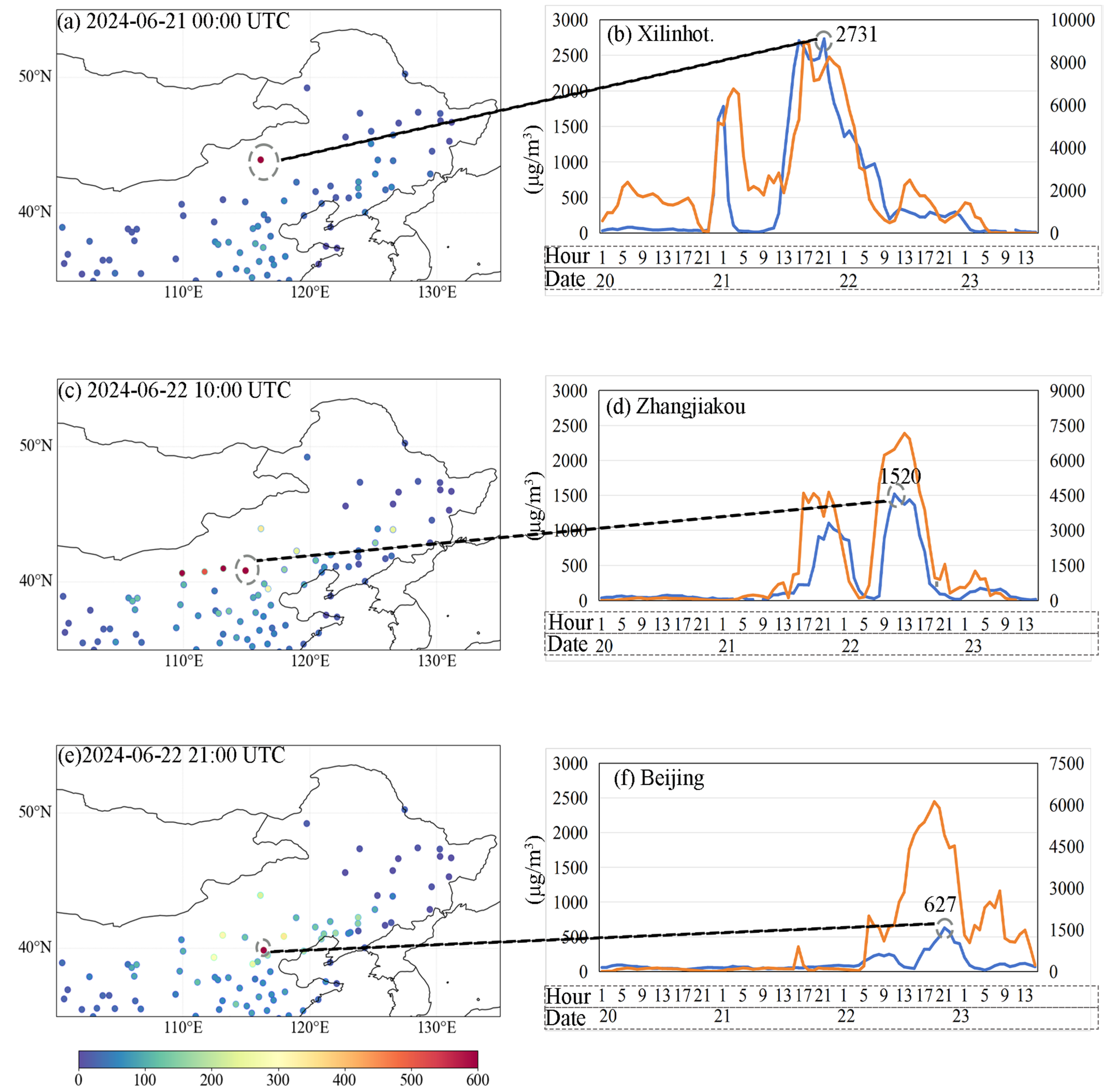
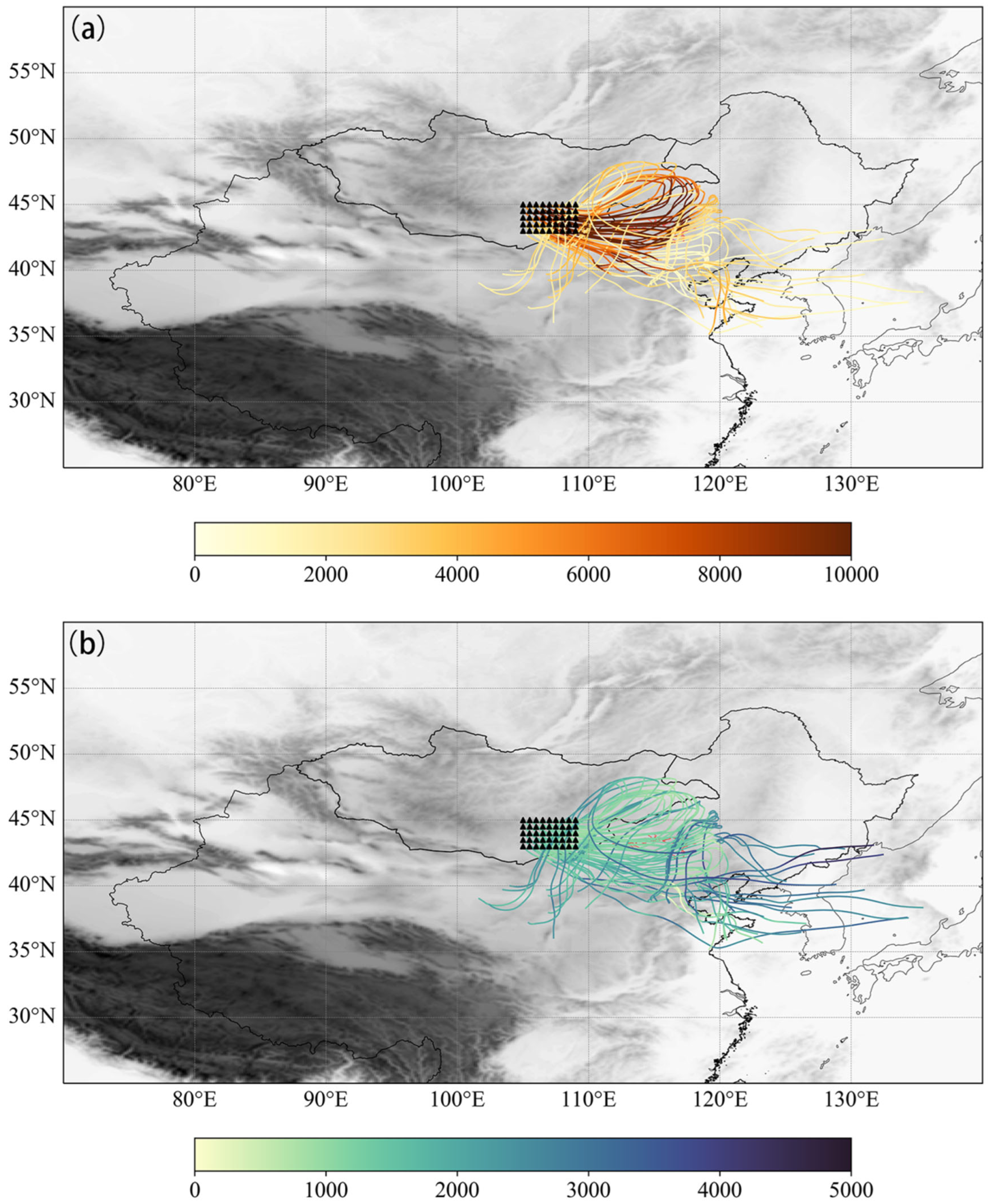
- The dust originated from the southern Gobi region of Mongolia and was transported southeastward. The source concentration exceeded 10,000 µg m−3 but decreased with source distance. High-altitude dust was widely transported but at relatively low concentrations, whereas the opposite was true at low altitudes. PM10 concentrations gradually decreased southward post-border crossing, as dust shifted from storm-generated to wind-blown and suspended dust.
- (2)
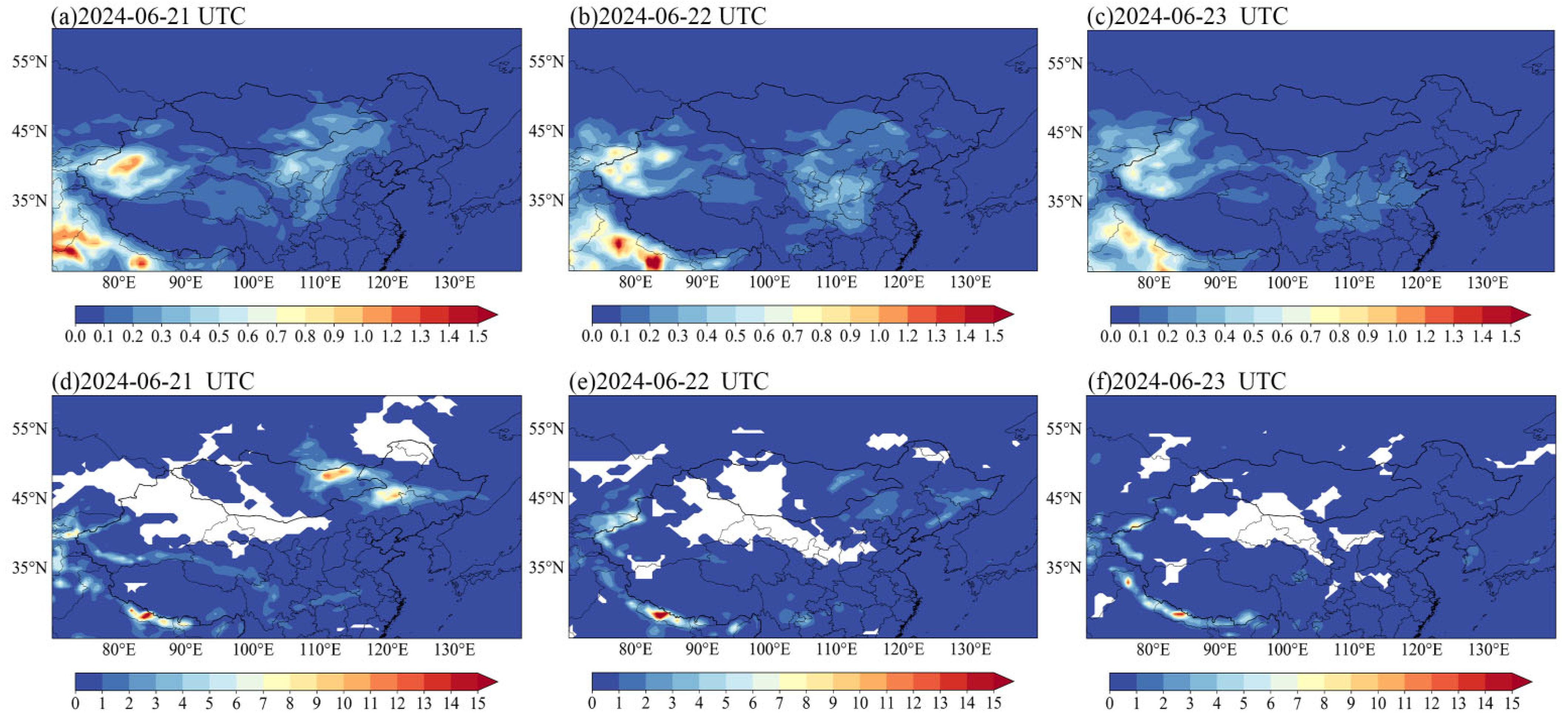
- Dust deposition pattern: On 21 June, dry deposition was concentrated in the source area and front section of the transport path, while wet deposition dominated in areas of precipitation. By 23 June, the extent of dry deposition contracted post-expansion as dust concentration decreased, thereby indicating the gradual dissipation of the dust storm.
- (3)
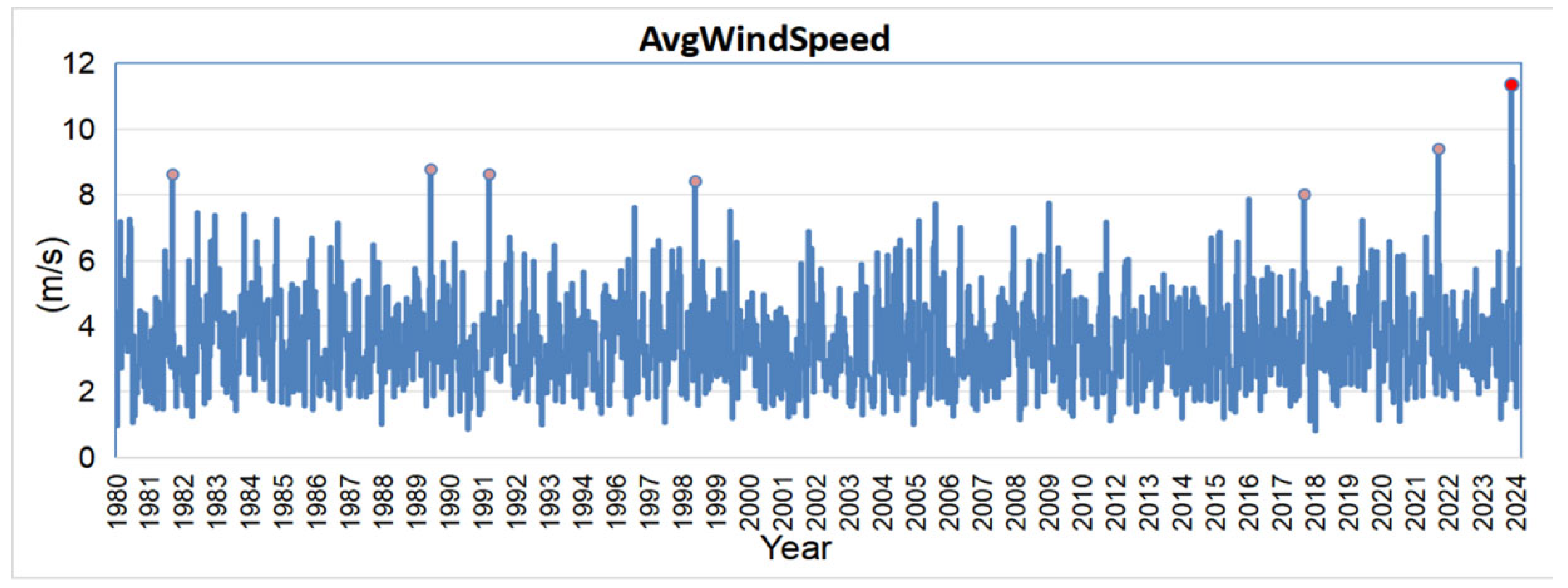
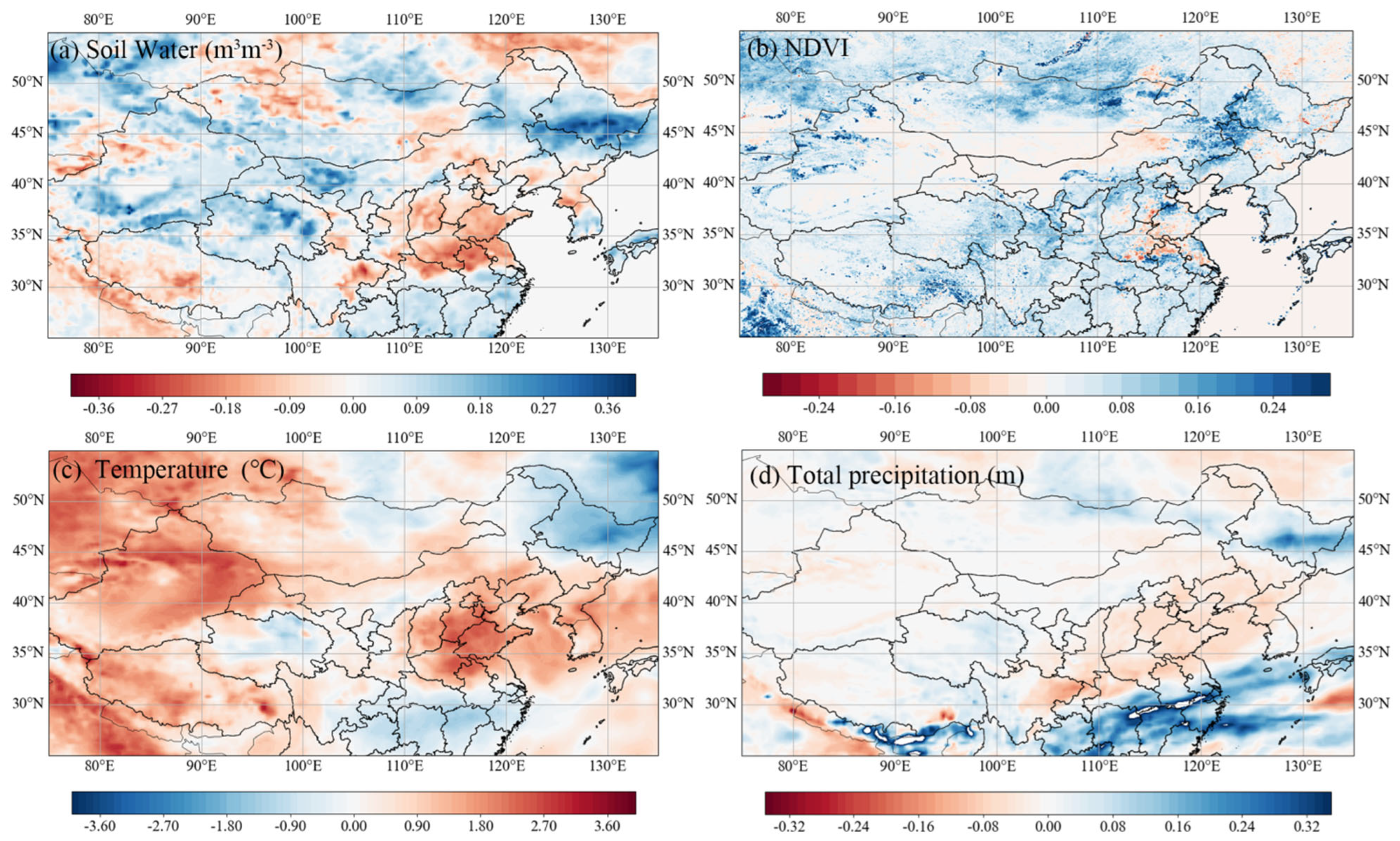
- Origin and dynamic mechanisms of dust-weather events: The dust storm event in June 2024 was triggered by a Mongolian cycle. Strong winds (11.35 m s−1; extreme, equated to historical data for the same period) generated by the low-pressure center of the Mongolian cyclone were the primary force that directly lifted sand and dust. Surface conditions (such as low soil moisture, poor vegetation, high temperatures, and low precipitation) in the dust source area and along the dust pathway enhanced wind erosion and entrainment, thereby establishing a foundation for sustained dust generation. The integrated use of satellite remote sensing, numerical modeling, and trajectory analysis exemplified in this work underscores the importance of multidisciplinary approaches in addressing contemporary challenges in atmospheric research. This study also provides a scientific basis for the study of rare-season dust-storm events in East Asia and for the formulation of cross-border air-quality joint-management strategies.
Author Contributions
Funding
Institutional Review Board Statement
Informed Consent Statement
Data Availability Statement
Acknowledgments
Conflicts of Interest
Abbreviations
| PM10 | Particulate Matter with Aerodynamic Diameter ≤ 10 μm |
| WRF-Chem | Weather Research and Forecasting Model with Chemistry |
| LAGRANTO | Lagrangian Analysis Tool |
| ERA5 | Fifth-Generation European Centre for Medium-Range Weather Forecasts Reanalysis |
| MERRA-2 | Modern-Era Retrospective Analysis for Research and Applications, Version 2 |
| SYNOP | Surface Weather Observations |
| WMO | World Meteorological Organization |
| NDVI | Normalized Difference Vegetation Index |
| RGB | Red Green Blue |
References
- Filonchyk, M.; Peterson, M.P.; Zhang, L.; Yan, H. An analysis of air pollution associated with the 2023 sand and dust storms over China: Aerosol properties and PM10 variability. Geosci. Front. 2024, 15, 101762. [Google Scholar] [CrossRef]
- Li, R.; Zhang, M.; Du, Y.; Wang, G.; Shang, C.; Liu, Y.; Zhang, M.; Meng, Q.; Cui, M.; Yan, C. Impacts of dust events on chemical characterization and associated source contributions of atmospheric particulate matter in northern China. Environ. Pollut. 2023, 316, 120597. [Google Scholar] [CrossRef]
- Zhou, Y.; Gao, X.; Lei, J. Characteristics of Dust Weather in the Tarim Basin from 1989 to 2021 and Its Impact on the Atmospheric Environment. Remote Sens. 2023, 15, 1804. [Google Scholar] [CrossRef]
- Long, X.; Tie, X.; Li, G.; Cao, J.; Feng, T.; Zhao, S.; Xing, L.; An, Z. Effect of ecological restoration programs on dust concentrations in the North China Plain: A case study. Atmos. Chem. Phys. 2018, 18, 6353–6366. [Google Scholar] [CrossRef]
- Wu, C.; Lin, Z.; Shao, Y.; Liu, X.; Li, Y. Drivers of recent decline in dust activity over East Asia. Nat. Commun. 2022, 13, 7105. [Google Scholar] [CrossRef]
- Borjigin, A.; Bueh, C.; Yong, M.; Purevjav, G.; Xie, Z. Cross-Border Sand and Dust Storms between Mongolia and Northern China in Spring and Their Driving Weather Systems. Remote Sens. 2024, 16, 2164. [Google Scholar] [CrossRef]
- Yin, Z.; Wan, Y.; Zhang, Y.; Wang, H. Why super sandstorm 2021 in North China? Natl. Sci. Rev. 2021, 9, nwab165. [Google Scholar] [CrossRef] [PubMed]
- Piao, J.; Chen, W.; Wei, K.; Cai, Q.; Zhu, X.; Du, Z. Increased sandstorm frequency in North China in 2023: Climate change reflection on the Mongolian plateau. Innovation 2023, 4, 100497. [Google Scholar] [CrossRef]
- Chen, S.; Zhao, D.; Huang, J.; He, J.; Chen, Y.; Chen, J.; Bi, H.; Lou, G.; Du, S.; Zhang, Y.; et al. Mongolia contributed more than 42% of the dust concentrations in northern China in March and April 2023. Adv. Atmos. Sci. 2023, 40, 1549–1557. [Google Scholar] [CrossRef]
- Bao, T.; Xi, G.; Deng, B.; Chang, I.-S.; Wu, J.; Jin, E. Long-term variations in spatiotemporal clustering characteristics of dust events in potential dust sources in East Asia. CATENA 2023, 232, 107397. [Google Scholar] [CrossRef]
- Zhang, Y.; Chen, Y.; Chen, S.; Alam, K.; Chen, J. Mongolia dust transport across borders under the background of global warming. Glob. Planet. Change 2024, 239, 104509. [Google Scholar] [CrossRef]
- Ye, Q.; Zheng, X. Distribution, Transport, and Impact on Air Quality of Two Typical Dust Events in China in 2021. Atmosphere 2023, 14, 432. [Google Scholar] [CrossRef]
- Zhang, Y.H.; Wang, F.; Zhou, S.; Zhang, T.; Qi, M.; Song, H. Contribution of dust emissions from farmland to particulate matter concentrations in North China Plain: Integration of WRF-Chem and WEPS model. Environ. Int. 2025, 195, 109191. [Google Scholar] [CrossRef]
- Al Zubi, R.; Gill, T.E.; Lee, J.A.; Ardon-Dryer, K.; Kandakji, T. Spatiotemporal analysis of sand and dust emission point sources detected from satellite imagery in Syria, Jordan, and Iraq. Sci. Total Environ. 2024, 949, 175157. [Google Scholar] [CrossRef] [PubMed]
- Rahmati, O.; Mohammadi, F.; Ghiasi, S.S.; Tiefenbacher, J.; Moghaddam, D.D.; Coulon, F.; Nalivan, O.A.; Bui, D.T. Identifying sources of dust aerosol using a new framework based on remote sensing and modelling. Sci. Total Environ. 2020, 737, 139508. [Google Scholar] [CrossRef]
- Minamoto, Y.; Nakamura, K.; Wang, M.; Kawai, K.; Ohara, K.; Noda, J.; Davaanyam, E.; Sugimoto, N.; Kai, K. Large-Scale Dust Event in East Asia in May 2017: Dust Emission and Transport from Multiple Source Regions. SOLA 2018, 14, 33–38. [Google Scholar] [CrossRef]
- Meng, H.; Wang, F.; Bai, G.; Li, H. A Study on Dust Storm Pollution and Source Identification in Northwestern China. Toxics 2025, 13, 33. [Google Scholar] [CrossRef]
- Ye, Q.; Zheng, X.S.; Zhao, S.Y. Remote sensing monitoring and transport path analysis of an intense dust weather process in 2021. Natl. Remote Sens. Bull. 2023, 27, 1821–1833. [Google Scholar] [CrossRef]
- Su, L.; Xie, Z.; Yong, M.; Wu, C.; Cheng, Z.; Purevjav, G.; Bueh, C.; Bao, Y. Influence of cut-off lows on dust transport from the Great Lakes Basin to northern China. Glob. Planet. Change 2025, 247, 104738. [Google Scholar] [CrossRef]
- Zhao, J.; Ma, X.; Wu, S.; Sha, T. Dust emission and transport in Northwest China: WRF-Chem simulation and comparisons with multi-sensor observations. Atmos. Res. 2020, 241, 104978. [Google Scholar] [CrossRef]
- Bessho, K.; Date, K.; Hayashi, M.; Ikeda, A.; Imai, T.; Inoue, H.; Kumagai, Y.; Miyakawa, T.; Murata, H.; Ohno, T.; et al. An introduction to Himawari-8/9–Japan’s new-generation geostationary meteorological satellites. J. Meteor. Soc. Japan 2016, 94, 151–183. [Google Scholar] [CrossRef]
- Hersbach, H.; Bell, B.; Berrisford, P.; Hirahara, S.; Horányi, A.; Muñoz-Sabater, J.; Nicolas, J.; Peubey, C.; Radu, R.; Schepers, D.; et al. The ERA5 global reanalysis. Quart. J. Roy. Meteor. Soc. 2020, 146, 1999–2049. [Google Scholar] [CrossRef]
- Gelaro, R.; McCarty, W.; Suárez, M.J.; Todling, R.; Molod, A.; Takacs, L.; Randles, C.A.; Darmenov, A.; Bosilovich, M.G.; Reichle, R.; et al. The Modern-Era Retrospective Analysis for Research and Applications, Version 2 (MERRA-2). J. Clim. 2017, 30, 5419–5454. [Google Scholar] [CrossRef] [PubMed]
- Sprenger, M.; Wernli, H. The LAGRANTO Lagrangian analysis tool—Version 2.0. Geosci. Model Dev. 2015, 8, 2569–2586. [Google Scholar] [CrossRef]
- Yin, Z.C.; Huo, Y.; Ma, X.; Zhang, Y.; Ma, X.; Wang, H. Mechanisms of dust source accumulation and synoptic disturbance triggering the 2023 spring sandstorm in northern China. Trans. Atmos. Sci. 2023, 46, 321–331. (In Chinese) [Google Scholar]
- Sugimoto, N.; Shimizu, A.; Nishizawa, T.; Jin, Y. Long-Range Transport of Mineral Dust Observed with the Asian Dust and Aerosol Lidar Observation Network (AD-Net). E3S Web Conf. 2019, 99, 02001. [Google Scholar] [CrossRef]
- Asutosh, A.; Vinoj, V.; Murukesh, N.; Ramisetty, R.; Mittal, N. Investigation of June 2020 giant Saharan dust storm using remote sensing observations and model reanalysis. Sci. Rep. 2022, 12, 6114. [Google Scholar] [CrossRef] [PubMed]
- Xu, C.; Guan, Q.; Lin, J.; Luo, H.; Yang, L.; Tan, Z.; Wang, Q.; Wang, N.; Tian, J. Spatiotemporal variations and driving factors of dust storm events in northern China based on high-temporal-resolution analysis of meteorological data (1960-2007). Environ. Pollut. 2020, 260, 114084. [Google Scholar] [CrossRef]
- An, L.; Che, H.; Xue, M.; Zhang, T.; Wang, H.; Wang, Y.; Zhou, C.; Zhao, H.; Gui, K.; Zheng, Y.; et al. Temporal and spatial variations in sand and dust storm events in East Asia from 2007 to 2016: Relationships with surface conditions and climate change. Sci. Total Environ. 2018, 633, 452–462. [Google Scholar] [CrossRef]
- Wang, G.; Shu, S.; Li, W. Asian dust threatens air pollution control efforts. Science 2025, 390, 451. [Google Scholar] [CrossRef]
- Tian, Y.; Wang, Z.; Pan, X.; Li, J.; Yang, T.; Wang, D.; Liu, X.; Liu, H.; Zhang, Y.; Lei, S.; et al. Influence of the morphological change in natural Asian dust during transport: A modeling study for a typical dust event over northern China. Sci. Total Environ. 2020, 739, 139791. [Google Scholar] [CrossRef] [PubMed]



Disclaimer/Publisher’s Note: The statements, opinions and data contained in all publications are solely those of the individual author(s) and contributor(s) and not of MDPI and/or the editor(s). MDPI and/or the editor(s) disclaim responsibility for any injury to people or property resulting from any ideas, methods, instructions or products referred to in the content. |
© 2026 by the authors. Licensee MDPI, Basel, Switzerland. This article is an open access article distributed under the terms and conditions of the Creative Commons Attribution (CC BY) license.
Share and Cite
Su, L.; Yong, M.; Xie, Z.; Bueh, C.; Song, D.; Sun, X. Emission, Transport, and Deposition Mechanisms for a Severe Summer Dust Storm Originating in Southern Mongolia. Atmosphere 2026, 17, 240. https://doi.org/10.3390/atmos17030240
Su L, Yong M, Xie Z, Bueh C, Song D, Sun X. Emission, Transport, and Deposition Mechanisms for a Severe Summer Dust Storm Originating in Southern Mongolia. Atmosphere. 2026; 17(3):240. https://doi.org/10.3390/atmos17030240
Chicago/Turabian StyleSu, Lunga, Mei Yong, Zuowei Xie, Cholaw Bueh, Dongmei Song, and Xin Sun. 2026. "Emission, Transport, and Deposition Mechanisms for a Severe Summer Dust Storm Originating in Southern Mongolia" Atmosphere 17, no. 3: 240. https://doi.org/10.3390/atmos17030240
APA StyleSu, L., Yong, M., Xie, Z., Bueh, C., Song, D., & Sun, X. (2026). Emission, Transport, and Deposition Mechanisms for a Severe Summer Dust Storm Originating in Southern Mongolia. Atmosphere, 17(3), 240. https://doi.org/10.3390/atmos17030240