Article

Pollution Characteristics, Health Risk Assessment and Source Apportionment of Heavy Metals in Urban Park Soil Particles of Taiyuan, China


1
College of Environmental and Resource Sciences, Shanxi University, Taiyuan 030031, China
2
Hebei Key Laboratory of Mineral Resources and Ecological Environment Monitoring, Baoding 071000, China
3
Hebei Research Center for Geoanalysis, Baoding 071000, China
4
MOE Key Laboratory of Coal Environmental Pathogenicity and Prevention, Shanxi Medical University, Taiyuan 030001, China
5
Department of Environmental Health, School of Public Health, Shanxi Medical University, Taiyuan 030001, China
*
Authors to whom correspondence should be addressed.
Atmosphere 2026, 17(3), 230; https://doi.org/10.3390/atmos17030230
Submission received: 27 December 2025 / Revised: 12 February 2026 / Accepted: 17 February 2026 / Published: 24 February 2026

Abstract

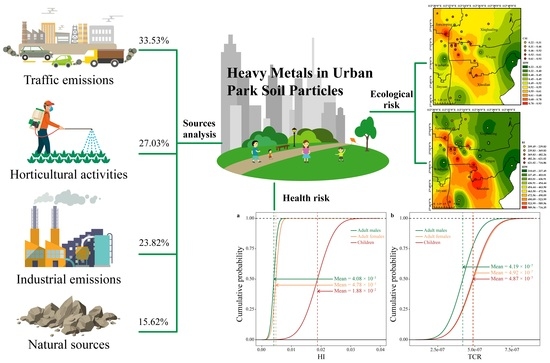
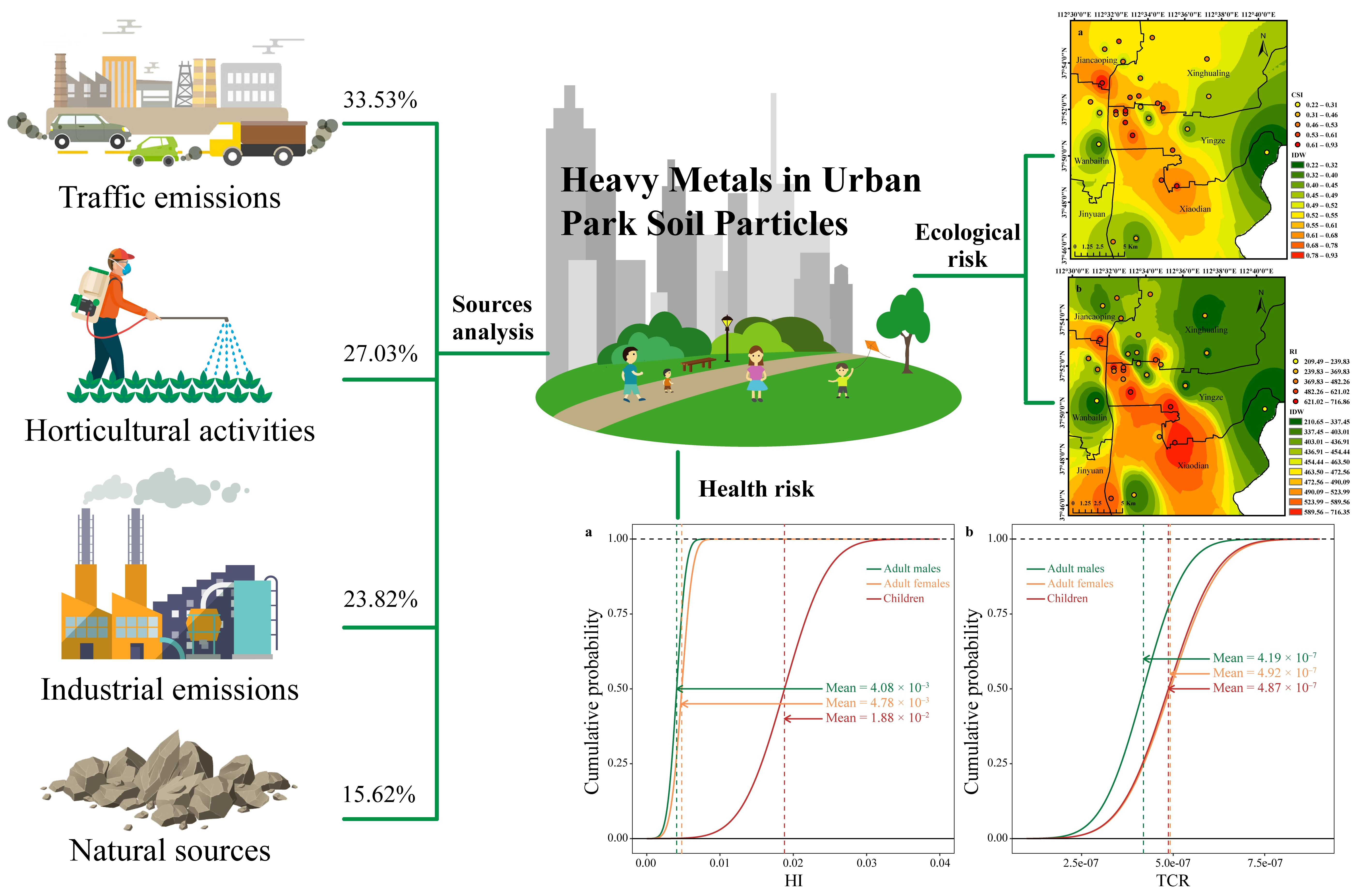
To investigate the pollution characteristics, potential risks and source apportionment of heavy metals in soil particles from urban parks in Taiyuan, Shanxi Province, China, thirty soil samples were collected and processed into soil particles, and the concentrations of Cr, Ni, Cu, Zn, Pb, Cd, As, and Hg were subsequently measured. The results demonstrated that the mean concentrations of all eight heavy metals exceeded the natural lithogenic background values of Shanxi Province, with Hg, Cr, Pb and Cd exhibiting high variability. Obvious heavy metal accumulation was observed in the central urban area of Taiyuan, and Cd in park soil particles posed moderate to heavy contamination. The coefficient of variation (CV) values for Hg, Cr, Pb, and Cd were above 35%, and their enrichment factor (EF) values were greater than 1.5, implying that contamination of these four heavy metals was predominantly influenced by anthropogenic activities. The potential ecological risk index (RI) and contamination severity index (CSI) revealed that most sampling sites exhibited strong ecological hazards. Both non-carcinogenic and carcinogenic risks associated with heavy metals were within acceptable thresholds for both adults and children. Compared to adults, children were identified as being more vulnerable to heavy metal exposure than adults. Positive matrix factorization (PMF) analysis identified four primary sources: traffic emissions (Cu, Zn, Pb, and Cd), horticultural activities (Hg), natural sources (As), and industrial emissions (Cr, Ni), which contributed 33.53%, 27.03%, 15.62%, and 23.82% to the total heavy metal load, respectively. The findings of this study provide a scientific basis for the prevention, control, and management of heavy metal pollution in urban park soils.

Graphical Abstract

1. Introduction

Along with the rapid development of urbanization and urban-rural integration, a great amount of heavy metals were released into urban environments and contributed to the pollution of air, water and soil, posing potential risks to humans [1]. As an important component of urban green space, urban parks play an important role in building sustainable cities to enhance the quality of life for residents. Urban parks can aid many social services, such as exercise, recreation, education and entertainment [2,3]. Heavy metals that have accumulated in urban park soil particles can enter the human body through ingestion, inhalation and dermal contact, potentially causing adverse health effects such as neurotoxicity, cardiovascular disorders, cancer, and gastric damage [4,5,6,7]. Therefore, heavy metal pollution in park soil has garnered increasing attention in recent years [8,9].
Heavy metal pollution in the park soils has been reported in Europe, the United States, Asia and China [10,11,12,13,14,15,16]. Previous studies found that Pb and Cu in park and playground soils exhibited the highest bioaccessibility, and Pb had a potential non-carcinogenic risk to children [9]. As, Cd, Cr, Cu, Ni, Pb and Zn were observed in the soil of Lin’an (China) community garden and the carcinogenic risk of As, Cd and Ni exceeded the safety range [17]. In Jiaozuo (China), the soil or the dust of urban parks and schools also posed high potential risks to children [18,19]. Similarly, the good correlation between carcinogenic risk and the concentration of heavy metals was detected in southern Ghana and Baghdad (Iraq) [20,21]. Therefore, it is urgent to investigate the pollution characteristics, as well as the ecological and health risks of heavy metal in urban park soils, based on which appropriate control strategy can be established to effectively manage the risks.
Heavy metal pollution in park soils is mainly sourced from industrial activities, fossil fuel combustion and traffic emissions around parks. Pesticides and chemical fertilizers are also the primary source of heavy metal in park soils [22]. A study of four parks in Sydney manifested that traffic emissions contributed to 72~84% of heavy metals in park soils near the arterial roads [3]. Similarly, traffic emissions were considered as an important source of heavy metals in park soils in Beijing and Shanghai (China) [13,23]. Industrial emissions have also been observed to be the major source of heavy metals in the surface soil of Beijing and Nanjing (China) [24,25]. In addition, the impact of other anthropic factors such as atmospheric sedimentation and municipal solid waste cannot be ignored [26,27,28]. To prevent and control heavy metal pollution, it is necessary to determine the sources of the pollution and identify high-risk factors.
Taiyuan is one of the most important industrial cities in China. Previous studies on heavy metals primarily focused on agricultural soil, riparian sediments and dust, in which significant accumulations of heavy metals such as Pb, Cd, Cr, Cu, and Zn were found [29,30,31,32]. However, studies on park soils are rare. The main objectives of the present study were (1) to characterize the spatial distribution of eight heavy metals (Cr, Ni, Cu, Zn, Pb, Cd, As, Hg) in the urban park soil particles of Taiyuan; (2) to evaluate the degree of heavy metal contamination using the geo-accumulation index (Igeo) and enrichment factor (EF); (3) to assess the ecological and health risks associated with these heavy metals; and (4) to identify the potential sources of heavy metals.

2. Materials and Methods

2.1. Study Area and Sampling Site

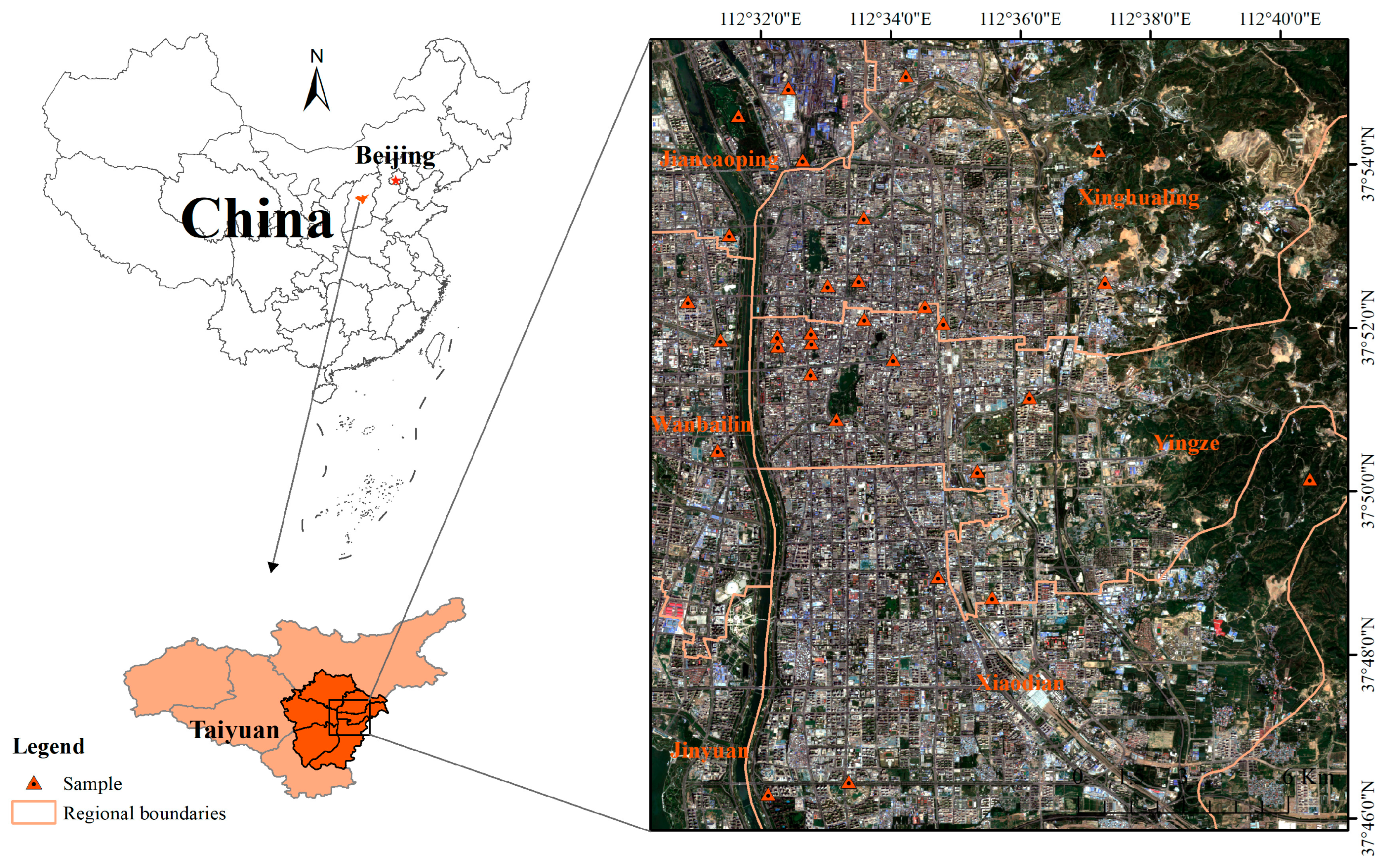
With an area spanning approximately 6900 km2 and a population of roughly 5.3 million, Taiyuan is the capital city of Shanxi Province, located in the North China. It is situated between 111°30′ and 113°09′ E, and 37°27′ and 38°25′ N. The urban area of Taiyuan comprises six districts: Xiaodian, Yingze, Xinghualing, Jiancaoping, Wanbailin, and Jinyuan (Figure 1). The annual mean precipitation in Taiyuan is approximately 420–450 mm, with the majority falling between June and August. The annual mean temperature is about 9.5 °C, characterized by the lowest temperature in January and the highest in July [31]. The per capital green land area of the city is 12.75 m2, with a green land coverage rate of approximately 44%. As a key national base for energy and heavy chemical industries in the past, Taiyuan featured pillar sectors, including coal, chemical engineering, machinery manufacturing, metallurgy, and thermal power generation. The dominant soil type in the city is brown soil, and the parent material throughout Taiyuan is Quaternary loess. Parks located within six urban districts and established for more than five years were selected as the research subjects (Figure 1).

2.2. Sample Collection and Processing

Soil samples were collected within 1~2 m from park entrances and exits, footpaths, and playgrounds (partly included forest floor). Samples were collected from the upper 0~5 cm, 3~5 samples were collected at each sampling site and thoroughly mixed to form a composite sample. Then, the samples were air-dried in a ventilated laboratory environment, impurities were removed, and the material was sieved through a 200-mesh screen. All samples were stored at −4 °C until analysis. The original mass of the samples was no less than 1 kg, and the mass after drying and screening was no less than 500 g [13].

2.3. Chemical Analysis

An acid digestion procedure was performed using a fully automated microwave digestion system, and then Ni, Cu, Zn, Pb, Cd and total Cr were analyzed by inductively coupled plasma-mass spectrometer (ICP-MS), and As and Hg were analyzed by atomic fluorescence spectroscopy (AFS). Each sample was repeated three times to ensure accuracy, and the final results were expressed as mean ± SD.

2.4. Ecological Risk Assessment

2.4.1. Enrichment Factor (EF)

The enrichment factor (EF) is used to assess the degree of metal pollution and the probable contribution of the anthropogenic source [33]. It is generally believed that heavy metal pollution may be totally from crustal materials or natural weathering processes if EF < 1.5, whereas EF > 1.5 specifies that the metal is caused by human activities [34]. EF is calculated as follows:
E F = C i B v / C v B i
where C i is the mean concentration of a target metal and C v is the concentration of the reference element in the sample. B i is the lithogenic background value of the target metal to be measured and B v (3%) is the background value of the reference element. The reference element can generally be Fe, Al, Ca, Mn, etc. [35,36]. “Fe” is geochemically stable and less affected by anthropogenic activities, making it widely adopted as a reference element in similar studies [37]. More importantly, Fe in the study area exhibited low variability and minimal enrichment. For these reasons, “Fe” was chosen as the normalization factor in this study.

2.4.2. Geo-Accumulation Index (Igeo)

The geo-accumulation index (Igeo) can effectively reflect the concentration of exogenous heavy metals in the soil [38]. The calculation formula is as follows [35]:
I g e o = log 2 [ C i / ( K × B C ) ]
where C i is the mean concentration of the element in the sample. BC is the lithogenic background concentration of the element [39]. K (1.5) is the background matrix correction factor, due to lithological variability. The seven contamination classes can be assigned based on the increasing value of the geo-accumulation index shown in Table 1 [40].

2.4.3. Potential Ecological Risk Index (RI)

The potential ecological risk index (RI) proposed by Swedish scholar Hakanson [41] is determined through the following formula:
R I = i = 1 n E r i = i = 1 n T i × C i / B i
where E r i is the potential ecological risk factor of the element in the sample; T i is the toxic response factor of metals (the values for Cr, Ni, Cu, Zn, Pb, Cd, As and Hg are 2, 5, 5, 1, 5, 30, 10 and 40, respectively) [42]; C i is the mean content of the element in the sample; and B i is the regional background value of the element in soil. RI can be divided into four classes (Table 2) [43].

2.4.4. Contamination Severity Index (CSI)

The contamination severity index (CSI) is a comprehensive indicator to investigate the severity of heavy metal contamination in the soil. The structure of this index is based on the “effects range—low (ERL)”, and “the effects range—median (ERM)”. CSI considers the weight of each heavy metal to reflect the toxicity boundaries and adverse biological effects. The classification of contamination severity refers to Pejman et al. [44]: uncontaminated (CSI < 0.5), very low contamination severity (0.5 < CSI < 1), low contamination severity (1 ≤ CSI < 1.5), low to moderate contamination severity (1.5 ≤ CSI < 2), moderate contamination severity (2 ≤ CSI < 2.5), moderate to high contamination severity (2.5 ≤ CSI < 3), high contamination severity (3 ≤ CSI < 4), very high contamination severity (4 ≤ CSI < 5), and extremely high contamination severity (5 ≤ CSI). The formula for the CSI is shown in the following (4) [45]:
C S I = i = 1 n W i [ ( C i / E R L i ) 1 / 2 + ( C i / E R M i ) 2 ]
where W i is the weight of the heavy metals; C i is the mean concentration of the metal; E R L i and E R M i [46] are the effects range—low and the effects range—median given in Table S1. The weight of each HM is determined by principal component analysis (PCA), and is calculated using the following formula:
W i = ( Q i × E ) / i n ( Q i × E )
where Q i is the load value and E is the eigenvalue.

2.5. Methods of Health Risk Assessment

Health risks mainly include non-carcinogenic and carcinogenic risks. Cr, Ni, Cu, Zn, Pb, Cd, As, and Hg exert chronic non-carcinogenic risks and As, Cr, and Ni present carcinogenic risks. To quantify the non-carcinogenic and carcinogenic risks of these eight heavy metals to children and adults from ingesting contaminated soil, three main pathways including oral ingestion, dermal adsorption and inhalation were considered in both non-carcinogenic and carcinogenic risks. A Monte Carlo simulation was employed to quantify the uncertainty and variability of health risk assessment results across different demographic groups (including children and adults). Specifically, the Monte Carlo simulation was run with 10,000 iterations, and the risk parameters of each demographic group were set based on the guidelines of the U.S. Environmental Protection Agency (USEPA) and relevant domestic standards, combined with the actual demographic characteristics of the Taiyuan urban area.
The formula for calculating the average daily exposure (ADD) under different exposure routes is as follows. The parameters are shown in Table S2 [1,23].
A D D i n g = ( C × R i n g × E F × E D × 10 6 ) / ( B W × A T )
A D D d e r m a l = ( C × S A × S L × A B F × E F × E D × 10 6 ) / ( B W × A T )
A D D i n h = ( C × R i n h × E F × E D × 10 6 ) / ( P E F × B W × A T )
The non-carcinogenic risk index and carcinogenic risk index were calculated according to the following formula:
H Q i = A D D i / R f D i
H I = i = 1 n H Q i
T C R = i = 1 n C R i = i = 1 n A D D i × S F
where C is the mean concentration of the element in the sample; HQi is the non-carcinogenic risk index of a single heavy metal; RfD is the reference dose of three exposure pathways; and HI is the total non-carcinogenic risk index. The non-carcinogenic risk is higher when HI > 1, and within an acceptable range when HI < 1 [47]. TCR is the carcinogenic risk index and SF is the carcinogenic slope factor. RfD and SF are shown in Table S3 [30,48].

2.6. Source Analysis of Heavy Metals

This study conducted the source of heavy metals based on the positive matrix factorization (PMF, US EPA, v5.0) [49,50]. PMF v5.0 is a peer-reviewed multivariate receptor modeling software; this model decomposes the concentration matrix X (30 samples × 8 species) into two non-negative matrices: factor contributions g (30 samples × 4 factors, representing the mass contribution of each source to individual samples) and factor profiles f (4 factors × 8 species, representing the chemical fingerprint of each source). All model operations (data input, configuration, base runs, and diagnostics) were performed via the EPA PMF 5.0 graphical user interface, and the identified factors were assigned to specific source types based on their characteristic chemical compositions and the relevant literature [51,52]. The data matrix in the PMF model can be expressed as Formula (12).
X i j = k = 1 p g i k × f k j + e i j
where X i j is the concentration of element j in the i soil sample; g i k is the content of element J in source K (mg·kg−1); f k j is the contribution of source K to the i soil sample; and e i j is the residual matrix. Its main purpose is to optimize the objective function, Q, and it is calculated according to the following formula:
Q = i = 1 n j = 1 m e i j / U n c 2
where U n c is the uncertainty and the calculation formula is as follows:
U n c = 10 % X i j + 1 / 3 M D L
U n c = 5 / 6 M D L
where MDL is the detection limit of the method. U n c is calculated by Formula (14) when the measured concentration of soil heavy metals is greater than the corresponding MDL; when the measured concentration of soil heavy metals is less than or equal to the corresponding MDL, U n c is calculated by Formula (15), and the concentration of heavy metals is corrected to 1/2MDL at the same time.

2.7. Statistical Analysis

The descriptive statistical analysis of the data was obtained through IBM SPSS v27.0 (IBM, Armonk, NY, USA). The spatial analysis was performed using ArcGIS10.8, and the data visualization was completed in the R software (Version 4.3.3; R Core Team, 2024) environment.

3. Results and Discussion

3.1. Characteristics of Heavy Metal Pollution

Table 3 presents the descriptive statistics for heavy metals in urban park soil particles, including the mean, median, minimum, maximum, standard deviation, coefficient of variation (CV), and the natural lithogenic background values for soils in Shanxi Province. The average concentrations of Cr, Ni, Cu, Zn, Pb, Cd, As and Hg were 92.33 ± 45.61 mg·kg−1, 34.54 ± 8.86 mg·kg−1, 28.68 ± 7.94 mg·kg−1, 116.01 ± 33.11 mg·kg−1, 23.71 ± 7.87 mg·kg−1, 1.01 ± 0.32 mg·kg−1, 10.72 ± 2.84 mg·kg−1 and 0.07 ± 0.06 mg·kg−1, respectively. The average concentrations of all heavy metals exceeded their corresponding lithogenic background values, indicating significant heavy metal pollution in urban park soils, which is in keeping with previous studies [29,39]. In particular, the average concentrations of Cd and Hg were 9.90 and 3.04 times the corresponding background values. Previous studies showed that many anthropogenic activities such as vehicle emissions, agricultural practices, and industrial activities might lead to high Cd and Hg contamination [23]. In addition, the concentrations of Hg, Zn, Pb, and Cr exceeded their background values in 24, 27, 29 and 25 samples, respectively. Similar results reported that Hg, Zn, Pb and Cr were the largest accumulated heavy metals in the Fenhe River sediments from the Taiyuan section [32]; although the study focused on the sediments of sediments, the sources of contamination were comparable. These findings highlighted that local pollutant management and control should pay more attention to Hg, Zn, Pb and Cr.
According to the classification standard for the degree of variation [53], the coefficients of variation for Hg, Cr, Pb, and Cd were above 35%. Notably, Hg and Cr exhibited extremely high coefficients of variation at 85.71% and 49.40%, respectively. This high variability may be attributed to elevated concentrations observed in a limited number of soil samples, suggesting the presence of point sources for these two heavy metals. Previous studies found that Hg was the largest contributor to heavy metal pollution of indoor dust in urban and rural areas of Taiyuan [30].
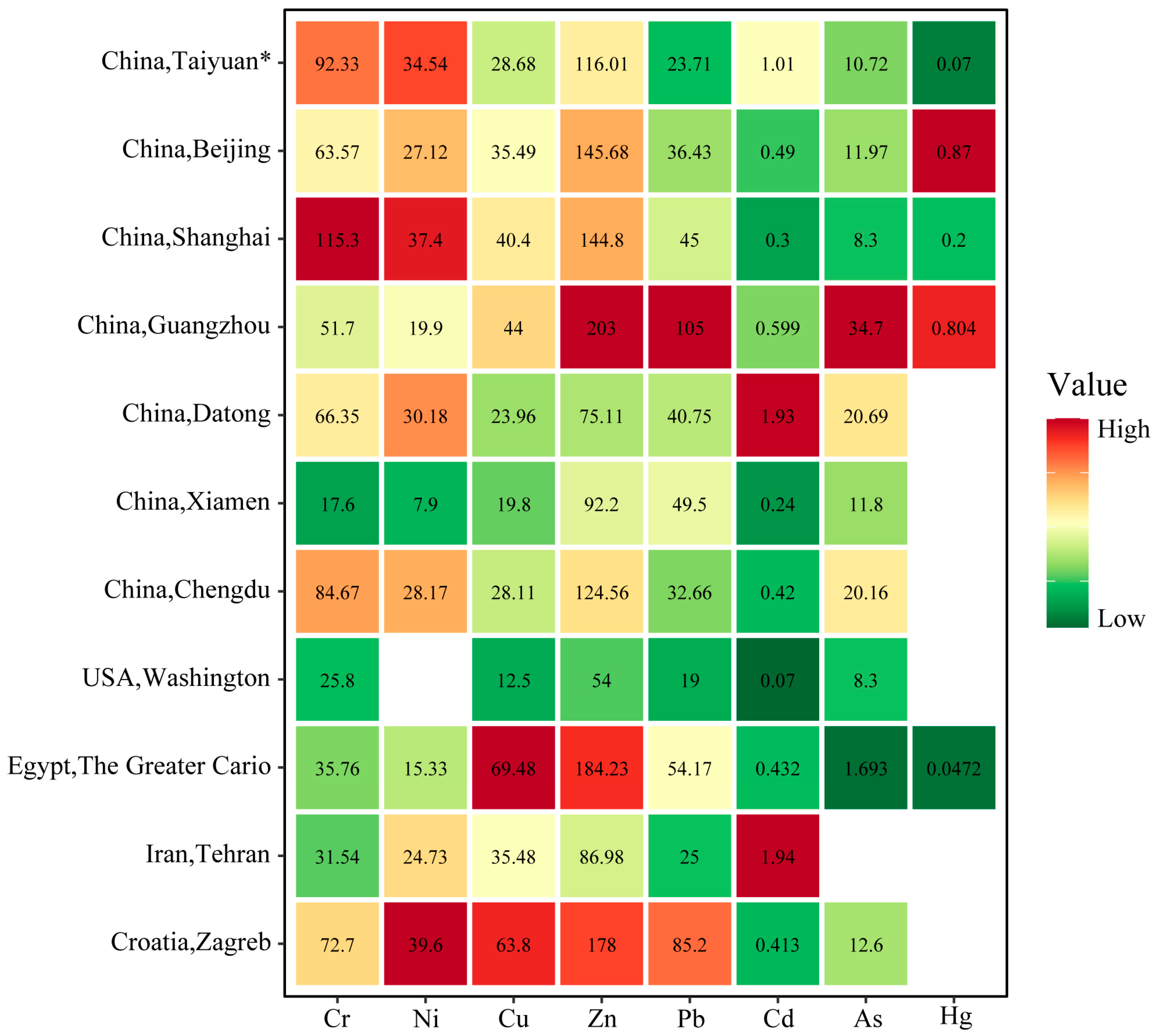
To better understand the contamination levels of the study area, the results of this study were compared with those of urban parks in different cities worldwide. As shown in Figure 2, the concentrations of Cr and Cd in the soil particles of urban parks in the study area were higher than those reported in Washington, Egypt, Croatia and other Chinese cities [8,14,54]. The concentrations of Ni, Zn and As were at moderate levels, while Cu and Pb were relatively lower compared to those in Iran, Egypt, and Urumqi [8,15,55]. Similarly, the concentrations of Cu and Pb were lower than those of other Chinese cities such as Guangzhou and Shanghai [16,23]. Compared with Datong (northern Shanxi), the concentration of Cu was higher, whereas Pb was lower [56]. Additionally, the concentration of Hg in soil particles of Taiyuan’s urban parks was lower than those in Beijing, Shanghai and Guangzhou [13,16,23]. For As, its concentration in Taiyuan was higher than that in Shanghai and Chengdu [23,55], comparable to that in Beijing and Xiamen [13,57], but lower than that in Guangzhou and Datong [16,56].
The differences in heavy metal concentrations across countries and cities are mainly attributed to variations in geological backgrounds and industrial development levels [12], which highlights the importance of implementing differentiated environmental management strategies. In the study area, Cd and Cr concentrations were relatively higher; therefore, targeted pollution control measures for those two heavy metals should be prioritized. Although the concentrations of Ni, Zn, As, Cu, Pb and Hg were lower, long-term prevention and control should not be neglected, as they are crucial for improving the soil environment quality of urban parks and protecting public health and ecological security.

3.2. Spatial Distribution

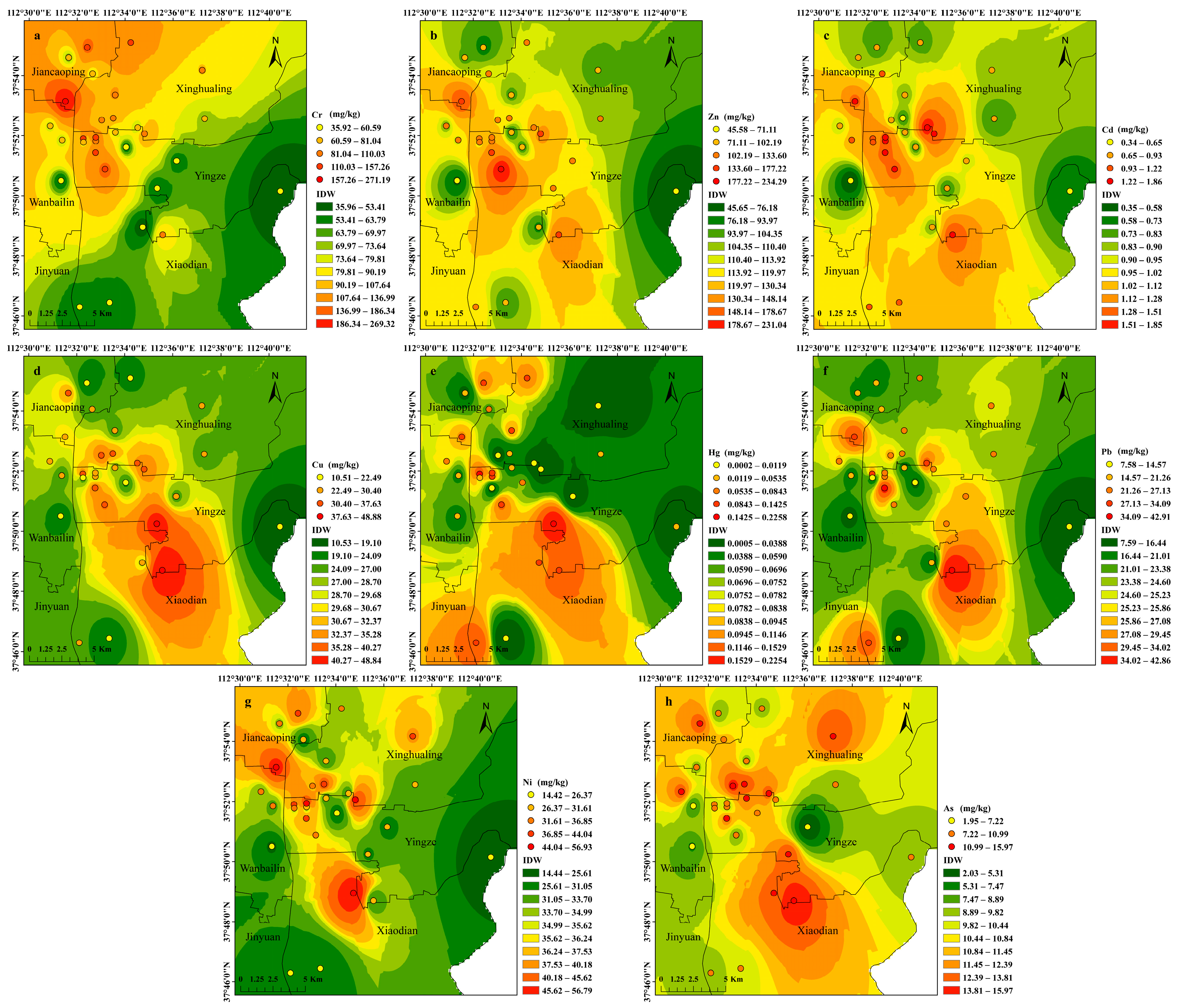
The spatial distribution maps of Cr, Ni, Cu, Zn, Pb, Cd, As and Hg were achieved using the inverse distance weighting (IDW) method, based on heavy metal concentrations. As shown in Figure 3, Cr was primarily distributed in the northwest of the study areas, specifically in the Jiancaoping district (Figure 3a). The northwest part of Taiyuan encompasses the Taiyuan Iron & Steel Group and many smaller-sized smelters, which considerably influenced the concentration of Cr in the park soil particles [58]. High concentrations of Cd and Zn were mainly concentrated in the Yingze district (Figure 3b,c). The spatial distribution of high Cu, Hg, Pb, and Ni were mainly located in the Yingze and Xiaodian districts (Figure 3d–g). The Yingze district is in the center of Taiyuan, so intensive traffic flow is the primary source of these heavy metals, such as vehicle emissions, corrosion-resistance material weathering, brake wear and the wear of automobile tires [59]. As was evenly distributed in the study area, the high-concentration sample sites were randomly distributed, indicating that the pollution source of As was likely a non-point, such as parent soil materials (Figure 3h). The spatial distribution of heavy metals in urban park soil particles was significantly different depending on the location of sampling parks and the emission source around them.

3.3. Contamination and Risk Assessment

3.3.1. Enrichment Factor (EF) and Geo-Accumulation Index (Igeo)

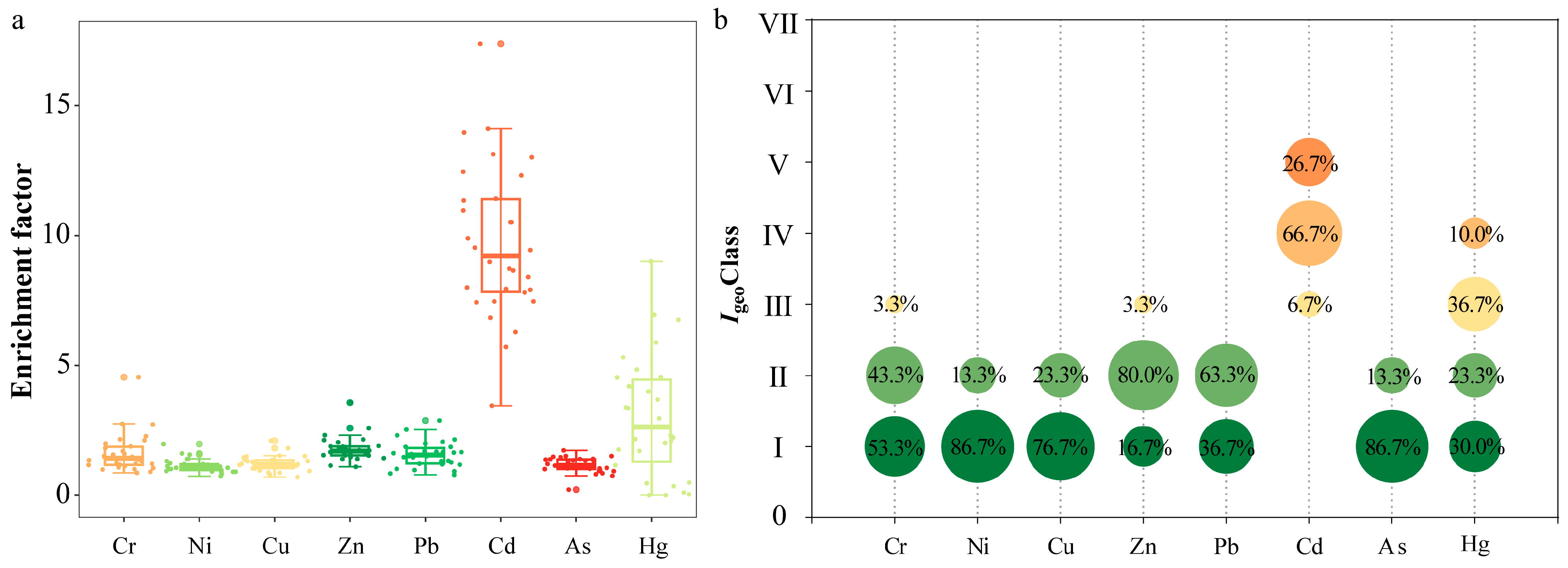
To assess the impact of anthropogenic activities on heavy metal contamination in urban park soil particles, the EF values for eight heavy metals were calculated and presented in Figure 4a. The EF values exhibited ranges of 0.86–4.55 for Cr, 0.74–1.98 for Ni, 0.70–2.11 for Cu, 1.10–3.57 for Zn, 0.79–2.88 for Pb, 3.45–17.38 for Cd, 0.22–1.73 for As, and 0.01–9.01 for Hg. The mean EF values of Ni, Cu, As, Cr, Zn, Pb, Hg and Cd were 1.13, 1.22, 1.16, 1.63, 1.79, 1.58, 3.02 and 9.70, respectively. The EF values of Cr, Zn, Pb, Cd and Hg were >1.5, suggesting that the contamination of these five heavy metals in urban park soil particles was likely influenced by anthropogenic activities [30].
The Igeo classification of eight heavy metals was presented in Figure 4b. The mean Igeo values for eight heavy metals were arranged in the following order: Cd (2.64) ˃ Zn (0.23) ˃ Cr (0.23) ˃ Pb (0.02) ˃ Hg (−0.06) ˃ Cu (−0.32) ˃ As (−0.42) ˃ Ni (−0.43). The Igeo values for Pb, Ni, Cu, As, Cr and Zn ranged from class I to class III, and the values of most sampling points were in the range of class I to class II, indicating that these six heavy metals were between no pollution and slight pollution. The Igeo value for Hg ranged from class I to class IV, and 11 samples belonged to class III (mild pollution). The Igeo value for Cd ranged from class III to class V, with 20 samples classified as class IV, which showed that Cd contamination was more severe compared to other metals in the study area.

3.3.2. Contamination Severity Index (CSI) and Potential Ecological Risk Index (RI)

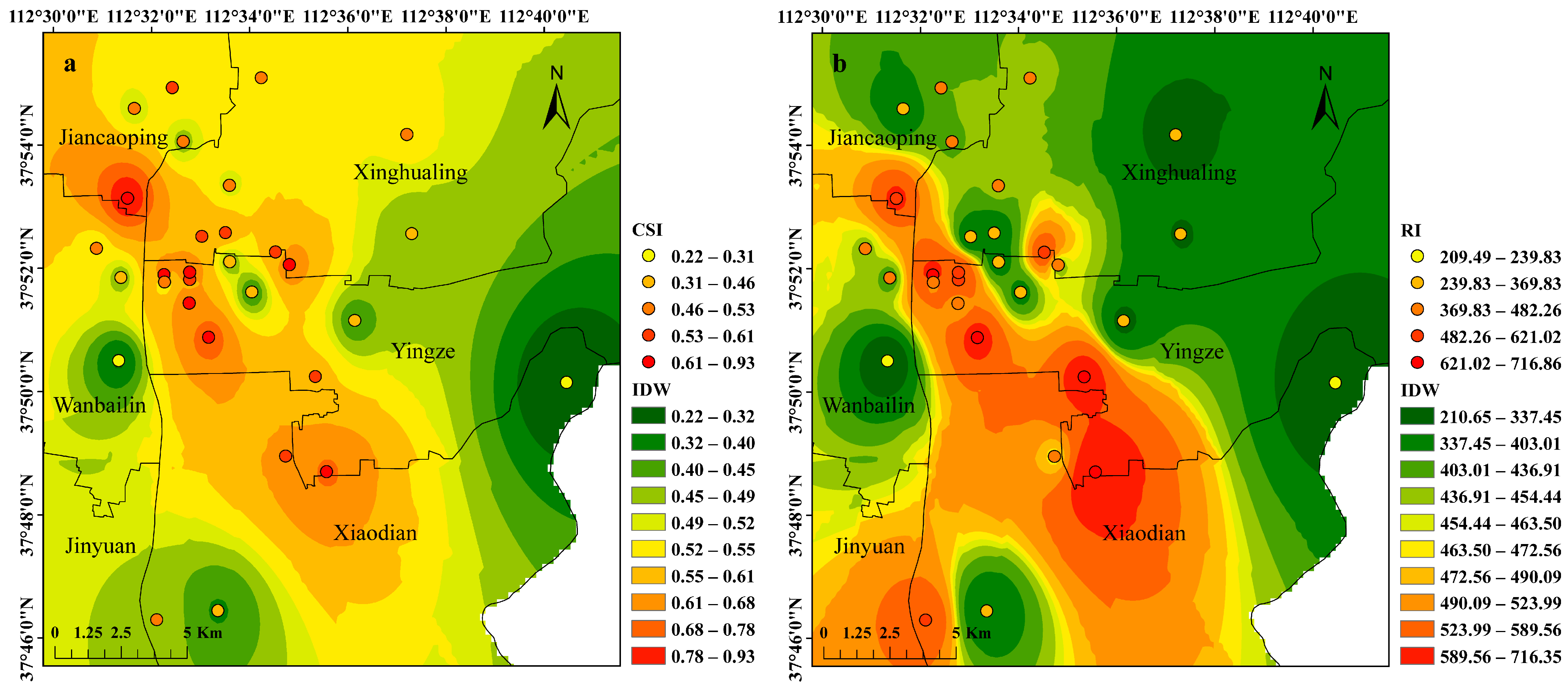
Considering the multifaceted sources of pollution in the study area, we conducted a comprehensive investigation to assess the overall enrichment levels and ecological risks associated with heavy metals in the urban park soil particles, using the CSI. The CSI values exhibited a range of 0.22 to 0.93. Specifically, 43.33% of soil particles samples presented values < 0.5, belonging to non-pollution, while 56.67% of soil samples had values in the range of 0.5–1.0, which reflected a low pollution risk (Figure 5a). Severely contaminated areas were primarily concentrated in the west and south parts of the Yingze district, as well as parts of the Xinghualing, Wanbailin and Jiancaoping districts.
The distribution of RI was shown in Figure 5b. The RI values ranged from 209.49 to 716.85 in the study area: 6.67% of soil samples belonged to medium ecological hazards (150 < RI < 300), 66.67% exhibited strong ecological hazards (300 < RI < 600), and 26.67% exhibited very strong ecological hazards (RI > 600) (Figure 5b). Severely contaminated areas were primarily concentrated in the west part of the Yingze district and at the junction between the Yingze and Xiaodian districts, which is the center of Taiyuan city.
Compared the results of CSI and RI, it can be found that the ecological risk levels of many sampling points were consistent.

3.4. Health Risk Assessment

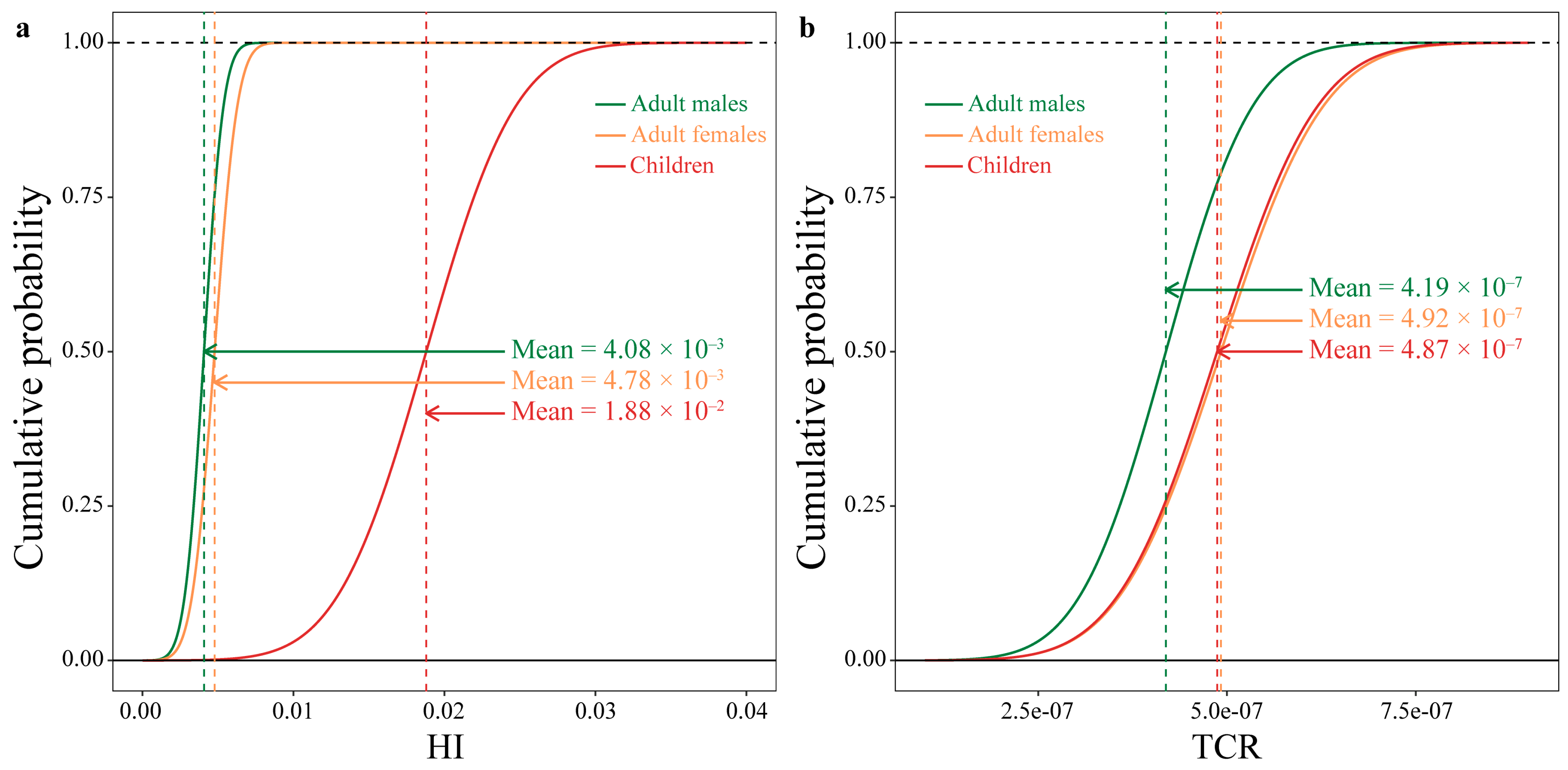
Soil is the potential source of particles; heavy metals in soils can be released into PM2.5, PM10 and other aerosols via wind erosion and dust emission, thereby imposing adverse health risks [60,61]. Therefore, a Monte Carlo simulation was applied to assess both non-carcinogenic and carcinogenic risks posed by heavy metals in urban park soil particles to various populations (adult males, adult females and children) via three exposure pathways. As illustrated in Figure 6a, the non-carcinogenic risk values for various demographic groups were below one, indicating that the non-carcinogenic risk remained within an acceptable threshold. The HI values for the three populations were ranked in the following order: children (1.88 × 10⁻²) > adult females (4.78 × 10⁻³) > adult males (4.08 × 10⁻³). As for the carcinogenic risk, the mean values of TCR for children, adult females and males were 4.87 × 10⁻⁷, 4.92 × 10⁻⁷ and 4.19 × 10⁻⁷, respectively (Figure 6b). Overall, both non-carcinogenic and carcinogenic risks for all population groups were within acceptable limits. However, it was worth noting that children were more vulnerable to non-carcinogenic health risks arising from heavy metals than adult males and females (Figure 6a), which is consistent with previous studies [62]. Although both non-carcinogenic and carcinogenic risks were acceptable, a substantial proportion of sites showed strong to very strong ecological risks; acceptable health risk does not necessarily imply negligible environmental concern, particularly for children.

3.5. Source Identification

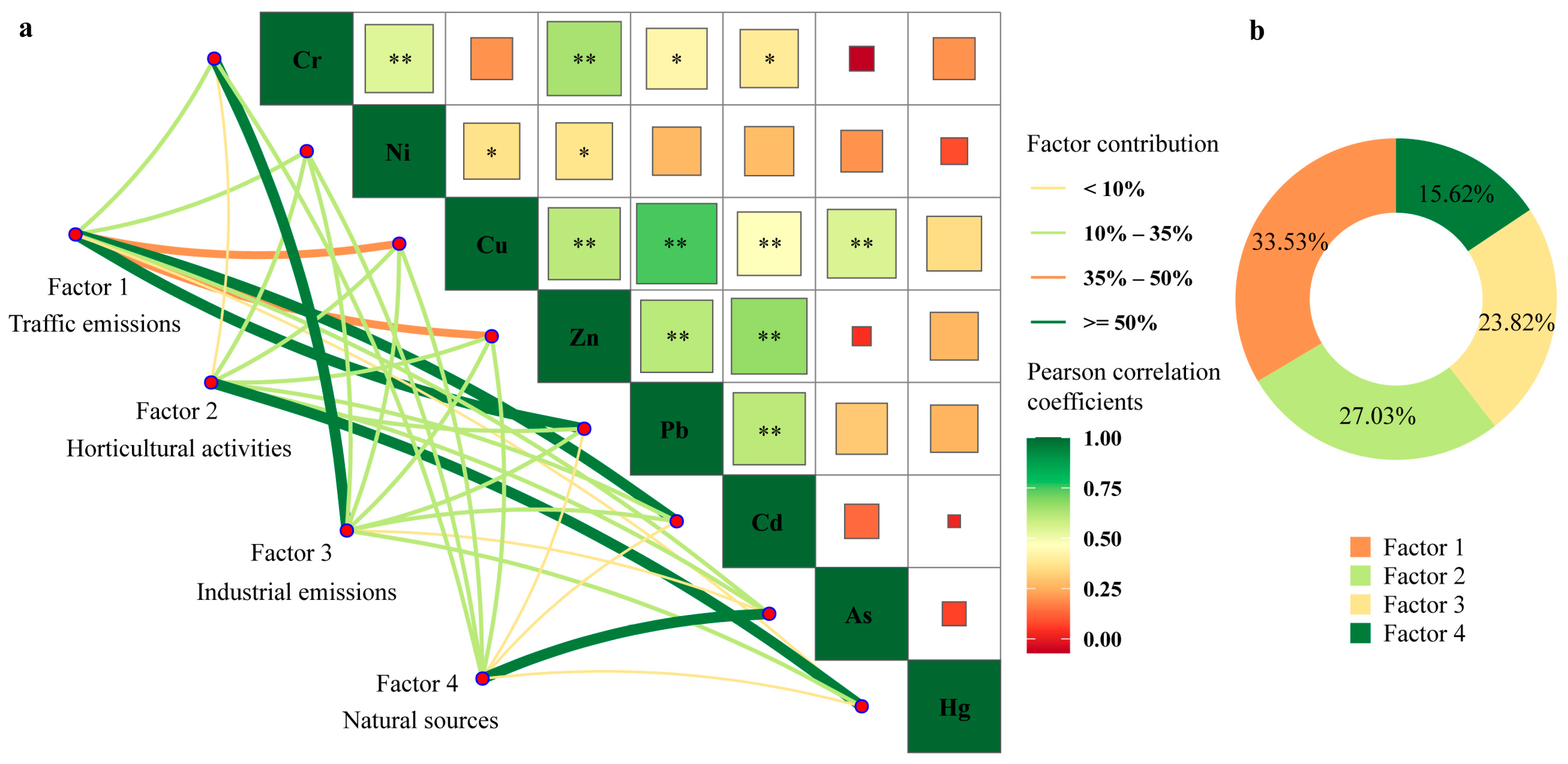
To identify the sources of eight heavy metals, Pearson correlation analysis and PMF were performed. As shown in Figure 7a, the Pearson correlation coefficients for Cu, Zn, Pb and Cd were highly correlated with each other, indicating that these four heavy metals share a similar anthropogenic source, such as vehicle emissions [63,64]. Cr also showed a relatively strong correlation with Ni, demonstrating that Cr and Ni may come from the same sources. In addition, Cr was also significantly correlated with Zn, Pb and Cd, which indicates that Cr may be influenced by other anthropogenic activities. No significant correlation was found between Hg and the other seven elements, suggesting that Hg originated from a different source. A positive correlation was found between As and Cu.
The PMF model was applied to identify the sources and contributions of heavy metals in urban park soil particles. The model performed well and met the criteria for PMF source apportionment when four factors were adopted, with R2 ˃ 0.5 and PMF-calculated residuals ranging from −3 to 3, indicating a good fit of the simulated results. Accordingly, four factors were ultimately identified, with contribution rates of 33.53% (Factor 1), 27.03% (Factor 2), 23.82% (Factor 3), and 15.62% (Factor 4), respectively (Figure 7b).
Factor 1 was primarily characterized by Cu, Zn, Pb and Cd, with contribution rates of 42.00%, 44.50%, 53.10% and 58.00%. Pearson correlation analysis revealed significant positive correlations between Cu and Zn, Cu and Pb, and Cd and Pb, suggesting that these four heavy metals may originate from the same source. Numerous previous studies have reported that traffic emissions and industrial activities, such as metal smelting, were significant contributors to the accumulation of Cu, Zn and Pb in soil particles [13,65,66]. Additionally, Cd, Cu, Pb and Zn have been found to be the primary elements of road dust collected from industrial and residential areas [67]. Zn, in particular, is a component of vehicle tires, and high concentrations of Zn have been found in street dust, especially on trunk roads [36,68]. According to the spatial distributions (Figure 2), the high-concentration areas of Cu, Zn, Pb and Cd were mainly concentrated in the center of Taiyuan city, where traffic is particularly dense. Hence, Factor 1 can be interpreted as traffic emissions.
Factor 2 primarily loaded on Hg. As shown above, the mean concentration of Hg in the study area was 3.04 times the corresponding background value, and Hg exhibited a high coefficient of variation (85.71%) (Table 3), as well as a large EF (3.02) (Figure 4a), indicating that Hg in urban park soil particles was likely to be severely influenced by anthropogenic activities. Previous studies showed that 80% of manmade Hg sources enter the atmosphere in the form of elemental vapor, which may originate from exhaust emissions, fuel combustion and waste incineration [13]. Generally, Hg also comes from agricultural activities such as the use of pesticides and fertilizers [22]. It was a common phenomenon to use fertilizers and pesticides in daily greening management [1]. Therefore, the second source was tentatively identified as horticultural activities.
Factor 3 was dominated by Cr and Ni. Cr accounted for the majority of this source with a contribution rate of 57.20%, and the contribution rate of Ni was 28.6%. Cr and Ni were significantly correlated and their concentration distributions were highly similar (Figure 2). The spatial distribution results show that Cr and Ni primarily concentrated in the north of the study area, where industrial activities, such as metal smelting, are prevalent. Taiyuan Iron & Steel Group is located in this area. Previous studies have demonstrated that a large amount of Cr and As elements can remain in the vicinity of steel mills [7,67], and Ni is one of the priority-controlled heavy metals in the steel industry [69], further supporting the idea that Cr and Ni were primarily derived from industrial activities [32]. Therefore, Factor 3 was identified as industrial emissions.
Factor 4 was exclusively dominated by As, with a contribution rate of 50.7%. As shown in Figure 3, As was evenly distributed across the study area and exhibited a lower average concentration, suggesting that there were fewer contributions from external sources. Previous studies have demonstrated that As may originate from multiple sources, such as coal combustion [19,22], metal smelting [7], agricultural activities [70] and soil parent materials [71]. However, considering the very low concentration and the small EF, it is less likely to be influenced by human activities. Furthermore, as shown in Figure 4b, most soil samples exhibited lower Igeo values, which validated against its crustal origin. Thus, the primary source of As was determined to be the soil parent material. At all events, Factor 4 was identified as the natural source.

4. Conclusions

In the present study, we investigated the concentrations, distribution characteristics, ecological and health risks and pollution sources of Cd, Cr, Pb, Zn, Cu, Ni, Hg and As in urban park soils of Taiyuan, northern China. The mean concentrations of all eight heavy metals exceeded the corresponding soil lithogenic background values. The CV values for Hg, Cr, Pb and Cd were greater than 35%, accompanied by EF higher than 1.5, collectively indicating intense anthropogenic disturbance. Among these heavy metals, Hg, Zn, Pb and Cd were identified as the primary contaminants in the study area, with 24, 27, 29 and 25 samples exceeding their respective background values, respectively. The contamination levels of Cr, Pb, Zn, Cu, Ni and As varied from no pollution to moderate pollution. The most severely polluted area was primarily located in parts of the Yingze and Xiaodian districts, the core urban area of Taiyuan. The CSI values ranged from 0.22 to 0.93, suggesting an uncontaminated to very low pollution status. The RI values varied from 209.49 to 716.85, and 93.34% of soil samples posed strong to extremely strong ecological hazards, with Cd posing a significantly higher ecological risk, relative to other heavy metals. Regarding human health risks, both non-carcinogenic and carcinogenic risk for all exposed populations fell within acceptable thresholds, implying that heavy metals in the urban park soils of Taiyuan pose no significant adverse health risks to residents. Source apportionment results demonstrated that heavy metals in the urban park soils of Taiyuan mainly originated from traffic emissions (33.53%), horticultural activities (27.03%), industrial emissions (23.82%) and natural sources (15.62%).

Supplementary Materials

The following supporting information can be downloaded at: https://www.mdpi.com/article/10.3390/atmos17030230/s1, Table S1:The effects range-low ( E R L i ) and the effects range-median ( E R M i ) of heavy metals in soils; Table S2: Calculation parameters of health risk assessment; Table S3: Reference dose (RfD) and slope factors (SF) values of metals in soil by different exposure pathways used in health risk assessment model.

Author Contributions

Methodology, A.L.; validation, L.W.; formal analysis, M.H.; data curation, Z.W.; writing—original draft preparation, H.W.; writing—review and editing, H.G. and Z.Z.; funding acquisition, Y.H. All authors have read and agreed to the published version of the manuscript.

Funding

This research was funded by “The National Natural Science Foundation of China (22276116)”, “The Natural Science Foundation of Shanxi Province (202303021211009)”, the “International Scientific and Technological Cooperation Projects of Shanxi (China) for Designated Countries (202304041101011)” and the “Open Fund from MOE Key Laboratory of Coal Environmental Pathogenicity and Prevention, Shanxi Medical University, China” (MEKLCEPP/SXMU-202302).

Institutional Review Board Statement

Not applicable.

Informed Consent Statement

Informed consent was obtained from all subjects involved in the study.

Data Availability Statement

All relevant data are within the manuscript and its Supplementary Materials.

Acknowledgments

The authors extend their appreciation to the anonymous reviewers for their thoughtful comments and valuable advice.

Conflicts of Interest

The authors declare no conflicts of interest.

References

  1. Qin, S.; Xie, L.; Lan, J.; Yang, Y.; Diao, W.; Ning, Y. Heavy metal exposure and cancer risk: Findings from a mendelian randomization study. Toxicol. Lett. 2026; in press. [Google Scholar] [CrossRef]
  2. Li, C.; He, Z.; Wang, J. Dynamic differences in urban park accessibility across age groups: A case study of Shanghai, China. Appl. Geogr. 2026, 188, 103910. [Google Scholar] [CrossRef]
  3. Liu, J.; Wang, H.; Cheng, Y.; Sun, Y.; Yang, C. Urban park quality assessment: A synergy differentiation approach integrating landscape, behavior and emotion. J. Clean. Prod. 2026, 543, 147633. [Google Scholar] [CrossRef]
  4. Gu, Y.G.; Gao, Y.P. Bioaccessibilities and health implications of heavy metals in exposed-lawn soils from 28 urban parks in the megacity Guangzhou inferred from an in vitro physiologically-based extraction test. Ecotoxicol. Environ. Saf. 2018, 148, 747–753. [Google Scholar] [CrossRef]
  5. Ma, J.Y.; Li, W.Y.; Yang, Z.Y.; Su, J.Z.; Li, L.; Deng, Y.R.; Tuo, Y.F.; Niu, Y.Y.; Xiang, P. The spatial distribution, health risk, and cytotoxicity of metal(loid)s in contaminated field soils: The role of Cd in human gastric cells damage. Sci. Total Environ. 2023, 878, 162942. [Google Scholar] [CrossRef] [PubMed]
  6. Shahab, A.; Hui, Z.; Rad, S.; Xiao, H.; Siddique, J.; Huang, L.L.; Ullah, H.; Rashid, A.; Taha, M.R.; Zada, N. A comprehensive review on pollution status and associated health risk assessment of human exposure to selected heavy metals in road dust across different cities of the world. Environ. Geochem. Health 2023, 45, 585–606. [Google Scholar] [CrossRef] [PubMed]
  7. Yang, S.; Zhao, J.; Chang, S.X.; Collins, C.; Xu, J.; Liu, X. Status assessment and probabilistic health risk modeling of metals accumulation in agriculture soils across China: A synthesis. Environ. Int. 2019, 128, 165–174. [Google Scholar] [CrossRef]
  8. Shetaia, C.A.; Li, M.; Chen, J.; Wang, Y.; Elhebiry, M.S.; Abdelaal, A.; Su, H.; Chen, Z.; Salem, A. Comprehensive assessment of remarkable heavy metals contamination in road dust in Greater Cairo: Priority control factors based on source apportionment and risk assessment. J. Environ. Manag. 2025, 394, 127607. [Google Scholar] [CrossRef]
  9. Kyene, M.O.; Gbeddy, G.; Mensah, T.; Acheampong, C.; Kumi-Amoah, G.; Ketemepi, H.K.; Brimah, A.K.; Akyea-Larbi, K.; Darko, D.A. Bioaccessibility and children health risk assessment of soil-laden heavy metals from school playground and public parks in Accra, Ghana. Environ. Monit. Assess. 2023, 195, 1199. [Google Scholar] [CrossRef] [PubMed]
  10. Gulan, L.; Stajic, J.M.; Zeremski, T.; Durlević, U.; Valjarević, A. Radionuclides and metals in the parks of the city of Belgrade, Serbia: Spatial distribution and health risk assessment. Forests 2022, 13, 1648. [Google Scholar] [CrossRef]
  11. Khan, S.; Munir, S.; Sajjad, M.; Li, G. Urban park soil contamination by potentially harmful elements and human health risk in Peshawar City, Khyber Pakhtunkhwa, Pakistan. J. Geochem. Explor. 2016, 165, 102–110. [Google Scholar] [CrossRef]
  12. Li, D.; Lu, Q.; Cai, L.; Chen, L.; Wang, H. Characteristics of soil heavy metal pollution and health risk assessment in urban parks at a megacity of central China. Toxics 2023, 11, 257. [Google Scholar] [CrossRef]
  13. Liu, L.; Liu, Q.; Ma, J.; Wu, H.; Qu, Y.; Gong, Y.; Yang, S.; An, Y.; Zhou, Y. Heavy metal(loid)s in the topsoil of urban parks in Beijing, China: Concentrations, potential sources, and risk assessment. Environ. Pollut. 2020, 260, 114083. [Google Scholar] [CrossRef] [PubMed]
  14. Nezat, C.A.; Hatch, S.A.; Uecker, T. Heavy metal content in urban residential and park soils: A case study in Spokane, Washington, USA. Appl. Geochem. 2017, 78, 186–193. [Google Scholar]
  15. Yaghoubi, S.Z.; Hosseini, S.A.; Bidhendi, G.N.; Sharafati, A. Assessment of heavy metals in contaminated soils of urban parks in Tehran, Iran. Int. J. Environ. Sci. Technol. 2022, 19, 12303–12314. [Google Scholar] [CrossRef]
  16. Zhou, H.; Ouyang, T.; Guo, Y.; Peng, S.; He, C.; Zhu, Z. Assessment of soil heavy metal pollution and its ecological risk for city parks, vicinity of a landfill, and an industrial area within Guangzhou, South China. Appl. Sci. 2022, 12, 9345. [Google Scholar] [CrossRef]
  17. Yan, Y.; Chen, R.; Jin, H.; Rukh, G.; Wang, Y.; Cui, S.; Liu, D. Pollution characteristics, sources, and health risk assessments of potentially toxic elements in community garden soil of Lin’an, Zhejiang, China. Bull. Environ. Contam. Toxicol. 2022, 109, 1106–1116. [Google Scholar] [CrossRef]
  18. Han, Q.; Wang, M.; Cao, J.; Gui, C.; Liu, Y.; He, X.; He, Y.; Liu, Y. Health risk assessment and bioaccessibilities of heavy metals for children in soil and dust from urban parks and schools of Jiaozuo, China. Ecotoxicol. Environ. Saf. 2020, 191, 110157. [Google Scholar] [CrossRef] [PubMed]
  19. Wang, M.; Han, Q.; Gui, C.; Cao, J.; Liu, Y.; He, X.; He, Y. Differences in the risk assessment of soil heavy metals between newly built and original parks in Jiaozuo, Henan Province, China. Sci. Total Environ. 2019, 676, 1–10. [Google Scholar]
  20. Frimpong, S.K.; Koranteng, S.S. Levels and human health risk assessment of heavy metals in surface soil of public parks in Southern Ghana. Environ. Monit. Assess. 2019, 191, 588. [Google Scholar] [CrossRef]
  21. Salah Al-Heety, E.A.M.; Yassin, K.H.; Abd-Alsalaam, S. Health risk assessment of some heavy metals in urban community garden soils of Baghdad City, Iraq. Hum. Ecol. Risk Assess. 2017, 23, 225–240. [Google Scholar] [CrossRef]
  22. Men, C.; Liu, R.; Xu, F.; Wang, Q.; Guo, L.; Shen, Z. Pollution characteristics, risk assessment, and source apportionment of heavy metals in road dust in Beijing, China. Sci. Total Environ. 2018, 612, 138–147. [Google Scholar] [CrossRef]
  23. Huang, J.; Wu, Y.; Sun, J.; Li, X.; Geng, X.; Zhao, M.; Sun, T.; Fan, Z. Health risk assessment of heavy metal(loid)s in park soils of the largest megacity in China by using Monte Carlo simulation coupled with Positive matrix factorization model. J. Hazard. Mater. 2021, 415, 125629. [Google Scholar] [CrossRef] [PubMed]
  24. Li, Y.; Feng, D.; Ji, M.; Li, Z.; Zhang, R.; Gu, C. The risk characteristics of heavy metals in urban soil of typical developed cities in China. Environ. Monit. Assess. 2022, 194, 132. [Google Scholar] [CrossRef] [PubMed]
  25. Meng, D.; Shao, Y.; Luo, M.; Liu, Z.; Xu, D.; Ma, L. Risk assessment and source analysis of soil heavy metal(oid)s pollution in Beijing, China. Water Air Soil Pollut. 2023, 234, 574. [Google Scholar] [CrossRef]
  26. de Souza, V.B.; Hollas, C.E.; Bortoli, M.; Manosso, F.C.; de Souza, D.Z. Heavy metal contamination in soils of a decommissioned landfill southern Brazil: Ecological and health risk assessment. Chemosphere 2023, 339, 139689. [Google Scholar] [CrossRef]
  27. Guo, X.; Zhao, Y.; He, H.; Wang, X. Potential ecological risk assessment of soil heavy metals in Hunchun basin, Northeast China. Arab. J. Geosci. 2020, 13, 56. [Google Scholar] [CrossRef]
  28. Khan, M.B.; Setu, S.; Sultana, N.; Gautam, S.; Begum, B.A.; Salam, M.A.; Jolly, Y.N.; Akter, S.; Rahman, M.M.; Shil, B.C.; et al. Street dust in the largest urban agglomeration: Pollution characteristics, source apportionment and health risk assessment of potentially toxic trace elements. Stoch. Environ. Res. Risk Assess. 2023, 37, 3305–3324. [Google Scholar] [CrossRef]
  29. Hu, J.; Zhao, X.; Wang, T.; Gou, K. Distribution characteristics, evaluation, and source analysis of heavy metals in soils of Fenhe riparian zone in Taiyuan City. Environ. Sci. 2022, 43, 2500–2509. [Google Scholar]
  30. Huang, H.; Xu, Z.; Yan, J.; Zhao, X.; Wang, D. Characteristics of heavy metal pollution and ecological risk evaluation of indoor dust from urban and rural areas in Taiyuan city during the heating season. Environ. Sci. 2021, 42, 2143–2152. [Google Scholar]
  31. Liu, Y.; Wang, H.; Li, X.; Li, J. Heavy metal contamination of agricultural soils in Taiyuan, China. Pedosphere 2015, 25, 901–909. [Google Scholar] [CrossRef]
  32. Ma, H.; Zhen, Z.; Mi, M.; Wang, Q. Characteristics of nutrients pollution and ecological risk assessment of heavy metal in sediments of Fenhe River, Taiyuan section, China. Water Supply 2021, 22, 2596–2611. [Google Scholar] [CrossRef]
  33. Adimalla, N.; Chen, J.; Qian, H. Spatial characteristics of heavy metal contamination and potential human health risk assessment of urban soils: A case study from an urban region of South India. Ecotoxicol. Environ. Saf. 2020, 194, 110406. [Google Scholar] [CrossRef]
  34. Jiang, F.; Ren, B.; Hursthouse, A.; Deng, R.; Wang, Z. Distribution, source identification, and ecological-health risks of potentially toxic elements (PTEs) in soil of thallium mine area (southwestern Guizhou, China). Environ. Sci. Pollut. Res. 2019, 26, 16556–16567. [Google Scholar] [CrossRef]
  35. Kowalska, J.B.; Mazurek, R.; Gąsiorek, M.; Zaleski, T. Pollution indices as useful tools for the comprehensive evaluation of the degree of soil contamination—A review. Environ. Geochem. Health 2018, 40, 2395–2420. [Google Scholar] [PubMed]
  36. Li, F.; Zhang, G.; Jinxu, Y.; Ding, T.; Liu, C.-Q.; Lang, Y.; Liu, N.; Song, S.; Shi, Y.; Ge, B. Comprehensive source identification of heavy metals in atmospheric particulate matter in a megacity: A case study of Hangzhou. J. Environ. Manag. 2024, 366, 121747. [Google Scholar] [CrossRef] [PubMed]
  37. Chen, T.; Li, T.; Zhang, J.; Liu, Y. Relationship between soil trace elements, organic matter and pH in corn planting area of Yuanping city. Hubei Agric. Sci. 2022, 61, 14–19+26. [Google Scholar] [CrossRef]
  38. Liu, Y.; Gao, W.; Chai, S. Assessment of fluxes and ecological and health risks of toxic trace elements in atmospheric deposition from Baicheng-Songyuan Area, Jilin Province, Northeast China. Atmosphere 2024, 15, 744. [Google Scholar] [CrossRef]
  39. Liu, Y.; Su, C.; Zhang, H.; Li, X.; Pei, J. Interaction of soil heavy metal pollution with industrialisation and the landscape pattern in Taiyuan City, China. PLoS ONE 2014, 9, e105798. [Google Scholar]
  40. Ochiagha, K.E. The geo-accumulation index of some heavy metals in the roadsides doils of Onitsha south local government area Anambra State, Nigeria. Sci. J. Chem. 2020, 8, 42–47. [Google Scholar]
  41. Hakanson, L. An ecological risk index for aquatic pollution control. A sedimentological approach. Water Res. 1980, 14, 975–1001. [Google Scholar] [CrossRef]
  42. Wei, Z.; Kang, Y.; Li, Z.; Yin, S.; Liu, P.; Wei, H. Pollution characteristics and health risk assessment of heavy metals in the central downtown road dust of Linfen City. J. Shanxi Univ. Nat. Sci. Ed. 2024, 47, 1318–1325. [Google Scholar]
  43. Huang, Y.; Chen, Q.; Deng, M.; Japenga, J.; Li, T.; Yang, X.; He, Z. Heavy metal pollution and health risk assessment of agricultural soils in a typical peri-urban area in southeast China. J. Environ. Manag. 2018, 207, 159–168. [Google Scholar] [CrossRef]
  44. Pejman, A.; Nabi Bidhendi, G.; Ardestani, M.; Saeedi, M.; Baghvand, A. A new index for assessing heavy metals contamination in sediments: A case study. Ecol. Indic. 2015, 58, 365–373. [Google Scholar] [CrossRef]
  45. Soetan, O.; Viteritto, M.; Qian, Y.; Feng, H. Evaluation of toxic metal pollution in freshwater surficial sediments using environmental indices and multivariate statistical approaches—A systematic revies. Environ. Nanotechnol. Monit. Manag. 2024, 22, 100961. [Google Scholar]
  46. Long, E.; Macdonald, D.; Smith, S.; Calder, F. Incidence of adverse biological effects within ranges of chemical concentrations in marine and estuarine sediments. Environ. Manag. 1995, 19, 81–97. [Google Scholar] [CrossRef]
  47. Karimian, S.; Shekoohiyan, S.; Moussavi, G. Health and ecological risk assessment and simulation of heavy metal-contaminated soil of Tehran landfill. RSC Adv. 2021, 11, 8080–8095. [Google Scholar] [CrossRef]
  48. Chen, R.; Chen, H.; Song, L.; Yao, Z.; Meng, F.; Teng, Y. Characterization and source apportionment of heavy metals in the sediments of Lake Tai (China) and its surrounding soils. Sci. Total Environ. 2019, 694, 133819. [Google Scholar] [CrossRef]
  49. Lei, T.M.T.; Ye, W.; Liu, Y.; Cheng, W.H.; Molla, A.H.; Chen, L.-W.A.; Wu, S. Quantification of Heavy Metals in Indoor Dust for Health Risk Assessment in Macao. Atmosphere 2025, 16, 1294. [Google Scholar] [CrossRef]
  50. Wu, Q.; Li, R.; Chen, J.; Yang, Z.; Li, S.; Yang, Z.; Liang, Z.; Gao, L. Historical construction, quantitative source identification and risk assessment of heavy metals contamination in sediments from the Pearl River Estuary, South China. J. Environ. Manag. 2024, 359, 120943. [Google Scholar] [CrossRef] [PubMed]
  51. Li, C.; Wang, X.; Xiao, S.; Wang, H. The source apportionment of heavy metals in surface dust in the main district bus stops of Tianshui city based on the positive matrix factorization model and geo-statistics. Atmosphere 2023, 14, 591. [Google Scholar] [CrossRef]
  52. Zhang, Z.; Zhao, X.; Deng, C.; Man, H.; Qi, L.; Zhao, J.; Luo, Z.; Wang, H.; Jing, S.; He, K.; et al. Multiple enhanced PMF framework addressing ambient processing and factor allocation for VOC source apportionment. J. Clean. Prod. 2026, 540, 147523. [Google Scholar] [CrossRef]
  53. Hu, H.; Han, L.; Li, L.; Wang, H.; Xu, T. Soil heavy metal pollution source analysis based on the land use type in Fengdong District of Xi’an, China. Environ. Monit. Assess. 2021, 193, 643. [Google Scholar] [CrossRef] [PubMed]
  54. Roje, V.; Orešković, M.; Rončević, J.; Bakšić, D.; Pernar, N.; Perković, I. Assessment of the trace element distribution in soils in the parks of the city of Zagreb (Croatia). Environ. Monit. Assess. 2018, 190, 121. [Google Scholar] [CrossRef]
  55. Wang, M.; Ma, W.; Sui, S.; Wang, M.; Wang, M.; Wang, Y.; Jiang, F.; Guo, X.; Xing, M.; Han, Q.; et al. Heavy metals and water-soluble inorganic ions in park dust of Chinese megacity: Machine learning-driven soure assignment and control prioritization. J. Environ. Chem. Eng. 2025, 13, 117898. [Google Scholar] [CrossRef]
  56. Liu, Y.; Guo, W.; Wu, Y. Source-oriented health risk assessment of heavy metals in soil and dust at coal resource-based urban parks in northern China based on bioaccessibilities. Ecotoxicol. Environ. Saf. 2025, 297, 118252. [Google Scholar] [CrossRef]
  57. Zhao, L.; Yan, Y.; Yu, R.; Hu, G.; Cheng, Y.; Huang, H. Source apportionment and health risks of the bioavailable and residual fractions of heavy metals in the park soils in a coastal city of China using a receptor model combined with Pb isotopes. Catena 2020, 194, 104736. [Google Scholar] [CrossRef]
  58. Chen, H.; Teng, Y.; Li, J.; Wu, J.; Wang, J. Source apportionment of trace metals in river sediments: A comparison of three methods. Environ. Pollut. 2016, 211, 28–37. [Google Scholar] [CrossRef]
  59. de Miguel, E.; Llamas, J.F.; Chacón, E.; Berg, T.; Larssen, S.; Røyset, O.; Vadset, M. Origin and patterns of distribution of trace elements in street dust: Unleaded petrol and urban lead. Atmos. Environ. 1997, 31, 2733–2740. [Google Scholar]
  60. Ghosal, S.; Wall, S. Identifying regional soil as the potential source of PM2.5 particulate matter on air filters collected in Imperial Valley, California-a raman micro-specroscopy study. Environ. Pollut. 2019, 253, 181–189. [Google Scholar] [CrossRef] [PubMed]
  61. Zhang, H.; Song, H.; Wang, X.; Wang, Y.; Min, R.; Qi, M.; Ru, X.; Bai, T.; Xue, H. Effect of agricultural soil wind erosion on urban PM2.5 concentrations simulated by WRF-Chem and WEPS: A case study in Kaifeng, China. Chemosphere 2023, 323, 138250. [Google Scholar] [CrossRef]
  62. Yang, Z.; Lu, W.; Long, Y.; Bao, X.; Yang, Q. Assessment of heavy metals contamination in urban topsoil from Changchun City, China. J. Geochem. Explor. 2011, 108, 27–38. [Google Scholar] [CrossRef]
  63. Zhu, G.; Guo, Q.; Xiao, H.; Chen, T.; Yang, J. Multivariate statistical and lead isotopic analyses approach to identify heavy metal sources in topsoil from the industrial zone of Beijing Capital Iron and Steel Factory. Environ. Sci. Pollut. Res. 2017, 24, 14877–14888. [Google Scholar] [CrossRef] [PubMed]
  64. Zhang, H.; Cai, A.; Wang, X.; Wang, L.; Wang, Q.; Wu, X.; Ma, Y. Risk assessment and source apportionment of heavy metals in soils from Handan City. Appl. Sci. 2021, 11, 9615. [Google Scholar] [CrossRef]
  65. Song, H.; Li, J.; Li, L.; Dong, J.; Hou, W.; Yang, R.; Zhang, S.; Zu, S.; Ma, P.; Zhao, W. Heavy metal pollution characteristics and source analysis in the dust fall on buildings of different heights. Int. J. Environ. Res. Public Health 2022, 19, 11376. [Google Scholar] [CrossRef] [PubMed]
  66. Zheng, Y.-M.; Chen, T.-B.; He, J.-Z. Multivariate geostatistical analysis of heavy metals in topsoils from Beijing, China. J. Soils Sediments 2008, 8, 51–58. [Google Scholar] [CrossRef]
  67. Guo, G.; Zhang, D.; Wang, Y. Source apportionment and source-specific health risk assessment of heavy metals in size-fractionated road dust from a typical mining and smelting area, Gejiu, China. Environ. Sci. Pollut. Res. 2021, 28, 9313–9326. [Google Scholar] [CrossRef]
  68. Li, X.; Poon, C.-s.; Liu, P.S. Heavy metal contamination of urban soils and street dusts in Hong Kong. Appl. Geochem. 2001, 16, 1361–1368. [Google Scholar] [CrossRef]
  69. Wang, K.; Tian, H.; Hua, S.; Zhu, C.; Gao, J.; Xue, Y.; Hao, J.; Wang, Y.; Zhou, J. A comprehensive emission inventory of multiple air pollutants from iron and steel industry in China: Temporal trends and spatial variation characteristics. Sci. Total Environ. 2016, 559, 7–14. [Google Scholar] [CrossRef]
  70. Wang, Z.; Bai, L.; Zhang, Y.; Zhao, K.; Wu, J.; Fu, W. Spatial variation, sources identification and risk assessment of soil heavy metals in a typical Torreya grandis cv. Merrillii plantation region of southeastern China. Sci. Total Environ. 2022, 849, 157832. [Google Scholar] [CrossRef]
  71. Meng, M.; Yang, L.; Yu, J.; Wei, B.; Li, H.; Cao, Z.; Chen, Q.; Zhang, G. Identification of spatial patterns and sources of heavy metals in greenhouse soils using geostatistical and positive matrix factorization (PMF) methods. Land Degrad. Dev. 2021, 32, 5412–5426. [Google Scholar] [CrossRef]
Figure 1. The distribution of sampling sites.
Atmosphere 17 00230 g001
Figure 2. Comparison of heavy metals in park soils of Taiyuan* with those in other cities worldwide, where values represent the mean concentrations of heavy metals (mg/kg) and blank cells indicate no corresponding heavy metal data.
Atmosphere 17 00230 g002
Figure 3. Spatial distribution maps of heavy metals in park soil particles: (a) Cr; (b) Zn; (c) Cd; (d) Cu; (e) Hg; (f) Pb; (g) Ni; and (h) As.
Atmosphere 17 00230 g003
Figure 4. (a) Enrichment factor (EF) of heavy metals and (b) the class distribution of the geo-accumulation index (Igeo) of heavy metals in park soil particles.
Atmosphere 17 00230 g004
Figure 5. Spatial distribution of (a) contamination severity index (CSI) and (b) potential ecological risk index (RI) in park soil particles.
Atmosphere 17 00230 g005
Figure 6. Accumulative distribution of non-carcinogenic and carcinogenic risk: (a) hazard index (HI) and (b) total carcinogenic risk (TCR). The red, green, and orange curves represented the probability distribution of children, adult males and adult females, respectively.
Atmosphere 17 00230 g006
Figure 7. Source apportionment of heavy metals in park soil particles. (a) The correlation between heavy metals by Pearson’s correlation analysis (** indicates p < 0.01, * indicates p < 0.05) and identification of sources of heavy metals based on PMF, and (b) the percentage of contribution for each factor identified by the PMF model.
Atmosphere 17 00230 g007
Table 1. Classification for pollution degree of geo-accumulation index (Igeo).
IgeoClassificationPollution Degree
Igeo < 0INo pollution
0 ≤ Igeo < 1IISlight pollution
1 ≤ Igeo < 2IIIMild pollution
2 ≤ Igeo < 3IVModerate pollution
3 ≤ Igeo < 4VHeavy pollution
4 ≤ Igeo < 5VISerious pollution
Igeo ≥ 5VIIExtremely serious pollution
Table 2. Classification standard for pollution degree of potential ecological risk index (RI).
RI ValuesRisk Intensity
RI < 150Low ecological hazards
150 ≤ RI < 300Moderate ecological hazards
300 ≤ RI < 600Strong ecological hazards
RI ≥ 600Very strong ecological hazards
Table 3. Statistics analysis of heavy metals in urban park soil particles (mg·kg−1 for metals, % for CV).
HMsMeanMedMinMaxSDCV/%BVMean/BV
Cr92.3377.6335.92271.1945.6149.4055.31.67
Ni34.5433.0714.4256.938.8625.6529.91.16
Cu28.6827.1810.5148.887.9427.6822.91.25
Zn116.01112.7845.58234.2933.1128.5463.51.83
Pb23.7124.127.5842.917.8733.1914.71.61
Cd1.010.910.341.860.3231.680.1029.90
As10.7210.151.9515.972.8426.499.11.18
Hg0.070.060.000.230.0685.710.0233.04
Notes: HMs: Heavy metals; Med: median; Max: maximum; Min: minimum; SD: standard deviation; CV: coefficient of variation; and BV: background value.
Disclaimer/Publisher’s Note: The statements, opinions and data contained in all publications are solely those of the individual author(s) and contributor(s) and not of MDPI and/or the editor(s). MDPI and/or the editor(s) disclaim responsibility for any injury to people or property resulting from any ideas, methods, instructions or products referred to in the content.