Article

Transport Dynamics and Multiscale Turbulence Analysis of Vegetation Canopies Based on Wind Tunnel Experiments


1
Department of Mechanical Engineering, 7/F, Haking Wong Building, The University of Hong Kong, Pokfulam Road, Hong Kong SAR, China
2
School of Atmospheric Sciences, Sun Yat-Sen University, and Southern Marine Science and Engineering Guangdong Laboratory (Zhuhai), Zhuhai 519000, China
*
Author to whom correspondence should be addressed.
Atmosphere 2026, 17(2), 226; https://doi.org/10.3390/atmos17020226
Submission received: 23 January 2026 / Revised: 20 February 2026 / Accepted: 20 February 2026 / Published: 23 February 2026

Abstract

The momentum transport and scale-dependent motion characteristics within vegetation canopies play a crucial role in shaping near-surface turbulent structures and exchange processes, yet the interactions among different turbulent scales and their statistical representations remain insufficiently understood. Based on a series of controlled wind tunnel experiments, this study identifies coherent turbulent structures using a phase-space algorithm constructed from streamwise velocity fluctuation u′, acceleration a, and jerk j, and compares transport efficiency (exuberance η). This study uses scale-wise (cut-off frequency) momentum flux contribution analysis, natural visibility graph (NVG), and large–small-scale amplitude modulation to examine transport and multiscale behaviors across different canopy densities, array layouts, and inflow conditions. Results show that canopy density (different Cd drag coefficient) is a primary factor governing transport efficiency. Under low-wind staggered configurations, increasing canopy density strengthens the contribution of low-frequency large-scale motions to total momentum flux. In contrast, high-wind aligned configurations intensify canopy-top shear, enhancing small-scale motions and thereby reducing the relative contribution of large-scale motions. NVG analysis further reveals that in high-density canopies, large-scale acceleration and deceleration events tend toward equilibrium, whereas deceleration events dominate consistently in low- and medium-density cases. Amplitude modulation results indicate that high-density cases exhibit highly consistent modulation behavior, followed by low-density cases, while medium-density cases display a pronounced height-dependent variation, characterized by a distinct modulation critical point. This study proposes a unified analytical framework integrating coherent structure detection, graph-theoretic analysis, multiscale transport characterization, and large–small-scale modulation, providing a comprehensive description of momentum transport and scale motions within canopy flows, and it offers new insight into the mechanisms governing complex vegetation canopy turbulence.

1. Introduction

Urban environments are increasingly shaped by complex roughness elements that regulate airflow, turbulence, and pollutant transport near the surface. Among these elements, vegetation has become a critical component as cities adopt more green infrastructure for environmental and climatic benefits [1,2]. Vegetation behaves as a porous, permeable obstacle whose distributed drag and multiscale interactions generate flow adjustments far more complex than those produced by solid building walls.
Wind tunnel, numerical, and field studies have explored vegetation effects on airflow and pollutant transport. Conan et al. [3] linked coherent structures to momentum and scalar fluxes over vegetation canopies. Mo et al. [4] analyzed turbulence across canopies of varying densities and validated a wind-profile model for the RSL and ISL. Liu et al. [5], using LES, examined scalar transport downstream of fractal trees, highlighting vegetation-induced mixing. However, the impact of vegetation on urban air quality remains inconsistent. Canopy arrangement, porosity, and leaf area density have been associated with both pollutant accumulation and removal in street canyons [1,2,6,7]. Several studies report reduced ventilation and increased pollutant levels due to trees [8,9,10], while field observations show that vegetation can trap pollutants in deep or confined street canyons [11,12].
A variety of approaches have been developed to identify coherent turbulent motions responsible for transport and mixing in wall-bounded and urban flows, like U-level detection [13] and quadrant analysis [14]. However, such methods typically rely on user-defined thresholds. Based on a filtering technique used in 1D data [15], refined phase-space techniques have been developed to objectively identify extreme turbulent events characterized by large velocity, acceleration, or jerk, providing a more systematic description of turbulence dynamics [16].
Natural visibility graph (NVG) methods provide a network-based framework for analyzing turbulence signals beyond conventional statistical approaches. Lacasa et al. [17] established that time series can be transformed into complex networks that preserve structural properties of periodic, random, and fractal signals. Subsequent studies demonstrated that NVGs capture multiscale organization in wall-bounded turbulence and reveal large–small-scale modulation through topological metrics [18,19,20,21]. Together, these works position visibility-graph analysis as a robust and parameter-free tool for extracting structural information from turbulent flows.
Amplitude modulation (AM) has been extensively studied to understand large–small-scale interactions in boundary-layer turbulence. Experimental studies have documented how large-scale motions (LSMs and VLSMs) influence near-wall turbulence [22,23,24,25,26,27], though certain AM metrics may be biased or sensitive to signal characteristics [22]. Both laboratory and rough-wall experiments indicate that modulation strength depends on Reynolds number, surface roughness, and flow configuration [23,24,25,26,27]. Numerical simulations offer further mechanistic insight: LES studies link modulation to systematic phase relationships between scales [28,29], while DNS confirms that AM intensifies with increasing Reynolds number and enhances near-wall extreme events [30]. Methodological evaluations suggest that spectral filtering provides reliable scale separation [31], and simulations over realistic urban geometries highlight strong spatial variability in modulation [32].
In current vegetation canopy turbulence research, two important gaps remain. First, momentum transport has rarely been decomposed by scale, and most studies report only the total momentum flux, without quantifying the contributions of different turbulence scales. Second, large–small-scale interactions in canopy turbulence have been explored only to a limited extent. The present study provides a partial contribution to two gaps.
To provide a unified analytical framework, the present study integrates phase-space detection, NVG-based temporal characterization, amplitude modulation analysis, and scale-wise momentum flux contribution. These complementary methods together quantify how canopy density and array configuration regulate coherent structures, large-scale motions, and momentum transport. The organization of this paper is as follows: Section 2 presents the wind tunnel experimental setup and parameter details. Section 3 focuses on the presentation and analysis of the results, including transport efficiency, contributions to momentum flux, the acceleration and deceleration effects of large-scale motions, and large–small-scale amplitude modulation. Finally, Section 4 summarizes the main conclusions.

2. Wind Tunnel Experiments

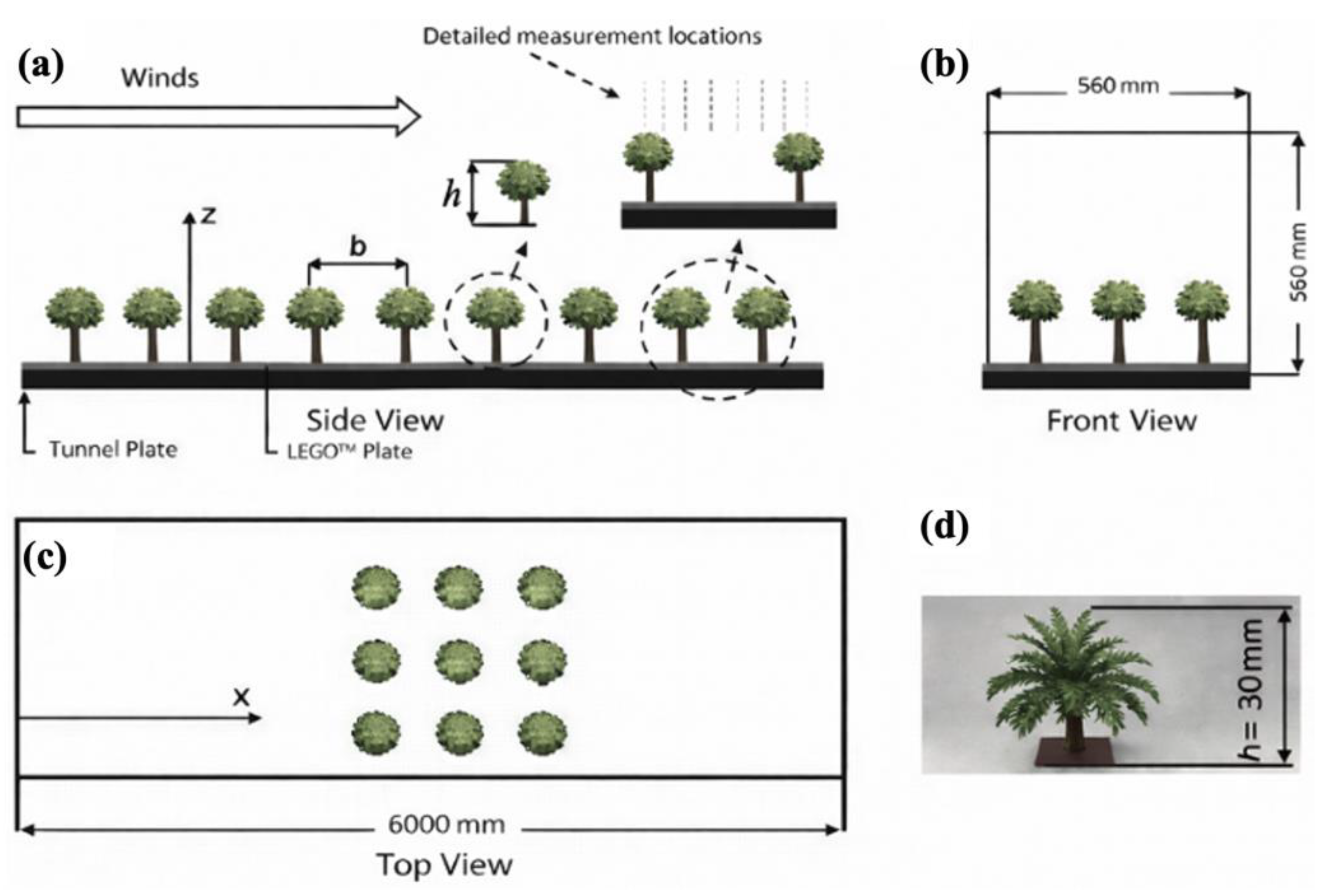
The experiment was carried out in an open-circuit, isothermal wind tunnel located in the Department of Mechanical Engineering at The University of Hong Kong (Figure 1). The airflow is generated by a three-phase blower, whose output is adjusted through a variable-frequency drive, allowing reference wind speeds between approximately 0.5 m and 19 m/s. Upstream of the test section, a flow-conditioning system—comprising a straightening element followed by a honeycomb layer positioned between the settling chamber and the contraction—was implemented to maintain a low ambient turbulence level (kept under 5%). The working section measures 6 m in length and 0.56 m × 0.56 m in cross-section. Artificial tree elements were mounted across the entire floor of the test section to ensure the formation of a fully developed turbulent boundary layer.
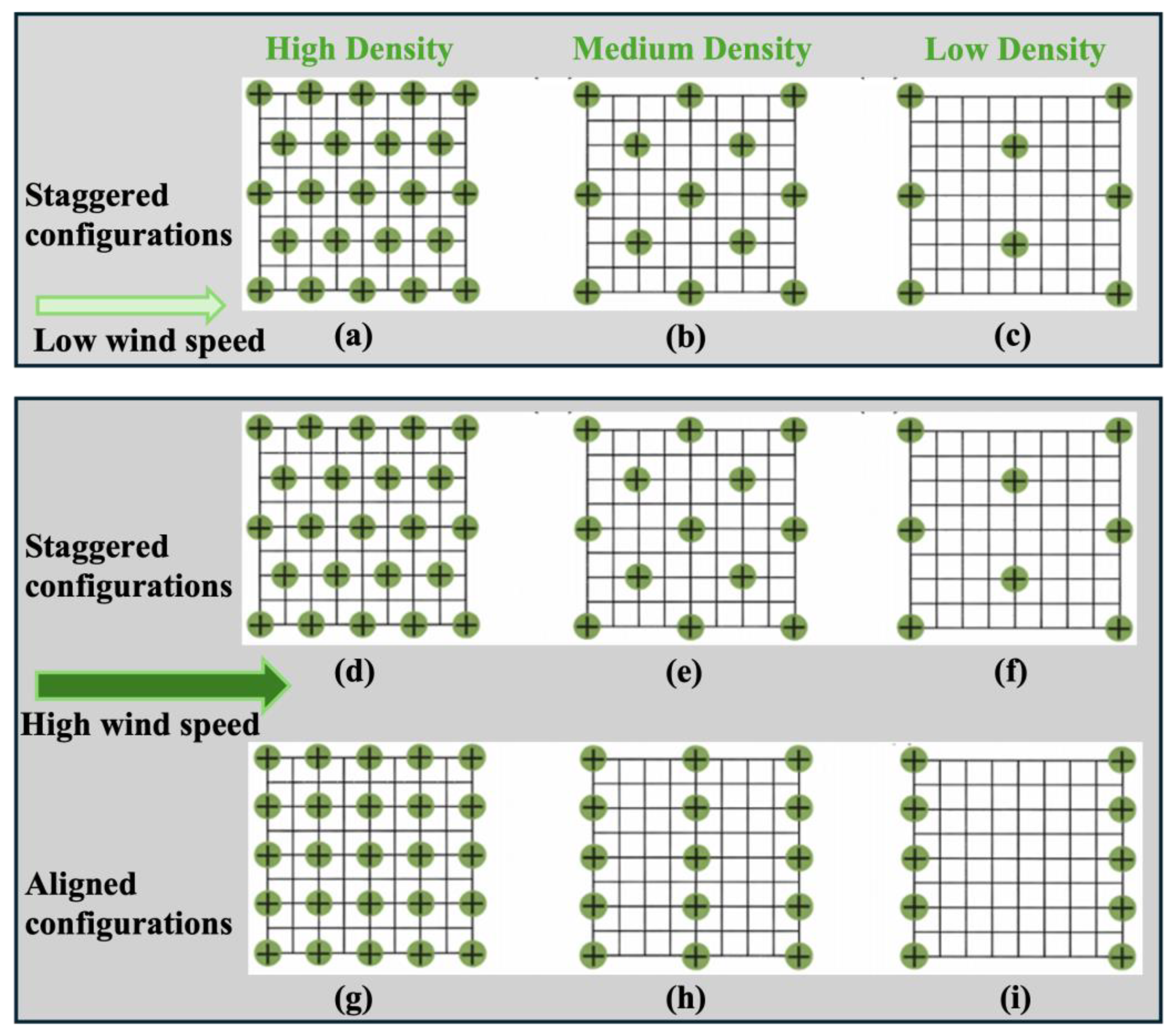
The canopy models were constructed using arrays of identical plastic tree elements. Each element was fitted onto a LEGO® brick, allowing the vegetation density to be properly controlled. The representative dimensions of a single tree unit are approximately 25 mm in length and width, and 30 mm in height (including the LEGO® connector at the base; see Figure 1a–d). These elements were subsequently arranged on LEGO® baseplates that were fixed to the entire floor of the wind tunnel test section. Six different spatial configurations of the tree arrays were examined (Figure 2a–i). The streamwise spacing b was systematically varied, yielding three distinct height-to-spacing ratios (h/b = 0.47 in high-density cases, 0.23 in medium-density cases, and 0.12 in low-density cases). The streamwise spacing b was systematically varied, yielding three distinct height-to-spacing ratios (h/b = 0.47, 0.23, and 0.12). Two plan arrangements—aligned and staggered—were considered. For the staggered setups, experiments were further conducted under two nominal wind speed ranges: a lower-speed band (approximately 9–12 m/s) and a higher-speed band (approximately 14–16 m/s). Two levels of freestream wind speeds are employed to test Reynolds number independence. In total, nine experimental cases were carried out. The complete categorization of these cases has been summarized in Table 1, and a representative example is the LDLW-S case, referring to low density, low wind speed, and staggered arrangement.
Some parameters are defined as follows: U is the freestream wind speed. The friction velocity is estimated by the spatio-temporal average of downward momentum flux, i.e., u*2 = − <uw″> [33,34]. The drag coefficient is calculated by Cd = u*2/2U2. The TBL thickness δ is defined at the height z where the spatio-temporal average of wind speed converges to 99% of the freestream value <u>|z=δ = 0.99U. The top and the bottom of ISLs are identified at the heights where the mean wind speeds no longer follow the log-law, and the RSL top is then taken at the ISL bottom. The Reynolds numbers based on the freestream wind speed and friction velocity are Re (= Uδ/ν) and Re* (= u*δ/ν).
The relatively low turbulence intensity in the wind tunnel represents a limitation of the present study, as it does not fully reproduce the energetic and intermittent turbulence typically observed in real atmospheric boundary-layer flows. This difference may restrict the direct applicability of the results to natural environments. Nevertheless, the primary objective of this work is to investigate relative transport mechanisms under controlled laboratory conditions, where the influence of canopy density and configuration can be systematically examined without external variability. Within this experimental framework, the observed trends remain physically consistent and meaningful. Future studies will consider higher background turbulence levels to further assess the robustness and broader applicability of the findings.
Another limitation of the present study is that the canopy models are rigid and therefore cannot capture the dynamic responses of real vegetation, such as bending and oscillation under wind loading. These flexible behaviors may alter wake development, turbulence generation, and momentum exchange in ways that rigid models cannot represent. Incorporating flexibility into the experimental setup would require more complex design considerations, including material properties and dynamic similarity requirements. This will be an important direction for future work aimed at achieving a more realistic representation of canopy–flow interactions.

3. Results and Discussion

3.1. Transport Efficiency and Phase-Space Algorithm

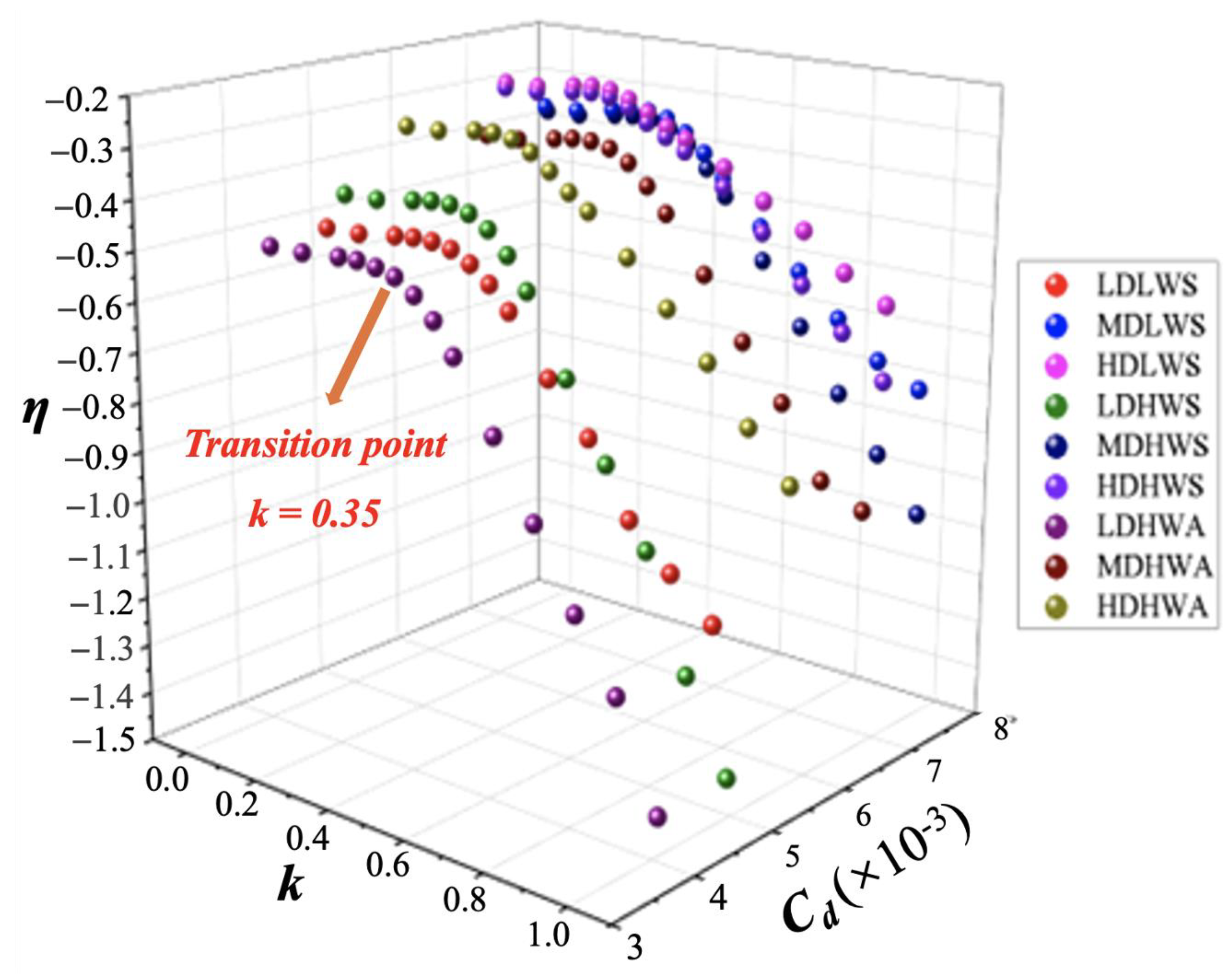
The three-dimensional distribution of exuberance η, scale coefficient k (the analytical approach follows Wu et al. [16] and Chen et al. [35]), and drag coefficient Cd for different tree arrays is illustrated in Figure 3. The scale coefficient k is introduced to control the size based on streamwise velocity fluctuation u′, acceleration a, and jerk j [16] of the detection ellipsoid in phase space. For a given dataset, all other parameters are fixed, and k is the only free parameter determining the volume of the detection ellipsoid. As k increases, the ellipsoid expands in phase space and encloses an increasing number of data points. Consequently, fewer data points remain on the surface of, or outside, the ellipsoid and are identified as coherent structure data points. Therefore, k effectively represents the scale employed in the phase-space detection and is defined as a scaling coefficient.
The momentum flux fraction
S i = u w Q i ¯ u w ¯
quantifies the contribution from the i-th quadrant Qi to the spatio-temporal average of vertical momentum flux u w ¯ . Subsequently, the exuberance
η = S 1 + S 3 S 2 + S 4
is used to compare the turbulent transport efficiency [36,37,38,39,40] and is defined as a measure of the relative contribution of momentum-enhancing (Q2 and Q4) versus momentum-reducing (Q1 and Q3) turbulent events, and therefore represents the intrinsic capability of the canopy flow to support vertical momentum transfer. In view of the transport direction of Qi, less negative exuberance implies more efficient vertical transport.
Transport efficiency remains comparable across different experimental conditions because its physical meaning is unchanged, and the definition and interpretation of η do not depend on canopy density, inflow conditions, or turbulence intensity, ensuring that all cases are evaluated under the same physical framework. The uncertainty of η is small because the quadrant contributions are derived from long, well-converged time series and averaged over multiple measurement points. These procedures ensure statistical stability, so the computed η is reliable and suitable for cross-case comparison despite variations in experimental conditions.
In general, arrays with lower planting density exhibit reduced drag coefficients. The transport efficiency at roof level rises as the drag coefficient increases (Figure 3). However, when the scale coefficient k exceeds approximately 0.35 (a transition point in the phase-space detection scale, beyond which the characteristics of the detected coherent structures change markedly), the transport efficiency decreases markedly.
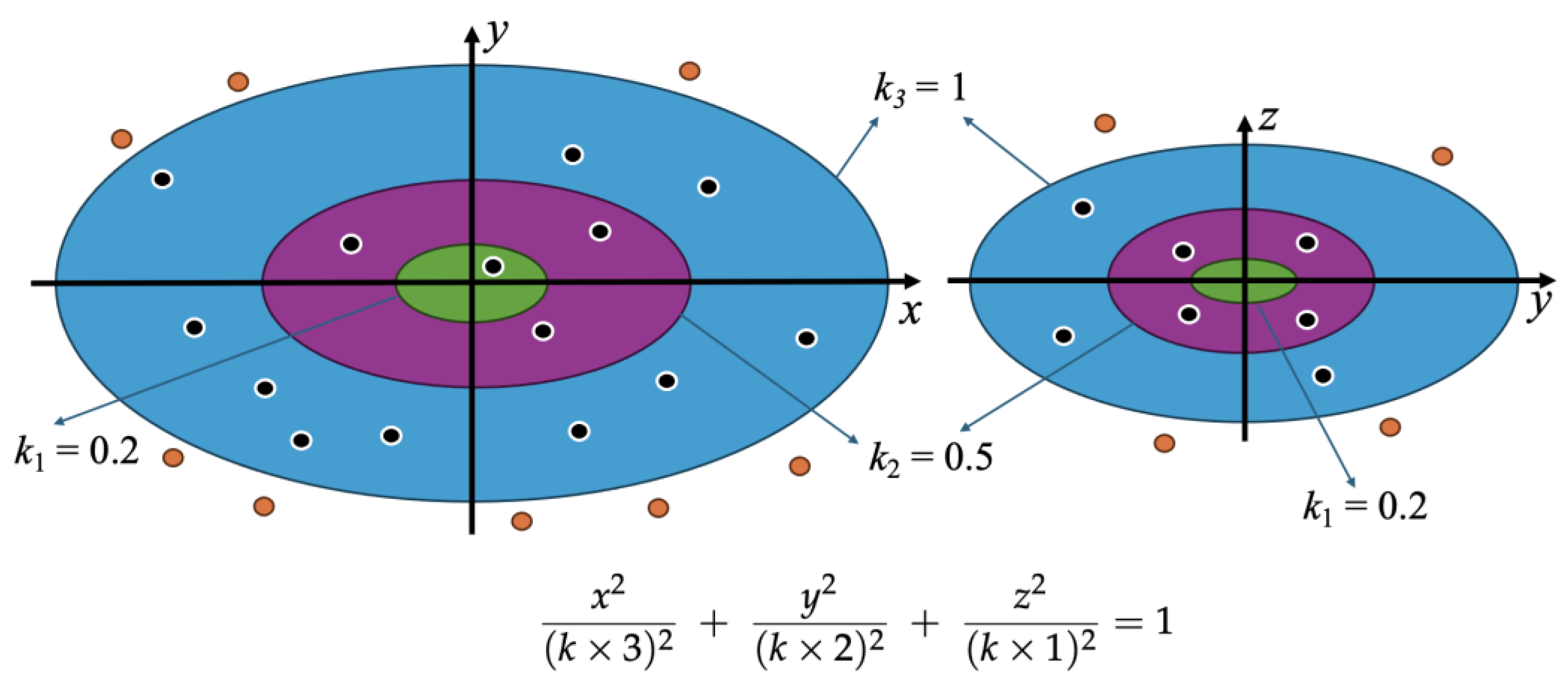
This behavior is associated with the role of k in the phase-space detection algorithm. As k increases, the detection ellipsoid expands (major half-axis e u = k λ σ u , median half-axis e a = k λ σ a , minor half-axis e j = k λ σ j , λ is the characteristic size of coherent structures, u′ is the streamwise velocity fluctuation, a is the acceleration, and j is the jerk, and detailed calculation procedures for the relevant parameters are provided in [16]), data points satisfying this criterion (u′/eu2 + a/ea2 + j/ej2 ≥ 1) are identified as coherent structures, and more data points are enclosed within the ellipsoid and are, therefore, excluded from the coherent structure analysis. Consequently, the analysis increasingly relies on data points located on the ellipsoid surface or outside it.
In Figure 4, the classification uses k3 = 1 as the reference boundary. As the value of k decreases from this state, a portion of the previously black non-coherent points will be out of the ellipsoid and is therefore reclassified as brown coherent structures. When k is small (e.g., k1 = 0.2), the ellipsoid is compact and excludes only a small portion of data near the origin, leaving many points on or outside the surface to be identified as coherent structures. As k increases (e.g., k2 = 0.5 or k3 = 1.0), the ellipsoid expands substantially, reducing the number of effective points outside the surface. The remaining points are typically associated with lower momentum-transport efficiency, explaining the progressive decline in overall transport efficiency with increasing k. In the analysis, each phase-space point is represented by a three-dimensional vector (u′, a, j), corresponding to streamwise velocity fluctuation u′, acceleration a, and jerk j.
At larger values of k, these remaining points are predominantly distributed farther from the phase-space origin and are associated with structures that exhibit intrinsically lower momentum transport efficiency. As a result, the overall transport efficiency decreases progressively with increasing k.
The phase-space method plays a central role in interpreting the momentum-transport behavior revealed in this study. By jointly considering the multi-order quantities (u′, a′, j′), the phase-space framework identifies coherent structures based on their intrinsic dynamical signatures rather than single-variable thresholds. The ellipsoidal criterion provides a geometrically rigorous separation to quantify how canopy density and array configuration regulate the transport efficiency of coherent structures. Specifically, by capturing how the dynamical trajectory of a structure evolves in phase space, the method reveals whether coherent structures enhance or suppress vertical momentum exchange. This capability is essential for explaining the transition in transport efficiency observed at k = 0.35, as only the phase-space method can explicitly reveal how the momentum-transport capability of coherent structures degrades when the detection scale expands.

3.2. Momentum Flux Contribution

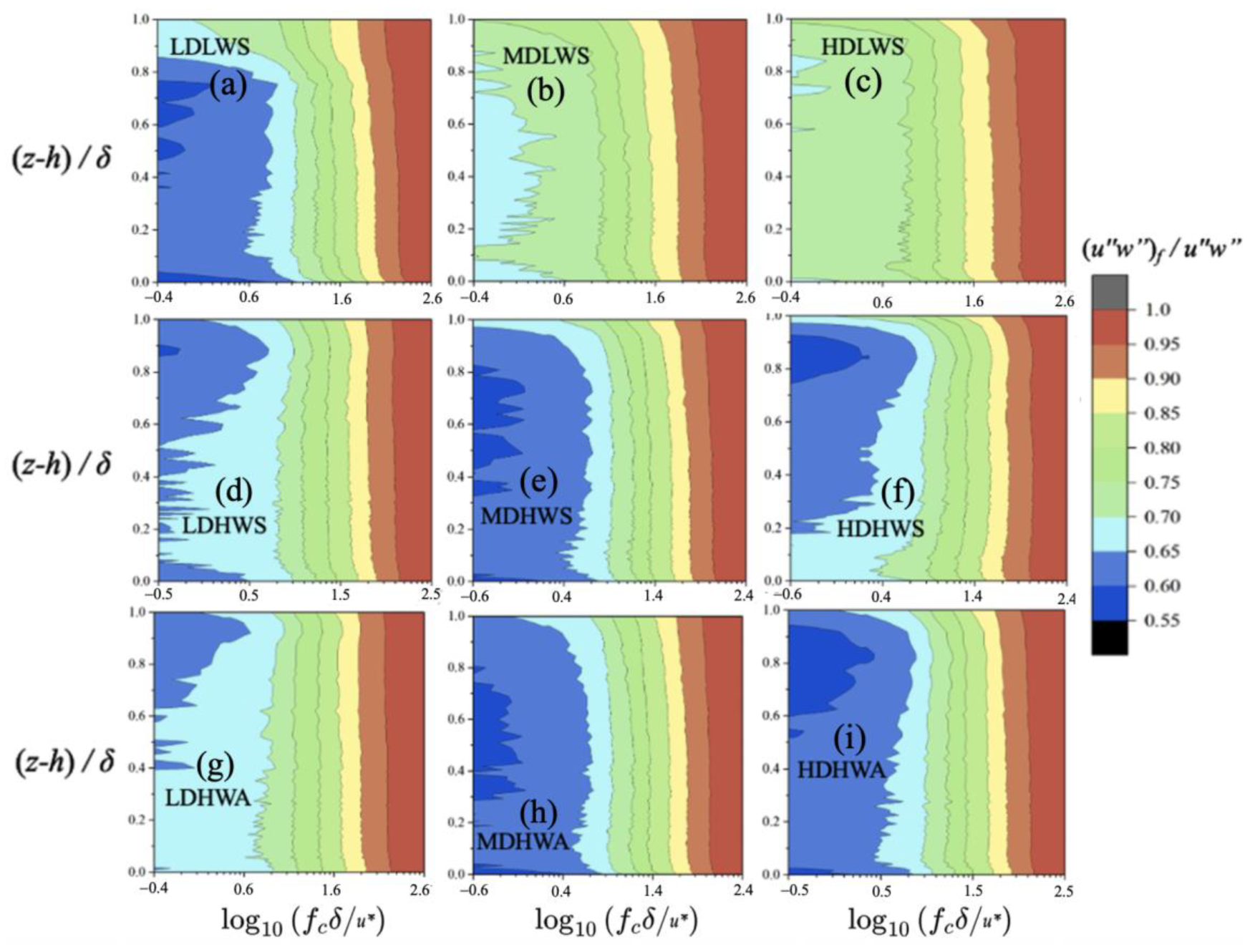
Figure 5 illustrates momentum flux contributions to the total flux at various low-pass filtered frequencies. Under low-wind configurations (Figure 5a–c), increasing tree canopy density primarily enhances drag and wake interference, suppressing small-scale turbulence and strengthening the dominance of low-frequency large-scale structures, thereby increasing their contribution to total momentum flux. In high-wind aligned configurations (Figure 5g–i), higher density intensifies the shear layer at the canopy top, strengthening more small-scale motions, which moderately reduces the relative contribution of low-frequency large-scale motions.
However, in the high-wind staggered configurations (Figure 5d–f), increasing canopy density leads to only minor changes in the scale-wise contributions to the momentum flux. At high velocity, wake turbulence is already strong and nearly saturated, so the flow remains wake-dominated regardless of density. The staggered geometry disrupts the continuity required for a well-defined drag discontinuity at the canopy top, preventing the formation of a coherent shear layer. As a result, small-scale motions originate mainly from wake shedding rather than shear-layer breakdown, which explains the weak sensitivity of the momentum flux distribution to density. This interpretation is consistent with the mechanisms described by Ghisalberti and Nepf [41] and Nepf [42].

3.3. Natural Visibility Graph Analysis of Large-Scale Motions

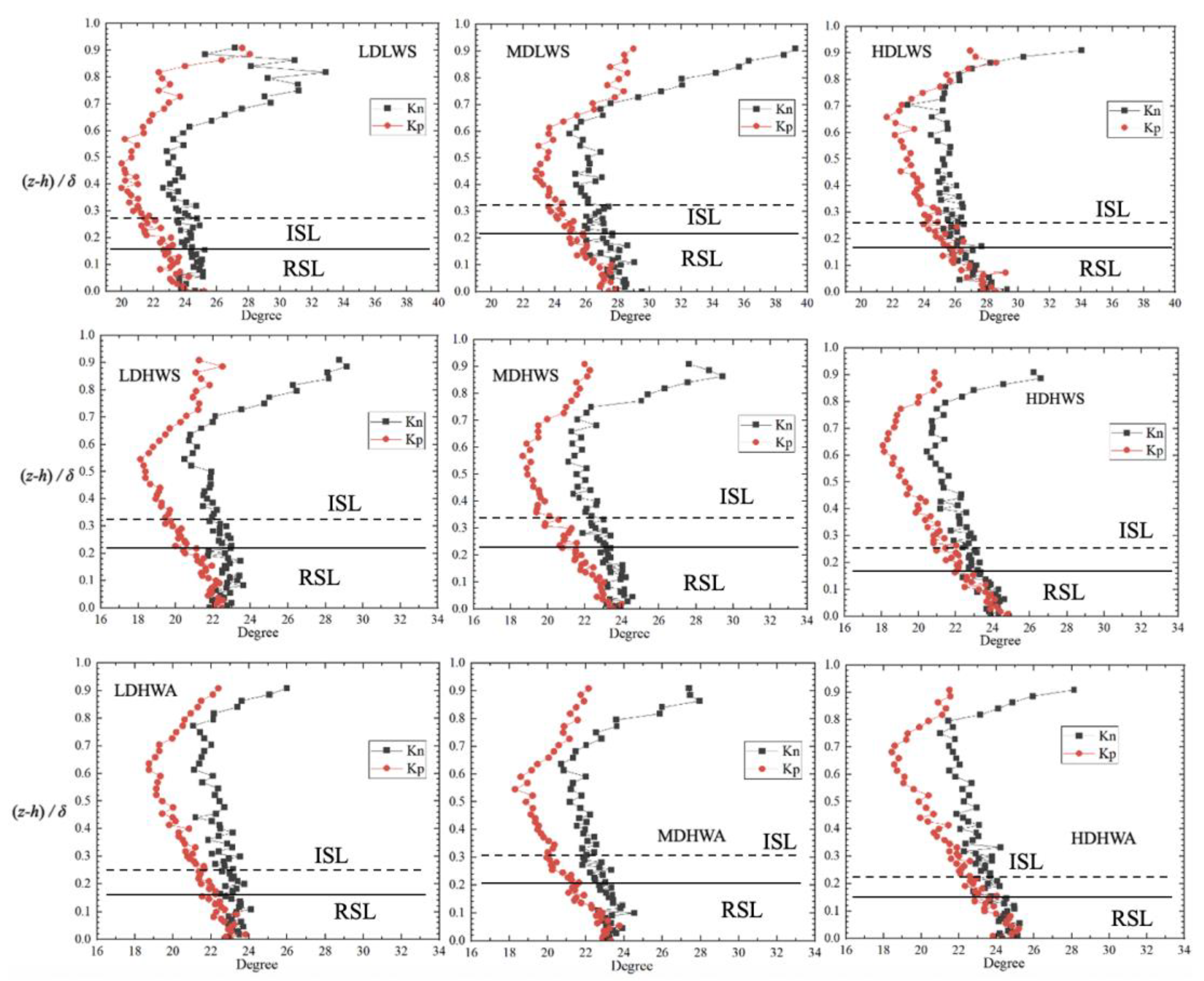
Natural visibility graphs provide a useful framework for examining the volatility of turbulent signals and are applicable to both large- and small-scale motions [18]. The large-scale motions are determined jointly by the cut-off frequency based on TBL thickness δ [29,32] and the low-pass filter. Following Iacobello et al. [18], the natural visibility graph (NVG) is constructed from the velocity fluctuation time series. To quantitatively distinguish acceleration and deceleration events at large scales, two NVG-based degrees are defined as: Kp = (1/Npos) ∑ (kj|uLS > 0), Kn = (1/Nneg) ∑ (kj|uLS < 0), where kj denotes the degree of the j-th node in the NVG, and Npos and Nneg represent the number of data points with positive and negative large-scale velocity fluctuations, respectively. In practice, the differences between the small-scale indicators Kn and Kp are minor, so the present discussion focuses on their behavior at larger scales. In Figure 6, the primary difference between density cases becomes most evident within the roughness sublayer (RSL), where high-density configurations tend to show a near balance between large-scale acceleration and deceleration events. However, as the height increases from the upper RSL toward the ISL, this balance progressively weakens, large-scale deceleration motions strengthen, and as a result, even in the highest-density cases, deceleration motion begins to dominate over acceleration motion.
Under dense canopy conditions, the strong mean shear above the canopy and the frequent interactions among adjacent wakes generate a saturated turbulence environment within the roughness sublayer (RSL), which results in wake-generated turbulence and the shear-layer continuously replenishing the energy of large-scale motions, allowing them to maintain a balanced alternation between acceleration and deceleration. However, under sparse canopy conditions, the weakened canopy drag and the reduced overlap of wakes lead to incomplete turbulence saturation and an under-energized shear, causing large-scale motions to become deceleration-dominated.
The NVG method effectively captures this imbalance because its visibility-based degree reflects how prominently a point stands out relative to its surrounding values. Comparing the degree of acceleration and deceleration reveals whether canopy density causes systematic differences in the fluctuation structure of large-scale motions. Although these differences do not measure momentum transport directly, they indicate the dynamical state of the large-scale flow: balanced acceleration and deceleration suggest more active motions that favor vertical momentum exchange, whereas a dominance of deceleration reflects weaker transport capability. Thus, NVG asymmetry provides a concise statistical indicator of how canopy structure influences large-scale turbulence dynamics relevant to momentum transport.

3.4. Amplitude Modulation of Large- and Small-Scale Motions

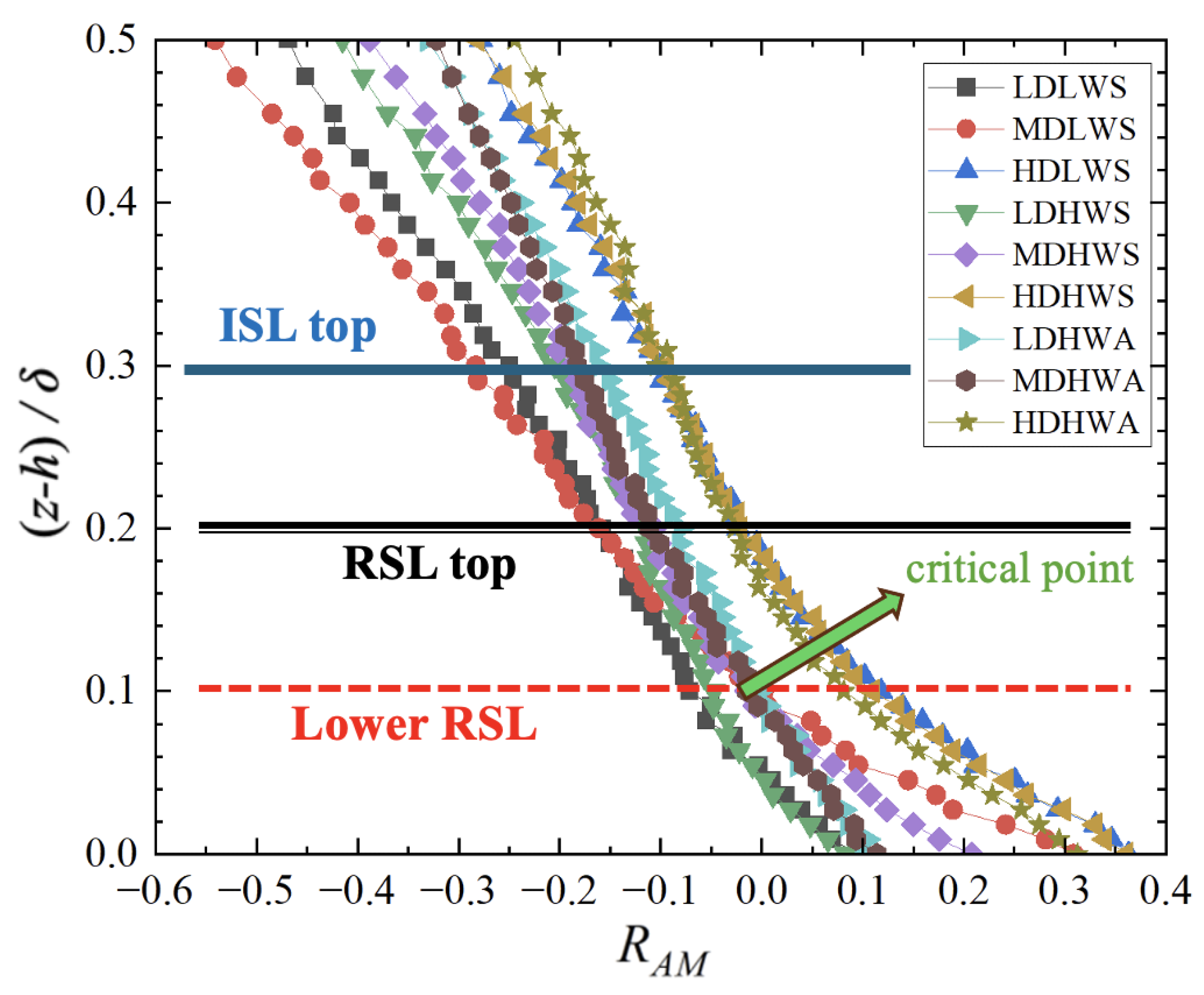
Figure 7 describes the amplitude modulation coefficients of motion at different scales under various circumstances. The large-scale and small-scale motions are determined jointly by the cut-off frequency based on TBL thickness δ [29,32] and the low-pass filter. Overall, canopy density is the dominant factor affecting the amplitude modulation coefficient RAM, a trend that is also observed in roughness-dependent modulation studies [27]. The three high-density cases almost entirely overlap across the full height range, demonstrating that dense arrays produce highly consistent modulation behavior. Their values decrease from about 0.35 near the canopy base to approximately 0 at RSL top, where a distinct turning point occurs. Across all high-density cases, the modulation behavior is nearly insensitive to canopy arrangement and inflow wind speed, consistent with observations that stronger surface resistance suppresses variability in modulation intensity [26]. The three low-density cases remain relatively close throughout most of the RSL, although their internal variability is slightly larger than that of the high-density group. Within the RSL, their values generally vary from around 0.1 to approximately –0.1. However, once the height exceeds the IRS top, the three low-density curves begin to separate more clearly, which is not present at lower heights.
Within the medium-density group, a clear contrast emerges between the low-wind staggered case and the high-speed aligned case. At lower heights, the low-wind staggered configuration exhibits the largest modulation coefficient, while the high-wind aligned configuration shows the smallest value, consistent with the well-known enhancement of near-wall large–small-scale coupling [43]. However, once the flow reaches the critical height (lower RSL height), where the modulation coefficient crosses 0, this ordering reverses: the high-wind aligned case becomes dominant, and the low-wind staggered case drops to the lowest level, reflecting the height-dependent transition of modulation characteristics observed in wall turbulence [25]. This inversion indicates a fundamental shift in the governing mechanism. At lower heights, local wake interactions dominate under low-wind staggered conditions, producing stronger small-scale responses and therefore larger modulation. Above the critical height, where canopy influence weakens and outer-layer large-scale structures become more influential, the coherent shear-layer motion in the high-wind aligned configuration provides a stronger large-scale forcing, in agreement with evidence that outer-layer structures strongly condition small-scale structures [24]. Thus, the medium-density regime reveals a unique crossover behavior where the controlling mechanism transitions from wake-induced modulation below the critical point to shear-layer-driven modulation above it, which is consistent with the role of coherent shear-layer vortices [44].
Based on the present dataset, the critical point is better interpreted as a transitional state arising from the combined influence of shear-layer development, turbulence interactions, and canopy geometry. It is not governed by any single physical parameter in a monotonic manner. This transitional state appears only in the medium-density configuration, where different flow mechanisms coexist and collectively maintain an intermediate regime between the sparse and dense canopy conditions. In addition, a frequency of 2000 Hz is sufficiently high for resolving the turbulent fluctuations relevant to the AM analysis. The potential influence of alternative sampling frequencies will be explored in future work.

4. Conclusions

This study summarizes the transport efficiency characteristics and multiscale momentum-transfer mechanisms in canopy flows based on a series of controlled wind tunnel experiments. By integrating multiple quantitative analysis methods, it examines momentum flux contributions and the interactions between large- and small-scale motions under different canopy conditions. The main results are presented as follows:
  • Transport efficiency at the canopy top increases with drag coefficient, with the strongest enhancement near the canopy–top interface. Stronger vegetation-induced drag enhances momentum exchange and turbulent mixing in the upper canopy, promoting vertical transport. The canopy top, therefore, acts as a sensitive transition layer linking canopy turbulence to the overlying boundary layer.
  • The influence of canopy density on momentum flux contributions depends on wind speed and array configuration. Under low-wind conditions, higher density strengthens drag, suppresses small-scale motions, and enhances low-frequency large-scale contributions. In high-wind aligned cases, increased density promotes shear-layer activity, moderately increasing small-scale motions and reducing the relative contribution of large-scale motions. In high-wind staggered cases, wake turbulence is already saturated, and no continuous shear layer develops at the canopy top, resulting in minimal sensitivity of scale-wise flux distribution to density changes.
  • NVG analysis indicates that canopy density primarily modulates large-scale acceleration and deceleration within the roughness sublayer (RSL). In high-density cases, these motions remain nearly balanced in the RSL but become increasingly deceleration-dominated toward the inertial sublayer (ISL). This highlights the canopy-top transition layer as a density-sensitive region governing large-scale flow behavior.
  • Increasing canopy density is the primary factor that strengthens the amplitude modulation coefficient. For high-density cases, all configurations show nearly identical behavior: the amplitude modulation coefficient decreases from about 0.35 near the canopy base to nearly 0 at the RSL top. Low-density cases show a similar height-dependent pattern, but with smaller magnitudes (from about 0.1 to –0.1) and slightly larger variability between configurations. In the medium-density group, the amplitude modulation coefficient shows a clear crossover: the ordering between cases reverses around the lower RSL, where the coefficient changes sign.
However, this study also has a clear limitation: the canopy models used in the experiments are made of rigid materials, which cannot adequately represent the flow–structure interactions that occur in real vegetation. Future work should consider incorporating flexible materials to better capture these flow–solid coupling effects.

Author Contributions

G.C.: Writing—original draft, visualization, methodology, investigation, formal analysis, and data curation. F.L.: Writing—review and editing, validation, methodology, and data curation. R.W.: Writing—review and editing, validation, methodology, and data curation. C.-H.L.: Supervision, resources, project administration, and funding acquisition. Z.M.: Writing—review and editing, and data curation. All authors have read and agreed to the published version of the manuscript.

Funding

This research was funded by the Hong Kong (HK) Research Grants Council (RGC) Theme-based Research Scheme (TRS) T24-504/17-N and the RGC Collaborative Research Fund (CRF) C7064-18G, as well as the RGC General Research Fund (GRF) 17211322.

Data Availability Statement

The experimental data used in this study are part of an internal project of the research group and are not publicly available. Data may be provided upon reasonable request to the corresponding author.

Acknowledgments

This study is partly supported by the Hong Kong (HK) Research Grants Council (RGC) Theme-based Research Scheme (TRS) T24-504/17-N and the RGC Collaborative Research Fund (CRF) C7064-18G, as well as the RGC General Research Fund (GRF) 17211322. Technical support from Vincent K.W. Lo was appreciated. All individuals acknowledged in this section have provided their consent to be mentioned.

Conflicts of Interest

The authors declare the following financial interests/personal relationships that may be considered as potential competing interests: Chun-Ho LIU reports that financial support was provided by the Hong Kong (HK) Research Grants Council (RGC). If there are other authors, they declare that they have no known competing financial interests or personal relationships that could have appeared to influence the work reported in this paper.

References

  1. Abhijith, K.V.; Kumar, P.; Gallagher, J.; McNabola, A.; Baldauf, R.; Pilla, F.; Broderick, B.; Di Sabatino, S.; Pulvirenti, B. Air pollution abatement performances of green infrastructure in open road and built-up street canyon environments—A review. Atmos. Environ. 2017, 162, 71–86. [Google Scholar] [CrossRef]
  2. Buccolieri, R.; Santiago, J.L.; Rivas, E.; Sanchez, B. Reprint of: Review on urban tree modelling in CFD simulations: Aerodynamic, deposition and thermal effects. Urban For. Urban Green. 2019, 31, 56–64. [Google Scholar] [CrossRef]
  3. Conan, B.; Aubrun, S.; Coudour, B.; Chetehouna, K.; Garo, J.-P. Contribution of coherent structures to momentum and concentration fluxes over a flat vegetation canopy modelled in a wind tunnel. Atmos. Environ. 2015, 107, 329–341. [Google Scholar] [CrossRef]
  4. Mo, Z.; Liu, C.H.; Chow, H.L.; Lam, M.K.; Lok, Y.H.; Ma, S.W.; Wong, F.L.; Yip, P.Y. Roughness sublayer over vegetation canopy: A wind tunnel study. Agric. For. Meteorol. 2022, 316, 108880. [Google Scholar] [CrossRef]
  5. Liu, S.; Liu, C.-H. Scalar transport after a high-resolution solitary fractal tree based on large-eddy simulation: Implication to urban green infrastructure. J. Clean. Prod. 2024, 461, 142693. [Google Scholar] [CrossRef]
  6. Abhijith, K.V.; Gokhale, S. Passive control potentials of trees and on-street parked cars in reduction of air pollution exposure in urban street canyons. Environ. Pollut. 2015, 204, 99–108. [Google Scholar] [CrossRef]
  7. Gromke, C.; Ruck, B. Pollutant concentrations in street canyons of different aspect ratio with avenues of trees for various wind directions. Bound.-Layer Meteorol. 2012, 144, 41–64. [Google Scholar] [CrossRef]
  8. Gromke, C.; Ruck, B. Influence of trees on the dispersion of pollutants in an urban street canyon—Experimental investigation of the flow and concentration field. Atmos. Environ. 2007, 41, 3287–3302. [Google Scholar] [CrossRef]
  9. Buccolieri, R.; Gromke, C.; Di Sabatino, S.; Ruck, B. Aerodynamic effects of trees on pollutant concentration in street canyons. Sci. Total Environ. 2009, 407, 5247–5256. [Google Scholar] [CrossRef]
  10. Vranckx, S.; Vos, P.; Maiheu, B.; Janssen, S. Impact of trees on pollutant dispersion in street canyons: A numerical study of the annual average effects in Antwerp, Belgium. Sci. Total Environ. 2015, 532, 474–483. [Google Scholar] [CrossRef]
  11. Jean, A.; Buccolieri, R.; Eddy, J.; Monks, P.; Leigh, R. Air quality affected by trees in real street canyons: The case of Marylebone neighbourhood in central London. Urban For. Urban Green. 2017, 22, 41–53. [Google Scholar] [CrossRef]
  12. Abhijith, K.V.; Kumar, P. Field investigations for evaluating green infrastructure effects on air quality in open-road conditions. Atmos. Environ. 2019, 201, 132–147. [Google Scholar] [CrossRef]
  13. Metzger, M.M.; McKeon, B.J.; Arce-Larreta, E. Scaling the characteristic time of the bursting process in the turbulent boundary layer. Phys. D Nonlinear Phenom. 2010, 239, 1296–1304. [Google Scholar] [CrossRef]
  14. Krogstad, P.-Å.; Kaspersen, J.H.; Rimestad, S. Convection velocities in a turbulent boundary layer. Phys. Fluids 1998, 10, 949–957. [Google Scholar] [CrossRef]
  15. Goring, D.G.; Nikora, V.I. Despiking acoustic Doppler velocimeter data. J. Hydraul. Eng. 2002, 128, 117–126. [Google Scholar] [CrossRef]
  16. Wu, J.; Krynkin, A.; Croft, M. Objective phase-space identification of coherent turbulent structures in 1D time series. J. Hydraul. Res. 2022, 60, 811–825. [Google Scholar] [CrossRef]
  17. Lacasa, L.; Luque, B.; Ballesteros, F.; Luque, J.; Nuno, J.C. From time series to complex networks: The visibility graph. Proc. Natl Acad. Sci. USA 2008, 105, 4972–4975. [Google Scholar] [CrossRef] [PubMed]
  18. Iacobello, G.; Ridolfi, L.; Scarsoglio, S. Large-to-small scale frequency modulation analysis in wall-bounded turbulence via visibility networks. J. Fluids Mech. 2021, 35, 025116. [Google Scholar] [CrossRef]
  19. Gao, Z.-K.; Small, M.; Kurths, J. Complex network analysis of time series. Rev. Mod. Phys. 2016, 88, 045006. [Google Scholar] [CrossRef]
  20. Charakopoulos, A.K.; Karakasidis, T.E.; Papanicolaou, P.N.; Liakopoulos, A. The application of complex network time series analysis in turbulent heated jets. Chaos Interdiscip. J. Nonlinear Sci. 2014, 24, 024408. [Google Scholar] [CrossRef]
  21. Murugesan, M.; Zhu, Y.; Li, L.K.B. Complex network analysis of forced synchronization in a hydrodynamically self-excited jet. Int. J. Heat Fluid Flow 2019, 76, 14–25. [Google Scholar] [CrossRef]
  22. Schlatter, P.; Örlü, R. Quantifying the interaction between large and small scales in wall-bounded turbulent flows: A note of caution. Phys. Fluids 2010, 22, 051704. [Google Scholar] [CrossRef]
  23. Guala, M.; Metzger, M.; McKeon, B.J. Interactions within the turbulent boundary layer at high Reynolds number. J. Fluid Mech. 2011, 666, 573–604. [Google Scholar] [CrossRef]
  24. Talluru, K.M.; Baidya, R.; Hutchins, N.; Marusic, I. Amplitude modulation of all three velocity components in turbulent boundary layers. J. Fluid Mech. Rapids 2014, 746, R1. [Google Scholar] [CrossRef]
  25. Baars, W.J.; Talluru, K.M.; Hutchins, N.; Marusic, I. Wavelet analysis of wall turbulence to study large-scale modulation of small scales. Exp. Fluids 2015, 56, 188. [Google Scholar] [CrossRef]
  26. Squire, D.T.; Baars, W.J.; Hutchins, N.; Marusic, I. Inner–outer interactions in rough-wall turbulence. J. Turbul. 2016, 17, 1159–1178. [Google Scholar] [CrossRef]
  27. Li, F.; Wang, R.; Chen, G.; Mo, Z.; Ikegaya, N.; Liu, C.-H. Turbulence scale and strength analysis in the roughness and inertial sublayers over urban areas: A wind tunnel study. Build. Environ. 2025, 267, 112193. [Google Scholar] [CrossRef]
  28. Chung, D.; McKeon, B.J. Large-eddy simulation of large-scale structures in long channel flow. J. Fluid Mech. 2010, 661, 341–364. [Google Scholar] [CrossRef]
  29. Anderson, W. Amplitude modulation of streamwise velocity fluctuations in the roughness sublayer: Evidence from large-eddy simulations. J. Fluid Mech. 2016, 789, 567–588. [Google Scholar] [CrossRef]
  30. Yao, Y.C.; Huang, W.X.; Xu, C.X. Amplitude modulation and extreme events in turbulent channel flow. Acta Mech. Sin. 2018, 34, 1–9. [Google Scholar] [CrossRef]
  31. Dogan, E.; Örlü, R.; Gatti, D.; Vinuesa, R.; Schlatter, P. Quantification of amplitude modulation in wall-bounded turbulence. Fluid Dyn. Res. 2019, 51, 011408. [Google Scholar] [CrossRef]
  32. Liu, Y.; Liu, C.-H.; Brasseur, G.P.; Chao, C.Y.H. Amplitude modulation of velocity fluctuations in the atmospheric flows over real urban morphology. Phys. Fluids 2023, 35, 025116. [Google Scholar] [CrossRef]
  33. Cheng, H.; Castro, I.P. Near wall flow over urban-like roughness. Bound.-Layer Meteorol. 2002, 104, 229–259. [Google Scholar] [CrossRef]
  34. Cheng, H.; Castro, I.P. Near-wall flow development after a step change in surface roughness. Bound.-Layer Meteorol. 2002, 105, 411–432. [Google Scholar] [CrossRef]
  35. Chen, G.; Liu, C.-H.; Mo, Z. Turbulent transport characteristics of coherent structures in ideal urban morphology based on wind tunnel experiments. In Proceedings of the 14th UK Conference on Wind Engineering, Southampton, UK, 4–6 September 2024. [Google Scholar] [CrossRef]
  36. Christen, A.; van Gorsel, E.; Vogt, R. Coherent structures in urban roughness sublayer turbulence. Int. J. Climatol. 2007, 27, 1955–1968. [Google Scholar] [CrossRef]
  37. Hertwig, D.; Patnaik, G.; Leitl, B. LES validation of urban flow, part II: Eddy statistics and flow structures. Environ. Fluid Mech. 2017, 17, 551–578. [Google Scholar] [CrossRef]
  38. Yoshida, T.; Takemi, T.; Horiguchi, M. Large-eddy-simulation study of the effects of building-height variability on turbulent flows over an actual urban area. Bound.-Layer Meteorol. 2018, 168, 127–153. [Google Scholar] [CrossRef]
  39. Palusci, P.; Monti, P.; Cecere, C.; Montazeri, H.; Blocken, B. Impact of morphological parameters on urban ventilation in compact cities: The case of the Tuscolano-Don Bosco district in Rome. Sci. Total Environ. 2022, 807, 150490. [Google Scholar] [CrossRef]
  40. Wang, R.; Liu, C.-H.; Li, F.; Mo, Z. Turbulent transport mechanism in the roughness sublayers over idealized urban areas and its implication to street-level ventilation. Sustain. Cities Soc. 2024, 100, 105030. [Google Scholar] [CrossRef]
  41. Ghisalberti, M.; Nepf, H. Shallow flows over a permeable medium: The hydrodynamics of submerged aquatic canopies. Transp. Porous Media 2009, 78, 385–402. [Google Scholar] [CrossRef]
  42. Nepf, H.M. Flow and transport in regions with aquatic vegetation. Annu. Rev. Fluid Mech. 2012, 44, 123–142. [Google Scholar] [CrossRef]
  43. Mathis, R.; Hutchins, N.; Marusic, I. Large-scale amplitude modulation of the small-scale structures in turbulent boundary layers. J. Fluid Mech. 2009, 628, 311–337. [Google Scholar] [CrossRef]
  44. Ghisalberti, M.; Nepf, H. Mass transport in vegetated shear flows. Environ. Fluid Mech. 2005, 5, 527–551. [Google Scholar] [CrossRef]
Figure 1. Schematic of the test section with models of the vegetation canopy. (a) Front view; (b) side view; (c) top view; (d) photograph of a unit of plastic tree model.
Atmosphere 17 00226 g001
Figure 2. Layout of the vegetation canopy models.
Atmosphere 17 00226 g002
Figure 3. Air transport efficiency of the vegetation canopy at the level of roof height.
Atmosphere 17 00226 g003
Figure 4. Conceptual illustration of the phase-space detection ellipsoid expansion.
Atmosphere 17 00226 g004
Figure 5. Momentum flux contribution under different cut-off frequencies.
Atmosphere 17 00226 g005
Figure 6. The degree of acceleration and deceleration in large-scale motion.
Atmosphere 17 00226 g006
Figure 7. Amplitude modulation coefficient of large- and small-scale motions.
Atmosphere 17 00226 g007
Table 1. TBL parameters in the wind tunnel experiments.
CasesFigure 2U (m/s)u* (m/s)Cd (×10−3)δ (mm)ISL
(mm)
RSL
(mm)
Re (×103)Re * (×103)
HDLW-S(a)11.940.717.022501068429817
MDLW-S(b)9.710.67.562351179422814
LDLW-S(c)11.480.564.73220988225212
HDHW-S(d)15.770.937.012501008239423
MDHW-S(e)14.090.877.62351179833120
LDHW-S(f)14.60.734.952251129232816
HDHW-A(g)14.730.795.72240947635318
MDHW-A(h)14.430.846.762251028432418
LDHW-A(i)14.740.664.072501008236816
Disclaimer/Publisher’s Note: The statements, opinions and data contained in all publications are solely those of the individual author(s) and contributor(s) and not of MDPI and/or the editor(s). MDPI and/or the editor(s) disclaim responsibility for any injury to people or property resulting from any ideas, methods, instructions or products referred to in the content.