


Abstract
This study investigates the characteristics of water and sediment evolution under the influence of the Datengxia Water Control Hub Project by analyzing its affected area, with a focus on the driving mechanisms of human activities on these processes. Utilizing hydrological data (1993–2022) from the Wuxuan and Dahuangjiangkou Stations, along with meteorological, land use, and population data, we applied the M–K (Mann–Kendall) trend test, Pettitt change point test, double mass curve method, and a random forest model. These methods were used to quantify the contributions of rainfall and human activities and to identify the dominant controlling factors. Model reliability was verified by comparing predicted and observed P-III (Pearson Type III distribution curve), enabling an assessment of water–sediment changes before and after the project’s construction. The results indicate that (1) both stations showed a non-significant declining trend in runoff and sediment load, with a human activity-induced change point detected in 2003; (2) human activities accounted for 93.18% and 92.38% of the reduction in runoff and sediment load at Wuxuan Station, and 74.44% and 54.33% at Dahuangjiangkou Station, respectively; (3) population density was the dominant factor for water–sediment changes at Wuxuan Station (influence weight: 0.41), while grassland area (0.41) and population density (0.40) primarily controlled runoff and sediment changes, respectively, at Dahuangjiangkou Station; (4) following project construction, the trend of the decreasing flood inundation extent with increasing frequency became more pronounced, and sediment deposition was concentrated mainly in the reservoir area and downstream reaches. The study confirms the dominant role of human activities in the basin’s water–sediment dynamics, and the established methodological framework provides a scientific basis for integrated watershed management and ecological conservation.
1. Introduction
Climate change and human activities constitute pivotal drivers of ecological and environmental transformations [1]. Alterations in climatic patterns induce varying degrees of modification in watershed hydrological processes, thereby influencing the evolution of runoff and sediment dynamics. Concurrently, human interventions—such as watershed development, reservoir regulation and utilization, land reclamation and exploitation, as well as soil and water conservation measures—significantly reshape underlying surface conditions, which in turn govern surface runoff generation and the processes of sediment production and transport within basins [1,2]. Under the coupled forcing of these two factors, the structure, functionality, and spatial distribution of ecosystems consequently undergo corresponding shifts [3]. Large-scale water conservancy projects, as a prominent form of human activity, inevitably lead to pronounced alterations in natural river flow regimes and sediment retention, thereby exerting profound impacts on hydrological processes and sediment transport dynamics. Along the longitudinal profile of a river, abrupt changes in runoff and sediment flux occur upstream and downstream of such projects, with the most pronounced effects typically localized at the project site. Therefore, it is of considerable significance for the rational utilization and scientific management of water resources in river basins to quantitatively distinguish the contributions of human activities and climate change to watershed water–sediment processes and to analyze their respective driving characteristics [4].
Extensive research has been conducted worldwide concerning the impacts of human activities and climate change on water and sediment dynamics in engineered river reaches. Shi Hongling et al. [5] analyzed trends and causes of water–sediment variations in the Huai River Basin, concluding that reservoir construction in upstream mountainous areas has reduced sediment inflow into the basin. Wen Y et al. [6] applied the Budyko framework and fractal theory to attribute water–sediment changes in the lower Yellow River, revealing characteristics of multi-factor coupled driving. Guo Xinyi et al. [7] employed the SWAT (Soil and Water Assessment Tool) model to quantify the contributions of factors such as climate, land use, and human activities to changes in watershed runoff. Han Jianchun et al. [2] adopted a random forest model to quantify human and climatic factors, analyzing their contribution rates to runoff and sediment transport variations in the Ru River Basin, and proposed that coupled economic–ecological–social drivers underlie these changes. Wang Yixuan et al. [8] jointly utilized the SWAT model and random forest model for a comparative analysis of runoff variability in the Yanghe River Basin, demonstrating the superior simulation accuracy of the random forest model. However, existing studies predominantly focus on macroscopic assessments at the whole-watershed scale, while fine-scale quantification and attribution of water–sediment processes within the direct influence zones of specific large-scale hydraulic projects remain insufficient. The project-affected zone represents an area where hydrological processes undergo the most drastic changes and where natural processes and anthropogenic regulation interact most intensely. Neglecting this spatial heterogeneity impedes accurate evaluation of the actual eco-hydrological effects of engineering interventions.
Accordingly, this study takes the direct influence area of the Datengxia Water Control Hub Project—a key regulatory structure on the mainstem of the Xijiang River in the Pearl River Basin—as its research focus. This multi-purpose project integrates flood control, navigation, power generation, and water resource allocation. Its operation is bound to exert profound and complex impacts on water–sediment processes both upstream and downstream. Through the integrated application of statistical testing and machine learning modeling, this research aims to achieve the following objectives: (1) analyze long-term trends, change points, and phased differences in runoff and sediment series within the project-affected area; (2) construct a random forest model to quantitatively separate the relative contributions of climate change and human activities to water–sediment variations; and (3) develop predictive models for water–sediment processes under different flood frequency scenarios, thereby providing references for project operation and management.
2. Overview of the Study Area
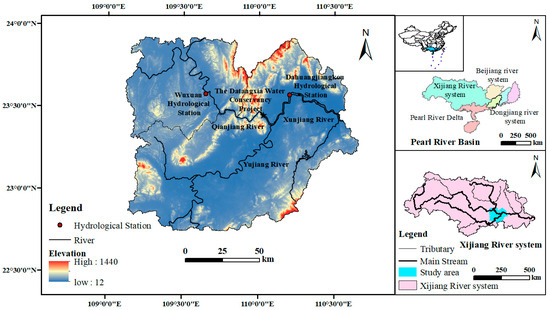
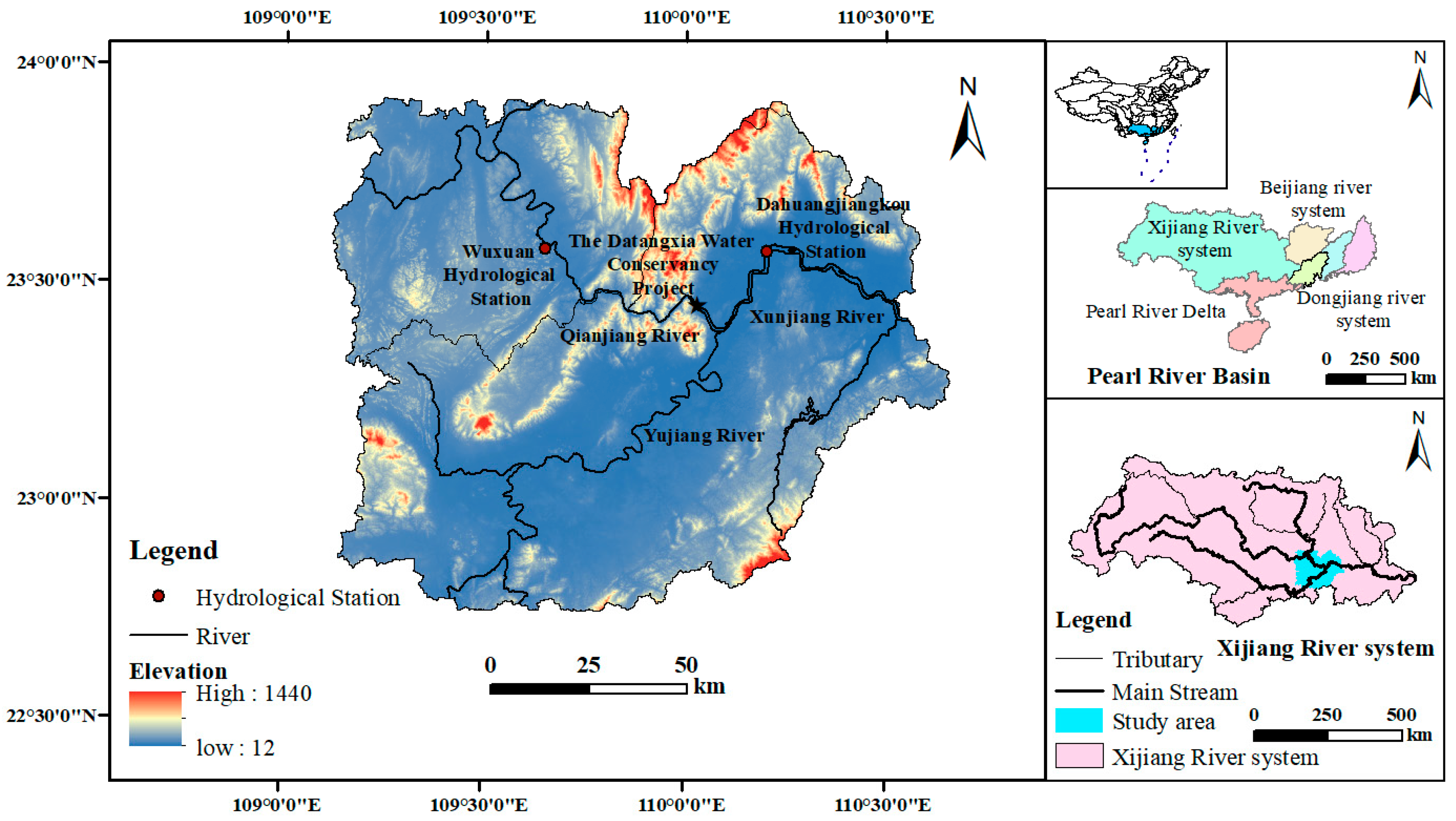
The Datengxia Water Control Hub Project is located on the Qianjiang River section of the Xijiang River system in the Pearl River Basin, approximately 12 km upstream of Guiping County, Guangxi. The catchment area upstream of the hub is 190,400 km2, accounting for about 55.9% of the total area of the Xijiang River Basin. The Qianjiang River stretches 122 km in length. After converging with the Yu River in Guiping County, it is known as the Xunjiang River, which flows for another 167 km before joining the Guijiang River in Wuzhou to form the Xijiang River. The Yujiang River is a major unregulated tributary that joins the mainstream downstream of the Datengxia Project, substantially increasing the discharge at Dahuangjiangkou Station. As this study focuses on the direct zone of influence of the Datengxia Project, the contribution of the Yujiang River is treated as an external boundary condition and is not explicitly simulated within the modeling framework. The Xijiang River originates from the southern foot of Maxiong Mountain in Zhanyi County, Yunnan Province. It flows from west to east through Yunnan, Guizhou, Guangxi, and Guangdong provinces, with a total drainage area of 340,400 km2, making it the largest river within the Pearl River Basin. The study area is shown in Figure 1. Hydrological and meteorological data from the Wuxuan Hydrological Station (hereafter Wuxuan Station) and the Dahuangjiangkou Hydrological Station (hereafter Dahuangjiangkou Station) were selected as the foundational data for this study.
Figure 1.
Geographical location of the study area. Note: The Yujiang River is an unregulated tributary and is not controlled by the Datengxia Water Control Hub Project.
Wuxuan Station is located 64 km upstream of the Datengxia Water Control Hub Project in the Xijiang River Basin. It controls a catchment area of 188,900 km2, accounting for approximately 99.2% of the basin area above the dam site. The average annual runoff is 4010 m3·s−1, with a runoff depth of 716 mm and a runoff modulus of 22.7 L·s−1·km−2. The Qianjiang River is a low-sediment river with an average sediment content of 0.41 kg·m−3 over many years, and the maximum cross-sectional sediment concentration is 5.22 kg·m−3 accounting for 61.7% of the Pearl River Basin. The sediment transport mainly occurs during the flood season from June to August, accounting for more than 70% of the annual sediment transport volume. The flood peaks and sand peaks basically correspond to each other. The Dahuangjiangkou Station is located downstream of the confluence of the Xunjiang River and the Ganshui River, downstream of the Datengxia Water Control Hub Project, with a catchment area of 289,418 km2.
The Datengxia Water Control Hub Project is a pivotal control structure on the mainstream of the Xijiang River in the Pearl River Basin. Construction began in 2014 and was carried out in two phases on the left and right banks. River closure was achieved in 2019, and the initial impoundment and power generation phase commenced in 2020. The main structure was completed in 2023, and the normal storage level was reached in 2024, marking the project’s full operational status. The project has significantly enhanced comprehensive benefits in flood control, navigation (increasing vessel capacity from 300 to 3000 tons), water supply, and power generation. This study utilizes hydrological data from 1993 to 2022, covering the pre-construction (1993–2013), construction (2014–2020), and initial operation (2021–2022) periods, aiming to systematically elucidate the impact mechanisms of human activities on water and sediment processes across different stages. All the above data were sourced from the Feasibility Study Report of the Datengxia Water Control Hub Project.
3. Methods and Data Sources
3.1. Data Sources and Preprocessing
Runoff data spanning 1993 to 2024 were obtained from two hydrological stations: Wuxuan and Dahuangjiangkou. These data were sourced from the Geographic Remote Sensing Ecological Network Scientific Data Registration and Publication System (available at www.gisrs.cn). Concurrently, rainfall data for the study area were acquired from the National Meteorological Scientific Data Sharing Service Platform (http://data.cma.cn).
Rainfall runoff data are daily hydrological records, which were aggregated to monthly values through standard hydrological calculations. Sediment transport data were obtained from reference [9] and the feasibility study report of the Datengxia Water Control Hub Project. Land use data were sourced from the multi-period land use remote sensing monitoring dataset of China. The population density and natural population growth rate were collected from the Statistical Yearbook of Guangxi Zhuang Autonomous Region. To align with the monthly hydrological time step, annual land use and population variables were assigned to all months within the corresponding year [10], thereby preserving their annual variation without introducing artificial high-frequency signals.
3.2. Methods
3.2.1. Methodological Framework
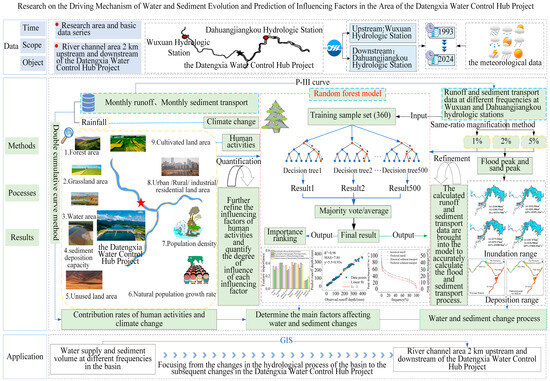
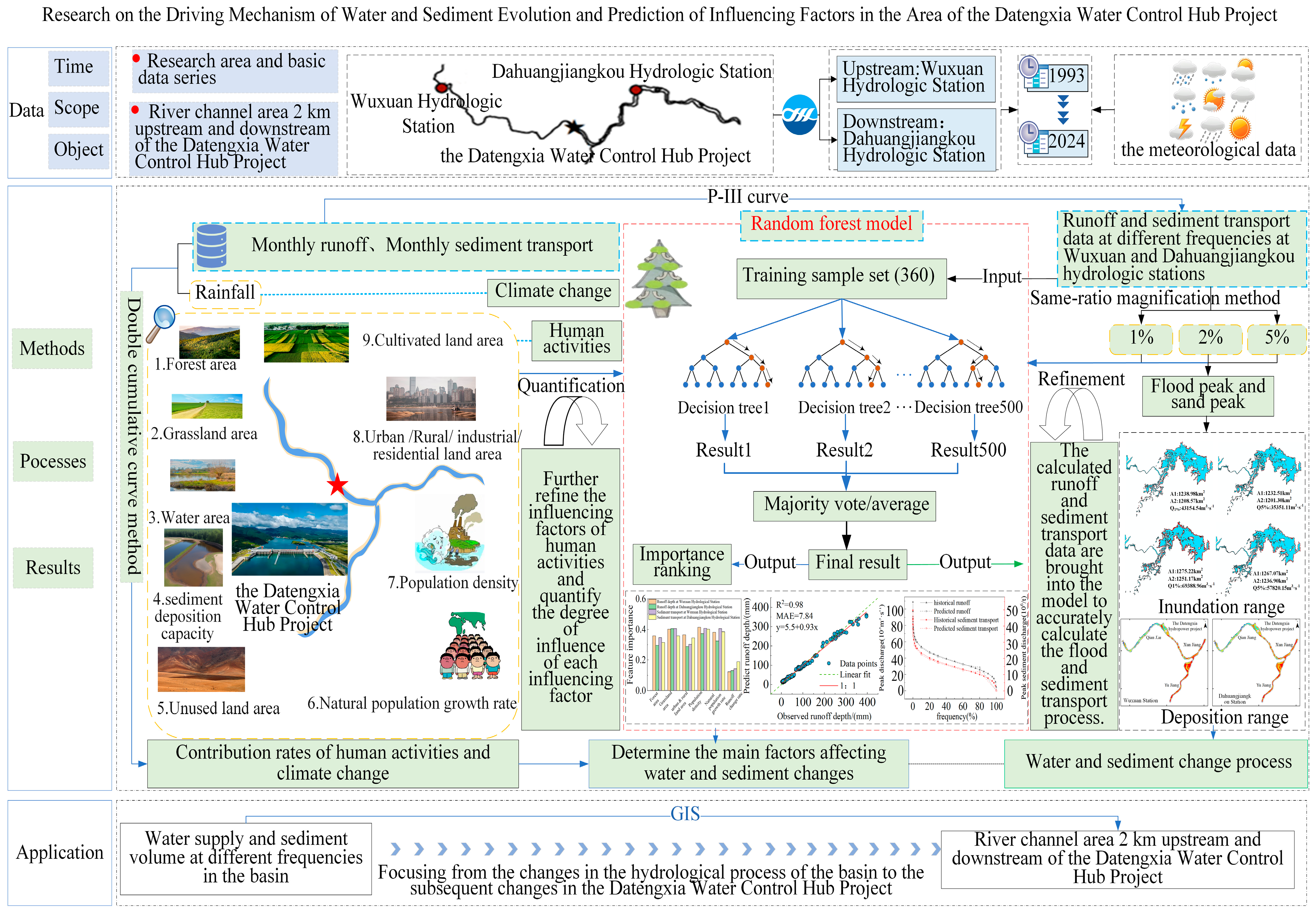
This paper focuses on the Datengxia Water Control Hub Project as the study area, using monthly data from upstream and downstream hydrological stations from 1993 to 2024 as the basis. With the random forest model serving as the core method to quantify the influence of human activities on water and sediment variations, the double mass curve method is applied to derive the contribution rates of rainfall and human activities. Subsequently, influencing factors are screened and utilized as feature variables, while runoff and sediment transport are set as target variables, enabling a quantitative analysis of the relative importance of each influencing factor. Based on the quantification of the impacts of human activities on water–sediment dynamics, a model is trained to predict flood processes and sediment deposition under different frequency scenarios (as illustrated in Figure 2).
Figure 2.
Research methodology framework. The red five-pointed star marks the location of the Datengxia Water Control Project, and the blue area indicates the rivers within the project’s affected zone.
3.2.2. Hydrological Model
Hydrological models can be categorized—based on their characteristics and objectives—into conceptual, distributed, physical, and data—driven types. Among these, distributed hydrological models offer enhanced spatiotemporal simulation capabilities, extending analysis from single water volume changes to a broader spectrum of hydrological and water resource management problems [11]. The Xin’anjiang model [12], a typical distributed model, has been progressively refined and is well-suited for rainfall—runoff modeling in humid and semi-humid regions of China. It is widely applied in flood forecasting, runoff simulation, and water resource planning [13].
The study area, influenced by the Datengxia Water Control Hub Project, experiences a tropical monsoon climate characterized by minimal annual temperature variation. Precipitation distribution is highly uneven between dry and wet seasons, with intense, concentrated rainfall during the wet season under the influence of the southwest monsoon. The dry season is dominated by the northeast monsoon system.
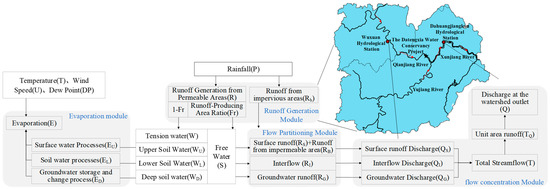
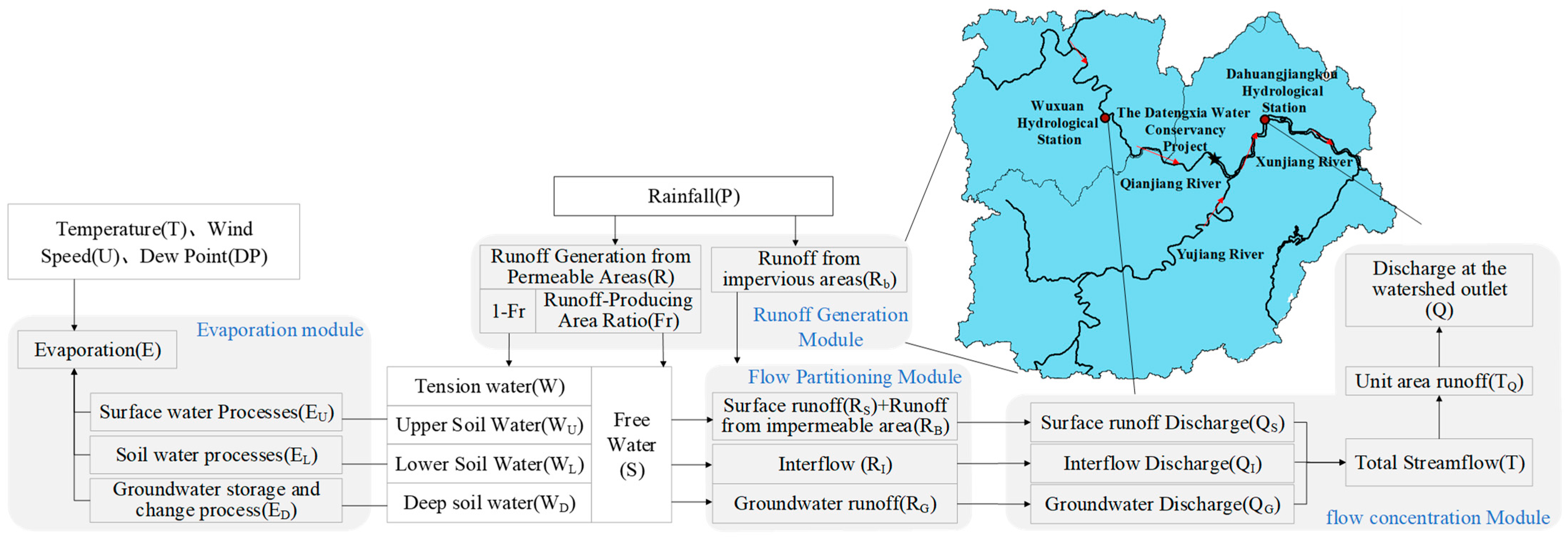
Using the Xin‘anjiang model as a framework, we developed a hydrological model for the Datengxia Project influence area, with rainfall as the primary input. The model comprises four core modules: water source division, flow generation, confluence, and evapotranspiration (Figure 3).
Figure 3.
The hydrological model of the affected area of the Datengxia Water Control Hub Project. Red dots indicate hydrological stations, the black five-pointed star marks the Datengxia Water Control Project, and red arrows show river flow direction.
Flow generation: The underlying surface is divided into permeable and non-permeable zones. Rainfall in permeable areas undergoes surface depression filling, infiltration, and soil water redistribution before contributing to surface runoff. In contrast, rainfall on non-permeable areas converts directly into surface runoff.
Confluence: All generated runoff subsequently undergoes slope convergence and river network convergence, eventually aggregating at the basin outlet.
Evapotranspiration: Building on the flow generation and confluence modules, this component accounts for the influence of meteorological factors (e.g., air temperature, wind speed, and dew point temperature) on potential evapotranspiration. It describes water loss pathways from surface depressions to groundwater through the soil profile.
3.2.3. Mann–Kendall Test Method (M–K) Test and Pettitt Mutation Test Analysis
Since hydrological data are monthly data and they belong to non-normally distributed data, they are defined as time series data. The Mann–Kendall (abbreviated as M–K) test [14] is widely used in hydrological trend analysis. Furthermore, assuming that there is a stationary time series for the monthly hydrological data studied, the hydrological data statistic S can be defined as follows:
where , and represent the i-th and j-th values in the stationary time series, respectively.
Denote the existence statistic Z:
where denotes the variance of . If , it indicates that the trend of change in this data series is not significant; otherwise, there is a significant trend of change.
The M–K mutation test (the Mann–Kendall test) does not require the sequence to follow a specific distribution and is insensitive to outliers, making it widely used in the analysis of trends and mutations in time series. For a sequence of length n, the rank sequence Sk is defined and the sequential statistic UFk and the reverse sequential statistic UBk are constructed. If UFk exceeds the critical line, it indicates a significant trend, while the intersection of UFk and UBk within the critical lines corresponds to the mutation point of the sequence.
Due to the existence of mutations in hydrological and meteorological elements, non-parametric statistical methods are often employed to detect such mutations. The Pettitt mutation test [15] can analyze hydrological and meteorological sequences to identify change points and quantify their statistical significance. The test statistic is defined as follows:
According to the statistics, the following can be obtained:
where the values of and are, respectively, the i-th and j-th elements in the stationary time series, corresponding to the samples.
3.2.4. Contributions of Climate Change and Human Activities
The double cumulative curves [16] were adopted to calculate the impact of climate change and human activities on runoff and sediment transport, and the specific driving characteristics of each factor on runoff change were further quantitatively evaluated by calculating their respective contribution rates [17]. The contribution rate is calculated according to the following formula:
where and , respectively, represent the runoff depth formed due to climate change and human activities, is the contribution rate of climate change to runoff evolution, is the contribution rate of human activities to runoff evolution, and is the difference in measured runoff depth between the base period and the impact period. Its essence represents the variation in runoff caused by changes such as climate change and human activities.
3.2.5. Random Forest Model
The dynamics of runoff and sediment transport are governed by a complex interplay of climatic and anthropogenic factors—including precipitation, land use patterns, vegetation cover, and human interventions—whose influences follow distinct spatiotemporal statistical patterns. To formalize these relationships, we express the system as a multivariate mapping:
where is a sequence of the influencing factors, and are the mapping relationships of the respective influencing factors on the runoff volume and the sediment transport volume, and and are the runoff volume and the sediment transport volume, respectively.
To quantify the relative influence of each driver, we define the contribution rate of a factor as the proportion of variance in or attributable to that factor when all other predictors are held fixed. Estimating these rates enables a shift from a purely correlative description toward a mechanistic interpretation of water–sediment dynamics. In this study, contribution rate estimation is performed using a random forest regression model [18], a data-driven, non-parametric approach well-suited for capturing nonlinear interactions among predictors.
Random forest regression [19] is a Bootstrap-aggregating (Bagging) ensemble in which each base learner is a decision tree. During training, each tree is grown on a bootstrapped sample of the data, and at every split a random subset of predictors (here, approximately one third of the total) is evaluated, thereby decorrelating the trees and providing a robust measure of variable importance. Our implementation uses the TreeBagger toolbox in MATLAB R2023b (The MathWorks, Inc., Natick, MA, USA) with the following hyperparameters:
Number of trees: 400;
Maximum splits per tree (MaxNumSplits): 20;
Minimum leaf size: 1 observation;
Predictors sampled per split: p/3 (where is the total number of predictors).
In the regression analysis of contribution rate, a subset containing k attributes is randomly selected from the attribute set of the corresponding node and assigned to each node of the base decision tree. Then, an optimal attribute is selected from this subset for partitioning to obtain the decision tree model of this node. Suppose the dataset composed of human activities and predicted values is , and thus set N decision trees.
Variable importance quantification follows the out-of-bag permutation importance scheme. For each tree, the out-of-bag (OOB) samples—those not used in building that tree—yield a baseline prediction error . The values of a given predictor are then randomly permuted within the OOB set, and the error is recomputed (). The importance of that predictor is taken as the average increase in error over all trees, calculated according to [20]:
where represents the prediction error of the model on the original out-of-bag data, and represents the prediction error of the model on the same data after adding noise interference to feature X.
The predicted value of a new input node is calculated by looking at the neighbors of a certain node through the model trained on the dataset , and these neighbors are weighted by using the following weighting function :
where and are the non-negative weights of the i-th node of the runoff volume and sediment transport volume in the same decision tree relative to the new data points . For any specific node , the sum of all the weights must be 1.
4. Results
4.1. Effects of Rainfall and Human Activities on Runoff and Sediment Transport
4.1.1. Characteristics of Runoff Driven by Meteorological Factors
In order to analyze the driving characteristics of meteorological factors on runoff, the daily meteorological data of two hydrological stations in the study area were extracted, and rainfall, average temperature, average dew point, and average wind speed were taken as the main research factors. Before the analysis, the daily data were statistically divided into monthly and annual sequence data. Among them, the annual rainfall data adopted cumulative values, and the annual average temperature, dew point, and wind speed adopted arithmetic mean values. The processed data is shown in Table 1. For a very small number of missing values, linear interpolation is adopted for interpolation to ensure the continuity of the data.
Table 1.
Annual average data of meteorological elements at Wuxuan Station and Dahuangjiangkou Station.
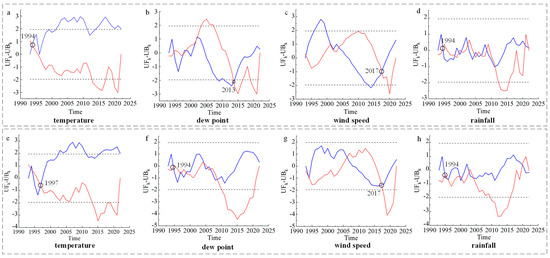
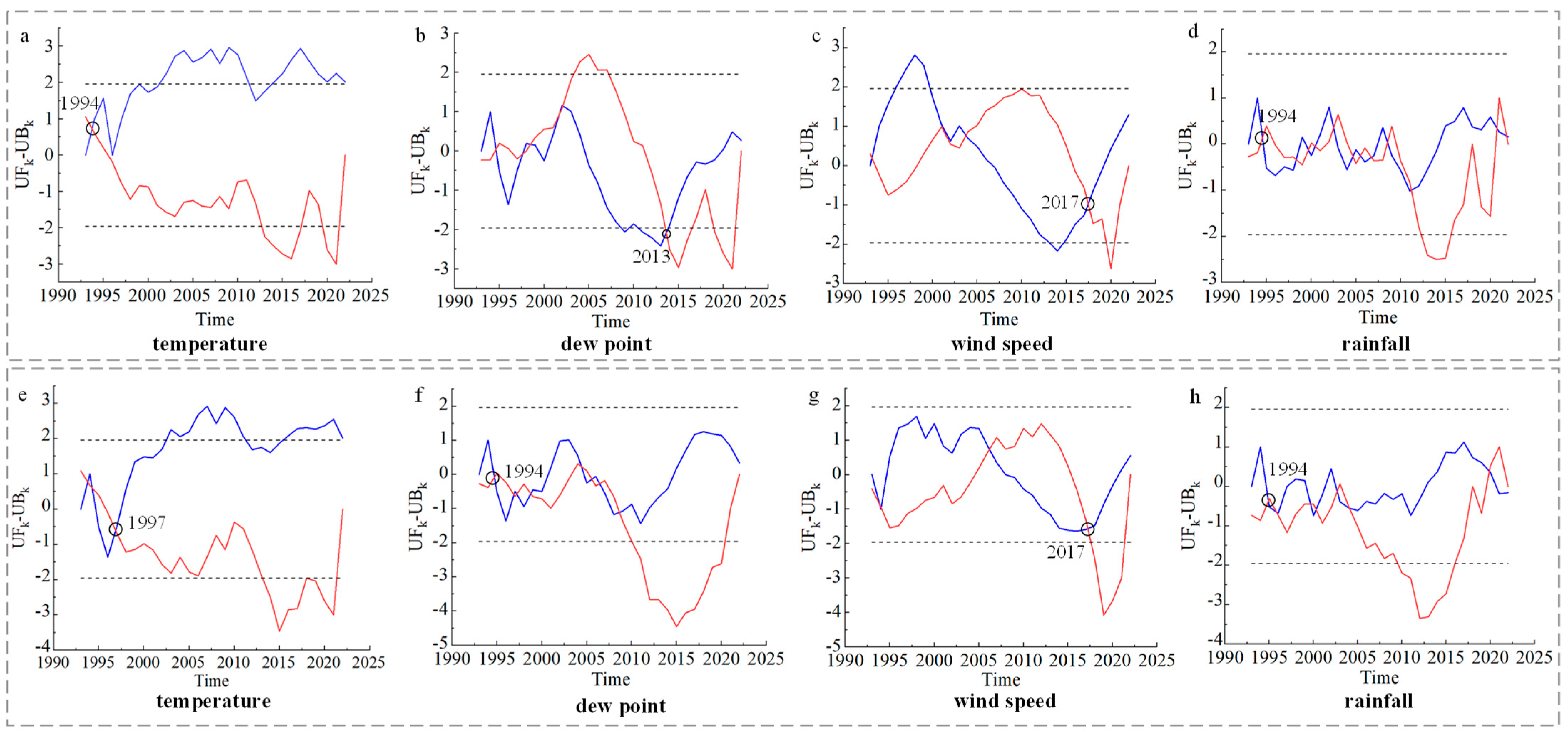
This study utilizes monthly meteorological observation data, which constitute a non-normally distributed time series. The Mann–Kendall (M–K) abrupt change test, supplemented by the cumulative anomaly method and Pettitt test for multi-dimensional change point diagnosis, was systematically applied to analyze the abrupt change characteristics of four meteorological factors: temperature, dew point, wind speed, and rainfall. The results reveal significant heterogeneity in the timing of abrupt changes across meteorological elements, with no synchronous cross-factor abrupt change pattern observed (Figure 4). Specifically, temperature at Wuxuan Station underwent a significant abrupt change in 1994 (p < 0.05), and dew point changed abruptly in 2013 (p < 0.05) (Figure 4a,d), while temperature at Dahuangjiangkou Station showed a significant abrupt change in 1997 (p < 0.05) (Figure 4e).
Figure 4.
The results of M–K mutation test on four meteorological factors. (a–d) M–K mutation characteristics in Wuxuan station, showing temperature (a), dew point (b), wind speed (c), and rainfall (d), respectively; (e–h) M–K mutation characteristics in Dahuangjiangkou station, showing temperature (e), dew point temperature (f), wind speed (g), and rainfall (h), respectively. In each subplot, the blue line represents the UFk statistic (forward sequence), the red line represents the UBk statistic (backward sequence), and the black dashed lines indicate the critical values at the 0.05 significance level (±1.96).
Notably, the rainfall series exhibited no statistically significant abrupt changes at the interannual scale (p > 0.05), with its long-term trend remaining relatively stable and demonstrating persistent co-variation with hydrological variables such as runoff and sediment load. Therefore, within the hydrological attribution framework developed in this study, rainfall was selected as a representative proxy variable for climate change, used to quantitatively disentangle the influence of climate variability on watershed water and sediment processes within a “climate–human activity” dual attribution model. This selection is grounded both in the statistical independence diagnostics of meteorological factors and in ensuring the robustness and physical consistency of climate forcing representation in the attribution model.
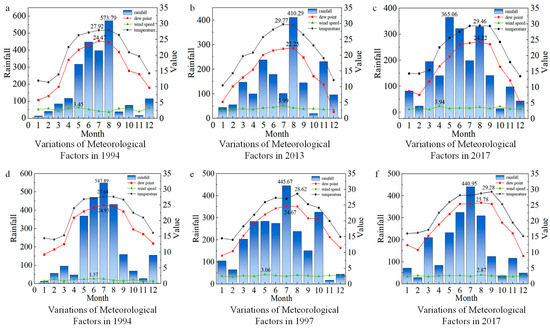
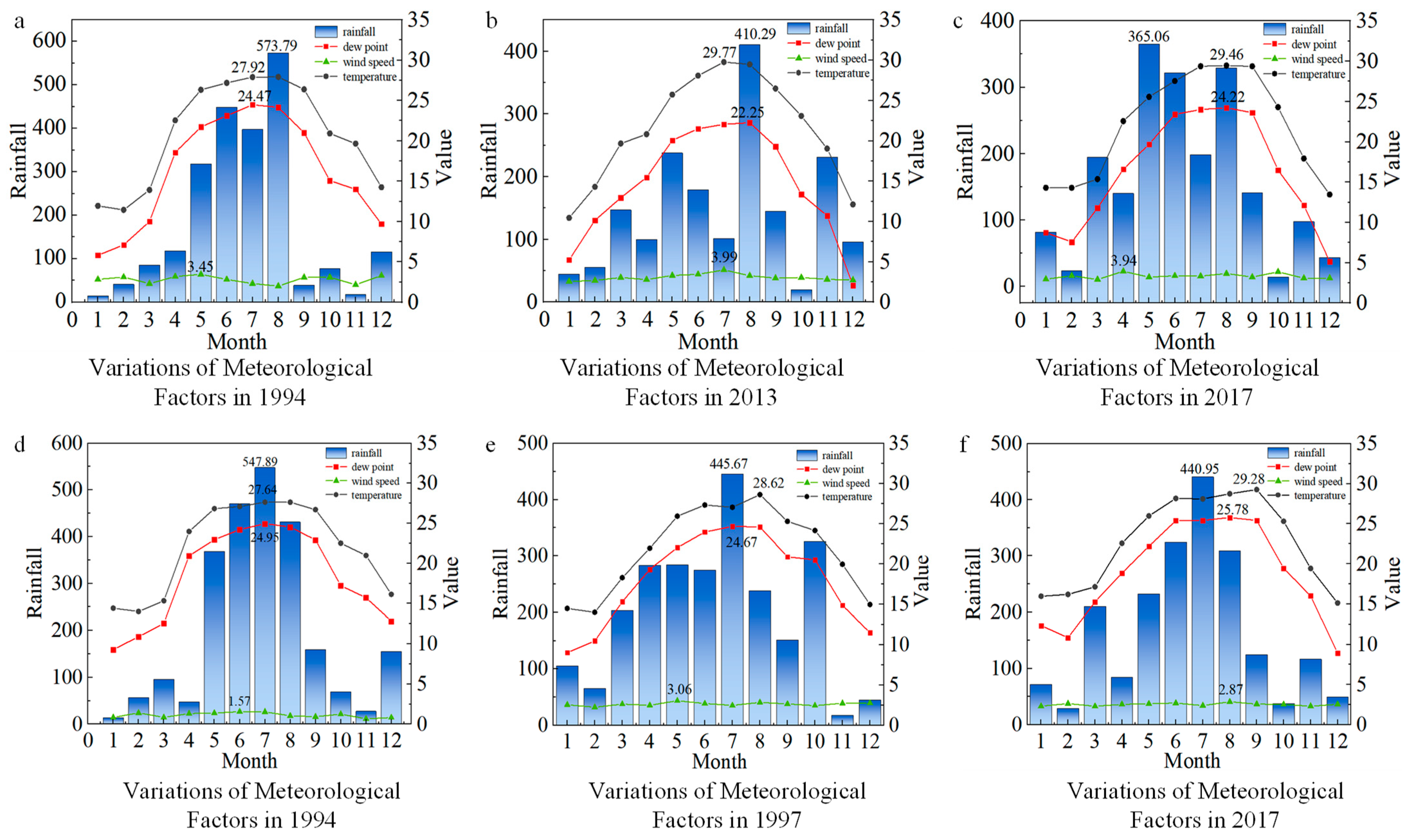
To further analyze the synchronous differences between factors such as temperature, dew point, and rainfall, the monthly average data of meteorological factors in the abrupt change years at the two stations were statistically analyzed, as shown in Table 2. Meanwhile, the monthly average data process lines of each element during the abrupt change years at Wuxuan Station and Dahuangjiangkou Station, respectively, were plotted, as shown in Figure 5. Both stations show strong and concentrated seasonal signals, and there are obvious gradient changes. Among them, the rainfall is mainly concentrated from May to August. The changing trends of temperature and dew point remain highly synchronous, both starting to rise from April and continuing until after the rainfall begins to decrease (September). Wind speed tended to be stable throughout the year, which was completely different from rainfall. There was no significant synchronization between the two.
Table 2.
Average data of meteorological elements during the years of mutation.
Figure 5.
The characteristics of abrupt change in meteorological factors and the intra-year variation curves. Meteorological factors include temperature, dew point, wind speed, and rainfall. (a–c) Variations in meteorological factors at Wuxuan station for the years 1994, 2013, and 2017, respectively; (d–f) variations in meteorological factors at Dahuangjiangkou station for the years 1994, 1997, and 2017, respectively.
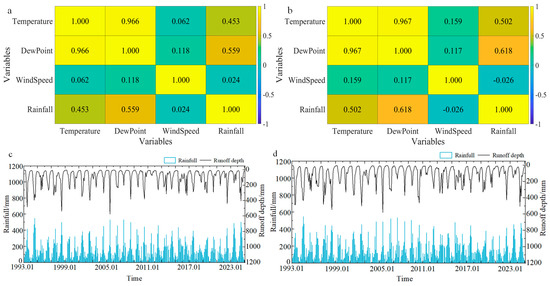
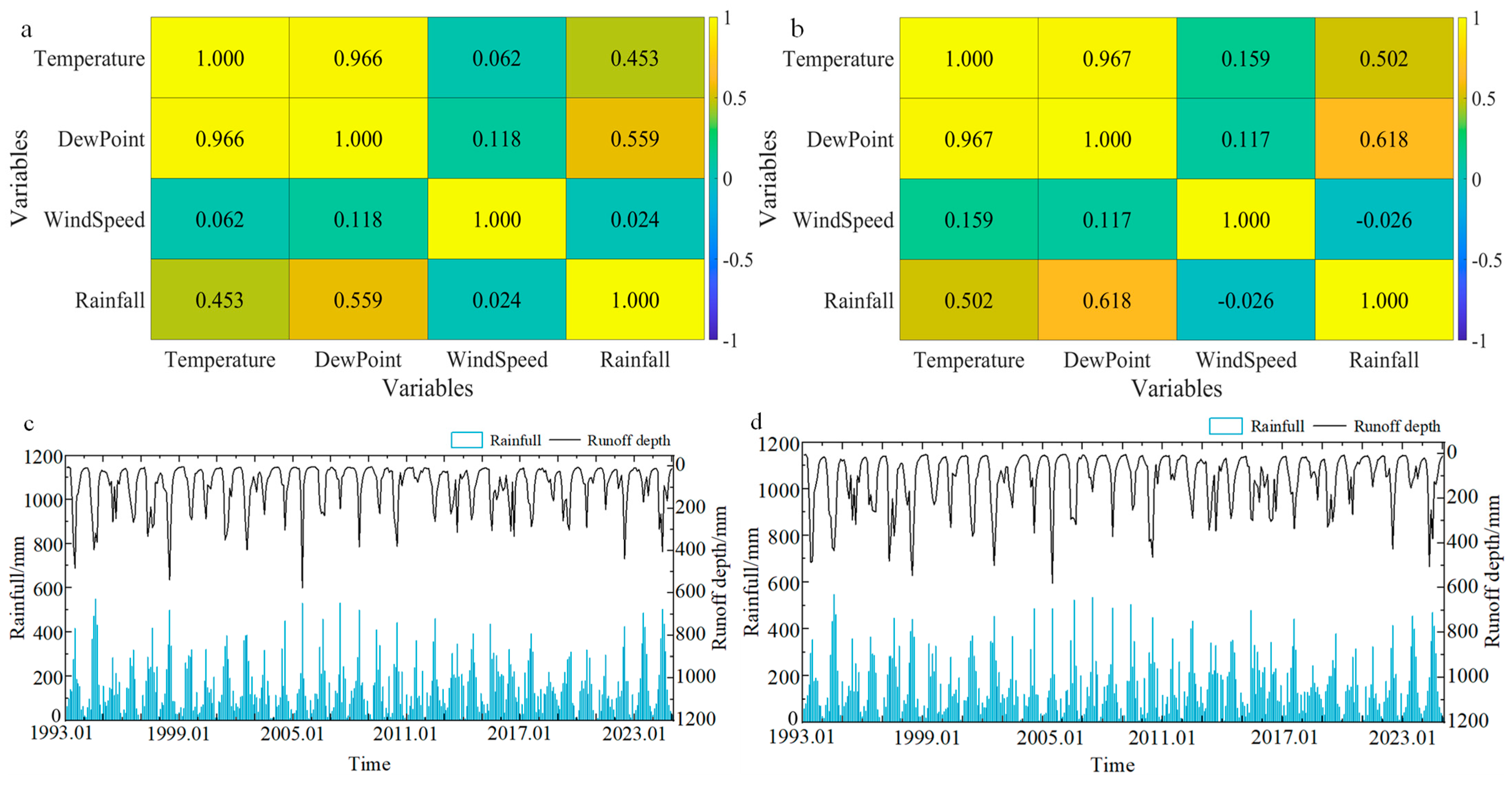
In order to identify the dominant meteorological factors of runoff variation in the basin, a correlation analysis was conducted on the monthly meteorological series (rainfall, temperature, dew point, and wind speed) of Wuxuan Station and Dahuangjiangkou Station from 1993 to 2024, aiming to quantitatively describe the intensity and direction of statistical association among various meteorological elements. The results of the correlation analysis show that the rainfall at both stations is highly positively correlated with the dew point (r > 0.55), moderately positively correlated with the temperature (r > 0.45), but has no significant correlation with the wind speed. The dew point is highly positively correlated with the temperature (r > 0.96), and the strong correlation between the dew point and rainfall conforms to the driving mechanism of the hydrological system, that is, high water vapor content is a prerequisite for the generation of rainfall. The correlation between temperature and rainfall mainly stems from their synchrony on a seasonal scale, a feature that is also confirmed in the monthly data changes, as shown by Figure 6a,b.
Figure 6.
The results of correlation analysis of driving factors and rainfall–runoff time series diagram. Driving factors include temperature, dew point, wind speed, and rainfall. (a,b) Correlation of driving factors at Wuxuan station and Dahuangjiangkou station, respectively; (c,d) process curves of rainfall and runoff from 1993 to 2024 at Wuxuan station and Dahuangjiangkou station, respectively.
The above correlation analysis statistically confirmed the intrinsic connection between other meteorological factors and rainfall, visually demonstrated the dynamic driving mechanism of rainfall on runoff, and further mapped the rainfall–runoff time series process line from 1993 to 2024. The results show that the shapes and rhythms of the runoff process lines and rainfall process lines at the two stations are highly consistent, precisely reflecting that rainfall is not only the most direct climatic forcing factor on the water–sediment process, but can also effectively represent the changes in water vapor conditions, as shown in Figure 6c,d. Therefore, it is reasonable to verify the synergy and consistency of the two in time series from the scale of rainfall–runoff processes. In subsequent modeling, rainfall can be regarded as the single input factor of climate change, and a solid foundation can be laid for quantifying the relative contribution of climate change under a unified framework.
4.1.2. Change Trends in Runoff and Sediment Transport
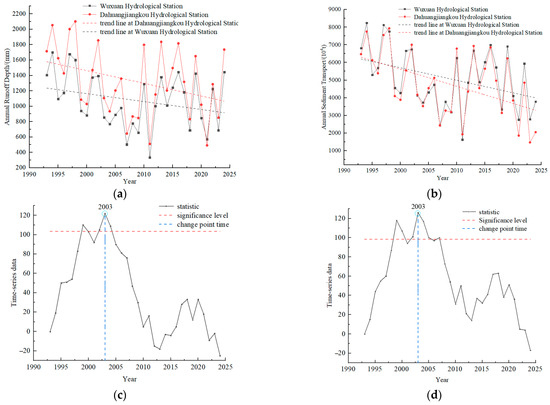
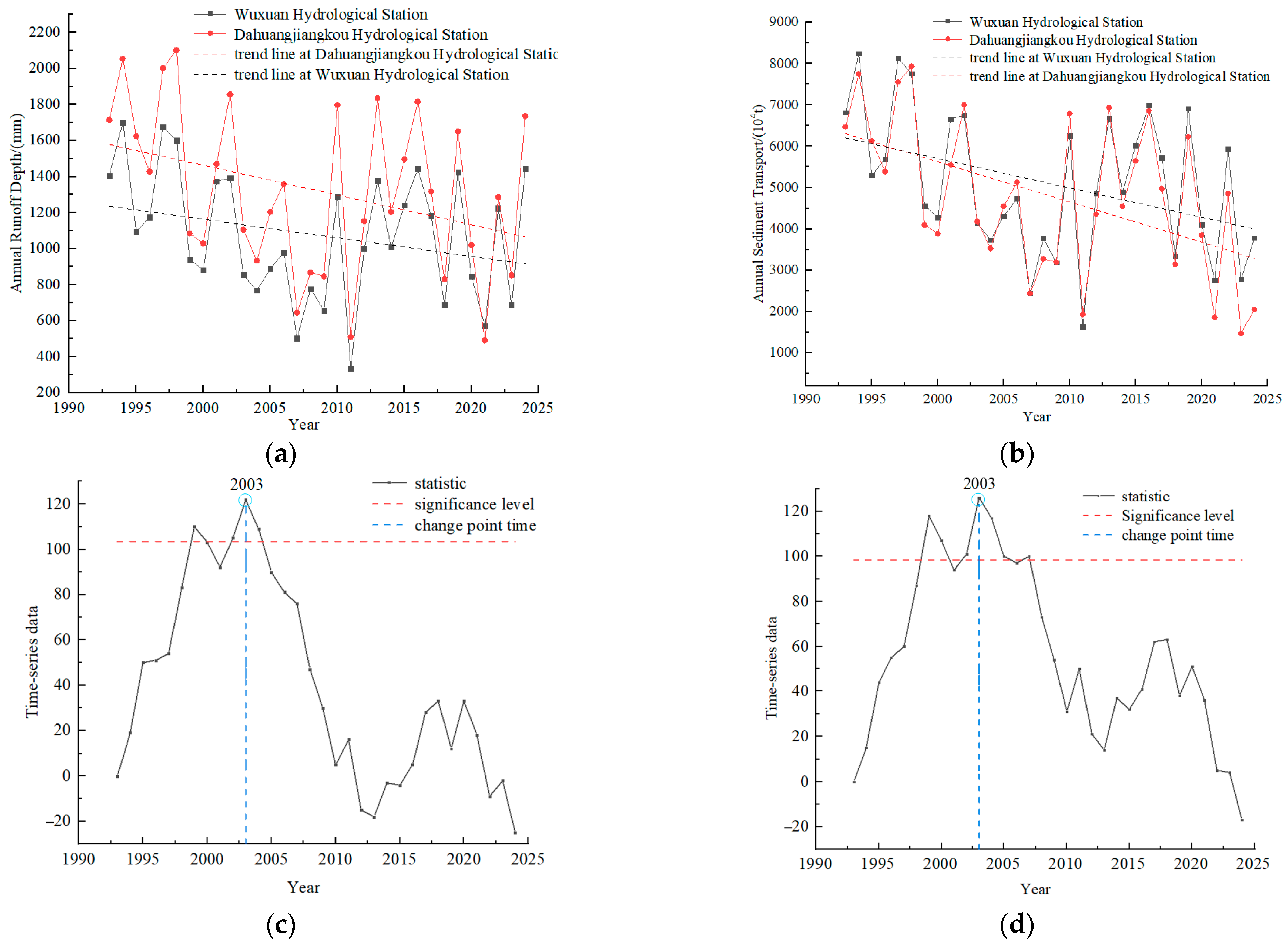
The variation patterns of runoff and sediment transport at Wuxuan Station and Dahuangjiangkou Station are presented by using the methods of statistics and fitting of annual runoff and annual sediment data, as shown in Figure 7a,b. According to the feasibility study report of the Datengxia Water Control Hub Project, the peak of runoff and the peak of sediment transport are synchronized, and the data of sediment transport volume can be calculated from the runoff volume. In 1994, the maximum runoff volume of Wuxuan Station was 160.545 billion m3, and the maximum sediment transport volume in the same year was 82.4133 million tons. During the period from 1993 to 2009, both the runoff volume and sediment transport volume showed an overall downward trend, and the fluctuations in both were relatively large. They began to decline in 2003 and reached their lowest points in 2007, with the runoff volume and sediment transport volume being 47.507 billion m3 and 24.38758 million tons, respectively. They started to rise in 2010, but the increase was relatively small.
Figure 7.
Runoff and sediment transport changes at two stations (Wuxuan Station, Dahuangjiangkou Station) from 1993 to 2024. (a) Hydrograph trend of runoff; (b) trend line of sediment discharge process; (c) cumulative curve of runoff; (d) cumulative curve of sediment.
Compared with Wuxuan Station, the overall runoff depth of Dahuangjiangkou Station is larger and the overall decrease is also greater. However, the overall sediment transport volume is smaller than that of Wuxuan Station, and the overall decrease is relatively small. But both the maximum and minimum values are higher. The maximum annual runoff volume was 304.187 billion m3 in 1998, and the sediment transport volume was 79.5387 million tons, which also dropped to its lowest point in 2007. The corresponding runoff volume and sediment transport volume were 93.271 billion m3 and 24.3334 million tons, respectively. Due to the decrease in precipitation, the annual runoff depth and annual sediment transport volume of the two stations have shown varying degrees of downward trends; especially after 2000, the downward trend has been more obvious.
The non-parametric M–K trend test was applied to identify whether there was an overall trend of monotonically rising or falling in the annual runoff sequence. The long-term variation characteristics of the annual runoff sequence at the study site were systematically analyzed, and then the statistical significance of this trend at the selected significance level (α = 0.1 in this study, corresponding to a confidence level of 90%) was evaluated. The annual runoff depth at Wuxuan Station showed a decreasing trend (Z = −1.53), but did not reach a significant level (|Z| < 1.65). The Dahuangjiangkou Station showed a significant decreasing trend (Z = −6.28, |Z| > 1.65), which indicates that the trend of runoff reduction at downstream stations is more significant.
The significance of the Mann–Kendall (M–K) test reflects only the overall monotonic trend of a hydrological series and cannot effectively identify potential local change points within the sequence—even when the overall trend is not statistically significant, structural shifts may still occur. Therefore, the Pettitt test for change point detection was applied to the hydrological series of both Wuxuan Station and Dahuangjiangkou Station at a significance level of α = 0.05 (95% confidence). The results (Figure 7c,d) show that the Pettitt statistics for Wuxuan and Dahuangjiangkou Stations are 2.10 and 2.11, respectively, both exceeding the critical value of 1.7011, indicating that a statistically significant abrupt change occurred at both stations in 2003.
To further verify the robustness of this change point, multiple statistical methods were used for cross-validation. For Wuxuan Station, the sliding t-test (|T| = 2.885) and the cumulative anomaly test (|T| = 2.4846) independently identified 2003 as a significant change point year. Similarly, for Dahuangjiangkou Station, the sliding t-test (|T| = 2.8464) and the ordered clustering method (|T| = 3.376) also consistently identified 2003 as the most pronounced change point year. The high degree of agreement among the four methods—each based on different statistical principles—collectively demonstrates that 2003 represents an objective and robust turning point in the hydrological regime of the study area. This finding provides a reliable temporal basis for dividing the “pre-human-impact” (baseline) and “post-human-impact” (change) periods in the subsequent attribution analysis.
4.1.3. Contribution Analysis of Rainfall and Human Activities to Water and Sediment Changes
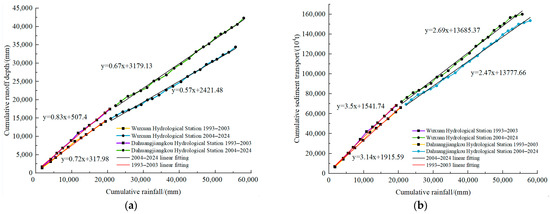
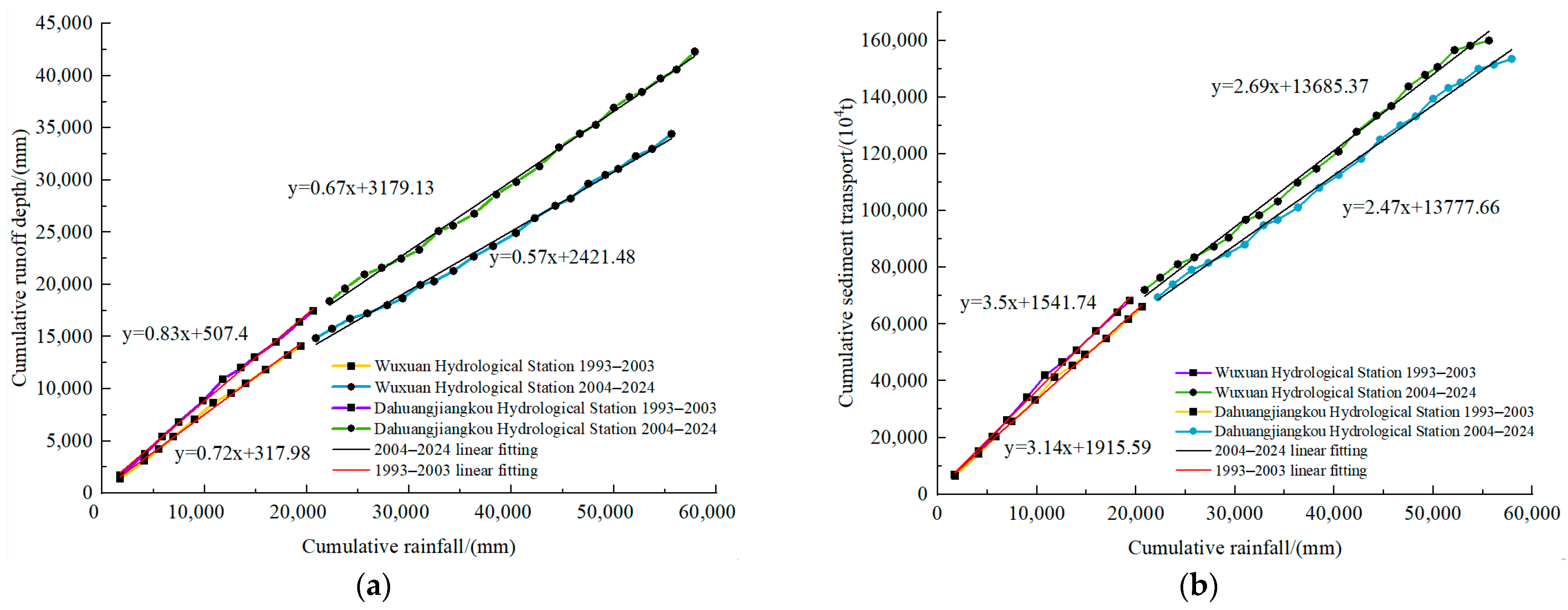
The characteristics of rainfall and human activities driving water and sediment at Wuxuan Station and Dahuangjiangkou Station were presented using the double cumulative curve of rainfall and runoff volume and its linear fitting, as shown in Figure 8. Both stations have divided the double cumulative curves into two segments, namely the period from 1993 to 2003 (Period I) and the period from 2004 to 2024 (Period II). From Period I to Period II, there were jumps in both the runoff volume and sediment transport volume at Wuxuan Station and Dahuangjiangkou Station. The slopes of the runoff volume fitting the straight line decreased from 0.72 to 0.56 and from 0.83 to 0.67, respectively, indicating that the ability of the same precipitation in Period II to generate runoff decreased. The slopes of the straight lines fitting the sediment transport volume of the two stations decreased from 3.5 to 2.72 and from 3.14 to 2.51, respectively, indicating that in Period II, under the same precipitation, both the runoff production capacity and the sediment production capacity decreased. Therefore, from the analysis results, it can be concluded that the turning points of the track flow at both stations were in 2003, which is consistent with the Pettitt test results. Before 2003, the impact of human activities on the runoff changes in the basin was relatively small. Therefore, in this study, Period I was set as the base period to quantify the contribution rate of rainfall and human activities to the runoff volume.
Figure 8.
Double cumulative curve charts of rainfall–runoff and rainfall–sediment transport. (a) Double cumulative curve charts of rainfall–runoff; (b) double cumulative curve charts of rainfall–sediment transport.
To further analyze the driving characteristics of rainfall and human activities on the runoff and sediment transport in the basin, the contribution rates of these two driving factors were calculated using the double mass curve method (the difference in slopes before and after the mutation point divided by the total change in slope) and are summarized in Table 3 and Table 4, respectively. Furthermore, the research suggests that the main influencing factor for the variation in runoff volume is human activities. The main stage during which the runoff volume and sediment transport volume of the two stations are affected by human activities is Period II. Among them, the contribution rates of the runoff volume and sediment transport volume of Wuxuan Station were 91.97% and 90.43%, respectively. The contribution rates of the runoff volume and sediment transport volume at Dahuangjiangkou Station were 52.95% and 65.32%, respectively.
Table 3.
Analysis results of effects of rainfall and human activities on runoff.
Table 4.
Analysis results of effects of rainfall and human activities on sediment transport.
4.2. The Main Controlling Factors of Human Activities on Water and Sediment Changes
4.2.1. Analysis of the Main Control Factors
The combined effects of human activities have extensive and profound impacts on the changes in river basin runoff [21]. Human activities such as river basin development, agricultural expansion and changes in irrigation measures, urbanization, soil and water conservation, and forest development have led to changes in land use and altered the underlying surface conditions. The implementation of projects such as the construction of cascade reservoirs in river basins, the configuration of water diversion and water regulation projects, and water supply and irrigation systems directly alters the water volume distribution and flow velocity of rivers. By reading the relevant literature and consulting statistical yearbook materials, nine factors were finally selected, including land use type [22] (cultivated land area, forest land area, grassland area, water area, urban and rural land area, and unused land area), population density, natural population growth rate, and runoff change rate, to study the response and driving mechanism of runoff change in the basin.
To strengthen the predictive stability of the random forest model, a correlation analysis was performed on nine potential influencing factors using the Spearman rank correlation method. The strength of the monotonic relationship between each predictor and the target variable was interpreted based on the absolute value of the correlation coefficient |R|. An |R| of 0 indicates no association, |R| < 0.4 corresponds to a weak correlation, 0.4 ≤ |R| < 0.75 represents a moderate to strong correlation, and |R| = 1 denotes a perfect monotonic relationship.
The Spearman correlation analysis identified several factors exhibiting statistically meaningful associations with the hydrological target variables, as summarized in Table 5 and Table 6. For Wuxuan Station, the strongest correlations were observed with forest area (−0.50), grassland area (0.44), population density (−0.42), natural population growth rate (0.34), and runoff change rate (0.30). At Dahuangjiangkou Station, the most pronounced correlations corresponded to grassland area (0.46), runoff change rate (0.37), population density (−0.33), urban and rural land area (−0.31), and natural population growth rate (0.27). These correlation patterns not only highlight spatially differentiated controls on water and sediment dynamics but also provide a quantitative basis for selecting the following six factors as primary explanatory variables in subsequent modeling: forest area, grassland area, urban and rural land area, population density, natural population growth rate, and runoff change rate.
Table 5.
Correlation analysis of main influencing factors at the Wuxuan Hydrologic Station.
Table 6.
Correlation analysis of main influencing factors at the Dahuangjiangkou Station.
4.2.2. Simulation Verification of Random Forest Model
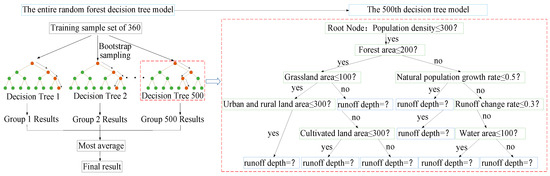
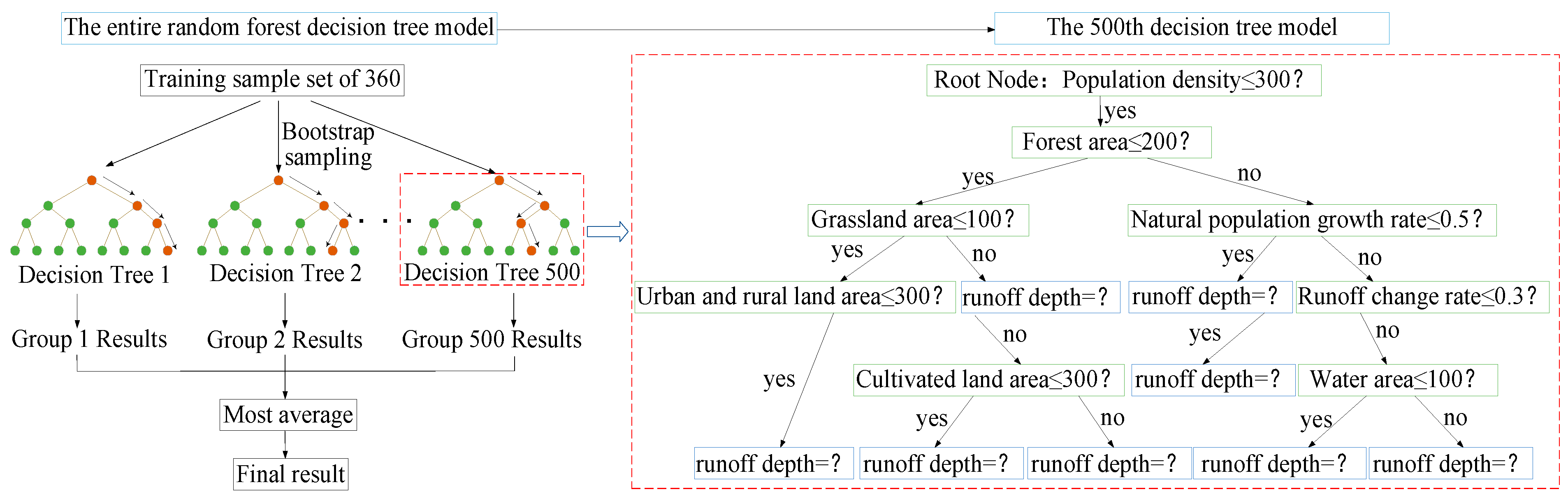
To simulate and analyze the contribution rate of human activities to runoff volume and sediment transport volume, based on the results of the previous correlation analysis, six main control factors with the highest correlation with runoff volume (namely cultivated land area, forest land area, urban and rural land area, population density, natural population growth rate, and runoff change rate) were selected as the independent variables of the model, and runoff volume and sediment transport volume were taken as dependent variables to establish the prediction model, as shown in Figure 9.
Figure 9.
Random forest decision tree model. The monthly hydrological data from 1993 to 2024 were divided chronologically into three subsets: the training set (1993–2003), the validation set (2004–2013), and the test set (2014–2024). Each subset serves a distinct purpose in model development and evaluation.
The main parameters of the random forest model are trees = 500, leaf = 1, and max depth = 25. Regression analysis was simulated using the MATLAB platform [23]. The simulation evaluation indicators include the coefficient of determination () and the mean absolute error ().
Training set: Used to build the random forest model. During this phase, the model learns the underlying relationships between input variables (e.g., land use, climate indices, and population density) and target outputs (runoff depth and sediment transport volume). Key parameters optimized during training include the number of decision trees, maximum tree depth, minimum samples per leaf, and the number of features considered for each split. Hyperparameter tuning was conducted via grid search aimed at minimizing prediction error.
Validation set: Used to fine-tune the model and prevent overfitting. The performance on this set (measured via R2 and MAE) guided the selection of the final hyperparameter combination before evaluating the model on unseen data.
Test set: Used to independently assess the generalization ability of the finalized model. This set simulates real-world application on data that the model has never encountered during training or validation.
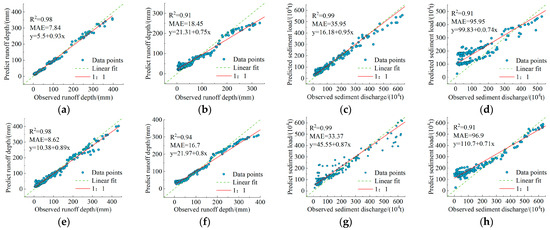
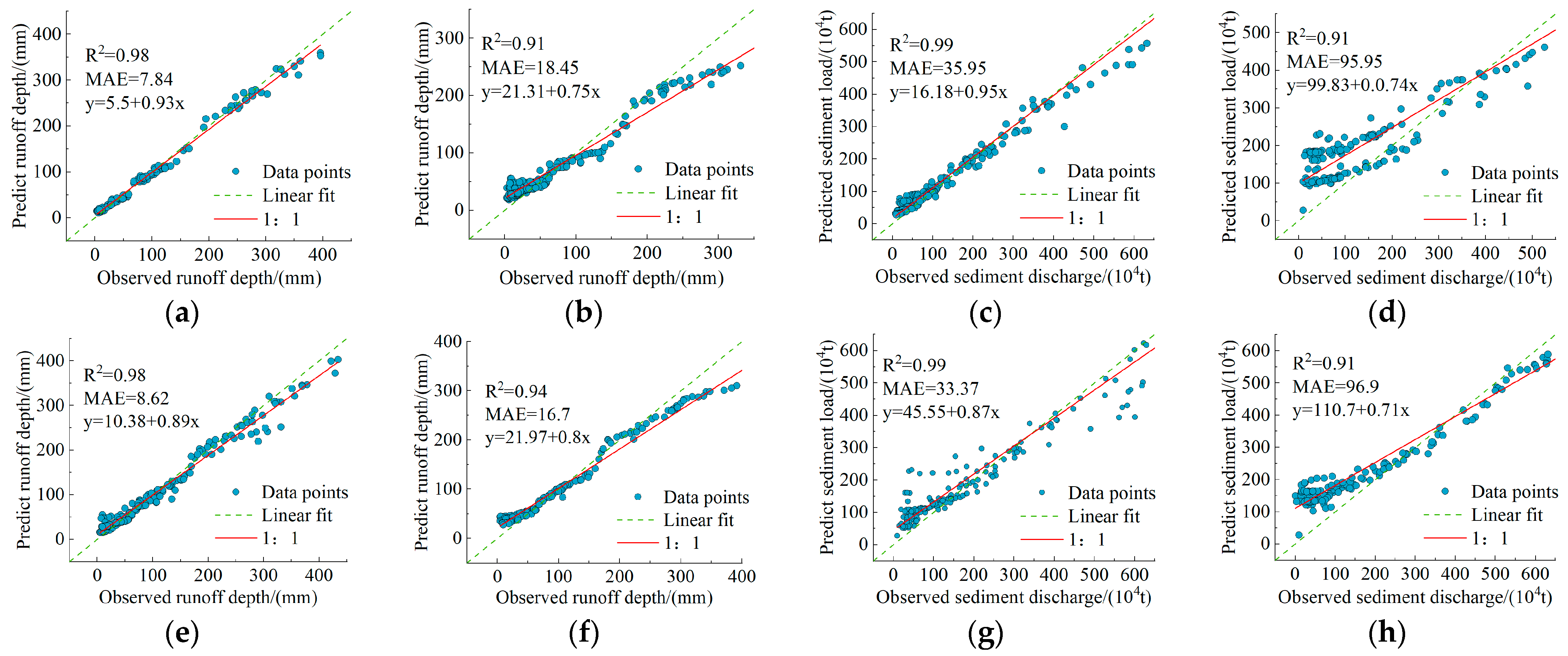
The model achieved strong predictive performance on the test set: for Wuxuan Station, runoff depth (R2 = 0.91, MAE = 18.45) and sediment transport (R2 = 0.91, MAE = 95.95); for Dahuangjiangkou Station, runoff depth (R2 = 0.94, MAE = 16.7) and sediment transport (R2 = 0.91, MAE = 96.9). All R2 values exceed 0.90, indicating that the model captures the dominant patterns in both runoff and sediment series. The close agreement between simulated and observed data (Figure 10) confirms that the selected key influencing factors—when incorporated as model inputs—enable reliable prediction of basin-scale hydrological characteristics and flood processes.
Figure 10.
Performance of the random forest model in simulating runoff depth and sediment transport at (a–d) Wuxuan and (e–h) Dahuangjiangkou Stations. (a,e) Training set simulations of runoff depth; (b,f) test set simulations of runoff depth; (c,g) training set simulations of sediment transport; (d,h) test set simulations of sediment transport.
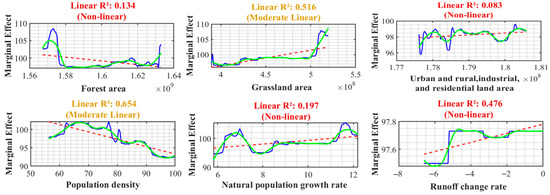
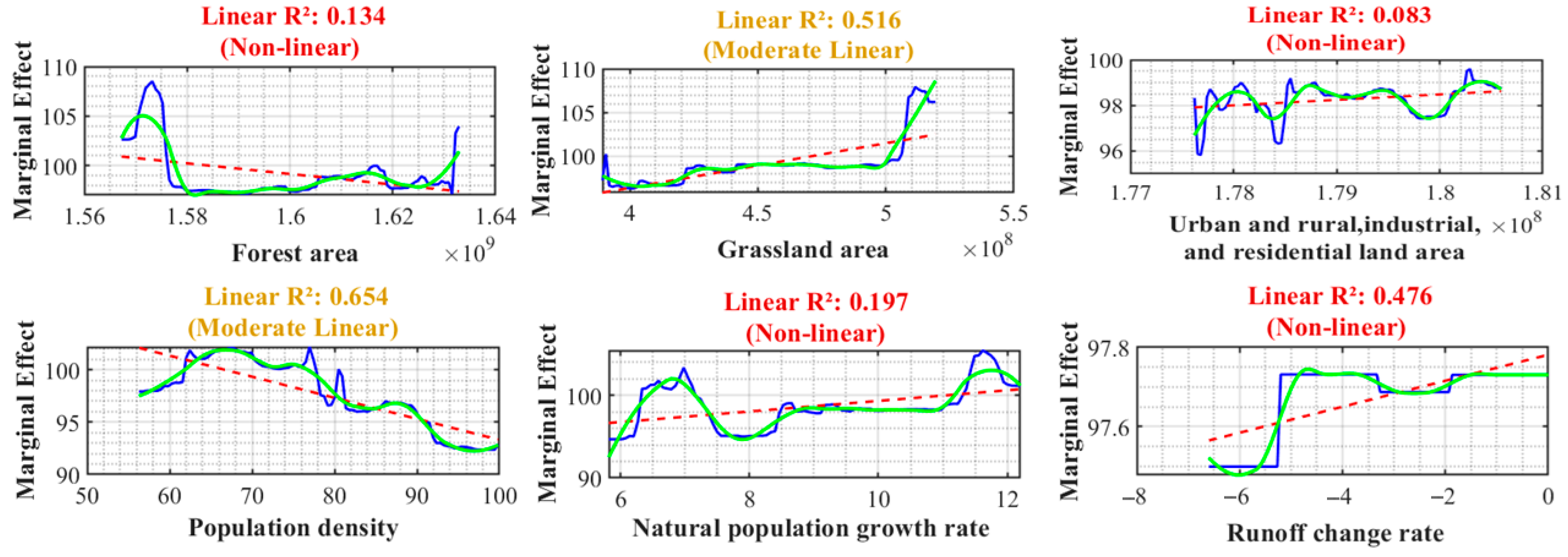
This study systematically investigates the influence mechanisms of various factors on target variables (e.g., runoff, sediment) by integrating Partial Dependence Plots (PDPs) visualization (as shown in Figure 11) with explanatory power (R2) analysis. The results show that population density exhibits the highest linear explanatory power (R2 = 0.654). Its PDPs curve in Figure 11 further reveals a distinct unimodal nonlinear response: the marginal effect increases with rising population density, peaks within the range of 65.0–77.5 persons/km2 (approximately 100), and then gradually declines. This indicates that the impact of population density on hydrological processes follows an optimal range, with weakened marginal effects at both lower and higher densities, particularly beyond 80.0 persons/km2, where a clear decreasing trend is observed.
Figure 11.
Partial Dependence Plots. The blue curves represent the fitted relationship between the actual values of each factor and the output (runoff change rate), reflecting the observed patterns in the original data. The green curves represent the fitted relationship between the predicted values of each factor and the output, illustrating the relationships learned by the model. The red dashed lines indicate the nonlinear fitting curves. (Degree of importance of influencing factors).
Grassland area also demonstrates relatively strong linear explanatory power (R2 = 0.516), and its PDPs curve in Figure 11 displays an overall monotonic trend, supporting its role as a direct and cumulative linear driver. In contrast, both urban–rural built-up area and forest area show lower linear explanatory power (R2 = 0.083 and 0.134, respectively). Their complex PDPs shapes shown in Figure 11 suggest that their effects on the target variables are likely highly context-dependent or interactive with other factors, resulting in limited independent linear influence. The natural population growth rate (R2 = 0.197) and runoff change rate (R2 = 0.476) exhibit moderately weak and moderate linear explanatory power, respectively, with their PDPs curves in Figure 11 hinting at possible non-monotonic responses.
In summary, among the key driving factors, the PDPs presented in Figure 11 illustrate that population density demonstrates a clear unimodal threshold characteristic, while grassland area is governed primarily by a linear mechanism. The effects of urban–rural land use and forest area appear more context-sensitive. These findings highlight that in watershed management, attention should be given not only to the scale of population aggregation but also to identifying its optimal density range to avoid diminishing marginal returns beyond critical thresholds. Meanwhile, linear dominant factors such as grassland area can be managed effectively through direct regulation based on their spatial extent.
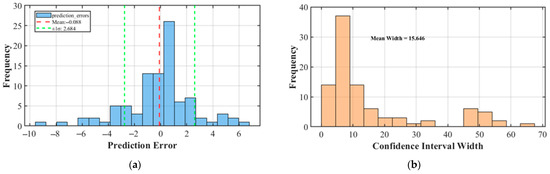
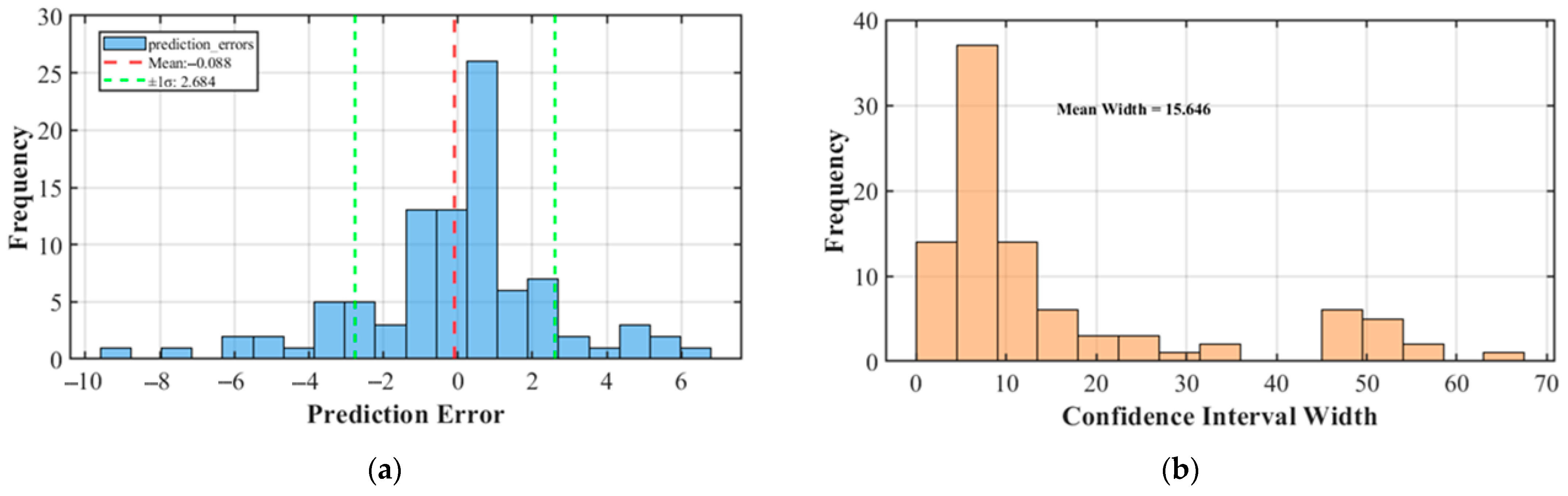
Based on a test set of 132 samples, this study validated the predictive performance and uncertainty quantification capability of a random forest model. As shown in Figure 12, the model demonstrated excellent prediction accuracy, with errors following a normal distribution (mean = −0.088, standard deviation = 2.684) and a 95% error bar of ±5.261. The 95% confidence intervals constructed using 1000 Bootstrap resamples achieved an actual coverage rate of 100%. The distribution of interval widths is presented in Figure 2, with a mean width of 15.646 and notable variation across samples (minimum 2.523, maximum 66.640). The results indicate that the model not only maintains high precision but also effectively quantifies prediction uncertainty through error distribution (Figure 12a) and confidence interval width distribution (Figure 12b), supporting its application in decision-making scenarios that require reliability assessment.
Figure 12.
Predictive uncertainty analysis of the random forest model. (a) Prediction error distribution. (b) Confidence interval width Distribution.
4.2.3. Identification of the Main Control Factors Influencing Water and Sediment Changes
Based on the random forest model, the relative importance of each influencing factor to runoff and sediment transport was quantified. In random forest regression, feature importance is calculated as the mean decrease in impurity (or, equivalently, the total reduction in the mean square error) attributed to a given feature across all decision trees in the ensemble. The importance score reflects the relative contribution of that feature to improving the model’s predictive accuracy for the target variable.
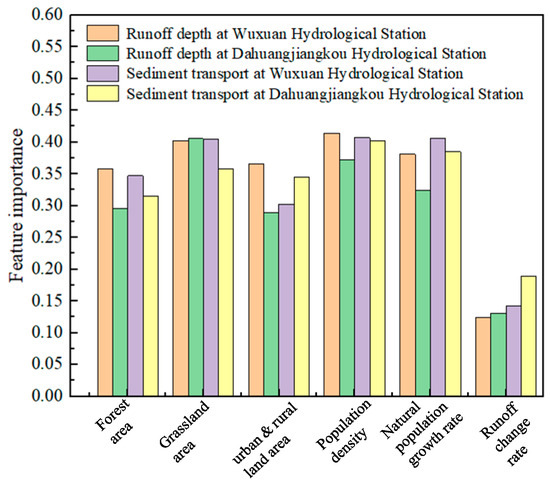
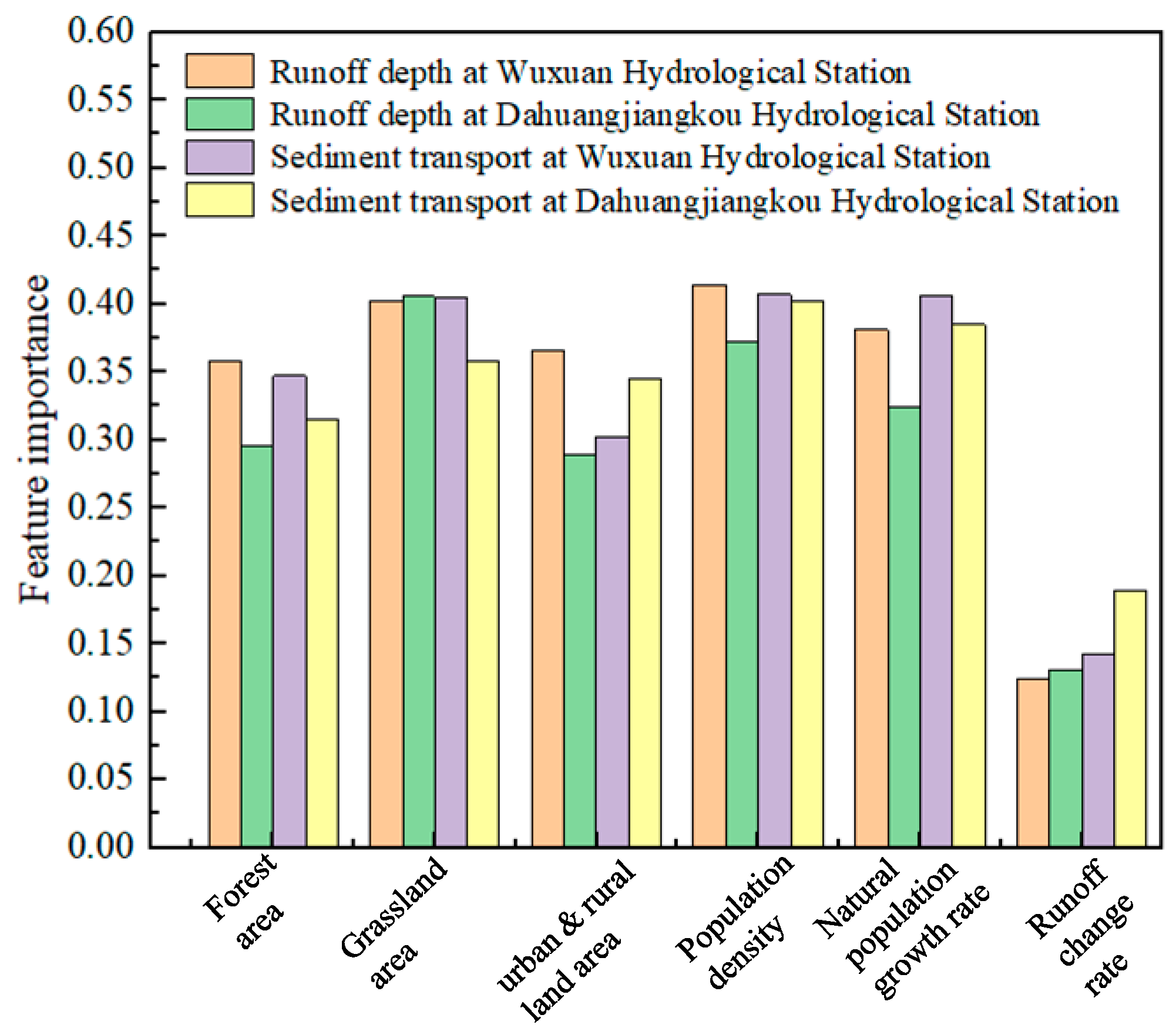
The importance scores of the six considered factors are presented in Figure 13. The results indicate that the population density and natural population growth rate are the most influential common factors for both runoff and sediment transport at Wuxuan and Dahuangjiangkou Stations, with importance scores consistently in the high range of 0.37–0.41. The role of land-use types exhibits clear spatial variation: grassland area exerts a strong influence on runoff at Dahuangjiangkou Station (importance = 0.41), whereas at Wuxuan Station its influence ranks second only to population density (importance = 0.40). In contrast, the runoff change rate shows a relatively limited effect at both stations (importance = 0.12–0.19), suggesting that short-term hydrological fluctuations contribute little to explaining the variation in basin-scale sediment transport.
Figure 13.
Degree of importance of influencing factors.
Compared with the results in the correlation analysis table, the significance of the influencing factors in the random forest model has changed. This is mainly because correlation analysis usually only captures linear relationships, ignoring the interactions and nonlinear relationships between features. In contrast, the random forest model can handle these complexities and is more robust to noise, resulting in more comprehensive and accurate results.
4.3. Research Area Flood Inundation Prediction and Sediment Deposition Analysis
4.3.1. Flood Frequency Design in the Study Area
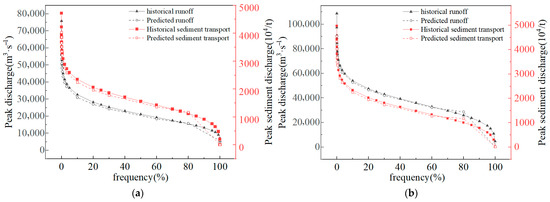
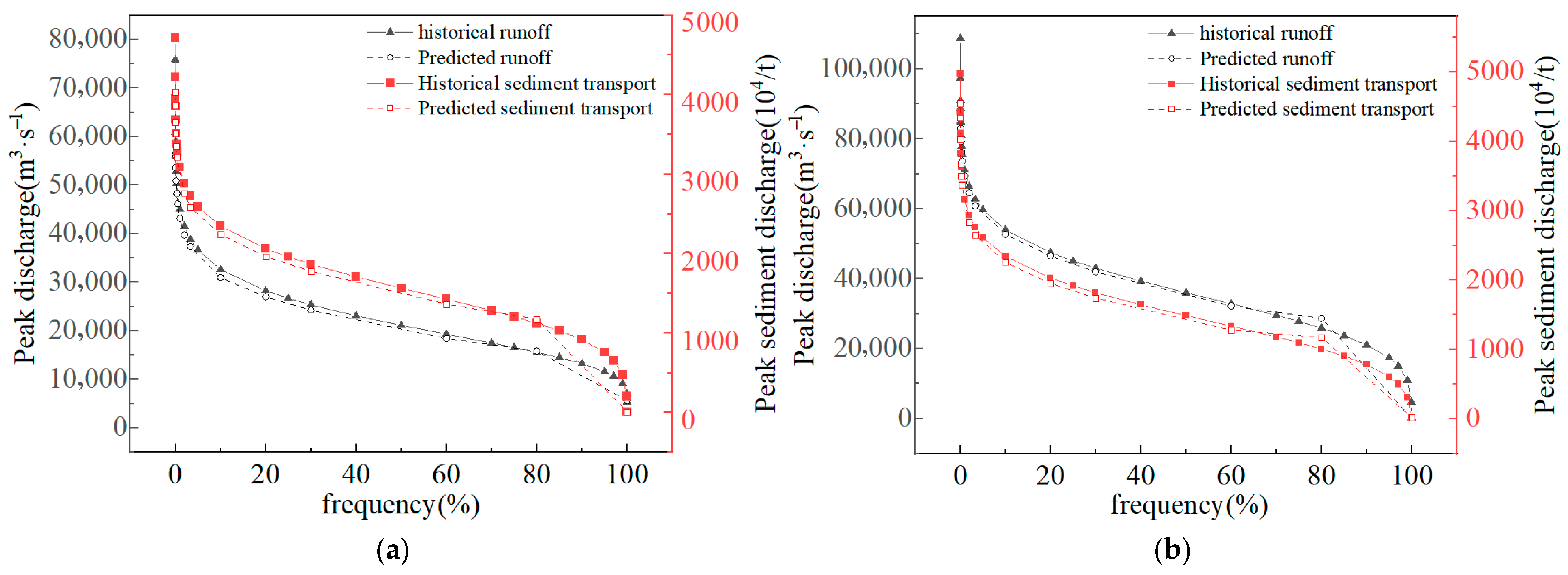
Annual maximum runoff and sediment transport series (1993–2024) from both stations were fitted with Pearson Type III (P-III) frequency curves (Figure 14). The shape of the P-III distribution is determined by its statistical moments; here, we report the coefficient of variation (Cv) and the coefficient of skewness (Cs), which quantify the dispersion and asymmetry of each series, respectively.
Figure 14.
Comparative analysis of P-III. Frequency curves of runoff and sediment transport. (a) Comparison between historical data and predicted data based on the P-III-type curve in Wuxuan Station; (b) comparison between historical data and predicted data based on the P-III-type curve in Dahuangjiangkou Station; both historical data and forecast data include runoff volume and sediment transport volume.
For Wuxuan Station, the runoff series yields Cv = 0.35 and Cs = 0.86. The relatively low Cv indicates moderate inter-annual variability in peak flows, while the positive Cs reflects a right-skewed distribution, implying that although flood magnitudes are generally stable, the station remains prone to occasional high-magnitude events. The sediment transport series at the same station shows Cv = 0.35 and Cs = 0.43, suggesting similar variability but less pronounced skewness compared to runoff.
At Dahuangjiangkou Station, the runoff series exhibits Cv = 0.35 and Cs = 0.43, indicating both lower variability and less skewness relative to Wuxuan, and hence greater stability in peak flows. The sediment series there gives Cv = 0.40 and Cs = 0.45, pointing to slightly higher variability and mild positive skewness.
Using the fitted P-III distributions, design values corresponding to 20-, 50-, and 100-year return periods were derived. These were used as inputs to the trained random forest model to predict runoff and sediment transport under the respective exceedance probabilities. The predicted design values are listed in Table 7. A visual comparison between the historical frequency curves and the model-based predictions (Figure 14) shows close agreement in both magnitude and distribution shape across return periods. This consistency confirms that the random-= forest model can reliably simulate not only average conditions but also the statistical characteristics of extreme hydrological events, demonstrating its applicability for design-level forecasting in the study area.
Table 7.
Runoff and sediment transport data at different frequencies.
4.3.2. Application of Flood Prediction in the Study Area
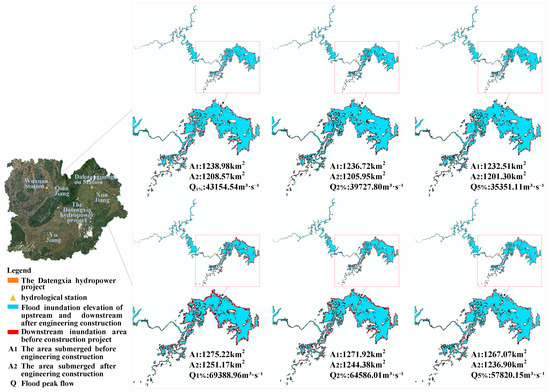
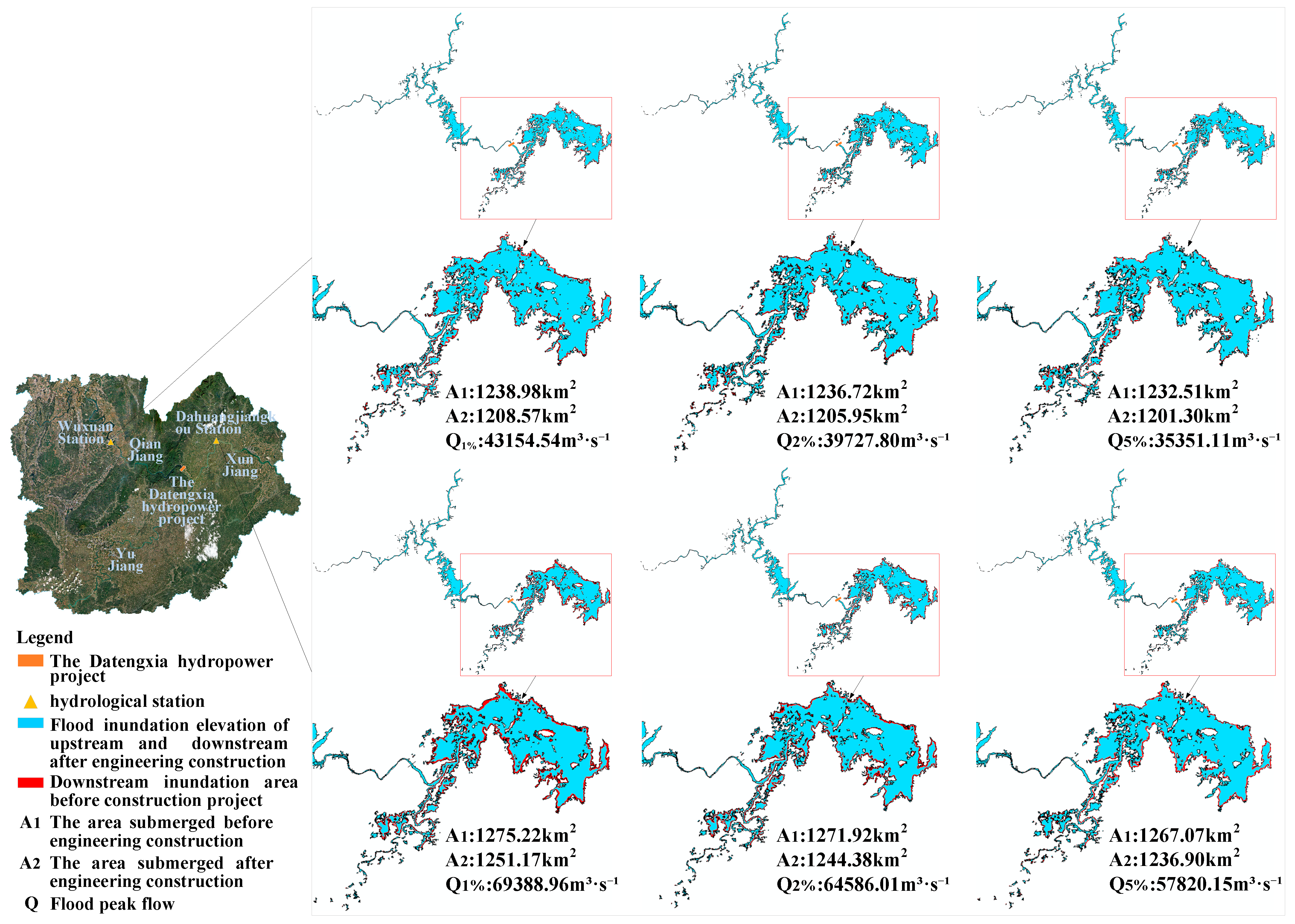
The random forest model was used to predict floods of different frequencies in the study area, and the maximum runoff depth and sediment transport volume were selected as the main parameters. The prediction results are shown in Table 8 and Table 9. The results show that the Datengxia Water Control Hub Project has played a significant role in regulating the regional flood process: under the flood frequencies of once every 100 years, 50 years, and 20 years, respectively, the Datengxia Water Control Hub Project has effectively reduced the discharge flow at Wuxuan Station and Dahuangjiangkou Station. The flood volume at Wuxuan Station has been reduced from 43,154.54 m3·s−1, 39,727.80 m3·s−1, and 35,351.11 m3·s−1 before the construction of the project to 12,554.54 m3·s−1, 9127.8 m3·s−1, and 4751.11 m3·s−1. The flood volume at Dahuangjiangkou Station has been reduced from 69,388.96 m3·s−1, 64,586.01 m3·s−1, and 57,820.15 m3·s−1 before the construction of the project to 38,788.96 m3·s−1, 33,986.01 m3·s−1, and 27,220.15 m3·s−1.
Table 8.
Prediction data of maximum sediment transport and runoff at three frequencies.
Table 9.
Inundation elevation data of three frequencies before and after engineering construction.
The inundation range of Wuxuan Station and Dahuangjiangkou Station before and after the construction of the Datengxia Water Control Hub Project was output using the simulation prediction results, as shown in Figure 15. Before the construction of the project, the submerged area of Wuxuan Station was relatively extensive, mainly concentrated in the central and northeastern parts of the study area. However, after the construction of the project, even under a large flow rate, the submerged area was significantly smaller than that before the construction. The inundation range of Dahuangjiangkou Station is relatively small. The inundation area shows a gradient change under the three frequencies. After the construction of the project, the inundation range also significantly decreased, mainly concentrated in the northeastern area. Therefore, by analyzing the flood simulation and prediction results of the study area, it can be observed that the construction and operation of the Datengxia Water Control Hub Project, as a typical example of human activities, are significant driving factors for the evolution of floods in the study area.
Figure 15.
Flood inundation range before and after the construction of the Datengxia Water Control Hub Project.
4.3.3. Application of Sediment Transport Prediction in the Study Area
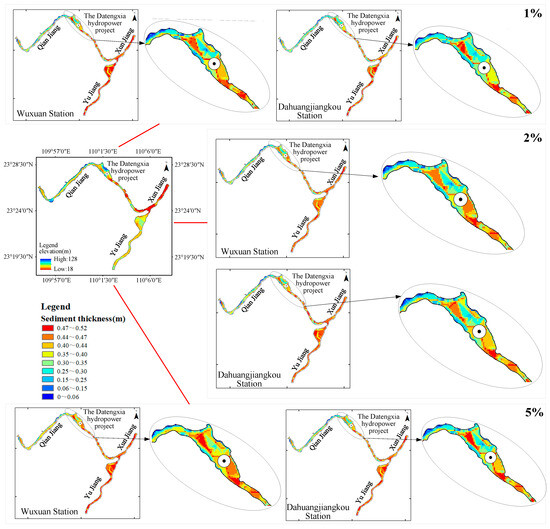
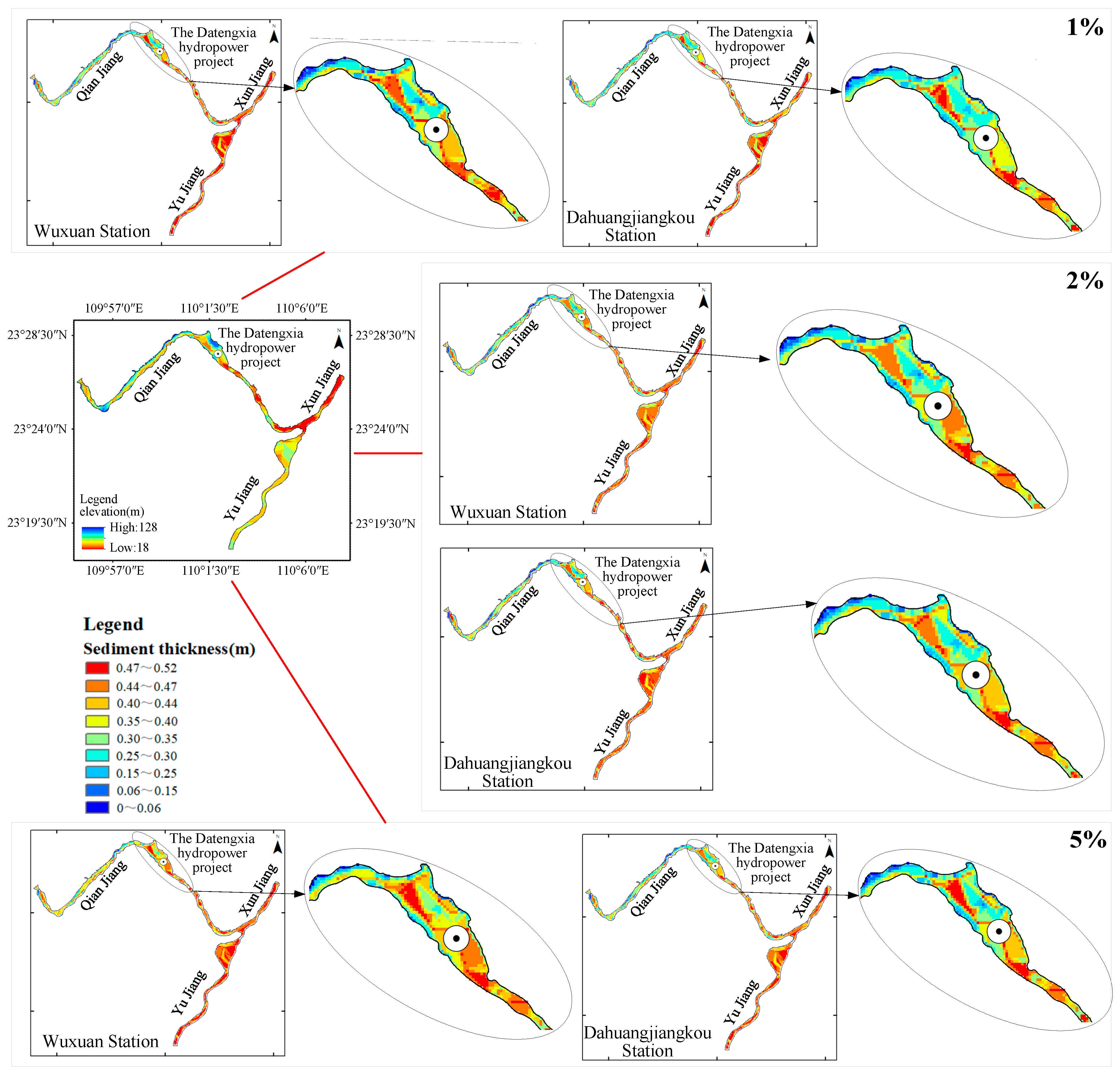
Based on the flood prediction simulation results of different flood frequencies at Wuxuan Station and Dahuangjiangkou Station, the river channels within 2 km upstream and downstream of the Datengxia Water Control Hub Project were selected as the analysis range. The random forest model was used to further predict the characteristics of sediment transport and siltation, and the simulation results were used to output the spatial differences and dynamic characteristics of sediment erosion and siltation in the study area, as shown in Figure 16. As the frequency of floods increases, the amount of sediment transported and the depth of siltation also increase accordingly. As an upstream station of the Datengxia Water Control Hub Project, Wuxuan Station transported 29.4079 million tons, 27.5788 million tons, and 24.5855 million tons of sediment to the Datengxia Water Control Hub Project under three flood frequencies of 100 years, 50 years, and 20 years, respectively. The siltation depths in the studied upstream river channel were 0.52 m, 0.5 m, and 0.47 m, respectively. Under the above three frequencies, after being regulated by the Datengxia Water Control Hub Project, the sediment discharge at Dahuangjiangkou Station was 30.07 million tons, 28.3504 million tons, and 25.4844 million tons, respectively, and the corresponding siltation depths in the downstream river channel were 0.45 m, 0.43 m, and 0.4 m.
Figure 16.
The siltation thickness upstream and downstream of the Datengxia Water Control Hub Project under three inflow frequencies.
From the prediction results, it can be observed that due to the construction and operation of the Datengxia Water Control Hub Project, compared with the sediment transport and siltation characteristics of the river channel within 2 km upstream of the studied project, before the construction of the project, the steep slope section upstream had strong water flow kinetic energy and strong sediment transport capacity, making it difficult for sediment to deposit. After the construction project and water storage, the slope gradually slowed down and the flow rate sharply decreased, causing a large amount of sediment to settle. The reservoir area effectively reduced the impact force of the water flow by regulating the water level and flow rate, promoting the siltation of some sediment. Therefore, it can be considered that the conclusion obtained from the simulation results that the sediment transport volume decreases and the siltation thickness increases is reasonable. Within 2 km downstream, the flow velocity of the river channel recovers relatively quickly, and the sediment is carried and transported again. Compared with the reservoir area, the thickness of sediment accumulation is smaller. Therefore, by analyzing the sediment prediction results, it can be observed that in the upstream and downstream of the Datengxia Water Control Hub Project, the sediment transport and siltation evolution are affected by the operation regulation of the project. The Datengxia Water Control Hub Project is a significant driving factor for sediment transport and siltation in the study area.
5. Discussion and Conclusions
5.1. Discussion
Based on a multi-source dataset and an integrated “mutation identification–attribution–prediction” analytical framework, this study elucidates the evolutionary mechanisms of water and sediment processes in the area influenced by the Datengxia Water Control Hub Project under the coupled impacts of human activities and climate variability. The findings reveal that the influence of human activities exhibits both chronological precedence and spatial heterogeneity, with the population density and grassland area identified as key sensitive factors. The following discussion will address the mutation mechanisms, driving factors, and model applicability.
- The hydrological series of the basin exhibited a statistically significant mutation around 2003, indicating that intensive human activities were already capable of driving systematic changes in the hydrological regime prior to the construction of major water conservancy projects. Notably, this mutation point temporally coincides with the well-documented decadal weakening of the Asian summer monsoon system, of which the Southwest Monsoon—identified in Section 3.2.2 as the dominant control on wet season precipitation in the study area—is an integral component. This suggests that the observed hydrological shift occurred against a non-stationary climatic background, although contribution decomposition confirms that human activities remain the dominant driver (93.18% and 92.38% at Wuxuan Station). Concurrently, distinct spatial differences were observed in water–sediment responses between upstream and downstream sites: upstream sites were strongly influenced by project regulation, showing synchronized variations in runoff and sediment load, whereas downstream sites displayed an asynchronous pattern characterized by increased runoff but reduced sediment transport. This reflects that human activities not only alter the total water and sediment fluxes but also modify sediment sources and transport pathways through measures such as soil–water conservation and channel interventions. It should be noted that the identified mutation year may vary within a 1–2-year window due to local variability in the time series and the sensitivity of the detection method; however, this uncertainty does not undermine the core conclusion that the mutation occurred significantly earlier than the construction of the main project.
Since the construction of the Datengxia Water Control Hub Project, the overall runoff volume of the two stations has shown a downward trend to varying degrees. However, the annual runoff volume of the downstream Dahuangjiangkou Station is greater than that of Wuxuan Station. The reason is that the tributary Yujiang River flows into Dahuangjiangkou Station. Although the influence of the Yujiang River has not been considered herein, it is mainly because the Yujiang River is not affected or controlled by the Datengxia Water Control Hub Project. As an unregulated tributary, the Yujiang’s flow regime is directly impacted by the Southwest Monsoon, making the Dahuangjiangkou hydrograph a natural superposition of project-regulated and monsoon-driven signals—a valuable window for examining their interaction. There is a close connection between water and sediment in the basin. The sediment transport volume of the two stations is calculated from the runoff volume. Although there is a difference between the accuracy and the true value, the overall trend of change will not change. The runoff volume at Dahuangjiangkou Station is greater than that at Wuxuan Station, but the sediment transport volume is smaller. This might be related to the implementation of soil and water conservation measures in the basin and related human activities such as sand mining in the river.
- 2.
- The population density and grassland area were identified as the most sensitive social and natural factors affecting sediment transport, which aligns with the general understanding that human activities and land cover changes dominate erosion and sediment yield in rapidly urbanizing basins. It is important to clarify that although the random forest model can robustly handle multicollinearity, highly correlated factor groups (e.g., population density and built-up area) collectively represent the macro-process of “human activity intensity,” making it difficult to attribute feature importance precisely to any single independent variable. Therefore, the identified key factors should be regarded as proxy indicators reflecting the integrated impact of human activities and the status of natural land cover. These findings provide clear targets for basin management: while continuing to promote soil–water conservation, it is essential to strictly control the disorderly expansion of human activity zones, optimize land-use structure, and pay particular attention to the risks of channel adjustment and local erosion induced by altered flow dynamics downstream of hydraulic projects, thereby systematically enhancing the basin’s erosion resilience and ensuring channel stability and project safety.
- 3.
- This study developed an integrated “mutation identification–attribution–prediction” analytical framework. By combining the Pettitt test, double mass curve, and random forest modeling, a complete chain of analysis—from hydrological mutation diagnosis to contribution rate separation and key driver identification—was achieved. This framework provides a transferable tool for water–sediment attribution and prediction in basins lacking long-term monitoring data. That said, the current analysis is built upon a comprehensive yet regionally specific dataset; the conclusions drawn are therefore most robust for basins with comparable climatic, geomorphic, and anthropogenic conditions. It should be noted, however, that the current approach still has limitations in spatially explicit attribution, and its conclusions are more applicable to regional, medium- to short-term management. If applied to data-scarce basins or long-term forecasting, the framework should be validated by integrating distributed models and multi-source data, and the interactions between project operation and extreme climate events need to be further examined.
5.2. Conclusions
This paper selects the affected area of the Datengxia Water Control Hub Project as the research object to explore the response relationship between climate change and human activities to the runoff and sediment transport volume of the basin, and to investigate the driving mechanism of sediment transport change characteristics before and after the project’s construction. The following conclusions are drawn:
- The cumulative effects of human activities emerge earlier than in major projects. Both runoff and sediment series at Wuxuan Station and Dahuangjiangkou Station showed statistically significant mutations in 2003, which precedes the commencement of the main Datengxia Water Control Hub Project in 2014. This indicates that regional human activities—such as cascade hydropower development and land-use changes—had already become the dominant drivers of systematic shifts in water–sediment regimes before the large-scale hydraulic infrastructure was built;
- Human contributions exhibit longitudinal differentiation, with key drivers clearly identified. The attribution rates of human activities to the reduction in water and sediment were higher at the upstream Wuxuan Station (>92%) than at the downstream Dahuangjiangkou Station (54–74%). The random forest model identified the population density and grassland area as the most sensitive controlling factors;
- The proposed “mutation identification–attribution–prediction” framework offers methodological value. It effectively handles the nonlinear characteristics of water–sediment series and provides a transferable tool for attribution analysis in data-limited basins.
Author Contributions
C.G.: Conceptualization, Methodology, Writing—Reviewing and Editing, Software; Y.W.: Data curation, Writing—Original draft preparation; W.W.: Visualization, Investigation; S.C.: Supervision; X.G.: Software, Validation. All authors have read and agreed to the published version of the manuscript.
Funding
This work was supported by the Ministry of Science and Technology Innovative Methods Work Special Project [2020IM030400]; Key Laboratory of Fluid and Power Machinery, Ministry of Education [LTDL2020-001]; the 14th Five-Year Plan for Education Science in Gansu Province [GS[2024]GHBZ199]; Lanzhou University of Technology Graduate Course Ideological and Political Demonstration Project [KCSZ-SF202402009]; Gansu Provincial Department of Education 2024 Curriculum materials research project [GSJC-Y2024034]. The funders had no role in the study design, data collection and analysis, decision to publish, or preparation of the manuscript.
Data Availability Statement
The raw data supporting the conclusions of this article will be made available by the authors on request.
Acknowledgments
I would like to express my thanks to all those who have helped me over the course of my researching and writing this paper. First, I would like express my gratitude to all those who helped me during the writing of this thesis. A special acknowledgement should be shown to Ren-nian Li, from whose lectures I benefited greatly. I am particularly indebted to Li who gave me kind encouragement and useful instruction all through my writing. And my warm gratitude also goes to my friends and family who gave me much encouragement and financial support, respectively. Moreover, I wish to extend my thanks to the library and the electronic reading room for their providing of much useful information for my thesis.
Conflicts of Interest
The authors declare that they have no known competing financial interests or personal relationships that could have appeared to influence the work reported in this paper.
References
- Lv, Z. Impact of Human Activities and Climate Change on Water and Sediment Process in Upper Yellow River Basin; China Institute of Water Resources and Hydropower Research: Beijing, China, 2017; pp. 50–51. [Google Scholar]
- Han, J.; Li, P.; Yang, Z.; Zhang, Y.; Xu, Y.; Feng, Y.; Dang, X. Variation and influencing factors of runoff and sediment in Ru River Basin based on random forest model. J. Ecol. 2023, 43, 4190–4201. [Google Scholar]
- Ning, Z.; Gao, G.; Fu, B. Changes in streamflow and sediment load in the catchments of the Loess Plateau, China: A review. J. Ecol. 2020, 40, 2–9. [Google Scholar]
- Zhang, J.; Wang, J.; Zhao, N.; Shi, J.; Wang, Y. Analysis of Changes in Runoff and Sediment Load and Their Attribution in the Kuye River Basin of the Middle Yellow River Based on the Slope Change Ratio of Cumulative Quantity Method. Water 2024, 16, 944. [Google Scholar] [CrossRef] [Scilit]
- Shi, H.; Hu, C.; Wang, Y.; Tian, Q. Variation trend and cause of runoff and sediment load variations in Huaihe River. J. Water Resour. 2012, 43, 571–579. [Google Scholar] [CrossRef]
- Wen, Y.; Xu, H.; Zhang, J.; Bai, Y. Quantitative attribution analysis of water and sediment changes in the Lower Yellow River (1950–2022) under the influence of climate change and human activities. Environ. Earth Sci. 2025, 84, 240. [Google Scholar] [CrossRef] [Scilit]
- Guo, X.; Jia, Y.; Fan, L.; Wang, G. The effects of climate change and human actions on runoff and its seasonal variation. J. Water Resour. Water Transp. Eng. 2024, 10–19. [Google Scholar] [CrossRef]
- Wang, Y.; Liu, X.; Shen, Y. Applicability of the random forest model in quantifying the attribution of runoff changes. Chin. J. Ecol. Agric. 2022, 30, 864–874. (In English) [Google Scholar]
- Tu, Q.H.; Yang, L.F. Sediment Design Manual; China Water Resources and Hydropower Press: Beijing, China, 2006; pp. 401–402. [Google Scholar]
- Zhou, Y.; Liang, X.; Shan, N.; Yang, C.; Yuan, H.; Zheng, C. Temporal scaling in hydrological variables: Methods, patterns, and comparative insights. Sustain. Horiz. 2026, 17, 100170. [Google Scholar] [CrossRef] [Scilit]
- Carril-Rojas, D.; Guzzon, C.; Mediero, L.; Fernández-Fidalgo, J.; Garrote, L.; Llasat, M.C.; Marcos-Matamoros, R. A Flood Forecasting Method in the Francolí River Basin (Spain) Using a Distributed Hydrological Model and an Analog-Based Precipitation Forecast. Hydrology 2025, 12, 220. [Google Scholar] [CrossRef] [Scilit]
- Wang, J.; Zhuo, L.; Han, D.; Liu, Y.; Rico-Ramirez, M.A. Hydrological Model Adaptability to Rainfall Inputs of Varied Quality. Water Resour. Res. 2023, 59, e2022WR032484. [Google Scholar] [CrossRef] [Scilit]
- Wang, Y.; Zhang, K.; Luo, Y.; Zhang, Q.; Li, Z.; Yao, C.; Chen, X.; Wang, S.; Liu, J.; Zhang, C.; et al. GHydroMod-SIM-DAI v1.0: A new distributed hydrological model capable of dynamically recognizing runoff generation mechanisms and accounting for aboveground and underground anthropogenic impacts. J. Hydrol. 2025, 663, 134184. [Google Scholar] [CrossRef] [Scilit]
- Gao, J.; Bian, H.; Zhu, C.; Tang, S. The response of key ecosystem services to land use and climate change in Chongqing: Time, space, and altitude. J. Geogr. Sci. 2022, 32, 317–339. [Google Scholar] [CrossRef] [Scilit]
- Wu, Z.; Xie, P.; San, Y.; Lei, X.; Yuan, S.; Wang, C. Moving correlation coefficient-based method for the detection of change-points in hydrological time series. J. Water Resour. 2017, 48, 1473–1481+1489. [Google Scholar] [CrossRef]
- Mu, X.; Zhang, X.; Gao, P.; Wang, F. Theory of Double Mass Curves and Its Applications in Hydrology and Meteorology. Hydrology 2010, 30, 47–51. [Google Scholar]
- Dai, T.; Jiang, Y.; Tian, X.; Liu, F.; Han, S.; Luo, S. Analysis of sediment sources in small watersheds of typical karst trough valley in Southwest China using composite fingerprinting technique. China Environ. Sci. 2024, 1–13. [Google Scholar] [CrossRef]
- Lv, C.; Lv, S.; Jiao, T.; Zhao, H.; Wang, F.; Shao, W. Evaluation and Analysis of Driving Factors for the Coordinated Development of Water Resources, Economy, Society and Ecological Environment in the Yellow River Basin of Henan Province. China Rural Water Conserv. Hydropower 2024, 12, 1–11. [Google Scholar] [CrossRef]
- Breiman, L. Random Forests. Mach. Learn. 2001, 45, 5–32. [Google Scholar] [CrossRef] [Scilit]
- Shen, F.; Zhang, W.; Xu, X.; Wang, J.; Fu, Y.; Yang, G.; Zhai, S. Topological identification of distribution networks based on key feature selection using RF and MIC. Power Syst. Prot. Control 2024, 52, 1–11. [Google Scholar] [CrossRef]
- Yang, G. Prediction of Sediment Load Trends in the Yellow River Basin in the Next 30–50 Years. Master’s Thesis, Tsinghua University, Beijing, China, 2019. [Google Scholar]
- Zhang, J.-T.; Su, Y.; Pareti, M.; Qin, S.; Shu, Q. Nonlinear Impacts and Threshold Effects of Land Use Change on Ecosystem Service Value in Northwest China. Environ. Sci. 2025, 1–20. [Google Scholar] [CrossRef]
- Wu, Z.; Cao, C.; Wang, E.; Luo, K.; Zhang, J.; Sun, Y. Tea selection method based on morphology feature parameters. J. Agric. Eng. 2019, 35, 315–321. [Google Scholar]

Disclaimer/Publisher’s Note: The statements, opinions and data contained in all publications are solely those of the individual author(s) and contributor(s) and not of MDPI and/or the editor(s). MDPI and/or the editor(s) disclaim responsibility for any injury to people or property resulting from any ideas, methods, instructions or products referred to in the content. |
© 2026 by the authors. Licensee MDPI, Basel, Switzerland. This article is an open access article distributed under the terms and conditions of the Creative Commons Attribution (CC BY) license.