Article

A Climatology of Low-Level Jets at the Tiksi Observatory (Laptev Sea, Siberia) Using High-Resolution Regional Climate Model Simulations


by
Günther Heinemann
1,* and
Lukas Schefczyk
2
1
Environmental Meteorology, University of Trier, 54296 Trier, Germany
2
State Environment Agency Rhineland-Palatinate, 55116 Mainz, Germany
*
Author to whom correspondence should be addressed.
Atmosphere 2026, 17(2), 218; https://doi.org/10.3390/atmos17020218
Submission received: 28 January 2026 / Revised: 16 February 2026 / Accepted: 18 February 2026 / Published: 20 February 2026
(This article belongs to the Section Meteorology)

Abstract

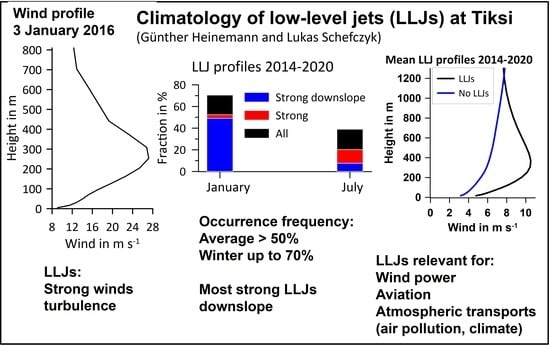
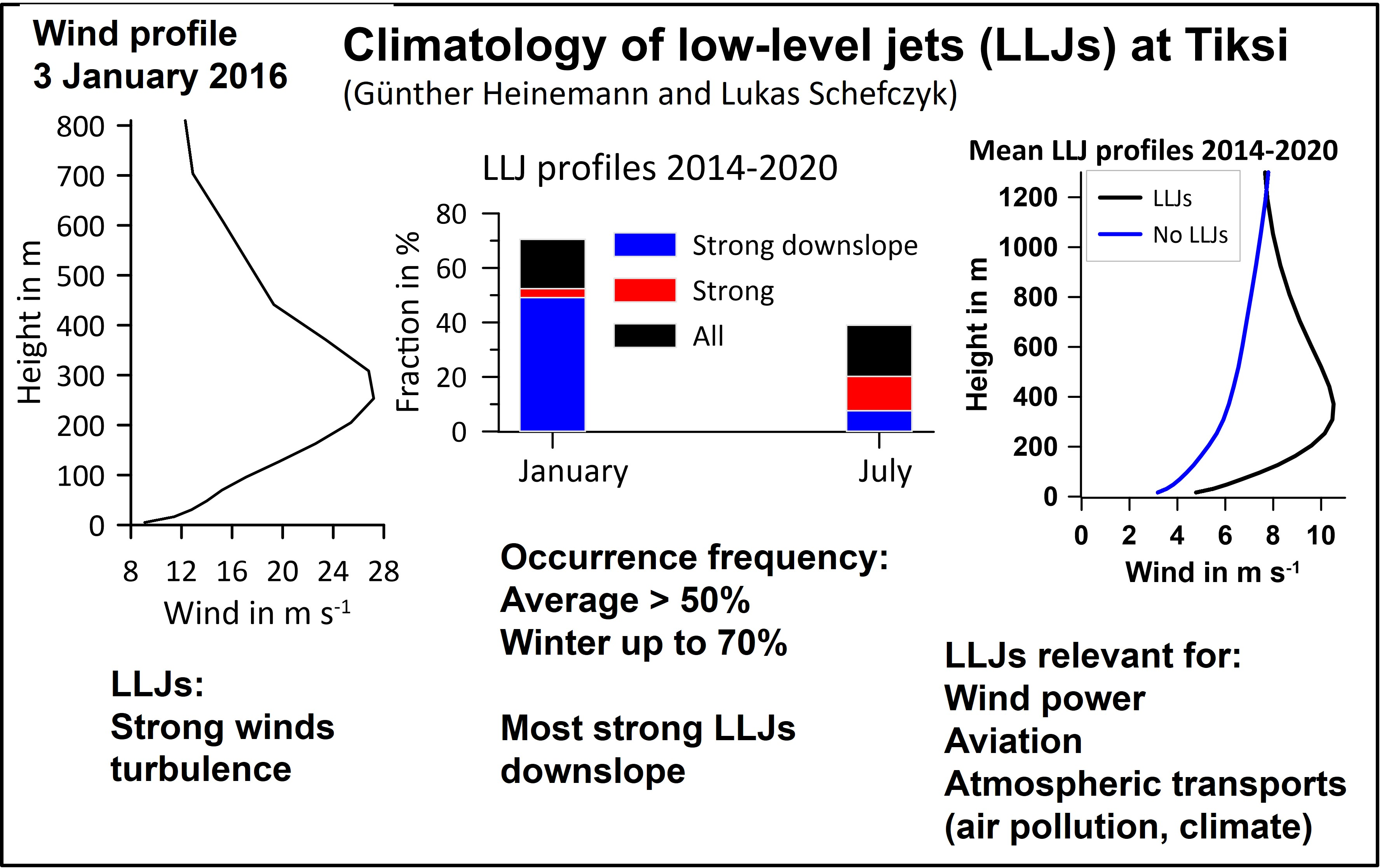
Low-level jets (LLJs) are important mesoscale features in the Arctic and are highly relevant for the atmospheric transport of heat, moisture, and air pollutants, as well as for wind energy and aircraft operations. In this paper, LLJs at the Tiksi observatory in the Laptev Sea region are investigated during the period 2014–2020 using simulations performed with the regional climate model CCLM with a 5 km resolution. The main synoptic weather patterns for LLJs at Tiksi were identified using a self-organizing map (SOM) analysis. LLJs occurred in about 55% of all profiles with an average height of about 400 m and an average speed of about 13 m/s. About 60% of the LLJs had core speeds larger than 10 m/s (strong jets). The occurrence frequency for all jets showed a pronounced seasonal cycle with more and stronger LLJs during winter. The turbulent kinetic energy in the lower ABL was four times as large for LLJs than for situations without LLJs, which underlines the impact of LLJs on turbulent processes in the ABL. The mean duration of LLJ events (duration of at least 6 h) was almost 24 h and the 90th percentile was about two days. About 70% of the LLJ events were associated with downslope winds of the local mountain ridge and had a longer duration of about three days for the 90th percentile.

Graphical Abstract

1. Introduction

The low-level jet (LLJ) is a climatologically important phenomenon in the stable boundary layer (SBL) of polar regions [1,2,3]. LLJs are wind maxima in the ABL that are generally associated with strong wind speeds and turbulence [4,5,6]. Since they are mesoscale features which can extend horizontally for several hundred kilometers [7,8], they are relevant, e.g., for problems of air pollution transport, atmospheric rivers, and turbulence production and ABL structure. Knowledge about LLJ occurrence and climatology is of large importance for wind power and logistics operations in polar regions, particularly for aircraft operations [9].
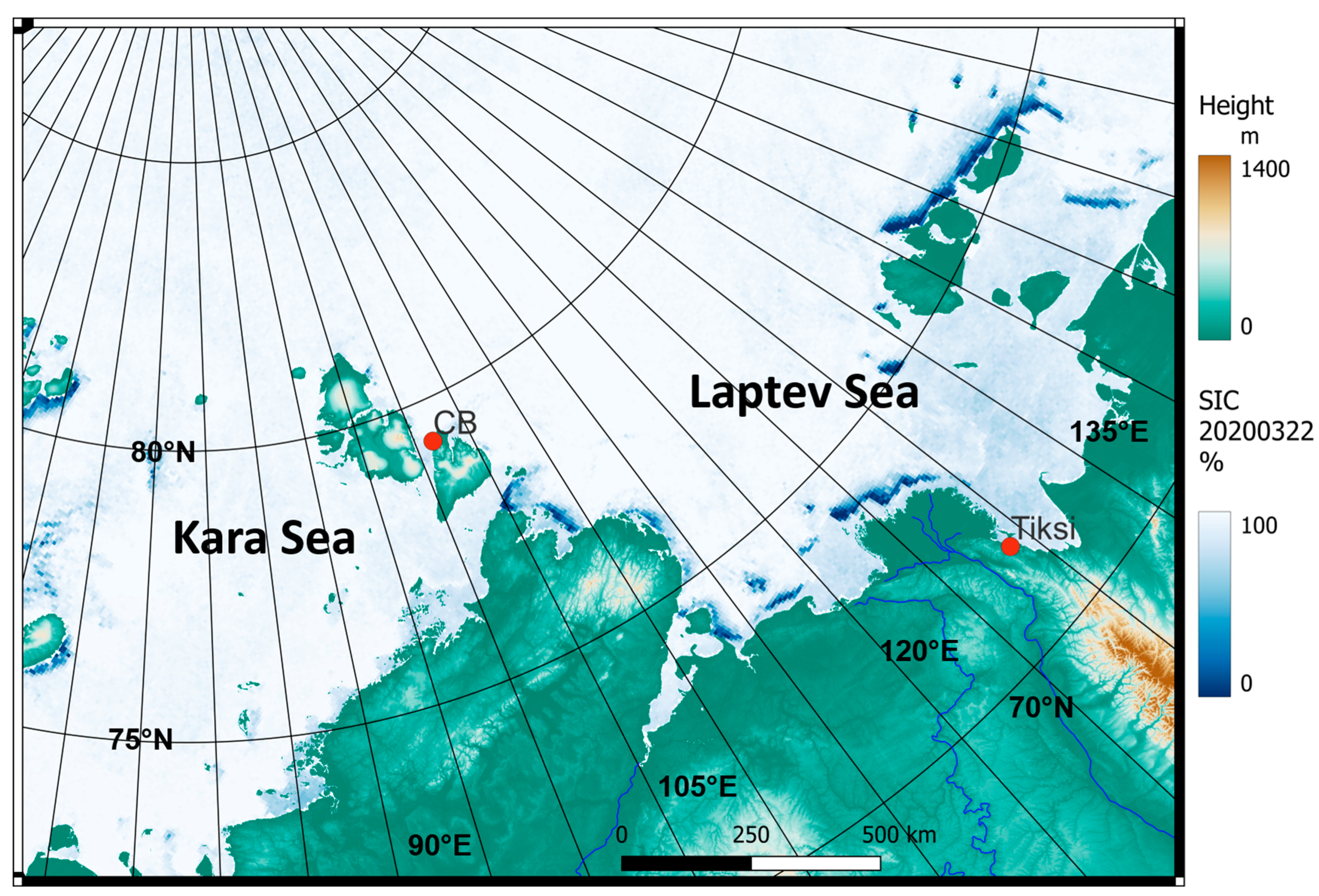
LLJs in polar regions are generated by several mechanisms, such as inertial oscillation [10], baroclinicity [7,8,11], katabatic and downslope winds [12,13], and topographic channeling [14,15]. In the present paper, the regional focus is the coastal region of the Laptev Sea (Figure 1), particularly the area around the Tiksi observatory (Figure 2). In a broader context, knowledge of wind conditions in that area is also relevant in connection with the activities of the Northern Sea Route [16]. Strong winds also force flaw polynyas in the coastal area of the Laptev Sea [17]. The sea ice conditions shown in Figure 1 are an example of this process for a synoptic situation with an LLJ at Tiksi.
The first climatology for LLJs in the Arctic using model data was presented by [1], who used Arctic System Reanalysis (ASR) data with a 30 km resolution [18] for the years 2000–2010. They found that LLJs with the highest frequency, exceeding 80%, were associated with strong gradients in topography. Baroclinically forced LLJs at the sea–ice edge had frequencies around 40%. For the central Arctic, fewer (20%) and weaker LLJs were found. A climatology of LLJs over Arctic ocean areas using ERA5 reanalyses [19] was shown by [2] for the years 2000–2010. They found a similar pattern for the LLJ distribution as [1]. For the Laptev Sea area, which is the area of interest in the present study, [1] found an LLJ frequency of about 20% over the ocean areas, while the LLJ frequency was much higher over land areas with mountain ranges (about 60%), where LLJs occur parallel to the slope of the topography. This agrees with the study of [13], who found the area around Tiksi was one of the hotspots for downslope windstorms in the Russian Arctic using ASR Version 2 data with a15 km resolution. However, [20] showed that a horizontal resolution of 30 km as provided, e.g., by ERA5 reanalyses, is not adequate to resolve topographic effects in that area, which underlines the need for high-resolution simulations in areas with complex topography.
In the present paper, we address this gap by using the regional climate model CCLM (consortium for small-scale model—climate limited-area mode, see Section 2.1) with a relatively high horizontal resolution of 5 km for the Laptev Sea area (see Figure 1). We focus on the climatology of LLJs for the region of the Tiksi observatory (Figure 2). LLJs in that area were studied by [21] using SODAR (Sound Detection And Ranging) data at Tiksi for the winter of 2014/15. A case study of [20] showed that topographic effects are of large importance for the formation of the LLJ at Tiksi and that the LLJ is part of a downslope wind event. A detailed evaluation of the performance of CCLM simulations at Tiksi for one year was published in [22]. They found that the simulations agreed well with near-surface and SODAR observations and represented LLJ structures and statistics very well. The present study uses a much longer period of six years, simulated with CCLM at a 5 km resolution.
The paper is structured as follows: Section 2 describes the data as well as the method for LLJ detection. Section 3 shows first the results for the LLJ statistics, then the results of a self-organizing map analysis [23] of the synoptic situations for LLJs at Tiksi are presented. A discussion is given in Section 4, followed by the conclusions in Section 5.
Figure 1. Model domain of the CCLM model with a 5 km resolution with the topography and sea ice concentration for 22 March 2020. The Russian observatories Cape Baranova (CB) and Tiksi are marked by red dots (topography data from [24]). The main rivers are shown (data from [25]). Figure created by the author.
Atmosphere 17 00218 g001
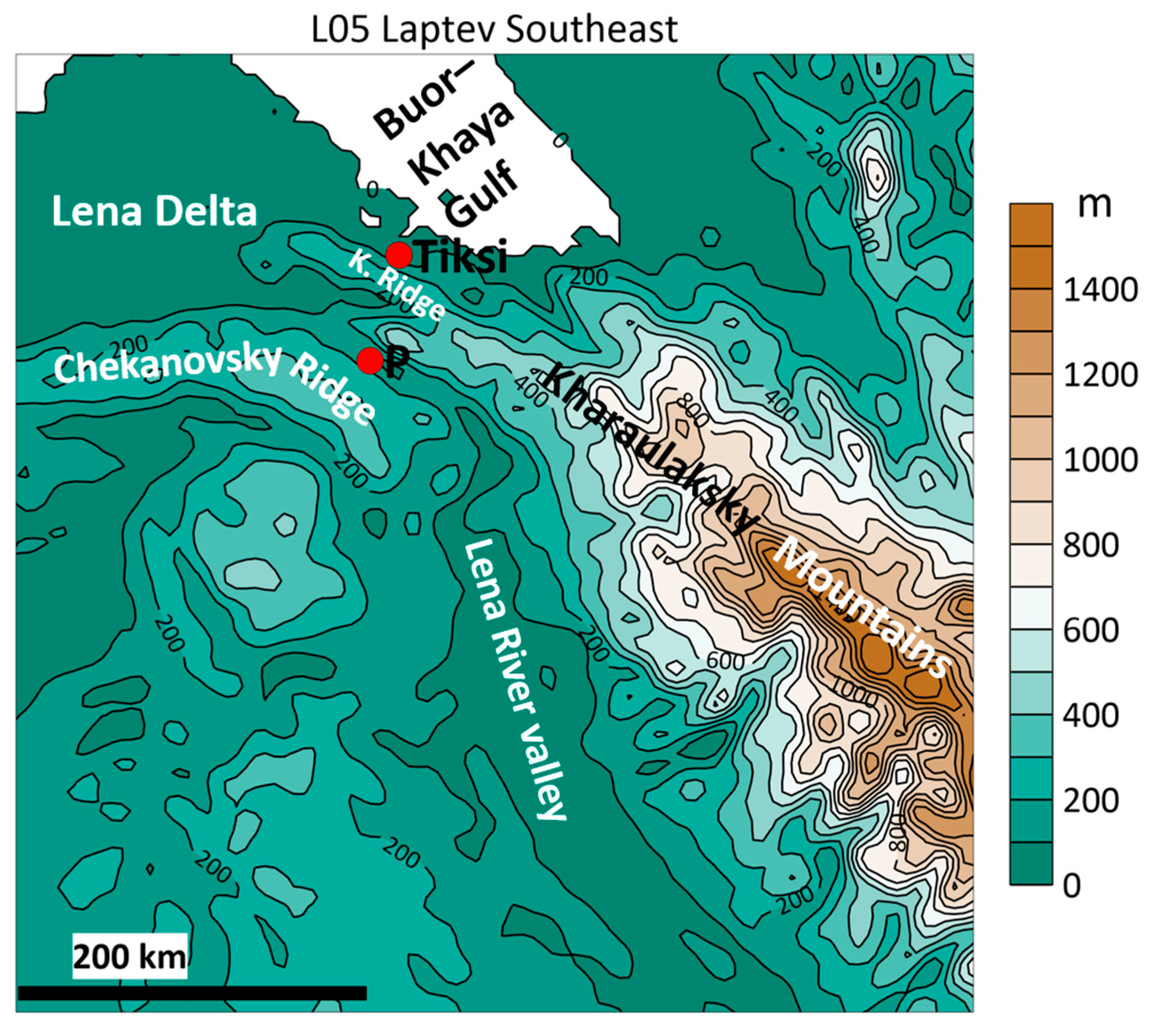
Figure 2. Map of the Tiksi area with the topography of the CCLM model with a 5 km horizontal resolution. The main topographic features (K. Ridge = Kharaulaksky Ridge) and locations of Tiksi and a grid point P southwest of Tiksi are marked.
Atmosphere 17 00218 g002

2. Data and Methods

2.1. Measurements

The Tiksi observatory (71.60° N, 128.89° E, 7 m asl) is located about 5 km south of the Tiksi settlement (Yakutia, Russia, see Figure 2) at the shoreline of the Buor–Khaya Gulf of the Laptev Sea. The Tiksi observatory (referred to as Tiksi hereafter) is part of a network of long-term Arctic atmospheric observatories [26]. The main topographic feature is the Kharaulaksky Ridge west of the observatory (Figure 2). Tiksi has a long-term record of standard synoptic observations with a continuous time series of 3-hourly data starting in 1967 [13]. For the present study, only the 10 m wind data for the period 1970–2020 are used (note that wind speed and direction have a resolution of 1 m/s and 10°, respectively).

2.2. Simulations

The setup of the simulations is the same as described in [22], who used the first year of the present data set, which covers the period from October 2014 to August 2020 [27]. The model used is the non-hydrostatic regional climate model consortium for small-scale model—climate limited-area mode (CCLM, [28]) with a 5 km horizontal resolution. The model domain covers the areas of the Kara Sea and Laptev Sea (Figure 1). In the vertical, the model has 60 terrain-following vertical levels and extends up to 22 km. There are 13 levels below 500 m in order to obtain a high resolution for the ABL (the first model level is at 5 m above the surface, seen in Table A1 in Appendix A). The initial data and boundary data are taken from ERA5 data [19]. The topography data are taken from [29], and have a resolution of 1 km. It was shown by [20] that CCLM with a 5 km resolution well-represents the relevant topographic features in the Tiksi area, such as the Lena River valley and the Kharaulaksky Ridge at the northern part of the Kharaulaksky Mountains (Figure 2).
The simulations were run in forecast mode and were restarted daily with a spin-up of 6 h (the key settings of the simulations and SBL parameterizations are given in Table A1 and Table A2). No nudging was performed during the simulation time of 30 h. Sea ice concentration (SIC) as shown in Figure 1 was taken as daily data from Advanced Microwave Scanning Radiometer 2 (AMSR2) data with a 6 km resolution [30]. Sea ice thickness was updated daily from interpolated Pan-Arctic Ice Ocean Modeling and Assimilation System (PIOMAS) fields [31].
Since the standard version of CCLM [28] was designed for mid-latitudes, several modifications were made to adapt the model to polar regions. Adaptions were made to the SBL turbulence parameterizations and to the prognostic turbulent kinetic energy (TKE) scheme. An asymptotic mixing length depending on the TKE and stability was used [32]. The new SBL parameterizations showed improved results for the representation of surface inversions over Antarctica [33] and katabatic LLJs over Greenland [34].
Further adaptions of the CCLM to polar regions were made for the sea–ice representation. A two-layer sea–ice model and a tile approach for sea ice were implemented [32]. The sea–ice model has a parameterization of the snow height depending on the ice thickness. The tile approach includes the parameterization of the subgrid-scale ice thickness (thin ice in leads and polynyas), a parameterization of the sea ice form drag [35] and parameterizations for the roughness length of heat according to [36].
CCLM was evaluated by multiple studies for the Arctic. Over sea ice in the central Arctic, evaluations of CCLM were performed for the one-year period of the MOSAiC experiment [37] for near-surface quantities [32] as well as for vertical profiles [38]. The latter study found a wind speed bias of 0.3 m/s in the lower 200 m for the comparison of CCLM with radiosondes, and biases of ±0.1 m/s up to 2000 m. CCLM was also part of regional climate model intercomparison studies in the Arctic [39].
With respect to land- and topographically induced flows, the study of [34] compared CCLM simulations to near-surface data and aircraft-measured profiles of LLJs over Greenland for April and May 1997. The comparison with aircraft profiles showed that CCLM yielded realistic profiles for katabatic LLJs. For the Laptev Sea area, [14] used near-surface measurements and SODAR measurements for a three-year period at the Russian observatory “Ice Base Cape Baranova” located at Severnaya Zemlya Archipelago in the western Laptev Sea (Figure 1). The comparison of wind profiles from SODAR measurements and CCLM showed a positive bias for the wind speed of about 1 m/s below 100 m, which increased to 1.5 m/s for higher levels.

2.3. LLJ Detection

The methodology for detecting LLJ profiles is the same as in [22] and [3]. The anomaly of the wind maximum of an LLJ had to be at least 2 m/s. Wind maxima were searched below 1000 m for each profile, but the search height for the wind decrease of 2 m/s above the wind maximum depended on the LLJ height (for details see [22]). The maximum search height was 1500 m. This method enables the detection of only “well-shaped” LLJs with a clear wind anomaly. The limitation of search height in combination with the absolute criterion of a 2 m/s wind anomaly is comparable to detection methods using a threshold for the wind gradient above the jet, as used, e.g., by [40].
LLJs are mesoscale features lasting several hours. Following [8], an LLJ event is defined as the period where the LLJs are detected in consecutive profiles (gaps of one data point in the hourly data are allowed). During the event, the LLJ heights of consecutive profiles have to be consistent (height differences smaller than 300 m). As in [8], events must have a duration of at least 6 h.

2.4. Mountain Froude Number

For the analysis of the flow dynamics of air passing over the Kharaulaksky Ridge, the mountain’s Froude number (Frm) was calculated using the mean wind speed (Um) and stability (Nm) for the sub-crest layer:
F r m = U m N m h m
The height scale hm was assumed to be 300 m, which is the typical mountain height for the Kharaulaksky Ridge near Tiksi. Nm is the bulk Brunt–Väisälä frequency, which was calculated as
N m 2 = g θ m Δ θ m h m
Δθm is the bulk difference in the potential temperature between hm and the lowest model level (5 m), and θm is the mean potential temperature of that layer. Frm is the inverse of the normalized mountain height, which is used to describe flow blocking or different flow regimes (e.g., [41]).

2.5. Self-Organizing Maps

The main synoptic weather patterns for LLJs at Tiksi were identified using a self-organizing map (SOM) analysis. SOM is an established clustering and classification method for meteorological applications [23]. For the SOM software, the package “kohonen” (version 3.0.12) of the R programming software (version 4.5.2).is used [42]. One important parameter for the SOM training is the number of patterns [43]. In the present study, a six-pattern SOM was applied for the mean sea-level pressure (MSLP) for days with LLJs at Tiksi in order to yield a limited number of interpretable patterns.

3. Results

3.1. Representativeness of the Simulation Period

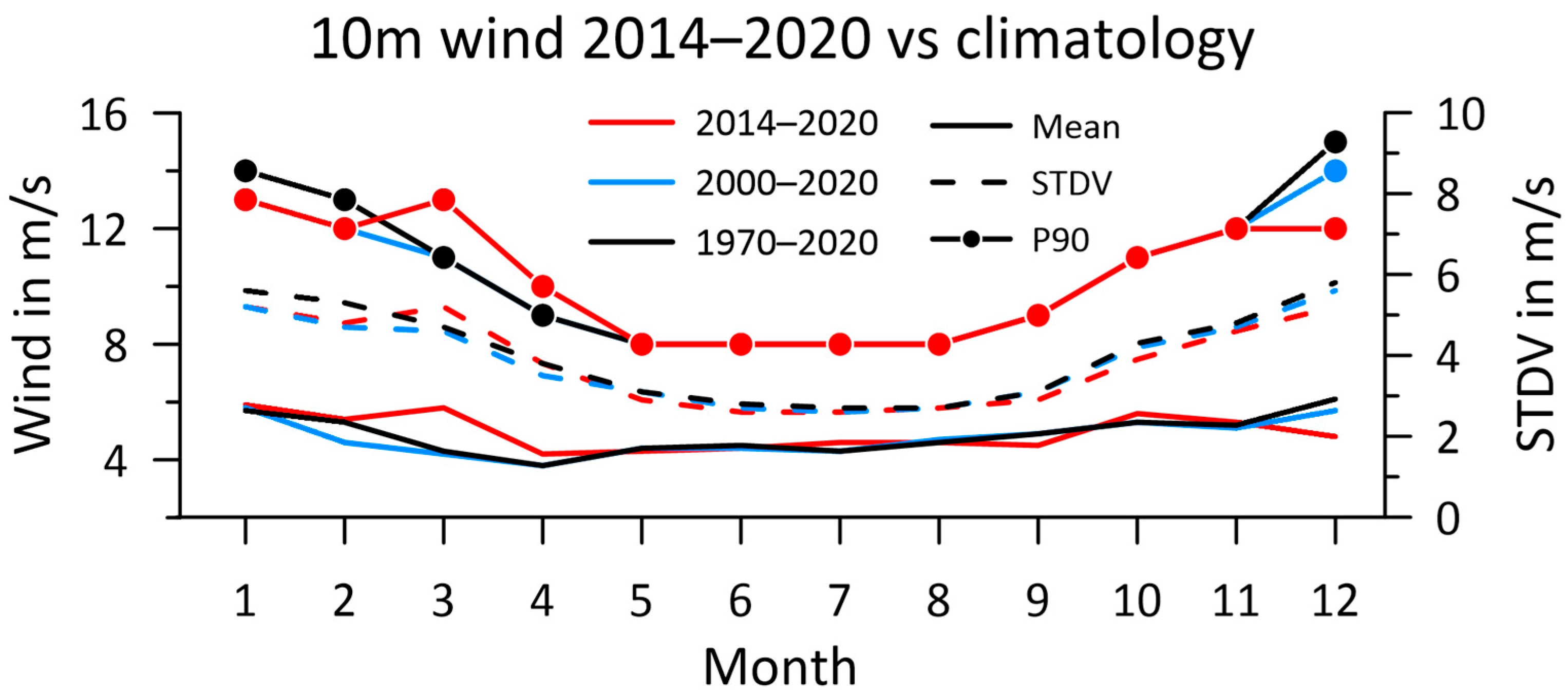
Since the six-year period of the 5 km resolution simulations is much shorter than the typical period of 30 years used for climatological studies, synoptic observations of the Tiksi observatory are used to evaluate the representativeness of the simulation period. Figure 3 shows the monthly statistics for 10 m wind speed at Tiksi for the periods of the 5 km CCLM simulations (2014–2020) and the periods 2000–2020 and 1970–2020. The mean wind speed showed only weak seasonal variations and the simulation period differed only slightly from the other periods for March and December (+1.5 and −1.3 m/s, respectively). The same behavior was found for the 90th percentile (note that the wind speed data has a resolution of 1 m/s), while the standard deviation (STDV) is almost identical for all periods. The frequency distributions of the wind measurements for different periods are shown in Figure S1 (Supplementary Materials). There were only marginal differences in the wind speed distributions between the different periods. The same holds for the wind direction, where the simulation period showed that westerly winds were slightly more frequent. Overall, the simulation period was found to be representative on a climatological time scale.

3.2. Statistics of Hourly LLJ Profiles

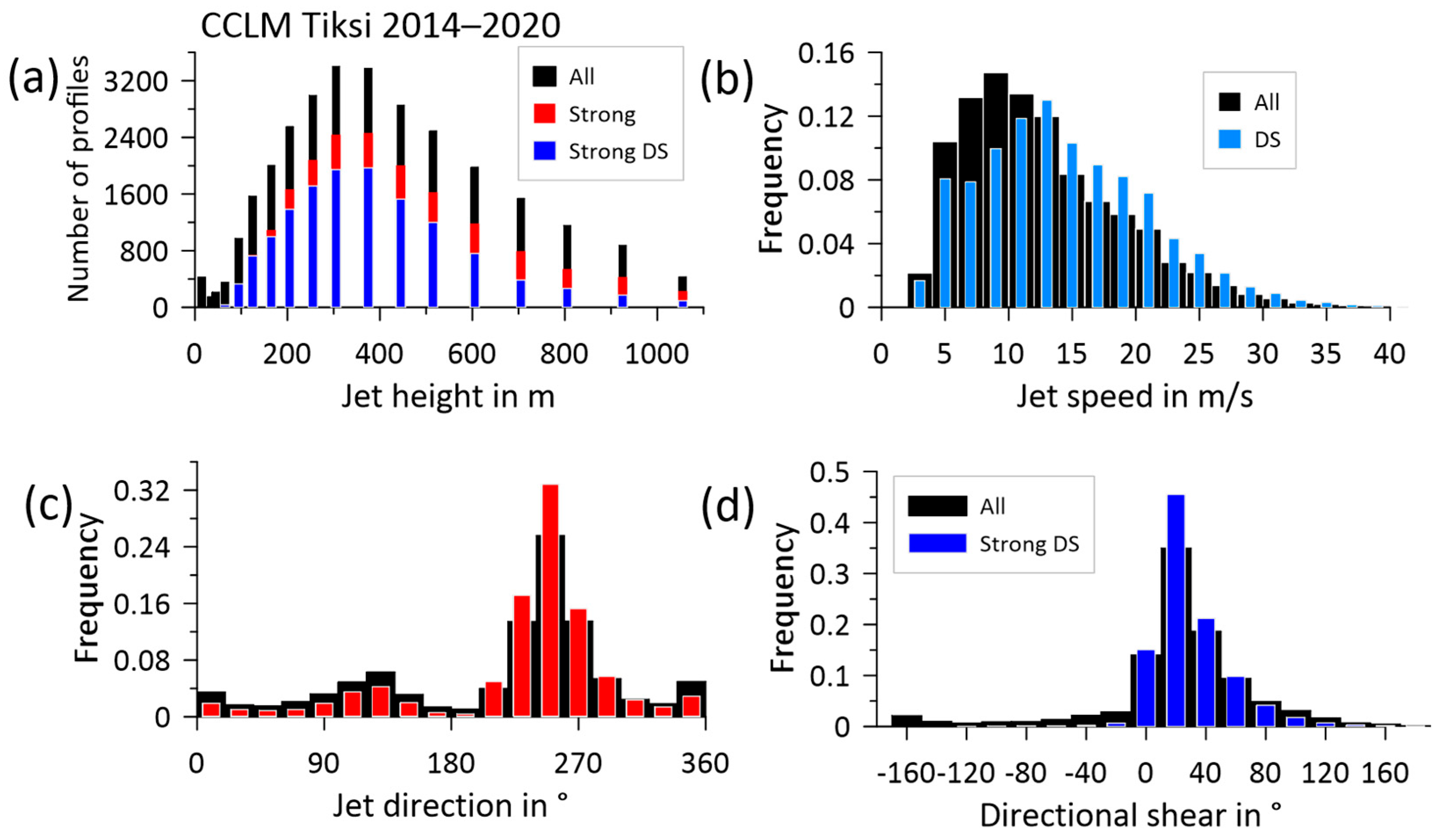
The statistics for the simulated hourly LLJ profiles for 2014–2020 are shown in Figure 4. LLJs were most frequent for the height range 200–500 m (Figure 4a), and 50% of all LLJ heights were in this range. Most LLJs (60%) were strong (wind speed ≥ 10 m/s). The mean height was about 390 m for all LLJs and strong LLJs. The LLJs had a mean wind speed of about 13 m/s and a 75th percentile of about 16 m/s (Figure 4b), while the maximum jet speed was about 40 m/s. The wind direction at the jet core (Figure 4c) showed pronounced peaks for directions west–southwest for all LLJs and strong LLJs. Figure S2 (Supplementary Materials) shows the corresponding wind roses. Most jets were from the sector 225–270°, but there were also secondary maxima for southeasterly and northerly LLJs. For strong jets, these secondary maxima are much smaller. Considering the topography in the Tiksi area, wind directions in the sector 180–300° can be considered downslope winds [20,22], with winds passing over the Kharaulaksky Ridge (Figure 2). Most strong LLJs are associated with downslope winds (Figure 4a) and their wind speed distribution is shifted to larger wind speeds (Figure 4b). The directional shear between the jet core and a height of 5 m (Figure 4d) was mostly positive with a peak at 20° for all LLJs, which can be expected due to Ekman dynamics, i.e., a clockwise turning of the wind direction with height caused by friction. For the strong downslope LLJs, the variability of the directional shear is even smaller than for all of the LLJs. Overall, LLJs were found for 54% of all profiles for the whole period; 33% of all profiles were strong LLJs (60% of all LLJs). A proportion of 63% of all LLJs were downslope LLJs, and most of the downslope LLJs were strong (76%).
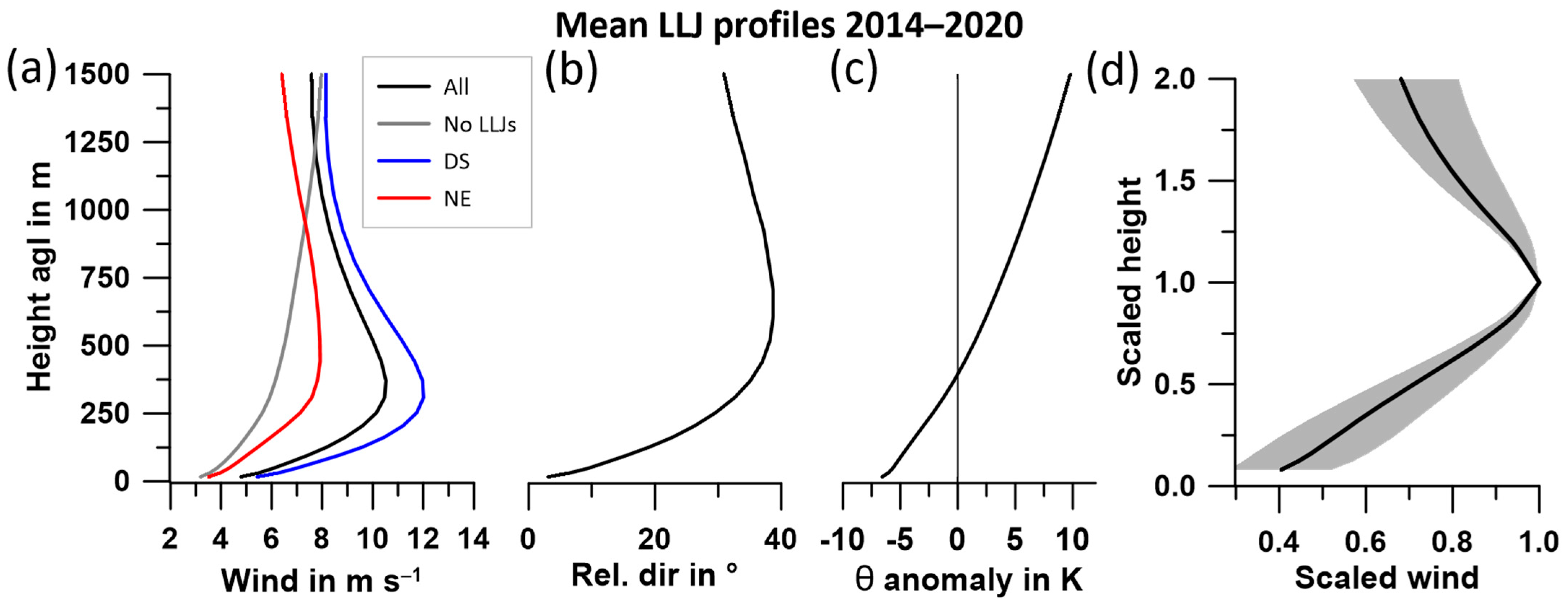
The average of the LLJs profiles for the lowest 1500 m area is shown in Figure 5. The mean wind profile (Figure 5a) for all jets showed a pronounced maximum at about 300 m, while the mean for profiles without an LLJ showed a continuous increase in wind speed with height and about the same wind speed as LLJs above 1000 m. Below that height, the mean wind speed for LLJs was up to about 4 m/s higher than for situations without LLJs. There was also a dependence on the jet direction. For downslope (DS) LLJs, the wind profile showed a larger wind anomaly, while for jets from northerly and easterly directions (NE, 345–150°) the wind profile showed a weaker and broader anomaly. This was also a result of averaging LLJs with a larger variability in height.
The change in mean wind direction relative to the lowest level (Figure 5b) showed turning of the wind with height of about 40° due to friction. The potential temperature anomaly was computed in the lowest 1500 m for each level and for each profile in order to avoid the influence of the large seasonal variation in temperature. The profile of the mean potential temperature anomaly showed that LLJs are associated with a highly stable SBL with an increase in the potential temperature by more than 10 K in the lowest 1000 m. Since the averaging of wind profiles regardless of the LLJ height leads to a smoothing of the wind maximum, all wind profiles were nondimensionalized by scaling the height with the LLJ height and the wind speed with the LLJ speed. The obtained mean scaled wind profile is shown in Figure 5d. In contrast to Figure 5a, the nose-like shape of the wind profile was much more pronounced. The variability indicated by the 25th and 75th percentiles is relatively small, reflecting that the shape of the LLJ profiles is very similar.
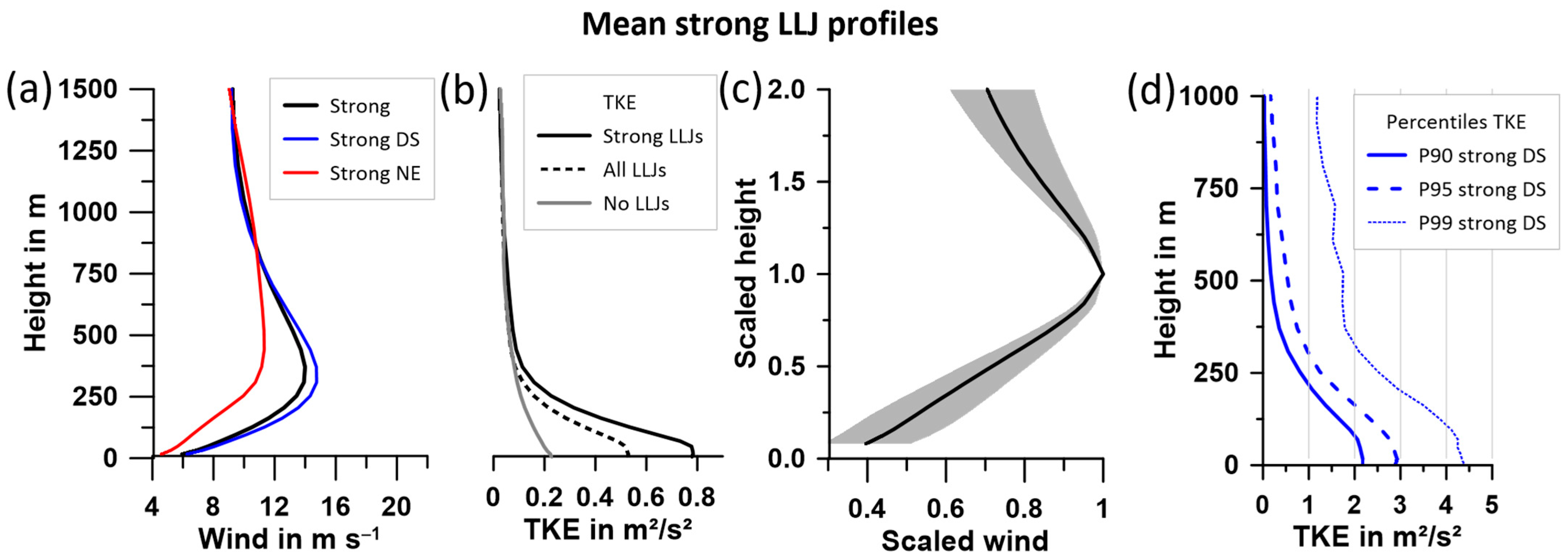
For strong LLJs, the mean wind profiles reflected that the downslope LLJs were dominating (Figure 6a). The northern and easterly LLJs were weaker and less pronounced. Wind speeds above the LLJ height were larger than for all LLJs (Figure 5a), which indicated a stronger synoptic forcing. The profile of the mean potential temperature anomaly was similar to the profile of all LLJs. The profiles for the TKE (Figure 6b) showed that the TKE in the lowest 250 m for strong LLJs was about four times as large as for situations without LLJs. This underlies the importance of strong LLJs for the turbulence structure and exchange processes in the ABL [5]. The mean TKE is very small for heights above 500 m. However, the profiles of TKE percentiles for strong downslope LLJs (Figure 6d) showed that turbulence extremes were much larger than the mean values and exceed 2 m2/s2 at low levels in 10% of the LLJs. The 95th and 99th percentiles showed relatively large TKE values even for heights above 500 m. The mean scaled wind profile for strong LLJs (Figure 6c) was similar to that of all LLJs.
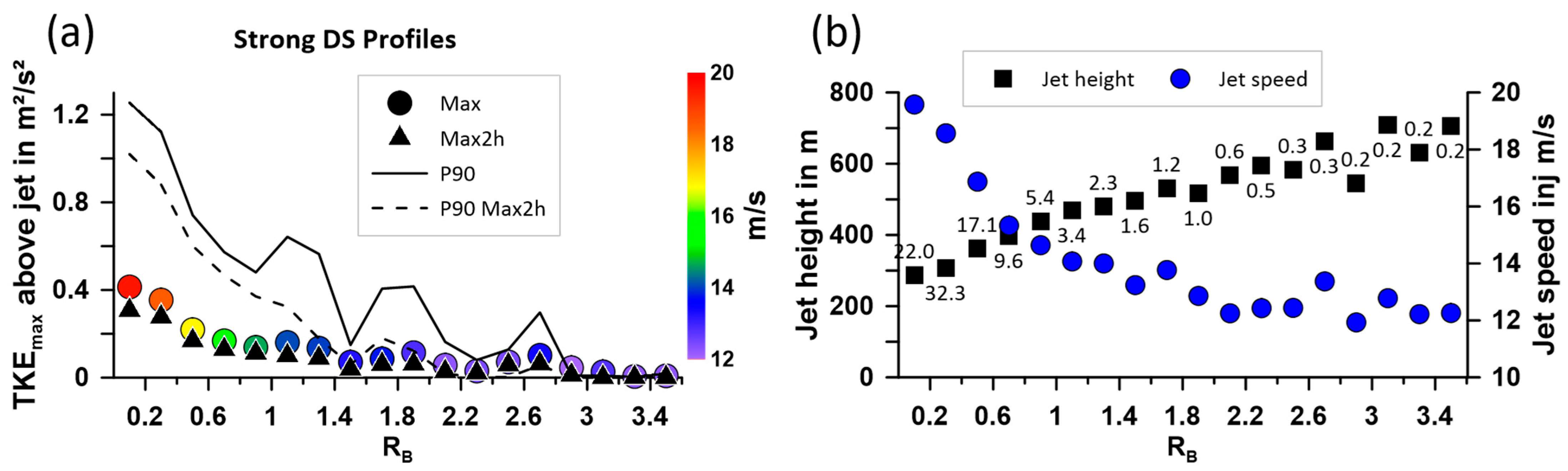
The study of a strong downslope LLJ event by [20] showed that TKE values larger than those near the surface occurred above the jet during wave-breaking conditions. In order to study the TKE above the jet for strong DS LLJs, the maximum TKE above the jet height and above the level of two times the jet height up to 2200 m was calculated for each LLJ profile. While the first quantity also includes TKE production by the wind shear directly above the wind maximum, the second quantity can be regarded as a measure of the TKE not directly produced by the jet, such as breaking waves. The results as a function of the bulk Richardson number (RB) at the jet level are shown in Figure A1 (Appendix B). The mean maximum TKE above the jet decreased with increasing RB (Figure A1a). This is associated with a decrease in the jet speed with increasing RB, while the jet height increases with increasing stability (Figure A1b). About 85% of all strong DS LLJs were in the RB range 0–1, which corresponds to Froude numbers larger than 1 (shooting flow, [44]). The mean maximum TKE above two times the jet height was only slightly lower than the maximum above the jet, that means that a large part of the large TKE values were found well above the jet height. The same holds for the 90th percentiles, which exceeded 0.8 m2/s2 in the RB range 0–0.4 (representing about 55% of the strong DS LLJs). All TKE quantities showed a similar decrease with stability.

3.3. Statistics of LLJ Events

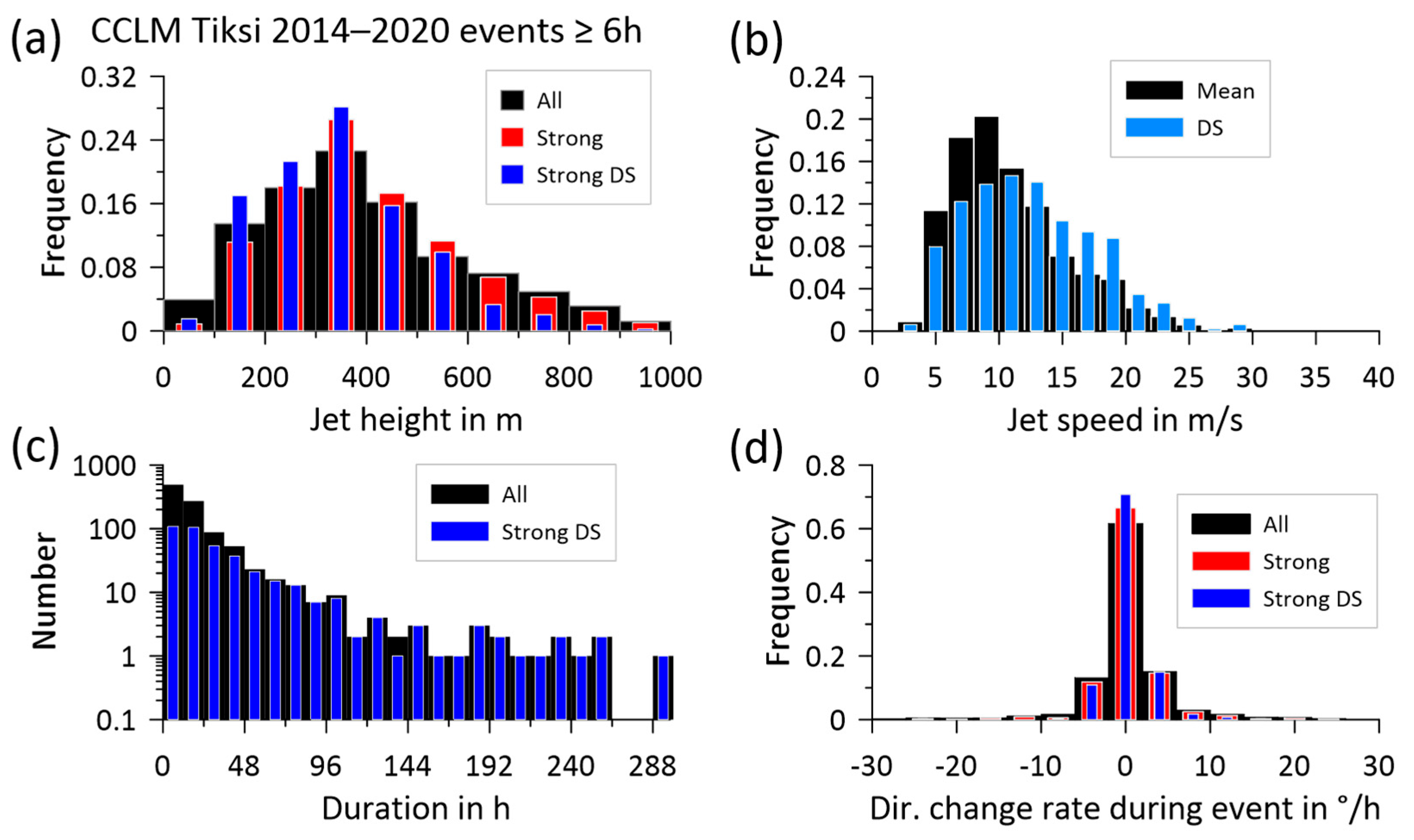
The statistics for all LLJ events for the whole period (Figure 7) show the averages for each event. About 1000 events of at least 6 h duration were detected for the six-year period. LLJ events were found for 43% of the time period (Table 1), which was less than the frequency of LLJ profiles (54%). This means that 11% of the hourly LLJ profiles were not part of events. Strong events are events with a maximum jet speed of at least 10 m/s. The accumulated duration of strong events was 36% of the whole period, which was about the same as the frequency of strong LLJ profiles. About 70% of all LLJ events were associated with downslope winds, and about 85% of the downslope events were strong LLJ events (Table 1). The height distribution (Figure 7a) shows relatively smaller differences between all and strong events than for the single LLJ profiles, which means that the LLJ profiles not included in events were mainly weaker. The distribution of the height of strong downslope (DS) events was shifted to lower values compared to strong events of all kinds. DS events showed also higher wind speeds (Figure 7b) compared to all events. Note that the wind speed is the mean over the duration of the event, which leads to smaller values compared to the distribution of the single profiles (Figure 4b). The distribution of the event duration (Figure 7c) showed that most events had durations of 24 h or less, but some events lasted more than 5 days. The mean duration was 23 h (Table 1), and strong events lasted slightly longer (29 h). Larger differences were found for the 90th percentiles of the duration, where strong events were 16 h longer. Most long-lasting events were associated with downslope winds, and the 90th percentile of the duration for strong DS events was 95 h. Mean jet speeds were about 4 m/s lower for northern and easterly (NE) events than for DS events (Table 1), and the differences were even larger for the 75th and 90th percentiles (up to about 7 m/s). The duration of NE events was much shorter than for DS events, and only 10% lasted more than one day.
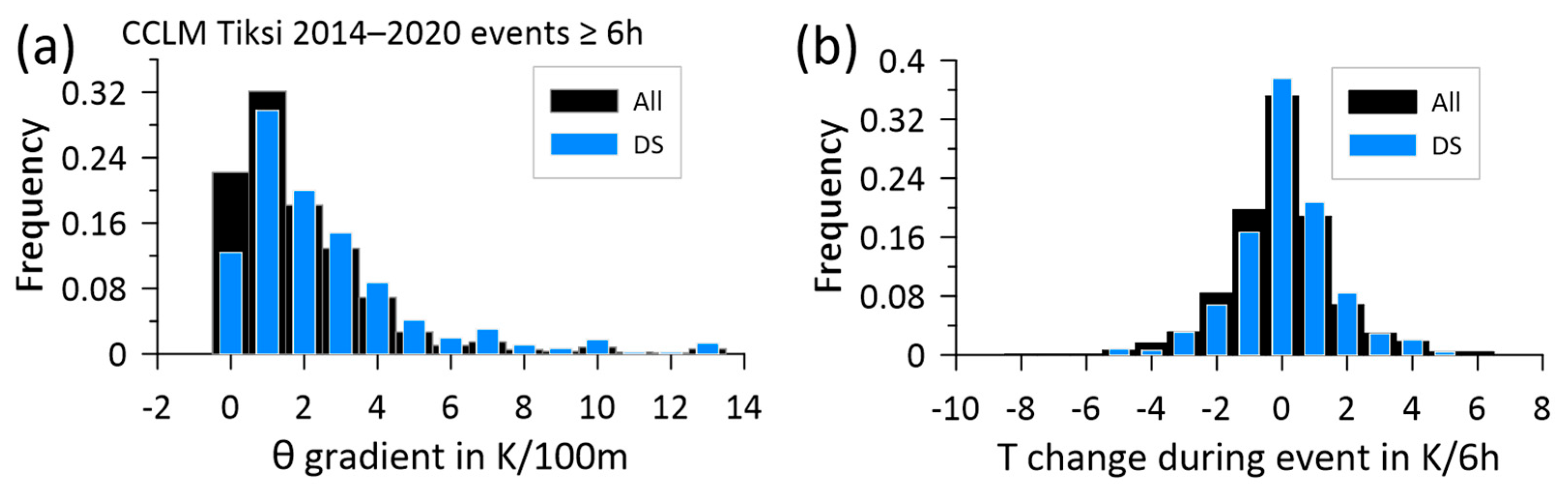
Figure 7d shows the rate of change in the wind direction during the events. About 60% of the events showed a very high directional constancy with change rates smaller than ±2°/h. Of the values, 97% were in the range ±6°/h. This constancy was even more pronounced for strong events and strong DS events (67 and 71% within ±2°/h, respectively). The static stability (gradient of the potential temperature) below the jet (Figure 8a) showed that stable stratification was present for most LLJ events, which is consistent with the mean of the LLJ profiles (Figure 5). DS events had less near-neutral conditions and were more frequent for larger stabilities. The change of the mean temperature of the lowest 100 m during events is shown in Figure 8b. For all events, the changes were centered around zero with an average of −0.04 K/6 h. In about 75% of the events the temperature change in the lower ABL was less than ±1.5 K/6 h. For DS events, the changes were slightly biased to positive values (mean of 0.14 K/6 h).

3.4. Seasonal Cycle of LLJs

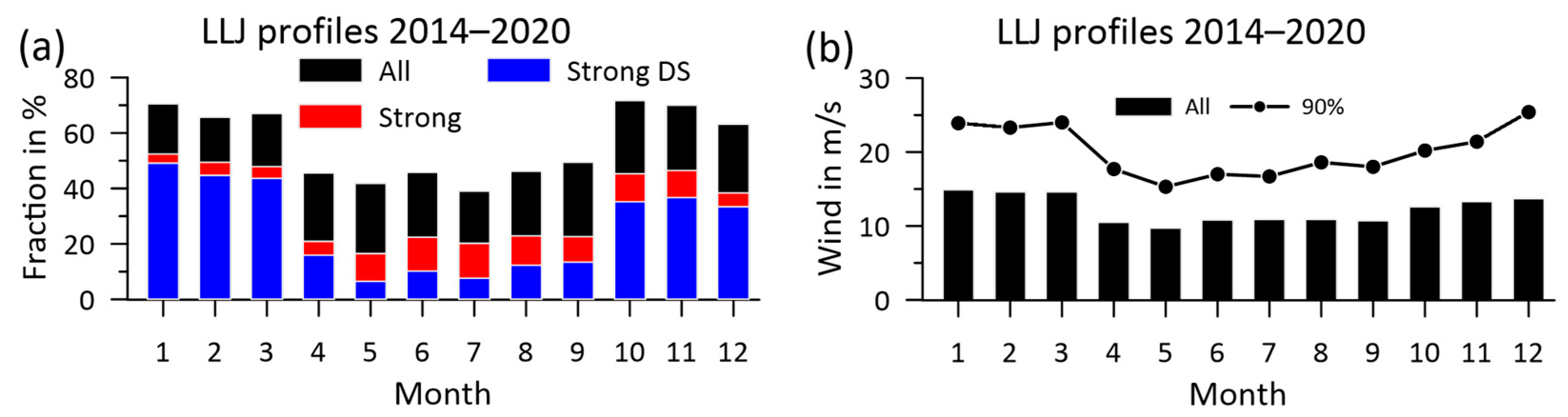
The frequency of LLJ profiles for different months is shown in Figure 9. The seasonal distribution of all LLJ profiles (Figure 9a) showed the largest values, with up to about 70% in the winter months and about 40–50% during summer. The seasonal cycle was even more pronounced for strong LLJ profiles. The mean wind speed of LLJs (Figure 9b) showed slightly lower values for the summer months, but a more distinct seasonal cycle for the 90th percentile of the jet speed. While the strongest 10% of the LLJs exceeded about 25 m/s during winter, the summer LLJs were about 8–10 m/s weaker.
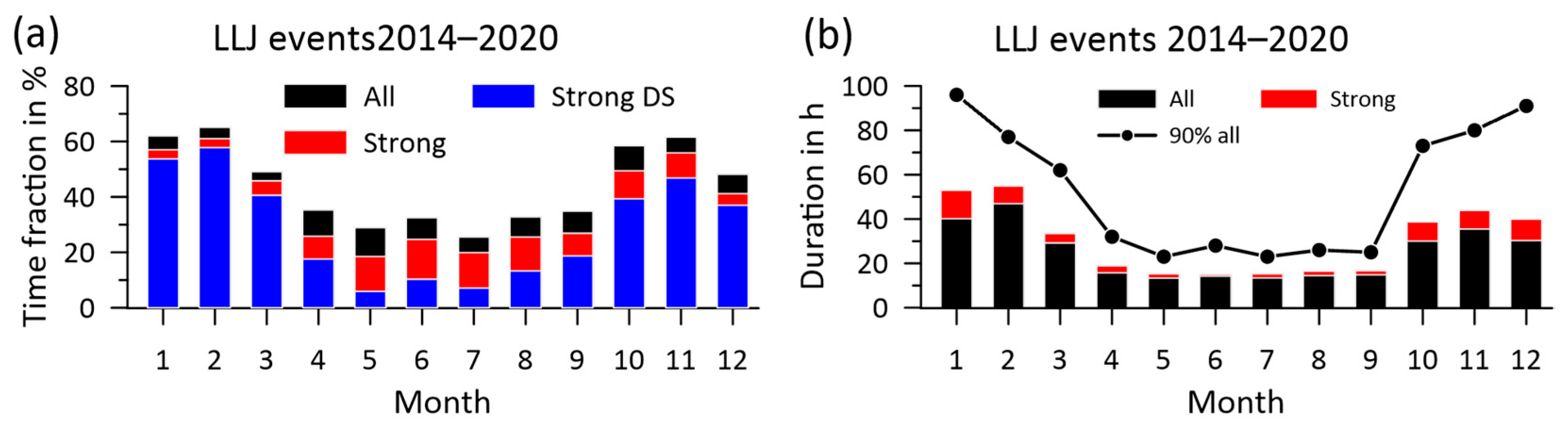
The seasonal cycle of the monthly fraction of all LLJ events (Figure 10a) was similar to that of the hourly LLJ profiles, but the differences between all and strong events were smaller. Since the events can last for several days, the time fraction and not the number of events is shown. During winter, most LLJ events were strong events and most had a time fraction of 60%. The time fraction was much lower during summer, particularly for DS events. A remarkable seasonal cycle was found for the event duration (Figure 10b). The duration of events was much larger during winter than for summer, particularly for strong events. While the longest 10% of the events had durations of more than about four days during January and December, their 90th percentile dropped to about one day for the summer months.

3.5. SOM Analysis of Synoptic Patterns for LLJ Events

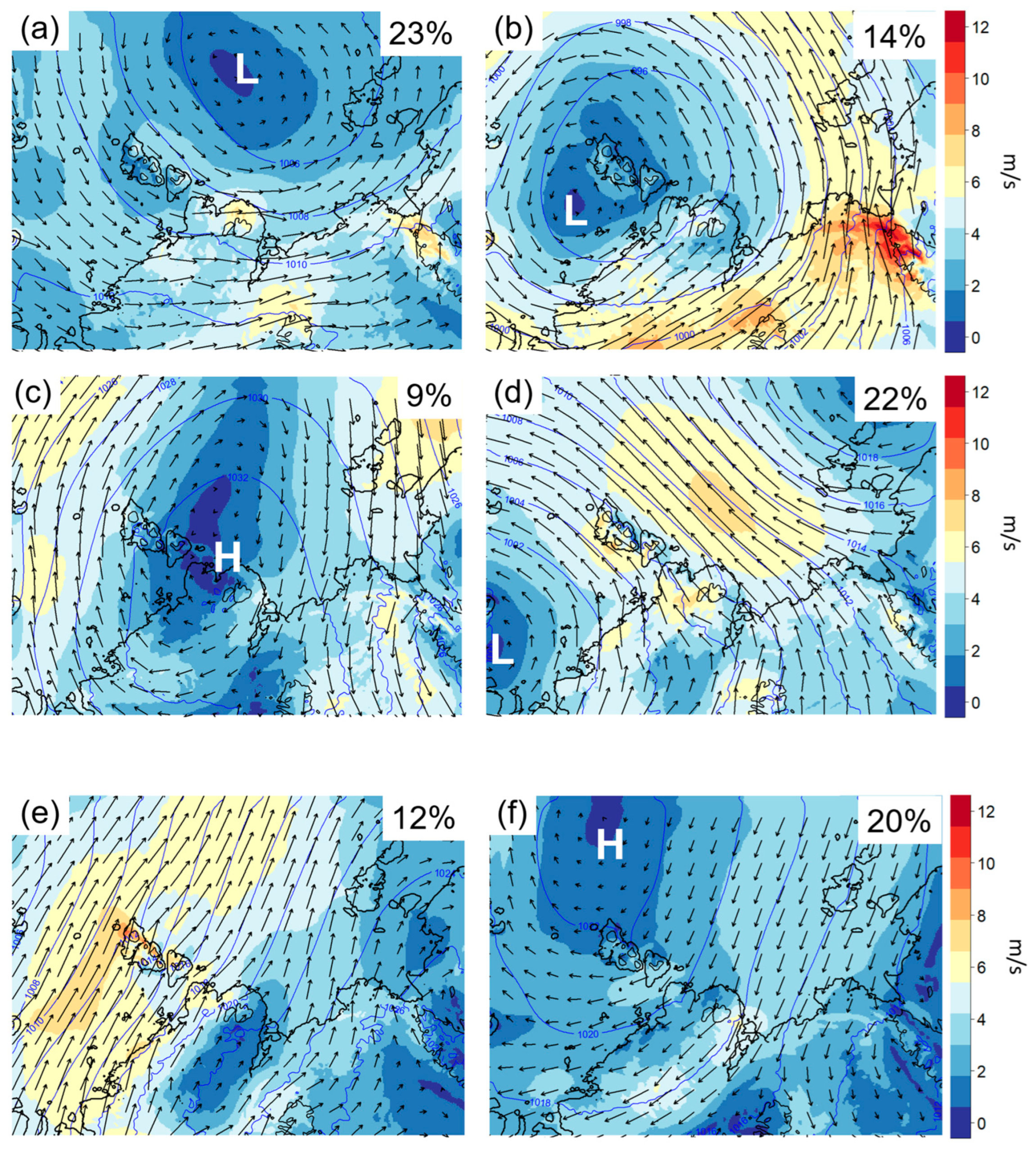
In order to identify the main synoptic weather patterns for LLJs at Tiksi, a SOM analysis was applied for daily MSLP fields for (a) days when a strong LLJ event started and (b) all days with strong LLJ events. The mean MSLP and the mean wind field at about 370 m above the surface for each SOM pattern was chosen to visualize the synoptic weather patterns. The 370 m wind values correspond to the mean LLJ height (Figure 6). For the analysis of the initial synoptic situation for LLJs, Figure 11 shows the mean fields for MSLP and 370 m wind for each SOM pattern for the starting days of strong LLJ events. A summary of the synoptic situation associated with each pattern is given in Table 2. The SOM yielded slightly different results for different randomizations for the training. In order to quantify the robustness of the SOM analysis, the SOM was applied more than 20 times, and the mean values are shown in Table 2. The maximum of the uncertainty taken as the standard deviation was about 1%. A downslope wind situation was present at the start for about 70% of the events. This was associated with four pressure and flow patterns: (1) a low over the central Laptev Sea (23%, Figure 11a) with moderate downslope winds in the Tiksi area, (2) a low over the western Laptev Sea and eastern Kara Sea (14%, Figure 11b) with strong downslope winds, (3) southerly flow over the whole Laptev Sea associated with a low over the Kara Sea and a high over the eastern Laptev Sea (22%, Figure 11d) with weak downslope winds, and (4) southwesterly flow over the whole Laptev Sea associated with a low over the northern Kara Sea (12%, Figure 11e) with medium downslope winds. The remaining two patterns did not show downslope winds at Tiksi and were present for about 30% of the events: (1) a high over the north-western Laptev Sea (20%, Figure 11f) and (2) a high over the western Laptev Sea (9%, Figure 11c), both with weak northeasterly or easterly winds in the Tiksi area.
In order to investigate the flow situation in the Tiksi area in more detail, the wind field at 200 m for the subdomain of Figure 2 is shown in Figure S3 (Supplementary Materials). The case study by [20] showed a downslope LLJ event that was associated with a barrier wind with a wind maximum at about 200 m west of the Kharaulaksky Mountains in its initial phase. A barrier wind at the Kharaulaksky Mountains is generated when a westerly flow west of the mountain barrier piles up cold air, which then causes a flow parallel to the mountain barrier. This barrier wind situation can be seen in Figure S3a,e, which represented about 35% of the events.
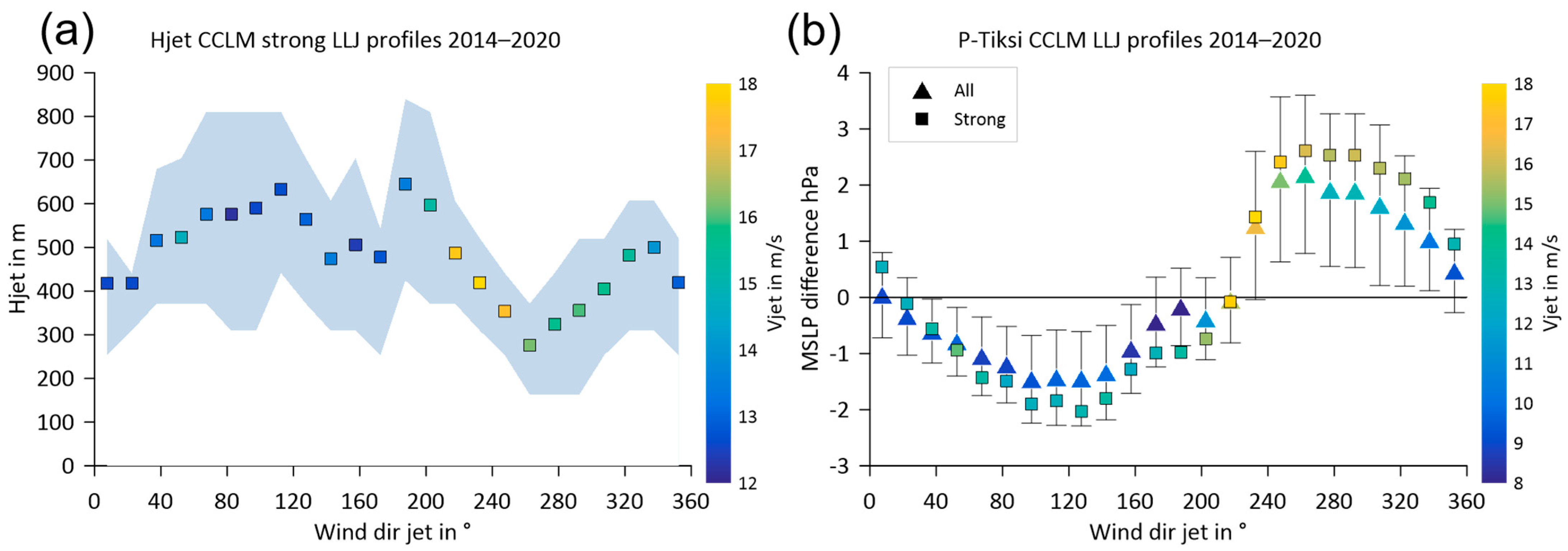
When the SOM analysis is applied for all days of strong LLJ events, similar patterns and frequencies were found as for the start days (Figure S4, Supplementary Materials). The pattern with a low over the central Laptev Sea (Figure S4a) showed the low to be more southerly compared to Figure 11a and the zone with high wind speeds at 370 m was still mainly in the lee of the Kharaulaksky Mountains. The pattern with a low over the western Laptev Sea (Figure S4b) showed the low center to be more easterly and more intense than for the start days. Wind speeds were higher compared to Figure 11b and a zone with speeds larger than 8 m/s extended over a large part of the eastern Laptev Sea, while more than 14 m/s were found in the downslope wind areas of the Kharaulaksky Mountains. Stronger winds were also found for the pattern of southerly flow (Figure S4d) and westerly flow (Figure S4e) over the Laptev Sea. Since only days with strong LLJ events were used for the analysis, the low wind speeds at 370 m in the Tiksi area for the high-pressure patterns (Figure S4c,f) need further explanation. Figure A2a (Appendix B) shows the dependence of the LLJ height on the jet direction. For northerly and easterly flow the mean height/speed of LLJs was larger/smaller than for the downslope LLJs. Thus the LLJs of the high-pressure patterns were not represented in the 370 m wind field. In addition, the wind data are daily means, and the signal of NE events will be weakened since most NE events have durations of less than one day (mean duration of 16 h for strong NE events).
Another interesting aspect is the relation of LLJs to the pressure difference across the Kharaulaksky Ridge. Figure A2b shows the MSLP difference between grid point P in the Lena River valley (Figure 2) and Tiksi as a function of jet direction. For downslope jets, the mean difference was positive (around 2 hPa for all jets and slightly larger for strong LLJs), which is consistent with the lee wave conditions for downslope windstorms [45]. For easterly LLJs, the mean MSLP differences were negative, with slightly smaller absolute values compared to DS LLJs.

4. Discussion

In the present study, LLJs in the Tiksi area were analyzed using CCLM simulations with a 5 km resolution and an hourly model output for the period 2014–2020. The simulation period was found to be representative for the wind conditions at Tiksi on a climatological time scale. The methodology for detecting hourly LLJ profiles was the same as in [22] and is comparable to detection methods using a threshold for the wind gradient above the jet as used, e.g., by [40]. While most of the recent LLJ studies (e.g., [2,8,40,46]) had no limitations for the minimum jet speed, a minimum jet speed of 10 m/s was used by [47] and related studies (e.g., [48,49]) in order to study LLJs with a high impact on the ABL. Therefore, results for strong LLJs with at least 10 m/s were presented as well in the current study.
The LLJs simulated by CCLM yielded very good results when compared to measurements. CCLM simulations at Tiksi were evaluated using synoptic observations, radiosondes and high-resolution SODAR observations for one year (2014/15) by [22]. They found that the CCLM simulations at a 5 km resolution represented the wind profile and the statistics of LLJs at Tiksi very well. CCLM overestimated wind speed by 1.0–1.5 m/s for heights between 100 and 400 m, which was in the range of the uncertainty of the SODAR wind speed. A comparison of LLJs simulated by CCLM with LLJs derived from high-resolution radiosonde data for one year (2019/20) during the MOSAiC experiment [8] showed a slight underestimation of about 5% for the LLJ frequency and very small differences for the mean and 25th/75th percentiles of the jet speed (less than 1 m/s).
LLJ events were defined as LLJs that last at least 6 h, since we regard LLJs as mesoscale features which should be present at the same level for several hours. The same definition of LLJ events was used by [8] for LLJs during the MOSAiC drift in order to exclude LLJs that occurred only as single profiles generated by wind gusts. In addition, the concept of LLJ events allowed for a better characterization of LLJs based on dynamical criteria such as baroclinicity, inertial oscillations and advection. A similar analysis of LLJ dynamics as in [8] was restricted for the Tiksi area, since the computation of horizontal gradients using data on the terrain-following CCLM levels turned out to not be feasible due the topography in this region. Particularly, the computation of the geostrophic wind from horizontal pressure gradients was limited by effects of the topography and lee waves on the pressure field.
The results for the climatology of the hourly LLJ profiles showed that LLJs were present in 54% of all profiles for the whole period of six years. 60% of the LLJs were strong LLJs with jet speeds of at least 10 m/s. The mean jet speed for all LLJs was about 13 m/s, the absolute maximum speed was 40 m/s. Strong LLJs had a mean wind speed of about 16 m/s. The mean jet height was about 400 m for all jets and strong jets, but there was dependence on the jet direction with larger heights for northern and easterly (NE) jets and lower heights for LLJs associated with downslope (DS) winds. Downslope LLJs were present in 63% of all LLJ profiles, and most of them (76%) were strong LLJs.
Strong LLJs were generally associated with LLJ events of at least 6 h, while about 10% of the hourly LLJ profiles were not part of events and were weaker in general. About 70% of the LLJ events were associated with downslope winds. About 85% of the downslope events were strong events (maximum speed during the event of at least 10 m/s). The accumulated duration of strong events was 36% of the whole period, and the mean duration was 23 h. Most long-lasting events were associated with downslope winds, and the 90th percentile of the duration for strong DS events was 95 h.
The relation of strong LLJ events to downslope wind events is consistent with the fact that the Tiksi area is one of the hotspots for downslope windstorms in the Russian Arctic as shown by [13]. They used synoptic observations at Tiksi for 1967–2016 and defined a downslope windstorm event as 10 m winds of at least 8 m/s from the sector 180–240° for a duration of at least 6 h. They found that DS windstorms occurred with a mean frequency of about 22% and had a mean duration of about one day (35% were longer than one day). In the present study, the frequency of strong DS LLJ events was 25% with a mean duration of 25 h, which is comparable to the statistics of [13]. Another similarity is the pronounced seasonal variation. LLJ profiles showed a frequency of up to about 70% in the winter months and about 40–50% during summer. The seasonal cycle was even more pronounced for strong LLJ profiles, particularly for DS LLJs. The seasonal cycle of the monthly fraction of all LLJ events was similar to that of the LLJ profiles. While almost all strong LLJ events during winter were associated with downslope winds, their fraction was less than 10% during summer. The duration of events was much larger during winter than for summer, particularly for strong events. The 90th percentile of the event duration was more than about four days during January and December, but dropped to about one day for the summer months.
LLJs have a strong impact on the turbulence structure of the ABL [4,5,6,12,50]. LLJs associated with downslope winds and a flow over mountains are generally associated with lee waves, where wave breaking can produce additional turbulence above the LLJ [51]. For the Tiksi region, strong downslope windstorms were found to be associated with turbulence, being hazardous for light aircraft [9]. In the study by [20] using CCLM with a 5 km horizontal resolution for a strong LLJ event at Tiksi, high values of TKE due to wave breaking above the jet height were found (maximum values of more than 0.7 m2/s2). A structure resembling a hydraulic jump was found downwind of Tiksi. A precondition for a hydraulic jump is the presence of shooting flow conditions with a Froude number larger than 1 [44]. Since the Froude number is related to the bulk Richardson number (RB) shown in Figure A1 (Appendix B), all DS LLJs with RB < 1 were associated with shooting flow (about 75%/85% of all/strong DS LLJs) and therefore there was a high potential of hydraulic jumps in the Tiksi area. The presence and location of hydraulic jumps strongly affects the wind conditions at Tiksi [52].
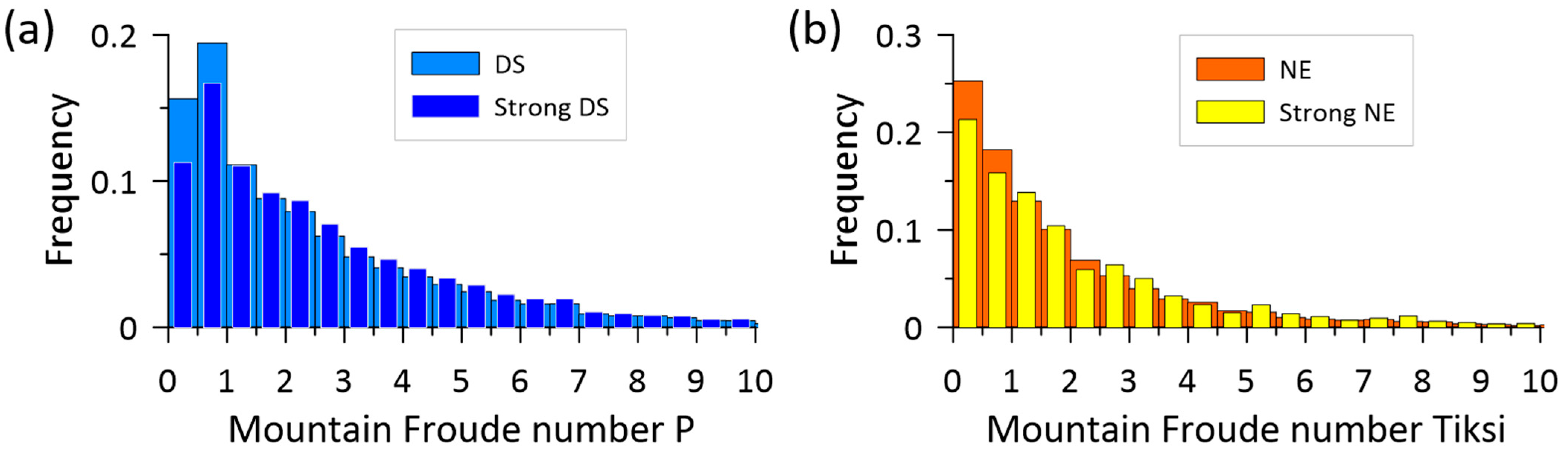
In order to study if the flow was able to cross the Kharaulaksky Ridge, the mountain Froude number Frm (Section 2.4) was calculated at the grid points Tiksi and P (Figure 2). Grid point P was located west–southwest of Tiksi, which was in the most prominent wind direction sector for DS LLJs (Figure S2). The distribution of Frm for downslope LLJs (all and strong) at P is shown in Figure A3a (Appendix B). A mountain Froude number larger than 1 indicates that the air can freely flow over the mountain ridge [53], which was the case for 65/72% of all/strong DS LLJs. For Frm < 1 a partial blocking occurs (about 20% of the DS LLJs were in the range of 0.5–1). In contrast, the Froude number at Tiksi for NE LLJs (Figure A3b) had lower values (about 10% less exceeding 1), indicating that blocking by the mountain ridge occurred more frequently for NE LLJs, but the mean jet height was much higher than the mountain ridge (Figure A2a). The findings for the Froude number and the pressure difference across the Kharaulaksky Ridge (Figure A2b) were consistent with the lee wave conditions for downslope windstorms in that area [45,52].
An SOM analysis was applied for daily MSLP fields and six patterns were detected for strong LLJ events. Four patterns were associated with downslope winds in the Tiksi area, which was the case for about 70% of the events. For the starting days of DS LLJ events the most frequent pressure patterns were a low over the central Laptev Sea and southerly flow over the whole Laptev Sea associated with a low over the Kara Sea. The starting days of NE LLJ events were mainly associated with a high over the north-western Laptev Sea. The results of the SOM analysis for all of the days of strong LLJ events were similar, but also showed shifts in the pressure patterns and more intense winds. Barrier winds at the western side of the Kharaulaksky Mountains were found in about 50% of strong DS events. A detailed case study of an event associated with a barrier wind situation was presented by [20], who documented the important role of the barrier wind (also an LLJ) for the initial phase of the LLJ event at Tiksi. The mature and dissipation phase of the LLJ event was dominated by a low moving from the east over the Laptev Sea. Thus, the pressure patterns found by the SOM analysis may also change during an event. The MSLP patterns for downslope windstorms at Tiksi were studied by [13]. They used daily NCEP/NCAR reanalyses with a spatial resolution of 2.5° and found a low over the western Laptev Sea and Kara Sea as the dominant pressure pattern with mainly southwesterly winds in the Tiksi region. The SOM analysis of the present paper showed a much more detailed picture. A limitation of six patterns was chosen for the SOM analysis, which is much less than in other studies, e.g., [54]. A larger number of patterns allows for a more detailed discrimination of patterns, but a smaller number, as in the present study, is more suitable for a classification of typical synoptic patterns.
Model resolution is crucial for the simulation of LLJs in regions with complex topography such as the Tiksi area. In contrast to studies of LLJs using reanalyses (e.g., [1,2]), we use CCLM model forecasts of up to 30 h with a high horizontal, vertical and temporal resolution. The study by [1] used ASR Version 1 reanalyses [18] for the winter (October-March) period of 2000–2010 with a rather coarse vertical resolution (vertical spacing of 25 hPa) and a horizontal resolution of 30 km. They found LLJ frequencies of 60–70% in the region of the Kharaulaksky Mountains and 50–60% in the Tiksi area. This is in agreement with the global climatological study of LLJs by [40] based on ERA5 data, which also indicated increased frequencies of LLJs along the Kharaulaksky Mountains. However, the coarse resolution of ERA5 or ASR, a 30 km resolution, is not suitable for studies of mountain wave processes in the Tiksi area [20]. In the ERA5 topography, neither the Kharaulaksky Ridge nor the Lena valley are resolved. In contrast, the CCLM topography with a 5 km resolution resolves the main topographic features around Tiksi reasonably well. This present study showed higher LLJ frequencies for Tiksi (up to about 70%) in the winter months than [1], which could be partly explained by better representation of the topography. A recent study of LLJs using high-resolution (3 km horizontal resolution) was shown by [46] for the Nordic Seas using the Norwegian Reanalysis NORA3 hindcast dataset over the period of 2000–2015. They found the highest LLJ frequency over land areas, particularly over the island of Novaya Zemlya in the eastern Barents Sea, where LLJs were often associated with downslope winds. This shows that downslope wind process is important for LLJs in many regions of the Arctic and that the resolution of simulations must be adequate to resolve the regional topography.

5. Conclusions

LLJs at Tiksi were found in about 55% of all hourly profiles with an average height of about 400 m, an average speed of about 13 m/s, and about 60% of the LLJs have speeds larger than 10 m/s (strong jets). The occurrence frequency for all jets showed a pronounced seasonal cycle with about 70%/50% in winter and about 40%/20% in summer for all/strong jets. LLJs were stronger during winter. The turbulent kinetic energy in the lower ABL was four times as large for strong LLJs compared to conditions without LLJs, which underlines the impact of LLJs on turbulent processes in the ABL. About 70/85% of all/strong LLJ events (lasting at least 6 h) were associated with downslope winds, and 10% of the strong downslope events lasted for more than 90 h. Strong DS LLJs were associated with notable TKE above the jet height, which indicated the presence of a wave-breaking process. Most DS LLJs were characterized as shooting flow with a high potential of hydraulic jumps in the Tiksi area. About 35% of strong events and about 50% of strong DS events were associated with barrier winds along the Kharaulaksky Mountains at the start of and during the events.
The present study contributes to the understanding of the climatology and dynamics of LLJs in the Siberian Arctic. Future work will include climatological studies of wind energy and downslope windstorms during climate change.

Supplementary Materials

The following supporting information can be downloaded at https://www.mdpi.com/article/10.3390/atmos17020218/s1, Figure S1: Frequency distributions of wind measurements at Tiksi for different periods; Figure S2: Wind roses for all LLJs and strong LLJs; Figure S3: SOM patterns for starting days of strong events with wind at 200 m for a CCLM subdomain; Figure S4: SOM patterns for all days of strong events with MSLP and wind at 370 m for the full CCLM domain.

Author Contributions

Conceptualization, G.H.; data curation, G.H. and L.S.; formal analysis, G.H.; funding acquisition, G.H.; investigation, L.S.; methodology, G.H.; project administration, G.H.; software, G.H. and L.S.; supervision, G.H.; validation, G.H.; visualization, G.H.; writing—original draft, G.H.; writing—review and editing, G.H. and L.S. All authors have read and agreed to the published version of the manuscript.

Funding

This research was funded by the Federal Ministry of Education and Research (BMBF) under grant 03F0831C in the frame of German–Russian cooperation “WTZ RUS: Changing Arctic Transpolar System (CATS)”.

Institutional Review Board Statement

Not applicable.

Informed Consent Statement

Not applicable.

Data Availability Statement

The model data were published by [27] and are available on a permanent data archive at the Deutsches Klimarechenzentrum (DKRZ). Data from the Tiksi observatory were obtained from NOAA via ftp://ftp.ncdc.noaa.gov/pub/data/gsod (last accessed on 11 February 2026). ERA5 data were provided for the CCLM community (www.clm-community.eu, accessed on 19 February 2026) via the DKRZ data pool. The basic CCLM model was provided by the CLM Community and the German Meteorological Service. Model data processing was performed using Climate Data Operators (CDO) (https://doi.org/10.5281/zenodo.3539275) and R software (version 4.5.2). The R package “kohonen” (version 3.0.12) was applied for the SOM analysis. The QGIS Geographic Information System (https://zenodo.org/records/18268584, accessed on 16 February 2026) was used.

Acknowledgments

This work used resources from the Deutsches Klimarechenzentrum (DKRZ) granted by its Scientific Steering Committee (WLA) under project ID bb0474.

Conflicts of Interest

The authors declare no conflicts of interest. The funders had no role in the design of the study; in the collection, analyses, or interpretation of data; in the writing of the manuscript; or in the decision to publish the results.

Abbreviations

The following abbreviations are used in this manuscript:
ABLAtmospheric boundary layer
ASRArctic system reanalysis with 30 km (version 1) and 15 km resolution (version 2)
CCLMCLM
DSDownslope
ECMWFEuropean centre for medium-range weather forecasts
ERA5Fifth-generation ECMWF reanalysis
FrmMountain froude number
LLJLow-level jet
MOSAiCMultidisciplinary drifting observatory for the study of Arctic climate
MSLPMean sea-level pressure
NCARNational center for atmospheric research
NCEPNational centers for environmental prediction
NENortherly and easterly
NORA3Norwegian reanalysis
PIOMASPan-Arctic ice ocean modeling and assimilation system
RBBulk Richardson number
SBLStable boundary layer
TKETurbulent kinetic energy
SODARSound detection and ranging
SOMSelf-organizing maps
STDVStandard deviation

Appendix A

Table A1. Configuration of the CCLM simulations.
Vertical/Horizontal Resolutions, Levels Below 1600 mRun ModeSea Ice Concentration (SIC) and Thickness
60 levels, 5 km
5, 16, 31, 48, 70, 96, 127, 163, 205, 253, 309, 371, 442, 520, 607, 704, 810, 926, 1053, 1192, 1342, 1504 m
Forecast mode (reinitialized at 18 UTC, 6 h spin-up), forcing by ERA5 data, no nudgingSIC: AMSR2 [30]
PIOMAS, daily data [31]
Table A2. Key boundary layer parameterizations of CCLM.
ParameterizationReferences
Roughness lengths
OceanModified Charnock relation [55]
Sea iceRoughness length for momentum (z0): dependent on ice thickness and SIC; roughness length for heat (zT): ratio zT/z0 dependent on roughness Reynolds number, form drag[32]
[36]
[35]
LandLand use and subgrid scale orography (SSO) scheme[56]
[57]
Turbulence
TKEPrognostic, 1.5 order turbulence closure at level 2.5[56]
[58]
minimum diffusion coefficients0.01 m2/s[34]
Asymptotic mixing length SBLDepends on TKE and stability[34]
Tile approach for sea ice
Surface classesGrid-scale ice (all thicknesses ≥ 1 cm), subgrid-scale thin ice (1–20 cm), open ocean[32]

Appendix B

Figure A1. Mean quantities for classes of the bulk Richardson number (RB) at the jet level for strong downslope hourly profiles. (a) Maximum TKE above the jet (up to 2200 m, dots, wind speed as color code) and its 90th percentile (solid line), and maximum TKE above 2 times the jet height (up to 2200 m, triangles) and its 90th percentile (dashed line); (b) jet speed (dots) and height (squares, numbers indicate the fraction in %).
Atmosphere 17 00218 g0a1
Figure A2. (a) Jet height for strong hourly LLJs as a function of jet direction (shaded: 25th to 75th percentiles). (b) Difference in the mean sea-level pressure (MSLP) between point P and Tiksi (see Figure 2) as a function of jet direction for all LLJs (triangles, with STDV) and strong LLJs (squares). The color code is the jet speed.
Atmosphere 17 00218 g0a2
Figure A3. Frequency distributions of mountain Froude numbers for hourly LLJ profiles calculated with a mountain height of 300 m (a) at point P (see Figure 2) for downslope LLJs (all and strong), and (b) at Tiksi for northern and easterly (NE) LLJs (all and strong).
Atmosphere 17 00218 g0a3

References

  1. Tuononen, M.; Sinclair, V.A.; Vihma, T. A climatology of low-level jets in the mid-latitudes and polar regions of the Northern Hemisphere. Atmos. Sci. Lett. 2015, 16, 492–499. [Google Scholar] [CrossRef]
  2. López-García, V.; Neely, R.R.; Dahlke, S.; Brooks, I.M. Low-level jets over the Arctic Ocean during MOSAiC. Elem. Sci. Anthr. 2022, 10, 63. [Google Scholar] [CrossRef]
  3. Heinemann, G.; Zentek, R. A Model-Based Climatology of Low-Level Jets in the Weddell Sea Region of the Antarctic. Atmosphere 2021, 12, 1635. [Google Scholar] [CrossRef]
  4. Kallistratova, M.A.; Kouznetsov, R.D.; Kramar, V.F.; Kuznetsov, D.D. Profiles of Wind Speed Variances within Nocturnal Low-Level Jets Observed with a Sodar. J. Atmos. Ocean. Technol. 2013, 30, 1970–1977. [Google Scholar] [CrossRef]
  5. Liu, C.; Yang, Q.; Shupe, M.D.; Ren, Y.; Peng, S.; Han, B.; Chen, D. Atmospheric Turbulent Intermittency Over the Arctic Sea-Ice Surface During the MOSAiC Expedition. J. Geophys. Res. 2023, 128, e2023JD038639. [Google Scholar] [CrossRef]
  6. Roy, S.; Sentchev, A.; Schmitt, F.G.; Augustin, P.; Fourmentin, M. Impact of the Nocturnal Low-Level Jet and Orographic Waves on Turbulent Motions and Energy Fluxes in the Lower Atmospheric Boundary Layer. Bound.-Layer Meteorol. 2021, 180, 527–542. [Google Scholar] [CrossRef]
  7. Guest, P.; Persson, P.O.G.; Wang, S.; Jordan, M.; Jin, Y.; Blomquist, B.; Fairall, C. Low-Level Baroclinic Jets Over the New Arctic Ocean. J. Geophys. Res. Ocean. 2018, 123, 4074–4091. [Google Scholar] [CrossRef]
  8. Heinemann, G.; Schefczyk, L.; Zentek, R. A model-based study of the dynamics of Arctic low-level jet events for the MOSAiC drift. Elem. Sci. Anthr. 2024, 12, 64. [Google Scholar] [CrossRef]
  9. Shestakova, A.A. Assessing the Risks of Vessel Icing and Aviation Hazards during Downslope Windstorms in the Russian Arctic. Atmosphere 2021, 12, 760. [Google Scholar] [CrossRef]
  10. Andreas, E.L.; Claffy, K.J.; Makshtas, A.P. Low-Level Atmospheric Jets And Inversions Over The Western Weddell Sea. Bound.-Layer Meteorol. 2000, 97, 459–486. [Google Scholar] [CrossRef]
  11. Jakobson, L.; Vihma, T.; Jakobson, E.; Palo, T.; Männik, A.; Jaagus, J. Low-level jet characteristics over the Arctic Ocean in spring and summer. Atmos. Chem. Phys. 2013, 13, 11089–11099. [Google Scholar] [CrossRef]
  12. Heinemann, G. Aircraft-Based Measurements Of Turbulence Structures In The Katabatic Flow Over Greenland. Bound.-Layer Meteorol. 2002, 103, 49–81. [Google Scholar] [CrossRef]
  13. Shestakova, A.A.; Toropov, P.A.; Matveeva, T.A. Climatology of extreme downslope windstorms in the Russian Arctic. Weather. Clim. Extrem. 2020, 28, 100256. [Google Scholar] [CrossRef]
  14. Heinemann, G.; Drüe, C.; Makshtas, A. A Three-Year Climatology of the Wind Field Structure at Cape Baranova (Severnaya Zemlya, Siberia) from SODAR Observations and High-Resolution Regional Climate Model Simulations during YOPP. Atmosphere 2022, 13, 957. [Google Scholar] [CrossRef]
  15. Barstad, I.; Adakudlu, M. Observation and modelling of gap flow and wake formation on Svalbard. Q. J. R. Meteorol. Soc. 2011, 137, 1731–1738. [Google Scholar] [CrossRef]
  16. Myslenkov, S.A. Wind Waves Conditions Along the Northern Sea Route. Oceanology 2024, 64, S61–S69. [Google Scholar] [CrossRef]
  17. Martin, S.; Cavalieri, D.J. Contributions of the Siberian shelf polynyas to the Arctic Ocean intermediate and deep water. J. Geophys. Res. 1989, 94, 12725–12738. [Google Scholar] [CrossRef]
  18. Bromwich, D.H.; Wilson, A.B.; Bai, L.; Liu, Z.; Barlage, M.; Shih, C.-F.; Maldonado, S.; Hines, K.M.; Wang, S.-H.; Woollen, J.; et al. The Arctic System Reanalysis, Version 2. Bull. Am. Meteorol. Soc. 2018, 99, 805–828. [Google Scholar] [CrossRef]
  19. Hersbach, H.; Bell, B.; Berrisford, P.; Hirahara, S.; Horányi, A.; Muñoz-Sabater, J.; Nicolas, J.; Peubey, C.; Radu, R.; Schepers, D.; et al. The ERA5 global reanalysis. Q. J. R. Meteorol. Soc. 2020, 146, 1999–2049. [Google Scholar] [CrossRef]
  20. Heinemann, G. A Case Study of a Wintertime Low-Level Jet Associated with a Downslope Wind Event at the Tiksi Observatory (Laptev Sea, Siberia). Meteorology 2025, 4, 7. [Google Scholar] [CrossRef]
  21. Heinemann, G.; Drüe, C.; Schwarz, P.; Makshtas, A. Observations of Wintertime Low-Level Jets in the Coastal Region of the Laptev Sea in the Siberian Arctic Using SODAR/RASS. Remote Sens. 2021, 13, 1421. [Google Scholar] [CrossRef]
  22. Heinemann, G.; Drüe, C.; Makshtas, A. Simulations of low-level jets at the Tiksi observatory (Laptev Sea, Siberia) using the regional climate model CCLM and evaluation using SODAR observations for the winter 2014/15. J. Eur. Meteorol. Soc. 2025, 3, 100027. [Google Scholar] [CrossRef]
  23. Liu, Y.; Weisberg, R.H. A Review of Self-Organizing Map Applications in Meteorology and Oceanography; InTech: London, UK, 2011. [Google Scholar]
  24. GMTED. Global Multi-Resolution Terrain Elevation Data 2010 (GMTED2010). Available online: https://cmr.earthdata.nasa.gov:443/search/concepts/C1220567856-USGS_LTA.html (accessed on 3 September 2024).
  25. Dawson, N.; Fischer, J.; Kuhn, M.; Pasotti, A.; mhugent; Rouzaud, D.; Bruy, A.; Sutton, T.; Dobias, M.; Pellerin, M.; et al. qgis/QGIS: 3.44.7; Zenodo: Geneva, Switzerland, 2026. [Google Scholar]
  26. Uttal, T.; Starkweather, S.; Drummond, J.R.; Vihma, T.; Makshtas, A.P.; Darby, L.S.; Burkhart, J.F.; Cox, C.J.; Schmeisser, L.N.; Haiden, T.; et al. International Arctic Systems for Observing the Atmosphere: An International Polar Year Legacy Consortium. Bull. Am. Meteorol. Soc. 2016, 97, 1033–1056. [Google Scholar] [CrossRef]
  27. Schefczyk, L.; Heinemann, G. CATS Projekt—Uni Trier—Simulation L05. Available online: https://Hdl.handle.net/21.14106/d6370870d522874d91d18f1f5282baec67e02ce3 (accessed on 12 November 2025).
  28. Steger, C.; Bucchignani, E. Regional Climate Modelling with COSMO-CLM: History and Perspectives. Atmosphere 2020, 11, 1250. [Google Scholar] [CrossRef]
  29. Hastings, D.A.; Dunbar, P.K. Global Land One-kilometer Base Elevation (GLOBE) Digital Elevation Model, Documentation. In Key to Geophysical Records Documentation (KGRD); Geophysical Data Center: Boulder, CO USA, 1999; pp. 1–147. [Google Scholar]
  30. Spreen, G.; Kaleschke, L.; Heygster, G. Sea ice remote sensing using AMSR-E 89-GHz channels. J. Geophys. Res. 2008, 113, 14485. [Google Scholar] [CrossRef]
  31. Zhang, J.; Rothrock, D.A. Modeling Global Sea Ice with a Thickness and Enthalpy Distribution Model in Generalized Curvilinear Coordinates. Mon. Weather. Rev. 2003, 131, 845–861. [Google Scholar] [CrossRef]
  32. Heinemann, G.; Schefczyk, L.; Willmes, S.; Shupe, M.D. Evaluation of simulations of near-surface variables using the regional climate model CCLM for the MOSAiC winter period. Elem. Sci. Anthr. 2022, 10, 33. [Google Scholar] [CrossRef]
  33. Zentek, R.; Heinemann, G. Verification of the regional atmospheric model CCLM v5.0 with conventional data and lidar measurements in Antarctica. Geosci. Model Dev. 2020, 13, 1809–1825. [Google Scholar] [CrossRef]
  34. Heinemann, G. Assessment of Regional Climate Model Simulations of the Katabatic Boundary Layer Structure over Greenland. Atmosphere 2020, 11, 571. [Google Scholar] [CrossRef]
  35. Lüpkes, C.; Gryanik, V.M. A stability-dependent parametrization of transfer coefficients for momentum and heat over polar sea ice to be used in climate models. J. Geophys. Res. 2015, 120, 552–581. [Google Scholar] [CrossRef]
  36. Andreas, E.L. A theory for the scalar roughness and the scalar transfer coefficients over snow and sea ice. Bound.-Layer Meteorol. 1987, 38, 159–184. [Google Scholar] [CrossRef]
  37. Shupe, M.D.; Rex, M.; Blomquist, B.; Persson, P.O.G.; Schmale, J.; Uttal, T.; Althausen, D.; Angot, H.; Archer, S.; Bariteau, L.; et al. Overview of the MOSAiC expedition—Atmosphere. Elem. Sci. Anthr. 2022, 10, 60. [Google Scholar] [CrossRef]
  38. Heinemann, G.; Schefczyk, L.; Zentek, R.; Brooks, I.M.; Dahlke, S.; Walbröl, A. Evaluation of Vertical Profiles and Atmospheric Boundary Layer Structure Using the Regional Climate Model CCLM during MOSAiC. Meteorology 2023, 2, 257–275. [Google Scholar] [CrossRef]
  39. Sedlar, J.; Tjernström, M.; Rinke, A.; Orr, A.; Cassano, J.; Fettweis, X.; Heinemann, G.; Seefeldt, M.; Solomon, A.; Matthes, H.; et al. Confronting Arctic troposphere, clouds, and surface energy budget representations in regional climate models with observations. J. Geophys. Res. 2020, 125, e2019JD031783. [Google Scholar] [CrossRef]
  40. Luiz, E.W.; Fiedler, S. Global Climatology of Low-Level-Jets: Occurrence, Characteristics, and Meteorological Drivers. J. Geophys. Res. 2024, 129, e2023JD040262. [Google Scholar] [CrossRef]
  41. Gaberšek, S.; Durran, D.R. Gap Flows through Idealized Topography. Part I: Forcing by Large-Scale Winds in the Nonrotating Limit. J. Atmos. Sci. 2004, 61, 2846–2862. [Google Scholar] [CrossRef]
  42. Wehrens, R.; Kruisselbrink, J. Flexible Self-Organizing Maps in kohonen 3.0. J. Stat. Softw. 2018, 87, 1–18. [Google Scholar] [CrossRef]
  43. Liu, Y.; Weisberg, R.H.; Mooers, C.N.K. Performance evaluation of the self-organizing map for feature extraction. J. Geophys. Res. 2006, 111, e2005JC003117. [Google Scholar] [CrossRef]
  44. BALL, F.K. The Theory of Strong Katabatic Winds. Aust. J. Phys. 1956, 9, 373–386. [Google Scholar] [CrossRef]
  45. Abatzoglou, J.T.; Hatchett, B.J.; Fox-Hughes, P.; Gershunov, A.; Nauslar, N.J. Global climatology of synoptically-forced downslope winds. Int. J. Climatol. 2021, 41, 31–50. [Google Scholar] [CrossRef]
  46. Michel, C.; Furevik, B.R.; Borg, A.L.; Haakenstad, H.; Breivik, Ø. Climatology of Low-Level Jets Over Scandinavia and the Nordic Seas Using Model Datasets and Radiosondes. Int. J. Climatol. 2025, 45, e8871. [Google Scholar] [CrossRef]
  47. Bonner, W.D.; Esbensen, S.; Greenberg, R. Kinematics of the Low-Level Jet. J. Appl. Meteor. 1968, 7, 339–347. [Google Scholar] [CrossRef]
  48. Carroll, B.J.; Demoz, B.B.; Delgado, R. An Overview of Low-Level Jet Winds and Corresponding Mixed Layer Depths During PECAN. J. Geophys. Res. 2019, 124, 9141–9160. [Google Scholar] [CrossRef]
  49. Whiteman, C.D.; Bian, X.; Zhong, S. Low-Level Jet Climatology from Enhanced Rawinsonde Observations at a Site in the Southern Great Plains. J. Appl. Meteor. 1997, 36, 1363–1376. [Google Scholar] [CrossRef]
  50. Duarte, H.F.; Leclerc, M.Y.; Zhang, G.; Durden, D.; Kurzeja, R.; Parker, M.; Werth, D. Impact of Nocturnal Low-Level Jets on Near-Surface Turbulence Kinetic Energy. Bound.-Layer Meteorol. 2015, 156, 349–370. [Google Scholar] [CrossRef]
  51. Ólafsson, H.; Ágústsson, H. The Freysnes downslope windstorm. Meteorol. Z. 2007, 16, 123–130. [Google Scholar] [CrossRef]
  52. Shestakova, A.A. Impact of land surface roughness on downslope windstorm modelling in the Arctic. Dyn. Atmos. Ocean. 2021, 95, 101244. [Google Scholar] [CrossRef]
  53. Durran, D.R. Another Look at Downslope Windstorms. Part I: The Development of Analogs to Supercritical Flow in an Infinitely Deep, Continuously Stratified Fluid. J. Atmos. Sci. 1986, 43, 2527–2543. [Google Scholar] [CrossRef]
  54. Cassano, E.N.; Glisan, J.M.; Cassano, J.J.; Gutowski, W.J.; Seefeldt, M.W. Self-organizing map analysis of widespread temperature extremes in Alaska and Canada. Clim. Res. 2015, 62, 199–218. [Google Scholar] [CrossRef]
  55. Charnock, H. Wind stress on a water surface. Q. J. R. Meteorol. Soc. 1955, 81, 639–640. [Google Scholar] [CrossRef]
  56. Doms, G.; Förstner, J.; Heise, H.; Herzog, H.-J.; Mironov, D.; Raschendorfer, M.; Reinhardt, T.; Ritter, B.; Schrodin, R.; Schulz, J.-P.; et al. A Description of the Nonhydrostatic Regional COSMO-Model. Part II. Physical Parameterizations; Deutscher Wetterdienst: Offenbach, Germany, 2013. [Google Scholar]
  57. Lott, F.; Miller, M.J. A new subgrid-scale orographic drag parametrization: Its formulation and testing. Q. J. R. Meteorol. Soc. 1997, 123, 101–127. [Google Scholar] [CrossRef]
  58. Mellor, G.L.; Yamada, T. A Hierarchy of Turbulence Closure Models for Planetary Boundary Layers. J. Atmos. Sci. 1974, 31, 1791–1806. [Google Scholar] [CrossRef]
Figure 3. Statistics for 10 m wind measurements (3 h values) at Tiksi per month (1 is January, 12 is December) for different periods for mean wind speed (solid lines), the 90th percentile (P90, lines with dots) and the standard deviation (STDV, dashed lines, right axis).
Atmosphere 17 00218 g003
Figure 4. Statistics for hourly LLJ profiles of the (a) jet height (absolute frequencies at model levels), (b) jet speed, (c) wind direction at the jet core, (d) directional shear (difference between the wind direction at the jet core and at a height of 5 m) for all LLJs (black) and strong LLJs (red, wind speed ≥ 10 m/s), downslope LLJs (DS, light blue) and strong downslope LLJs (strong DS, dark blue).
Atmosphere 17 00218 g004
Figure 5. Mean vertical profiles for all LLJs of (a) wind speed, (b) wind direction difference from the lowest level, (c) potential temperature anomaly (see text) and (d) the mean wind profile scaled with LLJ height and LLJ speed (the shaded region marks the 25th and 75th percentiles, respectively). In (a), the mean of all profiles without an LLJ is shown as a gray line, DS (blue) and NE (red) jets are from directions in the sectors 180–300 (downslope) and 345–150° (northern and easterly), respectively.
Atmosphere 17 00218 g005
Figure 6. Mean vertical profiles for strong LLJs (jet speed ≥ 10 m/s) of (a) wind speed, (b) the TKE for strong LLJs (black line), all LLJs (dashed line), and profiles without LLJs (gray line). (c) The mean wind profile scaled with LLJ height and LLJ speed. (d) Percentiles of the TKE for strong downslope (DS) LLJs. DS (blue) and NE (red) jets are from directions in the sectors 180–300 (downslope) and 345–150° (northern and easterly), respectively.
Atmosphere 17 00218 g006
Figure 7. Statistics for LLJ events, with the (a) mean jet height (relative frequencies), (b) mean jet speed, (c) duration (logarithmic scale), and (d) rate of change of wind direction during the event for all events (black), strong events (red, wind speed ≥ 10 m/s), downslope events (DS, light blue) and strong downslope events (strong DS, dark blue).
Atmosphere 17 00218 g007
Figure 8. Statistics for LLJ events, with the (a) mean gradient of the potential temperature below the jet and (b) temperature change (mean of the lowest 100 m) during the event for all events (black) and downslope events (DS, light blue).
Atmosphere 17 00218 g008
Figure 9. Statistics for hourly LLJ profiles per month (1 is January, 12 is December) for (a) frequency of LLJ profiles and (b) mean LLJ speed and its 90th percentile. All LLJs (black), strong LLJs (red) and strong downslope LLJs (blue).
Atmosphere 17 00218 g009
Figure 10. Statistics for LLJ events per month (1 is January, 12 is December) for (a) time fraction of events and (b) mean event duration and its 90th percentile. All events (black), strong events (red) and strong downslope events (blue).
Atmosphere 17 00218 g010
Figure 11. SOM patterns for start days of strong events with MSLP (blue isolines every 2 hPa) and wind at 370 m above the surface (wind speed color shaded, vectors every 20 grid points) for the full CCLM domain. The coastline and the isoline of the 500 m topography are shown. The frequency of each pattern is given in the upper right corner. “L” and “H” denote low and high pressure systems, respectively. See Table 2 for a description of the subpanels.
Atmosphere 17 00218 g011
Table 1. Statistics for the events (frequency in %, mean, 25, 75 and 90th percentiles) of mean LLJ speed and duration (DS = downslope, NE = northern and easterly).
2014–2020Fraction/rel. %Event Mean Speed in m/sEvent Duration in h
LLJ Events ≥ 6 h MeanP25P75P90MeanP25P75P90
All43/10011.07.513.417.82382346
Strong ≥ 10 m/s36/8513.09.815.318.92993262
DS30/7013.08.816.319.41893774
Strong DS25/8415.012.318.220.825135295
NE11/259.17.110.913.31471624
Strong NE7/6511.19.312.313.91681828
Table 2. SOM classification of synoptic patterns for start days of strong events and 370 m wind conditions at Tiksi: downslope (DS), northern and easterly (NE). BW denotes barrier wind conditions at the western side of the Kharaulaksky Mountains. (a)–(f) are the corresponding subpanels of Figure 11.
SOM Start days strong LLJ Events 370 m-Wind Tiksi
Pattern%Synoptic SituationBWDSNEStrength
1 (a)23Low central Laptev Sea2323 Medium
2 (b)14Low western Laptev Sea 14 Strong
3 (c)9High western Laptev Sea 9Weak
4 (d)22Southerly flow Laptev Sea 22 Weak
5 (e)12South-westerly flow Laptev Sea1212 Medium
6 (f)20High north-western Laptev Sea 20Weak
Sum%100 357129
Disclaimer/Publisher’s Note: The statements, opinions and data contained in all publications are solely those of the individual author(s) and contributor(s) and not of MDPI and/or the editor(s). MDPI and/or the editor(s) disclaim responsibility for any injury to people or property resulting from any ideas, methods, instructions or products referred to in the content.