
Article

Transitions Between Circulation Regimes: The Role of Tropical Heating
by
Ralph D. Getzandanner
and
David M. Straus
*
Department of Atmospheric, Oceanic and Earth Sciences, George Mason University, Fairfax, VA 22030, USA
*
Author to whom correspondence should be addressed.
Atmosphere 2026, 17(2), 201; https://doi.org/10.3390/atmos17020201
Submission received: 23 December 2025 / Revised: 2 February 2026 / Accepted: 3 February 2026 / Published: 13 February 2026
(This article belongs to the Special Issue Recent Advances in Subseasonal to Seasonal Predictability)

Abstract

Four Euro-Atlantic (EA) circulation regimes are identified using cluster analysis applied to 500 hPa geopotential heights from the ERA-Interim (ERAI) reanalysis. These are the positive and negative phases of the North Atlantic Oscillation (NAO+, NAO−), Scandinavian Blocking (SB), and the Atlantic Ridge (AR). This paper studies transitions between these four regimes, the signature of tropical heating preceding these transitions, and the identification of transitions for which this forcing plays a role. The findings can further our understanding of when transitions occur. To address these questions, we examine the relationship of heating to the Madden–Julian Oscillation (MJO), the El Niño Southern Oscillation (ENSO), shifts in the Intertropical Convergence Zone (ITCZ), and possible stratospheric influences. Mid-latitude diabatic heating is also examined to determine shifts in the storm tracks. We use the ERAI reanalysis to estimate diabatic heating, streamfunction, Rossby wave activity, and stratospheric zonal winds. We find that Indian Ocean tropical heating enhances the transition from the SB regime to the NAO+ regime. In contrast, western Pacific heating seems to force transitions from all other regimes into the NAO− regime. The flux of Rossby wave activity indicates that in some transitions, mid-latitudes play a role in forcing tropical heating. The majority of the transitions examined show indications of tropically forced behavior. Less than half showed evidence that mid-latitude dynamics were the primary cause of the transition. Nearly half of the transitions appeared to be related to phases of the MJO. We also found that intensification of heating in the eastern equatorial Pacific and equatorial Atlantic (ITCZ) plays a role. Transitions during the early and late parts of the season, along with the role of ENSO, are found to be modest factors.

1. Introduction

Mid-latitude weather and climate are, in large part, the result of transitory weather systems that can be classified into short-time-scale individual synoptic weather features and lower-frequency planetary or hemispheric-scale patterns. Low-frequency patterns, which are often persistent, have been identified worldwide. Walker and Bliss [1] were among the first to identify correlations between barometric pressure at widely separated points. Namias [2] examined the configuration of large-scale atmospheric flow and introduced an index that quantified the degree of zonal or blocked flow. Rex [3] examined atmospheric blocking and was among the first to describe what we now term circulation regimes (or just regimes). Wallace and Gutzler [4] added to the work of Rex, further compiling and refining relationships between separate locations, known as teleconnections. They also presented circulation patterns based on these teleconnections. Regional circulation patterns have been cataloged since the late 19th century and used by the German Weather Service since the 1940s [5,6,7] and are described by Baur [8]. The US Air Force weather service has used a similar catalog of European weather patterns since the 1980s. A more comprehensive review of the Northern Hemisphere circulation patterns was performed by F. Panagiotopoulos et al. [9]. These patterns are associated with certain weather conditions over broad areas. An extensive review of regime behavior is given by Hannachi et al. [10]. Ghil and Robertson [11] placed the preferred patterns and teleconnections within a broader framework. They describe two types of low-frequency variability that affect the mid-latitude atmosphere. They are planetary flow regimes and intraseasonal oscillations. Planetary flow regimes, referred to as “particles” by Ghil and Robertson [11], are thought of as preferred patterns or circulation regimes that have been identified on both hemispheric and regional scales. The intraseasonal oscillations (“waves”) are periodic oscillations that may be related to unstable periodic orbits [12]. Regimes can be useful for prediction given their persistence, [7,13,14], and many others, and can provide an empirical set of weather conditions to be expected when a particular regime is influencing a region, e.g., Cassou [15] and Amini and Straus [16].
Understanding the dynamics involved in the development and transition of regimes is paramount for predicting them and would provide insight into the atmospheric conditions that favor a change in the planetary wave pattern. A worthy objective would be to accurately predict a transition from one regime to another using a forecast model, an ensemble of individual models, or a collection of models. The identification of circulation regimes via cluster analysis has been achieved in the Northern Hemisphere [10,17,18], the Pacific North American region [16,19,20], and the Euro-Atlantic region [7,13,21,22].
The Euro-Atlantic regimes (shown in Figure 1) are described in more detail in Section 2. One point to note immediately is that it is well-known that the positive and negative phases of the clusters resembling the North Atlantic Oscillation, or NAO, Wallace and Gutzler [4], are not exactly opposite to each other. Each of the Euro-Atlantic regimes can be associated with extreme weather conditions. Some of the weather associated with each regime is presented in Amini and Straus [16] and in Ferranti et al. [23]. Examples include extreme precipitation, temperature extremes, and extended dry conditions.
Since transitions between the Euro-Atlantic regimes are associated with changes in predominant weather types, they are of some importance. Transitions were addressed by Vautard [21]. Three preferred regime transitions were found: These were (in terms of our terminology) the NAO+ to Scandinavian Block, the Scandinavian Block to NAO−, and NAO+ to Atlantic Ridge. Cassou [22] also found that the NAO+ to Scandinavian Block and Scandinavian Block to NAO− are preferred.
Vautard [21], using similar Euro-Atlantic regimes, except at the 700 hPa surface, found three preferred regime transitions. These were the Zonal (NAO+) to Blocking (Scandinavian Block), Blocking to Greenland Block (NAO−), and Zonal (NAO+) to Atlantic Ridge. Cassou [22] also found that the NAO+ to Scandinavian Block and Scandinavian Block to NAO− are preferred. They also determined that some of these transitions were related to phases of the Madden–Julian Oscillation, which manifests itself as coherent eastward propagating large-scale convection originating in the Indian Ocean.
While much of the previous literature on the dynamics of regimes and their transitions has focused on mid-latitude processes [12,24,25,26,27,28,29], there is also a clear interaction between tropical diabatic heating and the circulation regimes. On seasonal-to-interannual time scales, the heating associated with the El Niño Southern Oscillation strongly affects the regimes in the Pacific North American region [20,30]. On intra-seasonal time scales, the regimes in the Euro-Atlantic sector (shown in Figure 1) respond to tropical heating. However, this has been investigated almost exclusively in the somewhat limited context of the Madden–Julian Oscillation (MJO) [22,31,32,33]. We discuss this in more detail later in this Section and in Section 2.
To the extent that tropical diabatic heating generally drives changes in the probability of circulation regime occurrence, this heating must affect the transition paths between regimes. This suggests that focusing on the evolution of transitions between circulation regimes, and an assessment of the diabatic heating (both tropical and extra-tropical) that precedes and interacts with these transitions, provides a more complete picture of the role of diabatic heating. In this study, we investigate this, and it is one of the main purposes of this article.

1.1. The Role of Mid-Latitude Dynamics

The mid-latitude forcing of the NAO teleconnection pattern has been studied extensively (see the review of Song [34]), with several variations in approach. One school of thought is that the eddies play a dominant role in the forcing and maintenance of the NAO. In particular, transient eddy-vorticity forcing [35] and Rossby wave breaking [27,36] are important. Both wave breaking and vorticity forcing are related to the poleward flux of zonal momentum, and their forcing of circulation changes underlie the role of changes in the intensity and position of the storm tracks. Michel and Riviere [37] looked in detail at the role of Rossby wave breaking in the formation, decay, and transitions of the four Euro-Atlantic regimes.
Another school of thought posits that NAO development is a response to the pre-existing configuration of eddies. Song [34] found that the phase speed of the eddies leads to the development of the NAO (faster phase speed leads to NAO+) and that the eddy vorticity forcing from high and low frequency eddies acts differently.
Atmospheric blocking accounts for two of our four Euro-Atlantic regimes, NAO− and the Scandinavian Block. Because of the processes involved in the life cycle of blocking, its inherent persistence, and its relationship to extreme weather, it is one of the more studied atmospheric phenomena [3,17,38,39]. A good review of blocking is provided by Huang et al. [40]. As with the NAO, the role of transient eddy forcing is very prominent [38]. The strength of the background mean westerly wind is of great importance to the life cycle of blocking, with weak flow aiding the maintenance and strong flow leading to its destruction [40]. Studies of the decay of blocking focus on energy conversions [41] and the role of stratospheric forcing in blocking decay (or transition) have been discussed by Attard and Lang [42]. Much of the previously quoted work on blocking addresses local blocking patterns following a large number of blocking definitions [30,38,39,40,41,42,43,44]. Little work has been carried out specifically in the context of the Atlantic Ridge and Scandinavian blocking regimes. Platzer et al. [45] looked at Euro-Atlantic sea level pressure (SLP) regime transitions. Their results showed dynamic indicators of time-variation dimension and persistence near transitions, but they did not go into detail about what may have caused the variations.

1.2. The Role of Tropical Forcing

The role of forcing of the Euro-Atlantic regimes by tropical diabatic heating has more recently been considered as an alternative to the local mid-latitude dynamics hypothesis described in the previous section. From this point of view, mid-latitude dynamics remain important, but changes ultimately result from tropical heating.
Many have suggested a link between the mid-latitudes and the Madden–Julian Oscillation, or MJO. The MJO, Madden and Julian [31], is an envelope of eastward-propagating convection originating in the Indian Ocean and reaching the central Pacific, with a lifecycle spanning roughly 30 to 80 days. The MJO explains roughly 25% of the tropical variance in circulation and heating [46]. Changes in the likelihood of occurrence of regimes in the Euro-Atlantic region have been attributed to (and follow in time) the tropical diabatic heating associated with different phases of the MJO in observational and modeling studies [22,47,48,49,50]. The interaction may also go the other way, with two of the circulation regimes (NAO+ and NAO−) associated with subsequent MJO phases [47], implying mid-latitude forcing of MJO heating. Convection associated with the MJO in the W. Pacific Ocean will generate a Rossby wave source [51], which, in turn, can affect variability in the mid-latitudes. In the case of the NAO, mid-latitude energy fluxes can intrude into the tropics by creating instability and forcing circulations and convection in those regions [52].
Cassou [22] found that the NAO+ is more likely to follow Phases 2 and 3 (convection over the Indian Ocean) and that the Scandinavian Blocking is more likely at short lags following Phase 6 (convection over the western and central Pacific). He suggests that the NAO− may not be directly related to the MJO but may be more a consequence of the preferred transition sequence of NAO+ to Scandinavian Block and then to NAO− following phase 6 and 7. Yadav and Straus [49] took the research by Cassou [22] further and found that there were fast and slow modes of the MJO and that the relationship between the Euro-Atlantic regimes depended on the speed of the oscillation. They define fast episodes as those that propagate from the Indian Ocean to the Western Pacific in 10 days or less (MJO phase 6) and slow episodes as those that take 20 days or more to reach phase 6. They also found that the NAO+ and the NAO− responses were greater during slow episodes.

1.3. Stratospheric Influences

The stratosphere has been shown to have a significant influence on tropospheric winter weather and regimes [53,54,55,56,57,58]. This influence is felt through changes in the stratospheric polar vortex (SPV), stratospheric sudden warming (SSW), and the quasi-biennial oscillation (QBO), The zonal wind at 10–50 km has the most considerable effect over the North Atlantic and Europe [59]. Charlton-Perez et al. [60] found that the strength of the stratospheric polar vortex (SPV) can affect the occurrence, persistence, and transition of regimes. They found a significant probability of transitions into the NAO− regime when there is a reduction in the strength of one standard deviation of the SPV. It was also found that the opposite holds: strong SPV events seem to favor the NAO+ [59,60,61]. Heating associated with phases of the El Niño Southern Oscillation (ENSO) and MJO appear to modulate the stratosphere: during La Niña conditions and following phase 8 of the MJO, an indirect pathway is created that allows poleward vertical Rossby wave propagation into the stratosphere, resulting in a weakening of the SPV and an increase in the probability of occurrence of the NAO− regime [56,59,61].

1.4. Goal

The goal of this paper is to diagnose the diabatic heating, upper-tropospheric circulation as measured by the streamfunction and Rossby wave activity and the state of the stratosphere prior to each regime transition by the use of composites. We aim to assess which transitions are associated with tropical heating, including the location of the heating. We seek to determine the role of MJO tropical heating relative to non-MJO tropical heating. The role of the pre-existing stratospheric circulation is assessed. Finally, we examine whether the regime itself or its transitions play a role in stimulating tropical heating.
In Section 2 of this paper, we examine how regimes and their transitions are identified, how tropical forcing and mid-latitude dynamics are determined by diabatic heating, and the mechanisms of this heating (MJO, ENSO events, and mid-latitude storm tracks). We also look at secondary effects in terms of stratospheric influences. Section 3 presents the results for heating, the Rossby wave source, and the streamfunction prior to regime transitions. Section 4 discusses the results. Section 5 and Section 6 provide a summary and our conclusions. In the original research, which was part of a doctoral thesis, we examined all possible transitions. However, in this article, we focus only on the transitions identified as significant.

2. Methods

2.1. How Are Regimes Identified?

The focus of this research covers the North Atlantic and European Region (EA) and considers regimes occurring over the domain (30°–80° N 100° W–30° E). These regimes tend to occur in conjunction with other regimes. For instance, the four Euro-Atlantic regimes are closely related to eddy jet regimes, identified by Woollings et al. [62]. They also frequently occur concurrently with regimes in the Pacific/North American regions [20,59,63].
Regimes in the geopotential height surfaces have been identified in the Euro-Atlantic region from reanalysis and modeling studies by [15,21,22,48,49,50,64], and others. A common method for identifying these regimes is the k-means clustering method [7,30,64,65], which is described later in this paper. A property of this approach is that every state is assigned to one of the four regimes whose characteristic patterns are seen in Figure 1. The EA regimes are well established in the previously cited works and persist longer than the typical period of baroclinic transients.
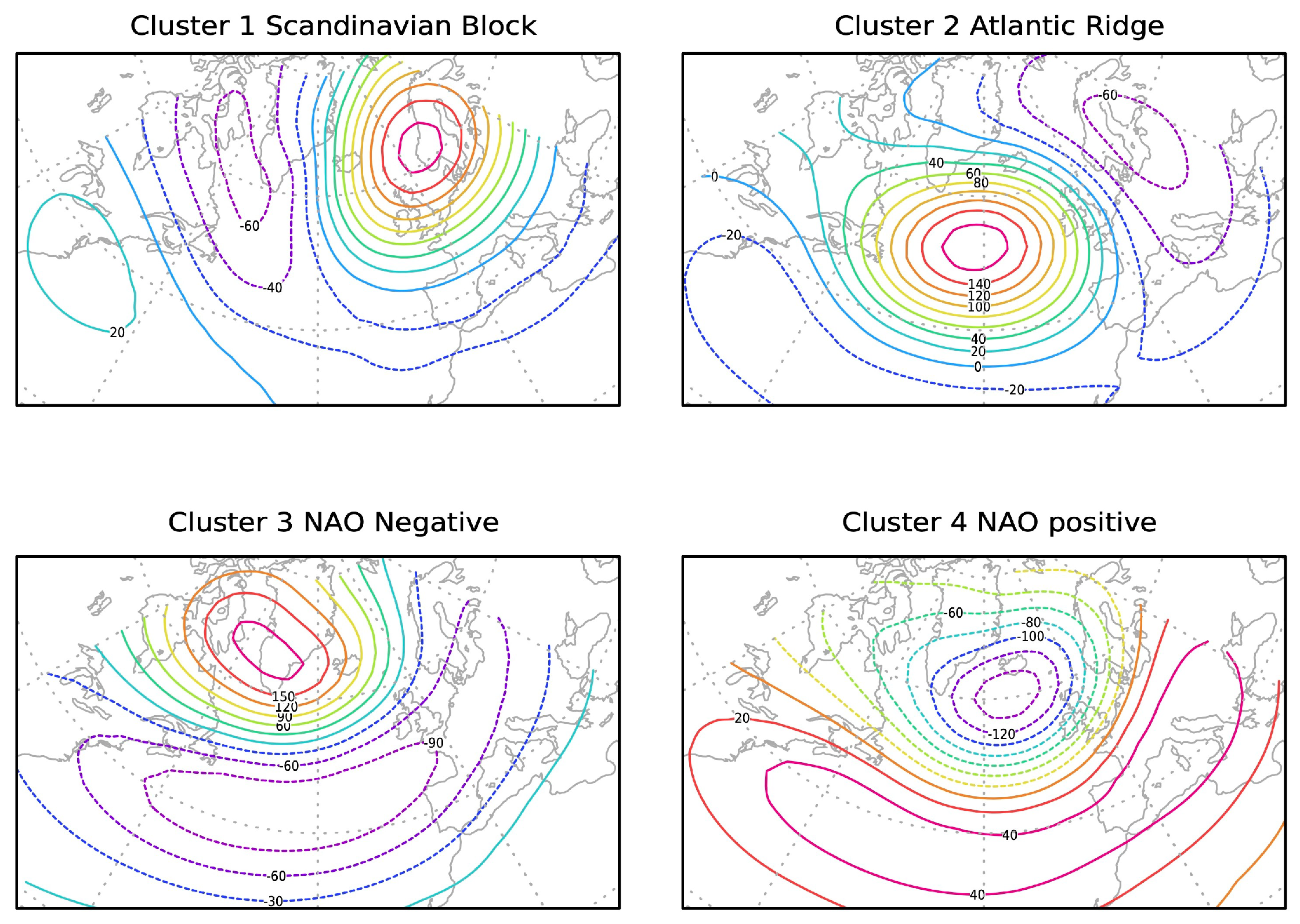
The first two regimes are highly correlated with the positive and negative phases of the well-known North Atlantic Oscillation teleconnection patterns. The NAO+ is characterized by negative height anomalies centered between Greenland and Northern Europe and can be thought of as a strengthening of the semi-permanent Icelandic Low. The NAO− regime has above normal height anomalies between the North American Maritimes and Greenland, with a southward shift of the North Atlantic storm track and below normal heights over the Central Atlantic and Western Europe. The last two regimes are the Atlantic Ridge, which exhibits above normal height anomalies across the entire North Atlantic, and the Scandinavian Blocking, which is characterized by a positive height anomaly centered over the Scandinavian region of Northern Europe. The NAO+/− is highly correlated with and can be thought of as a manifestation of the Northern Annular mode, also known as the Arctic Oscillation [66,67].
The dataset used for analysis and evaluation was the European Centre for Medium-Range Weather Forecasts (ERA-Interim, hereafter ERAI) reanalysis, Dee et al. [68], for the 35 boreal winters from 1980/81 to 2014/15. The winter season was defined as the 132 days starting from 16 November. The software used to do these calculations and all others in this paper was Fortran 77, compiled with the Intel 2020.2 compiler on the Hopper Cluster of the Office of Research Computing at George Mason University. Regimes are identified using cluster analysis (k-means) applied to 500 hPa height fields (Z500) for boreal winter. The k-means clustering method takes a set of states in a reduced-dimensional phase space and clusters them around k centroids. The algorithm iteratively repositions the centroids until the variance ratio R is maximized: R is the ratio between the variance of the cluster centroids (weighted by the cluster population) to the sum of the Euclidean squared distance between each state and the centroid to which it is assigned. The larger R is, the more the data can be separated (partitioned) into distinct clusters. See Michelangeli et al. [64] and Straus et al. [20], as well as Appendix A, in which the method of assessing statistical significance is given.
To apply cluster analysis to boreal winter Z500 fields, the following steps are taken: the data are filtered using 5-day running means to remove the most rapidly evolving synoptic systems. The seasonal cycle is estimated by fitting the evolution of Z500 at each grid point with a parabola in time, then averaging the parabola over all years considered [69]. (We will consistently refer to the 5-day running means as days, with the understanding that each day refers to the middle day of a running 5-day mean.) Subsequently, principal component analysis is applied to the unnormalized data. The resulting variates (principal component time series) form the coordinates in an N-dimensional phase space, where N is the number of modes retained. N is chosen to capture about 80 percent of the spacetime variance, which led to a choice of N = 12.
The k-means clustering method is one of a class of partitioning methods in which each state (day) is assigned to a unique cluster. Since k must be chosen a priori, its choice is ambiguous. We limit the choice of k by requiring a high degree of significance (see Appendix A), yet low enough to provide robust statistics. The choice of k = 4 is consistent with much of the previous literature, for example, Cassou [22] and Ferranti and Corti [70].

2.2. How Are Regime Transitions Defined?

The criterion used by the k-means algorithm to assign a state to a particular cluster (regime) is based on the Euclidean distance in PC-space, corresponding to the mean-squared error. To focus on states closest to the cluster centroid, we consider only those with high pattern correlation with the regime centroid.
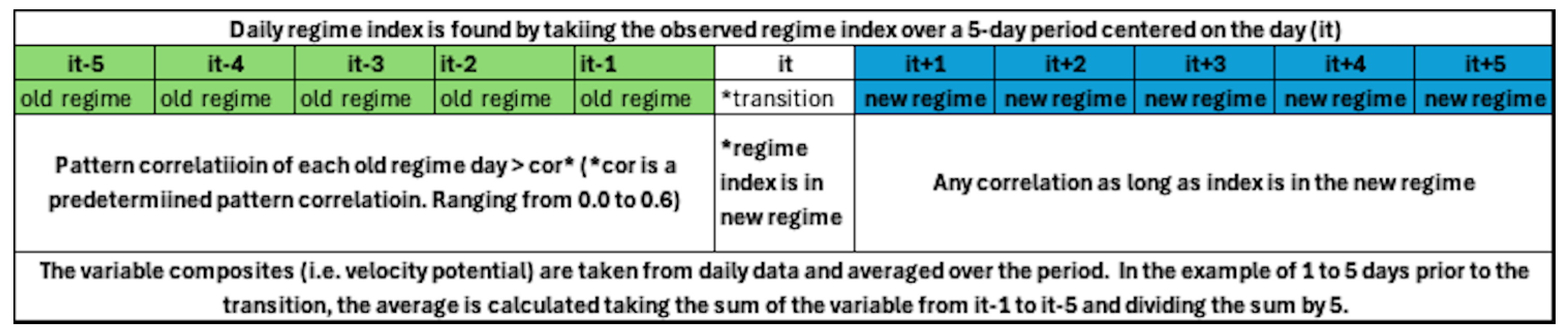
Regime transitions are defined using the following criteria, as shown in Figure 2: The prior regime must persist for at least 5 days and be correlated to the centroid by a predetermined correlation coefficient threshold ranging from 0.0 to 0.6 (green boxes). Once a transition has occurred and the atmosphere is in a new regime (red box), it must persist in that regime for at least 5 days (blue boxes). We have not put a requirement on the pattern correlation for the new regime but have verified that a requirement of 0.4 pattern correlation with the new centroid for the first five days of the new regime does not markedly reduce the number of transitions considered.
This method of identifying regime transitions focuses on states that correspond closely to one of the patterns shown in Figure 1 and so would be readily identified by a forecaster. Although we will consider composites of heating and streamfunction up to 20 days before the transition in the following sections, we do not require that the system remain in a single regime over the entire time span, as this would drastically reduce the number of transition episodes and severely limit statistical significance.

2.3. Diabatic Heating

We consider both tropical and mid-latitude diabatic heating. Tropical heating is due to convection that may be related to the Madden–Julian Oscillation [31], areas of tropical convergence such as the Intertropical Convergence Zone (ITCZ) and the South Pacific Convergence Zone, and convection associated with warm ocean temperature anomalies water during the El Niño and Southern Oscillation (ENSO). Mid-latitude diabatic heating, particularly over the oceans, is due primarily to extra-tropical baroclinic disturbances, and is taken as an indicator of the storm tracks.
The diabatic heating is estimated from four times daily circulation and thermodynamic fields from the ERAI reanalysis at full horizontal resolution ( 512 × 256 Gaussian grid) and at 37 pressure levels, using a residual method similar to that of Hagos et al. [71]. Specifically, the heating rate Q is obtained from
c p 1 Π θ t + · ( v θ ) θ ( · v ) + ω θ p = Q
Here, θ is potential temperature, p is pressure, ω = d p / d t , c p the specific heat at constant pressure, v the horizontal velocity, and Π = p p 0 R / c p is the Exner function, where p 0 = 1000 hPa and R is the specific gas constant of dry air. The heating was vertically integrated over the atmospheric column from 1000 hPa to 50 hPa. In order to focus on the large-scale component of diabatic heating, the vertically integrated heating is filtered to retain only zonal waves 0–3. This planetary wave heating is denoted by PW.

2.4. Composites of Diabatic Heating and Streamfunction Preceding the Regime Transitions

To determine the change in diabatic heating before a transition from regime A to regime B, the difference between the heating in the pentad prior to the transition and the composite of heating taken over all occurrences of regime A is taken. This procedure is repeated for the periods 6–10 days, 11–15 days, and 16–20 days before the transition. For the longer leads (e.g., 16–20 days), the system might be in a regime other than regime A. For clarity, we also show the anomaly of PW heating in the regime being transitioned from (here Regime A), where the anomaly is constructed with respect to the climatological heating.
Anomalies of the streamfunction ( ψ ) at 300 hPa and Rossby wave activity [72] are defined in the same manner.

2.5. Assignment of MJO Phases Before Transitions

The Madden–Julian Oscillation (MJO), Madden and Julian [31], is an envelope of eastward-propagating convection originating in the Indian Ocean and reaching the central Pacific, with a lifecycle spanning roughly 30 to 80 days. The MJO explains roughly 25% of the tropical variance in circulation and heating [46]. Changes in the likelihood of occurrence of regimes in the Euro-Atlantic region have been attributed to (and follow in time) the tropical diabatic heating associated with different phases of the MJO in observational and modeling studies [22,47,48,49,50]. The interaction may also go the other way, with two of the circulation regimes (NAO+ and NAO−) associated with subsequent MJO phases [47], implying mid-latitude forcing of MJO heating.
We compute the average of the MJO indices (RMM1 and RMM2) for each of the 5-day periods prior to a transition (1–5 days, 6–10 days, 11–15 days, 16–20 days). These indices are taken from the NOAA Physical Sciences Laboratory (https://psl.noaa.gov/mjo/mjoindex/rmm_star_data.txt, accessed on 1 July 2019) and correspond to the leading two principal components of combined outgoing long-wave radiation and zonal winds at 850 and 200 hPa, following Wheeler and Hendon [46]. The average values of RMM1 and RMM2 were computed for each 5-day period, and the average amplitude and phase of the MJO were derived from these. Then, for each regime transition, we construct a histogram of the frequencies of occurrence of each phase before that transition.

2.6. Determination of Warm and Cold ENSO Events

The determination of warm and cold events associated with ENSO utilizes the Niño 3.4 anomalies of sea surface temperature (SST). This index represents SST anomalies near the equator (5° N to 5° S) from near the dateline (170° W to 120° W). The index was taken from the HadlSST1 dataset [73] (https:/hadleyserver.metoffice.gov.uk/hadisst/data/download.html, accessed on 1 July 2019). We consider values of −1.0 or less to be moderate cold events and +1.0 or greater to be moderate warm events. Values in between are considered neutral. Strong warm (cold) events are associated with a value of the index greater than +1.5 (less than −1.5).

2.7. Determination of the Stratospheric Polar Vortex

The anomalies are obtained by subtracting the parabolic seasonal cycle, whereas in other indices, such as diabatic heating and streamfunction, we subtract the full seasonal mean. To estimate the strength of the stratospheric polar vortex, we use an index that takes the 360° area average over 59°–61° North and divides it by 5.15 m·s−1. This is similar to Roberts et al. [61]. We also examined the 100 hPa level and found similar results.

3. Results

3.1. What Are the Regimes and How Often Do They Occur?

The results of the k-means cluster analysis for 500 hPa geopotential height (for four clusters) in the EA region are shown in Figure 1. The figure shows the composite height field for all days assigned to a particular regime. Table 1 shows the number of regime occurrences where a regime is assigned to each day based on the least mean square distance to the centroid of one of the four regimes. The most frequent regime is NAO+ at 33.77 percent, followed by Scandinavian Blocking at 23.75 percent, Atlantic Ridge at 22.97 percent, and finally NAO− at 19.51 percent. The percent of occurrences are consistent with [22,74], Swenson and Straus [75]. It should be noted that these percentages can vary widely from winter to winter, as seen in Table 2. For example, there were nine winters when the NAO− occurred 10 days or less and six winters when it did not occur at all. Looking at the winter of 1999–2000, the Scandinavian Block regime did not occur at all and the NAO− regime only occurred five times, meaning all the transitions that winter were between the NAO+ and Atlantic Ridge.
There does not seem to be a strong relationship between regime occurrence and ENSO (see Table 1 and Table 2). However, we observe that during very strong El Niño events, the NAO occurs less frequently: during the very strong 1982/83 and the strong 1991/92 El Niño events, there were no occurrences of NAO−. During the 1997/98 warm event, NAO− occurred less than the other three events.

3.2. Persistence of the Euro-Atlantic Regimes?

Table 3 shows the average and maximum persistence for each regime: NAO− was found to be the most persistent, lasting an average of 12.77 days, and the Scandinavian Block was the least persistent, 9.58 days. All regimes persisted for 4 weeks or more at least once over the 35 years. The NAO+ and NAO− have the longest periods of persistence.

3.3. Observed Transitions

First, it should be noted that a regime often persists for fewer than 5 days and may transition to another regime, which may also persist for fewer than 5 days. (Recall that the day in question is the middle day of a running 5-day mean.) We will term these episodes chaotic regimes. There are also many scenarios in which a transition occurs from a chaotic regime to a regular regime, or from a regular regime to a chaotic regime. Finally, there are situations in which a regime lasts for 5 or more days, transitions to a new regime for less than 5 days, and then returns to the original regime. In the ERA-I data (1980–2015), these chaotic situations account for 20.56 percent of all episodes, totaling 950 days.
Preferred transitions have been identified in the literature by Vautard [21], Cassou [22], and others. The regime transitions for correlations greater than 0.4 were tested for significance using the bootstrap method described in Appendix B. As shown in Table 4, only 3 of the possible 12 transitions achieved 95 percent significance. This confirms some of the previously identified preferred paths but also some of the opposite transitions that occur almost as often (see Table 4). The two preferred paths most widely acknowledged are the NAO+ to Scandinavian Block and the Scandinavian Block to NAO−, Vautard [21], Cassou [22]. It should be noted that the NAO+ to NAO− transition does occur but only at correlations below 0.3.
The following are the ERAI significant transitions:
  • NAO+ to Scandinavian Block (Cassou transition)
  • Scandinavian block to NAO− (Cassou transition)
  • Scandinavian Block to Atlantic Ridge
Table 4 shows all transitions with a positive pattern correlation, and the bottom figure is for all transitions with a pattern correlation greater than 0.4. The rows are the previous regime, and the columns are the future regime.
It should be noted that a regime often persists for fewer than 5 days and may transition to another regime, which may also persist for fewer than 5 days. We will term these episodes chaotic regimes. There are also many scenarios in which a transition occurs from a chaotic regime to a regular regime, or from a regular regime to a chaotic regime. Finally, there are situations in which a regime lasts for 5 or more days, transitions to a new regime for less than 5 days, and then returns to the original regime. These chaotic situations account for 20.56 percent of all episodes, totaling 950 days, and are not included in our composites.

3.4. Regime Composites of Heating and Streamfunction

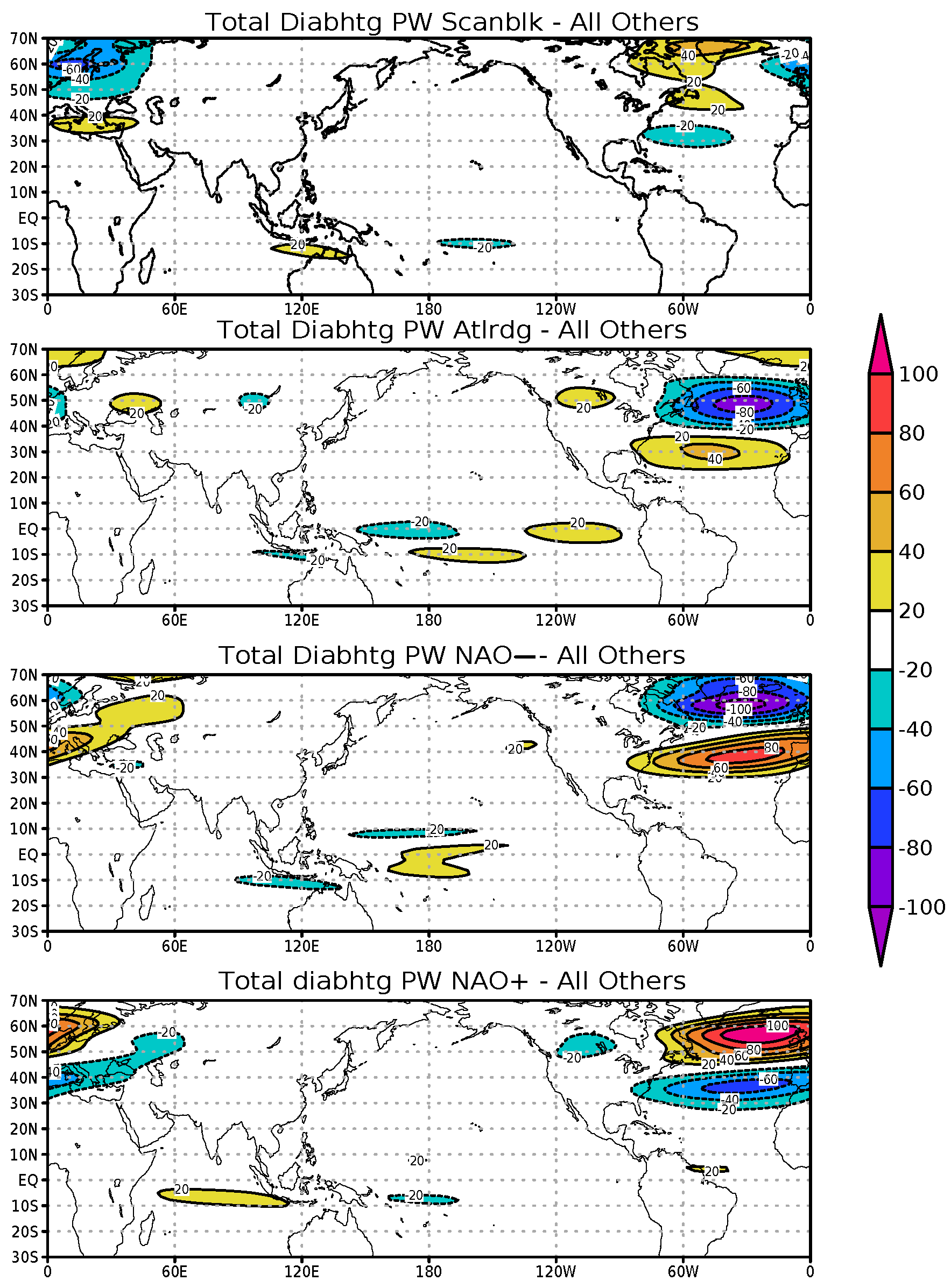
Figure 3 shows the diabatic heating for each of the EA regimes subtracted from the total of all the other regimes. Extra-tropical heating anomalies are proxies for storm-track shifts, so for the Scandinavian Block, the storm tracks are shifted westward and poleward (consistent with storms going north of the blocked region). In contrast, the significant shift for the Atlantic ridge is a southward shift of the storm tracks. NAO+/− stormtrack shifts are well-known.
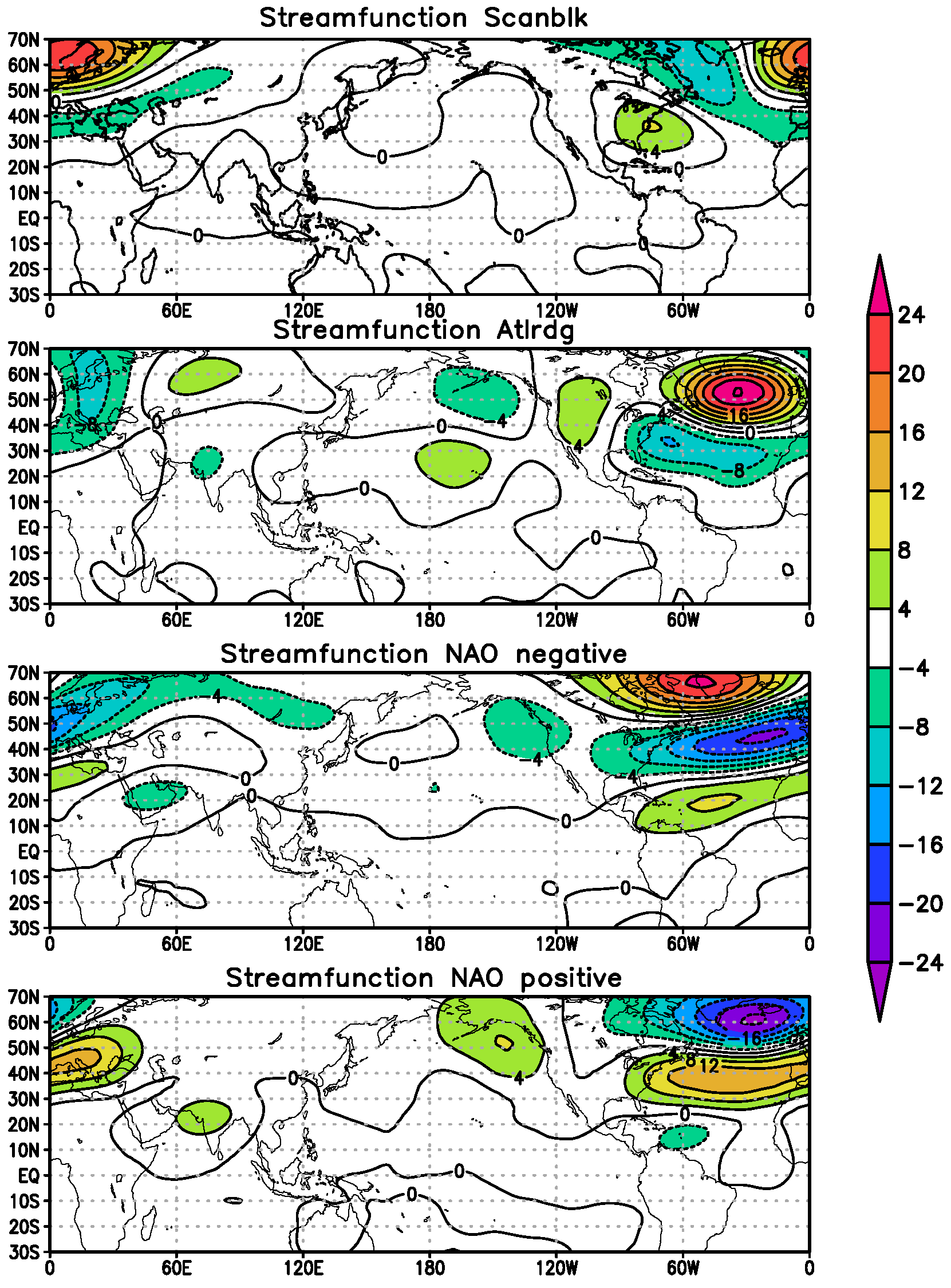
Figure 4 shows the streamfunction anomalies for each regime with respect to the climatology of the other regimes. Nearly all of the strong anomalies are confined to the EA region. Extra-tropical heating anomalies are proxies for storm-track shifts, so for the Scandinavian Block, the storm tracks are shifted westward and poleward (consistent with storms going north of the blocked region). In contrast, the significant shift for the Atlantic ridge is a southward shift of the storm tracks. NAO+/− stormtrack shifts are well-known.

3.5. Anomalies Associated with Individual Regime Transitions

The following figures show composites for each individual transition, highlighting changes prior to the transition from one regime to another. For the three transitions shown (we examined all 10 transitions), we show composites of diabatic heating, streamfunction, and Rossby wave activity. We also show a MJO phase histogram and relationship to warm and cold events for each transition.
The first set of figures shows differences in vertically integrated heating prior to the transition (1–5 days, 6–10 days, 11–15 days, 16–20 days) minus the seasonal mean heating in the regime being transitioned from. Such differences are called pre-transition anomalies. (By definition, the pre-transition anomalies 1–5 days prior to the transition should be close to zero.) For each figure, the left-hand set of panels shows the pre-transition anomalies, while the right-hand set of panels shows the anomalies of heating with respect to the full seasonal mean. In addition, the same format is used to display the 300 hPa streamfunction and Rossby wave activity.
For each transition, we also show histograms of the relative frequency of MJO for different periods preceding the transitions, as well as a histogram of the frequency of warm and cold ENSO events.

3.5.1. NAO+ to Scandinavian Block Transition

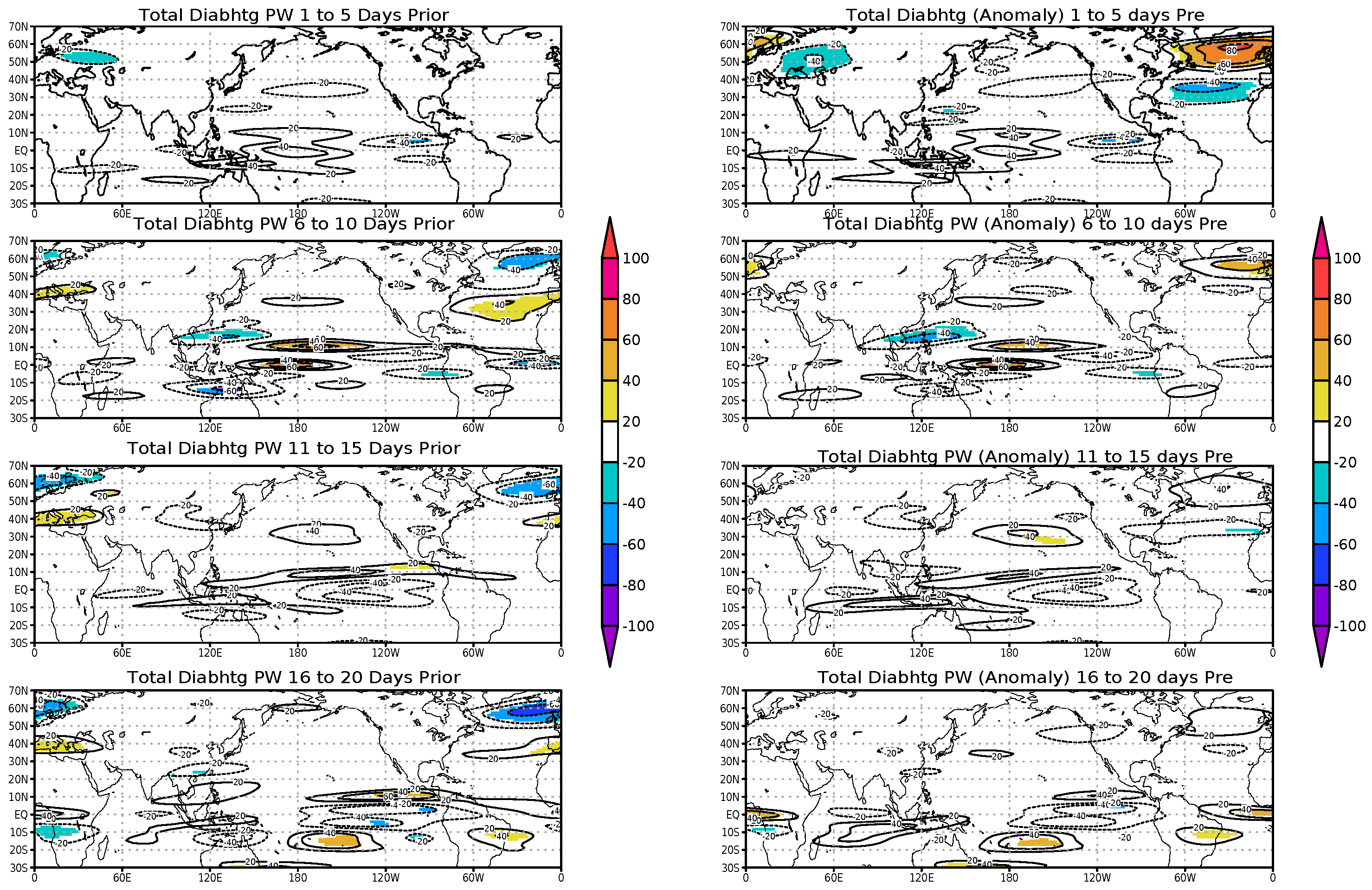
Figure 5 shows the pre-transition heating for the NAO+ to Scandinavian Blocking transition. This is one of the transitions identified as preferred by Cassou [22]. Small areas of heating in the central Pacific, mostly north of the equator, but significance is achieved only at 6–10 days prior. Heating in the storm track regions of the North Atlantic shows the shift of the storm tracks northward to the west of where the block will occur.
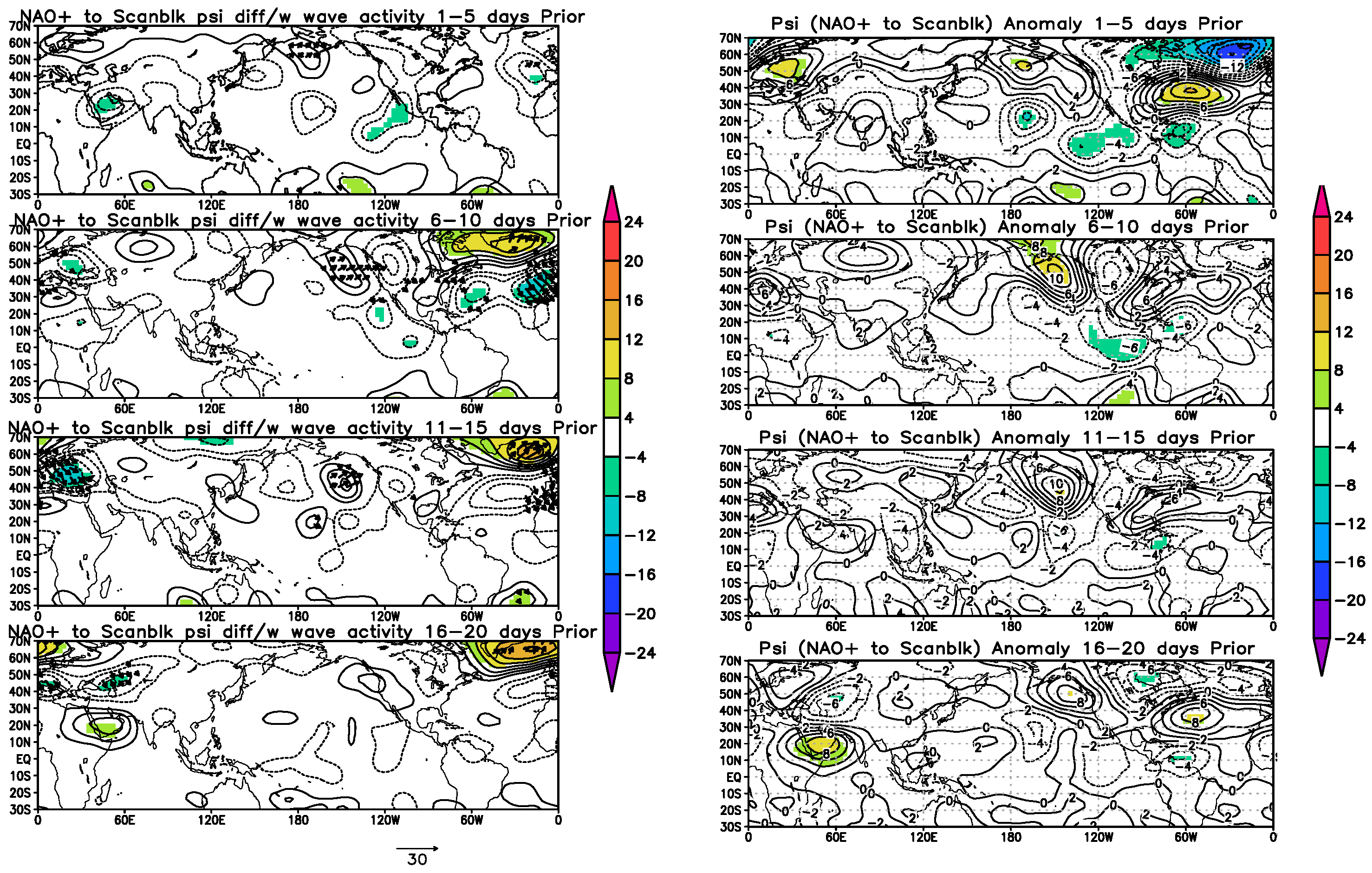
The maps shown in Figure 6 are very quiescent in the tropics in terms of streamfunction and wave activity. Note that the anomaly 1–5 days prior is weaker than the overall NAO+ anomaly (Figure 4), indicating the weakening of the NAO+.
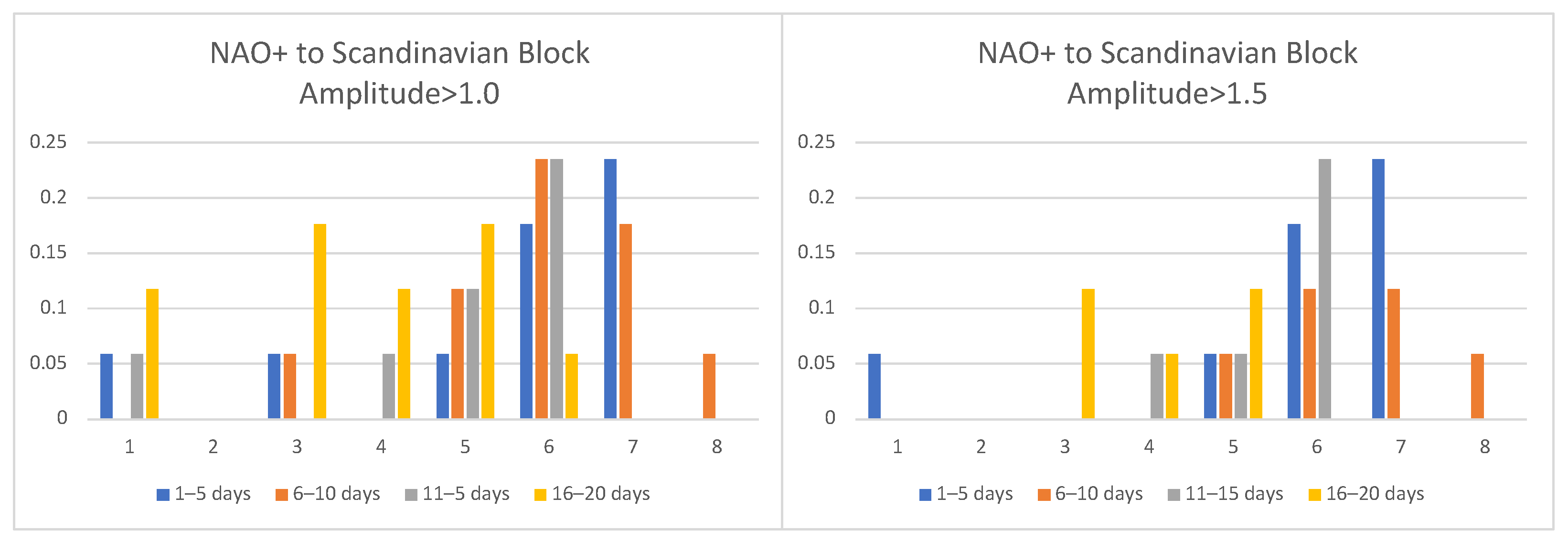
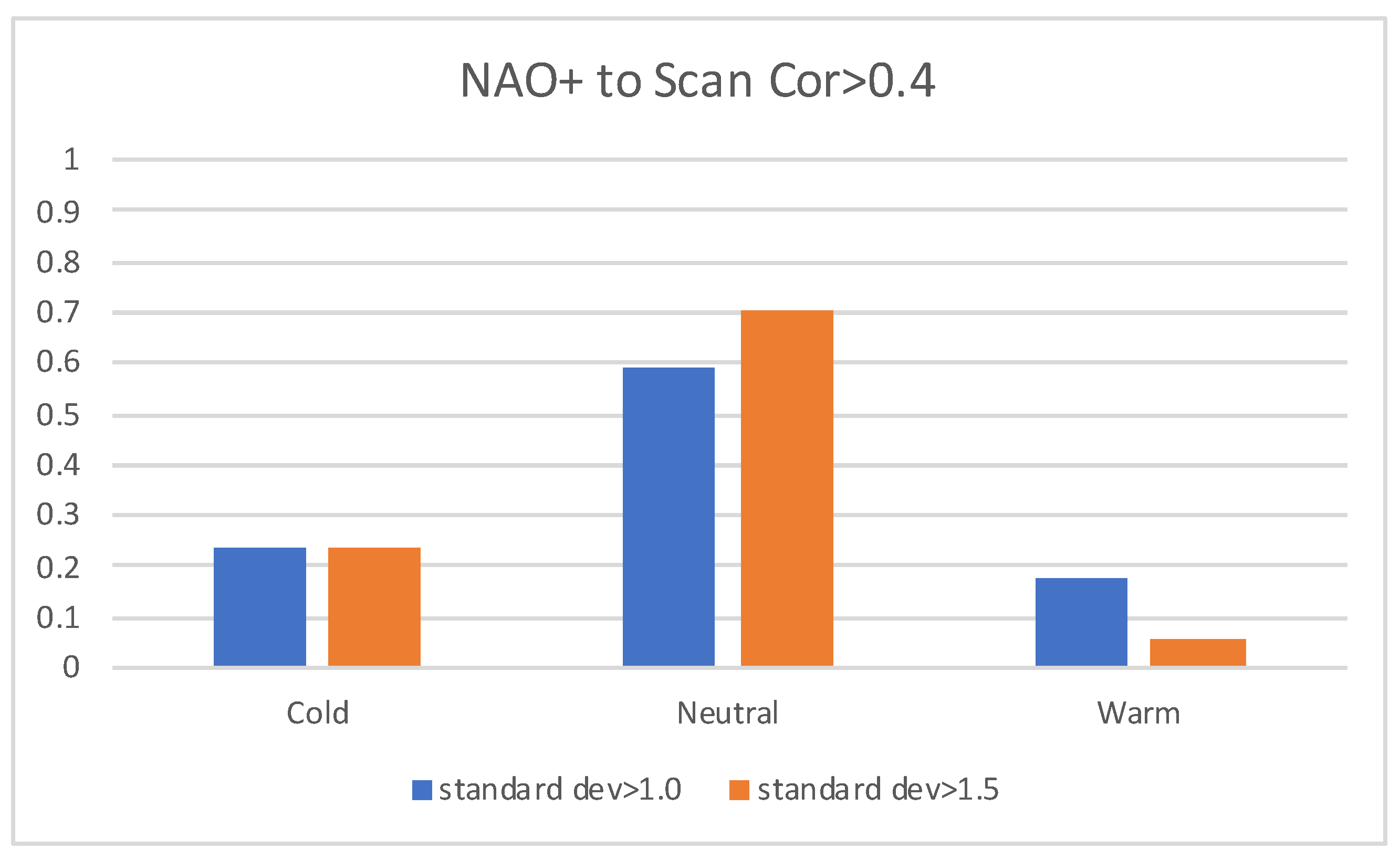
Figure 7 and Figure 8 indicate that while many of the phases of MJO participate, there is a strong preference for later phases. All phases of ENSO (although more than half are neutral) participate, but this transition shows no preference for warm or cold events.

3.5.2. Scandinavian Block to NAO− Transition

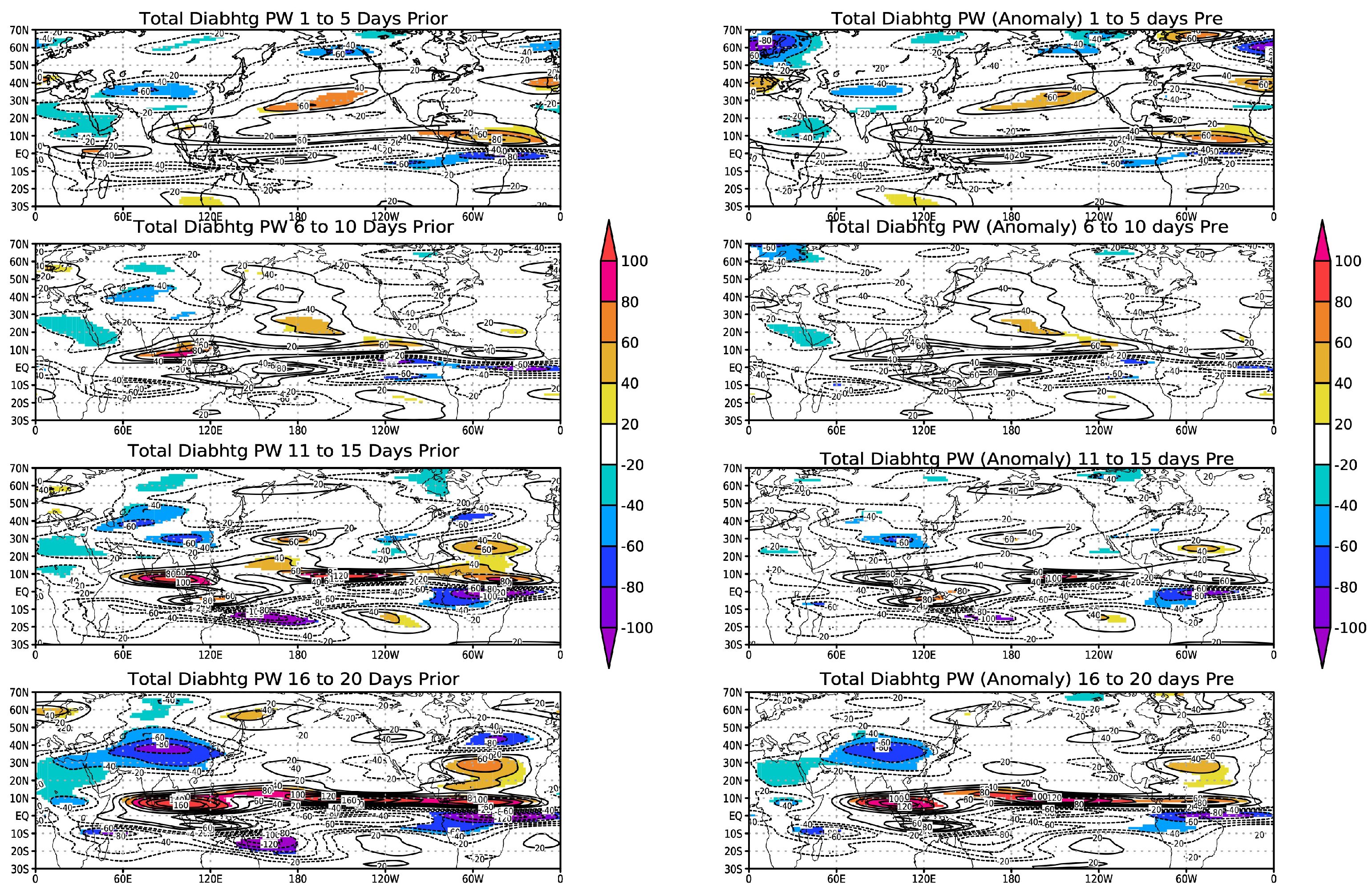
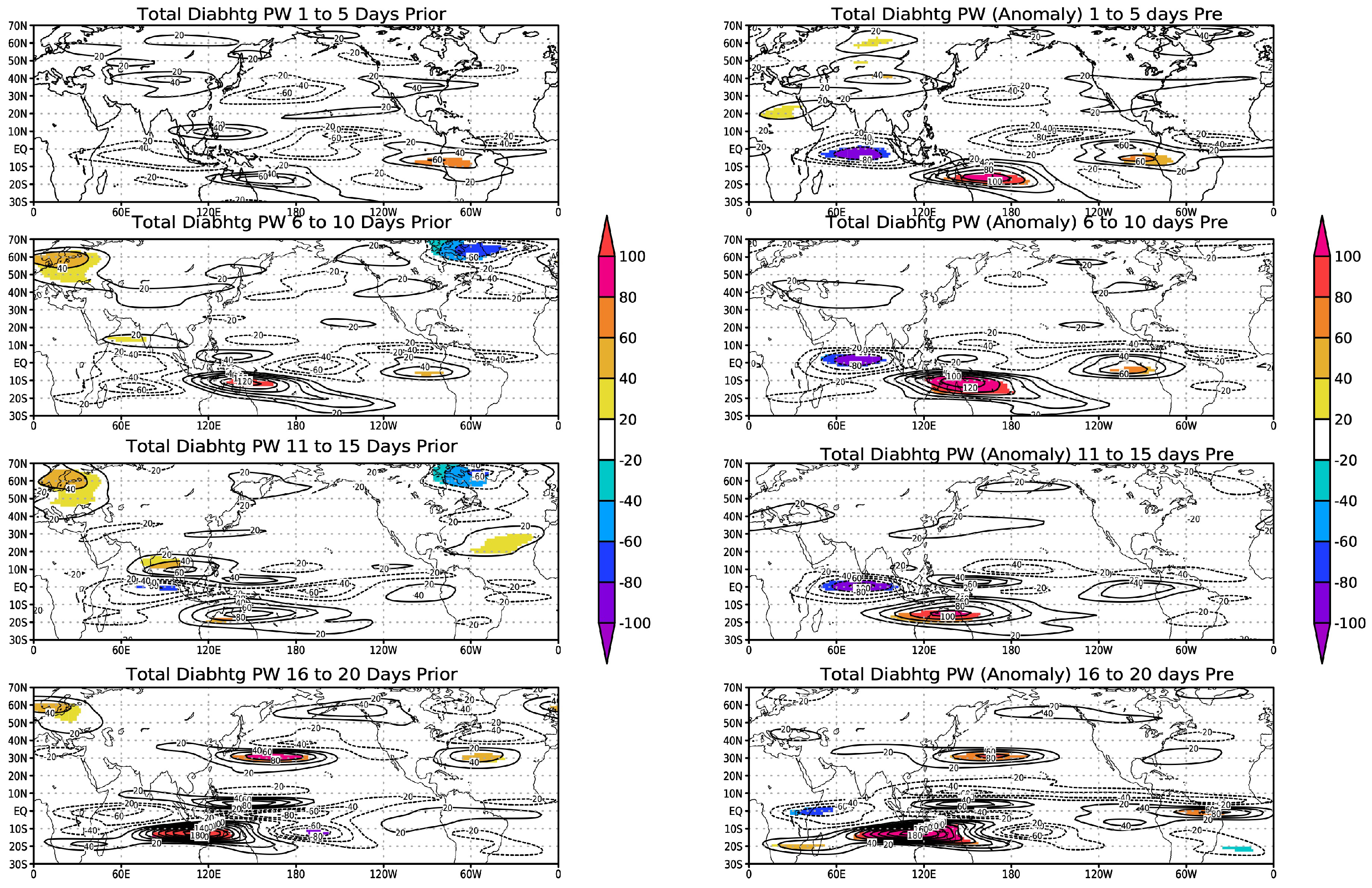
Figure 9 shows strong tropical heating in the Indian and Atlantic Oceans in both the difference and anomaly plots 1–5 days prior to the transition. Very strong heating is observed in the tropical Indian, Pacific, and Atlantic Oceans for several days prior. (In fact, this tropical heating is the strongest for all the transitions.) Heating over the eastern Pacific is observed in 7 of the 9 episodes used to construct these composites, including neutral and cold ENSO years).
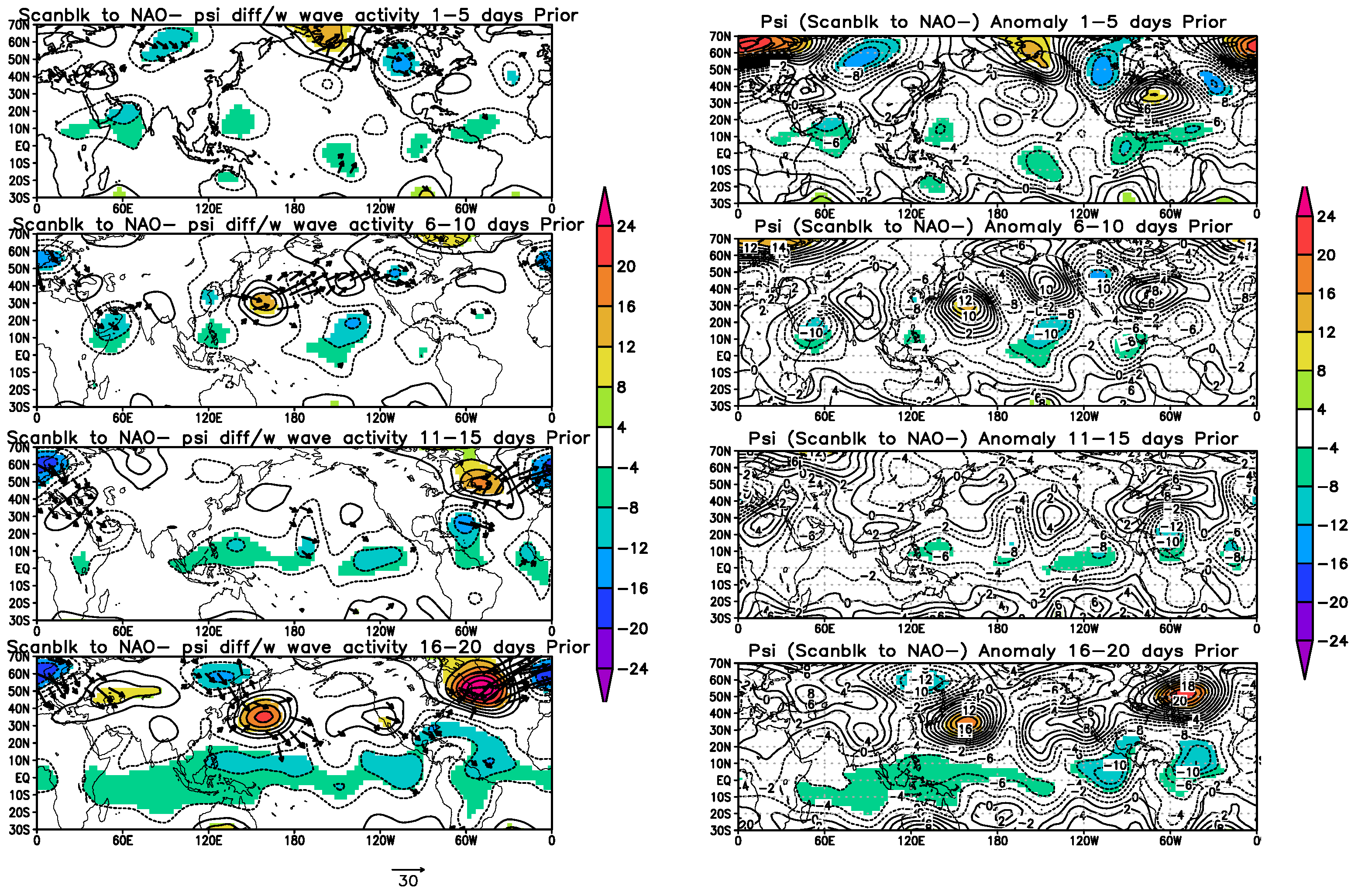
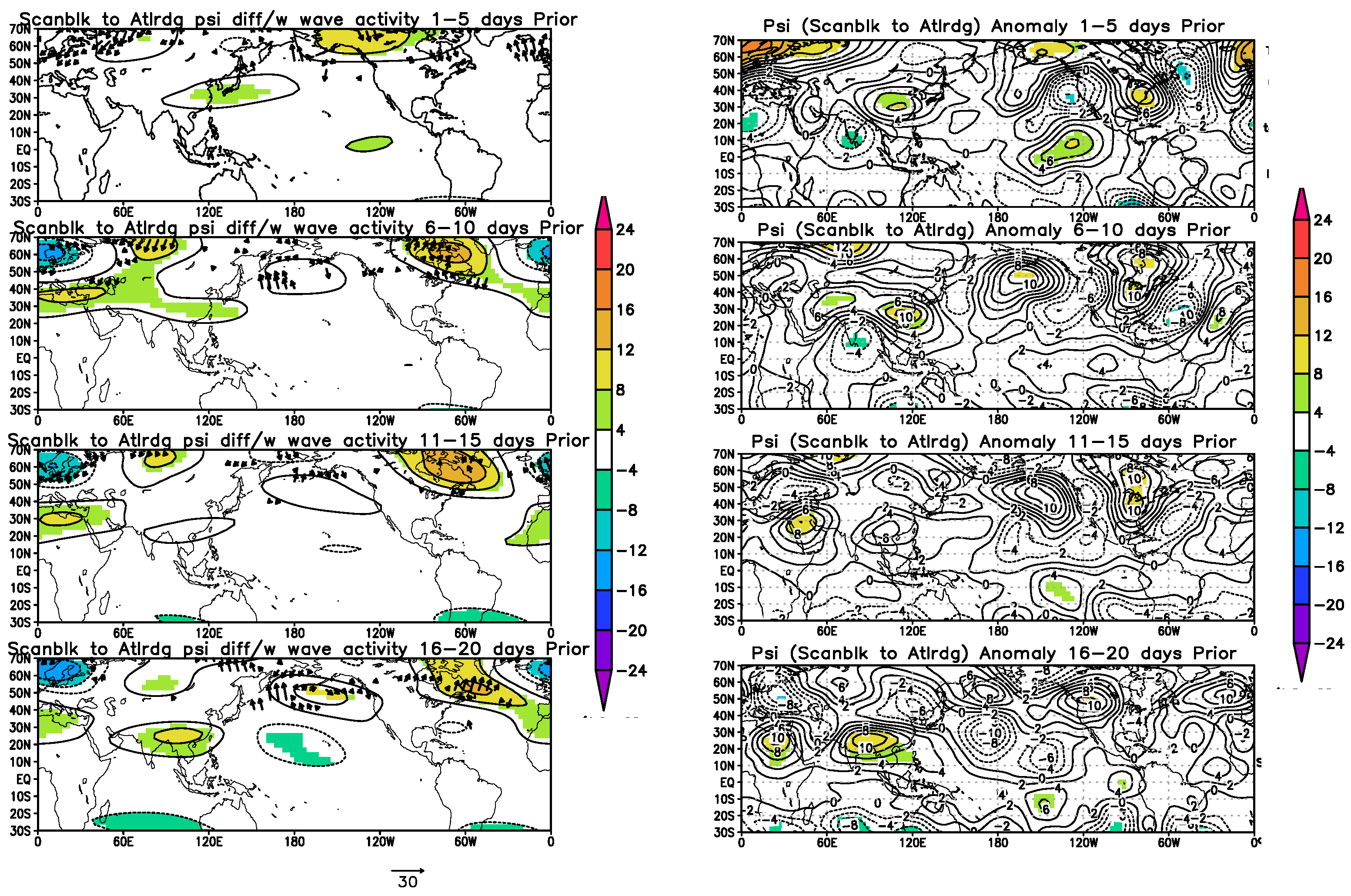
Figure 10 shows that the streamfunction anomalies show the Scandinavian Block in place 1–5 days prior to the transition. The streamfunction differences and associated wave activity show a strong eastward and equatorward propagation into the northern tropics 6–15 days prior and strong wave activity emanating from the mid-Pacific at around 35° N over North America into the Atlantic at 1–10 days prior to the transition.
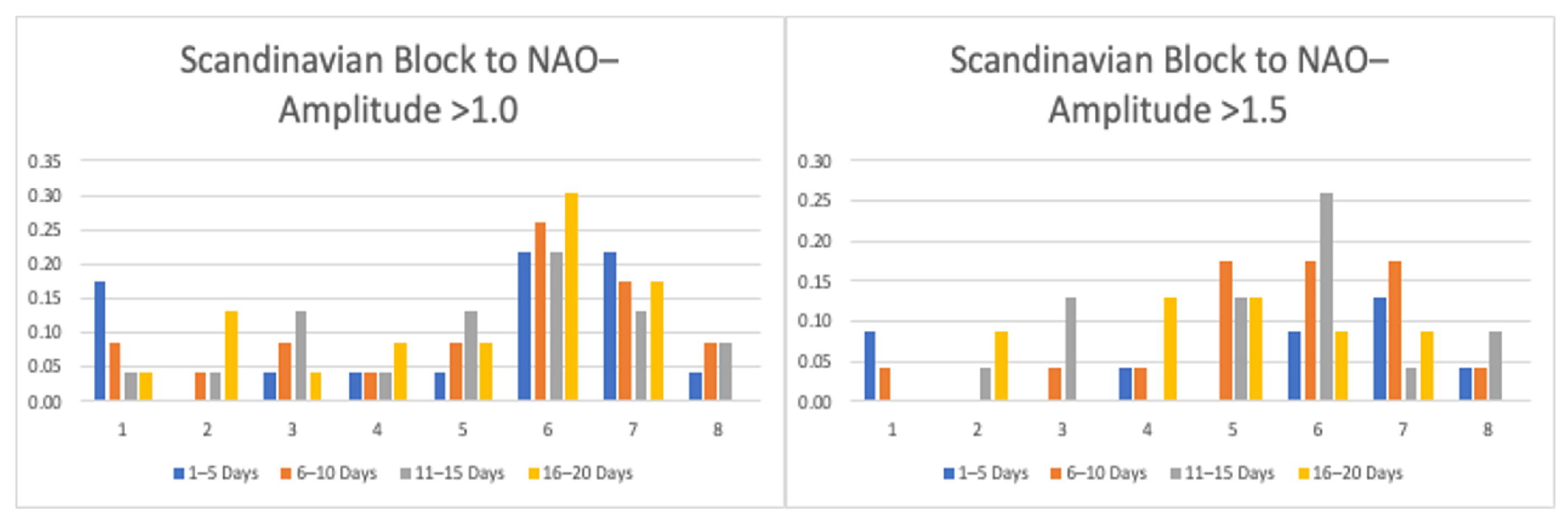
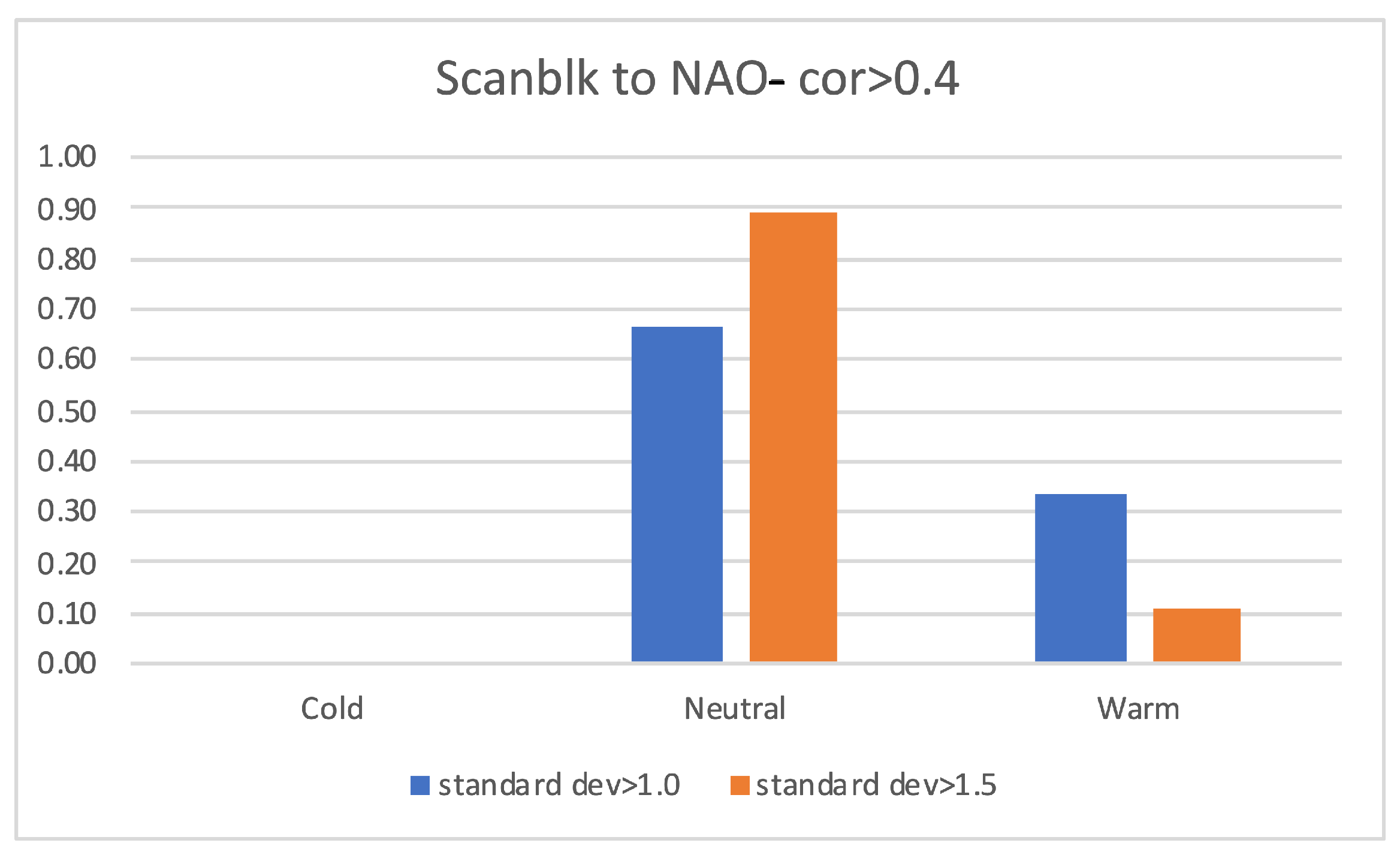
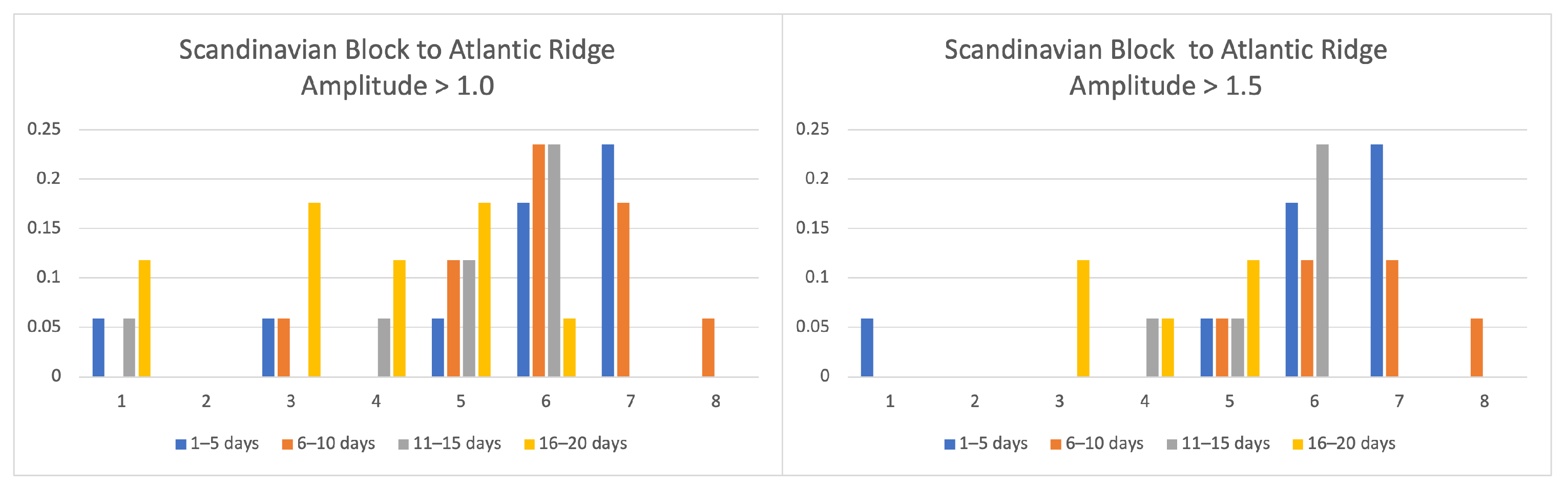
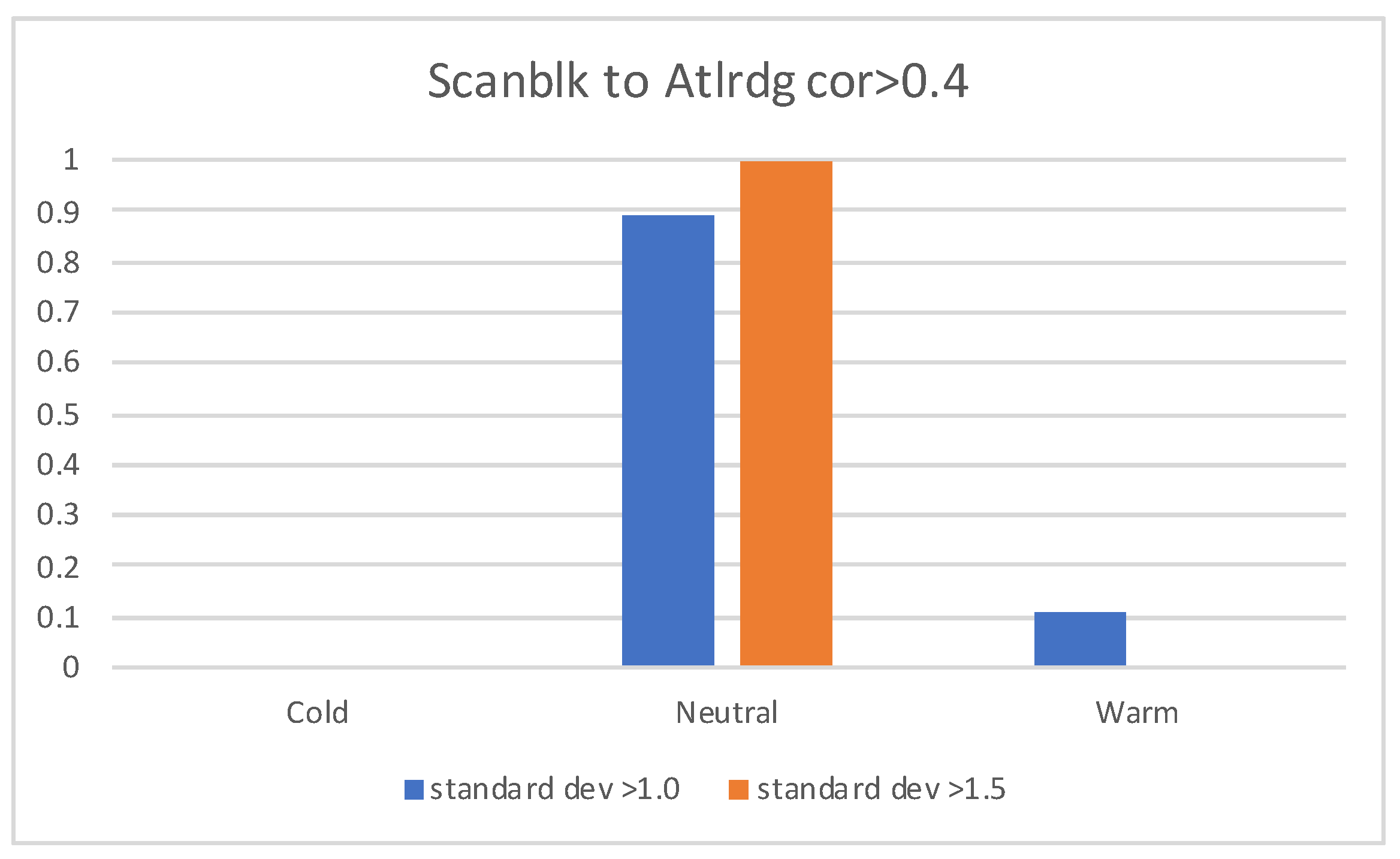
Figure 11 shows all phases of the MJO participate, but there is some preference for later phases. As shown Figure 12, most transitions occur during ENSO-neutral years, with only a few occurring during warm years.

3.5.3. Scandinavian Block to Atlantic Ridge Transition

In the heating difference and anomaly maps shown in Figure 13, a region of heating in the western Pacific at about 15° S is seen for all lags, although it becomes less significant as the lag decreases. In the high latitudes, the difference pattern shows heating over Northern Europe and cooling off the coast of Newfoundland. This is the opposite of the seasonal mean pattern of heating prior to the Scandinavian Block regime, indicating a pre-transition weakening of the Block regime.
The corresponding streamfunction difference and anomaly maps, along with the Rossby wave activity, for the Scandinavian Block to Atlantic Ridge transition are shown in Figure 14. With the exception of the North Atlantic, the difference between the pre-transition days and the normal Scandinavian Block has a pattern very similar to the anomalies (right figure). The difference plots show the dissipation of the Scandinavian Block (20 to 6 days prior) and then the beginning of the formation of the Atlantic Ridge at 1–5 days prior to the transition. The decay of the Scandinavian Block, 16–20 days, is associated with strong wave activity from Northern Canada. Looking at the anomaly 1–5 days prior to the transition, it is somewhat more diffuse than the total Scandinavian Block anomaly. Wave activity propagates from Northern Europe eastward and equatorward towards mid-latitudes but does not reach the subtropics. This is consistent with little diabatic heating seen north of the equator.
The MJO histograms shown in Figure 15 show that all phases of the MJO are represented, although a preference for the later phases (5–7) is evident for strong MJO events. Figure 16 shows that most of these transitions occur during neutral ENSO years.

3.5.4. Stratospheric Results

Our results using the ERA-I data at the 50 hPa level and the average zonal wind anomaly (with the full winter parabolic seasonal cycle subtracted) showed that prior to almost all transitions, the stratospheric polar vortex was neutral as seen in Table 5. As expected, the SPV prior to transitions from the NAO+ was slightly above normal. We also found that before transitions from the NAO−, the SPV was slightly below average. Of note was the Scandinavian Block to NAO− transition, which showed a clear decrease in the strength of the SPV from 20 days prior to just before the regime transition.

4. Discussion

The preferred transitions found were in agreement with previous work by Vautard [21] and Cassou [22]. The term “preferred” in this context means that the transitions occur more often than would be expected on the basis of the frequency of occurrence of the regimes. Using the ERAI dataset, only three regime transitions were found significant at the 95 percent level. They were the two transitions we term “Cassou transitions” (NAO+ to Scandinavian Block and Scandinavian Block to NAO−) and the Scandinavian Block to Atlantic Ridge.
As presented in Section 1, prior research indicates a strong relationship between some Euro-Atlantic regimes and the MJO [22,47,49,52], among others. We determined the MJO relationship in two ways:
  • Histograms of phase using the real-time multivariate index of Wheeler and Hendon [46] to determine the phase and amplitude of the MJO.
  • Subtracting the first two principal components of tropical heating and zonal wind for 850 hPa and 200 hPa that represent the MJO (see Appendix C).
The latter method shows almost no change in tropical heating preceding any transition. The difference between the two methods is that the index depends on an assumed linear relationship of the heating on the circulation.
The histograms (first method) show that only the transitions to NAO+ (specifically, Scan Block to NAO+), the transitions to NAO−, and the NAO+ to Atlantic Ridge transition have any coherent MJO signal. For the transition to NAO+, we see an increase just prior to phases 2 and 3. For the NAO− transitions, we see increases prior to phases 6–7. It should also be noted that despite the apparent relationship in the histograms, the frequency of any one phase does not exceed 30 percent in almost all cases.
We examined the two Cassou transitions in terms of tropical heating generally and specifically to see if there was a relationship with the MJO. The NAO+ to Scandinavian Block transition (Figure 5) shows some areas of diabatic heating in the central Pacific that do not seem to be moving in an eastward direction as would be expected if associated with the MJO. This transition seems to be forced from mid-Pacific, (starting 6 to 10 days prior), but perhaps this is partly due to Indian Ocean heating that forced the NAO+ propagating eastward.
Finding that the MJO influence on mid-latitude blocking (Scandinavian Block and NAO−) is relatively weak on interannual time scales, ref. [76] point out that on shorter time scales, early MJO phases are associated with weakened blocking over Europe and late phases are associate with strengthened blocking over Europe, in agreement with [22] and Henderson et al. [43].
When we look at the second Cassou transition, Scandinavian Block to NAO− in Figure 9, we see a large area of significant heating covering much of the tropics. We have determined that the ITCZ in the Atlantic shifts southward as the winter progresses and that this transition occurs mainly during the first half of the winter. Perhaps this northward shift plays a role in increased moisture in the Atlantic Storm Track. Quoting from [22],
“There is evidence that a destabilized atmosphere due to enhanced moisture located upstream from the North Atlantic storm track favors CWB (Cyclonic Wave Breaking) in agreement with our findings, and could thus be an additional contributor to NAO− occurrence.”
In addition to Cassou, ref. [43] found that prior to phase 6, a negative PNA pattern may serve as a waveguide that redirects Rossby wave energy toward Europe (also see Branstator [77]). The presence of significant heating 11–15 days prior to the transition shows that tropical forcing in the eastern Pacific is involved. This is completely consistent with the Rossby wave source seen in [22] at 25° N 110° W. Again, we quote Cassou [22]:
“The second mechanism proposed for teleconnection between MJO and NAO− relies on direct tropical forcings originating from the eastern Pacific. At short lag time, although the anomalous convection is weak, phase 6 is associated with tropical upper-level divergence around 120° W, leading to advection of absolute vorticity by the MJO divergent tropical outflow and to enhanced momentum convergence around 30° N. This picture is consistent with there being a Rossby wave source around 20° N, 110° W (Cassou [22]) that initiates a downstream wave train propagating northeastwards towards Europe”
It should be noted that our research has several limitations. Using only 35 years of reanalysis and limiting the transitions to the most robust pattern correlations, the data remain sensitive to uncertainties in estimates of diabatic heating and other parameters. This is also true for the transitions themselves. We also looked only at the boreal winter, so our conclusions may not apply to other seasons.

5. Summary

We have investigated the interactions between the tropics and extratropics in the context of the Euro-Atlantic (EA) circulation regimes and their transitions during boreal winter. The background tropical (planetary wave) diabatic heating anomalies, defined as the heating associated with any one of the four EA regimes minus the average heating in all other regimes, lie in the range of 40–60 W·m−2 in the central Pacific. For transitions from each regime, we form one type of anomaly by taking the difference between the heating prior to the transition and the background heating of the regime being transitioned from. Such tropical heating anomalies are much stronger for periods up to 20 days prior to “well-defined” transitions. Such transitions are defined to occur when the atmospheric circulation anomaly has a pattern correlation of at least 0.40 (and on average over 0.60 ) with one regime for the 5 days prior to a transition into a second regime, in which the atmosphere remains for at least 5 days. The sequence of heating anomalies depends on the particular group of trajectories. The following summary is organized by which regime is being transitioned from, that is, from the point of view of making a forecast transition from a known regime:
  • NAO+ to Scan Block transitions (preferred): Small areas of heating in the central Pacific, mostly north of the equator, but significance is achieved only at 6–10 days prior. Heating in storm track regions in the North Atlantic shows decay of the storm track in preparation for blocking. The tropics are very quiescent in terms of streamfunction and wave activity. It should be noted that the anomaly 1–5 days prior is weaker than the overall NAO+ anomaly, so that NAO+ weakens. All phases of MJO participate, as well as all phases of ENSO (although more than half are neutral). Local dynamics (including synoptic eddy fluxes) may play a role in this path to blocking onset, but tropical forcing does not.
  • Scan Block to NAO− transitions (preferred): Strong, statistically significant, heating anomalies appear in the central and eastern Pacific 11–20 days before the transition, with less heating in the equatorial Atlantic and Indian Oceans just north of the equator for 11–20 days before the transition, but diminish in size and scope as the transition is approached. A significant dipole of Atlantic diabatic heating/cooling at around 30° N/50° N, is seen 11–20 days before the transition. Wave activity flux vectors for ranges of 6–15 days prior show strong propagation from high latitudes equatorward into the Indian Ocean, indicating that the mid-latitude dynamics preceding these transitions contribute to the Indian Ocean equatorial heating. While all phases of the MJO (as defined by the conventional Wheeler–Hendon index) may be found in examples of this transition, there is a preponderance of Phases 5 to 7 (heating in the Pacific Ocean). The apparent role of Pacific Ocean heating anomalies 6–15 days ahead of these transitions is consistent with previous MJO-focused studies showing the NAO− occurrence peaking after Pacific Ocean convection. The involvement of the equatorial and mid-latitude Atlantic heating is new.
  • Scan Block to Atlantic Ridge transitions (preferred): A region of heating in the western Pacific at about 15° S is seen for all lags, although it becomes less significant as the lag decreases. In high latitudes, looking at the difference pattern, there is heating over Northern Europe and cooling off the coast of Newfoundland, which is just the opposite of the climatological pattern of heating prior to the Scandinavian Block (SB), as would be expected (Figure 13). The difference between the pre-transition days and the normal SB has a pattern very similar to the anomalies from climatology, except in the EA regions. The difference plots show the dissolution of the SB (days 20 to 6 prior), and then the beginning of the formation of the Atlantic Ridge at 1–5 days prior. The decay of the Scandinavian Block at 16–20 days is associated with strong wave activity from Northern Canada. The anomaly 1–5 days prior is somewhat more diffuse than the total Scandinavian Block anomaly. Wave activity propagates from Northern Europe eastward and equatorward towards mid-latitudes but does not reach the subtropics, consistent with little heating north of the equator. All phases of the MJO are represented, although a preference for the later phases (5–7). Most of these transitions occur during neutral ENSO years.

6. Conclusions

A substantial amount of previous work has been focused on the MJO-related forcing of the NAO-related Euro-Atlantic regimes, while the processes leading to transitions between regimes have been largely studied from a mid-latitude point of view. Almost no connection has been made between these two schools of thought. We have examined the large-scale tropical and extra-tropical heating along particular sets of trajectories (evolutions), which undergo clear transitions between states in one regime to those in another, and found that different transition paths to the same regime are associated with different evolutions of diabatic heating, both tropical and mid-latitude. In some cases the tropical heating (e.g., Atlantic heating prior to the Scan Block to NAO− transition) is itself influenced by the Rossby wave activity originating from the Euro-Atlantic region, while the involvement of mid-latitude heating (presumably related to storm track shifts) is seen up to 20 days prior to some of the transitions.
For most of the transitions examined, there is not a clear preference for any specific traditional MJO phase prior to the transition, nor does subtracting the diabatic heating specifically related to the MJO make a large difference. From this we conclude not that the MJO is not important, for it is possible that existing diagnostics of the MJO are likely too restrictive. In any case, the emphasis in using heating to predict transitions should be on the complete structure of heating. The detailed mechanisms behind the tropical-extratropical interactions (for example the Scan Blocking to NAO− transition), and the role of mid-latitude heating (in for example the Atlantic Ridge to NAO+ transition) should be studied in the future using large ensembles of simulations and forecasts.
We have shown tropical heating almost certainly plays a role in the transition of some of the Euro-Atlantic regimes. Of course, this is not a new finding, Cassou [22], Henderson et al. [43], Henderson and Maloney [44], Yadav and Straus [49], Gollan and Greatbatch [76], and others have established that certain phases of the MJO can lead to an increase in transitions to the NAO+, Scandinavian Block, and NAO−.
What is new is that we show that when heating in the tropics plays a role in the transition of Euro-Atlantic Regimes, a preferred phase of the MJO is typically present in no more than 30 percent of the episodes. This is not to say previous work on the relationship between the MJO and Euro-Atlantic Regimes is not valid; we are simply saying the MJO is not required. This was seen in the Scandinavian Block to NAO− transitions where we found similar results to Cassou [22] and Yadav and Straus [49] that an increase is seen following MJO phase 6–7. However, we also found that in more than 70 percent of the episodes during the boreal winter, it did not follow the MJO. Most importantly in 7 of the 9 cases of the Scandinavian Block to the NAO− transition, tropical Pacific heating is present prior to transition suggesting this heating is a probable prerequisite regardless of the cause of the heating. We also found that tropical Atlantic heating was evident in some of the transitions. Grimm [78] found that South American and South Atlantic convection may play a role in MJO initiation in the Indian Ocean but may also serve as a Rossby wave source affecting the Euro-Atlantic region.
Warm and cold ENSO events do not play much of a role in regime transitions. This can be understood in the context of what Swenson and Straus [79] found, that even during warm or cold events, the tropical diabatic heating is highly variable. We have also shown that prior to some of the transitions, there is a tropical response to the mid-latitude forcing.

Unanswered Questions

Unanswered questions include the following:
  • Is the anomalous heating seen in the Eastern Pacific and over the Atlantic solely a result of a shift in the ITZC, and what are the dynamical mechanisms linking this heating to the Euro-Atlantic regimes?
  • From the forecasting point of view, what is the role of systematic errors in the basic state in distorting the response to tropical heating associated with regime transitions?
  • In light of the above, can indices be constructed based on tropical heating (or outgoing long-wave radiation) that would be useful to forecasters?
  • We have no explanation for the remarkable result that tropical heating throughout the Pacific and Atlantic region is consistently seen far in advance of the Scandinavian Block to NAO− transition, as seen in Figure 9.
Our focus has been on the regional EA regime framework. There may be global modes coupling the tropics and extratropics, and part of the evolution of such a global mode may project onto the EA regimes. One possibility for such a mode is the coupling in planetary-scale zonal winds between the tropics and mid-latitudes suggested by the results of Straus and Lindzen [80].

Author Contributions

The paper was conceptualized by both authors, who developed the methodology. The software for extracting the basic fields, time filtering, and original cluster analysis was written and executed by D.M.S. The software for computing regime transitions and all associated composites was written and executed by R.D.G. The original writing was all carried out by R.D.G., with D.M.S. contributing to the editing. D.M.S. was responsible for the project administration. All authors have read and agreed to the published version of the manuscript.

Funding

We acknowledge the support of the Computational and Information System Lab at the National Center for Atmospheric Research for computer time and data storage, as well as the Office of Research Computing at George Mason University.

Informed Consent Statement

Not applicable.

Data Availability Statement

The ERA-Interim reanalysis data is available from the National Center for Atmospheric Research https://https://climatedataguide.ucar.edu/climate-data/era-interim, accessed on 2 February 2026. The Fortran codes used to carry out this analysis, and all results, are available from the lead author by special request. They reside on the Hopper cluster of the Office of Research Computing at George Mason University.

Acknowledgments

We would like to thank the U.S. Veterans Administration Vocational Rehabilitation Program for providing financial support to the author during much of this research.

Conflicts of Interest

The authors declare no conflicts of interest.

Abbreviations

AtlrdgAtlantic Ridge
EAEuro-Atlantic
ENSOEl Niño Southern Oscillation
ITZCIntertropical Convergence Zone
MJOMadden–Julian Oscillation
NAONorth Atlantic Oscillation
QBOQuasi-Biennial Oscillation
ScanBlkScandinavian Block
SPVStratospheric polar vortex

Appendix A. Statistical Significance of k-Means Clusters

The k-means algorithm will almost always converge to a set of clusters for any value of k, independent of the number of distinct maxima in the multi-dimensional probability distribution function (pdf). It is therefore necessary to have a procedure for distinguishing the results of a cluster analysis from the results that would have been obtained had the principal components been truly independent of each other, thereby precluding multiple local maxima in the pdf. This can be achieved by defining a distinct stochastic process for each PC in such a way that (i) the synthetic data sets generated from these processes capture some desired property of the PC time series, and (ii) the synthetic data sets generated using the processes for distinct PCs are statistically independent. Using realizations of each process for each PC, a large number N s of synthetic data sets, each with the same number of points (times) and the same dimension (number of PCs) as the original data set are generated, and cluster analysis is applied to each. The percentage of these N s cluster analyses for which the ratio variance is less than that of the original data yields a confidence level, which in our case exceeds 99 % . The approach used to generate the synthetic series for each individual PC aims at approximating the auto-correlation at all time lags computed from the observed PC time series. This “random phase approximation” was introduced by Christiansen [81], and modified for use of seasonal data by Straus [82] and Straus et al. [7].

Appendix B. Significance Testing

For the heating anomaly and difference maps shown in the next section, significance was found using the statistic equality of means test. To determine the significance of the frequency of transitions, a bootstrap with replacement method was applied 1000 times. In this context, significance measures whether the frequency of a particular transition is higher than would be expected based on the overall frequency of regimes and thus identifying “preferred” regimes. In the bootstrap procedure, a large number of synthetic data sets of cluster assignments are generated. Each synthetic data set has 132 daily entries for each of the 35 years, each corresponding to a 5-day running mean in the original data set. For each daily entry (for day d), the cluster assignment used is the ERAI cluster assignment for a randomly chosen pentad and year. However, if that ERAI cluster assignment is the first of N five-day running means assigned to the same cluster (say cluster m) in the ERAI record, the entire block of d to d + N − 1 in the synthetic data set is assigned to cluster m. This method uses replacement meaning that the same randomly chosen ERAI dates may be selected multiple times.
The next step is to determine regime transitions. The technique for finding synthetic transitions is the same set of rules used to compute the significance of the real data. The data must remain in the regime for at least 5 consecutive 5-day running means and must have a positive correlation to the current regime. The day of transition is considered the day the data goes into a new regime. Once in the new regime, the data must remain in that new regime for at least 5 running 5-day means. If the number of transitions between cluster A and cluster B is NAB in the real (reanalysis or reforecast) record, this is considered significant if the same number exceeds NAB for only 5 percent or fewer of the synthetic data sets.

Appendix C. MJO Calculation Based on Diabatic Heating

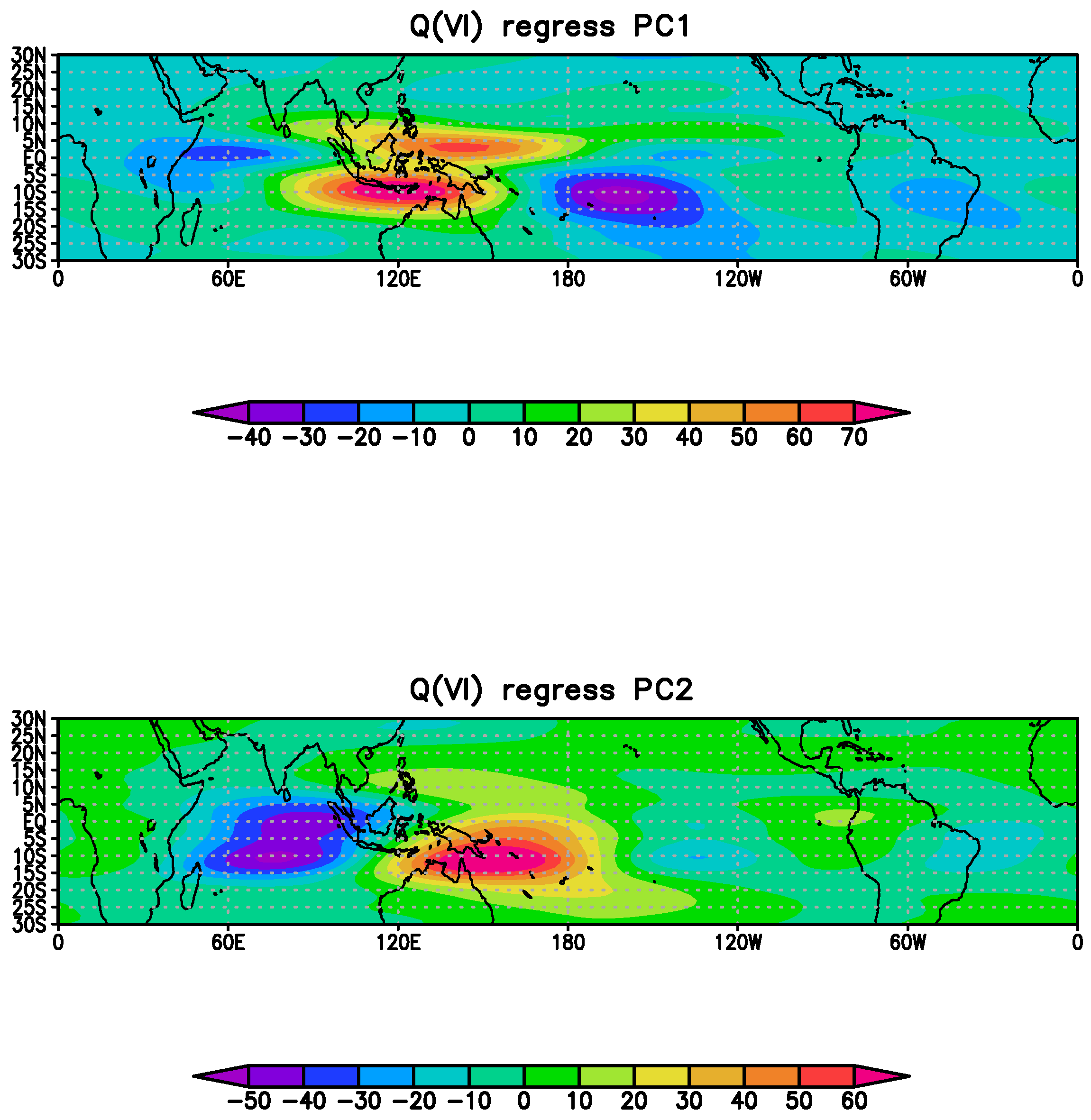
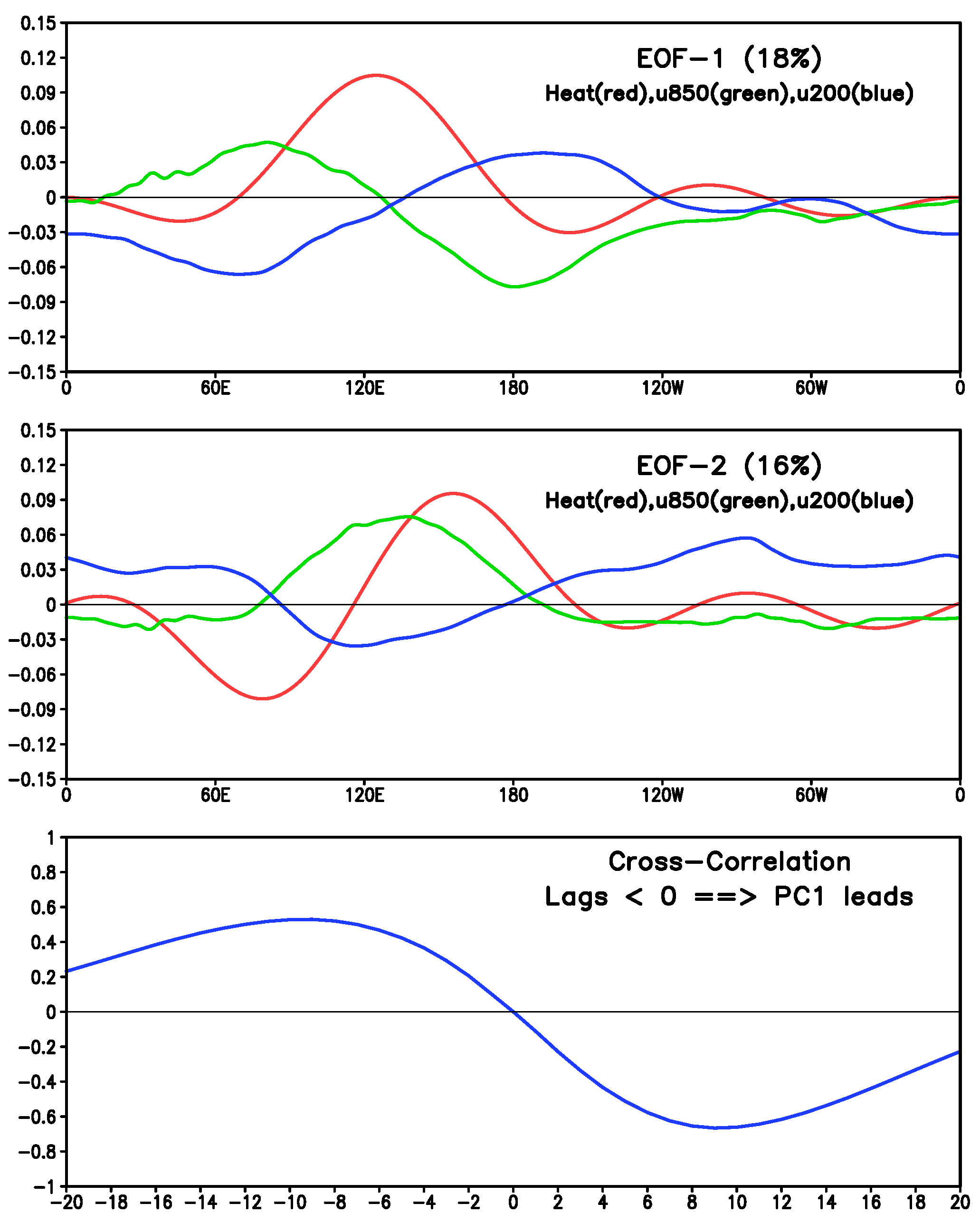
In order to obtain the manifestation of the MJO, we use a process similar to that of Wheeler and Hendon [46] in which the (tropically averaged 15° N to 15° S) outgoing longwave radiation (OLR) and zonal wind at 850 hPa and 200 hPa are used as input to principal component analysis. In our calculation, OLR is replaced by the vertically integrated diabatic heating. We then apply a regression of the full vertically integrated heating maps on to the two leading PCs (shown in Figure A2). The regression patterns of the heating on the leading two PCs are shown in Figure A1. These two EOFS explain about 34 percent of the total variance, while the lag correlation between the leading two modes indicates eastward propagation (shown in Figure A2).
Figure A1. Regression of the vertically integrated heating on each PC (The units are Watts/m2 per standard deviation of the PC).
Atmosphere 17 00201 g0a1
Figure A2. First two EOFs of the diabatic heating, u850 and u200. The bottom panel shows the lag correlation between pc1/pc2 of heating. The lag correlation between the leading two modes indicates eastward propagation.
Atmosphere 17 00201 g0a2

References

  1. Walker, G.; Bliss, E. World Weather V. Mem. R. Meteorol. Soc. 1932, 36, 53–84. [Google Scholar]
  2. Namias, J. The Index Cycle and Its Role in the General Circulation. J. Meteorol. 1950, 7, 130–139. [Google Scholar] [CrossRef]
  3. Rex, D.F. Blocking Action in the Middle Troposphere and its Effect upon Regional Climate. Tellus 1950, 2, 275–301. [Google Scholar] [CrossRef] [PubMed]
  4. Wallace, J.M.; Gutzler, D.S. Teleconnections in the Geopotential Height Field during the Northern Hemisphere Winter. Mon. Weather Rev. 1981, 109, 784–812. [Google Scholar] [CrossRef]
  5. Hess, P.; Brezowsky, H. Katalog der Großwetterlagen Europas: (1881–1976); Berichte des Deutschen Wetterdienstes, Dt. Wetterdienst: Offenbach, Germany, 1977. [Google Scholar]
  6. James, P.M. An objective classification method for Hess and Brezowsky Grosswetterlagen over Europe. Theor. Appl. Climatol. 2007, 88, 17–42. [Google Scholar] [CrossRef]
  7. Straus, D.; Molteni, F.; Corti, S. Atmospheric Regimes: The Link Between Weather and the Large Scale; Cambridge University Press: Cambridge, UK, 2017; pp. 105–135. [Google Scholar] [CrossRef]
  8. Baur, F. Compendium of Meteorology; Chapter Extended-Range Weather Forecasting; American Meteorological Society: Boston, MA, USA, 1951; pp. 814–833. [Google Scholar]
  9. Panagiotopoulos, F.; Shahgedanova, M.; Stephenson, D.B. A review of Northern Hemisphere winter-time teleconnection patterns. J. Phys. IV Fr. 2002, 12, 27–47. [Google Scholar] [CrossRef]
  10. Hannachi, A.; Straus, D.M.; Franzke, C.L.E.; Corti, S.; Woollings, T. Low-frequency nonlinearity and regime behavior in the Northern Hemisphere extratropical atmosphere. Rev. Geophys. 2017, 55, 199–234. [Google Scholar] [CrossRef]
  11. Ghil, M.; Robertson, A. “Waves” vs. “particles” in the atmosphere’s phase space: A pathway to long-range forecasting? Proc. Natl. Acad. Sci. USA 2002, 99, 2493–2500. [Google Scholar] [CrossRef]
  12. Itoh, H.; Kimoto, M. Multiple Attractors and Chaotic Itinerancy in a Quasigeostrophic Model with Realistic Topography: Implications for Weather Regimes and Low-Frequency Variability. J. Atmos. Sci. 1996, 53, 2217–2231. [Google Scholar] [CrossRef]
  13. Plaut, G.; Simonnet, E. Large-scale circulation classification, weather regimes, and local climate over France, the Alps and Western Europe. Clim. Res. 2001, 17, 303–324. [Google Scholar] [CrossRef]
  14. Franzke, C.; Woollings, T.; Martius, O. Persistent Circulation Regimes and Preferred Regime Transitions in the North Atlantic. J. Atmos. Sci. 2011, 68, 2809–2825. [Google Scholar] [CrossRef]
  15. Cassou, C. Euro-Atlantic Regimes and Their Teleconnections ECMWF. In Seminar on Predictability in the European and Atlantic Regions; ECMWF: Reading, UK, 2010. [Google Scholar]
  16. Amini, S.; Straus, D.M. Control of Storminess over the Pacific and North America by Circulation Regimes. Clim. Dyn. 2018, 52, 4749–4770. [Google Scholar] [CrossRef]
  17. Molteni, F.; Tibaldi, S.; Palmer, T. Regimes in the Wintertime Circulation over Northern Extratropics. I: Observational Evidence. Q. J. R. Meteorol. Soc. 1990, 116, 31–67. [Google Scholar] [CrossRef]
  18. Kimoto, M.; Ghil, M. Multiple Flow Regimes in the Northern-Hemisphere Winter. I: Methodology and Hemispheric Regimes. J. Atmos. Sci. 1993, 50, 2625–2643. [Google Scholar] [CrossRef]
  19. Robertson, A.; Ghil, M. Large-scale weather regimes and local climate over the western United States. J. Clim. 1999, 12, 1796–1813. [Google Scholar] [CrossRef]
  20. Straus, D.M.; Corti, S.; Molteni, F. Circulation Regimes: Chaotic Variability versus SST-Forced Predictability. J. Clim. 2007, 20, 2251–2272. [Google Scholar] [CrossRef]
  21. Vautard, R. Multiple Weather Regimes over the North-Atlantic—Analysis of Precursors and Successors. Mon. Weather Rev. 1990, 118, 2056–2081. [Google Scholar] [CrossRef]
  22. Cassou, C. Intraseasonal interaction between the Madden-Julian Oscillation and the North Atlantic Oscillation. Nature 2008, 455, 523–527. [Google Scholar] [CrossRef]
  23. Ferranti, L.; Magnusson, L.; Vitart, F.; Richardson, D.S. How far in advance can we predict changes in large-scale flow leading to severe cold conditions over Europe? Q. J. R. Meteorol. Soc. 2018, 144, 1788–1802. [Google Scholar] [CrossRef]
  24. Charney, J.G.; DeVore, J.G. Multiple Flow Equilibria in the Atmosphere and Blocking. J. Atmos. Sci. 1979, 36, 1205–1216. [Google Scholar] [CrossRef]
  25. Charney, J.G.; Straus, D.M. Form-Drag Instability, Multiple Equilibria and Propagating Planetary Waves in Baroclinic, Orographically Forced, Planetary Wave Systems. J. Atmos. Sci. 1980, 37, 1157–1176. [Google Scholar] [CrossRef]
  26. Ghil, M.; Mo, K. Intraseasonal Oscillations in the Global Atmosphere. Part I: Northern Hemisphere and Tropics. J. Atmos. Sci. 1991, 48, 752–779. [Google Scholar] [CrossRef]
  27. Franzke, C.; Lee, S.; Feldstein, S.B. Is the North Atlantic Oscillation a Breaking Wave? J. Atmos. Sci. 2004, 61, 145–160. [Google Scholar] [CrossRef]
  28. Luo, D.; Cha, J. The North Atlantic Oscillation and the North Atlantic Jet Variability: Precursors to NAO Regimes and Transitions. J. Atmos. Sci. 2012, 69, 3763–3787. [Google Scholar] [CrossRef]
  29. Messori, G.; Davini, P.; Alvarez-Castro, M.C.; Pausata, F.S.R.; Yiou, P.; Caballero, R. On the low-frequency variability of wintertime Euro-Atlantic planetary wave-breaking. Clim. Dyn. 2019, 52, 2431–2450. [Google Scholar] [CrossRef]
  30. Straus, D.M.; Molteni, F. Circulation Regimes and SST Forcing: Results from Large GCM Ensembles. J. Clim. 2004, 17, 1641–1656. [Google Scholar] [CrossRef]
  31. Madden, R.A.; Julian, P.R. Detection of a 40–50 Day Oscillation in the Zonal Wind in the Tropical Pacific. J. Atmos. Sci. 1971, 28, 702–708. [Google Scholar] [CrossRef]
  32. Zhang, C. Madden-Julian Oscillation. Rev. Geophys. 2005, 43, RG2003. [Google Scholar] [CrossRef]
  33. Tseng, K.C.; Barnes, E.A.; Maloney, E. The Importance of Past MJO Activity in Determining the Future State of the Midlatitude Circulation. J. Clim. 2020, 33, 2131–2147. [Google Scholar] [CrossRef]
  34. Song, J. Understanding Anomalous Eddy Vorticity Forcing in North Atlantic Oscillation Events. J. Atmos. Sci. 2016, 73, 2985–3007. [Google Scholar] [CrossRef]
  35. Barnes, E.A.; Hartmann, D.L. Dynamical Feedbacks and the Persistence of the NAO. J. Atmos. Sci. 2010, 67, 851–865. [Google Scholar] [CrossRef]
  36. Rivière, G.; Orlanski, I. Characteristics of the Atlantic Storm-Track Eddy Activity and Its Relation with the North Atlantic Oscillation. J. Atmos. Sci. 2007, 64, 241–266. [Google Scholar] [CrossRef]
  37. Michel, C.; Rivière, G. The Link between Rossby Wave Breakings and Weather Regime Transitions. J. Atmos. Sci. 2011, 68, 1730–1748. [Google Scholar] [CrossRef]
  38. Nakamura, H.; Nakamura, M.; Anderson, J.L. The Role of High- and Low-Frequency Dynamics in Blocking Formation. Mon. Weather Rev. 1997, 125, 2074–2093. [Google Scholar] [CrossRef]
  39. Michelangeli, P.A.; Vautard, R. The dynamics of Euro-Atlantic blocking onsets. Q. J. R. Meteorol. Soc. 1998, 124, 1045–1070. [Google Scholar] [CrossRef]
  40. Huang, F.; Tang, X.; Lou, S.Y.; Lu, C. Evolution of Dipole-Type Blocking Life Cycles: Analytical Diagnoses and Observations. J. Atmos. Sci. 2007, 64, 52–73. [Google Scholar] [CrossRef]
  41. Ma, J.; San Liang, X. Multiscale Dynamical Processes Underlying the Wintertime Atlantic Blockings. J. Atmos. Sci. 2017, 74, 3815–3831. [Google Scholar] [CrossRef]
  42. Attard, H.E.; Lang, A.L. Troposphere-Stratosphere Coupling Following Tropospheric Blocking and Extratropical Cyclones. Mon. Weather Rev. 2019, 147, 1781–1804. [Google Scholar] [CrossRef]
  43. Henderson, S.A.; Maloney, E.D.; Barnes, E.A. The Influence of the Madden–Julian Oscillation on Northern Hemisphere Winter Blocking. J. Clim. 2016, 29, 4597–4616. [Google Scholar] [CrossRef]
  44. Henderson, S.A.; Maloney, E.D. The Impact of the Madden–Julian Oscillation on High-Latitude Winter Blocking during El Niño–Southern Oscillation Events. J. Clim. 2018, 31, 5293–5318. [Google Scholar] [CrossRef]
  45. Platzer, P.; Chapron, B.; Tandeo, P. Dynamical Properties of Weather Regime Transitions. In Proceedings of the Stochastic Transport in Upper Ocean Dynamics; Chapron, B., Crisan, D., Holm, D., Mémin, E., Radomska, A., Eds.; Springer: Cham, Switzerland, 2023; pp. 223–236. [Google Scholar]
  46. Wheeler, M.; Hendon, H. An all-season real-time multivariate MJO index: Development of an index for monitoring and prediction. Mon. Weather Rev. 2004, 132, 1917–1932. [Google Scholar] [CrossRef]
  47. Lin, H.; Brunet, G.; Derome, J. An Observed Connection between the North Atlantic Oscillation and the Madden–Julian Oscillation. J. Clim. 2009, 22, 364–380. [Google Scholar] [CrossRef]
  48. Straus, D.M.; Swenson, E.; Lappen, C.L. The MJO Cycle Forcing of the North Atlantic Circulation: Intervention Experiments with the Community Earth System Model. J. Atmos. Sci. 2015, 72, 660–681. [Google Scholar] [CrossRef]
  49. Yadav, P.; Straus, D.M. Circulation Response to Fast and Slow MJO Episodes. Mon. Weather Rev. 2017, 145, 1577–1596. [Google Scholar] [CrossRef]
  50. Yadav, P.; Straus, D.M.; Swenson, E. The Euro-Atlantic Circulation Response to the Madden-Julian Oscillation Cycle of Tropical Heating: Coupled GCM Intervention Experiments. Atmos. Ocean 2019, 57, 161–181. [Google Scholar] [CrossRef]
  51. Sardeshmukh, P.; Hoskins, B. The Generation of Global Rotational Flow by Steady Idealized Tropical Divergence. J. Atmos. Sci. 1988, 45, 1228–1251. [Google Scholar] [CrossRef]
  52. Stan, C.; Straus, D.; S. Frederiksen, J.; Lin, H.; D. Maloney, E.; Schumacher, C. Review of Tropical-Extratropical Teleconnections on Intraseasonal Time Scales. Rev. Geophys. 2017, 55, 902–937. [Google Scholar] [CrossRef]
  53. Baldwin, M.P.; Dunkerton, T.J. Propagation of the Arctic Oscillation from the stratosphere to the troposphere. J. Geophys. Res. Atmos. 1999, 104, 30937–30946. [Google Scholar] [CrossRef]
  54. Polvani, L.M.; Waugh, D.W. Upward Wave Activity Flux as a Precursor to Extreme Stratospheric Events and Subsequent Anomalous Surface Weather Regimes. J. Clim. 2004, 17, 3548–3554. [Google Scholar] [CrossRef]
  55. Limpasuvan, V.; Thompson, D.W.J.; Hartmann, D.L. The Life Cycle of the Northern Hemisphere Sudden Stratospheric Warmings. J. Clim. 2004, 17, 2584–2596. [Google Scholar] [CrossRef]
  56. Garfinkel, C.I.; Feldstein, S.B.; Waugh, D.W.; Yoo, C.; Lee, S. Observed connection between stratospheric sudden warmings and the Madden-Julian Oscillation. Geophys. Res. Lett. 2012, 39, L18807. [Google Scholar] [CrossRef]
  57. Lee, S.H.; Charlton-Perez, A.J.; Woolnough, S.J.; Furtado, J.C. How Do Stratospheric Perturbations Influence North American Weather Regime Predictions? J. Clim. 2022, 35, 5915–5932. [Google Scholar] [CrossRef]
  58. Kolstad, E.W.; Lee, S.H.; Butler, A.H.; Domeisen, D.I.V.; Wulff, C.O. Diverse Surface Signatures of Stratospheric Polar Vortex Anomalies. J. Geophys. Res. Atmos. 2022, 127, e2022JD037422. [Google Scholar] [CrossRef]
  59. Lee, S.H.; Furtado, J.C.; Charlton-Perez, A.J. Wintertime North American Weather Regimes and the Arctic Stratospheric Polar Vortex. Geophys. Res. Lett. 2019, 46, 14892–14900. [Google Scholar] [CrossRef]
  60. Charlton-Perez, A.J.; Ferranti, L.; Lee, R.W. The influence of the stratospheric state on North Atlantic weather regimes. Q. J. R. Meteorol. Soc. 2018, 144, 1140–1151. [Google Scholar] [CrossRef]
  61. Roberts, C.D.; Balmaseda, M.A.; Ferranti, L.; Vitart, F. Euro-Atlantic Weather Regimes and Their Modulation by Tropospheric and Stratospheric Teleconnection Pathways in ECMWF Reforecasts. Mon. Weather Rev. 2023, 151, 2779–2799. [Google Scholar] [CrossRef]
  62. Woollings, T.; Hannachi, A.; Hoskins, B. Variability of the North Atlantic Eddy-Driven Jet Stream. Q. J. R. Meteorol. Soc. 2010, 136, 856–868. [Google Scholar] [CrossRef]
  63. Baxter, S.; Nigam, S. A Subseasonal Teleconnection Analysis: PNA Development and Its Relationship to the NAO. J. Clim. 2013, 26, 6733–6741. [Google Scholar] [CrossRef]
  64. Michelangeli, P.; Vautard, R.; Legras, B. Weather Regimes—Recurrence and Quasi Stationarity. J. Atmos. Sci. 1995, 52, 1237–1256. [Google Scholar] [CrossRef]
  65. Hochman, A.; Messori, G.; Quinting, J.F.; Pinto, J.G.; Grams, C.M. Do Atlantic-European Weather Regimes Physically Exist? Geophys. Res. Lett. 2021, 48, e2021GL095574. [Google Scholar] [CrossRef]
  66. Thompson, D.W.J.; Wallace, J.M. The Arctic oscillation signature in the wintertime geopotential height and temperature fields. Geophys. Res. Lett. 1998, 25, 1297–1300. [Google Scholar] [CrossRef]
  67. Wallace, J.M. North atlantic oscillatiodannular mode: Two paradigms—One phenomenon. Q. J. R. Meteorol. Soc. 2000, 126, 791–805. [Google Scholar] [CrossRef]
  68. Dee, D.P.; Uppala, S.M.; Simmons, A.J.; Berrisford, P.; Poli, P.; Kobayashi, S.; Andrae, U.; Balmaseda, M.A.; Balsamo, G.; Bauer, P.; et al. The ERA-Interim reanalysis: Configuration and performance of the data assimilation system. Q. J. R. Meteorol. Soc. 2011, 137, 553–597. [Google Scholar] [CrossRef]
  69. Straus, D.M. On the Role of the Seasonal Cycle. J. Atmos. Sci. 1983, 40, 303–313. [Google Scholar] [CrossRef][Green Version]
  70. Ferranti, L.; Corti, S. New clustering products. ECMWF Newsl. 2011, 127, 6–11. [Google Scholar]
  71. Hagos, S.; Zhang, C.; Tao, W.K.; Lang, S.; Takayabu, Y.N.; Shige, S.; Katsumata, M.; Olson, B.; L’Ecuyer, T. Estimates of Tropical Diabatic Heating Profiles: Commonalities and Uncertainties. J. Clim. 2010, 23, 542–558. [Google Scholar] [CrossRef]
  72. Takaya, K.; Nakamura, H. A Formulation of a Phase-Independent Wave-Activity Flux for Stationary and Migratory Quasigeostrophic Eddies on a Zonally Varying Basic Flow. J. Atmos. Sci. 2001, 58, 608–627. [Google Scholar] [CrossRef]
  73. Rayner, N.; Parker, D.; Horton, E.; Folland, C.; Alexander, L.; Rowell, D.; Kent, E.; Kaplan, A. Global analyses of sea surface temperature, sea ice, and night marine air temperature since the late nineteenth century. J. Geophys. Res. Atmos. 2003, 108. [Google Scholar] [CrossRef]
  74. Ferranti, L.; Corti, S.; Janousek, M. Flow-dependent verification of the ECMWF ensemble over the Euro-Atlantic sector. Q. J. R. Meteorol. Soc. 2015, 141, 916–924. [Google Scholar] [CrossRef]
  75. Swenson, E.T.; Straus, D.M. Rossby Wave Breaking and Transient Eddy Forcing during Euro-Atlantic Circulation Regimes. J. Atmos. Sci. 2017, 74, 1735–1755. [Google Scholar] [CrossRef]
  76. Gollan, G.; Greatbatch, R.J. The Relationship between Northern Hemisphere Winter Blocking and Tropical Modes of Variability. J. Clim. 2017, 30, 9321–9337. [Google Scholar] [CrossRef]
  77. Branstator, G. Circumglobal Teleconnections, the Jet Stream Waveguide, and the North Atlantic Oscillation. J. Clim. 2002, 15, 1893–1910. [Google Scholar] [CrossRef]
  78. Grimm, A.M. Madden-Julian Oscillation impacts on South American summer monsoon season: Precipitation anomalies, extreme events, teleconnections, and role in the MJO cycle. Clim. Dyn. 2019, 53, 907–932. [Google Scholar] [CrossRef]
  79. Swenson, E.T.; Straus, D.M. Transient Tropical Diabatic Heating and the Seasonal-Mean Response to ENSO. J. Atmos. Sci. 2015, 72, 1891–1907. [Google Scholar] [CrossRef]
  80. Straus, D.M.; Lindzen, R.S. Planetary-Scale Baroclinic Instability and the MJO. J. Atmos. Sci. 2000, 57, 3609–3626. [Google Scholar] [CrossRef]
  81. Christiansen, B. Atmospheric Circulation Regimes: Can Cluster Analysis Provide the Number? J. Clim. 2007, 20, 2229–2250. [Google Scholar] [CrossRef]
  82. Straus, D.M. Synoptic-Eddy Feedbacks and Circulation Regime Analysis. Mon. Weather Rev. 2010, 138, 4026–4034. [Google Scholar] [CrossRef]
Figure 1. Composites of 500 hPa geopotential for each of 4 clusters for k = 4 over the Euro-Atlantic region covering the domain (30°–80° N 100° W–30° E). Details given in Section 2.1. Shown are anomalies of geopotential (contours) in m·s−2.
Atmosphere 17 00201 g001
Figure 2. Rules used in this research to determine regime transitions. The prior regime must persist for at least 5 days (green boxes) and be correlated to the centroid by a predetermined correlation coefficient threshold ranging from 0.0 to 0.6. (blue boxes).
Atmosphere 17 00201 g002
Figure 3. Total planetary wave diabatic heating for each regime minus the total of all the others. The diabatic heating is calculated by taking the sum of the levels, 1000–850 hPa, 850–400 hPa, and 400–50 hPa. Values The heating is based on regime-pattern correlations exceeding 0.4. Contour interval equals 20 W·m 2 .
Atmosphere 17 00201 g003
Figure 4. Streamfunction at 300 hPa for each regime minus the climatology of all the regimes. The streamfunction is based on correlations of greater than 0.4 in regime and transition patterns. Contour interval equals 4 × 10⁶ m2·s−1.
Atmosphere 17 00201 g004
Figure 5. Pre-transition planetary scale diabatic heating for transitions from the NAO+ to Scandinavian Blocking. The panels on the left show the diabatic heating difference 1–20 days prior to the transition and the composite of the previous regime. The right figure shows the anomaly of the days prior to the transition compared to the seasonal mean. Shaded areas are significant at the 90 percent level. The diabatic heating is calculated by taking the sum of the levels, 1000–850 hPa, 850–400 hPa, and 400–50 hPa. The heating is based on regime-pattern correlations exceeding 0.4. Contour interval equals 20 W·m 2 .
Atmosphere 17 00201 g005
Figure 6. The 300 hpa streamfunction and Rossby wave activity for the transition from NAO+ to Scandinavian Block. The panels on the left are the Rossby wave activity and the difference between the days prior to the transition and the NAO regime. Shaded areas are significant at the 90 percent level. Vectors are denoted by black arrows and are in m·s−1 and show the pre-transition source and direction of Rossby Wave activity. The right panel shows the anomaly relative to the seasonal mean for days prior to the transition. Contour interval equals 2 × 10⁶ m2·s−1.
Atmosphere 17 00201 g006
Figure 7. The percentage of time in each phase for each 5-day period prior to the regime transition. The graph on the left is for MJO amplitudes greater than 1.0, the right is for greater than 1.5. Consistent with other research, there is clear indication of Indian Ocean heating (Phase 3) 15–20 days before transition.
Atmosphere 17 00201 g007
Figure 8. NAO+ to Scandinavian Block transitions occurrences during cold, neutral, and warm events based on the SST standard deviation of the Niño34 index. We base this on the composite of the index at the time of each transition. The blue bar represents standard deviations greater than 1.0, and the orange bar represents standard deviations greater than 1.5.
Atmosphere 17 00201 g008
Figure 9. Pre-transition planetary scale diabatic heating for transitions from the Scandinavian Block to NAO−. The panels on the left show the diabatic heating difference 1–20 days prior to the transition and the composite of the previous regime (Scandinavian Block). The right figure shows the anomaly of the days prior to the transition compared to the seasonal mean. Shaded areas are significant at the 90 percent level. The diabatic heating is calculated by taking the sum of the levels, 1000–850 hPa, 850–400 hPa, and 400–50 hPa. The heating is based on regime-pattern correlations exceeding 0.4. Contour interval equals 20 W·m 2 .
Atmosphere 17 00201 g009
Figure 10. The 300 hPa streamfunction and Rossby wave activity for the transition from Scandinavian Block to NAO−. The panels on the left show Rossby wave activity and the difference between days prior to the transition and the Scandinavian Block regime. Shaded areas are significant at the 90 percent level. Vectors are denoted by black arrows and are in m·s−1 and show the pre-transition source and direction of Rossby Wave activity. The right panel shows the anomaly relative to the seasonal mean for days before the transition. Contour interval equals 2 × 10⁶ m2·s−1.
Atmosphere 17 00201 g010
Figure 11. Scandinavian Block to NAO−. The Graph on the left is for MJO amplitudes greater than 1.0; the graph on the right is for amplitudes greater than 1.5. Note the increases before MJO phases 6 and 7.
Atmosphere 17 00201 g011
Figure 12. Scandinavian Block to NAO− transitions occurrences during cold, neutral, and warm events based on the SST standard deviation of the Niño34 index. We base this on the composite of the index at the time of each transition. The blue bar represents standard deviations greater than 1.0, and the orange bar represents standard deviations greater than 1.5.
Atmosphere 17 00201 g012
Figure 13. The planetary wave heating for the transition from Scandinavian Block to Atlantic Ridge. The panels on the left show the diabatic heating difference 1–20 days prior to the transition and the composite of the previous regime. The right figure shows the anomaly of the days prior to the transition compared to the seasonal mean. The diabatic heating is calculated by taking the sum of the levels, 1000 – 850 hPa, 850 – 400 hPa, and 400 – 50 hPa. The heating is based on regime-pattern correlations exceeding 0.4. Contour interval equals 20 W·m−2. Shaded areas are significant at the 90 percent level.
Atmosphere 17 00201 g013
Figure 14. The 300 hPa streamfunction and Rossby wave activity for the transition from Scandinavian Block to Atlantic Ridge. The panels on the left are the Rossby wave activity and the difference between the days prior to the transition and the Scandinavian Block regime. Shaded areas are significant at the 90 percent level. Vectors are denoted by black arrows and are in m·s−1 and show the pre-transition source and direction of Rossby Wave activity. The right panel shows the anomaly relative to the seasonal mean for days before the transition. Contour interval equals 2 × 10 6   m 2 · s 1 .
Atmosphere 17 00201 g014
Figure 15. Scandinavian Block to Atlantic Ridge. The graph on the left is for MJO amplitudes greater than 1.0; the right is for amplitudes greater than 1.5.
Atmosphere 17 00201 g015
Figure 16. Scandinavian Block to Atlantic Ridge transitions occurrences during cold, neutral, and warm events based on the SST standard deviation of the Niño34 index. We base this on the composite of the index at the time of each transition. The blue bar represents standard deviations greater than 1.0, and the orange bar represents standard deviations greater than 1.5.
Atmosphere 17 00201 g016
Table 1. Statistics for each of the four Euro-Atlantic regimes. The percentage of the total winter days, along with the mean number of days for each winter.
Scan BlockAtl RdgNAO−NAO+
% of Occurrence23.75%22.97%19.51%33.77%
ine Mean31.330.325.744.6
Std Dev13.5315.9521.2420.86
Table 2. The total number of days (5-day running means) in each regime for all 35 winters examined in the ERA-I dataset. Blue shading represents fewer than 10 occurrences. Orange shading indicates 80 or more occurrences. The last two columns indicate the NDJFM average anomalies of the Niño 3.4 index from HadISST1.1 (https://psl.noaa.gov/data/timeseries/month/data/nino34.long.anom.data, accessed on 1 November 2025), and the intensity of the warm or cold event, with weak events less than 1, moderate between 1 and 1.5, strong between 1.5 and 2.0, and very strong greater than 2.0. Cold events are the same thresholds except negative.
WinterScan BlockAtl RidgeNAO−NAO+Avg Nino3.4
1980–198110593032−0.092
1981–198232263539−0.078
1982–198328510522.148Very Strong
1983–198431331653−0.778Weak
1984–198548105321−1.094Moderate
1985–198629154444−0.554Weak
1986–1987262834441.124Moderate
1987–1988242923560.734Weak
1988–198918221082−1.762Strong
1989–199024222840.03
1990–1991513016350.266
1991–199252380421.498Moderate
1992–199338330610.445
1993–1994282013710.056
1994–1995163512690.962Weak
1995–199653304360.192
1996–199734184139−0.292
1997–1998373228352.142Very Strong
1998–199924431451−1.32Moderate
1999–2000068559−1.506Strong
2000–20013585831−0.916Weak
2001–200240182153−0.154
2002–2003631634190.984Weak
2003–2004305323260.208
2004–2005195830250.486
2005–200652412910−0.722Weak
2006–2007291427620.528Weak
2007–20083327369−1.57Strong
2008–200929452533−0.74Weak
2009–201018588211.396Moderate
2010–201119206429−1.428Moderate
2011–20124837047−0.832Weak
2012–201326256021−0.152
2013–20141824090−0.21
2014–201535480490.66Weak
Table 3. Average and maximum persistence for each of the 4 Euro-Atlantic Regimes. NAO− was found to be the most persistent, lasting an average of 12.77 days, and the Scandinavian Block was the least persistent, 9.58 days. All four have persisted for 4 weeks or more at least once over the 35 years.
Scan BlkAtl RidgeNAO−NAO+
Average9.5810.4512.7712.36
Max27334656
Table 4. The total number of occurrences for each transition for the ERAI reanalysis. The table at the top is for pattern correlations greater than 0.0, and the one at the bottom is for correlations greater than 0.4. The top table shows all transitions with a positive pattern correlation, and the bottom table shows all transitions with a pattern correlation greater than 0.4. The rows are the previous regime, and the columns are the regime to which it transitioned.
Scan BlockAtlantic RdgNAO−NAO+
Scandinavian Block907132020
Atlantic Ridge14875919
NAO−1407977
NAO+292361361
Scan BlockAtlantic RdgNAO−NAO+
Scandinavian Block72710910
Atlantic Ridge770066
NAO−507457
NAO+171001053
Table 5. Shows the zonal wind anomaly at 60° N and 50 hPa standardized by dividing by a constant factor of 5.15 m·s−1, which is similar to Limpasuvan et al. [55] and Roberts et al. [61] using ERAI data.
Days PriorNAO+ to ScanBlkScanBlk. to NAO−ScanBlk to AtlRdg
1–5 days−0.176−0.005−0.279
6–10 days0.0530.022−0.038
11–15 days0.1670.071−0.287
16–20 days0.0280.119−0.275
Disclaimer/Publisher’s Note: The statements, opinions and data contained in all publications are solely those of the individual author(s) and contributor(s) and not of MDPI and/or the editor(s). MDPI and/or the editor(s) disclaim responsibility for any injury to people or property resulting from any ideas, methods, instructions or products referred to in the content.