Article

Characterising and Differentiating Non-Exhaust Airborne Nanoparticle Sources in Urban Traffic and Background Environments


1
Global Centre for Clean Air Research (GCARE), School of Engineering, Civil and Environmental Engineering, Faculty of Engineering and Physical Sciences, University of Surrey, Guildford GU2 7XH, UK
2
Climate and Atmosphere Research Centre, The Cyprus Institute, Nicosia 2121, Cyprus
3
Institute for Sustainability, University of Surrey, Guildford GU2 7XH, UK
*
Author to whom correspondence should be addressed.
Atmosphere 2026, 17(2), 164; https://doi.org/10.3390/atmos17020164
Submission received: 10 December 2025 / Revised: 28 January 2026 / Accepted: 29 January 2026 / Published: 2 February 2026
(This article belongs to the Section Air Quality)

Abstract

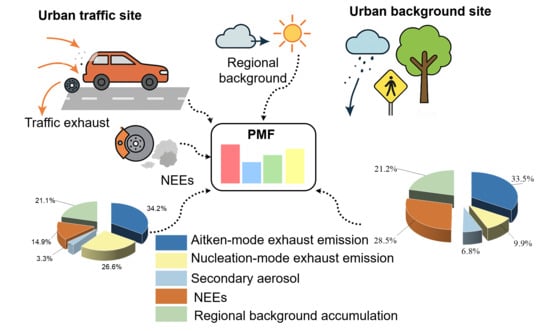
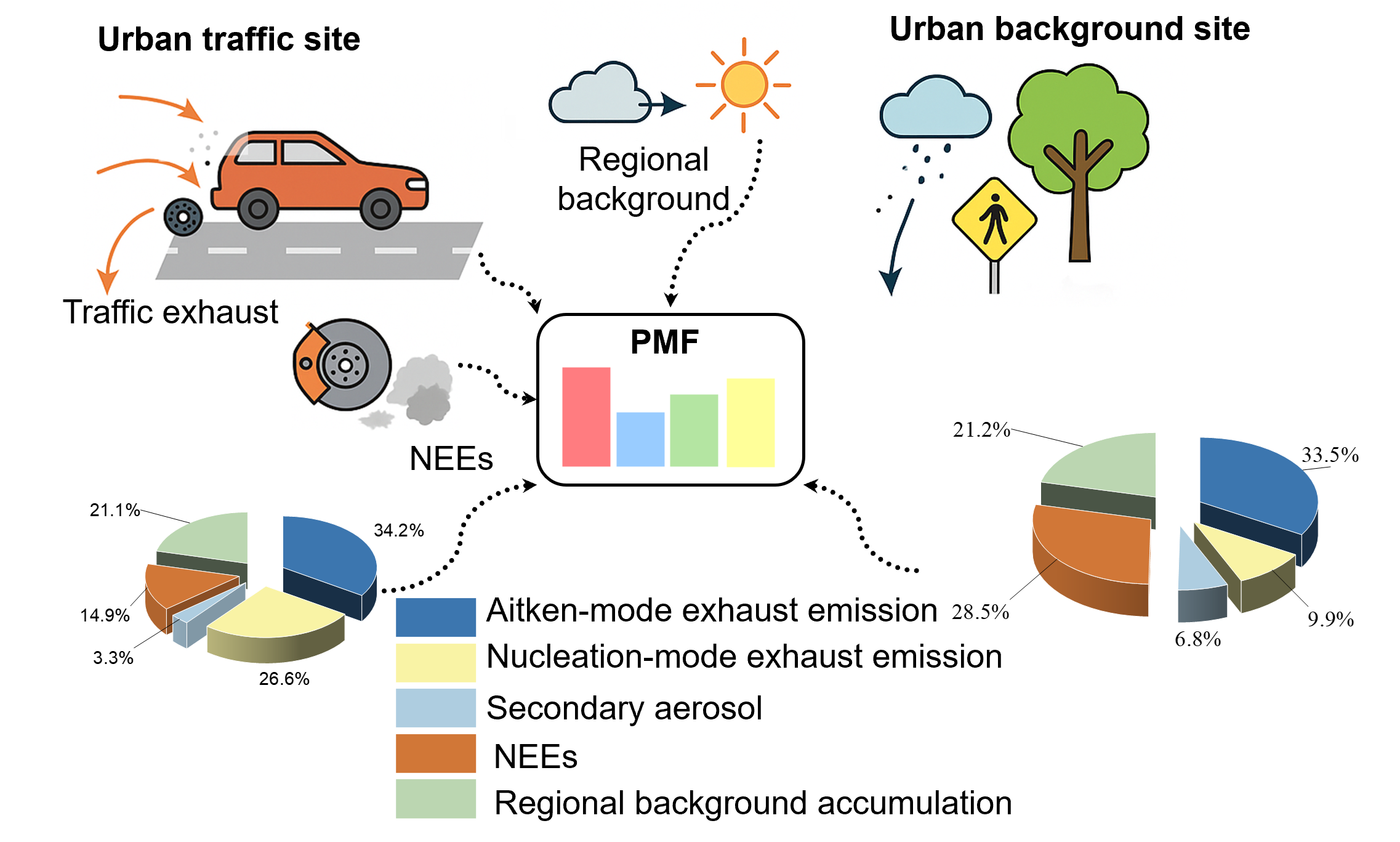
The contribution of non-exhaust emissions (NEEs) to particle number concentration (PNC) remains insufficiently quantified, particularly across different urban environments. In this study, we address this gap by quantifying the contribution of NEEs to airborne nanoparticles in urban areas. Using positive matrix factorisation (PMF), conditional probability function analysis, Pearson correlation, and source identification, we identified five source factors contributing to PNC at two sites in London: a traffic site and a background site. Five source factors were resolved at both sites: Aitken-mode traffic exhaust particles, nucleation-mode exhaust emission, secondary aerosol, non-exhaust emission, and regional background accumulation. Interestingly, the contribution of NEEs differed between the two sites. At the traffic site, NEEs contributed 14.9%, while at the background site, their contribution was higher at 28.5%, likely due to the favourable summer dispersion conditions. However, the contribution of nucleation-mode exhaust emission also showed significant differences: 26.6% at the traffic site and only 9.9% at the background site. Based on these findings, we propose that air quality policies should integrate NEEs into regulations, improve road maintenance, and use PNC-based along with metal tracers to identify and control PNC. This study offers valuable insights for developing strategies to manage urban nanoparticle pollution.

Graphical Abstract

1. Introduction

Transport-related particulate matter (PM) emissions are a growing public health and environmental concern due to their well-documented adverse effects on human health and the climate [1]. Based on aerodynamic diameter, PM is typically classified into coarse particles (2.5–10 μm in diameter), fine particles (0.1–2.5 μm), and ultrafine particles (<0.1 μm) [2]. Coarse and fine particles degrade visibility and irritate the respiratory tract [3]. In contrast, ultrafine particles can penetrate deep into the alveolar region and enter the systemic circulation, potentially triggering oxidative stress, inflammation, and cardiovascular effects [4]. Moreover, ultrafine particles may also translocate to the brain by crossing the blood–brain barrier, thereby potentially exerting direct harmful effects on the central nervous system [5]. Particle size is thus a critical determinant of toxicological behaviour and ecological impact, with smaller (nano-scale) particles often posing disproportionate health risks despite their low mass.
Both tailpipe (exhaust) and non-tailpipe (non-exhaust) processes are significant sources of road traffic PM [6]. While exhaust emissions result from fuel combustion in internal combustion engines, non-exhaust emissions arise from mechanical and thermally driven processes. Mechanical abrasion from braking and tyre–road interactions generates coarse and fine wear particles [6], whereas high-temperature friction and the volatilisation of the material from brakes and tyres release vapour-phase species that subsequently condense to form nanoparticles. Previous studies have commonly used meteorological parameters and gaseous pollutants such as NOx, CO, and O3 as auxiliary variables to support factor interpretation [7]. Moreover, chemical characterisation is essential for accurately identifying and quantifying these sources [8]. In the UK, the National Atmospheric Emissions Inventory (NAEI) estimated that, in 2016, 90% of atmospheric copper (Cu) emissions and 23% of zinc (Zn) emissions to the atmosphere originated from non-exhaust sources, with even higher proportions expected near roads [9,10,11,12]. Therefore, incorporating these NEE tracers into source apportionment studies can improve the resolution and accuracy of factor identification. However, the inclusion of tracer elements such as Cu, zinc (Zn), iron (Fe), barium (Ba), and organic carbon (OC) in such studies has been limited to date. Cu, Fe, and Ba, which are commonly found in brake pads and disc materials, are emitted during braking processes [13]. Zn, present in tyre rubber as zinc oxide for vulcanisation, accounts for around 1% of tread composition and is released through tyre wear [14]. OC is associated with tyre wear and road dust resuspension because the abrasion of rubber and road surface materials releases significant amounts of organic matter [15].
Notable strategies include integrating chemical speciation data with positive matrix factorisation (PMF) to identify the sources of PM [14]. For example, antimony (Sb) is a well-established tracer of brake wear and is widely used to identify brake-derived particles in source apportionment analyses, accounting for 1–3% of the ultrafine particle mass [16]. In addition, using Zn as a tyre wear tracer, the tyre–road abrasion factor accounted for 16.4% of coarse and 12.3% of fine PM (by mass); using Al-Si-Ca-Fe as crustal signatures, road dust resuspension contributed 29.6% (coarse) and 9.1% (fine) [17]. Despite these advances, most source apportionment studies rely on mass-based PM concentrations, which may underestimate the contribution of ultrafine particles. In contrast, number-based metrics provide a distinct and exposure-relevant perspective on air quality. Particle number concentration (PNC) provides a more exposure-relevant metric that warrants deeper investigation into emission mechanisms. Overlooking number-based distributions can obscure critical source signatures and limit the accuracy of nanoparticle exposure assessments. Unlike mass-based metrics, PNC can reveal distinct source dominance, particularly for ultrafine particles, whose health risks are amplified by their extremely high number concentrations despite their negligible mass. These considerations underscore the need to integrate PNC data with NEE tracer data in source apportionment studies to improve the identification of ultrafine particle sources.
To address the shortcomings of mass-based pollutant measurements, we conducted a statistical analysis with explicit consideration of NEEs. Here, we combine size-resolved PNC data with key tracers (Cu, Zn, Fe, Ba, and OC) to effectively identify the NEE sources in urban environments. The analysis was conducted at two contrasting sites in London: a traffic location (Marylebone Road) and a background site (Honor Oak Park). This dual-site approach allowed us to assess NEE characteristics under different traffic and environmental conditions. The primary objective of this study is to quantify the contribution of airborne nanoparticles to NEEs in order to inform the development of future control strategies. The specific objectives are as follows: (1) apportion sources of ambient nanoparticles by applying PMF to PNC data; (2) evaluate the relative contribution of NEEs in different urban settings; and (3) examine the emission characteristics and particle number size distribution (PNSD) patterns of NEEs across contrasting site conditions.

2. Materials and Methods

2.1. Study Sites

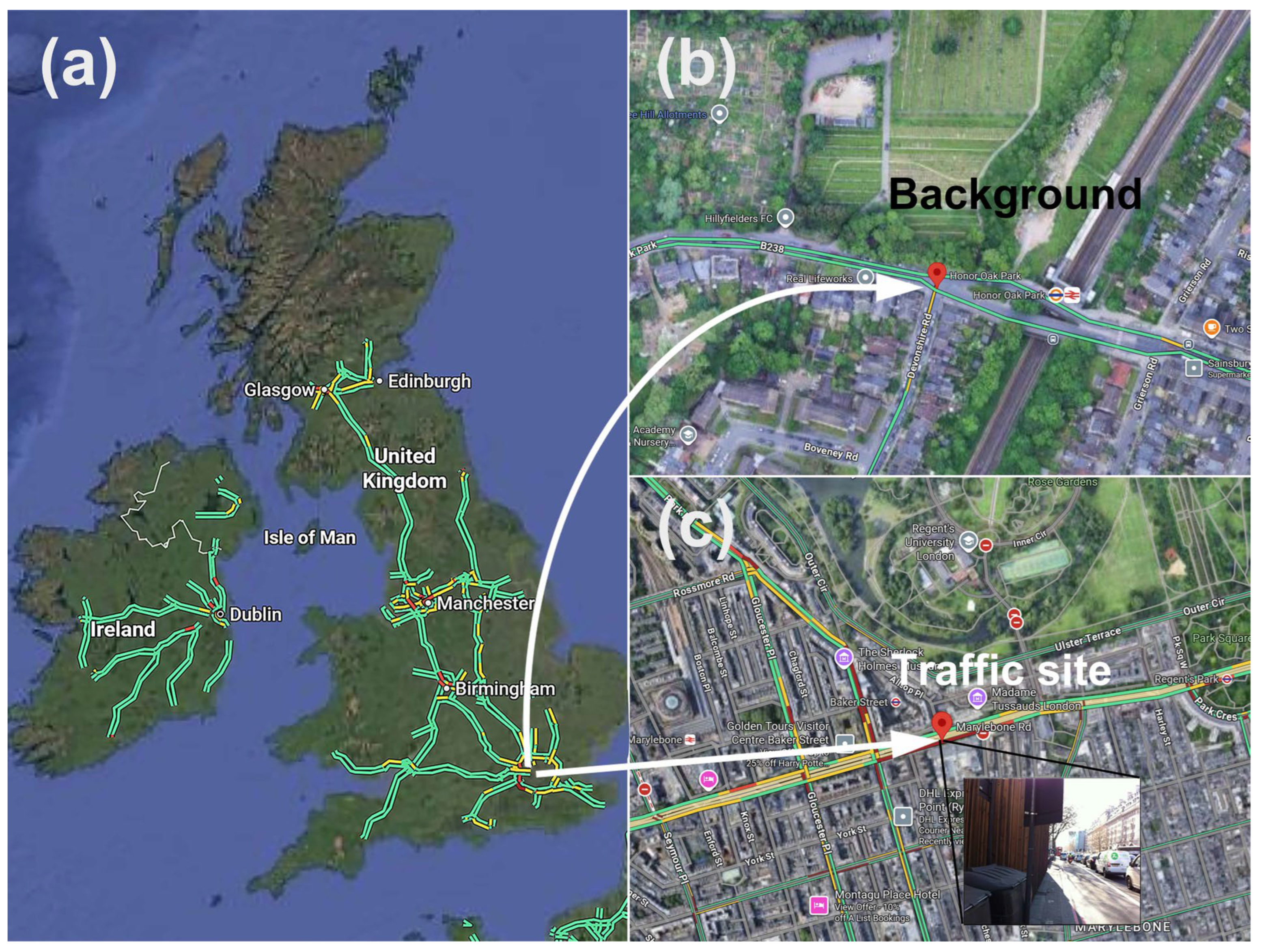
This study focused on two monitoring sites in London representing different traffic environments: an urban traffic site (Marylebone Road, 51°31′16.2″ N 0°09′23.4″ W) and an urban background site (Honor Oak Park, 51°26′59.8″ N 0°02′48.2″ W) shown in Figure 1. These sites allowed for the comparison of ultrafine particle sources influenced by different levels of traffic intensity.
Marylebone Road is located along the A501, a six-lane arterial road in central London carrying approximately 80,000–90,000 vehicles per day. The monitoring station is positioned about 1 m from the kerbside, directly exposed to vehicular emissions. The surrounding multi-storey buildings form a street canyon that frequently exacerbates pollutant accumulation, particularly during peak traffic hours. This site is therefore representative of high-intensity traffic emissions in a densely built urban environment.
Honor Oak Park is situated within the sports ground of King’s College London in southeast London. The site is situated several hundred metres back from the South Circular (A205) and is surrounded by low-rise housing and green spaces, with light to moderate local traffic. Its suburban location and limited direct vehicular influence make it suitable for characterising urban background conditions. In addition, London is generally influenced by prevailing south-westerly winds, which means that roadside emissions are more frequently transported to the Marylebone Road site than to the background site.

2.2. Data Acquisition

PNC data were obtained from the UK Department for Environment, Food and Rural Affairs (DEFRA) air quality monitoring network. Measurements were collected using a Scanning Mobility Particle Sizer (SMPS, model 3938, TSI Incorporated, Shoreview, MN, USA), which combines a Differential Mobility Analyser (DMA) and a Condensation Particle Counter (CPC). The system covered a size range of 16.6–604.3 nm and completed a full scan every 2.5 min. The results were aggregated into 15 min averages, which represent the standard resolution of the UK Particle Numbers and Concentrations Network. The instruments were operated under DEFRA QA/QC protocols, including routine calibration, flow checks, sample drying, and charge neutralisation. To improve transparency regarding measurement accuracy/uncertainty, we note that SMPS/CPC performance in the DEFRA PCN Network is subject to established QA/QC procedures and that the effective particle detection (counting) efficiency is commonly characterised by the CPC cut-off diameter (D50, i.e., 50% detection efficiency). Public DEFRA documentation indicates that D50 can differ between SMPS configurations used in the network (e.g., ~7 nm for the TSI 3938W50-CEN-7 SMPS and ~10 nm for the TSI 3936 SMPS), implying that uncertainty is generally larger toward the lower end of the measured size range. Accordingly, results that rely on very small differences in modal diameter are interpreted cautiously, with emphasis placed on robust trends in source contributions and size distribution patterns. Continuous measurements were collected for June 2022 at both monitoring sites. After data processing and quality control, a total of 5594 valid 15 min averaged data points were used as the input data to PMF.
In addition to PNC, co-pollutants and meteorological parameters were collated from DEFRA air quality monitoring network to support the interpretation of PMF results. At the traffic site, measurements included O3, NOx, SO2, CO, PM10, PM2.5, BC, NH4+, SO42−, and NEE tracers (Cu, Fe, Zn, Ba, OC). At the background site, available data comprised O3, NOx, PM10, PM2.5, OC, and the trace metals (Cu, Fe, Zn, Ba). Metals were collected on PM2.5 filters and subsequently analysed using inductively coupled plasma mass spectrometry (ICP-MS). OC was quantified with a thermal–optical method, while PM10 and PM2.5 mass concentrations were determined gravimetrically with Partisol samplers (Thermo Fisher Scientific, Waltham, MA, USA). Additional meteorological parameters, including temperature, wind speed, wind direction, and humidity, were obtained from the UK Met Office. In central London, the average temperature during June 2022 was 17 °C, with observed extremes ranging from 6 to 31 °C. The corresponding average relative humidity was 64%.

2.3. Data Analysis

During data pre-processing, blank data points were identified and removed, and outliers were handled to ensure consistency and reliability. Source apportionment was conducted using the US EPA’s PMF model (version 5.0), which decomposes the concentration matrix into source contributions and profiles under non-negativity constraints. An uncertainty matrix was incorporated to weight observations during model fitting. The decomposition process is mathematically expressed in Equation (1):
x i j = k = i p g i k f j k + e i j
where x i j represents the PNC of size bin j in sample i; g i k and f j k are the source contribution and profile matrices; e i j is the residual; and p is the number of factors. The number of factors was determined using Q-value diagnostics (Qtrue/Qexp), scaled residuals, and the interpretability of factor profiles. Bootstrap and DISP analyses were applied to evaluate stability and rotational ambiguity.
The PMF model was applied to the PNC dataset comprising 51 size bins. Uncertainties were estimated for each bin. For values at or below the method detection limit (MDL), the uncertainty was calculated using Equation (2):
uncertainty   =   5 6 × MDL
For concentrations above the MDL, the uncertainty (unc) was computed using Equation (3):
u n c = ( E r r o r   F r a c t i o n c o n c e n t r a t i o n ) 2 + ( 0.5 M D L ) 2
where EF (error fraction) was set to 5% for all bins, following the EPA PMF guidance. Each bin was then classified according to its signal-to-noise (S/N) ratio: S/N > 2 (strong), 0.2 < S/N < 2 (weak), and S/N < 0.2 (bad, excluded).
The PMF model outputs a set of factors that represent different sources of pollution. To facilitate source identification, the contributions of each factor were examined in more detail using particle size distribution patterns, meteorological data, and statistical correlations with co-pollutants.
We used conditional probability function (CPF) analysis to examine the association between factor contributions and prevailing meteorological conditions. CPF plots were generated based on the 75th percentile of fractional source contributions, allowing for the identification of potential source regions by assessing how source contributions varied with wind speed and direction. CPF was calculated as follows:
C P F ϴ = m ϴ n ϴ
where m ϴ represents the number of occurrences in which the factor contribution exceeded the 75th percentile for a given wind direction ϴ and n ϴ is the total number of observations from that wind direction. CPF plots were generated using the OpenAir package to aid in source attribution.
Temporal variations in source contributions were assessed by examining hourly variations in normalised factor contributions. Pearson correlation analysis was conducted between factor contributions and co-pollutant concentrations to support source interpretation. Strong associations with specific pollutants strengthened the estimation of individual contributions from source categories and supported their differentiation.

3. Results and Discussion

3.1. Source Contributions to Particle Number Concentration

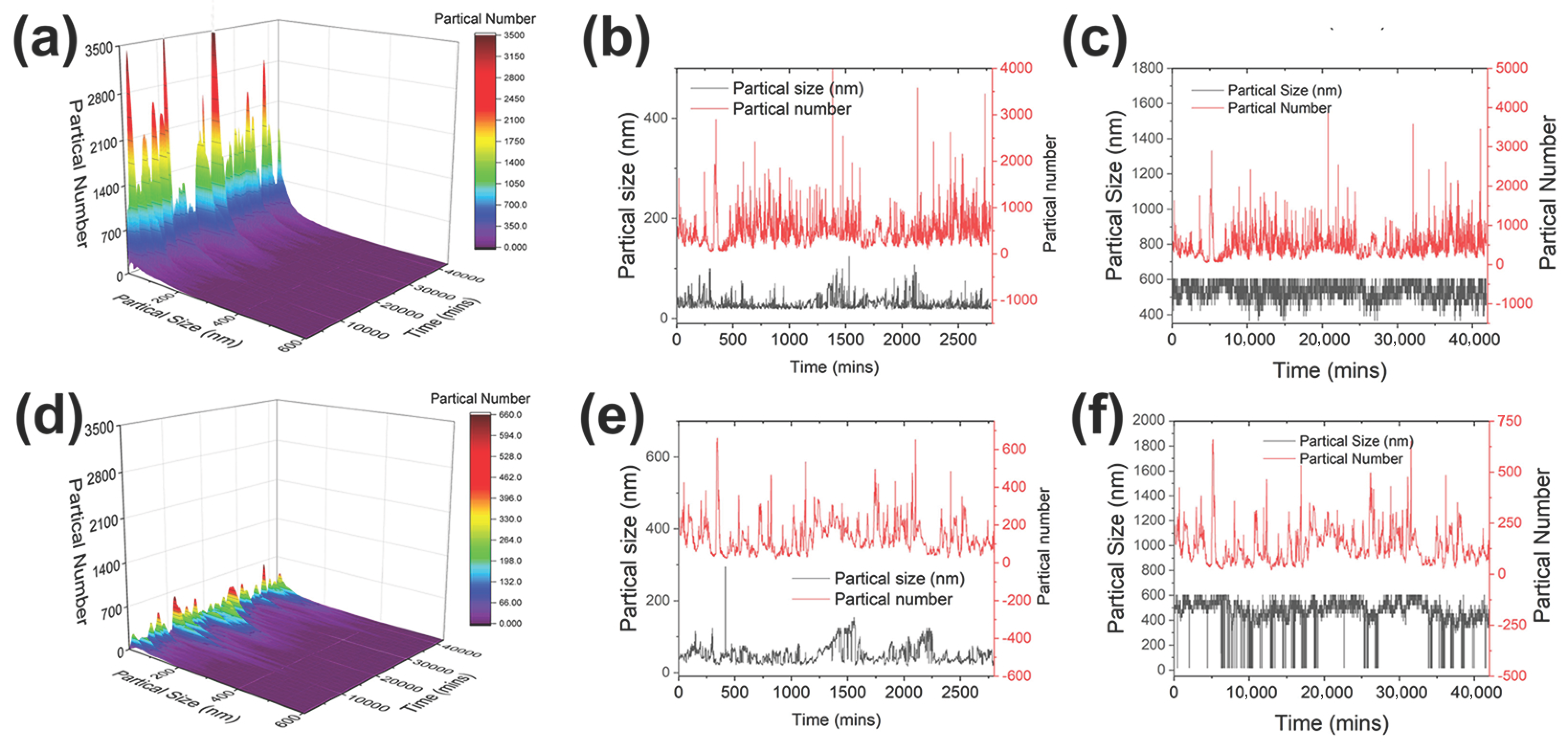
As shown in Figure 2a, the PM we studied exhibited a notable concentration of ultrafine particles at the traffic site. To further investigate the distribution and characteristics of these particles, we analysed the largest and the smallest particle distribution in 42,000 min (approximately one month). The smallest particles are concentrated within a narrow size range between 16.6 and 100 nm, with a range from 0 to 3000 particles (Figure 2b). The largest particles are concentrated within a narrow size range between 400 and 600 nm, with a range unpredictably from 0 to 3000 particles (Figure 2c). This variability highlights the dynamic nature of particle distributions in urban environments. Further analysis of the PND revealed that smaller-diameter particles, particularly those in the nanometre scale, constituted the largest portion of the total particle count. To account for potential interference from background factors, we selected a park area as a background blank sample for comparison.
Interestingly, as shown in Figure 2d, the PND patterns from the background site exhibit a similar trend to the traffic site. The size and number distributions of particles at both sites are primarily concentrated in the smaller particle range within the detection diameter range. Furthermore, the particle size distributions over time are closely aligned, which may be due to both sites being within urban environments. Moreover, the concentration of particles in the smaller size range further emphasises the importance of considering PNC when performing source apportionment analysis, as small particles dominate the overall distribution. As shown in Figure 2e, the smallest particles have a diameter between 50 and 160 nm at the traffic site, with a range from 48 to 600 particles. The largest particles are concentrated within a narrow size range between 50 and 600 nm, with a range unpredictably from 48 to 600 particles (Figure 2f). This indicates that even at a background site, the prevalence of smaller particles remains a dominant feature of the particulate matter distribution. These findings emphasise the importance of ultrafine particles in the overall PNC in urban environments. The similarity between the study and background areas suggests that the primary source of these particles may be linked to local traffic and environmental conditions, with particles potentially being transported from the background area to the traffic and urban locations.

3.2. Source Apportionment of PNC

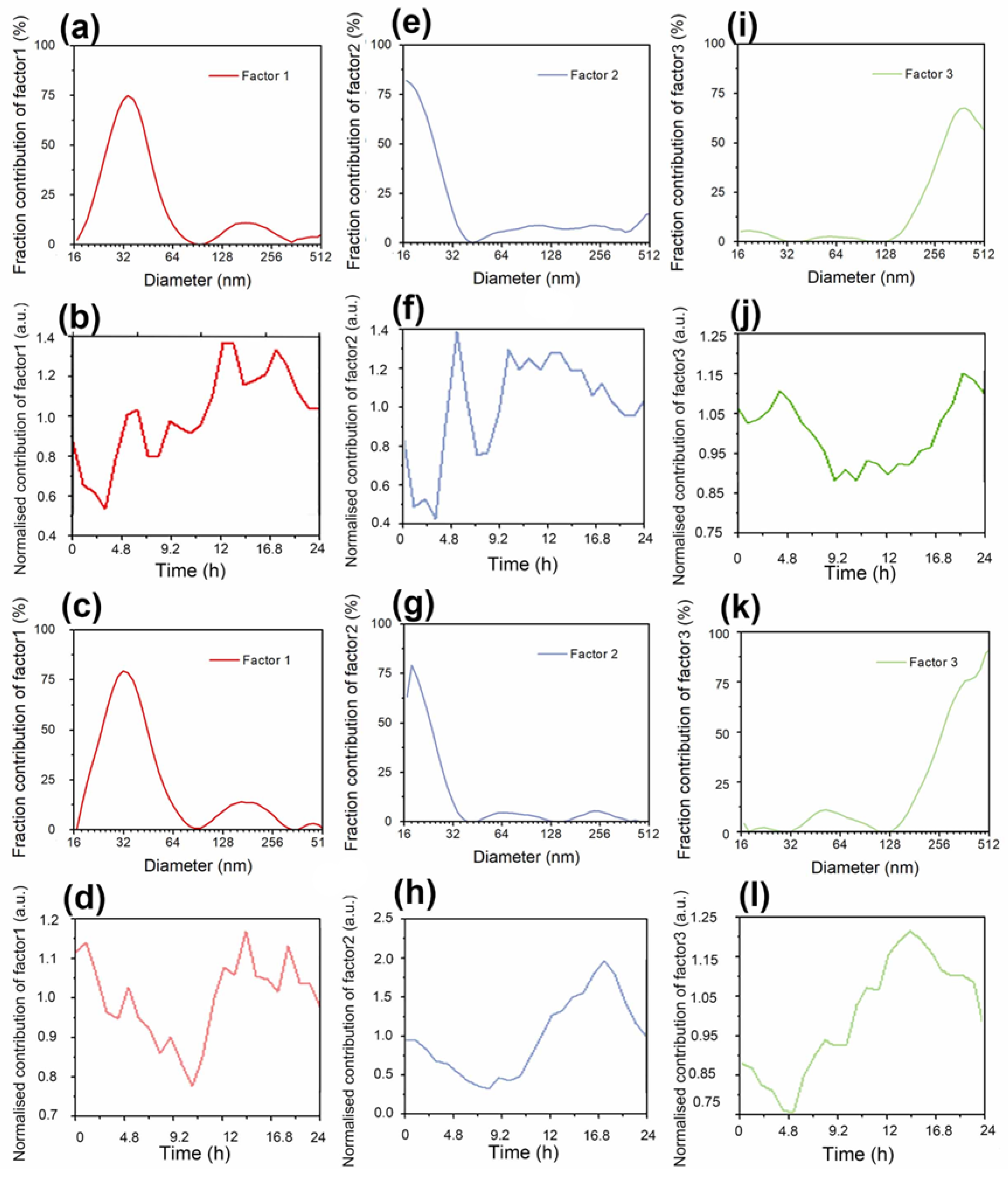
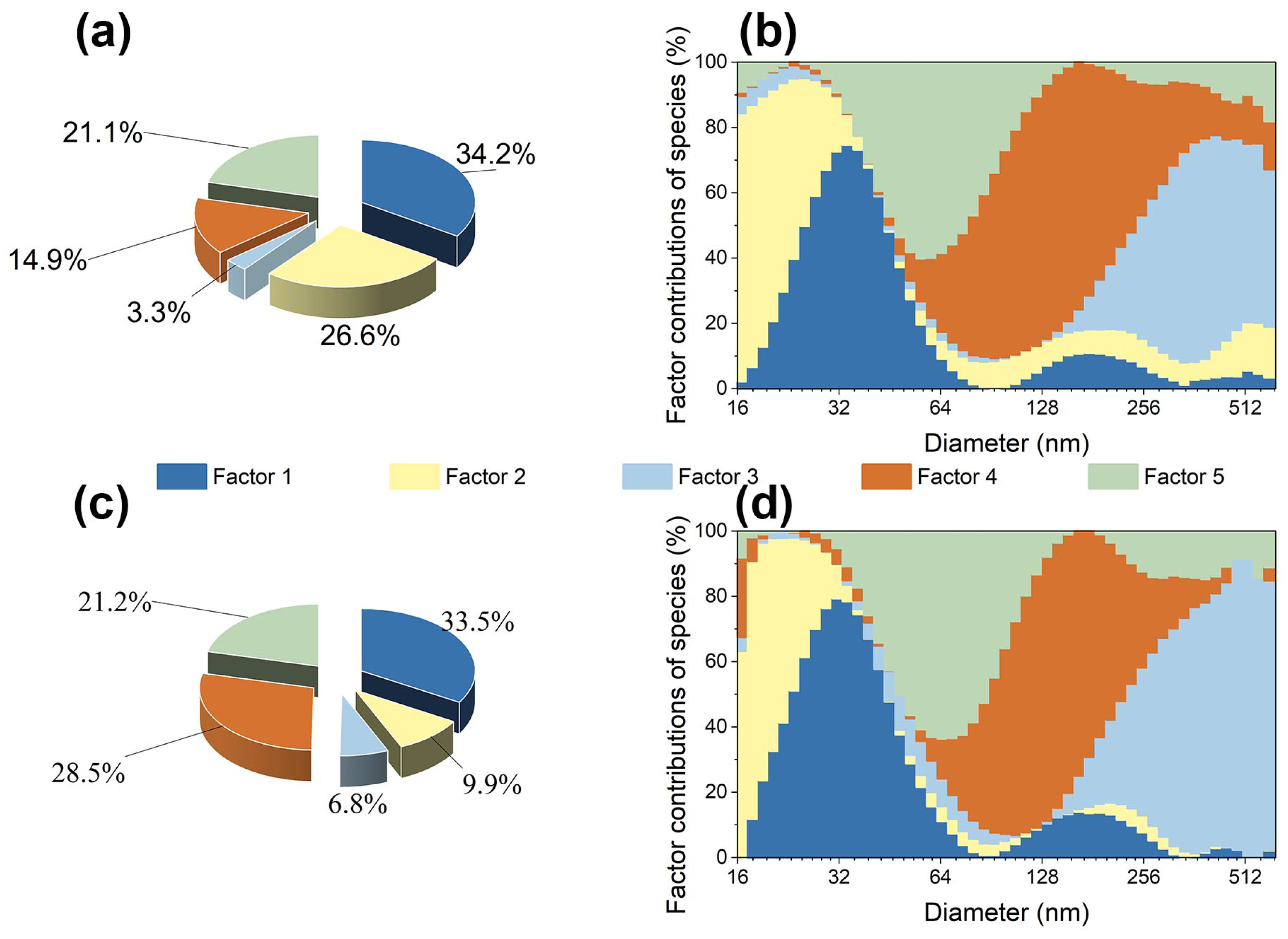
Based on the PMF apportionment results, the final contributions of the five Factors were determined from the minimum and a stable value of the objective function Q value [7]. At the traffic site, the Factors 1–5 contributed 34.2%, 26.6%, 3.3%, 14.9%, and 21.1% to the total PNC, respectively (Figure 3a,b). At the background site, the corresponding contributions were 33.5%, 9.9%, 6.8%, 28.5%, and 21.2% (Figure 3c,d). The Factors were interpreted as Aitken-mode traffic exhaust particles (Factor 1), nucleation-mode exhaust emission (Factor 2), secondary aerosol (Factor 3), NEEs (factor 4), and regional background accumulation (factor 5). Pearson correlation analysis between the factor contributions and the measured particle number concentration was used to quantify source pollutants and to discriminate the relative contributions of the different sources. Furthermore, CPF analysis was performed in Section 3.4 to support the reliability of the source apportionment results [18]. Hourly variations in normalised factor contributions were also examined. A detailed description of each of the identified factors can be found below. The size distribution profiles and diurnal variations of Factors 1–3 and Factors 4–5 are presented in Figure 4 and Figure 5, respectively.

3.2.1. Factor 1: Aitken-Mode Exhaust Emission

At the urban traffic site, Factor 1 displayed a bimodal PND with a dominant peak at around 34 nm and a secondary peak at approximately 177.9 nm (Figure 4a). The dominant 34 nm peak falls within the Aitken mode (30–100 nm) and likely represents traffic particles that have rapidly evolved from freshly emitted nucleation-mode exhaust. Meanwhile, the minor approximately 178 nm peak corresponds to particles that have grown further through ageing processes such as condensation and coagulation. This bimodal pattern aligns with the findings of Rönkkö et al. [19], who demonstrated through modelling that aged diesel exhaust particles exhibit bimodal size distributions. They found that volatile condensable vapours contribute to the growth of particles into the accumulation mode. Similarly, Beddows et al. [20] reported a dominant mode around 55 nm and a smaller peak extending into the accumulation range (>100 nm). Factor 1 contributed the largest share to the total PNC (34.2%), underscoring the dominant role of traffic emissions in the urban PNC. In addition, the diurnal variation in the normalised Factor 1 contributions (Figure 4b) shows lower contributions during late-night/early-morning hours and a clear enhancement during daytime, with the highest levels occurring from late morning to afternoon. This daytime increase is consistent with intensified traffic activity and stronger vertical mixing/dispersion conditions that modulate near-road concentrations, further supporting a traffic-related (aged/exhaust-influenced) origin for Factor 1.
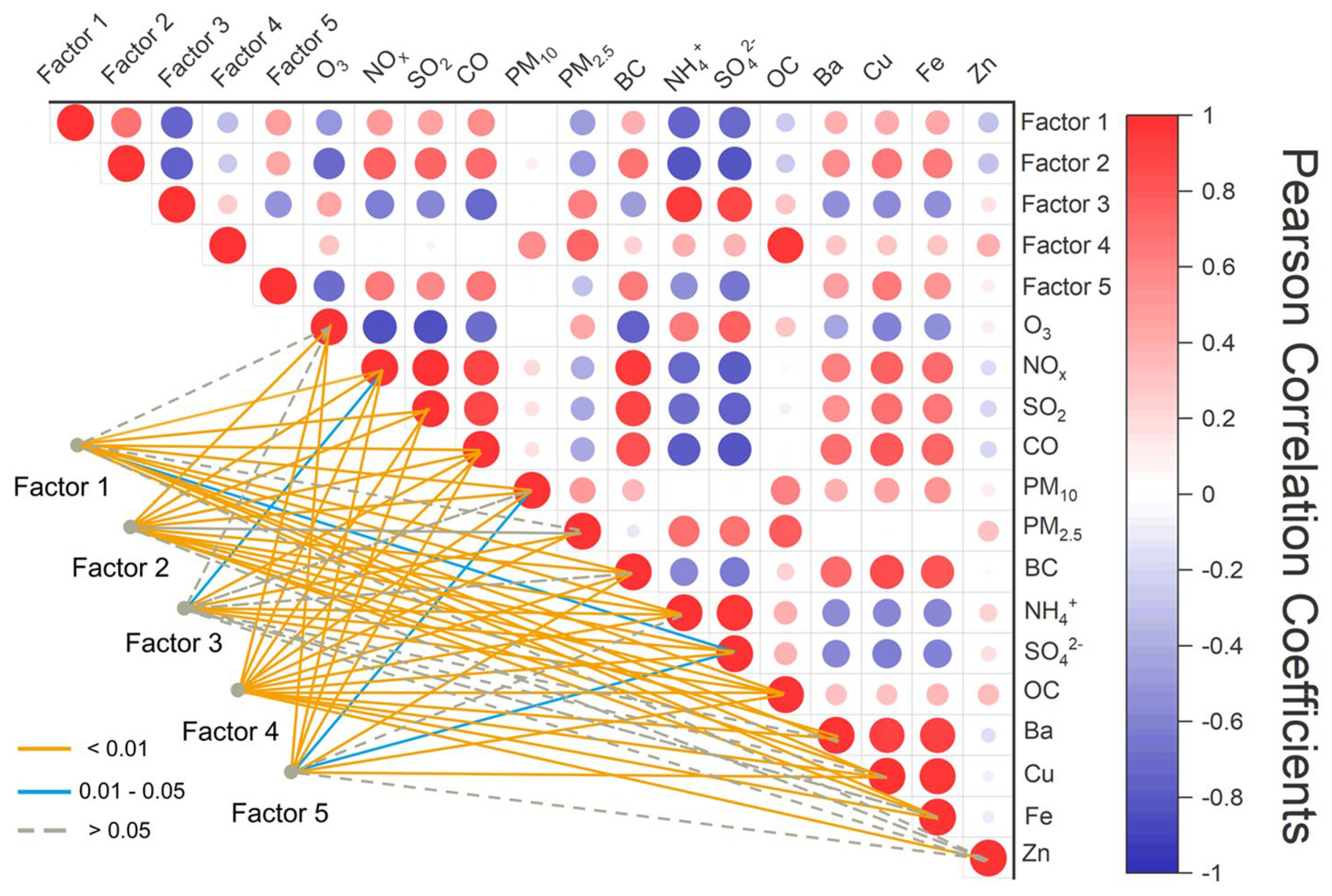
Pearson correlation analysis shows positive correlations with typical traffic-related pollutants (Figure 6), including NOx (r = 0.249, p < 0.01), SO2 (r = 0.227, p < 0.01), CO (r = 0.292, p < 0.01), PM10 (r = 0.163, p < 0.01), BC (r = 0.235, p < 0.01), and OC (r = 0.167, p < 0.01). In addition, significant positive correlations with Ba (r = 0.212, p < 0.01), Cu (r = 0.239, p < 0.01), and Fe (r = 0.267, p < 0.01) indicate contributions from non-exhaust traffic emissions such as brake and tyre wear. In contrast, Factor 1 is negatively correlated with O3 (r = −0.21, p < 0.01) and NH4+ (r = −0.183, p < 0.01), suggesting a limited influence from aged ammonium-rich secondary aerosols. Overall, the Pearson correlation analysis shows that Factor 1 is strongly affected by traffic exhaust, while also being partly mixed with non-exhaust components and slightly aged aerosol. Therefore, Factor 1 is interpreted as Aitken-mode particles of exhaust emission, i.e., traffic-related ultrafine particles that are somewhat more aged and mixed with non-exhaust components compared with the nucleation-mode Factor 2.
At the urban background site, Factor 1 similarly exhibited a bimodal PND, but with a smaller primary peak at approximately 31.7 nm and a secondary peak near 191.2 nm (Figure 4c). Its PNC profile was similar to that observed at the urban traffic site, suggesting that both sites were influenced by traffic-related emissions. This pattern is consistent with aged traffic particles transported from other areas. It accounted for roughly one-third of the total PNC at this site (33.5%), highlighting its dominant contribution. The diurnal variation at the background site (Figure 4d) shows a comparatively smoother day–night cycle than at the kerbside location, with reduced contributions around the late-morning period and higher contributions from afternoon to evening. This weaker and smoother diurnal contrast is consistent with a more mixed background environment, where the Factor 1 signal reflects both transported/aged traffic-related particles and local activity, rather than being dominated by immediate roadside emissions. These results reaffirm that Factor 1 represents a traffic-related source and are in line with previous observations that aged traffic particles can dominate ultrafine number concentrations in urban environments [21].

3.2.2. Factor 2: Nucleation-Mode Exhaust Emission

At the urban site, Factor 2 exhibits a PND dominated by a pronounced nucleation mode peak at 16.6 nm, with a weaker secondary peak around 604 nm (Figure 4e). Notably, approximately 96.7% of the associated particles were smaller than 100 nm, mainly within the nucleation (<30 nm) and the Aitken modes. This size profile is typical of freshly emitted vehicle exhaust particles. In addition, the diurnal variation in normalised Factor 2 contributions at the traffic site (Figure 4f) shows a pronounced early-morning enhancement (around the morning commuting period), followed by sustained elevated contributions during the daytime, and comparatively lower levels during late-night/early-morning hours. This temporal behaviour is consistent with a fresh, traffic-related source whose intensity increases with vehicle activity and is modulated by daytime dispersion conditions.
Pearson correlation analysis further supports this interpretation. Factor 2 shows positive correlations with typical traffic-related pollutants, including NOx (r = 0.46, p < 0.01), CO (r = 0.42, p < 0.01), and BC (r = 0.41, p < 0.01), indicating a strong influence from the traffic exhaust. It is also positively correlated with SO42− (r = 0.222, p < 0.01), OC (0.08, p < 0.01), and Fe (r = 0.396, p < 0.01), suggesting some mixing with secondary aerosol and traffic-related metallic particles, likely including contributions from brake and type wear. In contrast, Factor 2 is negatively correlated with O3 (r = −0.261, p < 0.01) and NH4+ (r = −0.246, p < 0.01), which is consistent with ozone titration by fresh NO and indicates only a limited influence from aged ammonium-rich secondary aerosols. Together, these correlations further confirm that Factor 2 represents fresh traffic exhaust emission.
Rönkkö et al. [19] highlighted that traffic is a dominant source of ultrafine particles in roadside environments, particularly within the nanocluster aerosol range. The observed 16.6 nm peak in this study falls within the nucleation mode, consistent with freshly emitted vehicle exhaust. Similarly, Kim et al. reported dominant concentrations in the 10–30 nm range during rush hours in Seoul, mainly attributed to diesel vehicles, while Chatain et al. [22] found that particles between 20 and 50 nm contributed significantly to roadside PNC in Strasbourg. Ghadikolaei et al. [23] also confirmed that diesel and gasoline vehicles emit primary particles predominantly in the 20–30 nm range. These observations corroborate the attribution of Factor 2 to fresh traffic emissions.
At the urban background site, Factor 2 displayed a unimodal PND with a sharp peak at 17.8 nm (Figure 4g), consistent with fresh traffic emissions. The diurnal profile revealed a gradual increase in concentration from midday to late afternoon, followed by a decline during the night, indicative of local traffic influence rather than pronounced rush-hour peaks. The diurnal profile at the background site (Figure 4h) exhibits a clear daytime build-up with increasing contributions from late morning to the afternoon, reaching a maximum in the late afternoon, and decreasing thereafter. The absence of a sharply defined rush-hour peak and the smoother daytime rise suggest that Factor 2 at the background site is influenced by diluted/transported fresh traffic emissions and local traffic activity under evolving boundary layer conditions.
In summary, Factor 2 consistently represents freshly emitted traffic exhaust particles at both the urban traffic and background locations. The contribution of Factor 2 is notably higher at the traffic site (26.6%) compared to the background site (9.9%), reflecting the greater vehicle activity at the former. The observed temporal and spatial patterns, along with size distributions and correlation analyses, collectively confirm its classification.

3.2.3. Factor 3: Secondary Aerosol

At the urban traffic site, Factor 3 is characterised by a dominance of particles larger than 100 nm, with approximately 94% of the associated particles exceeding this threshold (Figure 4i). This size distribution is in stark contrast to typical exhaust emission profiles, which are dominated by ultrafine particles (<100 nm). Such a discrepancy implies that Factor 3 particles are formed through atmospheric ageing processes rather than being emitted directly from combustion sources. Notably, the prevalence of >100 nm particles falls within the expected size range of secondary aerosols produced by atmospheric oxidation and gas-to-particle conversion processes [24].
Pearson correlation analysis further supports the identification of Factor 3 as a secondary aerosol source. Factor 3 shows significant positive correlations with PM2.5 (r = 0.403, p < 0.01), NH4+ (r = 0.78, p < 0.01), SO42− (r = 0.67, p < 0.01), and OC (r = 0.306, p < 0.01), indicating a strong association with fine particulate mass and secondary inorganic and organic aerosol. In contrast, Factor 3 is weakly but significantly negatively correlated with CO (r = 0.176, p < 0.01), suggesting that it is largely decoupled from primary combustion emissions. This combination of correlations strongly supports its identification as a secondary aerosol source. In particular, the strong co-variation in NH4+ and SO42− indicates the formation of neutralised ammonium sulphate or ammonium bisulphate—key constituents of secondary inorganic aerosols. Meanwhile, the correlation with SO2 underscores the importance of precursor availability for secondary aerosol formation. Taken together, these features are consistent with established mechanisms whereby gaseous precursors (including NOx and volatile organic compounds, VOCs) are oxidised in the atmosphere to yield secondary components such as sulphates, nitrates, and secondary organic aerosols [25]. The diurnal profile of Factor 3 shows a distinct afternoon peak in particle concentration (Figure 4j), which is consistent with enhanced photochemical activity driving secondary aerosol formation during the daytime. This diurnal behaviour aligns with findings from other studies: Hopke et al. [26] observed that secondary aerosol source profiles are generally dominated by particles larger than 100 nm, and Kalkavouras et al. [27] reported that secondary particle concentrations typically peak in the 80–100 nm range with elevated levels in the afternoon due to intensified photochemical reactions. These results from the literature closely match the present observations at the urban site.
At the urban background site, Factor 3 exhibits a dominant particle size mode at 523.4 nm with a secondary peak at 52.4 nm (Figure 4k), indicating that most particles associated with this factor lie in the accumulation mode. The diurnal profile at this site similarly shows an increase in particle concentration during the afternoon (particularly after midday; Figure 4l), consistent with photochemical conditions that are favourable for secondary aerosol formation. These characteristics mirror those observed at the urban site, further reinforcing the identification of Factor 3 as a secondary aerosol source.

3.2.4. Factor 4: Non-Exhaust Emissions

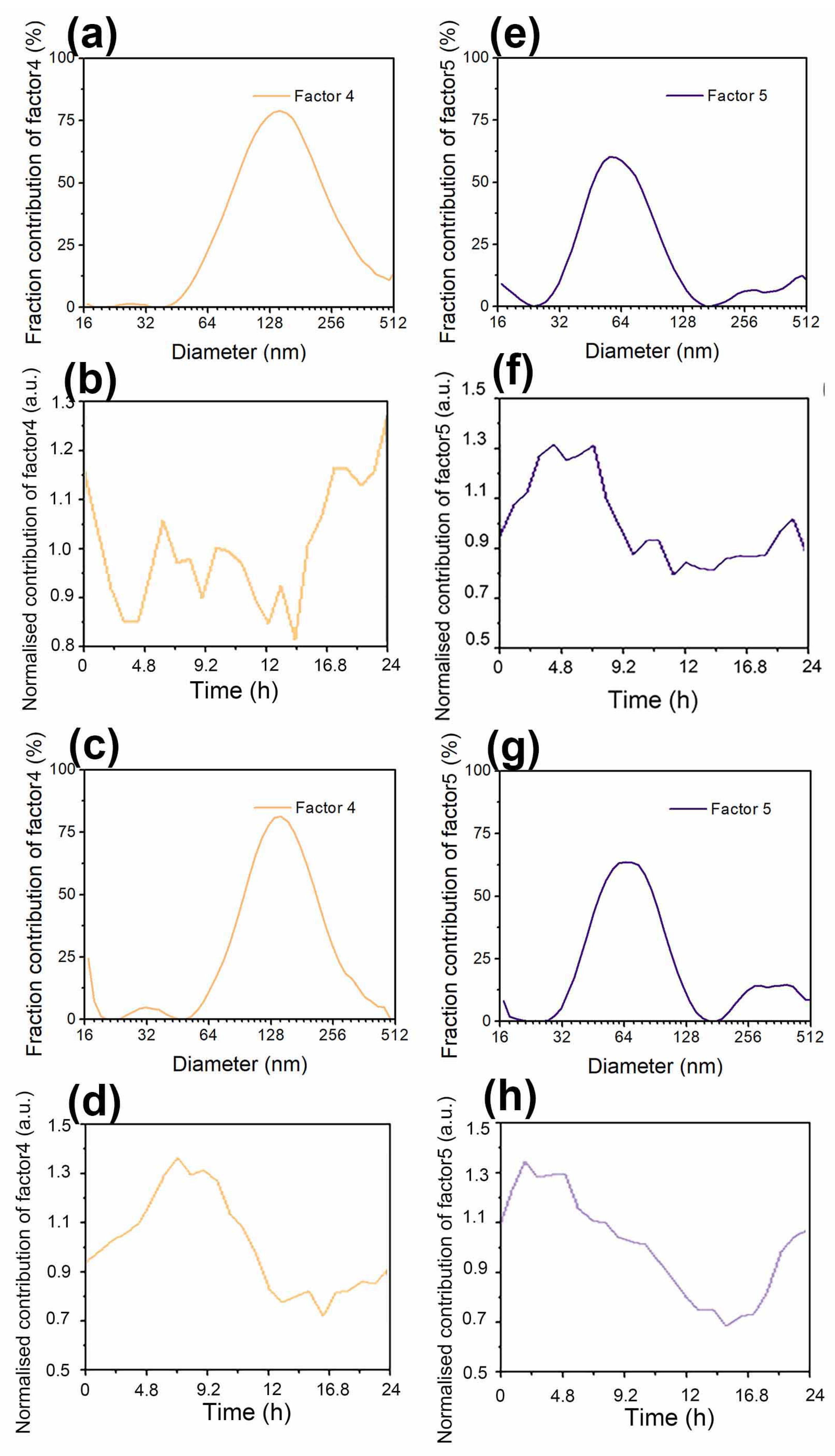
Factor 4 was identified as a source of non-exhaust traffic emissions at both the urban traffic and background sites. The PND of Factor 4 is clearly unimodal, with a peak at approximately 143 nm at the traffic site and around 115 nm at the background site (Figure 5a). This peak in the accumulation mode suggests that the particles are predominantly generated by mechanical abrasion or resuspension processes, rather than fresh combustion aerosols. Notably, the PND profile of Factor 4 lacks the ultrafine (<50 nm) modes typical of vehicle exhaust, which further supports a non-exhaust origin.
Chemical tracer analysis strongly reinforces the identification of Factor 4 as vehicle non-exhaust emissions. The PMF factor profile shows elevated contributions of heavy metals such as Cu, Zn, Fe, and Ba, along with substantial OC. These species are well-known markers of brake and tyre wear, as well as resuspended road dust. In particular, Fe, Cu, Zn, and Ba have been widely reported as abundant in brake lining materials (with Sb and Ba as specific brake wear tracers), and Zn is prominent in tyre rubber, making them diagnostic of traffic abrasion sources. The presence of OC in this factor may derive from organic-rich road dust or tyre fragments. Such a composition is clearly distinct from exhaust emissions (dominated by soot carbon and gaseous precursors), and closely matches the expected fingerprint of non-exhaust vehicular PM. The similarity of our Factor 4 to that “brake dust” source further confirms its identity as traffic-derived NEE.
The diurnal variation in Factor 4 further aligns with a traffic-derived source mechanism (Figure 5b). At the traffic site, Factor 4 exhibits pronounced increases during the day, with peaks corresponding to the morning and evening rush hours when traffic volume and stop-and-go driving (frequent braking) are highest. During these peak traffic periods, the contribution of non-exhaust particles can be an order of magnitude higher than during low traffic hours, as expected from intensified brake and tyre wear under congested conditions. In the late night and early morning (off-peak hours), Factor 4 contributions drop to near-minimal levels, consistent with very low traffic activity (and nearly absent braking events) at those times. Interestingly, the temporal variation in NEE-related particles differs between the traffic-congested area and the park area. In the traffic-heavy area, the NEE concentration peaks during the late hours (around 0:00), likely due to low traffic speeds and heavy braking in the nighttime traffic. In contrast, in the park area, where traffic intensity is lower, the NEE concentration peaks in the morning (around 9:00 a.m.), corresponding to increased traffic activity during the daytime. This suggests that the traffic activity in the surrounding areas has a strong influence on the NEE concentration in the park, even though the area itself is not directly impacted by high traffic.
The urban background site shows a similar diurnal pattern of Factor 4 on a reduced scale: a gentle daytime rise in contributions, indicating that even away from direct road influence, the ambient aerosol bears the imprint of increased daytime traffic emissions (likely through regional transport of resuspended dust or advected brake/tyre wear particles). The synchrony between the Factor 4 temporal profile and typical vehicle activity cycles reinforces the source attribution (Figure 5c,d). Overall, the size distribution, chemical signature, and daily pattern of Factor 4 all coherently point to non-exhaust emissions from road traffic (brake wear, tyre wear, and road dust resuspension) as a significant contributor to urban particulate matter at both kerbside and urban background locations. This finding highlights that even as exhaust emissions are increasingly controlled, non-exhaust particles remain an important urban air pollution source that can disperse beyond the immediate roadside environment.

3.2.5. Factor 5: Regional Background Accumulation

Factor 5 shows a major accumulation-mode peak at the traffic site at 60.1 nm (Figure 5e). This modal diameter lies in the accumulation range and is consistent with aged, regionally mixed particles rather than freshly emitted nucleation/Aitken-mode exhaust. The diurnal variation at the traffic site (Figure 5f) exhibits a relatively weak day–night contrast, with higher normalised contributions during late night/early morning and lower contributions around midday–afternoon. The absence of sharp rush-hour peaks and the smoother temporal evolution indicate that Factor 5 is not dominated by immediate local traffic emissions, but is mainly modulated by dilution/accumulation processes (e.g., changes in atmospheric mixing) acting on a background aerosol reservoir.
At the background site, Factor 5 presents a similar size distribution pattern with a major peak at ~65 nm (Figure 5g). Although the background site modal diameter is slightly larger than that at the traffic site (difference < 5 nm), this marginal shift should be interpreted cautiously given measurement uncertainty; therefore, we do not over-interpret this small difference and instead emphasise the overall similarity of the accumulation-mode profiles and their temporal behaviour. Consistently, the diurnal profile at the background site (Figure 5h) shows a gradual decrease from morning toward midday and an increase later in the day, again lacking pronounced rush-hour features. This smooth diurnal behaviour supports the interpretation of Factor 5 as a regional/background accumulation factor influenced primarily by atmospheric mixing and transport rather than local emission pulses.
Similar size distributions have been reported in other studies; for example, Vratolis et al. [28] observed a peak around 50–60 nm at an urban background site and attributed it to a mixture of dispersed urban emissions and regional influences. Likewise, Beddows et al. [20] reported an urban background factor characterised by weak chemical associations, limited diurnal variability, and diffuse wind sector influence, which they linked to pollution transported over long distances. Taken together, these results support the interpretation of Factor 5 as a background source.

3.3. Identification of High-Risk Areas Based on CPF Analysis

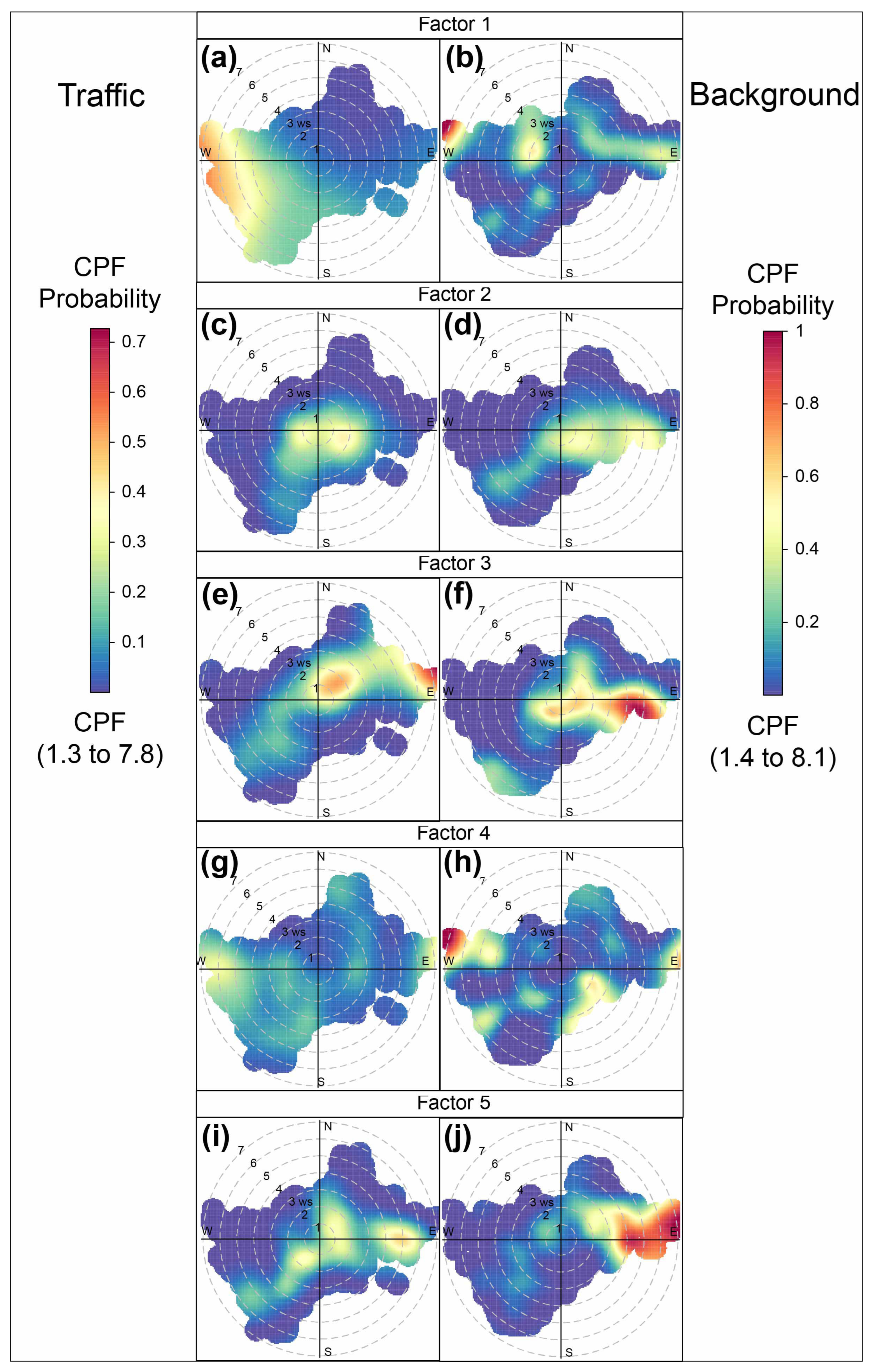
The CPF analysis for each factor highlights distinct wind patterns associated with high-concentration events, which in turn clarifies their likely sources. Factor 1 is predominantly associated with south-westerly winds (Figure 7a,b), bringing air masses from the nearby major road towards the site. These episodes typically occur during low wind speeds (approximately 0.3 m/s), conditions that limit dispersion and lead to pollutant build-up near the roadway. This behaviour is consistent with observations by Fuzzi et al. [15], who found that stagnant winds in roadside environments favour the accumulation of traffic-related pollutants. Based on these characteristics, Factor 1 is interpreted as Aitken-mode traffic exhaust particles. This behaviour is consistent with the findings of Manigrasso et al. [29], who observed that a mix of regional transport and local emissions enhances submicron particle concentrations. Based on these characteristics, Factor 1 is interpreted as Aitken-mode traffic exhaust particles.
By contrast, Factor 2 shows high contributions under westerly winds (Figure 7c,d), which carry fresh emissions directly from Marylebone Road to the monitoring site. This clear directional signal from the adjacent road confirms that Factor 2 represents fresh traffic exhaust emissions originating nearby.
In contrast to the locally sourced traffic factors, Factor 3 (secondary aerosol) displays enhanced conditional probabilities during south-westerly winds at both the roadside and background sites, especially at moderate wind speeds (Figure 7e,f). This common south-westerly pattern indicates that Factor 3 is dominated by regionally formed secondary particles delivered by the prevailing SW airflow, rather than generated by local emissions.
Unlike the previous factors, Factor 4 (NEEs) exhibits a diffuse CPF pattern with relatively low, uniform probabilities across all wind directions and little dependence on wind speed (Figure 7g,h). The absence of any dominant wind sector implies that NEE particles are generated locally around the sites (e.g., by vehicles in all directions and road surface abrasion/re-suspension) instead of coming from a single upwind source region.
Finally, Factor 5 (background) has a CPF distribution closely resembling that of Factor 3, with elevated probabilities concentrated in the south-westerly sector (Figure 7i,j). This similarity reinforces the identification of Factor 5 as a regional background contribution, representing aged, well-mixed air masses arriving from the prevailing upwind direction with only minimal local influence. Taken together, these CPF results clearly distinguish the regionally transported secondary and background contributions (Factors 3 and 5) from the more locally generated NEE contribution (Factor 4).

3.4. Comparative Analysis of Traffic and Non-Traffic Nanoparticle Contributions

The PMF results revealed that traffic-related sources dominated PNC at both sites, although their overall contribution was lower at the background location. At the urban traffic site, traffic-related sources, including Aitken-mode exhaust emission, nucleation-mode exhaust emission, and NEEs, accounted for 75.7% of the total PNC, with NEEs contributing 14.9%. At the urban background site, traffic-related sources accounted for 71.9% of total PNC, with NEEs contributing 28.5%. Similar patterns have been reported in previous PMF studies based on particle number data. For example, Kalkavouras et al. [27] found that traffic sources accounted for 65% of PNC during warm periods and 54% during cold periods in Athens. Rivas et al. [30] reported traffic contributions of 46% in Barcelona, 47% in Helsinki, 61% in London, and 68% in Zurich. In Beijing, Cai et al. [31] observed a combined traffic-related contribution of 44%.
In the background site, the fresh exhaust emission was substantially reduced, consistent with the lower local traffic intensity. By contrast, nucleation-mode exhaust emission, secondary aerosol, and background factors contributed relatively more, reflecting the strong influence of regionally formed and transported particles under such conditions. The NEEs’ contribution did not diminish with reduced traffic activity, indicating that NEEs remain a consistent component of the urban nanoparticle and cannot be neglected.
The NEEs contribution was comparable at both sites (14.9% at the traffic and 28.5% at the background location). This suggests that NEE-related particles at the background site may originate from nearby major roads, particularly in meteorological conditions that limit vertical dispersion and favour near-surface accumulation. Rönkkö and Timonen [19] observed that traffic-derived nanoparticles can impact urban air quality over extensive areas, with wind direction and atmospheric stability significantly influencing their spatial distribution. Similarly, Wrobel et al. [32] found that traffic-related fine particles can persist longer in the atmosphere due to their low settling velocity, and that their concentrations may peak at some distance from the road. Their study also highlighted that wind speed and direction significantly affect the spatial spread of traffic-related aerosols.

4. Conclusions

This study provides critical insights into the contribution of NEEs to PM in urban environments, particularly focusing on nanoparticles. The results demonstrate that NEEs, including particles from brake wear, tyre wear, the resuspension of road dust, and road surface abrasion, contribute significantly to the PNC at both high-traffic and background sites. Specifically, NEEs contributed 14.9% to the PNC at the traffic site and 28.5% at the background site, highlighting their persistent presence across diverse urban environments. Notably, the study shows that traffic-related sources dominate PNC, but NEEs remain a significant, often underappreciated source of particulate pollution, especially in areas with lower traffic intensity. These findings underscore the importance of integrating NEE control strategies alongside exhaust emission reduction efforts into urban air quality policies. The study also reveals that smaller particles (<100 nm) dominate the overall particle count, emphasising the need to prioritise regulating ultrafine particles, which pose considerable health risks despite their low mass due to their high number concentrations.
The analysis further highlights that policies should aim to mitigate both exhaust and non-exhaust sources. Measures such as implementing smoother driving practices and enhancing road maintenance can help reduce the formation of NEEs. Additionally, the study advocates the inclusion of metal tracers in air quality monitoring systems to improve the identification and differentiation of NEE sources. Incorporating number-based metrics like PNC, rather than mass-based measures, will also provide a more accurate understanding of nanoparticle pollution, especially for ultrafine particles that disproportionately impact human health.
Future research directions could focus on several key areas:
First, focus on linking PMF-resolved source-specific PNC contributions with existing epidemiological evidence to better contextualise the health implications of each identified source. Second, improve the use of number-based concentration metrics (PNC) in air quality monitoring and assessment by comparing them with traditional mass-based metrics to ensure that ultrafine particle exposures are adequately represented. Third, investigate how meteorological factors (such as wind speed and temperature) influence the spatial and temporal distributions of the resolved non-exhaust particle sources, to inform more targeted monitoring under varying conditions. Fourth, apply the PMF approach with particle number and chemical tracer data at additional urban locations or during different seasons to test the consistency of the identified nanoparticle sources and their contributions.
In conclusion, this study underscores the need for comprehensive air quality management strategies that address both exhaust and non-exhaust emissions. Urban air quality policies must integrate these findings to more effectively manage particulate pollution, especially given the growing evidence of the health impacts associated with ultrafine particles. By incorporating these sources into air quality frameworks, we can not only improve environmental health but also mitigate the broader impacts of traffic-related pollution in urban settings.

Author Contributions

Y.W.: Conceptualization, methodology, software, validation, formal analysis, investigation, visualisation, writing—original draft, writing—review and editing; G.B.: Writing—review and editing; P.K.: Conceptualization, methodology, supervision, project administration, funding acquisition, writing—original draft, writing—review and editing. All authors have read and agreed to the published version of the manuscript.

Funding

PK acknowledges the support received through the UKRI (NERC, EPSRC, AHRC) funded RECLAIM Network Plus (EP/W034034/1), GreenCities (NE/X002799/1), GP4Streets (APP44894), GREENIN Micro Network Plus (APP55977), and UGPN-funded (UGPN-NBS) projects.

Institutional Review Board Statement

Not applicable.

Informed Consent Statement

Not applicable.

Data Availability Statement

The original contributions presented in this study are included in the article. Further inquiries can be directed to the corresponding author.

Conflicts of Interest

The authors declare no conflicts of interest.

Abbreviations

The following abbreviations are used in this manuscript:
PMParticulate Matter
NAEIThe National Atmospheric Emissions Inventory
CuCopper
ZnZinc
FeIron
BaBarium
OCOrganic Carbon
PMFPositive Matrix Factorisation
PNCParticle Number Concentration
DEFRAThe UK Department for Environment, Food and Rural Affairs
SMPSScanning Mobility Particle Sizer
DMADifferential Mobility Analyser
CPCCondensation Particle Counter
CPFConditional Probability Function
NEEsNon-exhaust Emissions

References

  1. Manisalidis, I.; Stavropoulou, E.; Stavropoulos, A.; Bezirtzoglou, E. Environmental and Health Impacts of Air Pollution: A Review. Front. Public Health 2020, 8, 505570. [Google Scholar] [CrossRef]
  2. Hinds, W.C.; Zhu, Y. Aerosol Technology: Properties, Behavior, and Measurement of Airborne Particles; John Wiley & Sons: Hoboken, NJ, USA, 2022. [Google Scholar]
  3. Moreno-Ríos, A.L.; Tejeda-Benítez, L.P.; Bustillo-Lecompte, C.F. Sources, characteristics, toxicity, and control of ultrafine particles: An overview. Geosci. Front. 2022, 13, 101147. [Google Scholar] [CrossRef]
  4. Xuan, L.; Ju, Z.; Skonieczna, M.; Zhou, P.-K.; Huang, R. Nanoparticles-induced potential toxicity on human health: Applications, toxicity mechanisms, and evaluation models. MedComm 2023, 4, e327. [Google Scholar] [CrossRef] [PubMed]
  5. Schraufnagel, D.E. The health effects of ultrafine particles. Exp. Mol. Med. 2020, 52, 311–317. [Google Scholar] [CrossRef]
  6. Piscitello, A.; Bianco, C.; Casasso, A.; Sethi, R. Non-exhaust traffic emissions: Sources, characterization, and mitigation measures. Sci. Total Environ. 2021, 766, 144440. [Google Scholar] [CrossRef]
  7. Al-Dabbous, A.N.; Kumar, P. Source apportionment of airborne nanoparticles in a Middle Eastern city using positive matrix factorization. Environ. Sci. Process. Impacts 2015, 17, 802–812. [Google Scholar] [CrossRef]
  8. Ormanova, G.; Hopke, P.K.; Dhammapala, R.; Ozturk, F.; Shah, D.; Torkmahalleh, M.A. Chemical characterization and source apportionment of atmospheric fine particulate matter (PM2.5) at an urban site in Astana, Kazakhstan. Atmos. Pollut. Res. 2025, 16, 102324. [Google Scholar] [CrossRef]
  9. Denier van der Gon, H.A.C.; Gerlofs-Nijland, M.E.; Gehrig, R.; Gustafsson, M.; Janssen, N.; Harrison, R.M.; Hulskotte, J.; Johansson, C.; Jozwicka, M.; Keuken, M.; et al. The Policy Relevance of Wear Emissions from Road Transport, Now and in the Future—An International Workshop Report and Consensus Statement. J. Air Waste Manag. Assoc. 2013, 63, 136–149. [Google Scholar] [CrossRef]
  10. Smolders, E.; Degryse, F. Fate and Effect of Zinc from Tire Debris in Soil. Environ. Sci. Technol. 2002, 36, 3706–3710. [Google Scholar] [CrossRef]
  11. Councell, T.B.; Duckenfield, K.U.; Landa, E.R.; Callender, E. Tire-Wear Particles as a Source of Zinc to the Environment. Environ. Sci. Technol. 2004, 38, 4206–4214. [Google Scholar] [CrossRef]
  12. Harrison, R.M.; Allan, J.; Carruthers, D.; Heal, M.R.; Lewis, A.C.; Marner, B.; Murrells, T.; Williams, A. Non-exhaust vehicle emissions of particulate matter and VOC from road traffic: A review. Atmos. Environ. 2021, 262, 118592. [Google Scholar] [CrossRef]
  13. Fussell, J.A.-O.; Franklin, M.; Green, D.C.; Gustafsson, M.; Harrison, R.A.-O.; Hicks, W.A.-O.; Kelly, F.J.; Kishta, F.; Miller, M.A.-O.X.; Mudway, I.S.; et al. A Review of Road Traffic-Derived Non-Exhaust Particles: Emissions, Physicochemical Characteristics, Health Risks, and Mitigation Measures. Environ. Sci. Technol. 2022, 56, 6813–6835. [Google Scholar] [CrossRef] [PubMed]
  14. O’Loughlin, D.P.; Haugen, M.J.; Day, J.; Brown, A.S.; Braysher, E.C.; Molden, N.; Willis, A.E.; MacFarlane, M.; Boies, A.M. Multi-element analysis of tyre rubber for metal tracers. Environ. Int. 2023, 178, 108047. [Google Scholar] [CrossRef] [PubMed]
  15. Aatmeeyata; Sharma, M. Polycyclic aromatic hydrocarbons, elemental and organic carbon emissions from tire-wear. Sci. Total Environ. 2010, 408, 4563–4568. [Google Scholar] [CrossRef]
  16. Xue, W.; Xue, J.; Mousavi, A.; Sioutas, C.; Kleeman, M.J. Positive matrix factorization of ultrafine particle mass (PM0.1) at three sites in California. Sci. Total Environ. 2020, 715, 136902. [Google Scholar] [CrossRef]
  17. Matthaios, V.N.; Lawrence, J.; Martins, M.A.G.; Ferguson, S.T.; Wolfson, J.M.; Harrison, R.M.; Koutrakis, P. Quantifying factors affecting contributions of roadway exhaust and non-exhaust emissions to ambient PM10–2.5 and PM2.5–0.2 particles. Sci. Total Environ. 2022, 835, 155368. [Google Scholar] [CrossRef]
  18. Zhao, Z.; Hao, M.; Li, Y.; Li, S. Contamination, sources and health risks of toxic elements in soils of karstic urban parks based on Monte Carlo simulation combined with a receptor model. Sci. Total Environ. 2022, 839, 156223. [Google Scholar] [CrossRef]
  19. Rönkkö, T.; Kuuluvainen, H.; Karjalainen, P.; Keskinen, J.; Hillamo, R.; Niemi, J.V.; Pirjola, L.; Timonen, H.J.; Saarikoski, S.; Saukko, E.; et al. Traffic is a major source of atmospheric nanocluster aerosol. Proc. Natl. Acad. Sci. USA 2017, 114, 7549–7554. [Google Scholar] [CrossRef]
  20. Beddows, D.C.S.; Harrison, R.M.; Green, D.C.; Fuller, G.W. Receptor modelling of both particle composition and size distribution from a background site in London, UK. Atmos. Chem. Phys. 2015, 15, 10107–10125. [Google Scholar] [CrossRef]
  21. Vörösmarty, M.; Hopke, P.K.; Salma, I. Attribution of aerosol particle number size distributions to main sources using an 11-year urban dataset. Atmos. Chem. Phys. 2024, 24, 5695–5712. [Google Scholar] [CrossRef]
  22. Chatain, M.; Alvarez, R.; Ustache, A.; Rivière, E.; Favez, O.; Pallares, C. Simultaneous roadside and urban background measurements of submicron aerosol number concentration and size distribution (in the Range 20–800 nm), along with chemical composition in Strasbourg, France. Atmosphere 2021, 12, 71. [Google Scholar] [CrossRef]
  23. Ghadikolaei, M.A.; Wong, P.; Chen, S.H.; Ng, K.W.; Xu, J. Effect of vehicle light on the nanostructure of particulate matters emitted from diesel and gasoline vehicles. WIT Trans. Ecol. Environ. 2021, 252, 125–133. [Google Scholar]
  24. Hallquist, M.; Wenger, J.C.; Baltensperger, U.; Rudich, Y.; Simpson, D.; Claeys, M.; Dommen, J.; Donahue, N.; George, C.; Goldstein, A. The formation, properties and impact of secondary organic aerosol: Current and emerging issues. Atmos. Chem. Phys. 2009, 9, 5155–5236. [Google Scholar] [CrossRef]
  25. Seinfeld, J.H.; Pandis, S.N. Atmospheric Chemistry and Physics: From Air Pollution to Climate Change; John Wiley & Sons: Hoboken, NJ, USA, 2016. [Google Scholar]
  26. Hopke, P.K.; Feng, Y.; Dai, Q. Source apportionment of particle number concentrations: A global review. Sci. Total Environ. 2022, 819, 153104. [Google Scholar] [CrossRef] [PubMed]
  27. Kalkavouras, P.; Grivas, G.; Stavroulas, I.; Petrinoli, K.; Bougiatioti, A.; Liakakou, E.; Gerasopoulos, E.; Mihalopoulos, N. Source apportionment of fine and ultrafine particle number concentrations in a major city of the Eastern Mediterranean. Sci. Total Environ. 2024, 915, 170042. [Google Scholar] [CrossRef]
  28. Vratolis, S.; Gini, M.I.; Bezantakos, S.; Stavroulas, I.; Kalivitis, N.; Kostenidou, E.; Louvaris, E.; Siakavaras, D.; Biskos, G.; Mihalopoulos, N.; et al. Particle number size distribution statistics at City-Centre Urban Background, urban background, and remote stations in Greece during summer. Atmos. Environ. 2019, 213, 711–726. [Google Scholar] [CrossRef]
  29. Manigrasso, M.; Protano, C.; Martellucci, S.; Mattei, V.; Vitali, M.; Avino, P. Evaluation of the Submicron Particles Distribution Between Mountain and Urban Site: Contribution of the Transportation for Defining Environmental and Human Health Issues. Int. J. Environ. Res. Public Health 2019, 16, 1339. [Google Scholar] [CrossRef]
  30. Rivas, I.; Beddows, D.C.S.; Amato, F.; Green, D.C.; Järvi, L.; Hueglin, C.; Reche, C.; Timonen, H.; Fuller, G.W.; Niemi, J.V.; et al. Source apportionment of particle number size distribution in urban background and traffic stations in four European cities. Environ. Int. 2020, 135, 105345. [Google Scholar] [CrossRef]
  31. Cai, J.; Chu, B.; Yao, L.; Yan, C.; Heikkinen, L.M.; Zheng, F.; Li, C.; Fan, X.; Zhang, S.; Yang, D.; et al. Size-segregated particle number and mass concentrations from different emission sources in urban Beijing. Atmos. Chem. Phys. 2020, 20, 12721–12740. [Google Scholar] [CrossRef]
  32. Wróbel, A.; Rokita, E.; Maenhaut, W. Transport of traffic-related aerosols in urban areas. Sci. Total Environ. 2000, 257, 199–211. [Google Scholar] [CrossRef]
Figure 1. Locations of the Marylebone Road (traffic) and Honor Oak Park (background) monitoring sites in London. (a) Location of the study area within the UK. (b) Honor Oak Park site (background). (c) Marylebone Road site (traffic). Inset photograph showing the street canyon environment at the traffic site (source: DEFRA UK-AIR site information page, UKA00315; accessed on 17 January 2026; Open Government Licence v3.0).
Atmosphere 17 00164 g001
Figure 2. Particle number and size distribution at different study sites. (a) Particle number distribution for the traffic site. (b) Time dependence of the smallest particle size and number at the traffic site. (c) Time dependence of the largest particle size and number at the traffic site. (d) Particle number distribution for the traffic site. (e) Time dependence of the smallest particle size and number at the background site. (f) Time dependence of the largest particle size and number at the background site.
Atmosphere 17 00164 g002
Figure 3. PMF-derived source contributions to PNC at the traffic and background sites. (a) Contribution of sources to the total PNC data in the traffic site. (b) Proportional contributions of identified sources to PNC using PMF at the traffic site. (c) Contribution of sources to the total PNC data in the background site as a percentage. (d) Proportional contributions of identified sources to PNC using PMF at the background site.
Atmosphere 17 00164 g003
Figure 4. Size distribution profiles and diurnal variations in PMF Factors 1–3 at the traffic and background sites. (a) Factor 1 size distribution profile at the traffic site. (b) Diurnal variation in normalised Factor 1 contributions at the traffic site. (c) Factor 1 size distribution profile at the background site. (d) Diurnal variation in normalised Factor 1 contributions at the background site. (e) Factor 2 size distribution profile at the traffic site. (f) Diurnal variation in normalised Factor 2 contributions at the traffic site. (g) Factor 2 size distribution profile at the background site. (h) Diurnal variation in normalised Factor 2 contributions at the background site. (i) Factor 3 size distribution profile at the traffic site. (j) Diurnal variation in normalised Factor 3 contributions at the traffic site. (k) Factor 3 size distribution profile at the background site. (l) Diurnal variation in normalised Factor 3 contributions at the background site.
Atmosphere 17 00164 g004
Figure 5. Size distribution profiles and diurnal variations in PMF Factors 4–5 at the traffic and background sites. (a) Factor 4 size distribution profile at the traffic site. (b) Diurnal variation in normalised Factor 4 contributions at the traffic site. (c) Factor 4 size distribution profile at the background site. (d) Diurnal variation in normalised Factor 4 contributions at the background site. (e) Factor 5 size distribution profile at the traffic site. (f) Diurnal variation in normalised Factor 5 contributions at the traffic site. (g) Factor 5 size distribution profile at the background site. (h) Diurnal variation in normalised Factor 5 contributions at the background site.
Atmosphere 17 00164 g005
Figure 6. Pearson correlation coefficients of pollutants and five factors.
Atmosphere 17 00164 g006
Figure 7. CPF analysis at the 75th percentile level. Conditional probability function (CPF) analysis at the 75th percentile level for the five PMF factors at the traffic and background sites. (a) Factor 1 at the traffic site; (b) Factor 1 at the background site. (c) Factor 2 at the traffic site; (d) Factor 2 at the background site. (e) Factor 3 at the traffic site; (f) Factor 3 at the background site. (g) Factor 4 at the traffic site; (h) Factor 4 at the background site. (i) Factor 5 at the traffic site; (j) Factor 5 at the background site.
Atmosphere 17 00164 g007
Disclaimer/Publisher’s Note: The statements, opinions and data contained in all publications are solely those of the individual author(s) and contributor(s) and not of MDPI and/or the editor(s). MDPI and/or the editor(s) disclaim responsibility for any injury to people or property resulting from any ideas, methods, instructions or products referred to in the content.